












































Markwayne Mullin, in DHS nomination hearing, vows to improve security grant program
Mullin said he would work to streamline the paperwork process and reimbursement timelines
Oliver Contreras/AFP via Getty Images
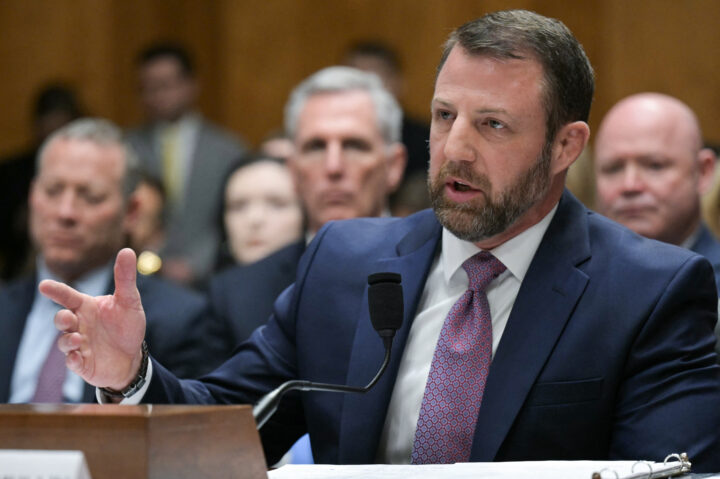
DHS Secretary Markwayne Mullin testifies during a Senate Committee on Homeland Security and Governmental Affairs confirmation hearing on Capitol Hill in Washington, DC


 Add JewishInsider on Google
In his nomination hearing to be secretary of homeland security, Sen. Markwayne Mullin (R-OK) said he will aim to “streamline the process” for grants, including the Nonprofit Security Grant Program (NSGP) aimed at helping harden religious institutions, amid heightened antisemitism and increased threats during the ongoing war in Iran.
The NSGP has faced persistent challenges, including severe underfunding, controversial new conditions and, most recently, delays tied to the ongoing partial shutdown of the Department of Homeland Security.
When pressed by senators on the need to unlock NSGP funding in the wake of the violent attack at Temple Israel in suburban Detroit last week, Mullin agreed that the process should be streamlined and said he would aim to “cut out the redundancies” and “amount of paperwork.”
“The Jewish community is spending about a billion dollars a year privately securing their own institutions,” said Sen. Elissa Slotkin (D-MI). “No religious group should have to spend that amount of money on their own security in the United States of America. So I would just ask for your help in reforming the Nonprofit Security Grant Program so it’s agile, so you don’t have to win the grant and then still do 100 pieces of paper.”
Sen. James Lankford (R-OK) echoed those sentiments, noting that the “length of time it takes to get a response” is concerning, especially for “locations that are higher risk than others.”
“Synagogues and temples have been one of those very high risk locations that are out there,” Lankford said, referencing the attack at Temple Israel. “That location happened to be one of the locations where there’s also been this nonprofit security grant to help harden that facility.”
“We have multiple challenges here,” Lankford added. “One of them is, when the decision is made, they make a request, go through the paperwork, get approval to be one of those locations that we say we need to harden this location. Once the approval is done, it may take months to over a year just for the dollars to actually come on it because there’s more bureaucratic hoops to go through.”
In response, Mullin agreed, “there’s a better way to do this.” He added that while he may have political differences with some of the lawmakers on the committee, this issue “isn’t one” of them and that he would be “laser focused and get this resolved.”
“The amount of paperwork once you’re approved to get the funding flowing, and then the paperwork that’s followed up on is way too encompassing,” Mullin said. “Taking years to get reimbursed is not acceptable. Taking months to get reimbursed is not acceptable.”
Mullin was also pressed on the threat of terrorist attacks domestically amid the DHS funding lapse and ongoing conflict in Iran.
Sen. Josh Hawley (R-MO), cited several recent incidents that had “potential terrorist ties,” including the antisemitic attack at Temple Israel in Michigan whose perpetrator had family ties to Hezbollah; a school shooting at Old Dominion University earlier this month, which is being investigated as an act of terrorism; a mass shooting in Austin, Texas, which is being investigated as having ties to the Iran conflict; and the detonation of bombs in New York City.
“Is this a good time for the Department of Homeland Security to be shut down and unfunded?” Hawley said.
“It’s a horrible time,” Mullin replied. “It’s devastating to the morale of the men and women we have tasked to keep care, take care of all of us, all the homeland, regardless it’s a blue state or red state.”
Sen. Richard Bumenthal (D-CT) pressed Mullin over whether he would approve the deportation of Iranian dissidents who could face death or punishment upon being returned to Tehran. The Trump administration has deported Iranians back to Iran from the U.S. on several deportation flights after a deal between the two governments was reached.
“Before the war in Iran began, the Trump administration negotiated a back-channel agreement, a deal with the Islamic Republic to deport Iranian nationals, including asylum seekers and dissidents,” Blumenthal said. “I have no doubt you share my outrage about the treatment of Iranian nationals who were deported, possibly to torture and death in Iran. We should not be sending Iranian dissidents and asylum seekers back to Iran, wouldn’t you agree?”
Mullin was noncommittal, arguing that he didn’t know “the specifics” behind the incident.
“Before I can talk about hypotheticals, I would need to know the reasons behind it,” Mullin said. “But I don’t want to deport anybody that’s here legally and most definitely not individuals that have done everything possible to be a contributor to society.”
“We know that our enemies want to infiltrate us and use our rules and generosity against us, so I don’t know the specifics of their background,” Mullin added. “But I will be happy to look into it.”
Rep. Josh Gottheimer (D-NJ), a leader in the House on antisemitism and NGSP funding who attended Mullin’s hearing, told Jewish Insider that DHS needed “new leadership,” and signaled an openness to working with Mullin on the issue.
“We don’t agree on everything, that’s for sure. But, after a decade of working out together most mornings, and finding bipartisan solutions to some of the toughest issues, Markwayne and his family have become very good friends,” Gottheimer said.
During the hearing, Mullin also noted that Gottheimer is “a friend” and that he would “run through fire for the guy.”
“When Josh asked me to join a bipartisan group called No Labels, that’s when we really started seeing that there’s a lot of common ground that we can work together on,” Mullin said. “We can set the differences aside, and we can work together. In fact, our daughters are writing a book together about bipartisanship.”
Mullin’s prospects for confirmation remain somewhat in question, given apparent opposition from Sen. Rand Paul (R-KY), who leads the committee where Mullin’s nomination vote will take place. Paul’s opposition traces to personal animosity between the two colleagues, as well as what Paul described as Mullin’s “anger issues.”
Mullin recently called Paul a “freaking snake” and said that he “understood” why Paul’s neighbor had attacked him, an assault that resulted in serious injuries and a prison sentence for Paul’s neighbor. Mullin refused to apologize at the hearing, to Paul’s outrage.
“I was shocked that you would justify and celebrate this violent assault that caused me so much pain and my family so much pain. The record will show a lack of contrition, no apology and no regrets for your support. You completely understand the violence that was perpetrated on me. You’re unrepentant,” Paul said. “I just wonder if someone who applauds violence against their political opponents is the right person to lead an agency that has struggled to accept limits to the proper use of force.”
“We can have our differences,” Mullin replied. “It’s not going to keep me from doing my job as secretary of homeland security.”
Paul threatened during the hearing to cancel the vote, scheduled for Thursday, on Mullin’s nomination. If Paul refuses to allow a vote, that would effectively block Mullin’s nomination, even if he otherwise has the necessary support to advance.
The Kentucky senator and committee Democrats also raised questions about a classified trip Mullin claims to have taken to a combat zone while he was a member of the House, the details of which Mullin refused to discuss in public during the hearing, alleging that the trip was classified. Committee members retired to a secure room to discuss the trip after the hearing.
If a vote is held, Mullin will need the support of at least one Democrat on the committee in order to advance without Paul’s support. Sen. John Fetterman (D-PA) has previously expressed his intention to support Mullin, and urged Paul and Mullin to move past their feud during the hearing.
More Stories

CANCEL CALLS
Democratic push grows for Ilhan Omar, Fateh to cancel Hasan Piker event

Daily Overtime
Deadlocked dash to Israeli elections
HISTORY LESSON
Brett McGurk’s fact check of former Harris advisor Phil Gordon on hostage negotiations

PREDECESSOR PROBLEMS
The Lander policy at the heart of Levine’s Israel bonds reversal

Daily Overtime
Hillel disputes fired rabbi’s claim

PRESIDENTIAL ENDORSEMENT
Trump gives Netanyahu ‘complete and total endorsement’
Please log in if you already have a subscription, or subscribe to access the latest updates.
 Continue with Google
 Continue with Apple