















































Experts are raising red flags on the technology’s ability to influence voters and the lack of regulations around its use

Haim Zach/GPO
Israeli Prime Minister Benjamin Netanyahu votes in the September 2019 national election.


 Add JewishInsider on Google
The run-up to next year’s Israeli election will be the first in which artificial intelligence tools to create images and videos and rapidly compose texts are easily accessible, and experts are raising red flags over the technology’s ability to influence voters and campaigns and the lack of regulations around its use.
Israeli politicians have long been early adopters of technological tools to boost their campaigns, from bypassing traditional media through Facebook to using social media data to target key demographics before most liberal democracies were doing so, and AI will likely be no different.
Tehilla Shwartz Altshuler, head of the Democracy in the Digital Age program at the Israel Democracy Institute, told Jewish Insider that Israel is one of the countries with the largest market penetration of AI in the world — 85% of Israelis have used ChatGPT and 76% use it frequently, according to a study by the Israeli Internet Association published in October — so it is only a matter of time before politicians use it in their campaigns.
(National elections are legally required to take place on Oct. 26, 2026, at the latest, but political tensions make an earlier date possible.)
“AI chatbots have significant penetration in the public,” Shwartz Altshuler said. “They will be used to ask whether to vote and for whom to vote. We have not seen anything like this before. … People use chatbots as a companion for emotional support. The concern over the great influence of chatbots on voter behavior is significant.”
Shwartz Altshuler said that there have already been attempts to “give poison injections” to AI models, such as creating fake news sites and positions on subreddits to manipulate the bots into giving more pro-Israel responses to users abroad, and those tools can be turned inward, toward Israeli voters.
She also pointed out that Israel does not have any laws requiring machine-generated content to be labeled.
“This is the first time we have an election in which we are unable to differentiate between authentic and machine-generated photos and videos,” she said. “There is a fear that the perception of reality is being undermined. People can forge documents and make deepfakes of politicians. … Machine-generated content can create an alternative reality, a very dangerous prospect when the content is very emotionally attractive.”
Yuval Dror, the former dean of media studies in Israel’s College of Management Studies, who hosts a popular technology podcast in Hebrew, was skeptical that computer-generated photos and videos will have a major impact on the next election.
“With photos, sometimes we can tell if it’s AI or not. With video, people usually know that it’s AI,” he told JI. “The impact of [AI-generated] video will mostly be economic, because it will be much easier to produce. In the past, you needed an ad agency, actors, post-production work. Now it’s much easier, so [campaigns will] save money.”
“You can create a false presentation in which masses of people say this or that and look like a grassroots movement,” Yuval Dror, the former dean of media studies in Israel’s College of Management Studies, said. “There is [already] an army of bots echoing a few people on social media.”
Dror was more concerned about AI-generated texts, which he noted can be much harder to detect.
AI may be used in upcoming political campaigns to flood social networks with content, making a candidate, message or policy appear to have more support than it does in reality. This already happens on X, where much of the political discourse in Israel takes place, but also in more closed networks like WhatsApp and Telegram, Dror said.
“You can create a false presentation in which masses of people say this or that and look like a grassroots movement,” Dror said. “There is [already] an army of bots echoing a few people on social media.”
“We’ve seen this for years. It will just get more and more convincing,” he added.
Shwartz Altshuler said that social media companies have difficulty stemming mass-bot content. “Generative AI can create a lot of versions of the same content, so the result is inauthentic, coordinated behavior on social media,” she said. “If there are slightly different versions of the same content, the social networks don’t detect” that it comes from bots.
“Most of these [AI tools] are not mentioned in the law or by past Central Election Committee decisions. They are in a grey area. [Campaigns] will do what they want,” Tehilla Shwartz Altshuler, head of the Democracy in the Digital Age program at the Israel Democracy Institute, predicted.
In addition, developments in AI since the last Israeli election, in 2022, can help politicians use data even more effectively to target potential voters with different kinds of messages and ads, she said.
Shwartz Altshuler recounted speaking with a prominent Israeli political strategist who told her, “First we win elections, and then we see if what we did is legal or not.”
“Most of these [AI tools] are not mentioned in the law or by past Central Election Committee decisions. They are in a grey area. [Campaigns] will do what they want,” she predicted.
Despite the fertile ground for election fraud using AI, Shwartz Altshuler said it is unlikely that new laws will be passed before the next election. “This coalition has no motivation to pass such laws [and] usually the courts say laws [regarding elections] can only be applied after the next election.”
She also pointed out that the current Central Election Committee chairman, Noam Solberg, is a conservative Supreme Court justice, and therefore would be unlikely to instruct the Knesset to pass laws addressing the issue.
Despite all the advances in AI, it may not be enough to cover for a weak candidate.
Dror said that Israeli politicians are already using AI to write texts for social media or speeches: “Some politicians are not capable of stringing together two sentences, so they let AI do it, but the result is no less awkward.”
They have also generated all kinds of pictures to post online, which Dror said “makes [them] look stupid,” using Israeli Environmental Protection Minister Idit Silman, who posted a picture earlier this year depicting French President Emmanuel Macron kissing Hamas leader Yahya Sinwar, as an example. Israeli Defense Minister Israel Katz frequently posted AI-generated images ridiculing Israel’s enemies when he was foreign minister last year.
“I don’t know that there’s an audience for this stupidity,” Dror said.
Republican and Democratic lawmakers express hope that the new feature will expose the level of foreign involvement in domestic online political discourse

Subaas Shrestha/NurPhoto via Getty Images
A Nepali X (formerly Twitter) user opens the mobile app on September 4, 2025, following the announcement of the government to ban the social media platform in the Himalayan nation.
Republican and Democratic lawmakers alike are cheering the implementation of X’s new location feature this week — allowing users to see what countries accounts are operating from — with some expressing hope that the move will expose the level of foreign involvement in domestic online political discourse.
Lawmakers on both sides of the aisle touted the new feature as a useful way to identify if an account commenting on U.S. political matters could potentially be a foreign actor.
The new feature has exposed a variety of far-left and far-right accounts engaging in U.S. political discourse and spreading antisemitic and anti-Israel sentiments as they operate from various foreign countries.
Rep. Don Bacon (R-NE) said the information gleaned from the platform’s new feature crystalized the degree to which “foreign interests are trying to spread” antisemitic ideas in the United States. “The evidence is insightful,” Bacon, who is leading a bill with Rep. Josh Gottheimer (D-NJ) aimed at addressing antisemitism on social media, told Jewish Insider.
“On one hand I’m glad much of the antisemitism poison is not coming from the U.S., but it is alarming that so many foreign interests are trying to spread that poison by pushing it in the U.S. and masquerading as Americans,” the Nebraska Republican continued. “We need to keep informing Americans that much of the antisemitism is coming from abroad.”
Several lawmakers argued that the feature would help with the broader effort to prevent worsening domestic partisan divides, especially those fueled by U.S. adversaries.
“Foreign adversaries have spent years flooding social media with hate-filled and antisemitic propaganda to divide Americans,” Sen. James Lankford (R-OK), the GOP co-chair of the Senate Bipartisan Task Force for Combating Antisemitism, told JI. “Americans deserve to know which accounts are run from abroad so we know the true source of these narratives.”
Rep. Tom Suozzi (D-NY), who represents a Trump district and has been critical of X owner Elon Musk, said in a statement, “I have always suspected that many anti-Israel, antisemitic, Jew hate accounts are promoted by our adversaries.”
“Beijing, Moscow and Tehran know they cannot defeat us economically or militarily, so they exploit controversial issues, like Israel and antisemitism, and try to divide,” Suozzi told JI. “We must defend America by pushing back on external adversaries seeking to divide us internally.”
Others noted in statements to JI that ensuring transparency from major social media platforms was a necessary step in combating the rise in online antisemitism.
“Transparency on social media is crucial to fighting misinformation and antisemitism online. We’ve seen cases of foreign actors like Russia, China and Iran attempting to use these platforms to sow division and spread hate,” Gottheimer told JI. “I am glad they implemented this change and hope they will work with Congress to take steps to fight antisemitism and prevent malicious foreign influence.”
Rep. Laura Friedman (D-CA), who led a letter to Defense Secretary Pete Hegseth in July about X’s AI program Grok expressing antisemitic and pro-Nazi ideas, told JI in a statement, “This transparency is an important step. No matter what side of the aisle you’re on, bad actors spreading antisemitic narratives to divide Americans is a real threat. There’s much more tech companies should do to expose and stop this manipulation.”
Other Republicans also commented on the new feature this week.
Sen. Ted Cruz (R-TX), who has become a leading voice targeting right-wing antisemitism, posted on X on Tuesday that “America-hating foreign bots are at it again,” in response to a tweet from an account that is based in South Asia, according to the new location feature.
Former U.S. Ambassador to the U.N. Nikki Haley tweeted her support for the new service, writing on Tuesday, “I have long said foreign actors are using social media to poison our politics and divide Americans. The location feature on X is a huge win for transparency and American security. Other social media platforms should do the same.”
The demonstration portraying Israeli and U.S. leaders drinking the blood of Gazans was organized by Hazami Barada and Atefeh Rokhvand, who have been involved in setting up anti-Israel encampments across the D.C. area

A demonstration at Union Station in Washington, D.C., portrayed Israeli and U.S. leaders eating and drinking the blood and organs of Gazans
An antisemitic art display at Washington Union Station on Thursday depicting U.S. and Israeli leaders drinking the blood of Gazans is drawing widespread condemnation for echoing the historic blood libel against Jews.
“This is the kind of stuff that Nazi soldiers were shown during World War II, with the idea to make it that Jewish people were not humans,” Ron Halber, CEO of the Jewish Community Relations Council of Greater Washington, told Jewish Insider. “This is exactly what that is in the modern day. It is done to make Jews look like animals.”
The demonstration, displayed both inside and outside of D.C’s main train station, was organized by Hazami Barada and Atefeh Rokhvand, two anti-Israel activists who have been involved in several protests around Washington since the Oct. 7, 2023, terrorist attacks in Israel, including leading a protest encampment outside of the Israeli Embassy and outside of then-Secretary of State Tony Blinken’s home for months in 2024.
Barada protested a community vigil for the first anniversary of the Oct. 7 attack, which took place at The Anthem, a music venue in the nation’s capital. Rokhvand is an elementary school teacher who spoke at the Muslim Student Association conference in 2024.
Another local activist, Hasan Isham, took credit on Instagram for 3D printing the masks used in the protest, which featured people dressed in suits wearing masks to resemble Israeli Prime Minister Benjamin Netanyahu, President Donald Trump, Secretary of State Marco Rubio, former President Joe Biden and Blinken. The five officials were sitting at a long “Friendsgiving dinner” table decorated with the Israeli flag while eating doll limbs drenched in fake blood. A menu placard read: “Starter: Gaza children’s limbs.” “Main: Stolen Organs.” “Dessert: Illegally harvested skin.” “Drink: Gaza’s spilled blood.”
Leading Jewish groups condemned the demonstration, with the Anti-Defamation League calling it “nothing less than abhorrent.”
The American Jewish Committee said that “blood libel was on full display” and called on “leaders and authorities [to] condemn this display and ensure that public spaces are not used to spread dangerous hate.”
“This was nothing less than the revival of one of the oldest and most dangerous antisemitic tropes in history. Blood libel has fueled violence, persecution, and massacres of Jews for centuries. Seeing it resurface in our nation’s capital is both horrifying and unacceptable,” AJC said in a statement.
Union Station is within U.S. Park Police jurisdiction, which manages its own permits. Park Police did not respond to an inquiry from JI asking whether a permit was provided for the demonstration. First Amendment permits had previously been granted for a pro-Palestinian encampment outside of Union Station, but were revoked after demonstrators burned American flags in 2024.
The display on Thursday was removed by Amtrak police within five minutes of being fully set up, according to the Metropolitan Police Department. After being removed from Union Station, the organizers moved the display to outside the station.
“Whether inside or outside, this was absolutely disgusting… and done to incite hatred against Jewish people,” said Halber. “The result is that this could lead to violence against Jews. It was designed to use the worst antisemitic stereotypes against Jews to demonize Jews. It’s nothing more than a modern-day blood libel.”
“This happened at Union Station where members of Congress and people advocating on Capitol Hill pass through,” continued Halber. “This is seen by a lot of people.”
The two pro-Israel lawmakers said Trump should reimpose Biden-era sanctions on violent settlers if the Israeli government fails to take action

Kyle Mazza/Anadolu via Getty Images/Mostafa Bassim/Anadolu via Getty Images
Sen. Cory Booker (D-NJ) and Rep. Dan Goldman (D-NY)
Sen. Cory Booker (D-NJ) and Rep. Dan Goldman (D-NY) wrote a letter to President Donald Trump on Wednesday urging him to pressure the Israeli government to intervene to stop attacks on Palestinians by Israeli settlers in the West Bank and to oppose settlement expansion.
The clear-cut criticism of Israel is notable coming from two lawmakers generally seen as strong supporters of the Jewish state. The two urged Trump to reimpose Biden-era sanctions — withdrawn by the Trump administration — on those involved in the settler attacks if the Israeli government does not act.
“The Netanyahu government’s lack of action to address extreme settler violence emboldens Hamas, Palestinian Islamic Jihad, and other terrorist groups, and builds resentment in the West Bank, while putting increased pressure on the fragile ceasefire agreement in Gaza that your Administration secured,” the two lawmakers said. “More must be done to stop settler violence and ensure that those who perpetrate acts of violence against civilians in the West Bank are not allowed to operate with impunity.”
The lawmakers called on Trump to “speak out against settlement expansion, demand accountability for settler violence, and continue to publicly oppose annexation.”
“This vigilante violence is not isolated. It is systemic and aims to impede a viable two-state solution,” the letter continues. “It is consistent with broader systemic efforts to approve illegal expansion of settlements, demolitions of Palestinian homes and structures, and annexation of the West Bank, including Prime Minister Netanyahu’s most recent actions regarding the controversial E1 settlement project.”
Booker and Goldman said that these actions by the Israeli government ultimately threaten Israel’s security, isolate it from the international community and undermine “peace efforts in the region. This includes the Abraham Accords, a critical achievement during your first Administration.”
They said that the administration should “press the Israeli government to take significant action to prevent settler violence, hold perpetrators accountable, seek justice for the victims of violent crimes already committed, and ensure the safety and security of civilians in the West Bank” and should reimpose sanctions on those involved in the attacks if the Israeli government fails to do so.
The lawmakers, who previously wrote a similar letter to the Biden administration, highlighted that they were the only members of Congress in Israel during the Hamas attacks on Oct. 7, 2023, and said they “steadfastly support the special U.S.-Israel relationship and a secure and just future for both Israelis and Palestinians.”
“We continue to believe that a two-state solution is the only viable option that affirms and protects Israel’s right to exist as a democratic, Jewish state and ensures the Palestinian people’s right to human dignity, prosperity, self-determination, and a state of their own,” the letter continues. “Unchecked extremist settler violence and de facto or de jure settlement expansion threatens the very seeds of trust and cooperation needed to make progress toward this goal, which is fundamental to an enduring peace in the region.”
Plus, partisan redistricting endangers pro-Israel lawmakers
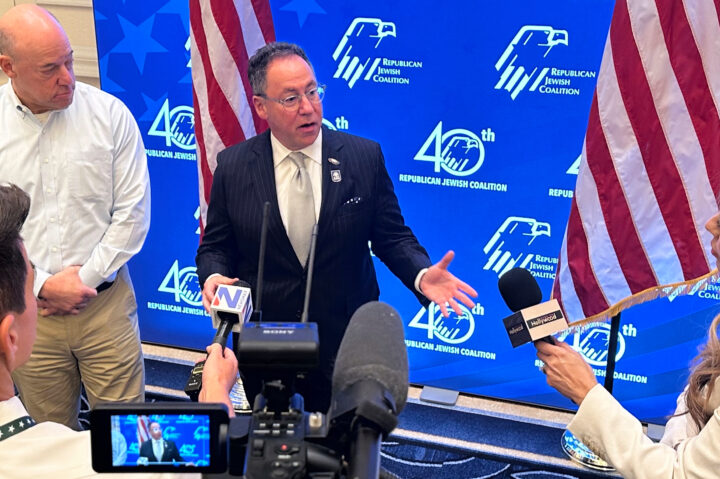
Republican Jewish Coalition CEO Matt Brooks, center, alongside Ari Fleischer, an RJC board member and press secretary to former President George W. Bush, answers questions from members of the news media about confronting antisemitism within the Republican Party, during the coalition's annual conference at the Venetian Resort in Las Vegas, Saturday, Nov. 1, 2025. (AP/Thomas Beaumont)
Good Monday morning!
In today’s Daily Kickoff, we report from the Republican Jewish Coalition’s annual leadership summit in Las Vegas, and look at how mid-decade redistricting efforts in a handful of states could affect pro-Israel legislators. We report on newly obtained audio of Maine Senate candidate Graham Platner expounding on his Israel views, and cover the arrest of Israel’s former military advocate-general, who resigned from her position last week. Also in today’s Daily Kickoff: Michael Eisenberg, Sylvan Adams and Gordon Gee.
Today’s Daily Kickoff was curated by Jewish Insider Executive Editor Melissa Weiss and Israel Editor Tamara Zieve, with assists from Danielle Cohen-Kanik and Marc Rod. Have a tip? Email us here.
What We’re Watching
- The Foundation for Defense of Democracies is hosting a virtual event with former Israeli Defense Minister Benny Gantz on his vision for the future of Israel’s security and relationships around the world.
- The Anti-Defamation League is hosting its annual real estate reception in New York City. This year’s event will honor Feil Organization CFO Eric Lowenstein.
- Elsewhere in New York, Birthright Israel is holding its annual gala tonight. Actor Jonah Platt is slated to emcee the evening’s events, which will honor Lynn Schusterman.
- In Israel, the annual Christian Media Summit kicked off last night in Jerusalem.
What You Should Know
A QUICK WORD WITH JI’S MATTHEW KASSEL
LAS VEGAS — Until last week, the Republican Jewish Coalition’s annual leadership summit was expected to be a triumphant gathering to celebrate President Donald Trump’s accomplishments in the Middle East, chief among them his administration’s recently brokered ceasefire deal between Israel and Hamas, Jewish Insider‘s Matthew Kassel reports.
That all changed after Tucker Carlson hosted the neo-Nazi influencer Nick Fuentes on his podcast for a sympathetic interview, provoking fierce backlash. By the time that Kevin Roberts, the president of the Heritage Foundation, came to Carlson’s defense on Thursday, the RJC recognized its conference would require a thematic update to more forcefully emphasize the urgency of confronting rising antisemitism — and its enablers — within the GOP.
“If there was ever a time for the RJC, this is our time,” Norm Coleman, the organization’s national chairman, said in opening remarks on Friday. “We have been called to this moment to fight the scourge of antisemitism.”
But even as multiple speakers at the three-day summit held at the Venetian Resort — including congressional leaders, conservative activists and media personalities — alluded to antisemitism in their ranks, many talked in broad strokes, didn’t mention Carlson by name or downplayed the issue as confined to the fringes, despite Carlson and Fuentes each commanding a significant number of dedicated followers on the far right.
SPEAKING UP
Lindsey Graham calls Tucker Carlson antisemitism a ‘wake-up call’ for GOP
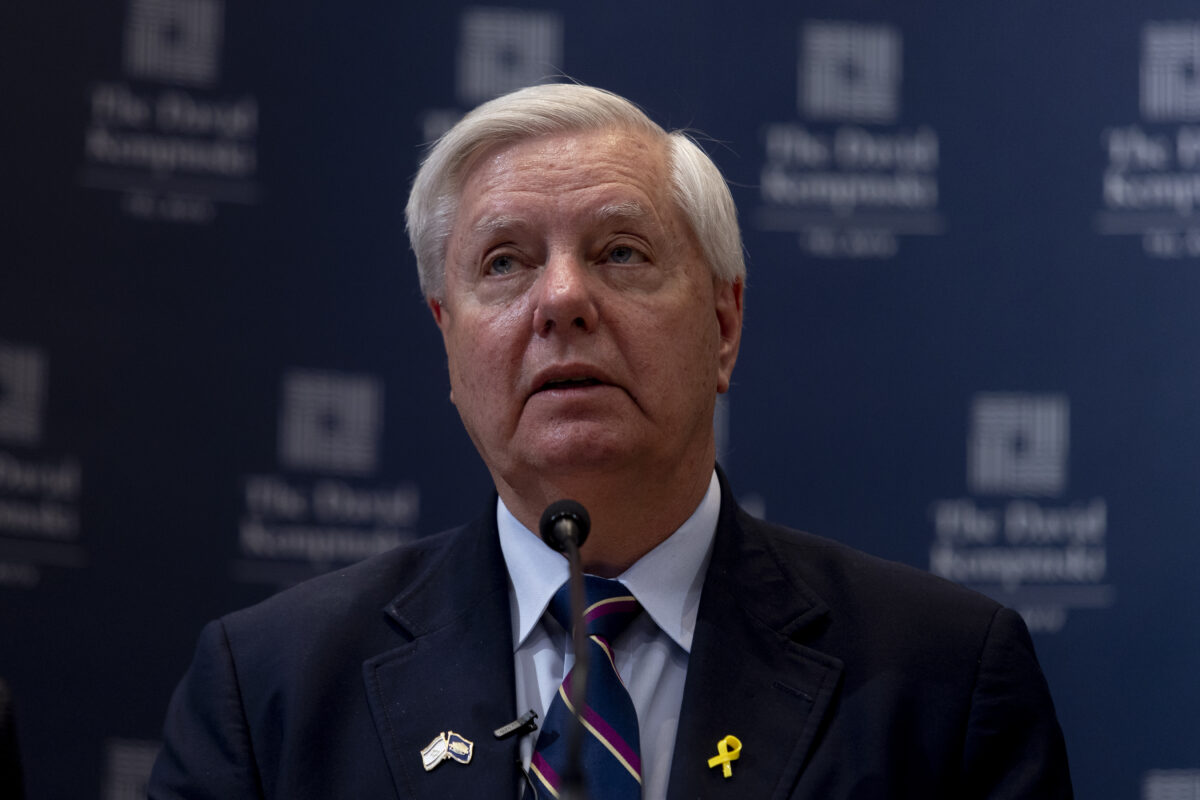
Sen. Lindsey Graham (R-SC) spoke out against Tucker Carlson for giving a friendly platform to Nick Fuentes, the neo-Nazi influencer, on his podcast this week, calling it “a wake-up call” for the Republican Party as it grapples with rising antisemitism within its ranks. “How many times does he have to play footsie with this antisemitic view of the Jewish people and Israel until you figure out that’s what he believes?” Graham said of Carlson in an interview with Jewish Insider’s Matthew Kassel on Friday on the sidelines of the Republican Jewish Coalition’s annual leadership summit at the Venetian Resort.
‘Niche market:’ Graham said that “antisemitism has been with us, and it’ll always be with us, and the goal is to limit it, fight back and contain it. I am confident that if anybody in the Republican world ran for office as a member of Congress, for the Senate or any major elected office and spouted this garbage, it would get creamed,” Graham told JI. “This is a niche market. It won’t sell to a wider audience.”
Drawing a red line: Rep. Randy Fine (R-FL) called Tucker Carlson “the most dangerous antisemite in America” in remarks on Saturday at the conference, in what was an unusually direct rebuke of the far-right commentator who is facing backlash over his recent friendly interview with the neo-Nazi influencer Nick Fuentes, Jewish Insider’s Matthew Kassel reports.
OUT OF BOUNDS
At RJC summit, Ted Cruz slams right-wing embrace of antisemitic figures
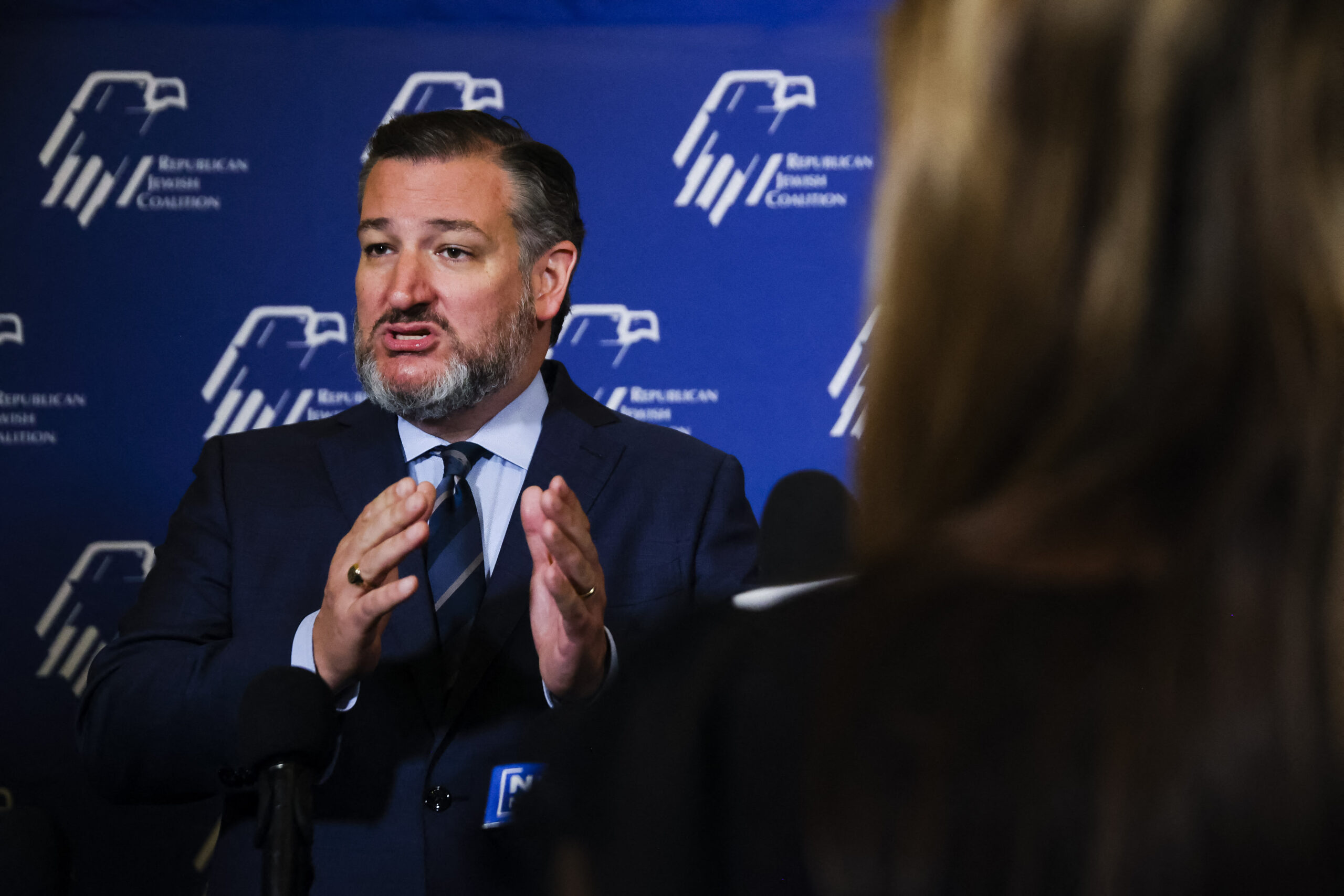
Sen. Ted Cruz (R-TX) criticized Republicans who refuse to disavow prominent antisemites in the conservative movement as “cowards” after the Heritage Foundation and its president, Kevin Roberts, defended Tucker Carlson and his friendly interview with neo-Nazi influencer Nick Fuentes. Cruz warned during a half-hour address at the opening of the Republican Jewish Coalition’s annual summit in Las Vegas on Thursday evening that young Christians were turning away from supporting Israel, something he argued was the result of pro-Israel Christians being maligned by leading voices in the America First movement, Jewish Insider’s Emily Jacobs reports.
Cruz’s comments: The Texas Republican senator did not mention the Heritage Foundation, Roberts, Carlson or Fuentes by name, though he accused anyone who uncritically promotes Adolf Hitler of being “complicit” in spreading virulent antisemitism. Fuentes has praised Hitler on multiple occasions; in his statement, Roberts said he “disagree[s] with” some of Fuentes’ views, “but canceling him is not the answer.” “The last year, we’ve seen three prominent people on the right publicly muse, ‘Gosh, maybe Hitler’s not all that bad.’ No. He is the embodiment of evil, a grotesque bigot. And if you’re confused by that, you’re an imbecile,” Cruz said on Thursday. “Too many people are scared to confront them. I want to ask you, how many elected Republicans do you see standing up and calling this out? How many do you see willing to take on the voices in the anti-Israel right?”
Bonus: Following Roberts’ comments last week, Heritage’s chief of staff, Ryan Neuhaus, was reassigned to serve as a senior advisor, while the think tank’s executive vice president, Derrick Morgan, was moved into the chief of staff role on an interim basis through the end of the year.
PLATNER’S POSITION
Newly surfaced recording of Graham Platner highlights his Israel fixation
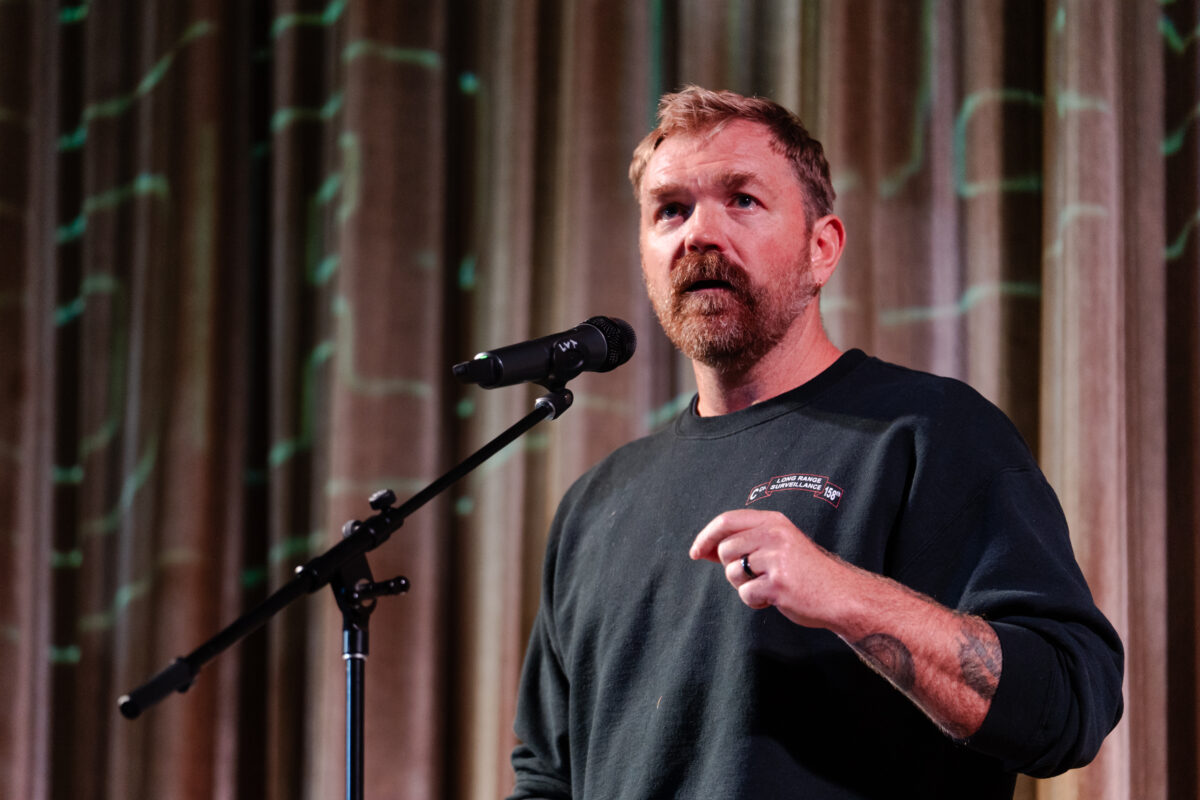
Like many progressives now running for Congress, Graham Platner, a Democratic Senate candidate in Maine, has made opposition to Israel a central part of his messaging. But more so than many candidates, the political newcomer seems particularly invested in engaging on Middle East policy. In a private conversation with attendees of an August fundraiser in Maine, Platner defended his stances on Israel and shared previously undisclosed details about his personal ties to the region, according to audio of the discussion, recently shared with Jewish Insider’s Matthew Kassel.
What he said: While he said he agreed that Hamas is a terrorist organization, Platner claimed that Israeli Prime Minister Benjamin Netanyahu had “publicly stated that” Israel was “funding Hamas to make sure that there was going to be no non-radical leadership within Gaza in order to keep a Palestinian state from happening.” While members of Netanyahu’s coalition have made this argument, the prime minister has never personally made such a claim. New York Times reporting from shortly after the Oct. 7 attacks alleged that the Israeli prime minister had allowed the Qatari government to send money into the Gaza Strip for several years in order to “maintain peace in Gaza.”
Family ties: In the conversation, which took place before controversy ensnared his campaign, Platner noted his stepbrother is Seth Frantzman, an Israeli author, journalist and security analyst who has long worked for for The Jerusalem Post and lives in Jerusalem, saying they are “very close,” according to the audio.
Bonus: Platner’s finance director became the latest campaign departure last week, following the exits last month of Platner’s campaign manager and political director. Ronald Holmes said in a LinkedIn post that he “began to feel that my professional standards as a campaign professional no longer fully aligned with those of the campaign.”
MAPPING MOVES
Partisan redistricting efforts endanger pro-Israel incumbents
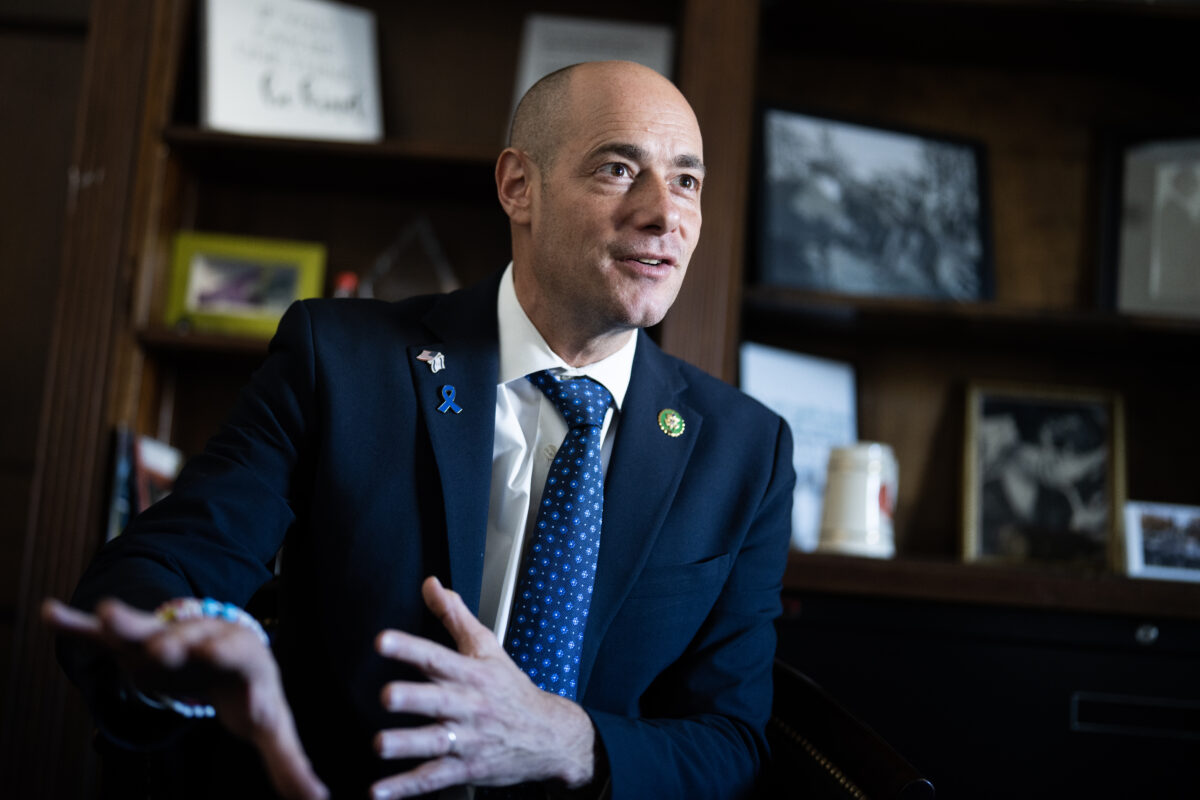
Triggered by President Donald Trump’s efforts to gain a partisan edge in the 2026 midterm elections, a cascade of states is undertaking unusual mid-decade redistricting efforts, in what has become a growing race between Democrats and Republicans to shore up incumbents, knock out lawmakers from the opposing party and create more-winnable seats. On both sides of the aisle, the efforts could endanger a number of vocal pro-Israel incumbents, Jewish Insider’s Marc Rod reports.
Who’s in danger: The districts of Reps. Greg Landsman (D-OH) and Don Davis (D-NC) have been redrawn to be less favorable to the incumbents, and in Florida, Republicans are considering efforts to pack Democratic voters into a smaller number of districts, potentially endangering several pro-Israel incumbents including Reps. Debbie Wasserman Schultz, Jared Moskowitz and Darren Soto. On the Republican side, a series of GOP lawmakers in California with strong records on Israel and antisemitism could be impacted by the redistricting push, including Rep. Ken Calvert — who chairs the Appropriations subcommittee on defense funding — as well as Reps. Darrell Issa, Kevin Kiley, Doug LaMalfa and David Valadao.
LEGAL TROUBLES
Ex-IDF advocate-general arrested over alleged destruction of evidence after being reported missing

Former IDF Advocate-General Yifat Tomer-Yerushalmi was arrested on Sunday evening, reportedly on grounds of obstruction of an investigation, after disappearing and leaving behind a note raising concerns of a potential suicide. The arrest came two days after she resigned her post following a determination by police that she had leaked sensitive materials showing alleged abuse of a Palestinian detainee at Israel’s Sde Teiman prison to the media, Jewish Insider’s Lahav Harkov reports.
Chain of events: Police found Tomer-Yerushalmi’s car at a beach north of Tel Aviv, hours after relatives reported that she was missing. According to Israeli media, she had left a note to her family telling them, “don’t look back.” The ensuing manhunt involved police, the Israeli Navy, drones with geothermal detection and more. Tomer-Yerushalmi was arrested after police found her safe, but without her phone, which had last been tracked near her car and then turned off. The disappearance of the phone raised police officers’ concern that she had possibly staged a suicide attempt to cover up the destruction of evidence caused by the disposal of her phone, Ynet reported. National Security Minister Itamar Ben-Gvir said on Monday that Tomer-Yerushalmi remains on suicide watch in jail.
UNIVERSITY INSIGHTS
Longtime higher ed leader Gordon Gee says fear, not free speech, is ruling America’s campuses

Gordon Gee has served as president of more American universities than almost anyone, as far as he knows. Most recently he led West Virginia University, from which he retired in July; before that, he oversaw Ohio State, Vanderbilt, Brown and the University of Colorado over a span of 45 years. In an interview with Jewish Insider’s Gabby Deutch last week, Gee, 81, looked back on his career and reflected on the state of academia, noting a growing chasm between what he described as two different kinds of universities: those like Vanderbilt, that have held firm to the principles of institutional neutrality, and those like his alma mater, Columbia University, that have struggled to take an impartial stance in response to campus protests and antisemitism — and that are wary of making significant change.
Fear factor: “The biggest challenge facing university presidents is fear,” said Gee. “I think the university presidents, in many ways, are paralyzed, and a lot of it is brought on by themselves, because of the fact that they allowed themselves to become kind of engaged in this ‘go along, get along’ response, and now all of a sudden, when they discover that they’ve got to take a stand, it’s becoming very difficult for many of them.”
Bonus: In The Atlantic, University of Chicago law professor Aziz Huq suggests that the Trump administration’s recent offer to prioritize federal funding for schools that agree to a series of dictates from the government provides universities that don’t agree to the compact with new opportunities, noting that “[w]ithdrawal from the embrace of the federal government, while painful, also is a chance to confront some latent, long-simmering weaknesses of the existing higher-education model.”
Worthy Reads
Roberts’ Rules of Disorder: The Wall Street Journal’s editorial board weighs in on Heritage Foundation CEO Kevin Roberts’ response to recent antisemitic comments by far-right commentators Tucker Carlson and Nick Fuentes. “Amid criticism on Friday, Mr. Roberts scrambled to list Mr. Fuentes’s odiousness, but his initial contribution was to join in the Jew-baiting. His video framed the issue not as antisemitism, but as Christian freedom of conscience in the face of a hostile attempt to impose loyalty to Israel on Americans. … If conservatives — and Republicans — don’t call out this poison in their own ranks before it corrupts more young minds, the right and America are entering dangerous territory.” [WSJ]
Boycotting The Times: The Atlantic’s Jonathan Chait reflects on a push by anti-Israel figures to refuse to submit future op-eds to The New York Times over the paper’s perceived bias toward Israel. “But the extent to which these writers object to the sword depends on who is wielding it. The letter’s demands come from a coalition of nine groups, three of which have declined to condemn Hamas for the October 7 attack, while six — the U.S. Palestinian Community Network, the Palestinian Feminist Collective, the Palestine Solidarity Working Group, the Palestinian Youth Movement, Pal-Awda, and National Students for Justice in Palestine — rationalized or directly endorsed the massacre.” [TheAtlantic]
Fear of Mamdani: In the Jewish News Syndicate, William Daroff and Betsy Berns Korn, respectively the CEO and chair of the Conference of Presidents of Major American Jewish Organizations, raise concerns about New York City mayoral front-runner Zohran Mamdami over what they describe as his demonstrated “hostility toward the concerns of the Jewish community and contempt for the broader public interest” ahead of tomorrow’s election. “What begins as a debate about policy too often becomes a campaign of hostility toward Jews. In this context, any candidate who fails to condemn terrorists who burned families alive, abducted civilians, and committed rape and other war crimes, as Hamas and other Palestinian terrorists did in southern Israel on Oct. 7, 2023, forfeits the moral right to seek public office.” [JNS]
PA Still Key: In the National Interest, David Makovsky and Shira Efron posit that the Palestinian Authority Security Forces could serve as an “imperfect but plausible” option on the ground in postwar Gaza. “Despite their shortcomings, these forces have over three decades of experience in security coordination with the IDF in the West Bank. … The PA today is like a car without wheels: it cannot drive Gaza out of the post-October 7 morass. But wheels can be added — reforms that build credibility, training that professionalizes the PA’s security forces, and service delivery that tangibly improves daily life for suffering Gazans. With each milestone, the PA gains a larger role, international donors gain confidence, Israel gains a more stable frontier, Gazans gain a path out of limbo, and Palestinians everywhere regain agency that could help establish a political horizon.” [NationalInterest]
Word on the Street
In a wide-ranging CBS “60 Minutes” interview that aired Sunday night, President Donald Trump described the ceasefire between Israel and Hamas as being “very solid”; Trump also said that the U.S. would be “involved” in Israeli Prime Minister Benjamin Netanyahu’s corruption trial, two weeks after the president, speaking at the Knesset, called on Israeli President Isaac Herzog to pardon Netanyahu…
Netanyahu said on Sunday that Israel would “act as necessary” if Lebanon does not move to fully disarm Hezbollah, amid concerns that the Iran-backed terror group is rearming in defiance of the ceasefire inked last year…
Amos Hochstein, who served as a senior official in the Biden administration overseeing the Lebanon portfolio, cautioned that Israel’s muscular approach to Hezbollah in Lebanon could be “counterproductive” and that Beirut is “in a really tough spot” as it works to shore up international support…
Israeli Energy Minister Eli Cohen said his U.S. counterpart, Energy Secretary Chris Wright, canceled a planned trip to Israel following Jerusalem’s decision to hit pause on a $35 billion gas agreement with Egypt that would be the biggest gas deal in Israel’s history…
Video from a May 2024 city council meeting in Hamtramck, Mich., that was recently viewed by local media showed Mayor Amer Ghalib, the Trump administration’s nominee to be U.S. ambassador to Kuwait, voicing support for the council’s passage of a boycott, divestment and sanctions resolution targeting Israel; Ghalib told members of the Senate Foreign Relations Committee that he had not supported the resolution…
The Diocese of Harrisburg, Pa., condemned and apologized for a Halloween float representing a local Catholic school that included a replica of the front gates of Auschwitz with the words “Arbeit Macht Frei”…
The Wall Street Journal spotlights Palantir’s new “Meritocracy Fellowship” in which 22 high school graduates spend four months at the company in lieu of pursuing a traditional college track…
A spokesperson for Zohran Mamdani said that the New York City Democratic mayoral candidate, if elected, would reassess the partnership between the Roosevelt Island campus of Cornell University and Israel’s Technion…
Former U.K. Labour party leader Jeremy Corbyn, who was ousted from the party’s leadership over a series of antisemitism incidents, phone-banked for Mamdani over the weekend…
A London bus driver was suspended after refusing to return a dropped bank card to a visibly Jewish man and hurling antisemitic insults at the passenger for an hour until police arrived…
A French court sentenced four Bulgarian men to prison terms ranging between two and four years over the vandalism last year of Paris’ Holocaust memorial…
The bodies of three Israelis were repatriated to Israel and identified overnight as dual American Israeli citizen Capt. Omer Neutra, Col. Asaf Hamami and Staff Sgt. Oz Daniel; the exchange came a day after Israeli forensics determined that three bodies given to Israel by Hamas on Friday evening did not belong to any of the remaining hostages…
Israel announced a series of tax benefits aimed at luring Israeli high-tech workers abroad back to the country amid an exodus that followed the Oct. 7, 2023, attacks and ensuing war…
Canadian Israeli philanthropist Sylvan Adams committed $100 million to help rebuild the Soroka Medical Center in Beersheva, Israel, which sustained significant damage during the 12-day war between Israel and Iran in June, eJewishPhilanthropy’s Judah Ari Gross reports…
Omani Foreign Minister Badr Albusaidi told attendees at the IISS Manama Dialogue in Bahrain over the weekend that Gulf countries should reverse course on their isolation of Iran and deepen diplomatic, economic and security cooperation with Tehran…
Iranian President Masoud Pezeshkian said that Iran would rebuild its nuclear facilities with “greater strength,” while denying that the country is seeking nuclear weapons…
The New York Times published a belated obituary for World War II partisan fighter and poet Hannah Senesh as part of the paper’s “Overlooked No More” series; Senesh was executed at age 23 after being captured by the Nazis in 1944…
Dutch-Jewish resistance member Selma van de Perre, who forged and delivered documents and helped Jewish families seeking shelter, died at 103…
Pic of the Day

Israeli Prime Minister Benjamin Netanyahu met in Jerusalem over the weekend with Aryeh Lightstone, who is serving as a senior advisor to White House Special Envoy Steve Witkoff; White House senior advisor Josh Gruenbaum and venture capitalist Michael Eisenberg, who is working with the U.S. team overseeing ceasefire efforts.
Birthdays

Winner of the 2013 Nobel Prize in medicine, professor at Yale University, James Rothman turns 75…
Chancellor emeritus of The Jewish Theological Seminary where he also served as a professor of Jewish history, Ismar Schorsch, Ph.D. turns 90… Senior U.S. District Court judge in California, he is the younger brother of retired SCOTUS Justice Stephen Breyer, Judge Charles Breyer turns 84… U.S. senator (D-HI), Mazie K. Hirono turns 78… Resident of Great Barrington, Mass., and a part-time researcher at UC Berkeley, Barbara Zheutlin… Rabbi emeritus at Temple Anshe Sholom in Olympia Fields, Ill., Paul Caplan turns 73… Actress, comedian, writer and television producer, best known for the long-running and award-winning television sitcom “Roseanne,” Roseanne Barr turns 73… Comedian, talk show host, political and sports commentator, Dennis Miller turns 72… Manuscript editor and lecturer, author of books on the stigma of childlessness and on the Balfour Declaration, Elliot Jager turns 71… Award-winning Israeli photographer whose works have appeared in galleries in many countries, Naomi Leshem turns 62… Regional director of development for The Washington Institute for Near East Policy, Jeanne Epstein… Podcaster and clinical professor of marketing at the New York University Stern School of Business, Scott Galloway turns 61… Co-founder and former CEO of Blizzard Entertainment, now CEO of Dreamhaven, Michael Morhaime turns 58… Entrepreneur-in-residence at Loeb Enterprises, he was previously co-chair of the board of the Yeshiva University Museum, Edward Stelzer… VP for federal affairs at CVS Health, she was the White House director of legislative affairs in the last year of the Obama administration, Amy Rosenbaum turns 54… Director of development for States United Democracy Center, Amie Kershner… Partner at political consulting firm GDA Wins, Gabby Adler… Agent at Creative Artists Agency, Rachel Elizabeth Adler… Actress who won three Daytime Emmy Awards for her role on “ABC’s General Hospital,” Julie Berman turns 42… Director of corporate responsibility, communications and engagement at Southern Company Gas, Robin Levy Gray… Senior managing director at Guggenheim Securities, Rowan Morris… General manager of NJ/NY Gotham FC, a women’s soccer team based in Harrison, N.J., Yael Averbuch West turns 39… Former captain in the U.S. Marine Corps, he is a co-founder of D.C.-based Compass Coffee, Michael Haft turns 39… New York state senator, Michelle Hinchey turns 38… Deputy coordinator for global China affairs at the U.S. Department of State, Julian Baird Gewirtz turns 36… Recent MBA graduate at The Wharton School, Ben Kirshner turns 33… Marketing manager at American Express, Caroline Michelman turns 33… Founder and CEO of Noyse Publicity Management, Noy Assraf turns 30… Actress and model, Diana Silvers turns 28… Stu Rosenberg…
Israeli Justice Minister Yariv Levin threw his support behind legislation to allow for the formation of a special tribunal to prosecute Hamas terrorists who are part of the Nukhba, the terrorist group’s special forces unit

Knesset
MK Simcha Rothman (center)
The return of the final, living hostages to Israel last week has reopened discussion of putting the Palestinian perpetrators of the Oct. 7, 2023, atrocities in Israel on trial.
Israeli Justice Minister Yariv Levin threw his support behind legislation to allow for the formation of a special tribunal to prosecute Hamas terrorists who are part of the Nukhba, the terrorist group’s special forces unit, on charges of genocide, which carries the death penalty.
The bill is meant to “ensure that the legal process will be run efficiently and to ensure that justice will be done and seen,” Levin said in a joint statement with the bill’s sponsors, Knesset Law, Constitution and Justice Committee Chairman Simcha Rothman of the Religious Zionist Party and Yisrael Beytenu lawmaker Yuli Malinovsky. The group plans to bring the legislation to a first vote as soon as possible and usher it through the process “at the greatest speed, with a shared aim to bring the Nukhba terrorists to justice soon.”
Levin, Rothman and Malinovsky said that the office of the Israeli state attorney, the country’s chief prosecutor, has drafted indictments against Nukhba terrorists.
They noted that during the two years since the Hamas attacks on southern Israel, the State Attorney’s Office, police and Shin Bet have interrogated the Nukhba terrorists and collected evidence “of an unprecedented scope,” including thousands of hours of video of the atrocities and of testimony.
During that time, the Law, Constitution and Justice Committee held a series of meetings to examine possible ways to put the Nukhba terrorists on trial and ensure they are prosecuted to the full extent of the law.
“We met with the Justice Ministry once every few months,” Rothman told Jewish Insider. “Levin finally supports [the bill]. Every obstacle was standing in our way, and [Levin] didn’t make an effort to remove them. Now, there’s nothing preventing it from moving forward.”
The move toward putting Oct. 7 perpetrators on trial comes soon after the return of the living hostages, as well as weeks after a heated debate in the Knesset over instituting the death penalty for terrorists. The legislation’s explanatory portion says it is meant to “nip terrorism in the bud and create a heavy deterrent.”
The death penalty has only been carried out once in Israel’s history — following the conviction of senior Nazi official Adolf Eichmann for crimes against the Jewish people and crimes against humanity.
The bill, which applies to terrorists broadly, not only those who participated in the Oct. 7 attacks, was proposed by members of National Security Minister Itamar Ben-Gvir’s Otzma Yehudit Party and brought before the Knesset National Security Committee, chaired by Tzvika Foghel, also of Otzma. The Prime Minister’s Office asked Ben-Gvir to postpone the vote.
Gal Hirsch, the coordinator for the hostages, said in the committee meeting that Ben-Gvir’s effort was potentially harmful to the ongoing discussions to secure the release of the remaining hostages. Representatives from hostage families have also pleaded with the lawmakers to stop the proceedings, concerned that the moves could endanger their loved ones.
On Monday, Ben-Gvir made an ultimatum to Israeli Prime Minister Benjamin Netanyahu that either the death penalty bill passes a first Knesset vote in the next three weeks, or his party will no longer vote with the coalition.
“When terrorists remain alive, the terrorists outside are motivated to carry out kidnappings in order to free their Nazi brothers in future deals,” Ben-Gvir said. “If they murder a Jew, they do not stay alive.”
Rothman argued that his bill is significantly different from Ben-Gvir’s, and pointed out that he held a committee meeting the same week as the one that courted controversy, and neither Netanyahu nor Hirsch asked him to hold off.
“It’s a question of whether you want real results. [Otzma lawmakers] don’t understand what they’re dealing with. The law they want to pass [is so broad], I think it would end up giving a Jewish Israeli the death penalty first,” he remarked.
While Rothman said that having all of the living hostages home will help the Oct. 7 trials to move forward, when he asked senior defense figures over the last two years whether there was a risk to the hostages’ lives from his actions, “they said no. They said when there’s a conviction or maybe even an indictment, possibly, but just building the framework is not a risk.”
As such, Rothman said that though it may seem like a long time has passed, “the time hasn’t been a waste. A lot of material was collected and we oversaw the legislative and political decisions that needed to be made.”
Rothman and Malinovsky’s bill would establish a special tribunal for those who participated in the Oct. 7 attacks, with the proceedings made public. The legislation sets different rules for presenting evidence to protect the privacy of victims and their families, and to streamline the process of prosecuting large numbers of defendants. It also allows for non-Israeli judges to be appointed. In addition, it would establish a committee of representatives of Israel’s justice minister, defense minister and foreign minister to determine government policy as to whether to prosecute the Nukhba terrorists on genocide charges, which carry the death penalty, taking national security into consideration.
In a Knesset Law, Constitution and Justice Committee meeting on Wednesday, the first since Levin publicly supported the bill, Malinovsky said that she and Rothman “understand that it was difficult to gather evidence … and I know that law enforcement and the State Attorney’s Office overturned every stone to find evidence. [Regular] criminal justice proceedings do not have a response for the events of Oct. 7, therefore MK Rothman and I wrote this bill to regulate the jailing and prosecution of the terrorists who participated in the Oct. 7 massacre.”
Malinovsky said that there is difficulty tying specific terrorists to specific murders, and genocide is a collective crime, by which they can be charged as a group. In cases in which there is no evidence tying a terrorist to genocide, they can be tried in a military court as illegal fighters who committed acts of terror against Israel, a crime that carries a life sentence.
Much of the bill is focused on clear criteria for genocide charges.
“At first, the Justice Ministry said that genocide charges won’t work,” Rothman recalled earlier this week, “but today, I think they understand that they need to go there.”
The special tribunal is meant to prevent the Oct. 7 trials from getting caught up in the Israeli justice system’s significant backlog.
“It’s a lot of heavy cases that will block up the whole justice system” if the trials are in regular courts, Rothman explained.
In addition, he said, “I don’t want a situation where a judge is with the Nukhba in the morning and in the afternoon is dealing with an Israel who stole a car. We could end up lowering the standards of defendants’ rights in all of Israel. When we authorized preventing meetings [of terrorists] with lawyers, [judges] used it for all kinds of other cases, just because they can. We’re not going to allow that.”
Rothman said that the question of appointing foreign judges to the tribunal remains open, because it may be too complex. However, he said, “bringing a major jurist from the U.S. or somewhere else can give the trials an international imprimatur.”
Malinovsky said at the committee meeting that the Oct. 7 attacks “are like nothing else in the world, and I invite anyone who has knowledge to speak. We need creative solutions, outside of the box, and therefore we need a change of attitude, especially in the Justice Ministry.”
Greenblatt spoke at AJC’s Global Jewish Diplomacy Reception, where former Amb. Shapiro also decried Palestinian statehood recognition as a ‘mistake’

U.S. Mission to the U.N.
Jason Greenblatt, Special Representative for International Negotiations Delivers Remarks at a UN Security Council Briefing on the Middle East
Jason Greenblatt, a key architect of the Abraham Accords, joined President Donald Trump in coming out against the Israeli government’s reported plans to annex portions of the West Bank, saying on Thursday evening that it was the wrong time to do so.
“I think Israel has so many challenges right now, militarily, [with the] hostages. There’s enormous things going on. The world is turned against Israel. I don’t agree with those that are pushing Bibi. I don’t know if it’s Bibi himself, but I hope that Bibi could figure out a way to get out of that political space that he’s in. And I think President Trump is making the right call,” Greenblatt said, using Israeli Prime Minister Benjamin Netanyahu’s nickname.
Greenblatt made his remarks during an onstage interview with Jason Isaacson, the American Jewish Committee’s chief policy and political affairs officer, at the AJC’s annual Global Jewish Diplomacy Reception at Manhattan’s Harmonie Club on the sidelines of the United Nations General Assembly, which is being held this week. Shortly before the reception, Trump told reporters that he was firmly against Israeli annexation of the West Bank.
Greenblatt preceded his opposition to annexation by noting his right-wing bona fides.
“My answer is coming from somebody who’s on the right politically, both in Israel and here. In fact, some of my Palestinian friends would say that sometimes I was Bibi’s mouthpiece,” he said.
“But I agree with President Trump and what he said earlier today … I don’t think this is the time. I don’t think it’s the place. And I was part of the team that wrote the paperwork that would have allowed Israel to … apply Israeli sovereignty,” Greenblatt said, using the term the Israeli government prefers to refer to annexation. “I don’t think this is the time to do it.”
In addition to Greenblatt, speakers at the reception included Daniel Shapiro, former U.S. Ambassador to Israel under President Barack Obama, and Serge Berdugo, president of the council of Jewish communities of Morocco, who received AJC’s Akiba Award during the event. At least ten hostage family members were also present, some of whom offered staunch criticism of the Israeli government’s handling of the war in Gaza.
Responding to the growing number of Western countries recognizing Palestinian statehood, Shapiro called these moves an ineffectual “mistake.”
“It’s a purely rhetorical step that changes nothing and probably does little, if anything, to advance the stated goal of some sort of resolution of the Israeli-Palestinian conflict. And in many ways it may actually set it back in part because of the way it appears to — and certainly many Israelis understand it to, and I’m sorry to say, many Arabs understand it to — reward Hamas,” Shapiro said.
He also described the development, in part, as a response by world leaders to Israel’s refusal to develop a “day after” plan in Gaza.
“What is that vision of the day after? Not only when does it start, but what does it look like afterwards? And is it something that Arab states and European states can buy into and get behind,” Shapiro said. “That could have been a way of satisfying some of the domestic pressures, but it wasn’t really available. And so I think some of the leaders turned to this ill-advised move instead.”
Speaking on behalf of hostage families, Ruby Chen, father of slain American Israeli hostage Itay Chen, whose remains are still being held captive by Hamas in Gaza, thanked the AJC for their advocacy on behalf of the hostage families and criticized the Israeli government for the ongoing hostage crisis.
“I think I’m still in shock that … it wasn’t obvious that it should have been the number one objective of the government of Israel. But it’s unfortunate that there were other objectives, such as the disbanding of Hamas and making sure that Oct. 7 does not happen again, which are all legitimate,” said Chen.
Chen continued, “We call on President Trump to bring all the parties together and put on the table a deal that is acceptable by everybody, and we pray to God that… those of you who are meeting with [Netanyahu]… are able to send a message saying we hope that he shares the same conviction that President Trump has shown, as well as President Biden and the previous administration to bring all these hostages home.”
As the hostage family members gathered for a photograph following Chen’s speech, the father of Israeli hostage Nimrod Cohen, Yehuda Cohen, stepped up to the microphone and delivered a fiery impromptu speech criticizing Netanyahu.
“After two years, Netanyahu is prolonging an unneeded war. If you really want to help us as a Jewish organization, please help us advocating the push on Netanyahu, making Netanyahu, forcing Netanyahu to end the war and get a hostage deal,” he said.
Cohen, who came out in support of the countries recognizing Palestinian statehood — breaking ranks with the Hostages and Missing Families Forum and nearly all of Israel’s political leaders, which described it as a reward for Hamas — defended his position as a form of leverage over the prime minister.
“We are using the Europeans — their declaration of the Palestinian state, their sanctions of Netanyahu’s government … We have no choice. We are at war with Netanyahu. So if you really want to help us, that’s forcing Netanyahu to end the war and get a hostage deal, this is the real help,” said Cohen.
A letter led by Reps. Brad Schneider and Jamie Raskin says such a move would ‘not only violate international law but undermine decades of bipartisan U.S. policy and threaten the progress of the Abraham Accords’
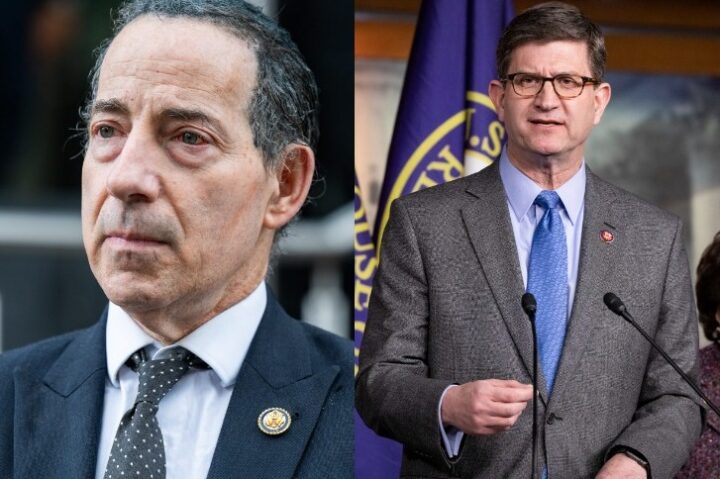
Annabelle Gordon/Bloomberg via Getty Images/Samuel Corum/Getty Images
Reps. Jamie Raskin (D-MD) and Brad Schneider (D-IL)
Most House Democrats, including all of the current and former top Democratic leaders, signed on to a letter on Thursday to Israeli leaders warning them against unilaterally annexing territory in the West Bank or Gaza.
At a time when Democrats are increasingly divided over the U.S.-Israel relationship and its direction, the letter highlights a strong degree of unanimity within the party against annexation, among both Democrats who largely remain supportive of Israel and those who have become more critical over the war in Gaza. President Donald Trump reportedly told Arab leaders on Tuesday that he would pressure Israel against annexation.
“As long-standing supporters of the U.S.-Israel relationship, Israel’s security, and Israel’s future, we are deeply opposed to proposals for unilateral annexation of territory in the West Bank,” the 178 lawmakers, led by Reps. Brad Schneider (D-IL) and Jamie Raskin (D-MD), said. “Such a move would not only violate international law but undermine decades of bipartisan U.S. policy and threaten the progress of the Abraham Accords, which offer Israel and its neighbors the opportunity to build a more secure, cooperative, and prosperous regional future. Unilateral annexation of the West Bank would plunge the region, already reeling from tens of thousands of deaths in the horrific Gaza war, into further chaos and violence.”
The letter is addressed to Israeli Prime Minister Benjamin Netanyahu, Defense Minister Israel Katz and Foreign Minister Gideon Sa’ar. Included among the signatories are House Minority Leader Hakeem Jeffries (D-NY), Minority Whip Katherine Clark (D-MA) and Democratic Caucus Chair Pete Aguilar (D-CA), as well as former House Speaker Nancy Pelosi (D-CA), former Majority Leader Steny Hoyer (D-MD) and former Democratic Whip Jim Clyburn (D-SC).
The signatories highlighted that leaders from the United Arab Emirates have expressed that West Bank annexation would be a red line for them that would endanger regional normalization and integration with Israel.
“Moves toward annexation would undermine Israel’s progress on normalization, prevent international cooperation to rebuild Gaza after this devastating war, risk instability in Jordan, and even further strain ties with key European partners,” the letter continues.
They added that annexation of territory in Gaza, as discussed by some Israeli ministers, “would not only violate international law but exacerbate humanitarian and diplomatic challenges at a moment when broad international support for Israel is at risk.”
The lawmakers stated that they are “convinced that unilateral steps by either side,” including Israeli annexation of territory in the West Bank or Gaza, would be an impediment to direct negotiations between Israel and the Palestinians toward a two-state solution and make a “just, sustainable peace” harder to attain.
“We respectfully urge your government to refrain from steps toward unilateral annexation and to recommit to a negotiated outcome consistent with U.S. policy and the regional vision embodied in the Abraham Accords,” the letter concludes. “That path best safeguards Israel’s security and democratic ideals, advances regional cooperation against shared threats, and offers Israelis and Palestinians the possibility of living side by side in peace and dignity, freed from perpetual attacks on civilians and the threat of war.”
Schneider, a co-chair of the Congressional Jewish Caucus, has been a leader in the moderate pro-Israel wing of the party, though he has expressed concerns about the humanitarian situation in Gaza and previously warned individually against annexation. The progressive Raskin is a co-sponsor of legislation that would severely restrict many critical arms transfers to Israel.
Signatories to the letter similarly span the spectrum from consistent supporters of Israel to vocal critics.
Other signatories include Senate candidates Reps. Angie Craig (D-MN), Robin Kelly (D-IL), Raja Krishnamoorthi (D-IL) and Chris Pappas (D-NH); No. 4 House Democrat Rep. Ted Lieu (D-CA); Jewish Caucus co-chair Rep. Jerry Nadler (D-NY); and Reps. Greg Meeks (D-NY), Adam Smith (D-WA) and Rosa DeLauro, the ranking members of the Foreign Affairs, Armed Services and Appropriations Committees, respectively.
Some of Israel’s most vocal far-left critics, as well as some of its most ardent centrist defenders, did not sign onto the letter.
Some congressional Republicans, meanwhile, have shown signs of increasing openness to recognizing Israeli sovereignty over the West Bank.
The House speaker cautioned that the party is likely bound for a major debate over foreign policy after President Trump leaves office

Kent Nishimura/Getty Images
House Speaker Mike Johnson (R-LA) does an interview with CNN at the U.S. Capitol on April 17, 2024 in Washington, D.C.
House Speaker Mike Johnson (R-LA) spoke about his efforts to hold the line against the isolationist wing of the Republican Party in a private meeting with pro-Israel leaders on Capitol Hill on Wednesday, several individuals who attended the meeting told Jewish Insider.
Johnson, who described himself to the group as a “Reagan Republican” focused on “peace through strength,” acknowledged that isolationism is rising in the Republican Party, and that the party is likely bound for a major debate on the issue after President Donald Trump leaves office.
And Johnson told the group that, in his candidate recruiting efforts, he’s working to filter out isolationists to prevent that wing of the party from growing larger in the House, four people who attended the meeting said.
“The speaker was very, very direct about the U.S. role with Israel and in the world and understands that there are voices that don’t agree in both parties, on both extremes, and urges us all to be involved in fighting back against those extremes,” Eric Fingerhut, the CEO of the Jewish Federations of North America, told JI.
One attendee said Johnson had also expressed a strong interest in finding new funding methods for humanitarian aid in Gaza, outside of the United Nations.
Johnson also discussed his recent trip to Israel and his and his wife’s lengthy dinner with Israeli Prime Minister Benjamin Netanyahu and his wife, Sara, with whom he said he has become close friends. He said that he and Netanyahu had discussed that there are no good options ahead in Gaza, one attendee told JI.
The speaker also told the group he is eager to return to Israel to address the Knesset, after he was unable to do so as scheduled in June due to the Israel-Iran war.
Johnson emphasized his commitment to working across the aisle to support Israel and the Jewish community, an individual in the room said. With a government shutdown deadline fast-approaching at the end of the month, Johnson said he’s committed to continuing to work through the regular appropriations process and negotiating with the Senate, and noted that various Jewish communal priorities would be part of that process.
One source said Johnson had also highlighted the fact that he was the highest-ranking elected official to visit a settlement in the West Bank, which the source noted puts him at odds with many in the Jewish community.
Rep. Tim Walberg (R-MI), who also addressed the meeting, provided an overview of the investigations that the House Education and Workforce Committee is conducting into antisemitism, as well as noted he’d been texting recently with Anti-Defamation League CEO Jonathan Greenblatt about the proliferation of antisemitic conspiracy theories about the killing of influencer Charlie Kirk.
Rabbi Levi Shemtov of American Friends of Lubavitch (Chabad) delivered a prayer and Reps. David Kustoff (R-TN), Randy Fine (R-FL) and Craig Goldman (R-TX) also spoke to the group.
One attendee described Johnson as clearly knowledgeable about and comfortable with the issues at play and the meeting overall as cordial and non-contentious.
“There’s just a remarkable sense of gratitude from all across the Jewish community for the leadership that Speaker Johnson has brought to the U.S.-Israel relationship,” Fingerhut said. “He was not someone who was that well-known to our community before he became speaker, but he’s comprehensively knowledgeable. It’s clearly something he feels very personally about.”
The organizations in attendance included: The Louis D. Brandeis Center for Human Rights Under Law, the Republican Jewish Coalition, Agudath Israel of America, AIPAC, the Simon Wiesenthal Center, Conference of Presidents of Major American Jewish Organizations, National Council of Jewish Women, Syngeros Holdings, CUFI Action, the Orthodox Union, the U.S.-China Economic and Security Review Commission, Standard Industries, the American Jewish Committee, Zionist Organization of America, National Debt Relief, Jewish Institute for National Security of America, the Deborah Project, Foundation for Defense of Democracies, Coalition for Jewish Values and the Endowment for Middle East Truth.
Cohen told JI that he’s considering getting into politics but it’s ‘definitely not the time’ with Netanyahu still dominating the scene

Rami Zarnegar
Book cover/Yossi Cohen
Like any former Mossad chief, Yossi Cohen has long been a relatively elusive figure in Israeli public life. So his recent embrace of the spotlight has left Israeli politicos wondering whether he will run for prime minister in the next election.
While the name “Yossi Cohen” is so generic in Israel that one may think it’s an alias akin to “John Smith,” it is, in fact, the real name of the intelligence officer who was nicknamed “Callan” for his favorite British spy show, and “the model” for his dapper style and perfectly-gelled coif. He first received public attention as deputy Mossad chief known only as “Y,” and emerged from the shadows with his real name and face in 2013 when Israeli Prime Minister Benjamin Netanyahu appointed him national security advisor. Cohen was appointed head of the Mossad two years later, a job he retained for six years.
Cohen received attention for commanding ambitious Mossad operations, such as smuggling Iran’s nuclear archive to Israel, and for Netanyahu reportedly naming him as one of his possible heirs, but he rarely gave interviews — until now.
Cohen has been on a Hebrew media blitz ahead of Tuesday’s release of his new book, The Sword of Freedom: Israel, Mossad and the Secret War, in Hebrew and English.
The book is a mix of memoir, in which he discusses becoming the first kippah-wearing graduate of the Mossad cadets’ course and his undercover missions, recruiting spies within Hezbollah and the Iranian nuclear program, as well as his rise to head the organization and lead major operations. It also includes commentary on recent events, including the failures of the defense establishment — and less so of politicians, in his description — on Oct. 7, 2023, the ongoing war and hostage negotiations. Cohen laments that things would have gone better if his advice in past years had been heeded.
It reads, in many ways, like the kind of book a politician would publish before a big run, to let potential voters get to know him — albeit with the much more exciting elements of spycraft.
Yet, in an interview with Jewish Insider last week at his office in a Tel Aviv high-rise, where Cohen’s day job is representing the Japanese investment holding company SoftBank in Israel, he dismissed the idea that his book was the first step in a political campaign.
“That was not the reason for me to write the book,” he said. “I started writing the book something like three years ago, much earlier. I decided to [publish the book] now, because I believe that now is the time … Since I started the book we had the judicial reform, the seventh of October, a war against Hezbollah and the Iranian events. Each of those chapters had to be updated.”
Still, Cohen added, “I can’t say that one day it will not serve my political goals if I will decide to go into politics.”
Thus far, Cohen has kept politics as an “if.” In the past, it was a “no,” he said, but now, he’s thinking about it.
“I am not entering any politics right now,” he clarified. “I stay uninvolved in this kind of politics because nothing is happening. The entire Israeli political system is a little bit stuck. I’m not assessing that any kind of election will happen before the end of next year, November 2026 as planned,” when the next Israeli elections are scheduled to occur.
Cohen said he does not have a team ready for a political campaign, and that all he is doing currently is promoting his book.
The former Mossad chief said that “I was always a Likudnik,” identifying with ideas of the party’s ideological forebear Ze’ev Jabotinsky, but “all options are open” as to whether he would join an existing party or start his own.
He would not join Likud in its current iteration unless it is “reshaped,” he said, in an apparent reference to the vocal populism from within the party’s ranks in the Knesset.
“I don’t want to criticize people personally … but it’s a different party today. It’s not the party that I grew up on. It’s so totally different.”
As to whether he would wait for Netanyahu to leave the political scene, Cohen said, “Definitely this is not the time. …Currently, I am staying in business, 100%.”
Cohen and Netanyahu have not spoken in over a year and a half, when several months into the war the former intelligence chief warned the prime minister that senior defense figures may try to manipulate investigations into the failure of Oct. 7 to exonerate themselves.
Despite the long disconnect, Cohen said that there is no rupture between them, because they had an excellent working relationship, but they were not personal friends. He noted that before the war they had not spoken for a long time; Netanyahu offered him the role of defense minister in late 2022, but Cohen could not legally take it because of a required cooling-off period between serving as a senior defense officer and entering politics.
Cohen has somewhat shielded Netanyahu from blame for the failures surrounding the Oct. 7 attacks, referring in his book to the security establishment’s failure and asserting that “there is no one else to blame.”
He clarified in his interview with JI that “the political leadership always has responsibility” for events such as Oct. 7 and called for a state commission of inquiry to be established, something that Netanyahu has sought to avoid.
“We must make sure to investigate what has to be investigated,” Cohen said. “The intelligence level was poor. It was either not gathered properly or not interpreted properly, but the result was super poor. We didn’t give the State of Israel any alerts about a major attack. … We didn’t have any workable defense lines operating correctly at our borders.”
“There’s the Shin Bet and IDF intelligence who have to know these things, and since they didn’t, and they didn’t push back the enemy when it entered the State of Israel or counter the enemy before it entered Israel, that’s a failure. You don’t need an investigation to know that. Then, of course, I think that the government was responsible for everything that happened under its auspices,” he said.
Soon after Oct. 7, Netanyahu tasked Cohen with trying to find a way to get Palestinian civilians out of Gaza so Israel would be able to fight Hamas with fewer civilian casualties.
“The Mossad and I were trying to convince [Egypt] to let the Palestinians leave, even for a short time, only the civilians … without anything, no cellular, no electronics, no armaments, no physical threats, to the Egyptian side,” he recalled. “Take them into the Sinai Peninsula for six months, one year at a time, a million or a million and a half people. …That was the plan. It didn’t work because [Egyptian President Abdelfatah] Sisi and his consultants said it will cause a kind of revolution in Egypt because of the hatred of Hamas…and their [affiliation] with the Muslim Brotherhood.”
Nearly two years later, Cohen says “it’s hard to explain why … the world does not really embrace any Gazan immigrants. Indonesia, Malaysia, Qatar even, or Egypt and Libya — a long list of Muslim countries — could say ‘I would take 50,000,’ ‘I would take 100,000,’ ‘Come live with us.’ No one said that, not even Muslim countries. Even if … they would all be sent back home.”
Cohen said the story demonstrates the lengths to which Israel went to protect Gazan civilians from the war.
“Israel does not mean to harm civilians,” he said. “We do not starve them, we do not fight a war against any of the civilians. We keep the international war laws very tightly. But now they’re in [Gaza] and we can’t do much. We try to help them, but it’s a war zone. What I was trying to do is send them away from a war zone.”
As to how the war in Gaza should end, “the best case scenario should be connected to a hostage deal. If there is a hostage deal today, Israel should take it,” he said, days before Israel attempted to strike Hamas leaders in Qatar, which has mediated the hostage and ceasefire talks.
While Cohen said he is not privy to the details of the talks, he said “if there is a deal that gets some of our hostages home and for this we have to pay a price of pausing our military action as we did in the past, I will be very much in favor.”
At the same time, he said “the State of Israel cannot afford to not complete the defeat of Hamas.”
Cohen said he did not have an answer as to who should administer Gaza after the war. He dismissed the control some Gazan families have of small areas, saying “it’s two and a half people … Someone has to take care of them, to supply them with … social services, health services.
He was, however, certain that the Palestinian Authority should not be involved, because it is not capable of managing Gaza. “We tried that,” he said, referring to Hamas deposing the PA in Gaza in 2006. He also noted that Israel has been protecting PA President Mahmoud Abbas: “We’re fighting for him and with him against Hamas in his territories.”
Cohen wrote in the book about his involvement in another element of the war in the past two years: the pager attack in which Israel detonated hundreds of beepers belonging to Hezbollah terrorist operatives in Lebanon.
“It started 25 or so years ago, when I was the head of a division in the Mossad,” he recounted. “We understood … there is something new that we can do, and that is selling to our enemies tampered, manipulated equipment. That is the family of the pagers and walkie-talkies.”
One of the early operations in that vein was the sale of a special calibrated table sold to Iran for use in its nuclear program, which later exploded, but the pager operation was the largest in magnitude. Other tampered equipment was used for surveillance or for tracking locations.
“These are things we learned to do 20 years ago,” he said. “Building up this kind of relationship with the buyers is something very hard to do because they check you … they go into everything, so you have to be real. The concept was invented, and now you see the results.”
Cohen said that the IDF and Mossad “did a beautiful job” in the 12-day war against Iran in June: “We prepared a lot of capabilities inside Iran to allow for that and it was operated correctly during the war.”
Israel must always be prepared for the next round against Iran, he added.
“We’re not sure that Iran will not go back and try to enrich uranium again,” he said. “They claim that they can rebuild their sites …They [the West] said the destruction was huge, and I believe the Western side on that. Nevertheless, if they [rebuild] and there is a threat coming from that direction, the only thing that I can suggest my government and the administration [do] is to attack it.”
Cohen frequently lamented in his book that the Israeli defense establishment is insufficiently aggressive and overly cautious.
The former Mossad chief said he felt that his “responsibility was to counter our enemies brutally. If I see terrorism, I have to counter it. If I see Iranian nuclear sites, I have to counter them. If I see someone anywhere, anyhow trying to plan something against the State of Israel, I have to counter it. And I did not always feel that this was the methodology being practiced in other bodies.”
By not nipping growing threats in the bud, Cohen argued, Israel allowed them to grow to a magnitude that it became too hesitant to act against.
The war in Iran, however, was an example of a positive change, Cohen said.
“I think that [Eyal] Zamir as [IDF] chief of staff is doing an amazing job,” he said. “He’s much more aggressive. He’s telling the government … ‘Yeah, there will be some missiles coming back to our side, but we can deal with it.’”
“Now, on the Iranian side, they know we can do it and we may do it again,” Cohen added.
Cohen has been deeply involved in Israel’s unofficial relations with Arab states, and said he is still optimistic that Saudi Crown Prince Mohammed bin Salman will seek normalization with Israel, but only after the war ends.
“They cannot make a peace treaty with a country at war. It doesn’t work in the Muslim world. … He would be very cautious entering these kinds of negotiations right now, because people are saying about Israelis, ‘Look what they do to our brothers in Palestine.’ But the minute the whole war will be over, I expect that he will sign an agreement with us,” Cohen said.
As to the Saudi demand for concrete steps towards Palestinian statehood in exchange for establishing diplomatic relations with Israel, Cohen said “a Palestinian state is something that is not realistic anymore,” again citing the PA’s inability to govern Gaza.
At the same time, Cohen opposed Israeli annexation of parts or all of the West Bank and said he finds it unlikely that the government will do it.
“Countries that have an agreement with us don’t want that to happen because it kills the idea of any future Palestinian negotiations and they can’t live with that,” he said.
Cohen posited that Israel will not annex parts of the West Bank because it “closes the door” on an eventual arrangement with the Palestinians.
“The reality is that since 1967, we haven’t annexed anything in the West Bank, right?” he said. “And why is that? … Because we want to leave a door open for negotiations with the Palestinians. That is why any government, even the right of [Menachem] Begin and Netanyahu, have not annexed anything in the West Bank.”
Cohen predicted that will continue to be the case for decades.
“I’m not sure how long it will take to create something better with the Palestinians that we see today, that will transform them into a friendly country and territory. They’re a deadly enemy, this is what we have, even in the West Bank. And on the other hand, this is territory that we cannot confiscate.”
“I think the status quo should be kept,” he added.
Early in the book, Cohen expressed his appreciation for Russian President Vladimir Putin, calling him “a deeply strategic thinker and natural leader,” and in the interview last week, he stuck with that position, despite the ongoing war in Ukraine and Russia’s turn away from Israel and alliance with its enemies in recent years.
Cohen said that “many things that the State of Israel has done with Putin are unknown to the public. When I stated that, I based it on things that we have done with the Russian administration for many years, and Syria is an example,” referring to the deconfliction mechanism between Jerusalem and Moscow when the Russian Army was in Syria to prop up then-President Bashar al-Assad.
“The only mediators [between Israel and Syria] were the Russians, and what we saw happening was that the Iranian Revolutionary Guards and Hezbollah terrorists were coming down to our borders,” Cohen recalled. “We didn’t want that, and we couldn’t speak to Hezbollah or to the IRGC. So the only one that was taking part in these negotiations was Putin, who eventually pushed [Iran-backed troops] back 40 kilometers. … We needed him to be on our side, and he was.”
Cohen also spoke of Russia finding and returning the body of IDF soldier Zachary Baumel, which had been missing in Syria since 1982.
“The operation that [Putin] conducted inside Syria … was amazing. I was there in the Russian Ministry of Defense in a ceremony where we got the body of an Israeli soldier to be brought back to a Jewish grave… I was in Moscow and Jerusalem on the same day. We had a ceremony late in the afternoon to bury him. I was involved in looking for his body my whole life, and here Russia did it for us. … That’s a big thing,” Cohen said.
Cohen also mentioned the criticism of Israel soon after Russia’s invasion of Ukraine. “Israel cannot fight all wars. [The Biden administration] said we have to support Ukraine with more weapons. Come on. If you want to support Ukraine with more weapons, you’re welcome to do that. I mean, Israel has other interests in the region, like with Russia. [Israel is] a small country at the end of the day … and very vulnerable.”
When confronted with the idea that American audiences may not appreciate his praise of Putin, Cohen said “you don’t have to agree with everything Russia does, and they will conduct their own policies if you agree to it or not.”
Israel needs to “negotiate, engage with leaders on the other side, to make sure that good things happen,” Cohen said. “This is what I cherish, the way President [Donald] Trump conducts things with Russia, because disengagement with them will not make the war [in Ukraine] end just because you wish for it to end. … You have to know how to conduct your international relationships, and somehow you have to conduct them with your enemies … that are not in line with your values.”
Asked why he first wrote his book, together with a team, in English and then had it translated into Hebrew, Cohen said that the American audience is important to him because “America is the only friend we have” in Israel.
The book, he said, “is not only about me, it’s about the world and international relationships, and I thought America is the right place to [publish] that first.”
In addition, Cohen said he wanted to communicate to the Jewish communities in the U.S. and other countries “to tell them what the State of Israel is and how important the relationship with Jewish communities is to me. They are very dear to me. … I know there is a lot of work that’s missing recently with the Jewish communities in the U.S. and I want to be a positive player.”
The freshman New York congressman also said that Israel must do more to pursue an end to the war, make its case to the world and provide aid in Gaza

Spencer Platt/Getty Images
Westchester County Executive George Latimer speaks to supporters after winning his race against Democratic incumbent Representative Jamaal Bowman in the 16th Congressional District of New York's Democratic primary.
Having recently returned from a trip to Israel, Rep. George Latimer (D-NY) is emphasizing that Israel’s critics in the United States and around the world are overlooking Hamas’ key role in perpetuating the conflict and contributing to the humanitarian issues in Gaza, strengthening the terrorist group’s position and insulating it from external pressures.
At the same time, the New York Democrat also said that Israel must do more to pursue an end to the war, make its case to the world and provide aid in Gaza.
Latimer, speaking to Jewish Insider last week, said that the trip, organized by the AIPAC-affiliated American Israel Education Foundation for Democratic freshmen and leading Democratic lawmakers, had reinforced his view that the situation on the ground is more complicated than the more simplistic narratives demonizing Israel that have been spread by some critics and media.
“When you see on the ground, you understand it is not a simple black-and-white situation,” Latimer, a first-term congressman from Westchester County, N.Y., who sits on the House Foreign Affairs Committee, said. “People come up to me and say, ‘Israel is practicing genocide. What they’re doing is evil and we need to stop it.’ And then you get on the ground and you realize how much more complicated it is than that.”
He said that American critics of Israel fail to acknowledge Hamas’ “role in all of this and its contributory actions.” He said he sees a “lack of appreciation here in the United States that Hamas is committed — has shown no signs to want to sit, talk peace, have a cessation of hostilities. … That makes it very, very hard to plot a strategy, if the other side is completely intransigent.”
Latimer said the situation is comparable to overlooking the fact that the U.S. entered World War II because Japan bombed Pearl Harbor, or that the U.S. invaded Afghanistan because of the 9/11 attacks. He said that the “mindset” that motivated such attacks doesn’t disappear overnight, and can take protracted conflict to address.
At the same time, he said that “there’s a gap between what [the Israeli government] needs to be doing and what it is doing, and it’s a serious gap.” He said he doesn’t see proposals to relocate the population of Gaza out of the enclave, discussed during a meeting with Israeli Prime Minister Benjamin Netanyahu, as “workable” or “humane.”
He addressed friction within Israeli society over Israel’s war plans in Gaza, and said that Netanyahu’s decision-making may be shaped by his far-right coalition members, adding that “if there’s no movement from Hamas, what can you ask Israel to do unilaterally?”
“So Netanyahu’s strategies present as intransigent in the face of intransigence on the other side,” Latimer continued. “You need some joint breakthrough where both sides step back from the path that they’re on, and both sides have to be willing to do that, if you can expect the other side to also then do that.”
He noted the difficulty of forcing a dug-in enemy like Hamas to surrender, comparing it to the challenge of forcing a Japanese surrender during WWII.
Latimer unseated Rep. Jamaal Bowman (D-NY), a vocal Israel critic, in the 2024 Democratic primary, boosted by significant support from his district’s Jewish community as well as national pro-Israel groups.
Latimer told JI he thinks Israel has not done enough to try to win over or influence global opinion in its favor. Latimer said he believes that the Israeli government views such efforts as a lost cause and not worth attempting.
“There’s a case to be made [for Israel]. But in lieu of that, the rhetoric is all what Israel is doing and not doing, and how evil they are, when, in fact, all of this came from an attack that was horrific on Oct. 7,” Latimer said.
He said that there have been “atrocities” on the Israeli side, pointing broadly to settler violence in the West Bank, but said that “the question is, overall, are you weighing all of these things together, or as the world opinion, and much of the United States opinion, particularly among younger people, has been framed completely around ‘Israel bad,’” ignoring the “evil that’s been done on behalf of the other side of this. That is a contributing reason why we’re in the situation we’re in.”
“The fact that people are starving is horrific. But as long as the world blames Israel for it solely, Hamas is winning. Why would they change any strategies?” Latimer said. “The leaders of Hamas are not sitting in the tunnels. … They’re sitting in the safety of the protection of [Turkish President Recep Tayyip] Erdogan or over in Qatar. Therefore, they’re not under the pressure.”
Latimer said that the food supply in Gaza was a key issue he examined on the trip, calling starvation in Gaza a “legitimate” problem.
He said that the current four Gaza Humanitarian Foundation aid distribution sites are “nowhere near enough,” given the “massive number of people that need to be fed and housed.”
But he added that Hamas being “unwilling to cooperate” in the safe delivery of aid is an impediment to efforts to improve the humanitarian situation and that the United Nations “in the eyes of the Israelis, has lost credibility.”
He said that the best path forward would likely be for a coalition of Arab countries to take the lead of a humanitarian aid distribution entity: “We need to have a third party that has credibility.”
“Israel is not doing enough to solve the problem, and Hamas is doing things to prohibit the problem from being solved,” Latimer said, calling on Israel to work to increase the number of food distribution centers and strengthen supply lines and on Hamas to stop attempting to intercept food and sow chaos at distribution sites.
“The fact that people are starving is horrific. But as long as the world blames Israel for it solely, Hamas is winning. Why would they change any strategies?” he said. “The leaders of Hamas are not sitting in the tunnels. … They’re sitting in the safety of the protection of [Turkish President Recep Tayyip] Erdogan or over in Qatar. Therefore, they’re not under the pressure.”
“What I saw in September 2005 gave me hope. What I see when I go back 20 years later is, you shake your head and you go, ‘Why did it turn out this way?’” Latimer said. “Did it turn out this way because Israel wanted it to turn out this way? Israel didn’t want Oct. 7. Israel didn’t want all of its young men in the reserves and active duty, constantly on a wartime footing.”
He declined to weigh in definitively — citing the limited information at his disposal and his limited power as a lone congressman — on whether the U.S. needs to increase pressure on its allies in Turkey or Qatar to expel or detain those Hamas leaders, but said that “clearly there has been insufficient pressure on Hamas” because its leaders have shown no urgency to return the hostages, negotiate in good faith or participate in un-corrupted food distribution.
Latimer said he first traveled to Israel two decades ago, just after the Israeli disengagement from Gaza, and that there was hope at the time that the Israeli withdrawal would “allow the opportunity for Gaza to experience peace and some kind of growth.”
“What I saw in September 2005 gave me hope. What I see when I go back 20 years later is, you shake your head and you go, ‘Why did it turn out this way?’” Latimer said. “Did it turn out this way because Israel wanted it to turn out this way? Israel didn’t want Oct. 7. Israel didn’t want all of its young men in the reserves and active duty, constantly on a wartime footing.”
He said that if Gaza’s leaders had pursued growth and development over the past 20 years, “we could be in a very different place today,” but instead Hamas seized power and used Gaza as a platform to attack Israel.
Asked about recent decisions by European countries to unilaterally recognize a Palestinian state, which came around the time of Latimer’s trip, the congressman said that he supports a two-state solution, but one that “comes out of a negotiated process,” noting the many outstanding issues to be worked through.
“You cannot expect Israel to survive with a hostile entity interspersed with its borders, and yet be its own country. And there has to be a sense that this country can function and provide its services to its people and maintain civil control. None of those things are automatically in place yet, so I don’t know what we’re recognizing in substance,” Latimer said.
“I think what we’re recognizing in symbolism is European countries that basically are saying, ‘We need to have a two state solution,’ and probably their population is reacting to what’s happening in the moment and putting pressure on their governments to do this,” he continued.
“The Palestinian Authority certainly has a steep mountain to climb, but right now, they’re the best hope that you have of a presence — and certainly it’s not Hamas, it’s certainly not coming out of any of the groups that Iran is backing or has backed,” Latimer said.
Based on the delegation’s meeting with Palestinian Authority leaders, Latimer said that he believes there is an “intent” and “willingness” in the PA to pursue needed reform and bolster credibility with the Palestinian population.
“How much success they’re going to have with the civilian population to accomplish those things — it’s going to be a tall task,” he said.
At the same time, he noted that some Arab governments such as those in Jordan and Egypt maintain cooperative relationships with Israel even as many of their citizens remain hostile.
“The Palestinian Authority certainly has a steep mountain to climb, but right now, they’re the best hope that you have of a presence — and certainly it’s not Hamas, it’s certainly not coming out of any of the groups that Iran is backing or has backed,” he continued.
In the long term, Latimer added, the Abraham Accords represent a path forward for the region, and said that moderate Sunni Arab states want to see a viable and demilitarized Palestinian Authority government that can credibly govern the Palestinian people.
The possibility of new elections taking place soon, more than any particular shift in military strategy or policy decisions, is looking like the most likely factor that could advance progress in the region
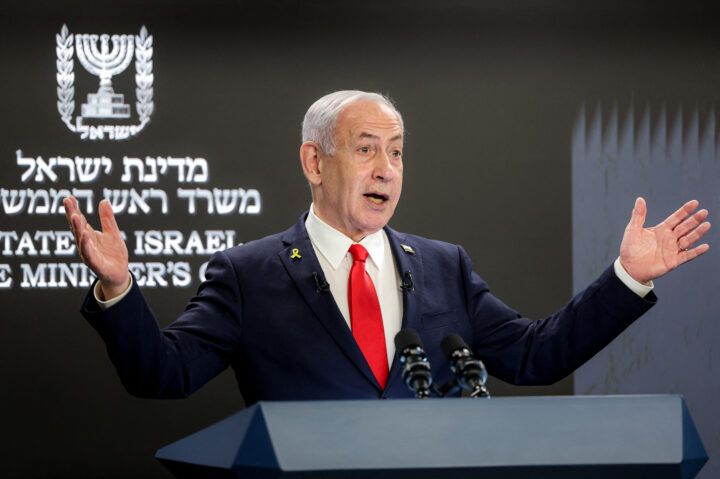
ABIR SULTAN/POOL/AFP via Getty Images
Israel's Prime Minister Benjamin Netanyahu gives a press conference at the Prime minister's office in Jerusalem on August 10, 2025.
In the run-up to the U.S. presidential election last year, one common refrain heard in Israeli leadership was to wait out the election in the hope of a friendlier Trump administration taking over.
Increasingly, many pro-Israel voices in the United States are quietly saying the same thing about upcoming Israeli elections, which polls suggest could usher in a more moderate coalition, and diminish the influence of far-right leaders in the current Israeli government.
The possibility of new elections taking place soon, more than any particular shift in military strategy or policy decisions, is looking like the most likely factor that could advance progress in the region.
While Israeli elections are not guaranteed to take place until October 2026, the legislative crisis over Haredi conscription in the IDF is looking like it could collapse Israeli Prime Minister Benjamin Netanyahu’s coalition, and move up the election timetable to as early as next January.
What has prevented elections until now is the fact that all members of the governing coalition are projected to lose seats if elections are held. That most Israelis want new elections is the very reason why they haven’t happened – yet.
Indeed, if elections were held today, Netanyahu would be in serious trouble. A recent poll commissioned by Israel’s Channel 12 found the anti-Netanyahu bloc making up a narrow majority of 61 of the Knesset’s 120 seats, with the current Likud-led coalition sitting at 49 seats, and Arab parties making up the remaining 10 seats.
Likud won 32 seats in the 2022 election that brought Netanyahu back to power; his party polls at 24 seats right now. The far-right parties led by Finance Minister Bezalel Smotrich and National Security Minister Itamar Ben-Gvir also lost significant support since 2022, dropping from their current 14 seats to 10.
Public polling in Israel also shows majority sentiment favoring a deal that would return all the hostages for an end to the war, along with broad concern that an extended war or occupation in Gaza would wreak havoc on Israel’s social cohesion and economic vitality.
There has been a political subtext to much of the Israeli government’s decision-making in the last several years. Even amid the remarkable success of Israel’s 12-day war against Iran, Netanyahu didn’t get the type of political bump successful wartime leaders typically do.
Throughout the war, he’s been in a defensive crouch, with his playbook focused on keeping his far-right partners, Smotrich and Ben-Gvir, satisfied to avert a collapse in the government that would necessitate early elections.
But with Israel’s international isolation becoming a growing political issue, and the concern over the fate of the remaining hostages driving domestic discourse, the politics have changed in Israel. That means Israel’s political calendar — and the prospect of elections around the corner — may end up playing a decisive role in the future of the war.
Top IDF and government officials have clashed on a series of issues, including the appointments of more than two dozen military officials and Zamir’s opposition to the plan to take over Gaza City and expand IDF operations in the Gaza Strip

IDF
The Chief of the General Staff, LTG Eyal Zamir, the Director of the ISA, Ronen Bar, and the Commanding Officer of the IAF, Maj. Gen. Tomer Bar, in the IAF’s Underground Operations Center, commanding the strikes in Gaza overnight between March 17th and March 18, 2025
Tensions between Israeli Prime Minister Benjamin Netanyahu and Eyal Zamir, the chief of staff of the IDF, are as high as the record-setting temperatures that have swept the region.
The IDF’s top officials and the Israeli government have clashed on a series of issues in recent days, including the appointments of more than two dozen military officials and Zamir’s opposition to Netanyahu’s plan to take over Gaza City and expand IDF operations in the Gaza Strip, which was approved by Israel’s Security Cabinet last week.
The IDF chief of staff has warned that the new approach to Gaza risks the lives of the 20 remaining living hostages in the enclave, and would further deplete the military’s resources in Gaza. The army, under strain after nearly two years of war, has — even prior to Zamir’s appointment in March — been at odds with the government over the continued exemption of the majority of the country’s Haredi population from the mandatory conscription required of most Israelis.
Israel Democracy Institute President Yohanan Plesner told Jewish Insider this morning that “historically, the relationship between the political level — prime minister, defense minister — and the top brass of the defense establishment, and mainly the IDF chief of staff, has been based on the premise that when Israel engages or embarks on significant security endeavors, operations and so on, it’s based on mutual consent,” with both parties having “de facto … veto power.”
But now, Plesner said, Netanyahu “is violating this decision-making norm that characterized the way decisions on core security [and] national security issues were made in the past.”
Plesner pointed to IDI polling conducted earlier this summer that showed Zamir being the senior official in whom Israelis had the most trust, at 68.5%. The same poll found Netanyahu with a trust rating of 40%.
The potential removal of a senior official months into his tenure “was not in the cards in the past. A chief of staff would voice their professional opinion and they wouldn’t risk being fired.”
The clash between Netanyahu and Zamir has also drawn in former Israeli Prime Minister Naftali Bennett, who is widely seen as one of the only people who could topple Netanyahu in the next election. Bennett attributed the infighting to Zamir’s opposition to the continuation of Haredi draft exemptions — an issue that has sowed division even within Netanyahu’s coalition and still threatens to topple the government.
“Instead of standing behind the army,” Bennett said, “the government has launched an attack *on* the army.”
Netanyahu has previously clashed with — and dismissed — senior military officials, most notably former Israeli Defense Minister Yoav Gallant, whom Netanyahu first tried to fire in early 2024 but was met with mass protests, before ousting him in November 2024. Last summer, Israeli media reported tensions between the prime minister and Zamir’s predecessor, Lt. Gen. Herzi Halevi, over Netanyahu’s suggestion that hostage talks had not moved forward because Hamas did not feel enough pressure from the country’s military. Netanyahu also pursued the dismissal of former Shin Bet chief Ronen Bar whom he clashed with on a number of issues — including the hostage negotiations and war strategy — citing “continuing lack of trust.”
Plesner pointed out that relations between Netanyahu and both Gallant and Halevi “very much soured around the fact that they were committed to implementing the Supreme Court ruling” that removed the Haredi draft exemption, and that Zamir, as chief of staff, similarly backs the conscription of the Haredi community as war fatigue plagues the reservists who have served hundreds of days in uniform since the start of the war.
Nearly all of the IDF’s top leaders from Oct. 7, 2023, have departed their roles, whether by choice or force, in the almost two years since the attacks. Netanyahu — who has long tried to absolve himself of responsibility for the attacks, instead blaming the military and the Shin Bet — remains the only senior government official from that time still in power. Analyst Nadav Pollak suggested that the prime minister has, since Oct. 7, been “trying to divert the blame from him to the military leadership (he didn’t know Hamas plans etc.) and as long as the focus is on the IDF leadership it’s not on Bibi.”
Now, with the Knesset out for the rest of the summer, ceasefire talks stalled and an immediate collapse of his government off the table, Netanyahu is able to buy some time — perhaps up to several weeks — as Israel’s top political and military brass game out and implement the government’s Gaza strategy. Meanwhile, observers will watch to see how Zamir will carry out Netanyahu’s orders.
Sources told Israel Hayom that Dermer began considering the move after Israel’s degraded Iran’s nuclear program

Michael Brochstein/SOPA Images/LightRocket via Getty Images
Ron Dermer, Israeli ambassador to the United States, seen speaking at an AIPAC Policy Conference in Washington, DC.
Israeli Strategic Affairs Minister Ron Dermer is considering resigning from the Israeli government in the coming months, Israel Hayom reported on Monday.
Dermer, a close advisor of Prime Mister Benjamin Netanyahu, has in recent years worked primarily on the issue of the Iranian nuclear threat. He began contemplating his exit after Israel degraded Iran’s nuclear capabilities in June, senior government sources told the outlet.
It wasn’t clear when he would resign, though the sources indicated it would likely be before Israel’s next elections. Elections are currently scheduled for October 2026, but could be held sooner, depending on Netanyahu’s ability to keep his 60-member coalition together.
Since February, Dermer has also led Israel’s ceasefire and hostage-release negotiation efforts, a role that has engendered criticism from elements of the Israeli public, including hostage family members who called for his resignation from the negotiating team in May over the lack of progress toward a deal.
The Maryland senator has emerged as an outspoken critic of Israel in the Senate. A presidential campaign would give him a larger platform for his views

Nathan Howard/Getty Images
Sen. Chris Van Hollen (D-MD) speaks at a campaign rally for Democratic gubernatorial candidate Wes Moore at Bowie State University on November 7, 2022 in Bowie, Maryland.
Sen. Chris Van Hollen (D-MD), one of the most strident critics of the Israeli government in the Senate, is set to deliver the keynote speech next month at an Iowa Democratic Party fundraiser that’s a frequent stop for high-profile Democrats and presidential hopefuls.
The Polk County Steak Fry in Des Moines is a highly watched annual event for Democratic politicos, and Van Hollen’s appearance is a sign of the senator’s ambitions for higher office.
Van Hollen has become a leading voice of the party’s left wing on foreign affairs, and was an early critic of Israel for its war against Hamas in Gaza. He has also asserted himself as a prominent figure in the party on other issues, including pushing for the release of Kilmar Abrego Garcia, who the Trump administration deported for several months to a high-security prison in El Salvador.
A Van Hollen campaign spokesperson told JI the senator is “looking forward to the opportunity to speak to Iowans about the future of the Democratic party as we confront a lawless president and chart a new course.”
Polk County Democrats Chair Bill Brauch told the Baltimore Banner that the party seeks out Democrats with national appeal and that they saw him as a “big get.”
“Throughout his career, he has been a tireless advocate for equal rights, justice, and opportunity, fighting to create good jobs, strengthen small businesses, and expand access to education and job training for all,” the group said in its announcement. “In Congress, Senator Van Hollen has defended Social Security and Medicare, worked across party lines to protect the Chesapeake Bay, expand medical research, fight childhood cancer, and pass the ABLE Act to help families with children with disabilities.”
Illinois Gov. J.B. Pritzker — also seen as a potential presidential contender in 2028 — headlined the event last year, and Minnesota Gov. Tim Walz was the headliner in 2023. Barack Obama delivered the keynote in 2007.
Sen. Ruben Gallego (D-AZ) and former Transportation Secretary Pete Buttigieg have made stop-overs in the Hawkeye State in recent months — which may be restored to its first-in-the-nation status in the 2028 Democratic presidential nomination process.
Rep. Dan Goldman (D-NY): ‘It is clear that Prime Minister Netanyahu’s personal and political interests are guiding Israel’s actions, rather than what is best for the Israeli people’

Blue/Bloomberg via Getty Images
Representative Ritchie Torres, during an interview in New York, US, on Tuesday, Jan. 28, 2025.
Pro-Israel Democrats on Thursday criticized the Israeli government’s plans to expand its operations and take control of additional parts of Gaza.
The Israeli Security Cabinet early Friday approved plans to take over Gaza City, though it stopped short of Prime Minister Benjamin Netanyahu’s statement earlier Thursday to Fox News that Israel plans to occupy the entire Gaza Strip.
The plan seems to be aggravating the growing friction between the Israeli government and some of the Jewish state’s most vocal liberal backers in the United States over Israel’s ongoing war in Gaza and the humanitarian crisis in the enclave.
Rep. Ritchie Torres (D-NY) said that Israel is ultimately responsible for making its own decisions, but said he’d advise the Israeli government to seek an end to the war once it frees the hostages.
“First: the highest priority is to secure the release of the hostages who are at grave risk of dying from deliberate starvation and torture,” Torres told Jewish Insider. “Second: the war in Gaza is in danger of becoming a quagmire that bogs Israel down for years — indeed decades — to come.”
He again said the war risks becoming a long-term entanglement like the Iraq and Afghanistan wars were for the United States, costing both money and lives.
“The war fatigue and post-traumatic stress in Israeli civil society and in the Israeli military — as well as the humanitarian crisis in Gaza — have become unbearable,” Torres continued. “Israel has degraded Hamas. And so once Israel has secured the release of the hostages, it should declare victory, end the war, and focus on expanding the Abraham Accords to include relations with the likes of Saudi Arabia and Indonesia.”
Rep. Jake Auchincloss (D-MA) pushed back on suggestions by Netanyahu in his announcement of the new Gaza plan that governance would ultimately be turned over to Arab forces.
“Netanyahu said: ‘We don’t want to keep Gaza. We want a security perimeter. We want to hand Gaza over to Arab forces that will govern Gaza properly,’” Auchincloss said to JI. “My question is: What Arab force has agreed to this? What is the plan for governance? There is no evidence that either exists.”
Rep. Lois Frankel (D-FL) said that Israel should prioritize increasing humanitarian aid and protecting civilians.
“Israel has the right and responsibility to defend itself against Hamas and other terrorist threats. At the same time, I believe it is in the interest of Israel, the United States, and the entire region to prioritize efforts that protect innocent lives and stabilize the situation,” Frankel said. “That means working urgently to get food, water and medicine to civilians in Gaza while continuing to support Israel’s long-term security. I remain committed to a path that ensures the safety of the Israeli people and upholds our shared humanitarian values.”
In a lengthy statement released hours before Netanyahu’s formal announcement, Rep. Dan Goldman (D-NY) blasted both Netanyahu and the situation in Gaza, saying that Netanyahu’s decisions are being motivated by the prime minister’s self-interest, rather than Israel’s best interests. He unequivocally rejected discussion of full occupation of Gaza.
“The current crisis in Gaza shocks the conscience. The international community — especially Israel and the United States — must immediately put an end to this humanitarian catastrophe,” Goldman said. “It is clear that Prime Minister Netanyahu’s personal and political interests are guiding Israel’s actions, rather than what is best for the Israeli people or for the nation of Israel. He is beholden to the extreme right, whose support he needs to remain in power, which, in turn, is helpful to defend against his corruption case.”
Goldman continued, “To the extent a full occupation is indeed his plan, it is not only morally reprehensible, but it is also opposed by Israeli military and national security leaders as well as the Israeli people.”
He said that the international community must come together to free the hostages, end the war and surge aid into Gaza, which requires “unified international pressure on Hamas,” and said that international recognition of a Palestinian state before the hostages are released “only serves to reward” Hamas and disincentivize it from agreeing to a ceasefire and hostage deal.
“Fundamentally, Prime Minister Netanyahu must stop putting his own personal interests ahead of the state of Israel’s,” Goldman concluded. “The sacredness of human life and Israel’s sacrosanct place as a democracy and safe haven for the Jewish people are simply too important to be sacrificed on the altar of political self-interest.”
Rep. Brad Sherman (D-CA), in a new statement on Thursday, did not directly address the new Israeli plans, but said that all parties must work to “surge humanitarian aid to the people Gaza — not Hamas or criminal gangs” to the point of eliminating scarcity.
“I welcome the steps Israel has taken, including instituting humanitarian pauses and conducting airdrops of aid. However, these steps alone are not sufficient — it is clear that the current aid delivery system needs to be scaled up to adequately meet the needs in Gaza,” Sherman said. “That includes significantly increasing the number of Gaza Humanitarian Foundation’s distribution sites to prevent crowding, establishing safer distribution processes, and distributing higher quantities of aid each and every day.”
He also urged the United Nations and NGOs to “stop playing politics,” work with the GHF and distribute the food stockpiles sitting inside Gaza. And he said that those who criticize Israel without pressuring Hamas or acknowledging its starvation of hostages only encourage the terrorist group to keep fighting.
“The fastest way to alleviate the suffering of Gazans and the hostages is for Hamas to release the hostages and lay down its arms and depart for Iran or another country willing to accept them. This would pave the way for legitimate Arab-led governance and allowing Gaza to be rebuilt,” Sherman continued.
Pro-Israel Republicans, meanwhile, are supporting Netanyahu’s latest moves.
“The fastest way for this conflict to end is for Hamas to surrender and release the hostages. In the absence of that — Hamas has continually refused the terms of a ceasefire — Israel must take the necessary steps to eliminate Hamas,” Rep. Mike Lawler (R-NY), who chairs a key House subcommittee focused on the Middle East, told JI. “Simply put, there cannot be peace so long as Hamas and the Palestinian Authority remain in power. I support Israel’s decision to use all military and diplomatic means to achieve their objectives, while continuing to provide humanitarian aid and assistance to the innocent Palestinians long suffering under Hamas’ brutal oppression.”
Rep. Joe Wilson (R-SC) said in an X post he supports Netanyahu’s “proposal to provide governance to Gaza. This will protect Israeli civilians from Hamas rocket attacks whose covenant is to murder all Jews. It will also allow for safe delivery of food for the people of Gaza. Mutually beneficial to everyone.”
Asked about the Israeli government’s decision, AIPAC placed the blame on Hamas.
“This war is only being extended because Hamas refuses to free all 50 hostages and surrender power in Gaza,” the group said in a statement. “America’s leaders must continue to stand with our ally Israel and take concrete steps that increase the pressure on Hamas to let all the hostages go and give up control of Gaza.”
Vocal critics of the Israel government on Capitol Hill blasted the new plan.
“Netanyahu’s plan to reoccupy Gaza is key to the far-right’s goal of taking over Gaza & the West Bank and forcing Palestinians out,” Sen. Chris Van Hollen (D-MD) said on X. “Meanwhile, Trump is making us a subcontractor in this operation. US taxpayers should not be funding what amounts to ethnic cleansing by another name.”
Congressional Progressive Caucus Chair Rep. Greg Casar (D-TX) said on X that the move toward full occupation of the Strip is “unacceptable and will not lead to safety and security for Israelis or Palestinians.” He renewed his call for the U.S. to stop providing weapons to Israel.
The group also visited a Gaza Humanitarian Fund staging site on the Gaza border and met with hostage families
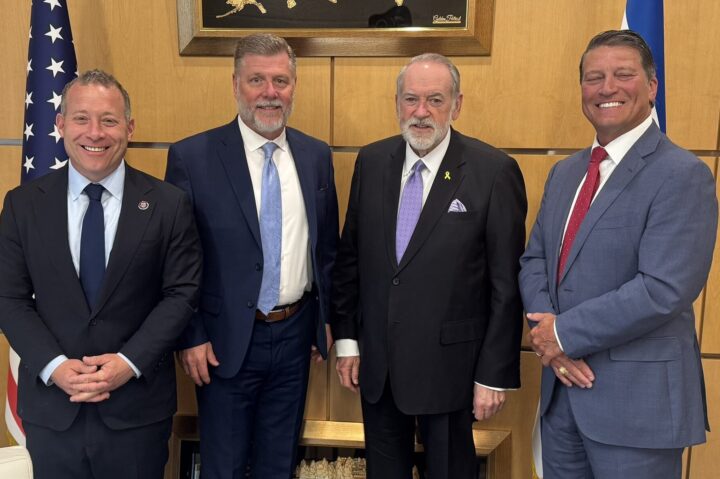
Courtesy of Rep. Rick Crawford
From left to right: Rep. Josh Gottheimer (D-NJ), House Intelligence Committee Chair Rick Crawford (R-AR), Ambassador to Israel Mike Huckabee and Rep. Ronny Jackson (R-TX).
A group of House Intelligence Committee members visited Israel this week, meeting with top Israeli leaders as well as visiting one of the sites of the Oct. 7, 2023, Hamas terror attacks, a Gaza Humanitarian Foundation staging site and the Kerem Shalom border crossing.
The group included committee Chairman Rick Crawford (R-AR) and Reps. Josh Gottheimer (D-NJ) and Ronny Jackson (R-TX).
The lawmakers met with officials including Prime Minister Benjamin Netanyahu, Mossad Director David Barnea, U.S. Ambassador to Israel Mike Huckabee, IDF representatives and Palestinian Authority officials.
The group also visited Kibbutz Kfar Aza near the Gaza border, which suffered heavy losses in the Oct. 7 attacks, and met with hostage families, including the family of Evyatar David, an Israeli hostage shown in a recent video emaciated and forced by Hamas to dig his own grave in a Gaza tunnel.
“Israel and its people have experienced untold levels of tragedy and devastation because of the very fact that they exist,” Crawford said in a statement. “But the Jewish people are a strong, resilient, and compassionate people. Based on our conversations and briefings with military and intelligence partners this week, it is clear Israel is committed to a peaceful end to the unrest in the region but will not cede any ground to Hamas or other Iranian terrorist proxies.”
He said that the group’s “message was simple — the United States stands with Israel and its people. I am grateful for the ongoing cooperation between the U.S. and our Israeli partners as we work to advance our shared goals in the region.”
In a statement, Gottheimer emphasized the need to free the hostages, increase humanitarian aid and end Hamas’ rule in Gaza.
“Given the situation, it was extremely important to meet with Prime Minister Netanyahu and other senior Israeli officials, Ambassador Huckabee, and family members of hostages still in Gaza,” Gottheimer said. “It was also critical to visit an aid staging location at the Kerem Shalom border crossing and a GHF coordination site, which gave me a better understanding of efforts to surge aid into Gaza.”
“We must ensure aid is able to swiftly reach Gazans in need, not Hamas terrorists, who continue to steal food from innocent Palestinians,” he continued. “With so much misinformation, there is no better way to understand the situation than to see it firsthand. By promoting security and stability in the Middle East, the United States will improve our own national security.”
Jackson said in a statement, “This trip not only provided critical firsthand updates from our Defense, State, and Intelligence partners on the ever-evolving elements that threaten Israel, the Middle East, and ultimately the United States, but also reinforced the need for continued strong support to our key ally in the region, Israel.”
He praised both Huckabee and Netanyahu for the work that they are doing.
“We need strong leadership and coordination to protect American lives and interests, and I’m proud to see the Trump administration making national security a top priority with a strategy that is tough, smart, and focused on keeping our country and allies safe,” Jackson continued.
Discussions touched on issues including freeing the hostages, the need to end Hamas’ control of Gaza, the need to increase humanitarian aid — including through the GHF — the need for continued maximum pressure on Iran, the threats from Iran-backed terrorist groups, Hamas’ use of human shields and the need for continued bipartisanship in the U.S.-Israel relationship, according to press releases.
Klobuchar: ‘I have supported Israel’s right to defend itself, I always will. But they aren’t changing’

Drew Angerer/Getty Images
Sen. Amy Klobuchar (D-MN)
Sen. Amy Klobuchar (D-MN) said that she voted, for the first time, for resolutions blocking U.S. arms sales to Israel this week to send a message to the Israeli government of disapproval for the humanitarian situation in Gaza, even as she acknowledged that the vote might not make much of an impact.
“I just think it’s really important for people to speak out when they can, even if it’s on a vote that isn’t probably going to make all the difference right now. And it doesn’t mean I’m going to be hard-stop against aid for Israel in the future,” Klobuchar told Punchbowl News.
“At some point, you’ve got to seek change. And I think this is one way you can do it,” she continued. “I have supported Israel’s right to defend itself, I always will. But they aren’t changing.”
She said that she’d tried to communicate her disapproval of the humanitarian situation in Gaza to Israeli Prime Minister Benjamin Netanyahu during his recent visit to Washington, D.C. but said it “didn’t work very well when I said it.”
Klobuchar said in a Senate floor speech several days before the votes that she attended the meeting with Netanyahu “for one reason: in my capacity as No. 3 in the Democratic leadership, and that was to raise the issue of the humanitarian crisis in Gaza.”
“I say to my colleagues you can support the people of Israel. You can be horrified and condemn, as all of us did, the terrorist attack. But we cannot continue to allow people to starve,” Klobuchar said. “Lives are being lost on a daily basis, kids, innocents, and the government of Israel must change course.”
She said that U.S. policy must focus on returning to a ceasefire, increasing humanitarian aid, freeing the hostages and security a two-state solution.
The Minnesota Democrat, a moderate, has historically been a quiet but reliable supporter of Israel. She’s also the No. 3 Senate Democrat, seen as a potential successor to Minority Leader Chuck Schumer (D-NY).
Of the 11 members of Democratic leadership, seven voted for the resolutions on Wednesday.
Klobuchar is running for the No. 2 Senate Democratic leadership slot, competing against Sen. Brian Schatz (D-HI), a consistent supporter of prior efforts to halt weapons sales, and Sen. Patty Murray (D-WA), who, like Klobuchar, flipped her vote to support the Sanders resolutions after previously opposing them.
Torres: ‘War becomes a process of mutual dehumanization which we’re seeing in real time’

Michael M. Santiago/Getty Images
Rep. Ritchie Torres (D-NY) speaks at a press conference endorsing New York City Mayoral candidate Andrew Yang on January 14, 2021 in New York City.
Rep. Ritchie Torres (D-NY) on Tuesday warned that the war in Gaza appears to be turning into a “quagmire” akin to the Iraq war, without clear objectives or any realistic end point.
The pro-Israel Democrat has grown more vocal lately about his criticisms of the Israeli government and how it has been handling the war in Gaza, as concern about the humanitarian situation in the enclave has mounted on both sides of the aisle. He has also continued to offer support for Israel and emphasize that Hamas is primarily responsible for the war in Gaza.
“I want to see Israel secure the release of hostages and end the war, because as long as the war persists, there’s a real potential — our experience with Afghanistan and Iraq tells us that wars in the Middle East can morph into quagmires that have no clear end in sight that have no clearly defined strategic objectives,” Torres said in an interview with The Bulwark.
“I feel this is a quagmire that could persist indefinitely with no clear end in sight,” he continued, a situation he said would limit the Israeli economy and expansion of the Abraham Accords. He said the Israeli government has failed to outline clear objectives for the war. “It feels like a quagmire reminiscent of the war in Iraq.”
He said that Israel has been “extraordinarily effective” in its operations against Hezbollah and Iran, “but [I] have concerns about the war in Gaza.”
Torres said that “war becomes a process of mutual dehumanization which we’re seeing in real time. There should be space in the American heart for the humanity of both Israelis and Palestinians.”
He said that Hamas is the “central cause” and “primarily responsible for the suffering that has been unleashed since Oct. 7.”
But he also said that the “humanitarian crisis in Gaza is simply and morally unacceptable and all parties including Israel and the United States must do their part to ease the hardship and hunger that has taken hold in the Gaza strip. To me, it is wrong to deny or downplay the crisis.”
He rejected arguments that he said he’d seen from Israeli officials that the crisis in Gaza is purely Hamas propaganda, and said that he can’t deny to constituents concerned about the issue that it is happening.
The correct response, he continued, is “not to downplay it, but it’s to tell our constituents that we are doing everything that we can to ease suffering among Palestinian civilians and children. That the war is not against the Palestinian people. It’s against Hamas.”
A source in the PMO told JI that Israel has ‘absolutely no interest in undermining the freedom [of workers and volunteers for Christian organizations] coming to Israel’
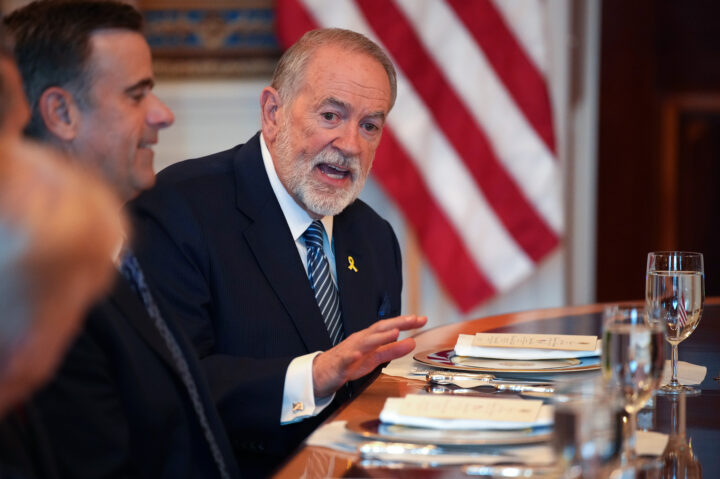
Andrew Harnik/Getty Images
U.S. Ambassador to Israel Mike Huckabee delivers remarks as President Donald Trump hosts Israeli Prime Minister Benjamin Netanyahu for a dinner in the Blue Room of the White House on July 7, 2025, in Washington, DC.
Israeli Prime Minister Benjamin Netanyahu’s office resolved a dispute between U.S. Ambassador to Israel Mike Huckabee and Israeli Interior Minister Moshe Arbel over the denial of visas to workers and volunteers for several evangelical Christian organizations, two sources involved in the matter told Jewish Insider on Sunday.
“A solution has been reached to the satisfaction of all parties. The Evangelical Christian organizations active in Israel, which represent the vast majority of Zionists in the world today, will receive all of the visas they need through a streamlined and efficient application process,” Calev Myers, the attorney for the organizations told JI on Monday.
Hours before the issue was resolved, a source in the Prime Minister’s Office told JI, “this is something that we consider to be of urgent importance. We have every intention of solving this problem very quickly … It is being handled with the proper sensitivity between the Prime Minister’s Office and the embassy.”
The PMO source said that Israel has “absolutely no interest in undermining the freedom [of workers and volunteers for Christian organizations] coming to Israel … We value evangelicals. It’s very regrettable that there is a problem and we obviously have to fix it.”
Huckabee sent a letter to Arbel last Wednesday, expressing “great distress” and “profound disappointment” that after the two met to discuss the matter earlier this year, the Interior Ministry’s visa department continued to conduct investigations into American and other evangelical organizations seeking visas for their workers.
“It would be very unfortunate that our embassy would have to publicly announce throughout the United States that the State of Israel is no longer welcoming Christian organizations … and is instead engaging in harassment and negative treatment towards organizations with long-standing relationships and positive involvement toward Zionism and friendship to the Jewish people and the State of Israel,” Huckabee wrote.
If the situation continues, Huckabee added, he will instruct the U.S. Embassy’s consular section to treat Israeli citizens in kind.
“Surely this is not the relationship the State of Israel wishes to have with its best partner and friend on the planet,” he wrote.
A source close to Huckabee told JI that the ambassador did not intend for the letter to go public, which it did on Channel 12 news on Thursday evening.
Arbel responded on Thursday that he had committed “to reviewing such applications with the utmost efficiency,” instructed his staff to do so as well earlier this year, and that every specific case raised by Huckabee’s office was addressed “within an exceptionally short timeframe.” The interior minister argued that the specific organizations Huckabee mentioned in his letter were not the ones they had discussed in their meeting earlier this year.
Arbel also said he was surprised by the way Huckabee handled the matter — sending copies of the letter to Netanyahu, President Isaac Herzog, Foreign Minister Gideon Sa’ar and Knesset Speaker Amir Ohana — which, he said, “deviates from accepting working norms and does not reflect the direct and constructive relationship we have established.”
Rabbi Pesach Wolicki, executive director of Israel365action, an organization connecting Christians to pro-Israel advocacy, said that this has been a long-standing issue regarding clergy and other workers and long-term volunteers, and not Christian pilgrims coming to Israel for short visits.
Huckabee and attorney Calev Myers met with Arbel about six months ago to work out issues with a specific group of organizations, and Arbel said he would solve it, but the issue remained unresolved, Wolicki explained.
The exchange of letters also came up at a time of increased tensions between Israel and Christians, after what Israel said was an errant tank shell hit the only Catholic church in Gaza and killed three people, and after several incidents of harassment and attacks by extremist settlers against the Christian population of Taybeh in the West Bank.
Huckabee wrote on X on Saturday that “Taybeh is a quiet Palestinian Christian village south of Jerusalem w/ a lot of American citizens that has been vandalized-including fires set at ancient church. I visited there today. Desecrating a church,mosque or synagogue is a crime against humanity and God.”
“I work for all American citizens who live in Israel –Jewish, Muslim or Christian. When they are terrorized or victims of crime[s], I will demand those responsible be held accountable [with] real consequences,” the ambassador added.
Wolicki said that “the timing couldn’t have been worse.”
Israel has laws restricting missionary activity, and the visa issue has been exacerbated by the fact that the Shas party, whose Haredi constituency is especially sensitive to missionizing, has run the Interior Ministry for much of the last 25 years, he added.
“Any situation in which you have noncitizens in the country for the long term, it’s a bureaucratic process, and because of sensitivity about missionizing, this has always been an issue,” Wolicki said, noting that Israel365 has also had problems obtaining visas for Christian employees in the past.
The organizations Huckabee mentioned in his letter, the Baptist Convention of Israel, Christian Missionary Alliance and Assemblies of God are missionary groups, Wolicki said.
“There are official restrictions on missionary activity that, when Christians learn of them — and I say this with a lot of firsthand experience — it really moves them from support for Israel, even from the American level of valuing free speech … but also they feel like, how can you say you respect Christians and you want Christian support but we’re not even allowed to talk about Jesus when we’re there,” Wolicki said.
“Christians don’t think you’re offending anyone when you preach the gospel, and Jews view that as you have a knife and you’re trying to stab them,” he added.
Wolicki argued that the laws against missionary activity are problematic, though he acknowledged that abolishing them would likely be unpopular in Israel.
“Missionaries are active all over Israel anyway. There are Israelis who are active … Anyone concerned about missionary activity, which is a legitimate concern, should know this is not the solution. It causes more harm than good and makes Christians more hostile to the Jewish people,” he said.
Josh Reinstein, director of the Israel Allies Foundation, which promotes faith-based diplomacy, said that he has seen this issue come up repeatedly over the 21 years since the foundation was founded.
“It’s an ongoing issue because they always change the requirements for Bible-believing Christians and their organizations,” Reinstein said. “There are no protections for Evangelicals like the 14 mainline churches [the Israeli Religious Affairs Ministry] recognizes.”
“This needs a solution, but it is definitely not a crisis or a problem of Israel not wanting Christians as the enemies of Israel are making it out to be,” he added.
Reinstein questioned why what he called a minor issue was making bigger news than Christians under attack in Syria.
“Israel is the only place in the region where Christians grow and thrive, as opposed to in the 22 countries around us,” he said. “People understand the relations bewteen Jews and Christians is so important today…which is why they are trying to make it into a bigger deal than it is. Huckabee is one of the greatest allies and friends Israel has. I don’t think it was his intention to cause a rift.”
United Torah Judaism left the coalition and Shas quit the government, but did not pull its 11 lawmakers out of the parliamentary coalition
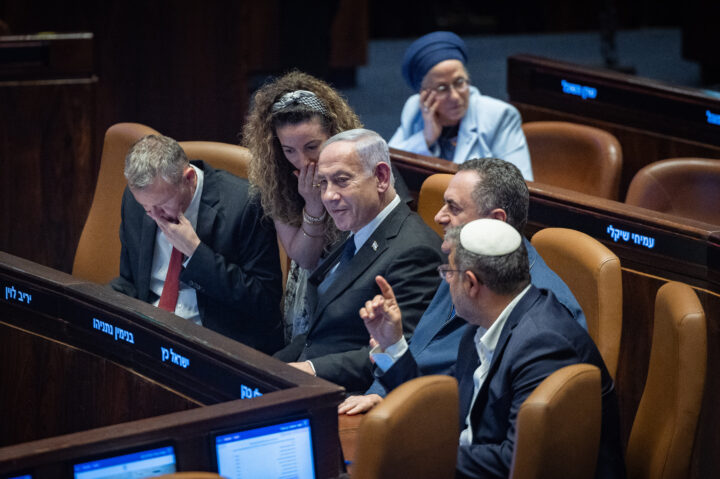
Yonatan Sindel/Flash90
A discussion and a vote on the expulsion of MK Ayman Odeh at the assembly hall of the Knesset, the Israeli parliament in Jerusalem, July 14, 2025.
New Israeli elections are unlikely to happen this year, despite the departure on Wednesday of two parties from Israeli Prime Minister Benjamin Netanyahu’s government over disagreements over Haredi military exemption legislation.
After months of disagreements, Ashkenazi Haredi faction United Torah Judaism left Netanyahu’s coalition in protest, leaving it with 61 out of the Knesset’s 120 seats. On Wednesday, Sephardic Haredi party Shas’ five Cabinet ministers quit the government, though party leader Aryeh Deri will remain an observer in the Security Cabinet.
Shas only quit the government — meaning their Cabinet posts — and did not pull its 11 lawmakers out of the parliamentary coalition. Shas, whose voter base is right-wing and even more supportive of Netanyahu than the prime minister’s own Likud party, said it will not vote with the opposition. This means that Netanyahu retains a majority in the Knesset, albeit a razor-thin one.
Opposition leader Yair Lapid still argued soon after Shas’ announcement that “starting today, Israel has a minority government. A minority government cannot send soldiers into battle … It has no authority, no right. It is an illegitimate government.”
“Israel does not have full-time welfare, health, interior, housing or labor ministers,” Lapid added. “The Netanyahu government is a minority government that endangers the care of Israel’s citizens.”
Both Haredi parties have been boycotting Knesset votes since April in protest over the Haredi conscription debate, in effect leaving the coalition with a minority and obstructing its ability to pass laws.
Israeli law only allows an early election to be called proactively, meaning that a Knesset member would have to propose a bill to disperse the legislature, followed by three separate votes on the issue. Opposition leaders held a vote last month on dispersing the Knesset, and under Israeli law are prevented from calling another such vote for six months unless 61 lawmakers sign a petition to the Knesset speaker.
Netanyahu’s government has time on its side, with the Knesset’s summer recess beginning on July 27 and the legislature’s voting schedule recommencing on October 19.
By law, the next election is set for Oct. 27, 2026, but the last time a Knesset election was held on its originally scheduled date was in 1988.
Shas and UTJ left the government over the ongoing political debate over legislation that would impose penalties on Haredi yeshiva students who do not enlist in the IDF. The parties’ Councils of Torah Sages have argued that religious study must be prioritized over serving in the military.
Israel has a mandatory military draft, but has historically exempted Arab citizens and Haredi yeshiva students from conscription. Governments on the left and right maintained the exemption for Haredim over decades, but Israel’s High Court of Justice struck it down in a series of rulings over more than 10 years, with no minor adjustments made by consecutive governments satisfying the justices’ standard of equality under the law. Last summer, the court ordered the Defense Ministry to send draft notices to young Haredi men.
Meanwhile, the 21 months of war in Gaza — with hundreds of thousands of Israelis serving in reserves, many of whom have served hundreds of days in active duty, leaving behind families and businesses — have increased the IDF’s manpower needs and the urgency to resolve the issue of Haredi conscription. Shas and UTJ’s allies on the Israeli right have moved away, in varying degrees, from tolerating the exemption for political expedience even as their own constituents serve in the IDF.
Knesset Foreign Affairs and Defense Committee chairman Yuli Edelstein, a Likud lawmaker, has been at the forefront of the dispute with the Haredi parties, refusing to advance legislation that does not satisfy the military’s needs, while Shas and UTJ demand that the bill institute little to no consequences for yeshiva students who do not serve in the IDF.
When announcing his resignation from the cabinet on Wednesday, Religious Services Minister Michael Malkieli said that penalizing yeshiva students for not serving is “no less than cruel and criminal persecution.”
Among the proposed sanctions are cutting daycare and housing subsidies afforded to the Haredi sector, prohibiting those who ignore conscription notices from receiving driver’s licenses or leaving the country, and, in some cases, arrest.
Edelstein reached a compromise over the sanctions with the Haredi parties in June, less than a day before the 12-day war with Iran began. However, the Haredim continued to boycott coalition votes in recent weeks, leading Edelstein to withdraw some of his concessions.
Speaking at a conference on Wednesday, Edelstein said that “this is not the time to bring down a right-wing government.”
He called on the Haredim to “bring a concrete proposal. For once, the Haredim should say what they agree to. My door is open; I promise to examine it quickly and hold negotiations.”
“For an entire year, they did not bring any concrete proposal for a conscription law,” Edelstein added. “In the moment of truth, they … made all kinds of excuses every time … It’s apparently not a question of the extent of the sanctions or the target [enlistment] numbers, but a total refusal to take part in the holy privilege … that is called the Israeli Defense Forces.”
28 Democratic senators and 8 Senate candidates in battleground states have publicly expressed opposition to Israeli annexation of parts of the West Bank

U.S. Senate Studio / Gage Skidmore
Minnesota Sens. Amy Klobuchar (D-MN) and Tina Smith (D-MN) have joined more than two dozen Senate Democrats publicly warning Israeli leaders of the implications of efforts to unilaterally annex portions of the West Bank. Israeli Prime Minister Benjamin Netanyahu has said that the government could start annexing territory as early as July 1.
In individual letters sent last month and made public over the weekend, both senators — Klobuchar addressed Secretary of State Mike Pompeo and Smith wrote to Netanyahu and Israeli Defense Minister Benny Gantz — posited that annexation would undermine efforts to attain a two-state solution.
Twenty-eight senators have so far spoken out against the annexation proposal.
Last month, 19 Democratic senators sent a letter to Netanyahu and Gantz urging the Israeli leaders not to move forward with the effort. That letter, which was updated several times before being sent, cautioned the new Israeli government that “unilateral annexation puts both Israel’s security and democracy at risk” and “would have a clear impact on Israel’s future and our vital bilateral and bipartisan relationship.” Sens. Dianne Feinstein (D-CA) and Bob Casey (D-PA) sent individual communiques to Netanyahu and Gantz, similarly opposing the move, and Sens. Michael Bennet (D-CO) and Maggie Hassan (D-NH) addressed the matter in individual letters to Pompeo.
In addition, Sens. Mark Warner (D-VA) and Catherine Cortez Masto (D-NV) issued statements against annexation, and Sen. Chris Coons (D-DE) indicated to Jewish Currents that instead of signing or authoring a letter on annexation, he would “communicate directly with [Israeli] Ambassador [Ron] Dermer and Israeli officials to express his concerns.”
On Monday, eight Senate candidates in battleground states are expected to join the list expressing their strong opposition to such a move. In statements provided to J Street and shared with Jewish Insider, the candidates — Cal Cunningham (North Carolina), Sara Gideon (Maine), Teresa Greenfield (Iowa), Al Gross (Alaska), Jaime Harrison (South Carolina), MJ Hegar (Texas), John Hickenlooper (Colorado), Amy McGrath (Kentucky) and Jon Ossoff (Georgia) — emphasized that annexation would put the future of a two-state solution at risk.
Read their statements in full here.
Earlier this month, House Speaker Nancy Pelosi (D-CA) warned that unilateral annexation “puts the future [of peace] at risk and undermines our national security interest and decades of bipartisan policy.” Presumptive Democratic presidential nominee Joe Biden also came out against annexation, saying it “will choke off any hope for peace.”
“From the presidential nominee to the speaker of the House and from the Senate to the senatorial campaign trail, Democratic leaders have now made absolutely clear that they do not and cannot support unilateral annexation in the West Bank,” J Street President Jeremy Ben-Ami told JI. “For annexation to move forward in the face of this overwhelming opposition would be incredibly harmful to the future of Israelis and Palestinians and to the US-Israel relationship.”
Former U.S. Ambassador to the U.N. Nikki Haley also weighs in

Bill Clark/CQ Roll/AP Images
Republican Sen. Jim Risch (left) and Democratic Sen. Bob Menendez both condemned the U.N.'s report.
The Office of the United Nations High Commissioner for Human Rights (OHCHR) released a list of 112 companies on Wednesday that do business in Israeli West Bank settlements, sparking swift negative reactions from the Israeli government, many members of Congress and most mainstream American Jewish organizations.
Michelle Bachelet, the U.N. High Commissioner for Human Rights, said she was “conscious this issue has been, and will continue to be, highly contentious,” but that the list had been compiled “after an extensive and meticulous review process.” The report did not call for sanctions or boycotts of the specific companies listed, but is seen by many as a pressure campaign against the businesses.
The list included Airbnb, Booking.com, Motorola, TripAdvisor, General Mills and Expedia — though 94 of the entities were Israeli businesses.
In response, Israel cut ties with Bachelet for releasing the list without advance warning and without any coordination with Israeli officials. Prime Minister Benjamin Netanyahu called the U.N. Human Rights Council “a biased body that is devoid of influence” that works only to “disparage Israel.”
In a statement, House Majority Leader Steny Hoyer (D-MD) said that efforts to boycott or single out the Jewish state “mirror the kind of gross discrimination directed at Jewish people during some of history’s darkest moments.”
Rep. Eliot Engel (D-NY), the chairman of the House Foreign Affairs Committee, said the list is “wrongheaded and will embolden those who seek to use boycotts as a tool to pressure Israel.”
Reps. Michael McCaul (R-TX), Joe Wilson (R-SC) and Lee Zeldin (R-NY), members of the House Foreign Affairs Committee, released a joint statement calling the blacklist “yet another anti-Israel stunt that will not further peace in the region.”
Former U.S. Ambassador to the U.N. Nikki Haley tweeted that the body “hit a new low,” calling the timing of the publication “conniving and manipulative at best.”
Sen. Jim Risch (R-ID), chairman of the Senate Foreign Relations Committee, published a statement calling the report “incredibly biased,” and that it only offered further proof the OHCHR “is overly politicized and focusing a disproportionate amount of time and resources on Israel.”
Sen. Bob Menendez (D-NJ), the ranking Democrat on the Senate Foreign Relations Committee, accused the U.N. body of being “driven by politically motivated actors who seek to isolate Israel and undermine its right to exist.”
House Republican Whip Steve Scalise said the list “gives Israel’s enemies targets for violence and economic punishment.” Rep. Ted Deutch (D-FL) called the move “shameful,” and said it “will do nothing to further peace.” Rep. Brad Schneider (D-IL) said the list was “the most recent in a long series of discriminatory and shameful actions by the United Nations.”
Sen. Martha McSally (R-AZ) tweeted that the list is the list “discriminatory” and “absolutely appalling,” and Sen. John Boozman (R-AR) said the U.N. Human Rights Council “caved to anti-Israel voices.”
Condemnation also came from AIPAC, the Conference of Presidents and the American Jewish Committee.
None of the four members of “The Squad” — Reps. Ilhan Omar (D-MN), Rashida Tlaib (D-MI), Alexandria Ocasio-Cortez (D-NY) and Ayanna Pressley (D-MA) commented on the U.N. publication as of Wednesday evening.
2020 hopeful praises Joint List for backing Gantz as prime minister

Jeremy Hogan/SOPA Images/Sipa USA
South Bend, Indiana Mayor Pete Buttigieg campaigns in Clinton, Iowa on September 24, 2019.
WATERLOO, IOWA — Presidential hopeful Pete Buttigieg accused Donald Trump of taking “U.S. foreign policy steps for the purpose of intervening in Israeli domestic politics” on Monday. Trump has long been a vocal ally and supporter of Prime Minister Benjamin Netanyahu, and touted a potential defense treaty between the United States and Israel days before the recent election.
Speaking to reporters on his campaign bus, Buttigieg said Trump’s last-minute interjection was a “conflation of domestic and international politics.” The mayor of South Bend, Indiana, compared the president floating a potential Israeli treaty to Trump’s appearance with Indian Prime Minister Narendra Modi in Houston on Sunday at a campaign-style rally.
“There’s something deeply unhealthy in many different overlapping ways about [that] kind of conflation of U.S. policy and domestic politics on both sides,” he argued. Buttigieg pointed out that Trump has only contributed to the alliance between the United States and Israel “increasingly coming to be viewed as a partisan issue.”
The Democratic hopeful expressed skepticism that Trump’s remarks last week — appearing to distance himself from Netanyahu — would lead to any change in U.S. policy. “I don’t really find hope in anything this president is doing,” said Buttigieg, “but we’ll see what comes up.” The 2020 hopeful speculated that Trump “wants some level of credibility for whatever peace plan they are going to put out. I’m skeptical but we’ll see what they do or, as the president says ‘we’ll see what happens.’”
Buttigieg also hailed the decision of the Joint List, a coalition of Israeli Arab parties, to back Blue and White leader Benny Gantz as Israel’s next prime minister. “It’s remarkable,” said the South Bend mayor. “I don’t know how that reverberates in terms of the domestic calculations that Gantz has to make, but there is some possibility of growth and unity in that somewhere. I’d like to find out what it actually leads to.”
Please log in if you already have a subscription, or subscribe to access the latest updates.
 Continue with Google
 Continue with Apple