

























The new initiative will also include an antisemitism reporting tip line
Bryan Bedder/Getty Images for Anti-Defamation League
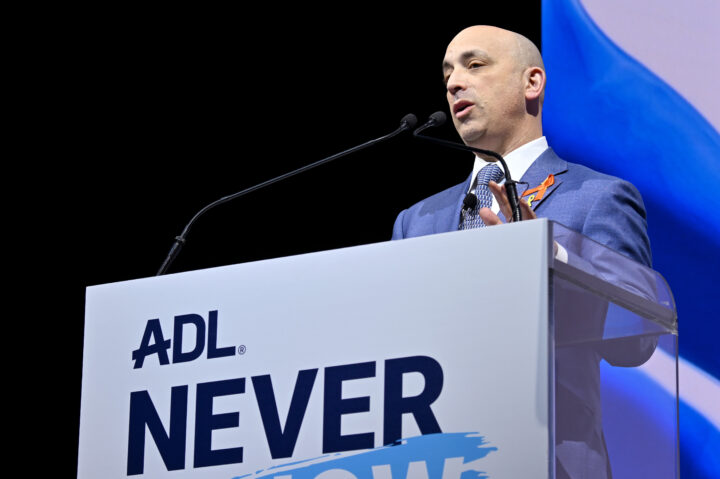
ADL CEO Jonathan Greenblatt speaks onstage ADL's Never Is Now at Javits Center on March 03, 2025 in New York City.


 Add JewishInsider on Google
In the wake of New York City Mayor-elect Zohran Mamdani’s victory on Tuesday, the Anti-Defamation League is launching the “Mamdani Monitor,” an initiative to track and monitor policies and personnel appointments of the incoming administration, Jewish Insider has learned.
The initiative will feature a tip line to report antisemitism as well as investment into researching policies, mayoral appointments and funding decisions coming from City Hall.
The ADL said it will draw from tip line reports to launch a public-facing tracker that monitors policies and other actions from the Mamdani administration that could impact Jewish safety and security — including education policy, budget priorities and security measures. The antisemitism watchdog plans to use the tracker’s findings to mobilize New Yorkers to respond to policies deemed threatening to the Jewish community.
ADL CEO Jonathan Greenblatt told JI that the initiative’s launch comes as Mamdani, throughout his campaign, “promoted antisemitic narratives, associated with individuals who have a history of antisemitism and demonstrated intense animosity toward the Jewish state that is counter to the views of the overwhelming majority of Jewish New Yorkers.”
“We are deeply concerned that those individuals and principles will influence his administration at a time when we are tracking a brazen surge of harassment, vandalism and violence targeting Jewish residents and institutions in recent years,” said Greenblatt.
Antisemitism and anti-Israel incidents reached historic levels in New York City following the Oct. 7, 2023, terrorist attacks. Jewish leaders have expressed concern that some of Mamdani’s proposed policies — such as the desire to disband the NYPD’s Strategic Response Group, which responds to riots — could threaten the safety of the Jewish community. According to the NYPD, in 2024, 54% of all hate crimes in New York City were against Jews.
As they denounce the UAE’s alleged backing of Sudan’s Rapid Support Forces, far-left lawmakers have passed over the Muslim Brotherhood affiliations and foreign backing of the rival Sudanese Armed Forces

Tariq Mohamed/Xinhua via Getty Images
Abdel Fattah Al-Burhan in the vehicle, chairman of Sudan's Transitional Sovereign Council and commander of the Sudanese Armed Forces SAF, departs from the Presidential Palace in Khartoum, Sudan, on March 26, 2025.
In recent days, a chorus of left-wing lawmakers in Congress have ramped up their ire towards the United Arab Emirates, accusing the Gulf country of helping fuel the yearslong civil war in Sudan by reportedly backing the Rapid Support Forces (RSF), the non-Islamist Arab force fighting the Muslim Brotherhood-aligned Sudanese Armed Forces (SAF).
The UAE has long denied allegations of involvement in the war. The Wall Street Journal reported this week that, according to sources, recent assessments by the Defense Intelligence Agency and the State Department’s intelligence bureau purport to show the UAE sending Chinese drones to the RSF.
On the other side, Iran, Russia, Egypt and Turkey have provided support to the SAF, according to conflict monitors and reporting by Bloomberg and The Washington Post.
The war in Sudan has wrought havoc upon the eastern African nation, with both warring factions committing crimes against humanity. The conflict has killed as many as 150,000 people and has displaced around 12 million.
Over the more than two-year long conflict, both militias have been accused of widespread sexual assault, mass killings of civilians, torture and deliberate attacks on civilian infrastructure. On Monday, the RSF captured the city of El Fasher after an 18-month blockade which saw the group effectively devastate the city, with reports of mass killings, sexual violence and the destruction of hospitals and displacement camps.
The U.S. government, under former President Joe Biden, determined the RSF was committing genocide and found both the RSF and SAF guilty of committing war crimes.
Meanwhile, the Muslim Brotherhood’s growing influence with the Sudanese Armed Forces has alarmed experts, who warn that the SAF’s deepening ties to Islamist networks threaten regional stability and could pose a risk far beyond the eastern African nation.
“The Muslim Brotherhood has had a strong presence in Sudan since the 1940s and that presence has evolved over the years,” Norman Roule, a former senior U.S. intelligence official, told Jewish Insider. “It’s important to note that this presence is also why Iran is such a strong supporter of the Burhan [head of SAF] government.”
Liam Karr, an analyst at the American Enterprise Institute, who has condemned actions on both sides of the conflict, says the ties date back to former Islamist dictator Omar al-Bashir, who ruled Sudan for several decades before the SAF overthrew him in 2019.
“The SAF is working with several Islamist brigades that consist of former Bashir-era army, police and intelligence personnel,” Karr told JI. “This includes the al Baraa Ibn Malik Brigade, which is widely associated with the Sudanese Muslim Brotherhood and Bashir and has an estimated 20,000 fighters.”
In recent months, the SAF has received explosive attack drones from Iran’s Revolutionary Guard Corps to aid in the conflict, while Egypt, one of their key backers, arrested a key Islamist militia leader aligned with the group — signaling that even staunch regional supporters of the group are “growing wary of its Islamist factions,” according to Foundation for Defense of Democracies Research Fellow Hussain Adbul-Hussain.
Roule said Iran has a vested interest in providing the SAF with weaponry in order to reestablish a presence in the region and revitalize their “broken proxies,” following Israel’s degrading of its military capabilities and of its proxy Hezbollah, as well as the fall of the Assad regime in Syria.
“This is of extreme importance to the U.S. and its partners in the region, because if the Quds Force [IRGC] is able to establish a presence it lost in Syria, it would be able to reestablish training camps it operated a decade ago for Hamas smugglers, routes for weapons that it could send back into Gaza and revitalize Lebanese Hezbollah, as well as provide a transshipment location of weapons to the Houthis,” said Roule. “The Muslim Brotherhood presence in Khartoum is of serious concern for the United States and deserves much greater attention. It is a significant threat to the United States, Israel and the region.”
Anti-Israel lawmakers, including some of the Jewish state’s most vocal critics in the House, have sounded the alarm on the RSF, but have notably glossed over the SAF and its increasingly Islamist alignment.
“Sudan is facing the world’s worst humanitarian crisis and a genocide,” said Rep. Ilhan Omar (D-MN) in a post on social media on Tuesday. “The UAE and other arms dealers to the RSF and RSF-aligned militias must be held accountable.”
Rep. Rashida Tlaib (D-MI) echoed the same sentiment, saying she is “horrified” by the RSF’s “mass killings of civilians.”
“We must do everything in our power to stop this genocide, including cutting off all weapons sales to the United Arab Emirates who are arming and funding this ethnic cleansing,” said Tlaib on social media on Wednesday.
Rep. Joaquin Castro (D-TX) followed suit and similarly directed his criticism at the Emirates.
“I am incredibly concerned about the deepening humanitarian crisis in Sudan, and the atrocities committed by the Rapid Support Forces,” Castro wrote on social media on Wednesday. “The United States must put pressure on the RSF and those who back it — including the United Arab Emirates — to end these atrocities.”
A number of far-left activists online have also singled out the RSF and its reported Emirati ties for condemnation.
Kenneth Roth, a virulent critic of Israel and former head of Human Rights Watch, posted on Tuesday, “British arms sold to the United Arab Emirates are being found in Sudan, where the UAE is arming the paramilitary Rapid Support Forces as they commit genocide.”
“Both the Biden and Trump administrations refused to hold the UAE accountable as it armed Sudan’s RSF, despite massacre after massacre, atrocity after atrocity,” wrote New York Times columnist Nicholas Kristof, adding, “Members of Congress are showing more responsibility and initiative.”
House Democrats, led by Reps. Gregory Meeks and Sara Jacobs, released a statement in April marking the two year anniversary of the conflict. “External actors like the UAE must immediately stop fueling the conflict by arming the warring parties,” the statement said notably only listing the UAE and omitting any mention of Turkey, Iran, Russia, and other countries who have sent arms to factions in Sudan.
A bi-partisan group of senators, including Ranking Member Jeanne Shaheen (D-N.H.) of the Senate Foreign Relations committee, released a statement on Thursday breaking in tone from the other lawmakers – condemning both sides and making mention of all nations reportedly backing the war.
“Both the RSF and the Sudanese Armed Forces (SAF) have committed atrocities against civilians and pursued a zero-sum war at any cost,” the lawmakers said in a statement. “Foreign backers of the RSF and SAF-including the United Arab Emirates (UAE), Russia, Iran, China and governments in the immediate region-have fueled and profited from the conflict and legitimized the monsters destroying Sudan,” the senators continued.
Secular forces in Sudan have called for the country’s Islamist movement to be classified as a terrorist group, according to Hussain. Sudan’s Civil Democratic Alliance of Revolutionary Forces (Sumud) has stated that the “Islamist movement sees no pathway for ending the fighting other than the complete submission of the Sudanese people to its terrorist regime, an arrangement that has never achieved peace.”
Karr says the Trump administration and the SAF’s own partners have put “heavy pressure” on the group to “distance itself politically from the Islamist groups.” Karr also believes pressure should be applied to the RSF.
In his second term, President Donald Trump voiced support for designating the Muslim Brotherhood as a terrorist organization. Various members of congress have introduced legislation that would require the secretary of state to use this designation, though Congress has yet to move forward with the legislation.
Gibson Dunn LLP and Anti-Defamation League announce new joint network offering pro bono legal assistance to victims of antisemitic incidents
Bryan Bedder/Getty Images for Anti-Defamation League
ADL CEO Jonathan Greenblatt speaks onstage ADL's Never Is Now at Javits Center on March 03, 2025 in New York City.
Responding to historic levels of antisemitism in the U.S., the Anti-Defamation League and Gibson Dunn LLP announced on Wednesday a new joint network offering pro bono legal assistance to victims of antisemitic incidents.
The new initiative joins an already crowded space of Jewish groups offering legal services, including the Louis D. Brandeis Center for Human Rights Under Law, The Lawfare Project and StandWithUs.
While leaders of those organizations told Jewish Insider they welcome the ADL’s new venture — and some already have plans to collaborate — the network appears to overlap with existing Jewish nonprofit work, though none with the scale of lawyers and firms the ADL is engaging.
Called the ADL Legal Action Network, the antisemitism watchdog’s latest initiative will involve more than 40 law firms across the U.S., with more than 39,000 attorneys offering support as co-counsel and referral counsel to people who have experienced discrimination, intimidation, harassment, vandalism or violence on the basis of their Jewish identity.
Victims will be instructed to submit information about their case online to be evaluated by a professional litigation team, which will assess whether the situation warrants free representation. The system leverages “cutting-edge AI technology to efficiently triage and route cases to the network of law firms and ADL’s national incident response infrastructure,” according to the ADL. Participating law firms include Cooley LLP; Covington & Burling LLP; Morgan, Lewis & Bockius LLP; Lieff Cabraser Heimann & Bernstein LLP; and Arnold, Porter Kaye Scholer LLP.
James Pasch, ADL’s vice president of litigation, told JI that the group will “continue to work with and refer cases to the Brandeis Center and several other organizations doing this important legal work, including serving as co-counsel on several cases.”
Still, Pasch said that the launch of a platform to provide Jews “access to significant resources and some of the top legal minds in the country” is a unique approach, one that he said “has never existed before to fight back against antisemitism in the courts.”
“We’re continuing to see historic levels of intake from a range of Jewish Americans, despite the ceasefire [in the Israel-Hamas war]. We’re seeing lots of activity, maybe not at the levels of a year ago, but certainly more than we’ve seen previously,” said Ken Marcus, founder of the Brandeis Center, which provides representation to Jewish students and employees nationwide.
In February, the Brandeis Center established the Center for Legal Innovation — a team of nearly 20 lawyers and legal staff to litigate exclusively against antisemitism. “I’m pleased that there will be a new network in which to collaborate with,” Marcus told JI.
In addition to the Brandeis Center, several other Jewish groups have been providing pro bono legal services to protect Jewish civil rights for years.
“The Lawfare Project and the #EndJewHatred movement launched the Legal War Room nearly two years ago — long before today’s new initiatives — to create a global infrastructure for defending Jewish civil rights through coordinated, strategic litigation,” Gerard Filitti, senior counsel at The Lawfare Project, told JI.
The Lawfare Project’s network has grown to more than 900 lawyers worldwide, according to the organization — significantly smaller than the new ADL network. “The Lawfare Project emphasizes strategic litigation and systemic reform more than scale, taking on high-profile, precedent-setting cases,” said Filitti.
He continued, “It’s encouraging to see other organizations now adopting our model; it validates what The Lawfare Project proved first — that the rule of law is one of the most powerful tools to fight antisemitism.”
Yael Lerman, director of the antisemitism education organization StandWithUs’ legal department, Saidoff Law, told JI that the group is “happy to see ADL is expanding into this area, in which we are witnessing an increase in reports of antisemitism to our intake hotline.”
“The need for legal groups to address antisemitism in the community is growing and our work certainly reflects this, as does ADL’s new initiative,” she said, adding that “we anticipate partnering with them regularly in this new endeavor.”
Lerman declined to elaborate on how Saidoff Law’s work differs from the new Legal Action Network.
The legal network’s launch comes two years after ADL and Gibson Dunn teamed up with the Brandeis Center and Hillel International to respond to a rise of antisemitism on college campuses, following Hamas’ Oct. 7, 2023, terrorist attacks, by creating the Campus Antisemitism Legal Line, a free legal protection helpline for college students who have experienced antisemitism.
Sen. Bernie Sanders didn’t mention the Israeli hostages in a comment expressing hope the war in Gaza would soon end
Chip Somodevilla/Getty Images
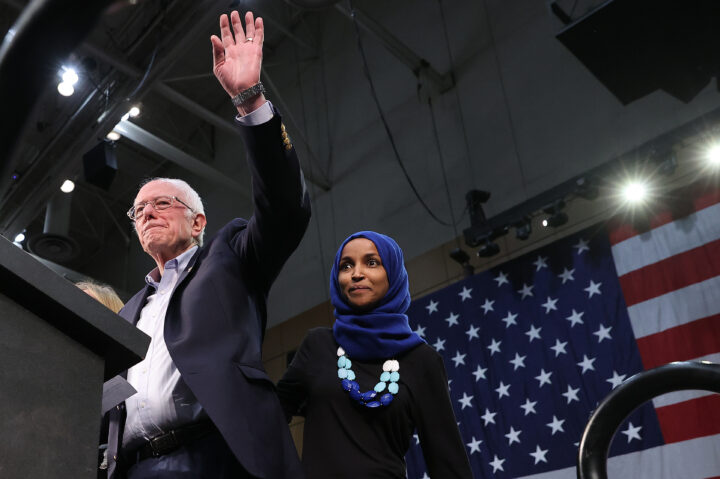
Rep. Ilhan Omar (D-MN) (R) introduces Democratic presidential candidate Sen. Bernie Sanders (I-VT) during a campaign rally at the Roy Wilkins Auditorium March 2, 2020.
Democratic lawmakers who have been stridently critical of Israel and its operations in Gaza offered tepid support for the ceasefire and hostage-release deal, the first phase of which was signed on Thursday, while reiterating their criticisms of Israel and the U.S.’ support for the Jewish state. Few offered any words of support for the Israeli hostages who have been held by Hamas for over two years.
Sen. Bernie Sanders (I-VT), who has led a series of efforts to block arms transfers to Israel, didn’t explicitly praise the deal negotiated by President Donald Trump, but said he hopes the deal would lead to the end of a “horrific war.” He made no mention of the Israeli hostages set to be released, but asserted one-tenth of the Gazan population was killed or injured during the war.
“As of today something like 10% of the Palestinian people in Gaza have been killed or wounded, mostly women, children and the elderly. The United States has put tens of billions of dollars into an effort which has led to mass destruction,” Sanders told Jewish Insider. “So I hope — and I’m sure everybody else does — that this horrific war can end as soon as possible.”
Rep. Ilhan Omar (D-MN) said on X that the ceasefire is a “hopeful step” but quickly pivoted to expressing unvarnished opposition to Israel. She also made no mention of the Israeli hostages expected to be freed from their Hamas captors.
“For the sake of humanity, let’s hope this will be a lasting and permanent ceasefire,” Omar said. “While this is a hopeful step, we must demand accountability for every war crime committed during this genocide and continue to call for an end to the occupation.”
Rep. Delia Ramirez (D-IL), the lead sponsor of legislation that aims to place strict conditions on critical arms sales to Israel, said on X she plans to continue to pursue that legislation.
“Immediately after October 7, I called for a ceasefire and for a path that honors our shared humanity. It is unfortunate that it took this long. However, I am hopeful that today’s ceasefire agreement will bring the hostages and prisoners home and end the bombing and starvation of the Palestinian people,” Ramirez said. “We must save Palestinian lives and pursue an end to U.S. complicity in Israel’s war crimes, atrocities, and genocide. I will continue to work to Block the Bombs, as we pursue a future of self-determination for the Palestinian people and a just and lasting peace for all residents of the region.”
Rep. Joaquin Castro (D-TX), tamping down on enthusiasm for the deal, reposted an X post suggesting that Israel may violate the deal.
“There is certainly some hope that the Gaza deal will hold but it’s important to remember that the last ceasefire agreement collapsed in March before ever reaching phase 2 when Israel reimposed a blockade on Gaza and bombings on the strip resumed,” the post, from an NBC News correspondent, reads.
Other prominent critics, particularly on the far-left, have remained unusually mum about the deal.
Squad members Reps. Rashida Tlaib (D-MI) and Alexandria Ocasio-Cortez (D-NY), Rep. Summer Lee (D-PA) and Progressive Caucus Chair Rep. Greg Casar (D-TX) did not respond to requests for comment and did not comment publicly.
Some other lawmakers who have been vocally critical of Israel’s operations in Gaza offered more fulsome praise for the deal.
Sen. Chris Van Hollen (D-MD) said in a statement that the deal is “the first hopeful moment in a long time,” noting both the release of hostages and the surge of aid into Gaza. He credited U.S. pressure on Israel, however, rather than the reported increased pressure from Qatar, Turkey and Egypt on Hamas, for the breakthrough.
“Pressure from the U.S. and others has always been necessary to reach this moment — something that could have been achieved much earlier and prevented the staggering loss of civilian life, starvation, and devastation in Gaza,” Van Hollen said. “U.S. leadership will be essential to enforce this plan and convert this moment into real progress toward lasting peace — which can only be achieved by sidelining the extremists on all sides and committing to security, dignity, human rights, and justice for all.”
Rep. Ro Khanna (D-CA), who led an effort calling for the U.S. to unilaterally recognize a Palestinian state, also praised the deal and led with the return of the Israeli hostages in his comments.
“It’s obviously very welcome news. Finally, the hostages are going to come home. The bombing hopefully is going to stop. Israel is going to withdraw,” Khanna said on Fox Business. “Everything I have read seems that this is a welcome development. And I’m really glad that after two years of a war, this seems to be finally coming to a resolution.”
“Now, we need to work for 2 states & ensure the bombing does not resume later in the year,” he added on X.
Rep. Ayanna Pressley (D-MA) told JI, “For the sake of humanity, I pray this holds. It is so far past time to end this genocide, free the hostages, and surge food, water, and baby formula to starving families in Gaza.”
Sen. Elizabeth Warren (D-MA) declined to comment, saying she had not reviewed the deal.
The FBI director said the bureau is cutting all formal ties with the Jewish civil rights group

Kayla Bartkowski/Getty Images
Director of the Federal Bureau of Investigation (FBI) Kash Patel
FBI Director Kash Patel called the Anti-Defamation League “an extreme group functioning like a terrorist organization,” saying in a Wednesday announcement that the FBI has cut all formal ties with the anti-hate group.
Patel slammed James Comey, the former FBI director now facing federal charges for allegedly lying to Congress in 2020, for speaking at an ADL conference in 2014 and 2017.
“James Comey disgraced the FBI by writing ‘love letters’ to the ADL and embedding agents with an extreme group functioning like a terrorist organization and the disgraceful operation they ran spying on Americans,” Patel told Fox News. “That was not law enforcement, it was activism dressed up as counterterrorism, and it put Americans in danger.”
The ADL’s website says the organization “works closely with federal, state and local law enforcement to assist them in protecting communities from extremism and hate.” The Bureau’s Denver field office gave a leadership award to a senior ADL official last year, calling the ADL “invaluable partners for the FBI in Denver.” The press release announcing that award has since been deleted from the FBI’s website.
“That era is finished,” Patel said Wednesday. “This FBI formally rejects Comey’s policies and any partnership with the ADL.”
In recent days, the ADL came under fire from Elon Musk, Donald Trump Jr. and other far-right activists because of a post on its website that outlined ties between extremists and Turning Point USA, the activist group founded by Charlie Kirk, the conservative influencer who was killed at a speaking engagement in Utah last month. Facing pressure from these leading voices on the right, the ADL this week deleted its online Glossary of Extremism and Hate.
“ADL has deep respect for the Federal Bureau of Investigation and law enforcement officers at all levels across the country who work tirelessly every single day to protect all Americans regardless of their ancestry, religion, ethnicity, faith, political affiliation or any other point of difference,” the group said in a statement Wednesday.
“In light of an unprecedented surge of antisemitism, we remain more committed than ever to our core purpose to protect the Jewish people.”
A letter to industry execs from the Brandeis Center for Human Rights Under Law cites the Civil Rights Act of 1964, which prohibits discrimination based on national origin

Amy Sussman/Getty Images for DGA
Emma Stone and Mark Ruffalo speak onstage during the 76th Directors Guild of America Awards at The Beverly Hilton on February 10, 2024 in Beverly Hills, California.
The current boycott by Hollywood actors, directors and other industry workers against Israeli counterparts “violates federal and state civil rights laws,” according to a letter distributed on Wednesday by a Jewish civil rights group to major U.S. film industry leaders, Jewish Insider has learned.
The letter was sent by the Louis D. Brandeis Center for Human Rights Under Law to top studios, distributors, platforms, talent agencies and film festivals — including Walt Disney Studios, Warner Bros. Motion Picture Group, Universal Pictures, Sony Pictures, Lionsgate, Netflix, Amazon, MGM Studios and Apple Studios. It warns that participation in the “Hollywood Blacklist,” a boycott circulated last month by Film Workers for Palestine that calls for industry professionals to blacklist Israeli artists, companies and institutions, could result in legal consequences.
The letter was signed by more than 5,000 Hollywood actors, directors, and other industry employees, including industry heavyweights such as Emma Stone and Mark Ruffalo.
Boycotting Israeli institutions would also jeopardize studios’ eligibility for film tax credit status, the letter said, noting that “a production that participates in the Hollywood Boycott may also violate its contractual obligations in connection with receiving state tax breaks.”
The letter cites the Civil Rights Act of 1866, which “prohibits both organizations and individuals from refusing to contract for goods and services with Jews and Jewish businesses operating in the United States,” which it says is “an evident component of the Hollywood Blacklist targeting the Israeli film industry while carving out Palestinian Israelis for different treatment from Jews.” The letter also refers to the Civil Rights Act of 1964, which prohibits discrimination based on national origin.
While the blacklist claims to only target Israeli institutions deemed “complicit” in denying Palestinian rights, and not individuals, it refers to all but “a few” Israeli film institutions as complicit. Additionally, the letter states that the effort would affect Jewish individuals who work for boycotted films. Discrimination on the basis of national origin is “self-evident,” the Brandeis Center wrote, “since the Hollywood Blacklist exclusively targets ‘Israeli film institutions,’ while non-Israeli film institutions who may be similarly ‘complicit’ in the alleged whitewashing or support for Israel are not subjected to the same scrutiny and shunning.”
“Boycotting Jews isn’t an original idea, or, thankfully, a legal one in the United States of America,” Rory Lancman, director of corporate initiatives and senior counsel at the Brandeis Center, said in a statement. “We caution Hollywood decision makers against submitting to pressure to effectuate this blatantly illegal blacklist of Jewish Israeli artists and institutions. As we say in our letter, we much prefer to see their work on the screen, and not them in court.”
Since the blacklist petition’s release, approximately 1,200 prominent members of the film industry signed a counterletter, spearheaded by Creative Community For Peace, calling for signers of the original boycott to rethink their stance. Signatories of the counter petition include Mayim Bialik and Debra Messing.
Sirene Abou-Chakra posted a series of anti-Israel messages on social media over years prior to her employment with the auto giant
Jeff Kowalsky/Bloomberg via Getty Images
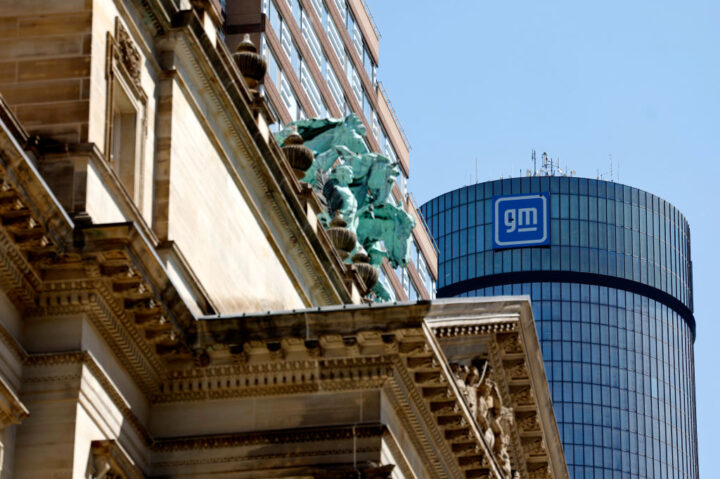
The General Motors Co. headquarters inside the Renaissance Center in Detroit, Mich., on Monday, April 15, 2024.
Sirene Abou-Chakra, the head of General Motors’ global philanthropy division with a history of posting anti-Israel messages on her public X account, is no longer in her role, a GM spokesperson confirmed to Jewish Insider.
Abou-Chakra, a native of Dearborn, Mich., took over the auto company’s mammoth philanthropy arm in June to questions about how her extensive anti-Israel social media history would impact GM’s relationship with the Detroit-area Jewish community and its extensive business relationships with the Jewish state.
The spokesperson did not say if Abou-Chakra, who previously served as the chief development officer for the city of Detroit and also spent a decade with Google as an account executive, was fired or had left on her own accord.
From late 2019 through the summer of 2024, Abou-Chakra posted a series of tweets that were critical of the Jewish state and Republicans, accusing Israel of being “built on lies,” alleging the country “is not a democracy” and claiming the pro-Hamas protests in Washington during Israeli Prime Minister Benjamin Netanyahu’s speech to a joint session of Congress last July were “planted” by pro-Israel actors.
“Haven’t seen this at any pro Palestine rally all year and there have been thousands. *He* comes to town and all of a sudden ‘Hamas’ graffiti, anti semitic dolls, and American flags are burned? I have a hard time believing this wasn’t planted by the other side,” Abou-Chakra wrote in a since-deleted post.
During that protest at Washington’s Union Station, demonstrators assaulted a police officer while he was making an arrest; spray-painted “Hamas is comin” on a statue outside the station, along with other pro-Hamas graffiti; carried Hamas flags; called for a “final solution”; burned an effigy of Netanyahu and carried another showing him with horns covered in blood; and took down and burned an American flag outside the station before replacing it with a Palestinian flag.
The posts, almost all of which were still online prior to JI’s first outreach to GM earlier this month, were promptly taken down, though the auto giant did not respond to multiple requests for comment at the time.
In a November 2019 tweet that had been deleted prior to this month but was featured in a Deadline Detroit article at the time, Abou-Chakra criticized Michigan Gov. Gretchen Whitmer for visiting Israel. Notably, Whitmer’s trip included a stop at GM’s headquarters in Herzliya, which was opened in 2008 and employs more than 700 people.
“Apartheid is the Israeli regime restricting @RashidaTlaib movements in Palestine yet inviting @GovWhitmer to discuss trade. 2 US government officials from Michigan. 1 major difference,” Abou Chakra wrote. “Arabness is a crime in Israel, and this week 8 from the same family in Gaza paid that price.”
The organization stands by a separate resource that describes Kirk’s Turning Point USA’s ties to ‘extremists’
Ari Perilstein/Getty Images
Anti-Defamation League Entertainment Industry Dinner at The Beverly Hilton Hotel on May 24, 2017 in Beverly Hills, California.
Under pressure from Elon Musk, Donald Trump Jr. and prominent right-wing activists in the wake of the assassination of Charlie Kirk, the Anti-Defamation League is removing from its website the Glossary of Extremism and Hate, one of the organization’s signature anti-hate resources.
The database identifies over 1,000 terms relating to extremist ideologies and groups, and it has faced scrutiny in recent days after viral social media posts revealed that the Glossary of Extremism included an entry about the slain Turning Point USA founder and his organization.
Musk, Trump Jr., Rep. Anna Paulina Luna (R-FL) and other conservatives slammed the civil rights organization for its apparent portrayal of Turning Point and Kirk, just weeks after his death, as extremists.
An ADL spokesperson confirmed to Jewish Insider that the organization removed the glossary entirely and that it does not consider TPUSA an “extremist group.” The glossary no longer appears on the ADL website.
“With over 1,000 entries written over many years, the ADL Glossary of Extremism has served as a source of high-level information on a wide range of topics for years. At the same time, an increasing number of entries in the Glossary were outdated. We also saw a number of entries intentionally misrepresented and misused,” the spokesperson told JI. “At ADL, we always are looking for how we can and should do things better. That’s why we are moving to retire the Glossary effectively immediately. This will allow ADL to explore new strategies.”
But although the Glossary of Extremism and Hate has been deleted from the ADL’s site, material about Kirk and TPUSA — including criticism of the group for its ties to “a variety of extremists” — still appears in another resource on the ADL’s website. A spokesperson described that “backgrounder” as one of “a multitude of resources on its website that address extremism and its many expressions.”
The ADL first published its backgrounder on Turning Point in February 2019. The piece was then updated in January 2023 and again on Monday afternoon, after screenshots of the page itself and the glossary entry on TPUSA circulated on social media. The edited version softens some of the ADL’s language about TPUSA while holding firm on its description of the group’s more extreme elements.
The ADL’s page on TPUSA, which will remain on the website, but not as part of a searchable glossary entry, appears in a section about “Extremism, Hate or Terrorism.” Prior to this week, the entry stated: “Since the group’s founding, Kirk has moved further to the right and has promoted numerous conspiracy theories about election fraud and COVID-19 and has demonized the transgender community.”
“Kirk also promotes Christian nationalism: the idea that Christians should dominate the government and other areas of life in the US. TPUSA continues to attract racists to the group. Numerous TPUSA representatives have made bigoted remarks about minority groups and the LGBTQ+ community,” the TPUSA entry continued. “White nationalists have attended TPUSA events, even though the group says it rejects white supremacist ideology.”
Kirk was one of the most influential conservative activists in the country until he was shot and killed at a Utah university speaking engagement this month by a perpetrator who wrote in text messages to a romantic partner that he “had enough” of Kirk’s “hatred.” Utah Gov. Spencer Cox said earlier this month that the suspect was “deeply indoctrinated with leftist ideology.”
The ADL’s webpage about Kirk, which remains active, still says that Kirk “created a vast platform that was used by numerous extremists and far-right conspiracy theorists. A number of such individuals speak and attend his annual AmericaFest and other events sponsored by TPUSA.”
But the updated page edited some of the language about Kirk and took a more subdued tone towards TPUSA. The ADL now describes the group as “a political student organization that appeals to a wide range of conservatives, from moderate Republicans to the far-right. TPUSA has played a significant role in GOP politics and elections, helping to galvanize young people.”
The ADL also added a lengthy section about Kirk’s support for Israel, and goes on to say that TPUSA and Kirk “publicly supported the state of Israel and spoke out against its critics. These views made him a target of prominent voices from the extreme right such as the Groypers.”
Still, the ADL states that TPUSA “has promoted some conspiracy theories,” and that some people tied to TPUSA “have a history of bigoted statements about the Black community, the LGBTQ community and specifically transgender people, and other minority groups.”
The ADL spokesperson told JI that an organization’s inclusion in its Glossary of Extremism did not necessarily mean the group was a hate group. “To be clear, inclusion in our glossary did not mean that the purpose of the group was to promote extremism or hate, and Turning Point USA is not an extremist group,” the spokesperson said.
“We recognize that TPUSA repeatedly stated that it rejects white supremacist ideology; however, as we noted in our materials, white nationalists openly attended their events and some people affiliated with the organization had a history of bigoted statements about minority groups. So we felt it important to have it covered both in the glossary and as a fuller backgrounder with more in-depth research on the group,” the spokesperson added.
On Sunday, prior to the changes, Musk decried the ADL’s descriptions of Turning Point as “deeply wrong” and in need of an immediate correction.
“The ADL needs to change this now,” Musk wrote on his X platform.
Trump Jr. wrote that ADL’s inclusion of TPUSA in its glossary was “disgraceful.”
In a tweet alongside a screenshot of the organization’s prior page about Turning Point, Luna, who represents Florida’s Gulf Coast, said the ADL “has some explaining to do.” “Seems to me like if they don’t agree with you, they will label you a ‘hate group,’” she wrote on X on Monday morning.
“‘America First’ is not hate speech. Turning Point USA is not a hate group,” Luna wrote in a subsequent tweet later Monday.
Andrew Kolvet, the longtime executive producer of Kirk’s podcast, posted earlier in the day: “Good morning to everyone except the pro-Antifa, anti-Christian hate group known as the ADL.” The Antifa remark was in reference to criticism from conservatives over how the ADL classifies the far-left group on its site.
This is not the only time the ADL has recently reassessed its educational resources. In late 2023, the organization eliminated a major educational program, “A World of Difference,” after 40 years. The organization published a slew of anti-racism resources in the summer of 2020, following the murder of George Floyd, but some of them have since been removed from its website. In 2022, the ADL promised to review its educational content following a Fox News investigation that slammed the group’s use of “concepts from critical race theory.”
Under CEO Jonathan Greenblatt’s leadership, the ADL has had to fight off critics from both the ideological left and the right as it grapples with its mission amid rising antisemitism within both political parties.
When Greenblatt took the helm of the organization a decade ago, replacing longtime ADL chief Abe Foxman, he faced criticism from some on the right for taking the organization in a liberal direction. In the first Trump administration, the ADL came out against the White House on several occasions, including by signing onto a lawsuit challenging the president’s policy banning travelers from several Muslim nations.
Greenblatt has also taken on progressive critics who disagree with the ADL’s stalwart support for Israel, and his assertion that anti-Zionism is antisemitism. After the Oct. 7 terror attacks, the organization has leaned more deeply into its pro-Israel ethos and its work targeting antisemitism, stepping back from some of its focus on other forms of hate.
More recently, the organization has taken steps in the second Trump administration to reach disaffected conservatives — angering some longtime supporters in the process. In January, the ADL hired a lobbying firm with close ties to Trump to assist on its antisemitism work.
When Musk made a hand gesture during Trump’s inauguration that resembled a Nazi salute, Greenblatt took flak from some in the Jewish community for coming to Musk’s defense. He has since said he should have “framed” his comments differently.
This story was corrected to note the timing of when the ADL eliminated its “A World of Difference” program.
The suit invokes two U.S. laws that provide civil remedies to victims of international terrorism

Christian Ohde/McPhoto/ullstein bild via Getty Images
Gavel and scales of justice
The Anti-Defamation League filed a new lawsuit on Thursday on behalf of more than 140 U.S. victims of the Oct. 7 attacks alleging that several different terrorist groups carried out the attacks with material support from U.S.-designated state sponsors of terror: Iran, Syria and North Korea.
The suit comes a year after a similar suit by the ADL targeting Iran, Syria and North Korea, but it relies on an additional statute to seek compensation for the American victims of the attacks, which left 1,200 people dead. The suit also includes more plaintiffs than the original case.
The new case names the terror groups — Hamas, Palestinian Islamic Jihad, the Popular Front for the Liberation of Palestine, the Democratic Front for the Liberation of Palestine, the Al-Aqsa Martyrs Brigade, the Palestinian Mujahideen Movement, Hezbollah and the Popular Resistance Committees — and invokes two American laws that provide civil remedies to victims of international terrorism.
“The victims of the October 7 massacre deserve justice, accountability and redress,” ADL CEO Jonathan Greenblatt said in a statement. “This lawsuit seeks to do that by holding those responsible for the carnage accountable, from the state sponsors who provided the funding, weapons and training to the terrorist organizations who carried out these unspeakable atrocities.”
ADL brought the lawsuit with Crowell & Moring, a law firm that has helped victims in terrorism cases including the bombings of the U.S. Embassy in Beirut in the 1980s and the bombing of UTA flight 772 in 1989. The firm obtained billions of dollars in judgments in those cases.
“State sponsors of terrorism should not be able to avoid the consequences of their heinous acts by hiding behind the proxies they materially support,” Crowell partner Aryeh Portnoy, the lead counsel on the case, said in a statement.
The parents of Yona Brief, an IDF soldier who was severely injured on Oct. 7 and died as a result of his wounds more than a year later, said they hope the lawsuit will help deter future attacks.
“We believe it is critical that those responsible for the horrific terror inflicted that day are held accountable in a court of law, to ensure the record is clear as to who helped support, plan and carry out the violence that day,” David and Hazel Brief said in a statement. “We are hopeful that this type of litigation will help prevent attacks like these in the future, so that no other families have to go through losing a loved one as a result of such violence.”
Several leaders in the community told JI they continue to have concerns about his record, while others are quietly engaging
Michael M. Santiago/Getty Images
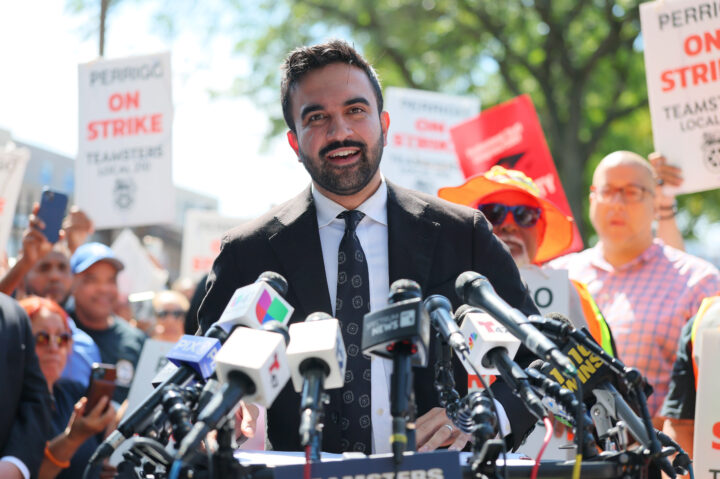
New York City Zohran Mamdani speaks on Sept. 15, 2025 in New York City.
As Jewish leaders reckon with the increasing likelihood that Zohran Mamdani will be the next mayor of New York City, many who have voiced anxiety over his avowedly anti-Israel policies are reacting with a mix of fear and resignation.
Their concerns have been mounting as Mamdani, the Democratic nominee, has continued to hold a comfortable lead in the race, where polling shows him handily prevailing over the divided field. The 33-year-old democratic socialist and Queens state assemblyman has recently claimed endorsements from prominent party leaders including New York Gov. Kathy Hochul, who clarified she does not agree with him on Israel issues but said she appreciated his commitment to combating antisemitism as well as his efforts to meet with Jewish community members to address “their concerns directly.”
But multiple Jewish leaders said in interviews with Jewish Insider on Wednesday that they remain deeply skeptical of his campaign’s outreach and pledges to confront rising antisemitism, citing a string of recent statements in which he has doubled down on his hostile approach to Israel — as well as an ongoing refusal to explicitly denounce extreme rhetoric espoused by his allies on the far left.
While Mamdani has, since winning the primary in June, walked back some of his polarizing views on key issues such as policing, he has otherwise made an exception for Israel, of which he has long been a fierce critic. In a series of interviews published last week, for instance, he reiterated a campaign vow to arrest Israeli Prime Minister Benjamin Netanyahu if elected, even as legal experts cautioned such a move could violate federal law.
A vocal supporter of the Boycott, Divestment and Sanctions movement against Israel — which some critics deem antisemitic — he said he would end a program established by Mayor Eric Adams, who is now running as an independent, to foster business partnerships between companies in Israel and New York City. He also said he would stop relying on the working definition of antisemitism promoted by the International Holocaust Remembrance Alliance — which labels some criticism of Israel as antisemitic — as was adopted by Adams in a recent executive order.
And although he has said he would discourage activists from invoking the slogan “globalize the intifada,” which he himself has not used publicly, Jewish leaders have noted that Mamdani has still not condemned the phrase itself, fueling suspicion that he tacitly approves of the chant critics interpret as a call to antisemitic violence.
“I believe that he will genuinely work to drive a wedge between Jews and their neighbors as long as he serves in public office,” Sara Forman, executive director of New York Solidarity Network, a group that supports pro-Israel Democratic candidates for state and local office, told JI. “To this date,” she said of Mamdani, “his actions certainly have given us no indication they match his words.”
Andres Spokoiny, who leads the Jewish Funders Network but emphasized that he was speaking only in his personal capacity, said that he was “extremely concerned and extremely fearful” about what he regards as a likely Mamdani mayoralty. “His views make the majority of Jews unsafe and unwelcome,” he told JI.
More broadly, Spokoiny said his worries had less to do with particular policies than what he called “the breaking of a taboo” around anti-Zionist sentiment that did not ultimately serve as an “impediment” to Mamdani’s rise, even in a place that is home to the largest Jewish community of any city in the world. “That fact that it is in New York is highly symbolic,” he said. “It shows that our society doesn’t have the antibodies to reject somebody with a very divisive message.”
He also voiced regret about a lack of unity in the organized Jewish community to collectively oppose Mamdani and coalesce behind one candidate in the race, which includes former New York Gov. Andrew Cuomo, running on an independent line, and Curtis Sliwa, the GOP nominee. “I think it asks for a deep rethinking in the Jewish community about how we face this challenge,” he said.
While Mamdani has won backing from some Jewish elected officials in New York, notably Rep. Jerry Nadler (D-NY), others have continued to keep the nominee at a safe distance with just weeks until November. Senate Minority Leader Chuck Schumer (D-NY) has withheld an endorsement of Mamdani despite meeting privately with him, as has Rep. Dan Goldman (D-NY), who said last month he is waiting for the nominee to take “concrete steps” to address antisemitic hate crimes.
“Typically during a general election you’ll see candidates moderate their positions either in a dishonest attempt to bridge the gap between themselves and uncomfortable voters or in a genuine extension of the olive branch,” said Sam Berger, an Orthodox Democrat who represents an Assembly district in Queens. “Indeed, we’ve seen Zohran do this with the business world as well as with the NYPD.”
Simone Kanter, a spokesperson for Goldman, said on Wednesday that the congressman had “nothing new to add yet beyond what he’s already said” about Mamdani.
During his campaign, Mamdani has more actively aligned with groups on the far left including Jewish Voice for Peace, which is anti-Zionist, and Jews for Racial and Economic Justice, which hosted a recent gala at which the nominee was celebrated alongside Brad Lander, the Jewish comptroller with whom he cross-endorsed in the primary.
Even as Mamdani has engaged in outreach to the Jewish community to address concerns about his platform, among other issues, some Jewish leaders indicated they did not anticipate there would be any common ground on which to develop a relationship with a potential Mamdani administration.
“Typically during a general election you’ll see candidates moderate their positions either in a dishonest attempt to bridge the gap between themselves and uncomfortable voters or in a genuine extension of the olive branch,” said Sam Berger, an Orthodox Democrat who represents an Assembly district in Queens. “Indeed, we’ve seen Zohran do this with the business world as well as with the NYPD.”
By contrast, Berger argued of his colleague in the state legislature, Mamdani “hasn’t done the bare minimum with long-recognized Jewish institutions and leaders, instead relying on his support from the fringe of the fringe,” which he called “a major red flag.”
“Fixing potholes is typically apolitical,” he told JI, “but [when] the point of contention is the uplifting of baseless hatred against the Jewish people there is no common ground to be had.”
Kalman Yeger, an Orthodox assemblyman in Brooklyn who has been among Mamdani’s most outspoken critics, said the nominee’s “inability to get his brain around the notion that globalizing the intifada is a bad thing is terrifying.”
Simcha Eichenstein, a Democratic assemblyman from the Hasidic neighborhood of Borough Park in Brooklyn, was equally pessimistic about Mamdani.
“We can agree to disagree when it comes to policy matters, but as a visible Jew, I should be able to walk the streets of New York City safely, without fear of harassment,” he told JI on Wednesday.
“The inability and unwillingness of a candidate running to represent nearly a million Jews to denounce radical, extreme and antisemitic groups have many within the Jewish community wondering whether we have a future in New York at all,” Eichenstein added, citing as an example the radical pro-Palestinian group Within Our Lifetime, which has led at least one protest that was attended by Mamdani in 2021.
Kalman Yeger, an Orthodox assemblyman in Brooklyn who has been among Mamdani’s most outspoken critics, said the nominee’s “inability to get his brain around the notion that globalizing the intifada is a bad thing is terrifying.”
“His lunatic threat to arrest Netanyahu, when he is surely not stupid enough to believe he has that power, is a sign to the Jew haters that he stands with them,” Yeger added, claiming Mamdani “will, by his words, his actions and his inactions, cause continued increasing antisemitism” in New York City.
Mamdani has forcefully rejected accusations he has fomented antisemitism, vowing to increase funding to counter hate crimes by 800%. A spokesperson for his campaign did not return a request for comment from JI on Wednesday.
Daniel Rosenthal, vice president of government relations at UJA-Federation of New York, said his organization, a nonprofit forbidden from making political endorsements, “will strongly oppose any actions that alienate or marginalize Jews, including attempts to delegitimize Israel and support BDS. As always, we will work to ensure that the needs and concerns of Jewish New Yorkers are heard and addressed.”
Leon Goldenberg, a Brooklyn real estate executive who is an executive board member of the Flatbush Jewish Community Coalition, said his group had no interest in meeting with Mamdani — despite that he expects him to win the election. “What I really have a problem with is ‘globalize the intifada,’” he told JI on Wednesday. “You can’t condemn it. ‘Globalize the intifada’ is murder Jews on the streets.”
Goldenberg, who endorsed Adams in the general election but now believes he has no chance, said he was considering moving his permanent residence to Florida, where he keeps an apartment, if Mamdani prevails this fall. “He’s bright. I’m not going to take that away from him,” he said of the nominee. “But there’s very little that qualifies him to be mayor. If he had a different mindset, he’d be a great mayor.”
Despite their concerns about a potential Mamdani administration, few Jewish leaders were ready to speculate about working with him.
Daniel Rosenthal, vice president of government relations at UJA-Federation of New York, said his organization, a nonprofit forbidden from making political endorsements, “will strongly oppose any actions that alienate or marginalize Jews, including attempts to delegitimize Israel and support BDS.”
“As always, we will work to ensure that the needs and concerns of Jewish New Yorkers are heard and addressed,” Rosenthal told JI.
Other Jewish leaders pointed to ongoing voter registration efforts to boost Jewish turnout in the election. Josh Mehlman, who chairs the Flatbush Jewish Community Coalition, said his group had helped register more than 5,000 new Democratic voters in the Orthodox community in the last week alone. He did not respond when asked if he felt the increase in registrations would have any discernible impact on the outcome of the mayoral race.
Joel Rosenfeld, a representative of the influential Bobov Hasidic sect, also stressed his community “is fully focused on voter registration” in the lead-up to the election. Asked if he had anything else to add on the matter, Rosenfeld said, “A blessed new year,” ahead of the Jewish holiday of Rosh Hashanah.
Still, there are signs that some Hasidic groups may now be cautiously — and quietly — warming up to a potential future Mamdani administration, even if it remains unlikely that any groups will endorse him, community members say.
“The Hasidim are a very practical bloc of voters, particularly the leadership,” said one Democratic consultant who has worked with the community. “Results matter more than ideology for them. If they think Mamdani will win, that’s where they’ll go.”
One Jewish community activist familiar with the matter said that “there are some groups secretly talking to” Mamdani “or his top people,” though he added it was “hard to believe any groups will openly endorse him, especially if Adams is still in the race.”
“The feeling is that like it or not he is most likely going to be the next mayor so we might as well begin a dialogue now rather than after the election,” he told JI.
Another activist familiar with a Satmar faction in Williamsburg, which represents the largest Hasidic voting bloc in New York City, said that Mamdani’s team is “aggressively courting” the community and has been in dialogue with leadership. “They want to work with us and we want to work with them,” the activist said in summarizing the dynamic, speaking on the condition of anonymity to address a sensitive situation.
“The Hasidim are a very practical bloc of voters, particularly the leadership,” said one Democratic consultant who has worked with the community. “Results matter more than ideology for them. If they think Mamdani will win, that’s where they’ll go.”
State Rep. Chris Rabb’s extreme views are alarming Jewish leaders and voters in a Philadelphia-based district with a sizable Jewish constituency
Paul Weaver/SOPA Images/LightRocket via Getty Images
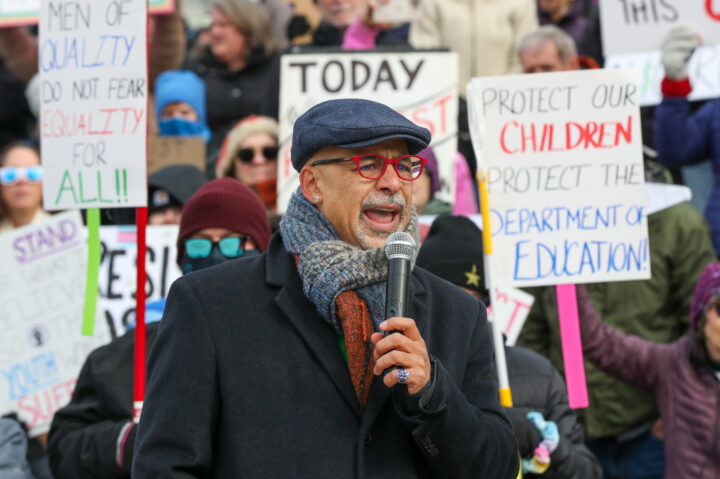
Pennsylvania state Rep. Chris Rabb speaks during a protest outside of the Pennsylvania Capitol.
The wide-open primary race for the most Democratic district in the country is highlighting stark divisions in Israel policy among the leading candidates.
The candidates for Pennsylvania’s 3rd Congressional District — which includes western Philadelphia, Center City and parts of north Philadelphia — include a host of prominent local officials, as well as some outsider candidates, including state Sen. Sharif Street, who recently resigned as state Democratic Party chair, progressive state Rep. Chris Rabb, state Rep. Morgan Cephas and physician Dr. David Oxman.
Dr. Ala Stanford, a local surgeon and activist who gained prominence during the COVID-19 pandemic, is also seen as a likely candidate, and former City Councilman Derek Green may also join the race.
A Rabb victory would be cause for significant concern for pro-Israel voters in the district — which includes some heavily Jewish areas of Philadelphia — and national pro-Israel groups. The state senator has an extensive history, particularly since Oct. 7, of anti-Israel activism, and has accused Israel of genocide.
He posted on social media in Sept. 2024 in support of a Philadelphia teacher who was suspended following a complaint from Jewish parents about threatening social media posts directed toward them.
“I’m here in solidarity with the educators and students who have shown the discernment to understand that discomfort is not the same as danger, animus or even harm. Quite the contrary, without discomfort, we cannot truly learn, grow or heal,” Rabb said on Instagram. “I do not believe that being critical of any political ideology — be it neo-liberalism or Zionism — is being against an entire people or ethnic group. … We must not allow students and educators to be attacked for discussing critical global issues or other international struggles … And there should be no instance when a mere reference to any sovereign nation is reflexively viewed as a proxy for hate or bias.”
Rabb was the only elected official to attend a recent anti-Israel “People’s Tribunal” hosted by a range of far-left groups, which aimed to present a case that U.S. officials including Sen. John Fetterman (D-PA) are guilty of complicity with genocide and war crimes by Israel.
Rabb described the event as a generational moment that would reverberate far into the future.
He called on his state to divest from and cease any investments in Israel until the end of the war in Gaza, and said that advancing a proposed anti-Boycott, Divestment and Sanctions bill would “cause a s*** show of epic proportions that no Democrat wants to see — especially in an election year where the policy choices we make are being scrutinized by a highly skeptical, but vigilant and well organized subset of the electorate.”
Rabb also spoke at a February 2024 protest led by anti-Israel group Jewish Voice for Peace at which he indicated support for protests blocking traffic and opposed arrests of demonstrators at the Pennsylvania Statehouse, comparing anti-Israel protests to the Civil Rights Movement. “This is a radical expression of one’s First Amendment rights,” he said.
He visited and praised anti-Israel encampments at multiple colleges in Pennsylvania and indicated support for BDS efforts targeting the colleges, participated in events with the local Council on American-Islamic Relations chapter and spoke out against detentions and attempted deportations of student activists.
He also condemned school leaders out-of-state, in Maryland, for suspending teachers for anti-Israel, antisemitic or pro-Palestinian comments, one of whom he said was a personal friend.
“I’m irate about how these pro-#censorship folx have maliciously targeted these teachers,” Rabb said. “Being pro-#Palestine is neither a crime, nor anti-Jewish.”
Rabb on Oct. 18, 2023, 11 days after the Hamas attacks, called for a ceasefire as well as the release of “the more than 200 civilian hostages taken back into Gaza and Palestinian political prisoners.”
“I grieve the loss of lives in Israel and Palestine. I condemn Hamas’s brutal attack on October 7th … I also grieve the thousands of Palestinians in Gaza, including hundreds of children, who have been killed by Israeli bombs since then. It is never acceptable to cause the deaths of civilians. All human life is sacred,” Rabb said. “I join my colleagues in Congress who have called for immediate de-escalation, ceasefire, adherence to International Humanitarian Law and humanitarian aid to Palestine commensurate with the devastation wrought upon Gaza.”
Rabb was one of several Democratic state lawmakers who signed onto a Nov. 21, 2023, letter to Pennsylvania’s congressional delegation which delivered a similar message. The chief of staff for the state senator who led that letter had reposted several X posts on Oct. 7 indicating support for the Hamas attacks on Israel.
Street, who is Muslim, has long-standing ties to members of the state’s Jewish community and has spoken out in support of Israel’s right to exist and against antisemitism. He traveled to Israel in 2017 on a trip for Muslim legislators organized by the American Jewish Committee’s Project Interchange, a source familiar with the campaign told Jewish Insider.
“As a Black man and a Muslim, I’ve spent my entire political career fighting for the inherent worth and dignity of every person. That’s why I have stood strong against the growing tide of anti-Semitism in this country,” Street said in a statement to JI. “In Congress, I will work hard for peace in the Middle East based on mutual trust and grounded in Israel’s right to exist and the right of the Palestinian people to live without fear.”
In a November 2023 statement responding to the Hamas attack and ensuing war in Gaza, Street emphasized the right of both Israelis and Palestinians to peace and freedom, and mourned civilian deaths on both sides, while emphasizing the importance of U.S. support for Israel.
“We must affirm the right of Israel to exist. We must affirm the right of the Jewish people to have a sovereign state and we must also affirm the right of the Palestinian people to live in a place where their children are safe and their families are secure,” Street said. “A place where their hospitals and schools are not compromised by Hamas commingling military facilities with hospitals and schools.”
He said that the U.S. “must not abandon its calling to protect the children of the Holocaust” and “must remember why the modern state of Israel was created in the aftermath of World War II. We must remain vigilant in our support of Israel and its right to defend itself.”
Street added that “does not disavow us from having an obligation to the Palestinian people as well,” and ensuring that “food flows plentifully into the land of Palestinian people,” that hospitals and schools are rebuilt and that both Israeli and Palestinian children can live in peace.
He went on to condemn hate crimes in the United States targeting both the Palestinian and Jewish communities, as well as Christians.
Street also offered his condemnation and condolences following the shooting earlier this year of two Israeli Embassy staffers outside the Capital Jewish Museum in Washington.
“As the highest-ranking Muslim elected official in Pennsylvania, I am heartbroken by the senseless act of violence that took the lives of two Israeli embassy staff in Washington, D.C.,” Street said. “I extend my deepest condolences to the families of Yaron Lischinsky and Sarah Milgrim, and to all who are grieving this horrific tragedy. No one should fear for their lives simply because of who they are or where they work.”
“I unequivocally condemn this shooting—and all acts of gun violence, antisemitism, and hatred. We must all stand against violence, wherever it occurs and whoever it targets,” Street continued. “I support the right of Israel to exist in peace and security, just as I support the rights of Palestinians to live with dignity and freedom. A just and lasting peace in the region will never be built on bloodshed. We must do better—here at home and abroad.”
As the Pennsylvania Democratic chair, Street spoke out against the Uncommitted movement that urged voters to oppose President Joe Biden in the 2024 presidential primary over his position on the war in Gaza. “As a Muslim American, I know that President Biden has my back and will fight for our community,” Street said. He also emphasized the need for Democrats to appeal to both Jewish and Muslim voters.
Street did not vote last year on an anti-Boycott, Divestment and Sanctions bill when it passed either the Pennsylvania Senate Appropriations Committee or the full Senate.
Cephas does not appear to have much of a public record of speaking out about the conflict in the Middle East, though in the days after the Oct. 7, 2023, Hamas attack on Israel, she was an advocate for increased state-level funding for nonprofit security funding.
Larry Ceisler, a public affairs executive in Philadelphia, told JI that the race is likely to be highly competitive — a rare opportunity for a Philadelphia elected official to potentially secure a long tenure in higher office.
He described the race as essentially a toss-up and said he could see a scenario for each of Street, Cephas and Rabb to win. Ceisler said that the race could break down, to some extent, along geographic lines.
Street, Ceisler said, has strong name recognition as the son of a former Philadelphia mayor, and represents north Philadelphia. Cephas represents west Philadelphia, and Rabb represents northwest Philadelphia, an area that is very politically active, leans left and usually has high voter turnout in primaries.
Ceisler predicted Rabb will present himself as the furthest-left candidate in the field and noted that he previously beat a candidate backed by the local party apparatus, while Street is likely to lean on more traditional support bases including local party and ward leaders and some organized labor groups.
He said Cephas’ youth, gender and leadership in the Statehouse could also make her an attractive candidate for some voters. And he said that Stanford enjoys high name recognition and goodwill from the COVID-19 era, though she is untested and unscrutinized as a political candidate.
Ceisler noted that he is a Rabb constituent and former supporter who wrote to Rabb to express his disappointment early in the Israel-Hamas war about his post-Oct. 7 positions, saying he felt Rabb was “uninformed” and had accepted false and misleading information, though he said that Rabb should not be “vilified.”
CORRECTION: An earlier version of this story misidentified the name of public affairs executive Larry Ceisler.
She also doubled down on her condemnation of the slogan ‘globalize the intifada,’ over which she previously criticized mayoral nominee Zohran Mamdani
Drew Angerer/Getty Images
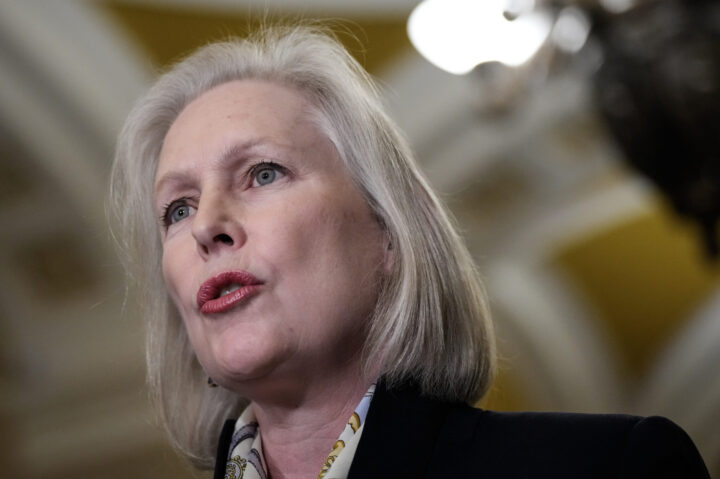
Sen. Kirsten Gillibrand (D-NY) speaks at a news conference following a closed-door lunch meeting with Senate Democrats at the U.S. Capitol on October 31, 2023, in Washington, D.C.
Sen. Kirsten Gillibrand (D-NY) said in comments to Jewish leaders in New York City on Monday that anti-Israel protesters and, in some cases, fellow Democratic lawmakers are fueling antisemitism through the rhetoric and slogans they use, though she said that in many cases it is unintentional.
“Some of the rhetoric that comes out of various protests globally, various protests on college campuses is so damaging. When they say words like ‘river to the sea,’ whey they say words like ‘globalize the intifada,’ it means end Israel. It means destroy Jews,” Gillibrand said in a video from a roundtable with Jewish leaders in Borough Park shared by The Forward. “No matter what words they intend to be saying, that is the meaning of these simple phrases.”
Intifada, she continued, is “not a social movement. It’s terrorism, it’s destruction, it’s death.”
The New York senator has been particularly outspoken about the “intifada” rhetoric in the context of the New York City mayoral race. She previously offered strong condemnation of Democratic mayoral nominee Zohran Mamdani for his refusal to condemn the “globalize the intifada” slogan and said that Jewish constituents were alarmed by his past comments.
Gillibrand also claimed Mamdani had made “references to global jihad,” but later apologized. She has not endorsed Mamdani’s mayoral bid.
The New York senator said she would work with Democratic colleagues “who sometimes, in my opinion, don’t use the right words or aren’t sensitive to the impact of those words” and explain to them how their comments are being received and contributing to antisemitism, and to rally them to support efforts to fight antisemitism.
“Nine times out of 10, they aren’t trying to be antisemitic or even trying to be anti-Israel. They just think they’re fighting for human rights,” Gillibrand continued, “but the words they often choose to use are very hurtful and harmful and are undermining.”
“It is very hurtful and it makes people feel like sometimes the members of our party do not have their back, and I think that’s very disruptive and damaging for our community, for our state, for our brothers and sisters,” Gillibrand said.
Gillibrand added that leaders and individuals have to “understand the impact of their words in all contexts,” including to the Muslim community and other faith and immigrant communities.
She also insisted that “nine out of 10 Democrats are pro-Israel and want peace in the Middle East,” though a majority of the Senate Democratic caucus recently voted in favor of blocking some arms sales to Israel.
Gillibrand argued that many of her colleagues’ concerns are driven by the political leadership in Israel, including Prime Minister Benjamin Netanyahu and far-right members of the Israeli government.
“They don’t know how to articulate political disagreement, and sometimes it comes out as anti-Israel,” she said. “I try very hard to explain that your intentions are one thing, but how you’re received is another, and that’s where we get the disconnect.”
Every one of the ads the Maine Democratic Senate candidate is running on Facebook and Instagram states his opposition to AIPAC, and several accuse Israel of genocide
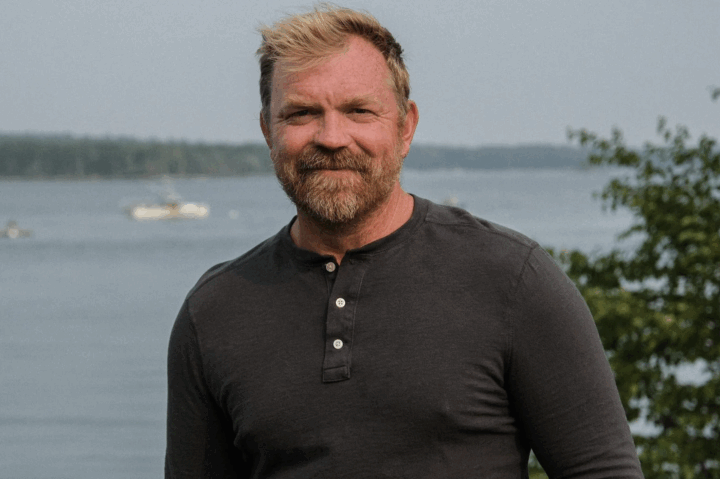
Graham Platner for Senate
Graham Platner
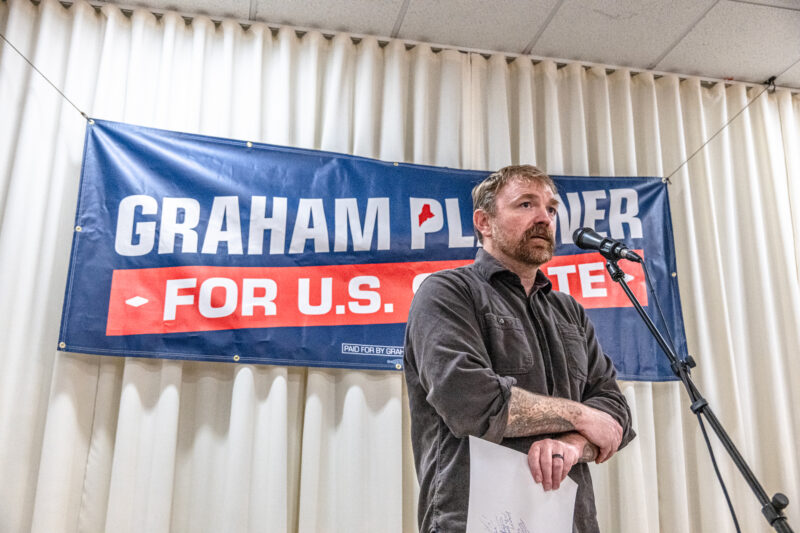
Democratic Maine Senate candidate Graham Platner is putting anti-AIPAC and anti-Israel messaging front-and-center in fundraising appeals he’s circulating on social media.
Platner is currently running a series of Facebook and Instagram advertisements soliciting donations for his campaign that highlight his opposition to AIPAC and accuse Israel of committing genocide. The pitches indicate that Platner is treating the issue as central to rallying support for his campaign.
“My opponent has already been endorsed by AIPAC — an endorsement I will never get. Because what is happening right now in Gaza is a genocide,” Platner says in one direct-to-camera video ad focused specifically on his opposition to AIPAC. “I need your help because we refuse to take money from AIPAC, and we refuse to take money from the billionaires who support it.”
Every one of the eight active ads that Platner is running on Facebook and Instagram, according to Meta’s political advertising library tool, includes a repudiation of AIPAC, and around half accuse Israel of genocide. In most of Platner’s other ads, that language comes alongside comments on a range of other issues.
Some of the written advertisements being circulated by Platner’s campaign on Facebook and Instagram include language such as “there is a genocide happening in Palestine,” “why are we funding Netanyau’s genocide in Palestine?” and “I won’t kowtow to AIPAC or billionaires.”
Platner’s campaign did not respond to a request for comment.
Platner, in the days since launching his campaign, has been repeatedly and vocally critical of Israel and of AIPAC, including calling the group “weird.”
Platner’s potential general election opponent, Sen. Susan Collins (R-ME) has been a vocal supporter of Israel in the Senate, as chair of the Senate Appropriations Committee. It’s not clear yet how Platner’s stance on Israel will play in the election, but Collins is already attacking him for his views.
The candidate’s advocacy on the Israeli-Palestinian conflict appears to date back to his high school days — a page from his yearbook that Platner’s campaign shared on X shows him holding a sign that appears to read “Free Kosovo Chechnya Kashmir Palestine Kurdistan Tibet.”
JCRC of Greater Washington CEO Ron Halber: ‘It’s difficult when two-thirds of our community is voting for a political party whose base is hostile to Israel’
Jemal Countess/Getty Images for Court Accountability
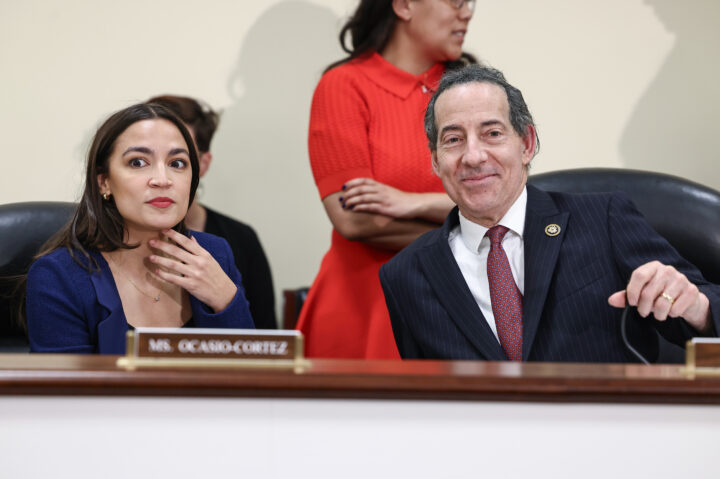
Rep. Jamie Raskin (D-MD) chats before a roundtable discussion on Supreme Court Ethics conducted by Democrats of the House Oversight and Accountability Committee at the Rayburn House Office Building on June 11, 2024 in Washington, DC.
Ron Halber, the CEO of the Jewish Community Relations Council of Greater Washington, strongly criticized Rep. Jamie Raskin (D-MD) over his recent decision to support legislation that seeks to severely restrict U.S. aid to Israel, casting the congressman’s move as part of a troubling pattern that has sparked concern among pro-Israel activists in his Maryland district.
“Jamie’s signing on that legislation was extremely disappointing,” Halber said in an interview with Jewish Insider on Tuesday, referring to the Block the Bombs Act, a bill led by far-left lawmakers that would place unprecedented new conditions on U.S. weapons transfers to Israel.
Raskin, who became a co-sponsor of the bill earlier this month, has not issued any statement regarding his decision.
“It unfortunately follows his signing on to other similar letters and a vote against additional arms to Israel last year, which really raised a lot of people’s eyebrows,” Halber, who said he considers Raskin a friend, told JI.
Halber said that he had spoken with Raskin, one of the most prominent progressive Jewish lawmakers in Congress, three times over the last two days, asking him to withdraw his name from the bill and instead issue a statement expressing the concerns about the war in Gaza that had motivated him to back the controversial legislation.
Raskin said he would be considering the request and indicated he was “not opposed to Israel using arms in other theaters” outside of Gaza, according to Halber, who described “a very honest and frank conversation” about the bill, which was introduced in May in response to the worsening humanitarian crisis in the war-torn enclave.
While he acknowledged that Raskin is “pulled by both being a leader of the Progressive Caucus and by his own progressive Zionism,” Halber said that the legislation represents “a bridge too far” for the pro-Israel community. The bill effectively amounts to an arms embargo on Israel, he said, arguing that it “seeks to unilaterally disarm one of our closest allies” as Israel defends itself on multiple fronts.
“I’m hoping that Jamie will take his name off the bill and use a statement to express his concerns,” Halber told JI, noting that the congressman has also fielded messages from several Jewish leaders leaders in his Montgomery County district who have aired objections. “If he doesn’t, we will be disappointed, but that’s his decision to make and he has to live with the ramifications of his decision,” Halber added. “I don’t see how that helps him.”
Natalie Krute, a spokesperson for Raskin, declined multiple requests for comment about his decision to back the bill, and did not immediately respond to JI on Tuesday regarding his recent conversations with Halber.
Halber’s private engagement with Raskin, who joined 32 other lawmakers in supporting the bill, underscores the challenges that mainstream Jewish groups are now facing as even some of the most reliable defenders of Israel in the Democratic Party shift away from reflexively backing the Jewish state, amid growing outrage over the crisis in Gaza.
“It’s difficult when two-thirds of our community is voting for a political party whose base is hostile to Israel,” Halber said of the waning support for Israel among Democrats. “I think a lot of my colleagues are also finding this a very difficult era,” he added.
Halber said he had also recently spoken with Sen. Angela Alsobrooks (D-MD) after she faced scrutiny from Jewish leaders this month for voting in favor of Sen. Bernie Sanders’ (I-VT) resolutions to block some U.S. arms sales to Israel, despite vowing to oppose such efforts during her Senate campaign last year.
“I’m convinced that her vote was more about sending a message of moral outrage to the Israeli government about the number of children who are malnourished in Gaza,” he said of their discussion, adding he was “a little more forgiving” in assessing her decision because it had coincided with a surge of media coverage about the humanitarian crisis in Gaza.
Alsobrooks was among 27 Senate Democrats, the majority of the caucus, who voted earlier this month to block shipments of U.S. aid to Israel — marking a dramatic turn against the Jewish state for the party. “While I didn’t like that Democratic senators voted” for the resolutions, “it was understandable, and they knew it wasn’t going to pass,” Halber said on Tuesday. “The question is, if it was going to pass would they have supported it — and I hope not.”
Even as the Block the Bombs bill is also not expected to pass, Halber indicated that he viewed Raskin’s move as a more egregious offense, calling it a “safe way” to register discontent with Israel’s conduct in Gaza that nevertheless “went too far” for his heavily Jewish district.
“Obviously, he’s trying to maintain a leadership position within the House Progressive Caucus,” Halber said of the congressman’s thinking. But on his home turf, “there are a lot of” constituents who do not support imposing sweeping new conditions on Israel, he told JI.
Still, Halber suggested that his lobbying to convince Raskin to withdraw his name from the bill is part of a broader effort to “push back against” the growing influence of what he called the “radical left,” whose views on Middle East policy he described as a “huge danger” to Israel’s continued security in the region.
“Once the war comes to an end, the whole Jewish community is going to have to re-strategize,” Halber said of the challenges ahead as his organization and others like it reckon with their traditional approach to engaging on such issues. “We have a lot of work to do with young people and with Democrats and independents.”
The war in Gaza “is going to impact Israel’s image for years to come,” Halber predicted. “Hopefully, once the media isn’t covering it every day, we can provide more context about what happened” and help “rebuild” Israel’s reputation among skeptical voters.
A new report from NGO Monitor describes the ‘workaround’ used by international aid groups to continue flow of aid to Gaza despite Hamas involvement

Ali Jadallah/Anadolu via Getty Images
Members of the Al-Qassam Brigades, the military wing of Hamas as the bodies of hostages' are handed over to the Red Cross teams as part of the Hamas-Israel prisoner-hostage swap agreement in Khan Yunis, Gaza on February 20, 2025.
Amid an international outcry over the humanitarian conditions in Gaza, Israel and the Gaza Humanitarian Foundation have repeatedly pointed to Hamas’ practice of diverting and disrupting the distribution of aid that officials say has entered Gaza unimpeded as one of the culprits behind the crisis.
NGO Monitor, which tracks the funding of anti-Israel organizations, wrote a new report given exclusively to Jewish Insider, which claims to show evidence of Hamas controlling the destination of humanitarian aid given in cash for years before and during the Gaza war, including money coming from U.N. agencies and NGOs funded by European governments.
The report alleges that the groups distributed cash and vouchers to beneficiaries selected by the Hamas-run Gaza Ministry of Social Development (MoSD), which since 2019 has been led by Ghazi Hamad, a member of the Hamas politburo who was designated a terrorist by the U.S. last year and who, weeks after Hamas’ Oct. 7, 2023 attacks, vowed that “there will be a second, a third, a fourth … one-millionth” Oct.7-style attack on Israel.
Hamad made headlines in Israel earlier this week with his assertion that the commitments of 11 countries to recognize a Palestinian state is an “achievement” stemming from Hamas’ attacks on Israel.
In 2023, the EU provided $19.6 million, France donated $9.34 million and Spain $1.75 million “for the payment of social allowances to poor Palestinian families.” The EU stated that since 2008, it “has been a steadfast supporter of the Palestinian Authority’s Ministry of Social Development, collaborating to ensure that basic social allowances are extended to the most vulnerable families residing in the West Bank and Gaza.”
In August 2024, according to the report, the EU and Spain provided 15.5 million Euros of aid for Gaza, saying they were partnering with the PA MoSD to deliver it. The EU also gave UNICEF over 4 million Euros in 2023 for a project in which the MoSD was the “main partner.”
Among the governments funding programs involving the MoSD is the U.K., even though its Foreign Office had been made aware of the matter and expressed concern over possible “severe” reputational damage that could come from its involvement.
Other countries funding programs working with the MoSD, according to the NGO Monitor report, include Germany, Switzerland and Norway.
The EU and others say that they are working with the MoSD in Ramallah, controlled by the Palestinian Authority, as opposed to the Gaza MoSD, controlled by Hamas.
However, the NGO Monitor report argues that the Ramallah MoSD was used to circumvent Western countries’ rules against contact with Hamas, a proscribed terrorist organization, while the beneficiaries were still chosen by the Hamas-controlled MoSD in Gaza.
A 2022 Oxfam International analysis of its cash-assistance programs in Gaza described “workarounds needed for the no-contact policy” with Hamas, by way of “the interface between humanitarian agencies and the MoSD in Ramallah, and the local authorities in Gaza,” otherwise known as Hamas.
The Oxfam analysis notes that there is “collaboration between the de-facto government in Gaza and the official Ramallah government,” and that “in the MoSD in Gaza, most of the staff are from the de-facto government,” meaning Hamas.
The organization called for more work with Arab humanitarian aid groups, “capitalizing on the fact that the latter are not restricted by no-contact policies,” meaning that they work directly with Hamas.
Hamas also takes a cut of the cash that aid organizations transfer into Gaza.
The minutes from a Oct. 8, 2024, meeting of the Gaza Cash Working Group, a U.N.-led coordination mechanism for U.N. agencies and international NGOs, state that the Hamas-controlled government in Gaza charged “withdrawal fees up to 20% … these fees are not limited to multipurpose cash assistance, but apply across the entire market.”
NGO Monitor also highlighted a 2022 Mercy Corps Gaza project as an example of Hamas control of humanitarian funding. A description of the project from the U.N. repeatedly referred to the MoSD’s central role.
“Through unconditional cash assistance, this project will identify and select the most vulnerable HHs [households] … from the Ministry of Social Development (MoSD) unserved waiting lists of Social Safety Net (SSN),” the U.N. description states. At another point, it says that the project will be undertaken with “full coordination and engagement with the MoSD.”
Oxfam responded to inquiries from JI that the organization “operates under a strict and clear no-contact policy with de facto authorities in Gaza. We do not work or communicate with the Ministry of Social Development (MoSD) in Gaza. In line with this, our work in Gaza is coordinated through the MoSD’s PA focal point based in Ramallah.”
“The reference in the 2022 study is not an admission of direct engagement,” the organization continued. “It describes sector-wide challenges … We have robust safeguards in place to prevent any misuse or manipulation of our aid programs and adhere to the highest standards of humanitarian principles and accountability.”
Mercy Corps also told JI it has a strict no-contact policy against engaging with sanctioned entities and that allegations that it worked with the MoSD in Gaza is “false and inaccurate.” Their aid recipient lists came from the MoSD in Ramallah, managed by the PA, the organization stated.
“We do not and have not coordinated with Hamas in Gaza to implement our aid programs, and allegations that we work with Hamas are false,” the group stated. “We are confident in our processes and policies, including a rigorous verification process for program participants, which ensures we help the most vulnerable families, while avoiding those with affiliation or contact with sanctioned groups. We have decades of experience delivering humanitarian assistance in high-risk environments like Gaza.”
The BBC reported on Wednesday that Hamas has continued to pay 30,000 salaries throughout the war in Gaza using “a secret cash-based payment system” even as Israel attempts to block the terrorist group from making payments.
Hamas employees receive encrypted messages inviting them to “meet a friend for tea” at a specific time and place. When they arrive, someone hands them an envelope of cash and then walks away.
Hamas has stockpiled about $700m in cash, according to the BBC, but has only paid $7m in salaries since the war began in Oct. 2023. Employees reportedly only receive about 20% of their wages, and the BBC quoted employees claiming to have non-combat roles who were frustrated with the insufficient payments and the dangers in having to travel to collect the cash amid Israeli airstrikes.
In addition, Hamas has reportedly distributed food packages to its members, angering Gazans who accuse the terrorists of not aiding others, according to the BBC.
The former ADL director said he is ‘troubled’ by the ‘demonizing’ of immigrants and attacks on universities

Anna Moneymaker/Getty Images
Holocaust survivor and former National Director of the Anti-Defamation League Abraham Foxman delivers remarks during the U.S. Holocaust Memorial Museum's Annual Days of Remembrance ceremony at the U.S. Capitol on April 23, 2025 in Washington, DC.
Abe Foxman, the former Anti-Defamation League national director, offered pointed criticism of the Trump administration in a Holocaust Remembrance Day commemoration at the Capitol on Wednesday.
“As a [Holocaust] survivor, my antenna quivers when I see books being banned, when I see people being abducted in the streets, when I see government trying to dictate what universities should teach and whom they should teach. As a survivor who came to this country as an immigrant, I’m troubled when I hear immigrants and immigration being demonized,” Foxman said, to sustained applause from the audience.
Foxman, who led the ADL for nearly three decades, made the comments while delivering an address at the 2025 Days of Remembrance, which was organized by the U.S. Holocaust Memorial Museum in Washington.
Foxman also praised the Biden administration and the second Trump administration for each committing to addressing antisemitism. “We live in very chaotic times, where our values, our history, our democracy are being tested. As a survivor, I’m horrified at the explosion of antisemitism — global and in the U.S. I’m appreciative of President Biden’s historic initiative on antisemitism and thankful to President Trump’s strong condemnation of antisemitism and his promise to bring back consequences to antisemitic behavior,” Foxman said.
“We look around us and what do we see? Rampant antisemitism on college campuses and in cities worldwide in the aftermath of that horrific terror attack on our cherished Jewish state, Israel. We see social media algorithms that promote extreme views, conspiracy theories,” Foxman continued, adding that “online conspiracy theories are just one click away from antisemitism.”
“We also see forms of antisemitism that seemed unthinkable: Holocaust denial, distortion, civilization, exploitation and even glorification. We look around and see here in America antisemitism on both the far left and far right. The 20th-century history of Nazism and communism should be an alarm bell as to just how dangerous this is, and not just for us Jews, but for all of society, for all who care about democracy, individual freedom and dignity,” he said.
Foxman also noted that the scourge in domestic antisemitism was reminiscent of how Jew hatred worsened for years prior to Adolf Hitler’s rise to power. “Antisemitism [is] not so different from the conspiracy theories that permeated Europe for centuries, long before Hitler was born and helped make the killings of two-thirds of our people possible,” he said.
Commerce Secretary Howard Lutnick also spoke at Wednesday’s reception, where he described the Holocaust as a “failure of humanity” and argued that the evil that perpetrated it was akin to the Sept. 11, 2001, attacks and the Oct. 7, 2023, attacks on Israel.
“The Holocaust was a failure of humanity. But as we all know, no matter how hard we try, that kind of hatred continues to exist, just in many, many other forms. It shows up in different ways, and it shows up at different times,” Lutnick said.
The Oct. 7 attack, Lutnick argued, was “carried out with the same genocidal hatred that fueled Auschwitz, and it’s that same disregard for human life that fueled the Sept. 11 attacks. It’s just the same hate, it just comes at a different time with a different name.”
Becoming emotional, Lutnick vowed “in very, very clear and plain language” that Trump “will never back down from defending the Jewish people, never.”
The other leading Democratic candidates for New York City mayor condemned the arrest as unconstitutional and authoritarian

Seth Wenig-Pool/Getty Images
Former New York Gov. Andrew Cuomo
Former New York Gov. Andrew Cuomo is so far staying silent with regard to the arrest by federal agents on Sunday of a Palestinian student activist who played a leading role in anti-Israel protests at Columbia University last year — as several primary rivals for New York City mayor condemn the move.
A spokesperson for Cuomo, a Democrat who announced his mayoral bid a week ago, did not return requests for comment from Jewish Insider on Monday. He has otherwise declined to publicly address the matter.
His hesitation to weigh in on the politically charged issue suggests that Cuomo — who has been courting Jewish and pro-Israel voters — is taking a cautious approach to the Trump administration’s polarizing crackdown on campus protests even as he indicates that combating rising antisemitism is among his top priorities.
“The law must be aggressively enforced and our New York should go even further and be at the forefront, leading the fight against the global rise of antisemitism,” Cuomo said in a 17-minute kickoff video, which featured an image of an anti-Israel demonstration outside of Fordham University.
The former governor has also pledged to stand up to President Donald Trump, characterizing him as “the bully in the schoolyard” who “puts his finger in your chest.”
Cuomo’s opponents in the June primary election, meanwhile, have almost unanimously denounced the arrest as a violation of due process and called for the release of Mahmoud Khalil — a green card holder who was detained by U.S. Immigration and Customs Enforcement agents days after the Trump administration said it would slash $400 million in federal funding from Columbia over the university’s handling of alleged antisemitic protests.
Brad Lander, the progressive-minded city comptroller and a Jewish Democrat, called the arrest “an unconstitutional and egregious violation of the First Amendment, and a frightening weaponization of immigration law.”
“I disagree strongly with things that were said in the protests he reportedly led,” Lander said on Sunday. “But it will not make Jews — or any of us — safer for the federal government to deport people for saying things we may find hateful.”
In a statement to JI on Monday, Scott Stringer, the former comptroller and a Jewish Democrat, said it is “absolutely absurd for the government to arrest people they don’t agree with.”
“While I disagree with many of the tactics and rhetoric of the protests at Columbia, the Trump administration detaining a green card holder for engaging in speech they don’t like is a clear violation of First Amendment rights,” Stringer added.
Zohran Mamdani, a state assemblyman from Queens and the most outspoken critic of Israel in the mayoral race, also denounced the arrest as “a blatant assault on the First Amendment and a sign of advancing authoritarianism under Trump,” he wrote on social media. “He must be released now.”
Mamdani added in a separate post that Cuomo’s continued avoidance of the issue shows he is “not prepared to stand up to Donald Trump.”
“This chilling action by the Trump administration crosses another line towards authoritarianism,” said Zellnor Myrie, a Brooklyn state senator who is one of several progressives in the race. “ICE has no right to detain a green card holder who has not been convicted of, or even charged with, any crime. This is profoundly un-American, and Khalil must be released.”
Adrienne Adams, the City Council speaker who officially launched her mayoral bid on Saturday, likewise characterized Khalil’s arrest as an act of “blatant authoritarianism.”
“This is a civil rights issue and an astounding overreach that disregards the U.S. Constitution,” she said on Monday. “It should concern every American and cannot be allowed to stand.”
In a statement shared with JI on Monday, Jessica Ramos, a state senator from Queens, said that the Trump administration had “offered no serious legal justification for Khalil’s detention, instead citing a Trump executive order.”
“We know from history that abuse of detention powers are a hallmark of authoritarian regimes,” Ramos added. “Contrary to his own belief, Trump is not a king. His actions are a threat to all of us, even those who disagree with Khalil’s speech. I demand the immediate release of Mahmoud Khalil.”
The Department of Homeland Security said in a statement on Sunday that Khalil had been arrested “in support of President Trump’s executive orders prohibiting anti-Semitism,” claiming the former Columbia graduate student “led activities aligned to Hamas, a designated terrorist organization.”
“ICE and the Department of State are committed to enforcing President Trump’s executive orders and to protecting U.S. national security,” the statement added.
Khalil, who has not been formally charged with a crime, is being held in an immigration detention facility in Louisiana, according to an online ICE database. His attorney has vowed to challenge the arrest in court.
Trump, in comments posted to social media on Monday, said that Khalil’s detention “is the first arrest of many to come.”
“We know there are more students at Columbia and other Universities across the Country who have engaged in pro-terrorist, anti-Semitic, anti-American activity, and the Trump Administration will not tolerate it,” he wrote. “Many are not students, they are paid agitators. We will find, apprehend, and deport these terrorist sympathizers from our country — never to return again.”
A spokesperson for New York City Mayor Eric Adams, who had aggressively targeted Columbia protestors last year, declined to comment on the arrest. “We don’t have a lot of information on this beyond what has been reported,” the spokesperson told JI, adding that Adams’ team “doesn’t work with ICE on civil immigration enforcement.”
The mayor has in recent weeks faced widespread calls to resign over accusations, which he denies, that he negotiated a deal with the Department of Justice to dismiss his federal corruption charges in exchange for enforcing the Trump administration’s immigration agenda.
Jim Walden, a former federal prosecutor who is running as an independent, shared a more skeptical view of Khalil on Monday, even as he called for due process in handling his arrest. “I cannot lend my voice to someone who strikes me as an antisemitic terrorist sympathizer,” he told JI in a statement. “He deserves due process of law in the United States — unlike the repressive regimes he supports.”
“Offering support to terrorists, attacking Jewish students, and engaging in hate speech seem like valid reasons for authorities to take a closer look at pro-Hamas organizers,” Walden said.
Many campus leaders are now conceding it is easier to give in to protesters than to stand firm against their rule-breaking

Jacek Boczarski/Anadolu via Getty Images
Students and residents camp outside Northwestern University during a pro-Palestinian protest, expressing solidarity with Palestinians with banners in Evanston, Illinois, United States on April 27, 2024.
It’s spring in Cambridge, Mass. — graduation season — which means that large white tents have started to appear on the leafy quads throughout Harvard Square.
Until Tuesday, a different kind of tent was still visible in Harvard Yard: small camping tents housing the stragglers who remained in Harvard’s anti-Israel encampment even after final exams wrapped up several days ago. Last week, Harvard suspended student protesters who refused to abide by campus administrators’ orders to disband the encampment, blocking access to their dorms.
But now, just a week from the start of official university commencement festivities, Harvard has backtracked on its disciplinary action, ahead of the arrival next week of thousands of graduates’ family members, alumni and honorary degree recipients to the Ivy League university. University officials seemed to be saying that Harvard cannot get ready for commencement if Harvard Yard is still gated and locked, accessible only to university affiliates and the handful of people still camped out in protest of Harvard’s alleged “complicity in genocide.”
In making a deal with the protesters, Harvard interim President Alan Garber joined a growing number of leaders at elite universities who are incorporating protesters’ voices into major university investment decisions and allowing student activists to get off with few, if any, repercussions after weeks of disciplinary violations. Harvard’s dean of the faculty of arts and sciences wrote in a Tuesday email that the outcome “deepened” the university’s “commitment to dialogue and to strengthening the bonds that pull us together as a community.”
The path Garber took is now a well-trodden one — remove the threat of disciplinary consequences and allow protesters to meet with university trustees or other senior leaders to pitch them on divesting their schools’ endowments from Israeli businesses, a concession that before last month would have been unthinkable at America’s top universities.
In a matter of days it has become commonplace. Just two years ago, Harvard’s then-president, Lawrence Bacow, responded to the campus newspaper’s endorsement of a boycott of Israel by saying that “any suggestion of targeting or boycotting a particular group because of disagreements over the policies pursued by their governments is antithetical to what we stand for as a university.”
Northwestern University set the tone two weeks ago when President Michael Schill reached an agreement with anti-Israel protesters in exchange for them ending their encampment. Jewish leaders on campus found the agreement so problematic that the seven Jewish members of the university’s antisemitism committee — including Northwestern’s Hillel director, several faculty members and a student — stepped down in protest. Lily Cohen, a Northwestern senior who resigned from the committee, summed up their concerns: “It appears as though breaking the rules gets you somewhere, and trying to do things respectfully and by the books does not.”
Her observation has proven prescient as universities negotiate with anti-Israel protesters who break campus rules while they slow-walk reforms long sought by Jewish students — or even avoid meeting with Jewish community members altogether.
University of Wisconsin-Milwaukee Chancellor Mark Mone signed onto a far-reaching agreement with protesters this week that calls for a cease-fire in the war between Israel and Hamas in Gaza, condemns “genocide” and denounces “scholasticide” in Gaza and cuts off ties between a university-affiliated environmental NGO and two government-owned Israeli water companies. Meanwhile, Hillel Milwaukee said in a statement that Mone has refused to meet with Jewish students since Oct. 7. Where universities fumbled over statements addressing the Oct. 7 attacks last fall in failed bids to satisfy everyone, many campus leaders have now conceded it is easier to give in to protesters than to stand firm against their rule-breaking. (The president of the University of Wisconsin system said he is “disappointed” by UWM’s actions.)
Princeton University and Johns Hopkins University made concessions to encampment leaders this week. At Johns Hopkins, the school pledged to undertake a “timely review” of the matter of divestment, and to conclude student conduct proceedings related to the encampment. Hopkins Justice Collective, the group that organized the protests, characterized the agreement as “a step towards Johns Hopkins’ commitment to divest from the settler colonial state of Israel.”
In a campus-wide email on Monday, Princeton President Christopher Eisgruber said all students must vacate the campus quad where they had organized an anti-Israel encampment. He offered the campus protest leaders an audience with the body that reviews petitions for divestment. Other student groups can also petition for a meeting, he wrote.
Students who were arrested during the course of the protests may have a chance to take part in a so-called “restorative justice” process, whereby the university “would work to minimize the impact of the arrest on the participating students.” If protesters take responsibility for their actions, Eisgruber wrote, the school will conclude all disciplinary processes and allow the protesters to graduate this month.
At many more universities, top administrators — including university presidents — have met with demonstrators, giving them a chance to air their concerns even when they didn’t reach an agreement. University of Chicago administrators held several days of negotiations with encampment leaders before the talks fell apart and police cleared the protesters. The George Washington University President Ellen Granberg met over the weekend with student protesters who lectured her about “structural inequality” at GW and likened the university’s code of conduct to slavery and Jim Crow-era segregation, according to a video recording of the meeting.
College administrators’ negotiations to end the protests might bring a wave of good headlines and promises of quiet at campus commencements, the largest and most high-profile event of the year for most universities. But students haven’t said what they’ll do when school is back in session next year.
By promising meetings with university investment committees, the administrators are almost certainly guaranteeing that campus angst over the war in Gaza will not die down. Brown University President Christina Paxson pledged that protest leaders can meet with the university’s governing body to discuss divestment from companies that operate in Israel — in October, a year after the Hamas attacks that killed more than 1,200 people and ignited the ongoing bloodshed in the Middle East.
Correction: This article was updated to more accurately reflect negotiations between Princeton’s president and the protesters.
Eural Warren Jr. served 17 years for his role in an altercation in which one person was killed

Getty images
View of the Carrier Dome and Syracuse University hill in Syracuse, N.Y.
A man convicted of manslaughter has been participating in an anti-Israel encampment in the middle of Syracuse University’s campus for more than a week, Jewish Insider has learned.
Eural Warren Jr. was convicted of manslaughter in the first degree in 1996 when he beat a victim’s head with a firearm, causing multiple skull fractures, according to the New York State Department of Correctional Services website. (He was also charged with criminal possession of a firearm.)
The victim was punched and knocked down by a second person, and died due to his injuries. Warren appealed the conviction in 1997, but was denied. According to court documents from his appeal, “Medical testimony established that the victim died from the cumulative effect of several skull fractures, only one of which was caused by the second assailant. [D]efendant’s conduct was an actual cause of death, in the sense that it forged a link in the chain of causes which actually brought about the death.” Warren was released from prison in 2013 after serving 17 years, records show. His LinkedIn shows him as the “CEO/Executive Director/Founder” of No Space For Hate since April 2023.
The 49-year-old is unaffiliated with the upstate New York university, but several photos obtained by Jewish Insider show him protesting and sleeping alongside students since the “Gaza solidarity encampment” overtook Syracuse’s campus on April 29. (On Tuesday, the encampment was directed by the administration to relocate off of the central quad to make room for graduation ceremonies; it was not shut down).
Onondaga County District Attorney William Fitzpatrick confirmed to JI that Warren is the person photographed at the encampment. “I can confirm it is absolutely the same person. I have looked up his mugshot just to be sure,” Fitzpatrick said. Of the encampment, Fitzpatrick added, “Syracuse administration has decided to handle it ‘internally’… my position is that [all of the protesters] are breaking the law [and] should be removed and arrested.”
A spokesperson for Syracuse University did not respond to multiple inquiries from JI asking whether the school is aware of Warren.
Warren’s troubling history came to light after a vocally pro-Israel female student alleged that, on several occasions, he photographed her and a friend passing by the encampment. “We were creeped out,” the student, who requested to remain anonymous to speak about a sensitive topic, told JI. “It wasn’t hard to find his name because he follows Syracuse’s Students for Justice in Palestine and Jewish Voice for Peace Instagram pages. Then we did a quick Google search and found out he’s a criminal,” she said.
The student, who is active in the school’s pro-Israel group, said that last Sunday she reported Warren to the Syracuse Department of Public Safety, which encouraged her to fill out a bias report. She submitted the report on Tuesday, rather than going to the police. Also on Tuesday, Warren was photographed at the encampment, dressed in Syracuse gear to blend in with student protesters.
By Thursday, the student hadn’t heard a response from the school.
“It’s difficult, [especially] when the encampments were in the middle of campus because you couldn’t avoid it,” she said, noting that “intimidating” slogans have been tossed around by the protesters, “including calling for the intifada and ‘from the river to the sea Palestine will be free.’”

Jennifer Liseo/ADL
ADL CEO Jonathan Greenblatt
Anti-Defamation League CEO Jonathan Greenblatt on Tuesday bemoaned what he described as a lack of national media attention to a dramatic rise in antisemitic attacks across New York City, saying that the current polarized political environment has made it difficult to meaningfully address the uptick in violence against Jews in the major metropolis.
“The idea that you have 200 incidents [of antisemitism] here in New York City — [that] should be a national news story. It doesn’t belong in the metro section of The New York Times. It belongs on the front page,” Greenblatt told Jewish Insider during a press conference in Brooklyn, N.Y. “But here’s the thing: In a world which is so polarized, so charged, and so political, everything needs to fit to a narrative. You know what? I don’t care how you vote!”
The fight against antisemitism, Greenblatt stated, has to be, in the name of “decency, diversity and dignity,” a national focus. “When you don’t value these things, when you allow hostility to happen, when you sit and ignore intolerance, that is unacceptable.”
The ADL also announced an initiative in partnership with the Brooklyn Borough President’s office that will double the number of schools participating in its “No Place for Hate” program, with a goal of reaching as many as 40 schools in neighborhoods with significant Jewish populations. The move comes in response to a dramatic increase in violent antisemitic incidents across Brooklyn.
The announcement comes the same day as the FBI released its annual report on hate crime statistics. The report noted that anti-Jewish bias was the source of 57 percent of religion-based hate crimes reported in 2018.
“No one should fear for their safety or be victimized because of their religious beliefs,” said Brooklyn Borough President Eric Adams. “Since extremist, hate-filled rhetoric has become awakened and stoked across this country — particularly in Crown Heights right here in Brooklyn — this unacceptable behavior is increasingly becoming the norm for some.”
Greenblatt stressed that a national response, irrespective of political affiliation, is required regardless of who is the target. “Whether you are a borough president, whether you are a school board president, or the president of the United States, all of us have a responsibility to step up and speak out when hate happens on our watch, whether or not it affects us,” he said.

AP Photo/Kirsty Wigglesworth
Britain's Shadow Chancellor John McDonnell, left, embraces Jeremy Corbyn, Leader of Britain's main opposition Labour Party during his speech on stage during the Labour Party Conference at the Brighton Centre in Brighton, England, Monday, Sept. 23, 2019.
LONDON — The U.K.’s Labour Party formally adopted on Tuesday a slew of anti-Israel agenda items as part of its party platform for the next general election. The opposition party, which has recently faced numerous accusations of antisemitism and anti-Israel bias, appeared to only wade deeper into controversy.
On the fourth day of the 2019 Labour conference in Brighton, delegates voted to support a boycott of Israeli settlement goods, and called for a moratorium on trade agreements with the Jewish state. This appeared to be the first time the party has formally adopted a BDS policy. According to reports, the nearly unanimous vote followed audible shouts of “Free Palestine” throughout the event space.
In a statement posted to Twitter, Labour Friends of Israel director Jennifer Gerber denounced the move, calling the Labour party a “home for anti-Jewish racists and Israel haters.”
“It’s depressing but thoroughly unsurprising that Labour has today ended its decades old opposition to the extremist Israel boycott movement. Boycotts do nothing to bring about peace and are designed entirely to demonize Israel,” Gerber said. “With [Labour leader Jeremy] Corbyn now uniquely singling out the world’s only Jewish state for boycotts, it’s no wonder the Jewish community fears the prospect of him becoming prime minister. This is another dark day in the history of the Labour Party,” Gerber’s statement continued.
Tuesday’s vote followed a host of anti-Israel and antisemitic incidents at the conference over the weekend. Before the confab began, evidence emerged showing Corbyn’s 2002 support for the “Cairo Declaration.” Along with other left-leaning leaders, Corbyn appeared to have signed the declaration which specifically accused Israel of committing apartheid.
On Sunday, Sussex police confiscated a poster from the conference that showed Israeli Prime Minister Benjamin Netanyahu and the Israel “lobby” attacking Corbyn, who stands at a podium defending Palestinian rights. The poster was immediately denounced, including by a Labour spokesperson, who said “This kind of hateful poster has no place anywhere near our conference.”
Please log in if you already have a subscription, or subscribe to access the latest updates.
 Continue with Google
 Continue with Apple