











































Recent FDD reports found that Iranian oil exports have remained near peak levels in spite of U.S. sanctions, which the think tank attributed to a failure of enforcement

Florence Lo-Pool/Getty Images
Chinese President Xi Jinping speaks at the opening ceremony of the China-CELAC Forum ministerial meeting at The Great Hall of People on May 13, 2025 in Beijing, China.


 Add JewishInsider on Google
A new bipartisan and bicameral bill is pushing for greater accountability and transparency on China’s violations of U.S. oil sanctions on Iran.
China is the largest importer of Iranian oil, in spite of the sweeping U.S. sanctions regime targeting the Iranian oil and gas industry, as well as newer sanctions that target importers of that oil, which have been recently applied to some firms in China.
Recent reports by the Foundation for Defense of Democracies have found that Iran oil exports, primarily to China, have remained near their peak level in spite of U.S. sanctions, which FDD has attributed to a “failure of U.S. sanctions enforcement.”
The new bill, led by Sens. Richard Blumenthal (D-CT) and Lindsey Graham (R-SC) and Reps. Raja Krishnamoorthi (D-IL) and Ben Cline (R-VA), requires the administration, within a year of the bill’s passage, to determine whether the People’s Republic of China is conducting sanctionable activities with regard to Iran.
In advance of that determination, the bill requires the administration to report to Congress within 180 days on China’s purchases of Iranian oil, including how China is using shell companies and other methods to dodge sanctions, as well as on Chinese efforts to sell or transfer chemical precursors to Iran to support its ballistic missile program.
Recent reports have found that Iran has been importing materials from China to rebuild its ballistic missile program, an effort that has prompted concern on Capitol Hill.
“China’s growing purchases of Iranian oil and its support for Iran’s ballistic missile program are not just violations of U.S. sanctions—they are direct threats to regional stability and to our allies,” Krishnamoorthi said in a statement, adding that the legislation “gives Congress the intelligence and transparency needed to expose how the PRC enables Iran’s most dangerous activities.”
“By bringing these transactions into the light, we strengthen our ability to enforce sanctions and hold malign actors accountable,” Krishnamoorthi continued.
Krishnamoorthi is mounting a bid for the U.S. Senate in his home state.
“China’s continued purchases of Iranian oil and its role in enabling Iran’s missile program to pose a direct threat to U.S. national security and to the stability of our allies in the Middle East,” Cline said. He called the legislation and the reporting it requires “a necessary step toward exposing how the PRC uses shell companies, transshipment schemes, and other avenues to evade sanctions.”
“This report will give Congress and the Treasury Department the insight needed to strengthen enforcement, close loopholes, and ensure that hostile regimes, and those who bankroll them, are held accountable,” Cline continued.
Blumenthal said that China’s purchases of oil are “providing significant financial support for Iran’s terrorist activities in the Middle East and beyond.”
“Transparency is the first step towards accountability, which is why our bill would require a full report on China’s oil and ballistic missile-related transactions with Iran. This information will support robust sanctions enforcement and provide a path forward for additional legislative action,” Blumenthal said.
Graham called the bill “the first step in fully understanding how China and other nations prop up the Ayatollah’s war machine.”
Rabbi Levi Shemtov called Johnson and Jeffries ‘perhaps the best friends of Israel and the Jewish people either side of the aisle has ever seen’

Office of House Speaker Mike Johnson
House Speaker Mike Johnson (R-LA), Senate Minority Leader Chuck Schumer (D-NY) and House Minority Leader Hakeem Jeffries (D-NY) host menorah lighting alongside Chabad Rabbi Levi Shemtov, the executive vice president of American Friends of Lubavitch (Chabad), Dec. 10, 2025
Democrats and Republicans gathered for a rare moment of bipartisanship on Capitol Hill on Wednesday at the pre-Hanukkah menorah lighting ceremony hosted by congressional leadership.
House Speaker Mike Johnson (R-LA), Senate Minority Leader Chuck Schumer (D-NY) and House Minority Leader Hakeem Jeffries (D-NY) hosted the gathering alongside Chabad Rabbi Levi Shemtov, the executive vice president of American Friends of Lubavitch (Chabad), who led the prayer portions of the program and helped light the menorah candles.
Over a dozen lawmakers from across the political spectrum mingled with rabbis and Jewish political operatives while noshing on sufganiyot and Star of David-shaped sugar cookies and sipping coffee and soft drinks at the annual gathering, which the three congressional leaders organized for the first time two months after Hamas’ Oct. 7, 2023, attack on Israel.
Johnson was forced to miss the beginning of the event to oversee a dispute unfolding between several of his members on the House floor over the National Defense Authorization Act, but arrived in time to participate in the end of the menorah lighting.
Among the lawmakers in attendance were Reps. Randy Fine (R-FL), Virginia Foxx (R-NC), Craig Goldman (R-TX), Josh Gottheimer (D-NJ), David Taylor (R-OH), Tom Kean Jr. (R-NJ), Lois Frankel (D-FL), Wesley Bell (D-MO), Debbie Wasserman Schultz (D-FL), Jared Moskowitz (D-FL), Brad Schneider (D-IL), Dan Goldman (D-NY), Jamie Raskin (D-MD), Sara Jacobs (D-CA) and Melanie Stansbury (D-NM).
Also present were Rabbi Yehuda Kaploun, the Trump administration’s nominee to be the State Department special envoy to monitor and combat antisemitism; Matt Brooks, CEO of the Republican Jewish Coalition; Paul Teller, executive director of Advancing American Freedom; and Mort Klein, president of the Zionist Organization of America.
Absent from the ceremony was Senate Majority Leader John Thune (R-SD), who was unable to attend due to a scheduling conflict, according to a source familiar with the matter.
All three congressional leaders noted in their respective speeches the bipartisanship that the event had engendered, and all used their remarks to reiterate their commitment to fighting antisemitism and standing with the American Jewish community.
“We do share this in common, that we support Israel, obviously, and the Jewish people,” Johnson said of Jeffries, whom the House speaker called “my good friend and my colleague.”
Johnson said he was glad to see “all of our many colleagues and friends who have joined us here for this meaningful occasion” and specifically pointed out Craig Goldman and Fine as “two of my favorite colleagues down here who have joined us and proudly represent Jewish people in Congress.”
“It’s a special time of year, and we like to do this,” Johnson remarked.
Jeffries complimented Shemtov for “always committing to bringing us together, not as Democrats or Republicans, but as Americans.”
Shemtov said that his “message for today” was how the branches of the menorah diverge in different directions but originate “from the base facing towards that middle, which is moderation.”
“I think that there are two ways to look at people who go out from the base into different directions,” Shemtov said. “We can focus on the differences and worry about conflict, or we can focus on the variety that brings unity.”
Shemtov praised Johnson and Jeffries specifically for their leadership on Jewish issues, prompting the room to applaud for both men.
“I don’t get involved in their opinions on political issues. That’s not my role. But one thing I will say is the two gentlemen on my left are strong and perhaps the best friends of Israel and the Jewish people either side of the aisle has ever seen,” Shemtov said of the House leaders. “I go to sleep easier at night knowing that at the helm of our nation and this institution of Congress are people who recognize the value we give this nation.”
The legislation is more expansive than the Trump administration’s executive order, which authorizes designating individual branches of the Muslim Brotherhood

Salah Malkawi/Getty Images
Jordanian police close the entrance of a Muslim Brotherhood headquarter after the announcement of banning the society in the country on April 23, 2025 in Amman, Jordan.
The House Foreign Affairs Committee voted on a bipartisan basis on Wednesday to advance a bill designating the entire Muslim Brotherhood globally as a terrorist organization, weeks after the Trump administration took action to target certain branches of the group.
Every Republican on the committee, joined by Democratic Reps. Brad Sherman (D-CA), Sheila Cherfilus-McCormick (D-FL), Greg Stanton (D-AZ), Jared Moskowitz (D-FL), Jim Costa (D-CA), George Latimer (D-NY) and Brad Schneider (D-IL), voted in favor of the bill, which was led by Reps. Mario Diaz-Balart (R-FL) and Moskowitz.
The legislation is more expansive than the Trump administration’s executive order, which authorizes designating individual branches of the Muslim Brotherhood. The bill would mandate the administration conduct assessments of all Muslim Brotherhood branches to determine if they meet the standard for designation as terrorist groups, and ultimately designate the entire Muslim Brotherhood network based on those findings.
“This is more than just a political organization. It promotes extreme and destabilizing views which continue to inspire acts of terrorism across the globe, most notably Hamas in its horrific Oct. 7, 2023, attack on Israel,” Rep. Brian Mast (R-FL), the committee chairman, said. “For too long, the threat the Muslim Brotherhood poses to U.S. national security has been downplayed here in the United States and it’s well past time for a course correction.”
Rep. Greg Meeks (D-NY), the committee’s ranking member, argued against attempting to sanction the entire Muslim Brotherhood, arguing that it is a diffuse ideology, without any true central leadership or coordination.
He said that, while certain Muslim Brotherhood branches, such as Hamas, meet the criteria to be designated as terrorist groups, the authorities already exist to take action against them. And he warned the legislation “would complicate the U.S. engagement with political leaders and parties who have historic and non-violent ties to Brotherhood-affiliated movements, like in Morocco. It would alienate important regional partners in the Middle East, such as Qatar and Turkey.”
Meeks also cautioned that the legislation could also be used to target Muslims generally, including American Muslims as well as Arab and Muslim groups in the U.S. He said the bill could be used to implement a “back-door Muslim ban” and “subject millions of people … to arbitrary and subjective determinations based on indirect or tangential affiliations. The language is so imprecise, this bill invites discriminatory and political targeting under the pretext of national security.”
Democrats who support the legislation, including Schneider and Moskowitz, pushed back, though they both said they do not think the legislation is perfect. Moskowitz rejected the idea that the legislation could facilitate a Muslim ban, and said the U.S. should follow the model of regional allies like Saudi Arabia, the United Arab Emirates, Jordan and Egypt, which have experience with the Muslim Brotherhood and have themselves banned it.
Schneider said that the pattern of Muslim Brotherhood extremism and violence, most notably by Hamas, “demands Congress take the threat seriously and confront the networks that enable violent extremism.” He emphasized that the legislation includes clear guidelines and grounding in intelligence, as well as strong congressional oversight provisions to prevent overbroad application of the law.
“Moving this legislation … ensures Congress, not an inconsistent executive or one with personal conflicts, remains the arbiter of how terrorism designations are used in America’s name,” Schneider added.
Rep. Keith Self (R-TX) emphasized that the legislation would “codify key elements” of the Trump executive order and “provide a permanent statutory framework to address the ongoing threat posed by the Muslim Brotherhood and its violent offshoots.” He emphasized that Brotherhood documents have laid out a plan to infiltrate and subvert U.S. institutions and society.
Rep. Randy Fine (R-FL) warned that the American Muslim Brotherhood affiliates are stoking instability and violence at home. “It is more important than it has ever been for us to stand up and say we’re going to follow the lead of 11 other countries … and saying we are not interested in having this organization in the United States. It is a terrorist movement.”
Diaz-Balart, in a statement, praised the committee for advancing the legislation, and said it “further amplifies other efforts, like those of President Trump, to take decisive action against this insidious threat.”
Moskowitz also celebrated the move, saying, “For decades, the Brotherhood has been tied to extremism and instability across the Middle East and around the world. Other nations have already taken steps to investigate the Brotherhood and its affiliates, and the United States must have the authority to do the same.”
Boris Zilberman, the senior director of public policy and strategy for the Christians United For Israel Action Fund, emphasized in a statement that executive orders can be repealed as easily as they can be signed, and noted that the bill targets Brotherhood branches not specifically called out in the executive order.
“While a close reading of the president’s executive order does not exclude the possibility of sanctioning Muslim Brotherhood affiliates in Qatar or Turkey, this legislation is specific in calling out Doha and Ankara along with many other nations that the Muslim Brotherhood uses to advance its malign activities,” Zilberman said.
Companion legislation in the Senate has yet to move forward.
The committee also voted unanimously in favor of legislation sanctioning the Iran-backed Houthis for violations of human rights and hostage-taking, instructing the State Department to take action to engage with European governments about antisemitism in their countries and creating new procedures to harmonize various U.S. sanctions registries — assessing whether entities sanctioned under certain authorities should also be sanctioned under others.
Another bill, which would sanction specific Iranian leaders who have issued fatwas against President Donald Trump and Israeli Prime Minister Benjamin Netanyahu, passed on a bipartisan basis with 47 votes in favor and two Democrats, Reps. Joaquin Castro (D-TX) and Pramila Jayapal (D-WA), abstaining.
Castro introduced an amendment, which failed on party lines, that would have broadened the legislation to apply to measures taken against any U.S. leader or senior official, or the leaders of major U.S. allies.
Democrats argued that those measures would make the legislation more lasting and applicable in the long term, while Republicans said they wanted to keep the legislation focused on discrete, specific threats against Trump and Netanyahu.
The bipartisan group said Lebanon had failed to fulfill its ceasefire obligations to disarm the terrorist organization

Tom Williams/CQ-Roll Call, Inc via Getty Images
Rep. Josh Gottheimer, D-N.J., leaves the U.S. Capitol after the House passed the One Big Beautiful Bill Act on Thursday, May 22, 2025.
A bipartisan group of House lawmakers wrote to the president and prime minister of Lebanon on Wednesday demanding they urgently move forward to disarm Hezbollah, in accordance with the ceasefire agreement signed by Lebanon and Israel in November 2024.
The group accused the Lebanese government of failing to fulfill its promises and obligations to disarm the terrorist group and threatened a withdrawal of U.S. support if it does not change course.
“We write to you with a critical message: disarm Hezbollah now, including by force if necessary,” the letter reads. “Empty promises and partial measures that fall far short of disarming the group are clearly not enough. The lack of real progress has enabled Hezbollah to rearm and rebuild its positions, even in areas south of the Litani River, where it is prohibited from operating under UN Security Council Resolution 1701.”
The lawmakers continued, “Every day your government fails to act in a meaningful way pushes Lebanon closer to renewed war and deeper into the grip of a terrorist organization loyal to Iran, not to the Lebanese people.”
The letter argues that the failure to pursue disarmament has left families in southern Lebanon displaced and endangered, allowed Hezbollah to rebuild and threatened Lebanon’s future. The lawmakers said that the Lebanese government’s continued failure to fulfill its obligations would lead to renewed Israeli strikes and would risk the withdrawal of U.S. support for the Lebanese government.
“The time for empty promises has passed. Lebanon’s obligations under the ceasefire are clear, and so is the risk of continued delay,” the letter reads. “The United States will also find it increasingly difficult to justify continued support for a government that refuses to uphold its own commitments and allows a terrorist organization to dictate its future. The current path of inaction only brings about Lebanon’s ruination at the hands of Hezbollah.”
The letter, led by Rep. Josh Gottheimer (D-NJ), was co-signed by Reps. Jefferson Shreve (R-IN), Don Bacon (R-NE), Gus Bilirakis (R-FL), Mark Messmer (R-IN), Tom Suozzi (D-NY), Claudia Tenney (R-NY), Don Davis (D-NC) and Jared Golden (D-ME).
The legislation, set for a vote on Wednesday, intends to designate the entire Muslim Brotherhood globally as a terrorist organization, as opposed to other efforts which focus on its branches

Kevin Carter/Getty Images
U.S. Capitol Building on January 18, 2025 in Washington, DC.
Just over a week after the Trump administration announced moves to designate branches of the Muslim Brotherhood as terrorist organizations, the House Foreign Affairs Committee is set to discuss and vote on legislation that aims to classify the entire organization globally as a terrorist group on Wednesday.
The bipartisan House legislation, led by Reps. Mario Diaz-Balart (R-FL) and Jared Moskowitz (D-FL), would instruct the Department of State to assess whether each branch of the Muslim Brotherhood operating globally meets the requirements for designation as a terrorist group. It would then use those determinations to designate the Muslim Brotherhood as a terrorist group in its entirety.
The legislation may go further than the current executive action on the issue, which does not specifically mandate assessments of each Muslim Brotherhood branch and does not directly aim to proscribe the entire Muslim Brotherhood.
Some analysts have raised concerns that the executive branch action does not directly target the Muslim Brotherhood branches in Qatar and Turkey, as it names only the branches in Lebanon, Jordan and Egypt.
But others have argued that designating the entire Muslim Brotherhood as a terrorist group is legally and logistically problematic, given that the group does not have any central organization or leadership and that some Muslim Brotherhood branches are not directly tied to terrorism.
Rep. Brian Mast (R-FL), the committee chairman, told Jewish Insider prior to the administration’s announcement that the committee was looking to take up legislation on the issue.
Companion legislation in the Senate led by Sen. Ted Cruz (R-TX) has not yet been scheduled for a markup.
In addition to the Muslim Brotherhood bill, the Foreign Affairs Committee will vote on legislation — led by Reps. Darrell Issa (R-CA), Brad Sherman (D-CA), Mike Lawler (R-NY), Brad Schneider (D-IL), Bill Keating (D-MA) and Moskowitz — to impose sanctions on the Houthis and their members under the Global Magnitsky Act and the Robert Levinson Hostage Taking and Accountability Act in response to the group’s obstruction of humanitarian aid, human rights violations and involvement in taking U.S. nationals hostage.
The sanctions would phase out after five years, and the legislation would also require reports to Congress on Houthi indoctrination efforts, obstruction of humanitarian aid and human rights violations.
The Committee is also set to discuss the Protecting Europe from Antisemitic Crime and Extremism (PEACE) Act, led by Reps. Randy Fine (R-FL) and Max Miller (R-OH), which instructs the State Department to diplomatically engage with European governments to address antisemitism in their countries and to consult with Congress on the issue.
It will additionally consider a bill by Fine and Moskowitz that aims to harmonize various U.S. sanctions lists, instructing the administration to assess whether individuals included on some designation lists should be sanctioned under other authorities as well, and to report to Congress on those determinations.
Republican and Democratic lawmakers express hope that the new feature will expose the level of foreign involvement in domestic online political discourse

Subaas Shrestha/NurPhoto via Getty Images
A Nepali X (formerly Twitter) user opens the mobile app on September 4, 2025, following the announcement of the government to ban the social media platform in the Himalayan nation.
Republican and Democratic lawmakers alike are cheering the implementation of X’s new location feature this week — allowing users to see what countries accounts are operating from — with some expressing hope that the move will expose the level of foreign involvement in domestic online political discourse.
Lawmakers on both sides of the aisle touted the new feature as a useful way to identify if an account commenting on U.S. political matters could potentially be a foreign actor.
The new feature has exposed a variety of far-left and far-right accounts engaging in U.S. political discourse and spreading antisemitic and anti-Israel sentiments as they operate from various foreign countries.
Rep. Don Bacon (R-NE) said the information gleaned from the platform’s new feature crystalized the degree to which “foreign interests are trying to spread” antisemitic ideas in the United States. “The evidence is insightful,” Bacon, who is leading a bill with Rep. Josh Gottheimer (D-NJ) aimed at addressing antisemitism on social media, told Jewish Insider.
“On one hand I’m glad much of the antisemitism poison is not coming from the U.S., but it is alarming that so many foreign interests are trying to spread that poison by pushing it in the U.S. and masquerading as Americans,” the Nebraska Republican continued. “We need to keep informing Americans that much of the antisemitism is coming from abroad.”
Several lawmakers argued that the feature would help with the broader effort to prevent worsening domestic partisan divides, especially those fueled by U.S. adversaries.
“Foreign adversaries have spent years flooding social media with hate-filled and antisemitic propaganda to divide Americans,” Sen. James Lankford (R-OK), the GOP co-chair of the Senate Bipartisan Task Force for Combating Antisemitism, told JI. “Americans deserve to know which accounts are run from abroad so we know the true source of these narratives.”
Rep. Tom Suozzi (D-NY), who represents a Trump district and has been critical of X owner Elon Musk, said in a statement, “I have always suspected that many anti-Israel, antisemitic, Jew hate accounts are promoted by our adversaries.”
“Beijing, Moscow and Tehran know they cannot defeat us economically or militarily, so they exploit controversial issues, like Israel and antisemitism, and try to divide,” Suozzi told JI. “We must defend America by pushing back on external adversaries seeking to divide us internally.”
Others noted in statements to JI that ensuring transparency from major social media platforms was a necessary step in combating the rise in online antisemitism.
“Transparency on social media is crucial to fighting misinformation and antisemitism online. We’ve seen cases of foreign actors like Russia, China and Iran attempting to use these platforms to sow division and spread hate,” Gottheimer told JI. “I am glad they implemented this change and hope they will work with Congress to take steps to fight antisemitism and prevent malicious foreign influence.”
Rep. Laura Friedman (D-CA), who led a letter to Defense Secretary Pete Hegseth in July about X’s AI program Grok expressing antisemitic and pro-Nazi ideas, told JI in a statement, “This transparency is an important step. No matter what side of the aisle you’re on, bad actors spreading antisemitic narratives to divide Americans is a real threat. There’s much more tech companies should do to expose and stop this manipulation.”
Other Republicans also commented on the new feature this week.
Sen. Ted Cruz (R-TX), who has become a leading voice targeting right-wing antisemitism, posted on X on Tuesday that “America-hating foreign bots are at it again,” in response to a tweet from an account that is based in South Asia, according to the new location feature.
Former U.S. Ambassador to the U.N. Nikki Haley tweeted her support for the new service, writing on Tuesday, “I have long said foreign actors are using social media to poison our politics and divide Americans. The location feature on X is a huge win for transparency and American security. Other social media platforms should do the same.”
More than a dozen Democratic operatives told JI that the party’s support for Israel has declined, but hope that the end of the war will create space for skeptics to reengage with the Jewish state

Eric Lee/Bloomberg via Getty Images
Representative Katherine Clark, a Democrat from Massachusetts, center left, and Representative Hakeem Jeffries, a Democrat from New York, center right, arrive for a news conference with House Democrats outside the US Capitol in Washington, DC, US, on Wednesday, Oct. 15, 2025.
One thing Betsy Sheerr knows for sure is that most Democratic lawmakers still believe in Israel’s right to exist. She also knows that needing to reestablish this basic fact may not be a good sign for her party, and, more broadly, for American support for Israel.
“I can’t believe the bar is so low that that’s where we have to start,” said Sheerr, a longtime Democratic activist and a board member of the Jewish Democratic Council of America.
That’s the position in which many pro-Israel Democratic advocates find themselves as they begin to take stock of the domestic political damage wrought by Israel’s two-year war with Hamas that followed the Oct. 7, 2023, terror attacks.
Unlike naysayers on the right who suggest Democrats have abandoned Israel — a claim made frequently by President Donald Trump — the Jewish activists and communal leaders who advocate for a strong U.S.-Israel relationship and for U.S. aid to Israel still insist that support for the Jewish state remains bipartisan, and that congressional Democrats remain broadly pro-Israel. That proposition faced its toughest test during a two-year war, when Democrats became increasingly sympathetic to the Palestinians as Israel’s effort to eradicate Hamas left the Gaza Strip in ruins and claimed thousands of lives.
As a fragile ceasefire holds, Jewish Democrats see an opportunity to reengage party activists and elected officials who have grown frustrated with Israel’s actions in Gaza.
Jewish Insider spoke to more than a dozen fundraisers, activists and professionals in the pro-Israel space, most with a long history of involvement in Democratic politics. Their pitch to Democrats at this precarious moment involves two parts: First, push to make Trump’s peace plan a reality. Second, ensure that Democrats understand that the value of America’s relationship with Israel is independent from the leader of either country — and that Israeli Prime Minister Benjamin Netanyahu, who remains unpopular with the American left, won’t be in power forever.
“I think ending the war turns the temperature down pretty dramatically,” said Brian Romick, CEO of Democratic Majority for Israel. “Right now, what we’re saying is, no matter where you were in the previous two years, we all need the deal to work, and so being for the deal [and] wanting the deal to work is a pro-Israel position right now, and then you build from there.”
At the start of the war, 34% of Democrats sympathized more with Israel, and 31% sympathized more with Palestinians, according to New York Times polling. New data released last month shows that 54% of Democrats now sympathize more with the Palestinians, compared to only 13% with Israel. That stark shift in public opinion corresponded to more Democratic lawmakers voting to condition American military support for Israel than ever before.
This summer, 55 Democrats in the House co-sponsored legislation that would significantly restrict arms sales to Israel. Twenty-seven Democratic senators voted in July to support a bill put forward by Sen. Bernie Sanders (I-VT) that aimed to reject Israeli arms sales. The bill failed, but it marked a watershed moment for the party, with more than half of all Democrats voting in support of the measure. Not long ago, voting to condition aid to Israel would have been seen as a red line by pro-Israel groups. But with a growing number of Democrats who have already done so, such threats could ring hollow.
“I do think that there is room to build forward,” said Jeremy Burton, CEO of the Jewish Community Relations Council of Greater Boston, which works closely with Democratic lawmakers in deep-blue Massachusetts. “We have to be secure enough in our own belief in the future and our hope for the future to say ‘OK, if your point was that you’re committed to the long-term project of Israel’s security and safety, and you were looking for short term ways to pressure the government of Israel, then let’s move forward with the long-term project, even if we disagreed with you in the short term.’”
The pro-Israel lobby AIPAC maintains that it is committed to bipartisanship on Capitol Hill, even as the group has faced sharp criticism from progressive activists — including some who have pressured political candidates to swear off donations from the group. A spokesperson for the organization downplayed the shifting political headwinds, noting that American military aid to Israel continued throughout the war.
“It is important to separate the noise from anti-Israel extremists of the right and left and actual impact,” AIPAC spokesperson Marshall Wittmann told JI. “For example, time and time again Congress has resoundingly rejected the efforts of those extremists to cut defense assistance to Israel.”
AIPAC has a long-standing policy of not criticizing the Israeli government no matter who is in power, and that isn’t shifting. But other pro-Israel advocates believe that approach may not work with Democrats who are fed up with Netanyahu’s governance.
“We know that can one be critical of certain Israeli government policies and still be pro-Israel, and we also know that’s increasingly the case for many Democrats, just as it is for a majority of Jewish Americans,” said Halie Soifer, CEO of the Jewish Democratic Council of America.
“The vast majority of Democrats are far more sympathetic to the people of Israel than its current leadership,” echoed Tyler Gregory, who leads the Bay Area JCRC and works closely with progressive leaders in San Francisco. “We need to bring it to a human level.”
Andrew Lachman, president of California Jewish Democrats, was more overt in his hope that Israel elects a new leader in its next election, set to take place next October, unless it’s called sooner.
“If there’s a new change in leadership in Israel, that has the opportunity to be able to reset some of those relationships,” Lachman told JI.
It’s a sentiment echoed by Sheerr, who regularly interacts with Democratic lawmakers on Capitol Hill. “I think a lot of people, both lawmakers and others, are looking forward to the next Israeli elections, frankly, and life after Bibi,” she said. That is, of course, assuming that Netanyahu isn’t reelected — a risky bet given that Netanyahu has held the role through multiple elections since 2009, except for one 18-month stretch.
Rep. Seth Moulton (D-MA), who is challenging Sen. Ed Markey (D-MA) in Massachusetts’ Senate primary next year, said this month that he would return donations from AIPAC, an organization that has previously endorsed him. He told JI last week that he took issue with the group’s “steadfast support for the Netanyahu government.”
“My views on Israel as an essential partner of the United States and our most important ally in the Middle East have not changed,” Moulton said.
Markey, for his part, has been one of Israel’s leading critics in the Senate, making next year’s Democratic primary one between a candidate who condemns the leading U.S.-Israel advocacy group and a candidate with a record of voting against military aid to Israel.
Ron Halber, who leads the Jewish Community Relations Council of Greater Washington and maintains close ties with Democratic lawmakers in Maryland and Virginia, said that Israeli leaders also have a responsibility to repair ties between Democrats and the Jewish state.
“For Israel to align itself, or for the current government or for advisors to think that working with the Republican Party is the way to the future, is about the dumbest strategic mistake I can imagine,” said Halber. “The bipartisan nature of the U.S.-Israel relationship is the fundamental blanket of Israel’s support in the world.”
The leftward shift of Democratic lawmakers has come despite advocacy campaigns by major Jewish groups who urged senators to vote against Sanders’ resolutions restricting aid to Israel. But some within the mainstream Jewish community recognize that the longtime approach of offering unequivocal support to Israel’s government is not sustainable.
“My opinion is that this government is harmful,” said Sam Lauter, a public affairs consultant in San Francisco and Democratic fundraiser who helped create DMFI in 2019. “I used to be one of those people who would be sort of silent about that, because ‘I’m a diaspora Jew, and I don’t get a say.’”
Halber said he believed that many Democrats supporting Sanders’ bill “did so symbolically,” because they knew it was going to fail. “They were trying to send a message to Israel that this is a bridge too far, when they believed humanitarian aid [to Gaza] was being cut off,” he added.
The “million-dollar question,” according to Ilan Goldenberg, J Street’s vice president of policy, is whether lawmakers’ support for conditioning military assistance to Israel will continue after the war, when they have to vote to approve the annual $3.8 billion security package to Israel.
“I think it’s going to be, ‘We need accountability, and we need certain behavior that we would like to see,’ and if you’re not getting that out of the Israelis, then a willingness to use more leverage and pressure and accountability,” said Goldenberg, who served as Jewish outreach director on Vice President Kamala Harris’ presidential campaign last year. “I think that is where the center of the Democratic Party is likely to settle, which is a very different place from where we were before the start of the war.”
J Street has supported Sanders’ resolutions restricting arms sales to Israel.
If any of the support for the bills that sought to reject certain weapons sales carries over into the regular appropriations process, it would mark a significant shift.
“It seems indisputable that the Overton window has shifted dramatically over the last two years in terms of what ‘the left’ broadly deems acceptable about Israel, Zionism and even the Jewish American community,” said Amanda Berman, CEO of the progressive group Zioness. “This kind of rhetoric doesn’t just disappear when the news cycle moves on. That said, the vast majority of liberals and progressives are not uniquely obsessed with Jews or Israel, and have any number of urgent issues of concern.”
Even as pro-Israel activists seek to rebuild frayed ties with erstwhile allies, they recognize that not everyone should be welcomed back into the tent, even if the tent is bigger than it was before.
“We don’t need to be forgiving or ignoring those who chose to just demonize and be dismissive of our anxieties, our fears, our hopes over the last two years,” said Burton.
The dust has hardly settled in Gaza, and it is too soon to know what the lasting impact of the war will be. But given that this was Israel’s longest war, and that it played out under scrutiny of the traditional media and social media, “it’s going to be a lot harder to put the genie back in the bottle than previous times,” as one person involved in Jewish philanthropy and Democratic politics quipped.
Commerce Secretary Howard Lutnick and his wife, Allison, supported the creation of the sukkah through their family foundation

Liri Agami
Former hostages Noa Argamani (left) and Edan Alexander (center) stand with Daniel Neutra, brother of hostage Omer Neutra, and other hostage family members at a memorial event at the Kennedy Center in Washington, D.C., on Oct. 7, 2025.
Oct. 7 bloomed warm and sunny in Washington this year as dozens of Jewish community leaders and bipartisan political officials gathered somberly at a pavilion at the Kennedy Center to mark two years since the Hamas terror attacks in Israel.
A large sukkah, deemed the “Sukkah of Hope,” had a simple message displayed: “Two years in captivity. We can bring them home,” with photos of the 48 people, living and dead, still held captive by Hamas in Gaza. Several former hostages and the family members of those still in Gaza walked up to the stage inside the sukkah, one after the other, all with variations on the same message: Thank you, President Trump, they said. Bring our loved ones home.
“President Trump, we are thankful for what you’ve done, for your determination, for the time and energy you’ve given to this cause,” said Liran Berman, whose twin brothers, Gali and Ziv, remain in Gaza.
“We are really grateful and hopeful. I’m glad that this man, Donald Trump, is behind us,” said Iair Horn, who in February returned to Israel after 498 days in Hamas captivity. His younger brother, Eitan, is still being held in Gaza.
Their appeal to the president’s dealmaking prowess came after the Hostages and Missing Families Forum nominated Trump for a Nobel Peace Prize, an honor he has long coveted. The president sent a letter to the former hostages and the hostage families early Tuesday thanking them for the nomination and expressing his commitment “to returning all the hostages home, and ensuring the total destruction of Hamas so these horrific acts may never be repeated.”
The Sukkah of Hope was supposed to be constructed on the Ellipse, outside the White House. But the government shutdown meant that could not happen. Still, its move to the Kennedy Center did not keep high-level government officials from visiting.
Before the memorial service, several Cabinet secretaries had breakfast with the former hostages and hostage family members. In attendance were Secretary of State Marco Rubio, Commerce Secretary Howard Lutnick, Interior Secretary Doug Burgum, Director of National Intelligence Tulsi Gabbard, Environmental Protection Agency Administrator Lee Zeldin and Treasury Secretary Scott Bessent.
Ronen Neutra, whose son Omer was killed on Oct. 7 and whose body is being held hostage by Hamas, said the Cabinet members sounded optimistic about the possibility of a deal.
“We are hearing from the Cabinet members their optimism that we might be getting closer to a deal,” Neutra said. “But I think what is more important for us, or as important, is to hear the commitment that [we] have been hearing from President Trump, that this has to happen, and this is on his top priority list, and I think it trickles down.”
Lutnick and his wife, Allison, supported the creation of the sukkah through their family foundation.
“Donald Trump is the driving force of peace in this world,” Lutnick said at the memorial event. “The United States of America is together with the hostages and the hostage families. We are part of you, we are with you and we will help get them home.”
In the crowd at the event were Noa Argamani, Edan Alexander, Keith Siegel, Arbel Yehoud, Doron Steinbrecher and Ilana Gritzewsky, all of whom survived Hamas captivity. Alexander, a dual U.S.-Israeli citizen, and the Neutra family met with Trump at the White House on Tuesday afternoon.
At the memorial, several outlined the torture they face and they fears they harbor for loved ones who remain in Gaza.
“There are no words in any language to describe what I went through,” said Yehoud, whose partner, Ariel Cunio, 28, remains in Gaza. “Even as I stand here before you, I’m not really there. A massive part of me is still there, trapped in that darkness, and I will remain there until my Ariel and everyone comes home.”
In a letter to Secretary of State Marco Rubio, the bipartisan group suggested leveraging U.S. assistance to Colombia to push for action

(Photo by Alexi J. Rosenfeld/Getty Images)
President of Colombia Gustavo Petro speaks during the 80th session of the UN’s General Assembly (UNGA) on September 23, 2025 in New York City.
A bipartisan group of 18 House members is urging the State Department to pressure Colombia’s government to change course on what the lawmakers described as a dangerous pattern of antisemitic rhetoric and policies by government officials, including the country’s president.
“As U.S.-Colombia relations continue to be strained by numerous issues, including the increasingly troubling antisemitic rhetoric and discriminatory policies from Colombian President Gustavo Petro, which are directly threatening the safety and well-being of Colombia’s Jewish community, we write to urge the administration to consider even stronger actions, including leveraging U.S. assistance to push for meaningful change in President Petro and his government,” the lawmakers, led by Reps. Jared Moskowitz (D-FL) and Maria Elvira Salazar (R-FL), said in a letter sent on Monday to Secretary of State Marco Rubio.
The lawmakers said that Petro’s antisemitic comments on social media and anti-Israel posture “have contributed to an increasingly hostile environment for Colombian Jews,” raising particular concern about the appointment of Richard Gamboa, “a self-proclaimed ‘rabbi’ with anti-Zionist views and dubious credentials who lacks ties with Colombia’s Jewish institutions,” to be the Ministry of Interior’s director of religious affairs.
The letter characterizes Gamboa’s appointment as “a deliberate provocation aimed at legitimizing antisemitic perspectives within government institutions” and a “calculated effort by President Petro to normalize anti-Jewish hatred for political gains.”
“There is genuine concern that Mr. Gamboa will continue to accelerate the deteriorating situation facing Colombian Jewry,” the letter continues.
Gamboa, the lawmakers, noted, has gone on antisemitic “tirades” on social media, writing, “Zionists ARE NOT JEWS,” “true rabbis are not Zionists,” and “The full weight of the law should fall upon … defenders of a genocidal regime that usurps and profanes the name of Judaism.”
They also pointed to media reports that indicate that the government may seek to use Gamboa as its official liaison to the Jewish community, sidelining the Confederation of Jewish Communities of Colombia.
The letter was co-signed by Reps. Laura Gillen (D-NY), Buddy Carter (R-GA), Josh Gottheimer (D-NJ), Gary Palmer (R-AL), Mike Lawler (R-NY), Pat Harrigan (R-NC), Chuck Fleischmann (R-TN), Debbie Wasserman Schultz (D-FL), Pete Stauber (R-MN), Brad Schneider (D-IL), Frederica Wilson (D-FL), Don Bacon (R-NE), Lois Frankel (D-FL), Haley Stevens (D-MI), Ted Lieu (D-CA) and Tom Kean Jr. (R-NJ).
Carter and Stevens are running for the Senate in Georgia and Michigan, respectively.
The American Jewish Committee supported the effort and “remains deeply concerned by the antisemitic rhetoric and discriminatory policies emanating from Colombian President Gustavo Petro and his Administration, which poses a direct threat to the safety and well-being of Colombia’s Jewish community,” Dina Siegel Vann, the director of AJC’s Arthur and Rochelle Belfer Institute for Latino and Latin American Affairs, said in a statement.
“These actions by the highest levels of government in Colombia must not become normalized,” Siegel Vann continued. “We commend Representatives Jared Moskowitz (D-FL) and María Salazar (R-FL) for their principled leadership in urging Secretary of State Marco Rubio to make clear to President Petro that his government’s continued provocations and embrace of antisemitic rhetoric and policies are inconsistent with our shared values and interests.”
Petro has a long history of anti-Israel and antisemitic comments and accused the Jewish state of genocide, severing ties last year. He declined to condemn the Oct. 7, 2023, Hamas attacks on Israel, instead comparing Israel to the Nazi regime — something he has done for years, including prior to his time in office.
Rabbi Yosef Hamra, the brother of the last chief rabbi of Syria, says ‘lifting the Caesar sanctions is essential to restore synagogues and cemeteries [and] safeguard irreplaceable Jewish heritage’

Rami Alsayed/NurPhoto via Getty Images
Syrian President Ahmad Al-Sharaa attends the signing ceremony of a strategic agreement to develop Tartus Port in Damascus, Syria, on July 13, 2025.
A debate is quietly simmering in Washington over the prospect of repealing congressionally mandated sanctions on Syria, an effort that has bipartisan support — but is not without its opponents.
As part of the Senate’s ongoing consideration of the 2026 National Defense Authorization Act, a provision was included in a bipartisan consensus package of amendments that would fully repeal the Caesar Act, a strict sanctions framework imposed in response to the Assad regime’s human rights violations. Should the NDAA move forward on the Senate floor, the amendment is almost certain to pass.
The sanctions are currently being waived by the Trump administration, but can only be permanently repealed, before their 2029 expiration date, by Congress.
Some on Capitol Hill are pushing for a more cautious approach, keeping the sanctions on the books, at least in the short term, while pushing for the Syrian government, led by former Al-Qaida commander Ahmad al-Sharaa, to abide by a series of conditions in exchange for continued waiving of the sanctions.
Sens. Lindsey Graham (R-SC) and Chris Van Hollen (D-MD) introduced a series of amendments to the Senate NDAA taking such an approach. The first would suspend the sanctions but keep them sanctions on the books indefinitely, past 2029, and require compliance with a series of conditions to keep the sanctions paused.
A second, updated amendment would keep the sanctions on the books for the next four years and would recommend but not require the reimposition of sanctions if the conditions in question are not met.
The Graham-Van Hollen amendment is unlikely to have sufficient support to pass the Senate.
A similar debate is playing out in the House, where the Financial Services Committee voted to advance a bill, led by Rep. Mike Lawler (R-NY), that would condition the lifting of sanctions, over the objections of lawmakers who have called for immediate and unconditional relief.
Activists in the Syrian-American diaspora community, including Rabbi Yosef Hamra, the brother of the last chief rabbi of Syria, who now resides in Brooklyn, are calling for Congress to reject efforts to condition sanctions relief, and want lawmakers to fully repeal the Caesar Act as quickly as possible.
Hamra, in a letter to congressional offices on behalf of the Jewish Heritage in Syria Foundation that was shared with Jewish Insider, expressed “grave concern” about the original Graham proposal, saying it would endanger Syrian Jews and prevent their ability to rebuild their community.
“This measure would put in place snapback provisions which would extend the Caesar Syria Civilian Protection Act indefinitely, including provisions harsher than those applied during the Assad regime’s worst atrocities,” Hamra wrote. “Lifting the Caesar sanctions is essential to restore synagogues and cemeteries, safeguard irreplaceable Jewish heritage and re-establish a mutli-faith community in Syria after more than 30 years in exile. Simply put, this amendment would be devastating to the Jewish community in Syria.”
Hamra noted that members of the Syrian Jewish community have begun to return to the country and work to rebuild and restore Jewish sites and artifacts, which he said requires “a stable, predictable policy environment that encourages investment, cultural preservation, and the safe return of refugees.”
He argued that the sanctions “should be completely repealed with no risk of snapping back. Any attempt to prevent this law from being completely repealed without risk of snapback would be a disaster” by discouraging support for projects inside the country, which he said would halt efforts to rebuild.
Henry Hamra, the son of the rabbi, told JI he also rejects the updated Graham-Van Hollen amendment.
“A watered down amendment by Senator Graham has the same chilling effect and damage of any amendment that requires conditions and threatens snapback sanctions of any kind,” Henry Hamra said in a statement to JI. “That’s why the Jewish Syrian community in the United States supports a clean repeal of the Caesar Act with no conditions it is the right and moral thing to do.”
Henry Hamra told JI that extensive work is needed to restore old synagogues, Torah scrolls and other artifacts that have been long neglected and added, “We need all the sanctions to be lifted to help us out.”
A source supporting the repeal effort said Treasury officials told Congress that keeping the Caesar Act — which includes mandatory secondary sanctions provisions on individuals doing business with those sanctioned — on the books in any form, even if the sanctions are being waived, has created an environment of uncertainty that has made foreign countries and businesses unwilling to invest in long-term development and reconstruction efforts in Syria.
“This is more than a two-year or a short-term thing to rebuild the whole neighborhood, [it] would take years. American companies, too, by the way, are interested in working in Syria. As long as Caesar is an authority, and there’s snapback for it, people will be wary to do that,” Mouaz Moustafa, the executive director of the Syrian Emergency Task Force, told JI. “And the progress, including on some of the conditions that are being placed, itself, would be stifled if [the] Caesar Act remains in perpetuity.”
Moustafa’s group is also opposing any action short of full Caesar repeal, and argues that anything less would be a punishment to the Syrian people.
A spokesperson for AIPAC told JI that the organization “do[es] not oppose the lifting of the Caesar sanctions but believe[s] Congress should make clear its expectations for the new Syrian government and lay out the conditions under which sanctions could be reimposed.”
John Hannah, a senior fellow at the Jewish Institute for National Security of America and a national security advisor to former Vice President Dick Cheney told JI he opposes the sanctions repeal, and that he favors a conditional approach like that outlined in the Lawler bill.
Hannah said that there is “some significant evidence” that Syrian President Ahmad al-Sharaa is willing to engage on U.S. security priorities which justifies some easing of sanctions, “but our big concern is that the administration has had kind of a blind spot on internal matters in Syria with regards to governance and particularly with the relationship of Damascus to the key minority groups, some of them quite well armed.”
He warned that Syria’s future is being “undermined” by internal governance issues, including what he described as an “Islamist, Sunni-supremacist” and “highly centralized, authoritarian” approach to statebuilding by al-Sharaa, and by the two high-profile massacres of religious minority groups in recent months.
“[Al-Sharaa] has shown himself to be a ruthless pragmatist and I think the U.S. has just got to use the significant leverage it does have and continues to have, which is primarily wrapped in Caesar — to apply that equally as effectively as we have on the security priority to a set of priorities about the process of internal governance in Syria,” Hannah said. He argued that the U.S. should not “just surrender that prematurely, particularly after these extraordinary levels of violence we’ve seen inside of Syria that are completely undermining the possibility of a stable, cooperative Syrian partner to the United States.”
He warned that al-Sharaa’s “particular vision of Syria” is the greatest risk and potential driver of another collapse and devolution back into civil war in Syria — more so than the potential impacts of sanctions, as argued by proponents of sanctions relief. “We can’t tolerate another 1,500-person massacre of some minority inside of Syria. I think it’ll break the country,” Hannah added.
He said the U.S. should condition sanctions relief on legitimate dialogue and efforts to include and protect minorities, including Druze and Alawites, Western involvement in training and professionalizing the Syrian military and the expulsion of foreign jihadists from the Syrian government. Under such conditions, he said he’d be supportive of repealing Caesar in two years, ahead of its current expiration in 2029.
Hannah said that by making clear the U.S. is “fully committed to continuing to issue waivers,” as long as “we see a sustained level of progress here,” it should provide “sufficient green lights” to wealthy Arab states and others to begin ramping up investments.
He also urged the U.S. to work with regional and European allies to develop a joint approach and outreach strategy for Syria, and said that the time is not right for the U.S. to remove its remaining military forces from the country and surrender the leverage those troops provide.
Correction: Rabbi Yosef Hamra is the brother of the last chief rabbi of Syria. A previous version of the story identified Hamra as his nephew.
Trump said he expects to reach a positive conclusion to F-35 talks with the Turkish president ahead of a White House meeting this week
Evan Vucci
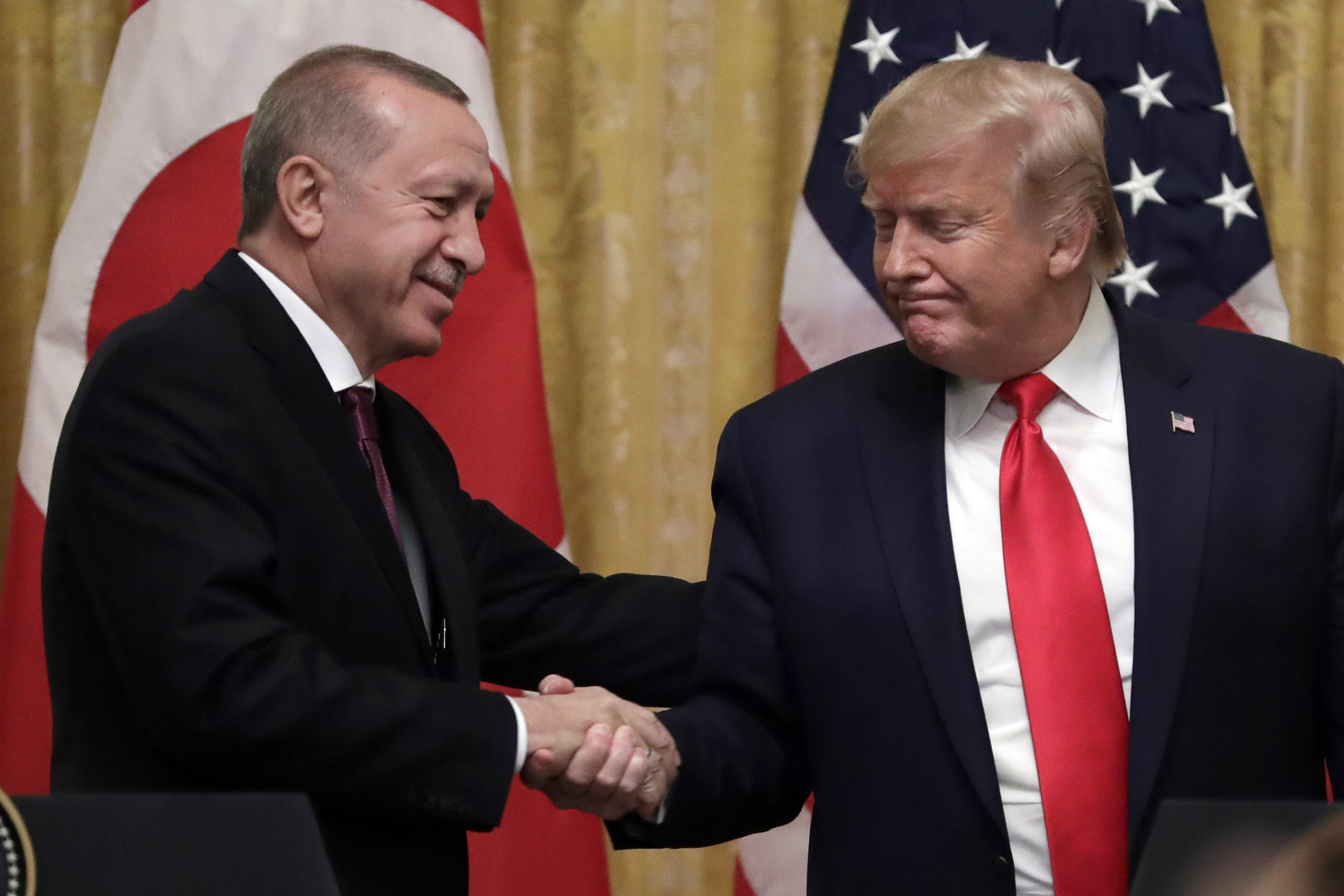
President Donald Trump shakes hands with Turkish President Recep Tayyip Erdogan after a news conference in the East Room of the White House, Wednesday, Nov. 13, 2019, in Washington.
A bipartisan group of House members urged the administration to “be very careful” in negotiations with Turkey about its potential re-entry into a program allowing it to acquire and potentially co-produce F-35 fighter jets, ahead of a White House meeting between President Donald Trump and Turkish President Recep Tayyip Erdogan on Thursday.
Trump said Friday that he would host Erdogan at the White House for trade and military talks, “including the large-scale purchase of Boeing aircraft, a major F-16 Deal, and a continuation of the F-35 talks, which we expect to conclude positively.”
Lawmakers have been pressing for months for the administration to be cautious in allowing Turkey to acquire the advanced fighter jets, something it has been banned by law from doing since it purchased a Russian S-400 missile defense system. By law, Turkey must dispense with that system before it can be re-admitted into the F-35 program, but some lawmakers have pushed for additional conditions, given various conflicts with Turkey, including its hostile posture toward Israel.
“The United States must be very careful when engaging in negotiations particularly as it relates to discussions surrounding Turkey’s potential reentry into the F-35 Joint Strike Fighter program. Turkey was rightfully removed from the program in 2019 following its acquisition of the Russian-made S-400 missile defense system—a clear violation of U.S. law under the Countering America’s Adversaries Through Sanctions Act (CAATSA),” Reps. Gus Bilirakis (R-FL), Chris Pappas (D-NH), Nicole Malliotakis (R-NY) and Dina Titus (D-NV), who chair the Congressional Hellenic Caucus, said in a joint statement on Monday.
They emphasized that the Turkish-Russian cooperation, in spite of Turkey’s NATO status, “directly undermines the security of U.S. defense technology and poses a threat to the strategic integrity of allied defense cooperation,” as well as “risks exposing sensitive U.S. military capabilities to Russian intelligence, eroding allied trust, and jeopardizing the development of next-generation military platforms.”
In addition to the formal legal obstacles that should ban F-35 acquisition under current conditions, the four lawmakers added that Erdogan has “consistently demonstrated a disregard for international norms and democratic principles.”
They said that upholding the sanctions law is critical both to protect U.S. defense technology as well as to demonstrate the U.S.’s commitment to the rule of law.
“Rewarding Erdogan’s government without meaningful changes in behavior would set a dangerous precedent and weaken the credibility of U.S. foreign policy,” the lawmakers wrote. “The United States must stand firm in defending its laws, its alliances, and the international order.”
‘The Syrians are prepared to move forward with Israel to advance peace. It is unclear how long the door to this opportunity will remain open. We call on Israel to seize the moment,’ the lawmakers continued
Senate Foreign Relations Committee Democrats/X
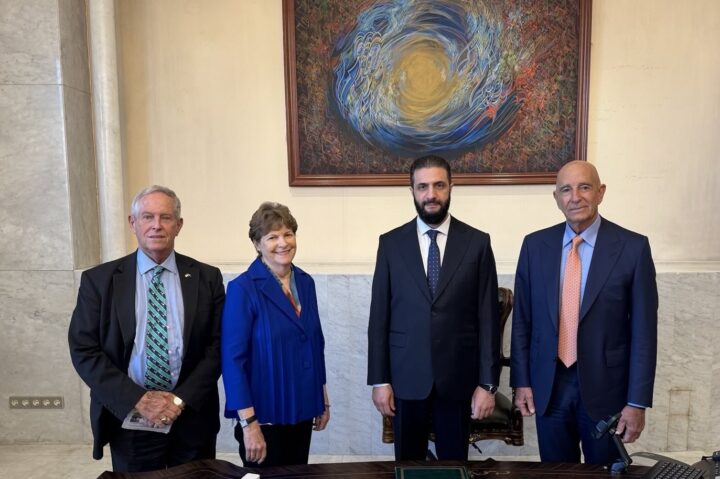
Sen. Jeanne Shaheen (D-NH), Rep. Joe Wilson (R-SC) and U.S. envoy Tom Barrack meet with Syrian president Ahmad al-Sharaa in Damascus on August 25, 2025.
A bipartisan group of U.S. lawmakers including Sens. Joni Ernst (R-IA), Jeanne Shaheen (D-NH) and Rep. Joe Wilson (R-SC) criticized the Israeli government on Thursday for carrying out a new round of strikes in Syria, which reportedly killed eight Syrian soldiers.
The statement is one of the most public signs yet of friction between U.S. lawmakers, including some staunch supporters of Israel, and the Israeli government over Israel’s approach to the new Syrian government, which has included repeated rounds of strikes on Syrian targets even amid diplomatic engagements. Many U.S. lawmakers, meanwhile, are urging a more optimistic approach.
“We just returned from Syria, where we heard directly from interim President [Ahmad] Al Sharaa, cabinet ministers and Syrians from across ethnic and religious communities,” the lawmakers said in a joint statement on Wednesday. “The message was clear: Syria needs a chance to succeed and move past the violence and strife that consumed the country for over 14 years. Last night’s destabilizing strikes on Syria by Israel make that goal more difficult to achieve.”
The lawmakers praised the Trump administration for lifting sanctions on Syria and U.S. envoy Tom Barrack for brokering a meeting between the Syrian and Israeli governments. They argued that there is a real but shrinking window for true Syrian-Israeli peace, and said Israel must step up.
“The Syrians are prepared to move forward with Israel to advance peace. It is unclear how long the door to this opportunity will remain open. We call on Israel to seize the moment and immediately cease hostilities so the progress made by Syrians and Special Envoy Barrack can continue,” the lawmakers continued. “A stable and secure Syria is the only path toward freedom from Iran’s reach and containment of the ISIS threat.”
The criticisms are similar to frustrations expressed privately by some Republican senators to Jewish Insider earlier this summer following Israeli strikes targeting the Syrian defense ministry and presidential palace in response to atrocities against Syrian Druze in Sweida.
Sen. Lindsey Graham (R-SC) told JI in July that Israel’s “security concerns in Syria are legitimate. They’re very important to me, but I also want to help the president with his efforts to integrate the country. So there’s some tension, and I hope we can clear it up.”
He said it would be critical to determine the extent to which the Syrian army has been involved in the atrocities against the Druze and how much control the Syrian government exerts over its coalition and allies. He said that if the Syrian military or government were involved, sanctions should be reinstated.
‘We all see Lebanon is at a point of change. We're here to tell you that we're buying into that change,’ Graham said, citing the country’s ‘religious diversity’

Houssam Shbaro/Anadolu via Getty Images
Sen. Lindsey Graham (R) speaks during a press conference alongside Sen. Jeanne Shaheen and Rep. Joe Wilson in Beirut, Lebanon on August 26, 2025.
Sen. Lindsey Graham (R-SC) championed a U.S. defense agreement with Lebanon during a bipartisan congressional delegation to Beirut on Tuesday, saying it would be the “biggest change in the history of Lebanon.”
Speaking at a press conference alongside Sen. Jeanne Shaheen (D-NH) and Rep. Joe Wilson (R-SC), Graham asked, “How many nations have a defense agreement with the United States? Very few. … The number of nations that America is willing to go to war for is very few. Why do I mention Lebanon being in that group? You have one thing going for you that is very valuable to me: religious diversity.”
“Christianity is under siege in the Mideast. Christians are being slaughtered and run out of all over, all over the region, except here. And so what I am going to tell my colleagues is, ‘Why don’t we invest in defending religious diversity in the Mideast? Why don’t we have a relationship with Lebanon where we would actually defend what you’re doing?’” he continued.
“I think it’s in America’s interest to defend religious diversity, whether you’re Druze or Alawite or a Christian or whatever. The idea that America may one day have a defense agreement with Lebanon changes Lebanon unlike any single thing I could think of,” Graham said.
During their visit, the delegation, joined by U.S. Ambassador to Turkey Tom Barrack, diplomat Morgan Ortagus and U.S. Ambassador to Lebanon Lisa Johnson, met with Lebanese President Joseph Aoun, Prime Minister Nawaf Salam, Parliament Speaker Nabih Berri and head of the Lebanese Armed Forces Gen. Rodolph Haykal.
During the press conference, the lawmakers conveyed their encouragement over the progress that Lebanon has made in military, financial and democratic reforms and their hope that the government would be able to execute the changes fully.
“We all see Lebanon is at a point of change. We’re here to tell you that we’re buying into that change, that we support what you’re trying to do. That if you do make an effort to disarm Hezbollah, we’ll be there trying to help. We’ll try to help your military, we’ll try to help your economy. We think that’s the right thing for you to do, and it benefits the entire region,” Graham said.
“If you’re able to pull this off, Saudi Arabia will look at you differently. If you’re able to pull it off, Israel will look at you differently. If you’re able to pull this off, there’ll be a groundswell of support in Washington to help your economy and to help your military,” he continued.
“Congress is looking at Lebanon differently because you’re behaving differently. If you continue to go down this road, I think you have a wonderful opportunity to secure your nation, economically, militarily, like anything I’ve seen since I’ve been coming to the region with [the late Sen.] John McCain (R-AZ). It all depends on what happens with the Hezbollah file and the Palestinian file.”
Wilson compared recent changes in Lebanon and in Syria with the fall of dictator Bashar al-Assad to the fall of the Berlin Wall in 1989. “There’s such an opportunity for stability, security, for economic prosperity, for everyone,” he said.
Graham also emphasized the potential for improved relations between Israel and Lebanon if Hezbollah was contained. “If I were the Israeli prime minister, I would be looking at Lebanon differently after Hezbollah was disarmed by the Lebanese people,” he said.
Pressed by reporters on what steps Israel is taking to disarm Hezbollah and de-escalate conflict, Graham answered, “Why do you need Israel to tell you to disarm Hezbollah? That’s not Israel’s decision. That’s yours. Whether [the IDF] withdraw[s from southern Lebanon] or not, it depends on what you do. So don’t tell me anymore, ‘We’re not going to disarm Hezbollah until Israel does something.’ If that’s the model, you’re going to fail.”
“The reason you disarm Hezbollah is because it’s best for you. This country is going backward, not forward, if you don’t follow through with disarming the Palestinians and Hezbollah and making the Lebanese army the central repository of arms for the nation. If you don’t do that, you’re going nowhere,” the South Carolina senator said.
Israeli Prime Minister Benjamin Netanyahu said in a statement yesterday that he “acknowledges the significant step taken by the Lebanese Government” and that “in light of this important development, Israel stands ready to support Lebanon in its efforts to disarm Hezbollah and to work together towards a more secure and stable future for both nations.”
Netanyahu pledged that if the Lebanese Armed Forces “take the necessary steps to implement the disarmament of Hezbollah, Israel will engage in reciprocal measures.”
Shaheen and Graham, both of whom serve on the Senate Appropriations Committee, also spoke about their support for supplying U.S. funding for the LAF and Lebanon’s financial recovery.
Shaheen called the steps Lebanon’s government has pledged to make in military and banking reforms “critical” and said the lawmakers will “continue to press for support, through legislation and through the appropriations process, support for the avenue that Lebanon has chosen for your future.”
The Brooklynites headed to the Blue Ridge Mountains

Carina Johansen/Bloomberg via Getty Images
Marthe Skaar, chief communications and external relations officer for Norges Bank Investment Management, left, and Nicolai Tangen, chief executive officer of Norges Bank Investment Management, during the presentation of the sovereign wealth fund's half-year earnings at the Arendalsuka conference in Arendal, Norway, on Tuesday, Aug. 12, 2025.
Good Tuesday morning.
In today’s Daily Kickoff, we cover concerns from a bipartisan group of legislators that the Trump administration is withholding information about Nonprofit Security Grant Program allocations, and report on the decision by Norway’s sovereign wealth fund to divest from nearly a dozen Israeli companies even as it continues to court top American pro-Israel executives. We cover the University of Washington’s pursuit of criminal charges against anti-Israel student vandals on the campus, and spotlight an initiative to create a new thriving Orthodox Jewish community in North Carolina’s Blue Ridge Mountains. Also in today’s Daily Kickoff: Eric Goldstein, Larry Ellison and Tzvika Mor.
What We’re Watching
- A delegation of freshman House Democrats are in Israel this week with the AIPAC-affiliated American Israel Education Foundation while the House is in August recess. Read more on the trip from Jewish Insider’s Marc Rod here.
- Iranian senior security official Ali Larijani is in Lebanon today as part of his first trip abroad since being named head of Iran’s Supreme National Security Council earlier this month. Larijani traveled to Beirut after a stop in Iraq. He’s spending three days in Lebanon as the government in Beirut pushes for the disarmament of Iranian proxy Hezbollah.
What You Should Know
A QUICK WORD WITH JI’S GABBY DEUTCH
Seven months into the second Trump term, it’s clear that many of the country’s top universities are scared of President Donald Trump.
The schools rely on federal funding to power much of the research that has made them into academic powerhouses, so if that funding dries up — a punishment, the Trump administration says, for universities’ failure to deal with antisemitism — their work will be imperiled.
As a result, some universities have taken proactive steps to address antisemitism in the hopes of fending off the ire of the Trump administration. But the White House does not view these actions as good-faith gestures. Instead, the administration is increasingly taking advantage of schools’ acknowledgments of past failings as an admission of guilt — and it is responding in a correspondingly punitive way.
The new chancellor of UCLA took office this year with the stated mission of fighting antisemitism and improving the campus climate following the disastrous 2023-2024 school year that saw violent clashes on the campus. Last month, the university agreed to pay $6 million to settle a lawsuit filed by Jewish students and faculty members who alleged that UCLA permitted antisemitic conduct during the spring 2024 anti-Israel encampment. The chair of the University of California Board of Regents said the settlement was an important step toward fostering “a safe, secure and inclusive environment.”
Yet on the same day UCLA announced the settlement, the Justice Department found UCLA to be in violation of federal civil rights law, stating the school “failed to adequately respond to complaints of severe, pervasive, and objectively offensive harassment and abuse” by Jewish and Israeli students after the Oct. 7, 2023, Hamas terror attacks. And last week, the Trump administration reportedly demanded that UCLA pay an eye-popping $1 billion to settle federal investigations into its handling of antisemitism, race-based admissions policies and transgender issues.
Dividends and Divisions
Norway’s sovereign wealth fund cuts Israeli holdings, while courting top American pro-Israel execs
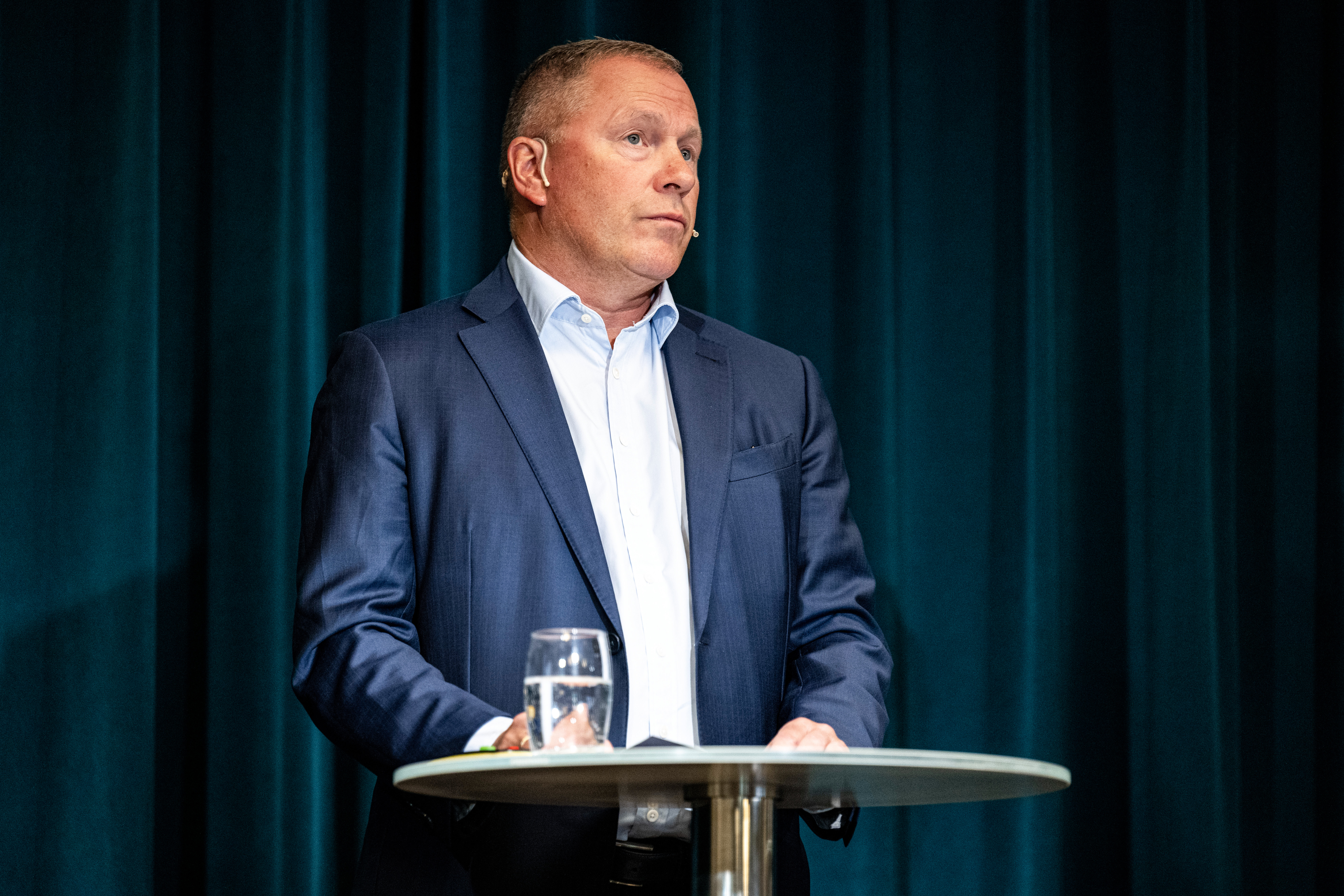
Norway’s sovereign wealth fund said on Monday that it was divesting from 11 Israeli companies and had terminated its contracts with external fund managers in Israel over concerns regarding the humanitarian crisis in Gaza and the West Bank, Jewish Insider’s Matthew Kassel reports.
Background: The decision follows a review initiated last week by Norway’s finance minister amid media reports that the fund had in recent years increased its holdings in an Israeli jet engine company that provides services to the Israeli military. Nicolai Tangen, CEO of Norges Bank Investment Management, which manages the Norwegian Sovereign Wealth Fund, has worked to build relationships with American business leaders who are supportive of Israel whom he has hosted on his podcast in recent years, including Michael Dell of Dell Technologies and Jonathan Gray of Blackstone — who among others have prominently engaged in philanthropic efforts to support Israel following the Oct. 7 attacks.
Blue Ridge Bayit
Mountain minyan: An unorthodox experiment in North Carolina’s Blue Ridge Mountains

Yudi Gross is the CEO of Shefa Living, a company that is developing a 350-home gated community catering toward religious Jews. He knows his pitch is somewhat unorthodox: Move to the mountains. In North Carolina. To a tiny town with no synagogue and few other Jews for miles. But what he’s pitching is a radical vision of what observant Judaism could look like if not bound to the geographical constraints that have kept Orthodox communities from rural living. Jewish Insider’s Gabby Deutch reports on the effort to build a brand-new Orthodox community from the ground up, in a Bible Belt town 90 miles from the nearest airport.
No limits: Glossy marketing materials on Shefa Living’s website call it a “new Torah-centric community in the Blue Ridge Mountains.” Buyers have put down deposits on 60 homes, Gross said. Starting in September, they’ll choose their lots, and work with developers on selecting upgrades and finishes in the new homes. More than 150 people have visited North Carolina to tour the site. “This is not just 25-30 people who want to have a nice place in the summer. This is a dream for so many people,” Gross said. “I hope this transforms the way Orthodox families can choose to live geographically.”
campus beat
University of Washington pursues criminal charges for anti-Israel student vandals

More than 30 anti-Israel demonstrators who occupied a University of Washington engineering building at the end of the spring semester — causing more than $1 million worth of damage — are now being investigated by the university and local attorney’s office for potential criminal charges, Jewish Insider’s Haley Cohen has learned.
Terror ties: The investigation comes after a recent report put a spotlight on a link between the radical student group that led the takeover and the U.S. designated terrorist group Popular Front for the Liberation of Palestine. “We have taken this incident very seriously, including having issued emergency suspensions for all students who were arrested in the building and working with the King County Prosecuting Attorney’s Office on potential criminal charges,” a University of Washington spokesperson told JI on Wednesday, referring to the demonstration in May in which masked demonstrators blocked entrances and exits to the building and ignited fires in two dumpsters on a street outside.
Massachusetts move: Jewish leaders in Massachusetts praised a new report and set of recommendations by a state body that called for K-12 schools to implement the International Holocaust Remembrance Alliance’s working definition of antisemitism.
on the hilL
House lawmakers say administration is withholding information about security grant allocations

A bipartisan group of more than 70 House lawmakers pressed the Trump administration last week about the supplemental round of Nonprofit Security Grant Program funding awarded to more than 500 Jewish groups in June, saying that the administration is withholding information from Congress about which institutions are receiving funding, Jewish Insider’s Marc Rod reports. Some nonprofits that applied for grants have not, themselves, been told whether their applications have been accepted either, two sources familiar with the situation told JI, complicating their efforts to submit complete and accurate applications for 2025 funding.
State of play: The lawmakers said they have “sincere concern” that they have not been provided with the list of institutions receiving funding under the $94 million funding round, as has been standard practice — with the administration allegedly citing an unspecified “security concern.” They added that the absence of that information could impact institutions’ ability to apply for funding from the 2025 NSGP allocation. A Senate aide told JI that at least some lawmakers in the upper chamber have similarly been left in the dark about the grant awards, as have some of the applicant institutions themselves.
DIVERGENT VOICE
Hostage families protest Gaza offensive — but this father says it doesn’t go far enough

The day after Israel’s Security Cabinet voted to seize control of Gaza City, the Hostages Families Forum organized a major protest in Tel Aviv against the decision, warning it would put their loved ones’ lives in danger. But Tzvika Mor, father of hostage Eitan Mor, has been speaking out against the Cabinet decision for a different reason — he thinks the IDF should be pushing even more aggressively to take over the rest of Gaza. Since his son was kidnapped from the Nova festival on Oct. 7, 2023, Mor has not wavered from his position that defeating Hamas must be Israel’s top priority in the war in Gaza. As chairman of the Tikvah Forum, a hawkish minority group of hostage families, Mor and several other hostages’ relatives argue that only sustained military pressure will bring all of the hostages home. Mor spoke out against the Israeli Security Cabinet’s recent decision in an interview with Jewish Insider’s Lahav Harkov on Sunday.
Mor’s mindset: “The question isn’t what they’re going to do, but what is the goal. If the goal is to lead Hamas to negotiate, it will fail, just like in Gideon’s Chariots, which took five months and didn’t bring back the hostages and didn’t destroy Hamas,” Mor said, referring to the IDF operation that began earlier this year. “The goal cannot be to bring [Hamas] to talks; it must be to destroy them.” Hamas, he said, is not motivated to return the hostages, because they have the food, fuel and water that they need to survive, but if they feared for their survival, the situation would be different.
Worthy Reads
A Performer’s Plea: In The Atlantic, singer Bono makes a plea for a ceasefire between Israel and Hamas in which he criticizes the Oct. 7, 2023, Hamas attacks as well as the actions of Israeli Prime Minister Benjamin Netanyahu’s government. “Yahya Sinwar didn’t mind if he lost the battle or even the war if he could destroy Israel as both a moral and an economic force. Over the months that followed, as Israel’s revenge for the Hamas attack appeared more and more disproportionate and disinterested in the equally innocent civilian lives in Gaza, I felt as nauseous as anyone but reminded myself that Hamas had deliberately positioned itself under civilian targets, having tunneled its way from school to mosque to hospital. When did a just war to defend the country turn into an unjust land grab? I hoped Israel would return to reason. I was making excuses for a people seared and shaped by the experience of Holocaust, who understood the threat of extermination not simply as a fear but as a fact. I reread Hamas’s charter of 1988; it’s an evil read. (Article Seven!)” [TheAtlantic]
Addressing Aid: In The Wall Street Journal, Hebrew University law professor Netta Barak-Corren calls on the U.S. and other global aid donors to commit to condition future humanitarian assistance on recipient countries hitting established benchmarks meant to address aid diversion. “Against the immediate risk of human suffering, donors must consider that allowing aid diversion could extend that risk for years. A cross-country analysis of 621 leaders in 123 countries from 1960 to 1999 showed that large, unconditional aid inflows help autocrats survive. World Bank data show that unconditional aid correlates with higher corruption and weaker rule of law. Nothing obligates donors to bankroll the fighters causing the suffering. Setting conditions on aid to prevent diversion aligns humanitarian spending with humanitarian intent.” [WSJ]
School Strategist: The New York Times’ Michael Bender spotlights May Mailman, who as the Trump administration’s senior adviser for special projects is “the most important, least-known person behind the administration’s relentless pursuit” of the country’s top universities. “She is credited as an animating force behind a strategy that has intimidated independent institutions and undercut years of medical and scientific research. … ‘There are a lot of good ideas floating around this building, but somebody has to capture those ideas, make sure that the right people are involved and that there is a process to put them into action,’ Ms. Mailman said in a recent interview at the White House. ‘So I’m the catcher of floating ideas.’” [NYTimes]
Word on the Street
Sen. Chris Van Hollen (D-MD), one of the most strident critics of the Israeli government in the Senate, is set to deliver the keynote speech next month at an Iowa Democratic Party fundraiser that’s a frequent stop for high-profile Democrats and presidential hopefuls; should Van Hollen make a presidential bid in 2028, such a campaign would give him a larger platform for his views, Jewish Insider’s Marc Rod reports…
President Donald Trump told Axios that Hamas “can’t stay” in Gaza in the long term, but stopped short of backing Israel’s plans to take over portions of the enclave…
Sen. Ted Cruz (R-TX), responding to Tucker Carlson’s criticism of himself and U.S. Ambassador to Israel Mike Huckabee over their positions on Israel, said that the former Fox News host “now routinely attacks Trump, shills for Iran & doesn’t bother to hide his all-consuming hatred for Israel”…
xAI’s Grok chatbot posted that it was temporarily suspended after accusing Israel of genocide, weeks after the feature came under fire for a series of antisemitic and violent postings…
Virginia state Del. Sam Rasoul dismissed recent concerns over his social media posts that referred to Zionism as “evil” as being part of “silly season” politics…
City & State NY put out its annual Manhattan Power 100 list; Manhattan Borough President Mark Levine tops the list, which also includes NYPD Commissioner Jessica Tisch, Reps. Jerry Nadler (D-NY) and Dan Goldman (D-NY), ADL CEO Jonathan Greenblatt, Sid Davidoff, Steven Rubenstein, James Tisch and Merryl Tisch, Brad Tusk, Nancy Cantor, Seth Pinsky, Eva Moskowitz and Columbia University President Claire Shipman…
The Israeli-American Council said its Los Angeles headquarters were vandalized with swastikas and other Nazi symbols over the weekend…
eJewishPhilanthropy’s Judah Ari Gross interviews IsraAid CEO Yotam Polizer about the humanitarian group’s previously under-the-radar work to assist in Gaza aid distribution efforts…
UJA-Federation of New York pledged $1 million to IsraAid’s Gaza effort; UJA CEO Eric Goldstein said, “We must hold tight to what has always anchored the Jewish people: the belief that all human life is sacred”…
The New York Times looks at how Oracle cofounder Larry Ellison — the second richest person in the world — is working to create a self-funded, profitable research institute to focus on his philanthropist interest areas, including climate change and global health…
Authorities in Montreal arrested a man in connection with a weekend attack on an Orthodox Jewish man in the city’s Villeray–Saint-Michel–Parc-Extension neighborhood…
The New York Times reviews Giaime Alonge’s novel The Feeling of Iron, about two Holocaust survivors who track down their Nazi tormentor decades after the Holocaust…
Australian Prime Minister Anthony Albanese said that Israeli Prime Minister Benjamin Netanyahu was “in denial about the consequences that are occurring” as a result of the humanitarian situation in the enclave; the two spoke on Thursday, when the Australian leader informed Netanyahu of Canberra’s intention to unilaterally recognize a Palestinian state…
Israeli Strategic Affairs Minister Ron Dermer is reportedly considering resigning from the Israeli government in the coming months…
Bloomberg looks at the challenge facing Lebanon’s new government and its president, Joseph Aoun, as Beirut faces American and Gulf pressure to force Hezbollah to disarm, while the Iran-backed terror group refuses to acquiesce to the government’s effort…
Pic of the Day
Israeli Prime Minister Benjamin Netanyahu spoke on Monday at the opening ceremony of the Knesset Museum in Jerusalem.
Birthdays

Award-winning writer of fiction and non-fiction and the author of several novels and a novella, Rachel Kadish turns 56…
Hungarian-American investor, currency trader and political activist, born György Schwartz, George Soros turns 95… Retired Beverly Hills attorney, Sheldon Stanford Ellis… Emmy Award-winning television screenwriter, television producer and author, Gail Parent turns 85… Professor of psychology at the University of Pennsylvania and author of many self-help books, Martin Elias Peter Seligman turns 83… Attorney in Ontario, Canada, who served as president of the Canadian Jewish Congress, Lester Scheininger turns 78… Co-founder and chairman of the film and television company Beacon Pictures, Barry “Armyan” Bernstein turns 78… U.S. diplomat, Karyn Allison Posner-Mullen turns 74… Trustee at Houston’s Congregation Emanu El, she worked for more than 40 years at the University of Texas Health Science Center at Houston, Fredi Bleeker Franks… Sales manager of Illi Commercial Real Estate in Sherman Oaks, Calif., Stuart Steinberg… Israel’s former ambassador to Uzbekistan, Bulgaria, Kenya, Uganda, Tanzania and Albania, Noah Gal Gendler turns 68… Former member of Knesset from the Yesh Atid party, Haim Jelin turns 67… Founding editor of The Times of Israel, David Horovitz turns 63… Chairman of Goldman Sachs International, Sir Bradley Fried turns 60… Senior rabbi at Brookline’s Temple Beth Zion, Claudia Kreiman… Chief strategy officer at NYC’s Educational Alliance, Anya Hoerburger… Scottsdale-based real estate Investor, Jay Chernikoff… Co-founder at Understory, David Fine… CEO and co-founder of Forsight, a prop tech AI and machine learning company, Ariel Applbaum…
The lawmakers said allowing Turkey to obtain the jets while still possessing a Russian missile defense system ‘would jeopardize the integrity of F-35 systems’ and ‘expose U.S. military secrets to Russian intelligence’

Nicolas Economou/NurPhoto via Getty Images
Lockheed Martin F-35 Lightning II a fifth generation fighter jet during a flight demonstration while landing, at Paris Air Show 2025 at Le Bourget Airport.
A bipartisan group of 40 House members is urging Secretary of State Marco Rubio to maintain the U.S. ban on exporting advanced F-35 fighter jets to Turkey, amid ongoing reports that the U.S. and Turkey are negotiating to allow the sale of the jets.
“We strongly urge the Administration to review the facts and reject Turkey’s attempt to rewrite the history of its violation of U.S. law and national security policy,” the lawmakers said in a letter to Rubio on Thursday.
The group highlighted that President Donald Trump, during his first term, signed the law that bans the sale of the F-35s to Turkey in light of its purchase of an S-400 missile defense system from Russia.
“Nearly a decade later, Turkey still possesses S-400 systems and has shown no willingness to comply with U.S. law. This behavior cannot be rewarded,” the letter reads. “Lifting sanctions or allowing Turkey back into the F-35 program without first removing its S-400s would jeopardize the integrity of F-35 systems; expose U.S. military secrets to Russian intelligence; undermine our defense industrial base and allied confidence in purchasing future U.S. platforms; and disrupt development of the next-generation fighter jet recently announced by the Administration.”
The lawmakers emphasized that U.S. policy on the issue has been consistent across administrations and parties.
They said that the U.S. must “uphold U.S. law, maintain CAATSA sanctions, and protect American defense and intelligence assets” and “continue to hold allies and adversaries alike accountable when their actions threaten U.S. interests.”
The letter was led by Reps. Chris Pappas (D-NH), Gus Bilirakis (R-FL), Dina Titus (D-NV) and Nicole Malliotakis (R-NY), who lead the Congressional Hellenic Caucus.
The letter is supported by the American Jewish Committee, Christians United for Israel Action Fund and FDD Action as well as the American Hellenic Educational Progressive Association, the American Hellenic Institute, American Friends of Kurdistan, Armenian National Committee of America, Coordinated Effort of Hellenes, the Hellenic American Leadership Council, Middle East Forum and the International Coordinating Committee Justice for Cyprus.
The bill includes a total of $80 million in additional funding, as compared to 2025, for several cooperative programs with Israel
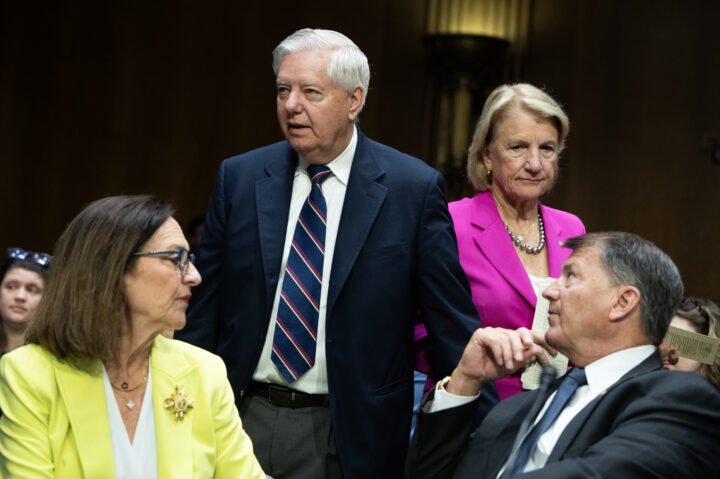
Tom Williams/CQ-Roll Call, Inc via Getty Images
From left, Sens. Deb Fischer, R-Neb., Lindsey Graham, R-S.C., Shelley Moore Capito, R-W.Va., and Mike Rounds, R-S.D., attend the Senate Appropriations Committee markup of the "Department of Defense Appropriations Act, and the Departments of Labor, Health and Human Services, Education, and Related Agencies Appropriations Act," in Dirksen building on Thursday, July 31, 2025.
The Senate Appropriations Committee’s draft 2026 defense funding bill, approved by a broad bipartisan committee vote on Thursday, includes increases to several U.S.-Israel cooperative defense programs.
The bill includes a total of $80 million in additional funding, as compared to 2025, for several cooperative programs with Israel. It offers a total of $75 million for counter drone and missile programs, $47.5 million for cooperative programs in emerging defense technologies like artificial intelligence and $80 million for counter-tunneling programs, according to a summary released by the committee.
The bill includes $500 million for cooperative missile defense programs including Iron Dome, David’s Sling and Arrow provided annually under the terms of the U.S.-Israel memorandum of understanding.
It also offers additional security assistance funding for Bahrain and Jordan.
The committee debated and rejected two amendments by Democrats addressing the administration’s plans to retrofit a gifted Qatari jumbo jet to serve as Air Force One.
Sen. Jeanne Shaheen’s (D-NH) amendment would have prohibited funding to modify or operate the Qatari jet, highlighting security and corruption concerns about the gift; the unclear costs and timeline associated with the retrofit; and comments by the secretary of the Air Force indicating that the administration plans to pull funding from a nuclear missile program to fund the overhaul.
Recent reports suggest that renovations could cost close to $1 billion.
“This jet was just delivered to the Department of Defense. We need to have a classified briefing to understand any proposed modifications and the risk of not applying them,” Sen. Mitch McConnell (R-KY) responded, opposing the amendment. “The aircraft timeline is such that it’s not going to be modified with fiscal [year] [20]26 dollars in any event, making this a poison pill political amendment better suited for the [National Defense Authorization Act].”
President Donald Trump said that the plane could make its first flight in February.
Shaheen withdrew the amendment due to Republican comments that the amendment would kill the defense spending bill.
Sen. Chris Murphy (D-CT) offered a more limited amendment that would have blocked the administration from transferring the plane to a private entity before the end of its useful life, an attempt to head off reported plans to transfer the plane, after Trump’s term, to his presidential library, potentially for his personal use, after his presidency.
Republicans again argued that a full briefing is necessary on the administration’s plans before making any such moves, and that the amendment would kill the defense spending bill.
“To address this claim that’s been made a few times that this is a poison pill, if I understand correctly, that means that the Senate would refuse to fund the Pentagon unless it allows the president to accept a jet from a foreign prince. If that’s true, I’d like to understand why that is the line in the sand that would be drawn,” Sen. Jon Ossoff (D-GA) responded. “The only other argument that I can conceive is that we think the President would veto the entire Pentagon budget unless he’s able to accept a jet from a foreign prince. I’d like to see him make that argument to the American public.”
The committee rejected the Murphy amendment by a party line vote.
Sen. Lisa Murkowski said she opposed the two amendments to ensure the bill as a whole could still pass, but said, “I don’t want my ‘no’ vote to be assumed that I’m OK with where we are with this transfer, that I’m OK not knowing the numbers behind it, that I am perhaps OK with the appearances — because I have concerns about them.”
The Senate bill would provide billions in additional funding for air and missile defense systems and to replenish U.S. stockpiles of air defense interceptors, which saw heavy use during the recent war in Gaza.
“Recent operations in the Middle East illustrate how quickly modern warfare can exhaust our arsenal of critical [interceptor] munitions,” McConnell, who chairs the Defense Subcommittee, said. “The administration’s request did not fully maximize production capacity for certain critical munitions.”
“We made lots of improvements in the [administration’s] request given the challenges with missile stockpiles that we’re seeing in Ukraine and the Middle East,” Sen. Chris Coons (D-DE), the subcommittee ranking member, said. “I can’t explain why the administration didn’t propose to buy every single missile it could on existing production lines and expand others, but it didn’t.”
Generally, lawmakers on both sides of the aisle argued that the administration’s defense funding request was too low, and agreed on a bipartisan basis to propose providing $852.5 billion, 2.6% or nearly $22 billion above the administration’s request and the House’s draft of the bill, which the lower chamber approved last month.
Bipartisan group of experts urges members of the Senate Foreign Relations Near East, South Asia, Central Asia and Counterterrorism subcommittee to keeping engaging with Mideast allies

Leigh Vogel/Getty Images for Concordia Summit
Brian Hook, former U.S. special representative for Iran and senior advisor to the U.S. secretary of state, speaks onstage during the 2021 Concordia Annual Summit at Sheraton New York on September 21, 2021, in New York City.
Members of the Senate Foreign Relations Near East, South Asia, Central Asia and Counterterrorism subcommittee were urged by a bipartisan group of experts on Wednesday to support efforts to keep the U.S. engaged with Israel and other allies in the Middle East. The experts, including former Trump and Biden administration officials, warned that a U.S. retreat from the region would create a vacuum quickly filled by American adversaries.
Wednesday’s proceedings, which marked the subcommittee’s first hearing of this Congress, focused on “U.S. diplomatic strategies for a dynamic Middle East,” and was organized by Sen. Dave McCormick (R-PA), the subcommittee chairman, and Sen. Jacky Rosen (D-NV), the top Democrat on the panel.
Brian Hook, who served as U.S. special representative for Iran in the first Trump administration; Daniel Shapiro, who served as former U.S. ambassador to Israel under President Barack Obama and then as special liaison to Israel in the Biden administration; and Shelly Culbertson, a senior policy researcher at RAND focused on disaster and post-conflict recovery appeared as witnesses. All three concurred that U.S. diplomatic and military engagement was critical for ensuring that mistakes of the past are not repeated.
“The old order in the Middle East is passing away, and a new, better order is coming into view. We have too much proof of a better order to return to the failed strategies that perpetuated the old order. American diplomacy should support the new and dynamic Middle East,” Hook said. “In broad strokes, I think this means diplomacy that stands by our allies in good times and in bad. It means deterring our adversaries, and it means sustaining the incredible gains made over the last two years, especially during the recent 12-day war against the Iranian regime.”
“The United States can help midwife a regional dynamic of sovereign states anchored by Israel and Arab Gulf nations, who together counter extremism, invest in their own citizens and recognize the right of the Jewish people to live in peace alongside their neighbors. President Trump described this vision in his 2017 Riyadh speech. He deserves great credit for realizing this vision across his first term and into the second term,” he continued.
Hook went on to say that the U.S. “should help organize our allies around shared interests.”
“For example, countering Iran’s threats to the U.S. and the region, advancing the peace process through the Abraham Accords and deepening economic and cultural ties. But continued success in the region is not inevitable. American leadership coupled with burden sharing by our partners is essential for this vision to become a reality. We should convert the recent military gains into an enduring balance of power that favors America and her regional allies. The U.S. and its partners should continue resisting Iran’s expansionist, antisemitic designs in the region,” he argued.
Shapiro offered a similar message, telling senators that the U.S. has “a once-in-a-generation opportunity to help reshape the region in ways that will bring more peace and prosperity and less conflict and violence to those who live there and significant benefit to the interests of the United States.”
“President Trump was right to seek a nuclear deal with Iran through diplomacy, but given how close Iran was to a nuclear weapon and its proven willingness to attack Israel directly, I believe a military confrontation was necessary and inevitable,” Shapiro said, praising the president’s handling of the nuclear issue.
“Israeli and U.S. operations caused severe damage to Iran’s nuclear facilities. They’ll be unusable for a significant period of time, and that’s time we can perhaps extend through a range of means. Now, none of this means the threats posed by Iran and its proxies are eliminated. But the significant gains produced by military power now give us the opportunity to use all the tools at our disposal – deterrence, but also diplomacy – to consolidate those gains,” Shapiro continued.
Shapiro urged members to capitalize “on the damage to Iran’s nuclear program and the weakening of the Iranian allied access to secure a long-term improvement in the regional security environment.”
“That means seeking renewed negotiations with Iran to sustain the gains of the military strikes, prevent the nuclear programs reconstitution, secure full access for IEA inspectors, locate and remove Iran’s enriched uranium stockpile, assure zero enrichment going forward, and achieve meaningful limits on Iran’s ballistic missile inventory. It also means maintaining pressure on Iran by coordinating with European partners on the snapback of JCPOA sanctions, increasing efforts to scale back Iranian oil exports to China, and making clear that additional military strikes by Israel or the United States are possible,” he said.
Shapiro warned, however, that no progress could be made “until the Gaza war ends” and encouraged all parties to work toward a 60-day ceasefire that “really must transition directly into the end of the war.”
“That will require Israeli agreement to certain terms, but also intense pressure on Hamas by Qatar and other actors,” Shapiro explained.
Hook told senators he had “never been more optimistic about the future of the Middle East than I am now,” following the degradation of Iran’s nuclear program, while cautioning that he hoped that Israel’s actions to ensure Hamas “is uprooted from Gaza” could be conducted “in a way to maintain support here in the United States.”
Culbertson similarly praised the U.S. and Israel’s operations against Iran’s proxies and the regime’s nuclear program, while arguing that an emphasis on diplomatic efforts was necessary to “set a new course for the Middle East” and allow the U.S. to “reestablish itself as the partner of choice” in the region.
“This means rethinking what constitutes U.S. interests. Civilian displacement, state collapse and economic despair are not peripheral. They’re central to long-term global stability. These are, of course, primarily the responsibility of regional governments, but the United States has powerful tools to support progress. Doing so is not charity, it’s strategy,” Culbertson explained.
“The U.S. has repeatedly sought to reduce its footprint in the Middle East, only to be drawn back in again and again. Every administration since Jimmy Carter has launched new military operations there in response to threats to American interests. This has meant chasing symptoms instead of solving underlying problems. We now have an opportunity to break that cycle,” she added.
Culbertson also said the U.S. should mediate the ends of the conflicts in Gaza, Syria, Lebanon, Yemen and Libya, address the region’s long-term humanitarian and refugee crisis, support and facilitate post-war recovery efforts, help improve governance and job prospects in these countries, and focus on “strategic priority locations” such as Iraq, Syria, the West Bank and Gaza that “could become a model of recovery and partnership.”
Culbertson presented two potential futures, one where “conflicts grind on, economies remain stagnant, Iran, Russia and China fill the vacuum, extremist groups like Hamas and ISIS exploit social gaps, refugees flee and the United States is pulled back in again and again,” and another where “the United States steps forward with strategic leadership. We help end wars. We support governments in rebuilding. Cities recover. Youths find work. The region stabilizes and draws closer to us and our allies.”
“We can choose, at least in part, which future unfolds,” Culbertson argued.
The BIRD Health Act builds on the existing Binational Industrial Research and Development Foundation program by allocating funding for joint healthcare innovation
Andrew Harnik/Getty Images/Tom Williams/CQ-Roll Call, Inc via Getty Images
Reps. Randy Weber (R-TX) and Chris Pappas (D-NH)
A new bipartisan House bill set to be introduced on Wednesday aims to expand U.S.-Israeli research and development cooperative programs in the medical field.
The BIRD Health Act, led by Reps. Randy Weber (R-TX) and Chris Pappas (D-NH), builds on the long-running Binational Industrial Research and Development Foundation program.
Around a third of BIRD projects in the past decade have been related to the health-care sector, and the U.S. and Israel have pursued growing cooperation in the field in recent years. The bill would further formalize those efforts by establishing a new $10 million annual funding stream and joint management structure between the Department of Health and Human Services and the Israeli Ministry of Health specifically focused on supporting such projects.
It would support research and development between institutions and companies in both countries, including startups, as well as health systems, telemedicine, disease prevention efforts and biological product manufacturing.
“The United States and Israel share one of the strongest, most enduring alliances in the world, and it just makes sense to join forces in advancing life-saving health technologies that benefit both our nations,” Weber said in a statement. “The BIRD Health Act of 2025 builds on our shared strengths to support cutting-edge medical innovation, strengthen supply chains, and improve health outcomes for American families.”
“U.S. and Israeli doctors, scientists, and researchers are leading the world in groundbreaking medical advancements, including regenerative medicine, disease prevention, and cancer research,” Pappas said in a statement. “The health technology and innovation program created through this bipartisan legislation will strengthen the bilateral partnership between the U.S. and Israel to address emerging health issues, develop innovative solutions, and save lives.”
The gathering also included the state’s two leading Democrats, Gov. Josh Shapiro and Sen. John Fetterman, and President Donald Trump

Jeff Swensen/Getty Images
President Donald Trump (C) arrives to speak to guests and investors at the inaugural Pennsylvania Energy and Innovation Summit at Carnegie Mellon University on July 15, 2025 in Pittsburgh, Pennsylvania.
PITTSBURGH — Pennsylvania’s top lawmakers put up a united front on Tuesday to emphasize to the hundreds of tech and energy investors at Sen. Dave McCormick’s (R-PA) inaugural innovation summit the benefits of working with states that embrace bipartisanship and the national security imperatives of investing domestically.
The Pennsylvania Energy and Innovation Summit brought top tech and energy executives to Carnegie Mellon University’s campus, home to one of the world’s most advanced AI programs. Tuesday’s gathering also included the state’s two leading Democrats, Gov. Josh Shapiro and Sen. John Fetterman (D-PA), and President Donald Trump, all of whom praised the conference as a strategic way to promote U.S. investment to the scores of foreign and American leaders in attendance.
Amazon Web Services’ $20 billion investment last month in three computing and AI campuses in the Keystone State was “an indicator of all that we can be when we harness the new things that we have going for us, and when we have government and the private sector working together, not at odds, and when we pull in our educational institutions … in a way that really helps move Pennsylvania forward,” Shapiro said during a panel discussion with McCormick and AWS CEO Matt Garman.
While McCormick and Shapiro acknowledged their political differences, they said they agreed that their state should be on the forefront of the technological innovation and investment happening in the United States. They also said they share the view that a unified team of statewide leaders is more appealing to outside investors and businesses than an assortment that’s at odds with each other.
“I look at this moment as a business guy, and so I say one of two things: If I’m a business guy, what do I want?” McCormick asked. “I want to come to a place that has all those ingredients and has uniform political leadership. … If you’re a CEO and you want to invest a bunch of money and you come in and sit down, you meet the governor and he’s talking bad about me and saying that I’m full of it, and vice versa, that makes you not want to invest, right? So we need to be aligned at all levels.”
“The governor and I are of different parties, we have plenty of differences, but on this, we agree. Sen. Fetterman was at our dinner last night. On this, we agree that we need to be at the crossroads of the energy revolution, the AI revolution. To have a leadership position, we need to show a unified front at the local level, at the state level, at the national level. That’s the only way to win,” McCormick continued.
The conversation, which took place as hundreds of AI and energy firms courted investors at tables around the Jared L. Cohon University Center on Carnegie Mellon’s campus, followed panel discussions from senior tech and finance executives about winning the race for AI and energy domination domestically and the benefits of investing in the Keystone State.
Shapiro and McCormick separately said that they view Pennsylvania as a purple state that requires bipartisan cooperation to push any legislation across the finish line.
“As a candidate, I promised I would get things done, and in Pennsylvania, you can’t get things done unless you’re able to work with people who you disagree with on certain things and find areas of common agreement,” McCormick said. “We can agree that we’ve got to have great jobs in Pennsylvania, we’ve got to take advantage of our energy resources, like there is so much to agree on. So I think this is a particularly special moment for Pennsylvania.”
Shapiro noted that his first two years as governor took place under a Republican state Senate, forcing him to reach across the aisle and find common ground on areas such as economic and education policy, before noting that he still takes issue with major GOP policy priorities such as Trump’s budget reconciliation bill.
“The last two years, I was the only governor in the entire country with a divided legislature. Senate led by Republicans, a House led by Democrats. This year, I think there’s one or two other governors with the same. For me to get any bill to my desk requires votes from the Republican Party and the Democratic Party. And I think if you enter every discussion focusing on your differences, you’ll never get anything done,” Shapiro said.
“We’re honest about differing on the bill that was just passed, the reconciliation bill that was just passed last week,” he added of his disagreements with McCormick. “But we also understand how critically important it is to grow our economy in Pennsylvania, this unique moment that we are in.”
Fetterman, who returned to Washington on Tuesday for Senate business, told Jewish Insider in a statement that he was fully supportive of the summit and the unity push by McCormick and Shapiro.
“Party aside, we’re all in – on Pennsylvania’s best interests,” Fetterman told JI, adding that he sent his “congratulations to Sen. McCormick for putting this tremendous event together for Pennsylvania’s future.”
McCormick later highlighted in his discussion with Shapiro and Garman the need for Pennsylvania and the U.S. to keep up with the rest of the world in economic development.
“If you travel around the world, if you go to the Middle East, if you go to other places, the pace of change is extraordinary. And it’s gonna require a level of urgency that I don’t think most people in this room have probably had in the past about this moment, particularly in Pennsylvania. And so that urgency, we need to grab the moment,” the senator said.
In response, Shapiro pointed out that one of McCormick’s top takeaways from his recent visit to the Middle East was the potential for U.S. investments from new partners.
“The senator, and I think Dina [Powell McCormick] as well, went to the Middle East a month or two ago, and we talked right when he came back. One of the things you were most jazzed up about, I thought, were the investments that folks in the Middle East shared with you that they wanted to make in America and how you were pitching Pennsylvania as part of that,” Shapiro said.
“This is a global race for both energy dominance and AI dominance. We need home-grown Pennsylvanians to be doing this work, and we need investment from all across the country and all across the globe. We do not want China to beat us in this AI race. This is one of the most important national security questions we have, and so if the senator and others can bring investment from around the globe to right here in Pennsylvania,” he continued.
During the president’s roundtable discussion with McCormick, leading executives and several members of his Cabinet, Trump touted the $5.1 trillion in domestic investments he claimed to have secured on his last visit to the Middle East while cheering the $90 billion in committed U.S. projects announced at the summit.
“Today’s commitments are ensuring that the future is going to be designed, built and made right here in Pittsburgh and I have to say right here in the United States of America,” Trump said.
Interior Secretary Doug Burgum described the president’s “vision of energy dominance” as the “foundation of this golden age for America.”
“You identified that there were a couple of threats to our country. One was Iran having a nuclear weapon. The other was losing the AI arms race to China. You took care of one of those a few weeks ago. You’re helping to take care of the other one here,” Burgum said of Trump’s agenda, prompting a smile from the president.
McCormick then noted that Trump’s attendance at the summit helped boost interest from industry leaders and investors alike. “I really believe, Mr. President, based on you being here, we’re going to look back on this day and say that this was a real, seminal moment in the history of our Commonwealth and maybe in the history of our country,” he told the president.
Trump then remarked that while McCormick had initially only asked him to make a brief appearance at the gathering, he decided to stay for longer once he saw the industry leaders on the high-profile guest list.
“When I saw the people gathered, I said, ‘I’m not leaving. I want to learn something.’ And I have learned something. This is the smartest group of talent, probably, that you’ve ever had in terms of energy and even finance, [that you’ve] ever had in one room,” Trump remarked to the crowd.
The bill takes a new tack at a previously attempted move by first designating Muslim Brotherhood branches individually
Salah Malkawi/Getty Images
Jordanian police close the entrance of a Muslim Brotherhood headquarter after the announcement of banning the society in the country on April 23, 2025 in Amman, Jordan.
A bipartisan House bill set to be introduced on Tuesday aims to designate the Muslim Brotherhood as a terrorist organization, a step forward for an effort that saw renewed interest following the terrorist attack in Boulder, Colo., targeting Jews advocating for the release of hostages in Gaza by a man who appeared to have expressed support for the group years earlier.
Similar efforts have been pursued at multiple points in the past, but the latest legislation has been updated significantly and focuses on the various branches of the Muslim Brotherhood responsible for terrorism.
The bill, led by Reps. Mario Díaz-Balart (R-FL) and Jared Moskowitz (D-FL), notes that Hamas is a Muslim Brotherhood affiliate that has long been designated as a Foreign Terrorist Organization by the U.S. and that receives material support from the Muslim Brotherhood. It also highlights the destabilization efforts by other Muslim Brotherhood branches in various Arab partner countries of the U.S.
The bill is co-sponsored by Reps. Randy Fine (R-FL), Chuck Fleischmann (R-TN), John Rutherford (R-FL), Andy Barr (R-KY) and Mike Bost (R-IL).
“Today, I once again introduced legislation to designate the Muslim Brotherhood as a foreign terrorist organization,” Díaz-Balart said in a statement. “The global Muslim Brotherhood has numerous regional branches, including terrorist organizations such as Hamas, and spreads violence and instability throughout the Middle East. For this reason, it is crucial to U.S. national security interests that we prohibit U.S. dollars from enabling the Muslim Brotherhood’s dangerous activities, and that we ensure Muslim Brotherhood members are blocked from entering the United States.”
“This important legislation gives the Trump Administration the additional authority it needs to protect Americans, and our closest allies, from this insidious threat,” he continued.
Moskowitz said in a statement, “The Muslim Brotherhood has a documented history of promoting terrorism against the United States, our allies, and our society.”
“Countries such as Bahrain, Egypt, Austria, Jordan, Saudi Arabia, UAE, and France have already taken important steps to investigate and crack down on the Muslim Brotherhood and its affiliates. The U.S. government has to have the authority to crack down on the serious threats posed by this group as well,” Moskowitz continued. “That’s why I’m joining Rep. Diaz-Balart and Sen. Cruz to introduce the Muslim Brotherhood Terrorist Designation Act. This bill builds on my call for an investigation into designating the Muslim Brotherhood a Foreign Terrorist Organization, and it ensures we are taking crucial steps to protect our national security.”
Sen. Ted Cruz (R-TX) introduced companion legislation in the Senate on Monday.
The legislation instructs the secretary of state to identify all branches of the Muslim Brotherhood operating globally and provide a determination of whether each of those branches meets the requirements for designation as a foreign terrorist organization.
The legislation would use those determinations to designate the global Muslim Brotherhood organization as a terrorist group, in light of its support for those branches.
The bill also pursues three methods of designating the group as a foreign terrorist organization: by revising the Anti-Terrorism Act, which was initially targeted at the Palestine Liberation Organization, to include the Muslim Brotherhood, by seeking State Department designation as a Foreign Terrorist Organization and seeking Treasury Department designation as a Specially Designated Global Terrorist group.
The three designations grant the federal government various sanctions authorities and bar Americans from supporting the groups. The bill would also make Muslim Brotherhood members ineligible for entry into the United States and could impose financial sanctions on them.
Previous efforts to designate the group focused on the entire Muslim Brotherhood, rather than starting by targeting specific branches, and only pursued FTO designation.
A fact sheet by the legislation’s sponsors states that the previous “top-down … strategy failed because not all MB branches are currently violent and would therefore meet the criteria for designation.” It described this new approach as “bottom-up,” and similar to the approach the Trump administration took to designate the Islamic Revolutionary Guard Corps as a terrorist group — citing its support for the Quds Force, which was designated as a terrorist group.
Fine has separately introduced legislation to designate the Council on American Islamic Relations as a terrorist group.
The Ohio Democrat suggested the responses to the strikes from within his party are motivated by the current political environment, fears about a broader war and concerns about the future of diplomatic talks and the safety of people in the region
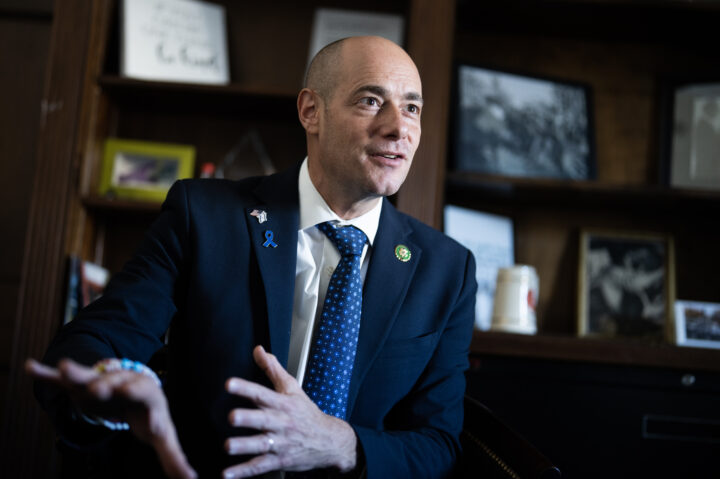
Tom Williams/CQ-Roll Call, Inc via Getty Images
Rep. Greg Landsman (D-OH) is interviewed by CQ-Roll Call, Inc via Getty Images in his Longworth Building office on Friday, November 3, 2023.
Rep. Greg Landsman (D-OH) has stood apart in recent weeks as one of a small number of congressional Democrats who’ve been supportive of the Trump administration’s strikes on Iranian nuclear facilities.
He argued in an interview with Jewish Insider last week and in a recent op-ed that the Israeli and American show of force, alongside the undermining of Iran’s proxies across the region, could be the key to weakening the Iranian regime to a point where it will agree to a fundamental change of course going forward, unlocking opportunities for regional peace and prosperity. And, he said, it’s critical that the U.S. move forward in a truly unified and bipartisan manner to capitalize on that opportunity.
Landsman told JI he thinks that his Democratic colleagues’ responses to the strikes are motivated by the current political environment, fears about a broader war and concerns about the future of diplomatic talks and the safety of people in the region.
“We’re just in a different political environment than the one I grew up in,” Landsman, 48, said. “The one I grew up in was ‘politics stops at the water’s edge,’ which I loved. … The thinking behind it … is that when we take on these really complicated foreign policy issues, that we do it in a bipartisan way, and that’s not the environment we live in right now.”
He said there’s also a “legitimate concern that it would provoke further attacks or it would instigate a broader war.” Landsman has argued that the current situation is fundamentally different from the run-up to the Iraq war that many skeptics of the strikes have invoked.
Some colleagues, he added, may have also had concerns about compromising diplomatic efforts or “legitimate concerns for people’s safety. But I think for others, and for a lot of folks, it’s just political,” he said.
Landsman said he still hews to the older approach, believing that it’s critical to work toward bipartisan common ground in critical foreign policy questions. He highlighted that the American people overwhelmingly oppose the prospect of an Iranian nuclear weapon.
“I think the American people want [our Middle East policy] to be bipartisan, all of it,” Landsman said. “I think they’re tired of the partisanship in general, but in particular, as it relates to how we resolve these international conflicts and how we take advantage of international or global opportunities, I think they are done with all of this being so partisan.”
He said he still believes a diplomatic solution with Iran is possible and necessary, but said the regime needed to be weakened and see that the U.S. is willing to use force in order to agree to totally dismantle its nuclear program and allow comprehensive international inspections and to dismantle its terrorist proxies .
Unlike some supporters of the strikes, Landsman said he doesn’t think regime change in Iran is the most productive goal, and that the U.S. should instead leverage the regime’s vulnerability for a more favorable deal and fundamental change to the regime’s posture.
“This regime wants to stay in power. If they decide — which they can, and now they’re so weakened that it’s an easier decision for them, and that’s why the strikes were important — they can decide, ‘We’re going to focus on the Iranian people’” and abandon terrorism and their ambitions to destroy Israel, Landsman said. “They could unlock the talent of tens of millions of incredibly brilliant people that have been stuck in Iran under this regime.”
He said that achieving that will “require real engagement and leadership” from both Congress and the executive branch.
Landsman has proposed establishing a bipartisan and bicameral congressional committee to work toward Middle East peace, and argued that the administration needs an expanded team working on the issue, describing Middle East envoy Steve Witkoff as stretched too thin.
“They need to lay out a vision for ending hostilities with Iran and ending the war in Gaza and giving people a sense of what will happen next in terms of peace and stability and security,” Landsman said.
The congressman argued that these issues are too difficult and too important for Congress to be excluded, or to be treated in a partisan manner. He pushed for deep and ongoing executive branch engagement with Congress, not just providing briefings, but in strategizing and building a lasting solution going forward.
Finally putting the Iranian threat to bed would set the Middle East on a fundamentally different course, Landsman argued. “[The Middle East] should be Europe, [if not] for Iran. It hasn’t been able to break out that way because Iran has been the primary obstacle.”
“Getting to a point where Iran is slowly but surely being removed as a threat opens up all the doors,” he said. “It just changes the dynamic for everybody.”
He said he believes leaders across the region see a path toward ending the war in Gaza and the long-running conflicts and building “a Middle East that’s entirely free from terror and countries are working together” and prospering.
In spite of the deep divisions that have increasingly characterized discussions in the United States on Israel and the Middle East since the Oct. 7, 2023, terror attacks, Landsman said he still believes that “the list of what we agree on is way bigger than the list of what folks may disagree on.”
The points of agreement across the American political spectrum include: that Iran cannot have a nuclear weapon; that Iran needs to be subject to stringent inspections; that Iran needs to cease its support for terrorists; that Hezbollah must be disarmed; that the war in Gaza needs to end; that the hostages need to be returned; that Hamas needs to be removed from power; and that international investment in collaboration with Israel and non-Hamas Palestinian leaders is needed to move Gaza forward.
“More international pressure can be brought to bear on Iran and Hamas and Hezbollah and the Houthis to separate them … and say ‘The world has come together. We are going to pick the side of those who want to rebuild the region and rebuild it free of terror and corruption,’” Landsman said. “Ultimately, when you have the kind of security that any country would need and expect, then you get back to the negotiating table.”
Landsman has spoken on multiple occasions in recent months about his aspirations for an abiding peace in the Middle East, a vision that he says is driven by a lifetime of connection and passion for Israel and the region.
He said his Jewish upbringing had inculcated in him a sense of connection to the importance of Israel for the Jewish people.
Landsman said that efforts to negotiate between Israel and the Palestinians were also a constant feature of his youth, and that he believes that there is still broad agreement on the goal of a durable peace that can provide security for Israel and self-determination and self-governance for the Palestinians.
A Harvard Divinity School graduate, the Ohio congressman has visited Israel numerous times as a lawmaker, but also traveled there frequently and built connections in his previous work in education advocacy. After implementing new preschool programs in the Cincinnati area, Landsman was asked to help work with Ethiopian Israelis to improve educational outcomes, an effort that grew between 2015 and 2020.
He said his time on the ground in Israel showed him that Jews and Palestinians “have a lot in common” — shared history, a shared home and common experiences of expulsion and rejection. And it highlighted to him the extent to which Arab Israelis are part of and integrated into Israeli society.
“I have built up this legitimate affection and love for these two communities of people that, because of circumstance, have been fighting,” Landsman said. “Ending that would transform everything — not just their lives, but the region and the world.”
Rep. Lawler: ‘I am committed to strengthening our relationships with regional partners and putting our ally Israel in the best position possible to do the same’

Kevin Carter/Getty Images
The U.S. Capitol Building is seen at sunset on May 31, 2025 in Washington, DC.
Rep. Mike Lawler (R-NY) introduced bipartisan legislation on Thursday that would expedite arms sales to U.S. partners that normalize relations with Israel and work with the U.S. in its efforts to counter Iran and its terrorist proxies.
The Abraham Accords Defense Against Terror Act would “narrow the timeline for congressional consideration after arms sales are accepted, while maintaining existing eligibility criteria for arms sales themselves,” according to a press release on the bill. The legislation would provide “the same preferential treatment that our NATO allies receive” to eligible countries.
Reps. Jared Moskowitz (D-FL), Ryan Zinke (R-MT), Don Davis (D-NC), Bryan Steil (R-WI), Don Bacon (R-NE), Michael Baumgartner (R-WA), Buddy Carter (R-GA), Jeff Crank (R-CO), Chuck Edwards (R-NC), Brian Fitzpatrick (R-PA), Brad Finstad (R-MN), Chuck Fleischmann (R-TN), Andrew Garbarino (R-NY), Josh Gottheimer (D-NJ), Abe Hamadeh (R-AZ), Dave Kustoff (R-TN), Anna Paulina Luna (R-FL), Michael McCaul (R-TX), Mark Messmer (R-IN), Zach Nunn (R-IA), John Rose (R-TN), Maria Salazar (R-FL), Pete Stauber (R-MN), Elise Stefanik (R-NY) and Joe Wilson (R-SC) signed on to the bill as co-sponsors.
“This legislation will … [provide] greater benefits to our Abraham Accords and counterterrorism partners. It represents a key step toward implementation of the Abraham Accords and turning shared diplomatic commitments into real-world cooperation. Lastly, it sends a strong message to adversaries: the United States and its allies will not allow Iran’s proxies to destabilize the region unchecked,” Lawler, who chairs the House Foreign Affairs subcommittee on the Middle East and North Africa, said in a statement.
He continued, “I am committed to strengthening our relationships with regional partners and putting our ally Israel in the best position possible to do the same. There is no question that fostering deeper security relationships is key here.”
“The Abraham Accords have been a historic model for peace between Israel and its neighbors, and we should be doing everything we can to expand it and bring more states into the fold,” Moskowitz said.
“This common-sense bill builds on the progress of the Abraham Accords to incentivize others to normalize relations with Israel and cooperate against the threat of Iran and Iranian proxies, safeguarding our ally Israel’s very right to exist in the process,” he added.
Efforts to expedite arms sales to U.S. partners has been a long-term priority for lawmakers and administrations on a bipartisan basis, and the House currently has a dedicated task force on overhauling the military sales process.
“There are too many bureaucratic barriers that prevent us from assisting our closest allies in global security,” Zinke, who chairs that task force, said in a statement. “This bill strengthens the ties forged by the Abraham Accords by ensuring our partners have expedited access to the tools they need to stand against Iran and its terrorist proxies. Israel is one of our closest and most vital allies, and peace through strength is the only way to secure the region and protect American interests.”
The lawmakers reintroduced a bill that would allow the president to provide Israel with the heavy ordnance and aircraft necessary to utilize it

Anna MoneymAaker/Getty Images/Tom Williams/CQ-Roll Call, Inc via Getty Images
Reps. Mike Lawler and Josh Gottheimer
A bipartisan group of House members reintroduced a bill on Wednesday to allow the president to provide Israel with bunker-buster bombs — the heavy ordnance used by the U.S. against Iran’s Fordow and Natanz nuclear facilities — and the planes needed to drop them.
The bill is part of a long-standing effort led by Rep. Josh Gottheimer (D-NJ), one of its lead sponsors, to give the administration the option to provide Israel the capabilities to act independently against Iran’s most highly fortified nuclear facilities. The legislation’s sponsors argue that it remains relevant even in the aftermath of the U.S. strikes in the event Iran attempts to reconstitute its nuclear program.
Transferring the systems — which are unique to the U.S. — to Israel has been seen by some experts as a way to ensure Israel has the ability to destroy underground nuclear sites in Iran while avoiding direct U.S. involvement in the conflict.
Stating that Israel and other U.S. allies should be “prepared for all contingencies if Iran pursues development of a nuclear weapon” and that the U.S. must “send a clear signal to Iran that development of a nuclear weapon will never be tolerated,” the bill authorizes the president, at his discretion, to take steps to transfer the bombs and aircraft to Israel for the purpose of striking Iran’s nuclear sites, if certain conditions are met.
If the president certifies to Congress that Iran has violated or changed its implementation of the Nuclear Non-Proliferation Treaty or reduced access for International Atomic Energy Agency inspectors such that they cannot fully verify Iran’s nuclear material and activities and that Israel has no other method to destroy Iran’s nuclear facilities, then the president would be authorized to transfer the bunker busters and aircraft.
Under the legislation, either the president or, by his delegation, the secretary of defense would be authorized to give the order to transfer the weapons.
Iran is currently in violation of its NPT obligations and has limited access for IAEA inspectors, enacting a law on Wednesday suspending cooperation with the body.
In advance of the potential transfer, the legislation authorizes the administration to build infrastructure in Israel to allow Israel to host and operate the relevant systems — which Israel currently does not have — including extended runways for the aircraft and facilities to house the aircraft and store the bunker busters. It also authorizes the administration to store bunker busters in U.S. facilities in Israel.
The legislation also allows the U.S. to train Israeli personnel in the use of the bunker busters, and to engage in joint research with Israel to improve U.S. weapons and develop weaponry to destroy Iran’s underground nuclear facilities and Hezbollah’s underground rocket storage sites.
The bill further states that the U.S. should “seek to extend limitations on Iran’s enriched uranium, including through engagement in multilateral diplomatic initiatives,” and notes that the legislation does not constitute an authorization for use of military force against Iran.
The bill is led by Gottheimer and Rep. Mike Lawler (R-NY), and co-sponsored by Reps. Jared Moskowitz (D-FL), Juan Vargas (D-CA) and Tom Suozzi (D-NY).
“It’s a pivotal moment to see what happens in terms of Iran agreeing … not to develop a nuclear weapon or not, to continue their nuclear program proliferation or not, to let in monitors or not,” Gottheimer told Jewish Insider. “This [bill] is poised to see what Iran does moving forward, and obviously why it gives the president discretion to make the decision on selling these weapons to Israel.”
Gottheimer said that whether the bunker busters will be needed again in the future is “really dependent upon what Iran does next.”
“If Iran continues to develop its program, we cannot allow Iran to have a nuclear weapon,” he said. “If Iran decides to reconstitute its program and move ahead and break out and go to 90% enrichment, I think you want to make sure that they’re strongly deterred from doing so.”
Lawler said that the bill is a “bipartisan stand to protect Israel and stop Iran’s nuclear threat. Iran’s uranium stockpile makes clear that the danger is real. This bill gives the president the authority to equip Israel with the tools and training they need to deter Tehran and make the world a safer place.”
Tyler Stapleton, the director of government relations at FDD Action, a lobbying group affiliated with the Foundation for Defense of Democracies, which is supporting the bill, said that, following the U.S. and Israeli airstrikes on Iran, “it remains critical that the U.S. continue to support Israel in training and equipping its forces to target and destroy fortified nuclear facilities that could be rebuilt in the coming years.”
“The United States should assist Israel in developing the capability to store bunker-buster munitions and create an aerial delivery system that can be deployed independently by Israeli forces if necessary,” Stapleton said. “Congress should authorize the Department of Defense to take these actions without delay, ensuring both the U.S. and Israel retain the operational flexibility needed to counter the ongoing threat of a nuclear-armed Iran.”
Moderation, pragmatism and bipartisanship are becoming endangered principles in a polarized political environment that rewards extremism and hot takes over thoughtful policymaking
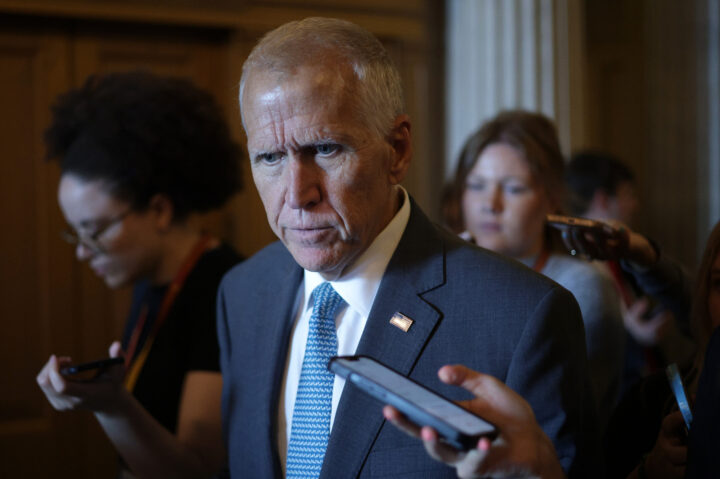
Alex Wong/Getty Images
U.S. Sen. Thom Tillis (R-NC) speaks to reporters at the U.S. Capitol Building on June 30, 2025 in Washington, DC.
The political developments over the last week couldn’t send a more dispiriting message about the viability of the political center — in both parties.
Last Tuesday, a self-proclaimed democratic socialist, Zohran Mamdani, who campaigned on a far-left agenda on issues ranging from the economy, crime and antisemitism, emerged as the Democratic standard-bearer for mayor of New York City.
Over the weekend, Sen. Thom Tillis (R-NC), one of the most pragmatic Republicans in the upper chamber, announced he wouldn’t be running for reelection after signaling he’d be one of two GOP votes against President Donald Trump’s “big, beautiful” budget reconciliation bill. His decision to retire came after Trump, in a Truth Social post, threatened to support a primary challenger.
Tillis, notably, was the deciding Republican vote scuttling the nomination of interim D.C. U.S. Attorney Ed Martin for, among other issues, his associations with a Nazi sympathizer.
And on Monday, Rep. Don Bacon (R-NE), one of only three House Republicans who represents a district that former Vice President Kamala Harris won in 2024, formally announced his retirement, making it all the more likely a more-partisan Democratic lawmaker will succeed him in the seat.
These are just the latest developments that underscore that moderation, pragmatism and bipartisanship are becoming endangered principles in a polarized political environment that rewards extremism and hot takes over thoughtful policymaking.
The list of threats to the mainstream middle are all over: Sen. John Cornyn (R-TX) is facing a serious threat from far-right Texas Attorney General Ken Paxton in next year’s primary despite his long record of pragmatism and thoughtful policymaking as Texas’ senior senator.
Sen. Bill Cassidy (R-LA), who reluctantly cast the tiebreaking vote to confirm Robert F. Kennedy Jr. as HHS secretary despite his record opposing vaccines, is nonetheless facing the likelihood of a tough renomination fight against state Treasurer John Fleming, a former GOP congressman.
Meanwhile, on the Democratic side, Mamdani’s surprise victory threatens to activate the left-wing grassroots in numerous congressional primaries. For a while, it looked like the moderates in the party held the upper hand after an embarrassing 2024 election where activists’ preferred policies badly hurt the Democratic ticket. But amid a DSA victory in New York, anti-ICE activism percolating again throughout the party and significant crowds showing up for anti-Trump “No Kings” protests last month, there are signs of an empowered progressive flank of the Democratic Party.
The emergence of liberal lawmakers like Sen. Chris Murphy (D-CT), who are accommodating out-of-the-mainstream views in the party, is an ominous sign of where the party could be headed.
Murphy told NBC’s “Meet the Press” about Mamdani’s primary win: “He was authentic, right? I mean, yes, he’s got some views that are a little bit out of the conventional mainstream. But you know what? The traditional political pundits have no idea what’s actually mainstream in this country … And so Democrats should learn from his victory.”
We could be close to a time where both parties’ populist, activist wings become the dominant forces in primaries, a trend that has been apparent in recent years and may be past the point of no return. That would be a blow to good governance and a win for performative politics and nonstop narcissism being the driving force in American elections.
The House’s 2026 Homeland Security Appropriations bill now includes $335 million for the Nonprofit Security Grant Program

Brandon Bell/Getty Images
A law enforcement vehicle sits near the Congregation Beth Israel synagogue on January 16, 2022 in Colleyville, Texas.
The House Appropriations Committee voted on Tuesday to boost its proposal for 2026 Nonprofit Security Grant Program funding by $30 million, up to $335 million, an increase that Jewish groups say is a positive, but insufficient step, amid rising threats to the community.
The change was approved by a voice vote as part of a bipartisan package of amendments.
The committee’s original proposal had set funding for the program at $305 million, the same funding level in place in 2023, which had fulfilled less than half of the grant applications received at the time, before the spike in domestic antisemitism and antisemitic violence in the aftermath of the Oct. 7, 2023, Hamas terror attacks and ensuing war in Gaza.
Supporters of the program on Capitol Hill have, on a bipartisan basis, called for $500 million to be provided for the program in 2026, while many Jewish community groups have said the program should receive $1 billion.
The debate also comes amid rising fears of Iranian-backed or Iran-inspired attacks on Jewish institutions in the U.S. prompted by Israeli and American strikes on Iran.
Eric Fingerhut, the CEO of the Jewish Federations of North America, told Jewish Insider that JFNA is “grateful” for the funding boost, which is “a meaningful step forward, but it’s still not enough.”
“Security isn’t a luxury — it’s a necessity. For many Jewish organizations, the cost of keeping their doors open and our community safe from growing antisemitic threats is the single largest cost,” Fingerhut said.
He noted that JFNA and other Jewish groups are bringing a delegation of more than 400 Jewish leaders to Congress on Wednesday to advocate for greater NSGP funding and other priorities.
Lauren Wolman, director of federal policy and strategy at the Anti-Defamation League, said, “In the wake of surging antisemitic violence and the heightened threat environment following the Iran-Israel conflict, Jewish communities across the country are living in fear.”
“ADL was proud to work with bipartisan members to increase funding for the Nonprofit Security Grant Program in the Homeland Security Appropriations Markup,” Wolman said. “In times of crises, expressions of solidarity are important, but they must be backed by meaningful action. As the appropriations process moves forward, ADL will continue working with members of Congress on both sides of the aisle to increase funding to ensure at-risk communities can worship, learn, and gather without fear.”
“This funding boost over the Subcommittee’s initial proposal is a very welcome and good start,” Nathan Diament, executive director of the Orthodox Union Advocacy Center, said in a statement. “We appreciate the Appropriations Committee’s bipartisan effort to increase funding for the NSGP at such a critical time. With threats against the Jewish community surging, every additional dollar makes a difference in protecting lives.”
But, Diament continued, “the need far exceeds current funding levels, and we will continue to work with allies in Congress toward the $500 million funding target. That level of funding is what our community needs, and it is supported by a strong bipartisan coalition.”
The legislation counts Senate leaders Thune, Schumer among its original co-sponsors
Kevin Carter/Getty Images
The U.S. Capitol Building is seen at sunset on May 31, 2025 in Washington, DC.
Top Senate leaders introduced a bipartisan resolution on Monday condemning the recent antisemitic attacks in Washington and Boulder, Colo.
The resolution is being led by Sens. James Lankford (R-OK) and Jacky Rosen (D-NV), joined by Senate Majority Leader John Thune (R-SD) and Minority Leader Chuck Schumer (D-NY), as well as Sens. Michael Bennet (D-CO), John Hickenlooper (D-CO), Dave McCormick (R-PA), John Fetterman (D-PA) and Jerry Moran (R-KS).
The resolution highlights that both attackers professed to have been motivated by the war in Gaza and shouted slogans including “Free Palestine,” during their attacks. It also notes that both suspects have been lionized online as heroes and that both attacks have prompted “calls for more violence.”
It describes the attacks as a “result of antisemitism, extremism, and political violence, which are threats not only to Jewish individuals, but to all of society in the United States.”
“Antisemitism is not just a Jewish problem, but a problem that threatens democracy and all of humanity,” the resolution declares. “Fighting antisemitism will not only protect the Jewish community in the United States but also protect our democracy.”
The legislation mourns slain Israeli Embassy staffers Sarah Milgrim and Yaron Lischinsky, condemns antisemitism, expresses support for the Jewish community and “encourages all of society to denounce and combat all manifestations of antisemitism and ensure that antisemitism is not normalized.”
It also highlights “the importance of resources and action in the aftermath of attacks, including the distribution of resources from the Nonprofit Security Grant Program.”
Lankford said in a statement the two attacks are “horrific reminders of the unfortunate rise in antisemitism across our country.”
“This resolution makes it clear: we unequivocally condemn antisemitism in all its forms,” Lankford said. “Our Jewish friends and neighbors should not live in fear because of their faith and heritage, and this resolution affirms the right to live their faith freely.”
Lankford and Rosen are the co-chairs of the Senate antisemitism task force.
“Communities across our country are experiencing an increase in antisemitic vandalism, threats, and violence that endangers the safety of Jewish Americans, like the recent attacks in Washington and Colorado,” Rosen said. “We have a responsibility to call out antisemitism and do everything we can to combat acts of hate in all of its forms. Senator Lankford and I introduced this bipartisan resolution to condemn recent attacks and recommit to doing all we can to tackle the alarming rise of antisemitic incidents.”
McCormick and Fetterman introduced a similar resolution last week, with 34 cosponsors, that highlighted the Washington and Boulder attacks as well as the arson attack on Pennsylvania Gov. Josh Shapiro’s residence during Passover.
That resolution is a companion to one that passed with near-unanimous support in the House earlier this month.
Proponents on both sides of the aisle say that repealing the Caesar Act sanctions will remove obstacles to reconstruction and stabilization efforts in post-Assad Syria
Kevin Carter/Getty Images
The U.S. Capitol Building is seen at sunset on May 31, 2025 in Washington, DC.
Bipartisan groups of House and Senate members have introduced legislation to repeal the Caesar Syria Civilian Protection Act, sanctions legislation passed in 2019 targeting the former Syrian government led by Bashar al-Assad, a step that proponents say will help remove obstacles to reconstruction and stabilization efforts in post-Assad Syria.
The administration recently announced that it would be lifting all sanctions on Syria, but the Caesar Act sanctions can only be temporarily waived, for periods of 180 days, barring a full repeal by Congress. Administration officials have indicated that they’d support such a step, and sanctions relief, in principle, has broad support on both sides of the aisle.
The sanctions, named for a pseudonymous individual who documented the Assad regime’s torture of civilians, also targeted Syrian critical industries, individuals and businesses that supported or did business with the Syrian government and Iranian and Russian entities that supported the Syrian government.
Sens. Jeanne Shaheen (D-NH) and Rand Paul (R-KY) introduced legislation on Wednesday to repeal the sanctions.
Reps. Joe Wilson (R-SC), Jimmy Panetta (D-CA), Marlin Stutzman (R-IN), Lou Correa (D-CA), Jack Bergman (R-MI), Pramila Jayapal (D-WA), Anna Paulina Luna (R-FL) and Mike Levin (D-CA) introduced a similar bill in the House last week.
“We can keep the new Syrian authorities accountable without decimating the economy,” Shaheen said in a statement. “Sustained diplomatic engagement can yield tremendous results.”
Paul argued against the Caesar Act sanctions in principle, saying they had been too broadly targeted.
“While the Caesar Act was intended to isolate the Assad regime, it has ended up punishing everyday Syrians — fueling poverty, crippling recovery, and blocking progress toward peace,” Paul said. “This repeal is about restoring a more targeted, principled approach that holds bad actors accountable without inflicting unnecessary suffering on the very people we claim to support.”
The timeline for the repeal effort is somewhat unclear: Secretary of State Marco Rubio testified in May that the administration’s ultimate goal would be to repeal the act, conditioned on the new Syrian government “mak[ing] enough progress” on U.S. priority issues.
But U.S. Ambassador to Turkey Tom Barrack, who also serves as U.S. envoy to Syria, indicated greater urgency, calling for Congress to repeal the sanctions within the first 180-day waiver period, which is renewable if the sanctions are not repealed before then.
“I promise you the one person who has less patience with these sanctions than all of you is President Trump,” Barrack said during a visit to Syria to meet with President Ahmad al-Sharaa last month.
The House lawmakers leading the repeal legislation represent a broad spectrum of the House, ranging from a former chair of the House Progressive Caucus to a former House Freedom Caucus member, and including Israel hawks on both sides of the aisle.
“The Assad regime sanctioned by the Caesar Act no longer exists, and it is time to repeal the law to provide long-term certainty to those who would like to invest in the reconstruction and rebuilding of Syria,” Wilson said in a statement.
Panetta said that repealing the sanctions would help the U.S. “position itself as a partner for continued progress” as adversaries aim to gain a foothold in Syria.
“The repeal of these broad sanctions will give foreign partners the certainty they need to invest in the Syrian economy and give their new government a chance to succeed,” Jayapal said.
A bipartisan group of House members described the State Department’s response to Americans stuck in Israel as inadequate thus far
Tom Williams/CQ-Roll Call, Inc via Getty Images
Rep. Josh Gottheimer, D-N.J., leaves the U.S. Capitol after the House passed the One Big Beautiful Bill Act on Thursday, May 22, 2025.
A bipartisan group of 45 House members wrote to President Donald Trump and Secretary of State Marco Rubio on Tuesday urging officials to act promptly to facilitate evacuations of American citizens from Israel, or at least provide them with additional information on efforts to allow for such evacuations.
They argued that communication from the administration to this point has been inadequate, leaving Americans without clear information or a path to leave Israel. They asked the administration to provide information to them by Wednesday that they can convey to their constituents.
“Americans in Israel are depending on our government for guidance and a pathway to safety,” the letter, obtained by Jewish Insider, reads. “All available options including evacuations by land routes and sea must be explored. At a minimum, American citizens in Israel deserve updates on the efforts underway to ensure their safe departure.”
The lawmakers criticized the State Department for failing to provide any additional information beyond directing them to enroll in the State Department’s travel registration and information program.
“We trust that you will honor our responsibility to protect the American people, no matter where they are in the world,” the lawmakers wrote.
The letter was led by Reps. Josh Gottheimer (D-NJ) and Wesley Bell (D-MO). The majority of the signatories were Democrats but two Republicans — Reps. Don Bacon (R-NE) and Nicole Malliotakis (R-NY) — also signed on.
The U.S. embassy’s offices in both Jerusalem and Tel Aviv are set to be closed through at least Friday, the State Department announced.
The resolution, with 16 co-sponsors, marks a bipartisan show of support for the Israeli operations as members of the far left and far right oppose Israel’s operation

SAN/Middle East Images/AFP via Getty Images
Smoke rises from a location allegedly targeted in Israel's wave of strikes on Tehran, Iran, on early morning of June 13, 2025.
A new bipartisan resolution introduced by Reps. Claudia Tenney (R-NY) and Brad Sherman (D-CA) and 14 co-sponsors on Tuesday praises Israel’s strikes on Iranian nuclear and military facilities and condemns Iran’s retaliatory missile attacks on Israeli civilian targets.
The resolution marks a bipartisan show of support for the Israeli operation even as elements of the far left and far right are warning that the Israeli strikes risk dragging the U.S. into a regional or global war and run counter to American interests.
The resolution states that the House “stands with Israel as it takes targeted military actions to dismantle Iran’s nuclear enrichment capabilities and defend itself against the existential threat of a nuclear-armed Iran,” “recognizes that Israel’s preemptive and proportional strikes against Iran’s nuclear sites advance the United States’ vital national security interest in a nuclear free Iran” and “reaffirms Israel’s right to self-defense.”
The legislation further states that the House “stands ready to assist Israel with emergency resupply and other security, diplomatic, and intelligence support.”
It asserts that the war came “after exhausting all diplomatic avenues,” and describes the Israeli operation as “intelligence-driven preemptive strikes to prevent Iran from acquiring nuclear weapons and such capability explicitly designed to achieve the destruction of Israel and the United States,” which, the resolution states, has “achieved national security objectives without risking American lives.”
The resolution also condemns Iran’s “indiscriminate attacks against civilians in Israel” and its repression of its own citizens, and calls on Tehran to give up its pursuit of nuclear weapons and dismantle its nuclear program and urges other countries to support that goal.
The legislation accuses Iran of having “repeatedly rejected good-faith diplomatic efforts by the United and others to address its nuclear program” and of not negotiating “in good faith.”
The resolution is co-sponsored by Reps. Don Bacon (R-NE), Jeff Van Drew (R-NJ), Josh Gottheimer (D-NJ), Elise Stefanik (R-NY), Brian Fitzpatrick (R-PA), Maria Elvira Salazar (R-FL), Shri Thanedar (D-MI),Roger Aderholt (R-AL), Mike Lawler (R-NY), Juan Ciscomani (R-AZ), Chris Smith (R-NJ), Scott Fitzgerald (R-WI), Randy Feenstra (R-IA) and Tom Barrett (R-MI), and supported by FDD Action, the Jewish Institute for National Security of America and the American Jewish Committee.
The resolution highlights that Iran had been increasing its enrichment activity, stockpiling enough highly enriched uranium for six nuclear weapons and blocking international inspections, among other steps that have brought it closer to a nuclear bomb.
It notes that the International Atomic Energy Agency recently censured Iran for violating its nuclear Non-Proliferation Treaty commitments, and that Iran responded by further increasing its enrichment activities.
“This bipartisan resolution reaffirms the United States’ unwavering support for Israel’s right to self-defense and for its bold, courageous efforts to dismantle Iran’s nuclear program once and for all,” Tenney said in a statement. “The U.S.-Israel partnership remains unshakable, and this resolution sends a clear and unified message: we will work together to ensure the Iranian regime is never able to obtain a nuclear weapon.”
Sherman, in a statement, argued that Iran’s activities had made Israel’s strikes necessary.
“The Islamic Republic of Iran has made clear time and time again its intent to ‘annihilate’ Israel and attack the United States and has funded direct military attacks on Israel and the United States for decades It’s regrettable that Iran’s decades of violation of the Nuclear Non-Proliferation Treaty (NPT) which it signed has led us to a point where this is necessary,” Sherman said. “The only thing more dangerous than this war is an Ayatollah with access to nuclear weapons. Israel could not wait until Iran had a stockpile of nuclear weapons ready to be launched.”
An early draft of the letter stated that the administration’s alleged deal proposal was weaker and more dangerous than the original nuclear deal
Tom Williams/CQ-Roll Call, Inc via Getty Images
Rep. Josh Gottheimer, D-N.J., leaves the U.S. Capitol after the House passed the One Big Beautiful Bill Act on Thursday, May 22, 2025.
A bipartisan group of nine House members wrote to the Trump administration on Friday emphasizing — as the administration continues to push for a nuclear deal — that U.S. negotiators must not allow Iran to maintain any nuclear enrichment capacity if a deal is reached.
An early draft of the letter circulated by Reps. Josh Gottheimer (D-NJ) and Don Bacon (R-NE) prior to Israel’s strikes on Iran on Friday forcefully condemned the administration over reports that it had proposed allowing Iran to temporarily maintain low-level enrichment, criticizing that proposal as weaker and more dangerous than the original nuclear deal, and describing the talks as an Iranian delay tactic.
The finalized letter, which follows a similar communique from a bipartisan group of members earlier this month, again highlights that the administration will face vocal opposition on both sides of the aisle if it agrees to a deal that allows Iran to maintain a pathway toward a nuclear weapon.
“[Israel’s] decisive action comes after two months of unsuccessful diplomacy and represents a critical chance to stop the Iranian regime from acquiring a nuclear weapon,” the final version of the letter reads. “Tehran’s pursuit of nuclear arms, combined with its long record of fueling violence through terrorist proxies, has brought this moment upon itself.”
The letter argues that the U.S. must insist upon “zero enrichment, zero pathway to a nuclear weapon” and warns that any nuclear deal that does not meet those benchmarks “will face strong bipartisan opposition in Congress.”
The letter states that Iran “spent decades deceiving the international community and using diplomacy as a delay tactic while building the capacity to produce nuclear weapons” and describes the Israeli campaign against Iranian nuclear, military and critical infrastructure sites as “an opportunity to bring an end to Iran’s nuclear ambitions by ensuring their complete dismantlement in negotiations.”
The lawmakers said that they are “deeply concerned by Iran’s continued use of stalling tactics,” calling the talks an effort to buy time to avoid snapback of United Nations sanctions and rebuild Iran’s nuclear program. They noted that the Trump administration’s own two-month deadline for talks had already passed.
“It is time Iran makes a decision — make meaningful concessions or face crushing diplomatic pressure in addition to Israel’s military pressure,” the lawmakers wrote, urging the administration to work with allies to reimpose sanctions by next month — in advance of the October deadline.
The finalized letter was led by Gottheimer and Bacon and co-signed by Democratic Reps. Jared Moskowitz (D-FL), Greg Landsman (D-OH), Juan Vargas (D-CA), Tom Suozzi (D-NY), Ritchie Torres (D-NY), Brad Sherman (D-CA) and Darren Soto (D-FL).
The previous version of the letter, drafted and circulated by Gottheimer and Bacon prior to the beginning of the Israeli campaign, more directly criticized the administration and its reported proposal to allow Iran to maintain some level of enrichment in an interim capacity.
“Such a proposal undermines U.S. national security and the security of our allies in the region,” the draft read. “The Iranian regime cannot be trusted … The Iranian regime must not be permitted to enrich uranium on its soil, at any level, under any circumstances.”
“We are deeply concerned that the United States is even entertaining proposals that would enable any form of enrichment — particularly one that involves U.S. assistance to build nuclear reactors in Iran and allows enrichment until a regional enrichment consortium facility is built, something Iran will demand is on their soil,” the draft continued.
The draft framed the delays and that proposal, as outlined, as “not just weaker than the JCPOA but far more dangerous,” referring to the Obama-era Joint Comprehensive Plan of Action, imposing fewer restrictions and greater concessions than the original 2015 nuclear deal at a time when Iran is only weeks from nuclear breakout.
It argued that a deal should also address Iran’s support for terrorism, something that Secretary of State Marco Rubio said, as recently as last month, has not been part of talks.
“If Iran refuses, we must return to a policy of maximum pressure and strategic deterrence,” the draft read. “The Iranian regime responds only to strength — not appeasement.”
The draft stated that the negotiations bore the hallmarks of Iranian obstructionism and stalling tactics.
“Iran continues to slow-walk negotiations, refusing to make meaningful concessions — all while continuing to grow its stockpile of enriched uranium,” the draft read. “If this process feels like a delay tactic, that is because it is.”
The draft also condemned Trump’s discussions with Russian President Vladimir Putin about joining the nuclear talks as “not only naïve, [but] incredibly dangerous.”
“Putin is openly allied with Iran and is actively engaged himself in an unprovoked war in Ukraine,” the draft read. “Asking for Putin’s help in securing a nuclear deal with Tehran risks legitimizing the actions of both regimes and could invite further instability.”
'I think the timing just becomes all that much more important,' Rep. Brad Schneider (D-IL), who is leading the trip, told JI

Alex Brandon/AP Photo
Israeli Prime Minister Benjamin Netanyahu, United Arab Emirates Foreign Minister Abdullah bin Zayed al-Nahyan and Bahrain Foreign Minister Khalid bin Ahmed Al Khalifa, stand on the Blue Room Balcony during the Abraham Accords signing ceremony on the South Lawn of the White House, Tuesday, Sept. 15, 2020, in Washington.
A bipartisan group of lawmakers is departing today for Saudi Arabia, the first leg of an Abraham Accords-themed congressional delegation that also plans to visit Bahrain, the United Arab Emirates and Israel and meet with leaders in each country. Rep. Brad Schneider (D-IL), who is leading the delegation, told Jewish Insider that the trip will take place even as Israeli strikes against Iran continue.
“I think the timing just becomes all that much more important,” Schneider said in an interview on Friday. “Last night, Iran took a significant hit to its nuclear program and its military. So I think and hope maybe it opens up possibilities. We’ll find out.”
Other members attending the trip, which is hosted by the Atlantic Council’s N7 Initiative, include Reps. Don Bacon (R-NE), Jimmy Panetta (D-CA) and Zach Nunn (R-IA).
“During these times of instability in the region, support for the Accords is necessary to enhance Israel’s security and stability, as well as a way to counter threats posed by Iran,” Bacon said in a statement.
It has been nearly five years since Israel normalized ties with the UAE, Bahrain and Morocco in the Abraham Accords, which were widely viewed not just as a diplomatic accord but also a counterweight to Iran’s influence in the region.
“The Arab countries around Israel remain committed to this idea of a better future, a pathway to peace, and I believe the Abraham Accords are that path,” said Schneider. “The purpose of the trip, before the strikes against Iran, was to talk about that. That doesn’t change.”
Democrats Chris Coons, Catherine Cortez Masto, Andy Kim, Jacky Rosen and Elissa Slotkin voted with Republicans against the resolutions
Kevin Carter/Getty Images
The U.S. Capitol Building is seen at sunset on May 31, 2025 in Washington, DC.
The Senate on Wednesday defeated two resolutions aimed at blocking certain weapons sales to Qatar and the United Arab Emirates, with five Democrats voting with nearly all Republicans against both resolutions.
The 56-39 votes came as a pressure tactic from some progressive Democrats on the two U.S. partners and the Trump administration over dealings between President Donald Trump and the two Gulf states — Qatar’s provision of a luxury jumbo jet to serve as Air Force One and the UAE’s investment of $2 billion in a Trump-linked cryptocurrency.
Democratic Sens. Chris Coons (D-DE), Catherine Cortez Masto (D-NV), Andy Kim (D-NJ), Jacky Rosen (D-NV) and Elissa Slotkin (D-MI) voted against the two resolutions. Sen. Rand Paul (R-KY) voted present.
Coons said in a statement that “these resolutions don’t hold President Trump accountable” and will not punish Trump at all, but will rather “target other countries for the actions of our president, countries that host more than 10,000 U.S. troops on strategically important bases and are our partners.”
He said that blocking the sales would weaken two pillars of stability in the region and create space from those partners at a critical time, as well as make other nations doubt Congress’ reliability.
He said the sales were negotiated years ago.
Sen. Chris Murphy (D-CT), who led the effort with Sens. Chris Van Hollen (D-MD), Tim Kaine (D-VA), Brian Schatz (D-HI) and Bernie Sanders (I-VT), has framed the arms sales as a direct response to “cash payments” from the two nations.
“Normally those might be deals that Congress would approve, but we cannot approve any security relationship today with countries in the Middle East that are engaged in the fundamental corruption of American foreign policy,” Murphy said earlier this week. “The Trump administration is moving these sales forward as part of a broader scheme which enriches Donald Trump to the tune of billions of dollars.”
He said the Qataris are looking to be “not left out” of the second Trump administration and that the Emiratis are seeking “our secrets,” specifically sensitive semiconductor technology that could be compromised by China.
Republicans’ essentially united front against the resolutions came even though multiple Senate Republicans have expressed deep skepticism of Qatar and called for its status as a major non-NATO ally to be reconsidered.
Murphy, meanwhile, in a Senate floor speech earlier this week expressed gratitude for Qatar in spite of the resolutions.
“What makes this moment so dangerous is that both UAE and Qatar, but especially Qatar, are key partners of the United States,” Murphy said. “They’re imperfect allies, but they are our allies. In fact, I’ve been down on this floor in the past arguing on behalf of Qatar and the U.S.-Qatar relationship, when other senators have tried to denigrate the Qataris’ contributions to regional peace. The Qataris have been a critical partner of ours on so many important issues.”
He suggested that Qatar had felt bullied by the Trump administration into offering the jet and “feels like it had little choice but to say yes when asked for this $400 million gift” because the U.S. had punished and isolated Qatar during the first Trump administration when Saudi Arabia and the UAE “effectively ganged up to blockade Qatar and Trump gave that move implicit consent.”
He claimed that the UAE had first set the precedent for Qatar by investing in Trump’s cryptocurrency, leaving Qatar to play catch-up.
But he also noted that the U.S. has never allowed any other Middle East country to buy MQ-9 Reaper drones, the weapons sale to Qatar in question, because the U.S. has felt that such transfers are too risky.
One resolution, which praised ICE and highlighted the need for vetting visa applicants, split House Democrats

Nathan Howard/Getty Images
The U.S. Capitol is seen on June 13, 2024 in Washington, DC.
The House voted on Monday to pass two resolutions condemning recent antisemitic attacks. One, led by Republicans, which focused on the Boulder, Colo., attack and immigration issues, and split the Democratic caucus. The other, which was bipartisan and highlighted a series of antisemitic attacks, passed nearly unanimously, with just two lawmakers voting present.
The first resolution attracted controversy among Democrats ahead of the vote, but it passed by a 280-133 vote. Seventy-five Democrats, mostly moderates and pro-Israel members, ultimately voted in favor of the resolution and 113 voted against it.
Another five Democrats, Reps. Herb Conaway (D-NJ), Shomari Figures (D-AL), Sarah McBride (D-DE), Johnny Olszewski (D-MD) and Dina Titus (D-NV), and one Republican, Rep. Marjorie Taylor Greene (R-GA), voted present.
The resolution stated that the Boulder attack, perpetrated by an Egyptian national who overstayed a visa and work permit who threw a Molotov cocktail at activists raising awareness for the hostages in Gaza, “highlights the need to aggressively vet aliens who apply for visas” and “demonstrates the dangers of not removing from the country aliens who fail to comply with the terms of their visas.”
It also praised law enforcement and Immigration and Customs Enforcement and emphasized the need for “free and open communication” between state and federal law enforcement — an apparent reference to Colorado sanctuary state policies that limit such cooperation.
Prior to the vote, Republicans softened the resolution amid strident criticism from Democrats, stripping out one section that described the slogan “Free Palestine” as antisemitic and another one that explicitly condemned Colorado’s sanctuary state policies.
The second resolution, which condemns “the rise in ideologically motivated attacks on Jewish individuals in the United States,” including the attack in Boulder, the Capital Jewish Museum murders and the arson targeting Pennsylvania Gov. Josh Shapiro, passed with 400 votes in favor. Reps. Rashida Tlaib (D-MI) and Greene voted present. No members voted against the latter resolution.
“We cannot ignore these attacks or dismiss them as isolated incidents,” Rep. Jeff Van Drew (R-NJ), who led the bipartisan resolution, said in a statement. “They are part of a serious and dangerous trend that must be condemned by all of us. Today, the House stood firmly in support of respect and dignity for everyone because we know that every American deserves to live without fear in their own community.”
Greene said in an X post that “antisemitic hate crimes are wrong, but so are all hate crimes. Yet Congress never votes on hate crimes committed against white people, Christians, men, the homeless, or countless others.”
She objected to the fact that Congress has voted on “endless resolutions” on antisemitism while “Americans from every background are being murdered — even in the womb.”
“Prioritizing one group of Americans and/or one foreign country above our own people is fueling resentment and actually driving more division, including antisemitism,” Greene continued.
Ahead of the vote, a group of Jewish House Democrats had urged congressional leaders to take substantive action beyond passing nonbinding resolutions to combat antisemitism, primarily by passing the Antisemitism Awareness Act and bolstering Nonprofit Security Grant Program funding.
The letter is particularly notable, given that a number of prominent Democrats joined Republicans in holding a hard line against Iran’s nuclear program

Jemal Countess/Getty Images for Protect Our Care
A view of the U.S. Capitol on March 12, 2024 in Washington, DC.
A new bipartisan letter sent Friday by 16 House lawmakers to Secretary of State Marco Rubio and Middle East envoy Steve Witkoff argues that any nuclear deal with Iran must permanently dismantle its capacity to enrich uranium — a notable message particularly from pro-Israel Democrats to the administration.
The letter highlights that an insistence on full dismantlement of Iran’s enrichment capabilities is not only a Republican position, and that President Donald Trump will not be able to count on unified Democratic support for a deal that falls short of that benchmark. Previously, 177 House Republicans said they also demand a deal that does not allow enrichment and some pro-Israel Democrats have expressed the view individually.
“We wholeheartedly agree that Iran must not retain any capacity to enrich uranium or continue advancing its nuclear weapons infrastructure,” the letter, which frames the appeal as an endorsement of Rubio and Witkoff’s public positions on the subject, states. “There is widespread bipartisan support for this requirement and we appreciate your commitment to this essential cornerstone of any agreement.”
The letter highlights the Iran Nuclear Agreement Review Act, which mandates that any agreement with Iran be submitted for congressional review, and emphasizes, “for any agreement to endure, it must have strong bipartisan support. We urge you to engage with Congress as negotiations proceed to ensure that any final agreement commands broad support.”
The lawmakers called on the officials to work with the U.S.’ European allies to “promptly invoke the snapback mechanism” to reimpose United Nations sanctions on Iran if talks fail to yield an agreement that fully dismantles Iran’s nuclear program.
They note that, given the Oct. 18 expiration of the snapback provision, “the process must begin by late Summer at the latest if no deal is reached. Iran’s repeated violations must be met with clear consequences.”
“The Iranian regime must understand that the United States is unwavering in its demand that Iran’s uranium enrichment capability be totally dismantled,” the letter reiterates. “We appreciate your leadership on this pressing matter vital to America’s national security interests and stand ready to work in a bipartisan manner to prevent Iran from obtaining a nuclear weapon.”
The letter, led by Reps. Laura Gillen (D-NY) and Claudia Tenney (R-NY), was co-signed by Reps. Dan Goldman (D-NY), Wesley Bell (D-MO), Joe Wilson (R-SC), Josh Gottheimer (D-NJ), Brad Schneider (D-IL), Don Bacon (R-NE), Eugene Vindman (D-VA), Lois Frankel (D-FL), Debbie Wasserman Schultz (D-FL), Jared Moskowitz (D-FL), Grace Meng (D-NY), Frank Pallone (D-NJ), Ted Lieu (D-CA) and Chris Pappas (D-NH).
Pappas is also mounting a run for the U.S. Senate.
The requests, in some cases, constitute calls for Trump to walk back funding cuts he proposed earlier this month

Getty Images
U.S. Capitol Building
In response to the shooting that killed two Israeli Embassy staffers outside the Capital Jewish Museum last week, a bipartisan group of 46 House members wrote to President Donald Trump on Friday urging him to support expanded funding for key security programs in his full budget request to Congress, expected as soon as Friday afternoon.
While presidential budget requests are non-binding and are frequently modified by Congress, Trump’s requests are likely to be influential in the GOP-controlled Congress. And the appeals made by the lawmakers, in some cases, constitute calls for Trump to walk back funding cuts he proposed in the high-level budget toplines — known as a “skinny budget” — he submitted to Congress earlier this month.
Highlighting the “sharp rise in threats to the Jewish community,” the lawmakers — most of them Democrats — said that it is “imperative that the federal government take the necessary steps to increase funding for enhanced security measures” and “ensure that the Jewish community is equipped with the necessary tools to prevent loss of life in the case of an attack.”
The legislation calls on Trump to support $500 million in funding for the Nonprofit Security Grant Program, the same funding level that bipartisan groups of House and Senate members have urged Appropriations Committee leaders to support, calling the program “one of the most effective and critical programs for protecting the Jewish community and all faith-based communities from attack.” Jewish groups have called for funding to be increased to $1 billion.
Trump, in his “skinny budget,” had called for a reduction in funding for non-emergency grants at the Federal Emergency Management Agency, a category that includes NSGP, but did not put forward a specific request for the program itself. In the past, presidents have not always made any specific funding requests for the NSGP, even in their more detailed budget outlines.
The letter outlines a series of examples that “demonstrate the direct return on investment for communities under threat” from the NSGP, highlighting incidents in which security upgrades paid for by the program likely saved lives by stopping shooting attacks.
The lawmakers also called for Trump to “explore opportunities,” in collaboration with lawmakers, to provide an additional dedicated fund to allow faith-based organizations to hire security officers.
“Although Jewish institutions can use the NSGP to hire additional security personnel, the majority of Jewish institutions have either not been recipients of these grants or cannot afford the additional costs incurred,” the letter reads. “In light of recent events, it is more clear than ever that Jewish institutions are in desperate need of additional personnel support.”
The letter calls on Trump to support increased funding for the Federal Bureau of Investigation. Trump called for a $545 million cut to the FBI’s budget in his “skinny budget”, pledging that the FBI would focus on counterintelligence and counterterrorism and that it would eliminate “duplicative intelligence activities.”
The letter emphasizes the FBI’s role in domestic terrorism investigations, which have been on the rise, and intelligence gathering and the FBI’s responsibility to report to Congress on domestic terrorism threats.
It calls for increased Department of Justice grants for local law enforcement to ensure that hate crimes are properly reported to local and federal law enforcement agencies, and specifically for grant programs to counter hate crimes “to ensure that antisemitic hate crimes are addressed and prosecuted in a timely manner” and their extent is fully understood.
The “skinny budget” called for cutting $1 billion in DOJ grant programs, including “programs that focus on so-called hate crimes in clear violation of the First Amendment.”
The letter was led by Reps. Josh Gottheimer (D-NJ) and Jared Moskowitz (D-FL) and co-signed by Reps. Max Miller (R-OH), Haley Stevens (D-MI), Brittany Pettersen (D-CO), Laura Gillen (D-NY), John Larson (D-CT), Dan Goldman (D-NY), Jamie Raskin (D-MD), Nikema Williams (D-GA), David Scott (D-GA), Wesley Bell (D-MO), Shri Thanedar (D-MI), Dina Titus (D-NV), Donald Norcross (D-NJ), Susie Lee (D-NV), Andre Carson (D-IN), Shontel Brown (D-OH), Sheila Cherfilus-McCormick (D-FL), Lloyd Doggett (D-TX), Lizzie Fletcher (D-TX), Greg Landsman (D-OH), Frederica Wilson (D-FL), Debbie Wasserman Schultz (D-FL), Janelle Bynum (D-OR), Madeleine Dean (D-PA), Frank Pallone (D-NJ), Jerry Nadler (D-NY), LaMonica McIver (D-NJ), Ted Lieu (D-CA), George Latimer (D-NY), Juan Vargas (D-CA), Julie Johnson (D-TX), Julia Brownley (D-CA), Marilyn Strickland (D-WA), Darren Soto (D-FL), Chris Pappas (D-NH), Brendan Boyle (D-PA), Bill Keating (D-MA), Tom Suozzi (D-NY), Steve Cohen (D-TN), Benny Thompson (D-MI), Jan Schakowsky (D-IL), Brad Sherman (D-CA), David Kustoff (R-TN) and Del. Eleanor Holmes Norton (D-DC).
Miller and Kustoff, who are both Jewish, are the only Republican signatories.
As the Oval Office dominates foreign policy, pro-Israel advocates rethink their Congress-focused playbook

GETTY IMAGES
A general view of the U.S. Capitol Building from the National Mall, in Washington, D.C., on Thursday, May 29, 2025.
For decades, Jewish and pro-Israel groups invested significant resources in building bipartisan relationships with key members of Congress to steer legislation, while helping secure foreign aid and blocking unfavorable initiatives concerning the Middle East.
But that long-standing playbook has appeared less effective and relevant in recent years as Congress has increasingly ceded its authority on foreign policy to the executive branch, a trend that has accelerated with President Donald Trump’s return to office. The dynamic is frustrating pro-Israel advocates who had long prioritized Congress as a vehicle of influence, prompting many to reassess the most effective ways to advocate for preferred policies.
That Congress had no formal role in Trump’s recent decisions to unilaterally reach a ceasefire with the Houthis in Yemen and to lift sanctions on Syria, for example, has stoked speculation that legislators could also be sidelined from ratifying a potential nuclear deal with Iran.
There are any number of reasons why Congress has taken a back seat in shaping foreign affairs, experts say, including Trump’s efforts to consolidate power in the executive branch, most recently by gutting the National Security Council. And Trump’s own power in reshaping the ideological direction of his party, preferring diplomacy over military engagement, has made more-hawkish voices within the party more reluctant to speak out against administration policy.
“Congress is increasingly irrelevant except on nominations and taxes,” Elliott Abrams, a senior fellow at the Council on Foreign Relations who served as a special envoy for Iran in the first Trump administration, told Jewish Insider. “It has abandoned its once-central role on tariffs, and plays little role in other foreign affairs issues. That’s a long-term trend and we saw it in previous administrations, but it is worsened by the deadlocks on Capitol Hill, the need to get 60 votes to do almost anything, and by Trump’s centralization of power in the White House.”
Previously, “when there was real power in the departments, congressional oversight meant a lot more,” Abrams added. “If you’re a foreign ambassador in Washington, there’s no one to talk to at the NSC, lots of vacancies at State, and while there are plenty of people to meet with on the Hill, what are they going to do for you? You need to see Trump” Abrams said, or Steve Witkoff, the special envoy to the Middle East leading the negotiations with Iran.
The executive branch, to be sure, has long held significant control over foreign policy but it has expanded considerably in the decades following the 9/11 attacks. Since then, a law passed by Congress to authorize the invasion in Iraq in 2003 has been used — and, critics allege, abused — by successive administrations to initiate military action abroad without first seeking approval from lawmakers who are constitutionally empowered to decide when the country goes to war and oversee defense spending.
Still, Congress has also long shown “disinterest” in exercising its power over foreign policy, said Brian Katulis, a senior fellow at the Middle East Institute. “This was a preexisting condition,” he explained to JI. “By and large, Congress abdicated its oversight role before Trump even came to office,” especially as national security matters have been overshadowed by competing domestic issues such as inflation and immigration, which “resonate more saliently” with voters.
“Trump’s dominance over the Republican Party accounts for much of the acquiescence on the part of his Congress,” observed Stephen Schlesinger, a historian who specializes in international affairs. “But let us not forget that recent Democratic presidents have practically had a free hand, too, in pursuing their own global policies — with little reaction or opposition from their party members.”
Among other examples, Schlesinger cited former President Barack Obama’s nuclear deal with Iran — brokered without consent from Congress — as well as former President Joe Biden’s “total support” for Ukraine in its war against Russia.
Republican deference to Trump, however, has set a new standard for such acquiescence, Schlesinger argued, particularly on talks with Iran. “Given the past obsessive Republican fury against a deal with Iran during Democratic administrations, still none in Trump’s party have objected to a nuclear deal with Tehran under Trump, or, for that matter, his solo decision to lift sanctions on Syria, a country led by a former radical Islamic leader,” Schlesinger noted.
“Certainly the reality of governance in Washington today is that Congress may not be totally irrelevant, but they’re an appendage to the whims and desires of the Trump presidency,” said Norman Ornstein, a senior scholar at the American Enterprise Institute. “There is little if any pushback or oversight of what Trump” and his advisors “involved in foreign policy and diplomacy are doing — and that’s a change.”
The new dynamic has forced pro-Israel groups to adapt to a new political landscape in which their traditional advocacy has been weakened by Congress’ diminished clout and lack of interest in asserting meaningful supervision over Trump’s recent Middle East policy decisions.
“There are very few remedies for this kind of a standoff where the executive branch has arrogated to itself so much power that Congress is essentially marginalized,” said Danielle Pletka, a senior fellow at the American Enterprise Institute who previously worked on the Hill. “When you look at the question of Israel, you have to see it in the context of much broader trends.”
Marshall Wittmann, a spokesperson for AIPAC, argued that both “the administration and Congress play a critical role in strengthening and expanding the U.S.-Israel relationship, and AIPAC works with key leaders in power, on both sides of the aisle and both sides of Pennsylvania Avenue, to build support for the mutually beneficial alliance between America and Israel.”
The absence of congressional influence has come as disagreements have emerged between the Trump administration and the Netanyahu government over ending the war in Gaza and nuclear diplomacy with Iran. Trump’s recent trip to the Middle East — where he met with a range of Arab leaders but did not stop in Israel — was one of the latest indications of deprioritization of America’s closest ally in the region.
Tensions have also surfaced amid ongoing negotiations with Iran. Pro-Israel advocates have voiced concerns that Trump’s negotiating team is nearing an agreement that could simply reinstate the deal brokered by the Obama administration a decade ago — which detractors had criticized as a pathway to a nuclear weapon since it allowed Iran to continue enriching uranium.
The Trump administration has indicated it will not permit Iran to retain domestic nuclear enrichment — even as some officials have sent mixed signals on the matter, contributing to a sense of confusion over the ultimate terms of an agreement. Trump pulled out of the original deal — which was widely opposed by Republicans — during his first administration.
For pro-Israel groups, the risks of clashing with Trump on key issues likely outweigh the benefits, observers contend. “Any organization has to very carefully weigh its equities before publicly taking on the administration,” Daniel Silverberg, a former top foreign policy advisor to Rep. Steny Hoyer (D-MD), told JI.
The pro-Israel lobbying group AIPAC has recognized that it is now operating in a unique landscape, according to Manny Houle, a Democratic pro-Israel strategist who previously served as the group’s progressive outreach director in the Midwest. Before Trump was elected, Howard Kohr, AIPAC’s former president, frequently said the group “was all about Congress,” Houle recalled in a recent interview with JI. “Then, Trump was in office and he said we’re going to be dealing with the White House.”
Marshall Wittmann, a spokesperson for AIPAC, argued that both “the administration and Congress play a critical role in strengthening and expanding the U.S.-Israel relationship, and AIPAC works with key leaders in power, on both sides of the aisle and both sides of Pennsylvania Avenue, to build support for the mutually beneficial alliance between America and Israel.”
“President Trump has a strong pro-Israel and anti-Iran record, but his administration evinced early on a lack of expertise and consistency in its policy toward Iran’s nuclear program,” said Michael Makovsky, president and CEO of the Jewish Institute for National Security of America. “But recently that position has evolved and strengthened due in no small part to feedback it has gotten.”
“We applaud the administration’s strong statements and actions in support of our ally, commend Congress for passing pro-Israel legislation such as the annual appropriation for lifesaving security assistance to Israel, and appreciate President Trump and congressional leaders both making clear last week that Iran must completely dismantle its nuclear program,” Wittmann said in a statement to JI last week.
Even as Congress has failed to take formal action over points of disagreement with Trump’s recent Middle East directives, some pro-Israel activists suggested their outreach to lawmakers on the Iran talks in particular has yielded substantive results in recent weeks.
“President Trump has a strong pro-Israel and anti-Iran record, but his administration evinced early on a lack of expertise and consistency in its policy toward Iran’s nuclear program,” said Michael Makovsky, president and CEO of the Jewish Institute for National Security of America. “But recently that position has evolved and strengthened due in no small part to feedback it has gotten.”
In public and private settings, JINSA and other pro-Israel groups, as well as Israeli officials and congressional Republicans, “have made the case that Trump needs to stick to his initial policy of dismantlement of Iran’s enrichment facilities,” Makovsky said.
“This has contributed to Trump officials pivoting in the past couple weeks to a tougher ‘no enrichment’ stand,” Makovsky told JI last week.
Eric Levine, a top GOP fundraiser and a board member of the Republican Jewish Coalition who recently launched a federal lobbying practice, said “the most important voice Congress will have is if the president makes a deal with Iran. I think that it’s really important that the Senate remains steadfast and safeguards its powers and insists, if there is a deal, it should be counted as a treaty. If he thinks it’s an amazing deal, he should have no trouble passing it.”
Still, it remains to be seen if the toughest voices against Iran in the Senate who have expressed reservations with enrichment limits and other perceived weaknesses of a potential deal will push back against Trump if he lands on an agreement that does not meet their standards. While some Republican lawmakers have spoken out in recent weeks to set expectations for a deal, including Sens. Ted Cruz (R-TX), Tom Cotton (R-AR) and Lindsey Graham (R-SC), observers say they are skeptical that Congress will ultimately seek to flex its authority if an agreement comes forward.
“The ultimate test will be if there’s a vote on Iran,” said former Rep. Steve Israel (D-NY), a pro-Israel Democrat who opposed Obama’s deal in 2015. “As Congress has grown more performative, it has become less deliberative on foreign policy,” he added. “The speaker’s gavel has become a rubber stamp. The result is an abdication by Congress of its delineated responsibilities.”
Eric Levine, a top GOP fundraiser and a board member of the Republican Jewish Coalition who recently launched a federal lobbying practice, said “the most important voice Congress will have is if the president makes a deal with Iran.”
“I think that it’s really important that the Senate remains steadfast and safeguards its powers and insists, if there is a deal, it should be counted as a treaty,” said Levine. “If he thinks it’s an amazing deal, he should have no trouble passing it,” Levine said of Trump’s efforts to reach what he has suggested is an imminent accord.
It is unclear if the White House will seek approval from Congress for a deal, even as lawmakers have recently stressed that an agreement would have no guarantee of surviving in future administrations if not ratified by the legislative branch.
Secretary of State Marco Rubio affirmed during hearings on Capitol Hill last week that U.S. law requires that any deal with Iran be submitted to Congress for review and approval, noting that he had been in Congress when that law, the Iran Nuclear Agreement Review Act, was passed. A White House spokesperson declined to confirm if Trump plans to present a potential deal to Congress when reached by JI on Wednesday, deferring to the president and Witkoff’s remarks from the Oval Office — which did not address the matter.
With Congress increasingly on the sidelines, some pro-Israel groups have turned to alternative forms of advocacy to buttress their lobbying efforts in recent years.
“Advocacy tactics are always changing,” James Thurber, a distinguished professor of government at American University and a leading expert on federal lobbying, told JI. “It is like war where opponents must be flexible, try new tools, assess and adjust. It is essential to be persistently focused on the best strategy, theme and message and to not rely on outdated lobbying tactics.”
“Our world has changed,” said Ann Lewis, a veteran Democratic advisor and a former co-chair of Democratic Majority for Israel, whose formidable political arm has actively engaged in congressional primaries featuring sharp divisions over Israel. “Any definition of advocacy that begins post-election is less effective than it deserves to be.”
Indeed, AIPAC’s foray into campaign politics four years ago, marking a major tactical shift for the organization, was a sign of the changing power dynamics in Washington. The group has since helped to elect a range of congressional allies, while working to unseat some of the fiercest critics of Israel in the House and blocking potential antagonists from getting elected.
“Advocacy tactics are always changing,” James Thurber, a distinguished professor of government at American University and a leading expert on federal lobbying, told JI. “It is like war where opponents must be flexible, try new tools, assess and adjust. It is essential to be persistently focused on the best strategy, theme and message and to not rely on outdated lobbying tactics.”
But as most foreign policy decisions now emanate from the White House, some pro-Israel activists say they remain frustrated by the lack of will from Congress to assert its authority, even as they vow their efforts will continue.
“It is tragic that Congress has so blatantly shirked its responsibility to act as a check and balance on the executive branch,” a senior political operative involved in pro-Israel advocacy recently lamented. “But under no circumstances does that mean we stop fighting for the future of the U.S.-Israel relationship.”
Plus, Torres urges APA to address 'persistent and pernicious’ antisemitism

SAEED JARAS/Middle East Images/AFP via Getty Images
Dislocated Palestinians carry the humanitarian aid they have received from a United Nations distribution point in Rafah, southern Gaza Strip on May 27, 2025.
Good Thursday morning.
In today’s Daily Kickoff, we consider the efficacy of the first days of the Gaza Humanitarian Foundation’s operations to distribute aid in the enclave, and report on a call by Rep. Ritchie Torres on the American Psychological Association to address antisemitism in its ranks. We have scoops on a call by 33 senators for $500 million in nonprofit security funding on the heels of the Capital Jewish Museum shooting; a bipartisan House letter urging President Donald Trump to reach a deal to release the hostages in Gaza; and a statement by 41 pro-Israel House Democrats praising the resumption of humanitarian aid to Gaza. Also in today’s Daily Kickoff: Marc Steinberg, Sam Feist and Gal Gadot.
What We’re Watching
- The Capital Jewish Museum will reopen today, a week after a deadly attack in which two Israeli Embassy staffers were killed after attending an American Jewish Committee event held at the museum. The museum will hold a program this morning that includes addresses from museum officials, local clergy and Washington, D.C., Mayor Muriel Bowser.
- In Massachusetts, the Holocaust Museum Boston is holding its official groundbreaking ceremony today.
What You Should Know
A QUICK WORD WITH MELISSA WEISS
In October 2023, then-Deputy National Security Advisor Jon Finer said that “getting assistance into Gaza is a complicated undertaking.” In a constantly evolving war in which much has changed over the last 19 months, Finer’s comments remain as relevant and prescient as they did when he first made them to CNN. Aid distribution has long plagued Israeli, American, Palestinian and Arab agencies and officials, who have since the start of the war struggled to unite on a comprehensive aid plan.
There are a variety of challenges, among them the resistance of many aid organizations in Gaza to work with Israel, Israeli bureaucracy and logistical hurdles, and the sheer challenge of delivering aid to two million people in an enclave in which terrorists embed themselves with civilians and in aid groups.
After the failed attempt to create a humanitarian pier to deliver aid by sea, skepticism ran high that outside actors could facilitate the mass transfer of aid across Gaza. And in the first 48 hours of its operations, the Gaza Humanitarian Foundation faced a slew of online criticism — largely from activists and other aid groups.
But a closer look at the GHF’s operations shows a newly formed organization that is serving as an efficient, if imperfect, mechanism to distribute aid in Gaza after an 11-week-long block.
Despite some isolated incidents, including brief chaos ensuing from a rush on supplies that was quickly calmed, and the looting of some facilities, the transmission of aid has largely proceeded smoothly. There are expected hurdles, including the long distances some have to travel to access the aid being provided by GHF. On the first day of operations, GHF said it distributed 8,000 packages, increasing the next day to 14,000. That number is expected to steadily increase as operations are refined and adjusted as needed.
The aid mechanism’s successes to date are underscored by Hamas’ efforts to thwart its work. The terror group used Facebook to spread rumors that GHF had closed some of its facilities. The rumors were quickly picked up by news outlets, such as Reuters, despite a lack of verification. GHF released a statement saying it “urge[s] journalists and the public to verify sources carefully. In several instances, we are seeing news reports echo Hamas statements or online disinformation campaigns without verification for accuracy.” Such narratives, the group added, “endanger humanitarian efforts and mislead the public.”
Outside aid efforts have for months faced resistance from established groups on the ground, including U.N. organizations. UNRWA in particular, which has been largely sidelined from operations since the implementation of an Israeli law banning the group from operating in the Palestinian territories over its staffers’ ties to Hamas, has been among the most critical of the new effort.
Critics were quick to write the GHF’s obituary earlier this week, following the resignation of its CEO and COO. But the first days of operations show what a coordinated, multi-party effort could look like, and provide an alternative for those looking for a new way to address an issue that has long plagued decision-makers. The greatest threat to GHF’s existence may not be the logistical problems or online backlash, but the deeply entrenched institutions that have repeatedly failed to deliver for the people of Gaza.
exclusive
Torres warns American Psychological Association to address ‘persistent and pernicious’ antisemitism in its ranks

Concerned with a “persistent and pernicious pattern of antisemitism” at the American Psychological Association, the preeminent professional organization for American psychologists, Rep. Ritchie Torres (D-NY) is urging the body’s leadership to investigate antisemitism within its ranks and better respond to the concerns of Jewish members, Jewish Insider’s Gabby Deutch reports. His letter comes as the mental health field grapples with an antisemitism problem that has only grown more acute after the Oct. 7, 2023, Hamas attacks on Israel.
Blowing the whistle: “I have spoken directly with whistleblowers — many of them longtime APA members — who accuse the organization of enabling a hostile environment,” Torres wrote in a letter, obtained by JI, that he sent to the APA’s president and president-elect on Wednesday. “These incidents collectively suggest that the APA has not only been dismissive of the legitimate grievances of Jewish psychologists but also permissive of content that traffics in malicious falsehoods against Zionism, Israel, and the Jewish community.”
SCOOP
After Capital Jewish Museum killings, 33 senators call for $500 million in nonprofit security funding
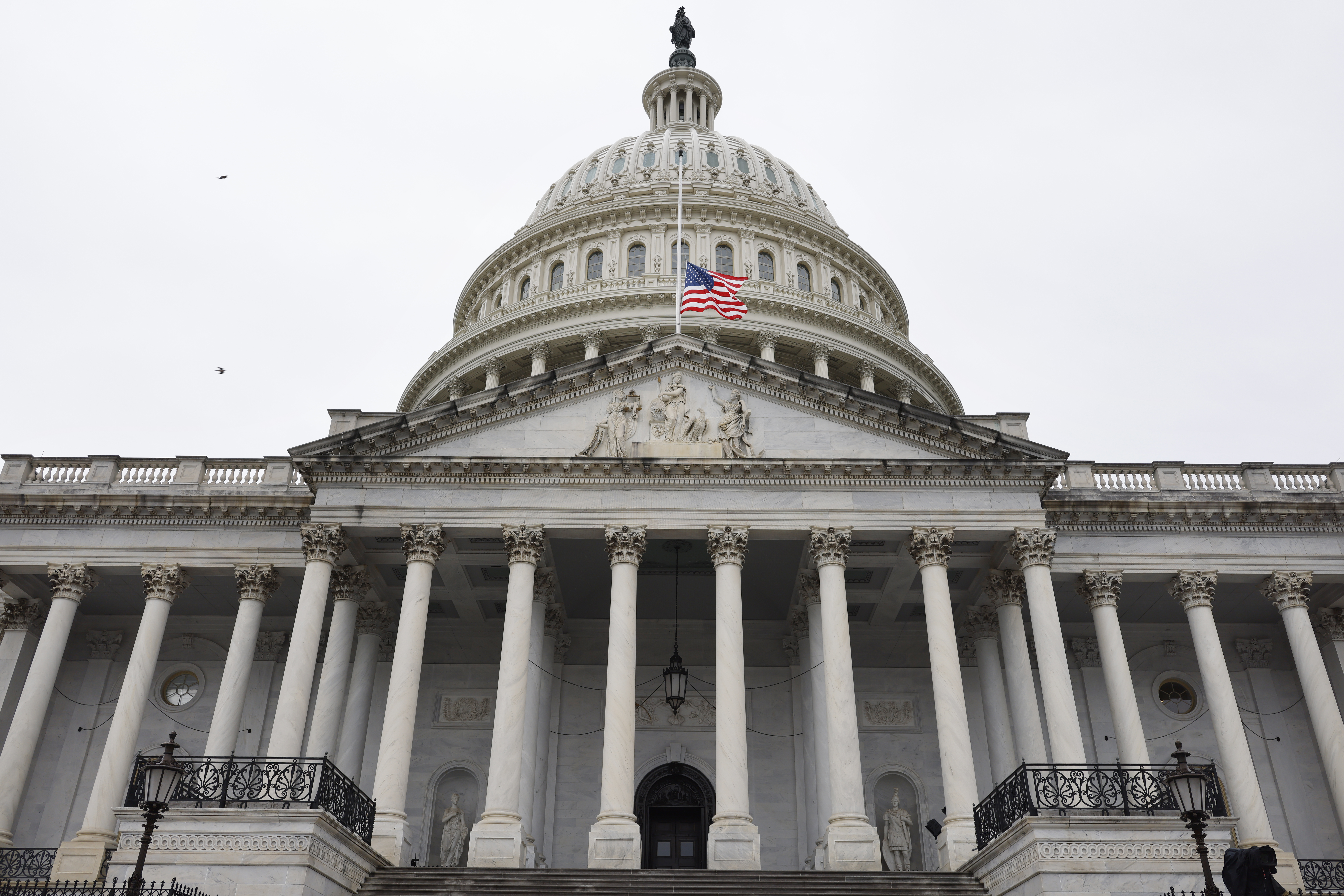
A bipartisan group of 33 senators — mostly Democrats — sent a letter last week urging Senate Appropriations Committee leaders to provide $500 million for the Nonprofit Security Grant Program in 2026, matching the record-high request from a group of House members earlier this month, Jewish Insider’s Marc Rod reports.
About the request: The letter was sent the day following the murder of two Israeli Embassy employees outside the Capital Jewish Museum in Washington, an attack that led a coalition of Jewish groups to call for increasing funding for the program, which provides synagogues and nonprofits with grants to improve their security, to $1 billion. Though only two Republicans signed the letter, the bipartisan request marks a change in Senate advocacy on this issue — in the past, bipartisan Senate groups have not specified amounts in their lobbying for the program. Senate Democrats last year called for $400 million for the program.
rumor realized
Trump confirms he told Netanyahu not to strike Iran last week
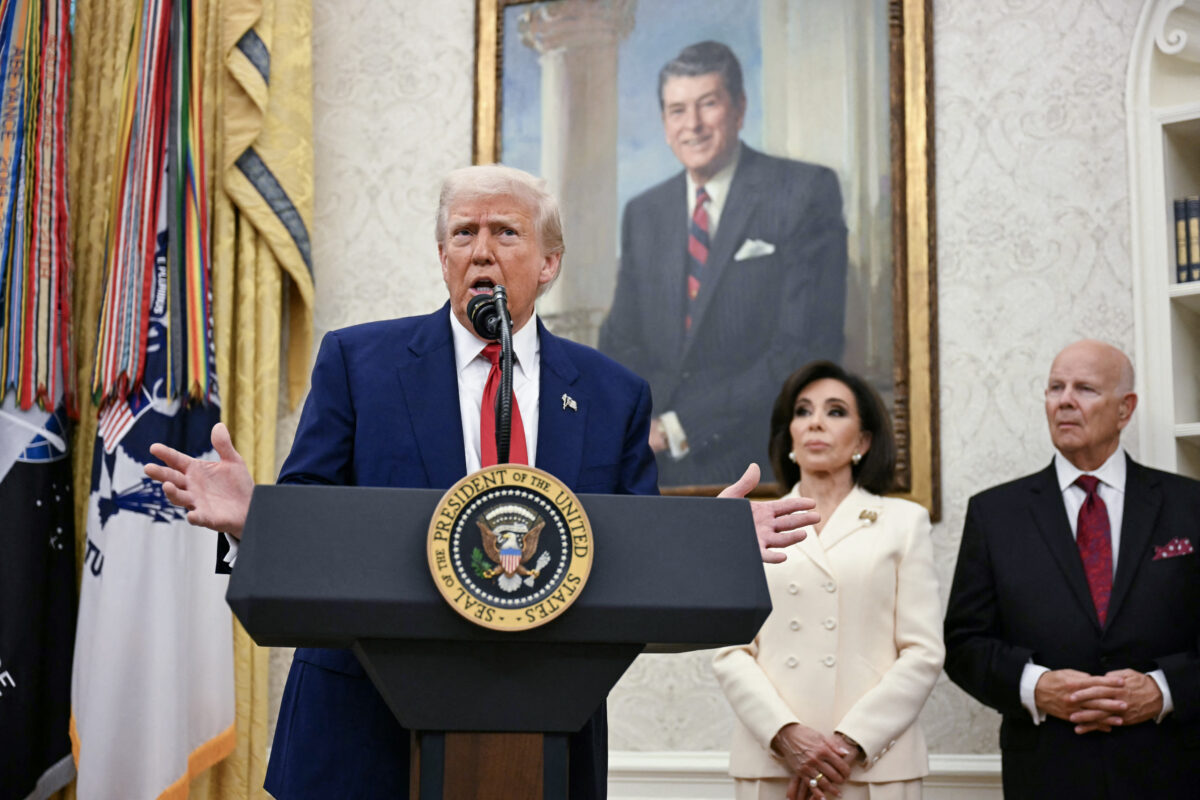
President Donald Trump confirmed reports that he warned Israeli Prime Minister Benjamin Netanyahu in a phone call last week not to proceed with plans to attack Iran’s nuclear facilities while the U.S. and Iran continue negotiations, saying that he told the Israeli leader a strike “is not appropriate right now,” Jewish Insider’s Danielle Cohen reports.
What he said: Speaking to reporters in the Oval Office on Wednesday, the president responded to a question about the validity of the report by saying, “I’d like to be honest. Yes, I did.” Pressed about the nature of the conversation, the president clarified, “It’s not a warning, I said I don’t think it’s appropriate. We’re having very good discussions with them [Iran] and I don’t think it’s appropriate right now.”
EXCLUSIVE
Pro-Israel Dems say resumption of Gaza aid will refocus attention on hostages

A group of 41 pro-Israel House Democrats released a statement on Wednesday praising the resumption of humanitarian aid to Gaza as helping to refocus international attention on releasing the hostages and calling for a comprehensive plan for postwar Gaza, Jewish Insider’s Marc Rod reports.
What they said: The statement, first shared with JI, argues that the renewed delivery of aid, which began on Monday, was “essential to alleviate the humanitarian crisis in Gaza, so that the primary focus of the international community can return to releasing the hostages that remain in captivity.” They added, “the United States, Israel, and key Arab partners must agree upon a serious and credible political and security plan to govern Gaza after the war.” The statement was organized by Rep. Dan Goldman (D-NY), in cooperation with Democratic Majority for Israel.
after captivity
Hostages’ long-lasting mental and physical scars of Gaza captivity are treated at ‘Returnees Ward’

When Israelis held hostage by terrorists in Gaza are released, there is a flurry of attention. Members of the media descend on the hospitals to which the newly freed hostages are sent. Soon after, however, the public no longer hears much from most of them. Beilinson Hospital in Petah Tikva, in central Israel, has treated and continues to treat hostages released in the ceasefire that took place earlier this year. Dr. Michael Bahar, director of the Rehabilitation Unit at Beilinson, who has been overseeing their recovery, told Jewish Insider’s Lahav Harkov in the hospital this week that his department “built rehabilitation programs based on each patient’s specific needs. It’s a multidisciplinary process, working with physical therapists, occupational therapists, dieticians, nurses and psychologists. For the rehabilitation of the female soldiers, “we work with the IDF,” he added.
Meaningful connection: The Rehabilitation Unit at Beilinson also treats many wounded soldiers, and Bahar said they and the former hostages have found it meaningful to undergo joint treatment and exercises together, including in the department’s pool. “The soldiers felt that they were fighting to free the hostages, so we connected between them,” Bahar said. “One evening the [female soldier hostages] went to visit the wounded soldiers in the department. It was an indescribable moment. They couldn’t speak, they were so excited … It was very significant, very powerful for the soldiers and the returnees.”
exclusive
Bipartisan House letter urges use of ‘all available diplomatic efforts’ to free hostages

In a letter to President Donald Trump, a bipartisan group of House members renewed a call for a deal to release all of the remaining hostages held in Gaza, including the bodies of four Americans believed to be deceased, urging him to capitalize on potential momentum from the release of Israeli American Edan Alexander earlier this month, Jewish Insider’s Marc Rod reports.
Letter writing: “Building on the momentum of Edan’s release, we strongly urge your Administration to press forward with all available diplomatic efforts to secure the return of all hostages — including the four remaining Americans: Omer Neutra, Itay Chen, Gadi Haggai, and Judi Weinstein Haggai,” the House letter reads. “While Edan’s return marks a critical breakthrough, the suffering he endured underscores the urgency of this mission … This moment — coming in the wake of Edan’s homecoming—offers a window of opportunity.”
Worthy Reads
Ditch Gaz-a-Lago: In Foreign Policy, former U.S. Ambassador to Israel Dan Shapiro suggests that President Donald Trump should abandon his proposed “Gaza Riviera” plan in the interest of ending the war and freeing the remaining hostages. “The plan was utterly unrealistic from the start. The White House quickly clarified that Trump envisioned no U.S. troops taking part and no U.S. funds being used to implement it. No other countries stepped forward either to host the displaced Palestinians or with money to pay for the grand reconstruction. Having never asked Gaza’s residents if they wanted to leave — surely some do, and should be permitted to, but others would choose to stay — Trump’s plan, if it forced the latter category out, would amount to ethnic cleansing. But even a mirage can cause damage. What the Gaza Riviera plan did accomplish was to empower the far-right Israeli leaders, Finance Minister Bezalel Smotrich and National Security Minister Itamar Ben-Gvir, to pursue their extremist agenda of ridding Gaza of Palestinians, followed by Israeli reoccupation and resettlement. … But Netanyahu’s embrace of this plan has become a major obstacle to the release of hostages and a better path for Gaza. It is fueling the worst instincts of Israeli politicians whose agenda would upset Trump’s own regional goals.” [ForeignPolicy]
The NSC Purge: In The Atlantic, Thomas Wright, who served in the Biden administration’s National Security Council, considers the role that a fully staffed NSC plays in presidential decision-making, following the White House’s purge last week of dozens of appointed officials. “Those who oppose Trump may welcome these cuts, precisely because they reduce the ability of this president to destroy and remake U.S. foreign policy. Decimating the NSC removes a layer of White House oversight from the departments engaged in foreign affairs, which could mean strengthening them relative to Trump: If Rubio is truly a temporary national security adviser, there for just six months, the gutting of the NSC will weaken his successor and strengthen his influence as secretary of state. The Pentagon, Treasury Department, Department of Homeland Security, Central Intelligence Agency, and other agencies could likewise set up their own mini–foreign policies, each based on the Cabinet secretary’s interpretation of what they heard from the president, whether in a meeting, a side conversation, or a Truth Social post.” [TheAtlantic]
Word on the Street
The transfer of a Qatari plane to the Trump administration has not been finalized amid delays regarding a memorandum of understanding that lays out the terms of the agreement; President Donald Trump has said that the plane is a “free” gift from Doha, while Qatari officials have stated that the Trump administration initiated the transaction…
A federal court blocked the imposition of the Trump administration‘s tariffs, saying the administration overstepped its authority in imposing the tariffs…
The New York Times’ Edward Wong posits that Trump may be envisioning a world order in which China, Russia and the United States operate in separate spheres of influence…
CNN interviews released hostages Omer Shem Tov and Keith Siegel about their time in Gaza and efforts to raise awareness about the plight of those who remain in captivity, including Omri Miran and Matan Angrest, with whom Siegel was kept for long periods of time…
A federal judge in New Jersey issued an order on Wednesday ruling that the Trump administration’s justification for its monthslong effort to deport Columbia University protest leader Mahmoud Khalil was likely unconstitutional — but that his failure to disclose his affiliations with anti-Israel groups raises concerns, Jewish Insider’s Haley Cohen reports…
Elon Musk reportedly threatened to withhold the Trump administration’s support for the creation of an artificial intelligence campus in the United Arab Emirates that is being built in partnership with Sam Altman’s OpenAI and Nvidia if Musk’s xAI was not included in the project…
Elliott Investment Management partner Marc Steinberg was appointed to the board of Honeywell International; Elliott, which has a more than $5 billion stake in the company — one of its largest investments — last year called on Honeywell to break itself apart…
C-SPAN CEO Sam Feist said the network is facing a “crisis of funding” amid a broader shift away from cable news and the decision by distributors, including YouTube and Hulu, not to include the channel in its offerings…
The Wall Street Journal looks at the origins of the Trump administration’s targeting of elite universities, positing that the president’s focus on the issue began following the 2019 assault of a conservative student at the University of California, Berkeley…
Five anti-Israel activists were arrested for protesting at the London set where Israeli actress Gal Gadot is filming “The Runner”…
The U.K. is mulling sanctions on Israeli Finance Minister Bezalel Smotrich and National Security Minister Itamar Ben-Gvir…
Israeli Prime Minister Benjamin Netanyahu confirmed that Israel killed Hamas leader Mohammed Sinwar in an airstrike earlier this month…
Israeli Defense Minister Israel Katz said that Israel planned to establish 22 settlements in the West Bank, a move he said “strengthens our hold” on the territory…
The Israeli Defense Ministry said it has shot down more than 40 drones using its new laser air-defense system since October 2023; most of the drones shot down by the new system were fired from Lebanon…
Ravid Haim, the baby born following a West Bank terror attack that killed his mother two weeks ago, died on Thursday morning; the baby had been in serious condition since he was delivered by emergency c-section immediately after the shooting…
The Financial Times looks at the domestic and international challenges facing South African President Cyril Ramaphosa as he confronts “a hostile U.S., a stagnant economy and radical populist parties hovering in the wings”…
International Atomic Energy Agency head Rafael Grossi said that “the jury is still out” on whether the U.S. and Iran will reach a new nuclear agreement, as the parties prepare for a fifth round of talks to start on Friday…
Boston-based philanthropist and business leader Richard Barry Slifka died at 85…
Chicago real estate lawyer Morrie Much, a longtime donor to the Simon Wiesenthal Center and the Jewish United Fund of Chicago who also supported the construction of the Holocaust Museum in Skokie, Ill., died at 88…
Educator and fundraising professional Henry Saltzman died on May 11 at 95…
Pic of the Day

Israelis gathered yesterday in front of the U.S. Embassy branch office in Tel Aviv to mark the 600th day of the war, calling on President Donald Trump to put pressure on Israeli Prime Minister Benjamin Netanyahu to end the war and secure the release of the remaining 58 Israeli hostages from Gaza.
Birthdays

Founder and creative director of the fashion label Shoshanna, style director for Elizabeth Arden, Shoshanna Lonstein Gruss turns 50…
Montreal-based businessman and philanthropist, Marvin Birnbom turns 95… Professor emerita of marine biology at Rutgers University, Judith Shulman Weis turns 84… Former member of the Knesset for the Likud party and then Israel’s ambassador to Japan, Eli Cohen turns 76… Winner of three Emmy Awards and a Grammy, actor, composer, singer, songwriter and record producer, Danny Elfman turns 72… U.S. Sen. Jerry Moran (R-KS) turns 71… Retired senior diplomat in the Israeli Ministry of Foreign Affairs, she was previously a brigadier general in the IDF, Ruth Yaron turns 68… Television writer, producer and actor, best known as the creator of the sitcom “Arrested Development” as well as the co-creator of “The Ellen Show,” Mitchell Hurwitz turns 62… Immediate past president of Ahavath Achim Congregation in Wichita, Kan., she is a trustee-at-large on the board of JFNA, Ellen Ginsburg Beren… Professor at the University of Chicago, co-author of the best-selling books in the Freakonomics series, Steven Levitt turns 58… CEO and executive editor of 70 Faces Media, Amiram (Ami) Eden… Policy analyst at Centers for Medicare and Medicaid Services, Yaakov Feinstein… Founding partner of Blandford Capital, Nathaniel Jerome Meyohas turns 51… Chief communications officer and global spokesperson at Aish, she is also a cookbook author with over 100,000 cookbooks sold, Jamie Geller turns 47… Film producer and former corporate lawyer at Skadden Arps, Edward Frank “Teddy” Schwarzman turns 46… Senior political reporter at The Forward, Jacob Kornbluh… Swedish-born pro-Israel activist, commentator and reporter, Annika Hernroth-Rothstein turns 44… Managing director at Hudson Bay Capital Management, Alexander Berger… Assistant secretary for constituency affairs for New York Gov. Kathy Hochul, Jacob “Jake” Adler… Israeli-born assistant pitching coach for the Miami Marlins, he pitched for Team Israel at the 2020 Summer Olympics, Alon Leichman turns 36… English actor, his bar mitzvah was at the Western Wall in Jerusalem, Gregg Sulkin turns 33…
Middle East envoy Steve Witkoff said Wednesday the administration is working on new terms for a deal with Hamas

Maja Hitij/Getty Images
Ruby Chen, father of 19-year-old hostage Itay Chen speaks at the press conference at hostage square on December 16, 2023 in Tel Aviv, Israel.
In a letter to President Donald Trump, a bipartisan group of House members renewed calls for a deal to release all of the remaining hostages held in Gaza, including the bodies of four Americans believed to be deceased, urging him to capitalize on potential momentum from the release of Israeli American hostage Edan Alexander earlier this month.
Middle East envoy Steve Witkoff said on Wednesday that the administration would soon put forward a “new term sheet” for a potential ceasefire, expressing confidence about reaching a long-elusive deal.
“Building on the momentum of Edan’s release, we strongly urge your Administration to press forward with all available diplomatic efforts to secure the return of all hostages—including the four remaining Americans: Omer Neutra, Itay Chen, Gadi Haggai, and Judi Weinstein Haggai,” the House letter reads.
“While Edan’s return marks a critical breakthrough, the suffering he endured underscores the urgency of this mission,” the letter continues. “Those still in captivity continue to face unimaginable hardship, and we owe it to them and their families to do everything in our power to secure their release. This moment — coming in the wake of Edan’s homecoming — offers a window of opportunity.”
Witkoff said earlier this week that there is a deal on the table to release half of the living and half of the deceased hostages in exchange for a temporary ceasefire of unspecified length before negotiations to free the remaining hostages. Witkoff said Hamas has offered a “completely unacceptable” response.
“We urge you to continue using every diplomatic tool available, in close coordination with our regional allies and partners, to press for the release of all hostages,” the House letter continues. “Edan’s return has brought renewed hope to the nation — and to the close-knit community of Tenafly, New Jersey. Now, we must act swiftly to ensure that hope is realized for every hostage and every waiting community.”
The lawmakers highlighted the physical and mental torture that Alexander endured in Gaza, which many of the hostages still in captivity continue to endure. They thanked the Trump and Biden administrations and others involved in ongoing hostage negotiations and in freeing Alexander.
The letter was led by Rep. Josh Gottheimer (D-NJ) and co-signed by Reps. Young Kim (R-CA), Tom Suozzi (D-NY), Laura Gillen (D-NY), Ro Khanna (D-CA), Maria Salazar (R-FL), Frederica Wilson (D-FL), Val Hoyle (D-OR), Greg Stanton (D-AZ), Frank Pallone (D-NJ), Tom Kean (R-NJ), Don Bacon (R-NE), Chris Pappas (D-NH), Laura Friedman (D-CA), Greg Landsman (D-OH), Jake Auchincloss (D-MA), Seth Moulton (D-MA), Juan Vargas (D-CA), Brad Schneider (D-IL), Ritchie Torres (D-NY), Kim Schrier (D-WA), Gabe Amo (D-RI), Jeff Van Drew (R-NJ), French Hill (R-AR) and Herb Conaway (D-NJ).
The letter was sent the day following the murder of two Israeli Embassy employees, which prompted calls for more resources to protect Jewish institutions
Kevin Carter/Getty Images
U.S. Capitol Building on January 18, 2025 in Washington, DC.
A bipartisan group of 33 senators — mostly Democrats — sent a letter last week urging Senate Appropriations Committee leaders to provide $500 million for the Nonprofit Security Grant Program in 2026, matching the record-high request from a group of House members earlier this month.
The letter was sent the day following the murder of two Israeli Embassy employees outside the Capital Jewish Museum in Washington, an attack that led a coalition of Jewish groups to call for increasing funding for the program, which provides synagogues and nonprofits with grants to improve their security, to $1 billion. The funding request in the Senate letter likely would have been finalized prior to the attack.
It’s not clear, at this point, whether lawmakers might seek to revise their requests to come closer to the $1 billion level, or how feasible either request level might be. The Trump administration had proposed cuts to non-emergency grant programs at the Federal Emergency Management Agency and has not yet offered a specific proposal for the NSGP. The $500 million request is nearly double the NSGP’s current funding level of $274.5 million.
“The threat of violence is unfortunately increasing at places of worship across our country at alarming rates,” the Senate letter reads. “There has been an increase in hoax bomb and active shooter threats against houses of worship to interrupt services and intimidate the worshipers. There has also been an increase in antisemitic and anti-Muslim incidents across the country following the October 7 attack in Israel.”
The letter outlines a series of attacks on houses of worship across the country, including synagogues, which the signatories said “highlight the ever-increasing need for the NSGP.”
The letter also notes the significant shortfall in funding for the program last year, with just 43% of grant applications being approved, even with additional funding available through the national security supplemental bill. Applicants requested a total of nearly $1 billion in funding.
“Unfortunately, it is easy to see that the need for the NSGP is quickly outpacing the funding,” the letter reads, noting that the deficit “left most of the applicants without the funding they needed to provide security to their at-risk institution.”
“Today’s threat environment provides a compelling public interest in preventing attacks that would disrupt the vital health, human, social, cultural, religious, and other humanitarian services provided by at-risk faith-based and nonprofit institutions,” the letter continues. “Such threats terrorize the lives and well-being of millions of Americans who operate, utilize, live, and work in their communities.”
The letter was led by Sens. Kirsten Gillibrand (D-NY), James Lankford (R-OK), Gary Peters (D-MI) and Jacky Rosen (D-NV), joined by Sens. Kevin Cramer (R-ND), Tim Kaine (D-VA), Amy Klobuchar (D-MN), Tammy Baldwin (D-WI), Mark Warner (D-VA), Sheldon Whitehouse (D-RI), Mark Kelly (D-AZ), Adam Schiff (D-CA), John Hickenlooper (D-CO), Angus King (I-ME), Raphael Warnock (D-GA), Alex Padilla (D-CA), Andy Kim (D-NJ), Richard Blumenthal (D-CT), Jack Reed (D-RI), Tammy Duckworth (D-IL), Elissa Slotkin (D-MI), Chris Van Hollen (D-MD), Maria Cantwell (D-WA), Ron Wyden (D-OR), Cory Booker (D-NJ), Angela Alsobrooks (D-MD), Lisa Blunt Rochester (D-DE), Tina Smith (D-MN), Maggie Hassan (D-NH), Jon Ossoff (D-GA), Ben Ray Lujan (D-NM), Dick Durbin (D-IL) and Ed Markey (D-MA).
Though Lankford and Cramer are the only two Republicans who signed the letter, the bipartisan request marks a change in Senate advocacy on this issue — in the past, bipartisan Senate groups have not specified amounts in their lobbying for the program. Senate Democrats last year called for $400 million for the program.
Blumenthal: ‘Our bipartisan effort seeks to strengthen measures to bring long overdue justice to families whose cherished art was brazenly stolen by the Nazis’

J. Scott Applewhite/AP Photo
Sen. John Cornyn, R-Texas, center, is flanked by Senate Judiciary Committee Chairman Dick Durbin, D-Ill., left, and Sen. Richard Blumenthal, D-Conn., at the Capitol in Washington, Thursday, Nov. 14, 2024.
Sens. John Cornyn (R-TX) and Richard Blumenthal (D-CT) introduced bipartisan legislation last week aimed at eliminating loopholes used by museums and other stakeholders to continue possessing Nazi-looted artwork that Jewish families have been trying to recover.
Introduced on Thursday, the Holocaust Expropriated Art Recovery (HEAR) Act would expand on Cornyn’s 2016 legislation of the same name, which was passed at the time by unanimous consent, by ending the Dec. 31, 2026, sunset date on the original bill and strengthen the existing procedural protections to ensure that victims’ claims are not dismissed due to non-merit-based factors such as time constraints.
“The artwork wrongfully ripped from Jewish hands during the Holocaust bears witness to a chapter in history when evil persisted and the worst of humanity was on full display. I’m proud to introduce this legislation to support the Jewish people and Holocaust survivors by helping them recover art confiscated by the Nazis that they are rightfully owed and give them the justice and restitution they deserve,” Cornyn said in a statement.
“The theft of art by the Nazi regime was more than a pilfering of property — it was an act of inhumanity. Our bipartisan effort seeks to strengthen measures to bring long overdue justice to families whose cherished art was brazenly stolen by the Nazis,” Blumenthal said.
Many families of Holocaust victims in the U.S. who have located artwork from deceased relatives and sued to recover those items face the deadline at the end of next year before the statute of limitations sets in. Thousands of stolen works of art remain unreturned to their rightful owners from the Nazi plunder, and there are scores of ongoing cases to resolve disputes over ownership of those items.
“Unfortunately, many museums, governments, and institutions have contradicted Congress’ intent and obstructed justice by stonewalling legitimate claims, obscuring provenance, and employing aggressive legal tactics designed to exhaust and outlast Survivors and their families. Rather than embracing transparency and reconciliation, too many have chosen to entrench and litigate, effectively preserving possession of stolen works rather than returning them to their rightful owners,” a press release for the bill states.
Sens. Thom Tillis (R-NC), Cory Booker (D-NJ), Marsha Blackburn (R-TN), John Fetterman (D-PA), Eric Schmitt (R-MO) and Katie Britt (R-AL) co-sponsored the bill, which was endorsed by a number of Jewish organizations including Agudath Israel of America, the American Jewish Committee, Anti-Defamation League, Jewish Federations of North America, StandWithUs and World Jewish Congress, among others.
“This legislation helps to right a historic wrong committed during one of the darkest chapters in history. By eliminating unnecessary legal obstacles, the HEAR Act establishes a clear path to restitution for Holocaust survivors and their families, ensuring that art and cultural property stolen by the Nazis can finally be returned to their rightful owners,” Tillis said.
Fetterman said in a statement, “Eighty years after the Holocaust, we have a moral responsibility to do right by the victims of these atrocities and their families. I’m grateful to join my colleagues from both sides of the aisle in introducing the HEAR Act to help return artwork stolen by the Nazis to its rightful owners.”
The state legislation has divided the New Jersey gubernatorial field thus far

Tom Williams/CQ-Roll Call, Inc via Getty Images
Rep. Josh Gottheimer (R-NJ) leaves a meeting of the House Democratic Caucus at the Democratic National Committee on Tuesday, July 9, 2024.
Rep. Josh Gottheimer (D-NJ), a candidate for governor of New Jersey, challenged his fellow candidates to pledge to sign bipartisan state legislation to codify the International Holocaust Remembrance Alliance’s working definition of antisemitism in response to the murder of two Israeli Embassy officials outside the Jewish museum in Washington.
That legislation has become a major dividing line in the gubernatorial race — Gottheimer and Rep. Mikie Sherrill (D-NJ) support it, while Jersey City Mayor Steven Fulop opposes it, but said recently he would not veto it. Other candidates did not respond to requests for comment on the issue earlier this year. Critics of the legislation say that the IHRA definition — which identifies some criticism of Israel as antisemitic — violates free speech protections.
“I’m heartbroken by the tragic act of violence that took the lives of two young Israeli Embassy staffers in Washington, D.C. Wednesday night … While the investigation continues, one thing is undeniable: antisemitism is fueling violence in this country, and it’s getting worse,” Gottheimer said in a statement shared with Jewish Insider. “Here in Jersey, we feel the effects of hate firsthand in our communities and synagogues. New Jersey had the third highest amount of antisemitic incidents last year, according to the ADL.”
“No one should have to live in fear simply for being Jewish. We must call out antisemitism wherever it appears and hold those responsible for spreading hate and violence accountable to the fullest extent of the law,” he continued. “As Governor, I’ll immediately sign New Jersey’s IHRA bill into law, and I’ll push to dismantle antisemitism and hate in any form whenever it rears its ugly head.”
Gottheimer visited the scene of the shooting outside the Capital Jewish Museum on Thursday morning.
The bipartisan group wrote in their letter: ‘Failure to confront this pernicious ideology harms not only Jewish medical professionals, students, and patients but threatens to destroy the very foundations of our healthcare system’
Nathan Howard/Getty Images
The U.S. Capitol is seen on June 13, 2024 in Washington, DC.
A bipartisan group of House lawmakers is urging colleagues to take steps to address antisemitism in the health care field in the 2026 appropriations process for the Department of Health and Human Services and related agencies.
In a letter sent Wednesday, the lawmakers called on the leaders of the Subcommittee on Labor, Health and Human Services, Education and Related Agencies to demand reports from HHS on the rise of antisemitism in health care.
“Failure to confront this pernicious ideology harms not only Jewish medical professionals, students, and patients but threatens to destroy the very foundations of our healthcare system,” the letter reads. “Dangerous rhetoric from individuals in positions of influence raises fears among Jewish and Israeli students, families, and patients about whether they will receive equitable and compassionate care. Antisemitic hate and bigotry put Jewish patients at risk and undermine the ethical foundations of medicine, where commitment to the patient should be paramount.”
The lawmakers argued that there is growing evidence of a “dangerous erosion of the professional standards that define graduate medical training” and said that medical schools must enforce codes of conduct to prevent antisemitism.
The letter highlights that the vast majority of Jewish medical professionals experienced antisemitism in the year after the Oct. 7, 2023 Hamas attacks, and points to specific incidents which the lawmakers argue have “directly compromised patient care.”
It also highlights issues in medical schools that they say constitute a “dangerous erosion of the professional standards that define graduate medical training” and issues in the mental health field including therapists promoting the view that Zionism is a mental illness and who have blacklisted Jewish patients and providers.
The letter urges the lawmakers, in their 2026 funding bill, to instruct HHS to provide a comprehensive report to Congress on antisemitism and civil rights violations in health care and medical schools, arguing that a lack of comprehensive data makes it difficult to tackle the problem.
It also requests a report on all civil rights complaints in health care and medical schools submitted to HHS in the past two years, including spelling out which cases included antisemitism, and how the complaints were addressed.
The letter was signed by Reps. Buddy Carter (R-GA), Dan Goldman (D-NY), Mike Lawler (R-NY), Greg Landsman (D-OH), Troy Balderson (R-OH), Brad Sherman (D-CA), Brian Fitzpatrick (R-PA), Tim Kennedy (D-NY), Haley Stevens (D-MI), Tom Suozzi (D-NY), Don Bacon (R-NE), Shelia Cherfilus-McCormick (D-FL), Sarah Elfreth (D-MD), Mike Carey (R-OH), Laura Friedman (D-CA) and Jared Moskowitz (D-FL).
“Far too many Jewish health professionals and graduate students face pervasive antisemitism that often goes unaddressed by the very institutions entrusted with their safety and wellbeing,” Rachel Dembo, the senior manager of government relations and engagement for the Jewish Federations of North America said in a statement.
“It’s alarming that today’s current and future providers are encountering environments where antisemitism is treated as acceptable — and where it can even distort or impact clinical care,” Dembo continued. “Compassion cannot coexist with discrimination and bigotry. Jewish Federations of North America are committed to ensuring clinical care is safe and fair for all — because bias can never be part of any patient’s treatment plan.”
Lauren Wolman, the director of government relations at the Anti-Defamation League, said in a statement, “We commend bipartisan Members of Congress for sounding the alarm on this disturbing trend, and we urge the Appropriations Committee to act.”
“From hospitals to medical schools — the mission of medicine is to heal, not to harm. Antisemitic discrimination in clinical and educational environments violates that fundamental principle,” Wolman added. “Providers, students, and patients deserve an environment rooted in equity, dignity, and safety — free from antisemitism and hate.”
The Pennsylvania Democratic senator’s criticism of his party drew loud applause from pro-Israel activists

Gabby Deutch
Sen. John Fetterman (D-PA) speaks at a NORPAC advocacy event in Washington on May 20, 2025.
As Sen. John Fetterman (D-PA) faces attacks from the media and fellow lawmakers in the Democratic Party, he hit back at members of his own party on Tuesday in remarks to a group of bipartisan activists in Washington.
Speaking to members of NORPAC, a pro-Israel advocacy organization, Fetterman offered some of his sharpest criticism yet of the Democratic Party’s approach to Israel after the Oct. 7 Hamas attacks.
“Israel and your community deserves much better from my party,” Fetterman said, earning loud applause.
He described how American universities have produced a “monoculture that produced, actually, rampant antisemitism,” and called to address it — but suggested Democrats are not interested in doing so.
“We have to address that. But in my party, you will pay a price,” said Fetterman. “That’s OK. I think that’s what defines character … that you’re going to support things even if it moves against your own political interest.”
Several recent reports have suggested that Fetterman is struggling with mental health challenges, which Fetterman has denied.
The lawmakers said the move reflects Turkey’s shift away from its Western alliances toward U.S. adversaries

Burak Kara/Getty Images
Turkey's President Recep Tayyip Erdogan speaks to supporters at his party’s Istanbul mayoral candidate Murat Kurum's campaign rally on March 29, 2024 in Istanbul, Turkey.
A bipartisan group of House members introduced legislation this week to redesignate Turkey at the State Department as a Middle Eastern country, rather than a European country, describing the move as a message to Turkey about its turn away from its relationships with Europe and the United States and shift toward U.S. adversaries.
The bill is designed “to send a clear message to Ankara: The United States recognizes Turkey’s turn to the Middle East and no longer sees Turkey prioritizing its relationship with Europe,” according to a statement from the bill’s lead sponsors, Reps. Brad Schneider (D-IL) and Gus Bilirakis (R-FL).
The statement says that the designation change is consistent with Turkey’s growing ties with Russia, China and Iran, its backing of Hamas and its hostile military actions toward Greece and Cyprus, which “are fundamentally at odds with Western security interests”; its “increasingly anti-Western posture, turning away from its European aspirations”; and its “growing authoritarianism and continued hostility toward NATO allies.”
They noted that the redesignation would leave Turkey in the same category as Iran, Syria and Libya.
“Turkey is at a crossroads, but Erdoğan has made his choice,” Schneider said in a statement, referring to Turkish President Recep Tayyip Erdoğan. “His government harbors Hamas operatives, props up [Russian President Vladimir] Putin’s war machine, and obstructs NATO unity — while still demanding the privileges of a Western ally. It’s time for American diplomacy to stop pretending that Turkey is still part of Europe.”
The bill is being introduced under the auspices of the Congressional Hellenic Israel Alliance.
“Turkey has consistently demonstrated a complete disregard for following international law,” Bilirakis said in a statement. “Erdoğan repeatedly acts contrary to American interests, with his dangerous behavior contributing to the instability of the region. The time has come for official U.S. foreign policy to more accurately reflect the realities of this hostile regime’s conduct and for Erdoğan to be held accountable.”
The bill is co-sponsored by Reps. Dina Titus (D-NV), Nicole Malliotakis (R-NY), Chris Pappas (D-NH) and Josh Gottheimer (D-NJ), and comes days after a congressional hearing where lawmakers voiced concerns about Turkey’s role in the U.S. alliance system.
The bill also requires the State Department to report to Congress on the impacts of Turkey’s move away from Europe.
Running his own routes in Jerusalem and D.C., NFL-player-turned Congressman Anthony Gonzalez says parties must work together

Courtesy
Rep. Anthony Gonzalez (center) visits Israel in August 2019 with a congressional delegation.
Thirty-four members of the 116th Congress previously served as mayors, 161 hold law degrees and 78 have served in the military. Only two are former NFL players. And one of those is Rep. Anthony Gonzalez, a 34-year-old freshman Republican lawmaker from Ohio.
Gonzalez, who visited Israel last week on a trip coordinated by the AIPAC-affiliated American Israel Education Foundation, sat down in Jerusalem with Jewish Insider to discuss his time in the Jewish state, his unorthodox path to Congress, his efforts to reach across the political aisle and his thoughts on the political future of his former teammate, Peyton Manning.
“When I left the NFL I was never sure exactly what would translate to the rest of my life,” Gonzalez told JI last week in the lobby of the King David Hotel. “When you leave something like the NFL, the concern is always that you didn’t develop any skills that translate into the traditional business world, or the non-NFL world.” But in fact, he said, “there are unbelievable parallels, both from a campaign standpoint, but more importantly from [the standpoint of] how to work with people who you may not agree with.”
Gonzalez, the son of a Cuban immigrant father, grew up in Cleveland, Ohio. He played college football at The Ohio State University, and was drafted by the Indianapolis Colts in 2007. In 2012 he signed with the New England Patriots, but was released several months later and opted to retire from the sport, going on to earn an MBA degree from Stanford. In 2018, when a congressional seat opened up in Ohio’s 16th district, Gonzalez beat out two Republicans in the primary and trounced Democrat Susan Moran Palmer in November. Since taking office in January, the congressman has regularly pursued bipartisan initiatives and worked closely with several Democrat lawmakers.
“One flaw of American politics is that we simply do not sit together and talk through issues in a bipartisan way,” he said. “We do that in our silos, and then we come to the House floor and we argue like cats and dogs — it doesn’t make a bit of sense to me, but that’s what we do.” Gonzalez said that more conversations and discussions that reach across the aisle “will ultimately lead to better legislation and better lawmaking.”

Reps. Anthony Gonzalez (R-OH) and Steve Cohen, (D-TN) are seen in Rayburn Building in January 2019.
One issue in particular that Gonzalez has been working on with a Democratic colleague is foreign election interference. He and fellow freshman Rep. Elissa Slotkin (D-MI) have spearheaded a task force to address the role of foreign agents in spreading propaganda in the United States.
“What we wanted to do was come together as a bipartisan group and push legislation that will hopefully protect our infrastructure and also force disclosure on certain entities who are broadcasting propaganda into our country,” he said, pointing in particular to Russian networks including Sputnik and Russia Today. “These are two entities that are sponsored and controlled by the Russian government,” he said. “And if they’re going to be broadcasting into the country on stories that are pure propaganda, I think they need to disclose who they are.”
Gonzalez said he is confident if and when legislation from the task force comes to the House floor, it will receive widespread support.
“My belief is that this is one of those things that — when you read it and you understand the situation — you ask yourself, how is this not already a law?” he said. “I’m hopeful.”
The freshman Republican spoke to JI just a week after the mass shootings in El Paso, Texas and Dayton, Ohio — a few hours from where he grew up. Gonzalez said he hopes that when Congress reconvenes in September, real action can be taken on the issue.
“We need to have these debates,” he said. “Let’s put everything on the table and let’s work on things that are actually going to solve the problem. There are a lot of bills that we can talk about that will make us feel good, but probably won’t do much.”
Gonzalez added that “the one thing that I can guarantee is: If we do nothing, if we don’t work on our mental health issues, if we don’t have the debate about what sensible laws look like, nothing will change… If we don’t enact solutions, we’re going to be talking about this again in the not-too-distant future, and that’s horrifying.”
The Ohio Republican would like to see progress made on red flag laws, where guns can be removed from people deemed by a judge to be a danger to themselves and others.
“To me it just makes sense that if there is an individual who is threatening, has deep mental illness, is showing all kinds of signs that they are going to commit one of these mass murders, then I think we need to have the system where you are able to take the weapons away from that person and potentially commit them to an asylum of some sort,” he said. “We need a mechanism to step in and make sure that nothing horrible happens.”
And Gonzalez is aware that the issue of gun safety is a critical one to many American Jews, particularly in the wake of two fatal synagogue shootings in the past year. He said he has asked Jewish friends in his district: “‘Do you feel safe going to synagogue? Do you feel secure in the community?’ And the reality is a lot of them don’t right now, and security costs and insurance costs are going through the roof for a lot of our synagogues because of these attacks.”
Gonzalez said it is “shocking that we’re dealing with this in our country in 2019, but at the same time, I believe that we have a cultural sickness that is manifesting itself in a whole host of places. And unfortunately, antisemitism is one of those places.” He posited that there is no “quick fix” to the issue, but “there are things we can do from a funding standpoint to help provide security to make sure that… our Jewish brothers and sisters can worship in peace.”
While Gonzalez has criticized President Donald Trump — calling his attack on “the Squad” last month “wildly inappropriate” — he mostly tries to steer clear of the constant partisan squabbling.
“This job is about making law. That’s fundamentally what my job is,” he said. “My job is to advocate for policies that are going to benefit my district. And so that is what I focus all of my time and energy on. I’m somebody who doesn’t find… the tweeting and the 24-hour cable news cycle to be one that is particularly productive for lawmaking. I actually think it’s a complete disaster.” Gonzalez said he deleted his personal Twitter account from his phone “about a month ago. And I am so much happier. Twitter is a complete cesspool.”

Wide receiver Anthony Gonzalez #11 of the Indianapolis Colts runs a pass pattern against the Cleveland Browns at Cleveland Browns Stadium on November 30, 2008.
Gonzalez’s visit to Israel this month was his first to the country, and an opportunity he immediately jumped to take.
“The Middle East is a complicated place, and I think it’s incumbent on all members of Congress to understand the issues in the Middle East, understand who our friends are, who our allies are, what the state of play is and how we can partner forward,” he said. “Not to mention that I’ve always wanted to come here for its historical significance, religious significance and geopolitical significance.”
The freshman congressman pointed to the group’s meeting with Prime Minister Benjamin Netanyahu, discussing ways Israel can partner with the U.S. on tech innovation and cyber security, as a highlight of the trip.
“We had a great discussion about where the future of the U.S.-Israel relationship can go,” Gonzalez said of the meeting. “He spoke eloquently about our ability to partner on cyber security, on big data and machine-learning initiatives specific to the intelligence community, but also the armed forces. And that makes perfect sense because Israel is so unbelievably innovative as a country and is so far ahead of the curve… when it comes to innovating on our technological future.”
One area that wasn’t much discussed in the sit down with Netanyahu? Peace or Palestinians.
“We didn’t get into that as much,” Gonzalez said. “We focused primarily on the U.S.-Israel relationship.”
The Ohio lawmaker chose to skip the delegation’s visit to Ramallah after learning that Palestinian Authority President Mahmoud Abbas opted not to meet with the Republicans, despite meeting a similar Democratic delegation a week earlier.
But Gonzalez said he and his wife, Elizabeth, took time to explore the city of Jerusalem and meet average citizens.
“I’ve done that a handful of times throughout this trip,” he told JI. “I went for dinner one night with my wife and then we walked into the shopping areas and just talked to people. And I felt like I got a pretty well-rounded perspective on Israel.”
Gonzalez and Rep. Colin Allred (D-TX) — who was also on the recent AIPAC trip — are the only former NFL players currently in Congress, but could more be joining the ranks soon? Peyton Manning, Gonzalez’s former Colts teammate, contributed to the Republican’s congressional campaign in 2018. And rumors that the legendary quarterback could enter politics himself continue to abound.
“He’s too smart for that,” Gonzalez said with a laugh. “He won’t. He’s not gonna run… he would win unquestionably, without a doubt… he’s an incredible competitor and he’s very smart. So I think he would do very well if he wanted to. But I would put the odds of him jumping into politics at zero.”
Please log in if you already have a subscription, or subscribe to access the latest updates.
 Continue with Google
 Continue with Apple