
























































Treasury guidance offers boost to Jewish groups preparing for new education tax credit
JFNA is working with its network of local Jewish federations to prepare for when the new scholarship-granting organizations (SGOs) are allowed to begin operating
Getty Images
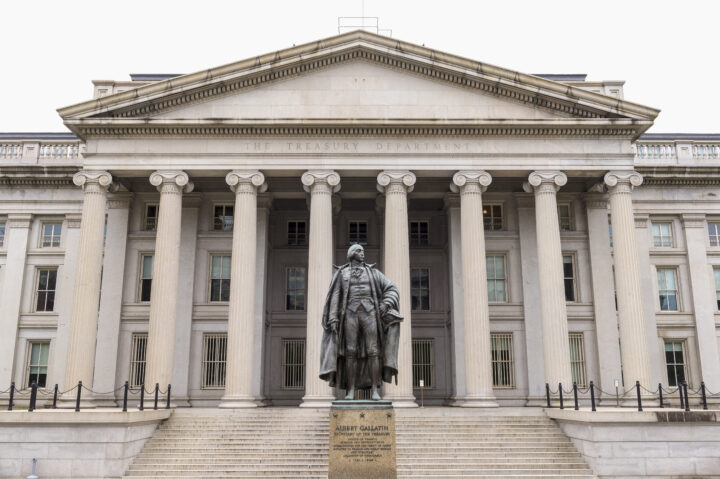
Building of the US Treasury Department in Washington, D.C.


 Add JewishInsider on Google
Jewish advocacy groups are celebrating a new set of wonky tax guidelines released last week by the Treasury Department that offer clarity into a new federal education tax credit that they hope will help more Jewish families access day school education.
Education-focused nonprofits have been awaiting guidance from the federal government about the program, which provides a dollar-for-dollar federal tax credit for people who donate up to $1,700 to organizations that fund certain approved education expenses, like private school tuition and tutoring costs.
Final guidance on the tax credit regarding regulations for the organizations, and where and how they can operate, as well as who will be able to receive the scholarship funds, are not expected to be issued until September. But last week, Kevin Salinger, the Treasury Department’s deputy assistant secretary for tax policy, did a whirlwind tour of virtual briefings with nonprofits to preview the forthcoming new guidance. Treasury also hosted an in-person briefing for stakeholders that included representatives from the Orthodox Union and Agudath Israel.
“The substance of the preview was very positive, and it was very positive for parents, for all families, for people who send their kids to public schools, to Jewish day schools and to private schools,” Sheila Katz, chief Jewish life officer at the Jewish Federations of North America, told Jewish Insider on Friday.
Passed as part of Republicans’ 2025 spending package, called the “One Big Beautiful Bill” by President Donald Trump, the federal education tax credit will formally get off the ground in 2027.
JFNA is working with its network of local Jewish federations to prepare for when the new scholarship-granting organizations (SGOs) are allowed to begin operating. The group wants people to know about the tax break they could be able to receive if they support SGOs operating within the Jewish community. Jewish organizations believe that the bump in giving prompted by the tax credit will substantially increase the amount of scholarship funds available to help Jewish children attend day schools.
Most of the conversation about the program is happening among philanthropists, educators and administrators; it is too early for all but the most plugged-in community members to be tracking the latest developments. Still, Jewish professionals working to advance the program say that the new messaging from the Treasury Department allows them to better communicate with stakeholders ahead of the program’s official launch.
“We’ve been making sure that everyone is updated, so school leaders, parents, donors, people interested in starting SGOs — really, we want to make sure that every single person, no matter what role they play as a donor, as a scholarship recipient, as a school, have all the information needed to make this the success that it can be,” said Sydney Altfield, CEO of Teach Coalition, the Orthodox Union’s advocacy arm that supports Jewish day schools.
One open question for Jewish organizations is whether each separate SGOs needs to be created in each state, or if those organizations could operate across state lines. The new guidance clarifies that SGOs can fund scholarships in multiple states.
“There is opportunity for a larger-scale SGO to help minimize community resources, and open up so many different operations,” said Altfield. “There could be a national Jewish SGO that helps every single Jewish day school, Orthodox, not Orthodox, whatever it may be.”
One of the biggest question marks has been which states will participate in the program, which requires states to opt in. Many Democratic governors have been hesitant to do so, wary that they will be seen as promoting school choice programs and undermining public schools.
The Treasury Department clarified last week that the SGOs can support public school students, which had previously been uncertain. Public schools are tuition-free, but the SGOs will be able to fund tutoring programs for public school students or support for disability inclusion.
“We were really, really pleased to hear their commitment to making this work for public schools,” said Katz.
Colorado Gov. Jared Polis was the first Democrat to pledge to opt into the program. New York Gov. Kathy Hochul, a Democrat, said last month that she will opt the Empire State into the tax initiative. Many other states with large Jewish communities, including Pennsylvania, New Jersey and California, have not yet weighed in. Altfield said that Teach Coalition’s focus for the rest of this year will be to convince Democratic governors to get on board.
“We are laser focused in making sure that other governors really understand it the way that [Hochul] understands it, of leaving money on the table for public school students,” said Altfield.
More Stories

AID CONVERSATION
GOP Reps. Kustoff, Goldman say Republicans want to see U.S. aid to Israel continue

Democracy Deficit
New report warns civics education crisis is fueling antisemitism, eroding support for Israel

EXCLUSIVE
Brandeis Center urges Qatar to provide ‘complete public accounting’ of campus funding

SAFETY SURGE
Hochul announces security funding, enhanced police presence ahead of High Holy Days

FLAGGING FICTION
Blinken denies report he delayed Hamas offer to free hostages
on the trail
Moskowitz leans into work combating antisemitism as he launches general election campaign
Please log in if you already have a subscription, or subscribe to access the latest updates.
 Continue with Google
 Continue with Apple