


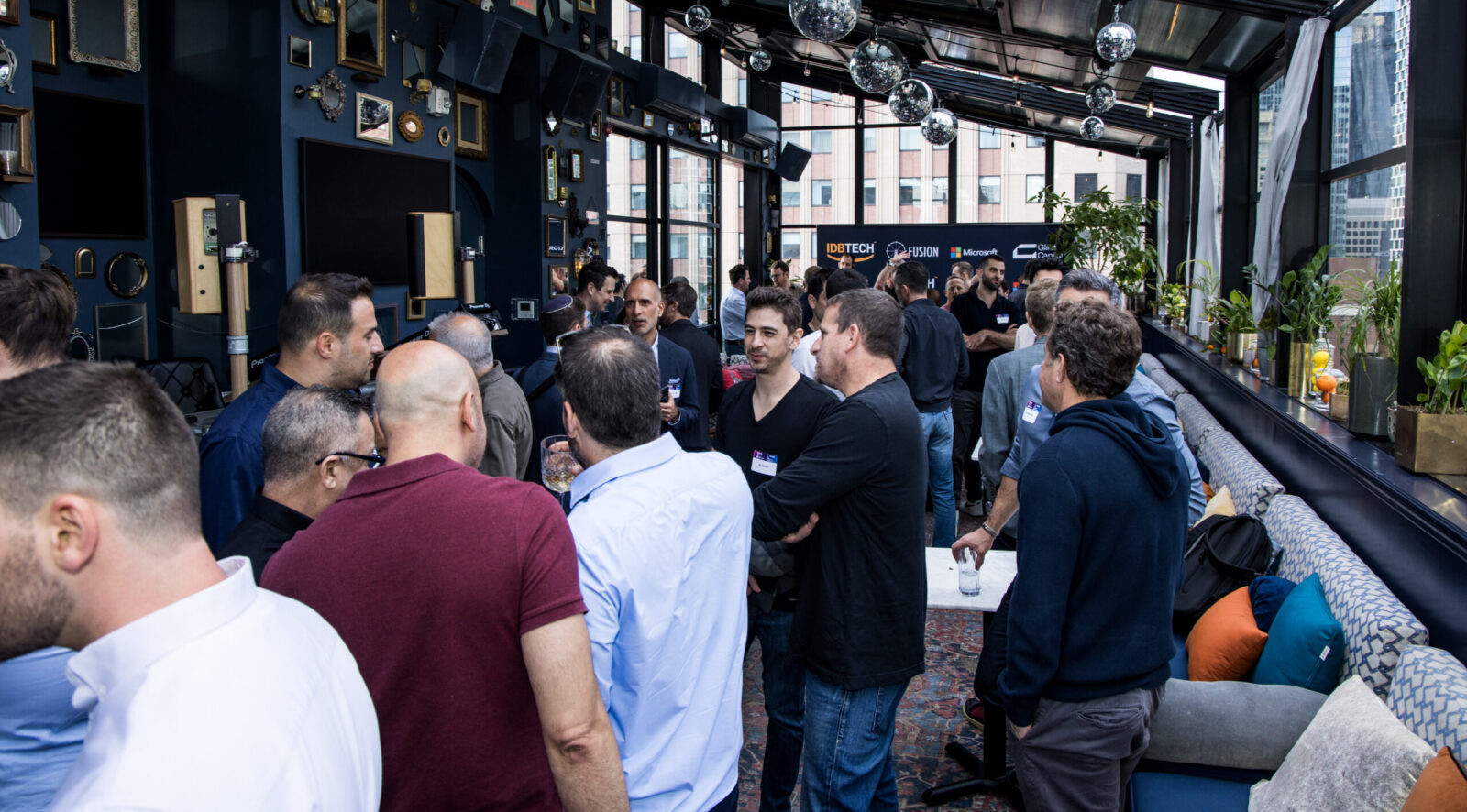
Courtesy
Israeli startup founders receive warm reception at New York Tech Week
Airwallex and Andreessen Horowitz brought 12 Israeli founders to New York to build relationships, pitch investors and learn from their American counterparts


 Add JewishInsider on Google
There’s a mantra in the Israeli startup world that its founders are months behind their American counterparts. New York Tech Week gave them a chance to close that gap, according to investors who descended on Manhattan last week.
Michael Morgenstern, head of startups at financial technology platform Airwallex, which teamed up with Andreessen Horowitz — one of the world’s leading venture capital firms — to bring a delegation of Israeli founders to tech week for the first time, told Jewish Insider that VCs are looking to see more AI products come out of Israel, which historically has been security focused.
“It would be interesting to see an AI lab out of Israel,” he said. “Why haven’t we seen an OpenAI or Claude, something of that status, coming out of the Israeli ecosystem? It makes me wonder if we are stagnating as an ecosystem. So exposing the Israeli market to what’s going on on the ground gives Israeli entrepreneurs the chance to get months ahead.”
“The mantra in the Israeli startup market right now is that Israeli founders and entrepreneurs are nine months behind the Americans,” he continued. “So if we can fly them here, make sure that people with low budgets — that will soon have high budgets — come to the U.S. and get on the ground, they’re going to get back to Israel with a whole new set of insights that are going to prepare them and be on par with the American companies versus the ones in Tel Aviv.”
“So it’s a very strategic play for them to come, get the experience and do the pitches. Ultimately, the U.S. is the ultimate market for most Israeli founders so if we can be the corridor at Airwallex and I can be the shepherd, it’s a delight to do so,” he said.
The 12 Israeli founders included in the delegation said they felt widely embraced at last week’s New York Tech Week, overwhelmingly saying that they felt no need to hide their roots.
“I feel I can be openly Israeli in the U.S. — specifically at tech week,” Aviv Shamny, founder of Limy AI, an Israeli startup that helps brands and products show up on AI search engines, told JI. “I didn’t feel any antisemitism at all at tech week.”
Shamny, who recently moved to the U.S. from Israel to grow his company — and served in combat following the Oct. 7, 2023, terrorist attacks — said the idea for his startup “came to me in the trenches of war.” For the past year, Limy has been part of A16Z Speedrun, an elite, highly competitive 12-week startup accelerator program operated by Andreessen Horowitz.
“People are really hustling,” said Morgenstern. “Last week was Boston tech week, next week is London. New York is the primo one. People are enjoying it. It’s decentralized as there’s what feels like thousands of events all over the city for every stage and profile.”
Morgenstern led several events throughout the week, including taking founders who recently moved to New York in a helicopter to give them their first tour of Manhattan. “We did a pitch in the air called ‘Up in the Air with Airwallex,’” he said, adding that amid historic rates of antisemitism, “I’ve only heard positive things from Israelis meeting with non-Israelis.”
The Israeli delegation consisted of entrepreneurs launching new startups — many of whom declined to speak with JI due to their companies’ stealth status.
“It was a very selective process,” said Morgenstern. “There were hundreds, if not thousands, of applications. Andreessen Horowitz picked the founders, and we’re strategic partners with them. We’re the ones supporting the founders with their banking and corporate operations. This is the first time we’ve done this and we plan on doing it again.”
Much of the A16Z delegation is composed of deeper infrastructure companies, working on AI tools, cybercompanies, fintech and defensetech.
“Historically, cyber is what Israelis have been known for, but it’s interesting to see the early-stages people try to zig when everyone’s zagging and look a little different to stand out,” said Morgenstern. “So an Israeli founder doing a consumer company, selling to individuals is very unique. Healthcare and fintech also. We’re also seeing some big rounds happening. A lot of Israeli teams are raising $10, $20, $30 million-plus out of stealth mode. It’s interesting they don’t want anyone to know what they’re doing, but at the same time they’re raising a lot of money and growing their balance sheet. From my seat in the VC land, I see an incredible demand and the resilience of Israelis right now is showing why they’re such an investable asset.”
“Generally, Andreessen Horowitz has a unique stance,” said Shamny, who was not part of the A16Z delegation since the firm has already invested in his company.
“On one hand, they don’t take sides, they take the side of innovation. They see Israel as one of the main innovation hubs and are really doubling down on it. We’ve been getting positive feedback from the firm. I do think this contributes to us being able to position ourselves as still the startup nation, regardless of all the antisemitism going on in the world. I think the war — regardless of what is wrong and what is right — has been impactful on Israel’s presence and what people think about us as Israelis. Andressen’s push toward Israeli innovation has been helpful in positioning ourselves.”
“As Israelis we are very proud to take part in this unique group of people and companies. It’s fun to be a part of.”
Yair Vardi, an Israeli American venture capitalist and founding partner of Fusion, Israel’s leading pre-seed fund, produced several events during tech week.
“I didn’t see reluctance to work with Israelis this week,” Vardi told JI. “On the contrary, New York is the home to over 400 Israeli startups. In the last few years, New York has become even more attractive for Israeli startups. I don’t see that changing even with politics. New York is home for the stock exchange and many Fortune 500 companies and a big Jewish community. [Israelis] aren’t happy with the new mayor [Zohran Mamdani], but I don’t think it pushes them not to come. This week we saw the numerous delegations coming out of Israel [including the one from] A16Z. I’ve attended a dozen events with Israeli entrepreneurs, from cybersecurity to legal and finance,” said Vardi.
A jam-packed week of networking ended with a Friday night Shabbat dinner organized by Brex and Tech Tribe, a New York-based community for Jews in tech and digital media, part of the Chabad Young Professionals network, founded by Rabbi Mordechai Lightstone.
“We try to create a Jewish community for people who work in startups and try to give them the tools and skills they need for what they create,” Lightstone told JI. “We constantly have conversations around the intersection of technology and Judaism; can you ask halachic questions to ChatGPT instead of a rabbi, those types of things.”
“New York Tech Week is something that has grown over the past couple years in general,” he said. “The city is booming with excitement and energy, much more than previous years.”
“Jews in tech have woken up and realized they have to really represent it, to go out there and say I’m Jewish, I have Jewish values and I’m proud of it. In the past three years we’ve seen a lot of that, and this week has been an expression of that,” said Lightstone, who hosted the first Tech Week Shabbat dinner just weeks after the Oct. 7 attacks. “At the time, it was a very cathartic experience for everybody to be together and feel comfortable when people were very on edge and felt they couldn’t speak in the workplace,” he said.
“There have been incidents of antisemitism in tech since Oct. 7, especially in the big companies. They didn’t always handle antisemitism well. They’re very careful with [diversity, equity and inclusion], but when it came to Jews [they] were lacking,” continued Lightstone.
About 100 VCs and founders attended the Shabbat in downtown Manhattan, which Lightstone called an opportunity for an “un-networking experience to connect and unwind from the week.” Guests were served arak and whiskey made by the Israeli startup Verstill, which utilizes AI technology in its spirits creation and maturation process, and Israel’s Jezreel Winery sponsored the wine. American Friends of Reichman University co-sponsored the meal.
Ahead of the dinner, Noga Sapir, the founder of a mental health startup called Reflect, who came from Israel for her first New York Tech Week, told JI the week was “great.”
“I’m fundraising right now so I’ve been looking at the events where founders and fundraisers meet,” she said. “I did have concerns [coming as an Israeli] but I was completely embraced. There has not been one person that when I told I’m Israeli didn’t say that’s amazing and awesome. I think because Israel is such a powerhouse for tech companies, people in the startup environment have come to expect an Israeli presence.”



Please log in if you already have a subscription, or subscribe to access the latest updates.
 Continue with Google
 Continue with Apple