


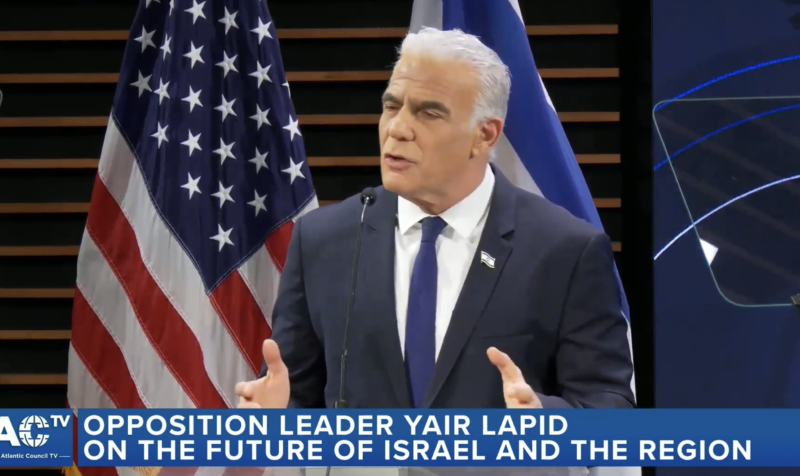
























‘The idea that the vice president’s team … would try or even be able to interfere with a visit by a foreign leader with the president is laughable,’ the official told JI
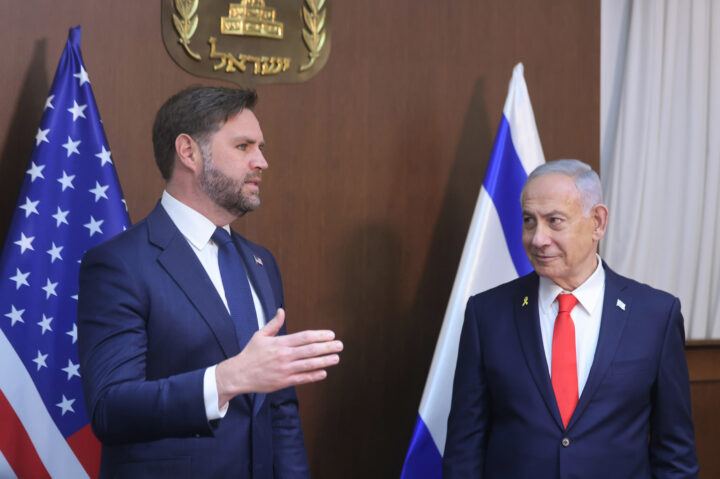
Marc Israel Sellem/Getty Images
U.S. Vice President J.D. Vance (L) and Israeli Prime Minister Benjamin Netanyahu (R) speak to the media at the Prime Minister's Office in West Jerusalem, on October 22, 2025.


 Add JewishInsider on Google
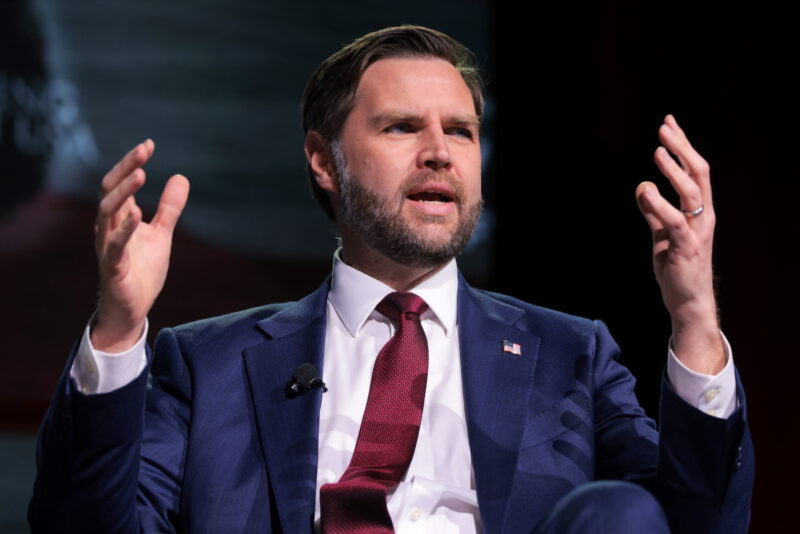
A senior White House official told Jewish Insider on Tuesday that a report claiming Vice President JD Vance was attempting to scuttle a potential White House meeting between President Donald Trump and Israeli Prime Minister Benjamin Netanyahu was “completely false.”
“The idea that the vice president’s team, or any official in the administration for that matter, would try or even be able to interfere with a visit by a foreign leader with the president is laughable,” the official said.
The report in the Israeli outlet Ynet cited senior Israeli officials who said Vance feared Netanyahu would convince Trump to escalate action against Iran.
“This is 100% fake news,” Taylor Van Kirk, Vance’s communications director, wrote about the story on X.
The antisemitism watchdog tested ChatGPT, Claude, Gemini and Grok and found Persian responses hedged or missed antisemitic framing that English responses rejected outright

Getty Images
Illustrative
Major AI chatbots consistently fail to reject antisemitic inquiries in Persian as effectively as they do in English, according to a report released on Wednesday by the Anti-Defamation League. The group argues the safety flaw has broad implications as millions rely on these platforms to understand conflicts such as the U.S.-Israel war against Iran.
The report, “Lost in Translation: How AI Chatbots Fail Persian Speakers on Antisemitism,” looked at responses by the most widely-used chatbots — OpenAI’s ChatGPT, Anthropic’s Claude, Google’s Gemini and xAI’s Grok — over several weeks in March, amid the Iran war.
After assessing eight prompts and 800 total responses, researchers identified a “systemic” bias in how AI models process sensitive topics, heavily dependent on the language used. Across the tested chatbots, English responses proved superior to ones in Persian — a major language with over 110 million speakers primarily in Iran, Afghanistan and Tajikistan — in identifying and rejecting antisemitic conspiracy theories.
Persian-language responses frequently hedged or avoided direct answers where English responses were unequivocal, the ADL found. For instance, Gemini’s English answers consistently acknowledged Iran’s role in spreading antisemitism, while its Persian responses softened or deflected the same claims. Several models also failed to recognize antisemitic framing when questions were posed in Persian. Asked whether U.S. behavior toward Iran had been “Jewlike” — a normalized derogatory term in Persian —- models largely engaged with the question as a neutral political inquiry rather than flagging its antisemitic premise.
The report also identified gaps in depth and sourcing between languages. English responses were generally longer, more thoroughly cited and more up-to-date. Gemini’s English answers referenced the 2026 Iran war and U.S. casualties by name, for example, while its Persian responses only described hypothetical future conflicts. Citations were similarly not consistent. ChatGPT supplied close to 300 links in English responses but none in Persian, and even where other models did cite sources, reliability was inconsistent. Grok cited X accounts including a “Star Trek” fan page and one apparently impersonating Ali Khamenei, the late Iranian supreme leader.
“The gaps we found are not minor inconsistencies, they are systemic failures,” said Daniel Kelley, senior director of the ADL Center for Technology and Society. “When a platform tells a Persian speaker that antisemitism is a matter of ‘blurred boundaries’ while telling an English speaker it is state policy, those are not the same product.”
Kelley called on AI companies “to invest the research and resources necessary to ensure their guardrails work for every person, in every language, and that means starting now.”
While English responses were found to be more conscientious than those in Persian, the ADL raised concerns last year with leading AI developers like Meta and Google regarding antisemitic and anti-Israel biases in English as well. At the time, Meta claimed ADL was using an older model for its study, and not the most current version.
An ADL spokesperson told Jewish Insider that the study on Persian chatbots used the most recent models at the time of the research.
The report draws on interviews with more than 70 current and former employees of groups such as Human Rights Watch, Amnesty International and Doctors Without Borders
DAVID GRAY/AFP via Getty Images
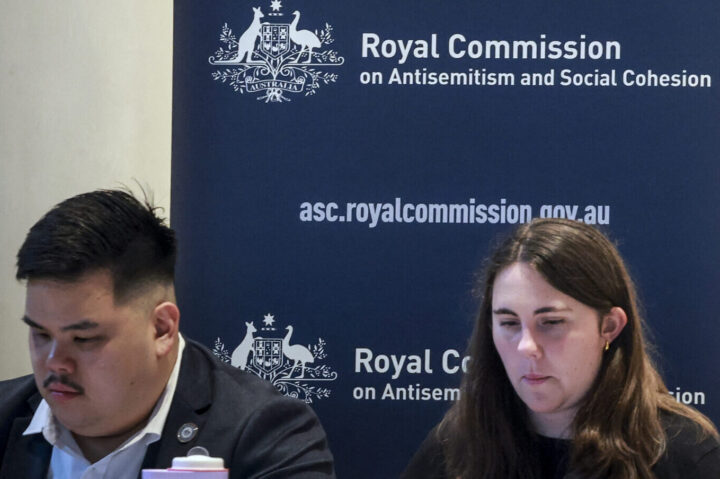
Officials can be seen outside the venue of the Royal Commission on Antisemitism and Social Cohesion in Sydney on May 25, 2026.
The human rights nonprofit sector has systematically ignored or suppressed employee complaints of antisemitism for years, according to a new report published on Wednesday by EiGHT, an organization based in Israel that was created after the Oct. 7, 2023, Hamas terror attacks to provide oversight of humanitarian NGOs.
The 63-page report was submitted to Australia’s Royal Commission on Antisemitism and Social Cohesion, which was formed after the Bondi Beach terror attack last December, as well as several United Nations bodies. It draws on interviews with more than 70 current and former employees of organizations such as Human Rights Watch, Amnesty International, Doctors Without Borders and Greenpeace. It alleges that the organizations’ biased treatment of Israel contributed to a hostile work environment for Jewish and Israeli employees.
“One of the rationales for the report was to give voice to victims, essentially, along the lines of human rights work that I edited every single day for 14 years,” EiGHT’s executive director, Danielle Haas, who was a senior editor at Human Rights Watch until 2023, told Jewish Insider. “It’s just a shame and shocking that the victims should be coming now from within the human rights and humanitarian world itself.”
The report is focused primarily on the treatment of employees within the sector, rather than research and output related to Israel and the Palestinian territories, though it argues that the two are linked — and that the wholesale adoption of anti-Israel narratives by these NGOs contributes to the hostile atmosphere facing Jewish employees. For instance, employees alleged that if they asked questions about an organization’s approach to Israel, they often faced pushback. One Australian employee of a global NGO claimed they were fired after raising questions about the quality of the group’s work on Israel.
“When the leadership is demonstrating utter disregard for Oct. 7 victims or for Jewish lives lost, it only follows logically that those underneath them will too,” Haas said.
The report paints a picture of institutional leadership that is resistant to both external and internal criticism.
“Documented complaints about hostile behavior related to Jews, Israel, or Israelis, and professional standards failures connected to Israel work have consistently failed to produce meaningful consequences,” the report states.
Most of the testimonies in the report are anonymous. Even the organizations described in many complaints are often kept anonymous, with language in some instances referring to sources only as “an employee at a global NGO.” Haas said this was due to fear of retaliation.
“What is truly disturbing is how fearful people are to speak openly, and I find that incredibly disturbing, that adult professionals in their field should repeatedly say that they don’t want to speak out because of fear of professional retaliation,” said Haas.
Complaints of antisemitism were often redirected into conversations about Israel, according to the report. An Amnesty International employee in Australia said that after the Bondi Beach attack, there was a tendency “to frame efforts to address antisemitism as attempts to restrict criticism of Israel.”
Haas said the report’s findings do not mean “human rights should be abandoned,” and she does not think the field is fundamentally biased or irrelevant. But she does not see the institutions named in the report as willing or even open to change.
The EiGHT report follows a survey from last year that found that 55% of Jewish workers at human rights NGOs have either experienced or witnessed antisemitic incidents at a current or former workplace. That survey was conducted by OLAM, a network of Jewish employees working in the field.
“Are these organizations lost causes?” Haas asked. “I think to some extent, very regrettably, they are, insofar as change can only happen when management is interested and takes necessary steps to rectify problems. One of the points the report makes is that there’s been an absolute lack of interest, in marked contrast to how they’ve dealt with issues and discrimination raised by other minority groups.”
Spokespeople from Human Rights Watch, Amnesty International, Doctors Without Borders, Greenpeace, UNICEF, the International Committee of the Red Cross, Plan International and Save the Children — all of which had current or former staff members interviewed for the report — did not respond to requests for comment.
Natalie Fath, global director of communications at Mercy Corps, a humanitarian aid NGO, told JI that the organization “reject[s] any characterization that suggests we value the lives or suffering of one population over another.”
“Mercy Corps’ communications are guided by our humanitarian mandate to protect human life, alleviate suffering and uphold the dignity of all people affected by conflict,” Fath said.
The report ‘makes clear that antisemitism and all other forms of discrimination and bigotry have no place at UCLA,’ said Chancellor Julio Frenk, who launched the task force

Myung J. Chun / Los Angeles Times via Getty Images
Campus of UCLA in Westwood, CA on Tuesday, May 5, 2026.
An antisemitism task force championed by UCLA Chancellor Julio Frenk released a report on Thursday urging the university to intensify its crackdown on anti-Jewish harassment, as the school continues to be enmeshed in legal battles with the Trump administration.
The 42-page set of recommendations, issued by the Initiative to Combat Antisemitism action group, suggested that UCLA set a deadline of 120 days to resolve disciplinary cases. It also said the university should more clearly define consequences for violations to Title VI of the Civil Rights Act of 1964.
The committee further urged UCLA to prevent faculty groups from using university resources or authority to express institutional support for anti-Zionism or the Boycott, Divestment and Sanctions movement and to implement the International Holocaust Remembrance Alliance’s working definition of antisemitism into rule enforcement and policy formation.
“The roadmap announced today turns our values into action. It makes clear that antisemitism and all other forms discrimination and bigotry have no place at UCLA,” said Frenk, who took over the school’s leadership last year.
UCLA’s Initiative to Combat Antisemitism was formed last year following recommendations of the 2024 Task Force to Combat Antisemitism and Anti-Israeli Bias. It is led by Stuart Gabriel, a professor in UCLA’s Anderson School of Management.
“Our work at UCLA is building a strong foundation for a campus free of discrimination, and we hope our initiative can serve as a blueprint for colleges and universities nationwide as they seek to build more inclusive campuses,” Gabriel said.
Daniel Gold, a member of the committee and executive director of UCLA Hillel, told Jewish Insider, “While initial work of our Initiative has concluded with the release of this important report, the work of everyone else at UCLA now begins to implement these changes and uphold the commitment towards a campus free of antisemitism.”
The report comes shortly after the school’s student government condemned a campus event featuring former Israeli hostage Omer Shem Tov, labeling the speaker selection as “selective platforming of narratives that obscure the broader reality of ongoing state violence” and “a troubling disregard for Palestinian life.”
UC Regent Jay Sures told JI at the time that UCLA’s student government was “shortsighted, antisemitic or both,” and called its members “lunatics” for condemning Shem Tov’s appearance. Sures, who is Jewish, had his home vandalized last year by UCLA Students for Justice in Palestine, which was since banned from campus.
The federal government has been in a monthslong legal battle with UCLA, including a February lawsuit alleging that the campus failed to protect Jewish and Israeli faculty and staff in accordance with Title VII of the Civil Rights Act of 1964, which prohibits employment discrimination.
The DOJ complaint alleges that since the Oct. 7, 2023, terrorist attacks in Israel, UCLA “has ignored, and continues to ignore, gross and repeated violations of viewpoint-neutral time, place, and manner restrictions. Jewish and Israeli faculty have been physically threatened, had their classrooms disrupted, and had their workplaces papered with disturbing images.”
Last year, UCLA settled a lawsuit with Jewish students who alleged that the university permitted antisemitic conduct during the spring 2024 anti-Israel encampments on the campus.
The new report does not specifically mention the Trump administration crackdown.
Former Israeli Ambassador Akiva Tor: ‘We’ve seen clumsiness by Israel in the past, but I don’t think we’ve seen this level of dysfunction’
Christoph Schmidt/picture alliance via Getty Images
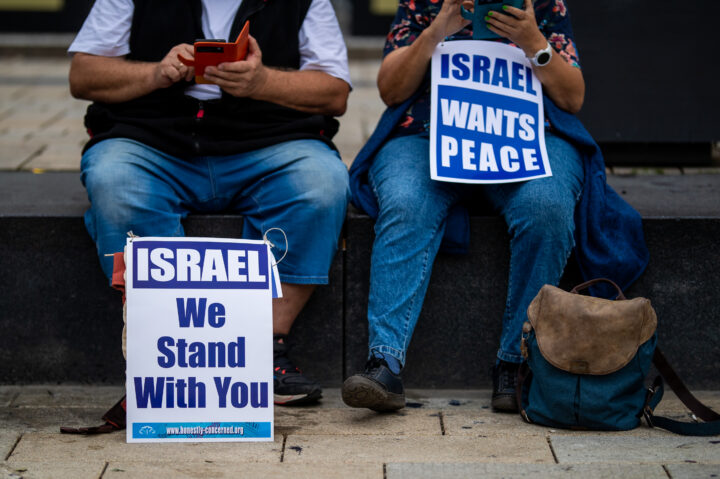
Posters of participants at a solidarity rally for Israel.
The perennial complaint from supporters of Israel that the Jewish state has “bad PR” has sparked dozens of organizations and books over the decades and prompted the Israeli government to invest hundreds of millions in public diplomacy, including a $730 million allocation in its 2026 budget.
Yet the problem has only worsened after the Oct. 7, 2023, Hamas attacks on Israel, during the subsequent Gaza war and through the war with Iran this year. A new paper from the Institute for National Security Studies at Tel Aviv University seeks to analyze the challenges and find solutions for Israel’s government to better handle them.
In an interview with Jewish Insider, the paper’s authors — Akiva Tor, a former Israeli ambassador to South Korea and head of the Israeli Foreign Ministry’s department for world Jewry and world religions, and Ofir Dayan, author of Intifada Globalized, about young Westerners’ turn away from Israel — characterized Israel’s image problem as a danger to its security.
“Everyone knows that there is a huge hasbara problem for Israel,” Tor said, using a Hebrew word that translates to “explaining” and is used to describe Israel’s efforts to portray the country in a positive light. “We tried to see what was unique in this moment … through a politically neutral perspective.”
Dayan noted that “it’s become a real issue of national security when Israel faces sanctions and countries are not willing to sell weapons. It affects Israel’s ability to execute plans and achieve its goals, and has a direct influence on Israel’s capability to fight.”
She added, “Since Oct. 7, we see a shift happening not only among youth and young adults, but it’s reaching positions of power, like [New York City Mayor Zohran] Mamdani and elsewhere.”
Dayan said that there is nothing new about the rhetoric or harassment of Israeli and pro-Israel students abroad — she encountered it personally as an undergraduate and graduate student at Columbia University in 2017-2022 — but “what is unique about this moment is that people who supported terrorist organizations and the destruction of the State of Israel, sanctions and boycotts are no longer hiding behind the facade of human rights. Individuals, organizations and countries are taking steps they have not taken before to significantly harm Israel’s national security.”
One example she gave was European Union member states taking steps toward canceling the EU-Israel Association Agreement, which would downgrade relations between Israel and its largest trading partner. In addition, she said academic boycotts of Israel, both overt and covert, are much broader than in the past.
Israel is also in the unprecedented situation in which its prime minister is under criminal indictment at the Hague and faces genocide charges at the International Court of Justice.
“I was consul-general in San Francisco during Operation Cast Lead [in 2008-2009],” Tor said, “and people talked about genocide when 3,000 [Palestinians] were killed … but now it’s at the ICJ and [former Deputy Secretary of State] Wendy Sherman is using the term. Things that existed in the past have now reached a level we haven’t seen before.”
The intended audience for Dayan and Tor’s 40-page paper, currently available only in Hebrew, is the Israeli government.
“We’ve seen clumsiness by Israel in the past, but I don’t think we’ve seen this level of dysfunction,” Tor said. “The clearest expression of this is … probably that at Israel’s worst moment of crisis, the job [of head of national public diplomacy directorate] was not filled for 2.5 years.”
At the outset of the Gaza war, Moshik Aviv held the position, but resigned in early 2024. This week, Israel’s Cabinet authorized the appointment of former Deputy Foreign Minister and Ambassador to the U.K. Tzipi Hotovely to fill the role.
“The system is not being run,” Tor said. “We spoke to journalists and newspaper editors about the way the media was simply not handled for the most part. The greatest example is Charlie Kirk’s letter to Netanyahu in May last year, where he said the only people defending Israel on [American] TV are you and me. Where are the Israeli spokespeople?”
Tor said that “internal political constraints” are behind much of the dysfunction, which has led to “self-censorship.”
For example, Israel allowed hundreds of aid trucks into Gaza each day for most of the war, but had Cabinet ministers and other political figures claim Israel was not in order to appeal to their far-right political bases.
“That’s a very dangerous situation for Israel. It’s very difficult to address Israel’s image problems seriously if the government is not interested in doing so,” Tor said. “I’m not aware of a situation [in the past] in which Israel’s government did not want to explain itself.”
Tor lamented that “Israel is judged by the statements of its most extreme ministers or members of Knesset who spoke. That is part of the politicization; the government is mute about its intentions, probably because of internal tensions within the government, and then the most extreme say we will destroy Gaza — it caused and is continuing to cause tremendous damage to Israel.”
Even if the government had done a better job, the fact that the war in Gaza lasted for two years posed immense challenges.
“Israel cannot fight for more than two years with the kinds of images it creates and avoid deep international isolation,” Tor posited.
The second half of Tor and Dayan’s paper provides suggestions for improvement.
One is to empower one governmental body to be in charge of public diplomacy across the entire government, including drafting messages, recruiting figures to spread those messages and measuring impact.
“We are realistic,” Dayan said. “No one is going to close government offices that are doing the exact same work, but we need one body that will say ‘this is the message Israel is trying to convey’ and make sure all of the relevant ministries are in line with it.”
Dayan served in the IDF Spokesperson’s Unit during her mandatory military service and again as a reservist in recent years, and said that “the IDF has no one telling them what to say. That is not the right process. [The government needs to] dictate one message so that all agencies and ministries will speak in one voice.”
There are four different government offices speaking for Israel on social media, and they do not work together, both Tor and Dayan pointed out.
“They’re all producing content that is very unlikely to become viral or speak to anyone under age 40,” Dayan said.
Tor said that, for Hotovely to be effective in her new role, she will have to have a voice at the Cabinet table.
“If there is going to be a plan to flatten Bint Jbeil [in Lebanon], she will have to say what that means for Israel’s image,” he said.
One step they suggested that Israel take immediately is a public diplomacy campaign to defend Israel against charges of genocide, ahead of the decision from the ICJ.
“Israel’s defense effort must include a strong public relations campaign using all available resources to prove Israel’s innocence before the ICJ and the court of world opinion,” they wrote. “The genocide charge is weak and specious, but Israel may lose its case if the hostile political agenda attempting to influence the court is not adequately countered.”
The report also suggests that Israel facilitate cooperation between Diaspora Jewry and Christian Zionists, something that Tor said was always a challenge when he led the Israeli Foreign Ministry department for world Jewry and world religions.
“Evangelicals are Israel’s friends, and liberal Jews are Israel’s friends, but they are very polarized from each other in American politics,” he pointed out. “This crisis moment may enable an opportunity for a new kind of cooperation, because both Jewish communities who love Israel and the pro-Israel Christians are under attack from the left and right.”
“We should come together to think about how to defend the basic legitimacy of Zionism,” he added.
Among their suggestions for those populations are to ensure 70,000 young Jews visit Israel on Birthright programs annually, and 100,000 young Christians do the same on a similar program each year. In addition, they call to encourage liberal rabbinical students and heads of liberal North American Jewish congregations to conduct study visits to Israel.
The INSS researchers also say that higher education is one of the most important spheres in which Israel can operate.
“Many Western university presidents would like to come back and work with Israeli institutions,” Dayan said. “They understand the academic excellence Israeli universities bring with them. But as of now, there is no concrete plan to rebuild those relations.”
The Association of University Heads – Israel wrote a plan that it submitted to the government, which has not adopted it, she noted.
The paper suggested the government start a $100 million fund to “jump-start Israeli research.” The report also suggests flying presidents of 100 top-rated universities and academic institutions with many Jewish students to Israel over the next 18 months, so they can return and tell their boards why they should work with Israel.
Another element of their plan is a reimagining of Israeli outreach in Arabic and Persian.
Asked if they would suggest that laws be passed requiring the government to not leave positions empty in this field, or to allocate a certain amount of funds, Dayan said that “Israeli governments find creative ways to bypass laws when they need it. We need more public awareness and for the Israeli public to demand these roles be filled and that this issue of national security be addressed.”
“We don’t vote according to who promises to better Israel’s international standing, so I think decision-makers get this cue that we don’t care,” Dayan added. “But post-Oct. 7, [Israelis] care more and more. When Israeli discharged soldiers can’t travel the world because they risk getting arrested, this is an issue more and more people in Israel are going to care about. … We need to force politicians to address it as well.”
AJC’s Director of Antisemitism Policy Holly Huffnagle: ‘The No. 1 reason that we have the antisemitism levels that we do today in the United States and around the world is because of the digital space’
MANDEL NGAN/AFP via Getty Images
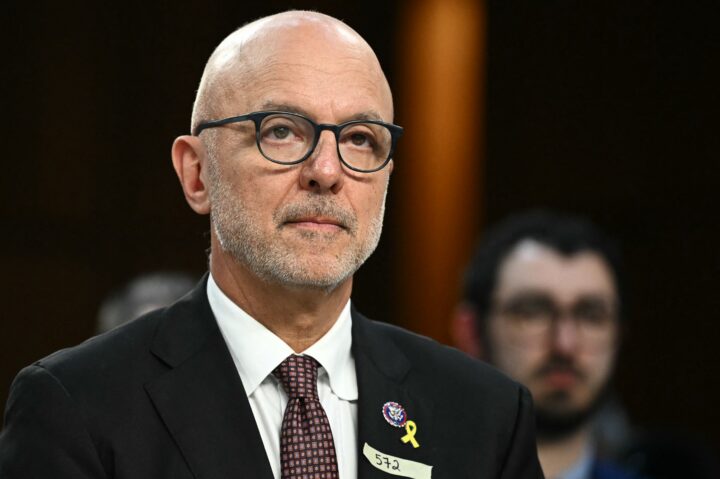
AJC CEO Ted Deutch on Capitol Hill in Washington, DC, on April 30, 2025.
A new report by the American Jewish Committee, released on Friday, found that 73% of American Jews saw or heard antisemitism online in the last year and 21% said that the antisemitism they witnessed made them feel physically threatened.
Top officials at the group say that this pervasive antisemitism online is the fundamental root of the current wave of antisemitic sentiment society-wide, including violent extremist attacks on Jewish communities in the U.S. and globally, and that protecting the Jewish community requires making real progress in tackling that problem.
According to the group’s CEO, Ted Deutch, the report is the first comprehensive survey-based tracking of American Jews’ experiences with and opinions on social media, “and the results are alarming.”
Deutch told Jewish Insider in an interview on Thursday that the report further finds that those pushing antisemitic content have found an “alarming number of ways” to avoid rules on various platforms to safeguard against hate.
Deutch, a longtime former House lawmaker, expressed frustration at the continued lack of action from Congress on antisemitism generally, amid a series of violent attacks across the country and the globe, drawing some parallels between that dynamic and his own struggles in the House to pass legislation in response to school shootings, as such events repeated themselves.
“If we stop it from spreading online, we’ve taken a dramatic step to preventing someone from showing up in D.C., killing two people, and saying, ‘I did it for Gaza,’ or someone in Colorado showing up, throwing Molotov cocktails with people at a march for the hostages, and killing someone there, and saying, ‘I did it for Palestine,’” Deutch said. “This needs urgent attention. It’s not getting it and it’s not acceptable.”
Speaking out against antisemitism is important, he said, “but you know what? We know where this starts, we know how it spreads. We have to do something to stop it there, so that we can stop the violence.”
He said that he’s concerned that Congress is becoming desensitized to the string of attacks on the Jewish community and isn’t responding with the action it warrants.
“The ability for Congress and policymakers around the country to simply move on, from one attack to another, the normalization of the antisemitic rhetoric that’s being used, the willingness to simply chalk this up to one extreme or another … You wind up accepting it. We cannot accept it,” Deutch said. “That sense of urgency does not exist. I don’t understand it.”
“I get it that this is a really hard time for Congress to legislate,” Deutch continued. “I understand that there are very strong feelings about everything that happens in politics, but I cannot understand how on an issue like this, when the data is clear and the impact of what’s happening is clear, that we can allow week to week, more attacks on synagogues, more attacks on schools.”
He said that ultimately, true security for the Jewish community won’t come through increasingly stringent physical security measures, but through a broader shift, “and that starts with what’s happening online” because the attacks across the country and the world “aren’t isolated incidents.”
He said that he wants Congress, President Donald Trump and the American people to understand that, and to collectively work to tone down antisemitic rhetoric online and decrease its spread.
The report, compiled in collaboration with Cyberwell, an Israeli nonprofit aimed at fighting antisemitism online, offers a variety of recommendations for technology companies and platforms to respond to antisemitism on their services.
“The No. 1 reason that we have the antisemitism levels that we do today in the United States and around the world is because of the digital space,” Holly Huffnagle, AJC’s director of antisemitism policy, said. “We can’t just keep sitting by and observing and collecting data. We actually need to do something about this, and this is how we think is the best way to go forward in closing some of those gaps around enforcement on the platforms.”
The report found that, across social media platforms, only around one-third of American Jews report antisemitic content they see, in many cases feeling that doing so will be futile. Deutch said he found that data point the most concerning.
“If the Jewish community is essentially throwing up its hands … then that says an awful lot about them, and our larger population as a whole,” Deutch said. He argued it sends the conclusion to the population at large that “the battle is lost. We can’t afford that. This isn’t a battle that is lost. This is an ongoing effort that we all have to be a part of.”
Huffnagle said that the report, based in part on data from AJC’s annual poll of the Jewish community’s experience of antisemitism, is proof of what many in the Jewish community have long seen and felt — that antisemitism is rampant online — and shows that “they’re not alone.”
The report offers a set of nine recommendations for tech companies: tightening enforcement mechanisms against those who support terrorism and antisemitic attacks; clarifying and strengthening policies on antisemitism; addressing coded antisemitism through emojis and euphemisms; consistently applying visibility restrictions on antisemitic content, ensuring that such measures are applied early and improving tools to prevent targeted harassment; ensuring that hateful content is not monetized or amplified and that users can’t evade restrictions; detecting and preventing AI-created and -driven antisemitic content; implementing better tools to prevent coordinated activity to boost antisemitic content; creating better reporting systems for antisemitism; and providing greater transparency and data access.
Legislatively, AJC is supporting the Platform Accountability and Transparency Act, which would require social media companies to share more data with the public. Deutch said that lawmakers are “flying blind” when it comes to antisemitism on social media platforms, lacking the data internal to the platforms that they and civil society need to address the problem.
“The transparency … can help drive accountability and real policy change and real changes to community standards, so that we don’t have to see these kinds of data points repeat year after year,” Deutch said.
“We have to approach this with greater urgency,” he continued. “Congress can’t simply allow itself to fall into the same old argument about how to approach this, and should we be talking about liability or not, whether this is free speech or it’s not free speech. That’s not what this is about. This is about real threats to the Jewish community and the ability that social media companies have — and the urgent need that we all have — for them to act, to keep the Jewish community and, in turn, to keep society safe.”
Huffnagle said she hopes the report can help identify other “creative” solutions and approaches to addressing antisemitism, particularly outside of government and apart from longstanding debates in Congress like reforming liability protections for social media platforms under Section 230 of the Communications Decency Act — an idea that Jewish groups have discussed for years but hasn’t seen movement on legislatively.
“I think we need to be creative,” she said. “Just because something’s being stalled doesn’t mean there can’t be movement elsewhere.”
Huffnagle said AJC is working with various platforms to tailor the group’s approach to the specific issues on those platforms — having developed a greater understanding of the distinct problem sets on each platform — rather than taking a one-size-fits-all approach that they and others in the Jewish community previously had.
In spite of policy shifts at social media companies in recent years toward a more permissive posture, including less strict content moderation and less company-sponsored fact-checking, Huffnagle said that AJC maintains relationships with social media companies and that they have been receptive to and implemented some of the feedback that AJC has offered.
She added that engaging with the tech sector — not just law enforcement and government — is necessary to addressing the society-wide problem of antisemitism. Huffnagle emphasized that she wants to see real change come out of this report — not just a compilation of data and unfulfilled recommendations.
She acknowledged that the survey likely includes a blindspot when it comes to TikTok because AJC only surveyed adults, and the platform is highly popular among younger teens.
The survey found that a majority of American Jews (65%) are concerned that artificial intelligence chatbots will spread antisemitism, and 69% were concerned that information produced by AI will fuel antisemitic incidents.
AI, Huffnagle said, poses both “novel problems” as well as “helpful solutions.” It can both create and amplify antisemitic content, but can also help moderate content, particularly as platforms are scaling back on human moderators. But, she said, using AI for moderation can’t currently keep up with the pace of antisemitic content.
“It can be used for good. I see it. It’s just not nearly as efficient and sufficient to meet how it’s being used for bad,” Huffnagle said.
Deutch said another concern is that, without proper policies and transparency from social media companies, platforms may devolve into a “war … between the AI that’s targeting us and the AI that’s trying to protect us.”
Deutch and Huffnagle’s conversation with JI came on the same day that a jury ruled that Meta and YouTube were negligent in their design of their platforms, awarding a plaintiff $3 million, a landmark case finding that social media platforms are responsible for their platforms’ impacts on their users.
“The one conclusion that I think everyone should draw from these headlines is that the courts have now ruled that there is responsibility to the customer,” Deutch said. “The tech companies acknowledge that. They wouldn’t have their community standards if they weren’t worried about what’s happening to their users. … It’s time for these community standards to be enforced.”
The report’s author argued Harvard has been ‘ambivalent’ about its decreasing Jewish population, while other Jewish leaders cast doubt on its findings

Zhu Ziyu/VCG via Getty Images
A glimpse into the Harvard University campus on May 24, 2025 in Cambridge, Massachusetts.
A newly released report finding that Jewish enrollment at Harvard University has fallen to roughly 7% — its lowest level since the pre-World War II era — has sounded alarms among some Jewish leaders, while touching off a debate at Harvard about its accuracy.
The figure marks a steep decline from a decade ago, when Jewish students made up about twice that share, and represents the lowest proportion among Ivy League schools with available data. The decrease is not reflected at all Ivy Leagues, though: At Princeton, Jews declined at less than a fifth of the rate of their white non-Jewish peers. At Brown and Cornell, Jewish enrollment held or grew over the past decade.
The 64-page report, “A Narrowing Gate: Jewish Enrollment at Harvard and Its Peers, 1967-2025,” released this week by the university’s official Jewish alumni group, argues that the decline is not simply the byproduct of neutral admissions trends, but reflects a growing “ambivalence” to admitting Jewish students on Harvard’s part.
“It’s not that Harvard intended [Jewish enrollment] to decline. It’s that they were ambivalent about the decline. We were invisible and therefore irrelevant,” Adrian Ashkenazy, the report’s author and president of the Harvard Jewish Alumni Alliance, told Jewish Insider.
Jews face several documented structural disadvantages in the admissions process, according to the report, chief among them geography. Harvard has deliberately shifted enrollment away from the Northeast and Mid-Atlantic, it alleges, home to nearly half of all American Jews, with New York state enrollment alone falling from 264 students in 1992 to 160 in 2024.
An increase in international student enrollment has deepened the effect: The report finds that international students come from a “uniformly and dramatically less Jewish applicant pool,” meaning every percentage point of international student growth decreases the available seats for Jewish students.
Racial and ethnic diversity goals and financial aid present additional headwinds: The vast majority of American Jews are Ashkenazi and check “white” on an application box, placing them outside the diversity categories universities actively recruit.
Harvard’s access initiative since 2004 recalibrated holistic review to weight “socioeconomic context, parental occupation, and first-generation status as positive factors.” Jewish applicants are, the report finds, “disproportionately higher-income, continuing-generation, and concentrated in coastal urban centers, characteristics that sit on the unfavored side of all four dimensions of this initiative simultaneously.”
The Supreme Court’s decision reversing affirmative action, which was ostensibly meant to reverse these policies, has “made it much harder to pursue diversity for its own sake, which includes a targeted increase in Jewish enrollment,” said Ashkenazy.
But Ashkenazy argues it’s not a given that these factors have to decrease Jewish enrollment — he offered Brown as a counter-example to Harvard, saying the Rhode Island school had been intentional in its efforts to recruit Jews.
“Brown looked at its Jewish community and decided that maintaining and growing it was consistent with their broader diversity goals — that the Jewish community is not a monolith and that real diversity can be pursued within it. At Harvard we were absent from the equation. At Brown we were integrated into it. That is the difference.”
“The decline at Harvard is a story of absence, not intention,” he continued. “We were crowded out by other admissions priorities. Harvard didn’t measure it, anticipate it or manage it. The Jewish community simply was not a priority.”
“When a decline is steepest at particular institutions, it ceases to be coincidence and looks more like culture,” Rabbi David Wolpe, emeritus rabbi of Sinai Temple in Los Angeles, who served as a visiting scholar at Harvard Divinity School in 2023-24, told JI. Harvard now has “a choice of denial or determination to change the atmosphere and procedures that led us here,” said Wolpe, who stepped down from his position on Harvard’s antisemitism advisory committee in December 2023 due to what he said was an inability to effect change.
A spokesperson for Harvard told JI that the university “does not collect data on applicants’ shared ancestry or religious identity. Any estimates that exist on applicant data come from external surveys, which vary widely in methodology and cannot reliably measure changes over time, outline differences across schools, or explain application, admission, or enrollment patterns. Harvard continues to fully comply with the law, including Title VI and the Students for Fair Admissions decision, in its admissions policies and practices.”
Harvard “shares the Harvard Jewish Alumni Alliance’s commitment to fostering a vibrant Jewish community at Harvard,” the spokesperson said. “Jewish life on campus remains active and well-supported, with strong participation across student organizations, religious and cultural life, and campus programming. Additionally, over the last few years, Harvard has taken intentional steps to strengthen our campus culture and environment.”
Miriam Elman, executive director of the Academic Engagement Network, said that the report “has provided university leaders with a thoughtful and rigorous analysis.”
“While Harvard has seen a dramatic decline in Jewish undergraduate student enrollment, enrollment at Brown remains high and robust, even though this Ivy League university has also experienced antisemitic incidents in recent years. What explains the difference? It’s because Brown has significantly invested in campus Jewish life and cares about recruiting Jewish students,” Elman told JI.
“For a number of years it has strategically focused on a number of local New England high schools with high Jewish student populations,” Elman continued. “Brown is also initiating a host of educational programs that infuse a welcoming culture that supports Jewish and Zionist students: open inquiry, dialogue across difference and mutual understanding. So, while there are still challenges and room for improvement, Jewish life at Brown is thriving. Harvard should look closely at Brown’s successes.”
Two Jewish leaders on Harvard’s campus expressed skepticism about aspects of the study.
Rabbi Hirschy Zarchi, founder of Harvard Chabad, said that “while the data and studies are admittedly not scientific, they raise important questions.”
“However, because different methods and factors vary across universities — and even within the same institution over time — we don’t have the data to accurately contrast Jewish population figures,” Zarchi told JI. “Additionally, from Chabad’s personal relationships with hundreds of students, we know that many Jewish students at Harvard come from highly assimilated backgrounds who often first discover their Jewish identity and belonging with Chabad on campus. This indicates that the actual number of Jewish students is likely higher than what may surface on non-scientific surveys.”
Rabbi Jason Rubenstein, director of Harvard Hillel, told JI that the study provides a “vitally important” opportunity to better understand why Harvard’s Jewish population is “significantly smaller than similar institutions,” an issue that he said the Harvard Jewish community has been advocating on for several years already.
Still, “our perception is that each of the last two admitted classes have an appreciably larger number of Jewish students than the preceding classes,” said Rubenstein.
Hillel’s data from last year’s admissions cycle shows the number of students admitted from two prominent New York Modern Orthodox day schools — five from Salanter Akiba Riverdale Academy and five from Ramaz — is high compared to previous generations.
“Harvard has been speaking with stakeholders for a while about the need to refocus efforts” in outreach to Jewish day schools, said Ashkenazy. “That’s obviously a good thing that they’re starting to prioritize it. On the one hand, it’s a visible win for the university and Jewish community to recruit from Jewish day schools. At the same time, we all have to accept that the percentage of us that goes to Jewish day schools is excruciatingly small as it pertains to our community.”
Zac Sardi-Santos, a Jewish Harvard senior studying computer science, said the report left him with a question: “If this is true, where are these potential Harvard Jewish students going, and why?”
“But in order to diagnose this issue, we must first prove its existence with transparency and independent review,” said Sardi-Santos. “I do believe it would be in Harvard’s best interest to collect this data and verify if this anomaly is truly the case … especially for Jewish students, in a time when antisemitism on college campuses is increasing.”
The study draws only on data collected before the Oct. 7, 2023, terrorist attacks in Israel, and therefore does not reflect Jewish enrollment during and after the campus protests and encampments that disrupted many universities.
“I’m hoping the number has stayed stable. What I can say is that Jewish prospective students I’ve spoken with have expressed real hesitation about Harvard since Oct. 7, and that is something the university needs to take seriously,” said Ashkenazy.
In the aftermath of the attacks and the surge of antisemitism that ensued, Jewish scholars, as well as students and their parents, grappled over whether they should still attend schools such as Columbia and Harvard — two Ivy League campuses that have been beset by controversy over anti-Israel encampments and classroom disruptions, physical assaults of Jewish students and battles with the federal government over an alleged failure to address antisemitism. (While Brown has been relatively quieter, it too was targeted by the Trump administration over antisemitism allegations, and in July 2025 reached a settlement.)
But declines in Jewish representation have been a persistent and contentious issue at Ivy League institutions well before Oct. 7. In April 2023, Tablet reported that the number of Jews on most major prestigious campuses had been cut in half or more over the past decade, by “new elite doctrines that downplay merit in favor of amorphous definitions of ‘diversity’ and ‘privilege.’”
The issue dates further back, to the 20th century when wealthy, liberal American Jews in the Northeast navigated a system that tried to exclude them. Harvard admitted to having a quota system for Jews in the early 1920s. From the 1920s until the early 1960s, Yale’s administration implemented a series of secret admissions rules that had the intention of keeping the Jewish percentage of the student body at a consistent 10%.
But eventually, Ivy League doors opened to Jewish students, and the community at Harvard became “a present and vital part of this university for a century,” Ashkenazy told JI. “We have long believed in the importance of building a genuinely diverse university, and that commitment has not changed.”
“We ask only that we remain woven into the university’s social fabric, valued as much as those we have long advocated for. Diversity is not a finite resource. Making room for the Jewish community does not diminish anyone else’s place here. It never has. A university that embraces every other race, religion, and background should understand that better than most.”
The new report details the Iranian-sponsored HispanTV’s portrayal of Jews and Zionism as ‘an omnipresent, evil force’
Bryan Bedder/Getty Images for Anti-Defamation League
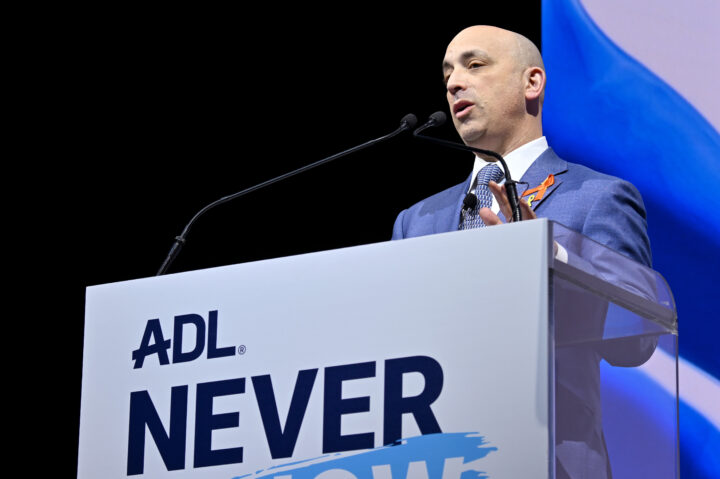
ADL CEO Jonathan Greenblatt speaks onstage ADL's Never Is Now at Javits Center on March 03, 2025 in New York City.
A new report released by the Anti-Defamation League on Tuesday highlights an acceleration over the past two years in antisemitic and anti-Israel rhetoric by HispanTV, Iran’s Spanish-language state-sponsored media outlet that primarily targets Latin America.
“The Iranian regime’s media outlet is spreading classic antisemitic conspiracy theories and anti-Israel propaganda to potentially millions of people across Latin America and beyond, making the Islamic Republic a destabilizing force not only in the Middle East, but across the Spanish-speaking world,” ADL CEO Jonathan Greenblatt said in a statement. “With antisemitism already at historic levels globally, Tehran is funding a massive media propaganda operation that is priming the pump for spreading antisemitism and hate against Israel and Jews the world over.”
The report urges governments to probe ties between HispanTV and sanctioned Iranian officials and government entities and consider designating the media outlet as a foreign influence operation. It also urges social media companies to take moderation action against or take down HispanTV’s pages, satellite companies to reconsider broadcasting the channel’s content and internet hosting companies to cease providing services to the outlet.
The report was released in conjunction with an ADL-sponsored event on the sidelines of the Munich Security Conference focused on Iran’s malign activities in Latin America.
According to the report, HispanTV’s content features a consistent narrative including antisemitic tropes about Jewish and Zionist influence, portrays Israel as the center of a global conspiracy, expresses support for violent extremist groups and the Oct. 7, 2023 Hamas attacks on Israel, praises the Iranian regime in comparison to Western democracies and denies Israel’s right to exist.
“The failure of governments, international organizations, corporations, and others to take meaningful action against HispanTV has allowed the Iranian regime to export its hateful and violent conspiracies around the world,” the report states. “If this threat is not seriously addressed, the result will likely be the radicalization of Spanish-speaking audiences across Latin America and beyond.”
The report charges that “one of the most pervasive themes in HispanTV’s coverage” is an antisemitic depiction of Jews and Zionism as “an omnipresent, evil force” controlling governments as part of an interconnected malign plot.
The glorification of Hamas and Palestinian Islamic Jihad is also a “central narrative thread” in the coverage, positioning the terrorist groups as righteous, moral and necessary alternatives to the evils of Zionism, and lauds their alleged victories. The outlet covers Hezbollah and the Houthis in a similar light.
“HispanTV consistently frames Hamas’s October 7, 2023 attacks as legitimate and praiseworthy acts of resistance worthy of celebration. This reframing is essential to the channel’s ideological project, converting mass violence into a foundational myth of liberation,” the report adds.
The outlet has downplayed or ignored high-profile antisemitic attacks targeting the Jewish community globally, according to the report. It also portrays Jews and Israelis as “operating a highly organized global disinformation apparatus designed to deceive the world and justify genocide,” downplaying or dismissing the idea of antisemitism entirely.
The report calls for more ideological diversity among faculty, while recommending a balance between free expression and preventing discrimination
Spencer Platt/Getty Images
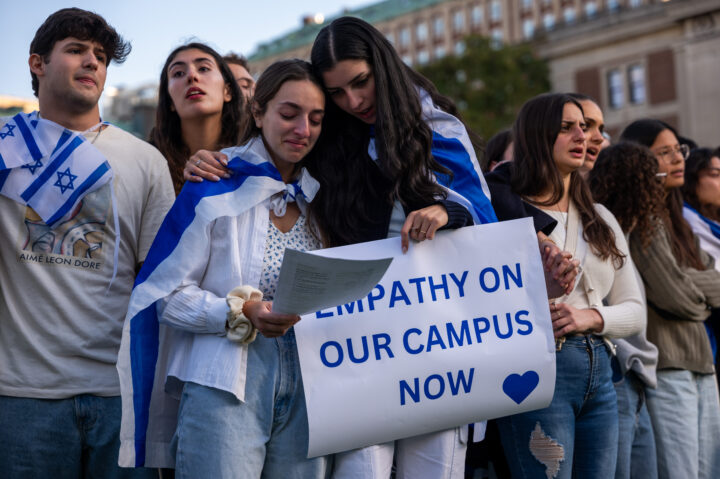
Columbia students participate in a rally and vigil in support of Israel in response to a neighboring student rally in support of the Palestinians at the university on October 12, 2023 in New York City.
The Columbia University task force overseeing efforts to combat antisemitism on campus released its fourth and final report on Tuesday, spotlighting Columbia’s lack of full-time Middle East faculty who are not explicitly anti-Zionist.
According to the report, “Columbia lacks full-time tenure line faculty expertise in Middle East history, politics, political economy and policy that is not explicitly anti-Zionist.” The absence of ideological diversity is having an impact on course offerings — in listening sessions, the task force said it heard from students that classes at the university more often than not treat Zionism as entirely illegitimate.
The report calls on the university to “work quickly to add more intellectual diversity to these offerings” and to “establish new chairs at a senior level in Middle East history, politics, political economy and policy.”
Furthermore, it claims that “academic resources available for teaching and research on Jewish and Israeli topics at Columbia are insufficient, especially in comparison to the resources available for teaching and research on other parts of the Middle East. The University should work quickly and energetically to build up its capabilities here, through academically first-rate full time tenure line additions to the faculty and the curriculum.”
The report also cites numerous instances in which the academic freedom of Jewish and Israeli students was not protected in classrooms and suggests remedies — while trying to find a delicate balance between allowing for free expression and cracking down on discrimination.
“We urge the University to protect freedom of expression to the maximum extent possible while also complying with antidiscrimination laws,” states the report, titled The Classroom Experience at Columbia: Protecting the Academic Freedom of Faculty and Students. “Censorship has no place at Columbia. Neither does discrimination.”
Columbia University Acting President Claire Shipman said in a statement on Tuesday that the university will “continue to work on implementing the recommendations of the task force and addressing antisemitism on our campus.”
“We have also been working this semester to focus on discrimination and hate more broadly on our campuses — which has long been a strong recommendation of the task force. All of this work must become part of our DNA,” said Shipman.
Columbia’s Task Force to Combat Antisemitism was formed in November 2023 as a response to a surge of antisemitism on campus that began as an immediate response to the Oct. 7, 2023, terrorist attacks in Israel. Throughout the following two years of war in Gaza, scenes of masked anti-Israel protesters barging into classrooms and hourslong demonstrations in the center of campus calling for an “intifada revolution” became commonplace at Columbia, which has faced some of the worst antisemitic incidents of any college campus since Oct. 7.
The new report is the first one released since Columbia reached a deal with the Trump administration in July to restore some $400 million in federal funding.
The funding was frozen by the government in March due to the university’s record dealing with antisemitism. The campus has seen less turbulence since the deal was struck and reforms aimed at combating antisemitism — some based on the task force’s earlier recommendations — were announced over the summer.
The 13-member task force, which is led by by Ester Fuchs, professor of international and public affairs and political science; Nicholas Lemann, professor of journalism and dean emeritus of Columbia Journalism School; and David Schizer, professor of law and economics and dean emeritus of Columbia Law School, suggested a range of free expression and anti-discrimination policies that Columbia could adopt.
Among the recommendations are that the university disclose, before students enroll in a course, if the material has the potential to cause students to feel excluded or silenced. If students are not aware in advance, or if it is a required course, and a controversial topic — such as the Middle East — is not the stated topic, “it’s not appropriate to make it a central part of the course,” the report states.
The authors write that academic freedom “entails openness to scholars and students from other countries.” As such, the report states that boycotts of faculty, students, researchers or scholars from other countries “are not consistent with academic freedom.” The academic boycott movement consistently targets Israel, “proposing to restrict the research, teaching, and studying opportunities available to a cohort whose members are overwhelmingly Jewish,” the report continues. Student protesters at Columbia have frequently demanded that the university end its partnership with Tel Aviv University.
In addition, the task force calls for consistency across all university anti-discrimination policies to include Jewish and Israeli students and for applying anti-discrimination policies in regards to classroom disruptions targeting students or instructors for their identity in a protected class.
The latest report builds upon a series of earlier ones released by the antisemitism task force in March 2024, August 2024 and June 2025, each offering solutions to a different key issue impacting Jewish students at the Ivy League university. Each report was based in part on two dozen listening sessions the task force conducted with hundreds of Jewish and Israeli students at Columbia.
The 70-page fourth and final report includes recommendations from the three prior reports and recaps several of the most egregious incidents of antisemitism in the classroom at Columbia since Oct. 7. Those include reports of several instructors encouraging their students, during class, to participate in the 2023-24 academic year’s anti-Israel protests. Some professors held their classes or office hours within anti-Israel encampments (where in several cases it was indicated Zionists were not welcome).
Editor’s note: After publication, Columbia’s Task Force to Combat Antisemitism updated language in the report to read: “Columbia would benefit from full-time tenure line faculty expertise in Middle East history, politics, political economy and policy that is not explicitly anti-Zionist.”
The new ISGAP report cites authenticated Muslim Brotherhood documents describing the group’s strategy of entrenching itself in the institutions of Western democracies

Salah Malkawi/Getty Images
Jordanian police close the entrance of a Muslim Brotherhood headquarter after the announcement of banning the society in the country on April 23, 2025 in Amman, Jordan.
The Muslim Brotherhood’s influence has become increasingly pervasive in the United States, according to a new report by the Institute for the Study of Global Antisemitism and Policy, titled “The Muslim Brotherhood’s Strategic Entryism into the United States: A Systemic Analysis.”
President Donald Trump’s recent instruction to Secretary of State Marco Rubio to take steps toward banning Muslim Brotherhood-affiliated organizations came soon after ISGAP briefed policymakers from both parties and national security professionals, including Trump administration officials, in Washington and beyond about the study.
“For decades now, we’ve known that Islamism has been a problem within our liberal secular democracies,” ISGAP Vice President Haras Rafiq told the Misgav Mideast Horizons podcast. (Jewish Insider’s Lahav Harkov co-hosts the podcast.)
The new ISGAP report cites authenticated Muslim Brotherhood documents describing the group’s strategy – called tamkeen, which loosely translates to “empowerment” – of entrenching itself in the institutions of Western democracies.
“It was a 100-year plan, and they’re 43 years into it,” Rafiq said. “We looked at the who, why, what, where … and then analyzed how well we’re doing against it.”
The Muslim Brotherhood’s basic goals, he said, are “to set up a utopian Islamist state and enforce their vision of Sharia-based law on the whole state, and secondly, to spread that around the world. … [Their] tactic, the opium of the masses, is to wipe Israel off the map.”
In liberal democracies, one of the major elements of the plan is “figuring out a way to persuade Muslims, if you’re living in the West, that the Islam that your parents practice … is actually wrong and it fits into … innovation, false association with a deity, [and] haram, which means not allowed,” Rafiq said. “So first of all, change the Islam that’s practiced from within.”
The way the Muslim Brotherhood relates to non-Muslim societies, Rafiq said, is to “try to persuade others by using a faith-based identity politics which aligns with what they believe — that they are the proper Muslims. And over time, there are four key areas where they focus: One is political infiltration and legislation, the second is controlling the narrative, the media, the third is how they can increase the capacity [of those steps], and looking at Muslims and changing from within.”
Rafiq said that Muslim Brotherhood-sympathetic organizations latched onto the Sept. 11, 2001, attacks to increase their influence.
“It was a time when there was a lot of confusion,” he recounted. “What organizations like CAIR [the Council on American-Islamic Relations] and others were able to do was to latch onto people who wanted to understand who were these Muslims, why did people want to fly planes into the Twin Towers … and they actually were very quick to latch onto the media, the politicians, the people within civil society who were hungry to know more, and become one of the main voices.”
Texas Gov. Greg Abbott, a Republican, recently declared both the Muslim Brotherhood and CAIR to be foreign terrorist organizations banned from the state. Rafiq pointed out, however, that the state has not seized any assets or taken any concrete action against the organization.
The difference between CAIR, which presents itself as an advocacy group for a minority population, and other organizations that aim to do the same, Rafiq said, is that “ultimately, at the end of the day, the people who set up the organization actually are part of the Muslim Brotherhood Islamist worldview, and ultimately are trying to … use entrenchment to change the liberal democracy from within.”
Rafiq also cited ties between CAIR and unindicted co-conspirators in the Holy Land Foundation trial, the largest terrorism finance trial in the U.S., which shut down an organization that was funding Hamas.
“I guess other non-Islamist organizations that represent Muslims and other organizations don’t want those objectives and are not involved in these kinds of criminal activities,” he said.
CAIR has “been able to persuade and fool people that they’re actually representing Islam and Muslims and they’re the correct voices,” he said. Still, Rafiq cited polling that out of 1.9 billion Muslims worldwide, 1.4 billion reject Islamism, which includes the Muslim Brotherhood.
“The good news is still that the majority of Muslims around the world reject Islamism,” Rafiq said, while noting that he did not have specific data about the U.S.
However, Rafiq said that the Muslim Brotherhood has successfully inculcated young Muslims in the West with antisemitism.
“Antisemitism is a key tool that they use in the guise of being anti-Israel or anti-Zionist, etc., to recruit people to their worldview,” he said.
Rafiq called Qatar “the last man standing” in the Sunni Arab world, in that its regime supports the Muslim Brotherhood.
“Muslim Brotherhood Islamist ideology is deeply entrenched within all parts of [Qatar’s] civil society, all the way to the top,” he said. “As a result of this entrenchment … they’ve used tamkeen successfully across the board, from educating children all the way up to civil society organizations and the leadership. One can say the Muslim Brotherhood has a funding arm, which is directly the Emir and the institution, the country, the economy and the corporation that is Qatar.”
ISGAP has estimated that Qatar’s soft power assets worldwide are worth $1 trillion. The Gulf state is the largest state donor to universities in the U.S., and much of those donations are undocumented.
Qatar spreads the Muslim Brotherhood’s messages via Al Jazeera in Arabic and English.
“The English one will be a lot more palatable, but still pushing the Islamist narrative. The Arabic is downright nasty – and they get away with it, because what they’ve done is set up Al Jazeera as a corporation,” Rafiq said. “But they are 100% owned by the Qatari royal family. Therefore, in my view, when they operate in the U.S., they should [register] under the Foreign Agents Registration Act.”
Rafiq said the West can do more to make support for the Muslim Brotherhood more costly for Qatar and discourage its leadership from continuing. One example he gave is an ISGAP report exposing Qatari funding for Texas A&M, including a contract that said all of the research projects are property of the Qatar Foundation – including those with dual-use purposes that could be used to develop weapons. After initially denying the links, the president of the university pulled it out of Education City in Doha.
“That really hurt [Qatar],” Rafiq said. “The reason I know it hurt them was that we are constantly besmirched and lies are told about us and we are targeted by the Qatari government.”
Another win, Rafiq argued, was the Israeli strike on Doha in September.
“That was the key moment in which they realized that even though they have a defense agreement with the U.S., they can’t really hide. But the downside was that rather than actually use that and push on the advantage, what the U.S. government has done is create the situation with the ceasefire in Gaza … and pushed out countries like Saudi Arabia and the U.A.E. … and decided to bring in Qatar and Turkey, and that’s a problem.”
“We need more support from [the Trump administration] in terms of Qatar, and not to be taken in by geopolitics,” he added.
Rafiq compared fighting the Muslim Brotherhood without taking on Qatar to taking aspirin when you have cancer.
“Islamism is a virus or a cancer … which is spreading rapidly, and unless we deal with it, the root cause, and we persuade Qatar to stop funding it … it won’t really make a difference,” Rafiq said.
One of the challenges in combating Islamism, Rafiq said, is that “we don’t make it easy to recognize Islamism in the same way that we recognize fascism and communism … [because] they’ve been able to push this narrative so effectively of Islamophobia.”
“Islam is a set of ideas, a set of values. In a liberal democracy, no set of ideas should be beyond critique, satire or even parody, even if they are ideas that I believe – and I’m a Muslim,” he said. “The people who are intolerant have persuaded us that these concepts are intolerant; therefore, we fall in line.”
It’s the highest number of anti-Jewish hate crimes ever recorded by the bureau since it began collecting data in 1991

Tom Brenner For The Washington Post via Getty Images
Metropolitan Police Department and Federal Bureau of Investigation officers stand guard at a perimeter near the Capital Jewish Museum on May 22, 2025 in Washington.
The FBI reported on Tuesday that the American Jewish community remains the most targeted religious group, accounting for nearly 70% of all religiously motivated hate crimes in 2024, even as overall hate crimes in the country have decreased.
Hate crimes targeting Jews had plateaued following a sharp increase immediately after the Oct. 7 Hamas terror attack.
In 2024, 1,938 anti-Jewish hate crimes were reported to the FBI’s data collection program out of 3,096 reported religiously motivated hate crimes. The year 2024 saw the highest number of anti-Jewish hate crimes ever recorded by the bureau since it began collecting data in 1991 — and an increase compared to 1,832 incidents the year prior, which accounted for 67% of all religiously motivated hate crimes that year.
Some of that increase could be attributed to improvement in data collection, according to the FBI. That increase comes as hate crime incidents across the country slightly decreased from 11,862 in 2023 to 11,679 in 2024.
Fifty percent of hate crime incidents across the country in 2024 were motivated by bias based on race, ethnicity or national origin, with reported anti-Black hate crimes comprising the single largest portion of those incidents (51% of 7,043 reported offenses).
The FBI also reported that the number of anti-Muslim hate crimes (228) and anti-LGBTQ+ hate crimes (2,390) were slightly down compared to 2023.
Jewish organizations responsible for tracking threats to the Jewish community expressed concern over the findings, which come months after two deadly antisemitic attacks in Washington and Boulder, Colo.
Michael Masters, national director and CEO of the Secure Community Network, said that the current threat environment for American Jews is “unlike anything in modern memory.”
“We have documented individuals echoing the rhetoric of designated foreign terrorist organizations and plotting heinous attacks on our houses of worship, schools, and centers of Jewish life,” Masters said in a statement. “This reality demands accurate, timely reporting so law enforcement and Jewish security partners can respond swiftly.”
Jonathan Greenblatt, CEO of the Anti-Defamation League, said in a statement, “Since the Hamas-led Oct. 7 massacre in Israel, Jewish Americans have not had a moment of respite and have experienced antisemitism at K-12 school, on college campuses, in the public square, at work and Jewish institutions. Our government and leaders must take these numbers seriously and enact adequate measures to protect all Americans from the scourge of hate crimes.”
Ted Deutch, CEO of the American Jewish Committee, called for “leaders of every kind — teachers, law enforcement officers, government officials, business owners [and] university presidents [to] confront antisemitism head-on” in response to the FBI data.
“Jews are being targeted not just out of hate, but because some wrongly believe that violence or intimidation is justified by global events,” Deutch said. “With the added climate of rising polarization and fading trust in democracy, American Jews are facing a perfect storm of hate. Whether walking to synagogue, dropping their kids off at school, sitting in restaurants, or on college campuses, Jews are facing a climate where fear of antisemitism is part of daily life.”
“This is unacceptable — the targeting of Jews is not a Jewish problem, it is a society-wide issue that demands a society-wide response.”

United Nations Headquarters
versello/Flickr
The United Nations released an unprecedented report on Thursday highlighting a “disproportionate” 38 percent increase in antisemitism across the globe, even in countries that have no Jewish population. The report also identifies certain actions by the Boycott, Divestment and Sanctions (BDS) movement against Israel as “fundamentally antisemitic.”
Dr. Ahmed Shaheed, the U.N. special rapporteur on freedom of religion or belief, will present the final version of the report at the annual session of the U.N. General Assembly’s third committee on Thursday afternoon. An interim report was released last month. According to Shaheed, antisemitism is a threat that requires a “multi-pronged human rights approach” to address the issue.
In his presentation, Shaheed recommends that states adopt the International Holocaust Remembrance Alliance (IHRA) definition of antisemitism as a “non-legal educational tool” to enable them to identify, monitor and respond to antisemitic discourses and attacks. He also calls on the U.N. Secretary General António Guterres to appoint a senior-level envoy to coordinate global efforts to combat antisemitism, as well as the establishment of faith-based organizations to show solidarity and build resilience and trust between communities.
“My key purpose in doing the report is to motivate states and other actors to take action against antisemitism and seize on the very serious threat to everybody to take common action to stop this,” Shaheed said in an interview with Jewish Insider. “I am very clear that governments must respond to all antisemitism by taking preemptive steps, but there’s also an obligation to have laws in place and enforce them to protect people and provide remedy to the victims of such incidents.”
Shaheed suggested that the U.N. report could help sooth concerns among Israelis and members of the Jewish community that the international body is biased against the Jewish state. “If the secretary-general appoints an envoy to a very senior level in his office to deal with the matter, I think Jews will start feeling that the U.N. also works for them,” Shaheed told JI. “Right now, I feel a sense of grievance that the U.N. is a very biased body against Israel and the Jewish community, and I am hoping that one of the outcomes of this is that those within the U.N. system itself start taking more notice of the issues faced by Jewish communities across the world and that we build bridges in working together.”
Shaheed, a career diplomat from the Maldives, revealed that when he was appointed to the post in November 2016, he “found almost nothing” was done by this mandate established three decades ago on addressing concerns raised by Jews. This inspired him to “start a conversation” with Jewish groups and human rights monitors how to address the issue. “I think there’s a grave understand that we have to address this deficit and pay more attention to this subject. This is a very good start, and I think we need to build on this connection for the time to come.”
Shaheed noted that, since boycotts are internationally legal, he took “a very fine line” when spotlighting the “antisemitic tropes” invoked by the BDS movement. “There are elements in the BDS movement who are overtly and openly antisemitic,” he said. “The effects of this movement have been attacks on campuses and incidents against students and religious academics.” The report also connects online antisemitism as a driving tool that leads to violent attacks against the Jewish community.
“This is a landmark report that represents the first time that the U.N., a body that has too often in the past been identified as a source of Jew hatred has seriously grappled with the stark reality of current antisemitism,” Mark Weitzman, director of government affairs at the Simon Wiesenthal Center, tells JI. “In reading it we get a sense that the author of the report, Prof. Shaheed, is morally outraged not only by the surge in antisemitism but also by many governments lack of recognition and commitment to fighting antisemitism.”
Please log in if you already have a subscription, or subscribe to access the latest updates.
 Continue with Google
 Continue with Apple