
















The lawmakers argue the meeting, which was canceled after interference by the State Department, should be investigated for potentially violating of the Logan Act

Photo by MADISON SWART/Hans Lucas/AFP via Getty Images
New York Working Families Party co-directors Ana Maria Archila (R) and Jasmine Gripper (L) take the stage during a rally in support of Zohran Mamdani at Brooklyn Steel in Brooklyn, New York, on May 4, 2025.


 Add JewishInsider on Google
Several House Republicans sent a letter on Thursday to the Department of Justice calling for an investigation into whether New York City Mayor Zohran Mamdani and his international affairs commissioner, Ana María Archila, violated the Logan Act by scheduling a meeting with the Iranian ambassador to the United Nations.
Archila, who heads the New York City Mayor’s Office for International Affairs, had previously scheduled a July 7 meeting with Amir-Saeid Iravani, Iran’s U.N. ambassador, before the State Department intervened and the meeting was canceled.
Mamdani claimed last week that the meeting was “made in error” and had been scheduled without his knowledge. The mayor also stressed that the Iranian mission had reached out to his team and not the other way around.
The lawmakers argue that the planned meeting should be investigated for potentially violating the Logan Act, a centuries-old statute that prohibits American citizens from negotiating with foreign governments without authorization on behalf of the United States.
The letter was led by Rep. Addison McDowell (R-NC) and also signed by Reps. Buddy Carter (R-GA), Clay Fuller (R-GA), Pat Fallon (R-TX), Randy Fine (R-FL), Riley Moore (R-WV), Wesley Hunt (R-TX), Lauren Boebert (R-CO), Pete Sessions (R-TX), Pat Harrigan (R-NC), Rich McCormick (R-GA), Claudia Tenney (R-NY), Anna Paulina Luna (R-FL), and Max Miller (R-OH).
The lawmakers said they were especially concerned about the attempted meeting in light of negotiations between the U.S. and Iran being “in a critical stage.”
“Given its timing, we believe this proposed meeting may have presented significant national security risks,” the letter reads. “In light of this, we respectfully ask that the Department of Justice investigate potential violations of the Logan Act on the part of the mayor’s office.”
“We support President Trump’s efforts to shore up American economic and national security interests in the Middle East, and we understand the vulnerable nature of continued peace negotiations,” it continues. “For that reason, we believe that a formal investigation is necessary to determine whether Commissioner Archila, acting on behalf of Mayor Madani, engaged in any unlawful activity or communication with the Islamic Republic of Iran.”
The mayor’s office did not immediately respond to a request for comment.
Israeli Ambassador Yechiel Leiter said Khanna had declined a request to coordinate with the embassy for the trip where he was stopped by Israeli settlers in the West Bank
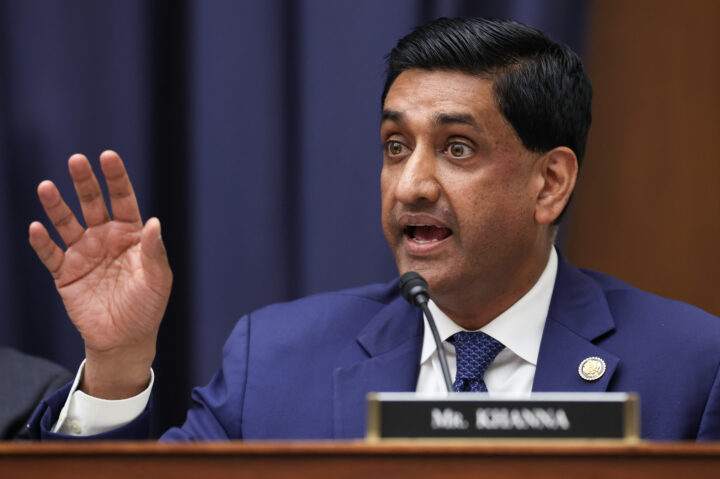
Photo by Win McNamee/Getty Images
Rep. Ro Khanna (D-CA) questions U.S. Secretary of Defense Pete Hegseth as he testifies before the House Armed Services Committee April 29, 2026.
Rep. Ro Khanna (D-CA) on Sunday called on Israeli Prime Minister Benjamin Netanyahu to launch an investigation after the lawmaker said he was harassed by Israeli settlers in the West Bank last week, an incident Netanyahu attributed to a small group of “vigilantes.”
During his first known trip to Israel and the West Bank since October 2024, Khanna said that his delegation’s van had been surrounded, stopped and taunted last Wednesday by Israeli settlers armed with U.S.-made M4 rifles during a tour of the southern West Bank, an incident that a New York Times photographer traveling in a different vehicle said he witnessed.
Khanna claimed IDF vehicles then appeared, and the soldiers spoke amiably with the settlers and continued to block the road themselves after the settlers departed. The IDF denied that the visitors were detained by military personnel.
Cameron Kasky, an aide to Khanna, said the group was held for over an hour and appealed to the U.S. Embassy in Jerusalem for assistance. Kasky previously ran in the Democratic primary in New York’s 12th Congressional District on an explicitly anti-Israel platform.
Khanna told NBC News the incident had made him “more resolved” to consider a presidential run in 2028.
“I have something unique to offer about the injustices of Palestinians,” he told the Times. “I’m going to go to every corner of America, regardless of whether I run or not, and tell their stories and tell the story of what is happening in the West Bank.”
An IDF spokesperson told NBC that troops and police officers were dispatched to the scene in a “closed military zone” after a “report was received regarding Israeli civilians who were unlawfully blocking the vehicle of foreign nationals.” The military said the soldiers reopened the road and let the delegation through.
Israel Police said that officers on the scene did not witness any violence and that the group was stopped in a restricted zone. Israel prohibits its citizens from entering certain areas of the West Bank without an IDF permit, particularly Palestinian Authority-controlled Area A, which are typically marked with warning signs. Foreign civilians are generally not legally barred from these areas, though they may be subject to security advisories or temporary restrictions.
Police added that Khanna’s tour group leader was warned of a possible arrest and that the group was told that civilians were not permitted in the area, before being released. Khanna said that his office had alerted the Israeli Embassy in Washington of his visit — a claim that was denied by the Israeli Ambassador to the U.S. Yechiel Leiter.
Speaking on CBS’ “Face the Nation,” Leiter said that Khanna’s team did not alert Israeli authorities, saying instead that the California lawmaker had ignored a request from officials to allow them to assist in coordinating the trip.
“We reached out to him [Khanna] when we heard he was going to Israel … We suggested he visit with survivors of the Oct. 7 [2023] massacre, that he visit the borders so he understands the issues that we have on our borders and so on,” Leiter said. “He [Khanna] ignored that and he decided to coordinate his trip not with Israel, but with Palestinian activists and with J Street.”
“There was a question about visas, that’s all,” Leiter added of Khanna’s outreach to the embassy. “But when we requested that he coordinate the trip with us, he rejected that by basically staying silent.”
J Street President Jeremy Ben-Ami on Sunday denied that J Street had any involvement in organizing Khanna’s visit.
Speaking on NBC’s “Meet the Press” on Sunday, Khanna called the encounter “unprecedented” and accused the IDF of “lying.”
“They had violent settlers detain American citizens, including an American government official,” Khanna said. “You had these settlers brandishing M4s, kicking the tires of our van, laughing at us, mocking us, videotaping us. We were detained for about 20 minutes, fearful for our lives. Then the IDF comes, four soldiers, they tell our translator that they’re on the side of the settlers.”
Also appearing on NBC on Sunday, Netanyahu insisted that Israel is “a country of laws” and blamed the confrontation on a fringe group of “vigilantes.”
“We’re a country of laws, and people who break the law, we take them to court,” Netanyahu said. “There is a vigilante effort, not by the settler community … There are 150 juvenile delinquents that are not part of that community. They come from other parts of Israel. I don’t want vigilantes of any kind, and we are working to put them under the law.”
Responding to Netanyahu’s remarks, Khanna pushed the Israeli leader to further investigate the matter.
“The prime minister needs to open an investigation on these violent settlers,” Khanna said. “They need to be prosecuted … their outpost needs to be investigated, and he [Netanyahu] needs to have an investigation on these four IDF officers.”
“Security cameras can see that they were involved in the detention of American citizens,” he added. “How dare they mistreat people with an American passport that way?”
‘We don’t need your money (it’s probably coming from AIPAC anyways),’ the shop wrote in a since-deleted social media post
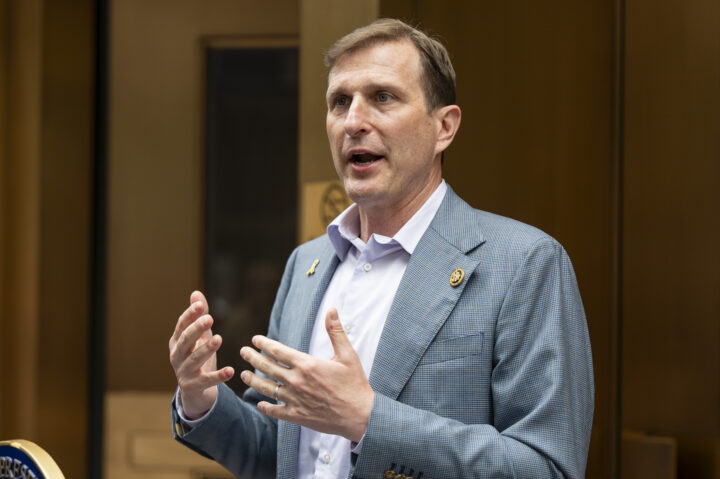
Mostafa Bassim/Anadolu via Getty Images
Rep. Dan Goldman (D-NY) speaks to members of the press during a press conference on ICE practices in immigration courts outside Ted Weiss Federal Building in New York, U.S., May 29, 2025.
The Department of Justice’s Civil Rights Division is investigating a Brooklyn cafe after it banned Rep. Dan Goldman (D-NY) from its store, posting discriminatory messages online that accused the congressman of enabling genocide and tying him to AIPAC.
“Federal law prohibits public accommodations such as coffee shops from discriminating against patrons based on their race, religion, or national origin. These actions are not only reprehensible, they’re potentially illegal. The Civil Rights Division has opened an investigation, and will bring an enforcement action if warranted,” Harmeet Dhillon, the DOJ’s assistant attorney general for civil rights, said.
“We see that you stopped by our shop today for a coffee. Do you see how it doesn’t taste like genocide juice?” Poetica Coffee in Williamsburg wrote in a since-deleted Instagram post with an image of Goldman standing at the register. “We don’t serve racists, fascists, homophobes, genocide enablers. Too bad we didn’t recognize you right away, or we would have turned you away.”
“We don’t need your money (it’s probably coming from AIPAC anyways),” the post continued. “Don’t ever come to Poetica.” The shop said it refunded Goldman for his $9.82 purchase.
The coffee shop is owned by Parviz Mukhamadkulov, who has frequently used social media to share posts condemning Israel. Poetica Coffee’s website claims it serves “whoever walks through the door is treated with unconditional dignity.”
Goldman is facing a primary challenge from former New York City Comptroller Brad Lander in Tuesday’s election. Both candidates are Jewish and self-identified “progressive Zionists,” although in a debate earlier this month Goldman declined to join Lander in calling the Israeli military actions a “genocide.”
A spokesperson said the school was ‘shocked and deeply troubled that this hateful symbol expressing antisemitism was raised’ and is cooperating with police
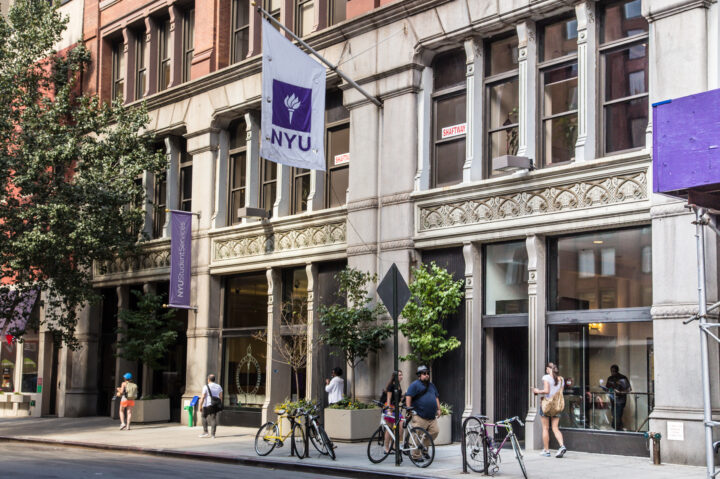
Getty Images
Street view of New York University NYU in Greenwich Village Manhattan.
The NYPD is investigating an incident where a flag displaying swastikas and a Star of David was flown atop an NYU building on Wednesday.
Appearing near Washington Square Park, the flag mimicked the purple NYU banners seen across campus, yet it was emblazoned with a Star of David flanked by two swastikas. It was flown on the roof of the Steinhardt building, named in honor of its Jewish benefactors, Michael and Judy Steinhardt.
The NYPD said it became aware of the flag when it received a 911 call at 5:21 p.m. reporting harassment. The flag, which was hung near a graduation event, was removed about 15 minutes after it was reported, according to Washington Square News, NYU’s student newspaper. The investigation remains ongoing as of Thursday evening.
“We are shocked and deeply troubled that this hateful symbol expressing antisemitism was raised on a flagpole overlooking Washington Square Park. Campus safety responded immediately to remove it and we are working closely with the NYPD to identify whoever is responsible,” Wiley Norvell, spokesman for NYU, told Jewish Insider.
“We are one community. We protect each other. And we will not let hate and division find a foothold on our campus.”
Angie Craig calls on Minnesota Democrats to investigate antisemitism ahead of state party convention
Delegates are expected to take up divisive anti-Israel resolutions at the convention being held next month
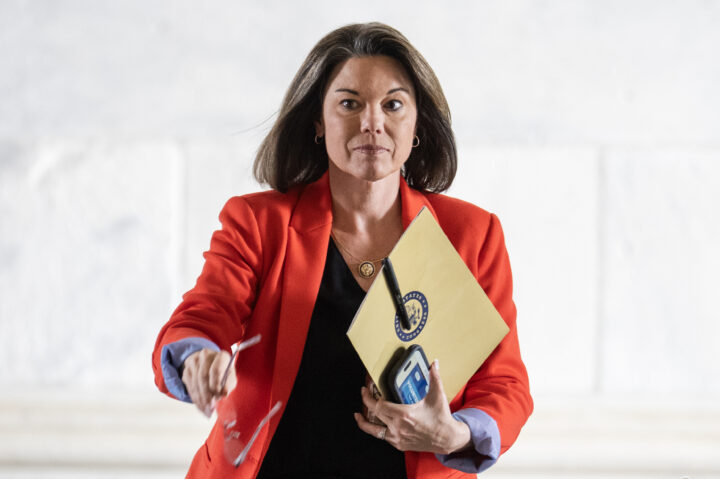
Tom Williams/CQ-Roll Call, Inc via Getty Images
Rep. Angie Craig (D-MN) arrives for a vote in the U.S. Capitol on Thursday, March 26, 2026.
The Senate campaign of Rep. Angie Craig (D-MN) is calling on Minnesota’s Democratic Party to launch a formal investigation into a series of alleged instances of antisemitic activity among delegates in the lead-up to its state convention being held at the end of next month.
In a letter sent last week to Richard Carlbom, chair of Minnesota’s Democratic-Farmer-Labor Party, Craig’s campaign wrote that one of its staffers had received a threatening anonymous phone call last month from a person “believed to be a delegate” who used an ethnic slur for Jews and said that the congresswoman “takes dirty Jewish money.”
The letter, shared exclusively with Jewish Insider, also cited a local DFL organizing convention in late March at which an unnamed delegate allegedly said that “we should nuke” Israel, among other examples of extremist violent rhetoric.
Mara Kunin, Craig’s campaign manager, said in the letter to state party leadership that such “incidents should be investigated promptly and that the DFL should take appropriate action and make clear that antisemitism in addition to other forms of hate will not be tolerated in our party.”
“Hate in all forms must be called out, whether it comes from the right or the left,” Kunin wrote. “We hope this serves as a necessary wake-up call for the DFL. We urge prompt and decisive action — action that allows the DFL to live up to our shared goal of building a big-tent party rooted in the principles of respect, dignity and integrity.”
In a statement shared with JI, Carlbom said that the DFL “condemns antisemitism and harassment in all forms without reservation,” and called the incidents raised by Craig’s team “disgusting and wrong, full stop.”
“We have responded directly to the Craig campaign, connected them to our Code of Conduct Committee, and encouraged those affected to file a police report,” he continued. “We will enforce our Code of Conduct and hold every leader and member to the standard our party demands. That work is happening and it won’t stop.”
The letter comes as Jewish and pro-Israel Democrats have voiced concerns about growing hostility toward Israel that has overlapped with a creeping extremism among some high-profile party influencers who have gained prominence espousing antisemitic rhetoric.
In Michigan’s Senate race, for example, Hasan Piker, an antisemitic streamer who has praised Hamas, has recently emerged as a flash point in a broader debate about whether Democratic candidates should appear with him publicly or join his show.
The issues raised by Craig’s campaign also dovetail with an uptick in anti-Israel sentiment during state and national party conventions around the country. Last week, at the Democratic National Committee’s meeting in New Orleans, party activists voted down one controversial resolution that criticized AIPAC’s “undue influence” in primary elections, while kicking two other measures to a Middle East working group.
Similar efforts are now poised for consideration at several state conventions in the coming months, including a series of new resolutions introduced by Democratic activists in Texas seeking to formally condemn Israel for alleged genocide while labeling pro-Israel political activity as “foreign interference in U.S. elections.”
In Minnesota, where Craig is facing off against Lt. Gov. Peggy Flanagan for the DFL endorsement, the party’s convention in late May is expected to feature some divisive resolutions related to Israel as in past years, according to local Jewish community activists familiar with the ongoing preparations.
During a recent local convention among several that take place before the statewide meeting, for instance, one new resolution advocated for removing language from the DFL’s official platform recognizing “Israel’s right to exist within secure borders, Palestinian rights to self-determination, and continued peace efforts in the Middle East.”
“Israel with the full support & shielding of the U.S. Government has conducted an intensification of genocide & ethnic cleansing in the past 2+ years, murdering more than 75,000 Palestinians since October 2023,” the resolution states. “The DFL party cannot claim any sort of morality while providing support to a state that’s founded on and committed to ongoing occupation, apartheid, and genocide. The two-state solution has long been an illusion, and so-called ‘peace’ without justice is not worth supporting.”
The DFL did not return a request for confirmation about the status of the resolution and if it would be taken up at the state convention in its current form.
Manny Houle, a Democratic pro-Israel strategist based in Minnesota, said it was “highly unlikely this divisive verbiage makes it as is to the state ballot at the end of May,” noting “there is an entire other round of editing when it comes to resolutions and most of the greatly divisive platforms are not getting the statewide support needed to make the ballot.”
“However, some sort of floor petition resolution is likely,” he told JI. “In addition there likely will be a resolution, if not multiple, about Middle East peace.”
One local Jewish activist now involved in efforts to oppose such resolutions, speaking on condition of anonymity to address a sensitive matter, predicted “other problematic” measures will also arise at the state convention. “We have been strategizing about how to handle any anticipated nastiness at the state convention this year, likely to arise through ‘debate’ over these resolutions,” the activist told JI, pointing to a DFL Jewish community outreach organization that is seeking to become an official party caucus.
In the August Senate primary to be held three months after the convention, Craig, a moderate favored by the pro-Israel community, has claimed backing from the party’s establishment wing, while Flanagan is largely coralling progressive support in what is regarded as a proxy fight between opposing Democratic factions.
While AIPAC has not made an endorsement in the race, Craig’s past support from the advocacy group have drawn criticism from activists working to force the party leftward on Israel.
Antoine Givens, a Craig spokesperson, said her team “will continue to make clear that antisemitism and all forms of hate cannot be tolerated in our party,” while referring to the recent alleged incidents of antisemitic behavior among party members.
“Violence and the threat of violence have no place in our politics and no place in the DFL,” he told JI in a statement. “These actions are unacceptable, and it’s on all of us to demand better.”
Deputy Inspector General Adam Kaplan told lawmakers that vetting processes for USAID had exempted U.N. employees, despite identifying Gaza as ‘high-risk’ for ‘misuse of U.S.-funded assistance’

Rafah Police
Armed men sit atop a U.N. aid truck outside a U.N. logistics facility in the Gaza Strip
The deputy inspector general of the U.S. Agency for International Development, Adam Kaplan, said on Tuesday that his office will investigate U.N. staff for ties to Hamas, noting that previous vetting requirements by the aid agency exempted employees of the international body.
Following the Oct. 7, 2023, terrorist attacks in Israel, USAID’s Office of Inspector General (USAID OIG) — responsible for conducting independent auditing and investigation of USAID and other foreign assistance programs — identified Gaza as a “high-risk for potential diversion and misuse of U.S.-funded assistance,” and has initiated investigations into several partners over connections to terrorism and fraud “to ensure humanitarian assistance in Gaza does not fall into the hands of Hamas and other foreign terrorist organizations.”
Previously, the agency has looked into the United Nations Relief and Works Agency, which provides services to Palestinians, uncovering evidence in 2025 connecting three “current or former” UNRWA employees to the Oct. 7 attacks and affiliating 14 other “current or former” UNRWA employees with Hamas. UNRWA also itself dismissed nine of its employees for their potential participation in the attacks.
During a House Oversight and Intelligence Subcommittee hearing on Tuesday discussing wasteful foreign assistance spending, Kaplan noted that USAID “required partner vetting of organization staff” to ensure that “terrorists don’t get our money,” however, that action “exempted U.N. staff.”
“To address this gap, USAID IG is investigating U.N. staff for ties to Hamas to ensure U.S. taxpayers do not pay their salaries,” Kaplan said.
He also noted a lack of transparent access to information. Describing ongoing investigations, Kaplan said his department has sought information from “five different U.N. agencies on 10 investigations,” but that response times spanned six months to two years, something he called “unacceptable.”
“We encounter nonstop obstruction by the U.N. to share information about potential misuse of U.S. funds,” Kaplan said. “USAID heavily relied on award recipients operating in remote locations to self-disclose fraud allegations of all award recipients. The least transparent is the United Nations.”
“We urge the State Department to implement a clause mandating that awards to the U.N. provide us with access to information,” he added.
Kaplan also said a major issue was that U.S. Anti-Terrorism Certifications (ATC), a legal promise required from organizations receiving U.S. foreign aid that they are not connected to terrorism and will not use U.S. funds to support terrorist groups, “applied only to grants, not contracts,” something that shielded contractors from being investigated over terrorist links.
“This certification allowed the Department of Justice and Office of the Inspector General to bring cases against grantees for concealing past support to Iran and Hezbollah,” Kaplan said. “Inexplicably, however, contractors were not required to make the same representation.”
Kaplan said that bad actors have “tried to exploit gaps” in the past, referencing a case in the Southern District of New York where a “British NGO [that] had falsified its past support provided to Hezbollah and Iranian affiliates” was dismissed because the office was not in the U.S.
“We brought the case, the judge in New York said, ‘Well, there’s really no ties. It’s a British firm, and other than the actual contract grant, there’s no ties to the United States. They don’t have an office in the U.S.,’” Kaplan said. “The case was dismissed. You have no idea how much that frustrated us, because it was a great case, and this contractor lied about his past affiliation with terrorist actors.”
Officials are investigating a possible connection between the attacks
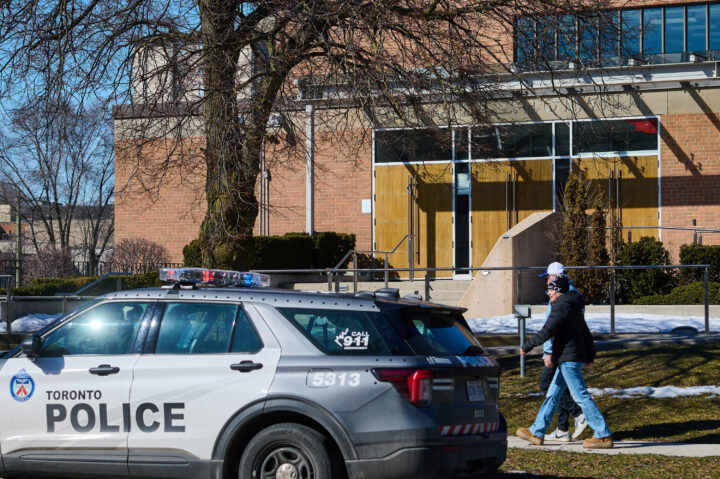
Sammy Kogan/The Canadian Press via AP
Pedestrians pass by a police car parked outside Shaarei Shomayim synagogue in Toronto, Sunday, March 8, 2026.
Two Toronto-area synagogues were damaged by gunfire late Friday and early Saturday following an earlier shooting at another area synagogue last week.
Officials are investigating a possible connection between the shootings, the latest of which occurred outside of Shaarei Shomayim Synagogue and The Beth Avraham Yoseph of Toronto (BAYT) synagogue over the weekend. No one was injured in either incident.
In a message to congregants, Rabbi Daniel Korobkin, senior rabbi of BAYT, called the shooting “an appalling and cowardly act of evil,” adding that it left damage to the building’s front doors. BAYT — one of the largest Orthodox synagogues in North America — is located in the city of Vaughan’s Thornhill neighborhood, a heavily Jewish Toronto suburb.
Korobkin praised several Canadian politicians, including MPP Laura Smith, Vaughan Mayor Steven Del Duca, MP Melissa Lantsman and Vaughan City Councillor Gila Martow, for “working tirelessly with all levels of government, the intelligence community, and York Regional Police, who are in the midst of conducting a thorough investigation.”
He told members that they should continue to “attend minyanim, shiurim and other communal activities with renewed vigor and resolve.”
According to Toronto police, multiple shots were fired at the front doors of Shaarei Shomayim at 12:03 a.m. on Saturday — less than an hour after the BAYT shooting. Shaarei Shomayim is located in North York, about three miles from Thornhill.
Prime Minister Mark Carney called the attacks “an assault on the rights of Jewish Canadians to live and pray in safety.”
The attacks come after another Toronto synagogue was shot at last Monday night, causing damage to the building’s exterior. Toronto Police Service said that there were several bullet holes in the front windows of Temple Emanu-El in North York. No injuries were reported, but some people were inside the building at the time of the attack, following a Purim celebration.
At a press conference on Sunday, Noah Shack, the CEO of the Centre for Israel and Jewish Affairs, the advocacy arm of Jewish Federations of Canada-UIA, said that the country is “at a crossroads” following the three shootings.
“This gunfire didn’t come from nowhere,” said Shack. “Over the last two years, our Jewish community has been subject to increasing incidents of hate, intimidation, harassment and violence.”
Israel’s Ministry for Diaspora Affairs and Combating Antisemitism found a 670% increase in antisemitic incidents in Canada in 2024.
Toronto Police Chief Myron Demkiw said at the press conference that there are ongoing investigations. He promised a “relentless” pursuit to hold suspects accountable.
The Senate education committee chairman said New York City public schools’ federal funding could be at risk

Kayla Bartkowski/Getty Images
Sen. Bill Cassidy (R-LA) speaks to reporters following the weekly Republican Senate policy luncheon at the U.S. Capitol on March 11, 2025, in Washington, D.C.
Sen. Bill Cassidy (R-LA), the chair of the Senate Health, Education, Labor and Pensions Committee, announced on Thursday that he’s launching an investigation into New York City Mayor Zohran Mamdani, prompted by the mayor’s rescission last month of executive orders from the prior administration related to Israel and antisemitism.
“Has antisemitism decreased in New York City? I haven’t seen any evidence of that. Academic institutions have, of recent, been places where Jewish students have felt quite threatened,” Cassidy told Jewish Insider, referring to Mamdani’s repeal of an executive order implementing the International Holocaust Remembrance Alliance’s working definition of antisemitism that came as part of a broader revocation of executive orders issued by former Mayor Eric Adams following his indictment in September 2024 on federal bribery and wire fraud charges.
“I think Mayor Adams did a good job in signaling that the city had an interest in making sure that students, no matter how they identified themselves, were safe from harassment,” Cassidy continued. “The rescinding of the antisemitism and Israel orders doesn’t seem to be conducive with a lowering instance of antisemitism, so why did Mamdani rescind them? That’s the point.”
Among his first actions in office, Mamdani also repealed an anti-Boycott, Divestment and Sanctions order.
Cassidy said in a letter to Mamdani that “strong leadership against antisemitism and discrimination is essential to the safety and security of Jewish New Yorkers.”
“It is my job to ensure every student feels safe, and at a time when Jewish students feel scared, I am concerned your actions will only exacerbate their fears,” Cassidy continued. “Decisions by your administration that weaken established safeguards for Jewish students in New York and are out of alignment with federal executive orders warrant careful scrutiny. Jewish students deserve clear assurance that their safety and civil rights will not be compromised by your administration’s actions.
He warned that repealing the IHRA order puts New York City out of alignment with federal antisemitism executive orders “and may hinder the U.S. Department of Education’s Office for Civil Rights’ enforcement of Title VI.” He warned that the $2.2 billion in federal funding allocated to New York City public schools could be at risk depending on “compliance with federal civil rights laws and applicable executive orders designed to protect students.”
Cassidy asked Mamdani to explain his administration’s plans to adopt an alternative antisemitism definition, its plans to combat antisemitism on campuses, whether it has consulted with the federal government about the “potential funding implications” of withdrawing the IHRA order, whether it has issued guidance to New York City schools about antisemitism and whether he believes BDS is antisemitic.
“Whatever somebody’s ideological background, if they’re in a position of responsibility, they must protect their citizens,” Cassidy said in a post on X. “Clearly, antisemitism has been on the rise. We must respond to real dangers directed at Jewish students.”
The Ivy League school called the EEOC’s request for the personal information of Jewish employees as part of its antisemitism investigation ‘extraordinary and unconstitutional’

Getty Images
Exteriors of University of Pennsylvania (UPenn) located in Philadelphia
A burgeoning legal battle between the University of Pennsylvania and the Equal Employment Opportunity Commission escalated last week when the Ivy League university called the agency’s methods of investigating whether the school permitted an antisemitic work environment “extraordinary and unconstitutional.”
The EEOC subpoenaed the university to turn over lists of Jewish employees and members of Jewish organizations, along with detailed identifying and contact information, saying the information is needed for the agency to contact potential victims of antisemitic discrimination. The university’s president and trustees — with the support of Jewish campus organizations Hillel, Chabad and Meor, as well as the Jewish Federation of Greater Philadelphia — refused to do so.
Handing over those names would disregard “the frightening and well-documented history of governmental entities that undertook efforts to identify and assemble information regarding persons of Jewish ancestry,” the university asserted in a legal filing last Tuesday.
What may appear to be an arcane legal issue illuminates the tension at the heart of the Trump administration’s aggressive approach to combating campus antisemitism, with even some of the victims of that discrimination concerned that the methods of countering it have gone too far. While the EEOC said it is committed to doing whatever it can to investigate antisemitism among faculty and staff of the elite university, Jewish faculty and students see something worrisome.
“We are deeply concerned that the EEOC is now seeking lists of individuals identified as Jewish, including their personal home addresses, phone numbers, and private emails, based solely on their affiliation with Jewish organizations on campus — and without their consent,” Hillel and Meor wrote in a social media post in November. “Across history, the compelled cataloging of Jews has been a source of profound danger, and collection of Jews’ private information carries echoes of the very patterns that made Jewish communities vulnerable for centuries.”
Why does the EEOC, which examines complaints of discrimination and civil rights violations at American workplaces, want Penn to provide the lists of Jewish university affiliates? And why are Jewish faculty members — including some who support the federal government’s efforts to investigate antisemitism at their place of work — urging their employer not to comply?
The dispute dates back to December 2023, when the EEOC pledged to investigate whether Jewish employees at Penn had been subjected “to an unlawful hostile work environment.”
The inquiry was opened the same week that then-Penn President Liz Magill testified before Congress about her handling of antisemitism at the Philadelphia university in the weeks that followed the Oct. 7, 2023, terror attacks in Israel. The investigation continued quietly for nearly two years, overseen by EEOC Commissioner Andrea Lucas, who last year was appointed chair of the agency by President Donald Trump.
It spilled into public view in November when the EEOC filed suit against Penn, seeking to force the university to finally compile and hand over the lists of Jewish faculty members and students that the EEOC said are crucial to its investigation.
The sought-after lists would include the members of all Jewish clubs and student groups, the names of everyone who participated in confidential university listening sessions about antisemitism, faculty members who were criticized and doxxed in a social media post from an anti-Israel student group and all employees and faculty of the Jewish studies program. Karen McDonough, deputy director of the EEOC’s Philadelphia office, said in a legal filing that the university’s refusal to turn over the lists has “severely hampered” the investigation.
Penn disagrees. The university called the demand “not only disconcerting but entirely unnecessary,” pledging instead that it would send a message to all university employees telling them how to get in touch with the EEOC to share instances of antisemitism they experienced or witnessed. The university said it has “cooperated extensively” with the agency by turning over more than 100 documents.
A more typical investigation might involve agency officials interviewing people who issued complaints directly with the agency, then visiting the campus and publicizing their investigation, according to Samuel Bagenstos, a law professor at the University of Michigan with expertise in employment law.
“If there are those claims that should be followed up, they should definitely be followed up, and they should be followed up according to usual investigative practices and not this dragnet of, ‘Let’s compile a list of all the Jews at Penn,’” Bagenstos told Jewish Insider last week. “It’s an incredibly unusual, if not completely unprecedented, request. It’s not tailored at all to any particular allegations of discrimination.”
An EEOC spokesperson did not respond to a request for comment.
The agency appeared to follow a similar playbook last year when it investigated antisemitism among staff at Columbia University and the affiliated Barnard College. Employees from both institutions received text messages from the EEOC on their personal phones asking them to fill out a survey identifying whether they are Jewish or Israeli, and if they have faced antisemitic harassment.
In that case, university officials had agreed to hand over employee data. Columbia’s associate general counsel and deputy general counsel told the Columbia Daily Spectator, the student newspaper, that the university complied with a subpoena to share employee information with the EEOC. But because the dispute ended in July with a settlement — and not with legal action — the EEOC’s methods of information-gathering at Columbia and Barnard never became public. (Columbia agreed to pay $21 million to resolve antisemitism charges.)
The Penn faculty members and employees opposed to the efforts by the federal government to obtain the controversial lists are not saying that the university is free from antisemitism. The Penn Faculty Alliance to Combat Antisemitism, which formed after Oct. 7 in response to rising anti-Jewish antagonism on campus, filed a brief supporting the university, and its members said that while they want to see the EEOC’s efforts to combat antisemitism at Penn continue, they oppose the methods being used by the agency.
“While the Alliance supports the EEOC’s efforts to combat antisemitism at Penn, its members are gravely concerned that the scope of the EEOC subpoena, which effectively seeks full lists of Jewish individuals at Penn and their personal information, invokes the troubling historical persecution of Jews, and threatens the personal security of the Alliance’s members,” the group wrote in a legal filing last week.
As the case moves forward in federal court, Penn and the EEOC are poised to test the boundaries of how far a civil rights investigation can go in the name of protecting a vulnerable group.
The event comes days after students who caused $1 million in damages during a protest against Israel’s war in Gaza were allowed to return to campus

GENNA MARTIN/San Francisco Chronicle via Getty Images
Suzzallo Library at the University of Washington.
A university professor who resigned from her position following a Title VI antisemitism investigation, and another who organized large-scale anti-Israel demonstrations, are among several controversial speakers scheduled to speak at an event on Friday hosted by the University of Washington.
The day-long conference, called “The World as Palestine: On Advocacy, Activism, and Justice,” is organized by the Middle Eastern Studies department and is scheduled to be held in the university’s student union building.
Andrea Brower, a former instructor in a “Solidarity and Social Justice” program at Gonzaga University in eastern Washington, is scheduled to speak during the program’s opening panel, “Reflections from Eastern Washington’s Palestinian Liberation Movement.” She resigned in 2024 after the school opened an antisemitism investigation into the protests she led on campus against Israel’s war in Gaza and her criticism of the university’s investment in companies with ties to Israel.
The panel will examine “academic dissent, critical thought, and resistance with reflections from Eastern Washington’s Palestinian liberation movement,” according to its registration page.
Another speaker on the panel will be Majid Sharifi, the director and professor of international affairs at Eastern Washington University. When Iran fired hundreds of ballistic missiles and drones at Israel in October 2024, Sharifi told CBS News Miami that Iran was “defending itself” after its “sovereignty was violated” by Israel’s assasination months prior of Hamas leader Ismail Haniyeh in Tehran.
The third speaker alongside Brower and Sharifi is Kathryn DePaolis, an associate professor and interim chair and director of the School of Social Work at Eastern Washington University. DePaolis helped create a new group called the Inland Northwest Coalition for the Liberation of Palestine two months after the Oct. 7, 2023, Hamas terrorist attacks. During Israel’s war in Gaza, the organization staged Palestinian “die-ins” in front of the Spokane courthouse.
“The event isn’t about the scholarship of activism, which would be different — it’s activism itself,” a Jewish faculty member at UW told Jewish Insider. “It’s using state resources to promote an ideology and worldview that contributes to antisemitism and anti-Zionism on campus.”
Other panel topics are “Lessons from the Palestinian and Filipino Struggles for Liberation” and “Activism and Civic Engagement in Washington State.” Laila Taji, an author speaking on the latter panel, has ties to the radical student group Students United for Palestinian Equality & Return (SUPER UW), which led a destructive protest on campus last year over the school’s ties to Boeing — and Boeing’s ties to the IDF — that caused more than $1 million in damages to the university’s engineering building.
The event will also screen “The Palestine Exception,” a documentary about “professors and students as they join calls for a ceasefire and divestment from companies that do business with Israel and face waves of crackdown from administrators, the media, the police and politicians,” according to the film’s synopsis.
Neither the UW administration nor Washington Gov. Bob Ferguson responded to requests for comment from JI about the selection of speakers for the event at the university, which is a public college.
The event comes days after students from SUPER UW who were suspended and arrested last spring for their participation in the engineering building vandalism were allowed to return to campus, Victor Balta, a spokesperson for the university, confirmed to JI. “The student conduct hearing process has been completed and the students have been found responsible for violations of the student conduct code and held accountable. The students were out of class and banned from campus for three quarters,” said Balta. Twenty-one students were suspended at the time.
“Suspensions also resulted in forfeiture of tuition paid or the repayment of tuition by any student who must remain in good standing in order to receive financial aid, such as tuition exemption grants for graduate students or work study. Once a suspension is concluded, any outstanding balances due must be paid in order to be eligible for re-enrollment,” Balta continued.
The students could still face criminal charges, though none have been brought in the nine months since the protest. The incident also led the Trump administration’s Task Force to Combat Antisemitism to open a review into the university.
SUPER UW was suspended as an official student organization in December 2024 after its members were charged with “vandalism,” “unauthorized keys, entry, or use,” “failure to comply” and “disruption and obstruction” by the school’s administration, according to the group. As a result, SUPER UW does not have access to school resources but can still gather on campus.
In August, Secure Community Network, found that a manifesto released by SUPER UW — which the student group published on Medium shortly before its building takeover began — was inspired by a foreign terrorist entity.
The document praised Hamas’ Oct. 7 terrorist attacks in Israel as a “heroic victory” and said the group looks to “the rich history of struggle in our university for strength and inspiration as we take action.” SUPER UW also released a statement of solidarity with the Samidoun Palestinian Prisoner Solidarity Network, a fundraising arm of the terror group Popular Front for the Liberation of Palestine that was designated as a terror group by the U.S. Treasury Department in October 2024.
The professional organization has faced accusations of being non-responsive to members’ complaints of antisemitism for months, including in a previous letter by Rep. Ritchie Torres

Bill Clark/CQ-Roll Call, Inc via Getty Images
Chairman Tim Walberg (R-MI) attends the House Education and Workforce Committee hearing on "The State of American Education" in the Ryaburn House Office Building on Wednesday, February 5, 2025.
The House Education and Workforce Committee announced on Friday that it’s opening an investigation into antisemitism in the American Psychological Association, a move that follows mounting reports of antisemitism and unaddressed discrimination inside the organization, which represents more than 170,000 individuals in the psychology field and is responsible for the accreditation of psychology professionals.
“The Committee is gravely concerned about antisemitism at the APA,” Committee Chairman Tim Walberg (R-MI) wrote in a letter to APA President Debra Kawahara on Friday informing the organization of the investigation.
“Jewish APA members have reported being harassed and ostracized by their colleagues within the APA and at APA events because of their Jewish identity, their efforts to speak out against antisemitism, and their Zionist beliefs. Members have also stated that their complaints to the association have gone unanswered, raising significant concerns about the APA’s commitment to addressing harassment.”
Walberg’s letter highlights that Jewish members raised a series of concerns about antisemitism in an open letter in February, including antisemitic and pro-Hamas statements in APA listservs and by APA leaders which have gone unaddressed by organization leadership.
According to Jewish Insider’s reporting, that letter went unacknowledged for months, prior to outreach from Rep. Ritchie Torres (D-NY) who called on the APA to address a “persistent and pernicious pattern of antisemitism” in its ranks. And when the APA did organize a Zoom meeting to address the concerns raised, some vocal antisemitic and anti-Israel members and groups were included in the conversation.
The APA also allegedly offered educational credit to members for attending conferences where speakers have expressed antisemitism, supported violence against Jews and Israelis, minimized Jewish suffering and “patholgiz[ed] Jewish people’s connection to their indigenous homeland,” Walberg’s letter states.
“More broadly, the rampant antisemitism in [one] division has led to members resigning,” Walberg wrote.
He also noted that some internal APA groups are attempting to repeal the APA’s adoption of the International Holocaust Remembrance Alliance’s working definition of antisemitism, claiming that antisemitism is being “weaponized” to “silence and punish people of color.”
Walberg’s letter requests the APA provide to the committee a range of internal documentation and communications relating to Jews, antisemitism and the Israeli-Palestinian conflict since Oct. 7, 2023.
Yifat Tomer-Yerushalmi recently resigned amid allegations of lying about leaking sensitive materials about investigation into abuse at Sde Teiman prison
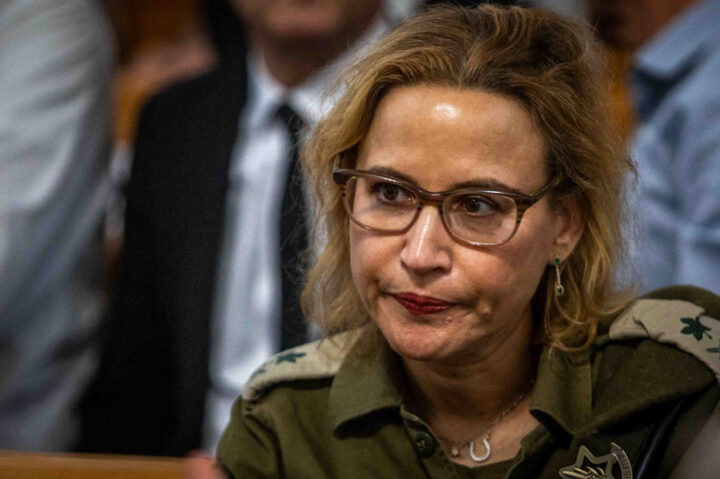
Oren Ben Hakoon/AP
Israel's Military Advocate General Maj. Gen. Yifat Tomer-Yerushalmi, at the supreme court in Jerusalem Tuesday, Oct. 1, 2024.
Former IDF Advocate-General Yifat Tomer-Yerushalmi was arrested on Sunday evening, reportedly on grounds of obstruction of an investigation, after disappearing and leaving behind a note raising concerns of a potential suicide. The arrest came two days after she resigned her post following a determination by police that she had leaked sensitive materials showing alleged abuse of a Palestinian detainee at Israel’s Sde Teiman prison to the media.
Police found Tomer-Yerushalmi’s car at a beach north of Tel Aviv, hours after relatives reported that she was missing. According to Israeli media, she had left a note to her family. The ensuing manhunt involved police, the Israeli Navy, drones with geothermal detection and more.
Tomer-Yerushalmi was arrested after police found her safe, but without her phone, which had last been tracked near her car and then turned off. The disappearance of the phone raised police officers’ concern that she had possibly staged a suicide attempt to cover up the destruction of evidence caused by the disposal of her phone, Ynet reported.
National Security Minister Itamar Ben-Gvir said on Monday that Tomer-Yerhushalmi remains on suicide watch in jail. The Tel Aviv Magistrate’s Court extended her remand until Wednesday.
Tomer-Yerushalmi resigned from the IDF on Friday following her suspension in light of a criminal investigation by police that found that she had leaked surveillance video purportedly showing abuse at the Sde Teiman detention facility, in which terrorists who perpetrated the Oct. 7, 2023 attacks were held, and that members of the MAG corps lied to the High Court of Justice about it.
“I approved the release of material to the media in an attempt to counter the false propaganda directed against the military law authorities,” Tomer-Yerushalmi wrote in her resignation letter. “I bear full responsibility for any material that was released to the media from within the unit.”
Masked military police officers entered the Sde Teiman facility last July, arresting several prison guards for alleged abuse after a doctor found wounds possibly indicating rape of a Palestinian prisoner. Ultimately, five of them were charged this year with abusing the detainee, a Hamas police officer who allegedly attacked a guard who was searching his person, but not with rape. According to the indictment, the soldiers tased the prisoner, kicked him and stepped on him while he was handcuffed, breaking his ribs.
The arrest sparked protests at the detention facility, with demonstrators — including three far-right lawmakers — at one point breaking into Sde Teiman, arguing that the IDF soldiers were being mistreated. The MKs and others on the right have frequently accused the MAG of not protecting IDF soldiers and endangering the hostages. One right-wing commentary outlet called the MAG corps “a chapter of [the International Criminal Court in] the Hague, a hostile body bringing foreign interests into the army” and leading a “campaign against the soldiers.”
In August last year, Israel’s Channel 12 broadcast the video at the center of the scandal, purporting that it showed sexual abuse. The video showed a detainee lying on the floor, while soldiers surrounded him with riot shields, such that their treatment of him could not be seen in the clip. The IDF said the video had been misleadingly edited.
The video was distributed widely by international news organizations as well as on social media.
Following petitions to Israel’s High Court of Justice demanding an investigation, Tomer-Yerushalmi’s deputy, Gal Asael, ordered a probe of the leak by Military Police. A report provided by Asael to the Supreme Court and the Knesset stated that the leak did not come from the MAG corps, but that “hundreds of people were exposed to the materials, and therefore we cannot know who is the leaker.”
Army Radio reported in recent days that Asael has said he did not know the leak came from within the MAG corps. He is not currently a suspect.
Israeli Attorney-General Gali Baharav-Miara approved Asael taking command of the investigation, and backed up his report. In September, the Attorney-General’s Office told the High Court that “there is not even a preliminary indication pointing at the source for transferring the information.” Justice Minister Yariv Levin – who has attempted to fire Baharav-Miara – accused her of conspiring with Tomer-Yerushalmi in the obstruction of justice and said she cannot be involved in the ongoing proceedings relating to this case.
Police arrested former IDF chief prosecutor Matan Solomesh on Sunday night, alleging that he knew about the leak and did not report it.
Senior government figures blasted Tomer-Yerushalmi in public statements in recent days.
At a Cabinet meeting on Sunday, Israeli Prime Minister Benjamin Netanyahu called the incident at Sde Teiman “the most severe public relations attack that the State of Israel has experienced since its establishment,” and said that it “caused immense damage to the image of the State of Israel and the IDF, to our soldiers.”
Israeli Defense Minister Israel Katz accused Tomer-Yerushalmi of a “blood libel against IDF soldiers and preferring the good of [Hamas] terrorists over [the soldiers].”
Katz and IDF Chief of Staff Eyal Zamir have begun the process of finding Tomer-Yerushalmi’s replacement.
By law, the MAG is appointed by the Defense Minister to protect her independence, even though the IDF chief of staff is technically her commanding officer. The MAG is the ultimate authority on what is legal or illegal in the IDF, and has broad discretion over law enforcement matters, including investigations and indictments.
The MAG corps’ independence within the IDF system is often described as the soldiers’ “bulletproof vest,” helping protect them from international courts, which are supposed to respect existing domestic legal proceedings.
Eran Shamir-Borer, the director of the Israel Democracy Institute’s Security and Democracy Center and the former head of the IDF International Law Department in the MAG corps, expressed concern that the ongoing scandal relating to Tomer-Yerushalmi “might have broader implications for Israel’s legal resilience and ability to protect its soldiers and commanders against legal risks overseas.”
“What’s happening now threatens to cast a big shadow over the military’s ability to do this,” he added. “It’s a real earthquake. … A unit of the IDF entrusted with enforcing the law has been very much contaminated.”
At the same time, he stressed that “this should not taint the entire unit, comprised of hundreds of professional legal officers with strong commitment to ensuring Israel’s security and maintaining the rule of law.”
In addition, Shamir-Borer cautioned against public pressure to drop the charges against the soldiers who allegedly abused the Palestinian detainee in Sde Teiman, saying that “the current scandal should not be used as a pretext to further erode the rule of law.”
Shamir-Borer said that Katz and Zamir now have an “enormous task” to “rebuild trust in this unit within Israeli society, but also overseas.”
Students wearing masks and keffiyahs disrupted a speech by an Oct. 7 survivor, chanting ‘Zionists not welcome here’
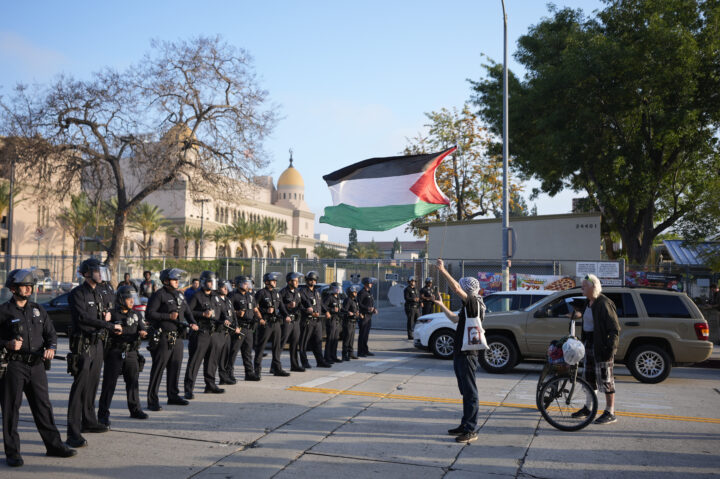
Ryan Sun/AP
A pro-Palestinian demonstrator holds a flag in front of a police line after protesters were told to disperse at the Shrine Auditorium, where a commencement ceremony for graduates from Pomona College was being held, Sunday, May 12, 2024, in Los Angeles.
Pomona College opened an investigation on Thursday after an on-campus event held Wednesday commemorating the second anniversary of Hamas’ Oct. 7, 2023, terrorist attacks was disrupted by four masked and keffiyah-clad individuals who barged in chanting “Zionists not welcome here.”
“While we have not yet identified the individuals, we are examining video footage taken during the event, as well as security footage to determine how access could have been gained,” Gabrielle Starr, the college’s president, wrote in a campus-wide email. “We are also reviewing our security protocols for on-campus events.”
“Antisemitic hate cannot be tolerated here,” Starr wrote.
The memorial, sponsored by Hillel in a university building and scheduled on the Hebrew calendar anniversary of the attacks, featured a talk by Yoni Viloga, who survived the attack on his family’s home in Kibbutz Mefalsim.
“The event was meant to be an opportunity for students to reflect on what happened two years ago. The disruption was very unsettling, I saw students with tears in their eyes,” Bethany Slater, director of Pomona Hillel, told Jewish Insider. The disruption, which also included chants of “Zionism is still a colonial ideology” and “You’re all complicit in genocide,” lasted about two minutes, until campus safety officers arrived.
While the liberal arts college in Claremont, Calif., has faced several anti-Israel demonstrations since the Oct. 7 attacks, Wednesday evening’s protest was the first to occur in an expressly Jewish space on campus. It also came days after Israel and Hamas agreed to a ceasefire and hostage-release deal.
“This is the first time Hillel has been targeted. Demonstrations have always been directed at the [university] administration because they were calling for [Boycott, Divest and Sanctions measures],” said Slater. “This is the first time a Jewish event has been targeted at all, which is just shocking that it would happen now in the context of the ceasefire agreement.”
Pomona College is among the dozens of universities currently under investigation by the Department of Education’s Office for Civil Rights for its alleged failure to address campus antisemitism.
Pomona administrators have responded quickly to a number of anti-Israel incidents that have occurred on campus in the aftermath of the Oct. 7 attacks and ensuing war in Gaza. In April 2024, police officers dressed in riot gear arrested at least 20 masked students after some 150 people stormed the university president’s office and refused to leave for more than three hours. Organized by the student-led group Pomona Divest Apartheid, the demonstrators from Pomona, as well as the affiliated Scripps and Pitzer Colleges, were protesting the removal of an anti-Israel “mock apartheid wall” on campus.
The following October, when an on-campus demonstration — which involved anti-Israel students taking over and shutting off access to a campus building — took place on the first anniversary of the Oct. 7 attacks, Pomona suspended 10 involved students through the end of the 2024-25 academic year.
Republican Rep. Dave Taylor condemned the ‘inappropriate symbol’ and requested a Capitol Police probe
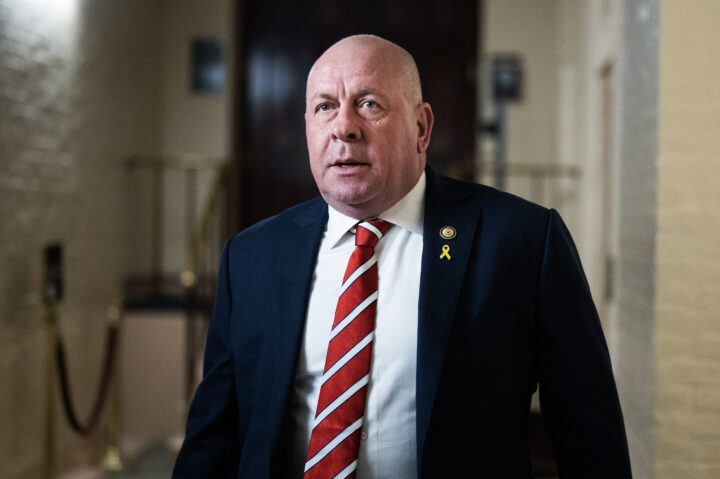
Tom Williams/CQ-Roll Call, Inc via Getty Images
Rep. Dave Taylor (R-OH) leaves a meeting of the House Republican Conference in the U.S. Capitol on Wednesday, June 4, 2025.
Rep. Dave Taylor (R-OH) blamed “vandalism” and requested a Capitol Police investigation after a flag showing a swastika overlaid onto the American flag was spotted in a staff member’s cubicle during a virtual meeting.
The flag was pinned up on the wall of the staffer’s cubicle alongside various other memorabilia, including a copy of the U.S. Constitution and a congressional calendar. The incident was first reported by local Ohio news outlet The Rooster.
“I am aware of an image that appears to depict a vile and deeply inappropriate symbol near an employee in my office,” Taylor said in a statement issued Wednesday. “The content of that image does not reflect the values or standards of this office, my staff, or myself, and I condemn it in the strongest terms. Upon learning of this matter, I immediately directed a thorough investigation alongside Capitol Police, which remains ongoing. No further comment will be provided until it has been completed.”
An email inquiry to the Capitol Police’s public information office returned an automatic reply stating that the office is closed until the end of the current government shutdown.
Taylor is a first-term lawmaker representing much of southern Ohio. The staffer in question, whose involvement in the incident is at this point unknown, has served as a legislative correspondent for Taylor since January.
“As a Jewish community we are concerned when any symbol of hate — especially a swastika — is found in the halls of Congress,” Howie Beigelman, the CEO of the Ohio Jewish Communities, told Jewish Insider. “Congressman Taylor has been a good friend to the Jewish community since his election. He’s reached out to us to convey his anger that a swastika was in his office as well as his concern for how this will impact the Jewish community across Ohio and nationally. We hope that wherever this investigation leads, he and his team will take any necessary & appropriate action.”
The discovery comes a day after a Politico report about a group chat in which leaders of Young Republican groups across the country praised Adolf Hitler, joked about the Holocaust and discussed putting political opponents in gas chambers, as well as expressed racist sentiments and supported rape.
This story was updated on Wednesday evening to include the comments of Ohio Jewish Communities’ CEO Howie Beigelman.
In appearance at think tank, Malley also said President Biden was less committed to a nuclear deal than President Obama

BRENDAN SMIALOWSKI/AFP via Getty Images
Robert Malley, Biden administration special envoy for Iran, waits to testify about the JCPOA (Joint Comprehensive Plan of Action) during a hearing of the Senate Foreign Relations on Capitol Hill May 25, 2022, in Washington, D.C.
Rob Malley, the Biden administration’s Iran envoy, revealed Thursday that the investigation into his alleged mishandling of classified information, which prompted the suspension of his security clearance and his suspension from his post, was closed earlier this year.
“I didn’t know what they were looking at. The claim was that I mishandled classified information. I don’t know what they were referring to. They never told me what they were referring to. I still don’t know what they’re referring to. I may never know what they were referring to or looking at,” Malley said on a Carnegie Endowment for International Peace webinar on Thursday. “I do know that after roughly two years of the situation, the Justice Department notified my lawyers that they had closed the investigation.”
Malley was first suspended around April or May of 2023, which would likely place the end of the investigation — based on the two-year timeline Malley laid out — during the Trump administration.
A State Department inspector general’s report last year found that Malley’s suspension had been mishandled: State Department officials allowed him to temporarily remain in his role as Iran envoy and failed to broadly disclose the fact that he had been suspended, even to his direct supervisor or other top officials.
Congressional Republicans have sought for years to obtain additional information about the investigation, but were consistently refused by State and Justice Department officials. They have alleged Malley transferred classified information to a personal device, which was hacked by a hostile actor.
Discussing Iran talks under the Biden administration with moderator Aaron David Miller, a Carnegie senior fellow, Malley suggested that President Joe Biden was never as interested in or committed to reaching a nuclear deal as President Barack Obama had been, and was unwilling to expend the political capital needed on Capitol Hill or with Israel to make a deal happen.
“When I started off with the Biden administration, I thought President Biden was eager to get back into the deal. That was a misperception on my part. And we took our healthy time to express our interest to the Iranians. And we started off by saying that we wanted a longer, stronger deal,” Malley said. “I think at some point the Biden administration, the team, concluded this is not working, and so we went back to a pure revival of the deal. But by then, perhaps the Iranians had different ideas in mind.”
He said that both Biden and Iranian Supreme Leader Ayatollah Ali Khameinei had been unenthusiastic about reaching a deal and overestimated the other side’s interest in it.
Malley criticized the Biden administration for keeping the Trump administration’s maximum pressure sanctions in place to try to bring Iran to the table after campaigning against those sanctions.
“For President Obama, this was a priority. It was one of his top foreign policy, perhaps even top priority writ large,” Malley said. “I think President Biden never felt that it was that important. He never was in love with the deal. And I think he was not prepared to overcome for a long time the political obstacles that he was facing and the regional obstacles — Israeli opposition in particular.”
He argued that if the Biden administration had been able to “rip the band-aid” and seal a deal early on in Biden’s term, it could have mitigated, if not fully avoided, the political backlash in the midterms and the 2024 election, though he said that he was unsure if the Iranians would have agreed to a deal, given their fear that a future U.S. administration would have again withdrawn.
Malley added that there had been a “real chance” to reach a deal in August 2022, but said that “at that point was clearly [the Iranians’] responsibility” to agree.
He also said that the core premise of the 2015 Joint Comprehensive Plan of Action — that Iran’s nuclear program and sanctions relief could be decoupled from Iran’s other malign activities in the region — may have been faulty, given both American and Iranian political considerations.
Asked by Miller if he would have resigned from the Biden administration over its handling of the war in Gaza, had he still been in his position, Malley said he “very much would like to think that I would have resigned.”
He called the U.S.’ handling of the war “a blemish, a scar that we’re not going to be able to overcome, far worse than Iraq, in my view, because this is a case where we enabled, participated in, fueled, what an increasing number of organizations are calling a genocide.”
Committee Chairman Tim Walberg sent letters to the three schools requesting materials on complaints of antisemitism and discussion of the issue among DEI staff

Bill Clark/CQ-Roll Call, Inc via Getty Images
Rep. Tim Walberg (R-MI) speaks during the House Republicans' news conference in the Capitol on Wednesday, Dec. 6, 2023.
The House Committee on Education and the Workforce will investigate three medical schools over their “failures to address antisemitism,” Rep. Tim Walberg (R-MI), the chair of the committee, announced on Monday.
The three schools targeted in the probe are the University of Illinois College of Medicine (UICOM), University of California, San Francisco and University of California, Los Angeles Geffen School of Medicine.
The investigations come as medical schools and the medical profession have faced increasing scrutiny over rising antisemitism since the Oct. 7, 2023, Hamas attacks.
In letters sent to the leaders of each institution, Walberg requested that the administrators send a lengthy list of documents to the committee, including materials related to complaints of antisemitism, any discussion of antisemitism among DEI staff after Oct. 7 and all guidelines for antisemitism training and investigations that are utilized on campus.
“The Committee has become aware that Jewish students, faculty, and patients have been experiencing hostility and fear at the university, and it has not been demonstrated that the university has meaningfully responded to address and mitigate this problem,” Walberg wrote to each institution, followed by a list detailing alleged incidents of antisemitism.
The allegations at UCLA date back to 2021, when UCLA’s medical school reportedly instituted a mandatory first-year seminar about “structural racism and health equity” that described Jews as “white” and showed them alongside images of “oppressors” and “capitalists” with “long hooked noses.” Other incidents include a student writing in the UCLA Class of 2025 group chat that Hamas’ actions on Oct. 7 were akin to a “slave rebellion” and a professor in the mandatory equity class requiring students to chant “free Palestine” with her.
Last year, the House Energy and Commerce Committee warned UCSF that its federal funding could be at risk if it didn’t do more to address antisemitic harassment. In June, UCSF fired a medical school professor who had posted antisemitic content online and targeted a Jewish faculty member — more than a year after she first made the posts.
Jewish students at UCSF have hidden parts of their Jewish identity, “including removing identifiers on social media,” and the Jewish patients have done the same, according to the letter from Walberg. It also lists several instances of UCSF faculty and staff expressing support for Hamas.
The allegations at UICOM include the removal of Oct. 7 hostage posters from campus, a student group hosting a lecture with a speaker who expressed support for Hamas and a UICOM surgeon comparing Israel to the Islamic State and to Nazis in social media posts. In a Slack channel, which is used to share information about campus events, multiple posts reportedly rejected the claim that Hamas terrorists raped Israeli women on Oct. 7. Walberg also said the medical school staff member tasked with addressing antisemitism is “not suited” to help the school deal with the problem, because he has “made light of the rise [of] antisemitism on college campuses.”
Dr. Yael Halaas, a plastic surgeon in New York and the founder and president of the American Jewish Medical Association, praised the investigations.
“We are physicians and healthcare professionals because we believe in healing the sick and helping the vulnerable. Hate has no place in healthcare,” Halaas told Jewish Insider. “Equally, as educators, we know that indoctrination — whether political, antisemitic, or any ideology of hate — has no place in medicine. The practice and teaching of medicine must be grounded in science, compassion, and respect for human dignity.”
The letters request the universities to submit relevant documents to the committee by Sept. 8.
The student group responsible for the damage has ties to a terror organization, SCN report finds
GENNA MARTIN/San Francisco Chronicle via Getty Images
Suzzallo Library at the University of Washington.
More than 30 anti-Israel demonstrators who occupied a University of Washington engineering building at the end of the spring semester — causing more than $1 million worth of damage — are now being investigated by the university and local attorney’s office for potential criminal charges, Jewish Insider has learned.
The investigation comes after a recent report put a spotlight on a link between the radical student group that led the takeover and the U.S. designated terrorist group Popular Front for the Liberation of Palestine.
“We have taken this incident very seriously, including having issued emergency suspensions for all students who were arrested in the building and working with the King County Prosecuting Attorney’s Office on potential criminal charges,” a University of Washington spokesperson told JI on Wednesday, referring to the demonstration in May in which masked demonstrators blocked entrances and exits to the building and ignited fires in two dumpsters on a street outside.
The newly constructed engineering building had been partially funded by Boeing, which the student protest group, Students United for Palestinian Equality & Return (SUPER UW), said makes UW a “direct partner in the genocide of the Palestinian people” due to the IDF’s use of Boeing products. Days later, the university suspended 21 students who were arrested during the anti-Israel protests, a marked shift from the school’s reaction to previous anti-Israel activity.
The incident also led the Trump administration’s Task Force to Combat Antisemitism to open a review into the university.
The Seattle public university’s investigation into criminal charges comes as the Secure Community Network (SCN), a safety and security network for American Jewish communities, found that a manifesto released by SUPER UW — which the student group published on Medium shortly before its building takeover began — was inspired by a foreign terrorist entity.
The document praised Hamas’ Oct. 7 terrorist attacks in Israel as a “heroic victory” and said the group looks to “the rich history of struggle in our university for strength and inspiration as we take action.” SUPER UW also released a statement of solidarity with the Samidoun Palestinian Prisoner Solidarity Network, a fundraising arm of the terror group Popular Front for the Liberation of Palestine which was designated as a terror group by the U.S. Treasury Department in October 2024.
“The fact that this action was inspired by a foreign terrorist entity is gravely concerning and should be an alarm for the broader community,” Solly Kane, president and CEO of the Jewish Federation of Greater Seattle, told JI. “When foreign terrorist organizations are allowed to infiltrate university campuses the implications are significant and we hope the university leadership will continue to follow-up on this incident seriously and with consequences for those responsible, after appropriate due process.”
Miriam Weingarten, co-director of Chabad UW with her husband Rabbi Mendel Weingarten, said she hoped that those responsible for the damage from the May protest would be “held responsible in a way that would deter any future actions.” She said doing so would help Jewish students feel safe and comfortable on campus, and, in the meantime, “Chabad continues to be open as a space for Jewish students to become more confident in their Jewish pride.”
Kerry Sleeper, SCN deputy director of intelligence and information sharing, warned in June at a congressional hearing about the rise of antisemitism that the terror ties associated with UW demonstrators are part of a larger pattern at protests on campuses around the country — claiming that “this is not a protest in the traditional sense; it is an information and intimidation campaign targeting Jewish students and institutions, often through violent tactics.”
“These trends are fueled by a persistent ecosystem of anti-Israel networks operating in the U.S. and online,” Sleeper said. “Groups such as the Students for Justice in Palestine, Within Our Lifetime, Unity of Fields, and online propaganda hubs such as the emerging ISNAD Network consistently amplify messaging aligned with Hamas, Hezbollah, Al Qaeda, ISIS, and Iranian-backed information operations.”
“While not all are directly tied to designated foreign terrorist organizations, they help blur the lines between protest and incitement, justifying, glorifying and promoting violence against the Jewish community in the name of Gaza.”
In a statement to JI, Michael Masters, SCN national director and CEO, said that as students return to campus in the coming weeks, “these threats are not dissipating; they’re evolving.”
“These incidents are not isolated; they are part of a coordinated effort, which has included the circulation of terror toolkits, to intimidate Jewish students and disrupt Jewish life.”
Masters called for universities to “do more to protect their students and secure Jewish spaces, including allocating the necessary resources and funding for security. Jewish students should never have to choose between their safety and fully participating in campus or religious life.”
One person has been arrested after throwing a Molotov cocktail towards demonstrators, injuring multiple victims

Screenshot/X
A man is arrested after throwing a Molotov cocktail at pro-Israel demonstrators in Boulder, CO on June 1, 2025.
The FBI and law enforcement in Colorado are investigating a possible act of terrorism after multiple people attending a weekly pro-Israel gathering in Boulder to honor hostages kidnapped by Hamas were attacked by a suspect seen throwing Molotov cocktails in their direction.
FBI Director Kash Patel wrote on X that the bureau was “fully investigating” what he described as a “targeted terror attack” in Boulder on Sunday, while FBI Deputy Director Dan Bongino said they were probing the incident as an “act of terror, and targeted violence” while asking for anyone with information to contact the bureau.
One person was arrested after throwing a Molotov cocktail towards the pro-Israel demonstrators, according to Boulder Police Chief Steve Redfearn. Speaking to reporters from the scene of the attack, Redfearn said authorities were called to the area responding to calls “that people were being set on fire” by “a man with a weapon.”
Redfearn also said that victims, attendees of the weekly Boulder Run for Their Lives event calling for the release of the remaining hostages in Gaza, had “injuries consistent with burns and other injuries,” though he could not provide an estimate for the number of individuals who were harmed in the attack.
He warned that some of those injuries could be life threatening. At a Sunday evening press conference, Redfearn said the victims ranged in age from 67 to 88 years old, “at least one” of whom “was very seriously injured, probably safe to say, [in] critical condition.” The 88 year old victim fled Nazi persecution in Europe, Rabbi Yisroel Wilhelm, the Chabad director at the University of Colorado Boulder, told CBS Colorado.
At a press conference Sunday, FBI Denver Special Agent in Charge Mike Michalek identified the suspect as Mohamed Sabry Soliman. Fox News reported that Soliman is an “Egyptian national in the U.S. illegally as a visa overstay who entered the U.S. during the Biden administration,” citing senior Department of Homeland Security officials.
Soliman arrived in the U.S. in August 2022 on a visa that expired in February 2023, filing a claim with U.S. Citizenship and Immigration Services in September 2022 for a work visa that was approved for a two-year period in March 2023. He remained in the U.S. illegally despite his work authorization expiring in March of this year.
Videos circulating on social media of the attack showed Soliman shouting “end Zionists.”
Colorado Gov. Jared Polis, a Democrat, said in a post on X that he was “closely monitoring the situation in Boulder” and said that his state was working “with local and federal law enforcement to support this investigation.”
In a second statement on his personal account, Polis wrote that, “As the American Jewish community continues to reel from the horrific antisemitic murders in Washington, D.C., it is unfathomable that the Jewish community is facing another terror attack here in Boulder, on the eve of the holiday of Shavuot no less.”
“Several individuals were brutally attacked while peacefully marching to draw attention to the plight of the hostages who have been held by Hamas terrorists in Gaza for 604 days. I condemn this vicious act of terrorism, and pray for the recovery of the victims,” he continued.
Sen. Michael Bennet (D-CO), who is running to replace the term-limited Polis, described the incident as a “horrifying terror attack” in a statement posted to X. “My thoughts are with the victims of the horrifying terror attack that occurred this afternoon in Boulder. Hate and violence of any kind will not be tolerated in Colorado,” Bennet wrote.
Sen. John Hickenlooper (D-CO) wrote on the platform that, “Hate of any kind has no home in Colorado. We’re monitoring the reports of a horrific terror attack in Boulder this afternoon. Our thoughts are with the victims and their loved ones.”
Senate Minority Leader Chuck Schumer (D-NY) also said that he was “closely monitoring the situation in Boulder,” adding, “This is horrifying, and this cannot continue. We must stand up to antisemitism.”
A White House official said late Sunday that President Donald Trump “has been briefed” on the attack.
The attack comes less than two weeks after the murder of two Israeli Embassy staffers attending an American Jewish Committee event in Washington. The alleged shooter yelled “Free Palestine” shortly after committing the crime.
In April, during the first night of Passover, an arsonist tried to burn down Gov. Josh Shapiro’s residence. The perpetrator cited the governor’s support for Israel as his motive.
Torres said the organization is ‘permissive of content that traffics in malicious falsehoods against Zionism, Israel, and the Jewish community’

Al Drago-Pool/Getty Images
Rep. Ritchie Torres, a Democrat from New York, speaks at a House Financial Services Committee hearing on oversight of the Treasury Department and Federal Reserve coronavirus pandemic response on Capitol Hillon September 30, 2021 in Washington, DC.
Concerned with a “persistent and pernicious pattern of antisemitism” at the American Psychological Association, the preeminent professional organization for American psychologists, Rep. Ritchie Torres (D-NY) is urging the body’s leadership to investigate antisemitism within its ranks and better respond to the concerns of Jewish members.
“I have spoken directly with whistleblowers — many of them longtime APA members — who accuse the organization of enabling a hostile environment,” Torres wrote in a letter, obtained by Jewish Insider, that he sent to the APA’s president and president-elect on Wednesday. “These incidents collectively suggest that the APA has not only been dismissive of the legitimate grievances of Jewish psychologists but also permissive of content that traffics in malicious falsehoods against Zionism, Israel, and the Jewish community.”
Torres’ letter comes as the mental health field grapples with an antisemitism problem that has grown more acute after the Oct. 7, 2023, Hamas attacks on Israel. The Association of Jewish Psychologists said in 2023 that it was “deeply disappointed and terribly saddened” by the APA’s actions in the aftermath of Oct. 7.
Torres reported that Jewish and pro-Israel psychologists have been harassed on APA-sponsored listservs, including one email with the phrase “kudos to Hamas,” according to conversations he had with APA members, and that divisions within the organization have “issued politicized and inflammatory statements” accusing Israel of genocide, while “suppressing dissenting academic voices.”
Torres urged the APA to conduct an independent investigation into antisemitism across its affiliated divisions and listservs; to reform accreditation of continuing education programs “to ensure the APA is not lending institutional legitimacy to bigotry”; to enforce “clear standards for respectful discourse,” including “protections for Zionist Jews”; and to make sure that Jews are represented as the APA works to address antisemitism.
“The APA’s legitimacy as a scientific and professional institution is at stake,” Torres wrote, if the body does not take action.
A spokesperson for the APA confirmed that the organization received the letter and that they will reach out to Torres to discuss it.
“In the meantime, I can assure you that the American Psychological Association is categorically not an antisemitic organization,” Kim Mills, APA’s senior director for strategic external communications and public affairs, said.
Countries threatening Israel if it does not work with U.N. on humanitarian aid are funding a Hamas-controlled program to distribute aid in Gaza; USAID also involved

OMAR AL-QATTAA/AFP via Getty Images
A Palestinian man stands next to a truck carrying UNICEF aid supplies outside a shopping mall in Gaza City on May 12, 2025.
One of Hamas’ top three sources of funding is the U.K., where it is a banned terrorist organization, an investigation from Israel’s Channel 12 found. That funding includes 25% of Hamas’ donors from non-state actors, as well as tens of millions of dollars from the government of the U.K. to a UNICEF program whose beneficiaries are determined by Hamas.
The U.K., France and Canada threatened Israel last week with “concrete actions” if it does not lift restrictions on humanitarian aid and work with United Nations agencies to distribute it.
The U.K., Canada and the European Union — of which France is a member— as well as Switzerland, Norway, Sweden, Mauritius and Croatia, sponsored a project through UNICEF, the U.N. Children’s Emergency Fund, for which a Hamas-run ministry provides a list of people to receive funding.
The program provides cash payments of $200-$300 per month to 546,000 needy people in Gaza. UNICEF said that it works with a “beneficiary list from the MoSD,” meaning the Hamas-controlled Ministry of Social Development, to determine who receives the cash. The program uses a digital platform funded by USAID to distribute the cash. UNICEF published an update on the program as recently as November 2024.
MoSD is led by Ghazi Hamad, a member of Hamas’ politburo, designated a “senior Hamas official” by the U.S. Treasury Department.
A 2022 document from the U.K. Foreign Office, uncovered by NGO Monitor, showed that London was aware of Hamas’ involvement with the program and that it had the potential for “severe” reputational damage.
“The cash assistance component will be implemented in coordination with the Ministry of Social Development MoSD. The MoSD in Gaza is affiliated with the de facto authorities and thus UK Aid can be linked directly or indirectly with supporting the de facto authority (Hamas) in Gaza which is part of a proscribed group,” the document reads.
The U.K. gave about $23.1 million to UNICEF projects in the West Bank and Gaza in 2024, and $4.8 million in 2023.
NGO Monitor’s legal Advisor, Anne Herzberg, noted that it is unclear how much of that funding went to the Gaza cash program.
“There is very little detail from the U.K. side about how much is going in, what oversight is in place, what exactly they are doing to mitigate the risk” of money going to Hamas, Herzberg told Jewish Insider on Sunday. “A lot of countries are giving funds to the U.N. and just leave it in their hands.”
Herzberg said that while a lot of attention has gone to UNRWA, the U.N. agency for Palestinian refugees and their descendants, which was recently banned from Israel after some of its employees participated in the Oct. 7, 2023, attacks, “UNRWA is just the tip of the iceberg, because 13 U.N. agencies are operating in Gaza. There is very little information into how these other U.N. agencies are operating.”
“Aid diversion is the main problem and why there have been so many issues with humanitarian aid in Gaza,” she said. “It’s inconceivable to me that these governments refuse to deal with this issue. They claim they want to help Palestinians, to end the conflict and bring peace, yet they don’t want to tackle this issue.”
Beyond government aid going to Hamas, what qualifies the U.K. as the leading non-Muslim country funding Hamas is nongovernmental contributions, Channel 12 reported.
In 2001, Muslim Brotherhood-affiliated Sheikh Yusuf Al-Qaradawi founded the Union of Good, a coalition of 50 Islamist charities with connections to Hamas and other proscribed terrorist groups. The group raised hundreds of millions of dollars for Hamas during the Second Intifada.
The organization was banned in the U.S. and U.K., and Qaradawi, who is Egyptian and lives in Doha, Qatar, has been barred from the U.S., U.K. and France.
Yet the organizations making up the Union of Good continued their fundraising activities.
The Channel 12 report names specific Hamas operatives based in the U.K., including Zahar Birawi, who is the head of the Palestinian Return Center in London, leads Hamas activities in Great Britain and has been instrumental in organizing weekly anti-Israel protests in London. Issam Yusef Mustafa, a former member of the Hamas politburo, is a U.K. citizen and is the biggest fundraiser for Hamas in Europe as the head of “Interpal,” a former Union of Good group sanctioned by the U.S. and Israel.
Herzberg explained that many of the organizations funneling money to Hamas are registered as businesses so they can avoid scrutiny from the Charity Commission.
“The monitoring in the U.K. does not seem as robust as what you see in the U.S., where there are many more investigations going on at the governmental level and more reporting, even though the U.K. government says it has robust control in its laws,” Herzberg said. “It’s unclear how those laws are being enforced.”
Erez Noy, a former Shin Bet official dealing with terror funding, told Channel 12 that “Hamas is strong in Britain because over the years they got used to being able to do almost anything they want there, compared to other countries in Europe … For years, Britain, for whatever reason, did not handle preventing and taking care of these systems [to fund terror]. When Hamas realizes there is a permissive arena, it tests the limits.”
Hamas petitioned the U.K. last month to be removed from the country’s list of banned terrorist organizations.
According to Udi Levy, the former head of the Mossad’s department for fighting terrorism funding, “these are businesses that raise funds under the guise of humanitarian aid, and reach Hamas in Gaza, Judea and Samaria [the West Bank] and anywhere else around the world.”
Levy told Channel 12 that “total victory over Hamas is not just in the Gaza Strip. We are making a huge mistake because even if we kill every last ‘soldier’ in Gaza, there is still a massive Hamas infrastructure that will continue to act and even rehabilitate its activities, unless we start taking care of it.”
The British Embassy in Israel said in response to a query from JI that “Hamas is a proscribed terrorist organization in the U.K. and funding or supporting it is a crime. We categorically reject the false and irresponsible allegations in the Channel 12 investigation that the UK Government funds Hamas run agencies in Gaza. No UK funding was provided to the Ministry of Social Development in Gaza … We are clear that Hamas must play no role in the future of Gaza. FCDO [the Foreign Office] conducted a thorough due diligence assessment of UNICEF, and we identify how U.K. funds are transferred until they reach the final beneficiaries.”
The embassy interpreted the claim made by the U.K. Foreign Office that “U.K. Aid can be linked directly or indirectly with supporting the de facto authority (Hamas) in Gaza which is part of a proscribed group,” as referring to the Ministry of Social Development in Ramallah run by the Palestinian Authority.
In addition, the embassy stated that it does “not recognize the claim that 25% of Hamas’s non-state funding comes from the U.K. To our knowledge, no official Israeli body has ever made such a claim.”
The group is under investigation and has been sued over allegations that it is providing support to Hamas and other foreign terrorist organizations
Kayla Bartkowski/Getty Images
Sen. Bill Cassidy (R-LA) speaks to reporters following the weekly Republican Senate policy luncheon at the U.S. Capitol on March 11, 2025, in Washington, D.C.
The Senate Health, Education, Labor and Pensions (HELP) Committee has launched an investigation into American Muslims for Palestine and its activities on college campuses, Sen. Bill Cassidy (R-LA) announced on Thursday.
Cassidy, the HELP committee’s chairman, revealed the probe while delivering his opening statement at the panel’s hearing on campus antisemitism. The news marks the first time the Senate has investigated the organization. American Muslims for Palestine (AMP) is an anti-Israel nonprofit that bolsters National Students for Justice in Palestine, which in turn supports SJP groups on campuses nationwide.
“Today, as chair of the HELP committee, I launched an investigation into the American Muslims for Palestine, demanding answers about their activities on college campuses. This group’s leaders have ties to Hamas and helped create the group Students for Justice in Palestine. I also requested information from the Justice Department and several universities on these groups. We must continue to build upon these efforts,” Cassidy said.
The Louisiana senator sent letters on Wednesday evening to AMP Chairman Hatem Bazian, as well as Attorney General Pam Bondi and FBI Director Kash Patel.
In his letter to Patel and Bondi, Cassidy requested answers on what their respective agencies were doing to “investigate and address threats posed by outside groups to safety on college campuses.” His letter to Bazian asks for clarification about AMP’s “past or present ties to groups associated with the Foreign Terrorist Organization Hamas.”
Members of AMP’s leadership, including Bazian, have faced scrutiny over their ties to now-defunct charities including the Islamic Association for Palestine and the Holy Land Foundation, which were shut down after the federal government found they had provided financial support to Hamas.
Bazian, critics note, was a frequent speaker at Islamic Association for Palestine conferences. He also founded National SJP.
As part of the investigation, Cassidy also sent letters to the presidents of The George Washington University, University of California Los Angeles, Columbia University and its affiliate Barnard College requesting information about SJP and AMP activities on their campuses.
In the previous Congress, the House Ways and Means Committee probed AMP and urged the Internal Revenue Service to revoke its tax-exempt status. The Virginia attorney general is also investigating AMP and seeking to uncover its private donor list.
AAMP is also facing an ongoing lawsuit by the family of David Boim, an American killed in a Hamas terrorist attack in the West Bank in 1996. Another civil suit filed last year accuses the group of providing material support for Hamas in violation of federal law.
The Boim case alleges that AMP is an “alter ego” of the Islamic Association for Palestine and the Holy Land Foundation and is responsible for the civil judgement against them.
A group of protesters clogged the sewage system of Columbia’s international affairs school, and spray painted the business school with an antisemitic slur
Victor J. Blue for The Washington Post via Getty Images
Students protest against the war in Gaza on the anniversary of the Hamas attack on Israel at Columbia University in New York, New York, on Monday, October 7, 2024.
Columbia University’s administration has launched an investigation — together with law enforcement — to identify the perpetrators of an act of vandalism on Wednesday in which anti-Israel demonstrators clogged the sewage system in the School of International and Public Affairs building with cement and sprayed the business school with red paint.
Columbia defined the spray-painting as an “act of vandalism” in a Wednesday statement, adding that the graffiti “included disturbing, personal attacks.” It said it was “acting swiftly to address this misconduct” and “to identify the individual perpetrators and address their actions.”
“The university has done a better job [responding to antisemitic incidents] compared to in the past year, but at the same time, the actions of these perpetrators has gotten a lot worse,” a second-year graduate student in SIPA who requested to remain anonymous told Jewish Insider. “This went from antisemitic vitriol to cementing toilets and causing staff to be there overnight scrubbing fecal matter out of the toilets.”
In a Wednesday night email to SIPA students, the school’s dean, Keren Yarhi-Milo, wrote that the women’s restrooms on four floors of the building were “vandalized with a cement-like substance causing the toilets to clog.” The walls of the 15th floor restroom were also spray-painted, as was the business school’s Kravis Hall, according to the email.
The Columbia Spectator reported that the graffiti included the phrase “Keren eat Weiner,” a reference to Yarhi-Milo and Rebecca Weiner, the NYPD’s deputy commissioner of intelligence and counterterrorism, as well as “5.3.2018-1.29.2024 Hind called we must answer” and “Im scared please help – HIND AGE 6,” a reference to Hind Rajab, a Palestinian girl killed during the war in Gaza.
In April of last year, at the start of the illegal anti-Israel encampment movement, protesters occupied Hamilton Hall and unfurled a banner that read “Hind’s Hall,” announcing that they had renamed the building in her honor. New York City Resists with Gaza, Columbia University Apartheid Divest and Students for Justice in Palestine claimed responsibility for the vandalism in a social media post.
Columbia’s response comes as the university has reacted more quickly to antisemitism in recent weeks — a sharp contrast compared to what lawmakers and Jewish students and faculty have called a slow, or nonexistent, response to the frequent antisemitism occurring on campus since the Oct. 7 attacks in Israel. Last week, the university suspended a university affiliate for participation in a masked demonstration in which four people barged into a History of Modern Israel class, banged on drums, chanted “free Palestine” and distributed posters to students that read “CRUSH ZIONISM” with a boot over the Star of David.
Columbia’s Office of Student Affairs also mandated on Wednesday that a SIPA group chat, intended to distribute campus-related information to students, be restricted to “administrator-only” mode after several incidents of students espousing antisemitic rhetoric in conversations, a student familiar with the situation told JI.
“We have been monitoring the chats closely and while the discussions are warranted, we have been mandated by the OSA to pause all cohort group chats temporarily till we convene to find a resolution to the ongoing discussions. … I would urge everyone to reflect on how we can reinforce civility in our discourse as we navigate this,” an administrator wrote in one cohort chat, according to messages obtained by JI.
The SIPA graduate student described antisemitic rhetoric in the students’ chat to JI as “a constant stream of pretty outrageous messages.”
“It quickly devolved into the same two or three students from our cohort invoking the Holocaust,” he said. “OSA is getting the handcuffs on these [perpetrators] more quickly than they were last year.”
Asked whether the perpetrators of Wednesday’s vandalism would be suspended or expelled once identified, a spokesperson for Columbia told JI that the university won’t comment further.
“Examining your own aggression prevents the next victim,” said filmmaker Joseph Cedar.
RAN MENDELSON/HBO
The contentious, dramatic events that marred the summer of 2014 in Israel will be dramatized in the HBO series “Our Boys,” which premieres a week from today on August 12.
On June 12, 2014, three Israeli teenagers — Eyal Yifrach, Gilad Sha’ear and Naftali Fraenkel — were kidnapped by Hamas terrorists. After a nationwide search of more than two weeks that left the country on edge, their bodies were found dumped in a field. Two days later, the burned body of Palestinian teenager Mohammed Abu Khdeir was discovered in a western Jerusalem forest. “Our Boys” follows the Shin Bet’s investigation into Abu Khdeir’s murder, revealing an unexpected story that the show’s creators believe is worth retelling — for both dramatic and political reasons.
While “Our Boys” begins with the kidnapping of the three Israeli teenagers, neither the boys nor their families appear as actual characters in the show. Viewers are instead brought up to speed courtesy of news footage from 2014. In contrast, Abu Khdeir and his family are introduced as well-developed characters with whom the audience can sympathize.
Hagai Levi, one of the show’s Israeli creators, explained the decision to Jewish Insider: “It’s much more interesting to deal with my own soul searching than why ‘the other’ would do something to me,” he said.
Levi, along with co-creators Joseph Cedar (who previously directed “Norman”) and Palestinian filmmaker Tawfik Abu Wael, visited New York City last week to promote the show. Joined by actor Shlomi Elkabetz (who plays Shin Bet operative Simon), the three filmmakers sat down with JI in the reading room of The Whitby Hotel in midtown Manhattan to share what drew them to the project.
“We’re on this wheel,” notes Cedar, who was born in New York but immigrated to Jerusalem at age six, regarding the Israeli-Palestinian conflict. “A cycle of where some kind of violent act creates victimhood, suffering, pain that then creates rage, that turns into a violent act that creates pain, suffering, victimhood and so on.” In Cedar’s view, “aggression is more interesting than victimhood and so dramatically that’s probably the reason.”
Cedar said the decision to focus on Khdeir also had political motivations. “There’s also a political reason for us focusing on the aggression and not the victimhood,” he said. “Holding onto victimhood creates more aggression. Examining your own aggression prevents the next victim. We’re not interested in our own victimhood, not because we don’t sympathize with the pain but, because we have an interest in stopping the cycle.”
For a show about a region with competing narratives, the creators embraced their own differences and didn’t shy away from the challenge of syncing those views into a single series.
Abu Wael, who directed the Palestinian scenes for “Our Boys,” said the series is written from an Israeli point of view, which created a challenge for him. “It is very difficult because from a Palestinian point of view, the first thing they will say is ‘but the occupation didn’t start with the kidnapping of the three boys. The killers of the three boys were living under apartheid.’”
Cedar, who argued that there are both Israeli and Palestinian points of view in the miniseries, conceded that for Abu Wael, even if the three Israeli boys aren’t characters in the show, “the decision to start the cycle with our victimhood is a cop-out on our side.”
It remains to be seen how the average HBO viewer will react to a show diving deep into the murky waters of the Israeli-Palestinian conflict. The Shin Bet’s investigation into Abu Khdeir’s murder leads them to a pair of Mizrahi yeshiva students in the West Jerusalem neighborhood of Har Nof, a group not typically associated with acts of extremism. “For us it was very important to show the hidden currents in society and not the obvious ones,” Levi said.

A scene from the upcoming miniseries “Our Boys.”
Cedar said the identity of Khdeir’s murderers reverberated through Israel in a unique way.
“One of the interesting things that happened when the identity of the killers became known is that all Israelis had a sigh of relief,” Cedar recalls. “They’re not one of us. It’s either an insane man who forces his young nephews to take part in this or they’re in some weird group that has no larger institutionalized base, or no belonging to something that reflects on us. It’s extremely rare and it probably will never happen again because it’s so rare.”
For Cedar, the series demonstrates how that perception is wrong, and in his view, there is no way for Israeli Jews to distance themselves from the murder.
Elkabetz, whose character leads the Shin Bet investigation on the show, said there might not have been an organization behind the murder, but “if individuals decide to do an act, you understand there are bigger influences. It’s in the air and they get permission from it.”
For fans of “Fauda” and “Shtisel,” “Our Boys” incorporates both similar dynamics and even several cast members from the two shows. Shadi Mar’i, who plays Walid on “Fauda,” appears on “Our Boys” as Abu Khdeir’s older brother, while Michael Aloni, who plays Akiva on “Shtisel,” is a Shin Bet investigator.
Abu Wael points out that there are only so many actors in Israel, but says there’s a key difference between “Fauda” and “Our Boys.”
“On Fauda, Palestinians are either terrorists or traitors,” he said. “This show is different because you have a very normal Palestinian family with dreams like everyone else.”
Please log in if you already have a subscription, or subscribe to access the latest updates.
 Continue with Google
 Continue with Apple