







































































The antiwar measure failed again, this time by a 50-49 vote
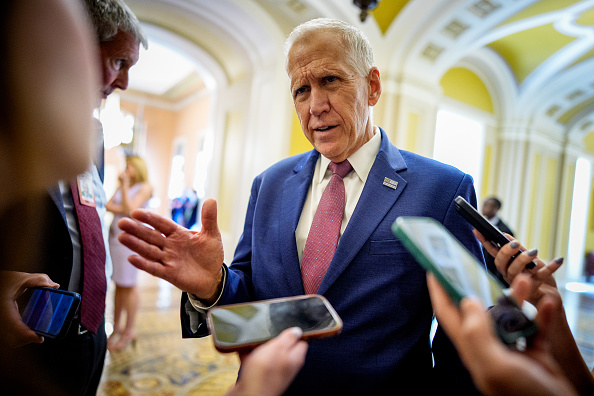
Photo by Andrew Harnik/Getty Images
Sen. Thom Tillis (R-NC) speaks to reporters as he walks into the Senate Chamber of the U.S. Capitol Building on April 15, 2026 in Washington, D.C.


 Add JewishInsider on Google
Sen. Thom Tillis (R-NC) joined Democrats and a handful of Republicans in voting on Thursday for a war powers resolution demanding an end to the war in Iran. But, despite growing calls from vulnerable Republicans ahead of the midterm elections, most of the GOP continued to vote against the war powers effort, and the measure failed by a 50-49 vote.
“We’re reaching a point to where we just need answers. We got to know what success looks like,” Tillis, who is not running for a third Senate term, said earlier this week. “There’s never been any way to measure what success looks like. … For every step we take forward, we take a step back.”
He also highlighted the economic costs of the war, opposition from voters and concerns that the war could drag on indefinitely.
Sens. Susan Collins (R-ME), Lisa Murkowski (R-AK) and Rand Paul (R-KY) also voted for the resolution, while Sen. John Fetterman (D-PA) voted against it.
Reps. Nancy Mace, Mariannette Miller-Meeks and Zach Nunn voted for the first time for a war powers resolution

Kevin Carter/Getty Images
U.S. Capitol building on July 12, 2026 in Washington, DC.
The House approved a third war powers resolution aiming to force an end to the conflict with Iran late Tuesday, with a record seven Republicans voting in favor of the effort.
Reps. Nancy Mace (R-SC), Mariannette Miller-Meeks (R-IA) and Zach Nunn (R-IA) joined Reps. Tom Barrett (R-MI), Warren Davidson (R-OH), Brian Fitzpatrick (R-PA) and Thomas Massie (R-KY), who had previously supported war powers efforts, in voting for the resolution.
Miller-Meeks and Nunn are both facing competitive midterm races in toss-up districts. Nunn in particular has generally been a hawk on Iran. Mace, who is retiring from Congress after losing the South Carolina gubernatorial primary, has previously expressed some criticisms of the war and has proven to be an unpredictable vote on a range of issues.
“Iran must be held accountable for killing Americans, supporting terrorism, threatening the Strait of Hormuz, and pursuing nuclear weapons. Iowa has already paid a devastating price, including two service members killed by an Iranian drone in Kuwait,” Nunn said in a statement. “Congress owes them, their families, and every American in uniform clear objectives and constitutional oversight. With the negotiating window closed, sustained combat operations now require congressional authorization.”
Emphasizing his own service record, Nunn said he “will not support another open-ended war. We can defend Americans, pressure Iran, and pursue peace while ensuring Congress fulfills its constitutional responsibility.”
Miller-Meeks and Nunn’s shifting votes in particular underscore the pressure that some swing-district Republicans are feeling over the war, which polls poorly and has contributed to rising gas prices in the United States.
Miller-Meeks, also a veteran, emphasized that the mission in Iran should “stay focused and limited, because Americans do not want another forever war. I will not vote to keep our soldiers in an open-ended war, with Iowans paying too much at the pump.”
“The Iranian regime and its nuclear ambitions have been defanged. The President needs to present a plan to Congress and the American people for how this ends so we can focus on bringing our soldiers home and lowering prices,” she continued.
Mace said in a statement that the war has dragged on significantly longer than initially planned, with no end in sight, hundreds of Americans wounded and more than a dozen killed, while gas prices and inflation have increased.
“The President needs to make his case for continuing this conflict to Congress and the American people,” Mace said. “We cannot allow Iran to obtain a nuclear weapon, but we also cannot continue to put American troops in harm’s way without a clear objective and exit strategy or send another generation into an endless regime change war in the Middle East. Congress needs to step in and do its job.”
Rep. Greg Meeks (D-NY), the ranking member of the House Foreign Affairs Committee, said in a statement following the vote, “The president must end this failed war and appoint real diplomats, not real estate developers, to work multilaterally on a diplomatic solution that opens the Strait and reduces tensions. The American people have made it clear that they do not support this war, and the Constitution does not grant Trump the authority to wage it without the consent of the people and their representatives.”
Hours later, the Senate rejected a similar measure

Kevin Carter/Getty Images
The U.S. Capitol Building is seen at sunset on May 31, 2025 in Washington, DC.
The House passed a second Iran war powers resolution on Thursday following the resumption of hostilities between the U.S. and Iran, with a handful of Republicans who have argued that continued operations violate the War Powers Act again siding with Democrats on the measure.
But hours later, the Senate blocked a separate resolution, also along narrow margins.
Reps. Tom Barrett (R-MI), Brian Fitzpatrick (R-PA), Thomas Massie (R-KY) and Warren Davidson (R-OH) again sided with all House Democrats to pass the resolution by a 214-208 vote.
Rep. Nancy Mace (R-SC) said prior to the vote that she planned to support the war powers resolution but ultimately did not.
The Senate resolution was blocked by a 49-47 vote, with Sen. Susan Collins (R-ME) voting with most Democrats in support of the resolution and Sen. John Fetterman (D-PA) voting against it.
The House and Senate previously passed a similar resolution attempting to end the war, which Democrats have cited to describe the renewed hostilities as illegal.
The measure passed in the House on Thursday was in the form of a concurrent resolution — as was the previous resolution passed by Congress — which is not presented to the president and is generally not seen as carrying the force of law, though Democrats have been working to explore avenues to enforce it.
Also on Thursday, Rep. Greg Meeks (D-NY), the ranking member of the House Foreign Affairs Committee, introduced a resolution demanding that House Speaker Mike Johnson (R-LA) initiate civil action in federal courts to enforce the previously passed war powers resolution directing the removal of U.S. forces from the Iran war.
Democrats on both sides of the vote argued that the U.S. is not actually engaged in hostilities in Lebanon, while Rep. Rashida Tlaib criticized Lebanon’s talks with Israel

Jabin Botsford/The Washington Post via Getty Images
Rep. Rashida Tlaib (D-MI) speaks during a hearing on Capitol Hill on Wednesday, Dec. 01, 2021, in Washington, D.C.
Nearly all House Democrats voted for a Lebanon war powers resolution on Tuesday that aimed to block U.S. support for Israeli operations against Hezbollah, though the legislation failed to secure a House majority, with nearly all Republicans and 22 Democrats voting against the measure.
It was the second time that Rep. Rashida Tlaib (D-MI) has forced a vote on a Lebanon war powers resolution, though her first resolution faced opposition from key Democratic leaders who viewed it as poorly drafted and overbroad.
Tuesday’s resolution directed the removal of U.S. armed forces from “any hostilities in Lebanon,” but included exemptions for continued security cooperation with the Lebanese Armed Forces and the protection of U.S. diplomatic facilities in Lebanon. Tlaib’s original resolution, which failed in early June, directed the administration more broadly to “remove the United States Armed Forces from Lebanon.”
Reps. Henry Cuellar (D-TX), Don Davis (D-NC), Laura Gillen (D-NY), Jared Golden (D-ME), Vicente Gonzalez (D-TX), Josh Gottheimer (D-NJ), Adam Gray (D-CA), Steny Hoyer (D-MD), Greg Landsman (D-OH), George Latimer (D-NY), Susie Lee (D-NV), Jared Moskowitz (D-FL), Donald Norcross (D-NJ), Jimmy Panetta (D-CA), Marie Gluesenkamp Perez (D-WA), Brad Schneider (D-IL), Brad Sherman (D-CA), Darren Soto (D-FL), Tom Suozzi (D-NY), Norma Torres (D-CA), Juan Vargas (D-CA) and Marc Veasey (D-TX) were the only Democrats to oppose the resolution.
Reps. Lauren Boebert (R-CO) and Thomas Massie (R-KY) were the only Republicans to support it.
In comments on the House floor on Monday evening, Tlaib appeared to criticize Lebanese diplomatic negotiations with Israel, which have been aimed at a shared goal of disarming and defanging Hezbollah.
“To the Lebanese government: Learn the lessons of the countries before you and the lessons of Lebanon’s own history. The Israeli government does not abide by any agreements. They have violated every single ceasefire in all the so-called peace agreements,” Tlaib said.
“Wake up, the so-called agreement is not protecting Lebanese people. This is about apartheid government and structure expanding into your country,” she continued. “Do not abandon your land and your people and become another subcontractor for the Israeli occupation.”
She asserted that the Lebanese government is letting “outsiders divide your people” and foment “greater instability and another civil war.” She continued to dismiss the role of Hezbollah in the conflict — including its own repeated violations of ceasefire agreements — and claimed that the Lebanese people broadly, rather than Hezbollah, are Israel’s target.
Tlaib argued that the U.S. “is currently engaged in illegal and unauthorized hostilities in Lebanon” by providing intelligence to and coordinating with Israel, further claiming that the U.S. is exercising command and control over Israeli operational decisions. She suggested that the U.S. provision of spare parts and maintenance for Israel’s Air Force also constitutes hostilities in Lebanon.
Rep. Greg Meeks (D-NY), the ranking Democrat on the House Foreign Affairs Committee, said that the updated resolution “corrected the flaws” of the previous one and “will not infringe upon America’s national security interests in Lebanon, while ensuring we stay out of another forever war that is not in our interest.”
But, unlike Tlaib, Meeks emphasized that he’s not aware of any U.S. forces engaged in hostilities in Lebanon. He said the resolution would prevent any forces from being deployed in such a capacity without congressional support.
Meeks expressed support for efforts by Israel and Lebanon to ensure their citizens’ safety and security but said “this does not justify disproportionate airstrikes which have killed too many civilians, including medical workers and journalists, as well as destroyed civilian infrastructure throughout Lebanon.”
He also praised the recent framework agreement between Israel and Lebanon, signed under the auspices of the U.S.
Schneider, one of the few Democrats who opposed the resolution, said that the resolution “has surprised many of my colleagues, who have noted that the U.S. is not engaged in hostilities in Lebanon,” and called it “unprecedented and deeply irresponsible.”
He said that Tlaib is “advancing a novel, controversial and counterproductive theory” that intelligence sharing and targeting assistance constitute U.S. involvement in hostilities in Lebanon, which would implicate the U.S. in hostilities in many places around the world, including in Russia. He said that passing such a war powers resolution “undermines the purpose” of the War Powers Act and “weakens Congress’ ability to check the Trump Administration.”
Schneider also warned that passing the resolution would embolden Hezbollah and Iran and undermine the recent Israel-Lebanon framework deal, potentially encouraging the two to launch a full-scale war against the Lebanese government.
Sens. Bill Cassidy and Rand Paul, supporters of previous war powers efforts, changed their votes on the resolution, which had previously passed a procedural hurdle
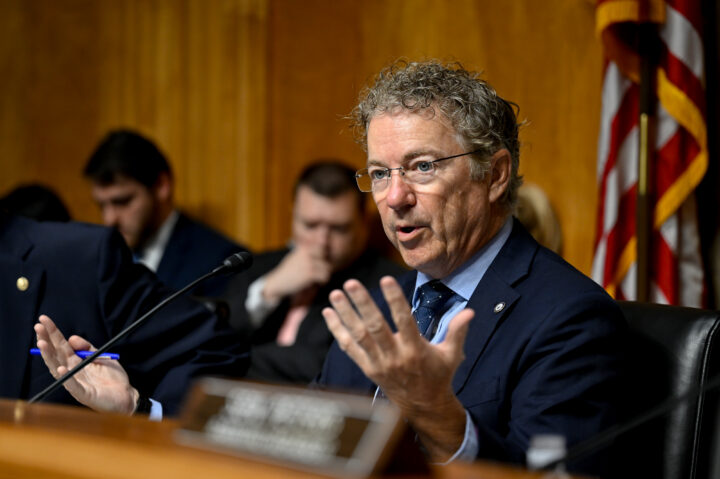
Daniel Heuer/Bloomberg via Getty Images
Senator Rand Paul, a Republican from Kentucky and chairman of the Senate Homeland Security and Governmental Affairs Committee, during a confirmation hearing in Washington, DC, US, on Wednesday, June 17, 2026.
The Senate voted on Wednesday night to block a Democratic-led war powers resolution seeking to end military operations against Iran, after a heated meeting between President Donald Trump and Senate Republicans where he berated a handful of lawmakers over their votes in favor of a successful war powers resolution the previous day.
Sens. Bill Cassidy (R-LA) and Rand Paul (R-KY), supporters of previous war powers efforts, changed their votes on the resolution on Wednesday, which had previously passed a procedural hurdle — Cassidy now voting no and Paul voting present. Sens. Susan Collins (R-ME) and Lisa Murkowski (R-AK) again voted yes, while Sen. John Fetterman (D-PA) voted no. The final vote was 50-47.
Cassidy, who engaged in a shouting match with Trump in the meeting over his recent war powers votes, told reporters after the meeting that he would not change his vote until he had been briefed on the war. Hours later, Cassidy received a private briefing on the war from Vice President JD Vance and White House Special Envoy Steve Witkoff.
“I am reassured. I had my briefing. My criteria is met,” Cassidy said. “As long as I’m reassured that there’s honesty and that, as they’re depicting events, it’s playing out appropriately, I’m reassured. But again, you want to trust but verify.”
Cassidy had said earlier in the day that he did not believe the administration’s prosecution of the war was on track to achieve the goals it laid out. Following that conversation, Cassidy changed his tune.
“I think it’s plausible that they are achieving the objectives, as they laid it out,” Cassidy told Jewish Insider. He added that he wants to “see events transpire the way they depict them, but they had plausible explanations for how they’re achieving those objectives.”
Cassidy said he had passed a note to Witkoff, who attended the Senate meeting with Trump, asking him for a briefing, and the White House had called within the hour to set it up.
The Louisiana senator has emerged as a key swing vote since losing his primary to Trump-backed Rep. Julia Letlow (R-LA).
Paul, the earliest GOP vote in favor of war powers efforts, said his present vote came in deference to the administration’s negotiating strategy.
“My opinion on the debate over war and executive power has not changed and I have voted that way several times. But since hostilities seem to be over and the president asked me to give consideration to his negotiating position, I will do so,” Paul said. “My vote of present is a way to give the president more space and leverage to negotiate a lasting peace.”
Cassidy said Trump raised his voice after the senator defended his vote backing a resolution directing the administration to withdraw U.S. forces from Iran

Bill Clark/CQ-Roll Call, Inc via Getty Images
Sen. Bill Cassidy, (R-LA), walks through the Ohio Clock Corridor before President Donald Trump arrives for the Senate Republicans' lunch meeting in the U.S. Capitol on Wednesday, June 24, 2026.
President Donald Trump engaged in a shouting match with Sen. Bill Cassidy (R-LA) during a closed-door lunch with Senate Republicans on Wednesday over the outgoing Louisiana senator’s support for a war powers resolution directing the administration to withdraw U.S. forces from Iran that passed the chamber the previous day.
Cassidy acknowledged the incident after the luncheon concluded, telling reporters that the dispute began when the president questioned aloud why any Republican would vote for the resolution. The Louisiana senator stood up from his chair and asked Trump if his question was rhetorical or if he wanted an explanation. Cassidy said Trump responded by asking for an explanation, which the senator obliged.
The Louisiana senator said that he told the president, “You have not told the American people what’s going on. It was supposed to last four weeks, it has lasted for four months. Our original objectives have not been achieved. And I want to know what’s going on.”
He went on to say that Trump “did not particularly care for my comments” and “raised his voice,” prompting Cassidy to grow angry. At some point during the confrontation, other GOP senators encouraged Cassidy to sit down and tried to “deescalate” the situation. Cassidy obliged his colleagues and stopped engaging the president.
“I lost my temper,” Cassidy said. “That’s not appropriate, it’s the Irish in me. But I, again, matched his tone, and his volume. It went back and forth.”
Cassidy accused Trump of making several negative comments about him, including a remark about Cassidy losing his reelection bid to a Trump-backed challenger. Another GOP senator said that Cassidy referred to Trump as “my brother” at one point instead of his formal title, which Trump responded to angrily.
Still, the senator said that Cassidy remained respectful of the president during the exchange, and attributed the blowup in part to Trump’s longstanding frustration with Cassidy on a range of issues, including his impeachment in 2021.
Cassidy noted that he would continue to vote for the war powers resolutions until he is briefed on the war effort. Sens. Lisa Murkowski (R-AK), Susan Collins (R-ME) and Rand Paul (R-KY) joined Cassidy in helping Democrats pass a war powers resolution in the Senate for the first time on Tuesday, delivering the upper chamber’s first rebuke of the president’s war.
He added that he will be satisfied once the administration briefs Congress on the details of the U.S. memorandum of understanding with Iran. “You say everything’s fine, but on the outside, it doesn’t look like everything’s fine,” he said of the Trump administration’s handling of diplomatic efforts to end the war in Iran.
“I make no apologies for standing up to the president, if you will, trying to demand that more information be shared with the American people,” Cassidy said. “If someone tries to bully you into not asking that question, I’m not going to accept that either. I am sticking up for the American people, even if I’m speaking to the president.”
The meeting was organized by Sen. Rick Scott (R-FL) and comes at a time of heightened tension between Trump and the Senate Republican conference over the war powers vote; Trump’s demands that the Senate pass his signature voter ID bill, for which Senate Republicans say they lack the votes; and, most recently, Trump’s last-minute decision on Wednesday morning to cancel a signing ceremony at the Capitol for a much-anticipated bipartisan housing package.
A large group of Senate Republicans — including Senate Majority Leader John Thune (R-SD), Majority Whip John Barrasso (R-WY), Sens. John Hoeven (R-ND), Jerry Moran (R-KS), Thom Tillis (R-NC), Mike Rounds (R-SD), Katie Britt (R-AL), Kevin Cramer (R-ND), Tim Scott (R-SC), Mike Crapo (R-ID), John Kennedy (R-LA), Collins, Murkowski and others — huddled on the Senate floor for an extended period after the contentious meeting, in what appeared to be an at-times animated conversation.
Following the luncheon, Scott told reporters that Trump was “very forceful about what he cares about,” also noting that the president talked about Iran “a lot.”
“[Trump] is very comfortable he’s going to get a deal,” Scott said. “[Iran is] doing exactly what he wants. He was very disappointed that somebody would vote on the war powers resolution to stop him in the middle of negotiations, so that frustrates him.”
Scott suggested he understands Trump’s heated demeanor: “If I was the president, I was in the middle of a negotiation to protect American lives, I would be frustrated too.”
Scott said that Trump told senators that Iran is not telling the truth about the talks, and that if Iran doesn’t agree to a good deal, the U.S. will return to military action.
“He said Iran’s agreeing to whatever his requests are. Don’t believe in anything [that] the Iranian press is putting out, because it’s a complete lie,” Scott said. “He’s very comfortable that they’re not gonna have nuclear weapons, they’re not going to have the money to be able to continue to support Hamas, Hezbollah and the Houthis, so he’s very comfortable that we’re going to have a good deal.”
Kennedy, who has been skeptical that the Iranian regime will hold to the terms of any deal but supportive of the administration’s negotiation efforts, offered a similar view.
“I’m in the middle of serious negotiations, trying to settle a conflict, and one of my mates undermines me,” Kennedy said of the president’s perspective. “I’m going to be mad too, and he was mad as a murder hornet about that. He’s right to be mad, in my opinion. Not criticizing anybody for their vote, but these next 60 days are critical,” he added, referring to the 60-day window for further negotiations established in the agreement with Iran.
“We ought to support him, whether you like him or not,” Kennedy continued. “I don’t know how it’s going to end up, you’ll have plenty of time to assess it after 60 days, but we’re going to give peace a chance for 60 days.”
Cramer said that Trump was “very detailed” in his discussion of the situation in the Middle East, but he and other Republicans said there was little opportunity for them to ask questions.
Like Scott, Cramer said Trump disputed Iran’s characterizations of the talks. “He emphasized again that everything they’re saying they’re not giving up, they’re giving up,” Cramer said. “My trust is in our administration until such time as they sign something that’s foolish.”
Another GOP senator, speaking on condition of anonymity, said that Trump emphasized to the group that he could “blow everything up” but that that would have harmed many Iranians, which he wanted to avoid.
The senator told JI that the president explained the MOU to senators — including the financial benefits Iran stands to gain and his decision to strike Iranian nuclear sites in 2025 — and defended his diplomatic overtures to the Iranian regime. They said that Trump told the group, “Without any question in his mind, the number one thing is that Iran is just not going to be able to have a nuclear weapon, ever.” The senator said Trump expressed “so much compassion for Israel” in his remarks.
Trump also warned the lawmakers, according to the senator, that, “If we don’t watch out, what we do here can screw up a whole lot of stuff when you’ve got people that are negotiating” a possible deal with Iran.
Rounds said the president provided senators “more of a briefing in terms of what [the administration is] doing over [in Iran] than we’ve heard to date.” However, Rounds noted that “most of it to me was consistent with what we’ve learned” in previous classified briefings.
When asked whether Republican senators explained to Trump that there is a lack of votes to pass his voter ID bill, the SAVE America Act, Rounds said, “We really didn’t get into that.”
Sen. Tommy Tuberville (R-AL), a strong supporter of the president, praised Trump’s performance in the meeting, telling reporters after the luncheon, “You can’t take it personal. You’ve got to go in knowing that the head coach is coming into the … room.”
“The president did a hell of a job of getting his message over, and sometimes in a loud voice, sometimes not so loud,” Tuberville said. “That’s how you do it. That’s how I did it. Not to say it’s perfect. He came in and got his point across, and I think when we all left, we understood where he [stands].”
Sen. Roger Marshall (R-KS) similarly dismissed the shouting match between Trump and Cassidy as indicative of the president having an issue with the Senate GOP conference.
“I think it’s great for a family to have these types of discussions,” Marshall said. “You all act like no one ever yelled at each other. I didn’t go into a doctor’s hospital board meeting where there wasn’t yelling at each other. I think it’s perfectly fine if you’re trying to air your grievances.”
Sen. John Cornyn (R-TX), meanwhile, sarcastically told reporters that there “was quite a unity message” during the meeting.
Cornyn also remarked that Trump spoke for an hour and 15 minutes and that there “wasn’t really an opportunity” for him to get a question in.
The president’s continued push for the Senate to pass the SAVE America Act, despite lacking the votes without abolishing the 60-vote filibuster threshold, was also a major point of contention.
“He wants the SAVE Act, that much is clear,” Kennedy told reporters. “I want to say that I’m on the record for any way to get the SAVE Act passed. I still think there’s potential through reconciliation, but some of my Senate colleagues don’t agree with it. … It’s clear he wants it.”
“I know there’s frustration over the SAVE Act passage, but we simply don’t have the votes because we’re not going to nuke the filibuster,” Tillis said. “We’ve made it clear multiple times, if the SAVE Act requires nuking the filibuster it’s simply not going to happen and that’s been obvious long before today.”
The resolution passed 50-48 with GOP Sens. Paul, Murkowski, Collins and Cassidy voting with Democrats in favor
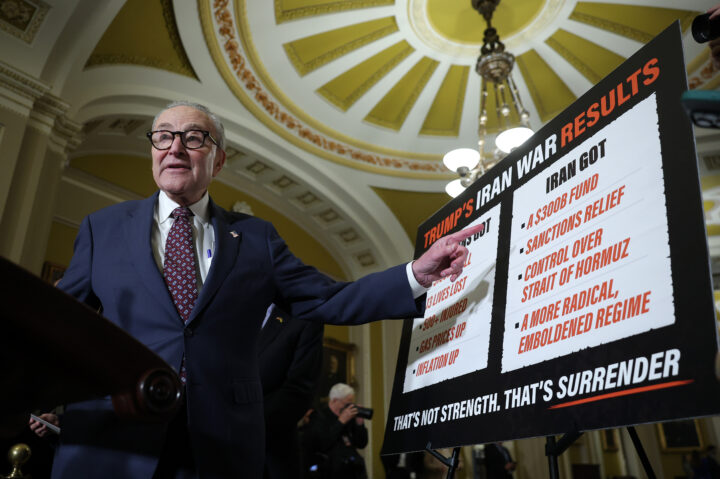
Photo by Kevin Dietsch/Getty Images
U.S. Senate Minority Leader Chuck Schumer (D-NY) speaks to reporters after the weekly Senate policy luncheons at the U.S. Capitol on June 23, 2026 in Washington. Schumer spoke out against President Trump's Iran deal and a the need for the Senate to pass a War Powers Resolution regarding Iran.
The Senate voted on Tuesday to pass a House-passed war powers resolution directing the administration to withdraw U.S. forces from Iran — a congressional rebuke of the administration over the war in Iran — though legally its effects are likely to be largely symbolic.
The resolution passed by a 50-48 vote, with Republican Sens. Rand Paul (R-KY), Lisa Murkowski (R-AK), Susan Collins (R-ME) and Bill Cassidy (R-LA) again voting in favor and Sen. John Fetterman (D-PA) voting against it. Ultimately, GOP absences enabled the resolution to go forward.
But the resolution, now passed by both chambers, came in the form of a concurrent resolution, which is not submitted to the president and, based on past court precedent, is not seen as carrying the force of law — though a House Democratic aide argued to CNN that the measure would be binding.
Rep. Greg Meeks (D-NY), the ranking member of the House Foreign Affairs Committee and lead Democratic sponsor of the war powers resolution, insisted in a statement, “Regardless of what President Trump says, this measure is binding under the War Powers Resolution, and I will explore all legal avenues to ensure the Executive complies with the will of Congress.”
Unlike previous efforts, however, the concurrent resolution did not require other procedural votes by the Senate, allowing Democrats to take advantage of the Republican absences and move directly toward final passage to deliver a message of rebuke to the administration.
The Senate still has other war powers resolutions pending, including one which passed an initial procedural hurdle, but currently lacks the support to pass through an additional procedural vote and final passage with full attendance. That legislation, which comes in a different form as joint resolutions, would be presented to the president if passed and set up a potential veto or other legal fight.
Republicans warned that adopting the resolution would send a further signal to Iran that it does not need to negotiate or make any compromises with the U.S. as part of ongoing talks.
Four Republicans again broke with their party, but absences handed the GOP a narrow 48-47 win
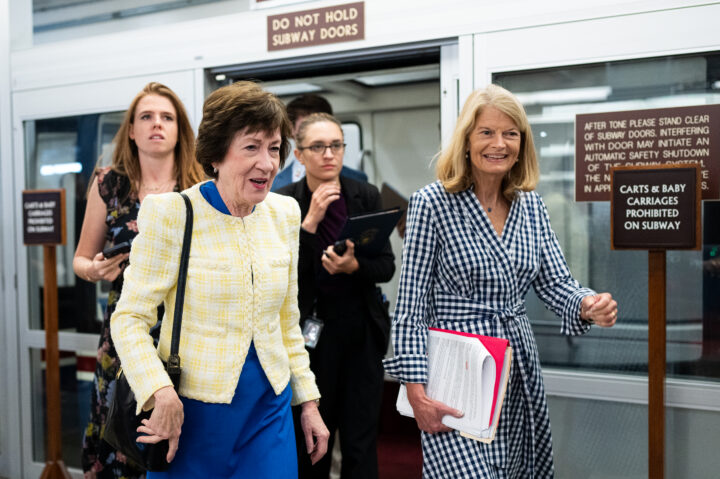
UNITED STATES - APRIL 30: From left, Sen. Susan Collins, R-Maine, and Sen. Lisa Murkowski, R-Alaska, talk as they arrive for a vote in the U.S. Capitol on Wednesday, April 30, 2025. (Bill Clark/CQ-Roll Call, Inc via Getty Images)
Despite having previously approved a similar motion, the Senate on Tuesday narrowly defeated a procedural vote on a war powers resolution to prevent further military action against Iran, as the administration moves forward in negotiations with Tehran.
The same four Senate Republicans — Sens. Susan Collins (R-ME), Lisa Murkowski (R-AK), Rand Paul (R-KY) and Bill Cassidy (R-LA) — voted to advance the resolution, but absences favored Republicans this time, defeating the resolution 48-47.
Sen. John Fetterman (D-PA) was again the sole Democrat who voted against the effort.
Sen. Tim Kaine (D-VA), who led the previous war powers resolution that successfully advanced, explained to reporters that he hasn’t yet called up that resolution for further votes because he needs to secure one more vote in support to ensure passage.
“I would like to call up mine when I know I’ve got a win,” Kaine said. “I don’t yet have a fifth. I need a fifth vote. … I’ve been working some people to try to get that, but I haven’t gotten any solid commitments.”
He said that he’s still trying to persuade colleagues that, even if the war is paused now, it should not restart without congressional approval, and that Democrats still want to have weekly votes on the war. He said he’s hopeful that the current ceasefire could give some additional Republicans the leeway to vote for the effort.
Sen. Thom Tillis (R-NC), seen as a potential GOP swing vote, ultimately voted against the motion after telling reporters that the current uncertainty could warrant some involvement by Congress.
“I don’t even know what we’re doing right now. … Are we in a ceasefire, are we in an agreement that is basically a new agreement on a ceasefire? Are we working towards a real lasting agreement that may be subject to ratification of Congress?” Tillis said before the vote.
The North Carolina Republican said he would decline to take a firm position before hearing arguments on both sides of the issue.
“[If y]ou’ve got all that uncertainty, then maybe, if we do still think that the U.S. forces need to be put at risk and be kept there, then we should probably be talking about an authorization for the use of military force,” Tillis continued.
House Democratic leadership opposed Tlaib’s resolution, but said they’ll support a different effort of hers to block U.S. support for Israeli operations against Hezbollah

Tom Williams/CQ-Roll Call, Inc via Getty Images
Rep. Rashida Tlaib (D-MI) attends the House Financial Services Committee on Wednesday, March 29, 2023.
The House rejected a war powers resolution by Rep. Rashida Tlaib (D-MI) on Thursday that aimed to block U.S. support for Israeli operations against Hezbollah in Lebanon, after House Democratic leaders publicly came out against the effort.
But the Democratic leaders said they would support a future effort by Tlaib along similar lines that will include carveouts for other U.S. operations inside Lebanon, indicating that Tlaib’s next effort is likely to pick up greater Democratic support.
The resolution failed by a vote of 324-92, with most votes in favor of the resolution coming from progressive House Democrats, though several more moderate lawmakers also voted in favor. The Congressional Progressive Caucus whipped in favor of the resolution. Rep. Thomas Massie (R-KY) was the only Republican who supported the effort, and 117 Democrats — a majority of the caucus — voted against it.
Reps. Betty McCollum (D-MN) and Derek Tran (D-CA) voted present.
Tlaib’s resolution, which directed the administration to “remove the United States Armed Forces from Lebanon” within seven days, aimed to cut off U.S. logistical and intelligence support for Israeli operations against Hezbollah. Tlaib has consistently ignored or downplayed Hezbollah’s role in the conflict, describing Israel’s operations as being against Lebanon and the Lebanese people writ large.
Democratic critics said that the legislation would also require the U.S. to remove military guards from its diplomatic facilities and U.S. servicemembers that train and advise the Lebanese Armed Forces. Tlaib insisted that other U.S. operations would be able to continue, in spite of the strict wording in her legislation that indicated they would be impacted.
House Democratic leaders Reps. Hakeem Jeffries (D-NY), Katherine Clark (D-MA) and Pete Aguilar (D-CA) said in a joint statement that they support efforts by the LAF to defeat Hezbollah — making no mention of Israel — and said that they “do not support any effort by the Trump administration to entangle the United States in a war in Lebanon or other parts of the Middle East.”
They said that, since there are no U.S. troops involved in hostilities in Lebanon, a more prudent path would be to pursue an alternative resolution Tlaib introduced, with support from Rep. Greg Meeks (D-NY), the ranking member of the House Foreign Affairs Committee.
The statement came after multiple days of behind-the-scenes wrangling and negotiations over the legislation.
Tlaib’s alternative resolution directs the administration to remove U.S. forces “from any hostilities in Lebanon” within seven days, and includes a specific carveout for diplomatic protection and cooperation with the LAF.
Despite introducing the alternative resolution herself, Tlaib said on X, “The people of Lebanon can’t wait another month for Congress to act.”
Rep. Brad Schneider (D-IL), who said Tlaib denied him the opportunity to speak on the House floor on the legislation, emphasized in a video statement that the legislation might impact U.S. support for the LAF and U.S. diplomatic security and highlighted that Hezbollah is a threat to the Lebanese people, in addition to attacking Israel since early February.
“We need to find a path where Lebanon and Israel can live in peace, and this resolution doesn’t help us. It doesn’t send a message to the president or the Trump administration. It doesn’t send a message to the Netanyahu government,” Schneider said. “It sends a message to Lebanon and Hezbollah that what they’re doing is acceptable. It sends a message to the Lebanese people that once more they’re pawns in someone else’s fight.”
Rep. Jared Moskowitz (D-FL) told Jewish Insider, “The United States is not at war with Lebanon nor is there any indication that we’re going to war with Lebanon. So it’s an unnecessary war powers vote.”
Debate over the resolution on Tuesday turned heated when Rep. Max Miller (R-OH) accused Tlaib of “advocat[ing] for terrorists on a daily basis” and of “hang[ing] out with” with Hezbollah “butchers.”
His remarks were struck from the congressional record with an objection from Tlaib, but he said in a statement read out on the House floor by a colleague that he stood by his remarks.
The resolution passed 215-208, with four Republicans breaking ranks to vote for the resolution, and all present Democrats remaining united on the issue for the first time since the war began

Kevin Carter/Getty Images
U.S. Capitol Building on January 18, 2025 in Washington, DC.
The House passed a war powers resolution on Wednesday that would halt U.S. military operations against Iran, after House Republicans postponed an expected vote on the resolution for more than a week, in an ultimately futile effort to stave off defeat.
The resolution passed 215-208, with four Republicans breaking ranks to vote for the resolution, and all present Democrats remaining united on the issue for the first time since the war began. Six Republicans and one Democrat were absent for the vote — so the resolution likely still would have passed even with full attendance.
The vote comes after the Senate advanced a procedural vote on a similar resolution, and is a notable signal of opposition from Congress to the war in Iran, even if President Donald Trump can veto such a resolution if it passes the Senate. Some Republicans have suggested that the underlying 1973 War Powers Act is unconstitutional or invalid, and should be challenged in court or ignored by the administration.
A final Senate vote on the war powers resolution that advanced last month is still pending.
Republican Reps. Warren Davidson (R-OH), Thomas Massie (R-KY), Tom Barrett (R-MI) and Brian Fitzpatrick (R-PA) broke ranks to support the resolution. Davidson and Massie are libertarian-leaning isolationists, while Barrett and Fitzpatrick represent hotly contested swing districts.
Davidson voted for a war powers resolution at the outset of the conflict, but voted present and then against subsequent resolutions, before flipping his vote back to yes on the latest vote.
Fitzpatrick told reporters his vote was an issue of the law. The War Powers Act gives the administration 60 days to conduct military operations without congressional approval.
“We’re past the 60 days, so you have two choices: you either follow the law or you change the law,” Fitzpatrick said. “You can’t violate the law, that’s not an option. … I don’t see what’s complicated about it. Bring it to Congress, debate it on the merits and have us vote. That’s the way the system’s supposed to work.”
The administration has claimed that its military operations against Iran that began in February have concluded, and that its continued limited strikes against Iranian targets do not qualify as warfare.
Barrett, who introduced a limited Authorization for Use of Military Force in Iran, offered a similar stance in a statement.
“Congress has the exclusive authority under the Constitution to declare war and authorize the use of force,” Barrett said. “The War Powers Act of 1973 delegates some of that authority to the president for a limited period of time. That authority has expired, so my consistent belief is that it is time for Congress to decide the scope of the mission and the appropriate limits on the use of force in Iran.”
Other Republicans argue the legislation sends a message of weakness and division and strips the U.S. of leverage in the midst of negotiations.
“I think what it signals to Iran is that, especially from the Democratic standpoint, it gives them confidence to try and drag these negotiations out. So I think it undermines the position of the United States of America,” Rep. Mike Lawler (R-NY), who chairs the Foreign Affairs Committee’s Middle East subcommittee, told reporters. “They’re actively undermining the United States position in these negotiations, so, from my standpoint, I think it’s foolish, and that’s why I voted no.”
Rep. Jared Golden (D-ME), the sole Democratic holdout on previous votes, also flipped his vote to support the resolution in Wednesday’s vote.
Golden said that, after the 60-day mark of the Iran war passed, the statutory cutoff for military operations undertaken without congressional authorization, he believed the war could not continue without such approval. But he described a war powers resolution the House voted on last month as textually flawed and outdated.
“The passage of my War Powers Resolution is a significant bipartisan rebuke of President Trump’s illegal and costly war in Iran, and the first step toward ending it once and for all,” House Foreign Affairs Committee Ranking Member Greg Meeks (D-NY) said in a statement. “The passage of this WPR today signals a significant turning point: more and more Republicans are listening to their constituents who do not want another open-ended war in the Middle East. Now the Senate must take up this measure and make clear to the President that enough is enough.”
CPC members constitute nearly 45% of the House Democratic caucus

Monica Morgan/Getty Images
Rep. Rashida Tlaib (D-MI) speaks at the “Bridging Community and Normalization with the Republic of Cuba and the United States of America" event.
The leadership of the Congressional Progressive Caucus, whose members constitute nearly 45% of the House Democratic caucus, is encouraging members to vote for a war powers resolution led by Rep. Rashida Tlaib (D-MI) which aims to prevent any U.S. cooperation with or assistance for the Israeli operations in Lebanon, Jewish Insider has learned.
Tlaib is expected to force a vote on the resolution this week. The backing of the CPC leadership does not guarantee support from all 95 of the caucus’ members, but indicates that Tlaib’s resolution could pick up substantial support among congressional Democrats.
CPC Chair Rep. Greg Casar (D-TX) did not respond to a request for comment.
The resolution currently has nine cosponsors along with Tlaib: Reps. Delia Ramirez (D-IL), Nydia Velázquez (D-NY), Chuy García (D-IL), Valerie Foushee (D-NC), Yassamin Ansari (D-AZ), Lateefah Simon (D-CA), Ilhan Omar (D-MN), Val Hoyle (D-OR) and Ro Khanna (D-CA).
House Foreign Affairs Committee Ranking Member Greg Meeks (D-NY), who has been at the forefront of other war powers efforts that aim to stymie the Trump administration, hasn’t yet publicly weighed in on Tlaib’s effort.
House Minority Leader Hakeem Jeffries (D-NY) said he hadn’t reviewed the legislation yet.
Tlaib, in advocating for the resolution, has largely ignored Hezbollah’s role in the conflict. An FAQ circulated by her office last week asserted that Hezbollah is not the true target of Israel’s operations.
“Israeli leaders’ statements and actions have made it clear that this invasion is not about Hezbollah. Indiscriminate bombings, the demolition of entire towns and villages, and illegal forced displacement orders have targeted the entire population across wide swaths of Lebanese territory,” the FAQ reads in a section entitled, “What about Hezbollah?”
“The U.S. enabling and supporting another Israeli invasion and indefinite military occupation in Lebanon will only lead to more death and destruction. It is clear that if we are serious about achieving peace and security for all, we must use our leverage to put an immediate end to this invasion,” the section continues.
While she framed the resolution as cutting off U.S. support for Israel’s operations, she said it would not impact U.S. assistance or support for the Lebanese Armed Forces.
The vote is postponed until June, after the Memorial Day holiday

Andrew Harnik/Getty Images
House Majority Leader Steve Scalise (R-LA) speaks to members of the media at the U.S. Capitol Building on May 21, 2026 in Washington, DC.
House Republicans postponed a vote on a war powers resolution on Iran, which was expected to pass given a series of GOP absences and Rep. Jared Golden’s (D-ME) anticipated flip to support the effort.
The vote now will not take place at least until the beginning of June, after the House’s weeklong Memorial Day recess, but Republicans can’t put the vote off indefinitely given House rules.
The previous war powers resolution failed in a tied vote last week. But eight Republicans — only one of whom was likely to vote for the resolution — were absent for Thursday’s votes, with only two Democrats not present. Only four Republicans and two Democrats were absent for the previous war powers vote.
Democrats said that the margins would have been sufficient to secure passage of the resolution. House Republicans kept the previous vote open for more than 45 minutes — even though it was scheduled to last just five minutes. The delay unfolded as both Republican and Democratic leaders huddled on the House floor, with Democrats repeatedly shouting for the vote to be closed.
House Majority Leader Steve Scalise (R-LA) tacitly acknowledged the attendance issues following the vote.
“Well, we just had some members that weren’t there that wanted to be recorded on it, so we’re going to be giving them that opportunity when we come back,” he told Punchbowl News.
Rep. Brian Fitzpatrick (R-PA), one of the few Republicans who was expected to support the resolution, predicted to Politico that the resolution would pass when it next comes up for a vote.
Democrats have been openly frustrated at the delay. Reps. Hakeem Jeffries (D-NY), Katherine Clark (D-MA) and Pete Aguilar (D-CA), the three top Democrats in the House, accused House Republicans of having “failed this country.”
“The Republican-controlled House continues to behave like a wholly-owned subsidiary of the Trump administration. Republicans cowardly pulled a scheduled vote on a War Powers Resolution — legislation that would have passed with bipartisan support and required the President to end the conflict in the Middle East,” the three said.
They accused Republicans, ahead of Memorial Day weekend, of having “refuse[d] to show up and be accountable to the brave service members that have been recklessly put in harm’s way.”
“The American people will remember in November,” the Democratic leaders said, in reference to the midterms.
The Senate advanced a similar war powers resolution earlier this week through a procedural vote, and is also expected to take a final vote on the measure after the recess, the result of which may also depend on attendance.
Regardless, even if the resolutions pass both chambers, President Donald Trump has the ability to veto them.
Rep. Tom Kean Jr. (R-NJ), whose extended absence from the House for more than two months has gained increasing attention, resurfaced Thursday, contacting reporters and Republican officials after weeks of silence amid an unspecified health condition.
Kean reportedly told National Republican Campaign Committee Chair Rep. Richard Hudson (R-NC) that he would be returning to work in June — potentially securing another “no” vote for Republicans, should he return immediately after the recess, according to reporters who spoke to Hudson.
The motion passed with four Republicans voting in favor, teeing up a vote on the war powers resolution itself

Tyler Kaufman/Getty Images
Sen. Bill Cassidy (R-LA) speaks to media on the first day of early voting outside of the Louisiana State Archives on May 02, 2026 in Baton Rouge, Louisiana.
Sen. Bill Cassidy (R-LA) joined with Democrats to vote for a procedural motion advancing legislation that would end U.S. military operations against Iran, allowing the war powers resolution to move forward on Democrats’ eighth such attempt since the war began.
Cassidy joined three other Republicans — Sens. Susan Collins (R-ME), Lisa Murkowski (R-AK) and Rand Paul (R-KY) — in voting for the procedural motion, which was approved by a 50-47 vote. Sen. John Fetterman (D-PA) voted against the motion.
The passage of the motion will now tee up further debate and an additional vote on the resolution itself, at a time to be determined. The Senate is set to depart for a Memorial Day recess this weekend, and floor time this week is expected to be focused on a reconciliation bill funding immigration enforcement, among other issues.
Cassidy’s vote came days after he lost his primary race to a challenger backed by President Donald Trump. He’s been supportive of the Iran war to this point, but has also been critical of the administration and has voiced the need to assert congressional power, particularly in the wake of his election loss.
He emphasized to reporters on Monday evening the need to rally support from traditional U.S. allies to address the situation in the Strait of Hormuz.
“While I support the administration’s efforts to dismantle Iran’s nuclear program, the White House and Pentagon have left Congress in the dark on Operation Epic Fury,” Cassidy said on X. “In Louisiana, I’ve heard from people, including President Trump’s supporters, who are concerned about this war. Until the administration provides clarity, no congressional authorization or extension can be justified.”
The result came about in part due to absences by Sens. John Cornyn (R-TX), Thom Tillis (R-NC) and Tommy Tuberville (R-AL). Had they been present and voted as they have in the past, the vote would have been tied, allowing Vice President JD Vance to cast a tie-breaking vote and reject the motion.
Yet, some of those votes may not be guaranteed when the resolution itself comes to the floor.
Tillis, who is retiring, has repeatedly bucked Trump and his party on a range of issues. Cornyn has been strongly supportive of the war, but Trump on Tuesday endorsed his primary opponent, Texas Attorney General Ken Paxton, likely setting Cornyn on the road to defeat in his primary race.
Cornyn announced on X shortly after the vote that he would be canceling campaign events in Texas on Wednesday and heading back to Washington to vote on Republicans’ reconciliation bill.
However, earlier this year, several Republicans voted with Democrats to advance a similar motion on a war powers resolution relating to Venezuela, but most of them flipped their votes under pressure from the administration and Republican leadership, ultimately blocking final passage of the resolution.
The House could pass a war powers resolution as well this week, depending on attendance. A previous vote last week was tied, 212-212, but Rep. Jared Golden (D-ME), the sole Democrat to vote against the resolution, said he would vote for a future resolution.
Even if the resolutions pass, they can still be vetoed by Trump.
The resolution aims to ban U.S. intelligence sharing and targeting assistance to Israel for its operations in Lebanon, but does not make any mention of Hezbollah
Tom Williams/CQ-Roll Call, Inc via Getty Images
Rep. Rashida Tlaib (D-MI) attends the House Financial Services Committee on Wednesday, March 29, 2023.
Rep. Rashida Tlaib (D-MI) plans to force a House vote next week on a war powers resolution blocking any U.S. involvement in or support for Israeli military operations in Lebanon, according to a memo distributed by Tlaib’s office to progressive lawmakers and obtained by Jewish Insider.
Tlaib’s resolution, co-led by Rep. Delia Ramirez (D-IL), aims to prevent any U.S. assistance to Israel in its operations in Lebanon, including intelligence sharing and targeting assistance for operations against Hezbollah. Neither the legislation nor Tlaib’s memo make mention of Hezbollah nor acknowledge its attacks on Israel or its refusal to disarm.
“The United States is assisting this destruction through the weapons, intelligence, logistics, and diplomatic cover it provides the Israeli government, and Congress has the power and duty to put an end to this illegal invasion,” a press release by Tlaib’s office read.
The legislation is backed by a host of anti-Israel groups including American Muslims for Palestine, Code Pink, the Democratic Socialists of America, Justice Democrats, Jewish Voice for Peace and the Sunrise Movement.
In the memo circulated to other progressives, Tlaib’s team accused Israel of destroying and displacing entire communities and committing war crimes, and argued that “there is no real ceasefire” between Israel and Lebanon. The two countries held their third round of ambassador-level meetings in Washington on Thursday.
The memo asserts that there are “repeated, credible, sourced reports” that President Donald Trump has personally approved or disapproved specific operations in Lebanon, and that the U.S. and Israel are coordinating on targeting.
It also states that there are “credible reports” that the U.S. is sharing targeting intelligence in Lebanon.
“It is almost certain, given the depth of this military relationship, that the U.S. has been involved in these hostilities far more than has been publicly reported thus far,” the memo reads. “The Pentagon has every incentive to avoid confirming the full scope of that involvement, and as we saw during Yemen, details only emerge under pressure. We should expect the same dynamic here.”
The memo makes the case that bringing the vote to the House floor would bring attention to the war and place pressure on the White House and on Israel to end it, though it acknowledges that the resolution is not likely to pass.
It also asserts that a war powers resolution on Cuba in the Senate forced Senate Republicans to make public statements opposing a U.S. invasion of the island, something the memo argues would not have happened without the resolution vote.
“Forced votes create forced disclosures and force people to make commitments that are harder to walk back later,” the memo reads.
Rep. Ro Khanna (D-CA) alluded to the plan to force a vote on X on Thursday, posting, “I support [Tlaib’s] War Powers Resolution to stop any US involvement in the war in Lebanon. 2,896 Lebanese have been killed, and Israel is striking even Beirut. 1.2 million have been displaced. We need a vote next week.”
The vote ended in a 212-212 tie, with two new House Republicans voting to force an end to the war
Kevin Carter/Getty Images
The U.S. Capitol Building is seen at sunset on May 31, 2025 in Washington, DC.
The House voted by the narrowest possible margin to reject Democrats’ latest effort to force an end to the war in Iran, with a final tied vote of 212-212.
Reps. Tom Barrett (R-MI) and Brian Fitzpatrick (R-PA) both voted with Democrats and Rep. Thomas Massie (R-KY) for the war powers resolution, while Rep. Jared Golden (D-ME) again voted against it.
Following the vote, an angry shout about Golden could be heard from a lawmaker on the Democratic side of the chamber. Golden said in a statement on Wednesday that he would vote for a “‘clean’ war powers resolution to remove the United States from hostilities against Iran,” pointing to a potential upcoming vote next week on a resolution by Rep. Greg Meeks (D-NY), but said that the resolution that came up for a vote on Thursday was flawed.
Wednesday’s resolution, of which Golden was an original co-sponsor, set a 30-day timeline for the war operations in Iran, a deadline which has long since passed.
“I supported this resolution when it was introduced, but unfortunately its proposed 30-day deadline lacks any real meaning now that we are more than 70 days into this conflict,” Golden said. “It no longer passes the straight-face test. I look forward to voting for a clean, relevant resolution as soon as possible.”
But, Golden continued, the “law is clear” and the administration’s “window for unilateral military engagement has closed. Hostilities, including the use of the U.S. fleet to impose a blockade of Iranian ports, cannot legally continue unless the president seeks, and wins, Congressional approval.”
Barrett and Fitzpatrick both represent swing districts, and Barrett recently introduced an Authorization for Use of Military Force to limit the U.S. operations in Iran. Should Barrett and Fitzpatrick maintain their positions and attendance otherwise remain the same, a war powers resolution could pass as early as next week.
Barrett, when he introduced the AUMF, said that he believes operations in Iran are ongoing in spite of claims to the contrary by the administration and that Congress needs to reclaim its constitutional authority over war powers.
Rep. Warren Davidson (R-OH), who voted for the first Democratic war powers resolution earlier this year and “present” on a second one in April, flipped his vote to “no” on this third effort. Davidson said he wanted to allow President Donald Trump space to negotiate and that any vote before the 90-day mark of the war would be “political.”
House progressives have gradually introduced a barrage of war powers resolutions, with the goal of potentially forcing votes as frequently as every day, meaning many more such votes are on the horizon.
Despite the three Republican defections, the measure still failed to pass
Kevin Carter/Getty Images
U.S. Capitol Building on January 18, 2025 in Washington, DC.
Sen. Lisa Murkowski (R-AK) became the latest of a small number of Senate Republicans to break ranks and vote with the majority of Democrats in favor of an effort to force an end to the war in Iran on Wednesday.
She joined Sen. Susan Collins (R-ME), who voted for the second time for such an effort, and Sen. Rand Paul (R-KY), who has consistently voted with Democrats on the issue. Nevertheless, the effort still fell short of a majority of the Senate, or of the 60 vote threshold needed for passage, with a final vote of 49 in favor to 50 against.
Sen. John Fetterman (D-PA) remained the only Democrat to vote against the war powers effort.
Murkowski has been working with other Senate Republicans on an Authorization for Use of Military Force to set limits on the U.S. operations against Iran, but it remains unclear when she plans to introduce it or what its scope will be.
Murkowski and Collins’ votes suggest they’re unconvinced by the administration’s assertions that the military operations that began in late February have now concluded. The War Powers Act sets a 60-day deadline for military action without congressional approval.
“You’ve got a timeline that has taken us beyond the 60 days,” Murkowski told reporters. “I thought that perhaps we would get … more clarity from the administration in terms of where we are, and I haven’t received it. So I felt that it was now time to advance a discharge so that we can discuss our responsibilities as Congress under the War Powers Act.”
Collins said following the prior vote, two weeks ago, that she had voted for the resolution in order to enforce the War Powers Act.
Sen. Josh Hawley (R-MO), who previously said his position might change after the 60-day mark and has been urging the administration not to restart military operations, again voted against the war powers effort.
“I think the administration’s in compliance, the president’s [in] compliance with the war powers statute given his certification to Congress … saying that he had terminated hostilities under Operation Epic Fury,” Hawley told Jewish Insider, echoing comments he made earlier this week. “I welcome the termination of hostilities … I’m glad [Trump] has resisted some of my colleagues’ calls to return to large-scale bombing and is pursuing an end to the conflict. I think that’s good.”
Senate Majority Leader John Thune (R-SD) had urged Republicans not to break ranks on the issue while President Donald Trump is in China on a state visit this week.
“Right now, the president’s overseas,” Thune said. “He’s negotiating with the Chinese on a whole range of issues, some of which bear on national security, and I think it would be best if everybody hung together and supported the president.”
Sen. John Curtis (R-UT), who had previously expressed opposition to any military operations beyond the 60-day deadline, also voted against the resolution. He suggested to reporters that the efforts from Democrats were not “serious.”
“I’ve yet to see a serious war powers vote. Let’s admit it, all this is a poke at the president,” Curtis said.
Curtis told reporters later in the day that the situation and the path forward is not simple, and that many questions including whether the U.S. is in a ceasefire, whether hostilities have actually stopped and whether the U.S. is drawing down from operations in Iran need to be answered to shape his approach to the issue.
He said that there is not “any question in my mind” that the 60-day period has expired. He reiterated that he would not fund the war beyond 60 days without congressional authorization.
Asked by JI whether he would introduce his own war powers resolution or AUMF as an alternative to those pushed by Democrats, Curtis indicated he does not plan to do so. “Ever since 1973,” when the War Powers Act was first passed, “Congress has struggled with what the answer is.”
He said he wants to ensure the administration maintains freedom to act in an emergency scenario. He said that drawing the proper boundaries is “not easy, and there’s a reason nothing’s been done on it. It’s not a matter of will, it’s a matter of where do you draw that line? I do think it’s time to have that conversation and count me in, in a group that would try to define that.”
Asked about the potential for renewed military action, he said he would have to evaluate it and the requirements for notifying Congress based on events as they occur.
Sen. Thom Tillis (R-NC) told reporters he wants to work with the administration on an AUMF, dismissing comments by Secretary of Defense Pete Hegseth yesterday indicating that the administration feels it does not need and does not plan to seek an AUMF if it returns to combat.
The House is set to vote on a war powers resolution on Thursday, which stands a greater chance of passage. However, Rep. Warren Davidson (R-OH), who voted for the first war powers resolution that came before the House earlier this year, said he plans to vote “present” tomorrow, as he did on the second House vote.
Jewish Insider Washington reporter Matthew Shea contributed reporting.
The measure garnered 47 votes in the Senate, with GOP Sen. Susan Collins joining with Democrats for the first time
Kevin Carter/Getty Images
The U.S. Capitol Building is seen at sunset on May 31, 2025 in Washington, DC.
The Senate rejected for the sixth time an effort from Democrats to force the Trump administration to halt the war in Iran — with the vote once again falling largely along party lines.
The vote was the last before the conflict approaches the 60-day mark outlined in the War Powers Resolution of 1973, which requires the executive to seek congressional approval for continuing hostilities or draw down U.S. forces.
“After 60 days of war, it is long past time for Republicans to hold Donald Trump accountable,” Sen. Adam Schiff (D-CA) said in a statement released prior to the vote. “Some of my colleagues have indicated that the War Powers Act’s 60-day mark is the moment they may join our efforts to bring this war to its conclusion. That time has come.”
The latest resolution, sponsored by Schiff and Senate Minority Leader Chuck Schumer (D-NY), failed by a measure of 50-47. Sens. Jerry Moran (R-KS), Patty Murray (D-WA) and Tommy Tuberville (R-AL) did not vote.
Sens. John Fetterman (D-PA), Rand Paul (R-KY) and Susan Collins (R-ME) voted with the opposition party. This was the first time in which Collins sided with the Democrats on the war powers votes.
“As I have said since these hostilities with Iran began, the President’s authority as Commander-in-Chief is not without limits,” Collins said in a statement following the vote. “Further military action against Iran must have a clear mission, achievable goals, and a defined strategy for bringing the conflict to a close. I voted to end the continuation of these military hostilities at this time until such a case is made.”
Collins added that the 60-day war powers deadline is “not a suggestion; it is a requirement.”
Sen. Josh Hawley (R-MO) said he was not surprised by Collins, noting that “she has been saying the 60-day clock is significant for her.”
He added that for him: “We haven’t reached the 60 days. That’s why I voted the way I voted.” However, Hawley said that he wants “to see an end to the war.”
Senate Republicans have told Jewish Insider they expect the White House to abide by the law and provide notification of a 30-day extension to Congress, which is permitted to ensure a safe withdrawal. However, the administration has not yet indicated publicly whether it will seek that extension or continue offensive operations, and Defense Secretary Pete Hegseth claimed at a Senate Armed Services Committee hearing on Thursday that the 60-day clock was “paused” during the ongoing ceasefire.
As the deadline approaches, a growing rift is emerging among Senate Republicans over whether to support an Authorization of Use of Military Force.
“I would hope it wouldn’t come to that,” Hawley said of the White House potentially extending the conflict past the 60-day mark. “I think the administration has tried to remain within the statute.” Hawley has said that should the conflict extend past the deadline with no further action from the White House that he would debate an AUMF, but said he would prefer not to support authorizing a war he wants to see “wind down.”
Hawley said he would “welcome further communication from the White House.”
Sen. Todd Young (R-IN) also said he expects that the White House will “communicate” and “make a very strong legal argument.” He also noted that he believes the administration has “followed the War Powers Act provision so far in a very careful way.”
Young said that should an AUMF be necessary, he could see himself voting for a “properly structured authorization.”
“That’s been my position throughout this exercise,” Young said, referring to the recent slate of war powers votes. “My hope would be that if we went down that road, we’d work with the administration to draft a properly scoped authorization for the use of military force.”
Meanwhile, Sen. Mike Rounds (R-SD) said he is “not ready to commit to anything.”
“I want to make sure that we continue to get classified information on a timely basis from the Pentagon,” Rounds said. “I think today we had a very good classified setting with a lot of good information being provided. I think they [the White House] did a good job of sharing their point of view on it. So we’re moving in a good direction.”
Asked whether he believes anything would change at the 60-day deadline, Rounds replied: “I have no reason to believe that’s the case right now.”
Rounds said he believes a path forward between the U.S. and Iran will be “extremely difficult without regime change.”
“But that doesn’t mean that there isn’t hope for an agreement with this particular regime under very strict observations by outside forces to make sure that they adhere to any agreements we make,” Rounds added.
Sen. Tim Kaine (D-VA) said that while he thinks the current war is “unwise” and “illegal,” he said that if Congress “were to pass an AUMF in both houses it would stop being illegal.”
“I would stop critiquing it as an illegal war if they [Congress] passed an AUMF,” Kaine said.
Kaine said he expects that another war powers vote “will come up right after [Congress adjourns for] recess.”
“I think the testimony this morning shows they [the White House] know they got a 60-day problem,” Kaine said, referring to Hegseth’s remarks at the hearing.
Rounds, who serves on the Senate Armed Services committee, said that he would need to “go back and do a good review of that particular” remark.
“We’re in the middle of it,” Rounds said. “Once I have a chance to actually go through it myself then I’ll have a comfort level. I’m not going to disagree with him [Hegseth] at this stage.”
Under the War Powers Resolution, a president cannot sustain military operations for more than 60 days without congressional approval or requesting a 30-day extension

Tom Williams/CQ-Roll Call, Inc via Getty Images
Sen. Mike Rounds (R-SD) talks with reporters in the U.S. Capitol on Tuesday, March 3, 2026.
Senate Republicans are increasingly skeptical about the future of U.S. military engagement in Iran as the 60-day deadline for the war mandated by the War Powers Resolution approaches.
Under the 1973 law, the president cannot sustain military operations for more than 60 days without congressional authorization or a formal declaration of war, after which U.S. forces must be withdrawn. The White House can request a 30-day extension — with written justification to Congress — should it present “unavoidable military necessity.”
Short of a formal declaration of war, Congress can authorize continued operations through an Authorization for the Use of Military Force (AUMF), similar to that enacted following the 9/11 attacks, which would provide the legal basis for the administration to sustain the campaign.
But the prospects for such a measure remain uncertain, as it would require a high-stakes public vote that could divide Republicans.
With the 60-day deadline approaching this week, GOP lawmakers told Jewish Insider they expect the White House to comply with the statute and notify Congress of a 30-day extension — though they remain uncertain and divided over whether they would support authorizing continued military action.
Sen. Thom Tillis (R-NC) said he will not “quibble” over whether the exact deadline is met, however he stressed that the White House should respect the law on the books.
“I’m not going to quibble over a day or two, but people are saying we don’t know if the War Powers Resolution is constitutional … the reality is it’s on the books, ratified by Congress,” Tillis said. “[The White House should] follow it and at least ask for an extension, and give us clarity on why you need the extension beyond the 60 days. Then it gives them 30 days to be clear on what they need for the appropriations request,” he said, referring to the coming supplemental funding request from the administration.
Tillis did not indicate whether he believed an authorization would be needed, but said he would “support an AUMF that is drafted and supported by Republicans.” He called the recent rounds of war powers votes initiated by Democrats “political theater.”
“They’re not a serious effort to understand the details of what the president wants to accomplish and then provide congressional support to do it,” Tillis said. “I think if we do that, it strengthens our hand in dealing with the murderers posing as the mullahs of Iran.”
Sen. Mike Rounds (R-SD) did not commit to whether he would support an AUMF. He told JI that it will depend on several factors, including an explanation from the White House.
“It’ll depend on the information that they [the White House] provide to us, and we’ll see if they’re actually intending to stay there for an extended period of time, or if they’re going to have boots on the ground, or whether they’re going to be withdrawing from the area based on any kind of peace agreement,” Rounds said.
Rounds said his “expectation” is that the White House will “notify us [Congress] of an additional 30-day extension.”
“We’ve begun the process now of both classified and an open hearing tomorrow,” Rounds said, referring to a Senate Armed Services Committee hearing taking place on Thursday with Defense Secretary Pete Hegseth and Joint Chiefs Chairman Gen. Dan Caine. “So I think now steps will start to happen in terms of a more complete congressional review.”
However, Rounds noted that regardless of where the war heads, he expects that “this chapter in our history has not closed.”
“I suspect we’re still going to have to deal with an Iranian regime, which is a threat to the entire world,” he said.
Tillis said he had not heard anything on the White House potentially asking for a 30-day extension, but said in response to Rounds’ comments that “[Rounds] is on the Senate Armed Services committee, so that’s good news. I would expect Senate Armed Services Committee members to know before me. That’s good.”
Sen. Josh Hawley (R-MO) also did not signal whether he would support an AUMF. While he noted that he believes the White House has “been very careful to follow the war powers framework this whole conflict,” he stressed that he would like to see hostilities wind down and is skeptical of voting for a move that opens up the conflict further.
“Hopefully [there will be] an end to the war,” Hawley said, adding that he hopes “the president and secretary of state will be able to come back to Congress [and say] that they’re working to end the conflict and that active hostilities are over.”
He added that he wants the White House to do something “better than ask for 30 more days.”
“Clearly the president is trying to get to a peace deal here, I mean he says it everyday. It’s clear what he’s trying to do. He does not want to go back,” Hawley said. “We’re not bombing. He has said he doesn’t want to go back to that, which I agree with by the way. So I think we should bring this to a close.” President Donald Trump said on Wednesday that he’s rejecting Iran’s latest proposal to end the war as it omits any concessions on the country’s nuclear program.
Hawley said that Congress “can always debate an AUMF” if the White House doesn’t ask for a 30-day extension, but emphasized that he would prefer to “keep on that track” of winding down the war.
“I don’t really want to authorize a war, I want to end it,” Hawley said. “If we can’t, if the administration doesn’t ask for more time, if there are no additional certifications from them, I think we’re in AUMF territory, which would be kind of unfortunate. I would prefer not to vote to open up a conflict that I think ought to be wound down.”
Sen. John Cornyn (R-TX), meanwhile, said that he would be “open” to supporting an AUMF, but “would be skeptical that it could pass.” He added that Trump is “relying on his own power within the Constitution.”
“We don’t have any American troops on the ground, and I don’t think that’s the president’s idea,” Cornyn said. “I mean, we’ve seriously degraded their ability to threaten their neighbors and that’s a good thing.”
“But unfortunately, it looks like now the supreme leader is out of the picture, that the more radical IRGC elements [are coming to power], which you can’t trust them so I wouldn’t trust any agreement that you might have,” Cornyn added. “I think President Trump ought to finish the job he started and make sure there’s not a threat to us or to the region for the foreseeable future.”
The results remained unchanged from previous iterations of the vote
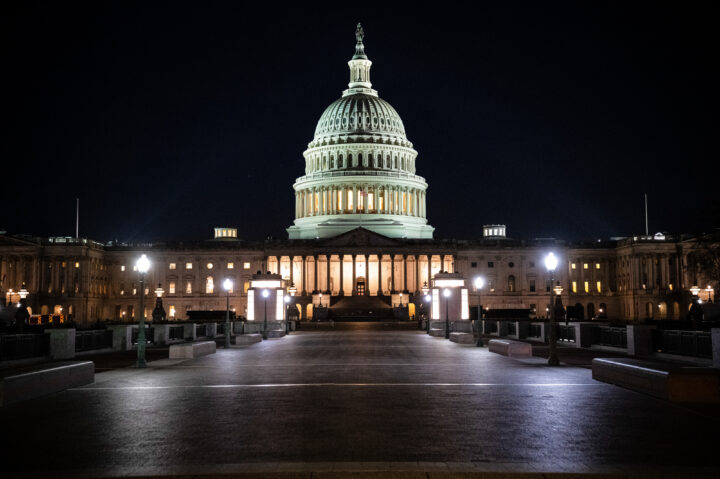
Graeme Sloan/Bloomberg via Getty Images
The U.S. Capitol in Washington, DC, US, on Wednesday, April 1, 2026.
For the fifth time, the Senate rejected an effort by Democrats to force the administration to end the war in Iran, with the partisan battle lines on the issue remaining firmly unchanged from previous iterations of the vote.
“Democrats will continue to force votes on war powers resolutions every week until Republicans decide to put the American people over Donald Trump and end this war,” Senate Minority Leader Chuck Schumer (D-NY) said ahead of the vote.
The vote failed 51-46, with Sens. Mark Warner (D-VA), Chuck Grassley (R-IA) and David McCormick (R-PA) not voting, and Sens. John Fetterman (D-PA) and Rand Paul (R-KY) voting with the opposing party.
Democrats have already introduced eight other similar resolutions that will be eligible for votes in the coming days and weeks, giving them plenty of runway to continue such efforts for the foreseeable future.
In the House, Reps. Greg Meeks (D-NY) and Ro Khanna (D-CA) also introduced new war powers resolutions on Iran, after previous efforts narrowly failed. The Congressional Progressive Caucus reportedly plans to force votes on such resolutions frequently next month.
Though they haven’t broken openly with the president, dynamics for at least some Senate Republicans could begin to shift toward the end of the month; under the War Powers Act, the administration can only carry on military operations without congressional approval for 60 days, with an additional 30-day drawdown period.
Though some Republicans have said Congress and the administration should disregard that deadline, others say that some form of action will be necessary at that point, and some hope that the war will be over before then.
Sen. Lisa Murkowski (R-AK) who has been working with other senators on crafting an Authorization for Use of Military Force on the war, told Jewish Insider on Wednesday, “we’ve been having some good conversations, and we’re going to continue them.” She said the goal of the AUMF is to have “greater disclosure, greater transparency” about the war.
Sen. Josh Hawley (R-MO) said earlier this week, ahead of the U.S. extension of the ceasefire, that he believed the president was “trending in a direction of ‘let’s end this without further involvement, including even further strikes’” and said that he hopes the war is over before the 60-day mark.
He told JI that he hasn’t been working with Murkowski on her AUMF, but said that the effort “makes sense since we’re approaching the 60-day deadline.”
Sen. Mike Rounds (R-SD) told JI he would “give the administration the benefit of the doubt that they will respond accordingly, in compliance with that” 60-day deadline “and if not, then we’ll have to have some discussions” around further congressional involvement through an AUMF or other avenue.
Still, other Republicans seem comfortable overlooking the 60-day deadline.
“I think the president has the authority to protect us, so we should let the president protect us,” Sen. Pete Ricketts (R-NE) said.
Plus, Dems concerned over fraying Israel-Europe ties

Daniel Torok/The White House via Getty Images
President Donald Trump and Secretary of State Marco Rubio (R) sit in the Situation Room as they monitor the mission that took out three Iranian nuclear enrichment sites, at the White House on June 21, 2025 in Washington, DC.
This P.M. edition is reserved for our premium subscribers — offering a forward-focused read on what we’re tracking now and what’s coming next. Please don’t hesitate to share your thoughts and feedback by replying to this email.
📡On Our Radar
Notable developments and interesting tidbits we’re tracking
President Donald Trump announced this afternoon, with the status of negotiations with Iran up in the air and the expiration of the ceasefire quickly approaching, that he is indefinitely extending the ceasefire at the request of Pakistani negotiators (despite having said, as recently as this morning, that he was not inclined to do so).
“Based on the fact that the Government of Iran is seriously fractured … we have been asked to hold our Attack … until such time as their leaders and representatives can come up with a unified proposal,” Trump wrote on Truth Social. “I have therefore directed our Military to continue the Blockade and, in all other respects, remain ready and able, and will therefore extend the Ceasefire until such time as their proposal is submitted, and discussions are concluded, one way or the other”…
Talks were meant to begin shortly in Islamabad, but Vice President JD Vance’s trip was reportedly put on hold and he remains in Washington. Vance, Special Envoy Steve Witkoff and Jared Kushner were all spotted arriving at the White House for meetings this afternoon.
Iran also had not committed to sending its own delegation — Iranian Foreign Minister Abbas Araghchi accused the U.S. of violating the ceasefire through its blockade of Iranian ports and seizure of an Iranian-flagged cargo ship, calling it an “act of war. … Iran knows how to neutralize restrictions, how to defend its interests, and how to resist bullying,” he wrote…
U.S. forces boarded an oil tanker in the Indian Ocean that had been sanctioned for working with Iran which defense officials said was currently carrying Iranian oil, in a further escalation of the U.S. campaign against Tehran-aligned assets and actors outside of the Middle East.
The Treasury Department also announced sanctions on 14 individuals and entities in Iran, Turkey and the United Arab Emirates for “their involvement in procuring or transporting weapons or weapons components on behalf of the Iranian regime”…
Six weeks after he was announced as Iran’s new supreme leader after the assassination of his father, Mojtaba Khamenei has still not been seen in public, raising speculation he is incapacitated from injuries sustained in a U.S.-Israeli airstrike or has been smuggled abroad…
Senate Foreign Relations Committee Chairman Jim Risch (R-ID) endorsed Sen. Roger Wicker’s (R-MS) view that the U.S. should reconsider its funding for the Lebanese Armed Forces in light of its continued inaction to disarm Hezbollah, in addition to the Lebanese government’s failure to “follow through on long-promised economic reform. The era of complacency & unconditional bailouts must come to end,” Risch said…
Sen. Chris Murphy (D-CT) clarified that his post calling it “awesome” that several Iranian oil tankers had bypassed the U.S. blockade — reporting that has been disputed as Iranian propaganda — was written as sarcasm. “[O]bviously Trump’s bungled mismanagement of this war is not ‘awesome.’ As I have said a million times here, it’s a disaster and he should end the war immediately,” Murphy wrote on X…
Democratic lawmakers are expressing concern over Israel’s fracturing relationship with key European allies, while experts say the shifting dynamics could carry longer-term economic and political risks for Jerusalem, even if Israel weathers threats to unwind largely symbolic defense agreements, Jewish Insider’s Matthew Shea reports.
Among other recent moves, Spain and Ireland led a push today to suspend the EU’s association agreement with Israel. The initiative stalled as member states remained divided on the issue; still, Rep. Josh Gottheimer (D-NJ) called the developments “deeply alarming.”
“NATO allies like Spain, France and Italy are turning their backs on Israel, a key democratic partner that is actively fighting on the front lines against Iran,” Gottheimer said. “Singling out Israel represents a double standard”…
The arsonist who pleaded guilty to attacking a North London synagogue on Saturday night was released on bail by the Westminster Magistrates’ Court today, JI’s Haley Cohen reports. The 17-year-old boy who threw a bottle containing accelerant through the window of Kenton United Synagogue must live and sleep at his home address and not enter any synagogue, the judge said. It was the third such attack on a Jewish institution in London within a week…
Rep. Sheila Cherfilus-McCormick (D-FL) resigned from Congress this afternoon, half an hour before her House Ethics Committee sanctions hearing was due to begin. Having lost jurisdiction in the matter, the committee canceled the hearing…
The Board of Peace is reportedly in discussion with the UAE-owned DP World logistics company about managing supply chains and humanitarian aid in Gaza, including potentially building a new port and developing a free-trade zone, according to Financial Times, as part of the Trump administration’s vision of privatizing much of Gaza’s services and infrastructure…
⏩ Tomorrow’s Agenda, Today
An early look at tomorrow’s storylines and schedule to keep you a step ahead
Keep an eye out in Jewish Insider for a look at how Jewish Democrats in Michigan are making sense of their place in the party in the wake of a state convention where pro-Israel voices were shouted down and a pro-Hezbollah candidate won the party’s nomination for a statewide race.
The House Financial Services Committee will hold a hearing evaluating the effectiveness of U.S. sanctions.
A vote on the fifth Iran war powers resolution in the Senate, expected today, has been pushed to tomorrow.
92NY will host a discussion on the future of New York’s Jewish community with New York City Council Speaker Julie Menin, Manhattan Borough President Brad Hoylman-Sigal and New York City Comptroller Mark Levine.
The New York City Council’s Task Force to Combat Antisemitism will hold its first hearing. The task force was established by Menin in January, shortly after her election, to make recommendations and work towards her five-point plan to combat antisemitism.
Robert Kraft’s Blue Square Alliance Against Hate will host a unity dinner in partnership with the NFL, Hillel International, United Negro College Fund and the Pittsburgh Steelers for Black and Jewish college students from the Pittsburgh area. The event will include a fireside chat featuring Kraft, Pennsylvania Gov. Josh Shapiro and former Pittsburgh Steelers quarterback Charlie Batch.
Washington, D.C., mayoral candidate Kenyan McDuffie will hold a meet-and-greet with young Jewish professionals.
Rep. Elise Stefanik (R-NY) will speak in conversation at Yeshiva University with its president, Rabbi Ari Berman, about her new book, Poisoned Ivies: The Inside Account of the Academic and Moral Rot at America’s Elite Universities.
Stories You May Have Missed
IRON DOME DECISIONS

J Street’s Ilan Goldenberg said the surge in far-left calls to cut off missile-defense aid ‘stirred up the conversation a little more’ but says the group was moving that way regardless
CAMPAIGN CLASH

Adam Hamawy said on Hasan Piker’s show that he does not support Israel’s Iron Dome missile-defense system, arguing that it insulates Israel from the consequences of war
Plus, Israel-Lebanon talks to continue Thursday

Edna Leshowitz/Getty Images
Jack Schlossberg, grandson of former President John. F Kennedy who is currently running for Congress, on Jan. 12, 2026 in New York City.
This P.M. edition is reserved for our premium subscribers — offering a forward-focused read on what we’re tracking now and what’s coming next. Please don’t hesitate to share your thoughts and feedback by replying to this email.
📡On Our Radar
Notable developments and interesting tidbits we’re tracking
Iranian officials have signaled they will attend talks with the U.S. in Islamabad, Pakistan, this week, with Vice President JD Vance, White House Special Envoy Steve Witkoff and Jared Kushner expected to depart for the meeting tomorrow (despite President Donald Trump’s claim that they were already in transit this morning).
Negotiators are up against a running clock, as Trump said today that his two-week ceasefire with Iran will end “Wednesday evening Washington time” and it’s “highly unlikely that I’d extend it” if no deal is reached…
In a series of heated social media posts, Trump again denied that Israel dragged the U.S. into war with Iran: “[T]he results of Oct. 7th, added to my lifelong opinion that IRAN CAN NEVER HAVE A NUCLEAR WEAPON,” were his motivation, he wrote on Truth Social.
Trump also boasted that the deal under negotiation will be “far better” than the 2015 Iran nuclear deal. “If a Deal happens under ‘TRUMP,’ it will guarantee Peace, Security, and Safety, not only for Israel and the Middle East, but for Europe, America, and everywhere else,” he wrote. Lashing out at the media, Trump insisted, “I’m winning a War, BY A LOT, things are going very well,” claiming the U.S. blockade, “which we will not take off until there is a ‘DEAL,’ is absolutely destroying Iran”…
The State Department confirmed that the U.S. will host the second round of ambassador-level talks between Israel and Lebanon on Thursday, as the 10-day ceasefire between the two countries that began last Thursday, after the first round of talks, continues to hold…
Republican operatives and strategists are growing increasingly concerned that the GOP may lose the Senate in the midterm elections, several told Politico, as rising gas prices and unease around the war with Iran create a poor national environment for Trump’s party.
The New York Times’ Nate Cohn argues that Democrats have a “realistic chance” to flip the four seats they need to win back the chamber because “they’ve recruited unusually strong candidates in three states that supported Mr. Trump three times: North Carolina, Ohio and Alaska.”
“In all three states, the Democrats’ likely nominees are popular recent statewide office holders. They either won their last campaign or were highly competitive in losing re-election under less favorable political conditions. So far, the polls show those Democrats running well ahead of what one might otherwise expect,” Cohn writes…
Kennedy scion Jack Schlossberg’s shifting views on Israel policy and decision to skip two upcoming Jewish community candidate forums are raising eyebrows in New York’s heavily Jewish 12th Congressional District, Jewish Insider’s Matthew Kassel reports.
During a candidate forum at 92NY last week, for example, Schlossberg rejected continued U.S. funding for offensive weapons to Israel amid the war in Iran — even as he emphasized support for boosting the Iron Dome missile-defense system, which he described as a “critical” technology…
Minnesota’s Democratic Party is poised to endorse progressive Lt. Gov. Peggy Flanagan for U.S. Senate at its convention next month, Flanagan’s campaign said, after the lieutenant governor secured support from over 90% of Democratic-Farmer-Labor Party local conventions held statewide. The party endorsement, however, will not determine the nominee, as Democratic voters are set to choose their candidate in the Aug. 11 primary election.
The campaign of Rep. Angie Craig (D-MN), Flanagan’s primary opponent and the favorite of pro-Israel activists, called on the DFL last week to launch a formal investigation into a series of alleged instances of antisemitic activity among its delegates. One instance at a local convention last month reportedly saw an unnamed delegate argue that “we should nuke” Israel…
The Wall Street Journal reports on the growing feud between Defense Secretary Pete Hegseth and Army Secretary Dan Driscoll, which “spilled out into public view on Thursday, when Driscoll described to lawmakers his fondness for the Army’s former top general, Randy George, whom Hegseth fired as the service’s chief of staff on April 2 while Driscoll was on vacation”…
A Washington Post investigation found that, since January 2025, neo-Nazi influencer Nick Fuentes has made nearly $900,000 through paid messages on his livestreams from roughly 11,000 fans. His top 500 donors are responsible for almost half of that amount…
The UAE has asked the U.S. to consider offering it financial assistance amid the war with Iran, as the Gulf country has borne the brunt of Iran’s drone and missile strikes, taking a heavy toll on its oil, economic and tourism industries. Emirati officials raised the idea of a currency-swap line, which would allow Abu Dhabi inexpensive access to U.S. dollars…
European officials hosted two meetings on Gaza reconstruction today — one gathering, led by EU representative Kaja Kallas and Norway, centered on coordinating aid with the U.S.-led Board of Peace, where White House advisor Josh Gruenbaum requested international assistance in rebuilding the enclave. The other forum, led by Kallas and Belgium, focused on a two-state solution and was attended by Palestinian Authority Prime Minister Mohammad Mustafa…
In response to Israeli Foreign Minister Gideon Sa’ar’s condemnation of an IDF soldier found to have desecrated a statue of Jesus in southern Lebanon, Radosław Sikorski, Poland’s deputy prime minister and foreign affairs minister, accused the IDF of committing war crimes.
“Lessons should also be drawn regarding the way they are being trained,” Sikorski wrote on X. “IDF soldiers themselves admit to war crimes. They killed not only civilian Palestinians but even their own hostages”…
Incoming Hungarian Prime Minister Peter Magyar affirmed that his country is bound by rules of the International Criminal Court to arrest those sought under its warrants, including Israeli Prime Minister Benjamin Netanyahu; Magyar said he intends to prevent Hungary from leaving the ICC, a move his predecessor, Prime Minister Viktor Orban, had initiated.
Responding to questions about Netanyahu’s claim that Magyar had invited him to the country for a ceremony marking the 70th anniversary of the Hungarian Uprising, Magyar responded, “Every leader is welcome to attend this important commemoration,” but “we have a legal obligation to enforce the court’s rulings, and I’m sure [Netanyahu] knows this”…
Apple CEO Tim Cook announced this afternoon that he will step down from the helm of the tech giant and become its executive chairman in September. Succeeding Cook is John Ternus, head of the company’s hardware engineering…
⏩ Tomorrow’s Agenda, Today
An early look at tomorrow’s storylines and schedule to keep you a step ahead
Keep an eye out in Jewish Insider for an interview with Rachel Goldberg-Polin on the release of her book, When We See You Again, which debuts tomorrow.
The Senate Committee on Banking, Housing and Urban Affairs will hold a nomination hearing for Kevin Warsh, son-in-law of Jewish philanthropist Ronald Lauder, to be chairman of the Board of Governors of the Federal Reserve. Democrats intend to press Warsh on his personal fortune, which he has only partially disclosed thus far.
The House Ethics Committee will hold a public hearing to determine whether to apply sanctions to Rep. Sheila Cherfilus-McCormick (D-FL), after finding last month that she had committed serious ethics violations and campaign finance misconduct.
The U.S. Helsinki Commission will hold a hearing on Iran’s support for Russia amid its war with Ukraine.
The Senate Foreign Relation Committee’s subcommittee on Africa will hold a hearing on U.S. approaches to counterterrorism on the continent.
Stories You May Have Missed
LATIN LINKS

An Israeli diplomatic source told JI that Ecuador and Paraguay are expected to join the Isaac Accords
MICHIGAN MOMENT

Platner, in Reddit post on Hamas terrorist attack: ‘From a strictly professional standpoint, this was a damn fine looking and successful raid against a superior opponent’
The swing-district Republican is the first GOP lawmaker other than isolationist Thomas Massie to support constraining the administration’s military operations in Iran

Tom Williams/CQ-Roll Call, Inc via Getty Images
Rep. Brian Fitzpatrick (R-PA) talks with a reporter in the U.S. Capitol's Statuary Hall on Friday, March 27, 2026.
Rep. Brian Fitzpatrick (R-PA), a moderate Republican and co-chair of the House Problem Solvers Caucus, introduced a war powers resolution on Thursday that aims to enforce the deadlines for the war in Iran laid out in the 1973 War Powers Act.
Fitzpatrick is the first Republican — other than isolationist Rep. Thomas Massie (R-KY) — to introduce legislation that would constrain the administration’s ability to act in Iran. The move is a signal that GOP support for the effort could begin to erode if the administration disregards legal limitations on the length of its operation in Iran.
The War Powers Act limits any military operation initiated unilaterally by the executive branch to 60 days, with an additional 30-day drawdown period, unless the operations are subsequently authorized by Congress. The 60-day period will expire at the end of April.
“The War Powers Act of 1973 is the law of the land,” Fitzpatrick said. “This consistent standard must be applied to all past, current, and future administrations when it comes to military hostilities abroad. … This is the law that has applied to past administrations, and it is the law that will apply to current and future administrations. This is the law and, until it is changed, it will be consistently applied and consistently enforced across all administrations and all conflicts.”
Other Republicans, including moderates, have also indicated that they would be uncomfortable with or unable to support any military operations in Iran past the 60-day deadline without additional congressional authorization — though some have said they would support such an authorization.
Yet, others have argued that the limitations in the War Powers Act are not legally binding and say Republicans on the Hill will disregard them.
Running in a highly competitive district, Fitzpatrick’s move could also be a sign of discomfort with the continued war effort among swing-district Republicans ahead of the midterm elections.
Plus, Vance courts pro-Israel donors ahead of 2028

Adri Salido/Getty Images
The Lebanese capital is seen from a viewpoint after U.S. President Donald Trump announced a ceasefire between Israel and Lebanon that would commence at midnight local time on April 16, 2026 in Beirut, Lebanon.
This P.M. edition is reserved for our premium subscribers — offering a forward-focused read on what we’re tracking now and what’s coming next. Please don’t hesitate to share your thoughts and feedback by replying to this email.
📡On Our Radar
Notable developments and interesting tidbits we’re tracking
President Donald Trump announced the start of a 10-day ceasefire between Israel and Lebanon to begin at 5 p.m. ET today, after he held phone calls with Lebanese President Joseph Aoun and Israeli Prime Minister Benjamin Netanyahu earlier in the day.
Trump added that he will be inviting Aoun and Netanyahu to the White House for “meaningful talks,” later telling reporters such a meeting could happen in the “next week or two.”
The text of the agreement released by the State Department indicates the ceasefire is a “gesture of goodwill” on Israel’s part “intended to enable good-faith negotiations” toward a permanent agreement. The temporary pause in hostilities could be extended if Lebanon “effectively demonstrates its ability to assert its sovereignty” and prevent Hezbollah from carrying out attacks against Israel…
Trump again indicated further talks with Iran could take place this weekend and said the two sides are “very close to making a deal,” telling reporters this afternoon that Iran has already agreed to “give us back the nuclear dust,” referring to its highly enriched uranium.
Hours earlier, Secretary of Defense Pete Hegseth warned at a press briefing that U.S. forces are “maximally postured” to return to military operations against Iran if negotiations are unsuccessful, and will look to attack “infrastructure, power and energy”…
The House narrowly voted to block a Democratic resolution to force an end to the war in Iran by a vote of 214-213-1, with all but one of the four Democrats who opposed a similar effort in March changing their votes to support today’s measure, Jewish Insider’s Marc Rod reports.
Reps. Greg Landsman (D-OH), Juan Vargas (D-CA) and Henry Cuellar (D-TX), who voted last month against a similar resolution, flipped their votes to support the war powers effort. But Rep. Jared Golden (D-ME), who is retiring at the end of his term, voted no again. On the Republican side, Rep. Warren Davidson (R-OH), who voted for the war powers resolution last time, switched his vote to “present.” Rep. Thomas Massie (R-KY) was the only Republican who voted for the resolution…
Vice President JD Vance, the first vice president to serve simultaneously as finance chair of his party, is building donor relationships that may prove useful should he choose to run for president in 2028, The New York Times reports, including attempting to woo some pro-Israel donors who have otherwise been wary of his ties to far-right commentator Tucker Carlson.
Among others, Vance has developed relationships with Jewish philanthropists Miriam Adelson, whom he spent New Years Eve with at Trump’s Mar-a-Lago resort, and Paul Singer; has appeared as the guest of honor at a dinner hosted by Palantir and 8VC co-founder Joe Lonsdale; and has been featured at a Republican National Committee event hosted by tech executive Keith Rabois, who is married to Under Secretary of State Jacob Helberg…
With less than six weeks to go until the Texas primary runoff election, Sen. John Cornyn (R-TX) is defending his seat against Texas Attorney General Ken Paxton with a significantly larger war chest: As the first quarter of 2026 closed, Cornyn had more than $8 million in cash on hand (including a small donation from former President George W. Bush), while Paxton had $2.6 million in the bank. Whoever clinches the GOP nomination will face state Sen. James Talarico, who has nearly $10 million on hand…
Josef Palermo, who was the first curator of visual arts and special programming at the Kennedy Center until his dismissal last month, recounts his experience as Trump and the center’s then-President Richard Grenell initiated an overhaul of the building, a process Palermo describes as “cronyism, incompetence, and a series of bizarre moves.”
Palermo recounts an exhibition he organized commemorating the Oct. 7 Hamas attacks in the building’s Israeli Lounge: “Speaking at the opening reception, Grenell warned the mostly Jewish audience that unless donors came forward to sponsor the space and pay for renovation costs, the lounge would be given away to a new donor. … Such a strong-armed fundraising pitch, at an event commemorating a pogrom, struck many of us in the room as inappropriate. I was mortified”…
Asked for his perspective on antisemitic streamer Hasan Piker’s reach on his platform, Twitch CEO Daniel Clancy said at the Semafor World Economy summit in Washington today that “one of the challenges is when you’re livestreaming you say a lot … you might say a lot of things that are over the top. … If you violate [community guidelines] then we take enforcement actions and we suspend you — it’s designed not to kick you off forever.”
“Whenever Hasan has stepped over the line, we’ve taken action … Folks will get worked up from both the right and the left on this because we have also conservative people that are saying certain things that some people don’t like. … In general, we think it is important for us to allow people to express themselves,” Clancy said…
⏩ Tomorrow’s Agenda, Today
An early look at tomorrow’s storylines and schedule to keep you a step ahead
Keep an eye out in Jewish Insider for a temperature check on support for Israel within the Democratic Party, in light of 85% of Democratic senators voting in favor of a Sen. Bernie Sanders (I-VT)-led measure to block military sales to the Jewish state.
France and the U.K. will co-host a conference tomorrow focused on restoring freedom of navigation through the Strait of Hormuz, with leaders from several European, Asian and Gulf countries participating via video.
Michigan’s Democratic Party will hold its endorsement convention on Sunday, where party activists will nominate their two preferred candidates for the University of Michigan’s Board of Regents. The election has reignited the campus’ debate over Israel, as candidate and anti-Israel activist Amir Makled seeks to unseat Jewish regent Jordan Acker, who became the target of antisemitic vandalism and harassment in the aftermath of the Oct. 7 Hamas attacks. (The SEIU labor union recently pulled its endorsement of Makled over his past support of Hezbollah.)
National party leaders including former Vice President Kamala Harris and Sen. Cory Booker (D-NJ) will appear at events in Detroit ahead of the convention.
We’ll be back in your inbox with the Daily Overtime on Monday. Shabbat Shalom!
Stories You May Have Missed
CAPITAL CONTEST

‘I didn’t seek, nor would I accept, the endorsement of Democratic Socialists of America,’ McDuffie told JI in an interview
SCOOP

Platner, in Reddit post on Hamas terrorist attack: ‘From a strictly professional standpoint, this was a damn fine looking and successful raid against a superior opponent’
All but one of the four Democrats who had opposed the previous war powers effort flipped their votes in support

Graeme Sloan/Sipa via AP
The U.S. Capitol Building at sunset in Washington, D.C., on Saturday, March 6, 2021.
The House narrowly voted to block a Democratic resolution to force an end to the war in Iran by a vote of 214-213-1, with all but one of the four Democrats who opposed a similar effort in March changing their votes to support it on Thursday.
Rep. Greg Meeks (D-NY), the top Democrat on the House Foreign Affairs Committee, had held off on calling a vote on the resolution in hopes that he would be able to win over enough Democratic holdouts and Republican defectors to pass the legislation.
Reps. Greg Landsman (D-OH), Juan Vargas (D-CA) and Henry Cuellar (D-TX), who voted last month against a similar resolution, flipped their votes to support the war powers effort. But Rep. Jared Golden (D-ME), who is retiring at the end of his term, voted no again.
On the Republican side, Rep. Warren Davidson (R-OH), who voted for the war powers resolution last time, switched his vote to “present.” Rep. Thomas Massie (R-KY) was the only Republican who voted for the resolution.
A small number of Republicans who have expressed skepticism about the war effort and could have been potential swing votes, including Reps. Lauren Boebert (R-CO) and Nancy Mace (R-SC), did not vote.
Golden said in a statement that the war powers resolution would “weaken our hand” in negotiations with Iran.
“I believe we must maintain a strong negotiation position over Iran’s nuclear program, freedom of movement in the international waters at the Strait of Hormuz, and how to achieve a durable peace between our two nations,” Golden said in a statement.
Plus, Senate Dems dominate 2026 fundraising

Kevin Dietsch/Getty Images
Rep. Ilhan Omar (D-MN) speaks at a press conference on committee assignments for the 118th U.S. Congress, at the U.S. Capitol Building on January 25, 2023, in Washington, D.C.
This P.M. edition is reserved for our premium subscribers — offering a forward-focused read on what we’re tracking now and what’s coming next. Please don’t hesitate to share your thoughts and feedback by replying to this email.
📡On Our Radar
Notable developments and interesting tidbits we’re tracking
A war powers resolution brought by Senate Democrats to force an end to the war in Iran was blocked by Republicans yet again this afternoon, the fourth failed attempt mounted by Senate Democrats since the war began in late February, Jewish Insider’s Marc Rod reports.
Nevertheless, top Senate Democrats have said they intend to continue forcing such votes weekly (they have nine more resolutions already filed) in the hopes that more Republicans will change their votes as the war drags on…
Texas state Sen. James Talarico announced he raised $27 million in the first quarter of 2026 in his run for U.S. Senate, a massive haul that his campaign claimed is the largest amount ever raised by a Senate candidate in the first quarter of an election year. Democrats hope the funds will put Texas in play as Talarico seeks to challenge either Sen. John Cornyn (R-TX) or Texas Attorney General Ken Paxton, who are still locked in their own hotly contested primary.
The top Senate fundraisers behind Talarico this quarter were also Democrats: Sen. Jon Ossoff (D-GA) brought in $14 million — breaking the record for first-quarter fundraising in Georgia — former North Carolina Gov. Roy Cooper raised $13.8 million and former Sen. Sherrod Brown (D-OH) raised $12.5 million…
Rep. Tom Kean Jr. (R-NJ) said he raised $1.1 million in this year’s first quarter, bringing his total to $4.4 million raised — more than any other House incumbent or candidate in New Jersey this cycle, according to the New Jersey Globe — as he defends his swing seat from several well-funded Democratic challengers.
But even as he’s pulled in plenty of support, Kean has missed a month’s worth of votes on Capitol Hill due to an unspecified medical issue, with his staff declining to say when he will return…
Rep. Ilhan Omar (D-MN) in an interview on the “Pod Save America” podcast praised former Rep. Marjorie Taylor Greene (R-GA) — once a vocal Omar foe who called for the congresswoman’s deportation while they were both in the House — and far-right influencer Candace Owens over the pair’s break with President Donald Trump, JI’s Marc Rod reports.
“I believe the thing that has been very fascinating, especially about Marjorie and Candace, is that … they’re saying, ‘This action is wrong,’ right? They’re saying, ‘I am done with you.’ We should give them credit for that, the fact that they’ve had this wake-up call to finally seeing this con man, this corrupt, chaotic man for what he is,” Omar said…
Sebastian Gorka, the White House senior director for counterterrorism and a deputy assistant to the president, is reportedly angling for the position of director of the National Counterterrorism Center, which was recently vacated by Joe Kent amid Kent’s opposition to the Iran war. Gorka has been a staunch defender of Trump and backed his war with Iran, as well as repeatedly praised Israel amid its war in Gaza…
Israeli Prime Minister Benjamin Netanyahu spoke with Péter Magyar, the presumptive next prime minister of Hungary, for the first time today, calling the conversation “warm” and saying that Magyar indicated he will continue the close relationship the countries enjoyed under his predecessor, outgoing Prime Minister Viktor Orbán…
New York Gov. Kathy Hochul defended her proposal to bar demonstrations of more than two people from occurring within 25 feet of a house of worship today, JI’s Will Bredderman reports, legislation that has drawn legal scrutiny over its creation of a new felony offense for violators.
“I believe I have the right to protect people’s constitutional right to free exercise of religion,” Hochul told reporters when asked if she had concerns that the legislation might provoke challenges on First Amendment grounds. “So if that means we test it in court, bring it on”…
After holding its final public hearing earlier this week, the White House Religious Liberty Commission is now preparing a set of recommendations to be presented to the president next month. Ambiguity and confusion about the commission’s mandate has left commissioners unsure if they’ll continue to meet — their first year on the panel was marred by the firing of one commissioner over her disruption of a hearing on antisemitism…
Progressive media organization More Perfect Union is launching More Perfect University, an effort aimed at college students to act as an alternative to the conservative Turning Point USA, with a focus on urging young people to share left-wing political and economic messaging through social media. Faiz Shakir, the head of More Perfect Union who is also chief political advisor to Sen. Bernie Sanders’ (I-VT) campaign, said he hopes to jump-start “an economic populist movement for the next generation”…
Duke University’s Students for Justice in Palestine chapter has been suspended as a student group and had its funding frozen after it posted virulently antisemitic imagery depicting Israel and the U.S. as pigs frothing at the mouth on its Instagram page, prompting student complaints to campus administration…
University of Michigan President-elect Kent Syverud announced today he has been diagnosed with brain cancer and will no longer assume the presidency, leaving the future of the school’s leadership in question. Jewish leaders had praised Syverud’s appointment as a positive development for UM, which had seen rampant anti-Israel activity in the aftermath of the Oct. 7, 2023, Hamas attacks…
⏩ Tomorrow’s Agenda, Today
An early look at tomorrow’s storylines and schedule to keep you a step ahead
Keep an eye out in Jewish Insider for a preview of a first-of-its-kind antisemitism conference taking place tomorrow at Harvard, created as an outcome of last year’s settlement of a Title VI lawsuit against the school.
New Jersey’s 11th Congressional District will hold its special election for the remainder of Gov. Mikie Sherrill’s congressional term, where progressive Analilia Mejia is expected to prevail against Republican Joe Hathaway.
The Senate Foreign Relations Committee will hold nomination hearings for John Breslow to be U.S. ambassador to Cyprus, Todd Steggerda to be U.S. representative to the U.N. in Geneva and Preston Wells to be U.S. representative to the International Atomic Energy Agency, among others.
The Shalom Hartman Institute will host a discussion at the Capitol Jewish Museum in Washington with Jeffrey Goldberg, editor-in-chief of The Atlantic, on American Jewry ahead of the 250th anniversary of the founding of the United States.
The House Appropriations Committee will hold a budget hearing on the Department of Homeland Security, including the Federal Emergency Management Agency, which oversees the Nonprofit Security Grant Program.
Stories You May Have Missed
SCOOP

The Oct. 7 mastermind died in ‘heroic’ style, according to Donald Borenstein, director of video for the Mamdani campaign and City Hall
DEM DIVIDES
The question facing the Middle East working group’s members is whether they will actually be able to agree on anything — or if the group is simply a way to push the issue off until 2028
Even after their fourth failed attempt, Democrats say they intend to continue forcing such votes weekly
Kevin Carter/Getty Images
The U.S. Capitol Building is seen at sunset on May 31, 2025 in Washington, DC.
An effort by Senate Democrats to force an end to the war in Iran was again blocked by Republicans on Wednesday, the fourth such failed attempt mounted by Senate Democrats since the war began in late February.
The measure failed by a vote of 52-47, with all Democrats except Sen. John Fetterman (D-PA) voting for a procedural motion on the war powers resolution, and all Republicans except Sen. Rand Paul (R-KY) voting against it. Sen. Jim Justice (R-WV) was not present for the vote.
Nevertheless, Democrats intend to continue their efforts. They have nine such resolutions that have been filed, and top Senate Democrats said this week they intend to continue forcing such votes weekly, in the hopes that more Republicans will change their votes as the war drags on.
Some Republicans have begun to express hesitation about the war, and top members of the caucus have said they hope it comes to an end soon. But thus far most have not been willing to openly break with President Donald Trump on the effort.
Separately, Sen. Bernie Sanders (I-VT) plans to call up a vote later on Wednesday on a pair of measures to block sales of bombs and bulldozers to Israel, which Sanders has also framed as referenda on the war in Iran. Twenty-seven Democrats have previously voted for such resolutions, and supporters of the effort expect that number to increase this time.
But at least one lawmaker, Sen. Kirsten Gillibrand (D-NY), who introduced a war powers resolution on Iran this week, for future consideration, said that she views the two issues differently.
“I think of them very differently,” Gillibrand told Jewish Insider during a virtual press conference on Wednesday. “I oppose the war in Iran, but I do not believe we should leave an ally who is being attacked without support,” she said, referring to Israel.
Meeks said he will likely bring up a war powers resolution for a vote this week, and is waiting to see if several of his colleagues will flip their votes in favor

Tom Williams/CQ-Roll Call, Inc via Getty Images
Rep. Gregory Meeks (D-NY)
Rep. Greg Meeks (D-NY) said he’s aiming to call up a war powers resolution this week to force an end to the war in Iran, but that he’s still working to lock down the support of a few wavering Democratic and Republican lawmakers whose support will be necessary to pass the legislation.
Meeks had considered calling up the legislation before Congress’ two-week recess, but ultimately declined to do so, saying he was waiting until the legislation could pass and he didn’t yet have the votes.
“I’m probably going to do war powers this week. I’m still working [on] it. I’m very close,” Meeks told Jewish Insider. “I’ve got just about all of the Democrats — just about — and [some] Republicans. And I have some that are contemplating, but I don’t know what they’re going to do.”
He said that there are a few lawmakers who voted against a previous war powers effort in the House who are talking to him and considering now voting in favor, but haven’t disclosed their final plans to him yet.
Meeks said that he thinks he will get “just about every Democrat … maybe the exception of one.”
Of the four Democrats who voted against a previous war powers effort, two — Reps. Greg Landsman (D-OH) and Henry Cuellar (D-TX) — said that they would vote for the next war powers resolution, and Cuellar affirmed those plans to JI on Tuesday. Reps. Juan Vargas (D-CA) and Jared Golden (D-ME) haven’t announced their plans yet.
Vargas told JI on Tuesday that he has made up his mind, but declined to preview how he plans to vote. Golden, who is not running for reelection, could be the hardest of the four to flip.
On the Republican side, Rep. Lauren Boebert (R-CO), who said she would oppose a supplemental funding request for the war, declined to comment on how she would vote, saying she isn’t currently focused on a potential war powers resolution.
Meeks said that the current ceasefire makes it an important time for Congress to weigh in, and that he may ultimately bring the resolution forward for a vote even if he’s not sure if there are sufficient votes to pass it.
“We don’t know what the president may do or may not do afterwards,” Meeks explained. “I’ve been waiting to get commitments … it may be time for them to get on one side of the fence or the other, as opposed to staying on the fence. I may just do it. I haven’t decided yet, but I may just do it.”
Even if the resolution passes the House, it currently would not pass the Senate and would almost certainly be vetoed by the president. But Meeks argued that passing the resolution in the House would send an important message to the administration anyway.
“I think this is giving a message to the president — and it becomes really important, because the 60 days will be up soon, and they have to come to Congress for the money,” Meeks said, referring to a 60-day deadline for the operation cease or to come to Congress for authorization under the War Powers Act. “And it lets the president know that unless he comes to Congress and lets us know what the plan is, he’s not going to get the money.”
Rep. Don Bacon (R-NE), who has said the administration hasn’t properly articulated its plans and goals for the war to Congress, told reporters he will “support continued operations until we get this job done, or it’s clear to me it’s fruitless.”
“I support the military campaign. I think some of the commentary has not been helpful from the White House, but yes, I think the military has done a great job,” Bacon said, pointing to the destruction of Iran’s leadership and military capabilities.
He said that an Authorization for Use of Military Force would be legally required to continue the war beyond the 60-day deadline — a point that other Republicans have disputed — but said that he would be “inclined to support” such an authorization.
“Maybe not a blanket one, but yes, I think we should finish the job,” Bacon said. “These guys have been our enemy. These guys have been our enemy, they’ve killed young [U.S. troops].”
Jewish Insider’s Washington reporter Matthew Shea contributed reporting.
The group ranges from pro-Israel Democrats like Sen. Kirsten Gillibrand to anti-Israel members like Sen. Chris Van Hollen

Drew Angerer/Getty Images
Sen. Kirsten Gillibrand (D-NY) speaks at a news conference following a closed-door lunch meeting with Senate Democrats at the U.S. Capitol on October 31, 2023, in Washington, D.C.
A group of six additional Senate Democrats plan to file new war powers resolutions this week to halt the war in Iran, a move that would allow Democrats to continue forcing votes on the war for the foreseeable future.
Previously, a different group of six Democrats introduced similar resolutions, and Democrats have called up two of them thus far, with plans to call up a third this week. So far, the resolutions have all failed along mostly party lines, with all senators remaining consistent in their votes.
The latest group of lawmakers includes Sens. Jeff Merkley (D-OR), Kirsten Gillibrand (D-NY), Chris Van Hollen (D-MD), Mark Kelly (D-AZ), Raphael Warnock (D-GA) and Andy Kim (D-NJ).
The array of lawmakers involved in the latest effort spans from staunch progressives and critics of Israel to generally more pro-Israel members.
“President Trump chose to start a war knowing it was going to raise gas prices on Americans already struggling to get by,” Gillibrand said in a statement. “The president, and his party, just don’t care about anyone other than themselves. They lie, cheat and steal to enrich themselves and leave regular folks with the bill. It is long past time for Republicans in Congress to stand up and do their job.”
House Democrats also plan to call up a war powers resolution this week, which may pass given that some Democrats who previously opposed a war powers effort and a handful of Republicans have indicated they plan to change their votes.
The latest set of six resolutions will not be eligible for floor votes immediately, but Democrats can call up the other four resolutions introduced previously at will. Senate Democrats are also likely to force votes on matters related to the Iran war during the upcoming reconciliation process, which Republicans aim to use to fund immigration enforcement and other priorities.
The war powers resolution introduced by the far-left lawmakers does not mention Hezbollah’s ongoing attacks on Israel
Tom Williams/CQ-Roll Call, Inc via Getty Images
Rep. Rashida Tlaib (D-MI) attends the House Financial Services Committee on Wednesday, March 29, 2023.
A war powers resolution introduced by Reps. Rashida Tlaib (D-MI), Delia Ramirez (D-IL) and Nydia Velazquez (D-NY) on Friday would block any U.S. participation in and assistance to Israeli operations against Hezbollah in Lebanon.
Like the war powers resolutions on Iran that lawmakers have repeatedly called up for votes in the House and Senate, Tlaib or another lawmaker could force the House to vote on the legislation.
It aims to prevent any U.S. assistance to Israel in its operations in Lebanon, including intelligence sharing and targeting assistance for operations against Hezbollah.
“The United States is assisting this destruction through the weapons, intelligence, logistics, and diplomatic cover it provides the Israeli government, and Congress has the power and duty to put an end to this illegal invasion,” a press release by Tlaib’s office reads.
The legislation is sponsored by a slew of anti-Israel groups including American Muslims for Palestine, Code Pink, the Democratic Socialists of America, Justice Democrats, Jewish Voice for Peace and the Sunrise Movement.
In a separate resolution also introduced by Tlaib on Friday, she accused Israel of “illegal invasion, war crimes, and ethnic cleansing” in Lebanon. The resolution does not include any mention of Hezbollah or its repeated and ongoing attacks on Israel, including the terror group’s most recent decision to attack Israel in solidarity with Iran, instead accusing Israel of decades of violations of Lebanon’s sovereignty, and of planning a genocide in the country.
It further accuses Israel of more than 15,000 violations of the 2024 ceasefire agreement while overlooking the Lebanese government and Hezbollah’s failure to comply with the terms of the agreement, which required the disarmament of Hezbollah.
“The United States is coauthoring this destruction through the weapons, intelligence, logistics, and diplomatic cover it provides the Israeli Government,” the resolution continues.
The vote again fell largely along party lines, with only Sens. John Fetterman and Rand Paul defecting from their parties
Kevin Carter/Getty Images
The U.S. Capitol Building is seen at sunset on May 31, 2025 in Washington, DC.
For the third time in a month, Senate Republicans on Tuesday evening blocked an effort by Democrats to halt U.S. operations in Iran.
The war powers resolution, this time led by Sen. Chris Murphy (D-CT), is part of a series of efforts by Senate Democrats to disrupt business on the Senate floor to force a reckoning and public testimony by Cabinet officials about the war in Iran.
Democrats have four other such resolutions filed, which they could call up for votes at a time of their choosing, using special procedures allowing lawmakers to force votes on war powers resolutions.
The Senate again rejected the resolution 53-47, with Sen. John Fetterman (D-PA) once again voting in favor of the war effort and Sen. Rand Paul (R-KY) again voting against it.
The mostly party-line vote comes in spite of recent comments by some Senate Republicans pushing for the war to come to an end.
Sen. Tim Kaine (D-VA), another leader of the Democratic war powers push, said that the group plans to continue to force weekly votes on the issue. He acknowledged before the vote that the results might not change this week, but suggested that some Republican colleagues might be won over if the war continues to drag on, troops are sent to invade Iran or oil prices continue to spike.
Kaine indicated that he was not encouraged by President Donald Trump’s comments that he considered the U.S. to have “won” the war in Iran or his recent claims of engaging in productive talks with the regime.
“If he announces that it’s over, that will be good news,” Kaine told Jewish Insider. “Now, the consequences are not going to be over for a very long time, and Virginians are going to be suffering the consequences of something that lacked a rationale and lacked a plan for a very long time, in all likelihood. But the minute he announces it’s over, that will be positive — if he doesn’t change his mind, but he could change his mind.”
The House is expected to vote this week on a similar measure led by Rep. Greg Meeks (D-NY). A separate House measure led by Rep. Josh Gottheimer (D-NJ) and other pro-Israel moderates which would limit the war effort to 30 days — a period which will expire next week — could also come to a vote soon.
At least one House Democrat who voted previously against a war powers resolution and backed the U.S. operations in Iran has said he plans to vote for the Meeks resolution this week.
The Ohio congressman had been one of four Democrats to oppose the previous resolution to halt the war in Iran

Tom Williams/CQ-Roll Call, Inc via Getty Images
Rep. Greg Landsman (D-OH) is interviewed by CQ-Roll Call, Inc via Getty Images in his Longworth Building office on Friday, November 3, 2023.
Rep. Greg Landsman (D-OH), one of the few House Democrats who has supported strikes on Iran and opposed a war powers resolution to bring it to an end earlier this month, now says he wants to see the war wrapped up, and will vote for an upcoming resolution to end the conflict.
“It’s time to finish the operation in Iran. It’s time to be done,” Landsman said in a statement on Friday. “No expansion of the original operation. No ground troops.”
Landsman’s statement comes in advance of an anticipated vote on another war powers resolution to end the conflict next week, led by Rep. Greg Meeks (D-NY). Landsman said he plans to vote for the war powers resolution, and urged colleagues to do the same.
Reps. Henry Cuellar (D-TX), Jared Golden (D-ME) and Juan Vargas (D-CA) were the only other Democrats to vote against the previous war powers resolution earlier this month.
“The fact is, in three weeks, we have destroyed nearly all of the regime’s missile and drone launch capacity and eliminated their ability, for now, to produce ballistic missiles and drones,” Landsman said. “This means the objective to destroy the weapons shield built to protect their underground nuclear enrichment facilities has been achieved.”
“The cost of inaction was far too high to tolerate. But now it’s time to be done,” he continued, adding that U.S. military officials have successfully executed their mission, so it is “now it is time for the administration to end the operation before we become entangled in a conflict with no strategic logic.”
The Ohio congressman criticized the Trump administration for its communication around the war, while praising military officials for how they have conducted the U.S. operations.
Cuellar, Golden and Vargas did not comment on how they plan to vote on the next war powers resolution. Assuming full attendance, just three other lawmakers who opposed the previous war powers resolution would need to flip to allow the next one to pass.
Landsman, Cuellar, Golden and three other moderate House Democrats are also co-sponsoring an alternative war powers resolution that would limit the duration of the war to 30 days from its inception, which also should be eligible for a vote in the House soon.
That 30-day deadline from the war’s beginning — March 30 — is quickly approaching, raising the likelihood that other Democrats like Cuellar and Golden might support ending the war, based on the timeline they laid out.
‘If you can't stand against that, you don't stand for a f***ing thing,’ the former Obama admin official said
Cheriss May/NurPhoto via Getty Images
Ben Rhodes, then-deputy national security advisor to President Barack Obama, participates in an interview with press at the White House in on Wednesday, December 14, 2016.
A former top Obama administration foreign policy official said on Wednesday that any Democratic lawmakers who vote to support U.S. strikes on Iran should be primaried.
“If you vote for the funding of this war, you should be primaried. I don’t want you in the Democratic Party,” said Ben Rhodes, co-host of the “Pod Save the World” podcast and former deputy national security advisor under President Barack Obama.
He was referring to Reps. Greg Landsman (D-OH), Henry Cuellar (D-TX), Jared Golden (D-ME) and Juan Vargas (D-CA), the only four Democrats to vote against a war powers resolution last week that sought an immediate end to the U.S. military campaign in Iran.
Rhodes, who was one of the biggest boosters of the 2015 Iran nuclear deal and a leading Israel critic on the left, said the Democratic Party should have a big tent — but that support for President Donald Trump’s actions in Iran falls outside of that tent.
“I would like to have a big tent in this party. I think there should be people with different ideas of how to get health care, different ideas of taxation,” Rhodes said to co-host Tommy Vietor. “To me, this is not a left-center issue. This is a right and wrong issue. Morally, what do we stand for as Democrats?”
Rhodes suggested that Democrats who cast a vote in support of the war are doing so because of donor pressure.
“How is anybody going to trust you to fight for their health care if you’re too afraid to cast a vote, that someone might call you weak or some donor might call you and complain?” Rhodes asked. “If you as a Democrat can’t say that I am against a war and I’m not going to fund a war that is being launched by an authoritarian president, illegally, with no rational basis that is explained to the American people, that has already unleashed these consequences, if you can’t stand against that, you don’t stand for a f***ing thing.”
Four Democrats and two Republicans broke with their parties to oppose and support the resolution, respectively
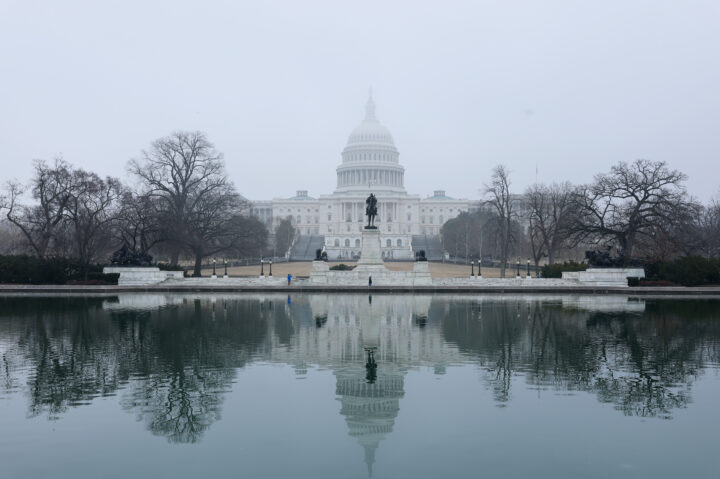
Anna Moneymaker/Getty Images
U.S. Capitol on March 05, 2026 in Washington, DC.
A day after Republican senators blocked a vote to end the U.S.-Israeli operations in Iran, the House voted 219-212 to defeat a similar war powers resolution, with four Democrats breaking with their party to oppose an immediate end to the war, and two Republicans voting with other Democrats to oppose military action.
Reps. Greg Landsman (D-OH), Jared Golden (D-ME), Henry Cuellar (D-TX) and Juan Vargas (D-CA) were ultimately the only Democrats to vote against the resolution, which was led by Reps. Ro Khanna (D-CA) and Thomas Massie (R-KY). Reps. Josh Gottheimer (D-NJ) and Jared Moskowitz (D-FL), who said they would oppose the resolution before the war began, ultimately voted in favor.
On the Republican side, Massie and Rep. Warren Davidson (R-OH), both of whom have isolationist leanings, were the only members of the GOP to support the resolution.
Moskowitz had argued before the war that voting preemptively on the resolution would remove U.S. leverage in negotiations, but argued that the situation has since changed and that the U.S. is now in a full-scale war.
“I didn’t flip at all,” Moskowitz told Jewish Insider. “Circumstances have changed since my first statement two weeks ago.”
In a statement, he condemned Iran and its regime, saying he is “happy that [Ayatollah Ali Khamenei] is no longer able to reign terror on his country,” but added, “Regardless of how one feels about this war, or this President, Congress’s constitutional role in any declaration of war is a completely separate issue,” expressing concern at the erosion of congressional war powers over the past year.
“We must reestablish our Article I authority which grants Congress all legislative powers,” Moskowitz said, adding that he did not believe the resolution would prevent continued efforts to protect U.S. bases and personnel nor intelligence sharing with allies.
Gottheimer emphasized in a statement that the U.S. “simply can’t afford to get this wrong — we must win and crush” the Iranian regime’s military capabilities, emphasizing that he is not, in principle, opposed to military action against Iran and that the regime “deserves the punishment they’re receiving.
“With the defeat of the War Powers Resolution in the Senate, the vote in the House today shifted from an unacceptable call that could put our troops in harm’s way to a clear call for this Administration to articulate the goals for the mission, the end game, and their plan to avoid a protracted conflict,” Gottheimer continued — suggesting that he voted for the resolution because it was, in essence, symbolic given that it did not pass the Senate.
“Unlike some of my colleagues who are opposed to combatting the Iranian regime, the world’s leading state sponsor of terror, I’m supporting this resolution to send a clear message to the Administration: the American people deserve a coherent explanation of what precipitated this war, what success looks like, and how we will know when the mission has been achieved,” he continued, criticizing “shifting justifications and objectives” from the administration. “I’m not opposed to taking action against Iran. I believe that steps to address the persistent threats are merited and necessary to protect our broader national security interests.”
He pledged to make sure the military has sufficient resources, signaling that he may support supplemental funding for the mission if and when requested.
The beginning of combat operations, the loss of some American soldiers and the administration’s inconsistent messaging and strategy — as well as an aggressive push from Democratic leadership — likely helped Democrats close ranks on the war powers resolution.
After the vote, Rep. Greg Meeks (D-NY), the ranking member of the House Foreign Affairs Committee, said that he would call up another war powers resolution 60 days from the start of the war, the limit under which an administration can conduct military operations without congressional authorization under the War Powers Act.
“Members who voted against today’s WPR on the assumption that Trump’s war will be swift or limited will not have that excuse once we’ve entered the third month of open-ended hostilities,” Meeks said.
Like Moskowitz and Gottheimer, a handful of other Democrats who have offered a degree of support for the U.S. operations in Iran ultimately voted for the resolution. Some have pointed to concerns about constitutional process and the administration’s failure to seek congressional approval for the war, rather than opposition to the war in general.
“I will vote for the war powers resolution because I cannot support unchecked authority for the administration to engage, indefinitely, in an already deadly war with unknown size and scope, especially considering Secretary [of Defense Pete] Hegseth’s suggestion that he is willing to” use ground troops in the operation, Rep. Tom Suozzi (D-NY), a moderate House Democrat, said.
At the same time, Suozzi said that “Iran is weaker and the regime’s leadership has been decimated — those are good things. If these operations make the region more secure and America safer, those would also be good things.” He added that the war powers resolution would not prevent Congress from authorizing the use of force in Iran “if necessary and properly presented to Congress.”
Davidson, one of the two Republicans who voted for the resolution. said on the House floor on Wednesday that operations against Iran were just, and potentially necessary, but unconstitutional.
“For some this debate will be about whether we should even be fighting in Iran. For me, the debate is more fundamental: is the president of the United States, regardless of the person holding the office, empowered to do whatever he wants?” Davidson said. “That’s not what our Constitution says. … I rise in support of this war powers resolution today because the moral hazard posed by a government no longer constrained by our Constitution is a grave threat.”
Davidson argued that his Republican colleagues were ignoring the clear definition of what constitutes a war, and repudiating Trump’s campaign promises.
The House resolution, unlike the Senate version, included no specific protections to allow for continued U.S. intelligence sharing with Israel and other allies, and defensive operations to protect allies like Israel and U.S. forces.
Earlier this week, Gottheimer, Landsman, Suozzi, Cuellar, Golden and Reps. Jimmy Panetta (D-CA), Jim Costa (D-CA), Vicente Gonzalez (D-TX) and Adam Gray (D-CA) had introduced an alternative resolution that would give the administration 30 days from the start of the war to wind down operations in Iran, rather than demanding an immediate halt, while banning any ground operations.
Gottheimer said in his statement he plans to call up his resolution during the week of March 23, but he hopes that, “Between now and then, I hope either the conflict has reached its objectives or the Administration has made a strong case to Congress and the American people for why this mission must continue.”
But most ultimately voted for the Massie-Khanna resolution.
Suozzi said that the Gottheimer resolution “would prevent a reckless and potentially unsafe removal of our forces and allow us to continue to protect American troops and our allies in the region during this perilous time,” a seeming indictment of the war powers resolution he nevertheless supported.
Top lawmakers supporting the war powers resolution have largely failed to articulate what the implications of immediately ending operations would be, with some claiming, in spite of the resolution’s language, that U.S. forces would be allowed to finish their mission and wind down.
Some former Democratic officials argued that Gottheimer’s alternative effort would be a more prudent path, with U.S. forces and embassies under fire from Iran, and that any realistic and safe withdrawal would take time. One also argued that the resolution, if brought to a vote, might pick up enough Republican support to pass.
Daniel Silverberg, a former advisor to Rep. Steny Hoyer (D-MD), emphasized that a similar effort to cut off the U.S.’ Libya operations led by “one of the most ardent anti-war activists in the House,” then-Rep. Dennis Kucinich (D-OH), included a 15-day wind-down provision.
“The Massie-Khanna resolution lacks it. The notion that Democrats would not, at a minimum, support that amendment to allow for a responsible withdrawal of forces is problematic from a national security perspective and from a messaging perspective,” Silverberg said.
Jeremy Bash, a former chief of staff at the Department of Defense and Central Intelligence Agency under the Obama administration, told JI that the Khanna-Massie resolution “requires [a] very strange outcome” that would be “dangerous for our troops” and that it was not “credible” because it lacked any buffer period.
The vote showcased how the Iran war has quickly become a partisan issue, despite lawmakers on both sides of the aisle expressing long-standing concerns about the threat from Iran

GETTY IMAGES
A general view of the U.S. Capitol Building from the National Mall, in Washington, D.C., on Thursday, May 29, 2025.
With the U.S.-Israel operation against Iran widening, the Senate voted 53-47 on Wednesday afternoon — largely along party lines — to block a procedural vote on a war powers resolution that would have forced the immediate withdrawal of U.S. forces from combat with Iran.
Sens. Rand Paul (R-KY) and John Fetterman (D-PA) broke with their respective parties as expected, with Paul voting for and Fetterman voting against the motion, with all other lawmakers voting along party lines.
The vote showcased how the Iran war has quickly become a partisan issue, despite lawmakers on both sides of the aisle expressing long-standing concerns about the threat from Iran and its malign activities and some Democrats offering a degree of positive commentary about the U.S. strikes.
Though widely expected to fail, Democrats view the resolution, and a similar one up for a vote in the House tomorrow, as a critical avenue to go on record with their opposition to the Trump administration’s military offensive. Many Democrats believe U.S. military engagement in Iran will be politically unpopular in a midterm election year, and are objecting to the administration’s decision not to seek congressional authorization for the operation.
Pressed by Jewish Insider in the days leading up to the vote, several top Democrats backing the resolution did not offer a clear articulation of the potential implications and impacts the resolution would have when U.S. assets and embassies are actively under fire from Iran.
Two argued, in spite of the directive contained in the legislation for U.S. forces to immediately withdraw, that the resolution would nevertheless allow for an orderly completion of the mission and drawdown of U.S. personnel.
Around 40 Democratic senators — most of the caucus — sat together at their desks on the Senate floor as the vote began, a break with usual Senate practice, which sees senators mingle on the floor and filter in and out of the chamber as votes proceed.
The tactic was likely designed to signal the nearly unified Democratic opposition to and concern about the legislation.
Republican Sens. Jerry Moran (R-KS), Lisa Murkowski (R-AK) and Susan Collins (R-ME) had all declined to tell reporters, in the days before the vote, how they planned to vote, but all three ultimately voted with their party against the motion.
Sen. Todd Young (R-IN), a prominent Republican advocate for reclaiming congressional war powers, said in a statement earlier Wednesday that he believed, based on the information he received, “there was a very real possibility of Iran escalating those threats against us and our service members, so President Trump made the difficult decision to direct strikes.”
He said the danger to U.S. forces and allies “will only grow if we limit the President’s military options at this critical moment. An abrupt disengagement could pose increased risks to American lives and interests.”
At the same time, he also called for hearings and debate about the administration’s aims and strategy, particularly as the war continues.
Collins said in a statement, “Passing this resolution now would send the wrong message to Iran and to our troops. At this juncture, providing unequivocal support to our service members is critically important, as is ongoing consultation by the Administration with Congress.”
Sen. John Curtis (R-UT) said after the vote, “I will say very clearly: Yes, I wish I would have been consulted. I wish my vote would have been asked for before this. But the president did act within his legal bounds to do what he has done.”
Murkowski, Collins, Paul, Young and Sen. Josh Hawley (R-MO) recently voted with Democrats in favor of a procedural vote on a similar resolution to end U.S. operations in Venezuela, but Hawley and Young ultimately flipped on the vote on the resolution itself, leading the Venezuela resolution to fail.
Paul argued that the war in Iran was contrary to Trump’s campaign message of opposing regime change and preemptive wars, which he said had resonated with him and with other Trump voters.
The general GOP unity around the resolution isn’t necessarily a signal that all Republicans are directly in lockstep behind Trump’s efforts, however, or that they would remain so regardless of how the campaign proceeds.
Hawley — who generally favors a more restrictionist foreign policy — for example, told reporters on Tuesday that he believed Trump would need congressional approval to put troops on the ground in Iran. But Sen. Rick Scott (R-FL) offered the opposite view.
Collins said in a statement that “sustained combat operations require full engagement with Congress. The Administration has adhered to the provisions of the War Powers Act that require notification to Congress within 48 hours of hostilities commencing, and it has provided numerous classified briefings to Congress.”
Some former Democratic officials have questioned the wisdom of the approach taken by the war powers resolutions up for debate in the Senate and House, which demand the immediate withdrawal of U.S. forces from combat with Iran.
They’ve argued that it’s unreasonable, unrealistic and dangerous for U.S. forces to be required to pull out immediately, without any drawdown period.
“We have U.S. servicemembers in harm’s way. Some are flying combat sorties as we speak. We can’t call them in the cockpit and say ‘Congress has prohibited you from completing this mission. Please turn around and stop what you’re doing.’ If that sounds a little strange, it is because the Ro Khanna [D-CA] resolution requires that very strange outcome,” Jeremy Bash, a former chief of staff at the Department of Defense and Central Intelligence Agency under the Obama administration, told JI, referring to a similar resolution in the House.
“An immediate withdrawal is dangerous for our troops. Any pullback needs to be orderly and safe. We need to give the combatant commander at least a few weeks to do this safely,” Bash continued. “For a war powers resolution to be credible, it has to build in several days for the commanders to act responsibly to protect their troops. This cannot be done immediately.”
Without congressional authorization, the administration is required under law to end the operation 60 days from its start.
The House is set to vote on similar legislation tomorrow, with most lawmakers again expected to vote along party lines.
The vote was held open for an extended time to allow Sen. John Cornyn (R-TX) to return to the Senate after his Tuesday night primary election.
Washington reporter Matthew Shea contributed reporting.
The new resolution, put forth by a group of pro-Israel Democrats, gives the administration 30 days to end the campaign or seek congressional approval

Graeme Sloan/Sipa USA
Pedestrians walk near near the U.S. Capitol Building, in Washington, D.C., on Thursday, January 2, 2025.
A group of six moderate House Democrats introduced an alternative war powers resolution on Iran, which — rather than demanding an immediate end to the ongoing U.S. operation — would give the administration 30 days in which to either end the campaign or come to Congress to seek approval for continued strikes.
The resolution is sponsored by Reps. Josh Gottheimer (D-NJ), Jimmy Panetta (D-CA), Henry Cuellar (D-TX), Greg Landsman (D-OH), Jared Golden (D-ME) and Jim Costa (D-CA). It signals concern from the group of hawkish pro-Israel House Democrats about the efforts by their colleagues to demand an immediate end to operations in Iran, though at least some of the sponsors of the resolution still plan to vote for the existing war powers resolution this week as well.
“Iran is actively firing drones and ballistic missiles at U.S. troops, our embassies, allies, and is targeting civilians across the region,” Gottheimer said on X on Tuesday. “This new Democratic War Powers Resolution will uphold Congress’s constitutional authority — while also ensuring the U.S. can defend our troops, embassies, and allies from Iranian aggression.”
Landsman said that the resolution “allows for the short-term, targeted strikes on the regime’s missiles and bombs, requires Trump to come to Congress for a vote, and specifies ‘no ground troops.’ Destroy the [regime’s] ability to destroy more lives or cause any more mayhem or violence. Nothing more.”
In a press release, Gottheimer’s office pointed to concerns that the resolution led by Reps. Ro Khanna (D-CA) and Thomas Massie (R-KY), which is set to receive a House vote this week, would pull out U.S. forces even as Iran is targeting U.S. troops, assets, facilities and allies. “It is vital that we allow for a safe transition, that protects our service members, embassies, and allies, not a potentially precarious withdrawal,” the statement reads.
Lawmakers supporting the war powers resolutions in both chambers have largely not articulated what an immediate end to the war would entail or the potential consequences of abruptly pulling out U.S. forces.
The new resolution includes specific language forbidding the administration from deploying ground troops into Iran “in a combat role, including for regime change, or for occupation unless explicitly authorized by Congress,” but includes an exception for search and rescue and intelligence operations.
Gottheimer’s press release argues that an “open-ended commitment” and a potential commitment of ground troops would both be “unacceptable,” while also warning that “it is equally unwise to act in a precipitous way and endanger America’s security and put our service members in additional harm’s way.”
The Gottheimer-led resolution also contains language that would allow the U.S. to continue to defend its facilities, personnel and allies from “imminent attack;” keep forces in the region “for defensive purposes” and who are engaged in other missions and continue sharing intelligence with partners.
The war powers resolution that is set to receive a House vote later this week does not include similar language to specifically allow for continued intelligence sharing and defensive operations protecting allies, which could raise concerns for pro-Israel Democrats.
The Senate version of the resolution does include such protections.
While Gottheimer and Landsman have said they oppose the Massie-Khanna resolution, Panetta said on Tuesday that he would support it, despite also backing the Gottheimer resolution.
“The President has not abided by our Constitution when it comes to invading foreign sovereign states,” Panetta said in a statement. “That is why Congress must fulfill our obligations under the constitution by supporting this week’s bipartisan War Powers Resolution.”
Asked about the Gottheimer resolution, Rep. Greg Meeks (D-NY), the ranking member of the House Foreign Affairs Committee, emphasized that the Massie-Khanna legislation will be coming to the floor on Wednesday. “That’s the one we have. This is continuing right now. We need to vote on this resolution tomorrow. I’m not considering any other [resolution].”
Jeremy Bash, a former chief of staff at the Department of Defense and Central Intelligence Agency under the Obama administration, told JI that the Khanna-Massie resolution is reckless.
“We have U.S. servicemembers in harm’s way. Some are flying combat sorties as we speak. We can’t call them in the cockpit and say ‘Congress has prohibited you from completing this mission. Please turn around and stop what you’re doing.’ If that sounds a little strange, it is because the Ro Khanna resolution requires that very strange outcome,” Bash said. “An immediate withdrawal is dangerous for our troops. Any pullback needs to be orderly and safe. We need to give the combatant commander at least a few weeks to do this safely.”
He said that Congress can and should be involved in debating the war and providing oversight, but “for a war powers resolution to be credible, it has to build in several days for the commanders to act responsibly to protect their troops. This cannot be done immediately.”
Bash called Gottheimer’s resolution a “very sensible alternative that will protect our troops.”
Daniel Silverberg, a former advisor to Rep. Steny Hoyer (D-MD), emphasized that a similar effort to cut off the U.S.’ Libya operations led by “one of the most ardent anti-war activists in the House,” then-Rep. Dennis Kucinich (D-OH), included a 15-day wind-down provision.
“The Massie-Khanna resolution lacks it. The notion that Democrats would not, at a minimum, support that amendment to allow for a responsible withdrawal of forces is problematic from a national security perspective and from a messaging perspective,” Silverberg said.
Amb. Daniel Shapiro, a former U.S. ambassador to Israel and senior State and Defense Department official, said that the resolution could serve as a “fallback” if the Massie-Khanna resolution fails, one which might have a chance of attracting GOP support.
“The 30 day clock … arguably addresses a concern that some members might have about troops who are actively engaged and in the field, and would need some window of time … to wind down and safely conclude operations,” Shapiro said.
Most Democrats are pushing for a war powers resolution next week, amid ongoing military operations

Win McNamee/Getty Images
The American flag flies in front of the U.S. Capitol on February 28, 2026 in Washington, DC. U.S.
A number of Republican lawmakers rallied behind President Donald Trump’s military strikes against Iran on Saturday, while leading Democrats expressed quick and strident opposition to the administration’s decision to attack Iran.
Democrats are also demanding Congress reconvene promptly next week to vote on war powers resolutions to block further military operations in Iran without congressional approval. The resolutions were already expected to come up for votes in the coming week.
A few Democratic lawmakers sounded more open-minded about the attack against Tehran. Sen. John Fetterman (D-PA), one of the few foreign policy hawks in his party, said the president “was absolutely” correct to attack Iran in an appearance on Fox News. “God bless the United States, our great military, and Israel,” Fetterman said.
Rep. Greg Landsman (D-OH), who told Jewish Insider earlier this week that limited strikes on Iran could be necessary and productive, echoed that stance on Saturday. He said that he would oppose the war powers resolution.
“I hope these targeted strikes on the Iranian regime’s military assets end the regime’s mayhem and bloodshed and makes way for this lasting peace in the region,” Landsman said. “Thank you to our brave service members who are leading this effort, and I pray their work will finally free the people of Iran and those in the region from more violence or war. May peace emerge from all of this.”
Rep. Josh Gottheimer (D-NJ), who had been planning to oppose the war powers resolution, praised the attack while highlighting the administration’s obligations under the War Powers Act, which limits the duration for which the president can unilaterally commit forces to armed conflict without congressional approval.
“Today, the United States, with our key democratic ally Israel, took decisive action to defend our national security, fight terror, protect our allies and stand with the Iranian people who have been massacred in the streets for demanding freedom from the murderous Iranian regime,” Gottheimer said. “I applaud the extraordinary bravery and professionalism of our servicemembers and pray for their safety as Iran and its terrorist proxies retaliate against American bases and our partners in the region.”
“Confronting the Iranian threat is essential to America’s national security and to global stability. The world is safer because of the courage and skill of our service members. I am praying for their safety and the safety of all of our allies who have been targeted by Iranian retaliation,” he continued.
Sen. Jacky Rosen (D-NV) offered more muted support for the operation, praising U.S. servicemembers while saying she “stand[s] with the Iranian people in their hope for a better future and will continue to work in a bipartisan way in Congress to provide them the support they need.” She called for an immediate and detailed briefing on the administration’s plans, and highlighted Iran’s long record of malign activity and attacks on its own citizens.
But Rosen also warned against a protracted conflict and criticized the lack of congressional authorization.
Rep. Tom Suozzi (D-NY), among the most moderate Democrats in the House and a potential swing vote on the war powers resolution, said Trump needs to seek congressional authorization for the operation, while offering support for the administration’s goals.
“I agree with the President’s objectives that Iran can never be allowed to obtain nuclear capabilities. The President must now clearly define the national security objective and articulate his plan to avoid another costly, prolonged war in the Middle East,” Suozzi said. “Iran remains the leading state sponsor of terrorism in the region and must never be allowed to obtain a nuclear weapon. Preventing that outcome is vital to our national security, the safety of our allies, and the stability of the Middle East.”
Most of the leading voices in the Democratic Party, however, are rallying against the Iran attack.
Sen. Tim Kaine (D-VA), who is leading a war powers resolution in the Senate that he planned to call up for a vote next week, said in a statement, “Every single Senator needs to go on the record about this dangerous, unnecessary, and idiotic action,” calling the strikes a “colossal mistake,” accusing the president of having “learned nothing from decades of U.S. meddling in Iran and forever wars in the Middle East” and of being “mentally incapacitated.”
Rep. Ro Khanna (D-CA), who is leading similar legislation in the House, said that “the American people are tired of regime change wars that cost us billions of dollars and risk our lives. We don’t want to be at war with a country of 90 million people in the Middle East.”
Rep. Thomas Massie (R-KY), one of the few GOP isolationists in Congress and Khanna’s cosponsor on that resolution, also said he opposes the operation.
“This is not ‘America First,’” Massie said. “When Congress reconvenes, I will work with @RepRoKhanna to force a Congressional vote on war with Iran. The Constitution requires a vote, and your Representative needs to be on record as opposing or supporting this war.”
Rep. Warren Davidson (R-OH), another isolationist-minded Republican who indicated this week that he was leaning toward voting for the war powers resolution, sent similar signals on Saturday.
“We need a government small enough to fit within the Constitution. We need a government effective enough to solve problems and serve its own people. Or, we need a new Constitution,” Davidson said.
The House is not scheduled to reconvene until Wednesday.
Rep. Jim Himes (D-CT), the top Democrat on the House Intelligence Committee, who was one of the handful of congressional leaders briefed on the administration’s plans earlier this week, said that “everything I have heard from the administration before and after these strikes on Iran confirms this is a war of choice with no strategic endgame.”
He said he expressed his concerns to Secretary of State Marco Rubio during the briefing this week.
Republicans are largely lining up behind the administration, with the exception of Massie.
Sen. Lindsey Graham (R-SC), who had urged Trump to take action, praised the administration, saying Trump had “met the moment.”
“My mind is racing with the thought that the murderous ayatollah’s regime in Iran will soon be no more. The biggest change in the Middle East in a thousand years is upon us,” Graham said. “The likelihood of normalization between Saudi Arabia and Israel getting back on track is exceedingly high – a subject I brought up last week to the key players in the region who concurred if the ayatollah goes down, historic peace advances.”
Graham met with leaders in Israel, Saudi Arabia and the United Arab Emirates this month and said on Fox News on Saturday morning that he plans to return soon. Following retaliatory strikes by Iran on U.S. military facilities in several Arab states, Saudi Arabia issued a statement condemning Iran and offering its support for measures the Arab states may take in response.
“This operation has been well-planned,” Graham continued. “It will be violent, extensive and I believe, at the end of the day, successful. Again the demise of the ayatollah’s regime with American blood on its hands is necessary and more than justified.”
He later urged Arab and other allies to “get behind President Trump and go all in to ensure the ayatollah’s Iran, which has become the largest state sponsor of terrorism in the world is no more.”
Sen. Tom Cotton (R-AR), the chairman of the Senate Intelligence Committee, who was also briefed, said, “The butcher’s bill has finally come due for the ayatollahs. May God bless and protect our troops on this vital mission of vengeance, and justice, and safety,” highlighting the regime’s long record of attacks against Americans.
House Speaker Mike Johnson (R-LA) said Iran is “facing the severe consequences of its evil actions,” and said Trump had “made every effort” at diplomacy. “For decades, Iran has defiantly maintained its nuclear program while arming and funding Hamas, Hezbollah, and other internationally recognized terrorist organizations. Iran and its proxies have menaced America and American lives, undermined our core national interests, systematically destabilized the Middle East, and threatened the security of the entire West.”
“The Gang of 8 was briefed in detail earlier this week that military action may become necessary to protect American troops and American citizens in Iran. I received updates from Secretary Rubio thereafter, and I will remain in close contact with the President and the Department of War as this operation proceeds,” Johnson continued.
Other rank-and-file Democrats, including some moderates, drew parallels with the Bush administration’s war against Iraq in their criticism.
Sen. Mark Warner (D-VA), the top Democrat on the Senate Intelligence Committee, said that the strikes raise “serious legal and constitutional concerns.”
“The American people have seen this playbook before — claims of urgency, misrepresented intelligence, and military action that pulls the United States into regime change and prolonged, costly nation-building,” Warner continued. “We owe it to our service members, and to every American family, to ensure that we are not repeating the mistakes of the past. The president owes the country clear answers: What is the objective? What is the strategy to prevent escalation? And how does this make Americans safer?”
Sen. Ruben Gallego (D-AZ), an Iraq war veteran representing a GOP-leaning state, expressed concern for U.S. forces, who Trump acknowledged could be lost in the ensuing war.
“I lost friends in Iraq to an illegal war. Young working-class kids should not pay the ultimate price for regime change and a war that hasn’t been explained or justified to the American people,” Gallego said. “We can support the democracy movement and the Iranian people without sending our troops to die.”
Rep. Brad Schneider (D-IL), a co-chair of the House Jewish caucus and a key pro-Israel leader, criticized the administration’s move and said he would support the war powers resolution. “The President of the United States is not allowed to take our nation to war without authorization from Congress.”
“This is a moment of peril and opportunity,” Schneider said. “Congress must step up to meet the moment, fulfill its constitutional duties, and ensure American action — with our allies in the region and around the world — leads to a more stable and peaceful Middle East, not another generational entanglement ending in failure.”
Former Rep. Elaine Luria (D-VA), among the House’s most vocal Democratic Iran hawks while she was in office and who is now running to reclaim her former seat, also said Congress should “immediately return to Washington” to vote on Kaine’s war powers resolution.
Rep. Jake Auchincloss (D-MA) said that Trump has “no credibility on either the strategy or law guiding foreign policy” — pointing to the president’s delayed promise to Iranian protesters earlier this year that help would be coming — and said he plans to support the war powers resolution.
“I am ready to work across the aisle to craft congressionally directed strategy on Iran, especially for securing American air supremacy in the region and supporting the Iranian people’s right to self determination,” Auchincloss said. “But first congressional Republicans must call the question on this fundamental issue of war powers by voting against a reckless commander-in-chief and for the Constitution.”
The Democratic lawmaker’s comments suggest he’s leaning towards voting against a war powers resolution on Iran
Tom Williams/CQ-Roll Call, Inc via Getty Images
Rep. Greg Landsman (D-OH) is interviewed by CQ-Roll Call, Inc via Getty Images in his Longworth Building office on Friday, November 3, 2023.
Rep. Greg Landsman (D-OH) said that the U.S. and its allies “may very well need to take defensive action, targeting military assets in Iran,” in a statement shared with Jewish Insider on Wednesday.
While Landsman didn’t explicitly say in the statement that he intends to oppose the war powers resolution on Iran that may come to a vote before the House next week, his position suggests that he’s skeptical of that effort. Two House Democrats — Reps. Josh Gottheimer (D-NJ) and Jared Moskowitz (D-FL) — have already expressed outright opposition to the war powers resolution.
“Targeted strikes on known ballistic missiles and rocket infrastructure and other weapons depots, including nuclear assets, may very well save lives,” Landsman said. “The region and world would be a much safer place if the regime’s military capacity was leveled. These targeted strikes could prevent war, which should be the goal of any effort.”
“If targeted, defensive strikes are necessary, and these strikes are successful, the prospect of war and further violence is diminished. That’s what we should all want: an end to decades of bloodshed and mayhem by this regime. We should continue to work to weaken the regime’s ability to do harm,” Landsman added.
Emphasizing Iran’s long-standing pattern of terror throughout the region, including killing more than 30,000 demonstrators in two days last month, in addition to hundreds of Americans and fueling violence throughout the region, Landsman said that the U.S. has an opportunity to “end the bloodshed and mayhem.”
“For most of my life, the regime in Iran has caused bloodshed and mayhem. At some point, we have to say enough is enough, and begin to destroy its ability to kill innocent people, including its own citizens,” Landsman said. “If it weren’t for the regime, Yemenis, Iraqis, Lebanese, Palestinians, and Persians might all be free.”
Though the administration continues efforts to negotiate with Iran, Landsman said that the regime has “yet to show any interest in disarming or pulling back from funding violence and terror in the region. Instead, the regime is threatening further attacks on Americans and our allies.”
Landsman said that, in the case of any military action, the administration has an obligation to remain in close touch with senior congressional leaders and make its case to the American public. “This is true for targeted strikes on military assets, even if the purpose is to prevent war and further violence,” Landsman said.
“Going to war, which would be boots on the ground and an extended or ongoing military engagement, does require congressional approval,” he continued.
‘They should just rename it the Ayatollah Protection Act because that’s what it does,’ Rep. Jared Moskowitz said

U.S. House of Representatives
Reps. Josh Gottheimer (D-NJ) and Jared Moskowitz (D-FL)
Rep. Jared Moskowitz (D-FL) told Jewish Insider on Friday afternoon that he’ll vote against a resolution blocking military action against Iran, expected to come to a vote on the House floor next week.
Moskowitz joins Rep. Josh Gottheimer (D-NJ), who issued a joint statement with Rep. Mike Lawler (R-NY) earlier in the day, as the only Democrats who are thus far publicly opposing the war powers resolution, which Reps. Ro Khanna (D-CA) and Thomas Massie (R-KY) plan to introduce.
Gottheimer and Moskowitz are among the strongest Democratic Iran hawks in the House, but others could join the two.
“I am a no [vote]. I am not willing to preemptively tell the supreme leader that he has nothing to worry about, no reason to negotiate because you are totally safe, and that the people of Iran can’t depend on us. They should just rename it the Ayatollah Protection Act because that’s what it does,” Moskowitz told JI.
In their joint statement, Gottheimer and Lawler emphasized that Iran poses a threat to the United States and to global stability through its pursuit of a nuclear weapon, efforts to “aggressively” reconstitute its ballistic missile arsenal and sponsorship of global terrorism, and said the regime is “waging war on its own people.”
“This record represents only a fraction of Iran’s long pattern of aggression, and it makes clear why we must preserve the ability to defend our troops and our homeland,” Gottheimer and Lawler said. “We stand with the Iranian people who are demanding basic rights and dignity, and we are committed to protecting them from the regime’s savagery.”
“That is why we oppose the Massie-Khanna War Powers Resolution to prohibit the use of force against Iran,” They continued. “We respect and defend Congress’s constitutional role in matters of war. Oversight and debate are absolutely vital. However, this resolution would restrict the flexibility needed to respond to real and evolving threats and risks signaling weakness at a dangerous moment.”
The lawmakers called for the administration to brief Congress on any planned military action in compliance with the law, but said that “Congress must not limit our ability to protect Americans and our allies.”
Most House Democrats have been vigorously urging the Trump administration against military action against Iran, and are expected to support the resolution. It’s unclear whether any other House Republicans will support the resolution.
Rep. Don Bacon (R-NE), who broke with most Republicans to support a similar resolution blocking further military action in Venezuela, signaled last week he is likely to oppose the Iran war powers resolution and expressed outright support for military action.
“I’ll study the bill before committing on how I’ll vote. But I do think the President must take military action. He promised the Iranians that we would support them if they stood up against the regime,” Bacon said in a statement. “The Iranians did and now an estimated 50,000 people have been executed. There cannot be empty promises.”
Several other House Democrats who have records of breaking with their party on Middle East issues or who supported last summer’s U.S. strikes on Iran’s nuclear facilities did not preview how they plan to vote when asked by JI on Friday.
Rep. Laura Gillen (D-NY), a hawkish moderate Democrat from Long Island, didn’t offer a definitive stance on the vote.
“The Iranian regime is the world’s leading state sponsor of terrorism, brutally oppresses its own people, and can never be allowed to acquire nuclear weapons to threaten the U.S. and our ally Israel,” Gillen told JI. “Only Congress has the responsibility to decide whether to declare war, and given the risks to American troops in the region, the Administration should immediately brief Congress on its strategy on Iran.”
Reps. Greg Meeks (D-NY), Adam Smith (D-WA) and Jim Himes (D-CT), the top Democrats on the House Foreign Affairs, Armed Services and Intelligence Committees issued a joint statement Friday “strongly oppos[ing] preemptive military action against Iran, which endangers U.S. personnel and risks drawing Israel and Gulf partners into a wider conflict.”
They called for continued diplomacy and said that the U.S. should not walk away from the talks for “a short-term, unauthorized show of military force that leaves Americans less secure,” adding that any decision to take military action must be approved by Congress.
‘Congress must do its job and stop this march to war,’ Khanna said

Tom Williams/CQ-Roll Call, Inc via Getty Images
Reps. Thomas Massie, (R-KY), left, and Ro Khanna, (D-CA), conduct a news conference outside a Department of Justice office in NoMa on Monday, February 9, 2026.
Reps. Ro Khanna (D-CA) and Thomas Massie (R-KY) plan to introduce and attempt to force a vote on a war powers resolution blocking military action against Iran without congressional authorization, as the Trump administration appears to be moving closer to military action against the Islamic Republic.
“[Massie] & I have a War Powers Resolution to debate & vote on war before putting U.S. troops in harm’s way. I will make a motion to discharge to force a vote on it next week,” Khanna wrote on X on Wednesday.
He framed the legislation as an attempt to block a “disastrous war” with Iran that “would be catastrophic.”
“Like the votes before the Iraq war, this could be one of the most consequential votes in the history of Congress,” Khanna said. “Are we going to stop another endless dumb foreign war? Or will the neoconservatives mislead us once again?”
He said that lawmakers must go on the record about where they stand on a potential conflict.
“A war with Iran would be catastrophic. Iran is a complex society of 90 million people with significant air defenses and military capabilities. We also have 30-40k U.S. troops in the region who could be at risk of retaliation. Congress must do its job and stop this march to war,” Khanna said.
Once introduced, there will be a waiting period of 15 House session days before the lawmakers can force a vote on the resolution.
Similar legislation is pending in the Senate, introduced by Sens. Tim Kaine (D-VA) and Rand Paul (R-KY), but the two have not yet called it up for a vote. Kaine said last week he was waiting to see the trajectory of the negotiations between the U.S. and Iran.
Several similar resolutions were introduced by House lawmakers after the Operation Midnight Hammer strikes last June, but never came to votes.
U.S. military assets have moved into the region in recent weeks amid escalating rhetoric from President Trump

Anna Moneymaker/Getty Images
Sens. Tim Kaine (D-VA) and Rand Paul (R-KY) speak to reporters at the U.S. Capitol on January 07, 2026 in Washington, DC.
Sens. Tim Kaine (D-VA) and Rand Paul (R-KY), leading voices in the Senate on war powers issues, introduced a war powers resolution on Friday to block military action against Iran without congressional approval.
The resolution comes after weeks of threats by President Donald Trump against the Iranian regime to intervene on behalf of anti-regime protesters, and amid a U.S. military buildup in the Middle East.
Kaine and Paul can force a vote in the Senate on the resolution, as Kaine has done with resolutions related to a series of other military actions taken by the Trump administration, including last summer’s Operation Midnight Hammer strikes on Iranian nuclear facilities.
The Senate blocked that resolution by a 53-47 vote; Paul voted with most Democrats in favor of the resolution while Sen. John Fetterman (D-PA) voted with most Republicans against it.
Most recently, five Senate Republicans voted with Democrats for a procedural motion on a resolution to block further military action against Venezuela, but two ultimately flipped, under pressure from the Trump administration, on the final vote, blocking its passage.
Republicans were generally supportive of the U.S. strikes on Iran last summer, and some Democrats did praise the action after the fact, even as they expressed concerns about the administration’s unilateral action without congressional approval.
Trump has cited presidential self-defense authorities in carrying out various military actions around the world, including last summer’s strikes in Iran.
Sen. John Fetterman was the only Democrat who opposed the resolution and Sen. Rand Paul was the only Republican who supported it

Drew Angerer/Getty Images
Sen. Tim Kaine (D-VA) speaks to reporters on his way to a classified all-Senate briefing.
The Senate voted down Sen. Tim Kaine’s (D-VA) war powers resolution that would have blocked additional U.S. military action against Iran on Friday evening, with nearly all Democrats voting in favor of the resolution, and almost all Republicans voting against it.
The resolution failed, 53-47, with Sen. Rand Paul (R-KY) being the only Republican to vote in favor and Sen. John Fetterman (D-PA) being the only Democrat to vote against.
Kaine said in an address prior to the vote that while he acknowledged the need for U.S. military engagement in certain instances, any offensive actions required the approval of the legislative branch.
“The United States needs to defend itself and it needs to work with allies to help them defend themselves,” Kaine said. “But our troops, our sons and daughters, deserve to have wise civilian leadership that only make the decision to send them into war on the basis of careful consideration and a debate before the entire public.”
The Virginia senator, who has long been a champion of enforcing Congressional war powers, argued the president does not have the authority “to go on offense against another nation or an entity like a terrorist group.”
In response, Sen. Lindsey Graham (R-SC), one of the most vocal supporters of the strikes in the Senate, said that requiring congressional approval would be a “disaster for the country” and upend the military command structure.
“Since the founding of this country, it’s been understood that the commander in chief can act, as the commander in chief, to protect our nation from threats — that he is in charge of the military. He’s the civilian in charge of the military, and it’s his decision to use military force,” Graham said. He noted that Congress has only declared war five times but engaged in hundreds of military actions, and said Congress can cut off funding for military operations if it does not agree with the executive.
“Just think of the chaos that would ensue in this country if there were not one commander in chief, but 535,” Graham reiterated, adding that the reaction from Congress to the strikes and conflicting intelligence about their efficacy shows that Congress would not be able to act decisively if consulted.
He said it would not be practical for the administration to have to wait for Congress to act in response to a future nuclear facility or threat to U.S. forces, “and that’s not what the founders meant.”
Several Senate Republicans who backed a similar resolution in 2020 following the U.S. strike that killed Islamic Revolutionary Guard Corps Gen. Qassem Soleimani voted, this time, against the resolution. That list included Sen. Todd Young (R-IN), Bill Cassidy (R-LA), Susan Collins (R-ME), Mike Lee (R-UT) and Jerry Moran (R-KS).
Collins noted in her statement that Iran had “threatened to attack Americans on our own soil and around the world” after Israel launched its operation to take out its nuclear program. She also said she supported the strikes and the subsequent ceasefire, both of which made it “the wrong time to consider this resolution and to risk inadvertently sending a message to Iran that the President cannot swiftly defend Americans at home and abroad.”
“I continue to believe that Congress has an important responsibility to authorize the sustained use of military force. That is not the situation we are facing now,” Collins said. “The president has the authority to defend our nation and our troops around the world against the threat of attack.”
Lee said that determinations around war powers are “heavily fact-dependent.”
“We got a classified briefing yesterday. The totality of the circumstances that they outlined, including the finality of the action they’d taken — there’s no ongoing operations there,” Lee said.
Sen. Jacky Rosen (D-NV), one of the Senate’s most vocal pro-Israel Democrats, said in a statement that she hopes the strikes are successful in the long-term, that Iran must be prevented from obtaining nuclear weapons, that the U.S. must defend its personnel and that she would “continue to back Israel should it need to respond to a break in the agreement.”
“At the same time, the U.S. Constitution gives Congress the power to declare war and authorize any offensive attacks on other sovereign nations,” Rosen said. “The decision to go to war and put our troops in harm’s way is one that cannot be made lightly, and must be made by Congress, which is why I voted today to advance the War Powers Resolution.”
Sen. Josh Hawley (R-MO), who has advocated for a more restrained approach to U.S. foreign policy, dismissed arguments that the War Powers Act was applicable to the strikes ordered by Trump, which he called “an Article II matter.”
“I think, probably, the War Powers Act is unconstitutional. Some parts of the War Powers Act are kind of closer questions, but I think this is actually not very hard. I mean, if a president, any president of any party, cannot order one-off, limited military strikes without the approval of Congress, why do we have Article II?” Hawley asked.
“Go back and read the debates, and exactly what the framers did not want was foreign policy by committee, so I think this is not a close question. You can be opposed to the strikes and still be like, ‘Wow, this is not a good idea, this resolution,’” he told JI, adding that Trump was “100%” acting within his constitutional authority.
The Indiana senator tells JI: ‘I do not believe this resolution is necessary at this time’

Samuel Corum/Getty Images
The move to oppose a war powers resolution represents a shift for Todd Young (R-IN), shown here in the Capitol in a photo from 2020.
Sen. Todd Young (R-IN) will oppose Sen. Tim Kaine’s (D-VA) war powers resolution blocking the U.S. from taking further military action against Iran, he revealed to Jewish Insider ahead of Friday’s vote.
The position is a shift for Young, who partnered with Kaine in early 2023 to successfully pass legislation repealing the 1991 and 2002 Authorizations of Military Force to formally end the Gulf and Iraq wars. The two introduced their first joint war powers repeal bill in 2019, and Young voted for an amended version of Kaine’s 2020 war powers resolution following President Donald Trump’s decision to assassinate Iranian Gen. Qassem Soleimani after initially opposing the Virginia Democrat’s original language.
The Indiana senator, who has been a leader on the GOP side in efforts to update and enforce Congress’ war-making powers, told JI on Friday that he will vote no on Kaine’s latest resolution, citing his belief that Iran’s nuclear program was a direct threat to the U.S. meriting a targeted response.
“Following recent briefings, I feel confident that Iran was prepared to pose a significant threat to the security of the United States and Israel, making the president’s decision to pursue limited, targeted action necessary and based on the appropriate legal foundation. America and the world are safer because of the skill and determination of our military personnel who acted last Saturday,” Young said in a statement.
Young also said that given President Donald Trump’s push for a ceasefire rather than an escalation of U.S. military action in Iran, he did not view the resolution as needed. Still, he cautioned that the Trump administration should engage with Congress on any future military actions.
“Based on President Trump’s stated goal of no further military action against Iran and conversations with senior national security officials regarding the administration’s future intentions, I do not believe this resolution is necessary at this time,” Young said.
“Should the administration’s posture change or events dictate the consideration of additional American military action, Congress should be consulted so we can best support those efforts and weigh in on behalf of our constituents. I am prepared to work with the Trump administration to advance a targeted authorization for the use of military force against Iran should the situation require it,” he continued.
Sens. Adam Schiff, Andy Kim and Tim Kaine announced plans to introduce an amendment to ensure that the U.S. can continue to share intelligence with Israel and to assist Israel’s defense
Drew Angerer/Getty Images
Sen. Tim Kaine (D-VA) speaks to reporters on his way to a classified all-Senate briefing.
A Senate war powers resolution aiming to block further U.S. military action against Iran appears to be building and solidifying support among Democrats ahead of an anticipated vote later this week.
Sens. Adam Schiff (D-CA), Andy Kim (D-NJ) and Tim Kaine (D-VA) announced on Tuesday they planned to introduce an amendment to Kaine’s resolution to specifically ensure that the U.S. can continue to share intelligence with Israel and to assist Israel’s defense and provide it with defensive equipment to counter attacks by Iran and its proxies.
A House resolution on the issue had prompted private divisions among Democrats earlier this week over a similar issue, with many lawmakers concerned that the resolution would prevent the U.S. from continuing to support Israeli missile defense, a Democratic staffer not authorized to speak publicly told JI.
The senators said in a statement they expect the full Senate will vote on the amendment prior to a final vote on Kaine’s resolution. They argued that the amendment makes clear to Iran that the U.S. will continue to defend Israel.
Kaine said that the ceasefire between the U.S. and Iran announced Monday night doesn’t change the necessity of the vote, and “actually gives you the space to actually have a decision about, prospectively, should we be at war with Iran without a vote of Congress.”
Asked by Jewish Insider whether he still anticipates that most or all other Democrats will still support the resolution, Kaine said, “They believe we should not be at war without a vote of Congress. They may have different points where a war would be the right thing to do, but that should not happen without a vote of Congress.”
He said he still expects to have multiple Republicans supporting the resolution, but the number is unknown. Only Sen. Rand Paul (R-KY) has publicly voiced support.
Sen. Mark Kelly (D-AZ), asked about the resolution, said that there was not a “clear and imminent threat to the United States, to our citizens” and the administration “should have come to us and talked about this,” as it did prior to Operation Desert Storm, in which he served.
“You’ve got a goal, you talk to Congress about it. You get the force ready to do this. You talk to the adversary and you say, ‘Here are our options: Get out of Kuwait or we’re going to kick you out,’” Kelly said. “That occurred with a full, transparent discussion with the United States Congress, per the Constitution.”
Kelly reviewed a classified Defense Intelligence Agency assessment indicating the U.S. strikes had a limited effect on Iran’s nuclear program, and said that the situation shows the “recklessness of just rushing forward when you don’t have the follow-on plan, and you don’t really consider the consequence.”
He said the strikes were risky because Iran may now take its program completely covert and race to a nuclear weapon. “This has been my concern since the second this happened. Does this push them forward?” Kelly said.
Sen. John Hickenlooper (D-CO) said he hadn’t looked at the resolution but said “it seems like we had lots of time to be consulted.”
Sen. Elissa Slotkin (D-MI) said she’s still examining the resolution but emphasized that she led legislation in 2020 to block military action against Iran following the killing of Quds Force head Gen. Qassem Soleimani.
Sen. Ted Cruz (R-TX) on Tuesday proposed another amendment to Kaine’s resolution, commending President Donald Trump for a “successful mission” in damaging the regime’s nuclear program.
The Texas Republican introduced the amendment in anticipation of a vote later this week on the resolution, which would curtail the president’s ability to take any additional action targeting Iran without congressional approval

Tom Williams/CQ-Roll Call, Inc via Getty Images
Sen. Ted Cruz (R-TX) is seen outside a Senate Judiciary Committee markup on Thursday, November 14, 2024.
Sen. Ted Cruz (R-TX) on Tuesday proposed an amendment to Sen. Tim Kaine’s (D-VA) war powers resolution, which would block the U.S. from taking further military action against Iran, commending President Donald Trump for a “successful mission” in damaging the regime’s nuclear program.
Cruz introduced the amendment in anticipation of a vote later this week on the resolution, which would curtail the president’s ability to take any additional action targeting Iran without congressional approval. The amendment, if adopted, would attach language to the resolution celebrating the very actions it seeks to block.
“Members of the United States Armed Forces and intelligence community, and all those involved in the planning and successful execution of Operation Midnight Hammer on June 21, 2025, including President Donald J. Trump, should be commended for their efforts in a successful mission,” the amendment reads.
The Texas senator offered an identical amendment praising the president’s actions when Kaine introduced a war powers act in 2020 in response to Trump’s decision to assassinate Quds Force head Gen. Qassem Soleimani. That amendment, which said that those involved in the operation “should be commended for their efforts in a successful mission,” passed 64-34.
“The Senate routinely passes this language to applaud presidents for operations like these, which make all Americans immeasurably safer. We came together to congratulate President Obama for liquidating Osama bin Laden, and the Senate voted to applaud President Trump for doing the same to Soleimani. I intend to ensure we do the same for this weekend’s crucial operation, which eliminated the existential threat to America of a nuclear-armed Iran,” Cruz told Jewish Insider in a statement.
Kaine told reporters on Monday that his resolution was likely to come up for a vote on Thursday or Friday.
Reps. Massie and Khanna are standing down on their war powers resolution, but Democrats in the House and Senate will continue to push ahead with other legislation

Aaron Schwartz/Sipa USA via AP Images
Rep, Jim Himes (D-CT) gives remarks on camera outside the House Chamber of the Capitol Building on Thursday April 10, 2025.
House and Senate Democrats are pushing ahead with efforts to bring forward votes this week in both chambers on resolutions that aim to constrain the administration from taking any further military action against Iran in spite of President Donald Trump’s surprise announcement of a ceasefire between Israel and Iran.
Trump’s diplomatic breakthrough is creating some political awkwardness for Democrats who had insisted the president would escalate the war, but many are still likely to support the resolutions, which reflect their dissatisfaction with the president’s decision to strike Iran’s nuclear facilities without congressional authorization.
Rep. Thomas Massie (R-KY), the lead sponsor of one war powers resolution in the House, said he no longer plans to force a vote on it, explaining, “if we’re not engaged in hostilities, I think it’s a moot point.” He said he had told House Speaker Mike Johnson (R-LA) that he would not attempt to bring the resolution to the floor.
Rep. Ro Khanna (D-CA), Massie’s lead co-sponsor, said, “The anti-war advocacy of the left and right broke through. I am glad cooler heads prevailed and Trump seems committed to stopping this war. I spoke with Rep. Massie this evening and we are taking a wait and see approach about whether a vote will be needed now on our War Powers Resolution.”
But a group of senior House Democrats introduced a separate resolution on Monday evening, which they are expected to continue to advance.
The U.S. strike, Massie’s resolution and broader questions about the situation in Iran have been causing heartburn for many House Democrats, particularly supporters of Israel, Democratic staff sources told Jewish Insider earlier Tuesday.
Democratic staffers not authorized to speak publicly explained that, behind the scenes, the largely unified public Democratic opposition to the strikes has been driven by several factors, including the perceived lack of political support for the strikes, concerns about an escalating war and frustration with the Trump administration.
“I think a lot of members support the strike privately but see this as a politically vulnerable issue for [Trump],” one Democratic staffer said.
Another staffer said that Democrats are afraid of echoes of the Iraq war: If the U.S. ends up in a full-scale, protracted, politically unpopular war with Iran, they don’t want to be on record as having supported it.
And, the staffer said, there’s a deep level of distrust for the Trump administration, which acted largely unilaterally in the strikes, did not make efforts to keep congressional leaders informed about the strikes and hasn’t yet presented any evidence to Congress of the need for the strikes or their success.
Rep. Jim Himes (D-CT), the ranking member of the House Intelligence Committee, who worked with other top Democrats on an alternative war powers resolution, said the resolution effort should continue “if United States forces remain engaged.”
Himes, along with Reps. Greg Meeks (D-NY) and Adam Smith (D-WA), the top Democrats on the Foreign Affairs and Armed Services committees, introduced their own war powers resolution Monday evening, after the ceasefire was announced.
Whether that resolution will come to the floor remains an open question. The House speaker was reportedly working on a procedural plan that would strip the Massie resolution of its privileged status, sidestepping a vote on the House floor, and could potentially use the same tactic to defuse the new Democratic resolution.
On the Senate side, Sen. Tim Kaine (D-VA) said he also plans to push forward with his efforts, and said that Senate Majority Leader John Thune (R-SD) is working with Minority Leader Chuck Schumer (D-NY) to facilitate a vote.
“Whether or not a ceasefire between Israel and Iran comes to fruition — and I hope it does — I will move forward to force a vote on my resolution to require Congress to debate and vote on whether or not the United States should engage in a war with Iran,” Kaine said in a statement to JI. “Americans don’t want matters of war and peace, bombing and ceasefire, to rest upon the daily whims of any one person.”
“That’s why the Framers of our Constitution decided that war should only be declared following a public debate and congressional vote,” Kaine continued. “Congress must affirm its commitment to that principle and send a clear message: no more endless wars.”
Other Democrats agreed that a war powers resolution should still receive a vote in spite of the ceasefire.
Rep. Greg Casar (D-TX), the chairman of the Congressional Progressive Caucus, told JI, “At the end of the day, I think that a war powers resolution makes good sense to vote on and for Congress to finally reassert what is in black-and-white letters in the Constitution, which is that only Congress and the consent of the American people can start a war.”
Rep. Pat Ryan (D-NY), a former Army intelligence officer, argued that the uncertainty of the situation necessitated that Congress step in.
“It’s a very volatile situation, which, to me, makes it even more urgent that we make clear and reassert what the Constitution of the United States says, which is that it is the Congress that has the authority to declare war or authorize the use of [force],” Ryan told JI.
He added that it “should be concerning to every American that multiple days after doing — not even a preemptive strike — a preventive strike, there’s still no legal justification, there’s still no clarity about the effectiveness.”
A memo sent by Trump to the Senate cited presidential foreign relations authorities enshrined in the U.S. constitution as the legal backing for the strike.
Rep. Jared Moskowitz (D-FL), among the few House Democrats who supported the strikes, told JI that he wants to see Congress reclaim its power but that the administration also has the ability to take defensive action without consulting Congress. He said that the war powers resolution push is likely no longer relevant if the ceasefire continues.
“Based on the ceasefire that was announced, it if holds, it appears that the issue in this current climate is moot, but overall, still important,” Moskowitz said. “[The war powers resolution] is no longer relevant to this particular purpose. It would be more of a general ‘us reasserting our authority as Congress.’”
Kaine told reporters earlier in the day that his resolution in the Senate would come up for a vote on Thursday or Friday.
Kaine said that the vote was “fluid” but he expected to see Republican support, and that he expected nearly all Democrats, with the exception of Sen. John Fetterman (D-PA), to support it.
“I think the fluidity and change is something that I think warrants — this is why you get a congressional discussion, because these things can escalate,” Kaine said. “They can move in ways that are hard to predict, and that’s why a discussion and a vote is a good idea.”
He said that, “my colleagues on the Democratic side, regardless of whatever they feel about Iran, [believe] wars without Congress, wars that bypass us, are a bad idea.”
Sen. Rand Paul (R-KY) confirmed he planned to support the resolution as well, arguing that the Constitution is clear that war powers are vested in Congress and that his position on the issue has been consistent across administrations.
“There have always been people who argue the president can do whatever he wants,” Paul said. “The problem is, that’s a recipe for chronic intervention. It’s a recipe for endless war.”
Sen. Adam Schiff (D-CA), a pro-Israel Democrat, also said he supported the resolution.
Ahead of the ceasefire, some specific concerns with the wording of the Massie resolution had split Democrats, one Democratic staffer said. That prompted the separate resolution from Meeks, Himes and Smith. House Minority Leader Hakeem Jeffries (D-NY) claimed at a press conference on Monday that he hadn’t reviewed the Massie resolution yet, indicating that he would not be supporting it.
A Democratic staffer explained that there were fairly widespread concerns that Massie’s resolution could block the U.S. from continuing to support Israel’s defense.
The Democrat-led resolution includes a specific exception allowing the U.S. to defend itself or any ally or partner from “imminent attack,” whereas Massie’s resolution only allowed for continued defense of the United States and intelligence sharing with allies. The Democrats leading the resolution emphasized in a statement that it would allow U.S. forces defending Israel to continue their activities.
“What we’re trying to get clarity on is to ensure that there’s no ambiguity or doubt about our ability to fully support the defense of Israel and the Israeli people, that we can continue … intelligence sharing and information sharing, cyber,” Ryan said earlier, of the Massie resolution. “There are key dimensions where we have to continue to be very closely aligned.”
“My concern is less about the language of the resolution and more about who introduced it, frankly,” Ryan continued. Massie has a history of comments that colleagues on both sides of the aisle have condemned as antisemitic.
Jeffries, at his press conference, largely focused on the fact that the Trump administration had failed to inform Congress about the strikes in the normal manner and had still not provided a proper justification for the strikes or accounted for Iran’s nuclear material.
He also argued that the administration’s claims to have destroyed Iran’s nuclear program completely couldn’t be trusted.
Rep. Steny Hoyer (D-MD), a former House majority leader and perhaps the most prominent Democratic supporter of the strikes, told JI that his support for the strikes was consistent with unilateral action taken by administrations dating back to President Bill Clinton.
He added that it would be “hypocritical” not to support the strikes now, when administrations have said for decades that they will not permit a nuclear Iran, and said that the recent International Atomic Energy Agency report showed that Iran was “too close” to a nuclear weapon and “stopping them was the right thing to do.”
Hoyer also noted that Congress moves more slowly than the executive branch and that a slow public debate over a potential strike in Congress over strikes would have “incentivized [Iran] to move ahead as quickly as possible.”
He said that as a general matter, however, he believes that it is important for Congress to be able to put a check on the administration’s ability to go to war, though he said that the decision to strike Iran was a long time coming.
Fetterman, the only Senate Democrat who has announced he plans to oppose the war powers resolution, blasted some colleagues who have called the strikes unconstitutional. He said he would have opposed the Kaine resolution before the strikes.
He noted that previous Democratic administrations had conducted similar “one-off” strikes and argued that congressional approval would only be needed if the U.S. was going to start a broader, protracted war.
Fetterman also blasted Democrats for joining Massie’s effort calling him, “that weirdo from Kentucky.”
Among Republicans, Massie’s resolution may have seen some additional support from a handful of isolationist Republicans, but likely not many. Rep. Marjorie Taylor Greene (R-GA), the Republican who, alongside Massie, has been most outspoken against the U.S. strike, told Punchbowl News she would not support the effort.
But she also said she wanted to push to cut off U.S. aid to Israel, and has previously condemned Israel’s military action against Iran.
The Virginia senator can force a vote on the legislation, which would bar U.S. military action against Iran unless directly authorized by Congress
Drew Angerer/Getty Images
Sen. Tim Kaine (D-VA) speaks to reporters on his way to a classified all-Senate briefing.
Sen. Tim Kaine (D-VA) introduced a war powers resolution on Monday that aims to block the U.S. from taking military action against Iran in support of Israel’s ongoing operation against the regime.
The resolution would bar military action against Iran unless directly authorized by a congressional vote, or in order to defend the United States from an “imminent attack.”
The legislation comes as Israeli leaders are reportedly pushing the United States to support Israel’s military operations, particularly to target the deeply entrenched nuclear site at Fordow that Israel is believed to lack the capabilities to destroy on its own.
War powers resolutions are privileged under congressional procedures, meaning that Kaine can force a vote on the legislation. Kaine told Jewish Insider on Monday that the resolution could be called up, at earliest, late next week, depending on other timing issues.
Rep. Thomas Massie (R-KY) announced that he plans to introduce a similar war powers resolution in the House.
“The question of whether United States forces should be engaged in hostilities against Iran should be answered following a full briefing to Congress and the American public of the issues at stake, a public debate in Congress, and a congressional vote as contemplated by the Constitution,” the resolution reads.
Kaine warned in a statement that the Israeli-Iranian conflict “could quickly pull the United States into another endless conflict.”
“It is not in our national security interest to get into a war with Iran unless that war is absolutely necessary to defend the United States,” Kaine said. “The American people have no interest in sending servicemembers to fight another forever war in the Middle East. This resolution will ensure that if we decide to place our nation’s men and women in uniform into harm’s way, we will have a debate and vote on it in Congress.”
President Donald Trump has indicated that the U.S. does not intend to get directly involved in the conflict.
Lawmakers, led by Kaine, pursued similar efforts during Trump’s first administration following the killing of Quds Force leader Gen. Qassem Soleimani. That legislation passed Congress in 2020 with the support of then-Sen. Lamar Alexander (R-TN), as well as Sens. Todd Young (R-IN), Mike Lee (R-UT), Lisa Murkowski (R-AK), Susan Collins (R-ME), Rand Paul (R-KY), Bill Cassidy (R-LA) and Jerry Moran (R-KS), but was vetoed by Trump.
Sens. Bernie Sanders (I-VT), Peter Welch (D-VT), Elizabeth Warren (D-MA), Jeff Merkley (D-OR) Chris Van Hollen (D-MD), Ed Markey (D-MA), Tammy Baldwin (D-WI) and Tina Smith (D-MN) introduced a separate bill on Monday to block funding for any use of force against Iran except if authorized by Congress or in self-defense.
Please log in if you already have a subscription, or subscribe to access the latest updates.
 Continue with Google
 Continue with Apple