










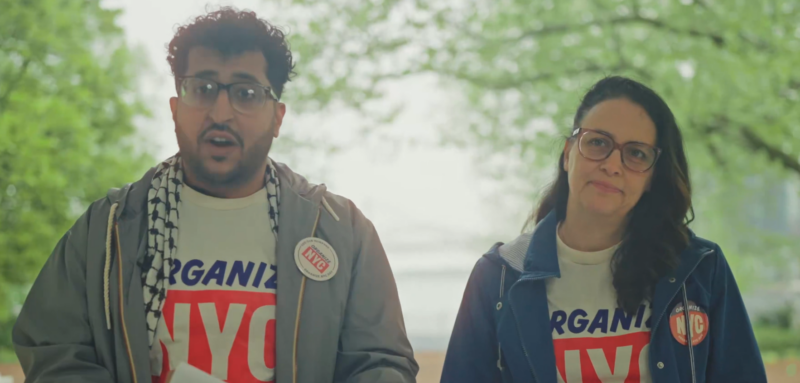

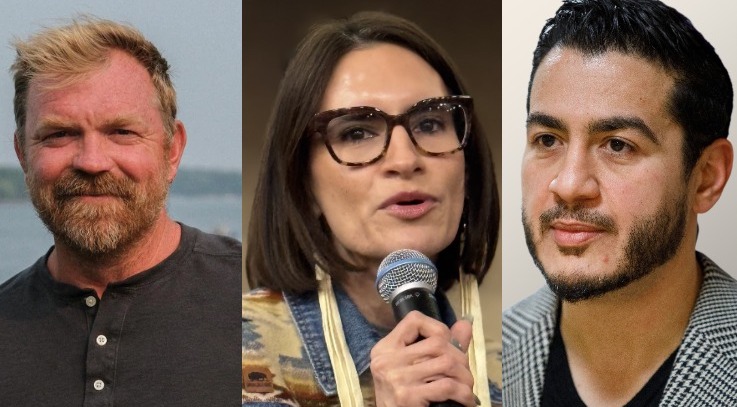
























‘The guy that’s going to win the primary in Maine has a Nazi tattoo on his chest and now that’s no problem for a lot of voters. … That’s crazy,’ Fetterman told CNN
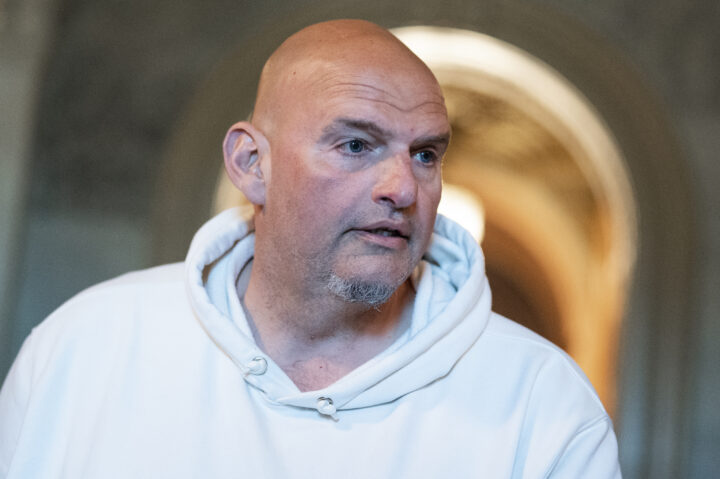
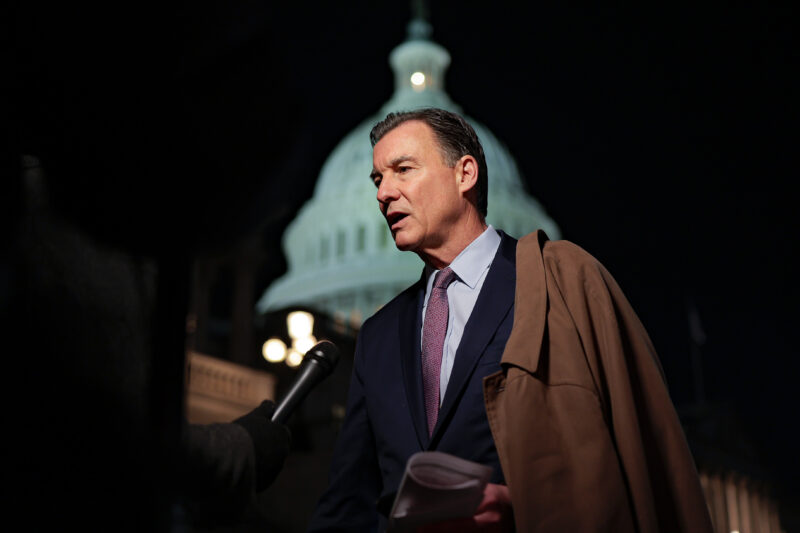
Tom Williams/CQ-Roll Call, Inc via Getty Images
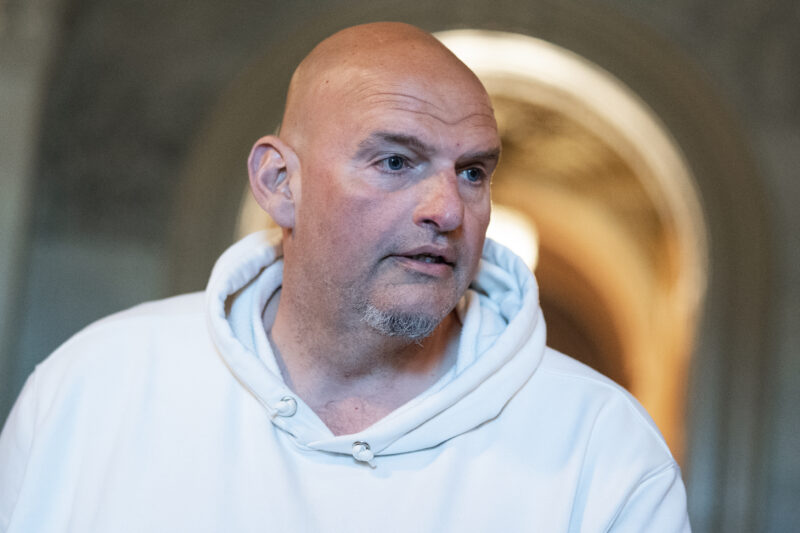
Sen. John Fetterman (D-PA) is seen after the Senate luncheons in the U.S. Capitol on Tuesday, April 14, 2026.


 Add JewishInsider on Google
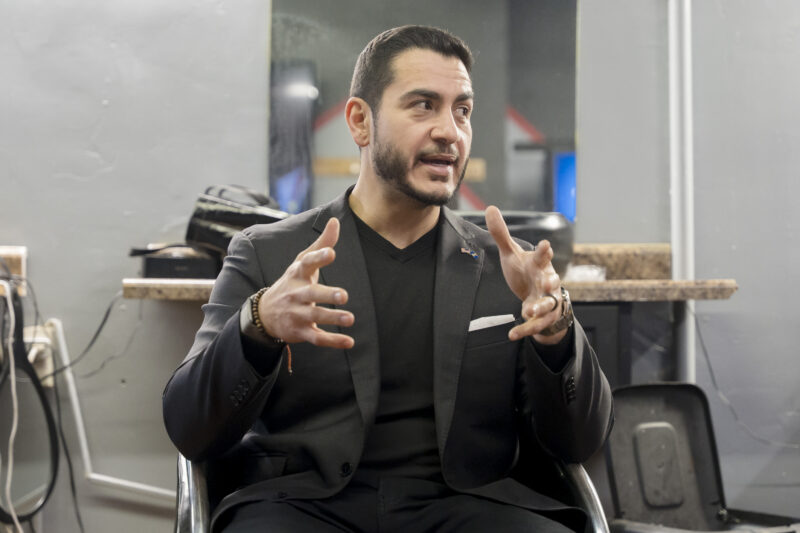
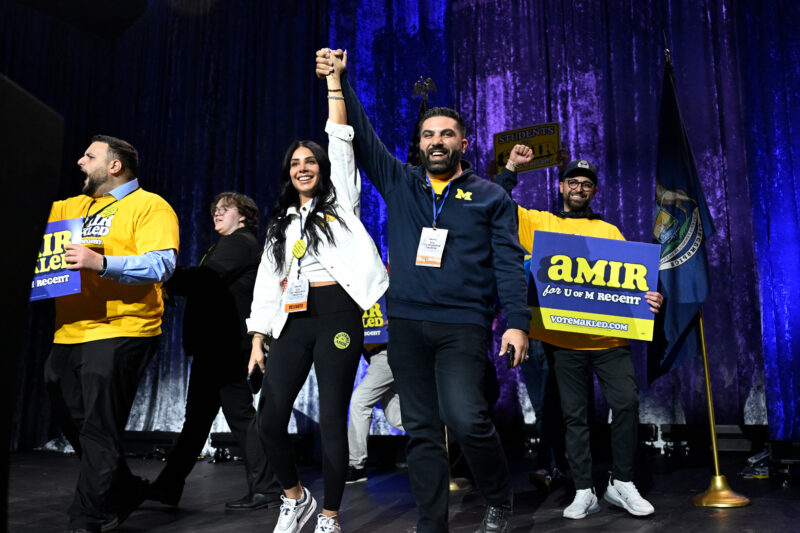
Sen. John Fetterman (D-PA) said on Friday that the Democratic Party “absolutely” has an issue with rising antisemitism, calling out the party’s embrace of candidates including Graham Platner in Maine and Abdul El-Sayed in Michigan while criticizing the recent progressive push to cut off defensive aid to Israel.
The Pennsylvania senator made the comments after being asked on CNN’s “The Arena with Kasie Hunt” if he believed the Democratic Party has a problem with antisemitism. Fetterman argued that the growing support for both candidates in their respective primaries was indicative of a tolerance for antisemitism within the party.
He pointed to Platner surviving the controversy surrounding his Nazi tattoo and Jewish Insider’s reporting in recent days that the first-time candidate repeatedly praised Hamas’ tactics in a 2014 Reddit forum that shared video of the terrorist group killing several Israeli soldiers.
“I mean, the guy that’s going to win the primary in Maine has a Nazi tattoo on his chest and now that’s no problem for a lot of voters,” Fetterman said. “I don’t know why. That’s crazy. And now, I mean, we know he knows, he knew what that was. I mean, if you’re back over 12, 13 years, cheering about the death of Israeli soldiers, I mean, you clearly have a serious issue, and the left has a serious issue with antisemitism.”
“It was just released that he was praising and celebrating a video online where Hamas was beating and torturing Israeli soldiers to death,” Fetterman said, referring to Platner.
Fetterman also made note of El-Sayed’s lead in one recent primary poll despite his decision to campaign alongside antisemitic streamer Hasan Piker.
“The guy in Michigan, he’s leading now in that race, as my party becomes more and more hostile to Israel,” Fetterman said. “They’re just palling around someone like Hasan Piker, you know the guy that, absolutely, I mean, he absolutely is proud to cheer for Hamas, loves Hamas.”
“The Democrats are proud to stand with him and campaign with him,” he added. “Go ahead, try to win Pennsylvania and campaign around Hasan Piker, or saying, ‘Yeah, America deserved 9/11’ or ‘Hamas is 1,000% better than Israel’ or ‘I don’t care about the rapes and for all this other things.’ We have a serious problem with my party.”
Fetterman, one of most vocal pro-Israel Democrats in the Senate, told Hunt that Israel is “becoming more and more toxic for a Democrat to support,” pointing out that “80% of Democrats view Israel in a negative way.” He specifically condemned the uptick in progressive and far-left voices coming out against continued defensive aid to Israel.
“You have people like [Rep. Alexandria Ocasio-Cortez] voting against Iron Dome, the technology that prevents tens and tens of [thousands] of Israeli deaths from the rockets that those cowards fire at civilians,” he said.
Fetterman went on to criticize members of his party for opposing the war in Iran, saying that there were other Democrats who felt the same as him in supporting the effort but were not speaking out because doing so would be “politically toxic.”
“Every single Democrat has already been on record saying, ‘We can‘t ever allow Iran to acquire a nuclear bomb,’” Fetterman said, specifically naming former Vice President Kamala Harris and former Secretary of State Hillary Clinton and “everyone that’s run for president” who said “we can’t ever allow that to happen.”
“Then, [President Donald] Trump happened to do something about that to prevent that. That’s why I support that,” he continued. “I’m not the only Democrat who supports this, but I’m the only Democrat that’s willing to stand up and say it’s the right thing because I know how politically toxic it is as a Democrat to support this.”
Fetterman surmised that he is the “only Democrat … perhaps left in the entire Congress” who will say publicly that recent U.S. military action in Iran “was necessary” because doing so “contradicts every single thing that every Democrat has said” about how “we can’t ever allow Iran to acquire a nuclear bomb.”
Fetterman went on to criticize the Democratic lawmakers who voted for the recent war powers resolutions in the House and Senate, arguing that their opposition to the war has been “celebrated” by Iranian leadership and calling their response to the conflict “absurd.”
“Iran has celebrated this,” Fetterman said of the broad Democratic opposition. “A lot of people in my party and a lot of people in the media has turned Iran into the underdog. They’re like Rudy” — making a reference to the 1993 sports movie — “and putting them up on their shoulders and cheering for Iran at this point.”
Asked to respond to Sen. Elissa Slotkin’s (D-MI) statement that “being pro-Israel today is not about simply supporting the political or military agenda of Prime Minister [Benjamin] Netanyahu, just like being pro-American should not be equated with loyalty to President Trump,” Fetterman argued that her comments on her votes for Sen. Bernie Sanders’ (I-VT) measures on Thursday blocking military sales to Israel were similarly “absurd.”
“She’s a Democratic senator. Why aren’t you criticizing Iran? Why aren’t you criticizing Hamas or Hezbollah or these other kinds of forces? If you have to pick a side here, criticize that. So that’s where we are as a Democratic Party, and you’re going to vote against the kinds of critical aid that Israel requires and needs in order to beat back and destroy an organization like Hezbollah. Like I said, if you have to pick a side in a war, and clearly we have a side, I’m proud to stand on the side of Israel and America.”
Pressed on if he was still committed to being a Democrat given that his comments marked his harshest criticism yet of his party, Fetterman responded affirmatively.
“Well, of course. Yeah, I am absolutely committed to [remaining a] Democrat, absolutely,” Fetterman said. “I vote 91, 92 percent the Democratic line, but I am the only Democrat now that’s proud to consistently stand with Israel, and I’m going to do that, and that’s been very damaging with my standing as a Democrat.”
“If it’s what’s necessary, I’ll be the last Democrat standing with Israel through this,” he later added.
Fetterman also predicted that the war in Iran would not go on much longer, noting that “things kind of continue to wind down,” and said it’s “important to support” the U.S. securing an outcome in which Iranian leadership “surrenders.”
“I think these are very positive developments,” he said of Israel and the U.S. targeting Iran and their leading proxies.
“I think it seems like it’s going to wind down,” Fetterman said. “And we’re heading to a strong end at this point.”
The South Carolina Republican brought Christian and Jewish leaders together to speak out against ‘stopping’ antisemitism in the GOP ‘before it gets stronger’
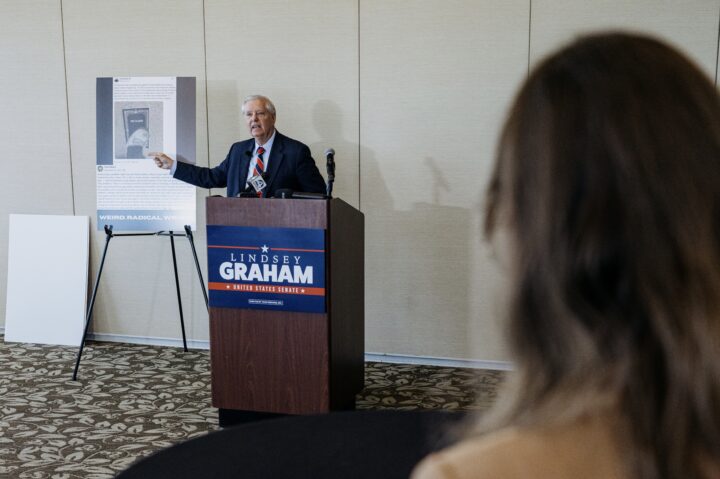
Lindsey Graham for Senate Campaign
Sen. Lindsey Graham (R-SC) at news conference last Thursday during which he criticized the actions of his primary opponents' staffers.
Sen. Lindsey Graham (R-SC) doubled down on his calls for two of his primary challengers in his reelection campaign to fire senior officials over their record of antisemitic statements after both candidates refused to do so — vowing on Tuesday to fight the growing tolerance for Jew-hatred in the GOP and call out aspiring lawmakers in South Carolina who excuse or embrace it.
The South Carolina senator convened Christian and Jewish leaders for a call with reporters to criticize Paul Dans and Mark Lynch, who are challenging Graham in the Republican primary for his Senate seat, over Dans’ refusal to fire Vish Burra as his campaign communications director and Lynch declining to part ways with Evan Mulch as his political director despite their respective records of making antisemitic statements.
Graham told reporters that while he would not typically make an issue of the behavior of staffers from an opposing campaign, he felt compelled to speak out because of the outgrowth of antisemitism in the Republican Party.
“I’m speaking more today as just an American, a senator representing South Carolina, rather than just a candidate. I’ve never had to make a phone call like this, and it, quite frankly, is disturbing,” Graham said. “There are two opponents of mine that have staff members that are very out of touch with where I think South Carolina is, and spewing hate in the form of antisemitism.”
“I’ve never done this before, but this is a problem in America, a small problem in the Republican Party, that I don’t want to grow,” he continued. “I seldom do this, go after other people’s campaigns, because I feel confident that what I’ve got to offer wins the day politically, but this is not about politics. This is not about my primary. This is about stopping something before it gets stronger, calling it out and making it unacceptable.”
Graham highlighted both staffers’ records at a news conference last Thursday and on Tuesday’s call, condemning Burra for depicting Jews as cockroaches in a video he created on the right-wing One America News Network, which ultimately resulted in his firing as a producer.
Mulch, meanwhile, posted a photo on X last June of a boot stepping on the Talmud and calling it a “hate filled book.”
“I call this out because I think it’s a vile antisemitic action. It has no place in politics or, quite frankly, decent society, and he hasn’t been fired,” Graham said on Tuesday. “As a matter of fact, Mr. Dans, in responding to the call to deal with the staffers, said that my campaign was controlled by Israel and that I’m being blackmailed by Israel and other affiliated groups, which I think is one of the oldest stereotypes, that the Jews control politicians.”
“When you step on the Talmud with a boot, I don’t think that’s American,” he added of Mulch. “I don’t think it’s Christian, and I don’t think there’s any place in running for higher office for people who engage in that behavior, and I’ve called for him to be fired with no response.”
While Graham said he does not believe it is inherently antisemitic to voice objections to the policies of the Israeli government, he argued that tolerance of such criticisms did equate to tolerance of blatant antisemitism.
“I’m a strong supporter of Israel, and you can oppose Israeli policies and not be an antisemite,” Graham said. “But when you’re an antisemite, not only do you oppose Israel, I think you oppose human decency and what America stands for.”
Graham told Jewish Insider on the call that he was confident “that when the people of South Carolina — Republicans, Democrats and independents — hear what’s going on, and that’s why I’m doing it today, it will be soundly rejected.”
Matt Brooks, CEO of the Republican Jewish Coalition; Tony Perkins, president of the Family Research Council; Ralph Reed, founder of the Faith & Freedom Coalition; Sandra Hagee Parker, who chairs the board of CUFI Action Fund, the political arm of Christians United for Israel; and Rabbi Yossi Refson of Chabad of Charleston spoke on the call in support of Graham’s efforts.
“We have witnessed, I believe, sadly, the institutionalization of antisemitism in the Democratic Party,” Brooks told attendees. “For us at the Republican Jewish Coalition, let me be very clear and unambiguous that this is a fight that we will take everywhere. We will ensure that antisemitism does not take hold in our party like it has taken hold in the Democratic Party. The fabric of America was woven together based on Judeo-Christian values, the values that we all cherish are built in partnership with our Christian allies and friends. Anybody who traffics in antisemitic rhetoric or antisemitic actions has no place in our party.”
Graham vowed at the end of the call to continue his push to ensure elected Republicans in and out of the state are individuals who repudiate antisemitism.
“The breadth of condemnation here and the quality of the thoughts expressed not only give me hope and prove that I’m doing the right thing. It inspires me. I am not going to let this go after what I heard today. I am never going to let this go until my last breath. I will make sure that any group, but particularly the long suffering Jewish people, have my unequivocal support.”
Dans and Lynch were unapologetic about their campaign staffers, instead releasing statements late last week and Tuesday directing their ire at Graham in deeply personal terms.
“He’s given a member of my campaign staff more attention than he’s given South Carolinians for decades,” Dans said in a statement last Thursday. “The real headline that you should be covering is how many opioid deaths happened in South Carolina last year on Lindsey Graham’s watch. Israel picks Lindsey Graham’s staff, but they do not pick mine. I am not firing Vish Burra and I am calling on the people of South Carolina to fire Lindsey Graham.”
Lynch, meanwhile, told JI in a statement on Tuesday evening that Graham was “an existential threat to both the nation of Israel and the United States.”
“Lindsey Graham is responsible for the deaths of countless Jews in Israel by the fact that he has sent 10s of millions of dollars to Al-Qaeda, Hamas, and Al-Nusra Front — funding the enemies of Israel,” Lynch said.
The move, which Trump has sent mixed signals about, may cause further fractures in the GOP over support for the war
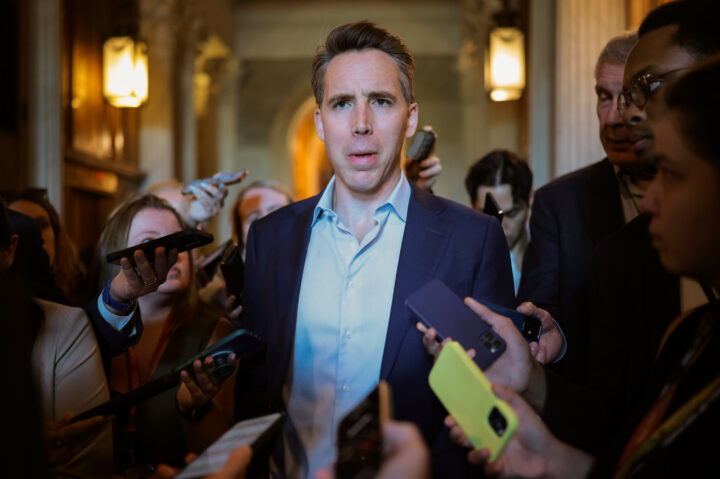
Kayla Bartkowski/Getty Images
Sen. Josh Hawley (R-MO) speaks to the press on June 2, 2025 in Washington.
As the U.S. deploys thousands of Marines to the Middle East and President Donald Trump continues to send mixed messages about whether he plans for a ground invasion of Iran, one GOP senator said he’s hoping the administration does not take that step.
“I would hope it wouldn’t come to that,” Sen. Josh Hawley (R-MO) told Jewish Insider on Friday, when asked about the possibility of a ground operation in Iran.
Hawley has previously argued that the war should wrap up quickly and said that deploying ground troops might require an affirmative congressional war authorization. His comments suggest that a ground invasion could cause further fractures among Republican lawmakers over the war.
Trump gave conflicting answers last week on whether he plans to send U.S. troops to Iran, saying at one point that he was “not afraid” to deploy troops, but saying later in the week that he did not plan to do so.
Already, a small number of other congressional Republicans are growing hesitant about the effort.
“I wish that the president would figure out a way to end the war. I think it’s becoming more challenging every day in terms of how you end it,” Sen. Lisa Murkowski (R-AK) said earlier this week.
Murkowski also said, before reports emerged of a potential $200 billion supplemental funding request for the war, that the funding level requested might “provide its own level of shock.”
And Rep. Lauren Boebert (R-CO) said she would oppose any additional funding request for the conflict.
But other Republicans are standing firmly by the administration.
Sen. Rick Scott (R-FL) said that he’s not concerned about the possibility of placing troops on the ground.
“The president is doing what he needs to do, he’s got to protect American freedom, he’s got to destroy their nuclear weapons, their ability to hit us with ballistic missiles,” Scott said. “He’s doing the right thing.”
Mullin said he would work to streamline the paperwork process and reimbursement timelines
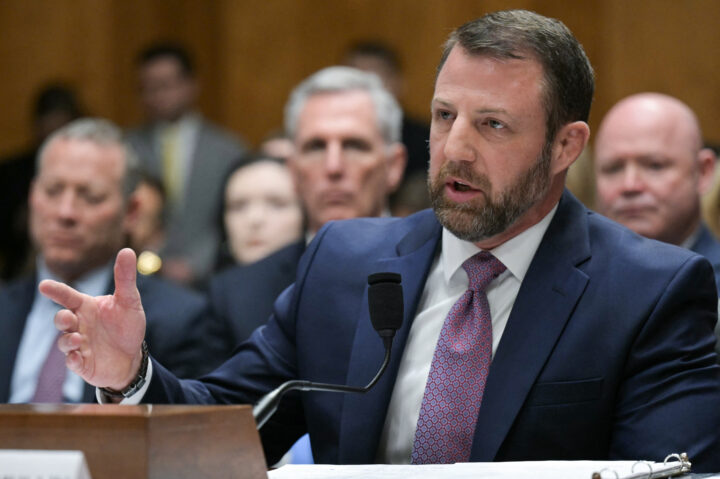
Oliver Contreras/AFP via Getty Images
Sen. Markwayne Mullin (R-OK), nominee to be Secretary of Homeland Security, testifies during a Senate Committee on Homeland Security and Governmental Affairs confirmation hearing on Capitol Hill in Washington, DC, on March 18, 2026.
In his nomination hearing to be secretary of homeland security, Sen. Markwayne Mullin (R-OK) said he will aim to “streamline the process” for grants, including the Nonprofit Security Grant Program (NSGP) aimed at helping harden religious institutions, amid heightened antisemitism and increased threats during the ongoing war in Iran.
The NSGP has faced persistent challenges, including severe underfunding, controversial new conditions and, most recently, delays tied to the ongoing partial shutdown of the Department of Homeland Security.
When pressed by senators on the need to unlock NSGP funding in the wake of the violent attack at Temple Israel in suburban Detroit last week, Mullin agreed that the process should be streamlined and said he would aim to “cut out the redundancies” and “amount of paperwork.”
“The Jewish community is spending about a billion dollars a year privately securing their own institutions,” said Sen. Elissa Slotkin (D-MI). “No religious group should have to spend that amount of money on their own security in the United States of America. So I would just ask for your help in reforming the Nonprofit Security Grant Program so it’s agile, so you don’t have to win the grant and then still do 100 pieces of paper.”
Sen. James Lankford (R-OK) echoed those sentiments, noting that the “length of time it takes to get a response” is concerning, especially for “locations that are higher risk than others.”
“Synagogues and temples have been one of those very high risk locations that are out there,” Lankford said, referencing the attack at Temple Israel. “That location happened to be one of the locations where there’s also been this nonprofit security grant to help harden that facility.”
“We have multiple challenges here,” Lankford added. “One of them is, when the decision is made, they make a request, go through the paperwork, get approval to be one of those locations that we say we need to harden this location. Once the approval is done, it may take months to over a year just for the dollars to actually come on it because there’s more bureaucratic hoops to go through.”
In response, Mullin agreed, “there’s a better way to do this.” He added that while he may have political differences with some of the lawmakers on the committee, this issue “isn’t one” of them and that he would be “laser focused and get this resolved.”
“The amount of paperwork once you’re approved to get the funding flowing, and then the paperwork that’s followed up on is way too encompassing,” Mullin said. “Taking years to get reimbursed is not acceptable. Taking months to get reimbursed is not acceptable.”
Mullin was also pressed on the threat of terrorist attacks domestically amid the DHS funding lapse and ongoing conflict in Iran.
Sen. Josh Hawley (R-MO), cited several recent incidents that had “potential terrorist ties,” including the antisemitic attack at Temple Israel in Michigan whose perpetrator had family ties to Hezbollah; a school shooting at Old Dominion University earlier this month, which is being investigated as an act of terrorism; a mass shooting in Austin, Texas, which is being investigated as having ties to the Iran conflict; and the detonation of bombs in New York City.
“Is this a good time for the Department of Homeland Security to be shut down and unfunded?” Hawley said.
“It’s a horrible time,” Mullin replied. “It’s devastating to the morale of the men and women we have tasked to keep care, take care of all of us, all the homeland, regardless it’s a blue state or red state.”
Sen. Richard Bumenthal (D-CT) pressed Mullin over whether he would approve the deportation of Iranian dissidents who could face death or punishment upon being returned to Tehran. The Trump administration has deported Iranians back to Iran from the U.S. on several deportation flights after a deal between the two governments was reached.
“Before the war in Iran began, the Trump administration negotiated a back-channel agreement, a deal with the Islamic Republic to deport Iranian nationals, including asylum seekers and dissidents,” Blumenthal said. “I have no doubt you share my outrage about the treatment of Iranian nationals who were deported, possibly to torture and death in Iran. We should not be sending Iranian dissidents and asylum seekers back to Iran, wouldn’t you agree?”
Mullin was noncommittal, arguing that he didn’t know “the specifics” behind the incident.
“Before I can talk about hypotheticals, I would need to know the reasons behind it,” Mullin said. “But I don’t want to deport anybody that’s here legally and most definitely not individuals that have done everything possible to be a contributor to society.”
“We know that our enemies want to infiltrate us and use our rules and generosity against us, so I don’t know the specifics of their background,” Mullin added. “But I will be happy to look into it.”
Rep. Josh Gottheimer (D-NJ), a leader in the House on antisemitism and NGSP funding who attended Mullin’s hearing, told Jewish Insider that DHS needed “new leadership,” and signaled an openness to working with Mullin on the issue.
“We don’t agree on everything, that’s for sure. But, after a decade of working out together most mornings, and finding bipartisan solutions to some of the toughest issues, Markwayne and his family have become very good friends,” Gottheimer said.
During the hearing, Mullin also noted that Gottheimer is “a friend” and that he would “run through fire for the guy.”
“When Josh asked me to join a bipartisan group called No Labels, that’s when we really started seeing that there’s a lot of common ground that we can work together on,” Mullin said. “We can set the differences aside, and we can work together. In fact, our daughters are writing a book together about bipartisanship.”
Mullin’s prospects for confirmation remain somewhat in question, given apparent opposition from Sen. Rand Paul (R-KY), who leads the committee where Mullin’s nomination vote will take place. Paul’s opposition traces to personal animosity between the two colleagues, as well as what Paul described as Mullin’s “anger issues.”
Mullin recently called Paul a “freaking snake” and said that he “understood” why Paul’s neighbor had attacked him, an assault that resulted in serious injuries and a prison sentence for Paul’s neighbor. Mullin refused to apologize at the hearing, to Paul’s outrage.
“I was shocked that you would justify and celebrate this violent assault that caused me so much pain and my family so much pain. The record will show a lack of contrition, no apology and no regrets for your support. You completely understand the violence that was perpetrated on me. You’re unrepentant,” Paul said. “I just wonder if someone who applauds violence against their political opponents is the right person to lead an agency that has struggled to accept limits to the proper use of force.”
“We can have our differences,” Mullin replied. “It’s not going to keep me from doing my job as secretary of homeland security.”
Paul threatened during the hearing to cancel the vote, scheduled for Thursday, on Mullin’s nomination. If Paul refuses to allow a vote, that would effectively block Mullin’s nomination, even if he otherwise has the necessary support to advance.
The Kentucky senator and committee Democrats also raised questions about a classified trip Mullin claims to have taken to a combat zone while he was a member of the House, the details of which Mullin refused to discuss in public during the hearing, alleging that the trip was classified. Committee members retired to a secure room to discuss the trip after the hearing.
If a vote is held, Mullin will need the support of at least one Democrat on the committee in order to advance without Paul’s support. Sen. John Fetterman (D-PA) has previously expressed his intention to support Mullin, and urged Paul and Mullin to move past their feud during the hearing.
The Pennsylvania senator told JI about the U.S. military operation’s successes: ‘Why can’t a single Democrat agree that this is a good thing for the world and the region?’

Lev Radin/Pacific Press/LightRocket via Getty Images
Senator John Fetterman speaks during the grand opening of The Altneu synagogue.
Sen. John Fetterman (D-PA) is criticizing his fellow Democrats over their opposition to President Donald Trump’s decision to launch the U.S. war in Iran, arguing that his party should celebrate efforts to bring down the Iranian regime and its military and nuclear capabilities as a “positive development.”
Fetterman, the most vocal pro-Israel Democrat in the Senate, has been one of the leading advocates for striking Iran directly since Hamas’ Oct. 7, 2023, attacks on Israel. He backed Trump’s decision to strike Iran’s nuclear facilities amid the 12-day war with Israel last year, criticizing Democrats at the time for speaking out against the operation, and has since emerged as one of the staunchest Iran hawks in the Democratic Party.
The Pennsylvania senator said, since leading Democrats have long argued that Iran should never have the ability to get a nuclear weapon, criticism from the party of the joint U.S.-Israel efforts to degrade their military capabilities is hypocritical.
“First, let’s get to history. Every single Democratic presidential candidate or Democratic president all agreed, we can never allow Iran to acquire a nuclear bomb. Everyone has run the gamut: sanctions, treaties, proxies, other kinds of negotiations. It never worked,” Fetterman told Jewish Insider in an interview on Tuesday. “But you know what it actually produced? Nine hundred pounds of just pure, weapons-grade uranium.”
“When the country that wants death to America and wants to destroy Israel could have been months away from developing a nuclear weapon, and every single Democratic candidate for president all agreed we can never allow them [to do so], why can’t we just acknowledge what’s happened?” he asked. “It’s a profound development. I don’t get it. I know what the [Democratic] base demands right now: condemn and criticize.”
He said that Democrats should be able and willing to praise the operation for degrading Iran’s regime and its capabilities.
“Why can’t a Democrat call this a positive development given everything that Iran is responsible for and what their ambitions are?” Fetterman said. “This is effectively us destroying the Nazi regime and Hitler before they could’ve even begun. So, to your readers, whether in Israel or here, I ask: Why is that a problem?”
Fetterman also said that the media and fellow Democrats are ignoring what he characterized as the apparent successes and effectiveness of the U.S.-Israel strikes.
“Iran’s capabilities have been effectively ended. Right now, the missile strikes are down by 90 percent. Their Navy is gone. They can’t even project any force at this point,” Fetterman said. “Why do The New York Times and other left-wing media keep making it seem that the region is on fire when this is the breaking free of Iran? Why can’t a single Democrat agree that this is a good thing for the world and the region?”
Fetterman also blasted recent comments from former Vice President Kamala Harris and California Gov. Gavin Newsom, potential 2028 Democratic presidential contenders, criticizing Trump’s decision to launch the U.S. war in Iran and questioning the future of the U.S.-Israel relationship. The Pennsylvania senator said he was not surprised by the mainstreaming of opposition to Israel within the Democratic Party, predicting that the shift away from supporting Israel would continue.
“I expect at the end that our party is going to continue to back away from the moral clarity of Israel. If you are describing Israel as an apartheid state, or you have people in leadership [doing so], that’s profoundly disappointing but unsurprising,” Fetterman said.
The senator addressed Saudi and Emirati leadership directly about escalating tensions in the region in his remarks at the Munich Security Conference
Sean Gallup/Getty Images
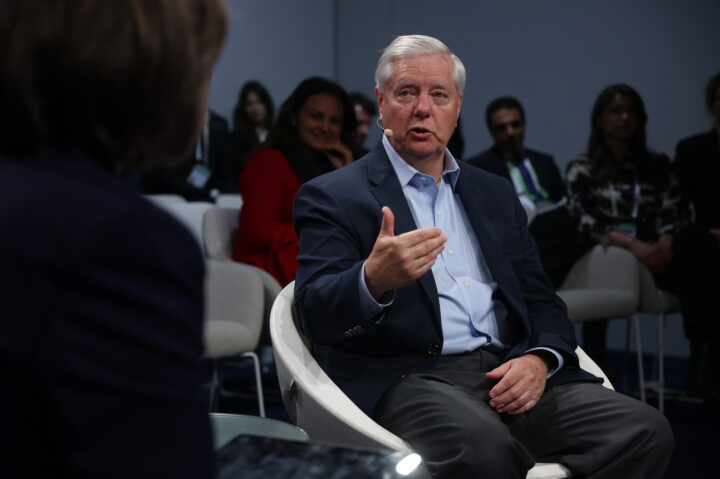
Sen. Lindsey Graham (R-SC) speaks at the 62nd Munich Security Conference on February 13, 2026 in Munich, Germany.
Sen. Lindsey Graham (R-SC) warned Saudi Arabia that the escalating tensions with the United Arab Emirates risk benefiting Iran at a critical moment in the Middle East, addressing the nations’ leaders directly in remarks at the Munich Security Conference on Saturday.
“As to MBS [Saudi Crown Prince Mohammed bin Salman] and MBZ [UAE President Sheikh Mohamed bin Zayed al-Nahyan] — knock it off, Saudi Arabia, knock it off,” Graham said from the stage. “I’m tired of this crap.”
Graham also urged “anybody who will listen in the Middle East — don’t let this moment pass,” and warned that the rift between the UAE and Saudi Arabia is “emboldening Iran.” He added that “MBZ is not a Zionist,” pushing back against criticism in Saudi Arabia of the Emirati leader’s ties to Israel. Among other escalatory rhetoric out of the kingdom, a prominent Saudi academic publicly accused Abu Dhabi last month of aligning itself too closely with Jerusalem and acting as “Israel’s Trojan horse in the Arab world.”
Saudi Arabia and the UAE have increasingly been at odds in recent months as the two U.S. allies have backed different sides in several regional conflicts and Riyadh continues to pivot away from its role as a moderating force in the region.
“Be smart, but don’t be locked down with fear,” said Graham. “I know they [the UAE and Saudi Arabia] got differences in Yemen and they got differences in Sudan, but we got to think big picture,” he said. “To any leader in the region that doesn’t understand you’re on the verge of history, history would judge you poorly.”
In Yemen, Saudi Arabia conducted an airstrike in late December 2025 against what Riyadh said was an Emirati arms shipment linked to the UAE-backed Southern Transitional Council (STC). Hours after the strike, the Emirati government announced it would withdraw its remaining troops from the country.
The two countries have also diverged in Sudan, where Riyadh has embraced Islamist-aligned factions while the UAE has aligned with rival forces. The Gulf states have also taken opposite sides in Somalia, with the UAE quietly supportive of Somaliland, while Saudi Arabia condemned Israel for recognizing the region’s independence.
Graham’s remarks in Munich come as the South Carolina senator remains an outspoken advocate of expanded cooperation between Israel and Arab states and has repeatedly emphasized countering Iran as a central U.S. objective in the region. On Monday, Graham met with Israeli Prime Minister Benjamin Netanyahu in his Jerusalem office during a trip to Israel.
The Texas senator, facing a competitive primary, praised Sen. Ted Cruz for taking the lead in speaking out against anti-Jewish hate
Kevin Dietsch/Getty Images
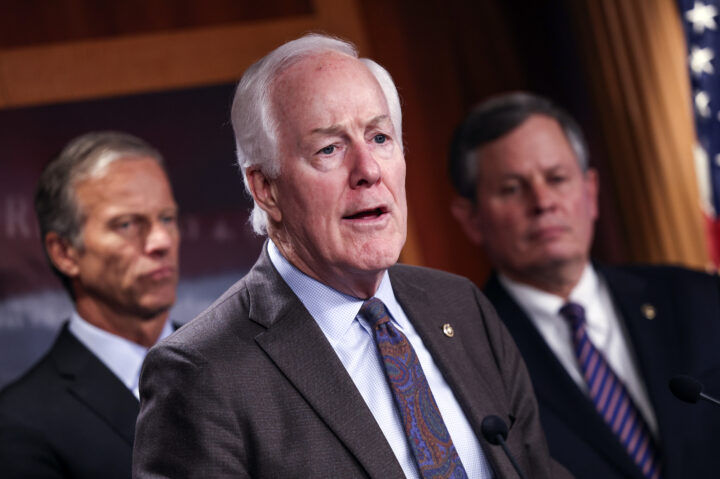
Sen. John Cornyn (R-TX), joined by Sen. John Thune (R-SD) (L) and Sen. Steve Daines (R-ID) speaks about the Senate Democrats at the U.S. Capitol on September 29, 2021 in Washington, D.C.
Facing a heated primary against Texas Attorney General Ken Paxton, Sen. John Cornyn (R-TX) accused his right-wing challenger on Thursday of associating with antisemitic and anti-Israel voices within the MAGA movement.
Cornyn told Jewish Insider in a wide-ranging interview that Texas Republican voters should view Paxton’s associations with figures such as former Trump advisor Steve Bannon as “alarming” — while urging Republicans to call out antisemitic and anti-Israel voices within the party, along the lines of his outspoken Texas GOP colleague Sen. Ted Cruz (R-TX).
“There’s this interesting, and troubling, tendency of some folks who claim the MAGA mantle to associate with antisemites like Nick Fuentes, Candace Owens and Steve Bannon. I know Ken Paxton regularly goes on Bannon’s ‘War Room’ podcast, and it’s something that should be alarming to Texas voters. People like that I don’t think are what I would call conservatives,” Cornyn said.
“Once they “get their foot in the door, they have a way of corrupting the whole party and the whole movement,” he continued. “I just think allowing somebody like Ken Paxton inside the tent will end up being the destruction of the Republican Party.”
Paxton has been a guest on Bannon’s “War Room” podcast on numerous occasions in recent years, even as Bannon has made a number of controversial comments, most notably labeling popular Jewish conservative podcast host Ben Shapiro as a “cancer” on the party after he spoke out against Tucker Carlson and Owens’ antisemitism at a Turning Point USA conference last year.
Bannon has also ramped up attacks on Israel, calling the Jewish state a “protectorate” of the United States — while speaking out against President Donald Trump’s decision last year to attack Iran’s nuclear facilities.
A spokesperson for Paxton defended the Texas attorney general’s record on Israel and fighting antisemitism in a statement to JI.
“AG Paxton has been a fierce friend of Israel,” the spokesperson said. “After spending $70 million and still being double digits behind in the polls, Sen. Cornyn has nothing else left but to throw random attacks at the wall and see if they stick. AG Paxton has a STRONG and unquestionable record standing against antisemitism.”
Cornyn is facing a tough reelection battle against Paxton and Rep. Wesley Hunt (R-TX), both of whom are running to his right in next month’s Republican primary.
The senator, a fixture in Texas politics for nearly four decades who served at the top levels of Senate leadership, argued that his primary contest would help determine what it means to be an electable Republican at a time when the party’s principles and values are being debated internally.
“A lot of it [the GOP primary election] is going to boil down to a question of character. I think character still matters and the attorney general doesn’t believe it matters at all,” Cornyn said. “I just can’t in good conscience turn over this job representing 32 million people and a state that I love and a party that I helped build over my career, I can’t turn it over to a corrupt and unprincipled individual like the attorney general.”
Cornyn warned that the GOP is at risk of being overrun by extremists if prominent conservatives continue to align themselves with fringe figures who espouse antisemitic views, drawing a comparison to his assessment of the current ideological trajectory of the Democratic Party.
“It starts out with the old saying: the enemy of my enemy is my friend. A lot of these folks were opposed to a lot of the worst excesses of the Democratic Party and the leftists. They began to corrode that movement with things like antisemitism and graft and greed. I think that’s how credibility of the opposition was eroded, by failing to call out people like that,” Cornyn said.
“To maintain the integrity of conservatives, that’s why it’s so important to call out and to cut out some of these cancers that I think ultimately would result in the failure of the conservative movement,” he continued. “Because people could point to the corruption that was allowed to develop and thus undermine the credibility and integrity of the whole movement.”
Cornyn praised Cruz for “being one of the first to stand up and call out some of the fringe characters,” and criticized Republicans who associate themselves with far-right figures.
“I’ve tried to do my part, initially through an editorial in the Dallas Morning News. I know this is a cancer, because antisemitism is just another way of dehumanizing people, and then using that behavior to justify in some people’s minds acts of violence,” the GOP senator said. “Obviously, the history of the Jewish people, dating back to the Holocaust, has been one of opponents trying to dehumanize them and make them seem to be something less than equal in terms of their dignity and their right to exist.”
Asked whether Trump would back him before the March primary, Cornyn told JI that he did not expect an endorsement, adding that he was dealing with “a lot of misinformation and lies.”
“I’ve been supportive of the president and his policies. Unfortunately, you always have to contend with a lot of misinformation and lies in modern elections,” Cornyn explained. “He [Trump] said he considers all three of us [GOP candidates] to be friends. If your base is divided among three people, choosing one out of those three people and disappointing the supporters of the other two, I can understand [that being] not something he would want to necessarily embrace unless he felt like it’s worth the cost.”
Cornyn argued that he would be the strongest general election candidate between himself, Paxton and Hunt, whereas Paxton would “ultimately provide the Democrats the best opportunity they’ve had since 1994 to turn Texas blue.”
“President Trump desperately wants to maintain the majority in the House, and we’ve got five new congressional seats in Texas,” he said. “If I’m the nominee, I will provide some help to those downballot races since I’ll be at the top of the ballot. I won by 10 [points] in 2020. If Paxton is the nominee, he’ll either lose or win by the skin of his teeth.”
Asked about Texas state Rep. James Talarico and Rep. Jasmine Crockett (D-TX), the Democrats in the race, Cornyn suggested he would enjoy running against either in a general election.
“They should be running for Senate in California because they are totally out of step with where I think Texans are,” he said.
Cornyn added that he would not underestimate Crockett.
“I wouldn’t count out Jasmine. Jasmine is smart, but I think she’s not running as good a campaign as Talarico,” Cornyn said. “Talarico is raising a lot of money, and he definitely has a better organization than Jasmine does.”
Budd says Qatar should hand over Khaled Mashaal because he has the ‘blood of Americans on his hands’

Kevin Dietsch/Getty Images
Sen. Ted Budd (R-NC)
Sen. Ted Budd (R-NC) called on Qatar to extradite Hamas operative Khaled Mashaal to the U.S., telling Jewish Insider on Wednesday that the leader has the “blood of Americans on his hands.”
Mashaal, who is under U.S. indictment on terrorism-related charges, appeared this past weekend at the Al Jazeera Forum in Doha, where he rejected the U.N. Security Council-backed plan for Gaza — a move that could further complicate U.S. efforts to advance Phase 2 of President Donald Trump’s Gaza peace initiative.
“[Mashaal] is responsible for plotting the brutal massacre of Americans and Israelis on Oct. 7, 2023,” said Budd. “He should absolutely be extradited to the U.S. to face justice for his appalling crimes, not walking free to make public appearances in Qatar calling for Hamas to maintain its weapons and deny foreign intervention in Gaza.”
Budd also told JI that he wants to see Qatar crack down on the content disseminated by state-backed Al Jazeera.
Sen. Pete Ricketts (R-NE) said that he wasn’t familiar with Mashaal’s case in particular, but told JI that “one would like to see the that Qataris, who are supposed to be helping us out, participate or cooperate with us when we’re trying to bring terrorists to justice.”
Also featured at the forum was Francesca Albanese, the U.N. special rapporteur, who was sanctioned by the U.S. in July 2025. Appearing by video, she told forum attendees that humanity has a “common enemy” in Israel.
Middle East policy experts have cautioned that Qatar’s hosting of prominent Hamas and U.S.-sanctioned individuals allows those figures to circumvent U.S. restrictions, while promoting anti-American sentiment. The U.S. does not currently impose any direct sanctions on Qatar.
“The Qataris are not inherently violating U.S. sanctions by inviting these guys to speak,” said Natalie Ecanow, senior research analyst at the Foundation for Defense of Democracies. But, she added, “that’s not to say that this isn’t a latent disregard for U.S. sanctions by a country that’s supposed to be an ally and a partner.”
Ecanow said it is “not the first time” the Qataris have “thrown a finger in the face of American sanctions.” She noted Doha’s significant and long-term investment in Russia’s energy sector amid the ongoing war in Ukraine, as well as Qatar’s continual hosting of Hamas officials.
“The Qataris say that they were asked by the Americans to host Hamas. I have not seen documentation to prove that,” said Ecanow. “Hamas leaders have been living there for over a decade, and they amass multi-billion dollar fortunes.”
Edmund Fitton-Brown, a former British diplomat and senior fellow at FDD, called the forum in Doha a “convention of enemies of America,” telling JI that the decision to give Hamas leaders a platform is “thoroughly obnoxious.”
“The fact that this is happening doesn’t seem to me to be a significant evolution from what has been completely normal practice in Qatar throughout the year and during the Trump administration,” said Fitton-Brown. “How do you have a close relationship with Qatar when it evidently supports Hamas?”
Ecanow said Doha’s actions are especially troubling as a country that is supposed to be a U.S. partner. During Trump’s second term, the White House has worked to strengthen bonds with Qatar; the president visited last May and signed an executive order in September that regards “any armed attack on the territory, sovereignty, or critical infrastructure of the State of Qatar as a threat to the peace and security of the United States.” The two countries also finalized an agreement in October that allows Doha to build an air force facility in Idaho.
“These guys are supposed to be our allies,” said Ecanow. “It’s not just some random country that’s disrespecting U.S. sanctions. It’s a major non-NATO ally. It hosts the largest American military base in the region and invests billions of dollars in the U.S. education system.”
Michael Jacobson, a senior fellow at The Washington Institute for Near East Policy, said the issue has become a “continuous source of angst and irritation in Washington circles.” He said that entities and individuals in Qatar are involved in “sanctionable activity.”
“I’m sure there’s still Qatari entities and individuals involved in trying to send money to Hamas,” said Jacobson. “It’s interesting that this administration has sanctioned many entities and pushed other governments to sanction entities tied to Hamas and its fundraising, meanwhile I don’t think there’s been any in Qatar that have been sanctioned over the last year.”
Jacobson described the issue as a “long-standing problem” and said the Trump administration’s inaction is “telling,” adding that there is “certainly stuff you could sanction if you wanted to.” However, he also argued that the U.S. relationship with Qatar does carry upside.
“It’s not like [Qatar is] doing nothing to help us,” said Jacobson. “They did serve as a liaison to Hamas, and they were able to, with the Turks, put pressure on Hamas to release the hostages and agree to a ceasefire.”
Regardless, analysts suggested that the Trump administration is unlikely to alter its current approach to Doha.
“It would have to be something really headline-grabbing that would have the president look at it and say, ‘Hang on a minute,” said Fitton-Brown.
“In my view, the nearest we’re going to get to [sanctions] is going to be some of the actions of the Qatari state in U.S. academia, where they’re putting money into universities with completely unacceptable conditions about not criticizing Qatar or appointing totally unsuitable faculty,” said Fitton-Brown.
He added that Qatar’s influence in education “crosses over with some of the anti‑Israel, anti‑Jewish, anti‑American manifestations on U.S. campuses that have certainly been a focus of concern from this administration.”
Even if Washington stops short of imposing new penalties, Fitton-Brown argued that the larger strategic question about Qatar’s role in the U.S. and the region remains unresolved.
“[Qatar] is not a friend,” said Fitton-Brown. “At best it’s a frenemy, and at worst it’s actually a systematic and insidious and sustained threat to America, its way of life, and its values.”
Graham ended the meeting when Chief of Defense Gen. Rodolphe Haykal refused to call Hezbollah a terrorist organization
Andrew Harnik/Getty Images
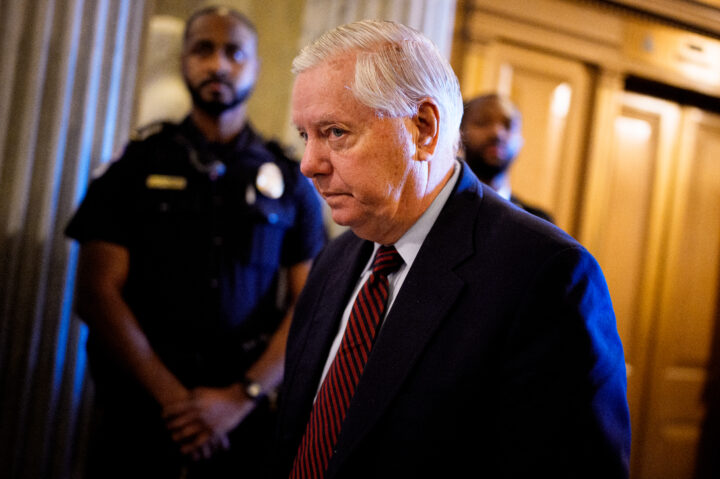
Sen. Lindsey Graham (R-SC) walks into the Senate Chamber on December 11, 2025 in Washington, DC.
Sen. Lindsey Graham (R-SC) abruptly ended his meeting with Gen. Rodolphe Haykal, the head of the Lebanese Armed Forces, on Thursday after Haykal declined to refer to Hezbollah as a terrorist organization.
Graham met with Haykal in his Senate office for a planned discussion on the latest military developments in Lebanon and the LAF’s approach to Israel and Hezbollah. The South Carolina senator wrote on X that he asked the Lebanese military official at the start of the meeting if he viewed Hezbollah as a terrorist organization, and did not appreciate the response he received.
“I just had a very brief meeting with the Lebanese Chief of Defense General Rodolphe Haykal,” Graham said. “I asked him point blank if he believes Hezbollah is a terrorist organization. He said, ‘No, not in the context of Lebanon.’ With that, I ended the meeting.”
“They are clearly a terrorist organization. Hezbollah has American blood on its hands. Just ask the U.S. Marines. They have been designated as a foreign terrorist organization by both Republican and Democrat administrations since 1997 — for good reason,” he added. “As long as this attitude exists from the Lebanese Armed Forces, I don’t think we have a reliable partner in them. I am tired of the double speak in the Middle East. Too much is at stake.”
Haykal has been in Washington this week for meetings with U.S. lawmakers and Trump administration officials. Aside from Graham, Haykal met with Sen. Jeanne Shaheen (D-NH), the top Democrat on the Senate Foreign Relations Committee, and Reps. Brian Mast (R-FL) and Gregory Meeks (D-NY), respectively the chairman and ranking member of the House Foreign Affairs Committee, respectively. Haykal also met with Joint Chiefs Chairman Gen. Dan Caine and officials at the CIA, the Pentagon and the National Security Council.
He was previously slated to visit the U.S. in November, but scrapped the trip after Graham and others canceled their meetings over a statement Haykal released weeks prior that blamed Israel for the unrest in Lebanon without mentioning Hezbollah. Graham, who has visited Lebanon multiple times in the last year to encourage the Lebanese government to disarm Hezbollah and stabilize its border with Israel, warned in numerous statements responding to Haykal at the time that his position toward U.S.-Lebanon relations would likely shift if changes were not made.
“It is clear that the Lebanese Chief Head of Defense — because of a reference to Israel as the enemy and his weak almost non-existent effort to disarm Hezbollah — is a giant setback for efforts to move Lebanon forward,” Graham wrote on X in November. “This combination makes the Lebanese Armed Forces not a very good investment for America.”
“The idea of the Lebanese military joining forces with Hezbollah to combat Israel would put in jeopardy everything that I and many others are trying to do to help Lebanon move forward,” he cautioned in another tweet.
The U.S., along with Graham, has been pushing Lebanon to follow through on its commitment to disarm Hezbollah, made as part of the Trump administration’s ceasefire deal between Israel and Hezbollah in 2024. The first phase of the deal, which went into effect in November of that year, called for the Lebanese military to remove Hezbollah from the territory south of the Litani River, near Israel’s border, by the end of 2025. The second phase would then focus on Hezbollah’s disarmament north of the Litani.
The Lebanese government announced it accomplished that goal in early January, though Israel has disputed that claim, with Prime Minister Benjamin Netanyahu’s office saying, “Efforts made toward this end by the Lebanese Government and the Lebanese Armed Forces are an encouraging beginning, but they are far from sufficient, as evidenced by Hezbollah’s efforts to rearm and rebuild its terror infrastructure with Iranian support.”
Graham said while in Israel in late December that the “trend lines in Lebanon” were “optimistic” following months of public statements from several senior Lebanese government officials calling for Hezbollah to be disarmed.
“If you want peace, deal with the people who do not. Take them out of the game. Get your head out of the sand,” Graham said at a press conference in Tel Aviv. “If you want a peaceful Lebanon, you need to find a way to deal with Hezbollah because they don’t want peace with Israel. They want to destroy Israel. Most people in Lebanon don’t want to destroy Israel.”
‘These groups must be allowed to maintain their own security forces, or I guarantee you today, a genocide will happen in Syria,’ Sam Brownback said
MANDEL NGAN/AFP
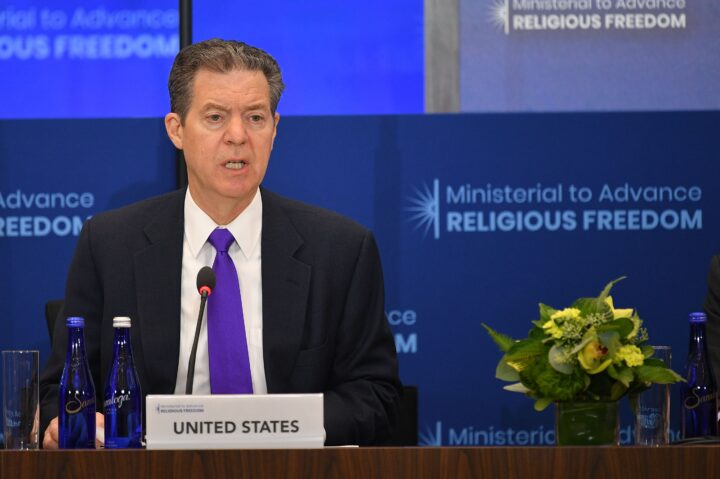
Former US Ambassador-at-Large for International Religious Freedom Sam Brownback.
Sam Brownback, the former U.S. ambassador at large for international religious freedom and a former GOP senator, warned Wednesday that, unless Syrian minority groups are allowed to maintain their own security forces, they face a likely genocide by government-aligned forces.
The stark warning is a repudiation of the policies of the new Syrian government led by President Ahmad al-Sharaa, which had pushed for full integration of minority-led forces into the Syrian military and most recently launched a military offensive against the Kurdish-led and U.S.-backed Syrian Defense Forces, largely forcing a Kurdish surrender.
Forces aligned with the Syrian government have also carried out massacres of Druze, Alawite and Christian minorities since al-Sharaa’s rise.
The Trump administration has remained largely supportive of the al-Sharaa government, even as critics have accused it of essentially abandoning the U.S.’ longtime Kurdish allies to the Syrian government onslaught.
“The new administration in Syria is purging religious minorities, threatening and killing them,” Brownback said at a hearing of the House Foreign Affairs Committee. “These groups must be allowed to maintain their own security forces, or I guarantee you today, a genocide will happen in Syria like happened in Iraq to the Yazidis and Christians.”
Brownback urged the U.S. to pressure the Syrian government to change course.
“One Syria — not talking about breaking Syria — but the people there, the Druze, the Alawites and Christians, have to be able to provide their own security,” he said. “The Kurds are our best allies. We’ve got to keep standing with the Kurds. They will protect religious minorities and they need to be able to have their own security.”
Rep. Bill Huizenga (R-MI), who questioned Brownback on the issue, said that he and “many” of his colleagues “struggled” with the idea of repealing the Caesar Civilian Protection Act, the last major sanctions targeting Syria, but ultimately did so on the promise of continued congressional oversight.
In the Senate, a bipartisan pair of lawmakers is pushing to reverse course and re-institute sanctions in response to the attack on the Kurds..
Brownback also warned that there are “early warning signs of a Muslim-on-Christian war … brewing across Africa,” and that the U.S. needs to get out ahead of it. He pointed to Nigeria as a starting point of this conflict, with its government backed by China, Russia, Turkey and Saudi Arabia engaging in persecution of Christians.
Rep. Joaquin Castro (D-TX) accused the Trump administration, and colleagues on the Hill, of turning a blind eye to what he described as attacks on the Christian community in “Palestine, including Jerusalem” by Israeli government forces and Israeli settlers.
Blumenthal: ‘I hope that this indication of a change in course is just a short-term flip’

Jemal Countess/Getty Images for Fair Share America
Sen. Richard Blumenthal speaks at a rally at the Capitol on April 10, 2025 in Washington, DC.
Sen. Richard Blumenthal (D-CT) warned on Thursday that the U.S. would need to reevaluate its relationship with Saudi Arabia if Riyadh makes a long-term pivot against efforts to normalize relations with Israel.
Israeli Prime Minister Benjamin Netanyahu suggested this week that Saudi Arabia’s increasing rapprochement with Turkey and Qatar would be a nonstarter for continued normalization efforts. Leading Saudi figures and media have also recently taken a strongly anti-Israel and antisemitic tone, which Netanyahu said provides aid to anti-Israel forces.
“If they’re reversing course on normalization, all bets are off for almost everything, including a defense treaty and other kinds of agreements,” Blumenthal told Jewish Insider. “I would very much regret it, and I think they would too in the long run, because it goes against all of the long-term goals of the kingdom to turn a leaf on terrorism and restore or reimagine their economy with less dependence on oil.”
He added that he “would be very surprised” if Riyadh actually makes such a pivot “and I hope that this indication of a change in course is just a short-term flip.”
Pressed on signals that Riyadh’s long-term vision may be shifting — given Saudi Arabia’s deepening ties to Turkey and Qatar and its recent plans to scale back some of the landmark megaprojects that were part of its Vision 2030 push — Blumenthal said he believes that Crown Prince Mohammed Bin Salman’s plan remains the same.
“I think there continues to be a long-term strategy in MBS’ mind, but there’s no question we need to be very clear-eyed that there are reactionary forces, and frankly antisemitic elements, in the regime,” Blumenthal said. “And we’re going to see those elements bubble up and potentially resist progress — and hopefully not prevent it. But we need to be very mindful of the mantra ‘trust but verify’ when dealing with Saudi.”
Two Republican senators offered a more optimistic view on the future of the U.S.-Saudi relationship.
Sen. Markwayne Mullin (R-OK) said that “every conversation I’ve had with Saudi Arabia is that they’re interested in normalization,” and that he would have to hear from Riyadh directly before judging the consequences of any potential change in direction.
Sen. James Lankford (R-OK) said that he didn’t have a strong read on Saudi Arabia’s current stance on normalization, but that he continues to believe that it is in the U.S.’ and the world’s interest.
“That brings long-term stability to the region,” Lankford said. “It’s been one of the main dividing points in the region is this absurd belief that Israel’s not even a country should be recognized. We don’t break through that until everybody just acknowledges everybody’s sovereignty.”
‘Today, many of the NGOs and technology providers that maintain these tools are facing closure due to funding cuts,’ the letter warns
Nathan Posner/Anadolu via Getty Images
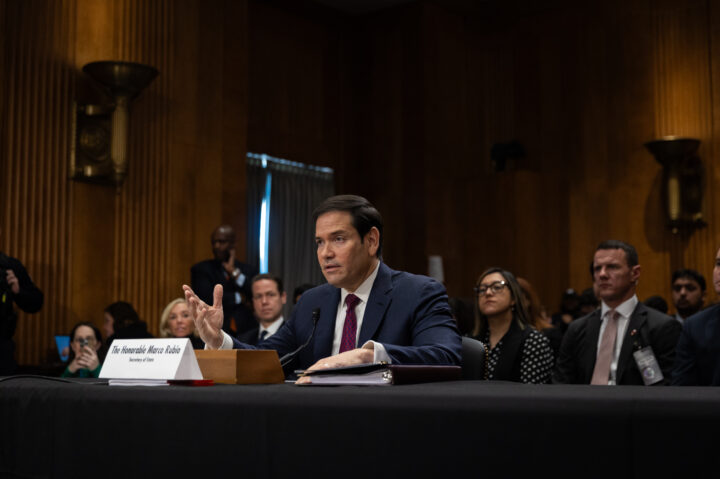
Secretary of State Marco Rubio testifies during a Senate Foreign Relations Committee hearing on Venezuela, in Washington, DC, United States on January 28, 2026.
A bipartisan group of senators wrote to Secretary of State Marco Rubio on Wednesday urging him to “surge resources to quickly enable critical internet freedom support” to protesters in Iran, pointing to funding cuts that have stretched resources for such programs.
“Today, many of the NGOs and technology providers that maintain these tools are facing closure due to funding cuts and more importantly, fewer Iranian citizens can share their videos and messages with the world and each other,” the letter warns. “Without the continuous operation of internet freedom programming carried out by the State Department and Open Technology Fund, millions of Iranians will lose their last secure window and voice to the outside world.”
The lawmakers, Sens. James Lankford (R-OK), Jacky Rosen (D-NV), Lindsey Graham (R-SC) and Cory Booker (D-NJ), warned that if U.S. programs fully lapse, regime-controlled programs and state media will step into the gap, “giving the regime near-total control over the digital space and putting users at far greater risk.”
“As we watch brave Iranians take to the streets, it is clear that supporting the Iranian people’s access to information is not a partisan issue but a matter of national security, as well as meeting legislative requirements for a strategy for promoting internet freedom in Iran,” the lawmakers said, pointing to existing legislation mandating the State Department to expand internet access in Iran. “The United States must pair its maximum pressure on the regime with maximum support for the Iranian people.”
The letter comes at a time when Congress has offered few of its own strategies to respond to the wave of protests around Iran — which, according to Rubio, have now largely been put down by the regime.
Such efforts to promote free internet access to the Iranian people, amid efforts by the regime to impose an internet blackout, have emerged as a key area of bipartisan agreement.
Much of the U.S.’ global communications programming, including funding for promoting internet access, was slashed last year amid cutbacks to various foreign aid programs. Some prominent Republicans have criticized the administration, saying that government-sponsored news programming and communications assistance have failed to meet the moment in Iran.
The letter emphasizes the “long-standing and bipartisan commitment” to supporting internet freedom programs, which are “more important than ever as the people of Iran protest against the regime in record numbers.” The legislators noted that prior administrations have, for two decades, supported various anti-censorship and internet freedom tools in Iran, and that Congress passed legislation in 2024 supporting such programs.
“Without U.S. leadership, an entire generation of Iranians would have remained in the dark — and the most powerful source of pressure against the Islamic Republic, the Iranian people themselves, would have been neutralized,” the letter reads.
It notes that the existing U.S. programs allowing a small number of Iranians to remain online had “proved decisive” during the Israel-Iran war last summer to demonstrate the division between the Iranian people and the regime, and said that expanded internet access now “would put a spotlight on the increasingly securitized atmosphere that is cracking down on dissent.”
Graham has been a close ally of the Saudis while urging the kingdom to normalize relations with Israel
Andrew Harnik/Getty Images
Sen. Lindsey Graham (R-SC) walks into the Senate Chamber on December 11, 2025 in Washington, DC.
Sen. Lindsey Graham (R-SC) called on Saudi Arabia to end what he described as its “attack on the United Arab Emirates” and slammed the country’s silence regarding the Syrian government’s campaign against the Kurds, demanding the kingdom use its influence to “keep the region from falling further into chaos.”
Graham made the comments in a post Tuesday morning on X, hours after announcing his plans to introduce legislation this week imposing sanctions on any government or group involved in targeting Kurdish forces in Syria. Syrian government forces have recently led a campaign against the Kurdish-led and U.S.-backed Syrian Democratic Forces, resulting in the loss of SDF control over parts of the country’s territory.
“As previously stated, I am trying to work with the administration and regional partners to prevent a bloodbath in Syria against our Kurdish allies,” Graham wrote. “It is now time for the region to change their ways and man up for decency.”
“To Saudi Arabia: I have tried to work hard to chart a new path for relations between your country, the United States and the region,” he continued. “I have tremendous respect for many of the changes that have been embraced. However, the Kingdom’s attack on the United Arab Emirates and their silence regarding the Syrian government’s constant assault on the Kurds has to change.”
Last month, Saudi forces carried out airstrikes in southern Yemen targeting what they said were weapons shipments from the United Arab Emirates to UAE-backed separatists, escalating tensions between Riyadh and Abu Dhabi and prompting the UAE to announce a withdrawal of its remaining forces from Yemen.
The South Carolina senator continued, “Please understand that I am smart enough to know that Saudi Arabia has influence on the Syrian government, and I expect them to use it to keep the region from falling further into chaos.”
Graham, who has been closely engaged with the Saudis while lobbying the kingdom to normalize relations with Israel, said earlier this month that he would be “dramatically rethinking” the “nature of” the U.S. alliance with Saudi Arabia and other Gulf states if they “intervened on behalf of Iran to avoid decisive military action” by President Donald Trump against the Iranian regime.
“All the headlines suggesting that our so-called Arab allies have intervened on behalf of Iran to avoid decisive military action by President Trump are beyond disturbing. The ayatollah’s regime has American blood on its hands. They are slaughtering people in the streets,” Graham said at the time.
“If it is accurate that the Arab response is ‘action is not necessary against Iran’ given this current outrageous slaughter of innocent people, then there will be a dramatic rethinking on my part regarding the nature of the alliances now and in the future.”
Netanyahu said on Sunday that Jerusalem had previously warned Australia’s PM that Palestinian statehood recognition endangered Jews in the country

Kevin Dietsch/Getty Images
Sen. Bernie Sanders (I-VT), joined by fellow senator Sen. Jeff Merkley (D-OR) (R), speaks at a news conference on restricting arms sales to Israel at the U.S. Capitol on November 19, 2024 in Washington, DC.
Sen. Bernie Sanders (I-VT) criticized Israeli Prime Minister Benjamin Netanyahu on Tuesday, after Netanyahu linked the terror attack in which 15 people were killed at a Hanukkah celebration in Sydney, Australia, to Canberra’s support for a Palestinian state.
Netanyahu highlighted in a speech on Sunday that he had warned Australian Prime Minister Anthony Albanese that Canberra’s recognition of a Palestinian state was fueling antisemitism and endangering Australian Jews. Netanyahu further accused Albanese of failing to take action against antisemitism.
Sanders issued a statement in response on Tuesday: “No, Mr. Netanyahu. Speaking out on behalf of the Palestinian people is not antisemitic. Opposing the disgraceful policies of your extremist government is not antisemitic. Condemning your genocidal war, which has killed more than 70,000 people — mostly women and children — is not antisemitic. Demanding that your government stop bombing hospitals and starving children is not antisemitic.”
He said that “we must continue to oppose antisemitism and all forms of racism and bigotry. At the same time, we must demand a world in which international law and human rights are respected by all governments, without exception.”
Sanders opted against signing onto a joint statement issued Monday by Jewish Senate Democrats condemning the Sydney attack. Asked about his decision not to join the collective statement from Jewish Senate Democrats, a Sanders spokesperson pointed JI to Sanders’ comment on Sunday mourning the attack, in which the Vermont senator called antisemitism “a disgusting and cowardly ideology” that is “growing worldwide” and added, “we must be equally committed to fighting all forms of” bigotry.
Graham: ‘How many times does he have to play footsie with this antisemitic view of the Jewish people and Israel until you figure out that’s what he believes?’
Amir Levy/Getty Images
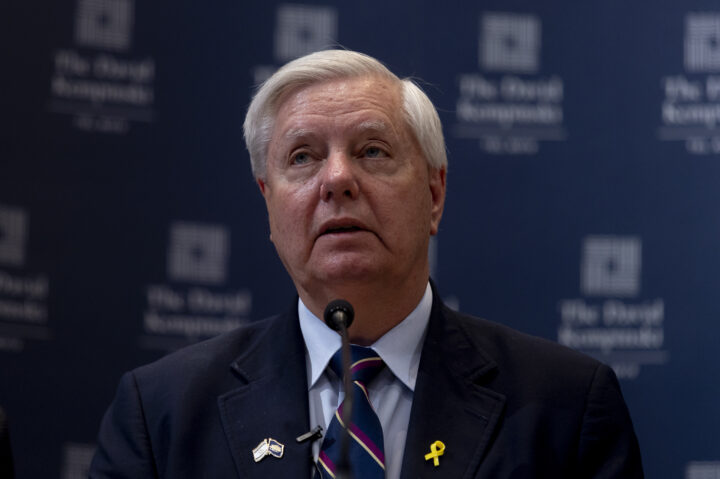
Senator Lindsey Graham (R-SC) speaks at a press conference on US-Israel relations on February 17, 2025
LAS VEGAS — Sen. Lindsey Graham (R-SC) spoke out against Tucker Carlson for giving a friendly platform to Nick Fuentes, the neo-Nazi influencer, on his podcast this week, calling it “a wake-up call” for the Republican Party as it grapples with rising antisemitism within its ranks.
“How many times does he have to play footsie with this antisemitic view of the Jewish people and Israel until you figure out that’s what he believes?” Graham said of Carlson in an interview with Jewish Insider on Friday on the sidelines of the Republican Jewish Coalition’s annual leadership summit at the Venetian Resort.
Graham said that “antisemitism has been with us, and it’ll always be with us, and the goal is to limit it, fight back and contain it.”
“I am confident that if anybody in the Republican world ran for office as a member of Congress, for the Senate or any major elected office and spouted this garbage, it would get creamed,” Graham told JI. “This is a niche market. It won’t sell to a wider audience.”
Carlson, a frequent critic of Graham, has faced backlash this week for failing to challenge Fuentes’ antisemitic views, including praising Adolf Hitler and engaging in Holocaust denialism. During the interview, Fuentes railed against “organized Jewry” while Carlson expressed his disdain for Christian Zionists including Mike Huckabee, the U.S. ambassador to Israel, saying he had been seized by a “brain virus.”
“To suggest that evangelical Christians are confused or got it wrong says more about the critic than it does evangelical Christians,” Graham countered. “The guy that’s doing the talking is a raving antisemite white nationalist, and if you want to hook your wagon to that, you’ll have a very short journey in the Republican Party.”
Graham said that Carlson and Fuentes “did us all a favor by being so brazen. It’s kind of a wake-up call.”
Even as Carlson, a close ally of Vice President JD Vance, remains influential in the GOP, Graham argued that “being anti-Israel in the modern Republican Party is a death sentence to political viability.”
“We’re not gonna put up with that crap. We’re not that kind of party,” he said.
The South Carolina senator also joined other senators in raising concerns about the president of the Heritage Foundation, Kevin Roberts, who has faced widespread criticism for defending Carlson’s interview and for soft-pedaling Fuentes views in a video he posted to social media on Thursday. “That’s the decision made, and we’ll see how well it plays in the marketplace,” Graham, who is facing a primary challenge next year from a former Heritage Foundation staffer, reiterated.
Amid the criticism Friday, Roberts posted a follow-up statement on X where he condemned Fuentes’ “vicious antisemitic ideology, his Holocaust denial, and his relentless conspiracy theories that echo the darkest chapters of history” but made no further comment about Carlson.
Sen. Ted Cruz (R-TX), who spoke at the RJC summit on Thursday night, and Mitch McConnell (R-KY) have spoken out against right-wing antisemitism after Carlson’s Fuentes interview.
Vance also drew scrutiny this week from conservative Jewish critics after he spoke at a campus Turning Point USA event and avoided forcefully confronting students who had asked him questions about Israel that used antisemitic tropes, such as suggesting Jewish control of U.S. politics and claiming that Jews oppress Christians.
Graham said he believed that the students were “espousing stereotypes about the Jewish people and the Jewish state,” which he called “pretty unnerving.”
“I think JD handled it well,” he said, but added: “I wish he would have been more direct.”
“I would have been real direct and said, ‘Let me tell you, if you think our relationship with Israel is less than beneficial, you’re ignorant. Israel’s fighting our fight,” he said. “My goal is to keep the threats over there so they don’t come here,” he added. “My goal is not to fight alone, to have other people fighting with us. And you can’t have a better partner in the fight than Israel.”

Georgia is used to political dynasties. The daughter of former Senator Sam Nunn and the grandson of President Jimmy Carter have both run for statewide office in recent years, while incumbent Senator David Perdue is the first cousin of former governor and current Trump cabinet member Sonny Perdue. But Georgians aren’t used to dynasties coming from other parts of the country.
Democrat Matt Lieberman is hoping to change that in 2020. The suburban Atlanta businessman and son of former Senator Joseph Lieberman (I-CT) is the first candidate to jump into Georgia’ special election for the U.S. Senate. The seat is currently held by Johnny Isakson, who will resign at the end of the year. Isakson’s departure, announced earlier this year, will prompt Republican governor Brian Kemp to appoint a replacement who will try to hold the seat in a non-partisan special election in November 2020.
Lieberman enters the race as a relative political unknown, despite his famous father. Howard Franklin, a Democratic political strategist in Georgia, told JI that he didn’t think Lieberman’s entry would keep other well-known names out of the race. Lieberman had not even been on the radar of well-connected Democrats in the state until recently.
In an interview with Jewish Insider earlier in October, Lieberman joked that he was winning “in a blowout” as the only declared candidate in this race. A businessman and former principal at a Jewish day school, Lieberman said he hadn’t expected to run for office, despite his upbringing. “Honestly, I thought about it at a much, much younger age coming out of law school, and I hadn’t thought about it in 20 years,” said the Democratic Senate hopeful. “I have not been positioning or angling for this. I am truly running as an outsider as a fed up citizen of Georgia and for the fed up citizens of Georgia and I think I got to a point where a lot of us are right now, I couldn’t take it any more I felt compelled to get up off of my butt and do something.”
Lieberman is running as a mainstream Democrat who supports impeaching Trump and implementing a public option to allow Americans to buy into a government-run health care plan. This proposal was almost passed during the debate over the Affordable Care Act, but was blocked by objections from then-Senator Joe Lieberman.
Lieberman’s relationship with his father will likely present some issues with liberal voters. In addition to blocking progressive goals like a public option, the senior Lieberman broke from the Democratic Party first by successfully running for re-election as an independent in 2006 and then by actively campaigning for John McCain during the 2008 presidential election.
Matt Lieberman recognized the challenge that comes along with having a high-profile politician as a father, telling JI, “for voters here in Georgia who like [Joe Lieberman], I hope they’ll give me a little bit of an extra hearing, and for the people who really don’t like him I would just remind them that technically speaking we are two different people and I think they’ll give me a hearing as well. Honestly, I think ultimately people are fair in that regard, even if they have no intention of supporting you, I think they will hear you out so I think people will do me that courtesy because it’s what engaged citizens ought to do so.”
Former Senator Lieberman’s reputation has left a number of progressive activists skeptical, however. Adam Green, the co-founder of the Progressive Change Campaign Committee, a progressive Democratic activist group, told JI, “Joe Lieberman is the corporate war-monger past of the Democratic Party. I don’t know anything about his son, but voters don’t love insider legacies and don’t love corporate greed and don’t love the Iraq War — so Joe Lieberman’s reputation likely won’t be helpful in this campaign.”
Cenk Uygur, the host of the Young Turks and a leading progressive activist, used even stronger language with JI. “The sins of the father should not be passed on to the son but neither should any degree of credibility,” he told JI. “Why are we having a conversation about this guy? Because of his last name and only because of his last name. I’m tired of these wannabe royals in America. His policy positions are milquetoast, which does run in the family. Apparently, we’ve gotten the Liebermans to a public option, give us a couple of more generations and we might finally get them to single payer.”
Regardless of initial skepticism, Matt Lieberman is already using his family background to amplify his progressive message. In his campaign announcement video, he tied the controversial 2000 Florida recount to Stacey Abrams’s defeat in the 2018 Georgia governor’s race, one that Abrams has claimed was stolen. Lieberman has declined to go that far, telling JI, “I think there were enough problems that were identified in the election to make a reasonable person not just worried but frustrated that it wasn’t run in a better way with fewer problems.”
On foreign policy, Lieberman expressed concern that Trump had “completely sold out” the Kurds, whom he described as a “reliable [and] heroic ally of the United States under difficult circumstances.” In his view, “we should be sticking by our allies.” Lieberman went on to “extend that thought to the issue of our alliance with Israel and one of the concerns it’s fair to have when it comes to this president is that no one really knows where he is going to be tomorrow on an issue and why he’s going to be there and that’s problematic.”
Lieberman struck far more equivocal notes about the 2015 nuclear deal with Iran. “I think the Iran nuclear deal could have been better,” said the Senate hopeful. “I will say only as a lay person, only as a citizen, that the benefit of delaying Iran’s nuclear capability may well have been outweighed by the cost of freeing up enormous sums of money for Iran to wreak havoc.” Lieberman added “I think any future deal would need to look at what that experience has been and would look at what Iran has done with the funds that were opened up to it and take that into much more serious consideration given actual events that have transpired.”Before the election can happen, Lieberman still has to find out who his opponent will be. Republican Governor Brian Kemp, whom Lieberman parodied in his first campaign ad, will appoint Isakson’s replacement by end of the year. The special election will be a jungle primary in which candidates from all parties will compete against each other in November 2020 to serve the remaining two years of Isakson’s term. If no candidate receives a majority of the vote, a runoff between the top two finishers for the seat will be held in January 2021.

The CNN and New York Times Democratic Presidential Debate Otterbein University Westerville, Ohio 2019
Westerville, Ohio — In a heated debate Tuesday night, Senator Elizabeth Warren (D-MA) bore the brunt of the attacks from rival candidates after taking the lead in national and early state polls.
On a crowded stage of 12 presidential hopefuls, the Massachusetts Democrat faced barbed questions about her health care and tax policies from more moderate rivals including South Bend, Indiana Mayor Pete Buttigieg and Senator Amy Klobuchar (D-MN).
Buttigieg, who launched a web ad attacking Warren for her support for Medicare for All before Tuesday’s debate, tried to portray her as a classic Washington politician reluctant to acknowledge the tax increases that would come as part of the plan. Warren has emphasized that costs will go down “for hardworking middle-class families” as part of legislation intended to provide free health care coverage to every American.
Senator Bernie Sanders (I-VT), who has long boasted of “writing the damn [Medicare for All] bill,” acknowledged that taxes would go up, but “for virtually everybody, the tax increase they pay will be substantially less — substantially less than what they were paying for premiums and out-of-pocket expansions.” Klobuchar praised Sanders “for being honest” and then accused Warren of not telling Americans “where we’re going to send the invoice.” Klobuchar defended her comments after the debate, telling reporters, “I wasn’t sharply attacking anyone, I was making my case about why I’m the best candidate.”
Although in past debates, Warren had been attacked by centrist candidates for her support for Medicare for All, that criticism came from long-shot candidates like former Congressman John Delaney (D-MD) and former Governor John Hickenlooper (D-CO). The Massachusetts Democrat emphasized her health care policy as a moral position and said that “the issue is whether the Democratic Party has the guts to stand up to the health care industry.”
Warren faced attacks from rivals on a variety of other topics: Businessman Andrew Yang criticized her support of a wealth tax, Congresswoman Tulsi Gabbard (D-HI) attempted to pin her down on foreign policy and Senator Kamala Harris (D-CA) went after her for refusing to call on Twitter to delete President Donald Trump’s account.
Warren also had a tense exchange with former Vice President Joe Biden. After Warren touted her efforts to create the Consumer Finance Protection Bureau (CFPB) during the Obama administration, Biden noted his own efforts at the time, telling her, “I went to the floor and I got you the votes.” In response, Warren pointedly thanked Barack Obama for his efforts.
The debate also featured the first extended discussion of foreign policy in the six presidential debates of the 2020 cycle, and came days after Trump announced the withdrawal of U.S. troops from Syria as the Turkish military launched an invasion of the country.
Gabbard, who has defended the regime of Bashar al-Assad, served as a foil for the other candidates on stage, criticizing “regime-change wars” and attacking “the mainstream media” and politicians from both parties for having, along with Trump, the “blood of Kurds” on their hands. Gabbard’s comments prompted a fierce rebuke from Buttigieg about the president’s decision to withdraw U.S. forces. “Part of what makes it possible for the United States to get people to put their lives on the line to back us up is the idea that we will back them up, too,” said the South Bend mayor, who served a tour in Afghanistan as a Navy reservist. “This president has betrayed American values. Our credibility has been tattered.”
Elizabeth Warren argued, “I think that we ought to get out of the Middle East. I don’t think we should have troops in the Middle East but we have to do it the right way, the smart way.” Warren’s comments were strongly criticized by fellow senator Chris Coons (D-DE) after the debate. Coons, a Biden supporter, told reporters that Warren’s statement “showed a striking degree of naïveté or ill preparedness.”
Former Texas congressman Beto O’Rourke clashed with the other candidates over his support for mandatory buybacks of assault weapons. O’Rourke, whose hometown of El Paso, Texas, was the site of a mass shooting in August, insisted that if assault weapons “are too dangerous to sell, they are also too dangerous to own.” He sparred with Buttigieg, who said that the Texas Democrat was focused on “purity tests,” arguing that O’Rourke had no clear plan for how he would take assault weapons away from their owners. O’Rourke also faced criticism from former HUD Secretary Julian Castro. “I am not going to give these police officers another reason to go door to door in certain communities, because police violence is also gun violence, and we need to address that,” Castro said.
Democrats did find common ground in the first debate since the beginning of the impeachment inquiry against Trump. On stage Tuesday night, there was unanimous support for the impeachment inquiry centered around Trump’s effort to pressure the Ukrainian government to investigate Biden’s son Hunter Biden. Only hours after the former vice president’s son admitted to bad judgment in an interview with ABC News, his father insisted on the debate stage “my son did nothing wrong. I did nothing wrong.”
Please log in if you already have a subscription, or subscribe to access the latest updates.
 Continue with Google
 Continue with Apple