


















The second annual Sephardic Rabbinic Conference, backed by the Orthodox Union and UJA-Federation, will bring together around 150 participants from a dozen countries to address leadership gaps and Diaspora institution-building

Getty Images


 Add JewishInsider on Google
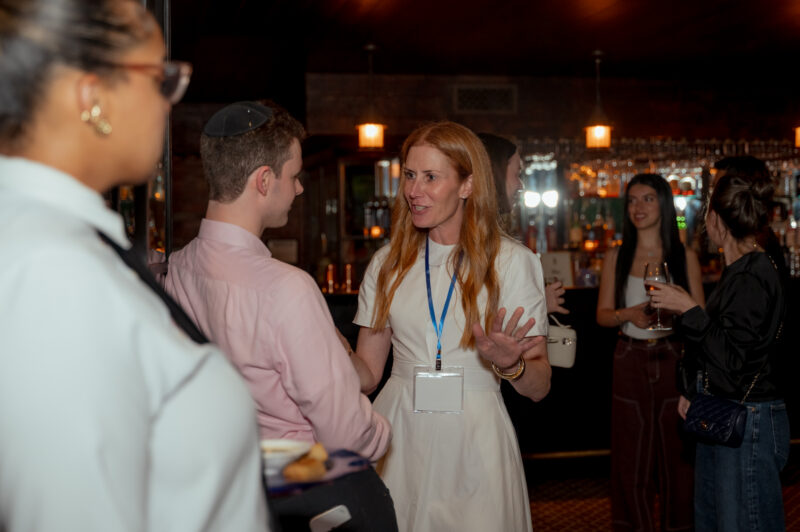
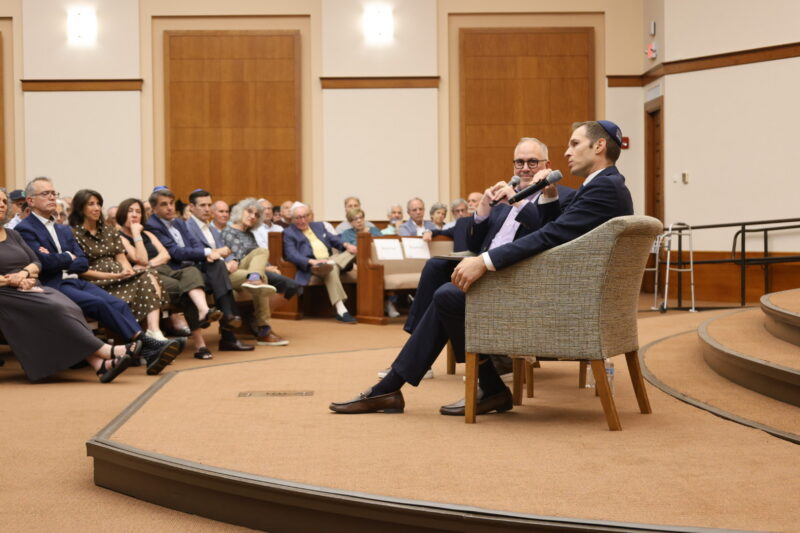
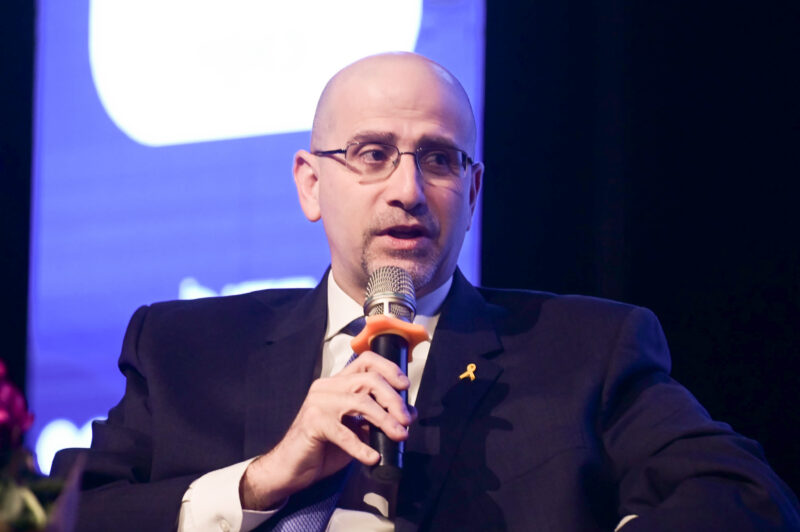
Some 150 rabbis, communal leaders and young professionals from a dozen countries will convene in Manhattan on Monday and Tuesday for the second annual Sephardic Rabbinic Conference, a gathering aimed at strengthening a Jewish community that organizers say has long operated in a Jewish institutional landscape shaped by Ashkenazi-dominated institutions.
The conference, titled “The Art of Leadership,” will bring together rabbis and rebbetzins from Mexico City to Moscow, Cape Town to Queens, to lead sessions on halachic authority, mental health, pastoral care, connecting to Israel and what organizers describe as the urgent work of building long-lasting Sephardic institutions in the diaspora.
“There’s clearly been a lack of [Sephardic] representation in a lot of mainstream Jewish institutions — in federations, in schools —- a lack of our needs being seen and heard,” said Ethan Marcus, managing director of Sephardic Brotherhood of America and co-organizer of the conference with Avi Garson, co-founder of The Habura, an online and physical Jewish study center. “Whether it’s a Moroccan, Turkish or Spanish Portuguese community, they may differ from what you would say mainstream Ashkenazi communities need,” Marcus told Jewish Insider.
This year’s conference, Marcus asserted, is itself evidence that the status quo is beginning to change: It’s being held at UJA-Federation of New York’s headquarters and backed by a roster of major Jewish institutions, including the Orthodox Union — which hosted last year’s inaugural gathering — the Rabbinical Council of America, World Zionist Organization and KKL-JNF.
“These organizations are stepping up and saying, ‘We want to hear from you and what your unique ideas and needs are, and what you also have to offer the wider Jewish world,’’” said Marcus. “We believe there’s a lot the wider Jewish world can take away from the Sephardic path we’re pushing. This idea of a middle-of-the-road [approach] steeped in Jewish traditions but fully engaged with the challenges and benefits of the modern world. To us that’s very much the Sephardic approach, and it’s something that all Jewish people can benefit from.”
Speakers include Daniel Rosenthal, vice president of government relations at UJA; Ofir Akunis, consul general of Israel in New York; Yaakov Hagoel, chairman of the WZO; and Caroline Bryk, senior director of Jewish day school strategies at Tikvah — alongside dozens of rabbis from across the globe.
Despite making up just an estimated 10% of the American Jewish population, Sephardic and Mizrahi Jews in the U.S. report higher rates of Jewish communal participation, a stronger connection to Israel and are more likely to say that being Jewish is somewhat or very much a part of their daily life compared to Ashkenazi Jews, according to a 2025 report by JIMENA (Jews Indigenous to the Middle East and North Africa).
On Manhattan’s Upper East Side, just blocks from where the conference is being held, the Sephardic community has been steadily establishing itself — anchored by institutions like the Moise Safra Center, the 14-story community center that opened on East 82nd Street in 2018 and marked a demographic shift for the neighborhood.
And yet, Garson had questions — which he laid out in a piece for La Djente, the national magazine of the Sephardic Jewish Brotherhood of America — that ultimately led to the creation of last year’s conference: Where is Sephardic leadership coming from? Where is it being trained? And who is going to lead and represent the community in the years ahead?
“One thing led to the other and we realized we should put everyone together in the same room,” Garson told JI, reflecting on the inaugural gathering, which focused on the theme of education. “We managed to get 40 rabbis and community leaders from six countries. We realized there’s a real deep ongoing desire to connect — for everyone to get together and discuss these issues and collaborate.”
This year’s event, with a focus on leadership, comes as a “turning point in the Sephardic world — where all of these synagogues and people are recognizing we need to work together,” said Marcus. “We can be uniquely our own identities; the Sephardic world is not a monolith. Moroccan Jewish communities, Syrian Jewish communities all have their unique customs and traditions, but there’s a lot more that unites us than divides us. But we don’t have to get rid of our self-identities. Jewish unity doesn’t mean Jewish uniformity.”
That openness extends to the conference’s slate of speakers — not just Sephardic rabbis, but Ashkenazi voices and some from outside the Jewish community entirely. The point, Garson said, is “to bring in good ideas and best practices to help our community, which in turn can help the Jewish community more broadly.”
He traced the notion back to Maimonides, the medieval Sephardic sage known for his intellectual openness, who famously championed: “Hear the truth, whoever speaks it.”
46-year old Larry Montes of the Bronx will be prosecuted for assault and criminal mischief after he struck a woman and damaged synagogue property
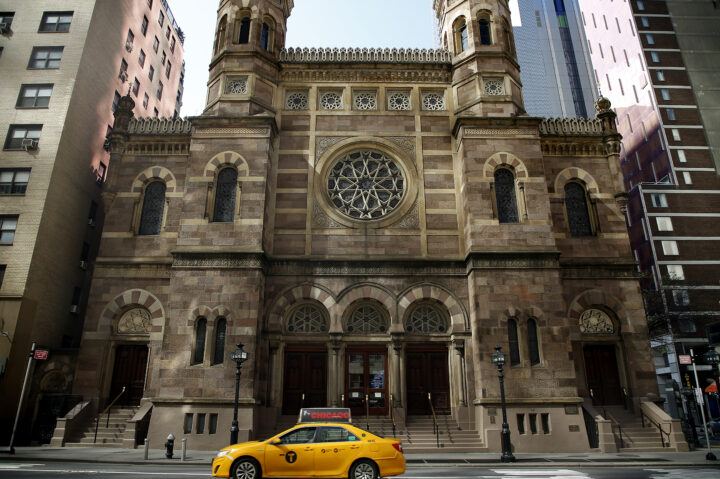
New York City's Central Synagogue on Lexington Avenue (Photo by John Lamparski/Getty Images)
New York City authorities have leveled hate crimes charges against a Bronx man arrested on Friday for attacking a woman and a guard during Shabbat services at Central Synagogue in Manhattan — marking the latest in a wave of antisemitic incidents targeting the world’s largest Jewish community outside Israel.
NYPD Commissioner Jessica Tisch revealed that 46-year-old Larry Montes will be prosecuted for assault and criminal mischief as hate crimes, “among other charges,” after police arrested him for striking a woman, damaging property and head-butting a member of the Reform synagogue’s security detail.
Video from the Upper East Side synagogue’s livestream captured the terrified reaction as a man, whom police have identified as Montes, burst screaming into Friday night Shabbat services before a guard forced him from the premises.
It was during his exit that Montes became physically violent, though victims experienced only minor injuries, Tisch wrote on X.
“I’m relieved that no one was seriously injured. Those who were hurt were evaluated at the scene and are doing well. There are no known additional threats at this time, and additional NYPD resources have been deployed to the synagogue,” Tisch posted, noting her personal connection to the congregation. “Central Synagogue is where I grew up. In joy and in sorrow, it has always been a place of comfort and peace. What happened there tonight is deeply painful. A place of worship should never be a crime scene.”
Mayor Zohran Mamdani offered his own condolences and assurances following the assault.
“I can only imagine the pain and fear an attack like this, during Shabbat services, causes for the congregation and for Jewish New Yorkers across our city,” he wrote in a post on X. “Every New Yorker must be able to observe their religion without fear of violence. This despicable act has no place in our city, and our administration will do everything in our power to keep Jewish New Yorkers safe.”
The arrest comes just weeks after Central Synagogue Rabbi Angela Buchdahl publicly castigated the mayor over a viral video released on his official social media channels denouncing Israeli Prime Minister Benjamin Netanyahu as a “war criminal.” Buchdahl warned that singling out the Jewish state as “uniquely monstrous” put Jewish New Yorkers in danger.
“You say you want to keep the Jews of New York City safe. But safety is not just about providing extra protection at parades and synagogues. Safety is about creating a climate in which Jews do not need to feel maligned or indicted by the city’s leaders, where we do not need to feel there is a bullseye on our backs,” Buchdahl wrote. “You cannot claim to protect Jews while using the power of your office to make Jewish identity morally tainted and imperiled.”
Days after Mamdani’s video, a Jewish man leaving another Manhattan synagogue was one of two victims of another alleged antisemitic attack, although a link between the mayor’s social media clip and the Upper West Side stabbing has not been established. The incident prompted Jewish civic and political leaders to demand Mamdani tone down his rhetoric about Israel, a call to which he did not respond.
Mamdani, whose anti-Israel activism helped propel him to prominence on the left, faced near-identical calls from a roundtable of rabbis he invited to City Hall on Monday. Among the groups represented at the event was the Union for Reform Judaism, which responded to the attack on Friday by encouraging Congress to pass the bipartisan Jewish American Security Act, and highlighting the funding the legislation would provide for enhanced security at synagogues.
“Jewish spiritual practice includes study, prayer and yes, action. Let us double down on all three,” URJ said in a statement.
If Mamdani is able to succeed by only playing to his base — still a big if — the city’s organized Jewish community risks getting written off entirely
Spencer Platt/Getty Images
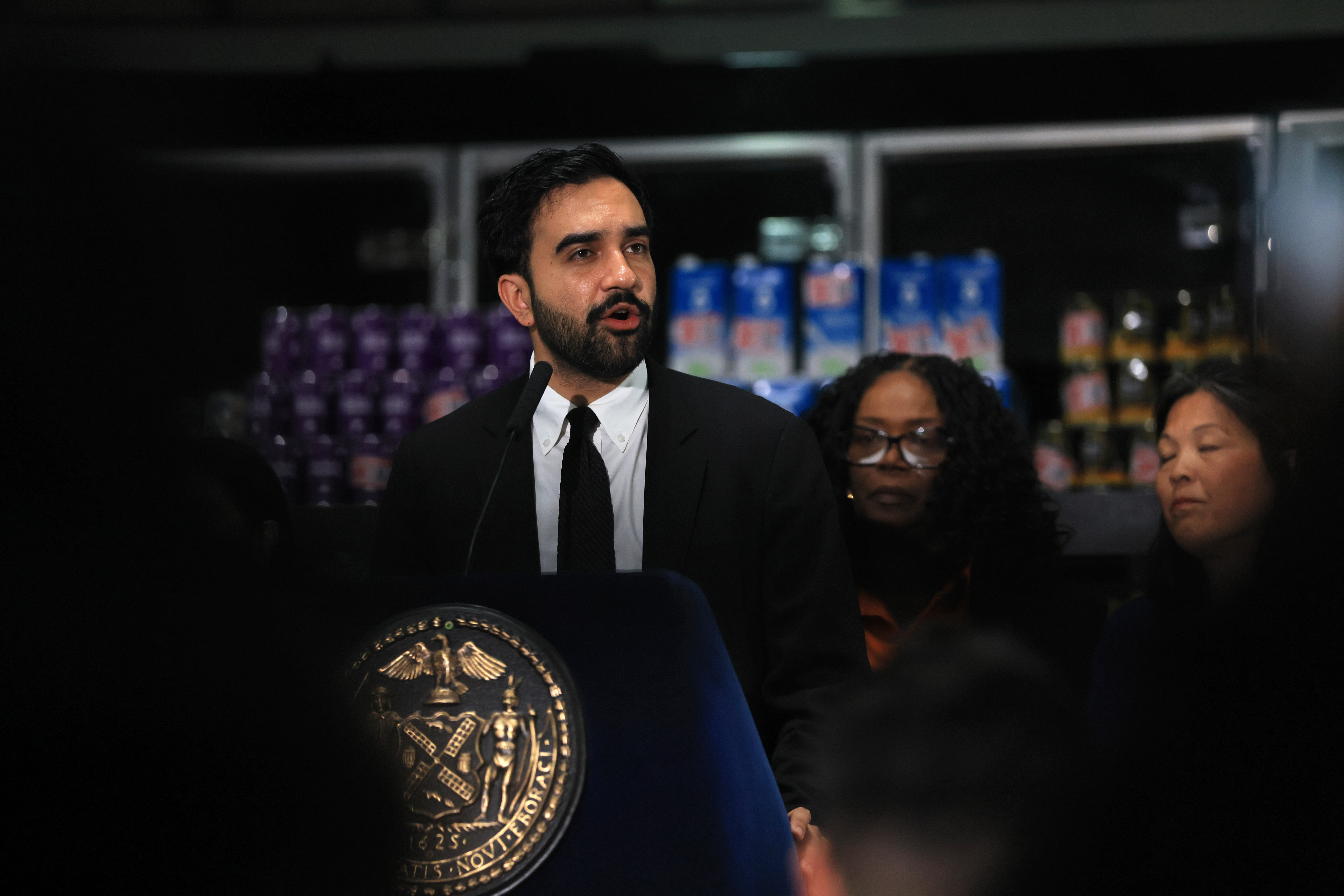
New York City Mayor Zohran Mamdani speaks at a food distribution center on July 27, 2026 in the Brooklyn borough of New York City.
The morning after a double hate crime targeted an Asian American and a Jewish man wearing a yarmulke in Manhattan, during which the attacker allegedly yelled “Allahu Akbar” and “Justice for Islam” while passing a synagogue and stabbing the second victim, New York City Comptroller Mark Levine offered what may prove a eulogy for a political era in America’s greatest metropolis.
“There is no New York without us,” the Jewish Democrat said at a press conference outside The Jewish Center, the Modern Orthodox synagogue where the Jewish victim worshipped, invoking the deep history and contributions of Jews to the Big Apple.
But Mayor Zohran Mamdani, the lone citywide official not to attend the gathering, seems to wager that he can govern New York City without much support from the dense web of religious and civic organizations that historically shaped Jewish life there and helped guide the choices of his predecessors. Mamdani received only about one-third of the Jewish vote in the mayoral election, but little support from legacy Jewish groups.
One need only look to the state Assembly district covering the site of the assault to see how Mamdani is at odds with the mainstream Jewish leadership. As mayor, he endorsed an opponent of Rabbi Stephanie Ruskay, the favorite of local Jewish Democratic leadership, as she sought the seat in June. The rabbi serves as associate dean of Jewish Theological Seminary, and is the daughter-in-law of retired longtime UJA-Federation of New York CEO John Ruskay. In doing so, Mamdani even spurned one of his most vocal Jewish supporters, former Manhattan Borough President Ruth Messinger, long a standard-bearer of a Jewish liberalism rooted in communal institutions.
The mayor instead backed Eli Northrup, a Jewish attorney and activist ambivalent about Israel but deeply engaged in the online left that propelled Mamdani to power.
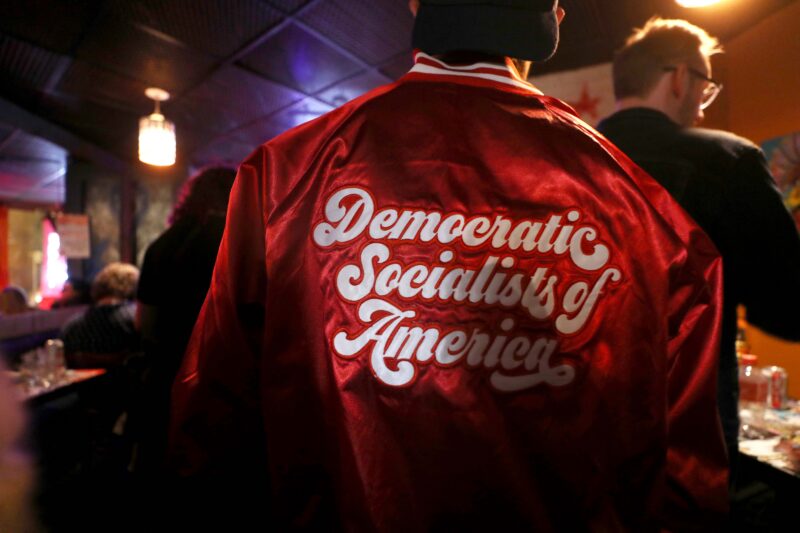
And it was this very online, Democratic Socialists of America-dominated audience that the mayor addressed two days before the attack, when he released a video denouncing Israeli Prime Minister Benjamin Netanyahu, even as he admitted he could not honor his campaign vow to arrest him if he came to the city for the United Nations General Assembly meeting in September. The social media post followed days of questions and criticism from local press and Jewish leaders over his continued toying with the idea of cuffing the Israeli leader, even though city attorneys had long apprised Mamdani that he had no authority to enforce an International Criminal Court warrant against the Israeli leader, as The New York Times subsequently reported.
But rather than plainly admitting he could not honor his promise, the mayor spun a real-world, local loss into an Internet triumph: releasing a dramatic, camera-facing address on his official social media channels with the caption “Benjamin Netanyahu is a war criminal.” The video itself focuses on denouncing the Israeli prime minister as the “architect of a horrific genocide” — without even mentioning the Oct. 7 Hamas terror attack that set off the most recent round of the conflict. Only in the final moments of the video, which received more than 150 million views, does the mayor acknowledge he lacks legal grounds to arrest Netanyahu.
There is at present no evidence that the video inspired the Manhattan attack, much less a violent incident at a Jewish summer camp in Queens this week. But the video prompted fierce criticism from Jewish leaders — and calls from Levine and other prominent Democrats for a general tempering of rhetoric among elected officials. Mamdani has refused to even acknowledge suggestions that he turn down the temperature.
He also dismissed concerns from a suite of Jewish attorneys associations that a panel he appointed to recommend city judicial appointments did not include a single Jewish member, despite the prevalence of Jewish attorneys in New York. This kind of political faux pas, committed amid relentless criticism from Jewish leaders, would typically sap a leader’s political capital. But Mamdani built his political coalition online, apart from traditional bases of political influence, and it looks to have endured these incidents unscathed.
If anything, the mayor still appears empowered after helping to elect three leftist allies in New York City to Congress last month, ousting two sitting members of the House in the process. And the institutions, Jewish and otherwise, that have sought to stop him look weaker than ever.
He smashed the political organization of one-time ally Rep. Nydia Velazquez (D-NY), and humiliated the left-wing Working Families Party by using his clout to lift Assemblymember Claire Valdez over Brooklyn Borough President Antonio Reynoso in the primary for the retiring Velazquez’s seat.
He also potentially decimated the unique Jewish-Dominican political alliance — the kind of “only in New York” ethnic coalition that once defined city politics — that elevated Levine to power by taking out the comptroller’s most important ally, Rep. Adriano Espaillat (D-NY), with his own pick: radical grad student Darializa Avila Chevalier.
But Mamdani is not the only canny politician capitalizing on the emotionally heightened moment. Netanyahu, facing a tough election fight at home, has announced his intention to come to New York and challenge the mayor’s message and authority directly. Mamdani, who enjoys better poll numbers among American Jews than Netanyahu, has already tacitly urged his supporters to greet the Israeli leader with protests.
A collision between the two seems increasingly likely — with potential to again impact New York’s Jewish community.
Less sensationally, and often behind the scenes, the main challenge to Mamdani’s latitude in government have so far been two more moderate-minded Jewish women, NYPD Commissioner Jessica Tisch and City Council Speaker Julie Menin, both around issues of law and order. Tisch, a grand marshal in this year’s Israel Day on Fifth Ave parade, reportedly forced the mayor’s hand on the question of arresting Netanyahu, as her department prepared to publicly declare it could not take the Israeli politician into custody.
Menin helped shepherd bills mandating police buffer zones around religious institutions and schools at a time when the mayor struggled to condemn pro-Hamas protests outside synagogues.
Meanwhile, American Federation of Teachers President Randi Weingarten has fought the mayor politically. Her union helped bankroll PACs opposing his political candidates, and its New York branch — closely aligned with Menin and the city’s Jewish Democratic establishment — has threatened the mayor with “all-out war” in upcoming contract negotiations.
So far though, these struggles have barely slowed the mayor down. His social media-fueled movement has little appetite for compromise, at least on their core issues (which includes opposition to Israel). If Mamdani is able to succeed by only playing to his base — still a big if — the city’s organized Jewish community risks getting written off entirely.
The NYC mayor wouldn’t respond to criticism from fellow Democrats or Netanyahu, or explain why he continued toying with the notion of arresting the Israeli prime minister
Spencer Platt/Getty Images
New York City Mayor Zohran Mamdani speaks at a food distribution center on July 27, 2026 in the Brooklyn borough of New York City.
Days after an alleged hate crime against a Jewish person in Manhattan, New York City Mayor Zohran Mamdani refused to engage with suggestions from various corners that he de-escalate his rhetoric around Israel — or speak to why he continued publicly toying with arresting Israeli Prime Minister Benjamin Netanyahu well after city attorneys told him he couldn’t.
Manhattan District Attorney Alvin Bragg has charged Raul Morales with multiple hate crimes for stabbing first an Asian American and then a Jewish man on the Upper West Side last Thursday — the latter attack allegedly preceded by Morales shouting “Allahu Akbar” and “justice for Islam” outside an Orthodox synagogue displaying American and Israeli flags.
A number of Jewish leaders linked the attack to the mayor’s recent denunciations of Netanyahu and the Jewish state, and even a fellow Democrat signaled at a press conference on Friday morning that Mamdani should “take the temperature down.”
Netanyahu himself, whom Mamdani excoriated in a widely watched video last week as “the architect of a horrific genocide,” accused the mayor of “fomenting hate” in a Sunday appearance on Fox News.
But the mayor declined to substantively engage with any of these criticisms when pressed by reporters on Monday.
“I’m not interested in getting into a back and forth with Prime Minister Netanyahu,” the mayor said when asked about Netanyahu’s comments at an unrelated press conference, though he immediately pivoted back to attacking the Israeli leader when asked moments afterward about other New York elected officials suggesting his commentary might negatively impact Jewish New Yorkers. “When I make criticisms of Prime Minister Netanyahu, they are criticisms of Prime Minister Netanyahu. And what I shared were not even, frankly, personal assessments. They were objective facts.”
Still, the democratic socialist acknowledged that the majority of the city’s hate crimes fall upon its Jewish minority, and pledged his administration would protect them. He also praised the police for quickly arresting Morales, who has pleaded not guilty to the charges against him.
“One of my top priorities is keeping Jewish New Yorkers safe, keeping every single New Yorker safe,” he said. “My responsibility as a New Yorker and as a mayor of this city is a responsibility to take care of each and every person who calls the city their home. And that is not based upon whether or not they agree with me, how they feel about me. My job is to make sure that they are safe, that they are thriving, and they continue to call this city home.”
Asked why he continued to publicly suggest there was a possibility he might honor his campaign promise to arrest Netanyahu well after — according to The New York Times — city attorneys told him he had no power to do so, the mayor refused to explain.
“I’ve said all that I have to say on that topic,” he answered.
The attack comes after Jewish groups warned of heightened risk to New York Jews in the aftermath of Mayor Zohran Mamdani’s viral video accusing Israel of war crimes
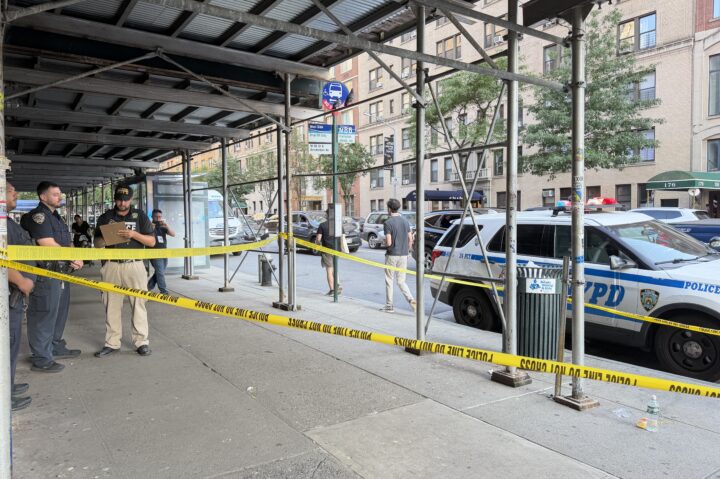
Sruli Fruchter
Scene of a stabbing attack on Manhattan's Upper West Side on July 23, 2026.
A Jewish man was stabbed on Thursday afternoon on Manhattan’s Upper West Side, along with one other victim, in what was potentially a hate crime, NYPD Commissioner Jessica Tisch said.
“Detectives are continuing to work the case and determine motive, but according to victim and witness statements, [the suspect] yelled ‘Allahu Akbar’ during both attacks,” Tisch wrote on X.
The NYPD press office told Jewish Insider that police responded at 1:31 p.m. to a 911 call near West 84th Street and Central Park West and found a 57-year-old man conscious and alert with a stab wound to the back. Officers then encountered a 50-year-old man two blocks away with a stab wound to the chest, who was also awake and responsive. The other victim was Asian, Tisch said. Medics transported both men in stable condition to a nearby hospital.
The NYPD has arrested 51-year-old Raul Morales in connection with both assaults, Tisch announced, and the NYPD is investigating the incident as a potential hate crime.
New York City Mayor Zohran Mamdani condemned the stabbings on X on Thursday evening, saying, “These hateful and despicable attacks have no place in our city,” but he did not mention antisemitism.
Mamdani added that the NYPD’s initial investigation “suggests that mental health may have been a factor. They are also evaluating these stabbings as potential hate crimes.”
The attack occurred on the Tisha B’Av holiday just outside of The Jewish Center, a Modern Orthodox congregation. New York assemblymember and congressional nominee Micah Lasher, who is Jewish and represents the area, told The Times of Israel that the Jewish victim was wearing a kippah.
The Jewish victim is a member of Congregation Ohab Zedek, another Modern Orthodox synagogue on the Upper West Side, a source familiar with him told JI.
City Council Speaker Julie Menin wrote on X that the attack “appears to be an antisemitic stabbing.”
“While we await additional details to be confirmed, we know that what is happening in our city is abhorrent,” wrote Menin, the first Jewish person to ever serve in her role. “The fear in the Jewish community is real. Every New Yorker deserves to feel safe in their neighborhood, regardless of their faith or identity.”
Gov. Kathy Hochul similarly called the incident “what appears to be another senseless attack on New Yorkers simply because they’re Jewish.”
Jewish groups had warned a day earlier that a video released by Mamdani on Tuesday night railing against Israeli Prime Minister Benjamin Netanyahu, in which he accused Israel of a litany of war crimes, put Jewish New Yorkers at risk.
A 64-year-old Jewish man was injured in a separate incident in Brooklyn on Tuesday morning when a man shouting antisemitic slurs shoved him to the ground, injuring his back and hip, police said. The NYPD is investigating the attack as a hate crime.
This is a developing story.
The Kennedy scion was the only one of four NY-12 Democratic candidates to say he supports the legislation imposing restrictions on weapons sales to Israel at a debate on Tuesday
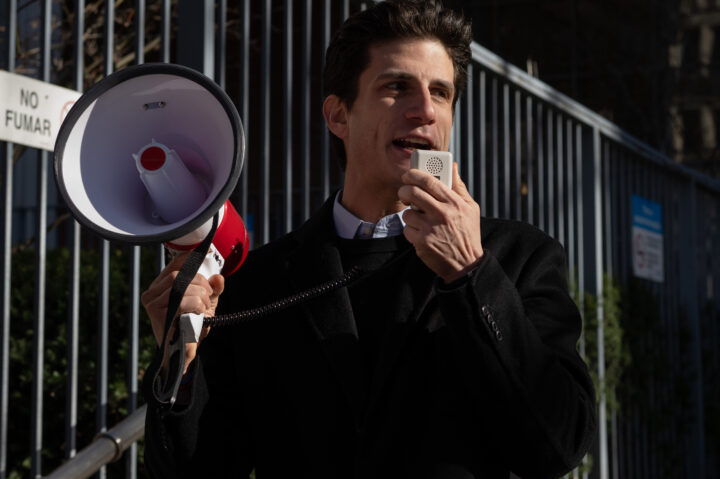
Edna Leshowitz/Getty Images
Jack Schlossberg, grandson of former President John. F Kennedy who is currently running for Congress, on Jan. 12, 2026 in New York City.
Jack Schlossberg, the Kennedy scion and social media influencer running for a coveted open House seat in Manhattan, came out on Tuesday in support of legislation that would impose unprecedented new restrictions on weapons sales or transfers to Israel, despite previously expressing skepticism of the bill.
During a debate on Tuesday evening, Schlossberg pledged that “as of today,” he would vote in support of the Block the Bombs Act, a controversial bill that has drawn backing from a growing number of left-wing House Democrats, casting his rejection of offensive weapons as a response to “a moral question that is being put to our country right now.”
He also reiterated he would vote for continued U.S. funding to boost Israel’s Iron Dome missile-defense system, saying his position aligns with a commitment to “protect civilian lives as best we can” in the region.
Schlossberg, who has shared inconsistent positions on aid to Israel throughout the campaign to succeed retiring Rep. Jerry Nadler (D-NY) in a heavily Jewish House district, wrote in a January questionnaire that he was “unsure” whether he would support the Block the Bombs Act, arguing that it “would not provide an avenue to peace and stability.”
Even as he has frequently voiced his objections to future weapons sales to Israel, Schlossberg had not appeared to publicly back the Block the Bombs Act until Tuesday’s debate, marking a clear divide over Israel in the race.
By contrast, Schlossberg’s top rivals in the June 23 primary — including state Assemblymembers Micah Lasher and Alex Bores and former GOP attorney George Conway — all declined to support the bill at the debate.
Schlossberg’s campaign did not respond to a request for comment about his evolution on the legislation.
The 33-year-old grandson of former President John F. Kennedy has criticized Lasher and Bores for opposing efforts to condition military aid to Israel that single out the Jewish state.
But despite claiming on social media last month that he supports “no weapons to Israel,” Schlossberg has reportedly stated otherwise behind closed doors.
Speaking in May at a private social club on the Upper East Side, he told members he “probably would have continued funding Israel’s offensive weaponry within the years following Oct. 7,” according to audio of the meeting obtained by Politico.
His campaign told Politico that Schlossberg’s “views have evolved as the situation has.”
For his part, Schlossberg insisted in a series of social media posts that the story had misrepresented his views and that his stance on offensive aid has been consistent, even though he also said his “position has changed as the situation does.”
During a candidate forum in January, meanwhile, Schlossberg was comparatively noncommittal about his stance on aid to Israel, which he called “a strong democratic ally historically to the United States.”
“I would want to have a full intelligence briefing to try to understand the situation before supporting any specific legislation,” he said.
The Democratic congressional hopeful aired his frustration when asked about his stance regarding U.S. aid to the Jewish state at a candidate forum
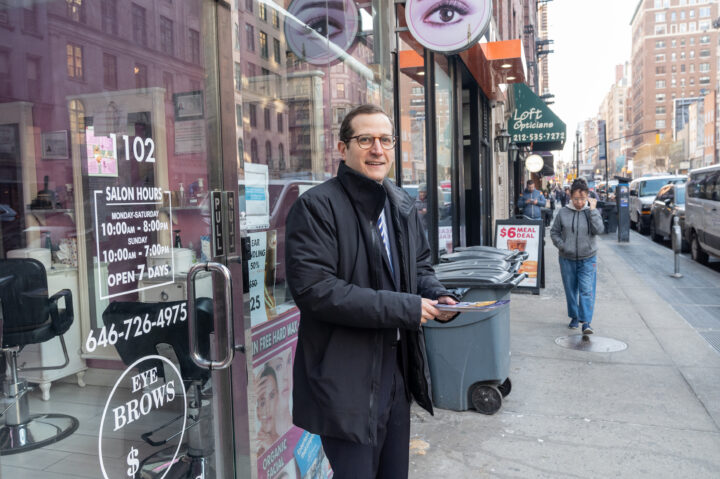
Lev Radin/Pacific Press/LightRocket via Getty Images
Micah Lasher campaigns and distributes flyers as he runs to represent Congressional District 12 on Lexington Avenue.
Micah Lasher, a Democratic New York state assemblymember running to fill the seat of retiring Rep. Jerry Nadler (D-NY) in Manhattan, raised concerns on Monday that “the political dialogue” in his primary “is obsessed with Israel,” a key topic of discussion in the heavily Jewish 12th Congressional District.
Lasher, who is Jewish and a supporter of Israel, made the remarks while participating in a candidate forum at B’nai Jeshurun, a synagogue on the Upper West Side. The forum was the latest of several Jewish community events ahead of the closely watched June 23 primary election.
During the forum on Monday night, the moderator, New York Times opinion columnist Michelle Goldberg, asked Lasher where he stood regarding continued U.S. aid to Israel — a question that has been repeatedly posed to him and his opponents throughout the race.
Lasher, in a position shared by most of his top rivals, has said he backs funding to boost Israel’s Iron Dome missile-defense system and opposes efforts to condition U.S. aid to Israel that single out the Jewish state.
Rather than answering Goldberg’s question directly, Lasher sounded increasingly frustrated as he described feeling “exhausted by the obsession on a plot of land the size of New Jersey.”
“I care about the survival of Israel as a Jewish state. I am heartbroken by the killing of Palestinians. I will look at every policy question through those lenses,” he said.
When Goldberg noted, “We’re in a synagogue,” Lasher countered, “The leading proponents of the idea that antisemitism is different from anti-Zionism will tell you being in a synagogue doesn’t mean that your life is about Israel.” He added that there are housing and childcare issues they should be focusing on.
“I spend a great deal of time wrestling with the challenges and the horrors of what is going on in Israel,” Lasher said. “I am not obsessed with Israel, and I worry sometimes that our political dialogue — and the political dialogue in this race — is obsessed with Israel.”
In concluding his remarks, Lasher stated that his “answers will be complicated” and “will not fit into 90 seconds.”
“I’m tired of the obsession on this topic in this campaign,” he said to applause.
At a debate days before the start of early voting, all leading Democratic contenders for the NY-12 seat declined to call Israel’s war in Gaza a genocide
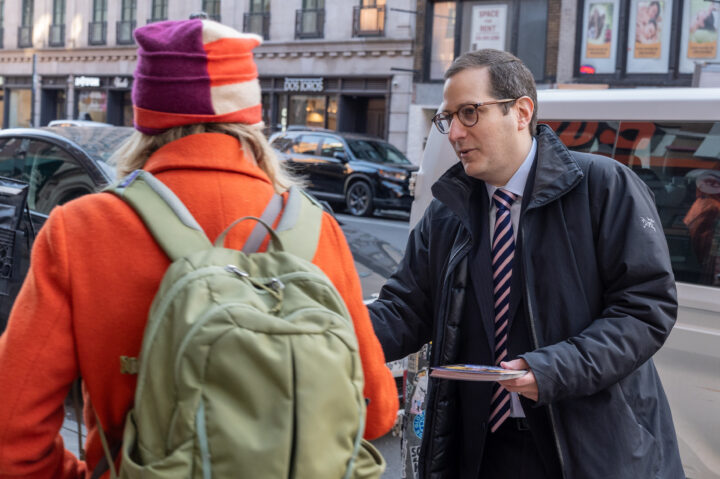
Lev Radin/Pacific Press/LightRocket via Getty Images
New York state Assemblyman Micah Lasher campaigns and distributes flyers as he runs to represent NY-12 on Lexington Avenue.
The four leading Democrats running in a closely contested Manhattan primary to succeed retiring Rep. Jerry Nadler (D-NY) all declined to describe Israel’s military conduct in Gaza as genocide during their first televised debate on Thursday evening.
Micah Lasher, an assemblyman who is backed by Nadler and other Democratic leaders in New York, called the number of Palestinian casualties “horrific” but characterized the question as “one of a set of definitional debates that does more to divide people of good faith than it does to find common ground.”
Alex Bores, a fellow assemblyman who has gained left-wing endorsements even as a defender of Israel, said he was “not comfortable” using the word, while Jack Schlossberg, a Kennedy scion and social media influencer, told the PIX11 debate moderator that he was “less interested in what we call it than what we do about it.” George Conway, a former Republican who is now an outspoken critic of President Donald Trump, said he did not think Israel’s war “meets the threshold” for genocide.
Their broadly unanimous responses underscore the political landscape shaping the June 23 primary race to represent New York’s 12th Congressional District, a seat home to the largest Jewish constituency in the country and where many voters identify with liberal Zionist sentiments.
In contrast with other congressional primaries in more progressive districts in Brooklyn, Queens and Upper Manhattan — where Israel has emerged as a flashpoint — the race for Nadler’s coveted House seat in the heart of Manhattan has been largely marked by a consensus view among the top candidates who have all generally voiced continued support for the Jewish state.
One notable exception stems from their differences over U.S. military aid to Israel, a topic of discussion at Thursday’s debate — which also focused on issues such as Trump’s immigration agenda and AI policy, a divisive source of industry-linked outside spending in the race.
Lasher and Bores have both agreed that the U.S. should consistently enforce the Leahy Laws — which prohibit security funding to foreign military units that engage in human rights violations — rather than singling out Israel for conditioned military aid, a position they each highlighted during the debate.
Meanwhile, Schlossberg continued to argue against future weapons sales to Israel amid wars in Iran and Lebanon, even as he reiterated his support for aid to boost Israel’s Iron Dome missile-defense system that has recently faced growing pushback from the far-left flank of the Democratic Party.
Conway, for his part, said simply that he opposes efforts to block offensive or defensive weapons to Israel, which he called “our one true, steadfast ally in the region.”
With days remaining until early voting, the debate was the latest of several forums in which the candidates have faced questions on Israel and other issues of particular concern for Jewish constituents, whose support could tip the scales in what polls have shown will be a close election.
On Wednesday evening, several of the candidates gathered at Temple Emanu-El’s Streicker Cultural Center on the Upper East Side of Manhattan for the most recent Jewish community forum, moderated by the Jewish Democratic Council of America.
The event, which was attended by Bores, Lasher and Schlossberg, featured some lesser-known candidates: Laura Dunn, a civil rights lawyer, and Nina Schwalbe, a public health expert. Conway did not participate in the discussion.
Among the key topics covered were aid to Israel, the Iran war and instances where “anti-Zionism blurs into antisemitism,” as Halie Soifer, JDCA’s CEO, put it while moderating the event.
Lasher, who has identified as a “proud Zionist Jew,” said that “while anti-Zionism and antisemitism are not precisely the same thing, I think we need to acknowledge they often go hand in hand,” citing recent protests outside of synagogues in New York City at which demonstrators have voiced support for Hamas.
“Holding Israel to a standard that is applied to no other country, making Jewish people feel unwelcome in any environment, these are all examples of antisemitism,” Lasher said.
Morris Katz, who helped propel Mamdani to power, has been advising some of the leading anti-Israel Democrats on the ballot this year
Lev Radin/Pacific Press/LightRocket via Getty Images
Micah Lasher campaigns and distributes flyers as he runs to represent Congressional District 12 on Lexington Avenue.
Micah Lasher, a Democratic state assemblymember who is running for an open House seat in Manhattan, has enlisted a top progressive consulting firm with ties to New York City Mayor Zohran Mamdani to cut ads for his campaign, Jewish Insider has learned.
Fight Agency, a media firm co-founded by Morris Katz, who rose to prominence as an advisor for Mamdani’s insurgent mayoral campaign, is working with Lasher as he seeks to succeed retiring Rep. Jerry Nadler (D-NY) in a crowded primary in New York’s 12th Congressional District, which has the largest Jewish electorate in the country.
“Team Lasher is thrilled to welcome Fight Agency to our team that includes powerhouses Mark Guma and Haley Scott,” Grace Peacore, a Lasher spokesperson, told JI on Wednesday, referring to other consultants advising the campaign. “We can’t wait for you to see what we’ve been cooking up. Stay tuned!”
Katz shot a new ad for Lasher this week at a bagel shop on the Upper West Side with Nadler and New York Gov. Kathy Hochul, both of whom have backed his campaign, according to Peacore.
The relationship represents something of an unlikely pairing for both parties. Fight Agency prides itself on elevating anti-establishment candidates with left-wing worldviews — among its most high-profile clients this election cycle are Graham Platner, an oyster farmer who is now the presumptive Democratic nominee in Maine’s Senate race, and Abdul El-Sayed, who is running in Michigan’s crowded Senate primary. Both candidates have positioned themselves as staunch critics of Israel.
Katz, who is Jewish, is also an outspoken critic of Israel who has sought to push the party leftward on Middle East policy, while Lasher has called himself a “proud Zionist Jew” and opposed legislative efforts to block U.S. weapons sales to Israel. He is known as a policy wonk with close connections to the Democratic establishment in New York — thanks to his past roles working for Hochul and former New York City Mayor Michael Bloomberg, among others.
Katz had reportedly been working to help consolidate progressive backing for Lasher, though one of his top rivals in the June primary, Assemblymember Alex Bores, has drawn endorsements from a range of left-wing groups in recent days.
Lasher, whose campaign had not yet been up on the airwaves, is also facing Jack Schlossberg, a Kennedy scion and social media influencer, and George Conway, a prominent critic of President Donald Trump, among other lesser-known candidates.
One Jewish leader, speaking anonymously to discuss the race, called Lasher’s decision to hire Katz a smart move, even if he disagreed with his stances on Israel. “I would also use him!” he told JI on Wednesday.
The New York State assemblymember, who is consolidating progressive support in the race to succeed Jerry Nadler, said he told the Sanders-affiliated group that endorsed him that his position on Israel funding was different from theirs
John Nacion/Variety via Getty Images
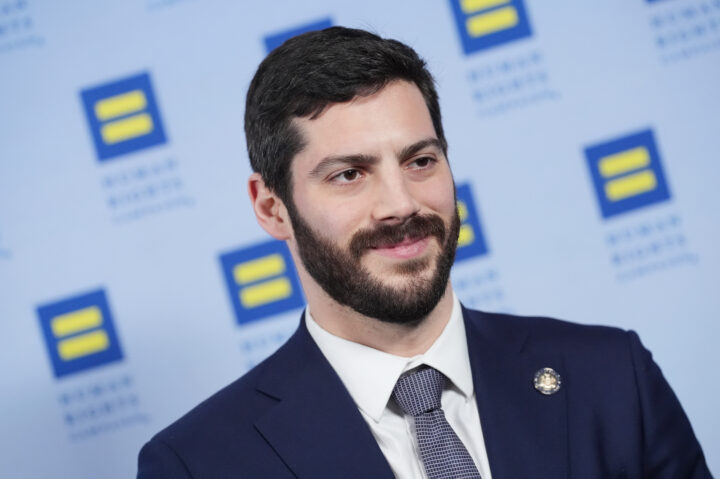
Alex Bores at Human Rights Campaign Greater New York Dinner held at the Marriott Marquis on February 07, 2026 in New York, New York.
New York State Assemblymember Alex Bores, a leading Democratic primary candidate for an open House seat in Manhattan, said on Tuesday that he disagreed with Our Revolution, the left-wing advocacy group that recently endorsed his campaign, over its opposition to U.S. military funding for Israel.
Speaking at a candidate forum hosted by West Side Institutional Synagogue and moderated by Jewish Insider’s editor-in-chief, Josh Kraushaar, Bores said that even as he welcomed the endorsement because of such shared interests as AI regulation, he was not aligned with Our Revolution’s approach to Israel, a key issue in the heavily Jewish 12th Congressional District.
The endorsement from Our Revolution, which is affiliated with Sen. Bernie Sanders (I-VT), drew some boos from the crowd when it was mentioned during the forum. Bores, a former Palantir employee facing attack ads from an AI-linked super PAC, clarified he was “happy to partner with” the organization “in the fight” to regulate the industry he has scrutinized as a state legislator.
“They asked me specifically about my position on Israel, which is well-documented and different from theirs,” Bores explained. “I said the same thing I say in every room.”
The endorsement last week had fueled skepticism among some Jewish leaders, raising doubts over his commitment to upholding support for Israel if he is elected to the House.
But Bores, who is now consolidating support from the progressive left in the crowded race to succeed retiring Rep. Jerry Nadler (D-NY), emphasized that “we need to make it acceptable for there to be people in progressive spaces that still believe in the right of Israel to exist and to defend itself.”
“I will always say the same things in every room. I said them there,” Bores said of his discussions with Our Revolution. “They made the decision to endorse. I view that as a sign that maybe we’re expanding this coalition.”
Later in the forum, Bores reiterated that he opposed Sanders-led legislative efforts to restrict arms sales to Israel.
More broadly, Bores sought to cast himself as a potential bridgebuilder who hopes to expand the progressive coalition to welcome more pro-Israel voices. “I would show that you can be someone who believes in” such goals as Medicare for All “and get support from progressive groups and still stand for supporting our allies, supporting a safe, democratic Jewish state,” he told the crowd.
“You need to be able to engage in all of these communities in order to do that, and I would be very happy to play that role,” he added.
Bores was joined at the forum on Tuesday by his fellow state assemblymember, Micah Lasher, and George Conway, a former Republican who is now a prominent critic of President Donald Trump. Both candidates have likewise expressed strong support for Israel.
Jack Schlossberg, the Kennedy scion who has called for blocking arms sales to Israel, declined to attend.
As Alex Bores and Jack Schlossberg woo the left, Micah Lasher emerges as favorite among Jewish voters
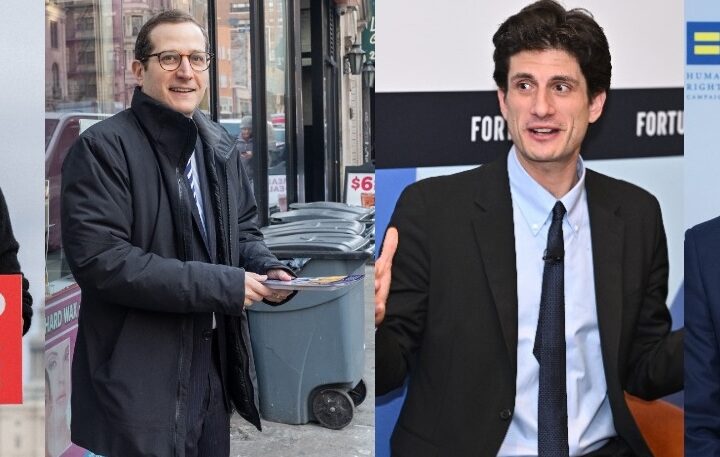
Brian Stukes/Lev Radin/Roy Rochlin/John Nacion
George Conway/Micah Lasher/Jack Schlossberg/Alex Bores
With seven weeks remaining until the Democratic primary for an open House seat in Manhattan, the crowded race is beginning to show emerging signs of division over Israel and rising antisemitism, key issues in the heavily Jewish district where many voters closely identify with liberal Zionist sentiments.
The last week — which included two candidate forums focused on Jewish community issues and was punctuated by an anti-Israel protest near a synagogue in the district hosting an Israeli real estate event — highlighted some of the subtle ideological fault lines inflecting the June 23 race to succeed retiring Rep. Jerry Nadler (D-NY).
From recent efforts to block U.S. weapons sales to Israel to the intersection between anti-Zionism and antisemitism, the four top candidates in the closely contested race — state Assemblymembers Alex Bores and Micah Lasher, Kennedy scion Jack Schlossberg and former Republican attorney George Conway — are by varying degrees staking out differing views on Middle East policy as well as domestic concerns affecting the Jewish community, while continuing to reaffirm their support for the Jewish state.
Meanwhile, some recent endorsements that Bores received from left-wing advocacy groups hostile toward Israel have fueled skepticism of that support among Jewish leaders, along with speculation he is seeking to carve out a progressive lane for himself that has been largely unoccupied for most of the campaign.
The starkest disagreements were on display last Wednesday during a candidate forum at the Stephen Wise Free Synagogue on the Upper West Side, where Schlossberg, a social media influencer with a narrow lead in most private polls, notably said he would have joined most Senate Democrats who voted last month to restrict arms sales to Israel — even as he continues to back defensive aid to help boost Israel’s Iron Dome system.
For their parts, Conway and Lasher both confirmed they would have opposed the legislation introduced by Sen. Bernie Sanders (I-VT). “I don’t support the withholding of aid from Israel,” Conway explained, drawing applause from the audience, while Lasher said he did not believe the bill “would have actually improved the lives of people on the ground,” echoing comments he had made in a candidate questionnaire opposing House legislation to block weapons sales to Israel.
Bores, who had previously committed to the event, pulled out the day before, citing a scheduling conflict in Washington.
The forum, which took place a day after anti-Israel demonstrators had chanted antisemitic slogans near Park East Synagogue to oppose an Israeli real estate event featuring some advertising for settlements in the West Bank, drew other distinct contrasts among the candidates.
Schlossberg, for instance, condemned what he called the “antisemitic rhetoric” used by demonstrators who had shouted slogans such as, “We don’t want no Zionists here,” “Death to the IDF” and “We don’t want no two-state, we want ‘48.”
Still, he added, “I don’t think that a land sale for real estate that is in violation of international law should be happening in a house of worship.”
In comparison, Lasher, a Jewish protégé of Nadler’s, questioned the protesters’ aims. The demonstration was more broadly about “framing Israel, and the idea of making aliyah to Israel, as illegitimate,” he argued. Earlier, he said the protest was “intended to create fear in the hearts of Jewish New Yorkers and stigmatize our community.”
“I think it’s important to speak with clarity,” added Lasher, who has touted his state legislation to ban protests directly outside houses of worship, which has been opposed by anti-Israel activists in the city. “When people are outside a synagogue shouting, ‘We don’t want two states, we want ‘48’ — that’s not about the question of West Bank settlements. That is about the legitimacy of Israel.”
Bores, whose state Assembly district includes Park East Synagogue, said in a joint statement with City Councilmember Virginia Maloney before the protest on Tuesday that the demonstration evoked “painful memories of times when people have been harassed while entering houses of worship.” He did not appear to have commented on the protest after it occurred.
While Bores has recently accepted support from some groups opposed to U.S. funding for Israel, he has indicated that he does not share such positions. He has rejected legislative efforts to condition aid — stating in one candidate questionnaire, for example, that “determining foreign policy through legislation that targets individual countries has overall not been beneficial for achieving universal rights.”
He reiterated that view last Monday during a separate forum at The Jewish Center, a Modern Orthodox synagogue on the Upper West Side, where he appeared with Lasher. “I support the consistent application of Leahy Laws across all countries,” he said, referring to U.S. laws banning security funding to foreign military units that engage in human rights violations.
Lasher also agreed with that position. “It should be a universal standard,” he said.
“We should be able to stand up to people in our party,” Bores added at the forum last week, “and say how important our relationship is with the State of Israel and how important it is to ensure the rights of everyone in the region, including the Palestinians.”
Still, his recent endorsement from Our Revolution, a Sanders-aligned group that has advocated for cutting military funding to Israel, has fueled questions about the sincerity of his positions. His decision to pull out of the Stephen Wise candidate forum on short notice last week also raised eyebrows, particularly as he had done so after winning support from a City University of New York union that has called for divesting from Israel.
Bores has otherwise claimed backing from New York Progressive Action Network, which likewise supports efforts to withhold U.S. military aid to Israel.
“There’s a lot of skepticism now,” said one Jewish community leader who is closely following the race, speaking on the condition of anonymity to address a sensitive issue. “You don’t get the endorsements of Our Revolution and PSC CUNY,” which represents faculty and staff in the university system, “without saying something differently privately than you do publicly.”
“There’s concern now that there wasn’t a few weeks ago,” the Jewish leader said, noting Bores had been calling community members to do “damage control” after receiving the Our Revolution endorsement. He has explained that the nod extends from their shared goal of regulating the AI industry, which is targeting the former Palantir employee aggressively in the race, according to the Jewish leader.
A spokesperson for Bores’ campaign did not respond to a request for comment about the endorsement last week.
While some Jewish voters in the district feel that Lasher’s views on Israel are to the left of their own, his outspoken opposition to rising antisemitism and commitment to Israel’s security are now appealing to a segment of the community that is questioning the apparent dissonance between Bores’ publicly stated positions and his endorsements from organizations with which he is not aligned on Middle East policy.
A graphic circulating in local Jewish WhatsApp groups on Friday, which was shared with Jewish Insider, warned that “a Bernie Sanders PAC just endorsed Alex Bores” and that “Jack Schlossberg wants to cut arms sales to Israel,” highlighting the names in red.
“Micah Lasher is the clear choice. The community and rabbis are rallying behind him,” the message continued. “It’s time to unite to win this seat.”
Garth Symonds, who chairs The Jewish Center’s committee to get out the vote, said in a statement to JI on Friday that Bores “has proven his toughness in the face of well-funded attacks by those resistant to AI regulation” and that he “appears to have a strong legislative record, but so does Lasher.”
“On Israel, Lasher has a supportive track record, whereas Bores appears close to some people in the Working Families Party, which is anti-Israel, and has been endorsed by One Revolution,” he said, claiming Lasher, a veteran Democratic operative, “has deeper political experience.”
The Working Families Party, which supports conditioning aid to Israel, chose not to issue an endorsement after soliciting questionnaires from Bores, Lasher and Schlossberg. But the group has recently indicated it could rethink that decision as Schlossberg has gained traction, saying “we can do better than that.” It is most likely to support Bores if it does weigh on the primary, City & State New York has reported.
Backed by prominent donors and polling at the top of the Democratic primary field for NY-12, Schlossberg says he supports Iron Dome but is open to restricting U.S. aid to Israel
Edna Leshowitz/Getty Images
Jack Schlossberg, grandson of former President John. F Kennedy who is currently running for Congress, on Jan. 12, 2026 in New York City.
As Jack Schlossberg gains a foothold in his primary campaign for a coveted open House seat in the heart of Manhattan, his views on Israel policy are drawing closer scrutiny, as he begins to stake out a stance on the increasingly heated subject of Democratic debate.
His decision to skip at least two upcoming Jewish community candidate forums occurring next month, meanwhile, is also raising some eyebrows among a key constituency in a district that has the largest Jewish voting population in the country.
On Middle East policy, the 33-year-old Kennedy scion has embraced positions that place him to the left of the field on Israel, a potentially consequential issue in the 12th Congressional District, which favored former New York Gov. Andrew Cuomo over New York City Mayor Zohran Mamdani in the November mayoral election.
Schlossberg, like his some of his Democratic rivals, had backed Mamdani, despite disagreeing with the now-mayor’s controversial campaign vow to arrest Israeli Prime Minister Benjamin Netanyahu and declining to call Israel’s war in Gaza a genocide, among other notable differences.
But as the fallout over Gaza and the war with Iran has stoked Democratic skepticism of the U.S. relationship with Israel, Schlossberg is now joining growing calls to oppose U.S. weapons sales to the Jewish state, though he has yet to clearly articulate his plans to enact such policies if elected to serve in the House.
During a candidate forum at 92NY last week, for example, Schlossberg, the grandson of former President John F. Kennedy, rejected continued U.S. funding for offensive weapons to Israel amid the war in Iran — even as he emphasized support for boosting the Iron Dome missile-defense system, which he described as a “critical” technology.
“I do not think the United States should back away from its ally completely and leave them hanging out to dry without any defenses,” he told the crowd, while saying Congress should hold a vote on funding for the war in Iran, including offensive weapons to Israel.
Schlossberg made no mention of Senate votes taking place that evening in which most Democrats favored resolutions led by Sen. Bernie Sanders (I-VT) seeking to block arms sales to Israel — which were ultimately rejected.
Meanwhile, in a questionnaire recently solicited by the Working Families Party, Schlossberg confirmed that he would co-sponsor legislation introduced by Rep. Betty McCollum (D-MN) “that would end U.S. military aid to Israel for any uses connected to the occupation of the West Bank and East Jerusalem.”
“Yes, I oppose the use of U.S. taxpayer dollars for abuse, illegal seizure and destruction of property and any violations of international humanitarian law anywhere,” he wrote.
For their part, two of his rivals in the race to succeed Rep. Jerry Nadler (D-NY), state Assemblymen Micah Lasher and Alex Bores, both declined to back the legislation. Another top primary opponent, George Conway, a former Republican lawyer and activist who has become a vocal critic of President Donald Trump, did not submit a questionnaire to the party.
Previously, Schlossberg had said at a candidate forum in January that he “would want to have a full intelligence briefing before supporting any specific legislation” related to Israel.
Schlossberg, who identifies as Jewish on his father’s side despite being raised Catholic, has taken steps to court the district’s sizable Jewish constituency. In the first policy proposal of his campaign, for instance, he pledged to fast-track legislation that would nearly double security funding for synagogues and other Jewish institutions amid an uptick in antisemitic violence.
It is unclear whether his views will shape pro-Israel spending in the race. Democratic Majority for Israel did not respond to requests for comment, though one person familiar with internal discussions told Jewish Insider late last year it was unlikely to engage in the primary, barring any major developments.
A spokesperson for AIPAC likewise declined to comment on the primary when reached by JI.
J Street, the progressive Israel advocacy group that has recently begun calling for ending U.S. funding to bolster Iron Dome, told JI it has “primary approved” Bores, Lasher and Schlossberg, meaning its members are able to contribute to all three candidates through its online political portal.
Tali deGroot, J Street’s vice president of political and digital strategy, told JI in a statement that all three of the candidates “are aligned with J Street’s pro-Israel, pro-peace, pro-democracy positions.”
“Ultimately, it is up to the district to determine who they want to represent them in Congress, and we are glad to see three J Street-aligned voices in this race,” she added.
Some Jewish leaders say that they are interested in hearing more from Schlossberg as he emerges as a leading candidate in the race. He attended Shabbat services in March at the Conservative Park Avenue Synagogue on the Upper East Side, a day after the terrorist attack against Temple Israel in suburban Detroit.
But he is otherwise expected to be absent from two Jewish community forums next month in the district at The Jewish Center and West Side Institutional Synagogue, the latter of which will be moderated by JI’s editor-in-chief.
Daniel Sherman, the rabbi of West Side Institutional Synagogue, said Schlossberg had been invited to the May 4 candidate forum “but his campaign responded that they had a scheduling conflict.” The event will be attended by Lasher, Bores and Conway, according to a flyer.
“As our goal is to engage with all of the candidates we would welcome his presence if the scheduling conflict can be resolved,” Sherman told JI.
Mordechai Schwarz, a longtime Jewish Center member who organized its upcoming forum, told JI that Schlossberg’s team had declined to join due to a busy schedule, even when asked if an alternative date would work better, while Conway’s campaign had not responded to repeated email invitations.
In an email to The Jewish Center shared with JI by its rabbi, Yosie Levine, Schlossberg’s team gave its “sincerest apologies” for skipping the forum, adding that “May is a busy, everchanging month for us, so we do not have alternative times to offer right now.”
In a statement to JI on Monday, a spokesperson for Schlossberg said, “Jack Schlossberg knows that Israel is a critical democratic ally for America and does not believe we should abandon Israel. That includes funding for the Iron Dome — which he would support should he be elected to Congress, so that Israel can protect itself from the myriad of threats facing it from all directions — as well as his local plan to boost protections at Jewish places of worship, given the increase in antisemitism and hate crimes.”
“With that said, Mr. Schlossberg is also the only NY-12 candidate fully opposed to the no-plan Iran war,” the spokesperson added. “That includes weapons to foreign countries, Donald Trump’s massive $200b supplemental request, and his record-breaking, bloated $1.5 trillion defense budget demands. No war means no funding for any part of the war. Schlossberg would vote accordingly.”
A spokesperson for Conway told JI on Friday he was unable to attend the forum because of a “scheduling conflict,” and said the campaign would be following up with The Jewish Center “to close the loop” on the pending matter.
Lasher and Bores are listed as attending The Jewish Center’s forum in a flyer.
The Stephen Wise Free Synagogue, a Reform congregation on the Upper West Side, is hosting a Democratic candidate forum scheduled for May 6, a representative confirmed to JI, but participants have not yet been finalized. Schlossberg’s team confirmed to JI after this story was published that he will be joining the Stephen Wise forum.
Most of the limited available polling conducted earlier this year shows Schlossberg narrowly leading the crowded primary field with a small plurality of the vote in the district that spans the Upper East and West Sides and stretches south to Union Square.
More recent private polling has indicated that Schlossberg continues to maintain a leading position in the race. According to a source briefed on an internal survey conducted for Schlossberg’s campaign in early April, who broadly described the results to JI on condition of anonymity, the Kennedy scion held a seven-point lead in the 20s — with his opponents all clustered in the high teens. The poll’s margin of error was three percentage points.
Jake Dilemani, a Democratic consultant who is not involved in the primary, suggested that Schlossberg’s favorable position most likely is “a function of name recognition,” saying that voters “are interested in his campaign because there’s a sexiness to a Kennedy running.”
Like other political observers, though, Dilemani told JI he expects the polling to shift as outside spending and other advertising influences the primary.
A star-studded list of campaign donors reflects Schlossberg’s celebrity status in the race, featuring prominent names from politics, fashion, music and entertainment such as Tory Burch, John Goodman, Bette Midler, Paul Simon, Lorne Michaels, Richard Plepler, Damon Lindelof, Bryan Lourd, Peggy Siegal, Chrissy Teigen, Jay Carney and Jon Corzine — all of whom have shown up in recent campaign filings to the Federal Election Commission.
Schlossberg, who had built a sizable online following as a social media influencer before launching his bid in November, pulled in nearly $1.2 million in the first quarter of 2026, according to his latest filing released last week, with most of that money on hand, less than his rivals have banked in their accounts.
Credibly or not, Schlossberg’s fresh perspective as a relative newcomer has provided him some license — despite his well-known family name — to call himself an “outsider” in a field populated by more established opponents with extensive records in both politics and government.
“President Kennedy was the first Catholic and the youngest president. He challenged the status quo, and he was an outsider. And that’s what I am in this race, so I’m proud to continue that legacy here,” he recently told a local news outlet, saying he will bring “new energy” to Washington.
But some critics point to Schlossberg’s otherwise thin resume, lack of reported income last year and history of bizarre and performative social media stunts, such as imitating a Nazi salute in a controversial video that surfaced at the start of his campaign, as evidence that his recent political makeover remains unconvincing.
While many of the district’s older constituents may still be unaware of Schlossberg’s unbalanced online record, Dilemani predicted that the other campaigns “will do their best to make it known” before the June primary.
High campaign staff turnover since he entered the primary has also drawn scrutiny to his operation. And he has faced some recent scrutiny for pulling out of other upcoming candidate forums.
Chris Coffey, a Democratic strategist who is not involved in the race, expressed strong doubts over Schlossberg’s bid to represent what he described as a “really important seat” in “one of the most educated and affluent districts in the country,” airing concerns about his “erratic background” and “online persona.”
“I have no doubt he is a great guy to go and have a Diet Coke with,” Coffey explained of Schlossberg. “But in an era where Democrats will hopefully be in an oversight position and needing to use all the tools they can to hopefully go after the president, he’ll be the guy making videos and doing press conferences.”
He also questioned the sincerity of Schlossberg’s comments on Israel as the party has shifted to the left, claiming he had not yet seen him “take a tough position” on any issue in the race.
“I honestly think Jack would say and do anything to get elected,” he told JI, citing Schlossberg’s recent opposition to a redevelopment project in Chelsea that some of his rivals have backed. “If he thinks today that it’s better to say, ‘I’m never going to give Israel a weapon again,’ he’ll say that,” Coffey added.
In Coffey’s assessment, “this race will test whether we’re in a moment where resumes don’t matter and nothing actually matters.”
Still, Schlossberg has managed to win some notable mainstream support, claiming a major endorsement in February from retiring Rep. Nancy Pelosi (D-CA), who said in a statement that he “represents the best of his generation” and “possesses a unique ability to navigate the digital and the classical political worlds in a way that can get things done for people.”
He has also garnered praise from Al Sharpton, joining the Democratic commentator for a “power breakfast” reported in Page Six this month and days later taking the stage at his National Action Network convention in New York, a closely watched annual political event.
Eighteen-year legal fight over the Iran-tied Alavi Foundation ends with a new group with similar leadership taking over its assets — and NYC skyscraper
Cem Ozdel/Anadolu Agency/Getty Images
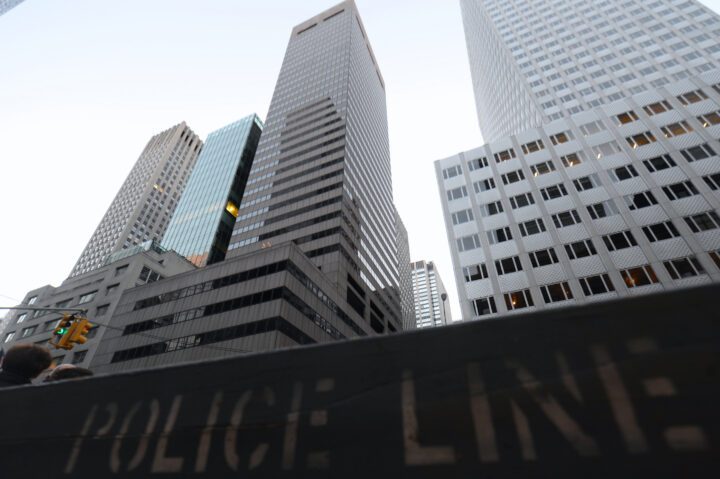
The 650 Fifth Avenue building, a 36-story office tower, located on 52nd Street near Rockefeller Center is seen on April 20, 2014 in New York City.
As tensions intensified between the U.S. and Iran amid the regime’s violent repression of protesters in January, and as Tehran vowed itself “prepared for war,” a long-running battle with the Islamic Republic’s forces in Manhattan came to an end.
The final stages of the conflict between the Justice Department and the New York-based Alavi Foundation, which since 2008 has faced allegations of acting under Iranian direction, took place in secrecy — with scores of legal documents sealed and even vaulted away.
But materials filed on Jan. 12 with the New York State Charities Bureau revealed its ultimate outcome: a settlement that will provide compensation for numerous American and Israeli victims of Tehran-backed terror, but also enable a successor organization to recoup control of the foundation’s vast assets, including its 36-story crown jewel skyscraper on Fifth Avenue.
The final deal — which a filing this month shows came together confidentially in the last days of the Biden administration, and has just begun to go into effect — will officially dismantle the Alavi Foundation and strip it of hundreds of millions of dollars. Formed as the Pahlavi Foundation in 1973 during its namesake shah’s reign, Alavi was later commandeered and rechristened by figures tied to the regime of the mullahs, and the federal government accused it of conspiring with an Iranian state-owned bank to evade taxes and sanctions.
The settlement of the suit brought by the federal government compels payouts totaling $318 million to the U.S. government and a wide array of people Iran and its proxies have harmed: in the 1983 bombing of the U.S. Marine barracks in Beirut, in the 1996 Khobar Towers attack in Saudi Arabia, in multiple 1990s and 2000s suicide attacks against Israel, in the torture and murder of an Iranian dissident, and in the 1990 assassination of Rabbi Meir Kahane.
In exchange, a new non-governmental organization, the Amir Kabir Foundation, will rise in Alavi’s place. Named for a historic Persian imperial administrator, the new group will take full possession of 650 Fifth Ave., appraised at $435 million, plus bank and investment accounts holding more than $87.6 million, and properties from Queens to California worth tens of millions more and home to various Shia religious and educational facilities.
Records show that the Amir Kabir Foundation shares Alavi’s old address and even its phone number, and that three of the five members of the Alavi Foundation’s board of directors are part of the new group’s six-person leadership team. This includes Dr. Hamid Yazdi, who has served as Alavi’s president since 2013, and whose name appears on registration paperwork for the Amir Kabir Foundation. Yazdi did not respond to requests for comment.
And although by-laws for the new group require it to remain “independent from any national or international agencies,” it will continue to provide funding and support for at least one longtime Alavi affiliate: the Qoba Foundation of Carmichael, Calif., which occupies an Alavi-owned property that the feds sought to seize in the early days of the case and which bears the name of a politically significant Iranian mosque.
The news that the Amir Kabir Foundation shared much of Alavi’s leadership team and would regain access to the huge rental revenues from 650 Fifth Avenue and the network of religious facilities lodged at the old organization’s properties alarmed longtime Iran-watchers.
“This is the Iranians playing anti-sanctions, anti-accountability three-card monte. They are treating the U.S. Department of Justice and the courts as if they are fools,” asserted Dr. Michael Rubin of the American Enterprise Institute. “Iran’s only concern is maintaining the property. It’s lucrative and, in theory, can help undermine U.S. security from within. If the CIA owned a skyscraper in Tehran, would they be so willing to give it up, or would they just shuffle the acronyms around and hope no one notices?”
The news also worried Lara Burns, head of terrorism research at George Washington University’s Program on Extremism. Burns highlighted her own contributions to a report that found Alavi-backed groups had promoted anti-American, pro-ayatollah extremist rhetoric, and noted the group’s history of violating sanctions, as documented in the federal case. She suggested “government fatigue” with the lengthy and expensive litigation process may have contributed to the federal decision to settle.
A former FBI agent, Burns further argued financial penalties like those in the settlement can at times serve effective “punitive and deterrent functions” — but not in this case.
“I do not believe restitution and fines serve either purpose in the case of Alavi Foundation, who has shown a willingness to continue its behavior at all costs and the fiscal ability to maintain that agenda,” she argued to Jewish Insider. “Allowing Alavi to obfuscate their identity and basically start with a clean slate creates risks related to a continued foreign influence campaign on behalf of a regime that has called for the death of U.S. leaders and who has blatantly stated its intent to cause America harm through a variety of nefarious activities.”
But Alavi’s longtime attorney, Daniel Ruzumna, maintained that the new foundation would in no way serve as an alter ego to the old. He noted that the Alavi Foundation’s board had completely turned over during the yearslong legal fight, and stated that all members of the Amir Kabir Foundation’s leadership had submitted to interviews with the federal government and received no objection.
Further, he pointed to language in the document filed in New York subjecting the Amir Kabir Foundation to a five-year term of oversight from the state Attorney General’s office, and said that it would operate under the “close supervision” of the Justice Department.
“AKF and its board members have no relationship to the Government of Iran, no connection to the Government of Iran, and have never been accused of having a relationship with Iran — zero, nothing,” Ruzumna said. “Any suggestion otherwise is categorically false.”
The office of the U.S. Attorney for the Southern District of New York, which handled the case, declined to comment for this story.
The outlet initially described the suspects’ actions as derailing ‘what could’ve been a normal day enjoying the city’
Thomas Fuller/NurPhoto via Getty Images
The CNN logo appears on a smartphone screen in the Apple app store in this photo illustration in Ontario, Canada, on February 26, 2026.
CNN significantly changed a story and removed a social media post on Tuesday that downplayed an attempted terrorist attack over the weekend outside of Manhattan’s Gracie Mansion, initially writing that the suspects traveled from Pennsylvania for “what could’ve been a normal day” during the city’s “abnormally warm weather.”
The two individuals, who claimed inspiration from ISIS, allegedly threw improvised explosive devices at an anti-Muslim protest organized by white nationalist Jake Lang outside New York City Mayor Zohran Mamdani’s residence on Saturday. Neither bomb ultimately detonated.
A CNN article about the attack, as well as a post by the outlet on X that shared identical language, initially described Emir Balat, 18, and Ibrahim Kayumi, 19, as “two Pennsylvania teenagers” who “crossed into New York City Saturday morning for what could’ve been a normal day enjoying the city during abnormally warm weather.”
“But in less than an hour, their lives would drastically change as the pair would be arrested for throwing homemade bombs during an anti-Muslim protest outside of Mayor Zohran Mamdani’s home,” according to the story, which was written by Taylor Romine, Gloria Pazmino and Holly Yan.
CNN later deleted the X post and added an editor’s note to its story, saying that the language “failed to reflect the gravity of the incident thereby breaching the editorial standards we require for all our reporting. It has therefore been deleted.”
The network updated the article multiple times since its initial social media post. Earlier on Tuesday morning it read, “Two Pennsylvania men on Saturday followed the route taken by thousands as they crossed the George Washington Bridge into New York City. But less than an hour later, their trajectory took a dark turn as they were arrested for throwing homemade bombs during an anti-Muslim protest outside of Mayor Zohran Mamdani’s home.”
The current version of the story states, “Investigators are digging deeper into the backgrounds of two terror suspects accused of tossing makeshift bombs at a protest outside the New York City mayor’s home in what authorities describe as an ISIS-inspired attack over the weekend.”
A CNN spokesperson told Jewish Insider that the outlet did not have comment beyond the editor’s note and statement issued on Tuesday.
The group behind the pro-Hamas chants in Queens has a nationwide network and links to pro-terror organizations and individuals
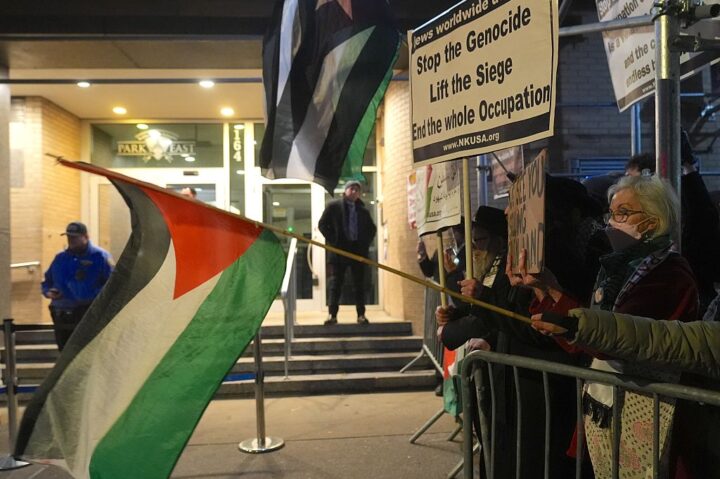
Selçuk Acar/Anadolu via Getty Images
Anti-Israel demonstrators gather at 'No Settlers on Stolen Land' protest against a Nefesh b'Nefesh event at the Park East Synagogue in Manhattan in November 2025.
The group behind a pro-Hamas demonstration near a Queens synagogue earlier this month and a series of other events targeting Jewish religious institutions has deep pockets — and deep roots, which criss-cross the country and link it to various extremist cells — according to publicly available tax filings.
The demonstrators who broke into chants of “Say it loud, say it clear, we support Hamas here” outside Young Israel of Kew Garden Hills — and triggered outrage over New York City Mayor Zohran Mamdani’s belated condemnation — were affiliated with an outfit known by multiple names: Palestinian Assembly for Liberation (PAL), Al-Awda (Arabic for “the return”) and Palestine Right to Return Coalition (PRRC). But official filings with state and federal authorities reveal that the groups are different monikers of a single nonprofit operation, one whose revenue has exploded in recent years: from just $44,789 in 2022 to $451,903 in 2024, the most recent period for which filings are available.
The group also orchestrated the action targeting Park East Synagogue in Manhattan in November, and the “Flood Boro Park” rally that devolved into violence last February. On the day of Hamas’ Oct. 7, 2023, attacks on Israel, the organization issued a full-throated endorsement of the assault.
“The Palestinian Assembly for Liberation and Al-Awda NY send their highest salutations to the Palestinian Resistance, the Freedom Fighters and Defenders of the indigenous Palestinian people,” a post on its Facebook page reads. “PAL and Al-Awda NY call on Palestinians globally to take their place in history, and to mobilize in all fora in support of the Liberation Operation.”
The group helped organize a Times Square protest the following day, alongside multiple far-left organizations. Much of the blowback the event received from New York officials centered on the participation of the NYC chapter of the Democratic Socialists of America, of which Mamdani is and was a member.
However, materials promoting the demonstration show that its staging received support not just from PAL/Al-Awda/PRRC but also from the People’s Forum, a Manhattan-based arm of a global network financed by Beijing-based tech mogul Neville “Roy” Singham. Singham and his wife, Jodie Evans, have poured their massive fortune into advancing disinformation supportive of the Chinese government and its allies, Russia and Iran. The People’s Forum also hosted Al-Awda’s national conference in 2022, which featured speakers from the DSA BDS Working Group.
Social media and blog posts reveal that PAL/Al-Awda/PRRC has also worked closely with Evans’ organization CODEPINK, known for its tactics of disrupting Capitol Hill hearings and political events, and for its pro-China and pro-Iran activism. PAL/Al-Awda/PRRC has also long partnered with the Party for Socialism and Liberation and its affiliate, Act Now to Stop War and End Racism Coalition, which provides staff to the Singham network. All of these groups have been involved in the Shut It Down 4 Palestine protest campaign, as well as in the 2024 encampments at Columbia University.
PAL/Al-Awda/PRRC also has ties to Samidoun, a group identified by Israel, Germany, Canada and the United States as a fundraiser and affiliate of the Popular Front for the Liberation of Palestine, which has been designated as a terror group by the U.S. for decades. PAL/Al-Awda/PRRC and Samidoun have cross-promoted and participated in each other’s events for years.
Further, a booklet for a 2023 “People’s Tribunal” on the Al-Awda website identifies Samidoun co-founder Charlotte Kates as “a member of Al-Awda, The Palestine Right to Return Coalition,” and archived versions of a now-deleted page listing PAL/Al-Awda/PRRC’s national board identified Kates as the group’s “Communications/Secretary” from 2021-2023. These pages also reveal that Nerdeen Kiswani, the founder of Within Our Lifetime and an outspoken defender of militant group violence, served as PAL/Al-Awda/PRRC’s “Youth Representative” in these same years. During that same period, Kiswani was a student at CUNY Law School, and delivered a speech at the school’s 2022 commencement in which she alleged that she had “been facing a campaign of Zionist harassment by well-funded organizations with ties to the Israeli government and military.”
The national board also includes attorney Lamis Deek, who has publicly praised Hamas, the PFLP, and Iran’s Al-Quds intelligence force — and who officially launched the “Palestinian Assembly for Liberation” with other Al-Awda organizers in 2021.
The PFLP and Hamas are not the only terror organizations with which PAL/Al-Awda/PRRC and its leaders have shown affinity. The Anti-Defamation League discovered one of the group’s self-identified founders, Abbas Hamideh, lauded Hezbollah on his Twitter account.
Tax documents show PAL/Al-Awda/PRRC at present has just two officers on its board. The organization’s chair is Amani Barakat, part of a prominent business, real estate and philanthropic dynasty based in Southern California. The late family patriarch, Adil Barakat, was a leader in the Arab American Press Guild and the United States Organization for Medical and Educational Needs, a relief organization centered on Middle Eastern affairs.
PAL/Al-Awda/PRRC’s treasurer and only other listed executive is Anas Amireh, a Miami-area realtor who has lectured at Florida International University.
Barakat, Amireh and Deek did not respond to requests for comment, and messages left in an inbox and at a phone number listed on the Al-Awda website similarly received no answer.
The source of the group’s swelling resources isn’t clear from public information. It has received sizable contributions from “dark money” funds that mask the original contributor’s identity, as well as from the WESPAC Foundation, a New York-based charity that has come under fire for underwriting organizations that call for Israel’s destruction.
Labor for Palestine and U.S. Campaign for the Academic and Cultural Boycott of Israel are also both affiliated with PAL/Al-Awda/PRRC, and operate out of its address in Coral Gables, Fla.
Comedian Guy Hochman performed an alternative show outside in freezing cold weather
Noam Galai/Getty Images
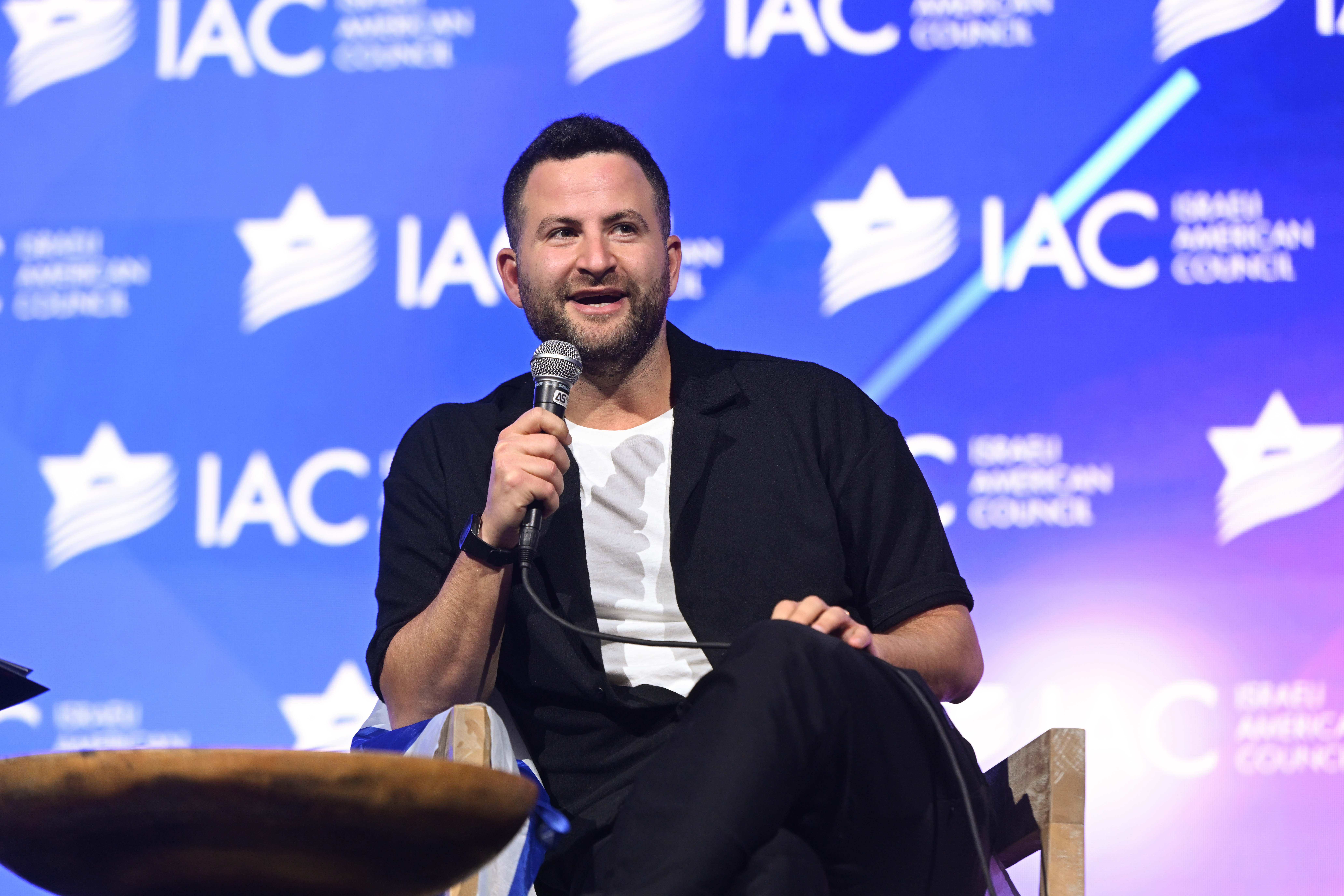
Guy Hochman speaks at the IAC National Summit 2026 at The Diplomat Beach Resort on January 17, 2026 in Hollywood, Florida.
A Manhattan comedy club canceled Israeli comedian Guy Hochman’s show on Tuesday night after pro-Hamas groups protested outside of the venue.
“The owner of the place was afraid and canceled the show,” Hochman told Jewish Insider, referring to Broadway Comedy Club, located near Times Square. “So, I did an alternative show for my audience outside freezing to death.”
“We are not giving up,” Hochman continued, adding that “another, big show” was planned for Wednesday evening. He did not disclose the location of the rescheduled show. “We are the Jewish people and we want to live and laugh,” said Hochman.
The owner of the venue, Carolyn Martin, did not respond to a request for comment from JI.
City College of New York’s Students for Justice in Palestine chapter was among the groups promoting the Tuesday demonstration on social media. It shared a post from the New York City chapter of the Palestinian Youth Movement that said “victory” was achieved by the cancellation. CCNY SJP, which remains a registered student group, also participated in this month’s pro-Hamas protest in Queens that caused nearby schools and a synagogue to close early.
Outside the comedy venue, masked demonstrators banged on drums, chanted and held signs that read “clean up the trash,” “death to the IDF” and “no war criminals in our city.” A heavy NYPD presence was called to monitor the protest.
Hochman was reportedly detained at the airport for six hours of questioning on Monday when he arrived in Toronto after the anti-Israel group Hind Rijab Foundation filed a complaint about his service in the IDF. He was released after intervention from the Israeli consulate.
In contrast with top candidates in the race, Kasky embraced stances far to the left of the Democratic mainstream

Sarah Morris/Getty Images
Co-founder of the student-led gun violence prevention group "Never Again," Cameron Kasky, speaks March For Our Lives II to protest against gun violence on June 11, 2022 in Los Angeles, California.
Cameron Kasky’s announcement on Wednesday that he was ending his bid for a coveted open House seat in the heart of Manhattan and pivoting to focus on advocating for human rights in the West Bank didn’t come as much of a surprise — given the 25-year-old progressive political activist’s almost exclusive fixation on targeting Israel as a first-time candidate.
Kasky, a Democratic upstart who was among a range of contenders vying to succeed retiring Rep. Jerry Nadler (D-NY) in the 12th Congressional District, had recently returned from a visit to the West Bank, and his experience meeting with Palestinians had left him with “one concern,” he said, motivating his decision to drop out of the primary and seek to promote legislation to counter Israeli settler violence in the territory.
Without providing specifics, Kasky said he looked forward to sharing more details of what he called a “West Bank human rights emergency plan” and said he had “consulted with experts extremely well-versed in the matter” to ensure that “the t’s are crossed and the i’s are dotted.”
Still, while Kasky framed his so far loosely defined next act as a “chance to do what must be done” in the wake of his brief “human rights-centered campaign,” as he described it, his explanation about the sudden withdrawal avoided mentioning that he had been seen as an unserious candidate struggling to gain any traction in the crowded race.
His harsh criticism of Israel generated online attention and helped him to build a relatively sizable and enthusiastic following on social media.
But Kasky’s early exit from the June primary, just two months after launching his bid, illustrates how digital clout is not a reliable indicator of meaningful voter support, particularly as a growing number of influencers has sought unsuccessfully to convert online popularity into a seat in Congress in a range of recent primaries.
It also underscores how Kasky’s anti-Israel views were likely alienating to many voters in one of the most heavily Jewish districts in the country — even as several far-left challengers across New York are taking on pro-Israel incumbents. One Democratic operative familiar with the district, which covers the Upper East and West Sides, called Kasky’s hostile positions on Israel a form of political “kryptonite.”
Former New York Gov. Andrew Cuomo, a pro-Israel moderate, won the district with 50% of the vote in November, beating now-Mayor Zohran Mamdani by five points.
In contrast with top candidates in the race, Kasky embraced stances far to the left of the Democratic mainstream, repeatedly accusing Israel of committing genocide in its war in Gaza, for instance, while pledging to vote against all aid to Israel, “‘defensive’ or otherwise,” as he wrote on his campaign site. He also said he was running to block what he called the “Greater Israel” agenda, accusing Israeli leadership of using “colonial violence” to expand the country’s territory across the Middle East.
Polling commissioned by a rival campaign, some details of which were relayed to Jewish Insider by a Democratic source familiar with the figures, showed Kasky far behind his leading opponents. Two recent polls put Kasky in sixth place, garnering just 5% of the primary vote in one and 8% in the other, according to the source, who shared the unpublicized numbers on condition of anonymity.
The polls showed two state assemblymen, Micah Lasher and Alex Bores, clustered at the top of the field along with Jack Schlossberg, a young Kennedy heir, and George Conway, a former Republican attorney and a prominent critic of President Donald Trump, the source confirmed on Thursday. While no candidate won more than 20% of the vote in either poll, Kasky was seen as operating in a lower tier and unlikely to break out.
His stances on Israel, among other issues, were “a dealbreaker” to a significant share of the electorate, the source noted to JI. “I don’t think that he had the means to become a compelling candidate and build a coalition,” he added.
Owing to his hasty departure from the race, some Democratic strategists and activists suggested that he had not intended to remain a candidate and was using his long-shot bid to build an online audience.
“Kasky saw the writing on the wall,” said another Democratic source who spoke with the candidate. “He did not have a sustainable campaign because it was never a campaign for Congress.”
For Kasky, a Jewish survivor of the 2018 shooting at Marjory Stoneman Douglas High School in Florida who became a gun control activist, “it was a campaign for new social media followers, the hard, hard left and activist clout,” the source told JI on condition of anonymity to offer a candid assessment. “He can absolutely claim victory for getting new followers on Instagram outside of Florida, but he achieved this milestone on the backs of the people he so shockingly vilified: NY-12 Jews.”
“He was never running to win,” added a Jewish Democratic leader familiar with Kasky’s abortive campaign, who was granted anonymity to weigh in freely about the race. “He was running to raise his profile and raise some money so he could continue to be an activist influencer.”
Kasky’s campaign, whose fundraising numbers will be reported later this month, did not return JI’s request for comment on Thursday.
Scott Stringer, a former city comptroller who previously lived in the district and now resides in Lower Manhattan, dismissed Kasky’s campaign as unviable from the beginning. “The bottom line is he wasn’t a factor when he was running, and he’s not a factor now that he’s not running,” Stringer, a Jewish Democrat backing Lasher in the primary, told JI. “I think he would have been better served by applying to his local community board.”
“There’s a whole lot of people on Twitter, unfortunately, who focus on Jewish hate,” he added. “But at the end of the day I think most people tuned out his rhetoric. I know I did.”
The outspoken Trump critic also raised concerns about the mayor’s decision to revoke executive orders dealing with antisemitism
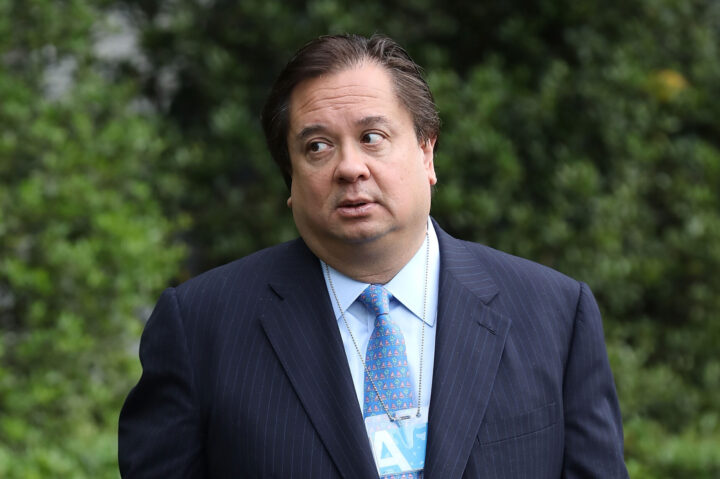
Chip Somodevilla/Getty Images
George Conway attends the 139th Easter Egg Roll on the South Lawn of the White House April 17, 2017 in Washington, DC.
George Conway, a former Republican lawyer and prominent critic of President Donald Trump who announced his bid in a Democratic House primary in Manhattan on Tuesday, is raising concerns about New York City Mayor Zohran Mamdani’s approach to Israel and antisemitism.
Conway, who recently relocated to Manhattan in order to run for the seat being vacated by retiring Rep. Jerry Nadler (D-NY), said in an interview with The New York Times published Tuesday that he was “disturbed” by Mamdani’s sharp criticisms of Israel, even as he called the mayor “a great politician” and voiced admiration for his “focus on affordability.”
The first-time candidate, 62, added in an interview with NBC News on Tuesday that he was “concerned about some of the language” Mamdani has “used in the past about Israel,” as well as the mayor’s recent decision to revoke a pair of executive orders related to Israel and antisemitism on his first day in office.
“His focus really has to be on bringing people together,” Conway said of Mamdani, “not sending the wrong message to individual groups of people.”
As a former Republican operative, Conway, who is running on a staunchly anti-Trump platform, could face skepticism from voters in a heavily Democratic congressional district that includes the Upper East and West Sides.
But his views on Mamdani, who has long been a fierce critic of Israel, could otherwise resonate with a sizable Jewish constituency in the district — which former New York Gov. Andrew Cuomo carried with 50% of the vote in the November mayoral election.
Conway is joining a crowded and competitive race to succeed Nadler, including two state legislators, a Kennedy scion and a gun control advocate who is a vocal detractor of Israel’s war in Gaza. While all the top candidates endorsed Mamdani’s campaign, they have also disagreed with some of his stances on Israel, such as his refusal to recognize the country’s right to exist as a Jewish state.
Still, most candidates have been relatively cautious about publicly sharing their own positions on Israel amid deepening divisions over Middle East policy in the Democratic Party.
Conway, for his part, has previously been critical of Israel’s military conduct during its war with Hamas in Gaza.
A spokesperson for Conway declined to comment further on Tuesday, referring Jewish Insider to his interview with NBC News.
Judge Alvin Hellerstein became a law clerk because firms would not hire an Orthodox lawyer; now, he cites Torah from the bench
Screenshot/ Blavatnik Archive, Oral History Project
Judge Alvin Hellerstein
Judge Alvin Hellerstein is 92 years old, and with 27 years on the federal bench in Manhattan, he has presided over some of the most prominent trials in recent memory — including thousands of lawsuits brought in the aftermath of the Sept. 11 terrorist attacks, a suit against disgraced Hollywood producer Harvey Weinstein and, now, the criminal case against deposed Venezuelan President Nicolás Maduro.
It’s a remarkable final chapter in a legal career that was once nearly derailed by antisemitism. Hellerstein has described his judicial style as being influenced by Judge Edmund Palmieri, for whom Hellerstein served as a law clerk in the 1950s. (Ruth Bader Ginsburg, later a Supreme Court justice, clerked for Palmieri a few years later.) But that chapter almost didn’t happen. Hellerstein wanted to work at a law firm, but he ended up applying to clerkships because he said the non-Jewish law firms in New York would not hire him.
“As a Jewish boy coming to interview at law firms, you met up with very strong discrimination, some of it overt, most of it implied,” Hellerstein said in an interview in 2020 on the podcast “Behind the Bima.” He ended up working at a Jewish firm — one of the first Orthodox lawyers to be employed at any New York City firm.
“I was pleased to say that after me, that there were others, and some credit me with having broken the precedent,” Hellerstein said. “When I became a judge, it didn’t make any difference if I was Orthodox or not. It made no difference if I was religious or not. My capabilities as a lawyer were measured, as well as my character and other characteristics, but there was no discrimination.”
Now, the eyes of not just the legal profession but the world will be upon Hellerstein as he oversees the federal criminal case against Maduro following the brazen U.S. capture of the controversial Venezuelan leader. Maduro pleaded not guilty on Monday in his first court appearance in New York, where he faces narco-terrorism and weapons charges.
Hellerstein was nominated to serve as a federal district judge in the Southern District of New York by President Bill Clinton in 1998. In 2011, he assumed senior status, which means he hears fewer cases than he once did. (President Barack Obama nominated Jesse Furman, also an observant Jew, to fill Hellerstein’s seat on the bench.)
In his chambers, Hellerstein displays a sign bearing a Hebrew phrase from the book of Deuteronomy: “Tzedek tzedek tirdof,” it reads. “Justice, justice, you shall pursue.”
Hellerstein has spoken often about a case he presided over nearly two decades ago, in which a Mexican immigrant truck driver faced drug charges related to narcotics planted in his truck by a different driver. Hellerstein helped the defendant obtain legal counsel, and the case was ultimately dismissed by federal prosecutors — saving the defendant from prison and deportation. When the truck driver appeared in front of Hellerstein, thanking him and crying, Hellerstein invoked that passage from the Torah.
“I told him about the sign I had in my office, tzedek tzedek tirdof,” Hellerstein said in the 2020 interview. “I told him that there are many reasons that are given for the repetition, but the one I favor is that we don’t know where justice is. We have to pursue it. We have to look for it. And when an opportunity is given to have justice in the courtroom, justice in the eyes of the defense counsel, justice in the eyes of the prosecutor, justice in the eyes of the judge and the public, we have to thank him [the defendant] for giving us this opportunity.”
Hellerstein has been active in Jewish communal life for decades. Before he was appointed to the federal bench, Hellerstein served as president of the Board of Jewish Education of Greater New York. He has also been a philanthropic supporter of The Jewish Center, an Orthodox synagogue on the Upper West Side, and AMIT, a network of schools in Israel. According to a 2016 New York Times article, Hellerstein played tennis with three rabbis weekly for more than 45 years.
But Hellerstein has long said that being Jewish does not influence the decisions he reaches as a judge.
“I would not want it to be said that I ruled in a certain way because I am an Orthodox Jew, and I would not want to feel that my Jewish upbringing or values cause me to rule in one way and not another,” Hellerstein wrote in a 2013 article in the Touro Law Review. “My rulings, over thirteen years of judging, are my record. They reflect all that influenced me … indeed, all my life experiences, and, certainly, my Jewish education and my Jewish values. But, above all these influences, there is one category that stands pre-eminent — the Constitution, statutes, and cases that I swore as a judge to follow and uphold.”
In the 2020 interview, recorded during the High Holy Days, Hellerstein was asked by Rabbi Philip Moskowitz of Boca Raton Synagogue what advice he, as a judge, would share ahead of Yom Kippur, the ultimate judgment day.
“You’re in a much better place than I am to make those suggestions,” he quipped to the rabbi. “I do feel that I have to account for what I do. Part of my accountability is to the Court of Appeals, where I can be reversed, and I often am. Another is my account to the individuals involved directly in the process. And third, I have to account to God. My purpose in life is to be as good a judge as I can be, and I have to ask for strength and wisdom in performing that job.”
Hillary Clinton says anti-Israel sentiment among young people fueled by ‘propaganda’ on social media
Speaking at the Israel Hayom summit, Clinton recalled the ‘frankly shocking’ lack of understanding among her students at Columbia University
Alex Wong/Getty Images
Former U.S. Secretary of State Hillary Clinton delivers keynote remarks during a discussion at Georgetown University on December 2, 2025 in Washington, DC.
Speaking at the Israel Hayom summit in Manhattan on Tuesday, former Secretary of State Hillary Clinton warned of the influence of social media in shaping young people’s perceptions on Israel and the Israeli-Palestinian conflict.
“There is a great deal of valid concern about how Israel is viewed, not just around the world, but from the United States, how Jewish Americans are viewed, and what is being seen as a significant increase in antisemitism in real life and online,” said Clinton. “It’s time now that the hostages are back and people can breathe again, that everyone needs to take stock of where we are, both in Israel and in this country, learn the lessons that perhaps can help us determine a more productive future.”
Clinton said she believes growing hostility toward Israel is a “generational” issue, rather than a “Republican versus Democrat” divide.
“A lot of the challenge is with younger people. More than 50% of young people in America get their news from social media,” said Clinton, who added that the problem lies in the information users are receiving “and the conclusions they are drawing from it.”
Clinton recalled teaching at Columbia University, where she is a professor of practice at the School of International and Public Affairs, during and after the Oct. 7, 2023, terrorist attacks and seeing this impact firsthand.
“We began to realize that our students — smart, well-educated young people from our own country, from around the world — where were they getting their information? They were getting their information from social media, particularly TikTok. That is where they were learning about what happened on Oct. 7,” said Clinton. “What they were being told on social media was not just one sided, it was pure propaganda.”
Clinton said it was often difficult to engage in “reasonable discussion” in such a climate because students lacked historical knowledge and “had very little context,” calling it “frankly shocking.” She also warned that in addition to social media, she saw immediate and planned efforts to distort the context of the Oct. 7 attacks.
“There was an organized effort that was prepared literally on Oct. 8 to begin to try to both provide mis- and disinformation about what had happened on Oct. 7, what the meaning was, what the history between the Israelis and the Palestinians [was],” said Clinton.
A key way forward, according to Clinton, is finding an effective way to talk about Israel to the younger generation. She added that Israel has “the worst PR.”
“The story that needed to be told was not getting told as effectively as I thought it should. And I think that’s only worse now,” said Clinton. “We have to do a better job of talking through the importance of supporting Israel and Israel’s security in a way that crosses generations.”
If elected in January, Menin would be the first Jewish speaker of the New York City Council
Lev Radin/Pacific Press/LightRocket via Getty Images
Council member Julie Menin speaks during rally of 240 Holocaust survivors for 240 hostages kidnapped by Hamas during terrorist attack on Israel on October 7, 2023.
Julie Menin, a moderate Jewish Democrat from Manhattan who last week declared an early victory in the New York City Council speaker race, is widely expected to serve as an ideological counterweight to the incoming administration of Mayor-elect Zohran Mamdani, a democratic socialist hoping to advance a range of far-left agenda items.
Some of their biggest clashes could stem from their sharply opposing views on Israel and antisemitism.
Menin, who would be the Council’s first Jewish speaker if officially elected in January during an internal vote, is an outspoken supporter of Israel and visited the country on a solidarity trip months after Hamas’ Oct. 7, 2023, attacks. The daughter of a Holocaust survivor, Menin, 58, has advocated for Holocaust education funding and warned of rising antisemitism as a three-term city councilwoman.
For his part, Mamdani, a 34-year-old Queens state assemblyman, has long been a detractor of Israel — whose right to exist as a Jewish state he has refused to recognize. He has said that he will not participate in the Israel Day parade up Fifth Avenue, which Menin regularly attends, and indicated that he could move to enact some policies aligning with the Boycott, Divestment and Sanctions movement targeting the Jewish state, even as he has also promised to protect Jewish New Yorkers by calling for a major increase in funding to prevent hate crimes, among other measures.
Their diverging approaches to such issues were on display late last month, when Menin and Mamdani each shared contrasting statements responding to a demonstration outside of a synagogue in her district during an event about immigration to Israel.
While Mamdani admonished the synagogue for promoting “activities in violation of international law,” a comment he revised after facing backlash, Menin condemned the protest as “not acceptable,” saying “congregants must have the right to worship freely and to enter and exit their house of worship without impediment.”
Jewish community leaders suggested that Menin, whose district includes a wide swath of the Upper East Side, could find herself at odds with Mamdani if he chooses to act on some of his campaign pledges that raised red flags among pro-Israel advocates. The mayor-elect has said, for instance, he intends to revoke the city’s embrace of a working definition of antisemitism used by the International Holocaust Remembrance Alliance. He has also indicated he will reassess the partnership between Cornell University and Israel’s Technion, potentially kicking the joint Cornell Tech campus out of its home on Roosevelt Island, which sits in Menin’s district.
A spokesperson for Menin said that she was not available for an interview with Jewish Insider on Monday.
In a recent conversation with Errol Louis of NY1, Menin defended the Cornell-Technion partnership, saying that it has “created thousands and thousands of tech jobs.”
“I was just there last month. They’ve created hundreds of new tech companies, innovative tech companies that are now housed in New York City, that are really the future of our great city,” Menin added. “I think, look, we need to really try to come together on these issues, and I think it’s absolutely possible to do so.”
One Jewish leader close to Menin, who spoke with JI on condition of anonymity to address a sensitive issue, said that “the community sees her as a check and a safeguard” against Mamdani’s administration and that she “understands the historical importance of this moment,” as she is poised to become the first Jewish speaker. “She is a proud Jewish woman who represents a proud Jewish district.”
Still, the Jewish leader noted, Menin is “not the type to look for any fights,” stressing she is more likely to first seek common ground on divisive issues, unless she has “no choice but to push back.”
In recent public statements, Menin has struck a collaborative tone in regard to Mamdani, who will be the city’s first Muslim mayor, stressing their shared focus on affordability goals such as universal childcare, one of the mayor-elect’s top priorities.
Menin announced last week that she had secured enough backing to become the next speaker, touting votes from at least 36 members of the council. Though allegiances could shift in the coming weeks, Menin, who added endorsements Monday, is not expected to fall below the minimum threshold of 26 votes required to win in the 51-seat body. Her chief rival, Crystal Hudson, a progressive from Brooklyn who was seen as more closely aligned with Mamdani’s agenda, conceded the race last week.
In a statement last Wednesday, Menin, who did not make an endorsement in the mayoral race, said she was “honored and humbled by the trust and faith that my colleagues have put in me to lead the City Council as a force of action for New York families.”
“With this broad five-borough coalition, we stand ready to partner with Mayor-Elect Mamdani’s administration and deliver on a shared agenda that makes New York more affordable through universal child care, lowers rent and health care costs and ensures that families across the city can do more than just get by,” she continued.
A spokesperson for Mamdani, who did not publicly take sides in the speaker race, did not respond to a request for comment on Monday.
Dora Pekec, a spokesperson for the mayor-elect, said in a statement last week that Mamdani “looks forward to working with her and the entire City Council to deliver on our affordability agenda for New Yorkers.”
Lynn Schulman, a Jewish councilwoman from Queens and an ally of Menin, said she believed her colleague “will be an excellent speaker” and “fair to everybody,” especially as she prepares to negotiate a massive, $116 billion budget.
“The Council is made up of a very broad and diverse group,” she told JI. “I think that there is going to be a lot of collaboration. Julie is someone who’s always brought a lot of people together. We have to work as a collegial body.”
Sydney Altfield, CEO of Teach Coalition, an Orthodox advocacy group, said that she was “encouraged” that Menin locked up a super majority among council members, adding that she had “worked closely” with the likely speaker and trusts “she is someone who can turn policy into progress.”
“As New York moves forward with a Muslim mayor, a Catholic governor and now the potential of a Jewish council speaker, we have the chance to see something powerful,” Altfield said in a statement to JI. “Leaders from every faith standing shoulder to shoulder for our children.”
Despite looming tensions over Israel, Sara Forman, executive director of New York Solidarity Network, a local pro-Israel group, said it was “premature” to speculate about any possible friction with Mamdani, focusing instead on how Menin is poised to become the first Jewish speaker — which she called “hugely significant in this moment” of rising antisemitism.
“It gives the community some reassurance moving forward that there’s somebody just like us,” Forman said.
Andrew Cuomo carried the district in the NYC mayoral race, underscoring its pro-Israel constituency
Michael M. Santiago/Getty Images
Rep. Jerrold Nadler (D-NY) arrives to view proceedings in immigration court at the Jacob K. Javitz Federal Building on June 18, 2025 in New York City.
An increasingly crowded race for a coveted House seat in the heart of Manhattan is shaping up to be among the most vigorously contested Democratic primary battles in next year’s midterms, with half a dozen — and counting — contenders now jockeying for the chance to succeed retiring Rep. Jerry Nadler (D-NY).
In a district home to one of the largest Jewish constituencies in the country, the open primary next June is likely to center in part on Israel as the candidates signal where they stand on an issue that has grown intensely charged over the war in Gaza.
Even as the far left now seeks to ride momentum from Zohran Mamdani’s mayoral victory — which elevated an unabashed socialist to executive office — experts suggested the primary could largely serve as an exception to the anti-Israel sentiments that became a trademark of his stunning rise.
Former New York Gov. Andrew Cuomo, who ran as an independent in the mayoral election this month, won the district by five points with 50%, indicating that a potentially meaningful share of Jewish voters were resistant to Mamdani’s hostile views on Israel and refusal to condemn rhetoric seen as antisemitic.
The district, which includes the Upper East and West Sides of Manhattan, “is more moderate and pro-Israel than” another heavily Jewish House seat in Brooklyn where Mamdani performed well, Chris Coffey, a Democratic strategist who is not involved in the race, told Jewish Insider on Thursday.
So far, however, most of the declared candidates have been relatively cautious about sharing their positions on Israel — underscoring the hazards of addressing a subject that has fueled deep divisions within the Democratic Party. “I would be surprised if they want to lead on this,” Coffey speculated. “It’s a contentious issue.”
With the exception of Alex Bores, an assemblyman who represents the Upper East Side, none of the top candidates who have launched bids in recent weeks answered a question from JI on Thursday asking whether they would support an embargo on offensive weapons to Israel, a measure backed by Nadler after he revealed in September that he would step down at the end of his current term.
“There are laws on the books about this and they should be applied across the board,” Bores said in a statement indicating he would oppose such efforts if elected. “There is no singling out or exemptions for any one country.”
Privately, Bores has been “clear” that an arms embargo is not “negotiable for him,” according to a person familiar with his thinking. Former Rep. Steve Israel (D-NY), a pro-Israel Jewish Democrat, endorsed the assemblyman on Tuesday but was not available to comment about his decision.
Alan Pardee, a former financial executive who is also seeking the nomination, was more direct in a statement shared with JI. “I believe that Israel has the right to defend itself, and that the United States is a critical ally in that regard. I do not support the proposed embargo,” he said.
Micah Lasher, a Jewish assemblyman on the Upper West Side and a protégé of Nadler who is viewed as traditionally pro-Israel, has yet to publicly confirm his own stance on the matter, even as he is expected to reject an embargo. Lasher also dodged a question about the issue while speaking at an Assembly town hall in September before he launched his House bid, saying he was unwilling to discuss topics outside his state legislative purview, according to audio shared with JI.
A poll that circulated in the district in September, which some observers suspected was affiliated with Lasher or allies of his campaign, asked respondents whether they supported Congress blocking “the sale of weapons to Israel” in order to “send a message to Israeli Prime Minister Benjamin Netanyahu,” a sign of the significance of such questions to voters in the race.
Like Nadler, a veteran Jewish lawmaker who has long sought to balance his progressive politics with support for Israel that dwindled during the war in Gaza, Lasher had faced backlash from some Jewish community leaders in the district for having endorsed Mamdani, though he has clarified they are not aligned on Israel issues.
Other candidates in the primary who backed the mayor-elect have similarly distanced themselves from his positions on Israel. Erik Bottcher, a city councilman from Chelsea who joined the primary on Thursday, has confirmed that, unlike Mamdani, he supports Israel’s right to exist as a Jewish state. Jack Schlossberg, an influencer and the grandson of John F. Kennedy, who also entered the primary this week, has said he disagrees with Mamdani’s pledge to arrest Netanyahu if he steps foot in the city. The political scion was raised Catholic but identifies as Jewish.
Bores, who endorsed Mamdani in September, has objected to a failed bill the mayor-elect introduced as an assemblyman to strip nonprofit groups of their tax-exempt status for “engaging in unauthorized support of Israeli settlement activity.” Bores has said he viewed the bill as “immediately suspicious” because it “singularly applies to organizations providing aid to a specific country and its people.“
And Liam Elkind, a Jewish former nonprofit leader who had launched a primary challenge to Nadler before he announced his plans to retire, has expressed his concern that Mamdani has refused to denounce the phrase “globalize the intifada” — seen by critics as a call to violence against Jews. Mamdani has, instead, pledged to “discourage” usage of the phrase.
Rounding out the primary field is Jami Floyd, an attorney and journalist who is seeking to occupy a centrist lane and has said that she did not vote for Mamdani.
The field could grow as other potential candidates are said to be mulling campaigns, including George Conway, a lawyer and outspoken critic of President Donald Trump who is an independent, and Nathalie Barth, former president of Park Avenue Synagogue.
Cameron Kasky, a young gun-violence prevention activist, has filed to run and said on Thursday he is now exploring a bid. He is expected to soon join the race, according to a person familiar with the matter. He would be one of the lone anti-Israel voices in the current primary field, testing the resonance of such views among an electorate that denied Mamdani the majority of the vote.
Kasky, who is Jewish, has frequently criticized Israel on social media and is in favor of an arms embargo. “If you are a Democrat running in 2026 and do not fully support an arms embargo to the to State of Israel amidst their ongoing genocide in Gaza despite Trump’s fake ‘ceasefire,’” he said in a recent post, “Stop wasting everybody’s time. It’s over. The people have spoken. Moral clarity is winning.”
Despite his recent loss, Cuomo, a staunch defender of Israel, is also exploring a campaign and has been making calls to donors who backed his mayoral bid, though it was unclear how seriously he is considering the move, people familiar with the matter told JI. Cuomo, who was once married to a Kennedy, has suggested that he can pull support from Schlossberg and told people he “already has the Kennedy voters,” one of the sources told JI. A spokesperson for Cuomo has dismissed speculation that he has been considering a House campaign.
The primary is also expected to attract outside spending from super PACs and major Democratic donors, including Reid Hoffman, the co-founder of LinkedIn who has reportedly committed to backing Elkind. One person familiar with the race suggested Lasher could claim support from a powerful former boss, Michael Bloomberg, the former mayor of New York City, for whom he once worked as a legislative director.
AIPAC, the pro-Israel advocacy group that has actively engaged in recent primary cycles, did not respond to a request for comment about how it is assessing the race.
The Reform leader told JI the Jewish community ‘has an obligation to counter’ the normalization of anti-Zionist views on the left
Screenshot
Rabbi Ammiel Hirsch speaks at the Stephen Wise Free Synagogue in New York City on Feb. 28, 2025
As the New York City mayoral race nears its end, Manhattan Rabbi Ammiel Hirsch has a message for his colleagues: It’s not too late to provide “leadership and clarity of perspective” to voters to oppose Democratic nominee Zohran Mamdani, citing the candidate’s hostility towards Israel and refusal to recognize it as a Jewish state.
Hirsch, a prominent and notable moderate pro-Israel voice within the progressive-minded Reform movement isn’t surprised by polling showing Mamdani leading his opponents, former New York Gov. Andrew Cuomo, who is running as an independent, and Republican Curtis Sliwa, among unaffiliated and Reform Jews, who skew overwhelmingly liberal.
But Hirsch, the senior rabbi of the Stephen Wise Free Synagogue, expressed frustration with the lack of organized effort among Jewish leaders to oppose Mamdani, whose affiliation with the Democratic Socialists of America (DSA) and antagonistic views on Israel — including his refusal to condemn the term “globalize the intifada” — have generated private and public criticism.
In an interview with Jewish Insider on Wednesday, Hirsch, who has led the Upper West Side congregation for the past 20 years, said there is still time for left-wing Jewish leaders to find their voice. Even without initiatives and statements from the Reform movement, progressive Jewish leaders can still “make a difference” by “laying out the stakes” — even as early voting begins this Saturday.
Hirsch recently released an online video message, addressing Mamdani directly. “I do not speak for all Jews, but I do represent the views of the large majority of the New York Jewish community, which is increasingly concerned with your statements about Israel and the Jewish people,” the rabbi said. “Your opposition to Israel is not centered on policies, you reject the very existence of Israel as a Jewish state … I urge you to reconsider your long-held rejection of Israel’s right to exist. Be a uniter and a peacemaker.”
Following Hirsch’s video, other Jewish leaders began to follow his lead. Rabbi Elliot Cosgrove of the Conservative Park Avenue Synagogue on Manhattan’s Upper East Side said in an address to his congregation last Saturday, “Mamdani’s distinction between accepting Jews and denying a Jewish state is not merely a rhetorical sleight of hand or political naïveté — though it is to be clear both of those — his doing so is to traffic in the most dangerous of tropes.”
On Wednesday, more than 600 rabbis from around the country signed on to an open letter, “A Rabbinic Call to Action: Defending the Jewish Future,” spearheaded by The Jewish Majority.
“As rabbis from across the United States committed to the security and prosperity of the Jewish people, we are writing in our personal capacities to declare that we cannot remain silent in the face of rising anti-Zionism and its political normalization throughout our nation,” the letter states.
“When public figures like New York mayoral candidate Zohran Mamdani refuse to condemn violent slogans, deny Israel’s legitimacy, and accuse the Jewish state of genocide, they, in the words of Rabbi Ammiel Hirsch, ‘Delegitimize the Jewish community and encourage and exacerbate hostility toward Judaism and Jews.’”
Hirsch, who serves as president of the New York Board of Rabbis, sat down with JI to discuss the current moment, one that he called “an obligation — it’s the call of history — for Jewish leaders to stand up” ahead of the Nov. 4 election.
Jewish Insider: You’ve been raising your voice against Mamdani, but with voting starting this weekend, do you think other Jewish leaders who have just started speaking out took too long?
Ammiel Hirsch: The Jewish world has very serious self-reflection to do in the aftermath of the Oct. 7, 2023, terrorist attacks. Everything has changed and the future will be different than what it was going to be pre-Oct. 7. The American Jewish community has substantial — in some respects unprecedented — challenges in the years to come.
The kind of antisemitism we are seeing now and likely to see in the future is different and more widespread than anything anyone alive has experienced. Our relationship with Israel has to be reassessed and reevaluated. How we teach our young people has to be reassessed and evaluated and the nature of the American Jewish community itself — we are seeing a deep polarization that should have taken everybody by surprise. During crunch time, when Israel was under real existential threat, we didn’t expect this kind of polarization around the idea of the existence of Israel.
Everything needs to be reevaluated. I concluded over the last two years that certain things I was perhaps willing to overlook in favor of other values and interests need to be looked at more carefully now. I’m not prepared to overlook candidates for public office who express fundamental anti-Zionism. We need to draw the line on anti-Zionism because it disenfranchises and delegitimizes Judaism itself. It leads to an intensification of antisemitism.
JI: Are you surprised there hasn’t been more of an organized effort among the Jewish community to challenge Mamdani since he won the primary in June? Has the Jewish world met the moment?
AH: We’ve been slow to respond to widespread, pervasive, global anti-Zionism and we’ve been slow inside the Jewish community in countering Jewish voices who are anti-Zionist. We, the mainstream of the Jewish community, have an obligation to counter that ideology. If it’s not countered, it intensifies and exacerbates the problem and that relates to public candidates as well. It’s imperative for the American Jewish community to stand up and express the kinds of views that I expressed. I think more are doing so. It is a responsibility at this historic moment in time for Jewish leadership to do so.
It would have been better had it been earlier, but it’s welcome — and imperative — at any time. It does make a difference and I urge everybody, especially those in Jewish leadership, to lay out the stakes. I say this as a Jewish leader, but I’m a New Yorker and U.S. citizen as well and care about the well-being of the city and country. It goes way beyond the well-being of the Jewish community.
Judaism has a lot to say about poverty, economics, immigration, the death penalty — all of those issues are important as well. But specifically on the anti-Zionism issue, it goes to the very existence and future of the Jewish people. Anti-Zionism means dismantling the place where half of the world’s Jews live. That’s the intention of the anti-Zionist enemies of Israel and Zohran Mamdani is giving them ideological and communal support. It’s an obligation — it’s the call of history — for Jewish leaders to stand up at this moment of Jewish history. Our people need leadership and clarity of perspective from their leaders. They’re thirsting for Jewish leaders to clarify what is in the best interest of the Jewish people and what is in the best interest of our values. Not to do that is to fail at this inflection point of American and world Jewish history. I’m heartened that more American Jewish leaders are speaking up now, but not enough.
JI: What do you make of the recent IRS reversal allowing rabbis and other clergy members to make political endorsements from the pulpit? One of the most recent examples being by another prominent New York City rabbi, Elliot Cosgrove, who heads the Park Avenue Synagogue. He decried Mamdani in a speech to his congregation last Shabbat, saying he believes the front-runner “poses a danger to the security of the New York Jewish community.”
AH: For me, I uphold the Johnson Amendment [a 1954 provision in the U.S. tax code that prohibits all 501(c)(3) nonprofit organizations from endorsing or opposing political candidates], no matter what the IRS decided to enforce. I do not endorse political parties or candidates. I speak about policies, which are directly relevant to our roles as rabbis and Jewish leaders. Policies reflect public morality. I’m not going to become partisan. It’s wrong on principle, because we receive tax relief status on the basis of our commitment to being nonpartisan. It weakens us because it unnecessarily splits the community and runs the risk of making synagogues into political centers. I try very carefully to speak about general policies and not endorse parties or candidates. That’s why my message was in the form that it was [speaking to Mamdani directly].
In my message, I was turning to the candidate himself. I didn’t tell people what my political preferences were or how they should vote. My message was that anti-Zionism endangers the Jewish community.
JI: Polls that look at Reform, Conservative and Orthodox voters have found Reform Jews are more supportive of Mamdani — why do you think that is? You’ve authored several essays, both before and after Oct. 7, about why the Reform movement is more inclined towards criticizing Israel than other branches of Judaism. Is that a driving factor here for support for Mamdani?
AH: The more liberal a person is the more likely they are to resonate and support liberal candidates, so it’s not surprising to me. The Reform movement started in North America as a religious movement that negated the centrality of Jewish peoplehood, so of course they were going to resonate more to universal values, not as an expression of Jewish peoplehood values, but the negation of it. Part of that still exists and the more years go by that Jews do not perceive an existential threat against the Jewish community, the more they return to that inclination towards universalism — that Jewish peoplehood is the problem. I’ve called that out for years now and I think that does play a role. It’s why I feel so strongly that I need to speak out.
I do not consider anti-Zionism to be a liberal position, it’s illiberal and I think many people are confused. Zionism is the liberation movement of the Jewish people, that’s a liberal philosophy.
JI: Would you like to see the Union for Reform Judaism come out with an official statement against Mamdani?
AH: I don’t participate in the decisions of the URJ. As I said, I believe it’s important for every Jewish leader to speak up at this inflection point of American Jewish history, so I would welcome it from everybody across the board.
I’ve seen some very good statements from our Orthodox colleagues. We need to unite as much as possible. There is room for debate and disputation, it’s part of Judaism, but at this critical moment in Jewish history we should seek to lay aside for another day controversies that distract us from the main objective that we have, which is to counter antisemitism and a form of anti-Zionism that constitutes antisemitism.
All of us need to unite on that because we’re a small minority and the task is monumental. If we don’t voice a common position, then what happens is we give an impression that the Jewish community is split on the very essence of the contemporary Jewish experience, which is the centrality of Jewish peoplehood and support of the Jewish state. We give the impression that the small minority of Jews, who are very noisy, constitute a much bigger component of Judaism than they really are. That’s another reason we need to counter this loudly.
In our movement, which is the most liberal of affiliated American Jews, there are some anti-Zionist voices but the overwhelming majority of the Reform movement is pro-Israel and considers Israel to be a component of their own Jewish identity.
JI: What are some ways in which you would encourage synagogues and Jewish institutions to engage with Mamdani if he is elected mayor?
AH: If he becomes mayor, he will have been elected fair and square. Then we’ll have to try our best to work with him where we can and oppose him when we must.
Given that this anti-Zionist philosophy is mainstream, it is imperative for American Jewish leaders to stand up, push back. People will vote how they vote and whoever wins will reflect the will of the people and then we’ll have to work within those constraints.
Good Tuesday afternoon,
This P.M. briefing is reserved for our premium subscribers like you — offering a forward-focused read on what we’re tracking now and what’s coming next.
I’m Danielle Cohen-Kanik, U.S. editor at Jewish Insider. I’ll be curating the Daily Overtime for you, along with assists from my colleagues. We hope you enjoy the inaugural edition and would love to hear your thoughts and feedback. Please don’t hesitate to drop us a line by replying to this email.
📡On Our Radar
Notable developments and interesting tidbits we’re tracking
Today, we remember Wesley LePatner, a Jewish philanthropist and Blackstone executive killed in Monday’s shooting at the firm’s Manhattan headquarters. LePatner, 43, served on the boards of the pluralistic Abraham Joshua Heschel School and the UJA-Federation of New York. The federation called LePatner “extraordinary in every way” in a statement, saying she “lived with courage and conviction, instilling in her two children a deep love for Judaism and the Jewish people.” Hindy Poupko, deputy chief planning officer at UJA, said in remarks at the Israel on Campus Coalition’s National Leadership Summit in Washington today that there was a second Jewish victim of the shooting, Julia Hyman. Hyman, a Cornell graduate, worked for Rudin Management in the Midtown skyscraper…
Concerns among Democrats about the humanitarian situation in Gaza and Israel’s role in it are intensifying. On Capitol Hill, the majority of Senate Democrats, led by a group including Senate Minority Leader Chuck Schumer (D-NY) and Sen. Jacky Rosen (D-NV), sent a letter to Secretary of State Marco Rubio and Middle East envoy Steve Witkoff calling the humanitarian crisis in Gaza “unsustainable” and saying that the Israeli- and American-backed Gaza Humanitarian Foundation has “failed” to properly deliver aid…
One Democrat standing up for Israel is Rep. Ritchie Torres (D-NY), who said at the ICC summit today, “We have to remind the world that, despite the amnesia, Hamas was the central cause of the war in Gaza. … Hamas is morally responsible, principally responsible for the war in Gaza.” Read more on Torres’ speech in JI’s Daily Kickoff tomorrow…
Sen. Bernie Sanders (I-VT), who did not sign the Senate Democrats’ letter, jumped into the fray by introducing another resolution to block an arms transfer to Israel — his third since November 2024. In a novel twist, this resolution would block the sale of $1 million worth of assault rifles to Israel’s police force overseen by far-right Minister of National Security Itamar Ben-Gvir, potentially opening the door for more Democrats to vote in favor, given Ben-Gvir’s less-than-favorable reputation within the party…
British Prime Minister Keir Starmer, applying pressure of his own, announced today that the U.K. will recognize a Palestinian state at the U.N. General Assembly in September — matching France’s timeline, announced last week — unless Israel takes “substantive steps to end the appalling situation” in Gaza, reaches a ceasefire with Hamas and commits to reviving the possibility of a two-state solution and not annexing the West Bank. President Donald Trump, who met with Starmer in Scotland yesterday, told reporters that the British PM didn’t discuss the move with him and that he has no view on it, but that the U.S. is “not in that camp”…
On the home front, UCLA settled a lawsuit with Jewish students who alleged that the university permitted antisemitic conduct during the campus’ anti-Israel encampments in spring 2024. According to the agreement announced today, the university cannot allow or facilitate the exclusion of Jewish students, faculty or staff from UCLA programs or campus areas. Notably, the agreement specifies that Jews cannot be excluded “based on religious beliefs concerning the Jewish state of Israel.” Also getting a windfall in the settlement: UCLA agreed to pay over $2.3 million combined to UCLA Hillel and Chabad, the Anti-Defamation League, the Academic Engagement Network and other Jewish organizations combating antisemitism on campus…
⏩ Tomorrow’s Agenda, Today
An early look at tomorrow’s storylines and schedule to keep you a step ahead
Keep an eye on Jewish Insider later this week where we’ll feature an interview with Jeanine Pirro, interim U.S. attorney for D.C., who spoke with JI about the ongoing prosecution of the assailant responsible for the deadly May shooting at the Capital Jewish Museum. We’ll also cover Rep. Mike Collins’ (R-GA) record on antisemitism as he jumps in the race to challenge Sen. Jon Ossoff (D-GA), and report on Harvard’s overtures to the Jewish community while it gears up for a settlement with the federal government.
We’re staying tuned for how President Donald Trump may react as some of the U.S.’ closest allies gear up to recognize a Palestinian state, a policy the U.S. has rejected as unhelpful to peace efforts for decades. Though he said today he has “no view” on the matter, as the U.N. General Assembly nears, will Trump take a tougher line on his European partners?
Stories You May Have Missed
WAIT-AND-SEE APPROACH
New York Jewish leaders reluctant to fight against Mamdani
One Jewish political leader: ‘No one thinks it’s going to be good for the Jewish community to be hostile and to be in constant war with the next mayor’
PODCAST POLITICS
Former Obama staffers turned podcasters reemerge to lead anti-Israel chorus

Ben Rhodes and Tommy Vietor shaped the story of the Iran nuclear deal. Now they’re trying to turn Democrats away from Israel
LePatner, a Blackstone executive, served on the boards of the Abraham Joshua Heschel School and UJA-Federation of New York
courtesy/UJA-Federation of NY
Wesley LePatner speaks at the UJA-Federation of New York's annual Wall Street Dinner in December 2023.
Wesley LePatner, a Blackstone executive who was involved with Jewish communal organizations in New York City, was killed in the Monday shooting at the firm’s Midtown headquarters, the company confirmed on Tuesday.
LePatner was the global head of Core+ Real Estate at Blackstone and CEO of Blackstone Real Estate Income Trust, according to Blackstone’s website. A Yale graduate, she joined the company in 2014 after more than a decade at Goldman Sachs.
She served on the board of trustees at the Abraham Joshua Heschel School, a pluralistic Jewish day school in New York, and she joined the board of directors at UJA-Federation of New York earlier this month.
“We are devastated by the tragic loss of Wesley LePatner, a beloved member of UJA’s community and a member of our board of directors, who was killed in yesterday’s mass shooting in Midtown,” the federation said in a statement.
“Wesley was extraordinary in every way — personally, professionally, and philanthropically,” the organization said. “In the wake of Oct. 7, Wesley led a solidarity mission with UJA to Israel, demonstrating her enduring commitment in Israel’s moment of heartache. She lived with courage and conviction, instilling in her two children a deep love for Judaism and the Jewish people.”
In 2023, LePatner was awarded the Alan C. Greenberg Young Leadership Award at UJA’s 2023 annual Wall Street dinner. In a speech, she outlined her involvement with the organization, dating back nearly two decades.
“I first attended the UJA Wall Street dinner as a young analyst in 2004, where I am pretty certain I sat in one of the last tables at the back of the room,” LePatner said at the event, which took place two months after the Oct. 7 attacks. “Never in my wildest imagination could I have believed that I would be up on this stage two decades later. UJA has many super-powers, but its most important in my view is its power to create a sense of community and belonging, and that ability to create a sense of community and belonging matters now more than ever.”
LePatner also sat on the board of the Metropolitan Museum of Art, the Yale University Library Council and Nareit, a real estate organization.
The shooting also claimed a second Jewish victim, Julia Hyman. A Cornell graduate, Hyman worked for Rudin Management in the Midtown skyscraper.
Ofir Akunis, consul general of Israel in New York, called the murder of LePatner and Hyman — as well as NYPD Officer Didarul Islam — “horrific and senseless” at the Israel on Campus Coalition’s National Leadership Summit in Washington on Tuesday. “In this difficult moment, Israel stands in solidarity with New Yorkers and all Americans,” Akunis said.
Jones was honored at the Auschwitz Jewish Center Foundation’s 25th anniversary gala dinner

Haley Cohen
CNN commentator Van Jones addressed some 600 attendees of the Auschwitz Jewish Center Foundation 's(AJCF) 25th anniversary gala dinner at Pier 60 in Manhattan, June 12th, 2025
“It’s not the firebombs and hunting of Jewish people in the streets of America right now, it’s the appalling silence of people that know better and won’t say better,” CNN commentator Van Jones told some 600 attendees of the Auschwitz Jewish Center Foundation’s (AJCF) 25th anniversary gala dinner on Wednesday at Pier 60 in Manhattan.
Jones was honored at the gala for his work promoting Black-Jewish relations, which includes launching the Exodus Leadership Forum, a group that aims to renew the Civil Rights Movement-era alliance between the Black and Jewish communities. In January, he led an AJCF-Exodus Delegation to Poland, commemorating the 80th anniversary of the liberation of Auschwitz-Birkenau.
“It was a small number of Black folks who held on to the cultural DNA of ‘justice for all.’ It was a small number of Jews who held on to the cultural DNA of ‘repair the world,’” Jones said, reflecting on the Civil Rights Movement, in which American Jews played a meaningful role. “When you put those two bits of cultural DNA together, you get a double helix of hope for humanity.”
Jones called on Black people and Jews to partner together again amid a different kind of crisis.
“We have to do it again,” he said. Following the recent shooting in Washington in which two Israeli Embassy employees were killed and a firebombing attack in Boulder, Colo., targeting advocates calling for the release of hostages in Gaza, the FBI and Department of Homeland Security warned last week that American Jews face an “elevated threat.”
Wednesday’s event was held in support of AJCF’s anti-hate educational center based in Oswiecim, Poland. In attendance — in full uniform — were several alumni of the American Service Academies Program, a 16-day educational initiative in Poland run by AJCF for a select group of cadets and midshipmen from the academies for the U.S. Military, Navy, Air Force and Coast Guard. Most of the participants are not Jewish and come from rural towns.
At the dinner, AJCF announced plans to partner with Historically Black Colleges and Universities to bring Black and Jewish leaders on the program to learn about shared history. The group also announced the recent purchase of a new facility, which will be located across the street from the current one and will focus on genocide prevention education.
“Be proud of who you are, what you have persevered through and the example that you have set for the world,” Jones told the crowd, which also included several Holocaust survivors.
“Just an inch out of the horrors of the Holocaust, [Jews in the Civil Rights Movement] came and helped us,” Jones reflected. “Can you imagine that? Being an inch out of the horrors of the Holocaust and then seeing your children get in buses and go down south to help somebody. What a people.”
From secular to sacred, the trendy Chabad location draws young professionals, business executives and politicos together in community

Courtesy
Chana Gurevitch and Rabbi Berel Gurevitch, former U.S. Ambassador to Israel Tom Nides and television producer and congregation member Neil Goldman at Chabad West Village.
It’s Friday evening in Manhattan’s fashionable West Village. A couple dozen of New York’s elite — business executives, a television producer, a fashion designer, a journalist and a few politicos — pack a charming brownstone, a spot that’s been frequented by a range of influential people, from former U.S. Ambassador to Israel Tom Nides to reality TV personality Andy Cohen. Wine flows around a long candlelit table. A three-course meal and deep discussion follow late into the night.
This isn’t dinner in one of the neighborhood’s Michelin-starred restaurants — although some weeks the waitlist here can be just as long. It’s Shabbat at Chabad West Village.
There are more than 3,000 Chabad Houses around the world aimed at Jewish outreach, inspired by the teachings of the Lubavitcher Rebbe Menachem Mendel Schneerson. New York City alone is home to some 40 Chabad centers. Each Chabad caters to the characteristics of the community it serves.
But in the West Village — one of Manhattan’s most unlikely neighborhoods for the spread of Torah — synagogue-goers, a diverse group of mostly secular Jews, say something unique is happening at this Chabad in particular. The growing, vibrant community is a stark contrast with the shul just across the street, the Charles Street Synagogue that sits defunct.
“When we moved here, we did not know one person,” Rabbi Berel Gurevitch, who launched Chabad West Village six years ago with his wife, Chana, told Jewish Insider. “Now our list consists of around 5,000 Jewish people,” said Gurevitch, who is in his early 30s but declines to disclose his exact age so as not to inhibit older members from connecting.
The Gurevitches decamped from the comfort of Crown Heights, Brooklyn, where they both grew up, for the West Village, a neighborhood known for its trendy arts and nightlife scene. The synagogue initially ran out of a small apartment on Grove Street — with New Yorker staff writer Calvin Trillin, who still attends frequently — as its landlord.
Now in a townhouse on Charles Street, where such real estate can run into the tens of millions of dollars, the center, which is also the personal home of the Gurevitches and their three children, has become synonymous with several innovative programs: letting attendees be “Rabbi for a Day”; a “TGIF” program where participants learn how to host Friday night dinners with their friends; explanatory “Shabbat Matinée” services for people who would otherwise be at brunch and are giving prayer a chance; and a speaker series called “Hineni: Here I Am,” which has featured Trillin, Nides, social psychologist Jonathan Haidt and comedian Alex Edelman.
“[Rabbi Gurevitch’s] energy and drive was infectious instantaneously,” Marc Calcano, the West Village Chabad’s security director, told JI. “You can easily tell how everyone in the congregation lives based on this energy. It’s not just the synagogue where you go to worship, but it’s where you meet great people and there’s incredible conversation. After services no one ever wants to leave. This place is incredibly special. The lingering continues for hours.”
Unlike some Chabad centers, which cater specifically to young professionals, families or senior citizens, the West Village Chabad has drawn a diverse crowd that spans different age groups and income levels. The community has recently celebrated several simchas and full-circle moments, where children and their parents pray together.
“It started for my kids. [The rabbi] brought in a real beehive to teach about [honey for] Rosh Hashanah and I just thought ‘what an amazing thing to encounter in the middle of the West Village,’” said Steeven Mallet, 42, who stumbled upon the Chabad four years ago while walking his dog and has sent his children to its preschool since. “Then we started going for Shabbos and events.”
“My wife is Conservative, I’m Orthodox and there’s just a crowd of everyone,” said Mallet, who was born and raised in France and works in finance. “It’s a very tolerant community.”
Marc Calcano, the West Village Chabad’s security director, was hired in the aftermath of the Oct. 7, 2023, terrorist attacks on Israel — as antisemitism skyrocketed around the U.S. and Jewish institutions remained on high alert. “[Rabbi Gurevitch’s] energy and drive was infectious instantaneously,” Calcano, a former NYPD officer, reflected. “You can easily tell how everyone in the congregation lives based on this energy. It’s not just the synagogue where you go to worship, but it’s where you meet great people and there’s incredible conversation. After services no one ever wants to leave. This place is incredibly special. The lingering continues for hours,” he told JI.
In January, Calcano celebrated the bar mitzvah of his son, Carter, at the synagogue. Calcano — who is not Jewish but whose children have a Jewish mother — never expected that Carter, who has Down syndrome, would be able to lead a bar mitzvah service. But with the help of Gurevitch, he did it. “Every minute that I spend thinking about it is an emotional minute for me,” Calcano said.
In April, a Grammy-nominated musician and a Trump White House staffer, who got married in 2022 after meeting at Chabad West Village, celebrated their second child’s bris at the synagogue.
Among the qualities that set the synagogue apart is its fast-growing demographic of singles and young professionals — at a time when polls from recent years show that synagogue attendance is declining for the majority of American Jewish young adults — especially those unmarried and without children. According to Gurevitch, every young professional event he’s held since Oct. 7 has sold out. Last month, the center hosted its first wine tasting Shabbat dinner geared towards those in their 20s and 30s.
“I was extremely lonely when I first moved to New York,” Scarlett Tucker, a 30-year-old CPA who lives in the neighborhood, told JI. Tucker, who met her best friend after first attending a Shabbat dinner at the center in 2022, describes her Jewish upbringing in California as “eating lobster at the Passover Seder.”
“I feel very close to Chana [Gurevitch] and I don’t have any family here so it’s been a warm place,” Tucker said. “For a long time, I didn’t really understand being Jewish.”
“I have not gotten more religious at all, I’ve just gotten more comfortable with it,” she continued. “The one thing that has changed for me, most significantly, is that it’s now very important to me that I marry someone Jewish.”
“They have created, and allowed me to help build with them, a vibrant Jewish base for me and so many others in downtown New York City, where Jews from all walks of life can find an entry point into our tradition,” Neil Goldman, segment producer at the Late Show with Stephen Colbert, told JI. “They have established a beautiful Jewish community where none existed, have brought so many Jews in touch with their Jewish heritage for the first time, and are fulfilling the Lubavitcher Rebbe’s call to make our world a brighter, more spiritual place.”
Ezra Feig, the 33-year-old founder of Nice Jewish Runners, a running club started in the aftermath of Oct. 7, told JI that his attendance at Chabad West Village for the past three years has felt “unique” due to “how they have managed to attract so many amazing people which has created a feeling where everyone is welcome and feels included.”
Feig reflected that as he was going through El Al security on the way to Israel for Passover, he was asked what community he belonged to. When he said “Chabad West Village,” the security agent responded, “Oh I’ve heard what a great community that is. I’m going to come check it out.”
Neil Goldman, segment producer at the Late Show with Stephen Colbert, told JI that he was drawn to Chabad West Village five years ago by the Gurevitches’ “soulfulness, their elegance, and of course their food.”
“They have created, and allowed me to help build with them, a vibrant Jewish base for me and so many others in downtown New York City, where Jews from all walks of life can find an entry point into our tradition,” said Goldman, who is 39. “They have established a beautiful Jewish community where none existed, have brought so many Jews in touch with their Jewish heritage for the first time, and are fulfilling the Lubavitcher Rebbe’s call to make our world a brighter, more spiritual place.”
Jonathan Harounoff, Israel’s international spokesperson to the United Nations, described a similar setting where “regulars are highly impressive and the food is incredible.”
“What makes the place even more appealing, though, is its total lack of pretension,” Harounoff, 29, told JI.
While congregants echo that the people — and food — are what make the synagogue special, the 5,000- square-foot, multistory West Village townhome is distinctive in itself — and holds a metaphor, according to Gurevitch.
Etched into the walls of the sanctuary is a line from the Book of Genesis, “Behold, God was in this place and I didn’t know it.”
“Our dreams are big,” Gurevitch said. “On a fundamental level, I would like to see a thriving Jewish community here. Until every Jewish person in this area has that connection and access, our job isn’t finished and we’re far from there. We’ve only scratched the surface.”
“I like people to have their own interpretations of it,” Gurevitch told JI. “But I think the most obvious one is that this Chabad, like an expression of life itself, is a place where you can find God in the most unexpected way. You’re walking down the street in the West Village and suddenly you walk inside and there’s 140 people praying. Wake up and realize that God is in here, you don’t have to travel the world or climb mountains or turn your life upside down to find God. I think this Chabad physically and spiritually represents that.”
Amid hosting events and meals for a variety of movers and shakers, Chana stressed the importance of “striking a balance.”
“We hold on to that homey, warm, intimate feeling even though there are thousands of members and very well-attended events,” she said.
The Gurevitches’ vision for Jewish life in the West Village is only just beginning. “Our dreams are big,” the rabbi said. “On a fundamental level, I would like to see a thriving Jewish community here. Until every Jewish person in this area has that connection and access, our job isn’t finished and we’re far from there. We’ve only scratched the surface.”
“Five, 10 years from now,” he continued, “I would love to walk down the street on Shabbat and see kippahs, people walking with their tallits, moms pushing strollers, Jewish people living publicly and proudly and us being able to provide the support base and epicenter for all of them.”
Please log in if you already have a subscription, or subscribe to access the latest updates.
 Continue with Google
 Continue with Apple