


















Jewish concerns at the forefront of closely contested race to succeed Nadler
At a debate days before the start of early voting, all leading Democratic contenders for the NY-12 seat declined to call Israel’s war in Gaza a genocide
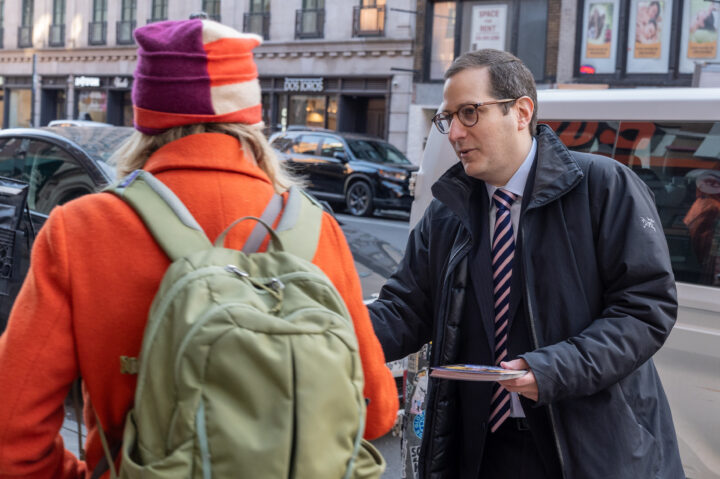
Lev Radin/Pacific Press/LightRocket via Getty Images
New York state Assemblyman Micah Lasher campaigns and distributes flyers as he runs to represent NY-12 on Lexington Avenue.


 Add JewishInsider on Google
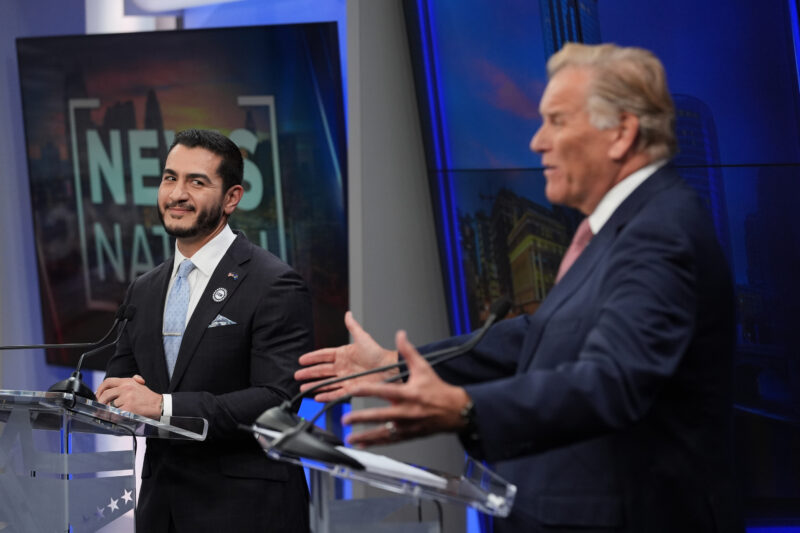
The four leading Democrats running in a closely contested Manhattan primary to succeed retiring Rep. Jerry Nadler (D-NY) all declined to describe Israel’s military conduct in Gaza as genocide during their first televised debate on Thursday evening.
Micah Lasher, an assemblyman who is backed by Nadler and other Democratic leaders in New York, called the number of Palestinian casualties “horrific” but characterized the question as “one of a set of definitional debates that does more to divide people of good faith than it does to find common ground.”
Alex Bores, a fellow assemblyman who has gained left-wing endorsements even as a defender of Israel, said he was “not comfortable” using the word, while Jack Schlossberg, a Kennedy scion and social media influencer, told the PIX11 debate moderator that he was “less interested in what we call it than what we do about it.” George Conway, a former Republican who is now an outspoken critic of President Donald Trump, said he did not think Israel’s war “meets the threshold” for genocide.
Their broadly unanimous responses underscore the political landscape shaping the June 23 primary race to represent New York’s 12th Congressional District, a seat home to the largest Jewish constituency in the country and where many voters identify with liberal Zionist sentiments.
In contrast with other congressional primaries in more progressive districts in Brooklyn, Queens and Upper Manhattan — where Israel has emerged as a flashpoint — the race for Nadler’s coveted House seat in the heart of Manhattan has been largely marked by a consensus view among the top candidates who have all generally voiced continued support for the Jewish state.
One notable exception stems from their differences over U.S. military aid to Israel, a topic of discussion at Thursday’s debate — which also focused on issues such as Trump’s immigration agenda and AI policy, a divisive source of industry-linked outside spending in the race.
Lasher and Bores have both agreed that the U.S. should consistently enforce the Leahy Laws — which prohibit security funding to foreign military units that engage in human rights violations — rather than singling out Israel for conditioned military aid, a position they each highlighted during the debate.
Meanwhile, Schlossberg continued to argue against future weapons sales to Israel amid wars in Iran and Lebanon, even as he reiterated his support for aid to boost Israel’s Iron Dome missile-defense system that has recently faced growing pushback from the far-left flank of the Democratic Party.
Conway, for his part, said simply that he opposes efforts to block offensive or defensive weapons to Israel, which he called “our one true, steadfast ally in the region.”
With days remaining until early voting, the debate was the latest of several forums in which the candidates have faced questions on Israel and other issues of particular concern for Jewish constituents, whose support could tip the scales in what polls have shown will be a close election.
On Wednesday evening, several of the candidates gathered at Temple Emanu-El’s Streicker Cultural Center on the Upper East Side of Manhattan for the most recent Jewish community forum, moderated by the Jewish Democratic Council of America.
The event, which was attended by Bores, Lasher and Schlossberg, featured some lesser-known candidates: Laura Dunn, a civil rights lawyer, and Nina Schwalbe, a public health expert. Conway did not participate in the discussion.
Among the key topics covered were aid to Israel, the Iran war and instances where “anti-Zionism blurs into antisemitism,” as Halie Soifer, JDCA’s CEO, put it while moderating the event.
Lasher, who has identified as a “proud Zionist Jew,” said that “while anti-Zionism and antisemitism are not precisely the same thing, I think we need to acknowledge they often go hand in hand,” citing recent protests outside of synagogues in New York City at which demonstrators have voiced support for Hamas.
“Holding Israel to a standard that is applied to no other country, making Jewish people feel unwelcome in any environment, these are all examples of antisemitism,” Lasher said.
More Stories
NUCLEAR NEWS
Senate expected to vote on Saudi nuclear deal before end of year
PRAIRIE STATE PRIORITIES
Illinois Democrats spend big for anti-Israel candidate running for state Senate
PRESIDENTIAL ENDORSEMENT
Trump gives Netanyahu ‘complete and total endorsement’
UNLOCKING THE KEYSTONE
RJC drops $400,000 to boost Brian Fitzpatrick in Pennsylvania swing district
WAR WORRIES
Could another war with Iran be the October surprise of the Israeli election?

EDUCATION INVESTIGATION
House Education Committee finds systemic antisemitism in Philadelphia, Berkeley K-12 schools
Please log in if you already have a subscription, or subscribe to access the latest updates.
 Continue with Google
 Continue with Apple