


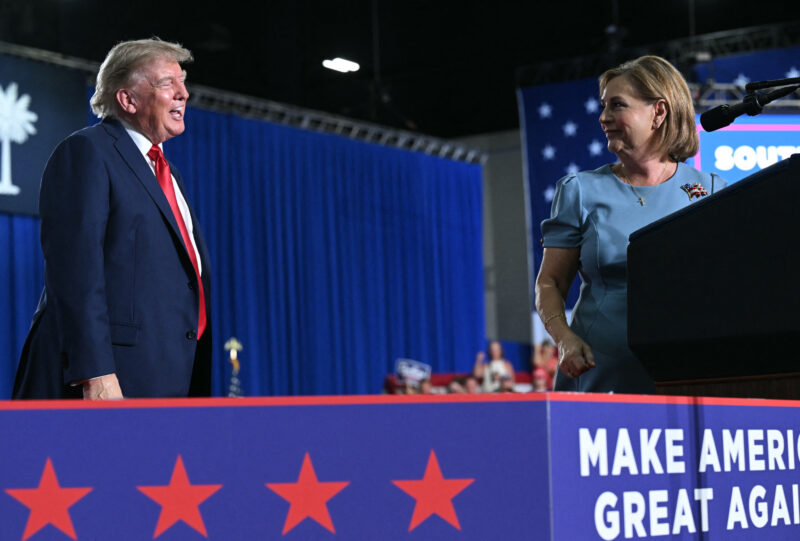

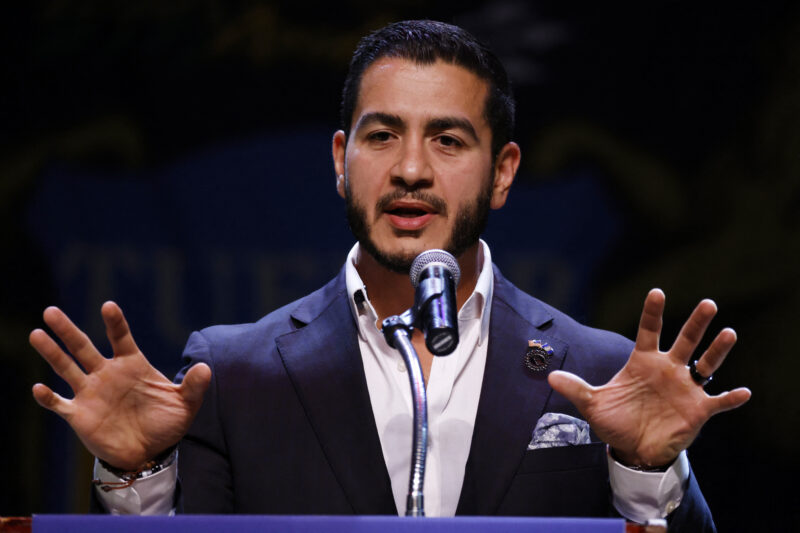
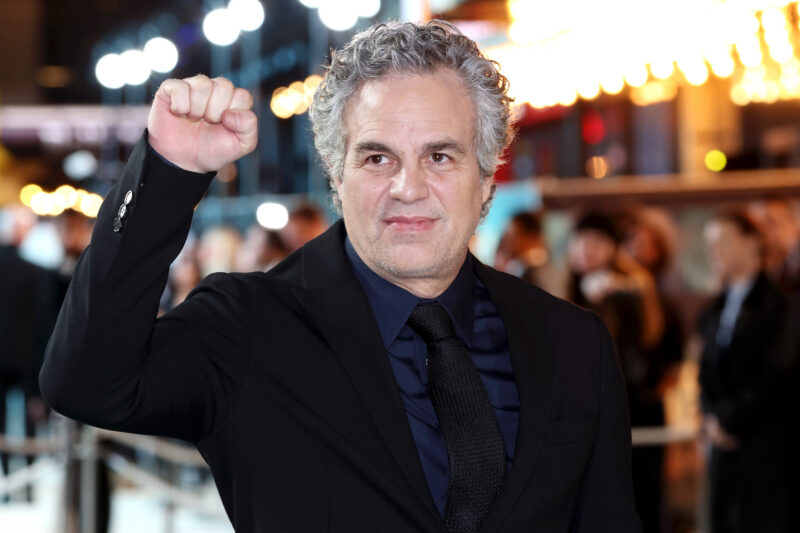
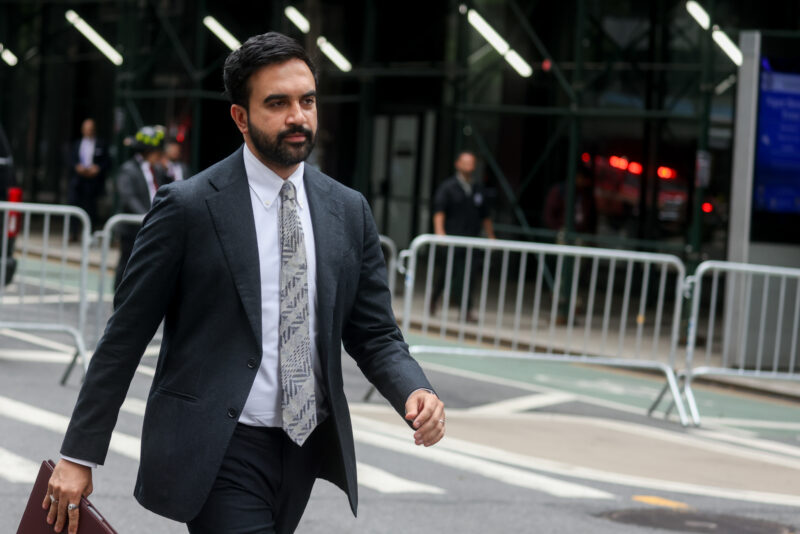


















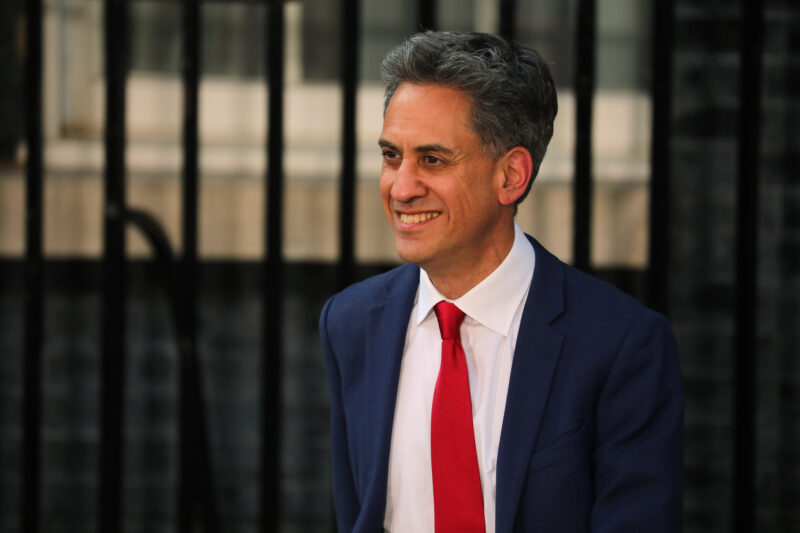










Michigan GOP gubernatorial nominee John James, Steve Scalise visit site of Michigan synagogue attack
James called the rise in antisemitic threats ‘an urgent national concern’

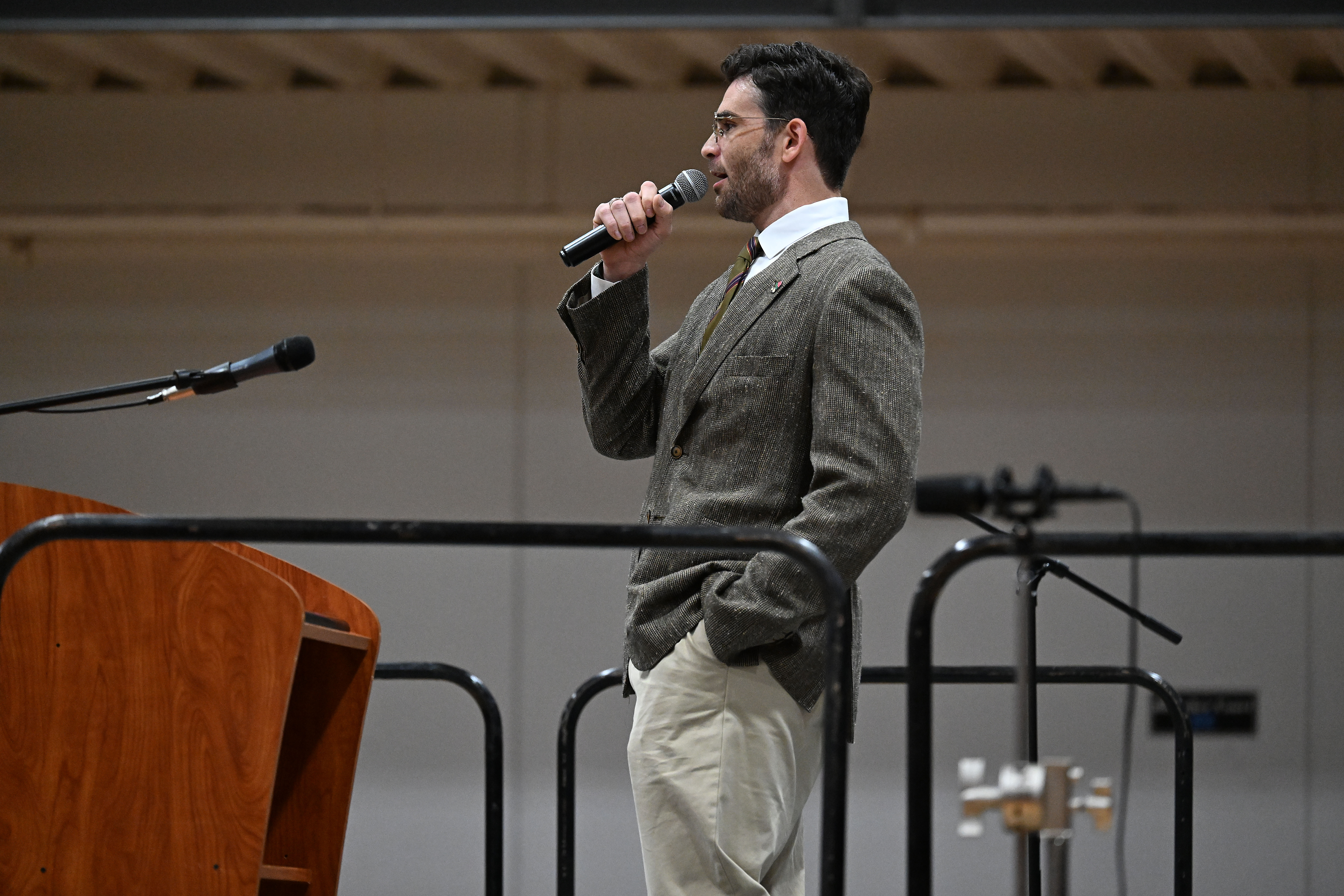
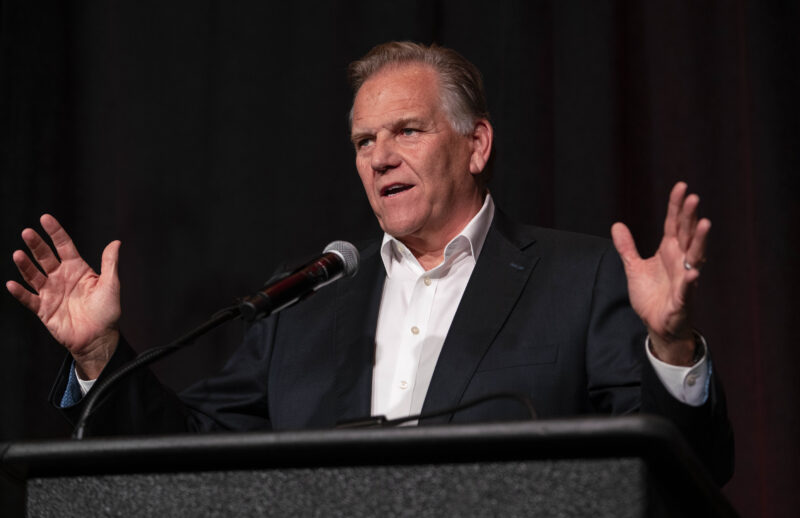
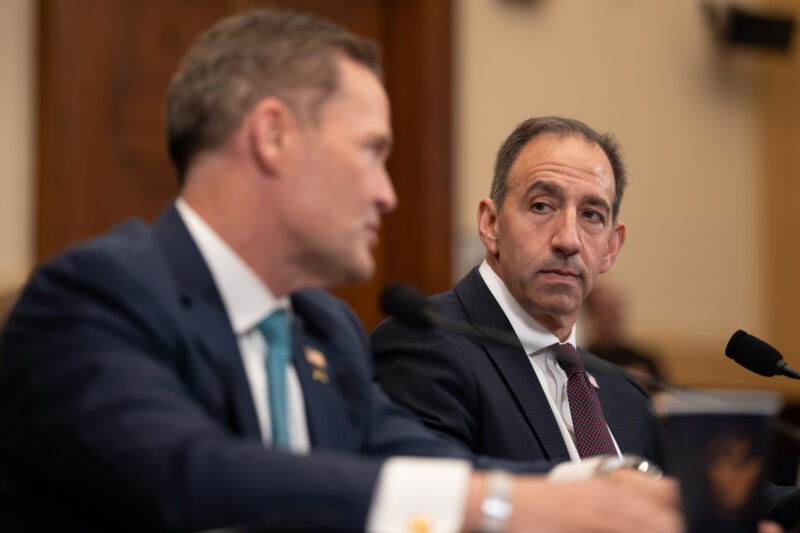
Gubernatorial nominee John James visits Temple Israel with House Majority Leader Steve Scalise


 Add JewishInsider on Google
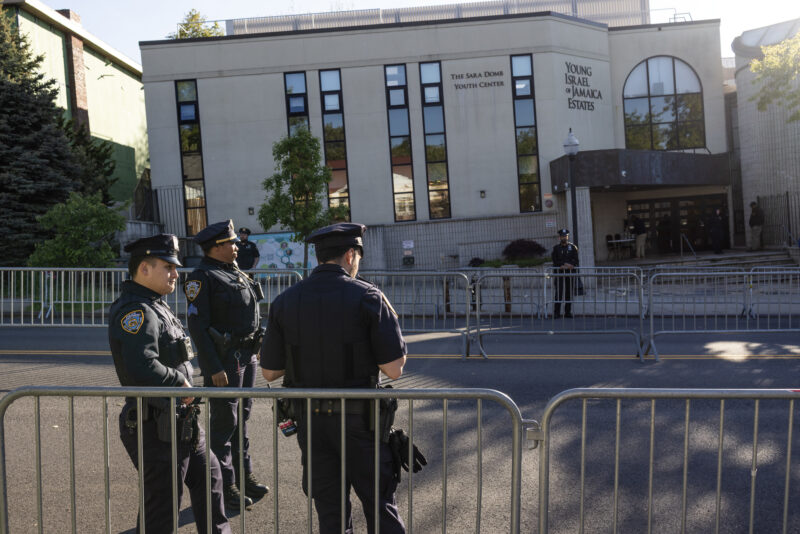
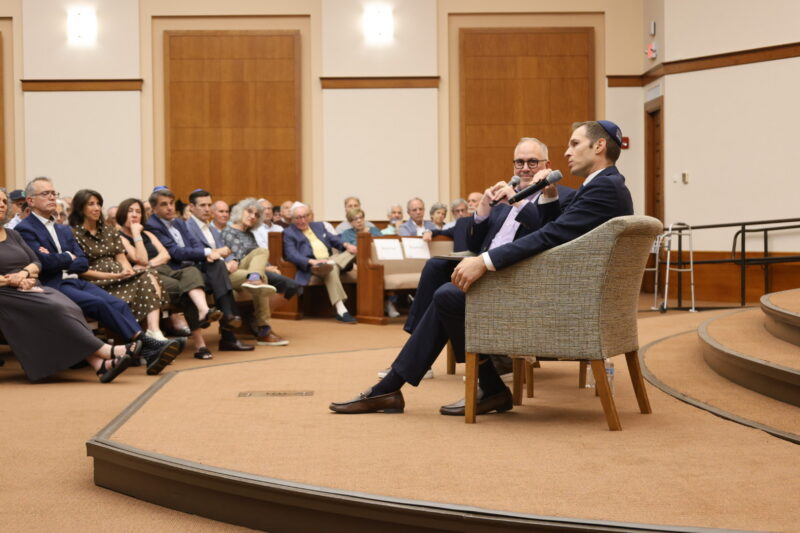
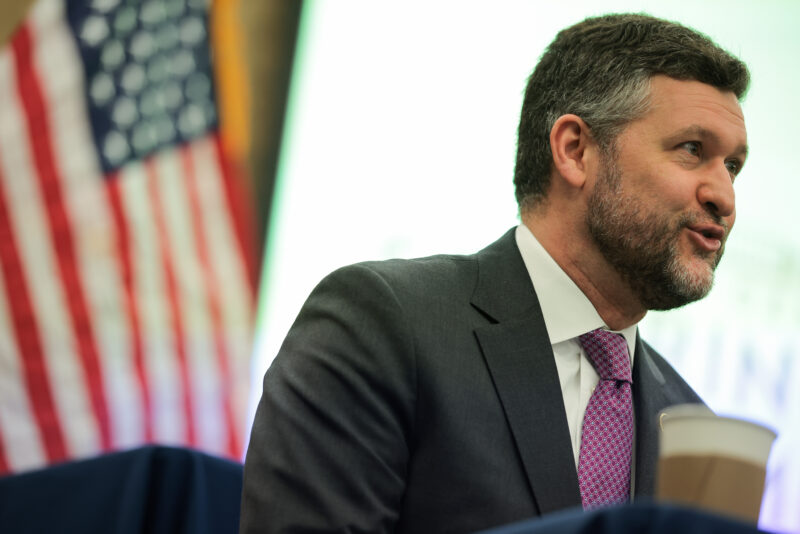
Rep. John James (R-MI), the GOP nominee for governor of Michigan, and House Majority Leader Steve Scalise (R-LA), visited Temple Israel in West Bloomfield, Mich., the site of an attempted shooting and bombing attack earlier this year, on Thursday.
“I appreciate Leader Scalise coming here to see the site of the attack first-hand, and to talk with community leaders,” James said in a statement. “To have a top member of Congress visit signals that we are treating the rise in threats seriously, and that this is an urgent national concern.”
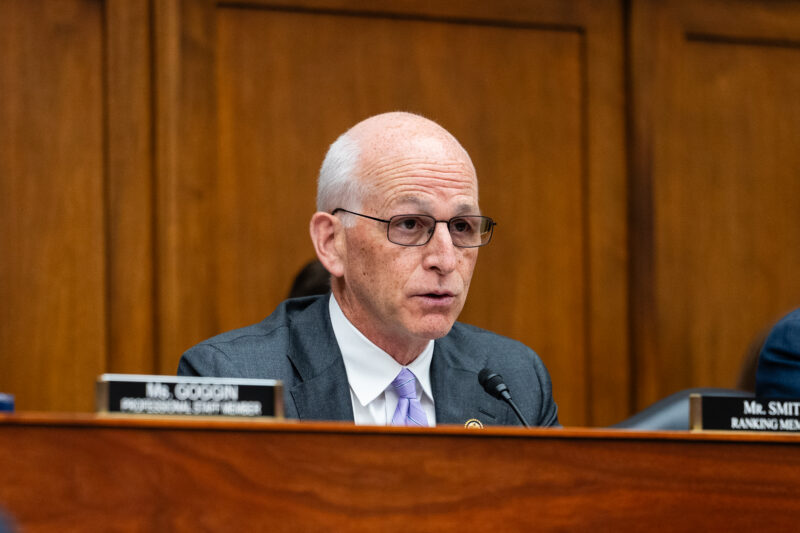
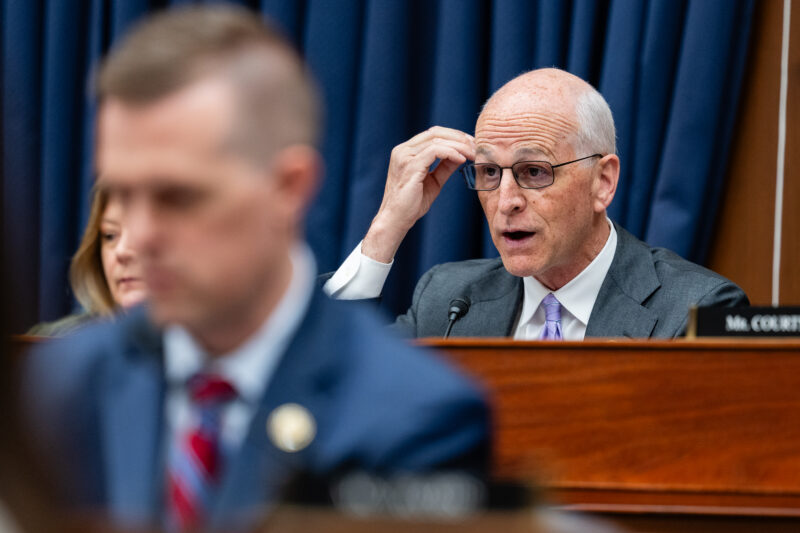
The pair were joined by other members, including Ways and Means Committee Chairman Jason Smith (R-MO), Rep. Glenn Grothman (R-WI) and Rep. Pete Stauber (R-MN).
In a release, James’ office noted that he is cosponsoring the Jewish American Security Act which aims to protect the Jewish community by increasing security grant funding, among other measures.
“There is a sickness in a certain segment of our population that reacted to the Oct. 7 terrorist attack with sympathy for the attackers, and which has spent the past few years irrationally targeting members of the Jewish community here in Michigan with hateful words and actions,” James continued. “I fought extremists in Iraq; we cannot let that kind of violent thinking take root here in Michigan. Everyone should be able to live and worship in peace.”
The visit was arranged in cooperation with the Jewish Federations of North America.
“Leader Scalise and his colleagues sent an unmistakable message when they walked through the doors of Temple Israel to tour the site of the terrible terrorist act against our children: We see the threat Jewish Americans are facing and we will not look away from it,” Dennis Bernard, the national chair of government relations for the JFNA, said in a statement. “They understand that violence against the Jewish community has reached unacceptable levels, and that it is time for action.”
Bernard, a Michigan resident, urged Congress to promptly pass the Jewish American Security Act.
Top contributors to Florida gubernatorial candidate James Fishback are also bankrolling Rashida Tlaib, Ilhan Omar, Abdul El-Sayed and Andre Carson
Campaign website
James Fishback
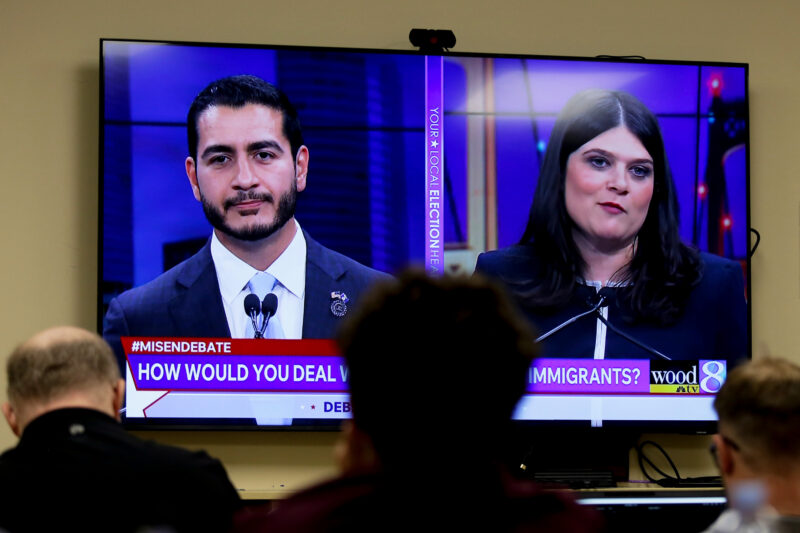
James Fishback, the GOP candidate for Florida governor whom critics call “openly racist” and “openly antisemitic,” ostensibly sits at the opposite end of the political spectrum from the likes of Rep. Rashida Tlaib (D-MI) and Democratic Senate candidate Abdul El-Sayed in Michigan.
But the far-right and far-left politicians share more than just an aversion to Israel — they also overlap in donors, Jewish Insider has found.
As a candidate, Fishback has embraced and celebrated neo-Nazi podcaster Nick Fuentes’ “groyper” movement, propagated the “white genocide” and “great replacement” conspiracy theories, told a Black Floridian they should be lynched and repeatedly taunted Rep. Byron Donalds (R-FL) — his rival to replace Gov. Ron DeSantis — over his race. The radical right candidate has also called the Western Wall “stupid,” referred to fast food as “goyslop,” promised Tucker Carlson he would dump the Sunshine State’s holdings in Israeli bonds, blamed the Iran war on AIPAC and released an ad vowing that no one would be “convicted of antisemitism” for criticizing the Jewish state under his leadership.
But his campaign has proven a magnet for donors to progressive candidates, who have poured tens of thousands of dollars into a PAC supporting his election.
Among the 27 donors to give the maximum $3,000 contribution to Fishback’s bid for Tallahassee is New York-based philanthropist and financier Amed Khan. A longtime associate of the Clinton family and contributor to former Presidents Barack Obama and Joe Biden, as well as to the Democratic National Committee, Khan’s public commentary and political giving has pivoted leftward since the Oct. 7, 2023, Hamas attacks on Israel.
Besides maxing out to Fishback, this cycle the investment banker and Quincy Institute board member has kicked $7,000 to former Maine Senate nominee Graham Platner, the progressive Democrat whose tirades against “oligarchs” and “the establishment” — not to mention his rhetoric on Israel — made him a favorite of the online left before a rape allegation derailed his campaign. In March, Khan donated the maximum $5,000 to Peace, Accountability, and Leadership PAC, an arm of the Institute for Middle East Understanding Policy Project, a dark money nonprofit dedicated to advancing pro-Palestinian narratives and candidates.
And just weeks before contributing to the Republican Fishback in February, Khan gave $3,500 to Gaza flotilla activist Greg Stoker, who is running against Rep. John Carter (R-TX) and Democratic candidate Justin Early on the Green Party line. On the same day he cut a check to the far-right Floridian, Khan donated $3,500 to another Green House hopeful: former Gaza Humanitarian Foundation contractor Anthony Aguilar, who has accused his former employer and the IDF of war crimes.
Khan also gave $3,500 in January to Rep. Ro Khanna (D-CA), part of a pattern of support for the increasingly anti-Israel lawmaker that stretches back to 2019.
In the 2024 cycle, Khan gave $5,000 to Justice Democrats, and donated smaller amounts to Rep. Summer Lee (D-PA), Rep. Ilhan Omar (D-MN), and then-Rep. Jamaal Bowman (D-NY), all figures linked to the Democratic Socialists of America and the left-wing “Squad” in Congress.
But Khan has also maintained support for more mainstream liberal figures, donating $7,000 in June 2025 to former U.S. Ambassador to Ukraine Bridget Brink’s bid for Congress in Michigan, and $14,000 that March to committees affiliated with Sen. Jon Ossoff (D-GA), a Jewish Democrat who has lately clashed with AIPAC and opposed military aid to Israel.
Another of Fishback’s max-out donors is similarly a historic backer of Democrats who lately has ventured into supporting figures on the fringes of both parties: Parviz Tayebati, a Port Biscayne-based tech investor.
Tayebati has donated a total of $19,000 to committees linked to Rep. Thomas Massie (R-KY) and $6,600 to former Rep. Marjorie Taylor Greene (R-GA), both hard-right figures who have increasingly leaned into an anti-Israel identity toward the end of their tenure. He has also donated $3,500 to a PAC supporting one of Greene’s unsuccessful replacements, former state lawmaker Colton Moore, who once was a firm supporter of Israel but more recently became the lone Republican in the state Senate to oppose adopting the International Holocaust Remembrance Alliance’s working definition of antisemitism.
In May, Tayebati gave $2,000 to Platner and another $1,000 to Effie Phillips-Staley, a left-wing Democrat who picked up an anti-Israel drumbeat in her failed bid to become the Democratic nominee against Rep. Mike Lawler (R-NY).
One of the few donors to comment for this story, Tayebati told JI he donated to Fishback after seeing a social media video of him criticizing Israel’s military campaign in the Gaza Strip. However, he called his decision to give money to the candidate “short sighted,” and pleaded ignorance of Fishback’s full views at the time of the donation in January.
“After I found out how extreme and actually antisemitic he is I regretted my support,” Tayebati wrote in a text message, adding that he has changed parties several times in the years since he arrived in the U.S. from Iran. “I am an American citizen and believe anyone who becomes a citizen [in] this country must have their loyalty only to America first and view anyone who is a U.S. citizen but uses their rights and freedom to promote another country as traitors and should be deported.”
Tayebati has also supported a few less extreme candidates, including Dr. Annie Andrews, a Democratic challenger to Sen. Lindsey Graham (R-SC) and Rep. Nancy Mace (R-SC).
Fitting a similar pattern is physician Mohamad Naem of Tampa, Fla., who has given the maximum to Fishback while also donating $7,450 to El-Sayed’s campaign in Michigan, blowing past the $7,000 campaign contribution ceiling. The Senate candidate’s team told JI they would refund the over-the-limit funds, but declined to comment for this piece beyond vowing they had never shared any donor list or had other contact with Fishback.
A longtime supporter of Tlaib, in late 2023 Naem began also sending cash to her Squad colleagues Lee, Bowman, Rep. Ilhan Omar (D-MN) and former Rep. Cori Bush (D-MO). Also in the 2024 cycle, he donated $2,000 to Pervez Agwan and $1,000 to Preston Nouri, both left-wing upstarts who made criticism of Israel and AIPAC a central theme in their campaigns.
Last year, he contributed $3,333.34 to the committees of Rep. Andre Carson (D-IN) and $1,500 to Rep. Delia Ramirez (D-IL), both key backers of legislation that would sever military aid to the Jewish state and of resolutions condemning its actions, while keeping up his support for Omar and Tlaib.
In recent months, along with donations to El-Sayed, Naem has given smaller amounts to Phillips-Staley and to Eric Yonce, another unsuccessful Israel critic who ran for Congress in Florida.
As with Khan and Tayebati, Naem has made a few donations to candidates supportive of Israel, including Sen. Jim Risch (R-ID), Rep. Abe Hamadeh (R-AZ) and Rep. Cory Mills (R-FL). He also gave $1,000 in 2025 to Rep. Marlin Stutzman (R-IN), who in June proposed winding down U.S. aid to Israel, although the congressman has aligned his position with that of Israeli Prime Minister Benjamin Netanyahu.
But Fishback’s other underwriters have shunned centrists in favor of candidates on the party’s margins. Another of his contributors is Hassan Shibly, who left his position as the head of the Florida chapter of the Council on American-Islamic Relations in 2021 following domestic abuse allegations from his wife.
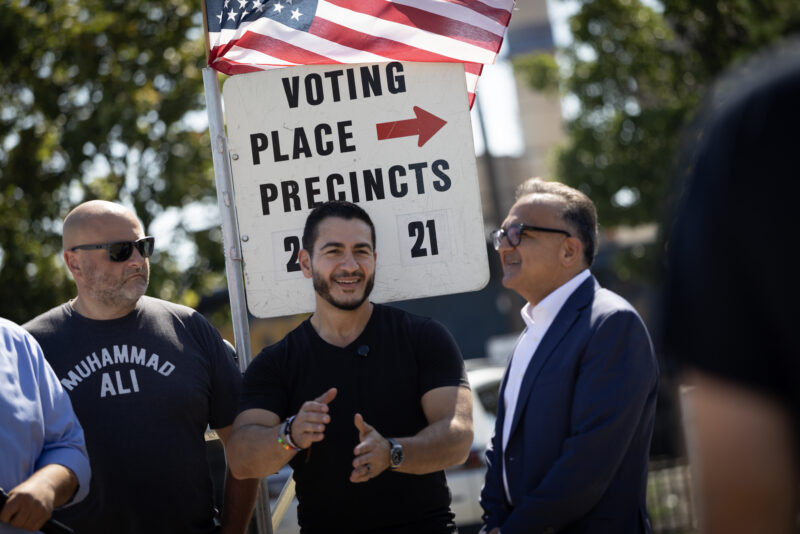
On the federal level, Shibly has given this cycle to Aaron Baker, running as a right-wing, anti-Israel alternative to Rep. Randy Fine (R-FL) and to Mussab Ali, who challenged Rep. Rob Menendez (D-NJ) as an AIPAC-bashing left-wing insurgent. And beginning in November 2023, Shibly has donated $200 each month to Omar in Minnesota.
In an email to JI, Shibly fiercely disavowed all of Fishback’s controversial stances — save one.
“One of the most significant reasons for my support is his stated position that American taxpayer dollars should be prioritized for the needs of Americans rather than funding foreign governments,” Shibly wrote. “I have been outspoken in opposing continued U.S. funding for the Israeli government’s military campaign in Gaza because I believe Israel has committed genocide against the Palestinian people. Ending or substantially reducing U.S. taxpayer funding for that campaign is an issue of profound moral importance to me.”
Current CAIR-Florida director and attorney Mohammad Mubarak gave $1,000 to Fishback, but at the federal level has given thousands more to El-Sayed, Tlaib, Omar and Carson. Radiologist Nabeel Hamoui gave the GOP gubernatorial contender the full $3,000 allowed under law in May, three months after maxing out to El-Sayed’s Senate campaign. In recent cycles, he’s given to Carson, Omar, Bowman, Lee, Bush and Tlaib.
Tampa investor Ramsy Dahla gave the maximum to Fishback, but has never donated to a federal official other than Tlaib. Another longtime Tlaib backer from Tampa, Ymad Elabed, appears to have given double the largest legally permitted contribution to Fishback by donating from two separate addresses.
Meanwhile, another Tampa businessman, Yasin Saad, gave $3,000 to Fishback but has favored Tlaib and recurring Palestinian American congressional candidate Ammar Campa-Najjar at the federal level.
Texas supermarket magnate Salah Nafal is also a member of Fishback’s $3,000 club, even as he’s given strictly to left-wing Israel critics for national offices, including El-Sayed, Platner, Omar and Tlaib, as well as Rep. Analilia Mejia (D-NJ), Michigan democratic socialist Aisha Farooqi and failed Texas congressional candidates Zeeshan Hafeez and Tanya Lloyd.
Meanwhile, Florida First PAC — a state committee dedicated to backing Fishback for governor — picked up a $35,000 contribution in June from Jacksonville law office Farah & Farah. The firm’s founding partner, Eddie Farah, has given $6,000 this cycle to Tlaib while also kicking $2,000 to the committees of Georgia’s Greene. In 2024, he backed Cornel West for president, while also donating to the PAC Counter Coalition, which subsequently ran a small independent expenditure for New York City Mayor Zohran Mamdani.
Oil distributor Basem Ali gave Florida First $5,000 in May, nearly a year after he gave to the Tlaib campaign. Ali has given tens of thousands to the Michigan congresswoman over the course of her career, and also supported Omar and Campa-Najjar, though he has also donated to Rep. Gus Bilirakis (R-FL), a strong Israel supporter.
Attorney General Phil Weiser, the Democratic nominee for governor, made the comments after she declined to call the Boulder firebombing antisemitic

Photo by Michael Ciaglo/Getty Images
Colorado gubernatorial candidate, state Attorney General Phil Weiser speaks at an election-night watch party after winning the Democratic primary, at Ace Eat Serve on June 30, 2026 in Denver, Colorado.
Colorado Attorney General Phil Weiser, the Democratic nominee for governor, criticized his party’s socialist congressional nominee Melat Kiros for her refusal to describe the deadly firebombing of a Boulder, Colo., hostage awareness march last year as an act of antisemitism.
Kiros, speaking last week to 9News, a local channel, declined to call the attack antisemitic, because “I don’t know what was in the heart of the perpetrator. … I don’t know what his intentions were.”
Melat Kiros, a DSA-backed congressional candidate in Colorado, declined to call the Boulder firebombing attack antisemitic in an interview with the local channel 9News.
— Jewish Insider (@jewishinsider) June 26, 2026
"I don't know what was in the heart of the perpetrator," Kiros said.
Read more: https://t.co/rtQDjet1sl pic.twitter.com/jcK9qsMhH5
Weiser, who is Jewish, said in an interview with the same channel that he was concerned by Kiros’ comments, noting that he was personally friendly with Karen Diamond, the Holocaust survivor killed in the attack, and her husband.
“What happened on June 1 in Boulder was an antisemitic attack,” Weiser said. “We cannot look at that murder and say anything else happened than a hate crime, and so if someone isn’t going to acknowledge that I’m concerned about that, because this was tried, this was how we have a conviction” for a hate crime.
He said that he hasn’t spoken to Kiros yet, but when he does, he would raise his concerns about her comments.
“You hear it a lot in the context of Black Lives Matter — now we’re talking Jewish lives matter,” Weiser said. “Black Lives Matter, period. Black Lives Matter — Elijah McClain’s life mattered. Period. You don’t put a comma. Jewish lives matter. Karen Diamond’s life mattered. You don’t put a comma, an ‘and’ or a ‘but.’ Period.”
In a CNN interview on Wednesday, Kiros described the attack as “a horrific attack on a group of Jewish people that were engaging in peaceful protest” which “made many Jewish people … feel incredibly unsafe” but she again declined to directly call the attack antisemitic.
“The fact of the matter is, is that this conflation between the actions of the state of Israel and Judaism and the Jewish people is making Jewish people less safe. It is leading to a rise in antisemitism that’s taking place all across our country,” Kiros said. “My commitment is to protecting the sanctity and dignity of life for everyone. That means standing strong, side-by-side to our Jewish brothers and sisters and neighbors, to make sure that they are protected against this rising hate and this rising antisemitism.”
Pressed again on why she didn’t call the attack antisemitic, Kiros insinuated that Israel’s military actions in Gaza were to blame for the attack.
“What we’re talking about here is attacks that are taking place on the Jewish community as a result of the actions that are taking place in Palestine, the genocide that is taking place in Palestine, actively making Jewish people less safe in our city and across our country,” she said.
She repeated that “our commitment has to be to combating that hate, combating the conflation between the actions of the state and the Jewish people and standing against this antisemitism.”
Kiros’ campaign did not immediately respond to requests for comment.
The same day Francesca Hong appeared on the livestream of antisemitic conspiracy theorist ‘Mike From PA,’ she also joined Hasan Piker’s Twitch show
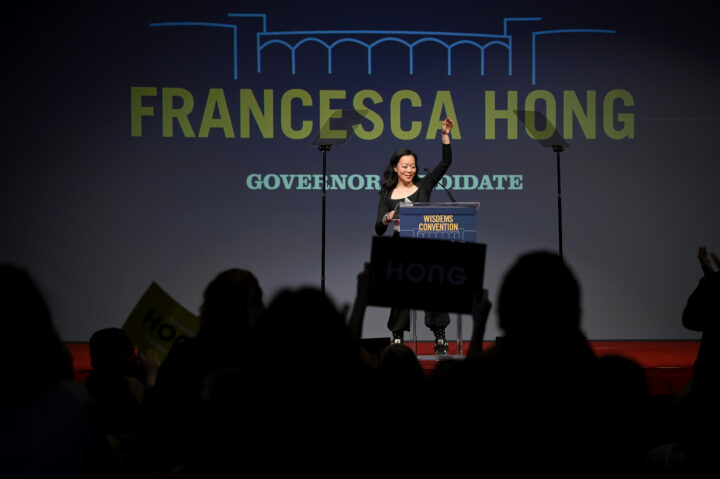
Daniel Boczarski/Getty Images for WisDems
Gubernatorial candidate Francesca Hong speaks on stage during Wisconsin Democrats 2026 Convention on June 14, 2026 in Madison, Wisconsin.
Francesca Hong, a Democratic Socialists of America-affiliated candidate for governor of Wisconsin, appeared on Tuesday on the Twitch stream of Mike Beyer, known by his online handle “Mike From PA,” a fringe far-left influencer who has espoused open antisemitism.
Beyer was suspended from Twitch last year for comments in which he said that “Jewish is not an ethnicity” and Jewish identity is “a constructed ethnicity, this demonic ethnicity, wholly invented.” He subsequently apologized, claiming he had intended to refer to Zionists, rather than Jews.
The Anti-Defamation League praised Twitch for the suspension. “Streamers with such reach and influence should use their platforms responsibly and not engage in inflammatory, dehumanizing and antisemitic rhetoric,” the group said in 2025.
Despite the walkback, Beyer has continued to spread other antisemitic conspiracy theories, including boosting a claim that “Zionists were obsessed with destroying the Soviet Union” so that they could enslave children from the Soviet bloc and use them for child trafficking and prostitution.
Amid scrutiny of his interview with Hong, Beyer on Tuesday blamed an organized conspiracy trying to slander “grassroots politicians like they are getting direct orders from [Israeli Prime Minister Benjamin] Netanyahu.”
Later on Tuesday, Hong also appeared on antisemitic streamer Hasan Piker’s Twitch show.
Asked about the two appearances, Allison Geyer, a spokesperson for Hong’s campaign said, “Rep. Hong has been clear throughout this campaign that antisemitism, Islamophobia, racism, transphobia, and all forms of dehumanization have no place in Wisconsin politics or in the movement we are building.” Geyer also said that Hong condemns the Oct. 7 Hamas terror attacks as well as the “ongoing genocide” in Gaza, despite the monthslong ceasefire in the Israel-Hamas war.
Geyer said Hong was not aware of Beyer’s comments prior to the appearance, but noted that he “issued a very lengthy apology” and said he was “talking about Zionist political ideology and held himself accountable for his statement.”
“Appearing on a podcast or livestream is not an endorsement of every statement a host has ever made. Fran is willing to go anywhere and talk to anyone about her vision for a better, more compassionate world. Sometimes that means talking to people who have said pretty nasty things,” Geyer continued. “Speaking with them isn’t an endorsement of those perspectives; it’s a way to reach people who have been isolated from conversations about community, compassion, and the systems of power and control that contribute to the struggles we share.”
Geyer said that non-traditional platforms “are going to shape this election” and that they will be dominated by “the right, … conspiracy theorists … or people who do not share our values” if Democrats don’t appear.
“Trying to turn every interview into a referendum on everything a host has ever said is a distraction from the material issues that will shape people’s lives,” Geyer said. “Fran sees every conversation as an opportunity to bring more people into the tent, especially voters who have been turned off by establishment politicians and status-quo politics, and to build a positive future for Wisconsin together.”
One of Hong’s opponents, Joel Brennan, the former secretary of the Wisconsin Department of Administration, condemned Beyer and Piker.
“Joel wouldn’t join that livestream and disagrees with much of what he’s said. This race isn’t about clicks or views, it’s about Wisconsin,” a Brennan spokesperson said. “Joel is laser-focused on talking directly with Wisconsinites about what’s keeping them up at night: the cost of living, including health care, child care, and housing, and fixing our school funding problem.”
State Sen. Kelda Roys accused Hong of associating with controversial figures to benefit her campaign financially, emphasizing that Roys raises most of her own money from grassroots supporters.
“How candidates raise money reflects the type of leader they are and the type of governor they would be. Kelda’s campaign is built on support from progressive grassroots donors in Wisconsin, over 90% of her contributions come from everyday Wisconsinites whose trust she has earned through conversations and events around the state,” Jalen Knuteson, a spokesperson for Roy, said. “Hong made a lucrative choice to align herself with an influencer who has cashed in on divisive, antisemitic, and offensive comments,”
David Crowley, the Milwaukee county executive, also criticized Hong.
“Anyone seeking public office should exercise good judgment about the platforms they choose to elevate, and should have zero tolerance for antisemitism, political violence, or any form of hate. David Crowley believes leadership is about bringing people together, not courting controversy or seeking attention through divisive platforms,” a Crowley campaign spokesperson said. “The Crowley campaign has been clear that antisemitism is unacceptable and has no place in Wisconsin. Leaders have a responsibility to exercise sound judgment and make clear where they stand. David is focused on earning the trust of every Wisconsinite by leading with decency, respect, and a commitment to bringing people together rather than dividing them.”
“Joel wouldn’t join that livestream and disagrees with much of what he’s said. This race isn’t about clicks or views, it’s about Wisconsin,” a Brennan spokesperson said. “Joel is laser-focused on talking directly with Wisconsinites about what’s keeping them up at night: the cost of living, including health care, child care, and housing, and fixing our school funding problem.”
Other candidates in the gubernatorial race — including 2022 Democratic Senate nominee Mandela Barnes and Lt. Gov. Sara Rodriguez — did not immediately respond to requests for comment.
If a far-left, anti-Israel wave sweeps over the Democratic Party in tonight’s statewide primaries, it will be a wake-up call for those downplaying the rise of the socialist left
RJ Sangosti/MediaNews Group/The Denver Post via Getty Images
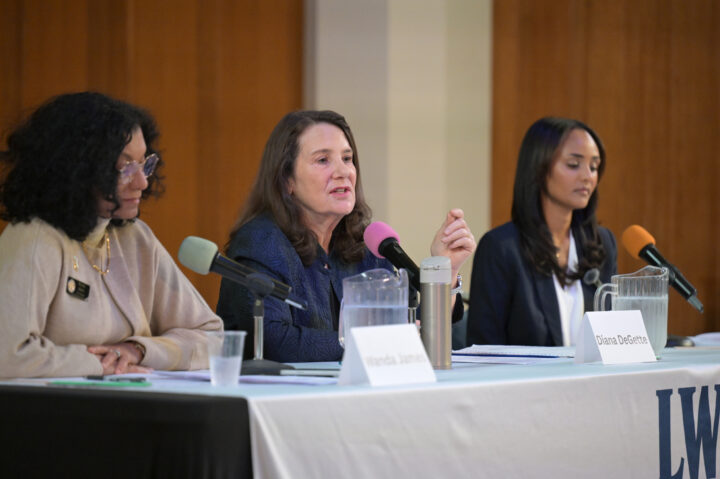
From left, Wanda James, Diana DeGette and Melat Kiros participate in a League of Women Voters Congressional District 1 candidate forum on May 28, 2026, in Denver, Colorado.
Colorado is a state famous for its moderation, with its governor (Jared Polis) and two senators (Michael Bennet and John Hickenlooper) among the most pragmatic figures in Democratic politics. So if a far-left, anti-Israel wave sweeps over the Democratic Party in tonight’s statewide primaries, it will be a true wake-up call for those downplaying the rise of the socialist left.
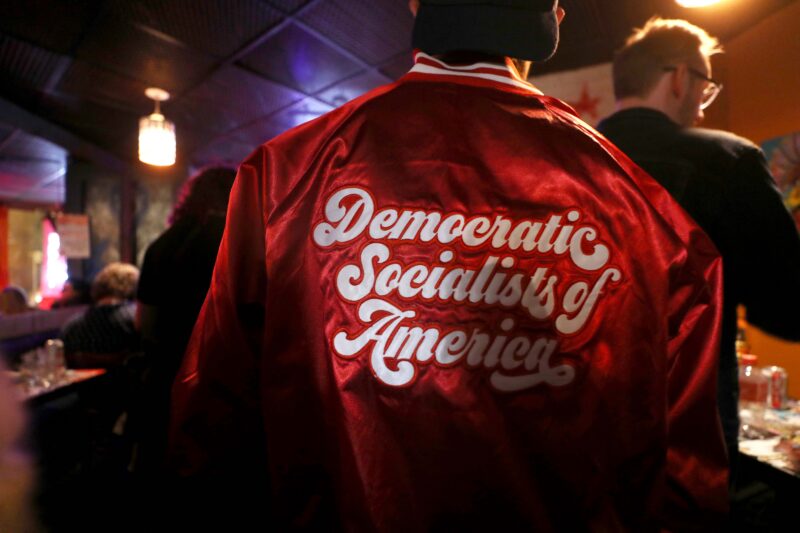
The biggest race we’re tracking — and the one where a Democratic incumbent looks most vulnerable — is the primary between longtime Rep. Diana DeGette, 68, an influential progressive who has left an imprint on major legislation in Congress, and Democratic Socialists of America-affiliated 29-year-old doctoral student Melat Kiros, whose deep-seated antagonism against Israel is a top focus of her campaign.
Kiros is the latest example of how radical candidates running for office on their hostility toward Israel are also indulgent of the rising antisemitism around them. Her political awakening came after she was fired from the law firm Sidley Austin for writing a public letter denouncing the hundreds of law firms that signed a petition calling on law schools to do a better job addressing antisemitism on their campuses.
Kiros was angered that the law firms considered those calling for the elimination of Israel as antisemitic. In the last week, she also refused to call the firebombing of a hostage awareness march in Boulder, Colo., antisemitic. Sense a pattern?
As JI’s Marc Rod reported, Kiros’ extreme views have done little to dent her support in a progressive Denver-area district that DeGette has easily held for the last three decades. DeGette barely won the 30% of the vote from party activists necessary to qualify for the primary ballot — in what could be a foreshadowing of the primary results tonight.
The overall landscape in Colorado is looking similarly treacherous for other Democratic moderates, even if they end up prevailing. Sen. John Hickenlooper, once considered a shoo-in to win renomination, is facing a credible challenge from DSA-backed state Sen. Julie Gonzales. If Hickenlooper loses, it would be a political earthquake across the country, but even a close race against a fringe candidate would be a major warning sign for the health of the Democratic Party.
And well outside of Denver, another primary in a swing district is being closely watched for ideological signals of where the party is headed. Early in the cycle, Democratic Majority for Israel’s political arm rallied behind former state Rep. Shannon Bird, a moderate who has been a reliable supporter of Israel and outspoken critic of antisemitism in the state Legislature, in her race against Rep. Gabe Evans (R-CO).
State Rep. Manny Rutinel, a progressive who has attacked Bird as insufficiently liberal on immigration, has been vague on where he stands on Israel policy, but his record as a college student has raised concerns from the broader Jewish community.
As an undergraduate at the University of Florida in 2014, Rutinel attended a demonstration that was co-organized by Students for Justice in Palestine, the extreme anti-Israel group that has expressed alignment with Hamas, according to a local news story covering the event at the time. A Rutinel spokesperson told JI that Rutinel did not have any affiliation with SJP and said the demonstration was focused on police brutality in the U.S.
Neither candidate has focused much on Israel policy — a sign that opposing Israel isn’t a winning message in swing districts like Colorado’s 8th District, which also features a sizable Hispanic population.
The state’s Democratic gubernatorial primary between Bennet and Attorney General Phil Weiser will also be closely watched as a signal of voters’ discontent with Washington. Bennet was viewed by many as an early favorite, but Weiser holds a powerful statewide role that allowed him to position himself in opposition to the Trump administration by filing dozens of lawsuits against federal government policy.
Weiser, who is Jewish and told JI he blocks off Shabbat to spend with his family, is running as the progressive in the race but has kept his focus on campaigning as an anti-Trump candidate and as a Washington outsider.
The DSA chapter in Denver is opposing his gubernatorial campaign because, they write, he “remained a strong supporter of Israel despite the ongoing genocide.” (They also are opposing Bennet because of his votes for military aid to Israel.)
Shapiro, to CNN: ‘There are 46 majority Muslim nations, 23 of which have Islam as their official religion’
Peter W. Stevenson/The Washington Post via Getty Images
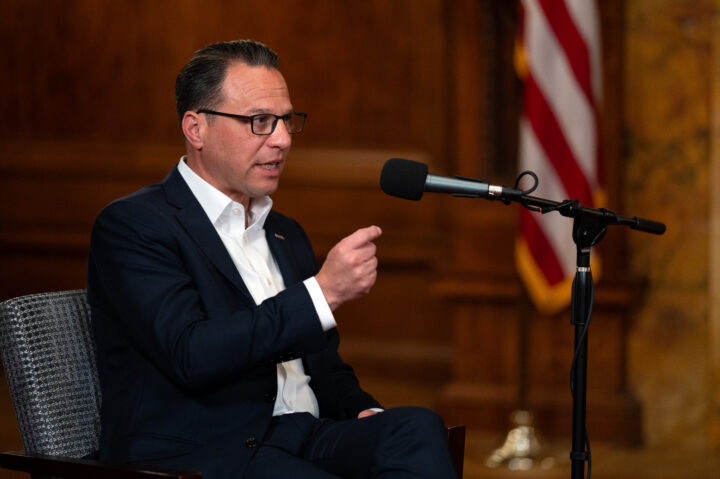
Pennsylvania Gov. Josh Shapiro sits for an interview at the Pennsylvania State Capitol on June 11, 2025.
Pennsylvania Gov. Josh Shapiro defended Israel’s standing as a Jewish state, telling CNN in an interview that the country faces a level of scrutiny and attack over its religious character not applied to the Muslim states throughout the region.
“For those who do not want there to be a Jewish state, oftentimes they will predicate their views on this notion that being grounded in a religion and being a democracy can’t coexist. I think it’s important to point out the hypocrisy of that view,” Shapiro said in an interview with CNN that aired on Monday. “When there are 46 majority Muslim nations, 23 of which have Islam as their official religion, either because of statute or their constitution, and only one has Judaism as their official religion, and yet we’re focused just on the Jewish state.”
Unlike countries that constitutionally declare an official religion, Israel has no official religion by law — though its 2018 Basic Law designates it as the nation-state of the Jewish people, and religious institutions play a significant role in civic life. Israel formally recognizes multiple religious communities, including Jewish, Muslim, Christian and Druze populations, and grants each its own religious courts for matters of personal status such as marriage and divorce.
The Democratic governor also said that he feels it’s important to stick to his convictions on the issue, rather than following trends or pressure.
“I think it is particularly important at this time to be open and vocal and honest about your views, and not put your finger in the wind and just cater to whoever is expressing their views the loudest,” Shapiro continued.
The comments come as attacks on Israel’s status as a Jewish state have become increasingly prevalent, particularly from the far left, including by at least one Democratic senate candidate.
Pritzker, Emanuel take contrasting paths on Israel, antisemitism ahead of possible presidential runs
In two separate interviews published Tuesday, Pritzker came out as a more forceful voice against antisemitism and in support of the U.S. relationship with Israel

U.S. Embassy in Japan/United States Department of Defense
Rahm Emanuel/Illinois Gov. JB Pritzker
Two Jewish Democrats from Chicago are looking to run for president.
One, Illinois’ two-term governor, JB Pritzker, has built up a reliably progressive record while steering clear of ideological fights over Israel, antisemitism and other cultural issues fueling the Democratic Party.
The other, former Chicago Mayor Rahm Emanuel, is one of his party’s leading pragmatists, known for feuding with left-wing Democrats over education, the power of unions and the degree to which cultural progressivism cost the party on the ballot box.
So it came as a surprise that, in two separate interviews each published Tuesday, it was Pritzker who came out as a more forceful voice against antisemitism and in support of the U.S. relationship with Israel, while Emanuel sounded like he was all too eager to blame Israeli Prime Minister Benjamin Netanyahu as he anticipated a future breakup between the two close allies.
Pritzker offered the point that relationships between allies aren’t dependent on whether you personally like the elected leadership in charge. It’s a line you’d expect more mainstream Democrats to invoke, especially as Israel’s favorability within the Democratic Party has sunk to new lows.
“There are a lot of people who don’t like Netanyahu, but you shouldn’t take it out on Israel. It’s a democracy that elected him. There are a lot of people who don’t like Trump. I mean, should we be tossed into The Hague as a country because of Trump?” Pritzker told Politico over matzoh ball soup at Manny’s Deli, referring to the home of the International Criminal Court.
Emanuel, when asked by Jewish Insider if there was a special relationship between the U.S. and Israel, agreed with the premise but then quickly pivoted to arguing the state of the relationship should be premised on Israel’s efforts contributing to peace in the region. It’s an implication that its post-Oct. 7 efforts at self-defense have gone too far.
“Every risk you will take, the State of Israel takes, for peace, then America will stand by you,” he told JI. “We understand there’s risks. We have stood by Israel through thick and thin.” “But,” he said, “when one friend in that relationship abandoned something that’s contrary to our interests and contrary, in my view, also to Israel’s interests,” it is reasonable to rethink that alliance.
Pritzker also spoke directly about the scourge of antisemitism, laying most of the blame for the rise in anti-Jewish hate on President Donald Trump, but when pressed, also laid out a clear red line that it’s never acceptable to invoke antisemitism for disagreeing about Israel’s policies.
“Antisemitism has often been connected to people’s views about Israel. That is: If you don’t like what Israel and, in particular, Netanyahu are doing, now it’s OK to have slurs that you’re spewing about Jews,” Pritzker said. “It’s not. It’s never OK.”
Asked about whether anti-Zionism intersects with antisemitism, Emanuel touted his own experiences fighting neo-Nazis in Skokie, Ill., and relentlessly attacking anti-Jewish hate as an elected leader. He told JI that “we have to confront” antisemitism wherever it emerges, referencing Maine Senate candidate Graham Platner not knowing he had a neo-Nazi tattoo on his chest. One day later on CNN, he endorsed Platner’s campaign.
At a time when unfavorable views of Israel are at historic highs within the Democratic Party and open antisemitism is being tolerated in a way unimaginable not long ago, the trajectory of these two prominent Jewish presidential contenders — along with the fate of Pennsylvania Gov. Josh Shapiro — will be instructive on the future role of Jewish voters within the Democratic coalition.
Pritzker, with strong anti-Trump and progressive bona fides, may feel a little more comfortable tacking to the center when talking about Israel and antisemitism. Emanuel, who has made a name for himself as a moderate calling out the excesses of the left as he travels across the country (and speaks on TV), may be a little more reticent to tout his pro-Israel credentials, given the ideological direction the party is headed in.
Plus, our sit-down with Josh Shapiro in Pittsburgh
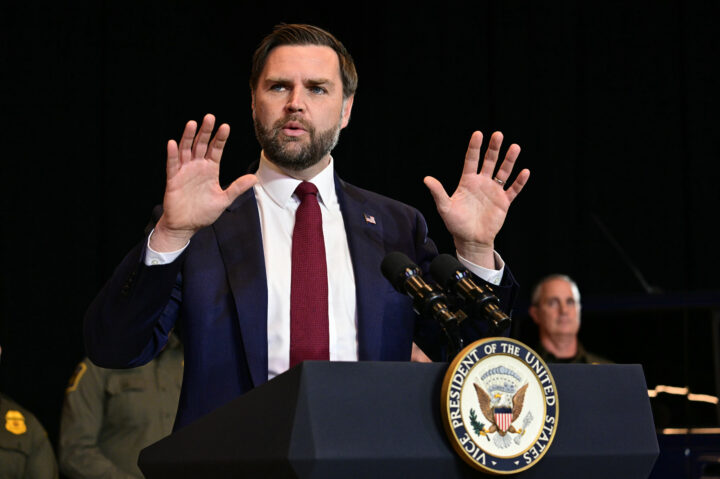
Jim Watson - Pool/Getty Images
U.S. Vice President JD Vance gives remarks following a roundtable discussion with local leaders and community members amid a surge of federal immigration authorities in the area, at Royalston Square on January 22, 2026 in Minneapolis, Minnesota.
Good Thursday morning.
In today’s Daily Kickoff, we interview Gov. Josh Shapiro about recent Senate moves attempting to block U.S. military aid to Israel, and talk to Sen. Richard Blumenthal — one of seven Senate Democrats to vote last week against the weapons bans — about his efforts to restore bipartisan support for the Jewish state. We talk to Jewish leaders from communities targeted by antisemitic violence about their efforts to lobby Congress on legislation to protect religious institutions, and report on New York City Mayor Zohran Mamdani’s decision not to adopt any definition of antisemitism after scrapping City Hall’s previous adoption of the International Holocaust Remembrance Alliance’s working definition of antisemitism days into his tenure. Also in today’s Daily Kickoff: Chaim Galbut, Patrick Drahi and Hilary Krieger.
Today’s Daily Kickoff was curated by JI Executive Editor Melissa Weiss and Israel Editor Tamara Zieve, with assists from Danielle Cohen-Kanik and Marc Rod. Have a tip? Email us here.
What We’re Watching
- Israeli Ambassador to the U.S. Yechiel Leiter and Simon Karam, Lebanon’s former top envoy to Washington, are set to convene today for a second State Department-brokered meeting in as many weeks between officials from the countries. U.S. Ambassador to Israel Mike Huckabee returned to Washington earlier this week and is expected to participate in the talks.
- The talks will take place days before the expiration of a 10-day ceasefire between Jerusalem and Beirut, and a day after a Lebanese journalist for the pro-Hezbollah daily Al-Akhbar was killed in an Israeli strike on Hezbollah targets in southern Lebanon. Read more here.
- Paramount Skydance CEO David Ellison is hosting a dinner this evening at the U.S. Institute of Peace honoring President Donald Trump and CBS News’ White House correspondents amid a flurry of events around the White House Correspondents Dinner on Saturday night.
- The Jewish Democratic Council of America is hosting a candidate forum with NY-17 Democratic candidates Cait Conley and Beth Davidson. Read our interviews with Conley, a former senior counterterrorism official, and Davidson, a Rockland County legislator.
- Former Deputy Secretary of State Kurt Campbell and Walter Russell Mead are among those slated to speak today at the Hudson Institute‘s daylong New India Conference in Washington.
- Missouri Gov. Mike Kehoe, a Republican, will sign into law legislation adopting the International Holocaust Remembrance Alliance’s working definition of antisemitism.
What You Should Know
A QUICK WORD WITH JI’S mATTHEW KASSEL
As Vice President JD Vance has recently found himself navigating tenuous negotiations between the United States and Iran, his central role in the talks to end the war is highlighting his own vulnerabilities on the domestic front — where he is facing pushback from the isolationist right that is seen as part of his coalition.
In many ways, Vance’s political troubles recall his predecessor, former Vice President Kamala Harris, who in her 2024 presidential campaign drew fierce protests from far-left activists who objected to former President Joe Biden’s support for Israel amid the war in Gaza.
Harris, who has grown more openly critical of Israel since losing the race and leaving office, strained both to articulate a consistent message on Gaza that would satisfy the far and center left and to distance her campaign from an aging, unpopular president whose approach to Israel, according to her recent memoir, was not fully aligned with her own.
Anti-Israel activists continue to insist, even years after the election, that Harris’ association with Biden while he supported Israel’s war against Hamas cost her votes that contributed to her defeat, while pro-Israel Democrats claim she failed to draw red lines around growing extremism within the party that alienated moderates, and is now inflecting the midterm elections. More recently, the former vice president faced anti-Israel hecklers during a book tour last year.
In recent weeks, Vance, who is widely seen as a top 2028 presidential prospect, has likewise struggled to appease a restive coalition of anti-war critics on the populist right who feel his alignment with President Donald Trump’s robust foreign policy agenda represents not only a betrayal of their values but also the noninterventionist views he himself had long espoused.
Last week, in a disruption reminiscent of Harris’ campaign experience, Vance was notably heckled during a speaking appearance at a Turning Point USA event held at the University of Georgia, where an attendee interrupted his comments to accuse the Trump administration of supporting “genocide” in Gaza and “killing children.”
SHAPIRO SPOTLIGHT
Josh Shapiro supports U.S. aid to Israel, but calls to use it as leverage
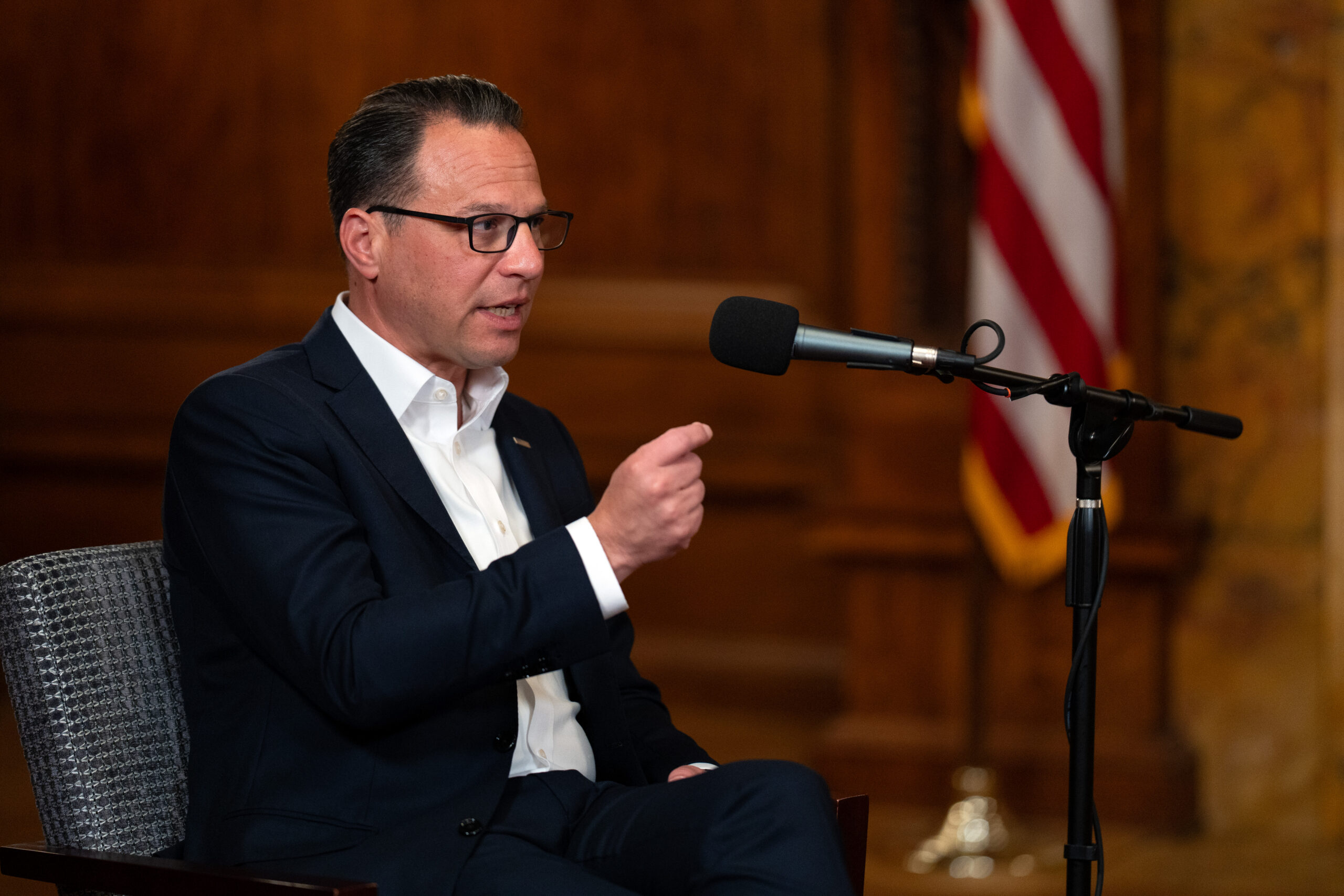
On the eve of the NFL draft on Wednesday, Pittsburgh, the host city, was in full spectacle mode. Israel, 6,000 miles away, was abuzz for a very different reason: the country was celebrating Yom HaAtzmaut, marking 78 years of independence. As he jumped between draft events, Pennsylvania Gov. Josh Shapiro shared his thoughts with Jewish Insider’s Gabby Deutch about both.
On Israel and the Iron Dome: “In the case of Israel, you have a country that is constantly being attacked with missiles and other weapons that put civilians at risk, and America is invested in providing assistance like Iron Dome to protect innocent civilians from those terrorist attacks,” said Shapiro. “I think that is in America’s national security interest.” But the swing-state governor, who appears to be mulling a presidential run in 2028, did argue that the U.S. should use its position as a major financial backer of Israel to exert leverage over the country’s use of American-made weapons. Shapiro said Washington has not done a good enough job of that.
Bonus: Last night, Shapiro co-hosted a Unity Dinner for Jewish and Black college students, part of an effort by the United Negro College Fund, Hillel International and Robert Kraft’s Blue Square Alliance Against Hate to bridge divides between the communities.
PARTNERSHIP PRIORITIES
Sen. Richard Blumenthal says he wants to work to restore eroding bipartisan support for Israel
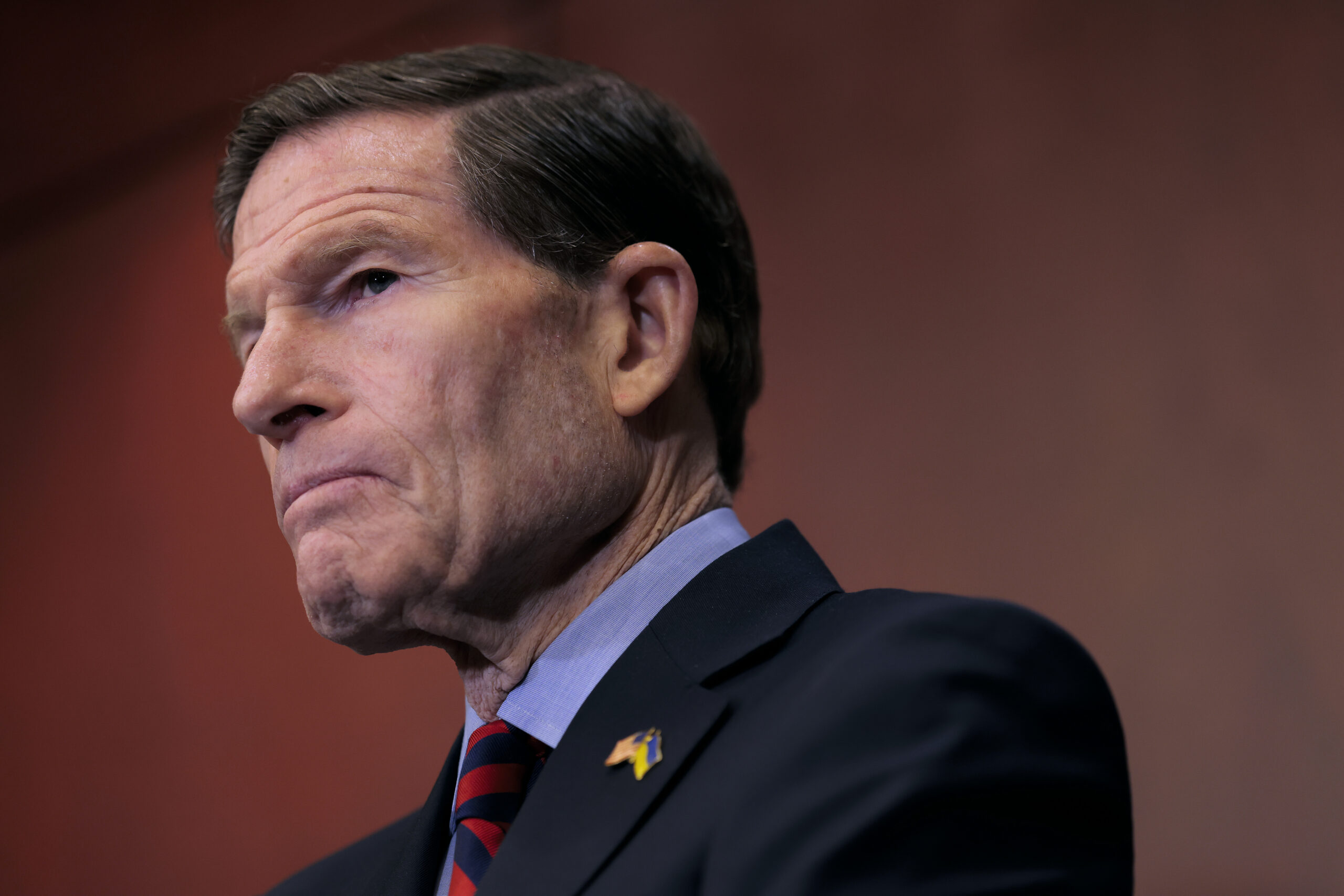
Sen. Richard Blumenthal (D-CT), one of just seven Senate Democrats to vote last week against resolutions to block U.S. arms sales to Israel, said that he still wants to maintain and restore bipartisan support for Israel, Jewish Insider’s Marc Rod reports.
Standing his ground: “An overriding goal that has been one of my most profound concerns since coming to the United States Senate is to preserve bipartisan support for Israel,” Blumenthal told JI in a brief interview on Wednesday. “I partnered with [former Sen.] John McCain (R-AZ) on traveling to the Middle East and to Israel a number of times. He believed powerfully, as I do, that the cause of Israel’s security has to be bipartisan, and I will adhere to that goal as long as I’m in this body.”
On the Hill: For the fifth time, the Senate rejected an effort by Democrats to force the administration to end the war in Iran, with the partisan battle lines on the issue remaining firmly unchanged from previous iterations of the vote. In the House, Reps. Greg Meeks (D-NY) and Ro Khanna (D-CA) also introduced new war powers resolutions on Iran, after previous efforts narrowly failed.
MAINE SQUEEZE
Elizabeth Warren shrugs off Graham Platner praise of Hamas tactics
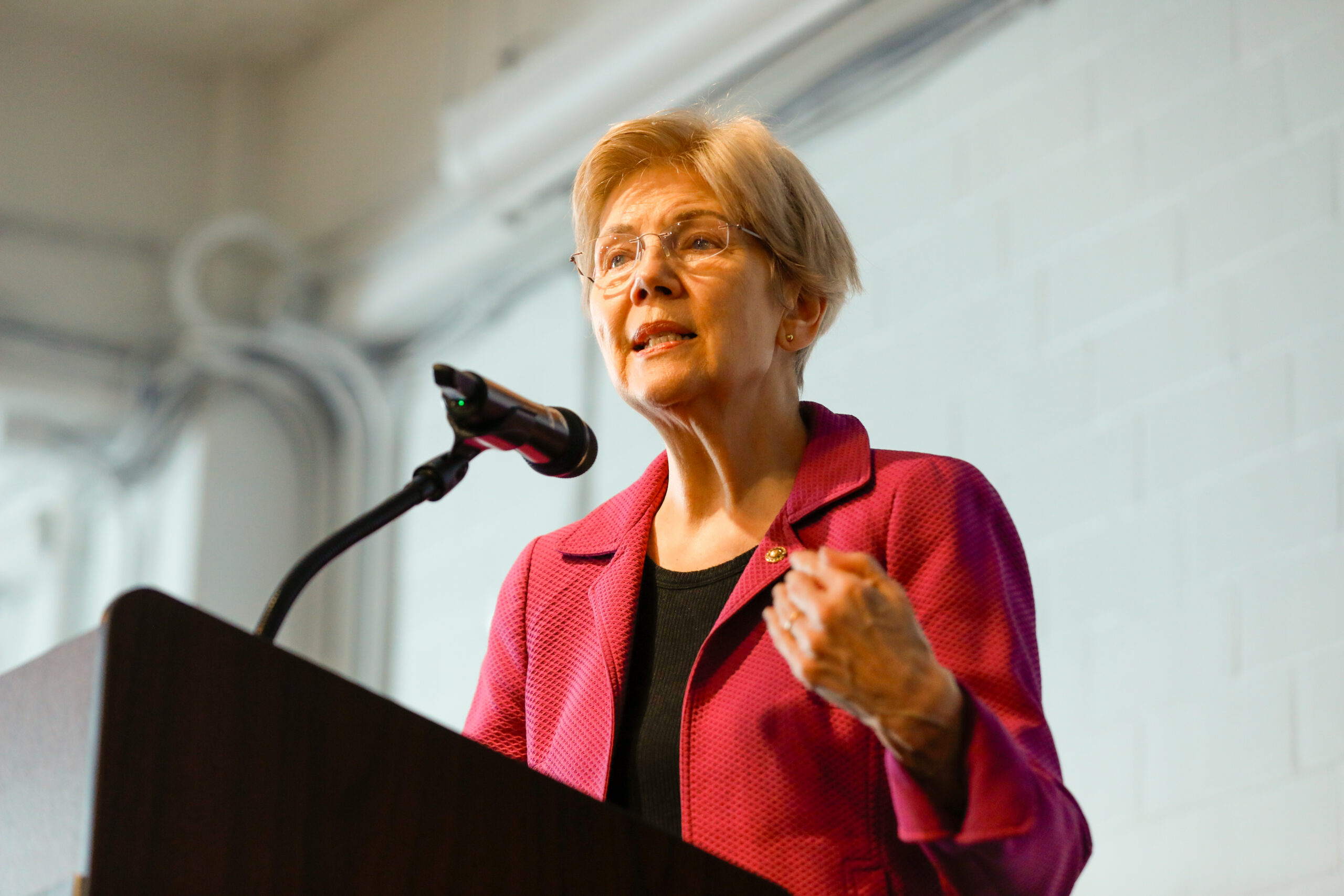
Sen. Elizabeth Warren (D-MA) dismissed criticism of Maine Senate candidate Graham Platner’s scandals on Wednesday, after calling him “my kind of man” at his rally in Maine on Saturday, Jewish Insider’s Danielle Cohen-Kanik reports.
Standing by him: “You care about character,” CNBC host Sara Eisen said to Warren. Eisen referred to a JI report unearthing Platner’s 2014 Reddit comments in which he said “‘I dig it,’ next to a video of a bunch of terrorists killing five soldiers? I don’t know, I mean, you guys want to be the party of inclusivity, right?” Warren answered, “I want to be the party that stands up for hardworking people. I want to be the party that is transformative of an economy that right now is hip deep in corruption … and that’s what Graham Platner wants to do and I’m there to stand with him and to help in that fight.”
COMMUNAL PUSH
Leaders from communities targeted by antisemitic violence push lawmakers for security support
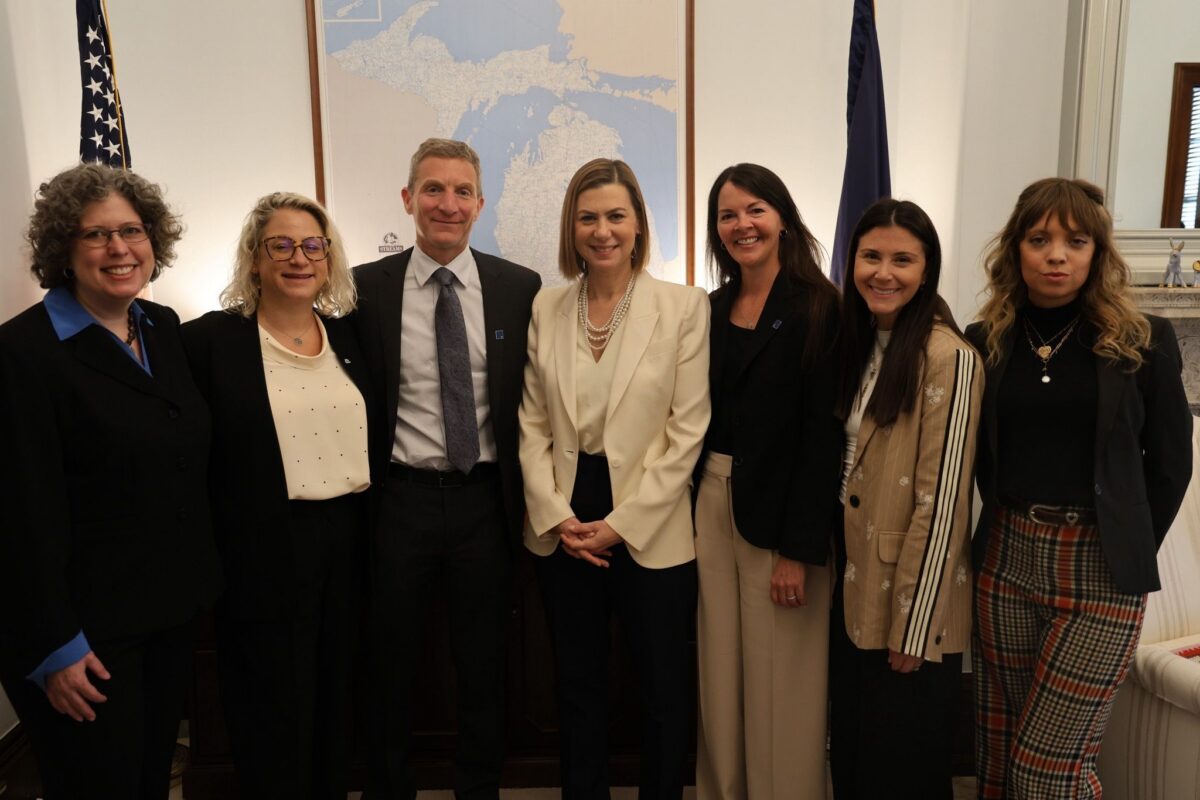
Jewish leaders from communities impacted by antisemitic violence in the past year met with House and Senate leaders on Capitol Hill on Wednesday to advocate for additional federal security assistance, Jewish Insider’s Marc Rod reports. The advocates represented Temple Israel in West Bloomfield, Mich., Beth Israel Congregation in Jackson, Miss., a hostage awareness march in Boulder, Colo., and the Capital Jewish Museum in Washington.
Notable quotable: “I will never forget the phone call. Or the images on the news of smoke rising from the place where I had just left my child,” Taylor Weintraub, a parent of a child who attended Temple Israel, told reporters on Wednesday morning. “Thank God, none of the children were physically hurt. But that wasn’t luck, that was preparation — reinforced doors, trained security, investments made because we knew this could happen. But here’s what keeps me up at night: we are the lucky ones.”
DEFINITION DEBATE
Mamdani won’t set definition of antisemitism after repealing IHRA, his antisemitism czar says
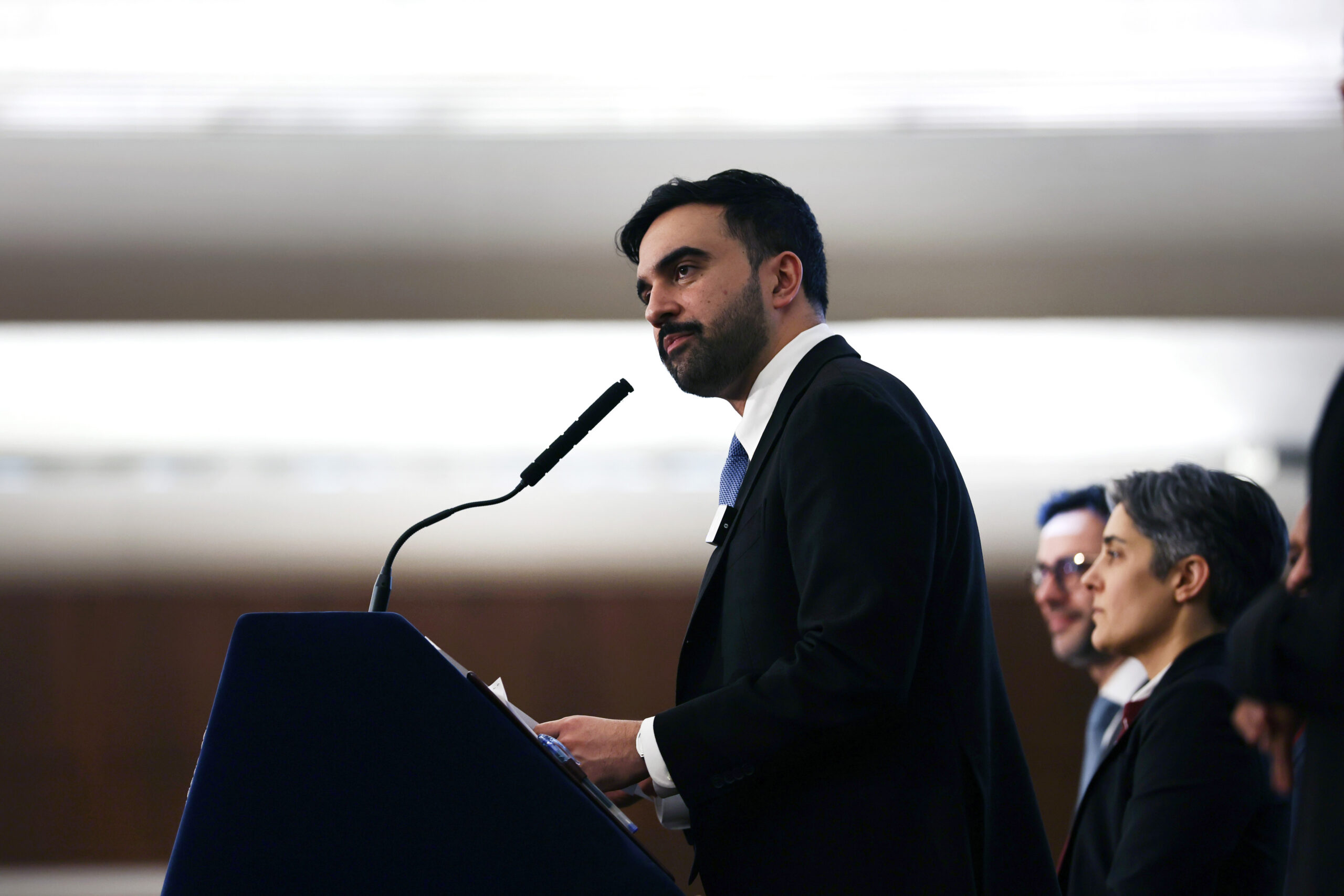
New York City Mayor Zohran Mamdani’s antisemitism czar said on Wednesday that his administration won’t replace the International Holocaust Remembrance Alliance’s working definition of antisemitism he wiped off the books his first day on the job, Jewish Insider’s Will Bredderman reports.
What she said: Speaking before the City Council’s Task Force Antisemitism alongside officials from the NYPD, the executive director of the Mayor’s Office to Combat Antisemitism, Phylisa Wisdom, said that city agencies do not and will not work off any official definition of antisemitism. “Across city government there is not a definition codified for any form of hate at all,” Wisdom told Republican Councilmember Inna Vernikov, one of the task force’s two co-chairs. “We don’t believe that there needs to be a codified definition at all.”
Manhattan moves: New York City Council Speaker Julie Menin warned Wednesday morning that if Mamdani vetoes the council’s legislation intended to regulate protests at religious and educational sites, the city will face “more divisiveness,” calling the decision a critical test for the mayor, Jewish Insider’s Haley Cohen reports.
Q&A
Former Secretary of State Mike Pompeo won’t rule out 2028 run

Former Secretary of State Mike Pompeo is keeping the door open to a possible 2028 presidential run, telling Jewish Insider’s Emily Jacobs in a wide-ranging interview “only the good Lord knows” what comes next as he continues to reestablish himself in the private sector and policy world after serving in the first Trump administration.
Looking ahead: Pompeo emphasized that there will be a “donnybrook” of competing visions for both parties in the next election cycle, and urged candidates to focus on “important issues” rather than online theatrics. He also praised Columbia University, where he now teaches at the School of International and Public Affairs, for “beg[inning] to get back the correct leadership … in a way where more voices can be heard.”
Out of the running: Sen. Jon Ossoff (D-GA) ruled out a 2028 presidential run, telling MSNOW he had “zero interest” in mounting a bid.
Worthy Reads
Dems’ El-Sayed Trap: The Atlantic’s Jonathan Chait posits that far-left Michigan Senate candidate Abdul El-Sayed, who is rising in polls against Democratic opponents, could win the primary but fall short in the general election due to his more radical positions and embrace of terrorist supporters. “The Democratic Party’s interest is to tamp down the importance of Israel. But El-Sayed’s best strategy to win the nomination is to play up the issue, which drives apart the party’s base and allows him to claim the biggest slice. … A candidate could potentially win statewide election in Michigan after soliciting endorsements from supporters of terrorism, but it won’t be easy. The Democrat’s likely opponent in November, former Representative Mike Rogers, presents as a mainstream Republican.” [TheAtlantic]
The Improbable Intermediary: The Financial Times’ Humza Jilani and Andrew England spotlights Pakistani army chief Asim Munir’s efforts to mediate talks to reach an end to the war between the U.S. and Iran. “During his stints heading Pakistan’s Inter-Services Intelligence agency and the military intelligence wing, Munir became familiar with Iran’s various power bases. This month, he visited Iran’s joint military command headquarters in Tehran and met its head, Major General Ali Abdollahi. The field marshal’s ascent into Trump’s orbit has been more improbable…” [FT]
Pakistan’s Preoccupation: In The Wall Street Journal, the American Enterprise Institute’s Sadanand Dhume suggests that Pakistan will “struggle to prosper in the modern world” if it continues its “visceral hostility” to Israel. “Pakistanis often frame talk of normalization as doing Israel — and by extension, the U.S. — a favor. In reality, Islamabad would be doing itself a favor. An obsession with Israel is often the hallmark of a country that can’t get its own act together. … To turn this ship around, Pakistan needs to see the world as it is, not as it would like it to be. It could learn from India, which jettisoned antipathy toward Israel in the early 1990s, at around the same time that it embraced a more market-based economic outlook.” [WSJ]
Word on the Street
The Defense Department announced that Navy Secretary John Phelan was departing, without giving a reason for his exit after 13 months in the role…
U.S. Ambassador to Turkey Tom Barrack doubled down on recent comments appearing to equate Israel and Hezbollah, saying he was “simply stating the obvious reality on the ground” when he said at a conference in Turkey last week that “everybody has been equally untrustworthy”…
Politico spotlights Keith Sonderling, a deputy to former Labor Secretary Lori Chavez-DeRemer who was tapped by the Trump administration to serve as acting secretary following her departure earlier this week; one GOP insider told Politico that Sonderling, who also served in the first Trump administration, has been “the pivot point of all labor and workforce policy for this administration”…
Rep. David Scott (D-GA) died at age 80; Scott, who was elected to the House in 2002 after decades in state politics, was the fourth House Democrat to die in office this Congress…
Rep. Tom Kean Jr. (R-NJ) has been absent from the House for nearly two months as the New Jersey Republican faces unspecified health issues; a consultant for Kean said the lawmaker, who represents the state’s most competitive purple seat, “will be back on a regular full schedule very soon”…
A senior Pentagon official told House Armed Services Committee members in a closed briefing this week that efforts to clear mines placed by Iran in the Strait of Hormuz could take six months…
Iran seized Liberian- and Panamanian-flagged ships transiting through the Strait of Hormuz; White House Press Secretary Karoline Leavitt said that the seizures did not violate the ceasefire as neither boat was U.S.- or Israeli-flagged…
Paolo Zampolli, the U.S. special representative for global partnerships, asked FIFA to replace Iran with Italy in this summer’s World Cup, after the Italian team failed to qualify for the tournament; the effort comes as the Trump administration looks to repair its relationship with Italian Prime Minister Giorgia Meloni, with whom President Donald Trump has clashed in recent months over the president’s comments about Pope Leo XIV over the Iran war…
Washington, D.C., mayoral candidate Janeese Lewis George missed a scheduled meeting with Jewish community members, with her staff citing a City Council hearing schedule change, Jewish Insider‘s Gabby Deutch reports; Ron Halber, the CEO of the Jewish Community Relations Council of Greater Washington said “We know that there are many demands on their time and we understand completely when unanticipated scheduling changes come up”…
High school basketball forward Chaim Galbut committed to Duquesne, which discovered the 6-foot-7 Orthodox Jewish teen on social media, as he aims to become the first observant Jew to play four years of D1 basketball…
Mitchell Rales is donating $116 million to support efforts to send works from the National Gallery of Art, where he serves as a longtime trustee, to smaller museums around the country that are facing fiscal challenges and declining attendance…
The New York Times spotlights Rabbi Shalom Landau, who is using TikTok and Instagram to share Jewish teachings beyond the Jewish community; read JI’s December 2025 profile of Landau here…
Mark Cuban’s Harbinger Sports Partners has reportedly garnered $450 million in investor commitments as it closes its first funding round…
Former Ben & Jerry’s CEO David Stever, who was fired by the ice cream company’s parent Unilever as the conglomerate clashed with its subsidiary over social issues, including product sales in Israel, was named the new CEO of Jeni’s Splendid Ice Creams…
The Financial Times calls Patrick Drahi’s potential sale of his SFR to French telecoms companies for $24 billion “a masterclass in hardball negotiation”…
A Canadian court found a 17-year-old guilty of plotting to murder Jews in an Islamic State-inspired attack in the country’s capital; a trial for the teen’s alleged co-conspirator is set to begin today…
Australia’s University of Queensland Press scrapped the publication of an indigenous author’s upcoming book after the book’s illustrator penned an essay in response to last year’s terror attack targeting a Bondi Beach Hanukkah celebration calling the victims of the attack “affluent beneficiaries of imperialism” and suggesting that “White, Jewish settler victimhood demands exceptional, heightened grief”…
Two Palestinians — a student and a parent of a student — were killed at a West Bank school by Israeli settlers; the IDF said it was investigating the incident, which took place after rocks were thrown at a car carrying Israeli passengers…
The New York Times spotlights India’s B’nei Menashe community, one of the “lost tribes” of Israel, as the remaining 5,800 members of the Jewish community prepare to move to Israel, with 250 flying to the Jewish state today…
The Hudson Institute’s Nate Sibley is joining the Helsinki Commission as a senior policy advisor focusing on illicit finance and economic statecraft…
70 Faces Media tapped Hilary Krieger as executive editor of the Jewish Telegraph Agency and New York Jewish Week…
Rabbi Margo Hughes-Robinson was named the executive director of New York Jewish Agenda, months after Phylisa Wisdom, who previously held the job, joined the Mamdani administration in New York City…
Pic of the Day

Israelis celebrated Yom HaAtzmaut, the country’s Independence Day, on Wednesday afternoon at Tel Aviv’s Charles Clore Park.
Birthdays

Founding member of the rock band the National, he was a collaborator on several of Taylor Swift’s studio albums, Aaron Brooking Dessner… and his twin brother, also a member of the National, Bryce David Dessner, both turn 50…
Retired stage, television and film actor, Alan Oppenheimer turns 96… Owner of Council Bluffs, Iowa-based Ganeeden Metals, a multigenerational scrap metal recycling firm, Harold Edelman… Retired real estate brokerage executive, he held leadership positions at Merrill Lynch Realty, Prudential California Realty and Fox & Carskadon, Terry Pullan… Retail industry analyst and portfolio manager at Berman Capital, he is the former president of JCPenney Credit Services and VP of credit at Macy’s, Steve Kernkraut… Chair emeritus of Israel Policy Forum, he serves as chairman of Trenton Biogas, an organics recycling-to-energy business in Trenton, Peter A. Joseph… Health services researcher focused on smoking cessation programs for women, maternal health and child health, Judith Katzburg, PhD, MPH, RN… Deputy director of NCSEJ, the National Coalition Supporting Eurasian Jewry, Lesley L. Weiss… Principal of Philadelphia-based Ceisler Media & Issue Advocacy, Larry Ceisler turns 70… Gary R. Pickholz… Retail sales manager at Chrissy’s Collection, Janni Jaffe… Co-founder of Gryphon Software, he is the author of a book on the history of antisemitism, Gabriel Wilensky turns 62… CEO of Hermitage Capital Management, he is the primary proponent worldwide of the Magnitsky Act, Bill Browder turns 62… DC-based executive director of the Orthodox Union’s Advocacy Center, Nathan J. Diament… Heiress and businesswoman, daughter of Ronald Lauder, style and image director for the Estée Lauder Companies, Aerin Lauder Zinterhofer turns 56… CEO of Aish HaTorah, Rabbi Steven Burg turns 54… Former president and CEO at Americans For Peace Now, now president and CEO at New Jewish Narrative, Hadar Susskind… Jewelry designer, Jennifer “Jen” Meyer turns 49… Director of policy initiatives at Maimonides Fund, Ariella Saperstein… Founder and CEO at 90 West, a Boston-based strategic communications firm, Alexander Goldstein… Co-founder of Edgeline Films, he co-directed and co-produced “Weiner,” a documentary about Anthony Weiner’s campaign for mayor of NYC in 2013, Joshua Kriegman… Vertical lead at Red Banyan, he was the communications director at the Republican Jewish Coalition, Neil Boylan Strauss… Israeli singer-songwriter, now based in Seville, Spain, known for Ladino music of the exiled Jews of Portugal and Spain, Mor Karbasi turns 40… Deputy director of the Mid-Atlantic and Florida for J Street, Adi Adamit-Gorstein… Senior editor at Axios, Alexis Kleinman… Former University of Michigan quarterback, now a fund manager in NYC, Alex Swieca… American Jewish Committee ACCESS New York board member, Sam Sorkin… Director of the Jewish Renewal Administration, Elisheva Mazya… Executive editor and strategist at ILTV News, Maayan Jaffe-Hoffman…
Moore said it’s his ‘governing philosophy’ to ‘unapologetically confront and condemn antisemitism’ at a Yom HaShoah remembrance event
Jewish Community Relations Council of Greater Washington
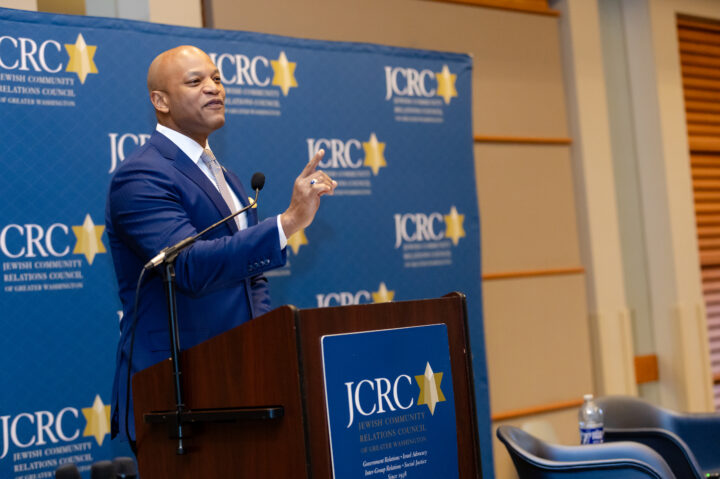
Maryland Gov. Wes Moore speaks at the Jewish Community Relations Council of Greater Washington's annual Maryland "Lox & Legislators" breakfast on Dec. 3, 2025.
Maryland Gov. Wes Moore pledged that his administration “will always support Maryland’s Jewish community” in recorded remarks for an event Monday evening marking Yom HaShoah, Israel’s Holocaust memorial day, at Beth Tfiloh Congregation in Pikesville, Md., a heavily Jewish suburb of Baltimore.
The Maryland governor, a potential Democratic presidential contender, said that it is his and his state’s “governing philosophy” to “unapologetically confront and condemn antisemitism and persecution wherever it arises,” to provide no refuge to hate, denial and conspiracy theories, to ensure that everyone feels safe to worship and to “realize the full promise of tikkun olam.”
“These are difficult times, but we’ll get through them together,” Moore said.
Moore emphasized the “responsibility” of those living today to commemorate the 6 million Jews who died in the Holocaust “because time does not carry memory forward on its own — people do.”
“We must work together to protect our history and condemn those who would try to deny it, and we can work together to be part of a change that we hope to see in the world, especially right here in Maryland, in this moment,” Moore continued.
He said that it’s important to continue to elevate the voices of Holocaust survivors while they are still living, and that it will be the “moral responsibility of our generation and our children’s generation to never forget.”
In 'Where We Keep the Light,' the swing-state Democrat provides the most intimate look yet at the centrality of Judaism to his understanding of the world
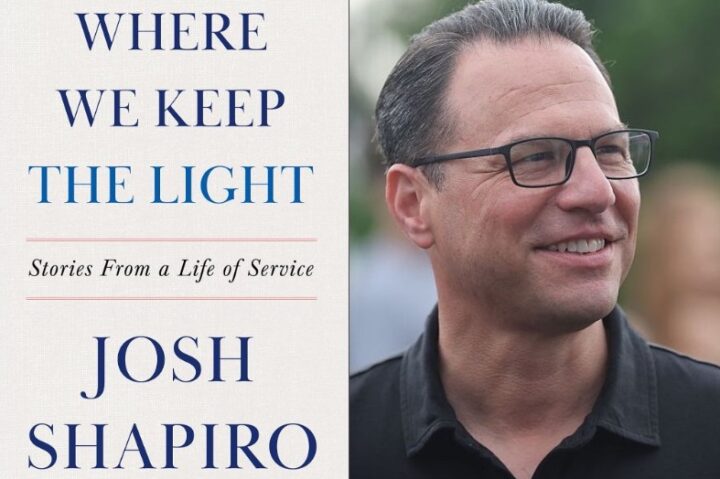
Amazon/Andrew Mordzynski/Icon Sportswire via Getty Images
Book cover/Pennsylvania Gov. Josh Shapiro
Each time Pennsylvania Gov. Josh Shapiro gets on a plane to visit different communities as he begins his reelection campaign, he’ll silently recite Judaism’s foundational prayer, the Shema, before takeoff, according to his new memoir.
Shapiro has always kept his Jewish faith at the center of his public identity. But in Where We Keep the Light, which comes out today, the swing-state Democrat provides the most intimate look yet at the centrality of Judaism to his understanding of the world. Widely expected to be eyeing a bid for the White House in 2028, Shapiro makes clear in his new book that he will not back away from his Jewish identity as his national profile grows.
“My faith has never been something I thought about doing a whole lot. Not because it’s not important. The opposite, really. It’s elemental,” Shapiro writes. “It’s why I sometimes sound a little vague when I get asked about my religion in interviews or when I try to put it into words. Kind of like when you get asked to explain how you fall asleep or blink. You just know to do it. It’s part of you, without thinking. All essence and instinct.”
The book begins with the story of the arson attack on the governor’s residence in Harrisburg last year, hours after Shapiro hosted a Passover Seder there. It’s clear that the incident, in which the assailant said that he targeted the governor because of what Shapiro “did to the Palestinians,” impacted him deeply.
“No one will deter me or my family or any Pennsylvanian from celebrating their faith openly and proudly,” Shapiro writes.
The next night, his family began their Seder by reciting Birkat Hagomel, which he described as “a prayer expressing gratitude for surviving a dangerous situation.” Shapiro again sought comfort in those days in the Shema, and its straightforward declaration of faith in God.
Along with his deep identification with Judaism, Shapiro doesn’t shy away from his support for Israel in his memoir.
The Democratic Party has become more critical of Israel in recent years, and it is easy to imagine Shapiro deciding that the politically savvy move would be to talk less about his connection to the Jewish state.
Instead, Shapiro appears to have decided that the right move — a result, surely, of both political and moral calculations — is to reveal exactly what role Judaism and Israel have played in shaping him.
Early excerpts of the book revealed that Shapiro was asked by members of Vice President Kamala Harris’ team, during the vetting process as she chose her running mate in 2024, whether he had ever acted as a foreign agent for Israel. He was also asked by Harris why he had taken such a strong position criticizing anti-Israel encampments at the University of Pennsylvania that year, and whether he would apologize for doing so. He took offense at both questions, wondering whether a double standard was at play.
He describes his first experience with advocacy, as part of the movement to free Soviet Jewry in the 1980s. He writes evocatively of a semester spent in Israel as a teenager with his Jewish day school, detailing the transformative moment he visited the Western Wall for the first time.
“My faith in that moment was around me. I was touching it. I was breathing it. My faith was alive and its roots grew deeper under me,” Shapiro writes. “The semester in Israel flew by. I loved every minute of it.” Years later, he returned to Jerusalem with his then-girlfriend Lori to propose.
Many scenes in Shapiro’s book also play out around the Shabbat table. There was the Shabbat dinner in 2017, early in Shapiro’s first month as Pennsylvania attorney general, that was interrupted by news of President Donald Trump’s ban on travel from several Muslim-majority nations. There was the Shabbat dinner in 2024 when he and Lori discussed the meeting he would have with Harris, two days later, about whether Shapiro wanted to be her running mate. The family’s Shabbat dinner table was also pictured in his first TV ad during the 2022 general election for governor.
Shapiro said he drew this lesson of embracing his Jewish faith from his experience as attorney general working with law enforcement and the Jewish community after the 2018 Tree of Life shooting. In the years after, particularly as he ran for governor, he began to have more people express to him their fear of antisemitism and of being Jewish. The answer, Shapiro writes, is not to hide.
“There have been times when I have struggled to figure out what my responsibility is as a person so public about my faith, at a time when it is more tenuous than ever to be Jewish in America,” Shapiro writes. “In these moments, I look to the Tree of Life community as my guidepost for what it means to live our faith out loud, without fear or question.”
Whether Shapiro continues to focus more closely on his Jewish faith and the rise of antisemitism, as he does in the book — as opposed to a more universal appreciation of religion’s positive role in society — is an open question. Shapiro likes to talk in stump speeches about his “faith,” with the word “Jewish” often conspicuously absent. In his election night victory speech in 2022, he quoted the Jewish book Pirkei Avot, or “Ethics of Our Fathers.” He talked about “scripture,” and how “my family and my faith call me to service.” He did not mention Judaism.
With his new book, Shapiro appears to be betting that standing up for his values and beliefs — even if the short-term politics might not be in favor of campaigning as a proud Jewish candidate who remains supportive of Israel — will be rewarded over the long haul by voters looking for someone who is authentic to his true self, standing by a time-tested set of clear moral principles.
Acton, the expected Democratic nominee, was the state’s public health director during COVID, a legacy she hopes won’t get in the way of her affordability message
Tony Dejak/AP
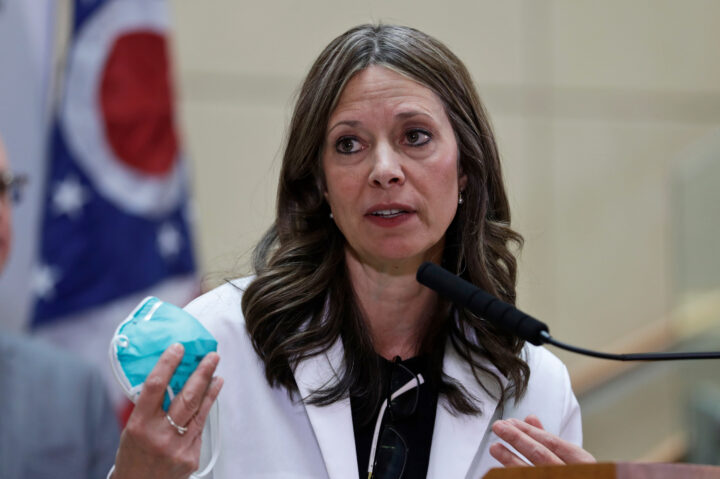
Ohio Department of Health Director Amy Acton holds up a mask as she gives an update on the state's preparedness and education efforts to limit the potential spread of COVID-19 at MetroHealth Medical Centre in Cleveland.
Amy Acton is running for governor of Ohio this November as an outsider: a Democrat challenging 15 years of Republican gubernatorial rule, a medical doctor with no political experience, a “scrappy kid” from Youngstown who experienced homelessness as a child.
But over a three-month period in the spring of 2020, she became a household name across the state. Every night, Ohioans watched Acton, then the statewide health director, in a white lab coat, describing the state’s COVID-19 precautions and trying to calm the anxiety people felt at the start of a new pandemic. The New York Times called her “the leader we wish we all had.” CNN called her “the Buckeye state’s version of the straight-talking Dr. Anthony Fauci” — before Fauci became a polarizing figure.
Now Acton is mounting her first political campaign — a bid for governor in a former swing state that has trended redder and redder in recent elections. Acton, perhaps cognizant of the angst that followed pandemic shutdowns and mask mandates, is not making her COVID-era fame the focal point of her campaign.
In a statement to Jewish Insider, Acton said her campaign will focus on one of the most animating issues for voters and politicians alike right now: affordability.
“I’m running for governor because people in my state are struggling with rising costs. There’s no breathing room,” Acton, who would be Ohio’s first Jewish governor if elected, said. “I refuse to look the other way while special interests and bad actors try to take our state backwards on nearly every measure. Everywhere I go, Ohioans are ready for change.”
But before she can get to that, Acton has to thread a difficult needle in reminding voters who she is. In the spring of 2020, during the peak of the pandemic, it felt like she was in everyone’s living rooms. Acton told the state about her family’s virtual Seder that year as she urged religious communities to celebrate the holiday without congregating. (“My matzah ball soup is the best, just saying,” Acton said, noting she didn’t have time to make it that year.)
“The magic of Amy Acton on those press conferences was her authenticity and her compassion,” said Richard Stoff, the founder of Ohio Business Roundtable.
Acton worked with DeWine to make Ohio one of the first states to shut down mid-March 2020. The move earned widespread praise at the time but now puts her in a precarious position politically, as the public health measures that were implemented early in the pandemic have turned into partisan cudgels in the ensuing years.
“Right now, that’s not the lead thing in her bio,” said Stephen Mockabee, director of the School of Public and International Affairs at the University of Cincinnati. “I think that the message that Acton will present is, ‘I’m a native Ohioan, and I love the state, that’s why I’m running, because I care about the state, and, you know, I have these experiences coming up from humble beginnings, through medical school in Ohio, working on behalf of the public in the public health capacity.’ I think that’s the story, not just referring specifically to COVID.”
“We saw the backlash to COVID, and how that could be a vulnerability for her. But what I’ve seen is it’s a strength. It is a foundation of trust that people have in her,” Ohio state Sen. Casey Weinstein told JI. “And if the worst attack against her from the other side is going to be that she fought for our health and fought to keep people out of the hospital and fought to keep us safe and was working hard to bring science and the absolute best she could to keep us and our families healthy, then okay, like, let’s have it.”
Indeed, Acton doesn’t lean into her turn as a pandemic celebrity in her messaging. Her campaign website describes her tough childhood in Youngstown, where she survived an abusive parent and homelessness, even living in a tent for a period. Her official biography tells of how she worked her way through college and medical school, kicking off a career in public health and advocacy. The only reference to COVID is carefully weighed: “When the pandemic hit, her steady leadership and voice for common sense not only saved countless lives but also helped Ohio’s economy and schools open earlier than other states,” Acton’s website declares.
Acton’s experience as Ohio health director showed her the personal cost of public life. Protesters regularly picketed her home in the Columbus suburb of Bexley. It was mostly people unhappy with pandemic-related restrictions, although the demonstrations also included a Proud Boys activist and a handful of antisemitic signs.
Ohio state Sen. Casey Weinstein, a Democrat whose district includes Akron, was also facing protesters in front of his family’s home as he spoke out against book bans. Acton reached out, and the two developed a friendship. A couple years ago, they reconnected at a Passover Seder hosted at the Ohio statehouse, and Weinstein has helped her campaign in the Cleveland area. (The two were also “celebrity bartenders” at a fundraiser for the Akron JCC last year.)
“We saw the backlash to COVID, and how that could be a vulnerability for her. But what I’ve seen is it’s a strength. It is a foundation of trust that people have in her,” Weinstein told JI. “And if the worst attack against her from the other side is going to be that she fought for our health and fought to keep people out of the hospital and fought to keep us safe and was working hard to bring science and the absolute best she could to keep us and our families healthy, then okay, like, let’s have it.”
Acton stepped down from the role in June 2020, three months into the pandemic. But it wasn’t due to the protests, she asserts. It was, as she told an interviewer last month, because she refused to go along with Republican lawmakers who wanted her to give permission to reopen some venues that had been shuttered due to pandemic restrictions.
“That she’s running I think takes a lot of guts on her part, because she was a face during COVID that people knew and recognized, and got a lot of negativity, I think unwarranted negativity, but about her role in trying to manage that crisis,” said Dan Birdsong, a political scientist at the University of Dayton.
“I could not put my name on orders that, frankly, would have killed people. I have a Hippocratic Oath as a doctor to do no harm,” she said. The campaign pitch is in the pivot that comes next — that she is still proud of leading the shutdown charge because it allowed the state to reopen schools and other spaces sooner.
“In Ohio, we flattened the curve. We saved a lot of lives, and we actually got back to work and life sooner because we took swift, decisive action,” she said. The key question — aside from whether any Democrat can, in 2026, be a viable statewide candidate in Ohio — is how the public will respond to the pandemic flashbacks that her campaign will inevitably spark.
“That she’s running I think takes a lot of guts on her part, because she was a face during COVID that people knew and recognized, and got a lot of negativity, I think unwarranted negativity, but about her role in trying to manage that crisis,” said Dan Birdsong, a political scientist at the University of Dayton.
The primary hasn’t taken place yet, but Acton and her general election opponent — Republican entrepreneur Vivek Ramaswamy, who ran for president in 2024 — have each cleared the field in their respective parties. A December poll showed Acton leading Ramaswamy by one point, but experts cautioned that it is too soon to draw any conclusions.
Acton has not made her Jewish faith central to her campaign in the same way that Pennsylvania Gov. Josh Shapiro did during his 2022 campaign. But she has long been steeped in the Jewish community, serving on boards like the Columbus JCC, Columbus Jewish Day School and Congregation Beth Tikvah outside Columbus. “My Jewish roots in tikkun olam have been a guiding force throughout my career as a public servant and instilled in me the belief that everyone deserves the same chance to get ahead that I had,” Acton told JI.
Antisemitism has taken an unusual place in the race, aside from the anti-Jewish hate that Acton faced as health director six years ago. Ramaswamy, the son of Indian immigrants, published an op-ed in The New York Times last month calling out the racist, antisemitic “Groyper” movement — conservatives who consider themselves followers of the neo-Nazi influencer Nick Fuentes.
“Conservative leaders should condemn — without hedging — Groyper transgressions,” Ramaswamy wrote. “We must practice what we preach: My current Democrat opponent in Ohio is a Jewish woman, and while I criticize her policy record unsparingly, I will be her most vocal defender against antisemitic attacks from left or right.”
Ramaswamy struck up a dialogue with Jewish communal leaders in Ohio after the Republican presidential primary ended.
“He’s staked out a really powerful position opposing some of the antisemitism and the bigotry on the right wing of the Republican Party. He’s gotten hate because of that,” said Howie Beigelman, president and CEO of Ohio Jewish Communities, a statewide advocacy group. “I think that both of them have a personal connection to our community, in that sense, understanding what we’re going through and the fears we have.”
Acton is not running as an uber-progressive Democrat; she did, after all, get her start in politics working for a Republican governor. That moderate sensibility is likely to help her in Ohio.
She is also hoping to ride the coattails of former Sen. Sherrod Brown, the last Democrat to win statewide in Ohio, as he challenges Sen. John Husted (R-OH), who was appointed to the Senate last year. Senate Minority Leader Chuck Schumer (D-NY) said this week that if Democrats hope to regain the Senate majority, they’ll need to win in Ohio — and Democrats will spend heavily to boost Brown.
“There are coattails there, and so making sure that she’s as strong as can be is really important,” said Jeff Rusnak, a Democratic strategist in Cleveland.
And whether COVID ultimately proves to be positive or negative for Acton, there’s no question her actions during that pandemic earned her some hardcore fans who will be trying to get her across the finish line. Acton’s neighbors in Bexley put signs in their yards that read, “DR. AMY ACTON FAN CLUB,” some of which remained well after the pandemic emergency ended. A local apparel company designed shirts in support of Acton that said “Not all heroes wear capes.”
“She had this following, and she still has this. I’ve been with her in public and witnessed this firsthand,” Rusnak said. “You could just be sitting at a coffee shop with her, having coffee, and people who she does not know will just walk up to her in tears and thank her, and want to hug her. It’s this very strange phenomenon.”
Last year, Walz looked like he was on the fast track in national politics. Now he looks to be ending his career as a disgraced two-term governor
Stephen Maturen/Getty Images
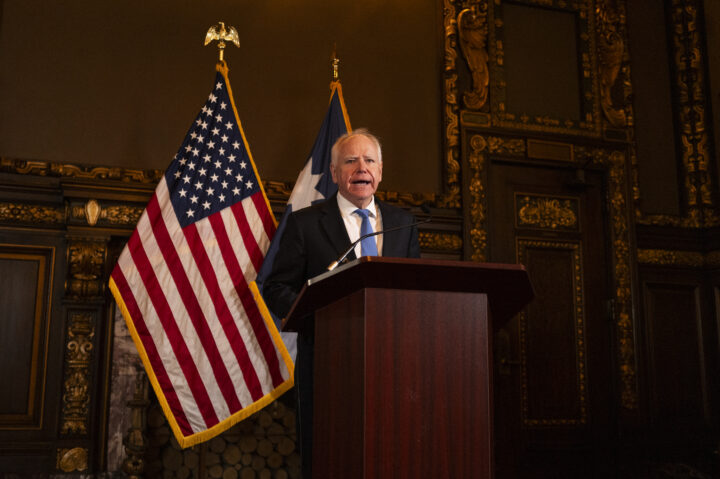
Minnesota Gov. Tim Walz speaks during a press conference at the State Capitol building on January 5, 2026 in St. Paul, Minnesota.
The political fall of Minnesota Gov. Tim Walz, who just months ago was near the apex of political prominence as Kamala Harris’ running mate in the 2024 presidential election, is an object lesson in the consequences of pandering to the far left of the Democratic Party.
Last year, Walz looked like he was on the fast track in national politics. Now he looks to be ending his career as a disgraced two-term governor.
Walz announced Monday that he’s not running for a third term in office, amid a growing scandal over massive welfare fraud, where dozens of individuals from the state’s Somali diaspora were convicted in schemes involving over a billion dollars stolen from the state’s social services programs.
The scandal offers a snapshot of some of the Democratic Party’s most glaring vulnerabilities. Walz, along with others in the state’s Democratic leadership, oversaw the allocation of generous welfare payments without ample accountability, while turning a blind eye to corruption in a Somali community that’s become a reliable Democratic voting bloc.
A nimbler, and more moderate, politician would have aggressively led the charge against the criminals instead of coming across as a passive bystander. After all, a scandal like this threatens the sustainability of generous social welfare programs that have defined the ethos of the Minnesota Democratic Party. Instead, in his announcement Monday, he decried “political gamesmanship” by Republicans for drawing outsized attention to the issue.
A more pragmatic Walz would also have been comfortable speaking out against scandalous elements within the Somali community (without painting the entire community with a broad brush). Instead, his belated comments speaking out against the fraud typically avoided reference to the perpetrators of the scandal, and he frequently blamed Republicans as racist for invoking their backgrounds. That only dug him into a deeper political hole.
Walz’s sensitivity about not alienating the state’s Somali community also came up in other areas that underscored his progressive instincts. When a leading Somali mayoral candidate (state Sen. Omar Fateh) came under fire for employing virulently antisemitic staffers at the top levels of his campaign, Walz remained silent, even as Sen. Amy Klobuchar (D-MN) spoke up.
Walz also has been supportive of far-left Rep. Ilhan Omar (D-MN) even when she’s faced controversies over using antisemitic tropes and embracing anti-Israel views that have placed her out of the Democratic Party’s mainstream. His selection as Harris’ running mate over Pennsylvania Gov. Josh Shapiro was cheered on by the anti-Israel wing of the party.
The fact that Walz’s time in office is ending, in part, over his ideological stubbornness, is a shift from his early political career. Representing a swing district in the House for over a decade, Walz generally voted with his party’s moderates and broke with liberals on gun rights and energy policy while maintaining strong support for Israel. But as governor, he tacked to the left, embracing criminal justice reform and gun control, while often pandering to his party’s activists.
In one notable exchange last year with California Gov. Gavin Newsom, he argued that MAGA Republicans were driven by racism and sexism — a point that the 2028 presidential contender disagreed with. Since his elevation to the national stage, Walz has often invoked racism and sexism in criticizing the Republican Party — an impolitic attack that distinguished him from prospective presidential contenders like Newsom and Shapiro.
Walz’s departure from the governor’s race gives Democrats the opportunity to replace him with Klobuchar, a more pragmatic figure who has coasted to reelection since first winning her Senate seat two decades ago. Klobuchar, if she runs, she’ll benefit from being distant from the state’s fraud scandal.
But she could face challenges on her left that could expose the divisions within the party. Minnesota Attorney General Keith Ellison, a progressive and longtime critic of Israel, has also been mentioned as a leading candidate. But his role as the state’s lead law enforcement officer during the fraud scandal — already an issue in his reelection campaign — would bring the same political vulnerabilities as Walz with more ideological baggage.
Asked about right-wing antisemitism, Blakeman said that Tucker Carlson ‘is a big blowhard who has an issue with Jewish people’
Noam Galai/Getty Images
Bruce Blakeman announces his run for New York governor on "Fox & Friends" at Fox News Channel Studios on December 09, 2025 in New York City. (
Nassau County Executive Bruce Blakeman suddenly emerged as the presumptive Republican nominee for governor of New York in December, with Rep. Elise Stefanik’s (R-NY) unexpected exit from the race against Gov. Kathy Hochul.
Now, with the formal endorsement of President Donald Trump, Blakeman is preparing for an uphill battle in a reliably Democratic state.
Blakeman, 70, is Jewish and said he represents the greatest number of constituents of any Jewish Republican elected official — more than 1.3 million. He vowed to protect the Jewish community statewide against antisemitism, and pledged that under his leadership, the state would step in if New York City Mayor Zohran Mamdani fails to do so.
Blakeman said that he has worked with the Nassau County police to deal with disruptive anti-Israel protests, setting firm rules for demonstrators, with prompt arrests if they stepped outside of those boundaries.
“If they got off the sidewalk, they would be given one chance to get back on it or they’d be arrested,” Blakeman said. “We didn’t take any nonsense. We didn’t allow them to do the things that they got away with in New York City. And that’s the same way I would approach it as governor.”
“Nick Fuentes is, in my opinion, a nut, but a dangerous one, and he has no place in the Republican Party,” Blakeman said. “Tucker Carlson is a big blowhard who has an issue with Jewish people, and it probably emanates from his chameleon-like personality. … He’s very unprincipled and I think he has biases that probably emanated from his youth.”
Blakeman said that if Mamdani fails to enforce the law, he would dispatch state police and national guard to do so. “We will not let any community be lawless, and I will not tolerate any acts of bigotry, antisemitism or racism in a state where I’m the governor.”
Asked about voices like Tucker Carlson and neo-Nazi influencer Nick Fuentes who are working to mainstream antisemitic ideas in the Republican Party, Blakeman did not mince words in his condemnation.
“Nick Fuentes is, in my opinion, a nut, but a dangerous one, and he has no place in the Republican Party,” Blakeman said. “Tucker Carlson is a big blowhard who has an issue with Jewish people, and it probably emanates from his chameleon-like personality. … He’s very unprincipled and I think he has biases that probably emanated from his youth.”
At the same time, Blakeman argued that he sees most antisemitism in the United States coming from the left, pointing to the large-scale turn against Israel in the Democratic Party.
“We have a couple of nuts in our party, but certainly [they are the] vast minority, and in the Democratic Party, it seems to me that they have completely abandoned Israel and that they are a hotbed for antisemitic activities,” Blakeman said.
He predicted those trends will help his campaign capture a significant number of Jewish Democratic voters who “realize that the Democratic Party has become an extreme party that’s hostile to Israel and hostile to Jewish people.”
He said he feels it’s important for the Republican Party to have “a strong Jewish presence” and that he takes his responsibility in that role seriously, saying he wants to be a “role model” for other Jewish people to get involved in GOP politics.
“I am a strong supporter of Israel,” Blakeman said. “I am a Zionist and a proud Zionist.”
“It’s something that I don’t take lightly as being a leader and someone who is a Jew and in the Republican Party,” Blakeman said.
Blakeman said he’s established a strong record as an ally and supporter of Israel in Nassau County, building business ties to Israel, implementing anti-Boycott, Divestment and Sanctions legislation and signing friendship agreements with what he called Judea and Samaria — the biblical term preferred by the Israeli government for the West Bank — and the Shomron Regional Council, a council of Israeli settlements in the West Bank.
“I am a strong supporter of Israel,” Blakeman said. “I am a Zionist and a proud Zionist.”
He said he’s currently under contract to buy an apartment in Beit Shemesh, as an investment.
Asked about the role his Jewish faith has played in his time in office and public life, the Nassau County executive responded, “Everything that I do emanates from the strength that’s given to me by Hashem, by God. So I am very mindful that it’s only with God’s blessings that I have the strength to do what I’m doing.”
“I ask for God’s blessings each and every day, and I pray every day, and I feel that having that spiritual connection with God is a very important part of my life,” he continued.
Blakeman said his campaign will focus on improving public safety, lowering prices for businesses and residents, making the state government more responsive and stopping the population flight from the state, issues he said are being driven by incumbent Gov. Kathy Hochul, a Democrat.
He framed Nassau County, under his leadership, as a counterpoint to those trends, pointing to the county’s low taxes and strong financial position. “If we can do that on the state level, I’m sure people will be happy. They’ll want to do business here. They want to live here, and they will flourish and prosper.”
“I want to make people happy. I want them to be proud of New York. I want them to want to raise their children and their grandchildren,” Blakeman said.
He said that his past victories in a Democratic-leaning county provide a model for winning statewide in deep-blue New York, arguing that he’s been able to reach populations that haven’t traditionally voted Republican, including Hispanic, Latino, Asian American, women and African American voters.
Asked about Mamdani’s victory in New York City, Blakeman said that Mamdani’s focus on affordability “struck a note with a lot of voters,” but New York City Republicans “didn’t have an adequate message with respect to that issue — and I do.”
Blakeman said he wants to create jobs and make the state more prosperous, rather than providing “a free bus ride or a handout,” spurring economic development and job creation in collaboration with the business community and unions.
The growing welfare fraud scandal in the state was a looming vulnerability over Walz’s bid for a third term
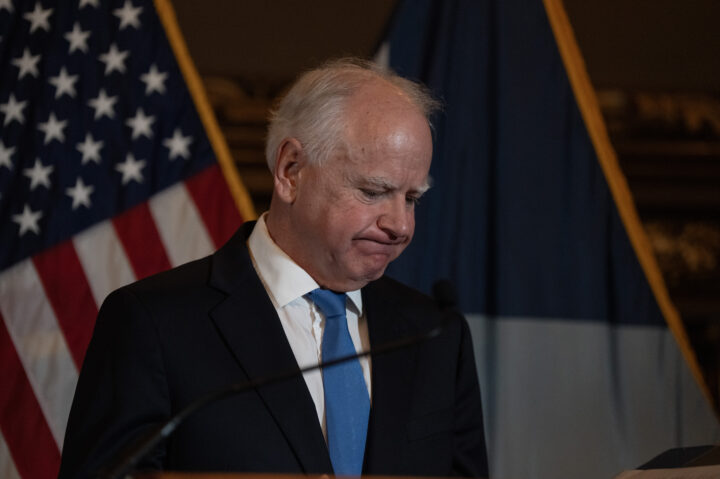
Jerry Holt/The Minnesota Star Tribune via Getty Images
Minnesota Governor Tim Walz announces that he would not be seeking reelection Monday January 5, 2026 at a press conference at the State Capitol in St.Paul, Minn.
Minnesota Democratic Gov. Tim Walz’s decision to drop out of the 2026 gubernatorial race in a state heavily favored for Democrats marks a significant political fall for the party’s 2024 vice presidential nominee.
Walz, 61, said while announcing on Monday that he would no longer seek a historic third term as governor that he had “every confidence” that he could have won his reelection bid — despite facing intense scrutiny for a state welfare fraud scandal that has gained national attention and become a political flashpoint in Minnesota. Still, Walz acknowledged that the fraud allegations, which have mostly been leveled at members of the state’s Somali community, and the broader scandal played a role in him ending his campaign.
The outgoing governor used his announcement to again criticize President Donald Trump and Republicans for “vile, racist lies and slander towards our fellow Minnesotans,” accusing them of highlighting the large number of Somalis under investigation and indictment to demonize the immigrant community.
Despite the scandal, Walz began the campaign as the favorite to win the governor’s race, the result of the state’s Democratic lean and the fact that Republicans have not won a statewide election there since 2006, when former Gov. Tim Pawlenty won his bid for a second term.
But Walz only won his 2022 reelection bid by eight points, which made his bid for a third term in 2026 precarious as Republicans looked to amplify the fraud allegations.
The decision to end his campaign means Walz will cap off two decades in elected office next January, less than two years after former Vice President Kamala Harris selected him as her running mate and thrust him onto the national stage.
While holding a moderate voting record as a member of Congress, Walz largely governed as a progressive, and was the preferred choice of progressive Democrats critical of Israel in the 2024 veepstakes over Pennsylvania Gov. Josh Shapiro.
On the campaign trail, Walz praised anti-Israel protesters and urged the U.S. to exert more leverage on Israel. He also drew scrutiny for appearing at events with an antisemitic and pro-Hamas Muslim cleric. He said last year after the election that war in Gaza was “rightfully” a “central focus” of the 2024 campaign.
Last year, Walz did not respond to inquiries about then-Minneapolis mayoral candidate Omar Fateh’s campaign, which employed senior staffers who celebrated Hamas’s Oct. 7, 2023, attacks on Israel.
And, criticizing Israel for striking Iran last June, Walz suggested that China was better positioned to act as a broker for Middle East peace than the Trump administration.
The positions and approach to governance mark a notable evolution for Walz from when he first entered political life. Walz was elected to the House during the Democratic midterm wave of 2006, scoring an upset in a GOP-leaning rural district. Walz held onto the southern Minnesota seat for six terms, assembling a pragmatic voting record in the process that included support for gun rights, Israel and the Keystone XL pipeline.
That voting record earned him the endorsement of the National Rifle Association, something the advocacy group revoked during Walz’s successful 2018 gubernatorial campaign, when he ran on a platform of tightening gun restrictions.
Walz’s leftward shift began after first being elected governor, but he accelerated his progressive push when his party won full control of the state legislature in 2022.
Minnesota is home to a sizable Muslim population, many of whom are represented by Rep. Ilhan Omar (D-MN), a vocal Israel critic, in the Minneapolis area. More than 18% of the state’s Democratic primary voters in 2024 chose to write in “uncommitted” rather than support former President Joe Biden as a means of protesting his support of Israel.
Walz said at the time that the party needed to focus on winning back those anti-Israel voters rather than dismiss their criticisms, though he also argued that centrist voters were also in play.
“These are voters that are deeply concerned, as we all are. The situation in Gaza is intolerable, and I think trying to find a lasting, two-state solution, certainly the president’s move towards humanitarian aid and asking us to get to a ceasefire, that’s what they’re asking, to be heard,” Walz told CNN on the evening of Super Tuesday. “That’s what they should be doing. … We start bringing these folks back in. We listen to what they’re saying. That’s a healthy thing that’s happening here.”
“Take them seriously. Their message is clear that they think this is an intolerable situation and that we can do more, and I think the president is hearing that,” he added
The move by the prominent Republican, who gained attention for her grilling of university presidents amid federal inquiries into campus antisemitism, comes a month after she entered the race

Kent Nishimura/Getty Images
Rep. Elise Stefanik (R-NY) testifies before the Senate Foreign Relations Committee on her nomination to be Ambassador to the United Nations on Capitol Hill on January 21, 2025 in Washington, D.C.
Rep. Elise Stefanik (R-NY) announced on Friday that she was ending her campaign for governor of New York, an abrupt and unexpected move that comes just over a month after the Republican congresswoman launched her bid to unseat Gov. Kathy Hochul.
In addition to not running for governor, Stefanik said in a statement posted to social media that she also would not seek reelection to her House seat, making her future plans unclear. Stefanik said the decision to end her short-lived gubernatorial bid was based on her desire to spend more time with family and the uphill battle she would face in the general election after what would likely be a bruising Republican primary battle.
“While spending precious time with my family this Christmas season, I have made the decision to suspend my campaign for Governor and will not seek re-election to Congress. I did not come to this decision lightly for our family,” Stefanik wrote on social media.
Stefanik added, “As we have seen in past elections, while we would have overwhelmingly won this primary, it is not an effective use of our time or your generous resources to spend the first half of next year in an unnecessary and protracted Republican primary, especially in a challenging state like New York.”
“And while many know me as Congresswoman, my most important title is Mom. I believe that being a parent is life’s greatest gift and greatest responsibility,” she continued. “I have thought deeply about this and I know that as a mother, I will feel profound regret if I don’t further focus on my young son’s safety, growth, and happiness — particularly at his tender age.”
Stefanik’s withdrawal from the race came weeks after Nassau County Executive Bruce Blakeman, another close ally of President Donald Trump, jumped into the GOP primary, setting up a competitive fight ahead of what would be a difficult general election contest for Republicans in the blue state.
Stefanik was briefly Trump’s nominee to be U.S. ambassador to the United Nations, though she withdrew her nomination as it became clear that House Speaker Mike Johnson (R-LA) could not afford another vacancy in the House without risking Republicans’ already slim majority.
Trump said in a statement on his Truth Social platform after Stefanik announced her decision, “Elise is a tremendous talent, regardless of what she does. … She will have GREAT success, and I am with her all the way!”
Johnson, meanwhile, wrote on X, “I know this was a tough decision for my friend and colleague @EliseStefanik, but her resolve to put family first is one that everyone will respect. Elise is an exceptional talent who has served the people of New York valiantly in Congress.”
“She will continue to be [a] leading force for our party and its principles no matter what the next chapter brings,” he added. “We are grateful for her service and wish her well in her next endeavors.”
The upstate New York lawmaker, a pro-Israel stalwart in Congress, had said during her confirmation process earlier this year that anti-Israel and antisemitic bias at the U.N. was a major factor that drove her interest in the Turtle Bay role. As she began considering entering the governor’s race this fall, Stefanik became a vocal critic of Hochul, frequently tying her to New York City Mayor-elect Zohran Mamdani and his policies.
Stefanik has gained attention in the Jewish community in the two years since Hamas’ Oct. 7, 2023 attack on Israel, most notably due to her aggressive questioning of university presidents about campus antisemitism.
Fishback has sought to cast next year’s Republican primary as 'very clearly a two-person race,' but political operatives are skeptical his bid will amount to on-the-ground traction even as he provokes controversy from behind the screen
Campaign website
James Fishback
In recent weeks, James Fishback, a 30-year-old Republican investor who last month launched a long-shot campaign for governor of Florida, has drawn online attention for a series of incendiary social media posts attacking Israel and invoking antisemitic tropes.
In addition to praising followers of the neo-Nazi influencer Nick Fuentes, comments for which he has refused to apologize, Fishback has promoted a range of extreme anti-Israel positions, including in a recent campaign ad vowing to defend those who accuse the Jewish state of genocide. He has taken repeated aim at the pro-Israel organization AIPAC, which he calls a “foreign lobbying group,” saying its supporters are “slaves” and that his own “allegiance is to America.”
“I’ll be the first to admit that I fell for the ‘Israel is our greatest ally’ scam and the lie that criticizing Israel is ‘antisemitic,’” he wrote in a social media post this week. “It wasn’t until I was offered a paid trip to Israel this summer (which I never took) that I realized how cringe and pathetic the propaganda was.”
In using such inflammatory rhetoric, Fishback, a political newcomer, is likely seeking to capitalize on the views of a younger audience of far-right voters increasingly fueling anti-Israel as well as antisemitic sentiment in the GOP, which has recently forced the party to confront a growing schism within its ranks over its ideological direction.
But while Fishback has sought to cast next year’s Republican primary as “very clearly a two-person race” between him and Rep. Byron Donalds (R-FL) — the pro-Israel GOP front-runner now dominating the polls while reporting a $40 million fundraising advantage — political operatives in both parties are skeptical his insurgent bid will ultimately amount to any sort of meaningful on-the-ground traction even as he continues to provoke controversy from behind the screen.
“Social media is the only reason anyone has heard of Fishback, and 20 years ago no one would even be talking about him,” Steve Schale, a Democratic strategist in Florida, told Jewish Insider. “Unless he stumbles into a pile of cash, it’s hard for me to see this being more than just an effort to get clicks.”
Fishback, the CEO of an anti-DEI investment firm called Azoria, is hardly the first candidate hoping to translate social media clout into votes or fame. A growing cohort of young influencers seeking office has emerged in recent years, so far with no success.
Deja Foxx, a progressive TikTok activist who ran for Congress in Arizona this summer, had raised a lot of money and appeared to be gaining momentum near the end of the campaign. But despite the hype, Foxx fell short by nearly 40 points — losing out to a more established local lawmaker.
In the race to succeed outgoing Florida Gov. Ron DeSantis, Donalds, a three-term congressman who is endorsed by President Donald Trump, is heavily favored to clinch the nomination over a handful of lesser-known primary rivals. Multiple surveys have shown him leading by double digits — with support from a range of state elected officials. Fishback, for his part, claimed just 2% of the vote in a recent poll.
“Although we’re still in the early stages of this race, it’s almost game, set, match,” said Ford O’Connell, a Republican strategist in Florida. “Byron Donalds is dominating the field, approaching 50% in the polls. Once voters realize he has Trump’s endorsement, he becomes the clear favorite. In GOP primary politics, Trump’s endorsement is the platinum standard.”
“If you look at any legitimate polling I would say Mr. Fishback has a very tall mountain to climb,” Will McKinley, a GOP lobbyist and government consultant in the state, echoed to JI.
Jim Cherry, a Republican pollster in Florida, said his “firm does political polling and as of this point, no client has requested that we include Fishback in any gubernatorial head-to-head questions.”
A college dropout and former hedge fund analyst, Fishback attracted some attention in conservative circles after he pitched DOGE “dividend checks” to a receptive Elon Musk, though the plan never took off. He later launched a super PAC to oppose Musk when the billionaire mogul fell out with Trump. He announced his gubernatorial bid in mid-November, pledging to “build on” DeSantis’ “historic record.”
Fishback has portrayed himself as a strong ally of DeSantis, who has so far declined to publicly back anyone in the race, while dismissing Donalds’ bid. But Fishback’s hostility to Israel puts him at odds with the governor, who has long touted his support for the Jewish state.
Meanwhile, Fishback’s recent comments on Israel are almost certain to alienate a sizable population of Jewish voters who live in Florida and can help tip the scales in close elections.
“In my opinion, he’s not a serious candidate and is simply trying to be incendiary to get attention,” said Gabriel Groisman, a Jewish Republican donor and a former mayor of Bal Harbour, Fla.
He declined to comment further, saying that doing so would be “counterproductive.”
In a statement to JI Thursday, Sam Markstein, spokesperson for the Republican Jewish Coalition, dismissed Fishback as “a radical fringe candidate who has decided that the way to run his campaign is to attack the Jewish community and our ally Israel.”
“It won’t work — and Republican Floridians will resoundingly reject him in the GOP primary,” he said.
Fishback, in response, said the “only poll that matters is on Election Day: August 18, 2026,” adding: “Until then, I am committed to earning Floridians’ votes by visiting all 67 counties to meet folks where they are, hear their concerns and share my vision for a more affordable Florida.”
“If elected, I’ll be a governor for all Floridians,” he continued in a statement to JI. “As a Christian, I have never ‘attacked’ anyone for their faith. I will protect religious freedom and ensure the safety of all Floridians.”
Three Jewish leaders see Gill as the likely front-runner for the 11th Congressional District seat, with Malinowski as a formidable candidate as well
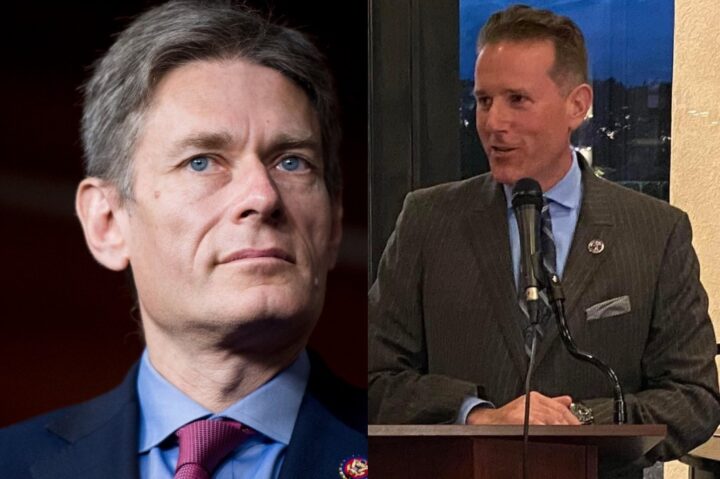
Bill Clark/CQ Roll Call via AP/Facebook
Former Rep. Tom Malinowski (D-NJ) and Essex County Commissioner Brendan Gill
The race to replace New Jersey Gov.-elect Mikie Sherrill in her northern New Jersey district, an affluent, suburban area with a sizable Jewish population, has attracted around a dozen Democratic candidates from a wide array of backgrounds. But three Jewish leaders in the state plugged into the local political scene say they see Essex County Commissioner Brendan Gill as the likely front-runner in the 11th Congressional District, with former Rep. Tom Malinowski (D-NJ) as a formidable candidate as well.
The primary election is set for Feb. 5, with a general election on April 16.
Gill, a former aide to Gov. Phil Murphy, has been endorsed by the outgoing governor, and is considered the leading Democrat, the Jewish leaders said, because he’s a well-known and well-liked figure in the district, has the backing of the Democratic Party establishment, entered the race relatively early and has long been seen as an up-and-coming leader in the area.
He’s also been working aggressively to secure supporters and donors, two leaders said.
But he could also face attacks over his role as Murphy’s campaign manager in 2017, when he faced allegations by a top campaign aide who accused Gill of running a “toxic” workplace, attempting to push her out of the campaign, of misogynistic behavior toward her and other female campaign staff and of using a misogynistic slur in an argument with her. Gill denies those allegations.
Malinowski is a known quantity from his three terms in Congress and has been endorsed by Sen. Andy Kim (D-NJ) as a counterweight to the New Jersey political machine — but there’s only partial overlap between Malinowski’s former House district and the neighboring seat he’s running in now, setting up potential attacks on him as an outsider.
“Malinowski is a legitimate, serious candidate. He’s in the mix. I would not rule him out. He’s a well-known name. He’s got the history here. He’s deeply connected,” one leader said. “If I had to gauge it right now, I would say Gill one, and [Malinowski] two.”
They also noted that the limits of Murphy’s influence were clear in Kim’s election in the Senate race, in which he garnered more statewide party support than Tammy Murphy, the wife of the current governor, who dropped her bid before the primary.
One Jewish leader said that, given his ties to Murphy and their ideological alignment, Gill would likely be a reliable supporter of the Jewish community, as Murphy generally has been. The leader noted that Gill had also worked in the past with Sen. Cory Booker (D-NJ) and the late Sen. Frank Lautenberg (D-NJ), both of whom were strong supporters of Israel.
“I think you’ll see someone who is a practical, thoughtful person in their engagement with the Jewish community,” they said.
But two other Jewish community leaders noted that Gill’s wife, a state representative, has raised concerns among some in the community.
Assemblywoman Alixon Collazos-Gill attended a Palestinian flag raising event in Clifton, N.J., which featured denunciations of Israel, accusations that Israel was committing genocide and deliberately inflicting famine in Gaza and calls for “no money for wars.”
Collazos-Gill, who has attended flag raising events for various other communities in Clifton as well, posted on Facebook after the event, “I was moved by the sense of community, love and resilience. Thank you Clifton for the kind invitation and the Palestinian community that organized the event.”
She was also critical of the Trump administration’s efforts to deport Mahmoud Khalil, an anti-Israel activist at Columbia University. “So many things are at stake: due process, freedom of speech, the right to peacefully protest, democracy. This is a warning that this can happen to any non-citizen. We should all be concerned,” she posted on Facebook.
She was also endorsed by the New Jersey branch of the Working Families Party, which at the national level has accused Israel of mass starvation in Israel and called for the U.S. to condition aid to the Jewish state. It supported an immediate ceasefire in Gaza two weeks after the Oct. 7, 2023, Hamas attack on Israel.
And she attended a meet-and-greet event in May at the invitation of prominent members of the Palestinian American Community Center, a local Palestinian group. Rep. Josh Gottheimer (D-NJ) urged the Department of Justice to investigate the group in April for hosting an alleged affiliate of the Popular Front for the Liberation of Palestine at its annual conference. In social media comments, an organizer of the meet and greet emphasized that it had occurred off-site and was not formally affiliated with the PACC, a nonprofit group.
Collazos-Gill was vague about what was discussed in a Facebook post, but thanked the two PACC members for “inviting me to join you in these meaningful conversations about the issues that matter most to you.”
Gill’s campaign did not respond to a request for comment.
The Jewish leader who praised Gill said they had spoken to Collazos-Gill recently and didn’t hear her express any anti-Israel sentiments, and said she had indicated an interest in cultivating relationships with the Jewish community. They also noted that Collazos-Gill is sponsoring legislation to codify the International Holocaust Remembrance Alliance’s working definition of antisemitism.
“Regardless, I do think Brendan is a supporter of Israel and the Jewish community as his own person,” the leader continued.
While in Congress, Malinowski was generally a reliable supporter of Israel and a voice against antisemitism, but some of his views towards Israel since Oct. 7, 2023, have raised skepticism in the Jewish community, one leader noted.
In public interviews, he expressed support last year for President Joe Biden’s moves to pressure Israel against entering the Gaza city of Rafah by withholding some arms shipments.
Also in the race is Jeff Grayzel, the deputy mayor of Morris Township, N.J., and a leader in his local Jewish community relations council and federation. While Jewish leaders praised Grayzel and said he’d be a strong voice for Jewish community priorities — one described him as clearly the strongest advocate on those issues — they were skeptical that he would have a path to victory against better-known figures such as Gill and Malinowski.
Grayzel, speaking to JI last week, pushed back, arguing that neither Malinowski nor Gill are particularly well-known in the district.
He predicted that Malinowski and Gill, training their fire at each other will provide an opportunity for other candidates to emerge, and that the wide field will mean that a fairly low vote percentage is needed to win.
Grayzel outlined a path to victory that includes winning Morris County, where he lives and which makes up 40% of the district, as well as picking up the substantial Jewish vote in Essex County.
“People are sick and tired of politics as usual,” Grayzel said. “I think I have the message that’s going to resound the most with the voters, coming at it as a [former] mayor who has literally solved problems, who’s delivered results for his community.”
The Jewish community, Grayzel added, will “have to come out and vote. … If Jews are sick and tired of antisemitism, if Jews are tired of how Israel has been treated, the answer to that is to vote.”
Lt. Gov. Tahesha Way also entered the race, but the Jewish leaders largely said they do not see her as a strong contender, given that she entered the race late and is not particularly well-known, despite her statewide position.
The suspect, Cody Balmer, pled guilty Tuesday on charges of attempted first-degree murder, aggravated assault and aggravated arson

Kyle Mazza/Anadolu via Getty Images
Police line cordon is seen at Pennsylvania Governor's Mansion after a suspected arson attack caused significant damage in Harrisburg, Pennsylvania, United States on April 13, 2025.
Hours after the man accused of an arson attack on the Pennsylvania governor’s mansion in April pled guilty to the attempted murder of Gov. Josh Shapiro, the governor appeared to publicly acknowledge for the first time that the attacker targeted him for his faith.
Cody Balmer was sentenced to 25 to 50 years in prison for the attack, which took place hours after Shapiro and his family hosted a Passover Seder at the governor’s residence in Harrisburg. Balmer said after his arrest that he was motivated by the war in Gaza, and that he wanted Shapiro to know that Balmer “will not take part in his plans for what he wants to do to the Palestinian people.” Shapiro has avoided calling the attack a hate crime.
In a CNN interview on Tuesday, Shapiro was asked by anchor Jake Tapper if he believed he was “targeted just because you’re Jewish.”
“Look, obviously, as governor of Pennsylvania I don’t have foreign policy in my job description. But clearly, the district attorney thought that this was a material fact,” Shapiro said. “Clearly this was a motivating factor.”
Balmer did not face hate crime charges in the case.
“Whatever is motivating this political violence in this country, it needs to stop. Whether it’s targeting me because of my faith, whether it’s targeting someone else because of their ideology, it is not OK,” Shapiro told Tapper. “I think we need all leaders to speak and act with moral clarity, to call it out, to condemn it, and to try and take down the temperature so we don’t end up in situations like this where public officials are targeted because of their faith or their feelings or their ideology.”
A new video released by prosecutors this week shows Balmer walking through the governor’s residence and attempting to kick down doors to the area where Shapiro and his family slept. He is seen throwing Molotov cocktails into a room filled with round tables where the seder had taken place hours before.
Speaking at the Eradicate Hate Global Summit on rising political violence, Shapiro called for ‘peaceful and respectful dialogue’
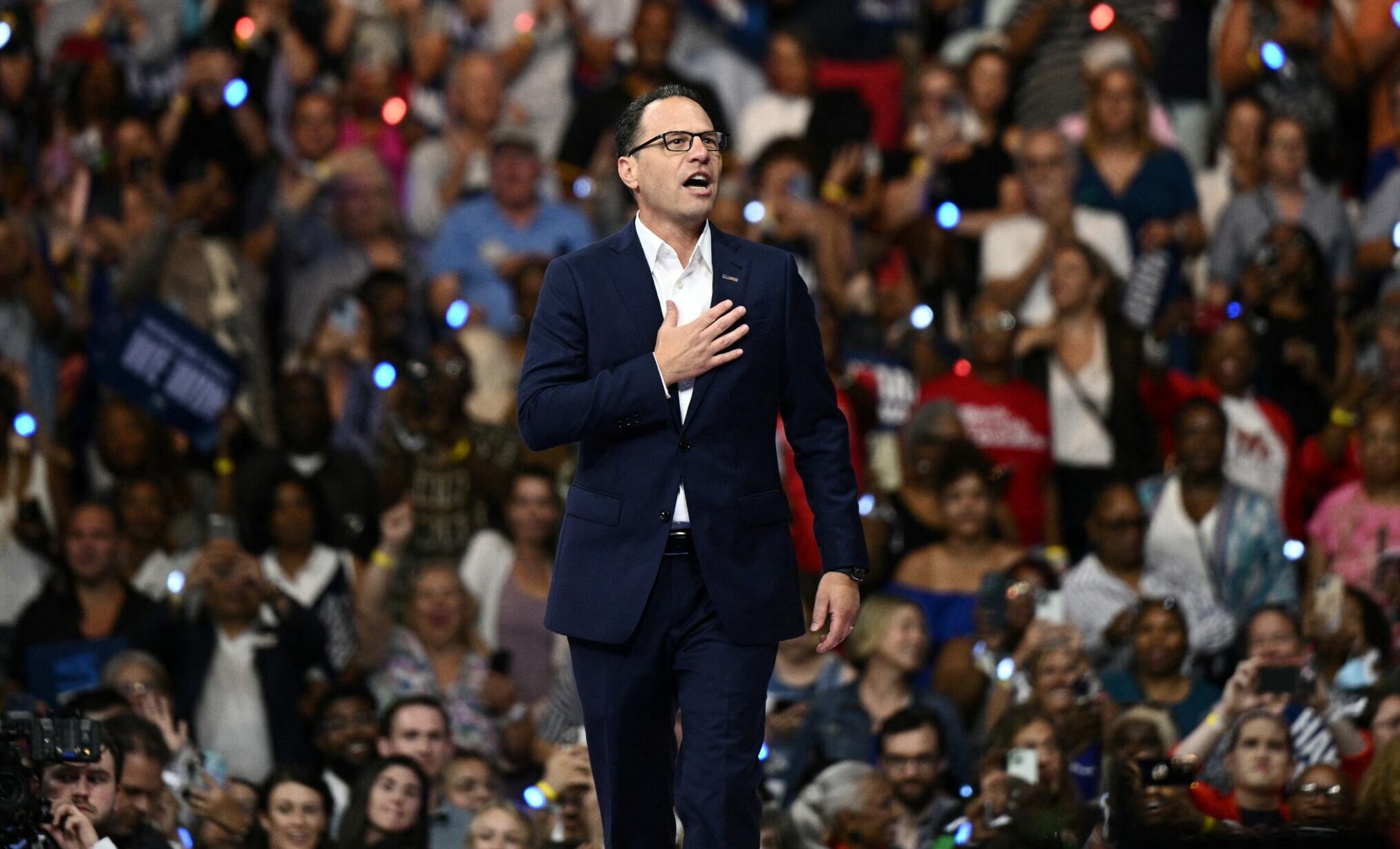
BRENDAN SMIALOWSKI/AFP via Getty Images
Pennsylvania Governor Josh Shapiro speaks before Democratic presidential candidate Kamala Harris in Philadelphia, Pennsylvania, August 6, 2024.
Amid an alarming rise in political violence, Pennsylvania Gov. Josh Shapiro said Tuesday that the way to combat extremism and division is by bringing people together and restoring their faith in the government — a civic-minded strategy that included some thinly veiled swipes at President Donald Trump and the hardline rhetoric he has adopted since conservative activist Charlie Kirk was killed in Utah last week.
Shapiro and his family survived an April arson attack that damaged the governor’s residence in Harrisburg while they slept, hours after hosting a Passover Seder there. The alleged arsonist acted to protest Shapiro’s stance toward the Palestinians, according to a police search warrant.
“I believe we have a responsibility to be clear and unequivocal in calling out all forms of political violence, making clear it is all wrong,” Shapiro said in a keynote address at the Eradicate Hate Global Summit, a Pittsburgh conference created in the aftermath of the 2018 mass shooting at the Tree of Life synagogue. “Unfortunately some, from the dark corners of the internet all the way to the Oval Office, want to cherry pick which instances of political violence they want to condemn.”
Shapiro called for dialogue and a rejection of the demands for revenge that have permeated social media since Kirk’s murder last week. The speech did not name Trump, although Shapiro called for Trump to act with “moral clarity” in a post on X on Monday.
Widely rumored to be considering a 2028 presidential run, the speech offered Shapiro a chance to deliver a wide-ranging speech to a national audience.
“We need to create more opportunities for peaceful and respectful dialogue, respecting each other’s fundamental rights as Americans,” said Shapiro. “Prosecuting constitutionally protected speech will only further erode our freedoms, deepen the mistrust. That is un-American.” Attorney General Pam Bondi said on Monday that the U.S. would be “targeting” hate speech, which she said was different from free speech — a statement she attempted to walk back a day later after facing bipartisan pushback.
There is a better way, Shapiro added: “That better way is the Pennsylvania way.”
“Those who stoke division will want to have us believe words are important, but we also need action,” said Shapiro. “We need to make sure people are safe here in Pennsylvania and all across America, safe to exercise their fundamental rights and freedoms, whether they’re debating on a college campus, praying at a synagogue or church or spending time at home with loved ones.”
Americans should do more to address hate online, and to teach people to better distinguish “fact from fiction” on the internet, argued Shapiro. But more than that, he said, they need to see and trust that the government actually can make their lives better.
“There’s a deeper issue at the root of this dangerous rise of political violence. Too many people don’t believe that our institutions and the people in them can solve problems anymore. They feel alone, ignored, shut out by a government that isn’t working for them,” said Shapiro. “It leads to a belief among some that the only way they can address their problems is through violence.”
The ways to prove otherwise, Shapiro said, are simple — helping people get driver’s licenses quickly, giving kids free breakfast at school and “building a government that works for Pennsylvanians and gets stuff done.”
Shapiro leaned on Jewish teachings in his speech, referring as he often does to how his faith underpins his public service.
During a speech at the Eradicate Hate Global Summit in Pittsburgh, Pennsylvania Gov. @JoshShapiroPA shared the story of an 82-year-old Christian chaplain of a local fire department, who gave Shapiro and his family a letter signed by each member of their department after an April… pic.twitter.com/jqTD9U7S3U
— Jewish Insider (@J_Insider) September 16, 2025
“My faith has taught me that no one is required to complete the task, but neither are we free to refrain from it. It means that each of us has a responsibility to get off the sidelines, get in the game and do our part,” Shapiro said.
After the attack on the governor’s mansion, Pennsylvanians “were united in speaking and acting with moral clarity, making clear that hatred and violence has no place here in Pennsylvania,” said Shapiro.
He shared the story of the 82-year-old Christian chaplain of a local fire department, who gave Shapiro and his family a letter signed by each member of their department. On the back, the chaplain had written by hand what he said was the most important blessing in his life, from the Book of Numbers.
May the Lord bless you and keep you. May the Lord make His face shine upon you and be gracious to you. May the Lord turn His face toward you and give you peace.
“I wept when I read that prayer that he wrote,” said Shapiro, who recalls then telling the chaplain that he recites that prayer — known as the Priestly Blessing in Judaism — to his children each night. He then proceeded to do so in Hebrew, and offered his own benediction about the power the prayer holds for a nation reeling from violence.
Yivarechecha Adonai v’yishmerecha. Ya’er Adonai panav eilecha v’chuneka. Yisa Adonai panav eilecha v’yasem l’cha shalom.
“Those are words of healing, words of hopefulness to me,” said Shapiro. “They are also words that again remind us of our shared humanity.”
The GOP nominee said one key to victory is winning over independents and moderate Dems in Rep. Josh Gottheimer’s home base of Bergen County
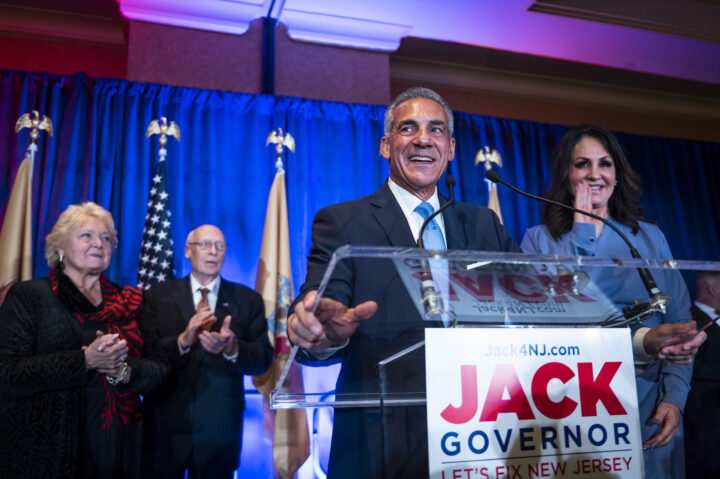
Mark Kauzlarich/Bloomberg via Getty Images
Jack Ciattarelli, Republican candidate for governor of New Jersey, speaks during an election night event in Bridgewater Township, N.J. on Wednesday, Nov. 3, 2021.
Ever since President Donald Trump ran surprisingly close to Vice President Kamala Harris in New Jersey during last year’s presidential race, Republicans have been looking at the state’s gubernatorial race as a chance to capitalize on the party’s momentum in the blue state.
Jack Ciattarelli, the GOP’s nominee for governor, also came tantalizingly close to defeating Gov. Phil Murphy in the state’s last gubernatorial race. He’s running again, and hoping to get over the finish line against Rep. Mikie Sherrill (D-NJ), in part by courting the state’s sizable Jewish community, which has swung to the right in recent elections.
“People now know, because of the closeness of my race, that we can win. There’s just an attitude change because they feel like the Democrats have really failed them on a number of issues, and antisemitism is one of them,” Ciattarelli told Jewish Insider in an interview ahead of his visit to Israel this week.
Ciattarelli, 63, who built two medical publishing companies in New Jersey while serving as a state lawmaker, said, “I see myself not so much as a politician, but a successful CEO who is looking to be the CEO hands-on governor that we need.”
As part of his Jewish communal outreach, Ciattarelli traveled to Israel on Sunday for a five-day visit, which he organized in a show of solidarity. He also spent time on his visit pursuing opportunities for economic investment from leading Israeli companies in the technology and medical sectors.
“Any students in violation of university policy, I think, should be expelled. Any student that’s broken the law should be arrested, and any student here on an academic visa from another country should be sent back to where they came from if they’re going to engage in that kind of behavior,” Ciattarelli said. “I will pressure our college and university presidents to be working in partnership with me to make sure that kind of behavior isn’t tolerated.”
He told JI that one of his goals with the visit was to boost the state’s economy “by forging a closer economic relationship with a number of nations” that are close U.S. allies. “Israel is first and foremost on the list, but as governor, I will certainly look to Canada, Mexico and India as well to increase our bilateral trade,” Ciattarelli said.
Fighting antisemitism, Ciattarelli said, will be a priority of his if he’s elected. Ciattarelli said he has “made very, very clear” that he supports codifying the International Holocaust Remembrance Alliance’s working definition of antisemitism into state law, will “appoint an attorney general and a superintendent of state police that are both sensitive to the needs and worries of New Jersey’s Jewish community” and will establish an Advisory Council on Jewish Relations to guide him on ways to the best support the community.
“Any students in violation of university policy, I think, should be expelled. Any student that’s broken the law should be arrested, and any student here on an academic visa from another country should be sent back to where they came from if they’re going to engage in that kind of behavior,” Ciattarelli said. “I will pressure our college and university presidents to be working in partnership with me to make sure that kind of behavior isn’t tolerated.”
Ciattarelli described the December 2023 House Education and Workforce Committee hearing, where the presidents of Harvard University, University of Pennsylvania and the Massachusetts Institute of Technology declined to say that calling for the genocide of Jews qualified as bullying and harrassment, as a “watershed moment” that brought the issue of antisemitism to the forefront of Jewish voters’ minds.
“I will do what others have done, including Democratic leaders, and that’s condemning Mamdani, condemning his candidacy, and doing all they can to make sure that a threat to communities such as this is not elected,” Ciattarelli told JI. “There is no space for someone like this in the public sphere, let alone in public office, and I’m going to do everything in my power to protect all 9.3 million citizens here in New Jersey, and particularly members of the Jewish community who feel threatened by a person such as this.”
“They want to see a governor who’s going to demonstrate zero tolerance for antisemitism and call it out for what it is when we see it and hear it,” Ciattarelli said of Jewish voters in the Garden State.
The New Jersey Republican has also sought to tie Sherrill to Zohran Mamdani, the far-left Democratic nominee in New York City’s mayoral race who has resisted condemning “globalize the intifada” rhetoric. Ciattarelli’s campaign cut a digital ad highlighting Sherrill’s nationally televised indecision on whether she would support Mamdani’s mayoral campaign.
“I will do what others have done, including Democratic leaders, and that’s condemning Mamdani, condemning his candidacy, and doing all they can to make sure that a threat to communities such as this is not elected,” Ciattarelli told JI. “There is no space for someone like this in the public sphere, let alone in public office, and I’m going to do everything in my power to protect all 9.3 million citizens here in New Jersey, and particularly members of the Jewish community who feel threatened by a person such as this.”
The race is competitive, with Jewish voters (who make up about 6% of the state’s population) potentially emerging as a swing voting bloc.
“This race is shaping up to be fairly tight, with both candidates making notable outreach efforts to the Jewish community. Jack’s visit to Israel and his strong support for IHRA have had a particularly positive impact,” one Jewish leader in the state told JI.
“Mikie has also engaged significantly, and that effort has been noticed, but concerns remain based on her support of Mamdani in the city and the way she recently framed the call for a ceasefire in Gaza. She still retains goodwill within the Jewish community, but has a long way to go in strengthening trust and confidence,” the leader explained.
A Jewish community leader in Central Jersey, also granted anonymity to speak freely, offered a similar take.
“It’s definitely a race that’s very closely watched in the Jewish community, more than any time in the past, I would say. I think seeing Jack going to Israel, out of all places, just three months before the general election, I think that shows you how important the Jewish vote is going to be this time around, and Jack is losing no time and trying to get the Jewish vote on his side,” the source said.
“I often say that in New Jersey, you have to run for governor as though you’re running for mayor,” Ciattarelli said, adding of his outreach to Democratic and unaffiliated voters, “The biggest compliment I get is when I can come down off a platform or stage, if somebody comes up to me and says, ‘Are you Republican? Are you Democrat?’”
Ciattarelli told JI that he views Bergen County, the state’s most populous county, as a must-win area for his campaign, making the support of Democratic and independent voters necessary in his path to victory. The area, which is represented by Gottheimer in Congress, is also home to around 100,000 Jewish residents, a majority of whom are registered Democrats or independents.
“Bergen County has a greater population than eight states and it’s the key to winning a statewide election. I did very well, just coming a little short in ‘21, but I do sense a change amongst a great number of people who may not have considered me last time, may not have voted last time that are looking to make a change here in New Jersey,” Ciattarelli said.
“I often say that in New Jersey, you have to run for governor as though you’re running for mayor,” he continued, adding of his outreach to Democratic and unaffiliated voters, “The biggest compliment I get is when I can come down off a platform or stage, if somebody comes up to me and says, ‘Are you Republican? Are you Democrat?’”
Since narrowly losing his first campaign for governor, Ciattarelli worked hard to unify the party around his repeat bid, making particular effort to secure support from the MAGA wing of the Republican Party. His efforts paid off in the primary, which he won without much serious GOP opposition.
For her part, Sherrill handily defeated five other Democrats, including Gottheimer, Newark Mayor Ras Baraka,and Jersey City Mayor Steve Fulop, in the Democratic primary.
With that backdrop, both parties are watching the November gubernatorial contest closely to see if the rightward shift in the Garden State has held since Trump took office in January. For his part, Ciattarelli says that while the issues animating New Jersey voters have not changed since his 2021 race, he believes “what is different is the political landscape.”
“The issues I was talking about in ‘21, including antisemitism, have now come to a complete boil. They were simmering back then,” Ciattarelli told JI. “I’m not competing with a pandemic this time around. It’s not easy to campaign when there’s a shelter-in-place order. I’m not running against an incumbent. There’s a lot less indifference.”
As part of his strategy to encourage voters to hit the polls in November, he said he was focusing his messaging around “four issues across the state that are raging that apply to all people”: the affordability crisis, affecting housing and energy costs; public education; public safety; and the overdevelopment of the interior of the state, where suburbs without the infrastructure to become a city are being overinvested in at the expense of New Jersey’s cities.
Regardless of which community he’s engaging with, the New Jersey Republican says the voters he’s spoken to have been more concerned with “how it is I go about solving issues” than national political matters.
“People get excited by ideas. They don’t want to hear the use of polarizing rhetoric. I think they find it a breath of fresh air when somebody stands up and is speaking to the issues and how they’re going to solve them,” Ciattarelli explained, describing this approach as “the secret to the sauce for me in the seven elections I won prior to November ‘21.”
Both parties are also investing heavily as the race emerges as one of the most competitive statewide elections of 2025.
The Democratic National Committee said earlier this month that it would provide more than $1.5 million for Sherrill’s campaign to devote to field staffing and ground game efforts. Greater Garden State, a super PAC connected to the Democratic Governors Association, announced plans in July to spend $20 million on ads for Sherrill. That dollar amount is greater than Murphy and outside groups supporting him spent on ad buys during the entire 2021 general election.
Georgia Gov. Brian Kemp, the chairman of the Republican Governors Association, visited North Jersey earlier this month for a series of fundraising events for Ciattarelli that brought in $1 million.
The governor convened several roundtables with executives from Israeli companies that Arkansas is looking to attract

Arkansas Gov. Sarah Huckabee Sanders/X
Arkansas Gov. Sarah Huckabee Sanders with her father, U.S. Ambassador to Israel Mike Huckabee, and mother, Janet, at the Western Wall, Jerusalem, Israel, August 2025
Arkansas Gov. Sarah Huckabee Sanders returned to the U.S. on Sunday following a nearly weeklong trip to Israel aimed at boosting Arkansas’ diplomatic and economic ties with the Jewish state.
The trade delegation was Sanders’ first official visit to Israel as governor and her first time visiting the Jewish state since her father, U.S. Ambassador to Israel Mike Huckabee, was confirmed to his role in April.
“It was an amazing trip,” Sanders told Jewish Insider in an interview. “The thing that stands out and is so amazing to see in person is just the resiliency of the people of Israel and just their steadfast commitment. Getting to visit with people that are living the day-to-day challenges that they are and yet, they’re still showing up for work, they’re still going to school, they’re still running their businesses and continuing on in the face of some pretty uphill, significant challenges is amazing.”
“I’m honored I got the chance to go and thankful for what I think is a great future in partnership and collaboration between Arkansas and the State of Israel in a lot of different ways,” she said.
Asked about her father’s tenure as ambassador thus far, Sanders remarked that Amb. Huckabee viewed the position as “a calling” rather than a job, given his longstanding connection to the Jewish state.
“Not only does he have a sense of joy about the job, but he has a true passion. For him, it is not a job, it’s a calling. He is somebody who has always led with conviction, but I don’t think that there’s any role he’s taken on where there’s a greater sense of conviction than this one,” Sanders said of her father, who served as governor of Arkansas from 1996 to 2007.
Sanders noted that her father’s appointment as ambassador to Israel was “a bit of a culmination of everything else he’s done in his life, from being a pastor to a governor to a communicator. It is a role that kind of encompasses a lot of different parts of his background, and something that he is genuinely very honored to be able to do.”
“Several members of the government leadership in Israel all commented [on what] an amazing job he was doing, how much they appreciate what he’s doing,” she explained, adding that, “One in particular even joked that the only bad thing about my dad in that role is that he may love [the country] more than even some of the Israelis.”
During her trip, Sanders met with Israeli Prime Minister Benjamin Netanyahu, Finance Minister Bezalel Smotrich and Economy Minister Nir Barkat, and was given a tour of the Knesset by Speaker Amir Ohana. The governor took part in a tour of the Ariel settlement in the West Bank alongside House Speaker Mike Johnson (R-LA) and a delegation of House lawmakers. Her first stop upon landing in Israel was Jerusalem, visiting the Western Wall to pray with her mother, former Arkansas First Lady Janet Huckabee, who moved to the Jewish state following her husband’s confirmation as ambassador.
During Sanders’ summit with Netanyahu, given that “components of Israel’s Iron Dome are produced in Arkansas … the governor expressed interest in expanding that partnership to support both Arkansas’ economy and Israel’s national security,” according to a readout from her office.
Asked if Netanyahu or others offered any suggestions of ways American governors could strengthen the U.S.-Israel relationship, Sanders told JI, “Generally, they appreciated us being there and showing such public support. Obviously, my dad is very vocally supportive, and they certainly appreciate that. I think the biggest thing was how much just showing up makes a difference, and being willing to not back down despite the fact that there is criticism.”
“[The Israelis] appreciated us and our delegation making the effort, not just to put something on Twitter or Instagram, but to come there in person and show our commitment to the relationship. Also, we don’t just want to show up, but we want to be able to work with Israeli companies to bring business into our state, to increase trade,” the Arkansas governor said.
Sanders noted that her administration had “done a lot when it comes to public legislation to support and show our commitment, whether it was signing the Judea and Samaria Act, where we recognized the area west of the Jordan [River] as Judea and Samaria, the way that God intended it to be. We’ve also invested significantly in pension funds and Israeli bonds in our state and a number of other things.”
“I didn’t have to tell them [the Israelis] that we had done those things. They knew. They’d been paying attention and they appreciated the things that we were doing and the way that we were showing support, most recently by coming to Israel and being there in person,” she said.
While in Israel, Sanders signed an Arkansas-Israel Memorandum of Understanding aimed at strengthening the trade relationship between the two. Little Rock counts Israel as one of its biggest trading partners, exporting over $150 million in goods to the Jewish state last year.
“Our goal with the MOU was to deepen the partnerships between Arkansas and Israel, especially in some of the areas that Israel is so advanced in: aerospace and defense, ag tech, energy and manufacturing. Those are also spaces that our state is heavily leaning into,” Sanders told JI.
“Agriculture is our number one industry, aerospace and defense are number one exports. Energy and manufacturing are key cornerstones in our state’s economy. So there’s a great synergy between our state and the State of Israel. Being able to collaborate further is good for both of us, and it will continue to facilitate the exchange of information and research between both sides and set the groundwork for a significant amount of future economic cooperation,” she added.
In addition to visiting Israel, Sanders briefly touched down in the United Arab Emirates to meet with government officials and leading aerospace and defense companies.
The Democratic and Republican nominees for New Jersey governor spoke at New Jersey Jewish Business Alliance event
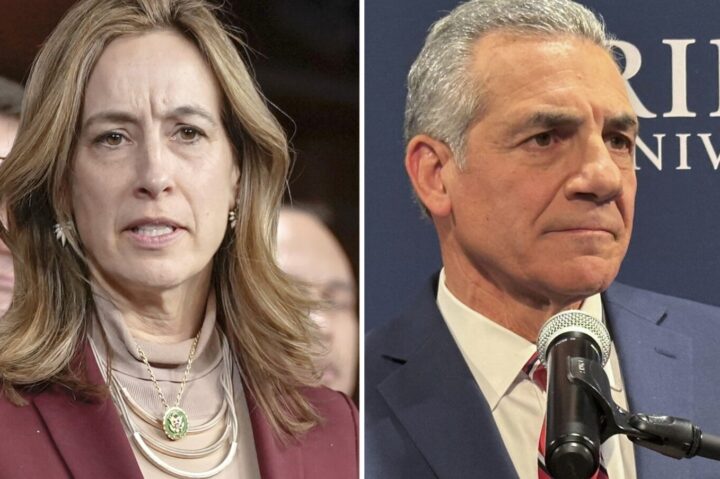
Mariam Zuhaib, Mike Catalini/Associated Press
In this photo combo Rep. Mikie Sherrill, D-N.J., left, speaking during a news conference, Feb. 13, 2024, in Washington and former Assemblyman Jack Ciattarelli speaking, Feb. 4, 2025, at Rider University in Lawrenceville, N.J.
The Democratic and Republican nominees for governor of New Jersey spoke last week at an event organized by the New Jersey Jewish Business Alliance about their plans to combat antisemitism across the Garden State.
“I as governor will certainly address this appalling surge of antisemitic incidents head-on and work to ensure that every business owner in our state has a fair shot,” Rep. Mikie Sherrill (D-NJ) said. “I vow to be an ally in the governor’s office. I’ll put the full force of law behind combating antisemitism and making sure that everyone can thrive here in the Garden State.”
Sherrill said that it’s “been an incredibly difficult past several years for the Jewish community here in New Jersey,” highlighting a series of incidents including a fire-bombing at a synagogue in her district, as well as graffiti, harassment, intimidation and more facing Jewish institutions, individuals and businesses.
She noted that Jewish business owners in the state had faced violent crimes and losses of business “because of their religion.”
Republican Jack Ciattarelli said that antisemitism “will not be tolerated in the state of New Jersey under my governorship” and that his entire administration “will be sensitive to the needs and worries of the Jewish community across this state.”
He said he plans to launch an advisory council to maintain “constant contact” with the Jewish community statewide.
He condemned Gov. Phil Murphy for calling antisemitism issues on college campuses “complicated.”
“It’s not complicated. Anybody who’s violating university policy should be expelled. Anybody who’s broken the law should be arrested, and anybody here on academic visa that’s done either those two things should go back to where the hell they came from,” Ciattarelli said. “We’re not going to have anybody feeling unsafe on our college campuses.”
The Republican nominee voiced support for legislation to codify the International Holocaust Remembrance Alliance’s working definition of antisemitism, which he said he hopes will be signed before he takes office.
Ciattarelli said that, on his upcoming trip to Israel, he’d be meeting with business leaders to find ways that New Jersey can increase its bilateral trade with the Jewish state.
“Do you know that New York does $14 billion a year in bilateral trade with Israel? New Jersey? Less than 2 billion,” Ciattarelli said. “What does New York have that we don’t have? I’ll be meeting with business leaders to say we’re open for business.”
Both nominees also spoke at length about their plans to improve the business climate in the state.
It’s the GOP gubernatorial nominee’s second trip to the Jewish state
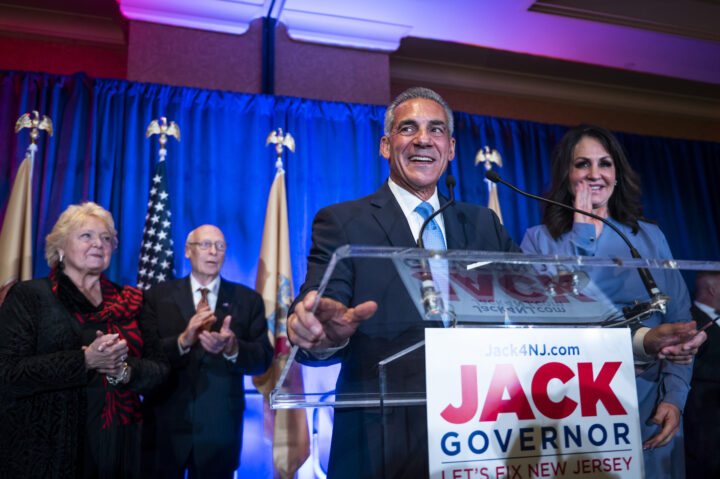
Mark Kauzlarich/Bloomberg via Getty Images
Jack Ciattarelli, Republican candidate for governor of New Jersey
Former New Jersey state Rep. Jack Ciattarelli, the Garden State’s Republican nominee for governor, will travel to Israel on Sunday for his first visit during the campaign, his campaign revealed to Jewish Insider.
Ciattarelli is running against Rep. Mikie Sherrill (D-NJ) in the race to succeed New Jersey Democratic Gov. Phil Murphy, who is term-limited. He was New Jersey’s GOP gubernatorial nominee in 2021 against Murphy, narrowly losing to the sitting governor.
Speaking to JI in an interview ahead of his trip, the New Jersey Republican said he expects to have “five very, very productive days in Israel.”
Ciattarelli said that the goal of the visit was to find opportunities for economic investment in New Jersey from leading Israeli companies in the technology and medical sectors and to show his solidarity with the Garden State’s Jewish community.
New Jersey has the second-largest Jewish population in the country.
“One of my objectives as governor is to grow our economy, and one of the ways that we achieve that objective is by forging a closer economic relationship with a number of nations, one of which is certainly Israel. They have technology companies, medical device companies, pharmaceutical companies, and a number of other industries that are looking to expand internationally. And when they do, we certainly want them to do that in New Jersey,” Ciattarelli said.
Ciattarelli added that the trip, his second time visiting the Jewish state, “also has great significance for New Jersey’s Jewish community,” because it signifies his commitment to a strong U.S.-Israel relationship.
“I’ve always been a big supporter of Israel. And as we know, antisemitism is at an all-time high in New Jersey, across the nation and the globe. As governor, antisemitism will not be tolerated. And so again, by going to Israel, we demonstrate a very close relationship between New Jersey and this very important ally in the Middle East and, of course, in the world,” he explained.
Ciattarelli previously traveled to the Jewish state during his 2021 gubernatorial run, one month before the general election. The trip, which Ciattarelli described to JI at the time as a “life-changing experience,” was his first visit to Israel.
“My goal was to let civic leaders, business leaders and religious leaders know that Israel will have a strong ally in New Jersey when I’m governor. From an economic development perspective, Israel does more than $14 billion a year in bilateral trade with New York. It does only $1 billion with New Jersey. That shouldn’t be the case,” Ciattarelli said after his 2021 visit.
“So I made clear during my trip and meeting with all leaders, that New Jersey is going to strengthen its cultural, religious and economic ties with the State of Israel. And we will stand with her in defending its people,” he continued.
He again mentioned the trade deficit while speaking to JI on Friday about his upcoming visit.
“Israel does $14 billion a year in bilateral trade with New York, less than $2 billion a year with New Jersey. There’s nothing New York has that New Jersey doesn’t. So we want to make sure that Israeli companies, when they invest in the United States, they do so right in New Jersey,” Ciattarelli said.
The former NC governor: He ‘generally does not believe we should withhold aid from a critical ally like Israel when they have to defend themselves against countries like Iran’

Allison Joyce/Getty Images
Former North Carolina Governor Roy Cooper
North Carolina Democratic Senate candidate Roy Cooper, the state’s former governor, rejected efforts to withhold U.S. aid to Israel, days after the Senate voted on legislation to block certain U.S. arms sales to Israel, his campaign told Jewish Insider.
“The Governor believes it’s urgent for the United States to use other means of pressure on the Israeli government to step up now and find ways to get food to people who desperately need it and return the hostages,” a Cooper campaign aide said. “He would consider the specific text of any bills that came before the Senate, but generally does not believe we should withhold aid from a critical ally like Israel when they have to defend themselves against countries like Iran.”
Cooper, a moderate Democrat, has taken other steps in recent days to distance himself from anti-Israel elements of the Democratic Party, including rejecting a series of anti-Israel resolutions passed by state Democratic Party leadership. But it wasn’t until he entered the Senate race that he weighed in against the anti-Israel turn of the North Carolina Democratic party.
The Senate’s Israel votes are proving to be a sensitive issue among Democratic Senate candidates across the country — and is emerging as a dividing line between the party’s moderates and progressives.
The congressman once again declined to endorse Zohran Mamdani in the NYC mayoral race but said he is ‘likely to win’

Tom Williams/CQ-Roll Call, Inc via Getty Images
Rep. Ritchie Torres (D-NY) is seen in the U.S. Capitol on Friday, June 28, 2024.
Rep. Ritchie Torres (D-NY) said Wednesday that he’s unlikely to mount a primary challenge against New York Gov. Kathy Hochul, after months of circling a potential run for that office.
“I’m unlikely to run for governor. The assault that we’ve seen on the social safety in the Bronx is so unprecedented, so overwhelming that I’m going to keep my focus on Washington, D.C.,” Torres, a favorite of the Jewish community, said on MSNBC’s “Morning Joe.” “So, my heart lies in Washington, D.C. I feel like now, more than ever, we have to fight the catastrophe that is the Trump presidency.”
Hochul’s lieutenant governor, Antonio Delgado, already declared his candidacy against the governor.
Torres also once again declined to endorse Zohran Mamdani, the Democratic nominee for New York City mayor, but said Mamdani is “likely to win.”
“There’s a difference between praising the man in his policies and praising the manner in which he ran his campaign. I mean, when it comes to how he ran his campaign, he’s genuinely a singular figure,” Torres said. “We do have an obligation to learn from his race. And I suspect he won not because he ran on divisive issues like ‘globalize the intifada’ or ‘defund the police.’ He ran on affordability.”
Torres said he spoke to Mamdani on Sunday and that they have “profound differences of opinion, and I’m not going to downplay those differences, but I’m committed to a working relationship with him. I’m committed to continuing dialogue.” He said that the mayor and the city’s congressional delegation have a “mutually necessary relationship, so we will coexist.”
‘You were not only a shining ray of light, but you were what we call a mensch,’ the family wrote in a letter to Gottheimer

Screenshot/Rep. Josh Gottheimer on X
Rep. Josh Gottheimer (D-NJ) meets with the parents of former Israeli-American hostage Edan Alexander on April 19, 2024.
Recently released Israeli-American hostage Edan Alexander and his family endorsed Rep. Josh Gottheimer (D-NJ) for governor of New Jersey and praised his advocacy for Alexander’s release in a letter to the congressman.
The letter, read out at a recent campaign event in Tenafly, N.J. by a family friend, reads, “We can’t wait to thank you in person and we can’t wait to call you Governor Josh in November.”
The letter is signed by Alexander himself, his mother and father Yael and Adi, his sister Mika and brother Roy.
“In those dark times” of Alexander’s captivity, “you were not only a shining ray of light, but you were what we call a mensch,” the family wrote. “You reached out to us and stood by us from day one. You opened doors for us in the political arena and used all your skills, connections and resources to help us in our long uphill struggle to bring back our son to us.”
“You used every platform to bring Edan to the spot light,” the letter continues. “In NJ, in DC and out to the world. You took it personally and took us in as your extended family. You were there for us in the public eye and in private.”
Gottheimer is banking on strong support and turnout from New Jersey’s Jewish community to propel him to victory in next week’s gubernatorial primary.
The Auburn University basketball coach has become a vocal advocate for Israel and against antisemitism, speaking at a Capitol Hill event last week

Stew Milne/Getty Images
Bruce Pearl head coach of the Auburn Tigers argues a call during the first half against the Alabama Crimson Tide at Neville Arena on March 8, 2025 in Auburn, Alabama.
With Sen. Tommy Tuberville (R-AL), the former Auburn University head football coach, announcing on Tuesday that he’ll forgo a second term in the Senate to instead run for governor of Alabama, chatter is emerging that another Auburn University coach, Bruce Pearl, might follow in Tuberville’s footsteps and make a bid for his Senate seat.
Semafor reported on Tuesday that Pearl’s name is being floated for the seat, but it’s not clear that he is interested. Pearl is Jewish and has become politically active on issues related to Israel and Middle East policy and antisemitism — delivering a keynote address just last week on Capitol Hill at a breakfast celebrating Jewish American Heritage Month.
“Alabama is a Republican stronghold, so the NRSC is confident voters will elect another Republican to continue representing them and championing President Trump’s agenda,” Sen. Tim Scott (R-SC), the chair of the National Republican Senatorial Committee, said in a statement about Tuberville’s decision, which did not mention Pearl specifically.
In his speech on the Hill last week, Pearl, who coaches Auburn’s men’s basketball team, rejected the idea of a two-state solution.
Pearl argued that a Palestinian state had effectively been “tried” in Gaza, following the Israeli withdrawal from the territory in 2005. “They had an opportunity and they turned it into a terrorist state. We cannot make that same mistake again,” he said.
“There cannot be another Palestinian state,” Pearl said. “We need to practice our faith and we need to put our faith into practice. My Jewish friends, we need to wake up and understand that when we said never again, we meant never again, but it happened again on Oct. 7.”
Pearl said that he supports the position recently articulated by Trump administration officials on Iran — that negotiations are the right first step but that Iran must dismantle its nuclear program.
“I’m glad President [Donald] Trump is taking leadership and having this discussion, and giving them the opportunity, and if they don’t take the opportunity, it’s got to be done for them,” Pearl said.
He pushed back on charges of genocide leveled against Israel, highlighting that the Palestinian population has ballooned since 1948, and said that Holocaust education should be mandatory and that colleges should be teaching the truth about the Middle East. Pearl also condemned countries that have criticized Israel’s conduct in the war.
“We’ve gotta protect ourselves from those people that want to kill us,” Pearl, who does not have Israeli citizenship, said. “And the second thing is this: We’ve got to be mensches. We’ve got to be kinder. We’ve got to be more generous. We’ve got to be the very best versions of ourselves that we possibly can. That’s what we’re simply commanded to do.”
Pearl told his family’s story at the event — his grandfather fled the pogroms to the United States with three siblings, while the rest of his family remained in Europe, where most died in the Holocaust.
He said he remembers sitting with his crying grandfather watching television coverage of the Six-Day War; Pearl said his grandfather was afraid that Israel would be wiped out overnight.
“He said if Israel was a state, maybe, in 1929, maybe more of his family would have been able to go to Israel,” Pearl said. “And maybe some of his relatives would still be alive. He told me two things that day: Number one, the United States of America saved his life … And the second thing was that if Israel was born sooner, maybe more of my family would still be alive.”
Pearl said that his love for Israel is an intrinsic part of his love of his Jewish faith.
He highlighted connections between the Abrahamic faiths — that Abraham “is the father of all nations, that connects us all” and that Jesus was Jewish.
“The Jewish people are strong. The Jewish people know how to work hard. We’re taught to speak the truth. We’re taught to hold the right values. We’re taught to stand up for injustice. We’re taught to teach it to our children,” Pearl said, describing that spirit as the one that brought him and two other Jewish coaches into the college basketball Final Four this year.
He said he believes the “vast majority of Americans support the Jewish people and support the State of Israel,” and praised Evangelical Christians who support Israel for reasons of faith.
The state legislation has divided the New Jersey gubernatorial field thus far

Tom Williams/CQ-Roll Call, Inc via Getty Images
Rep. Josh Gottheimer (R-NJ) leaves a meeting of the House Democratic Caucus at the Democratic National Committee on Tuesday, July 9, 2024.
Rep. Josh Gottheimer (D-NJ), a candidate for governor of New Jersey, challenged his fellow candidates to pledge to sign bipartisan state legislation to codify the International Holocaust Remembrance Alliance’s working definition of antisemitism in response to the murder of two Israeli Embassy officials outside the Jewish museum in Washington.
That legislation has become a major dividing line in the gubernatorial race — Gottheimer and Rep. Mikie Sherrill (D-NJ) support it, while Jersey City Mayor Steven Fulop opposes it, but said recently he would not veto it. Other candidates did not respond to requests for comment on the issue earlier this year. Critics of the legislation say that the IHRA definition — which identifies some criticism of Israel as antisemitic — violates free speech protections.
“I’m heartbroken by the tragic act of violence that took the lives of two young Israeli Embassy staffers in Washington, D.C. Wednesday night … While the investigation continues, one thing is undeniable: antisemitism is fueling violence in this country, and it’s getting worse,” Gottheimer said in a statement shared with Jewish Insider. “Here in Jersey, we feel the effects of hate firsthand in our communities and synagogues. New Jersey had the third highest amount of antisemitic incidents last year, according to the ADL.”
“No one should have to live in fear simply for being Jewish. We must call out antisemitism wherever it appears and hold those responsible for spreading hate and violence accountable to the fullest extent of the law,” he continued. “As Governor, I’ll immediately sign New Jersey’s IHRA bill into law, and I’ll push to dismantle antisemitism and hate in any form whenever it rears its ugly head.”
Gottheimer visited the scene of the shooting outside the Capital Jewish Museum on Thursday morning.
Please log in if you already have a subscription, or subscribe to access the latest updates.
 Continue with Google
 Continue with Apple