






































The Senate majority leader said ‘when we do sit down we have to make sure there are a lot of issues on the table'

Lev Radin/Sipa via AP
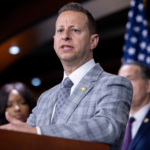
U. S. Senator and Senate Majority Leader Charles Schumer marks re-opening of Junior's Cheesecake restaurant on Times Square in New York on May 6, 2021.


 Add JewishInsider on Google
Senate Majority Leader Chuck Schumer (D-NY) called on the Biden administration on Thursday to address a range of issues in addition to Iran’s nuclear program in its negotiations with Tehran during a virtual event with the Jewish Community Relations Council of New York.
Schumer emphasized that he opposed both the 2015 nuclear deal when it was signed as well as the Trump administration’s withdrawal from it three years later, which he said “isolated the U.S., instead of Iran.”
“Today Iran has a greater ability — they’re closer to producing a nuclear weapon — than they were the day Trump pulled out of the agreement or the day Obama signed the agreement,” Schumer said.
The longtime New York senator indicated that he would like to see a broader deal with Iran addressing a range of issues including terrorism, ballistic missiles, human rights and hostage-taking, rather than focusing on the nuclear issue alone.
“I understand why the current administration is in negotiations and I don’t have any problem with them sitting down and talking, but I also believe… we have to follow through on all of these issues,” Schumer said. “It’s not that we shouldn’t sit down, because if we don’t sit down, Iran could just go forward and produce a nuclear weapon… but when we do sit down we have to make sure there are a lot of issues on the table.”
The Senate majority leader also said he plans to push for $360 million in funding for the Nonprofit Security Grant Program (NSGP) for fiscal year 2022. In 2020, the House approved $360 million in funding, while the Senate only approved $90 million; the chambers compromised at $180 million.
“I wanted $360 [million]. I was only minority leader in December. I got it doubled to $180 [million], now we’re going to try to get the full $360 [million] a year, which is very much needed and has broad support, so I’m very optimistic,” Schumer said.
Last week, a group of House members — roughly one-third of the legislative body — expressed support for $360 million in NSGP funding for 2022, which is also the target amount for a number of Jewish community organizations lobbying on the issue.
In recent weeks, however, several senators who had been vocal supporters of the NSGP program declined to provide to JI a specific target level for 2022 NSGP funding.
Earlier on Thursday, Schumer paid a shiva call to the family of Pinchas Menachem Knoblowitz, who died in the stampede at a Lag B’Omer gathering at Israel’s Mount Meron last weekend that killed 45 people. Schumer told the family he has “a deep faith in Hashem.”
“I have a Jewish heart — a neshamah,” Schumer said. “I have a deep faith in God. If I didn’t I wouldn’t be in this job.”
Also Thursday, the New York senator stopped by Junior’s in Times Square, digging into a slice of the restaurant’s famous cheesecake, to celebrate the location’s reopening.
“If there’s an iconic place on the planet that tells the toil of COVID, it’s Times Square,” Schumer said. “All of Times Square is coming back. And we’re here to say now that in Times Square there is light, there is liveliness, and there is cheesecake.”
The housing expert and all-around policy wonk is hoping his 'campaign of ideas' will set him apart in a crowded field

Courtesy
Shaun Donovan
On paper, Shaun Donovan seems to stand out as an eminently qualified candidate for New York City mayor. The 55-year-old housing and urban development expert with two master’s degrees is a policy wonk who held top jobs in the Obama White House and Bloomberg mayoral administration, and in conversation, he projects an air of academic forbearance reminiscent of his former bosses.
In his 200-page campaign policy book, released last month, Donovan lays out his painstakingly detailed and rather creatively rendered plan for New York City as it emerges from the ravages of the pandemic, calling for equity bonds of $1,000 for every child and envisioning a plan to engineer a series of “15-minute neighborhoods” in which “a great public school, fresh food, rapid transportation, a beautiful park and a chance to get ahead” are all within walking distance.
On Tuesday, Donovan announced a new initiative, “70 Plans in 70 Days,” in which he will lay out one new policy proposal every day until the Democratic primary on June 22 — a meticulous approach he is hoping will set his candidacy apart from the crowded field as a “campaign of ideas.”
“The plan for New York City is the best expression of that, and I really do have the boldest, most comprehensive ideas about the future of this city,” Donovan boasted in a recent interview with Jewish Insider. “But I also have the deepest experience in government to be able to ensure that those ideas can make a real difference in people’s lives.”
Donovan’s proposals have, appropriately enough, earned plaudits from serious policy experts in New York.
“I’ve been impressed with Shaun Donovan’s focus on getting New Yorkers back to work,” said Eli Dvorkin, editorial and policy director for the Center for an Urban Future. “He has identified a number of strong models that New York City can build on — from apprenticeship programs to nonprofit tech training — and made it clear that he would invest heavily in skills-building infrastructure. That’s what the city will need to rebound from the current crisis and build a more equitable economy in the future.”
But it remains to be seen if Donovan has the wherewithal to pull off an upset. Several analysts who spoke with JI described the mayoral hopeful as a “talented” individual, while also observing that, despite his policy chops, voters don’t seem to be rallying behind him.

Shaun Donovan, secretary of the Department of Housing and Urban Development, testifies at a Senate Homeland Security and Governmental Affairs subcommittee hearing on Nov. 6, 2013. (J. Scott Applewhite/AP)
“Shaun Donovan is a tremendously talented public servant,” said David Greenfield, the CEO of the Met Council and a former city council member. “The challenge that he faces is that he’s always sort of been in the background and therefore doesn’t have the same political profile as some of the more active and better-known political candidates, many of whom have either held office or run for higher-profile office before.”
Polling suggests as much. Donovan seems to be lagging significantly behind the apparent frontrunners in the race, including Andrew Yang, the charismatic former presidential candidate; Eric Adams, the brash Brooklyn borough president; and Scott Stringer, the seasoned city comptroller.
But Donovan remains uncowed, citing another set of statistics that he claims supports his case. “I wouldn’t trade my place in this race with anyone,” he said. “I think it’s reflected in polling that New Yorkers want change and they want experience at this moment, and I really believe I’m the only candidate that represents both of those in the sense that nearly every other candidate is, in some way, part of the status quo.”
Donovan, of course, isn’t exactly a fresh face in New York City government, though it has been some time since he was on the scene enacting what experts characterized as meaningful change.
From 2004 to 2009, he served as former Mayor Michael Bloomberg’s housing commissioner, creating the city’s first inclusionary housing program offering “density bonuses to developers who agree to set aside units as affordable,” according to Ingrid Ellen, a professor at New York University who specializes in housing.
“He left a legacy of improving the lives of so many people who don’t have the means to get habitable housing,” said Rabbi David Niederman, president and executive director of the United Jewish Organizations of Williamsburg, who worked with Donovan on issues of affordable housing back in the aughts.
“I worked extremely closely with mayors across the country and saw, again and again, that particularly at a time when our national politics could be divisive and dysfunctional, mayors really touch people’s lives.”
Following his tenure in city government, Donovan accepted an appointment from former President Barack Obama to helm the Department of Housing and Urban Development, during which time he helped lead a revitalization task force in the wake of Hurricane Sandy, among other things.
“I worked extremely closely with mayors across the country and saw, again and again, that particularly at a time when our national politics could be divisive and dysfunctional, mayors really touch people’s lives,” said Donovan, who went on to lead the Office of Management and Budget under Obama. “They are close to the ground. They are the leaders that can make the most difference in the day-to-day lives of New Yorkers and people in their communities.”
In conversation with JI, Donovan, who was raised on the Upper East Side, emphasized his family’s own personal connection to New York as an explanation for why he is now mounting a mayoral bid.
His father, Michael Donovan, an advertising executive, had Jewish, Catholic and Protestant grandparents, and was “beaten up as a child because of that,” Donovan said. Michael, who was born in Panama and grew up in Costa Rica, “had a deep connection to his Irish roots, but also a sense of being an outsider,” Donovan added. “He came to the U.S. to go to school like so many immigrants, and then came to New York to find opportunity, and found it.”
“I would say my entire family owes everything to New York in a fundamental way,” Donovan elaborated. “But at the same time, I also grew up in New York in the 1970s and ’80s. I saw homelessness exploding on the streets. I saw the South Bronx and so many other communities around the city struggling, even burning to the ground, and that really lit a fire in me to go to work on behalf of this city that I love.”

Shaun Donovan
“My platform is really about repairing and rebuilding the city but also about reimagining it as a city that works for everyone,” said Donovan, who advocates for investments in bus rapid transit as well as keeping libraries open 24 hours a day, seven days a week, so New Yorkers will have increased access to broadband.
But getting elected and implementing such policies is in many ways a more challenging task than earning an appointment to public office, particularly in New York, where many prominent figures have tried and failed to do so, including Joe Lhota, Richard Ravitch and Daniel Patrick Moynihan.
“This is a longstanding challenge,” said Mitchell Moss, a professor of urban policy and planning who directs the Rudin Center for Transportation Policy and Management at New York University. “It’s not unusual that people who succeed in appointed life can’t make it in New York City politics.”
Donovan seems intent on proving that he will be an exception to the rule. In the first TV ad of the race, released in February, he painted himself as a veteran of the Obama administration with ties to the current president, Joe Biden — though such appeals appear largely to have gone unnoticed as other candidates gain traction.
“I would say my entire family owes everything to New York in a fundamental way.”
“Donovan’s going to have to do something creative over the next couple of months to be able to catch people’s attention and be, if not their number one choice, their second or third,” said Jake Dilemani, a managing director in Mercury’s New York office.
Donovan is now mounting an aggressive TV ad blitz as he seeks to earn name recognition in the new ranked-choice voting system, buoyed by $2 million in independent expenditures from his father. “I am following the law,” Donovan said of his father’s super PAC contributions in an interview with WNYC host Brian Lehrer on Tuesday. “There are dozens of these groups supporting many different candidates who are running, and I don’t coordinate with any of them.”
In the end, Donovan, who has staked out a position, for better or worse, as one of the brainiest candidates in the race, wants to focus on the ideas. “I think, especially in this moment of crisis, New Yorkers are really hungry for a mayor who has the boldest ideas about how we rebuild our health and our economy, how we make this a more equitable city.”
“Shaun Donovan is very smart, very capable and very knowledgeable about New York City,” Moss acknowledged. But in the highly competitive mayoral race, he said, “It’s not enough to be smart.”
The city councilmember has emerged as an unlikely yet high-profile COVID-19 public health resource as he pursues higher office

Courtesy
Mark Levine
Before the pandemic, Mark Levine, a Democratic New York City councilmember who represents Upper Manhattan, was widely viewed as an ambitious lawmaker with a strong progressive bent. Beginning in 2014, his first year in office, Levine helped revitalize the council’s Jewish caucus into an activist vessel focused on matters impacting the Jewish community and beyond, while sponsoring historic legislation guaranteeing free legal representation for low-income tenants facing eviction.
But over the past year, Levine’s profile has risen dramatically as he has become one of New York’s most trusted public health resources on all matters COVID-19 — an unlikely role for the councilmember, who chairs the city’s health committee but has no experience in medicine. When the pandemic tore through New York last March, however, Levine emerged as an early, outspoken and sobering voice of reason, urging caution, championing science and, when appropriate, dispensing nuggets of restrained optimism from his widely followed Twitter feed — earning praise from one colleague as “the Anthony Fauci of the New York City Council.”
As the vaccine rollout continues apace, Levine’s social media presence has transformed into a veritable catalogue of available appointments as he seeks to ensure that residents across communities — particularly those that are underserved — schedule a time to get the shot.
“His platform has become one of the most important to follow for up-to-date information around vaccine access,” said Dara Kass, an associate clinical professor of emergency medicine at Columbia University Medical Center, lauding the councilmember’s steadfast effort to publicize city resources while advocating for real-time change when certain approaches proved ineffective. “I have seen him absolutely shine as a leader through this pandemic.”
David Greenfield, the Met Council CEO who worked closely with Levine during his time as a city councilmember from 2010 to 2017, said his former colleague “has attracted a citywide following” thanks to his work during the pandemic. “That has made him tremendously popular even outside of Manhattan.”
That reputation will no doubt serve Levine well as he now competes in the Democratic primary for Manhattan borough president, which will be held on June 22. While there is no public polling on the race, Levine is one of the most recognizable candidates in a crowded field that includes fellow Councilmember Ben Kallos, New York State Senator Brad Hoylman and former congressional candidate Lindsey Boylan.
“I’m going to be a public health warrior for the rest of my life,” Levine said in a recent interview with Jewish Insider. “As borough president, I will fight really hard for a full and just recovery from this pandemic.”
The 51-year-old councilmember announced his candidacy in January of 2020, just before the first confirmed coronavirus case was documented in New York, and has since raked in endorsements from a number of prominent city figures, including City Comptroller Scott Stringer, who is now running for mayor, Rep. Adriano Espaillat (D-NY), former Rep. Charles Rangel (D-NY) and former City Council speaker Melissa Mark-Viverito.

Mark Levine
Though Levine was initially somewhat cavalier about the emerging pandemic, denouncing COVID-19 “fear mongering” in an early-February Twitter message featuring photos of an appearance at the crowded Lunar New Year Parade in Chinatown, his rhetoric shifted significantly when he and his wife, Ivelisse Suarez, contracted the virus. “It undoubtedly makes it more real and gives me authority to say that this is anything but just like the flu,” he said. “I see my role, as standing up for science, for equity, for compassion.”
As he takes stock of the pandemic, which has claimed tens of thousands of lives and shuttered untold numbers of small businesses in New York, Levine sees an opportunity in the wake of such devastation to advance sweeping change. Recovery, he argues, will need to address the glaring inequalities laid bare by the virus. He calls for “unprecedented investment” in universal healthcare as well as an expansion of the city’s parks system and renewed investment in mom-and-pop stores and the arts. “I’m running for borough president to take on the fight for our comeback,” he said.
Whether he will be in a position to enact such priorities as Manhattan borough president, a role that is largely viewed as ceremonial, depends on how effectively he can wield the limited number of responsibilities that fall under his purview. Levine, for his part, believes he’s up to the task. “I think the office is incredibly important, now more than ever, to lay out a bold agenda for this borough, and to use the many levers of the office to enact it,” he said, citing his ability to introduce legislation, appoint community board members and make recommendations around zoning, land use and preservation.
“I’m going to be a public health warrior for the rest of my life. As borough president, I will fight really hard for a full and just recovery from this pandemic.”
“What it really all adds up to is a very powerful platform for organizing, and this is how I’ve led in the council,” Levine asserted. “As one member in a body of 51, I don’t have absolute power, but we enacted right to counsel for tenants, really historic legislation, because I led a three-year organizing campaign. I think that my record as chair of the Jewish caucus proves that I can take on a role that has been seen as ceremonial and use it to organize for impact.”
Greenfield backed up that view. “I would say that he has tremendously impressive organizing skills,” the Met Council CEO said of Levine. “He really has a unique ability to bring people together, and his reign as the chair of the Jewish caucus was a very inclusive one where everybody, regardless of their background, felt welcome.”
Throughout his four years leading the caucus, Levine worked to address Jewish poverty, foster intergroup relations with other minority communities and raise awareness around antisemitism, which he personally experienced during his campaigns for City Council in 2013 and 2017. He also visited Israel on a delegation of council members. “We came under attack for that,” Levine recalled. “There’s a real double standard. There’s been delegation trips to Russia and Turkey and China that led to not a peep of protest. But our trip to Israel certainly, unfortunately, did.”
Over the summer, Levine spoke out against a questionnaire distributed by the New York City chapter of the Democratic Socialists of America asking that local candidates pledge not to visit Israel if elected. “I think it would be absurd to say that I couldn’t travel to visit my cousins,” said Levine, who has family in Israel and is fluent in Hebrew. He began learning the language in his 20s after visiting the Jewish state a number of times, and views it as “a central part” of his Jewish identity.

Mark Levine
Yiddish is on his to-do-list. “I wish I knew more,” he told JI. “The pandemic disrupted it.” Still, Levine said he has been working with a group of activist parents to create a dual-language Yiddish public school program as part of what he describes as his passion for dual-language education. “I fight hard for government communication to be more available in Yiddish,” Levine said, charging that the city’s failure to develop strong ties with Orthodox communities in New York “really hampered the public health effort” during the pandemic.
The Orthodox community has been “scapegoated in often ugly, vicious terms” throughout the course of the virus, Levine said. “I remember last March being asked by a reporter whether I thought there was something unique about Jewish ritual that makes us more vulnerable to the coronavirus,” he added. “So I’ve been outspoken about both the need for the city to be better about building ties to the community and pushing back against the kind of vicious scapegoating that has been an unfortunate feature of the last year.”
The Chicago-born politician, who grew up in Maryland, lives in Washington Heights with his wife and two sons, and attends Hebrew Tabernacle Congregation, a Reform synagogue. He first ran for City Council in 2001 and was long active in local Democratic politics before he assumed office seven years ago. “A phrase which motivates me every day when I get out of bed to do this work is tzedek tzedek tirdof,” Levine said, referring to a line from Deuteronomy that translates to “Justice, justice you shall pursue.”
“It’s the pursuit of justice,” he said, “which our sages have taught us is such an essential value.”
“He’s not afraid to stand up for the Jewish community and for Israel,” said Greenfield. “I think that positions him well not just for Manhattan borough president but for future citywide office.”
“A phrase which motivates me every day when I get out of bed to do this work is tzedek tzedek tirdof.”
But as Levine prepares for the June election, he swats away any speculation of that kind, even as his newfound status as a de facto public health ambassador has likely introduced him to a number of voters who were unaware of him before the pandemic. “I’ve got my hands full with this race, and being borough president would be a dream job,” he said. “So no plans beyond that.”
He is also, of course, still busy raising awareness about the virus — a job he envisions folding into the borough presidency in one form or another if he is elected. “These are going to still be urgent matters come January 2022,” said Levine, who is hopeful that the city will soon emerge from dormancy as New Yorkers get vaccinated. Still, “it will be, undoubtedly, a main focus for me as borough president for years.”
“It’s been a year-long fight, and I have seen clear communication as just a pillar of the public health response,” he told JI. “This fight is not over.”
The former assistant district attorney calls for a renewed focus on law and order

Courtesy
Liz Crotty, one of eight Democratic candidates running for Manhattan district attorney, occupies something of a rarefied lane: She is the only avowed centrist in a field crowded with progressives who have pledged to reshape the office in dramatic fashion.
While some candidates brandish do-not-prosecute lists, Crotty argues that it is not in the job description to decide which crimes should be ignored. Where many of her opponents emphasize the need for increased police accountability, Crotty calls for more cops on the subways as well as a renewed focus on law and order. And while Crotty believes that “restorative justice” is in some cases a viable alternative to incarceration, she is not nearly as gung-ho about the concept as several others in the race.
“I thought that there was a real voice missing in this race as someone who’s a 21-year practitioner on both sides of the courtroom and really standing up for the good things that the DA’s office does,” Crotty, a former assistant district attorney who now practices criminal defense law, said in a recent interview with Jewish Insider. “I really saw a lack of a voice for the everyday, ordinary New Yorker who wants to ride the train and feel safe.”
Lest she be branded as a conservative in overwhelmingly blue Manhattan, Crotty, 50, was quick to make clear that she is “a lifelong liberal Democrat” and that she wears that designation as “a badge of honor,” while cheekily adding: “The only time I voted Republican was not for [New York City Mayor Bill] de Blasio, so that’s the kind of Democrat I am.”
Whether Crotty prevails in the upcoming election will, in several respects, function as a barometer of voters’ priorities for the next district attorney, who is poised to lead one of the most high-profile prosecutors’ offices in the country. Last year’s widespread protests against systemic racism — many of them in Manhattan — sparked a nationwide reckoning over criminal justice reform at the same time that violent crime spiked across New York City.
The recent DA race in Los Angeles may function as something of an early test case for how Manhattanites will weigh such concerns. In November, George Gascón, the godfather of the so-called progressive prosecutor’s movement, unseated the incumbent Democrat, Jackie Lacey, after she was targeted by Black Lives Matter activists for her failure to prosecute police officers.
In the Manhattan race, however, candidates have no incumbent to compete against as Cyrus Vance, Jr., prepares to step down at the end of the year after more than a decade in office. Not that he has avoided criticism from many candidates in the race, thanks in part to his decision not to pursue investigations into powerful New York figures like Harvey Weinstein and former President Donald Trump’s children.
The June primary includes a diverse field of candidates, including former federal prosecutors Tali Farhadian Weinstein and Alvin Bragg, former district attorneys Diana Florence and Lucy Lang, former public defender Eliza Orlins, state Assemblyman Dan Quart and civil rights attorney Tahanie Aboushi.
Crotty, for her part, isn’t eager to praise the outgoing DA. But even as her views are, in many respects, out of step with her opponents, she believes she is walking a path Manhattanites will appreciate.
“A lot of people in this race are speaking to a national, progressive platform, and not a localized, ‘what is going on here in Manhattan’ platform,” she said. “All politics are local, and I think they should speak to the problems that we’re seeing in New York — especially, since COVID, crime has risen, and I think we have to really speak to it. Being honest about what we’re seeing and what’s going on is more important than a political point of view.”
A New York native, Crotty attended Fordham University School of Law and then went on to serve as an assistant district attorney under Robert Morgenthau, whose emphasis on prosecuting white-collar criminals she vows to revive.
After six years, she left the office to work at Kreindler & Kreindler, an aviation law firm in New York, and then started her own boutique criminal law practice, Crotty Saland PC, with Jeremy Saland, a former fellow assistant district attorney.
“There is no candidate that has done what she has, both served as a Manhattan prosecutor and been in the trenches on the other side as a defense attorney in the courts,” Saland said of his partner in an interview with JI. “I know Liz as somebody who is not just prone to getting along nor is she prone to some gimmicky slogans about justice. She’s done it, she’ll do it and she’ll believe what is right not just based on her own gut but based on facts, based on realities.”
“All politics are local, and I think they should speak to the problems that we’re seeing in New York — especially, since COVID, crime has risen, and I think we have to really speak to it. Being honest about what we’re seeing and what’s going on is more important than a political point of view.”
Crotty takes a measured approach to many of the hot topics in the race. She rejects calls to defund the police, for instance, while pointing out that it also isn’t within the district attorney’s purview to implement such changes. “The police play a vital role in the running of New York City,” she said. “Now, can the police do a better job? Sure, who couldn’t?”
“Police need to be trained longer and better and paid more, and I think that that’s what we need to be working on,” she added. “They are a stakeholder in the criminal justice system because they make arrests and then we decide what — or not — to prosecute from there. But it starts with an arrest. So I’m not willing to give up on the idea that police can do better.”
As for whether she will seek fewer prosecutions on, for example, drug possession, as some candidates have promised, Crotty was consistent.
“The legislature is the one who decides what laws there should be and should not be, and as a constituent, I’m very happy they legalized marijuana,” she said, adding her belief that misdemeanors shouldn’t always lead to a criminal record or jail time. “But I think you definitely have to hold people accountable.”
That view applies to hate crimes, which have recently seen an uptick in New York. Though Crotty sees an upside to restorative justice, which seeks a form of mediation between victim and offender, “part and parcel of restorative justice is the defendant understanding that they did something wrong,” Crotty told JI.
“I think a lot of hate crimes, some of them do come from ignorance, and I think you have to look to education,” she said. “But I think you have to really say, ‘Listen, we’re going to hold people accountable, especially in hate crimes, and especially in antisemitism.’”
“It’s not like we can’t be fair, and it’s not that the district attorney’s office can’t do better. But I understand that public safety in every neighborhood should be the priority of the next DA.”
But above all, Crotty vowed to prosecute violent crime in Manhattan, an approach she says she wouldn’t necessarily have prioritized if she were running for the office a year or two ago.
“The 2019 platform for district attorney is way different than the 2021 platform for district attorney because crime has shifted,” she said, “and I think we have to be responsive to that.”
She believes reducing crime will take a multi-faceted approach that goes beyond the DA’s jurisdiction. “What is the mayor’s next plan for homelessness, for mental health services?” she said. “These are the things that are going to drive whether or not people get arrested.”
Ultimately, Crotty is confident her message will resonate because of her status as the race’s only self-identifying moderate. “The everyday, average New Yorker wants safety, and I think that I’m the candidate who’s been talking about it from the beginning, and I’ve never wavered,” Crotty said. “It’s not like we can’t be fair, and it’s not that the district attorney’s office can’t do better. But I understand that public safety in every neighborhood should be the priority of the next DA.”
“I’m actually running to prosecute crimes.”
The co-founder of local chain Compass Coffee spent the pandemic building a state-of-the-art roastery — and teaching congregants at his shul about coffee

Hilary Eldridge for Jewish Insider
Michael Haft
When I visited Compass Coffee’s new Washington roastery last week, Compass co-founder Michael Haft greeted me with a cup of his company’s blend in hand. It wasn’t his first cup of the day; he usually starts with a shot of espresso, before switching to cold brew and then chamomile tea in the afternoon.
Inside the 50,000-square-foot roastery, Haft, 34, poured me a glass of cold brew from a pitcher in a mini fridge that sat in an unoccupied corner of the warehouse. Tape on the floor next to the fridge showed the outline of where a coffee bar would be built when the roastery opens to the public with a full-service cafe in a month and a half — or, more likely, longer. ”In construction, you always say six weeks,” Haft joked.
Located in Northeast Washington’s Ivy City neighborhood, the roastery will eventually be able to accommodate several dozen cafe-goers who can enjoy their coffee while watching the next batch being brewed. A winery, breweries and distilleries dot the streets of this formerly industrial neighborhood, and Haft and his neighbors are gearing up for what they pray will be a busy, post-pandemic summer. Although Compass has occupied its Ivy City space for five years, it took the coronavirus pandemic to jump-start construction on the facility that will eventually produce 10 million pounds of coffee a year.
At the start of the pandemic, “we moved everybody who was willing to do construction out of coffee shops, and taught them how to do construction,” Haft said, gesturing at the people working in the roastery. “Over there, he used to be a barista,” Haft noted, pointing to one employee, “and now he’s doing the metal decking.” A total of 20 people moved from Compass’s cafes to do construction at the roastery.

Michael Haft outside the Compass Coffee roastery. Credit: Hilary Eldridge for Jewish Insider
In the seven years since Haft and his business partner Harrison Suarez opened their first cafe in Washington’s Shaw neighborhood, Compass has become a local favorite. “You don’t meet many people like him in Washington. There are a lot of lawyers. There are a lot of government folks. There are very few coffee entrepreneurs,” said Aaron Miller, associate rabbi at Washington Hebrew Congregation, the synagogue where Haft had his bar mitzvah. Haft now sits on the steering committee of the synagogue’s young professional network.
Haft’s path to becoming a coffee entrepreneur was unconventional, particularly for a Jewish kid from a well-to-do family, whose father, Robert Haft, was himself a well-known serial entrepreneur. Haft decided to join the Marines after a summer finance internship in Bethesda. “I hated it so much,” said Haft, who at the time was an undergrad at Washington University in St. Louis. But one day on his commute home, he passed a Barnes & Noble bookstore and picked up One Bullet Away, a memoir by Dartmouth student-turned-Marine Nathaniel Fick.
Although Compass has occupied its Ivy City space for five years, it took the coronavirus pandemic to jump-start construction on the facility that will eventually produce 10 million pounds of coffee a year.
In the book, Fick described a 10-week training program he did before officially joining the military. “You can literally just go and train with the Marine Corps, and, you know, they’ll beat the shit out of you, and at the end of it, you can walk away,” Haft said. The idea sounded crazy at first: “Nobody in my family is in the military. I don’t think I knew anyone in the military,” he said, “but I was so disillusioned with finance and office culture. It just felt soulless.” He decided to join the Marines.
It was 2007 — “not a great time in Iraq,” Haft acknowledged. “My parents were quite upset. They’re like, ‘We didn’t raise you to do this,’” he recounted. But eventually they came around and supported his decision.
Years later, his now-girlfriend — Sofia Gross, head of policy partnerships and social impact at Snap, Inc — reached out to him on the dating app Bumble after seeing that he had served as a Marine. “She swiped right, because Jewish Marine? There’s not a lot of them,” he said, smiling. (He only knew of one other Jewish Marine who had served at the same time as he did.) His girlfriend’s grandparents had survived the Holocaust, which inspired her to consider joining the IDF — perhaps a more common path for Jewishly involved young people than joining the U.S. military — but she ultimately joined the U.S. Navy. “That’s why she wanted to talk to me as a Jewish Marine. She wanted to meet somebody else who was Jewish in the American military,” Haft said.
Before launching Compass Coffee together, Haft and Suarez served together for the entirety of their time in the Marines, from training camp to combat in Afghanistan. “It happened by accident. It’s so, so strange. It never happens that two people make it all the way through this process together,” Haft said. Suarez had also attended Washington University, but it took joining the Marines for the pair to become friends.
When they left the military, the pair knew they wanted to go into business together, but they weren’t sure in what field. Their first plan was to do digital publishing, which they attempted with an e-book on coffee, called Perfect Coffee at Home. They quickly learned that digital publishing — though “a lot of fun” — was “not a good business,” Haft said, and “we lost money doing it.”

The state-of-the-art Compass Coffee roasting machines. Credit: Hilary Eldridge for Jewish Insider
So instead, they took what they learned in writing their coffee e-book and scaled up. “That’s been the last seven years, learning every step in the process from sourcing to roasting to packaging to distributing and making drinks, to teaching baristas about how to engage with customers,” Haft said. He and Suarez had to learn everything about coffee from scratch, but Haft said that process was “quite liberating — [learning] without the constraints of, ‘This is how it’s always been done.’”
Building things from scratch is somewhat of a mantra at Compass. The roastery’s basement houses a furniture shop, where a design team creates and builds each cafe’s chairs, tables and couches. Everything in the roastery, too, was engineered from scratch. Chas Newman, who oversees engineering at Compass, explained, in engineer-speak, that the industrial roaster is just a “different version of every other conveyor system, so once you start to figure out how anything works, it becomes easier to apply it.” Sounds easy enough, until you look around and see the obvious complexities of outfitting a massive warehouse with the machinery to efficiently roast, grind and package beans, and make Compass’s homemade syrups, and ship e-commerce orders.
Haft turned on the massive roasting machine to demonstrate how the coffee beans get roasted. Thousand-pound silos house the beans, which are then transported to the roaster, which heats the beans at 1,000 degrees for 15 minutes. Different “aromatic milestones” mark each step of the process. “When we get to about 300 degrees, the coffee starts smelling like wet grass. It’s not sexy,” Haft explained, pulling out some beans to sniff. Next up is “hay, and then baking bread, and then cookies,” before the machine gives off the distinct smell of freshly roasted coffee beans.
Before the pandemic, Compass operated 12 cafes in Washington and Northern Virginia. Many are in now-empty business districts. “Last year, in March, we were dropping 5 to 10% every day,” Haft recounted. “The first day you’re like, wow, that’s crazy. And then at the end of the week, you’re down, like, 70%.” When it became clear that the pandemic would not be a short-lived phenomenon, Haft and Suarez shut down half of Compass’s locations.
Two downtown cafes recently reopened for the first time in nearly a year. Haft has an app on his phone that allows him to compare sales at any cafe to a week, month or year prior. At the reopened locations, the numbers were up from zero — yet sales remained lower than they had been even during that first horrible week last March when the numbers had plummeted.

Michael Haft. Credit: Hilary Eldridge for Jewish Insider
“We’re trying to stay alive as a business,” Haft said. Compass Coffee is now sold at Whole Foods, and he hopes other grocery stores will be next. People can also buy the coffee directly from Compass’s online store. But it’s not a perfect solution: “E-commerce is hard. Packing boxes, I know it sounds silly, is a lot of work,” Haft explained.
Another COVID-era innovation for Compass has been Haft’s weekly appearance at a virtual Torah study event. Each Wednesday morning, he kicks off Washington Hebrew’s “Espresso Shot of Torah” parsha discussion by teaching attendees something about coffee.
“We have 50 people who show up pretty regularly. Any one of them could be a barista based on his training,” said Miller, the Washington Hebrew rabbi. His relationship with Haft predates the pandemic, back to a time when Compass would donate coffee and snacks for events at the synagogue. “He’s always volunteered. He’s donated freely, and with an open heart,” Miller added.
The Jewish community is not the only local community Compass has served during the pandemic. The company recently hosted a chai tasting with the Washington region’s Muslim Bar Association, where members received a chai kit from Compass but also had the opportunity to share their own chai recipes. And during the Black Lives Matter protests last summer, a Compass van would show up wherever people were gathering to deliver water and snacks. “People at Compass generally want to be involved in the community,” Haft said.
He applies the same thinking to his family. When our meeting ended, Haft left to drive across town to pick up his mother. She was finally due for her COVID-19 vaccine appointment, after a winter of family visits outside his parents’ Dupont Circle home. “He has a generous soul,” Miller said. “He really does.”
The Los Angeles mayor said the early days of COVID-19 ‘felt like we were walking through the valley of the shadow of death’

Eric Garcetti
Eric Garcetti has been praying more than usual lately.
The 49-year-old Democratic mayor of Los Angeles — who now takes part in a bi-weekly prayer session with local religious leaders — currently finds himself knee-deep in the most consequential moment of his political career as he works to confront the coronavirus pandemic, which has claimed more than 2,000 lives in the broader Los Angeles area.
Not that Garcetti is relying on just prayer. He was faster than most leaders across the country in shutting down his city — issuing a stay-at-home order in mid-March.
Before the pandemic, Garcetti had been wrestling with another intractable issue: homelessness. But according to Raphael Sonenshein, executive director of the Pat Brown Institute for Public Affairs at California State University, Los Angeles, the mayor’s response to the coronavirus has been on point.
“This crisis has given him an opportunity to really display a lot of leadership, and I think he’s done it very effectively,” said Sonenshein.
Garcetti — whose second and final term ends in 2022 — was seen as a contender for the Democratic presidential nomination until he announced that he wouldn’t run in early 2019. That calculation seems to have served him well. He now serves as a national co-chair on former Vice President Joe Biden’s presidential campaign, and is one of four members to sit on Biden’s vice presidential search committee.
“He has some options to be a major player in the Democratic Party nationally in whatever role he chooses or is available to him,” Sonenshein said of Garcetti’s post-mayoral prospects.
In the meantime, however, Garcetti is focused on the present moment. He spoke with Jewish Insider in a phone conversation on Wednesday morning, as the city was easing its shelter-in-place restrictions and — in a limited capacity — opening up retail businesses, drive-ins and houses of worship.
The interview has been edited and condensed for clarity.
Jewish Insider: You’re in the process of opening up retail businesses and drive-ins in Los Angeles. How do you think that will play out?
Eric Garcetti: There’s a couple things that I think we’ve learned. We’re not moving beyond COVID-19, but we’re learning to live with it. And we’re getting smarter. I think people really want to live in the white or the black, completely shut down or completely open, and it’s much more complicated. And unfortunately, it’s the reality that we’re all living in this gray, where nothing was ever fully closed down, and probably we won’t get back to a fully opened up, do-whatever-you want-world for a long time. And one of the things we had confidence in Los Angeles — we’ve seen steady cases, but that’s because we’re expanding testing all the time. But our positive rate has gone way down, our infection rate has gone way down, our hospital admissions have gone down, and our capacity remains very strong that we can’t strangle our economy to death. There’s real suffering that’s caused by COVID-19 and people getting sick, but there’s real suffering for workers and small businesses that feel like they’ll never come back.
And so we had the confidence, through the permission from the state of California, that once we hit these thresholds, to take some steps forward, and the reality is with retail, we never stopped shopping. We just allowed you to get your pants at Target instead of at the local store. And now we have the capacity to help those stores get open, do it safely, monitor them and start rebuilding local wealth, local jobs and some local Main Street prosperity again. So we announced that last night, and today is the first day that all retail establishments are open for in-person shopping. Drive-through theaters are easy, those are safe by definition. But we’re looking at the next steps, whether that’s going to be, in the coming days, limited percentages at our restaurants, our offices — and we also opened up houses of worship but for either 25% or no more than 100, whichever number is lower.
And one of the things I’ve said is, just because we say you can doesn’t mean you have to — either as the people who run these places or the people who go to them. So let’s get it right, let’s learn how to do it safe, and let’s make sure that we are, again, learning how to live with COVID-19 rather than saying we’ve beaten it.
JI: In terms of opening up houses of worship, will you be attending services at the IKAR synagogue, where you’re a member?
Garcetti: I’m a member of both IKAR and Wilshire Boulevard Temple. Not anytime soon, and they don’t have plans immediately to open. I think they’re smartly using their discretion. We’ve seen this around the world. Political leaders declare victory — I opened up restaurants — and then most restaurateurs can’t make any money and most customers are saying I don’t want to go to restaurants yet. So we really should steer away from politics on these things, and we should make really sensible decisions. We need to increasingly rely on people’s good judgment, which is a tough thing, I think, for leaders, and even for some of the public to trust, right? But we aren’t a police state in America, I’m not going to turn my city into one, and I always say, look, enforcement is the last step, and only in rare cases, where people are truly endangering people’s lives. We have to educate and encourage where we can, engineer spaces and build a culture where we all own this.
It’s the only way 350 million people will keep each other safe. There aren’t enough government workers, there aren’t strong enough laws to be able to mandate that, nor do we want those trade-offs. That said, I don’t think that that’s a pipe dream anymore. I’ve watched my city do that. There’s no way we could have saved as many lives as we did simply because we had cops out there on the street enforcing it. We did this out of an act of love, that people started wearing masks — the first big city to embrace that — that we stayed away from our senior centers. We couldn’t have had a guard at every single one. That we just used our head and our heart and our guts to do the right things. The only caveat I’d say, now, is don’t let up. Don’t become lazy. Don’t let the things we’ve earned through our good behavior lead us to bad behavior.

Los Angeles Mayor Eric Garcetti has his temperature taken during a screening at the Los Angeles Jewish Home in Reseda, California, on May 19, 2020. (Hans Gutknecht/The Orange County Register via AP)
JI: Looking back on the past couple of months, are there any days in particular that have been more difficult for you, on a personal level, as you’ve dealt with this crisis?
Garcetti: In the earliest days, it was some of the most devastating days I’ve experienced, both as mayor and as a human being. When I looked at the projections early on, we looked at maybe 5,000-20,000 deaths in L.A. County. It was almost too much to contain. It did, though, help guide the courage that we collectively had in Los Angeles to take actions really early, to step out when there were vacuums in leadership on everything from face masks, even how we described what people needed to do — safer at home instead of shelter in place is a small example of that — to stand-up testing when we don’t even have a health department in the city of L.A. That’s run by our county. And to be the first big city to offer universal testing for free with or without symptoms.
I kind of look back at this and realize that, what somebody once told me is, as leaders, we’re not defined by what we set out to do and how well we do them. We’re defined by what we don’t expect to happen and how well we react to them. And I also just learned a lot about informal leadership — talking to my city every single night and realizing that that was a moment to hear from them, and for them to hear from me, and for us to to build a stronger kind of civic and spiritual culture.
That helped me get through those tough moments, because when I spoke about L.A. love, it was what I was trying to tap into and find, and I saw all around me. It’s really easy to read all the bad news and the deaths and the suffering, and to be totally kind of drowned by that. But I also have seen so many acts of generosity and of love and of coming together — many times more than those tragic moments. So, it was early on looking at those numbers, but it’s been throughout, you know, talking to a police officer who loses his wife who is perfectly healthy in her 30s and leaves behind their two young kids. It’s talking to an immigrant who got no help from Washington, D.C., is starving and doesn’t know if they’ll be homeless.
These things are every single day, and for those who are relatively well off, but inconvenienced, I think people really need to get out there and hear how deep the suffering is right now economically for people across America.
JI: Has your faith figured into dealing with this crisis?
Garcetti: I used to pray every night going to sleep, and maybe I slipped a little bit before this. But I never formally kind of prayed as much as I have now. At the beginning of this, my wife — who probably generously describes herself as agnostic — nevertheless reached out to Rabbi Sharon Brous at IKAR, Rabbi Steve Leder at Wilshire Boulevard, but also some other religious leaders who have been close friends: Jon Bruno, who is the Episcopalian Bishop, and Bishop O’Donnell from the Catholic Church and a Muslim leader who leads a Jewish-Muslim interfaith project here, and a couple pastors from the African-American tradition.
And every day, we pray. We’re now doing it twice a week, but for, I don’t know, six or seven weeks, we prayed every weekday together. It would just be 15 minutes. But I don’t know if I could have gotten through my days without that. It was early on that Rabbi Leder led the prayer and talked about, you know, Psalm 23 — something we’ve all heard hundreds of times at funerals — and it felt like we were walking through the valley of the shadow of death. He emphasized that we are walking through it, and the way that a shadow is only there because of light. I’ve shared some of those moments even in my addresses at night, in a way that I probably hadn’t done very publicly in my life before.
So it’s absolutely strengthened me, and I asked them, finally, could I lead one prayer one day? They said OK, Rabbi Sharon asked if I would do it this past weekend because I had just put a prayer together based on Numbers, which to me was a perfect metaphor for what we’re walking through as well. And so this Saturday I had my debut. It was a commentary on Numbers. It was how this space in between is what we’re living in. We’re not in Egypt and we’re not in the promised land, but also just kind of in depth a little bit about how even in Numbers itself, most of it is the first year and the last year, and the 38 years in between barely gets a mention. And so we have to figure out a way to not only comfortably live in this in-between, but embrace it.
JI: Are those Zoom calls, or are you doing them in person?
Garcetti: No, just a conference call. We don’t want to see what we’re wearing, probably pajamas and robes or whatever.
JI: Is there anything that you miss most about pre-pandemic life in Los Angeles?
Garcetti: I miss my city and I miss my people. I mean, being mayor is a tough job, but it’s one that I love, and one of the things I love about it is just a chance to hear the stories of all my people and hear them face-to-face, to visit them in their community, or to talk about somebody’s lost hope on the streets and help them get into housing, or going to a graduation and speaking to students who have made it through a tough school. I just miss my city. I was just asked by a journalist a couple hours ago, ‘Well, you’re out and about, you have a different experience than everybody else has.’ But I’ve been out maybe five or six times for press visits to publicize testing centers or this, that and the other. But for 70 days, I’ve been going back and forth between a very limited group of people at City Hall and my family at home. And that’s it. So, I think like all of us, I miss what we have.

Garcetti gives a speech in Los Angeles in 2014. (Flickr)
JI: What measures are you taking in Los Angeles to ensure that people can vote safely in the November election?
Garcetti: In Los Angeles, the county controls that and it goes through the state. But I’ve been part of a coalition of cities around the country that are helping to make sure people are registered, to get out the vote and to pre-register young people. I worked with Billie Eilish before the crisis, for instance, to get as many high school students to register to vote at a time, because you can register when you’re 17 here in preparation, and the winning campus got a Billie Eilish concert, which is pretty amazing. So we try to do as many creative things as we can. We’re trying to make sure that our census workers are reminding people that it’s an election year and a census here. And in California, we’re going to have mail-in ballots for everybody. The governor’s moved forward with that, too, so we feel pretty strong and secure out here in California.
And I don’t even get this: mail-in ballots usually help Republicans and they’re fighting it. And Democrats usually do better with in-person voting, and Republicans are trying to force that to happen in places like Wisconsin. So it just makes no sense. We should put politics aside and really educate people about how to vote and how to do that safely. So we’re going to continue to push that through a lot of public education that we’re doing, and a lot of helping people sign up to get their ballots and to turn them in.
JI: You’re also a national co-chair on Joe Biden’s presidential campaign, and you sit on his vice presidential selection committee. Have you been able to focus on that, as much as you would have liked to, amid this pandemic?
Garcetti: Mostly I’m 95% of the time focused on my city. With no evening events happening, when I get home and I’m done with my day, I do try to give an hour or so each day to the campaign, and I’ve been very honored to not only be one of the first two co-chairs of the entire campaign — and I think there’s five of us now total, I might be the only Jewish one — but also one of the four folks that the vice president has asked to help him find a vice president. So I’m certainly fulfilling my duties there, and I’m all information in and no information out on that process because it’s a process that’s personal for Joe Biden to find the right person, which I know he will.
But both as a Latino and as a Jew, I kind of, in the back of my head, also have that sense of responsibility of making sure those values of my communities inform that work. And especially when you see things like the antisemitism that’s ticked up and conspiracy theories about COVID-19 that seem to be enabled by this White House — or whether it’s the way that immigrants were left behind in the legislation that moved forward, or even the children of immigrants who are full citizens who got no money unlike every other American citizen — I think both of those perspectives inform my work on the campaign a lot too.
JI: Everything is uncertain now, but what do you think Los Angeles will look like a year from now?
Garcetti: It’ll be very fragile, but I hope it will also be a moment of ambition and hope as well. I’ve said we can’t just react and respond, nor can we have as our end goal just reopening and rebuilding. We have to reimagine, because I want to bring back everything I loved about my city and my country when this pandemic is over. But there’s a lot of things that aren’t good enough with what normal was — whether it’s homelessness, whether it’s the health disparities by community, whether it’s the way the economy is leaving too many people behind or the climate emergency.
I gave a state of the city address four weeks ago now. Talk about a tense moment to give a state-of-your city address because usually it’s like, the state of L.A. is strong and it’s like, no, I think I did use the word fragile. But I said this is a time to reimagine and not just to return. And so, I hope that, a year from now or whatever we’re looking at — hey, wasn’t it amazing when we closed some streets to be able to walk? Maybe we can keep those closed. I hope it’s a moment we can say, African Americans shouldn’t die at 50% more than other communities because of pre-existing health conditions. Let’s fix that. I hope we can look at education and say, hey, long before we realize not everybody has a laptop and an internet connection, it’s time to fix our schools. And that we can look at things like maybe our place in the world is engaged with each other and not isolated from one another.
So I hope those lessons of love, those lessons of mutuality and those lessons of justice aren’t lost when this crisis is, ‘over,’ because there are a lot of crises that predate this that will continue the day we declare victory.
JI: Looking ahead, past your mayorship, do you have any thoughts about what’s next for you?
Garcetti: No, I don’t at this point. I mean, that’s not the usual coy answer. Somebody asked me that too, like, are you going to join the administration if [Biden] wins? I’m like, I have no frickin’ idea. I have to save my city right now. I take this job incredibly seriously. I didn’t run for president even though it was something that was a possibility because I kind of felt like my obligation and my love was here. You don’t just go to the next thing. I’ve always been kind of a late decider on those sorts of things. And it has to be true in the moment that you’re in. So I don’t, and I have the gift of two and a half more years as mayor, and these may be the most critical days of our life.
Kathy Manning was the first ever female chair of the board of the Jewish Federations of North America

Kathy Manning
When voters in North Carolina’s newly redrawn sixth district head to the polls on Tuesday, local Democratic Jewish activist Kathy Manning is hoping to win their votes. Manning, who ran unsuccessfully in 2018, launched her campaign in December following a state-wide redistricting that captured national attention and reshaped the state’s political landscape.
Manning’s prolific career includes serving as the first female chair of the board at the Jewish Federations of North America, sitting on the Jewish Agency’s board of governors, and working as an immigration attorney and a community activist in the district — which includes Greensboro and its suburbs. She is a current board member of the American Jewish Joint Distribution Committee.
Background: North Carolina’s electoral map was redrawn last year after state courts ruled that the former map was illegally drawn. Manning told Jewish Insider that the redistricting, which created a more heavily Democratic district, was a major factor in her choice to mount another run. “I think I have a much better chance of winning in this district,” Manning said. “Although I enjoyed running in the last district, only 45% of the voters were in Guilford County where I live. The rest of the voters — 55% — were in four rural areas that are very, very conservative and have much different issues than… the people in Guilford County.” In 2018, Manning handily won her Democratic primary, but lost to incumbent Rep. Ted Budd (R-NC), 51-45%.
Manning’s competition: Four other candidates are vying for the Democratic nomination. Manning has raised more than $870,000, over six times the amount brought in by her next closest Democratic competitor. Republican Rep. Mark Walker, who has held the seat since 2015, announced in December that he would not seek re-election.
Why she’s running: Manning has lived in the district for more than three decades and has established deep roots in the community. “I think I’m the one with the experience and leadership skills to be a great representative for this district.”
Focus on healthcare: She said her top priority in Congress would be healthcare and prescription drug pricing, a personal issue for Manning, who has battled with her insurance company over medication for her daughter’s chronic illness. “I was just astonished at how hard I had to fight to get the medication approved, and it really started me thinking about what people go through every day to get the healthcare they need and to get the the prescription drugs that they need,” she said. Manning wants to build on the Affordable Care Act, including adding a “robust” public option, permitting people to buy into Medicare at a younger age and allowing the government to negotiate with pharmaceutical companies.
Immigration reform: Manning said the country needs to update its immigration policies because the last major reforms, from 1986, are severely outdated. “The world has changed,” Manning said. “And our immigration laws need to change to meet the current dynamics of our economy. She added that the U.S. should establish a pathway to citizenship for children in the Deferred Action for Childhood Arrivals program, as well as their parents, and called for an end to the policy of separating families at the border. “That is the kind of horrific thing I never thought I would see in this country,” she said.
Israel: Manning, who has traveled extensively in Israel, expressed strong support for the U.S.-Israel alliance. “It is critically important for the state of Israel to have secure borders. It is critically important for the state of Israel to always maintain a qualitative military edge,” Manning said. “And I strongly believe that Israel is the best ally the United States could ever have in that region, because we share values.”
Trump’s Mideast peace proposal: The congressional hopeful is critical of the peace plan announced by the White House last month, calling it “an aspirational goal that represents what many Israelis would like.” Manning told JI that she doesn’t “quite understand how it will get the Palestinians to the table.” Manning was wary of a proposal that is not a result of direct talks between Israeli and Palestinian leaders. “I think that we need a plan that is negotiated by the parties themselves and not imposed from an outside country or organization,” she said.
Jewish upbringing: Manning said the lessons she learned growing up have helped shape her life and priorities. “I think it all goes in part to what I learned growing up Jewish, both in our history and in the teachings, those things that impacted me from the beginning,” she said, listing among her inspirations Hillel the Elder’s statement, “What is hateful to you, do not to your neighbor”; teachings about justice in Deuteronomy, and the lessons of the Exodus and Passover.

Governor's office
Governor Andrew M. Cuomo launches the “No Hate in Our State” campaign on Thursday.
New York Governor Andrew Cuomo apologized on Thursday to New York’s Jewish community for having to endure the pain of antisemitic violence under his watch. Cuomo issued the apology as he introduced a package of legislative measures to combat antisemitism in the upcoming April 1 budget. The governor spoke to Jewish Insider’s Jacob Kornbluh at a press conference following a meeting with Jewish leaders in midtown Manhattan.
Details: The package includes a first-in-the-nation domestic terrorism law, $25 million for religious nonprofit organizations vulnerable to hate crimes, an increase of $2 million to support the state police’s hate crimes task force, and a statewide education curriculum on diversity and tolerance for students. The Cuomo administration also launched a new website and an online petition to express support for the initiatives to combat antisemitism and hate.
We can do better: Following a roundtable with leaders of major Jewish organizations, Cuomo said, “This issue has caused me great personal pain, and my family personal pain, and families all across this nation should be embarrassed by this. I know I speak for every good New Yorker who disassociates themselves from these acts of cowardice and vengeance and hate. We’re sorry and I apologize to the Jewish community of this state that they had to go through this.”
Talk is cheap, action matters: Cuomo told JI that while authorities can punish hate crimes, treat them as domestic terrorism and implement security measures to help prevent such attacks, ultimately “you can’t legislate stopping hate.” But he emphasized that introducing such measures would reassure the Jewish community that the state is taking the issue seriously and it will not be tolerated. “It is not just what you say, it is what you do,” Cuomo said, “What does the state do after you have 22 acts of antisemitism? What does this nation do? I can tell you what New York does — we act. We pass the nation’s first legislative agenda that says loudly and clearly that we won’t tolerate this.”

Mayoral Photography Office
Amid a dramatic wave of antisemitic violence, Jewish community leaders excoriated NYC Mayor Bill de Blasio during a roundtable — which was closed to the media — in Borough Park on Thursday, Jewish Insider has learned.
According to several attendees who spoke on condition of anonymity, community leaders challenged the mayor over his response to the situation and expressed their disaffection about a lack of coordination with local NYPD precincts.
Speaking to reporters after the meeting, de Blasio said, “It’s going to take a lot of work at the grassroots to change hearts and minds. We have got to get to the day, and we’ve got to get there soon, where Jewish people in the city never have to worry about walking down the street, never have to worry about their safety.”
During the meeting, one of the leaders criticized the Democratic mayor for “politicizing” the issue of antisemitism by “pointing fingers” at President Trump, according to audio obtained by Jewish Insider. De Blasio pushed back, insisting that “the reality is” that the president “unleashed the forces of hatred” and it would be “dishonest” to claim that the threat doesn’t come from white supremacists and the alt-right.
De Blasio also defended critics of Israel in the Democratic Party, emphasizing that it is generally directed at the Netanyahu government. He added, “I am a Democrat, I am progressive, but I also went to the AIPAC [conference] purposely to make a message that all of us should be able to very clearly call out antisemitism, and we should be ready to oppose BDS and we should be ready to support Israel. But if see something that needs to be called out, I want to hear about it. I think we will probably agree 99 percent of the time. What I am not hearing so much is local leaders in New York City being antisemitic.”
De Blasio also defended the new state bail reform law which eliminates cash bail for those accused of committing misdemeanors and felonies, including non-violent hate crimes, though he pledged to work to change parts of the legislation.
Mayor blames rise in antisemitic attacks on right-wing antisemitism

Michael Appleton/Mayoral Photography Office
Mayor Bill de Blasio, Police Commissioner Dermot Shea and Executive Director of the Office for the Prevention of Hate Crimes Deborah Lauter meet with Jewish community leaders in Williamsburg to discuss the City's response to the attack in Jersey City, on Thursday, December 12, 2019.
New York City Mayor Bill de Blasio pledged on Thursday to increase efforts to root out hate speech and antisemitism in the aftermath of a terror attack at a Jersey City, N.J., kosher supermarket on Tuesday, the deadliest targeted attack against members of the tri-state Jewish community in history.
Calling it out and acting: “This is a moment to be really, profoundly concerned but history is not a teacher only of the negative, history teaches us something else. Which is these horrible trends, these horrible gathering storms can be stopped if people stand up and refuse to accept the reality,” de Blasio said during a press conference with Orthodox Jewish community leaders in the Williamsburg neighborhood of Brooklyn. “We need to be in the vanguard of stopping this hatred, turning the tide. And that is what we will do.”
High alert: De Blasio and Police Commissioner Dermot Shea told JI they were committed to increasing police presence around synagogues and Jewish establishments for as long as necessary. “Until this investigation is absolutely concluded, we are going to be in a state of high alert,” de Blasio told Jewish Insider. “and we’re going to assess the broader backdrop with this new unit focused on racially and ethnically motivated extremism of what kind of threats may be emerging over the horizon. This presence will be ongoing as we make that assessment.”
Shifting blame: The mayor maintained that the growing threat of antisemitism comes from the political right. “Where has the worst antisemitic attacks — before two days ago — happened in the United States of America in recent memory? Pittsburgh, Poway, and other parts of the country. And who were the perpetrators? White supremacists. We know this,” de Blasio explained to JI. “If folks on the right want to play this game with people’s lives, I would say you should be concerned about that. The historic danger to the Jewish people has come from right-wing extremists. That is a fact that is proven so deeply. I will debate anyone, anywhere on that one. De Blasio blamed the rise of violent antisemitic attacks on “a tragic global phenomenon” that has orginiated in Europe with the rise of political movements who are a “direct descendant of Nazism.”
De Blasio also pushed back against criticism that antisemitism has been rising under his watch, attributing it to the dramatic rise of hate speech on the right. “Why is there so much hate speech in America? Why is it different today that it was 4-5 years ago? I think you can fill in the blank. You can love [President Donald Trump], that is your choice, but you can’t miss the fact that the dialogue changed with the election in 2016.” He further insisted that there is an “extraordinary difference” between the rise of antisemitic incidents in New York City and the attacks in Jersey City, Poway and Pittsburgh. “And I will tell you just very clearly, we are going to go at all of it. I don’t care who the perpetrators are.”
De Blasio on the White House’s executive order to combat antisemitism on campus: “I have, honestly, mixed feelings about it. I have not read the exact proper document, but I have mixed feelings. Anything that confronts antisemitism, I support. But I worry, at the same time — as an American — about the balance we always strike in terms of freedom of speech and freedom of expression, particularly on college campuses. So this one leads me to real questions about whether that balance has been struck properly. Someone who disagrees with the Israeli government on a given policy, I don’t consider that antisemitic. If someone bears hatred in their heart towards the Jewish people, that’s antisemitism. So we have to understand where that line is.”

Some politicians are driven by ego and ambition to seek higher office. Others are driven by a mission to shake up the establishment and challenge the status quo. But for Allison Fine, it was the moment itself that called for her to step up and enter the race to succeed longtime Rep. Nita Lowey (D-NY).
Bio: Fine, 55, has a diverse resume. She is the past president of Temple Beth Abraham in Tarrytown, N.Y., a former chairwoman of the national board of NARAL Pro-Choice America Foundation, and a member of the advisory board of the Weschester branch of UJA-Federation of New York.
District details: Fine is one of seven Democrats — including State Senator David Carlucci, former Obama administration official Eveln Farkas, and Mondaire Jones, one of a few progressive candidates seeking to make history as the first black, gay member of Congress — who have announced their candidacy in New York’s 17th district. Lowey, whose district includes Westchester and Rockland counties, announced last month that she would retire next year after serving 32 years in Congress.
Now is the time: “This is not a business-as-usual moment in our country’s history,” Fine explained in an interview with Jewish Insider. “In every government that has more women at the table, they generally have fewer extreme partisan splits and they get more stuff done for people and for their families. I bring a really deep knowledge [of] technology and community service, and I bring both a passion [for] and a deep knowledge [of] women’s equality. This is a woman’s seat and I think it should stay a woman’s seat.” Fine didn’t plan to run for Congress, but, citing women’s equality and economics as key issues in the race, told JI, “This moment and time is too important to be sitting on the sidelines.”
Big shoes to fill: Fine said that she “can’t replace” Lowey, the current chair of the powerful House Committee on Appropriations and head of the subcommittee on State, Foreign Operations, and Related Programs. “But I do want to build on her legacy, in particular on her strong support for Israel, on her deep desire to want to reduce hate in all of its forms, and to support women’s equality and women’s health.”
Frequent traveler: “I have been to Israel five times,” Fine tells JI. “I’m hoping to go on the sixth time next year. I did my junior year in Tel Aviv, I have family there, and it is always such a moving experience to be in Israel.”
From shul to the halls of Congress: Fine pointed to her past role as president of her synagogue as something the may have prepared her to walk the halls of Congress and deal with partisan politics. “I think anybody who can do a good job as president of a synagogue is well-qualified to go to Congress,” she said. “People are really passionate about their congregations and they’re very vocal. It’s not an easy job at all.” Fine suggested that her ability to adapt to meet the demands of a changing environment has prepared her for Washington, noting that during her tenure as synagogue president, “We were the first synagogue to move from dues to a donation model — he idea of remaking communities without the barriers that came last century, in terms of what it meant to be a member in our community. We tried very hard to take down the walls of our synagogue to make sure everyone felt that they were a full member of the community regardless of their financial means, and made it a much more inviting place.”
Fine with The Squad: The newly declared candidate was reluctant to express her opinion on some of the outspoken freshmen members in the Democratic party, in particular Reps. Rashida Tlaib (D-MI), Ilhan Omar (D-MN) and Alexandria Ocasio-Cortez (D-NY). “I’ll just say this: I am delighted that we have so many women and so many women of color who are stepping up to run for office, and I think it is a huge benefit to the country to have this happen,” she said. “I think we need to support women once they are in office because the level of harassment that elected women receive is far larger than what men receive. And it’s a very difficult job to be a woman in public life. The amount of abuse and hate and harassment aimed at all women in public life is outrageous and they are at risk. And it certainly doesn’t help when people like the president aim their hate at such members.”

Jennifer Liseo/ADL
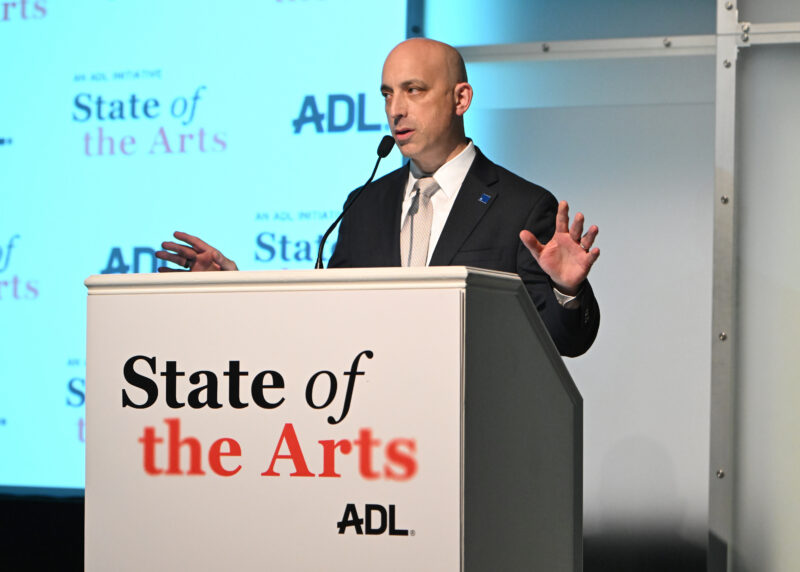
ADL CEO Jonathan Greenblatt
Anti-Defamation League CEO Jonathan Greenblatt on Tuesday bemoaned what he described as a lack of national media attention to a dramatic rise in antisemitic attacks across New York City, saying that the current polarized political environment has made it difficult to meaningfully address the uptick in violence against Jews in the major metropolis.
“The idea that you have 200 incidents [of antisemitism] here in New York City — [that] should be a national news story. It doesn’t belong in the metro section of The New York Times. It belongs on the front page,” Greenblatt told Jewish Insider during a press conference in Brooklyn, N.Y. “But here’s the thing: In a world which is so polarized, so charged, and so political, everything needs to fit to a narrative. You know what? I don’t care how you vote!”
The fight against antisemitism, Greenblatt stated, has to be, in the name of “decency, diversity and dignity,” a national focus. “When you don’t value these things, when you allow hostility to happen, when you sit and ignore intolerance, that is unacceptable.”
The ADL also announced an initiative in partnership with the Brooklyn Borough President’s office that will double the number of schools participating in its “No Place for Hate” program, with a goal of reaching as many as 40 schools in neighborhoods with significant Jewish populations. The move comes in response to a dramatic increase in violent antisemitic incidents across Brooklyn.
The announcement comes the same day as the FBI released its annual report on hate crime statistics. The report noted that anti-Jewish bias was the source of 57 percent of religion-based hate crimes reported in 2018.
“No one should fear for their safety or be victimized because of their religious beliefs,” said Brooklyn Borough President Eric Adams. “Since extremist, hate-filled rhetoric has become awakened and stoked across this country — particularly in Crown Heights right here in Brooklyn — this unacceptable behavior is increasingly becoming the norm for some.”
Greenblatt stressed that a national response, irrespective of political affiliation, is required regardless of who is the target. “Whether you are a borough president, whether you are a school board president, or the president of the United States, all of us have a responsibility to step up and speak out when hate happens on our watch, whether or not it affects us,” he said.

Evan Vucci
President Donald Trump speaks about the mass shootings in El Paso, Texas and Dayton, Ohio, in the Diplomatic Reception Room of the White House, Monday, Aug. 5, 2019, in Washington.
President Donald Trump received an enthusiastic welcome from several hundred members of the Orthodox Jewish community at a re-election fundraiser held at the InterContinental New York Barclay on Tuesday.
Video recordings circulating on social media show the president being greeted by Rabbi Yosef Yitzchak Jacobson, who recited the Hebrew blessing traditionally said upon seeing a king or head of state.
After being greeted with chants of “four more years,” Trump said he will focus his remarks on Israel because “this is a group, I think, if I didn’t talk about Israel, they’d say, ‘What a rotten speech that was.'”
In his remarks, Trump spoke at length about the Jerusalem embassy move and the pressure he got before making the decision. “I gave you, in Jerusalem, the embassy. That was a big deal,” Trump told attendees.
Trump also mocked Israel’s political system in the wake of the last two election outcomes. “What kind of a system is it over there?” he asked. “They are all fighting and fighting. We have different kinds of fights. At least we know who the boss is. They keep having elections and nobody is elected.”
The president boasted that he has “an approval rating of 98 percent” in Israel, and quipped that “if anything happens here” with his impeachment, “I will take a trip over to Israel to run for prime minister there.”
Trump on the flare-up in Gaza: “We’re watching Israel very closely… There are missiles going in and going out. A very bad day… very scary. We are watching it very closely, however. But a lot of bad things are happening today. I mean literally, I wake up and they showed missiles being shot in Israel, and likewise going in the other direction. We have to take care of Israel… We are watching and we are looking out for, really, a great country and with great people. Great people. It’s been misunderstood for a long time. It’s a tiny speck. When you look at these massive empires that it’s surrounded [by]. It’s a tiny speck, and they are almost saying, ‘How can this happen?’ But it happens because they are a great people and they are a very advanced people, and they have a great protector in Donald Trump.”
Speaking of Hillary Clinton, Trump noted, “75 percent of your people voted for her… She would never do anything for Israel.”
Hasidic singer Beri Weber performed during the luncheon.
This post was updated at 11:45 pm

Georgia is used to political dynasties. The daughter of former Senator Sam Nunn and the grandson of President Jimmy Carter have both run for statewide office in recent years, while incumbent Senator David Perdue is the first cousin of former governor and current Trump cabinet member Sonny Perdue. But Georgians aren’t used to dynasties coming from other parts of the country.
Democrat Matt Lieberman is hoping to change that in 2020. The suburban Atlanta businessman and son of former Senator Joseph Lieberman (I-CT) is the first candidate to jump into Georgia’ special election for the U.S. Senate. The seat is currently held by Johnny Isakson, who will resign at the end of the year. Isakson’s departure, announced earlier this year, will prompt Republican governor Brian Kemp to appoint a replacement who will try to hold the seat in a non-partisan special election in November 2020.
Lieberman enters the race as a relative political unknown, despite his famous father. Howard Franklin, a Democratic political strategist in Georgia, told JI that he didn’t think Lieberman’s entry would keep other well-known names out of the race. Lieberman had not even been on the radar of well-connected Democrats in the state until recently.
In an interview with Jewish Insider earlier in October, Lieberman joked that he was winning “in a blowout” as the only declared candidate in this race. A businessman and former principal at a Jewish day school, Lieberman said he hadn’t expected to run for office, despite his upbringing. “Honestly, I thought about it at a much, much younger age coming out of law school, and I hadn’t thought about it in 20 years,” said the Democratic Senate hopeful. “I have not been positioning or angling for this. I am truly running as an outsider as a fed up citizen of Georgia and for the fed up citizens of Georgia and I think I got to a point where a lot of us are right now, I couldn’t take it any more I felt compelled to get up off of my butt and do something.”
Lieberman is running as a mainstream Democrat who supports impeaching Trump and implementing a public option to allow Americans to buy into a government-run health care plan. This proposal was almost passed during the debate over the Affordable Care Act, but was blocked by objections from then-Senator Joe Lieberman.
Lieberman’s relationship with his father will likely present some issues with liberal voters. In addition to blocking progressive goals like a public option, the senior Lieberman broke from the Democratic Party first by successfully running for re-election as an independent in 2006 and then by actively campaigning for John McCain during the 2008 presidential election.
Matt Lieberman recognized the challenge that comes along with having a high-profile politician as a father, telling JI, “for voters here in Georgia who like [Joe Lieberman], I hope they’ll give me a little bit of an extra hearing, and for the people who really don’t like him I would just remind them that technically speaking we are two different people and I think they’ll give me a hearing as well. Honestly, I think ultimately people are fair in that regard, even if they have no intention of supporting you, I think they will hear you out so I think people will do me that courtesy because it’s what engaged citizens ought to do so.”
Former Senator Lieberman’s reputation has left a number of progressive activists skeptical, however. Adam Green, the co-founder of the Progressive Change Campaign Committee, a progressive Democratic activist group, told JI, “Joe Lieberman is the corporate war-monger past of the Democratic Party. I don’t know anything about his son, but voters don’t love insider legacies and don’t love corporate greed and don’t love the Iraq War — so Joe Lieberman’s reputation likely won’t be helpful in this campaign.”
Cenk Uygur, the host of the Young Turks and a leading progressive activist, used even stronger language with JI. “The sins of the father should not be passed on to the son but neither should any degree of credibility,” he told JI. “Why are we having a conversation about this guy? Because of his last name and only because of his last name. I’m tired of these wannabe royals in America. His policy positions are milquetoast, which does run in the family. Apparently, we’ve gotten the Liebermans to a public option, give us a couple of more generations and we might finally get them to single payer.”
Regardless of initial skepticism, Matt Lieberman is already using his family background to amplify his progressive message. In his campaign announcement video, he tied the controversial 2000 Florida recount to Stacey Abrams’s defeat in the 2018 Georgia governor’s race, one that Abrams has claimed was stolen. Lieberman has declined to go that far, telling JI, “I think there were enough problems that were identified in the election to make a reasonable person not just worried but frustrated that it wasn’t run in a better way with fewer problems.”
On foreign policy, Lieberman expressed concern that Trump had “completely sold out” the Kurds, whom he described as a “reliable [and] heroic ally of the United States under difficult circumstances.” In his view, “we should be sticking by our allies.” Lieberman went on to “extend that thought to the issue of our alliance with Israel and one of the concerns it’s fair to have when it comes to this president is that no one really knows where he is going to be tomorrow on an issue and why he’s going to be there and that’s problematic.”
Lieberman struck far more equivocal notes about the 2015 nuclear deal with Iran. “I think the Iran nuclear deal could have been better,” said the Senate hopeful. “I will say only as a lay person, only as a citizen, that the benefit of delaying Iran’s nuclear capability may well have been outweighed by the cost of freeing up enormous sums of money for Iran to wreak havoc.” Lieberman added “I think any future deal would need to look at what that experience has been and would look at what Iran has done with the funds that were opened up to it and take that into much more serious consideration given actual events that have transpired.”Before the election can happen, Lieberman still has to find out who his opponent will be. Republican Governor Brian Kemp, whom Lieberman parodied in his first campaign ad, will appoint Isakson’s replacement by end of the year. The special election will be a jungle primary in which candidates from all parties will compete against each other in November 2020 to serve the remaining two years of Isakson’s term. If no candidate receives a majority of the vote, a runoff between the top two finishers for the seat will be held in January 2021.

Richard Drew/AP
New York Mayor Bill de Blasio speaks at City Hall, Monday, Aug. 19, 2019.
NEW YORK — New York City Mayor Bill de Blasio is meeting on Wednesday with Palestinian-American leaders.
The meeting — announced in a media advisory as part of de Blasio’s daily schedule — is closed to press, and City Hall declined to release a list of attendees.
Jose Bayona, the mayor’s director of community and ethnic media, told Jewish Insider that the meeting is part of a practice to regularly meet with community leaders from all faith and ethnic backgrounds.
“We cannot predict what this group will raise in the meeting,” Bayona added, “but we anticipate conversation about an array of local issues, including the upcoming 2020 Census and efforts to get everyone counted, public schools and civic engagement.”
Chairman of city council’s Jewish Caucus says he’s ‘cautiously optimistic’ about the hire of Deborah Lauter
Richard Drew/AP
New York Mayor Bill de Blasio speaks at City Hall, Monday, Aug. 19, 2019.
On Tuesday, New York City Mayor Bill de Blasio announced the appointment of Deborah Lauter as executive director of the newly created Office for the Prevention of Hate Crimes.
Lauter previously served as the national civil rights director at the Anti-Defamation League. In her new position, she will supervise a team of six employees and oversee a budget of $1.7 million in the 2020 fiscal year, according to Colby Hamilton, a spokesman for the Mayor’s Office of Criminal Justice.
The opening of the new office follows a renewed push by New York City Councilmembers Chaim Deutsch (D-Brooklyn), Mark Levine (D-Manhattan) and Donovan Richards (D-Queens), who urged the mayor to take immediate action on antisemitism after a rash of recent incidents across New York City.
Earlier this year, a bill requiring educational outreach on the municipal level was passed by the City Council, and was slated to be implemented towards the end of the year. But in June, de Blasio declared the immediate opening of the office to combat the dramatic rise in antisemitic violence.
On Tuesday, three months after his initial announcement, the mayor made good on that promise.
“I’m cautiously optimistic about the mayor’s decision to hire Deborah Lauter as executive director,” Deutsch, chairman of the city council’s Jewish Caucus, told Jewish Insider. “She comes highly recommended, and I look forward to working together with her.”
Levine, who held the chairmanship until last year, lauded the pick as “an excellent choice,” saying Lauter “brings the right experience to this job.”
According to City Hall, Lauter has been on the job for a week now, but has yet to meet with de Blasio, who was reportedly in City Hall at the time of the announcement. “I don’t know the mayor’s schedule but I can assure you that everything that’s been communicated to me [indicates] the mayor is taking this extremely seriously,” Lauter told reporters.
Deutsch told ABC7 that it was “kind of disturbing” that the mayor had not yet met with his new appointee: “Does that kind of beg the question — is the mayor serious about this office or not?” The councilman said de Blasio has been “a little pre-occupied.” The mayor has spent much of the summer outside New York City following his May entrance into the 2020 Democratic presidential primary.
In an interview with Jewish Insider, Levine said: “Now that we have a strong director, we need this office fully staffed, adequately resourced and with the broadest possible mandate as soon as possible.”
Sarah Hurwitz says she discovered as an adult how much Jewish values were ‘the driving force of my career in politics’

Courtesy
Sarah Hurwitz, author of 'Here All Along.'
It was Yom Kippur 2016, and Sarah Hurwitz was attending prayer services in Washington, D.C. The longtime speechwriter for then-First Lady Michelle Obama didn’t welcome the intrusion of work into the holiest day in the Jewish calendar.
But it was also just one day before the first lady was poised to make a memorable, impassioned and fiery address. In that speech in Manchester, New Hampshire, the First Lady lambasted then-candidate Donald Trump for “countless examples of how he has treated women his whole life… The belief that you can do anything you want to a woman. It is cruel. It’s frightening. And the truth is, it hurts. It hurts.” Obama’s speech was labeled “epic” by The Washington Post and “the most powerful speech of this election” by Vogue.
And a day earlier, in the midst of the Yom Kippur liturgy, Hurwitz chose to have her say in drafting that address as well.
“I put a lot of thought into how I felt about having to work in a moment where I didn’t want to be working,” Hurwitz recalled in a recent phone interview with Jewish Insider. “In the end, weighing all the costs and weighing the goals that we were working for… That was the calculation I made.”
Hurwitz said she made the choice to work on a speech that was able to “help so many people who’ve experienced sexual assault feel seen and heard… it was a really powerful, moving speech I was really proud to be a part of.” And she understands that all Jews “make that calculation for themselves in the modern world. I think for many Jews it’s just a constant balancing act.”
Those calculations and decisions all came along with Hurwitz’s recent journey to Judaism, an exploration on which she embarked in her mid-30s, which led her to embrace the religion she had mostly avoided as a child and young adult. She chronicled this journey, her beliefs and her approach to Judaism in her debut book, published today, titled Here All Along: Finding Meaning, Spirituality, and a Deeper Connection to Life — in Judaism.
In the book’s intro, Hurwitz wrote that there was no major crisis point or wake-up call that led her to explore Judaism. Instead, despite working around the clock at the White House, she decided on a whim to sign up for a class at a D.C. Jewish center shortly after a breakup.
“What I discovered in that class utterly floored me,” she wrote. Hurwitz — who worked as a speechwriter for Hillary Clinton’s 2008 primary campaign before being hired by President Barack Obama in 2009 and then transitioning to work for the first lady from 2010-2017 — discovered a Judaism that not only inspired and moved her but also mirrored her career in public service.
“[People] know about tikkun olam and tzedaka and caring for the stranger, but Judaism has a lot of really deeper insights,” she told JI. “It has a lot of very specific thinking about how you help those who are struggling, about the value of each human life, and I think the more I learned about all of that, the more I was just struck by how much that was the driving force of my career in politics.”
And years after she first began studying Judaism, Hurwitz said, she realized that “it might be helpful to write a book that I wish I’d had when I first started learning.”
In it, she strives to “cover the basics while also unearthing some of the deeper insights and showing people that Judaism has so much to offer about how to live a good life, how to be a better person and how to have spiritual connection.”

While Hurwitz admits D.C. has a certain reputation — one that is often not conducive to religion and spirituality — she said her journey to embrace Judaism fit in pretty well.
“In the Obama White House, so many of my colleagues were such spiritual, compassionate, decent people,” she said. “So I think they really kind of identified with what I was doing, admired what I was doing… if you look at folks in the Obama White House, if you look at folks at a lot of the nonprofits… you’re going to find a lot of people who are not just self-centered, ambitious and self absorbed. I think you’ll find people who really care deeply about other people and are really public minded.” And those values, she said, “felt very in line with a lot of what I was thinking about when I was studying Judaism.”
Hurwitz experimented with all sorts of Jewish practices, finding the Jewish traditions that spoke to her and that jibed with her lifestyle.
“I currently observe a grand total of two of the rules of keeping kosher — I don’t eat pork or shellfish,” she wrote in Here All Along. “I don’t observe the laws around Shabbat (which prohibit working on Shabbat, among many other things), though I do have regular Shabbat dinners with friends. I don’t spend much time in synagogues, but I do attend services for the major holidays, and I celebrate others. I also try to observe the ethical mitzvot and feel guilty about my frequent lapses in doing so. And I care enough about Judaism to devote thousands of hours to studying it (which is a mitzvah) and writing about it.”
The speechwriter said she doesn’t identify with any one denomination, but finds beauty and draws meaning from all of them.
“I really appreciate the Reform movement’s inclusion and openness, its focus on social justice,” she told JI. “I really appreciate the rigor of the Orthodox movement and its deep textual learning and the commitments to things like Shabbat, which I think is just so powerful. When you actually spend time with folks who are observing Shabbat very, very rigorously, they are truly creating a sanctuary in time that’s special… I admire that. I also admire the Conservative movement’s focus on rigor plus inclusion.”
One topic that doesn’t play a significant role in Hurwitz’s book is the State of Israel. While she mentions traveling there, the Jewish community’s relationship to Zionism is largely unexplored in its pages. But that decision, Hurwitz said, doesn’t mean it’s not a part of her life.
“The modern State of Israel is very important to me,” she said. “My concern was that too often it’s just reduced to these very simplistic talking points and this divisive polarizing language that drives me crazy.” Therefore, Hurwitz didn’t want or feel the need to devote any particular chapter to it.
“Israel is not just some concept,” she said. “It’s a thriving democracy. It is a people, it is a culture, it is a history.”
Chaim Deutsch says ‘the mayor needs to realize that if he makes a commitment, he needs to make good on it’

Gage Skidmore/Flickr
New York City Mayor Bill de Blasio speaks at a campaign event in Iowa earlier this month.
The New York Police Department is investigating a brutal attack against a 64-year-old rabbi in Crown Heights on Tuesday as a hate crime.
Rabbi Avraham Gopin, the father-in-law of hassidic singer Benny Friedman, was reportedly jogging through Lincoln Terrace Park in Brooklyn on Tuesday morning when a man threw a rock at him. Gopin confronted the man, who in turn punched him in the face, and then hit him with a large rock, knocking out two teeth and causing facial injuries.
The incident is just the latest in an ongoing string of attacks against Jews in New York City. The most recent NYPD statistics show a 52 percent increase in antisemitic attacks (90-146 incidents) compared with the same period last year.
In an interview with Jewish Insider, Councilman Chaim Deutsch, chairman of the NYC Jewish Caucus, blamed Mayor Bill de Blasio for not coming through with his pledge to rush the creation of mayoral office for the prevention of hate crimes. Earlier this year, a bill requiring educational outreach within the office of prevention of hate crimes was passed by the City Council, and slated to be implemented towards the end of the year.
But in remarks at the annual Jewish American Heritage Month reception at Gracie Mansion in June, de Blasio declared the immediate opening of the office to combat the rise in antisemitism. But little action appears to have been taken on the issue.
“We are already in August, and I still haven’t heard anything about it being active or anyone being hired,” Deutsch said. “The commitment was made by the mayor that he’s going to have this open by June. We are waiting for this [to be] implemented.”
The Brooklyn lawmaker suggested the mayor should not neglect city business due to his presidential campaign.
“Whether he is here or not, de Blasio should make sure that his administration is on top of things, especially when he had made that commitment to open the office in June,” he stressed. “We are in a moment where we need to tackle these issues head on. We can’t just ignore them thinking it’s going to go away. The mayor needs to realize that if he makes a commitment, he needs to make good on it.”
Deutsch also said he is in favor of enacting hate crime laws, but they should be passed by the state legislatures.
In response to the JI report, Freddi Goldstein, the mayor’s press secretary, said the hate crimes office was never scheduled to open in June.
“Setting the record straight: we never committed to open the office in June,” Goldstein tweeted. “We promised to move up the November deadline set by the Council’s bill, which we’re doing. More to say in the coming days.”
This article was updated at 9:45am eastern time.
Lindsey Boylan says the 14-term congressman is ‘kicking the can down the road’ on impeaching Trump

Courtesy
Lindsey Boylan
In his 13 re-election bids since joining Congress in 1992, Representative Jerrold Nadler (D-NY) has yet to face a viable challenger. But next year Nadler, who now serves as chair of the influential House Judiciary Committee, will face at least one Democratic primary opponent who is garnering significant attention and resources in her quest to replace the 72-year-old incumbent and represent New York’s 10th congressional district.
Lindsey Boylan, who raised $264,657 in the last quarter, served as an economic development advisor for New York Governor Andrew Cuomo. Despite her background, she doesn’t expect the establishment to support her candidacy against the veteran congressman. “I went into this knowing I was doing it, and I’m doing this because of what I believe we need. No one is coming in to make this happen for me and that’s just the way I want it,” Boylan said in a recent interview with Jewish Insider in midtown Manhattan.
Boylan orderly outlined the issues she feels people in the district most care about, including housing, climate change and infrastructure. But what makes her confident voters in the district would oust a sitting representative who beat his last primary challenger by nearly 80 percentage points? After all, constituents are now seeing Nadler rise to the top ranks in House leadership and becoming a leading voice in making the case against President Donald Trump.
Boylan disagreed with the premise. “I respect his career,” she said. “What I would say is that in almost 30 years, he’s gotten three pieces of his own legislation enacted. Two of those were ceremonial. And I think when we talk of actually producing legislation, putting forth ideas that garner support and change the conversation, that’s just not something we’ve seen from him. We haven’t seen solutions to the problems we have.”
Boylan also largely dismissed Nadler’s role as chair of the Judiciary Committee: “I think as we’ve seen recently, the agenda of the Judiciary is driven by the Speaker of the House. If we talk about the interests of the district, there’s nothing on the judiciary committee that gets specific policy funded. And I think one of the things we’re seeing is that what you have to do to become part of the establishment leadership isn’t necessarily listening to the interests of your district.”
Boylan also thinks Nadler is “kicking the can down the road” and “politicizing” the issue of impeaching the president, rather than moving forward. “My view and the views of the people I’ve spoken with — who are supportive of impeachment in the district — really feel that we need to hold the president accountable for both rhetoric and substantive matters,” she said. “I think that [Nadler] has completely mishandled this. He has made, in many ways, what should not be a political process, a completely politicized issue. We should have been on this road months ago.”
Boylan firmly believes voters will express their dissatisfaction with the way Nadler has been handling the issue when they enter the ballot booth. “We just heard Congressman Nadler say that this moment is reminiscent of the 1930s in Germany… that’s a pretty big statement to just put out there and do nothing about, if you really believe that.”
Defining herself as a progressive woman, Boylan draws a clear line between her progressive bona fides and her views on Israel and national security. She sees Rep. Ayanna Pressley (D-MA) — who unseated a 10-term incumbent, Rep. Michael Capuano, in a surprise upset in 2018 — as her model. Unlike the other three members of “The Squad” — Reps. Alexandria Ocasio-Cortez (D-NY), Ilhan Omar (D-MN) and Rashida Tlaib (D-MI) — Pressley voted in favor of the recent House anti-BDS resolution.
As a supporter of Israel, Boylan says she approves of the anti-BDS resolution that recently passed with overwhelming support: “Boycotting Israel is both unproductive and unfair, at best.”
While Pressley has been promoting herself as part of The Squad, Boylan doesn’t see herself as part of any such group. “I was always way too nerdy to be a part of any kind of school,” Boylan quipped. “So the only squad I feel like I get to be part of is the one with my daughter and my husband, and my parents who moved across the country to be my treasurers.”
According to Boylan, people across the 10th district have an interest in foreign policy — and she has a very personal connection to Israel. “I had the opportunity when I worked for the governor to do all of the policy work for the economics side of his trade mission trips to Israel,” she explained. “And that was tremendous fun because — whether we’re talking about water resource management, or technology, or life sciences — Israel is a leader in so many things in terms of innovation, that’s a topic that is of great interest.”
Boylan recently visited Israel with her family to attend a bat mitzvah celebration for the daughter of a close friend. “It was magical,” she said of the weeklong trip. “It was the most magical trip I’ve ever been on. We went to Masada. We took so many tours of the Old City.”
Boylan said she has “a friend who’s in the intelligence community and is based in Jerusalem. He gave me a tour the Old City of Jerusalem and you see the security concerns. You see very real examples of how complicated and important security is for Israel. I’m someone who has an unshakeable support for Israel. I believe in a two-state solution, which I think is at the moment very complicated. As the daughter of a marine, as someone who’s been to Jerusalem, as someone who has an interest in long-[term] support for Israel and also a future that Palestinians can be proud of, it’s really important to me to focus on and also listen to the people in my district.”
As the interview wrapped up, Boylan shared with JI her favorite Jewish pastry: “Sufganiyot — the jelly-filled ones.”
A City Council intern who collapsed during a press conference for mayoral hopeful Christine Quinn this afternoon was forced to wait more than 30 minutes before a Hatzollah ambulance arrived to take her to the hospital. The intern had to wait 30 minutes even with a personal phone call from Quinn to police Commissioner Ray Kelly asking for help.
The 17-year-old intern, who works in the office of Councilwoman Diana Reyna, collapsed around 12 p.m. during a Williamsburg press conference. According to several news outlets, the victim was promptly pulled into the shade by Quinn and other staffers, and continued to fade in and out of consciousness for 30 minutes before a volunteer Hatzollah ambulance arrived to take her to Long Island Jewish Hospital.
Please log in if you already have a subscription, or subscribe to access the latest updates.
 Continue with Google

 Continue with Apple