

































The embassy told JI that the constitution’s ‘first draft was not written in coordination with France, and we were exposed to it with the broader public.’

Photo by CHRISTOPHE ENA/POOL/AFP via Getty Images
French President Emmanuel Macron (L) meets with Palestinian President Mahmoud Abbas on October 24, 2023 in the West Bank city of Ramallah. Macron's visit comes more than two weeks after Hamas militants stormed into Israel from the Gaza Strip and killed at least 1,400 people and amid Israel's retaliatory strikes.


 Add JewishInsider on Google
France did not take part in drafting the Palestinian Authority’s proposed constitution released earlier this month, which enshrines payments to terrorists in Israeli prisons, the French Embassy in Israel told Jewish Insider, despite PA President Mahmoud Abbas and French President Emmanuel Macron’s announcement of a joint committee on the matter last year.
The embassy told JI that the constitution’s “first draft was not written in coordination with France, and we were exposed to it with the broader public.”
“As part of the joint committee to strengthen the building of a Palestinian state … a delegation of French constitutional law experts is expected to examine the draft that was published and present recommendations,” the embassy spokeswoman stated.
Ofer Bronchtein, Macron’s advisor on Israeli-Palestinian affairs, told JI that the committee had met “here and there,” but like the embassy spokeswoman, did not know when they would meet next.
France recognized a Palestinian state last September and after Abbas wrote a letter to Macron saying he was committed to a two-state solution while calling for “an end of the Israeli occupation.” French Foreign Minister Jean-Noël Barrot interpreted the letter as promising “the end of allowances for the families of prisoners convicted on terrorism offences.”
Macron and Abbas met in Paris in November to announce a committee to establish the framework for a Palestinian state, including drafting a constitution. France reportedly raised concerns to the Palestinians about its practice of paying terrorists and their families, and Macron said after the meeting that Abbas agreed to an audit by an American company to ensure that the payments had ended.
Abbas had previously promised to stop the payments to terrorists last February, yet i24News reported on Wednesday that the PA had paid NIS 500 million ($161 million) to terrorists and their families in the past year. The PA has granted monthly payments, higher than the average Palestinian salary, to those imprisoned for committing or attempting acts of terror, or to their families. The amount paid increases with a longer prison sentence, thus incentivizing killing more Israelis.
The day before the presidents’ meeting, Abbas fired his finance minister, Omar Bitar, for continuing the payments, but Israel has accused Abbas of not intending to end the program, called “pay for slay” by its critics.
The PA draft constitution, published this month, includes two articles guaranteeing “protection and care for the families of martyrs, and the wounded, and prisoners, and those released from the occupation prisons, and the victims of genocide,” as well as “comprehensive care for the families of martyrs, the wounded, and prisoners, and those released.” One of the articles is part of the “public rights and freedoms” chapter, of which the draft states: “it is not permissible to conduct any constitutional amendment.”
The French Embassy said that when it comes to “the matter of ‘pay for slay,’ our stance is known and clear: This phenomenon must stop. The PA made a commitment to France on this matter, and it will be examined through an independent audit. We will act with determination and without compromising on this matter.”
Bronchtein argued that Abbas has stopped paying “those regarded in Israel as terrorists,” and that there should be universal social security for Palestinians.
“All families would have rights, without being linked to the criminal acts of certain family members. In Israel, for example, the families of [Prime Minister Yitzhak Rabin’s murderer] Yigal Amir or [Hebron massacre terrorist] Baruch Goldstein have rights like any other family — no more and no less,” he suggested.
Bronchtein is not a member of the joint committee, but took part in the meeting between Macron and Abbas in November. He said that “a group of jurists — French, and above all Palestinian — will finalize [the PA constitution]. The French constitutional model has inspired many countries, including the United States.”
“Palestinians and Israelis ultimately need to decide both their constitutional framework and their borders; that would resolve a large part of what opposes them [to each other],” he said. Israel does not have a constitution.
According to Bronchtein, Abbas promised France that parties or individuals advocating violence would not be able to run in elections. However, that rule is not part of the constitution.
The draft also refers to Jerusalem as “the capital of the State of Palestine,” and states that the PA is “committed to preserving [Jerusalem’s] religious character and protecting its Islamic and Christian sanctities.” It does not mention Jews or Judaism.
Bronchtein said that Jerusalem “is, and will remain, the eternal capital of the Jewish people. President Macron has acknowledged this. Al-Quds” — the Arabic name for Jerusalem — “would be the capital of Palestine; they are two different cities, but I believe they should remain united.”
“The Old City of Jerusalem — less than 1% of the city — should be open to everyone, as it was for a long time,” he added.
Emmanuel Navon, a longtime international relations lecturer at Israeli universities and CEO of the new Euro-Med Middle East Council, said that he “didn’t expect a Zionist manifesto” from the constitution, but that the French advisors should take note of “how this constitution relates to the Jewish people and their relation to the land. … Describing Jerusalem as only for Muslims and Christians says it all.”
Navon called the draft constitution a “joke.”
“Abbas did it because Macron said that, before he recognizes a Palestinian state, they needed to promise to be a democracy based on liberal values,” Navon said. “Abbas was elected in 2005 for a four-year term, and now he has a constitution? The whole thing is BS.”
“When they put pay for slay in the constitution, it shows that they don’t take Macron seriously,” Navon added.
Navon also took issue with France presenting itself as an expert on writing constitutions.
“One of the amazing achievements of the Fifth Republic [established in 1958] is that it managed to finally grant France a stable, functioning regime after almost 200 years since the revolution in which it went back and forth between republic, empire and constitutional monarchy. The regimes in the Third and Fourth Republics were completely unstable because of an extreme system of parliamentary politics where governments lasted an average of eight months. … Macron took France back to the Fourth Republic — he’s had five prime ministers in two years,” Navon explained.
“That adds to the irony of [Macron] going around advising people on constitutional law,” he added.
Netanyahu said on Sunday that Jerusalem had previously warned Australia’s PM that Palestinian statehood recognition endangered Jews in the country

Kevin Dietsch/Getty Images
Sen. Bernie Sanders (I-VT), joined by fellow senator Sen. Jeff Merkley (D-OR) (R), speaks at a news conference on restricting arms sales to Israel at the U.S. Capitol on November 19, 2024 in Washington, DC.
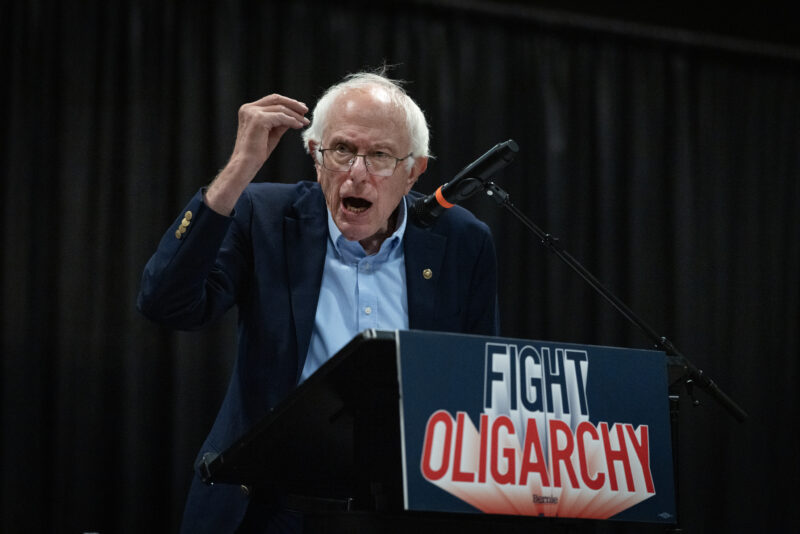
Sen. Bernie Sanders (I-VT) criticized Israeli Prime Minister Benjamin Netanyahu on Tuesday, after Netanyahu linked the terror attack in which 15 people were killed at a Hanukkah celebration in Sydney, Australia, to Canberra’s support for a Palestinian state.
Netanyahu highlighted in a speech on Sunday that he had warned Australian Prime Minister Anthony Albanese that Canberra’s recognition of a Palestinian state was fueling antisemitism and endangering Australian Jews. Netanyahu further accused Albanese of failing to take action against antisemitism.
Sanders issued a statement in response on Tuesday: “No, Mr. Netanyahu. Speaking out on behalf of the Palestinian people is not antisemitic. Opposing the disgraceful policies of your extremist government is not antisemitic. Condemning your genocidal war, which has killed more than 70,000 people — mostly women and children — is not antisemitic. Demanding that your government stop bombing hospitals and starving children is not antisemitic.”
He said that “we must continue to oppose antisemitism and all forms of racism and bigotry. At the same time, we must demand a world in which international law and human rights are respected by all governments, without exception.”
Sanders opted against signing onto a joint statement issued Monday by Jewish Senate Democrats condemning the Sydney attack. Asked about his decision not to join the collective statement from Jewish Senate Democrats, a Sanders spokesperson pointed JI to Sanders’ comment on Sunday mourning the attack, in which the Vermont senator called antisemitism “a disgusting and cowardly ideology” that is “growing worldwide” and added, “we must be equally committed to fighting all forms of” bigotry.
The timing could be damaging, coming days before Saudi Crown Prince Mohammed bin Salman is set to visit the White House
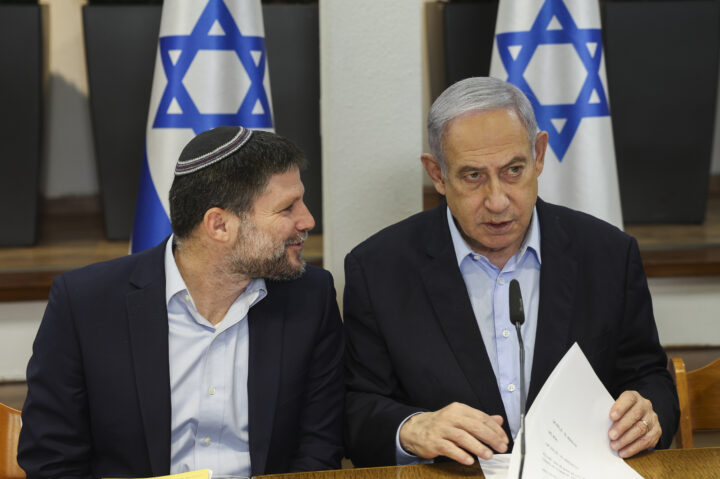
Ronen Zvulun/Pool via AP
Israeli Prime Minister Benjamin Netanyahu, right, speaks with Minister of Finance Bezalel Smotrich during the weekly cabinet meeting at the Defence Ministry in Tel Aviv, Israel, Jan. 7, 2024.
The members of Israeli Prime Minister Benjamin Netanyahu’s governing coalition spent much of the weekend arguing over something on which they all ostensibly agree — opposition to a Palestinian state.
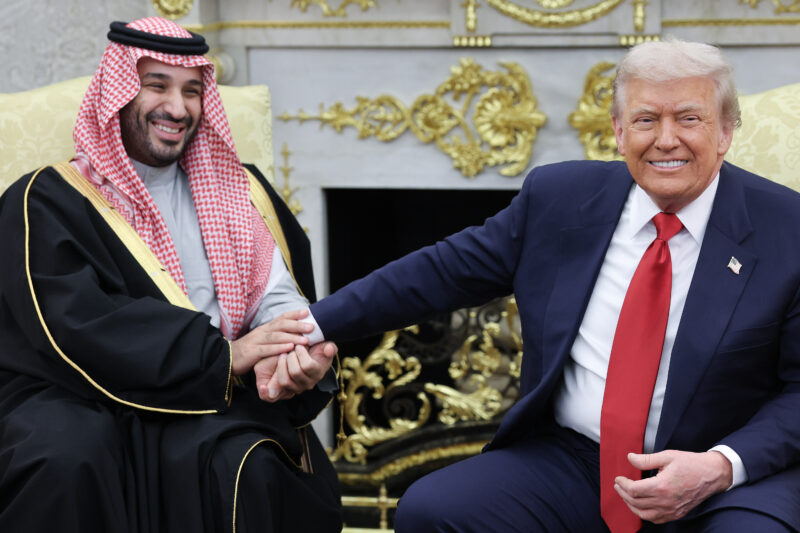
They may have been expressing their long and openly held opinions, but the timing could be damaging, coming days before Saudi Crown Prince Mohammed bin Salman is set to visit the White House. In the meeting, slated for Tuesday, President Donald Trump is expected to push for normalization between Riyadh and Jerusalem — something the Saudis have long conditioned on tangible steps towards a Palestinian state.
The latest debate started with far-right Israeli Finance Minister Bezalel Smotrich, who recently apologized for saying the Saudis can “keep riding camels” rather than normalize ties with Israel in exchange for a Palestinian state. On Saturday night, Smotrich said that Netanyahu was responsible for a “dangerous” increase in pressure on Israel, criticizing the prime minister for not speaking up more forcefully after nearly a dozen countries recognized a Palestinian state earlier this year. “Immediately come up with an appropriate and decisive response that will make clear to the entire world that a Palestinian state will not be established in our homeland,” Smotrich wrote on X.
Next came Likud ministers. “Israel will not agree to the establishment of a terror state in the heart of the Land of Israel,” Israeli Foreign Minister Gideon Sa’ar asserted. “Israel’s policy is clear: A Palestinian state will not be established,” chimed in Defense Minister Israel Katz.
The impetus for reiterating their position was the U.S.-proposed resolution at the United Nations Security Council backing Trump’s plan for Gaza and the formation of an International Stabilization Force, leading to a scenario in which “the conditions may finally be in place for a credible pathway to Palestinian self-determination and statehood.”
It’s unclear where these Cabinet ministers were in late September, when Netanyahu signed onto Trump’s 20-step plan, which uses the exact same language.
The Saudis saw Netanyahu’s agreement to a horizon for Palestinian statehood as satisfying their demand for a step in that direction, an Israeli diplomatic source who frequently advises Netanyahu said earlier this month.
But the pressure from the right was such that Netanyahu said at the opening of Sunday’s cabinet meeting that “our opposition to a Palestinian state in any territory west of the Jordan River exists and stands and has not changed at all.”
That apparent reversal of what Netanyahu agreed to less than two months ago could cause serious harm to Trump’s efforts to try to make Saudi Arabia the crown jewel of the Abraham Accords, a move that Netanyahu has long said would be greatly beneficial to Israel.
Elsewhere in Jerusalem, top opposition figures have sounded the alarm on the possibility of a Saudi domestic nuclear enrichment program and Riyadh purchasing F-35 planes. Former Prime Minister Naftali Bennett said that the government “lacks the ability to say ‘no.’ Faced with the initiative to establish a Palestinian state — silence. … Faced with those around us being armed with F-35s — silence.” Meanwhile, Israeli Ambassador to the U.S. Yechiel Leiter told The Jerusalem Post, “There’s no indication that Israel’s qualitative edge will be compromised.”
While Netanyahu and his ministers have been silent on other expected elements of MBS’ planned visit to Washington, there have been behind-the-scenes efforts to ensure Israel’s qualitative military edge is maintained.
The question remains, then, if these incentives are removed or downgraded, whether the Saudis will still want to normalize relations with Israel.
The Ohio Democrat said that withholding aid from Israel would 'undermine' the country 'in a way that is really significant'
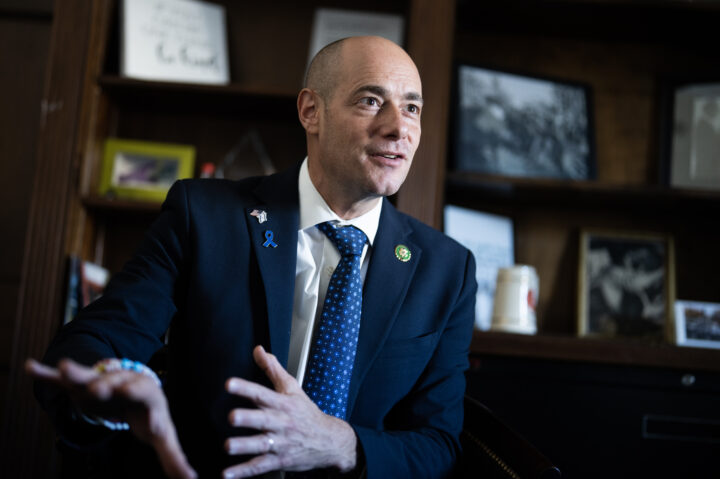
Tom Williams/CQ-Roll Call, Inc via Getty Images
Rep. Greg Landsman (D-OH) is interviewed by CQ-Roll Call, Inc via Getty Images in his Longworth Building office on Friday, November 3, 2023.
Rep. Greg Landsman (D-OH), in a webinar with Democratic Majority for Israel on Tuesday, emphasized that colleagues who push to block aid to Israel or recognize a Palestinian state risk emboldening Hamas, Hezbollah and Iran when they are on their back foot.
Landsman also laid out what he sees as preconditions for rebuilding Democratic support for the Jewish state.
“Saying, ‘We’re going to withhold aid, we’re going to unilaterally call for a Palestinian state’ — which exists where? Is that all of Israel? What are you talking about? — that suggests to Hamas, ‘Maybe we should keep fighting,’” Landsman said. “I don’t think that’s their intent. I think that it’s entirely appropriate to be critical of the government and decisions … without abandoning our ally.”
“Witholding aid does undermine our ally in a way that is really significant,” Landsman continued.
He said he’s trying to push colleagues in that direction. He added later that he believes that the war in Gaza is a “just war,” even if “it needs to come to an end.”
Asked about the longer-term path toward rebuilding Democratic support for Israel, Landsman said that an end to the war and new leadership in Israel would likely be critical steps in that direction.
“Once we get on the other side of this and we have a government that’s really actively pursuing peace, then the path for a lot of these folks who have felt alienated, to come back. I think is pretty clear,” Landsman said.
He added that peace must also come alongside continued efforts to beat back threats. “You do have to take out these terror armies, and you have to marginalize and completely sideline Iran as a threat, which is going to require constant work.”
He said he was encouraged to see the deal put forward by the Trump administration on Monday, arguing that the war “needs to end for a whole host of reasons,” including freeing the hostages and surging aid into Gaza.
“Israel’s standing in the international community has been diminished, which is a key strategy for Hamas. And this is one of the reasons why I think Netanyahu has got to figure out a way to end this war, because Hamas is succeeding at delegitimizing Israel in a way that is really harmful, way more so than anything it could do militarily,” Landsman said. “I think you’ve got to take that off the table, and that means ending the war.”
Landsman also said that “there’s still limited pressure on Hamas to end this war” and called on the Trump administration to employ “maximum leverage, maximum pressure” on the group, including by detaining Hamas leaders in Qatar.
He added that surging aid is “the right thing to do, it’s the Jewish thing to do and it’s also just strategically what has to happen if Israel is going to maintain its standing in the world and continue to get support.”
He said that positive steps are being taken but added that there are “serious issues with UNRWA that the U.N. and the international community have not gotten serious about.”
He also emphasized the need for an Arab-nation compact to bring the war to an end and deradicalize and rebuild Gaza with a new government that seeks peace with Israel.
“Get all 22 of them involved in a very formal and committed, long-term, sustainable way,” Landsman said. “I think that helps achieve the goals that we collectively have for ending this war and getting Gaza to a place where Hamas is gone, the strip is deradicalized and we’re in a position to help them rebuild with a new governing authority that wants peace with the state of Israel.”
Landsman suggested that such an effort could also unlock Arab-Israeli peace.
“An Israel that’s seeking peace is quite popular. I think that’s what [Saudi Crown Prince Mohammed bin Salman] would support. Once this war is over and there is a pathway to peace because these terror armies have been defeated … I think these folks do come back and say, ‘Okay, let’s be part of something,’” Landsman continued.
He said that the Trump administration needs a larger team, working full-time, on pursuing Middle East peace in the longer term. “You’ve got to get ironclad commitments from all of these countries. It’s got to be formal. They’ve got to come together in a formal, sustainable way.”
Without continuous White House pressure and attention, he warned that any peace that is reached is likely to crumble.
Less than one-quarter of House Democrats signed the letter, even as several European allies recognized a Palestinian state at the U.N.

Chip Somodevilla/Getty Images
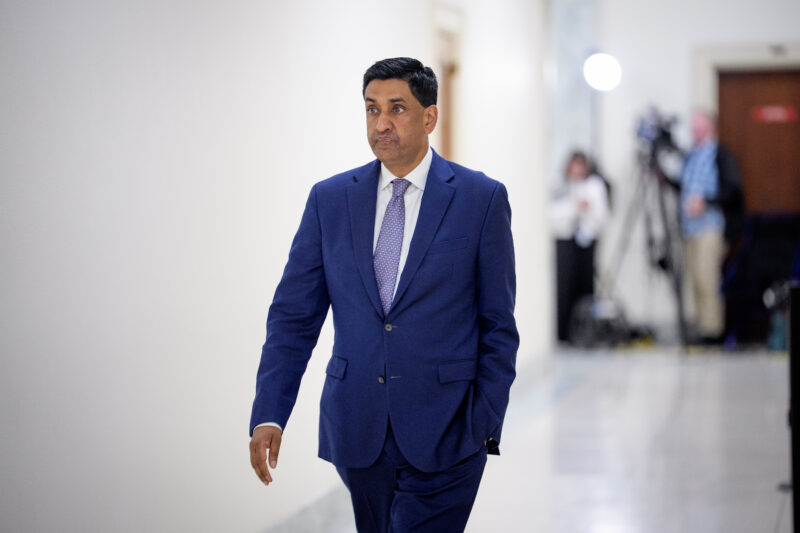
Rep. Ro Khanna (D-CA) leaves the U.S. Capitol on March 13, 2024 in Washington.
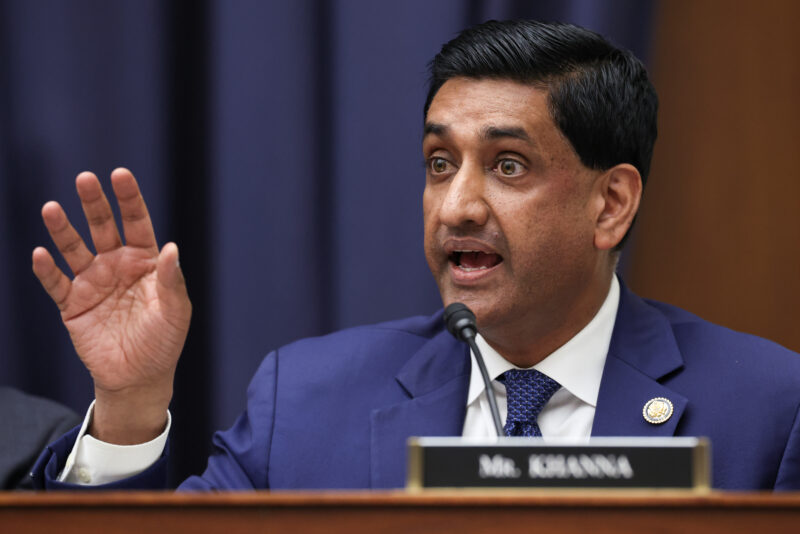
Forty-seven progressive House Democrats, led by Rep. Ro Khanna (D-CA), signed onto a letter to President Donald Trump and Secretary of State Marco Rubio calling for the U.S. to recognize a Palestinian state on the heels of similar decisions by European allies last week.
“It has long been acknowledged by much of the international community and previous U.S. administrations of both major political parties that a Palestinian state recognized as a full and equal member of the community of nations is necessary to fulfill the legitimate national rights of the Palestinian people and ensure the state of Israel’s survival as the democratic homeland of the Jewish people,” the letter, which was first reported on by Jewish Insider, reads.
The lawmakers argue that because the current Israeli government opposes a two-state solution — a position currently shared by much of Israeli society — and is “actively undermin[ing]” the prospects of an independent Palestinian state, “meaningful action is necessary to join the majority of the world in codifying Palestinian statehood and to unlock the potential for a broader regional peace and security arrangement.”
Trump vowed last week week that he would not allow Israel to annex the West Bank.
The letter also claims that recognizing Palestinian statehood would make reform of the Palestinian Authority “far more achievable and sustainable.”
Signatories to the letter include Reps. Becca Balint (D-VT), Donald Beyer (D-VA), André Carson (D-IN), Greg Casar (D-TX), Joaquin Castro (D-TX), Judy Chu (D-CA), Danny Davis (D-IL), Madeleine Dean (D-PA), Diana DeGette (D-CO), Chris Deluzio (D-PA), Mark DeSaulnier (D-CA), Maxine Dexter (D-OR), Lloyd Doggett (D-TX), Veronica Escobar (D-TX), Dwight Evans (D-PA), Bill Foster (D-MA), Maxwell Frost (D-FL), John Garamendi (D-CA), Chuy García (D-IL), Sylvia Garcia (D-TX), Robert Garcia (D-CA), Al Green (D-TX), Val Hoyle (D-OR), Jared Huffman (D-CA), Jonathan Jackson (D-IL), Sara Jacobs (D-CA), Pramila Jayapal (D-WA), Hank Johnson (D-GA), Marcy Kaptur (D-OH), Zoe Lofgren (D-CA), Stephen Lynch (D-MA), Betty McCollum (D-MN), James McGovern (D-CA), Chellie Pingree (D-ME), Mark Pocan (D-WI), Mike Quigley (D-IL), Emily Randall (D-WA), Mary Gay Scanlon (D-PA), Jan Schakowsky (D-IL), Bennie Thompson (D-MS), Mike Thompson (D-CA), Jill Tokuda (D-HI), Paul Tonko (D-NY), Nydia Velázquez (D-NY), Maxine Waters (D-CA) and Bonnie Watson Coleman (D-NJ).
Dexter and Garcia were both beneficiaries of significant outside spending from AIPAC’s United Democracy Project super PAC in their primary races, running against farther-left anti-Israel opponents.
Balint and Schakowsky are both Jewish. Davis, Evans and Schakowsky are retiring from Congress at the end of their current terms.
Many of the furthest-left lawmakers in the House, including some of the Jewish state’s most outspoken critics, did not sign onto Khanna’s letter, nor did some of the more moderate Democrats backing a concurrent effort to place strict restrictions on U.S. aid to Israel.
The letter is backed by groups including American Muslims for Palestine, DAWN, Emgage Action, Indivisible, J Street, MoveOn, MPower, Muslim Public Affairs Council, New Jewish Narrative and the Quincy Institute.
There is a notable split on this issue within the Democratic caucus: Khanna’s letter follows a letter from 30 moderate pro-Israel Democrats condemning unilateral recognition of a Palestinian state as “performative” and saying that doing so risks “emboldening Hamas, entrenching division, and undermining the very legitimacy and peace such recognition purports to advance.”
Netanyahu plans on attacking what he perceives as the moral bankruptcy of countries he sees as rewarding the perpetrators of the Oct. 7 attack and casting Israel as a villain
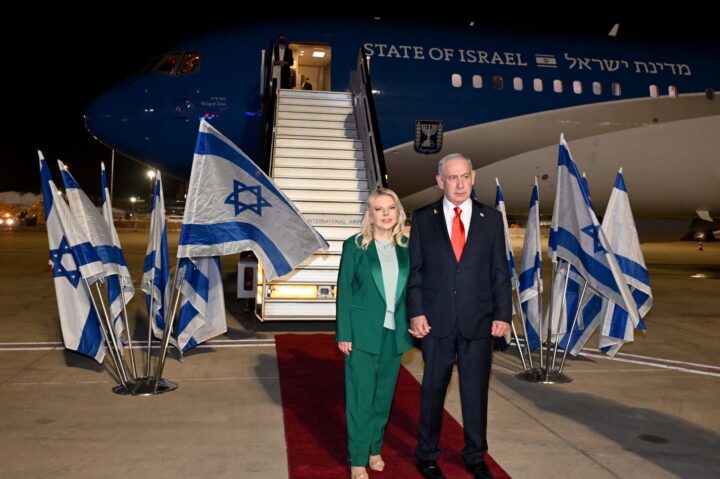
Avi Ohayon (GPO)
Israeli Prime minister Benjamin Netanyahu and his wife Sara depart to the U.S., Sept. 25th, 2025
Israeli Prime Minister Benjamin Netanyahu will have much to respond to when he stands in front of the United Nations General Assembly’s green marble wall today: a cascade of Palestinian state recognitions by Western countries, a flotilla of activists, influencers and parliamentarians — protected by Spanish and Italian naval ships — and accusations of genocide leveled from the UNGA stage.
On the tarmac at Ben Gurion Airport on Wednesday, Netanyahu vowed to “tell our truth — citizens of Israel, the truth of IDF soldiers, of our state.”
“I will condemn those leaders who, instead of condemning the murderers, rapists and burners of children, want to give them a state in the heart of Israel. This will not happen,” Netanyahu said ahead of his departure from Israel.
Netanyahu also plans on attacking what he perceives as the moral bankruptcy of countries he sees as rewarding the perpetrators of the Oct. 7 attack and casting Israel as a villain. His arrival in New York was accompanied by an advertising campaign launched by his office on billboards and trucks driving around Turtle Bay and Times Square with the message “Remember October 7.”
The signs also feature a QR code that leads to a site depicting the atrocities of that day.
“The goal of the campaign is to remind world leaders and the public about the atrocities perpetrated by Hamas and the unbelievable brutality of the terrorist organization that continues to hold 48 hostages in captivity in Gaza,” Netanyahu’s office said.
Ahead of the speech, Wing of Zion — Israel’s version of Air Force One — took a route that is hundreds of kilometers longer than usual, apparently to avoid the airspace of countries that might act on the International Criminal Court’s warrant for Netanyahu’s arrest.
Wing of Zion flew from Israel over the Mediterranean to Greek and Italian airspace, and then continued crossing over the Mediterranean until it reached the Atlantic Ocean.
The route was longer than the one he took to the U.S. in July, which overpassed France. A French diplomatic source said that Jerusalem asked Paris for authorization to fly over its airspace, which it provided, but the plane took another route anyway.
After France led the charge in the West to recognize a Palestinian state, Netanyahu was not taking any chances and chose not to rely on the goodwill of those same leaders who days earlier unilaterally recognized a Palestinian state.
Upon his arrival in New York, Netanyahu met with friendlier leaders: President Javier Milei of Argentina, Paraguayan President Santiago Peña and Serbian President Aleksandar Vučić. The readouts from the meetings focused on the theme of Netanyahu’s visit; he thanked the leaders for their “staunch opposition to anti-Israel bias at the United Nations.”
With Vučić, Netanyahu also discussed Alon Ohel, a dual Israeli-Serbian citizen held hostage by Hamas, which released a video of him this week.
The coordinated announcements mark a significant shift in the West’s posture — one that, while largely symbolic, underlines concerns about growing efforts to isolate Israel diplomatically
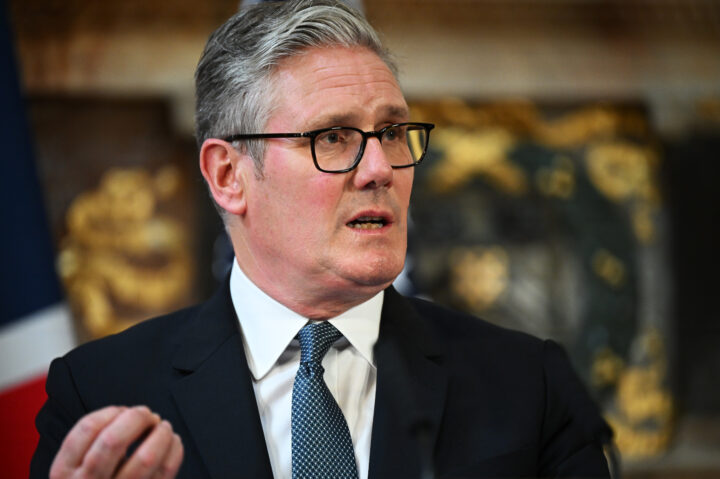
Leon Neal/Getty Images
UK Prime Minister Keir Starmer talks at a press conference at Chequers at the conclusion of a state visit by U.S. President Donald Trump, on September 18, 2025 in Aylesbury, England.
In a move that has sent ripples through diplomatic circles and sparked outrage in Jerusalem, multiple countries — including some of Israel’s key allies — officially recognized a Palestinian state yesterday. The coordinated announcements by the U.K., Canada, Australia and Portugal, with more to come, mark a significant shift in the West’s posture — one that, while largely symbolic, underlines concerns about growing efforts to isolate Israel diplomatically.
“Today, to revive the hope of peace for the Palestinians and Israelis, and a two-state solution, the United Kingdom formally recognises the State of Palestine,” said Prime Minister Keir Starmer.
“The man-made humanitarian crisis in Gaza reaches new depths. The Israeli government’s relentless and increasing bombardment of Gaza, the offensive of recent weeks, the starvation and devastation are utterly intolerable,” he said.
While Starmer said that the move toward a two-state solution “is not a reward for Hamas, because it means Hamas can have no future,” the terror group hailed it as “a gesture to the struggle, steadfastness and sacrifices of our people on the path to liberation and return.”
In President Donald Trump’s meeting with Starmer last week, Trump described the statehood push as “one of our few disagreements.”
The chain of Palestinian statehood recognition is unlikely to bring any immediate changes on the ground. As U.K. Deputy Prime Minister David Lammy said yesterday in an interview with Sky News, “any decision to recognize a Palestinian state … does not make a Palestinian state happen overnight. That has to be part of a peace process, it has to be based on 1967 borders, it has to be based on a shared capital in Jerusalem. That will be for final-status discussions. But it is to keep that process alive.”
Lammy stressed that the U.K. rejects any role for Hamas, “has been crystal clear that it is a terrorist organization” and is working on efforts to reform the Palestinian Authority.
Israel and many of its supporters have slammed the move as rewarding terrorism, as the country continues its war against Hamas in Gaza, where 48 hostages kidnapped during the group’s Oct. 7, 2023 attacks remain in captivity.
Israeli Prime Minister Benjamin Netanyahu said he has “a clear message to the leaders who recognize a Palestinian state after the terrible massacre of Oct. 7: You are giving a massive prize to terror. … It will not happen. There will not be a Palestinian state west of the Jordan River.” Netanyahu hinted that Israel will increase settlement activity in response. Far-right National Security Minister Itamar Ben-Gvir and several other coalition members went a step further by calling for annexation of the West Bank, which Saudi Arabia has reportedly said would have “major implications.” Read more on Netanyahu’s reaction and upcoming UNGA speech here.
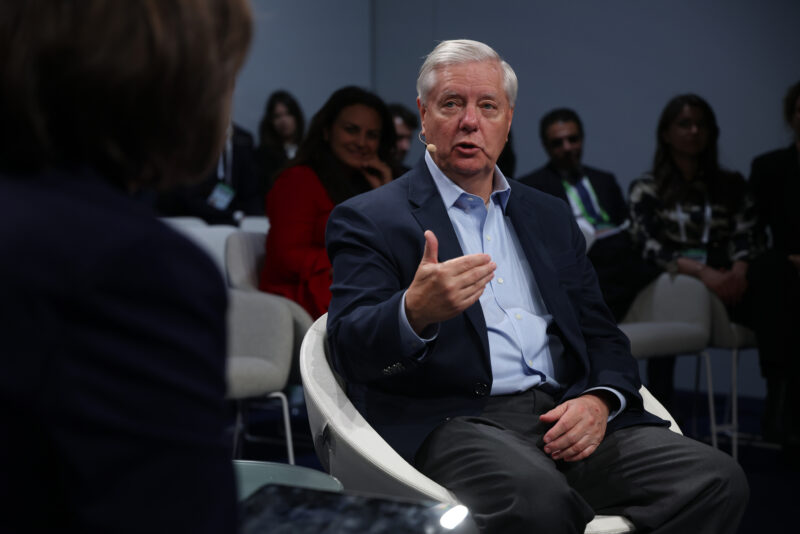
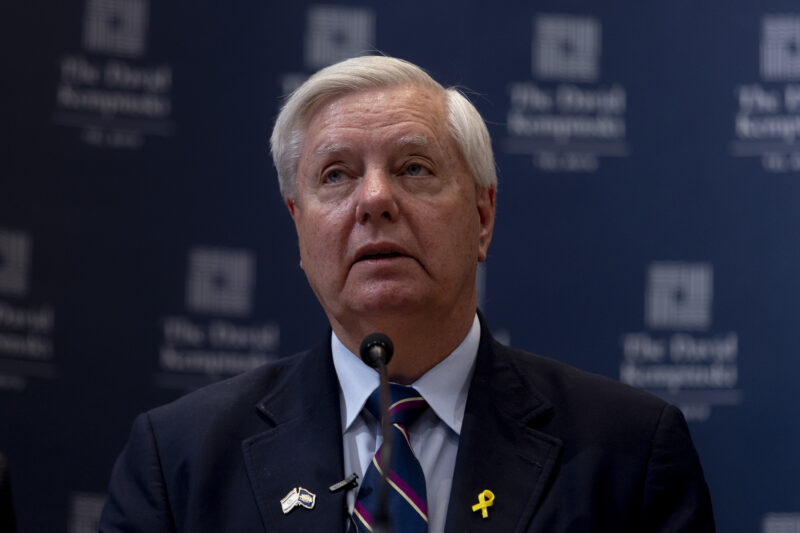
Sen. Lindsey Graham (R-SC) delivered a scathing assessment of the statehood development, writing on X: “80 years after the end of WWII, where over 6 million Jews were killed by the Nazis for simply being Jewish, the so-called civilized world is rewarding modern day religious Nazis with an arbitrary Palestinian state designation,” pointing to the lack of defined borders, leadership, and security arrangements.
The Hostages Families Forum also condemned the decision, saying in a statement: “As families who deeply want peace in the region, we believe that any discussion about recognizing a Palestinian state must be contingent upon the immediate release of all hostages … Any nation that fails to uphold this essential prerequisite acts against international law and effectively enables terrorism while legitimizing the October 7th massacre.”
Additional countries are expected to recognize a Palestinian state later today — on the eve of Rosh Hashanah — at the High-Level Conference on Palestine Statehood, led by France and Saudi Arabia.
And well into Rosh Hashanah tomorrow, when Israeli officials will be observing the Jewish high holiday, the U.N. Security Council will hold a critical meeting on the Gaza war.
In the face of these efforts to sideline Israel, Netanyahu is set to address the United Nations General Assembly on Friday, where he’s set to push back forcefully against the recognitions and reassert Israel’s red lines.
In Sunday’s Cabinet meeting, Netanyahu said that he will “present the truth. It is the truth of Israel, but it is also the objective truth of our just struggle against the forces of evil. I will also present our vision for true peace, peace that grows out from strength. … We have to fight both in the U.N. and in all the other fronts against the slanderous propaganda aimed at us, and against the calls to create a Palestinian state that will endanger our existence and constitute an absurd prize for terrorism.”
As the UNGA begins, several countries are recognizing a Palestinian state and the EU is considering suspending free trade with Israel
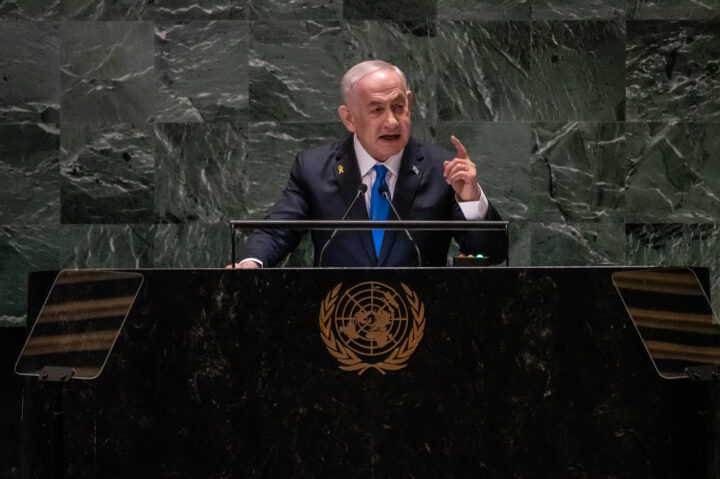
Stephanie Keith/Getty Images
Israeli Prime Minister Benjamin Netanyahu speaks during the United Nations General Assembly (UNGA) at the United Nations headquarters on September 27, 2024 in New York City.
Israeli Prime Minister Benjamin Netanyahu’s planned speech to the United Nations General Assembly on Friday is being overshadowed by European moves to isolate Israel, with the U.K., as well as Canada and Australia recognizing a Palestinian state on Sunday and more to come, as well as an upcoming EU vote on sanctions against Israel.
Netanyahu released a statement, in which he said he has “a clear message to the leaders who recognize a Palestinian state after the terrible massacre of Oct. 7: You are giving a massive prize to terror. … It will not happen. There will not be a Palestinian state west of the Jordan River.”
The prime minister hinted that Israel will increase settlement activity in response: “For years I prevented the establishment of this terror state facing great pressures, domestic and foreign … Not only that, we doubled the Jewish settlement in Judea and Samaria. The response to the latest attempt to force a terror state on us in the heart of our land will be given after my return from the U.S. Wait.”
U.K. Prime Minister Keir Starmer said on Sunday that his country is “acting to keep alive the possibility of peace and a two-state solution. That means a safe and secure Israel alongside a viable Palestinian state. At the moment, we have neither.”
He pushed back against the Israeli argument that recognition of a Palestinian state at this time acts as a reward for Hamas, arguing that “our call for a genuine two-state solution is the exact opposite of [Hamas’] hateful vision. … This solution is not a reward for Hamas, because it means Hamas can have no future.”
Hamas, however, praised the recognition as an “important move” and called for it to be accompanied by ending the “Judaization of the West Bank and Jerusalem, Israel’s isolation and Israel’s leaders brought before international court,” as well as the recognition of the Palestinians’ “natural right to resistance.”
The High-Level Conference on Palestine Statehood, led by France and Saudi Arabia, is set to take place Monday, on the eve of Rosh Hashanah. Nearly a dozen countries have said they would recognize a Palestinian state as part of that effort, following the announcements of the U.K., Canada and Australia on Sunday.
French President Emmanuel Macron argued in an interview with Israel’s Channel 12 News that “recognition of a Palestinian state is the best way to isolate Hamas … What they want is to destroy [Israel], but if we consider that the Palestinian state will always have the objective to destroy Israel, how [do] they want to build a sustainable future? There is no way.”
A recent poll commissioned by the French-Jewish umbrella organization CRIF found that 71% of French people reject the recognition of a Palestinian state before the hostages are freed and Hamas gives up power. In the U.K., a survey in The Telegraph showed 87% of Britons disagree with recognition of a Palestinian state without preconditions, including 89% of Labour voters. A YouGov poll, however, found that 44% of Britons supported the move, while 18% were opposed and 37% unsure.
U.S. Ambassador to France Charles Kushner noted that in conjunction with his announcement of Palestinian state recognition, Macron called for Palestinian recognition of Israel as a Jewish state, the demilitarization of Hamas and the establishment of strong governance for the Palestinians as preconditions for any recognition of Palestinian statehood. “These were France’s own conditions for recognition of a Palestinian state. How can France move forward with next week’s vote when none of these have been met?” Kushner said.
Netanyahu, who was Israel’s ambassador to the U.N. from 1984-1988, is known to relish his addresses to the U.N. General Assembly, embracing theatrical props, puns and long pauses on a platform where he hopes to capture the world’s attention for Israel’s benefit.
After his UNGA speeches, Netanyahu holds court, with other leaders visiting him in a conference room in Turtle Bay. This year, he is expected to meet with Argentinian President Javier Milei, the leaders of Paraguay and Serbia and New York Mayor Eric Adams, and there are reports that he will meet with Syrian President Ahmad al-Sharaa ahead of a possible security agreement between Damascus and Jerusalem. Then, Netanyahu is expected to fly to Washington to meet with President Donald Trump.
Meanwhile, Israel’s Foreign Ministry and Economy Ministry, which oversees foreign trade, have been pushing back against proposed European Union sanctions. The European Commission proposed the roll-back of relations between the bloc and Israel after it “found that actions taken by the Israeli government represent a breach of essential elements relating to respect for human rights” given “the rapidly deteriorating humanitarian situation in Gaza following the military intervention of Israel, the blockade of humanitarian aid, the intensifying of military operations and the decision of the Israeli authorities to advance the settlement plan in the so-called E1 area of the West Bank, which further undermines the two-state solution.”
The proposal, if accepted, would suspend free trade between Israel and the European Union, its largest trade partner.
A source in Brussels estimated that the move would cost Israel 227 million Euros ($266 million) in customs duties per year.
A date has not yet been set for voting on the suspension of free trade, which requires a qualified majority, also known as a “double majority,” meaning 55% of member states, and states representing 65% of the EU population, with at least four states opposed.
Hungary and the Czech Republic said they would oppose the proposal, following calls between their foreign ministers and Israeli Foreign Minister Gideon Sa’ar.
Sa’ar called the proposal “morally and politically distorted.”
“Moves against Israel will harm Europe’s own interests,” Sa’ar warned. “Israel will continue to struggle, with the help of its friends in Europe, against attempts to harm it while it is in the midst of an existential war. Steps against Israel will be answered accordingly, and we hope we will not be required to take them.”
Economy Minister Nir Barkat sent letters to Germany, Hungary, Czechia, Italy, Bulgaria, Greece, Lithuania, Cyprus, Croatia and Latvia asking them to oppose the measure to suspend free trade.
The European Commission also suspended 20 million Euros ($23.5 million) in projects with Israel, dealing with civil service training and regional-EU cooperation related to the Abraham Accords, through 2027. The commission was able to end the cooperation without a vote and noted in repeated statements that it was exempting “civil society and Yad Vashem.”
In addition, the European Commission proposed sanctions against Israeli Finance Minister Bezalel Smotrich and National Security Minister Itamar Ben-Gvir, as well as “violent settlers” and 10 members of the Hamas politburo, which would require a unanimous vote by EU member states. The ban on Israelis is unlikely to be approved, especially not the cabinet ministers.
In another sign of Israel’s increased isolation in Europe, several countries’ public broadcasters said they would boycott the 2026 Eurovision Song Contest if Israel were to take part, as it usually does.
Spain, the Netherlands, Slovenia, Iceland and Ireland have said they will not participate in the contest along with Israel, and Belgium threatened to follow suit.
Israeli public broadcaster Kan said that it will continue to be “a significant part in this cultural event, which cannot become political.”
“Israel is one of the most successful participants in the Eurovision contest — in the past seven years its songs and representatives have finished in 5th, 3rd, 2nd and 1st place,” Kan CEO Golan Yochpaz said.
Austrian Foreign Minister Beate Meinl-Reisinger, whose country is due to host the Eurovision next year, posted on X that the contest “is a symbol of peace, unity, and cultural exchange — not an instrument for sanctions.”
Plus, an interview with Israel's ambassador to Japan
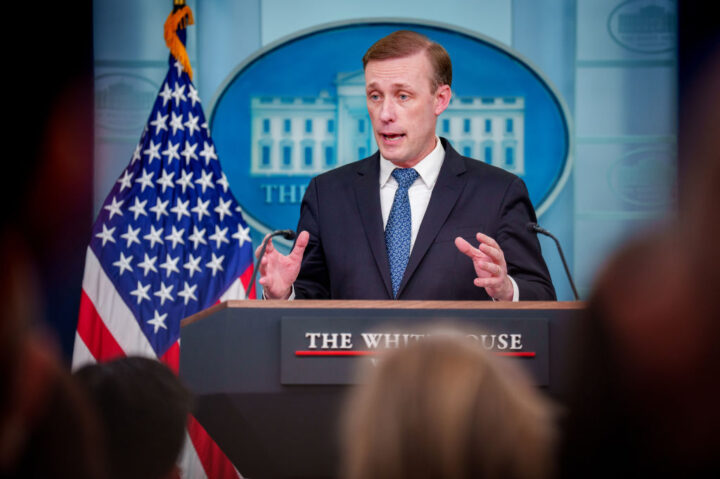
Andrew Harnik/Getty Images
National Security Advisor Jake Sullivan speaks during a news conference in the Brady Press Briefing Room at the White House on January 13, 2025 in Washington, DC.
Good Friday morning.
In today’s Daily Kickoff, we interview Israeli Ambassador to Japan Gilad Cohen about Tokyo’s approach to Palestinian statehood, and report on a resolution by seven Senate Democrats calling for the U.S. to unilaterally recognize a Palestinian state. We cover a meeting between Senate and House lawmakers with Syrian Foreign Minister Asaad al-Shaibani and report on House Foreign Affairs Committee votes rejecting conditions on aid to Israel. We cover Israeli Ambassador to the U.S. Yechiel Leiter’s remarks at the embassy’s Rosh Hashanah reception in Washington last night and report on the New York Democratic Party chair’s decision not to endorse Zohran Mamdani for mayor of New York City. Also in today’s Daily Kickoff: Jonathan Greenblatt, Rep. Elise Stefanik and Erika Kirk.
Today’s Daily Kickoff was curated by Jewish Insider Israel Editor Tamara Zieve and U.S. Editor Danielle Cohen-Kanik with an assist from Marc Rod. Have a tip? Email us here.
For less-distracted reading over the weekend, browse this week’s edition of The Weekly Print, a curated print-friendly PDF featuring a selection of recent Jewish Insider and eJewishPhilanthropy stories, including: New York Jewish leaders reckon with a potential Mamdani win; Palantir’s Alex Karp says Jews need to ‘leave their comfort zone’ to defend community; and Former Mossad chief Yossi Cohen talks covert missions, Oct. 7 failures in new book. Print the latest edition here.
What We’re Watching
- In New York today, an event on “Breaking the Chain: Global Action Against Hostage-Taking” will feature the first public remarks from former Israeli hostage Na’ama Levy. Also speaking are a Yazidi survivor of ISIS captivity; Danny Danon, Israel’s ambassador to the U.N.; Dorothy Shea, acting U.S. representative to the U.N.; and Ibrahim Olabi, Syria’s ambassador to the U.N.; among others.
- Chabad at Vanderbilt University will honor Vanderbilt Chancellor Daniel Diermeier with Chabad’s Lamplighter award tomorrow. Read JI’s interview with Diermeier and Washington University in St. Louis Chancellor Andrew Martin here.
- On Saturday, the Milken Center for Advancing the American Dream is opening with its flagship exhibition, the “American Dream Experience,” in Washington.
- On Sunday, Charlie Kirk’s memorial will be held at the State Farm Stadium in Glendale, Ariz., where speakers will include President Donald Trump, Vice President JD Vance, White House Chief of Staff Susie Wiles, Secretary of State Marco Rubio, Secretary of Defense Pete Hegseth, Director of National Intelligence Tulsi Gabbard and far-right podcast host Tucker Carlson, who has advanced conspiracy theories in the aftermath of Kirk’s murder claiming the conservative activist was being pressured by Israel.
What You Should Know
A QUICK WORD WITH JI’S GABBY DEUTCH
In Washington, whether a public official or their spokesperson is speaking honestly is usually not fully known until much later. Take Israel’s attack on Qatar last week: the Trump administration claimed not to have known about it ahead of time, but Israeli officials told Axios that Israeli Prime Minister Benjamin Netanyahu had given President Donald Trump a heads-up.
When a president leaves office, his former staffers tend to get rather loose-lipped — an opportunity for them to rehabilitate their reputation and, perhaps, tell the truth about their views (or at least the narrative they’d like to put forward on their own terms, not those of their boss).
The past few months have provided such an opportunity to the three architects of President Joe Biden’s Middle East policy team: Secretary of State Tony Blinken, National Security Advisor Jake Sullivan and Brett McGurk, Biden’s coordinator for the Middle East at the White House. All of them played a crucial role in shaping American policy toward Israel and Gaza after Oct. 7. Each has in recent months written op-eds and made lengthy appearances on podcasts and cable news to comment on developments in the Middle East.
Looking at where Blinken, Sullivan and McGurk have positioned themselves publicly, without the constraints of government service, is a sign of the options available to Democrats right now, at a moment when the party’s future is up for grabs — with an ascendant anti-Israel wing that is exerting stronger influence than ever, though it remains in the minority.
TOKYO TALK
Israeli ambassador to Japan: Tokyo undecided on Palestinian statehood recognition
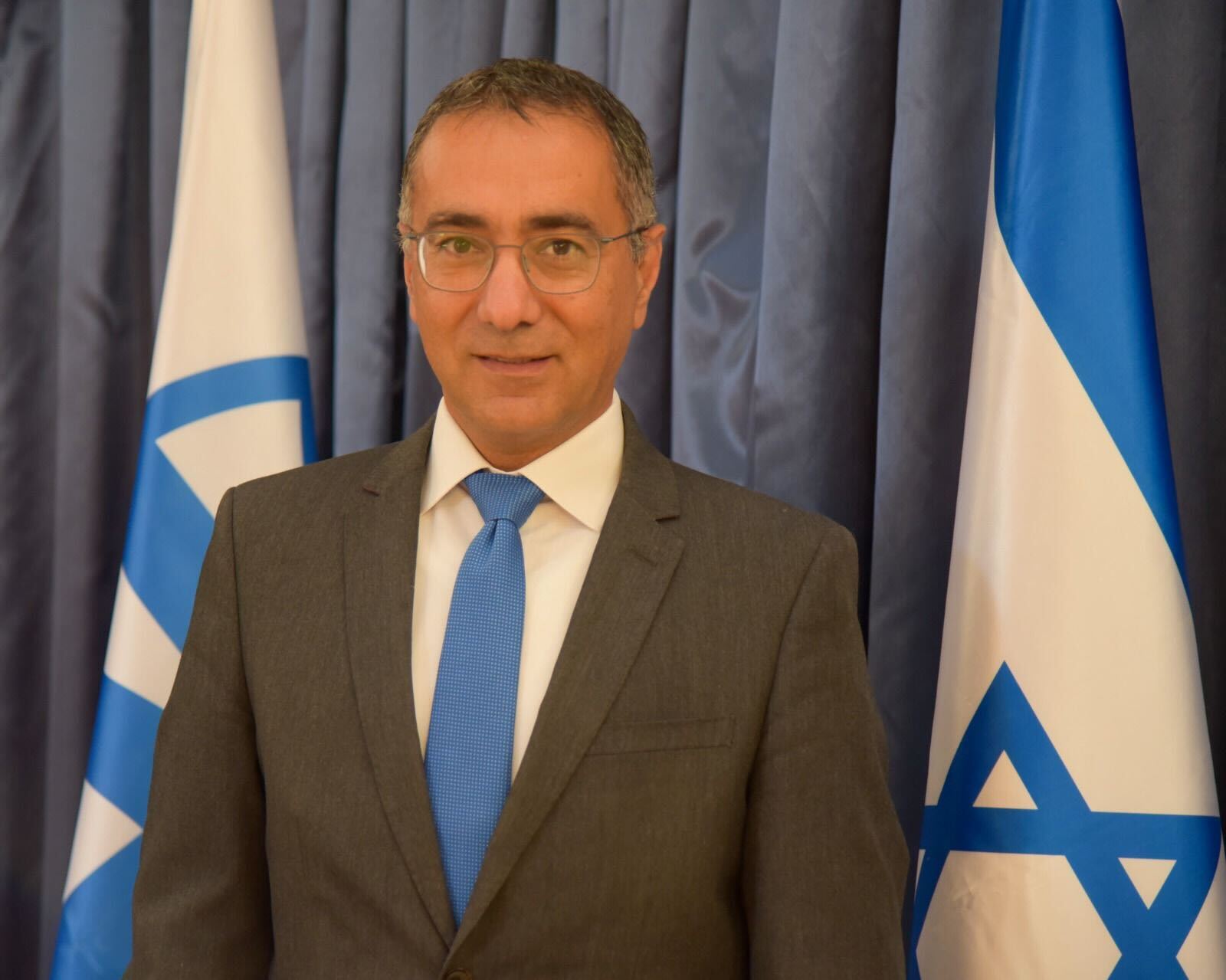
As reports swirl that Japan indicated it is no longer considering recognizing a Palestinian state at the United National General Assembly on Monday, Israeli Ambassador to Japan Gilad Cohen remains wary, but hopeful, he told Jewish Insider’s Haley Cohen in a wide-ranging interview on Friday in Tokyo. “Japan hasn’t decided yet. There is no official statement yet by Japan,” said Cohen, adding that he expects a decision will be finalized over the weekend.
Envoy’s efforts: “A recognition of a Palestinian state would be a reward to Hamas after the Oct. 7 terrorist attacks, would not contribute to peace and would not build on the trust of Israelis in the future,” he continued. In recent weeks, Cohen relayed that message to Japanese ministers as the country weighed recognizing a Palestinian state as several governments, including those in Britain, France, Australia and Canada, have announced plans to do at UNGA.
STATEHOOD PUSH
Seven Senate Dems call for recognition of a Palestinian state
A group of seven Senate Democrats introduced a resolution on Thursday calling for the U.S. to unilaterally recognize a Palestinian state, Jewish Insider’s Marc Rod reports. The resolution was led by Sen. Jeff Merkley (D-OR) and co-sponsored by Sens. Chris Van Hollen (D-MD), Tim Kaine (D-VA), Bernie Sanders (I-VT), Peter Welch (D-VT), Tina Smith (D-MN), Tammy Baldwin (D-WI) and Mazie Hirono (D-HI).
Merkley’s mission: Merkley and Van Hollen recently traveled to Israel and released a scathing report accusing Israel of deliberate ethnic cleansing and collective punishment. “Recognition of a Palestinian state is not only a practical step the United States can take to help build a future where Palestinians and Israelis can live in freedom, dignity, and security, but it is the right thing to do. America has a responsibility to lead, and the time to act is now,” Merkley said in a statement. “The goal of a Palestinian state can’t be put off any longer if we want the next generation to avoid suffering from the same insecurity and affliction.”
ON THE HILL
Lawmakers meet with Syrian foreign minister on Capitol Hill
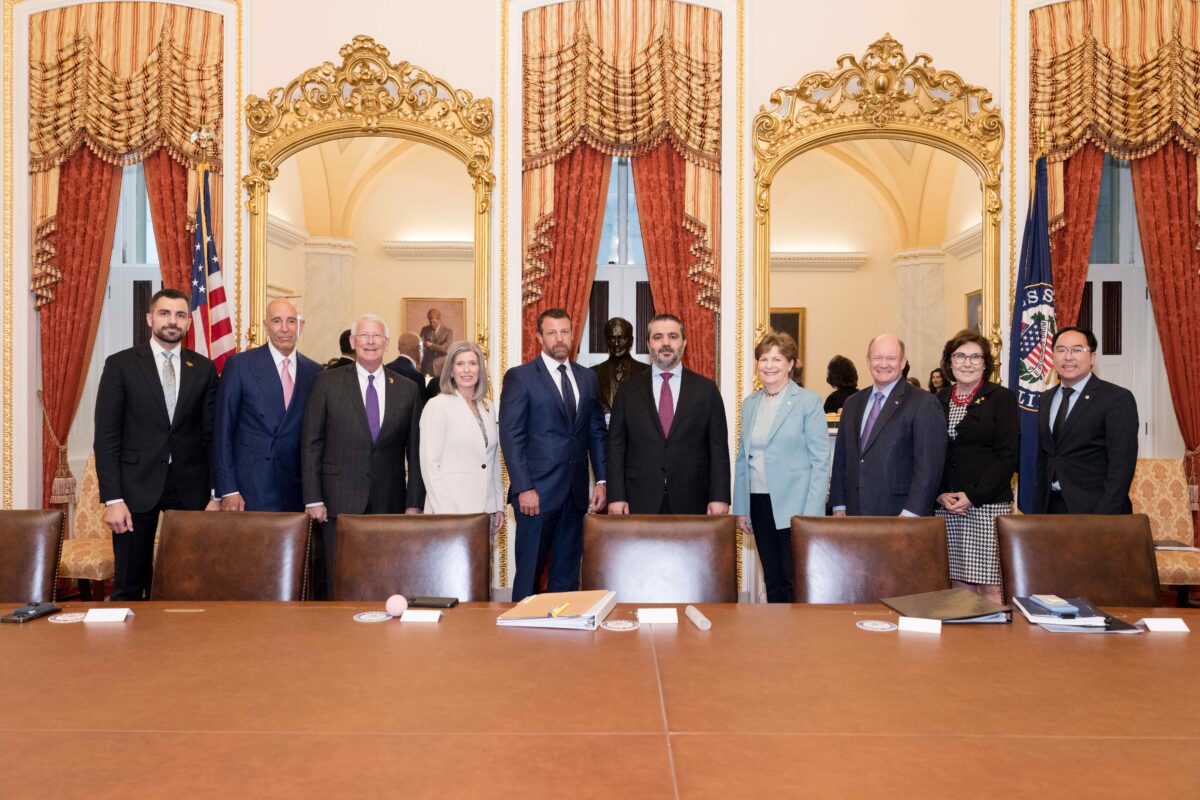
Senate and House lawmakers met Thursday with Syrian Foreign Minister Asaad al-Shaibani, in the first trip by a Syrian government official to Congress in decades. Sen. Richard Blumenthal (D-CT) said that their meeting was “very encouraging and constructive,” Jewish Insider’s Marc Rod reports.
Takeaways: “I think we are on a path to eliminate sanctions in a way that safeguards interests of other nations in the region, and at the same time, provides for reconstruction in Syria, in a way that negates the influence of Iran and Russia,” Blumenthal said. He said there was broad, but inconclusive, discussion about talks between the Syrian and Israeli governments. Sen. Andy Kim (D-NJ), who worked on Syria and Middle East issues at the State Department, called the trip “historic.” This was his first meeting with officials from the new Syrian government. “He very much expressed a deep interest in being able to work as partners with us to stand up against ISIS, to stop Iranian reach and meddling throughout the Middle East, to push back on Russian interference,” Kim said.
In the room: Along with Kim and Blumenthal, Sens. Jim Risch (R-ID), Jeanne Shaheen (D-NH), Roger Wicker (R-MS), Chris Coons (D-DE), Joni Ernst (R-IA), Jacky Rosen (D-NV), Markwayne Mullin (R-OK) and Lindsey Graham (R-SC) and Reps. Joe Wilson (R-SC) and Abe Hamadeh (R-AZ) met with al-Shaibani.
Reporter’s notebook: Times of Israel Editor in-Chief David Horovitz spent 48 hours in Damascus, accompanying a U.S. Jewish group to holy sites and meetings with Syrian government officials.
VOTED DOWN
House Foreign Affairs Committee overwhelmingly rejects conditions on aid to Israel
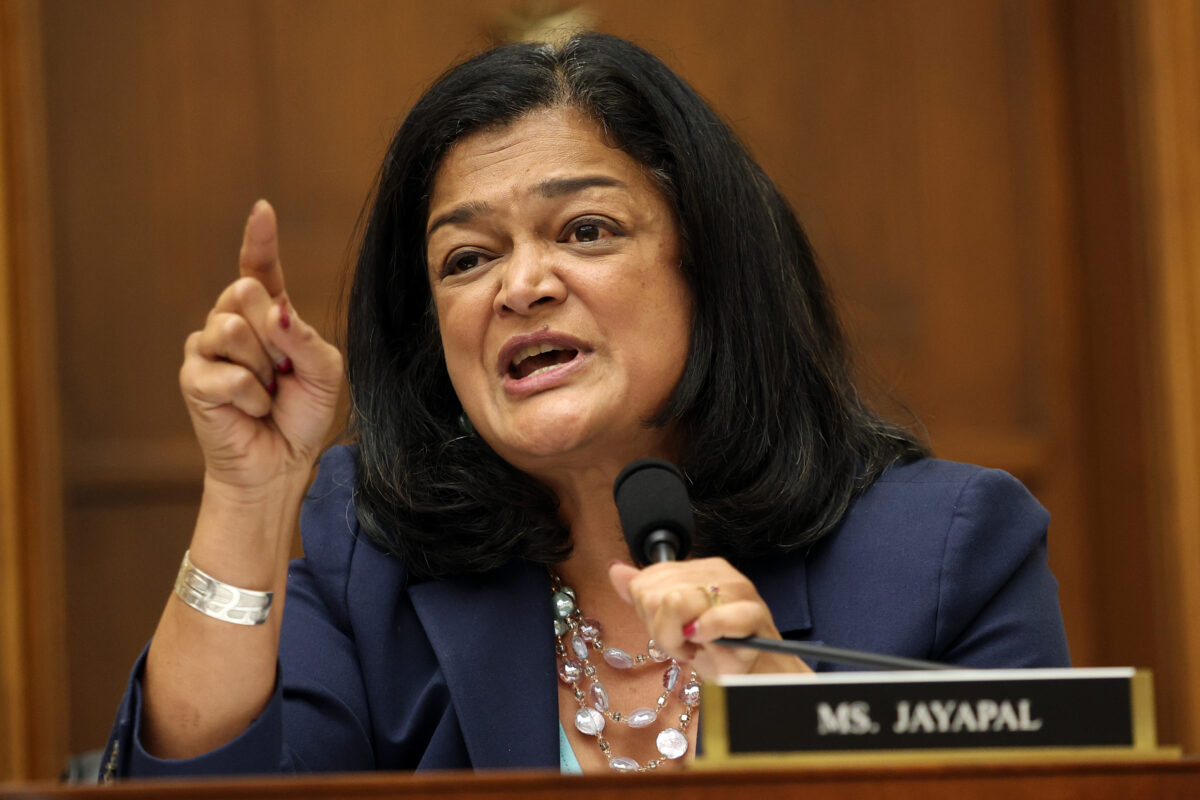
The House Foreign Affairs Committee, during a marathon markup of legislation to reform and reorganize the State Department, resoundingly rejected amendments seeking to condition U.S. aid to Israel on a bipartisan basis, Jewish Insider’s Marc Rod reports. The committee also engaged in vigorous debate over the U.S. relationship with Turkey and the future of the United Nations Relief and Works Agency.
Key votes: By two votes of 45-5, the committee rejected a pair of amendments by Rep. Pramila Jayapal (D-WA) that would have added new conditions to $1 billion of the $3.3 billion in direct military funding the U.S. provides to Israel each year. Jayapal and Reps. Joaquin Castro (D-TX), Sara Jacobs (D-CA), Jonathan Jackson (D-IL) and Madeleine Dean (D-PA) voted in favor of the amendments.
Coming soon: The world’s first laser-based missile defense system, known as “Iron Beam,” will be delivered to the IDF by the end of 2025, the Israeli Defense Ministry and arms manufacturer Rafael announced on Wednesday, Jewish Insider’s Lahav Harkov reports.
JUSTICE FOR ALL
ADL files suit on behalf of U.S. victims of Oct. 7 against Iran, Syria, North Korea
The Anti-Defamation League filed a new federal lawsuit on Thursday on behalf of more than 140 U.S. victims of the Oct. 7 attacks alleging that several different terrorist groups carried out the attacks with material support from U.S.-designated state sponsors of terror: Iran, Syria and North Korea. The suit, filed in U.S. District Court in Washington, comes a year after a similar federal suit by the ADL targeting Iran, Syria and North Korea, but it relies on an additional statute to seek compensation for the American victims of the attacks, which left 1,200 people dead. The suit also includes more plaintiffs than the original case, Jewish Insider’s Gabby Deutch reports.
Seeking justice: The new case names the terror groups — Hamas, Palestinian Islamic Jihad, the Popular Front for the Liberation of Palestine, the Democratic Front for the Liberation of Palestine, the Al-Aqsa Martyrs Brigade, the Palestinian Mujahideen Movement, Hezbollah and the Popular Resistance Committees — and invokes two American laws that provide civil remedies to victims of international terrorism. “The victims of the October 7 massacre deserve justice, accountability and redress,” ADL CEO Jonathan Greenblatt said in a statement. “This lawsuit seeks to do that by holding those responsible for the carnage accountable, from the state sponsors who provided the funding, weapons and training to the terrorist organizations who carried out these unspeakable atrocities.”
Exclusive: ADL and the Community Security Initiative of New York are partnering to launch a national threat monitoring and assessment network, following a year marked by two deadly attacks on North American Jewry, eJewishPhilanthropy’s Nira Dayanim reports.
BREAKING RANK
New York Democratic Party chair says he won’t endorse Mamdani

Jay Jacobs, the chairman of the New York Democratic Party, said on Thursday he will not endorse Zohran Mamdani for mayor of New York City, notably breaking with Gov. Kathy Hochul, who recently announced her support for the Democratic nominee. In a statement, Jacobs said he had a “positive conversation” with Mamdani, the 33-year-old democratic socialist and Queens assemblyman, soon after the primary, and dismissed what he called “the fear-mongering around him and his candidacy” as “wrong and a gross over-reaction,” Jewish Insider’s Matthew Kassel reports.
But: While Jacobs said he shared Mamdani’s belief that “America’s greatest problem is the continued growth in income disparity in our nation,” the state party chair noted they “fundamentally disagree” on “how to address it.” Jacobs, who is Jewish, also cited Mamdani’s staunch opposition to Israel, an issue on which the nominee has recently indicated he has no intention of budging, as a major source of contention. “Furthermore, as I expressed to him directly, I strongly disagree with his views on the State of Israel, along with certain key policy positions,” Jacobs said of Mamdani, who has vowed, if elected, to arrest Israeli Prime Minister Benjamin Netanyahu and said he would move to terminate a city program to foster partnerships between companies in Israel and New York City, among other positions that have raised concerns among Jewish leaders.
AAA push: Citing Mamdani’s stated plans to revoke the city’s use of the International Holocaust Remembrance Alliance’s working definition of antisemitism, Reps. Mike Lawler (R-NY) and Josh Gottheimer (D-NJ) called on Thursday for the House to pass the long-stalled Antisemitism Awareness Act, Jewish Insider’s Marc Rod reports.
Worthy Reads
Green Light for Annexation?: Philip Gordon, former national security advisor to Vice President Kamala Harris, argues in The New York Times that the international community must pressure Israel to stop any expansion in the West Bank due to the Trump administration’s permissiveness. “The Trump administration has not officially given its blessing to Israeli annexation of the West Bank. But it appears to be doing nothing to stand in Israel’s way. … Given America’s apparent acquiescence, only international action can prevent a coming disaster. It was encouraging that the United Arab Emirates said earlier this month that Israeli annexation in the West Bank would be a “red line,” jeopardizing Israel’s prized relationship with Abu Dhabi. A conference sponsored by France and Saudi Arabia at the U. N. General Assembly next week on the Palestinian issue will be another chance for the international community to put down a marker that most of the world objects to this Israeli government’s agenda. The government of Mr. Netanyahu should know that it can have flourishing relations with the rest of the world, or total control of the West Bank — but not both.” [NYT]
Ellison’s Empire: Former Wall Street banker and founding partner of the Puck media company William Cohan suggests in The New York Times that Oracle co-founder Larry Ellison’s rising profile as a “media magnate,” along with his friendship with President Donald Trump, threatens to reshape American journalism into a more partisan landscape. “Along with his son, David, [Ellison] could soon end up controlling a powerful social media platform, an iconic Hollywood movie studio and one of the largest content streaming services, as well as two of the country’s largest news organizations. Given Mr. Ellison’s friendship with, and affinity for, Donald Trump, an increasingly emboldened president could be getting an extraordinarily powerful media ally — in other words, the very last thing our country needs right now. … No matter their motives, two independent journalistic voices, CBS News and CNN, could soon be combined into something potentially almost unrecognizable, something way too close to what is served up on a daily basis by the Murdochs. And that will put yet another chink in the fragile armor that is America’s democracy.” [NYT]
Word on the Street
President Donald Trump said at a press conference with British Prime Minister Keir Starmer yesterday that the recognition of a Palestinian state, which the U.K. plans to do this weekend, is “one of [the] few disagreements” between the two leaders. “We want [the war] to end. We have to have the hostages back immediately. That’s what the people of Israel want, they want them back. And we want the fighting to stop,” the president continued…
Trump and Chinese President Xi Jinping are set to talk today, their second conversation in Trump’s second term, about trade and the framework deal to save TikTok in the U.S…
Syrian President Ahmad al-Sharaa told reporters on Wednesday that Syria and Israel could reach a security agreement “within days”…
Saudi Arabia signed a defense pact with Pakistan on Wednesday, as its leaders are reportedly angry with Washington over Israel’s recent strike against Hamas leaders in Qatar and are seeking alternative defense relationships…
Sens. Ted Cruz (R-TX), Tom Cotton (R-AR), Joni Ernst (R-IA), John Barrasso (R-WY), Rick Scott (R-FL), Lindsey Graham (R-SC), Bill Hagerty (R-TN) and Ashley Moody (R-FL) reintroduced the SEVER Act, which would bar sanctioned Iranian officials from entering the U.S. to visit the United Nations…
French President Emmanuel Macron told Israel’s Channel 12 that, despite European attempts to negotiate with Iran over its nuclear program, U.N. Security Council snapback sanctions will be implemented at the end of the month, likely on Sept. 27…
Israel’s i24 News reports it has obtained recent audio of Macron speaking to former French parliament member Meyer Habib where Macron is heard saying, “I will not recognize a Palestinian state without the release of the hostages,” contrary to his reported plan to do so next week…
Two Israeli soldiers were killed yesterday at the Allenby Crossing between Jordan and the West Bank by an assailant driving a truck of humanitarian aid destined for the Gaza Strip…
Rep. Elise Stefanik (R-NY) sent a letter to Attorney General Pam Bondi requesting that she investigate the organization Doctors Without Borders for terrorism, saying it had proliferated “propaganda continuously pushed by Hamas”…
Former Vice President Kamala Harris reflects on her decision-making in choosing a vice president to run on her presidential ticket in the 2024 campaign in her forthcoming book, 107 Days; she was concerned that Pennsylvania Gov. Josh Shapiro seemed to be more interested in being VP than in helping her win, according to Politico’s review of the memoir….
After several headlines positioned former New York Gov. Andrew Cuomo as shifting away from his previously full-throated support of Israel, Cuomo told the Forward on Wednesday that his position “hasn’t shifted one iota. I said we want three things: We want killing to stop, because it’s a matter of humanity. We want the hostages returned, and Hamas eliminated. If you don’t eliminate Hamas, you accomplish nothing. This will happen again and again”…
After her endorsement of New York City Democratic mayoral nominee Zohran Mamdani, New York Gov. Kathy Hochul has “pledged to anxious private sector leaders that she will use her power to act as a check on Mamdani’s agenda,” Politico reports…
A man in Texas was arrested for making death threats towards Mamdani over the phone and in writing, including saying in a message, “I’d love to see an IDF bullet go through your skull”…
Trump told reporters he is working to regain control of the Bagram Air Base in Afghanistan, which is now under Taliban control since the U.S. withdrawal in 2021…
The Board of Deputies of British Jews, the Executive Council of Australian Jewry and the Centre for Israel and Jewish Affairs in Canada released a joint statement urging their respective governments to reconsider their plans to recognize a Palestinian state next week…
Former President Barack Obama said that the firing of Karen Attiah — the anti-Israel Washington Post columnist who justified the Oct. 7 attacks and was let go from the Post earlier this week over social media posts on Charlie Kirk’s killing — is “precisely the kind of government coercion that the First Amendment was designed to prevent”…
The board of directors of Turning Point USA, the organization Kirk founded, unanimously named Erika Kirk, his widow, as its new CEO and board chair…
Pic of the Day
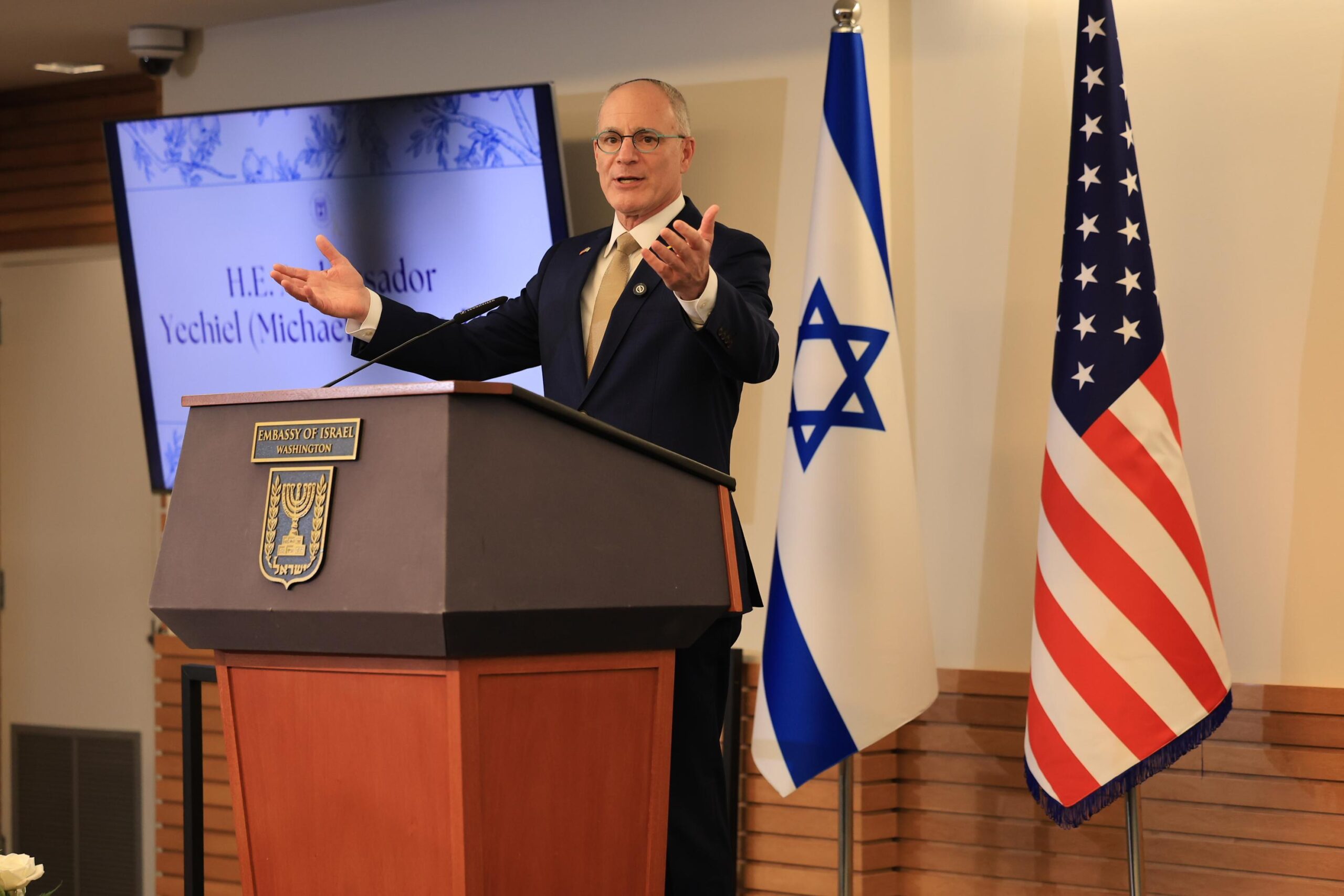
Speaking at a Rosh Hashanah reception at the Israeli Embassy in Washington yesterday, Yechiel Leiter, Israel’s ambassador to the U.S., compared congressional efforts to block U.S. weapons transfers to Israel to the antisemitic “blood libel” and he took aim at Sen. Bernie Sanders (I-VT) for leading the charge, Jewish Insider’s Gabby Deutch reports.
Birthdays
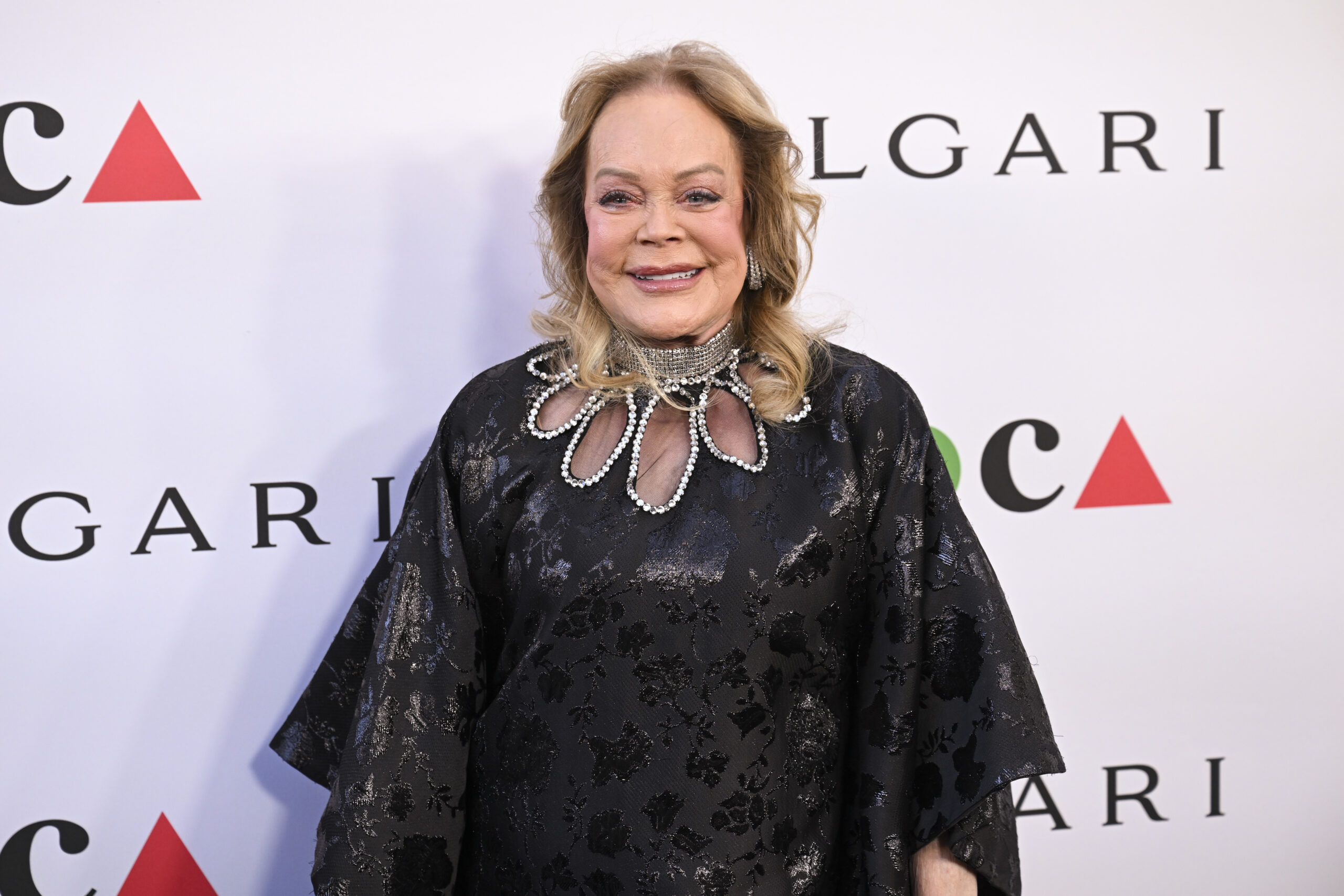
Author, theater producer, television personality and philanthropist, Candy Spelling turns 80 on Saturday…
FRIDAY: Professor of Jewish history and literature at Yeshiva University, he is the only son of Rabbi Joseph B. Soloveitchik, Haym Soloveitchik turns 88… Member of the New Hampshire House of Representatives until 2022, he has served as synagogue president, Jeffrey Colman Salloway turns 84… Professor at Yeshiva University’s Cardozo School of Law and director of the Innocence Project, Barry Scheck turns 76… Distinguished senior fellow at the Gatestone Institute, after a 28-year Pentagon career as a Middle East expert, Harold Rhode turns 76… Freelance reporter, he was a writing instructor at Montana State University Billings, Bruce Alpert… Archaeologist and professor of early Judaism at the University of North Carolina at Chapel Hill, Jodi Magness turns 69… Stockton, Calif.-based physician at The Pacific Sleep Disorders Center, Ronald Kass M.D…. Producer of over 40 films in his career and executive producer of the television series Monk, David Elliot Hoberman turns 73… Rabbi emeritus of Sinai Temple in Los Angeles, he is the inaugural rabbinic fellow at the ADL, David J. Wolpe turns 67… Boston-based attorney focused upon Section 529 college savings plans, Mark A. Chapleau… Chairman and CEO of NYC’s Metropolitan Transportation Authority, John Nathan “Janno” Lieber turns 64… Bow tie-clad field reporter for Fox Major League Baseball since 2005, he is also a senior baseball writer for The Athletic, Ken Rosenthal turns 63… Inspector general of the Federal Reserve Board and the CFPB, Michael Evan Horowitz turns 63… U.S. senator (R-SC), he chairs the Senate Banking Committee, Tim Scott turns 60… CEO of the Jewish Community Relations Council of Greater Washington, Ron Halber… Author of eight popular business books, former small business columnist for The Wall Street Journal, Mike Michalowicz… Founder and managing director at Two Lanterns Venture Partners, he is also the founder of MassChallenge, John Harthorne… Pole vaulter, she competed for the U.S. in the 2004 Olympics and for Israel in the 2012 Olympics, now an associate brand manager at Kraft Heinz, Jillian Schwartz Dickinson turns 46… CEO of Enduring Cause Strategies, Neal Urwitz… Former MLB player for nine seasons, he was on Team Israel for the 2020 Summer Olympics and the 2023 World Baseball Classic, Danny Valencia turns 41… Public affairs director at Elliott Investment Management, Joe Kristol… Singer-songwriter and producer, he frequently wears a Magen David pendant when performing, Charlie Burg turns 29… Former NFL placekicker, his college teammates nicknamed him the “Kosher Cannon,” Sam Sloman turns 28…
SATURDAY: Wealth management advisor, he won four Super Bowls with the Steelers during his eight-year career as a tight end, C. Randy Grossman turns 73… Dean of the Yeshiva of Greater Washington, Rabbi Ahron Lopiansky turns 72… Senior chairman of Goldman Sachs since 2019, prior to which he served as CEO there for 13 years, Lloyd Blankfein turns 71… Co-founder and board chair of Broadcom and owner of the NHL’s Anaheim Ducks, Henry Samueli turns 71… Justice of the Supreme Court of Israel since 2017, Yosef Elron turns 70… Insurance agent in Tulsa, Okla., Lawrence M. Schreier… Real estate developer, sports agent and boxing promoter, Marc Roberts turns 66… Former rabbi of Congregation Beit Torat Chaim of Jakarta, Indonesia, Rabbi Tovia Singer turns 65… Emergency medicine physician in Austin, Texas, he was the goalkeeper for the U.S. field hockey team at the 1984 Summer Olympics, Randolph B. “Randy” Lipscher turns 65… Civil rights attorney, author and legal analyst on “The Today Show,” “NBC Nightly News” and MSNBC, Lisa Bloom turns 64… SVP of marketing and communications at BBYO, Deborah Gavin Shemony… Former member of the Knesset for the Likud party, Keren Barak turns 53… Founder of PFAP Consulting and COO of PizzaIDF, Melissa Jane Kronfeld… Senior advisor to the under secretary of defense for research and engineering, James Mazol… Deputy news team lead at Bloomberg Law, Drew Singer… Principal at Blue Laurel Advisors, Emily Grunewald… Climate activist in Oakland, Calif., Carter Lavin… Senior director of strategic initiatives at Sony Music Entertainment, Alison Bogdonoff… VP of marketing at Cumulus Coffee, Zoe Plotsky Rosen… Isabel Eliana Tsesarsky… Actor, best known for his leading role as young aspiring filmmaker Sammy Fabelman in Steven Spielberg’s semi-autobiographical film “The Fabelmans,” Gabriel LaBelle turns 23… Theater, film and television actor, Jason Ian Drucker turns 20… Lauren Ackerman…
SUNDAY: One of the highest-grossing Hollywood box office producers of all time, plus the producer of many commercially successful TV shows, Jerry Bruckheimer turns 82… Chairman of the board of JDC, The American Jewish Joint Distribution Committee, Mark B. Sisisky turns 75… Immediate past chair of the Board of the Jewish Community Relations Council of New York, Cheryl Fishbein… Professor at Harvard Law School, following a three-year stint in the Obama White House, Cass Sunstein turns 71… and his wife, with whom he shares a birthday, administrator of the U.S. Agency for International Development during the Biden administration, Samantha Power turns 55… Immediate past president of the Women’s League for Conservative Judaism, Debbi Kaner Goldich… Owner of Total Wine & More, the largest alcohol retailer in the U.S., he was a member of the U.S. House of Representatives (D-MD) until January, David Trone turns 70… Member of the Knesset for the Likud party since 1998, he serves as Israel’s defense minister, Israel Katz turns 70… Professor of political science at Tel Aviv University and professor emeritus at Georgetown, Yossi Shain turns 69… One-half the renowned filmmaking team of the Coen Brothers, Ethan Jesse Coen turns 68… Attorney, author of 10 books and Fox News host of “Life, Liberty & Levin,” Mark R. Levin turns 68… Retired managing director of equity trading at Goldman Sachs, Andrew Berman… Co-founder of the private investment firm Centerbridge Partners, he is a former board chair of Johns Hopkins University, Jeffrey Aronson turns 67… Russian businessman who fell out of favor with President Vladimir Putin, now living in Israel, Leonid Nevzlin turns 66… Co-founder of Wisdom Without Walls, she is the author of a series of courses for the Melton School of Adult Jewish Learning, Sandra Lilienthal… Director of the Board of Jewish Education of Metropolitan Chicago, Alissa C. Zuchman, Ph.D…. Janet Bunting… Senior partner at polling firm Greenberg Quinlan Rosner Research, Anna Greenberg, Ph.D…. Emmy Award-winning talk show host, actress and producer, Ricki Lake turns 57… Guitarist and music producer in Israel, Nachman Fahrner turns 53… Managing editor of the New York Jewish Week, Lisa Keys… Member of the Maryland House of Delegates, Marc Alan Korman turns 44… Associate professor of radiology at Duke, he is an Olympic gold medalist in swimming, Dr. Benjamin M. Wildman-Tobriner turns 41… Former program director for strategic engagement at B’nai B’rith International, now a senior manager at Meridian International Center, Sienna Girgenti… COO of TAMID Group, Nathan Gilson… Lecturer in expository writing at UMass Boston, Mia Appelbaum… Member of the Michigan House of Representatives since 2023, Noah Jeremy Arbit turns 30… Global director of communications at Gallagher Bassett, Scott Frankel…
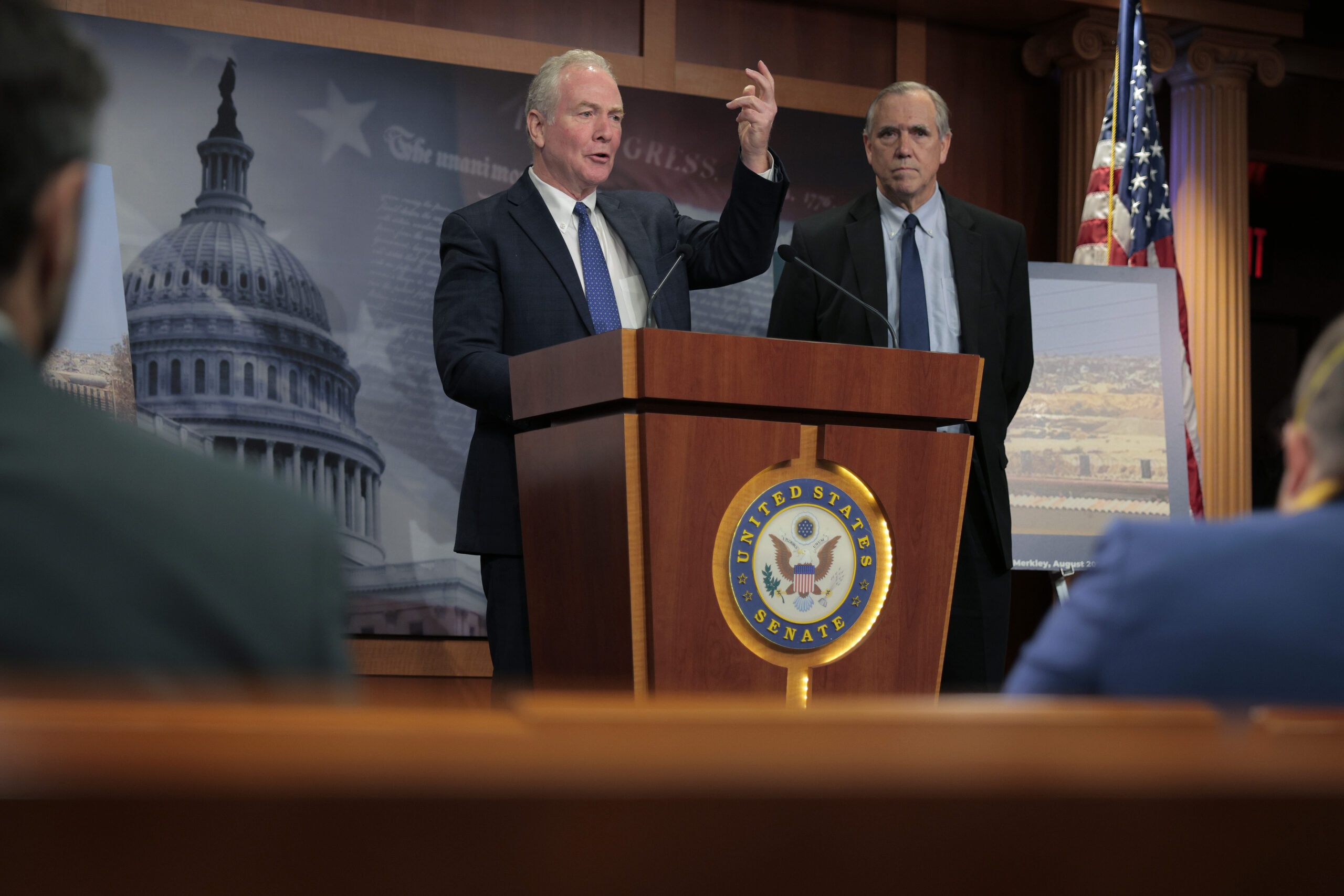
The resolution was led by Sen. Jeff Merkley and comes in conjunction with plans by several U.S. allies to recognize a Palestinian state and alongside a similar push from progressive House lawmakers
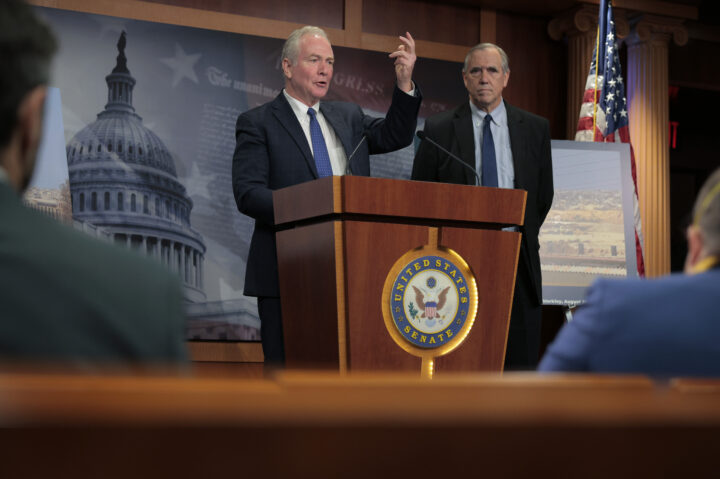
(Photo by Chip Somodevilla/Getty Images)
Sen. Chris Van Hollen (D-MD) and Sen. Jeff Merkley (D-OR) talk to reporters about their seven-day trip to the Middle East during a news conference at the U.S. Capitol on September 11, 2025 in Washington, DC.
A group of seven Senate Democrats introduced a resolution on Thursday calling for the U.S. to unilaterally recognize a Palestinian state.
The resolution was led by Sen. Jeff Merkley (D-OR) and co-sponsored by Sens. Chris Van Hollen (D-MD), Tim Kaine (D-VA), Bernie Sanders (I-VT), Peter Welch (D-VT), Tina Smith (D-MN), Tammy Baldwin (D-WI) and Mazie Hirono (D-HI).
The resolution came in conjunction with plans by several U.S. allies to recognize a Palestinian state and alongside a similar push from progressive House lawmakers. Merkley and Van Hollen recently traveled to Israel and released a scathing report accusing Israel of deliberate ethnic cleansing and collective punishment.
“Recognition of a Palestinian state is not only a practical step the United States can take to help build a future where Palestinians and Israelis can live in freedom, dignity, and security, but it is the right thing to do. America has a responsibility to lead, and the time to act is now,” Merkley said in a statement. “The goal of a Palestinian state can’t be put off any longer if we want the next generation to avoid suffering from the same insecurity and affliction.”
The resolution’s sponsors claimed that it constitutes a reaffirmation of long-standing U.S. support for a two-state solution.
The legislation highlights that “administrations of both political parties in the United States have long affirmed that a negotiated two-state solution is the only viable path to an enduring peace in the region” — but does not acknowledge that policymakers have traditionally seen unilateral recognition as contrary to that principle of a solution negotiated between the Israelis and Palestinians.
Kaine said that the Israeli government’s rejection of a two-state solution should cause the U.S. to change its own policies.
“Since July 2024 when the Israeli Knesset voted to deny a path to Palestinian statehood and made clear that Israel would not accept Palestinian autonomy, I have believed the U.S. should no longer condition recognition on Israeli assent but rather on Palestinian willingness to live in peace with its neighbors,” Kaine said. “We must redouble our efforts to work toward a future where Israelis and Palestinians alike can live in peace, security, and dignity.”
Welch said in a statement that “recognizing a two-state solution is long overdue and the only way forward — something Republican and Democratic Administrations have agreed on for decade. … This resolution signals Congress’ continued commitment for an enduring two-state solution for peace for the people of Israel and Palestine.”
Though the U.S. has supported a two-state solution, no previous administration has backed unilateral recognition of a Palestinian state.
Van Hollen said in a statement that Congress should assert its own stance on the issue because “the Netanyahu government has obstructed that goal [of a two-state solution] and the Trump Administration has abandoned it.”
The resolution condemns the Hamas attacks on Oct. 7 and the group’s rejection of Israel’s right to exist and calls for Palestinian elections, as well as noting that some Arab states have conditioned normalization with Israel on a path to a Palestinian state.
“Failure to advance a two-state solution risks entrenching an unacceptable permanent occupation, further destabilizing the region, and undermining United States interests and values,” the legislation states.
It calls on Hamas to surrender and release the hostages and on Israel to end the war in Gaza.
J Street supported the resolution.
In an interview with JI, Ambassador Gilad Cohen discusses his push to persuade Japan not to recognize a Palestinian state at the UNGA
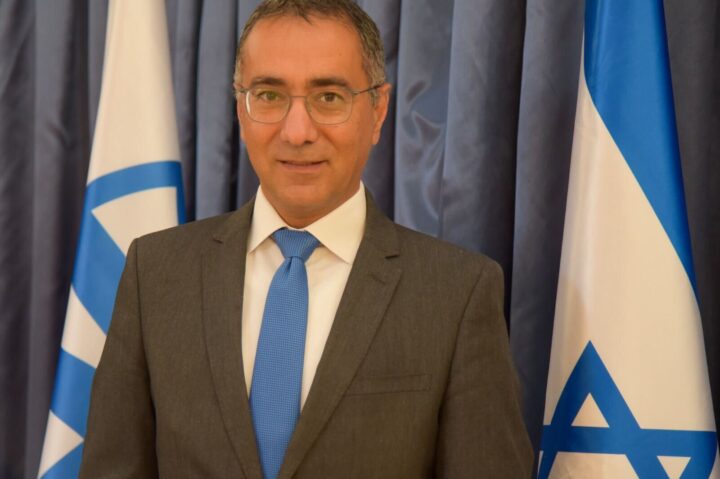
Courtesy Gilad Cohen
Israeli Ambassador to Japan Gilad Cohen
TOKYO — As Japan decided against recognizing a Palestinian state at the United Nations General Assembly on Friday, Israeli Ambassador to Japan Gilad Cohen told Jewish Insider in a wide-ranging interview in Tokyo that he is appreciative of Japan, “an important factor of the international community.”
On Friday evening, Japanese Foreign Minister Takeshi Iwaya called his Israeli counterpart, Gideon Sa’ar, to update him that after weeks of deliberation, Japan decided it will not recognize a Palestinian state at the UNGA.
“Sa’ar appreciated [the] decision and briefed [Iwaya] about Israel’s actions against Hamas chiefs in Qatar and IDF operations in Gaza,” Cohen told JI. “I join my foreign minister in appreciating Japan, a member of the G7, and an important factor of the international community, and for the deep friendship of our nations.”
“A recognition of a Palestinian state would be a reward to Hamas after the Oct. 7 terrorist attacks, would not contribute to peace and would not build on the trust of Israelis in the future,” he said. In recent weeks, Cohen relayed that message to Japanese ministers as the country weighed recognizing a Palestinian state as several governments, including those in Britain, France, Australia and Canada, have announced plans to do at the UNGA.
“This recognition is null and void because when you acknowledge a state there have to be conditions — what are the boundaries? Do you have effective control of the population? Nothing about that works with the Palestinians,” Cohen told JI. “Are they going to dismantle Hamas? Are they going to continue paying salaries for families of suicide bombers? Are they going to continue to have pacts with Iran against Israel? Is there going to be a repetition of Oct. 7 because they have a state? We are the Jewish people, we always have to be concerned and worried.”
For Cohen, who assumed office as ambassador of Israel to Japan in October 2021 following a stint as deputy director general for Asia and Pacific division in the Israel Ministry of Foreign Affairs, Japan’s consideration of recognizing a Palestinian state has been one of only a few disagreements he’s held with local politicians since arriving in Tokyo. In the immediate aftermath of the Oct. 7 attacks, “the Japanese government stood by Israel, called for an immediate and unconditional release of our hostages and said publicly that Hamas should be dismantled,” Cohen said.
“I thank the Japanese for acknowledging that Hamas is a terrorist organization and for saying that Iran is the number one destabilizer of the region. I want to thank the Japanese government for standing on the right side of history.”
When war broke out between Israel and Hamas soon after the Oct. 7, 2023, Hamas attacks on Israel, Japan, as a member of the U.N. Security Council, “was trying to influence the release of the hostages and not to [attack] Israel. They were not mediating, but there were messages Japan was trying to deliver for both sides in order to bring our hostages back,” Cohen recalled.
Looking ahead to the postwar period, Cohen suggested that Japan will contribute to rebuilding the Palestinian economy. “We will welcome any kind of investment in the Palestinian economy to revive it,” he said. “Economy is a major part of the vision of Palestinians living side by side with Israelis in peace and security.”
While tourism from Japan to Israel has seen a decline amid the war, Cohen said that joint business ventures between the two countries have increased over the past two years, as Israeli tech companies engage with Japan’s industrial giants and venture capital networks.
“Investments from Japanese companies in Israel were much higher in 2024 than 2023, including in AI and technology,” he said. “There is a saying that Israel can do things from zero to one and Japanese can take them from one to 10. Israeli innovation and startups can be combined with Japanese wisdom, experience and production ability that Israel doesn’t have.”
When it comes to creating cars, for example, an area that Japan is a global leader in, “Israel should focus on the brain of the car, systems that prevent accidents such as Waze and Mobileye,” said Cohen. “The synergy that we can learn from Japan — and we can share our experience with them — I see a lot of potential in economic relations. Japanese companies are looking at Israeli startups with great interest. In the last two and a half years, there have been direct flights from Israel to Japan, which is important because businessmen and investors do not have time to waste. This is an engine for connecting the people of Israel and Japan.”
Israel is among the handful of countries that Japan has a free trade deal with, an agreement signed by Cohen in March 2023. It allows 200 Israelis to come to Japan annually on a visa for one year of work, study and travel. At the same time, 200 Japanese citizens can come to Israel for one year to do the same.
Cohen sees himself not only as an ambassador of Israel “but also as representing the Jewish people in Japan,” he said, describing a small but vibrant community. Tokyo is home to two Chabad houses and a Jewish community center, which runs a pluralistic synagogue. The cities of Kyoto and Kobe also each have a Chabad. All five centers primarily cater to tourists.
It can be a challenge to navigate Holocaust education and antisemitism awareness in a country with limited historical exposure to those issues, Cohen said, recommending that all Japanese visit the Holocaust Education Center in Fukuyama City, near Hiroshima.
“The Japanese government comes to commemorate our Holocaust memorial days,” Cohen told JI. “They give thanks to [Chiune] Sugihara,” he said, referring to the Japanese diplomat who, while posted in Lithuania, saved thousands of Jews during the Holocaust. “We are participating in ceremonies to commemorate him. In Japan, he became a hero.”
“I see a lot of potential in the future when things calm down in the region,” continued Cohen. “I would like to have future agreements signed with Japan to boost the economy on both sides. I have many things on my agenda, but this will be after Rosh Hashanah.”
The Florida Democrat has shifted away from commitments he made to Jewish leaders during his first run for Congress, fueling frustration among former supporters

Courtesy
Maxwell Frost
When Rep. Maxwell Frost (D-FL) won his first election to the House in 2022, Jewish leaders in his Orlando, Fla., district who had been encouraged by his personal outreach were optimistic he would follow through on a range of commitments he had made vowing to uphold support for Israel.
Despite some initial concerns about his history of involvement in pro-Palestinian demonstrations as well as relationships with anti-Israel activists, Frost had circulated a lengthy Middle East position paper in consultation, in part, with a top pro-Israel group that largely assuaged lingering reservations among Jewish community leaders over the sincerity of his views.
In the paper as well as a candidate questionnaire solicited by Jewish Insider during his first primary, the young progressive organizer, describing himself as both “pro-Israel” and “pro-Palestinian,” voiced opposition to conditioning aid to Israel — arguing that the security threats facing the Jewish state are “far too grave” to enact such measures. In backing a two-state solution, he clarified that any agreement should require “the basic recognition that Israel has a right to exist” as well as “an end to the antisemitic rhetoric and positions of Hamas.” And if elected, he pledged to visit Israel — which he called “one of the United States’ most important allies and strategic partners.”
Now, almost midway into his second term, Jewish and pro-Israel leaders are expressing some buyer’s remorse as Frost, 28, has embraced positions that put him at odds with his past commitments, fueling frustration among those who had believed he would be a more dependable ally on key issues concerning Israel.
Frost, for his part, insists that the humanitarian conditions in Israel’s war with Hamas in Gaza have deteriorated so drastically during his tenure that he had no choice but to change his views, though that has not quelled discontent among his former allies.
“He has broken a lot of promises,” said one Jewish leader, echoing others who expressed dismay with Frost’s turn in Congress.
The most recent move to draw scrutiny from Jewish and pro-Israel leaders is a letter Frost signed urging the Trump administration to recognize a Palestinian state over growing concerns with the humanitarian crisis in Gaza.
The letter, signed by several prominent House progressives and led by Rep. Ro Khanna (D-CA) — who plans to introduce a similar resolution — said such a state “will need to fully recognize Israel” and guarantee “the disarmament of and relinquishing of power by Hamas.” But pro-Israel activists broadly see the renewed effort as a misguided concession to Hamas amid the ongoing war — as the terror group seeks to leverage international outrage over Israel’s military conduct.
Democratic Majority for Israel, whose political arm had provided input on Frost’s position paper during his primary, took issue with his decision to join the letter. While the group felt sufficiently comfortable with Frost’s Middle East policy views when he first ran for Congress, opting not to intervene on behalf of a top primary rival who had won an endorsement from its super PAC, it has become dissatisfied with his approach as he has continued to stake out more adversarial stances toward Israel during his time in the House.
“We strongly support a two-state solution that ensures Israel’s future as a Jewish and democratic state with recognized borders and upholds the right of Palestinians to live in freedom and security in a viable state of their own,” Brian Romick, DMFI’s president, said in a statement to JI on Tuesday. “But unilateral recognition of a Palestinian state at this time — as the terrorist group Hamas still governs parts of Gaza and continues to hold Israeli hostages — would not advance peace. It will instead prolong the war by incentivizing Hamas to reject any ceasefire deal, and reward the terrorism we saw on Oct. 7 while making future acts of terror more likely.”
In addition to the letter — which followed a similar resolution he co-sponsored in 2023 during his first term — Frost in May joined legislation to place unprecedented new conditions on aid to Israel by withholding offensive weapons over its alleged violations of international law.
Last year, he also voted against a widely approved bill to provide supplemental aid to Israel six months after Hamas’ attacks. In a statement explaining his thinking at the time, Frost wrote that he was “only able to justify aid for defense, not offense, and this legislation did not allow me to separate the two,” as the war “has claimed the lives of countless innocent Palestinian civilians and brought us no closer to the return of innocent Israeli hostages held by Hamas.”
“For me, the North Star here is having a two-state solution, and everything, all the decisions we make, have to point to that,” Frost said, arguing that he has remained consistent in upholding his core beliefs on the conflict even as his positions on specific policies have changed since he launched his initial campaign for Congress. “The thing I have in mind is the safety and security of everybody, of Israel, of Palestinians — of everybody.”
Meanwhile, Frost has yet to fulfill his campaign vow to travel to Israel, and has declined invitations to do so while in Congress, according to a person familiar with the matter.
In an interview on Wednesday, Frost acknowledged that his approach has changed since he entered the House, attributing his new positions to his revulsion at Israel’s behavior in Gaza — which he described as “completely unacceptable” and “abhorrent” in light of the civilian death toll. “In terms of specific policy points, things have changed,” Frost told JI. “Things have changed a lot — and unfortunately, not for the better.”
“For me, the North Star here is having a two-state solution, and everything, all the decisions we make, have to point to that,” he added, arguing that he has remained consistent in upholding his core beliefs on the conflict even as his positions on specific policies have changed since he launched his initial campaign for Congress. “The thing I have in mind is the safety and security of everybody, of Israel, of Palestinians — of everybody.”
Even as he condemned Hamas and said the terror group should have no role in rebuilding postwar Gaza, Frost said the conflict has evolved into what he regards as a “war on innocent people,” resulting in “massive loss of innocent life” that has fueled his decision to speak up against the Israeli government and its ongoing military campaign.
In the Middle East position paper he wrote in his first primary, Frost had rejected placing additional conditions on aid to Israel because, he wrote at the time, it would “undermine Israel’s ability to defend itself against the very serious threats it faces.” But he explained on Wednesday he had also felt such measures were “already written into the law” and “we didn’t really need to go further” in enforcing it at the time.
Now, however, “I do believe that the law is being violated,” he told JI, clarifying his recent support for legislation that seeks to withhold transfers of offensive weapons to Israel. “Because of that, we have to look at the way that we are both complicit but also encouraging the current behavior of the Netanyahu government,” he said.
Unlike a handful of his far-left House colleagues who have accused Israel of carrying out a genocide in Gaza, Frost hesitated to use the term himself, calling it a “difficult” word because of its historical connection to the Holocaust. Still, he said he would not seek to discourage others from such charges. “I’m not going to sit here and defend what is going on right now in any way, shape or form,” he said. “I understand why people use that word. But when we see what’s going on, it’s hard to find the words for it.”
“There’s a lot of things to hold, but the main thing is, yes, there are many things that have changed,” he reiterated. “But for me, what has not changed is the main goal, which is making sure that everyone’s safe and everyone’s secure.”
Frost is hardly alone among Democratic lawmakers who in recent months have become more critical of Israel’s behavior, with even some of the staunchest supporters of the Jewish state struggling to defend the Israeli government as the humanitarian situation in Gaza has continued to worsen nearly two years into the war.
“It’s a radical shift,” one community activist told JI, voicing frustration with Frost’s positions, even as he described their ongoing conversations as “very open and honest.”
His vacillating stances also illustrate some of the cross-pressures facing progressive Democrats who are not completely aligned with the party’s far left on its hostility toward Israel. Pro-Israel Democrats have recently voiced their concerns that anti-Israel policies could become a litmus test for the left in the midterms, particularly amid Israeli Prime Minister Benjamin Netanyahu‘s moves to occupy the enclave.
But Jewish community leaders in Frost’s district, who spoke on condition of anonymity to address what they characterize as an increasingly delicate relationship with the congressman, explained they are particularly disappointed with his evolution on Middle East policy, given their initial hopes that he would be among a dwindling number of progressive allies committed to defending Israel in the House.
“It’s a radical shift,” one community activist told JI, voicing frustration with Frost’s positions, even as he described their ongoing conversations as “very open and honest.”
The activist noted that Frost, who had been a prominent gun control advocate before he was elected to Congress, has “a good heart and doesn’t want to see people dying.” But “as a result,” he said, Frost has “a lot of blind spots” in his assessment of the conflict. The activist argued that Frost’s critique of Israel’s conduct in Gaza has ignored Hamas’ role in perpetuating the crisis as it refuses to surrender.
“At the end of the day, he very much comes from the ‘oppressor-oppressed’ worldview and sees Israel as the oppressor,” the activist said.
Frost, for his part, said his statements have been misconstrued by a wide range of critics across the spectrum, including pro-Palestinian activists who allege that he made separate commitments during his first primary bid that he has failed to uphold in Congress.
He stressed that he does not “do tit-for-tat stuff” while addressing the war. “Whenever I post about the hostages, I’ll have people sending me messages. ‘What about this?’ No,” he said. “Whenever I post about Palestinians, I’ll have people saying, ‘What about this?’ No, I will post about it all. I will talk about it all. I will say how I feel about everything.”
“I’m very firm in that, just coming from a place of, since I was 15 years old, being involved in the fight to end gun violence, and have grown up through a movement of death,” he told JI. “I just don’t think that’s the way to live as a human, quite frankly.”
“We’ve been disappointed that he has not met the commitments he gave to us,” one DMFI source told JI. “At the same time, we’re grateful that he has come to realize he made a mistake in at least one case, but members of Congress should think through their votes fully and discuss them with knowledgeable people before casting them.”
Even as Jewish and pro-Israel leaders say their relationships with Frost have worsened in recent months, frustration over his approach to Israel has been mounting since his first term, when he called for an “immediate ceasefire” in Gaza just days after Hamas’ terror attacks. As a freshman, he also voted against a resolution condemning rising antisemitic activity on college campuses, but he later said that vote had been a mistake after meeting with Jewish students in his district.
While Frost had shown contrition for his vote on the resolution in November 2023, DMFI still expressed dissatisfaction with his initial decision at the time — alleging he had not performed proper due diligence beforehand. “We’ve been disappointed that he has not met the commitments he gave to us,” one DMFI source told JI not long after the vote.
“At the same time, we’re grateful that he has come to realize he made a mistake in at least one case, but members of Congress should think through their votes fully and discuss them with knowledgeable people before casting them,” the source stated.
A spokesperson for Frost told JI at the time that the congressman “is trying to hold multiple truths all at once” as he receives input from constituents pushing opposing interests.
“I’m very comfortable with the decisions I’ve made,” Frost said of his approach to Israel. “As I walk the streets of my district, as I speak with the people in my district, this is where I find most people are at. They’re not really at the extremes that I’ve heard from.”
Speaking with JI on Wednesday, Frost said he has appreciated his ongoing discussions with pro-Israel leaders in his district — even if they have not been aligned on major policy questions in recent months. “Hearing their perspective is really important,” he confirmed. “What I always tell people is I might not always come to the conclusion that you agree with,” he said, “but I hope you’ll always feel I’ve engaged in good faith.”
He suggested that Jewish community activists who have been irked by his approach to the Middle East have not fully reckoned with his belief that Israel’s military actions have damaged its reputation in the United States. “It’s palpable across the country, and I think a lot of this has to do with the decisions that are being made by Netanyahu,” he argued.
“I’m very comfortable with the decisions I’ve made,” Frost said of his approach to Israel. “As I walk the streets of my district, as I speak with the people in my district, this is where I find most people are at. They’re not really at the extremes that I’ve heard from.”
When he assumed office in 2023, Frost had sought guidance from pro-Israel Democrats including Rep. Ritchie Torres (D-NY), who enthusiastically backed his campaign, and House Minority Leader Hakeem Jeffries (D-NY), one person familiar with the matter told JI. But the congressman has since drifted away from the two lawmakers on Israel while staking out positions that have put him more in line with the far left.
More recently, Frost has built closer relationships with such leading Israel critics as Rep. Alexandria Ocasio-Cortez (D-NY), the source told JI, even if he has resisted identifying as an official member of the so-called Squad of progressive House Democrats.
Owing in part to his network in Congress, Jewish community leaders are doubtful Frost will change his views on Israel. “It may be the best that we can hope is that he doesn’t become an actual member of the Squad,” said one activist, while noting that Frost is “totally safe” in his deeply blue district as he seeks a third term next year.
Still, the activist said, “his refusal to actually go and see” Israel “first-hand is a problem,” particularly in light of his primary vow to visit the Jewish state as a congressman.
Frost, who acknowledged the commitment that he had made, said he hopes to see the region “at some point,” but added that it has “been difficult to figure out the timing.”
After the interview, Frost asked his spokesperson to clarify that he would “like to travel to the region at a point where he’d be able to visit both Israel and the Gaza Strip,” indicating a potential visit is unlikely to occur in the foreseeable future.
Emmanuel Nahshon, the coordinator for combatting academic boycotts on behalf of the Israeli Association of Universities, speaks to JI about the challenges Israeli academia is facing in the shadow of the Gaza war
Shlomi Amsalem/GPO
Emmanuel Nahshon
As nearly a dozen countries announced plans to recognize a Palestinian state in the last week, the European Union debated exerting an additional form of leverage on Israel, in the form of suspending its participation in Brussels’ flagship scientific research and innovation program.
Earlier last week, the European Commission proposed a partial suspension of Israel’s participation in Horizon Europe — a 95.5 billion Euro ($109.2 billion) program that covers all areas of science and technology and has contributed significantly to Israeli academia and its tech sector — in response to what Brussels called a “severe” humanitarian situation in Gaza, which it views as having been insufficiently addressed by the daily humanitarian pauses this week.
The commission proposed to no longer allow Israeli entities to work with the European Innovation Council’s accelerator, which an Israeli diplomatic source estimated would lead to damages of about 10 million Euros ($11.4 mn.) to Israeli startups in the program, but none to research projects.
The motion did not receive the qualified majority in the European Union Council, and therefore Israel remains a full partner in Horizon Europe. Germany and Italy reportedly blocked the suspension, and Tuesday’s meeting on the matter ended without a decision. The European Council presidency said after the meeting that it plans to continue talks about the matter. The Israeli diplomatic source said some countries wanted to continue monitoring the humanitarian situation in Gaza before reaching a decision.
The scare from Brussels came at a difficult time for Israeli academia, which has been facing overt and more subtle forms of boycotts, Emmanuel Nahshon, the coordinator for combatting academic boycotts on behalf of the Israeli Association of Universities, told Jewish Insider in an interview on Wednesday.
Nahshon, a former ambassador and deputy director of Israel’s Foreign Ministry, who resigned last year in protest against the government, spoke about the challenges Israeli academia is facing in the shadow of the war in Gaza.
The interview has been condensed and edited for clarity.
Jewish Insider: What did you think about the outcome of the European Council’s discussion on partially suspending Israel from Horizon Europe?
Emmanuel Nahshon: They decided not to decide at the EU level, because we still have Germany and Italy blocking a possible majority against Israel, but even the Germans are telling us that this cannot go on. It’s an expression of the increasing isolation of Israel, given the unending war in Gaza, which has become more and more difficult to explain … It creates a bleak picture.
I’m very happy that sanctions on Israel in Horizon Europe did not work out this time, but unfortunately, it will happen next time.
JI: Can you explain why Horizon Europe is so important?
EN: It’s a fund budgeted by the EU and its member states, a multi-year fund for six to seven years, and its purpose is to fund joint research and development projects. Israel is one of the few non-EU countries that have been invited to participate … starting in the mid-1990s. It has been extremely successful.
European funds are extremely important because they create partnerships and networks and this is part of what has made Israel the innovation hub that it is.
Israel has one of the highest rates of return on investment and are welcome partners in top-level projects of the EU. By cutting us out of those projects, it will really punish Israeli innovation and the Israeli economy.
It’s not only about academic cooperation — it goes way beyond that. These are projects that are translated into concrete innovations for the welfare of humanity.
JI: What kinds of challenges is Israeli academia facing from anti-Israel elements abroad?
EN: Immediately after Oct. 7 [2023 Hamas attacks on Israel], there were mostly student protests, encampments, violent protests – those are almost non-existent now. It has shifted in the last year to something else, institutional boycotts.
Universities have decided to cut ties with Israel, as have professional associations – medical, psychology, historians, mathematicians. It’s much more dangerous. We now have countries in which the majority of universities have no contact with Israel. In Belgium and the Netherlands over 80% of universities have severed all contacts with Israeli universities, as have most in Spain and Italy. It’s beginning in Switzerland, in Geneva and Lausanne.
It’s a slippery slope. The more it happens, the more it is bound to happen. Universities copy one another.
On top of that, we have the silent, covert boycott. It’s like Voldemort [from Harry Potter], no one is saying its name, but it is there and we feel it all the bloody time. Israeli lecturers are not invited to international events anymore; articles are rejected; Israelis are not invited to take part in science and research consortia, etc.
If it continues for a year or two, we may face dire consequences.
JI: What would those consequences be?
EN: It’s the slow strangling of the Israeli academic world. We cannot function without contact with the outside world. Israel is too small a country to be able to have its own, internal academic world. We need contact with …the Ivy League and Western European universities.
On top of it, there is a phenomenon that began before the war, because of the so-called judicial reform, and that is Israeli academics leaving Israel. This is a brain drain that is noticeable and catastrophic. We are talking about tens of thousands of Israeli academics choosing to make their lives elsewhere. It began in early 2023 and the war made it worse.
JI: The Israeli Association of Universities (known in Israel by the Hebrew acronym VERA) hired you about a year ago to combat the academic boycott. What have you been doing?
EN: We have been working very hard on two levels. The first was to create internal coordination between different Israeli universities so we can speak the same language in the fight together. We did one thing that has been extremely useful, which is to create a common database. Now, on a regular basis, we have information coming from all the Israeli universities regarding boycott attempts and events. This is super useful, because now we know how many took place.
JI: How many?
EN: By last count there were over 800 boycott events since last summer. Some are smaller, some are bigger.
[Nahshon provided JI with a presentation given by VERA to the Knesset Education Committee in May, which said that this year they received an average of 50 boycott reports per month — double that of the previous year. Broken down by country, the number of reports about the U.S., Canada and Holland more than doubled, Spain went up 125% and England increased by 55%. A third of the complaints from North America were about the suspension of individual collaborations between Israeli scientists and their colleagues, while 18% were about difficulty in publishing, and 18% were about not being invited to lecture or participate in conferences. In Europe, nearly a third of the complaints were about institutions ending their cooperation with Israelis.]
Boycotts are complex. It’s a bit like sexual harassment. People do not always want to say they’ve been the victim, so we have to encourage people. Now, more and more [academics] are reporting and we have a fuller picture of the situation.
JI: What do you do after receiving the reports?
EN: We do work all over the world on the legal, political and public relations fronts. We emply the services of a law firm in Brussels that is helping us tremendously, because a lot of institutional boycott cases violate European laws.
For example, if universities want to kick Israeli researchers out of Horizon Europe [grantee] projects, that is against European law … We have had many successes in which they immediately stop the boycott.
Politically, we want to encourage our friends to pass legislation against boycotts, like the ones that exist in the U.S.
There are so many lies directed at Israeli universities that have nothing to do with reality, such as calling them apartheid or saying that Israeli academia teaches the military how to occupy or how to kill.
This effort is very new, very young. We need more budgets to function; it’s challenging. I have addressed the government without much success. We are looking for partners and funds, and we do the best we can with the limited means we have.
JI: The Weizmann Institute, one of Israel’s leading scientific institutions, was hit by an Iranian missile last month, which destroyed 45 labs. Are they going to have a hard time recovering because of international boycotts?
EN: I don’t think it will be a problem [raising funds for the recovery] because so many have expressed solidarity with the Weizmann Institute. They have so many friends around the world.
The problem is that the government is not fulfilling its mission. It should be the role of the Israeli government to commit to financing it, instead of fundraising … Israeli academia is not a priority for this government because it is identified with the more liberal wing of Israeli politics.
Weizmann will be fine, but the problem is of a more general nature. I quote the head of VERA Daniel Chamovitz, who said that “you can see that the Iranians put higher education and Israeli research at the center of their launch map” — apparently the Iranians understand better than the Israeli government that academia is a top priority. They aimed at Weizmann and the Soroka Hospital [in Beersheba, a teaching hospital] for exactly that reason.
A letter signed by prominent House progressives said such a state ‘will need to fully recognize Israel’ and guarantee ‘the disarmament of and relinquishing of power by Hamas’
Chip Somodevilla/Getty Images
Rep. Ro Khanna (D-CA) leaves the U.S. Capitol on March 13, 2024 in Washington.
Rep. Ro Khanna (D-CA) is circulating a letter to President Donald Trump and Secretary of State Marco Rubio among House lawmakers calling for the United States to recognize a Palestinian state.
Khanna, a prominent progressive voice in the House with aspirations for higher office, has become increasingly vocal in recent weeks about the humanitarian crisis in Gaza and in his criticism of the pro-Israel lobby group AIPAC.
“We are writing to request that the United States officially recognize a Palestinian state, as this tragic moment has highlighted for the world the long overdue need to recognize Palestinian self-determination,” a draft version of the letter obtained by Jewish Insider reads. “Just as the lives of Palestinians must be immediately protected, so too must their rights as a people and nation urgently be acknowledged and upheld.”
The letter had nine co-signatories, in addition to Khanna, as of Thursday evening.
The signatories said they welcome French President Emmanuel Macron’s decision to recognize a Palestinian state, and urged other governments to do the same. The U.K. and Canada said this week that they intend to do so as well, given certain conditions.
“It has long been acknowledged by much of the international community and previous U.S. administrations of both major political parties that a Palestinian state recognized as a full and equal member of the community of nations is necessary to fulfill the legitimate national rights of the Palestinian people and ensure the state of Israel’s survival as the democratic homeland of the Jewish people,” the letter continues.
U.S. policy has long opposed the unilateral recognition of a Palestinian state outside of a negotiated two-state solution between the Israelis and Palestinians.
“A viable Palestinian state will need to fully recognize Israel and adopt a framework to guarantee Israel’s security, including the disarmament of and relinquishing of power by Hamas in order to be broadly embraced by the community of nations,” the letter continues. “We will need to work closely with the Palestinian people, the Palestinian Authority, our Arab allies, and Israel to make this feasible.”
The letter argues that “recognizing Palestinian statehood and obligating Palestinian leaders to abide by the international law binding on states and their governments will make that far more achievable and sustainable than decades of statelessness and repression have.”
The letter has been co-signed by Reps. Greg Casar (D-TX), Lloyd Doggett (D-TX), Veronica Escobar (D-TX), Maxwell Frost (D-FL), Al Green (D-TX), Jared Huffman (D-CA), Pramila Jayapal (D-WA), Mark Pocan (D-WI) and Bonnie Watson Coleman (D-NJ) — all prominent progressive lawmakers in the House — since opening on Tuesday evening.
In a statement to JI, Khanna said, “This is the moment for the United States to officially recognize a Palestinian state. All 22 states in the Arab League this week called for a non Hamas Palestinian state that recognizes Israel.”
He said that his office had begun outreach on the issue this week, but did not plan to send the letter until the United Nations General Assembly in September, when France and others said they plan to formally recognize a Palestinian state. He described the response from his fellow lawmakers as “overwhelming.”
“It’s disappointing someone would leak the letter thinking it would sabotage the effort,” Khanna continued. “But you cannot sabotage an idea whose time has come.”
Khanna said in a memo to colleagues about the letter, “Recognition of Palestinian statehood — alongside continued efforts to secure Israel’s safety and guarantee its future as a democratic homeland for the Jewish people — is essential to achieving peace.”
He continued, “As the devastating toll of the war in Gaza continues to mount, this tragic moment has underscored the urgent need to acknowledge Palestinian self-determination and take meaningful steps toward a just and lasting resolution to the Israeli-Palestinian conflict.”
Previously, a resolution supporting Palestinian statehood, introduced in the House by Green in December 2023, received five co-sponsors — Watson Coleman, Frost, Doggett, Escobar and Rep. Andre Carson (D-IN).
The Arab League, in signing the declaration, condemned the Oct. 7 attack and called on Hamas to release the hostages to end the war for the first time
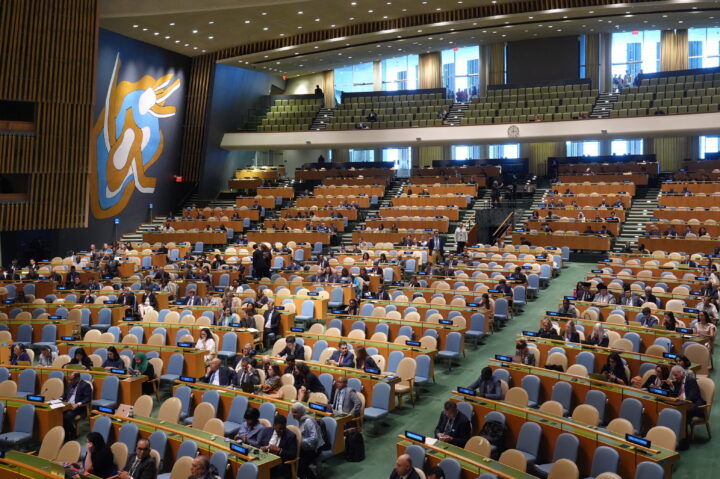
Selcuk Acar/Anadolu via Getty Images
A general view of hall at the High-Level International Conference on achieving a peaceful resolution to the Palestinian question and implementing a long-term sustainable peace, reviving the prospect of a two-state solution at the United Nations headquarters in New York, United States on July 29, 2025.
Eleven countries declared their intention to recognize a Palestinian state in conjunction with Tuesday’s France and Saudi Arabia-sponsored conference at the United Nations on a two-state solution.
The Arab League, along with the entire European Union and seventeen additional countries, signed the “New York Declaration,” which details a plan starting with the immediate end of the war and concludes with an independent, demilitarized Palestinian state living peacefully next to Israel. The declaration calls for UNRWA — the U.N. agency for Palestinian refugees, some of whose employees participated in the Oct. 7 attacks — to take part in the transition, and for the Palestinian Authority to implement reforms and hold democratic elections within a year.
Notably, by signing the declaration, for the first time, the entire Arab League — including Hamas benefactor Qatar — condemned Hamas’ Oct. 7 attacks on Israel and called for the terrorist group to disarm, give up its rule over Gaza and release the hostages in order to end the war.
A separate statement, the “New York Call,” was signed by 15 Western countries, six of whom already recognized a Palestinian state, and another nine who “expressed or express willingness … to recognize the state of Palestine as an essential step towards the two-state solution, and invite all countries that have not done so to join this call.”
Most U.N. member states — 145 out of 193 of them — recognize a Palestinian state, the vast majority of them having followed the Soviet Union in doing so in 1988. Nine of them took the step after the Oct. 7 attacks and the start of the war in Gaza. Eleven more announced the intention to do so this week.
The countries that joined the “New York Call” were Andorra, Australia, Canada, Finland, Luxembourg, Malta, New Zealand, Portugal and San Marino.
The declaration came hours after British Prime Minister Keir Starmer said that his country will recognize a Palestinian state by September if Israel does not reach a ceasefire with Hamas — though Hamas is the one who rejected such a deal last week — and commit to not annexing the West Bank and agree to reviving the idea of a two-state solution.
Last week, ahead of the conference, French President Emmanuel Macron announced that Paris would also recognize a Palestinian state in September at the U.N. General Assembly.
The response from Jerusalem was overwhelmingly negative, with Israeli Prime Minister Benjamin Netanyahu warning that recognizing a Palestinian state “rewards Hamas’s monstrous terrorism and punishes its victims … Appeasement towards jihadist terrorists always fails.” Foreign Minister Gideon Sa’ar called the statements “a reward for Hamas … at a time when Israel is still fighting in Gaza and there are still Israeli hostages there,” and “a rash and ill-considered decision, primarily driven by internal political considerations and pressures.”
Israeli opposition leader Yair Lapid wrote that “if Europe genuinely wants a Palestinian state to come into being one day, it needs to … demand that the Palestinians change … Declaring support for those who handed out candy in the streets of [the West Bank cities of] Nablus and Hebron on the morning of Oct. 7 does not advance a two-state solution. If anything, it pushes it further away.”
The State Department also called the conference an “unproductive and ill-timed publicity stunt” that will “embolden Hamas and … undermine real-world efforts to achieve peace … It keeps hostages trapped in tunnels.”
Former hostage of Hamas Emily Damari, a British citizen, posted on X that Starmer’s recognition of Palestinian statehood “risks rewarding terror [and] sends a dangerous message: that violence earns legitimacy … Recognition under these conditions emboldens extremists and undermines any hope for genuine peace. Shame on you.”
The Hostages Families Forum said that “recognizing a Palestinian state while 50 hostages remain trapped in Hamas tunnels amounts to rewarding terrorism … The abduction of men, women, and children, who are being held against their will in tunnels while subjected to starvation and physical and psychological abuse, cannot and should not serve as the foundation for establishing a state … The essential first step toward ensuring a better future for all peoples must be the release of all hostages through a single, comprehensive deal.”
Dan Diker, president of the Jerusalem Center for Security and Foreign Affairs, said in an interview with Jewish Insider that the move to recognize a Palestinian state emboldens Hamas, in that it convinces them that “they’re winning the long game. Hamas now says ‘The West is with us.’ This is exactly what they want, to pressure and corner Israel to succeed, and Hamas will say, ‘We’re not going to release the hostages.’ They’re just biding their time.”
Emmanuel Nahshon, the Israeli Foreign Ministry’s former deputy director for public diplomacy and a former ambassador to Brussels who resigned in protest against the government last year, told JI that 11 countries saying they’ll recognize a Palestinian state in one week creates “a slippery slope” towards diplomatic isolation for Israel.
“This enables countries that were friendly with Israel to criticize us publicly, and strengthens extremely radical elements in those countries,” Nahshon said. “It’s a kind of perfect storm with the purpose of delegitimizing Israel.”
Among those countries, he said, are Canada, the Netherlands and France.
“These are countries that we always considered to be like-minded, in terms of a point of reference for the State of Israel. We don’t want to compare ourselves to African dictatorships; rather, we see ourselves like Western European democracies. Now, Western European democracies are growing more and more distant from Israel,” Nahshon said.
Diker said that 11 countries recognizing a Palestinian state is “very dangerous in the perception war.”
“This is the greatest success for what was originally a Soviet plan, that the Palestinians under [PLO leader Yasser] Arafat and [Palestinian Authority President] Mahmoud Abbas and then Hamas inherited. The strategy is to divide … Western states from Israel, isolate Israel, and cause it to bleed to death,” he said.
Diker noted that France and the U.K.’s position is especially consequential because they are permanent members of the U.N. Security Council aligned with the U.S. If London and Paris follow through and recognize a Palestinian state, the U.S. will be the only permanent member of the UNSC not to do so.
Diker said that “what Starmer and Macron … [did] is an ill-advised move … The PA have not satisfied any of the requirements for statehood. They don’t have a functioning government; they don’t have control over the population or the ability to engage in international relations — they have 100 political warriors they call diplomats and all they do is subvert Israel.”
Nahshon added that the countries “are not stupid; they know that even if they recognize a Palestinian state it doesn’t mean there is a Palestinian state. You can trust the international community that they understand fully well that it won’t have practical, immediate implications, certainly not when Palestinians are unable to run their own state and possibly unwilling to have their own state, because if you ask most Palestinians, they would rather destroy Israel.”
Rather, he said the move to recognize a Palestinian state “sends a message to Israel of criticism and disapproval,” Nahshon said. “It’s addressed first and foremost at Israel … It’s a vote of no confidence addressed at the Israeli government saying, ‘We are very unhappy with the way you run the war in Gaza and with the free hand given to extreme settlers.’ The message is addressed to Netanyahu and his government.”
Diker pointed out that Starmer is “a well-heeled international lawyer, a human rights lawyer,” and that he and Macron “see themselves as being the human rights conscience of the Europeans” but put pressure mainly on Israel, “ironically, while Hamas kills and tortures its own people while they’re seeking humanitarian aid.”
“Israel has had a very serious problem in leading the narrative,” Diker said. “This is narrative warfare … [that] brought us to where we are … Israel has got to pull itself together and prosecute a soft power war.”
Diker called for there to be widely-released images of “Israeli soldiers handing food and aid to the Gazans. That is political, cognitive warfare. We should be seen doing that.”
Asked if that might be a domestic political risk to the current Israeli government, Diker said: “If we’re totally isolated internationally, it’s a fundamental threat to our existence. We can’t operate in a vacuum.”
Plus, a sit-down with Mike Huckabee ☕

MOHAMMED BADRA/POOL/AFP via Getty Images
France's President Emmanuel Macron exits a polling booth, adorned with curtains displaying the colors of the flag of France, to vote in the second round of France's legislative election at a polling station in Le Touquet, northern France on July 7, 2024.
Good Friday morning.
In today’s Daily Kickoff, we talk to Republicans on Capitol Hill about France’s plans to recognize a Palestinian state later this year and report on the daylight between Sen. Mark Kelly (D-AZ) and Arizona’s pro-Israel community as he throws his support behind candidates with histories of being critical of Israel. We interview U.S. Ambassador to Israel Mike Huckabee as he navigates his first months on the job, and report on Sen. Jeanne Shaheen’s (D-NH) support for Mike Waltz to be U.S. ambassador to the U.N., bypassing a delay imposed by Sen. Rand Paul. Also in today’s Daily Kickoff: Mandela Barnes, Tanya Simon and Elad Gil.
What We’re Watching
- We’re keeping an eye on the unfolding dispute regarding humanitarian aid in Gaza, as Israel and the U.N. accuse each other of holding up distribution efforts in the enclave amid broader concerns of worsening malnutrition among the Strip’s most vulnerable.
- In Istanbul, Turkey, today, France, Germany and the U.K. are holding nuclear talks.
- And in Washington, the Israel on Campus Coalition’s National Leadership Summit kicks off on Sunday afternoon in Washington.
What You Should Know
A QUICK WORD WITH JI’S GABBY DEUTCH
With a unanimous vote last week rejecting a measure that would’ve cut ties with the Anti-Defamation League, the board of directors of the National Education Association extended an olive branch to frustrated Jewish educators and parents who are concerned about creeping antisemitism within the union’s ranks.
ADL CEO Jonathan Greenblatt told Jewish Insider earlier this week that he was “pleased” to see the NEA reject the anti-ADL measure. But, he added, the union still has a “long way to go” toward making clear that it respects the Jewish community.
Greenblatt’s lingering concern is a sign that the NEA — the largest teachers’ union in the country, with more than 3 million members — has not entirely placated Jewish communal stakeholders. In fact, additional questions have continued to emerge in light of an NEA document that encourages teaching the “Nakba” and that erases antisemitism from the history of the Holocaust.
The Washington Free Beacon reported this week on the NEA’s 2025 handbook, a 434-page report outlining the organization’s “visionary goals” and “strategic objectives.” Among the items included in the dense document are dozens of measures that passed at last year’s “representative assembly,” a convening of the organization’s top leaders from around the country — the same group that, this year, voted to censure the ADL. Several of them have raised eyebrows in the Jewish community.
Q&A
Huckabee: United Nations more interested in self-preservation than getting food into Gaza
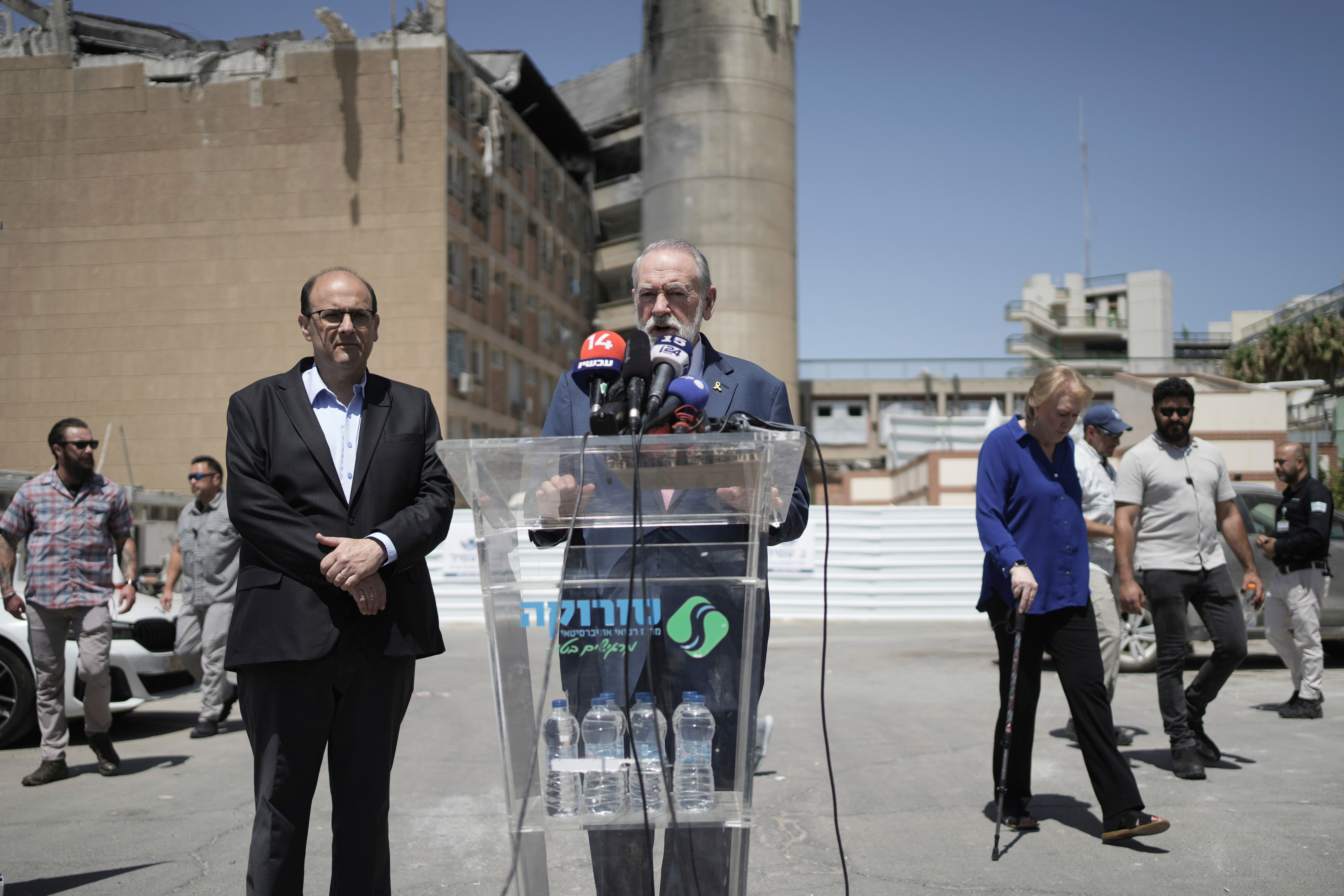
Since his arrival in Israel in April, former Arkansas Gov. Mike Huckabee has made his mark as the first evangelical U.S. ambassador to Israel — and possibly the most effusive in his remarks about the Jewish state. Following issues with work visas for Christian organizations and several incidents involving Palestinian Christians, Huckabee issued some strongly worded statements directed toward Israeli officials. But with the visa issue resolved and the world’s attention on the humanitarian situation in Gaza and the latest round of collapsed negotiations for a ceasefire and hostage-release deal, Huckabee was back to standing firmly behind Israel in an interview with Jewish Insider’s Lahav Harkov in his office at the U.S. Embassy in Jerusalem on Thursday.
On the issues surrounding aid distribution: “Well, we just want people to get the truth and to get the food, but we don’t want Hamas to steal it, which is what they have done through the U.N. model, which has been an absolute disaster. Maybe the U.N. is more interested in preserving the machinery of the U.N. than they are in feeding people,” Huckabee said. “And I know that sounds harsh, but I absolutely am on the record for that, because when I see just thousands of pallets, thousands of tons of food sitting that could be consumed by people, it’s sitting there because the U.N. doesn’t really have any incentive to go out and actually get it to the people.”
SUPPORTER SCRUTINY
Cracks in the coalition: Pro-Israel Arizonans wary of Sen. Mark Kelly’s endorsements

Sen. Mark Kelly (D-AZ) is facing new scrutiny from some Jewish community leaders in Arizona who are frustrated by his endorsements boosting the activist left in a series of recent House primaries in which he has withheld support for pro-Israel candidates and has even worked to actively oppose their campaigns behind the scenes, according to people familiar with the matter, Jewish Insider’s Matthew Kassel reports.
Tensed-up ties: Kelly’s engagement has strained what had been seen as a positive relationship with the pro-Israel community in Arizona, according to multiple local Jewish leaders who have voiced disappointment with his approach. Meanwhile, his recent interventions have raised questions about the political motivations of the Democratic senator in a key battleground state who has long been associated with his party’s moderate, centrist wing. The most recent source of tension with Jewish and pro-Israel leaders stems from Kelly’s endorsement of Adelita Grijalva in a Tucson House primary this month to succeed her late father, former Rep. Raul Grijalva (D-AZ), a longtime critic of Israel who died in March.
PARIS POSITION
Top Republicans blast France for recognizing Palestinian state

Republicans and senior Trump administration officials are blasting French President Emmanuel Macron for announcing on Thursday that France will recognize a Palestinian state at the United Nations General Assembly later this year, Jewish Insider’s Marc Rod reports.
Pushback: “The United States strongly rejects [Macron’s] plan to recognize a Palestinian state at the [UN] general assembly,” Secretary of State Marco Rubio said. “This reckless decision only serves Hamas propaganda and sets back peace. It is a slap in the face to the victims of October 7th.” Top Republican lawmakers largely argued that the decision constituted a reward for Hamas for its Oct. 7, 2023, attacks on Israel and its intransigence in recent hostage talks, the most recent round of which collapsed just hours before Macron’s announcement.
Read the full story here with additional comments from Sens. Tom Cotton (R-AR) and Lindsey Graham (R-SC) and Reps. Brian Mast (R-FL), Randy Fine (R-FL) Carlos Gimenez (R-FL) and former U.S. Ambassador to the United Nations Nikki Haley.
Bonus: In a tongue-in-cheek X post, U.S. Ambassador to Israel Mike Huckabee said, “Macron’s unilateral ‘declaration’ of a ‘Palestinian’ state didn’t say WHERE it would be. I can now exclusively disclose that France will offer the French Riviera & the new nation will be called ‘Franc-en-Stine.’”
LENT A LIFELINE
Shaheen bails out Waltz nomination, describing him as a ‘moderating force’

Sen. Jeanne Shaheen (D-NH), the top Democrat on the Senate Foreign Relations Committee, voted with nearly all committee Republicans to advance former National Security Advisor Mike Waltz’s nomination to be U.S. ambassador to the United Nations to move to the consideration of the full Senate, Jewish Insider’s Marc Rod reports.
Notable quotable: “I recognize that Mr. Waltz represents a moderating force with a distinguished record of military service and an extensive background in national security policymaking,” Shaheen said in a statement. “Further, Mike Waltz did not represent himself to me as someone who wants to retreat from the world—and this is a quality I value in nominees. Simply put, in a Situation Room filled with people like Vice President [J.D.] Vance and Under Secretary [of Defense Elbridge] Colby, who want to retreat from the world, and like Secretary [of Defense Pete] Hegseth, I think we’re better off having someone like Mike Waltz present.”
PUT ON PAUSE
Senate committee delays ethics watchdog’s confirmation hearing amid GOP questions

The Senate Homeland Security and Government Affairs Committee on Thursday delayed a confirmation hearing for Paul Ingrassia, the Trump administration’s nominee for a government ethics oversight role, amid questions about his record from some Senate Republicans, Jewish Insider’s Marc Rod reports. Ingrassia has a record of conspiratorial comments, including describing the Oct. 7, 2023, Hamas attacks on Israel and the ensuing war as a “psyop” and defending prominent antisemites, among other issues.
What they’re saying: Sen. James Lankford (R-OK) told JI he had more questions he wanted to ask Ingrassia and that the hearing had been delayed because “he had not met with a lot of members” and the lawmakers wanted the chance to do so. He said that the hearing will now likely happen in “September or later,” after the Senate’s August recess, to provide more time for these meetings.
Garden State race
Brian Varela running in the centrist lane in race against Rep. Kean
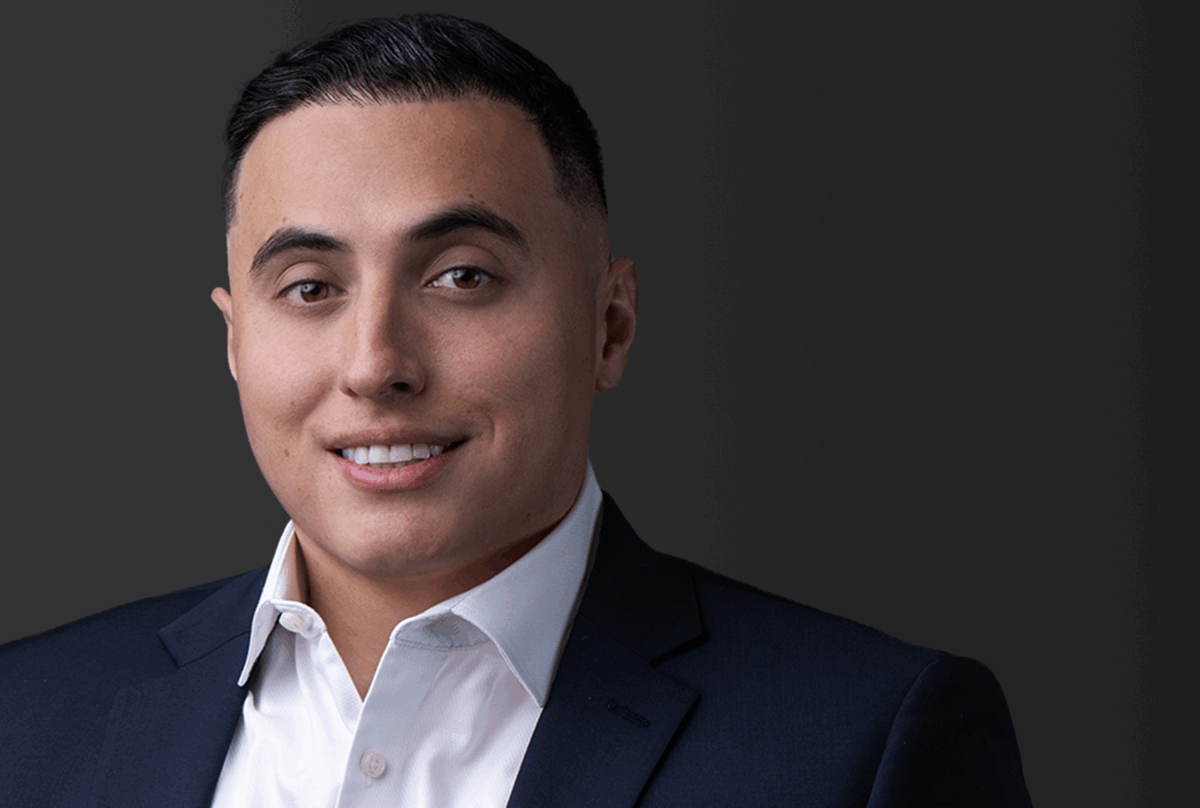
In a Democratic Party that has lost its grip on the working class — long its base of support and wellspring of its values — Brian Varela is offering a way back home. Varela, a small business owner and New Jersey political activist vying for the Democratic nomination for New Jersey’s 7th Congressional District, is leaning in to his working-class Colombian roots, suggesting that the Democrats need candidates, like him, who are better connected to the middle-class voters in his district. Varela, 36, has firmly established himself as a serious contender for the Democratic nomination for New Jersey’s 7th Congressional District with his recent announcement of a $700,000 fundraising haul in his first three months in the race, Jewish Insider’s Marc Rod reports.
Positioning: “I consider myself more of a moderate,” Varela told JI in an interview. “I do believe that we do need to be tight around budgets, and we can’t just go and haphazardly be cutting programs, but we do need to understand that we cannot allow the deficit to continue increasing.” He said that he thinks his perspective coming from a working-class background can help Democrats appeal to working-class voters they struggled to attract in 2024. And he said that Israel has been a “strong ally for us, and I think it’s important to make sure that we are there for Israel, that we help Israel with their ability to defend themselves.”
Worthy Reads
Where’s the Outrage?: In The Washington Post, Stephen Rapp, who served as U.S. ambassador-at-large for war crimes issues from 2009-2015, raises concerns about global silence around Iran’s human rights violations. “The regime’s response to its perceived vulnerability in the wake of that conflict has become increasingly aggressive. While its failures may be attributed to incompetence and the foreign penetration of its security services, its fury is being directed at domestic political opponents. Thousands of Iranians are in danger as parliament now seeks to expedite death sentences in cases involving imagined collaboration with foreign entities.” [WashPost]
A New Gaza: In The Wall Street Journal, Yasser Abu Shabab, the commander of the Popular Forces in Gaza, makes the claim that he has developed a model for post-Hamas governance in the Gaza Strip. “Through our efforts, we have shown a glimpse of what a new Gaza could look like. … Within months, more than 600,000 people — nearly a third of Gaza’s population — could be living outside the cycle of war. We need only three things to make this vision a reality: financial support to prevent Hamas’s return, humanitarian aid to meet the population’s immediate needs for food and shelter, and safe corridors so people can move around. In a short time, we could transform most of Gaza from a war zone into functioning communities. When the rebuilding has begun, Hamas can negotiate with Israel for the release of hostages in exchange for safe passage out of Gaza. Let them go to Qatar, Turkey or wherever their enablers will have them. We don’t want them among us.” [WSJ]
‘Needling the Jews’: In National Review, Jamie Kirchick breaks down far-right commentator Tucker Carlson’s evolution from Fox News host to conspiracy theorist trafficking in antisemitic tropes. “After years of ‘just asking questions,’ he has reached the nadir to which such questions inevitably lead. Carlson has chosen to exploit the world’s oldest prejudice while pretending that it’s somehow edgy. Ultimately, the reasons why Carlson decided to become America’s leading purveyor of antisemitic ideas matter less than what this development says about our society. Why has ‘needling the Jews,’ the very thing Carlson condemned Pat Buchanan for a quarter century ago, been a safe career move? For the persistent acting out of his anti-Jewish obsession in the national discourse hasn’t put a dent in his popularity; on the contrary, it may have even boosted it.” [NationalReview]
Word on the Street
U.S. Ambassador to Turkey Tom Barrack, the Trump administration’s Syria envoy, convened a four-hour meeting in Paris on Thursday for senior Israeli and Syrian officials, including Israeli Minister of Strategic Affairs Ron Dermer and Syrian Foreign Minister Assad al-Sheibani, to discuss security issues; the meeting was the first high-level sit-down between Israeli and Syrian officials in 25 years…
U.S. and Israeli negotiators departed Doha, Qatar, following Hamas’ most recent response to a ceasefire proposal, with White House Middle East envoy Steve Witkoff saying that the terror group’s response “shows a lack of desire to reach a ceasefire”…
The Pentagon informed staff on Thursday that it had indefinitely suspended the Department of Defense’s participation in think tank and research conferences and events; the announcement comes a week after the Pentagon pulled its affiliated speakers from the lineup at the Aspen Security Forum…
A new report from the Jewish Institute for National Security of America found that the U.S. launched nearly 14% of its THAAD interceptor stockpile during last month’s war between Israel and Iran; the report’s authors suggested it could take between three and eight years to replenish the stockpile…
Russia successfully launched an Iranian Soyuz communications satellite into orbit, months after signing a “strategic partnership” agreement with Tehran…
The Wall Street Journal reports on a 2003 birthday book given to Jeffrey Epstein that included messages from President Donald Trump and former President Bill Clinton…
Wisconsin Gov. Tony Evers, a Democrat, announced he does not plan to seek a third term; former Lt. Gov. Mandela Barnes, who came within a percentage point of unseating Sen. Ron Johnson (R-WI) in 2022, said he is considering entering the race to succeed Evers, while Sara Rodriguez, the state’s current lieutenant governor, hinted she was interested in the seat…
Members of a New Jersey state Assembly panel advanced a bill that would adopt the International Holocaust Remembrance Alliance’s working definition of antisemitism…
The FCC signed off on the $8 billion merger between Skydance Media and Paramount; The New York Times said that the merger “effectively ushers in the beginning of a new family dynasty for Paramount, which has been controlled by the Redstone family for decades. David Ellison, son of the tech billionaire Larry Ellison, plans to take control of the company when the deal closes”…
CBS News tapped network veteran Tanya Simon, who had overseen “60 Minutes” since the resignation last year of Bill Owens, as the weekly news program’s executive producer…
Israeli-American venture capitalist Elad Gil is raising a $1.5 billion fund for young startups; if closed, it would be one of the largest funds raised by a solo VC…
Two Jewish comics slated to perform at the upcoming Edinburgh Fringe next month had their shows canceled due to what organizers said were safety concerns…
Hungary issued a three-year ban on members of the Irish hip-hop group Kneecap from entering the country, citing the group’s “antisemitic hate speech and open praise for Hamas and Hezbollah as justification”; the ban comes ahead of the upcoming Sziget festival in Budapest, at which Kneecap was slated to perform…
Archeologists working at the Tinshemet Cave site in central Israel discovered what they believe to be, at 100,000 years old, one of the oldest burial sites in the world…
Eight Israeli soldiers were injured in a car-ramming attack on Thursday near the central Israeli city of Netanya; the assailant drove off and is believed to have abandoned his car near the West Bank town of Beit Lid…
Israeli Ambassador to the U.S. Yechiel Leiter distanced the Israeli government from recent comments by Israeli Heritage Minister Amichay Eliyahu, a far-right lawmaker who said that Jews would settle in the Gaza Strip and the government “is racing ahead for Gaza to be wiped out”…
Pic of the Day
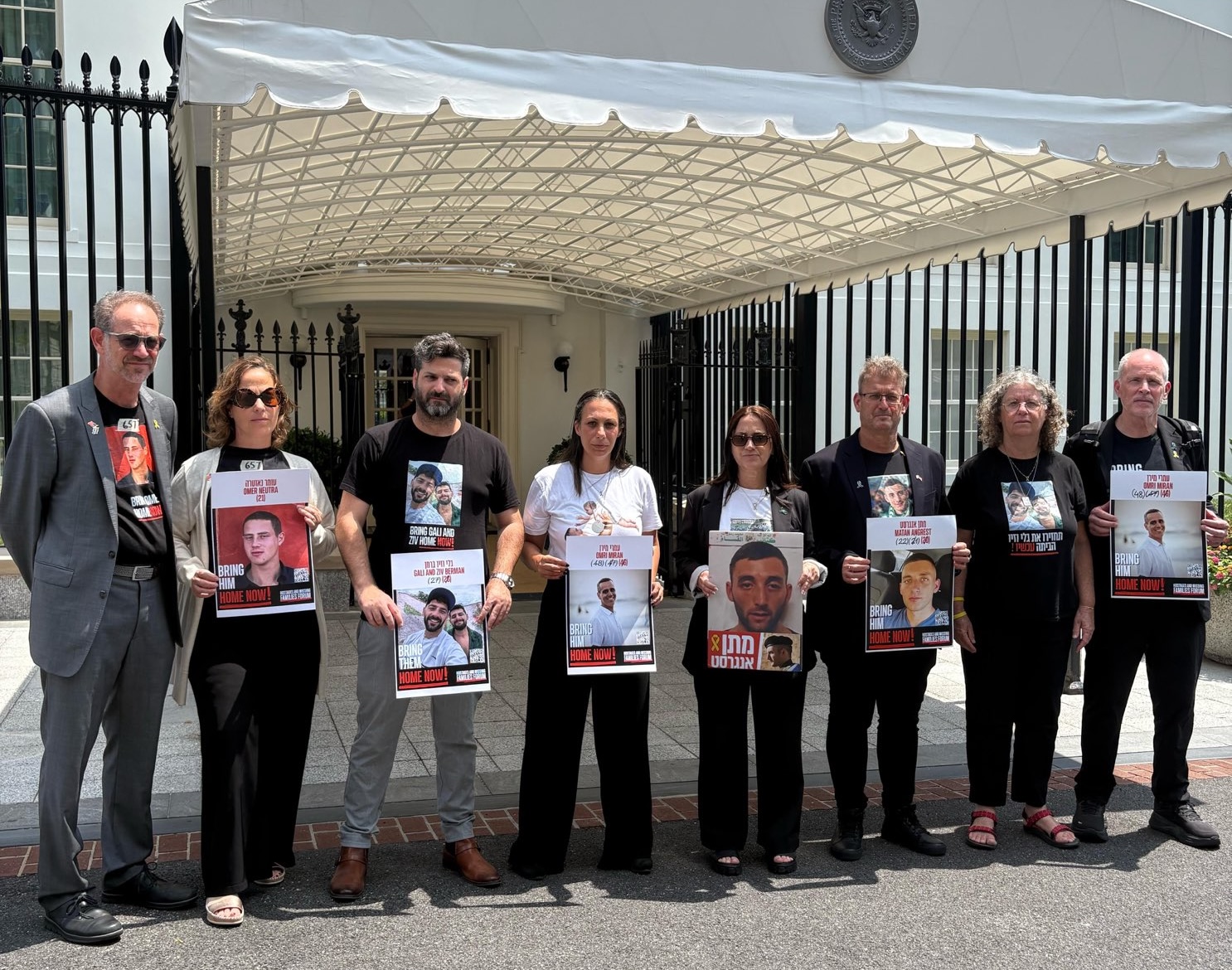
Former hostages and family members of some of the remaining 50 hostages still in captivity were in Washington this week for meetings with Trump administration officials, including Justice Department senior counsel Leo Terrell, the chair of the department’s antisemitism task force. At far right are Keith Siegel and his wife, Aviva, who were both taken hostage by Hamas on Oct. 7, 2023.
Birthdays
Actor, comedian and producer, Jeremy Samuel Piven turns 60 on Saturday…
FRIDAY: Warsaw Ghetto Uprising participant and Holocaust survivor, she is the subject of the 2021 documentary “I am Here,” Ella Blumenthal turns 104… Former publisher and editor-in-chief of Jewish Lights Publishing, he is an economist and religious scholar best known for his interfaith work, Stuart M. Matlins turns 85… Cinematographer, whose work includes “The Rocky Horror Picture Show” and “The Empire Strikes Back,” Peter Suschitzky turns 84… Member of the New York City Council from 2014 to 2021, Alan N. Maisel turns 79… Born in Casablanca, Morocco, nightclub owner, entrepreneur and film producer, he produced “The Woman in Red” and “Weekend at Bernie’s,” Victor Drai turns 78… Former IDF brigadier general (he was part of Operation Entebbe in 1976), then a member of Knesset, Efraim “Effi” Eitam turns 73… Voiceover artist, he is also the writer, producer, director and narrator of a documentary about the restoration of a NYC synagogue, Peter Grossman… Chairman of Vibrant Capital Partners and chair emeritus of the Weitzman National Museum of American Jewish History in Philadelphia, Philip Darivoff… Screenwriter, director and producer, best known for creating “Beverly Hills, 90210” and “Sex and the City,” Darren Star turns 64… Pulitzer Prize-winning author and journalist, she is a staff writer at The Atlantic, Anne Applebaum turns 61… Retired MLB pitcher from a small Jewish community in the Dominican Republic, he maintains a kosher home, José Bautista turns 61… Israeli journalist, television news anchor and author of a nonfiction book and a novel, Oshrat Kotler turns 60… CEO of Friends of the Israel Defense Forces until earlier this week, Rabbi Steven Weil… NYC-based criminal defense attorney, Arkady L. Bukh turns 53… Head coach of the men’s basketball team at Kent State University since 2011, Rob Senderoff turns 52… Radio personality on Baltimore’s WBAL and 98 Rock, Josh Spiegel turns 50… VP of communications and PR for the National Association of Healthcare Quality, Erin Seidler… Experimental electronic music producer, composer and singer, known professionally as Oneohtrix Point Never, Daniel Lopatin turns 43… Film and television actor, Michael Welch turns 38… Senior policy advisor at Nelson Mullins, Jake Kohn turns 36… Pitcher for Team Israel at the 2020 Olympics and at the 2023 World Baseball Classic, he is also a real estate broker at CBRE, Joseph “Joey” Samuel Wagman turns 34…
SATURDAY: Former mayor of Las Vegas for 12 years, where he was succeeded by his wife who served for 12 more years as mayor, Oscar Goodman turns 86… Former administrator at the University of Illinois and the University of Houston, chancellor of the California State University system and CEO of the J. Paul Getty Trust, Barry Munitz turns 84… Journalist and author or co-author of nearly two dozen books, both of her parents were killed in Auschwitz, Paulette Cooper turns 83… Author, podcaster, columnist and rabbi, Shammai Engelmayer turns 80… Member of the Florida House of Representatives from 2012 to 2020, Richard Stark turns 73… Chief medical officer at F|42, Alan H. Spiro, MD, MBA… Film and television director, she is best known for her work on the Showtime drama series “Homeland,” Lesli Linka Glatter turns 72… Sports columnist, author, television and radio personality, he works for ESPN’s Charlotte, N.C.-based SEC Network since 2014, Paul Finebaum turns 69… Venture capitalist, James W. Breyer turns 64… Former correspondent at ABC News for 23 years, now a founder at Ten Percent Media, Daniel B. “Dan” Harris turns 54… Physician and attorney, he is the founder and chairman of the DC-based consulting firm Stonington Global, Nicholas Muzin turns 50… U.S. senator (R-OK), Markwayne Mullin turns 48… Actress best known for her role in the “Spider-Man” trilogy, Mageina Tovah Begtrup turns 46… Managing partner of the D.C. office of ColdSpark, Nachama Soloveichik… Political correspondent at Israel’s Walla News, Tal Shalev… Israeli-born classical music composer, Gilad Hochman turns 43… Israeli born R&B singer and songwriter, Hila Bronstein turns 42… Manager of advisor communications at Cetera Financial Group, Lauren Garfield-Herrin… Actress and filmmaker, Hallie Meyers-Shyer turns 38… Member of the comedy group “The Try Guys,” with almost 2.9 billion YouTube views, Zachary Andrew “Zach” Kornfeld turns 35… Associate policy director for complex care at United Healthcare, Drew Gerber… NFL running back who retired in 2024, Tarik Cohen turns 30… Pitcher on the Israeli Women’s National Softball Team, now a curriculum designer at Great Hearts Academies, Tamara “T” Statman Schoen turns 28… President at B&B Digital Media, Tomer Barazani…
SUNDAY: Real estate developer who founded Aspen Square Management, he heads an eponymous foundation known for its flagship program PJ Library, Harold Grinspoon turns 96… Forensic pathologist known for his HBO show and his work investigating high-profile deaths, Michael M. Baden turns 91… Managing partner of Access Fund Management Company, he is a past president of the Jewish Community Federation of San Francisco, Harold Zlot… Former deputy secretary of defense and then CIA director in the Clinton administration, now a professor emeritus at MIT, John Mark Deutch turns 87… Steven M. Mizel turns 86… Former chairman of the Conference of Presidents of Major American Jewish Organizations, Stephen M. Greenberg turns 81… Artist and museum founder focused on Fusionism, Shalom Tomáš Neuman turns 78… Israeli author and television producer, he is best known for his documentaries of Israel’s intelligence agencies, Yarin Kimor turns 73… Israeli-born fitness personality, Gilad Janklowicz turns 71… Comedian, writer, producer and actress, Carol Leifer turns 69… Washington bureau chief and White House correspondent for the Christian Science Monitor, Linda Feldmann… Former VP of global communications, marketing and public policy at Facebook, he previously held a similar position at Google, Elliot Schrage turns 65… U.S. Army colonel (retired), Jeffrey Brian Carra… Israeli television and radio personality, Erez Moshe Tal turns 64… Heir to the Hyatt Hotels fortune, now a film producer, Jean “Gigi” Pritzker turns 63… Former CEO of the Rabbinical Assembly, she is now the founder of Insight Eldercare, Rabbi Julie Schonfeld… Member of the Hungarian Parliament for 20 years, then a member of the European Parliament since 2009, Tamás Deutsch turns 59… Rabbi at Kesher Israel: The Georgetown Synagogue, Rabbi Hyim Shafner… Former national platform director for the Democratic National Committee, now a political consultant and recruiter, Andrew Grossman… Former chief of staff of the House Republican Conference, he is now the managing partner at Capitol Venture, LLC, Jeremy Deutsch… Head of marketing at Jumplight and winner on “Jeopardy!” in 2019, Aaron Lichtig… D.C.-area political activist, Benjamin Rothenberg… SVP at Upland Workshop, Jeremy Adler…
Sen. Tom Cotton called the move a ‘shameful endorsement of terrorists’

Chesnot/Getty Images
French President Emmanuel Macron waves to media as he waits for Lebanese Prime Minister Najib Mikati prior to their meeting at Elysee Palace on October 23, 2024 in Paris, France.
The Trump administration, congressional Republicans and American Jewish groups are blasting French President Emmanuel Macron’s announcement on Thursday that France will recognize a Palestinian state at the United Nations General Assembly later this year.
Macron’s decision would make France the most prominent European Union country, and one of the U.S.’ closest allies, to unilaterally recognize a Palestinian state, and could create momentum for other countries to make similar decisions. U.S. policy has long held, on a bipartisan basis, that a Palestinian state can only be recognized in the context of a mutually agreed diplomatic solution between Israel and the Palestinians.
“The United States strongly rejects [Macron’s] plan to recognize a Palestinian state at the [UN] General Assembly,” Secretary of State Marco Rubio said. “This reckless decision only serves Hamas propaganda and sets back peace. It is a slap in the face to the victims of October 7th.”
Top Republican lawmakers largely argued that the decision constituted a reward for Hamas for its Oct. 7, 2023, attacks on Israel and its intransigence in recent hostage talks, the most recent round of which collapsed just hours before Macron’s announcement.
Sen. Tom Cotton (R-AR), the chair of the Senate Intelligence Committee, said that the announcement is a “shameful endorsement of terrorists.”
“The best way for this conflict to end is to back Israel in its righteous mission of rescuing the hostages and defeating Hamas,” he continued.
Graham (R-SC) called the decision “curious and disturbing on multiple levels” and said he is “certain this will embolden Hamas and make a ceasefire more difficult.”
“In addition, here are some questions that come to mind. Who’s in charge? What are the borders and boundaries? What is the governance structure? Does Hamas stay involved politically or militarily? Is the West Bank and Gaza part of a single state? Are they allowed to have an army? Does the education system change?” Graham continued. “Other than these few missing details, it seems like a foolproof plan!”
Rep. Brian Mast (R-FL), the chair of the House Foreign Affairs Committee, said in a statement, “Choosing to reward terrorism, hostage taking and genocide against Jews is the wrong choice.”
Rep. Randy Fine (R-FL) said that “France has a long history of surrendering.”
“They surrendered their country to Muslim terrorists long ago,” Fine continued. “Now they want to surrender the Holy Land to Hamas. America and Israel don’t surrender, especially to countries like ‘Palestine’ that don’t exist.”
Rep. Carlos Gimenez (R-FL) said Macron’s decision “is a slap to the face to the Jewish community & the state of Israel.”
“President Macron must rethink this decision and side with freedom & democracy, not a terrorist regime,” Gimenez continued.
Macron’s push for Palestinian statehood had previously faced criticism and scorn from congressional Republicans ahead of a conference the country is set to co-chair on a two-state solution, which was rescheduled from June to early next week.
“It certainly sounds like they take us for granted and think that they can act without consequence. France has a long history of doing this in foreign policy. They’re consistently a problem and have been forever, but I’d say it’s very unhelpful of them at this present moment,” Sen. Josh Hawley (R-MO) told Jewish Insider in June.
Sen. Lindsey Graham (R-SC) said he had tried to dissuade French officials from going ahead with the move.
Several senators downplayed France’s influence in Europe and said that the U.S. should ignore the effort.
AIPAC also condemned the French announcement.
“President Macron is acting as Hamas’ handmaiden with the announcement that France will unilaterally recognize a Palestinian state,” the organization said in a statement. “By taking this action, President Macron is rewarding Hamas’ barbaric attack on the Jewish state on October 7. Moreover, this unilateral recognition makes peace and reconciliation even more elusive.”
“We urge the Administration and Congress to express their opposition to the French government concerning this irresponsible action,” the statement continued.
The American Jewish Committee said the announcement “comes at an extremely troubling time, with Hamas continuing to reject proposals for a ceasefire and the return of the remaining hostages” and noted that France is not asking for any preconditions, including those that Macron himself had previously laid out.
“By offering recognition without conditions — and without demanding the release of hostages or the disarmament of Hamas — France removes any incentive for compromise. It sends a dangerous message: you can get what you want through violence, without giving anything in return,” AJC said. “It only emboldens terror groups like Hamas by legitimizing violence and hostage-taking as viable tactics to achieve political goals. It undermines efforts by leaders across Europe and the Middle East, who are still working toward a negotiated two-state solution. France has undercut its own credibility as an honest broker — a role it has long claimed in the Middle East,” the group continued.
Former U.S. Ambassador to the United Nations Nikki Haley said, “Calling for a Palestinian state, without conditions being met by the PA, does nothing to end this war. Hamas is still holding hostages and Israel’s borders are not secure.”
“If France wants to do something productive they should help eliminate Hamas,” she continued.
The French president cites travel issues for cancellation as he defends Israel’s strikes on Iran
Photo by CHRISTOPHE ENA/POOL/AFP via Getty Images
French President Emmanuel Macron (L) meets with Palestinian President Mahmoud Abbas on October 24, 2023 in the West Bank city of Ramallah. Macron's visit comes more than two weeks after Hamas militants stormed into Israel from the Gaza Strip and killed at least 1,400 people and amid Israel's retaliatory strikes.
French President Emmanuel Macron announced on Friday that his upcoming United Nations conference with Saudi Arabia promoting international recognition of a Palestinian state has been postponed following Israel’s attack on Iran.
Speaking to reporters from Paris, Macron said that the conference would need to be rescheduled for logistical purposes, citing the inability of Palestinian Authority officials to travel to U.N. headquarters in New York next week to participate.
The Trump administration was opposed to the conference, titled “The High Level International Conference for the Peaceful Settlement of the Question of Palestine and the Implementation of the Two-State Solution,” and urged U.N. member states against participating. Pro-Israel Republicans on Capitol Hill also criticized the gathering, which was scheduled to take place June 17-20, as a distraction from U.S. efforts to secure peace in the region.
Despite his campaign for Palestinian statehood recognition, Macron was quick to defend Israel’s strikes on Iran, releasing a statement early Friday criticizing Tehran for its nuclear program and supporting Israel’s right to self-defense. At his press conference later Friday, he argued that Iran was heavily responsible for the current unrest in the Middle East by building its nuclear program against the requests of the West and other actors in the region.
Still, he urged restraint in both the press conference and his statement.
“France has repeatedly condemned Iran’s ongoing nuclear program and has taken all appropriate diplomatic measures in response. In this context, France reaffirms Israel’s right to defend itself and ensure its security. To avoid jeopardizing the stability of the entire region, I call on all parties to exercise maximum restraint and to de-escalate,” Macron’s statement read.
“Peace and security for all in the region must remain our guiding principle,” the statement continued.
A U.N. spokesperson did not immediately respond to Jewish Insider’s request for comment on the conference.
France is sponsoring a U.N. conference towards recognizing a Palestinian state, as experts warn harsh rhetoric from Macron encourages homegrown antisemitism

LUDOVIC MARIN/AFP via Getty Images
French President Emmanuel Macron (R) shakes hands with Palestinian President Mahmud Abbas during a meeting on the sidelines of the 79th Session of the United Nations General Assembly in New York on September 25, 2024.
Israel and France have been on a diplomatic collision course in recent weeks, with French President Emmanuel Macron set to lay out steps toward the recognition of a Palestinian state at a French- and Saudi- sponsored conference promoting a two-state solution being held at the United Nations headquarters in New York next week.
The move comes as the French government released a report calling on Paris to recognize a Palestinian state and recalibrate its policies towards Israel to “appease” France’s growing Muslim population.
Last month, Macron called Israeli policies on Gaza “shameful” and raised the possibility of downgrading European Union cooperation with Israel; in response, Israeli Prime Minister Benjamin Netanyahu accused Macron of spreading blood libels and standing with Hamas. Days later, France threatened sanctions on Israel if it does not allow unrestricted humanitarian aid to be distributed by U.N. agencies in Gaza. After Macron once again threatened to “toughen” his stance against Israel last week, the Israeli Foreign Ministry accused him of being on a “crusade against the Jewish state” — referring to a period in which French knights massacred European Jews.
France has been preparing to co-chair “The High Level International Conference for the Peaceful Settlement of the Question of Palestine and the Implementation of the Two-State Solution” with Saudi Arabia at the U.N. on June 17-20. Macron said last week that the conference, which was first announced in December, is meant “to give fresh impetus to the recognition of a Palestinian state.” The French Foreign Ministry told The Guardian that Paris is trying to convince other countries to join it. The gathering’s other agenda items include reforming the Palestinian Authority and disarming Hamas.
French diplomats met with officials in Jerusalem to discuss the matter, and briefed reporters that the main goals of the conference are disarming Hamas, freeing the hostages, reforming the Palestinian Authority and planning for the “day after” the war in Gaza, including a two-state solution.
A French diplomatic source said on Sunday that France is “determined to recognize the state of Palestine to create the conditions for the existence of this state … Our goal for this conference indeed goes beyond the question of recognition. It is indeed about recreating an international consensus around the two-state solution, which allows for a lasting resolution to the conflict.”
Amid the sparring between Israel and France and the preparation to recognize a Palestinian state, the French Interior Ministry released a report titled “Muslim Brothers and Political Islam in France,” calling the Muslim Brotherhood an “imminent threat” to French national security. The Islamist group is funded by foreign powers, has over 100,000 members in France and runs or influences countless mosques, schools and other organizations. The report also describes the Muslim Brotherhood’s dissemination of antisemitic texts and propaganda.
Among the report’s recommendations is “the recognition by France of a Palestinian State alongside Israel” to “appease the frustrations” of French Muslims who perceive Paris as “supporting Jewish Israelis against Muslim Palestinians.”
Experts drew a connection between Macron’s pressure on Israel, Muslim Brotherhood influence and antisemitism in France.
French conservative intellectual Michel Gurfinkiel told Jewish Insider that “the main point of the report is not what it says about the Muslim Brotherhood. The real point is the conclusion that the French government should make efforts to bring French Muslims into the French fold, and that means … to recognize a state of Palestine.”
“There is a kind of interplay here,” he added. “The interior minister wanted to publish the report in order to give legitimacy to his own policy against Islamism in France. But it was published with the approval of President Macron … and obviously, the real goal of the president was to tell everybody, ‘I must recognize a State of Palestine because it is the only way for us to fight the Muslim Brotherhood.'”
Gurfinkiel noted that while Macron has to vacate the presidency in two years, he can run for a third nonconsecutive term in 2032, when he will be 55. “To return, his calculation is that he needs to secure the Muslim vote in France, which is going to grow in the coming years. He wants French Muslims to see him as the champion of their cause, and to be a champion of the Muslim cause means you support Palestine. Palestine is a code word for Muslim power in France, just like the right is extremely pro-Israel as a metaphor” against growing Islamism.
Emmanuel Navon, a professor of international relations at Tel Aviv University, also pointed out that the report about the Muslim Brotherhood says “clearly the Muslims are out of control and maybe one way of calming them down is to recognize a Palestinian state.”
“The report says there is a plan to conquer and Islamicize France. That’s not a conspiracy theory, it’s in the report,” Navon added.
Israel’s former ambassador to France, Daniel Shek, told JI, “I can’t rule out that there are domestic political motivations, but I can say that as someone who knows [Macron] and spoke with him about the topic [of a two-state solution] years ago, it’s not his central motivation. He wants to end the war out of a concern for Israel.”
“You see what happened on the Champs-Élysées on Saturday night,” Navon added, referring to soccer riots last month, during which there were several incidents of antisemitic vandalism. “Macron used an Arabic expression for ‘my brothers’ on Twitter, it is very telling. It’s clear he wants to appease the Muslims. Spoiler: It’s not going to work.”
The report’s repeated references to the Israeli-Palestinian conflict show that it is an important part of the French public debate because it is a synecdoche for political positions on immigration and Islam in France, Navon and Gurfinkiel said.
Israel’s former ambassador to France, Daniel Shek, however, told JI, “I can’t rule out that there are domestic political motivations, but I can say that as someone who knows [Macron] and spoke with him about the topic [of a two-state solution] years ago, it’s not his central motivation. He wants to end the war out of a concern for Israel.”
Boaz Bismuth, a Knesset member from Netanyahu’s Likud Party and a former diplomat and foreign correspondent based in France, told JI that French Foreign Ministry representatives discussed Macron’s plan to sponsor a conference supporting Palestinian statehood months ago, long before the French Interior Ministry’s report came out.
“I would even say this is the usual position of the French,” he said.
Over a week ago, vandals targeted Paris’ Shoah Memorial, two synagogues and a Jewish restaurant in the Marais, the historic Jewish neighborhood, and a third synagogue in another part of the city. A French rabbi reported that he was assaulted twice in the past week.
Gurfinkiel said that Macron’s remarks “obviously” encourage antisemitism.
“What people don’t understand,” he said, “is once you start saying that the Jews in Israel are bad, the consequence is that Jews everywhere are [perceived as] bad. It reactivates countless negative views and images of the Jews that are embedded in Western culture. You can’t escape it.”
Navon cited a recent French decision to posthumously give Alfred Dreyfus a promotion and said: “Remember that book People Love Dead Jews? It’s exactly that. They love dead Jews. They’re trying to fight antisemitism 100 years ago … but when it comes to the true antisemitism, which is the obsession with Israel and attacking Jews under the name ‘Zionist,’ they basically are taking part in demonizing Israel which encourages it.”
“He says [Israel is] committing war crimes and killing women and babies,” Navon added. “That feeds the antisemitism of the far-left and the Muslims. This hypocrisy is unacceptable.”
Bismuth also said that he “wouldn’t say [Macron] is an enemy of Israel or hates the Jews. I think he doesn’t understand the significance of what he’s doing.”
“I give him the benefit of the doubt that it’s not intentional … I call on him to show responsibility and understand the consequences and the meaning of the things he said,” the Likud lawmaker stated.
Shek took issue with what he said was “the Israeli government’s position that any initiative to end the war is an existential threat and anyone doing it is an antisemite.”
Bismuth voiced disappointment in Macron, who expressed support for Israel after Oct. 7. “I was in a meeting between him and Netanyahu [in October 2023]. I heard him call to establish an international coalition with Israel against Hamas. And he went from there to calling for an arms embargo on Israel [in 2024] … He did a 180-degree flip-flop.”
“What France, the U.K. and the U.S. need to remember is that we don’t only share the same values, but also the same enemies,” he added.
Shek also noted that “Macron was a real friend of Israel and defended Israel’s right to defend itself for months.”
“Then we turned him into an antisemitic enemy and a supporter of Hamas,” he added, referring to the way Israelis spoke about the French president. “And then, we’re surprised that Israel is isolated.”
According to Shek, Macron’s critical turn happened because “time has gone by and nothing positive is happening. He, like many other leaders in the world, think this war has been continuing for too long and the time has come to stop it. He’s not alone; he’s just more vocal. At least he’s trying to do something.”
Ilan Berman, senior vice president of the American Foreign Policy Council, said that France leading the U.N. two-state solution conference “speaks to [its] eroding global position currently,” Berman said. “For France, the Middle East in general and Israel-Palestine in particular is a very attractive portfolio to play in and take an outsize role.”
Navon cited two advisors to Macron as major engines behind the U.N. conference. Ofer Bronchtein, a French-Israeli who was involved in the Oslo Accords, is Macron’s advisor on the Middle East and is expected to represent him at the U.N. next week. The other is Jacques Attali, an Algiers-born Jewish social theorist who advised former French presidents Francois Mitterand, Nicolas Sarkozy and Francois Hollande before Macron. Attali began criticizing the war in Gaza as early as November 2023 and recently equated Hamas with Israel’s leadership in a post calling for Europe to “exert pressure” so that both are removed.
Navon also blamed Qatar’s influence on France, noting that Doha has made major investments in France at a time when the country has a large budget deficit.
Ilan Berman, senior vice president of the American Foreign Policy Council, said that France leading the U.N. two-state solution conference “speaks to [its] eroding global position currently,” Berman said. “For France, the Middle East in general and Israel-Palestine in particular is a very attractive portfolio to play in and take an outsize role.”
Berman expressed concern about the practical impact of France’s moves, saying that “as more and more countries, including upper-tier countries like France, begin to preemptively recognize Palestine as a state, it becomes harder and harder to assume that there isn’t a state, even though the fundamental conditions [for statehood] don’t apply.”
“It’s one thing for Sweden to say it; it’s another when France does,” he added. “There is a question in my mind: At what point does this boulder rolling downhill begin to pick up steam, and what does that mean?”
Shek said that not much will change if France recognizes a Palestinian state, noting that 147 countries, over three-quarters of U.N. member states, have already done so.
“It only pressures Israel, and as far as I’m concerned, that’s OK. If pressure ends the war, brings back the hostages and integrates Israel into the region, then it’s a very pro-Israel act,” he said.
The former ambassador argued that the establishment of a Palestinian state is in Israel’s interest, in that it would “turn the Palestinian Authority into a responsible party.”
Navon agreed that recognition of a Palestinian state will not change much on the ground, but he still called on Israel to scale back relations with France should they take such a step.
“We have to try to circle the wagons against countries trying to appease our common enemy. They are making a moral and practical mistake. The U.S. should make that point very clear,” said Emmanuel Navon, a professor of international relations at Tel Aviv University.
“Make sure they don’t participate in any future diplomatic initiatives in the Middle East. Downgrade security and defense relations, on which they depend. There should be consequences,” he said. “Let’s be obnoxious too. France has problems with former colonies … New Caledonia is supposed to have a referendum [about independence from France] and [the French] keep pushing it off,” Navon said, referring to the Pacific island nation. “Why don’t we bring up a resolution at the U.N.?”
As to what the American response should be to France’s latest moves against Israel, Navon said that the U.S. should not participate in the conference at the U.N. next week and “should be very clear in their statements that this is a global war against terror and that we don’t break ranks.”
“We have to try to circle the wagons against countries trying to appease our common enemy. They are making a moral and practical mistake. The U.S. should make that point very clear,” he stated.
Berman said that “for the Trump administration, this is a really good opportunity to say ‘put your money where your mouth is’ and help reconstruct Gaza. There is a really good play to be made here. The French, Spanish, Dutch and others are very eager to moralize and grandstand, but very reticent to put their money where their mouth is and contribute.”
Berman suggested that the Trump administration can say “we disagree with their decision, but in light of it, we hope Paris will agree to [help with] reconstruction and expect greater contributions to the Gaza Humanitarian Foundation,” the U.S. and Israel-backed group distributing food in Gaza.
“It’s the worst of all possible worlds if Macron gets an easy win and doesn’t have to actually do anything,” he added.
Please log in if you already have a subscription, or subscribe to access the latest updates.
 Continue with Google
 Continue with Apple