


















France denies role in drafting Palestinian constitution enshrining ‘pay for slay’
The embassy told JI that the constitution’s ‘first draft was not written in coordination with France, and we were exposed to it with the broader public.’

Photo by CHRISTOPHE ENA/POOL/AFP via Getty Images
French President Emmanuel Macron (L) meets with Palestinian President Mahmoud Abbas on October 24, 2023 in the West Bank city of Ramallah. Macron's visit comes more than two weeks after Hamas militants stormed into Israel from the Gaza Strip and killed at least 1,400 people and amid Israel's retaliatory strikes.


 Add JewishInsider on Google
France did not take part in drafting the Palestinian Authority’s proposed constitution released earlier this month, which enshrines payments to terrorists in Israeli prisons, the French Embassy in Israel told Jewish Insider, despite PA President Mahmoud Abbas and French President Emmanuel Macron’s announcement of a joint committee on the matter last year.
The embassy told JI that the constitution’s “first draft was not written in coordination with France, and we were exposed to it with the broader public.”
“As part of the joint committee to strengthen the building of a Palestinian state … a delegation of French constitutional law experts is expected to examine the draft that was published and present recommendations,” the embassy spokeswoman stated.
Ofer Bronchtein, Macron’s advisor on Israeli-Palestinian affairs, told JI that the committee had met “here and there,” but like the embassy spokeswoman, did not know when they would meet next.
France recognized a Palestinian state last September and after Abbas wrote a letter to Macron saying he was committed to a two-state solution while calling for “an end of the Israeli occupation.” French Foreign Minister Jean-Noël Barrot interpreted the letter as promising “the end of allowances for the families of prisoners convicted on terrorism offences.”
Macron and Abbas met in Paris in November to announce a committee to establish the framework for a Palestinian state, including drafting a constitution. France reportedly raised concerns to the Palestinians about its practice of paying terrorists and their families, and Macron said after the meeting that Abbas agreed to an audit by an American company to ensure that the payments had ended.
Abbas had previously promised to stop the payments to terrorists last February, yet i24News reported on Wednesday that the PA had paid NIS 500 million ($161 million) to terrorists and their families in the past year. The PA has granted monthly payments, higher than the average Palestinian salary, to those imprisoned for committing or attempting acts of terror, or to their families. The amount paid increases with a longer prison sentence, thus incentivizing killing more Israelis.
The day before the presidents’ meeting, Abbas fired his finance minister, Omar Bitar, for continuing the payments, but Israel has accused Abbas of not intending to end the program, called “pay for slay” by its critics.
The PA draft constitution, published this month, includes two articles guaranteeing “protection and care for the families of martyrs, and the wounded, and prisoners, and those released from the occupation prisons, and the victims of genocide,” as well as “comprehensive care for the families of martyrs, the wounded, and prisoners, and those released.” One of the articles is part of the “public rights and freedoms” chapter, of which the draft states: “it is not permissible to conduct any constitutional amendment.”
The French Embassy said that when it comes to “the matter of ‘pay for slay,’ our stance is known and clear: This phenomenon must stop. The PA made a commitment to France on this matter, and it will be examined through an independent audit. We will act with determination and without compromising on this matter.”
Bronchtein argued that Abbas has stopped paying “those regarded in Israel as terrorists,” and that there should be universal social security for Palestinians.
“All families would have rights, without being linked to the criminal acts of certain family members. In Israel, for example, the families of [Prime Minister Yitzhak Rabin’s murderer] Yigal Amir or [Hebron massacre terrorist] Baruch Goldstein have rights like any other family — no more and no less,” he suggested.
Bronchtein is not a member of the joint committee, but took part in the meeting between Macron and Abbas in November. He said that “a group of jurists — French, and above all Palestinian — will finalize [the PA constitution]. The French constitutional model has inspired many countries, including the United States.”
“Palestinians and Israelis ultimately need to decide both their constitutional framework and their borders; that would resolve a large part of what opposes them [to each other],” he said. Israel does not have a constitution.
According to Bronchtein, Abbas promised France that parties or individuals advocating violence would not be able to run in elections. However, that rule is not part of the constitution.
The draft also refers to Jerusalem as “the capital of the State of Palestine,” and states that the PA is “committed to preserving [Jerusalem’s] religious character and protecting its Islamic and Christian sanctities.” It does not mention Jews or Judaism.
Bronchtein said that Jerusalem “is, and will remain, the eternal capital of the Jewish people. President Macron has acknowledged this. Al-Quds” — the Arabic name for Jerusalem — “would be the capital of Palestine; they are two different cities, but I believe they should remain united.”
“The Old City of Jerusalem — less than 1% of the city — should be open to everyone, as it was for a long time,” he added.
Emmanuel Navon, a longtime international relations lecturer at Israeli universities and CEO of the new Euro-Med Middle East Council, said that he “didn’t expect a Zionist manifesto” from the constitution, but that the French advisors should take note of “how this constitution relates to the Jewish people and their relation to the land. … Describing Jerusalem as only for Muslims and Christians says it all.”
Navon called the draft constitution a “joke.”
“Abbas did it because Macron said that, before he recognizes a Palestinian state, they needed to promise to be a democracy based on liberal values,” Navon said. “Abbas was elected in 2005 for a four-year term, and now he has a constitution? The whole thing is BS.”
“When they put pay for slay in the constitution, it shows that they don’t take Macron seriously,” Navon added.
Navon also took issue with France presenting itself as an expert on writing constitutions.
“One of the amazing achievements of the Fifth Republic [established in 1958] is that it managed to finally grant France a stable, functioning regime after almost 200 years since the revolution in which it went back and forth between republic, empire and constitutional monarchy. The regimes in the Third and Fourth Republics were completely unstable because of an extreme system of parliamentary politics where governments lasted an average of eight months. … Macron took France back to the Fourth Republic — he’s had five prime ministers in two years,” Navon explained.
“That adds to the irony of [Macron] going around advising people on constitutional law,” he added.
More Stories
SECURITY SETBACK
Saudi Arabia postpones ‘Davos in the Desert’ until 2027 amid Houthi attacks
TEXTBOOK TEST
Syrian textbooks under al-Sharaa deny Israel’s right to exist and promote antisemitism, report finds

FIRING FALLOUT
Hillels of Georgia claims fired Emory rabbi not ‘truthful or transparent’ during hiring process
analysis
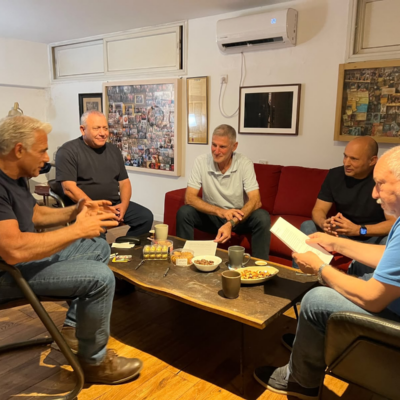
Is Israel’s anti-Netanyahu bloc fracturing?
Super Ball
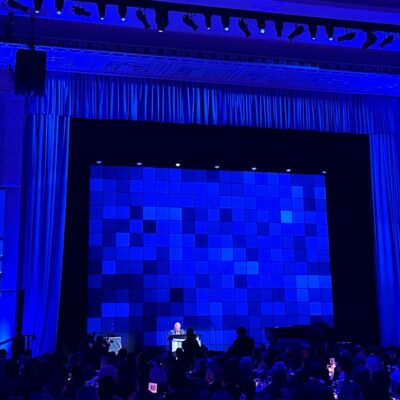
Robert Kraft’s Blue Square gala pulls in $32 million as NYC’s Waldorf glows blue
WAR WORRIES
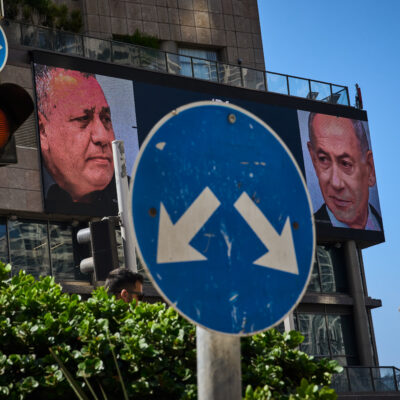
Could another war with Iran be the October surprise of the Israeli election?
Please log in if you already have a subscription, or subscribe to access the latest updates.
 Continue with Google
 Continue with Apple