















































Lt. Goldin was killed by Hamas during Operation Protective Edge in 2014; Hamas still holds four more hostage bodies

MENAHEM KAHANA/AFP via Getty Images
Israeli soldiers salute and people hold national flags as a van carrying Lt. Hadar Goldin's remains arrives at the National Center for Forensic Medicine in Tel Aviv on November 9, 2025.


 Add JewishInsider on Google
Hamas returned the remains of Lt. Hadar Goldin on Sunday, over 11 years after he was killed in battle in Gaza.
Israel confirmed the body was Goldin’s through DNA testing, four hours after it was returned.
Goldin was 23 when he fought in Operation Protective Edge in Gaza and took part in a mission to destroy a Hamas tunnel in Rafah on Aug. 1, 2014, during a 72-hour ceasefire. Hamas terrorists killed two Israeli soldiers, taking Goldin’s body with them.
Goldin’s parents, Leah and Simcha, publicly advocated for his return, but did not support the release of living terrorists in exchange for their son’s remains. They repeatedly suggested that humanitarian aid to Gaza be reduced or stopped as long as the remains of their son and Oron Shaul, another soldier whose body was taken in 2014, were held in Gaza.
After Goldin’s remains were returned, Leah said her family “took for granted that the State of Israel would not leave soldiers behind. It took us 11 years to bring him home through the IDF and security forces. … We faced many disappointments. We cannot give up on who we are, and we will prevail through our values. …Thank you for walking with us all the way.”
Simcha Goldin credited IDF “soldiers [who] fought to bring warriors back from the battlefield. The IDF brought Hadar back to his homeland — no one else. … What this war has proven is that when we fight for our soldiers, we succeed. Victory means bringing home the hostages and bringing home our soldiers to Israel.”
Goldin’s body is the 24th that Hamas has returned since the ceasefire began on Oct. 13 this year, after which all of the remaining hostages, both living and deceased, were meant to be returned within three days. However, the terrorist group has drawn out the return of the remains, and four more hostages have yet to be handed over to Israel: Meny Godard, Master Sgt. Ran Gvili, Dror Or and Sudthisak Rinthalak, a Thai national.
IDF Chief of Staff Eyal Zamir visited the Goldin family on Saturday night. Hamas and the Red Cross were permitted to search for his body in the areas of Gaza controlled by Israel, Hebrew media reported.
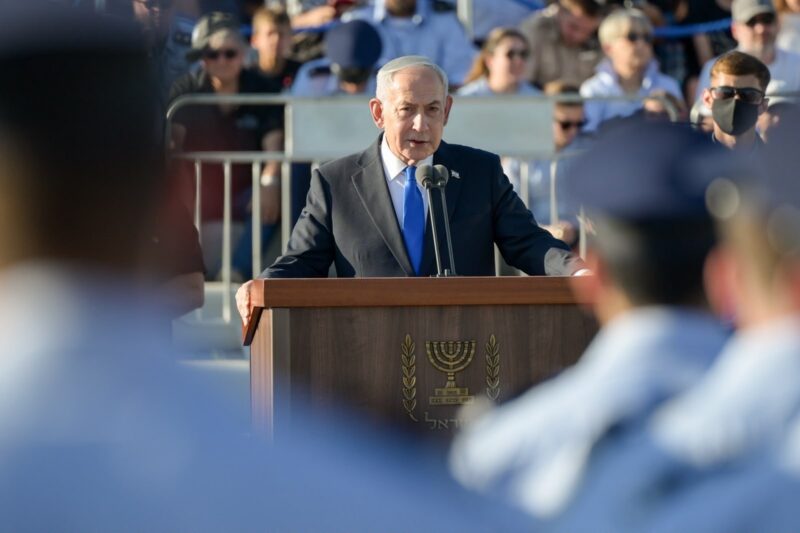
Israeli Prime Minister Benjamin Netanyahu announced earlier Sunday that Hamas was expected to return Goldin’s body.
“Lt. Hadar Goldin fell in a heroic battle in Operation Protective Edge 11 years ago,” Netanyahu said. “His body was taken hostage by Hamas, who refused to return him throughout this entire period. This entire time, Israeli governments made a great effort to return him. Naturally, this has been amid the great agony of his family, which will now be able to give him a Jewish burial.”
Netanyahu added that Israel has “a tradition from the establishment of the state … to bring back our soldiers who fell in battle, and we are doing it. Sometimes it takes a long time … It is a holy value. It expresses our mutual responsibility with the citizens of Israel and first and foremost the soldiers and fighters of Israel.”
Goldin’s return was reportedly tied to the fate of 200 Hamas fighters currently hiding in a tunnel in the Israel-controlled half of Gaza.
According to Israel’s Channel 12, the White House reportedly suggested a plan by which, after Goldin’s remains are returned, the terrorists would lay down their arms and surrender, and Israel would allow them to go into exile or to the Hamas-controlled half of Gaza. The IDF would then destroy the tunnel in which they were hiding.
An Israeli official said last week that Netanyahu “would not allow safe passage for 200 Hamas terrorists.”
Some Senate Democrats voiced concern over the stability of the ceasefire agreement and Israel’s commitment to abiding by it
Samuel Corum/Sipa/Bloomberg via Getty Images
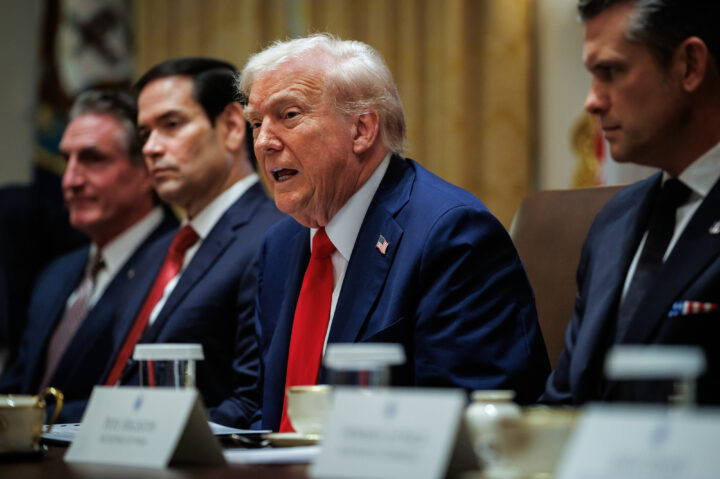
President Donald Trump during a Cabinet meeting at the White House in Washington on Oct. 9, 2025.
President Donald Trump defended Israeli Prime Minister Benjamin Netanyahu’s decision to order what the prime minister called “forceful” strikes on Hamas targets in Gaza on Tuesday in response to ceasefire violations by the terror group, dismissing concerns that the actions could upend the deal.
“They killed an Israeli soldier, so the Israelis hit back and they should hit back. When that happens, they should hit,” Trump told reporters aboard Air Force One on Tuesday evening. “Hamas is a small thing, but they kill people. They grew up killing people, and I guess they don’t stop. Nobody knows what happened to the Israeli soldier, but they say it was sniper-fire and it was retribution for that. I think they have a right to do that.”
“Nothing’s going to jeopardize that [the ceasefire],” he continued. “Hamas is a very small part of peace in the Middle East, and they have to behave. They’re on the rough side, but they said they would be good, and if they’re good, they’re going to be happy. If they’re not good, they’re going to be terminated. Their lives will be terminated, and they understand that.”
The Associated Press reported at least 80 killed in the strikes, including dozens of children. The Israeli army said it had hit dozens of terror targets and struck over 30 terrorists holding command positions within terrorist organizations operating in Gaza.
Initial reaction to Netanyahu’s decision to strike in Gaza fell largely along party lines, with Israel’s Republican allies in the Senate defending the Jewish state’s actions as self-defense while Democrats expressed concerns that the ceasefire in Gaza could be in jeopardy.
“You’re going to see a lot of this,” Sen. John Kennedy (R-LA) told Jewish Insider of the renewed skirmishes in Gaza. “I mean, the Hamas soldiers are not terribly civilized, and the fact that there’s a ceasefire is of no moment to many of them. You’re periodically going to see them continue to shoot at the Israeli soldiers, and when they do, the Israeli soldiers are going to shoot back and kill them.”
“Eventually the really stupid Hamas members will stop doing it, because they’ll be dead,” the Louisiana senator continued. “But this is gonna happen. I mean, you’re not talking about sane people.”
Sen. Pete Ricketts (R-NE) suggested “we ought to expect” the Israelis to still conduct operations in Gaza given Hamas’ actions targeting IDF troops and Palestinian civilians since the ceasefire went into effect.
“Hamas is a terrorist organization. They are going to continue to commit acts of violence, and Israel is going to need to respond,” Ricketts told JI. “That’s why it’s imperative that the Gulf states work together to get an international police force to be able to keep peace in Gaza while we go through this transition.”
Sen. James Lankford (R-OK) said he felt it was “entirely appropriate” that Israel struck Hamas targets in order to protect Israeli forces.
“Because Hamas is attacking the IDF, that is entirely appropriate for Israel to defend itself — today, yesterday, tomorrow. If Hamas is attacking them, violating, obviously, the ceasefire and attacking IDF soldiers, Israel has been very clear: If you shoot us, we’re going to actually stop you,” Lankford told JI.
Sen. Lindsey Graham (R-SC), who offered his support for further Israeli confrontation with Hamas earlier this week, wrote on X on Tuesday afternoon that he was in “total support” of “the recent military action by Israel against Hamas.”
“Without Hamas being disarmed and removed from power permanently, there will be no pathway to stability and peace in the Middle East. Hamas is killing their opposition and consolidating their power,” Graham wrote. “If Israel believes it is necessary to reengage Hamas militarily, so be it. They have my complete backing.”
Sen. Rick Scott (R-FL) concurred with his GOP colleagues, telling JI, “If Hamas is going to strike Israel, they [Israel] don’t have a choice. They have to strike back. It’s too bad, but they don’t have a choice.”
Sen. Mike Rounds (R-SD) surmised that Israel launched the strikes because Hamas was not honoring their side of the ceasefire deal by refusing to disarm.
“I think the reasoning for it was: Hamas is supposed to be planning on disarming, but I suspect that there’s probably some portions of Hamas that don’t want to disarm, and they’re probably regrouping,” Rounds told JI. “If [Netanyahu] can take out some more of those terrorists, I think he probably decided he would do it now as opposed to later.”
“We want that ceasefire to be successful, but it means Hamas has got to give up their weapons,” he added.
Sen. Ted Budd (R-NC) wrote on X on Tuesday that, “Hamas is in direct violation of the ceasefire, including deceptively & cruelly obstructing the return of deceased hostages to their families. The @IDF’s actions are a result of Hamas’ repeated violations & their targeting of Israeli troops.”
The North Carolina senator declined to elaborate when asked by JI at the Capitol about the developments, noting that he wanted to hold off on commenting further until he had been fully briefed on the situation.
Some Senate Democrats who have been critical of Israel’s actions in Gaza since Hamas’ Oct. 7, 2023, attacks on the Jewish state said they hoped the latest developments would not completely upend the ceasefire deal.
“It is very troubling,” Sen. Tim Kaine (D-VA) said of Netanyahu launching the strikes. “I give President Trump a lot of credit for really working hard to get him [Netanyahu] to accept the deal. He wouldn’t have accepted it before.”
Kaine questioned if Netanyahu was aiming to derail the ceasefire, and noted that such a development would upend current efforts by the U.S. to bring more Gulf states into the Abraham Accords.
“My question is: Is he trying to undo the deal?” the Virginia senator asked of Netanyahu. “If he’s trying to undo the deal, then he’s got another problem, which is [that] they [the U.S.] want more nations in the Abraham Accords, and those nations have said we’re not coming in unless there is a path forward to Palestinian autonomy.”
Sen. Mark Kelly (D-AZ) told JI that he was waiting to be briefed before speaking publicly, but said it would be “unfortunate if we wound up in a situation where this unravels.”
Middle East experts with whom JI spoke described Israel’s strikes against Hamas as necessary for its security, and dismissed concerns that Israel was acting without U.S. involvement or trying to disrupt the deal, while others expressed concern regarding Washington’s ability to constrain the Israelis.
“Israel has shown considerable patience and restraint in the face of multiple Hamas violations of its ceasefire obligations, but attacks on its personnel are something no government can accept,” Rob Satloff, executive director of The Washington Institute for Near East Policy, told JI. “Hamas’ violations are real and serious, deserving of an appropriate response.”
Mona Yacoubian, director and senior advisor of the Middle East Program at the Center for Strategic and International Studies, remained skeptical over Israel’s decision to strike. She said the operation could reflect a developing pattern where Israel takes military action with or without U.S. cooperation, and argued that Washington should be willing to adjust accordingly to “enforce” and monitor the ceasefire arrangement.
“Although we are still very much in the ‘fog of war,’ it does not appear that the United States approved the strike or necessarily even agrees with Israel’s interpretations that Hamas violated the ceasefire,” Yacoubian told JI. “We are likely seeing the beginnings of a ‘new normal’ where Israel strikes as it sees necessary. The key question is whether or not the United States will acquiesce to that.”
Gaith al-Omari, a senior fellow at The Washington Institute, predicted that the breakout of strikes was an isolated episode that would be “contained.”
“The current escalation is concerning but not surprising. Ceasefires take a while to solidify and stabilize, whether because of accidents or because the sides testing the limits of the ceasefire,” al-Omari said. “The challenge facing the U.S. now is how to balance supporting Israel’s right to respond to Hamas’ violations while at the same time ensuring that this round of escalation does not spin out of control.”
In an interview with JI, Nunn says the U.S.-Israel military relationship is crucial to pushing the boundaries of defensive technological development, keeping Americans safe and staying ahead of global adversaries

AP Photo/Altaf Qadri
U.S. Congressman Zach Nunn speaks to the Associated Press at a hotel in Dubai, United Arab Emirates, Wednesday, June 18, 2025.
For Rep. Zach Nunn (R-IA), the U.S.-Israel military relationship is crucial to pushing the boundaries of defensive technological development, keeping Americans safe, staying ahead of global adversaries and even providing advancements in sectors far removed from the battlefield.
Nunn is a rising national security voice on Capitol Hill, chairing the national security task force of the Republican Study Committee, is an Air Force veteran with experience in the Middle East and is also a longtime former intelligence officer. He hails from a competitive district in southwest Iowa, which includes much of Des Moines and stretches to the state’s southern border.
“We know that not only is Israel our best military partner for the region, it is the best stabilizing force,” Nunn, who led a pair of successful amendments in last week’s National Defense Authorization Act markup on the House floor aimed at improving U.S.-Israel military cooperation, told Jewish Insider in a recent interview. “Not only is Israel a force for good in the region, it’s one of our best innovative partners out here, and national defense begins with a tech and human capability that’s able to execute on it. And that really is funded through democracies that allow this type of innovation to take place.”
One of Nunn’s amendments, cosponsored by Reps. Josh Gottheimer (D-NJ) and Don Davis (D-NC), would establish a Defense Innovation Unit field office in Israel.
The DIU, which has offices throughout the U.S. and is headquartered in Silicon Valley, is a relatively new Pentagon body aimed at allowing the military to move more quickly to adopt emerging commercial and dual-use technologies — a “fast-track for a largely challenged defense apparatus … to onboard new technologies more quickly,” Nunn explained.
The tech sector, he said, starts on the West Coast, in Silicon Valley, and extends to “the East Coast, which in my mind is Tel Aviv.”
“I think that we have seen some of the best innovations coming out of Israel. Part of it is need, part of it is just the innovative spirit that Israel has brought to the fight on this,” he continued. “How do we onboard this so that the best technologies — and, candidly, the best tactics, techniques and procedures that Israel is literally field testing right now — can be replicated so that we help defend the men and women in uniform?”
He said that such efforts will save U.S. taxpayer money, help the U.S. keep ahead of its key adversary in Beijing and even provide advances in civilian technology. Precision-guidance weapon capabilities that Israel is developing can also be applied in precision agriculture techniques in Iowa, Nunn said.
Nunn’s other amendment, cosponsored by Davis, would require the Pentagon to review and report to Congress on progress made toward an integrated air and missile defense infrastructure in the Middle East, strategies and options for expanding those efforts and lessons learned from recent attacks throughout the region. Both amendments were incorporated into larger packages of amendments and passed by voice votes.
Of all the U.S.’ global allies, Nunn said, Israel is providing the most practical proving ground for new defensive technologies.
“It’s one thing to be able to do drills, to do innovation, to come up with new technologies. It’s another thing to be able to have to deploy them in the field … find out how they work and then be able to change your … tactics and employment in real time,” Nunn said. “That makes us much safer than just having the ideal weapons system on the shelf, to know how it’s going to work in battle and how our men and women in uniform can be best protected by it.”
Nunn noted that he was tied for the record of most amendments, nine in total, secured in the 2026 NDAA on the House floor.
Asked more broadly about the push from some, on both sides of the aisle, for the U.S. to reduce its focus and posture abroad, Nunn argued that relationships like the one with Israel pay dividends for the U.S.
“Peace through strength matters, and a peaceful Middle East is a lower cost to the American taxpayer,” Nunn said. “At the same time, it’s Israel who took out Iran’s missile defense systems. It’s Israel who’s provided the intelligence that has allowed us to not only save money, but save lives here on the home front. It’s Israel and the Mossad and IDF, who have taken out Iranian proxy groups, whether they be Houthi rebels, Hamas or Hezbollah, that have sent death squads after great leaders here in the United States.”
Efforts like the amendments he led, Nunn said, create American jobs, save the U.S. money, create technologies that can be used in both military and civilian applications and reduce the burden on the U.S.’ own forces.
“The United States is getting the best possible return when we partner with allies,” Nunn said, a position on which he said President Donald Trump and most members of Congress should be able to agree.
“Peace through strength matters, and a peaceful Middle East is a lower cost to the American taxpayer,” Nunn said. “At the same time, it’s Israel who took out Iran’s missile defense systems. It’s Israel who’s provided the intelligence that has allowed us to not only save money, but save lives here on the home front. It’s Israel and the Mossad and IDF, who have taken out Iranian proxy groups, whether they be Houthi rebels, Hamas or Hezbollah, that have sent death squads after great leaders here in the United States.”
Nunn noted that he was in the region, visiting Saudi Arabia, Bahrain and the United Arab Emirates on the eve of the U.S. strikes on Iran’s nuclear program in June.
He said that the U.S. strikes would not have seen the same level of success without Israel “doing all of the prep work on the front end,” and that the U.S. bombings sent a strong message to Iran and other adversaries.
“Clearly, President Trump is in a different league of presidents when it comes to negotiation,” Nunn said. “He’ll offer you peace. If you say no to it, he’s prepared to make sure that you can no longer be a threat to the world. I think that that sends a very important message to the next iteration of negotiations here with Iran. … The president has emboldened our allies, but also sent a very clear message to Iran that this is where it ends.”
“That’s a message that saves lives, saves taxpayer dollars and advances us when we look at emerging threats, whether they be in Moscow, Pyongyang and certainly Beijing,” Nunn continued. “The amount of investment that we have to make on the front end is much lower because we have those partnerships that amplify our ability, than if we were to have to do this all on our own, whether it’s domestically or internationally.”
Asked about the path forward with Iran, Nunn said that Trump’s approach to the conflict is distinctly different than that of past presidents. He said he was told by an Arab leader the day before the American strike on the Fordow nuclear facility that the Iranians had told that Arab leader that they believed they would secure further concessions from the U.S. by dragging out talks.
“Clearly, President Trump is in a different league of presidents when it comes to negotiation,” Nunn said. “He’ll offer you peace. If you say no to it, he’s prepared to make sure that you can no longer be a threat to the world. I think that that sends a very important message to the next iteration of negotiations here with Iran. … The president has emboldened our allies, but also sent a very clear message to Iran that this is where it ends.”
Nunn said that Iran now “has the opportunity” to cease its malign activities — funding for terrorism, weapons sales and development of nuclear and conventional weapons — and turn toward peace and collaboration with Israel and the United States.
The Iowan is also leading a bill to codify and build upon the maximum-pressure sanctions on Iran and ensure the enforcement of U.S. oil sanctions, describing it as a companion to the administration’s military strikes. He said the broad Republican support for the effort shows the conservative support for holding Iran accountable, for backing Israel and for providing relief to the Iranian people.
Nunn said he’s personally flown missions out of the Al-Udeid airbase in Qatar — the largest U.S. airbase in the Middle East — and that he agrees with the stance Trump took on the Israeli strike on Hamas officials in that country.
“In many ways there’s a shared concern here that Iran is the real radical, unhinged aggressor in the region, and there’s greater security by standing up not to a fellow Islamic state, but a state that is truly an autocrat and intends to threaten the rest of the world,” Nunn said.
“Qatar has been a great ally to us for decades now,” Nunn said. “They are a recognized partner in this. At the same time, there are bad actors everywhere. And as the president highlighted, I fully endorse — when Hamas is operating knowingly or unknowingly in a region — we’ve got to be able to decapitate that threat so it can’t reconstitute.”
He said he wants to see the U.S., Israel and the U.S.’ Arab partners pull closer together to counter threats from Hamas and other adversaries through the Abraham Accords and similar mechanisms.
“In an ideal situation, we never would have had these strikes to take place in the first place. We would have been able to share the intelligence and we would have eliminated this Hamas node working together,” Nunn said. “That’s the vision where I want to get to.”
The Abraham Accords, Nunn said, are helping to create a pathway for the region that Arab leaders remain excited about, based on recent visits to the region. He added that while many Arab countries’ populations remain hostile toward Israel, the tenor of anti-Israel public discourse has improved.
“In many ways there’s a shared concern here that Iran is the real radical, unhinged aggressor in the region, and there’s greater security by standing up not to a fellow Islamic state, but a state that is truly an autocrat and intends to threaten the rest of the world,” Nunn said.
The Democratic pro-Israel group is supporting the strike, a split from most congressional Democrats, including other pro-Israel voices

Tasos Katopodis/Getty Images
President Donald Trump
Democratic Majority for Israel suggested in a new searing statement that the Trump administration’s warning to Qatar about the impending Israeli attack in Doha earlier this week may have foiled the effort.
The Democratic pro-Israel group is taking a different approach to the strike than most Democratic lawmakers, who have been highly critical of the operation, with few exceptions.
“After years of criticizing Democrats — despite our party’s 75-year history of supporting Israel — President Donald Trump yesterday broke with our vital ally in an unprecedented manner,” DMFI CEO Brian Romick said in a statement.
“He even went as far as to direct his special envoy to alert Qatar, and in so doing risked alerting Hamas, about the attack,” Romick said. “The White House must answer whether their pre-warning of the attack in any way compromised Israel’s ability to eliminate Hamas’ terrorist leadership.”
Trump said in a statement on Truth Social that he “immediately directed Special Envoy Steve Witkoff to inform the Qataris of the impending attack, which he did, however, unfortunately, too late to stop the attack.” Qatari officials have said that the U.S. warning came while the strike was underway and explosions had already begun; another U.S. official told Axios the same.
Romick also criticized Trump for breaking publicly with Israel over the strike, which the president has condemned.
“Trump used his platform to undermine Israel at a time when we must demonstrate a unified front to get the hostages home and bring a negotiated end to the conflict,” Romick said.
The former Defense Department official said, ‘The risk is actually that these kinds of actions do set back the cause of normalization and integration’
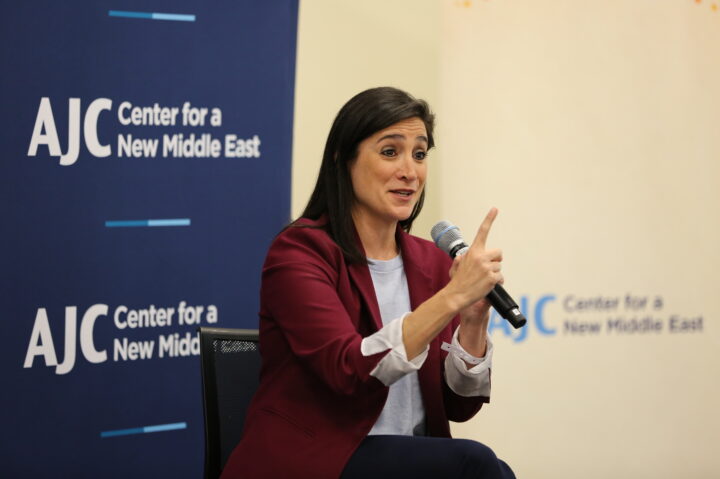
Martin H. Simon/AJC
Dana Stroul, the director of research at the Washington Institute for Near East Policy, speaks at AJC's Abraham Accords 5th Anniversary Commemoration on Capitol Hill in Washington on Sept. 10, 2025.
Dana Stroul, the director of research at the Washington Institute for Near East Policy and a former senior Defense Department official in the Biden administration, warned on Wednesday that the Israeli strike on Hamas leaders in Doha is leading Arab states to rally around Qatar, potentially dealing setbacks to regional normalization.
Stroul, speaking at an American Jewish Committee event in Washington to mark the five-year anniversary of the Abraham Accords, said that Arab leaders are offering support for Qatar following the strike, and that both Israeli and Iranian moves to make the Gulf a “new battlefield in the Middle East” are making the U.S.’ regional partners “very nervous.”
“It is really disappointing that not one [Arab] government acknowledged Hamas,” Stroul said. “What’s very clear is that everyone else in the region is aligned that this was a strike on Qatar,” as opposed to a strike on Hamas. “This is about Qatari sovereignty. We’ve seen really a shoring up of Arab leaders’ alignment with and defense of Qatar.”
She said that there had been relatively little criticism in the region for Israel attacking Iran’s nuclear program, undermining Hezbollah or helping bring down the Assad regime in Syria, but “this time Israeli military action didn’t happen on what everyone sort of agrees is an adversary … that was a major non-NATO ally of the United States who is actively participating in diplomatic processes.”
“Now we have the leader of the [United Arab Emirates], who years ago was the leader of the Gulf Rift in isolating Qatar — he just went to Qatar,” she continued, noting as well that Israel was disinvited today from the Dubai Air Show, where it had a significant presence in previous years.
“The risk is actually that these kinds of actions do set back the cause of normalization and integration,” she continued.
She also called Qatar, as the host of the U.S. air base in the region, a critical hub of regional defense integration efforts.
Another crucial question, she added, is how the Hamas military leadership in Gaza holding the remaining living hostages will react to the Doha strike.
“I’m very, very worried about the hostages,” she said.
She said it’s unlikely that the strikes will make Hamas leaders in Gaza more willing to negotiate or release hostages. The dispute between the U.S. and Israel over the strikes, compounded by growing international criticism of Israel, could further harden their resolve to not negotiate or compromise.
Stroul said that the strike’s apparent failure to kill any of the senior echelon of Hamas leaders could make it a “worst-case scenario,” in which Hamas leaders are less incentivized to negotiate and could cause Qatar to withdraw from any further mediation.
She added that it’s unclear how ceasefire negotiations can continue, and that parties may look to Egypt to step up as the new mediator, placing it in a potentially precarious position.
She said it was common knowledge in the region that the Hamas leaders are “dead men walking,” but said it’s an “open question” whether now was the right time to carry out that strike, or its broader implications.
Stroul also said that Qatar had never been formally asked to expel the Hamas leaders — she said that former Secretary of State Tony Blinken had asked the Qataris to do so in late 2024 when ceasefire talks yielded little progress, but the Trump administration’s special envoy Steve Witkoff asked that be walked back so that he could continue talks. Stroul was out of government at the time.
And she said that Qatar’s support of Hamas pre-Oct. 7, frequently cited by the country’s critics, was conducted with Israel’s knowledge and support, and that of the United States.
Plus, Ziv and Gali Berman's second birthday in captivity

(Photo by JACQUELINE PENNEY/AFPTV/AFP via Getty Images)
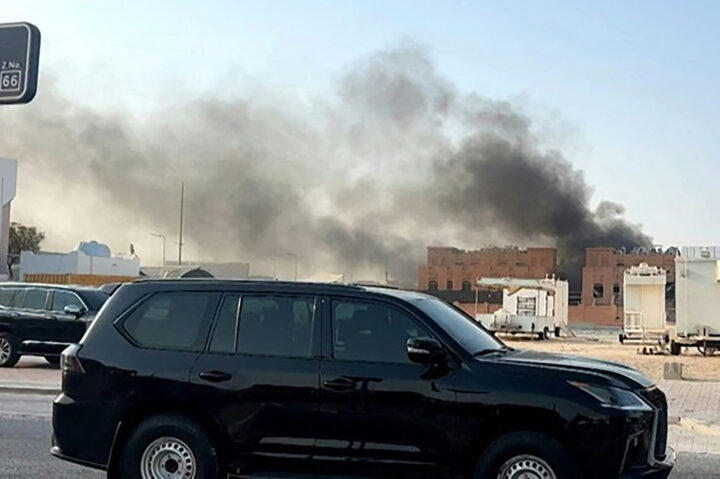
This frame grab taken from an AFPTV footage shows smoke billowing after explosions in Qatar's capital Doha on September 9, 2025.
Good Wednesday morning.
In today’s Daily Kickoff, we report the latest on the Israeli strike targeting senior Hamas officials in Doha, and look at how Capitol Hill is responding to the operation. We report on Texas state Rep. James Talarico’s criticism of Israel following the launch of his Senate campaign, and talk to friends of Israeli hostages Gal and Ziv Berman, who are marking the twins’ second birthday in Hamas captivity. Also in today’s Daily Kickoff: Elizabeth Tsurkov, Scarlett Johansson and Amb. Mark Wallace.
Today’s Daily Kickoff was curated by Jewish Insider Executive Editor Melissa Weiss and Israel Editor Tamara Zieve, with assists from Marc Rod and Danielle Cohen-Kanik. Have a tip? Email us here.
What We’re Watching
- We’re keeping an eye on the situation in the Middle East and Washington following Israel’s targeting of senior Hamas officials in Doha yesterday. More below.
- The California Senate’s Education Committee is holding a hearing this afternoon on AB 715, legislation meant to address antisemitism in the state’s K-12 schools. One of the legislators supporting the bill told The Jewish News of Northern California that the text had become “narrower” after the bill’s backers “compromised on numerous things with our colleagues who expressed concerns” over the legislation.
- Yeshiva University’s Rabbi Ari Berman will serve as the Senate’s guest chaplain today. C-SPAN’s Howard Mortman, author of When Rabbis Bless Congress, notes that Berman, who delivered the benediction at President Donald Trump’s inauguration earlier this year, will become the third rabbi to have prayed both in Congress and during a presidential inauguration.
- Elsewhere on Capitol Hill today, the House Committee on Education and the Workforce’s subcommittee on early childhood, elementary and secondary education is holding a hearing on antisemitism in K-12 schools. The Foundation for Defense of Democracies’ Brandy Shufutinsky, the Louis D. Brandeis Center for Human Rights Under Law’s Rachel Lerman, Defending Education’s Nicole Neily and T’ruah’s Rabbi Jill Jacobs are slated to testify.
- Brandeis University is unveiling its “New Vision for American Higher Education” this afternoon at the National Press Club. Sen. Ed Markey (D-MA) is slated to speak at the event. Across town, Sen. Ted Cruz (R-TX) is speaking at a Heritage Foundation event focused on the Muslim Brotherhood.
- The American Jewish Committee is holding an event this morning marking the upcoming fifth anniversary of the signing of the Abraham Accords.
- This afternoon, the Jewish Democratic Council of America is hosting “Israel and Gaza: Two Years Later and What Comes Next” with Israel Policy Forum’s Michael Koplow.
- Elsewhere in DC, the National Union for Democracy in Iran and MEAD are continuing their conference in Washington today.
- Some MEAD attendees are heading to Israel for the Jefferies TechTrek conference in Tel Aviv, which kicked off with a welcome reception last night. Former U.S. Ambassador to Israel Tom Nides, Paul Singer, Bill Ackman, Shaun Maguire and Dan Loeb are among those gathered for Jefferies.
- The Climate Solutions Prize Tour kicks off today in the United Arab Emirates, before moving to Israel on Sunday.
- Israeli President Isaac Herzog arrived in London today for a two-day visit.
- In Canada, “The Road Between Us,” about Israeli Maj. Gen. (res.) Noam Tibon’s efforts to rescue his son’s family from their Gaza envelope home on Oct. 7, 2023, will premiere at the Toronto International Film Festival, after it was previously removed from the slate of films over what organizers said was a failure to get Hamas to approve the use of its videos of the attacks.
- In Pennsylvania, representatives from the Jewish Federation of Greater Pittsburgh will deliver a victim impact statement at the sentencing of Talya Lubit, who pleaded guilty in May to charges of conspiracy and defacing and damaging Chabad of Squirrel Hill.
What You Should Know
A QUICK WORD WITH JI’S MELISSA WEISS AND Lahav harkov
Nearly a day after an Israeli airstrike targeted a meeting of high-level Hamas officials in Doha, Qatar, there are more questions than answers, both in Jerusalem and Washington. Israel has not confirmed which officials were killed in the strike, while Hamas has said that five officials from the group, including the son of Hamas’ chief negotiator, Khalil al-Hayya, were killed in addition to a member of the Qatari security forces.
Israeli reports earlier today indicate that the strike did not kill the most senior echelon of the terror group, which for years has been based in Qatar, a U.S. ally.
Amid ongoing uncertainty over the success of the strike, the operation was met with rare condemnation from the White House, first from Press Secretary Karoline Leavitt and then from President Donald Trump himself, who said he “was very unhappy about it, very unhappy about every aspect” — perhaps, in part, because the operation is not believed to have taken out the most senior Hamas officials.
But it was Trump himself who said over the weekend on his Truth Social site that he had “warned Hamas about the consequences of not accepting” the ceasefire and hostage-release deal that had been put forward by the U.S.
At the same time that Trump officials, including the president, were criticizing the operation, U.S. Ambassador to Israel Mike Huckabee was embracing Israeli Prime Minister Benjamin Netanyahu at the U.S. Embassy’s belated Independence Day celebration in Jerusalem, where the prime minister addressed a smaller group of VIPs attending the party.
HILL REACTIONS
Partisan divide emerges over Israeli strike on Hamas leadership in Qatar
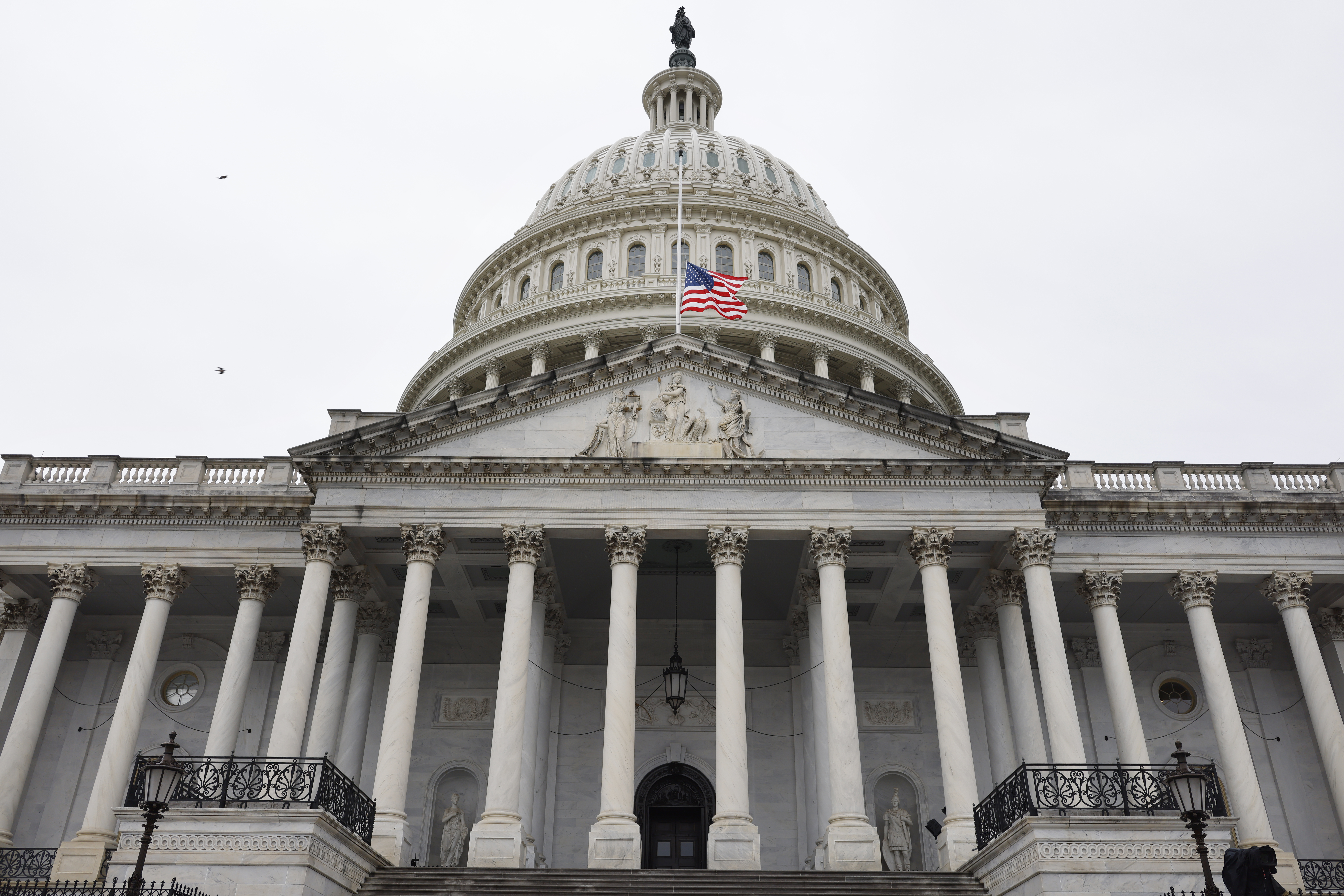
A partisan divide quickly emerged Tuesday over the Israeli strike on Hamas leadership in Qatar, with senior Republican lawmakers expressing support for the attack, while top Democrats criticized it, Jewish Insider’s Marc Rod reports.
What they’re saying: Sen. Roger Wicker (R-MS), the chair of the Senate Armed Services Committee, told JI, “I support it.” He continued, “I think Hamas has got to be destroyed, and there’s no sense in doing half measures.” But Wicker’s Democratic counterpart, Sen. Jack Reed (D-RI), called the strike “extremely disruptive, provocative and dangerous” and a “great strategic mistake.” He praised Qatar as “a strong ally of the United States” and argued that the strike, which targeted Hamas leaders who were part of negotiations with the U.S. and Israel, showed that Israel is not serious about reaching a ceasefire deal.
doha debate
Senate Republicans address differences with White House over Israel’s Doha strike
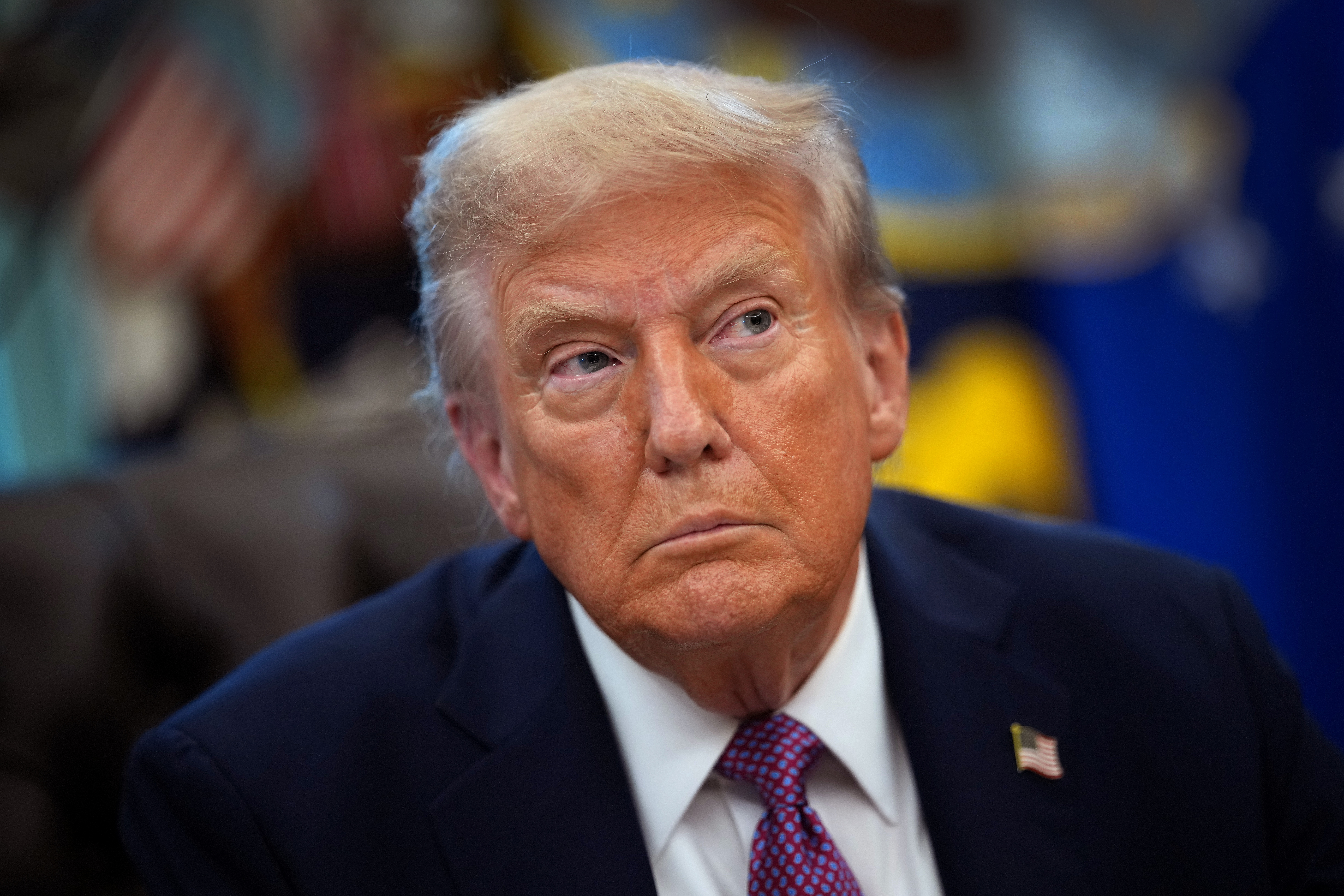
The Israeli strike targeting Hamas leaders in Qatar is dividing the White House, which strongly criticized Israel for attacking Qatari territory, and Senate Republicans, who have been overwhelmingly supportive of the Israeli action, Jewish Insider’s Marc Rod and Emily Jacobs report.
Divisions: Sen. Lindsey Graham (R-SC), asked about the White House statement on the attack, told JI, “I understand we have troops there, but my focus is Israel. Hamas has had every chance. … Lay down your weapons, release the hostages — you live. If you don’t — it keeps going.” Sen. Roger Marshall (R-KS), the most outspoken supporter of Qatar among Senate Republicans, stood alone in offering a full-throated criticism of the Israeli strike.
Breaking rank: Breaking with many of his Senate Democratic colleagues, Sen. Richard Blumenthal (D-CT) sounded a supportive note on the Israeli strike on Hamas leaders in Qatar on Tuesday. “I strongly support Israel’s right to defend itself against Hamas,” Blumenthal told Jewish Insider’s Marc Rod. “I want to know more about the details of this particular strike — I’m learning about it in real time and anything done to destroy Hamas’ leadership or its terrorist capability or military capacity is a step in the right direction.”
HOSTAGE RELEASE
Elizabeth Tsurkov released after months of torture by Iraqi terror group, Trump says

President Donald Trump announced Tuesday that Elizabeth Tsurkov, an Israeli-Russian researcher at Princeton University, was released by an Iranian-backed terrorist group in Iraq to the U.S. Embassy in Baghdad, Jewish Insider’s Marc Rod reports.
What he said: “I am pleased to report that Elizabeth Tsurkov, a Princeton Student, whose sister is an American Citizen, was just released by Kata’ib Hezbollah (MILITANT Hezbollah), and is now safely in the American Embassy in Iraq after being tortured for many months,” Trump said on Truth Social. “I will always fight for JUSTICE, and never give up. HAMAS, RELEASE THE HOSTAGES, NOW!”
Talarico talk
Texas Democratic Senate recruit James Talarico takes critical view of Israel

James Talarico, a Democratic state representative in Texas seen as a rising star in his party, launched a campaign for Senate on Tuesday, joining a crowded primary to claim the seat held by veteran Sen. John Cornyn (R-TX). The 36-year-old former public school teacher, who has studied to become a Presbyterian minister, has drawn national attention for openly embracing his Christian faith to connect with voters. In his launch video, he referred to Jesus, invoking him as “a barefoot rabbi who gave two commandments: love God and love neighbor,” Jewish Insider’s Matthew Kassel reports.
Israel approach: Talarico, who is calling for a generational shake-up in a party he sees as largely out of touch with voter concerns, until this week had no apparent record of public commentary on Middle East policy, a subject that is likely to stir debate in the upcoming election cycle amid Democratic divisions over Israel’s war in Gaza. In interviews published on Tuesday, he indicated that he would adopt a more critical approach to Israel, calling the war a “moral disaster” that his party has failed to address. “One of the primary reasons that the Democratic Party lost young voters in particular last election was our party’s failure to recognize the moral disaster in Gaza, and I hope that we have leaders who recognize that mistake,” he said in comments to Punchbowl News that were echoed in an interview with The Washington Post.
CAMPUS BEAT
Faculty and staff drive antisemitism on college campuses, ADL/AEN survey finds
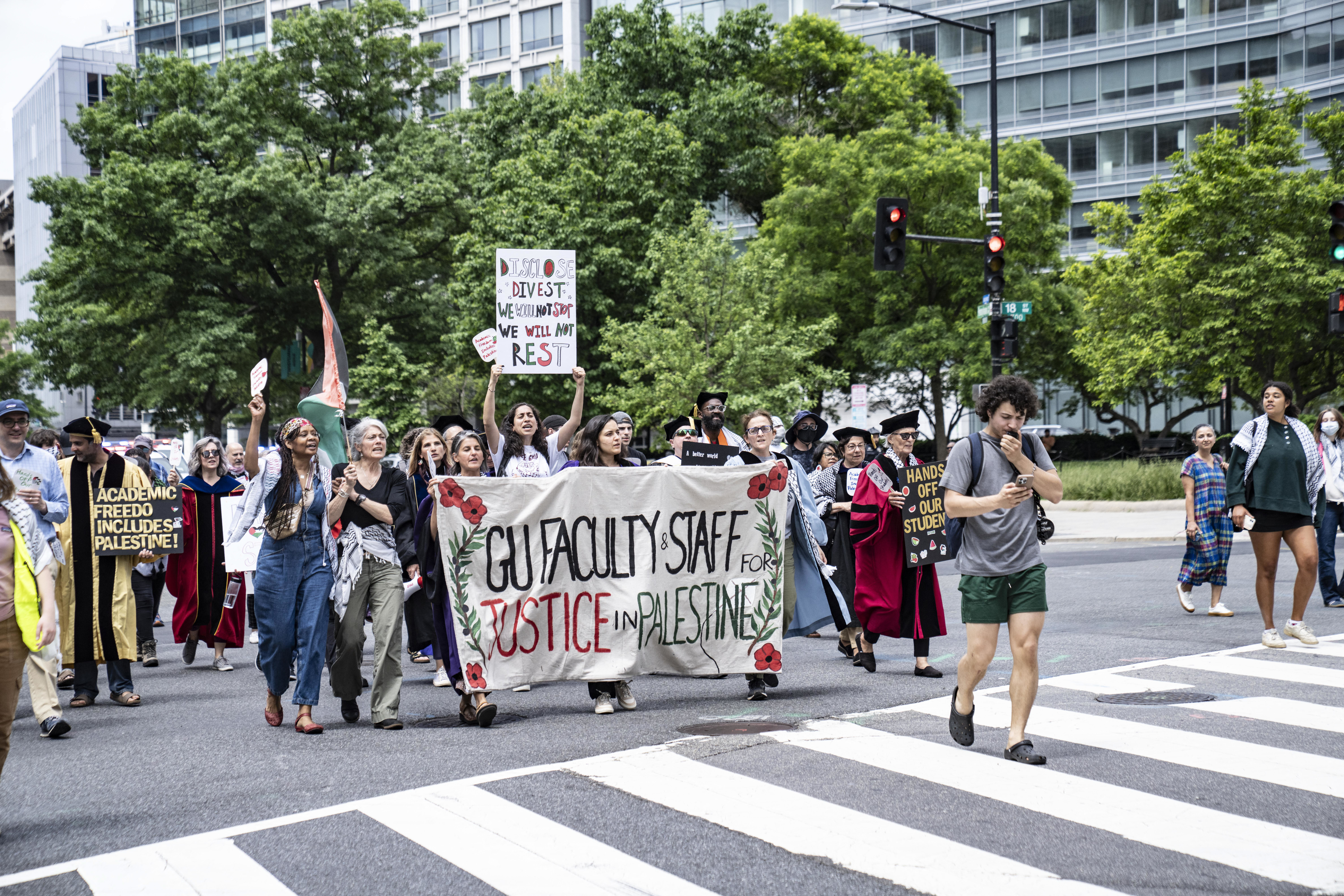
Much of the antisemitism on college campuses is fueled by faculty and staff — both on campus and within professional academic organizations — according to a survey released on Wednesday by the Anti-Defamation League and the Academic Engagement Network. Seventy-three percent of the 209 Jewish faculty members polled from universities around the U.S. reported observing antisemitic activities or statements from faculty, administrators or staff on campuses, including calls to boycott Israel and doxxing campaigns. Forty-four percent said they were aware of an organized Faculty for Justice in Palestine chapter on their campus, Jewish Insider’s Haley Cohen reports.
Testimony: “My chair is pro-Hamas (explicitly so) and has turned our department into an encampment, full of ‘river to the sea’ slogans and propaganda,” an anonymous faculty member shared in the survey. “When I and a few other Jewish faculty objected, the chair organized about 50 people to verbally attack us, including one who told me that we had all the money and power. Consequently, my department is a hostile work environment, and I can no longer attend events or participate in departmental life there.”
SOMBER DAY
‘We won’t normalize it’: Friends of Ziv and Gali Berman mark twins’ 28th birthday in Hamas captivity
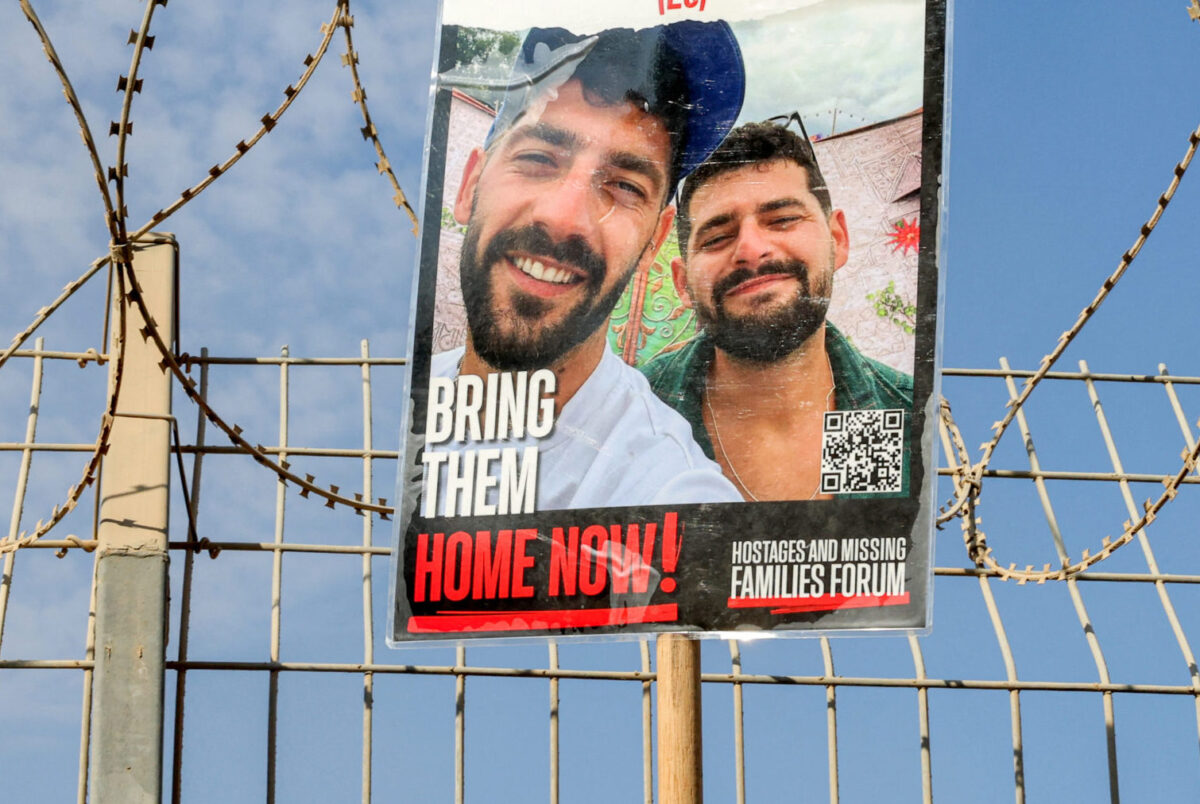
As Israeli twins Ziv and Gali Berman mark their 28th birthday in captivity on Wednesday — their second since being kidnapped to Gaza from Kibbutz Kfar Aza during the Hamas-led terror attacks of Oct. 7, 2023 — their close-knit group of friends is quietly commemorating the day while continuing their public campaign for the brothers’ release. Known to their loved ones as inseparable, Ziv and Gali are not only the best of friends but also deeply connected to — and the center of — their childhood circle in Kfar Aza. Ziv, the more quiet and reserved twin, and also the funny one, and Gali, the loud, extroverted and charming one, complement one another and gravitate toward each other, friends say. But testimonies from released hostages suggest that the two have been separated from each other while in captivity, Jewish Insider’s Tamara Zieve reports.
Friends reflect: Their birthday, said Inbar Rosenfeld, a lifelong friend of the twins, “makes us stop for a moment and remember, and get a sense of the time that they haven’t been here — and this is the second birthday [in captivity.]” Rosenfeld told JI on Tuesday, “It’s crazy, it’s tough — we never thought we would get to this situation.” Ido Felus, another close friend of the twins from Kfar Aza, said that their second birthday in captivity fills him with a mix of pain and perseverance. “I am sure they are coming back, I have no doubt of that,” Felus told JI.
Another birthday in captivity: Another Israeli hostage, Yosef Haim Ohana, is also marking his second birthday, his 25th, in captivity in Gaza today. Ohana was kidnapped from the Nova music festival on Oct. 7 after he chose to stay and help the wounded instead of fleeing. “On your 25th birthday, we gather not to celebrate, but to remember, to pray, and to amplify your voice until you come home. Let us surround Yosef with love, with faith, and demand: bring them all home now,” his father, Avi Ohana, said in a message.
Worthy Reads
Empty Gestures: The New York Times’ Bret Stephens considers the ramifications of the “gesture politics” that politicians and activists engage in around the Israel-Palestinian conflict. “What, then, do these gestures accomplish? The legitimate needs of the Palestinian people are these: an end to this war; an end to being dragged into future wars by Hamas; an end to the chronic misgovernance of the Palestinian Authority; the establishment of a self-governing political order that improves the lives of Palestinians without endangering the lives of Israelis; the eventual creation, under conditions of mutual trust, of a Palestinian state. Immediate recognition of such a state advances none of this. It is the proverbial cart before the horse. France and its fellow travelers aren’t aiming to do much to help actual Palestinians. Mainly, they seek to congratulate themselves. Countries achieve irrelevance when moral onanism takes the place of serious policy as the principal instrument of national policy.” [NYTimes]
Bullish Economy: In The Wall Street Journal, Nimrod Sapir considers why Israel’s economy has “defied expectations and displayed remarkable resilience” over nearly two years of war and growing international isolation. “Demographics further bolster Israel’s prospects: a growing, youthful labor force. Israel has the highest population growth rate among Organization for Economic Cooperation and Development countries, and that growth goes far beyond the Haredi and Arab sectors. Surging global demand for Israeli defense systems likewise strengthens the export base and opens new markets. Israel’s military achievements — particularly in neutralizing Iran’s nuclear ambitions and diminishing threats from its proxies — are reshaping the geopolitical landscape. For the first time in decades, investors can anticipate a gradual easing of geopolitical risks that have long weighed heavily on Israel’s economic potential.” [WSJ]
New Stage of War: The Free Press‘ Jay Solomon spotlights Qatar’s years of engaging in “one of the Middle East’s most dangerous games of double-dealing” by hosting Hamas officials as it benefits from its allyship with Western nations. “Israel’s attack on Qatari soil, and the U.S.’s connivance, marks the crossing of another boundary in the Jewish state’s two-year war with Hamas, sparked by the October 7 attack. … Israel’s attack inside Qatar may open a new chapter of direct conflict between Netanyahu’s government and the Al Thanis, though likely not involving their militaries. Qatar is one of the world’s richest nations per capita and possesses vast resources to challenge the legitimacy of the state of Israel through Doha’s global media operations, including the Al Jazeera television network and support for international bodies like the United Nations and the International Criminal Court.” [FreePress]
Word on the Street
Reps. Mike Lawler (R-NY) and Ritchie Torres (D-NY) wrapped up a bipartisan delegation to Italy, Tunisia and Morocco…
Democrat James Walkinshaw is won the special election in Virginia’s 11th Congressional District, succeeding Rep. Gerry Connolly (D-VA), who died earlier this year and for whom Walkinshaw served as chief of staff until 2019…
Syrian President Ahmad al-Sharaa is slated to travel to the U.S. for the U.N. General Assembly later this month; al-Sharaa, who will speak to the gathering on Sept. 24, is expected to meet with President Donald Trump on the sidelines of the annual confab…
Northwestern University announced the hiring of Henry Bienen to succeed outgoing President Michael Schill; Bienen previously led the school from 1995-2009, during which time he spearheaded the launch of Northwestern’s campus in Qatar…
The FBI is investigating threats made to several Pittsburgh-area Jewish organizations, including the Tree of Life…
Police in Oregon are searching for an individual who spray-painted swastikas on the Oregon Jewish Holocaust Museum earlier this summer…
Actress Scarlett Johansson said she intentionally cast Holocaust survivors in “Eleanor the Great,” her directorial debut, about an elderly American Jewish woman who assumes the childhood storyline of a deceased friend who had survived the Holocaust…
United Against Nuclear Iran CEO Mark Wallace sent a letter to the head of the U.S.-based Marriott International, inquiring about the hotel chain’s hosting of Hamas officials at the Ritz Carlton in Doha, Qatar…
The Wall Street Journal reports that Turkey and Egypt warned Hamas officials abroad in recent weeks to tighten security measures around their meetings…
Spain banned Israeli National Security Minister Itamar Ben-Gvir and Finance Minister Bezalel Smotrich, amid rising tensions between Jerusalem and Madrid over the war in Gaza and a Spanish arms embargo on Israel…
Former National Security Council staffer Oliver North quietly married his former secretary, Fawn Hall, nearly four decades after the Iran-Contra affair both were involved in…
The son of a British couple detained since January in Iran said his parents’ situation is “dire” following their meeting with the British ambassador in Tehran…
The International Atomic Energy Agency reached an agreement with Iran to resume inspections of the country’s nuclear facilities, three months after cooperation ceased amid the 12-day Israel-Iran war…
Zachary Isakowitz, who previously worked at the Semiconductor Industry Association as head of government affairs and at the Treasury, is joining Nvidia as a director of government affairs.
Pic of the Day

U.S. Ambassador to Israel Mike Huckabee (on guitar) and Paul Singer (on keyboard) jammed out to Chuck Berry’s “Johnny B. Goode” at the embassy’s belated Independence Day celebration last night at the Museum of Tolerance Jerusalem.
Birthdays
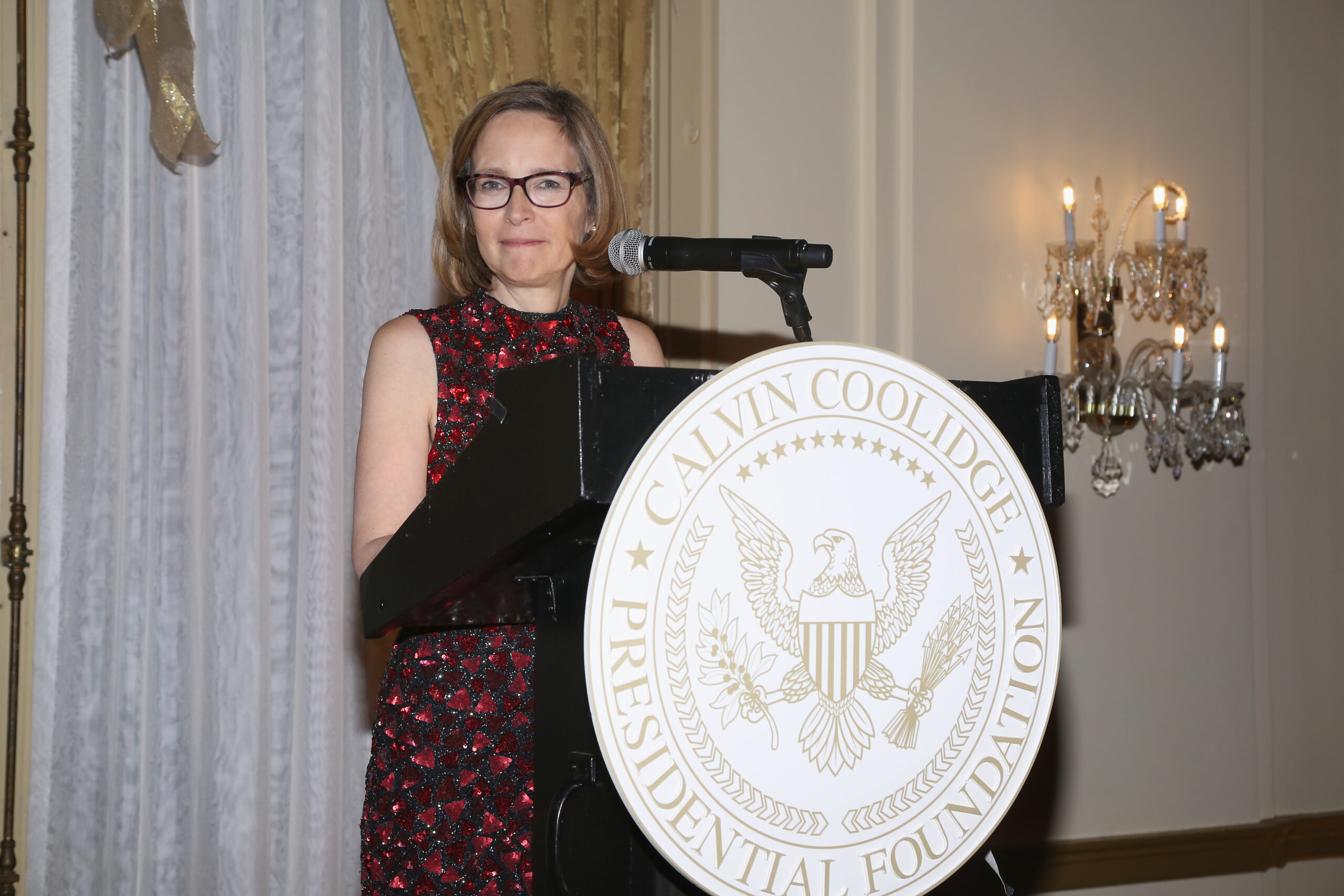
Writer, columnist and author of four New York Times bestsellers, Amity Ruth Shlaes turns 65…
Chairman of Shamrock Holdings, Roy Disney’s private investment company, Stanley Gold turns 83… Retired realtor in Southern California, Dianne Varon… Former EVP and general counsel at Chicago’s futures broker Rosenthal Collins Group, Gerald Fishman… Past president of Congregation Ahavas Israel in Passaic, N.J., Howard Penner… Retired coordinator at Truman Heartland Community Foundation, she had been a Hebrew teacher at Congregation Beth Torah in Overland Park, Kan., Henri Goettel… Houston attorney, and Republican Party activist, Gary M. Polland turns 75… Denver attorney and politician, he served in the Colorado House of Representatives for eight years, Joel Judd turns 73… Executive assistant to the office managing partner of the E&Y office in Tampa, Nancy Carol Finkel… U.S. senator (R-WY), Cynthia Lummis turns 71… Retired VP at Goldman Sachs, now a part-time elementary school teacher, Matthew Fried… Real estate attorney in South Florida, Steven A. Greenspan… Award-winning journalist and author, he wrote a 2024 book on Bernie Madoff, Richard Behar… Former acting administrator of the DEA, now a senior counsel at D.C.’s Crowell & Moring, Charles Philip “Chuck” Rosenberg turns 65… Founder and managing director at Beacon Global Strategies, Andrew Shapiro… NYC trusts and estates attorney, Lawrence Ira Garbuz… Co-founder and partner of One Madison Group, Jonathan Soros turns 55… Television writer and producer whose work includes “The Big Bang Theory,” Eric Kaplan turns 54… Executive director of the Maryland/Mid-Atlantic region of Agudath Israel, Ariel Sadwin… Writer, actress and comedian, she was a writer for “Saturday Night Live,” Sarah Schneider turns 42… Principal at Blue Zone Partners and managing partner at Precision Infrastructure Management, Charles Szold… PR strategist, Josh Nass… Chief foreign correspondent for Fox News, his 2024 book, Black Saturday, covers the events of Oct. 7 and the war that followed, Trey Yingst turns 32… Jennifer Meyer…
As conflicting accounts emerge about the strike’s outcome, Trump voices frustration while Netanyahu says the operation could bring the war in Gaza closer to an end
JACQUELINE PENNEY/AFPTV/AFP via Getty Images
This frame grab taken from an AFPTV footage shows smoke billowing after explosions in Qatar's capital Doha on September 9, 2025.
Nearly a day after an Israeli airstrike targeted a meeting of high-level Hamas officials in Doha, Qatar, there are more questions than answers, both in Jerusalem and Washington. Israel has not confirmed which officials were killed in the strike, while Hamas has said that five officials from the group, including the son of Hamas’ chief negotiator, Khalil al-Hayya, were killed in addition to a member of the Qatari security forces.
Israeli reports earlier today indicate that the strike did not kill the most senior echelon of the terror group, which for years has been based in Qatar, a U.S. ally.
Amid ongoing uncertainty over the success of the strike, the operation was met with rare condemnation from the White House, first from Press Secretary Karoline Leavitt and then from President Donald Trump himself, who said he “was very unhappy about it, very unhappy about every aspect” — perhaps, in part, because the operation is not believed to have taken out the most senior Hamas officials.
But it was Trump himself who said over the weekend on his Truth Social site that he had “warned Hamas about the consequences of not accepting” the ceasefire and hostage-release deal that had been put forward by the U.S.
At the same time that Trump officials, including the president, were criticizing the operation, U.S. Ambassador to Israel Mike Huckabee was embracing Israeli Prime Minister Benjamin Netanyahu at the U.S. Embassy’s belated Independence Day celebration in Jerusalem, where the prime minister addressed a smaller group of VIPs attending the party.
“Israel acted wholly independently and we take full responsibility for this action,” Netanyahu said of the Doha strikes. “This action can open to an end of the war in Gaza.”
Israeli officials and defense sources said on Wednesday that they are waiting for better intelligence before commenting on who was killed, but they viewed the operation as a success.
Israeli Defense Minister Israel Katz warned that there could be additional strikes of this kind: “The long hand of Israel will act against its enemies anywhere in the world. There is no place where they can hide. Whoever was a partner in the Oct. 7 massacre will be fully brought to justice.”
Everyone from Israeli Opposition Leader Yair Lapid to Finance Minister Bezalel Smotrich put out statements praising the IDF and Shin Bet and saying the terrorists got what they deserved.
At the same time, the Hostages and Missing Families Forum said the affiliated families felt “deep concern and heavy anxiety” that their loved ones would pay the price. “We know from survivors who have returned that the revenge directed at the hostages is brutal. The chance of bringing them back now faces greater uncertainty than ever before.”
However, Shimon Or, uncle of hostage Avinatan Or, said on Kan radio that “this action brings us closer to bringing Avinatan and the rest of the hostages. …We will not bring back the hostages anymore with military operations and ‘the gates of hell,’ but with control over Gaza.”
Meanwhile, Israeli officials have pushed back on criticism that the strikes would affect ceasefire talks, briefing press in Hebrew and English that the operation will help talks, because there are other channels for negotiations.
Many prominent Senate Democrats have criticized the strike

Jemal Countess/Getty Images for Fair Share America
Sen. Richard Blumenthal speaks at a rally at the Capitol on April 10, 2025 in Washington, DC.
Breaking with many of his Senate Democratic colleagues, Sen. Richard Blumenthal (D-CT) sounded a supportive note on the Israeli strike on Hamas leaders in Qatar on Tuesday.
“I strongly support Israel’s right to defend itself against Hamas,” Blumenthal told Jewish Insider. “I want to know more about the details of this particular strike — I’m learning about it in real time and anything done to destroy Hamas’ leadership or its terrorist capability or military capacity is a step in the right direction.”
Many prominent Senate Democrats have criticized the strike, saying it undermines negotiations for a ceasefire and that it should not have been carried out in Qatari territory. The White House expressed a similar view, breaking with top Senate Republicans who have been supportive of the Israeli attack.
Sen. John Fetterman (D-PA) was the only other Senate Democrat who has publicly been supportive of the Israeli action.
White House Press Secretary Karoline Leavitt: ‘Unilaterally bombing inside Qatar … does not advance Israel or America’s goals’
SAUL LOEB/AFP via Getty Images
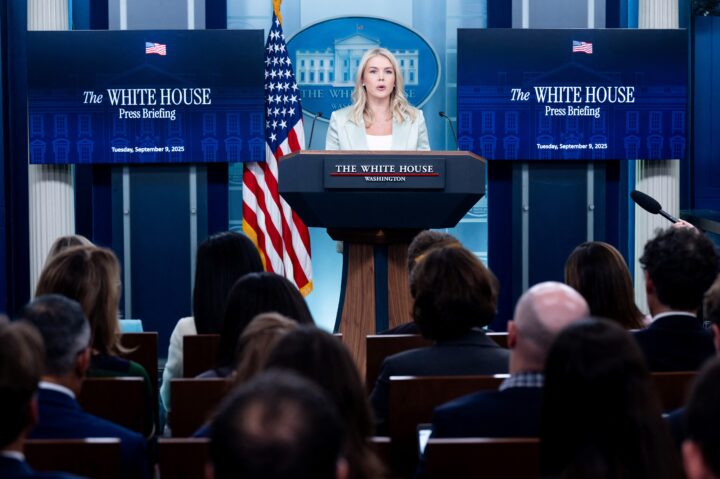
White House Press Secretary Karoline Leavitt speaks during a press briefing in the Brady Briefing Room of the White House in Washington, DC, on September 9, 2025.
In a prepared statement on behalf of President Donald Trump, White House Press Secretary Karoline Leavitt on Tuesday criticized the Israeli strike on Hamas leaders in Qatar and expressed regret that it had taken place in Doha, adding that the U.S. had warned Qatar about the strike when the U.S. itself became aware.
She said Trump had also vowed to Qatari leaders that such an attack would not be repeated in Qatari territory.
“This morning, the Trump administration was notified by the United States military … as Israel was attacking Hamas, which very unfortunately was located in a section of Doha, the capital of Qatar,” Leavitt said. “Unilaterally bombing inside Qatar, a sovereign nation and close ally of the United States that is working very hard and bravely taking risks with us to broker peace, does not advance Israel or America’s goals.”
Pressed repeatedly on whether Israel had notified the U.S. about the attack, as some reports indicated, or whether the U.S. military had detected it independently, Leavitt did not specify, repeating only that the U.S. military had notified the White House.
She said that Trump “immediately directed” Middle East envoy Steve Witkoff to notify Qatar about the upcoming attack when the administration learned about it.
“The president views Qatar as a strong ally and friend of the United States and feels very badly about the location of this attack,” Leavitt continued.
She did add, however, that the administration views eliminating Hamas as “a worthy goal.”
Asked whether Trump would impose “consequences” on Israeli Prime Minister Benjamin Netanyahu for the strike or provide a “directive … to Netanyahu in terms of what’s allowed in the future,” Leavitt said that “that’s a decision only the president can make.”
Leavitt said that Trump had spoken to Qatari Emir Tamim bin Hamad Al Thani, Prime Minister Mohammed bin Abdulrahman Al Thani and Netanyahu after the attack.
She said the president “assured [the Qatari leaders] that such a thing will not happen again on their soil” and thanked Qatar for “their support and friendship to our country.”
She said that both Trump and Netanyahu agreed that they want to make peace quickly and said Trump “believes this unfortunate incident could serve as an opportunity for peace,” and that Trump had conveyed his displeasure about the location of the strike to Netanyahu.
“He expects all of our friends and allies in the region — that includes both Qatar and Israel — to seek peace as well, and he wants to see that happen, and he’s working with all of our allies in the region to get that done,” Leavitt said.
Leavitt denied that Trump’s post on social media over the weekend offering a “last warning” to Hamas to accept a ceasefire deal was a reference to the impending Israeli attack.
The White House’s expressed concern about the location of the attack puts the administration at odds with many senior members of Trump’s own party in the Senate, who were quick to express support for the Israeli attack, and aligns more closely with top Senate Democrats who have been more critical of the attack and where it took place.
Asked about the White House’s opposition to the strike, multiple Senate Republicans who had earlier in the day expressed support for the Israeli attack declined to comment.
Meanwhile, Sen. Chris Coons (D-DE) said, “I will actually agree with President Trump that it doesn’t advance our interests in terms of advancing negotiations for the release of hostages or the ceasefire that is urgently needed in Gaza.”
“I have not gotten any briefing on the details of how it was approved, whether or not the Trump administration was aware and supported it, but in the middle of a hostage negotiation that is urgently needed to free the hostages, to end the fighting, to deliver humanitarian relief and to address Hamas — to take a strike in Doha against Hamas leaders, I think puts at risk any peace process,” Coons said. He added that he wants to be briefed on further details.
Top Senate Republicans are supporting the Israeli attack in Doha while senior Democrats are criticizing it

Kevin Carter/Getty Images
U.S. Capitol Building on January 18, 2025 in Washington, DC.
A partisan divide quickly emerged Tuesday over the Israeli strike on Hamas leadership in Qatar, with senior Republican lawmakers expressing support for the attack, while top Democrats criticized it.
Republican lawmakers largely characterized the strike as justified and unsurprising given the Hamas leaders’ responsibility for the Oct. 7, 2023, attacks on Israel, while Democrats argued that the strike compromised the ability to negotiate with Hamas officials for a ceasefire and should not have been carried out in the territory of a U.S. ally.
Sen. Roger Wicker (R-MS), the chair of the Senate Armed Services Committee, told Jewish Insider, “I support it.”
“I think Hamas has got to be destroyed, and there’s no sense in doing half measures,” Wicker continued.
Sen. James Risch (R-ID), the chair of the Senate Foreign Relations Committee, told JI that the strike was “not surprising.”
“Any member of Hamas who had anything to do with the invasion of Israel is in jeopardy, it’s a given,” Risch said. “Is now, always has been.”
He said he does not see the strike as having any broader implications for the U.S. relationship with Qatar.
Sen. Mike Rounds (R-SD) suggested that similar attacks on Hamas leaders may continue.
“Hamas is a terrorist organization. Israel has been focused on taking out that terrorist organization. These are the folks that Israel firmly believes were directly responsible for the Oct. 7 attacks,” Rounds said. “I think we’re going to see Israel continue to go after those individuals that are accountable for that terrorist activity.”
Sen. Pete Ricketts (R-NE) said that “Qatar has been told they probably ought not to harbor terrorist organizations, so Israel is going to defend itself and take out terrorist organizations.”
Sen. Ted Cruz (R-TX) said the strike shows that “Israel is serious about defending itself and taking out the terrorists.”
Sen. Lindsey Graham (R-SC) posted on X, “To those who planned and cheered on the October 7 attack against Israel, the United States’ greatest ally in the region: This is your fate.”
Senate Democrats took a starkly different perspective.
Sen. Jack Reed (D-RI), the ranking member of the Senate Armed Services Committee, called the strike “extremely disruptive, provocative and dangerous” and a “great strategic mistake.”
“Qatar has been a strong ally of the United States, one of our biggest bases in the region is there. … They, in fact, took a rocket attack after Iran tried to hit our troops at Al Udeid. They’ve provided significant financial support to our efforts in the Middle East,” Reed told JI, referring to retaliatory strikes by Iran on the U.S. airbase in Doha after the U.S. attacked its nuclear facilities in June.
He also argued that the strike, which targeted Hamas leaders who were part of negotiations with the U.S. and Israel, showed that Israel is not serious about reaching a ceasefire deal. A Hamas official on Monday publicly rejected the latest ceasefire proposal sponsored by the U.S., along with others.
“The Hamas representatives are there for at least some type of discussion about a ceasefire, and the signal I think that [Israeli Prime Minister Benjamin] Netanyahu [sends] is ‘I don’t want a ceasefire under any terms.’ So those hostages continue to languish,” Reed said.
Sen. Jeanne Shaheen (D-NH), the ranking member of the Senate Foreign Relations Committee, said at a Council on Foreign Relations event on Tuesday that “it’s unfortunate that Israel bombed in Doha, one of our allies.”
“I understand that they were going after one of the Hamas leaders — and we all agree that Hamas should be eliminated — but we have to be thoughtful about escalating things in a way that [isn’t] helpful, especially when we’ve got this opportunity in the region.”
Sen. Mark Kelly (D-AZ) called the Israeli strike “rather aggressive.”
“Hamas is a terrorist organization but Qatar often hosts the political side of the organizations so there is some avenue for communication,” Kelly told JI. “And they’re an ally of ours. It’s an aggressive thing to do, but I haven’t seen the details yet.”
Sen. Tim Kaine (D-VA) offered a somewhat more nuanced view, acknowledging to JI that it’s “been enormously frustrating for the Israelis and the U.S. that Qatar has sheltered Hamas.”
“But every once in a while, they have been an effective intermediary on things like hostages. So exactly what was the decision-making about why this was the right move now, I’m interested to know it,” Kaine said. “Until I get an answer to that, I’m probably not going to opine about it. But I understand the serious frustration with what Qatar has done with Hamas. I just need to know more.”
Several other Democrats including Sens. Elissa Slotkin (D-MI), Ruben Gallego (D-AZ) and Adam Schiff (D-CA) declined to comment, saying they needed more information before discussing the attack, as did Sen. John Barrasso (R-WY), the No. 2 Senate Republican.
Sen. John Fetterman (D-PA) was the only Senate Democrat who full-throatedly supported the strike, posting a gif on X of a smiling, dancing Winnie the Pooh.
The image, Fetterman told JI, “sums it up. Just like the beepers” — a reference to the Israeli attack on Hezbollah officials in Lebanon a year ago. “I love it. Hold them [Hamas] accountable.”
The Pennsylvania senator suggested tariffs, visa sanctions and restricting Norway’s market access should be ‘on the table’

Israel on Campus Coalition/X
Rep. Dave McCormick (R-PA) speaks at the ICC National Leadership Summit in Washington on July 29, 2025.
Sen. Dave McCormick (R-PA) wrote to top trade officials in the Trump administration urging them to take action to respond to the decision by the Norges Bank Investment Fund, Norway’s sovereign wealth fund, to divest from U.S. equipment firm Caterpillar because of the Israeli military’s use of its products in the West Bank and Gaza.
“As the Trump Administration continues to take bold action to rebalance global trade, I urge you to also address the disturbing politicization of sovereign wealth fund investment decisions against American companies,” McCormick said in a letter, sent Thursday, to Commerce Secretary Howard Lutnick and U.S. Trade Representative Jamieson Greer.
He called on the administration to take Norges’ moves against American companies into account in ongoing trade negotiations with Norway, calling the effort a “form of economic warfare directed by a foreign government against the U.S. economy.”
He said that “all options should be on the table to address this issue,” including tariffs, “restrictions on Norges’ access to U.S. financial markets, and visa sanctions” on those involved in moves against American companies.
McCormick served from 2020-2022 as CEO of Bridgewater Associates, which manages portions of Norges’ portfolio. Bridgewater CIO Greg Jensen addressed Norges’ 2024 investment conference.
Sen. Lindsey Graham (R-SC) called publicly for similar retaliatory action last week.
McCormick said he’d confronted Norway’s prime minister about the Caterpillar decision during a visit to the country last month, and said the prime minister had told him the decision “merely followed Norges’ ethical guidelines and was not political.”
“I respectfully disagree. While I recognize the value of Norges’ investments of nearly $1 trillion of U.S. assets, I have significant concerns that these decisions are entirely political and are driven by an agenda that has consistently targeted American companies and is explicitly anti-Israel,” McCormick continued.
McCormick emphasized that Caterpillar is a frequent target of the Boycott, Divestment and Sanctions movement targeting Israel, and noted that Norges has also previously divested from U.S. fossil fuel and defense companies — in some cases including companies that Norway itself purchases weapons systems from.
The Pennsylvania senator called on the administration to “look more broadly at instances of sovereign wealth funds adopting restrictive, unfair trade policies against U.S. companies as a result of political pressure” in other cases as well.
McCormick separately wrote to Norway’s ambassador to the United States, stating that he “remain[s] extremely concerned” by Norges’ moves against American companies, adding that he “brought this issue up directly with Prime Minister [Jonas Gahr] Støre and was unsatisfied with his response.”
The Commerce Department did not respond to a request for comment on whether it plans to address Norges’ divestment from Caterpillar.
Richard Goldberg, a senior advisor at the Foundation for Defense of Democracies and former Trump administration official, said that Norges’ decisions have a significant impact on global investment trends.
“Norges is such a large player … It moves capital markets with its decisions,” Goldberg explained. “It causes other sovereign wealth funds, pension funds to follow. It causes institutional investors to follow. It really does set trends in investment and an inversion of capital can have impacts.”
He said that Norges’ investment decisions in relation to Israel are a major political issue in Norway’s upcoming elections, and some of the left-wing parties who could become part of the next governing coalition are demanding divestment from a “laundry list” of other American companies over their relations to Israel.
Goldberg also argued that the “danger of weaponized sovereign wealth funds” both in terms of BDS efforts and other anti-American moves is an ongoing and growing issue, and that the administration should insist that sovereign wealth funds be covered in U.S. trade deals with foreign countries.
“This is a long standing attack on U.S. interests, attack on American energy companies, an attack on American defense companies and now an attack on any company that does business with the State of Israel — all of this to the detriment of our national economic security, all of it politicized by the Norwegians by a state-run, state-controlled entity” Goldberg said.
If the U.S. fails to respond, he continued, “we’re literally allowing supposed democratic allies for whom we provide a blanket of freedom the ability to conduct economic warfare against America and American interests.”
His comments came after the country’s sovereign wealth fund divested from Caterpillar over Israel’s use of its machines

Anna Moneymaker/Getty Images
Sen. Lindsey Graham (R-SC) in the Senate Judiciary Committee on January 30, 2025 in Washington, D.C.
Sen. Lindsey Graham (R-SC) on Thursday floated the possibility of punitive tariffs and visa restrictions in response to Norges Bank Investment Management’s — the Norwegian sovereign wealth fund — decision to sell its stake in the American machinery company Caterpillar in response to the Israeli military’s use of its products.
“To those who run Norway’s sovereign wealth fund: if you cannot do business with Caterpillar because Israel uses their products, maybe it’s time you’re made aware that doing business or visiting America is a privilege, not a right,” Graham said on X.
Caterpillar is a frequent target of Boycott, Divestment and Sanctions campaigns.
“Maybe it’s time to put tariffs on countries who refuse to do business with great American companies. Or maybe we shouldn’t give visas to individuals who run organizations that attempt to punish American companies for geopolitical differences,” the South Carolina senator continued. “I would urge you to reconsider your shortsighted decision.”
He had said a day prior that the decision by the Norwegian fund — the largest in the world — is “beyond offensive’ and “will not go unanswered.”
The Israeli prime minister’s statement came after President Donald Trump said he’s ‘not happy’ about the attack

Abed Rahim Khatib/picture alliance via Getty Images
A view of Nasser hospital in Gaza, that was damaged by an Israeli strike on August 25, 2025.
An Israeli strike on a Gaza hospital that reportedly killed 20 people, including four journalists, was a “tragic mishap,” Israeli Prime Minister Benjamin Netanyahu said on Monday, not long after President Donald Trump criticized the attack.
“Israel deeply regrets the tragic mishap that occurred today at the Nasser Hospital in Gaza. Israel values the work of journalists, medical staff and all civilians,” the Prime Minister’s Office said in a statement. “The military authorities are conducting a thorough investigation. Our war is with Hamas terrorists. Our just goals are defeating Hamas and bringing our hostages home.”
Trump told reporters in the Oval Office that he is “not happy” about Israel’s strike on the Nasser Hospital, in the southern Gaza Strip.
“I’m not happy about it. I don’t want to see it,” Trump said, while noting that he did not know the details of the strike.
The president added that he is also committed to getting the remaining hostages out of Gaza, though he expressed doubt that a deal would come through.
“At the same time,” he said, “we have to end that whole nightmare. I’m the one that got the hostages out. I got them out, all of them. [Middle East envoy] Steve Witkoff has been amazing.”
Israel has said that 20 living hostages are still being held in Gaza, but Trump on Monday repeated a claim that the true number is “probably a little bit less than 20, because I think one or two are gone.” Israeli officials have not said that any of the 20 hostages believed to be alive have died recently.
Hamas, Trump said, is unlikely to release the hostages.
“I said a long time ago I’m going to get them out, but when we get down to that final 10 or 20, these people aren’t going to release them, because [Hamas is] dead after they release them,” Trump said. “It’s a nasty situation, very nasty. Horrible thing.”
The Israeli Defense Forces announced that it would conduct an inquiry into the attack. “The IDF regrets any harm to uninvolved individuals and does not target journalists as such. The IDF acts to mitigate harm to uninvolved individuals as much as possible while maintaining the safety of IDF troops,” IDF international spokesperson Lt. Col. Nadav Shoshani said.
Jewish groups, Canadian politicians outraged over film festival’s cancellation of Oct. 7 documentary
American Jewish Committee: ‘Pulling a movie because footage wasn't cleared for copyright by a terror group is so ridiculous that it would almost be laughable’

Jemal Countess/Getty Images
A view of a large TIFF display on King Street during the first night of the 2024 Toronto Film Festival on September 05, 2024 in Toronto, Ontario.
Pro-Israel groups and Canadian politicians expressed outrage on Wednesday after organizers of the Toronto International Film Festival canceled an invitation to show the documentary “The Road Between Us: The Ultimate Rescue,” about the Oct. 7, 2023, Hamas terror attacks, at its upcoming festival, citing the use of Hamas footage of the attacks that had not been approved for use by the terror group.
The documentary tells the story of retired Israeli general Noam Tibon, who raced from Tel Aviv to rescue his son and two young granddaughters trapped in a safe room in Kibbutz Nahal Oz when Hamas terrorists invaded on Oct. 7.
“The Toronto International Film Festival’s reasoning for canceling the October 7 documentary screening is completely absurd and transparently dishonest,” the American Jewish Committee said in a statement. “Pulling a movie because footage wasn’t cleared for copyright by a terror group is so ridiculous that it would almost be laughable — if it weren’t so deeply, shamelessly disturbing.”
In an open letter, Creative Community for Peace, a nonprofit that mobilizes prominent members of the entertainment community to oppose boycotts of Israel, wrote that “instead of advancing peace, TIFF has chosen to amplify hate.”
“This is a surrender to an antisemitic campaign determined to silence Jewish and Israeli voices, at a time when antisemitism in Canada is surging to historic levels. Your decision has only deepened and legitimized that hostility. You claim the cancellation was for security reasons — yet anti-Israel productions face no such barrier.”
The CCFP letter continued, “You claim that the project couldn’t be screened because the filmmakers didn’t have the rights to footage Hamas — a Canadian designated terrorist group, broadcast to the world on October 7, 2023 when they massacred, raped, brutalized, and kidnaped thousands of innocent people from toddlers to Holocaust survivors — but that strains credibility.”
“By pulling this film, TIFF has silenced a story of extraordinary courage and survival,” Noah Shack, CEO of the Centre for Israel and Jewish Affairs, the advocacy arm of the Jewish Federations of Canada, said in a statement. “This shameful decision comes at a perilous time, as extremists are emboldened by recent plans by Canada and other nations to recognize Palestinian statehood.”
Toronto City Councillors James Pasternak and Brad Bradford called on the TIFF to reverse its decision.
“If TIFF does not reverse its decision, [the] Council should demand an investigation into this film banning decision,” Pasternak and Bradford said in a joint statement. “This film tells the story of a heroic rescue in the face of unimaginable violence, yet instead of defending truth and artistic freedom, TIFF appears to have yielded to political pressure and the fear of protests. Intimidation must not dictate which stories can be told. Silencing survivors and granting a listed terrorist organization any semblance of legal legitimacy is not neutrality — it is a moral failure.”
A TIFF spokesperson told Deadline that the invitation was withdrawn “because general requirements for inclusion in the festival, and conditions that were requested when the film was initially invited, were not met, including legal clearance of all footage.”
“The purpose of the requested conditions was to protect TIFF from legal implications and to allow TIFF to manage and mitigate anticipated and known risks around the screening of a film about highly sensitive subject matter, including potential threat of significant disruption.”
The 2024 TIFF festival also did not spotlight an Israeli film. Rather, it featured three anti-Israel documentaries, with four more slated for 2025. The festival is scheduled to run Sep. 4-14.
AJC statement: ‘The profound risks posed by a full military takeover of Gaza City cannot be overlooked’

Haley Cohen
Ambassador Deborah Lipstadt, U.S. special envoy to monitor and combat antisemitism, and Rabbi Andrew Baker, AJC’s director of international Jewish affairs, in conversation with AJC CEO Ted Deutch.
The American Jewish Committee, one of the leading global Jewish and pro-Israel advocacy organizations, expressed its “deep apprehension” over the Israeli Security Cabinet’s vote to move forward with a military takeover of Gaza City, in a statement released by the organization on Friday.
AJC acknowledged the “extraordinary challenges” Israel faces due to Hamas’ “intransigence” in negotiations and the “failure of the international community to impose sufficient pressure on the terrorist organization.”
“Still,” the statement read, “the profound risks posed by a full military takeover of Gaza City cannot be overlooked.” It highlighted concerns over “endanger[ing] the lives of the remaining hostages” and the possibility of “substantial casualties among both Israeli soldiers and Palestinian civilians,” in particular.
AJC called on the signatories of the New York Declaration — signed last month by dozens of countries including member states of the Arab League and European Union — to “apply maximum pressure on Hamas to agree to a hostage release and ceasefire agreement.”
Rep. Dan Goldman (D-NY): ‘It is clear that Prime Minister Netanyahu’s personal and political interests are guiding Israel’s actions, rather than what is best for the Israeli people’

Blue/Bloomberg via Getty Images
Representative Ritchie Torres, during an interview in New York, US, on Tuesday, Jan. 28, 2025.
Pro-Israel Democrats on Thursday criticized the Israeli government’s plans to expand its operations and take control of additional parts of Gaza.
The Israeli Security Cabinet early Friday approved plans to take over Gaza City, though it stopped short of Prime Minister Benjamin Netanyahu’s statement earlier Thursday to Fox News that Israel plans to occupy the entire Gaza Strip.
The plan seems to be aggravating the growing friction between the Israeli government and some of the Jewish state’s most vocal liberal backers in the United States over Israel’s ongoing war in Gaza and the humanitarian crisis in the enclave.
Rep. Ritchie Torres (D-NY) said that Israel is ultimately responsible for making its own decisions, but said he’d advise the Israeli government to seek an end to the war once it frees the hostages.
“First: the highest priority is to secure the release of the hostages who are at grave risk of dying from deliberate starvation and torture,” Torres told Jewish Insider. “Second: the war in Gaza is in danger of becoming a quagmire that bogs Israel down for years — indeed decades — to come.”
He again said the war risks becoming a long-term entanglement like the Iraq and Afghanistan wars were for the United States, costing both money and lives.
“The war fatigue and post-traumatic stress in Israeli civil society and in the Israeli military — as well as the humanitarian crisis in Gaza — have become unbearable,” Torres continued. “Israel has degraded Hamas. And so once Israel has secured the release of the hostages, it should declare victory, end the war, and focus on expanding the Abraham Accords to include relations with the likes of Saudi Arabia and Indonesia.”
Rep. Jake Auchincloss (D-MA) pushed back on suggestions by Netanyahu in his announcement of the new Gaza plan that governance would ultimately be turned over to Arab forces.
“Netanyahu said: ‘We don’t want to keep Gaza. We want a security perimeter. We want to hand Gaza over to Arab forces that will govern Gaza properly,’” Auchincloss said to JI. “My question is: What Arab force has agreed to this? What is the plan for governance? There is no evidence that either exists.”
Rep. Lois Frankel (D-FL) said that Israel should prioritize increasing humanitarian aid and protecting civilians.
“Israel has the right and responsibility to defend itself against Hamas and other terrorist threats. At the same time, I believe it is in the interest of Israel, the United States, and the entire region to prioritize efforts that protect innocent lives and stabilize the situation,” Frankel said. “That means working urgently to get food, water and medicine to civilians in Gaza while continuing to support Israel’s long-term security. I remain committed to a path that ensures the safety of the Israeli people and upholds our shared humanitarian values.”
In a lengthy statement released hours before Netanyahu’s formal announcement, Rep. Dan Goldman (D-NY) blasted both Netanyahu and the situation in Gaza, saying that Netanyahu’s decisions are being motivated by the prime minister’s self-interest, rather than Israel’s best interests. He unequivocally rejected discussion of full occupation of Gaza.
“The current crisis in Gaza shocks the conscience. The international community — especially Israel and the United States — must immediately put an end to this humanitarian catastrophe,” Goldman said. “It is clear that Prime Minister Netanyahu’s personal and political interests are guiding Israel’s actions, rather than what is best for the Israeli people or for the nation of Israel. He is beholden to the extreme right, whose support he needs to remain in power, which, in turn, is helpful to defend against his corruption case.”
Goldman continued, “To the extent a full occupation is indeed his plan, it is not only morally reprehensible, but it is also opposed by Israeli military and national security leaders as well as the Israeli people.”
He said that the international community must come together to free the hostages, end the war and surge aid into Gaza, which requires “unified international pressure on Hamas,” and said that international recognition of a Palestinian state before the hostages are released “only serves to reward” Hamas and disincentivize it from agreeing to a ceasefire and hostage deal.
“Fundamentally, Prime Minister Netanyahu must stop putting his own personal interests ahead of the state of Israel’s,” Goldman concluded. “The sacredness of human life and Israel’s sacrosanct place as a democracy and safe haven for the Jewish people are simply too important to be sacrificed on the altar of political self-interest.”
Rep. Brad Sherman (D-CA), in a new statement on Thursday, did not directly address the new Israeli plans, but said that all parties must work to “surge humanitarian aid to the people Gaza — not Hamas or criminal gangs” to the point of eliminating scarcity.
“I welcome the steps Israel has taken, including instituting humanitarian pauses and conducting airdrops of aid. However, these steps alone are not sufficient — it is clear that the current aid delivery system needs to be scaled up to adequately meet the needs in Gaza,” Sherman said. “That includes significantly increasing the number of Gaza Humanitarian Foundation’s distribution sites to prevent crowding, establishing safer distribution processes, and distributing higher quantities of aid each and every day.”
He also urged the United Nations and NGOs to “stop playing politics,” work with the GHF and distribute the food stockpiles sitting inside Gaza. And he said that those who criticize Israel without pressuring Hamas or acknowledging its starvation of hostages only encourage the terrorist group to keep fighting.
“The fastest way to alleviate the suffering of Gazans and the hostages is for Hamas to release the hostages and lay down its arms and depart for Iran or another country willing to accept them. This would pave the way for legitimate Arab-led governance and allowing Gaza to be rebuilt,” Sherman continued.
Pro-Israel Republicans, meanwhile, are supporting Netanyahu’s latest moves.
“The fastest way for this conflict to end is for Hamas to surrender and release the hostages. In the absence of that — Hamas has continually refused the terms of a ceasefire — Israel must take the necessary steps to eliminate Hamas,” Rep. Mike Lawler (R-NY), who chairs a key House subcommittee focused on the Middle East, told JI. “Simply put, there cannot be peace so long as Hamas and the Palestinian Authority remain in power. I support Israel’s decision to use all military and diplomatic means to achieve their objectives, while continuing to provide humanitarian aid and assistance to the innocent Palestinians long suffering under Hamas’ brutal oppression.”
Rep. Joe Wilson (R-SC) said in an X post he supports Netanyahu’s “proposal to provide governance to Gaza. This will protect Israeli civilians from Hamas rocket attacks whose covenant is to murder all Jews. It will also allow for safe delivery of food for the people of Gaza. Mutually beneficial to everyone.”
Asked about the Israeli government’s decision, AIPAC placed the blame on Hamas.
“This war is only being extended because Hamas refuses to free all 50 hostages and surrender power in Gaza,” the group said in a statement. “America’s leaders must continue to stand with our ally Israel and take concrete steps that increase the pressure on Hamas to let all the hostages go and give up control of Gaza.”
Vocal critics of the Israel government on Capitol Hill blasted the new plan.
“Netanyahu’s plan to reoccupy Gaza is key to the far-right’s goal of taking over Gaza & the West Bank and forcing Palestinians out,” Sen. Chris Van Hollen (D-MD) said on X. “Meanwhile, Trump is making us a subcontractor in this operation. US taxpayers should not be funding what amounts to ethnic cleansing by another name.”
Congressional Progressive Caucus Chair Rep. Greg Casar (D-TX) said on X that the move toward full occupation of the Strip is “unacceptable and will not lead to safety and security for Israelis or Palestinians.” He renewed his call for the U.S. to stop providing weapons to Israel.
Johnson will not be addressing the Knesset on this visit to Israel, as had been planned for a postponed June trip

Western Wall Heritage Foundation
House Speaker Mike Johnson (R-LA) visits the Western Wall on August 3, 2025.
House Speaker Mike Johnson (R-LA) and a group of House Republicans are visiting Israel this week, in Johnson’s first visit to Israel since becoming speaker.
Johnson was set to visit Israel in June to address the Knesset, but postponed his visit after the war between Israel and Iran began. He will not be addressing the Knesset on this visit, a source familiar with his plans told Jewish Insider.
Johnson and those in his delegation — Reps. Michael McCaul (R-TX), Nathaniel Moran (R-TX), Claudia Tenney (R-NY) and Michael Cloud (R-TX) — have prayed at the Western Wall and met with Israeli Defense Minister Israel Katz and Foreign Minister Gideon Sa’ar.
“We’re so grateful to be in Israel, particularly on this day, recognizing the destruction of the two Temples … it is such a moving time for us to be here at the Wailing Wall. We’ve offered our prayers, we’ve put our notes into the wall,” Johnson said in brief video remarks from the Kotel, which he visited on Tisha B’Av. “We’re so moved by the hospitality of the people and the great love of Israel.”
“Our prayer is that America will always stand with the people of Israel and we pray for the preservation and the peace of Jerusalem,” Johnson continued. “That’s what scripture tells us to do, it’s a matter of faith for us, and commitment that we have.”
Katz said in a statement that he thanked the lawmakers “for their unwavering support and moral clarity in standing with Israel against its enemies, and for their vital voices in the efforts to bring all the hostages home and defeat the murderous terrorist organization Hamas.”
Sa’ar said the group discussed global antisemitism, anti-Israel efforts by countries like Ireland and the attacks on the Druze in Syria, which Sa’ar said were “same kind of barbarism perpetrated by Hamas.”
The trip was organized by the U.S.-Israel Education Association.
In comments on CNN last week, Johnson raised concerns about the humanitarian crisis in Gaza, saying that “it is quite sad and quite alarming to see” and that he’d like to see the war in Gaza end soon.
Johnson’s office did not share any further details of his itinerary while he’s visiting the Jewish state.
Speaking at the Aspen Security Forum, the analysts also discussed the possibility of Iran attempting to reconstitute its nuclear weapons program covertly and the prospect of regime change in Iran

Aspen Security Forum
Former National Security Advisor Stephen Hadley, Rachel Bronson, David Sanger and Vali Nasr speak on a panel about Iran at the Aspen Security Forum on July 17, 2025.
ASPEN, Colo. — Speaking on a panel at the Aspen Security Forum, a group of Iran analysts discussed the potential paths forward in nuclear talks with Iran after the American and Israeli strikes on Iran’s nuclear facilities, the possibility that Iran will attempt to reconstitute its nuclear program covertly and the prospect of regime change in Iran.
Former National Security Advisor Stephen Hadley laid out three paths forward after the strikes: a continued campaign of Israeli air strikes to “mow the lawn,” while Iran works to try to re-establish its own deterrence; a negotiated agreement with Iran including intrusive inspections that would make it difficult for Iran to construct a covert nuclear program, with provisions addressing Iran’s ballistic missiles and proxies; and the possibility, with an agreement, that Iran decides to give up its pursuit of nuclear weapons, having spent billions of dollars on the program, alienated the region and still failed to deter a U.S. or Israeli attack.
“There is a question whether the Iranians will decide that the cost of pursuing a nuclear program was just too high,” Hadley said. “It was supposed to safeguard them from getting attacked by the Israelis in the United States, and it resulted in them getting attacked. … That’s a long way down the road. It’s probably a low-likelihood probability, but it would certainly remake the Middle East.”
He presented a potential pathway for Iran, working with Gulf states, to pursue the model that they have laid out, focusing on economic development.
Rachel Bronson, a senior advisor at the Bulletin of the Atomic Scientists, said that it’s widely believed Iran has seen a nuclear weapon as a guarantor of regime survival, in the model of North Korea. But she said there’s a chance that Iran wants to go down a different path.
“That begs the question whether the Iranians want to live like North Koreans and want to live in a sanctioned regime and in such isolation, which the Iranians demonstrated that they don’t want to live that way,” Bronson said.
David Sanger, the chief Washington correspondent for The New York Times, argued that, while the Fordow nuclear facility has likely been rendered inoperable due to U.S. strikes, other sites, such as Natanz and Isfahan, can likely be repaired or rebuilt.
“I don’t think anybody can say whether or not this is really gone for good. My guess is you’re going to need a political agreement with getting inspectors back in to make sure that it stays out of circulation,” he said.
Sanger added that it would be a “long time” before Iran is in a position where it will be willing to negotiate. He said he’s concerned about the lack of inspections in the interim, “because I think if we get into another confrontation with them, they will leave the [Nuclear Non-Proliferation Treaty]. And if that happens, I think we could see a second cycle of [military action].”
From the U.S. side, Sanger said that Washington publicly presenting a proposal could build pressure on Iran to strike a deal. Without diplomacy, Sanger continued, future military confrontation is likely. He said there are also major questions around enrichment that Israel and Iran will have to answer.
“The question for the Israelis is, would they give an assurance that says, ‘We won’t strike you if you don’t try to reconstitute your program and don’t have a covert nuclear weapons program?’” Sanger said. ”For the Iranians on the enrichment point, there’s a question of whether, diplomatically, you could finesse it by saying, ‘You of course have the sovereign right to enrich, but you also, in the exercise of that sovereignty, can elect to give it up for other purposes.’”
And he said that Israel should also consider whether it’s willing to allow limited enrichment under comprehensive and intrusive IAEA inspections, arguing that Iran’s pathway to a potential covert weapons program would come via other avenues.
Bronson highlighted that the U.S.’ European partners, and even Russian President Vladimir Putin, are now in lockstep with the Trump administration in insisting that Iran must give up its enrichment capacity.
She also said it’s likely unrealistic that Iran would be able to restart a covert nuclear program without the world’s knowledge, particularly if it attempts to retrieve its stockpiles of highly enriched uranium, activity that would be noticed by various intelligence services.
“The covert is always out there, but it’s a long way to go for them to get back in that game,” she said.
Johns Hopkins University professor Vali Nasr predicted that the Iranian government’s priority would be finding a way to prevent future strikes by the United States and Israel, rebuilding its deterrence and defense.
He also argued that the public, aggressive diplomacy from the Trump administration, including demands on Truth Social for full dismantlement of Iran’s nuclear program, make such a deal politically unpalatable for the Iranian regime. He accused the Trump administration of failing to seriously negotiate before its strikes.
“You’re basically asking for surrender. It’s not a compromise anymore,” Nasr said. “So then the question becomes, what is the acceptable cost for surrender? Would the supreme leader think that Iran is back to the wall sufficiently for him to … go and sign a surrender treaty?”
Nasr suggested that the U.S. would have to offer Iran incentives to bring in to the table and that Tehran would make significant demands for such a deal, including a guaranteed end to Israeli strikes on Iran and safeguards against the U.S. pulling out of the deal in the future.
The panel members downplayed the notion that regime change is an imminent prospect in Iran.
Hadley said the most likely source of such a change would be from a faction inside the regime, like the Islamic Revolutionary Guard Corps, that decides it wants to reduce the role of the mullahs and their revolutionary ideology.
“If folks come out in the streets it may be because one of those factions has called them to the streets to give them an excuse for making some kind of change with the regime,” Hadley said. “But that’s going to take a long, I think, considerable time, to play out.”
Sanger said that “betting on regime change is a risky business.” He said that the Obama administration had been gambling on the idea that Supreme Leader Ayatollah Ali Khamenei would be dead before the JCPOA sunset.
“It’s pretty clear from talking to the Israelis who were in Washington last week, that is their bet now: They are just pushing for time, and they think a regime change will happen,” Sanger continued. “But I’m not sure where they get that confidence.”
Nasr predicted that there will be no major changes inside Iran as long as Khamenei is still alive. And he argued that the U.S. would need to lay out an attractive alternative and future for Iran in order to motivate a faction like the IRGC to take action.
“How do you force this shift in Iran? How do you cause the debate at the top that people seriously consider that this is a dead end and there’s some other path on the table?” Nasr said. “Iranian leaders, hardline moderates cannot react to what is theoretically possible but is not actually solidly in front of them as an option.”
At the same time, Nasr said that the failure of Iran’s proxy network had been a significant blow to segments of Iran’s government, leaving them in a weakened position in the regime.
Trump: ‘I'm not happy with Iran, but I'm really not happy with Israel … [Israel and Iran] don’t know what the f*** they’re doing’
Tasos Katopodis/Getty Images
President Donald Trump
President Donald Trump blasted Israel on Tuesday morning after it said it would respond to Iranian violations of the ceasefire, telling reporters, “I’m not happy with Iran, but I’m really not happy with Israel.”
“We have two countries that have been fighting for so long and so hard that they don’t know what the f*** they’re doing,” he continued, speaking to reporters at Joint Base Andrews before taking off to attend the NATO summit at The Hague, Netherlands.
The IDF intercepted two missiles from Iran at about 10:30 a.m. Israel time, just hours after the ceasefire announced by Trump on Monday night came into effect. Israeli Defense Minister Israel Katz said he “instructed the IDF to respond forcefully to the violation of the ceasefire by Iran with powerful strikes against regime targets in the heart of Tehran.”
Asked about Iran’s violation of the ceasefire, Trump said, “They violated it but Israel violated it, too. Israel, as soon as we made the deal, came out and they dropped a load of bombs the likes of which I’ve never seen before. … I’m not happy with Iran, either, but I’m really not happy if Israel is going out this morning because of one rocket that didn’t land, that was shot perhaps by mistake, that didn’t land. I’m not happy about that.”
“These guys gotta calm down, it’s ridiculous,” he added later.
The Prime Minister’s Office said in a statement on Tuesday, “The ceasefire was set for 7 a.m. At 3 a.m., Israel forcefully struck at the heart of Tehran, damaging regime targets and eliminating hundreds of Basij militants and Iranian security forces. Shortly before the ceasefire went into effect, Iran sent a barrage of missiles, one of which took the lives of four of our civilians in Beersheba. At 7:00 the ceasefire went into effect. At 7:06 Iran sent one missile to Israeli territory and at 10:25, two additional missiles. The missiles were intercepted or fell in open areas with none injured and no damage.”
Shortly after he made his comments, Trump posted to Truth Social, “ISRAEL. DO NOT DROP THOSE BOMBS. IF YOU DO IT IS A MAJOR VIOLATION. BRING YOUR PILOTS HOME, NOW!”
Jerusalem sought clarifications from the Trump administration after his Truth Social post, an Israeli official told Jewish Insider, as the president had previously reassured Israel it could respond to Iranian violations of the ceasefire.
A senior Israeli official told Axios’ Barak Ravid that Trump called Israeli Prime Minister Benjamin Netanyahu on Tuesday and told him not to respond to Iran. Netanyahu reportedly told the president he could not cancel the strike and needed to give some kind of response to Iran’s violation of the ceasefire, and it was ultimately decided Israel would significantly scale back its attack and strike only one target.
The PMO confirmed the Israeli Air Force destroyed a radar system near Tehran as its response.
“Following a conversation between President Trump and Prime Minister Netanyahu,” the PMO continued, “Israel avoided conducting further strikes. In their conversation, President Trump expressed his great appreciation for Israel, which reached all of its goals in the war. The president also expressed his confidence in the stability of the ceasefire.”
After the conversation, Trump wrote on Truth Social, “ISRAEL is not going to attack Iran. All planes will turn around and head home, while doing a friendly ‘Plane Wave’ to Iran. Nobody will be hurt, the Ceasefire is in effect!” and then wrote, “IRAN WILL NEVER REBUILD THEIR NUCLEAR FACILITIES!”
Jewish Insider’s senior political correspondent Lahav Harkov contributed to this report.
Israel vows to ‘respond with force’; four people killed in wave of Iranian missile launches
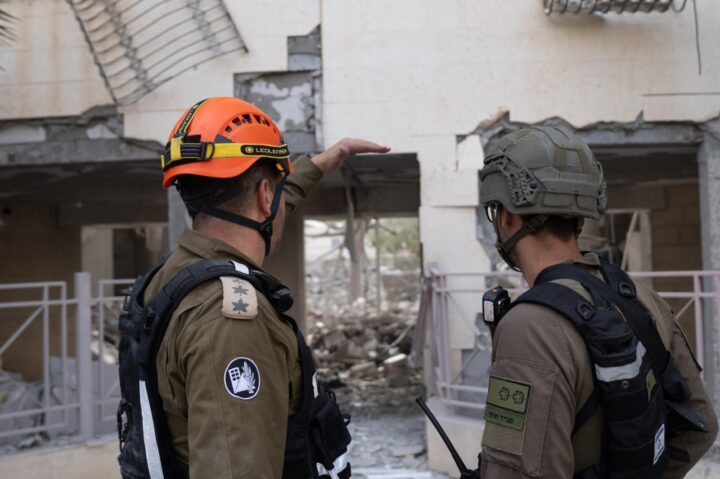
IDF
IDF Home Front Command forces operate at the impact site in Beersheva, June 24th, 2025
Iran violated a ceasefire with Israel hours after it began on Tuesday, with Israel vowing “powerful strikes” in response.
The IDF intercepted two missiles from Iran at about 10:30 a.m. No injuries were reported. Despite residents of northern Israel reporting interceptions, Iran denied firing the missiles.
Israeli Defense Minister Israel Katz said he “instructed the IDF to respond forcefully to the violation of the ceasefire by Iran with powerful strikes against regime targets in the heart of Tehran.” IDF Chief of Staff Lt.-Gen. Eyal Zamir said that “in light of the severe violation of the ceasefire carried out by the Iranian regime, we will respond with force.” A senior Israeli diplomatic source said that “Iran violated the ceasefire — and it will pay.”
In the hours before the ceasefire was meant to go into effect at 7 a.m., Iran launched 20 missiles in a series of barrages at Israel, killing four in a direct hit on a building in Beersheba.
Ahead of the deadly strike, Iranian Foreign Minister Abbas Araghchi sent mixed messages, first posting on X that “there is NO ‘agreement’ on any ceasefire … However, provided that the Israeli regime stops its illegal aggression against the Iranian people no later than 4 am Tehran time, we have no intention to continue our response afterwards.” Less than 20 minutes later, Araghchi implied on X that a ceasefire had gone into effect: “The military operations of our powerful Armed Forces to punish Israel for its aggression continued until the very last minute, at 4am.”
The Islamic Republic has repeatedly struck Beersheba since the war began 12 days ago, damaging buildings in the Soroka Medical Center, Microsoft offices and residences in the southern Israel city. The regime said it was aiming at an IDF research center in the city’s HiTech Park.
President Donald Trump announced a “Complete and Total CEASEFIRE” on Truth Social on Monday evening, saying that each “side will remain PEACEFUL and RESPECTFUL … This is a War that could have gone on for years, and destroyed the entire Middle East, but it didn’t, and never will!”
According to the president, Iran was supposed to have stopped firing at Israel at 7 a.m. local time, and Israel would stop 12 hours later.
At about 8 a.m. Israel time, Trump added: “THE CEASEFIRE IS NOW IN EFFECT. PLEASE DO NOT VIOLATE IT!”
Netanyahu and Trump spoke about the ceasefire overnight, while an American team that included Vice President JD Vance talked to Tehran, Reuters reported. Israel’s condition for the ceasefire was that Iran stop launching attacks, which they reportedly agreed to at the time. Qatar also took part in the negotiations.
The Israeli government released a statement on Tuesday morning that Prime Minister Benjamin Netanyahu reported to the Security Cabinet that “Israel has achieved all of the objectives of Operation Rising Lion, and much more. Israel has removed a double existential threat — on both the nuclear issue and regarding ballistic missiles. The IDF also achieved complete air superiority in the skies over Tehran, struck a severe blow to the military leadership and destroyed dozens of Iran’s main regime targets.”
“In Operation Rising Lion, the State of Israel made great historic achievements and placed itself in the first rank of the world’s major powers,” the government stated. “This is a great success for the people of Israel and its fighters, who removed two existential threats to our country, and ensured the eternity of Israel.”
Israel also “thank[ed] President Trump and the U.S. for their defensive support and for their participation in removing the Iranian nuclear threat.”
The ceasefire was reached “in full coordination with President Trump,” the statement reads, but “Israel will respond forcefully to any violation of the ceasefire.”
IDF Spokesperson Brig.-Gen. Effie Defrin also said in a briefing on Tuesday morning that “the IDF has fully met all the objectives defined in Operation Rising Lion.”
“The Chief of the General Staff instructed the IDF to maintain a high level of alert and readiness to deliver a powerful response to any violation of the ceasefire,” he added.
In addition, Israel’s Home Front Command maintained its restrictions on Israelis, including the continued closure of schools and non-essential businesses.
The Israeli government statement also said that the IDF killed hundreds of militants from the Basij, “the terrorist regime’s instrument of repression,” and killed a senior nuclear scientist, named Mohammad Reza Sadighi, according to Iranian reports.
Defrin said that on Monday night and early Tuesday, the Israeli Air Force “struck dozens of military targets in Tehran … deploying more than one hundred munitions.” The targets included the headquarters of SPND, where weapons systems and nuclear technology were developed, as well as military manufacturing infrastructure. The IAF also eliminated eight missile launchers that were ready to fire at Israel.
‘If we’re paying a maximal price, we should get maximal achievements,’ an Israeli security source told JI

GPO
Israeli Prime Minister Benjamin Netanyahu and Defense Minister Israel Katz direct Operation Rising Lion.
Israel’s leadership is concerned that international pressure may force the IDF to stop striking Iran before its mission is complete, an Israeli security source told Jewish Insider on Sunday.
The source spoke a day after President Donald Trump wrote in a Truth Social post that “this war in Israel-Iran should end,” and continued to express hope that a deal could be reached between Washington and Tehran, even as the next round of negotiations between the U.S. and Iran over Tehran’s nuclear program was postponed.
The president’s remarks came two days after Israel began targeting Iranian nuclear and military sites and Tehran retaliated by striking sites across Israel, including residential areas.
“We want the U.S. to understand our point of view,” the source said. “The goal is for Iran not to have capabilities that endanger the State of Israel and its existence.”
“If we’re paying a maximal price” — 13 fatalities, 380 injured in 22 missile impact sites as of Sunday morning — “we should get maximal achievements. That is the approach,” the source added, saying that Iran’s nuclear program should be destroyed and not “wounded.”
The official aim of Operation Rising Lions, authorized by Israel’s Security Cabinet on Thursday night, is to damage Iran’s nuclear and ballistic missile programs.
The goal did not include toppling the Iranian mullahs’ regime, in part because Israel would be unlikely to have “international legitimacy” to do so, the Israeli source said. In addition, the cabinet did not say its goal was the total elimination of Iran’s nuclear program, because it wanted to set attainable goals.
Please log in if you already have a subscription, or subscribe to access the latest updates.
 Continue with Google
 Continue with Apple