



























Democrats will be choosing whether to nominate moderate-minded lawmakers, or elevate potential future members of the far-left Squad
Scott Olson/Getty Images
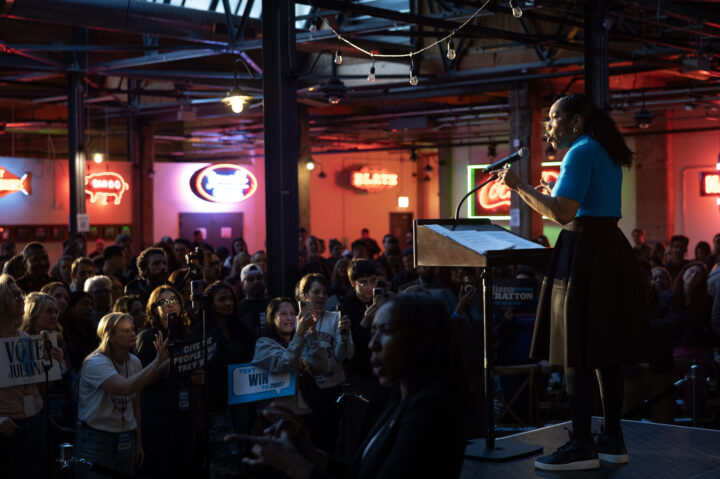
Illinois Democratic Senate candidate Lt. Governor Juliana Stratton speaks to voters during a campaign stop on March 13, 2026 in Chicago, Illinois.


 Add JewishInsider on Google
After months of an increasingly bitter campaign characterized by tens of millions in outside spending and increasingly heated debate over Israel policy, Democrats in the Chicagoland area head to the polls on Tuesday, with the outcome of the primaries potentially reshaping the political landscape in Chicago, one of the most Jewish cities in the country.
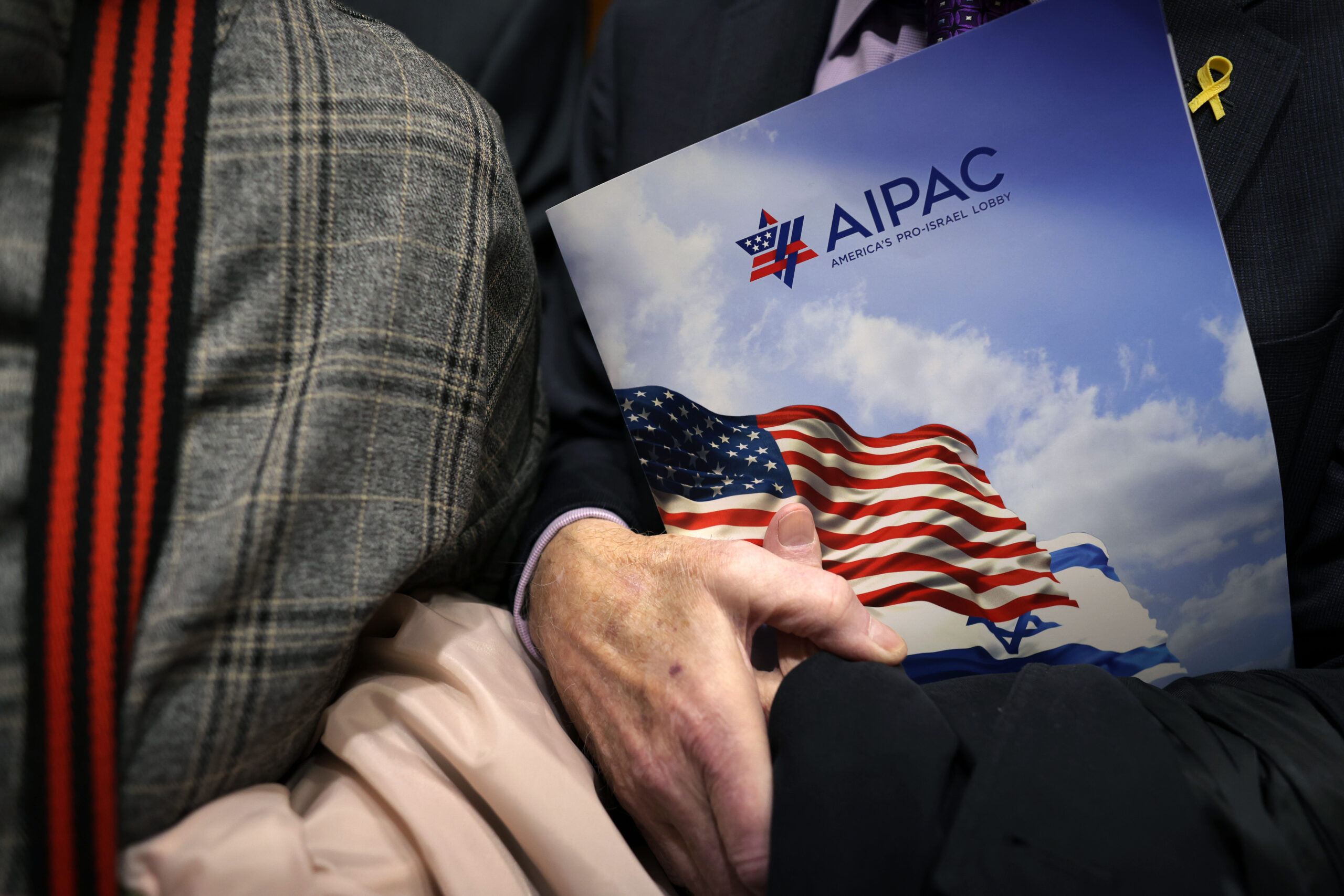
The races are also set to be a test of AIPAC and the pro-Israel community’s political strategy and heft. There are four House races that pro-Israel groups are reportedly engaged in, and their success rate in those primaries will be an early indicator of whether resources can overcome the shifting winds in a party that is becoming increasingly hostile to the Jewish state.
Broadly, a source close to AIPAC said, the group’s main goal in the primaries is to prevent six candidates — state Sen. Robert Peters in the 2nd District, activist Kina Collins in the 7th, activist Junaid Ahmed and Hanover Park Trustee Yasmeen Bankole in the 8th and influencer Kat Abughazaleh and Skokie School Board member Bushra Amiwala in the 9th — from being elected, as it believes those candidates would be aligned with the far-left ‘Squad’ on Israel policy issues if elected to Congress.
That’s an apparent change in strategy from the recent special election in New Jersey’s 11th Congressional District, where spending by the AIPAC-affiliated United Democracy Project against a relative moderate who had expressed an openness to conditioning aid to Israel helped elect a far-left candidate with more hostile views.
Here’s what we’re watching, and where the races stand.
Illinois Senate
This race appears to be effectively a two-way contest between Rep. Raja Krishnamoorthi (D-IL) and Lt. Gov. Juliana Stratton. Rep. Robin Kelly (D-IL), who has been carving out the left-most lane (including on Israel policy), has been trailing further behind in most polling and will have the hardest climb to victory, despite backing from the Congressional Black Caucus.
Krishnamoorthi, who has taken the most moderate and most pro-Israel posture, would likely benefit most from Stratton and Kelly splitting the Black and progressive Democratic vote in the state. A super PAC backing Krishnamoorthi has taken to promoting both him and Kelly while attacking Stratton.
Some recent polling has shown Stratton, who has been trying to balance criticism of Israel while also maintaining support within the Jewish community, closing in on Krishnamoorthi in the final stretch of the race.
Though Krishnamoorthi has been the most prolific fundraiser in the race, Stratton has benefited from more than $13 million in spending by the Illinois Future PAC, backed by Illinois Gov. J.B. Pritzker and his family, Stratton’s main political backer.
Stratton has hit Krishnamoorthi as overly supportive of Immigration and Customs Enforcement, in part by pointing to his vote in support of a resolution condemning the attack on an Israeli hostage awareness march in Boulder, Colo., last year, which also included language thanking ICE.
Krishnamoorthi also took a hit last week with a story that described him as mistreating employees as he amassed his war chest for this Senate run. Meanwhile, Stratton’s campaign is touting what it says is a deathbed endorsement by Rev. Jesse Jackson, who died last month.
2nd Congressional District
Despite poor fundraising as compared to others in the field and a term in prison for a corruption scandal, former Rep. Jesse Jackson Jr. (D-IL) has long been the favorite to win the 2nd Congressional District seat, an effort likely aided by national attention over his father’s death.
Affordable Chicago Now, a new super PAC reported to be supported by pro-Israel backers, has been boosting Cook County Commissioner Donna Miller, putting $4.3 million behind her campaign.
An AI industry-linked super PAC has stepped in to help boost Jackson’s chances. Miller has also faced attacks from the Working Families Party for receiving pro-Israel support.
Peters has been trying to carve out the far-left lane in the district, including by taking a strongly critical line toward Israel and AIPAC, though Jewish Insider reported that he had previously reached out to the group early in his campaign, offering a very different set of policy priorities.
7th Congressional District
The AIPAC-linked United Democracy Project and a cryptocurrency industry group have been supporting Chicago Treasurer Melissa Conyears-Ervin in the race, helping push her toward the top of the field. UDP has spent more than $5 million in the race. Conyears-Ervin has also received support from the Chicago Teachers’ Union, which has been hostile toward Israel.
Other notable candidates include state Rep. LaShawn Ford, who is Rep. Danny Davis’ (D-IL) preferred successor, and has taken significant heat from the crypto-backed Fairshake.
The progressive Collins, who has long held hostile stances toward Israel, is making her third run at the seat, but attention from progressive and anti-Israel interests has also turned toward Anthony Driver Jr., a union organizer who has seen support from outside spending by an SEIU-linked group, among other progressive candidates. That group has spent more than $550,000 hitting Conyears-Ervin, in part for receiving pro-Israel support.
Jason Friedman, a Jewish real estate developer and longtime Jewish federation leader who has taken a largely pro-Israel stance, has led the field in fundraising, but it’s unclear how he might fare in a historically Black district. UDP’s ads have also directly responded to Friedman’s criticism of Conyears-Ervin’s past corruption issues, attacking Friedman.
8th Congressional District
Former Rep. Melissa Bean (D-IL) is seen as the strong front-runner in the race, and is the most likely victory for pro-Israel voters in the Chicagoland House primaries.
By contrast, Ahmed has consolidated support among the progressive left and has staked out an anti-Israel stance on the trail. A poll released Sunday showed Bean in the lead, but Ahmed closing in, just five points behind.
Bean has been backed by pro-Israel groups, the AI industry and cryptocurrency advocates. Meanwhile, Justice Democrats and the anti-Israel IMEU Policy Project have been spending in the district in an attempt to undercut Bean and boost Ahmed.
Chicago Progressive Partnership, a group rumored to be linked to AIPAC, has recently been hitting Ahmed from the left, putting $664,000 behind that effort.
Other candidates in the race include Bankole, Cook County Commissioner Kevin Morrison and entrepreneur Neil Khot. Khot has led the field in fundraising with around $2 million, though a majority of that has been self-funded.
9th Congressional District
The 9th District seat has become the most watched and most bitter of the four House primaries in the Chicago area — with Middle East policy and pro-Israel funding becoming one of the most contentious issues, to the extent that those issues dominated a recent televised debate.
The top tier of candidates includes Evanston Mayor Daniel Biss, far-left activist and influencer Abughazaleh and state Sen. Laura Fine. Fine has charted out the most moderate and pro-Israel stance of the three, while Biss has leaned toward a progressive posture critical of Israel and Abughazaleh has taken an even harder anti-Israel line.
Though Biss and Fine at one point appeared to be the top candidates, recent polling has shown Fine falling behind and Abughazaleh closing the gap with Biss, who has consistently led in polling.
Abughazaleh finished out the race as the top fundraiser, pulling in $3.4 million, followed by Fine and Biss neck-and-neck at $2.6 and $2.5 million, respectively.
Elect Chicago Women, reportedly backed by pro-Israel donors, has put $5.8 million into supporting Fine and attacking Biss, but pro-Israel groups appear to have shifted their strategy in the final weeks of the campaign amid Abughazaleh’s surge.
Attacks on Biss have tapered off, while Chicago Progressive Partnership has been hammering Abughazaleh with more than $1.2 million in spending in just a few weeks. Most recently, the group has also been boosting Skokie School Board member Bushra Amiwala, in an apparent attempt to siphon off some of Abughazaleh’s base.
Meanwhile, Rep. Rashida Tlaib (D-MI) and actor and anti-Israel activist Mark Ruffalo offered endorsements for Abughazaleh over the weekend.
Though the pro-Israel community’s strategy in this race has been different than the one it took in New Jersey’s 11th Congressional District, where attacks on a liberal candidate helped elect another candidate from the far-left, there’s been longstanding fear among some in the local Jewish community that outside groups’ concerted anti-Biss attacks could end up electing the far-left Abughazaleh.
JI found that Biss reached out to AIPAC before formally announcing his campaign, and that his stances on Israel policy have also evolved significantly since he entered the race, including supporting efforts to cut off weapons transfers to the Jewish state.
Biss also faced grilling from the House Education Committee over his decision to withhold police support when Northwestern University sought to clear an anti-Israel encampment on campus in 2024.
J Street has spent around $150,000 boosting Biss.
Plus, Israel strikes back after 200-missile Hezbollah barrage

Zach D Roberts/NurPhoto via Getty Images
Nick Fuentes, the leader of a Christian based extremist white nationalist group speaks to his followers in Washington D.C. on November 14, 2020
👋 Good Thursday morning!
In today’s Daily Kickoff, we look at the ties between neo-Nazi influencer Nick Fuentes and Kai Schwemmer, the newly named political director of College Republicans of America, and spotlight the pro-Israel positions taken by Clay Fuller, who is expected to succeed Rep. Marjorie Taylor Greene following next month’s runoff in Georgia. We report on the escalation between Israel and Hezbollah following the terror group’s launching last night of 200 missiles at Israel, and look at the degree to which the United Arab Emirates is absorbing much of Tehran’s missile and drone attacks. Also in today’s Daily Kickoff: Howard Schultz, Adm. Brad Cooper and Dorothy McAuliffe.
Today’s Daily Kickoff was curated by JI Executive Editor Melissa Weiss and Israel Editor Tamara Zieve, with assists from Danielle Cohen-Kanik and Marc Rod. Have a tip? Email us here.
What We’re Watching
- The Senate Health, Education, Labor and Pensions Committee is holding a hearing this morning on the influence of foreign funding in higher education. National Association of Scholars President Peter Wood, Foundation for Defense of Democracies Senior Fellow Craig Singleton and The Asia Society’s Robert Daly are slated to testify.
- The annual weeklong SXSW festival kicks off today in Austin, Texas. Mahmoud Khalil, the controversial former leader of Columbia’s anti-Israel protest movement who is facing possible deportation over his activities, will, according to the festival schedule, participate in a conversation this weekend “on the cost of dissent,” alongside his lawyer and The Guardian’s Betsy Reed. More below.
- First in JI: The Republican Jewish Coalition is set to announce endorsements of 16 House Republicans running for reelection, mostly in swing districts: Reps. Tom Barrett (R-MI), Rob Bresnahan (R-PA), Juan Ciscomani (R-AZ), Gabe Evans (R-CO), Brian Fitzpatrick (R-PA), Tom Kean Jr. (R-NJ), Mike Lawler (R-NY), Ryan Mackenzie (R-PA), Mariannette Miller-Meeks (R-IA), Zach Nunn (R-IA), David Valadao (R-CA) and Derrick Van Orden (R-WI).
- RJC also endorsed the four incumbent Jewish House Republicans: Reps. David Kustoff (R-TN), Max Miller (R-OH), Randy Fine (R-FL) and Craig Goldman (R-TX) — the largest group of Jewish Republicans in the House since the 1980s, Jewish Insider’s Marc Rod reports.
What You Should Know
A QUICK WORD WITH JI’S MATTHEW KASSEL
In a low-profile electoral upset that defied the difficult national political environment facing the GOP, a Republican candidate declared victory this week in a down-ballot race for a seat on the Prince William Board of County Supervisors in Virginia — for the first time in nearly 40 years.
But while Republicans are now rejoicing over their narrow win, it otherwise largely demonstrated how Democratic leaders effectively sacrificed the seat to the GOP rather than elevate an extremist member of their own party who had claimed the nomination.
The result underscored the extent to which local Democrats had swiftly mobilized to oppose their own nominee, Muhammed Casim, who faced backlash over a series of recently uncovered past social media comments in which he used racist, misogynistic and antisemitic language. The posts, written more than a decade ago, used the n-word as well as demeaning rhetoric targeting women. He also accused Israel of genocide and promoted a conspiratorial post about U.S. financial assistance to the Jewish state, among other extreme comments.
More broadly, the outcome is an atypical example of how the Democratic Party worked to meaningfully confront extremism within its own ranks, even if its efforts came at the expense of an easily winnable local seat that instead flipped to Republicans for the first time in decades.
Casim apologized for his comments but refused bipartisan calls to drop out of the race, which had motivated a Democratic challenger to launch a write-in campaign that ultimately helped siphon votes away from his embattled bid. He lost to Republican Jeannie LaCroix by a margin of 258 votes. Write-in candidates pulled in 744 votes — a relatively sizable total that appeared to have made a difference in the closely contested race.
“Opposing antisemitism, racism or misogyny isn’t a partisan position,” Marc Broklawski, a Jewish vice chair of the Virginia Democratic Party, told Jewish Insider on Wednesday. “It’s a floor, not a ceiling, and the least we should expect from any party, official candidate or voter. When Democrats hold that floor even when it’s costly, that’s something to be proud of. When we don’t, voters notice that too.”
NORTHERN FRONT

Israel continued extensive strikes on Lebanon on Thursday morning, after Hezbollah shot about 200 projectiles at northern Israel the night before. About 120 of the rockets and missiles crossed from Lebanon into Israel during the Wednesday night barrage, with those not intercepted mostly striking Israel’s north, Jewish Insider’s Lahav Harkov reports.
State of play: The Magen David Adom emergency service treated two individuals with mild injuries following the missile fire from Lebanon. A home, with the exception of its safe room, was destroyed, and two others were damaged in Moshav Haniel in Emek Hefer, a region of Israel 70 miles from the Lebanon border. Soon after, Iran launched missiles at Israel, a move officials said likely indicated that the two Wednesday night barrages were coordinated between Tehran and Beirut. A senior Israeli official briefed the media on Thursday morning that a significant expansion of operations in Lebanon would soon take place, but did not say whether that would include a broad ground invasion.
Bonus: In Al Arabiya, former White House Middle East envoy Jason Greenblatt calls on Beirut to decisively crack down on and disarm Hezbollah, arguing that the Iranian proxy is at a particularly weak moment: “The aura of invincibility that Hezbollah cultivated for decades has faded. The pillars that sustained Hezbollah for years, money from Tehran, military dominance and political intimidation, have dramatically weakened.”
CAMPUS CONTROVERSY

Some pro-Israel conservative students are voicing concern over the College Republicans of America’s new political director, citing his ties to neo-Nazi influencer Nick Fuentes as evidence of the party’s increasingly “alarming” shift towards extremism, Jewish Insider’s Haley Cohen reports. Kai Schwemmer was tapped last week as political director of the campus group, which has grown to more than 200 active chapters across U.S. universities since it was established in 2023 as an offshoot from the College Republican National Committee.
Friend of Fuentes: Schwemmer, known on social media as Kai Klips, has a channel on Fuentes’ invitation-only streaming platform Cozy, which he launched with far-right conspiracy theorist Alex Jones. Schwemmer appeared in a 2021 video promoting Fuentes’ “White Boy Summer” tour and was featured as a “special guest” at Fuentes’ 2022 APFAC III conference, the progressive advocacy organization People for the American Way reported. Schwemmer has also been outspoken about his affiliation with Fuentes’ political movement, “America First.” “It’s alarming but not surprising,” College Republicans of America would select a Fuentes ally as its leader, Felipe Avila, a senior studying nursing at Catholic University of America, who identifies as conservative, told JI.
FRESH PERSPECTIVE
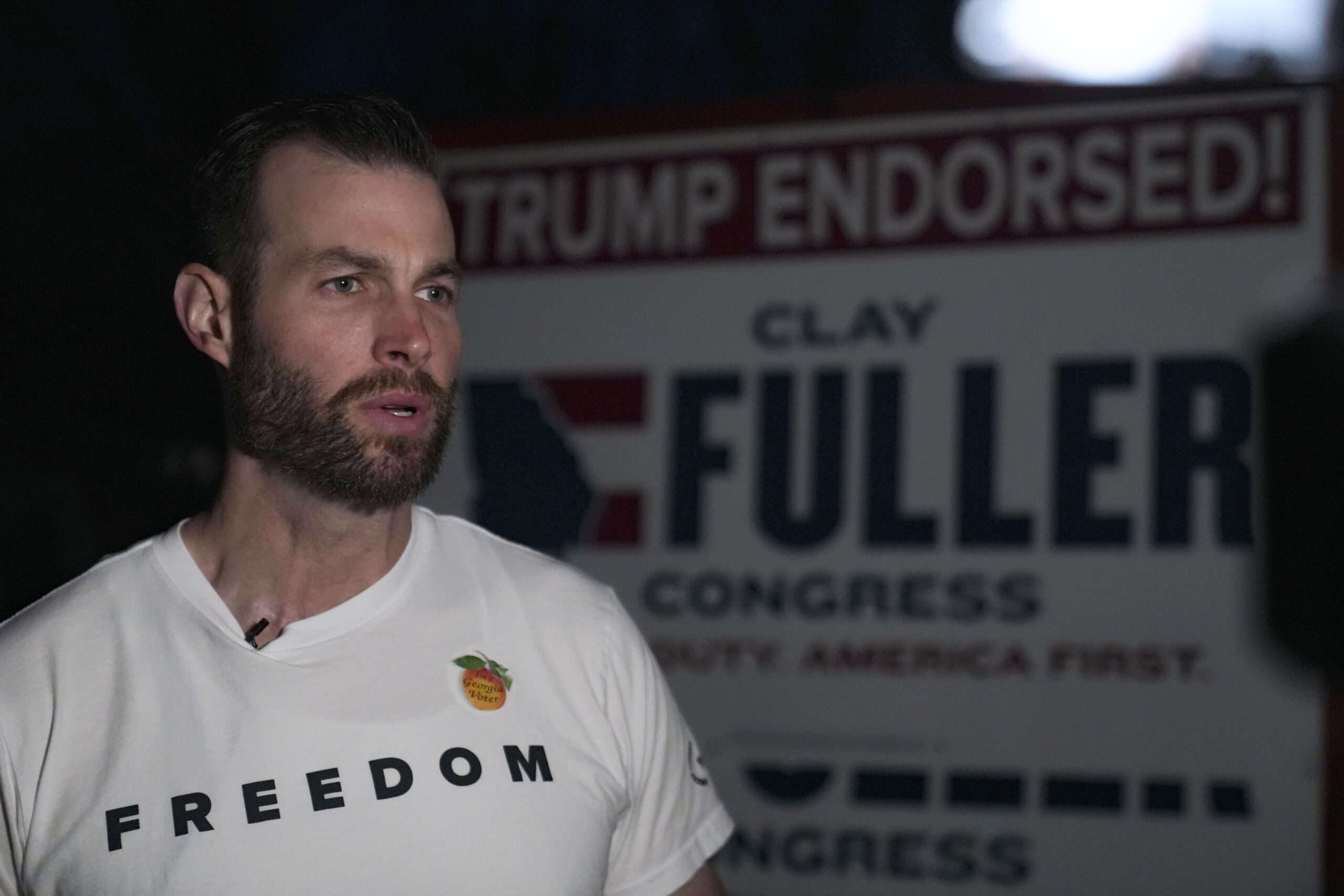
Clay Fuller, a veteran and district attorney, is expected to succeed former Rep. Marjorie Taylor Greene (R-GA) in the House, bringing a pro-Israel voice to replace one of the House’s most anti-Israel Republicans, Jewish Insider’s Marc Rod reports. Fuller led all Republicans on the all-party primary ballot in Georgia’s 14th Congressional District, winning 35% of the vote. Even though he finished narrowly behind Democrat and military veteran Shawn Harris, the Republican vote is likely to consolidate behind Fuller in next month’s runoff election.
Fuller’s positions: Fuller has expressed support for Israel and for the U.S. strikes on Iran. “President Trump tried the peace route with Iran not once, not twice, but THREE separate times — and they refused. He’s the peace President, but you can’t negotiate with a death cult,” Fuller said in a post on X last month, emphasizing he had supported operations against Iran during his time in the military and that the regime and its proxies had killed many Americans. The day after Hamas’ Oct. 7, 2023, attacks on Israel, Fuller blasted the Biden administration for unfreezing $6 billion in Iranian funds as part of an earlier hostage deal, highlighting Iran’s support to Hamas.
President’s pitch: President Donald Trump ripped into Rep. Thomas Massie (R-KY) during a campaign rally in Hebron, Ky., on Wednesday to support Ed Gallrein, his endorsed candidate to take on the incumbent, describing Massie as “disloyal,” a “loser,” the “worst person” and a “disaster as a congressman,” JI’s Emily Jacobs reports.
ON THE TRAIL
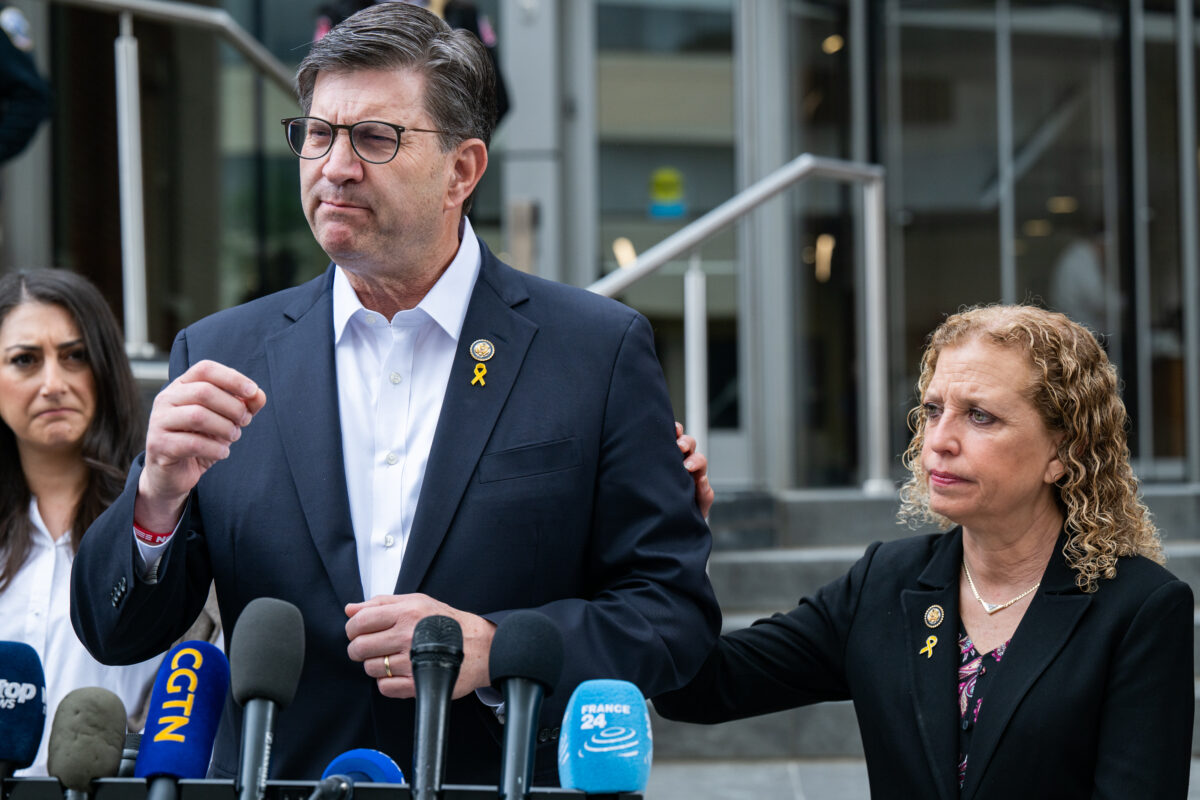
Remarks by pro-Israel stalwarts Reps. Debbie Wasserman Schultz (D-FL) and Brad Schneider (D-IL) on a Jewish Democratic Council of America webinar on Wednesday highlighted the delicate line that some pro-Israel Democratic lawmakers are walking on the war in Iran, Jewish Insider’s Marc Rod reports.
Notable quotable: “I can tell you assuredly: had I been presented with an Authorization for Use of Military Force, that made sense, and that we were properly briefed, and there was a demonstrative, imminent threat — which we have really yet to be shown — I am someone on our side of the aisle that likely would have voted for an AUMF if all of those things were in place,” Wasserman Schultz said. “Instead, [President Donald Trump] has blown an opportunity to go in in the most prepared way. … I have been careful about just blanket-ly condemning everything [Trump is] doing here, but most certainly, the way that we got into this was really unacceptable, and my constituents are very concerned.”
Friendly fire: A former top Obama administration foreign policy official said on Wednesday that any Democratic lawmakers who vote to support U.S. strikes on Iran should be primaried. “If you vote for the funding of this war, you should be primaried. I don’t want you in the Democratic Party,” said Ben Rhodes, co-host of the “Pod Save the World” podcast and former deputy national security advisor under President Barack Obama, JI’s Gabby Deutch reports.
CENTER STAGE
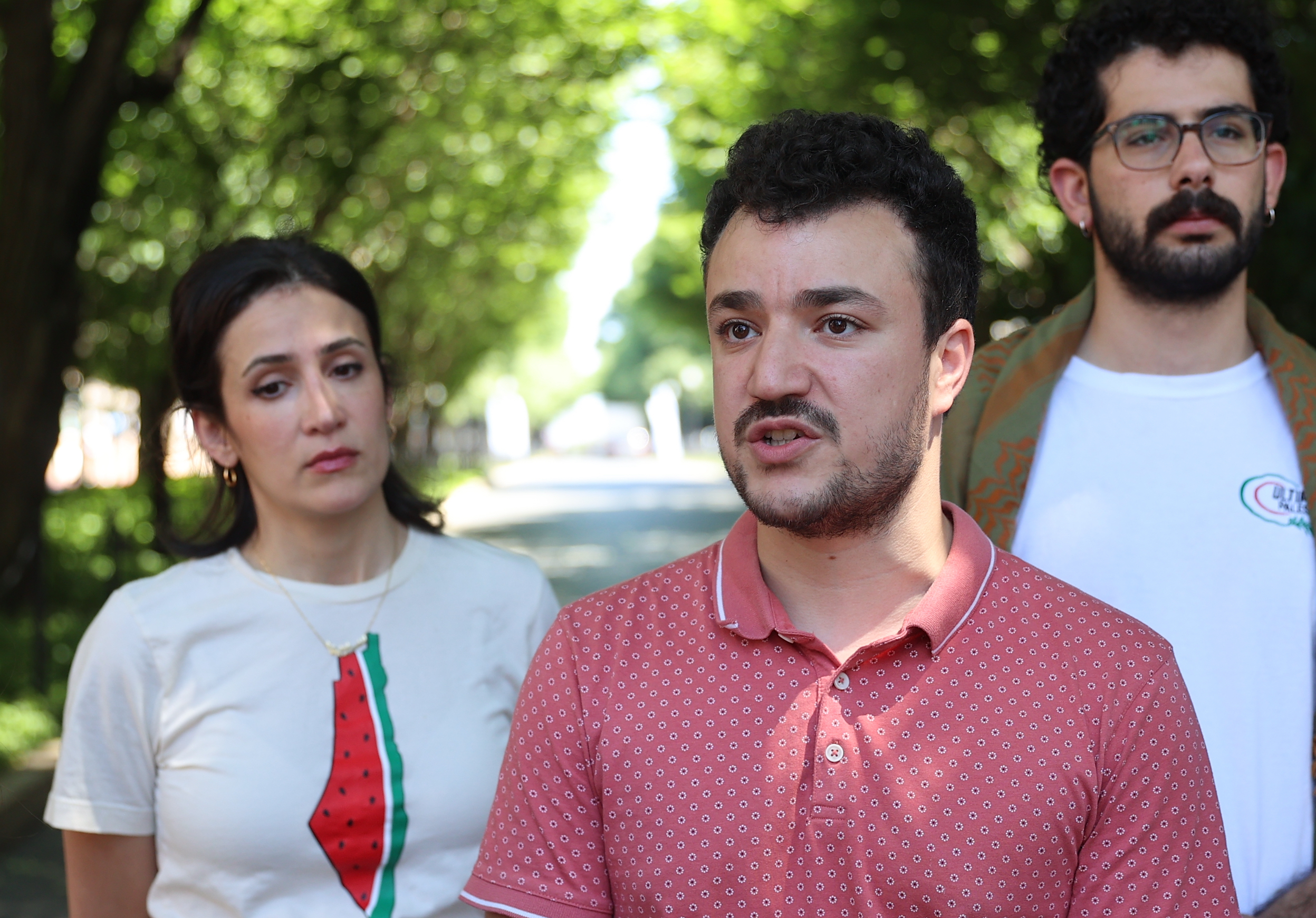
Columbia University anti-Israel protest leader Mahmoud Khalil is scheduled to speak at this week’s annual South by Southwest (SXSW) festival in Austin, Texas, Jewish Insider’s Haley Cohen reports. Khalil will participate on Sunday in a conversation “on the cost of dissent,” with The Guardian Editor Betsy Reed and Baher Azmy, legal director of the Center For Constitutional Rights who was a lawyer for Khalil in his deportation proceedings, according to the SXSW schedule.
Details: The weeklong festival each March convenes around 300,000 guests, including film and media professionals, executives and politicians to discuss culture, technology and innovation. “Khalil joins The Guardian for an unflinching conversation on his ordeal, the system that tried to silence him, and the personal and political stakes of resistance,” SXSW’s website states. At Columbia, Khalil was a key organizer of the anti-Israel encampment in April 2024, a two-week demonstration in the center of campus during Israel’s war in Gaza.
FEELING THE HEAT

As Iran retaliates against the U.S. and Israel’s joint military campaign, findings have revealed that the United Arab Emirates — not Israel — has thus far faced the majority of Tehran’s missile and drone attacks, Jewish Insider’s Matthew Shea and Marc Rod report. As of March 11, the UAE’s Ministry of Defense reported that its air defenses had “engaged” 268 ballistic missiles, 15 cruise missiles and 1,514 UAVs.
Bearing the brunt: Iranian strikes have targeted American assets in the country, such as the U.S. consulate in Dubai, but also a range of civilian targets, including Dubai International Airport, where a drone attack wounded four people. Reports have indicated that Abu Dhabi has faced more than three times the number of Iranian drones and missiles launched toward Israel. The attacks come as Gulf allies are running short on missile interceptors. Sens. Mike Rounds (R-SD) and Rick Scott (R-FL) argued to JI on Wednesday that, ultimately, the U.S. campaign against Iran will be to the benefit of the UAE and other Gulf allies, even if they’re feeling pain in the short term.
Winds of change: Despite Qatar’s anger with Iran over the regime’s continued attacks on its territory and civilian infrastructure, experts are divided over whether the conflict will ultimately force Doha to reconsider its long-standing policy of hosting Iranian-backed Hamas officials, JI’s Matthew Shea reports.
Worthy Reads
The War on Antisemitism: In Time, State Department antisemitism envoy Rabbi Yehuda Kaploun explains the Trump administration’s approach to fighting antisemitism. “Antisemitism proliferates from an ever-multiplying list of sources: voices from all sides of the political spectrum spew antisemitic rhetoric; foreign terrorist organizations espouse violent antisemitic ideologies; and online radicalization increasingly incites real-world antisemitic attacks against Jewish individuals and institutions globally.” [Time]
This War Has Roots: In The Washington Post, Geoffrey Corn and Orde Kittrie argue that the U.S.-Israeli war against Iran is a continuation of hostilities that have been ongoing for years. “International law does not require a distinct self-defense justification for every attack conducted once the right of self-defense is triggered. Once that right is initiated, military action is justified to achieve the overall self-defense objective, in this case terminating Iran’s capacity to strike the United States and its allies. … These facts justify the conclusion that the U.S. and Iran were already engaged in an armed conflict when the current round began. As a result, international law does not require the U.S. to refrain from further military action against Iran until just before the IRGC launches another assault.” [WashPost]
Risk Assessment: The Wall Street Journal‘s Yaroslav Trofimov looks at the risks Washington and American allies face if the war ends with the Iranian regime intact. “But leaving in place Iran’s theocratic regime — angry, defiant and in possession of its nuclear stockpile and what remains of its arsenal of missiles and drones — would essentially grant Tehran control over the world’s energy markets. It would also sacrifice the security of America’s partners and allies, and possibly make another, more devastating, regional war likely.” [WSJ]
Get Out of Jail Free: The Atlantic’s Graeme Wood considers the utility of former Iranian President Mahmoud Ahmadinejad, who has evolved from being the face of the Islamic Republic to an opponent of the regime and was rumored to have been killed by Israel early in the war. “ Contrary to early reports, Ahmadinejad is alive, his associates say. … The circumstances of his survival may prove significant as the war drags on. Whatever the intent, Ahmadinejad’s associates say the strike was in effect a jailbreak operation that freed the former president from regime control. Their description of the chaotic sequence of events that began before the war suggests that Ahmadinejad has friends on the outside.” [TheAtlantic]
Word on the Street
President Donald Trump announced his endorsement of Brandon Herrera, the far-right social media influencer who is the presumptive Republican nominee in Texas’ 23rd Congressional District, following Rep. Tony Gonzales’ (R-TX) announcement that he was dropping his reelection bid, Jewish Insider’s Marc Rod reports…
The Cook Political Report moved the Pennsylvania governor’s race from “Likely Democrat” to “Solid Democrat,” citing Pennsylvania Gov. Josh Shapiro’s 60% approval rating, cash on hand and significant polling lead over his Republican challenger, state Treasurer Stacy Garrity…
Dorothy McAuliffe, the wife of former Virginia Gov. Terry McAuliffe, announced her bid for Congress in a potential new district that is expected to favor Democrats, the status of which will be determined in a statewide vote next month…
Nearly all Senate Democrats wrote to Secretary of Defense Pete Hegseth on Wednesday to raise “grave concern” about a strike on a girl’s school that killed at least 168 people in the opening phase of the U.S.-Israeli war on Iran, Jewish Insider’s Marc Rod reports…
The letter came amid findings from a preliminary U.S. military investigation indicating that the U.S. was at fault for the bombing, which took place on the same block as a number of buildings used by the Islamic Revolutionary Guard Corps…
Federal and state officials in California sought to assuage concerns after the FBI’s Los Angeles division sent out a bulletin that Iran could conduct retaliatory drone attacks on the West Coast, with a law-enforcement official telling CBS News that there was no credible intelligence that prompted the bulletin, which had predated the Iran war…
The Department of Justice is probing Iran’s use of Binance to evade U.S. and international sanctions after an internal investigation at the cryptocurrency company found that the platform had been used to funnel more than $1 billion to terror proxies…
The New York Times reports on Iran’s use of cluster bombs to strike Israel in violation of international law…
The Swiss Embassy in Tehran, which has historically served as an interlocutor for U.S. interests in the Islamic Republic, announced it is temporarily closing, citing “the war in the Middle East and the increasing security risk,” but “will continue to maintain an open line of communication” between Washington and Tehran…
The Wall Street Journal spotlights CENTCOM head Adm. Brad Cooper, whom associates described as “thoughtful, decisive and cool under pressure” as he leads U.S. operations in the Middle East…
Yeshiva University is establishing the first new dental school in Manhattan in more than a century, with plans to enroll 150 students in an accelerated three-year program on its Midtown Manhattan campus…
Starbucks owner Howard Schultz became the latest executive to relocate to South Florida, purchasing a $44 million penthouse in Surfside, Fla….
The California Department of Education filed a lawsuit against the Oakland Unified School District, alleging that administrators failed to address “pervasive antisemitism” in schools in the Bay Area district following a directive in January to do so…
A judge in the U.K. tossed out the government’s appeal of a court ruling dismissing its case against Irish band Kneecap over a group member’s support for Hezbollah; the lower court had dismissed the case over a governmental procedural error…
Google completed its $32 billion purchase of Israeli cybersecurity startup Wiz, started in 2020 by Unit 8200 veterans Assaf Rappaport, Yinon Costica, Ami Luttwak and Roy Reznik; the deal marks the largest purchase of an Israeli-founded company in nearly a decade…
Iran’s sports minister said that the Islamic Republic’s national soccer team could not play in this summer’s World Cup, a number of games of which are being played in the U.S….
Spain is permanently withdrawing its ambassador from Israel, months after Ambassador Ana Maria Salomon Perez was recalled to Madrid; the country’s embassy in Israel going forward will be led by a charge d’affaires…
Bloomberg looks at Israeli efforts to establish an intelligence base on the coast of Somaliland months after Israel became the first country to formally recognize the African nation, which is separated from the Yemen-based Houthis by the Gulf of Aden…
Axios reports on the role that hackers are increasingly playing in the war between the U.S., Israel and Iran, following a cyberattack on Wednesday targeting the U.S.-based medical device company Stryker that disabled employees’ phones and laptops…
The Qatari-backed Irth Capital Management submitted a bid to take over Papa Johns, in a deal that would give the pizza chain a $1.5 billion valuation…
Bernard Haykel is joining the Foundation for Defense of Democracies as a senior fellow…
Angelika Saleh, the namesake of the Angelika Film Center, which she opened in 1989 with her then-husband, Joseph Saleh, died at 90…
Pic of the Day

UJA-Federation of New York announced last night it was committing $1.3 million to build the Shalva Sharabi Family Center in Ashkelon, Israel, a new center dedicated in memory of the wife and daughters of former hostage Eli Sharabi, who were killed during Hamas’ Oct. 7, 2023, attacks. The pledge for the center, which will support individuals with disabilities and trauma victims, was made at Shalva’s 36th anniversary gala, held at Gotham Hall in Manhattan, Jewish Insider’s Haley Cohen reports for eJewishPhilanthropy.
Birthdays
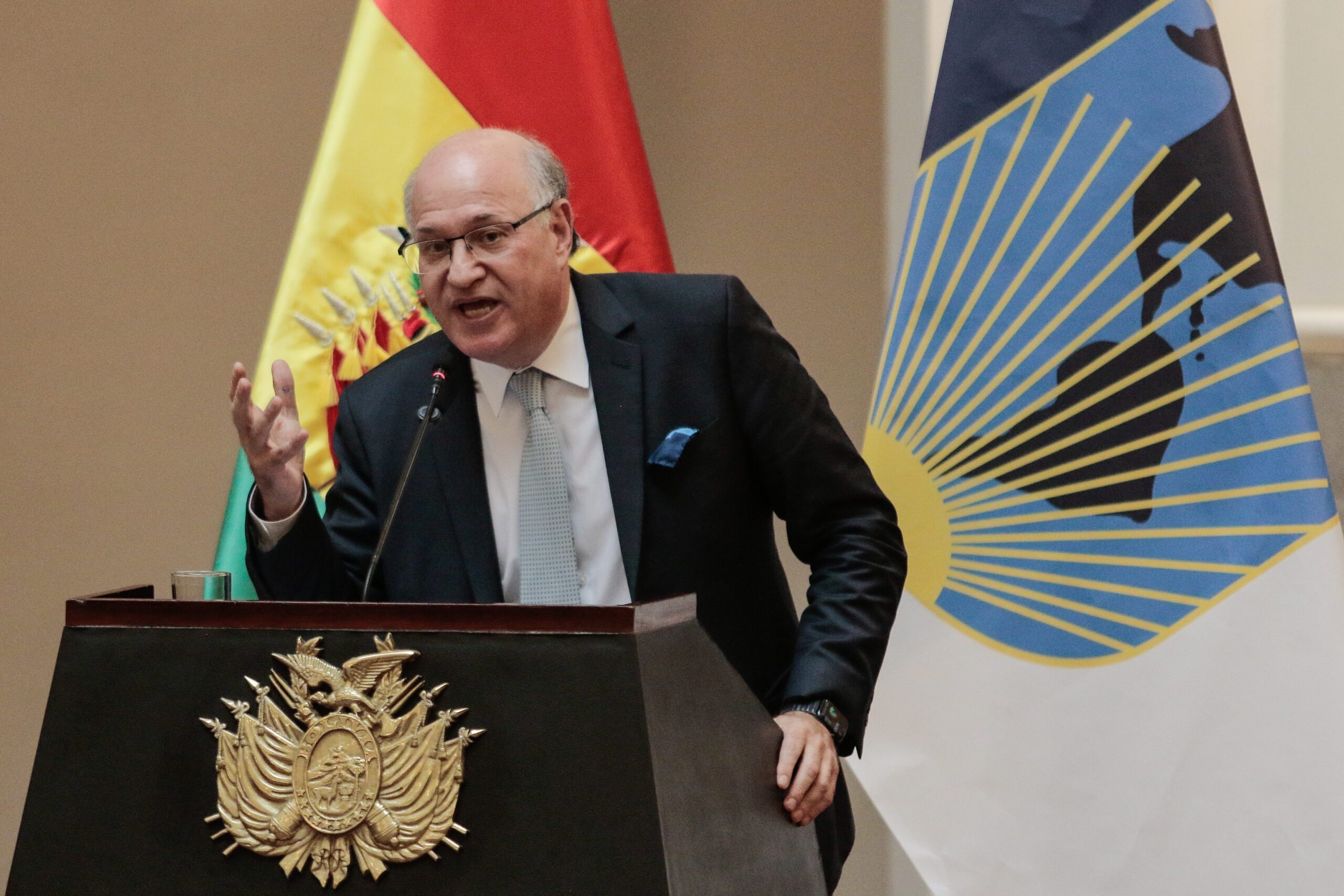
Born in Haifa, he served as president of the Central Bank of Brazil and is now president of the Inter-American Development Bank, Ilan Goldfajn turns 60…
Photographer, musician and author of 15 children’s books, Arlene Weiss Alda turns 93… Carol Margolis… Retired U.S. Sen. Mitt Romney (R-UT) turns 79… Director, producer and screenwriter of movies and television including directing the first of “The Fast and the Furious” film franchise, Rob Cohen turns 77… British sculptor, he won the 2017 $1 million Genesis Prize for “commitment to Jewish values, the Jewish community and the State of Israel,” Sir Anish Kapoor turns 72… Pitching coach who has worked for the Yankees, Reds, Braves, Marlins, Cubs and Padres, Larry Rothschild turns 72… Past president of AIPAC, he is the founder and CEO of R.A. Cohen & Associates, Robert A. Cohen… Former member of the Knesset for the Likud party, he is from the Israeli Druze community, Ayoob Kara turns 71… Founder of hedge fund Lone Pine Capital, Stephen Mandel turns 70… Sales representative at Paychex, Lynne Blumenthal… Director of constituency engagement at the United States Holocaust Memorial Museum, Diane Saltzman… Senior attorney in the D.C. office of Squire Patton Boggs, Stacey Grundman… Sportscaster for ESPN and a host of “SportsCenter,” Steve Levy turns 61… U.S. Sen. Tammy Duckworth (D-IL) turns 58… Chief Washington correspondent for CNN and co-host of the Sunday morning program “State of the Union,” Jacob Paul “Jake” Tapper turns 57… Founder and CEO at Miller Strategies, Jeff Miller… Israeli film and television actor, Tzachi Halevy turns 51… SVP of communications at the Alliance for Automotive Innovation, Brian T. Weiss… Founder and publisher of Fleishigs, a kosher food magazine, Shlomo Klein… Actor and comedian, Samm Levine turns 44… Writer, artist and social media personality, she is best known for her Daf Reactions series of videos explaining passages from the Talmud posted to TikTok, Miriam P. Anzovin… Senior public affairs specialist at the Association of American Medical Colleges, Talia Schmidt… Member of Congress (D-NY-15) since 2021, Ritchie Torres turns 38… Senior Middle East intelligence specialist at Vcheck, Aaron Magid… Founder and CEO of Serotonin and co-founder and president of Mojito, Amanda Gutterman Cassatt turns 35… CEO and co-founder of Wonder Media Network, Jennifer Manning Kaplan… Figure skater who won the 2016 World Junior championship, he competed for Israel at the 2018 Winter Olympics, Daniel Samohin turns 28… Israeli internet personality, model and singer, Anna Zak turns 25…
Rep. Debbie Wasserman Schultz said she would likely have voted to authorize force against Iran if the administration had approached Congress properly before launching the war
Annabelle Gordon/Bloomberg via Getty Image
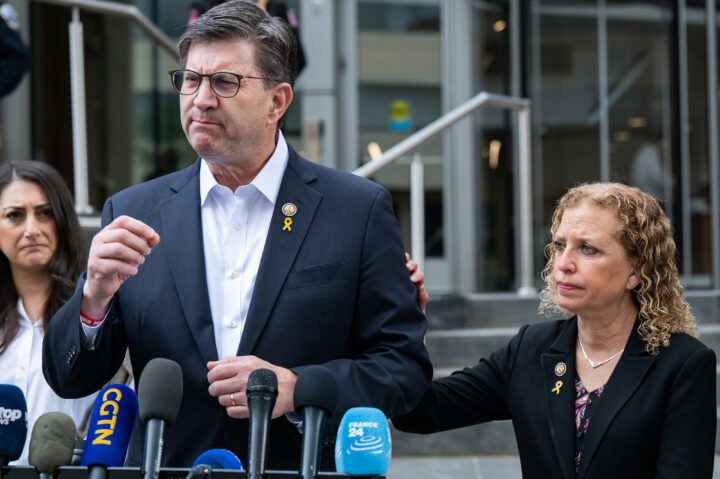
Rep. Brad Schneider (D-IL) and Rep. Debbie Wasserman Schultz (D-FL), during a news conference in Washington, DC, US, on Thursday, May 22, 2025.
Remarks by pro-Israel stalwarts Reps. Debbie Wasserman Schultz (D-FL) and Brad Schneider (D-IL) on a Jewish Democratic Council of America webinar on Wednesday highlighted the delicate line that some pro-Israel Democratic lawmakers are walking on the war in Iran.
Wasserman Schultz and Schneider, along with some of their Democratic colleagues, are longtime Iran hawks and have previously supported many of the stated aims of the war, but express deep skepticism of how the Trump administration is handling the operation and its decision not to seek congressional authorization.
Both Democrats voted for a war powers resolution last week that sought to bring an immediate halt to the war.
Wasserman Schultz said that, in addition to legal and constitutional concerns, Trump made a “colossally stupid” decision in not coming to Congress because some lawmakers, including her, might have voted to support an operation against Iran if presented with the proper intelligence and a clear plan.
“I can tell you assuredly: had I been presented with an Authorization for Use of Military Force, that made sense, and that we were properly briefed, and there was a demonstrative, imminent threat — which we have really yet to be shown — I am someone on our side of the aisle that likely would have voted for an AUMF if all of those things were in place,” Wasserman Schultz said. “Instead, [President Donald Trump] has blown an opportunity to go in in the most prepared way.”
By sidestepping Congress, the administration left the U.S. unprepared for the implications and blowback from the war, Wasserman Schultz said, highlighting, among other issues, the administration’s failure to evacuate American citizens from the region before the war started.
“I am so frustrated because I think everyone on this call knows how dangerous, deeply evil Iran is as a regime,” Wasserman Schultz said. “I have been careful about just blanket-ly condemning everything [Trump is] doing here, but most certainly, the way that we got into this was really unacceptable, and my constituents are very concerned.”
While Wasserman Schultz said she supported diplomacy with Iran, she also expressed skepticism about its chances for success, explaining that the Iranian regime would likely have sought to string the U.S. along until Trump left office, buying time to continue building its nuclear and missile programs.
Schneider said he believes strongly that the U.S. needs to address the threat from Iran, as well “help the people of Iran free themselves” from the regime, but added that “the Constitution is clear” that only Congress can declare war, and the administration has still not clearly identified an imminent threat that would have allowed it to legally take action unilaterally. He also said he does not trust the administration to properly carry through the mission without oversight.
“We can agree on the objectives in confronting Iran. We have no idea what the goals of this war are, or the strategy for achieving those goals, or the endgame that is trying to be ultimately accomplished that would bring the war to an end,” Schneider said. “My biggest fear is Trump … declares victory and goes home with Iran’s regime still in place, the nuclear program not completely defeated, [the] ballistic missile program damaged but not eliminated.”
He said that he’s afraid that, if the administration doesn’t set clear objectives, it will stop the war prematurely and ultimately leave the Iranian regime “more entrenched, feeling more powerful.”
The Illinois congressman speculated that Iranian leadership, by gathering in one central location, could have “present[ed] an opportunity that was too good to pass up” in launching the war but said that the administration still hasn’t properly articulated to lawmakers its thinking and strategy, so he does not know if that is the case.
Schneider said that an ideal outcome would require removing Iran’s enriched uranium from the country, which would necessitate international inspectors and a diplomatic settlement.
“There is no military solution to get us where we ultimately need to be. It has to be a political solution,” he said. “The military action always needed to be on the table to help us achieve that political solution. But with this President, I think it’s more ready, fire, aim, as opposed to ready, aim, fire.”
Schneider also called for Secretary of Defense Pete Hegseth to be removed from his job, saying Hegseth has failed to prepare for easily anticipated Iranian responses like mining the Strait of Hormuz, or to ensure proper oversight to prevent civilian casualties.
Wasserman Schultz said that she would consider a supplemental funding request if and when the administration presents one, emphasizing that she wants to ensure U.S. troops have the resources they need because “it’s not their choice to be there,” even if she doesn’t fully agree with the administration’s approach.
Wasserman Schultz added that she’s concerned that the war is “compromising our ability” to protect the U.S. from Russia and China.
Asked about a supplemental request, Schneider emphasized that U.S. servicemembers have his strong support and are “doing their job, they’re succeeding, and we should all pray for the success of their mission and their safe return.”
But he said he’s disappointed with the political leadership in the administration, particularly its distribution of online videos intermixing footage from the war with movie clips and video games, even as U.S. servicemembers have been killed and injured. “No one should take glee in the killing of the enemy. It is a necessary act that is advancing our interests.”
JDCA itself also seems to be striking a delicate balance.
The group’s CEO Halie Soifer said JDCA agrees with the need to stop Iran’s missile and nuclear programs, but emphasized that Trump is going around Congress and that, while some Democrats might “support, perhaps, some of the short-term tactical gains” some also “believe the administration is lacking a long-term strategy for success in Iran.”
Schneider and Wasserman Schultz were also critical of comments by Secretary of State Marco Rubio suggesting that Israel had effectively dragged the U.S. into the war. Rubio has said those comments were mischaracterized. Both criticized that framing of the conflict as incorrect and as potential fodder for increased antisemitism.
“The president said it himself: He was not compelled, he may have compelled Israel,” Schneider said.
But he added, “in the end, it doesn’t really matter,” predicting a similar rise in antisemitism as occurred around the 1973 Yom Kippur War — launched by Egypt — when people in the U.S. blamed Jews and Israel for rising gas prices.
“Because this administration did not have that conversation with Congress and, through Congress, with the American people, people are going to look for scapegoats,” he said. “And when folks are looking for scapegoats, Jews are almost always one of those targets.”
Wasserman Schultz said that Rubio’s comments were “unbelievable” and “dangerous.”
“It is incredibly dangerous for Jews worldwide, and … unacceptable for him to have basically set it up that, ‘Well, we had to do this because it’s the Jews’ fault,’” Wasserman Schultz said. “Once it’s said, the impact — it remains.”
Speaking broadly, she said that the picture presented to lawmakers in a classified setting was “more subtle.”
Fuller has expressed strong support for Israel and for U.S. strikes against Iran
Megan Varner/Getty Images
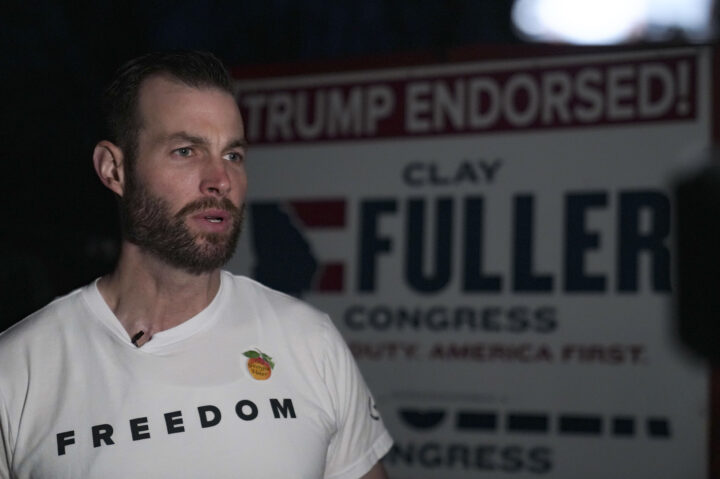
Clay Fuller, the Trump-endorsed Republican candidate for Congressional district 14, speaks to members of the media after arriving early to his voting precinct to cast his vote on March 10, 2026 in Lookout Mountain, Georgia.
Clay Fuller, a veteran and district attorney, is expected to succeed former Rep. Marjorie Taylor Greene (R-GA) in the House, bringing a pro-Israel voice to replace one of the House’s most anti-Israel Republicans.
Fuller led all Republicans on the all-party primary ballot in Georgia’s 14th Congressional District, winning 35% of the vote. Even though he finished narrowly behind Democrat Shawn Harris, a military veteran, the Republican vote is likely to consolidate behind Fuller in next month’s runoff election.
Fuller has expressed support for Israel and for the U.S. strikes on Iran.
“President Trump tried the peace route with Iran not once, not twice, but THREE separate times — and they refused. He’s the peace President, but you can’t negotiate with a death cult,” Fuller said in a post on X last month, emphasizing he had supported operations against Iran during his time in the military and that the regime and its proxies had killed many Americans. He added, “This mission is not in vain. Victory through strength.”
Fuller’s Air Force career included work on counterterrorism operations, and he was deployed in 2024 to the Al Udeid airbase in Qatar supporting U.S. Central Command operations.
The day after Hamas’ Oct. 7, 2023, attacks on Israel, Fuller blasted the Biden administration for unfreezing $6 billion in Iranian funds as part of an earlier hostage deal, highlighting Iran’s support to Hamas.
In 2024, he praised Israel and the IDF for eliminating senior Hezbollah official Ibrahim Aqil, pointing to Aqil’s involvement in the attack on the Marine Corps barracks in Beirut in 1983.
AIPAC congratulated Fuller on Tuesday’s results.
“AIPAC also congratulates Clay Fuller for advancing to the April runoff to replace Marjorie Taylor Greene, who worked throughout her tenure to weaken the U.S.-Israel relationship,” the group said in a statement. “Voters in Georgia’s heavily Republican 14th District now have the opportunity to elect a representative who reflects the values of thousands of pro-Israel Georgians and who understans the importance of the U.S.-Israel partnership.”
Harris has his own history with Israel — he served as defense attaché at the U.S. Embassy in Israel starting in May 2021, at the rank of brigadier general, according to his National Guard biography and a Facebook post by the Georgia National Guard.
But that hasn’t stopped him from taking a hostile stance toward Israel and its supporters.
“I’m not taking AIPAC money. I’m not taking money from outside groups trying to buy influence in this race,” he said on X on Wednesday, responding to AIPAC’s statement on Fuller. “No strings. No special favors. No backroom agendas. My loyalty is to the voters of Northwest Georgia. Always.”
The post was accompanied by a graphic reading “in case anyone was wondering… AIPAC is supporting Clay Fuller.”
Harris has also described the war in Gaza as a genocide, though he expressed support for the “people of the region, both in Israel and Palestine, who want to work hard and live their lives in peace, and deserve better from their leaders.”
“I am one of the very few candidates or currently serving Members of Congress who have lived in the region and worked on extraordinarily complex issues within Israel and the Middle East,” he continued.
Harris said previously he would not accept support from AIPAC or the Council on American-Islamic Relations.
His tone has changed significantly since Oct. 7, 2023, when Harris said, “Just as America has the right to defend itself, we must always support Israel’s right to defend itself, and we also must continue working to achieve a stable and just peace in the Middle East.”
He has also criticized the U.S. operations in Iran, citing the need for a “clearly defined mission and end goal” as well as consultation with Congress, and questioning whether the operation has “an achievable objective.”
The pro-Israel Democratic group warns that nominating far-left candidates will cost the party winnable seats against GOP incumbents

Daniel Knighton/Getty Images
City of San Diego Councilmember Marni von Wilpert rides in the Port of San Diego Holiday Bowl Parade on December 28, 2022 in San Diego, California.
As Democratic Majority for Israel prepares for the midterms amid growing divisions in the party over Middle East policy, the pro-Israel group is now focusing much of its energy on three under-the-radar House races for swing seats in California and Colorado that could be key to the party’s chances of reclaiming the majority in Congress.
In those primaries, DMFI’s political arm recently endorsed a trio of relatively moderate, pro-Israel Democrats facing opponents whom, the group feels, have demonstrated anti-Israel records or questionable positions on Middle East policy — qualities that could hamper their odds of winning Republican-held districts in the November election.
“These definitely rank high on our list of priorities,” Brian Romick, DMFI’s president and the chair of its super PAC, said in an interview with Jewish Insider on Tuesday. “These are all strong places where this matters.”
DMFI’s political arm is backing Marni von Wilpert, a San Diego councilwoman seeking the nomination in California’s 48th Congressional District; Jasmeet Bains, a California assemblywoman and a physician competing in the state’s 22nd District; and Shannon Bird, a former Colorado legislator running to unseat a vulnerable freshman Republican in the state’s 8th District. The nonpartisan Cook Political Report has ranked each of the races as “toss-ups” in its election forecast.
“We think all three of these candidates are strongly pro-Israel and have great relationships and records with the community,” Romick noted, calling them “the kind of candidates we need who can win both primaries and generals” and “hold these seats over the long term.”
DMFI’s efforts underscore how the organization is choosing to highlight consequential races in which the interests of Democratic Party leaders converge with its own, a notable alignment during a moment when Israel — and outside spending from pro-Israel groups — has emerged as one of the most polarizing sources of internal conflict in reliably blue districts.
One of DMFI’s “major goals” this cycle, Romick explained, is to “both elect pro-Israel candidates and help Democrats take back the House,” citing Republicans’ narrow three-seat majority as partly motivating its calculus. “If we win these three seats, then Democrats are in the majority with pro-Israel candidates.”
“I don’t think that anyone else is in that lane, and I think that’s an important distinction for us,” he told JI.
Romick declined to share if DMFI PAC plans to invest in the three primaries, following election cycles in which the group has spent heavily to help unseat vocally anti-Israel Democrats in deep blue House districts. “Possibly,” he hinted. “But I don’t want to show my hand.”
Here’s a rundown on the state of play in those races:
San Diego showdown
In California’s 48th District, redrawn last year to give Democrats an edge, von Wilpert is running in a crowded open primary to replace Rep. Darrell Issa (R-CA), who has long been a fixture in state and national politics. Her top opponent in the June race, Ammar Campa-Najjar, twice unsuccessfully competed for the seat in 2018 and 2020 — and is familiar to voters as a perennial candidate in a district covering the San Diego area.
Campa-Najjar outraised the field in the last quarter of 2025 and has claimed endorsements from a range of House members — including his girlfriend, Rep. Sara Jacobs (D-CA).
During his race against Issa in 2020, Campa-Najjar, who is of mixed Palestinian and Mexican-American descent, stressed support for Israel as an important strategic partner, broadly aligning with mainstream Democratic sentiment regarding Middle East policy. He said in a candidate questionnaire solicited by JI at the time, for instance, he believed the U.S. should maintain foreign aid to Israel.
In a statement to JI on Tuesday, Campa-Najjar said his “Middle East foreign policy remains consistent,” arguing that the “United States must help broker a lasting peace to end the bloodshed between Israelis and Palestinians.”
“As a new member of Congress, I’ll put forward a meaningful agenda for the day after that promotes a stable, secure, and prosperous future for both Israel and Palestine,” he continued. “That future is only possible with new leadership, with Palestinians no longer under Hamas rule and the Israelis no longer burdened by Netanyahu’s failures,” he added, in a reference to the right-wing Israeli prime minister.
Still, Romick echoed other critics of Campa-Najjar in noting that the candidate had previously changed his positions on key issues as part of a conservative makeover in his last election, raising questions over his commitment to upholding support for Israel as a lawmaker.
“He’s on record as anti-Trump. He’s on record as pro-Trump,” Romick said. “You never know what you’re going to get and that’s obviously dangerous when people shift a lot on Israel.”
Andrew Lachman, the political committee chair of California Jewish Democrats, said his organization reviewed questionnaires from both candidates and concluded that von Wilpert’s record in backing Jewish community causes was more substantive. The group gave von Wilpert a rating of “strong support” and is “neutral” on Campa-Najjar.
“Campa-Najjar seems interested in building a relationship with the Jewish community, but with respect to a record of resolutions and legislation to support the Jewish community, von Wilpert had a voting record and a record of supporting the Jewish community that was much more clearly defined,” he told JI.
For her part, von Wilpert said in a statement to JI that she “strongly” supports “Israel’s right to exist as a secure, Jewish democratic state and defend itself from the real threats it faces.”
“To me, ensuring Israel’s security and building peace for all in the region, including getting the two-state solution back on track, are inseparable, and U.S. leadership is indispensable to achieving both outcomes,” she added. “Only when a nation feels safe and secure, can it take the necessary steps to make peace.”
Both von Wilpert and Campa-Najjar are endorsed by J Street, the progressive Israel advocacy group.
Last week, Jim Desmond, a Republican member of the San Diego County Board of Supervisors, also filed to run for the seat that is now being vacated by Issa.
Under the newly drawn district lines, former Vice President Kamala Harris would have narrowly defeated President Donald Trump by three points.
Bakersfield battle
In a GOP-held district hours north of San Diego that includes part of Bakersfield, Bains is facing off against a progressive rival, school board trustee Randy Villegas, to challenge Rep. David Valadao (R-CA), who took office in 2021 but is now confronting a difficult national environment for Republicans. .
Villegas has gained endorsements from some of the most prominent Israel critics in Congress, including Sen. Bernie Sanders (I-VT) as well as Reps. Pramila Jayapal (D-WA) and Ro Khanna (D-CA), along with the virulently anti-Israel AIPAC Tracker, which said in a social media post that Villegas had signed on to a January 2024 letter pressing for “an immediate ceasefire in Gaza and to end the weaponization of antisemitism claims against Israel’s critics.”
“In Congress, Randy will fight to end the flow of unconditional military aid to Israel that fuels the ongoing genocide in Gaza and ethnic cleansing in the West Bank,” AIPAC Tracker said in its January endorsement. “He is ready to champion a foreign policy that centers human rights over militarism.”
Villegas’ campaign did not respond to a request for comment about his foreign policy views concerning Israel.
Speaking with JI, Romick characterized Villegas as “the most obvious” source of concern for pro-Israel Democrats among the three primaries that DMFI is now eyeing, referring in part to his early demand for a ceasefire just a few months after the Oct. 7 Hamas attacks. “He consistently has an anti-Israel record,” Romick said.
Lachman, meanwhile, said his group had not yet weighed in on the primary. “I do know that Bains has a reputation as a fighter for progressive values, but one who can build coalitions in order to sustain them,” he told JI. “Whereas, I don’t think Villegas is known for that.”
In a statement shared with JI on Tuesday, Bains said she believes “in Israel’s right to exist, defend itself and live in peace as a secure nation.”
“As a doctor,” she pledged, “my priority will always be protecting all human life and for that we must ensure advancing lasting peace. That’s why I believe a two-state solution is a necessary path forward to ensure long-term security and the dignity of people across the region.”
Valadao, for his part, is backed by AIPAC, which calls the congressman “a steadfast supporter of the U.S.-Israel alliance throughout his six terms representing the Golden State’s Central Valley.”
Colorado clash
Meanwhile, in a Colorado House race to take on Rep. Gabe Evans (R-CO), two Democrats are vying for their party’s nomination with differing records of public commentary on Israel as well as the rise of antisemitism.
Bird, who resigned from the Colorado legislature in January to focus on her congressional bid, has long been vocal in her support for Israel and opposition to antisemitism, which she recently called a “global cancer” after the terror attack targeting the Jewish community in Bondi Beach, Australia late last year.
During the war in Gaza, she frequently highlighted the plight of hostages on social media while issuing statements standing with Israel. “Lessons learned from history make clear that the world must stand with and protect Israel,” she wrote in one X post in 2024. Bird’s campaign did not return a request for comment from JI.
By contrast, her chief rival in the June primary, Manny Rutinel, a progressive state representative, has condemned recent instances of antisemitism — but does not appear to have clarified his stances on key issues regarding Israel.
While he has garnered endorsements from some pro-Israel House members such as Reps. Adriano Espaillat (D-NY) and Rob Menendez (D-NJ), his past record of activism has raised some concerns among pro-Israel Democrats who privately worry he will assume a hostile approach to Israel if he is elected. Republicans have indicated that they are eager to run against him in the general election.
As an undergraduate at the University of Florida, for example, Rutinel attended a demonstration in 2014 that was co-organized by Students for Justice in Palestine, the extreme anti-Israel group that has recently expressed alignment with Hamas, according to a local news story covering the event at the time.
The campus demonstration was “aimed to raise awareness for police brutality in Ferguson, Mo., and military oppression in Palestine,” the article noted.
In a statement to JI, however, a spokesperson for Rutinel said he “has never affiliated with Students for Justice in Palestine.”
“While in college at the time of the Ferguson protests, he attended a demonstration to protest police brutality in the United States,” the campaign spokesperson explained. “Manny supports Israel’s right to exist and supports a two-state solution with secure borders to bring peace.”
Rutinel also “supports U.S. security assistance to Israel in line with the Obama administration’s 2016 memorandum of understanding,” the spokesperson added, when asked about his views on conditioning aid to Israel, which has become a litmus test of sorts for left-wing candidates.
Evans, an Army veteran endorsed by AIPAC, has cited his service in the Middle East as motivating his staunch support for Israel and opposition to a nuclear Iran. The first-term congressman is viewed as one of the most vulnerable House Republicans seeking reelection in a district north of Denver.
State Sen. Sharif Street supports continued U.S. aid to Israel but calls Israeli PM Netanyahu a war criminal
Sharif Street campaign page
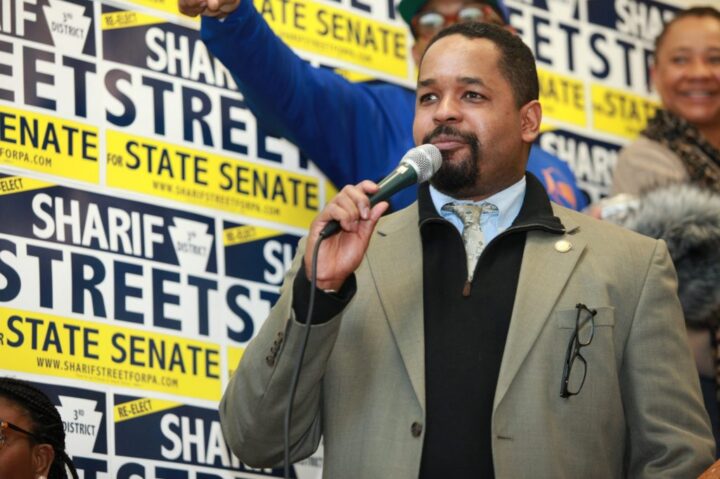
Pennsylvania state Sen. Sharif Street
Sharif Street is walking a unique political path.
The Pennsylvania state senator running for a House seat in the heart of deep-blue Philadelphia is Black and Muslim, and has staked out positions largely supportive of Israel.
He traveled to Israel with the American Jewish Committee in 2017 “to gain some understanding” of the complexities facing Israelis and Palestinians.
He has indicated that he would not support conditions on U.S. aid to Israel, saying that the two allies need an “open dialogue,” yet he refers to Israeli Prime Minister Benjamin Netanyahu as a war criminal.
Street’s nuances on Israel — he backs a strong U.S.-Israel relationship, while also urging a compassionate approach to the Palestinians — offer a sharp contrast with his most prominent rival in the Democratic primary for Pennsylvania’s 3rd Congressional District, who is a strident antagonist of Israel.
Street’s friends and allies in the Jewish community insist his stances aren’t a matter of political convenience or calibrated to win him a congressional seat, but rather are borne of years of study on the issue, personal conviction and decades-long ties to members of the Jewish community.
The nuances Street evinces on Israel extend to his reading of the Muslim community, too. While political analyses over the past two years have seen the Jewish and Muslim communities as generally at odds over the war in Gaza — including the three current Muslim members of Congress who regularly stake out anti-Israel stances — Street argued in an interview with Jewish Insider that doesn’t tell the full story of his community.
“The Muslim community is much more diverse than I think the American press tends to think,” Street told JI in a recent interview. “I’m an African American. We have had, historically, pretty good relationships with the Jewish community. … There are over 2 billion Muslims in the world, a third of the world population. And American Muslims are from South Asia, they’re from Europe, they’re from Africa, they are from the Middle East.”
“I think the perspective of the press is always just Middle Eastern Muslims who come to this country with a very long, recent history of … concerns about Israel in the Middle East. That’s not all Muslims,” he said.
Muslims from other parts of the world “have various perspectives and their issues are diverse.” And he said the African American Muslim community of which he is a part “does not have [that] kind of entrenched negative history.”
Many African American Muslims, he said, are converts, and grew up in Christian communities, with different perspectives on Israel and the Jewish community. Of the nearly 500,000 Muslims in the Philadelphia area, 80% are African American, according to Street.
“Every time they want to talk about Muslim-Jewish relations, they just focus on a very small sector — probably less than 10% of the Muslim community, which happen to be Arab American,” Street said. “And their perspective is important, but it doesn’t represent all Muslims.”
Speaking to JI, Street cast himself as a supporter of the U.S.-Israel relationship, while also urging a compassionate approach to the Palestinians and a concerted effort to aid in the reconstruction of Gaza.
“Israel is one of the United States’ most important allies in the world and certainly in the region, and we need to make sure that we keep that relationship strong,” Street said. “We also need to understand that we have to rebuild Gaza for Palestinians.”
He argued that a failure to properly rebuild Gaza and provide it with the necessary resources will only fuel radicalization and help Hamas and other extremist groups grow. “That makes both Palestinians and Israelis less safe,” he said.
He said the U.S. should invest in rebuilding and use its influence to bring along Israel and a multinational coalition, including Arab states, to assist the reconstruction and ensure the security of Gaza and the region, which would improve trust and the chances of success.
“By investing in those communities, we increase the safety and security for Israelis and Palestinians,” he reiterated. “At the same time, we have to recognize their immediate challenges, and the United States has to continue to make sure Israel can deal with the immediate challenges, while we increase the long term safety and security for both Israeli and Palestinians as well.”
He also indicated that he wouldn’t support conditions on U.S. aid to Israel, saying that the two allies need an “open dialogue.” He said that the U.S. should “encourage peace and prosperity in the region,” something best done through a “partnership” rather than by “dictating to Israel.”
He emphasized that all sides suffered in the war, and said he believes both Israelis and Palestinians want change.
Street takes a more critical stance toward Netanyahu.
He was quoted by the Philadelphia Inquirer as saying, “Guess what? Benjamin Netanyahu is not the only leader of a major country in the world that’s committed war crimes, because Donald Trump has done the same thing. But none of us would talk about getting rid of the United States of America as a country.” He said at a recent candidate forum that Netanyahu should be prosecuted for war crimes.
Asked about the comments quoted by the Inquirer, he told JI that it is “possible” that Netanyahu was responsible for war crimes “and I certainly think that that needs to be investigated.” He highlighted that many Israelis are also concerned with and dissatisfied with Netanyahu’s leadership throughout the war, and want to see him out of office.
“Ultimately — and I think the Israeli people will do the right thing — but I think that the Israeli courts have to have a chance to really hear that and oversee those issues, and that’s not likely to happen while we’re still in an armed conflict,” he said.
About his trip with AJC to Israel alongside other Muslim leaders in 2017, Street said, “So often we oversimplify what’s going on in the Middle East,” Street said. “I don’t think Americans fully understand the depth and complexity of the issues. So I wanted to gain some understanding.”
David Hyman, a longtime attorney in Philadelphia who was an ally of Street’s father, former Philadelphia Mayor John Street, watched him grow up since he was a teenager. He said he remembers having a conversation with Street along similar lines following that trip.
“He said that what he really came away with on the trip [was] that slogans and simple answers are not what will help matters,” Hyman recounted.
Kevin Greenberg, an attorney who said he’s been friends with Street for 30 years, said he’s seen Street’s views on the Middle East grow and evolve over time, and the two had — prior to Street’s AJC trip — discussed visiting Israel together.
“I’ve seen a lot of politicians decide to be pro-Israel, pro-Jewish for contributions, and I’ve seen a lot of people be anti-Israel, pro-BDS … because you think there are votes there. That just doesn’t enter into his calculus on this issue,” Greenberg said. “It’s a core belief of who Sharif is. And he stands for the little guy in any situation.”
Hyman, a board member of AJC’s Philadelphia chapter, offered similar praise.
“He’ll speak about his support for Israel in a setting, in a context where there’s no political upside,” Hyman said. “For me, that’s the litmus test, because there’s so little political courage these days to say anything other than what’s politically expedient. He’s very upfront.”
Hyman said that, while Street may disagree with some of the Israeli government’s decisions, “in terms of standing behind the basic tenets of Zionism and the right for Israel to exist and defend itself, he distinguishes himself at a time where [other supporters are] peeling off.”
And he emphasized that Street will be accessible to groups across the Jewish community, who already have existing relationships with him. “When issues come up, it’ll be natural for us to talk to him and take his temperature.”
Robin Schatz, the director of government relations for the Jewish Federation of Greater Philadelphia, also said that Street has “always been a friend” well before his run for Congress, and that he has always been accessible to her and the Jewish community.
At the beginning of their friendship decades ago, Greenberg said Street did not know much about the Middle East but wanted to learn more, growing up in a household more focused on the needs of Philadelphia residents. “Sharif has evolved from a curious, but unknowing person, to somebody who has a deep understanding, and respect for Jews qua Jews.”
Greenberg also said that Street has always maintained a diverse group of friends, and that both his social and professional circles have included many Jewish people, and that he was a prominent participant in both of Greenberg’s daughters’ bat mitzvahs.
Hyman noted that Street worked for a time at a historically Jewish law firm, and said that he has been active in a local AJC initiative bringing together Jews and Muslims.
Street condemned those in the United States who have turned their grievances over the war in Gaza into violent action against Jewish Americans.
“I think one of the things that happens is silent complicity. When people don’t speak out against the antisemitism that exists, that fuels it,” Street said. “We also can’t allow people who are having concerns to then turn into calling for violence in the U.S. … I will use my voice, as I have done as a state senator, as a congressperson to speak out against this and use the platform to do it.”
He additionally emphasized the importance of hate crimes legislation and pointed to his support for legislation in Pennsylvania to provide funding to protect houses of worship, which he noted helps Jewish, Muslim and other communities. He said he would support similar efforts at the federal level.
Schatz said that having a devout Muslim lawmaker like Street with strong ties to the Jewish community in Congress could be good for the Jewish community, especially given tensions that have appeared between the two communities.
“I think it’s good for the Jewish community to hear that somebody from a different faith group, especially from Islam, where people have been somewhat leery because of terrorism and Israel, to see that we do have true allies,” she said. “He’s consistently there for the [Jewish] community.”
Street’s friends and allies praised him for consistently being among the first leaders to speak out against antisemitic incidents, with more than one highlighting that he was the first elected official to condemn a recent pro-Hamas rally in Philadelphia’s Rittenhouse Square last month.
“In 2024, when some of the far left were making antisemitic attacks on Josh Shapiro, when he was up to be nominated for vice president, Sharif basically went on a virtual tour of Black Muslims all over the country, saying, do not do that,” Greenberg recounted. “Josh is a perfectly good candidate. He doesn’t hate us. He’s great with us. He’s a great leader for us, and do not let people attack him because he’s Jewish. You don’t like him? You don’t like him. Say that.”
Street, at the time, was the chair of the Pennsylvania Democratic Party. Greenberg said that Shapiro had backed another candidate for the post, but said Street maintained no ill will towards him and was insistent that attacks on Shapiro for his religion were unacceptable.
Speaking to JI before the U.S. went to war with Iran, Street said that Iran shouldn’t be allowed to obtain nuclear weapons, and that the U.S. needs to work with all of its allies and partners to prevent that from happening, “but ultimately we want to [get there] in a way that avoids war, if possible.”
After the war began, in a statement shared on Facebook, Street condemned the Iranian regime and Ayatollah Ali Khamenei, who was killed in an Israeli strike, but said that the “chaotic situation in Iran is perilous for the Iranian people and the world” and that Trump lacks the capacity to “successfully manage this situation.”
He also emphasized that the Constitution gives Congress the authority to declare war, not the president. “I am calling on Congress to immediately return to vote on a more narrowly tailored measure that will allow the US to defend its interests while exercising its oversight over this President to stop him from unilaterally starting wars all over the world,” Street said.
He told JI was similarly concerned that the administration failed to brief Congress, particularly Democrats, about the strikes it carried out on Iran last summer. He said he couldn’t judge whether those strikes were the right decision because of the administration’s failure to explain and provide intelligence about them to Congress or the public.
“Democrats and Republicans have worked in a bipartisan way under Democratic and Republican administrations to deal with the threat of Iran,” Street said. “President Obama was very strong on this issue. I would be strong on this issue, but the president can’t act unilaterally without congressional oversight. That’s the problem. It shouldn’t be partisan. … The leaders in Congress have to have the right intelligence to make those decisions.”
Street’s main competitor in the primary race is far-left state Rep. Chris Rabb. A Rabb win would likely cause significant concern among the district’s sizable Jewish community, given his record of anti-Israel activism and accusations of genocide against Israel.
At a recent candidate forum, several major candidates offered criticism of Israel and AIPAC. “F— AIPAC. They are a racist organization and I will not meet with them,” Rabb said, accusing the group of “destroying candidates’ lives.” At another forum, Rabb said he would vote to block further U.S. aid to Israel, while other candidates avoided weighing in specifically on the legislation.
Another candidate, Ala Stanford, a physician and activist, said that she supports a two-state solution but that the U.S. should not support wars “that harm and kill children and families.” State Rep. Morgan Cephas indicated she would meet with AIPAC but suggested she disagrees with the group’s positions. David Oxman, a physician, called Netanyahu the worst Jewish leader in millennia and accused AIPAC of conflating criticism of Israel with antisemitism.
Schatz, the Federation official, said that Cephas is also “very good with the community,” Stanford is “learning about the community” and would likely be an ally and Oxman is Jewish himself. Rabb, she said, has been at odds with the Jewish community..
Street led the field in fundraising as of the end of 2025, with $701,000 raised and $527,000 on hand. He was followed by Oxman who has raised $498,000 and had $357,000 on hand; Stanford, who has raised $467,000 and had $392,000 on hand; and Rabb, who has raised $384,000 and had $99,000 on hand.
A Street campaign poll conducted by Lake Research Partners in mid-November found Street in the lead with 22%, followed by Rabb at 17%, Stanford at 11%, Cephas at 7% and Oxman at 2%, with 36% of voters undecided.
Street, a former chair of the state Democratic Party and the son of a former Philadelphia mayor, is seen as the establishment favorite, with an endorsement from former Gov. Ed Rendell, as well as endorsements from numerous labor unions and local elected officials.
Rep. Dwight Evans (D-PA), the retiring incumbent, endorsed Stanford.
‘AIPAC may call itself pro-American. They may call themselves pro-Israel. But they are neither,’ the Maryland senator said

Eric Lee for The Washington Post via Getty Images
Sen. Chris Van Hollen (D-MD) speaks during an Election Night party at in Baltimore, Maryland on November 8, 2022.
Sen. Chris Van Hollen (D-MD) took aim at the pro-Israel advocacy group AIPAC during an address on Sunday morning at the opening plenary of J Street’s convention in Washington and accused it of being un-American.
Van Hollen elicited a loud chorus of boos in response to his description of AIPAC’s opposition to legislation he had sponsored seeking to place conditions on U.S. military assistance to Israel.
“I put forward months and months ago a proposal that said, with respect to any country, any country that receives U.S. military assistance — has to agree to, No. 1, comply by American law and by international law. You know who came out against that? AIPAC came out against that,” Van Hollen said.
“AIPAC came out against a proposal that says American taxpayer dollars that are used for military assistance — it’s OK to give them to any country in the world, even if that country doesn’t agree to abide by American law or international law,” said Van Hollen. “I will tell you that AIPAC may call itself pro-American. They may call themselves pro-Israel. But they are neither.”
Van Hollen accused Israel of violating American and international law during its war against Hamas in Gaza, and earned cheers for saying Israeli Prime Minister Benjamin Netanyahu’s actions should be reined in.
“There can’t be a continuing blank check when the Netanyahu government is operating in violation of American law, which they have repeatedly, or in violation of international law,” he said.
Van Hollen has emerged as one of Israel’s staunchest critics in Congress over the course of Israel’s war against Hamas in Gaza in response to the terror group’s Oct. 7, 2023, attacks. In his speech, he gave a shout-out to his wife, Katherine Wilkens, a longtime liberal analyst on the Middle East at think tanks in Washington.
“I’m also very pleased to be joined here today by the real expert in the Van Hollen family on the Middle East, and that’s my wife and partner, Katherine,” he said.
Van Hollen used his speech to tie the U.S. strikes against Iran that began early Saturday morning to President Donald Trump’s “lawless” actions domestically.
“What we see is this lawlessness and attack on freedoms here at home also infecting our foreign policy,” said Van Hollen. “It is a gross violation of international law just to go all off and attack another country. It’s not a preemptive strike … It also is a gross violation of your constitution. This isn’t a close call.”
Van Hollen criticized Trump’s stated goal of regime change in Iran, and said the president’s actions will harm civilians in Iran.
“Yes, we hate the Iranian regime. It’s been brutal against its own people,” said Van Hollen. “But I don’t think you’re going to help the Iranian people by watching bombs that kill civilians. We’ve seen over 140 school kids killed in one of the very first attacks of the war. That is not a way to bring solidarity and support from the people of Iran.”
Iranian forces said more than 150 people were killed after a strike hit a school in the county’s south, but the Israeli military said it was “not aware” of any IDF operations in that area. A CENTCOM spokesperson told The New York Times it is “aware of reports concerning civilian harm resulting from ongoing military operations. We take these reports seriously and are looking into them.”
Van Hollen was the only member of Congress to speak at J Street’s opening session. Other congressional speakers slated to address the conference on Monday include Sens. Brian Schatz (D-HI), Chris Murphy (D-CT), Adam Schiff (D-CA) and Tim Kaine (D-VA), as well as Reps. Nancy Pelosi (D-CA), Sean Casten (D-IL), Madeleine Dean (D-PA) and Sara Jacobs (D-CA).
When pressed, neither the mayor nor his spokesperson would condemn Kaif Gilani’s signal-boosting of a Holocaust revisionist and ex-Hamas chief
ANGELA WEISS/AFP via Getty Images
New York City Mayor Zohran Mamdani answers questions on October 17, 2025 in New York City.
New York City Mayor Zohran Mamdani and his team refused to condemn social media posts from the co-founder of the group ‘Hot Girls for Zohran’ that boosted antisemitic and pro-Iran voices and bashed police and leading U.S. politicians.
The refusal came one day after Jewish Insider revealed Kaif Gilani — a finance professional who spearheaded a social media, merchandising and volunteer canvassing operation supporting the mayor’s election last year — had shared conspiracy theories from a Holocaust revisionist and a video cheerleading ex-Hamas military chief and Oct. 7 mastermind Yahya Sinwar, along with posts insulting law enforcement and various political figures.
From City Hall on Thursday, Mamdani would only stress that Gilani’s organization operated independently of his official election effort.
Asked by a reporter about his association with Gilani, Mamdani said, “This was an individual leading an outside group and was never paid for by our campaign. If New Yorkers want to know my views then they can hear it directly from me.”
When JI pressed the mayor directly whether he condemned the content of Gilani’s posts, Mamdani refused to respond and left the room, similar to how he fled questions on the matter from Politico on Wednesday. His press secretary maintained he had answered the question.
Mamdani spokeswoman Dora Pekec acknowledged that the mayor had posed for photos with Gilani, but would not say anything about his view of the activist’s promotion of conspiracy theories of Israeli involvement in 9/11 and the assassination of President John F. Kennedy, as well as the amplification of explicit pro-Iran and pro-Hamas messaging, or of posts asserting that “all cops are going to hell” and “there’s no such thing as a good cop.”
“As the mayor says, if you want to know what he thinks, you can hear it from him,” Pekec said.
The mayor also did not answer a question from another reporter of whether he knew Gilani or had given him a referral to the campaign of former City Comptroller Brad Lander, whose congressional bid Mamdani has endorsed.
JI discovered that Gilani, through a company he formed in November, had been the highest-paid consultant to Lander’s congressional campaign — though Lander, a self-described progressive Zionist and outspoken Israel critic, insisted through a spokesperson that his team had been unaware of Gilani’s posts and terminated his contract after JI shared its findings.
Prince Khalid bin Salman said increasing antisemitic and anti-Israel rhetoric out of the kingdom are not reflective of the monarchy’s position
Kayla Bartkowski/Getty Images
Saudi Minister of Defense Khalid bin Salman attends a meeting with U.S. Secretary of Defense Pete Hegseth at the Pentagon on February 24, 2025 in Arlington, Virginia.
Several Jewish and pro-Israel leaders met privately with Saudi Arabia’s defense minister in Washington on Friday afternoon, as Riyadh draws scrutiny for its increasingly hostile posture toward Israel and promotion of antisemitic messaging.
According to several sources familiar with the discussion, Prince Khalid bin Salman Al Saud denied to attendees that increasing antisemitic and anti-Israel rhetoric out of the kingdom was reflective of the monarchy’s position and emphasized that Riyadh and Jerusalem have mutual understanding and ongoing military, security and intelligence cooperation. He praised Israel’s actions against Hezbollah in Lebanon but said he doesn’t agree with Jerusalem’s recent decision to recognize Somaliland’s independence.
The same day of the meeting, a Muslim cleric in Medina gave a sermon calling for “victory” over the “Zionist aggressors,” while an imam in Mecca preached, “O God support them in Palestine and substitute their weakness with strength.” Hussain Abdul-Hussain, a research fellow at the Foundation for Defense of Democracies, noted that the Saudi government selects speakers to deliver Friday sermons.
On Saudi Arabia’s seeming decline in relations with the UAE, the prince acknowledged the two countries have clashed recently in Yemen but denied any broader pivot in Saudi foreign policy or increasing acceptance of the Muslim Brotherhood in the kingdom, which experts have alleged.
He also spoke to Turkey’s importance in the region, as Saudi Arabia’s growing alliance with Ankara, in addition to countries including Qatar and Pakistan, has raised concerns about the country’s increasing alignment with Islamist actors.
One source confirmed reporting by Axios that Prince Khalid told the group that if President Donald Trump does not follow through on his pledge to take military action against Iran, “it will only embolden the regime.”
Among the attendees, according to two sources with knowledge of the meeting, were Anti-Defamation League CEO Jonathan Greenblatt, American Jewish Committee CEO Ted Deutch, Conference of Presidents of Major American Jewish Organizations CEO William Daroff, B’nai B’rith International CEO Daniel Mariaschin and Rabbi Levi Shemtov of American Friends of Lubavitch (Chabad).
An AJC spokesperson confirmed Deutch’s participation at the meeting. “AJC is in regular, ongoing dialogue with our partners across the Gulf and in Israel to strengthen regional security and advance cooperation and integration,” the spokesperson told JI. “Today was another example of that work. We carry out these efforts continuously from Washington, Jerusalem and Abu Dhabi.”
Daroff also confirmed his attendance to JI, saying the group “had a constructive, off-the-record conversation as part of an ongoing dialogue with Saudi Arabia on regional and geostrategic issues, and appreciated the opportunity to speak frankly.”
Shemtov similarly confirmed his participation and said the prince’s demeanor was “friendly and engaging.” Shemtov said he left the meeting “somewhat encouraged, even if not yet completely convinced” but declined to provide details on what was discussed as the meeting was off the record. Mariaschin confirmed his attendance as well.
The nearly two-hour meeting was also attended by 15 representatives of Washington-area think tanks, including Daniel Shapiro, a former U.S. ambassador to Israel now at the Atlantic Council; Dennis Ross, a veteran Middle East peace negotiator now at The Washington Institute for Near East Policy; Barbara Leaf, former assistant secretary of state for Near Eastern affairs who is now a distinguished diplomatic fellow at the Middle East Institute; Douglas Silliman, former U.S. ambassador to Iraq who is now the president of the Arab Gulf States Institute; Rev. Johnnie Moore, the former executive chairman of the Gaza Humanitarian Foundation; Karim Sadjadpour, a senior fellow at the Carnegie Endowment for International Peace; and former diplomat Daniel Fried, now a distinguished fellow at the Atlantic Council, the sources told JI.
In a separate meeting earlier Friday that ran for almost an hour and a half, Prince Khalid met with a smaller group of pro-Israel national security experts, including Mark Dubowitz of the Foundation for Defense of Democracies and Michael Makovsky of the Jewish Institute for National Security of America. Both confirmed to JI they had attended but declined to share details about the discussion.
In recent weeks, prominent Saudi social media figures and media outlets have amplified sharply critical and often inflammatory rhetoric aimed at countries that joined the Abraham Accords

BRENDAN SMIALOWSKI/AFP via Getty Images
A color guard holds Saudi Arabia's flag while waiting for Saudi Vice Minister of Defense Prince Khalid bin Salman arrival for an honor cordon at the Pentagon August 29, 2019, in Washington, DC.
Jewish and pro-Israel organizations that have celebrated the Abraham Accords in recent years appear slow to recognize the role they could be playing within the Abrahamic coalition — particularly by leveraging their Washington clout and decades of experience engaging Congress — as countries in the accords face increasing criticism for their participation in the normalization framework.
In recent weeks, prominent Saudi social media figures and media outlets have amplified sharply critical and often inflammatory rhetoric aimed at countries that joined the Abraham Accords, particularly the United Arab Emirates, portraying normalization with Israel as a betrayal of regional interests and casting Abu Dhabi as a proxy for Israeli power.
Countries that joined the Abraham Accords do not have comparable grassroots advocacy in Washington, making the role of established Jewish and pro-Israel organizations potentially consequential to the broader normalization effort. Yet despite those longstanding relationships, the groups have mounted little effort to inform the conversation in Washington as the Abraham Accords and their signatories face growing attacks. This was evident from Jewish Insider’s reporting earlier in January, when pro-Israel lawmakers from both parties largely downplayed concerns about Saudi Arabia’s shift when asked for comment.
Several of the groups have voiced growing discomfort with the kingdom’s pivot away from what was perceived as its moderating force in the region. But their relatively cautious responses, particularly around Riyadh’s increasingly hostile posture toward Israel and traditional alliances, have also highlighted an awkward tension as they seek to maintain support for the long-sought but elusive goal of bringing Saudi Arabia into the Abraham Accords.
That dynamic has come into sharper focus as a few major Jewish and pro-Israel organizations prepare to attend a sensitive meeting in Washington on Friday with Saudi Arabia’s defense minister, raising questions about how — or whether — the groups will more forcefully confront the growing rhetoric against the Abraham Accords.
Among the groups invited to the meeting were the American Jewish Committee, the Anti-Defamation League, the Conference of Presidents of Major American Jewish Organizations and the Zionist Organization of America, multiple sources familiar with the situation told Jewish Insider on Thursday, though it remains unclear which will attend. The Foundation for Defense of Democracies confirmed it would be attending a separate sit-down with the defense minister in the morning.
Notably, representatives from the pro-Israel lobbying group AIPAC weren’t set to attend, according to some sources familiar with the dynamics, hinting at some possible internal debate in the community regarding the wisdom of engaging with Saudi Arabia in spite of its troubling recent behavior. AIPAC declined to comment on the meeting when reached by JI on Thursday afternoon.
The AJC and ADL also declined to comment, and the Conference of Presidents did not respond to a request for comment. The Republican Jewish Coalition was invited to the meeting, one informed source told JI, but the group would not confirm its involvement.
The varying approaches suggest that Jewish organizations are strategically sensitive to alienating Saudi Arabia — as they hope for a change of heart on normalization with Israel. In turn, many groups haven’t directly confronted the antisemitic vitriol among influential figures in the kingdom.
Even as these organizations champion the advantages of joining the Abraham Accords, their responses appear to neglect a key regional signatory, the UAE; a prominent Saudi columnist recently called the UAE “an Israeli Trojan horse in the Arab world” in one of the latest public attacks now regularly targeting their neighboring country, as Riyadh reportedly turns away from its traditional moderate alliances and towards Islamist countries hostile to Israel, including Qatar and Turkey.
None of the organizations had publicly commented on Saudi Arabia’s new direction until reached by JI late last week, reflecting a possible early blind spot concerning a major regional shift that threatens to have far-reaching consequences not only for Israel but Jewish safety more broadly in the Middle East.
The largely reactive tenor of the engagement so far indicates that Jewish advocacy groups have yet to formalize a strategy for preemptively tackling such challenges and raising awareness among legislators and other policymakers to build an infrastructure to help advance the Abraham Accords amid dwindling Saudi support.
Jonathan Schanzer, FDD’s executive director, said the “worsening” rhetoric on Jews and Israel “has left U.S. organizations that previously advocated for warmer engagement with Saudis at an interesting crossroads.”
“Some will double down and attempt to embrace the Saudis with a bear hug,” he told JI on Tuesday. “Others will begin to criticize the kingdom sharply. This natural dichotomy may actually be healthy, showing the regime that there are two paths it can take. One will obviously be more advantageous to the regime than the other.”
“The priority now must be rapid de-escalation between Saudi Arabia and Israel, two close American allies, whose widening rift is being aggressively exploited by Muslim Brotherhood governments in Turkey and Qatar, as well as the Islamists in Iran,” FDD CEO Mark Dubowitz said. “Allowing this crisis to bleed into the Saudi-Israeli normalization process — and incitement against Israel and Jews — would be a strategic setback, particularly given its central importance to President Trump’s regional agenda.”
In addressing the shift, some Jewish groups have pushed back on Riyadh’s problematic language. The ADL, for example, condemned state-aligned media channels and regime mouthpieces for promoting “openly antisemitic dog whistles” while opposing the Abraham Accords, rhetoric it called “harmful” to “the prospect of peaceful coexistence in the region.”
AIPAC, meanwhile, struck a more diplomatic note in a statement to JI that made no explicit mention of Riyadh’s turn to open antisemitism, saying that “America would be stronger and our interests would be better served if more nations, including Saudi Arabia,” normalized ties with Israel.
That view was echoed by Democratic Majority for Israel, which glancingly alluded to “recent political frictions and unhelpful rhetoric” from Saudi voices, while characterizing normalization as “an enduring strategic imperative,” even as the kingdom has been increasingly hostile to a rapprochement with Israel.
For its part, the American Jewish Committee, which has actively pushed for normalization, has refrained from publicly commenting on the issue, only noting that it is “keeping a close eye on any developments.”
The COP, which in 2020 led a historic delegation to Saudi Arabia in what was then interpreted as a sign of warming ties with Israel, has likewise declined to publicly weigh in on the situation, in advance of the meeting on Friday.
Mort Klein, the national president of the conservative Zionist Organization of America, said he was also invited to the meeting on Friday by a caller “with an Arabic name,” but was unable to join due to a scheduling conflict. “I received a strange phone call asking me to attend,” he told JI on Thursday. He would not elaborate on the conversation or why another ZOA official would not be participating.
The ZOA has sharply criticized Saudi Arabia’s evolution as a “dangerous” development, urging the Trump administration to reconsider its plans to sell F-35 fighter jets to Riyadh, among other policies.
Some Middle East analysts familiar with Saudi Arabia’s recent maneuvering have raised doubts about whether the meeting will amount to more than a PR stunt for the kingdom. Both Qatar and Turkey have similarly engaged in past discussions with Jewish leaders that have done little to change their approaches to Israel or ties to Islamist groups.
“This meeting will be complete window dressing,” one expert told JI on Thursday. “The Saudis may try and rationalize their way out of their new alignment with Pakistan, Qatar and Turkey and say everything is fine with the UAE when evidence says otherwise.”
Daniel Shapiro, a U.S. ambassador to Israel in the Obama administration who served as a top defense official in the Biden administration, said that it was “wise and understandable” for Jewish organizations “to keep the door open to normalization” with Saudi Arabia, while stressing a need to “draw some bright lines about what’s not acceptable” with regard to its rhetoric and policies.
Citing the unpredictability of the situation, Shapiro also suggested that Jewish groups should seek to engage in proactive outreach “to get members of Congress and other officials focused on trying to figure out” Saudi Arabia’s motivations. That could result in “direct and frank conversations with” Riyadh to better understand its new thinking and potentially “draw some red lines.”
“People are really still making an adjustment to it,” Shapiro told JI in an interview on Wednesday. “It’s wise to use diplomacy, in real time, to try to put up some guardrails.”
In some ways, the hesitant manner in which some Jewish groups have contended with Saudi Arabia shows how the kingdom’s sudden realignment has confounded even the most seasoned Gulf watchers.
“The thoughts coming from Saudis are horrific and apparently at total odds with the public messages of the last few years,” Simon Henderson, a Middle East expert at the Washington Institute for Near East Policy, told JI. “Without a corrective comment from a senior Saudi figure, they should be taken seriously. Put simply, forget normalization anytime soon. Analysts are in a state of shock trying to work out the why and how permanent the damage may be.”
Still, Abe Foxman, the former longtime national director of the ADL, stressed that efforts to court Saudi involvement in a diplomatic agreement with Israel need not obscure a broader commitment to strenuously denouncing the kingdom’s “anti-Israel expressions and antisemitism.”
“As much as we may want Saudi Arabia to join the Abraham Accords, that hope and desire should not inhibit our ability to criticize” its recent policies, Foxman told JI on Tuesday. “I recall that during the years we pursued peace between Israel and Egypt and Israel and Jordan, we did not refrain from being critical of their anti-Israel policies or their embrace of antisemitism.”
Brian Katulis, a senior fellow at the Middle East Institute, cast the differing positions from Jewish groups as a “reflection of the wide diversity of views inside of the Jewish American community,” arguing that some of their responses are a demonstration of their “proximity” to Saudi Arabia or the rival UAE.
The invitation comes amid a sharp rise in antisemitic and anti-Israel rhetoric from the Kingdom
Anna Moneymaker/Getty Images
Saudi Arabia Defense Minister Prince Khalid bin Salman ahead of a meeting with Secretary of State Marco Rubio in the State Department Building on February 25, 2025 in Washington, DC.
Jewish and pro-Israel organizations were invited to a meeting with the Saudi defense minister in Washington on Friday afternoon, four sources familiar with the invitation confirmed to Jewish Insider.
Invited groups included the American Jewish Committee, Anti-Defamation League, Conference of Presidents of Major American Jewish Organizations and Republican Jewish Coalition, though as of Thursday morning it was not clear which invitees would be accepting the invitation.
Foundation for Defense of Democracies is meeting with the defense minister in a separate sit-down Friday morning, FDD CEO Mark Dubowitz confirmed to JI.
Saudi Defense Minister Khalid bin Salman, the brother of Crown Prince Mohammed bin Salman, is in Washington holding meetings with U.S. officials including Secretary of State Marco Rubio and White House Special Envoy Steve Witkoff on Thursday and Friday.
The invitation comes as some Jewish organizations have expressed concerns about the recent rise in antisemitic and Islamist rhetoric out of Saudi Arabia, but they’ve been relatively cautious in their language as they seek to maintain their support for the long-sought but elusive goal of bringing Riyadh into the Abraham Accords.
“This meeting will be complete window dressing,” one Middle East analyst familiar with the invitation and with the larger Saudi pivot in the region told JI. “The Saudis may try and rationalize their way out of their new alignment with Pakistan, Qatar and Turkey and say everything is fine with the UAE when evidence says otherwise.”
“They may also want to send a message to Jewish organizations with absolute clarity that they will not be joining the Abraham Accords until there’s a Palestinian state, especially ahead of a rumored visit by [Israeli Prime Minister Benjamin] Netanyahu to Washington in the next 30 days,” the analyst added.
“If these Jewish organizations do attend the meeting, they should give a stern message to Saudi leadership that their new strategic alliances and promoting antisemitism and being destructive in the region regarding Israel are not helpful.”
The group behind the pro-Hamas chants in Queens has a nationwide network and links to pro-terror organizations and individuals
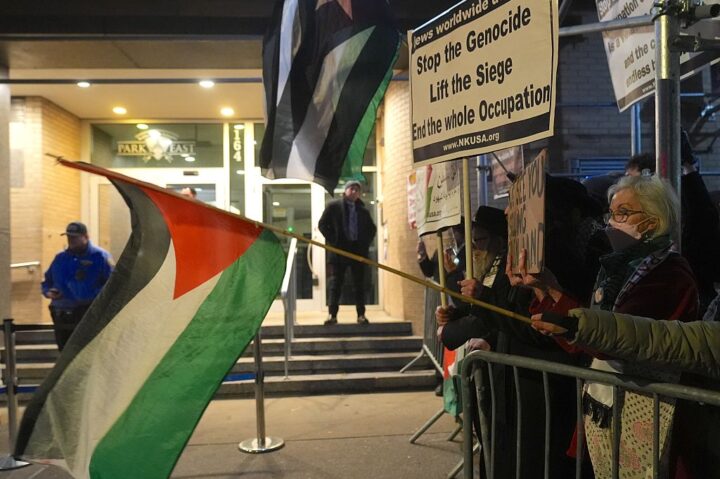
Selçuk Acar/Anadolu via Getty Images
Anti-Israel demonstrators gather at 'No Settlers on Stolen Land' protest against a Nefesh b'Nefesh event at the Park East Synagogue in Manhattan in November 2025.
The group behind a pro-Hamas demonstration near a Queens synagogue earlier this month and a series of other events targeting Jewish religious institutions has deep pockets — and deep roots, which criss-cross the country and link it to various extremist cells — according to publicly available tax filings.
The demonstrators who broke into chants of “Say it loud, say it clear, we support Hamas here” outside Young Israel of Kew Garden Hills — and triggered outrage over New York City Mayor Zohran Mamdani’s belated condemnation — were affiliated with an outfit known by multiple names: Palestinian Assembly for Liberation (PAL), Al-Awda (Arabic for “the return”) and Palestine Right to Return Coalition (PRRC). But official filings with state and federal authorities reveal that the groups are different monikers of a single nonprofit operation, one whose revenue has exploded in recent years: from just $44,789 in 2022 to $451,903 in 2024, the most recent period for which filings are available.
The group also orchestrated the action targeting Park East Synagogue in Manhattan in November, and the “Flood Boro Park” rally that devolved into violence last February. On the day of Hamas’ Oct. 7, 2023, attacks on Israel, the organization issued a full-throated endorsement of the assault.
“The Palestinian Assembly for Liberation and Al-Awda NY send their highest salutations to the Palestinian Resistance, the Freedom Fighters and Defenders of the indigenous Palestinian people,” a post on its Facebook page reads. “PAL and Al-Awda NY call on Palestinians globally to take their place in history, and to mobilize in all fora in support of the Liberation Operation.”
The group helped organize a Times Square protest the following day, alongside multiple far-left organizations. Much of the blowback the event received from New York officials centered on the participation of the NYC chapter of the Democratic Socialists of America, of which Mamdani is and was a member.
However, materials promoting the demonstration show that its staging received support not just from PAL/Al-Awda/PRRC but also from the People’s Forum, a Manhattan-based arm of a global network financed by Beijing-based tech mogul Neville “Roy” Singham. Singham and his wife, Jodie Evans, have poured their massive fortune into advancing disinformation supportive of the Chinese government and its allies, Russia and Iran. The People’s Forum also hosted Al-Awda’s national conference in 2022, which featured speakers from the DSA BDS Working Group.
Social media and blog posts reveal that PAL/Al-Awda/PRRC has also worked closely with Evans’ organization CODEPINK, known for its tactics of disrupting Capitol Hill hearings and political events, and for its pro-China and pro-Iran activism. PAL/Al-Awda/PRRC has also long partnered with the Party for Socialism and Liberation and its affiliate, Act Now to Stop War and End Racism Coalition, which provides staff to the Singham network. All of these groups have been involved in the Shut It Down 4 Palestine protest campaign, as well as in the 2024 encampments at Columbia University.
PAL/Al-Awda/PRRC also has ties to Samidoun, a group identified by Israel, Germany, Canada and the United States as a fundraiser and affiliate of the Popular Front for the Liberation of Palestine, which has been designated as a terror group by the U.S. for decades. PAL/Al-Awda/PRRC and Samidoun have cross-promoted and participated in each other’s events for years.
Further, a booklet for a 2023 “People’s Tribunal” on the Al-Awda website identifies Samidoun co-founder Charlotte Kates as “a member of Al-Awda, The Palestine Right to Return Coalition,” and archived versions of a now-deleted page listing PAL/Al-Awda/PRRC’s national board identified Kates as the group’s “Communications/Secretary” from 2021-2023. These pages also reveal that Nerdeen Kiswani, the founder of Within Our Lifetime and an outspoken defender of militant group violence, served as PAL/Al-Awda/PRRC’s “Youth Representative” in these same years. During that same period, Kiswani was a student at CUNY Law School, and delivered a speech at the school’s 2022 commencement in which she alleged that she had “been facing a campaign of Zionist harassment by well-funded organizations with ties to the Israeli government and military.”
The national board also includes attorney Lamis Deek, who has publicly praised Hamas, the PFLP, and Iran’s Al-Quds intelligence force — and who officially launched the “Palestinian Assembly for Liberation” with other Al-Awda organizers in 2021.
The PFLP and Hamas are not the only terror organizations with which PAL/Al-Awda/PRRC and its leaders have shown affinity. The Anti-Defamation League discovered one of the group’s self-identified founders, Abbas Hamideh, lauded Hezbollah on his Twitter account.
Tax documents show PAL/Al-Awda/PRRC at present has just two officers on its board. The organization’s chair is Amani Barakat, part of a prominent business, real estate and philanthropic dynasty based in Southern California. The late family patriarch, Adil Barakat, was a leader in the Arab American Press Guild and the United States Organization for Medical and Educational Needs, a relief organization centered on Middle Eastern affairs.
PAL/Al-Awda/PRRC’s treasurer and only other listed executive is Anas Amireh, a Miami-area realtor who has lectured at Florida International University.
Barakat, Amireh and Deek did not respond to requests for comment, and messages left in an inbox and at a phone number listed on the Al-Awda website similarly received no answer.
The source of the group’s swelling resources isn’t clear from public information. It has received sizable contributions from “dark money” funds that mask the original contributor’s identity, as well as from the WESPAC Foundation, a New York-based charity that has come under fire for underwriting organizations that call for Israel’s destruction.
Labor for Palestine and U.S. Campaign for the Academic and Cultural Boycott of Israel are also both affiliated with PAL/Al-Awda/PRRC, and operate out of its address in Coral Gables, Fla.
The Anti-Defamation League said it is ‘alarmed’ by leading Saudi voices using openly antisemitic dog whistles while peddling conspiracy theories
NATHAN HOWARD/POOL/AFP via Getty Images
Saudi Arabia's Crown Prince Mohammed bin Salman looks on during his meeting with the US Secretary of State in Riyadh on October 23, 2024.
Several leading Jewish and pro-Israel advocacy groups are expressing concerns about the impact of the recent rise in antisemitic and Islamist messaging out of Saudi Arabia, as the Gulf kingdom’s rhetoric is increasingly raising questions about its standing as a reliable U.S. ally in the region.
In recent weeks, Saudi Arabia has ratcheted up its anti-Israel rhetoric through state-sanctioned media and other regime mouthpieces, amid a widening rift with the United Arab Emirates and closer alignment with Islamist-oriented forces that are hostile toward Israel, such as Turkey and Qatar.
The new posturing, part of a broader pivot from what national security experts had seen as Saudi Arabia’s moderating influence in the region, has fueled surprise and frustration among Jewish American advocacy organizations that have pushed for the kingdom to normalize relations with Israel, an objective now regarded in some circles as unlikely for the foreseeable future.
Last week, the Anti-Defamation League said in a sharply worded social media statement that it was “alarmed by the increasing frequency and volume of prominent Saudi voices — analysts, journalists and preachers — using openly antisemitic dog whistles and aggressively pushing anti-Abraham Accords rhetoric, often while peddling conspiracy theories about ‘Zionist plots.’”
“This is harmful on many levels, diminishing the prospect of peaceful coexistence in the region and weakening regional initiatives promoting tolerance, understanding and prosperity,” the ADL added.
The pro-Israel lobbying group AIPAC, for its part, amplified a recent X post by Barak Ravid, a global affairs correspondent for Axios, who flagged what he called Saudi Arabia’s “information war against the UAE” and said “the Saudi press is full of articles that include anti-Israeli conspiracies, anti-Abraham Accords rhetoric and even antisemitic language.”
In a statement to Jewish Insider on Monday, Deryn Sousa, a spokesperson for AIPAC, emphasized that “America would be stronger and our interests would be better served if more nations, including Saudi Arabia, joined the Abraham Accords and worked together with our democratic ally Israel to promote regional peace, security and prosperity.”
Brian Romick, the president and CEO of Democratic Majority for Israel, echoed that sentiment, calling the Abraham Accords “a landmark diplomatic achievement” whose expansion, “especially through Saudi-Israeli normalization, should be a bipartisan pillar of U.S. policy.”
“A breakthrough between Israel and Saudi Arabia would be the most consequential step the region can take toward lasting peace, security, and prosperity, and the Trump administration should pursue it relentlessly while linking any upgrade in the relationship to measurable progress toward Saudi-Israeli normalization,” Romick said in a statement to JI. “Despite recent political frictions and unhelpful rhetoric, deep mutual interests in security, economic integration and technology make normalization an enduring strategic imperative.”
The American Jewish Committee, which has also promoted Saudi participation in the Accords, said it is “keeping a close eye on any developments” tied to the kingdom’s shift, but declined further comment.
While experts have linked Saudi Arabia’s recent animus toward Israel to such issues as the war in Gaza, Israeli recognition of Somaliland and unrest in Iran, Michael Makovsky, the president and CEO of the Jewish Institute for National Security of America, suggested that one unexplored motivating factor may be the Trump administration’s friendly relations with Islamist leaders in Turkey, Qatar and Syria.
“It sends a signal to the Saudis that you could take more Islamist positions, and it won’t hurt you with the United States,” Makovsky said in an interview with JI on Monday, arguing the administration will need to “reorient” its engagement in the region if it wants to help shape Saudi policies to align more closely with American interests.
But Makovsky said he has not seen interest among Trump officials in pursuing that path — even as the administration has long encouraged Saudi Arabia to join the Abraham Accords.
“I think the administration needs to step back and reflect on the fact that, if the Saudis are acting like this now, and they’ve been more of a moderating influence,” he said, “it should lead to a rethink of how they’re approaching all these other countries.”
The Scranton mayor is championing her support for Israel as she challenges GOP Rep. Rob Bresnahan
Jason Ardan/The Citizens' Voice via Getty Images
From left: Scranton Mayor Paige Cognetti, Scranton Tomorrow CEO Leslie Collins, and Pa. Gov. Josh Shapiro chat while walking through dowtown Scranton on Friday, December 13, 2024.
Paige Cognetti, the Democratic mayor of Scranton, Pa., is staking out a pro-Israel platform as she seeks to unseat freshman Rep. Rob Bresnahan (R-PA) in a northeast Pennsylvania swing district, emphasizing her support for continued military aid to the Jewish state in the wake of its war against Hamas in Gaza.
In a recent interview with Jewish Insider, Cognetti, who is favored to win the Democratic nomination in Pennsylvania’s 8th Congressional District, said “the Israel question,” as she called it, is “very simple” for her.
“I vehemently support Israel’s right to defend itself,” she explained, “and would take extremely seriously Congress’ role in ensuring they have the military aid that they need to defend themselves in a really dangerous neighborhood.”
To underscore her point, Cognetti, who was sworn into her third term as Scranton’s mayor earlier this month, touted a local munitions plant that she said continues to produce “the shells that we use for our own defense, but also that we ship to our allies, like Ukraine and Israel.”
“We’re very proud of that,” she said. “It’s really important to us in northeastern Pennsylvania that we defend ourselves, defend our military personnel at home and abroad. We’re very, very specific and deliberate about how we celebrate our veterans, and we feel the same way about supporting our allies.”
Even as some Democratic candidates have turned away from embracing such positions amid growing chilliness toward Israel within the party, Cognetti, for her part, said she did not feel compelled to join their ranks. “I understand that there has been a lot of rhetoric in the last couple of years — and a lot of folks that feel one way or the other,” she observed.
“But there has never been a question, to me, about what the U.S.’ role in supporting Israel should be,” she said, adding that she “will continue to support Israel as a member of Congress.”
In addition to calling for reauthorization of the current 10-year memorandum of understanding between Israel and the United States that is set to expire in 2028, Cognetti also stressed her support for ensuring humanitarian aid “gets to the people who need it” and backed a “diplomatic, two-state solution” to the conflict, which she acknowledged would be a “complicated and hard-fought” effort.
In her primary campaign to challenge Bresnahan, a first-term incumbent endorsed by AIPAC, Cognetti, 45, is seen by Democratic Party officials as well-positioned to win back the seat held by former Rep. Matt Cartwright (D-PA), who fell last cycle after six consecutive terms in one of two upsets in the state that helped Republicans maintain their increasingly narrow House majority.
Now, the Democratic Congressional Campaign Committee is eyeing the district as one of four possible pickup opportunities in the state, while targeting Bresnahan, 35, as “the poster-child of Washington corruption” due to scrutiny over his multiple stock trades as a congressman, despite a campaign vow to ban the practice among elected officials.
Speaking with JI last week, Cognetti reiterated those accusations, saying Bresnahan was “clearly profiting off of his votes,” and boasting of her own record “delivering results and putting an end to the corrupt machine politics that we’re far too familiar with here in northeastern Pennsylvania.”
Bresnahan’s campaign, for its part, has dismissed Cognetti as a “far-left extremist” who is in favor of open borders and defunding the police. But he may struggle to land those hits as Cognetti casts herself in a moderate light, particularly on sensitive issues relating to Israel and rising antisemitism on the left and right.
Cognetti, who launched her bid last September, has since raised more than $1.1 million, garnering over $640,000 in donations last quarter, her campaign recently announced. Cognetti is widely expected to prevail in the May primary, where she is facing Francis McHale, a retired state official. She has also reportedly claimed support from Pennsylvania Gov. Josh Shapiro, a moderate pro-Israel Democrat.
Larry Ceisler, a public affairs executive based in Pennsylvania who is supporting Cognetti’s House bid, called the mayor a “top-tier candidate” with a “great profile” for the swing district. “At one time, I thought Matt Cartwright was a unique candidate to hold that seat, but Paige has really come on over the last several months,” he told JI, noting that she “will have the resources she needs to win.”
“The fact is Matt Cartwright lost because he was hampered at the top of the ticket,” Ceisler added. “Paige will have the opposite as Josh Shapiro has proven to have coattails and Paige is positioned to take advantage of them.”
Cognetti, the first woman mayor of Scranton, was elected in 2019 when she ran as an independent and defeated a crowded field in what was then viewed as a rebuke of the local Democratic machine.
During her tenure, Cognetti has spoken up in support of Israel after Hamas’ Oct. 7, 2023, terror attacks and sought to raise awareness about the rise of antisemitism on both sides of the aisle. “There is some really, really dangerous rhetoric, and we need to call that out,” she said, characterizing anti-Jewish prejudice as antithetical to “core American values.”
“Of course, here in Pennsylvania, we have a fresh and really horrific example of antisemitism with the arson attack on Gov. Shapiro’s home and his family just last year,” she told JI. If elected, she added, she hopes to be “part of a coalition that raises the issue of antisemitism and passes any legislation necessary to make sure” the subject “remains in the forefront of people’s minds.”
Cognetti, who has never visited Israel, said she had signed up for a trip that was canceled in the wake of the Oct. 7 attacks but is “looking forward to getting there at some point.”
As she mounts her campaign, Cognetti said she is building “a broad coalition across the district” and describes forming “solid relationships” with Jewish community leaders as well as productive talks with “different groups that are focused on Israel.”
Democratic Majority for Israel’s political arm, which has not announced an endorsement in the race, “has had positive conversations with” Cognetti and is “keeping a close eye” on the primary, a source familiar with the matter told JI.
Despite internal divisions over Israel now roiling the Democratic Party, Cognetti argued that “some people have let themselves kind of get away from that simple answer, which is, Israel is surrounded by people who do not believe they should exist.”
“The United States,” she vowed, “has been and will continue to be its most staunch ally.”
City College of New York did not respond to requests for comment asking if disciplinary action would be taken against the group
Selçuk Acar/Anadolu via Getty Images
Anti-Israel demonstrators gather at 'No Settlers on Stolen Land' protest against a Nefesh b'Nefesh event at the Park East Synagogue in Manhattan in November 2025.
City College of New York’s Students for Justice in Palestine chapter remains a registered campus group following its participation in last week’s pro-Hamas protest in Queens that caused nearby schools and a synagogue to close early.
The demonstration was planned by a group called the Palestinian Assembly for Liberation [PAL]-Awda, protesting an event held by CapitIL, a Jerusalem-based real estate agency, at a Queens synagogue. The group called the meeting an “illegal event” promoting “blatant land theft and dispossession” in a social media post promoting the protest.
CCNY SJP reposted PAL-Awda’s fliers promoting the demonstration and shared videos on its Instagram story of its members participating in the protest. A spokesperson for CCNY did not respond to multiple inquiries from Jewish Insider following the protest regarding what, if any, disciplinary action would be taken.
The protest was also promoted by Columbia University Apartheid Divest, a coalition of student groups that is no longer recognized by Columbia University. Dozens of keffiyeh-clad demonstrators gathered near the synagogue, Young Israel of Kew Gardens Hills, and chanted, “We support Hamas here,” “There is only one solution, intifada revolution,” “Globalize the intifada” and “Death to the IDF” for more than two hours while banging on drums in the residential area in the heavily Jewish neighborhood. One protester held a ripped Israeli flag that was painted red to resemble blood.
The pro-Hamas language used by demonstrators was condemned by a range of New York politicians, including New York City Mayor Zohran Mamdani and former City Comptroller Brad Lander, both of whom have been vocally critical of Israel.
CCNY was already facing scrutiny following a university-sponsored interfaith event in November during which a Muslim spiritual leader delivered an antisemitic tirade against a CUNY Hillel director. The U.S. Department of Justice opened an ongoing investigation into the interfaith event shortly after it occurred.
Many New York Democrats, from Gov. Kathy Hochul to Attorney General Letitia James, quickly spoke up. It took Mamdani over a day to do the same.
Michael M. Santiago/Getty Images
New York City Mayoral Zohran Mamdani (L) and former Mayor Eric Adams attend the annual 9/11 Commemoration Ceremony on September 11, 2025 in New York City.
New York City Mayor Zohran Mamdani is facing criticism from Democratic leaders over his delayed and muted response to last week’s pro-Hamas protest in Queens that caused nearby schools and a synagogue to close early in anticipation of the demonstration, where dozens of masked protesters chanted “We support Hamas” near the synagogue.
Democratic elected officials across New York — including left-wing politicians hostile to Israel, like Mamdani ally and former City Comptroller Brad Lander — were quick to release statements condemning the support for Hamas that was on display at the demonstration, which was organized by the group Palestinian Assembly for Liberation, [PAL]-Awda, to protest an event held by CapitIL, a Jerusalem-based real estate agency.
The event was held at the Modern Orthodox synagogue Young Israel of Kew Gardens Hills.
A flyer promoting the protest, which took place on a residential street about half a block from the synagogue, called the meeting an “illegal event” promoting “blatant land theft and dispossession.” Keffiyeh-clad demonstrators also chanted “There is only one solution, intifada revolution,” “Globalize the intifada,” and “Death to the IDF” for more than two hours while banging on drums.
“Let’s be crystal clear: this is vile antisemitism,” Lander, who is running to unseat Rep. Dan Goldman (D-NY) as a Mamdani-endorsed challenger in New York’s 10th Congressional District, said on Friday morning. “This should not have to be said: you can oppose land sales in the West Bank, without supporting terrorism & the mass murder of Jews.”
Gov. Kathy Hochul, who endorsed Mamdani in the mayoral election, also weighed in on Friday morning, saying, “Hamas is a terrorist organization that calls for the genocide of Jews. No matter your political beliefs, this type of rhetoric is disgusting, it’s dangerous, and it has no place in New York,”
New York Attorney General Letitia James said Friday midday, “Hamas is a terrorist organization. We do not support terrorists. Period.”
Other New York Democratic leaders who condemned the protest quickly and directly on Thursday and Friday included New York City Comptroller Mark Levine, Senate Minority Leader Chuck Schumer and Sen. Kirsten Gillibrand and Reps. Grace Meng and Ritchie Torres.
But the newly inaugurated mayor remained silent Thursday night and much of the following day regarding the demonstration, which marked his first major test in protecting the city’s Jewish community.
His spokesperson did not respond to multiple inquiries from Jewish Insider on Thursday, including one asking whether the mayor’s team had discouraged demonstrators from protesting and another, immediately after the event, asking if he condemned any of the slogans chanted.
Mamdani broke his silence late in the afternoon on Friday when he was asked about the protesters’ pro-Hamas chant by Politico reporter Jason Beeferman while leaving a campaign event in Brooklyn for Democratic Socialists of America-endorsed candidate Claire Valdez, who is running for a Brooklyn-Queens congressional seat held by Rep. Nydia Velazquez (D-NY)
“That language is wrong,” Mamdani replied while walking to a car after the event. “I think that language has no place in New York City.”
Mamdani later followed up with an additional statement just after Shabbat started in New York: “As I made clear, the rhetoric and displays that we saw and heard in Kew Gardens Hills last night are wrong and have no place in our city,” he said. “My team is in close touch with the NYPD regarding last night’s protest and counterprotest. We will continue to ensure New Yorkers’ safety entering and exiting houses of worship as well as the constitutional right to protest.”
On Saturday, when asked at a press conference why he didn’t “condemn both sides,” Mamdani answered, “I absolutely have an opposition to the sale of land in the West Bank. It’s a violation of international law and that comes from my belief in the importance of following international law.”
“It’s been a distressing few months for Jews everywhere. I appreciated the mayor’s statement,” Democratic strategist Chris Coffey told JI. “Could it have come earlier? Sure. But being mayor in the first week is pure pandemonium and chaos. The important part is that he got it right.”
But Mamdani’s eventual response was met with continued concern from Jewish leaders over its delay and neglect to specifically condemn Hamas. In a sign of the far-left character of his political base, he also received criticism from DSA-aligned allies in his own camp for criticizing the protest.
“It’s a step up from his statement [after the Oct. 7, 2023 terrorist attacks in Israel], which failed to even mention Hamas. Still, it’s concerning that it takes the mayor of the city with the largest population of Jews outside of Israel nearly 24 hours to condemn blatant antisemitism when every other major elected in New York found the time,” Democratic state Assemblymember Sam Berger, who represents the district where the protest took place, told JI on Sunday.
Another Democratic Queens assemblymember, Nily Rozic, told JI, “It shouldn’t take the mayor [nearly] 24 hours to condemn an antisemitic protest layered in antisemitism, let alone one that openly supports terror organizations.”
Rozic expressed dismay over the timing of the statement after Shabbat.
“If the mayor were genuine in his concern over Jewish safety he would have acted with urgency and not waited so long, when most of those impacted wouldn’t see his statement until long after,” she told JI.
“I am a vocal & passionate support[er] of Mamdani’s,” Adam Carlson, founding partner of the polling group Zenith Polls, wrote on X. “But I’ve waited patiently all day for him to forcefully condemn Hamas — watching dozens of other city & state electeds do so — and am still waiting. This is not only hurtful to me, but it’s bad politics & distracts from his agenda.”
New York magazine writer David Freedlander posted screenshots on X of texts sent to him on Friday afternoon from two city political operatives, both “broadly supportive of Mamdani.”
The messages were identical: “Zohran is completely blowing this pro-Hamas protest thing.”
Lander has been criticizing Goldman for not fighting against Trump, even though he led impeachment efforts against the president

Mary Altaffer/AP
Rep. Dan Goldman (D-NY), left, is joined by New York City Comptroller Brad Lander during a news conference outside the Metropolitan Detention Center in the Sunset Park neighborhood of Brooklyn on Tuesday, Aug. 16, 2022.
The hotly anticipated primary matchup between outgoing New York City Comptroller Brad Lander and Rep. Dan Goldman (D-NY) was widely expected to be a bellwether race that would test the strength of pro-Israel sentiment within the Democratic Party.
Featuring two prominent Jewish New Yorkers with sharply opposing views on the Middle East, the race notably pits Lander, an outspoken critic of Israel and its war in Gaza, against Goldman, a more moderate incumbent viewed as a strong defender of the Jewish state.
But nearly a week after announcing his challenge, Lander, the progressive New York City comptroller, is so far tiptoeing around such differences, even as they are arguably the driving contrast in the primary. Instead, he has more actively emphasized a message that is casting Goldman as ineffective in countering President Donald Trump — declaring it is “time for fighters” and “not folders” in Congress.
His top surrogates — including a range of vocal Israel critics including Sens. Elizabeth Warren (D-MA) and Bernie Sanders (I-VT) and Zohran Mamdani, the mayor-elect of New York City — have made no mention of Middle East policy in their statements endorsing his campaign to represent New York’s 10th Congressional District, which covers Lower Manhattan and a swath of northwest Brooklyn.
“We need more fighters in Washington now more than ever, and Brad is a fighter,” Warren said last week, adding that Lander has “the grit to not just win this race, but deliver for working families.”
Such comments, however, have failed to note that Goldman, who was elected to Congress in 2022, is recognized as a leading Trump antagonist, having served as the top prosecutor in the president’s first impeachment case. Like Lander, he has frequently confronted the Trump administration on a range of issues including its immigration agenda. Last week, for instance, Goldman seized the spotlight during a fiery House hearing in which he clashed with Kristi Noem, the Homeland Security secretary — accusing her of illegally deporting asylum seekers in a grilling that drew headlines and social media virality.
Warren’s team did not respond to a request for comment when asked why she was not satisfied with Goldman’s record opposing Trump and his administration’s policies.
The early effort by Lander and some of his allies to employ rhetoric focused largely on fighting Trump has obscured how Israel is the clearest dividing line in the race — raising questions about Lander’s strategy as he seeks to shape a narrative Goldman’s supporters have dismissed as a misdirection. Rep. Nancy Pelosi (D-CA), in a statement last week, countered that her colleague is one of the “best members” she has “ever served with” and said he “is exactly the right fighter for this moment.”
With opposition to Trump likely a major motivating force for midterm voters, Lander is now facing scrutiny over his attacks targeting a two-term incumbent who has long staked his reputation on effectively battling the president. Meanwhile, in the wake of Israel’s recent ceasefire with Hamas, it remains to be seen if Gaza will continue to be an animating issue heading into the June primary election that is already shaping up to be a heated and expensive race.
Goldman, a Levi Strauss heir whose estimated net worth is up to $250 million, spent nearly $5 million of his own money during his first primary bid three years ago, when he narrowly prevailed in a crowded field of progressive rivals who split the vote. Lander has also targeted Goldman’s personal wealth, saying that the “oligarchy” should not “be able to buy a seat in Congress.”
Even as Lander, a former longtime city councilman from Brooklyn, touts high-profile support from the Senate, House progressives have for their part so far stayed on the sidelines.
Rep. Alexandria Ocasio-Cortez (D-NY), an Israel critic who backed Lander’s comptroller bid in 2021 and called him a “talented hero” after his arrest by federal agents at an immigration courthouse last June, said she is “not weighing into that race right now,” echoing other like-minded lawmakers who also declined to take sides in the looming primary.
While Lander has long identified as a progressive Zionist, he has been outspoken in criticizing Israel’s conduct in Gaza, accusing the country of war crimes and ethnic cleansing. He has additionally called for conditioning U.S. aid to Israel, a measure Goldman has rejected.
“What Lander is counting on now is the sentiment of the moment, which is further to the left and more anti-Israel,” Hank Sheinkopf, a veteran Democratic consultant in New York City, told Jewish Insider in a recent interview.
In a speech before the mayoral election, where he rose to prominence as a top surrogate for Mamdani after losing his own primary bid, Lander advocated for building a “coalition of anti-Zionists and liberal Zionists,” seeking to unify opposing factions to end “the horrors in Gaza.”
Goldman, for his part, chose not to endorse Mamdani, citing concerns about his approach to Israel and rising antisemitism, but he has said he looks forward to working with the mayor-elect on promoting his affordability agenda.
“What Lander is counting on now is the sentiment of the moment, which is further to the left and more anti-Israel,” Hank Sheinkopf, a veteran Democratic consultant in New York City, told Jewish Insider in a recent interview.
Still, in the days after launching his campaign, Lander has sent mixed signals about how he plans to highlight differences with his opponent on Israel.
In his campaign announcement video released last Wednesday, for example, he took a thinly veiled jab at Goldman in vowing not to do “AIPAC’s bidding,” referring to the increasingly demonized pro-Israel group, but did not mention the incumbent by name.
Lander told The New York Daily News in an interview last week that he views contrasts over Gaza as ancillary to their approaches to confronting the Trump administration, drawing raised eyebrows from observers who noted that hitting Goldman on his strongest issue avoids addressing a more salient tension over Middle East policy.
“On this issue, we have some disagreements,” he said of Israel, “but the core rationale is because it’s time for fighters not folders,” Lander elaborated on his approach to the race.
One Jewish community leader supportive of Goldman expressed frustration at the logic behind Lander’s challenge. “I’m just pissed that there’s not a single thing they can point to what Goldman isn’t doing right other than being pro-Israel,” he told JI, speaking on the condition of anonymity to address a sensitive subject.
During a campaign kickoff event in Brooklyn last week, Lander accused Goldman of failing to hold Israel accountable for its behavior in Gaza, saying “only I, of the two of us, recognize that Netanyahu’s leveling of schools and hospitals and the destruction of Gaza was a war crime,” in reference to the Israeli prime minister. He also reiterated that New Yorkers “don’t want elected officials who do AIPAC bidding in a district that recognizes that our safety and our freedom is bound up together.”
Lauren Hitt, a spokesperson for Lander’s campaign, disputed criticism that he is avoiding Israel as a top issue. “Brad literally called out AIPAC in his launch video, so safe to say he will continue to spend quite a bit of time discussing Israel in this race,” she said in a statement to JI on Friday.
On Friday, Lander also said on social media that, if he were a member of Congress, he would introduce a resolution censuring Rep. Randy Fine (R-FL) over his recent incendiary comments calling for Muslims to be “destroyed.” Lander, without directly citing his opponent, also noted he would “not have voted with Republicans” to censure Rep. Rashida Tlaib (D-MI) over incendiary comments against Israel during the Israel-Hamas war in 2023, as Goldman himself had done.
Hours later, Goldman also denounced Fine in an X post for remarks assailing Muslims as “barbarians,” calling the statement “despicable and unacceptable” and saying he “must apologize and retract this tweet immediately.”
Lauren Hitt, a spokesperson for Lander’s campaign, disputed criticism that he is avoiding Israel as a top issue. “Brad literally called out AIPAC in his launch video, so safe to say he will continue to spend quite a bit of time discussing Israel in this race,” she said in a statement to JI on Friday.
“Brad will also speak to the other issues concerning NY-10 voters, including affordability — another topic where the heir to the Levi Strauss fortune is out of step with the district’s experience. NY-10 voters don’t need a representative that’s palling around with Don[ald Trump] Jr. in the Bahamas, they need someone who understands and represents their views,” Hitt added, referring to an October social media post in which Trump’s son sarcastically thanked Goldman for his “kind words” about the president’s ceasefire and hostage deal during the government shutdown.
For now, it is unclear how AIPAC and pro-Israel groups more broadly are assessing the matchup — and if they will choose to engage in the primary. A spokesperson for AIPAC declined to weigh in.
In 2022, AIPAC disclosed after Goldman had won his primary that its super PAC, United Democracy Project, had quietly contributed at least $350,000 to a separate group established near the end of the race to fund a series of attack ads against Yuh-Line Niou, a far-left rival who had drawn controversy for voicing alignment with the Boycott, Divestment and Sanctions movement targeting Israel.
One pro-Israel consultant, who was granted anonymity to address a sensitive topic, suggested “AIPAC’s involvement in the race would probably be a negative against Goldman.” Mamdani, an ally of Lander who has long been a fierce critic of Israel, performed well in the district — where Goldman’s views on Israel have faced backlash from left-wing voters.
Democratic Majority for Israel, which is backing Goldman, had been wary of a one-on-one contest with Lander, whom polling has shown is a strong opponent, according to a person familiar with the group’s discussions. Lander’s early consolidation of progressive support helped to push two other rivals on the left not to run in the race, effectively clearing the field for the outgoing comptroller. A spokesperson for DMFI did not respond to requests for comment regarding its plans.
Goldman, meanwhile, said in an interview with a local news outlet last week he welcomes Lander’s challenge but is “not really thinking about” the race “right now.” A campaign spokesperson said that he is “focused on stopping” Trump and “will deal with Brad and other challengers in the new year,” when he is “planning to roll out a flood of” endorsements from fellow House members.
Despite differences over Israel, Goldman is also endorsed by J Street, a progressive Israel advocacy group that has long been close to Lander. A spokesperson for J Street told JI in a statement the group is “proud” to back Goldman and “we deeply value his pro-Israel, pro-peace and pro-democracy leadership.”
“Dan has a progressive record,” said Chris Coffey, a Democratic strategist. “It’s not always as far left on Israel as Brad, for sure, and that is one of the things that differentiates them on policy.” Israel, he added, “could be a defining issue in this race,” regardless of Lander’s messaging efforts to prioritize Trump.
“We are also grateful for our years-long friendship with Brad Lander, who is a vocal leader for our values. We know that the issue of peace is close to both of their hearts,” the spokesperson continued. “Ultimately, it is up to the district to determine who they want to represent them in Congress, and we are glad to see two J Street-aligned voices in this race.”
A top J Street official, speaking on background to address the primary, confirmed the group will not be engaging materially in the race as it is satisfied with both candidates’ records. “I expect our donor base will give to both,” the official told JI. “There’s definitely a split of opinion on this race, to say the least.”
“Dan has a progressive record,” said Chris Coffey, a Democratic strategist. “It’s not always as far left on Israel as Brad, for sure, and that is one of the things that differentiates them on policy.” Israel, he added, “could be a defining issue in this race,” regardless of Lander’s messaging efforts to prioritize Trump.
Lander, for his part, could also face backlash from far-left activists in the district who have bristled at his identification as a progressive Zionist and have taken issue with his investments in an Israeli arms producer as comptroller, even as he chose to cease holdings of Israel bonds during his four years in office.
The Democratic Congressional Campaign Committee, which is focused largely on winning back the House in next year’s midterms, declined to comment on the primary, though it has traditionally backed incumbents.
Locally, a political advocacy group in the district called Brooklyn BridgeBuilders, which is dedicated to fighting antisemitism and anti-Israel sentiment, is planning to support Goldman and is currently in the process of formalizing its strategy, according to Ramon Maislen, its CEO.
“The decision to challenge a highly effective liberal Jewish incumbent is incredibly fraught,” Maislen, a Jewish community activist who lives in Park Slope, told JI. “Dan is someone who has been unwavering in taking on Trump, defending our democracy and standing with the Jewish community.”
Jordan Wood, now running to succeed Rep. Jared Golden, said he won’t take money from AIPAC in his newly launched House campaign
Campaign website
Jordan Wood
Jordan Wood, a Maine Democrat who dropped his Senate bid on Wednesday to run for the seat held by retiring Rep. Jared Golden (D-ME), said in a recent podcast interview that he would reject contributions from AIPAC, the pro-Israel advocacy group, joining a growing crop of Democratic candidates who have made similar pledges.
In the conversation with Kaivan Shroff, a Democratic activist, released last week, Wood pointed to what he called “a tremendous amount of distrust right now among Democratic primary voters that the money that AIPAC has put into our political system has affected our priorities when it comes to foreign aid to Israel.”
Graham Platner, a leading far-left candidate in the Democratic Senate primary facing Maine Gov. Janet Mills, has been a particularly hostile critic of AIPAC, which he has made a central focus of his anti-Israel messaging.
In a statement to Jewish Insider, Wood clarified that he does not “take money from AIPAC for the same reason I don’t take money from corporate PACs or lobbyists — because it guarantees voters trust that my policy positions and votes in Congress are not influenced by any campaign contributions.”
A spokesperson for AIPAC, Marshall Wittmann, dismissed that logic. “It’s outrageous to discriminate against pro-Israel Americans,” he said in a sharply worded statement to JI. “Ostracizing and making false accusations about fellow citizens’ democratic engagement to strengthen the U.S.-Israel partnership is contrary to American values and interests.”
“Our six million members will not be deterred by anti-Israel extremists, and their voices will be heard in the 2026 elections,” Wittmann said.
During the podcast interview, Wood stated that, even as he pulls away from AIPAC, “I do also still support aid to Israel,” albeit alongside “conditions on the continuation” of U.S. assistance, including “restrictions on offensive military weapons” to the Jewish state.
Wood, a former congressional staffer who was trailing his rivals in what has increasingly solidified into a two-person Senate race, declared on Wednesday that he was jumping into the open primary to succeed Golden, a moderate Democrat who has represented a GOP-leaning district for three consecutive terms.
The congressman said last week he would not seek reelection, writing he had “grown tired of the increasing incivility and plain nastiness” of American politics and that he and his family had faced “frequent threats” that ultimately contributed to his decision.
Golden, a retired Marine, has been a dependably pro-Israel voice in the House and was endorsed by AIPAC before he announced he was stepping down.
“With Jared not running, it leaves open one of the most competitive House races in the entire country, and so I’m stepping up to take that on,” Wood said on Wednesday.
Matt Dunlap, the Maine state auditor, was already challenging Golden from the left before Wood, who embraced progressive stances as a Senate candidate, said he would enter the race.
The primary field is expected to grow in the coming weeks as other potential candidates are floated, including Troy Jackson, the former president of the Maine Senate currently running for governor, and Kirk Francis, chief of the Penobscot Nation.
The Democratic Congressional Campaign Committee, looking for more-moderate candidates in the field, is still recruiting even with Wood and Dunlap in the race, according to a source familiar with the matter.
Former Maine Gov. Paul LePage is the frontrunner for the Republican nomination in the swing district, which backed President Donald Trump by a double-digit margin in 2024.
Democrat Graham Platner entered the race accusing Israel of genocide in Gaza

Mark Makela/Getty Images
Sen. Susan Collins (R-ME) addresses the press on Nov. 6, 2022.
Sen. Susan Collins (R-ME) is criticizing Graham Platner, a Democrat running against her in next year’s election, for singling out AIPAC as a “weird” interest group in new remarks to a local newspaper published on Tuesday, where he pledged to decline support from the pro-Israel lobbying organization.
“Sen. Collins is a strong supporter of AIPAC, a bipartisan organization that promotes stronger ties between the United States and Israel,” Shawn Roderick, a spokesperson for Collins’ campaign, told Jewish Insider on Wednesday. “Nothing about their work is ‘weird’ — in fact, it has never been more important given the aggressive antisemitism that we have seen around the world since the appalling Oct. 7, 2023, terrorist attack.”
In his comment to the Midcoast Villager, Platner, a 40-year-old oyster farmer and Marine veteran who announced his bid to challenge Collins on Tuesday, noted that his campaign would reject backing from corporate super PACs and donations from interest groups such as AIPAC that he dismissed as “weird.”
“My view here is very simple,” Platner told JI on Wednesday when asked to elaborate on his initial comment, which had not been quoted in full. “What is happening in Gaza is a genocide, I refuse to take money from AIPAC or any group that supports the genocide in Gaza.”
In other interviews this week, Platner, a political newcomer, has similarly accused Israel of genocide in Gaza and also endorsed efforts to block U.S. arms sales to Israel.
AIPAC’s political action committee is backing Collins, in keeping with its commitment to defend friendly incumbents who are up for reelection. Collins, who is now seeking her sixth term, has been among her party’s leading moderate voices, pushing to maintain a bipartisan consensus on support for Israel.
Marshall Wittmann, a spokesperson for AIPAC, questioned Platner’s recent comment about the group in a statement to JI on Wednesday. “More than 12,000 Maine voters are members of AIPAC and advocates for a strong U.S.-Israel relationship who don’t think it’s ‘weird’ for Americans to engage in the democratic process,” he said. “We are proud to support Sen. Collins who is a stalwart champion of an alliance that benefits Maine and America.”
Still, Platner’s seemingly off-handed remark more broadly underscores a growing disconnect between AIPAC and the Democratic Party, where even some of the staunchest supporters of Israel have been put on the defensive amid an international uproar over the humanitarian crisis in Gaza.
In recent weeks, two Democratic House members who have received financial backing from AIPAC’s super PAC in their primaries, Reps. Maxine Dexter (D-OR) and Valerie Foushee (D-NC), both said they would support efforts to block transfers of offensive weapons to Israel. Foushee, for her part, also said earlier this month that she would not accept further support from AIPAC in her reelection campaign next year.
Meanwhile, Mallory McMorrow, a top Democratic candidate running for Senate in Michigan, revealed on Wednesday that she is urging AIPAC to refrain from engaging in the primary, where she is facing a strong pro-Israel advocate, Rep. Haley Stevens (D-MI), and a prominent left-wing critic of Israel, Abdul El-Sayed, who is backed by Sen. Bernie Sanders (I-VT).
The group declined to comment on McMorrow’s request.
Even as AIPAC has been under attack, it has continued to maintain friendly relationships with Democrats and Republicans, hosting a number of freshman lawmakers from both sides of the aisle on trips to Israel this month.
The Pennsylvania Democratic senator’s criticism of his party drew loud applause from pro-Israel activists

Gabby Deutch
Sen. John Fetterman (D-PA) speaks at a NORPAC advocacy event in Washington on May 20, 2025.
As Sen. John Fetterman (D-PA) faces attacks from the media and fellow lawmakers in the Democratic Party, he hit back at members of his own party on Tuesday in remarks to a group of bipartisan activists in Washington.
Speaking to members of NORPAC, a pro-Israel advocacy organization, Fetterman offered some of his sharpest criticism yet of the Democratic Party’s approach to Israel after the Oct. 7 Hamas attacks.
“Israel and your community deserves much better from my party,” Fetterman said, earning loud applause.
He described how American universities have produced a “monoculture that produced, actually, rampant antisemitism,” and called to address it — but suggested Democrats are not interested in doing so.
“We have to address that. But in my party, you will pay a price,” said Fetterman. “That’s OK. I think that’s what defines character … that you’re going to support things even if it moves against your own political interest.”
Several recent reports have suggested that Fetterman is struggling with mental health challenges, which Fetterman has denied.
The RJC’s decision to back Colby comes even as the group has differed with the foreign policy analyst on key issues — especially Iran

Dominic Gwinn / Middle East Images /via AFP)
Elbridge Colby speaks at the National Conservative Conference in Washington D.C., Tuesday, July 9, 2024.
The Republican Jewish Coalition urged the “swift confirmation” of Elbridge Colby as undersecretary of defense for policy in the Trump administration, according to a new letter, even as he faced scrutiny from pro-Israel conservatives over his dovish views on Iran and frequent calls to scale back U.S. involvement in the broader Middle East.
In the letter, which was sent on Thursday to Sen. Roger Wicker (R-MS), the chairman of the Senate Armed Services Committee, RJC leadership said it was “confident” Colby “will enact the strong pro-Israel policy of” President Donald Trump and Secretary of Defense Pete Hegseth, arguing the nominee “will be an asset to” the administration’s national security team.
“Mr. Colby understands that a strong and secure Israel is in America’s interests as well,” RJC CEO Matt Brooks and Norm Coleman, the group’s national chairman, wrote in their letter backing Colby. “He fully supports the continued robust U.S. political, military and financial support of Israel,” they added, noting Colby has “called Israel a model ally” and “will ensure that Israel can continue to check the aggression of our common enemies in Iran and its proxies in the region.”
The letter suggested the RJC was willing to overlook major potential differences with Colby, as Trump’s allies continued to fall in line behind some of his more divisive nominees awaiting confirmation.
Colby’s possible ascendancy also underscores how a new generation of defense advisors deeply skeptical of U.S. engagement abroad is poised to shape the Trump administration’s foreign policy — overshadowing more traditionally conservative voices raising concerns about recent hires at the Pentagon.
In contrast with the RJC, Colby, a so-called defense “prioritizer,” has voiced a more sanguine assessment of Iran, which he regards as a less urgent threat to U.S. interests than China. Colby has also argued that containing a nuclear Iran “is an eminently plausible and practical objective.”
Colby, who has called the Middle East “relatively unimportant,” has supported a withdrawal of U.S. military forces in the Persian Gulf that have helped defend Israel from Iranian missile attacks, saying that the U.S. can “more efficiently” deter Iran “by bolstering the military capabilities of its partners in the region.”
“If Iran’s provocations need to be answered, Washington must do so in a way that limits military involvement in the Middle East,” he wrote in a 2019 article. “If this means doing less than we might like against Iran, so be it.”
More recently, Colby questioned the Biden administration’s efforts to counter the Houthis, the Iran-backed proxy group in Yemen that has targeted Israel and global shipping lanes. While Colby has voiced support for Israel, he has called for a “reset” on the U.S.-Israel alliance to confront Beijing.
“America should be ready to provide potent material and political support to Israel,” Colby wrote shortly before the Hamas Oct. 7, 2023, attacks. “But at the same time, Israel should understand that the United States, which cannot afford to be enmeshed in another Middle Eastern war, will take a supporting role.”
He has otherwise opposed U.S. military assistance to Ukraine amid its war with Russia, which he has dismissed as a “peripheral conflict” with respect to U.S. national security interests. For its part, the RJC has urged Congress to back aid to Ukraine, saying “it is in America’s national interest to see Russia’s military might diminished and its malign strategic aims thwarted.”
Colby, whose confirmation hearing has not yet been scheduled, served in the first Trump administration as a deputy assistant secretary of defense and more recently worked at WestExec Advisors, a consulting firm co-founded by former Secretary of State Tony Blinken. Colby is an ally of Tucker Carlson, who has also pushed his inclusion in the Trump administration.
Sam Markstein, a spokesperson for RJC, said that “the letter in support of Mr. Colby came about as a result of extensive conversations with” Brooks and Coleman, “as we do with a wide range of various appointees and nominees for key administration positions.”
“After the conversation, in which we asked a wide range of questions and drilled down on his views, his commitment to support for Israel is clear,” Markstein told Jewish Insider on Sunday, “and as we said in the letter, Mr. Colby ‘will be an asset to President Trump’s solidly pro-Israel national security team.’”
Robert O’Brien, a former national security advisor in the first Trump administration, said he believed Colby’s foreign policy approach has “in some ways” been “mischaracterized,” calling Colby a “hawk when it comes to Israel and the Middle East.”
“I think Bridge’s concern is that the United States can only do so much,” O’Brien explained in a recent interview with JI.
Colby did not respond to a request for comment on Sunday.
In addition to Colby, some other Pentagon picks have also recently drawn backlash from pro-Israel Republicans, including Michael DiMino, the newly appointed deputy assistant secretary of defense for the Middle East, who has called for a reduced U.S. presence in the Middle East and said the U.S. does not have any critical interests in the region.
Dan Caldwell, a Pentagon advisor who helped lead the transition process at the Defense Department, has likewise advocated for a more restrained foreign policy that would have the U.S. “significantly” pull back its long-standing focus on the Middle East and regional adversaries such as Iran, while expressing a largely skeptical attitude toward Israel, among other views espoused by a growing isolationist wing of the GOP.
As Colby awaits Senate confirmation, his position is currently being held by a protégé, Alex Velez-Green, who most recently worked as a senior policy advisor at the Heritage Foundation.
One Republican foreign policy expert who served in the first Trump administration recently speculated to JI that Colby’s confirmation will be “a real tough one” — though the RJC’s recent letter could serve as a valuable stamp of approval amid broader skepticism from the pro-Israel community.
Eric Levine, a top GOP fundraiser and RJC board member who has vocally opposed the confirmation of Tulsi Gabbard, Trump’s pick to serve as the director of national intelligence, expressed comfort with Colby in an email to JI on Friday. “I’m with RJC,” he said.
An outspoken faction of the Democratic Party is openly criticizing Israel, but where does the mainstream stand?
Graeme Sloan/Sipa via AP
The U.S. Capitol Building at sunset in Washington, D.C., on Saturday, March 6, 2021.(Graeme Sloan/Sipa USA)(Sipa via AP Images)
Pro-Israel Democrats are grappling with how to reconcile widespread support for the Jewish state with vocal and occasionally misleading attacks from an outspoken faction of the party amid escalating violence between Israel and Hamas. In recent weeks, a group of House members critical of Israel have amped up their rhetoric, accusing Israel of “apartheid” in sharply worded social media statements while renewing calls for conditioned U.S. military assistance and seemingly downplaying threats from Hamas.
Even a pair of well-established Israel supporters in the Senate have veered from their usual pronouncements. On Saturday, Sen. Bob Menendez (D-NJ) said he was “deeply troubled” by Israel’s recent military actions, and Senate Majority Leader Chuck Schumer (D-NY) has been conspicuously reticent on the issue.
Still, longtime pro-Israel advocates in the party argue that support for the Jewish state remains strong even as social media platforms like Twitter appear to have empowered the Democratic Party’s more extreme Israel critics. “I’m not overly concerned about where the House Democratic Caucus is on Israel,” former Rep. Steve Israel (D-NY), who chaired the Democratic Congressional Campaign Committee from 2011 to 2015, said in an interview with Jewish Insider on Wednesday. “They support U.S.-Israeli relations.”
“I do get concerned with imbalanced news coverage and social media,” Israel added, “because neither of those platforms are providing the context that’s necessary to truly understand the conflict, and how to resolve it.”
Rep. Debbie Wasserman Schultz (D-FL), a long-standing pro-Israel stalwart, echoed that view. “We have a small group of loud voices,” she said. “The overwhelming majority of Democrats in the nation, and Democrats in Congress, are strongly supportive of Israel, of the U.S.-Israel relationship, of Israel remaining a Jewish and Democratic state.”
“From the president on down, there are still many, many, many Democrats who will always have strong support for Israel,” said Rep. Kathy Manning (D-NC), the former chairwoman of the Jewish Federations of North America. “I think we’re seeing some weariness by some Democrats because if all you do is watch the news, what you see is heartbreaking,” she added. “But people need to understand that Hamas brought this up.”

Rep. Kathy Manning (D-NC) speaks in support of Israel on the House floor on May 13, 2021.
According to AIPAC spokesman Marshall Wittmann, “bipartisan congressional solidarity with Israel has been expressed in nearly 400 statements of support during the current conflict.”
Recent polling, however, has also contributed to the impression that Democratic support for Israel may be diminishing, as two separate surveys released on Wednesday appeared to suggest. While a plurality of registered Democratic voters — 36% — said they sympathized with both Israelis and Palestinians, 34% of respondents were either unfamiliar with or didn’t have an opinion on the Israeli-Palestinian conflict, according to a Morning Consult/Politico survey of 1,992 voters. Moreover, the poll revealed that 18% of Democratic respondents sympathize with Palestinians and 12% with Israelis.
Those numbers were further underscored in an Economist/YouGov poll published yesterday, indicating that 35% of Democratic voters were equally sympathetic to Israelis and Palestinians while another 23% of Democrats sympathize with Palestinians and 16% with Israelis.
Despite the variety of opinion, the new polls simply demonstrate that more Democrats now harbor positive attitudes toward both the Israeli and Palestinian causes, views that dovetail with Democratic support for a two-state solution, according to Tamara Cofman Wittes, a senior fellow in the Center for Middle East Policy at the Brookings Institution.
“Being an ally of Israel,” Wittes told JI, “doesn’t mean, based on the polling data we have, that Americans don’t care about Palestinians or their aspirations or their rights.”
A recent Gallup poll indicated that three-quarters of Americans hold a favorable view of Israel — a number that has held steady since at least 2018.
“Pro-Israel Democrats, who represent the overwhelming majority of the party, are making it clear that support of Israel’s right of self defense and support of Palestinian rights are not mutually exclusive,” said Halie Soifer, CEO of the Jewish Democratic Council of America.
The Israeli-Palestinian conflict has not been the subject of such heated debate since the 2014 war between Israel and Gaza, according to Soifer, and recent tensions in the region have cast light on what she describes as a “new pro-Israel paradigm” within the Democratic Party that may have gone undetected until now. “People no longer view being pro-Israel and pro-Palestinian as a binary choice,” she said.

In this July 15, 2019, file photo, U.S. Rep. Ilhan Omar, D-Minn, right, speaks, as U.S. Rep. Rashida Tlaib, D-Mich. listens, during a news conference at the Capitol in Washington. (J. Scott Applewhite/AP)
In that time, however, digitally savvy Israel critics such as Reps. Alexandria Ocasio-Cortez (D-NY), Rashida Tlaib (D-MI) and Ilhan Omar (D-MN) — all of whom were elected in the last few years — have also become adept at using social media to disseminate their views.
“I think the anti-Israel forces were more determined, more creative, and worked harder in getting their message out,” Ann Lewis, co-chair of Democratic Majority for Israel, told JI. “They felt they were the underdogs, and therefore, they were more committed to telling this story and telling it in some pretty loud way.”
Rep. Mark Pocan (D-WI), a leader among Democrats skeptical of Israel who organized an hour of House floor speeches criticizing Israel’s policies and behavior toward Palestinians last week, claimed that an increasing number of Democrats in Congress are siding with him on this issue.
“You’re seeing more members who are raising questions,” Pocan told reporters on Wednesday. “Last week was the first time we filled an entire hour — we had more people that wanted to speak than even could.”
But Pocan also acknowledged that left-wing Israel critics are at odds with Democratic Party leaders, telling reporters that he is unsure if House Democratic leadership will allow a vote on a resolution introduced by Ocasio-Cortez seeking to block a $735 million arms sale to Israel.
Pocan said the Israeli-Palestinian conflict represents one of the progressive caucus’s biggest areas of disagreement with President Joe Biden, who has reiterated his belief that Israel has the right to defend itself while expressing support for a cease-fire between Israel and Gaza.
“I don’t feel like Israel’s position, its security, its American diplomatic support globally, is imperiled,” said Scott Lasensky, who served as a senior policy adviser on the Middle East and Israel in the Obama administration. “But it will make some uncomfortable. If some want Americans’ support and congressional support to be zero sum and to be uncomplicated, that’s not the reality that we’re in right now.”
Joel Rubin, executive director of the American Jewish Congress who served as director of Jewish outreach for Sen. Bernie Sanders’s (I-VT) 2020 presidential campaign, said he has been concerned by some of the charged rhetoric used by progressive Democrats on social media, particularly amid rising incidents of antisemitism.
“I think we’ve kind of lost our way a little bit in the language on this,” Rubin said in an interview with JI, noting that some progressive Israel critics are “pushing away” potential allies as they rush to denounce the Jewish state. “That’s distressing.”
But while the conversation may be somewhat raw at the moment, Rubin is optimistic that Democrats can ultimately find room for productive debate as intraparty disagreement over Israel comes to a climax. “It’s always been a fascinating and intriguing tension point,” he said. “But it’s healthy in a lot of ways.”
Please log in if you already have a subscription, or subscribe to access the latest updates.
 Continue with Google

 Continue with Apple