











































The Democratic congressman, in a letter rejecting an offer for a staffer to travel to Qatar, said that the kingdom needs to do more to pressure Hamas
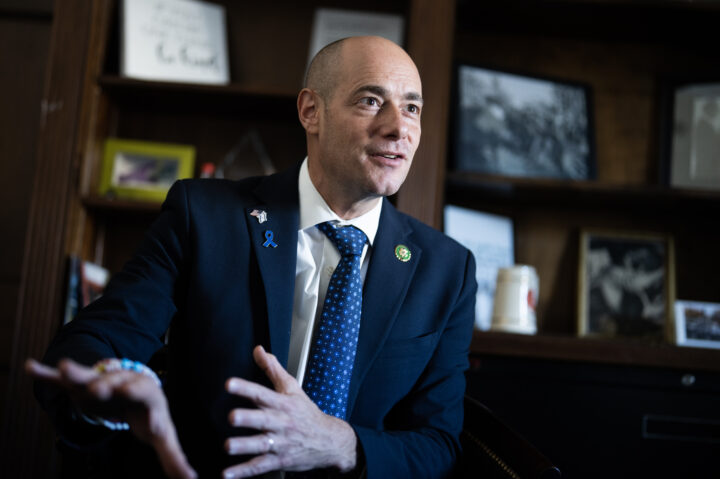
Tom Williams/CQ-Roll Call, Inc via Getty Images
Rep. Greg Landsman (D-OH) is interviewed by CQ-Roll Call, Inc via Getty Images in his Longworth Building office on Friday, November 3, 2023.


 Add JewishInsider on Google
Rep. Greg Landsman (D-OH) called on Qatar last week to step up more forcefully to pressure Hamas and bring about a hostage-release and ceasefire deal in Gaza, including taking into custody the Hamas leaders who have long enjoyed safe haven in Doha.
Landsman, in a lengthy X thread about the conflict in Gaza, took aim at various parties, including Qatar, which he called a “huge barrier” to peace given its continued support for Hamas. He revealed that he had rejected an invitation from the Qatari government for one of his staff members to travel to the country.
“It’s time to call the question on everybody, including the Qataris. There are legitimate questions about whether or not they should be doing more, they could be doing more,” Landsman said in an interview with Jewish Insider. “[Hamas] just refuses to engage anymore.”
In light of that situation, Landsman argued that every potential lever to change Hamas’ calculus must be explored and pursued.
He said that Qatar, as “the entity that has the most influence” over Hamas at this point, “has to feel way more pressure from the international community to do everything in their power” to get to a deal. The status quo of Hamas leaders living lavish lives in Qatar “should absolutely be questioned,” Landsman said.
He said he’s heard from Israeli officials and others involved in the hostage talks that the Qataris are “not seen as a trusted partner in this effort to end the war.”
In a letter to the Qatari ambassador rejecting the invitation for his staffer to travel to the kingdom, Landsman offered bracing criticism of Qatar’s role in hostage talks.
“Qatar’s gross mishandling of the hostage crisis in Gaza and failure to sufficiently pressure Hamas into ending the war prevents me from allowing staff to visit your country,” Landsman said. “That you continue to tolerate this obstructionist behavior from your terrorist beneficiary is incomprehensible.”
Calling the Hamas political leaders in Qatar who are representing the terrorist group in hostage talks “useless,” Landsman called on Qatar to detain the Hamas leaders until the hostages are released and other reforms are implemented in Gaza.
He called on Doha to end “future financial support for Hamas and Gaza” until the hostages are released and other reforms are implemented and to take steps to address antisemitic and pro-Hamas content on Al-Jazeera, the Qatari state-run media outlet.
He said he would be glad to send his staff on a trip to Qatar and to work with the country after it had taken the steps he outlined.
Landsman told JI that his conversations with Israeli leaders, on issues such as the need for additional humanitarian aid, produce change — albeit sometimes not as fast as or as comprehensively as he would hope.
With Qatar, he said, “I have had so many conversations and nothing changes.” He indicated that his engagements with Qatar earlier in the war had been more productive, noting that he’d arranged to bring a delegation of hostage families to meet with the Qatari ambassador shortly after the Oct. 7, 2023, Hamas-led attacks during which their family members were kidnapped.
Beyond squeezing Hamas’ leadership in Qatar, Landsman said he wants to see the country step up as not just a meditator and facilitator of dialogue, but as a more active partner in pursuing a two-state solution and regional peace.
He said that Qatar’s lobbying efforts in the United States, its outreach to lawmakers and their staff, its funding of U.S. colleges and universities and other efforts to assert its influence domestically show that the country “care[s] deeply about what we think.”
“That is why I sent the letter and why I’m pushing and doing it publicly,” Landsman said. “I’m sitting here as one member of Congress trying to do everything in my power to end this crisis. … They want the West to like them. They want us to see them as a partner, as an ally.”
In spite of his current criticisms, Landsman did not at this point embrace the idea of moving the U.S. airbase in Qatar elsewhere in the region, arguing that the U.S. should not give up on its relationship with Doha.
“What I am saying is there are expectations of partners, and our partnership will be so much stronger if [Qatar’s] relationship with this terrorist entity ends,” he explained. “That relationship has potential, but it should go in the direction that makes the most sense for our national security and peace and stability in the region, and that means resolving their Hamas issue.”
Landsman also called for shifts in Israel’s strategy in Gaza, saying that the humanitarian crisis is real and that he has spoken directly to Prime Minister Benjamin Netanyahu about the need to increase humanitarian aid.
He said Israel should be doing more to create humanitarian safe zones for civilians and to separate Hamas from the rest of the population of Gaza. And he argued that by sending in an “avalanche” of aid, Israel would diminish the impact of Hamas’ diversion of aid shipments.
He said Israel should also pull back on its large-scale campaign in Gaza and focus on targeted operations to find and liberate the hostages.
Asked about the impact of fellow Democratic lawmakers and the international community blaming Israel for the continuation of the war, Landsman said that there is a place for pressure on Israel to adjust its strategy, “but don’t abandon our ally. This is one of the most important allies we have.”
He also emphasized that Hamas has shown no interest in or willingness to agree to a new hostage deal and that international attacks on Israel will embolden it further.
“If they continue to see people just hammering away at Israel — which they believe is critical for them to achieve their goal, which of course is to destroy the State of Israel — they will continue to [fight],” Landsman said.
Landsman characterized the recent Arab League statement condemning the Oct. 7 attack and calling for Hamas to release the hostages as an important public step in pressuring Hamas.
He said the statement’s public rejection of Hamas mirrors what he has heard privately from Arab leaders for months. “I think this is going to put more pressure on Qatar to figure out a much better path forward with their unique issues with Hamas,” Landsman said.
After meeting with U.K. Prime Minister Starmer, the president said the U.S. will be getting more involved in providing aid

Tasos Katopodis/Getty Images
President Donald Trump
President Donald Trump decried the humanitarian situation in Gaza on Monday, telling reporters that he does “not particularly” agree with Israeli Prime Minister Benjamin Netanyahu’s assessment that there is no starvation taking place in the enclave.
“That’s real starvation stuff,” Trump said, following a meeting in Scotland with U.K. Prime Minister Keir Starmer. “I see it, and you can’t fake that.”
Trump said the U.S. will be getting “even more involved” in taking steps toward addressing hunger in Gaza, including by setting up “food centers.” A White House spokesperson declined to comment when asked for specifics about what this plan might entail. Trump said “all of the European nations” would be part of the project.
“We’re going to do it in conjunction with some very good people, and we’re going to supply funds,” said Trump.
Food distribution in Gaza is currently being operated by the Gaza Humanitarian Foundation, which is backed by both the U.S. and Israel. The organization has faced criticism for failing to meet the needs of Gazans, and scenes of chaos at the gates of its distribution centers have spread online.
Without mentioning GHF by name, Trump appeared to take aim at the existing aid mechanisms, saying that the new “food centers” will not have fences to keep people out.
“We’re also going to make sure that they don’t have barriers stopping people here. You’ve seen the areas where they actually have food, and the people are screaming for the food in there, they’re 35-40 yards away, and they won’t let them because they have lines that are set up,” said Trump. “And whether they’re set up by Hamas or whoever, but they’re very strict lines. We have to get rid of those lines.”
Trump blamed Hamas for the failure of recent ceasefire talks and for prolonging the war, including the humanitarian crisis. The president’s comments come after European leaders have pressed Israel to allow a freer flow of humanitarian aid into Gaza.
“We have a good group of countries who can help with the humanitarian needs, which is food, sanitation, some other things. It’s very difficult to deal with Hamas,” said Trump. “Hamas has become very difficult to deal with in the last couple of days, because they don’t want to give up these last 20 [hostages], because they think as long as they have them, they have protection. But I don’t think it can work that way.”
Fifty hostages remain in Gaza, and Israel believes at least 27 of them are dead. The most recent ceasefire proposal would only have seen the release of about half of the living hostages.
Trump also said Iran played a role in the failure of ceasefire talks, saying Iran “interjected themselves in this last negotiation.”
“I think they got involved in this negotiation, telling Hamas and giving Hamas signals and orders. And that’s not good,” Trump said. “For a country that just got wiped out, they’ve been sending very bad signals, very nasty signals. And they shouldn’t be doing that.”
Israel announces new aid measures and temporary ceasefires while defending its broader war strategy
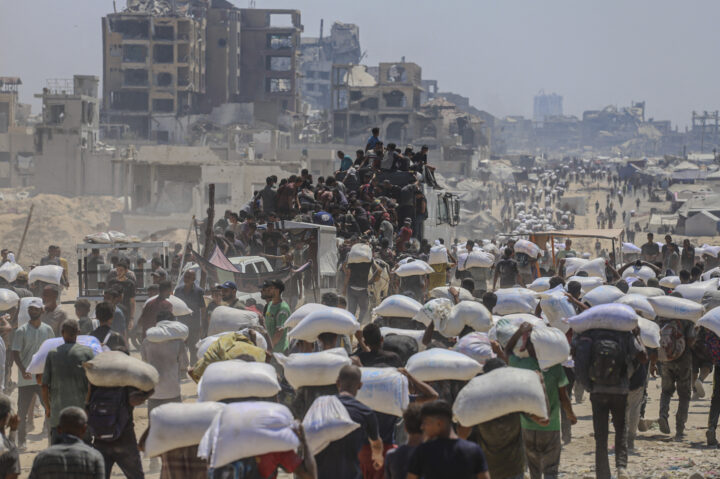
Ramez Habboub/Abaca/Sipa USA via AP Images
Palestinians carry humanitarian aid received through the Zikim crossing as they return to their families near the Al-Sudaniya area in northern Gaza, on July 27 2025 amid the beginning of airdrop operations.
In Israel’s effort to conduct a pressure campaign on Hamas to oust the terror group and release the remaining hostages held in Gaza, it has found itself instead on the receiving end of another global pressure campaign.
Facing mounting pressure amid a worsening humanitarian crisis in Gaza, Israel over the weekend announced a series of measures aimed at alleviating the widespread malnutrition and security issues in the enclave, including temporary ceasefires, aid airdrops, facilitating a massive increase in Gaza’s water supply and establishing designated humanitarian corridors — even as the IDF called claims of starvation in Gaza “a false campaign promoted by Hamas” and Israeli Prime Minister Benjamin Netanyahu denied that there was starvation in Gaza.
The crisis hit a fever pitch over the weekend as opposition to Israel’s efforts and limits on aid — first put into place in March as a pressure tactic to push Hamas to release the remaining hostages — surged to the highest levels of government around the world.
Dozens of countries called for an end to the war, a restoration of the flow of humanitarian aid into Gaza and the immediate release of the hostages. The shift in the political dynamic extended to Capitol Hill, where Democratic legislators, including many who have been strong supporters of Israel, expressed their concerns over Israel’s approach to the worsening humanitarian crisis in Gaza.
That backdrop led to a late-night announcement from the IDF’s on Saturday: “In accordance with directives from the political echelon and following a situational assessment held this evening, the IDF has begun a series of actions aimed at improving the humanitarian response in the Gaza Strip, and to refute the false claim of deliberate starvation in the Gaza Strip.”
On Israel’s most-watched news channel, Channel 12, journalists Almog Boker and Amit Segal described the move as a victory for Hamas after a successful propaganda campaign that captivated global opinion.
But not everyone agreed. On the same network, anchor Yonit Levi said, “It’s time to understand that this is not a failure of public diplomacy, but a moral failure.”
Domestically, the resumption of aid has the potential to cause divisions within Netanyahu’s coalition, whose right-wing members have in the past threatened to leave the coalition over moves that have been seen as concessions to Hamas.
Israeli National Security Minister Itamar Ben-Gvir and Finance Minister Bezalel Smotrich — both vocal opponents of allowing aid into Gaza — were excluded from a phone call on Saturday during which the decision was taken to increase aid. According to Ben-Gvir, an official from the Prime Minister’s Office claimed he had been left out to avoid forcing him to violate Shabbat — which Ben-Gvir denied, saying he was “available on Shabbat for any event or important security consultation.”
Smotrich, for his part, reportedly said overnight that he will not quit the government over the decision.
Addressing the move on Sunday during a visit to an Israeli Air Force base, Netanyahu defended the decision, calling it a continuation of existing policy. He said that while continuing efforts to defeat Hamas and release the hostages, “we will need to continue to allow the entry of minimal humanitarian supplies. We have done this until now.”
Amid the cacophony of criticism, Israel has largely stayed in the good graces of the White House. President Donald Trump on Sunday said that “Israel is gonna have to make a decision” about what to do with Hamas. “I know what I’d do, but I don’t think it’s appropriate that I say it.” U.S. Ambassador to Israel Mike Huckabee slammed the United Nations, The New York Times and Hamas for the humanitarian crisis, saying that their “lies & propaganda destroyed cease-fire deal, tried to discredit safe and functioning GHF effort, emboldened Hamas & will result in this complete balagan! Most sad for hostage families-grief prolonged.”
The U.N. World Food Program, which has not shied away from criticizing Israeli government actions, praised the influx of aid, saying the agency has “enough food in – or on its way to – the region to feed the entire population of 2.1 million people for almost three months.”
But while the most immediate concerns are being allayed, Israel will have to face another crisis of its own making — attempting to restore its standing with many of its traditional allies.
Indeed, when Rep. Ritchie Torres (D-NY), a pro-Israel stalwart, is sounding an alarm about his own frosty relationship with the Israeli government, it’s a glaring red flag about the state of Israel’s public diplomacy.
Israel’s former ambassador to France said the airdrops of aid are a result of condemnation from European capitals

Antoine Gyori - Corbis/Corbis via Getty Images
British Prime Minister Keir Starmer is greeted by French President Emmanuel Macron ahead of the 'Coalition Of The Willing' summit in support of Ukraine at Elysee Palace on March 27, 2025 in Paris, France.
For European leaders who are ratcheting up pressure on Israel to end the humanitarian crisis in Gaza, the Jewish state’s moves to pause military activity to allow a freer flow of humanitarian aid and begin airdrops of aid are “steps in the right direction,” the German foreign minister said on Sunday.
But the aid crisis is inextricably linked, observers say, to a much larger and even thornier issue — a deal to end the grinding 21-month war with Hamas and a release of the hostages. Until such a deal is struck, the pressure from Europe, and from some inside Israel, likely won’t ease. And it could worsen, with some experts warning that European sanctions on Israel aren’t out of the question.
Daniel Shek, a former Israeli ambassador to France and a member of the Hostage Families Forum’s diplomatic team, said that the aid airdrops are “a result of international pressure and not sudden altruism.”
However, Shek said, they are “like Tylenol for a cancer patient. Surgery is needed, meaning the end of the war.”
A spokesperson for German Chancellor Friedrich Merz said that he is “prepared to increase the pressure if progress [on a ceasefire and humanitarian aid] is not made.”
French President Emmanuel Macron announced last week that his country would recognize a Palestinian state. French Foreign Minister Jean-Noël Barrot argued that the move “proves [Hamas] wrong. It supports the side of peace against that of war,” because “Hamas has always rejected the two-state solution.”
The terrorist group praised France’s “positive step in the right direction.”
England and Germany declined to join France in recognizing a Palestinian state, but their leaders released a statement with Macron focusing on the “humanitarian catastrophe” in Gaza and calling for “the most basic needs of the civilian population, including access to water and food [to be] met without further delay” and for Israel “to immediately lift restrictions on the flow of aid.”
Israel has argued that it is not restricting the flow of aid into Gaza, but that the U.N. refuses to cooperate with the U.S. and Israel supported Gaza Humanitarian Foundation to distribute it.
U.K. Prime Minister Keir Starmer said that he is “unequivocal” in his support for a Palestinian state, but that recognition must come as “part of a wider plan which ultimately results in a two-state solution and lasting security for Palestinians and Israelis. This is the way to ensure it is a tool of maximum utility.”
The IDF noted that “responsibility for food distribution to the population lies with the U.N. and international aid organizations. Therefore, the U.N. and international organizations are expected to improve the effectiveness of aid distribution and to ensure that the aid does not reach Hamas.”
Israel initiated on Sunday 10-hour “pauses” in the coming days in areas of Gaza in which there are no IDF ground troops, daily until further notice, “aimed at improving the humanitarian response in the Gaza Strip and to refute the false claim of deliberate starvation.”
In addition to 28 airdrops on the first day, the IDF established corridors to allow the safe movement of U.N. convoys of food and medicine. The military also noted that “responsibility for food distribution to the population lies with the U.N. and international aid organizations. Therefore, the U.N. and international organizations are expected to improve the effectiveness of aid distribution and to ensure that the aid does not reach Hamas.”
Starmer, however, said after the airdrops were announced on Saturday that “Israel must allow aid in over land…The situation is desperate.”
German Foreign Minister Johann Wadephul said that “humanitarian pauses and aid deliveries into Gaza are steps in the right direction, results of many direct conversations in the last few days. Yet the situation remains unbearable: Hamas must release all hostages, a comprehensive ceasefire is badly needed.”
Starmer reportedly plans to ask President Donald Trump to return to ceasefire talks with Hamas, during the president’s visit to Scotland on Monday. A source in his office told The Guardian over the weekend that Starmer will “discuss further with [Trump] what more can be done to secure the ceasefire urgently, bring an end to the unspeakable suffering and starvation in Gaza and free the hostages who have been held so cruelly for so long.”
The U.S. and Israel withdrew their teams from the negotiations in Doha, Qatar, last week, after Hamas rejected a ceasefire and hostage deal by making new demands in areas that had previously been resolved. U.S. envoy Steve Witkoff said that Washington was looking for “alternative options,” which Israeli Prime Minister Benjamin Netanyahu later echoed.
Germany similarly remained concerned about the humanitarian situation in Gaza, with Foreign Minister Johann Wadephul saying that “humanitarian pauses and aid deliveries into Gaza are steps in the right direction, results of many direct conversations in the last few days. Yet the situation remains unbearable: Hamas must release all hostages, a comprehensive ceasefire is badly needed.”
Merz and Netanyahu spoke on the phone on Sunday. Following the call, Merz said he asked Netanyahu “to do everything in his power to bring about an immediate ceasefire and called on him to allow urgently needed humanitarian aid to reach the starving civilian population in Gaza without delay.”
Israel is taking a different approach to each major European capital and its statements and actions on Israel, a Foreign Ministry source told Jewish Insider.
The Israeli Foreign Ministry summoned the French charge d’affaires for a demarche by Director-General Eden Bar-Tal on Sunday. A statement from the ministry said that France “chose to harm Israel in its most difficult hour…France directly harmed the negotiations to return the hostages and for a ceasefire and all future diplomatic negotiations.”
Soon after Macron’s announcement on Thursday, Netanyahu said that it “rewards terror and risks creating another Iranian proxy, just as Gaza became. A Palestinian state in these conditions would be a launch pad to annihilate Israel — not to live in peace beside it. Let’s be clear: the Palestinians do not seek a state alongside Israel; they seek a state instead of Israel.”
If the war continues, Daniel Shek, a former Israeli ambassador to France and a member of the Hostage Families Forum’s diplomatic team, warned, “we could find ourselves under real pressure, such as sanctions, even from friendly countries that blocked [such steps] until now. Israel is isolating itself.”
Though Berlin has continued to make critical statements, the Foreign Ministry source indicated that Jerusalem still views Germany as a largely supportive country.
The source noted that while there was significant domestic pressure over Germany’s Israel policy, it has not backed down, such as last week when Berlin declined to join a letter of 28 countries calling to end the war immediately.
In addition, Germany did not support moves to reexamine Israel’s “association agreement” with the EU, which could result in a chill in relations between Israel and its largest trade partner. Changes in the association agreement would require consensus from all 28 EU member states, several of whom would be unlikely to support downgrading ties with Israel.
Wadephul and Israeli Foreign Minister Gideon Sa’ar have met three times since the former entered office three months ago. In one of the meetings he said that Germany would not cut off arms sales to Israel.
Emmanuel Navon, an international relations lecturer at Tel Aviv University and fellow at the Jerusalem Institute for Security Studies, said that the aid drops would likely be enough to stop Germany from taking action against Israel.
“I find it hard to believe that Germany, who we have very close ties with, would do something like [downgrade the association agreement] unless Israel has totally cut off humanitarian aid … For German public agreement, you need aid flowing into Gaza,” he added.
Shek was skeptical that Germany would follow Macron in recognizing a Palestinian state, but said “even Germany is showing signs of impatience and urgency,” and that there are other steps that Berlin could take.
The former ambassador also said he thought that canceling the EU-Israel Association Agreement was unlikely, because Hungary and Eastern European states would not support it. However, he said that the Brussels bureaucracy could slow-walk agreements and cooperation with Jerusalem in areas that often depend on EU grants such as scientific research and culture.
If the war continues, Shek warned, “we could find ourselves under real pressure, such as sanctions, even from friendly countries that blocked [such steps] until now. Israel is isolating itself.”
That being said, Shek and Navon doubted that the latest moves from Europe actually constituted pressure on Jerusalem.
Shek dismissed angry Israeli reactions to Macron’s “recognition of a virtual Palestinian state state that doesn’t exist … Those reactions are only aimed at the Israeli voter and have no value in international relations.”
“We need to say Hamas is looting and the U.N. won’t distribute the aid — we don’t need to wait to be accused of starving [Gazans] to say it,” said Emmanuel Navon, an international relations lecturer at Tel Aviv University and fellow at the Jerusalem Institute for Security Studies. “The problem is that we wait to be attacked and then we react. Once the accusation is out, it’s hard to correct.”
Navon noted that other G7 countries were not on board with Macron’s initiatives, even those with left-wing governments like the U.K. and Canada.
“Macron has brought relations with Israel to the low of the early to mid 1970s … when France was graded as hostile in Israel’s foreign policy,” Navon said. “It will take years to repair after [Macron].”
Navon said that Israel needs to be more proactive in communicating what is happening in Gaza: “We need to say Hamas is looting and the U.N. won’t distribute the aid — we don’t need to wait to be accused of starving [Gazans] to say it. The problem is that we wait to be attacked and then we react. Once the accusation is out, it’s hard to correct.”
In addition, Navon said, “Netanyahu needs to get his act together and tell his ministers to shut up or take away their phones.”
He referred to remarks by Heritage Minister Amichai Eliyahu in a radio interview last week that “the government is racing ahead to wipe out Gaza … All of Gaza will be Jewish.”
“The prime minister has to have better control of rogue members of his government and party who are causing us terrible damage,” Navon added.
Shek, however, said the way to improve Israel’s relations with Europe and the rest of the world is to end the war in Gaza.
The former ambassador argued that the issue is not one of Israel doing a poor job at explaining the situation to the world: “If all of these countries have reached the conclusion that the war needs to end, then Israel needs to have a discussion with them to find out how they can contribute to a better reality after the war … We need to just get into a conversation about an exit strategy … which is something that the Israeli government has refused to do from Oct. 8, 2023, to this day.”
Against the backdrop of ceasefire and hostage-release negotiations, Israeli actions in Gaza draw widespread condemnation

BASHAR TALEB/AFP via Getty Images
A Palestinian Hamas fighter carries a rifle as terrorists and people gather at the site of the handing over of Israeli hostages at the Nuseirat refugee camp in the central Gaza Strip on February 22, 2025.
It’s a scenario that has played out many times over since Oct. 7, 2023: Against the backdrop of ceasefire and hostage-release negotiations, Israeli actions in Gaza draw widespread condemnation. World leaders call for a ceasefire. Amid that growing criticism, Hamas, sensing increased pressure on Israel, responds by escalating its demands or backing away from negotiations entirely.
This week is no different, with Israel’s launch on Monday of a ground operation in central Gaza’s Deir al-Balah, where it had not previously operated, the same day that more than two dozen Western countries released a joint statement calling for “unconditional and permanent ceasefire.” Hamas negotiators in Doha, Qatar, have reportedly spent the last two weeks dragging out ceasefire talks, over issues ranging from the number of Palestinian prisoners to be released to the areas where the IDF is allowed to operate.
In yesterday’s statement, the countries’ demand of Hamas is only for the “immediate and unconditional release” of the remaining 50 hostages, with no mention of disarmament or the terror group’s removal from power — key Israeli demands since Hamas’ brutal attacks on the Jewish state almost two years ago.
Hamas has since October 2023 faced limited pressure to acquiesce to Israeli and American demands. The terror group’s backers in Doha, where senior Hamas officials have long lived in opulence and security, have similarly faced little international pressure — even as Qatar plays a key role in negotiations. Israel has not been a perfect actor, and at times has walked away from the negotiating table. But Jerusalem’s refusals have been outpaced by Hamas’ intransigence, the latter of which has frustrated White House officials in both the current and former administrations.
At his final press briefing as secretary of state in January, Tony Blinken warned that Hamas benefitted from international pressure on Israel, saying, “Hamas held back [from agreeing to deals] at various points because it saw or hoped that public international pressure was mounting on Israel, and it could just wait it out and that pressure would get to a point where Israel would have to accede to all of Hamas’ demands.”
And in a Washington Post op-ed shortly after leaving the White House, Brett McGurk acknowledged that “throughout the ceasefire negotiations, Hamas consistently held back on a commitment to release hostages and aimed to ensure that it remains in power after the war ends.”
What’s more, McGurk wrote in his op-ed, Israel faced demands in the weeks and months after the onset of the war “that the only way to stop the fighting was for Israel to accept all of Hamas’s terms. Calls to restrict weapons shipments to Israel, or to increase pressure on Israel (rather than on those who kept attacking it), or to back U.N. Security Council resolutions demanding ‘unconditional’ ceasefires with Hamas, discounted this regional equation and the intent of Israel’s adversaries.”
There is a popular adage that insanity is doing the same thing over and over again and expecting different results. For nearly two years, Israel, Hamas and the international community have fallen into an endless cycle of talks, official statements and Hamas backtracking. Far from getting a different result, the world has seen more of the same: the continued captivity of the hostages, deepening global ostracization of Israel, ongoing death and destruction in Gaza and a Hamas that feels emboldened to up its demands.
Some of the remaining 50 hostages are believed to be in the central Gazan city
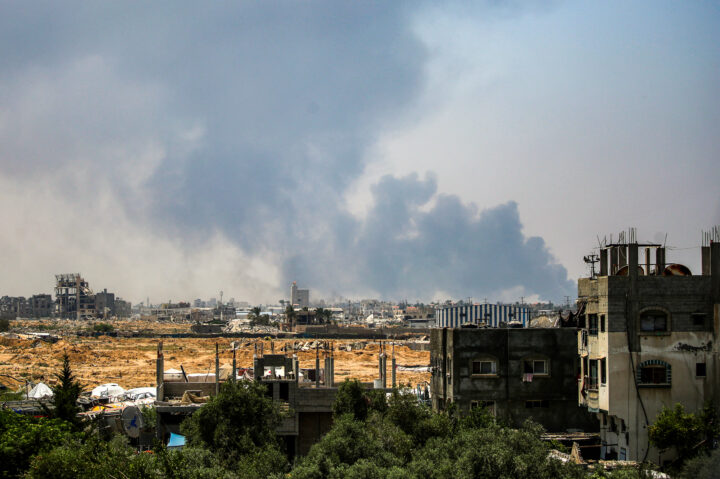
EYAD BABA/AFP via Getty Images
Smoke billows from Israeli bombardment as pictured from Deir el-Balah in the central Gaza Strip on July 21, 2025.
The IDF entered the central Gaza city of Deir al-Balah for the first time on Monday, amid stalled hostage and ceasefire negotiations in Doha, Qatar.
The maneuver in Deir el-Balah began a day after an evacuation order from the central Gaza city, built on the Mediterranean coast around an UNRWA refugee camp. Israeli officials believe some of the remaining 50 hostages may be being held in the area. In June 2024, the IDF freed four hostages, Noa Argamani, Shlomi Ziv, Almog Meir Jan and Andrey Kozlov in a raid in adjacent Nuseirat.
Deir el-Balah has been relatively unscathed during the war that began after the Hamas terrorist attacks on southern Israel on Oct. 7, 2023. The April 2024 incident in which the IDF killed World Central Kitchen aid workers whom it had mistakenly identified as terrorists took place near Deir el-Balah.
Before the latest operation in the Gaza war began in May, a senior defense official told Jewish Insider that the plan was to start from Gaza’s perimeter and work its way to the center, which the military now appears to be doing.
The Hostages and Missing Families Forum said that relatives of the 50 remaining hostages in Gaza — 20 of whom are thought to be alive — were “shocked and alarmed” to learn of the maneuver and demanded that Prime Minister Benjamin Netanyahu or other senior officials tell the Israeli public “why the offensive in the Dier al-Balah area does not put the hostages at serious risk.”
“We have received no official, organized updates or satisfactory answers on this matter,” the forum added. “The people of Israel will not forgive anyone who knowingly endangered the hostages, both the living and the deceased. No one will be able to claim they didn’t know what was at stake.”
Despite optimism in Jerusalem and Washington in recent weeks about the prospects for a 60-day ceasefire in which half of the remaining 50 hostages would be released, talks have been on hold for the past week. Hamas representatives in Doha, Qatar, are reportedly unable to contact the terrorist group’s leaders in Gaza.
The Word Health Organization said Tuesday that the IDF hit the residence compound belonging to local staff members and its main warehouse in Deir al-Balah on Monday. The organization also said that two of its staff and two family members were detained, three of whom were later released. The WHO demanded the immediate release of the staff member who remained in detention.
In a statement released Tuesday, the IDF said troops identified shots being fired toward them in the Deir al-Balah area, and responded toward the area from which the shooting originated. The army highlighted that, “Prior to the start of IDF activities in the area, the IDF warned the civilian population to evacuate from the area for their safety, and was in contact with the international organizations working in the area.”
It also noted that the troops detained several individuals suspected of involvement in terrorism and after questioning in the field, the majority were released and evacuated from the area in coordination with the international organizations.
IDF Chief of Staff Eyal Zamir said during a multi-arena situational assessment on Monday that “the IDF must be prepared for a continued wide-scale and comprehensive campaign, while managing a complex and challenging reality that requires multi-arena operations.”
“The war in the Gaza Strip is one of the most complex the IDF has ever known,” Zamir said. “We have achieved significant accomplishments – Southern Command continues to lead with regular and reserve brigades operating every day in both offense and defense.”
Also Monday, 25 countries — including most of the European Union, the U.K., Canada and Australia — called for an end to the war in Gaza and for the flow of humanitarian aid.
“The Israeli government’s aid delivery model is dangerous,” the countries said, apparently referring to the U.S.-backed Gaza Humanitarian Foundation that was installed as part of an effort to thwart Hamas’ practice of stealing and hoarding humanitarian aid.
The countries called for the hostages to be released immediately and expressed concern about the undermining of a two-state solution.
Israel’s Foreign Ministry rejected the statement, “as it is disconnected from reality and sends the wrong message to Hamas,” which welcomed the international statement.
“All statements and all claims should be directed at the only party responsible for the lack of a deal for the release of the hostages and a ceasefire: Hamas, which started this war and is prolonging it,” the Foreign Ministry stated.
The statement also argued that “Hamas is busy running a campaign to spread lies about Israel. At the same time, Hamas is deliberately acting to increase friction and harm to civilians who come to receive humanitarian aid.”
U.S. Ambassador to Israel Mike Huckabee called the 25 countries’ statement “disgusting” in that it “puts pressure on Israel instead of [the] savages of Hamas. Gaza suffers for one reason: Hamas rejects every proposal. Blaming Israel is irrational.”
'I must say, I was disappointed by the response of some senior people on the Democratic side,' Herzog told JI

Aspen Security Forum
Former Israeli Ambassador to the U.S. Michael Herzog
ASPEN, Colo. — Former Israeli Ambassador to the U.S. Michael Herzog and other pro-Israel speakers received a warm reception from the crowd at the Aspen Security Forum this week, as they discussed continued efforts to free the hostages in Gaza and Israel’s strikes on Iran.
But Herzog told Jewish Insider, on the sidelines of the conference after his panel on Wednesday, that he’s been disappointed by the response to the strikes from Democratic lawmakers in Washington, which has been overwhelmingly negative.
It’s a response that also stands in contrast to Herzog’s description of the transition he observed in the Biden administration’s thinking on Iran: from pushing for a nuclear deal with Iran that Herzog said would have been weaker than the Obama-era Joint Comprehensive Plan of Action to, by the time President Joe Biden left office, active discussions of strikes on Iran.
“I must say, I was disappointed by the response of some senior people on the Democratic side,” Herzog told JI. “I’m saying it carefully because I never interfere in domestic politics here, but from a strategic point of view, I was disappointed by the response of some senior Democrats to the war on Iran.”
Herzog said that maintaining bipartisan support for Israel was the central goal of his ambassadorship and that he engaged with nearly everyone, including critics, with the exception of the most extreme voices. He said he expected U.S. leaders on both sides of the aisle to realize that the strikes offered a “unique opportunity” to counter a “malign actor” and “changed the strategic landscape in the Middle East.”
“People who either criticize it on procedural issues or people who say, ‘[It] wasn’t the right timing because they were talking to each other about a deal’ — there’s never a right time. Never,” Herzog said, emphasizing that the strikes had not, as critics warned, spiraled into a protracted war similar to Iraq or Afghanistan.
Herzog said Israel must “put a lot of work into maintaining that dialogue with both sides of the aisle, explaining our common interest, away from domestic politics here … and exploring the new opportunities that have been created in the Middle East.”
Herzog said that Israel has been preparing for an attack on Iran for decades, but the specific planning for what became Israel’s Operation Rising Lion and the U.S.’ Operation Midnight Hammer began in earnest in November 2024, after the second Iranian strike on Israel and Israel’s elimination of Iran’s air-defense systems. By that time, U.S. nuclear talks with Iran, which Herzog criticized as misguided, had been long stalled.
He said the fall of the Assad regime in Syria the following month provided a further opportunity to take action.
“If you look at the journey the Biden administration took from the initial days when they were rushing to a deal with Iran, to the last few months of the Biden administration where they were talking to us about military options against Iran, they went a long way,” Herzog recounted.
Herzog said he believes that the Biden administration underwent “disillusionment with the possibility of reaching a good deal with Iran,” as Iran made unrealistic demands, such as removing the Islamic Revolutionary Guard Corps’ terrorism designation. And he said Iran’s supply of weapons for Russia’s invasion of Ukraine made the talks “much more difficult.”
“I just could see that movement with time, to the last phase of Biden’s presidency, when, after we turned the tables on the Iranian axis and opened that huge opportunity, we actually started looking with them at the military option,” he said. “It was too late in the day [to carry out the strikes before Biden left office], but it was a very interesting journey that I noticed.”
Looking at the rising isolationist sentiments on the Republican side of the aisle, Herzog said he’s been monitoring the issue and has “been concerned about it,” but also argued that such voices aren’t dominant in the Trump administration’s decision-making.
“It’s like a swing of a pendulum because the U.S. ultimately decided to follow Israel and strike Iran, and this is really historic, in that it’s a first-of-its-kind coordinated offensive operation. … This is the first time that we are coordinated in our offensive operations, that’s a very big deal for a long time to come in my view,” Herzog said.
He said he sees the pendulum swinging against the isolationists in the administration’s recent moves to provide additional support to Ukraine and take a tougher stance toward Russia as well.
“So all in all, I don’t think that the administration is following this isolationist trend, but I do follow it and I am concerned about it,” Herzog said. “I do believe that the world needs American leadership, [an] American dominant role. The world needs America to be a force of good, as it has always been, and that’s what we’d like to see.”
Herzog — reflecting on the panel he spoke on, “Israel at a Crossroads” — said that the U.S. and Israel need to be closely coordinated and in lockstep on the path forward on Iran, including the limits of a diplomatic deal and the red lines that would prompt further military action to prevent Iran from rebuilding its nuclear program, as well as ways to capitalize on Iran’s weakness throughout the region and prevent it from rebuilding its proxy network.
“We managed to surprise the Iranians, hit all the main centers of gravity and take them completely off balance. But challenges are still ahead of us because we have to assume that Iran will seek to rebuild those threatening capabilities,” Herzog said. “We should not rest on our laurels.”
He also emphasized that the strikes and the degradation of Iran’s proxies had “created the conditions for a different Middle East.”
Asked about the Israeli government’s policy on Syria — which shifted in the span of a week, from Israeli Prime Minister Benjamin Netanyahu actively discussing normalization and diplomatic paths with President Donald Trump in the White House to Israel bombing key Syrian government sites in recent days — Herzog described the new Syria as a “mixed bag” with both risks and opportunities, and said that it may be too early to judge.
“On one hand, I believe that this new leader, Ahmad al-Sharaa, a.k.a. Mohammad al-Jolani, doesn’t want, he doesn’t seek war with Israel, and he sends across messages, and that’s what he told the Trump administration,” Herzog said, adding that Israel had started a dialogue through the U.S. on what Herzog termed a formal or informal non-aggression agreement and the demilitarization of southern Syria.
“On the other hand, we should not forget the background of al-Sharaa and the people surrounding him or subordinate to him,” Herzog said. “They all grew up in the school of jihadism.”
He criticized al-Sharaa for what he said was an effort to “subjugate [Syrian minorities] so they become part of his Syria, his vision of Syria” rather than allowing for a federalist system. Herzog said the Israeli strikes “sent a very strong message … that we will not tolerate the scenes of humiliating the Druze and endangering their lives,” and aimed to block the Syrian army from conquering Druze areas and carrying out atrocities.
“What we’ve seen, first with the Alawites and now with the Druze, is very troubling,” Herzog said. “We in Israel, our concerns are about, first, the security situation in southern Syria, and second about the state of minorities, especially the Druze, because not only are they close to our border, [but] because we have an important Druze community in Israel. They are our brothers in arms.”
He added that it’s unclear to what extent al-Sharaa himself is in control over Syrian government forces’ actions.
The Israeli ambassador also reflected on the ways that the Oct. 7, 2023, Hamas attacks on Israel seemingly activated a global wave of antisemitism.
“You’re hit hard, you’re bleeding, and all your enemies smell the blood and rise to hit you,” Herzog said. “That pertains to all of our enemies in the region, the Iranian axis, but also pertains to anti-Israel, antisemitic forces here in the U.S. and elsewhere.”
He said that Israel has “gone a long way” against its military adversaries in the Middle East, “really turned the tables on Iran and the Iranian axis” and “created the conditions for a different Middle East.”
“But,” he continued, “we still have a long way to go against these anti-Israel, antisemitic forces. That’s an open front.”
Boehler also addressed criticisms of his direct talks with Hamas

Aspen Security Forum
U.S. hostage envoy Adam Boehler speaks at the Aspen Security Forum on July 17, 2025.
Aspen, Colo — U.S. hostage envoy Adam Boehler said at the Aspen Security Forum on Thursday that there had been “some movement forward” recently toward a ceasefire and hostage-release deal with Hamas. He also addressed criticisms of his direct talks with Hamas.
“It’s closer than it’s been, and if it doesn’t happen, in my strong opinion it would be continued hard-headedness from Hamas, in which case Israel will continue to take action, as they should,” Boehler, the only Trump administration official to address the conference, said. “I am more optimistic than I have been in a while about that.”
Boehler said that Israeli Prime Minister Benjamin Netanyahu’s success in striking Iran has given Netanyahu the political capital and positioning at home to potentially seal a deal. “In that way, there’s never been a better time.” He said Israel is “leaning in a lot” and that finalizing a deal gives Netanyahu the opportunity to further burnish his reputation in history.
By contrast, Boehler said that Hamas is “very hard-headed” in talks, which has been frustrating for negotiators and leads the terrorist group to reject deals that seem to be in its interest.
“With [former hostage] Edan Alexander, Hamas had multiple times where they probably lost leverage over time. Look at the whole war. They continue to hold out. Israel continues to kick their ass. And yet they still think they have leverage,” Boehler said.
Asked about his direct negotiations with Hamas, which were controversial, especially among Israeli officials who were largely kept out of the loop, Boehler downplayed the extent of the tension between the U.S. and Israel on the issue.
“There was no unilateral deal ever possible. While that’s an American citizen, Edan, we were always working with the Israeli side,” Boehler said. “Now whether or not — I think the question is whether or not discussions on that side were [conducted with Israeli involvement], but there would be no deal that would be possible that wasn’t coordinated with the Israelis.”
Boehler also emphasized that his job is to negotiate with people who he knows are “bad guys.”
“I’m under no illusions, ever. These are bad people. They’re bad guys,” Boehler said. “I’m not making a moral evaluation. I don’t want to go get beers with the guys. What I want is Americans out now, and I want them never to take them again.”
He said he tries to focus on what each side wants and where there might be commonalities that both sides can pursue.
Boheler added that he does not believe that meeting with someone is a concession itself. He argued that it can be more difficult to understand what an adversary actually wants in the present if he is relying on others’ characterization of their views, adding that direct talks can also move negotiations along more quickly.
The U.S. envoy argued that earlier and stronger U.S. action in the post-Oct. 7 hostage crisis — “in terms of being more aggressive in our support of Israel” — could have “made a difference if we had leaned in more at the beginning — I believe that is likely — versus holding back.”
“I’m not making that judgement by myself, I’m making that judgement from discussion[s] on the military side too,” he continued. “Are there things we could have done better there that would have made a difference for American lives and for Israeli lives? Yeah, of course.”
Boehler said that the U.S. strikes on Iran will help give him leverage in hostage talks by proving that Trump is serious about the things he says and is willing to back them up with force.
“What do I need to say? ‘You don’t want to listen to the president? One of his core platforms is getting Americans out. Look what happens,’” Boehler said. “He said something [and followed through] … it’s so important to have that credibility. And that kind of credibility doesn’t just bring Americans home. It makes people think twice before they take them.”
Boehler said that sometimes there is no negotiating path with terrorist groups or other adversaries, and that force is the only option, but that it’s worth attempting to see if there is a diplomatic path.
Boehler also repeated the administration’s recent warning to Americans against traveling to Iran for any reason.
“You sort of think that’s like, ‘Duh,’” Boehler said, to chuckles from the audience. “But you’d be surprised.”
He warned that it’s “very sensitive” for the U.S to compensate rogue actors for the release of American hostages because that can incentivize further hostage-taking going forward. The administration conducted a prisoner exchange with Russia.
“I’m very, very sensitive to hostage diplomacy because it doesn’t work. You will see we very rarely trade people. It would have to be very unique. Money? Forget about it,” Boehler said.
He said that he sometimes needs to employ “negative incentives,” including threats, as well.
“The president has always stated and oriented toward, ‘I would like a diplomatic solution.’ He told Iran that and then Iran tested it, and then they saw what they got,” Boehler said. “So those things are very important, and I think about the same thing from a hostage perspective.”
Asked about his conversations with hostage families, Boehler said he followed advice from his predecessors to be “authentic and truthful. And so if at that moment you’re feeling something, you can let that show.” He said he also tries to be “extremely responsive” to the families, but also upfront about the prospects for a deal and the potential obstacles.
“Those families have been through way more than I’ve been through. I don’t need to soft-pedal to them, but I owe them this responsiveness and authenticity,” Boehler said. “Their children, family members have been taken away, they’ve been killed. They don’t need bullshit from me. They need somebody that’s going to be honest with them and they can certainly take that.”
Boehler, who was involved in efforts to negotiate the Abraham Accords during Trump’s first administration, said that he believes the accords will grow within the next year, saying that Saudi Arabia had been clear across multiple administrations about its interest in a deal.
“I think that the inherent reasons there was interest there haven’t changed,” Boehler said. He downplayed the strain that the Oct. 7, 2023, Hamas attacks on Israel and the ensuing war have placed on those efforts, noting that the Abraham Accords have “held strong.”
“People make comments publicly, but if you look at the support, it was a totally different Middle East than if we had been in a war years before. And so I feel optimistic,” Boehler said.
Boehler also credited the Israeli government for acknowledging mistakes in its conduct in the war when they happen, noting one such statement issued on Thursday apologizing for an Israeli strike on a church in Gaza.
“I’m sure it was not on purpose and then they will do an investigation and say this is a real issue,” Boehler said.
At the same time, he said that it would be “a very dangerous thing” if Israel were to sway to the whims of global public opinion about its military campaign in Gaza “because they’re fighting for their survival all the time” against a terrorist group embedded in the civilian population.
The former Biden administration official said that the Israel-Hamas war 'could have stopped multiple times if Hamas stopped the war and released hostages — multiple, multiple times'
Aspen Security Forum
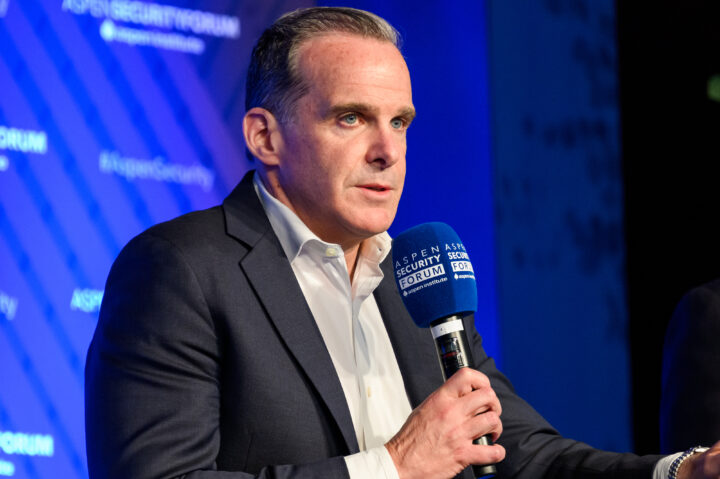
Former national security official Brett McGurk speaks at the Aspen Security Forum on July 16, 2025.
ASPEN, Colo. – Former U.S. and Israeli officials speaking at the Aspen Security Forum on Wednesday emphasized that Hamas bears responsibility for the failure of hostage release and ceasefire talks, and discussed the possible paths to ending the war in Gaza.
Brett McGurk, the top National Security Council official responsible for the Middle East under the Biden administration, argued on Wednesday that the history of ceasefire talks between Israel and Hamas “is being rewritten by people that weren’t involved in this.”
He emphasized that Hamas repeatedly ignored and rejected proposals that fulfilled many of its demands over the course of the last year, arguing that Israel’s attacks on Hezbollah had helped force Hamas’ hand to a temporary ceasefire deal that went into effect in early 2025.
“The moral toll of this awful situation tears at the soul of anyone who’s worked on this, anyone,” McGurk said. “But this war could have stopped multiple times if Hamas stopped the war and released hostages — multiple, multiple times.”
He said that, to this day, the “fundamental issue” is that the pressure for the deal has been on Israel, with “no pressure on Hamas.” He said the group has “not budged” on its demand to be allowed to remain in power in exchange for the release of hostages.
“Hamas started the war on Oct. 7, this panel is about Israel, but the enemies of Israel have agency,” McGurk said, emphasizing that Hamas made a choice to start the war, joined by Hezbollah and various Iranian proxies, in addition to Iran itself.
McGurk said he believes that if both sides accept the current U.S.-sponsored proposal to pause the war for 60 days while negotiating a permanent ceasefire, the war would end.
Former Israeli Ambassador to the U.S. Michael Herzog said that Israel “never developed a coherent plan [of] alternatives to Hamas.”
Herzog argued that Israel needs to propose an end to the war in exchange for the release of hostages, and that Hamas can be dealt with again at a later point while Israel focuses in the short term on Iran, normalization with Arab countries in the region and beginning to heal its own people and society.
Herzog framed the ceasefire deal with Hezbollah as a potentially successful model.
Former IDF Intelligence Directorate head Amos Yadlin said that the Gaza war is the “most justified war ever; however, at this moment, continuing the war is not serving Israeli interests.”
He said Israel should agree to end the war in exchange for a one-time release of all remaining hostages and the exile of some Hamas leaders, and work to bring in Arab partners to demilitarize the territory, with the understanding that Israel will continue to attack Hamas forces that reemerge as it has done with Hezbollah in Lebanon. Even if some Hamas forces remain, he said, they will not have the strength or capabilities they did before the war.
Yadlin also emphasized that Hamas leaders are to blame for the civilian casualties in Gaza, since they could have ended the war by releasing the hostages at any time.
Author and “Call Me Back” podcast host Dan Senor noted that Israel’s military was ill-prepared for the kind of extended, grinding, close-to-home war it is fighting in Gaza, and described the challenges of Hamas’ diversion of humanitarian aid and hostage-taking as unprecedented. And, he said, fear of Hamas has hampered efforts to cultivate alternative civilian leadership in Gaza.
“I think the idea that we could have a permanent ceasefire would only work if Israel would agree for Hamas to stay in Gaza and … in terms of the objectives of war, there is no world in which Israel can agree to Hamas staying in power in Gaza,” Senor said.
Pushing back on the comparisons between a potential Hamas deal and the Hezbollah ceasefire, Senor noted that in Lebanon, the Lebanese government and Lebanese Armed Forces provide a domestic counterweight to Hezbollah able to enforce demilitarization. In Gaza, no Arab states have stepped forward to carry out governance and demilitarization.
At the same time, Senor said that President Donald Trump’s proposal of mass relocation of the Palestinian population is not a realistic solution. He added that Israel will need a substantial buffer zone between its population in the south and the population in Gaza to feel safe in returning people to communities close to the Gaza border.
Yadlin pushed back, arguing that the relocation threat would provide Arab states the necessary motivation to become directly involved.
Yadlin added that Trump’s work to cultivate investments from the Gulf in combination with the strikes on Iran have shown the American people that the Middle East does not have to only be a region of loss and suffering, but one that has real promise.
Asked if Israel and the United States’ quick and devastating military campaign against Iran was a signal that the world had overestimated the threat from Iran, the panelists argued that was not the case. Instead, they said, many had underestimated Israel’s own capabilities and preparations, and the destruction of Iran’s proxies significantly undermined Iran’s ability to threaten Israel.
“You have to remember that Israel has prepared this war for decades, for many, many years, especially the last few months, but for decades,” he said.
McGurk added that the U.S. and Israeli interceptions of missiles fired during Iran’s October 2024 attack on Israel and Israel’s subsequent destruction of Iran’s air defense systems under the Biden administration set the stage for last month’s strikes, which he characterized as the result of close coordination across multiple administrations for years.
Looking ahead, Herzog said that there are not yet clear answers on the extent to which Iran maintains nuclear capabilities, but said that the strikes’ impact on Iran’s decision-making is also critical: whether it will race to a nuclear device to protect itself or — as Herzog said he believes — it is deterred and will move slowly and carefully if it attempts to resume its nuclear program.
He said there are two paths ahead: a new nuclear deal, including no enrichment and with intrusive inspections, which is nevertheless controversial in Israel because it would provide Iran with sanctions relief to rebuild its capabilities, or Israel’s continued use of force, which brings its own set of questions and challenges.
Herzog also said he’s hopeful that the strikes have deepened the divide between the Iranian regime and the Iranian people.
Yadlin similarly argued that the timetable for Iran’s nuclear program is less important than what kind of agreement can now be reached.
He said that the attacks had disproven Iran’s key calculus about its nuclear program: that Israel had the will but not the capabilities to do significant damage to the program, and that the U.S. had the capabilities but not the will.
McGurk and Herzog both spoke about the initial hours of the Oct. 7, 2023, attacks on Israel and their perspectives as the situation developed. Herzog, who was serving as the Israeli envoy in Washington at the time, said he received a call shortly after the onset of the attacks on Israel from a senior general shouting, “Mike, this is war, it’s not another round. It’s a war.”
McGurk said that Herzog had informed him about the attack, relaying along that same message: “It’s a massive attack, this is war.”
Herzog described McGurk, who has remained one of the most vocally pro-Israel members of President Joe Biden’s team since leaving office, as “the best partner that I could wish for,” adding that the then-White House official immediately offered full U.S. support for Israel.
McGurk emphasized that, early in the war, there were significant fears that Hezbollah and other Iranian proxies, or even Iran itself, would also mobilize against Israel, which would constitute an “existential threat.”
He recounted a call between Biden and Israeli Prime Minister Benjamin Netanyahu in the first days of the war. “Netanyahu said, ‘Joe, we’re in the Middle East, and in the Middle East, if you’re weak, you’re roadkill.’ Everybody sharpened their knives, and that’s what was happening,” McGurk said.
He said that intelligence showed early signs Hezbollah was preparing a ground invasion, and that Israeli and American officials had intensively discussed the possibility of a preemptive, Israeli attack in Lebanon, ultimately deciding against it due to Hezbollah’s strength at the time and Israel’s need to focus on Gaza. McGurk said he still believes that was the right decision.
McGurk, seen as one of the strongest champions in the Biden administration for the expansion of the Abraham Accords to include Saudi Arabia, said he’d been in discussion on Oct. 6 with visiting Saudi and other Middle Eastern leaders about “some things that were potentially going to be quite positive over the coming six months a year.”
He also pushed back on narratives from critics that the normalization efforts were a “white whale” that the U.S. chased in spite of reality. Instead, he said, the talks began because the Israelis and Saudis both approached the U.S. and asked them to mediate. He said the constant media leaks about the talks had hampered the process, and that they should have been conducted more privately.
“I think ultimately it will happen,” McGurk said. “What knocked it off was Hamas.”
Addressing the global spread of antisemitism and anti-Israel sentiment, Herzog said that “we [Israel] should do a better job” of pushing back on anti-Israel narratives, describing the public and diplomatic debate as an additional front in the war Israel is fighting.
Senor added that the Oct. 7 attack “brought something to the surface that was not about the way Israel should operate in Gaza,” appearing to be a “trigger moment for trying to drive Jews underground” in a way he had not expected.
Looking particularly at college campuses, Senor urged Jews to turn to alternative schools than the higher education institutions where they have faced harassment and discrimination, and to invest in those institutions rather than the ones that have not served them well in recent years.
Qatar’s be-everywhere, invest-in-everything strategy has allowed Doha to gain footholds across the global economy and in diplomatic circles

Jacquelyn Martin/AP
Qatari Prime Minister and Minister of Foreign Affairs Sheikh Mohammed bin Abdulrahman bin Jassim Al-Thani, attends a news conference about the Israel-Hamas war, and pressure to reduce civilian casualties, Friday, Dec. 8, 2023, in Washington.
Ceasefire and hostage-release talks have been ongoing in Doha, Qatar, for the last week. But one of the most consequential meetings in the negotiations could be happening tonight in Washington, when President Donald Trump hosts Qatari Prime Minister Mohammed bin Abdulrahman Al Thani for dinner at the White House.
This continues a new tradition for Trump of hosting prominent Gulf royals who aren’t the heads of state of their respective countries for dinner at the White House. In March, Trump hosted a dinner in the White House’s State Dining Room for Sheikh Tahnoon bin Zayed Al Nahyan, the United Arab Emirates’ national security advisor and chairman of several sovereign wealth funds.
Qatari officials have been in the U.S. all week. Qatari Emir Sheikh Tamim bin Hamad Al Thani was rumored to have met with Trump on the sidelines of the FIFA finals in New Jersey on Sunday, after being spotted in New York over the weekend.
White House Middle East envoy Steve Witkoff, whose trip to Doha last week was postponed over stalled talks, told reporters over the weekend that he planned to meet with Qatari negotiators on the sidelines of the match. And Trump shared a suite with senior Qatari sports officials at the match, including Nasser bin Ghanim Al-Khelaifi, the president of the Paris Saint-Germain team who played in New Jersey on Sunday and chairman of beIN Sports, previously known as Al Jazeera Sport. (In a weekend interview at the FIFA match, Trump even noted Qatar’s “big presence.”)
Qatar also loomed large in Washington this week, where legislators on the House Education and the Workforce Committee pressed university leaders from Georgetown, CUNY and the University of California, Berkeley about their foreign funding sources during a hearing about antisemitism in higher education. Former Rep. Jim Moran (D-VA), one of Qatar’s top lobbyists in Washington, was seen sitting right behind Georgetown University interim President Robert Groves as Groves testified on Tuesday. The school has received over $1 billion from Qatar, and has a campus in Doha.
Qatar’s be-everywhere, invest-in-everything strategy has allowed Doha to gain footholds across the global economy and in diplomatic circles. And since the start of the war, it has sought to highlight its role as a facilitator of ceasefire talks between Israel and Hamas, the latter of which Doha supports financially and diplomatically.
With Iran weakened following last month’s war, Qatar remains the Hamas sponsor with the most leverage on the terror group. Despite pledges last year to expel senior Hamas officials to Turkey, many of those officials remain in Qatar.
Earlier this week, Trump threatened steep tariffs on Russia if Moscow doesn’t reach a peace agreement with Ukraine before the end of August. But the Qatari royal family, with endless wealth and more favored global standing, does not face the same fiscal and geopolitical challenges and limitations as Russian President Vladimir Putin. It’s unclear what leverage Trump could use to push Qatar to exert pressure on Hamas as he seeks a resolution to the war.
Doha has the power to push Hamas to accept a ceasefire. Whether tonight’s dinner will exact a change in Qatar’s approach to Hamas remains to be seen. The sit-down between Trump and the Qatari prime minister could change the tide in the 21-month war, or it could serve as yet another missed opportunity in a war full of stalemates and diplomatic posturing — with fresh casualties mounting on both sides and 50 hostages still languishing in captivity.
The bill takes a new tack at a previously attempted move by first designating Muslim Brotherhood branches individually
Salah Malkawi/Getty Images
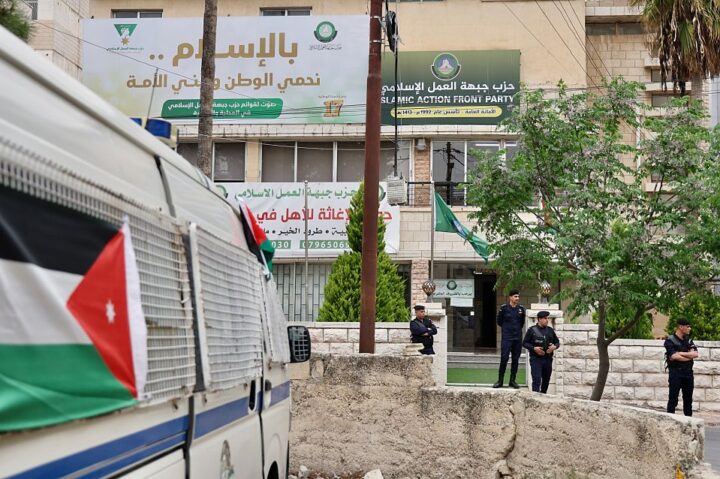
Jordanian police close the entrance of a Muslim Brotherhood headquarter after the announcement of banning the society in the country on April 23, 2025 in Amman, Jordan.
A bipartisan House bill set to be introduced on Tuesday aims to designate the Muslim Brotherhood as a terrorist organization, a step forward for an effort that saw renewed interest following the terrorist attack in Boulder, Colo., targeting Jews advocating for the release of hostages in Gaza by a man who appeared to have expressed support for the group years earlier.
Similar efforts have been pursued at multiple points in the past, but the latest legislation has been updated significantly and focuses on the various branches of the Muslim Brotherhood responsible for terrorism.
The bill, led by Reps. Mario Díaz-Balart (R-FL) and Jared Moskowitz (D-FL), notes that Hamas is a Muslim Brotherhood affiliate that has long been designated as a Foreign Terrorist Organization by the U.S. and that receives material support from the Muslim Brotherhood. It also highlights the destabilization efforts by other Muslim Brotherhood branches in various Arab partner countries of the U.S.
The bill is co-sponsored by Reps. Randy Fine (R-FL), Chuck Fleischmann (R-TN), John Rutherford (R-FL), Andy Barr (R-KY) and Mike Bost (R-IL).
“Today, I once again introduced legislation to designate the Muslim Brotherhood as a foreign terrorist organization,” Díaz-Balart said in a statement. “The global Muslim Brotherhood has numerous regional branches, including terrorist organizations such as Hamas, and spreads violence and instability throughout the Middle East. For this reason, it is crucial to U.S. national security interests that we prohibit U.S. dollars from enabling the Muslim Brotherhood’s dangerous activities, and that we ensure Muslim Brotherhood members are blocked from entering the United States.”
“This important legislation gives the Trump Administration the additional authority it needs to protect Americans, and our closest allies, from this insidious threat,” he continued.
Moskowitz said in a statement, “The Muslim Brotherhood has a documented history of promoting terrorism against the United States, our allies, and our society.”
“Countries such as Bahrain, Egypt, Austria, Jordan, Saudi Arabia, UAE, and France have already taken important steps to investigate and crack down on the Muslim Brotherhood and its affiliates. The U.S. government has to have the authority to crack down on the serious threats posed by this group as well,” Moskowitz continued. “That’s why I’m joining Rep. Diaz-Balart and Sen. Cruz to introduce the Muslim Brotherhood Terrorist Designation Act. This bill builds on my call for an investigation into designating the Muslim Brotherhood a Foreign Terrorist Organization, and it ensures we are taking crucial steps to protect our national security.”
Sen. Ted Cruz (R-TX) introduced companion legislation in the Senate on Monday.
The legislation instructs the secretary of state to identify all branches of the Muslim Brotherhood operating globally and provide a determination of whether each of those branches meets the requirements for designation as a foreign terrorist organization.
The legislation would use those determinations to designate the global Muslim Brotherhood organization as a terrorist group, in light of its support for those branches.
The bill also pursues three methods of designating the group as a foreign terrorist organization: by revising the Anti-Terrorism Act, which was initially targeted at the Palestine Liberation Organization, to include the Muslim Brotherhood, by seeking State Department designation as a Foreign Terrorist Organization and seeking Treasury Department designation as a Specially Designated Global Terrorist group.
The three designations grant the federal government various sanctions authorities and bar Americans from supporting the groups. The bill would also make Muslim Brotherhood members ineligible for entry into the United States and could impose financial sanctions on them.
Previous efforts to designate the group focused on the entire Muslim Brotherhood, rather than starting by targeting specific branches, and only pursued FTO designation.
A fact sheet by the legislation’s sponsors states that the previous “top-down … strategy failed because not all MB branches are currently violent and would therefore meet the criteria for designation.” It described this new approach as “bottom-up,” and similar to the approach the Trump administration took to designate the Islamic Revolutionary Guard Corps as a terrorist group — citing its support for the Quds Force, which was designated as a terrorist group.
Fine has separately introduced legislation to designate the Council on American Islamic Relations as a terrorist group.
Rabbi Doron Perez said waiting for his son Daniel’s body to be returned ‘is looking forward to something painful, which is an unusual thing, but it’s the end to an ongoing saga’

Alexi J. Rosenfeld/Getty Images
Sisters Shira Perez and Adina Perez, mother Shelly Perez, father Doron Perez and brother Yonatan Perez salute and cover their ears during the gun salute to IDF Capt. Daniel Perez at the end of the funeral at Mount Herzl National Cemetery on March 18, 2024 in Jerusalem.
As negotiations continue for a temporary ceasefire in Gaza, in which half of the remaining 50 hostages are expected to return to Israel over 60 days, families of those still being held are waiting to learn if their loved ones will be among those coming home soon. About 20 of the hostages are thought to be alive, but the families of the 30 others are also hoping to have a measure of closure, with their loved ones’ remains returned to be buried in Israel.
Rabbi Doron Perez told Jewish Insider that this period, in which there is constant discussion of a possible deal with hostages’ bodies returned to Israel, “is very nerve-wracking. … It aggravates the wound.”
His son Daniel was a 22-year-old officer in the IDF armored corps on Oct. 7, 2023, when Hamas attacked Israel. For five months, the family thought Daniel had been kidnapped, before learning that he had been killed on the day of the terrorist attacks and his body taken to Gaza.
When there is no talk of negotiations, Perez said, “You start thinking again, ‘Where is Daniel? Where is his body? Where is he being held?’ Some were found in cemeteries, some in tunnels, some in cupboards. You try to put it out of your mind, the vivid thoughts of where he may be, but [news about negotiations] brings it up again.”
Yafa Rudaeff is the wife of Lior Rudaeff, who was 61 years old and a member of the emergency squad in Kibbutz Nir Yitzhak, where they lived. He was killed by terrorists on Oct. 7 while defending the kibbutz; his body was taken to Gaza. He is survived by his wife, their four children and three grandchildren.
Rudaeff described the constant news about hostage talks to JI as emotionally wrenching. “It’s a roller coaster; sometimes yes, sometimes no,” she said. “It’s crazy.”
She was skeptical even as she called for a deal that would bring home all of the hostages.
“I live near the Gaza border, I hear what happens every evening [in Gaza] and wake up every morning to hear of another soldier killed,” she said. “I think that the best thing would be to get them all out in a deal so no more soldiers are killed.”
Rudaeff called for all of the living hostages to be released as soon as possible: “You cannot divide them. There is no one hostage whose situation is better or worse after so much time. They must all come home now.”
Perez said that the families of living hostages are going through “unimaginable suffering” and that he is praying for them, but he emphasized that it is important that the bodies not be left for the end, “because then you’ll never know if you’ll get them back.”
He noted that negotiations take a different view of living and deceased hostages.
“For a body, [Israel] gives something appropriate for a body, not a live, murderous terrorist,” he said, referring to some of the Palestinian prisoners released in exchange for living hostages. “It’s not bodies [of hostages] returning in place of those alive.”
In the past Israel has exchanged live terrorists for soldiers, such as in 2008, when it gave up five Hezbollah terrorists, including the infamous Samir Kuntar, who murdered Israeli children, in exchange for the bodies of Ehud Goldwasser and Eldad Regev.
Even if a temporary deal is reached, only half of the remaining hostages would be freed. Perez said that “in an ideal world, I would hope and pray that they can all come out, but I don’t think that is going to happen … because I don’t think Israel and Hamas can see eye-to-eye over what is considered the end of the conflict.”
But he is hoping for some degree of closure if Daniel’s body is returned.
“As a parent of someone deceased, you know the best you can hope for is to get a body back in a coffin,” he said. “There is no joy. … It is looking forward to something painful, which is an unusual thing, but it’s the end to an ongoing saga.”
Perez said his family is relatively lucky because they have a gravesite to visit, which they find to be “very meaningful.” Daniel’s bloodied uniform was found and buried, because under Jewish law all parts of the body, including any blood found, must be interred.
“There is a measure of comfort in that,” he said. “We don’t have a body, but we have a place. For people who don’t have a grave, it’s even worse. They have nowhere to go to pay respects.”
Rudaeff, however, has no gravesite for her husband. “We had a parting ceremony, but we haven’t really parted from him. We don’t have anything tangible.” she said. “I’m not delusional; I don’t think he’ll return, but we need the closure to successfully move forward.”
“This situation is not natural in any way,” she added.
Rudaeff expressed concern that her husband’s body will not be found “after all of the destruction in Gaza.”
She said the families of the deceased hostages “want to be able to end this chapter and start building something else without our loved ones. Now, we can’t do anything; we don’t know how to behave. To successfully rise up from this situation, we have to end it.”
Shlomi Nahumson, CEO of the IDF Widows and Orphans Organization, has been advocating for Rudaeff, whose husband is considered an IDF fallen because he was in the emergency squad, and five others widowed on Oct. 7 whose husbands remain in Gaza. There have been 317 new IDF widows and 735 new orphans since Oct. 7.
“These men put everything on the line to protect our future,” Nahumson said. “But until they can lay their loved ones to rest, they remain trapped in a tormenting state of uncertainty. It is imperative that we bring all their loved ones home — so that these families can find closure and begin to heal.”
Perez, who serves as the executive director of the World Mizrachi movement, said that in the nearly two years of advocating for his son’s return, he has seen that some cultures do not value the sanctity of a body after death, and he has had to explain this Jewish value to ambassadors and heads of state.
“I often quote Deuteronomy 21:24, which says you are not allowed to leave a body hanging, because it has the curse of God on it,” he said. “Our sages say the body has the image of God, a soul. A human body is not just a physical entity; it was infused during its life with something godly, soulful, beyond the physical world.”
“By not respecting the body, you are not respecting life, because a body is a receptacle of life, a fusion between heaven and earth. If you leave a body hanging, it is sacrilege … The desecration of the human body is a desecration of God’s name and the spirit and value of life,” he added.
'We are going to succeed, we’ll bring them all home,' Netanyahu said, repeatedly acknowledging hostage family members in the room
Anna Moneymaker/Getty Images
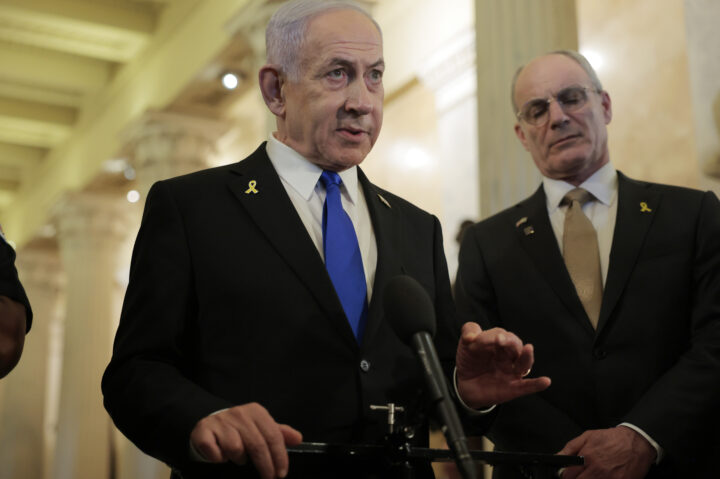
Israeli Prime Minister Benjamin Netanyahu speaks to reporters after meeting with U.S. Speaker Mike Johnson (R-LA) at the U.S. Capitol on July 8, 2025, in Washington, D.C.
Israeli Prime Minister Benjamin Netanyahu hosted senior administration officials, leaders from Jewish and pro-Israel Christian groups and hostage families for a reception last night at Blair House during his third visit to the United States this year.
Netanyahu was introduced by Paula White-Cain, the senior advisor to the White House Faith Office. “Israel, you are never, never alone,” she told the audience, pledging that evangelicals “will always stand with Israel.”
The Israeli prime minister spoke about efforts to free the hostages, both living and deceased, held in Gaza, saying, “We’re committed to getting every last one out … we don’t leave this sacred mission for a second.” He said he’d arrived a few minutes late because he had been speaking with the Israeli delegation engaging in hostage talks in Doha, Qatar, adding that he and President Donald Trump had spoken extensively about those efforts.
“We are going to succeed, we’ll bring them all home,” Netanyahu said, repeatedly acknowledging hostage family members in the room. “Each family has their own history of suffering, of hope, of prayer. … We do not forget, we will not relent, we’ll get them all home. All of them.”
Netanyahu also said that Iran would have had nuclear weapons within a year if Israel and the U.S. had not struck its facilities. He suggested that the U.S.’ show of force should also put to rest any questions about continued American supremacy in the 21st century, which “bodes well for the future.”
He honored Gen. Erik Kurilla, the outgoing head of U.S. Central Command — a rare public appearance in D.C. for the military leader. Netanyahu said Kurilla is a “commander without peer” whose successor would have “gigantic shoes” to fill, adding that Kurilla’s support has been “truly remarkable.” Netanyahu presented Kurilla with a sculpture made from a piece of an intercepted Iranian missile, featuring a map of Israel, a tree and a dove of peace, which Netanyahu said symbolized “peace through strength.”
Others in the crowded room — forced indoors by a torrential downpour and tornado watch in D.C. — included Education Secretary Linda McMahon, Commerce Secretary Howard Lutnick, Labor Secretary Lori Chavez-DeRemer, Small Business Administrator Kelly Loeffler, Under Secretary of Defense Elbridge Colby, U.S. Ambassador to Israel Mike Huckabee, Rep. Randy Fine (R-FL), Justice Department Senior Counsel Leo Terrell and Israeli Ambassador to the U.S. Yechiel Leiter. Brett McGurk, from the Biden administration’s National Security Council, was also in the crowd.
Jewish leaders in attendance included William Daroff, Elliot Brandt, Jonathan Greenblatt, Nathan Diament, Rabbi Moshe Hauer, former Sen. Norm Coleman (R-MN), Halie Soifer and Brian Romick. Christian leaders who attended included pastors Robert Jeffress, Mike Evans and Mario Bramnick.
The reception was the marquee event between the Israeli leader and officials from American Jewish groups during this visit. During recent visits to the U.S., Netanyahu skipped traditional sit-downs with Jewish leaders. Netanyahu has prioritized engagement with pro-Israel evangelical Christians and political conservatives, sometimes at the expense of more liberal-leaning American Jews.
Israel getting ‘80-90%’ of what it wants from a temporary ceasefire, but Hamas not willing to take steps towards ending the war, official says
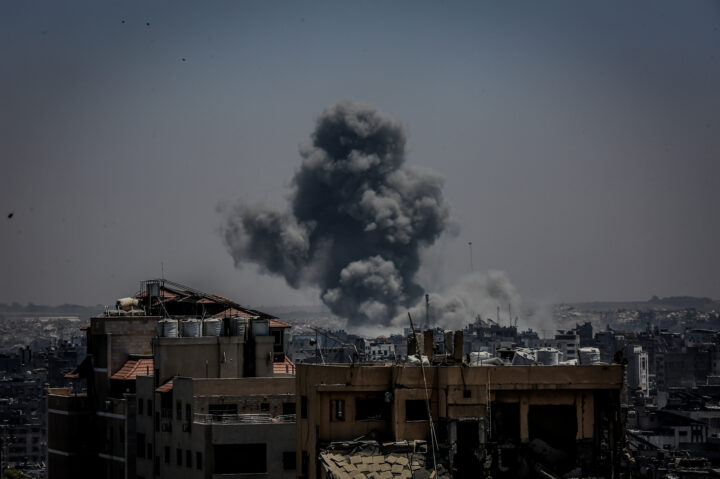
Saeed M. M. T. Jaras/Anadolu via Getty Images
Smoke rises after an Israeli strike in the eastern part of Gaza Strip on July 3, 2025.
A breakthrough in negotiations between Israel and Hamas for a temporary ceasefire and hostage-release deal is likely to take longer than expected, a senior Israeli official in Prime Minister Benjamin Netanyahu’s delegation to Washington told reporters on Monday, after Netanyahu’s dinner with President Donald Trump.
“We hoped that [a deal] would take a few days, but it may take more time,” the official said.
The negotiations in Doha, Qatar, are “fully coordinated” with the Trump administration, and Netanyahu and Trump may meet again “if necessary” while the prime minister is in Washington this week, the official said. Netanyahu is expected to return to Israel on Thursday afternoon, but in the past, he has extended his visits.
Israel and Hamas have been in negotiations mediated by the U.S. and Qatar for a 60-day ceasefire, in which Hamas would gradually free half of the 50 remaining hostages, approximately 20 of whom are thought to be alive, in exchange for the release of hundreds of Palestinian prisoners. In addition, Israel would withdraw from parts of the Gaza Strip, while keeping troops in the area’s perimeter and along key corridors.
Hamas responded to the temporary ceasefire proposal over the weekend, asking for many changes, the senior Israeli official said, to the extent that “Hamas’ answer was essentially no.”
Hamas previously rejected a similar proposal when Middle East envoy Steve Witkoff presented it earlier this year, but now, the official said, “the gaps are small enough for there to be talks.”
A second official on the delegation said the current proposal presents Israel with “80-90% of what it wanted to get.”
In addition to a continued presence on the Philadelphi Corridor, along the Gaza-Egypt border, where Israel has insisted on maintaining control since it reached the area in May 2024, the senior official said that Israel is demanding to keep troops along the Morag Corridor, slightly north of Philadelphi, which separates the southern Gazan cities of Rafah and Khan Younis.
A deal to end the Gaza war is not on the table because “Hamas is not responsive to the conditions that would allow a comprehensive agreement,” such as demilitarization for Gaza and exile for remaining Hamas leaders, the senior official explained. Without those conditions, “Hamas could do [the Oct. 7, 2023 attacks] again.”
“The conversation in the [news] studios that we can finish the war now is delusional. [Hamas] would see that as a major victory that could allow Iran to recover and Hezbollah to recover. I believe that with military and diplomatic pressure, we can bring back all of the hostages. Our pressure is neutralizing Hamas’ ability to control [Gaza],” the official said.
Israel’s vision for Gaza after the war is that “there is no more Hamas; Hamas is dismantled. Another force takes over the territory, the leaders are exiled and Hamas lays down its weapons … I need Gaza demilitarized, and I mean it.”
The senior official did not rule out the possibility that forces affiliated with the Palestinian Authority could be part of the other force, noting that there may be Fatah members in the existing militias that are pushing back against Hamas in Gaza.
“There needs to be another system that administers life [in Gaza]. I’m not certain that it won’t be [Israel], maybe it will be for some time and then we’ll pass it to someone else,” the senior Israeli official said.
The senior Israeli official addressed a plan, previously proposed by Trump, in which the population of Gaza is relocated outside of the Strip, saying that after the meeting between the president and Netanyahu, the official is convinced that the president was serious.
“The plan is alive,” he said. “What is needed is operational coordination, not just in the goal but how to achieve it, and that is what we discussed. The will is there.”
When it comes to Iran, the senior Israeli official said that Jerusalem and Washington are now working “to preserve our achievements against Iran, to prevent uranium enrichment and ballistic missile [production].”
According to the official, there has never been a time in which the governments of Israel and the U.S. have been more coordinated, and that the sides trust each other.
Israel “didn’t ask for and didn’t receive a green light from Trump to attack Iran. There is a different relationship now,” the official said. “We agree on things … You also don’t need to get approval. He understands that we have existential needs.”
A second Israeli official said Netanyahu and Trump’s administrations “had diplomatic coordination before the attack, military coordination during the attack, and now diplomatic coordination again.”
Egyptian national Mohamed Soliman now faces two counts of first-degree murder, in addition to 12 federal hate crimes charges and more than 100 state charges related to the June 1 firebombing
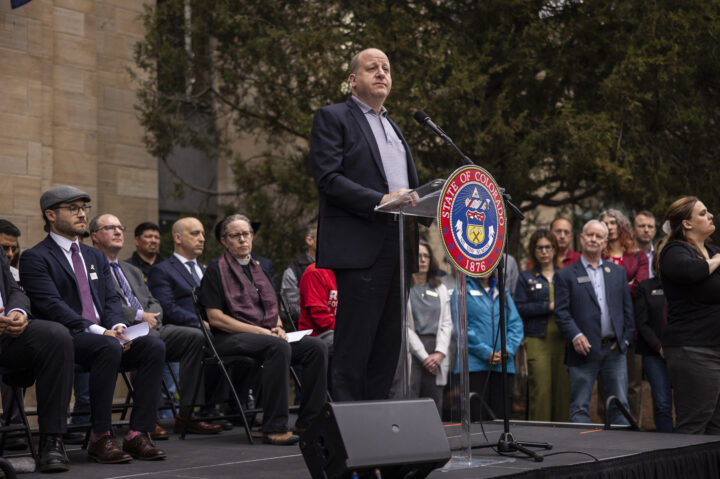
CHET STRANGE/AFP via Getty Images
Colorado Governor Jared Polis speaks during a community gathering at the site of an attack against a group people holding a vigil for kidnapped Israeli citizens in Gaza oin Boulder, Colorado on June 4, 2025.
Three weeks after a Colorado march in support of the Israeli hostages in Gaza was abruptly interrupted by a scene of grotesque violence, one of the victims of the antisemitic firebombing attack that left 29 people injured succumbed to her wounds.
Karen Diamond died on June 25, Rabbi Marc Soloway, of Boulder’s Congregation Bonai Shalom, announced in an obituary. She was 81, and is survived by her husband, two sons, two daughters-in-law and five grandsons.
“There are no words to express the pain of this horrific loss of our beloved member and friend,” Soloway wrote.
The alleged attacker, Egyptian national Mohamed Soliman, now faces two counts of first-degree murder connected to Diamond’s death, in addition to 12 federal hate crimes charges and more than 100 state charges related to the June 1 attack. A Justice Department spokesperson declined to comment.
Run for Their Lives, the organization that arranges the weekly hostage marches, released a statement on Monday calling Diamond’s death “a heavy and heartbreaking moment for us.”
Judith Weinstein-Haggai and Gad Haggai were murdered in Kibbutz Nir Oz in the Oct. 7, 2023, Hamas-led attacks in Israel

Hostages and Missing Families Forum
Judy Weinstein-Haggai and Gad Haggai
The IDF found and returned the bodies of U.S.-Israeli citizens Judith Weinstein-Haggai and Gad Haggai, who were killed in the Oct. 7, 2023, Hamas-led attacks, the Israeli Prime Minister’s Office announced on Thursday.
The Haggais were murdered in Kibbutz Nir Oz during Hamas’ onslaught targeting Gaza border communities. Their bodies were held by Hamas, the PMO said.
The couple was on a morning walk when they were shot by terrorists on motorcycles. Weinstein-Haggai called emergency medical services, but the ambulance that was traveling to help them was hit by a rocket, according to her daughter.
Gad was 72 and Judith, a New York native who also held Canadian citizenship, was 70; they are survived by four children and seven grandchildren.
The Weinstein-Haggai family released a statement via the Hostage and Missing Families Forum, saying that their return “is painful and heartbreaking, yet it also brings healing to our uncertainty. Their return reminds us all that it is the state’s duty to bring everyone home, so that we, the families, together with all the people of Israel, can begin the process of healing and recovery … A grave is not a privilege. A grave is a basic human right, without which personal and national recovery is impossible.”
The family called on leaders to “do everything necessary to reach an agreement that will return all 56 remaining hostages — the living for rehabilitation and the deceased for burial.”
Israeli Prime Minister Benjamin Netanyahu thanked the IDF soldiers and Shin Bet fighters who recovered the bodies and added, “We will not rest until we bring all of our hostages home, living and deceased.”
Israeli Defense Minister Israel Katz sent condolences to the Weinstein-Haggai family and said that “the State of Israel is morally and nationally committed to returning our brothers and sisters, living and not living, and we will continue acting with determination until the mission is complete.”
The bodies of two American hostages, Itay Chen and Omer Neutra, remain in Gaza, out of a total of 56 hostages, 20 of whom are thought to be alive.
Rep. Ritchie Torres said in remarks at the event, ‘We in the United States, both Jews and non-Jews, have a moral obligation to stand with our ally in ensuring that the Nova massacre is never forgotten and never repeated’

Haley Cohen
Mia Schem speaks at inaugural Tribe of Nova Foundation benefit held at Sony Hall, Times Square, May 30th 2025
Following her return to Israel, Mia Schem — who was kidnapped from the Nova music festival in southern Israel on Oct. 7, 2023, and spent 55 days in Hamas captivity — famously had the phrase “We will dance again” tattooed on her arm.
On Thursday night, approximately 800 New Yorkers joined Schem in dancing again at the sold-out inaugural Tribe of Nova Foundation benefit held at Sony Hall, a concert venue in Times Square. The event was held with the goal of raising at least $1 million to aid families of victims and survivors of Nova, where 411 festivalgoers, mostly young people, were killed and 44 were taken hostage.
“In Gaza, I lost my innocence,” Schem told attendees. “I brought back strength and the promise to live life, to help others and to fight with everything I have for the release of all hostages.” The event was held as 58 hostages remain captive in Gaza — about a third of whom are believed to be alive.
The Tribe of Nova Foundation was founded two weeks after the Oct. 7 attacks by five survivors of the massacre. It quickly drew support from high-profile entertainment and business executives including music manager Scooter Braun and tech entrepreneur Joe Teplow, both of whom attended Thursday’s event.
Ofir Amir, co-founder of the Tribe of Nova Foundation who was shot in both legs during the attack, told attendees that he went through a long period of rehabilitation and still carries “a life-long injury.”
“The Tribe of Nova Foundation was born out of an experience that we shared, our mutual values and sensitivity to one another,” he said. “I got my life back, but forever I will carry the memories of the friends I lost and the many beautiful souls we lost that day, our tribe of angels,” said Amir.
Rep. Ritchie Torres (D-NY) delivered remarks at the event, saying, “Israel cannot tolerate Oct. 7 being ignored because the world’s only Jewish state cannot survive it being repeated. We in the United States, both Jews and non-Jews, have a moral obligation to stand with our ally in ensuring that the Nova massacre is never forgotten and never repeated.”
“Resilience and renewal is encoded in the Jewish DNA … there is no doubt in my mind that the Jewish people will emerge better and stronger, more unified and more resilient than ever before, and that Israel will outlive its enemies: the Houthis, Hezbollah, Hamas and the Islamic Republic of Iran,” Torres continued, drawing applause from the crowd.
In North America, the foundation is best known for bringing the pop-up Nova Music Festival exhibition to cities including New York City, Miami and Toronto over the past year. The exhibit — an immersive experience that educates about the Oct. 7 attacks — is slated to arrive in Washington, D.C. this summer.
In Israel, the Tribe of Nova Foundation plans to open a community center to provide services and support by the end of the year, following a $2 million donation from UJA-Federation of New York in February. The UJA New York Nova House, projected to cost nearly $3 million, will provide rehabilitation, sports, cultural activities and workforce development to those directly affected by the attacks, as well as Israel Defense Force soldiers and individuals with special needs, according to the organization.
Attendees spotted on the dance floor included: Jonathan Greenblatt, CEO of the Anti-Defamation League; Eli Beer, founder of United Hatzalah of Israel; Josh Kadden, CEO of the Nova Festival Exhibition; former Israeli hostage Andrey Kozlov, who had been working as a security guard at the Nova festival when he was kidnapped; Martin Hoffstein, co-founder of JAJA Spirits and singer-songwriter Jeryko.
Months after their release, former hostages are quietly navigating the long, complex path to recovery inside a specialized ward at Beilinson Hospital in central Israel

Beilinson Hospital
Released hostages Naama Levy, Karina Ariyev, Agam Berger, Liri Albag and Daniella Gilboa gesture to well-wishers over a railing at Beilinson Hospital
When Israelis held hostage by terrorists in Gaza are released, there is a flurry of attention. Members of the media descend on the hospitals to which the newly freed hostages are sent. Dozens of photos of the former hostages and their families are disseminated from the hospitals. Siblings and other relatives give interviews about the returnees’ medical conditions and what they said about their treatment in Gaza.
Soon after, however, the public no longer hears much from most of them. To be sure, some gave high-profile interviews, while others found themselves on red carpets. Some were cheered by whole soccer arenas. The divorce of one former hostage from her husband has turned into gossip fodder in Israel. But for the most part, their day-to-day struggles are not on the public’s radar, even as the former hostages’ recoveries from their physical and mental injuries continues.
Beilinson Hospital in Petah Tikva, in central Israel, has treated and continues to treat hostages released in the ceasefire that took place earlier this year: female soldiers Naama Levy, Karina Ariyev, Agam Berger, Liri Albag and Daniella Gilboa, as well as Tal Shoham, Omer Wenkert, Eliya Cohen and Omer Shemtov.
Dr. Michael Bahar, director of the Rehabilitation Unit at Beilinson, who has been overseeing their recovery, told Jewish Insider in the hospital this week that his department “built rehabilitation programs based on each patient’s specific needs. It’s a multidisciplinary process, working with physical therapists, occupational therapists, dieticians, nurses and psychologists. For the rehabilitation of the female soldiers, “we work with the IDF,” he added.
“It’s been three months, and for some it continues, and we’re always thinking about the next stage,” Bahar said. “Every day of treatment has a schedule, matching each patient’s needs — physical, cognitive and beyond.”
The returnees come to the hospital multiple times a week for treatments that range from more traditional medical appointments to working with dieticians to ensure they are eating properly after over 500 days of malnutrition to exercises that strengthen injured limbs and improve aerobic activity.
Some of the treatments are in groups and include enjoyable but rehabilitative activities, such as cooking and dance classes. The returned hostages exercise using virtual reality headsets, and a ping-pong table was brought in at the request of one of the hostages, who then played with his family.
“They are accompanied by their psychologist, who plays a central role, because they can say when it’s too early to do something or if it’s the right time … They are starting to deal with participation in active lives in society, in school, with family,” Bahar said. The former hostages have had to consider whether the time is right to start working or studying, what kind of social activities they feel comfortable doing, whether they can drive and more.
The Rehabilitation Unit at Beilinson also treats many wounded soldiers, and Bahar said they and the former hostages have found it meaningful to undergo joint treatment and exercises together, including in the department’s pool.
“The soldiers felt that they were fighting to free the hostages, so we connected between them,” Bahar said. “One evening the [female soldier hostages] went to visit the wounded soldiers in the department. It was an indescribable moment. They couldn’t speak, they were so excited … It was very significant, very powerful for the soldiers and the returnees.”
Some of the hostages are still undergoing complex medical procedures, which they were given the option to delay. Freed hostage Romi Gonen, who was treated at Sheba Medical Center in Tel Hashomer, shared this week that she is undergoing a second surgery on her hand.
Dr. Noa Eliakim-Raz, head of the Returnees Ward and one of Beilinson’s six internal medicine departments, said that the staff has made sure to treat the returnees as “free people with the right to choose” after a year and a half in which their freedom was violently taken from them.
“Medically, we thought it was good to postpone some procedures and to give them the right to decide. If they say they want to postpone in order to go abroad, we can let them prioritize and decide for themselves. It’s clear to them that we are here for them, whenever they need us,” she said.
Beilinson set up the Returnees Ward on a floor of the Schneider Children’s Medical Center, which is in the same complex as the larger hospital. The entrance is through a corridor decorated with a cartoon dinosaur mural, with glass sliding doors that few hospital employees are able to access. They open up to signs that say “Now you’re home,” “We’ve waited for this moment,” and feature psalms thanking God for their return.
The department was set up after the November 2023 ceasefire, in which 105 hostages — mostly women and children — were released. Beilinson treated seven adult returnees — six mothers and a grandmother — while their children released from captivity were cared for at Schneider, all in the same department.
“Once that ended, we realized that everyone else who would come back would be adults and we started to prepare to receive them,” Eliakim-Raz said. “We hoped we would not have much time, but we had a lot of time to prepare.”
The department has room for up to 12 hostages, though the most it has treated simultaneously is nine. Two hospital rooms were designated for each returnee, one for the former hostage and another for family to sleep next door. Lounges were set up for the returnees to spend time together and to receive guests, including one with a sweeping view of the hospital campus, including the helipad on which the freed hostages arrived. A closet was filled with supplies the families may have forgotten to bring them: sweatsuits and pajamas, fluffy towels, slippers and flip-flops, stuffed animals, markers and paper — and lice removal shampoo.
Over time, Eliakim-Raz and her team compiled a medical protocol of hundreds of pages to prepare for the hostages’ return, listening to the testimony of those who already returned and poring over medical papers about other hostage situations, like in the Yom Kippur War, and Holocaust survivors. They also performed simulations of handling a group of freed hostages.
“So much changed, because being a hostage for 50 days is not like being there for over a year,” she said. “The preparation was complex. Soldiers male and female have different needs, there are other areas of care for young women, and much older adults have totally different problems. We prepared for every population and every scenario we could think of.”
“Every discipline involved needed to know what to prepare for, what it means psychologically and physically. The dieticians had to think about what they would encounter in someone who spent 550 days underground … What effect does a lack of stimuli have on younger and older people,” Eliakim-Raz said.
Dr. Michal Steinman, director of nursing at Beilinson, said that they also considered what being kept underground for long periods of time would mean, and whether the returnees would need dimmer lights or special glasses. They also thought they may need to help the returnees adapt to a more normal sleep schedule, though she found that “each one managed to keep track of time in their way. It was an amazing survival instinct, but it had psychological and bodily consequences.”
Steinman said she is “used to working on evidence-based medicine, but here we had to work based on clues. We examined the stories we heard and read and had to think of different variations to prepare. It was detective work.”
“We were well-prepared, but the real moment was indescribable,” Steinman said of the hostages’ arrival.
Each time hostages landed on the helipad in Beilinson, Eliakim-Raz said she “tried to give them a feeling of a home, more than a hospital. It’s a sort of warm capsule between captivity and home … It gives a lot of security. They are protected here. We didn’t let media in, and only people they wanted to see could be here. It was very closely managed.”
Steinman said the hospital’s treatment also extended to the hostages’ relatives, who in some cases had neglected their own health and underwent examinations by the doctors at Beilinson. Steinman and a mental health professional held nightly group meetings with the parents of the hostages when they were staying in the hospital, to answer questions about their children’s health.
“The public is excited about the hugs and kisses” when the hostages are reunited with their families, Eliakim-Raz said, “but the real difficult stage is at the end of the process when they have to go home.”
The continued outpatient rehabilitation program gives the returnees “continuity,” Bahar said. “They went back home but are still in this very safe environment.”

The medical literature about Holocaust survivors and Yom Kippur War prisoners of war who returned to Israel shows that those who are back from Gaza are likely to have long-term risks to their health.
“We see [in the literature] PTSD [post-traumatic stress disorder], depression and dangerous behaviors,” Eliakim-Raz said. “The body remembers and we don’t understand how, but it is in a more inflamed state than their peers. That can impact metabolic symptoms and cause a higher rate of strokes … I hope that they will have nothing and be healthy and happy, but the literature says that chances are that is not what’s going to happen.”
“If we don’t continue to reach out [to the hostages] now, maybe no one will make that connection in the future. They deserve that someone will examine them. We want to continue — they deserve that … We are going to actively invite them to checkup days and bring them in as a group to try to catch things early,” she said.
Like many Israelis, Steinman continues to try to follow what her patients are up to through the media.
“When I see them on TV, I’m so excited,” she said. “The group we met are inspirational. They went through a very difficult captivity and returned with a strong enough foundation to be rehabilitated and build a quality life. The scars will remain, but they all have great mental strength.”
That being said, the hostages who stayed at Beilinson all expressed forms of survivors’ guilt.
“They don’t feel ready to be fully rehabilitated until their friends get out” of Gaza, Eliakim-Raz said.
Meanwhile, the team at Beilinson is preparing in case they are entrusted with the care of some of the 20 remaining living hostages when they are released. Nurses check the medications in the department every week to make sure they aren’t expired, and the clothing to see that it fits the season.
Steinman said that recent hostage talks and the hope that the remaining hostages will be freed “takes me back to the long time we waited before … We’re back in the days of anticipation, and I don’t know when it will happen. For the 500 days of preparation before [the ceasefire that began in January], it was an emotional time. Sometimes we despaired.”
Steinman and Eliakim-Raz said that they put off travel plans because they don’t want to miss the hostages coming home: “This is where I need to be,” Steinman said.
“Everyone is waiting to see them return — though you can’t compare it to the families. For us, as a medical team, there is anticipation … We knew what to do and we did it well, and we want to do it again,” she added.
Middle East envoy Steve Witkoff said Wednesday the administration is working on new terms for a deal with Hamas

Maja Hitij/Getty Images
Ruby Chen, father of 19-year-old hostage Itay Chen speaks at the press conference at hostage square on December 16, 2023 in Tel Aviv, Israel.
In a letter to President Donald Trump, a bipartisan group of House members renewed calls for a deal to release all of the remaining hostages held in Gaza, including the bodies of four Americans believed to be deceased, urging him to capitalize on potential momentum from the release of Israeli American hostage Edan Alexander earlier this month.
Middle East envoy Steve Witkoff said on Wednesday that the administration would soon put forward a “new term sheet” for a potential ceasefire, expressing confidence about reaching a long-elusive deal.
“Building on the momentum of Edan’s release, we strongly urge your Administration to press forward with all available diplomatic efforts to secure the return of all hostages—including the four remaining Americans: Omer Neutra, Itay Chen, Gadi Haggai, and Judi Weinstein Haggai,” the House letter reads.
“While Edan’s return marks a critical breakthrough, the suffering he endured underscores the urgency of this mission,” the letter continues. “Those still in captivity continue to face unimaginable hardship, and we owe it to them and their families to do everything in our power to secure their release. This moment — coming in the wake of Edan’s homecoming — offers a window of opportunity.”
Witkoff said earlier this week that there is a deal on the table to release half of the living and half of the deceased hostages in exchange for a temporary ceasefire of unspecified length before negotiations to free the remaining hostages. Witkoff said Hamas has offered a “completely unacceptable” response.
“We urge you to continue using every diplomatic tool available, in close coordination with our regional allies and partners, to press for the release of all hostages,” the House letter continues. “Edan’s return has brought renewed hope to the nation — and to the close-knit community of Tenafly, New Jersey. Now, we must act swiftly to ensure that hope is realized for every hostage and every waiting community.”
The lawmakers highlighted the physical and mental torture that Alexander endured in Gaza, which many of the hostages still in captivity continue to endure. They thanked the Trump and Biden administrations and others involved in ongoing hostage negotiations and in freeing Alexander.
The letter was led by Rep. Josh Gottheimer (D-NJ) and co-signed by Reps. Young Kim (R-CA), Tom Suozzi (D-NY), Laura Gillen (D-NY), Ro Khanna (D-CA), Maria Salazar (R-FL), Frederica Wilson (D-FL), Val Hoyle (D-OR), Greg Stanton (D-AZ), Frank Pallone (D-NJ), Tom Kean (R-NJ), Don Bacon (R-NE), Chris Pappas (D-NH), Laura Friedman (D-CA), Greg Landsman (D-OH), Jake Auchincloss (D-MA), Seth Moulton (D-MA), Juan Vargas (D-CA), Brad Schneider (D-IL), Ritchie Torres (D-NY), Kim Schrier (D-WA), Gabe Amo (D-RI), Jeff Van Drew (R-NJ), French Hill (R-AR) and Herb Conaway (D-NJ).
The statement also calls for a ‘serious and credible political and security plan’ for Gaza

Anna Moneymaker/Getty Images
Rep. Dan Goldman (D-NY) returns to a hearing with the House Committee on Homeland Security on Capitol Hill on January 30, 2024 in Washington, DC.
A group of 41 pro-Israel House Democrats released a statement on Wednesday praising the resumption of humanitarian aid to Gaza as helping to refocus international attention on releasing the hostages and calling for a comprehensive plan for postwar Gaza.
The statement, first shared with Jewish Insider, argues that the renewed delivery of aid, which began on Monday, was “essential to alleviate the humanitarian crisis in Gaza, so that the primary focus of the international community can return to releasing the hostages that remain in captivity.”
“We strongly believe that there can be no lasting peace while Hamas remains in power. Its tyrannical rule over Gaza must end. To achieve that objective, the United States, Israel, and key Arab partners must agree upon a serious and credible political and security plan to govern Gaza after the war,” the lawmakers added. “Then, with the hostages returned and Hamas removed from power, the rebuilding process can begin to ensure lasting peace and security for Israelis and Palestinians alike.”
The statement highlights that Israel has facilitated the entry of 1.78 million tons of aid into Gaza since Oct. 7, 2023, and states that aid “must be disbursed swiftly and safely to Palestinian civilians and not Hamas, which has been stealing aid since the start of the war.”
It notes that Hamas continues to hold 58 hostages, saying, “Every day that goes by without the hostages’ release is a dagger in the hearts of their families.”
“We call on President Trump and his administration to do everything within their power to secure the release of the hostages, facilitate the disbursement of aid, and bring a swift end to the war,” the statement concludes.
The statement was organized by Rep. Dan Goldman (D-NY), in cooperation with Democratic Majority for Israel.
The statement was co-signed by Reps. Haley Stevens (D-MI), Greg Landsman (D-OH), Jimmy Panetta (D-CA), Debbie Wasserman Schultz (D-FL), Jake Auchincloss (D-MA), Vicente Gonzalez (D-TX), Dina Titus (D-NV), Jared Moskowitz (D-FL) Don Davis (D-NC), Sheila Cherfilus-McCormick (D-FL), Ritchie Torres (D-NY), Lois Frankel (D-FL), Tom Suozzi (D-NY), Wesley Bell (D-MO), Brad Sherman (D-CA), Angie Craig (D-MN), Hillary Scholten (D-MI), Grace Meng (D-NY), Frank Pallone (D-NJ), Josh Gottheimer (D-NJ), Greg Stanton (D-AZ), George Latimer (D-NY), Emilia Sykes (D-OH), Sarah Elfreth (D-MD), Mike Levin (D-CA), Brad Schneider (D-IL), Steve Cohen (D-TN), Frederica Wilson (D-FL), Jim Costa (D-CA), Laura Friedman (D-CA), Laura Gillen (D-NY), Sarah McBride (D-DE), Marilyn Strickland (D-WA), Josh Riley (D-NY) and Janelle Bynum (D-OR), Adriano Espaillat (D-NY), Juan Vargas (D-CA), Marc Veasey (D-TX), Jimmy Gomez (D-CA) and Ted Lieu (D-CA).
“This statement from 41 congressional Democrats, spearheaded by DMFI, reflects a clear-eyed understanding of the moral and strategic imperatives at stake in the continuing Israel–Hamas war,” DMFI President Brian Romick said in a statement. “Hamas’s continued captivity of 58 hostages after some 600 days, including the remains of American citizens, is a humanitarian outrage that demands the world’s attention. At the same time, aid intended for Palestinian civilians must not be diverted by Hamas to fuel terror and prolong this devastating war.”
“Their voices send a powerful message: the United States must remain steadfast in its commitment to our ally Israel, to the return of the hostages — both living and dead — and to a post-conflict vision that rejects terror and embraces peace,” Romick continued.
Speaking to the media in Israel for the first time in five months, the Israeli prime minister denied reports of friction with the U.S.

MAYA ALLERUZZO/POOL/AFP via Getty Images
Israeli Prime Minister Benjamin Netanyahu speaks during a press conference in Jerusalem on December 9, 2024.
Striking a defiant tone on Wednesday amid intensifying international pressure to end the war in Gaza, Israeli Prime Minister Benjamin Netanyahu laid down his conditions for the end of hostilities.
“The world is telling us to end the war,” Netanyahu said, in the first press conference he has held in Israel since December. “I am prepared to end the war according to clear conditions: Hamas lays down its weapons, steps down from power, returns all the hostages, Gaza is demilitarized and we implement the Trump plan” to relocate residents of Gaza.
“Whoever is calling for us to end the war is calling for Hamas to stay in power,” Netanyahu said, a day after Britain suspended free trade talks with Israel and the EU said it will review whether Israel is violating the human rights clause of the EU-Israel Association Agreement and two days after France, the U.K. and Canada threatened sanctions against Israel.
Netanyahu stressed that if there was an option for a temporary ceasefire in exchange for the release of hostages, Israel would accept that. He said there are 20 hostages confirmed to be alive in Gaza and the remains of up to 38 deceased individuals.
The prime minister reiterated previous comments he has made that friends of Israel, including U.S. senators, have said they support Israel in its war against Hamas, but they cannot accept a humanitarian crisis in Gaza, which many have said worsened after Israel instituted an 11-week blockade of aid.
Addressing reports of strained ties between the U.S. and Israel, Netanyahu said that he spoke to President Donald Trump about 10 days ago and Trump told him, “Bibi, I want you to know I have a total commitment to you and to the State of Israel.”
Netanyahu said that both countries seek “together to ensure Iran doesn’t get nuclear weapons, that Hamas will be thrown out of Gaza, that Trump’s plan — which I think is a genius plan — will happen,” and “change the face of the Middle East.” He stressed that the relocation plan would only be for those who wish to leave Gaza.
Referring to Trump’s recent Middle East tour, which excluded Israel, Netanyahu said, “I have no opposition to the U.S. deepening its ties to the Arab world … I think this can help broaden the Abraham Accords that I’m very interested in.”
Turning to Iran, Netanyahu said, “Iran remains a serious threat to Israel. We are in full coordination with the U.S. — we talk to them all the time. We hope that it’s possible to reach an agreement that will prevent a nuclear weapon from Iran and will prevent Iran from having the ability to enrich uranium. If it is reached, of course, we will welcome it,” he said, before adding, “In any case, Israel reserves the right to defend itself against a regime that threatens to destroy us.”
Netanyahu previously called for total dismantlement of Iran’s nuclear infrastructure, which would go farther than stopping Iran from enriching uranium. However, an official in Netanyahu’s office denied that his remark reflects a change in policy.
Speaking on the IDF’s expanded engagement in Gaza, Netanyahu laid out three phases of “Operation Gideon’s Chariots,” as the latest stage in the war is called: the immediate entry of aid into Gaza; opening aid distribution points that will be managed by American companies and secured by the IDF; and the creation of a “sterile” humanitarian zone for civilians.’
Netanyahu said that at the end of the operation, “all of Gaza’s territories will be under Israeli security control, and Hamas will be totally defeated.”
Netanyahu slammed Britain’s decision to sanction veteran settler leader Daniella Weiss, calling it “shameful” that “instead of sanctioning Hamas, they sanction a woman who is threatened every day … they are under pressure from the Islamist minority, from a population that is repeating the Hamas propaganda, the false propaganda and they give in to it. We don’t. We responded aggressively to them calling to give the ultimate reward for Oct. 7 — to give a Palestinian state. There is no greater prize for terror.”
The former hostage wrote to the board on social media: ‘This is not a question of politics. This is a question of humanity. And today, you have failed it’

Catherine Ivill - AMA/Getty Images
A sticker with an image of Emily Damari who is being held in Gaza during the Premier League match between Tottenham Hotspur FC and Liverpool FC at Tottenham Hotspur Stadium on December 22, 2024 in London, England.
A former British-Israeli hostage who was held by Hamas in Gaza for 15 months spoke out against the Pulitzer Prize Board on Thursday for bestowing an award to a Palestinian poet who has disparaged victims of the Oct. 7, 2023, attacks and appeared to legitimize the abduction of hostages, among other comments that have stirred controversy.
Emily Damari, who in January was released from Hamas captivity after she was shot and taken from her home in Kibbutz Kfar Aza in southern Israel on Oct. 7, expressed outrage at the Pulitzer committee board over its decision to honor Mosab Abu Toha, a Gazan-born writer whose New Yorker essays on the war-torn enclave won the award for commentary on Monday.
In an anguished statement posted to social media, Damari, 28, voiced “shock and pain” that Abu Toha had won the prestigious award, citing his past remarks, uncovered earlier this week by the pro-Israel media watchdog HonestReporting, in which he denigrated Israeli captives abducted by Hamas and questioned their status as hostages, while also casting doubt on Israeli findings that a baby and a toddler kidnapped by the terror group were “deliberately” murdered in Gaza with “bare hands.”
“If you haven’t seen any evidence, why did you publish this,” Abu Toha said in a social media post in February, criticizing a BBC report on the murder of Kfir and Ariel Bibas, the young siblings who were abducted by Hamas. “Well, that’s what you are, filthy people.”
Elsewhere, Abu Toha, who is now a visiting scholar at Syracuse University, took aim directly at Damari, arguing that she could not be described as a hostage because, like most Israelis, she previously served as a soldier in the Israel Defense Forces.
“How on earth is this girl called a hostage?” he said in a social media post in January, when Damari was among the first of three Israeli hostages to be freed amid a ceasefire deal that has since collapsed. “This soldier who was close to the border with a city that she and her country have been occupying is called a ‘hostage?’”
He likewise denounced another former Israeli hostage, Agam Berger, an IDF surveillance soldier freed in January. “These are the ones the world wants to share sympathy for, killers who join the army and have family in the army!” Abu Toha said in a social media post in February. “These are the ones whom CNN, BBC and the likes humanize in articles and TV programs and news bulletins.”
In her social media statement addressing the Pulitzer board on Thursday, Damari called Abu Toha “the modern-day equivalent of a Holocaust denier” and said that the committee had “joined him in the shadows of denial” by choosing to award his writing with one of the country’s top journalism prizes.
“This is a man who, in January, questioned the very fact of my captivity,” she wrote. “He posted about me on Facebook and asked, ‘How on earth is this girl called a hostage?’ He has denied the murder of the Bibas family. He has questioned whether Agam Berger was truly a hostage. These are not word games — they are outright denials of documented atrocities.”
Damari, who lost two fingers after she was shot in the left hand during the Hamas-led assault on Oct. 7, also recounted the harrowing circumstances of her nearly 500 days in captivity, writing that she had “lived in terror” as she was “starved, abused, and treated like I was less than human.”
“You claim to honor journalism that upholds truth, democracy, and human dignity,” Damari said in her statement to the Pulitzer board. “And yet you have chosen to elevate a voice that denies truth, erases victims, and desecrates the memory of the murdered. Do you not see what this means?”
“This is not a question of politics. This is a question of humanity. And today, you have failed it,” she concluded.
The Pulitzer board did not respond to a request for comment from Jewish Insider on Thursday, nor did Abu Toha.
‘There is no chance we will agree to a ceasefire with Hamas that will only allow it to rearm, recover and continue its war against Israel,’ a senior Israeli official said

Mahmoud Issa/Anadolu via Getty Images
Smoke rises after Israeli army's attack on the Tuffah neighbourhood in the east of the Gaza City, Gaza on April 25, 2025.
Israel will not accept a Hamas-proposed five-year ceasefire and hostage-release deal, because it does not require the terrorist organization to disarm, a senior Israeli official said in a briefing to journalists on Monday.
A Hamas official said on Saturday the group would release at one time all of the remaining hostages in Gaza — 59 total, including at least 21 living — in exchange for a five-year ceasefire.
Hamas would not, however, agree to disarming and would only enter an agreement to end the current war in Gaza, rejecting a 45-day ceasefire and hostage deal proposal proffered by Israel earlier this month.
The Israeli official said that the five-year proposal has been “going around some Arab states.”
“There is no chance we will agree to a ceasefire with Hamas that will only allow it to rearm, recover and continue its war against Israel,” he said.
Regarding a recent report that Qatar encouraged Hamas to harden its stance in the negotiations, the official said that “the Qataris had a negative influence in the current negotiations.”
The official said that the reason Israel has been fighting at a lower intensity in Gaza since the last ceasefire ended on March 18 was to give hostage negotiations a chance.
”We want to exhaust the effort to return the hostages and that influences our patterns of action,” he said.
However, the official added, “our patience is not endless,” indicating that the war could increase in its intensity in the coming weeks.
With regard to President Donald Trump’s proposal for Gazans to emigrate, the official said that there are Western countries, including Canada, that told Israel they want to help their citizens or relatives of citizens get out of Gaza.
“People who want to leave should be able to, freely, and there are countries that want to absorb them,” the official stated.
Israel is still not allowing humanitarian aid into Gaza. The official said that the Coordinator of Government Activities in the Territories, a combined IDF-civilian unit that deals with aid, among other matters in the West Bank and Gaza, “is constantly monitoring, and if there is not enough food, the information will be given to decision-makers.”
“We have no obligation to feed the war machines of the enemy’s economy,” the official added. “The trucks strengthened Hamas’ economy … It was their main source of income. It led us to think about how to prevent this phenomenon.”
Young Palestinian who took part in demonstrations in Gaza tells JI, ‘The majority of us are disgusted by Hamas and are not on the side of Hamas’ terrorism’

AFP via Getty Images
Palestinians chant slogans during an anti-Hamas protest, calling for an end to the war with Israel, in Beit Lahia in the northern Gaza Strip on March 26, 2025.
Palestinians have a responsibility to rise up against Hamas and to call to free the hostages and end the war in Gaza, Muhammad, a law student from Gaza City, told Jewish Insider this week.
Muhammad, whose last name was withheld for fear of retribution, took part in demonstrations against Hamas in the last week in central Gaza, where he has lived for most of the time since Hamas’ Oct. 7, 2023, attack on Israel. He spoke to JI in a conversation facilitated by the New York-based Center for Peace Communications, a peacebuilding organization founded by author and Middle East analyst Joseph Braude that strives to build public support for reconciliation.
Muhammad and his parents and siblings left Gaza City, in northern Gaza, in October, following IDF instructions. They have been displaced and living in a school ever since, except for four months in which they were instructed to leave and stay in Rafah, in southern Gaza.
Muhammad said that, while Hamas has portrayed the demonstrations as planned and funded from outside of Gaza, including by the Palestinian Authority, he sees them as grassroots with participants from different parts of the population.
The common slogans on banners and chanted by protesters are against both Hamas and the PA, which many Palestinians view as corrupt, he said.
“People are fed up with Hamas’ attempt to use their bodies, their lives, as a tool to make political and even financial gains from this war,” he said. “These protests were very openly and obviously asking Hamas to step down, get out of the political and military picture in Gaza.”
The demonstrators want the war to end instead of suffering the consequences of the Oct. 7 attack, which Muhammad called “Hamas’ plan cooked up with Iran and the Muslim Brotherhood.”
“Even though it’s very risky to protest Hamas’ rule in Gaza, this is a duty and responsibility on a humanitarian and moral level for educated Gazans,” Muhammad told JI through a translator provided by Center for Peace Communications on Tuesday. “Hamas went too far in oppressing the people while not negotiating [to end the war] with good intentions. All they are doing is looking for political gains for Hamas and not humanitarian gains for Gazans … We educated people have the responsibility to inspire others to say, after 18 years of Hamas rule, ‘enough.’”
Asked why he specified that educated people should take the lead, Muhammad said that he believed that sector of society has the capacity to do so under a Hamas dictatorship in which they are inundated by propaganda.
“Anyone with the knowledge and education, who reads and learns about politics, even religion, has the responsibility to open the eyes of the public who are sometimes moved by Hamas propaganda … I believe we have a responsibility because we know how to put the words together to describe the plight of the Gazans and talk to the media and the public, to try to bring peace and a better destiny for our people,” he said.
While Hamas has inflicted violence on the protesters, Muhammad said, “the people didn’t give up” and attacked Hamas police in return. He described an incident in which Hamas police killed a man in line to buy food for his family, and the family killed the police officer. “This is a new thing that did not happen in 18 years of Hamas rule,” Muhammad noted.
Asked about the hostages, of which 59 remain in captivity in Gaza, Muhammad said that ever since Israel tied humanitarian aid to their release, “people in Gaza who have nothing to do with politics are all asking that the hostages be able to go home in peace back to Israel.”
“If the people themselves knew where the hostages were, they would bring them back because the entire issue is backfiring on Gazans. It didn’t help us at any point,” he said.
However, Muhammad emphasized that releasing the hostages is not enough, and Hamas must be removed from power in Gaza.
“If the war would end now but Hamas would stay in Gaza, we will see another Oct. 7 because Hamas would do it again and again,” he warned. “We are asking Hamas to send back all the hostages and get out of Gaza, because those are the Israeli demands to end the war.”
On Oct. 7, Muhammad said that allegations that all Gazans supported Oct. 7 are false, and that “a lot of us were terrified when we saw Oct. 7 happening. The majority of us are disgusted by Hamas and are not on the side of Hamas’ terrorism.”
Muhammad said that protesters against Hamas are seeking a leader who can bring peace to Gaza, and he has heard talk about supporting former Palestinian Authority Prime Minister Salam Fayyad, a relatively moderate Palestinian figure who is currently a lecturer at Princeton University, and Mohammed Dahlan, an advisor to the president of the UAE who has been in exile from Gaza since attempting a coup against Hamas.
Muhammad said that “Palestinians should never try to get political gains or rights through military struggle. I don’t want to see another Oct. 7. Palestinians want to live in Gaza or the West Bank without weapons. People hate Fatah [the dominant party in the PA], Hamas and the PA.”
He expressed hope that Gaza will be able to emulate “examples of great collaboration and relations between Israelis and Palestinians in the West Bank that contribute to building productive relations on many levels, cultural and economic, and were able to achieve positive things. There is an opportunity for peace.”
Muhammad called on “the Israeli right wing and the Palestinian right wing to step back and give a chance to others who are more moderate to work on peace, because it is possible.”
At the same time, Muhammad said that, given the opportunity, he would like to leave Gaza.
Of President Donald Trump’s call to evacuate all Palestinians from Gaza, Muhammad said, “I want it to not just be an idea but a real plan that is implemented … I would be one of the very first people to leave Gaza because this is my choice.”
Muhammad said that “Egypt has a responsibility to open the borders, just like any country would do for its neighbors suffering from a catastrophe, whether war or another kind. [The border] should be open for civilians so they can leave.”
He also said Egypt should give Palestinians the rights of refugees and basic needs while they are in transit.
“We understand Egypt is saying they are closing the borders because they think the Oslo Accords will not be implemented and the Palestinian issue will be forgotten if Gaza is emptied, but this is not a justified reason for the people presently in Gaza to be literally imprisoned. People like me who had nothing to do with Oct. 7 are being subjected to shelling and hunger, because Egypt wants to keep us with Hamas in Gaza,” he said.
Muhammad called on the U.S. and Arab countries to pressure Egypt to open its border to Gazans.
“My message for President Trump is that we have big hopes that he will work on a peaceful political solution that will push Hamas not only out of Gaza but the entire Palestinian picture, and he will work on real peace between Palestinians and Israelis,” he said.
Prime Minister Benjamin Netanyahu's plan for a lengthy war is running against political headwinds from a war-weary Israeli public

JACK GUEZ/AFP via Getty Images
An Israeli soldier operates a tank at a position along Israel's southern border with the northern Gaza Strip on March 19, 2025.
With ground troops and tanks returning to Gaza, Israel is hoping military pressure will force Hamas to free more hostages, while preparing to oust the Palestinian terror group from power, even if it requires a lengthy war, insiders and experts said.
Israeli Prime Minister Benjamin Netanyahu revealed some of his thinking to new recruits to the IDF Armored Corps on Sunday, telling them that Israel is “winning because we understand that, to defeat our enemies, those who are closing in on us, we must break through with crushing force … The tremendous crushing force is the tank corps.”
The prime minister vowed that Israel “will complete … victory as soon as possible.”
A source in the Knesset Foreign Affairs and Defense Committee, who was briefed after the fighting restarted, told Jewish Insider that while it may take many months to fully remove Hamas from power in Gaza, Netanyahu is likely to agree to a ceasefire as soon as the terrorist group is willing to release a “reasonable” number of the remaining 59 hostages taken on Oct. 7, 2023, of which as many as 24 are believed to be alive.
The source, who supports the government’s aim of ousting Hamas from power, expressed concern that Netanyahu would not continue the war to the total defeat of Hamas.
Michael Makovsky, president and CEO of the hawkish Jewish Institute for National Security of America, who met with senior officials and military figures in Israel last week, told JI that Israel is trying to put pressure on Hamas to release hostages.
“They’ll see in the next couple of weeks,” Makovsky said. “If they can get more live hostages, as many as they can, then there can be a ceasefire for a while.”
At the same time, he said he was not optimistic that all the hostages would be released: “I don’t know why Hamas would do that.”
While most Israelis support removing Hamas from power in Gaza, polls show that the prospect of a months-long war with no end in sight and without the remaining hostages released faces political headwinds from a war-weary Israeli public. The plan would require mobilizing a fatigued group of reservists, and would place additional challenges on the Israeli homefront.
Makovsky pointed out that continuing the war would be “tougher on the people” of Israel, and attributed the “fatigue” among reservists to mistakes made early in the war, which “went longer than it should have — for some legitimate reasons and some not — and this is one of the results, that people are tired.”
The Israeli public is divided. According to a poll conducted last month by the Israel Democracy Institute, 33% of Jewish Israeli support ending the war and seeking diplomatic arrangements, while 28% supported resuming full-scale war in Gaza. Netanyahu has faced protests from hostage families seeking an end to the war, and has faced opposition over his efforts to fire the head of the Shin Bet, who supports further diplomatic negotiations.
Makovsky said that despite the demonstrations in Tel Aviv against resuming the war, he saw a consensus among all military figures that “at some point, they’re going to have to go back in” to Gaza to defeat Hamas.
“They know they have to finish off Hamas as much as possible; that’s just a fact,” he said.
Retired IDF Maj.-Gen. Yaakov Amidror, a former Israeli national security advisor under Netanyahu and a distinguished fellow at JINSA, said that the new phase of the war and the final defeat of Hamas may take as long as a year.
Following heavy airstrikes in the first 24 hours last week, ground forces entered three areas — the Netzarim Corridor bisecting northern and southern Gaza, northwestern Gaza on the shore and the Shaboura area of Rafah, in southern Gaza. Israel has killed Hamas and Palestinian Islamic Jihad figures, including senior political figures in Hamas.
“If that doesn’t bring Hamas into negotiations [to release the hostages] in good faith, you’ll see more ground forces going in,” Amidror said in a JINSA webinar. “The purpose at the end is to eliminate Hamas totally … That will take a year.”
It will take a “slow process” for the IDF to eliminate Hamas as a leading force in Gaza, involving large numbers of ground troops, Amidror said.
“We don’t need to rush. We have all the time, and we need to do it cautiously,” he said.
The ceasefire between Israel and Hamas ended last week after lasting for two months. For the first six weeks, hostages were released each week in exchange for Palestinian prisoners, including mass murderers, and Israel’s withdrawal from parts — but not all — of Gaza.
At that point, negotiations were meant to continue for the second phase of the deal, which was expected to bring about the release of the rest of the hostages along with an Israeli withdrawal from much of Gaza, with Hamas relinquishing control of the enclave. Israel sought to extend the first phase of the deal, instead of negotiating the second phase, in which Hamas reportedly sought to effectively remain in power along with Israel’s withdrawal from all of Gaza.
U.S. negotiators subsequently suggested two interim deals with an aim to maintain a ceasefire through Ramadan and Passover, which ends in mid-April, but Hamas did not agree to the terms, insisting on continuing to the second phase of the original agreement.
Amidror said that “the idea was not a ceasefire. It was to release more hostages. What we wanted to achieve was an agreement about the period during which Hamas would release the hostages, and what we learned … is that is not Hamas’ intention. They want to achieve a total withdrawal of the IDF from Gaza without any plan for the future. The meaning of that is to allow Hamas to rebuild itself in Gaza.”
Once that became clear, Israel relaunched the fighting in Gaza to extricate itself from the “absurd situation in which we are limiting our efforts inside Gaza and at the same time not getting any hostages out.”
Now, Israel’s task is “to smash Hamas to a level at which they are no longer relevant inside the Gaza Strip,” Amidror said.
“To those who say ‘the IDF didn’t succeed, Hamas is still strong,’ yes, Hamas is still strong in the Gaza Strip,” Amidror explained. “They recruited young people with Kalashnikovs and RPGs and are the strongest force in Gaza … but Hamas is not relevant as an organization that can attack Israel. In the first days [of the renewed war] they only shot three or four missiles at Israel … They cannot provide new weapons systems to the people they recruited, because they cannot smuggle [arms] in from the Sinai.”
Amidror asserted that ground troops are necessary for Israel to win the war.
“This will not be a war that will be determined by intelligence,” he said. “We will have to go and fight in the Gaza Strip to find [Hamas terrorists] and kill them. It won’t end with intelligence and precise air raids. It will be a very hard, ground forces kind of urban war.”
The Hamas-run Health Ministry in Gaza, which does not differentiate between combatants and civilians and is not trusted as a reliable source by Israel, says 50,000 people have been killed since the beginning of the war. Israel says it has killed some 20,000 terrorists and more than 400 Israeli soldiers have been killed in the fighting.
The new IDF chief of staff, Lt.-Gen. Eyal Zamir, had a “much more aggressive orientation in Gaza” when he was the head of the IDF’s southern command, and as such, Makovsky said he’s “not surprised they’ve gone in decisively this time.”
Similar to earlier phases of the war, Israel is moving towards having Gazan civilians stay in humanitarian zones where they will have access to food and medical aid, overseen by Israel to prevent Hamas control, the Knesset source said.
“Control of aid has been empowering Hamas,” Makovsky said. “Israel has to disconnect the two.”
In that vein, Israel has dropped leaflets in Gaza and published warnings on social media.
Defense Minister Israel Katz said on Friday that the IDF would continue to capture territory in Gaza, evacuating the population, as long as Hamas continues to hold the hostages.
Makovsky said that “creating bigger, deeper buffer zones than the 1 kilometer they initially carved out … makes sense from an Israeli perspective.”
The Knesset source focused on the combination of splitting Gaza between its north and south with Israel blocking humanitarian aid, describing it as a “siege strategy” that is meant to lead to Hamas “begging on all fours for a ceasefire.”
The source noted that Israel was not previously able to try such a strategy because the Biden administration insisted on large quantities of humanitarian aid flowing into Gaza, but that the Trump administration supports Israel’s renewed fighting in Gaza.
However, Makovsky argued that early in the war, “the IDF was a bit cautious. They didn’t go into Rafah right away, they went point to point. They didn’t [have a] plan and they had to develop one. That’s not on Biden. It became more about Biden in January” — when the administration threatened to block arms to Israel if it went into Gaza. “I think the IDF and the war cabinet, for that matter, deserve some responsibility for that.”
Carlson has platformed critics of Israel and Holocaust deniers in recent months

SAUL LOEB/POOL/AFP via Getty Images
U.S. media personality Tucker Carlson at the inauguration ceremony where President Donald Trump was sworn in as the 47th U.S. President in the U.S. Capitol Rotunda in Washington, DC, on January 20, 2025.
Right-wing talk show host Tucker Carlson appeared to remain seated as President Donald Trump said that “the hostages in the Middle East are coming back home to their families” during his inauguration speech on Monday, a comment that drew a wide and bipartisan standing ovation from a majority of attendees at the Capitol Rotunda ceremony.
Carlson, who received one of the most sought-after seats in Washington to attend the inauguration in the rotunda — which has a limited capacity of about 600 people — drew unusually fierce criticism from several Republican lawmakers over his decision last September to host Darryl Cooper, a Holocaust distortionist who called Winston Churchill the “chief villain” of World War II, on his show.
Three months later, Carlson held another controversial interview with Jeffrey Sachs, the Columbia University professor who, in a lengthy discussion with Carlson, espoused a litany of conspiracy theories about Israel and the broader Middle East.
Carlson and the newly inaugurated Vice President J.D. Vance have a close professional relationship. The former Fox News host lobbied Trump aggressively to choose Vance as his running mate, and the former senator has appeared on his online streaming program.
The outgoing president laid out the terms of the agreement in a White House address

ROBERTO SCHMIDT/AFP
President Joe Biden, flanked by Vice President Kamala Harris and Secretary of State Antony Blinken, speaks about the Israel-Hamas ceasefire and hostage release deal in the Cross Hall of the White House on January 15, 2025.
Nearly eight months after President Joe Biden gave a White House address laying out the terms of a proposed cease-fire and hostage-release deal between Israel and Hamas, he again spoke at the White House lectern on Wednesday, this time to announce that the two warring sides had “finally” agreed to the deal.
“At long last, I can announce a cease-fire and a hostage deal has been reached between Israel and Hamas,” Biden said. “This is the cease-fire agreement I introduced last spring. Today, Hamas and Israel have agreed to that cease-fire agreement and the whole of ending the war.”
He offered a veiled rebuttal to conservative critics who opposed the deal when he outlined it last year but are now more supportive of it following the backing of President-elect Donald Trump, whose aides were central to bringing the deal about.
“This is the exact framework of the deal I proposed back in May. Exactly,” said Biden. But, he added, his administration and the incoming one have “been speaking as one team” while negotiating in the region in recent days.
Trump announced the deal earlier in a post on his social network Truth Social, where he called it an “epic” agreement.
The deal has three phases, the first of which will include a “full and complete cease-fire, withdrawal of Israeli forces from all the populated areas of Gaza and and the release of a number of hostages held by Hamas, including women and elderly and the wounded,” said Biden. “I’m proud to say that Americans will be part of that hostage release in phase one as well, and the vice president and I cannot wait to welcome them home.”
In the first phase of the deal, 33 hostages are set to be gradually released — including some who are not alive.
Phase one will also include the release of hundreds of Palestinian prisoners from Israel, Biden said, as well as a surge of humanitarian assistance into Gaza. Many of those prisoners are believed to be Palestinians serving life sentences, some for murder of Israelis. During this period, Israel “will negotiate the necessary arrangements to get phase two, which is a permanent end of the war,” said Biden.
At the start of phase two, there will be an exchange of all the remaining living hostages, including male soldiers, and “all remaining Israeli forces will be withdrawn from Gaza,” according to Biden. “A temporary ceasefire will become permanent.”
Phase three will include the release of the remains of any additional hostages who were killed, and a “major reconstruction plan for Gaza will begin,” said Biden.
“This is one of the toughest negotiations I’ve ever experienced, and we reached this point because of the pressure that Israel built on Hamas backed by the United States,” said Biden, who touted Hamas’ military losses, the weakening of Hezbollah in Lebanon and the U.S.-led coalition to combat the Houthis as significant achievements.
“I’m deeply satisfied that this day has come — finally come — for the sake of the people of Israel and the families waiting in agony, and for the sake of the innocent people in Gaza who suffered unimaginable devastation because of the war,” said Biden. “In this deal, the people of Gaza can finally recover and rebuild. They can look to a future without Hamas in power.”
Incoming national security advisor says on Dan Senor’s ‘Call Me Back’ podcast that Hamas ‘cannot have a role’ in governing Gaza
MANDEL NGAN/AFP via Getty Images
U.S. Representative Mike Waltz (R-FL).
Incoming White House National Security Advisor Mike Waltz addressed the emerging hostage deal being negotiated between Israel and Hamas in Qatar on Dan Senor’s “Call Me Back” podcast Tuesday night.
“Those have been brutally tough negotiations. I hate the fact that we even have to enter them, into them, with a terrorist group like Hamas, but we need to get our people out and then prosecute our objectives in this conflict,” Waltz said.
“This is about imposing consequences for those who would do this type of horrendous act like we saw on Oct. 7, who would take Americans or other allies hostage. He [Trump] made it clear there’ll be nothing but downside. And I’m convinced that’s why you’re seeing this movement,” Waltz added.
The imminent hostage deal, Waltz continued, comes in part due to Hamas’ isolation, “with [Hamas political bureau leader Ismail] Haniyeh gone, with [Yahya] Sinwar gone,” and in part due to “the Trump effect.”
Waltz said that the Trump administration will “make every effort to get everyone out, living or deceased, so that they can have a proper burial.”
On a number of occasions throughout the interview, Waltz referred to getting “our people” out in the first phase of the deal, ostensibly a reference to the seven Israeli-Americans still being held in Gaza. According to information given to the Israeli press on Monday, the first stage of the deal would see the release of 33 hostages, including women, the elderly and the sick.
As Senor noted that the negotiations are “basically a done deal,” Waltz acknowledged that Israel has not yet accomplished all of its stated goals — emphasizing that “Hamas cannot have a role” in governing Gaza moving forward.
“We’ve been clear that Gaza has to be fully demilitarized, Hamas has to be destroyed to the point that it cannot reconstitute, and that Israel has every right to fully protect itself,” Waltz said. “So all of those pieces, all of those objectives are still very much in place. Look, I mean, Oct. 7 was a terrible day. They put everybody in a terrible position, including the Palestinian people of Gaza, whom they regularly hide behind and are willing to sacrifice, and have sacrificed, for their own sick ends and objectives. And so we need to get our people out and then we need to achieve those objectives in this war.”
Some Republicans worry the terms of the agreement currently being negotiated could hurt Israel’s ability to defend itself and eliminate future terrorist threats

Amir Levy/Getty Images
Medical workers take out released hostages from an Helicopter at Sheba hospital on November 28, 2023 in Ramat Gan, Israel.
Despite President-elect Donald Trump’s push for a deal to secure the release of the remaining hostages in Gaza before his inauguration, some Republicans are raising concerns that the terms of the agreement currently being negotiated could hurt Israel’s ability to defend itself and eliminate future terrorist threats.
Details are still being finalized on the deal, which could be announced in the coming days, but it includes a 42-day cease-fire between Israel and Hamas that requires the IDF to evacuate from the heavily populated areas of Gaza to the edges of the Gaza Strip. It will also swap dozens of hostages for hundreds of Palestinian terrorists in Israeli prisons, with 30 prisoners released for each civilian hostage and 50 prisoners for each female soldier.
The agreement has been in the works under the outgoing Biden administration, with talks falling apart several times in the last year. Negotiations picked up again after the U.S. election in November, when President Joe Biden, Secretary of State Tony Blinken and National Security Advisor Jake Sullivan kicked their efforts to reach a deal before leaving office into overdrive. The team also began updating Trump and Steve Witkoff, the president-elect’s incoming Middle East envoy, on the talks.
Terms of the deal have not changed since Trump and Witkoff got involved, though the speed at which progress has been made has increased since the president-elect reiterated last week that “all hell will break loose” in the region if Hamas did not return the remaining hostages by the time he was sworn in. “I don’t want to hurt your negotiation,” Trump said to Witkoff before issuing the threat last Tuesday. “If they’re [the hostages] not back by the time I get into office, all hell will break out in the Middle East.”
Behind the scenes, congressional Republicans have begun fretting that Trump could force them to back a deal that involves terms they’ve opposed for over a year. Some lawmakers and senior staffers have privately discussed the issue among themselves, though none of them have taken additional steps beyond engaging with Trump’s transition team about their concerns.
None of the GOP lawmakers who spoke to Jewish Insider for this story praised or defended the terms of the deal as it is currently written. The few GOP lawmakers willing to voice their skepticism publicly pointed to specific details that worried them.
Sen. Thom Tillis (R-NC) said that he was “really in the skeptical column for anything related to Hamas.” Tillis expressed concern that the terror organization was included in negotiations at all.
“I feel like they’re the wrong people to be brokering the deal because, in some respects, that means you’re a part of the future of Gaza. That’s a bad thing,” Tillis told JI.
Sen. John Cornyn (R-TX) said that while he wasn’t read up on the specifics of the deal as it currently stands, he had reservations about some of the terms negotiated under the outgoing administration, pointing to the release of Palestinian terrorists being held in Israeli prisons.
“The Biden administration hasn’t shown itself to be a very effective negotiator, period,” Cornyn told JI. “I’d be concerned that he [Biden] negotiated a bad deal, which would be consistent with everything he’s done the last four years. While I would applaud the release of the hostages, I am concerned that Hamas is incentivized to take more hostages so they can trade them for more prisoners.”
Sen. Rick Scott (R-FL) said that he viewed the release of all remaining hostages and the complete surrender of Hamas as critical components for a deal. “I’d want all the hostages back and I’d want Hamas to drop their weapons,” Scott said of his conditions to support an agreement.
“My attitude is that the way to end this is for Hamas to surrender,” Sen. Pete Ricketts (R-NE) told JI when asked about the deal. “I think it’s up to Israel to decide how this should work. It’s about Israel’s security.”
Sen. Ted Cruz (R-TX) did not criticize the deal directly, but rather argued that the Biden administration’s inability to get the hostages released paired with Trump’s recent threats against Hamas proved that pressuring Israel had prolonged the conflict.
“Everyone knows that Hamas was emboldened to extend their war against Israel, and keep these hostages in unimaginable hell, because Hamas leaders were hoping that the Biden administration would force Israel to capitulate. Everyone also knows that the hostages would not be getting out without President Trump’s threat to unleash hell against Hamas and its patrons,” Cruz told JI in a statement. “The fundamental lesson from the first Trump administration remains just as true today as it was four years ago: The way to secure peace and stability in the Middle East is to stand shoulder-to-shoulder with our Israeli allies.”
Given the opportunity to speak anonymously, most Republicans said they thought the deal needed to be renegotiated or tossed altogether. Two sources told JI that the Trump team had responded to their concerns by arguing that this deal served as the best vehicle to deliver on the president-elect’s promise to get this done by his first day back in office.
“To me the fundamentals of this deal are flawed. My heart goes out to the victims’ families, but what we’re trying to do is to also make sure that we have something that has staying power and gives us certainty that there’s not going to be another tranche of victims,” one Republican senator said. “I’m not sure that we’re there yet. I don’t know that this deal works practically, so regardless of what may occur in the waning hours of the Biden administration, I believe that there are going to be additional requirements for the new administration to impose.”
“If we’re not getting basic concessions like every hostage returned or other guarantees, then what are we getting out of this Biden deal? I don’t see how it is sustainable if Hamas is still in the picture,” another GOP senator told JI.
Those who responded optimistically to the developments largely focused on Trump’s influence in moving the deal along after multiple failed efforts to bring the remaining hostages home. They did not, however, praise the deal itself.
Senate Majority Leader John Thune (R-SD) said that he hadn’t been tracking the most recent developments, “but obviously, any news that suggests we’re coming closer to a resolution in that part of the world would be welcome news.”
Asked if he was confident Trump and Witkoff wouldn’t endorse a deal that hurt Israel, Thune answered affirmatively. “I haven’t followed closely, but I’m aware of some of the conversations that have been engaged in around those issues. Yes, I am confident. I think President Trump and Mr. Witkoff will be very careful to ensure that Israel’s interests are protected and preserved.”
Another GOP senator, speaking on condition of anonymity, told JI, “I’m not worried about Trump accepting a deal that isn’t strong enough for Israel, because I can’t imagine [Israeli Prime Minister Benjamin] Netanyahu would feel that kind of pressure to take a weak deal.”
Sen. John Kennedy (R-LA) says he worried that Biden, Blinken and Sullivan would take any deal as they depart the White House because they were “trying to create their legacy.” Regardless, he said he would get behind an agreement if Trump and Sen. Marco Rubio (R-FL), Trump’s nominee to be secretary of state, gave it their blessing.
“Unless Trump and Rubio sign off on it, I wouldn’t support it. If they can look me in the eye and tell me that this does not hurt Israel’s effort to destroy Hamas and Hezbollah and the Houthi rebels, then I would consider it,” Kennedy told JI.
Kennedy added that any deal must “keep that Philadelphi corridor secure, because that’s how the weapons are getting in. They’re coming in from Egypt.”
A spokesperson for Trump did not respond to JI’s request for comment.
'Please do not think about us only as a headline,' father pleads

Maya Alleruzzo/AP Photo
Relatives of U.S. citizens that are missing since Saturday's surprise attack by Hamas militants near the Gaza border, in Tel Aviv, Israel attend a news conference on Tuesday, Oct. 10, 2023 in Tel Aviv, Israel. Seated from left: Jonathan Dekel-Chen, father of Sagui Dekel-Chen (35) from Nahal Oz; Ruby Chen, father of Itay Chen, 19, a soldier in the armored corps; Ayala Neta, daughter, and Nahal Neta, son of Adrienne Neta, 66, a nurse living in Kibbitz Be'eri; Rachel Goldberg, mother of Hersh Goldberg-Polin, 23, who was attending the music festival, and Jonathan Polin, Hersh's father.
A nurse and midwife who has delivered more than 1,000 babies. A soldier who swapped weekend shifts so that he could attend his brother’s bar mitzvah. A young man attending an outdoor rave with friends. A father awaiting the birth of his third child.
The families of four American citizens who believe their loved ones are being held by Hamas in Gaza gathered in Tel Aviv on Tuesday afternoon to deliver a public, emotion-laden plea to both the Israeli and American governments, neither of which, relatives say, have provided adequate support or information about their family members.
On Tuesday afternoon, National Security Advisor Jake Sullivan said that 20 or more Americans remain unaccounted for. A National Security Council spokesperson confirmed on Monday that at least 11 American citizens have been killed in the attacks.
On Tuesday afternoon, following a phone call with Israeli Prime Minister Benjamin Netanyahu and Vice President Kamala Harris, President Joe Biden said he had “directed my team to share intelligence and deploy experts from across the United States Government to consult with and advise Israeli counterparts and hostage recovery efforts. Because as president, I have no higher priority than the safety of Americans being held hostage around the world.”
Rachel Goldberg, who grew up in Chicago and now lives in Jerusalem, last heard from her son, Hersh Goldberg-Polin, on Saturday morning. Goldberghad turned her phone off on Friday evening as the sunset ushered in Shabbat and Simchat Torah. After a siren alerted her to a rocket attack near Jerusalem on Saturday morning, she turned on her phone, concerned about Hersh, who was attending the Tribe of Nova music festival near Kibbutz Re’im.
“I turned my phone on, I believe, at 8:23 in the morning,” Goldberg said. “And when I turned it on, there were two texts in a row from Hersh at 8:11. The first one said, ‘I love you’ and immediately at 8:11 also it said, ‘I’m sorry.’ And so I knew immediately wherever he was, it was a terrible situation.”
Goldberg identified her son, whom she has not heard from since, in a photo taken inside a bomb shelter. In collecting eyewitness accounts, she said, she learned that Hersh had been injured in a firefight.
“They were fish in a barrel sitting in this bomb shelter,” Goldberg explained. “Terrorists came to the door, they were throwing grenades in, shooting machine guns, and we know that Hirsch’s arm from the elbow down was severed, was blown off, and that he tied a tourniquet around with his shirt.” She has not received any further information about her son’s whereabouts.
Goldberg was joined by the families of Itay Chen, Sagui Dekel-Chen (who is not related to Itay) and Adrienne Neta, whose son, Nahar Neta, issued a plea to President Joe Biden and Secretary of State Tony Blinken. The administration, Neta said, is “responsible to bring the U.S. citizens back home safe and sound. We expect nothing less from the U.S. administration and from President Biden and Secretary of State Blinken.”
Adrienne Neta is a California-born nurse and midwife who moved to Israel in 1981. She lived for decades on Kibbutz Be’eri, one of the deadliest sites of Saturday’s attack. When Hamas terrorists invaded the kibbutz, her children said, she was sitting on her patio on the phone. It was roughly 9:30 a.m. “Both my brother and my sister were on the call with her as the terrorist barged into her home, and we heard a little bit of screaming and that was our last contact with her,” her son Nahar Neta said. “There was no shooting on the call.”
His mother, Neta added, tried to use the limited Arabic she had picked up as a longtime nurse at Soroka Hospital to communicate with her captors.
A half-hour’s drive from Neta’s Kibbutz Be’eri sits Kibbutz Nahal Oz, which is where 35-year-old Sagui Dekel-Chen was taken hostage as he and other men on the kibbutz attempted to overpower the terrorists who had infiltrated the property. Dekel-Chen’s wife is pregnant with the couple’s third daughter.
Of the roughly 400 residents of the kibbutz, Sagui’s father, Jonathan Dekel-Chen, said, more than half have been killed or taken hostage. The roughly 160 survivors, the elder Dekel-Chen said, “call this a pogrom.”
“What happened to us, it’s not a war,” he said. “It’s not a fair fight. It is a pogrom. Hundreds of heavily armed, well-organized terrorists walked, rode, ran over the border with one object in mind: and that was to kill, maim, to destroy civilian life along the border.”
“As such,” he continued, “it seems to me that the United States, my original home, and still a very beloved place for me, always wants to be and must be on the side of good.” He called on the “United States government, to the Congress, to do what they can on the side of good here. We’re waiting for Sagui to come home.”
Rubi Chen, whose son Itay was captured while on duty, said he has connected with about 10 other families who are missing a relative with American citizenship following Saturday’s ambush.
Itay Chen had not been scheduled to be on duty the weekend of the attack. His younger brother’s bar mitzvah was the following weekend, when he had been originally scheduled to report for duty. Itay had traded weekend shifts so that he could be a part of his family’s celebrations.
Rubi Chen said the IDF had informed the family that Itay was listed as missing in action.
“You would think it would be a good assumption to say that after 70 hours, if he’s not in the State of Israel, he might be some other place. If that is the case, then he is by definition a POW.” Chen called for his son to be treated as a POW according to international law.
Chen said he had been in contact with the State Department and the U.S. Embassy in Jerusalem, but that he has received few answers as to his son’s whereabouts and any plans to rescue the hostages. There has “been no formal or concentrated attempt to talk to us as a group and update us about what they are doing in this matter,” Chen said on Tuesday.
“Please do not think of us only as a headline,” Rubi Chen pleaded. “We are more than that.”
Please log in if you already have a subscription, or subscribe to access the latest updates.
 Continue with Google
 Continue with Apple