





















Aber Kawas, a left-wing Muslim activist, also expressed solidarity with a man convicted of providing support to Al-Qaida
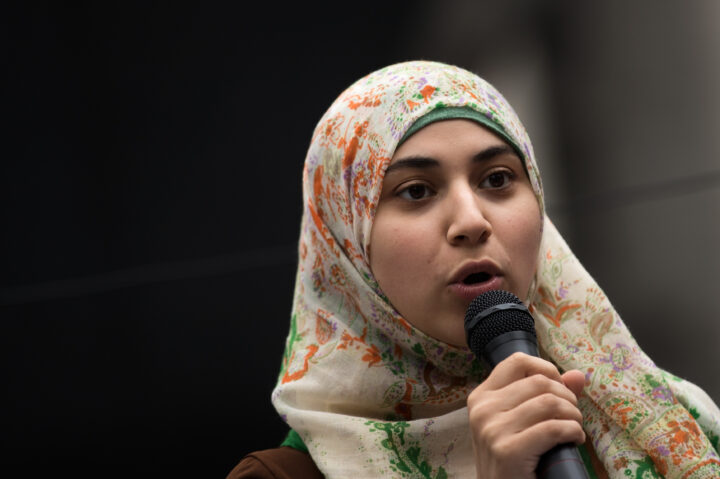
Drew Angerer/Getty Images
Aber Kawas, from the Arab American Association of New York, speaks to members and supporters of the New York Immigration Coalition during a rally for immigration reform in Foley Square, June 28, 2016 in New York City, New York.


 Add JewishInsider on Google
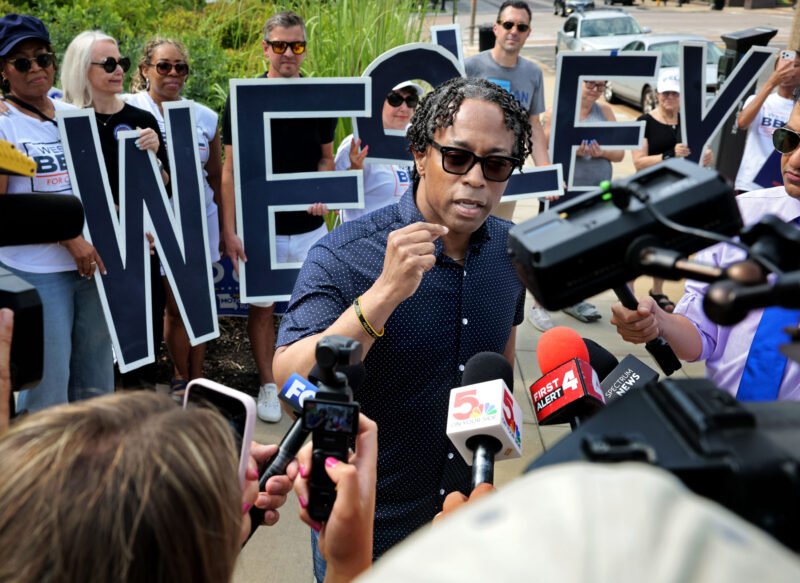
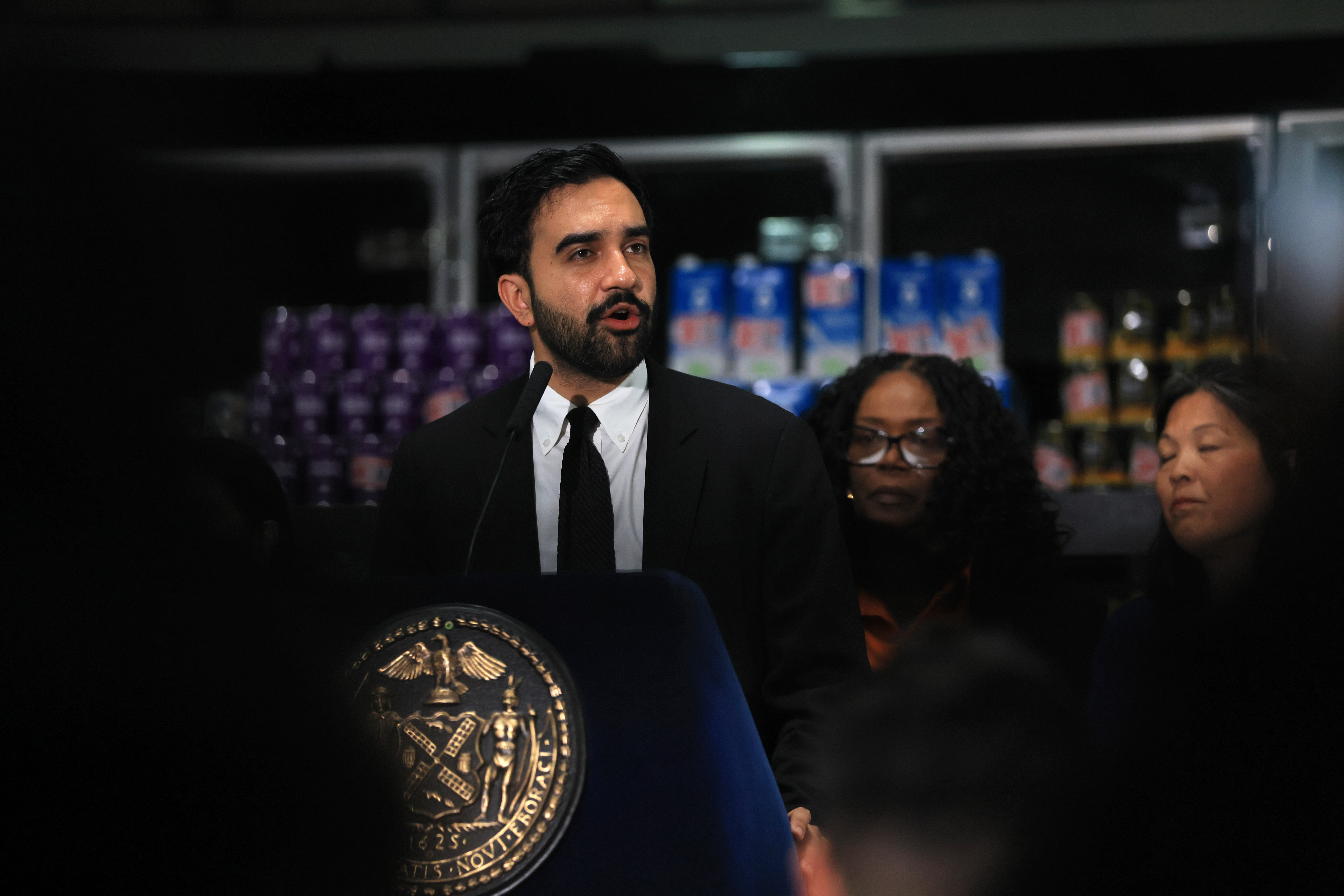
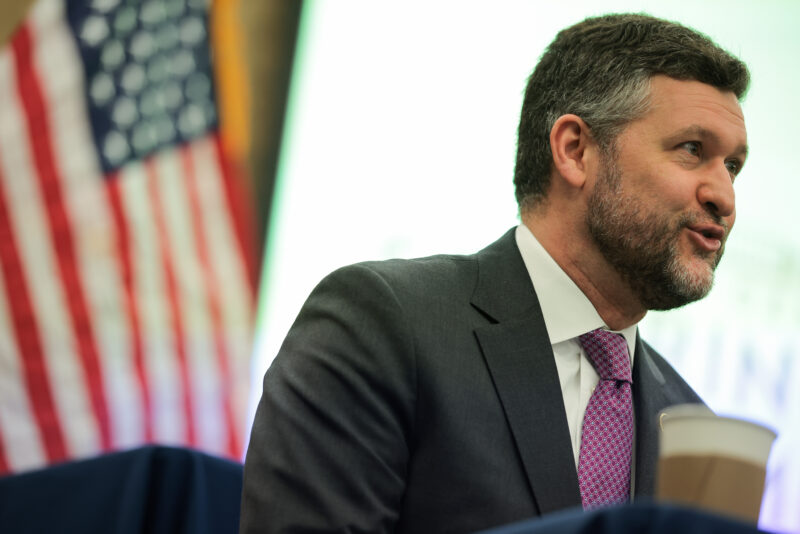
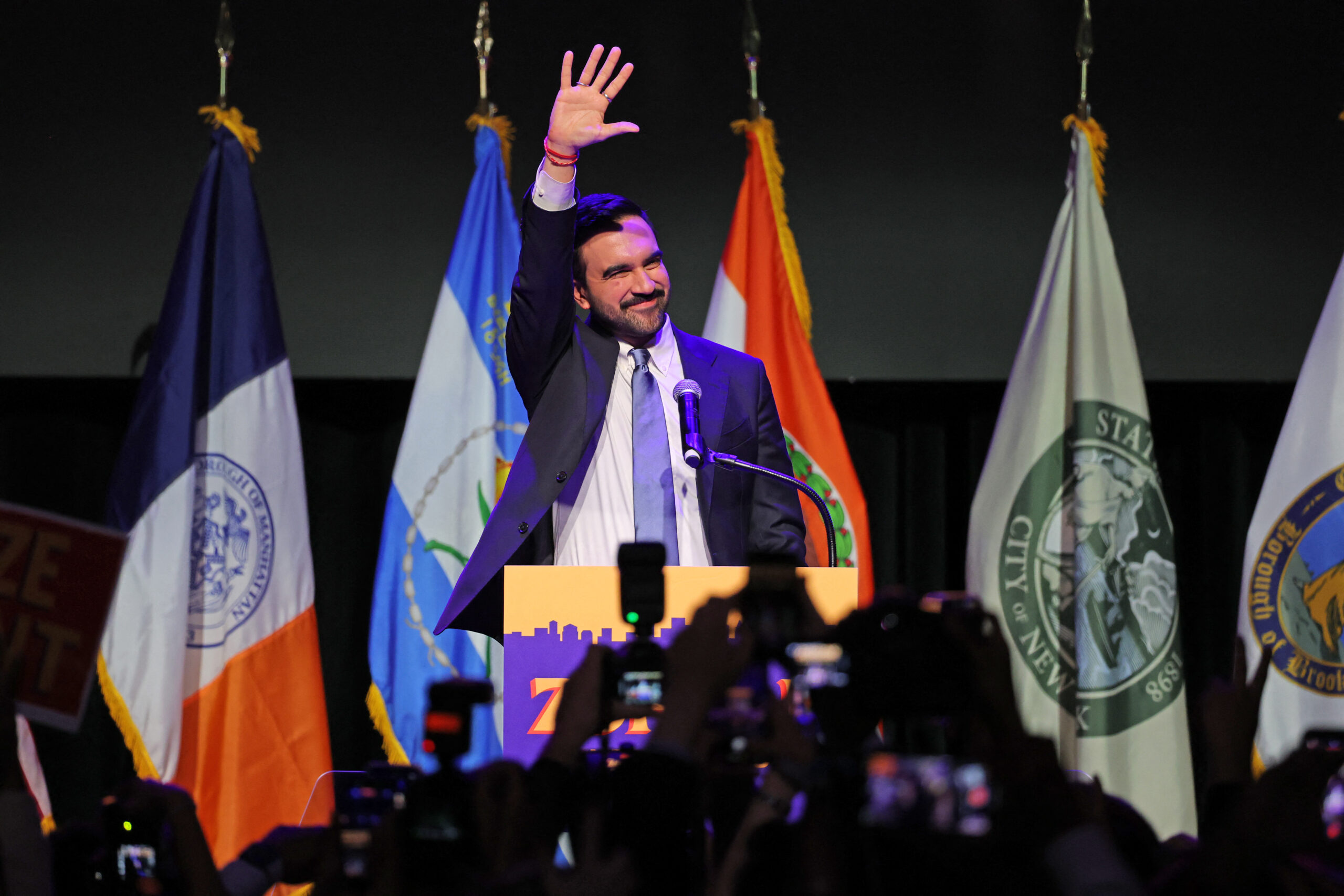
Zohran Mamdani, the mayor-elect of New York City, is facing scrutiny for reportedly throwing his support behind a local state Assembly candidate with a record of controversial remarks about 9/11, Israel and other related topics.
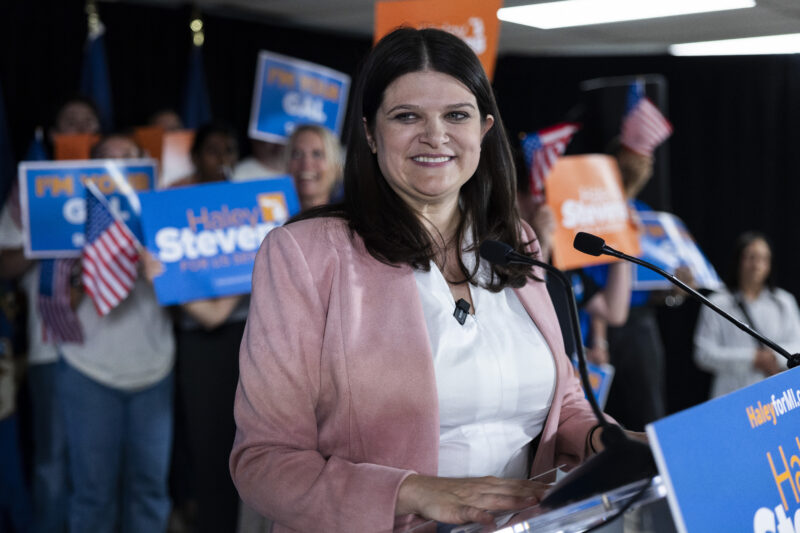
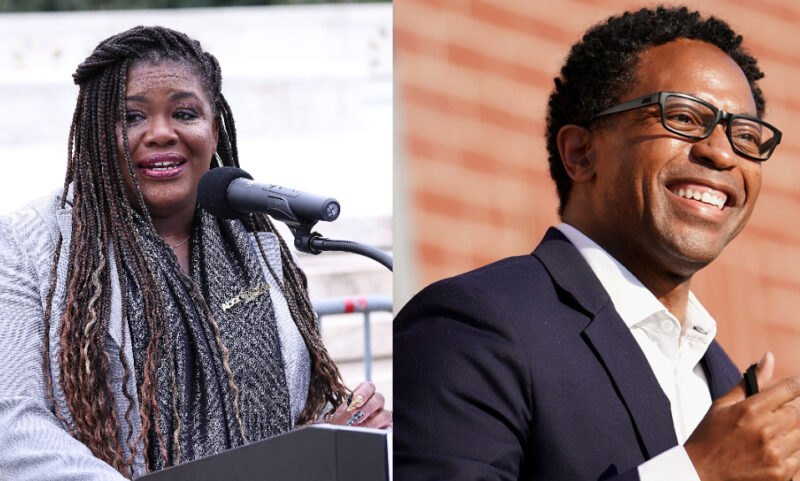
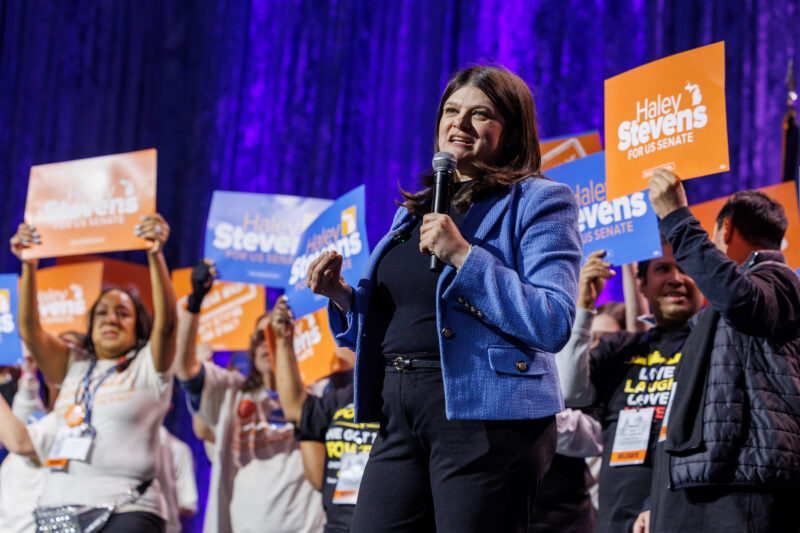
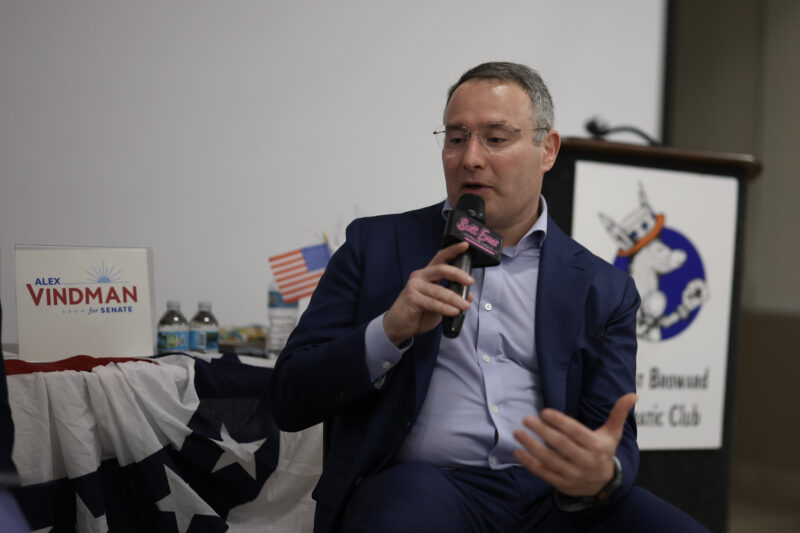
Aber Kawas, a Palestinian American activist running for an open Assembly seat in a largely Hispanic Queens district, came under the spotlight this week after several of her past online posts and comments resurfaced.
Mamdani’s decision to privately endorse Kawas, which was reported by The New York Daily News, underscores the depth of his hostility toward Israel, as he flexes his newfound political capital to boost a candidate whose extreme views are already stirring backlash.
In one widely circulated online video clip from 2017, Kawas downplayed the 9/11 attacks and suggested they paled in comparison to what she characterized as a “long trajectory” of capitalism, racism, white supremacy and Islamophobia that “have all been used to colonize lands” and “take resources from other people.”
“The idea that we have to apologize for a terror attack that a couple people did,” she said of 9/11, “and then there is no apologies or reparations for genocides and for slavery, et cetera, is something that I kind of find reprehensible.”
Kawas, who is in her early 30s and has long been active in Arab and Muslim organizing in New York City, also wrote a series of now-deleted blog posts in which she expressed solidarity with a man convicted of providing material support to al-Qaida as well as a group of Hamas-linked Muslim activists known as the Holy Land Five — whom she called “imprisoned heros.”
In another post in 2013, Kawas, commemorating the anniversary of the Nakba recognizing the mass displacement of Palestinians during the founding of Israel in 1948, also lamented “the day that the British Empire gave control of the land of Palestine to European Zionists who created a state based on the ethnic cleansing, murder, displacement, and occupation of millions of indigenous Palestinians in the area.”
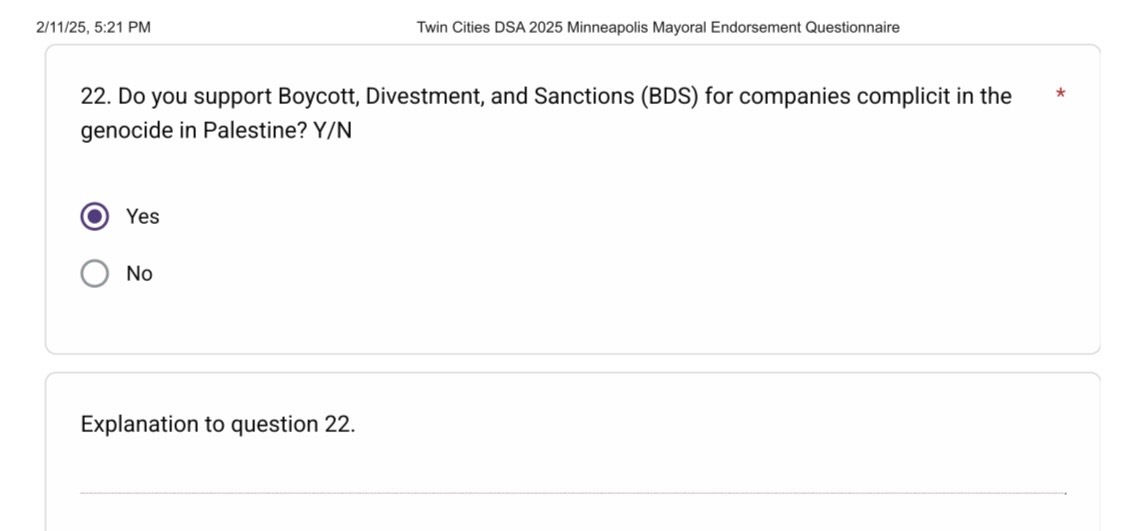
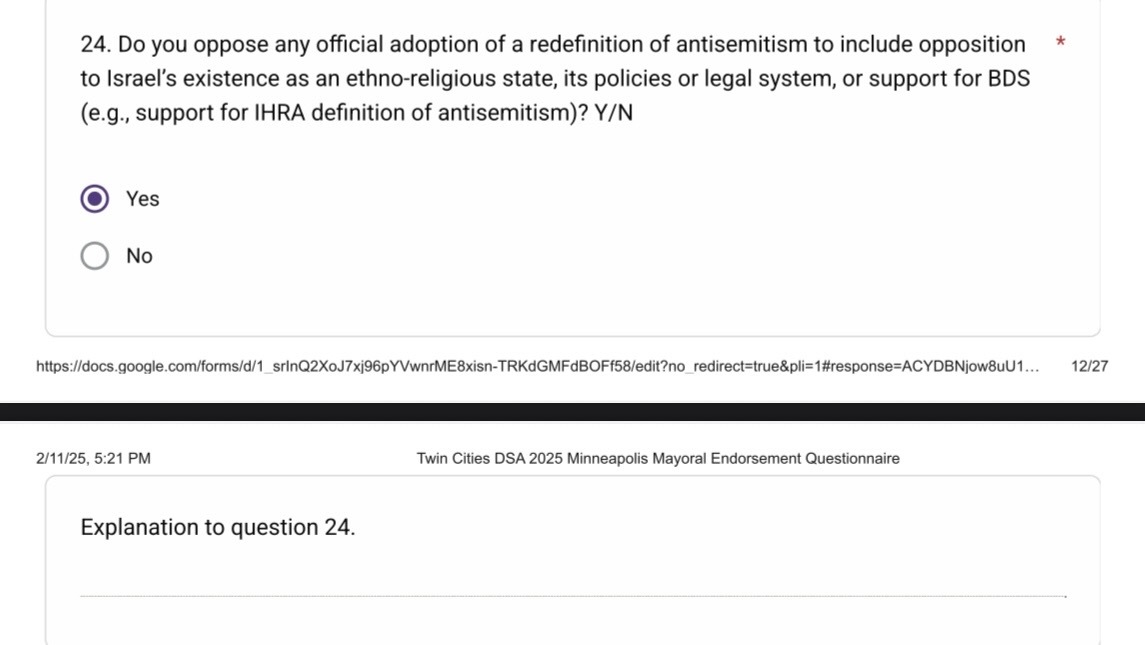
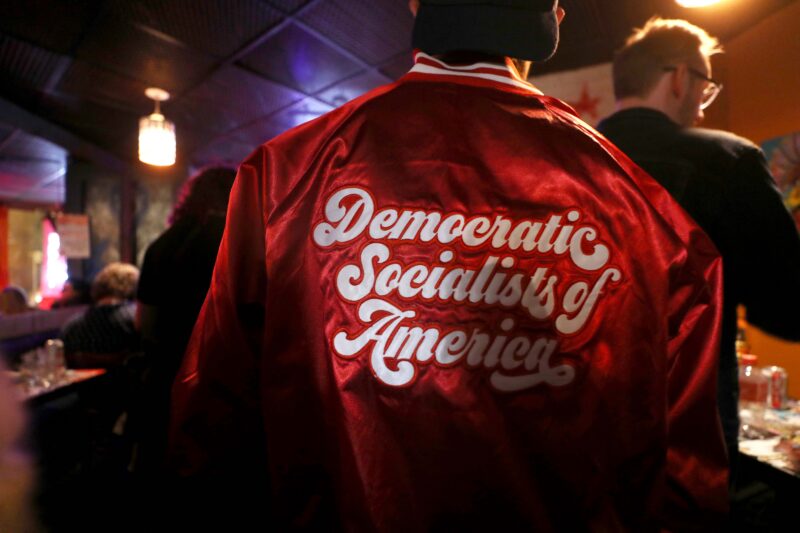
Kawas is a supporter of the Boycott, Divestment and Sanctions movement targeting Israel and was involved in efforts to promote failed legislation led by Mamdani that sought to strip Jewish nonprofits of their tax-exempt status, according to a candidate questionnaire solicited by the Democratic Socialists of America, which is reportedly moving to back her campaign.
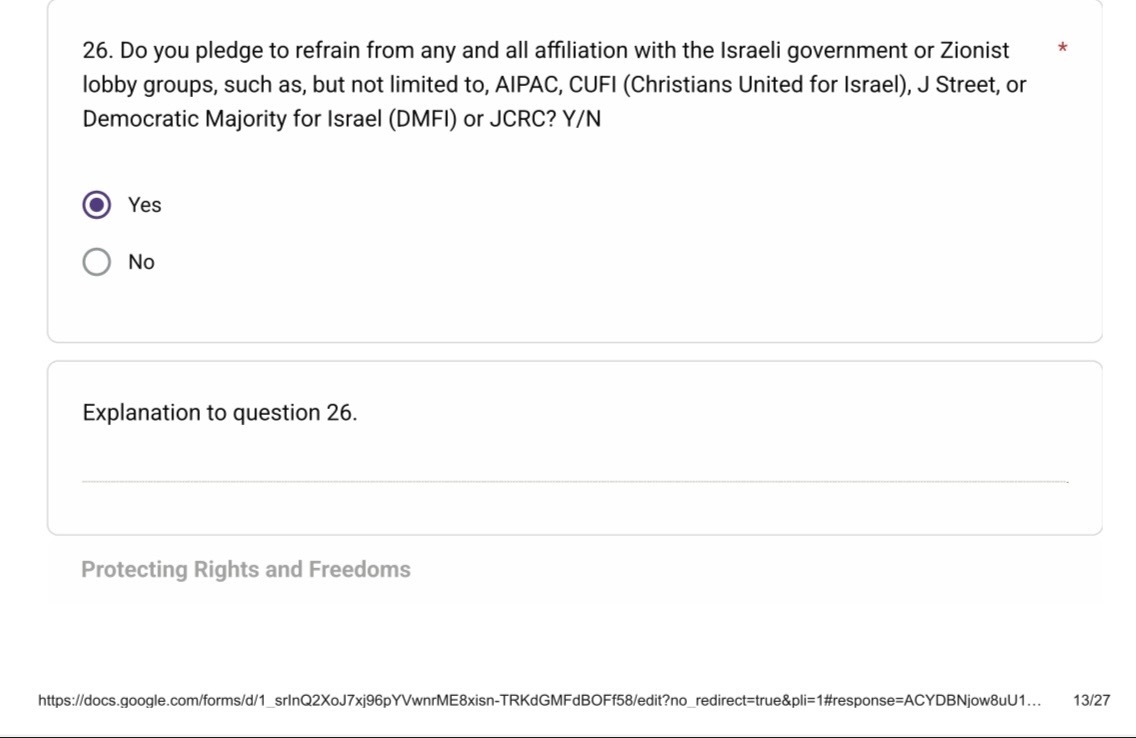
Elsewhere in the questionnaire, which was shared with Jewish Insider this week, Kawas said she would “refrain from any and all affiliation with the Israeli government and Zionist lobby groups” such as AIPAC and J Street, a left-wing organization that has defended Mamdani.
The DSA did not respond to a request for comment, and Kawas could not be reached on Wednesday.
Mamdani, for his part, shares Kawas’ approach to Israel as a longtime supporter of BDS, which he has indicated he could seek to uphold as mayor. He has previously praised the Holy Land Five in a 2017 rap song that drew criticism during the election. As an undergrad at Bowdoin College, where he founded a chapter of Students for Justice in Palestine, he also ended a brief partnership with J Street U, citing a policy of anti-normalization precluding engagement with groups that support Israel.
While he moderated on a number of issues over the course of his campaign, including a pledge to retain Jessica Tisch as police commissioner that assuaged some concerns among Jewish voters (she announced Wednesday that she had accepted the post), Mamdani has otherwise largely continued to make exceptions for Israel, one of his top issues as a state assemblyman.
This week, for instance, he reiterated a vow to arrest Israeli Prime Minister Benjamin Netanyahu for his alleged war crimes if he steps foot in New York City, a move experts have questioned as legally dubious.
Mamdani’s behind-the-scenes involvement in the Queens Assembly contest represents one of his first efforts to influence a local race since his election. He had also reportedly offered support to Brad Lander, the outgoing city comptroller, in a challenge to Rep. Dan Goldman (D-NY), a pro-Israel incumbent. And he has publicly discouraged Chi Ossé, a far-left city councilman, from mounting a bid to unseat House Minority Leader Hakeem Jeffries (D-NY), saying in an interview Wednesday that “right now is not the time” as he seeks to manage his relationships with top Democrats to advance his affordability agenda.
In the Queens race, Mamdani’s recent engagement has faced skepticism from pro-Israel activists.
“If DSA/Zohran Mamdani want to be the muscle behind the most anti-Israel candidate they can find to represent a majority Latino district with actual problems in Queens, that’s their prerogative,” Sara Forman, who leads New York Solidarity Network, a local pro-Israel group, wrote in a social media post this week. “Choosing to fixate on Israel instead of schools, Trump or ICE is certainly a choice.”
But Mamdani’s push to influence the primary has also raised a possible conflict with the left, as he places himself in opposition to outgoing Assemblywoman Jessica Gonzalez-Rojas, a DSA member running for state Senate who had already endorsed her chief of staff for the seat, which is based in Jackson Heights. Brian Romero, the aide, has vowed to continue with his bid in spite of the split endorsements, setting up an internecine fight that could test Mamdani’s sway as mayor.
A spokesperson for Mamdani did not respond to a request for comment from JI on Wednesday.
For her part, Kawas, who filed to run on Tuesday, is relatively new to the district, local campaign finance records show, and only recently moved back to New York City after studying in South Africa.
Still, a political advisor to Kawas reportedly argued at a recent DSA meeting that her background is best suited for the race as the far left seeks to ramp up its opposition to Israel with Mamdani set to take office.
“We have to actually run a Palestinian Arab in this race because we need to draw the fire of the Israeli lobby, and we have to beat them,” the advisor, Joe Stanton, told attendees at the meeting, according to The Daily News.
In her DSA questionnaire, Kawas echoed that sentiment. “As a Palestinian, it is clear that the majority understands what is happening to our people, and with the groundswell of support and resistance to genocide, we’ve made some headway on particular boycott and divestment campaigns,” she wrote. “But while the tide is turning in some respects (especially with Zohran’s election), the pro-Israel lobby is still dominant.”
“It is urgent that we continue to grow connections across the Palestine movement and the broader left on this terrain,” Kawas wrote, “and this office is the place where I can do that.”
Plus, Ted Cruz turns up the heat on Tucker Carlson
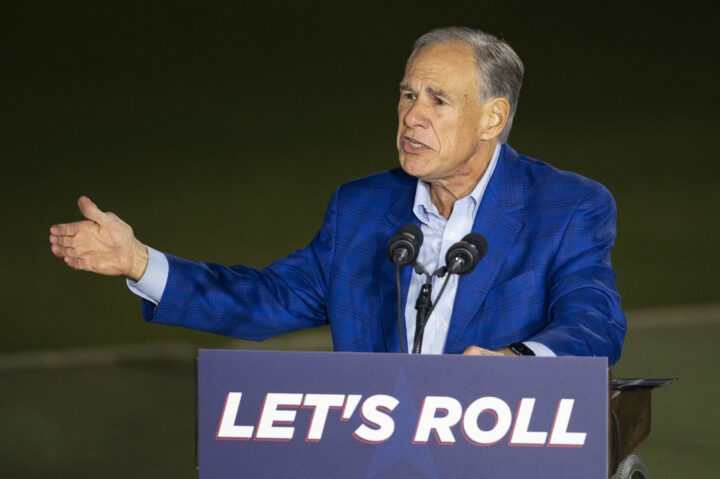
Jason Fochtman/Houston Chronicle via Getty Images
Gov. Greg Abbott announces his reelection campaign for Texas governor in Houston, Sunday, Nov. 9, 2025.
Good Tuesday afternoon!
This P.M. briefing is reserved for our premium subscribers like you — offering a forward-focused read on what we’re tracking now and what’s coming next.
I’m Danielle Cohen-Kanik, U.S. editor at Jewish Insider and curator, along with assists from my colleagues, of the Daily Overtime briefing. Please don’t hesitate to share your thoughts and feedback by replying to this email.
📡On Our Radar
Notable developments and interesting tidbits we’re tracking
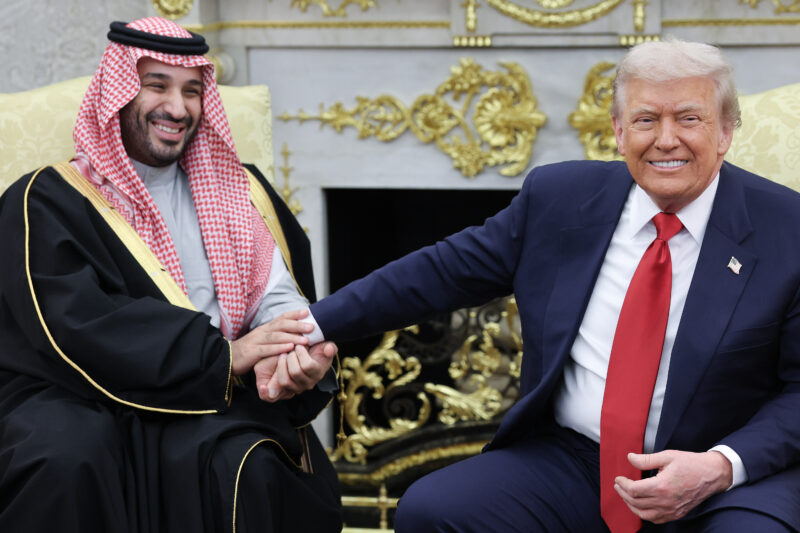
After their bilateral meeting in the Oval Office today, President Donald Trump and Saudi Crown Prince Mohammed bin Salman announced progress on a U.S.-Saudi defense pact and revealed details about Riyadh’s purchase of F-35 fighter jets, Jewish Insider’s Matthew Shea reports.
Trump said the F-35s being sold to Riyadh are “going to be pretty similar” to the advanced F-35I Adir model that Israel flies. “This [Saudi Arabia] is a great ally, and Israel’s a great ally. I know they’d like you [MBS] to get planes of reduced caliber, but I don’t think that makes you too happy. … As far as I’m concerned, [both countries are] at a level where they should get top of the line.”
The U.S. has granted Israel customization rights and operational freedoms with the F-35 that other countries do not have, which contribute to its qualitative military edge. With Saudi Arabia now the only other country in the Middle East besides Israel to obtain the fighter jet, questions remain around which model and allowances Riyadh will receive.
Trump also announced the two countries have “reached an agreement” on a defense pact, without offering further details, and said he expects them to reach a civil nuclear agreement as well…
MBS’ meeting with a bipartisan group of senators on Capitol Hill tomorrow has been canceled, Punchbowl News reports, after the Saudis were reportedly very selective about which senators could attend. His meeting with House lawmakers is still on the books, and he may still meet with individual senators…
The deals keep coming: Humain, the artificial intelligence company backed by Saudi Arabia’s sovereign wealth fund, is set to announce a “slew” of agreements with U.S. businesses tomorrow, Semafor scooped, including data center construction in collaboration with Amazon, AMD, xAI and GlobalAI…
Elsewhere in Washington, Sen. Ted Cruz (R-TX) upped the ante in his public dispute with Tucker Carlson, JI’s Gabby Deutch reports, telling the Jewish Federations of North America’s General Assembly this morning that calling out antisemitism from Carlson and his Republican allies is necessary to defend American values.
Cruz warned that many people are not fully grasping the scope of the problem, describing a meeting with Israeli Prime Minister Benjamin Netanyahu this year where, he said, Netanyahu tried to push back on the idea that right-wing antisemitism was a threat.
“I’ll tell you, he actually was a little dismissive of that. He said, ‘No, no, no, that’s Qatar, that’s Iran, that’s bots,’” Cruz said. “My response: ‘Mr. Prime Minister, yes, but no. Yes, that’s happening. Yes, there are millions of dollars being spent to spread this poison. Yes, that’s happening online. But it is real and organic’”…
Texas Gov. Greg Abbott designated the Muslim Brotherhood and Council on American-Islamic Relations as foreign terrorist groups and transnational criminal organizations today, JI’s Marc Rod reports, prohibiting them from buying land in Texas and allowing the AG’s office to sue to shut them down.
Efforts to designate the Muslim Brotherhood and CAIR have seen little public progress at the federal level, both in Congress and in the executive branch. But Abbott’s move may end up fueling momentum for similar legislative moves out of Washington, and could also provide a model to other like-minded governors in key states…
The Department of Education signed agreements with six other federal agencies to take over aspects of its work, marking one of the largest moves to dismantle the department to date, USA Today reports.
The Departments of the Interior, Health and Human Services and State are all taking a piece of the pie, though the Education Department has not determined the future of its Office for Civil Rights…
Cornell University Provost Kavita Bala took the unusual step of disclosing details about a discrimination case against Eric Cheyfitz, a professor who was placed on leave after he attempted to exclude an Israeli student from participating in his course on Gaza, due to misinformation circulating about the case. The professor recently retired to avoid further investigation by the university.
“After [the] third class, the faculty member talked to the student and explicitly told the student that he was not welcome in the class because ‘he was an Israeli citizen supporting an Israeli stance in Gaza.’ Those are the faculty member’s words,” Bala said at a recent Faculty Senate meeting. “This is not a case of academic freedom. This is a case of discrimination based on national origin”…
In an op-ed titled, “Why I Became a Socialist,” Chi Ossé, the New York City councilman mounting a primary challenge to House Minority Leader Hakeem Jeffries (D-NY), explains his recent decision to join the Democratic Socialists of America and touts his support for Mayor-elect Zohran Mamdani as critical to his victory.
Though Ossé appears to be capitalizing on his partnership with the incoming mayor to elevate his profile, Mamdani has discouraged Ossé on several occasions from running against the top House Democrat at a time when he’ll need support and funds from Washington…
⏩ Tomorrow’s Agenda, Today
An early look at tomorrow’s storylines and schedule to keep you a step ahead
Keep an eye on Jewish Insider tomorrow morning for a dispatch from the conservative National Task Force to Combat Antisemitism’s first summit following its split with the Heritage Foundation.
Tomorrow, the U.S.-Saudi Investment Forum will take place at the Kennedy Center, featuring discussions on energy policy, AI, financial services, urban development, biotechnology, aerospace and defense and more. A special address is on the agenda, though neither President Donald Trump nor Crown Prince Mohammed bin Salman’s attendance has been confirmed.
The Senate Foreign Relations Committee will hold a hearing on the nomination of Tammy Bruce, currently the State Department spokesperson, to be deputy U.S. ambassador to the U.N.
The Endowment for Middle East Truth is holding its 16th annual Rays of Light in the Darkness awards dinner in Washington, honoring Sen. John Fetterman (D-PA), Justice Department senior counsel Leo Terrell, Israeli Ambassador to the U.S. Yechiel Leiter, Hungarian Ambassador to the U.S. Szabolcs Takács and journalist Anila Ali.
Stories You May Have Missed
THE RIGHT’S NEW DIVIDE
‘Confused young groypers’: Jewish Republicans reckon with resurgent antisemitism on the right
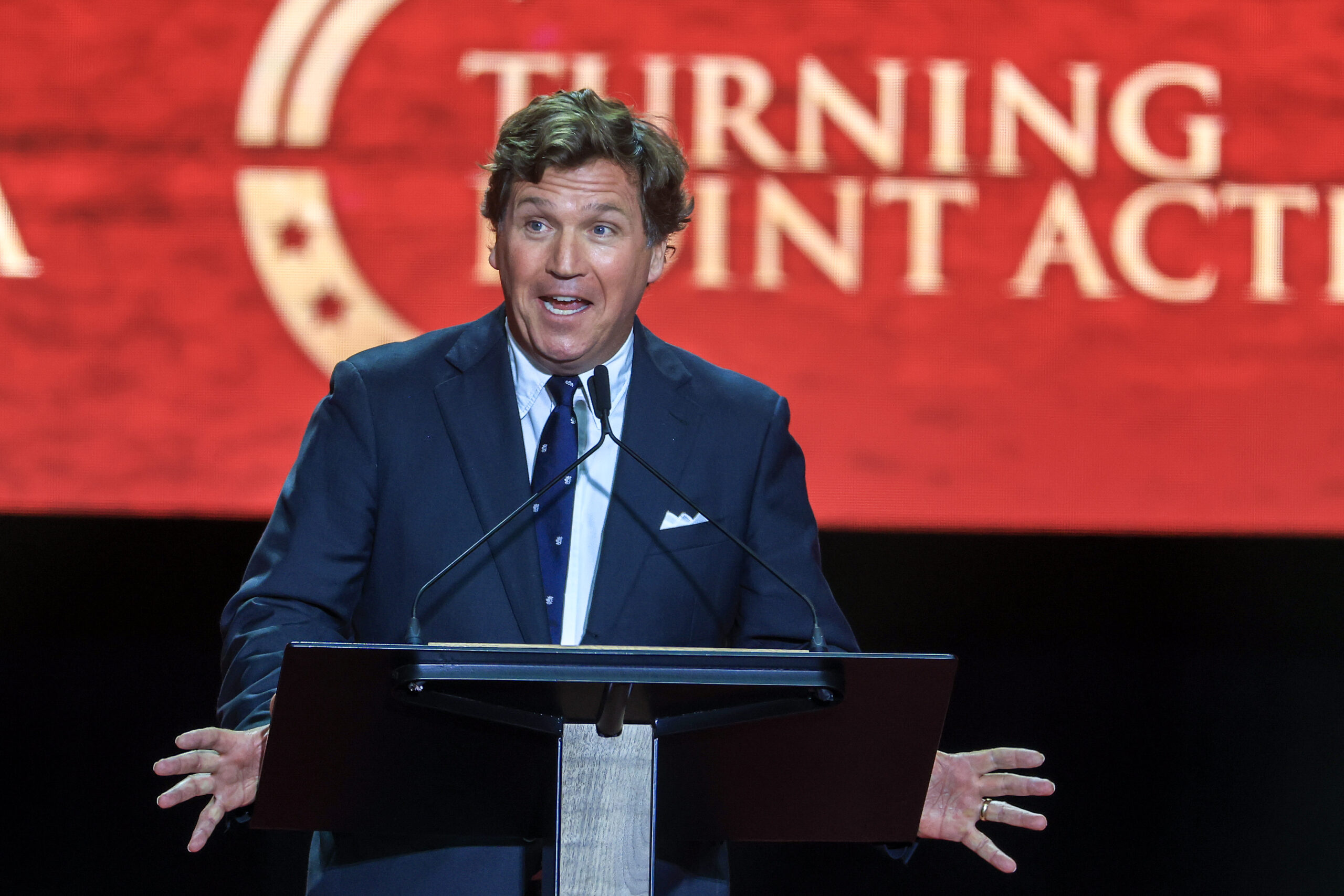
President Donald Trump, called by his Jewish supporters ‘the most pro-Israel president in history,’ won’t lead the party forever. So what will come next?
TRIBUNAL TURMOIL
Israel petitions ICC to remove chief prosecutor from case, citing conflict of interest

Karim Khan has been accused of sexual misconduct; Jerusalem alleges the ICC’s head prosecutor pursued a case against senior Israeli officials as a distraction
Plus, UNSC adopts U.S. resolution on Gaza

Andrew Harnik/Getty Images
President Donald Trump speaks before signing an executive order in the Oval Office of the White House on March 31, 2025 in Washington, DC.
Good Monday afternoon!
This P.M. briefing is reserved for our premium subscribers like you — offering a forward-focused read on what we’re tracking now and what’s coming next.
I’m Danielle Cohen-Kanik, U.S. editor at Jewish Insider and curator, along with assists from my colleagues, of the Daily Overtime briefing. Please don’t hesitate to share your thoughts and feedback by replying to this email.
📡On Our Radar
Notable developments and interesting tidbits we’re tracking
Washington is preparing for Saudi Crown Prince Mohammed bin Salman’s visit tomorrow, where he’ll meet President Donald Trump at the White House and be hosted for dinner with administration officials, members of Congress and business leaders. On Wednesday, MBS is expected to meet with lawmakers on Capitol Hill, Punchbowl News reports, and the U.S.-Saudi Investment Forum will take place at the Kennedy Center.
Trump confirmed to reporters in the Oval Office this afternoon that the U.S. will sell F-35 fighter jets to Saudi Arabia, without offering details of the deal…
In a blurring of the lines between the political and the personal, the president may have more than just defense deals on his mind: The Trump Organization is in talks to bring a Trump property to one of Saudi Arabia’s largest government-owned real estate developments, The New York Times reports…
The U.N. Security Council just adopted the U.S.-sponsored resolution backing Trump’s 20-point peace plan, including the creation of an international stabilization force in the Gaza Strip, with 13 votes in favor and Russia and China abstaining. The resolution contains language on “a credible pathway to Palestinian self-determination and statehood”…
The Journal also reports on Hamas’ rising popularity inside Gaza since the start of the ceasefire with Israel, as Gazans see the terror group as capable of restoring order and preventing lawlessness, which may pose an issue to the implementation of the ceasefire that requires Hamas to disarm…
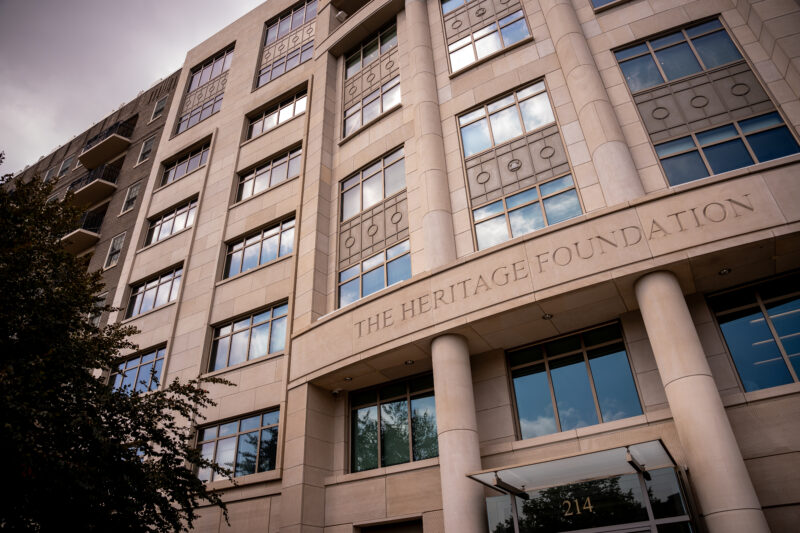
In the latest fallout at the Heritage Foundation over its president’s defense of Tucker Carlson after his friendly interview with neo-Nazi influencer Nick Fuentes, Robert George, a prominent board member, resigned today, citing the lack of a “full retraction” by Heritage President Kevin Roberts of the video defending Carlson, Jewish Insider’s Matthew Kassel reports.
George’s decision to step down indicates that Roberts is likely safe in his role, for now, as its board remains split about his future, according to a former Heritage staffer familiar with internal discussions…
Trump weighed in on the Carlson controversy over the weekend, saying when asked by reporters what role Carlson should play in the conservative movement after his interview with Fuentes, “I found [Carlson] to be good. I mean, he said good things about me over the years. I think he’s good. We’ve had some good interviews.”
“You can’t tell him who to interview. I mean, if he wants to interview Nick Fuentes, I don’t know much about him, but if he wants to do it, get the word out. People have to decide. Ultimately, people have to decide. … Meeting people, talking to people for somebody like Tucker, that’s what they do. You know, people are controversial. Some are, some aren’t. I’m not controversial, so I like it that way”…
Also evoking backlash, a producer for former Rep. Matt Gaetz’s (R-FL) weeknight show on the right-wing One America News Network has reportedly been fired after he shared a vehemently antisemitic social media post depicting Jews as cockroaches, JI’s Matthew Kassel reports.
Vish Burra, who was a booker and script writer for Gaetz, had drawn widespread backlash for posting an AI-generated animated video last week showing him entering a “scheming room” with Stars of David on the door to find a group of cockroaches counting money, who scurry away upon his arrival. The post has since been deleted.
Burra also defended Roberts in a separate post, writing, “I will expose the vermin in the venomous coalition and their transgression against MAGA, America First, and Kevin Roberts at The Heritage Foundation. It all starts with Susan Lebovitz-Edelman,” referring to a Jewish trustee at the conservative Manhattan Institute who is married to hedge fund manager Joseph Edelman…
Political alliances are developing in the Democratic primary to replace New Jersey Gov.-elect Mikie Sherrill in a special election for the state’s 11th Congressional District: Gov. Phil Murphy announced he’s backing Essex County Commissioner Brendan Gill, his former campaign manager and a front-runner in the race, while Tahesha Way, his lieutenant governor, is expected to launch a campaign shortly.
The field of nine other Democrats also includes former Rep. Tom Malinowski (D-NJ), who represented the neighboring district until 2023 and today received the endorsement of Sen. Andy Kim (D-NJ), in an apparent act of reciprocity — Malinowski supported Kim in his bid for Senate in 2024 against the governor’s wife, Tammy Murphy. The primary is expected to take place in late January-early February…
In nearby New York, pro-Israel Rep. Grace Meng (D-NY) drew a primary challenger today: Chuck Park, who served as a foreign service officer until 2019 and as chief of staff to New York City Councilman Shekar Krishnan, an ally of Mayor-elect Zohran Mamdani, announced an anti-establishment bid for the Queens district…
Now that he is about to assume leadership of the largest city in the U.S., Mamdani will need to receive top-level security clearance from the Trump administration, marking the first test of the new mayor’s relationship with Washington, Politico reports. Trump told reporters on Sunday that Mamdani “would like to come to Washington and meet and we’ll work something out” and “we want to see everything work out well for New York”…
⏩ Tomorrow’s Agenda, Today
An early look at tomorrow’s storylines and schedule to keep you a step ahead
Keep an eye on Jewish Insider tomorrow morning for a deep dive into the shifting anti-Israel dynamics on the far right.
Saudi Crown Prince Mohammed bin Salman’s White House visit will begin tomorrow with an arrival ceremony on the South Lawn and a greeting on the South Portico, before an Oval Office bilateral meeting and signing and lunch in the Cabinet Room. A formal dinner, hosted by First Lady Melania Trump, will take place in the evening in the East Room.
The American Jewish Committee will hold a webinar, “Unpacking the Saudi White House Visit,” tomorrow afternoon with Jason Isaacson, AJC’s chief policy and political affairs officer; Anne Dreazen, vice president of AJC’s Center for a New Middle East; and Michael Ratney, former U.S. ambassador to Saudi Arabia.
The National Task Force to Combat Antisemitism, a project that was closely affiliated with the Heritage Foundation until earlier this month when it broke with the conservative think tank over Heritage President Kevin Roberts’ defense of Tucker Carlson, is hosting a summit in Washington tomorrow in response to the recent developments. The gathering, “Exposing and Countering Extremism and Antisemitism on the Political Right,” will feature remarks from task force co-chairs Luke Moon, Pastor Mario Bramnick and Ellie Cohanim; U.S. Ambassador to Israel Mike Huckabee; Ralph Reed, president of the Faith and Freedom Coalition; and Tony Perkins, president of the Family Research Council. Discussion topics will include “replacement theology,” the path ahead for Gen Z and “overcoming the Woke Right.”
The Jewish Federations of North America’s General Assembly wraps up tomorrow in Washington. Sen. Ted Cruz (R-TX) is slated to speak and JI’s Lahav Harkov will moderate a panel on the Middle East in a post-Oct. 7 world.
U.S. Ambassador to the U.N. Mike Waltz will deliver remarks with pop diva Nicki Minaj tomorrow on the persecution of Christians in Nigeria.
Stories You May Have Missed
MILITARY MATTERS
Israel said to eye new defense agreement with U.S. as future of military assistance faces uncertainty
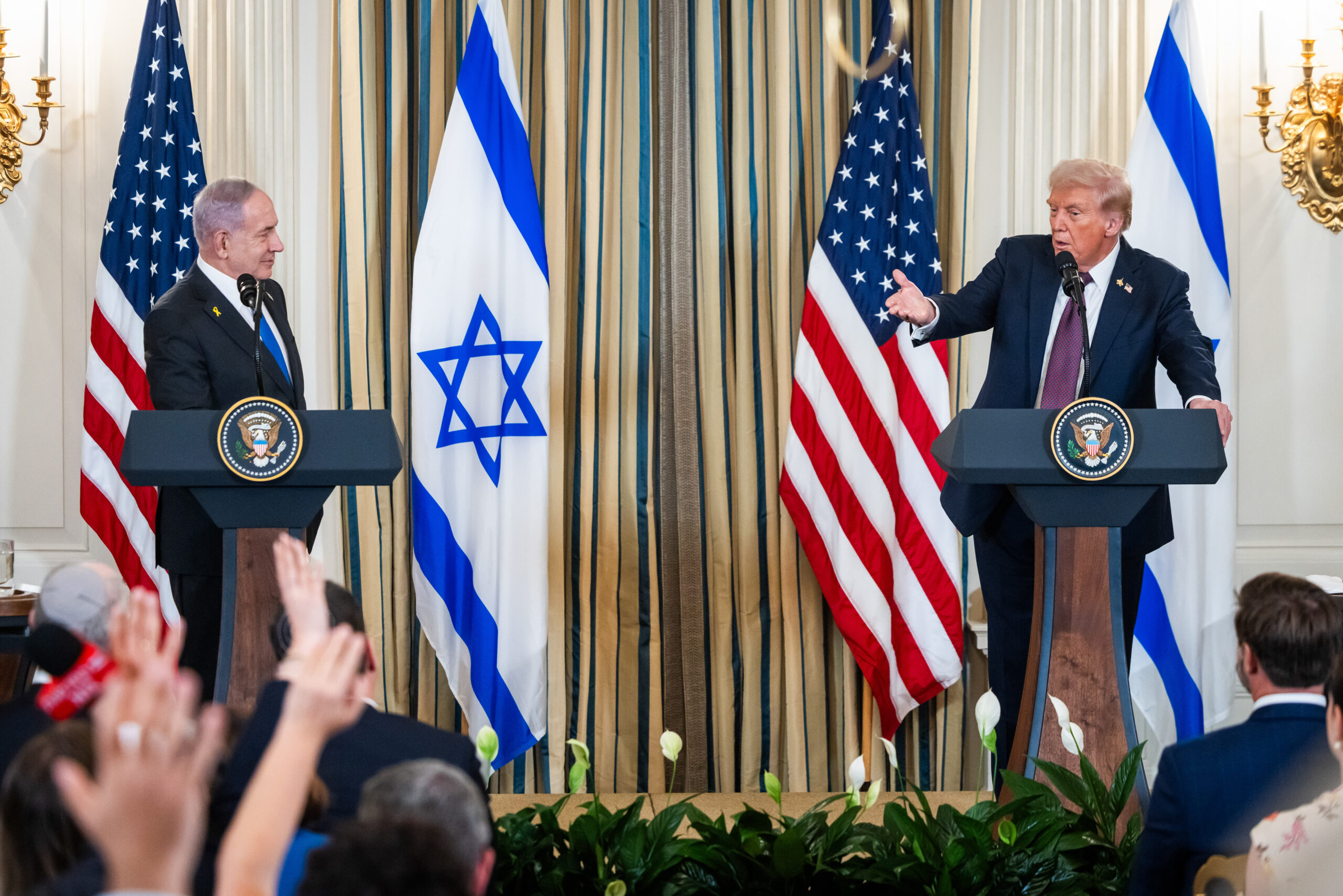
Jerusalem is looking to secure a new MOU – which would reportedly run through 2048 and includes ‘America First’ provisions – amid growing skepticism in U.S. politics over foreign aid
MANHATTAN MOMENTUM
Crowded field of Democrats seeks to win over Jewish voters in race to succeed Nadler
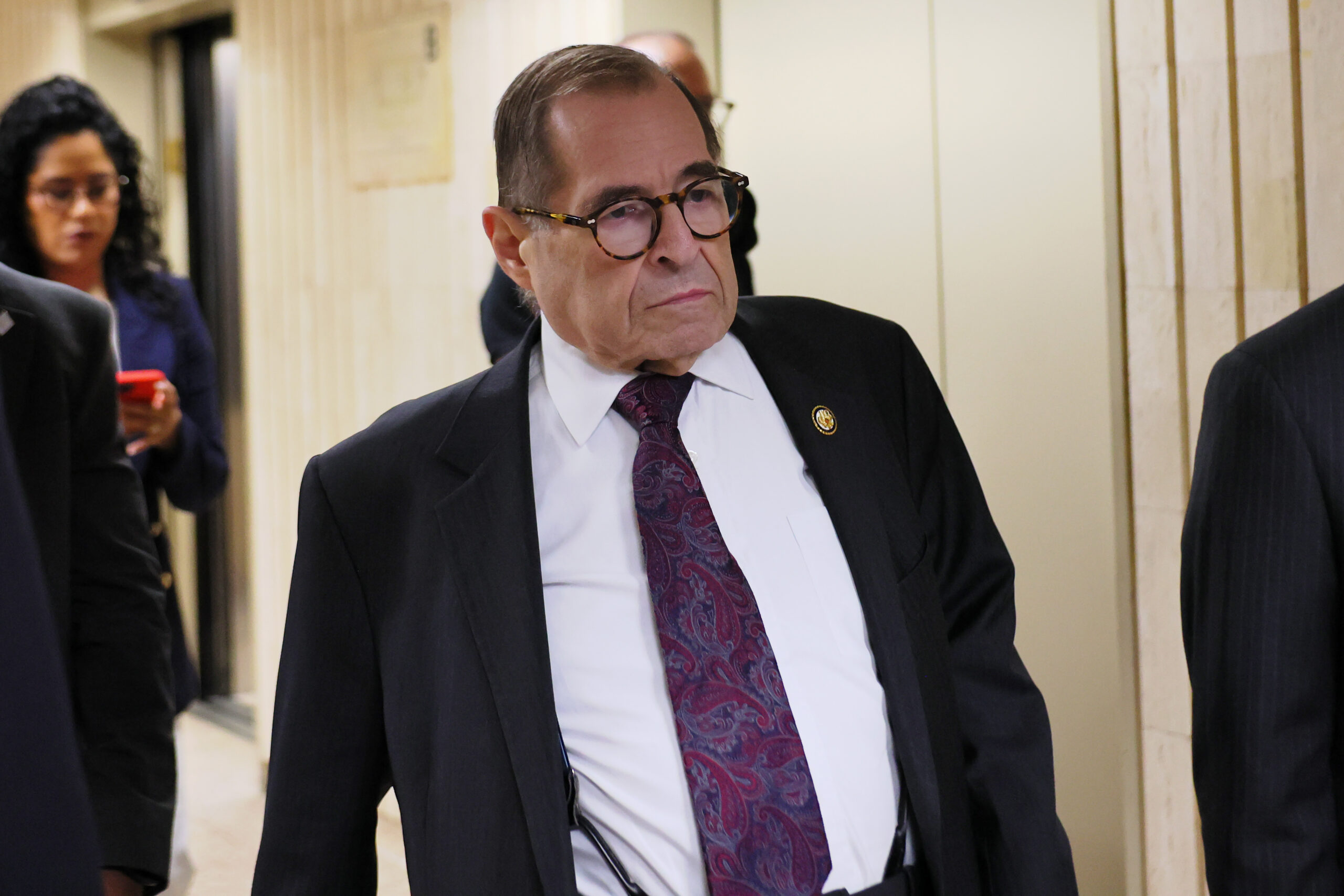
Andrew Cuomo carried the district in the NYC mayoral race, underscoring its pro-Israel constituency
Plus, moderates speechless in Seattle
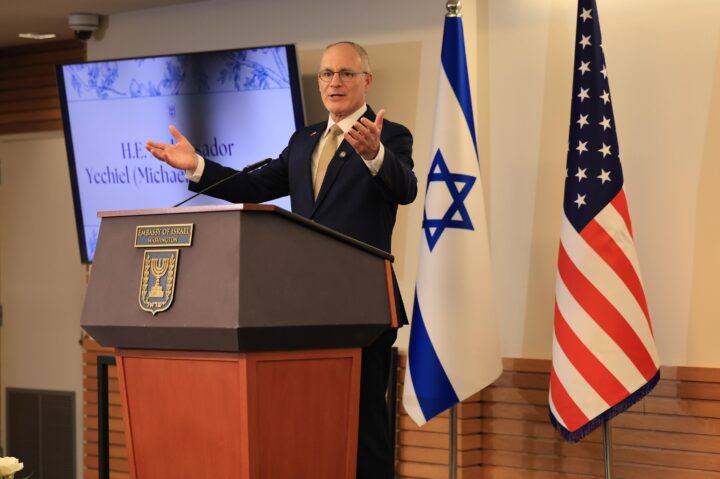
Shmulik Almany
Israeli Ambassador to the U.S. Yechiel Leiter addresses Rosh Hashanah reception at the Israeli Embassy in Washington, Sept. 18th, 2025
Good Thursday afternoon!
This P.M. briefing is reserved for our premium subscribers like you — offering a forward-focused read on what we’re tracking now and what’s coming next.
I’m Danielle Cohen-Kanik, U.S. editor at Jewish Insider and curator, along with assists from my colleagues, of the Daily Overtime briefing. Please don’t hesitate to share your thoughts and feedback by replying to this email.
📡On Our Radar
Notable developments and interesting tidbits we’re tracking
Israeli Ambassador to the U.S. Yechiel Leiter said in an interview with The Jerusalem Post that Israel “prefer[s] that Turkey not receive F-35s from the U.S.,” breaking with Washington over the move that President Donald Trump indicated he was open to during a meeting with Turkish President Recep Tayyip Erdogan in September.
But Leiter dismissed concerns around Saudi Arabia potentially acquiring F-35s, which is currently under negotiation ahead of Crown Prince Mohammed bin Salman’s visit to the White House next week. “There’s no indication that Israel’s qualitative edge will be compromised,” he said. Leiter has recently become Israeli Prime Minister Benjamin Netanyahu’s main conduit in Washington after the resignation of Strategic Affairs Minister Ron Dermer…
Israel is seeking a new 20-year memorandum of understanding with the U.S. when the current one expires in 2028, U.S. and Israeli officials told Axios, double the length of past agreements.
New Israeli propositions, including redirecting some of the funds towards joint U.S.-Israeli R&D rather than direct military aid, are reportedly designed to make the lengthy deal more attractive to Trump as well as the GOP, which has grown weary of foreign aid…
Trump told MBS in a phone call last month that he expects to see progress made on Israel-Saudi normalization now that the ceasefire in Gaza is in force, U.S. officials also told Axios, which MBS said he was “willing to work on”…
Israel and White House advisor Jared Kushner are preparing contingency plans in case Trump’s 20-point Gaza peace plan doesn’t come to fruition, Israeli media reports. The IDF’s chief of staff, Lt. Gen. Eyal Zamir, told Israeli Security Cabinet officials that the IDF will soon present its alternative…
Meanwhile in the U.S., the Democratic primary for the seat of retiring Rep. Jerry Nadler (D-NY) in New York’s 12th Congressional District, which has one of the largest Jewish constituencies in the country, gets more crowded by the day.
Shortly after the entry of JFK’s grandson, Jack Schlossberg, into the race, Erik Bottcher, a Democratic city councilman and LGBTQ activist, told The New York Times he’s jumping in (and that he supports Israel’s right to exist as a Jewish state). There are rumors that Lincoln Project co-founder George Conway is eyeing a bid, as well.
Among the many other candidates are longtime Nadler aide Micah Lasher, who today got the endorsement of Comptroller-elect Mark Levine; state Assemblyman Alex Bores; and gun control activist Cameron Kasky, who posted yesterday on social media, “If you are a Democrat running in 2026 and do not fully support an arms embargo to the State of Israel … Stop wasting everybody’s time”…
Seattle Mayor Bruce Harrell conceded to his opponent, socialist Katie Wilson, today after last night’s ballot drop made it mathematically impossible for him to prevail.
Though the moderate Harrell led in the polls for the week following Election Day, Wilson eventually gained ground and now leads him by a 0.7% margin — just shy of 2,000 votes. With only several hundred votes left to be counted, The Seattle Times said the race is “on pace to be the closest in modern Seattle politics.”
Wilson joins New York City Mayor-elect Zohran Mamdani, as well as progressive challengers who prevailed in several Seattle City Council races, as evidence of the far left’s growing popularity in major U.S. cities. However, their small (or razor thin, in Wilson’s case) margins of victory and Minneapolis Mayor Jacob Frey’s win over his DSA-aligned opponent are proof the fringe still lacks a mandate in the Democratic Party…
Former Rep. Elaine Luria (D-VA) announced raising more than $500,000 in the first 24 hours after the launch of her comeback bid for her seat in Virginia’s 2nd Congressional District.
The Jewish, pro-Israel Navy veteran sent out a fundraising email this afternoon with the subject line “Chutzpah,” saying the “Yiddish term that means guts or courage … runs in my family” and she’s “not afraid of a little mishigas”…
Sen. John Fetterman (D-PA) was hospitalized today after suffering a “ventricular fibrillation flare-up” and subsequent fall and face injuries, but is doing well, his spokesperson reported. His scheduled discussion this evening with UJA-Federation of New York about his new book has been cancelled…
The New York Times profiles Heritage Foundation President Kevin Roberts and his path from leading a small Catholic college to helming the prominent think tank and sparking controversy among conservatives over his embrace of Tucker Carlson.
Roberts claimed as part of his defense over releasing the controversial video during a staff meeting last week, “I actually don’t have time to consume a lot of news. I consume a lot of sports,” and “I didn’t know much about this [Nick] Fuentes guy. I still don’t.”
“‘Who could believe that the head of a think tank doesn’t think?’ said Charles Jacobs, the president of the Jewish Leadership Project, which resigned from a Heritage Foundation task force meant to fight antisemitism after Mr. Roberts’ video was released”…
Joining the list of Heritage resignations, Adam Mossoff, a law professor at George Mason’s Scalia Law School and a prominent pro-Israel advocate, announced he is resigning as a Heritage visiting fellow today “based on [his] considered judgment” of Roberts’ video and “subsequent commentary”…
⏩ Tomorrow’s Agenda, Today
An early look at tomorrow’s storylines and schedule to keep you a step ahead
Keep an eye on Jewish Insider tomorrow morning for a preview of President Donald Trump’s meeting next week with Saudi Crown Prince Mohammed bin Salman.
New York City Mayor Eric Adams is traveling to Israel tomorrow for a five-day trip where he plans to meet with government officials and economic development and high-tech leaders.
The Texas Tribune Festival, taking place this week in Austin, continues tomorrow with speakers including former Transportation Secretary Pete Buttigieg, Sen. Michael Bennet (D-CO), Democratic Texas Senate candidates James Talarico and Rep. Colin Allred, Sen. Chris Murphy (D-CT), comedian John Mulaney, former Sen. Joe Manchin (I-WV), venture capitalist Joe Lonsdale and former U.S. Attorney General Eric Holder. On Saturday, Sens. Amy Klobuchar (D-MN) and Adam Schiff (D-CA) are slated to speak.
MSNBC is launching its rebrand on Saturday as MS NOW, part of its separation from NBCUniversal, with dozens of veteran journalists recruited as part of its expanded newsroom.
On Sunday, the Museum of Jewish Heritage – A Living Memorial to the Holocaust will present its fourth annual New York Jewish Book Festival.
Sunday evening, the Jewish Federations of North America’s General Assembly kicks off in Washington, with an opening plenary including former U.S. Ambassador to Japan Rahm Emanuel, authors Sarah Hurwitz and Micah Goodman, CNN contributor Scott Jennings and Rabbi Angela Buchdahl, senior rabbi at Central Synagogue in New York City.
We’ll be back in your inbox with the Daily Overtime on Monday. Shabbat Shalom!
Stories You May Have Missed
BROTHERHOOD PARADOX
Israel’s neighbors have banned the Muslim Brotherhood, but Israel hasn’t. Why not?
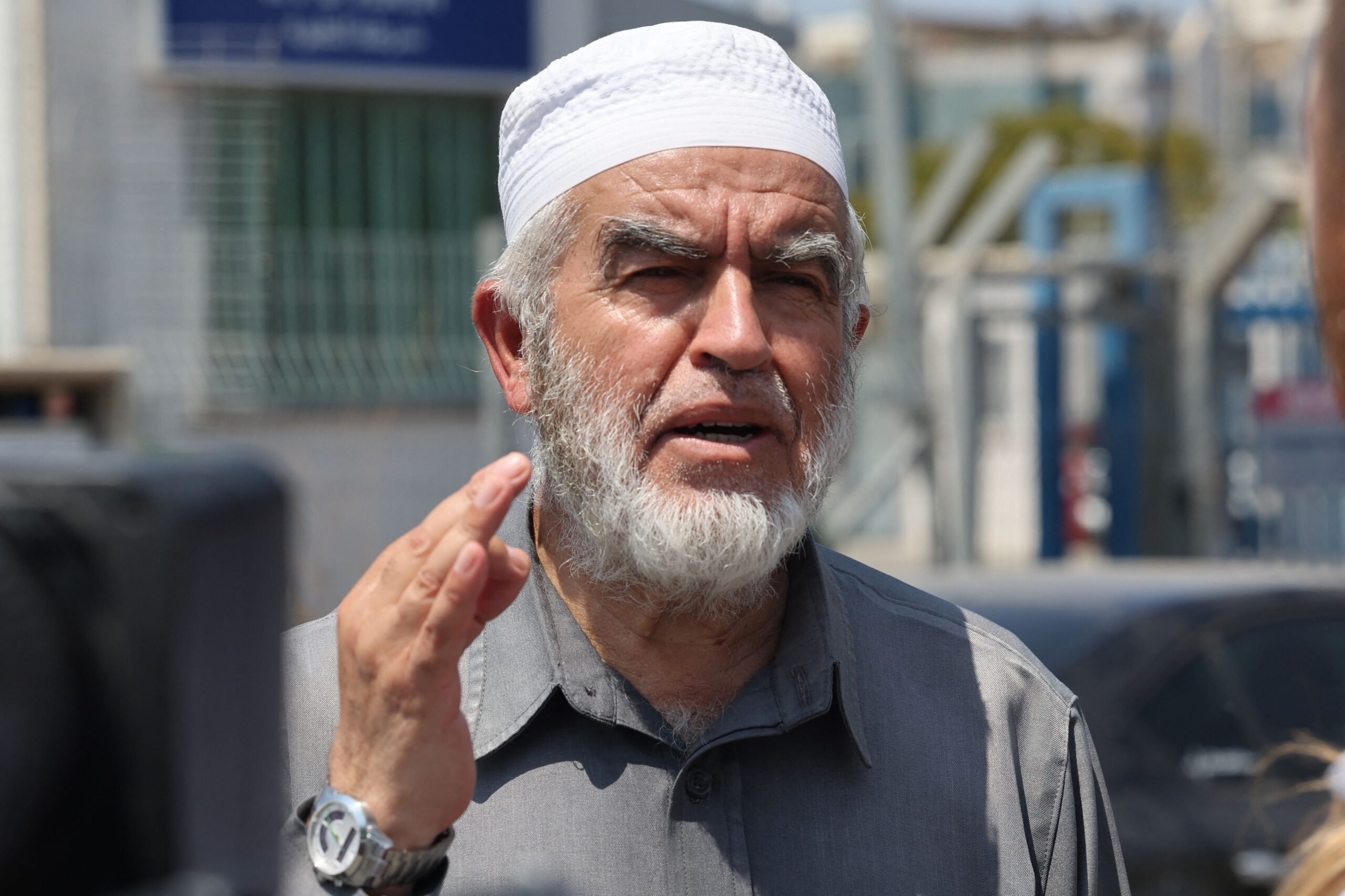
One of its branches is banned for Hamas ties. The other sits in the Knesset
WOOD-N’T TAKE IT
Another Maine Democrat takes page from Platner playbook
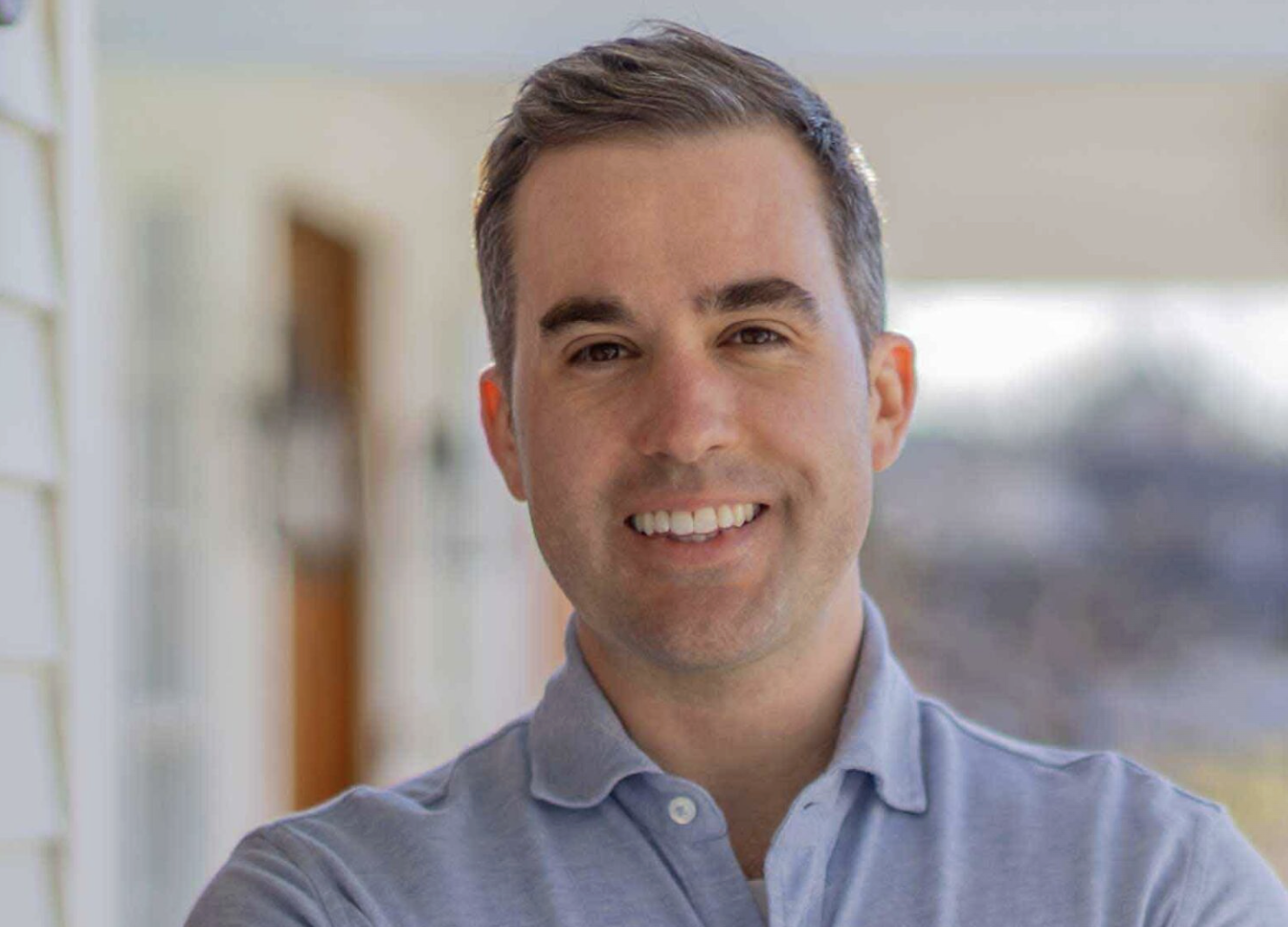
Jordan Wood, now running to succeed Rep. Jared Golden, said he won’t take money from AIPAC in his newly launched House campaign
Plus, Cait Conley emerges as Dem front-runner against Lawler
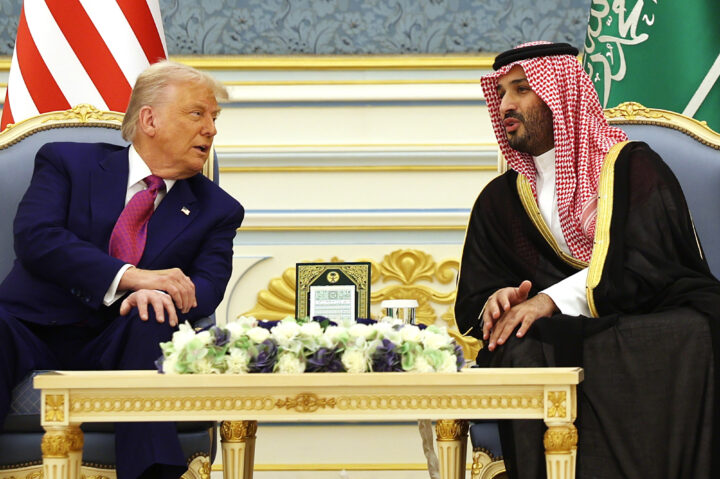
Win McNamee/Getty Images
President Donald Trump meets with Saudi Crown Prince Mohammed bin Salman during a “coffee ceremony” at the Saudi Royal Court on May 13, 2025, in Riyadh, Saudi Arabia.
Good Wednesday afternoon!
This P.M. briefing is reserved for our premium subscribers like you — offering a forward-focused read on what we’re tracking now and what’s coming next.
I’m Danielle Cohen-Kanik, U.S. editor at Jewish Insider and curator, along with assists from my colleagues, of the Daily Overtime briefing. Please don’t hesitate to share your thoughts and feedback by replying to this email.
📡On Our Radar
Notable developments and interesting tidbits we’re tracking
U.S. and Saudi officials are working to finalize a defense pact between the two countries ahead of Crown Prince Mohammed bin Salman’s visit to Washington next week, Axios reports. The agreement would reportedly contain similar guarantees to those Qatar received from the U.S. last month, with the Saudis also looking to purchase a weapons package that would include F-35 fighter jets.
The Trump administration also told the Saudis that it would like to see progress made on Saudi-Israel normalization, U.S. officials said. The negotiations on these deals quietly brought White House advisor Jared Kushner to Riyadh over the weekend and the Saudi defense minister to the U.S. earlier this week…
Jordan Wood, a former congressional aide and Democratic candidate for Senate in Maine, announced that he is switching his candidacy to now run for the House in Maine’s 2nd Congressional District, where Rep. Jared Golden (D-ME) has said he will not seek reelection.
Wood joined his fellow Maine Senate candidate Graham Platner in vowing not to accept support from AIPAC, saying in an interview last week, “There’s a tremendous amount of distrust right now among Democratic primary voters that the money that AIPAC has put into our political system has affected our priorities when it comes to foreign aid to Israel”…
Another shifting race is New York’s 17th Congressional District, where Jessica Reinmann, a Democratic nonprofit executive who was challenging Rep. Mike Lawler (R-NY), dropped out of the Democratic primary today and endorsed Cait Conley.
An Army veteran with extensive counterterrorism experience in the Middle East, Conley told Jewish Insider in April about her commitment to Israel’s security and concerns around threats posed by Iran.
With her background in national security, Conley is viewed as having the strongest profile to win back the swing seat for the party, according to Democratic sources familiar with the race.…
The Wall Street Journal reports on financial gains made by U.S. businesses over the two-year Israel-Hamas war; out of the $32 billion of military-related sales the U.S. has greenlit to Israel since October 2023, $19.3 billion is through contracts with Boeing, Lockheed Martin has secured $743 million, Caterpillar secured $295 million, and more…
An Israeli-founded AI cybersecurity company, Tenzai, founded just six months ago, came out of stealth yesterday with a $75 million seed round. Its technology, which finds hackable vulnerabilities in code, drew support from major venture capital firms including Greylock Partners, Lux Capital and Battery Ventures…
Israel reopened the Zikim border crossing into Gaza today to facilitate increased food and humanitarian aid flow, as part of its compliance with the ongoing ceasefire agreement with Hamas…
After being heckled by anti-Israel protesters at a podcast taping earlier this week, former Vice President Kamala Harris paused the conversation to tell the audience: “A lot of what this process has been for me has been about reflection. Look, we should’ve done more as an administration. We should’ve spoken publicly about our criticism of the way that Netanyahu and his government were executing this war.”
“We had more levers in terms of leverage that we did not use. … But let’s be very clear, that the inhuman nature of what has happened to the Palestinian people in Gaza, the innocent civilians, the extent of hunger, famine, suffering, death, is something that we must acknowledge,” Harris continued…
⏩ Tomorrow’s Agenda, Today
An early look at tomorrow’s storylines and schedule to keep you a step ahead
Keep an eye on Jewish Insider tomorrow morning for reporting on the status of the Muslim Brotherhood under Israeli law.
The U.S. House is expected to approve a spending package to reopen the government this evening, which would fund the government through Jan. 30.
The U.S. Commission on International Religious Freedom is holding a hearing tomorrow morning on religious freedom in Syria during the country’s transition out of dictatorship.
The DP World Tour golf championship kicks off in Dubai, UAE, tomorrow.
Stories You May Have Missed
NEXT STEPS
After Mamdani win, socialists look to challenge Democratic incumbents in NYC
Pro-Israel Democratic Reps. Hakeem Jeffries, Ritchie Torres and Dan Goldman are facing long-shot challengers from the far left
HISTORY LESSONS
Clintons tie Trump’s Gaza peace plan to Oslo Accords in Rabin memorial discussion
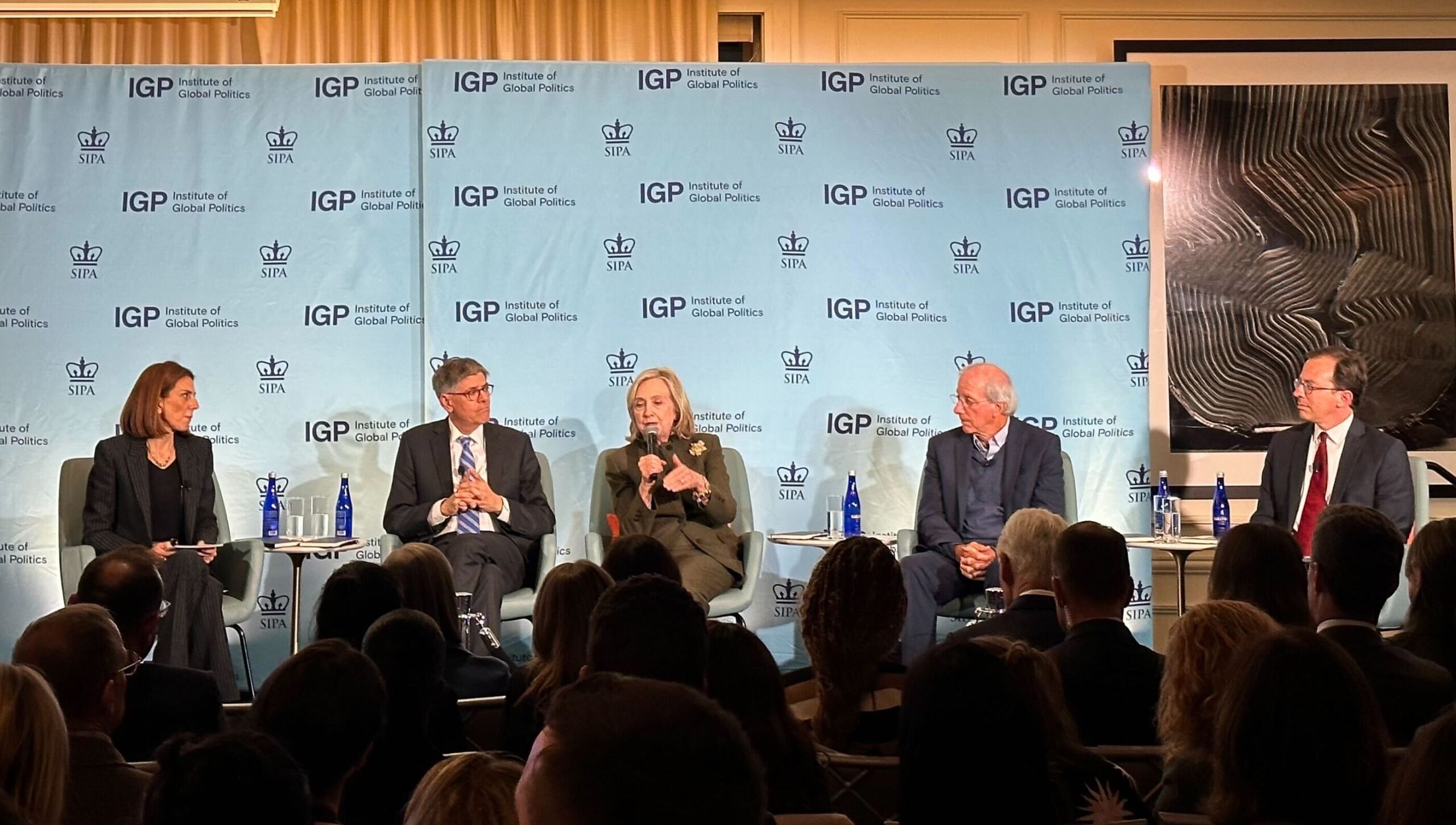
Former President Bill Clinton invoked slain Israeli Prime Minister Yitzhak Rabin’s ‘law’: ‘We will fight terror as if there are no negotiations. We will negotiate as if there is no terror’
Plus, Elaine Luria wants a rematch
Chip Somodevilla/Getty Images
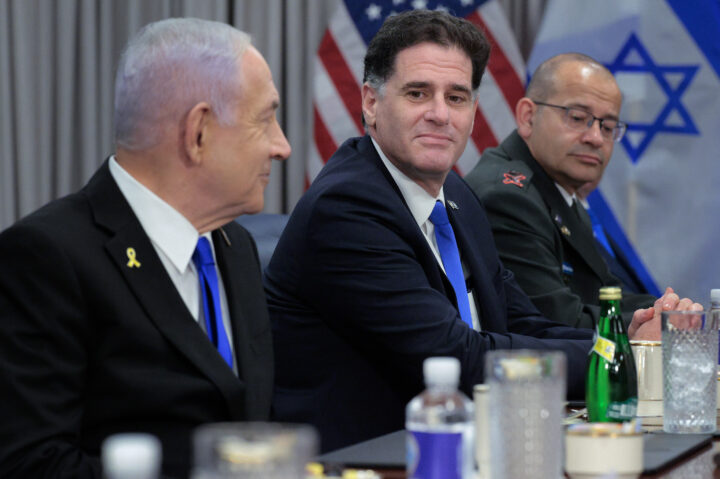
Israeli Prime Minister Benjamin Netanyahu (L) is joined by Israeli Minister of Strategic Affairs Ron Dermer and other officials for a meeting with U.S. Secretary of Defense Pete Hegseth at the Pentagon on July 09, 2025 in Arlington, Virginia.
Good Tuesday afternoon!
This P.M. briefing is reserved for our premium subscribers like you — offering a forward-focused read on what we’re tracking now and what’s coming next.
I’m Danielle Cohen-Kanik, U.S. editor at Jewish Insider and curator, along with assists from my colleagues, of the Daily Overtime briefing. Please don’t hesitate to share your thoughts and feedback by replying to this email.
📡On Our Radar
Notable developments and interesting tidbits we’re tracking
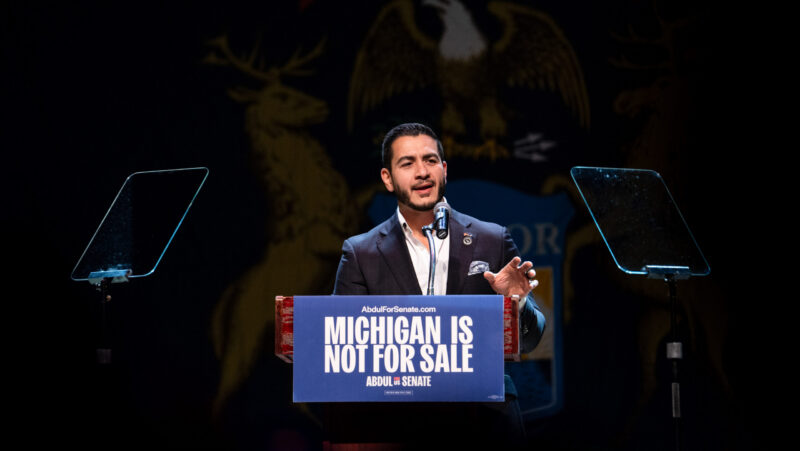
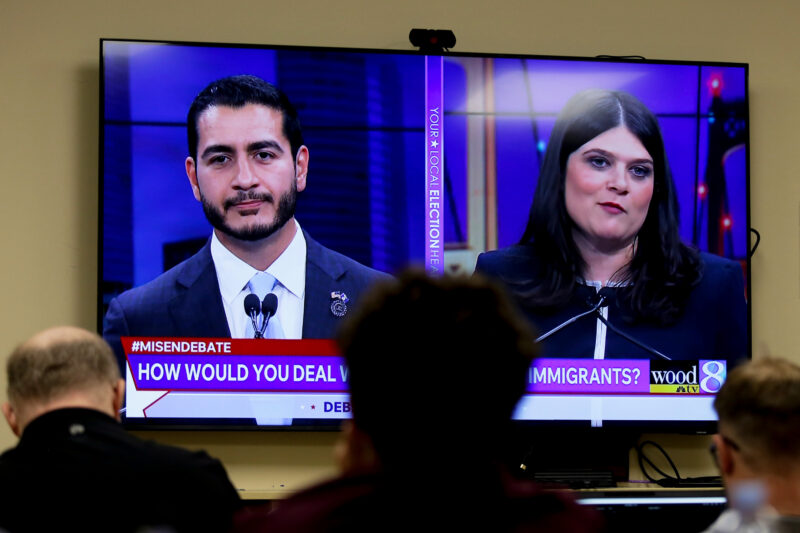
Michigan Democratic Senate candidate Abdul El-Sayed sidestepped a question about Israel’s right to exist during an interview with the anti-Israel media outlet Zeteo last week, Jewish Insider’s Marc Rod reports.
Zeteo founder Mehdi Hasan asked El-Sayed how he would respond if and when he faces questions on the campaign trail about whether he supports Israel’s right to exist as a Jewish state. Pressed after initially dodging the question, El-Sayed said, “Israel exists. Palestine doesn’t. And so I always wonder why nobody asks me why Palestine doesn’t have a right to exist.”
El-Sayed also dismissed AIPAC donors as “MAGA billionaires throwing their money around to try to dictate the outcome for a Democratic primary,” though AIPAC has not yet endorsed a candidate in the Michigan Senate race…
Chi Ossé, a far-left Gen Z New York City councilman, is planning to launch a primary challenge to House Minority Leader Hakeem Jeffries (D-NY), The New York Times reports, despite discouragement from his ideological ally, Mayor-elect Zohran Mamdani, who clinched Jeffries’ endorsement shortly before the general election. Ossé’s insistence on running reportedly caused him to be disinvited from Mamdani’s election night party…
Elsewhere in New York, Bruce Blakeman, the first Jewish executive of Nassau County who just won reelection last week, is considering mounting a bid for governor, he told Politico, where he would face off against Rep. Elise Stefanik (R-NY) in the GOP primary. Both are allies of President Donald Trump; Blakeman said he “told [Trump] that I was interested, and he didn’t discourage me. And I think he’s had the same conversation with Elise. I think the president is going to play it out and see what happens at the convention”…
Also throwing her hat in the ring, former Rep. Elaine Luria (D-VA), a moderate Jewish Democrat with a strong pro-Israel record, plans to launch a comeback campaign tomorrow, Punchbowl reports. Luria would likely be the front-runner in the already crowded Democratic primary to win back Virginia’s 2nd Congressional District from Rep. Jen Kiggans (R-VA), who defeated her in 2022…
Ron Dermer, Israel’s minister of strategic affairs and longtime advisor and confidante to Prime Minister Benjamin Netanyahu, resigned from his post today after three years in the role, JI’s Tamara Zieve reports. “This government will be remembered both for the October 7 attack and for its management of the two-year, seven-front war that followed,” Dermer wrote in his resignation letter. Israeli media had reported for months that Dermer’s departure was expected.
Dermer has led Israel’s ceasefire and hostage-release negotiations since February and is expected to stay on as Netanyahu’s envoy to continue handling the future of the Gaza portfolio, political sources recently told JI…
The State Department denied reports today that White House advisor Jared Kushner met with Gaza militia leader Yasser Abu Shabab to discuss ceasefire issues including dozens of Hamas terrorists still “stuck” in tunnels on the Israeli side of the ceasefire lines, though U.S. officials told Axios Kushner did speak with Netanyahu about the issue during their meeting in Jerusalem yesterday, and is eager to resolve it without impact on the next phase of the deal…
Saudi Arabia is set to host a U.S.-Saudi investment summit in Washington next Wednesday, a day after Crown Prince Mohammed bin Salman’s visit to the White House. An invite obtained by CBS News shows the event taking place at the Kennedy Center, co-hosted by Saudi Arabia’s Ministry of Investment and the U.S.-Saudi Business Council…
An undated letter from Houthi Chief of Staff Yusuf Hassan al-Madani to Hamas’ Al Qassam Brigades indicates that the Yemeni terror group has halted its attacks on Israel and ships in the Red Sea amid the ongoing ceasefire: “We are closely monitoring developments and declare that if the enemy resumes its aggression against Gaza, we will return to our military operations deep inside the Zionist entity, and we will reinstate the ban on Israeli navigation in the Red and Arabian Seas,” the letter reads…
⏩ Tomorrow’s Agenda, Today
An early look at tomorrow’s storylines and schedule to keep you a step ahead
Keep an eye on Jewish Insider tomorrow morning for an analysis on congressional redistricting efforts and additional reporting on Syrian President Ahmad al-Sharaa’s Washington meetings.
The International Conference of Chabad-Lubavitch Emissaries kicks off tomorrow, drawing 6,200 rabbis from 111 countries to New York City.
Former First Lady Michelle Obama will appear at Washington’s Sixth & I Synagogue tomorrow evening to discuss her forthcoming book, The Look.
Stories You May Have Missed
BETTER TOGETHER
Black and Jewish college students explore shared adversity and allyship at DC-area ‘Unity Dinner’

Sponsored by Robert Kraft’s Blue Square Alliance, Hillel International and the United Negro College Fund, the event brought together over 100 students in an effort to rebuild the Black-Jewish alliance of the Civil Rights Movement
PEACEKEEPING PROSPECTS
Concerns in Israel as U.S. seeks United Nations mandate for international force in Gaza

Israeli experts are pessimistic about the effectiveness and safety of a U.N.-led force, given Israel’s experience with similar mandates in the past
Plus, Laura Loomer turns on Israel aid
Syrian Presidency
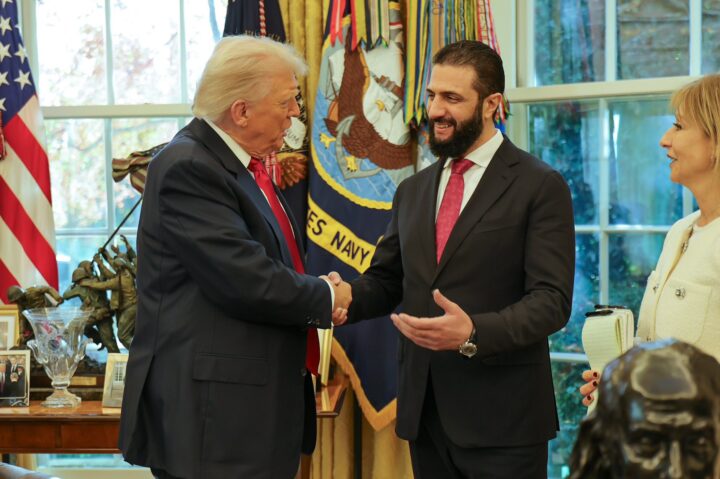
President Donald Trump greets Syrian President Ahmad al-Sharaa in the Oval Office on Nov. 10, 2025.
Good Monday afternoon!
This P.M. briefing is reserved for our premium subscribers like you — offering a forward-focused read on what we’re tracking now and what’s coming next.
I’m Danielle Cohen-Kanik, U.S. editor at Jewish Insider and curator, along with assists from my colleagues, of the Daily Overtime briefing. Please don’t hesitate to share your thoughts and feedback by replying to this email.
📡On Our Radar
Notable developments and interesting tidbits we’re tracking
Despite the historic nature of Syrian President Ahmad al-Sharaa’s White House visit today, his meeting with President Donald Trump was kept a relatively low-key affair. Al-Sharaa entered through a back door and didn’t receive the usual greeting photo op with Trump, and the meeting was closed to the press.
The two leaders made news nonetheless: Syria is now set to join the U.S.-led campaign against ISIS, Trump and al-Sharaa discussed reopening respective embassies in Damascus and Washington and the Treasury Department issued a new order extending the suspension of U.S. sanctions on Syria for six months.
Ibrahim Olabi, Syria’s U.N. ambassador, said the two leaders also discussed a prospective Israel-Syria security agreement. “The term used frequently during the meeting by President Trump and Secretary [of State Marco] Rubio was ‘let’s get this done,’” Olabi said…
Trump has encouraged lawmakers to fully lift the congressionally mandated U.S. sanctions on Syria, but Rep. Brian Mast (R-FL), a Trump ally and the chair of the House Foreign Affairs Committee, did not commit to supporting sanctions relief when he held his own meeting with al-Sharaa yesterday, Jewish Insider’s Marc Rod reports.
Mast and al-Sharaa “had a long and serious conversation about how to build a future for the people of Syria free of war, ISIS, and extremism,” Mast said in a statement, but offered no words of praise for the Syrian leader…
Sergio Gor was sworn in as U.S. ambassador to India today to unusual fanfare — he and Trump were joined in the Oval Office by Rubio; Vice President JD Vance; Treasury Secretary Scott Bessent; Attorney General Pam Bondi; U.S. Attorney for the District of Columbia Jeanine Pirro; Sens. Lindsey Graham (R-SC), Jim Risch (R-ID); Katie Britt (R-AL) and Tommy Tuberville (R-AL); Erika Kirk and Fox News host Laura Ingraham, among others.
Swearing in Gor, who used to serve as the head of the Presidential Personnel Office where he wielded significant influence in assuring political hires shared his skepticism of American engagement abroad, Vance said, “We have such a crowd here, you’d think we were swearing in a vice president”…
Laura Loomer, a right-wing Trump advisor who has historically maintained pro-Israel stances, wrote on social media today that, after spending “an incredible week” in Israel, she has “reached a firm conclusion: Israel must end its dependence on U.S. aid and the U.S. must end all aid to Israel.”
“I truly hope by the end of the Trump administration and by the beginning of a new administration in 2028 that we see zero aid flowing to Israel,” she wrote, calling it a “win-win” for the U.S., which will no longer be a “global baby sitter,” and for Israel, which will be free to conduct its wars as it wishes.
In response, Democratic Majority for Israel accused Loomer of continuing “a troubling pattern on the Right — embracing anti-Israel policies & undermining our allies,” in the vein of Tucker Carlson and Rep. Marjorie Taylor Greene (R-GA)…
Christine Pelosi, daughter of Rep. Nancy Pelosi (D-CA), who was thought to be considering a run for her mother’s seat as she retires, announced today that she is not running for Congress. Instead, Pelosi is launching a campaign for the state Senate seat currently held by Scott Wiener, who is running for her mother’s San Francisco congressional district…
New York City Mayor-elect Zohran Mamdani named two of his top advisors today: Dean Fuleihan to be first deputy mayor and Elle Bisgaard-Church as his chief of staff.
Bisgaard-Church is a democratic socialist who was part of Mamdani’s campaign inner circle. Fuleihan, on the other hand, is a city and state government veteran; he previously served in the same role under former Mayor Bill de Blasio and as his budget director, as well as a budget expert in the state Legislature, among other roles. Rep. Ritchie Torres (D-NY), who was at times at odds with Mamdani during his campaign, called Fuleihan’s appointment “exceptional … in more ways than one”…
Danielle Sassoon, the former interim U.S. attorney for the Southern District of New York who resigned her post rather than drop a case against New York City Mayor Eric Adams at the request of the Trump administration, has joined the law office of Clement & Murphy, The New York Times reports. The conservative boutique firm is known for its “longstanding opposition to executive branch overreach”…
The Wall Street Journal reports on Yale’s attempt to stay out of the line of fire in Trump’s crusade against higher education, including President Maurie McInnis’ increased government lobbying expenditures and a student forum where classmates encouraged each other to refrain from disruptive anti-Israel protests: “‘The only thing continuing to protest will do is to take education and opportunities away from the rest of us,’ said one post [on the forum]. ‘Ppl need to stop being stupid and selfish and realize they will gain no ground under this administration on the Israel issue’”…
Palantir CEO Alex Karp defended his support of Israel in an interview with WIRED, released today, saying, “Israel is a country with a GDP smaller than Switzerland, and it’s under massive attack. Some critiques are legitimate, but others are aggressive in attacking Israel. My reaction is, well, then I’m just going to defend them.”
“When people are fair to Israel and treat it like any other nation, which I don’t think they do, I will be much more willing to express in public the things I express in private to Israelis”…
⏩ Tomorrow’s Agenda, Today
An early look at tomorrow’s storylines and schedule to keep you a step ahead
Keep an eye on Jewish Insider tomorrow morning for reporting on veteran journalists Bianna Golodryga and Yonit Levi’s new book, Don’t Feed the Lion, which they will launch at Temple Emanu-El in New York City tomorrow night, joined in conversation by comedian Elon Gold.
This evening, Syrian President Ahmad al-Sharaa will appear on Fox News’ “Special Report” with Bret Baier.
Stories You May Have Missed
SCENE AT SOMOS
Jewish leaders begin outreach to incoming Mamdani administration, sensitively
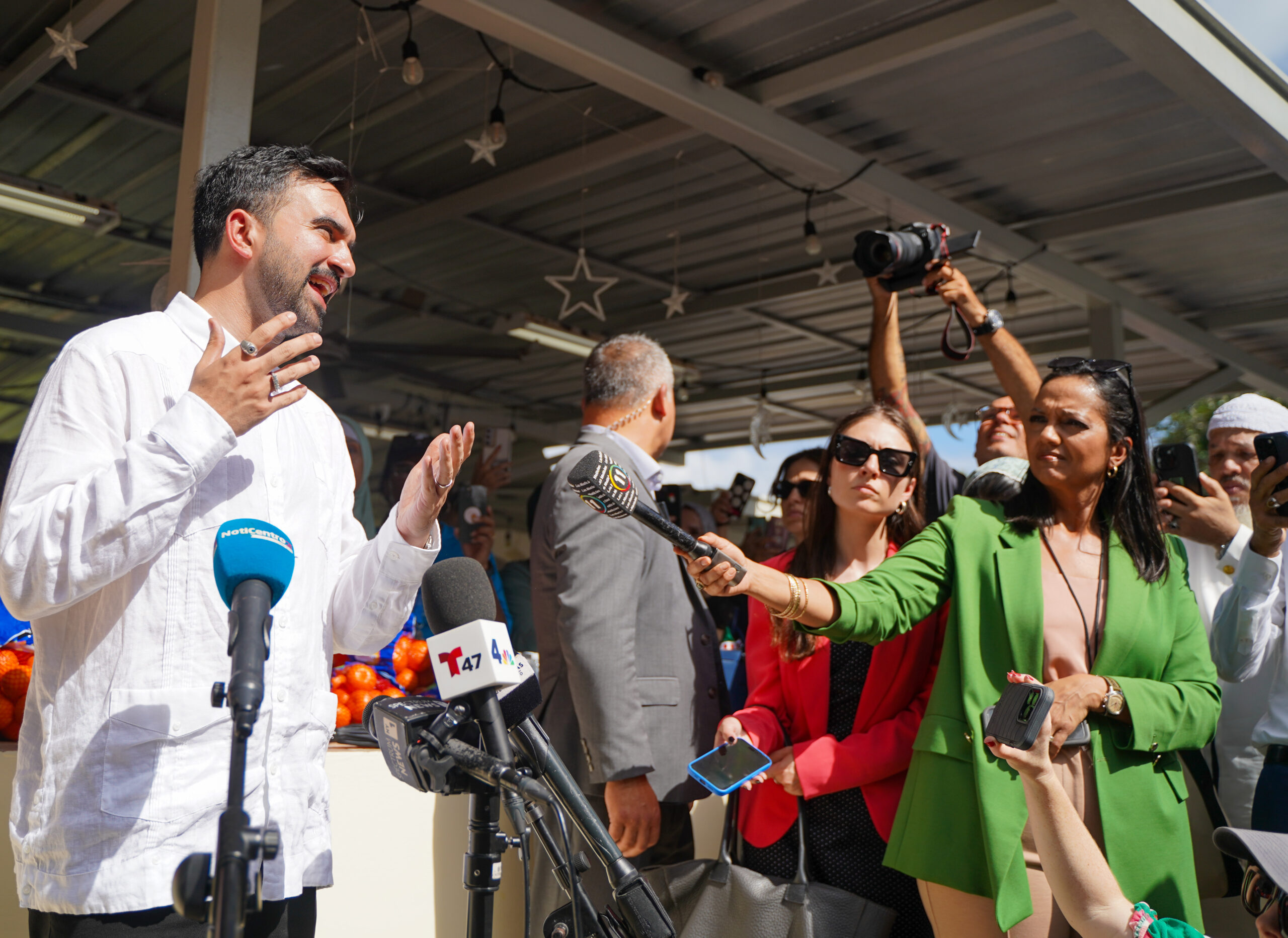
At the post-election Somos conference, Jewish officials tried to find areas of common ground with the new mayor
DAYTONA X DAMASCUS DIPLOMACY
The influencer couple selling Syria on Capitol Hill
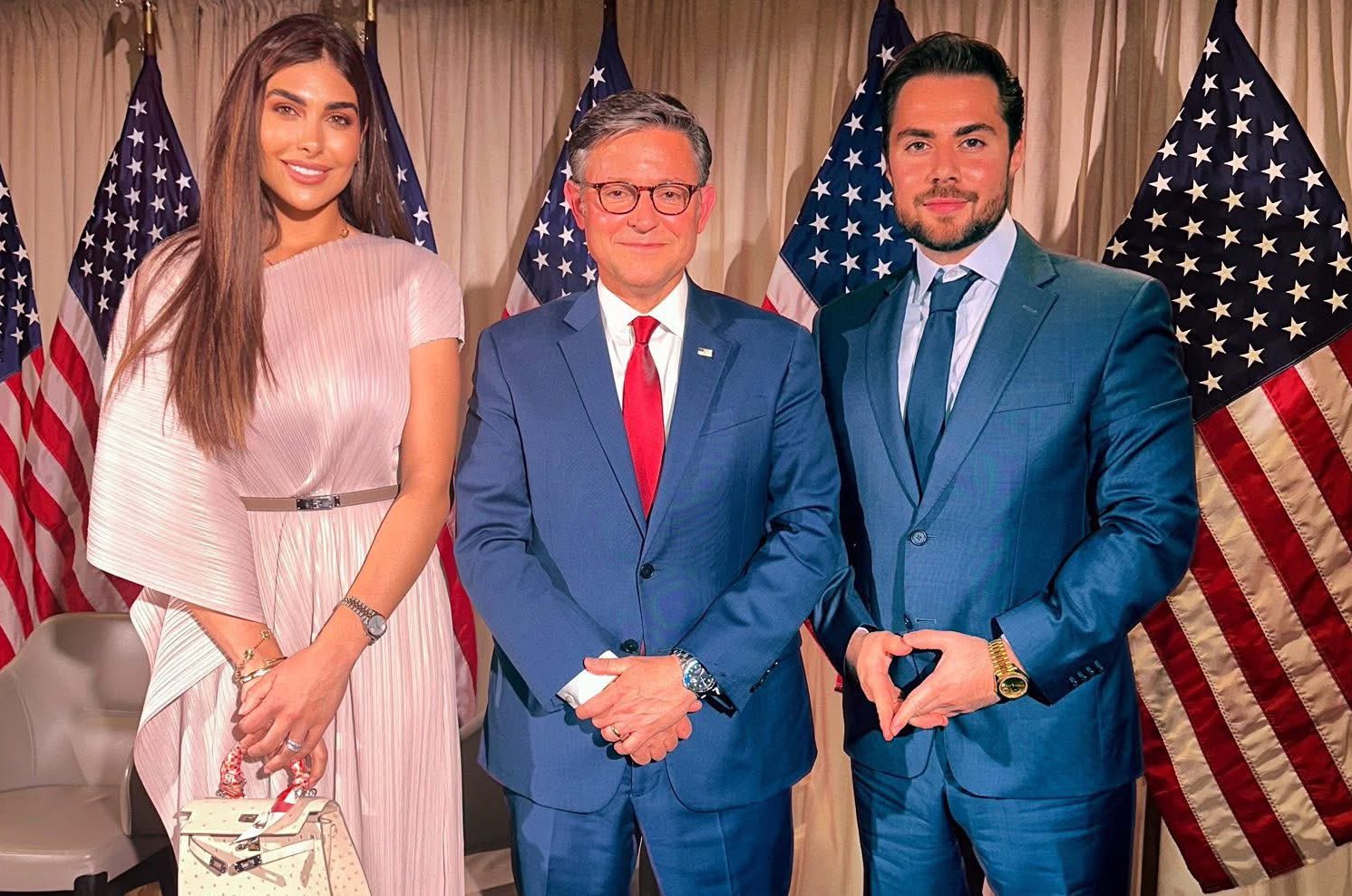
JI asked senior New York Democratic officials and Jewish community leaders to discuss the top threats that a Mamdani administration could pose to Jewish life in the city
Fearing a pullback of NYPD resources, the Community Security Initiative has formed ‘Task Force Z’ to prepare for potential changes under the incoming mayor

Adam Gray/Getty Images
NYPD Strategic Response Group (SRG) stand guard outside of 26 Federal Plaza on October 21, 2025 in New York City.
New York City’s leading Jewish security organization has prepared a new set of strategies to respond to policies that the city’s Mayor-elect Zohran Mamdani might put into place that would affect public safety.
Among the primary concerns of Mitch Silber, executive director of the Community Security Initiative and former director of NYPD intelligence analysis, is Mamdani’s vow to cut the police department’s Strategic Response Group.
“SRG is what essentially stands in between ‘Free Palestine’ protesters and the Jewish community,” Silber told Jewish Insider on Thursday. Disbanding SRG “will diminish public security and security for the Jewish community,” said Silber. Mamdani pledged he would disband the force as mayor in December 2024, saying it had “cost taxpayers millions in lawsuit settlements and brutalized countless New Yorkers exercising their first amendment rights.”
SRG was created after the 2008 Mumbai terrorist attacks so that New York City could be prepared in the event of similar multi-site attacks. “There’s no way CSI could replicate that,” Silber said.
But there are some elements of what SRG does that Silber said CSI, which is a partnership between the UJA-Federation of New York and the Jewish Community Relations Council of New York that relies on funds from private donors, “might be able to step up and, to some degree, fill a gap.”
Immediately after Mamdani won the Democratic primary in June, CSI formed “Task Force Z,” a group of senior regional security directors charged with understanding what policies Mamdani, as mayor, might put into place that would affect public safety and Jewish security in the city, and began to prepare strategies to deal with challenges.
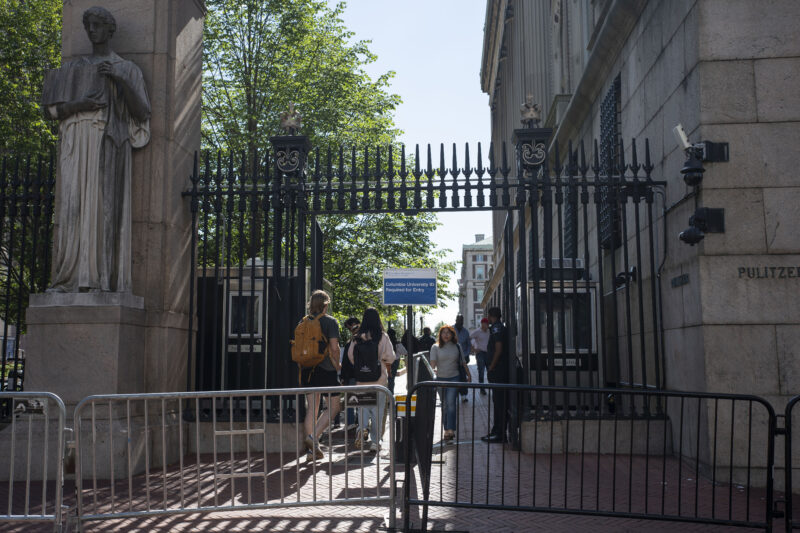
One of SRG’s primary missions is protest management, such as responding to the anti-Israel encampment on Columbia University’s campus last year. “Having volunteers be trained as how to be a buffer in a protest is something that we’re looking at if need be,” Silber told JI.
Asked how likely Mamdani is to be able to fulfill his pledge of disbanding SRG, Silber said, “The mayor in New York City calls the shots and the police commissioner either gets on board or gets a new job. If Mamdani wants to get rid of SRG, he’s going to get rid of SRG because he’s going to hire a police commissioner who will do it.”
Another threat to the Jewish community’s safety, said Silber, is Mamdani’s desire to reduce NYPD overtime pay.
“The Jewish community is one of the primary beneficiaries of NYPD’s overtime — when NYPD responds because it’s the High Holidays, or there’s an event overseas, they have to use overtime to do it. So if the police department cuts overtime that will cut the Jewish community’s security,” Silber said.
Already, the NYPD has just below 35,000 employees. “The last time the NYPD was 35,000 was 1994 when there were a million less people in the city,” Silber said. “We’re at an extremely low number and Mamdani isn’t going to increase the number of police.”
To help fill the gap, CSI’s new plans involve increased partnerships with other Jewish volunteer security groups.
“Who can we partner with on the ground who is capable, has resources and is proven the community can trust? Some of that is volunteer community security patrols called Shomrim and Shmira that are very connected to their respective communities in Crown Heights, Borough Park, Flatbush, Queens and Far Rockaway,” Silber told JI. “We’ve worked with them in the past and found them to be very capable. They are already doing some of the job that the NYPD would do but because the department is so resource short, when there’s a funeral or wedding in the neighborhood, NYPD calls these groups and asks them to use their own patrol cars. So it’s already happening and we anticipate, as the number of cops in a given precinct continues to fall, Shomrim and Shmira can really amplify our security efforts. These groups need resources, more vehicles, vests and radios if they are going to be a deterrent.”
“We’re finding out what these groups need and then will have conversations with donors,” continued Silber.
In Manhattan and Bronx neighborhoods, CSI is turning to its partnership with the Community Security Service, which has a network of more than 2,000 volunteers across New York City.
Richard Priem, CEO of CSS, told JI that the group has “contingency plans to address different scenarios including gaps in coverage or surges in requests for CSS support — whether from synagogues seeking training for their members to join our volunteer network, Jewish organizations requesting CSS volunteers to protect their events or parents serving as eyes and ears at their children’s day schools.”
“There will also be a fund for private security like we did after the Oct. 7, 2023, terrorist attacks [in Israel],” Silber said. “UJA will give us a fund for when a school or institution is having an event and doesn’t have enough security.”
CSI is also coordinating with Jewish security leadership groups in cities including Johannesburg, South Africa, Mexico City and Toronto “to try to understand how to protect the Jewish community when police don’t respond in a way that you expect them to,” said Silber.
“That informs some of our efforts as well,” he said. “They’ve invested very robustly in control rooms and camera systems so that they have situational awareness of what’s going on. That’s something we’re taking a closer look at.”
But the magnitude of New York City’s population — with about 1 million Jews — poses additional challenges. “Nevertheless, we may look more closely at incorporating cameras into security,” Silber said.
As NYPD officers are increasingly expressing interest in leaving the department, according to Silber, he said CSI is fielding inquiries “looking for landing when Mamdani comes in.”
The group is “looking into trying to figure out who might best fit in our team.”
Plus, Treasury targets Hezbollah financiers

Maksim Konstantinov/SOPA Images/LightRocket via Getty Images
The Kazakhstan national flag flutters in the wind on a flagpole.
Good Thursday afternoon!
This P.M. briefing is reserved for our premium subscribers like you — offering a forward-focused read on what we’re tracking now and what’s coming next.
I’m Danielle Cohen-Kanik, U.S. editor at Jewish Insider and curator, along with assists from my colleagues, of the Daily Overtime briefing. Please don’t hesitate to share your thoughts and feedback by replying to this email.
📡On Our Radar
Notable developments and interesting tidbits we’re tracking
The Abraham Accords is expected to gain another participant this evening, though in a first, the country is not joining as a show of peace with Israel — since the new addition, the Muslim-majority central Asian nation of Kazakhstan, has had full diplomatic relations with Israel since 1992.
Kazakhstan’s president, Kassym-Jomart Tokayev, is expected to announce the move at a meeting with President Donald Trump later today, where they will also hold a joint phone call with Israeli Prime Minister Benjamin Netanyahu. Trump administration officials told Axios that the White House wants to “build momentum” for the Abraham Accords ahead of Saudi Crown Prince Mohammed bin Salman’s visit to Washington on Nov. 18.
As far as Kazakhstan’s motivation, the former Soviet nation has long lobbied Washington to cancel a Cold War-era law that has hindered its access to American markets, and could benefit from currying favor with the Trump administration.
Leading Jewish organizations have worked with Kazakhstan’s Jewish community and government for over a decade to lobby Congress to repeal the Jackson-Vanik Amendment, and told Jewish Insider’s Lahav Harkov and Danielle Cohen-Kanik that they are highly supportive of the country’s inclusion in the Accords…
Ahead of Syrian President Ahmad al-Sharaa’s own visit to the White House on Monday, the U.N. Security Council voted in favor of a U.S.-sponsored resolution to lift sanctions on the former Al-Qaida leader turned president…
Also getting an Oval Office welcome, Israeli media reported today that Trump invited the 20 Israeli hostages released from Gaza last month to visit the White House in two weeks…
On the Hill, members of the Senate Armed Services Committee from both parties voiced concerns with Elbridge Colby, under secretary of defense for policy, and his office at the Pentagon at a committee hearing today — for the second time this week, JI’s Marc Rod reports.
“Many of this committee have serious concerns about the Pentagon’s policy office and how it is serving the president of the United States and the Congress,” Sen. Roger Wicker (R-MS), the chairman of the committee, said in his opening statement. “In many of these conversations, we hear that the Pentagon policy office seems to be doing what it pleases without coordinating, even inside the U.S. executive branch”…
Rep. Nancy Pelosi (D-CA) announced this morning that she will retire at the end of her term in 2027, after serving 39 years in Congress where she made history as the first female speaker of the House.
For most of her illustrious career, Pelosi has been a reliable ally of Israel and, as Democratic leader, generally managed to keep her caucus united around support for the Jewish state. But, like many Democrats, she leaned in a more critical direction during the war in Gaza, at one point supporting a call to suspend weapons transfers to Israel. Read JI’s interview with Scott Wiener, the state senator from California seeking to win her seat…
The IDF is beginning to demobilize thousands of reservists called up for duty, some of whom have served hundreds of days in the past two years, announcing that the country is transitioning from war into a period of “enhanced border security” as the ceasefire with Hamas in Gaza largely endures…
The Treasury Department announced sanctions today against members of Hezbollah’s “finance team” who “oversee the movement of funds from Iran” in an effort to support the Lebanese government’s moves to disarm the terror group. The department revealed that the Iranian Revolutionary Guard Corps has already transferred over $1 billion to Hezbollah this year…
Author Jamie Kirchick argues in The Washington Post that the “inevitable fracturing of President Donald Trump’s MAGA movement is in sight, the instigator of its rupture that most narcissistic and destructive of media personalities: Tucker Carlson.”
Kirchick admonishes Heritage Foundation President Kevin Roberts for failing to outright condemn Carlson’s platforming of neo-Nazi influencer Nick Fuentes: “Stalinists and Holocaust deniers like Fuentes are perfectly entitled to spew their nonsense on street corners, through self-published manifestos or in online livestreams. What they are not entitled to is the imprimatur of purportedly respectable institutions whose reputations hinge upon the voices they choose to amplify”…
⏩ Tomorrow’s Agenda, Today
An early look at tomorrow’s storylines and schedule to keep you a step ahead
Keep an eye on Jewish Insider tomorrow morning for an interview with former Minnesota Sen. Rudy Boschwitz, who will be celebrating his 95th birthday.
On Sunday, the Zionist Organization of America will hold its annual gala, where it will present awards to Rep. Elise Stefanik (R-NY); Israeli Ambassador to the U.S. Yechiel Leiter; Leo Terrell, head of the Department of Justice’s antisemitism task force; Israeli Ambassador to the U.N. Danny Danon; and philanthropists Irit and Jonathan Tratt.
We’ll be back in your inbox with the Daily Overtime on Monday. Shabbat Shalom!
Stories You May Have Missed
THE INSIDE STORY
The 36 hours in Washington that took hostage families from grief to gratitude
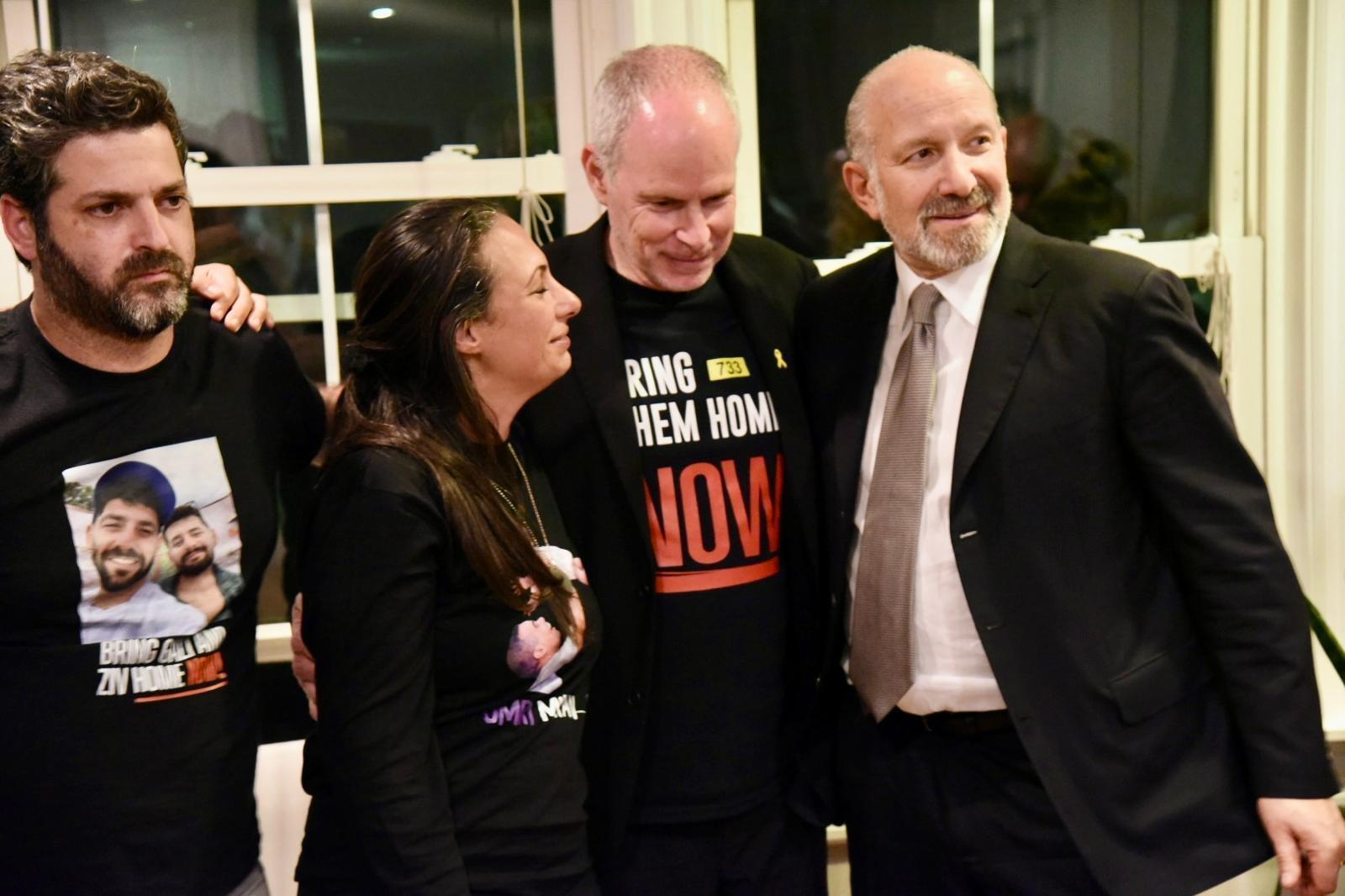
The story of how the hostage families came to learn their loved ones were coming home, told to JI by key players
COMMUNITY CONCERNS
What New York City Jewish leaders are most worried about in a Mamdani mayoralty
JI asked senior New York Democratic officials and Jewish community leaders to discuss the top threats that a Mamdani administration could pose to Jewish life in the city
If Mamdani’s win signaled that a far-left candidate could prevail in a deep-blue city, the underperformance of two other far-left challengers on big-city ballots underscores the limited appetite even deep-blue constituencies have for radical politics
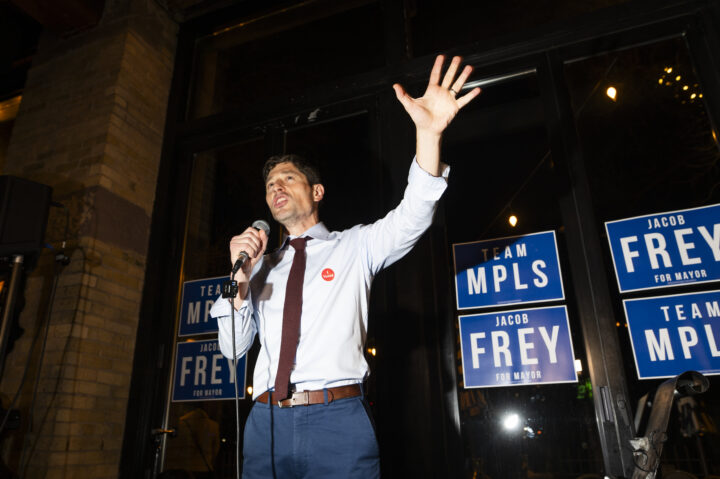
Stephen Maturen/Getty Images
Minneapolis Mayor Jacob Frey speaks at an Election Night party on November 4, 2025 in Minneapolis, Minnesota.
In addition to New York City Mayor-elect Zohran Mamdani’s race, we’ve been spotlighting two other mayoral contests where socialist, anti-Israel candidates were running competitively against more traditionally liberal standard-bearers: in Minneapolis and Seattle.
If Mamdani’s bare 50% majority in the three-way race signaled that a far-left candidate could prevail in a deep-blue city — even while dividing the Democratic Party — the underperformance of the two other far-left challengers on big-city ballots underscores the limited appetite even deep-blue constituencies have for radical politics.
In Minneapolis, Mayor Jacob Frey won reelection to a third term over Democratic Socialists of America-affiliated state Sen. Omar Fateh. The race was close: While Frey held a substantial 10-point lead in the first round of balloting, he narrowly secured a victory by six points (50-44%) in the second round of the city’s ranked-choice election system.
Fateh formed an alliance with two other left-wing candidates in the race, but ultimately enough people who didn’t back Frey in the first round chose him as a second or third preference.
Fateh, a progressive affiliated with the DSA, has accused Israel of committing genocide, among other anti-Israel views, and campaigned with Rep. Ilhan Omar (D-MN), who remains one of Israel’s harshest critics in Congress.
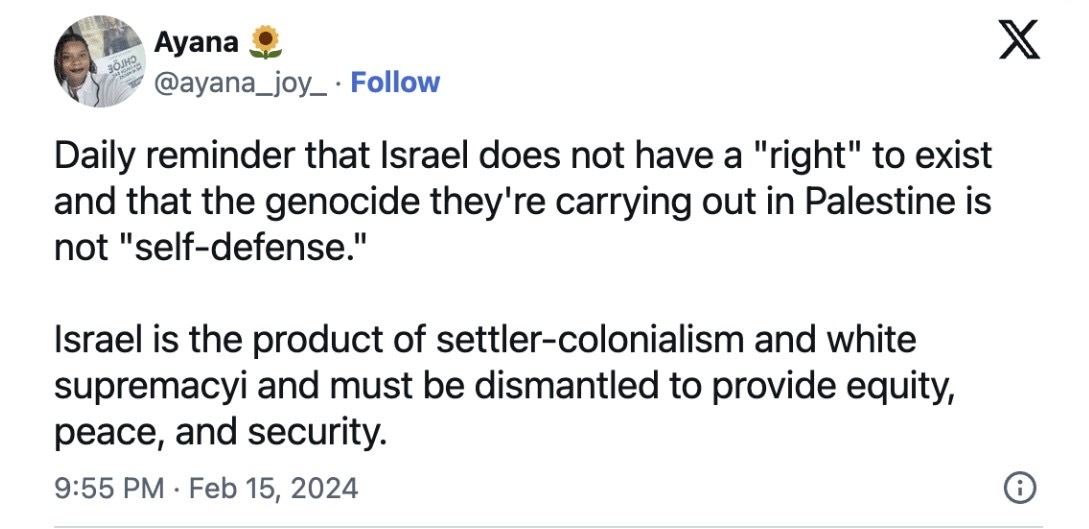
Members of Fateh’s staff had also expressed hostile views towards Israel; his communications manager, Ayana Smith-Kooiman, said in a series of now-deleted social media posts that Israel “does not have a ‘right’ to exist” and “must be dismantled,” and said she did not care about Hamas a month after the Oct. 7, 2023, terror attacks — statements that drew rebuke from Sen. Amy Klobuchar (D-MN).
The outcome is also looking favorable for the more-moderate incumbent in Seattle — though far from certain. Mayor Bruce Harrell, who trailed his socialist challenger Katie Wilson during the summer primary, is now leading her in the general election by eight points, 54-46%, with more than three-quarters of votes tallied.
Wilson, who has expressed hostile views towards Israel, including calling the Jewish state’s war on Hamas a “genocide,” led over Harrell in the primary. Wilson has expressed support in the past for divesting from investments in Seattle that support Israeli actions, which is in line with the BDS movement.
Additionally, some Seattle Jewish community leaders have expressed deep concern over Wilson’s candidacy and her relationships with anti-Israel activists, including Kshama Sawant, a former far-left Seattle city councilmember who has faced accusations of stoking antisemitism.
However, the race is still far from being decided. Many ballots are left to be counted, including a significant share from left-leaning parts of the city.
If both of the other socialist, anti-Israel candidates go down to defeat, combined with Mamdani’s bare 50% majority in heavily-Democratic New York City, it’s pretty clear that as an electoral strategy, left-wing activism and anti-Israel politicking is still a losing formula.
On the other hand, the fact that the far-left candidates were able to win between 45-50% of the citywide vote — with one win, one loss and one race still too close to call — it’s a sign that this brand of radical politics isn’t going away.
JI asked senior New York Democratic officials and Jewish community leaders to discuss the top threats that a Mamdani administration could pose to Jewish life in the city
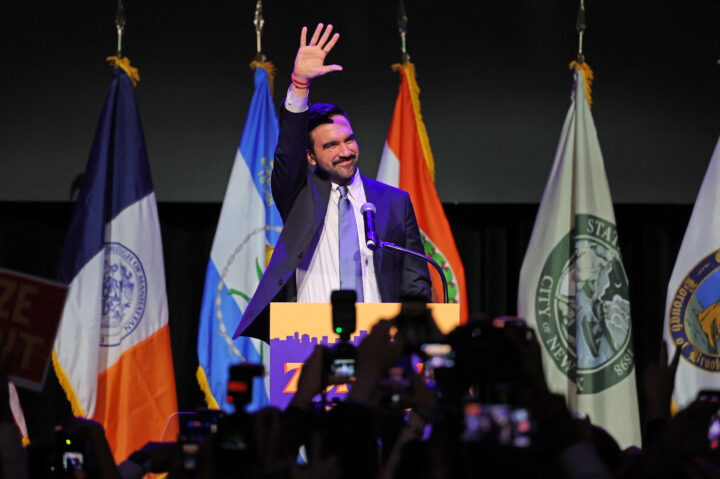
ANGELA WEISS/AFP via Getty Images
New York City Mayoral candidate Zohran Mamdani celebrates during an election night event at the Brooklyn Paramount Theater in Brooklyn, New York on November 4, 2025.
New Yorkers elected democratic socialist Zohran Mamdani on Tuesday as the next New York City mayor, ensuring the city will be headed in a leftward ideological direction for the next four years. Mamdani’s election has also sparked widespread concerns in the city’s Jewish community about how the incoming mayor, who refused to condemn “globalize the intifada” rhetoric or acknowledge the state of Israel as a Jewish homeland, would impact the day-to-day life of Jewish New Yorkers.
Jewish Insider asked senior New York Democratic officials and Jewish community leaders — granted anonymity to offer their candid thoughts — to discuss the top threats that a Mamdani administration could pose to Jewish life in the city.
Respondents expressed worry that Mamdani’s anti-Israel worldview could lead to heightened antisemitism, bring a vanguard of leftist operatives hostile to Jewish concerns into City Hall, impact the effectiveness of the New York Police Department and fray ties between the city and Israeli institutions or businesses. He has even vowed to arrest Israeli Prime Minister Benjamin Netanyahu if he visits, though experts have voiced doubt on the legality of the move.
These are five of the leading concerns from the Jewish communal leadership in New York City, home to the largest Jewish community in the country, about what Mamdani might do as mayor:
1. Mamdani has expressed a desire to defund, or even disband, the NYPD’s Strategic Response Group — the unit that responds to major protests, such as the anti-Israel encampment on Columbia University’s campus last year:
“He’s been pushing for years to disband the NYPD’s Strategic Response Group,” a source with knowledge of city government told JI. In December 2024, Mamdani tweeted, “As mayor, I will disband the SRG, which has cost taxpayers millions in lawsuit settlements and brutalized countless New Yorkers exercising their first amendment rights.”
The SRG responds to hostage situations, riots and protests, including the deadly Park Avenue office building shooting that occurred in July. In April 2024, the Strategic Response Group was called in to assist with clearing the anti-Israel encampment that overtook Columbia University, which saw several incidents of physical assault against Jewish students.
“One question is if he’s actually successful in disbanding them,” the source continued. “That will depend on his will and bureaucracy and whether he can put together an administration to accomplish his tasks. If he’s going to be an effective mayor, then yes he could do it. And if he is, then you’re going to see completely different responses in the city.
“Something super important is whether a Mamdani administration would actually have a proactive approach to policing and using security in a way that will make sure Jewish New Yorkers are safe. If it’s not a priority for them, then I’m afraid to see what will happen.”
2. Mamdani could further politicize NYC Public Schools at a time when anti-Israel rhetoric and related antisemitic incidents have surged dramatically in K-12 schools:
In the aftermath of the Oct. 7, 2023, Hamas terror attacks, New York City Public Schools launched new curriculum materials on antisemitism and Islamophobia in its schools. As mayor, Mamdani will have power to appoint a new chancellor of public schools, who could rewrite that curriculum.
Former Rep. Jamaal Bowman, previously a far-left congressman who lost reelection in part because of his radical views towards Israel, has been discussed as a potential candidate to lead the country’s largest public school system. Bowman embraced a number of hostile positions toward Israel in the aftermath of Oct. 7 and throughout his reelection campaign, including pledging to oppose funding for Israel’s Iron Dome missile defense system and endorsing the BDS movement.
The New York City Public School system has seen a surge of anti-Israel activity since Oct. 7. In November 2023, a Queens high school teacher said she was forced to hide in a locked office as a mob of students tried to push their way into her classroom, after learning she attended a pro-Israel rally.
In May, a “Teacher Career Pathways” newsletter for educators in the city’s 1,800 schools called for students to be heard on the “genocide in Gaza.” NYC Schools Chancellor Melissa Aviles-Ramos apologized for the mass communication, stating that it should not have been released without consultation from the mayor’s office.
A political insider told JI there is anxiety the new administration will fuel anti-Israel discourse in the classroom. “There’s concern about what curriculums will be used to teach about the [Israeli-Palestinian] conflict,” he said. “What vendors will be used?”
The American Jewish Committee announced plans on Wednesday to “boost the ‘Hidden Voices’ curriculum in New York City public schools, which provides resources, lesson plans and workshops to highlight the histories and contributions of underrepresented groups in U.S. history.”
3. Mamdani has expressed support for the BDS movement, which could have a wide-ranging impact on Israeli partnerships with New York City companies or institutions.
Mamdani said in June that he would attempt to divest from Israel if elected mayor — including discontinuing the NYC-Israel Economic Council, which Mayor Eric Adams recently launched.
“His pursuit of discriminatory policies that boycott and divest from Israel, companies doing business in Israel, and U.S.-Israel tech partnerships could cost New York taxpayers billions over the next ten years,” said the head of a leading Jewish organization. “He knows [BDS] policy is discriminatory and antisemitic, yet he refuses to abandon it. Even worse, he continues to double down and has made it an important piece of his economic strategy.”
Mamdani has also said he would “reassess” the partnership between Cornell University and Israel’s Technion, potentially displacing it from its campus on Roosevelt Island. “Ending [the Cornell-Technion] partnership would deal a blow to the city’s booming tech sector, chase away innovators, destroy vital educational opportunities, and damage New York’s reputation as a global business hub,” Ted Deutch, CEO of the AJC, said in a statement.
A political insider and Jewish communal leader told JI those are policies Mamdani could enforce, but “he would have to go out of his way to.”
“He said he’ll divest from Israel but it would be unprecedented for him to start organizing the pension boards under the comptroller,” the source said. “It doesn’t mean he won’t do it, but it’s more complicated than the stroke of a pen. No one knows if he will be passive, aggressive or proactive; there are many options of what we could do.”
4. Mamdani’s inability to condemn antisemitism from his public perch, while associating himself with extremist individuals could lead to a rise in antisemitism:
During the campaign, Mamdani affiliated with anti-Israel activist Linda Sarsour, considered to be one of the mayor-elect’s mentors and Imam Siraj Wahhaj, who Mamdani called one of the “foremost Muslim leaders” in the U.S. Wahhaj has a history of supporting controversial figures involved in terrorism, including testifying as a character witness at the trial of Omar Abdel-Rahman who was found guilty of seditious conspiracy for his role in plotting the 1993 World Trade Center bombing. Jeremy Corbyn, who led Britain’s Labour Party and was suspended over antisemitic comments, also phone-banked for Mamdani in the closing days of the campaign.
Mamdani has said he would oppose using the International Holocaust Remembrance Alliance’s working definition of antisemitism, which would dismantle an executive order signed by Adams in June as part of a push against rising antisemitism.
“Even if Mamdani doesn’t do anything to actually impact the day-to-day of the Jewish community, the symbolic impact of Mamdani’s victory [is] devastating,” another veteran Jewish communal leader said. “It shows that a person espousing views that most of us consider dangerous and antisemitic can get elected. It’s the breaking of a taboo.”
5. Mamdani’s failure to equate anti-Zionism with antisemitism could weaken enforcement of laws protecting Jewish institutions:
Throughout his campaign, Mamdani repeatedly said he does not support Israel’s right to exist as a Jewish state and that his criticism of Israel does not amount to antisemitism. But the majority of Jewish Americans report that Israel is a large part of their Jewish identity.
Antisemitism watchers have noted that anti-Israel demonstrations — especially those on college campuses — have increasingly turned blatantly antisemitic by targeting Jewish, not Israeli, institutions such as Hillels and Chabad houses.
The communal leader and political insider added that it’s uncertain where Mamdani draws a line at anti-Israel activity crossing into antisemitism, and therefore whether he would protect Jewish institutions. For example, they said, “it’s unclear if he would use protesting a university Hillel with ‘Free Palestine’ as antisemitic or anti-Zionist.”
Plus, the end of a Golden era in Maine

Stephen Maturen/Getty Images
Minneapolis Mayor Jacob Frey speaks to supporters at an Election Night party on November 2, 2021 in Minneapolis, Minnesota.
Good Wednesday afternoon!
This P.M. briefing is reserved for our premium subscribers like you — offering a forward-focused read on what we’re tracking now and what’s coming next.
I’m Danielle Cohen-Kanik, U.S. editor at Jewish Insider and curator, along with assists from my colleagues, of the Daily Overtime briefing. Please don’t hesitate to share your thoughts and feedback by replying to this email.
📡On Our Radar
Notable developments and interesting tidbits we’re tracking
Jewish Americans are still taking stock after Zohran Mamdani’s victory last night in the New York City mayoral race. The Conference of Presidents of Major American Jewish Organizations, based in New York, called Mamdani’s victory a “grim milestone” and a reminder “that antisemitism remains a clear and present danger, even in the places where American Jews have long felt most secure.” Ted Deutch, CEO of the American Jewish Committee, listed policies the organization will be looking toward “to address the profound concerns about what the future holds for Jewish safety and belonging.”
Robert Tucker, the Jewish commissioner of the New York City Fire Department, resigned this morning, The New York Post reports, hours before he was set to fly to Israel to meet his counterpart there.
In his first response to an incident of antisemitism as mayor-elect, Mamdani denounced the vandalism of the Magen David Yeshiva in Brooklyn, which had two swastikas graffitied on it overnight, as “a disgusting and heartbreaking act of antisemitism, and it has no place in our beautiful city”…
Another heavily Democratic city rejected its own far-left candidate for mayor today, as incumbent Mayor Jacob Frey of Minneapolis won reelection against his DSA-aligned challenger, state Sen. Omar Fateh, Jewish Insider’s Matthew Shea reports. Marking a win for the more pragmatic wing of the Democratic Party, Frey secured his third term with 50% of the vote, to Fateh’s 44%, in the second round of the city’s ranked-choice voting.
A similar result may be emerging in Seattle, where preliminary results last night showed the Democratic incumbent, Mayor Bruce Harrell, leading over his socialist challenger, Katie Wilson, though many ballots remain to be counted…
One day after a historic Election Day — first democratic socialist mayor of New York City, largest turnout in an NYC mayoral race since 1969, first female governor of Virginia, first Muslim woman elected to statewide office as Virginia’s lieutenant governor, a record percentage of registered voters turning out for the municipal election in Minneapolis, among others — and the U.S. is already hitting another milestone: the longest government shutdown in history, at 36 days long.
President Donald Trump partially blamed the shutdown for Democrats’ strong showing in yesterday’s elections at a breakfast with Senate Republicans this morning, telling them, “I thought we’d have a discussion after the press leaves about what last night represented, and what we should do about it. … I think if you read the pollsters, the shutdown was a big factor, negative for the Republicans”…
Citing the shutdown, increased polarization and rising political violence, Rep. Jared Golden (D-ME) announced this afternoon that he will not be seeking reelection. Golden, a pro-Israel centrist who often worked across the aisle, has represented Maine’s 2nd Congressional District, a largely rural, working-class district that Trump won in the 2024 election by 14 points, since 2018, a seat that will be difficult for Democrats to maintain…
Recently freed former hostage Elizabeth Tsurkov recounted her two and a half years of captivity by Kataib Hezbollah, the Iran-backed terror group in Iraq, in a new interview with The New York Times, detailing the torture she experienced that resulted in potentially permanent nerve damage and the need for “long-term physical and psychological rehabilitation,” as determined by doctors at Israel’s Sheba Medical Center…
The University of Maryland, College Park student government is scheduled to vote on two resolutions hostile towards Israel tonight, JI’s Haley Cohen reports. One calls for the university to prohibit people who are “committing war crimes” and “genocide” from speaking on campus, after the campus chapter of Students Supporting Israel hosted an event last month where former IDF soldiers spoke about their experiences serving during Israel’s war with Hamas.
The second resolution calls on the university to issue an apology to students who faced disciplinary action for protesting that event, when demonstrators packed the outside hallway shouting “baby killers” and “IOF [Israel “Occupation” Forces] off our campus,” while several others protested outside of the building with chants comparing the IDF to the Ku Klux Klan…
Variety profiles David Ellison in his first 100 days as CEO of the recently merged Paramount Skydance, including the media company’s about-face on Israel issues. Free Press founder Bari Weiss, hired as editor-in-chief of CBS News by Ellison, “has been so vocal in her support of [Israel] that she faces frequent death threats. She and her wife, The Free Press co-founder Nellie Bowles, require a detail of five bodyguards that costs the studio $10,000-$15,000 a day.”
Paramount also reportedly “maintains a list of talent it will not work with because they are deemed to be ‘overtly antisemitic’ as well as ‘xenophobic’ and ‘homophobic,’” after the studio was the first to denounce a boycott of Israel signed by several Hollywood heavyweights…
⏩ Tomorrow’s Agenda, Today
An early look at tomorrow’s storylines and schedule to keep you a step ahead
Keep an eye on Jewish Insider tomorrow morning for the latest news on the Heritage Foundation’s internal reckoning with its defense of Tucker Carlson.
Tomorrow, the Senate Judiciary Committee will hold a hearing on the Holocaust Expropriated Art Recovery (HEAR) Act, a bill aimed at eliminating loopholes used to possess Nazi-looted artwork that Jewish families have been trying to recover.
The Senate Armed Services Committee will hold a nomination hearing for Alex Velez-Green to be deputy under secretary of defense for policy, coming days after committee lawmakers blasted the Pentagon office and its head, Elbridge Colby, during a contentious hearing for failing to communicate with them.
Maccabi Tel Aviv will play Aston Villa tomorrow in a Europa League match that generated controversy after local authorities announced that supporters of the Israeli team would not be permitted to attend, with the game deemed “high risk” over security concerns. Over 700 police officers are expected to be deployed and a no-fly zone will be established around the Villa Park stadium in Birmingham, England.
Israel’s Hapoel Tel Aviv basketball team will face off against the Dubai team in Sarajevo, Bosnia and Herzegovina, in Round 9 of the EuroCup tomorrow.
The Blue Square Alliance Against Hate, formerly the Foundation to Combat Antisemitism, will host its second Sports Leaders Convening at Gillette Stadium in Massachusetts tomorrow, featuring Robert Kraft, the organization’s CEO and owner of the New England Patriots; Ted Deutch, CEO of the American Jewish Committee; Jonathan Greenblatt, CEO of the Anti-Defamation League; Adam Lehman, CEO of Hillel International; Michael Masters, CEO of the Secure Community Network; and leaders from major sports leagues.
The Washington Institute for Near East Policy will host a webinar tomorrow on the possibility of peace between Israel and Lebanon with Lebanese Member of Parliament Fouad Makhzoumi.
Stories You May Have Missed
KENTUCKY CONTEST
Nate Morris seeks McConnell’s seat with populist, pro-Israel message
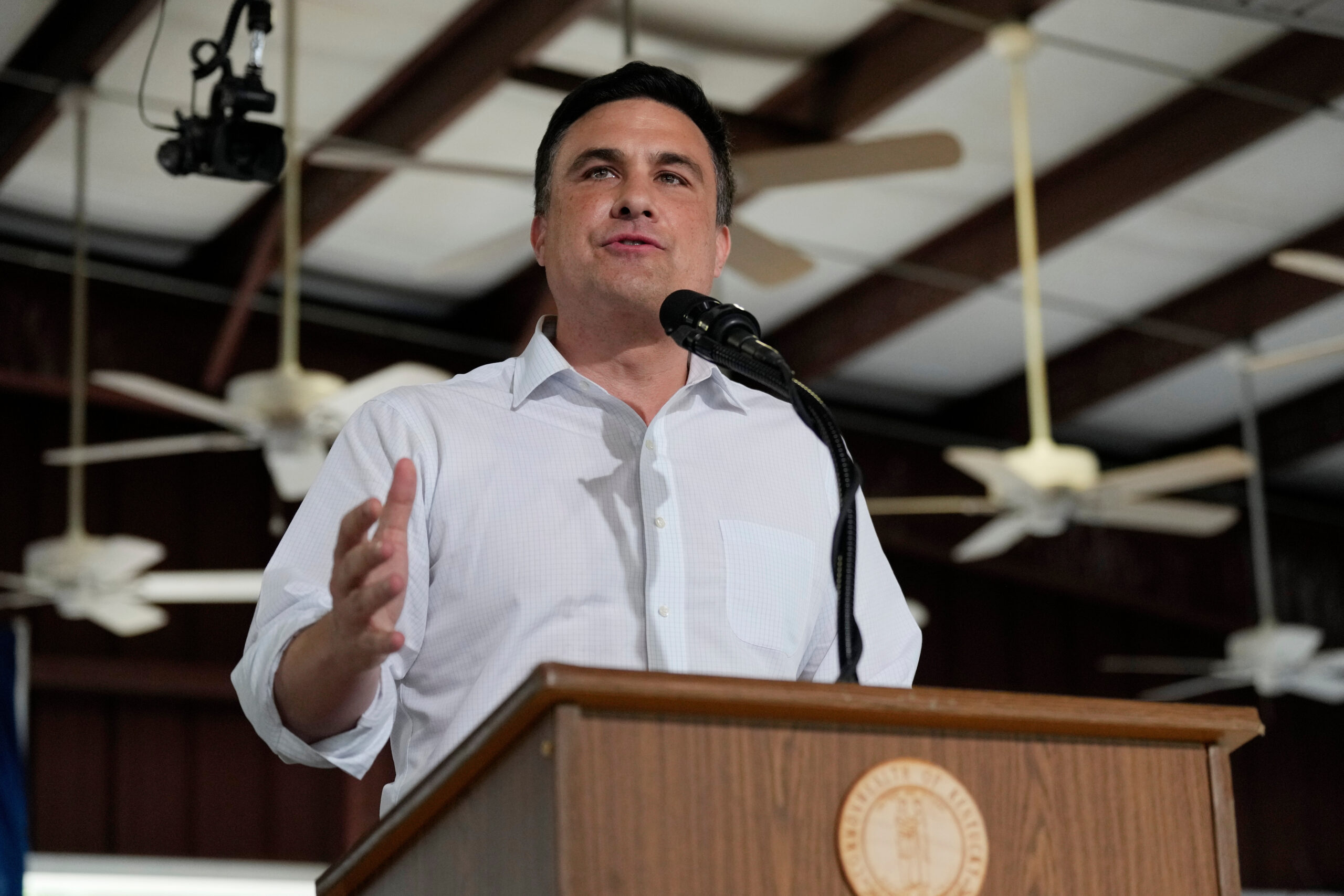
In an interview with JI, the wealthy businessman declined to weigh in on the Tucker Carlson controversy but said Republicans ‘shouldn’t be in the business of canceling anyone’
IN MEMORIAM
VP Dick Cheney remembered as friend of Israel, strong voice on national security issues
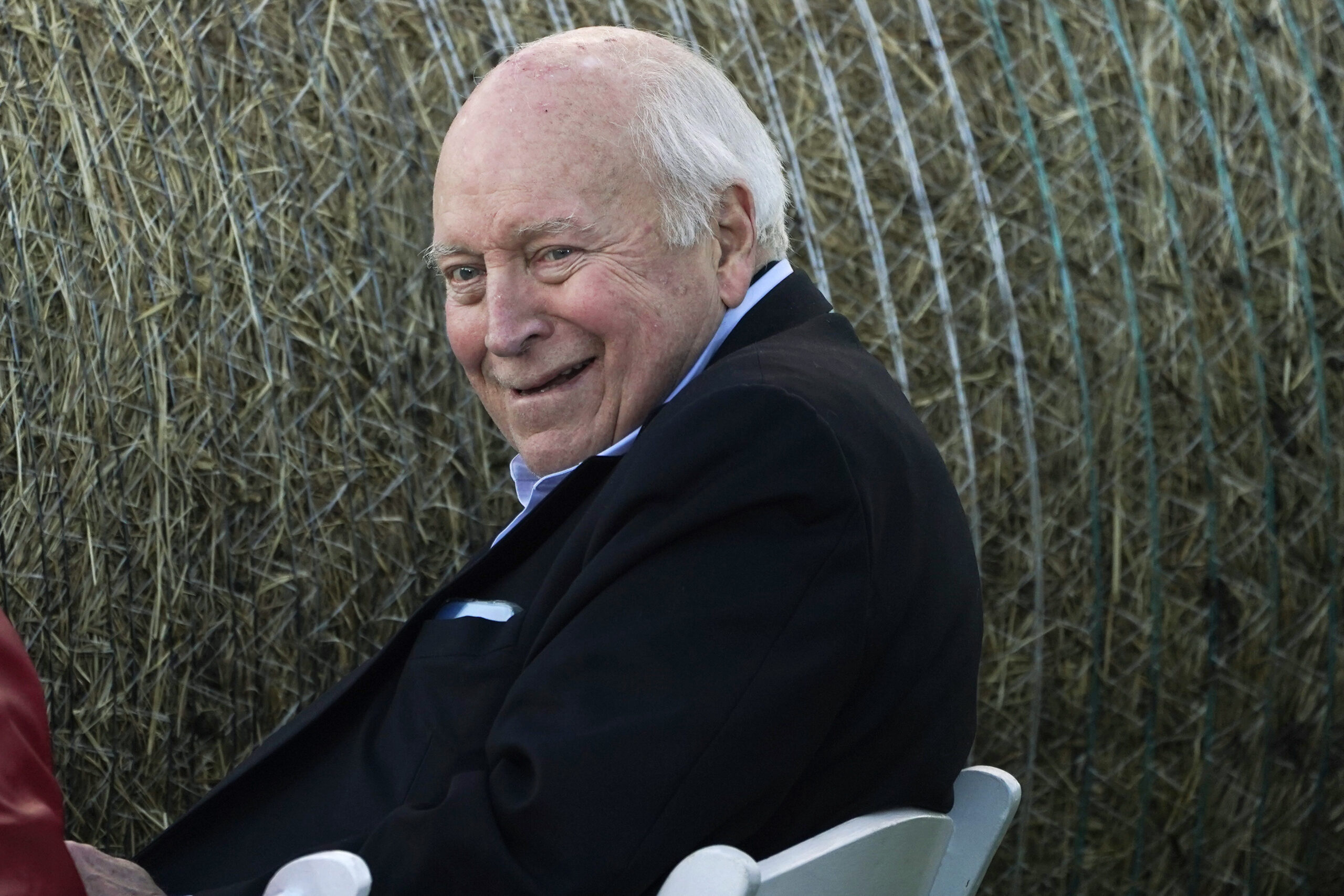
X is the only mainstream social media platform where Fuentes is allowed to have an account; he was unblocked in May 2024 and now has over 1 million followers
Frey’s success against DSA-aligned state Sen. Omar Fateh may be repeated in Seattle, where Mayor Bruce Harrell leads over socialist Katie Wilson, though results are incomplete
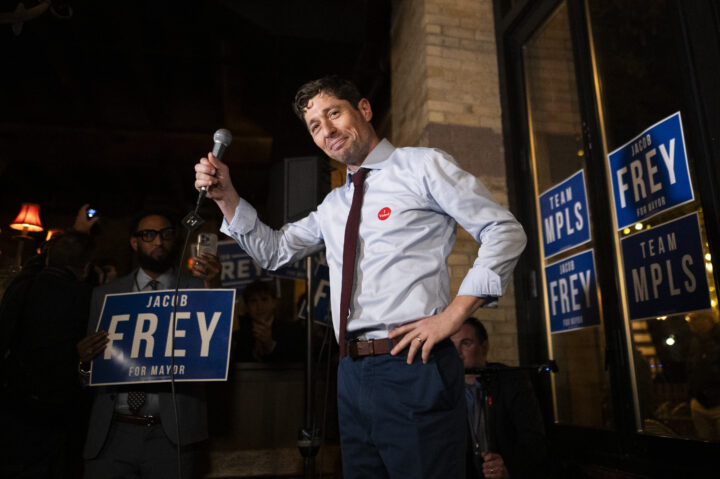
Stephen Maturen/Getty Images
Minneapolis Mayor Jacob Frey speaks at an Election Night party on November 4, 2025 in Minneapolis, Minnesota.
Democratic Mayor Jacob Frey of Minneapolis won reelection on Wednesday over his far-left, DSA-aligned challenger, state Sen. Omar Fateh, marking a win for the more pragmatic wing of the Democratic Party.
A similar result may be emerging in Seattle, where preliminary results showed the Democratic incumbent, Mayor Bruce Harrell, leading over his socialist challenger, though many ballots remain to be counted.
Frey, who is the second Jewish mayor to preside over Minneapolis, secured his third term, winning by six percentage points, 50% to 44%, in the final round of the city’s ranked choice voting on Wednesday.
Fateh, a progressive affiliated with the Democratic Socialists of America, has accused Israel of committing “genocide,” among other anti-Israel views, and campaigned with Rep. Ilhan Omar (D-MN), who remains one of Israel’s harshest critics in Congress.
Members of Fateh’s staff had also expressed hostile views towards Israel; His communications manager, Ayana Smith-Kooiman, said in a series of now-deleted social media posts that Israel “does not have a ‘right’ to exist” and “must be dismantled,” and said she did not care about Hamas a month after the Oct. 7, 2023, terror attacks — statements that drew rebuke from Sen. Amy Klobuchar (D-MN).
Frey’s victory in Minneapolis signals a wariness of a socialist candidate in the heavily Democratic city, in contrast with Zohran Mamdani’s win in New York City’s mayoral election on Tuesday.
Meanwhile, in Seattle, the first wave of ballots counted Tuesday night found Harrell holding a seven-point lead over self-described socialist Katie Wilson, 53% to 46%.
Wilson, who has expressed hostile views towards Israel, including calling the Jewish state’s war on Hamas a “genocide,” led over Harrell in the primary. Wilson has expressed support in the past for divesting from investments in Seattle that support Israeli actions, which is in line with the BDS movement.
Additionally, some Seattle Jewish community leaders have expressed deep concern over Wilson’s candidacy and her relationships with anti-Israel activists, including Kshama Sawant, a former far-left Seattle city councilmember who has faced accusations of stoking antisemitism.
However, the race is still far from being decided. Many ballots are left to be counted, including a significant share from left-leaning parts of the city. The next tranche of ballots is set to be reported around 5 p.m. local time on Wednesday.
Plus, how Jewish groups are prepping for Mayor Mamdani
ANGELA WEISS/AFP via Getty Images
New York City Mayoral candidate Zohran Mamdani celebrates during an election night event at the Brooklyn Paramount Theater in Brooklyn, New York on November 4, 2025.
Good Wednesday morning.
In today’s Daily Kickoff, we report on the Anti-Defamation League’s launch of a monitor to track the policies and hires of Mayor-elect Zohran Mamdani in New York City, and have the scoop on a series of demands being made of the Heritage Foundation by the leaders of the National Task Force to Combat Antisemitism following Heritage’s pledge to stand by Tucker Carlson. We report on Senate lawmakers’ criticisms of the Pentagon’s policy office under the leadership of Elbridge Colby, and interview Nate Morris, who is vying for the Senate seat being vacated by Sen. Mitch McConnell, on the sidelines of the Republican Jewish Coalition’s annual Las Vegas confab. Also in today’s Daily Kickoff: Jason Isaacman, Elizabeth Tsurkov, and Israel “Izzy” Englander.
Today’s Daily Kickoff was curated by Jewish Insider Executive Editor Melissa Weiss and Israel Editor Tamara Zieve, with an assist from Marc Rod. Have a tip? Email us here.
What We’re Watching
- In New York, former Israeli hostage Emily Damari will sit in conversation this evening with Noa Tishby at Temple Emanu-El.
- The Jewish Institute for National Security of America’s U.S.-Israel national security summit begins today in Aventura, Fla.
- On the heels of last night’s election, New York Democrats are heading to Puerto Rico today for the 2025 Somos Conference. Will you be there? JI’s Matthew Kassel will be covering the conference — say hello if you see him.
- The two-day SALT conference kicks off today in London. Former U.K. Prime Minister Tony Blair and former White House Communications Director Anthony Scaramucci are among the speakers at the fintech-focused summit.
What You Should Know
A QUICK WORD WITH JI’S Josh Kraushaar
Democrats scored sweeping victories across the country yesterday, with moderate lawmakers comfortably winning governorships in New Jersey and Virginia, while a democratic socialist prevailed in the closely watched New York City mayoral contest. California overwhelmingly voted to redistrict its congressional maps, a response to efforts in some red states to reconfigure congressional maps to give the GOP an edge.
The results underscore the widespread backlash to President Donald Trump’s polarizing governance in the first year of his second term in office, and indicate the likelihood that Democrats have momentum heading into next year’s midterm elections, where the party is looking to retake control of at least one branch of Congress.
In Virginia, former Rep. Abigail Spanberger, the Democratic nominee, easily defeated Republican Winsome Earle-Sears, the sitting lieutenant governor, by a double-digit margin (57-43%), bringing in a sizable Democratic majority in the state’s House of Delegates. Her victory was so sweeping that the Democrats’ scandal-plagued attorney general nominee Jay Jones, who was under fire for texts he sent several years ago wishing political violence against GOP colleagues, narrowly prevailed over the Attorney General Jason Miyares, a Republican.
In New Jersey, Rep. Mikie Sherrill (D-NJ) comfortably prevailed over Republican Jack Ciattarelli, outperforming polls suggesting a close race. With most of the vote reporting, Sherrill leads by a whopping 13-point margin, 56-43%. In Bergen County, a bellwether county with a significant Jewish population, Sherrill won over 55% of the vote, a dominant performance illustrating the breadth of her support.
In New York City, DSA-aligned Democratic nominee Zohran Mamdani prevailed over former Gov. Andrew Cuomo, who was running as an independent, though by a narrower margin than polling suggested. Mamdani leads Cuomo by eight points, 50-42%, with Republican Curtis Sliwa only winning 7% of the vote. The outcome suggested that many GOP voters ended up switching their support to Cuomo, who won a last-minute endorsement from Trump.
The Jewish vote in New York City went heavily for Cuomo, 60-31%, according to the exit polling, but Mamdani won nearly one-third support despite a long record of anti-Israel hostility and refusal to condemn “globalize the intifada” rhetoric, among other positions that alienated the mainstream Jewish community.
SCOOP
ADL launches a Mamdani monitor to track mayor-elect’s policies
In the wake of New York City Mayor-elect Zohran Mamdani’s victory on Tuesday, the Anti-Defamation League is launching the “Mamdani Monitor,” an initiative to track and monitor policies and personnel appointments of the incoming administration, Jewish Insider’s Haley Cohen has learned. The initiative will feature a tip line to report antisemitism as well as investment into researching policies, mayoral appointments and funding decisions coming from City Hall.
How it will work: The ADL said it will draw from tip line reports to launch a public-facing tracker that monitors policies and other actions from the Mamdani administration that could impact Jewish safety and security — including education policy, budget priorities and security measures. The antisemitism watchdog plans to use the tracker’s findings to mobilize New Yorkers to respond to policies deemed threatening to the Jewish community. ADL CEO Jonathan Greenblatt told JI that the initiative’s launch comes as Mamdani, throughout his campaign, “promoted antisemitic narratives, associated with individuals who have a history of antisemitism and demonstrated intense animosity toward the Jewish state that is counter to the views of the overwhelming majority of Jewish New Yorkers.”
Read the full story here.
SCOOP
Heritage-aligned antisemitism task force threatens to sever ties if reforms not enacted
Less than a day after an antisemitism task force aligned with the Heritage Foundation pledged to stand by the embattled conservative organization, the group’s co-chairs are now demanding concrete reforms from Heritage Foundation President Kevin Roberts — and warning that they may cut off ties with Heritage if their requests are not met. In a Tuesday afternoon email to members of the conservative National Task Force to Combat Antisemitism, which was viewed by Jewish Insider’s Gabby Deutch, the task force co-chairs shared the text of an email they sent to Roberts earlier in the day.
What they said: They asked Roberts to remove the controversial video he posted to X last week defending firebrand commentator Tucker Carlson, in which Roberts alleged that Carlson’s critics are part of a “venomous coalition” and that “their attempt to cancel him will fail.” The co-chairs wrote, “Many of us on the NTFCA are among those who believed you called us part of a ‘venomous coalition’ and implicitly questioned our loyalty to the United States. It makes collaboration with Heritage difficult for our members.” Roberts’ video came after Carlson faced criticism for hosting neo-Nazi Nick Fuentes on his podcast.
Sounding the alarm: House Speaker Mike Johnson (R-LA) criticized Carlson’s platforming of Fuentes, adding his voice to the growing list of Republicans who have publicly admonished the former Fox host for mainstreaming the avowed antisemite, Jewish Insider’s Emily Jacobs reports.
COLBY CONTENTION
Senate lawmakers blast Elbridge Colby’s DoD policy office over strategy decisions

Senate lawmakers from both parties on the Armed Services Committee excoriated the Department of Defense policy office run by Under Secretary of Defense for Policy Elbridge Colby at a Tuesday hearing. They criticized the office for a lack of communication with lawmakers as well as a series of controversial decisions seemingly at odds with White House policy, Jewish Insider’s Marc Rod reports.
Notable quotable: “It just seems like there’s this pigpen-like mess coming out of the policy shop that you don’t see from [other departments of the Pentagon]. Why do you think it is that there’s so many controversies emanating out of the policy shop and not these other offices in the department?” Sen. Tom Cotton (R-AR) said. Sen. Roger Wicker (R-MS), the chairman of the Armed Services Committee, said, “I’ve noticed an unsettling trend this year at times, that Pentagon officials have pursued policies that are not in accord with President Trump’s orders, or seem uncoordinated within the administration.”
KENTUCKY CONTEST
Nate Morris seeks McConnell’s seat with populist, pro-Israel message
As the GOP uneasily contends with rising hostility to Israel among younger right-wing voters, Nate Morris, a 45-year-old Republican Senate candidate in Kentucky who is courting the populist right with an anti-establishment message, emphasizes there is at least one long-standing party axiom he will never abandon: unwavering support for the Jewish state. In an interview with Jewish Insider’s Matthew Kassel last Friday, Morris, the wealthy founder of a successful waste management company who calls himself a “Trump America-First conservative,” said his commitment to upholding a strong U.S.-Israel alliance extends from his alignment with President Donald Trump’s vision for the Middle East.
Views on Israel: “I think he’s been the most pro-Israel president we’ve had in our country’s history, and I want to continue that kind of leadership on the issue in the United States Senate, on behalf of Kentucky and the country,” Morris told JI during the Republican Jewish Coalition’s annual summit in Las Vegas, where he met privately with members to pitch his campaign to succeed retiring Sen. Mitch McConnell (R-KY). But Morris also cited a more personal reason for what he described as his unequivocally pro-Israel worldview, explaining that, as a “proud” evangelical Christian, he has “always believed Israel is the land that was given to the Jews by God.”
Bonus: In his interview with JI, Morris noted that Zach Witkoff, the son of Trump’s special envoy, Steve Witkoff, recently hosted an event for his Senate campaign, where Morris got the chance to “hear firsthand a lot of the inside details” about how the ceasefire deal between Israel and Hamas “came together.” Trump’s approach “shows that when you have outsiders and business people negotiating, you can get great outcomes,” Morris added.
IN MEMORIAM
VP Dick Cheney remembered as friend of Israel, strong voice on national security issues
Former Vice President Dick Cheney, who died Monday, was remembered by former officials and pro-Israel leaders as a supporter of the Jewish state and a strong voice on U.S. national security issues throughout his time in public service, Jewish Insider’s Marc Rod reports.
What they’re saying: “He was always a big supporter of Israel while he was in the Bush administration but also before, as a congressman and as defense secretary in the first Bush years,” Tevi Troy, a presidential historian who served in the George W. Bush White House, told JI. Danielle Pletka, a distinguished senior fellow at the American Enterprise Institute, said that like other Republicans of his generation, Cheney’s support for Israel deepened in the wake of the 9/11 attacks, as the U.S. and Israel faced a shared threat.
EYE ON OSLO
Norwegian government puts sovereign wealth fund’s ethics council on hold
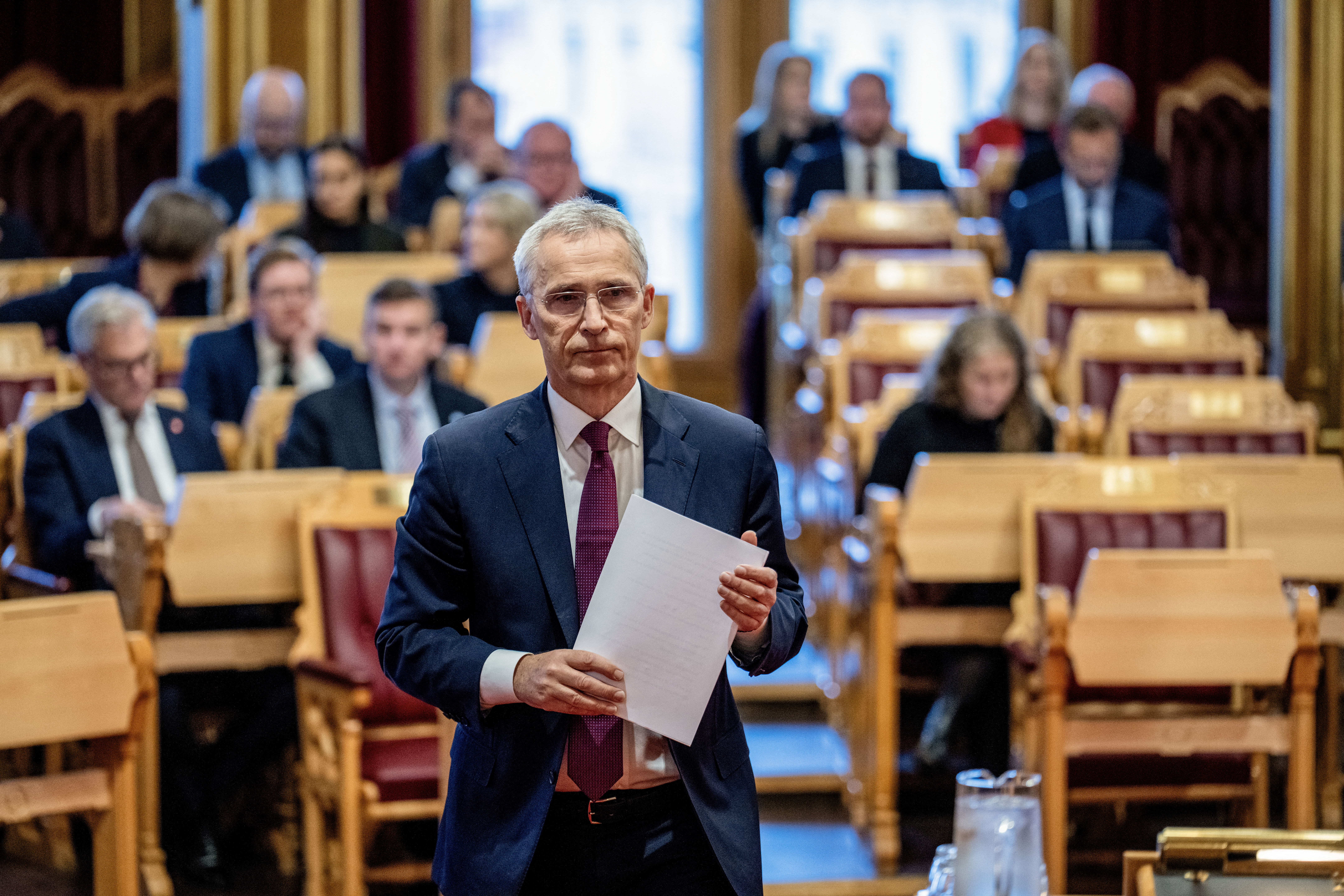
The Norwegian Legislature voted this week to place the ethics council of Norges, the country’s sovereign wealth fund, on hold, according to Norwegian media, a move that could delay or signal a change in course for expected anti-Israel moves and other ESG policies by Norges, Jewish Insider’s Marc Rod reports.
The latest: The ruling Labour Party partnered with conservative parties to pass the legislation placing Norges’ ethics council — which advises on divestment from certain companies — on hold until new ethics guidelines are instituted. Anti-Israel activists and left-wing lawmakers aligned with them protested against the move, according to local media reports, and condemned the decision.
Worthy Reads
Mamdani and the Machers: The New York Times’ Nicholas Fandos reports on New York City Mayor-elect Zohran Mamdani’s meetings with high-profile figures, including New York Gov. Kathy Hochul and former Mayor Michael Bloomberg as he looked to shore up support in the weeks prior to his election. “The [NYPD chief] appointment would be one of the most significant he would make, and Mr. Mamdani needed to know he would have a partner to implement a series of progressive reforms he had pitched for the Police Department. Ultimately, both Ms. Hochul and Mr. Mamdani came around. … Mr. Bloomberg had privately told associates over the summer he was done with Mr. Cuomo after spending more than $8 million to back him in the primary. Mr. Mamdani left the meeting thinking he had done enough to keep it that way. He was wrong. Angry over Mr. Mamdani’s comments on Israel and worried about his inexperience, Mr. Bloomberg ultimately sent $5 million to two super PACs attacking Mr. Mamdani and re-upped his endorsement of Mr. Cuomo — but did so only six days before Election Day.” [NYTimes]
No to the Groypers: In The Wall Street Journal, Ben Shapiro argues that the conservative movement in the U.S. is “at a crossroads” amid an ideological split within the Republican Party over its embrace of Tucker Carlson and platforming of Holocaust denier Nick Fuentes. “The Republican Party, like the Democratic Party before it, is at risk of being eaten alive by fringe actors. To allow it is both morally unjustifiable and politically obtuse. Americans reject this garbage. If Republicans cower before Nazi apologists and their popularizers, the GOP will lose — and deserve to. Our answer must be no. No to the groypers and their publicists like Mr. Carlson. No to demoralization. No to bigotry and antimeritocratic nonsense. No to anti-Americanism. This is our country, our party and our conservative movement. We can’t stand by while it is fractured by those who betray our most fundamental principles. If we lose the right, then we will surely lose to the left — and either way, we will lose our country.” [WSJ]
If Rabin Were Alive…: In The Atlantic, Dennis Ross, who worked closely with former Israeli Prime Minister Yitzhak Rabin while serving as the White House’s chief Middle East negotiator during the mid-1990s, considers how Rabin might have approached some of the country’s current challenges. “Hamas’s October 7 terrorist attack and Israel’s devastating campaign in Gaza have produced a mutual animosity that won’t soon disappear. But a more promising factor has also emerged: Arab states finally seem ready to assume some responsibility for resolving the Israeli-Palestinian conflict. … If Rabin were alive, he would spot this strategic opening and try to seize it. He would see in Trump’s 20-point peace plan an opportunity to rebuild a better Gaza and create a coalition with Arab states to oppose Iran and extremist forces in the region. Rabin would understand that Israel has to make some concessions to Palestinians in order to enhance the prospects of a regional coalition. But he would also require Palestinians to do their part by ensuring security and reforming the Palestinian Authority.” [TheAtlantic]
ABCs of Gaza Aid: In The Washington Post, Stony Brook University professor Todd Pittinsky calls for conditioning reconstruction aid to Gaza on education reforms in the enclave. “Every generation in Gaza grows up memorizing the language of martyrdom. Schools, summer camps, mosques and media channels work in concert to instill an uncompromising worldview: violence is virtuous, compromise is weakness and the annihilation of Israel is a sacred duty. Hamas’s rockets are the visible expression of decades of indoctrination of the next generation. Gaza’s children are the victims of this violent ideology. Few parents in London, Paris or Washington would tolerate their child being taught that violence is noble or that neighbors are subhuman. Yet the international community has subsidized precisely that curriculum for Palestinian children — and then has acted shocked when violence perpetuates itself. It’s time for that to end.” [WashPost]
Word on the Street
President Donald Trump renominated Jared Isaacman to be NASA director, six months after pulling the Elon Musk ally’s initial nomination amid a spat with Musk…
The White House is seeking a full repeal of existing sanctions on Syria ahead of President Ahmad Al-Sharaa’s meeting with Trump in Washington on Monday…
The Pentagon is advancing its consideration of a request from Saudi Arabia to purchase up to four dozen F-35 fighter jets; at a Jerusalem Center for Security and Foreign Affairs conference in Tel Aviv on Wednesday, Israeli Security Cabinet member Avi Dichter said Israel is having discussions in Washington in which it is “shedding light on the threats” of the potential sale…
Rep. Ayanna Pressley (D-MA) is mulling a challenge to Sen. Ed Markey (D-MA); if she enters the race, Pressley will also face Rep. Seth Moulton (D-MA), who announced his bid for the seat last month…
The Justice Department ended its antitrust investigation into Assaf Rappaport’s Wiz, clearing a key hurdle in Google’s effort to purchase the cybersecurity company for $32 billion…
Millennium Management CEO Israel “Izzy” Englander sold roughly 15% — valued at $2 billion — of his stake in the company the 77-year-old founded in 1989…
The Telegraph reports on a leaked BBC memo regarding the findings of an internal investigation by Michael Prescott, who until June was an independent external advisor for the network; Prescott’s 19-page report found “systemic problems” in BBC Arabic’s coverage of the Israel-Hamas war, which he said “pushed Hamas lies” and “minimised Israeli suffering”…
The New York Times interviews Israeli-Russian researcher Elizabeth Tsurkov about the torture and solitary confinement she endured over the two and a half years she was a hostage of the Iran-backed Kataib Hezbollah group in Iraq…
The U.N. Security Council voted to approve a resolution backing Morocco’s claim to the Western Sahara; the U.S., which led the measure, and 10 other countries voted in favor, while Russia, China and Pakistan abstained and Algeria voted no…
Israel received the remains of Staff Sgt. Itay Chen, the last remaining American hostage, who was killed on Oct. 7, 2023, while stationed along the Gaza border…
The Knesset is moving forward with legislation that would increase government oversight of the country’s media outlets…
Iran freed two French nationals who had been imprisoned in the country for more than three years; the couple had faced decades in prison after being convicted of espionage…
International Atomic Energy Agency head Rafael Grossi said that Iran must “seriously improve” its cooperation with nuclear inspectors, who have not been permitted to access the Fordow, Natanz and Isfahan facilities that were damaged during the 12-day war between Israel and Iran in June…
Stanley Chesley, a class-action lawyer and philanthropist who prioritized Jewish causes and projects in his hometown of Cincinnati, died at 89, eJewishPhilanthropy’s Jay Deitcher reports…
Pic of the Day
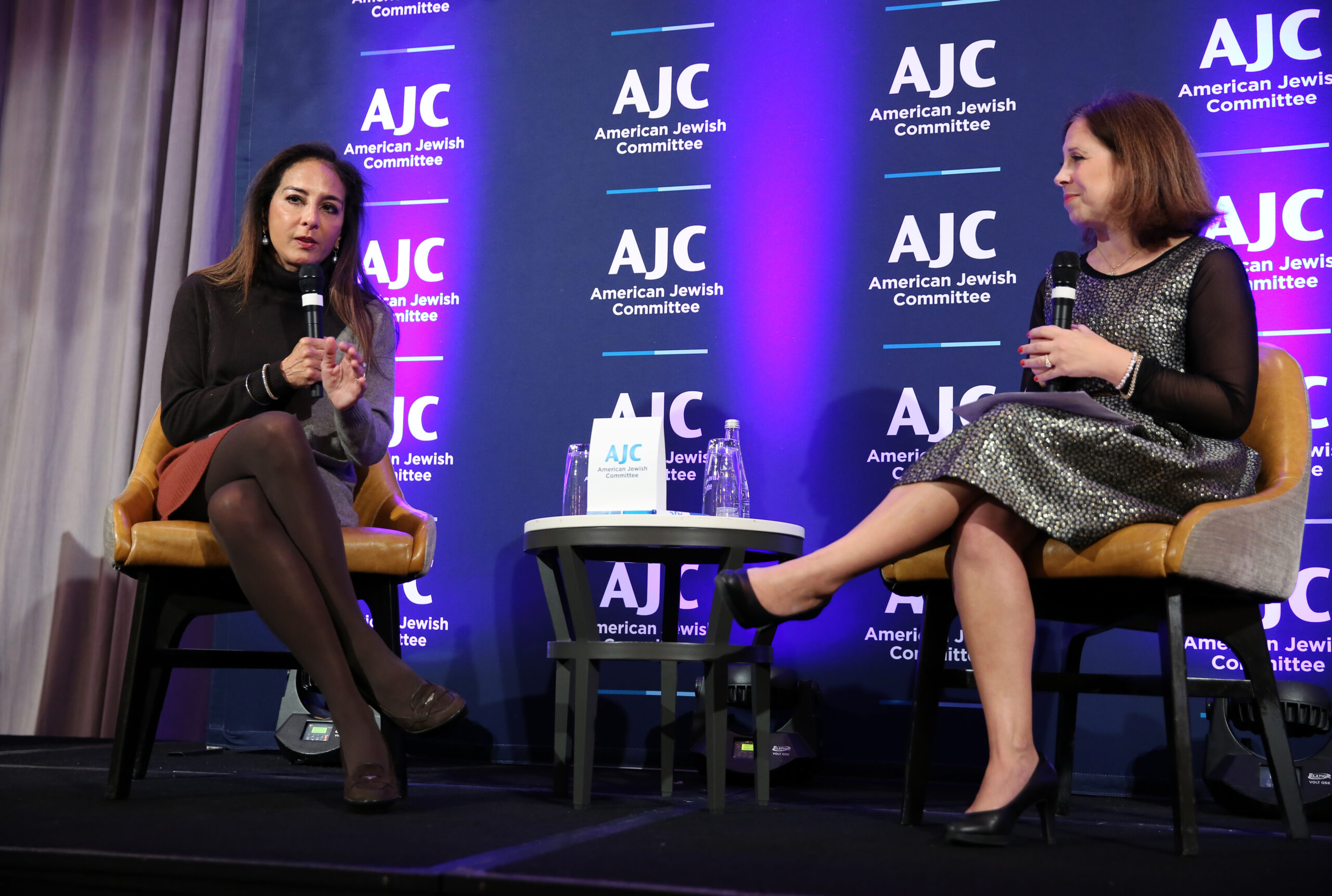
Julie Fishman Rayman (right), the American Jewish Committee’s senior vice president of policy and political affairs, interviewed the Department of Justice’s Harmeet Dhillon, who oversees the Civil Rights Division, on Tuesday at AJC’s National Leadership Council Advocacy Fly-In in Washington.
Birthdays
Israeli singer and survivor of the Nova Music Festival, she won second place in the Eurovision Song Contest 2025, Yuval Raphael turns 25…
Singer, poet and actor, best known as part of the duo Simon & Garfunkel, Art Garfunkel turns 84… Co-founder and chairman of Rexford Industrial Realty, Richard Ziman turns 83… Television and film critic, Jeffrey Lyons turns 81… French public intellectual, media personality and author, Bernard-Henri Lévy turns 77… Economist and former director of The Earth Institute at Columbia University where he remains a University Professor, Jeffrey Sachs turns 71… Israeli ceramic artist and sculptor, Daniela Yaniv-Richter turns 69… Psychologist and wife of Israeli Prime Minister Benjamin Netanyahu, Sara Netanyahu turns 67… Director at The Gottesman Fund, Diane Bennett Eidman… Music producer and entertainment attorney, Kevon Glickman… Former prime minister of Israel, now leader of the opposition, Yair Lapid turns 62… Former regional director of AJC New York, now CEO at Healthcare Foundation of NJ, Michael Schmidt… Research division director for JewishGen USA, Ellen Shindelman Kowitt turns 58… Senior fellow in governance studies at the Brookings Institution, Benjamin Wittes turns 56… Host, anchor and correspondent for CBS News and CBS Sports, Dana Jacobson turns 54… General counsel of The Jewish Theological Seminary, Keath Blatt… Jerusalem-born pianist, she has performed with major orchestras worldwide, Orli Shaham turns 50… Director at the Domestic Policy Council in the first six months of the Trump 47 administration, now director of federal education policy at America First Policy Institute, Max Eden turns 37… CEO and organizer of Los Angeles-based Aesthetics and Edits, Tara Khoshbin… Legal correspondent at Business Insider, Jacob Shamsian… Legislative assistant for Sen. Dave McCormick (R-PA), Talia Katz…
Plus, lawmakers say Pentagon, Elbridge Colby icing them out
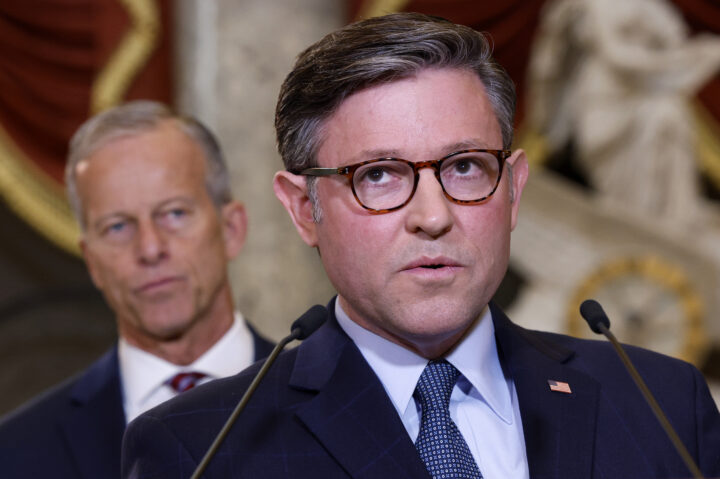
Kevin Dietsch/Getty Images
Speaker of the House Mike Johnson (R-LA), accompanied by Senate Majority Leader John Thune (R-SD), speaks during a news conference in Statuary Hall at the U.S. Capitol Building on October 3, 2025 in Washington, DC.
Good Tuesday afternoon!
This P.M. briefing is reserved for our premium subscribers like you — offering a forward-focused read on what we’re tracking now and what’s coming next.
I’m Danielle Cohen-Kanik, U.S. editor at Jewish Insider and curator, along with assists from my colleagues, of the Daily Overtime briefing. Please don’t hesitate to share your thoughts and feedback by replying to this email.
📡On Our Radar
Notable developments and interesting tidbits we’re tracking
Election Day is underway, and voters are breaking turnout records in New York City. Already by noon today, more people had voted in the mayoral race than had voted in the entirety of the 2021 NYC mayor’s race. By 3 p.m., more than 1.4 million New Yorkers had voted in the race — more than in any NYC mayoral election since 2001, according to The New York Times — with several more hours before the polls close at 9 p.m.
President Donald Trump chimed in last night, urging New Yorkers to vote for former Gov. Andrew Cuomo. “Whether you personally like Andrew Cuomo or not, you really have no choice. You must vote for him, and hope he does a fantastic job,” he wrote on social media. Trump added in another post, “Any Jewish person that votes for Zohran Mamdani, a proven and self professed JEW HATER, is a stupid person!!!”…
One party leader not weighing in: Senate Minority Leader Chuck Schumer (D-NY), who has officially made it through the mayoral race without issuing an endorsement. He had said throughout the election that he had held “conversations” with Mamdani but resisted calls to either endorse his party’s candidate or to denounce his anti-Israel views. At a press conference in the Capitol this afternoon, Schumer told reporters he himself had voted and “look[s] forward to working with the next mayor” but would not reveal who got his vote…
Leading right-wing figures continue to contend with the normalization of antisemitism within the GOP: House Speaker Mike Johnson (R-LA) joined the list of Republicans who have publicly admonished Tucker Carlson for platforming neo-Nazi Nick Fuentes on his podcast, saying today, “Some of the things [Fuentes has] said are just blatantly antisemitic, racist and anti-American. Anti-Christian, for that matter. I think we have to call out antisemitism wherever it is. Whether it’s Tucker or anybody else, I don’t think we should be giving a platform to that kind of speech. He has a First Amendment right, but we shouldn’t ever amplify it. That’s my view.”
Senate Majority Leader John Thune (R-SD) also denounced antisemitism on the right in comments today, though without naming Carlson or Fuentes. “Well, there are lots of voices, obviously, out there, but I don’t think there ought to be any — there just should be no room at all whatsoever for antisemitism or other forms of discrimination. That’s certainly not what our party is about,” Thune said…
Backlash against the Heritage Foundation for defending Carlson also continues; the National Task Force to Combat Antisemitism, a conservative coalition aligned with Heritage, changed its tune today in an email to President Kevin Roberts, a day after the task force said it would stand by the organization.
In today’s email, obtained by Jewish Insider’s Gabby Deutch, the NTFCA co-chairs made several demands of Roberts, including removing his controversial video defending Carlson; an apology “to those Christians and Jews who are steadfast members of the conservative movement and believe that Israel has a special role to play both biblically and politically;” a conference hosted by Heritage on the boundaries of the conservative movement; hiring a visiting fellow “who shares mainstream conservative views on Israel, Jews and Christian Zionists” to win over Gen Zers; and to host Shabbat dinners with Heritage’s interns and junior staff members to educate them about Judaism.
The task force co-chairs said in the email that if an agreement is not reached soon, their relationship with Heritage “will be irrevocably harmed.” Co-chair Luke Moon told JI, “If the terms aren’t met, we will take the NTFCA elsewhere”…
Several Jewish organizations have cut ties with the NTFCA already over the incident, including the Zionist Organization of America and Young Jewish Conservatives; today, the Coalition for Jewish Values and Combat Antisemitism Movement did so as well.
“We cannot grant legitimacy to an effort to combat antisemitism operated by the Heritage Foundation while Heritage is validating antisemitism and giving it a platform,” CJV wrote. “Although our target” on the task force “was and remains primarily a left-wing cause, ‘no enemies on the right’ was always liable to be proven false.”
CAM, in its resignation letter to Roberts, affirmed its support of free speech and specified that “the genesis of this letter is our deep concern with how you, Mr. Roberts, on behalf of the Heritage Foundation, have chosen to exercise your rights” [emphasis original]…
Bipartisan lawmakers expressed frustration with the Pentagon for not properly briefing them on national security issues at a Senate Armed Services Committee hearing today, after Defense Secretary Pete Hegseth announced a new rule last month requiring all Pentagon staffers to get approval before interacting with members of Congress.
Sen. Dan Sullivan (R-AK) called out Elbridge Colby, under secretary of defense for policy, specifically, saying it was even harder to contact him than Hegseth or Trump. “Man, I can’t even get a response, and we’re on your team,” Sullivan said…
The Trump administration is pushing Congress to repeal the Caesar Act sanctions on Syria ahead of Syrian President Ahmad al-Sharaa’s first visit to the White House on Monday, urging lawmakers to include it in the 2026 National Defense Authorization Act. The Senate already approved the repeal in its version of the NDAA last month, but the House version does not include a similar provision…
⏩ Tomorrow’s Agenda, Today
An early look at tomorrow’s storylines and schedule to keep you a step ahead
Keep an eye on Jewish Insider tomorrow morning for an interview with Republican Kentucky Senate candidate Nate Morris, who is seeking to take the seat of retiring Sen. Mitch McConnell (R-KY), and for a reflection on the late Vice President Dick Cheney’s legacy.
Tomorrow afternoon, the ADL will host a post-election briefing on the New York City mayoral race with its CEO, Jonathan Greenblatt, and Hindy Poupko, senior vice president of community strategy and external relations at UJA-Federation of New York.
Former Israeli hostage Emily Damari will appear at Temple Emanu-El in New York City tomorrow evening for her first public speaking engagement in the U.S., joined by author Noa Tishby.
Stories You May Have Missed
SCOOP
Before denouncing AIPAC, Moulton sought group’s endorsement for Senate campaign, source says
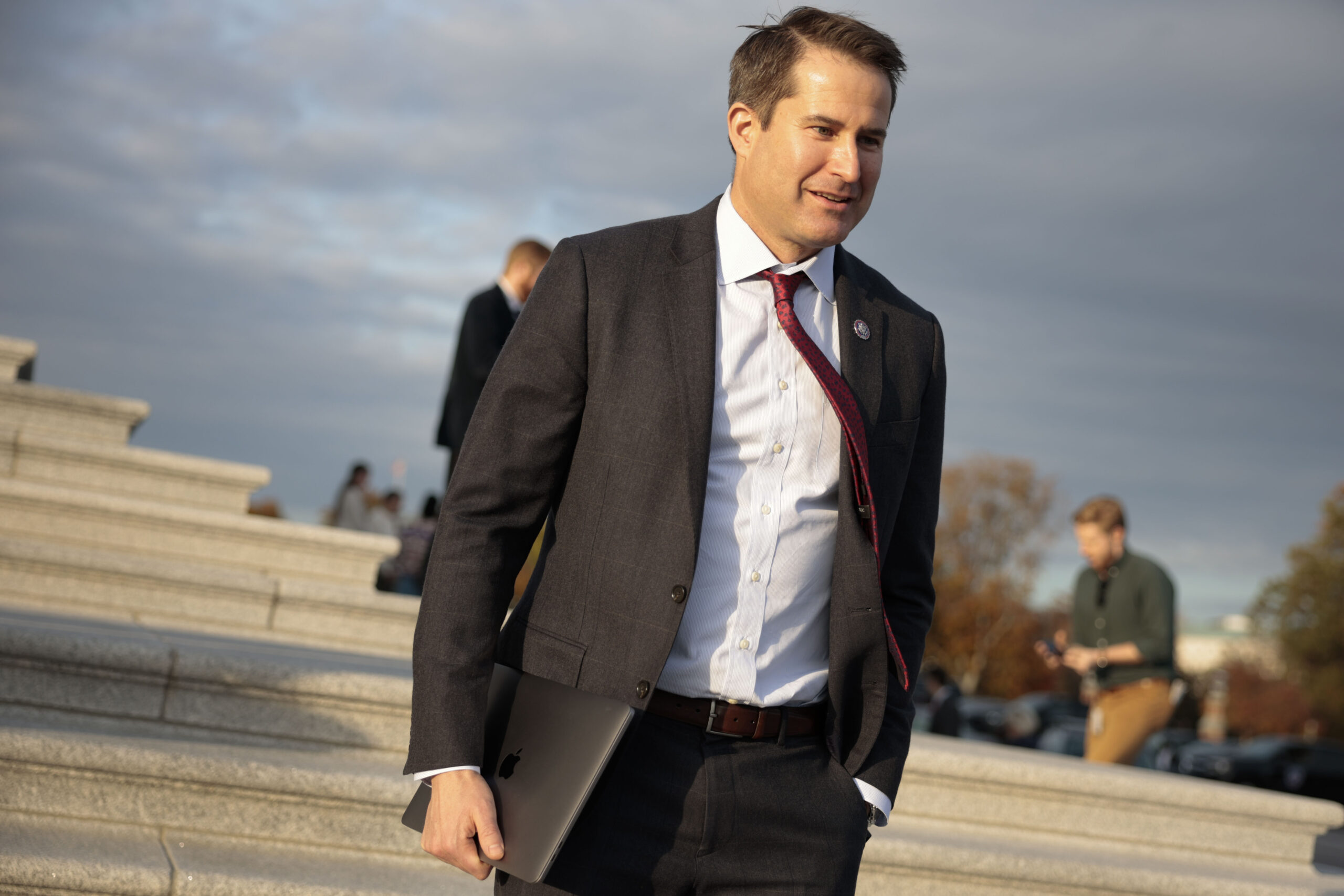
Moulton turned against the group when it was unable to guarantee him an endorsement upon the launch of his Senate campaign, a source told JI
THE X FACTOR
Conservatives resist blaming Musk for reinstating Nick Fuentes on X

X is the only mainstream social media platform where Fuentes is allowed to have an account; he was unblocked in May 2024 and now has over 1 million followers
The NYC mayoral front-runner has said that, if elected mayor, he may displace the campus, a joint project of Cornell University and Israel’s Technion, from Roosevelt Island
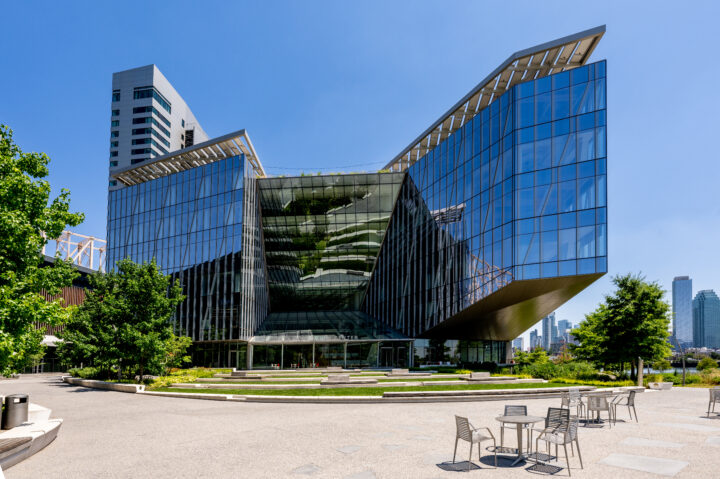
Roy Rochlin/Getty Images
A view of Tata Innovation Center at the Cornell Tech campus on Roosevelt Island on July 23, 2022 in New York City. Cornell Tech is joint academic venture between Cornell and the Technion – Israel Institute of Technology.
If elected mayor, Zohran Mamdani has said he would reassess the partnership between Cornell University and Israel’s Technion, potentially kicking the joint Cornell Tech campus out of its home on Roosevelt Island in New York City.
But two Jewish Mamdani backers who represent Roosevelt Island and have supported the project have been silent about his plans.
Cornell and Technion were selected by city officials under Mayor Mike Bloomberg in 2010 to build the campus on city-owned land and received $100 million in other incentives. It opened in 2017.
Mamdani’s campaign told The New York Times and Ynet that he would reassess the partnership if elected. As mayor, Mamdani would have the authority to appoint new members to Roosevelt Island’s governing board, giving him influence over management of the island.
Rep. Jerry Nadler (D-NY) and state Sen. Liz Krueger, both of whom have been supporters of Mamdani, as well as active backers of the Cornell Tech campus, did not respond to requests for comment. Both have appointees on the community task force that supported the construction of the campus, which is within their districts.
Mamdani called for a boycott of the campus shortly after being elected to the state Senate in 2020, and said that “Technion University is an Israeli University that has helped to develop a lot of weapons technology used by the IDF” and that the campus should be assessed through “the lens of BDS” — the Boycott, Divestment and Sanctions campaign targeting Israel — according to the New York Post.
Mamdani’s campaign did not respond to a request for comment on his stance or plans for the campus.
Former U.S. Ambassador to Israel Daniel Shapiro, now a distinguished fellow at the Atlantic Council, said Mamdani’s plans were “terrible.”
“It smacks of an academic boycott of a respected Israeli university,” Shapiro said. “It also is a great way to drive innovation jobs out of the city. Both wrong in principle and self-defeating in practice.”
Mamdani is also expected to attempt to block further investment in Israel bonds in the city’s pension fund and has said he would shut down the New York City-Israel Economic Council launched by Mayor Eric Adams.
Plus, Virginia LG candidate skirts antisemitism questions

Joshua Sukoff/Medill News Service
President Donald Trump holds a joint news conference at the White House with Israeli Prime Minister Benjamin Netanyahu on February 4, 2025. This is Trump’s first joint news conference with a foreign leader in his second term.
Good Monday afternoon!
This P.M. briefing is reserved for our premium subscribers like you — offering a forward-focused read on what we’re tracking now and what’s coming next.
I’m Danielle Cohen-Kanik, U.S. editor at Jewish Insider and curator, along with assists from my colleagues, of the Daily Overtime briefing. Please don’t hesitate to share your thoughts and feedback by replying to this email.
📡On Our Radar
Notable developments and interesting tidbits we’re tracking
It’s Election Day across the country tomorrow, and we’ll be watching several key races.
Front of mind is the New York City mayoral race where Democratic nominee Zohran Mamdani is expected to prevail, though it remains to be seen if he’ll claim an absolute majority.
All candidates are still vying for the Jewish vote: Over the weekend, divisions emerged in the anti-Zionist Satmar Hasidic community after one of its political leaders issued an endorsement of Mamdani — some leaders publicly broke ranks to reject the move and instead endorse his rival, former New York Gov. Andrew Cuomo.
Meanwhile, Republican nominee Curtis Sliwa visited the Lubavitcher Rebbe’s Ohel in Queens (and recalled a blessing he received from Rabbi Menachem Mendel Schneerson decades ago which Sliwa claimed “saved my life”)…
In nearby New Jersey, gubernatorial candidates Rep. Mikie Sherrill (D-NJ) and Jack Ciattarelli are doing the same. We’ve covered Sherrill’s recent outreach efforts to the state’s sizable Jewish community; on the GOP side, President Donald Trump posted on Truth Social on Sunday urging “ALL of my supporters in the Orthodox community in Lakewood [N.J.] and its surrounding towns to vote in HUGE numbers for Jack Ciattarelli,” naming in particular “all the Yeshiva students who turned out to vote for me last year.” Trump won around 88% of the heavily Jewish township’s vote in the 2024 presidential election…
And in Virginia, former Rep. Abigail Spanberger (D-VA) is likely to win the governor’s mansion against the state’s current lieutenant governor, Republican Winsome Earle-Sears, in a race set to make Old Dominion history — either way, the state will elect its first female governor.
Also on the Virginia ballot: Ghazala Hashmi, the Democratic state senator running for lieutenant governor, who has elicited concern from the state’s Jewish community over her past involvement in anti-Israel activism and her record on combating antisemitism.
In a brief interview today, Jewish Insider’s Editor-in-Chief Josh Kraushaar asked Hashmi how big of a challenge she thinks antisemitism is in Virginia. Hashmi replied: “I think we see growing challenges on so many levels of bigotry, and we have to be united in our efforts. I’m facing a great deal of Islamophobic attacks, as you probably have seen, so we have to respond to everything.” Pressed on what she thought about antisemitism specifically, Hashmi cut the interview short…
The fallout from the Heritage Foundation’s embrace of Tucker Carlson and refusal to disavow Nick Fuentes continues, as right-wing figures publicly declare themselves aligned with or opposed to the move. Orthodox conservative influencer Ben Shapiro said about Carlson, Fuentes and their ilk in a lengthy video statement today: “These people aren’t to my right. They’re not attached in any way to the fundamental principles of conservatism. And these people have already declared themselves my enemies. I’d be a fool not to take them seriously.”
Ryan Neuhaus, who served as Heritage Foundation President Kevin Roberts’ chief of staff until Friday, resigned after reposting numerous social media posts in defense of Roberts, including one saying that Heritage employees opposed to his statement were “virtue signaling” and calling for them to resign…
A new poll released today by the Democratic Majority for Israel finds that Democrats overwhelmingly support the ceasefire deal reached between Israel and Hamas and a majority of them think Trump played at least a “somewhat important role” in reaching the agreement, JI’s Danielle Cohen-Kanik reports.
A majority of those polled (56%) said they believe that the U.S. should keep its alliance with Israel, though only 32% felt so “strongly.” Three-quarters (75%) said they support Israel’s right to exist as a Jewish homeland, with 12% saying they don’t believe Israel has a right to exist…
The Wall Street Journal documents the rise and sustained popularity of Abdulmalik Al-Houthi, the reclusive commander of the Houthis in Yemen, who has continued to resist pressure by officials from Arab states to cease the terror group’s attacks on Israel and ships in the Red Sea, “and go back to being a relatively small-time player in the region’s conflicts.”
“‘They genuinely believe in this jihad to remove Israel from that land,’ said April Longley Alley, a former United Nations diplomat who has engaged with the Houthi leadership. ‘And they’re going to keep pushing’”…
Israeli Prime Minister Benjamin Netanyahu ordered the dispatch of a humanitarian and medical aid delegation from Israel to Jamaica today, to assist in relief efforts after Hurricane Melissa tore through the country earlier this week…
Sudanese refugees in Israel told The Times of Israel about the compounded pain and fear they experienced as the Oct. 7 Hamas attacks and the civil war in Sudan unfolded in parallel, decrying the lack of media coverage of Sudan while the world focused on Gaza…
Yad Vashem announced today that the museum has identified the names of 5 million Jewish victims of the Holocaust, and hopes to use artificial intelligence to name at least 250,000 more…
⏩ Tomorrow’s Agenda, Today
An early look at tomorrow’s storylines and schedule to keep you a step ahead
Keep an eye on Jewish Insider tomorrow morning for the backstory surrounding Massachusetts Senate candidate Rep. Seth Moulton’s (D-MA) attacks against AIPAC.
Tomorrow, the World Zionist Organization and Temple Emanu-El are holding a memorial event in New York City for slain Israeli Prime Minister Yitzhak Rabin on the 30th anniversary of his assassination. Speakers will include Rabin’s grandson, Jonathan Benartzi; Yehuda Kurtzer, president of the Shalom Hartman Institute; former U.S. Ambassador to Israel Dan Shapiro; Amy Spitalnick, CEO of the Jewish Council for Public Affairs; and Israeli American peace advocate Alana Zeitchik.
Stories You May Have Missed
UNIVERSITY INSIGHTS
Longtime higher ed leader Gordon Gee says fear, not free speech, is ruling America’s campuses

Gee, who served as president of five universities over 45 years, told JI he believes some administrators are opposed to reform efforts as a knee-jerk reaction to Trump
SHOW OF SOLIDARITY
Overhauled Kennedy Center takes on the mantle of combating antisemitism
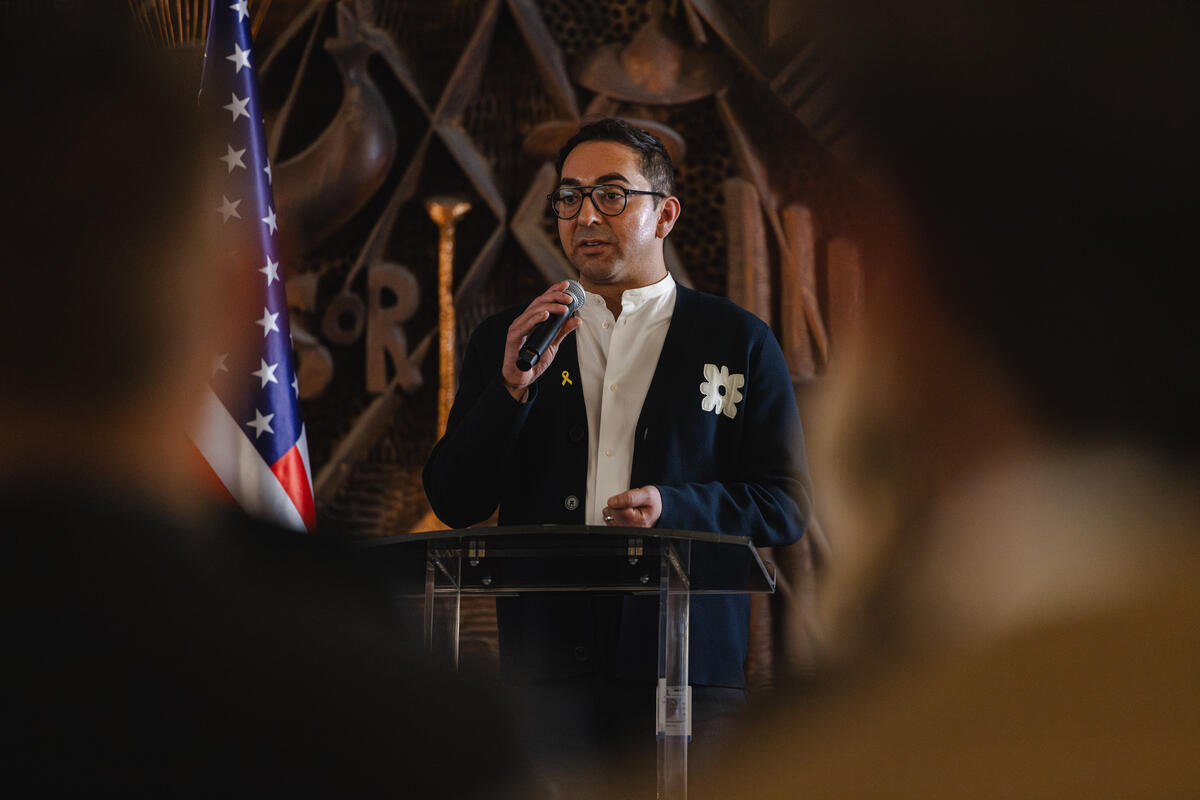
With a new board and leadership, the Kennedy Center is spotlighting Jewish culture and the fight against antisemitism in ‘solidarity’
Plus, Palantir CTO's Israeli inspiration
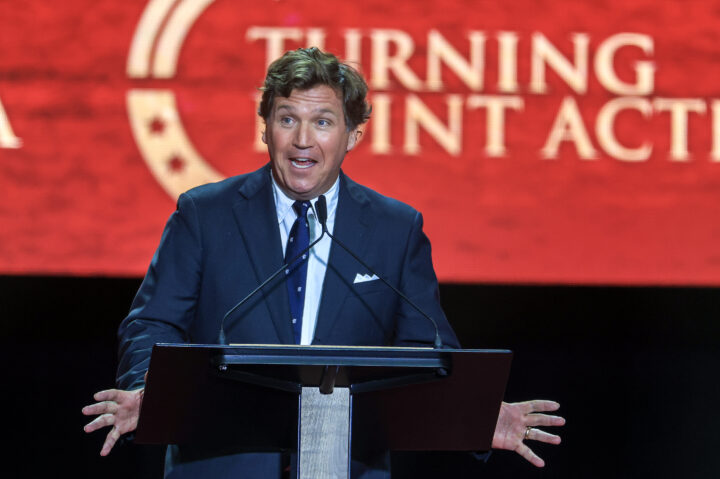
Joe Raedle/Getty Images
Tucker Carlson speaks during the memorial service for political activist Charlie Kirk at State Farm Stadium on September 21, 2025 in Glendale, Arizona.
Good Thursday afternoon!
This P.M. briefing is reserved for our premium subscribers like you — offering a forward-focused read on what we’re tracking now and what’s coming next.
I’m Danielle Cohen-Kanik, U.S. editor at Jewish Insider and curator, along with assists from my colleagues, of the Daily Overtime briefing. Please don’t hesitate to share your thoughts and feedback by replying to this email.
📡On Our Radar
Notable developments and interesting tidbits we’re tracking
Efforts are underway to establish an International Stabilization Force in Gaza, Axios scooped today, with U.S. Central Command taking the lead on drafting the plan and holding discussions with countries, including Indonesia, Azerbaijan, Egypt and Turkey, to potentially contribute troops.
Though Israeli officials have said they oppose Turkey’s involvement in Gaza, the U.S. still views Ankara as most capable of getting Hamas “to agree and behave,” one U.S. official told the outlet.
Israel’s main concern is the new force’s legitimacy with Gazans and its willingness to engage militarily with Hamas, a senior Israeli official said. The plan would also see the creation of a new Palestinian police force, with training and vetting by the U.S., Egypt and Jordan…
Kevin Roberts, president of the influential Heritage Foundation, released a video today affirming the organization’s support of anti-Israel commentator Tucker Carlson, defending the podcaster from the “pressure” of the “globalist class,” after reports arose that Heritage had scrubbed references to Carlson from one of its donation pages.
“When it serves the interests of the United States to cooperate with Israel and other allies, we should do so … But when it doesn’t, conservatives should feel no obligation to reflexively support any foreign government, no matter how loud the pressure becomes from the globalist class or from their mouthpieces in Washington,” Roberts said.
His comments come days after Carlson hosted neo-Nazi influencer Nick Fuentes on his podcast, whom Roberts said he was unwilling to “cancel.”
“We will always defend our friends against the slander of bad actors who serve someone else’s agenda. That includes Tucker Carlson, who remains — and as I have said before — always will be a close friend of the Heritage Foundation,” Roberts continued…
In the run-up to the New York City mayoral election, The Bulwark co-founder Bill Kristol — a longtime conservative commentator and founder of The Weekly Standard — said that he would vote for Democratic nominee Zohran Mamdani if he were a resident of the city.
“You know, New York City gets to have a left-wing mayor. It’s not the first time, and it’s different from the rest of the country. I wish they were a little less, you know, tolerant of certain things — on Israel, and so, against Israel and all that. But some of the economic stuff, I think, is just silly, but I don’t think it’s going to matter,” Kristol told The Forum. He called “the idea of going back to” former New York Gov. Andrew Cuomo “ridiculous”…
Cuomo, meanwhile, picked up the endorsement of Rep. Nick Langworthy (R-NY), the former chair of the New York State Republican Party, who said he’s had “plenty of disagreements — very publicly over the years — and fought tooth and nail with Gov. Cuomo. But there’s no doubt in my mind he would be a far superior mayor than a communist,” referring to Mamdani.
When asked if it’s a mistake for Republican nominee Curtis Sliwa to stay in the race, Langworthy said, “Everyone’s really got to check, is this a vanity project? Or is this something you’re trying to do to seriously be the mayor? There’s only one candidate running against Mamdani that has a credible path to win. And there’s Andrew Cuomo”…
Rep. Elise Stefanik (R-NY) is preparing to enter the race for New York governor shortly after the mayoral election, Axios reports, with more than $13 million on hand. Stefanik’s team reportedly believes New Yorkers will turn on the Democratic Party if Mamdani is elected mayor, leaving Democratic Gov. Kathy Hochul — who endorsed Mamdani — more vulnerable…
Rep. Haley Stevens (D-MI), the party front-runner for Senate in Michigan, is “underwhelming” the Democratic establishment, NOTUS reports, with strategists warning that her fundraising and campaign activity does not show her substantially pulling ahead of her opponents — state Sen. Mallory McMorrow and Abdul El-Sayed, the latter of whom is backed by Sen. Bernie Sanders (I-VT), both running to her left — as expected…
Palantir’s chief technology officer, Shyam Sankar, appearing on The New York Times’ “Interesting Times” podcast released today, affirmed that Israel is a “morally appropriate partner” for the software giant to conduct business with, and said that he was motivated to join up as a lieutenant colonel in the U.S. Army Reserves this year to lend his technological expertise because of his “observation in Israel after Oct. 7.”
“Israel is an incredibly technical country. Bountiful resources of technologists,” Sankar said. But when reservists were called up to join the IDF in its war in Gaza, “they were horrified at the state of technology, which is actually an implicit self-critique. … The IDF got more modernization done in the four months after Oct. 7 than in the 10 years that I’d worked with them prior”…
⏩ Tomorrow’s Agenda, Today
An early look at tomorrow’s storylines and schedule to keep you a step ahead
Keep an eye on Jewish Insider tomorrow morning for reporting on the Kennedy Center’s efforts to address antisemitism and fight cultural boycotts of Israel as its Trump-appointed director looks to make a mark on programming at the institution.
The Republican Jewish Coalition’s leadership summit kicks off tomorrow in Las Vegas, with featured speakers including House Speaker Mike Johnson (R-LA), Homeland Security Secretary Kristi Noem, Sen. Lindsey Graham (R-SC), Arkansas Gov. Sarah Huckabee Sanders, Rep. Randy Fine (R-FL), Israeli Ambassador to the U.S. Yechiel Leiter and many more. JI’s Matthew Kassel will be in attendance — be sure to say hello!
We’ll be back in your inbox with the Daily Overtime on Monday. Shabbat Shalom!
Stories You May Have Missed
CALIFORNIA CAMPAIGN TRAIL
Scott Wiener, looking to succeed Pelosi, balances progressive politics with Jewish allyship

Weiner, a longtime California state senator, could face a crowded field of Democrats if Nancy Pelosi retires — including AOC’s former chief of staff
TURNING UP THE VOLUME
Former Rep. Cori Bush shows no signs of dialing down extreme rhetoric in comeback campaign
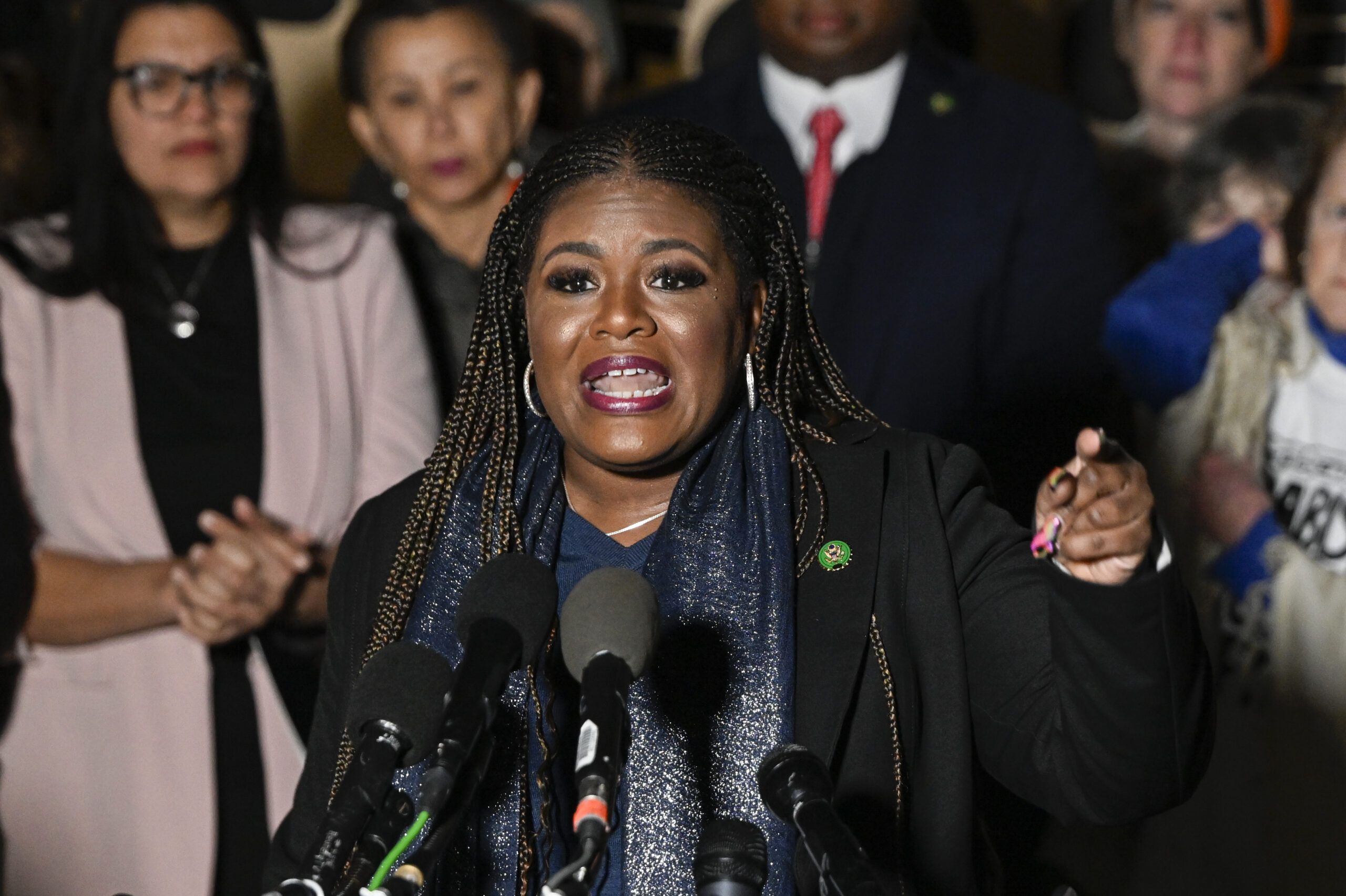
In a speech at a ‘No Kings’ rally, Bush spent time eulogizing convicted murderer Assata Shakur
Plus, Suozzi re-ups Cuomo endorsement
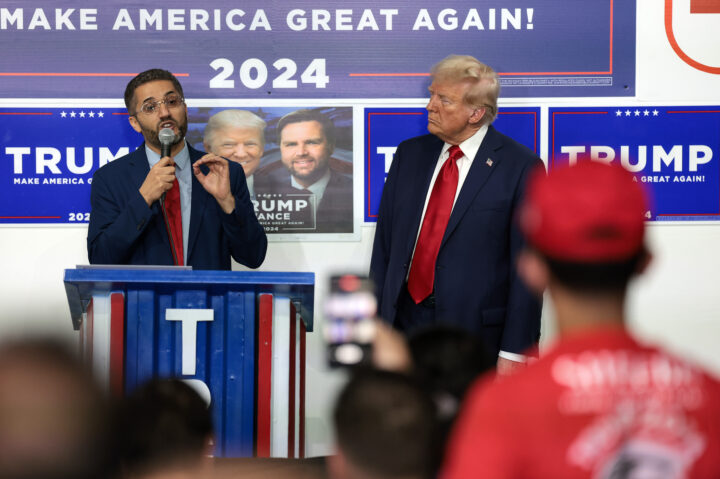
Win McNamee/Getty Images
Hamtramck, Mich. Mayor Amer Ghalib introduces President Donald Trump, as Trump visits a campaign office on Oct. 18, 2024, in Hamtramck, Michigan.
Good Wednesday afternoon!
This P.M. briefing is reserved for our premium subscribers like you — offering a forward-focused read on what we’re tracking now and what’s coming next.
I’m Danielle Cohen-Kanik, U.S. editor at Jewish Insider and curator, along with assists from my colleagues, of the Daily Overtime briefing. Please don’t hesitate to share your thoughts and feedback by replying to this email.
📡On Our Radar
Notable developments and interesting tidbits we’re tracking
The White House has told Republicans that President Donald Trump will not pull the nomination of Amer Ghalib, the mayor of Hamtramck, Mich., to be U.S. ambassador to Kuwait and wants the Senate Foreign Relations Committee to hold a vote on his candidacy, despite the growing bipartisan opposition to his nomination, Jewish Insider’s Emily Jacobs reports.
White House officials have communicated to committee Republicans in recent days that Trump would not withdraw Ghalib’s nomination because the president credits the Democratic Hamtramck mayor with helping him win the state of Michigan in the 2024 presidential election by turning out the state’s Arab American vote, two sources familiar with the ongoing discussions told JI.
“If Trump wants his friend to go down that way, that’s OK. He can go down that way,” one Republican on the committee said, expressing confidence that Ghalib had no path to advance out of committee…
Rep. Tom Suozzi (D-NY), who represents a Long Island-based swing district on the outskirts of New York City, today endorsed former New York Gov. Andrew Cuomo in the general election for New York City mayor. Suozzi had endorsed Cuomo in the Democratic primary and announced last month that he would not be endorsing Zohran Mamdani after he secured the party’s nomination.
In Suozzi’s decision to re-up his support for Cuomo, now running as an independent, less than a week out from the election, he distanced himself from Mamdani’s political leanings: “I’m a Democratic Capitalist, not a Democratic Socialist. I endorse Andrew Cuomo. I can not back a declared socialist with a thin resume to run the most complex city in America”…
Time magazine profiles New York City Mayor Eric Adams, where he recalls hosting Mamdani and his father, Mahmood Mamdani — a professor at Columbia University with a long record of anti-Israel commentary — for dinner in 2023. “The frightening thing is, he really believes this stuff! Globalize the intifada, there’s nothing wrong with that! He believes, you know, I don’t have anything against Jews, I just don’t like Israel. Well, who’s in Israel, bro?” Adams said…
Elsewhere in New York, the Democratic race to clinch the nomination for retiring Rep. Jerry Nadler (D-NY)’s seat gained another candidate today: Cameron Kasky, a Jewish gun control activist who survived the Marjory Stoneman Douglas High School shooting in 2018. Kasky, who recently started co-hosting the “For You Pod” with The Bulwark, frequently criticizes Israel and AIPAC in public statements, including accusing Israel of carrying out a genocide in Gaza and not being committed to the ongoing ceasefire with Hamas.
The field to succeed Nadler, a progressive Jewish lawmaker whose district has one of the largest Jewish constituencies in the country, has already drawn several candidates, including his former longtime aide, Micah Lasher…
Another candidate with harsh words for AIPAC is Rep. Seth Moulton (D-MA), challenging Sen. Ed Markey (D-MA) for his seat. Moulton, considered more moderate than Markey, continued to appeal to his left flank this week, appearing on a podcast hosted by Jack Cocchiarella, a self-described “progressive Gen Z political commentator” who frequently engages in harsh criticism of Israel on social media.
Moulton — who recently decided to return AIPAC’s donations and pledged not to take its support going forward — said his split with the group could continue to feature in the race depending “a lot on what happens in Gaza and Israel. … I certainly hope … we don’t resort to more violence, and if that’s the case, I think we’ll be able to talk about other issues in this campaign. Sadly, if it’s not, then I’m sure this will keep coming up.”
Moulton did not push back on Cocchiarella’s assertion that AIPAC, which he said has ties to the “Netanyahu regime,” should “be registered as a foreign lobby.” (Accusations from both political fringes that AIPAC — whose members are American citizens — constitutes a foreign influence operation have often invoked antisemitic dual loyalty tropes)…
The Anti-Defamation League today removed a section called “Protect Civil Rights” from its “What We Do” webpage, the Jewish Telegraphic Agency reports, shortly after it pulled down its “Glossary of Extremism and Hate” amid conservative attacks on the organization. The group appears to be pivoting after FBI Director Kash Patel recently cut the bureau’s ties with the ADL, calling it “an extreme group functioning like a terrorist organization”…
Spotted in Riyadh, Syrian President Ahmad al-Sharaa spoke today at the Future Investment Initiative summit, with front-row spectators Donald Trump Jr. and Saudi Crown Prince Mohammed bin Salman…
Also in the region, U.S. envoy Morgan Ortagus visited Lebanon today to push the Lebanese government to speed up efforts to disarm Hezbollah, with a goal of total disarmament by the end of the year, The New York Times reports.
The Lebanese Armed Forces have seized 10,000 rockets and 400 missiles from the terror group as part of disarmament efforts already, though Israeli and American officials told the Times it’s not sufficient, with Hezbollah moving to rebuild its stockpile…
⏩ Tomorrow’s Agenda, Today
An early look at tomorrow’s storylines and schedule to keep you a step ahead
Keep an eye on Jewish Insider tomorrow morning for an interview with California Democratic state Sen. Scott Weiner, running to replace former House Speaker Nancy Pelosi (D-CA), who is rumored to be announcing her retirement plans shortly.
Tomorrow, the N7 Foundation and Polaris National Security Foundation are hosting the invite-only Washington Prosperity Summit, with attendees including Trump administration officials, bipartisan lawmakers, foreign dignitaries from the Middle East and business executives, “to explore policies to advance prosperity in the region.”
The Simon Wiesenthal Center is hosting its 2025 Humanitarian Award Dinner in Los Angeles tomorrow, honoring Warner Bros. Discovery CEO David Zaslav, CNN anchor Dana Bash, Oct. 7 survivor Aya Meydan and former Israeli hostage Omer Shem Tov. Director Steven Spielberg will present Zaslav with this year’s Humanitarian Award, the center’s highest honor.
In Washington, Sony Pictures Entertainment, the Motion Picture Association and the German Embassy will host a special screening of “Nuremberg,” a new feature film on the Nuremberg Trials.
Also tomorrow, the World Zionist Congress wraps up in Jerusalem and the Future Investment Initiative summit comes to a close in Riyadh.
Stories You May Have Missed
JUSTICE, JUSTICE HE PURSUES
New U.S. Attorney in Minnesota Daniel Rosen sees history of antisemitism repeating itself
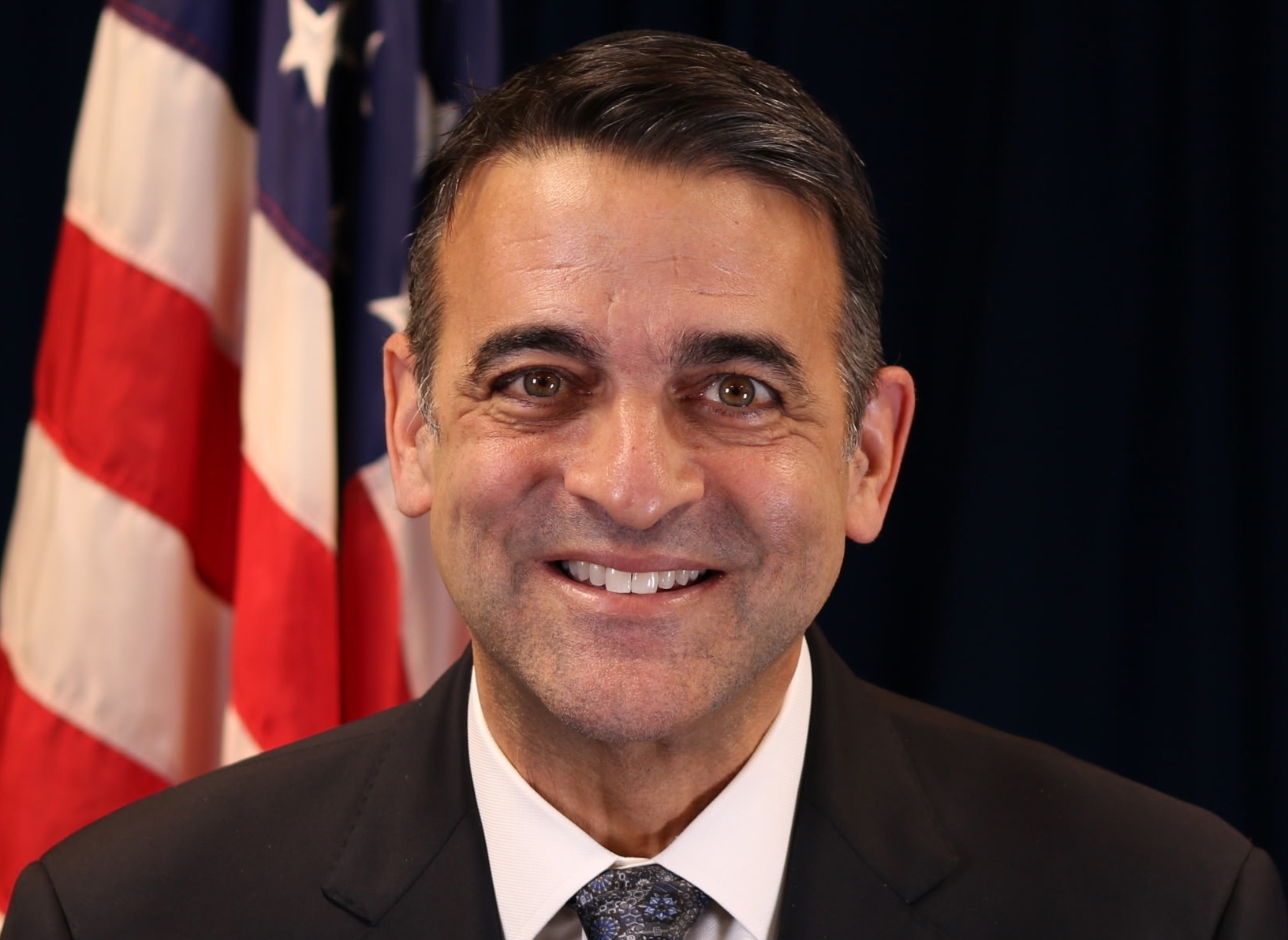
In an interview with JI, the Minnesota prosecutor and Jewish community leader said he was motivated to seek the role because of the ‘rapid escalation of violent antisemitism’
TIKTOK TALK
Jewish leaders, tech experts hopeful, but realistic about TikTok deal’s impact on online antisemitism
JFNA CEO Eric Fingerhut cited TikTok’s new owners’ ties to the Jewish community as an an encouraging sign
The president is standing by Amer Ghalib, the Hamtramck, Mich., mayor nominated to be U.S. ambassador to Kuwait, telling Republicans he won’t withdraw the pick
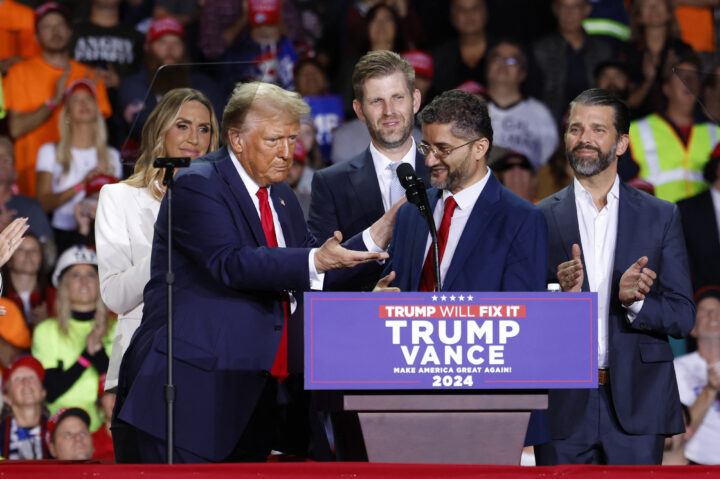
JEFF KOWALSKY/AFP via Getty Images
President Donald Trump introduces Democratic Muslim mayor of Hamtramck Amer Ghalib during his last campaign rally at Van Andel Arena in Grand Rapids, Michigan.
The White House has told Republicans that President Donald Trump will not pull the nomination of Amer Ghalib, the mayor of Hamtramck, Mich., to be U.S. ambassador to Kuwait and wants the Senate Foreign Relations Committee to hold a vote on his candidacy, despite the growing bipartisan opposition to his nomination, Jewish Insider has learned.
White House officials have communicated to committee Republicans in recent days that Trump would not withdraw Ghalib’s nomination because the president credits the Democratic Hamtramck mayor with helping him turn out Michigan’s Arab-American vote and win the state in last November’s presidential election, two sources familiar with the ongoing discussions told JI.
“We were told Trump believes he [Ghalib] helped him deliver Michigan. He doesn’t want to abandon him,” one GOP senator on the committee said of the White House’s characterization of the president’s thinking.
Pressed about the four committee Republicans who already committed to joining all Democrats in opposing Ghalib’s confirmation, the White House has told senators and senior committee staffers that Trump wants Ghalib’s nomination to receive a vote regardless of the outcome.
“If Trump wants his friend to go down that way, that’s OK. He can go down that way,” another Republican on the committee said, expressing confidence that Ghalib had no path to advance out of committee.
No Democratic senators on the committee will support advancing Ghalib’s nomination to the full Senate if and when it comes up for a vote, a source familiar with the Democratic whip count told JI. With all Democrats opposed, Ghalib could only afford to lose one Republican to be reported favorably out of committee.
Four committee Republicans have already come out publicly against his nomination — Sens. Ted Cruz (R-TX), John Curtis (R-UT), Dave McCormick (R-PA) and John Cornyn (R-TX). At least two others confirmed to JI that they have voiced their reservations about Ghalib to the White House in the wake of his confirmation hearing last week, when Ghalib faced a bipartisan grilling over his long record of promoting antisemitic ideas and his embrace of anti-Israel positions as an elected official. Those senators have not yet made those concerns public.
The White House did not respond to JI’s request for comment on Tuesday.
Sen. Jim Risch (R-ID), the committee’s chairman, acknowledged to JI on Tuesday evening that he had not yet scheduled Ghalib’s nomination for a vote, but demurred when asked if he planned to do so.
A committee spokesperson for Risch declined to comment.
“A lot of what Trump is doing is kind of testing whether these guys have a gag reflex,” one Democratic committee member said of the situation, surmising that the president’s actions were partially aimed at assessing how much Republicans were willing to push back on nominees and legislative proposals that they object to.
Plus, Mamdani invokes antisemitic tropes in newly revealed video
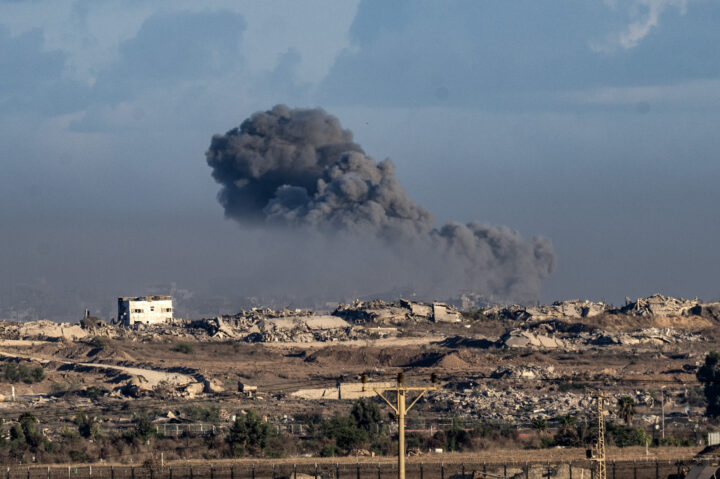
Mostafa Alkharouf/Anadolu via Getty Images
Smoke rises after Israeli airstrikes in the Gaza Strip, as seen from Israel near the border, on Oct. 7, 2025.
Good Tuesday afternoon!
This P.M. briefing is reserved for our premium subscribers like you — offering a forward-focused read on what we’re tracking now and what’s coming next.
I’m Danielle Cohen-Kanik, U.S. editor at Jewish Insider and curator, along with assists from my colleagues, of the Daily Overtime briefing. Please don’t hesitate to share your thoughts and feedback by replying to this email.
📡On Our Radar
Notable developments and interesting tidbits we’re tracking
Israeli Prime Minister Benjamin Netanyahu today ordered the IDF to “immediately carry out forceful strikes in the Gaza Strip” after Hamas terrorists opened fire on Israeli troops in the southern Gaza city of Rafah.
Hamas, in response, said it is postponing the release of a hostage body meant to be turned over to Israel today. Yesterday, Hamas staged the recovery of hostage remains that it reburied before handing to the Red Cross, caught on film by the IDF, which turned out to be partial remains belonging to a hostage who was already recovered by the Israeli army in 2023. Netanyahu said the act “constitute[d] a clear violation of the [ceasefire] agreement.”
Israeli officials told Axios that Netanyahu initially sought approval for action against Hamas from President Donald Trump, who is currently traveling in Asia, before moving forward, but there’s “no indication” the two leaders spoke before Netanyahu’s announcement on today’s strikes…
A senior Israeli official told Israel Hayom that Saudi Arabia has scaled back its participation in ceasefire talks after far-right Israeli Finance Minister Bezalel Smotrich made a disparaging comment last week on Saudi-Israel normalization, if it were to require the establishment of a Palestinian state. The statement (“No thank you, keep riding camels in the desert”) prompted blowback and he apologized shortly after.
“It’s not only because of Smotrich, but his comments certainly pushed [the Saudis] in that direction,” the official told the outlet. “Israel is now dealing with a bloc that includes Turkey, Qatar and Egypt — countries interested in preserving Hamas’ role in Gaza to varying degrees and refusing to pressure it to disarm”…
The Wall Street Journal traveled to an IDF outpost on the “yellow line” demarcating where Israeli troops have pulled back in Gaza. Israel is working on building water and electricity infrastructure and new aid hubs in the area and believes the entire line, which sits on high ground by design, is defensible from Hamas, Israeli officials told the Journal…
With a week to go until Election Day in the New York City mayoral race, new video has surfaced of Democratic nominee Zohran Mamdani invoking antisemitic rhetoric shortly before the Oct. 7, 2023, terror attacks.
Speaking at a Democratic Socialists of America convention in August 2023, Mamdani said, “For anyone to care about these issues, we have to make them hyper local. We have to make clear that when the boot of the NYPD is on your neck, it’s been laced by the IDF.” The idea that police brutality in the United States is caused by law enforcement training or coordination with Israel is a modern antisemitic trope.
Mamdani continued, “We are in a country where those connections abound, especially in New York City. You have so many opportunities to make clear the ways in which that struggle over there [Israel], is tied to capitalist interests over here”…
Meanwhile, The New York Times reports on the super PACs backing former New York Gov. Andrew Cuomo for mayor, which have raised him more than $40 million over the course of the election — compared to $10 million raised by super PACs for Mamdani and $1 million for Curtis Sliwa, the Republican nominee.
“The donors to the pro-Cuomo super PACs have included Michael R. Bloomberg, the former mayor; William Lauder, the chair of the Estée Lauder Companies; Ronald Lauder, the president of the World Jewish Congress; Bill Ackman, the investor; Steve Wynn, the casino investor; Daniel Loeb, the hedge fund manager; Barry Diller, the chairman of IAC; and Joe Gebbia, the co-founder of Airbnb,” the Times reports.
Bloomberg, who spent at least $8 million attempting to defeat Mamdani in the Democratic primary, met with him last month after he clinched the party’s nomination. Bloomberg was careful to note it was not an endorsement meeting, but rather a discussion on policy and staffing if Mamdani is elected mayor…
On the Hill, the nomination of Amer Ghalib, the mayor of Hamtramck, Mich., to be U.S. ambassador to Kuwait is facing what appear to be insurmountable odds as opposition to his confirmation grows among Senate Republicans, Jewish Insider’s Emily Jacobs reports.
Senators on both sides of the aisle had privately expressed reservations about Ghalib’s nomination prior to his rocky confirmation hearing in the Senate Foreign Relations Committee last week, but his attempts to evade responsibility for his support of antisemitic positions prompted several Republicans on the committee to go public.
Sen. Ted Cruz (R-TX) announced at the end of Ghalib’s hearing last Thursday that he would not be able to support moving his nomination out of committee to the Senate floor. Sens. John Curtis (R-UT), John Cornyn (R-TX) and Dave McCormick (R-PA) have since followed suit. Others on the panel, including Sen. Pete Ricketts (R-NE), have said they plan to raise their concerns about Ghalib with the committee chairman, Sen. Jim Risch (R-ID), and the White House…
Rep. Claudia Tenney (R-NY) will introduce a resolution this week affirming Israel’s sovereignty over the Temple Mount and demanding equal freedom of worship for all, JI’s Emily Jacobs scooped.
The resolution, if adopted, would put the House of Representatives on record as affirming “the inalienable right of the Jewish people to full access [of] the Temple Mount and the right to pray and worship on the Temple Mount, consistent with the principles of religious freedom.”
The current Israeli position, however, that Netanyahu has consistently affirmed, is to maintain the status quo at the holy site, which restricts Jewish prayer…
Rep. Elise Stefanik (R-NY), who led the the memorable questioning of university presidents at a House Education Committee hearing in December 2023, is coming out with a new book, titled Poisoned Ivies: The Inside Account of the Academic and Moral Rot at America’s Elite Universities, on April 7, 2026…
⏩ Tomorrow’s Agenda, Today
An early look at tomorrow’s storylines and schedule to keep you a step ahead
Keep an eye on Jewish Insider tomorrow morning for reaction in Washington to Israel’s latest strikes in Gaza in response to Hamas’ ceasefire violations.
Tomorrow, the Future Investment Initiative continues its ninth annual conference in Riyadh, Saudi Arabia.
In the evening, the Jewish Community Relations Council of Greater Washington is hosting its 2025 annual gala. Honorees include former Rep. David Trone (D-MD) and his wife, June, who is a JCRC board member; Behnam Dayanim, attorney and JCRC vice president; and Eva Davis, a realtor and co-chair of the Jewish Federation of Greater Washington’s Network Council.
Stories You May Have Missed
POSTWAR PLAN
East Gaza v. west Gaza: How partial IDF control could shape the enclave
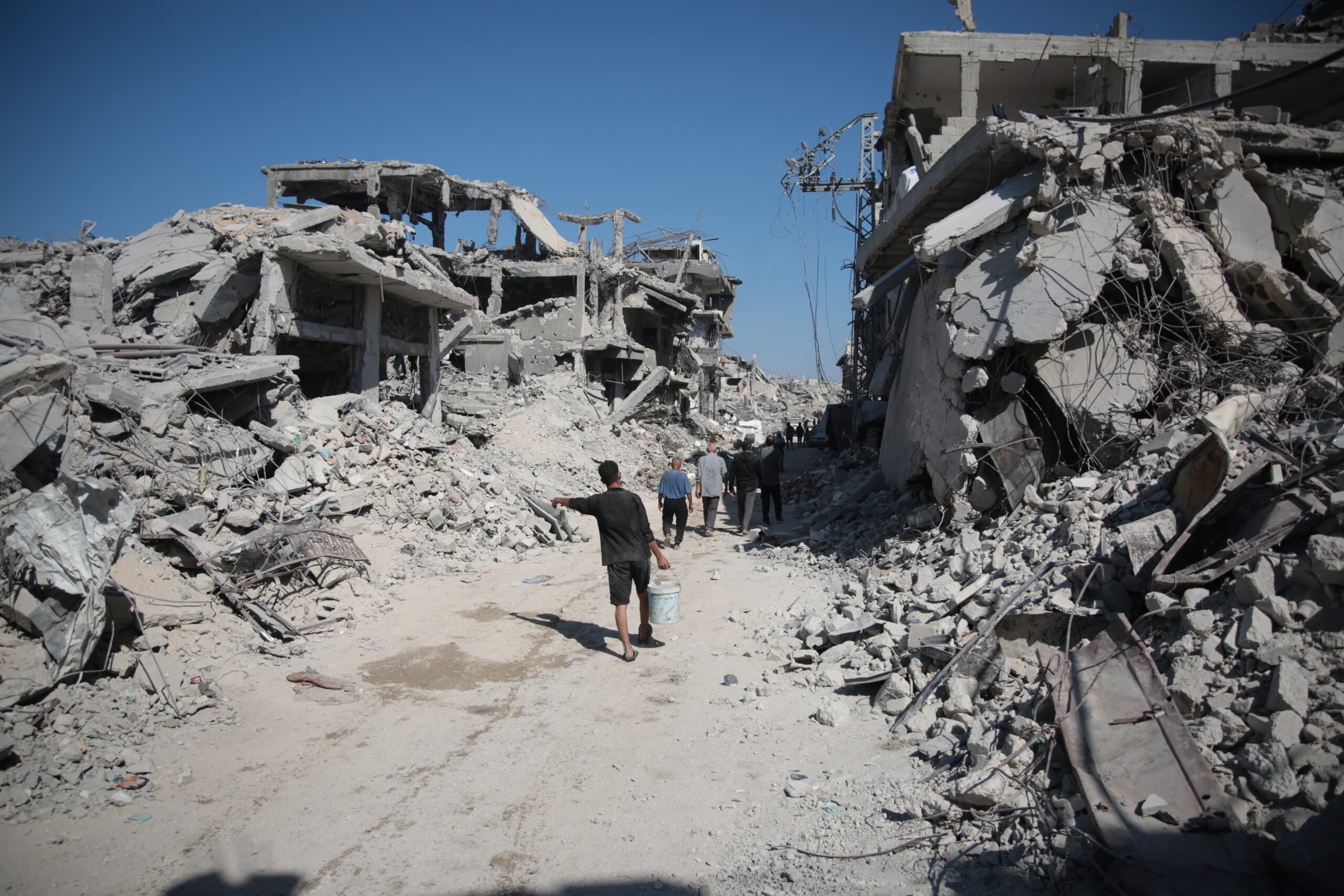
Experts say the IDF-controlled eastern region of Gaza could become a tool to isolate the terrorist group and reshape the enclave’s future, even as major hurdles remain
COPYCAT EFFECT
Fairfax County schools denounce Muslim student groups promoting hostage taking, violence on social media

The DC area’s Jewish community council calls for the offending students to be disciplined
Amer Ghalib’s path to confirmation is unclear as at least four Republicans now oppose him becoming ambassador
Win McNamee/Getty Images
Hamtramck, Mich. Mayor Amer Ghalib introduces President Donald Trump, as Trump visits a campaign office on Oct. 18, 2024, in Hamtramck, Michigan.
The nomination of Amer Ghalib, the mayor of Hamtramck, Mich., to be U.S. ambassador to Kuwait is facing what appear to be insurmountable odds as opposition to his confirmation grows among Senate Republicans.
No Republican or Democratic senators have come to Ghalib’s defense after his performance at his confirmation hearing before the Senate Foreign Relations Committee last week, when he faced a bipartisan grilling over his long record of promoting antisemitic ideas and his embrace of anti-Israel positions as an elected official.
Senators on both sides of the aisle had privately expressed reservations about Ghalib’s nomination prior to the hearing, but his attempts to evade responsibility for his record while under oath prompted several Republicans on the committee to go public.
Sen. Ted Cruz (R-TX) announced at the end of Ghalib’s hearing last Thursday that he would not be able to support moving his nomination out of committee to the Senate floor. Sens. John Curtis (R-UT), John Cornyn (R-TX) and Dave McCormick (R-PA) have since followed suit. Others on the panel, including Sen. Pete Ricketts (R-NE), have said they plan to raise their concerns about Ghalib with the committee chairman, Sen. Jim Risch (R-ID), and the White House.
“Based on the hearing that we had last week, I’m going to vote no against him,” McCormick told Punchbowl News on Tuesday. “I don’t think he demonstrated that he’s qualified for the role.”
Asked about Ghalib and the concerns surrounding his nomination while speaking to reporters on Tuesday morning, Senate Majority Leader John Thune (R-SD) said he was “vaguely familiar” with the Hamtramck mayor’s nomination but had not “examined” the matter closely.
The White House did not respond to Jewish Insider’s multiple requests for comment on the status of Ghalib’s nomination or the growing number of GOP senators coming forward to oppose him.
Ghalib is not believed to have any support on the Democratic side, reinforced by his lackluster answers to questions about his documented history of antisemitic remarks from Sens. Chris Murphy (D-CT), Tim Kaine (D-VA) and Jeanne Shaheen (D-NH), the top Democrat on the committee. He also has an embattled standing within the Democratic Party because of his decision to help President Donald Trump win the state of Michigan for Republicans last November.
“I think that you have dug your hole deeper today,” Murphy, who already opposed Ghalib prior to last week, told the nominee at his confirmation hearing.
Plus, Brad Lander considers congressional bid
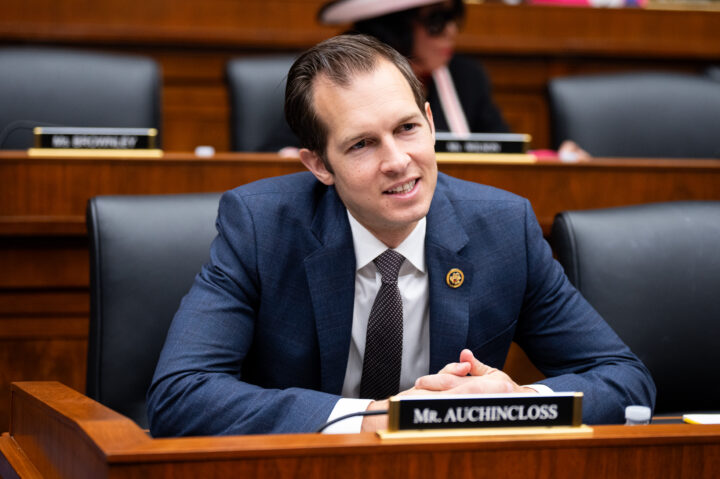
Bill Clark/CQ-Roll Call, Inc via Getty Images
Rep. Jake Auchincloss (D-MA) participates in the House Transportation Committee hearing on Thursday, June 27, 2024.
Good Monday afternoon!
This P.M. briefing is reserved for our premium subscribers like you — offering a forward-focused read on what we’re tracking now and what’s coming next.
I’m Danielle Cohen-Kanik, U.S. editor at Jewish Insider and curator, along with assists from my colleagues, of the Daily Overtime briefing. Please don’t hesitate to share your thoughts and feedback by replying to this email.
📡On Our Radar
Notable developments and interesting tidbits we’re tracking
Secretary of State Marco Rubio said today that Israel’s airstrike in Gaza over the weekend, which the IDF said targeted a Palestinian Islamic Jihad member who was planning a terror attack, did not violate the ongoing ceasefire with Hamas.
Rubio, who visited Jerusalem last week, told reporters standing next to President Donald Trump aboard Air Force One, “Israel didn’t surrender its right to self-defense. … We don’t view that as a violation of the ceasefire. They have a right — if there’s an imminent threat to Israel — and all the mediators agree to that”…
On the campaign trail, Rep. Jake Auchincloss (D-MA) became the first elected Democrat to call for Democratic Maine Senate candidate Graham Platner to drop out of the race to replace Sen. Susan Collins (R-ME), saying he finds the candidate’s conduct “personally disqualifying,” Jewish Insider’s Matthew Shea reports.
“This is a man who criticized and mocked police, rural Americans, and then put a Nazi tattoo on his body,” Auchincloss said. He expressed dissatisfaction with Platner’s defenses, in which the progressive candidate has claimed his actions aren’t a “liability.”
“I think it’s a liability, and I think we should have high standards for United States senators and one of them is: you don’t have a Nazi tattoo on your body,” Auchincloss continued…
Kevin Brown, the campaign manager for Platner, is stepping down after starting the job just last week, Axios scooped today. Brown told the outlet, “I started this campaign Tuesday but found out Friday we have a baby on the way. Graham deserves someone who is 100% in on his race and we want to lean into this new experience as a family”…
More than 160,000 New Yorkers submitted their ballot for New York City mayor with the start of early voting over the weekend, five times higher than the first weekend of early voting in 2021, according to Gothamist. Voters over 55 made up the majority of ballots cast, in contrast with the Democratic primary when voters ages 25-34 were first to the polls…
New York City Comptroller Brad Lander, who also ran in the mayoral Democratic primary and has been backing nominee Zohran Mamdani, is advancing plans to challenge Rep. Dan Goldman (D-NY) for his congressional seat, City & State New York reports.
“I’m very focused on helping Zohran win next Tuesday, and I’ll focus on after that, after that,” Lander told the outlet. At a rally for Mamdani over the weekend, Lander said “it’s more important than ever that we have leaders who understand this moment and will be partners to Zohran” in “the halls of Congress,” potentially hinting at his desire to run. Read JI’s reporting last month of the dynamics of a possible Lander-Goldman matchup…
Former Sen. John E. Sununu (R-NH), the former New Hampshire senator and part of an influential Granite State political family, officially launched his bid last week to take over the Senate seat of retiring Sen. Jeanne Shaheen (D-NH).
Sununu’s candidacy ensures a hotly contested GOP primary against former Sen. Scott Brown (R-MA), who served as ambassador to New Zealand during the first Trump administration. Brown, who announced his candidacy in June, served a partial term representing Massachusetts in the Senate from 2010-2012, only holding the seat for two years before being bested by Sen. Elizabeth Warren (D-MA).
Brown and Sununu, both of whom had pro-Israel records when they served in the Senate, will battle it out before taking on Rep. Chris Pappas (D-NH), the expected Democratic nominee with a history of winning in a swing district…
In an interview with The New York Times, Pennsylvania Gov. Josh Shapiro said that he still believes the U.S. could elect a Jewish president in his lifetime, even in the face of frequent antisemitic violence like the Passover arson attack on his residence.
“Being open about my faith has opened me up to be able to have a deeper relationship with the people of Pennsylvania, allowed them to share their stories … We’re doing that in this ultimate swing state,” Shapiro, seen as a 2028 presidential contender, said…
Semafor reports on a new survey of hundreds of thousands of voters, conducted by a new center-left group called Welcome, that finds that 70% of voters think the Democratic Party over-prioritizes cultural issues. The report urges Democrats “to abandon some of the progressive language about race, abortion, and LGBTQ issues that Democrats began using after the 2012 election — and recommends the nomination of more candidates willing to vote with Republicans on conservative immigration and crime bills”…
⏩ Tomorrow’s Agenda, Today
An early look at tomorrow’s storylines and schedule to keep you a step ahead
Keep an eye on Jewish Insider tomorrow morning for reporting on Fairfax County Public Schools’ reaction to glorifications of violence by local Muslim Student Association chapters.
Tomorrow afternoon, the Senate Judiciary Committee’s Subcommittee on the Constitution will hold a hearing on “Politically Violent Attacks: A Threat to Our Constitutional Order.”
Jewish Federations of North America will hold a briefing tomorrow on how the deal that split off ownership of TikTok’s U.S. business may impact the social media platform’s treatment of antisemitic content.
The 39th World Zionist Congress kicks off in Jerusalem tomorrow with the largest U.S. delegation in history, made up of 155 delegates and approximately 100 alternates. U.S. Ambassador to Israel Mike Huckabee will address a luncheon hosted by the American Zionist Movement ahead of the Congress’ opening.
Stories You May Have Missed
PEOPLE OF THE BOOK (CLUB)
As Jewish writers face boycotts and bias, new initiative aims to boost their books
The Jewish Book Council launched a new subscription service, Nu Reads, which provides six Jewish books per year, modeled on the success of PJ Library
QUAD CONTROL
Harmeet Dhillon says DOJ will fight antisemitism through law, not speech codes

In an interview with JI, the senior DOJ official said that while combating antisemitism is a priority, the Justice Department is focused on the Trump administration’s battle with DEI
Both Republican and Democratic senators grilled Amer Ghalib over his extremist comments; GOP Sen. Ted Cruz said he’ll vote against him
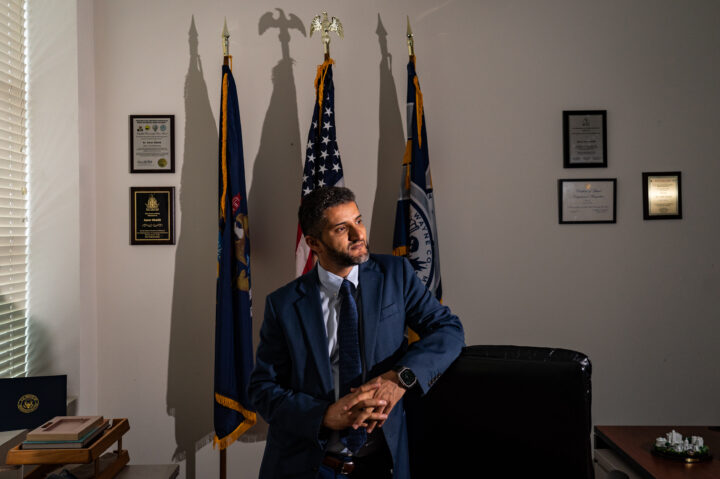
Salwan Georges/The Washington Post via Getty Images
Hamtramck Mayor Amer Ghalib is photographed in his office at the City Hall in Hamtramck, Michigan, Sunday, September 10, 2023.
Amer Ghalib, the mayor of Hamtramck, Mich., and President Donald Trump’s embattled nominee to be U.S. ambassador to Kuwait, struggled to win over skeptical senators of both parties during his confirmation hearing on Thursday as he faced a grilling over his long record of promoting antisemitic ideas and embracing anti-Israel positions as an elected official.
Ghalib was grilled by Democrats and Republicans on the Senate Foreign Relations Committee, which began when the committee’s ranking Democrat, Sen. Jeanne Shaheen (D-NH), called out his litany of antisemitic comments and denial of sexual violence during Hamas’ Oct. 7 attack.
It culminated with Sen. Ted Cruz (R-TX), after questioning Ghalib about his past opposition to the Abraham Accords and support of boycotts against Israel, announcing at the end of the hearing that he would not be able to support his nomination.
Senators on both sides of the aisle pressed Ghalib over a litany of extremist views and statements he’s made in recent years. In addition to his denial of the scope of the Oct. 7 Hamas attacks, senators also pointed to past comments he made suggesting that the terrorism itself was justified. They also questioned him over his consistent unwillingness to acknowledge Israel’s right to exist, and even when pressed at the hearing, resisted recognizing Israel’s place as the Jewish homeland.
He also faced bipartisan scrutiny over his recent characterization of Saddam Hussein, the former Iraqi dictator who invaded Kuwait, as a “martyr” — a social media post senators found stunning given that he’s being tapped as ambassador to the country Hussein invaded.
His record of antisemitic commentary was also probed, with senators asking about his liking a comment on Facebook referring to all Jews as “monkeys” and the record of one of his political appointees in Hamtramck who said the Holocaust was “God’s advanced punishment of the chosen people” over Israel’s war in Gaza.
Ghalib also tried to evade responsibility for Hamtramck becoming the first city in the nation to adopt a Boycott, Divestment and Sanctions policy against Israel. He claimed he played no formal role in that designation.
Throughout the hearing, Ghalib declined to walk back his comments, repeatedly arguing that what he believes in his “personal capacity” should be distinguished from how he planned to act in his “official capacity” as a U.S. ambassador. “I’m a Semite. The Arabs are Semites. Do we read history? How can we be antisemites? And I think, like I said, judge my actions and not my intentions,” Ghalib said.
Cruz, in the hearing, became the first Republican senator to say he can’t support Ghalib’s nomination. Several other GOP senators on the committee are considering coming out against Ghalib, according to sources familiar with lawmakers’ thinking.
“I believe your beliefs are sincere. I believe that when you became the mayor of the first city in America to pass a BDS resolution, it’s because you believe in BDS,” Cruz said. “What I do not understand is how you could possibly serve as United States ambassador for President Trump in the Middle East when you have passionate views, including having been a vocal opponent of the Abraham Accords, the singular and most consequential accomplishment President Trump has negotiated.”
“Your long-standing views are directly contrary to the views and positions of President Trump and to the position of the United States. I, for one, am not going to be able to support your confirmation,” he continued.
Sen. John Curtis (R-UT) who serves on the committee but was not in attendance at the hearing, released a statement after Ghalib’s testimony saying that the Utah senator is “deeply concerned about Mr. Ghalib’s nomination.”
“It is crucial that we expand peace in the Middle East and that begins with the acceptance of Israel’s right to exist. Ghalib has demonstrated he is sympathetic to beliefs that run completely contrary to that goal,” the statement read.
“I think that you have dug your hole deeper today,” Sen. Chris Murphy (D-CT) told Ghalib. “It doesn’t matter to me whether you support the president’s [Middle East peace] plan. Again, this idea that your personal views don’t matter is ridiculous.”
Senators told Ghalib that he was welcome to hold incendiary points of view or embrace those with such beliefs, but that would likely disqualify him for a role representing the United States as ambassador.
Sen. Jacky Rosen (D-NV), a co-chair of the Senate Bipartisan Task Force for Combating Antisemitism, excoriated Ghalib during her opening statement, describing his conduct as unacceptable for a public figure. “As an elected official, you had a responsibility to work with your constituents to eliminate hatred from communities, all hatred from communities, but instead, you chose to inflame divisions and traffic in antisemitism,” Rosen said.
“You liked a Facebook comment comparing Jews to monkeys. You characterize leaders you don’t like as ‘becoming Jewish.’ As mayor, you failed to comment after one of your political appointees suggested the Holocaust was ‘advance punishment’ for the war in Gaza, and you denied the Hamas used sexual violence as a weapon of war on Oct. 7,” she continued. “You can disagree with the Israeli government, but peddling antisemitism in such a public manner, as an elected official, as a community leader, is beyond the pale.”
Ghalib was asked four times — three by Sen. Dave McCormick (R-PA) and once by Murphy — if he would say that he supports Israel’s right to exist as a homeland for the Jewish people. “I think everybody, we can coexist in the region, and everybody has the right to exist now,” Ghalib told McCormick after the Pennsylvania senator’s third time asking the question.
Only after Murphy criticized his refusal to answer McCormick’s question did Ghalib respond directly.
“I believe it can be a home for the Jewish and the Arabs and the Muslims and the Christians as well. And that’s why it’s a diverse land for the three major religions,” Ghalib told Murphy, without mentioning Israel by name. “I think they can coexist, all the nations in the Middle East, based on the peace plan of President Trump that I support strongly.”
Murphy pressed Ghalib on his claims that he had condemned the October 2023 comments by Nasr Hussain, a political appointee of his on the Hamtramck Plan Commission, about the Holocaust being “God’s advanced punishment,” noting that Ghalib had not responded to requests from senators for proof that he had distanced himself from Hussain.
Sen. Tim Kaine (D-VA) also pointed out that Ghalib had expressed support for the Houthis’ November 2023 hijacking of the British-owned Galaxy Leader cargo ship in the Red Sea, prompting Ghalib to deny he had ever made such a statement.
Kaine then asked if he was denying that he had authored the social media post with the statement. Ghalib responded by suggesting that he now opposes the attack, and then appeared to accuse the Virginia senator of making “assumptions” and taking his words “out of context.”
“I don’t think it’s a celebration. This is an assumption that [you’re] making. I disagree with attacking the ships and disrupting,” Ghalib said. “I think there was a post, but it seems like it’s taken out of context. Maybe I commented, I don’t know.”
Later on, Cruz grilled Ghalib about a social media post he wrote in 2020 praising the Muslim Brotherhood as “an inspiration” and asked whether his stated support for the group would be a conflict if the Trump administration were to designate the Brotherhood as a terrorist organization. Ghalib said he would implement the president’s policies, though only after downplaying the group’s extremism.
“I believe that it’s an ideology. It’s not just a group of people. I disagree with a lot of things that they do. Some of them are extremists. Some of them are part of some governments in the Middle East,” Ghalib said of the Muslim Brotherhood.
Shaheen, the top Democrat on the committee, called Ghalib’s expressed beliefs “abhorrent” and said she was “very concerned about some of the statements that you have made, and frankly, what appear to be antisemitic views.” The New Hampshire senator said she took grave offense to Ghalib’s comments claiming that reports of sexual violence by Hamas on Oct. 7 were “lies and deception” and expected him to offer “an unequivocal condemnation of the horrific crimes committed on Oct. 7.”
Ghalib said he had “totally condemned what happened on Oct. 7” after learning of the atrocities, and claimed that he “was not aware” of what “kinds of abuses” Hamas had orchestrated when he made those comments. He also alleged that local media had misrepresented his past social media posts and public comments to make it look like he was antisemitic or supportive of terrorists and dictators.
“I’m in politics. I understand the press doesn’t always accurately represent what we say,” Shaheen replied. “That doesn’t explain the comments you made to my staff, nor the direct quotes from your hometown news outlet about sexual violence on Oct. 7. The fact that you represented to my staff that there was no documented evidence of that just shows to me a lack of recognition of what was going on.”
The only apology Ghalib offered regarding his past remarks related to his comments about Saddam Hussein, telling senators that he was sorry if his description of the late dictator had caused offense, especially with “those who suffered from Saddam or lost loved ones.” He explained that he was complimenting Hussein for “keeping the Iranian regime in check” after McCormick noted that he served in the 82nd Airborne Division that helped liberate Kuwait from Hussein’s forces.
The White House did not respond to Jewish Insider’s request for comment on the status of Ghalib’s nomination.
Mamdani’s pledge, announced at the last general election debate, is a signal of the DSA-backed candidate’s attempt to moderate on the issue of policing
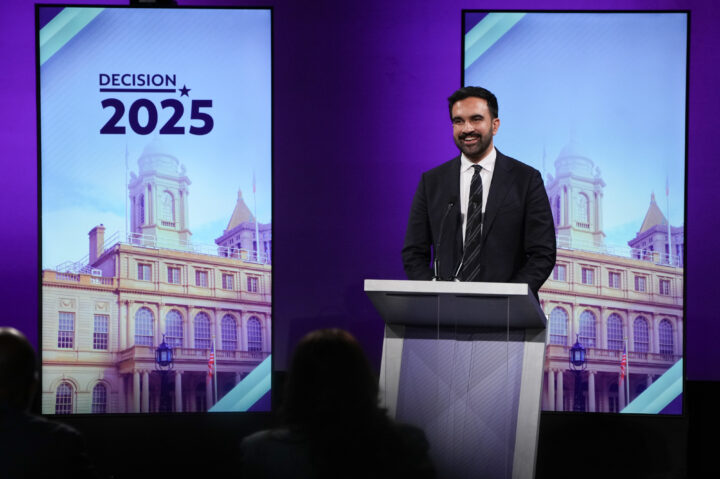
Hiroko Masuike/The New York Times/Bloomberg via Getty Images
Zohran Mamdani, New York City mayoral candidate, during a mayoral debate in New York, US, on Wednesday, Oct. 22, 2025.
Zohran Mamdani, the Democratic nominee for mayor of New York City, confirmed that he would ask Jessica Tisch to stay on as the city’s police commissioner if elected, ending longstanding speculation over his plans for a key role in his potential administration.
Tisch, appointed last year by outgoing Mayor Eric Adams, “took on a broken status quo, started to deliver accountability, rooting out corruption and reducing crime across the five boroughs,” Mamdani said at the second and final general election debate on Wednesday evening.
“I have said time and again that my litmus test for that position will be excellence, and the alignment will be of that position,” Mamdani added. “And I am confident that under a Mamdani administration, we would continue to deliver on that same mission.”
Mamdani’s choice could assuage concerns among moderate Democrats and other crime-conscious New Yorkers who had been hopeful that he would choose Tisch, a widely respected technocrat who previously led the Department of Sanitation.
Tisch, 44, who is Jewish, has not said whether she would plan to continue in her position if Mamdani is elected on Nov. 4.
Mamdani, a 34-year-old democratic socialist and Queens state assemblyman, has faced scrutiny over his past comments on law enforcement — including support for defunding the police. He has moderated during his mayoral campaign and says he no longer backs such efforts, even as he has pledged to pursue some goals that could potentially fuel tension, such as launching a Department of Community Safety “to ensure that mental health experts” instead of police “are responding to the mental health crisis,” he said at the debate.
Mandani’s opponents, former New York Gov. Andrew Cuomo and Curtis Sliwa, also said they would not seek to replace Tisch, though Sliwa, the Republican nominee, said he did not think she would choose to remain in her role if Cuomo or Mamdani is elected. Cuomo, running as an independent, said he did not believe Mamdani would follow through on his promise.
“His position has been to defund, disband the police, she wouldn’t take that,” Cuomo claimed, saying “their philosophies are totally incongruous.”
Elsewhere in the debate Wednesday, Cuomo and Sliwa ramped up their attacks on Mamdani over his strident opposition to Israel and refusal to condemn calls to “globalize the intifada,” continued sources of concern among Jewish voters.
Cuomo, who has recently escalated his criticism of Mamdani to a more personal level, accused him of stoking “the flames of hatred against Jewish people” during a particularly heated moment at the debate — while Sliwa cast the Democratic frontrunner as an “arsonist who fans the flames of antisemitism.”
Mamdani, playing defense on an issue that represents one of his top vulnerabilities, said that there “is room for disagreement on many positions and many policies,” and pushed back against Sliwa’s claim that he supports “global jihad.”
“I’ve heard from New Yorkers about their fears about antisemitism in this city, and what they deserve is a leader who takes it seriously, who roots it out of these five boroughs, not weaponizes it as a means by which to score political points on a debate stage,” Mamdani said.
The Jewish advocacy group slammed Mamdani’s insistence on calling Israel’s war against Hamas a genocide and ‘lack of moral clarity’
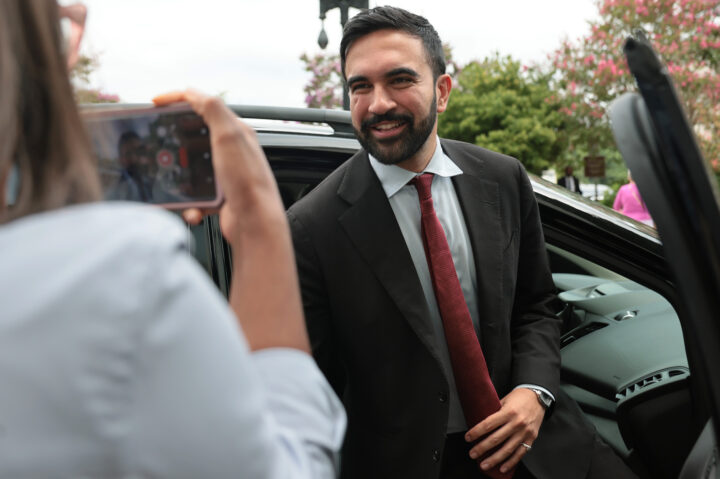
Michael M. Santiago/Getty Images
NYC Mayor Zohran Mamdani briefly speaks with reporters as he leaves the Dirksen Senate Office Building on July 16, 2025 in Washington, DC.
The American Jewish Committee raised alarms on Friday about Zohran Mamdani’s “continued use of problematic rhetoric as it relates to Israel and Jews” and called on the Democratic nominee for mayor of New York City to “change course” as he prepares for the Nov. 4 election.
In a lengthy statement, the nonpartisan organization cited, among other things, Mamdani’s repeated claim that Israel has committed genocide in Gaza, which the AJC called “unequivocally false and dangerous.” The charge “has not been proven in any international court” and “gives fodder to those who continue to use Israel’s self-defensive actions as an excuse to threaten and attack Jews,” the group said.
The AJC also criticized Mamdani’s refusal to recognize Israel’s right to exist as a Jewish state, saying that he is upholding an “unacceptable double standard” in his assessment of the region. “Israel is surrounded by Muslim countries,” the group wrote, “yet Mamdani does not continuously suggest that any of those nations should not exist as they are.”
And the organization took issue with what it characterized as Mamdani’s “lack of consistent moral clarity on Hamas,” pointing to a Fox News interview on Wednesday in which he sidestepped a question about whether Hamas should disarm and relinquish its leadership role in Gaza.
Mamdani, a democratic socialist assemblyman who has long been involved in anti-Israel activism, later clarified during the first general election debate on Thursday that Hamas “should lay down” its arms, but he did not share his views on its future role in the conflict.
The AJC, which has also recently highlighted concerns about Mamdani’s refusal to condemn calls to “globalize the intifada,” said in its statement that it feels “compelled to speak out when public figures use rhetoric or endorse policies that harm Jews.”
It urged Mamdani “to engage in dialogue and consultation with organizations and segments of the mainstream New York Jewish community,” with which he has had a tense relationship throughout the campaign and as an elected official in Albany.
“By continuing to prioritize anti-Zionist synagogues and groups, Mamdani ignores the perspectives and concerns of the vast majority of Jewish New Yorkers,” the group said.
Mamdani, who has stepped up his Jewish outreach efforts in recent weeks with limited success, has rejected claims that his views fuel antisemitism and vowed to increase funding to counter hate crimes by 800% if he is elected.
“One of the most meaningful experiences I’ve had over the course of this campaign has been the conversations I’ve had with Jewish New Yorkers,” Mamdani said at the debate on Thursday.
A spokesperson for Mamdani did not respond to a request for comment.
Amer Ghalib questioned reports of Hamas’ atrocities on Oct. 7 and has supported the BDS movement
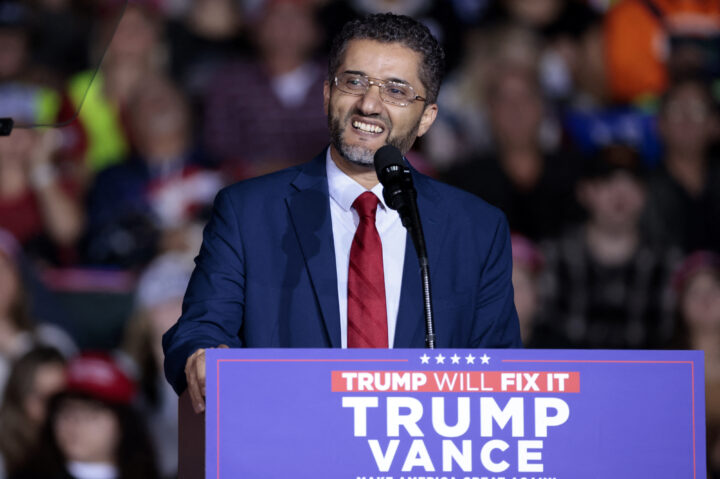
JEFF KOWALSKY/AFP via Getty Images
Democratic Muslim Mayor Amer Ghalib of Hamtramck, Michigan speaks before President Donald Trump holds his final campaign rally before election day at Van Andel Arena in Grand Rapids, Michigan on November 4, 2024.
Amer Ghalib, the mayor of Hamtramck, Mich., and President Donald Trump’s nominee to be U.S. ambassador to Kuwait, is scheduled for a confirmation hearing in the Senate Foreign Relations Committee, a delayed step toward confirmation for a nominee whose background and past comments have come under scrutiny.
Ghalib will come before the committee next Thursday, Oct. 23, at the first confirmation hearing the committee has held in more than a month. Ghalib is currently the only nominee on the agenda for that hearing.
The Democratic Hamtramck mayor, who endorsed Trump in the 2024 election and helped him rally support in Michigan’s Arab and Muslim American communities, has a history of anti-Israel commentary, including questioning reports of Hamas atrocities during the Oct. 7 attacks and supporting the Boycott, Divestment and Sanctions movement, as well as liking antisemitic posts on social media.
The Anti-Defamation League has said Ghalib’s nomination should be withdrawn. “Ghalib routinely traffics in antisemitism, actively supports the antisemitic BDS movement, attempted to justify the 10/7 massacre and refused to take disciplinary action against an appointee who attempted to justify the Holocaust,” the group said on X in March.
Sen. Jeanne Shaheen (D-NH) told reporters that the nomination had been delayed as lawmakers gathered additional information about Ghalib and his background via written questions.
Ghalib announced publicly after such reports that Trump had called him to emphasize his continued support even as “some parties have hindered this appointment.”
Ghalib will likely face questions about his record at the hearing.
But the NYC mayoral nominee hasn’t spoken out against the streamer’s long history of antisemitic rhetoric
Angelina Katsanis-Pool/Getty Images
Democratic mayoral nominee Zohran Mamdani speaks during a mayoral debate at Rockefeller Center on October 16, 2025 in New York City.
Zohran Mamdani, the Democratic nominee for mayor of New York City, expressed disagreement on Thursday with comments by Hasan Piker, a far-left streamer who has said “America deserved 9/11,” after several months in which the state assembly member had declined to condemn such rhetoric.
“I find the comments that Hasan made on 9/11 to be objectionable and reprehensible,” Mamdani said during the first general election debate on Thursday night, where he traded barbs with former New York Gov. Andrew Cuomo, who is trailing in the polls as he mounts an independent run following his primary loss to Mamdani in June.
Still, Mamdani, a 33-year-old democratic socialist, defended his decision to appear on Piker’s show for an extensive interview during the primary — even as the streamer has otherwise frequently stirred controversy for using antisemitic rhetoric in his commentary on Israel and Jewish issues.
“I also think that part of the reason why Democrats are in the situation that we are in, of being a permanent minority in this country, is we are looking only to speak to journalists and streamers and Americans with whom we agree on every single thing that they say,” Mamdani argued, while making no mention of Piker’s antisemitic comments. “We need to take the case to every person, and I am happy to do that.”
Piker has faced criticism for justifying Hamas’ Oct. 7, 2023, attacks and forcefully denying some of the terror group’s atrocities — including widespread reports of sexual violence. In one notable stream last year, Piker said “it doesn’t matter if rapes f***ing happened on Oct. 7,” while adding that “the Palestinian resistance is not perfect.” He has also described Orthodox Jews as “inbred” and compared Zionists to Nazis, among other slurs seen as antisemitic.
Elsewhere during the debate, Mamdani, an outspoken critic of Israel who was arrested in October 2023 during a ceasefire demonstration outside the Brooklyn home of then-Senate Majority Leader Chuck Schumer (D-NY), declined to confirm that he would not participate in protests if he is elected mayor. “The important thing is to lead from City Hall,” Mamdani said. “That’s what I’ll be doing.”
Mamdani had faced intense backlash before the debate for comments during a Fox News interview released on Wednesday in which he avoided directly answering a question about whether Hamas should disarm and relinquish its leadership role in Gaza. He clarified at the debate that Hamas, as well as “all parties,” “should lay down” their arms but did not comment on its future role in the conflict.
“I’m proud to be one of the first elected officials in the state who called for a ceasefire, and calling for a ceasefire means ceasing fire,” Mamdani said. “That means all parties have to cease fire and put down their weapons. And the reason that we call for that is not only for the end of the genocide, but also an unimpeded access of humanitarian aid.”
He added that “we also have to ensure that [the ceasefire] addresses the conditions that preceded this, conditions like occupation, like the siege and apartheid, and that is what I’m hopeful for.”
Mamdani, who has seen mixed results in his continued outreach to the Jewish community, also once again refused to condemn the phrase “globalize the intifada” — even as he reiterated that it “evokes many painful memories” for Jewish voters and reiterated he will “discourage” its usage.
Burnley’s surprising advancement to the general election is another sign of the growth of far-left politics within the Democratic Party
Erin Clark/The Boston Globe via Getty Images
Somerville At-Large City Councilor Willie Burnley Jr., smokes a joint on the front steps of his home.
Zohran Mamdani isn’t the only far-left, anti-Israel candidate running for mayor in a city with a notable Jewish constituency in November. As we’ve noted in these pages, socialist Katie Wilson is vying to unseat Mayor Bruce Harrell in the Seattle mayoral race. And far-left challenger Omar Fateh is running competitively against Mayor Jacob Frey in a closely watched Minneapolis mayoral contest.
But one lower-profile race featuring a Democratic Socialists of America activist with involvement in anti-Israel groups has flown under the radar. In the progressive city of Somerville, Mass. — just outside Boston and bordering Cambridge — City Councilor Willie Burnley Jr. advanced to a runoff against another city council member, Jake Wilson.
In the city’s first round of balloting, which ousted the city’s sitting mayor, Katjana Ballantyne, Wilson finished first with 42% of the citywide vote, but Burnley wasn’t far behind with 34%. Ballantyne, facing a backlash to the city’s rising housing costs, lagged in third place with just 23% of the vote.
If Burnley prevails, he would be the city’s first Black, openly queer and polyamorous mayor, according to Axios.
But Burnley’s unconventional self-identification pales in comparison to his radical record. He’s been endorsed by the Democratic Socialists of America, and has been active in the organization for at least the last several years. He has participated in anti-Israel protests, including one where he is standing in front of a protester holding a sign with a Nazi swastika flag next to an Israeli flag. At a Tufts University anti-Israel protest last year, he posed in front of posters reading “Glory to the martyrs.”
He has touted his endorsement from the anti-Israel group “Somerville for Palestine” and walked out on a Jewish constituent objecting to the city council’s consideration of a measure that would require Somerville to divest city funds business from companies that do business with Israel. In 2018, he was pictured being involved with the anti-Israel group IfNotNow.
Unsurprisingly, Burnley holds extremist views on other major issues of consequence, most notably supporting efforts to defund the police and describing the founders of the United States as “genocidal, racist, rapists who stole this country because they wrote some nice words.”
Burnley’s surprising advancement to the general election is another sign of the growth of far-left politics within the Democratic Party — particularly in urban centers. While the first round of results suggests that the more-experienced Wilson starts as the favorite, the fact that someone with Burnley’s extreme politics is in the running and could win one-third of the vote is alarming.
The self-proclaimed socialist union leader has accused Israel of committing genocide and said she would look to divest city funds from Israel
Campaign website
Katie Wilson
As progressives have gained traction in local races across the country, Katie Wilson, a self-described socialist now mounting a formidable bid for mayor of Seattle, has increasingly drawn comparisons to Zohran Mamdani, the far-left Democratic nominee for mayor of New York City whose primary upset in June stunned the national political establishment.
Like Mamdani, a 33-year-old democratic socialist and state assemblyman, Wilson, the co-founder and executive director of Seattle’s Transit Riders Union, took political observers by surprise when she handily led the August “jungle” primary with just over 50% of the vote — defeating the moderate incumbent mayor, Bruce Harrell, by a nearly 10-point margin.
Wilson, in her early 40s, is preparing to face Harrell once again in the Nov. 4 election, where analysts say she is now well-positioned to oust the first-term mayor. Harrell has struggled not only to land on a vision that resonates with voters but to effectively articulate an argument against his upstart challenger, who has focused on a populist message of affordability that Mamdani has also championed throughout his own campaign.
But while her record of commentary on Israel and the war in Gaza is far more limited than Mamdani, who has long been an outspoken critic of the Jewish state, many Jewish leaders in Seattle are expressing concern over Wilson’s statements about the conflict amid what they describe as a lack of outreach from her campaign with just five weeks until the election.
In a handful of recent remarks, Wilson has accused Israel of genocide in Gaza — a characterization that Jewish leaders and community activists have found troubling as voter sympathy for the Jewish state, especially in the progressive Seattle area, has sharply declined.
“I am strongly opposed to the genocide in Gaza,” Wilson said in a comment posted to social media in August. “As mayor of Seattle, my ability to end the violence is limited, but I will do everything I can to end the suffering of Palestinians and guarantee the safety of Muslims, Jews, and people of all faiths and backgrounds in Seattle.”
Meanwhile, Wilson has suggested that she is “open to divestment” if Seattle “has investments that are indirectly supporting Israel’s actions,” according to an email response to a person who asked about her stances on Israel that was posted to social media in July.
Elsewhere in the note, Wilson said that she was “familiar with the ‘end the deadly exchange’ efforts of a few years ago and think that’s something that could be done through executive action,” referring to a movement seeking to prohibit American police officers from training with Israeli law enforcement officials. The American Jewish Committee has accused the campaign of helping to fuel an antisemitic trope suggesting Israel is responsible for American police brutality.
Regina Sassoon Friedland, regional director of the American Jewish Committee’s Seattle office, echoed a range of Jewish community leaders in taking issue with Wilson’s rhetoric on Israel.
“While AJC does not endorse or oppose candidates, it should be noted that claims of genocide against Israel lack factual or legal foundation,” Friedland told Jewish Insider on Tuesday. “Not only are such accusations baseless, but they distort realities on the ground when no mention is made of Hamas, whose announced purpose is annihilating Israel.”
In addition to her comments, some Jewish community leaders say they are discouraged by Wilson’s relationships with anti-Israel activists including Kshama Sawant, a former far-left Seattle city councilmember who has faced accusations of stoking antisemitism. Wilson also claimed an endorsement from CAIR Action, a political advocacy group affiliated with the Council on American-Islamic Relations, whose executive director has drawn condemnation for praising Hamas.
A recently established political action committee called The Kids Table, which seeks to promote “pro-Jewish candidates for state and local office” in Washington state and is led by a group of Jewish millennial activists, claimed that Wilson has “allied herself with vitriolic anti-Jewish candidates” and “talked about focusing city resources on foreign affairs issues, rather than on local ones, including the urgent problem of Jewish safety and security in Seattle.”
“Time and time again we hear deep concern about Katie Wilson’s candidacy,” the group told JI of its conversations with the Jewish community, adding she did not respond to a “candidate questionnaire about antisemitism and extremism” that had been sent to her campaign and was filled out by Harrell.
Even as Wilson has only glancingly weighed in on Israel throughout the race, where strategists say it has not been a prominent issue for many voters, the broader organized Jewish community has otherwise observed a distinct absence of engagement from her campaign.
The Jewish Federation of Greater Seattle, for one, has not heard from her, several members told JI.
Scott Prange, an at-large member of the Jewish Community Relations Council of Greater Seattle, said he was “not personally aware that Wilson has made any outreach to the Jewish community in Seattle.”
“And at a time when, especially in Seattle, antisemitism runs rampant amongst the left in the wake of post-Oct. 7 rhetoric and propaganda,” he told JI on Tuesday, “she has only fanned the flames by echoing hollow narratives about Israeli genocide in Gaza and calling for divestment of any city funds invested in Israel.”
Jack Gottesman, president of Sephardic Bikur Holim Congregation, an Orthodox synagogue in Seattle that includes around 300 families, said he “would welcome the opportunity to meet with Katie Wilson, but to date I have not seen meaningful outreach from her or her campaign to the Jewish community.”
“Jews have been part of Seattle’s fabric for well over 100 years, and it is important that candidates engage respectfully with all communities,” he told JI this week. “Her description of the situation in Gaza as a genocide was a mischaracterization. These are complex issues that demand depth, not slogans. I hope she recognizes the weight of her words.”
Wilson’s campaign did not respond to numerous interview requests from JI over several weeks.
In contrast with Wilson, Harrell, who was elected in 2021, has maintained what Jewish leaders largely called a strong voice in support of Israel and against rising antisemitic violence. Nevet Basker, a co-chair of Washingtonians for a Brighter Future, a separate pro-Israel PAC that has endorsed Harrell, said that the local Jewish community “appreciates” his “clear opposition to antisemitism.”
“We recognize the immense challenges the mayor has faced” and “applaud his commitment to ensure that all Seattle residents and visitors are safe and welcome,” Basker told JI in a statement.
Rob Spitzer, the president of B’nai B’rith International and a vice chair of the Jewish Federation of Greater Seattle, said Harrell “has reached out” and “is generally supported by the community,” while recalling “meetings with him and his police and security team about protecting the Jewish community and our institutions.”
The Kids Table, for its part, countered that Harrell “has failed to meet this moment of crisis for the Jewish community,” noting that “pro-Palestinian protestors blocked the interstate for six hours and weren’t cleared or charged, and ‘kill your local colonizer’ was spraypainted on statues at the mayor’s alma mater, with zero comment from his office.”
Still, the group told JI in a statement, “Wilson’s candidacy, alliances with anti-Jewish figures and organizations, and lack of engagement have many Seattle Jews very worried about the next four years.”
Harrell’s campaign also did not respond to requests from JI for an interview.
While he has sought to connect Wilson to the movement to defund the police, which she says is not her goal, Harrell has avoided commenting on her approach to Israel, underscoring the shifting political dynamics around views that until recently would likely have been seen as too extreme for the Democratic Party but have now become acceptable to many voters.
Despite concerns from Jewish community leaders, Israel “hasn’t been front and center” in the race as a “topic of discussion or debate,” Sandeep Kaushik, a political consultant in Seattle who is not involved in either campaign, told JI.
Kaushik attributed Wilson’s unexpected rise in part to what he called the “Mamdani effect” and said she is the “front-runner,” even as he expects “the general election war is about to start” as pro-Harrell outside spending flows into the race and attacks ramp up in the final weeks.
“I think the mayor is now fighting for his political life,” Kaushik said.
Individuals involved in the race told JI impediments remain to consolidating support behind Andrew Cuomo
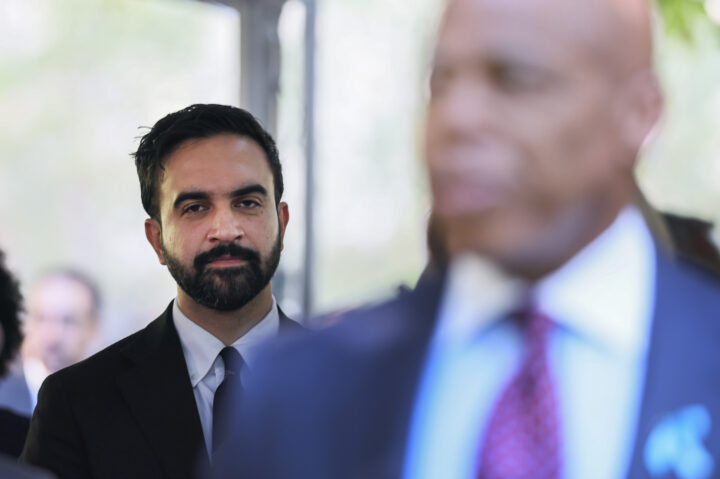
Michael M. Santiago/Getty Images
New York City Mayoral Zohran Mamdani (L) and former Mayor Eric Adams attend the annual 9/11 Commemoration Ceremony on September 11, 2025 in New York City.
New York City Mayor Eric Adams’ decision on Sunday to drop out of his race for reelection was met with a mix of tempered hope and continued resignation among political consultants and Jewish community leaders who have long been waiting for an opening to block Zohran Mamdani, the front-runner and Democratic nominee.
In choosing to suspend his campaign for a second term with just five weeks remaining until the Nov. 4 election, Adams, the scandal-scarred mayor who had been running as an independent, may not offer the escape hatch that many Mamdani critics have been hoping for.
Adams, a deeply unpopular mayor whose tenure in office had been marred by a series of damaging corruption scandals and accusations that he had become cozy with the Trump administration, will remain on the ballot. And Curtis Sliwa, the GOP nominee polling ahead of Adams, reiterated on Sunday that he will stay in the race, rejecting calls for him to step aside and help to clear the field for former New York Gov. Andrew Cuomo — who is also running as an independent after badly losing the June Democratic primary.
But some critics of Mamdani, a democratic socialist and Queens state assemblyman leading in the polls, suggested that the consolidated field could now move previously reluctant donors to invest in a late-stage effort to help bolster Cuomo — who had been casting the race as a two-man contest with Mamdani even before Adams ended his campaign.
“Sentiment among some major donors had been that unless the field started to narrow, they were going to keep their powder relatively dry,” Jake Dilemani, a Democratic strategist who was involved in Cuomo’s primary bid, told Jewish Insider. “With Adams out, that dynamic starts to change, pressure will mount on Sliwa to drop his bid, and dollars will follow.”
Hank Sheinkopf, a veteran Democratic strategist who is leading an anti-Mamdani super PAC called Protect the Protectors, said Cuomo “can win only if there are independent committees that are talking about” Mamdani’s far-left positions and “how they are dangerous to New York.”
“Failure to do that means Mamdani will win,” he told JI, while noting Cuomo’s “argument that he is more experienced isn’t working,” demonstrated by his negative voter ratings in polls.
Sheinkopf speculated that new donors could now be energized to open their checkbooks if they are convinced, as he believes, that a Cuomo victory will require outside groups, which have struggled to raise money even as they have begun to place ads in recent weeks, work on chipping away at Mamdani’s relatively favorable polling numbers.
“You can knock Mamdani to 30 or below,” Sheinkopf predicted. Recent surveys have shown Mamdani’s favorability ratings in the mid to high 40s.
Another political consultant who is involved in a separate anti-Mamdani super PAC, speaking on the condition of anonymity to address the current state of the race, said he is “hopeful that the donors who were sitting on the sidelines will now become more active,” but he had no details to share about any new movement on that front.
The consultant acknowledged that Sliwa’s choice to remain in the race, threatening to peel support from Cuomo, “is certainly an impediment, but hopefully not a major one,” suggesting that “Cuomo can get a lot of Sliwa’s vote.”
Chris Coffey, a Democratic consultant who helped to advise Cuomo’s primary campaign, said that the race had been “frozen” until Adams finally dropped out on Sunday. “Both donors and reporters spent three-plus weeks on whether Eric would drop out,” he told JI. “Now he has. It’s still going to be uphill for Cuomo but to have any shot, he needed Eric out and he’s out.”
“If donors and press now turn to Curtis, that won’t help Cuomo,” Coffey continued. “I’d expect to see national and local GOP push folks to Cuomo. That’s a double-edged sword but again, he needs it to have a meaningful shot.”
Eric Levine, a top GOP fundraiser who had been backing Adams’ bid, said that he is now supporting Cuomo and believes that Sliwa “needs to get out” if the former governor has any chance of prevailing in the race.
While he did not anticipate that Sliwa — whose campaign said in a statement on Sunday that he “is the only candidate who can defeat Mamdani” — will likely step aside, Levine called on GOP leadership in New York to urge him to drop out and help clear the field for Cuomo.
“He was a terrible governor, he’s an even worse person and will be a horrible mayor,” Levine said of Cuomo. “But compared to Mamdani,” the choice is easy, he told JI, citing the nominee’s hostile stances toward Israel that have fueled concern among many Jewish community leaders.
“The city is heading for a world of hurt, and any Republican who thinks that it’s a good idea to have Mamdani be the new face of the Democratic Party is too cynical for me,” Levine, a Republican Jewish Coalition board member, said on Sunday.
Cuomo, for his part, praised the mayor’s decision to ultimately drop out of the race, as he had called on Adams to do. “The choice Eric Adams made today was not an easy one, but I believe he is sincere in putting the well-being of New York City ahead of personal ambition,” the former governor said in a statement on Sunday. “We face destructive extremist forces that would devastate our city through incompetence or ignorance, but it is not too late to stop them.”
But while Cuomo’s campaign hopes to gain new backing from Black and Orthodox Jewish voters who were behind Adams, the mayor himself did not offer an endorsement, even if his announcement left open the possibility he could end up taking a side in the race. Adams otherwise warned, in a veiled swipe at Mamdani, that “insidious forces” are now seeking to “advance divisive agendas.”
“Major change is welcome and necessary,” Adams said in his announcement posted to social media on Sunday. “But beware of those who claim the answer is to destroy the very system we built together over generations.”
Leon Goldbenberg, an Orthodox leader in Brooklyn who is an executive board member of the Flatbush Jewish Community Coalition and had been backing Adams, said that he was encouraged by the mayor’s choice to suspend his campaign. “At this point, it’s more of a horse race,” he told JI, predicting Cuomo will see solid support in the Orthodox community as it seeks to register new voters ahead of the election.
“I think that you are going to see a tremendous turnout in the Orthodox community,” Goldenberg said. “Whether it makes a difference or not, I can’t tell you.”
Some activists in the broader organized Jewish community were less confident that the campaign shake-up on Sunday would meaningfully influence the outcome of a race that Mamdani has continued to dominate.
One Jewish leader, speaking on the condition of anonymity to address private discussions, said it was “too soon yet” to conclude if a critical mass of new donors would now be motivated to step up to help oppose Mamdani. “But new conversations are happening.”
Another Jewish leader who fears a Mamdani win, and also spoke on the condition of anonymity, was far less sanguine about Adams’ decision. “It doesn’t make a difference,” the Jewish leader told JI, while referring to such remaining obstacles as Sliwa and the mayor’s name still appearing on voters’ ballots.
A credible effort to beat Mamdani “would require about $10 to $15 million to make a difference,” the Jewish leader estimated. “I just don’t know that we have that chance.”
With that in mind, “the best thing that I’m hoping for is that we can keep him under 50%,” the Jewish leader said of Mamdani, “to make him govern from a minority position and not a mandated position.”
Kolot Chayeinu has drawn criticism for its anti-Israel Hebrew school curriculum, and one of its rabbis meeting with the Iranian president last year
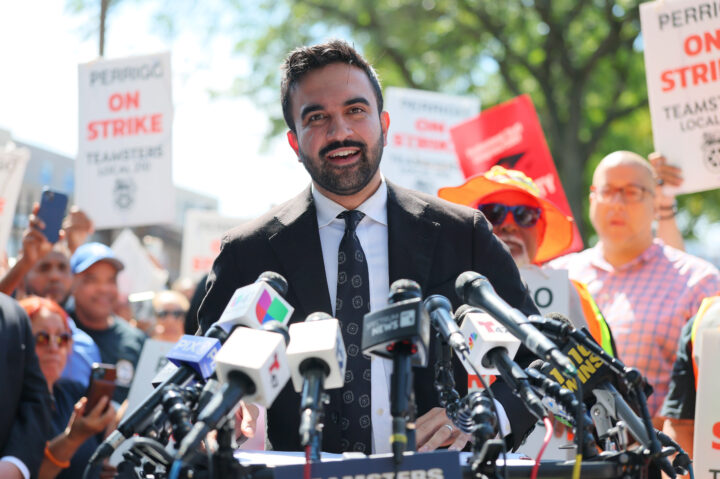
Michael M. Santiago/Getty Images
New York City Zohran Mamdani speaks on Sept. 15, 2025 in New York City.
Zohran Mamdani, the Democratic nominee for mayor of New York City, attended his first Rosh Hashanah service on Monday night at a Brooklyn synagogue well-known for its anti-Zionist activism.
The visit to Kolot Chayeinu, a nondenominational synagogue in Park Slope that has drawn controversy over its anti-Zionist orientation, comes as Mamdani is seeking to engage in increased outreach to Jewish voters ahead of the November election.
But the venue choice also underscores his polarizing position in the broader Jewish community — where many Jewish leaders have continued to raise alarms over his anti-Israel policies and refusal to condemn calls to “globalize the intifada,” among other issues.
Mamdani, an outspoken critic of Israel who has identified as anti-Zionist, was warmly received at the Monday service, where he sat in the front row in a mask and a yarmulke beside Brad Lander, the city comptroller who is a member of Kolot Chayeinu.
Lander, a close ally of Mamdani, recently described the congregation, which was one of the first to call for an early ceasefire in October 2023, as a meeting point for anti-Zionist Jews and progressive Zionists like himself.
The synagogue, which maintains an “open tent” policy on Israel and Palestine, has faced criticism for promoting anti-Israel views in its Hebrew school curriculum in the aftermath of Hamas’ Oct. 7, 2023, attacks.
In one particularly controversial lesson, students were instructed to write a letter of apology rebuking their Jewish “ancestors” for taking Palestinian land, fueling concerns among parents who objected to the politicized assignment.
A rabbi at Kolot Chayeinu, Abby Stein, who is a member of the anti-Zionist group Jewish Voice for Peace, also drew scrutiny for attending a meeting in New York City last year with Iranian President Masoud Pezeshkian, days before the Islamic Republic launched a missile attack against Israel.
Mamdani, a 33-year-old democratic socialist and assemblyman from Queens, did not deliver remarks at the Monday evening service. During his sermon, the rabbi accused Israel of committing genocide in Gaza, a claim that Mamdani has frequently made.
Mamdani is now expected to appear at other Jewish institutions during the High Holidays, including a mainstream congregation on Manhattan’s Upper West Side — where he could face a less welcoming audience skeptical of his hostile views toward Israel.
A spokesperson for Mamdani did not respond to a request for comment about his planned outreach to the Jewish community.
Several leaders in the community told JI they continue to have concerns about his record, while others are quietly engaging
Michael M. Santiago/Getty Images
New York City Zohran Mamdani speaks on Sept. 15, 2025 in New York City.
As Jewish leaders reckon with the increasing likelihood that Zohran Mamdani will be the next mayor of New York City, many who have voiced anxiety over his avowedly anti-Israel policies are reacting with a mix of fear and resignation.
Their concerns have been mounting as Mamdani, the Democratic nominee, has continued to hold a comfortable lead in the race, where polling shows him handily prevailing over the divided field. The 33-year-old democratic socialist and Queens state assemblyman has recently claimed endorsements from prominent party leaders including New York Gov. Kathy Hochul, who clarified she does not agree with him on Israel issues but said she appreciated his commitment to combating antisemitism as well as his efforts to meet with Jewish community members to address “their concerns directly.”
But multiple Jewish leaders said in interviews with Jewish Insider on Wednesday that they remain deeply skeptical of his campaign’s outreach and pledges to confront rising antisemitism, citing a string of recent statements in which he has doubled down on his hostile approach to Israel — as well as an ongoing refusal to explicitly denounce extreme rhetoric espoused by his allies on the far left.
While Mamdani has, since winning the primary in June, walked back some of his polarizing views on key issues such as policing, he has otherwise made an exception for Israel, of which he has long been a fierce critic. In a series of interviews published last week, for instance, he reiterated a campaign vow to arrest Israeli Prime Minister Benjamin Netanyahu if elected, even as legal experts cautioned such a move could violate federal law.
A vocal supporter of the Boycott, Divestment and Sanctions movement against Israel — which some critics deem antisemitic — he said he would end a program established by Mayor Eric Adams, who is now running as an independent, to foster business partnerships between companies in Israel and New York City. He also said he would stop relying on the working definition of antisemitism promoted by the International Holocaust Remembrance Alliance — which labels some criticism of Israel as antisemitic — as was adopted by Adams in a recent executive order.
And although he has said he would discourage activists from invoking the slogan “globalize the intifada,” which he himself has not used publicly, Jewish leaders have noted that Mamdani has still not condemned the phrase itself, fueling suspicion that he tacitly approves of the chant critics interpret as a call to antisemitic violence.
“I believe that he will genuinely work to drive a wedge between Jews and their neighbors as long as he serves in public office,” Sara Forman, executive director of New York Solidarity Network, a group that supports pro-Israel Democratic candidates for state and local office, told JI. “To this date,” she said of Mamdani, “his actions certainly have given us no indication they match his words.”
Andres Spokoiny, who leads the Jewish Funders Network but emphasized that he was speaking only in his personal capacity, said that he was “extremely concerned and extremely fearful” about what he regards as a likely Mamdani mayoralty. “His views make the majority of Jews unsafe and unwelcome,” he told JI.
More broadly, Spokoiny said his worries had less to do with particular policies than what he called “the breaking of a taboo” around anti-Zionist sentiment that did not ultimately serve as an “impediment” to Mamdani’s rise, even in a place that is home to the largest Jewish community of any city in the world. “That fact that it is in New York is highly symbolic,” he said. “It shows that our society doesn’t have the antibodies to reject somebody with a very divisive message.”
He also voiced regret about a lack of unity in the organized Jewish community to collectively oppose Mamdani and coalesce behind one candidate in the race, which includes former New York Gov. Andrew Cuomo, running on an independent line, and Curtis Sliwa, the GOP nominee. “I think it asks for a deep rethinking in the Jewish community about how we face this challenge,” he said.
While Mamdani has won backing from some Jewish elected officials in New York, notably Rep. Jerry Nadler (D-NY), others have continued to keep the nominee at a safe distance with just weeks until November. Senate Minority Leader Chuck Schumer (D-NY) has withheld an endorsement of Mamdani despite meeting privately with him, as has Rep. Dan Goldman (D-NY), who said last month he is waiting for the nominee to take “concrete steps” to address antisemitic hate crimes.
“Typically during a general election you’ll see candidates moderate their positions either in a dishonest attempt to bridge the gap between themselves and uncomfortable voters or in a genuine extension of the olive branch,” said Sam Berger, an Orthodox Democrat who represents an Assembly district in Queens. “Indeed, we’ve seen Zohran do this with the business world as well as with the NYPD.”
Simone Kanter, a spokesperson for Goldman, said on Wednesday that the congressman had “nothing new to add yet beyond what he’s already said” about Mamdani.
During his campaign, Mamdani has more actively aligned with groups on the far left including Jewish Voice for Peace, which is anti-Zionist, and Jews for Racial and Economic Justice, which hosted a recent gala at which the nominee was celebrated alongside Brad Lander, the Jewish comptroller with whom he cross-endorsed in the primary.
Even as Mamdani has engaged in outreach to the Jewish community to address concerns about his platform, among other issues, some Jewish leaders indicated they did not anticipate there would be any common ground on which to develop a relationship with a potential Mamdani administration.
“Typically during a general election you’ll see candidates moderate their positions either in a dishonest attempt to bridge the gap between themselves and uncomfortable voters or in a genuine extension of the olive branch,” said Sam Berger, an Orthodox Democrat who represents an Assembly district in Queens. “Indeed, we’ve seen Zohran do this with the business world as well as with the NYPD.”
By contrast, Berger argued of his colleague in the state legislature, Mamdani “hasn’t done the bare minimum with long-recognized Jewish institutions and leaders, instead relying on his support from the fringe of the fringe,” which he called “a major red flag.”
“Fixing potholes is typically apolitical,” he told JI, “but [when] the point of contention is the uplifting of baseless hatred against the Jewish people there is no common ground to be had.”
Kalman Yeger, an Orthodox assemblyman in Brooklyn who has been among Mamdani’s most outspoken critics, said the nominee’s “inability to get his brain around the notion that globalizing the intifada is a bad thing is terrifying.”
Simcha Eichenstein, a Democratic assemblyman from the Hasidic neighborhood of Borough Park in Brooklyn, was equally pessimistic about Mamdani.
“We can agree to disagree when it comes to policy matters, but as a visible Jew, I should be able to walk the streets of New York City safely, without fear of harassment,” he told JI on Wednesday.
“The inability and unwillingness of a candidate running to represent nearly a million Jews to denounce radical, extreme and antisemitic groups have many within the Jewish community wondering whether we have a future in New York at all,” Eichenstein added, citing as an example the radical pro-Palestinian group Within Our Lifetime, which has led at least one protest that was attended by Mamdani in 2021.
Kalman Yeger, an Orthodox assemblyman in Brooklyn who has been among Mamdani’s most outspoken critics, said the nominee’s “inability to get his brain around the notion that globalizing the intifada is a bad thing is terrifying.”
“His lunatic threat to arrest Netanyahu, when he is surely not stupid enough to believe he has that power, is a sign to the Jew haters that he stands with them,” Yeger added, claiming Mamdani “will, by his words, his actions and his inactions, cause continued increasing antisemitism” in New York City.
Mamdani has forcefully rejected accusations he has fomented antisemitism, vowing to increase funding to counter hate crimes by 800%. A spokesperson for his campaign did not return a request for comment from JI on Wednesday.
Daniel Rosenthal, vice president of government relations at UJA-Federation of New York, said his organization, a nonprofit forbidden from making political endorsements, “will strongly oppose any actions that alienate or marginalize Jews, including attempts to delegitimize Israel and support BDS. As always, we will work to ensure that the needs and concerns of Jewish New Yorkers are heard and addressed.”
Leon Goldenberg, a Brooklyn real estate executive who is an executive board member of the Flatbush Jewish Community Coalition, said his group had no interest in meeting with Mamdani — despite that he expects him to win the election. “What I really have a problem with is ‘globalize the intifada,’” he told JI on Wednesday. “You can’t condemn it. ‘Globalize the intifada’ is murder Jews on the streets.”
Goldenberg, who endorsed Adams in the general election but now believes he has no chance, said he was considering moving his permanent residence to Florida, where he keeps an apartment, if Mamdani prevails this fall. “He’s bright. I’m not going to take that away from him,” he said of the nominee. “But there’s very little that qualifies him to be mayor. If he had a different mindset, he’d be a great mayor.”
Despite their concerns about a potential Mamdani administration, few Jewish leaders were ready to speculate about working with him.
Daniel Rosenthal, vice president of government relations at UJA-Federation of New York, said his organization, a nonprofit forbidden from making political endorsements, “will strongly oppose any actions that alienate or marginalize Jews, including attempts to delegitimize Israel and support BDS.”
“As always, we will work to ensure that the needs and concerns of Jewish New Yorkers are heard and addressed,” Rosenthal told JI.
Other Jewish leaders pointed to ongoing voter registration efforts to boost Jewish turnout in the election. Josh Mehlman, who chairs the Flatbush Jewish Community Coalition, said his group had helped register more than 5,000 new Democratic voters in the Orthodox community in the last week alone. He did not respond when asked if he felt the increase in registrations would have any discernible impact on the outcome of the mayoral race.
Joel Rosenfeld, a representative of the influential Bobov Hasidic sect, also stressed his community “is fully focused on voter registration” in the lead-up to the election. Asked if he had anything else to add on the matter, Rosenfeld said, “A blessed new year,” ahead of the Jewish holiday of Rosh Hashanah.
Still, there are signs that some Hasidic groups may now be cautiously — and quietly — warming up to a potential future Mamdani administration, even if it remains unlikely that any groups will endorse him, community members say.
“The Hasidim are a very practical bloc of voters, particularly the leadership,” said one Democratic consultant who has worked with the community. “Results matter more than ideology for them. If they think Mamdani will win, that’s where they’ll go.”
One Jewish community activist familiar with the matter said that “there are some groups secretly talking to” Mamdani “or his top people,” though he added it was “hard to believe any groups will openly endorse him, especially if Adams is still in the race.”
“The feeling is that like it or not he is most likely going to be the next mayor so we might as well begin a dialogue now rather than after the election,” he told JI.
Another activist familiar with a Satmar faction in Williamsburg, which represents the largest Hasidic voting bloc in New York City, said that Mamdani’s team is “aggressively courting” the community and has been in dialogue with leadership. “They want to work with us and we want to work with them,” the activist said in summarizing the dynamic, speaking on the condition of anonymity to address a sensitive situation.
“The Hasidim are a very practical bloc of voters, particularly the leadership,” said one Democratic consultant who has worked with the community. “Results matter more than ideology for them. If they think Mamdani will win, that’s where they’ll go.”
The swing-district New York Democrat said he won’t be supporting the far-left nominee for NYC mayor

Lev Radin/Pacific Press/LightRocket via Getty Images)
Rep. Tom Suozzi (D-NY)
Rep. Tom Suozzi (D-NY) announced on Monday that he would not endorse Zohran Mamdani, the Democratic nominee for mayor of New York City.
Suozzi, who represents a Long Island-based swing district on the outskirts of New York City that takes in a slice of Queens, said in an interview with ABC7 that, while he believes Mamdani is “very talented” and “very smart,” he feels the Democratic mayoral candidate’s policies would lead to increased costs for New Yorkers.
“Let me say very clearly: Mamdani is a very talented guy. He’s very smart, he’s very charismatic. … I have nothing against him personally, and I’m sure he’s a good person, but I completely disagree with his ideas. I disagree that we should raise taxes in New York City because people are leaving New York State and New York City as it is,” Suozzi said. “I’m all for making sure wealthy people pay their fair share at the federal level, so that wherever you go in the country you’re still going to have to pay, but not to encourage people to escape New York and go to Florida and go to Texas.”
“He wants to raise the minimum wage in New York. Well, I’m all for giving people higher wages. I like raising the minimum wage, but we need to do it at the national level, not just at the local level, and chase people out,” he added, noting that lawmakers “don’t want to chase people out of New York.”
Suozzi’s announcement comes one day after New York Gov. Kathy Hochul endorsedMamdani’s candidacy, emerging as one of his highest-profile backers.
In a subsequent post on X, Suozzi wrote that, “I will not be endorsing Mamdani. While I share his concern about the issue of affordability, I fundamentally disagree with his proposed solutions. Like the voters I represent, I believe socialism has consistently failed to deliver real, sustainable progress.”
He added that, “People have asked me about the Governor’s decision. I have not discussed this with the Governor and I am not in a position to give the Governor political advice considering the fact that when I ran against her she beat me soundly.”
‘These comments are outrageous and have no place in our politics,’ said the Democratic Minnesota senator, who is backing Minneapolis Mayor Jacob Frey

Gage Skidmore
Sen. Amy Klobuchar (D-MN) speaking with attendees at the Moving America Forward Forum hosted by United for Infrastructure at the Student Union at the University of Nevada, Las Vegas in Las Vegas, Nevada.
Sen. Amy Klobuchar (D-MN) is rebuking a top mayoral candidate in Minneapolis, far-left state Sen. Omar Fateh, who has recently faced criticism for employing campaign staffers who have glorified Hamas’ Oct. 7, 2023, terror attacks, blamed Israel for the war in Gaza and called for the destruction of the Jewish state, among other extreme comments.
In a statement to Jewish Insider on Wednesday, a spokesperson for Klobuchar, who is backing Fateh’s chief rival, Mayor Jacob Frey, said that the senator “strongly and immediately condemned the Hamas terrorist attack, and condemns any statements to the contrary.”
“These comments are outrageous and have no place in our politics,” the spokesperson, Jane Meyer, said of the staffers’ remarks, which were unearthed by JI last week. “She has spoken out against antisemitism for years. She has endorsed the mayor and did so months ago.”
Klobuchar, who along with Minnesota Gov. Tim Walz is the most high-profile Democratic official supporting Frey’s campaign for a third term, had until now remained silent with regard to Fateh, a 35-year-old democratic socialist whose insurgent bid has drawn comparisons to Zohran Mamdani, the Democratic nominee for New York City mayor.
Meyer declined a request for comment from JI last Friday but ultimately shared a statement this week after Fateh drew backlash from, among others, the local Jewish Community Relations Council, which called into question his commitment to addressing Jewish safety concerns as he tolerates staffers who “traffic in antisemitism” and act as “apologists” for Hamas.
Fateh, who pledged to boycott the JCRC in a recent candidate questionnaire solicited by the Twin Cities chapter of the Democratic Socialists of America, has not yet addressed the staffers’ rhetoric, significantly more extreme than his own public stances on Israel and Gaza.
While he has accused Israel of genocide and voiced support for the Boycott, Divestment and Sanctions movement against Israel, Fateh’s communications manager, Ayana Smith-Kooiman, has endorsed the Hamas attacks as a justified act of “resistance” and declared that Israel “does not have a ‘right’ to exist” and “must be dismantled,” among several other now-deleted social media posts reviewed by JI.
In addition, David Gilbert-Pederson, a local political activist and City Council aide who has been listed as a Fateh campaign staffer in filings, has unreservedly praised Hamas’ violence against Israel. Speaking in December 2023, Gilbert-Pederson celebrated “what happened collectively for the people of Palestine on Oct. 7” and said supporters of the Palestinian cause must “stand in unconditional solidarity with those resisting oppression.”
Despite Klobuchar’s new condemnation of such rhetoric, most of Frey’s leading allies in the hotly contested mayoral race have so far refrained from commenting on the situation. Representatives for Walz have not responded to multiple requests for comment on the staffers or Fateh’s acceptance of their views.
Prominent Democratic officials who have not taken sides in the race have likewise declined to weigh in on the matter.
Fateh’s campaign did not respond to a request for comment on Wednesday.
The state senator is set to host a “Jews for Fateh” fundraiser early next month, according to an event page, which notes that attendees will learn about his “campaign’s movement to build a city that leaves no one behind.”
Mayor Jacob Frey’s most prominent backers are declining to criticize his rival for employing staff that celebrated the Oct. 7 Hamas attack
Stephen Maturen/Getty Images
Omar Fateh, a member-elect of the Minnesota State Senate, speaks during a vigil for Dolal Idd, who was shot and killed by Minneapolis Police on December 31, 2020, in Minneapolis, Minnesota.
Leading elected officials in Minnesota are remaining silent in response to a top Minneapolis mayoral candidate, far-left state Sen. Omar Fateh, whose campaign has faced scrutiny for employing staffers who have celebrated Hamas’ Oct. 7, 2023, attacks and called for Israel’s destruction, among other extreme views he has yet to publicly address.
Fateh, a 35-year-old Democratic socialist, now employs a campaign communications manager, Anya Smith-Kooiman, who, in now-deleted social comments recently unearthed by Jewish Insider, has endorsed the Hamas attacks as a justified act of “resistance,” said Israel “does not have a ‘right’ to exist” and “must be dismantled,” and amplified a comment dismissing widespread reports of sexual violence on Oct. 7 as “propaganda,” according to screenshots.
Meanwhile, David Gilbert-Pederson, a local political activist and City Council aide who has been listed as a Fateh campaign staffer in filings, has unreservedly praised the Oct. 7 attacks, insisting in remarks on a December 2023 panel discussion that supporters of the Palestinian cause must “stand in unconditional solidarity with those resisting oppression.”
But even as some of the state’s leading Democratic lawmakers have endorsed Fateh’s rival, incumbent Mayor Jacob Frey, who is seeking a third term, they have so far declined to weigh in on the staffers’ comments and Fateh’s decision to hire them, which has raised questions about his acceptance of extreme rhetoric on a particularly sensitive issue.
Sen. Amy Klobuchar (D-MN) and Gov. Tim Walz, who are Frey’s most high-profile backers in what is expected to be a hotly contested race, both avoided addressing the matter to JI. A spokesperson for Klobuchar declined to comment on Friday, and representatives for Walz did not return multiple requests for comment.
Prominent Democratic officials who have not taken sides in the mayoral contest also did not respond to requests for comment — including Peggy Flanagan, the lieutenant governor who is now running for U.S. Senate, and Rep. Angie Craig (D-MN), a pro-Israel lawmaker also seeking to replace retiring Sen. Tina Smith (D-MN). A spokesperson for the senator did not respond to a message seeking comment about Fateh.
The muted responses underscore an increasing reluctance among many Democratic elected officials and public figures to speak out against extremist or antisemitic language related to the ongoing war between Israel and Hamas.
In Minneapolis, only one of the three City Council members who have endorsed Frey’s reelection bid was open to weighing in on the matter, denouncing the campaign staffers as well as Fateh’s judgement for choosing to employ them.
“Defending the Oct. 7 terrorist attack is disgraceful, and it’s embarrassing that Sen. Fateh is OK with this behavior,” Linea Palmisano, a Democratic councilwoman, told JI on Friday. “Who mayors surround themselves with matters, and anyone who stands by these remarks isn’t ready for the job.”
LaTrisha Vetaw and Michael Rainville, the other Council members supporting Frey, did not return requests for comment.
While Fateh himself has not used the same rhetoric as his allies, the state legislator has been a staunch critic of Israel — calling for a ceasefire 10 days after the Hamas attacks and accusing Israel of genocide in its war in Gaza.
Fateh has also voiced his support for the Boycott, Divestment and Sanctions movement targeting Israel, which some critics have accused of stoking antisemitism, and has pledged not to engage with the local Jewish Community Relations Council, according to a candidate questionnaire solicited by the Twin Cities chapter of the Democratic Socialists of America, a supporter of his campaign.
In the document, portions of which were recently obtained by JI, Fateh vowed to “refrain from any and all affiliation” with the JCRC, which the DSA dismissed as a “Zionist lobby group” akin to AIPAC, J Street and Christians United for Israel — even as the group is nonpartisan and represents the Jewish community to Minneapolis government officials.
Fateh did not share an explanation for his answer despite space to do so, according to the document reviewed by JI.
Steve Hunegs, executive director of the JCRC of Minnesota and the Dakotas, sharply criticized the state senator’s responses to the DSA in a statement to JI on Friday, while questioning his commitment to combating antisemitism.
“Sen. Fateh’s campaign slogan promises a ‘city that works for everyone,’” Hunegs said. “But how can Sen. Fateh be understood as anything other than a divider when he’s pledged to boycott Jewish organizations? Likewise, how can Jews feel that our safety will be a priority when Sen. Fateh’s staff traffic in antisemitism? As proud Jews we aren’t going to allow Sen. Fateh, the DSA or Hamas apologists drive us from the public square.”
Fateh’s campaign did not respond to a request for comment on Friday.
Fateh, who assumed office in 2021 as the first Muslim and first Somali American to serve in the Minnesota state Senate, won the state Democratic Party endorsement last month over Frey, who has challenged the results.
The mayor, 44, is the second Jewish mayor to represent Minneapolis and has been increasingly outspoken against rising antisemitism in the wake of Hamas’ attacks, while opposing some resolutions on Israel in the City Council that he has dismissed as one-sided. He has also been a critic of Israel Prime Minister Benjamin Netanyahu and his handling of the war in Gaza amid a worsening humanitarian crisis.
The Minneapolis mayoral candidate’s communications manager wrote on social media that Israel ‘must be dismantled’
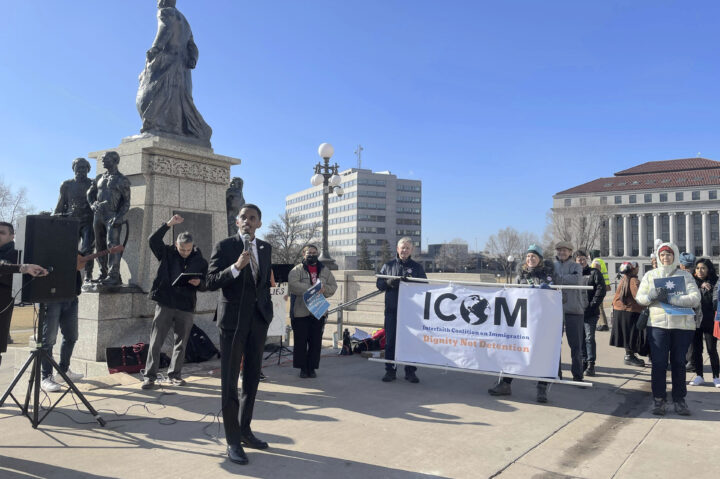
Trisha Ahmed/AP Photo
Minnesota Sen. Omar Fateh, of Minneapolis, speaks in front of the state capitol building in St. Paul, Minn., on Monday, Feb. 12, 2024.
Two political activists closely affiliated with Omar Fateh, a far-left Minnesota state senator who is now running for mayor of Minneapolis, have expressed a range of extreme views on the Hamas terror attacks of Oct. 7, 2023, endorsing the violence as a justified act of resistance and accusing Israel of initiating the war in Gaza, among other inflammatory comments.
Their rhetoric could fuel concerns among local Jewish leaders who sounded alarms about Fateh’s close alliances with anti-Israel activists after he won the state Democratic Party endorsement last month over Jacob Frey, the incumbent seeking a third and final term. Fateh, a 35-year-old democratic socialist whose campaign has recently drawn comparisons to New York City Democratic mayoral nominee Zohran Mamdani, has likewise been a staunch critic of Israel, calling its conduct in Gaza a genocide and pushing for a ceasefire 10 days after Hamas’ attack.
In a mayoral candidate questionnaire solicited by the Twin Cities chapter of the Democratic Socialists of America — which endorsed his bid after facing widespread criticism over its response to the Oct. 7 attack — Fateh also backed the Boycott, Divestment and Sanctions movement targeting Israel, according to portions of the form reviewed by Jewish Insider.
He additionally pledged, without explanation, to “refrain from any and all affiliation” with what the DSA questionnaire dismissed as “Zionist lobby groups,” citing AIPAC, J Street, Christians United for Israel and, most notably, the Jewish Community Relations Council, a nonpartisan organization that typically engages with a diverse group of elected officials in both parties. The local JCRC — which represents the Jewish community to Minneapolis government officials — has voiced reservations about its ability to interact with Fateh if he is elected, in light of his statements on Israel.
But some of Fateh’s campaign staffers have gone significantly further than the state legislator, raising questions over his tolerance for incendiary language on a sensitive issue that has stoked growing internal tensions in the state party and could possibly inflect an increasingly bitter mayoral race in the lead-up to November.
In a series of now-deleted social media posts, for instance, Fateh’s communications manager, Anya Smith-Kooiman stated that Israel “does not have a ‘right’ to exist” and “must be dismantled,” while amplifying comments dismissing widespread reports of sexual violence on Oct. 7 as “propaganda” and hailing the attacks as a form of “resistance” that succeeded where the peace process had failed.
Elsewhere, Smith-Kooiman, who joined Fateh’s campaign in December, according to her LinkedIn page, declared a month after the Oct. 7 attacks that she did “not give a flying f**k about Hamas,” claiming “the root of the problem is a colonial government segregating, ethnically cleaning, murdering Palestinians, stealing their land with impunity and not expecting a resistance group to violently fight back.”
“Colonial and oppressive regimes love to call everyone but themselves a terrorist,” she continued in her November 2023 post to X, now removed from her profile. “Israeli terrorism created Hamas and the cycle will go on and on until Israel, Britain and the U.S. are held accountable for their violence and thievery. Let’s address root causes: imperialism.”
More recently, Smith-Kooiman, in a June social media post, advocated for the release of what she called “all Palestinian hostages,” equating prisoners held in Israel with the captives who were kidnapped by Hamas on Oct. 7.
In addition to Smith-Kooiman, another activist with ties to Fateh’s mayoral bid, David Gilbert-Pederson, has unreservedly praised the Oct. 7 attack, which he has characterized as a heroic feat of defiance against “imperial domination.”

Speaking on a panel discussion about “connecting movements for collective liberation” in December 2023, Gilbert-Pederson — who has been listed as a Fateh campaign staffer in filings — celebrated “what happened collectively for the people of Palestine on Oct. 7,” saying it was not his place to cast judgment on the violence.
“We as Americans, people who live in the imperial core, our job is to stand in unconditional solidarity with those resisting oppression,” Gilbert-Pederson, a close ally of Rep. Ilhan Omar (D-MN), explained in his panel remarks. “Unconditional solidarity does not mean that we get to say, ‘Oh, this tactic you did, we don’t really like that,’ or, ‘We agree with you, but I think that some of your methods are too extreme.’ That’s not what unconditional solidarity means.”
“We live in the core of the empire,” he said, “so it is our job to demand that our government divest from Israel, divest from the colonial project, and start to free the U.S. as well.”
Broadly summarizing his approach, he argued that “all resistance to that kind of imperial domination is justified.”
Fateh’s campaign did not respond to a request for comment on Wednesday about Gilbert-Pederson and Smith-Kooiman, both of whom have previously faced some scrutiny for their rhetoric on Israel and Oct. 7, or his answers to the DSA’s questionnaire.
For his part, Frey, a Jewish Democrat, has been outspoken against rising antisemitism in the wake of Hamas’ attacks. The mayor, 44, has clashed with the City Council over anti-Israel resolutions he has dismissed as one-sided, even as he has condemned Israeli Prime Minister Benjamin Netanyahu and his government’s handling of the ongoing war in Gaza.
One Jewish political leader: ‘No one thinks it’s going to be good for the Jewish community to be hostile and to be in constant war with the next mayor’
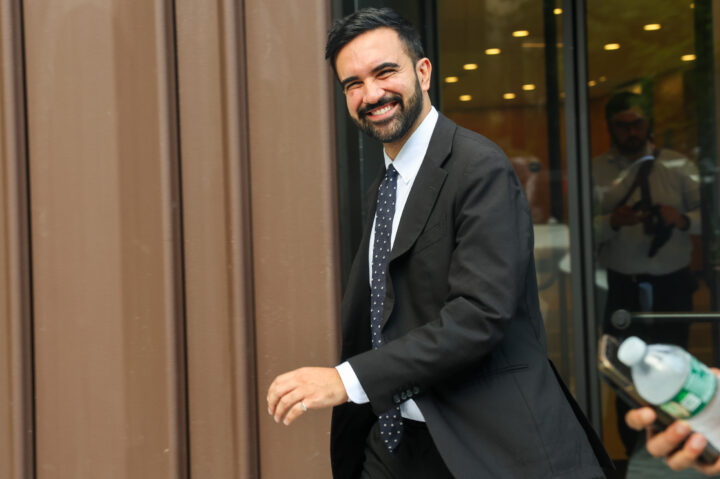
Spencer Platt/Getty Images
Democratic socialist candidate Zohran Mamdani, who won the Democratic primary for mayor of New York City, attends an endorsement event from the union DC 37 on July 15, 2025, in New York City.
In recent weeks, a creeping sense of frustration has settled in among many Jewish leaders in New York City as they have reckoned with the dawning reality that no one is stepping up to organize opposition to Zohran Mamdani, the Democratic nominee for mayor. Without a well-funded outside effort, Mamdani faces few obstacles in the general election despite numerous political vulnerabilities.
The complacency comes even as top Democratic leaders in New York have so far declined to endorse Mamdani, whose antagonistic views on Israel and democratic socialist affiliation have engendered criticism. But with a divided field of warring and baggage-laden candidates, Jewish leaders have privately voiced disappointment at the current state of the race.
“Big-money people are talking every week about how we have to do something, but I haven’t seen a real plan,” said one Jewish community leader who spoke on condition of anonymity to discuss private conversations. “People are just grasping,” he added. “There’s a sense of frustration out there and fear of a letdown.”
“You can’t beat somebody with nobody,” another Jewish leader said in assessing Mamdani’s rivals, including incumbent Mayor Eric Adams, former New York Gov. Andrew Cuomo and Curtis Sliwa, the GOP nominee — all of whom have so far resisted pleas to suspend their campaigns in order to avoid splitting the vote.
While some independent expenditure committees are preparing to spend heavily in the race to target Mamdani, an assemblyman from Queens whose far-left policies have provoked anxiety among Jewish New Yorkers, moderate voters and business leaders, the Jewish leader expressed skepticism that such efforts would ultimately “make a difference” as long as the election remains crowded with multiple opponents.
In the Hasidic enclave of Williamsburg, “the rank and file and donors are concerned” about Mamdani, said a source familiar with the situation. “But at the leadership level, people are mostly thinking that it’s a foregone conclusion” that Mamdani will prevail in November. “There’s not much to do and we have to start adapting and have to try to make amends with him and work with him.”
Jim Walden, an attorney, is also running as an independent alongside Adams and Cuomo, who in recent days have exchanged criticism as Mamdani, leading most polls with a plurality of the vote, stayed away from the headlines while celebrating his recent marriage in his birthplace of Uganda.
In the Hasidic enclave of Williamsburg, “the rank and file and donors are concerned” about Mamdani, said a source familiar with the situation. “But at the leadership level, people are mostly thinking that it’s a foregone conclusion” that Mamdani will prevail in November. “There’s not much to do and we have to start adapting and have to try to make amends with him and work with him.”
“No one thinks it’s going to be good for the Jewish community to be hostile and to be in constant war with the next mayor,” the source said on Monday. “For the community’s sake, we have to move on.”
As the anti-Mamdani coalition has struggled to coalesce more than a month after his shocking primary upset, the organized Jewish community is now largely taking a “wait-and-see” approach to the upcoming election, several Jewish activists told Jewish Insider on Monday.
David Greenfield, who leads the Jewish anti-poverty group Met Council and has been a fierce critic of Mamdani, said that many Jewish leaders are “watching closely to determine if he’ll moderate his socialist positions now that he has secured the Democratic nomination.”
“Zohran has floated possibly keeping NYPD Commissioner Jessica Tisch and that has caught the attention of several community leaders,” Greenfield told JI. “Currently, the race is quiet, partly due to Zohran himself being on vacation this month, but we expect it will significantly heat up again after Labor Day.”
A Jewish political activist who was not authorized to speak on the record echoed that assessment, even as he noted that some Jewish community leaders have been seeking to register new voters and working on “community structuring” in advance of the general election.
Still, he speculated that “if the race stays as is, then there will be a quiet shift to have conversations with Mamdani.”
For now, most mainstream Jewish groups remain hesitant to meet privately with Mamdani, according to a Jewish activist familiar with the matter, but the Democratic nominee has stepped up his outreach to Jewish voters and elected officials — while slightly softening his widely criticized defense of the slogan “globalize the intifada,” a phrase that many Jews interpret as a call to antisemitic violence. Mamdani has refused to personally condemn the slogan, but recently said he now discourages its use, marking a reversal from his primary comments as he seeks to grow his coalition.
“We’re planning to get started in August with messaging,” Jeff Leb, a political consultant who is leading a new super PAC called “New Yorkers for a Better Future Mayor 2025,” said on Monday. “I don’t think that people are sleeping on Zohran,” he said of the race. “I just think they’re making sure they have the resources they have to be active. Right now it’s a little bit early.”
Despite his evolution on the phrase, Mamdani remains a staunch opponent of Israel, backing the Boycott, Divestment and Sanctions movement he has indicated he could implement if elected. He has also suggested he would not visit Israel as mayor — defying a long-standing precedent in a place that is home to the largest Jewish population of any city in the world.
There are, to be sure, a range of anti-Mamdani initiatives underway in the Jewish community and beyond — some of which are expected to pick up in the coming weeks as summer begins to wind down after a period of relative inactivity, people involved in the efforts told JI.
Jeff Leb, a political consultant who is leading a new super PAC called “New Yorkers for a Better Future Mayor 2025” that plans to raise at least $20 million to hit Mamdani, told JI the group has in recent weeks held Zoom calls with more than 500 people and secured commitments as it readies attacks “to educate the public on Zohran’s priorities.”
“We’re planning to get started in August with messaging,” Leb said on Monday, noting that the super PAC is currently “candidate-agnostic” and will get behind Adams or Cuomo later in the race when polling indicates who is most favored. “I don’t think that people are sleeping on Zohran,” he said of the race. “I just think they’re making sure they have the resources they have to be active. Right now it’s a little bit early.”
Meanwhile, Eric Levine, a top GOP fundraiser in New York and a board member of the Republican Jewish coalition, is now organizing a fundraiser for Adams on Aug. 13, featuring former New York Gov. David Paterson and several donors from the legal and financial communities, according to an invite he has circulated within his network in recent days.
The Flatbush Jewish Community Coalition, which endorsed Cuomo in the primary but has not made a decision in the general election, recently launched a voter registration drive to boost Jewish turnout in November, Josh Mehlman, the group’s chairman, said on Monday.
The organization is expecting to register “tens of thousands of new voters,” Mehlman confirmed in a statement to JI. “With the political turbulence and antisemitism that unfortunately surrounds us, it is more clear than ever that the importance of every resident registering to vote for the upcoming and future elections will shape the quality of life and security of our communities,” he explained. “Our renewed efforts reflect that urgency.”
“No one wants to be fighting with the guy,” one Jewish leader said of Mamdani, acknowledging his rhetoric on Israel had evolved but not far enough to satisfy his most ardent skeptics. “No one wants to be in this position. But at the same time, I would put the onus on him. He’s the one who’s going to need to make changes.”
Sara Forman, the executive director of the New York Solidarity Network, a local pro-Israel group whose super PAC endorsed Cuomo in the primary, said the organization is now “keeping a close eye on everything that’s happening” in the race “and on its impact on the Jewish community,” while cautioning against “premature” conclusions at this stage of the election.
“Whether the field of candidates is able to coalesce in some way and what that looks like in September is very different from the end of July,” she told JI on Monday.
Privately, many Jewish leaders have fretted about the seemingly disaggregated and inchoate efforts to oppose Mamdani at a pivotal point in the race — as the current field continues to remain unsettled with limited time until the election.
“No one wants to be fighting with the guy,” one Jewish leader said of Mamdani, acknowledging his rhetoric on Israel had evolved but not far enough to satisfy his most ardent skeptics. “No one wants to be in this position. But at the same time, I would put the onus on him. He’s the one who’s going to need to make changes.”
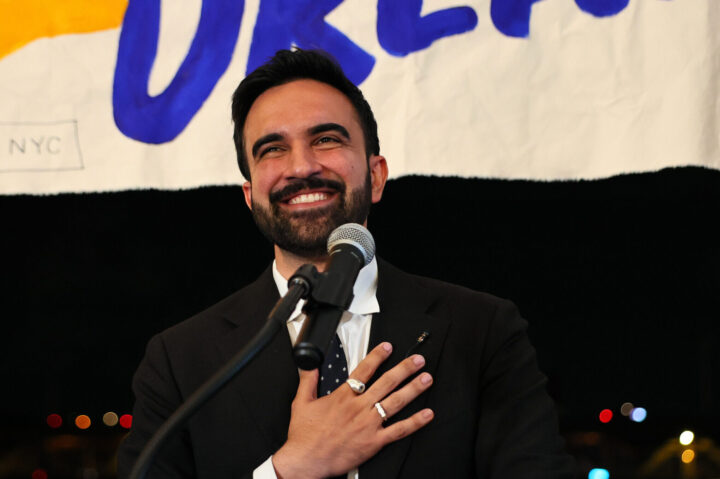
Michael M. Santiago/Getty Images
New York mayoral candidate, State Rep. Zohran Mamdani (D-NY) speaks to supporters during an election night gathering at The Greats of Craft LIC on June 24, 2025 in the Long Island City neighborhood of the Queens borough in New York City.
Since Zohran Mamdani won the Democratic nomination for New York City mayor, there’s been a fascinating disconnect between the polls showing Mamdani still vulnerable in the general election and the sclerosis among political leaders unable to make the tough decisions on whether to rally behind an alternative in a bid to stop the socialist candidate from becoming the next mayor.
There hasn’t been much good polling since the primary, but the most recent general election surveys all paint a picture of Mamdani leading the race with a plurality, but far below what a typical Democratic nominee should be receiving after a stunning, come-from-behind defeat of former New York Gov. Andrew Cuomo.
One poll, conducted by the Democratic firm Slingshot Strategies between July 2-6, found Mamdani winning 35% of registered voters, Cuomo at 25%, Republican nominee Curtis Sliwa tallying 14%, Mayor Eric Adams at 11% and attorney Jim Walden at 1%. Thirteen percent said they were undecided.
A late-June poll by the GOP firm American Pulse found Mamdani at 35%, Cuomo at 29%, Sliwa winning 16% and Adams with 14%. Asked whether they were leaning towards voting for Mamdani or anyone but Mamdani, it was close to an even split, with 48% leaning towards Mamdani and 46% preferring anyone else.
Of note, both polls found the combined Cuomo and Adams vote — which roughly encompasses the lion’s share of the moderate Democratic electorate — narrowly outpacing Mamdani’s share of support. In other words, the Mamdani alternative wouldn’t necessarily need a large portion of the Republican vote to prevail.
The obvious challenge for the anti-Mamdani forces is consolidating the field behind one leading opponent — or at least encouraging one of the two Democratic candidates in the race to drop out and endorse the other one. That’s a lot easier said than done.
The Cuomo camp rightly claims that, on paper, their numbers are stronger than the scandal-plagued Adams. The Adams camp rightly argues that Cuomo had his chance after blowing a very winnable race, thanks to a lackluster campaign operation and a lack of energy on the campaign trail — traits that won’t bode well for a general election rematch.
Both sides are correct in that all the Mamdani alternatives are seriously flawed. But looking at summer polls to predict how things could develop throughout the summer is a foolhardy exercise. After all, as we’ve written in these pages, the argument for defeating Mamdani doesn’t rest on the strength of the challenger, but the desire to build a broad coalition to stop a far-left activist from taking charge of the nation’s largest city.
Adams, as the incumbent, might be the better vehicle to put together that coalition despite his dismal favorability ratings right now. He’s already shown more agility as a general election candidate, framing the race between a silver-spooned socialist (Mamdani) against his blue-collar background.
On paper, Adams also seems better-positioned to win over enough Black voters and some crossover Republicans that Cuomo would likely struggle more in turning out. Cuomo is viewed as a partisan villain to most New York Republicans, and Adams has shown resilience with Black voters in his early campaign efforts.
But regardless of who is the strongest alternative, outside groups and business leaders need to start picking a side now if they have any hope of blocking Mamdani’s path to Gracie Mansion. It’s notable that most of the state’s top elected leaders — from Gov. Kathy Hochul to Senate Minority Leader Chuck Schumer to House Minority Leader Hakeem Jeffries — have still not endorsed Mamdani, even though he was declared winner of the primary over two weeks ago.
The longer the anti-Mamdani forces wait to make their move, the easier it becomes for him to consolidate enough Democratic support to make the efforts even harder. The reality is the fear of failure is as significant for many of these stakeholders as the desire to prevent a far-left candidate from taking over Gracie Mansion.
Adams, in launching his campaign Thursday, said the race is between ‘a candidate with a blue collar’ and one with a ‘silver spoon’
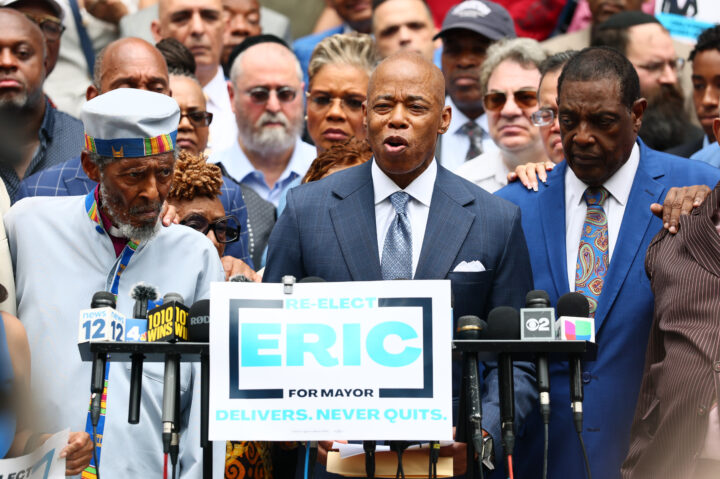
Michael M. Santiago/Getty Images
New York City Mayor Eric Adams speaks during a press conference at City Hall on June 26, 2025 in New York City.
Days after New York state Assemblyman Zohran Mamdani’s stunning upset in the Democratic primary for mayor of New York City, an emerging effort to block his path to Gracie Mansion is now beginning to materialize among a coalition of Jewish community leaders, business executives and Republican donors who have expressed alarm about his far-left policies and strident opposition to Israel.
While still in its nascent stage, the anti-Mamdani coalition is coalescing behind Eric Adams, the embattled mayor who skipped the primary to run as an independent and launched his reelection bid on Thursday. The mayor, who a day before in an appearance on “Fox & Friends” had called Mamdani a “snake-oil salesman,” is gearing up for a public brawl with the 33-year-old assemblyman and democratic socialist aiming to unseat him.
“This election is a choice between a candidate with a blue collar and one with a silver spoon,” Adams said in his campaign announcement on the steps of City Hall, depicting Mamdani, the son of a Columbia University professor and a filmmaker, as privileged.
Political strategists say Mamdani, who upset former New York Gov. Andrew Cuomo in the Democratic primary and would enter the general election as the presumptive front-runner, is a formidable nominee, particularly as the scandal-tarred mayor confronts dismal favorability numbers owing largely to the federal corruption charges he avoided while forging an unpopular alliance with the Trump administration.
But some opponents of Mamdani view Adams as the most effective vehicle to stop the presumptive Democratic nominee from winning in November, and are readying for a fight. Among other possible efforts now in the works is a “big push” to create an independent expenditure committee backed by real estate executives and other donors to boost Adams’ campaign, according to one consultant familiar with the matter.
“That’s definitely going to happen,” the consultant told Jewish Insider on Thursday, speaking on the condition of anonymity to discuss ongoing private deliberations. “People aren’t going to be taking this easy and just dealing with Mamdani,” he explained, noting the pro-Israel donor community could join the outside spending effort. “I’m sure some people are, but the people who have a lot to lose aren’t.”
Eric Levine, a top Republican fundraiser in New York City, endorsed Adams on Wednesday and said in an interview that he believes it is a “feasible” goal to reelect the mayor, provided that Cuomo stays out of the race and Curtis Sliwa, the GOP nominee, ends his campaign in order to avoid splintering the vote.
While Cuomo has yet to confirm if he will run on an independent ballot line, Sliwa has rejected growing calls for him to step aside. Jim Walden, a lawyer, is also running as an independent in what has become an unusually crowded race.
Levine, a board member of the Republican Jewish Coalition, said that he had received overwhelmingly positive responses since announcing his support for Adams in an email sent to 2,000 people — including from Democrats who backed Cuomo in the primary. “I’ve gotten feedback from a lot of people that this is a five-alarm fire and they’re going to line up behind Adams,” Levine told JI on Thursday, adding that he was “seriously considering” organizing a fundraiser for Adams and is hopeful Republican leaders would attend.
One strategist suggested that Adams could face backlash for campaigning with Republicans in the heavily Democratic city, especially as he has drawn scrutiny over his ties to the Trump administration. But the mayor will likely need to win support from a significant portion of GOP voters if he has any hope of building a viable coalition that has included Black and Orthodox Jewish residents whom Mamdani, with a long record of anti-Israel activism, has struggled to win over.
“Eric Adams has been a friend since his first days in office,” Leon Goldenberg, an executive board member of the Flatbush Jewish Community Coalition, said in a social media post. “Fighting antisemitism and standing with the Jewish community is in his DNA. The stakes are very high.”
The Jewish community, which overwhelmingly backed Cuomo in the primary, is expected to throw its support behind Adams, promising to deliver key voting blocs in November. Adams, who announced his reelection campaign alongside Orthodox leaders on Thursday, has long-standing ties to the community and during the primary engaged in a covert pressure campaign to try to influence the endorsement deliberations as Cuomo won backing from major Hasidic sects.
Leon Goldenberg, an executive board member of the Flatbush Jewish Community Coalition, said on Thursday he was supporting Adams’ campaign, the first endorsement from an Orthodox leader in what is anticipated to be many more heading into the fall.
“Eric Adams has been a friend since his first days in office,” Goldenberg, who has expressed concerns about Mamdani’s rise, said in a social media post. “Fighting antisemitism and standing with the Jewish community is in his DNA. The stakes are very high.”
Shabbos Kestenbaum, an Orthodox activist close to the Trump administration, has backed Adams and is also now seeking to rally support for his bid while urging Sliwa to drop out of the race. He said he was not yet at liberty to divulge specific names, but told JI he had been in communication with “Wall Street executives” as well as “young student activists” and a range of religious leaders about working to reelect Adams.
“There has really been a profound resurgence of a diverse coalition who truly, truly are terrified of Mamdani’s socialist dystopian future for New York City,” Kestenbaum said.
Still, no major financial commitments appear to have been made yet, even as Adams reportedly met with business leaders this week to discuss the race. “People haven’t made decisions,” said a person who has met with donors about the election. “Those types of decisions can’t be made in two or three hours.”
“A lot of people are talking about Eric. I just don’t see it in terms of being a contender,” George Arzt, a veteran political consultant, told JI. “Mamdani is very articulate. He is very likable. He’s got to prove himself to the real estate community and to the Jewish community.”
Jay Martin, executive vice president of the New York Apartment Association, said his organization “isn’t making any decisions for a little while,” but he added that his peers in the industry would likely be rallying behind the mayor. “I think they are going to see what they can do with Adams at the moment,” he told JI.
Mamdani, who has won some support from Democratic leaders since Tuesday’s primary, has dismissed the gestating efforts to corral support for Adams, saying that they will prove ineffective as his movement continues to gain traction. “What we have shown in this primary is our ability to overcome the same billionaires who may fund Eric Adams’s re-election campaign,” he told The New York Times, “and ultimately we’re able to do so because of the power of New Yorkers across the five boroughs.”
George Arzt, a veteran political consultant, said he was doubtful Adams would be able to win re-election as mayor, even as he acknowledged that there are “a lot of people” in the real estate industry and the Jewish community who are “very worried” about Mamdani, who has proposed rent freezes while defending calls to “globalize the intifada,” among other things.
“A lot of people are talking about Eric. I just don’t see it in terms of being a contender,” Arzt told JI. “Mamdani is very articulate. He is very likable. He’s got to prove himself to the real estate community and to the Jewish community.”
Jerry Skurnik, a senior consultant for Engage Voters U.S., a political consulting firm, said that “it will be very hard to defeat Mamdani in November,” noting that after the ranked-choice voting count is finalized, “he’ll have received over 500,000 votes.”
“That’s a pretty good start to a majority as he’ll have opportunity to then add votes from Democrats who didn’t vote in the primary and Democratic-leaning independents,” Skurnik added, before including a caveat. “On the other hand, I didn’t think Mamdani had a chance to win the primary until recently, so I don’t rule out anything.”
The stunning rise of the 33-year-old democratic socialist with a long history of anti-Israel activism sent shockwaves through New York City’s political establishment
Michael M. Santiago/Getty Images
New York mayoral candidate, State Rep. Zohran Mamdani (D-NY) speaks to supporters during an election night gathering at The Greats of Craft LIC on June 24, 2025 in the Long Island City neighborhood of the Queens borough in New York City.
Zohran Mamdani’s presumed victory over Andrew Cuomo in New York City’s Democratic primary for mayor on Tuesday evening marks an extraordinary upset that until recently seemed all but unthinkable for the far-left state assemblyman from Queens who entered the race last October with virtually no name recognition.
The stunning rise of the 33-year-old democratic socialist with a long history of anti-Israel activism sent shockwaves through New York City’s political establishment and is already reverberating beyond the Big Apple, raising questions over the ideological direction of the Democratic Party as it has struggled to land on a cohesive messaging strategy to counter President Donald Trump.
With the midterms looming, Trump’s allies are already reportedly preparing to link Mamdani’s radical politics to the broader Democratic brand.
Meanwhile, in a place home to the largest Jewish population of any city in the world, Mamdani’s path to the nomination is also contributing to a growing sense of political homelessness among Jewish Democrats who voiced discomfort with his strident criticism of Israel and refusal to condemn extreme rhetoric such as “globalize the intifada,” a slogan that critics interpret as fueling antisemitism.
Cuomo, the scandal-scarred former governor of New York, leaned into his support for Israel and raised alarms about the rise of antisemitism as he courted Jewish voters. But his message ultimately failed to resonate over Mamdani’s sustained focus on affordability, including calls to “freeze the rent” that galvanized younger voters who turned out en masse.
While the final primary results are unlikely to be fully counted until next week because of the city’s ranked-choice system, Mamdani, with nearly 44% of first-place votes, held a commanding seven-point lead over Cuomo on Tuesday night — forcing the former governor to deliver a concession speech earlier than most had expected.
“Tonight was not our night,” Cuomo said at his election night watch party in Manhattan. “Tonight was Assemblyman Mamdani’s night.” He said he had called Mamdani to congratulate him for “a great campaign” that “touched young people and inspired them and moved them and got them to come out and vote.”
“He deserved it,” Cuomo concluded. “He won.”
Mamdani, for his part, said in his own speech that he would “be a mayor for every New Yorker,” and sought to assuage voter concerns about his views on Israel and the Middle East. “There are millions of New Yorkers who have strong feelings about what happens overseas. Yes, I am one of them,” he said, adding, “You have my word to reach further, to understand the perspectives of those with whom I disagree.”
Mamdani’s insurgent victory five months into President Donald Trump’s second term was reminiscent of then-upstart Rep. Alexandria Ocasio-Cortez’s upset primary victory over then-Rep. Joe Crowley in the spring of 2018, one of the seminal moments that year of the political backlash to Trump. It was an early signal that the party, even as it elected a number of moderate lawmakers in that year’s Democratic wave, was moving inexorably leftward in reaction to a Trump White House.
Even as Mamdani is poised to win the Democratic nomination, the two-term state legislator is facing a potentially messy general election that Cuomo could enter on a separate ballot line. The former governor indicated on Tuesday that he would “take a look” at the race and would “make some decisions” but gave no clear confirmation of his plans.
As Cuomo mulls his decision, it remains unclear who will emerge as a moderate standard-bearer in the November election, though the primary results were sure to be an encouraging turn for Eric Adams, the embattled mayor running as an independent — and whose team was hoping for a Mamdani victory.
The crowded general election also includes Jim Walden, a centrist independent, and Curtis Sliwa, the Republican nominee, raising the specter of a fractured vote that could help propel Mamdani to Gracie Mansion.
Given that possibility, one Jewish leader in New York City recently speculated to Jewish Insider that Republicans would choose to unite behind Adams over Sliwa, “because then you have a real chance of winning.”
One Democratic strategist predicted that if Mamdani wins, some Jewish residents will move out of the state

Yuki Iwamura-Pool/Getty Images
Democratic mayoral candidate Zohran Mamdani
As the closely watched Democratic primary for mayor of New York City wraps up today, many Jewish and pro-Israel activists are now confronting a mounting sense of alarm that Zohran Mamdani, a far-left assemblyman from Queens, could win the nomination, propelling a fierce critic of Israel to the general election — and, potentially, Gracie Mansion.
In a city home to the largest Jewish community outside of Israel, Mamdani’s rise has fueled anxiety among Jewish leaders — particularly as his hostile positions toward Israel have hardly dented his standing in a competitive race that has narrowed to a two-person matchup.
Even if Mamdani does not win, Jewish Democrats uncomfortable with his strident criticism of Israel and alleged insensitivity to rising antisemitism fear that his surging campaign could end up alienating Jewish voters who have long called the party home.
“The Jewish community is going to face a real shock if Mamdani gets the nomination,” Mitchell Moss, an urban policy professor at New York University who is backing Cuomo, said in an interview with Jewish Insider on Monday. “A lot of people have come to realize that anti-Israel sentiment has metastasized into antisemitism.”
The Tik Tok-savvy Mamdani, a 33-year-old democratic socialist, has largely polled in second place behind his chief rival, former New York Gov. Andrew Cuomo, though a poll released by Emerson College on Monday showed Mamdani narrowly prevailing.
Cuomo’s campaign, for its part, has dismissed the survey as an outlier and cited other polls showing him with a more robust lead in the crowded race to unseat Mayor Eric Adams, who is seeking reelection as an independent. Fix the City, a pro-Cuomo super PAC that has slammed Mamdani’s approach to Israel in several attack ads, also released a new poll Monday that found Cuomo with a comfortable, 24-point lead over Mamdani in the final round of voting.
While support for Israel had once been viewed as a prerequisite for any winning campaign in New York City, Mamdani’s bid has tested that proposition. He has suggested he is uninterested in visiting Israel if elected, breaking with long-standing precedent, and has declined to acknowledge Israel’s right to exist as a Jewish state.
The two-term state lawmaker, who has endorsed boycotts targeting Israel, has said he would divest from Israel as mayor and promised to arrest Israeli Prime Minister Benjamin Netanyahu for alleged war crimes if he were to enter the city. Perhaps most controversially, Mamdani has drawn scrutiny for defending calls to “globalize the intifada” — a slogan that critics interpret as stoking violence against Jews.
Despite backlash, Mamdani doubled down on that defense during a radio interview on Monday, saying the phrase “has a variety of meanings to a variety of people.”
Many Jewish and pro-Israel activists in New York City have found his response alarming. “No matter what the outcome tomorrow, the fact that Zohran has been able to capture the attention of so many people who are really blind to his antisemitic tendencies really says something about the state of our electorate right now,” Sara Forman, who leads a pro-Israel super PAC that has urged voters to rank Cuomo first and to exclude Mamdani entirely, told JI.
Mamdani’s “foreign policy stances are isolating Jews and freezing us out from our political home base in the Democratic Party,” Forman said in an interview on Monday. “If the Democratic Party doesn’t wake up and start speaking to its core constituencies of Blacks, Jews and Latinos, we’re going to find our party rebuilt in someone else’s image.”
Hank Sheinkopf, a veteran Democratic strategist, predicted a Mamdani victory could end up pushing “more Jews nationally into the Republican column” and said Orthodox Jews might choose to relocate to South Florida and New Jersey. “Whether he wins or loses,” Sheinkopf said, the contours of the race have sent a concerning message that he characterized as “Jews don’t matter.”
Mamdani has rejected accusations of antisemitism, saying his opponents have weaponized such charges to score “political points.” He has said he is sensitive to rising antisemitism across New York City and has vowed to increase funding to counter hate crimes by 800%.
Early voting tallies have suggested that Mamdani has galvanized his base of younger supporters who are enlivened by his calls to “freeze the rent” and to deliver free buses as he has emphasized a message of affordability.
Cuomo, meanwhile, is depending on strong turnout from Black, Latino and Orthodox Jewish voters who have long been part of his core coalition. The former governor has locked up major endorsements from a range of key Orthodox leaders in Williamsburg and Borough Park, a Hasidic enclave in Brooklyn where he spent time on Sunday rallying a community that could deliver thousands of votes in a close election.
One Satmar leader in Williamsburg told JI that he is expecting solid turnout from New York City’s largest Hasidic voting bloc, predicting up to 8,000 votes for Cuomo, who has worked to mend relationships with Orthodox leaders that soured over his crackdown on religious gatherings during the COVID-19 pandemic.
The Cuomo campaign believes polls are missing the Orthodox vote, which could make the difference in a close election, according to an advisor who said that turnout from the community has been encouraging. “But what else are they missing is the question,” the advisor told JI on Monday, speaking anonymously to address the race.
Still, some Orthodox leaders remain on edge as Mamdani has continued to defy the odds over the course of the campaign. “He has really excited his base,” said one Orthodox leader in Brooklyn. “I am very fearful that he could actually make it, especially on ranked choice.”
Cuomo, who has won endorsements from Rep. Jim Clyburn (D-SC) and former President Bill Clinton in recent days, has also struggled to overcome his own vulnerabilities in the race, including accusations of sexual misconduct that forced his resignation from office in 2021. He denies the allegations and said he regrets stepping down.
In the final days of the election, the former governor — who has called antisemitism “the most important issue” and touted his staunch support for Israel — has insisted that his decades of government experience make him better suited to handle threats from Iran after the U.S. bombing of its nuclear sites over the weekend.
“Who do you want in charge in that situation?” he said of possible Iranian retaliation for the attacks. “Who’s handled situations like Hurricane Sandy and COVID and terrorist threats? This is not a job for on-the-job training.”
As for the bombing itself, Cuomo backed the effort to eliminate Iran’s nuclear capabilities, but he took issue with President Donald Trump’s decision to do so unilaterally without first consulting Congress — underscoring another key difference with Mamdani on Middle East policy.
Mamdani criticized the attack on Iran as “the result of a political establishment that would rather spend trillions of dollars on weapons than lift millions out of poverty, launch endless wars while silencing calls for peace, and fearmonger about outsiders while billionaires hollow out our democracy from within.”
The other candidates in the crowded primary, including Brad Lander, the city comptroller, and Adrienne Adams, the City Council speaker, have struggled to gain traction, polling has indicated.
Regardless of the primary result, which is unlikely to be confirmed for several days because of the ranked-choice system, both Mamdani and Cuomo could run in the general election on separate ballot lines, a possibility neither candidate has ruled out.
“This is a prelude to November,” said Moss, the urban policy professor, envisioning a high-stakes general election. “If Mamdani wins in New York,” he warned, “you can say goodbye to the Democratic Party for a long time.”
The endorsement from the Zaloynim faction as well as one from the smaller Aroynim faction could turn out more than 6,000 votes for Cuomo

Michael M. Santiago/Getty Images
NYC Mayoral candidate, former Gov. Andrew Cuomo arrives for the NYREC Emerging Leaders and Markets (ELM) Conference at the Victoria Renaissance Hotel on June 06, 2025 in New York City.
The majority Satmar faction in Brooklyn, which represents the largest Hasidic voting bloc in New York City, is backing former Gov. Andrew Cuomo for mayor, lending what is likely to be a major boost to his campaign in the final days of the increasingly competitive Democratic primary.
The Zaloynim Satmar faction based in Williamsburg, led by Rabbi Zalman Teitelbaum, announced on Tuesday that it is ranking Cuomo as its top pick in the June 24 primary, as recent polls have shown a tightening race between the former governor and Zohran Mamdani, a far-left state assemblyman from Queens.
The endorsement is slated to run on Wednesday in Der Yid, a Yiddish paper aligned with the faction — which ranked Adrienne Adams, the speaker of the City Council, as its second pick for mayor, followed by Zellnor Myrie, a state senator from Brooklyn.
Cuomo also notched a key endorsement on Monday from the rival Aroynim Satmar faction led by Rabbi Aaron Teitelbaum, which is a smaller but politically influential community. The group likewise ranked Adrienne Adams as its second pick in the primary to replace embattled Mayor Eric Adams, who is running as an independent.
Because Hasidic communities typically vote in blocs based on rabbinic support, the endorsements could collectively turn out more than 6,000 votes, experts estimate, which could make the difference in a close race.
The dual Satmar backing, highly coveted in New York City races, caps off a string of endorsements Cuomo has accumulated from Orthodox leaders in recent days. Last Friday, he claimed a major endorsement from the Bobov sect, the largest Hasidic bloc in the Borough Park neighborhood of Brooklyn that could deliver more than 4,000 votes, according to experts.
The former governor has also recently won support from the Far Rockaway Jewish Alliance; the Crown Jewish United and the Crown Heights PAC; and the Flatbush Jewish Community Coalition.
Still, there have been a few holdouts who remain bitter over Cuomo’s COVID-era restrictions, which many voters recall as discriminatory, according to one Jewish activist familiar with the situation who spoke on the condition of anonymity to address a sensitive subject.
On Monday, a large coalition of Hasidic sects and institutions in Borough Park broke from the Bobov leadership and announced it was ranking Adrienne Adams as its first choice, followed by Myrie, whose district includes the Hasidic enclave of Crown Heights.
The coalition did not publicly provide a reason for its decision to exclude Cuomo from its ranking. But the Jewish activist, who was privately briefed on its thinking, said that some Hasidic leaders continue to harbor lingering resentment toward Cuomo over his COVID policies, which the former governor has sought to address in a recent series of meetings to mend relationships with a community his campaign regards as crucial to securing the nomination.
“People didn’t find his apology sincere,” the Jewish activist said of Cuomo’s outreach.
The group was also organized by allies of Eric Adams, whose team has privately urged Orthodox leaders not to rank Cuomo first or to exclude him entirely from their endorsement slates, believing that Adams will be best poised to win the general election with Mamdani as the nominee, according to multiple people familiar with the behind-the-scenes push to influence the primary.
One source familiar with the effort said Adams has personally intervened, asking Moishe Indig, a leader of the Aroynim Satmar faction, to include Mamdani in an endorsement slate.
Indig did not respond to a request for comment on the effort, which was reported earlier by The New York Times.
Most Orthodox leaders have chosen to ignore the lobbying effort led by Adams’ deputy chief of staff, Menashe Shapiro, according to sources, even as the mayor has built close ties to the Jewish community and has recently been highlighting his new efforts to oppose antisemitism, which Cuomo has called “the most important issue” in the race.
A spokesperson for Adams, Kayla Mamelek, said in a statement on Tuesday that the mayor “has always stood with New York City’s Jewish communities — not only working to uplift and empower them, but confronting the disturbing rise in antisemitism in recent years.”
Even as Cuomo has rolled out a range of Orthodox endorsements, Adams’ team is hopeful that Jewish leaders will ultimately reverse course and back the mayor in the general election, according to sources.
But Cuomo’s advisors as well as Jewish leaders have dismissed that expectation as wishful thinking given the mayor’s precarious standing with voters after he convinced the Trump administration to dismiss his federal corruption charges as part of an alleged quid pro quo.
A recent poll showed that Adams would lose the general election by double digits in hypothetical matchups against both Mamdani and Cuomo, whose comfortable lead in the primary has been dwindling in recent weeks.
Mamdani’s insurgent bid has raised alarms among Jewish leaders who have been troubled by his fierce opposition to Israel amid rising antisemitism fueled by the ongoing war in Gaza.
“Mr. Cuomo’s leading opponent is a self-identified socialist who has expressed views and taken actions deeply offensive and worrisome to our community,” the Flatbush Jewish Community Coalition said in its endorsement on Monday, citing Mamdani’s support for anti-Israel boycott campaigns and his refusal to acknowledge Israel’s right to exist as a Jewish state. “These positions are not only controversial, they are outright dangerous.”
Mamdani has condemned antisemitism and said he strives to show his disagreements on Israel are “still based on a shared sense of humanity,” as he put it at a recent town hall hosted by the UJA-Federation of New York.
The democratic socialist has engaged in some direct outreach to the Orthodox community, meeting for an interview with Satmar leaders that was recently published in a popular Yiddish women’s magazine, among other efforts.
Indig, the Aroynim Satmar leader, has met with Mamdani and told the Times he was still weighing if he would add the assemblyman to his endorsement slate, suggesting that Adams’ recent outreach could pay off in the primary.
Indig, who backed Adams last cycle and is a part of his Jewish advisory council, prefers the mayor over Cuomo, said a person familiar with his thinking. He has indicated he will support Adams in the general election.
Unlike other Hasidic sects, the Satmar community is theologically anti-Zionist, opposing Israel on the grounds that the messiah has yet to arrive to usher in the creation of a Jewish state, and does not view Israel as a top issue.
Polling has found that Mamdani holds virtually no support in the Orthodox community, while Cuomo is favored by a sizable number of voters whom he is counting on to propel him to victory in the primary.
NYC mayoral candidate Zohran Mamdani said a trip to Israel is not necessary to support Jews but said in 2020 he would ‘coordinate a trip with other legislators to Palestine’
Yuki Iwamura-Pool/Getty Images
Democratic mayoral candidate Zohran Mamdani
In his campaign for New York City mayor, Zohran Mamdani, a far-left Queens state assemblyman polling in second place behind former New York Gov. Andrew Cuomo, has indicated he would not visit Israel if he is elected, saying he does not believe that such a trip is necessary “to stand up for Jewish New Yorkers.”
“I believe that to stand up for Jewish New Yorkers means that you actually meet Jewish New Yorkers wherever they may be, be it at their synagogues and temples or their homes or on the subway platform or at a park, wherever it may be,” Mamdani, a fierce critic of Israel, reiterated in comments at a mayoral forum hosted by several progressive Jewish groups on Sunday night.
By contrast, in a 2020 Zoom discussion with the Adalah Justice Project, a pro-Palestinian advocacy group, Mamdani said he was planning to organize a trip to the Palestinian territories, suggesting that he would make an exception for an issue he has upheld as one of his top causes during his tenure in Albany.
“Once COVID is over, I am planning on finding a way to coordinate a trip with other legislators to Palestine,” Mamdani said at the time. “We’ll figure that one out. I’ll probably get to the border and get turned away, but at the very least I’m going to organize it and go myself.”
It is unclear if Mamdani organized such a trip. His campaign did not immediately respond to a request for comment on Monday.
The comments, however, broadly underscore how Mamdani’s past remarks on the Israel-Palestinian conflict have become a source of growing tension as he confronts basic questions on the issue during his mayoral campaign.
Several of Mamdani’s Democratic opponents in the June 24 primary have said they would visit Israel if elected — in keeping with a long-standing tradition for New York City mayors who represent the largest Jewish community outside of Israel. Cuomo, who is leading the primary, has vowed it would be his first trip abroad, as have other candidates.
Mamdani, for his part, has suggested he would not visit any foreign country as mayor, saying he would instead “stay in New York City,” as he confirmed at the first mayoral debate last week. “My plans are to address New Yorkers across the five boroughs and focus on that,” he said.
During the mayoral forum on Sunday evening, he also raised doubts about whether he would be able to enter Israel at all, citing Israeli legislation barring non-citizen backers of the Boycott, Divestment and Sanctions movement from visiting the Jewish state.
Despite his long-standing support for BDS, Mamdani, who has faced scrutiny for declining to acknowledge Israel’s right to exist as a Jewish state, did not provide a direct answer about whether he would continue to endorse the movement as mayor when asked at the forum, saying only that he would seek to “bring New York City back into” compliance with international law.
“I think ultimately, the focus of our mayor should be on the issues of New York City at hand,” he insisted, even as he had argued in the Zoom conversation five years ago that BDS is a salient “local” issue and said that mayoral candidates should be pressured to join the movement to boycott Israel.
Elsewhere in that discussion, Mamdani voiced hostility to resolutions in the state Legislature to “disavow BDS” or “stand in solidarity with Israel,” which he dismissed as promoting Israeli interests.
“They use all of these hasbara propaganda talking points in the resolutions,” Mamdani said, using the Hebrew word for Israeli public diplomacy. “That is one place to fight is to stop such resolutions from being passed, to pass different kinds of resolutions.”
Mamdani has faced scrutiny for not signing on to several resolutions commemorating the Holocaust and honoring Israel during his tenure in office. He has defended his decision as consistent with what he now describes as a general policy against joining any such measures.
“In January, I told my Assembly staff not to co-sponsor any resolutions that were emailed to our office,” Mamdani said in a video last month. “It had nothing to do with the content of the resolution. But I understand this has caused pain and confusion for many.”
He said he had “voted every year for the Holocaust Remembrance Day Resolution, including this year, to honor the more than 6 million Jewish people murdered by the Nazis.”
In its announcement shared with JI, the group said ‘it is essential to elect champions of both the gay community and of Zionists’

Alexi Rosenfeld/Getty Images
Former governor and Mayoral candidate, Andrew Cuomo, (C) marches in the Celebrate Israel Parade up Fifth Avenue on May 18, 2025 in New York City.
A new coalition of pro-Israel LGBTQ activists is backing former New York Gov. Andrew Cuomo as its first choice in a ranked slate of candidate endorsements for New York City mayor, according to a statement shared exclusively with Jewish Insider on Thursday.
“Amidst the unprecedented rise in antisemitism and anti-Israel sentiment and activity within our city, we, LGBTQ Zionists of New York, feel a deep responsibility to share our endorsements for the Democratic primaries,” the group said in its announcement. “We believe it is essential to elect champions of both the gay community and of Zionists — those who support the Jewish people’s right to self-determination and the existence of the State of Israel.”
The group cited Cuomo’s “longstanding support for LGBTQ rights and plan to address antisemitism in the city,” which includes, among other things, a vow to adopt the International Holocaust Remembrance Alliance’s working definition of antisemitism into city law.
Cuomo, the Democratic front-runner who often touts his support for Israel and has called rising antisemitism “the most important issue” in the race, has been consolidating support from Jewish leaders in recent weeks, amid concerns over the increasing favorability of his top rival, Zohran Mamdani, a state assemblyman from Queens who has repeatedly refused to acknowledge Israel’s right to exist as a Jewish state and described himself as an anti-Zionist.
In the wake of Hamas’ Oct. 7, 2023, attacks, many Jewish and pro-Israel activists have increasingly felt unwelcome expressing their Zionism in LGBTQ spaces — where the ongoing war in Gaza has fueled rising anti-Israel sentiment that has also shaped the June 24 mayoral primary in New York.
“New York City is home to the largest LGBTQ community in America and the largest Jewish population outside of Israel,” the group said. “The stakes of this election are beyond historic — they’re personal. As we enter Pride Month, we are grateful for our selected candidates’ work thus far. We stand with immense pride as New Yorkers, as LGBTQ Jews, and as Zionists, and we will advocate for a future where we are seen, heard and celebrated for all that we are — and nothing less.”
In addition to Cuomo, the coalition ranked Whitney Tilson, a former hedge fund executive who has been outspoken in his support for Israel and his criticism of rising antisemitism, as its second pick for mayor. Brad Lander, the Jewish city comptroller who has long identified as a “progressive Zionist,” is its third choice, followed by Zellnor Myrie, a state senator from Brooklyn, and Scott Stringer, a former comptroller who is also Jewish.
The coalition represents hundreds of LGBTQ activists in New York City from a broad range of organizations, a spokesperson told JI. The group, which says it plans to engage in get-out-the-vote efforts in the final leg of the race, is led by Roniel Tessler and Alex Kaufman, who were motivated to pursue grassroots LGBTQ Zionist organizing following the Oct. 7 attacks.
The group also endorsed several downballot candidates, including Mark Levine, the Jewish Manhattan borough president now running for comptroller; Jenifer Rajkumar, a Queens state assemblywoman hoping to unseat Jumaane Williams in the race for public advocate; and Patrick Timmins, who is mounting a campaign against the Manhattan district attorney, Alvin Bragg.
In a heated City Council race in Park Slope, the group threw its support behind Maya Kornberg, a Jewish political scientist now challenging Shahana Hanif, the incumbent, who has faced backlash from Jewish voters over her harsh criticism of Israel and alleged insensitivity to antisemitic incidents in her district.
“We are endorsing candidates who will confront, condemn and work to resolve the dangerous rise of antisemitism in our city, and ensure Jewish, LGBTQ and Zionist voices are protected and respected,” the group said in its statement on Thursday.
Leaders of the Far Rockaway Jewish Alliance urged voters to move past their lingering resentment over Cuomo’s COVID policies, which community members recall as discriminatory

Spencer Platt/Getty Images
Former New York Gov. Andrew Cuomo speaks at the West Side Institutional Synagogue on April 1, 2025, in New York City.
An influential coalition of Orthodox Jewish leaders in Far Rockaway, Queens, is endorsing former Gov. Andrew Cuomo for mayor of New York City, Jewish Insider has learned, the first official demonstration of support from a major Orthodox group in the race.
In a lengthy statement first shared with JI on Wednesday night, leaders of the Far Rockaway Jewish Alliance wrote that the “Jewish community in New York — particularly the frum community — faces a political crisis of historic proportions,” and urged voters to move past their lingering resentment over Cuomo’s COVID policies, which community members recall as discriminatory.
“We still feel the pain of the unfair red zones imposed by Cuomo in 2020, which targeted our communities and restricted our way of life with heavy-handed measures,” the leaders acknowledged. “That wound lingers, a reminder of how quickly our freedoms can be curtailed. Yet, despite this pain, we must look forward and consider our future as Jews in New York City, where new threats loom larger than past grievances.”
The leaders, who represent a key voting bloc in Queens, suggested their support for Cuomo was motivated almost singularly by concerns with his top rival, Zohran Mandani, a Queens state assemblyman whose fierce opposition to Israel and close alliance with the Democratic Socialists of America have raised alarms in the Jewish community.
“If Zohran Mamdani and the movement behind him succeed, we risk losing everything we’ve built,” they write. “This isn’t a mere policy disagreement or politics as usual. Mamdani and his allies, backed by the DSA, have made their intentions clear: they aim to defund our yeshivas, strip our neighborhoods of police protection, and vilify support for Israel as a disqualifying offense. These aren’t empty threats. They’re drafting laws, redirecting budgets, and winning elections — all while projecting a facade of goodwill.”
The alliance members who signed the statement include Elkanah Adelman, Richard Altabe, Shalom Becker, Boruch Ber Bender, Rabbi Zvi Bloom, Jack Brach, Mordechai Zvi Dicker, Ruchie Dunn, Joel Kaplan, Moshe Lazar, Moishe Mishkowitz, Chaim Rapfogel, Baruch Rothman and Aaron Zupnick, according to the announcement.
“Cuomo is no tzaddik, and no one claims he is,” they write. “But we’re not choosing a rebbe — we’re choosing a shield. If we don’t seize the shield before us, we’ll be left utterly defenseless. The reality is stark: in the voting booth, only two candidates can win — Andrew Cuomo or Zohran Mamdani. No one else is close.”
Their new endorsement comes as Cuomo has sought to mend relationships in the Orthodox community that had soured during the COVID pandemic. As polling has shown a tightening race against Mandani, such support could prove crucial, promising to turn out thousands of votes.
In the coming days, Cuomo is also expected to win further endorsements from major Hasidic sects in the Brooklyn neighborhoods of Williamsburg and Borough Park, according to people familiar with the matter.
“Choosing not to vote for Cuomo isn’t neutrality — it’s handing Mamdani a victory,” the Queens leaders said in their own new endorsement. “That’s a risk our community cannot take. This moment demands action. If we fail to resist this radical, anti-Torah movement, we won’t be debating policies in ten years — we’ll be debating whether we can still live here at all. We cannot stay silent. We cannot stay home. Not now.”
“This isn’t about Cuomo,” they conclude. “It’s about us.”
Leon Goldenberg’s early endorsement is among the first formal signs of Orthodox support for the former governor, who has actively courted the community
Spencer Platt/Getty Images
Former New York Gov. Andrew Cuomo speaks at the West Side Institutional Synagogue on April 1, 2025, in New York City.
Leon Goldenberg, a prominent Orthodox Jewish leader in Brooklyn, is endorsing former New York Gov. Andrew Cuomo for New York City mayor, he confirmed exclusively to Jewish Insider on Friday.
“I am fully endorsing Gov. Cuomo,” Goldenberg said. “I think he’s the best candidate by far. He’s accomplished for the city and the state. We need somebody who’s going to get things accomplished and who’s going to fight antisemitism as a major issue.”
Goldenberg, who is an executive board member of the Flatbush Jewish Community Coalition, said that he was backing Cuomo in his personal capacity, but he anticipated his group would also endorse the former governor after the Jewish holiday of Shavuot, which concludes on Tuesday evening.
His early endorsement is among the first major signs of formal Orthodox support for Cuomo with just over three weeks until the June 24 Democratic primary. The former governor has in recent weeks engaged in proactive outreach to Orthodox leaders who represent sizable voting blocs that could prove crucial in the increasingly competitive race.
While polling has shown Cuomo leading the crowded primary field, his comfortable margin has narrowed as Zohran Mamdani, a far-left state assemblyman in Queens, has recently come within eight points of the former governor in the final round of ranked-choice voting, according to an independent survey released earlier this week.
Mamdani, an outspoken critic of Israel who is the only candidate in the primary to publicly back the Boycott, Divestment and Sanctions movement, has voiced rhetoric that has raised alarms among many Jewish leaders as his campaign continues to surge.
Recently, Mamdani faced scrutiny for declining to recognize Israel as a Jewish state while speaking at a town hall last week hosted by the UJA-Federation of New York. He also stirred controversy this week over his comments to a mosque in Queens in which he denounced Israel’s pager attack last year against Hezbollah in Lebanon without mentioning it had been aimed at the terror group’s operatives rather than civilians.
Goldenberg said his lone endorsement of Cuomo was in many ways meant to raise awareness about the stakes of what appears to have become a two-person race.
“We’re trying to get the message out about how important it is to support Cuomo,” Goldenberg said. “Mamdani, who will do very well in ranked-choice voting where Cuomo will not do as well, is really gaining a lot of ground.”
Cuomo has also notched support from Sam Berger, an Orthodox state assemblyman from Queens who has accused Mamdani of stoking antisemitism. But leading Orthodox groups, whose endorsements can traditionally yield thousands of votes that have helped tipped the scales in close elections, have yet to weigh in on the primary.
In recent weeks, Cuomo has met privately with a range of Orthodox leaders to mend relationships that deteriorated over restrictions he implemented at the height of the COVID pandemic, which many community members still recall as discriminatory.
The former governor has voiced regret for creating “the impression that the community was targeted,” which he said was not his intention, and recognized that he “could have done more” to address concerns at the time.
Though Orthodox leaders have been receptive to his outreach, constituents are still bitter about Cuomo’s COVID record, even as he has expressed contrition, according to people familiar with the conversations.
For his part, Goldenberg, whose group in Flatbush met with Cuomo this month, said that he had been satisfied with Cuomo’s response to criticism during their discussion, but emphasized he is now engaging in outreach to younger voters who may not be closely following the primary.
Mamdani “is not going to be a friend of the Jews,” Goldenberg told JI. “That’s the message that just has to get out more and more forcefully, especially in the Orthodox community, which is still incensed about COVID.”
Even as Mamdani has also sought to engage with the community, a recent poll showed his support at 0% among Orthodox voters, while faring better with other Jewish denominations. Cuomo, meanwhile, performs strongest in the Orthodox community, claiming 41% of the vote, according to the poll.
In the broader Jewish community, Cuomo, who has frequently touted his support for Israel while calling antisemitism “the most important issue” in the race, is leading the field with a relatively small plurality of the vote, recent polls suggest.
Despite leading all publicly available polls, Cuomo also holds high unfavorability ratings stemming in large part from his resignation as governor amid allegations of sexual misconduct, which he denies.
In a tight race, the Orthodox community could help close the margins for Cuomo, as previous primaries have shown. Mayor Eric Adams, now running as an independent, narrowly won the nomination in 2021 with critical support from Orthodox leaders, whose communities tend to vote as a bloc.
“The Orthodox community can make a difference,” said Goldenberg, whose group endorsed Adams last cycle. “If we come out forcefully.”
He estimated there are at least 100,000 Orthodox voters in Flatbush alone, but was unable to share a party breakdown. “We have been pushing people to register as Democrats, and have had some success,” he told JI. “We’ll keep pushing it.”
In the meantime, Goldbenberg said he expects other Orthodox leaders will also soon fall behind Cuomo. “I think it really has to happen across the board,” he told JI. “So many others are holding back, but I think we have to get the momentum.”
“Sometimes there’s a choice and you’re wavering until you get near the end,” he said, but dismissed the other candidates as unviable. “There’s no other choice today.”
One Orthodox leader, who spoke anonymously to address private discussions, suggested that “by the end of next week” endorsements would likely begin to roll in.
A major Satmar faction in Williamsburg, home to the largest Hasidic community in New York City, is currently planning to endorse Cuomo the week after next, according to a community leader familiar with the matter.
“Nothing is final until final,” the community leader clarified on Friday, “but that’s the expectation.”
The race, which pit a centrist challenger against a far left incumbent, serves as a harbinger for several upcoming competitive Democratic primaries

Allegheny County
Corey O’Connor
Corey O’Connor prevailed in his bid to oust Mayor Ed Gainey of Pittsburgh in the Democratic primary on Tuesday, dealing a major blow to the activist left in a city where progressives had until recently been ascendant.
O’Connor, the Allegheny County controller and a centrist challenger, defeated Gainey, the first-term incumbent aligned with the far left, by a significant six-point margin, 53-47%, on Tuesday evening with most of the vote counted.
“We built this campaign with and for the people of this city, neighborhood by neighborhood,” O’Connor said in a social media post on Tuesday night. “I’m proud to be your Democratic nominee for Mayor. I’m ready to get to work, and I’m grateful to have you with me as we take the next steps forward, together.”
The primary, which drew national attention in the final weeks, grew increasingly acrimonious — featuring particularly sharp divisions over Israel as well as antisemitism that served as a prelude for the sort of intra-Democratic clashes poised to emerge in several races for federal office next year.
During his tenure, Gainey, who had likewise unseated an incumbent when he was elected as Pittsburgh’s first Black mayor four years ago, drew frequent criticism from the city’s Jewish leaders over his alleged lack of outreach and for a record of offensive commentary on Israel’s war in Gaza, among other issues.
O’Connor, for his part, touted his long-standing ties to Pittsburgh’s sizable and politically active Jewish community, while reiterating his support for Israel and condemning rising antisemitism during the campaign.
Previously, O’Connor, the son of a former mayor of Pittsburgh, served on the City Council representing the heavily Jewish neighborhood of Squirrel Hill — where he was also raised.
O’Connor will face Tony Moreno, the Republican nominee, in the November election, but the race is not expected to be competitive as Pittsburgh is a heavily Democratic city.
Jewish community not yet coalescing behind any of the progressives in a race that could be ‘personality-driven’

Jonathan Wiggs/The Boston Globe via Getty Images
Former Boston City Council President Michelle Wu speaks with the media after announcing that she is running for Mayor of Boston in Roslindale, MA on Sept. 15, 2020. (Photo: Jonathan Wiggs/The Boston Globe via Getty Images)
Nearly 200 years after Boston elected its first mayor, the city recently swore in its first female mayor and its first mayor of color, almost by accident. Two-term mayor and former union boss Marty Walsh left his post in March to serve as secretary of labor in President Joe Biden’s administration, leading then-City Council President Kim Janey to become acting mayor. Just 12 years ago, the city elected its first woman of color, Ayanna Pressley, to the City Council. In 2018, Pressley also became the first woman of color to represent Massachusetts in Congress.
Now, Janey and five other candidates, all of whom are people of color and self-described progressives, are running to serve a full four-year term as mayor in a race widely seen as the christening of the “New Boston”: The city is close to becoming a majority-minority city, and all six candidates are quick to point out that Boston is no longer the mostly white, mostly Catholic city it once was. (The race is nonpartisan, so candidates are not technically affiliated with the Democratic Party, but the city is overwhelmingly Democratic: 82% of Boston voters cast their ballots for Joe Biden last November.) The deadline for candidates to enter the race was last week, kicking off a critical period of campaigning before a September primary that will send the top two vote-getters to the November general election.
“The community of Boston is in a period of transformation, and asking questions about what kind of city it wants to be going forward, both as an urban center and as the hub of a region,” said Jeremy Burton, executive director of the Jewish Community Relations Council of Greater Boston.
While the candidates come from diverse personal and family backgrounds, most have relatively similar electoral histories and political views, leading to questions of how voters will ultimately differentiate between them. Five of the six major candidates serve in city government, and three of the candidates — Michelle Wu, Andrea Campbell and Annissa Essaibi George — currently serve on the Boston City Council, as did Janey until earlier this year. A fifth candidate, John Barros, served as chief of economic development under Walsh. The final candidate, Jon Santiago, is a state representative and emergency room doctor.
“If you’re a progressive Democrat or a liberal Democrat, you by and large like all these candidates,” said Erin O’Brien, associate professor of political science at the University of Massachusetts Boston. “There seems to be pretty substantive policy agreement on the major issues. I think [the race will be] more personality driven.”
For the most part, all six candidates are highlighting a robust, equitable economic and public health response to the COVID-19 pandemic as a key focus of their campaigns. Other major issues include education and teacher pay, access to housing, adapting to and mitigating climate change and expanding transit options.

State Rep. MD Jon Santiago shows support for presidential candidate Elizabeth Warren at a morning press-conference in Boston to support Warren’s plan to handle infectious disease outbreaks on Feb. 27, 2020. (Jonathan Wiggs/The Boston Globe via Getty Images)
In a city where unions remain dominant, one major change is that none of the candidates are actively seeking the endorsement of the city’s police union. Essaibi George is the only candidate who has spoken out against the movement to defund the police, as she believes the city’s police force should be reformed, not defunded.
“[Essaibi George] has done it in terms that are much more palatable to progressives and less so to the police union,” O’Brien explained. “But I really feel like the police union is used to having political clout, and their clout isn’t anything these candidates want.”
Other unions in the city have not coalesced behind a single candidate, as they did when Walsh first ran in 2013. The construction union endorsed Santiago, and the nurses’ union endorsed Barros. The firefighters’ union endorsed Essaibi George, as did William Gross, former commissioner of the Boston Police Department.
Polling has been limited in the race, with more than three months until the primary, but a late April poll found that 36% of voters remain undecided. Wu narrowly leads Janey and Essaibi George, but each had only about 15% support.
The Greater Boston Metropolitan Area is home to about 250,000 Jews, but only about 10-20% of the area’s Jewish population lives in the city of Boston, with the rest scattered in the surrounding suburbs. Still, members of the Jewish community in suburbs like Newton and Brookline closely follow city politics. “Broader Boston serves as a real center of the region, and what happens in Boston — the success of its educational systems, the health of its economy, the vibrancy of transportation, the leadership the city provides — sets the tone for the region,” explained Burton.
In conversations with community leaders, Burton has not seen Jewish community members coalesce around a particular candidate. “To the extent that they settle on candidates, they are sort of all over the place, so nobody has emerged yet as a clear favorite candidate,” he said. In part, this has to do with the diversity of the city’s Jewish community, which Burton described as three-pronged: an Orthodox immigrant community in Brighton; a more secular, older community downtown comprised of empty-nesters; and a younger, progressive, LGBTQ-friendly community largely residing in the southern part of the city. “They are not necessarily seen as one distinct, highly visible community,” Burton noted.
“If you’re a progressive Democrat or a liberal Democrat, you by and large like all these candidates,” said Erin O’Brien, associate professor of political science at the University of Massachusetts Boston.
Many of the candidates have engaged with the organized Jewish community in some form, either by speaking at panel discussions hosted by Jewish groups or appearing at events including Holocaust remembrance ceremonies. Two candidates — Janey, the current mayor; and Campbell, a city councilor — have traveled to Israel with the Boston JCRC, and Barros participated in a trade mission to Israel as a member of Walsh’s administration in 2014.
Unlike the ongoing mayoral race in New York City, where all eight Democratic candidates have weighed in on the recent violence in the Middle East, the Israeli-Palestinian conflict has not crossed into the Boston race. But across the Charles River, the Cambridge City Council held a seven-hour meeting Monday night on a resolution that Burton described as aligned with the Boycott, Divestment, and Sanctions (BDS) movement against Israel. The council is slated to vote on the resolution Tuesday evening.
“One of the issues that’s being raised in the community is in fact that they largely haven’t done orders like this targeting other companies or countries (or at least not in many, many years),” Burton told JI. JCRC’s website notes that “there are hundreds of American companies that are working overseas and engaged in transactions that could be tied to questionable human rights practices,” and the “focus on Israel betrays a deeper and concerning animus to the world’s only Jewish state.”

City Councilor Annissa Essaibi-George stands for a portrait in Savin Hill, the Dorchester neighborhood where she grew up, in Boston on Jan. 27, 2021. (Erin Clark/The Boston Globe via Getty Images)
The only candidate who responded to questions from Jewish Insider about the resolution — and how they would vote if it came before them as mayor — was Barros, who did not answer the question. “The City of Boston is a diverse and inclusive community, and as mayor I would work to make sure our purchasing power reflects our values,” Barros said.
Who are the candidates hoping to become Boston’s next chief executive? Four of the six major candidates — all but Janey and Campbell — spoke with Jewish Insider about their campaigns.
Michelle Wu
Councilor Michelle Wu got her start in politics while working on the Senate campaign of her Harvard Law School professor and mentor Sen. Elizabeth Warren (D-MA). Like Warren, Wu’s campaign is full of plans — “many, many plans,” she told JI — and also like Warren, she argues that she has the experience necessary to get the job done. Wu is the longest-serving city councilor in the race, but she says the city needs change from the top to truly serve all its residents. “I believe that the way to deliver transformational change is to rethink our approach and recognize how intersectional our issues are,” Wu said.
Her election to the city council in 2013 made her the second woman of color to ever sit on the body, alongside Pressley, and she noted that people urged her not to run. “There were many, many well-meaning mentors, advisors and politicos around town who all told me not to do it,” Wu said. “It was with the best of intentions that people were saying, ‘You won’t get elected: You’re a first-generation American woman, young, not born in Boston. It’s not possible.’ And at that time, when you looked at the makeup of the city council, that made complete sense.”
Wu’s grandparents fled mainland China for Taiwan to escape civil war, and her Taiwanese-born parents then immigrated to the U.S., where she was born. “I can’t remember one instance where we discussed politics or current events at the dinner table,” Wu recalled, adding that “in my family’s multi-generational immigration story, politics was fear and famine, and war and corruption, and all of the many things that we were supposed to stay far away from growing up.”
After attending Harvard as an undergraduate, she returned home to Chicago to care for her younger sisters as their mother dealt with a mental health crisis. “All of a sudden, the bubble around us that had kept us completely walled off from politics and government bursts, and I had to deal with government all the time in extremely frustrating ways,” Wu said. She had witnessed people call the police on her mother, and she also had to learn to manage local government bureaucracy in Chicago when she opened a small business to support her family.
Wu has advocated for limiting funding for police, and instead rerouting it to mental health or social services. “I am one of the candidates in this election cycle that has committed to not accepting donations from the police union. We are in a moment of national reckoning on systemic racism that Boston must show leadership on,” she said.
She noted the strong partnerships between Jewish and Asian populations in the city, and credited Boston’s Jewish community for its activism dating back decades. “I feel very grateful for the efforts and the work that has been done with civil rights and antisemitism that has really laid the groundwork and continues to be the foundation for so much anti-racism work here in our city,” Wu said. “There are so many incredible community leaders and organizations building community, not just to connect members of the Jewish community, but really to create community across the board.”
Annissa Essaibi George
Councilor Annissa Essaibi George spent 13 years as a teacher at Boston public schools, a unique perspective she wants to bring to Boston’s top job. “Teaching in the classroom, teenagers gave me, I call it, a front-row seat to the people of Boston,” Essaibi George said. “When I taught high school, 11th and 12th grade, you sort of see the end result when systems fail our kids and fail our families.”
She ticked off some of the challenges she witnessed from that vantage point: “The impacts of substance use disorders on our kids and on our families; the impact of trauma; the impact of poverty; the impact of food insecurity; the impact of not being able to access healthcare, whether it’s physical healthcare or mental health care; [and] the impact of not having access to a high-quality education.”
“The community of Boston is in a period of transformation, and asking questions about what kind of city it wants to be going forward, both as an urban center and as the hub of a region,” said Jeremy Burton, executive director of the Jewish Community Relations Council of Greater Boston.
Born and raised in Boston, Essaibi George is a first-generation immigrant, the child of a Tunisian father and a Polish mother. Her mother had been born in a displaced persons camp in Germany after World War II. “My grandmother, as a teenager, was taken to work in a labor camp in Germany, and my grandfather was in the Polish army and was a prisoner of war,” she explained. Essaibi George grew up largely within Boston’s Polish community, and she was raised Catholic, but she also grew up learning about Islam and Tunisian culture from her father. Her campaign office is located in her grandparents’ old house, where her grandfather once owned and operated a TV and radio repair business.
“I share a common thread, I think, with most Bostonians, certainly those that are first-generation Americans, as a daughter of immigrants,” Essaibi George said. “Boston is rich in its ethnic and cultural diversity.” Should she be elected, she hopes to “first and foremost [build] a cabinet and an administration that is diverse and reflective of Boston to best tackle … systemic inequities.”
Essaibi George views police reform as part of addressing inequality in the city, but “I don’t support defunding the police,” she said, adding that many voters have told her they also hope to see more police officers. “I’ve heard how important public safety is, and we’ve seen some significant violence recently in our city. I have residents calling for more public safety, for more police, for a heightened presence of police officers across our city.” Shootings and homicides were up in 2020 — the city had 57 murders, compared to 37 in 2019 — but overall crime was down in the city.
Essaibi George expressed a commitment to combating antisemitism in Boston. “At the city level, we have a certain responsibility to be very intentional when thinking about and working against racism, antisemitism or hate,” she said. “A number of years ago, the Holocaust memorial in Boston was damaged, and as a city we came together to support our Jewish community and to support and honor what that memorial recognizes, remembers and reflects upon.”
Jon Santiago
As an emergency room doctor and a state representative, Santiago has had a busy year serving people at Boston Medical Center and in the state house. He knows that if he becomes mayor, he’ll have to put his medical career on pause — but that’s what he’s always wanted, he said: “That was always the game plan. I wanted to practice medicine for six to 10 years, but my eyes are always on the bigger picture, on those root causes [of the city’s critical problems],” he explained. “The way I look at problems is through a very comprehensive lens.”
When a gunshot victim enters his emergency room, Santiago said he considers the factors that could have led to that moment. It’s “a number of factors of a comprehensive, larger nature,” he said, including “housing, transportation, economic opportunity, education” that could ultimately contribute to who gets shot. “It’s not a coincidence why almost all the gunshot victims are young, Black or brown males.”
Born in Puerto Rico, Santiago moved to Boston as a toddler, and first began to see how public policy could impact health outcomes when his uncle contracted HIV. “Boston has been a place of opportunity where if you work hard, if you dream big, good things can happen. For me, it’s always been this inspirational place, but at the same time, it’s been a place of tragedy,” he said. “It’s a place where my uncle likely became infected with HIV and passed away from AIDS later on, leaving his son, my cousin, to become an AIDS orphan.” Seeing his uncle get sick and die led to his decision to go to medical school. Santiago later served in the Peace Corps in the Dominican Republic and studied as a Fulbright scholar in Paris.
Santiago presents himself as an outsider, having beaten a 36-year incumbent in his election to the state house in 2018, and he thinks Boston needs a mayor who does not come from within city politics. “The question I asked myself is, was I happy with the situation the city of Boston is currently faced with right now?” Santiago said. The answer was no. “There’s probably about 30-plus combined years of City Hall experience in those five candidates, not just years of experience, but also in leadership positions, multiple city council presidents, the chair of a department there,” he added. “The question for me is, Why are we going to the same people who have been in charge of the system — who enabled the system?”
Although Santiago has expressed support for reallocating money from the Boston police budget, he shied away from referring to his position as defunding the police. “I think that the term ‘defund the police’ is a term that has not served anything, anyone or any community,” he said. “I’m a person of color. I grew up in urban America for a number of years. I know what it feels like to be intimidated by cops,” Santiago noted, adding that he also sees the other side of the issue: “I understand the role that the cops do daily because I work with them in the emergency room. I see them each and every shift, and I respect the work they do.”
Like the other candidates, Santiago is running as a progressive. But he is also pushing a message of unity and understanding across political differences. “I think we have a lot more in common with each other, and I just believe in this American pragmatism,” Santiago argued. “I want to bring a sense of belief that Boston is a place where things can happen, where people can come together and work to achieve and address these complex issues.”
Santiago said that he met with members of the Jewish community at the urging of some Jewish members of his staff. “Their issues are very much intertwined with everyone’s issues — housing affordability, transportation, equity, education, how can we fight for a city that is responsive, and that reflects all of our interests,” he noted. “I’ve developed relationships with them. I’ve knocked on their doors and spoken with their community leaders, and will continue to do so.” He said he spoke with Jewish day schools in the area about the challenges of operating during the COVID-19 pandemic. “We’ve been back in the community several times since then, to really engage them and to learn from them,” Santiago noted.

John Barros announces his campaign for mayor of Boston, in a crowded Haley House Bakery Cafe, on Thursday, April 25, 2013. (Pat Greenhouse/The Boston Globe via Getty Images)
John Barros
Although John Barros has never held elected office, he is the only candidate to have previously run for mayor — and the Boston Globe endorsed him in 2013. That race also had a historically diverse field, though it culminated with Walsh’s victory. Barrow joined Walsh’s administration early on to oversee economic development issues. “I’m not running to make history. I’m not running because I feel like I need to be elected as a Black man. I’m running because I feel like I am ready to help the city meet the moment,” he told JI.
The economy is his expertise, and his main focus. He wants to “help our small businesses get back on their feet and get ready to help get our economy back in order, and then help to make the economy more inclusive, make those who are participating in the growth of our city more diverse,” he said. He also wants to prioritize creating Black-owned and women-owned businesses, and to “create opportunities for us to bridge the wealth divide gap in Boston.” He added that Boston faces many of the same challenges now as when he ran for mayor in 2013 — pandemic aside — but one major change is “the urgency is now different when you talk about transit and climate justice. It wasn’t part of the conversation back then.”
Barros’s political resume highlights his time as a community organizer, but he is also a small business owner himself. The son of immigrants from Cape Verde, in Western Africa, he owns a Cape Verdean restaurant called Restaurante Cesaria in Dorchester. “During the pandemic, we knew firsthand what it meant to try to survive as a small business and keep families employed. It was really difficult,” he said. “We had to make some tough cuts. The management left some paychecks on the table to make the right decision and try to keep the team in place.”
In that role, Barros had to navigate thorny ethical issues. “One of the toughest things for the restaurant is, I was able to manage the direct relief program from city government to small businesses, but because obviously I was a part owner of that business, [the restaurant wasn’t] able to receive any assistance,” he said. He praised that program and the resilience of Boston’s restaurants: “Restaurants and other places provide meeting space, networking space, places for people to connect, and they are really an important backbone to our community building,” he noted.
His parents came to the U.S. to build a life with better educational opportunities for their children, and he took their lessons to heart, becoming a community organizer at age 14. “I became a community organizer in my neighborhood, and started to do work in improving my neighborhood and improving the city,” he explained, later doing the work full-time and helping create urban parks and agricultural spaces. “I can’t say I’ve always wanted to be mayor. It is not true. I never thought I could be. I felt that government wasn’t for me, it was for someone else,” he said.
Barros has also expressed support for reallocating funding from the police, but he told JI he believes police must be partners in reform. “I think I can work with police to get those reforms. I started working with police on police reform matters as part of the Walsh administration,” he said. “It’s work that you do by bringing police to the table and having the hard conversations about what needs to change, and that’s the only way it can happen. Because the police, like everyone else, have bargaining units, have contracts.”
Barros highlighted his opposition to antisemitism and a commitment to fighting hate crimes in the city. “The Jewish community has seen an increase in crime, and we have to stand up against that and be firm in a zero-tolerance policy,” he explained. “It is a threat to all communities if we don’t stand up for the hate crimes being perpetrated to other communities.”
The housing expert and all-around policy wonk is hoping his 'campaign of ideas' will set him apart in a crowded field

Courtesy
Shaun Donovan
On paper, Shaun Donovan seems to stand out as an eminently qualified candidate for New York City mayor. The 55-year-old housing and urban development expert with two master’s degrees is a policy wonk who held top jobs in the Obama White House and Bloomberg mayoral administration, and in conversation, he projects an air of academic forbearance reminiscent of his former bosses.
In his 200-page campaign policy book, released last month, Donovan lays out his painstakingly detailed and rather creatively rendered plan for New York City as it emerges from the ravages of the pandemic, calling for equity bonds of $1,000 for every child and envisioning a plan to engineer a series of “15-minute neighborhoods” in which “a great public school, fresh food, rapid transportation, a beautiful park and a chance to get ahead” are all within walking distance.
On Tuesday, Donovan announced a new initiative, “70 Plans in 70 Days,” in which he will lay out one new policy proposal every day until the Democratic primary on June 22 — a meticulous approach he is hoping will set his candidacy apart from the crowded field as a “campaign of ideas.”
“The plan for New York City is the best expression of that, and I really do have the boldest, most comprehensive ideas about the future of this city,” Donovan boasted in a recent interview with Jewish Insider. “But I also have the deepest experience in government to be able to ensure that those ideas can make a real difference in people’s lives.”
Donovan’s proposals have, appropriately enough, earned plaudits from serious policy experts in New York.
“I’ve been impressed with Shaun Donovan’s focus on getting New Yorkers back to work,” said Eli Dvorkin, editorial and policy director for the Center for an Urban Future. “He has identified a number of strong models that New York City can build on — from apprenticeship programs to nonprofit tech training — and made it clear that he would invest heavily in skills-building infrastructure. That’s what the city will need to rebound from the current crisis and build a more equitable economy in the future.”
But it remains to be seen if Donovan has the wherewithal to pull off an upset. Several analysts who spoke with JI described the mayoral hopeful as a “talented” individual, while also observing that, despite his policy chops, voters don’t seem to be rallying behind him.

Shaun Donovan, secretary of the Department of Housing and Urban Development, testifies at a Senate Homeland Security and Governmental Affairs subcommittee hearing on Nov. 6, 2013. (J. Scott Applewhite/AP)
“Shaun Donovan is a tremendously talented public servant,” said David Greenfield, the CEO of the Met Council and a former city council member. “The challenge that he faces is that he’s always sort of been in the background and therefore doesn’t have the same political profile as some of the more active and better-known political candidates, many of whom have either held office or run for higher-profile office before.”
Polling suggests as much. Donovan seems to be lagging significantly behind the apparent frontrunners in the race, including Andrew Yang, the charismatic former presidential candidate; Eric Adams, the brash Brooklyn borough president; and Scott Stringer, the seasoned city comptroller.
But Donovan remains uncowed, citing another set of statistics that he claims supports his case. “I wouldn’t trade my place in this race with anyone,” he said. “I think it’s reflected in polling that New Yorkers want change and they want experience at this moment, and I really believe I’m the only candidate that represents both of those in the sense that nearly every other candidate is, in some way, part of the status quo.”
Donovan, of course, isn’t exactly a fresh face in New York City government, though it has been some time since he was on the scene enacting what experts characterized as meaningful change.
From 2004 to 2009, he served as former Mayor Michael Bloomberg’s housing commissioner, creating the city’s first inclusionary housing program offering “density bonuses to developers who agree to set aside units as affordable,” according to Ingrid Ellen, a professor at New York University who specializes in housing.
“He left a legacy of improving the lives of so many people who don’t have the means to get habitable housing,” said Rabbi David Niederman, president and executive director of the United Jewish Organizations of Williamsburg, who worked with Donovan on issues of affordable housing back in the aughts.
“I worked extremely closely with mayors across the country and saw, again and again, that particularly at a time when our national politics could be divisive and dysfunctional, mayors really touch people’s lives.”
Following his tenure in city government, Donovan accepted an appointment from former President Barack Obama to helm the Department of Housing and Urban Development, during which time he helped lead a revitalization task force in the wake of Hurricane Sandy, among other things.
“I worked extremely closely with mayors across the country and saw, again and again, that particularly at a time when our national politics could be divisive and dysfunctional, mayors really touch people’s lives,” said Donovan, who went on to lead the Office of Management and Budget under Obama. “They are close to the ground. They are the leaders that can make the most difference in the day-to-day lives of New Yorkers and people in their communities.”
In conversation with JI, Donovan, who was raised on the Upper East Side, emphasized his family’s own personal connection to New York as an explanation for why he is now mounting a mayoral bid.
His father, Michael Donovan, an advertising executive, had Jewish, Catholic and Protestant grandparents, and was “beaten up as a child because of that,” Donovan said. Michael, who was born in Panama and grew up in Costa Rica, “had a deep connection to his Irish roots, but also a sense of being an outsider,” Donovan added. “He came to the U.S. to go to school like so many immigrants, and then came to New York to find opportunity, and found it.”
“I would say my entire family owes everything to New York in a fundamental way,” Donovan elaborated. “But at the same time, I also grew up in New York in the 1970s and ’80s. I saw homelessness exploding on the streets. I saw the South Bronx and so many other communities around the city struggling, even burning to the ground, and that really lit a fire in me to go to work on behalf of this city that I love.”

Shaun Donovan
“My platform is really about repairing and rebuilding the city but also about reimagining it as a city that works for everyone,” said Donovan, who advocates for investments in bus rapid transit as well as keeping libraries open 24 hours a day, seven days a week, so New Yorkers will have increased access to broadband.
But getting elected and implementing such policies is in many ways a more challenging task than earning an appointment to public office, particularly in New York, where many prominent figures have tried and failed to do so, including Joe Lhota, Richard Ravitch and Daniel Patrick Moynihan.
“This is a longstanding challenge,” said Mitchell Moss, a professor of urban policy and planning who directs the Rudin Center for Transportation Policy and Management at New York University. “It’s not unusual that people who succeed in appointed life can’t make it in New York City politics.”
Donovan seems intent on proving that he will be an exception to the rule. In the first TV ad of the race, released in February, he painted himself as a veteran of the Obama administration with ties to the current president, Joe Biden — though such appeals appear largely to have gone unnoticed as other candidates gain traction.
“I would say my entire family owes everything to New York in a fundamental way.”
“Donovan’s going to have to do something creative over the next couple of months to be able to catch people’s attention and be, if not their number one choice, their second or third,” said Jake Dilemani, a managing director in Mercury’s New York office.
Donovan is now mounting an aggressive TV ad blitz as he seeks to earn name recognition in the new ranked-choice voting system, buoyed by $2 million in independent expenditures from his father. “I am following the law,” Donovan said of his father’s super PAC contributions in an interview with WNYC host Brian Lehrer on Tuesday. “There are dozens of these groups supporting many different candidates who are running, and I don’t coordinate with any of them.”
In the end, Donovan, who has staked out a position, for better or worse, as one of the brainiest candidates in the race, wants to focus on the ideas. “I think, especially in this moment of crisis, New Yorkers are really hungry for a mayor who has the boldest ideas about how we rebuild our health and our economy, how we make this a more equitable city.”
“Shaun Donovan is very smart, very capable and very knowledgeable about New York City,” Moss acknowledged. But in the highly competitive mayoral race, he said, “It’s not enough to be smart.”
It was a surprise to everyone in Portland, Maine — including Mayor Ethan Strimling — when 250 asylum-seekers from Angola and the Congo arrived in the New England city over a single week in June.
The only advance notice Portland received had been a call from a Catholic Charities worker in San Antonio, Texas, who had put the asylees — who had crossed into the U.S. through the border with Mexico — on a bus headed for the coastal city, Strimling said in an interview with Jewish Insider.
Though it created a housing crisis for officials in the municipality that The New York Times described as one of the “oldest and whitest states in the country,” Strimling and others welcomed them.
In April, when President Trump tweeted that he was considering sending immigrants to sanctuary cities, Strimling tweeted in response, “If Trump wants to send more immigrants our way, I say, ‘Welcome Home!’”
Asylees who arrived in June were given temporary shelter at the Expo Center, a city-owned basketball arena. “The city’s response made me so proud that I was a member of this community, let alone the mayor,” Strimling told JI. “I went to the shelter every night and talked to the families, made sure they were safe. “It gave me great joy to be down there every day.”
About half of the unexpected African asylees have settled in Portland, with the rest having been set up with housing in surrounding communities, said the mayor.
His city is “without question the most diverse in the state,” Strimling told JI, and he expects the 2020 census to reveal that 15 to 20 percent of its residents are people of color – a major shift from 20 years ago.
Now, three weeks from Portland’s mayoral election, Strimling hopes voters will elect him to a second term. Despite having three challengers, including one who interned for Strimling’s last campaign, “we are feeling cautiously optimistic” about winning, he told JI.
Strimling, who will turn 52 this week, was born and raised in New York City and was an acting student at Julliard when he decided to take a left — or northern — turn and move to a farm owned by his mother’s best friend, near Maine’s Acadia National Park. He earned his Bachelor’s degree at the University of Maine and a Master’s degree in education at Harvard before going to Washington to work as a legislative aide. He returned to the Pine Tree State to run a congressional campaign.
In the late 1990s, Strimling turned to working with at-risk kids, eventually running Learning Works, a community-based education organization, and joined the board of the NAACP. Later he was invited to join the board of the Maine chapter of the ADL. He stepped off of all boards when he ran for mayor. He lost his first race in 2011, but won his second attempt four years later.
Now he hopes to win a second term and address what he describes as Portland’s most pressing problems, primary among them a local housing crisis. He is pushing for a $10 million bond issue that would raise money for affordable housing, wants to increase the number of affordable housing units developers provide, and to “crack down on Airb&b,” which has taken 400 homes off the rental market since their owners began listing them on the short-term vacation stay site.
“When those migrant families arrived we needed just 100 units of affordable housing to not open up the gymnasium, and we didn’t have it,” said Strimling.
His city has become a tourist destination on the Maine coast, with developers building triple the number of hotel rooms as they did two decades ago. But that doesn’t mean it has been a total economic success for Portland, said Strimling, noting that “tourism industry jobs are low-paying.”
A pop-up organization calling itself Unite Portland has been running Facebook attack ads against Strimling in the past several weeks — not for another candidate, just against Strimling. The individuals behind it are real estate developers, he said, though organizers are not complying with mandatory disclosure reporting rules.Strimling said that his campaign filed an ethics complaint against them last week in an effort to force them to disclose more details.
The son of a non-Jewish mother and a Jewish father, Strimling identifies as Jewish, but it is a cultural rather than religious association, he said. His father, Arthur Strimling, is a theater director and midrashic story-maker based in Brooklyn. Most of his close friends from high school were Jewish, he noted. His girlfriend, who also works as his campaign manager, is not.
In July, an article in the local Portland Press-Herald about donors to his campaign highlighted the contributor with the most overtly “Jewish” name. In addition, there have been some anti-immigrant and anti-Strimling signs posted around Portland, he said.
However, antisemitism has not been an overt issue in his race for a second term, he said.
“I get a lot of ‘go back to NY’ — code for ‘New York values,’ you know what that can mean,” Strimling told JI. “But overtly antisemitic stuff, where they’re really identifying my ethnicity, I haven’t gotten that.”
Bill de Blasio is getting ready for his inauguration.
Almost exactly one month before the January 1 date when he’ll take the oath of office, the mayor-elect rolled out his inaugural committee today, a list of names “from all five boroughs, every community and every walk of life,” as his transition team put it in a press release.
Jewish Members of the Inaugural Committee
1.
Rabbi Heshie Dembitzer. Bobover Yeshiva B’nai Zion

L-R: Chaim Sieger hosts NYC mayor-elect Bill de Blasio with askanim Yitzchok Fleischer and Heshie Dembitzer. (Credit: Hamodia)
2. Matthew Hiltzik, Founder, Hiltzik Strategies

3. Yitzchok “Isaac” Leshinsky, CEO, Housing Bridge

4. Jona Rechnitz

Rahr and Jona Rechnitz (credit: NYDN)
5. Ronald Perelman, Chairman and CEO, MacAndrews & Forbes

6. Morris Missry, Partner, Wachtel Missry LLP

7. Jay Eisenhofer, Founder, Grant & Eisenhofer P.A.

Please log in if you already have a subscription, or subscribe to access the latest updates.
 Continue with Google
 Continue with Apple