


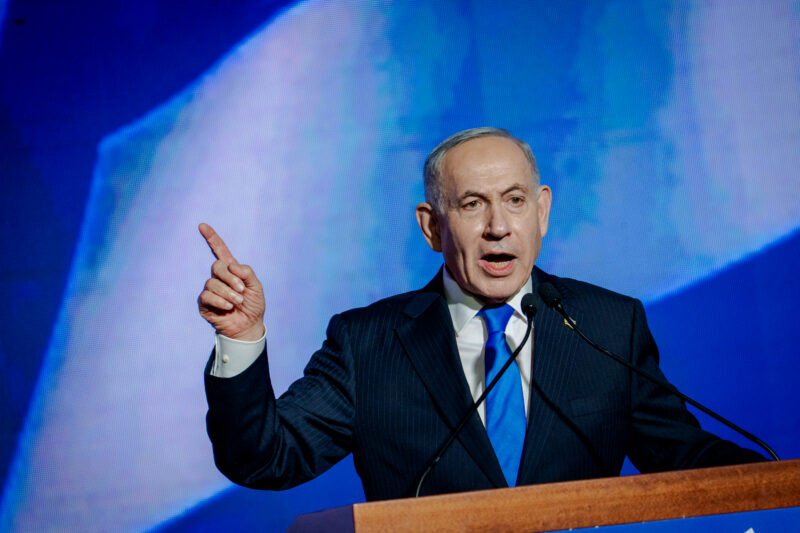
































































Jewish Democrats reluctant to vote for El-Sayed say the letter fails to acknowledge or address the primary drivers and manifestations of modern antisemitism: attacks on Jews for real or perceived ties to Israel
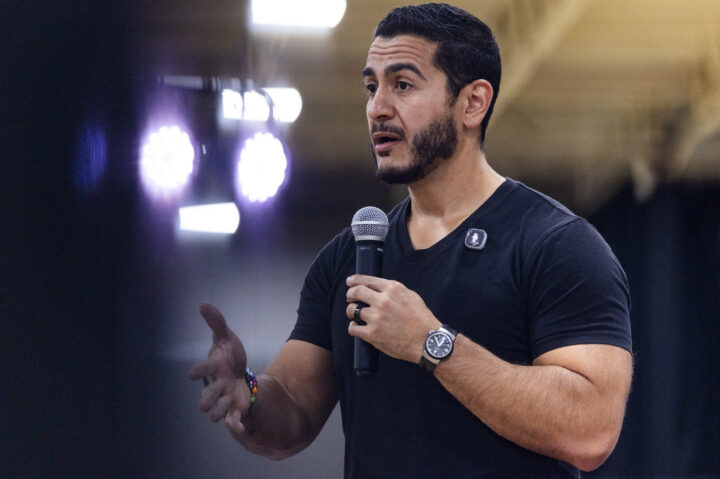
Emily Elconin/Getty Images
Democratic candidate for U.S. Senate Abdul El-Sayed answers questions from attendees during a town hall event on September 3, 2026 at the Oakland Expo Center in Waterford, Michigan.


 Add JewishInsider on Google
Michigan Democratic Senate nominee Abdul El-Sayed made his case to Jewish voters in a new mailer this week in which he pledged to combat antisemitism — but Jewish Democrats skeptical of El-Sayed said the letter only reinforced their concerns that he’s not prepared to acknowledge or address contemporary drivers and manifestations of antisemitism.
In the letter mailed to Jewish voters this week, El-Sayed said he knows “what it’s like to be discriminated against because of what I believe” and said that he wants to “protect the kind of America where everyone can pray how they choose to pray.”
“I care deeply about the threat of antisemitism to our communities, and I am committed to protecting all Michigan Jews against hatred and injustice,” El-Sayed continued. “As your senator, I will always stand up against antisemitism and take the threat of violence against our Jewish community incredibly seriously. Antisemitism is a scourge, and we need to address it in all its forms. It has no place in our communities. Ever. Full stop.”
The letter, paid for by the Michigan Democratic State Central Committee, is the latest part of the El-Sayed campaign’s efforts to win over skeptical members of the Jewish community, with prominent community leaders saying they plan to support his opponent, former Rep. Mike Rogers (R-MI), or sit out the race.
But some voters skeptical of El-Sayed’s campaign said the letter isn’t helping his case and that his focus on freedom of prayer and belief misunderstands the nature of the antisemitic threat that the community faces.
“What I have always said and what I will continue to say is that his continued emphasis on describing antisemitism solely as a religious bigotry leaves him ill-equipped to protect Jews should he be elected to office,” Democratic state Rep. Noah Arbit, who opposes El-Sayed, told Jewish Insider. “The attack on Temple Israel wasn’t motivated because the terrorist didn’t like how we pray. He attacked us because we are a proudly Zionist congregation.”
El-Sayed continues to face criticism for his response to the Hezbollah-inspired attack on Temple Israel in West Bloomfield, Mich., earlier this year, of which he said, “hurt people hurt people.” El-Sayed has since apologized for those remarks, and has been working since the primary election to win over skeptical Jewish voters.
Arbit said that El-Sayed “can’t bring himself to speak to the violent antisemitism that stems from blind, burning hatred of Israel” and questioned how he’ll respond if Jews face similar attacks going forward.
“When Jews in Michigan are targeted with violence because of our connections and our commitments to Israel, will Abdul El-Sayed stand with us?” Arbit said. “Or will he — as so many of his friends on the extreme, far left have done — deflect, excuse and blame us or blame the Israeli government for the fact that radicalized people have taken their anger about a foreign conflict out on Michiganders?”
Joan Lowenstein, a member of the Michigan Democratic Party Central Committee and president of the Jewish Federation of Ann Arbor, offered a similar view. Lowenstein is a leading member of the Nonnegotiable campaign, which is pressing El-Sayed and other Democrats to agree to a series of commitments to protecting Jewish safety and acknowledging Israel’s right to exist.
“It makes it seem as though all the Jews really care about is prayer, the only thing that differentiates us is that we pray differently, as though antisemitism is about prayer. It’s just so tone deaf,” Lowenstein said, adding that El-Sayed seems to be trying to separate Jewish voters from Israel.
She called the letter “more lip service,” not a meaningful commitment like those sought by the Nonnegotiable effort — and particularly hollow coming amid escalating anti-Israel rhetoric by El-Sayed, who this week said that Israel is not a friend or ally of the United States.
She said that El-Sayed’s repeated accusations that Israel dragged the U.S. into the Iran war and has caused nothing but trouble for the United States only play into antisemitic tropes.
“El-Sayed seems to be moving even farther away from understanding the issue of what we would have hoped to hear to reassure us, and instead is really just saying, you’re going to have to take me or leave me because all my votes are going to be against Israel,” she said.
Rabbi Aaron Starr of Congregation Shaarey Zedek in Southfield, Mich., a leader of the Nonnegotiable campaign, speaking in his personal capacity, also said that the letter highlights the disconnect between El-Sayed and the Jewish community and fails to address real-world manifestations of antisemitism.
“This letter demonstrates that Dr. El-Sayed is just not hearing the requests of Jewish Michiganders. It’s been six weeks since Nonnegotiable Michigan launched with clear and consistent communication,” Starr said. “I certainly share in his hope that America can be a place ‘where everyone can pray how they choose to pray,’ and I stand up for the right of everyone to pray or not to pray how they want. 21st-century antisemitism, though, manifests not in discrimination against how we pray, but in our ability to pray safely, to gather safely, to express our connection to the land, people, and state of Israel safely.”
He said that achieving safety for the Jewish community requires not just security funding — noting that the community spends $1 billion annually nationwide on securing its institutions — but also “rhetoric and policy that recognize how antisemitism takes hold and spreads.”
He went on to call out El-Sayed’s own rhetoric, including calling Israel “bloodthirsty” and attributing U.S. support for Israel to financial inducements.
“Just this week, he told a national audience that Israel takes American money to push our country into wars, and he equates Israel with Iran,” Starr said. “When he and others engage in such language, Jews across America feel the consequences on college campuses, at hospitals, in grocery stores, in parades, at our preschools, and in our sanctuaries.”
This week, Illinois Democratic House candidate Daniel Biss, who beat out an AIPAC-backed challenger as well as a far-left anti-Israel activist, visited the Wolverine State to speak to a group of Jewish voters in connection with Michigan Jews for Democracy, a group supporting but not formally affiliated with El-Sayed’s campaign.
“With antisemitism rising, Abdul has shown a real commitment to Jewish safety. He’s the right choice for our community and our country,” Biss said on X. Other speakers the group has brought to the state include Rep. Becca Balint (D-VT) and House candidate Brad Lander.
The ad is part of a national campaign with other ads running in Ohio, Michigan, Texas, Georgia, North Carolina and Iowa

Anna Moneymaker/Getty Images
Senior Advisor to the Director of the Cybersecurity and Infrastructure Security Agency Cait Conley speaks to Politico Cybersecurity reporter Maggie Miller during Politico's annual AI and Tech Summit on September 17, 2024 in Washington, DC.
The Jewish Democratic Council of America is launching a new streaming and digital ad campaign targeting Rep. Mike Lawler (R-NY) and boosting his Democratic opponent, Cait Conley.
The ad is part of a $300,000 national midterm campaign by JDCA that aims to reach 4 million Jewish voters by Election Day, with other ads running in Ohio, Michigan, Texas, Georgia, North Carolina, Iowa and every district that the Cook Political Report rates as a toss-up.
The anti-Lawler ad hits the two-term Republican, who represents Westchester and Rockland Counties, over his ties to President Donald Trump, featuring footage of the two together.
The ad accuses Lawler of staying silent in the face of antisemitism from the Trump administration — though Lawler has been among the most outspoken and active lawmakers on combating antisemitism on Capitol Hill.
“Donald Trump is lucky to have Mike Lawler, we’re lucky to have Cait Conley,” the ad states.
Conley has also pledged to be outspoken against antisemitism if elected.
In the district, JDCA held a canvassing event with Conley’s campaign and the Westchester Jewish Democrats on Sunday.
“NY-17 has the largest Jewish voting population of any of the vitally important red-to-blue congressional districts in the country, with Jewish Americans making up nearly one-fifth of its population,” JDCA CEO Halie Soifer said. “We’re proud to support veteran Cait Conley in this race, and are confident a majority of Jewish voters in the district will vote for her because she aligns with our values.”
“This JDCA PAC ad sends a clear message that a vote for any Republican this year, including Mike Lawler, is a vote for Donald Trump’s extremism, cruelty, chaos, and corruption,” she continued. “This ad underscores that Trump has elevated and embraced dangerous far-right extremists and Mike Lawler has failed to hold the White House accountable. Conley, on the other hand, stands with Jewish voters on every key issue, including her opposition to Donald Trump.”
During his campaign, Lawler has highlighted his bipartisan record, and endorsements from some Jewish Democratic local officials.
JDCA is also running ads against Sen. Jon Husted (R-OH), as well as a national campaign that highlights a Young Republicans group chat where members expressed antisemitic sentiments and praised the Nazis, and includes a clip of Vice President JD Vance shrugging off the scandal.
This story was updated on Oct. 19 to reflect that the ad campaign will run on streaming services, not cable.
The Honan Strategy Group survey also found Jewish voters split almost evenly on whether each major party is friendly or hostile to Jewish interests
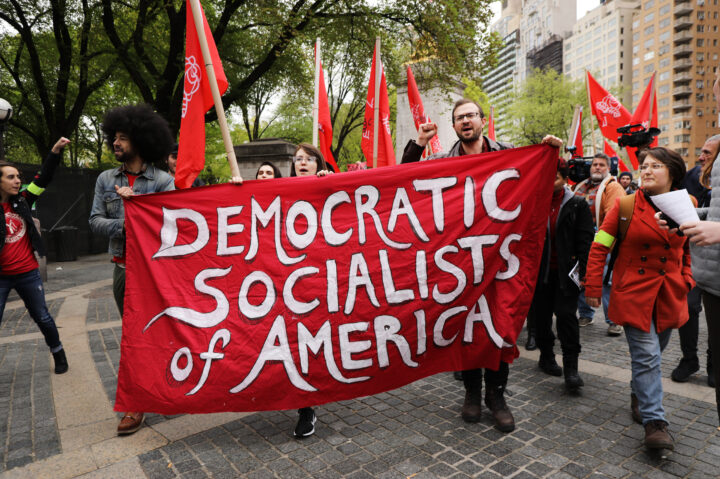
Spencer Platt/Getty Images
Members of the Democratic Socialists of America May 01, 2019 in New York City.
A new poll found support for the Democratic Party decreasing among Jewish voters in New York City and a widespread view among Jewish New Yorkers that the Democratic Socialists of America are hostile to Jews.
The poll, by the Honan Strategy Group, of 503 Jewish voters — a subsample of a poll of 1,167 likely New York City voters conducted from Oct. 2 to 6 — found that 51% of New York City Jewish voters said their support for the Democratic Party has grown weaker since Hamas’ Oct. 7, 2023, attacks on Israel. Only 9% said that their support for the party had grown stronger, 27% said it had stayed the same and 12% said that they had never supported Democrats.
A majority of Jewish voters, 61%, also described the DSA as hostile to the interests of Jewish people, with 53% characterizing the DSA as “very hostile.” Thirty percent said they saw the DSA as friendly.
New York City Mayor Zohran Mamdani, a DSA member, has had a rocky relationship with the mainstream Jewish community.
The survey found a significant difference in support for the Democratic Party among non-Jewish voters: only 26% of non-Jewish voters said their support for the party had grown weaker since Oct. 7 and 19% said it had grown stronger.
Jewish voters offered similar verdicts on the Democratic and Republican parties: 54% said the Democratic Party is friendly to Jewish interests and 46% called it hostile, while 51% said the Republican Party is friendly to Jewish interests and 49% said it is hostile.
Survey respondents were contacted by text and completed the survey online.
Slotkin: ‘People want to see a Jewish woman and a Muslim man being able to get along, debate, push and pull each other’
JEFF KOWALSKY / AFP via Getty Images
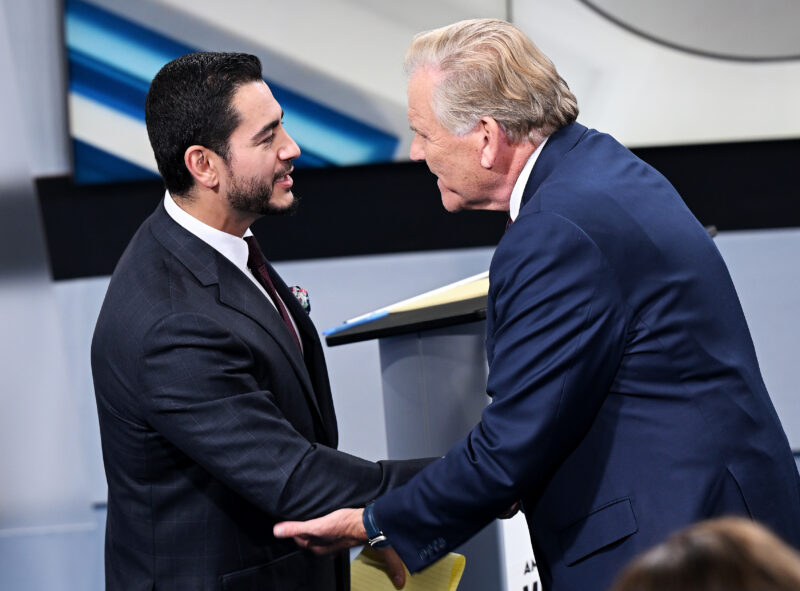
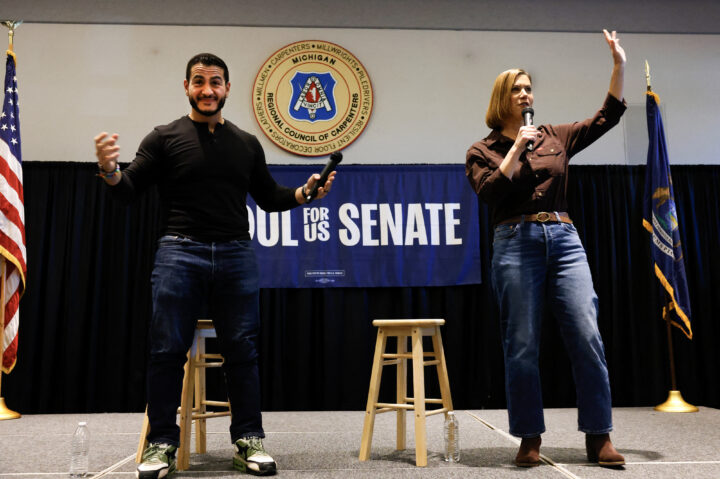
Democratic Michigan Senate candidate Abdul El-Sayed (L) reacts as Sen. Elissa Slotkin (D-MI) speaks during a town hall campaign event in Warren, Michigan, on October 3, 2026.
Sen. Elissa Slotkin (D-MI) argued during her first joint campaign appearance with Michigan Democratic Senate nominee Abdul El-Sayed that the Jewish vote is not a monolith and that some Jewish voters are prioritizing other issues than Israel and antisemitism in the state’s upcoming competitive Senate race.
Many prominent Jewish Democrats in Michigan have offered strident criticism of El-Sayed, saying they will not vote for him without major commitments on Israel policy and antisemitism — or they plan to vote for his opponent. Slotkin is Jewish.
“There’s no such thing as the Jewish voters, just like there’s no such thing as the Muslim voters or the Black voters. People have their own views and the things that they prioritize are going to drive their vote,” she said during a joint appearance on MS NOW after participating in a joint town hall event.
“People want to see a Jewish woman and a Muslim man being able to get along, debate, push and pull each other, and move the state forward.”
"People want to see a Jewish woman and Muslim man … move the state forward." Sen. Elissa Slotkin and Abdul El-Sayed spoke to MS NOW about their first joint appearance on the campaign trail, as El-Sayed’s race against Mike Rogers appears neck and neck. https://t.co/y8aVj0CEkp
— Jewish Insider (@jewishinsider) October 5, 2026
El-Sayed said that he and Slotkin agree that “you ought to be safe in your place of worship” regardless of religion. El-Sayed has faced criticism from many in the Jewish community for responding to the terrorist attack targeting Temple Israel in West Bloomfield, Mich., by saying “hurt people hurt people.” He has since apologized for those remarks.
During their joint appearance at the town hall in Macomb County, Mich., on Saturday, Slotkin downplayed disagreements between moderate and progressive Democrats, arguing that the “real debate among Democrats right now is fight versus flight,” she said. “I am on Team Fight and I need someone with me who is on Team Fight.”
El-Sayed also emphasized that the Iran war is driving up prices at home, and said that the U.S. has “no business fighting” the war.
Slotkin also called Trump “the most successful corrupt leader in the history of the world” and said that former Iraqi dictator Saddam Hussein “would spit out his tea at the amount of money that Donald Trump has stolen from his own people.”
Plus, NYMag responds to Jewish leaders' concerns
LM Otero and Eric Gay/Photo
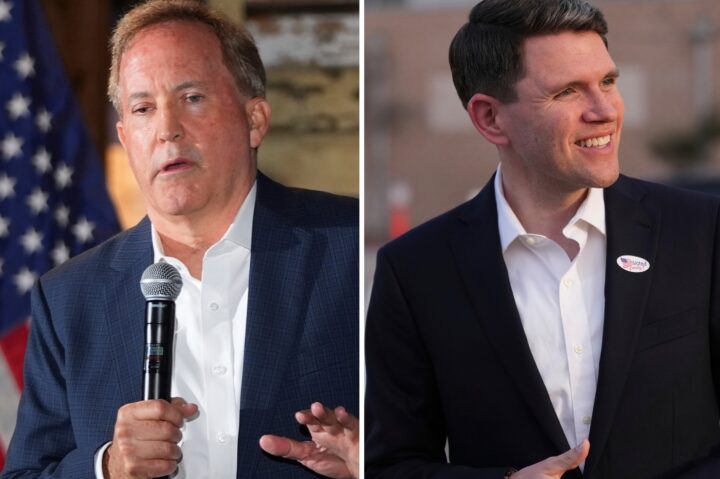
At left, Texas Attorney General Ken Paxton speaks in McKinney, Texas, May 19, 2026, and at right, Texas state Rep. James Talarico, after voting, in Austin, Texas, Feb. 17, 2026.
Good Friday morning.
In today’s Daily Kickoff, we talk to conflicted Jewish voters in Texas about the state’s upcoming Senate election between James Talarico and Ken Paxton, have the scoop on a letter from the editor-in-chief of New York magazine responding to Jewish leaders’ concerns over the magazine’s coverage of Israel and Jewish issues, and report on the new guidelines for a federal educational tax credit program that most Democratic governors are still mulling. Also in today’s Daily Kickoff: Quentin Tarantino, Selma Blair and Maya Regev.
Today’s Daily Kickoff was curated by JI Executive Editor Melissa Weiss, with assists from Danielle Cohen-Kanik and Tamara Zieve.
Today’s Agenda
We’re keeping tabs on the latest developments regarding FlyDubai 1073. This morning, El Al’s repatriation flights from the United Arab Emirates slated for today were canceled after the airline did not receive landing permissions. Some stranded passengers originally scheduled on FlyDubai flew to Israel via Abu Dhabi or European stopovers.
Indian Prime Minister Narendra Modi spoke this morning with Capt. Smit Machchhar, the hero pilot of FZ1073, who recounted the moments after the initial attack when he managed to open the cockpit’s door to allow passengers to overpower his co-pilot. “I had so many injuries, but I told myself I have to get up and act,” Machchhar said. “At the time, I pushed myself to open the cockpit door.”
President Donald Trump suggested on Thursday that, “based on what I’m hearing,” the attacking co-pilot had ties to Iran. Israeli Prime Minister Benjamin Netanyahu said that the co-pilot had undergone “Islamist radical indoctrination,” while cautioning that investigators have not yet determined whether he had ties to Iran or other foreign actors or was acting alone. Read more here.
In Yemen, the country’s internationally recognized government said its army carried out 20 strikes on Houthi targets today. Yesterday, Saudi Arabia claimed the Iran-backed terror group attacked a power station in Medina, the country’s second holiest city after Mecca. The Houthis denied responsibility for the attack.
A Washington state man employed by the Department of Energy will make his first court appearance today following his arrest by federal authorities who charged the man with providing material support to the Houthis.
On Saturday, Sen. Elissa Slotkin (D-MI) will appear with Democratic Michigan Senate candidate Abdul El-Sayed at a town hall in Macomb County, Mich.
One Thing To Know
texas toss-up
By Emily Jacobs
Caught between a scandal-plagued Republican nominee and a young Democrat who tacks further left on Israel than many are comfortable with, Jews in the Lone Star State find themselves in a Texas-sized bind when it comes to the pivotal Senate race between state Attorney General Ken Paxton and state Rep. James Talarico.
“I think Texas Jews are between a rock and a hard place in this race,” Norri Leder, a co-founder of Houston Jewish Women Vote and a board member of the local Jewish Federation, told Jewish Insider. “On one hand, you have Ken Paxton, who has a lot of ethical issues that trouble a lot of voters across party lines. With Talarico, you’ve got someone who, like many Democrats, is just afraid to discuss this subject [Israel] with the Jewish community too much. That’s been hard.”
In fact, Jewish leaders in Texas say, neither candidate has done much in the way of outreach to their community, which has left them seeking more engagement in what is a neck-and-neck race.
The Big Reads
media moment
Weeks after meeting privately with a group of Mizrahi and Sephardic leaders to address their concerns about a recent New York magazine cover package accused of erasing Jews from its narrative, the outlet’s editor-in-chief, David Haskell, vowed in response “to publish journalism that’s both accurate and empathic about the Jewish experience,” even as he otherwise declined to add a requested correction, according to an email he sent on Thursday, Jewish Insider’s Matthew Kassel reports. Haskell’s note to the Jewish leaders, which was reviewed by JI, came as New York has faced mounting scrutiny over its hostile turn against Israel in the years since Hamas’ Oct. 7, 2023, attacks, an ideological shift that has sparked internal tensions with some Jewish staffers who have raised objections to the magazine’s direction.
exhibit a
Not one of the 40 leading U.S. art museums evaluated by the Anti-Defamation League includes Jewish identity in its diversity commitments, according to a new report the group released on Thursday, Jewish Insider’s Haley Cohen reports. At the report’s launch event, held at the Jewish Museum on Manhattan’s Upper East Side, actor Selma Blair, who is Jewish, said she has felt a similar exclusion in Hollywood. After the actor publicly backed Israel in the months following the Oct. 7, 2023, Hamas attacks, “the brands I worked with were gone within a day,” Blair said as she addressed a crowded room of Jewish leaders, philanthropists, artists, influencers and reporters. “A few partnerships I built were shelved. My agency was gone. My lawyer was gone. My publicist was gone. My book agent was gone. My social media manager was gone. My son’s godmother was gone — my best friend.”
education deliberation
With the publication of regulations on Thursday for the new federal educational tax credit program, governors now have until the end of the year to decide whether to opt their states into the program, Jewish Insider’s Marc Rod reports. Blue-state governors have been caught between cross-pressures from Jewish community groups and other advocates that support the program and teachers’ unions, which vehemently oppose it. Spokespeople for the governors of New York, New Jersey and Illinois, as well as the District of Columbia government all said that they are still reviewing the new guidelines, with an eye toward protecting and supporting public schools.
The Rundown
behind the byline
looking forward
campus divide
mea culpa
minority protections
trump talk
On Our Radar
● The Live Briefing. Word on the street, clips, podcasts and quick updates — the items we’re tracking all day in our Live Briefing on the app (on Apple and Android) and website.
The Department of Defense is deploying a third aircraft carrier with up to 10,000 troops to the Middle East; the deployment comes amid a report that Iran has for weeks been conducting near-daily unsuccessful attacks on commercial vessels transiting through the Strait of Hormuz…
Secretary of State Marco Rubio waived human rights conditions on $320 million in U.S. military aid to Egypt, citing national security interests and Cairo’s “helpful role” following the start of the war with Iran, according to a State Department memo…
The Wall Street Journal does a deep dive into aviation security measures in the Middle East amid the investigation of FZ1073…
The Senate passed, by unanimous consent, a resolution led by Sens. Rick Scott (R-FL) and Jacky Rosen (D-NV) honoring the third anniversary of the Oct. 7, 2023, Hamas attacks on Israel…
The Senate also passed by unanimous consent a bill providing tax relief to Americans taken hostage, preventing them from facing interest, fines and other penalties for tax payments that were due while they were unjustly held abroad…
A Palestinian man who is a media representative for Hamas based in Gaza was indicted by a federal grand jury in New York on charges that he sent $1.7 million, including more than $600,000 from American donors, to the terror group; two brothers from Louisiana who were arrested last month are being charged with material support for a terror group in connection with the case…
The University of California asked a federal judge to dismiss the Department of Justice’s case against UCLA as it seeks to block a government demand that the school repay more than $2 billion in grants issued in the last several years; a lawyer for the university system accused the Trump administration of “political coercion” and “weaponizing” civil rights laws…
The Denver school board will give an outside investigator one week to look into claims that the board’s vice president used antisemitic language; the board’s president and superintendent accused the vice president of a slew of offenses, including referring to a Jewish member of the board as a “Zionist b***h”…
Israeli President Isaac Herzog criticized the U.K.’s recent ban on settlement products and services, describing the move as “unfair and politically motivated” interference in the upcoming Israeli election…
The U.K.’s Royal College of Nursing cut ties with Teva, one of the largest drug suppliers to the U.K.’s National Health Service, and will not allow the Israeli pharmaceutical company to take part in an upcoming summit on migraines and headaches, citing Teva’s Israeli military ties and concerns over past price-fixing and corporate abuse…
A dual British-Iranian citizen was arrested in London on suspicion of preparing terrorist attacks in connection with a security incident near the U.K.’s RAF Fairford base, which was used by the U.S. in its war against Iran…
U.K. Green Party leader Zack Polanski is facing questions over a speech in which he claimed his family fled Nazi-occupied Poland, despite records indicating that all four of his grandparents were born in the U.K. years prior to the Nazi invasion of Poland…
A French investigative outlet published additional screenshots of antisemitic messages purportedly sent by Jordan Bardella, the leader of the country’s far-right National Rally party, when he was a teenager; Bardella called Mediapart’s initial findings “crude fabrications”…
Anti-Israel protesters in Dublin disrupted a soccer match between Ireland and Austria by throwing tennis balls onto the field as part of a call for the Irish team to boycott its upcoming match against Israel…
Director Quentin Tarantino and his wife, Israeli singer and actor Daniella Pick, announced they are expecting their third child…
Bennett Schachter is joining Centerview Partners as a partner to lead the firm’s Capital Advisory business…
Gil Thompson, who previously served as a senior advisor to Rep. Brad Schneider (D-IL), is joining the Institute for an Interconnected Middle East as executive director, based in Paris…
French Resistance fighter Lucien Lazare, who assisted Allied troops and fought against the Nazis in southern France before moving to Israel, where he became an educator and peace activist, died at 101…
Worthy Reads
Find more Worthy Reads in our Live Briefing via our app (on Apple and Android) and website.
A Lot Like Barack: The Atlantic’s Russell Berman spotlights Pennsylvania Gov. Josh Shapiro’s “Obama-esque speeches” and cadence, as attention begins to turn to the 2028 presidential election, for which Shapiro is considered a potential candidate. “Like Barack Obama, Baruch Obama emphasizes pragmatism over doctrinaire progressivism; he has performed well in conservative areas of Pennsylvania that voted for Obama before turning to the right. Shapiro can wield a rhetorical knife, but he infuses his messaging with appeals to hope and optimism. Yet the most obvious similarity is that when Shapiro gives a speech, he really sounds an awful lot like the Democrats’ most renowned speechmaker.” [TheAtlantic]
Claude Consciousness: The New York Times’ Elizabeth Dias does a deep dive into Anthropic’s efforts to engage religious thinkers spanning faiths and denominations as the AI company builds a moral code for its platform. “The religious scholars had come to hear about technology’s next frontier. Now they were being confronted with a mind-bending existential question of almost unimaginable weight: What would it mean for humanity’s future if artificial intelligence systems possessed a consciousness that rivals our own?” [NYTimes]
Picture of the Day

Thousands of people gathered on Thursday night at the Western Wall in Jerusalem for the Birkat Kohanim (Priestly Blessing). Amir Levy/Getty Images
Birthdays
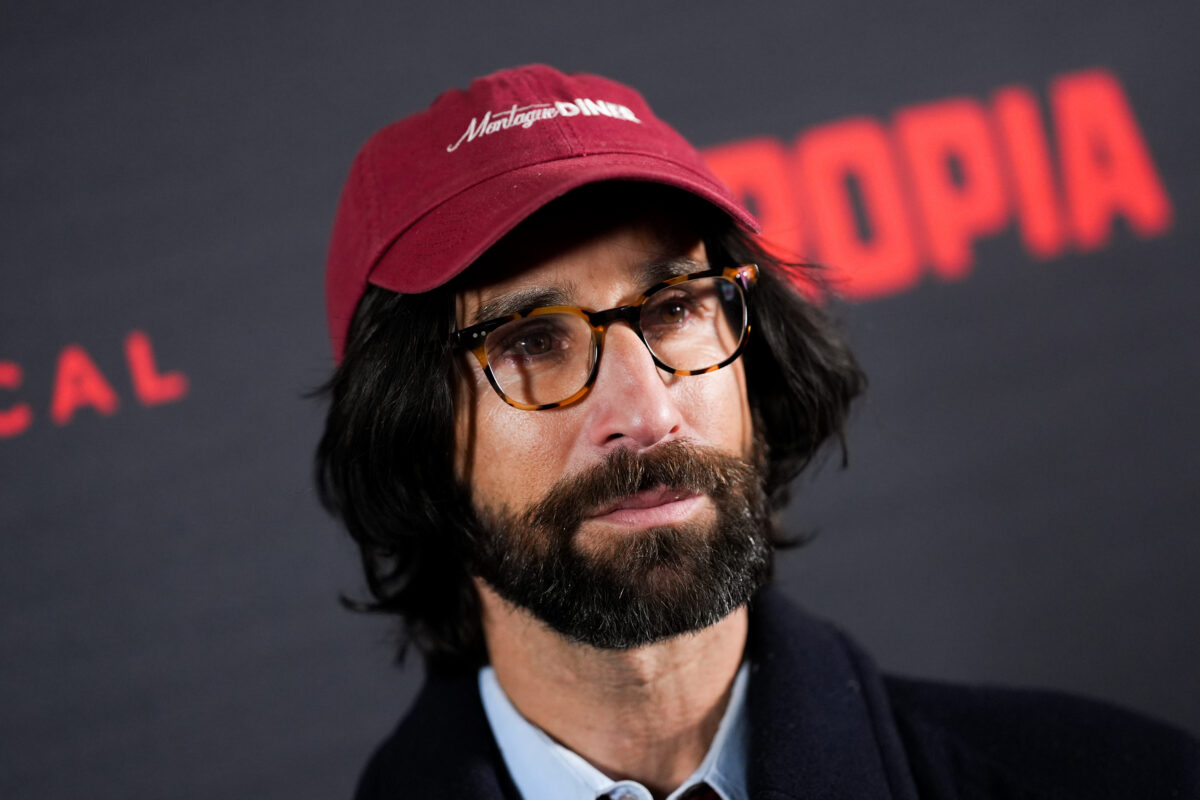
Marek Ariel Schulman, filmmaker and actor, turns 45 on Friday
FRIDAY
Richard Manekin, partner in Baltimore’s Workshop Development and leading commercial real estate broker
Diana Ely Epstein, co-chair of external relations at the Melvin J. Berman Hebrew Academy (Rockville, Md.)
Martin E. Hellman, professor emeritus of electrical engineering at Stanford and an inventor of public key cryptography, turns 81
Samuel Kaplan, Bethesda, Md., resident
Donna Karan, fashion designer and the creator of the Donna Karan New York and DKNY clothing labels, born Donna Ivy Faske, turns 78
Annie Leibovitz, portrait photographer whose work has been used on numerous album covers and magazines, turns 77
Douglas Norman Cotler, Grammy Award-winning singer-songwriter and composer, focused on Jewish music, turns 77
Yitzhak Cohen, former longtime member of the Knesset for the Shas party, turns 75
Omer Bar-Lev, Israel’s former minister of public security, he is the son of former IDF chief of staff and Minister of Police Haim Bar-Lev, turns 73
Scott Hochberg, former member of the Texas House of Representatives, turns 73
Idan Ofer, Israeli entrepreneur with interests in shipping, drilling, mining and soccer, turns 71
Paula Pretlow, chair and trustee of The Harry and Jeanette Weinberg Foundation
Bruce Blakeman, executive since 2022 of Nassau County, N.Y., he is running for governor of New York, turns 71
Bruce Sholk, chairman of the Budget and Finance Committee of The Jewish Agency for Israel
Gary Tuchman, former national correspondent for CNN, turns 66
Mark Pelavin, former chief program officer of the Union for Reform Judaism
Alexander Karp, co-founder and CEO of the software firm Palantir Technologies, turns 59
Andrew Weinstein, managing partner of the Fort Lauderdale-based Weinstein Law Firm, he is a major Democratic bundler in Florida
Scott Schoeneweis, former MLB left-handed pitcher with more MLB appearances than any other Jewish pitcher, turns 53
Michael “Mordechai” Gottlieb, insurance agent at Herman E. Wealcatch Inc.
Michelle Sara King, U.S. government official at the International Trade Administration, she serves on the American Jewish Committee’s regional board
Lindsay Gottlieb, head coach of women’s basketball at USC, she was an assistant coach in the NBA, turns 49
Kobi Yakob Arad, award-winning jazz pianist, composer and music producer, turns 45
Jena Griswold, secretary of state of Colorado since 2019, turns 42
Diana Diner, director of community affairs at Israel Bonds
Alex Fullman, associate attorney at Cooley LLP
Benjamin Lasky, rapper and record producer known by his stage name Quadeca, turns 26
SATURDAY
Michael Medved, syndicated radio show host, author and film critic, turns 78
Allyson Schwartz, former five-term member of the House of Representatives (D-PA-13), turns 78
Daniel Friedan, professor of physics at Rutgers, he was named a MacArthur “genius” Fellow in 1987, turns 78
Jeff Morgan, co-founder and owner of Covenant Wines, turns 73
Orna Stern, Westport, Conn.-based holistic health coach
Lisa Leff
Lyor Cohen, global head of music for Google / YouTube, turns 67
P. Shields Ferber Jr., president of The Ferber Company, a privately held real estate development and investment company
Craig Goldman, member of the House of Representatives (R-TX), one of four Jewish Republican congressmen, turns 58
Daniel Marks Cohen, senior director of housing development at LivCor, a Blackstone Company
David Mugrabi, art collector and dealer, who together with his father and brother are reputed to own $5 billion of art including over 1,000 pieces by Andy Warhol, turns 55
Guy Oseary, talent manager whose clients include Madonna and Red Hot Chili Peppers, author of Jews Who Rock, about Jewish influences on the music industry, turns 54
Rabbi Dovid M. Cohen, longtime congregational rabbi in N.Y. and N.J. and author of We’re Almost There
Eli Cohen, Israel’s minister of energy and infrastructure, turns 54
Bradley Tusk, venture capitalist and political strategist, turns 53
Rosalind S. Helderman, reporter for The Washington Post focused on political enterprise and investigations, turns 48
Josh Klinghoffer, longtime guitarist for the Red Hot Chili Peppers and a 2012 inductee to the Rock & Roll Hall of Fame, turns 47
Naomi Firestone-Teeter, CEO at the Jewish Book Council
Rabbi Benjamin Goldschmidt, rabbi at The Altneu Synagogue in Manhattan, turns 39
Juan Gilces, regional director of the D.C. area for Community Security Service
Noah Cameron Schnapp, actor since early childhood, turns 22
SUNDAY
Robert D. Sack, senior judge of the U.S. Court of Appeals for the 2nd Circuit, his father served as a rabbi in Brooklyn for 35 years, turns 87
Norman Pearlstine, executive editor of the Los Angeles Times from 2018 to 2020 after a long journalism career, turns 84
Marvin R. Shanken, publisher of lifestyle magazines including Wine Spectator and Cigar Aficionado, turns 83
Dov Weissglass, chairman of the executive committee at the University of Haifa, he was Israel’s negotiator in the Middle East peace process during the term of Prime Minister Ariel Sharon, turns 80
Alan Rosenberg, actor and past president of the Screen Actors Guild, turns 76
Steven Rakitt, senior advisor to the chairman of the Genesis Prize Foundation, formerly the president
Nathan Bergerbest, former deputy chief of staff for Sen. Lisa Murkowski (R-AK)
Nitzan Chen, former director of the Israeli Government Press Office, turns 63
Aubrey Dan, Canadian businessman, producer and impresario, turns 63
Liev Schreiber, actor, director, screenwriter and producer, turns 59
Abraham Benrubi, actor and voice actor, turns 57
Lee Goldberg, chief meteorologist at New York City’s WABC-TV, turns 54
Alicia Silverstone, film, television and stage actor, turns 50
Ryan Sadowski, former MLB pitcher, he is now the director of international scouting for the Lotte Giants in the Korea Baseball Organization, turns 44
Ron Katz, former member of the Knesset for the Yesh Atid party, turns 41
Sara Singla, senior director of people and culture at Leading Edge HQ following 11 years at Hillel International
Gefen Kabik, senior policy analyst at the American Action Network and Congressional Leadership Fund
Matt Deitsch, gun violence prevention advocate and political advisor, turns 29
Jewish leaders say neither Ken Paxton nor James Talarico has done much outreach — and Talarico's leftward tack on Israel and Paxton's scandals give them pause
LM Otero and Eric Gay/Photo
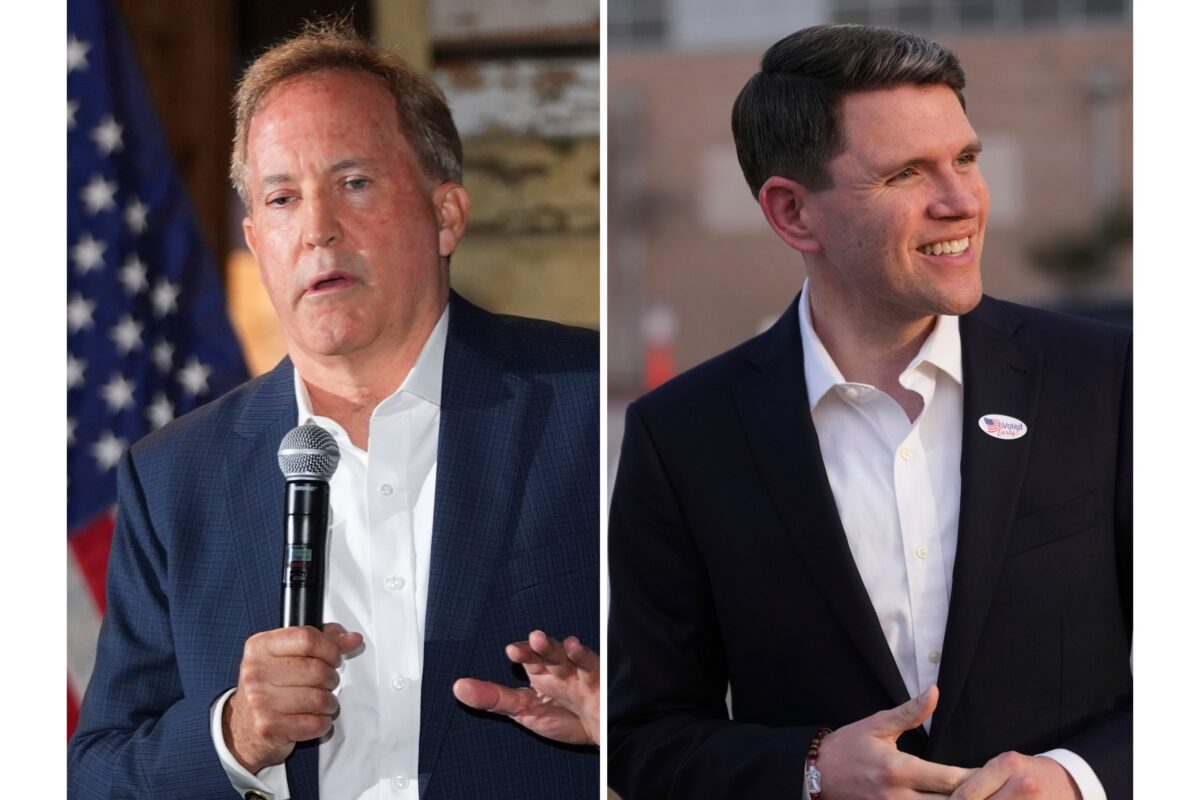
At left, Texas Attorney General Ken Paxton speaks in McKinney, Texas, May 19, 2026, and at right, Texas state Rep. James Talarico, after voting, in Austin, Texas, Feb. 17, 2026.
Caught between a scandal-plagued Republican nominee and a young Democrat who tacks further left on Israel than many are comfortable with, Jews in the Lone Star State find themselves in a Texas-sized bind when it comes to the pivotal Senate race between state Attorney General Ken Paxton and state Rep. James Talarico.
“I think Texas Jews are between a rock and a hard place in this race,” Norri Leder, a co-founder of Houston Jewish Women Vote and a board member of the local Jewish Federation, told Jewish Insider. “On one hand, you have Ken Paxton, who has a lot of ethical issues that trouble a lot of voters across party lines. With Talarico, you’ve got someone who, like many Democrats, is just afraid to discuss this subject [Israel] with the Jewish community too much. That’s been hard.”
Leder added: “I don’t think he’s in the same camp as [Michigan Democratic Senate nominee] Abdul El-Sayed, but he hasn’t robustly engaged with the Jewish community so we can fully understand his positions.”
In fact, Jewish leaders in Texas say, neither candidate has done much in the way of outreach to their community, which has left them seeking more engagement in what is a neck-and-neck race.
Art Pronin, who leads the Meyerland Area Democrats Club, a largely Jewish Democratic group in the Houston area, said that while he could not “remember a statewide race in Texas that had a heavy focus on reaching Jewish voters, because there are not a lot of us,” he believed that the state’s Jewish community was “seeking a little more open courting of our voices and our vote given the national climate.”
“I think this is a moment where our voices and our votes as Jewish Americans matter in this country and in this state,” Pronin told JI. “Let’s say the polling that calls this race a 50-50 split is correct. There’s more than 200,000 of us. Neither candidate can afford to alienate or dismiss any minority group, including Jews.”
Talarico, despite running in a reliably Republican state, has not moderated his rhetoric around Israel, calling for reductions in military aid to the Jewish state though not going as far as to label Israel’s war against Hamas in Gaza as a genocide, as many progressive Democrats have done. He has also vowed not to take any money from AIPAC in the campaign, despite having no such qualms about support from the pro-Israel group during his time in the state legislature.
“He really wants to maximize turnout and enthusiasm among the Democratic activist base, and we know the reality is that all of the energy in the Democratic Party right now is anti-Israel,” Southern Methodist University political scientist Matthew Wilson told JI.
Wilson added that Talarico’s positions on cultural issues are so progressive that he has little ability to make inroads with the socially conservative evangelical constituencies that are also strongly supportive of Israel.
Despite his critical rhetoric towards Israel, many Jewish voters in Texas view Talarico’s overall record on Jewish issues as acceptable, noting his support of legislation in the Texas Legislature that would require all state schools to adopt the International Holocaust Remembrance Alliance’s working definition of antisemitism.
While his Jewish outreach has been limited, he did attend a Rosh Hashanah service at Congregation Emanu El in Houston and took part in a roundtable with Jewish community leaders at the Dallas Holocaust and Human Rights Museum last month (which was not announced by the campaign). He also participated in a virtual event hosted by the Jewish Democratic Council of America in May.
As one Texas Jewish leader put it while noting Talarico’s limitations: “This is Texas, not Manhattan. He needs to have these conversations with the Jewish community, and I don’t just mean the most liberal elements of it, because most of us dislike Ken Paxton in this state. I mean people in the center and the center-right.”
Seth Krasne, Talarico’s campaign manager, said in a statement to JI, “James has a record of standing up for Texas’ Jewish community and Jewish safety — combating antisemitism, defending Jewish students on the floor of the Texas House, and supporting Israel’s right to exist.”
Paxton, meanwhile, has not made Jewish outreach a focus of his campaign during the campaign, though he has discussed his support for Israel and touted his record on combating antisemitism when asked. His campaign has not promoted any Jewish community events or meetings with Jewish leaders, though he made appearances at churches across the state throughout the month of August.
During the primary campaign, Sen. John Cornyn (R-TX), who built up strong relationships with the state’s Jewish community, attacked Paxton for associating with far-right, anti-Israel podcast host Steve Bannon and not speaking out against the rise in antisemitism on the far right.
While Texas Gov. Greg Abbott and Sen. Ted Cruz (R-TX) spoke out against the University of Texas College Democrats’ recent decision to invite antisemitic streamer Hasan Piker to speak on campus, Paxton’s campaign attacked Piker but didn’t address whether the school should rescind the invitation. (Talarico’s campaign declined to respond to questions about Piker.)
Jewish Democratic leaders in the state believe Cornyn would have had a chance at winning the state’s Jewish vote against Talarico, but that Talarico is likely to comfortably prevail against Paxton.
“Paxton doesn’t [show up]. Never has,” Pronin said. “He’s never been on our side as attorney general. He doesn’t have that communal relationship with us at all. He may try to say in your story he’s a friend now, but he’s not been a friend.”
Reached by JI, Paxton campaign spokeswoman Madison Cercy said in a statement, “James Talarico is a part of the antisemitic radical left that wants to see Israel destroyed. He is a part of the Democratic Socialist Movement and is no different from Hasan Piker, Zohran Mamdani, and AOC.”
The previously unreported Jewish outreach comes as Democrats worry about El-Sayed’s struggles to expand support beyond his base
Emily Elconin/Getty Images
Democratic candidate for U.S. Senate Abdul El-Sayed answers questions from attendees during a town hall event on September 3, 2026 at the Oakland Expo Center in Waterford, Michigan.
In the most significant sign of his efforts to make inroads with skeptical Jewish voters in Michigan’s Senate race, Abdul El-Sayed, the Democratic nominee, recently met with rabbis at Temple Israel for a closely guarded conversation, according to two people familiar with the meeting.
Two rabbis who were said to have participated in the conversation, details of which were unclear, declined to comment when reached on Wednesday. El-Sayed’s campaign did not respond to a request for comment.
The meeting came after El-Sayed apologized last month to Jewish Democrats for his equivocal response to the March terrorist attack against Temple Israel, a prominent Reform synagogue outside Detroit, which he had downplayed with the explanation that “hurt people hurt people.”
The covert nature of the meeting, which neither party has publicized, underscores the sensitivities felt among some Jewish leaders who have remained wary of publicly associating with El-Sayed because of their continued discomfort with his positions on Israel and remarks about antisemitism.
One rabbi at Temple Israel joined a rally last month at which Vice President JD Vance laid into El-Sayed while touting his Republican rival, former Rep. Mike Rogers (R-MI) — who has successfully courted some Jewish Democratic voters. Vance mentioned the rabbi in his speech, but not by name. A Jewish leader confirmed that a Temple Israel rabbi participated in the event.
Despite the unusual show of resistance, El-Sayed has, following his apology as well as a vow to hire a Jewish campaign liaison, made some inroads as he seeks to ease tensions with Jewish voters in the final stretch of a closely contested election.
He has since won endorsements from several progressive Jewish leaders including former Sen. Al Franken (D-MN). Former longtime Rep. Sander Levin (D-MI), in a statement on Tuesday, backed El-Sayed in spite of what he called “significant disagreement” over the nominee’s hostile approach to Israel — concerns about which some Jewish voters in Michigan have dismissed in recent opinion articles. While Levin held a pro-Israel record during his time in the House, his son Andy was highly critical of Israel while in Congress and ended up losing to Rep. Haley Stevens (D-MI) in a hotly contested 2022 primary.
Meanwhile, Sen. Elissa Slotkin (D-MI), who is one of the most prominent Jewish leaders in Michigan, is now urging fellow caucus members to rally behind El-Sayed after remaining neutral in a heated primary where Stevens, a vocal supporter of Israel, was narrowly defeated.
Still, it remains to be seen if such inroads will result in meaningful support for El-Sayed on Election Day, as he faces opposition from some Jewish voters who say he has fallen short of addressing major differences in a race that continues to stir up raw feelings.
Some Jewish holdouts in the state, for instance, have expressed their dissatisfaction with his apology over his comments on the synagogue attack. El-Sayed said he had “made a mistake” and asked “for forgiveness,” even as he also clarified that there was “opportunity for context later on,” a caveat some Jewish leaders interpreted as a sign he only regretted the timing of his sentiments rather than the message.
Halie Soifer, CEO of the Jewish Democratic Council of America, suggested in a statement on Wednesday that her group would not be endorsing El-Sayed, who has refused to acknowledge Israel’s right to exist as a Jewish state while failing to explicitly disavow Hasan Piker, an antisemitic steamer featuring in GOP attack ads and with whom El-Sayed campaigned ahead of the August primary..
“We have not endorsed El-Sayed” and “do not endorse all Democrats,” Soifer told Jewish Insider, even as she rejected crossing party lines to support Rogers — which she called “a vote to enable Donald Trump’s agenda.”
The Michigan Democratic Jewish Caucus, for its part, has yet to confirm whether it will back El-Sayed after he appeared at its summer fundraising event to offer his apology. Jessica Alexander, the caucus chair, told JI on Wednesday that members would be releasing a statement soon explaining their approach to the race that could help decide control of the Senate next year.
For now, “people are looking to learn more” about El-Sayed’s views and “are still struggling” with how they will vote, Alexander said, noting those “making decisions in the affirmative are just being quiet about it.”
“It’s this really strange space of liminality,” she said of the calculus facing Jewish Democrats. “Everyone wants different assurances — and I’m not sure if you get those in political races, ever.”
While El-Sayed has yet to name a Jewish liaison, Alexander said she was asked to participate in the interview process and had spoken with about five candidates, whom she declined to name. She told JI that she had not yet been informed of a final decision.
David Hecker, a Jewish union leader in Michigan, also took part in the interviews, he confirmed to JI Wednesday. “The key is having conversations with Jews who haven’t decided how they’re going to vote,” he explained of the liaison role. “With many there are going to be disagreements,” he added, while counting himself among them.
“His domestic policies I’m pretty much on board with,” Hecker said of El-Sayed. But, he added, “I’m a Zionist” and “I disagree with his perspective on what needs to happen in the Middle East.”
Still, “I appreciate how much he’s thought about it,” Hecker clarified.
Earlier this month, a coalition of rabbis and other Jewish leaders across the state launched a petition campaign to pressure El-Sayed to affirm a series of “nonnegotiable” commitments on a range of Jewish issues, arguing that failing to do so would jeopardize Jewish support for Democrats. The petition did not mention El-Sayed by name but was clearly aimed at him.
Among the demands were support for “Jewish sovereignty in Israel”; Jewish safety, including for Zionist Jews; and “full participation in American political life” for Jews.
But two Jewish leaders who signed the petition told JI Wednesday they had not had the chance to speak with El-Sayed and did not feel he had demonstrated his commitment to their requests.
Rabbi Aaron Starr of Congregation Shaarey Zedek in Southfield, Mich., who serves as the president of the Michigan Board of Rabbis, said he appreciated how in the past couple of weeks El-Sayed “has moderated his previously offensive and inflammatory rhetoric.”
“His callous words and violent tone, though, remain hard to forget — and probably foolish to forget,” he added. Now, “El-Sayed has become adept at talking around our concerns,” he continued. “Nevertheless, he is silent with regard to our right to define our own identities as American Zionists” and “Israel’s right to exist as a Jewish state,” among other key issues.
Joan Lowenstein, the Jewish caucus endorsement chair who also signed the petition, said she was unconvinced El-Sayed had meaningfully evolved in his stances on Israel since the primary. “He still will not say ‘Israel,’” she observed. “He says ‘Holy Land.’”
Even though El Sayed has condemned antisemitism and affirmed his commitment to Jewish safety, some critics have raised concerns that his rhetoric and alliances with extreme figures such as Piker have helped contribute to rising antisemitism on the far left, which has made a growing number of Jewish Democrats feel alienated in a party they have long called home.
A co-founder of “Jews for Abdul,” a loose coalition of Jewish activists, voiced reservations last month over El-Sayed’s approach to Israel, saying in a private call he could “do a better job” toning down his rhetoric on accusations of genocide in Gaza and his opposition to U.S. funding for the Jewish state, including defensive aid.
El-Sayed has said privately that he “is not going to change his position on Israel at all,” according to a source informed of such remarks. “He is who he is,” the source told JI.
Despite the hesitation among some Jewish voters with weeks remaining until the November election, one Jewish leader in Michigan who does not support El-Sayed predicted that the Democratic nominee “is on track to be elected narrowly but solidly,” citing unfavorable polling for Republicans nationally.
“I think the Jewish vote being split is not enough to cost him the election,” the Jewish leader said about El-Sayed on the condition of anonymity. (Michigan is home to some 130,000 Jews.) “Trump’s continued chaos is really causing a lot of people to swallow hard and just hold their nose and vote the entire Democratic ticket.”
Plus, Trump predicts war ends after Election Day
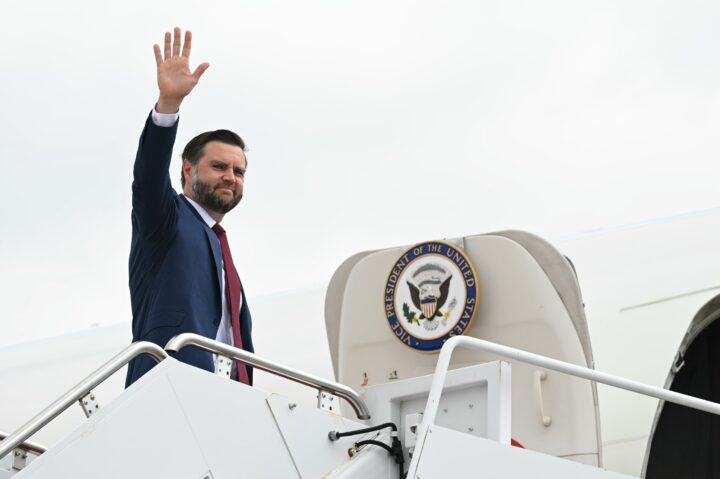
Saul Loeb-Pool/Getty Images
Vice President JD Vance boards Air Force Two on August 31, 2026, at Joint Base Andrews, Maryland.
Good Wednesday afternoon.
This P.M. briefing is reserved for our premium subscribers like you — offering a forward-focused read on what we’re tracking now and what’s coming next.
Today’s Daily Overtime was curated by JI U.S. Editor Danielle Cohen-Kanik.
📡On Our Radar
Notable developments and interesting tidbits we’re tracking
Asked about the U.K., France and Canada enacting sanctions against Israeli settlements in the West Bank, President Donald Trump told reporters this afternoon on his way to Dallas for the GOP midterm convention that he’ll be “speaking to Israel” about the issue. “I understand exactly what’s going on, but I want to find out why all of a sudden does that happen,” he added…
Trump also predicted the Iran war “will end immediately after” the midterm elections because the Iranian regime is “desperate to affect the election”…
White House officials and GOP elected officials told Axios that they’ve stopped trying to persuade Trump on anything and find it futile to push back on his decisions, with one longtime advisor telling the outlet, “Why bother? He’s the boss”…
A new poll of American Jewish voters commissioned by the nonpartisan Jewish Voters Resource Center found that Vice President JD Vance is viewed negatively by 82% of Jewish voters, including 39% of Jewish Republicans, Jewish Insider’s Matthew Shea reports. Vance’s approval numbers are markedly lower than those of Trump — who is viewed positively by 89% of Jewish Republicans — and Secretary of State Marco Rubio, at 93%…
A new CNN poll of the Senate races in Michigan and Maine found the Democratic candidates leading, though both were within the margin of error, indicating the races remain neck-and-neck in the lead-up to November. In Michigan, Democratic nominee Abdul El-Sayed led former Rep. Mike Rogers (R-MI) 47%-44%, while in Maine, Democratic nominee Troy Jackson led Sen. Susan Collins (R-ME) 48%-45%…
Trump has begun tapping his super PAC’s $400 million war chest through a new group, No Going Back PAC — financially backed by his main super PAC, MAGA Inc. — which has reserved at least $47 million in ads across six contested Senate races and one House race, The New York Times reports. The PAC’s top investments include nearly $15 million in Michigan, $11 million in Ohio and $9.6 million in New Hampshire…
Pakistan transmitted a warning from Saudi Arabia to Iran to rein in its Houthi proxies in Yemen amid an escalation in hostilities between the terror group and Riyadh, Reuters reports. Pakistani Defense Minister Khawaja Asif also sounded a cautionary note in an interview reminding global actors that attacks on Saudi Arabia could now trigger its mutual defense pact with Pakistan and Turkey…
The International Atomic Energy Agency’s board of governors voted today for the first time in two decades to report Iran to the U.N. Security Council for violating its nuclear nonproliferation obligations, diplomats told Reuters. The move marks an escalation that opens Iran to possible U.N. sanctions, though Russia and China’s vetoes on the UNSC make actual punitive action unlikely…
Israeli Foreign Minister Gideon Sa’ar inaugurated the first Israeli Embassy in the Slovenian capital of Ljubljana…
Israel and the Palestinian technocratic committee governing Gaza have successfully vetted roughly 16,500 Palestinians to serve in the Board of Peace’s new police force, though Jerusalem has not yet given its approval for the recruits to leave the Gaza Strip for training, two Board of Peace officials told The Times of Israel…
Reps. Brad Schneider (D-IL), Craig Goldman (R-TX), Ann Wagner (R-MO), Debbie Wasserman Schultz (D-FL), Jimmy Panetta (D-CA) and Gus Bilirakis (R-FL) urged Rubio and Treasury Secretary Scott Bessent to take steps to ensure Hamas cannot “exploit” economic instability in the West Bank, raising concerns about Israel’s decision to withhold tax revenues from the Palestinian Authority…
Former Secretary of State Tony Blinken rejected as “complete fiction” a Haaretz report that he delayed an offer by Hamas immediately after the Oct. 7, 2023, attacks to release some of the hostages it had captured…
White House Special Envoy Steve Witkoff earned more than $100 million — including nearly $69 million in cash and $38 million in crypto — from the trust that owns his stake in World Liberty Financial, the cryptocurrency venture he co-founded with Trump and his family in 2024, according to a new financial disclosure…
⏩ Tomorrow’s Agenda, Today
An early look at tomorrow’s storylines and schedule to keep you a step ahead
Keep an eye on Jewish Insider for reactions from Texas officials and Jewish leaders to the decision by the University of Texas’ Democratic student group to host far-left streamer Hasan Piker on campus later this month.
The GOP midterm convention, which offers a test of whether President Donald Trump can boost the prospects of Republicans in competitive general election races, concludes tomorrow with closing remarks from the president and a keynote address from Vice President JD Vance.
Also speaking at the summit tomorrow are Sen. Ted Cruz (R-TX), House Speaker Mike Johnson (R-LA), Michigan GOP Senate nominee Mike Rogers, Texas Gov. Greg Abbott, Rep. Mike Lawler (R-NY), Health and Human Services Secretary Robert F. Kennedy Jr., former White House Press Secretary Karoline Leavitt and Donald Trump Jr.
Stories You May Have Missed
A FATHER’S LOVE
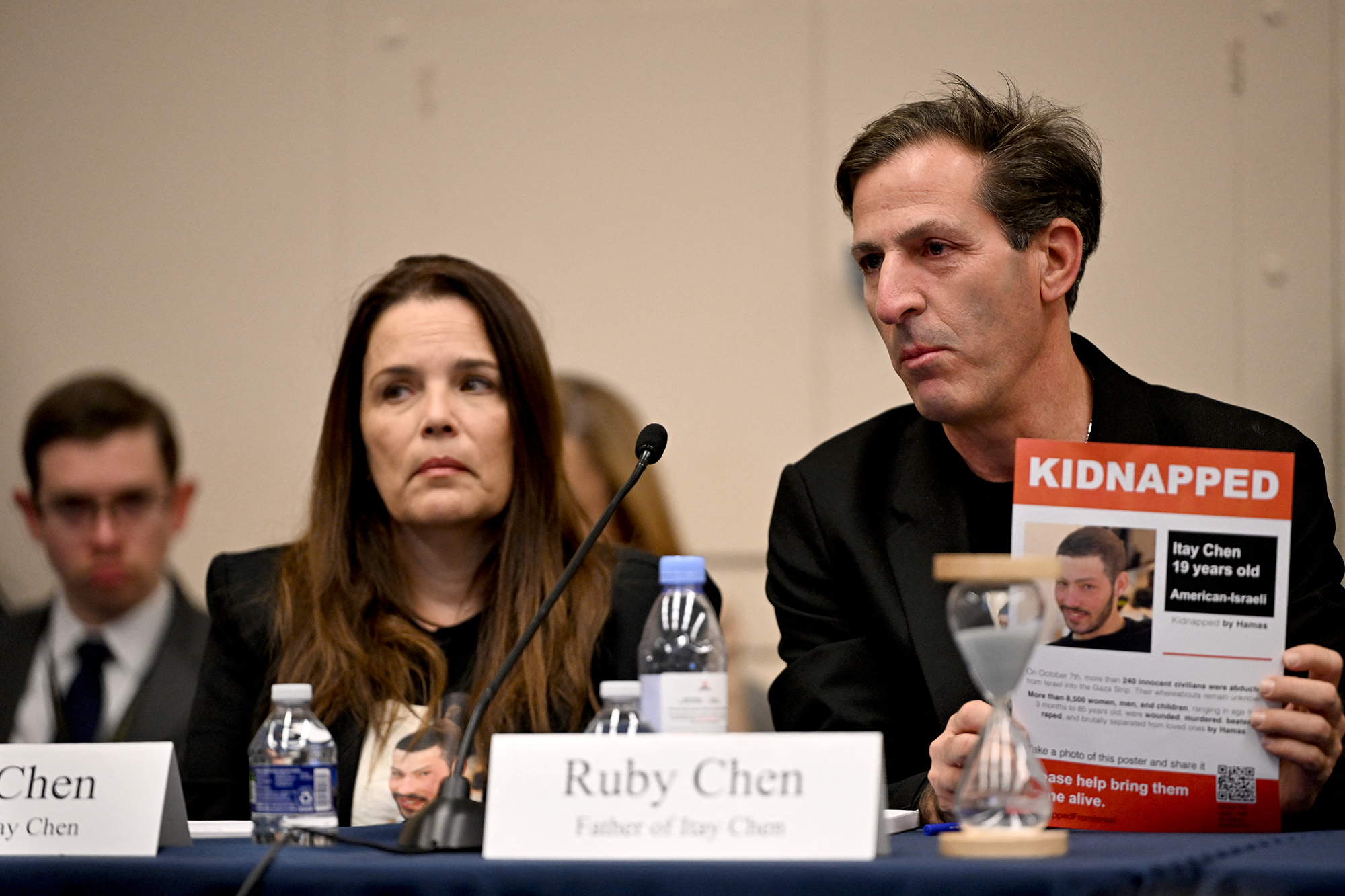
Chen — father of Itay Chen, whose body was held by Hamas for more than two years — is continuing to advocate to ensure that American victims of Oct. 7 are remembered, and that his son’s ‘sacrifice was not in vain’
BOOKSHELF

Jerusalem Post military correspondent Yonah Jeremy Bob and Wall Street Journal editorial writer Elliot Kaufman draw on years of interviews with top Israeli leadership
Nessel, who still hasn’t endorsed Democratic Senate nominee Abdul El-Sayed, said she won’t support Republican Mike Rogers
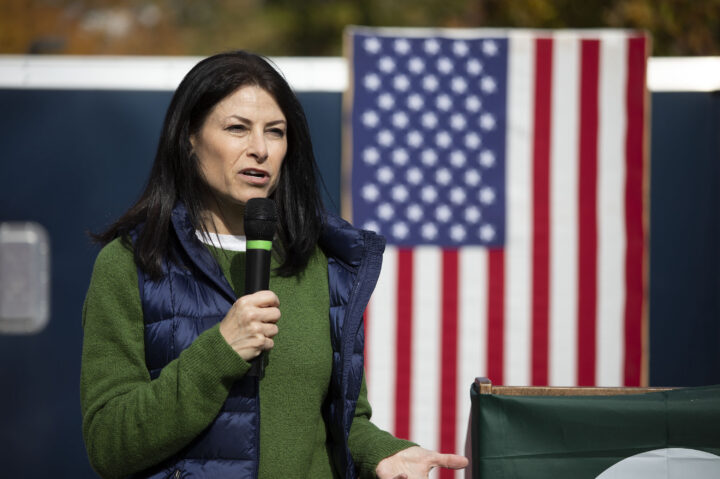
Bill Pugliano/Getty Images
Michigan Attorney General Dana Nessel speaks on Oct. 16, 2022 in East Lansing, Michigan.
Michigan Attorney General Dana Nessel, a Jewish Democrat, encouraged Jewish voters on Sunday to put aside concerns about their safety “in exchange for the opportunity to save the rest of humanity,” in a stark reference to the choices facing Jewish Democrats in the closely contested Senate election this November.
“We have a moral imperative to place the needs of the world above even our own self-interest and, yes, even our own survival,” Nessel told attendees in her remarks at the Michigan Democratic Jewish Caucus’ annual “Summer Simcha” gathering, where she was honored, according to reports confirmed by Jewish Insider.
Nessel’s comments did not explicitly refer to Abdul El-Sayed, the Democratic Senate nominee who has faced profound skepticism from Jewish Democrats over his hostile rhetoric toward Israel as well as his equivocal response to a violent terrorist attack on a synagogue outside Detroit in March.
But her plea to attendees suggested she was moving toward voting for El-Sayed, who also appeared at the event on Sunday to apologize for his initial comments on the synagogue attack in which he had claimed that “hurt people hurt people” and “violence is a cycle,” in remarks that were widely seen as insensitive to Jewish safety.
El-Sayed voiced regret for those remarks on Sunday, asking the caucus members “for forgiveness and a moment of grace” for what he called an ill-timed response. He also clarified that there was “an opportunity for context later on,” a sentiment that some voters found offensive in light of the attack, which had been perpetrated by a Lebanese American man who has lost relatives in Israeli strikes in Lebanon, including a brother who was a Hezbollah commander.
Nessel has been among the most high-profile Jewish Democrats in Michigan to withhold an endorsement of El-Sayed, whose response to the synagogue attack she had criticized in a podcast interview last week as “making excuses” for domestic terrorism that raised questions about how he would respond to other potential acts of violence.
Despite her reservations with El-Sayed, Nessel has also clarified that, unlike some Jewish Democrats in the state, she will not back former Rep. Mike Rogers (R-MI), the GOP nominee now aggressively courting Jewish voters who could help decide the election in a key battleground state.
In her speech on Sunday, Nessel alluded to Queen Esther, the biblical heroine of the Jewish holiday of Purim, in a dramatic illustration of the high stakes of the race.
“It is perhaps up to us now to follow in her path,” Nessel said, “and sacrifice the comfort, safety and security and even the very future of our own people in exchange for the opportunity to save the rest of humanity.” (In the Purim story, however, Queen Esther risked her own life to save the Jews rather than putting aside Jewish safety for a supposed greater good.)
She suggested the election hinged on more than just Israel, whose existence as a Jewish state El-Sayed has refused to acknowledge. “What good is defending the historic homeland of our ancestors and demanding that candidates acknowledge its right to exist, if the planet upon which it rests is no longer inhabitable?” she said to attendees at the event in Birmingham on Sunday.
“Come November, what do your Jewish values tell you to do?” Nessel asked, arguing against voting to empower Republicans when other urgent factors are also at play that go beyond Israel as well as the Jewish community.
One Jewish caucus leader who has spoken privately with Nessel said her remarks “certainly suggest” she will vote for El-Sayed even if she has not offered her endorsement.
“I think there is a difference between holding your nose and voting for someone and endorsing and I think she appreciates the distinction,” the caucus leader told JI, speaking anonymously to discuss a sensitive subject.
Joan Lowenstein, a Jewish caucus member, told JI after the event on Sunday that “the people who will vote for El-Sayed agree with” Nessel’s comments to the crowd.
“Many do not agree and don’t want to turn their backs on Jewish life in the U.S. or in Israel so that we can have a Democratic Senate,” she said, adding that “even though many of us disagree with each other, we respect the validity of these views.”
Asked whether he plans to change his vetting procedures for staff, Collins said, ‘I can’t see into the future’

Tom Williams/CQ-Roll Call, Inc via Getty Images
Rep. Mike Collins (R-GA) speaks during a news conference in the Capitol Visitor Center on a resolution "stating that President Donald Trump did not engage in insurrection," on Tuesday, February 6, 2024.
LAS VEGAS — Rep. Mike Collins (R-GA) on Sunday disavowed the antisemitic views and white nationalist affiliations of several former staffers and said that he understands why Jewish voters are concerned, but also suggested there was little he could have done to identify those red flags in the hiring process.
Collins, the GOP nominee for Georgia’s Senate seat, has been mostly quiet publicly about the repeated disclosures concerning his former staffers — as well as his son-in-law — and is working to court Jewish voters concerned about Sen. Jon Ossoff’s (D-GA) record of voting against aid to Israel on multiple occasions.
“Those staffers — those views are abhorrent, and they don’t represent my values,” Collins told reporters at the Republican Jewish Coalition’s annual leadership summit. “And you can look at my voting record.”
Pressed by Jewish Insider on how or whether he would change vetting procedures to ensure that such staff didn’t find their way onto his team again in the future, Collins downplayed the connections between himself and their activity, saying “this was after they were on my team and gone.”
But at least one of those staffers was engaged in the activity while still working for Collins: his former Chief of Staff Kip Talley was reportedly active in a white nationalist group chat discussing efforts to free a Holocaust denier from prison while still on Collins’ team.
“I can’t see into the future, but regardless I still don’t agree with them, period,” Collins continued. “We can vet all day long, but what happens when they leave and they go out into the future — that’s a different question. But I certainly don’t want people around me like that.”
He said that he sees “a rise of antisemitism and hate with young people around the globe, and we certainly need to address that because so many of these young people feel like they’ve been forgotten.”
Collins said that education and opportunity are key to pulling young people out of such radicalization and conspiracy theories.
Collins cast Ossoff as positioning himself to run as a Democratic Socialists of America candidate for president, highlighting Ossoff’s recent endorsement of Abdul El-Sayed for Michigan’s Senate seat and the support he previously received from antisemitic streamer Hasan Piker.
Neither Ossoff nor El-Sayed are DSA members. Piker disavowed Ossoff this week after Ossoff condemned recent antisemitic comments.
“We are both polar opposites, even on where we stand on Israel,” Collins said. “And it goes well past just the support for Israel and the Jewish population.”
In remarks to the RJC audience, Collins emphasized that his support for Israel is rooted in his religious faith.
“My faith tells me to support Israel,” Collins said. “I don’t have to answer to anybody in this room, but I tell you what, I’ve got to answer to the man upstairs, and by God, that’s important to me, and I know where I stand on that.”
He went on to emphasize that, even apart from faith, the contributions Israel has made to the world and the ways it has supported U.S. interests — including opposing Iran and other terrorist regimes — make supporting Israel worthwhile.
“That’s my stand. It always will be, and I have no problem professing that,” Collins said.
In an early sign of Rogers’ bipartisan backing, three prominent Jewish Democratic bundlers are holding fundraiser for Rogers next week
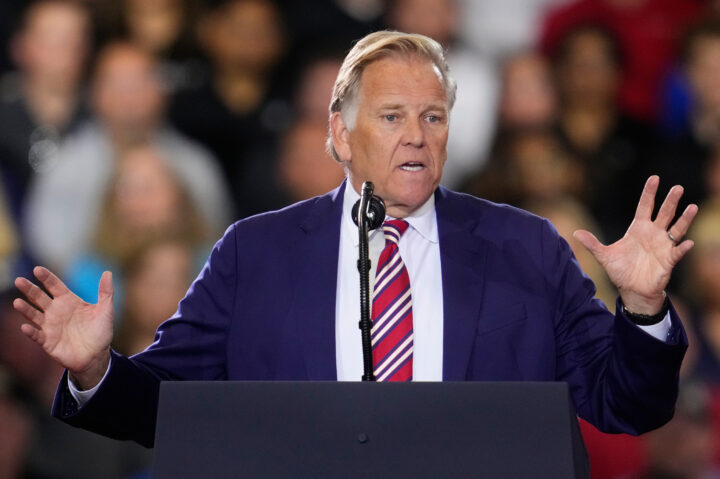
Paul Sancya/AP
Republican Senate candidate Mike Rogers speaks before President Donald Trump at an event at the General Motors Proving Ground Monday, July 27, 2026, in Milford, Mich.
More than a week after Abdul El-Sayed narrowly clinched the Democratic nomination in Michigan’s bruising Democratic Senate primary, his Republican opponent, former Rep. Mike Rogers (R-MI), is working to fine-tune his campaign’s outreach and messaging to disaffected Jewish voters who could play a decisive role in the closely contested race.
While Republicans in the key battleground state see an opportunity in November to capitalize on Jewish Democrats’ alarm over El-Sayed’s hostile rhetoric toward Israel and lackluster record in confronting the rise of antisemitism, Rogers has in the days following the primary still appeared relatively cautious in directly courting Jewish voters, as he has widened his pitch to Democrats in Michigan whom he reassured in a video message last week have “a home with” his campaign.
He has otherwise called El-Sayed, a far-left former public health official, “beyond antisemitic” and said he “hates Jewish people,” echoing the most extreme concerns among Jewish Democrats turned off by the Democratic nominee’s ties to antisemitic Twitch streamer Hasan Piker and comments equivocating over the foiled terrorist attack against a synagogue outside Detroit in March, among other issues.
Despite such criticism, Jason Cabel Roe, a GOP strategist in Michigan not involved in the race, said that he had not seen Rogers “specifically identifying the Jewish community as a target,” underscoring how the campaign is balancing private engagement with a key constituency alongside a more broadly calibrated public invitation for Democrats to join his coalition.
“A lot of this is going to come organically,” Roe told Jewish Insider, referring to Jewish Democrats in the state who are contemplating voting for Rogers. “This is not new territory for him.”
Bobby Schostak, a former chairman of the Michigan Republican Party and a prominent Jewish campaign surrogate, said he had hosted a donor call on Monday with Rogers and his pollster, Tony Fabrizio, joined by some 150 people. “There were people there who were traditionally not Republican voters,” he told JI, citing some Jewish Democrats and other former backers of Rep. Haley Stevens (D-MI), the moderate, pro-Israel lawmaker who lost to El-Sayed.
“Mike spoke to the importance of having a wide-open campaign with multiple coalitions,” Schostak said of the donor call, while stressing that Jewish Democrats in the Detroit area are particularly energized to help Rogers. “It is consequential both in numbers and in names,” he told JI on Thursday. “They are not being passive,” he explained. “They want to beat El-Sayed.”
In one of the first major signs of those efforts now materializing, three prominent Jewish Democratic bundlers in Michigan are hosting a fundraiser for Rogers next Tuesday, according to an email invite sent to Jewish community members on Thursday.
“This is something that none of us has ever done,” said Hannan Lis, who is leading the fundraiser with Brian Hermelin and Rob Orley. “But we feel this is a departure in the direction of the Democratic Party,” he told JI of El-Sayed’s staunch opposition to Israel and refusal to recognize its right to exist as a Jewish state. “We’re taking a stand here,” he added. “This is beyond politics.”
Even though “there are many issues where we don’t necessarily agree with Mike Rogers,” Lis noted, “we trust him” on key issues. The fundraiser is meant to “show we are willing to back up a person” who holds a mutual commitment to a “strong relationship with Israel” and “is not playing politics” on other matters concerning the Jewish community, he explained.
Hermelin, the president of the Jewish Federation of Detroit, confirmed his involvement in the fundraiser but declined to comment further on the event, which he is co-hosting in his personal capacity.
Rogers, recognized as a national security-focused conservative, has also attended pro-Israel fundraisers outside of the state this week, according to a person familiar with the matter. “There is now a lot of enthusiasm in the pro-Israel community for Mike Rogers,” the person said. “A not-insignificant piece is from Democrats.”
A spokesperson for Rogers’ campaign did not return a request for comment on Thursday.
The Republican Jewish Coalition has indicated it intends to aggressively target the nearly 100,000 Jewish voters in Michigan who make up a potential swing bloc, with a special focus on Jewish Democrats who “now find themselves politically homeless,” Sam Markstein, a spokesperson for the group, told JI in a statement.
Markstein said that he could not yet share specifics about the RJC’s plans to invest in the race but noted an independent expenditure is in the works and “will be significant.”
Eric Levine, a top Republican bundler in New York and an RJC board member who hosted a fundraiser for Rogers in late July, said the former congressman is “making a direct appeal to the Jewish community,” including Democrats, and “has been very successful.”
AIPAC, the pro-Israel advocacy group whose super PAC spent over $30 million to help Stevens, has not officially endorsed Rogers, but sources say it is likely to spend on his behalf before the November election. Representatives for AIPAC and its super PAC did not respond to requests for comment.
In a tacit recognition of the Jewish vote’s potential significance in the general election, El-Sayed has, for his part, recently sought to ease tensions with Jewish Democrats who remain skeptical about his campaign, emphasizing his “commitment to Jewish safety” even he has continued to use incendiary rhetoric on Israel in the wake of the primary.
Michael Horowitz, a Jewish Democratic leader and Detroit businessman, said he was “leaning heavily” toward voting for Rogers but that he had not made up his mind, underscoring the inherent challenges in enticing Jewish Democrats to defect from a party that they have long called home.
Though Horowitz said he will not vote for El-Sayed, he attributed his reservations to delivering a win for the Trump administration as well as a “volatile world” that could shape his assessment in the lead-up to the election. “I would say that the vast majority of people I’ve talked to are voting against El-Sayed — as opposed to voting for Rogers,” he told JI.
He said he is now working to arrange a “more intimate conversation” with Rogers to get a better sense of the candidate, after a surrogate reached out to make a connection. “I don’t think that not voting is an option,” he said, adding, “until I cast my vote it’s not a done deal.”
Shimon Levy, an Israeli American entrepreneur in Detroit who identifies as an independent and backed Stevens in the primary, said he is supporting Rogers’ campaign and had wrapped up lunch with members of his team when he spoke with JI on Thursday.
“I think, at this stage, the Rogers team is just here to listen,” he said. “They’re asking, ‘How do we win your vote?’”
In an interview with CNN, she underscored her pro-Israel bona fides, saying she is a ‘Zionist Democrat in Michigan’
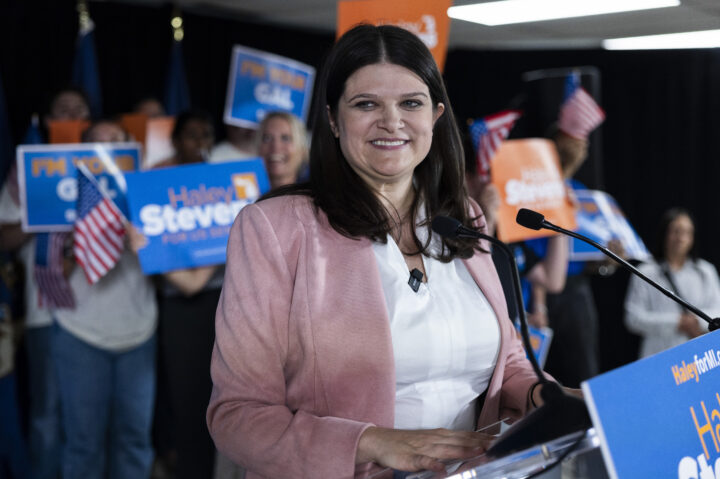
Rep. Haley Stevens (D-MI), candidate for Michigan's open U.S. Senate seat, holds a rally with Sen. Gary Peters (D-MI) on August 2, 2026 in Madison Heights, Michigan (Photo by Finn Gomez/Getty Images)
In her first cable news interview since her Senate primary loss on Wednesday morning, Rep. Haley Stevens (D-MI) told CNN that Jewish voters who are concerned about Democratic Senate nominee Abdul El-Sayed’s hostility towards Israel are “going to have to make a personal and private decision” as to who to support in November.
Stevens also told CNN on Friday that she is a “Zionist Democrat in Michigan.”
Just before he was declared the winner in the Democratic primary for the pivotal Michigan Senate race, El-Sayed doubled down on his criticism of Israel on MS NOW’s “Morning Joe,” calling the Jewish state “bloodthirsty” and saying his critiques go beyond the government of Israeli Prime Minister Benjamin Netanyahu.
El-Sayed, who made his opposition to AIPAC a central part of his campaign message, sought to ease tensions with skeptical Jewish voters after winning the nomination, addressing what he called “an issue that has been focused on in this race.”
“To all of my sisters and brothers of the Jewish faith,” he said in his televised remarks, “I want you to know that my commitment to your safety, my commitment to Jewish safety, is the same commitment that I have to the safety of my own daughters.” He also spoke about his experience going to a seder during the campaign, where in an awkward turn of phrase, said he was able to “break bread” with his Jewish friends.
On Friday, Republican Senate nominee Mike Rogers argued that the “vast majority of people” rejecting El-Sayed — whose bid he framed as a “campaign filled with anger, divisiveness, calls for violence and the views that are out of touch with your values”— have “a home with us.”
Some Jewish Georgians say they feel politically homeless as they have to choose between Sen. Jon Ossoff and Rep. Mike Collins
Wikimedia Commons
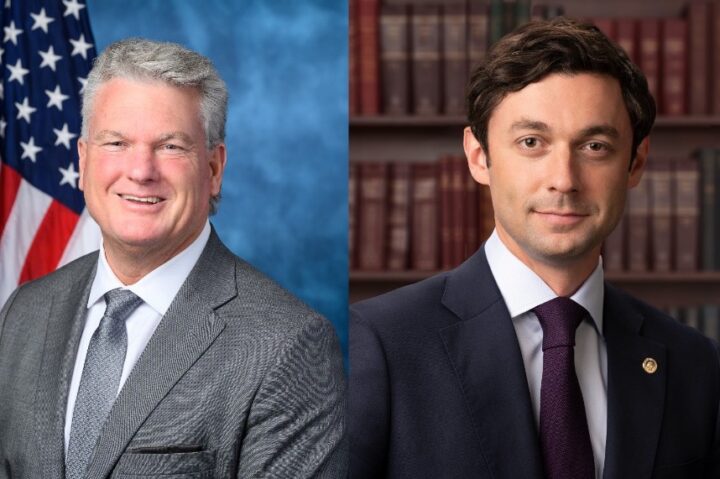
Rep. Mike Collins (R-GA) and Sen. Jon Ossoff (D-GA)
For some Jewish voters in Georgia, this year’s Senate race offers no comfortable choice. Sen. Jon Ossoff’s (D-GA) votes to block weapons shipments to Israel have alienated some longtime supporters, while Republican nominee Rep. Mike Collins’ (R-GA) history of inflammatory rhetoric and controversial staffing choices has made him a nonstarter for others.
It’s “hard for me to support either one,” Norman Radow, a major Democratic donor in Georgia and a prominent figure in Atlanta’s Jewish community, told Jewish Insider, and called the November election in the key swing state a “tough choice for a lot of Jewish people.”
“It’s hard for me to imagine that I would vote for Ossoff,” he said. “There would have to be some epiphany or something so outrageous about Collins that I have to do it.”
But at the same time, he said that Collins, a far-right Republican with a history of controversies — including boosting an antisemitic post on X and employing a chief of staff who was revealed to be a member of a group chat with white nationalists where he discussed efforts to free a Holocaust-denying far-right activist from prison — may be an equally unpalatable choice.
Cheryl Dorchinsky, the founder of the grassroots Atlanta Israel Coalition, similarly said that Ossoff’s positions on Israel have been “incredibly disappointing” — calling it a “very good example” of why she feels “politically homeless.”
Dorchinsky said she needs to look into Collins, explaining that she hadn’t been aware of the antisemitism scandals that had dogged him.
“I can’t say that I will be supporting Ossoff, and I hate that,” Dorchinsky said. “It’s just making me nauseous all around. … I really want to feel good about voting again, [to] like who I vote for.”
The race, then, offers a stark test of how defining the Israel issue will be for Jewish voters in Georgia, especially given Collins’ baggage. And they are feeling the weight of that vote in a purple state where their numbers — some 150,000 statewide — could make a difference. Ossoff defeated former Sen. David Perdue (R-GA) by about 50,000 votes out of some 4.4 million cast in 2020, helping to flip the Senate to the Democrats.
“Our vote here really, really matters,” said David Lubin, a Jewish Democrat who ran for the state Senate. But, he added, “If you’re a Democrat, you’re struggling with Ossoff’s track record on Israel.” He called the election a “very tough, very difficult” choice for him and for other Democrats.
Lubin, whose daughter was killed in a terror attack in 2023 in Israel, where she had moved two years prior and was serving as a police officer, said that Ossoff “still has time to make his case for Georgia voters and to the Jewish community.” Lubin said he’s open to voting for Collins or leaving his ballot blank in November, but he’ll give Ossoff “every opportunity” to win him over before Election Day.
But Collins’ record also raises concerns for Lubin.“That’s where people really have to sit down, they have to look at the candidate up until you go to the polls and you have to take all the information you can gather … to make the best decision.”
In order to win his vote, Lubin said that he wants to see Ossoff make a “stronger commitment” to change his votes on Israel and engage more deeply with the Jewish community in fighting antisemitism. For Collins, Lubin said he also wants to see him engage more with the Jewish community, to be “very clear on his stance with Israel with us, and his stance on how he will fight against Jewish hatred.”
Not everyone shares the concerns about Ossoff.
Cary Levow, a supporter of pro-Israel causes and candidates who has hosted fundraising events for Ossoff, told JI that the race is not “a close call,” and that Ossoff will clearly be the stronger advocate for the Jewish community.
“Jon has been very pro-Israel, even though he’s taken a vote or two that kind of got breathlessly reported as anti- or pro-Israel, which, in my opinion, gets a little too binary,” Levow said, emphasizing that Ossoff has strong ties to and family in Israel.
Collins supporters, too, say that concerns about their candidate are overblown, and argue that he’ll be the more reliable advocate for Jewish community concerns.
Peter Korman, a Jewish Republican state committee member, said he’s known both Collins and his father, former Rep. Mac Collins (R-GA), and said that allegations of antisemitism against Collins are “slander,” emphasizing Collins’ opposition to anti-Israel protests following the Oct. 7, 2023, terror attacks.
“He stood in support of Israel. He stood in support of the Jewish population here in Georgia and across the United States,” Korman said, insisting that there is “no indication” of “any antisemitism in Mike Collins’ background or his behavior, and I have personal experience with that.”
The wider currents at play in the Democratic Party nationwide are also figuring in the Ossoff-Collins race, observers note.
One Jewish donor in the state, who asked for anonymity to discuss sensitive matters, said they didn’t believe it was productive for the pro-Israel community to be strongly engaged in the Senate race, framing an Ossoff victory as essentially an inevitability even as they expressed disappointment with some of his votes.
The donor said some Jewish Democratic leaders have resigned themselves to voting for Ossoff despite their concerns, arguing that his positions are more moderate than those of the growing left flank of the party and that he continues to express support for Israel to pro-Israel donors.
The donor said that the more important focus for the Jewish community should be on defeating far-left candidates who don’t believe Israel has a right to exist.
In comments to JI about the concerns raised by Jewish community members, both candidates took shots at each other.
“Mike Collins is a notorious bigot whose blatantly antisemitic behavior and harassment is completely out of step with Georgians’ values and will be resoundingly rejected in November,” an Ossoff campaign spokesperson said in a statement.
Meanwhile, Collins’ campaign accused Ossoff of pandering to anti-Israel radicals, and emphasized Collins’ staunch support for Israel.
“Jon Ossoff would rather cater to his out-of-state, Hezbollah flag-adorned, radical anti-Israel campaign supporters than to his own constituents in Georgia,” a Collins spokesperson said in a statement. “While Jon Ossoff voted to block weapons sales to Israel and refused to condemn the dangerous anti-Israel protests that erupted across our country after October 7, Mike Collins has never bowed to the woke mob and has always put America’s and Israel’s safety first.”
Collins has seemingly taken steps to distance himself from some elements of his record that have troubled members of the Jewish community. The staffer responsible for the antisemitic X post, as well as the chief of staff who was in the group chat with white nationalists, are both no longer employed by him, according to Collins’ office.
Politico reported last week that his office had brought on a new chief of staff.
Meanwhile, a group of more than 115 leaders and members of Georgia’s Jewish community recently signed a joint statement, first shared with JI, condemning Collins’ social media activity and arguing that “Georgians deserve better.”
“Like most groups, Jews have a wide array of perspectives on issues. Yet our Jewish tradition binds us in a belief that we should all be practicing tikkun olam — working to make the world a better place,” the statement reads. “Our Jewish values also prohibit hate speech and racism — noting that all humanity is created in the image of the divine. Mike Collins’ posts run counter to our uniting principles, and we should not tolerate it, especially in a candidate for US Senate.”
Some Jewish voters in the state said they have no concerns about voting for Collins, seeing ousting Ossoff as crucial and expressing confidence that Collins’ evangelical Christian background will make him a reliable supporter of Israel and the Jewish community.
Korman, the GOP committeeman, said his concerns about Ossoff stretch back further than his votes on the arms sales to Israel, criticizing the senator for failing to speak out in favor of state-level legislation condemning the Oct. 7 attacks and codifying the International Holocaust Remembrance Alliance’s working definition of antisemitism.
He alleged that despite his Jewish identity, Ossoff has failed to speak out or be a leader for the Jewish community amid rising antisemitism nationally and within the Democratic Party.
Asked about Collins’ own vote against the Antisemitism Awareness Act in 2024, which would have codified the IHRA definition’s use by the Department of Education, Korman said that he understood that Collins’ concerns focused on free speech issues.
Others are building new relationships with Collins after the primary. Kirk Halpern, an Atlanta Jewish business leader, said he wasn’t familiar with Collins before the race but reached out to Collins’ campaign to offer his help as soon as the Republican primary ended, due to his deep opposition to Ossoff.
He said that after Ossoff’s first vote to block arms sales to Israel, he committed that “as soon as a Republican opponent is [nominated] that I will do everything I can to support that candidate. … Jon Ossoff has been wrong on every key vote.”
Halpern said that Ossoff, being Jewish and speaking out and voting against Israel, “gives cover for those that are antisemitic” and who want to see Israel destroyed.
Pressed on concerns from other community members about Collins’ history, Halpern said that he has found, living in the American South, “that the strongest support for Israel … as well as the vitality of the American Jewish community comes from the evangelical Christian community, the sincerity and love that evangelical Christians have for Israel and the Jewish people is is very deep.”
Collins, he continued, is a member of that community. “I believe that his evangelical Christian faith and his love of Israel and of the Jewish people will make sure that going forward, mistakes don’t occur,” Halpern said.
“I also believe that the absence of leadership by Jon Ossoff and with Jon Ossoff being Jewish, that is so much more problematic for our community,” Halpern added.
Halpern is set to host a meet-and-greet for Collins with members of the Jewish community later this month and said he hears similar “tremendous, informed disappointment in Jon Ossoff” from Jewish friends on both sides of the aisle.
For some Jewish voters, Derek Dooley, the moderate Republican primary candidate backed by Gov. Brian Kemp, was their favored candidate, but Collins handily won a primary runoff last month. Radow, the Democratic donor, said that Dooley would have been a more compelling Republican option for him as well.
Emanuel Fialkow, an early backer of Dooley’s campaign, said he’s now fully behind Collins.
“He’s our only chance to get rid of Ossoff, who we feel is untrustworthy and ineffective,” Fialkow said. “It should not be that difficult to support our only ally in the Middle East, and to symbolically weaken them with a vote against funding for arms sales is ridiculous. It’s almost un-American.”
Fialkow said he believes that Collins has, “whether it be for political reasons or his own religious convictions, demonstrated unwavering support for our strongest ally [Israel].”
He said he also has no concerns about Collins’ record on antisemitism, and said Collins has been “unwavering in his support in every conversation” that he’s heard about with Atlanta’s Jewish community.
One Jewish leader in the state said that Kemp, who has strong connections to the Jewish community, could have made a stronger play for the Jewish vote had he run for the seat. The leader said Collins — given both the concerns about his record and his comparative lack of relationships with the community — will have a tougher time picking up those votes. Whether Kemp decides to push his network to support Collins could also be a factor.
Ossoff, despite his votes on Israel, maintains a loyal and dedicated base among Georgia’s Jewish community — particularly in the face of a candidate with Collins’ record. His supporters argue that the backlash to his votes on Israel has been overblown.
Mike Greenwald, a member of Atlanta’s Jewish community who organized the statement of local leaders and community members, said he was “fairly horrified” at Collins’ nomination and that it was easy to find other Jewish Georgians who agreed. “He does not seem to be a friend of our community,” Greenwald told JI.
In addition to his social media activity and former chief of staff, Greenwald also raised concerns about Collins’ attendance at a New York City Young Republicans Club event alongside a member of Germany’s far-right AfD party.
He called Ossoff “an incredible friend to Israel,” emphasizing other votes the senator has taken in support of Israel and his work on hostage issues. He said Ossoff has been a champion on antisemitism, pointing to his support for federal nonprofit security grants for the community and other engagement with the Jewish community.
“He does all of the things you would expect someone who is a champion for both Israel and the Georgia Jewish community to do, and it’s not surprising, because it’s genuine, and we’re very proud of him for that,” Greenwald said. He said many in Georgia’s Jewish community are particularly proud of Ossoff as the state’s first Jewish senator.
“The contrast, as you picture him continuing on as senator versus Mike Collins, is pretty stark and an easy call for us,” Greenwald said.
Levow, the Ossoff fundraiser, said, “There’s no real comparison here, if he’s a little uncomfortable with 2,000-pound bombs [being sold to Israel], versus someone who’s flirting with antisemitism and white nationalists,”
“[Ossoff] has a very, very deep well of Jewish support,” he continued. “I haven’t really wavered from him. I don’t find any of his votes problematic, to be honest with you. I think history will look kindly on them, and they’re going to be evidently reasonable.”
He said that he sees the Jewish community, particularly younger Jews in the community, as highly supportive of Ossoff, noting that one recent Jewish community fundraiser drew around 70 supporters and raised $70,000. He said Ossoff has made frequent appearances at community events, including a speech at the area’s largest synagogue around Hanukkah.
“I think he’s done an excellent job for the Jewish community, for the state of Georgia, for the country,” Larry Auerbach, another Ossoff supporter, told JI, while raising concerns about Collins’ affiliations.
“Even if I didn’t appreciate and support Ossoff as much as I do, Collins is just somebody I could never tolerate for those reasons,” Auerbach said.
Auerbach called objections to Ossoff’s votes against arms sales to Israel “much ado about very little,” arguing that blocking the sales in question would have done nothing to hurt Israel’s operations in Gaza. He also highlighted Ossoff’s support for nonprofit security grants.
Ultimately, a Jewish leader in the state said, Ossoff is likely to pick up a substantial majority of the Jewish vote in the state — in part because most of the community generally votes Democratic.
“There will be those who vote for Collins 100% because of his support for Israel and are willing to be less concerned about the adjacent antisemitism,” the leader said. In the end, the leader continued, “Jon will probably get 70-65% of the vote — the Jewish community might increase its voting for Collins a little bit more,” but most voters will likely fall along party lines.
As the election nears, Radow, the Democratic donor, is waiting to see how things unfold.
“We’ll see how the race plays out, we’ll see how they debate, we’ll see what they say on the issues,” Radow said. “I think the Jewish community will have to make a choice. There are die-hard Democrats who’ll vote for a Democrat à la [New York City Mayor Zohran] Mamdani, just because he has a D in front of his name. I’m not that Democrat.”
Radow, who had previously engaged with Ossoff and pressed him to change his votes on weapons sales, suggested he had essentially written off Ossoff on the issue. He said Ossoff has dodged calls and outreach in the weeks ahead of major Israel votes, and then sent out mass emails to those concerned by his positions “a week after” the votes. “I’m just not going to play that game with him,” Radow said.
But his conflicted feelings about the pivotal race remain. He said that Collins being the GOP nominee “goes a long way to ensure that Jon’s going to win.”
Radow said Collins had once told him he believed the 2020 election was rigged, which was a “non-starter” for Radow, on top of Collins “surrounding himself with people that are not of moral character and I’ve heard … he’s said some antisemitic things along the way. For all those reasons, he’s not a compelling candidate for me.”
Some 72% of Jewish voters hold unfavorable views of the democratic socialist mayor, compared with 67% of non-Jewish voters who approve of his performance
Leonardo MUNOZ / AFP via Getty Images
New York City Mayor Zohran Mamdani arrives for a news conference at Gracie Mansion in New York City on March 9, 2026.
New polling data shows that a sizable majority of Jewish voters disapprove of New York City Mayor Zohran Mamdani’s job performance and fear he is pushing the Democratic Party too far to the left, in contrast with non-Jewish voters who hold a largely favorable view of the outspoken democratic socialist.
The gap between Jewish and non-Jewish survey respondents underscores the degree to which Jewish Democrats in New York and across the country increasingly feel out of place in their party amid a rise in antisemitism and anti-Israel sentiment on the far left, which has gained traction in recent state and congressional elections.
The poll, shared exclusively with Jewish Insider, showed that 72% of Jewish voters hold unfavorable views of Mamdani’s performance six months into his tenure, with 28% approving. Non-Jewish voters were more positive about the mayor — with 67% approving and 28% disapproving of Mamdani’s actions.
Meanwhile, nearly three in four Jewish voters said that they believed Mamdani’s views were outside the Democratic mainstream in New York City, compared with 52% of non-Jewish respondents who shared the same assessment.
And well over half of Jewish voters, 61%, said the Democratic Party under Mamdani was moving too far to the left, with 36% of non-Jewish voters feeling similarly. Non-Jewish respondents were, at 26%, also nearly twice as likely to say they felt the party had not moved enough to the left amid Mamdani’s mayorship — relative to 16% of Jewish voters, the poll revealed.
The poll was fielded days before Mamdani, a vocal critic of Israel, had helped elevate a trio of far-left candidates, including two Democratic Socialists of America-aligned candidates with extreme records on Israel and antisemitism, to the nomination in New York’s congressional primaries last month, unseating a pair of pro-Israel House incumbents. The wins established Mamdani as a veritable kingmaker in New York City politics, amid a broader rise of democratic socialism now shaping the midterms.
“Taken together, the data reveals a significant fault line within New York City’s Democratic coalition,” a polling memo by Honan Strategy Group shared with JI notes, “one that cuts along religious lines and will bear watching as Mamdani’s mayoralty takes shape.”
The poll, conducted by Honan Strategy Group, surveyed 614 likely general election voters in New York between June 12-17. Most of the respondents, 515, were not Jewish, while 99 were Jewish. Nearly three-quarters of respondents were Democrats, with 16% identifying as Republican. The rest identified as independent or as unaffiliated, according to Bradley Honan, who conducted the survey. The poll’s overall margin of error was around 4%.
The results echo a separate survey released in April and sponsored by The Jewish Majority, a pro-Israel research group based in Washington, D.C. The poll of 665 Jewish voters in New York City showed that most respondents, 40%, believed that Mamdani was doing a “poor” job as mayor.
The poll also found that 82% of Jewish voters — including most of those who voted for Mamdani — were “very” or “somewhat” concerned about the rise in antisemitism, which more than half, 58%, said was linked to the normalization of anti-Zionism espoused by the mayor and his allies on the far left.
Mamdani’s refusal to condemn calls to “globalize the intifada,” 61% of Jewish voters agreed in the survey, also helped to embolden pro-Hamas protestors who have targeted synagogues in New York in his tenure.
More recently, Mamdani has faced blowback for his comments at a political rally last month in which he attacked the pro-Israel group AIPAC as “monsters” who “move millions in dark money,” which Jewish leaders said had evoked classic antisemitic tropes.
The mayor has defended his rhetoric, saying he was borrowing from a phrase used by the Italian Marxist theorist Antonio Gramsci — though Mamdani quoted from a widely attributed mistranslation of his work.
Democrats also nominated pro-Israel former Navy pilot Rebecca Bennett in a neighboring district to run against Rep. Tom Kean Jr.
DREW ANGERER/AFP via Getty Images
Dr. Adam Hamawy speaks during an AFP interview after meetings on Capitol Hill, in Washington DC, on June 14, 2024.
New Jersey, the state with one of the largest Jewish populations in the country, has become something of a political nightmare for Jewish voters who have seen Democrats turn to far-left, virulently anti-Israel candidates in this year’s primaries.
That trend continued Tuesday night as Democratic voters in New Jersey’s 12th Congressional District nominated plastic surgeon Adam Hamawy, despite his past affiliations with Islamist extremists, who prevailed with about 28% of the vote in a crowded Democratic primary field.
Hamawy, with the support of left-wing groups, some progressive lawmakers and the anti-Israel American Priorities super PAC, prevailed over his opponents with regional bases but limited support outside their local communities. No pro-Israel groups or other moderate-minded outside PACs decided to spend money on anti-Hamawy attack ads, allowing him to consolidate enough backing from his base to prevail with a relatively small plurality.
Hamawy was a former associate of Omar Abdel Rahman, also known as the Blind Sheikh, who was convicted of inspiring the terrorists who engineered the 1993 World Trade Center bombing. Hamawy later served as a defense witness during Abdel Rahman’s 1995 trial, and volunteered around the same time in Bosnia with a group later shuttered as a front for Al-Qaida.
Despite his baggage, Hamawy is expected to win election to Congress in the November general election, given the central New Jersey district’s heavily Democratic electorate.
Democratic voters in the neighboring 11th Congressional District also overwhelmingly renominated left-wing Rep. Analilia Mejia (D-NJ), who was the surprise winner in a special election primary earlier this year after AIPAC’s super PAC spent money attacking the more moderate former Rep. Tom Malinowski (D-NJ)
But while Mejia won a whopping 82% of the Democratic vote against her long-shot opposition, there was a significant protest vote against her in the towns with a large Jewish constituency: Livingston and Millburn.
In more favorable news for pro-Israel moderate voters, Democrats nominated former Navy pilot Rebecca Bennett, who flew missions over the Straits of Hormuz, to run against Rep. Tom Kean Jr. (R-NJ) in a major battleground district.
“I just feel very strongly that Israel has a right to defend itself and has a right to exist, and that the United States needs to be able to support Israel, and it shouldn’t be partisan,” Bennett told Jewish Insider last August. “I think we should be supporting Israel as an ally, regardless of political party.”
She also told JI she supports continuing U.S. aid to Israel without restrictions or conditions.
Kean, who has represented the 7th Congressional District since 2022, has been missing from Congress for the last several months with an undisclosed illness. His uncertain personal circumstances have made Democrats bullish of their prospects in the swing district, which Kean only won by five points in 2024.
Meanwhile, Rep. Robert Menendez Jr. (D-NJ), a pro-Israel Democrat, comfortably brushed back a challenge from far-left, anti-Israel candidate Mussab Ali, winning 70% of the primary vote.
The race features an embattled Mayor Karen Bass facing a spirited challenge from her right in reality TV star Spencer Pratt, and from her left in City Councilmember Nithya Raman

Jason Armond/Los Angeles Times via Getty Images
Spencer Pratt, from left, Karen Bass and Nithya Raman are shown on a television while journalists work as they take part in the Los Angeles Mayoral debate at Skirball Cultural Center on Wednesday, May 6, 2026 in Los Angeles, CA.
In the closing weeks of the Los Angeles mayoral primary, the two candidates challenging incumbent Mayor Karen Bass — from both the left and the right — had a lot to say on areas of interest to Jewish Angelenos, which was particularly notable in a race in which those issues have, for much of the campaign cycle, not been front and center.
Nithya Raman, a city councilmember taking on Bass from the left — her surprising council victory over an incumbent in 2020 was powered by the Democratic Socialists of America — recently joined far-left political streamer Hasan Piker for an hour-long interview. She said she believes Israel has a right to exist, but also accused Israel of genocide and said she would no longer accept the endorsement of Democrats for Israel Los Angeles, a local group that supported her first council run six years ago.
Meanwhile, Spencer Pratt, a bombastic, 2000s-era reality TV star running as a Republican, was asked by CNBC anchor Sara Eisen the weekend before the primary if antisemitism is on his agenda should he be elected.
“I made it very clear that I’m going to protect my Jewish friends and families that feel unsafe from these attacks, and I didn’t even realize how insane it was until I said that publicly, and the level of Nazi, crazy psychopaths that are threatening me, saying I’m owned by Jewish — no, I want Jewish moms to feel safe when their kids go to temple or they go to class at UCLA,the same I want a Muslim student to feel safe going to worship. Everyone needs to feel safe in Los Angeles,” Pratt said.
In a city that is still recovering from last year’s devastating wildfires, and where affordability and homelessness rank as top concerns for voters, debates surrounding Israel and antisemitism are not top of mind for many — a contrast to last year’s mayoral contest in New York.

But in a race that appears to have the three leading candidates bunched together in a three-way tie, the winning votes could come from anywhere, and Pratt’s outreach to the Jewish community suggests he knows that winning over Jewish Democrats could help him make it to the general election (which will feature the top two vote-getters in the primary, regardless of party affiliation). The Los Angeles metro area is home to roughly 560,000 Jews, although not all of them live in the city of L.A.
That means that a pressing question facing moderate Jewish voters who have supported Bass, a liberal Democrat and former member of Congress, is whether taking a chance on Pratt is worthwhile.
A poll commissioned by the Los Angeles Times and released last week shows Bass and Raman statistically tied, with Bass favored by 26% of voters and Raman supported by 25%. Pratt is close behind, with 22%.
Pratt has earned support from some prominent L.A. Democrats, including the pro-Israel megadonor Haim Saban and Ashley Underwood, Larry David’s wife, who hosted a fundraiser for Pratt. A series of leaked messages, purportedly authored by Pratt, referred to antisemitism as a “legitimate mind virus and a sign of a decaying society.”
“Bass has had a long relationship with the Jewish community in L.A., but not a particularly strong one,” Dan Schnur, a political analyst who teaches at the University of Southern California and Pepperdine University, said. “Raman has been the subject of significant controversy. … Pratt voices a very pro-Israel MAGA type line, and he’s probably doing better among Jewish voters than [President Donald] Trump did, but not by a large margin.”
Pratt rose to fame on the MTV reality show “The Hills,” where he appeared as the boyfriend of star Heidi Montag, his now-wife. Thep couple’s Pacific Palisades home burned down last year during the wildfires, which Pratt has repeatedly raised as evidence of Bass’ failings. He entered the race in January, on the one-year anniversary of the fires. A viral campaign ad shows Pratt walking outside the homes of Bass and Raman, past a homeless encampment and in front of his home — an AirStream trailer on a charred lot — while pledging to return the city to the “golden age” of L.A.
Raman studied urban planning at MIT and then spent time in her native India, where she worked to improve sanitation in the city of Chennai. She worked in city government after moving to L.A. in 2013 and later founded a homelessness outreach organization. She relied on DSA in her 2020 race for council, in a district that includes parts of the San Fernando Valley, Hollywood, Los Feliz and Silver Lake.
Raman was censured by DSA in 2024 for her endorsement from Democrats for Israel (even though she said she would no longer seek their endorsement), while she has stood by her stance that Israel should exist in the face of pressure from Piker and others. But she has continued to take positions on Israel that place her well outside the Jewish mainstream, even as she has built relationships with many of the synagogues in her district. She told Piker that foreign policy would not be a focus of hers.
“Being mayor, my role is not one that has foreign policy power. It’s really one that is about Angelenos, and making sure that Angelenos are safe here, that we’re pushing back against antisemitism and Islamophobia, both of which have increased in the wake of what’s happening,” Raman told Piker.
Andrew Lachman, a past president of Democrats for Israel L.A., said Raman’s disavowal of the group, as well as her choice to be interviewed by Piker, raise concerns about her commitments.
“She wasn’t perfect, but she was taking steps to build relationships with the Jewish community. But her appearance on Piker’s show basically severely undercut, if not demolished, a lot of that trust and support,” Lachman told JI.
Bass is the known quantity in the race. She condemned Hamas’ Oct. 7, 2023, attacks in Israel and has criticized antisemitism, including after a violent altercation during an anti-Israel protest outside a synagogue in 2024. She convened a group of Jewish leaders and law enforcement officials to discuss antisemitism last year after deadly antisemitic attacks in Washington, D.C., and Boulder, Colo. Thrive LA, a political advocacy group with a focus on electing “common sense” candidates, issued a joint endorsement of Bass and Pratt.
“For most rational observers it’s a choice between a pro-BDS [Boycott, Divestment and Sanctions movement], hostile-to-Israel candidate and a totally irrational Trumper vs. the incumbent who in reality has done a credible job. I am supporting Bass unequivocally,” Howard Welinsky, a pro-Israel Democratic donor, told JI.
But she has faced controversy more broadly, particularly given that she was traveling in Ghana at the outbreak of the 2025 fires. Her polling numbers are unusually low for an incumbent.
What Raman and Pratt share is a similar message about taking on the establishment, Pratt’s success has surprised many in the race.
“He’s essentially out-Mamdami’ed the DSA candidate, which is no small feat,” said Schnur, referring to New York City Mayor Zohran Mamdani, a DSA member who was elected in an insurgent campaign last year. “Raman entered the race as an outsider, and he has out-outsider’ed her.”
Bass’ message is that she knows how to get things done — something she claims her opponents do not. She has also painted herself as the person best positioned to take on Trump.
“Angelenos, the city I’ve been in my whole life, the city I love, I feel we have accomplished a lot,” she said at a campaign launch rally in December. “But we’re not done. And I’m not finished.”
The move is intended to block Abdul El-Sayed’s path to victory, though a divided mainstream vote could help the anti-Israel candidate
MANDEL NGAN/AFP via Getty Images & Andrew Roth/Sipa USA
Mallory McMorrow and Haley Stevens
The Jewish Democratic Council of America announced a dual endorsement on Wednesday of Rep. Haley Stevens (D-MI) and state Sen. Mallory McMorrow in Michigan’s three-way Senate Democratic primary, saying “there are two candidates who stand with our community on issues of importance to Jewish voters, and there is one who does not.”
“It is because of this stark contrast of the views and values of Haley Stevens and Mallory McMorrow, compared to those of Abdul El-Sayed,” a vocal critic of Israel who has captured the enthusiasm of the far left, “that we are taking the distinct opportunity to endorse two candidates,” Halie Soifer, JDCA’s CEO, said in a statement.
The decision to issue a dual endorsement is rare for JDCA, which has long supported Stevens, a moderate pro-Israel Democrat who is favored by establishment leaders as well as AIPAC. In recent days, Stevens has won a series of major endorsements from Sen. Chris Coons (D-DE), former Sen. Debbie Stabenow (D-MI) and former Michigan Gov. Jennifer Granholm, with under three months until the August 4 primary seen as key to reclaiming the party’s majority in the upper chamber.
McMorrow, who has backed efforts to restrict arms sales to Israel and called its military conduct in Gaza a genocide while also reaching out to Jewish voters in the state, stands to to the left of JDCA on Middle East policy, which backs continued U.S. aid to Israel “with no cuts or conditions,” its website states.
In an interview with Jewish Insider, Soifer said the group had weighed those differences and engaged in “extensive conversations with McMorrow” as it made its endorsement.
“Given the fact that her views on this issue stood in such contrast with those of Abdul El-Sayed,” who has drawn criticism for campaigning with Hasan Piker, a Twitch streamer who regularly espouses antisemitic rhetoric, “we felt that it was important to send a clear message that either Stevens or McMorrow would” be preferable, Soifer explained on Wednesday.
McMorrow and Stevens have criticized El-Sayed for appearing with Piker, whose rhetoric he has refused to denounce. El-Sayed, who has been rising in recent polls — including one earlier this month in which he held a 10-point lead over his two primary opponents — has also side-stepped questions about Israel’s right to exist and said the Israeli government is just as evil as Hamas, among other inflammatory comments that have raised alarms among Jewish voters in the state.
While Soifer acknowledged concerns that Stevens and McMorrow could end up splitting the vote and inadvertently propelling El-Sayed to the nomination, she told JI the dual endorsement was meant to reflect JDCA’s broader assessment of the stakes of the race.
El-Sayed “stands alone among the most anti-Israel candidates who are running this cycle,” Soifer said, calling him an “unacceptable choice” in a state home to a sizable Jewish community.
“We wanted to send a clear message that he is a threat both to Democrats and the chances of holding onto that Senate seat,” she added. “It is our interest to ensure he is defeated.”
Polling has indicated that the general election — where Democrats are now expected to face former Rep. Mike Rogers (R-MI) — will be competitive.
JDCA has endorsed more than 120 candidates this election cycle. The group has so far notably refrained from offering its imprimatur to Graham Platner, the presumptive Senate Democratic nominee in Maine who has faced scrutiny over a Nazi tattoo he recently covered up and other personal controversies linked to his past online statements.
According to Soifer, JDCA plans to spend “at least six figures” in the Michigan Senate race, but she said she was not yet ready to share additional details about its strategy.
Adam Hamawy is running as an anti-Israel activist in a crowded primary to succeed Rep. Bonnie Watson Coleman, and is backed by well-financed outside groups
DREW ANGERER/AFP via Getty Images
Dr. Adam Hamawy speaks during an AFP interview after meetings on Capitol Hill, in Washington DC, on June 14, 2024.
The wide open Democratic primary in New Jersey’s 12th Congressional District could pose a difficult dilemma for local Jewish voters and national pro-Israel groups, given the candidacy of Adam Hamawy, a physician who served in Gaza and has made criticism of Israel a centerpiece of his campaign.
With a crowded field of candidates staking out a range of views on the U.S.-Israel relationship, the race poses tough strategic questions for the pro-Israel community — if it wants to block Hamawy from becoming the Democratic nominee. With such a divided field, a candidate could win the nomination in the June 2 primary with a small plurality.
The seat is currently held by the retiring Rep. Bonnie Watson Coleman (D-NJ).
Hamawy, who posted strong first-quarter fundraising and is winning support from national progressive groups and leaders, is now being championed by American Priorities, an anti-Israel group that aims to counter AIPAC. American Priorities has indicated it’s prepared to spend $2 million supporting Hamawy.
Pro-Israel groups are thus far uninvolved in the race and aren’t indicating any plans to engage.
But a Hamawy victory would create red flags in the Jewish community, given his outspoken anti-Israel stance. Despite his extreme views on Israel, he has a compelling personal biography — he is a veteran combat physician credited with saving Sen. Tammy Duckworth’s (D-IL) life.
A New Jersey Jewish leader told JI that the race presents tough choices for the Jewish community, predicting that Jewish voters are likely to be split among several of the candidates, including Sue Altman, a former state director for Sen. Andy Kim (D-NJ), and East Brunswick Mayor Brad Cohen.
Other candidates, including state Rep. Verlina Reynolds-Jackson, could also prove to be viable challengers, with the support of local political machines.
In addition to recent comments on far-left streamer Hasan Piker’s show in which he said he does not support Israel’s Iron Dome missile-defense system because it insulates Israel from the consequences of war, Hamawy is now also facing scrutiny for comments he made in 2024 after volunteering at the European Gaza Hospital in the enclave during Israel’s war with Hamas.
The Washington Free Beacon resurfaced past comments by Hamawy saying definitively that Gaza’s hospitals were not being used as bases or hideouts for Hamas terrorists, saying that he saw “no fighters at all,” no guns, no combatants and “definitely no tunnels underground.”
A year later, Hamas leader Mohammed Sinwar was killed in a strike on a tunnel that ran directly under the European Hospital’s emergency department during a meeting with other top Hamas leaders. Israel has said that the hospital served as a command center during Hamas’ Oct. 7, 2023, attacks on Israel and that it found evidence that Hamas hostages were held under it.
Altman ran on a pro-Israel platform in 2024 in a neighboring district but now says she opposes U.S. financial aid for Israel and wants to restrict and condition weapons sales, while arguing strongly in defense of the Iron Dome system and stridently criticizing Hamawy for opposing it. The former progressive organizer is trying to stake out a middle ground to attract both progressives critical of Israel and more pro-Israel Jewish voters.
Cohen is Jewish and has been the strongest supporter of Israel in the field, facing criticism and, in some cases, antisemitic attacks for that position. He once described himself as a member of AIPAC and faced criticism from Watson Coleman over his stance on Israel — she called him a “hard-line supporter of [Israeli Prime Minister Benjamin] Netanyahu” and specifically urged voters to reject him.
Both candidates, the Jewish leader said, are “reasonable people” who are willing and able to have nuanced conversations about Israel and the Jewish community — though they hold differing views on Israel. Jewish voters, they said, could play a significant role in the election, particularly in Cohen’s home area of East Brunswick.
“They both have their followings, and they’re both, I would argue, relatively well-liked both in and out of the Jewish community,” the leader said, highlighting that both also have experience in government.
The leader predicted that Cohen, given his strong and clear support for Israel and his positive reputation in the Jewish community statewide, is likely to be able to unify much of the Jewish vote.
Though he has the support of the local Democratic county organization, whether Cohen can win district-wide remains a question.
A Sunday night debate highlighted the range of views among the candidates on Israel, and the specific nuances that some candidates are trying to capture.
Hamawy, asked about potential conditions on U.S. aid globally, said that “this isn’t about defense.”
“Every country has a right to defend itself, but what we have from the International Criminal Court, what we have from Human Rights Watch, from Amnesty International and what I have seen and experienced in my own eyes isn’t self-defense,” Hamawy said. “It’s a country that is committing genocide and continues to bomb innocent people every day.”
He suggested that, in addition to cutting off aid to Israel, the U.S. should also cut off aid to the United Arab Emirates over its alleged support of a faction in the Sudanese civil war that the U.S. has determined is committing genocide.
Hamawy, who largely agreed with Piker’s positions on various issues when he appeared on his stream, distanced himself from Piker’s recent comments in a New York Times interview advocating for shoplifting.
“We have to abide by the laws. There’s no room for crime. We have to be able to make food affordable for people when they need it,” Hamawy said, “but crime is not the way to go about it, and so I disagree with that.”
Altman emphasized that she was “the only candidate in this race that AIPAC has actually endorsed against” — when she ran against incumbent Rep. Tom Kean Jr. (R-NJ) in 2024.
She said that she believes Israel should exist and that Netanyahu is a war criminal.
“I believe that we should not be sending our taxpayer money to Israel to kill civilians. But I also think the Iron Dome should exist,” Altman said. “Israel’s a prosperous country, however, it doesn’t need our money to support the Iron Dome. It can pay for it on its own.”
She condemned the “atrocities” in Gaza and the war in Lebanon, but she also emphasized that Hamas, Hezbollah and the Houthis “are terrorist organizations, and Israel should be allowed to defend itself against those organizations.”
Altman also emphasized that antisemitism and Islamophobia at home are not an acceptable reaction to the conflict in the Middle East.
Reynolds-Jackson took criticism from a fellow candidate over past affiliations with AIPAC, and for a trip she took to Israel in 2018.
She said that the “world is a different place” than it was at the time, and emphasized that she visited both Israel and the “Muslim side,” describing them both as “beautiful.” But she also emphasized that a kibbutz she visited in 2018 had been destroyed.
“When we talk about protecting the right for Israel to defend itself, when we talk about the innocent lives that [have] been lost, I am not afraid to say that I am pro-Israel and I am pro-Muslim. These are people that deserve to live in peace,” she said.
Asked earlier in the event about whether she would support suspending any U.S. aid to Israel, Reynolds-Jackson said, “I support Israel, I support the two-state solution,” before criticizing the amount the U.S. spends on military aid in Israel and elsewhere, and emphasizing her opposition to the war in Iran.
Cohen took the most unequivocally pro-Israel stance of the group.
“I believe very strongly in Israel’s right to exist, and not only exist, but to thrive in the Middle East, along with its neighbors. Everybody in that region of the world deserves to live in peace,” Cohen said. “The U.S. has always been an ally of Israel, and we have allies throughout the world that we support with military aid. That aid should not only be for defense, which Israel uses to defend its citizens, 20% of which are Muslim, it also must be able to fight back when attacked, just like we do for every other U.S. ally that we have around the world.”
He emphasized that Israel is a democracy facing threats from terrorists that want to destroy both it and the United States, even as he said he strongly disagrees with Israel’s current leadership.
Cohen also said that his disagreements with Watson Coleman, in spite of her criticism, are “really very few compared to the multiple things which we’ve agreed upon.” He praised her record and legacy in Congress.
Plainfield Mayor Adrian Mapp, also running for the seat, said he firmly believes that U.S. aid to Israel should be conditioned, while also calling Israel “a very important ally of the United States” with “the right to defend itself against terrorism.”
“I believe that Israel should exist within secure borders and should continue to be a very important ally and partner of the United States,” Mapp said. “On the other hand, I do believe that Palestinian people have a right to exist and a right to defend [themselves] within secure borders, and so we must make sure that we negotiate a peace agreement that will bring the Palestinians and the Israelis together, existing in borders of their own.”
Jay Vaingankar, a 28-year-old former Department of Energy official, also struck out a strongly anti-Israel stance and went on the attack against several other candidates on the stage over their alleged views on the issue or ties to the pro-Israel community.
‘I didn't seek, nor would I accept, the endorsement of Democratic Socialists of America,’ McDuffie told JI in an interview
Craig Hudson for The Washington Post via Getty Images
Council member Kenyan R. McDuffie (I-At Large) is seen before Mayor Muriel E. Bowser (D) testifies to the DC City Council outlining the Fiscal Year 2025 Budget in Washington, D.C., on April 03, 2024.
As Washington, D.C., voters get ready to elect their first new mayor in more than a decade, the two leading candidates — former colleagues on the Council of the District of Columbia — are proposing drastically different visions for the city’s future: political moderation or democratic socialism.
In an interview with Jewish Insider this week at his campaign headquarters in Northeast Washington, former Councilmember Kenyan McDuffie drew a direct contrast between his campaign and that of his Democratic Socialists of America-endorsed rival, Janeese Lewis George.
“I didn’t seek, nor would I accept, the endorsement of Democratic Socialists of America, or any organization, for that matter, that requires some sort of divisive pledge to exclude people that are a part of the fabric of the community of the District of Columbia,” McDuffie said.
He was referring to a DSA endorsement questionnaire that asked candidates not to engage with “the Israeli government or Zionist lobby groups.” Lewis George, a longtime DSA member, vowed not to attend events that promote Zionism when she filled out the questionnaire, which earned her the DSA endorsement.
Lewis George’s responses sparked concern among many in the Jewish community, and she apologized in a closed-door meeting with rabbis in March. But she has not offered any public remorse.
“I think it’s important for elected officials to have the courage to say in public things that they say in private,” McDuffie said. “Any message that depends on taking a pledge to exclude entire communities as a condition of a political endorsement is extraordinarily divisive and disturbing.”
Amid the controversy surrounding her DSA questionnaire and the meeting with rabbis, Lewis George released a statement last month pledging to stand firm in both her opposition to antisemitism and her support for “Palestinian human rights.” McDuffie told JI that he did not see the mayoral race as a place to litigate debates about the Israeli-Palestinian conflict.
“I think a mayor’s responsibility is to look out for all of its residents, particularly our most vulnerable residents,” said McDuffie. “At a time where the Jewish community is seeing rising antisemitism worldwide, and even the District of Columbia, it’s important that they understand that their elected officials are going to use every tool possible to protect them.”
“I didn’t bring those issues into this race. My opponent did it when she sought the endorsement of Democratic Socialists of America,” McDuffie said. “I’m not running for Congress. I’m not engaging in the crafting of foreign policy. I’m running for mayor of Washington, D.C., the most beautifully diverse city in America, and I’m running to fight and deliver for all D.C.”
McDuffie is actively courting votes in the Jewish community. He will appear next week at a meet-and-greet with Jewish young professionals in the District.
“I think a mayor’s responsibility is to look out for all of its residents, particularly our most vulnerable residents,” said McDuffie. “At a time where the Jewish community is seeing rising antisemitism worldwide, and even the District of Columbia, it’s important that they understand that their elected officials are going to use every tool possible to protect them.”
McDuffie pledged to speak out against antisemitic violence and rhetoric so that the District’s Jewish residents “understand that they have a mayor and elected leadership who’s going to strongly oppose those kinds of activities and threats and do everything humanly possible to protect them.” He called the city’s nonprofit security grant program, which provides funding to several local synagogues to pay for security expenses, a “nonnegotiable,” even if the city faces other budget challenges.
Born and raised in Northeast Washington, McDuffie entered politics circuitously. He worked as a mail carrier for the USPS before ultimately going to college and law school, in a career pivot he said was inspired by witnessing the death of two friends to the crack cocaine epidemic of the 1980s and 1990s. He spent a few years as a prosecutor, in Maryland and at the Justice Department, before running for Council in 2013. McDuffie represented Ward 5, which includes the neighborhoods Bloomingdale, Eckington, Brookland and Fort Totten, until being elected to a citywide at-large position in 2022 where he served until January.
His message now is about affordability, a buzzword brought into style last year by New York City Mayor Zohran Mamdani, a DSA member like Lewis George. The way to make the city more affordable, according to McDuffie, is “economic growth with guardrails” — a contrast to the sweeping changes promised by Lewis George, the viability of which McDuffie has questioned.
“They want experience. They want vision. They want bold. They want change. What they don’t want is more empty promises,” said McDuffie. “What they don’t want is rhetoric that isn’t supported by an actual plan. What they don’t want is somebody who engages with organizations seeking to divide residents, and what we think we have as an advantage is both a vision that is about building a big tent and inviting people in and a record.”
“We’re the nation’s capital. We can walk and chew gum,” McDuffie said. “I think that’s important for people to understand, that we can have innovative, transformational policies at the same time that we’re delivering core services on time and within a budget that doesn’t default to raising taxes on hard-working residents.”
McDuffie seemed to recognize that pushing a vision of pragmatism may not be as seductive as promises powered by major spending increases. For instance, both Lewis George and McDuffie want to build new housing in the city, but Lewis George has promised to build 72,000 new units compared to 12,000 suggested by McDuffie, The Washington Post reported. But McDuffie argued that voters want honesty.
“They want experience. They want vision. They want bold. They want change. What they don’t want is more empty promises,” said McDuffie. “What they don’t want is rhetoric that isn’t supported by an actual plan. What they don’t want is somebody who engages with organizations seeking to divide residents, and what we think we have as an advantage is both a vision that is about building a big tent and inviting people in and a record.”
Though McDuffie and Lewis George are widely viewed as the frontrunners in the race, they are not the only candidates running in the Democratic primary which, in deep blue Washington, will almost certainly decide the eventual victor. Other candidates in the June 16 primary include real estate developer Gary Goodweather and former Councilmember Vincent Orange.
The poll found AIPAC viewed more favorably by Jewish Republicans and independents, while Democrats gravitated more to DMFI
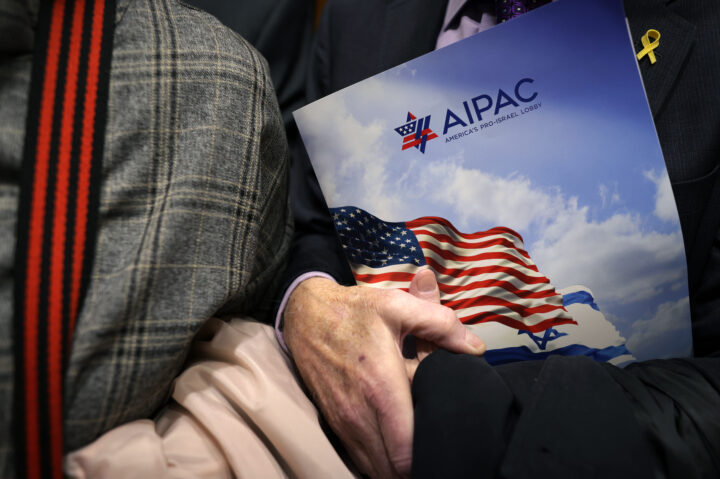
Alex Wong/Getty Images
A visitor holds an AIPAC folder in an elevator in Rayburn House Office Building on March 12, 2024 on Capitol Hill in Washington, DC.
A recently conducted survey assessing how Jewish voters view leading Israel advocacy groups finds that public opinion is divided over the effectiveness of outside engagement in American elections.
The Mellman Group poll, commissioned by the Jewish Electorate Institute (JEI) and released last week, surveyed 800 registered Jewish voters between March 13-23. It found a narrow 39% plurality agreed that it “was more important than ever” for pro-Israel groups to play a leading role in speaking out against candidates who oppose a close U.S.-Israel alliance, while 37% of respondents feared that such advocacy risks making things worse.
The split largely was along partisan lines: While two-thirds of Jewish Republicans and 59% of Jewish independents backed strong pro-Israel political advocacy, just 28% of Democrats shared the same view. A near-majority (46%) of Democrats feared that pro-Israel electioneering could turn voters against Israel.
AIPAC’s super PAC, the United Democracy Project, has been playing a leading role in influencing contested primaries, predominantly on the Democratic side.
But while the group’s aggressive spending in last month’s Illinois Democratic primaries drew outsized attention in the national press, only 11% of Jewish respondents said they were paying a “great deal” of attention to pro-Israel groups’ activity in primaries. Over half of Jewish respondents (51%) said they were paying no attention at all or “not much” attention to pro-Israel engagement in politics.
The poll also tested the public perception of the three leading Israel advocacy groups in Washington: AIPAC, Democratic Majority For Israel and J Street. AIPAC held the highest favorability rating (39%), with 29% viewing the longtime pro-Israel group unfavorably, while 32% said they were unsure.
While Republicans and independent Jews overwhelmingly view AIPAC favorably, opinion was split among Jewish Democrats, with 29% viewing the group favorably, 37% viewing AIPAC unfavorably and 33% saying they were unsure.
DMFI boasted the highest net favorable rating among Jewish respondents, with 32% viewing the Democratic Party’s pro-Israel group favorably while just 16% viewed it unfavorably. Its numbers were strongest with Jewish Democrats and weakest with Jewish Republicans.
J Street, which came out last week against funding Israel’s Iron Dome missile-defense system, held a net unfavorable rating, according to the poll. Just 18% viewed the group favorably, while 19% viewed it unfavorably, with a 46% plurality having never heard of the progressive group.
Support for the operation is highest among those who are the most connected to Israel and those who are most affiliated with Jewish institutions

Getty Images
A large plume of smoke rises over Tehran after explosions were reported in the city during the night on March 28, 2026 in Tehran, Iran.
Two new polls of Jewish voters released this week show broad opposition to the U.S. military action against Iran, with support for the operation highest among those who are the most connected to Israel and those who are most affiliated with Jewish institutions.
A Mellman Group poll on behalf of the Jewish Electoral Institute (JEI)found that 32% of Jewish voters back the current military action against Iran, while 55% disapprove and 13% remain undecided. Support tracked closely along partisan lines, with 83% of Republicans, 49% of independents and 13% of Democrats approving the war.
Among those who said they were very connected to Israel, the poll found nearly two-thirds of Jewish respondents supportive, with just 27% opposed. But among those only “somewhat” connected to Israel, 58% said they disapprove of the war with just 25% approving. Nearly all of those Jewish respondents unconnected to Israel said they disapprove of the military action against Iran.
Support also was strongest based on those who are more religiously observant. The vast majority of Orthodox Jews (83%) approve of President Donald Trump’s military action, with just 11% opposing. But among Conservative Jews, opinion is more evenly split, with 40% approving and 48% disapproving. And among Reform Jews, support is the lowest, with just 24% approving and 67% disapproving.
There’s also a pronounced gender divide within the Jewish community: 40% of Jewish men support the military action against Iran, with 49% opposing. But among women, only 26% approve of the war in Iran, with 59% opposing.
The poll also found a significant share of Jewish Democrats (28%) and independents (29%) who said they feel “torn” about the war — agreeing that Iran is a threat to peace but disagreeing with Trump’s handling of the operation.
The “torn” constituency, which makes up 23% of the Jewish vote, generally draws from those who said they were opposed to the war in the end. When the “torn” constituency is broken out, there’s a more even divide between those who support the war (31%) and those who oppose it (41%).
The Mellman Group poll surveyed 800 Jewish voters between March 13-22.
A separate poll of Jewish voters, conducted by GBAO for the progressive Israel advocacy group J Street, found a similar response towards the war in Iran: A 60% majority of Jewish voters disapprove of U.S. military action against Iran, while 40% support the war. Of note: A sizable 20% minority of Jewish Kamala Harris voters expressed support for Trump’s military action.
The J Street poll, notably, found higher support for the war among Conservative Jews, with 62% supporting and 38% opposing. It also found moderate Jews nearly evenly split, with 51% of self-described moderates in support, and 49% opposed.
The survey also asked whether U.S. military action makes Israel more or less secure, and found a 45% plurality agreeing that it helped Israel’s defense, with 36% concluding it made Israel less safe. But a 58% majority also said that the war weakened the United States, with only 30% believing it strengthened American national security.
The J Street poll also found that 77% of Jews don’t think Trump has a clear plan and mission for the war in Iran.
And it found that 70% of Jewish respondents said their sympathies are more with the Israelis, with 30% expressing more sympathy with the Palestinians. Asked about Israeli Prime Minister Benjamin Netanyahu, 28% of Jewish respondents said they viewed him favorably, with 66% viewing him unfavorably.
Singer told JI that his alignment with the GOP has been shaped by his Jewish faith
Courtesy
Boca Raton, Fla., Mayor Scott Singer
As Boca Raton, Fla., Mayor Scott Singer aims to unseat pro-Israel stalwart Rep. Jared Moskowitz (D-FL), the Republican is hoping that the region’s conservative shifts will help propel him to victory.
Singer told Jewish Insider last week he’s running for Congress because he “love[s] public service” and he sees the country at a “critical point … where we can go back to the failed policies of four years ago or continue to advance the gains that President Trump has made,” and he wants to help push Trump’s agenda forward. That includes Trump’s Middle East policy, which Singer lauded.
Singer, who is running in a traditionally Democratic district, emphasized his three-decade history of public service in the region, and said that he’s “seen a renewed enthusiasm and resurgence in terms of conservative, common sense policies,” particularly among Jewish voters, “as the Democratic Party has grown more and more left.”
“We’re seeing the Republican Party under President Trump becoming the party that really represents more of the issues that a lot of Jewish voters tend to care about,” Singer argued.
He also noted that the district, Florida’s 23rd, has seen a growth in conservative voters coming from out of state, many from states or cities led by Democrats. Trump came within two points of carrying the district in 2024, losing to former Vice President Kamala Harris, 50-48%. That was one of the bigger political shifts in the country, given that in 2020, Trump lost the district to Joe Biden by 13 points.Meanwhile, Moskowitz won his reelection bid 52%-48%.”
Whether Moskowitz and Singer actually end up facing each other in November remains somewhat of an open question, however, pending the outcome of Florida’s upcoming redistricting process.
Singer told JI that his alignment with the GOP has been shaped by his Jewish faith.
“Judaism places a value on individual rights and opportunity, responsibilities, education and freedom,” Singer said. “For hundreds of years, Jewish people were often excluded from Western society and had to make their way — often, as entrepreneurs or self employed, as generations of my family have been — finding ways for them to advance through society.”
“The promise of America is so great because anyone can come here and achieve great things,” he continued. “I’ve always leaned toward the right, because I found that this was a party that valued people’s individual opportunities, merits and contributions, and a natural home that’s consistent with the values that inform my faith.”
Singer argued that Trump has been the strongest advocate and champion of the U.S.-Israel relationship of any U.S. president and a “strong voice against antisemitism, and people are realizing this,” leading to shifts among Jewish voters toward the GOP.
He said that he “personally and spiritually [has] deep connections to the State of Israel and our ancestral home.” And he said that a continued strong U.S.-Israel relationship serves both countries’ interests.
“Israel has been taking a leading edge, fighting terror and fighting enemies who want to see the destruction of Western culture, Western values and the United States,” Singer said.
“What concerns me is in the Democratic Party — and I think it’s concerning a lot of voters, including historic Democratic voters and mainstream voters — is the outrageous and moral failings of Democratic leadership to to confront or contradict claims of genocide when Israel was brutally attacked by terrible terrorists who created committed horrific crimes against women and children — murdering, raping, strangling, kidnapping and torturing,” Singer continued, referencing the Oct. 7, 2023, Hamas terror attacks.
He downplayed anti-Israel trends among some on the right as “a few fringe commentators who seem to have lost semblance of what it means to be a conservative and do not represent the conservative movement.”
Singer emphasized that those voices are out of step with Trump.
“What concerns me is in the Democratic Party — and I think it’s concerning a lot of voters, including historic Democratic voters and mainstream voters — is the outrageous and moral failings of Democratic leadership to to confront or contradict claims of genocide when Israel was brutally attacked by terrible terrorists who created committed horrific crimes against women and children — murdering, raping, strangling, kidnapping and torturing,” Singer continued, referencing the Oct. 7, 2023, Hamas terror attacks.
Asked how he’d describe Moskowitz’s own record on these issues — the two-term Democratic lawmaker has been vocally supportive of Israel and has broken with many in his party on the issue — Singer offered little direct criticism for Moskowitz, instead arguing that he has limited power against what Singer described as a dominant anti-Israel current in the Democratic Party.
“You have to go back to the party and where you are,” Singer said. “When you’re a junior congressman and beholden to some of the increasingly hostile attitude of the Democratic Party and Democratic leadership, including statements by leaders in the House of Representatives that call Israel’s self defense a genocide. When they’re running the party, it’s very hard for any junior member to really stand out and make an effective difference in policy.”
Moskowitz responded in a statement to JI, “I guess the people who are trying to assassinate me over my support for Israel — they obviously think I’m pretty effective,” adding, “By [Singer’s] own logic, I guess there’s no reason for him to run for Congress because he won’t be able to help the district, because he’ll be a freshman.”
Moskowitz has stood apart from most Democrats on various issues relating to Israel, including voting for a controversial bill providing aid to Israel while cutting funding for the Internal Revenue Service, voting to censure Rep. Rashida Tlaib (D-MI) for anti-Israel and antisemitic rhetoric, voting to override President Joe Biden’s holds on certain arms sales to Israel and calling for stronger action by the Biden administration on a range of areas related to Israel policy, Iran and antisemitism.
The Democratic congressman has regularly crossed party lines to cosponsor legislation to support Israel and combat Iran with Republican colleagues.
Moskowitz is also facing a progressive primary challenger who has focused significantly on attacking his support for Israel.
Singer said that the U.S.’ current focus, when it comes to Israel, should be disarming and removing Hamas from Gaza. He expressed support for the Trump administration-led ceasefire plan, and said it’s “too hard to speculate” what might come after that, including whether the U.S. should support a two-state solution.
Singer said that, as a member of Congress, he would be vocal against antisemitism, and said that “Congress needs to codify gains that are coming from the Trump executive orders and reevaluate its approach to universities and other institutions at all levels of education” due to what he said was their failure to protect Jewish students’ civil rights.
“There’s still a constant and present danger to people who love freedom, the Israeli people, and also the people who’ve been oppressed by 20 years of a brutal regime,” Singer said.
He praised Trump’s “bold and necessary action” to strike Iran’s nuclear program last June, and said that the U.S. needs to “stand strong” against the Iranian regime amid its violent crackdown on protesters.
“What we’ve seen over the last few weeks with the terrible slaughter — the extent of which we don’t quite fully know because of blackouts — of people longing for peace may hopefully send a signal of an end to this harmful regime,” Singer continued. “We need to continue to work through our diplomatic, economic and military channels to ensure the safety of our nation, the safety of allies, and hopefully bring relief to people in various lands who’ve been threatened by this rogue regime.”
Singer said that, as a member of Congress, he would be vocal against antisemitism, and said that “Congress needs to codify gains that are coming from the Trump executive orders and reevaluate its approach to universities and other institutions at all levels of education” due to what he said was their failure to protect Jewish students’ civil rights.
He said he would be open to bills to “increase standards” for schools receiving federal funding and to revoke funds to ensure that students’ rights are protected.
He said that Congress also “needs to continue to work in terms of fighting antisemitism, in terms of definitions, training, support for institutions — at the state level, we have strong support for religious schools — and ensuring religious freedom for all people.”
Singer said Congress should consider enhancing protections, such as the FACE Act, for religious institutions to allow people to worship freely and without fear, if necessary.
Singer argued that voices in the GOP that have been attempting to mainstream antisemitic ideology are confined to the “fringe,” emphasizing that he sees the issues as more within the mainstream in the Democratic Party.
“There are fringe voices who seem to have lost the thread of the conservative movement and even in some cases, the pro-America movement, by their unfounded criticisms,” Singer said. “And these loud voices should [continue] to be disregarded. Good speech drives out bad speech, and we need to continue to stand strong on all sides of the political spectrum.”
Andrew Cuomo carried the district in the NYC mayoral race, underscoring its pro-Israel constituency
Michael M. Santiago/Getty Images
Rep. Jerrold Nadler (D-NY) arrives to view proceedings in immigration court at the Jacob K. Javitz Federal Building on June 18, 2025 in New York City.
An increasingly crowded race for a coveted House seat in the heart of Manhattan is shaping up to be among the most vigorously contested Democratic primary battles in next year’s midterms, with half a dozen — and counting — contenders now jockeying for the chance to succeed retiring Rep. Jerry Nadler (D-NY).
In a district home to one of the largest Jewish constituencies in the country, the open primary next June is likely to center in part on Israel as the candidates signal where they stand on an issue that has grown intensely charged over the war in Gaza.
Even as the far left now seeks to ride momentum from Zohran Mamdani’s mayoral victory — which elevated an unabashed socialist to executive office — experts suggested the primary could largely serve as an exception to the anti-Israel sentiments that became a trademark of his stunning rise.
Former New York Gov. Andrew Cuomo, who ran as an independent in the mayoral election this month, won the district by five points with 50%, indicating that a potentially meaningful share of Jewish voters were resistant to Mamdani’s hostile views on Israel and refusal to condemn rhetoric seen as antisemitic.
The district, which includes the Upper East and West Sides of Manhattan, “is more moderate and pro-Israel than” another heavily Jewish House seat in Brooklyn where Mamdani performed well, Chris Coffey, a Democratic strategist who is not involved in the race, told Jewish Insider on Thursday.
So far, however, most of the declared candidates have been relatively cautious about sharing their positions on Israel — underscoring the hazards of addressing a subject that has fueled deep divisions within the Democratic Party. “I would be surprised if they want to lead on this,” Coffey speculated. “It’s a contentious issue.”
With the exception of Alex Bores, an assemblyman who represents the Upper East Side, none of the top candidates who have launched bids in recent weeks answered a question from JI on Thursday asking whether they would support an embargo on offensive weapons to Israel, a measure backed by Nadler after he revealed in September that he would step down at the end of his current term.
“There are laws on the books about this and they should be applied across the board,” Bores said in a statement indicating he would oppose such efforts if elected. “There is no singling out or exemptions for any one country.”
Privately, Bores has been “clear” that an arms embargo is not “negotiable for him,” according to a person familiar with his thinking. Former Rep. Steve Israel (D-NY), a pro-Israel Jewish Democrat, endorsed the assemblyman on Tuesday but was not available to comment about his decision.
Alan Pardee, a former financial executive who is also seeking the nomination, was more direct in a statement shared with JI. “I believe that Israel has the right to defend itself, and that the United States is a critical ally in that regard. I do not support the proposed embargo,” he said.
Micah Lasher, a Jewish assemblyman on the Upper West Side and a protégé of Nadler who is viewed as traditionally pro-Israel, has yet to publicly confirm his own stance on the matter, even as he is expected to reject an embargo. Lasher also dodged a question about the issue while speaking at an Assembly town hall in September before he launched his House bid, saying he was unwilling to discuss topics outside his state legislative purview, according to audio shared with JI.
A poll that circulated in the district in September, which some observers suspected was affiliated with Lasher or allies of his campaign, asked respondents whether they supported Congress blocking “the sale of weapons to Israel” in order to “send a message to Israeli Prime Minister Benjamin Netanyahu,” a sign of the significance of such questions to voters in the race.
Like Nadler, a veteran Jewish lawmaker who has long sought to balance his progressive politics with support for Israel that dwindled during the war in Gaza, Lasher had faced backlash from some Jewish community leaders in the district for having endorsed Mamdani, though he has clarified they are not aligned on Israel issues.
Other candidates in the primary who backed the mayor-elect have similarly distanced themselves from his positions on Israel. Erik Bottcher, a city councilman from Chelsea who joined the primary on Thursday, has confirmed that, unlike Mamdani, he supports Israel’s right to exist as a Jewish state. Jack Schlossberg, an influencer and the grandson of John F. Kennedy, who also entered the primary this week, has said he disagrees with Mamdani’s pledge to arrest Netanyahu if he steps foot in the city. The political scion was raised Catholic but identifies as Jewish.
Bores, who endorsed Mamdani in September, has objected to a failed bill the mayor-elect introduced as an assemblyman to strip nonprofit groups of their tax-exempt status for “engaging in unauthorized support of Israeli settlement activity.” Bores has said he viewed the bill as “immediately suspicious” because it “singularly applies to organizations providing aid to a specific country and its people.“
And Liam Elkind, a Jewish former nonprofit leader who had launched a primary challenge to Nadler before he announced his plans to retire, has expressed his concern that Mamdani has refused to denounce the phrase “globalize the intifada” — seen by critics as a call to violence against Jews. Mamdani has, instead, pledged to “discourage” usage of the phrase.
Rounding out the primary field is Jami Floyd, an attorney and journalist who is seeking to occupy a centrist lane and has said that she did not vote for Mamdani.
The field could grow as other potential candidates are said to be mulling campaigns, including George Conway, a lawyer and outspoken critic of President Donald Trump who is an independent, and Nathalie Barth, former president of Park Avenue Synagogue.
Cameron Kasky, a young gun-violence prevention activist, has filed to run and said on Thursday he is now exploring a bid. He is expected to soon join the race, according to a person familiar with the matter. He would be one of the lone anti-Israel voices in the current primary field, testing the resonance of such views among an electorate that denied Mamdani the majority of the vote.
Kasky, who is Jewish, has frequently criticized Israel on social media and is in favor of an arms embargo. “If you are a Democrat running in 2026 and do not fully support an arms embargo to the to State of Israel amidst their ongoing genocide in Gaza despite Trump’s fake ‘ceasefire,’” he said in a recent post, “Stop wasting everybody’s time. It’s over. The people have spoken. Moral clarity is winning.”
Despite his recent loss, Cuomo, a staunch defender of Israel, is also exploring a campaign and has been making calls to donors who backed his mayoral bid, though it was unclear how seriously he is considering the move, people familiar with the matter told JI. Cuomo, who was once married to a Kennedy, has suggested that he can pull support from Schlossberg and told people he “already has the Kennedy voters,” one of the sources told JI. A spokesperson for Cuomo has dismissed speculation that he has been considering a House campaign.
The primary is also expected to attract outside spending from super PACs and major Democratic donors, including Reid Hoffman, the co-founder of LinkedIn who has reportedly committed to backing Elkind. One person familiar with the race suggested Lasher could claim support from a powerful former boss, Michael Bloomberg, the former mayor of New York City, for whom he once worked as a legislative director.
AIPAC, the pro-Israel advocacy group that has actively engaged in recent primary cycles, did not respond to a request for comment about how it is assessing the race.
At a time when both parties are facing rising antisemitism in their own midst, we will be keeping a close eye on the results for trends affecting the Jewish community
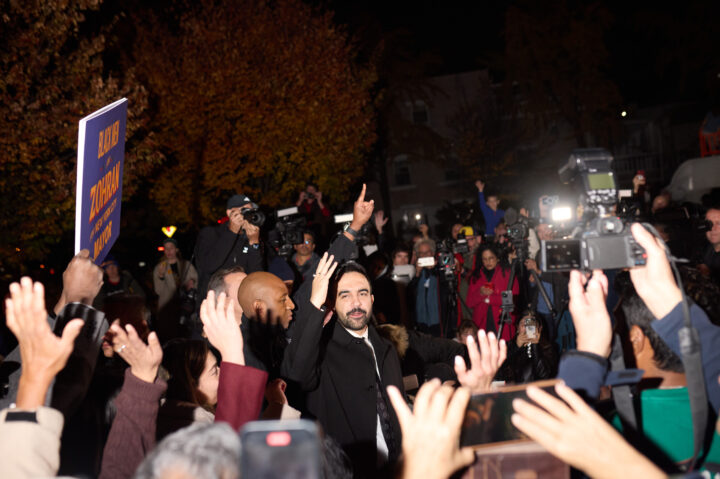
Taurat Hossain/Anadolu via Getty Images
Democratic candidate Zohran Mamdani campaigns on the eve of the Mayoral Election in Long Island City, New York, United States on November 3, 2025.
The stakes for Jewish voters are high for today’s off-year elections. All the major contests — in New York City, New Jersey, Virginia and California — are taking place in parts of the country where Jews make up a significant constituency. At a time when both parties are facing rising antisemitism in their own midst, we will be keeping a close eye on the results for trends affecting the Jewish community.
Here’s what we’ll be watching most closely:
New York City mayor: Polls consistently show Democratic nominee Zohran Mamdani with a comfortable lead, but there’s less consensus on how decisive his winning margin will be. Most polls show Mamdani under 50%, though a few show him hitting a majority. Some show the combined anti-Mamdani vote — represented by former New York Gov. Andrew Cuomo and Republican nominee Curtis Sliwa — outpacing Mamdani’s share.
Whether Mamdani surpasses a 50% majority will go a long way in determining how big his mandate will be. A narrower victory would mean that downballot Democrats — from members of Congress to local city council members — would have less to fear in response to the Mamdani movement.
President Donald Trump’s last-minute endorsement of Cuomo on Monday night could help the former Democratic governor pick off some Republican voters that had been leaning toward Sliwa. But for Cuomo to score an upset victory, he’d need to win over the vast majority of those Sliwa voters.
Pay close attention to the results in Rep. Jerry Nadler’s (D-NY) heavily Jewish Manhattan district for signs of where the progressive-minded Jewish vote ends up landing. Cuomo won the first round of balloting over Mamdani in the district (37-33%), which includes the Upper East and Upper West Sides, but Mamdani narrowly prevailed in the final round of ranked-choice voting. Nadler notably backed Mamdani after his victory in the primary, but his district featured a significant share of backers for Brad Lander, the progressive city comptroller, as well. Cuomo will need a solid showing in Nadler’s district to do well.
New Jersey governor: The race between Rep. Mikie Sherrill (D-NJ) and Republican Jack Ciattarelli is competitive, though Democrats hold a small edge, according to public polls. The county we’ll be watching closely as a bellwether is Bergen County in north Jersey, which has one of the largest Jewish constituencies in the state and saw a significant pro-Trump swing from 2020 to 2024.
It’s also home to Rep. Josh Gottheimer (D-NJ), the pro-Israel stalwart in Congress who carried the county in the Democratic gubernatorial primary and campaigned with Sherrill at a Jewish event in his home base last month.
Former President Joe Biden won 57% of the vote in Bergen, while former Vice President Kamala Harris barely won a majority (51%). New Jersey Gov. Phil Murphy, a Democrat, won 53% of the Bergen County vote in his narrow victory over Ciattarelli in 2021. Ciattarelli would probably need an outright win in suburban Bergen to secure a victory.
Virginia statewide elections: Former Rep. Abigail Spanberger, the Democratic nominee, is expected to win comfortably against Republican Winsome Earle-Sears, the lieutenant governor, but the downballot races are likely to be more competitive.
Republicans are pinning their hopes on securing a second term for Attorney General Jason Miyares, one of the more active state attorneys general working to fight antisemitism in their home state. His Democratic opponent, Jay Jones, is mired in a scandal over texts wishing violence against a former GOP colleague in the state Legislature. Polling shows the race highly competitive, with Spanberger’s margin of victory potentially making the difference as to whether she can pull Jones over the finish line.
The lieutenant governor race features Ghazala Hashmi, a Democratic state senator who has elicited concern from the state’s Jewish community over her past involvement in anti-Israel activism. She’s running against conservative talk show host John Reid. Either winner would make statewide history: Hashmi would be the first Muslim woman elected to statewide office; Reid would be the first openly gay Republican elected statewide.
In a brief interview Monday, Jewish Insider asked Hashmi how big of a challenge she thinks antisemitism is in Virginia. Hashmi replied: “I think we see growing challenges on so many levels of bigotry, and we have to be united in our efforts. I’m facing a great deal of Islamophobic attacks, as you probably have seen, so we have to respond to everything.” Pressed on what she thought about antisemitism specifically, Hashmi cut our interview short.
California redistricting referendum: Gov. Gavin Newsom is likely to win his push to redraw California’s congressional lines to offset some of the partisan redistricting that Republicans have engaged in. The new lines, however, could end up endangering some of the more moderate Republicans that have strong records on fighting antisemitism and supporting Israel.
The list of those Republicans adversely affected include: Rep. Ken Calvert — who chairs the Appropriations subcommittee on defense funding — as well as Reps. Darrell Issa, Kevin Kiley, Doug LaMalfa and David Valadao.
Kiley has been a particularly outspoken voice against campus antisemitism from his perch on the House Education and Workforce Committee.
Far-left mayoral scorecard: We’ll also be closely watching the mayoral races in Seattle and Minneapolis, where far-left DSA-aligned candidates are running competitively. If Katie Wilson and Omar Fateh end up both prevailing in Seattle and Minneapolis, respectively, it will signal a sign of the Democratic Party’s growing radicalism in major urban areas.
AIPAC responds: ‘Rep. Moulton is abandoning his friends to grab a headline, capitulating to the extremes rather than standing on conviction’
Anna Moneymaker/Getty Images
Rep. Seth Moulton (D-MA) speaks with a reporter outside of the U.S. Capitol Building on November 16, 2021 in Washington.
Rep. Seth Moulton (D-MA), who on Wednesday announced a primary challenge to Sen. Ed Markey (D-MA), announced Thursday that he will return donations he has received from AIPAC and will reject further donations from the group.
Massachusetts is a solidly Democratic state but has also a large population of Jewish pro-Israel voters who might be inclined to support the more-moderate Moulton. Though his record on Israel policy is somewhat mixed, Moulton’s record on the issue is more pro-Israel than that of Markey, who is a prominent critic of Israel and has voted repeatedly against weapons transfers to the Jewish state.
“I support Israel’s right to exist, but I’ve also never been afraid to disagree openly with AIPAC when I believe they’re wrong. In recent years, AIPAC has aligned itself too closely with Prime Minister [Benjamin] Netanyahu’s government,” Moulton said in a statement. “I’m a friend of Israel, but not of its current government, and AIPAC’s mission today is to back that government. I don’t support that direction. That’s why I’ve decided to return the donations I’ve received and will not be accepting their support.”
According to campaign finance watchdog group Open Secrets, Moulton received around $43,000 from AIPAC and its supporters in the 2024 election cycle, out of a total of $2.8 million raised. The Boston Globe reported that Moulton plans to return $35,000 in donations from the current election cycle.
AIPAC issued a blistering statement in response to Moulton.
“Rep. Moulton is abandoning his friends to grab a headline, capitulating to the extremes rather than standing on conviction,” spokesperson Marshall Wittmann said in a statement. “His statement comes after years of him repeatedly asking for our endorsement and is a clear message to AIPAC members in Massachusetts, and millions of pro-Israel Democrats nationwide, that he rejects their support and will not stand with them.”
Moulton’s stance echoes those taken by other prominent Democratic candidates across the country seeking to appeal to the progressive Democratic base increasingly hostile to Israel.
Moulton’s changed stance on accepting support from AIPAC is a sign of how even more-moderate Democrats are facing pressure from the party’s activist base to distance themselves from embracing Israel. The Massachusetts congressman had been endorsed by AIPAC prior to declaring his Senate campaign.
“I’m cautiously optimistic that the recent breakthrough in Gaza will move us closer to ending the horrific violence in the region,” Moulton added in the statement. “A political resolution that allows Israelis and Palestinians to live side by side in peace is exactly the kind of framework I’ve been calling for from the beginning.”
Barry Shrage, the longtime former president of the Combine Jewish Philanthropies of Greater Boston and a professor of practice in Brandeis University’s Hornstein Jewish Professional Leadership Program said it’s tough to predict where pro-Israel Jewish voters will land.
“I think a lot of people will remember what Markey has been doing and where Markey was coming from — kind of a leader of the anti-Israel ‘progressive’ Democratic faction,” Shrage said. “But then people are going to want to know, really, what Moulton really thinks.”
“He made a decision that the progressive wing of the Democratic Party is more important to him than the Jewish community — or he thinks that the Jewish community has also turned against Israel, which, by the way is not the case, not in Boston,” Shrage said, of Moulton’s denunciation of AIPAC. “It’s kind of a cop-out for him to say, ‘I disagree with Netanyahu and that’s why I won’t take any AIPAC support.’”
Shrage noted that he saw Markey aligning himself more closely with anti-Israel figures and groups during his 2020 campaign, pointing to an op-ed in which he wrote, “his campaign … has made a concerning shift by welcoming and featuring support from individuals and organizations with highly divisive and polarizing approaches to Israel, our country and our world and all that goes with it, socially, politically, and economically.”
Shrage supported then-Rep. Joe Kennedy (D-MA) against Markey in 2020.
He told JI that Markey’s leftward shift on Israel issues has continued in the ensuing six years, noting that Markey “won the race, in a way, by selling himself” to the left wing of the party.
A poll conducted by the Democratic polling firm GQR found Zohran Mamdani, the Democratic nominee, winning only 37% of Jewish voters
Spencer Platt/Getty Images
Democratic socialist candidate Zohran Mamdani, who won the Democratic primary for mayor of New York City, attends an endorsement event from the union DC 37 on July 15, 2025, in New York City.
A new poll of New York City Jewish voters commissioned by the pro-Israel New York Solidarity Network underscores the presence of a cohesive constituency opposed to Zohran Mamdani’s candidacy to become New York City mayor — but also illustrates some of the divisions preventing the city’s Jewish community from speaking with a loud, united voice.
The poll, conducted by the respected Democratic polling firm GQR, found Mamdani, the Democratic nominee, winning only 37% of Jewish voters, with 25% backing Mayor Eric Adams, 21% supporting former Gov. Andrew Cuomo and 14% preferring Republican nominee Curtis Sliwa. The results show that even though most Jewish voters identify as Democrats, a clear majority won’t support the Democratic nominee because of his record on issues of concern to the Jewish community — in a city where registered Democrats outnumber Republicans 6-to-1.
Adams performs particularly well among Orthodox Jews, winning 61% of their vote, while Cuomo leads among Conservative Jewish voters with 35% support. But among unaffiliated and Reform Jews, Mamdani leads with a near majority of the Jewish vote.
Asked if Jewish voters were pro-Israel, two-thirds (66%) responded in the affirmative, while 31% said they weren’t. That’s a slightly larger share of non-Zionist Jews than we’ve seen in national polling. Nearly two-thirds (63%) also said that the “globalize the intifada” rhetoric that Mamdani has defended is antisemitic, with just 27% disagreeing.
Just over half of Jewish voters in New York City (51%) believe Mamdani is antisemitic; 42% of respondents disagree.
The results illustrate the long-standing dynamic of the general election: Mamdani’s political standing is unusually weak as a Democratic nominee, but he continues to benefit from the divided field of opponents — and lack of a coherent strategy to go after the front-runner.
The fact that there isn’t a consensus Mamdani alternative within the Jewish community at this late stage demonstrates the hands-off approach to the race outside groups have taken, despite the very real fears many hold of what a Mamdani mayoralty would look like.
‘Every time a vote like this comes around, there is a break in trust and that becomes harder to restore,’ an Atlanta-area rabbi said, though the senator maintains some supporters
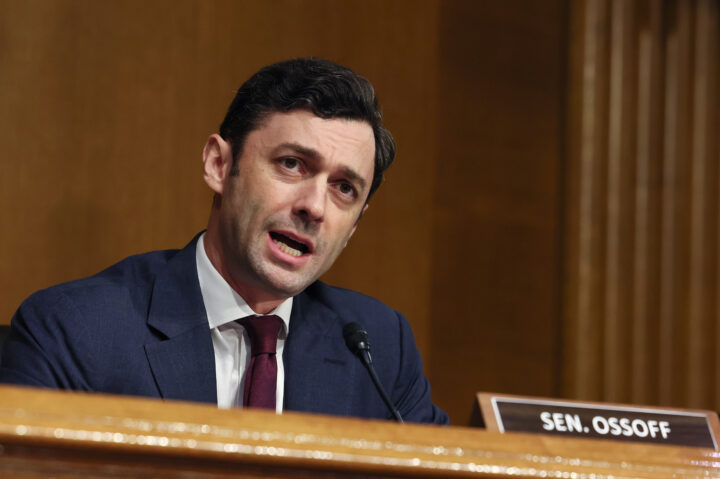
Jemal Countess/Getty Images for Breakthrough T1D)
Sen. Jon Ossoff (D-GA) questions witnesses during a hearing held to examine a future without Type 1 Diabetes with a focus on accelerating breakthroughs and creating hope at the Dirksen Senate Office Building on July 09, 2025 in Washington, DC.
Sen. Jon Ossoff’s (D-GA) vote Wednesday night, with a majority of Senate Democrats, in favor of a resolution to block a shipment of automatic weapons to Israel is fueling renewed frustration with the senator within the Georgia Jewish community, setting back efforts by the senator to repair ties with Jewish voters who objected to similar votes last December.
Ossoff’s relationship with Georgia’s sizable Jewish community could be a critical deciding factor in his reelection campaign next November — with a tight margin of victory expected in the swing state, significant changes in Jewish voting patterns could help decide the election.
The Georgia senator alienated many in the Jewish community by voting in December for two of three resolutions to block aid shipments to Israel. In subsequent months — after a group of Jewish donors expressed support for Republican Georgia Gov. Brian Kemp as a potential challenger — Ossoff reached out to Jewish community leaders and groups to work to repair ties, with some success.
Many leaders said at the time that he was making progress but had more work to do to fully regain their trust. Those efforts hit a stumbling block in June after Ossoff — whose second child had just been born — took nearly a week to comment on the war between Israel and Iran.
Ossoff said, of his votes on Wednesday, that he had voted for the resolution to block the automatic weapons to send a message to the Israeli government objecting to the humanitarian crisis in Gaza, as well as due to concerns that the weapons would be provided to police controlled by Israel’s national security minister, Itamar Ben-Gvir, a controversial figure even in pro-Israel circles.
He said he voted against a second resolution blocking a sale of bombs and bomb guidance kits, because those weapons are necessary to strike targets throughout the region attempting to launch missiles and rockets at Israeli civilians. Ossoff had similarly opposed a resolution on bombs and guidance kits in November, while voting for two other resolutions to block other weapons transfers.
Norman Radow, a major Democratic donor in Georgia who spoke to Ossoff on Wednesday evening after the votes, told Jewish Insider, “I’m disappointed with him and he knows it. And I think he knows that a vast majority of the Jewish community feels the same way.”
Radow said that Ossoff’s justifications for his vote on the assault rifles resolution didn’t hold water for him and his logic was “sophomoric.” The Democratic donor said he’d argued to the senator that Ossoff had overstated the extent of violence in the West Bank and of starvation in Gaza.
And he said he told the senator that non-binding efforts condemning Hamas and its backers are ineffectual, as compared to the real impacts that cutting off military supplies to Israel would have.
He indicated he appreciated the senator’s call.
“I’m disappointed in his behavior, but I can’t say it’s a surprise. We’ve seen this before,” Cheryl Dorchinsky, the founder of the grassroots Atlanta Israel Coalition, said. “It’s insane to me that anyone would think that voting against weapons to Israel during a war is a good idea, regardless of who’s in power.”
She said she feels adrift from both political parties. “When people that I see going into politics as having hopefully an interest in doing the right thing fail us as a people, it just kind of breaks my heart,” Dorchinsky said. She argued that Israel should not be a partisan issue, and blamed “bad actors” trying to turn it into one.
“While I wish [Ossoff] would have voted against both of [the resolutions], I’m very pleased he voted against [the one on bombs and bomb guidance kits],” Dov Wilker, who serves as the regional director of the American Jewish Committee in Atlanta, said. Wilker also said he was “disappointed” that the state’s other senator, Sen. Raphael Warnock (D-GA), had voted for both of the resolutions.
Another Jewish Democratic donor in Georgia said, “The yes vote with Sanders, who only wants to destroy the U.S.-Israel relationship, is concerning [and] emboldens the terrorists to continue to reject the ceasefire that was agreed to by Israel. It’s exactly what Hamas wants.”
Rabbi Joshua Heller of Atlanta’s Congregation B’nai Torah told JI that, while he does not endorse candidates, he’s heard in conversations that “a lot of folks who had previously been strong supporters of [Ossoff’s] in the Jewish community are not happy about the stands that he has taken.”
Heller said that, in conversations with him about such positions, Ossoff and his staff have highlighted actions he has taken in support of Israel, “and that is true, but every time a vote like this comes around, there is a break in trust and that becomes harder to restore.”
He said that in conversations with Democratic Jewish voters, many onetime Ossoff supporters are “having second thoughts, at this point,” and that there is a real “challenge in his relationship with a lot of folks in the Jewish community right now.”
“No Jewish community is monolithic, but I definitely see a lot of folks in the community who are troubled by this,” Heller said.
Ossoff still maintains supporters in the Jewish community who back his stance on this week’s resolutions.
Beth Sugarman, a prominent J Street member in Georgia, told JI, “The Jewish community has diversity of opinions, but the people I know think Jon Ossoff is thoughtful and represents us well and his statement and split vote was a good reflection of where the community is. The senator’s statement and split vote was thoughtful and exactly what the community believes.”
J Street supported both of the resolutions to block aid.
Cary Levow, a supporter of pro-Israel causes and candidates, said, “I support Senator Ossoff and know of other Jewish Georgians who understand that Jon’s approach to the Gaza humanitarian issue is genuine.”
“Senator Ossoff has voted for over $20 billion in aid to Israel, has family living in Israel and has spent a significant amount of time in the country,” Levow continued. “I think Jon has represented the Jewish community well and I have zero concern about a senator who is critical of how [Israeli Prime Minister Benjamin Netanyahu] Bibi is waging this war.”
Larry Auerbach, a Georgia lawyer and Ossoff supporter, said, “Senator Ossoff has done what the vast majority of Georgia’s Jewish community has asked him to do to represent us well by standing up for protecting the Israeli people’s security and saying that the extremists in the Netanyahu administration can’t continue like this.”
National Republicans see Ossoff’s positions as an opening to peel off Jewish voters in the upcoming senatorial election. The National Republican Senatorial Committee, which has seized on Ossoff’s November votes to block aid to Israel, again slammed him on Wednesday.
“Jon Ossoff is a radical leftist who time and again refuses to stand with Georgia’s Jewish community,” NRSC spokesperson Nick Puglia said in a statement. “He’d rather please the pro-Hamas extremists in his party than stand with Israel and Jewish Georgians. In 2026, voters will send him packing.”
Radow, the Democratic donor, argued that Ossoff’s votes were “bad politics,” though he said he’s not sure any of the current or prospective Republican candidates can beat Ossoff.
“He’s kowtowing to Bernie Sanders — that does not win elections in Georgia,” Radow said. “The only thing that Jon’s got going for him right now is the Republican field of candidates is pretty weak. … I want him to win, and he’s not winning my vote right now, and he’s not going to win a lot of people’s votes supporting Bernie resolutions.”
He said that whether he ultimately supports Ossoff next year will depend in part on which Republican ultimately ends up as the nominee against him.
“It’s certainly going to be an interesting race, and my vote is still up for grabs,” Radow said. “I’m not going to be a knee-jerk Democrat on this issue.”
He urged Ossoff, going forward, not to show public daylight with Israel, “stop playing secretary of state” and keep disputes with the Israeli officials behind closed doors. And he called on the senator to consult with Jewish community members before critical votes like this one, rather than reaching out afterward to explain his votes.
Dorchinsky said that she would “never say never to anything,” when asked if Ossoff could win her support at this point, and that she’ll “be paying attention” and make her final decision when she’s in the voting booth next year.
“He has a responsibility to represent us all, and if he actually started to, I would be thrilled. As of right now, I’m clearly not,” Dorchinsky said.
A Jewish leader in Georgia agreed that a key deciding question for wary Jewish voters will be who the Republican Party nominates to run against Ossoff in 2025.
The leader told JI he thinks that Ossoff’s vote for the assault rifles resolution could help him “thread the needle” more easily than other resolutions and represented a more “considerate” approach, given the Ben-Gvir connection. “I think the majority of American Jews are not fans of Ben-Gvir,” the Jewish leader said.
“I think that if he is consistent with his messaging around the specific nature of why he voted against the assault rifles, I think it’ll help people that are more on the fence with him, but want to vote for him — versus those that are just against him,” the leader said.
But, the leader continued, “that doesn’t mean everyone’s going to buy it,” and noted that many members of the community are unhappy with the vote.
They said the vote is particularly “not going to help” Ossoff among Jewish community members upset by his delay in commenting on the Iran war, “but those that were able to give him some grace that he finally said something — this will help them.”
Heller was more skeptical that Ossoff’s vote-splitting approach would satisfy anyone, saying he thinks the strategy won’t help Ossoff with supporters of Israel who don’t believe in stopping weapons shipments nor with opponents of Israel who believe in cutting off all aid to Israel.
Turbocharged partisanship and polarization, which has impacted nearly every issue in the country, is now affecting the politics behind support for Israel
Kevin Dietsch/Getty Images
House Minority Leader Rep. Hakeem Jeffries (D-NY), joined by fellow Democrats outside of the U.S. Capitol on July 02, 2025 in Washington, DC.
Like with the gradual impact of climate change, the Democratic Party’s shift away from its pro-Israel moorings and its commitments to fight antisemitism is happening in a slow but appreciable fashion. Seemingly every week, there’s a political development, polling nugget or election outcome that underscores the party’s commitment to Jewish voters isn’t quite where it was in the not-too-distant past.
There were the Pew Research Center and Quinnipiac polls this spring showing that most Democratic voters now view Israel unfavorably — with support for the Jewish state dividing more clearly along partisan lines. The results underscored why so few Democrats could muster even some reluctant praise for the U.S. strikes setting back Iran’s nuclear program.
There’s the blowback that Pennsylvania Gov. Josh Shapiro received from the Kamala Harris campaign for comparing extremist anti-Israel protesters on campuses to Ku Klux Klan members, as recounted in a new tell-all book about the 2024 campaign. Or the similar intraparty animus that another leading Democratic Jewish official, Michigan Attorney General Dana Nessel, received after her office charged anti-Israel student protesters for assaulting police and engaging in ethnic intimidation.
Amid sustained political pressure from the left, these two leading Jewish Democrats have since pulled their political punches. Shapiro, a national political figure who was one of the most prominent targets of antisemitic hate, notably chose to avoid labeling the attack on the governor’s mansion as antisemitic in a nationally televised interview. Nessel later dropped the charges, amid a smear campaign that her decision to charge the students was a result of anti-Muslim bias.
And of course, there was the shocking outcome last month in the New York City Democratic primary where Zohran Mamdani, the far-left candidate who declined to speak out against “globalize the intifada” rhetoric, comfortably prevailed over former New York Gov. Andrew Cuomo for his party’s nomination. That result followed pro-Israel stalwart Rep. Josh Gottheimer’s (D-NJ) fourth-place finish in New Jersey’s Democratic gubernatorial primary, despite ample resources and a message geared towards Jewish moderates.
Next week in an Arizona special election, the pro-Israel candidate, former state Rep. Daniel Hernandez Jr. — best-known for helping save former Rep. Gabby Giffords’ life — is lagging behind Adelita Grijalva, the daughter of the late Rep. Raul Grijalva (D-AZ), who has been more critical of the Jewish state.
The latest data points that should concern mainstream Democrats are from the new fundraising figures in the Michigan Senate race. The primary has become something of an ideological proxy battle, pitting Rep. Haley Stevens (D-MI), a strong ally of Israel with a battle-tested political track record, against an anti-Israel left-wing challenger, Abdul El-Sayed, who has not had much success in statewide politics. State Sen. Mallory McMorrow, with a progressive record in the Michigan Legislature, has been trying to balance both sides of the ideological divide. (Former Michigan House Speaker Joe Tate is also running.)
Stevens, long one of the party’s top fundraisers, lagged behind both her rivals in the just-completed fundraising quarter. Her $1.3 million raised, supplemented by a transfer of the $1.2 million already in her House campaign account, was a solid sum. But it was surpassed by McMorrow ($2.1 million) and also by El-Sayed ($1.8 million), whose surprising financial haul is a likely reflection of the ideological disposition of the party’s small donor base.
It’s a warning sign that anti-Israel activism is now being leveraged as a way to raise money for like-minded candidates. That would be a shift from recent elections where many candidates hostile to Israel were seen as too extreme to win support from a critical mass of donors.
The big picture? Turbocharged partisanship and polarization, which has impacted nearly every issue in the country, is now affecting the politics behind support for Israel — and even turning bipartisan issues with widespread support, like fighting against antisemitism and defending Jewish communal interests, into a partisan food fight.
For decades, most Jewish voters have aligned themselves with the Democratic Party, even amid serious policy disagreements. It’s hard to imagine that changing dramatically, even as we’ve seen small shifts towards the GOP, especially among more-observant Jewish voters. But if the party continues to accommodate far-left forces with radical views on Israel and antisemitism, that level of support will be significantly tested — and worth watching closely — in the years ahead.
Democratic pollster Mark Mellman found Trump’s overall approval rating with Jewish voters stands at 24%, while 31% approve his record on antisemitism

Ethan Miller/Getty Images
President Donald Trump is introduced at the Republican Jewish Coalition's Annual Leadership Summit at The Venetian Resort Las Vegas on October 28, 2023 in Las Vegas, Nevada.
More than 7 in 10 American Jews disapprove of President Donald Trump’s job performance, a new poll found, but he is making some inroads with Jewish voters on his handling of antisemitism, compared to his first-term standing.
The poll, administered by Democratic pollster Mark Mellman for the Jewish Electoral Institute (JEI) between April 15-18 and released on Wednesday, found that Trump’s overall approval rating among Jewish voters is at 24%, with 72% disapproving. The results suggest there hasn’t been much of a shift since the election: Trump won 26% of the Jewish vote, according to Mellman’s post-election survey conducted last December.
The poll also found large majorities of the 800 registered American Jewish voters who were surveyed opposing his policies on tariffs, cuts to the federal government, and threats to law firms.
“American Jewish voters are deeply distressed about the direction in which Donald Trump is taking the country and oppose many of his key policies. Indeed, a majority of Jewish voters disapprove of his job performance overall and disapprove of the way Trump is handling antisemitism,” Mellman said.
But on the issue of handling antisemitism in America, Trump receives higher marks from Jewish voters. The poll found 31% of Jewish voters approve of the way he’s dealing with antisemitism, while 56% disapprove. His current rating on antisemitism is markedly better than it was in his first term: When Mellman asked a similar question in JEI’s 2018 poll of Jewish voters, Trump’s disapproval rating on handling antisemitism was much higher (71%).
Among Jews under 30, many of whom have attended college recently or are currently university students, Trump’s numbers are also in better shape. One-third of younger Jewish voters said they approve of Trump’s handling of antisemitism, while just a narrow majority (52%) disapprove.
When asked about one of Trump’s specific policies designed to combat antisemitism, Trump faces broader disapproval. More than 7 in 10 American Jews disapprove of the executive order “allowing the federal government to deport individuals without a court hearing.”

AP
Democratic frontrunner Sen. Bernie Sanders (I-VT) would beat President Donald Trump 65-30% among Jewish voters, according to a new poll of 1,001 American Jews conducted by Garin-Hart-Yang Research Associates for the non-partisan Jewish Electorate Institute (JEI).
Not close: While Trump hits 30% against the remaining candidates, the poll shows he would receive only 28% of the Jewish vote in a hypothetical match-up against Michael Bloomberg, who — like Joe Biden — would receive 67%.
Not well liked: 52% of American Jews have a favorable view of Sanders, compared to 45% who view him as unfavorable, the survey shows. Sanders enjoys higher support among young Jews, ages 18-39. Sen. Elizabeth Warren (D-MA) is not far off with a 54/40% favorable/unfavorable rating.
Rating Trump: The poll, conducted February 18-24, showed that 68% of American Jews disapprove of Trump’s job performance. Nonetheless on issues related to Israel, more Jews approve of Trump’s handling of the issue than disapprove. Of those polled, 51% approve of his handling of U.S.-Israel relations, compared to 39% who disapprove. Surprisingly, a plurality — 44-40% — back Trump’s decision to support Israel annexing the West Bank, following a mapping process.
Firing up the base: Among Jewish Republicans, Trump received 81% approval.
Gold medal: Former South Bend Mayor Pete Buttigieg received the highest favorability rating (60%-28%) of all of the Democratic 2020 hopefuls. The survey projects he would receive the highest support among Jewish voters in a general election against Trump (69%-31%).
Read the full polling data here.
Conclusions: Pollster Frederick Yang said in a statement, “While Jewish voters have differing opinions about the major Democratic candidates, the poll demonstrates that they will overwhelmingly support any of the current Democratic candidates over President Trump at nearly equal levels, and that Israel is not driving the Jewish vote.”
Spin: Halie Soifer, executive director of the Jewish Democratic Council of America, said in a statement, “This non-partisan poll makes it clear that the top priority of Jewish American voters is defeating Donald Trump and electing Democrats who share our values. Jews will support any of the Democratic candidates by a two-to-one margin over Donald Trump because Jews want to elect a president who shares our values in November.”
Matt Brooks, executive director of the Republican Jewish Coalition, tells JI, “These results are consistent with what we’ve been saying since the start of this campaign that President Trump will significantly increase the share of the Jewish vote from where he was in 2016. It was only a few months ago when many pundits in the Jewish community were projecting that Trump would get the lowest share of the Jewish vote of any president in history, and now multiple polls are showing that he’s going to get one of the highest percentages of the Jewish vote in modern elections.”
Presidential candidate woos small but important bloc of Jewish Iowans before the caucuses

Photo courtesy of Ben Jacobs
Cory Booker’s presidential campaign is reaching out to Jewish voters in Iowa and other key primary states in an innovative way.
The New Jersey senator sent out Rosh Hashanah cards to over 30 Iowans and a broader group of supporters and friends across the country, wishing them “Shana Tova” in advance of the Jewish New Year. Set against a background of pomegranates, a fruit traditionally linked to Rosh Hashanah, Booker wishes recipients “a sweet new year filled with health, happiness and peace.”
David Adelman, a prominent Iowa lawyer and Democratic activist, received one of the cards himself. Adelman, who has not decided who he’ll be voting for in February, told Jewish Insider that it was “a nice touch and a nice gesture.”
He did not remember gestures like this during past caucuses, but noted that he received a Rosh Hashanah card from Hillary Clinton during the 2016 general election. He also recalled spotting singer Carole King, who was in Des Moines as a surrogate for John Kerry’s presidential campaign, at Rosh Hashanah services in 2004.
Jeff Link, a top Democratic operative in Iowa, noted that there “certainly has been outreach” to the Jewish community in past cycles. He hearkened back to a candidate forum at a Des Moines synagogue in 1988. Although Jews make up just 0.2% of the Hawkeye State’s population, Link said the Jewish community is still an important one for candidates to woo. “You have a lot of opinion leaders, influential Democrats and community leaders in that group, so I think it’s numerically not the biggest interest group in the state, [but] I think it’s important and influential,” said the veteran Democratic operative.
Booker himself has had a long interest in and affinity with Judaism. The New Jersey senator led the L’Chaim Society at Oxford while studying there in the early 1990s. He showed off his knowledge of Hebrew earlier this year during a CNN town hall and has long been a strong supporter of the alliance between the United States and Israel.
The cards come as Booker’s campaign has been struggling in the polls. The New Jersey senator announced on Saturday that if his campaign didn’t raise $1.7 million by the end of September, he would have to consider dropping out of the race.
In a statement, Booker’s Iowa state director Mike Frosolone told JI, “it’s very important to us that every faith and community in Iowa knows that they have an ally in the Cory 2020 campaign. Rosh Hashanah brings an excellent opportunity for us all to celebrate and be thankful for the blessings of the last year, and we wanted our friends in the Jewish community to know we are thankful for them.”
Please log in if you already have a subscription, or subscribe to access the latest updates.
 Continue with Google
 Continue with Apple