


























































Democratic governors face looming deadline to opt in for educational tax credit
While Republicans have embraced the program that is being championed by Jewish community groups, only Colorado Gov. Jared Polis has opted in so far among Democrats

Adam Gray - Pool/Getty Images
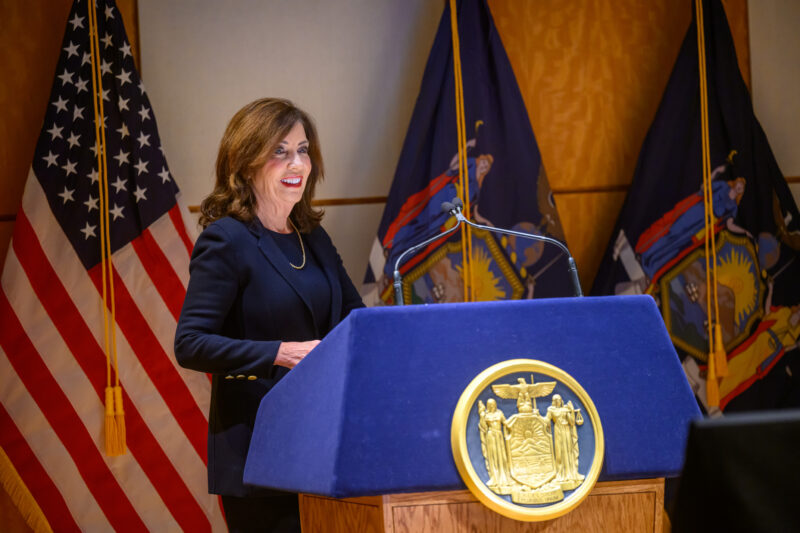
New York Gov. Kathy Hochul arrives for a ceremony to commemorate the 25th anniversary of the September 11th terrorist attacks on September 11, 2026, in New York City.


 Add JewishInsider on Google
With the publication of regulations on Thursday for the new federal educational tax credit program, governors now have until the end of the year to decide whether to opt their states into the program.
The tax credit program, which has been championed by many Jewish community groups but opposed by teachers’ unions, has presented a choice for blue-state governors, many of whom¸ have been publicly undecided to this point on whether they’d join the program. Several said that they were waiting to see the regulations before they made a final decision.
Among the elements of the new regulations released Thursday is guidance clarifying that governors cannot make state-specific rules governing what scholarship organizations are eligible for donations under the program — such as excluding scholarship programs benefiting public or private schools.
And in states that don’t opt in, donors will be able to contribute to scholarship organizations in other states, and still receive tax credits.
Another major development clarified by the new regulations is that, even when filing jointly, spouses will each be eligible for the $1,700 tax credit, totaling $3,400 per married couple per year, a provision applauded by advocates for the program.
Republican governors have all opted into the program, but among Democrats, only Colorado Gov. Jared Polis has signed up so far, while a handful of governors have already said they will opt out.
Several other Democratic governors told Jewish Insider on Thursday that they’re still reviewing the guidance.
“Governor Hochul is committed to ensuring every student receives a quality education that best meets their needs. If properly implemented, and structured so all students can benefit, the federal scholarship tax credit can expand opportunity without diverting funding from public schools, state or local budgets,” Jonah Allon, a spokesperson for New York Gov. Kathy Hochul, said in a statement. “The Administration is carefully reviewing the proposed regulations to ensure implementation would achieve these goals.”
Hochul had previously expressed her intention to opt in, pending any “poison pills that could harm New York’s education system” in a review of the final regulations.
A spokesperson for Illinois Gov. JB Pritzker told JI that his office is also reviewing the new guidance. “As stated since the federal government announced this program, the Governor’s Office will carefully evaluate the proposed regulations and make a decision grounded in what best supports working families, students, and our public schools,” the spokesperson continued.
A spokesperson for New Jersey Gov. Mikie Sherrill said that her administration “remains committed to ensuring every child in New Jersey has access to a high-quality education and the opportunities they need to succeed.”
“As we carefully review this federal guidance, we are examining who the program would serve, which opportunities are available, and how it could best benefit public school students,” the Sherrill spokesperson said. “The bottom line is clear: put kids first and strengthen New Jersey’s public schools.”
A spokesperson for the District of Columbia’s office of the superintendent for education also said the city is reviewing the new regulations.
“As the state education agency, the vision of the Office of the State Superintendent of Education is that DC learners of all ages and backgrounds are equipped with the knowledge and skills needed to pursue and thrive on the life path of their choice. We are reviewing the temporary regulations and proposed rulemaking that came out today,” the spokesperson said.
Several others including Govs. Josh Shapiro of Pennsylvania, Maura Healey of Massachusetts, Wes Moore of Maryland and Abigail Spanberger of Virginia did not respond to requests for comment. Virginia was opted in by then-outgoing Gov. Glenn Youngkin, but Spanberger could still decide to withdraw before the Jan. 1 deadline.
Democrats are facing pressure from teachers’ unions to oppose the new tax credit program.
American Federation of Teachers President Randi Weingarten called the program a “poison pill for the 90 percent of American children who attend public schools” by diverting taxpayer funding into private hands and depriving public schools of resources.
The credits will apply exclusively to federal taxes and scholarships can be open to public school students for tutoring, special needs services, transportation and some after school activities.
“State governors should reject it — not least of all because they will have no say or oversight over how the vouchers operate,” Weingarten said. “The reality is that for every precious public dollar funneled to private schools — money that could be spent on instruction, lowering class sizes, modern buildings or new books in the library — public school parents will be hunting for pennies on the floor.”
The National Education Association said the program is “robbing students of access to great public schools across the United States” while preventing states’ “ability to protect students or ensure meaningful benefits for public schools.”
National and local Jewish groups, however, are supporting the program and have been lobbying governors to enroll in it.
Rabbi A.D. Motzen, the national director of government affairs for Agudath Israel of America, told JI that the publication of the regulations for the program will allow states that have already opted in to begin implementing the program, and should allow states whose governors have said they’ve been waiting for the regulation to make decisions.
Addressing Hochul specifically, Motzen noted that she had said she wanted to ensure that public school students would be eligible, which the regulations make clear that they are, and argued that the regulations contain no poison pills.
“The big news is that states can move forward, that wanted to move forward, and states that said [they’re] waiting have what they need now to look at and hopefully make decisions sooner rather than later,” he said.
The midterm elections could also have some bearing on the program. Though Jan. 1 is the listed deadline, Motzen explained that new governors who take office at the start of the year should have additional time to finalize lists of eligible scholarship organizations.
He also pushed back directly on the arguments made by the teachers’ unions, emphasizing that 96% of all students will be eligible for scholarships and that the program will not come from state tax budgets.
“That’s just misrepresenting what it does. It helps almost every student in the state,” he said, adding, “the idea that it would financially harm a state is ludicrous.”
“Governors across the country have been telling us they were waiting for the federal guidelines. Well, here they are, and there is no reason left to wait,” Teach Coalition CEO Sydney Altfield said in a statement. “The rules make clear, in firm writing, that public school students can benefit too, with strong standards and real oversight. This doesn’t have to be a partisan issue. For Jewish families, it matters enormously.”
Teach Coalition said it plans to continue working with Hochul’s administration as it reviews the guidelines and to continue pushing other governors to join the program as well. Altfield said that the program can give parents and Jewish schools “meaningful new resources … at a moment when Jewish education has never been more important.”
Sheila Katz, the chief Jewish life officer for the Jewish Federations of North America, said, “With the regulations now released, we urge every governor that has not yet opted in to take the steps necessary to participate. Families should not lose access to these important education scholarships simply because of where they live.”
Katz said the program “has the potential to make Jewish day school more affordable and will drastically increase access to Jewish education for generations to come” and thanked the Treasury for making the program “as accessible as possible.”
A range of national Jewish organizations have endorsed a national scholarship-granting organization to support Jewish day schools, the Opportunity Fund for Jewish Education, and a range of state-level Jewish scholarship organizations are also expected to be launched.
Youngkin, who has been an advocate for the program, wrote in a post on X, “the teachers union was wrong. This scholarship program will not take any dollars from public schools, and public school kids are eligible!”
“Governors, it’s your time now — stand with kids and parents, opt-in to the Education Freedom Tax Credit,” he continued.
More Stories

FRIENDS ON THE TRAIL
Far-left California House challenger Mai Vang to campaign with Piker, insurgent DSA Dems

TERROR UPDATE
Netanyahu says FlyDubai Omani co-pilot underwent ‘Islamist radical indoctrination’

printing pressure
Inside New York magazine’s anti-Israel shift — and the Jewish staffers left behind

BEHIND THE BYLINE
IDF report identifies 170 Palestinian ‘journalists’ killed during Gaza war affiliated with terrorist groups

MEDIA MOMENT
New York magazine editor seeks to reassure Jewish leaders but stands by contentious cover issue

SECURITY SHORTFALL
Nonprofit Security Grant Program fulfills less than one-quarter of 2026 applications
Please log in if you already have a subscription, or subscribe to access the latest updates.
 Continue with Google
 Continue with Apple