



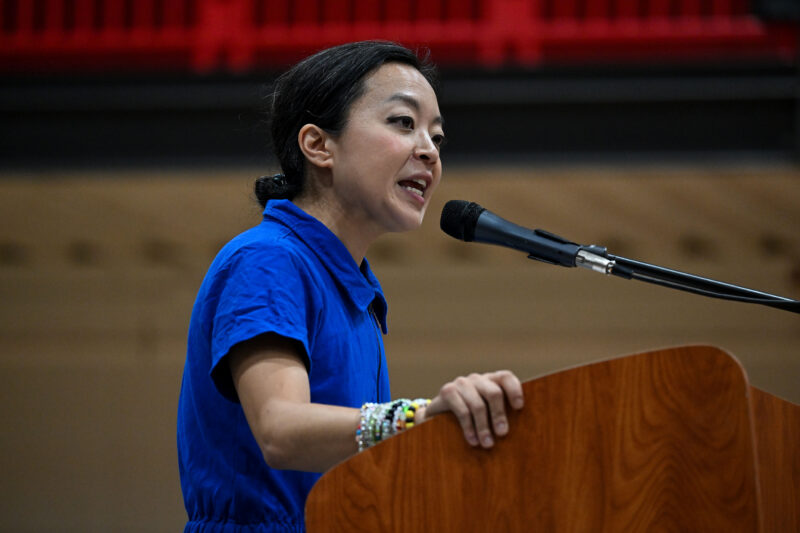





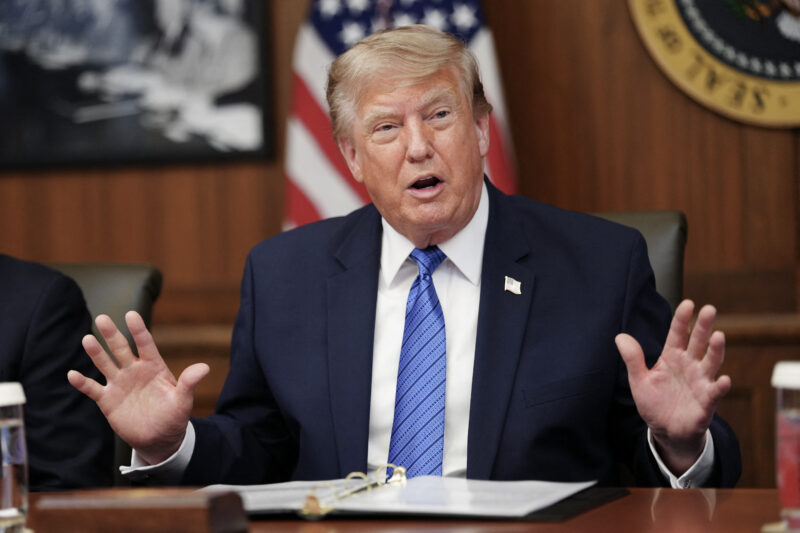


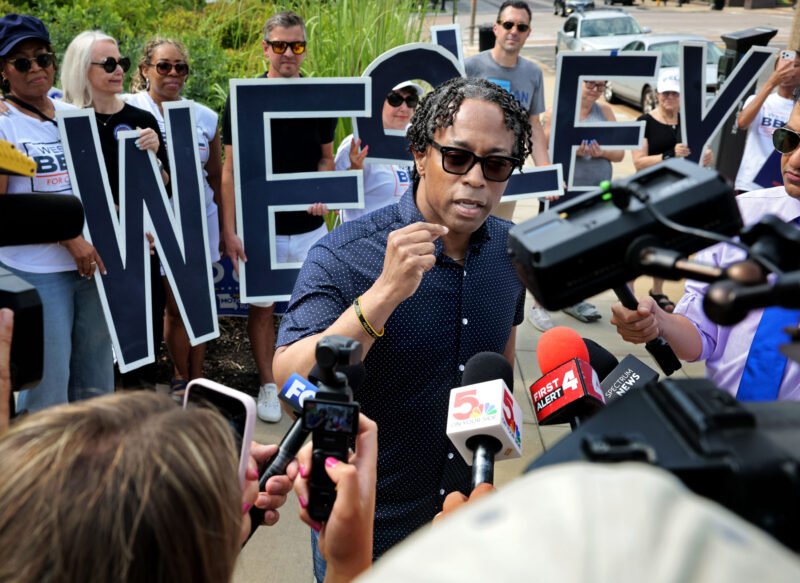








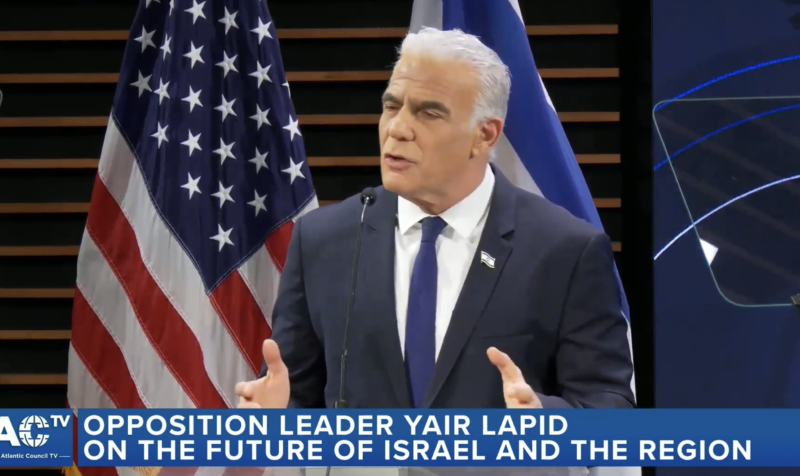
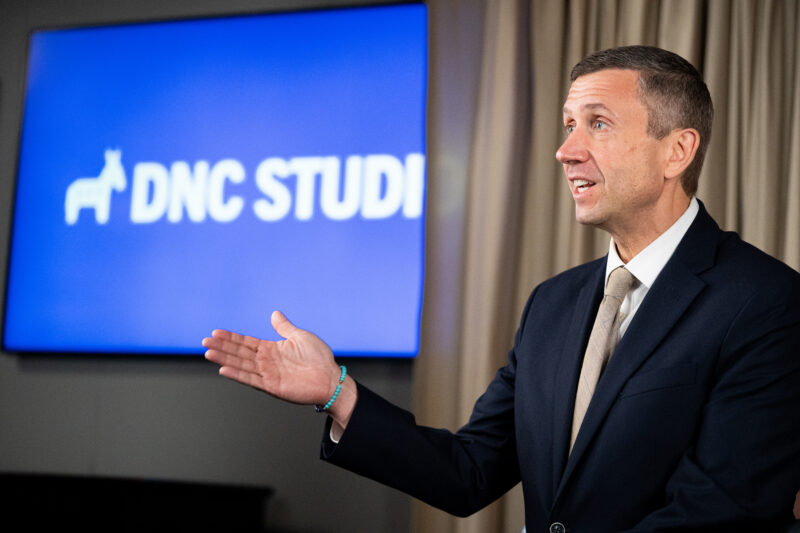
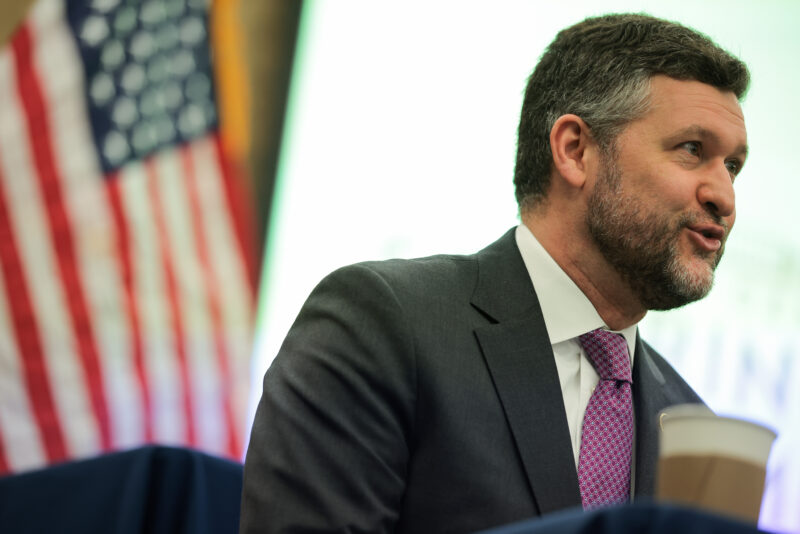
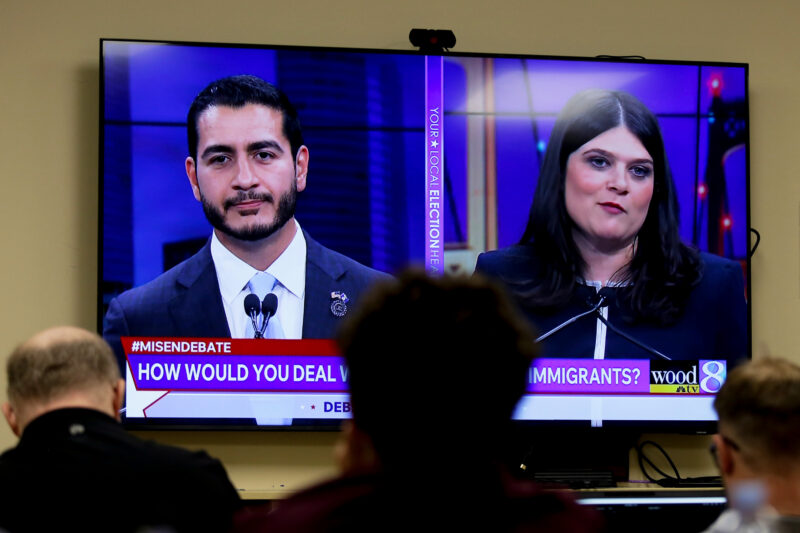






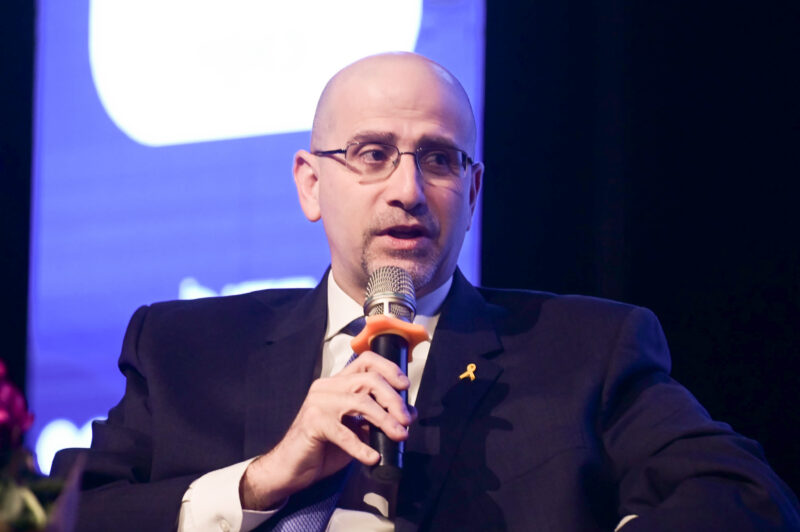
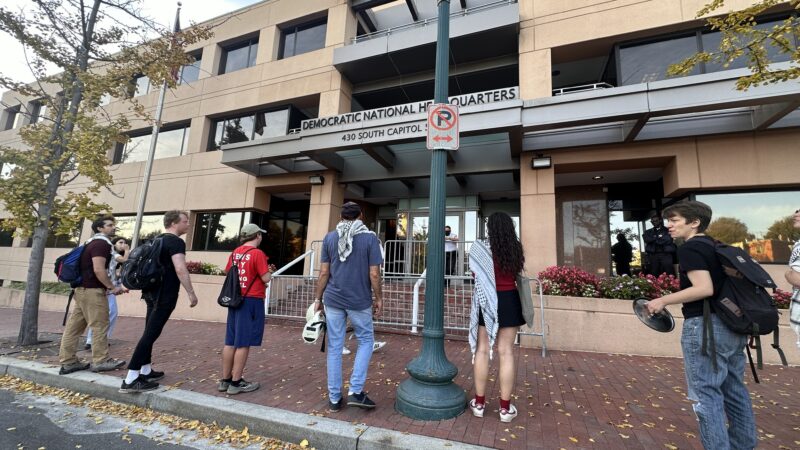
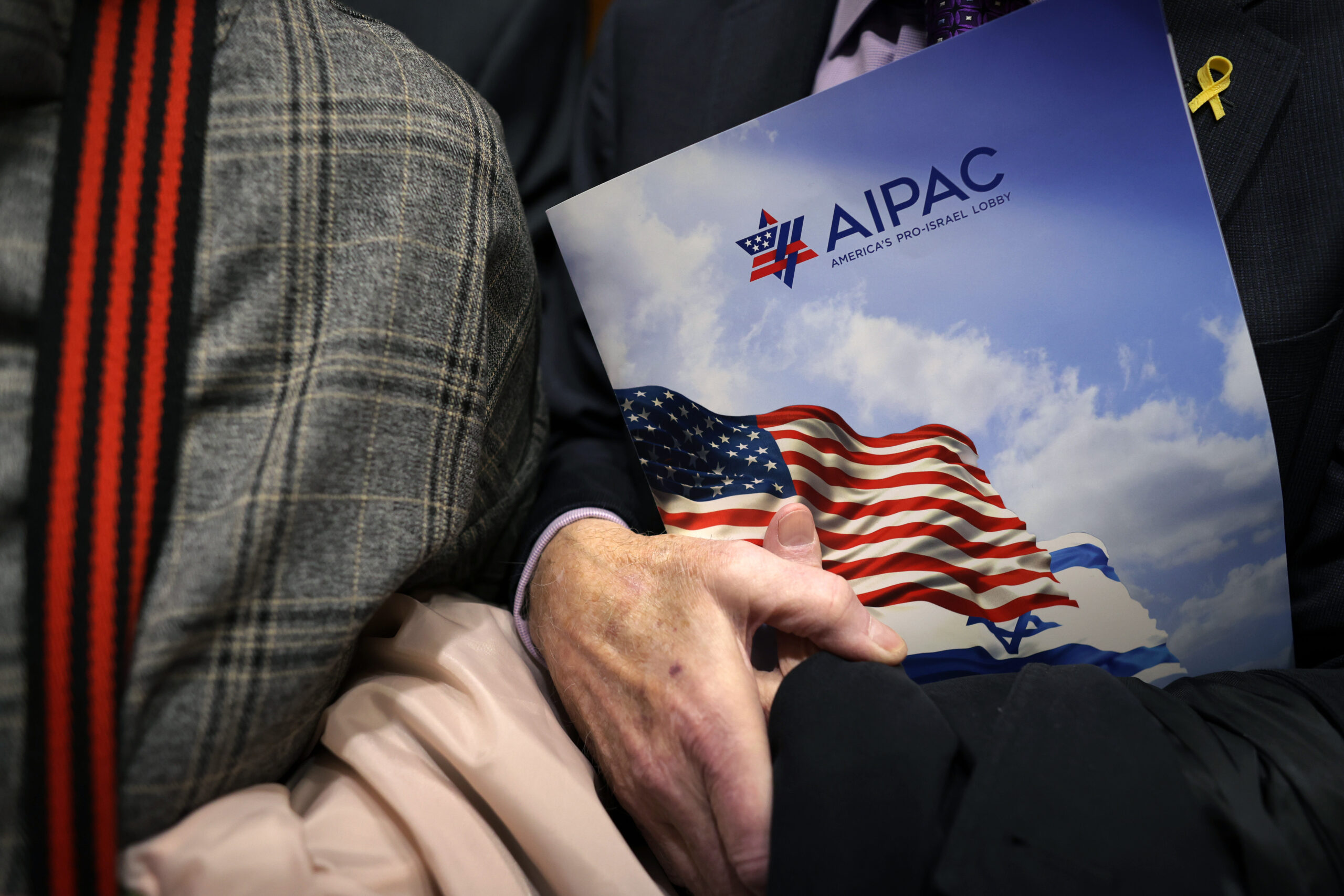













J Street President Jeremy Ben-Ami said his organization was ‘proud’ to sponsor the event after Piker was announced as the ‘surprise speaker’

Noushad Variyattiyakkal/SOPA Images/LightRocket via Getty Images
Hasan Piker attends Web Summit Qatar 2026


 Add JewishInsider on Google
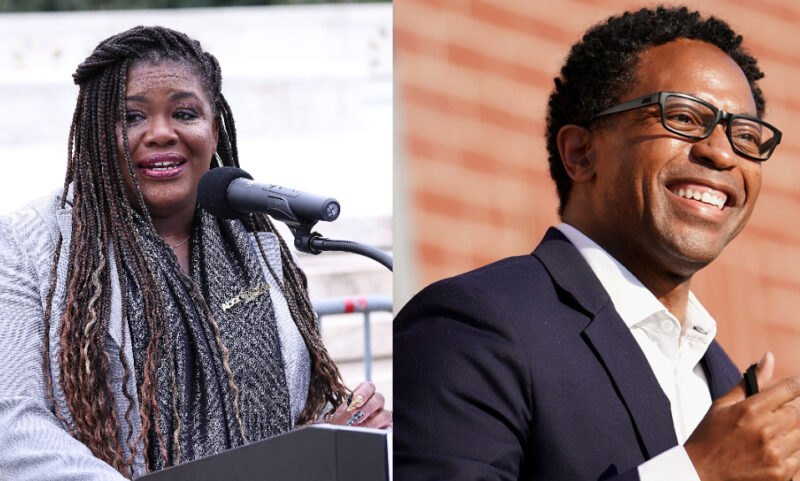
J Street’s college group is co-sponsoring this weekend’s College Democrats of America convention that will feature far-left, antisemitic influencer Hasan Piker.
J Street U, the student organizing arm of J Street, “is proud to sponsor and participate in the College Democrats Convention,” Jeremy Ben-Ami, president of J Street, told Jewish Insider on Friday, hours after Piker was announced as the convention’s “surprise speaker.”
The two-day conference began in Washington on Friday.
“We had no role in the selection of speakers and we’re sure there will be speakers — including Hasan Piker — with whom we disagree,” said Ben-Ami. “Being in venues like this is even more important when there are participants with whom we disagree. Failing to show up would be an abdication of our responsibility to make the case for our pro-Israel views.”
Despite facing scrutiny over comments including justifying Hamas’ Oct. 7, 2023, terrorist attacks, calling Orthodox Jews “inbred” and asserting that America deserved 9/11, Piker has recently been invited to speak at several high-profile events, including at The New Yorker‘s annual festival and at the Yale Political Union.
During his speech Saturday evening at the conference, Piker distanced himself from the mainstream Democratic Party, condemning “Democrats who compromise, who conciliate and who betray us,” to loud applause. “No more to the Democrats who collaborate and cooperate with the fascists, who will fund ICE, who will fund Israel … we don’t need those Democrats anymore,” Piker said.
The College Democrats’ convention is hosting several speakers who hold extreme anti-Israel views, including Democratic Socialists of America activist and Arizona congressional candidate Deja Foxx, commentator Kat Abughazaleh, gun-control activist and former DNC vice chair David Hogg and Democratic Socialists of America-endorsed congressional nominee Melat Kiros.
Georgia state Rep. Ruwa Romman, a Palestinian-American legislator with a long record of anti-Israel activism, will also be speaking.
The lineup also includes elected officials who have been critical of Israel’s policies, such as Rep. Jamie Raskin (D-MD), Sen. Chris Van Hollen (D-MD) and Rep. Jason Crow (D-CO).
The College Democrats of America is the official collegiate arm and student outreach branch of the Democratic National Committee. Neither group responded to a request for comment from JI about their decision to invite Piker.
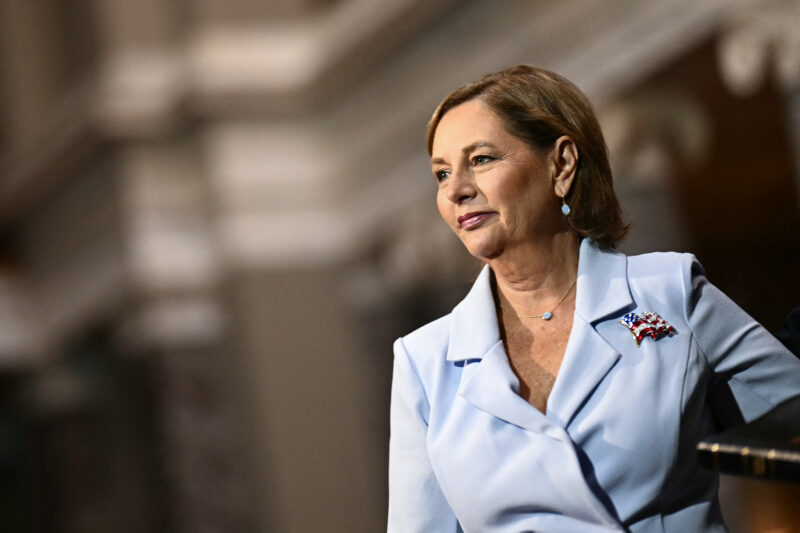
DeLauro has long publicly affiliated more closely with J Street than AIPAC, but AIPAC has maintained its support for and endorsement of the senior Democrat
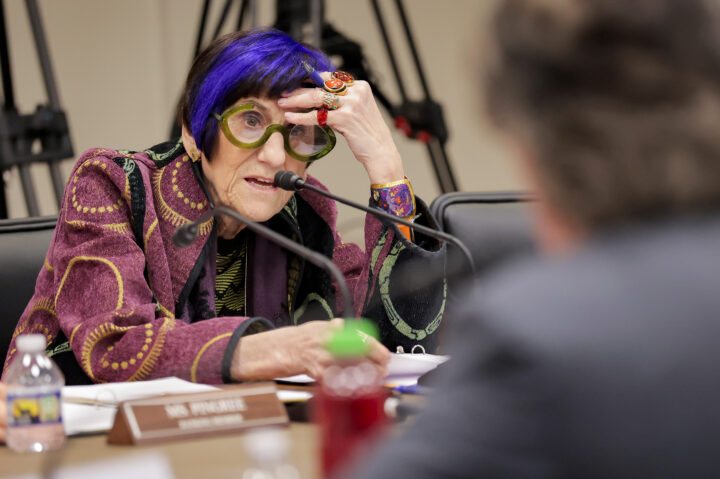
(Heather Diehl/Getty Images)
Rep. Rosa DeLauro (D-CT) questions Interior Secretary Doug Burgum during a House Appropriations Committee hearing at the Rayburn House Office Building on April 20, 2026 in Washington, DC.
Rep. Rosa DeLauro (D-CT), the ranking Democrat on the House Appropriations Committee, said she’ll no longer accept support from AIPAC, a major break with the pro-Israel group by one of the key power players in the House.
As the top Democrat on the Appropriations Committee, in line to again be the committee chair if Democrats retake the House, DeLauro has significant sway on federal funding matters, including the provision of aid to Israel.
DeLauro has long publicly affiliated more closely with J Street than AIPAC, and has staked out some positions more critical of Israel, including floating conditions on U.S. aid. But AIPAC has maintained its support for and endorsement of the senior Democrat, whose voice can be crucial to advancing its priorities.
“Congresswoman Rosa DeLauro is taking no contributions from AIPAC. She did in prior years when she believed Israel was acting like a strategic partner & was committed to a two-state solution,” DeLauro’s campaign manager Allison Dodge said in a statement posted on X. “It is abundantly clear now that the Netanyahu government has no interest in either.”
Dodge emphasized that DeLauro has “repeatedly called out the humanitarian crisis in Gaza and Israel’s annexation of the West Bank,” as well as pushed for additional aid to Gaza and an amendment in the 2027 Defense Appropriations bill that would “ensure U.S. weapons and equipment are not being used in violation of the ceasefire.”
The briefing is co-organized by the Center for International Policy, a far-left think tank that has described Israel's operations in Gaza as a genocide, and Win Without War

BRENDAN SMIALOWSKI/AFP via Getty Images
Robert Malley, Biden administration special envoy for Iran, waits to testify about the JCPOA (Joint Comprehensive Plan of Action) during a hearing of the Senate Foreign Relations on Capitol Hill May 25, 2022, in Washington, D.C.
J Street is slated to host a virtual briefing for congressional staff on the Trump administration’s memorandum of understanding with Iran featuring former Biden administration special envoy for Iran Rob Malley, who was suspended from his State Department role amid an investigation over his handling of classified materials.
The event, scheduled for next Tuesday, will feature Malley alongside Kelsey Davenport, director for nonproliferation policy at the Arms Control Association. It’s being co-organized by the Center for International Policy and Win Without War.
The Center for International Policy is a far-left think tank led in part by former Sen. Bernie Sanders (I-VT) advisor Matt Duss, that has taken a strongly hostile stance toward Israel, including opposing U.S. aid to Israel and describing Israel’s operations in Gaza as a genocide.
Malley was suspended for much of Biden’s term in office under suspicion of leaking classified documents, though he said the investigation into him had been closed during the Trump administration, and denied any knowledge of what the investigation pertained to.
A State Department inspector general’s report found that Malley was improperly allowed to continue working in his role for some time after his security clearance was suspended, and that his direct supervisor and other senior officials were not notified of his suspension.
The trailing Democratic incumbent said the pro-Israel group is ‘harmful in many ways’ despite receiving its backing, while Lander defended appearing in an ad with Mamdani allies
Screenshot
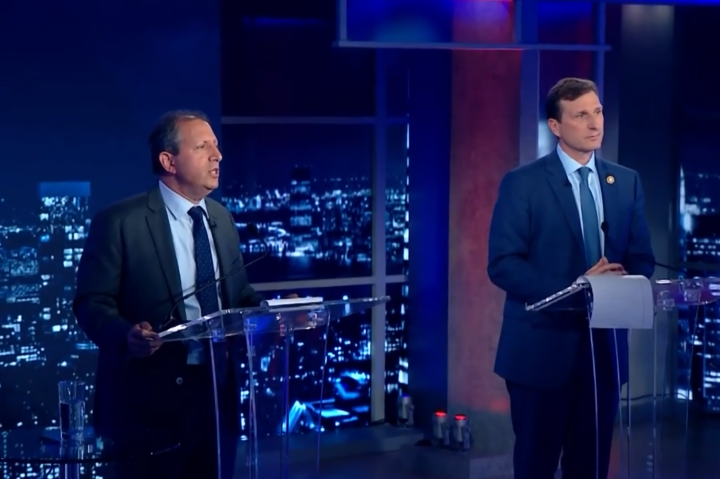
New York City Comptroller Brad Lander debates Rep. Dan Goldman (D-NY), June 15, 2026
Israel again took center stage on Monday night in a debate between former New York City Comptroller Brad Lander and Rep. Dan Goldman (D-NY) — with the incumbent congressman trying to prove his progressive bona fides by criticizing AIPAC, despite the group’s support for his campaigns.
Both candidates, each a self-identified “progressive Zionist,” inveighed in the televised face-off on PIX11 against Israel’s conduct of the war in Gaza, although Goldman declined to join Lander in calling the military actions a “genocide.” But the embattled Goldman, trailing in all available polls, also criticized AIPAC, despite acknowledging he has received the group’s endorsement.
“Brad and I agree on a lot of this: I do not think that AIPAC should unconditionally support the Israeli government, and I’ve made that very clear to them,” he said in answer to questions about the group. “I do think that AIPAC has some real problems and is harmful in many ways.”
Goldman said repeatedly that he has also received the backing of J Street, a left-leaning Zionist group often critical of Israel, and asserted that this proved he approached the issue “independently.”
Meanwhile, Lander — who has shifted left on Israel since receiving the endorsement of New York City Mayor Zohran Mamdani — continued to face questions about his decision to appear in an ad with another of the democratic socialist mayor’s favored candidates: former Columbia encampment organizer Darializa Avila Chevalier, a socialist challenger to Rep. Adriano Espaillat (D-NY). Avila Chevalier has come under fire for attending an anti-Israel rally one day after Hamas’ Oct. 7, 2023, attacks, an event denounced by both Lander and Mamdani, and for spreading Kremlin talking points and COVID-19 disinformation online.
Lander continued to insist that the ad, which characterized Mamdani and his slate of candidates as a “team,” did not constitute an endorsement. Goldman, for his part, called Espaillat a “mentor” and voiced support for his reelection.
AIPAC did not immediately respond to a request for comment. Early voting in New York’s primaries began last week; the primary date is June 23.
The progressive Israel advocacy group said it did not ‘have anything to share at this time’ about Maine’s scandal-plagued Democratic Senate nominee
Sophie Park/Bloomberg via Getty Images
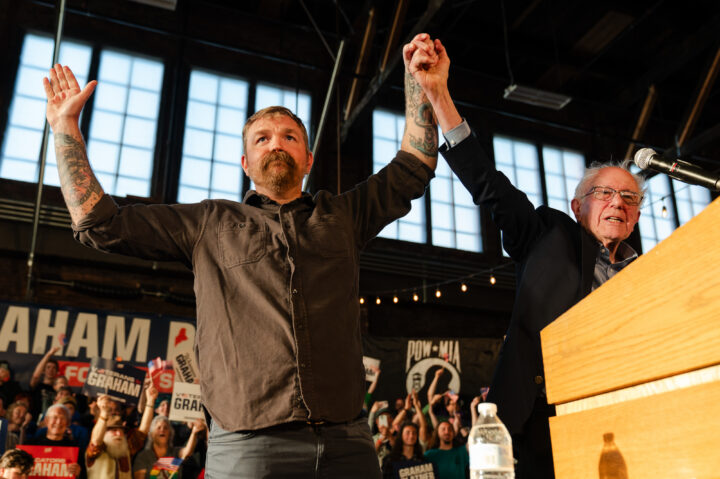
Graham Platner, Democratic Senate candidate for Maine, left, and Sen. Bernie Sanders (I-VT) during a Fighting Oligarchy event in Portland, Maine, on May 25, 2026.
J Street, the progressive Israel advocacy group, is for now withholding an endorsement of Graham Platner, the scandal-plagued Democratic Senate nominee in Maine, underscoring the extent to which even some left-wing Jewish activists appear skeptical of his insurgent campaign.
A spokesperson for J Street told Jewish Insider on Wednesday that the group did not “have anything to share at this time” about a Platner endorsement but would provide more information “if that changes.”
The spokesperson declined to confirm if J Street, which this cycle has backed a handful of Democratic Senate candidates vying for open seats or challenging Republican incumbents, had considered whether it will make an endorsement. The group had told JI in early May that it did “not currently have a position in the race.”
In a statement to JI on Thursday, the spokesperson said that it “is incorrect to frame J Street as actively withholding an endorsement from Graham Platner.”
The group “evaluates candidates and makes endorsement decisions on a rolling basis,” and its “endorsement process is ongoing,” the spokesperson said. “The timing of endorsement decisions does not reflect judgment about any individual candidate.”
J Street’s response came after Platner had clinched the nomination on Tuesday to challenge Sen. Susan Collins (R-ME), in a high-profile race Democrats see as crucial to reclaiming control of the upper chamber.
Platner won the Democratic primary decisively even as he has faced a mounting series of controversies over alleged “toxic” relationships with past girlfriends, sexual messages he sent to women while married and deleted Reddit comments expressing a range of incendiary views.
He also weathered a scandal relating to a Nazi tattoo on his chest for nearly two decades that he covered up last October. Platner has insisted that he did not recognize its imagery, despite claims to the contrary from a former girlfriend who first spoke with JI last year, shortly after he had announced his campaign.
The tattoo, along with Platner’s hostile criticism of Israel and insistent demonization of AIPAC, have stoked ongoing concerns among Jewish Democrats. Halie Soifer, CEO of the Jewish Democratic Council of America, has said the group is not ready to endorse Platner.
“We won’t support a Democrat who doesn’t represent the views and values of the vast majority of American Jews,” Soifer said in a statement in late April echoing a sense of discomfort with Platner’s candidacy felt by mainstream Jewish leaders.
JDCA had endorsed Maine Gov. Janet Mills, who suspended her campaign amid lackluster fundraising but remained on the ballot Tuesday, pulling in 19% of the vote. Platner won 72%.
Following Tuesday’s win, some prominent Senate Democrats have also declined to endorse Platner as he prepares for a bruising and expensive campaign.
J Street, which has moved to the left in recent years as it has sought to capitalize on growing Democratic frustration with Israel, is in many ways aligned with Platner on Middle East policy, including accusations that Israel committed genocide in its war in Gaza and calls to block U.S. military aid to the Jewish state that are now gaining momentum in Congress.
Still, the group has shown its intolerance for some extreme views that could be seen as antisemitic. In 2024, for instance, J Street revoked its endorsement of former Rep. Jamaal Bowman (D-NY), who was at the time fighting for reelection in a bitterly contested primary he would later lose, saying his inflammatory rhetoric on Israel had crossed a line.
Even as the group officially stays on the sidelines in Maine’s marquee Senate race, J Street’s state leader, Steven Koltai, who helped organize a Passover Seder with Platner, told the Jewish Telegraphic Agency he is “still very much” supporting the oyster farmer and former Marine in spite of recent revelations about his past.
In the statement to JI on Thursday, J Street’s spokesperson said the group “remains steadfast in our commitment to ensuring a pro-Israel, pro-peace majority in the Senate and House come January.”
Leiter: ‘The tent, as we call it, should be wide and as inclusive as possible, but it cannot be inclusive to those who are contributing to the efforts of those seeking to collapse the tent’
Tasos Katopodis/Getty Images
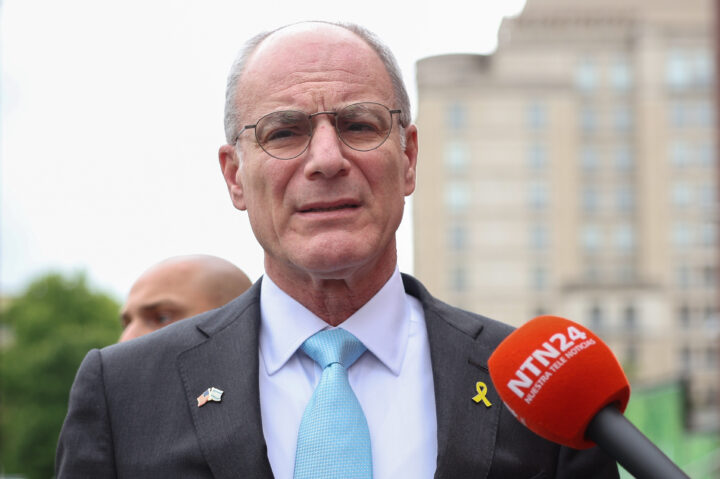
Israeli Ambassador to the United States Yechiel Leiter
A week after describing J Street as “a cancer within the Jewish community” for calling for the United States to restrict aid to Israel, Yechiel Leiter, Israel’s envoy to Washington, doubled down on his critique of the organization, stating that the liberal advocacy group’s recent actions are “decidedly not pro-Israel.”
The remarks came during Leiter’s broader address on Thursday at the Re-Charging Reform Judaism conference on Manhattan’s Upper West Side, during which he argued to the audience of over 300 Reform rabbis, lay leaders and teachers that American Jews need to respond to rising anti-Zionism and post-Oct. 7 hostility toward Israel with a stronger, more unapologetic form of Zionism and Jewish solidarity.
“J Street does incalculable amount of damage to the interests of Israel,” Israeli Amb. Yechiel Leiter said at the Re-Charging Reform Judaism conference, expanding on his previous critique of the liberal advocacy group.”
— Jewish Insider (@jewishinsider) May 27, 2026
Watch more of what he said below or read our full story: https://ji.news/55×33
While Leiter expanded on his critique of J Street, receiving applause and a standing ovation at the end of his speech, his remarks were more measured than in previous appearances, focusing on what he described as the group’s role in supporting arms embargoes and amplifying accusations against Israel, rather than attacking the organization wholesale. His past comments — including describing J Street as “duplicitous” and “two-faced” — drew ire from many progressive Jews.
“I believe the tent, as we call it, should be wide and as inclusive as possible, but it cannot be inclusive to those who are contributing to the efforts of those seeking to collapse the tent. J Street does incalculable amount of damage to the interests of Israel,” he said.
He continued, arguing that support for arms embargoes against Israel “endanger Israel” and that “supporting such embargoes is not pro-Israel,” He also denounced the organization’s call for Leiter to investigate the allegations of sexual abuse of Palestinians outlined in a controversial opinion piece by New York Times columnist Nicholas Kristof earlier this month.
“It is certainly not pro-Israel to push the canards peddled by Nick Kristof in The New York Times. Jewish dogs don’t commit rape. That was the last straw for me….It’s perfectly fine to have a different vision than the majority of Israelis as to what that peace should look like… but it’s unethical to undermine Israel’s democratically elected government. Friends, please understand, I did not call out J Street because I disagree with their vision of Israel. I call them out because their actions are endangering Israel,” he said.
Leiter also said that senators he meets with on Capitol Hill have accused Israel of “genocide and starvation” and said lawmakers cite J Street as a source for those claims.
“Ask anyone in the know in Washington who is lobbying alongside [Sen.] Bernie Sanders [I-VT], who is responsible for 40 of 47 Democratic senators voting in favor of the arms embargo in Israel,” Leiter said. “They will tell you J Street.”
Herzog’s comments come as liberal Jewish leaders, including Rabbi Rick Jacobs and David Saperstein of the Reform movement, repudiated Amb. Leiter’s harsh criticism of J Street

Aspen Security Forum
Former Israeli Ambassador to the U.S. Michael Herzog
Former Israeli Ambassador to the U.S. Michael Herzog said on Thursday that he does not view J Street, the progressive Israel advocacy group, as a pro-Israel organization, weighing in on the escalating war between his successor, Ambassador Yechiel Leiter, and J Street.
Leiter said earlier this week that he views J Street as a “cancer within the Jewish community,” citing its calls for restricting arms sales and U.S. aid to Israel, and calling group “two-faced” for purporting to be pro-Israel. J Street’s president, Jeremy Ben-Ami, has also accused Israel of genocide.
“To me, to be pro-Israel is to draw a clear line between criticizing Israeli government policies — and supporting anti-Israel agendas and libels de-legitimizing the State of Israel,” Herzog said on X. “To be pro-Israel is to go from pronouncing support for Israel’s right to exist (thank you for the generosity…), to supporting the provision of the means critical to defending that very existence.”
“To be pro-Israel is to listen to Israelis; In our vibrant democracy, most Israelis share the view that j-street doesn’t qualify as pro-Israel,” Herzog continued.
J Street did not immediately respond to a request for comment.
Unlike Leiter, a longtime close political ally of Israeli Prime Minister Benjamin Netanyahu, Herzog was appointed to his role by former Prime Minister Naftali Bennett, after Bennett’s coalition defeated Netanyahu in 2021, though Herzog remained in his role after Netanyahu was elected, until January 2025. Herzog’s brother, Isaac, is Israel’s president.
His comments criticizing J Street underscore the skepticism that Israeli leaders from across the ideological spectrum have towards the progressive advocacy organization.
The comments came as J Street rallied more than 500 Jewish leaders calling on Leiter to rescind his remarks and apologize for using language that “dehumanizes fellow Jews.” Signatories include Rep. Jerry Nadler (D-NY); former U.S. Ambassadors to Israel Dan Kurtzer and Tom Nides; Rabbis Rick Jacobs and David Saperstein, leaders of the Reform movement; and National Council of Jewish Women CEO Jody Rabhan.
At the same time, Leiter on Thursday morning offered a strong defense of the Reform movement, condemning Likud MK and Social Equality Minister Mai Golan for comments lambasting the denomination and telling a prominent Reform rabbi, “You’re marrying dogs in your delusional synagogues.”
Leiter said on X that he condemns “in the strongest terms Minister Mai Golan’s verbal attack on MK Gilad Kariv and on Reform Judaism in general.”
“As an Orthodox Jew and as Israel’s representative to the United States I find her words disgusting and reprehensible, worthy of excoriation and rebuke,” Leiter said. “Theological, political, and ideological differences are fine, even necessary for a healthy people. But there is a line that cannot be crossed, it is a line that divides debate from hate and separates altruism from populism. Too many are crossing the line.”
Leiter said he plans to meet in person with Reform leaders to apologize on Israel’s behalf.
J Street’s Ilan Goldenberg said the surge in far-left calls to cut off missile-defense aid ‘stirred up the conversation a little more’ but says the group was moving that way regardless

Saeed Qaq/Anadolu via Getty Images
Rockets fired from Gaza are neutralized in the air by Israel's 'Iron Dome' air defense system on the fourth day of the clashes in the city of Ashkelon, Israel on October 10, 2023.
In recent years, as the progressive Israel advocacy group J Street joined left-wing calls to place restrictions on U.S. military aid to Israel, support for funding Israel’s Iron Dome missile-defense system remained a sacred cow for the group — the final aspect of the old-school U.S.-Israel defense relationship that, even for most progressives, was unaffected by the broader Democratic shift away from unconditional support for Israel.
That consensus has shattered in recent weeks. Instead of steering the conversation among Democrats, where J Street maintains a solid base of support, the organization found itself playing catch-up to the progressive lawmakers it supports after several of them announced in early April that they think the U.S. should no longer fund Iron Dome batteries.
J Street released a statement on April 13 calling for the U.S. to cease funding Iron Dome batteries, arguing that Israel — a wealthy nation with a substantial defense budget — should pay for its own missile-defense systems. The announcement marked a significant policy shift for J Street, which has long stated that a congressional candidate’s support for U.S. financial backing of the Iron Dome system is one of its most important endorsement criteria.
J Street’s leaders have insisted that they reached this conclusion independently, and not as a result of shifting political winds. But in a conversation on Monday, J Street’s chief policy officer, Ilan Goldenberg, acknowledged that progressives’ rapid shift on the issue factored into J Street’s announcement, even as the group insists it was moving in that direction anyway.
“It stirred up the conversation a little more, but that memo was already written,” Goldenberg told Jewish Insider. “It’s not like this came out of nowhere. It was part of a track record of things we were doing. AOC kind of spurred up the conversation further.”
Goldenberg was referring to Rep. Alexandria Ocasio-Cortez (D-NY) telling the Democratic Socialists of America’s New York chapter that she opposes “any spending on arms for Israel, including so-called defensive capabilities,” as she also called for an arms embargo on the country. Several progressive lawmakers followed, including Reps. Ro Khanna (D-CA), Jim McGovern (D-MA), Jared Huffman (D-CA) and Mark Pocan (D-WI), all of whom were endorsed by J Street and voted for Iron Dome funding in 2021. Ocasio-Cortez, who is not a J Street endorsee, voted “present” on that 2021 legislation but signed onto a 2024 statement with several other progressive lawmakers saying they “support strengthening the Iron Dome and other defense systems,” even as they opposed offensive weapons sales to Israel.
“It’s been a combination of knowing this is coming, thinking through the substance of it ourselves and seeing the politics shift on it altogether that brought us to this point of making a decision about a week and a half ago to move in this direction,” Goldenberg said.
Alan Solomont, a former U.S. ambassador to Spain and the past board chair of J Street, said the decision was something J Street was heading towards on its own. Since the beginning of this year, the group has begun calling for an end to U.S. military aid to Israel, saying that Israel can afford to buy its own weapons systems, though it had not specifically made that argument for the Iron Dome until last week.
“We’re not following anyone else’s political lead. I think that, yes, we have been thinking about how we treat our military assistance in light of the policies of the current [Israeli] government, and we’ve been thinking about that for some time,” Solomont told JI last week. “Why people continue to support a government that is undermining Israel’s future is still sort of a puzzle to me.”
J Street’s leaders insist they are merely following the lead of Israeli Prime Minister Benjamin Netanyahu, who said in an interview with The Economist in January that Israel is seeking to end U.S. financial assistance in the next decade. Sen. Lindsey Graham (R-SC), a staunch Israel ally and a foreign policy hawk, then said he would accelerate that process, but he softened that position after a meeting with Netanyahu.
“Israel’s in a position now where it can pay for its weapons itself as a country that is as wealthy and powerful and successful as it is,” said Goldenberg, who served as Jewish outreach director on former Vice President Kamala Harris’ 2024 presidential campaign. “I think it got accelerated when Bibi and Lindsey Graham came out early this year.”
Still, Netanyahu’s call to phase out U.S. military aid has not yet resulted in any major policy shifts just yet, as the Memorandum of Understanding that provides Israel with its current $3.8 billion in annual military aid runs through 2028. Goldenberg said J Street wants to see the financial assistance “phased out in a responsible, rapid manner,” which he noted is “different than saying ‘cut it all off tomorrow.’” When asked whether J Street would support another Iron Dome missile-defense package if it were introduced at present, he suggested the organization would not.
“I would say that probably we support that not being in the supplemental,” Goldenberg said.
At the same time that J Street and many progressive lawmakers are calling for an end to U.S. financial assistance for the Iron Dome, other far-left candidates don’t think Israel should have access to Iron Dome batteries at all, even if paid for with its own funds.
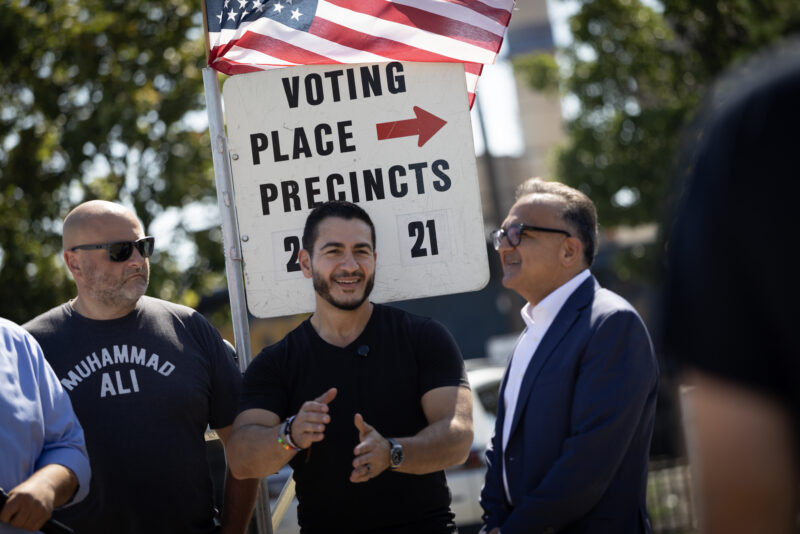
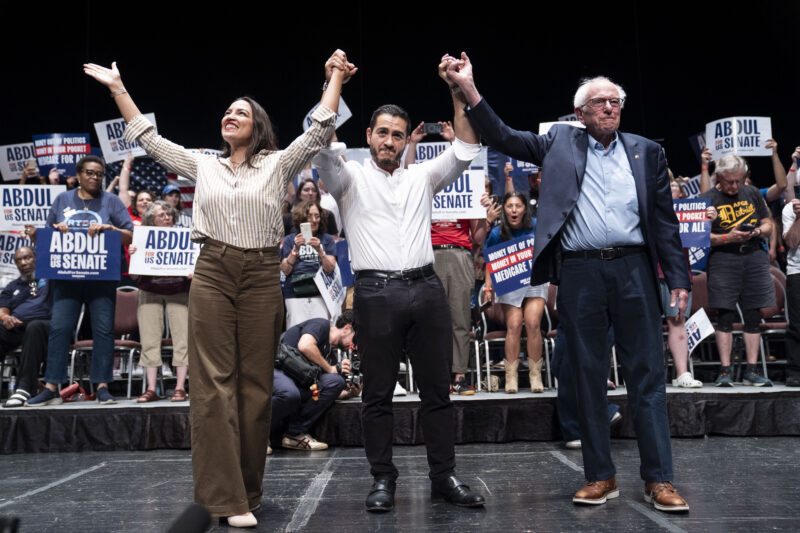
Abdul El-Sayed, a candidate for Senate in Michigan, has said the U.S. should not sell any weapons to Israel. DSA and other far-left groups argue that Israel’s access to strong missile-defense systems like the Iron Dome allow it to perpetuate bombing campaigns in Gaza and Lebanon because Israeli civilians are protected, and therefore the Iron Dome is responsible for bloodshed in the region. J Street argues that its position is holding the line against that more extreme view.
“I think that is a position that we need to guard against. We need to recognize Israel’s legitimate security needs,” Solomont said. “We should certainly be concerned about Israel’s security, and work with Israel as an ally around its security. Our commitment to Iron Dome is simply that we think that Israel, with an economy and per capita GDP that is higher than other allies — we’re just following Netanyahu’s lead to say that Israel can pay for these things itself.”
‘Israel is capable of paying for its own military equipment, including supplies for its missile defense systems,’ a spokesperson said, a position which is at odds with J Street PAC’s own stated endorsement criteria

Michael Brochstein/Sipa via AP Images
J Street President Jeremy Ben-Ami speak at the 2022 J Street National Conference held at the Omni Shoreham Hotel in Washington, D.C.
J Street, the progressive Israel advocacy organization which describes itself as a “pro-Israel, pro-peace” group, offered backing for the growing calls among far-left lawmakers to end U.S. support for Israel’s missile-defense systems, such as Iron Dome, which until recently had been largely spared even by strident critics of the Jewish state.
“What progressives are saying is not radical, and in fact, [Israeli Prime Minister] Benjamin Netanyahu and [Sen.] Lindsey Graham (R-SC) are arguing the same thing. Israel is capable of paying for its own military equipment, including supplies for its missile defense systems,” a J Street spokesperson told Jewish Insider.
Notably, that stance is at odds with J Street PAC’s own top endorsement criteria on its website as of Friday afternoon. The site states that J Street PAC requires endorsees to support “US security assistance to Israel that adheres to US law,” specifically citing support for Iron Dome.
“The United States plays an indispensable role in ensuring Israel’s future as a secure, democratic homeland for the Jewish people. J Street PAC only supports candidates who affirm this responsibility and who commit to supporting US security assistance to Israel as outlined in the 10-year Memorandum of Understanding (MOU) negotiated by President Obama — including sustained support for vital systems like Iron Dome,” the J Street website says.
The group, however, is currently supporting candidates who back policies like the Block the Bombs Act that run counter to the MOU.
In its statement, the group was referring to comments by the Israeli prime minister in which he did not call for an immediate end for U.S. aid to Israel, but said that he believed Israel would no longer need to rely on U.S. aid in a decade.
Though Graham initially responded to Netanyahu’s calls by suggesting he would immediately work to wind down U.S. aid, the South Carolina senator softened that position after a meeting with Netanyahu.
Calls to cut off missile defense aid to Israel have been growing in recent weeks from prominent far-left lawmakers like Reps. Alexandria Ocasio-Cortez (D-NY) and Ro Khanna (D-CA), joined recently by Brad Lander, a Jewish challenger to Rep. Dan Goldman (D-NY).
J Street’s backing of that stance could give cover to a host of rank-and-file Democrats to take a similar position.
Systems like Iron Dome are also co-produced by the U.S. and Israel, and similar arrangements would likely continue even if direct U.S. financial aid to Israel were ended in the short term.
In a Substack post on Sunday, J Street President Jeremy Ben Ami said that the U.S. should continue to cooperatively develop defensive technologies and to sell such systems to Israel, subject to Israel’s compliance with U.S. arms sales law, but that it should no longer provide any financial aid or subsidies to Israel for military systems.
“The United States should continue to supply what Israel needs for the defense of its people from Iranian, Hezbollah, Hamas and Houthi missiles – but the time is coming for Israel to pay for what it needs, as other prosperous countries do,” Ben Ami wrote.
He also reiterated J Street’s support for new legislation conditioning U.S. arms sales to Israel and for upcoming legislation to block specific arms sales.
“The exact timetable for phasing out taxpayer subsidies should be worked out carefully. The United States should honor existing commitments, including those in the 2016 memorandum of understanding, through their conclusion in the next two years,” Ben Ami said. “But after that, a responsible yet rapid phase-out is needed – a step that would move the U.S. and Israel toward a more mature, balanced, and ultimately more resilient partnership – one grounded not only in shared interests, but in shared standards and accountability.”
‘Saying Jewish donors are somehow the same as "pro-Israel lobby," I got a problem with that, and not just as an elected official, as a Jew,’ Slotkin said in response to a question at a town hall
Tom Williams/CQ-Roll Call, Inc via Getty Images
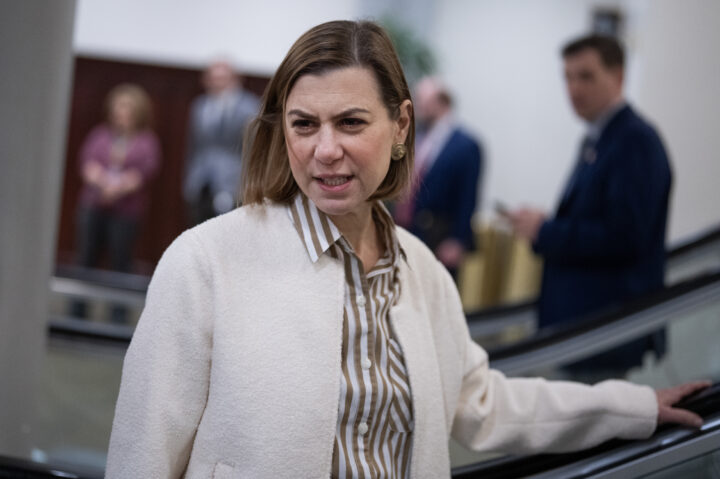
Sen. Elissa Slotkin (D-MI) is seen in the U.S. Capitol on Thursday, March 26, 2026.
Sen. Elissa Slotkin (D-MI) has lately been saying that she does not take money from AIPAC or any corporate political action committees. So when a college student asked her at a town hall in Cincinnati on Thursday about $4.5 million she has received from “pro-Israel lobbies,” Slotkin pushed back — arguing the student was unfairly lumping together all Jewish donors.
“I’m not sure what you’re referring to on ‘not AIPAC but the Israel lobby.’ If you’re equating ‘Israel lobby’ to Jews, I got a problem with that,” Slotkin said.
The figure that the Xavier University student quoted comes from a far-left organization called Track AIPAC, which targets elected officials who it alleges have received funding from the “Israel lobby.” But increasingly, the group is tallying up donations from “lobby donors,” a broad category that critics believe includes any Jewish donors who have also supported AIPAC, J Street or other Jewish or Israel-related advocacy groups.
Slotkin said that just as Iranian Americans, for instance, may not agree with everything the Iranian government does, “I think it’s really important, especially now, to make a distinction between the Israeli government and the choices that they’re making and the average Jew, okay, and Jewish people who donate to campaigns,” Slotkin said, earning applause from the audience.
At the end of the event, she stood by her response to the question when asked about it by another attendee.
“What I take issue with is someone saying that I took $4.5 million from the pro-Israel lobby. That’s not AIPAC. I don’t know what that is,” she said. “But if that’s counting Jewish donors and saying Jewish donors are somehow the same as ‘pro-Israel lobby,’ I got a problem with that, and not just as an elected official, as a Jew.”
Asked her position about taking money from AIPAC, Slotkin said she doesn’t accept AIPAC funding in the same way she eschews other “corporate PAC money.” But she said their work in Washington, of advocating for an issue by building relationships with members of Congress, is the same thing that scores of other groups do.
“I think Americans have the right to support those groups and do whatever they want. Doesn’t mean I have to agree with them. I don’t personally take money from AIPAC. I haven’t in many, many years,” Slotkin said to cheers. “But they and every other organization have an ecosystem in Washington, that they are doing things that every — there’s plenty of groups like them that do the very same thing, a Pakistani American group, or whatever group.”
After the town hall, Slotkin told Politico that she would not do an interview with Hasan Piker, the antisemitic Twitch streamer who appeared at two campaign rallies earlier this week with progressive Michigan Senate candidate Abdul El-Sayed.
“I gotta call balls and strikes, whether it’s antisemitism, Islamophobia, coming from the state that I come from, so that’s what I’ve tried to do as he’s come into Michigan,” Slotkin said.
The comments Piker has made with which she takes issue, Slotkin continued, are “some derogatory things he’s said about Orthodox Jews, saying that we deserve 9/11, there’s some things in there. Not to mention he calls me stupid like every other week.”
Speaking at J Street’s national summit, Sen. Tim Kaine also said ‘virtually all’ Democratic senators now seek the group’s endorsement

Drew Angerer/Getty Images
Sen. Tim Kaine (D-VA) speaks to reporters on his way to a classified all-Senate briefing
Democratic lawmakers speaking at the Monday evening gala of J Street’s Washington conference argued that the joint U.S.-Israel operation that killed many top Iranian leaders, including Supreme Leader Ayatollah Ali Khamenei, would ultimately make Iranians, Israelis and the United States less safe.
“I do not believe that the United States or Israel should be leading a regime change operation in Iran. It will not bring safety or security to the people of Iran, to the region or to the United States, and it’s important that all of us here in this room continue to stand up and say that,” Rep. Sara Jacobs (D-CA) said. “We’ve lived through this before. Regime change often backfires. It creates power vacuums, leads to even harder-line leaders and civil wars and failed states.”
She also argued the U.S. set Iran on the path toward the current regime’s leadership by backing the 1953 overthrow of the Mossadegh government in Iran.
Expressing her support for the war powers resolution vote taking place in the House later this week, Jacobs said, “We can’t be equivocal, that we have to say strongly and clearly that what is happening is not OK, and it is not making Jews in Israel or here in the United States any safer.”
Sen. Adam Schiff (D-CA) said that he does not mourn Khamenei nor the other Iranian leaders who have been killed, “but we have not just cut off the head of the snake. We have almost certainly kicked up a hornet’s nest, one with remaining capabilities and appetite for revenge. Now we ask, what comes next?”
He said that the administration entered into the operation without any clear plan to effect the regime change it appears to desire, nor how to protect and support the Iranian civilians the Trump administration has urged to rise up against the regime.
Sen. Tim Kaine (D-VA), the lead sponsor of the war powers resolution set for a vote this week in the Senate, made the case for his legislation, saying, “That vote in front of the American people is a way of clarifying what’s at stake and deciding if the mission is so important that we should risk our own kids’ lives.”
Former House Speaker Nancy Pelosi (D-CA) said that the “vote is not about whether we should go in or not. The vote is that you cannot go in unless Congress gives you the [authority],” framing the vote as an affirmation of Congress’ constitutional power to declare war.
Kaine emphasized that J Street’s influence within the Democratic Party has grown, saying that “virtually all” Democratic senators now seek the group’s endorsement.
Throughout the Purim-themed evening, speakers repeatedly drew comparisons between Trump, Israeli Prime Minister Benjamin Netanyahu and members of Trump’s administration and Haman, the villain of the Purim story.
“This is a moment not unlike the scenes that gave us the story of Purim: a hedonistic king less interested in justice than in his own pride and pleasure. A ruler flanked by evil advisors, his toxic grip on power unleashing danger and violence,” Schiff said. “It is all too reminiscent of the plots against the Jews driven by him.”
And in an unusual moment, Kaine capped off his remarks with a sing-along rendition of Woody Guthrie’s “This Land is Your Land,” playing his harmonica through the choruses.
Murphy: ‘Not a single one of us is safe from a future that mirrors the thousands of years of persecution that the Jewish people, with no self-determination, suffered under’

Jemal Countess/Getty Images for Fair Share America
Sen. Chris Murphy (D-CT) speaks at the U.S. Capitol on April 10, 2025 in Washington, DC.
Since the beginning of President Donald Trump’s second term, Sen. Chris Murphy (D-CT) has routinely adopted the argument that Trump poses a unique threat to American democracy. In an address on Monday at the J Street conference in Washington, Murphy leaned on Jewish history to tailor his case to fight Trump specifically to American Jews.
Murphy, who is considered a possible 2028 presidential candidate, invoked three pivotal moments in Jewish history that he said should inspire American Jews to speak out against what he described as Trump’s efforts to undercut democratic norms and procedures: the Bar Kokhba revolt against the Roman empire that led to the displacement of the Jewish diaspora; the Spanish Inquisition in 1492 that saw Jews flee Spain rather than face conversion or death; and pogroms under imperial Russia in which Jews had no recourse against state-sanctioned violence.
If American Jewry doesn’t stand up to Trump, Murphy said, they risk facing a similar fate in the United States.
“We are here today because we believe that this tragic history requires our world to make a home for the Jewish people in the Holy Land. That place is Israel. That place will always be Israel,” said Murphy, who has taken a harsher stance toward Israel in recent years. “When we criticize the government of Israel, when we speak up against its policies in places like Gaza or the West Bank, it is because we love Israel. It is out of our love for Israel and our belief that its current leaders are jeopardizing the future survival of that state.”
Yet he argued that the existence of a Jewish state should not preclude American Jews from fighting for the future of their own country.
“The answer to thousands of years of the Jewish people’s faith being decided by emperors and queens and czars is not and cannot simply be the State of Israel. No, the rest of the answer is simple. It’s democracy,” said Murphy. “In a working democracy, Jewish citizens are not subjects. They are not petitioners. They’re not guests to be expelled at the whim of a monarch. They are, you are, we are citizens.”
In the speech, Murphy criticized the U.S. attacks on Iran, saying Trump “launched an illegal war that the American people do not want” and that it amounts to “his most grievous assault on democracy.” But Murphy mostly used the stage to raise the alarm about democracy generally, saying America is “in the middle” of “a totalitarian takeover” and rallying J Street’s attendees to work to save it.
“You are here at maybe the most pivotal moment of all of our lifetimes when it comes to the preservation of self-determination, essential to the American project, essential to the future of the Jewish people all over the country,” said Murphy.
He closed by using a story about former Israeli Prime Minister Golda Meir as a call to action. Murphy described her attendance at the 1938 Evian Conference on the shores of Lake Geneva, where 32 nations — led by President Franklin Delano Roosevelt — discussed the plight of Jews in Europe. Meir attended as a Zionist representative of British Mandatory Palestine.
“She was assigned the status of observer, forced to watch in silence as one by one the representatives of 32 nations rose to express their deepest sympathy for the Jewish people in Europe, and then one by one explained why their countries could not take them in,” said Murphy. “Years later, reflecting on what her experience at that pivotal conference had taught her, she put it simply. The Jews should not be dependent on anyone giving them permission to stay alive.”
But where Meir used that sentiment to justify her support for Zionism, Murphy argued that it should also apply to American Jews living in the diaspora.
“Today, Jews in America and a multitude of other groups that are still facing discrimination and bias are not observers like Golda Meir was in the late 1930s. In our democracy, however imperfect, we have self-determination,” said Murphy.
“What a gift to be alive,” Murphy offered in closing, “when our mission is to save a country and to remember that without self-governance and self-determination, not a single one of us is safe from a future that mirrors the thousands of years of persecution that the Jewish people, with no self-determination, suffered under.”
J Street members are heading to Capitol Hill on Tuesday to lobby members of Congress to vote in favor of constraining military action in Iran
Jemal Countess/Getty Images for Protect Borrowers
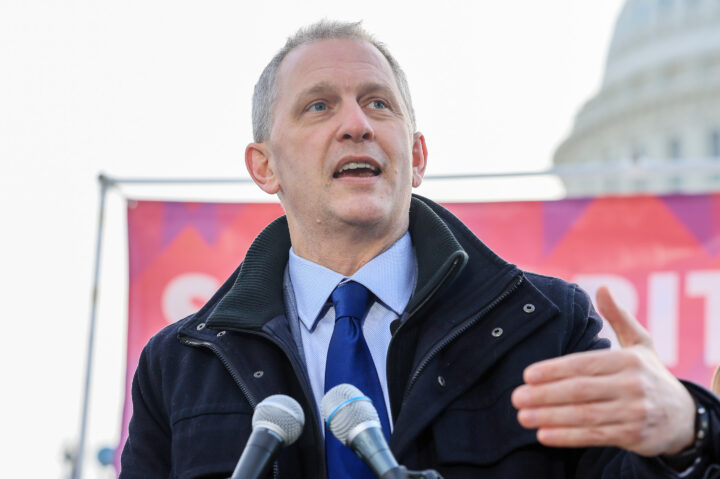
Rep. Sean Casten (D-IL) speaks on Capitol Hill on February 09, 2026 in Washington, DC.
Democratic members of Congress addressing J Street’s national convention in Washington on Monday used the occasion to rally support for long-shot resolutions coming before the House and Senate this week that will attempt to end U.S. military strikes against Iran.
“The president’s refusal to pursue consent from Congress, as required by the Constitution, is perhaps his most grievous assault on democracy, and we should not let it stand,” Sen. Chris Murphy (D-CT) said to the 1,500 activists gathered at J Street’s morning plenary.
Rep. Sean Casten (D-IL) told the crowd that he expects to see “very robust, possibly unanimous support” from congressional Democrats on the measures, which would put an immediate end to U.S. operations against Iran.
“I’m not the whip, but certainly the caucus seems to be very on board with asserting their constitutional authority,” Casten said. Even some hawkish Democrats, like Sen. Jacky Rosen (D-NV), are expected to vote in support of the measure, although a handful of Democrats, including Reps. Josh Gottheimer (D-NJ) and Jared Moskowitz (D-FL), have already said they will oppose it.
Casten was speaking alongside Rep. Madeleine Dean (D-PA), both of whom had recently returned from a J Street-sponsored trip to Israel and the West Bank. Dean said President Donald Trump should have used his State of the Union address last week to more directly discuss the coming attacks on Iran.
“Wouldn’t that have been the time, at least by then, to begin messaging to the American people what the vision and the mission was — if he was going to take this extraordinary military action, and of course, to message it to Congress, to say to Congress, ‘I recognize your role’?” Dean said. “We are a constitutional democracy. We are supposed to actually make sure that the people closest to the ground, closest to the people, have some say.”
The war powers resolutions are likely to fail, given Republicans’ control of Congress and their overall support for the military action ordered by Trump over the weekend. Even if passed, they would need two-thirds support to override an inevitable presidential veto.
Sen. Brian Schatz (D-HI) told the audience that even if the war powers resolutions are defeated, Congress still has a role to play in further authorizing U.S. military strikes against Iran.
“Republicans defeating the resolution is not a war authorization. The law is clear: Congress needs to explicitly authorize war through an authorization of the use of military force,” said Schatz. “Congress has a duty not just to check a reckless and lawless president, but also to represent the will of the people. And the people want nothing to do with this.”
On Tuesday, J Street members will go to Capitol Hill to lobby lawmakers to oppose the strikes and to vote in support of the war powers resolutions.
“Elected officials are elected for a reason: to put themselves on the record at important moments, and this is one of those moments,” J Street President Jeremy Ben-Ami told reporters on Monday. “We urge senators and congressmen to vote in favor of a war powers resolution when it comes to the floor.”
URJ’s Rabbi Rick Jacobs: ‘America’s Jewish congregations are diverse, filled with good, moral people who differ on complex issues’
Michael Brochstein/Sipa via AP Images
J Street President Jeremy Ben-Ami speak at the 2022 J Street National Conference held at the Omni Shoreham Hotel in Washington, D.C.
When more than 1,500 people gathered in Washington this weekend for J Street’s national conference, the progressive Israel advocacy group’s first major convening in four years, the gathering was billed as an opportunity to reflect on building regional peace in the Middle East in the aftermath of the Gaza war.
Instead, a major U.S. and Israeli military operation against Iran that began Saturday undercut the group’s pledge to focus on peace between Israelis and Palestinians and came to dominate the discussion. J Street quickly came out against the attacks.
The first speaker on the conference’s main stage on Sunday took an unusual departure from J Street’s dogma on diplomacy by noting that the organization’s positions are not the only ones that should be taken seriously in the Jewish community.
Rabbi Rick Jacobs, the president of the Union for Reform Judaism, kicked off the conference program by noting that J Street’s position, one of stark opposition to the attacks, sits alongside the views of others in the Jewish community who have cheered U.S. and Israeli military strikes seeking to bring about regime change in Iran.
“I’m certain that many in this gathering agree, as a matter of principle and foreign policy, with the J Street statement,” Jacobs said. “Many in our congregations might also agree. But America’s Jewish congregations are diverse, filled with good, moral people who differ on complex issues, as those raised by the Iran attacks.”
J Street’s leaders often make the case that greater nuance and complexity is required within the U.S. Jewish community, particularly making space for left-wing views on Israel within mainstream Jewish groups. Jacobs was making the argument in reverse: that people could also support the attacks in good conscience, and that neither view is superior.
“There are many in our congregations, in the Jewish community at large and in the broader American public who want to seek regime change for the sake of the people of Iran, for eliminating threats to America’s and Israel’s security, and to enhance stability in the region, who may well recognize that war is surely not the remedy for every global conflict, but feel there are times when military force is justified and believe a case can be made,” Jacobs continued.
Later, J Street President Jeremy Ben-Ami clarified where the group stands but said there is room in the organization for people who disagree.
“I made very clear J Street’s adamant and clear opposition to this war. It is a war of choice. It is a war without clear objectives. It is a war without a plan to achieve those unclear objectives. It is a war without constitutionally required congressional approval, and it is a war without public consent,” Ben-Ami said. “It is clear that in this room there is a mix of opinions. Not everyone in J Street would agree with the clear, articulated opposition to the war that I laid out.”
Sen. Chris Van Hollen (D-MD) called the war “dangerous” and said it would make Americans less safe. British human rights lawyer Phillippe Sands compared the attack on Iran to Russia’s invasion of Ukraine. On the other hand, former Israeli Prime Minister Ehud Olmert said Iran “needs to be punished.” In a video message recorded before the attacks began, Yair Golan, the leader of Israel’s liberal Democrats party, said that if war with Iran starts, “let us defeat those who seek our destruction.” Both Olmert and Golan are fierce opponents of Israeli Prime Minister Benjamin Netanyahu.
But while the convention main stage offered some room for nuance on Iran, most speakers were otherwise aligned on J Street’s messaging — that Israel’s government, led by Netanyahu, is not doing enough to make peace with Palestinians or to rein in violent settlers in the West Bank, and that the U.S., meanwhile, is not doing enough to safeguard Palestinians or provide oversight of Israel’s use of its military aid.
“There can’t be a continuing blank check when the Netanyahu government is operating in violation of American law, which they have repeatedly, or in violation of international law,” Van Hollen said.
Later in his speech, Jacobs, the URJ president, said the U.S. Jewish community must also learn to accept diverging opinions on Israel.
“It does not make one love Israel any less to be pained by the loss of life and suffering among innocents, and we must learn how to work amidst difference. Our Jewish community will not be safe only with more cameras and security protocols. Does anti-Zionism spill over into antisemitism? Yes. But not always,” Jacobs said.
J Street also plans to use the conference to spotlight its growing political influence in the Democratic Party, with a fundraiser on Sunday evening for North Carolina Senate candidate Roy Cooper, the former governor. Attendees will also be able to join a phone bank for Evanston, Ill., Mayor Daniel Biss, who is running for Congress in a contentious Democratic primary in Illinois where Israel has become a key issue.
Other congressional speakers slated to address the conference on Monday include Sens. Brian Schatz (D-HI), Chris Murphy (D-CT), Adam Schiff (D-CA) and Tim Kaine (D-VA), as well as Reps. Nancy Pelosi (D-CA), Sean Casten (D-IL), Madeleine Dean (D-PA) and Sara Jacobs (D-CA). The executive director of the House Majority PAC, a Super PAC that supports Democratic congressional candidates, will be at the conference meeting with top J Street donors.
‘AIPAC may call itself pro-American. They may call themselves pro-Israel. But they are neither,’ the Maryland senator said

Eric Lee for The Washington Post via Getty Images
Sen. Chris Van Hollen (D-MD) speaks during an Election Night party at in Baltimore, Maryland on November 8, 2022.
Sen. Chris Van Hollen (D-MD) took aim at the pro-Israel advocacy group AIPAC during an address on Sunday morning at the opening plenary of J Street’s convention in Washington and accused it of being un-American.
Van Hollen elicited a loud chorus of boos in response to his description of AIPAC’s opposition to legislation he had sponsored seeking to place conditions on U.S. military assistance to Israel.
“I put forward months and months ago a proposal that said, with respect to any country, any country that receives U.S. military assistance — has to agree to, No. 1, comply by American law and by international law. You know who came out against that? AIPAC came out against that,” Van Hollen said.
“AIPAC came out against a proposal that says American taxpayer dollars that are used for military assistance — it’s OK to give them to any country in the world, even if that country doesn’t agree to abide by American law or international law,” said Van Hollen. “I will tell you that AIPAC may call itself pro-American. They may call themselves pro-Israel. But they are neither.”
Van Hollen accused Israel of violating American and international law during its war against Hamas in Gaza, and earned cheers for saying Israeli Prime Minister Benjamin Netanyahu’s actions should be reined in.
“There can’t be a continuing blank check when the Netanyahu government is operating in violation of American law, which they have repeatedly, or in violation of international law,” he said.
Van Hollen has emerged as one of Israel’s staunchest critics in Congress over the course of Israel’s war against Hamas in Gaza in response to the terror group’s Oct. 7, 2023, attacks. In his speech, he gave a shout-out to his wife, Katherine Wilkens, a longtime liberal analyst on the Middle East at think tanks in Washington.
“I’m also very pleased to be joined here today by the real expert in the Van Hollen family on the Middle East, and that’s my wife and partner, Katherine,” he said.
Van Hollen used his speech to tie the U.S. strikes against Iran that began early Saturday morning to President Donald Trump’s “lawless” actions domestically.
“What we see is this lawlessness and attack on freedoms here at home also infecting our foreign policy,” said Van Hollen. “It is a gross violation of international law just to go all off and attack another country. It’s not a preemptive strike … It also is a gross violation of your constitution. This isn’t a close call.”
Van Hollen criticized Trump’s stated goal of regime change in Iran, and said the president’s actions will harm civilians in Iran.
“Yes, we hate the Iranian regime. It’s been brutal against its own people,” said Van Hollen. “But I don’t think you’re going to help the Iranian people by watching bombs that kill civilians. We’ve seen over 140 school kids killed in one of the very first attacks of the war. That is not a way to bring solidarity and support from the people of Iran.”
Iranian forces said more than 150 people were killed after a strike hit a school in the county’s south, but the Israeli military said it was “not aware” of any IDF operations in that area. A CENTCOM spokesperson told The New York Times it is “aware of reports concerning civilian harm resulting from ongoing military operations. We take these reports seriously and are looking into them.”
Van Hollen was the only member of Congress to speak at J Street’s opening session. Other congressional speakers slated to address the conference on Monday include Sens. Brian Schatz (D-HI), Chris Murphy (D-CT), Adam Schiff (D-CA) and Tim Kaine (D-VA), as well as Reps. Nancy Pelosi (D-CA), Sean Casten (D-IL), Madeleine Dean (D-PA) and Sara Jacobs (D-CA).
Ben-Ami is now serving on the board of the Rockefeller Brothers Fund, which has a history of donating to anti-Israel causes

Michael Brochstein/SOPA Images/LightRocket via Getty Images
Jeremy Ben-Ami, president of J Street, speaking at the J Street National Conference.
Jeremy Ben-Ami, the president of J Street, has been elected as a new trustee of the Rockefeller Brothers Fund, a leading philanthropic backer of anti-Israel causes, the foundation announced this week.
In joining the board, Ben-Ami is drawing closer to a foundation that has long been a top contributor to J Street, a progressive Israel advocacy group that has recently sought to capitalize on growing Democratic frustration with the war in Gaza.
But the foundation’s approach to philanthropy has not always been comfortably aligned with J Street’s mission, which is officially opposed to the Boycott, Sanctions and Divestment movement seeking to isolate Israel. For its part, RBF has provided funding to a range of pro-BDS groups such as Jewish Voice for Peace, the U.S. Campaign for Palestinian Rights and Palestine Legal.
Such giving came under scrutiny amid a surge of anti-Israel protests that arose in the aftermath of Hamas’ Oct. 7, 2023, terror attacks — particularly as JVP emerged as a leading organizer of some demonstrations. “Several of our partners take policy positions that are critical of the government of Israel,” the foundation said in a December 2023 statement defending its grantees, “but each shares our conviction that all human life is precious and valued.”
In a follow-up statement in May 2024, the foundation clarified that it “has had no direct involvement in the campus protests nor have we earmarked funds for them,” while acknowledging some grantees “have provided training, messaging, and/or legal support to student protest leaders.”
Ben-Ami, in a LinkedIn post, said that he was “enormously honored to be joining the board of a strategic and thoughtful leader in the philanthropic world” and was “looking forward to getting started.”
As a trustee, he will provide “fiduciary oversight of the Fund’s vision, mission, and activities,” RBF said in its brief announcement on Monday.
In an email to Jewish Insider, Ben-Ami said he was “deeply aligned with the Foundation’s focus on strengthening democracy, peacebuilding and promoting sustainable development,” praising the foundation’s approach as “particularly thoughtful and strategic.”
“I’ve appreciated RBF’s approach to funding in the Israel-Palestine area and specifically that they continue to engage on these issues when many others find the topic too politically contentious. It’s precisely their willingness to engage – and lead – on issues that others shy from that attracts me to them” Ben-Ami continued. “I might not agree with the exact tactics and prescription of each RBF grantee in this area, but I do know that the program is driven by a shared desire to achieve a just and durable peace and to challenge conventional wisdom in ways that I hope bring innovative solutions to light.”
“The beauty of the philanthropic world is that it allows dialogue to be opened and strategies to be tried that may not be possible in the more highly charged political arena where I have spent the bulk of my career,” Ben-Ami added.
The foundation’s “Peacebuilding” program, which focuses on the Middle East, “pursues interrelated strategies to advance conflict transformation of specific conflicts — Afghanistan and Israel-Palestine — as well as conflict prevention efforts elsewhere to de-escalate tensions and develop policy frameworks that advance peace,” according to its website. “The Fund has a particular interest in advancing shifts in U.S. foreign policy,” it adds.
In 2024, RBF’s assets totaled $1.4 billion, according to its most recent tax filings.
Even as it continues to reject BDS, J Street has recently shifted its policy and advocacy positions amid rising disillusionment with Israel’s conduct in Gaza. In August, Ben-Ami said he would no longer seek to push back against critics who claim Israel committed genocide in its war with Hamas. “I simply won’t defend the indefensible,” he wrote.
Earlier this month, meanwhile, he argued that the “longstanding framework built on unconditional support” for Israel “has broken down,” adding that “a changed reality demands a redefined approach to the relationship.”
Former RBF trustees have included Peter Beinart, a prominent anti-Zionist journalist, and Daniel Levy, a co-founder of J Street. In 2016, Nicholas Burns, a former veteran diplomat, resigned from the board, citing RBF’s “funding of organizations that support BDS,” which he called “fundamentally anti-Israeli.”
Stephen Heintz, RBF’s longtime president, who is stepping down this spring, also chairs the Quincy Institute for Responsible Statecraft, an isolationist think tank that has promoted sympathetic positions on Iran.
“Although our budgets, programs, and strategies have fluctuated over my tenure,” he wrote earlier this month, “our values have remained constant.”
‘There’s going to be a new normal,’ the progressive Israel advocacy group told JI, as it endorses candidates who call Israel’s actions in Gaza a genocide

Daniel Boczarski/Getty Images for Zioness Action Fund
Ilan Goldenberg speaks onstage during the Zioness Action Fund DNC Kickoff Party on August 20, 2024 in Chicago, Illinois.
Three months after a ceasefire largely ended the fighting between Israel and Hamas in Gaza, the battle over the future of U.S.-Israel relations still rages in Washington. Both the left and the right face an erosion of support for traditionally pro-Israel positions. Amid the upheaval, the progressive Israel advocacy group J Street sees an opportunity: a chance to solidify Democrats’ shift away from unconditional support for Israel and its security needs.
J Street is betting that the shift within the Democratic Party reflecting a chillier relationship with the Jewish state — wrought by two years of war in Gaza — is here to stay. At the start of an election year, interviews with J Street’s top political official and its policy chief make clear that the group is eager to create space for Democrats who have taken a more critical approach to Israel, reflecting and reinforcing a shift toward greater distance in the historically close U.S.-Israel alliance.
“There’s going to be a new normal,” Ilan Goldenberg, J Street’s senior vice president and chief policy officer, told Jewish Insider in an interview. “There were two years of trauma that, I think, with the return of the hostages and the end of the war, people can finally start processing, but things are not going back.”
Following the Oct. 7, 2023, Hamas attacks, public opinion, particularly on the left, began to shift against Israel during its aggressive war against Hamas in Gaza. That change was reflected in increased calls from congressional Democrats to place conditions on American security assistance to Israel, a position that a decade ago was largely a fringe idea.
AIPAC has, at least publicly, written off the shift as “noise,” noting that American security assistance to Israel remains intact. Earlier this month, Congress voted to approve a State Department funding package that included the expected $3.3 billion in military aid to Israel.
But J Street’s influence in the Democratic Party is growing. House Minority Leader Hakeem Jeffries (D-NY) accepted an endorsement from J Street for the first time last year. The group now counts every member of House Democratic leadership among its endorsees. (Jeffries has also been endorsed by AIPAC.)
Even though the Gaza war is largely over, J Street doesn’t expect the Democratic Party to return to its historic pro-Israel posture. Instead, the group wants to see a permanent shift in how Washington supports Israel militarily, even if its endorsees hold a range of views on that question.
“We’re not looking for complete ideological fealty from our endorsees. We just don’t ask for that,” J Street’s vice president of political and digital strategy, Tali deGroot, told JI. “We want to see candidates affirm that U.S. aid to Israel should conform to U.S. law, that Israel’s use of our aid should comply with international law and that our aid to Israel shouldn’t be viewed as a blank check.”
Israel is nearing the end of a 10-year security agreement with the U.S. that provides it $3.3 billion in annual foreign military financing (FMF), along with $500 million for cooperative missile-defense programs, though the funding needs to be approved by Congress every year. That memorandum of understanding expires in 2028, and the question hanging over the next MOU is, if the Trump administration comes to a similar agreement with Israel, whether the political will still exist in Congress to appropriate it over another decade.
Israeli Prime Minister Benjamin Netanyahu surprised even some of his closest backers by telling President Donald Trump last month that he wants to wind down U.S. FMF to Israel as part of a bid to increase Israeli self-sufficiency. Sen. Lindsey Graham (R-SC), a staunch pro-Israel advocate, said he intends to work with Netanyahu to achieve that goal. It’s a rare position where Netanyahu and Graham now find themselves aligned with a J Street policy position.
“I agree with Bibi Netanyahu and Lindsey Graham. It’s time to wind down the FMF piece of this,” Goldenberg said. “It doesn’t mean we don’t sell Israel weapons. It doesn’t mean we don’t cooperate on joint research together on things like Iron Dome.”
The “exceptional” way that the U.S. treats Israel — particularly Israel being the largest recipient of U.S. FMF — “actually is bad for Israel in that it draws all this extra attention to the relationship,” said Goldenberg. Instead, he argued that the U.S. should “put the relationship on normal grounds,” meaning withdrawing unconditional support.
“When [other allies] do things we disagree with, we don’t go along with that, and don’t necessarily give them weapons for that, or necessarily sit in international institutions and defend them when we disagree with their policies,” Goldenberg said.
J Street’s influence in electoral politics is relatively limited. The group’s war chest does not come close to that of rival AIPAC. Save for a handful of races, J Street largely does not play in primaries, although the group is planning to roll out a super PAC this year that is “pretty large,” at least by “J Street standards,” according to deGroot. On top of that, J Street’s policy priorities almost certainly stand no chance of getting adopted during the Trump administration.
And while large Jewish groups like the Jewish Federations of North America and the Anti-Defamation League have deepened their support for Israel since the Oct. 7 attacks, J Street has continued to test the boundaries of just how critical one can be towards the Jewish state while remaining in the Zionist camp. J Street President Jeremy Ben-Ami said in August that he would no longer push back when people claim that Israel’s actions in Gaza amounted to genocide. “I simply won’t defend the indefensible,” he wrote. And J Street has endorsed candidates who use the term genocide, like Sen. Bernie Sanders (I-VT).
“That’s up to the candidates of how they’re going to say it,” deGroot said regarding the word “genocide.” “We’re looking for broad values alignment, and if they are extremely concerned about the situation for Palestinians in Gaza, so are we.”
The former House speaker, who announced she is not seeking reelection, received plaudits for her support of the Jewish state, even as her positions changed during the Gaza war
ROBERTO SCHMIDT/AFP via Getty Images
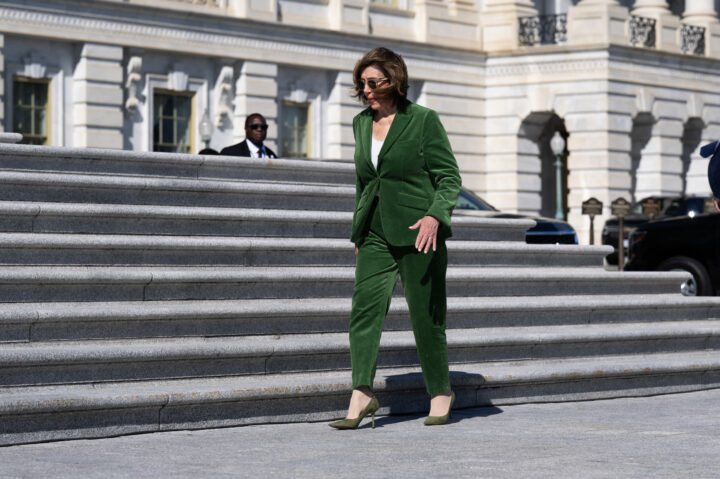
Rep. Nancy Pelosi (D-CA) attends a press conference with House Minority Leader Hakeem Jeffries (D-NY) on the steps of the U.S. Capitol in Washington, D.C., on October 15, 2025.
Rep. Nancy Pelosi (D-CA) announced on Thursday that she would not seek reelection, ending a nearly 40-year career in Congress and earning plaudits across a wide spectrum of Jewish voices, from J Street to AIPAC and many in the San Francisco Jewish community who have worked with her since the 1980s.
Pelosi, who is 85, rose to become the first and only female speaker of the House, a position she held from 2007-2011 and again from 2019-2023, when she presided over a divided caucus and a resurgent far-left flank of the party. Pelosi was known for keeping tight control over congressional Democrats and squashing intra-party squabbles.
“In my view, she was able to keep a pro-Israel consensus in the caucus, but it certainly came at a time when there was more angst around the issue,” said Tyler Gregory, CEO of the Bay Area Jewish Community Relations Council. “While we haven’t always seen eye-to-eye with her on specific policies, she’s always been pro-Israel, and I don’t think anyone can question that.”
Pelosi spoke several times at AIPAC’s annual policy conference. One year, she invoked her father, a former Baltimore mayor and Democratic member of Congress from Maryland, who she said “had a love for the idea of a Jewish state in what was then called ‘Palestine.’”
“Her love and close connection to the Jewish community started in Baltimore, with her father, the mayor,” said Amy Friedkin, a former AIPAC president and a close friend of Pelosi’s. “She used to say that the founding of the State of Israel was the most profound achievement of the 20th century.”
Marshall Wittmann, an AIPAC spokesperson, said that during her tenure as speaker, Pelosi “helped ensure that Israel had the resources to defend itself, which advances American interests and values.”
She sometimes diverged from pro-Israel advocates, particularly in 2015, when she championed the Iran nuclear deal as the leader of the Democratic caucus in the House.
“Nancy Pelosi was an early and steadfast supporter of J Street and a champion of diplomacy,” J Street President Jeremy Ben-Ami said in a statement. “She played a pivotal role in securing congressional support for the Iran nuclear deal and consistently advanced pro-Israel, pro-peace policies aimed at strengthening Israel’s security and promoting safety, dignity and self-determination for the Palestinian people.”
Like many Democrats, Pelosi began to take a more critical stance towards Israel during its two-year war in Gaza following the Oct. 7, 2023, Hamas terror attacks.
In April 2024, she signed onto a congressional letter urging the Biden administration to withhold some weapons transfers to Israel after the killing of World Central Kitchen aid workers in Gaza, a public condemnation of Israel that went further than previous actions by the former speaker.
“There are actions and statements that she made that I would disagree with, but when it came down to what was most important, which is Israel’s ability to be a Jewish, democratic state and live in peace and security — never a moment of wavering. Not even the thought process of wavering,” said Sam Lauter, a former longtime AIPAC activist and co-founder of Democratic Majority for Israel. Growing up in San Francisco, Pelosi’s family lived across the street from Lauter’s childhood home.
“Nancy Pelosi wasn’t just a friend of our community. She was part of our community,” said Lauter. “No one had to teach her about Zionism. She grew up believing in it.”
To mark the second anniversary of the Oct. 7 attacks in Israel, the Jewish Insider team asked leading thinkers and practitioners to reflect on how that day has changed the world. Here, we look at how Oct. 7 changed the U.S.-Israel relationship

Adobe Stock
two flags: American and Israeli waving in the blue sky
The Democratic House minority leader is also endorsed by AIPAC

(Photo by Drew Angerer/Getty Images)
House Minority Leader Hakeem Jeffries (D-NY) speaks during the March for Israel on the National Mall November 14, 2023 in Washington, DC.
The progressive Israel advocacy group J Street endorsed House Minority Leader Hakeem Jeffries (D-NY) on Friday, marking the first time the top Democratic congressional leader accepted an endorsement from the group.
With Jeffries endorsed by J Street, the group has now thrown its support behind the entire House Democratic leadership team: Jeffries, Democratic Whip Katherine Clark (D-MA) and Democratic Caucus Chair Pete Aguilar (D-CA).
Jeffries, Clark and Aguilar have all also been endorsed by AIPAC, and they have each traveled to Israel on AIPAC-affiliated trips.
“J Street is proud to endorse the House Democratic leadership team at such a critical moment in the US-Israel relationship,” J Street President Jeremy Ben-Ami said in a statement Friday. “After 23 months of war, it is important to endorse Democratic leaders who understand the time has come for a just and lasting peace that brings the remaining hostages home and immediately and permanently surges aid to the people of Gaza.”
In recent months, J Street has taken an increasingly critical line toward Israel’s handling of the war in Gaza. The organization has supported measures to withhold or condition American military aid to Israel, a position AIPAC vehemently opposes. Ben-Ami said last month that he has been convinced Israel’s actions in Gaza amount to a genocide.
“Hakeem Jeffries is a pro-Israel leader and a champion for strengthening and expanding America’s partnership with our democratic ally, none of which J Street supports,” AIPAC spokesperson Marshall Wittmann told Jewish Insider on Friday.
A spokesperson for Jeffries did not respond to a request for comment.
Slotkin, in an appearance on an anti-Israel podcast: ‘I was the first Jew elected to the Senate that was not endorsed by any Jewish group — AIPAC, J Street’

Paul Sancya/Pool/Getty Images
Sen. Elissa Slotkin (D-MI) rehearses the Democratic response to President Donald Trump's address to a joint session of Congress.
Sen. Elissa Slotkin (D-MI) indicated in an interview on the “Breaking Points” podcast on Tuesday that she’s open to considering cutting off offensive weapons sales to Israel — comments that came a day before the Senate is set to vote on blocking two arms sales to Israel — as well as distanced herself from “Jewish group[s]” like AIPAC and J Street.
At the same time, while offering criticisms of Israel and its operations in Gaza, Slotkin refused to embrace and pushed back on some of the more heated anti-Israel rhetoric offered by the podcast’s hosts. The podcast, which brings together a progressive and a libertarian host, generally takes an isolationist view toward U.S. foreign policy and is opposed to the close U.S.-Israel relationship.
Asked about cutting off offensive aid, Slokin said, “That certainly, to me, would be a place to look, but I’m not going to cut off a blanket next sale on a defensive weapon that comes through, no.”
One of the hosts, the progressive Krystal Ball, pressed Slotkin over the distinction between offensive and defensive systems, arguing that the U.S. does not provide defensive weapons systems to Russia or Iran — malign global actors and longstanding adversaries.
Slotkin responded by noting her support for the U.S.-Israel relationship in the long term, and argued allies should be treated differently than adversaries even in times of disagreement between the two countries.
“Sometimes we have big breaks with allies, right? Sometimes we have difficult moments with allies. Sometimes it goes the wrong way with allies. But an allied relationship is a long-term relationship,” Slotkin told the duo.
“I think about this from the mirror image way because I do not support the things that Donald Trump is doing, right? But I’m an American. So, do I want other countries to look at America and be like, ‘We can’t stand Donald Trump so we’re going to end the long-standing relationship we have with the American people. We’re going to cut off any support we give them on information sharing or intelligence sharing,’” she continued.
Slotkin also distanced herself from “Jewish group[s],” mentioning that she’d declined to seek endorsements from AIPAC and J Street specifically.
Asked if AIPAC should be forced to register as a foreign lobbying organization, Slotkin said she did not have an answer beyond that she knew “plenty of people who think they should” but would “have to look at the definition.”
Accusations from both political fringes that AIPAC — whose members are American citizens — constitutes a foreign influence operation, have often invoked antisemitic dual loyalty tropes.
After being accused of providing a “cop-out answer,” Slotkin replied by saying that she had stopped accepting money from the group over disagreements about policy and overall strategy in 2021, after having support from AIPAC members when she first ran for Congress in 2018. The group did not officially endorse or fundraise for candidates until the 2022 election cycle.
“You’ve got to get your facts straight. I have not been endorsed by AIPAC. I have not, I’m sorry. I was the first Jew elected to the Senate that was not endorsed by any Jewish group — AIPAC, J Street. In 2018, when I first ran [I was endorsed by] people who were [AIPAC] members, yes, but I’ve not been endorsed since then,” Slotkin said. “And I’ve just got to be honest, like I think that this is where facts really matter. I’ve had very, very difficult conversations with my colleagues in that organization and made a choice back in 2021.”
“2021, so that was the first time I was up for reelection. So I understand that there’s a sort of like, again, cornered position, but to me like I call balls and strikes as someone who served in the Middle East,” she added.
Slotkin was endorsed by one Jewish group, the Jewish Democratic Council of America, which maintains a pro-Israel stance, in 2024.
Slotkin, pressed by Ball on the humanitarian situation in Gaza, said she had signed onto a letter accusing Israel of pursuing a “policy of starvation,” adding that, as an “occupying power,” it has a responsibility to ensure food is supplied to Gaza. But she stopped short of endorsing Ball’s framing of Israel’s actions as a “crime against humanity.”
She also did not embrace Ball’s claims that Israel is pursuing “ethnic cleansing” in Gaza, while criticizing plans from the Israeli government for relocating people within or out of Gaza as illegal.
“I’ve been clear about that,” Slotkin said. “So I would ask for a little bit of an open mind.”
Ball responded by accusing Slotkin of failing to take meaningful action on the issue and criticizing her for voting for aid to Israel, for the Antisemitism Awareness Act, for legislation describing anti-Zionism as antisemitic and for sanctioning the International Criminal Court.
Ball told the Michigan senator that her progressive positions on domestic issues like health care and housing policy were irrelevant to her if she was “still supporting a genocide in Gaza.”
“I’m speaking for myself, but I know there are millions of other people who feel the same, that you have to at least cross this sort of moral threshold,” Ball said.
While Ball framed the conflict in the Middle East as a central issue in the New York City mayoral race, Slotkin, looking to her own senatorial race in 2024, argued that its political significance has been overplayed.
“This issue is motivating people in a very visceral and personal way. But it’s not the only issue that my voters in Michigan care about,” she said. “The online world is extremely, extremely focused on this, but that doesn’t always represent the majority.”
She said it’s the top issue in some areas, but outside of the Detroit area, “it’s not in the top 40.”
Slotkin also said she was proud that she had won a majority of both Jewish voters and the three cities with the largest Muslim populations in Michigan during her Senate campaign, which she attributed to “calling balls and strikes” and leaning on her background in Middle East policy.
The Michigan senator also appeared to argue that the pace of anti-Israel protests has dropped off significantly since the end of the Biden administration
“I just think it’s interesting that there were a ton of protests when Democrats were in charge” against the war in Gaza, adding that it’s “fair to say, just to be honest, that … the number of protests that go on now, versus before,” though she was cut off by the show’s hosts.
She generally declined to weigh in on the results of the New York City mayoral race, saying primarily that she believes the results reflect concerns about the cost of living and the need for a new generation of leadership.
“I can have plenty of disagreements with what I’ve heard Mr. [Zohran] Mamdani propose, and I do,” she said. “I am here because we lived the American dream through capitalism. A lot of free stuff to me is not the answer. … But I can have those disagreements. I would be thrilled to have that conversation with him or anyone else.”
Asked about her condemnation of Rep. Rashida Tlaib (D-MI) for using the phrase “from the river to the sea,” and if she would also condemn Rep. Randy Fine (R-FL) for his comments saying Gazans should “starve away,” Slotkin said she did not know who Fine was but had no reservations denouncing such remarks.
“I have no problem condemning Randy Fine, who I don’t know. I don’t, I’m sorry. I don’t know who that person is. I have no problem condemning someone who talks like that,” she told the hosts.
Slotkin was also asked if she believed that financier and convicted pedophile Jeffrey Epstein “had any connections to U.S. or Israeli intelligence agencies.” Slotkin, a former CIA analyst, said she would be “very surprised” if that was the case.

WASHINGTON, DC - APRIL 22: Rep. Cori Bush (D-MO) speaks during a news conference to advocate for ending the Senate filibuster, outside the U.S. Capitol on April 22, 2021 in Washington, DC. With the Senate filibuster rules in place, legislative bills require 60 votes to end debate and advance, rather than a simple majority in the 100 member Senate. (Photo by Drew Angerer/Getty Images)
👋 Good Thursday morning!
Ed. note: There won’t be a Daily Kickoff on Friday. We’ll see you on Monday!
For less-distracted reading over the weekend, browse this week’s edition of The Weekly Print, a curated print-friendly PDF featuring a selection of recent JI stories, including: Who’s in the majority now?; What was Bakari Sellers thinking in Ohio 11?; Jewish groups hear echoes of Hitler’s Games in run-up to 2022 Beijing Olympics; New York Jewish leaders recognize a familiar face in Kathy Hochul; Yogi Oliff, Jewish hoopster, gets D1 offer from West Point; and From the Archives: 20 years later, Joe Lieberman reflects back on the moment he was picked by Gore. Print the latest edition here.
Actress Mayim Bialikwill join “Jeopardy!” as one of the show’s new co-hosts, alongside executive producer Mike Richards. Bialik will host the show’s primetime specials.
One year ago yesterday, Joe Biden selected then-Sen. Kamala Harris (CA) as his running mate. Here’s what California Jewish leaders shared with us at the time.
the room where it happened
St. Louis Jewish leaders meet with Rep. Cori Bush staffers

WASHINGTON, DC – APRIL 22: Rep. Cori Bush (D-MO) speaks during a news conference to advocate for ending the Senate filibuster, outside the U.S. Capitol on April 22, 2021 in Washington, DC. With the Senate filibuster rules in place, legislative bills require 60 votes to end debate and advance, rather than a simple majority in the 100 member Senate. (Photo by Drew Angerer/Getty Images)
Staffers for Rep. Cori Bush (D-MO) met for the first time on Tuesday with leaders from St. Louis’s Jewish federation and Jewish Community Relations Council and the local chapters of the National Council of Jewish Women and American Jewish Committee, days after the Missouri congresswoman drew national attention for her successful sit-in at the Capitol to protest the end of the eviction moratorium, reports Jewish Insider‘s Marc Rod.
Background: Bush, who supports the Boycott, Divestment and Sanctions movement targeting Israel, has staked out a stridently anti-Israel stance, drawing connections in a May House floor speech between “militarized policing, occupation and systems of violent oppression and trauma” in the Palestinian territories and Ferguson, Mo., referring to Israel’s capital as “Jerusalem, Palestine” and describing Israel as an “apartheid” state.
Keeping it light: Jewish community leaders offered to provide information to Bush’s office on Israel issues going forward, but the conversation did not go into specifics on policy, according to St. Louis JCRC Executive Director Rori Picker Neiss. Bush’s support for BDS also did not come up.
Diverging opinions: Picker Neiss told JI, “They acknowledged that this could be an area where we might have more disagreement, but that because it’s an area where we know we have differing opinions, that’s why we need to talk about it more. We felt like they left that door wide open for us to continue that conversation with them.”
Reaching out: She also told JI that there has been a “getting to know you process” with Bush’s staff, given that Jewish organizations do not have long-running contacts in the freshman congresswoman’s office, but that Bush’s chief of staff, Abbas Alawieh, “made the initiative to reach out” to Picker Neiss to set up Tuesday’s meeting.
Next steps: The staff was also “committed to keeping an open channel of communication with the Jewish community, with future meetings taking place with Rep. Bush,” according to AJC St. Louis Director Nancy Lisker.
scene the other night
Turkish ambassador’s event seen as signal of warming ties between Ankara and Jerusalem

Credit: Turkish Embassy in Washington, D.C.
In an apparent sign of warming ties between Ankara and Jerusalem, Israeli Ambassador to the U.S. and U.N. Gilad Erdan was slated to attend an event at the Turkish ambassador’s residence on Tuesday night, but thunderstorms in the Northeast prevented him from getting there, an attendee told Jewish Insider’s Gabby Deutch.
Azerbaijan angle: Turkish Ambassador Hasan Murat Mercan hosted a farewell dinner for Azerbaijani Ambassador to the U.S. Elin Suleymanov, who is leaving Washington after 10 years at the embassy. Last week, Azerbaijan opened its first trade mission in Israel to boost economic ties between the two nations, and Israel has negotiated arms deals with Azerbaijan in the past.
History lesson: Ties between Israel and Turkey were first formalized in 1949, but relations between Israel and Turkey grew strained in 2010 when armed activists aboard the Turkish ship Mavi Marmara attempted to break through to Gaza, leading to a clash with Israeli soldiers. Turkish President Recep Tayyip Erdogan called Israeli President Isaac Herzog last month to congratulate him on becoming president, and a spokesperson for Erdogan announced that the two countries agreed to work toward improving relations.
Rebuilding ties: “We need to focus on the ability to get the chain back on the bicycle, and continue the wonderful journey of many centuries which marks the relationship between Turkey and the Jewish people, in Israel as well as the Diaspora,” said Rabbi Levi Shemtov, executive vice president of American Friends of Lubavitch (Chabad), who spoke at the event.
Who’s who: Attendees at the event included ambassadors from Pakistan, Uzbekistan, Kazakhstan, Georgia and Monaco; Jonathan Missner, board chair of Pro-Israel America; George Kent, deputy assistant secretary of state for European and Eurasian affairs; Tom Kahn, former staff director and chief counsel of the House Budget Committee; Nechama Shemtov; and Andrew Schofer, co-chair of a negotiating group for the Nagorno-Karabakh conflict.
podcast playback
Murphy urges U.S. to deprioritize Iran, tells Saudis to ‘come to terms’ with Hezbollah influence

Sen. Chris Murphy (D-CT) speaks during the Senate Foreign Relations Committee hearing on the nomination of Linda Thomas-Greenfield to be the United States Ambassador to the United Nations, on Capitol Hill in Washington, DC, on January 27, 2021.
Sen. Chris Murphy (D-CT), the chair of the Senate Foreign Relations subcommittee focusing on Middle East issues, believes the U.S. should deprioritize Iran deterrence and urge Saudi Arabia to “come to terms” with Hezbollah’s influence in Lebanon, he said in a Tuesday podcast interview with the Center for Strategic and International Studies.
Rollback: “How much does it matter to the United States what share of power Iran and Saudi Arabia have in the region 10 or 20 years from now? We act as if that question is existential to the United States. I’m not sure that it is,” Murphy said, adding that he is skeptical whether “providing security guarantees big enough to provide deterrence against the Iranians — for instance, creating red lines about what they can and cannot do in a place like Lebanon… is commensurate with our interest in the region. We have an interest in keeping the Iranians at bay. We have an interest in continuing to work with our partners, but I don’t know that it is such a significant interest that we should be dramatically increasing the security presence of the United States in the region.”
Targeted: Murphy recounted that Iranian Foreign Minister Mohammad Javad Zarif “always reminds” him that Iranian missiles are pointed at Saudi Arabia, not Israel. He acknowledged, however, that he takes “everything [Zarif] says with a large shaker of salt.” Rather than increasing security aid to Gulf allies, which Iran finds “provocative,” Murphy said the U.S.’s priority should be reentering the Joint Comprehensive Plan of Action nuclear deal and reaching other long-term diplomatic agreements with Iran.
New reality: Murphy warned that Lebanon, which is facing a series of crises, is on the brink of becoming a failed state and a source of instability and terrorism that could last decades. He blamed the deteriorating situation in part on a lack of Saudi engagement due to Hezbollah’s influence inside Lebanon. “[The Saudis] are deeply uncomfortable with the role that Hezbollah plays. The Saudis should come to terms with the fact that — at least in the short term — Hezbollah is going to be part of the political infrastructure there,” he said. “It would be much better for the Saudis to be a partner with the United States, with the French and other countries to try to offer the kind of economic support that might provoke political reform that would eventually allow for technocrats and non-sectarian actors to have greater influence in the government. That would lessen the influence of Hezbollah.”
travel plans
J Street postpones congressional trips to Israel

J Street/WikiCommons
J Street, the left-leaning Israel advocacy group, has delayed two August delegations to Israel, including one for House members and another for congressional staffers, amid mounting concerns over the surging Delta variant of the coronavirus, reports Jewish Insider’s Matthew Kassel. “We’ll be closely monitoring the outlook and hope to get our delegations to the region up and running again as soon as it’s safe and viable to do so,” J Street spokesperson Logan Bayroff told JI. The group hopes to reschedule the trips for the fall but has not made “any definitive timing decisions,” Bayroff said.
New direction: The postponements come as J Street seeks to advance a new policy that represents a change in direction for the lobbying group amid growing divisions over Israel within the Democratic Party. While J Street says it’s opposed to conditioning aid to Israel, the organization has recently begun advocating for restricting aid to the Jewish state. The group, which supports a recent bill that would restrict foreign security assistance to Israel, argues that this policy is different from conditioning aid. A spokesperson told JI in May that the group favors “end-use restrictions” to ensure that Israel uses U.S. aid only for “legitimate security purposes.”
Policy push: The group sought to advance this policy in New Mexico’s 1st Congressional District special election this past spring. Melanie Stansbury, the Democratic candidate who was endorsed by J Street, called for restricting aid to Israel “if it is indeed being used in any way that goes against U.S. interests and values, endangers Palestinian people or threatens the basic human rights of Palestinians,” as she put it in a statement to JI at the time. Stansbury, a former New Mexico state legislator, now serves in Congress.
‘No names to share’: J Street has yet to announce its full slate of congressional endorsements for the 2022 midterms, but earlier this summer confirmed to JI that it was backing Rep. Danny Davis (D-IL) for reelection next cycle. In June, following the conflict between Israel and Hamas, Davis told JI that he had been invited by J Street to participate in the now-postponed August delegation but had not yet decided if he would make the trip. Bayroff said J Street was planning to “roll out” a list of participants for the upcoming congressional delegation “once a trip is confirmed” but had “no names to share” at this point.
Worthy Reads
🔬 Paying It Forward: In an interview with The Hill’s Jim Saksa, Rep. Jake Auchincloss (D-MA) reflects on his grandfather’s service during World War II — instead of being sent overseas to fight, the government enrolled him at Purdue University to study biomedical engineering, and he went on to become a pioneer in the field of artificial limbs. “I just think about that,” Auchincloss said. “in one of the lowest moments of World War II, one of the lowest moments for Jews in our history, the U.S. government sent a Jewish kid in the Marine Corps to school. They gave him an opportunity, and he seized it. And this was a chance for me to pay that forward and to serve. It was also a way to challenge myself in a totally new realm.” [TheHill]
📉 Bad Bet:Institutional Investor’s Michelle Celarier speaks to some of the individuals who lost significant amounts of money investing in Bill Ackman’s Pershing Square Tontine Holdings, which failed to seal a high-stakes deal with Universal Music Group earlier this summer. “These men — and they all happen to be men — are immigrants, first-generation Americans, and children of the blue-collar working class who have excelled in their professions. They are now engineers, small-business owners, doctors, consultants. Some went to Harvard, Princeton, UCLA. Many were the first in their families to attend college; a few are still students. They are millennials — ranging in age from 24 to 39 — who live in New York, California, Illinois, Maine, Utah, and Texas, as well as Germany and Canada. They all lost money in Tontine — in at least one case more than $2 million — as SPAC mania swept through the stock market like wildfire over the past year.” [InstitutionalInvestor]
🦸 Thou Shall Not: In the New York Post, John Podhoretz, using outgoing New York Gov. Andrew Cuomo as an example, warns against the idolization of political figures. “The psalmist warned us: ‘Put not your trust in princes, nor in the son of a man, in whom there is no help.’ It isn’t just the mortality of princes that should make us wary of putting them on a pedestal. It is the fact that as mortal men, they are prone to deep human weaknesses: greed, vanity, lust, including the lust for domination. And yet we can’t help ourselves. We want to believe that the people we elect — or even, as in the case of the psalmist’s time and much of the planet even now, the strongmen who rule through force alone — are made of better stuff. And so we often impute to them moral strengths they don’t have, simply because we are so hungry to have someone to believe in.” [NYPost]
👨💻 Scaling Up: In an op-ed in the Wall Street Journal, Israeli Minister of Science, Technology and Space Orit Farkash-Hacohen announced Israel’s intention to provide professional opportunities in the tech sector to Israelis who are otherwise underrepresented in the field, such as Israeli Arabs, Bedouins and the ultra-Orthodox. “The plan aims to help the Arab community develop skills to work in science and technology. It will include educational programs, vocational training, and technology incubators for entrepreneurs and startups. We plan to establish technology and science centers for Arabs, an incubator hub with seed funding for promising minority entrepreneurs, and two new research-and-development centers, one of them for the Bedouin community.” [WSJ]
Around the Web
🎤 Questionable Ties: Sen. Ted Cruz (R-TX) is scheduled to participate in a town hall hosted by an organization whose CEO recently said that “some of our toughest battles today… are against corporations run by Jews.”
🗳️ Reflecting: Rabbi Pinchas Landis chronicles his volunteer efforts during the heated Democratic primary in Ohio’s 11th Congressional District, which pitted Shontel Brown against Nina Turner, a race that garnered national attention and underscored deep ideological divides within the Democratic Party.
🎙️ Overheard: C-SPAN’s Howard Mortman, author of When Rabbis Bless Congress: The Great American Story of Jewish Prayers on Capitol Hill, appeared on a podcast hosted by Reason’s Nick Gillespie to discuss the evolution of the modern media landscape.
📗 Making the List:Anne Frank: The Diary of a Young Girl was included on Time’s list of the 100 best young adult books of all time.
🎭 Hello, Gorgeous: Beanie Feldstein will star as Fanny Brice in a Broadway revival of “Funny Girl” next spring.
⛔ Access Revoked: Two NYU researchers investigating the spread of misinformation on the social media platform claim that Facebook blocked their access to the site, citing users’ privacy concerns in its decision.
🖥️ Tough Sell: Some vendors at the Sturgis Motorcycle Rally in South Dakota are selling merchandise with Nazi imagery.
✍️ Will’s Quill: Writing in Religion News Service, Rabbi Jeffrey Salkin describes the parallels he sees between modern anti-Israel demonstrations, which he views as guises for antisemitic political activity, and the mobs in Shakespeare’s “Julius Caesar.”
🏦 Recovery Road: Israel has nearly reduced its risk to its financial systems to pre-pandemic levels, according to a report from the European Central Bank.
📈 Super Store: Israeli supermarket company Shufersal reported a rise in second-quarter profits despite a sustained hit from the pandemic-induced sluggish economy.
☢️ Last Bid: German Foreign Minister Heiko Maas called on Iran to return to the nuclear talks in Vienna “with the necessary flexibility and readiness for compromise to strike a deal.”
👨 Free Press: Secretary of State Tony Blinken said he believes that journalist Austin Tice, who disappeared nine years ago in Syria while covering the early years of the country’s conflict, is alive and that Syrian President Bashar al-Assad has the ability to release him.
🕯️ Remembering: Marcia Nasatir, one of the first female executives in Hollywood, died at 95.
Pic of the Day

Credit: The Associated: Jewish Federation of Baltimore
The Elijah Cummings Youth Program in Israel (ECYP) unveiled a mural of the late Rep. Elijah Cummings (D-MD) at the Baltimore courthouse named in his honor. Rep. Kweisi Mfume (D-MD), second from left, a friend of Cummings and his successor in Congress, was on hand for the event to honor the late congressman, who founded the organization in 1998.
Birthdays

U.S. diplomat, Karyn Allison Posner-Mullen turns 70…
Hungarian-American investor, George Soros (born György Schwartz) turns 91… Retired Beverly Hills attorney, Sheldon S. Ellis turns 89… Television writer, creator of Dallas and Knots Landing, David Jacobs turns 82… Television screenwriter, producer and author, Gail Parent turns 81… NYC-born historian and author, William Rubinstein turns 75… Attorney in Ontario, Canada, who served as president of the Canadian Jewish Congress, Lester Scheininger turns 74… Director of management operations at the University of Texas Health Science Center at Houston, Fredi Bleeker Franks turns 69… Sales manager of Illi Commercial Real Estate in Encino, Calif., Stuart Steinberg turns 65… Israel’s resident ambassador to Albania and non-resident ambassador to Bosnia and Herzegovina, Noah Gal Gendler turns 64… Former member of Knesset from the Yesh Atid party, Haim Yellin turns 63… Founding editor of The Times of Israel, David Horovitz turns 59… Rabbi at Brookline’s Temple Beth Zion, Claudia Kreiman turns 47… SVP for external engagement at NYC’s Educational Alliance, Anya Hoerburger turns 44… Chief marketing officer at Cross Campus, Jay Chernikoff turns 42… Senior product manager at NYC-based Dynamic Yield, David Fine turns 32… CEO and co-founder of Forsight, a leading prop tech AI and machine learning company, Ariel Applbaum turns 27…
Please log in if you already have a subscription, or subscribe to access the latest updates.
 Continue with Google
 Continue with Apple