






































The former Israeli defense minister outlined his vision for confronting Iran, deepening ties with Greece and Cyprus and rebuilding Gaza under long-term security oversight

Tasos Katopodis/Getty Images
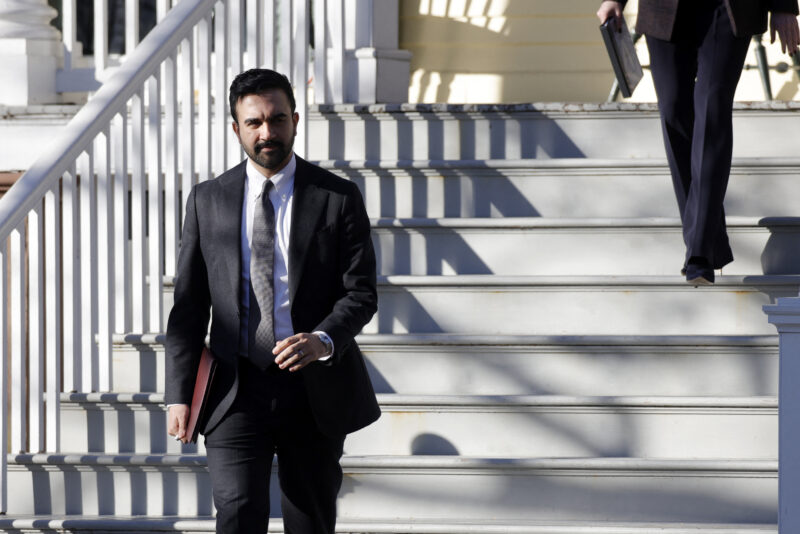
Benny Gantz, a member of Israel’s war cabinet, talks to the media after a meeting with Senate Minority Leader Mitch McConnell (R-KY) at the U.S. Capitol on March 04, 2024, in Washington, D.C.


 Add JewishInsider on Google
Former Israeli Defense Minister Benny Gantz discussed a wide range of security challenges facing Israel on Monday, outlining his long-term vision for confronting Iran, expanding regional defense cooperation and managing Gaza’s postwar recovery.
Speaking at a web event hosted by the Foundation for Defense of Democracies, the Knesset member and Blue and White party leader, who served as a minister in Israel’s war cabinet until June 2024, called Iran a “global challenge and threat to the State of Israel” and proposed a five-point plan to ensure Iran’s abandonment of its nuclear ambitions by 2028.
“Why 2028? It’s an assumption, hopefully not the wrong one,” Gantz added.
Gantz called Iran’s nuclear program “not a private issue.”
“If America or the international community can come up with an excellent” nuclear agreement with Tehran with “no strategic blinking, fine with me,” Gantz said. “Free inspection, anytime, anywhere, zero warning, zero tolerance for any obstacles that we find, then fine,” he added, referring to Iran permitting inspectors to enter the country and its nuclear facilities, an issue that has held up negotiations in the past.
On Turkey, Gantz said Israel and its allies should encourage Ankara to “reassess” its geopolitical alignment.
“Turkey needs the West. It’s connected to NATO, its economy is highly connected to what’s happening in Europe,” he said. “I think we should try to influence Turkey to reassess where it wants to be, rebalance where it wants to be between the West and the extremism of the Muslim Brotherhood.”
Gantz added that Israel should help form a multilateral partnership to strengthen cooperation across the eastern Mediterranean — one that could also engage Turkey constructively.
“Once again, I’m not trying to confront Turkey necessarily,” Gantz said. “I’m moving it from another perspective, with common interest by Greece, Cyprus, ourselves, maybe even Italy, or even other countries in Europe that may want to become part of this consortium … I think the Turks will have much more to benefit from cooperating rather than confronting.”
Gantz also highlighted the importance of working with NATO partners to motivate Turkey to promote stability in Syria. Since the fall of the Assad regime in late 2024, Israel and Turkey have often clashed over competing objectives in Syria.
The Jewish state sees Turkish influence in Syria as a potential security threat and has sought to use military incursions as a way of establishing a demilitarized zone on the border. Turkey has sought to support the new political project in Syria, pursuing deeper political, economic and military cooperation with Damascus.
In April, Israel carried out strikes on multiple cities in Syria, including more than a dozen near a strategic airbase in Hama, where Turkey has reportedly aimed to expand its military footprint. That same month, the two countries held talks to avoid clashes in Syria, reportedly reaching an agreement.
“It’s very important to reconstruct Syria and understand the Turkish involvement,” Gantz said. “We should take advantage of Turkey being part of NATO and the Western world to motivate Turkey to enhance Syria with the access of moderate countries, and not necessarily back to the Iranians.”
Gantz also addressed the security situation in Gaza, where Israel still controls 58% of the territory, marked by a yellow “initial withdrawal line,” something that experts told Jewish Insider earlier could become a permanent marker and serves a security purpose.
Gantz said he opposes Israeli settlements in the enclave, but supports maintaining a security zone under Israeli control. Gantz proposed that a U.S.-led civil administration should oversee the territory’s reconstruction over the next decade.
“It’s going to be a very chaotic decade right now, when we will have to be strong on defense,” Gantz said. “I think it will take a decade for [Gazans] to be able to rebuild something they can live with and we can live beside.”
28 Democratic senators and 8 Senate candidates in battleground states have publicly expressed opposition to Israeli annexation of parts of the West Bank

U.S. Senate Studio / Gage Skidmore
Minnesota Sens. Amy Klobuchar (D-MN) and Tina Smith (D-MN) have joined more than two dozen Senate Democrats publicly warning Israeli leaders of the implications of efforts to unilaterally annex portions of the West Bank. Israeli Prime Minister Benjamin Netanyahu has said that the government could start annexing territory as early as July 1.
In individual letters sent last month and made public over the weekend, both senators — Klobuchar addressed Secretary of State Mike Pompeo and Smith wrote to Netanyahu and Israeli Defense Minister Benny Gantz — posited that annexation would undermine efforts to attain a two-state solution.
Twenty-eight senators have so far spoken out against the annexation proposal.
Last month, 19 Democratic senators sent a letter to Netanyahu and Gantz urging the Israeli leaders not to move forward with the effort. That letter, which was updated several times before being sent, cautioned the new Israeli government that “unilateral annexation puts both Israel’s security and democracy at risk” and “would have a clear impact on Israel’s future and our vital bilateral and bipartisan relationship.” Sens. Dianne Feinstein (D-CA) and Bob Casey (D-PA) sent individual communiques to Netanyahu and Gantz, similarly opposing the move, and Sens. Michael Bennet (D-CO) and Maggie Hassan (D-NH) addressed the matter in individual letters to Pompeo.
In addition, Sens. Mark Warner (D-VA) and Catherine Cortez Masto (D-NV) issued statements against annexation, and Sen. Chris Coons (D-DE) indicated to Jewish Currents that instead of signing or authoring a letter on annexation, he would “communicate directly with [Israeli] Ambassador [Ron] Dermer and Israeli officials to express his concerns.”
On Monday, eight Senate candidates in battleground states are expected to join the list expressing their strong opposition to such a move. In statements provided to J Street and shared with Jewish Insider, the candidates — Cal Cunningham (North Carolina), Sara Gideon (Maine), Teresa Greenfield (Iowa), Al Gross (Alaska), Jaime Harrison (South Carolina), MJ Hegar (Texas), John Hickenlooper (Colorado), Amy McGrath (Kentucky) and Jon Ossoff (Georgia) — emphasized that annexation would put the future of a two-state solution at risk.
Read their statements in full here.
Earlier this month, House Speaker Nancy Pelosi (D-CA) warned that unilateral annexation “puts the future [of peace] at risk and undermines our national security interest and decades of bipartisan policy.” Presumptive Democratic presidential nominee Joe Biden also came out against annexation, saying it “will choke off any hope for peace.”
“From the presidential nominee to the speaker of the House and from the Senate to the senatorial campaign trail, Democratic leaders have now made absolutely clear that they do not and cannot support unilateral annexation in the West Bank,” J Street President Jeremy Ben-Ami told JI. “For annexation to move forward in the face of this overwhelming opposition would be incredibly harmful to the future of Israelis and Palestinians and to the US-Israel relationship.”
Please log in if you already have a subscription, or subscribe to access the latest updates.
 Continue with Google
 Continue with Apple