






























Sen. Chris Murphy said that the U.S. could no longer guarantee regional security, but that might have a ‘silver lining’ by obligating the Gulf states to negotiate directly with Iran

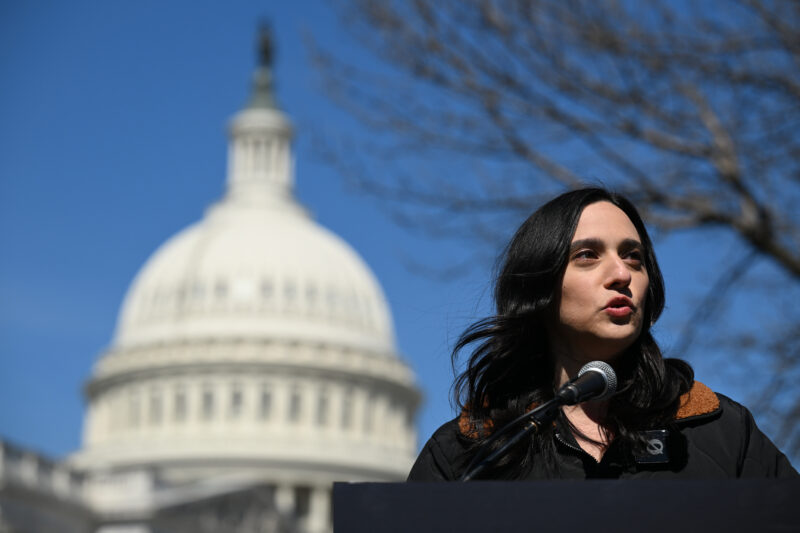
Jemal Countess/Getty Images for Fair Share America
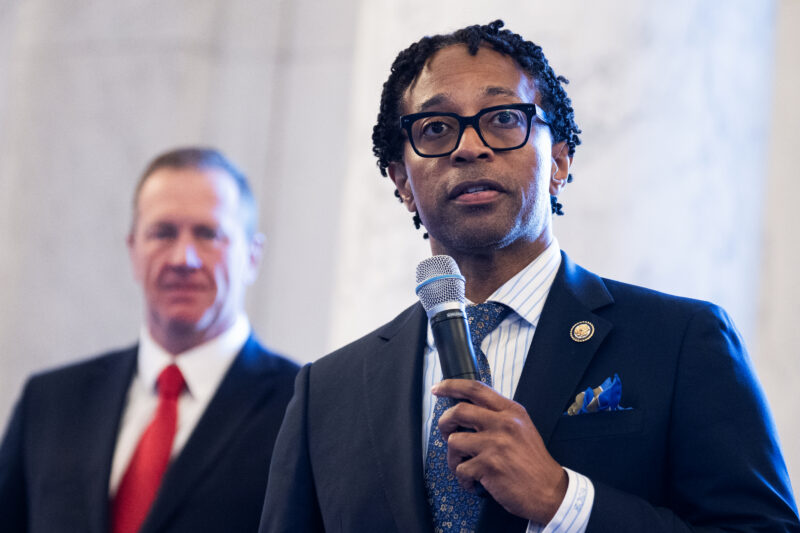
Sen. Chris Murphy (D-CT) speaks at the U.S. Capitol on April 10, 2025 in Washington, DC.


 Add JewishInsider on Google
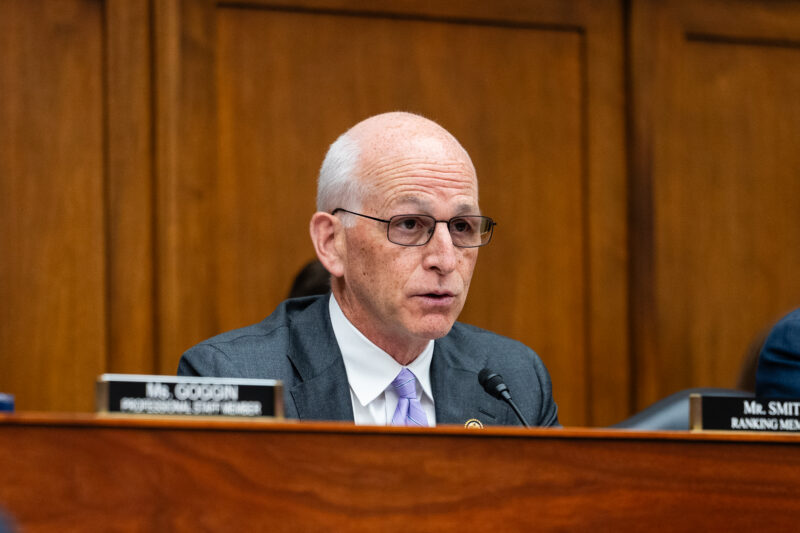
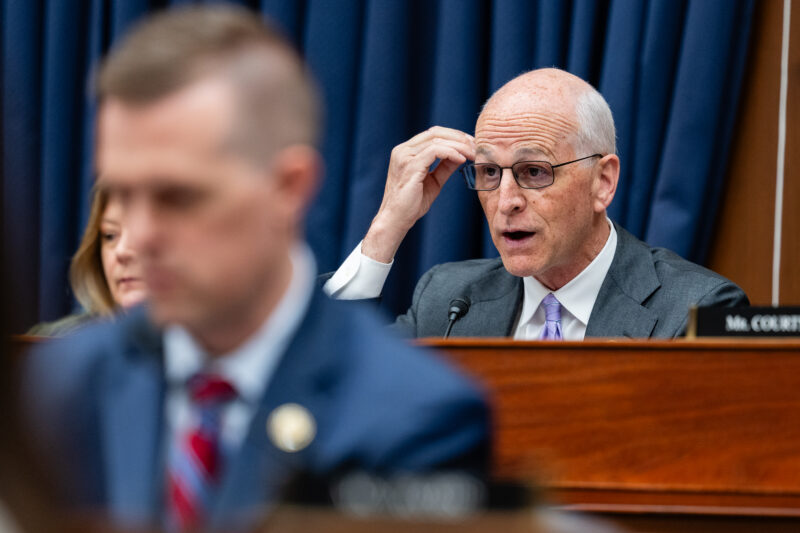
ASPEN, Colo. — Sen. Chris Murphy (D-CT) argued on a panel at the Aspen Security Forum on Thursday that the war with Iran had irreparably damaged the U.S.’ reputation and capacity in the Middle East, and that Gulf states would now need to take the lead and negotiate with Iran over the region’s future.
The U.S. has been “effectively eliminated as a security guarantor for our allies” because of what he described as a failed military campaign against Iran, Murphy argued.
“You can make an argument that that could be a long-term silver lining, that the Gulf states will have to sit down and negotiate, at the beginning, the question over the Strait of Hormuz and maybe another set of factors, and in those negotiations, that might be the new reality in the Middle East,” he said.
“Maybe in that conversation with the U.S. not in the lead, but as a partner, there is a solution to the ultimate Iranian control of the strait, but it’s admittedly very hard to answer that question right now,” Murphy continued.
He said that the current state of play suggests that an emboldened, enriched Iran with control of the Strait of Hormuz “seems to be the best-case endgame” and “that is why our allies and friends in the region are questioning whether there is any way the United States can ever secure them.”
Some allies, he acknowledged, want to see the U.S. “finish the job” in Iran, but argued that that’s an unclear and undefined goal that in some cases might involve committing U.S. ground forces.
Asked by moderator Jim Scuitto, a CNN correspondent, how a future Democratic president would approach the situation assuming the current status quo persists through 2028, Murphy said that is “kind of an impossible question,” adding that the U.S. would have to engage with its partners and Iran to try to secure freedom of transit in the Strait of Hormuz. Murphy himself is viewed as a potential presidential candidate.
He said that resolving the current standoff would likely require lifting sanctions and pressuring Israel to permanently end its war against Hezbollah in Lebanon.
Asked about the possibility of expanded U.S. strikes on Iranian oil infrastructure, as suggested earlier in the forum by former National Security Advisor Robert O’Brien, Murphy said that would only lead Iran to escalate further by ordering the Houthis to close the Bab el-Mandeb strait.
Iran, in Murphy’s framing, had “taken our best shot and survived” and realized it can use the Strait of Hormuz to increase its leverage at the negotiating table. He said that the current situation essentially removes any leverage the U.S. had in nuclear talks — having surrendered sanctions relief for the reopening of the Strait of Hormuz and showing that the U.S. military threat is not sufficient to bring down the regime.
As a result, he said that the U.S. would likely not be able to get a better deal than the Obama administration’s 2015 nuclear deal even if talks resumed.
Murphy characterized the war as a catastrophic, generational mistake — “the greatest foreign policy disaster of the last 20 years [and] one of the greatest mistakes any president has made in the world in our country’s history,” which left the U.S. looking “weak and feckless.”
He said that, as a result of the munitions expenditures in the war, the U.S. could not defend Taiwan from China today if it wanted to.
Robert Greenway, who led Middle East policy on the National Security Council during President Donald Trump’s first term, was the primary voice of optimism on the panel, arguing that despite some changing rhetoric, Trump’s objectives have been clear — dating back even to his first administration — and that there is “no question in my mind” that Iran’s capabilities have been significantly degraded.
“Their means and the opportunity to constitute a threat to U.S. vital interests and to global interests, as a matter of fact, are probably the lowest they have ever been since 1979. From the enrichment standpoint, they haven’t been at zero enrichment capacity since 2006,” Greenway said. “So, from an empirical perspective, I would say yes, progress has been made, and I think at this juncture, I would be pleased with that progress. And I don’t think there’s a lot left to be done to eliminate the remaining threat.
He argued that those who are concerned by Iran’s disruptions of the global economy should be supportive of the administration’s military campaign, arguing that Iran would only be more emboldened under a nuclear and missile umbrella.
“This is the most practical way to solve it. Diplomacy up to this point hasn’t prevailed, and it won’t as long as you have a disingenuous partner,” Greenway said. “Now, Iran cannot defend itself from any attack by the United States, or frankly, anyone else.”
Diplomacy, he reiterated, was a “failed approach” and he said military action is the “fastest” and “probably the only realistic way” to achieve the U.S.’ objectives.
He also said that definitively eliminating the threat from Iran would allow the U.S. to reduce its troop presence in the Middle East in the longer term. He said he doesn’t see any need for U.S. ground forces in Iran, arguing that the only potential uses for them would be for search and rescue operations or recovery of Iranian nuclear materials.
But with the nuclear materials currently buried and closely monitored, Greenway said, a ground infiltration to remove them isn’t necessary in the short term, though he said they should be removed from the country in the long term.
Countering Murphy, Greenway also said that many Middle East allies are privately supportive of continued U.S. military operations to finish the job, and are happy to see the threat of Iran reduced, though he acknowledged opinions vary.
Karim Sadjadpour, a senior fellow at the Carnegie Endowment for International Peace, disputed Murphy’s notion that the result of the war would remove the U.S. as a guarantor of regional security. He said that the Gulf countries understand that only the U.S. can protect them in the near term — China and Russia not being viable alternatives — and they still understand and fear Iran as a threat.
But he also acknowledged that, as a consequence of geography, Middle Eastern states will need to seek side deals with Iran to some extent.
Sadjadpour also emphasized that there will never be lasting stability in the Middle East until Iran is led by a government that actually represents the interests of the Iranian people — an aim he said the war did not advance.
“It is militarily weaker than it was four and a half months ago, but … psychologically it feels much stronger. It’s much more confident than it was four and a half months ago before the war,” Sadjadpour said. “I don’t think it’s going to give up its control of the strait anytime soon. I don’t think it’s going to make meaningful compromise anytime soon.”
He compared the current situation in Turkey to post-Soviet Russia — continuing to pursue its own security and destabilize its neighbors, and use energy and trade as a weapon.
He added that leaders in the U.S. often misunderstand Iran, comparing it either to Nazi Germany, an ideologically rigid regime that cannot be bargained with, or to China, ripe for grand bargain and rapprochement. Iran is most similar, he said, to the Soviet Union — not suicidal but not willing to place its economic and national interests above its revolutionary ideology except when faced with “almost existential” economic pressure.
With the Iranians appearing prepared to wait out the Trump administration, Sadjadpour continued, he doesn’t see a clear end to the current war.
Roxana Saberi, a journalist and author with contacts inside Iran, said that most people in the country remain hopeful but were disappointed by the results of the war and the memorandum of understanding, which she said had demonstrably emboldened Iran to step up human rights abuses at home.
Among the anti-regime population in Iran, which she said constitutes 80% of the Iranian public, there are now three groups: those that opposed the war, those that supported it and want to see further strikes and those that have become numb to the situation and are simply trying to survive.
Speaking at the Aspen Security Forum, an advisor to the Turkish president called Iran's nuclear program a 'civil' project and said Ankara is in talks with Washington to resolve a standoff over Russian-made missile defense systems
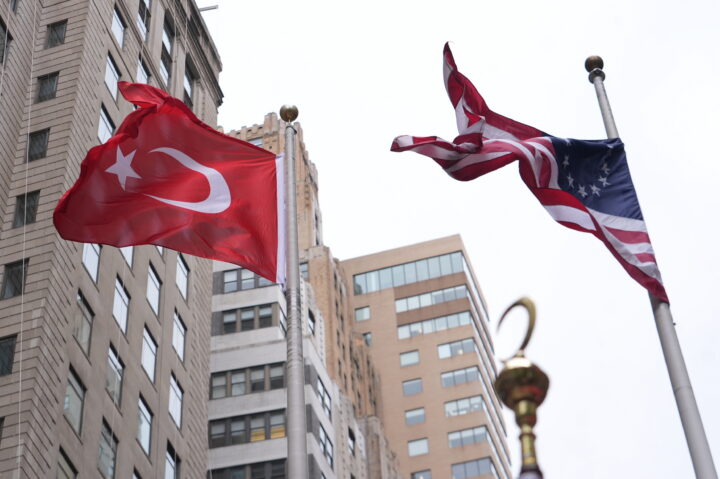
Photo by Selcuk Acar/Anadolu via Getty Images
A flag-raising ceremony is held at Bowling Green Park in New York, U.S. on May 15, 2026.
ASPEN, Colo. — Akif Çağatay Kılıç, a top foreign policy and security advisor to Turkish President Recep Tayyip Erdoğan, downplayed the threat posed to the region by Iran’s nuclear program at the Aspen Security Forum, while also repeatedly sidestepping questions about the status of Turkey’s Russian S-400 missile defense system and efforts to acquire F-35 fighter jets.
“I don’t perceive that we have a nuclear threat to the level that is being talked about, but we are closely monitoring it, and we’re talking to our Iranian colleagues and friends on how they perceive to be working on their nuclear program — civil nuclear program,” Kılıç said.
He continued to defend his country’s decision to acquire the S-400 system.
Kılıç also argued that the alternative energy corridors through the region that have been proposed to avoid the Strait of Hormuz are not a viable option so long as the war continues.
Kılıç said that Turkey is working with the U.S. to resolve the “legal issue” around the F-35s and S-400s, emphasizing that the leaders of both countries have expressed a desire to move the F-35 sale forward.
Asked directly about whether Turkey will offload its S-400s, Kılıç prevaricated and did not offer clear answers.
“It’s not easy always to navigate these things. But we’re trying to work with our American partners and allies to find a way that both countries can live with and go towards the future,” Kılıç said.
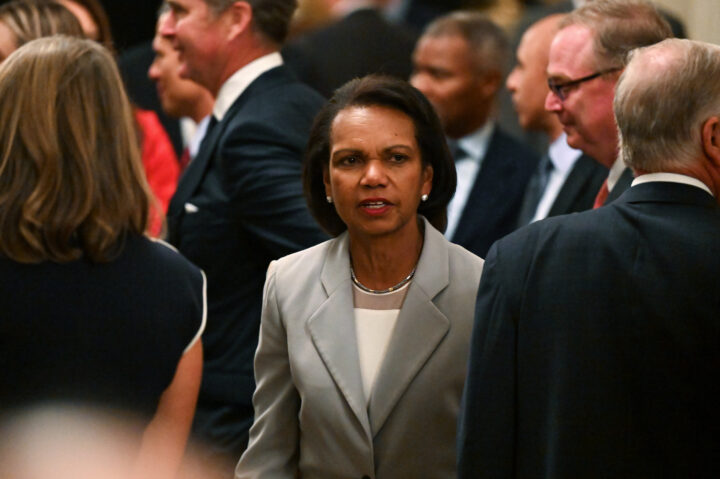
Former Secretary of Defense Mark Esper, joining Rice at the Aspen Security Forum, said the U.S. was right to launch the war but may have overestimated or overstated its own capabilities
(Roberto Schmidt/Getty Images)
Former U.S. Secretary of State Condoleezza Rice attends the swearing-in ceremony for Chairman of the Federal Reserve Kevin Warsh in the East Room of the White House on May 22, 2026 in Washington, DC.
ASPEN, Colo. — Former Secretary of State Condoleezza Rice on Tuesday opposed any nuclear deal with Iran, arguing at the Aspen Security Forum that the U.S. should continue pressure on Iran’s economy and “see what happens.”
Meanwhile, former Secretary of Defense Mark Esper speaking alongside Rice on a panel, suggested that the U.S. had potentially overestimated its capabilities in the war, agreeing that continued economic pressure and a renewed blockade would be the best strategies going forward.
The two, speaking at the Aspen Security Forum, also offered strong criticisms of U.S. allies for not joining with and at times attempting to obstruct the U.S. campaign against Iran.
“I would not buy a nuclear agreement [with Iran] under any circumstances. I’d let them sit there and stew in their lousy economy, where most of their A-level nuclear scientists have been killed, where I believe there are deep splits in the Iranian government … and let’s just see what happens,” Rice said. “I wouldn’t give them a penny back, and let’s just see what happens to that economy over time.”
Rice said that she believes the U.S. did do significant damage to Iran’s nuclear program and that she’s “quite confident” that the country is not in a position to produce a nuclear weapon in the near future.
Mark Esper, who served during President Donald Trump’s first term, said that the U.S. war on Iran was a “a good thing to do to show the seriousness of of how we felt about this and our willingness to commit force to do that” but added, “we can discuss whether our reach exceeded our grasp, and some of the language used about unconditional surrender, et cetera, pushed them into a corner”
He said that a success in the war would require a return to the status quo in the Strait of Hormuz and a deal on Iran’s nuclear program superior to the 2015 Joint Comprehensive Plan of Action.
Esper argued that there would be no way to bring such a result solely through airstrikes, and that the primary path forward should be renewed economic pressure on Iran, including a renewed blockade targeting Iran’s ports and land and air routes. He said the U.S. should continue to respond to Iranian attacks with strikes on its missile and drone capabilities.
Esper said that strategy will take time, patience, discipline and the support of allies and come at the cost of higher gas prices. He said the end goal should not be to collapse the Iranian regime but to bring Iran back to the negotiating table.
“That approach, barring — I’m open to any better one — gives you the highest return with the lowest risk to where we don’t want to go,” Esper said.
Former Secretary of Commerce Penny Pritzker, who also spoke on the panel, emphasized that economic pressure is a useful tool, which can be effective but takes time, will and coordination, without which there are ways to evade sanctions.
“I’m hopeful that with all this pressure, that something rational can come of this, because we’re not in a good place right now, obviously,” Pritzker said.
Rice and Esper both expressed frustration with U.S. allies’ refusal to cooperate with the U.S. operations and, particularly, European allies’ decisions to block the U.S. from using their bases in their countries in the course of those operations — a move Esper called “really stupid.”
Rice said it was “really not a very smart thing” for allies to dismiss the conflict as not “our war.”
She said would have “preferred” if the U.S. had worked more closely with its allies before the operation, but acknowledged that actually getting them onboard would have been questionable, pointing to her own experience trying to bring allies onboard with the Iraq invasion during the Bush administration.
Sometimes, she said, “the United States has to do something really hard, like really deal with a bad guy who’s been a bad guy for a long time,” she said, emphasizing that the sophistication and range of Iran’s missile program was increasing and it was preparing to make a major agreement with Russia on missiles. “When the time comes, if it’s your ally and your friend, even if you’re not going to join, you don’t try to harm the effort,” she said.
“When I hear, ‘Well, it wasn’t imminent,’ I think, ‘Do you really want to wait until it’s imminent, or do you want to try to degrade it earlier?’” she continued.
Both Esper and Rice warned that, through their actions around the Iran war and comments denigrating the U.S.’ reliability as an ally, or declaring that they will handle their own defense without American assistance, allies are only playing into the hands of those who want to see those alliances collapse.
“You may speak into existence exactly what you need to avoid, because there are some people inside the American political system, on both sides of the aisle, who would be perfectly happy to withdraw from the world, and you don’t want to help empower those people,” Rice warned.
‘A weak and vulnerable Iran was susceptible to a very good deal that would lock Iran's program in a box for decades, not just set it back for a couple of years,’ Sullivan said

Drew Angerer/Getty Images
Former National Security Advisor Jake Sullivan speaks during the daily press briefing after U.S. President Joe Biden gave remarks on the terrorist attacks in Israel at the White House October 10, 2023 in Washington, DC.
ASPEN, Colo. — Former National Security Advisor Jake Sullivan suggested at the Aspen Security Forum on Friday that the U.S. strikes on Iran had not been necessary and didn’t accomplish the fundamental goal of permanently stopping Iran’s nuclear program.
Asked whether he wished that President Joe Biden had carried through with plans to strike Iran before he left office, Sullivan argued that the situation at the time had been ripe for a diplomatic solution.
“During the transition, we handed off to the Trump administration. The situation in which Iran was at its weakest point since 1979,” Sullivan said. “Hezbollah had been functionally defeated. Assad had fallen. Its air defenses had been destroyed, and twice, Iran had tried to hit Israel with large salvos and missiles, and twice, with American help ordered by President Biden, Israel defeated those attacks. So Iran was weak and vulnerable.”
“In my view, a weak and vulnerable Iran was susceptible to a very good deal that would lock Iran’s program in a box for decades, not just set it back for a couple of years,” Sullivan continued.
He said that, after the strikes, a very similar deal remains necessary, “which is what I think President Trump will pursue, because the only way to permanently end Iran’s nuclear threat, I think, is through diplomacy.”
Sullivan’s perspective separates him from some Senate Democrats who spoke earlier in the day at Aspen, who described the strikes as successful even as they criticized the administration’s failure to coordinate with Congress and also emphasized that negotiations must follow.
The former CIA director warned that the Islamic Revolutionary Guard Corps may attempt to consolidate power in Iran

Maxym Marusenko/NurPhoto via Getty Images
Former CIA Director and retired US General David H. Petraeus speaks at a special event of the Kyiv Security Forum, Kyiv, Ukraine, September 05, 2023.
ASPEN, Colo. — Retired Gen. David Petraeus, the former director of the CIA and head of U.S. Central Command, said Friday at the Aspen Security Forum that, in the post Oct. 7, 2023 environment, Israel will no longer tolerate threats to its security throughout the region, including a resumption of Iran’s nuclear program.
Petraeus said, “We have to step back a little bit and recognize that Israel’s strategic calculation is very, very different from before Oct. 7, and that’s a big deal for the region,” explaining that Israel will no longer allow threats to metastasize anywhere in the Middle East.
He added that Iran must understand that it is vulnerable and that no Israeli leader will allow it to resume its push for a nuclear weapon.
“[The Iranians] have to recognize that if they make another move, they’re going to get hammered once again,” Petraeus said. “And I don’t think that an Israeli prime minister, even if it’s not Bibi Netanyahu, will allow the Iranians to proceed down the path to a nuclear device.”
He predicted that Russia would not be helpful to Iran in replacing its Russian-manufactured air-defense systems that Israel destroyed, since it doesn’t have sufficient systems to protect itself from Ukraine’s counter-strikes at this point.
Petraeus argued that Iran’s future direction and leadership will depend on what sort of leader or leadership structure succeeds Ayatollah Ali Khamenei — whether the country remains ruled by a hardline religious cleric or whether a new body, potentially one dominated by the Islamic Revolutionary Guard Corps, emerges.
“You can actually entertain at least a notion that, since they control 30 to 40% of the economy, that the Revolutionary Guard Corps says, ‘Hey, why are we doing all this stuff? We could be living high on the hog and stop getting bombed and our headquarters getting taken out, us individually targeted, if we just cut loose Hezbollah, and all these others. Who cares about this nuclear stuff? What has this brought us now?’” Petraeus said.
Journalist Kim Ghattas, speaking alongside Petraeus, said that “this 40 year arc of the Islamic Revolution is coming to an end,” citing knowledge from an unnamed Western diplomat previously based in Iran, “but exactly how it ends we just don’t know yet.”
She argued that the “inconclusive” nature of the Israel-Iran war “has actually complicated matters internally and in the region” and may allow the Iranian regime to recalibrate and consolidate power. She suggested that the IRGC could take charge and transform the country into more of a military dictatorship, sidelining the mullahs.
“I think that in the medium term, we’re looking at a more oppressive, more militaristic Iranian regime,” Ghattas said.
And she predicted that Iran would push ahead with its nuclear program as its only option for deterrence.
Ghattas also said that the fact that Iran had managed to survive the Israeli attacks had complicated efforts to sideline Hezbollah in Lebanon, sending a message to the group that it should hold out; she said that Hezbollah is unlikely to disarm without instruction from Iran, and that it would require political concessions in order to do so.
“We had a really golden opportunity at the beginning of the year, when everything was in flux, Hezbollah was very much on the back foot. [Syrian dictator Bashar al-]Assad was gone. Gaza had a ceasefire in January,” Ghattas said. “This was the moment to strike with a grand political vision, diplomatic vision, for the region. Now, everybody’s recalibrating. Iran is trying to see how it can get a foothold stronger again, into Lebanon, even into Syria.”
Petraeus said that he supports Israel’s objectives it has laid out in Gaza — destroying Hamas, removing it from governance and freeing the hostages — “but I’ve said publicly from the very beginning and written about it as well, that I just don’t think they’re going about it the right way.”
He said Israel should be pursuing a “comprehensive civil-military counterinsurgency campaign — clear, hold, build and transition,” including establishing security and governance measures in Gaza as the campaign proceeds and allowing Gazan Palestinians return to their homes.
“And that requires a fourth objective, which has never been stated, and that is to provide a better future for the Palestinian people in Gaza without Hamas in their lives,” he continued.
He said that, though Hamas has been degraded, it still has the largest armed force in Gaza and would reemerge as the dominant force in a vacuum, despite Israel’s arming of some Palestinian clans in Gaza.
“I’m really worried about what is the future of Gaza, for which there’s been no real vision provided for what life of the Palestinian people will look like,” Petraues said.
The retired general indicated that he’s optimistic about Syrian President Ahmad al-Sharaa, explaining, “We believe that he understands the need for a government that has representation from all of these different elements and not only assures majority rule, but also ensures minority rights.”
Ghattas warned that the ongoing Israeli military campaign in Syria risks spawning a revitalized terrorist threat in Lebanon and a renewed threat from Syria.
She said she supports the Trump administration’s policy in opening a door to the new Syrian government, but said that the U.S. has “gone a little bit too far in embracing al-Sharaa.”
“Great about lifting the sanctions, but you still need to breathe down his neck, because international support does not translate into national legitimacy, yet, and he’s not done enough in terms of national legitimacy,” Ghattas said.
The panelists also discussed Saudi Crown Prince Mohamed Bin Salman’s rise to power and vision for the region.
Petraeus said that bin Salman had overhauled a slow and indecisive government to consolidate power.
“There’s never been a consolidation of power like we see there, and there’s never been someone with the kind of vision that he has put forward as well,” Petraeus said. “You can ask if some of that is beyond realistic. … But he knows that.”
He said that bin Salman’s initiative has established Saudi Arabia as one of the key centers of power in the region, alongside the United Arab Emirates and Qatar, supplanting traditional power-players like Egypt.
Ghattas said that bin Salman had evolved over time and “transformed, for the better, the lives of millions of young Saudis.”
“I think the opportunities are great, but I think Saudi Arabia, which wanted to establish relations with Israel before Oct. 7, is finding itself with a conundrum that it cannot solve on its own without pressure from the United States on Israel,” Ghattas said, “which is [that] it is not going to reach out to Israel anymore unless they get a promise of a Palestinian state. The bar for that has risen tremendously.”
Plus, Huckabee presses Israel on pilgrims

Screenshot/Fox News
Adam Boehler, special presidential envoy for hostage negotiations, appears on Fox News Sunday on March 9, 2025
Good Friday morning.
In today’s Daily Kickoff, we talk to former Israeli Ambassador to the U.S. Mike Herzog about Democrats’ responses to U.S. involvement in last month’s war between Iran and Israel, and report on U.S. hostage envoy Adam Boehler’s comments at the Aspen Security Forum that a ceasefire is ‘‘closer than it’s been.” We interview Columbia students and alumni about the school’s negotiations with the Trump administration, and have the exclusive on a letter from Jewish House Democrats concerned over the Pentagon’s recent contract with xAI following a series of antisemitic posts by its Grok chatbot. Also in today’s Daily Kickoff: Rep. Josh Gottheimer, Daniel Nadler and Deborah Lyons.
For less-distracted reading over the weekend, browse this week’s edition of the Weekly Print, a curated print-friendly PDF featuring a selection of recent Jewish Insider and eJewishPhilanthropy stories, including: The psychology of denial: American Psychological Association struggles to confront antisemitism in its ranks; After Iran strikes, Saudis in no rush to join Abraham Accords, experts say; and Rep. Greg Landsman: Americans are ‘tired’ of partisanship on Iran and foreign policy. Print the latest edition here.
What We’re Watching
- House Minority Leader Hakeem Jeffries (D-NY) is slated to meet today in New York City with the Democratic mayoral nominee Zohran Mamdani. The meeting comes days after Mamdani, who has faced criticism for his defense of the “globalize the intifada” phrase, met on Capitol Hill with House Democrats. More below.
- The Aspen Security Forum wraps up today ahead of an off-the-record weekend gathering of the Aspen Strategy Group at the same venue in Aspen, Colo.
- The forum’s final morning kicks off with a sit-down with former CIA Director David Petraeus and the Financial Times’ Kim Ghattas, who will discuss the evolving situation in the Middle East.
- Later in the morning, Sens. Chris Coons (D-DE) and Mark Warner (D-VA) will speak in conversation with The New York Times’ Peter Baker.
- The final session of the forum today will feature former National Security Advisor Jake Sullivan, former Secretary of State Condoleezza Rice and two former defense secretaries, Robert Gates and Mark Esper.
- We’re keeping an on eye the situation in Syria, where a ceasefire implemented on Wednesday has largely held. We’re also eyeing Israeli activity in Syria and along the border, as Israeli balances its security concerns with efforts to maintain calm with the al-Sharaa government.
What You Should Know
A QUICK WORD WITH JI’S MARC ROD
Former Israeli Ambassador to the U.S. Mike Herzog and other pro-Israel speakers received a warm reception from the crowd at the Aspen Security Forum this week, as they discussed continued efforts to free the hostages in Gaza and the recent strikes on Iran.
However, Herzog told Jewish Insider on the sidelines of the conference that he’s been disappointed by the response to the strikes from Democratic lawmakers in Washington, which has been overwhelmingly negative.
It’s a response that stands in contrast to Herzog’s description of the transition he observed in the Biden administration’s thinking on Iran: going from pushing for a nuclear deal with Iran that Herzog said would have been weaker than the Joint Comprehensive Plan of Action to, by the time President Joe Biden left office, active discussions of strikes on Iran.
Herzog said that efforts to maintain bipartisanship on Israel were a critical element of his ambassadorship and that dialogue with nearly all leaders is critical, but, “I’m saying it carefully because I never interfere in domestic politics here, but from a strategic point of view, I was disappointed by the response of some senior Democrats to the war on Iran.”
Regarding Biden’s team, Herzog told JI: “If you look at the journey the Biden administration took from the initial days when they were rushing to a deal with Iran, to the last few months of the administration where they were talking to us about military options against Iran, they went a long way. … It was too late in the day [to carry out the strikes before Biden left office], but it was a very interesting journey that I noticed.”
WINDOW OF OPPORTUNITY
U.S. hostage envoy Adam Boehler: Hamas hostage deal is ‘closer than it’s been’
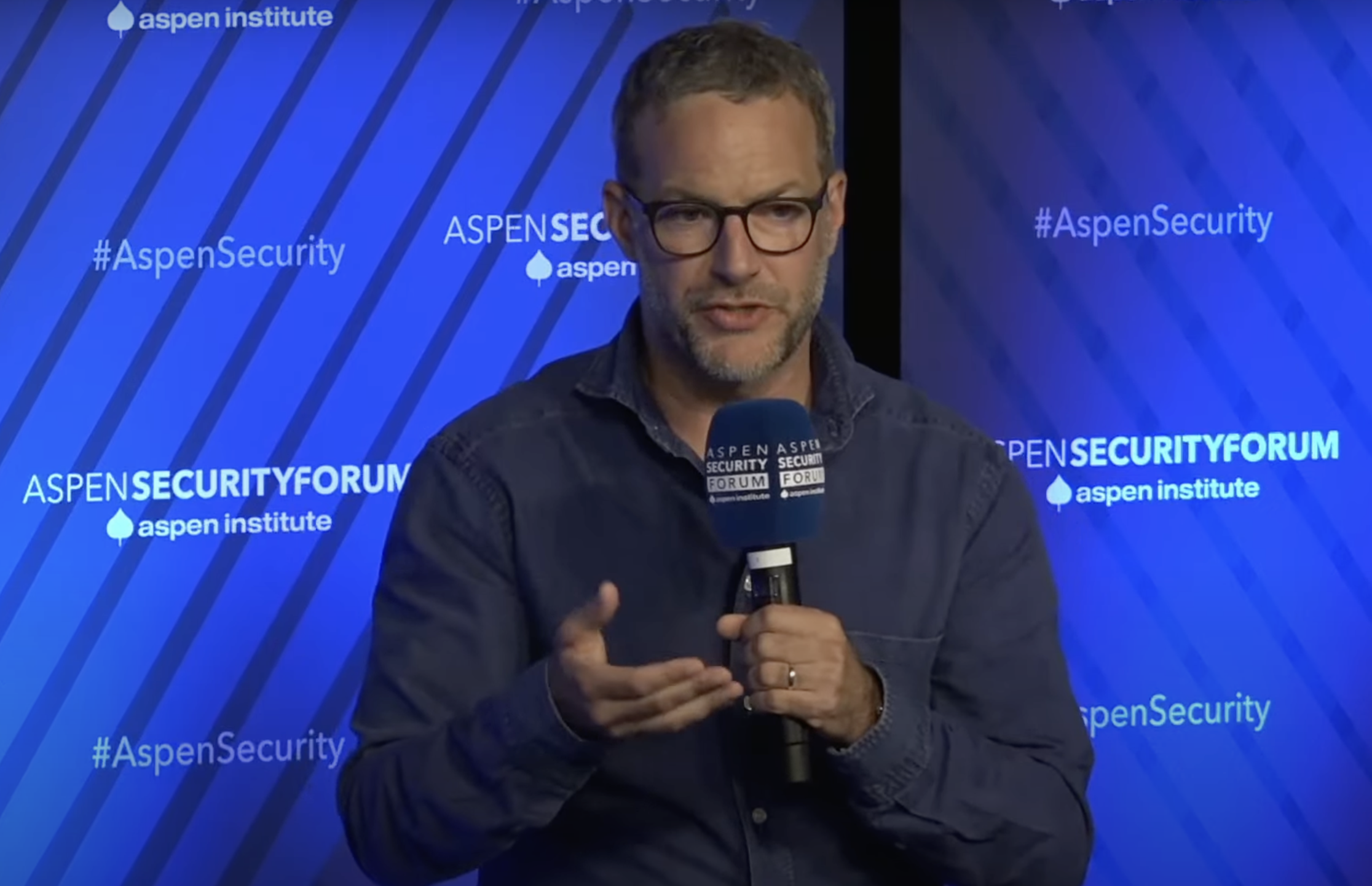
U.S. hostage envoy Adam Boehler said at the Aspen Security Forum on Thursday that there had been “some movement forward” recently toward a hostage-release deal with Hamas. He also addressed criticisms of his direct talks with Hamas, Jewish Insider’s Marc Rod reports.
Status update: “It’s closer than it’s been, and if it doesn’t happen, in my strong opinion it would be continued hard-headedness from Hamas, in which case Israel will continue to take action, as they should,” Boehler, the only Trump administration official to address the conference, said. Asked about his direct negotiations with Hamas, which were controversial especially among Israeli officials who were largely kept out of the loop, Boehler downplayed the extent of the breach. “There was no unilateral deal ever possible. While that’s an American citizen, Edan, we were always working with the Israeli side.”
Strategy session: Former Secretary of State Condoleezza Rice said Thursday at the Aspen Security Forum that the U.S. should work to exploit frictions between Iran, Russia, China and North Korea, to interfere with their deepening alliances. “I’ve thought this alliance is somewhat weaker than we sometimes would give it credit for, and I’d slam them together and make them deal with their own internal contradictions,” Rice reiterated.
tehran talk
Experts split on pathways forward for Iran, but agree regime change not imminent

Speaking on a panel at the Aspen Security Forum, a group of Iran analysts discussed the potential paths forward in nuclear talks with Iran after the American and Israeli strikes on Iran’s nuclear facilities, the possibility that Iran will attempt to reconstitute its nuclear program covertly and the prospect of regime change in Iran, Jewish Insider’s Marc Rod reports.
Analyzing Iran: Former National Security Advisor Stephen Hadley laid out three paths forward after the strikes: a continued campaign of Israeli air strikes to “mow the lawn,” while Iran works to try to reestablish its own deterrence; a negotiated agreement with Iran including intrusive inspections that would make it difficult for Iran to construct a covert nuclear program, with provisions addressing Iran’s ballistic missiles and proxies; and the possibility, with an agreement, that Iran decides to give up its pursuit of nuclear weapons, having spent billions of dollars on the program, alienated the region and still failed to deter a U.S. or Israeli attack. Rachel Bronson, a senior advisor at the Bulletin of the Atomic Scientists, said that it’s widely believed Iran has seen a nuclear weapon as a guarantor of regime survival, in the model of North Korea. But she said there’s a chance that Iran wants to go down a different path. “That begs the question whether the Iranians want to live like North Koreans and want to live in a sanctioned regime and in such isolation, which the Iranians demonstrated that they don’t want to live that way,” Bronson said.
Sanctions push: A group of Senate Republicans sent a letter to French, German and U.K. officials this week urging them to immediately reimpose U.N. Security Council sanctions on Iran for the regime’s violations of the 2015 nuclear deal and the Treaty on the Non-Proliferation of Nuclear Weapons, Jewish Insider’s Emily Jacobs reports.
CAMPUS BEAT
Columbia Jewish students, alumni critique school’s commitments to combat antisemitism as ‘bare minimum’

As Jewish students and alumni at Columbia University await the final details of the university’s prospective deal with the Trump administration, some are expressing skepticism that a list of commitments announced by the school this week to address antisemitism on campus would have a significant impact on protecting Jewish students, Jewish Insider’s Haley Cohen reports. The steps were publicized Tuesday by Columbia’s acting president, Claire Shipman, as the school works to reach a deal with the Trump administration to restore some $400 million in federal funding that was cut by the government in March due to the university’s record dealing with antisemitism since the Oct. 7, 2023, Hamas terror attacks in Israel.
Student reactions: According to a draft deal, Columbia would be required to pay a $200 million fine and commit to releasing admissions and staffing data to the federal government. “The deal as it stands now lets Columbia off the hook relatively without a scratch,” Inbar Brand, who graduated in the spring from Columbia’s dual-degree program with Tel Aviv University, told JI. “The school gets its money back without resolving the core issues in its governance and administrative structure that allowed for antisemitism to fester openly for so long on campus.” Noa Fay, a graduate student entering her last year in Columbia’s School of International and Public Affairs, described the university’s latest commitments and prospective deal as “an immense disappointment.”
SCOOP
In new memo, Republicans allege Biden admin provided grants for Palestinian NGOs with terror ties
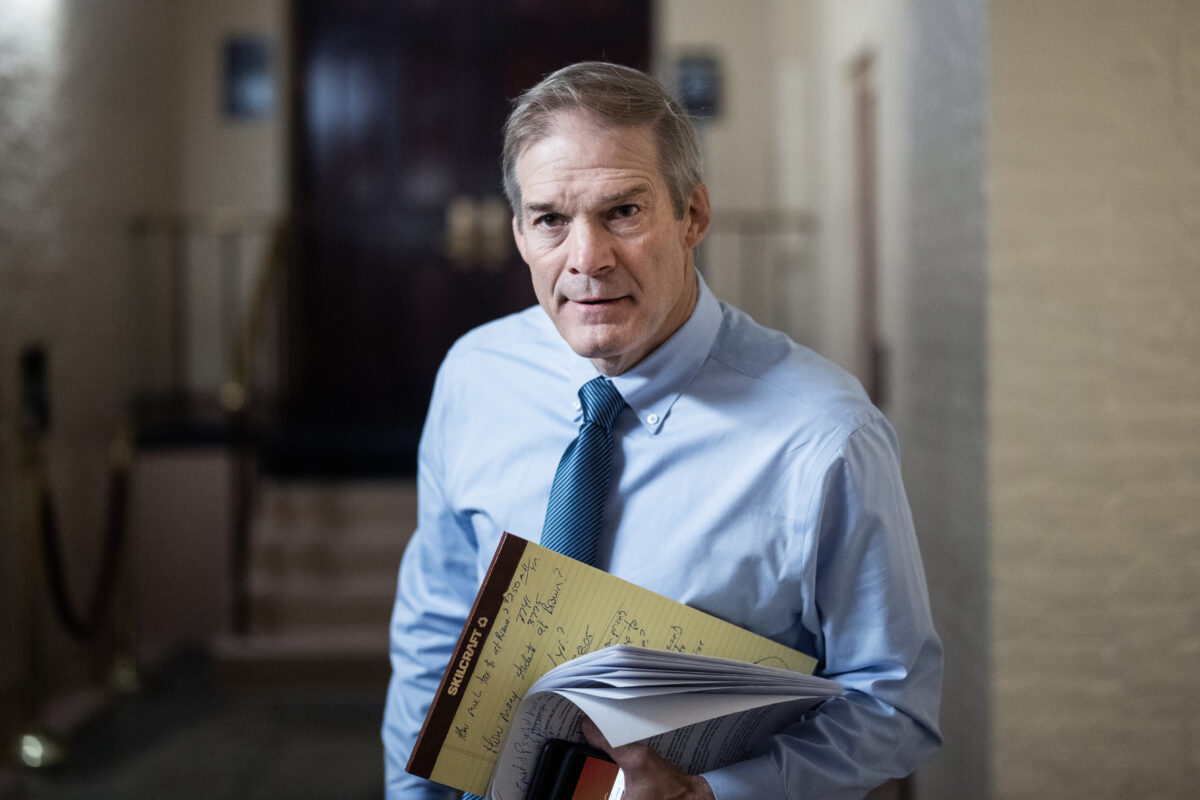
The GOP-led House Judiciary Committee drafted a new memo on Thursday alleging that federal funding granted to USAID and nongovernmental organizations under the Biden administration was given to Palestinian nonprofits with ties to proscribed terror groups, Jewish Insider’s Emily Jacobs reports.
The allegations: “Oversight conducted by the Committee reflects the Biden-Harris Administration’s neglect and misuse of taxpayer dollars through USAID, the State Department, and other federal agencies, which were used to directly and indirectly fund the efforts of anti-Netanyahu organizations and terrorist groups,” the memo sent to committee members, which was obtained by JI, states. Judiciary Committee Republicans also revealed in the memo that they were “expanding” their investigation “to include additional American and Israeli NGOs that may be involved in funneling U.S. government funds with the purpose of undermining the Israeli government or for the support or fiscal sponsorship of terrorist groups.”
holding power
Gottheimer avoids confronting Mamdani over ‘intifada’ comments

Rep. Josh Gottheimer (D-NJ), in a private meeting with House Democrats in Washington on Wednesday, avoided confronting Zohran Mamdani, the far-left Democratic nominee for mayor of New York City, over his controversial defense of calls to “globalize the intifada” and fierce opposition to Israel, Jewish Insider’s Matthew Kassel reports.
No objections: Gottheimer, an outspoken pro-Israel Democrat, has not been shy about calling out members of his party when disagreements over Israel and antisemitism have arisen. But during the meeting, Gottheimer did not bring up his objections to the 33-year-old democratic socialist, according to a House aide familiar with the matter, even as his views on Israel have raised alarms among Jewish voters and faced pushback from Democratic leaders who have so far withheld their endorsements.
EXCLUSIVE
Jewish Democrats press Pentagon about Grok contract after antisemitic meltdown

A group of Jewish House Democrats led by Rep. Laura Friedman (D-CA) raised questions on Friday about the Pentagon’s decision to announce a $200 million contract with Elon Musk’s company xAI to utilize a version of its Grok artificial intelligence, days after the chatbot posted antisemitic and violent screeds on X, Jewish Insider’s Marc Rod reports.
What they said: The lawmakers said that the contract raises questions about Musk’s potential personal influence over or access to the version of Grok that the Defense Department will use, and that the issues that produced the antisemitic meltdown might recur in its use of the program. And they alleged that the contract fits “a broader and increasingly visible pattern of the department turning a blind eye to antisemitism in its own ranks,” including Secretary of Defense Pete Hegseth’s defense of Pentagon Press Secretary Kingsley Wilson against accusations of antisemitism.
Worthy Reads
Protect the Druze: In Newsweek, Druze-Israeli diplomat Sawsan Natour-Hasson, who serves as minister for public diplomacy at the Israeli Embassy in Washington, calls for global condemnation of the attacks against members of the Syrian Druze community. “The atrocities of October 7 in Israel did not occur in a vacuum. We have warned the world for years about this growing wave of radical extremism. It has targeted the Yazidis in Iraq, the Alawites in Syria, Christians across the Levant — and now, it is butchering innocent Druze civilians: women, children, and the elderly. Homes are being shelled, families displaced, hospitals are being bombed, and religious sites and symbols desecrated, led by the Syrian regime with the blessing of President Abu Mohammad al-Jolani. And yet once again — the world has remained largely silent in the face of the genocide taking place against my people.” [Newsweek]
Presidential Plot: In The Wall Street Journal, the Foundation for Defense of Democracies’ Behnam Ben Taleblu and Saeed Ghasseminejad warn of potential Iranian plots to assassinate President Donald Trump. “Contrary to recent denials by Iran’s President Masoud Pezeshkian on Tucker Carlson’s podcast, these threats and plots are real. Books about the president’s time in office and on the campaign trail detail the precautions Mr. Trump had to take. U.S. authorities have been tracking, uncovering and, where possible, prosecuting people involved. The feds have disrupted several Iranian plots to assassinate Mr. Trump on U.S. soil.” [WSJ]
The Ties that Bind: The Atlantic’s Yair Rosenberg explores the political bind facing Israeli Prime Minister Benjamin Netanyahu amid the departure of the United Torah Judaism party from his coalition. “[Netanyahu] can either continue exempting the ultra-Orthodox and anger not just the public and the courts but also his own party, or revoke that exemption and lose the ultra-Orthodox — and with them, his coalition. Of late, Netanyahu has attempted to fudge the issue by pushing through legislation that would create a technical process for drafting the ultra-Orthodox but in practice make the new requirements easy to evade. This effort has met resistance in his party, however, and the bill has not passed — leading to the departure of the ultra-Orthodox parties from the government this week. For now, those parties have said that they won’t vote to force new elections, giving Netanyahu time to try to appease them. But unless he can figure out a way to pass a bill that somehow satisfies the ultra-Orthodox and their critics, it’s merely a matter of time before his erstwhile allies completely switch sides.” [TheAtlantic]
Toxic Workplace: In USA Today, Ken Marcus, the founder of the Louis D. Brandeis Center for Human Rights Under Law, warns that the field of mental health is becoming “steeped” in antisemitism. “In the health care system, research shows that antisemitism has escalated since the Hamas terrorist attacks of Oct. 7, 2023. Now, 75% of Jewish medical professionals say they have experienced antisemitism at work. No form of hatred is acceptable within our mental health care system – one that is supposedly built on empathy, ethics and compassion. … The proliferation of antisemitism in any space is horrific. But its proliferation in health care – a sacred, professional space brimming with private and sometimes life-threatening information – is especially dangerous.” [USAToday]
Word on the Street
In a letter to Israeli Interior Minister Moshe Arbel, U.S. Ambassador to Israel Mike Huckabee warned that he could publicly declare Israel not welcoming to Christian visitors, an escalation in an ongoing diplomatic row over Christian Zionists who have experienced complications traveling to Israel; Arbel, from the Haredi Shas party, has for years clashed with Christian clergy and groups who have sought visas to travel to Israel…
Israel apologized for a strike on a Catholic church in Gaza that killed three people and said it is investigating how “stray ammunition” struck the building; the official statement came following a call between Israeli Prime Minister Benjamin Netanyahu and President Donald Trump, during which the president reportedly pressured Netanyahu to release a statement…
The House of Representatives on Thursday rejected, in a 422-6 vote, a bid by Rep. Marjorie Taylor Greene (R-GA) to block the $500 million in cooperative missile-defense funding the U.S. provides annually to Israel, Jewish Insider’s Marc Rod reports…
Rep. Mike Lawler (R-NY) introduced the “Syria Sanctions Accountability Act” to amend the Caesar Act sanctions legislation that targeted the Assad regime, allowing sanctions relief for the new government conditioned on good behavior — a step short of the full repeal that other lawmakers are advocating. The bill also includes provisions to ensure accountability in Syria and assess other pathways for financial relief…
A former University of Michigan administrator who headed the university’s office of academic multicultural initiatives and was fired following complaints that she had made antisemitic comments at a diversity conference is suing the university, alleging discrimination in the course of the school’s investigation…
Forbes spotlights Daniel Nadler, who has raised $210 million at a $3.5 billion valuation for his company OpenEvidence, which uses artificial intelligence to help simplify the process for doctors to comb through extensive medical research…
Officials at Cheltenham High School in Pennsylvania, where alum Israel Prime Minister Benjamin Netanyahu is honored in the school’s hall of fame, are meeting today with members of the school’s alumni association to discuss a petition to remove Netanyahu’s photo from the hall of fame…
Deborah Lyons, Canada’s special envoy on preserving Holocaust remembrance and combating antisemitism, announced her departure from the role, which she assumed in October 2023…
A mosaic from Pompeii that had been acquired by a Nazi Wehrmacht captain during World War II and was repatriated in 2023 was put on display in a museum near the site of the ancient town, which was destroyed in a volcanic eruption…
An Israeli security officer at the U.S. Embassy in Jerusalem who had battled Hamas terrorists in Kibbutz Be’eri on Oct. 7, 2023, died in a drowning accident while on vacation in Greece…
Former Israeli Ambassador to the U.S. Michael Oren reflects on the “blood covenant” between Israel and its Druze community, following the attacks by Syrian government forces on the Syrian Druze community…
The Wall Street Journal reports on Iran’s efforts to rearm its militias across the region after months in which both Tehran and its proxies suffered significant hits by Israel and the U.S….
Gabriel Scheinmann, who had previously served as executive director of the Alexander Hamilton Society, was tapped to be chief of staff to U.S. Ambassador to France and Monaco Charles Kushner…
Austrian skydiver Felix Baumgartner, who in 2012 broke a world record for his jump from the stratosphere, died in a paragliding accident at 56…
Writer and photographer Laura Ben-David died at 56…
Pic of the Day

Israeli actor Gal Gadot was honored last night with Hadassah’s Power of Our Dreams Award at the opening ceremony of the Jerusalem Film Festival in Jerusalem.
Birthdays

First-ever Orthodox Jewish player selected in the MLB Draft, picked No. 77 overall in 2021, now on the minor league disabled list, Jacob Steinmetz turns 22 on Saturday…
FRIDAY: Israeli nuclear physicist and professor emeritus at Tel Aviv University, Jonas Alster turns 92… Theoretical chemist, 1981 Nobel laureate in chemistry, he has also published plays and poetry, born Roald Safran, Roald Hoffmann turns 88… Founding partner of NYC-based law firm Davidoff Hutcher & Citron, he was one of 20 people on Nixon’s “Enemies List,” Sidney Davidoff turns 86… President of the Jewish Genealogical Society of the Conejo Valley and Ventura County, Jan Meisels Allen… Former three-term mayor of Edmonton, Alberta, Stephen Mandel turns 80… Former prime minister of Peru, Yehude Simon Munaro turns 78… Executive director of the MLB Players Association for 26 years and then the same post at the NHL Players Association for 12 additional years, Donald Fehr turns 77… Beverly Hills resident, Felisa Bluwal Pivko… Finance, real estate and nursing home executive, Leonard Grunstein turns 73… Antisemitism scholar and one of the authors of the IHRA working definition of antisemitism, he is the COO of the World Jewish Restitution Organization, Mark Weitzman… Former Israeli Police spokesman, he is now a senior national radio broadcaster in Israel and an international talk-show host, Elihu Ben-Onn turns 71… Seattle-area consultant, Elihu Rubin… Former finance chairman of the RNC, Elliott B. Broidy turns 68… Former minister for congressional affairs at the Embassy of Israel to the U.S., he was previously the Israeli ambassador to Belarus, Martin Peled-Flax turns 67… Partner at Clifford Chance, Philip Wagman… CEO and co-founder at Let’s Bench, a publisher of customized keepsake prayer books and benchers, Yitz Woolf… Associate professor of cybersecurity law at the U.S. Naval Academy and formerly an attorney at Covington & Burling, Jeffrey Michael Kosseff turns 47… Deputy director of the White House National Economic Council until 2022, now a professor at NYU law school, David Kamin… Co-CEO of the Executive Council of Australian Jewry, Alexander Ryvchin turns 42… Reporter for “NBC Nightly News” and “Today,” Gadi Schwartz turns 42… Editor of Kveller and Hey Alma, Molly Tolsky… Lauren Friedlander… CEO of Moving Traditions, Shuli Karkowsky… Senior spokesperson at the U.S. Treasury until 2023, now the head of U.S. public affairs at Coinbase, Julia Krieger… Senior manager of content strategy at Gauntlet, Philip Rosenstein… Foil fencer who competed for the U.S. at the 2020 and 2024 Summer Olympic Games, she won a team gold medal at the 2024 games, Jacqueline Dubrovich turns 31… Director of Hillel at Queen’s University of Canada, he is the incoming director of campus and youth impact at CJPAC, Yosef Tarshish… Istanbul resident, Izi Doenyas… Ted Rosenberg… Dog enthusiast, N.R. Gross…
SATURDAY: Retired Israeli airline pilot, he successfully thwarted an in-flight hijacking by Leila Khaled in 1970, Uri Bar-Lev turns 94… Interactive designer, author and artist, in 1986 he married Caroline Kennedy, daughter of the late JFK, Edwin Arthur “Ed” Schlossberg turns 80… Retired professor at Erasmus University Rotterdam and Leiden University, he served in the Dutch Senate and then as the minister of foreign affairs of the Netherlands, Uriel “Uri” Rosenthal turns 80… Hotelier and real estate developer, the creator of the boutique hotel concept, he was the co-founder of NYC’s Studio 54 in 1977, Ian Schrager turns 79… Co-founder of Limmud FSU, she co-founded UJA-Federation of New York’s Women’s Executive Circle, Sandra F. Cahn… Former co-chairman of the Federation for Jewish Philanthropy of Upper Fairfield County, Conn., Linda Meyer Russ… Sportswriter for The Athletic and author of three books on baseball, Jayson Stark turns 74… Former CEO of Starbucks Coffee Company, he owned the NBA’s Seattle SuperSonics from 2001 to 2006, Howard Schultz turns 72… Retired judicial assistant at the Montgomery County (Pa.) Court of Common Pleas, Deenie Silow… Rabbi of Congregation Beth Abraham in Bergenfield, N.J., and rosh yeshiva at Yeshiva University in NYC, Rabbi Yaakov Neuburger turns 70… Head of the Kollel at Ner Israel Rabbinical College, Rabbi Ezra D. Neuberger turns 68… Former chairman and CEO of Sears Holdings (owner of retailers Sears and Kmart), Edward Scott “Eddie” Lampert turns 63… Israel’s ambassador to Canada until 2023, Ronen Pinchas Hoffman turns 62… Pulitzer Prize-winning New York Times reporter until 2017 and author of The Nazis Next Door: How America Became a Safe Haven for Hitler’s Men, Eric Lichtblau turns 60… Israeli actress, model and film producer, Yael Abecassis turns 58… Spokesperson to the Arab media in the Israel Prime Minister’s Office from 2010 until 2023, now a consultant, Ofir Gendelman turns 54… Member of Congress (D-IL), running in 2026 to succeed retiring Sen. Dick Durbin (D-IL), Raja Krishnamoorthi turns 52… Co-chairman and CEO of CheckAlt, Shai Stern… Senior writer and NBA Insider for ESPN, Ramona Leor Shelburne turns 46… Former soccer star at the University of Virginia, recently a director of administrative operations at Hopscotch Health, Chad Prince turns 46… Former deputy mayor of the city of Haifa, now a real estate developer, Shai Abuhatsira turns 45… Ultra-marathon runner, he performs as a mentalist and magician, Oz Pearlman turns 43… Associate partner at McKinsey & Company, Alexis Blair Wolfer… President of Clever Bee Academy in Hewlett, N.Y., Ezra David Beren… Israel editor at Jewish Insider, Tamara Zieve… Director of operations at Tide Realty Capital, Yanky Schorr… National political reporter for The Washington Post, Isaac Arnsdorf… Venue coordinator at JW3 London, Caroline Mendelsohn Lawrence… Former EVP and CEO of the Ronald S. Lauder Foundation, Dr. George Ban… Zach Houghton…
SUNDAY: Retired U.S. senator (D-MD), Barbara Mikulski turns 89… Retired president of the National Endowment for Democracy, Carl Gershman turns 82… Longtime Israeli diplomat, he served as Israel’s ambassador to Germany, Yoram Ben-Zeev turns 81… Former commissioner on the Civil Rights Commission, assistant secretary of HUD in the Clinton administration, presently vice chair of the Bank of San Francisco, Roberta Achtenberg turns 75… Senior U.S. District Court judge in Massachusetts, Judge Patti B. Saris turns 74… New York Times columnist and three-time Pulitzer Prize winner, Thomas Loren Friedman turns 72… Molecular geneticist at NYC-based Rockefeller University and an investigator of the Howard Hughes Medical Institute, Jeffrey M. Friedman turns 71… Broadcast and digital media executive, Farrell Meisel… Professor of sociology at the University of Illinois at Chicago, Barbara Risman turns 69… Past president of the Women’s Department at the Jewish Federation of Detroit, Marcie Hermelin Orley… Los Angeles-based wardrobe consultant, Linleigh Ayn Richker… Public policy expert and author, Jane S. Hoffman turns 61… Former member of the Knesset for the Yesh Atid party, she is a brigadier general in the IDF (reserves), Nira Shpak turns 59… Member of the Knesset for the United Torah Judaism party, Yitzhak Ze’ev Pindrus turns 54… Attorney, Jack Achiezer Guggenheim… SVP, Washington bureau chief and political director of CNN, David Marc Chalian turns 52… Co-author of Jewish Jocks: An Unorthodox Hall of Fame, he is a staff writer at The Atlantic, Franklin Foer turns 51… Southern states director at AIPAC, David Fox… Singer who burst on the scene as a finalist on the fifth season of American Idol, Efraym Elliott Yamin turns 47… Commissioner of the community affairs unit for NYC Mayor Eric Adams, Fred Kreizman… Co-founder and managing partner of Main+Rose, Beth Doane… Co-founder and co-executive director of the progressive Indivisible movement, Ezra Levin turns 40… Former MLB player, he was a third baseman for Team Israel in 2023, Ty Kelly turns 37… Comedian and regular player on “Saturday Night Live,” Chloe Fineman turns 37… Software engineer at Home Chef, Ashley Abramowicz Gibbs… Anesthesiologist, Dr. Sheila Ganjian Navi… VP of business development and operations at Thyme Care, Etan Raskas… SVP and head of investor relations at Vintage Investment Partners, Jonathan Tamir Alden… Actor and comedian, Joey Bragg turns 29… Associate in the trademarks and copyrights practice group at Ballard Spahr, she was president of USC Hillel as a college senior, Goldie Fields…
'I must say, I was disappointed by the response of some senior people on the Democratic side,' Herzog told JI

Aspen Security Forum
Former Israeli Ambassador to the U.S. Michael Herzog
ASPEN, Colo. — Former Israeli Ambassador to the U.S. Michael Herzog and other pro-Israel speakers received a warm reception from the crowd at the Aspen Security Forum this week, as they discussed continued efforts to free the hostages in Gaza and Israel’s strikes on Iran.
But Herzog told Jewish Insider, on the sidelines of the conference after his panel on Wednesday, that he’s been disappointed by the response to the strikes from Democratic lawmakers in Washington, which has been overwhelmingly negative.
It’s a response that also stands in contrast to Herzog’s description of the transition he observed in the Biden administration’s thinking on Iran: from pushing for a nuclear deal with Iran that Herzog said would have been weaker than the Obama-era Joint Comprehensive Plan of Action to, by the time President Joe Biden left office, active discussions of strikes on Iran.
“I must say, I was disappointed by the response of some senior people on the Democratic side,” Herzog told JI. “I’m saying it carefully because I never interfere in domestic politics here, but from a strategic point of view, I was disappointed by the response of some senior Democrats to the war on Iran.”
Herzog said that maintaining bipartisan support for Israel was the central goal of his ambassadorship and that he engaged with nearly everyone, including critics, with the exception of the most extreme voices. He said he expected U.S. leaders on both sides of the aisle to realize that the strikes offered a “unique opportunity” to counter a “malign actor” and “changed the strategic landscape in the Middle East.”
“People who either criticize it on procedural issues or people who say, ‘[It] wasn’t the right timing because they were talking to each other about a deal’ — there’s never a right time. Never,” Herzog said, emphasizing that the strikes had not, as critics warned, spiraled into a protracted war similar to Iraq or Afghanistan.
Herzog said Israel must “put a lot of work into maintaining that dialogue with both sides of the aisle, explaining our common interest, away from domestic politics here … and exploring the new opportunities that have been created in the Middle East.”
Herzog said that Israel has been preparing for an attack on Iran for decades, but the specific planning for what became Israel’s Operation Rising Lion and the U.S.’ Operation Midnight Hammer began in earnest in November 2024, after the second Iranian strike on Israel and Israel’s elimination of Iran’s air-defense systems. By that time, U.S. nuclear talks with Iran, which Herzog criticized as misguided, had been long stalled.
He said the fall of the Assad regime in Syria the following month provided a further opportunity to take action.
“If you look at the journey the Biden administration took from the initial days when they were rushing to a deal with Iran, to the last few months of the Biden administration where they were talking to us about military options against Iran, they went a long way,” Herzog recounted.
Herzog said he believes that the Biden administration underwent “disillusionment with the possibility of reaching a good deal with Iran,” as Iran made unrealistic demands, such as removing the Islamic Revolutionary Guard Corps’ terrorism designation. And he said Iran’s supply of weapons for Russia’s invasion of Ukraine made the talks “much more difficult.”
“I just could see that movement with time, to the last phase of Biden’s presidency, when, after we turned the tables on the Iranian axis and opened that huge opportunity, we actually started looking with them at the military option,” he said. “It was too late in the day [to carry out the strikes before Biden left office], but it was a very interesting journey that I noticed.”
Looking at the rising isolationist sentiments on the Republican side of the aisle, Herzog said he’s been monitoring the issue and has “been concerned about it,” but also argued that such voices aren’t dominant in the Trump administration’s decision-making.
“It’s like a swing of a pendulum because the U.S. ultimately decided to follow Israel and strike Iran, and this is really historic, in that it’s a first-of-its-kind coordinated offensive operation. … This is the first time that we are coordinated in our offensive operations, that’s a very big deal for a long time to come in my view,” Herzog said.
He said he sees the pendulum swinging against the isolationists in the administration’s recent moves to provide additional support to Ukraine and take a tougher stance toward Russia as well.
“So all in all, I don’t think that the administration is following this isolationist trend, but I do follow it and I am concerned about it,” Herzog said. “I do believe that the world needs American leadership, [an] American dominant role. The world needs America to be a force of good, as it has always been, and that’s what we’d like to see.”
Herzog — reflecting on the panel he spoke on, “Israel at a Crossroads” — said that the U.S. and Israel need to be closely coordinated and in lockstep on the path forward on Iran, including the limits of a diplomatic deal and the red lines that would prompt further military action to prevent Iran from rebuilding its nuclear program, as well as ways to capitalize on Iran’s weakness throughout the region and prevent it from rebuilding its proxy network.
“We managed to surprise the Iranians, hit all the main centers of gravity and take them completely off balance. But challenges are still ahead of us because we have to assume that Iran will seek to rebuild those threatening capabilities,” Herzog said. “We should not rest on our laurels.”
He also emphasized that the strikes and the degradation of Iran’s proxies had “created the conditions for a different Middle East.”
Asked about the Israeli government’s policy on Syria — which shifted in the span of a week, from Israeli Prime Minister Benjamin Netanyahu actively discussing normalization and diplomatic paths with President Donald Trump in the White House to Israel bombing key Syrian government sites in recent days — Herzog described the new Syria as a “mixed bag” with both risks and opportunities, and said that it may be too early to judge.
“On one hand, I believe that this new leader, Ahmad al-Sharaa, a.k.a. Mohammad al-Jolani, doesn’t want, he doesn’t seek war with Israel, and he sends across messages, and that’s what he told the Trump administration,” Herzog said, adding that Israel had started a dialogue through the U.S. on what Herzog termed a formal or informal non-aggression agreement and the demilitarization of southern Syria.
“On the other hand, we should not forget the background of al-Sharaa and the people surrounding him or subordinate to him,” Herzog said. “They all grew up in the school of jihadism.”
He criticized al-Sharaa for what he said was an effort to “subjugate [Syrian minorities] so they become part of his Syria, his vision of Syria” rather than allowing for a federalist system. Herzog said the Israeli strikes “sent a very strong message … that we will not tolerate the scenes of humiliating the Druze and endangering their lives,” and aimed to block the Syrian army from conquering Druze areas and carrying out atrocities.
“What we’ve seen, first with the Alawites and now with the Druze, is very troubling,” Herzog said. “We in Israel, our concerns are about, first, the security situation in southern Syria, and second about the state of minorities, especially the Druze, because not only are they close to our border, [but] because we have an important Druze community in Israel. They are our brothers in arms.”
He added that it’s unclear to what extent al-Sharaa himself is in control over Syrian government forces’ actions.
The Israeli ambassador also reflected on the ways that the Oct. 7, 2023, Hamas attacks on Israel seemingly activated a global wave of antisemitism.
“You’re hit hard, you’re bleeding, and all your enemies smell the blood and rise to hit you,” Herzog said. “That pertains to all of our enemies in the region, the Iranian axis, but also pertains to anti-Israel, antisemitic forces here in the U.S. and elsewhere.”
He said that Israel has “gone a long way” against its military adversaries in the Middle East, “really turned the tables on Iran and the Iranian axis” and “created the conditions for a different Middle East.”
“But,” he continued, “we still have a long way to go against these anti-Israel, antisemitic forces. That’s an open front.”
Speaking at the Aspen Security Forum, the analysts also discussed the possibility of Iran attempting to reconstitute its nuclear weapons program covertly and the prospect of regime change in Iran

Aspen Security Forum
Former National Security Advisor Stephen Hadley, Rachel Bronson, David Sanger and Vali Nasr speak on a panel about Iran at the Aspen Security Forum on July 17, 2025.
ASPEN, Colo. — Speaking on a panel at the Aspen Security Forum, a group of Iran analysts discussed the potential paths forward in nuclear talks with Iran after the American and Israeli strikes on Iran’s nuclear facilities, the possibility that Iran will attempt to reconstitute its nuclear program covertly and the prospect of regime change in Iran.
Former National Security Advisor Stephen Hadley laid out three paths forward after the strikes: a continued campaign of Israeli air strikes to “mow the lawn,” while Iran works to try to re-establish its own deterrence; a negotiated agreement with Iran including intrusive inspections that would make it difficult for Iran to construct a covert nuclear program, with provisions addressing Iran’s ballistic missiles and proxies; and the possibility, with an agreement, that Iran decides to give up its pursuit of nuclear weapons, having spent billions of dollars on the program, alienated the region and still failed to deter a U.S. or Israeli attack.
“There is a question whether the Iranians will decide that the cost of pursuing a nuclear program was just too high,” Hadley said. “It was supposed to safeguard them from getting attacked by the Israelis in the United States, and it resulted in them getting attacked. … That’s a long way down the road. It’s probably a low-likelihood probability, but it would certainly remake the Middle East.”
He presented a potential pathway for Iran, working with Gulf states, to pursue the model that they have laid out, focusing on economic development.
Rachel Bronson, a senior advisor at the Bulletin of the Atomic Scientists, said that it’s widely believed Iran has seen a nuclear weapon as a guarantor of regime survival, in the model of North Korea. But she said there’s a chance that Iran wants to go down a different path.
“That begs the question whether the Iranians want to live like North Koreans and want to live in a sanctioned regime and in such isolation, which the Iranians demonstrated that they don’t want to live that way,” Bronson said.
David Sanger, the chief Washington correspondent for The New York Times, argued that, while the Fordow nuclear facility has likely been rendered inoperable due to U.S. strikes, other sites, such as Natanz and Isfahan, can likely be repaired or rebuilt.
“I don’t think anybody can say whether or not this is really gone for good. My guess is you’re going to need a political agreement with getting inspectors back in to make sure that it stays out of circulation,” he said.
Sanger added that it would be a “long time” before Iran is in a position where it will be willing to negotiate. He said he’s concerned about the lack of inspections in the interim, “because I think if we get into another confrontation with them, they will leave the [Nuclear Non-Proliferation Treaty]. And if that happens, I think we could see a second cycle of [military action].”
From the U.S. side, Sanger said that Washington publicly presenting a proposal could build pressure on Iran to strike a deal. Without diplomacy, Sanger continued, future military confrontation is likely. He said there are also major questions around enrichment that Israel and Iran will have to answer.
“The question for the Israelis is, would they give an assurance that says, ‘We won’t strike you if you don’t try to reconstitute your program and don’t have a covert nuclear weapons program?’” Sanger said. ”For the Iranians on the enrichment point, there’s a question of whether, diplomatically, you could finesse it by saying, ‘You of course have the sovereign right to enrich, but you also, in the exercise of that sovereignty, can elect to give it up for other purposes.’”
And he said that Israel should also consider whether it’s willing to allow limited enrichment under comprehensive and intrusive IAEA inspections, arguing that Iran’s pathway to a potential covert weapons program would come via other avenues.
Bronson highlighted that the U.S.’ European partners, and even Russian President Vladimir Putin, are now in lockstep with the Trump administration in insisting that Iran must give up its enrichment capacity.
She also said it’s likely unrealistic that Iran would be able to restart a covert nuclear program without the world’s knowledge, particularly if it attempts to retrieve its stockpiles of highly enriched uranium, activity that would be noticed by various intelligence services.
“The covert is always out there, but it’s a long way to go for them to get back in that game,” she said.
Johns Hopkins University professor Vali Nasr predicted that the Iranian government’s priority would be finding a way to prevent future strikes by the United States and Israel, rebuilding its deterrence and defense.
He also argued that the public, aggressive diplomacy from the Trump administration, including demands on Truth Social for full dismantlement of Iran’s nuclear program, make such a deal politically unpalatable for the Iranian regime. He accused the Trump administration of failing to seriously negotiate before its strikes.
“You’re basically asking for surrender. It’s not a compromise anymore,” Nasr said. “So then the question becomes, what is the acceptable cost for surrender? Would the supreme leader think that Iran is back to the wall sufficiently for him to … go and sign a surrender treaty?”
Nasr suggested that the U.S. would have to offer Iran incentives to bring in to the table and that Tehran would make significant demands for such a deal, including a guaranteed end to Israeli strikes on Iran and safeguards against the U.S. pulling out of the deal in the future.
The panel members downplayed the notion that regime change is an imminent prospect in Iran.
Hadley said the most likely source of such a change would be from a faction inside the regime, like the Islamic Revolutionary Guard Corps, that decides it wants to reduce the role of the mullahs and their revolutionary ideology.
“If folks come out in the streets it may be because one of those factions has called them to the streets to give them an excuse for making some kind of change with the regime,” Hadley said. “But that’s going to take a long, I think, considerable time, to play out.”
Sanger said that “betting on regime change is a risky business.” He said that the Obama administration had been gambling on the idea that Supreme Leader Ayatollah Ali Khamenei would be dead before the JCPOA sunset.
“It’s pretty clear from talking to the Israelis who were in Washington last week, that is their bet now: They are just pushing for time, and they think a regime change will happen,” Sanger continued. “But I’m not sure where they get that confidence.”
Nasr predicted that there will be no major changes inside Iran as long as Khamenei is still alive. And he argued that the U.S. would need to lay out an attractive alternative and future for Iran in order to motivate a faction like the IRGC to take action.
“How do you force this shift in Iran? How do you cause the debate at the top that people seriously consider that this is a dead end and there’s some other path on the table?” Nasr said. “Iranian leaders, hardline moderates cannot react to what is theoretically possible but is not actually solidly in front of them as an option.”
At the same time, Nasr said that the failure of Iran’s proxy network had been a significant blow to segments of Iran’s government, leaving them in a weakened position in the regime.
Boehler also addressed criticisms of his direct talks with Hamas

Aspen Security Forum
U.S. hostage envoy Adam Boehler speaks at the Aspen Security Forum on July 17, 2025.
Aspen, Colo — U.S. hostage envoy Adam Boehler said at the Aspen Security Forum on Thursday that there had been “some movement forward” recently toward a ceasefire and hostage-release deal with Hamas. He also addressed criticisms of his direct talks with Hamas.
“It’s closer than it’s been, and if it doesn’t happen, in my strong opinion it would be continued hard-headedness from Hamas, in which case Israel will continue to take action, as they should,” Boehler, the only Trump administration official to address the conference, said. “I am more optimistic than I have been in a while about that.”
Boehler said that Israeli Prime Minister Benjamin Netanyahu’s success in striking Iran has given Netanyahu the political capital and positioning at home to potentially seal a deal. “In that way, there’s never been a better time.” He said Israel is “leaning in a lot” and that finalizing a deal gives Netanyahu the opportunity to further burnish his reputation in history.
By contrast, Boehler said that Hamas is “very hard-headed” in talks, which has been frustrating for negotiators and leads the terrorist group to reject deals that seem to be in its interest.
“With [former hostage] Edan Alexander, Hamas had multiple times where they probably lost leverage over time. Look at the whole war. They continue to hold out. Israel continues to kick their ass. And yet they still think they have leverage,” Boehler said.
Asked about his direct negotiations with Hamas, which were controversial, especially among Israeli officials who were largely kept out of the loop, Boehler downplayed the extent of the tension between the U.S. and Israel on the issue.
“There was no unilateral deal ever possible. While that’s an American citizen, Edan, we were always working with the Israeli side,” Boehler said. “Now whether or not — I think the question is whether or not discussions on that side were [conducted with Israeli involvement], but there would be no deal that would be possible that wasn’t coordinated with the Israelis.”
Boehler also emphasized that his job is to negotiate with people who he knows are “bad guys.”
“I’m under no illusions, ever. These are bad people. They’re bad guys,” Boehler said. “I’m not making a moral evaluation. I don’t want to go get beers with the guys. What I want is Americans out now, and I want them never to take them again.”
He said he tries to focus on what each side wants and where there might be commonalities that both sides can pursue.
Boheler added that he does not believe that meeting with someone is a concession itself. He argued that it can be more difficult to understand what an adversary actually wants in the present if he is relying on others’ characterization of their views, adding that direct talks can also move negotiations along more quickly.
The U.S. envoy argued that earlier and stronger U.S. action in the post-Oct. 7 hostage crisis — “in terms of being more aggressive in our support of Israel” — could have “made a difference if we had leaned in more at the beginning — I believe that is likely — versus holding back.”
“I’m not making that judgement by myself, I’m making that judgement from discussion[s] on the military side too,” he continued. “Are there things we could have done better there that would have made a difference for American lives and for Israeli lives? Yeah, of course.”
Boehler said that the U.S. strikes on Iran will help give him leverage in hostage talks by proving that Trump is serious about the things he says and is willing to back them up with force.
“What do I need to say? ‘You don’t want to listen to the president? One of his core platforms is getting Americans out. Look what happens,’” Boehler said. “He said something [and followed through] … it’s so important to have that credibility. And that kind of credibility doesn’t just bring Americans home. It makes people think twice before they take them.”
Boehler said that sometimes there is no negotiating path with terrorist groups or other adversaries, and that force is the only option, but that it’s worth attempting to see if there is a diplomatic path.
Boehler also repeated the administration’s recent warning to Americans against traveling to Iran for any reason.
“You sort of think that’s like, ‘Duh,’” Boehler said, to chuckles from the audience. “But you’d be surprised.”
He warned that it’s “very sensitive” for the U.S to compensate rogue actors for the release of American hostages because that can incentivize further hostage-taking going forward. The administration conducted a prisoner exchange with Russia.
“I’m very, very sensitive to hostage diplomacy because it doesn’t work. You will see we very rarely trade people. It would have to be very unique. Money? Forget about it,” Boehler said.
He said that he sometimes needs to employ “negative incentives,” including threats, as well.
“The president has always stated and oriented toward, ‘I would like a diplomatic solution.’ He told Iran that and then Iran tested it, and then they saw what they got,” Boehler said. “So those things are very important, and I think about the same thing from a hostage perspective.”
Asked about his conversations with hostage families, Boehler said he followed advice from his predecessors to be “authentic and truthful. And so if at that moment you’re feeling something, you can let that show.” He said he also tries to be “extremely responsive” to the families, but also upfront about the prospects for a deal and the potential obstacles.
“Those families have been through way more than I’ve been through. I don’t need to soft-pedal to them, but I owe them this responsiveness and authenticity,” Boehler said. “Their children, family members have been taken away, they’ve been killed. They don’t need bullshit from me. They need somebody that’s going to be honest with them and they can certainly take that.”
Boehler, who was involved in efforts to negotiate the Abraham Accords during Trump’s first administration, said that he believes the accords will grow within the next year, saying that Saudi Arabia had been clear across multiple administrations about its interest in a deal.
“I think that the inherent reasons there was interest there haven’t changed,” Boehler said. He downplayed the strain that the Oct. 7, 2023, Hamas attacks on Israel and the ensuing war have placed on those efforts, noting that the Abraham Accords have “held strong.”
“People make comments publicly, but if you look at the support, it was a totally different Middle East than if we had been in a war years before. And so I feel optimistic,” Boehler said.
Boehler also credited the Israeli government for acknowledging mistakes in its conduct in the war when they happen, noting one such statement issued on Thursday apologizing for an Israeli strike on a church in Gaza.
“I’m sure it was not on purpose and then they will do an investigation and say this is a real issue,” Boehler said.
At the same time, he said that it would be “a very dangerous thing” if Israel were to sway to the whims of global public opinion about its military campaign in Gaza “because they’re fighting for their survival all the time” against a terrorist group embedded in the civilian population.
‘I’ve thought this alliance is somewhat weaker than we sometimes would give it credit for, and I’d slam them together and make them deal with their own internal contradictions,’ Rice said
Aspen Security Forum
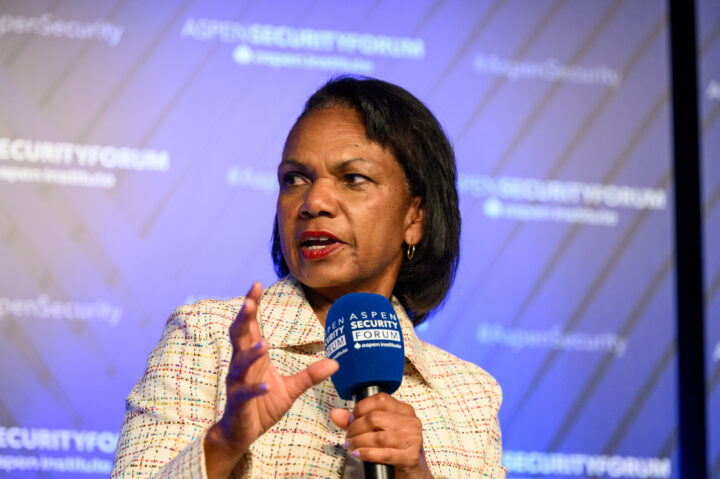
Former Secretary of State Condoleezza Rice speaks at the Aspen Security Forum on July 17, 2025.
ASPEN, Colo. — Former Secretary of State Condoleezza Rice said Thursday at the Aspen Security Forum that the U.S. should work to exploit frictions between Iran, Russia, China and North Korea, to interfere with their deepening alliances.
Rice suggested that, rather than trying to disrupt links between Iran and other adversaries, the U.S. should “slam them together” because “they actually have very little in common and they actually have a lot of problems between them.”
“Nobody could feel very good right now in their alliance about the Iranian situation,” Rice said, emphasizing that Russia had declined to provide any military backing to Iran after it was attacked by Israel and the United States, and China is also trying to “keep their heads down.”
“I’ve thought this alliance is somewhat weaker than we sometimes would give it credit for, and I’d slam them together and make them deal with their own internal contradictions,” Rice reiterated.
The former Biden administration official said that the Israel-Hamas war 'could have stopped multiple times if Hamas stopped the war and released hostages — multiple, multiple times'
Aspen Security Forum
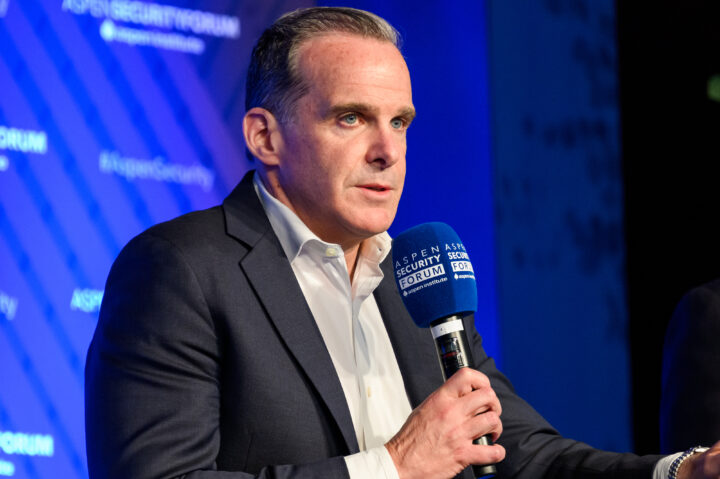
Former national security official Brett McGurk speaks at the Aspen Security Forum on July 16, 2025.
ASPEN, Colo. – Former U.S. and Israeli officials speaking at the Aspen Security Forum on Wednesday emphasized that Hamas bears responsibility for the failure of hostage release and ceasefire talks, and discussed the possible paths to ending the war in Gaza.
Brett McGurk, the top National Security Council official responsible for the Middle East under the Biden administration, argued on Wednesday that the history of ceasefire talks between Israel and Hamas “is being rewritten by people that weren’t involved in this.”
He emphasized that Hamas repeatedly ignored and rejected proposals that fulfilled many of its demands over the course of the last year, arguing that Israel’s attacks on Hezbollah had helped force Hamas’ hand to a temporary ceasefire deal that went into effect in early 2025.
“The moral toll of this awful situation tears at the soul of anyone who’s worked on this, anyone,” McGurk said. “But this war could have stopped multiple times if Hamas stopped the war and released hostages — multiple, multiple times.”
He said that, to this day, the “fundamental issue” is that the pressure for the deal has been on Israel, with “no pressure on Hamas.” He said the group has “not budged” on its demand to be allowed to remain in power in exchange for the release of hostages.
“Hamas started the war on Oct. 7, this panel is about Israel, but the enemies of Israel have agency,” McGurk said, emphasizing that Hamas made a choice to start the war, joined by Hezbollah and various Iranian proxies, in addition to Iran itself.
McGurk said he believes that if both sides accept the current U.S.-sponsored proposal to pause the war for 60 days while negotiating a permanent ceasefire, the war would end.
Former Israeli Ambassador to the U.S. Michael Herzog said that Israel “never developed a coherent plan [of] alternatives to Hamas.”
Herzog argued that Israel needs to propose an end to the war in exchange for the release of hostages, and that Hamas can be dealt with again at a later point while Israel focuses in the short term on Iran, normalization with Arab countries in the region and beginning to heal its own people and society.
Herzog framed the ceasefire deal with Hezbollah as a potentially successful model.
Former IDF Intelligence Directorate head Amos Yadlin said that the Gaza war is the “most justified war ever; however, at this moment, continuing the war is not serving Israeli interests.”
He said Israel should agree to end the war in exchange for a one-time release of all remaining hostages and the exile of some Hamas leaders, and work to bring in Arab partners to demilitarize the territory, with the understanding that Israel will continue to attack Hamas forces that reemerge as it has done with Hezbollah in Lebanon. Even if some Hamas forces remain, he said, they will not have the strength or capabilities they did before the war.
Yadlin also emphasized that Hamas leaders are to blame for the civilian casualties in Gaza, since they could have ended the war by releasing the hostages at any time.
Author and “Call Me Back” podcast host Dan Senor noted that Israel’s military was ill-prepared for the kind of extended, grinding, close-to-home war it is fighting in Gaza, and described the challenges of Hamas’ diversion of humanitarian aid and hostage-taking as unprecedented. And, he said, fear of Hamas has hampered efforts to cultivate alternative civilian leadership in Gaza.
“I think the idea that we could have a permanent ceasefire would only work if Israel would agree for Hamas to stay in Gaza and … in terms of the objectives of war, there is no world in which Israel can agree to Hamas staying in power in Gaza,” Senor said.
Pushing back on the comparisons between a potential Hamas deal and the Hezbollah ceasefire, Senor noted that in Lebanon, the Lebanese government and Lebanese Armed Forces provide a domestic counterweight to Hezbollah able to enforce demilitarization. In Gaza, no Arab states have stepped forward to carry out governance and demilitarization.
At the same time, Senor said that President Donald Trump’s proposal of mass relocation of the Palestinian population is not a realistic solution. He added that Israel will need a substantial buffer zone between its population in the south and the population in Gaza to feel safe in returning people to communities close to the Gaza border.
Yadlin pushed back, arguing that the relocation threat would provide Arab states the necessary motivation to become directly involved.
Yadlin added that Trump’s work to cultivate investments from the Gulf in combination with the strikes on Iran have shown the American people that the Middle East does not have to only be a region of loss and suffering, but one that has real promise.
Asked if Israel and the United States’ quick and devastating military campaign against Iran was a signal that the world had overestimated the threat from Iran, the panelists argued that was not the case. Instead, they said, many had underestimated Israel’s own capabilities and preparations, and the destruction of Iran’s proxies significantly undermined Iran’s ability to threaten Israel.
“You have to remember that Israel has prepared this war for decades, for many, many years, especially the last few months, but for decades,” he said.
McGurk added that the U.S. and Israeli interceptions of missiles fired during Iran’s October 2024 attack on Israel and Israel’s subsequent destruction of Iran’s air defense systems under the Biden administration set the stage for last month’s strikes, which he characterized as the result of close coordination across multiple administrations for years.
Looking ahead, Herzog said that there are not yet clear answers on the extent to which Iran maintains nuclear capabilities, but said that the strikes’ impact on Iran’s decision-making is also critical: whether it will race to a nuclear device to protect itself or — as Herzog said he believes — it is deterred and will move slowly and carefully if it attempts to resume its nuclear program.
He said there are two paths ahead: a new nuclear deal, including no enrichment and with intrusive inspections, which is nevertheless controversial in Israel because it would provide Iran with sanctions relief to rebuild its capabilities, or Israel’s continued use of force, which brings its own set of questions and challenges.
Herzog also said he’s hopeful that the strikes have deepened the divide between the Iranian regime and the Iranian people.
Yadlin similarly argued that the timetable for Iran’s nuclear program is less important than what kind of agreement can now be reached.
He said that the attacks had disproven Iran’s key calculus about its nuclear program: that Israel had the will but not the capabilities to do significant damage to the program, and that the U.S. had the capabilities but not the will.
McGurk and Herzog both spoke about the initial hours of the Oct. 7, 2023, attacks on Israel and their perspectives as the situation developed. Herzog, who was serving as the Israeli envoy in Washington at the time, said he received a call shortly after the onset of the attacks on Israel from a senior general shouting, “Mike, this is war, it’s not another round. It’s a war.”
McGurk said that Herzog had informed him about the attack, relaying along that same message: “It’s a massive attack, this is war.”
Herzog described McGurk, who has remained one of the most vocally pro-Israel members of President Joe Biden’s team since leaving office, as “the best partner that I could wish for,” adding that the then-White House official immediately offered full U.S. support for Israel.
McGurk emphasized that, early in the war, there were significant fears that Hezbollah and other Iranian proxies, or even Iran itself, would also mobilize against Israel, which would constitute an “existential threat.”
He recounted a call between Biden and Israeli Prime Minister Benjamin Netanyahu in the first days of the war. “Netanyahu said, ‘Joe, we’re in the Middle East, and in the Middle East, if you’re weak, you’re roadkill.’ Everybody sharpened their knives, and that’s what was happening,” McGurk said.
He said that intelligence showed early signs Hezbollah was preparing a ground invasion, and that Israeli and American officials had intensively discussed the possibility of a preemptive, Israeli attack in Lebanon, ultimately deciding against it due to Hezbollah’s strength at the time and Israel’s need to focus on Gaza. McGurk said he still believes that was the right decision.
McGurk, seen as one of the strongest champions in the Biden administration for the expansion of the Abraham Accords to include Saudi Arabia, said he’d been in discussion on Oct. 6 with visiting Saudi and other Middle Eastern leaders about “some things that were potentially going to be quite positive over the coming six months a year.”
He also pushed back on narratives from critics that the normalization efforts were a “white whale” that the U.S. chased in spite of reality. Instead, he said, the talks began because the Israelis and Saudis both approached the U.S. and asked them to mediate. He said the constant media leaks about the talks had hampered the process, and that they should have been conducted more privately.
“I think ultimately it will happen,” McGurk said. “What knocked it off was Hamas.”
Addressing the global spread of antisemitism and anti-Israel sentiment, Herzog said that “we [Israel] should do a better job” of pushing back on anti-Israel narratives, describing the public and diplomatic debate as an additional front in the war Israel is fighting.
Senor added that the Oct. 7 attack “brought something to the surface that was not about the way Israel should operate in Gaza,” appearing to be a “trigger moment for trying to drive Jews underground” in a way he had not expected.
Looking particularly at college campuses, Senor urged Jews to turn to alternative schools than the higher education institutions where they have faced harassment and discrimination, and to invest in those institutions rather than the ones that have not served them well in recent years.
Wally Adeyemo said that failing to properly invest in infrastructure in Gaza will empower extremist groups
Aspen Security Forum
Former Deputy Treasury Secretary Wally Adeyemo speaks at the Aspen Security Forum on July 16, 2025.
ASPEN, Colo. — Former Deputy Treasury Secretary Wally Adeyemo argued at the Aspen Security Forum on Wednesday that post-war reconstruction of Gaza will require new tools, methods and partners.
Adeyemo, who served in the Biden administration, said that a lasting solution will require a political settlement that provides the Palestinians with “some type of self-determination” and ensures Israeli security, but that some level of reconstruction and stability will need to precede both of those things. He said one estimate placed the cost of a reconstruction effort at $50 billion.
“We’re going to need to think about this differently with new tools, in new ways, because the thing that you want to do, not just in Gaza, but as we think about reconstruction differently, is we want it to be reconstruction that’s creating economic opportunity in the places that we are reconstructing,” Adeyemo said.
He said that will require a coalition, including new countries as well as private sector partners, because some of the actors involved in previous reconstruction efforts in Gaza have less of an appetite to spend money on the effort than they have in the past. International donors, led by Qatar, pledged upwards of $5 billion for the reconstruction of Gaza following the 2014 war with Israel.
Adeyemo added that it’s crucial that the reconstruction leads to a stable economy in which civilians aren’t reliant on extremist groups. He offered as an example that in prewar Gaza, obtaining fuel for an air conditioning unit required a relationship with Hamas and paying taxes to the terror group.
“Fundamentally, that was because of underinvestment in infrastructure,” Adeyemo said. “So as we think about infrastructure, I think the thing that you will want to think about in postconflict areas, Gaza or others, is, how do you do it in a way that not only restores basic infrastructure and basic equipment, but actually thinks about long term economic development in these areas?”
The co-chair of the Aspen Security Forum, a member of Biden’s national security team, noted Israel’s ‘extraordinary’ military successes
Aspen Security Forum
Former U.S. Ambassador to China Nicholas Burns speaks at the Aspen Security Forum on July 15, 2025.
Former U.S. Ambassador to China Nicholas Burns said at the Aspen Security Forum on Wednesday that Israel is now in the strongest geopolitical position in its history following the seismic changes throughout the Middle East that have taken place in the past two years.
Burns is a co-chair of the Aspen Security Forum and was a top member of President Joe Biden’s national security team.
“Israel is in such an extraordinary position. … Think about Israel being born, created May 14, 1948, besieged over decades by attacks and enmity from all of its Arab neighbors, now the strongest country in the Middle East,” Burns said as he opened the forum’s second day of events. “Israel’s in the strongest geopolitical position it’s ever been in, after the extraordinary events in Lebanon, in Gaza, in Iran, in Syria over the last two years.”
In his opening remarks at the conference the day prior, Burns said that Iran is “in its weakest strategic position since the Iranian revolution.”
“Consider the impact these turbulent series of events of the last few years have had on Yemen and on poor Lebanon, which is searching for true stability and independence, on the people of Syria. Consider the impact on the people of Gaza and the desperate situation that the people in Gaza are suffering right now,” Burns added.
Plus, antisemitism inside the American Psychological Association
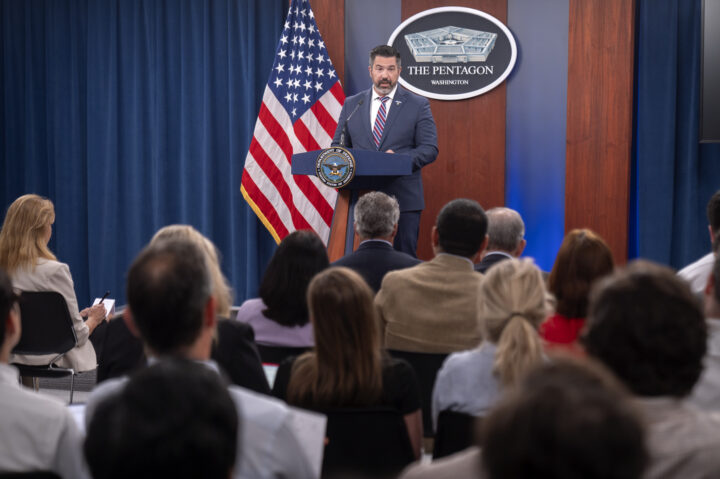
AP Photo/Mark Schiefelbein
Pentagon spokesman Sean Parnell speaks during a press briefing at the Pentagon, Wednesday, July 2, 2025, in Washington.
Good Tuesday morning.
In today’s Daily Kickoff, we preview the Aspen Security Forum, which begins today, and report on concerns from Jewish members of the American Psychological Association over the group’s approach to antisemitism and Israel. We report on the backlash facing Rep. Jerry Nadler over his support for New York City Democratic mayoral candidate Zohran Mamdani, and do a deep dive into Georgetown administrators’ handling of antisemitism issues on campus and the school’s financial support from Qatar ahead of today’s congressional hearing on the topics. Also in today’s Daily Kickoff: Sen. Dave McCormick, Alex Edelman and Ron Dermer.
What We’re Watching
- The Aspen Security Forum kicks off tonight. More below.
- President Donald Trump is in Pittsburgh this afternoon for Sen. Dave McCormick’s (R-PA) inaugural Pennsylvania Energy and Innovation Summit. More below.
- In Washington, the House Education and Workforce Committee is holding a hearing this morning on campus antisemitism — with a specific focus on the drivers of antisemitism in higher education. Representatives from Georgetown University, the University of California, Berkeley and the City University of New York are slated to testify. More below.
- Elsewhere on the Hill, the Senate Foreign Relations Committee will hold its confirmation hearing this morning for former National Security Advisor Mike Waltz to be U.S. ambassador to the U.N. Waltz’s hearing comes two months after he was removed over a series of clashes with the Trump administration on policy as well as his role in “Signalgate.”
- Tonight, the Argentine Embassy in Washington is hosting an event commemorating the upcoming anniversary of the 1994 bombing of the AMIA Jewish community center in Buenos Aires. Rep. Brian Mast (R-FL), AMIA President Osvaldo Armoza and State Department officials are slated to speak.
- Today is the special election in Arizona’s 7th Congressional District, where Adelita Grijalva is the front-runner to succeed her father, Rep. Raúl Grijalva (D-AZ), who died earlier this year. Grijalva is facing off against former state Rep. Daniel Hernandez and Deja Foxx.
- In Israel, we’re keeping an eye on Prime Minister Benjamin Netanyahu’s coalition, following United Torah Judaism’s decision last night to both quit the government and leave the ruling coalition over the Haredi draft law. Netanyahu will have until tomorrow evening to convince the party to reverse course before the 48-hour long resignation process takes effect.
- In Tianjin, China, Iranian Foreign Minister Abbas Araghchi is holding talks with his counterparts from Moscow and Beijing on the sidelines of the Shanghai Cooperation Organisation summit.
What You Should Know
A QUICK WORD WITH JI’S Marc rod
The 2025 Aspen Security Forum kicks off today and finds itself unexpectedly thrust into the ideological fights gripping the administration.
The Defense Department announced Monday that it would be withdrawing numerous senior military and civilian officials who had been set to speak at the conference.
Pentagon spokesperson Sean Parnell told Jewish Insider: “Senior Department of Defense officials will no longer be participating at the Aspen Security Forum because their values do not align with the values of the DoD. The Department will remain strong in its focus to increase the lethality of our warfighters, revitalize the warrior ethos, and project ‘Peace Through Strength’ on the world stage. It is clear the ASF is not in alignment with these goals.” Spokesperson Kinglsey Wilson offered even more pointed criticism to right-leaning outlet Just the News, saying the conference “promotes the evil of globalism, disdain for our great country, and hatred for the President of the United States.”
It’s tough criticism of a forum that prides itself on bipartisanship and aims to foster cross-partisan dialogue and solution-making, even as those attributes are in short supply in today’s Washington. The forum said in a statement, “we will miss the participation of the Pentagon, but our invitations remain open. … The Aspen Security Forum remains committed to providing a platform for informed, non-partisan debate about the most important security challenges facing the world,” noting that voices across the political spectrum will be speaking this week.
Many had been hoping to hear Defense Intelligence Agency Director Lt. Gen. Jeffrey Kruse, who was originally scheduled for a panel discussing the evolution of warfare, speak about his agency’s leaked report suggesting the strikes on Iran’s nuclear facilities had minimal effects, but Kruse was among the speakers withdrawn by the Pentagon.
Among the administration speakers still scheduled to appear are hostage envoy Adam Boehler, speaking on Thursday, and Tom Barrack, the U.S. ambassador to Turkey and special envoy to Syria. Barrack will be speaking on a Friday panel about the Middle East alongside former CIA Director David Petraeus and former Deputy National Security Advisor Dina Powell McCormick.
Read the rest of ‘What You Should Know’ here, and please get in touch if you’ll be attending the Aspen Security Forum. JI’s senior congressional correspondent Marc Rod will be reporting from the gathering all week.
COGNITIVE DISSONANCE
The psychology of denial: American Psychological Association struggles to confront antisemitism in its ranks
Concerns about antisemitism in the field of psychology have followed the American Psychological Association since soon after the Oct. 7, 2023, Hamas terror attacks. With 172,000 members, it is the largest body dedicated to the study of psychology in the world. The issue has become a flashpoint again in the run-up to the APA’s flagship annual conference, which will be held next month in Denver and is set to feature several lectures — including some offering continuing education credit — that offer sharply anti-Israel narratives, Jewish Insider’s Gabby Deutch reports in a new investigation.
Exclusive psychology: Several leading Jewish psychologists told JI that the APA has repeatedly failed to respond to the concerns of its Jewish members, despite a stated commitment to promoting an “accessible, equitable and inclusive psychology that promotes human rights, fairness and dignity for all,” according to the organization’s diversity mission. They say the APA has avoided taking a stand against double standards and litmus tests applied to Jewish psychologists who are vilified for their support for Israel. Instead, the organization has been almost paralyzed in the aftermath of Oct. 7, seemingly afraid to take sides between the Jewish psychologists seeking support and an increasingly vocal contingent of anti-Israel voices in the field, some of whom have described Zionism as a pathology to root out.
JI is committed to covering antisemitism. Catch up by reading our investigations on what Jewish professionals face in the mental health field and in pediatric medicine. Got a tip? Email us.
NADLER’S NOD
Nadler faces blowback from Jewish leaders for his Mamdani outreach
Rep. Jerry Nadler (D-NY) is facing backlash from some Jewish community leaders over his efforts to boost Zohran Mamdani, the Democratic nominee for mayor of New York City whose fierce criticism of Israel and refusal to condemn calls to “globalize the intifada” have stoked accusations of antisemitism, Jewish Insider’s Matthew Kassel reports.
Details: Nadler, the dean of New York City’s congressional delegation and co-chair of the House Jewish Caucus, endorsed Mamdani shortly after his stunning upset over former New York Gov. Andrew Cuomo in last month’s primary, and he has been working behind the scenes to build support for the nominee within the Jewish community, sources told JI. The 78-year-old congressman organized a meeting on Monday between Mamdani and local Jewish elected officials, some of whom chose not to join because of Mamdani’s hostility toward Israel, according to one person familiar with the matter.
Dem divisions: The pro-Israel Democratic party group Democratic Majority for Israel issued a scathing statement on Monday criticizing the party’s progressive wing amid Mamdani’s refusal to condemn the “globalize the intifada” slogan and the North Carolina state party’s recent passage of several anti-Israel resolutions, including one endorsing an arms embargo against the Jewish state, Jewish Insider’s Emily Jacobs reports.
On the calendar: House Minority Leader Hakeem Jeffries (D-NY) is slated to meet with Mamdani this week to discuss an array of issues, including Mamdani’s defense of the “globalize the intifada” slogan.
EXCLUSIVE
Leading Jewish organizations, synagogues express alarm about antisemitism in teachers’ unions
Around 400 Jewish organizations and synagogues signed onto an Anti-Defamation League backed letter Monday expressing concern over the “growing level of antisemitic activity” within teachers’ unions, which recently escalated with the National Education Association’s adoption of a measure targeting the leading Jewish civil rights organization, Jewish Insider’s Haley Cohen has learned. Signatories include the American Jewish Committee, Jewish Federations of North America, Conference of Presidents of Major American Jewish Organizations, National Council of Jewish Women, Orthodox Union, Rabbinical Assembly and Union for Reform Judaism.
What they said: The letter, addressed to Rebecca Pringle, president of the NEA — the largest teachers’ union in the U.S. — comes on the heels of a measure passed last week by the association that bars the union from using any teaching materials from the ADL. “The ADL has been a national leader in anti-hate education in K-12 schools for decades and is widely recognized as one of the country’s foremost experts on antisemitism,” the letter states, raising concern that, “although the measure does not explicitly say so, we understand that much of the underlying concern prompting this resolution is directed at ADL’s Holocaust education materials.”
Hoyas in the hot seat: As Georgetown University’s interim president, Robert Groves, is set to be questioned about campus antisemitism on Tuesday morning by the House Education and Workforce Committee, the university is contending with several thorny issues centered around the Jesuit school’s Prince Alwaleed Bin Talal Center for Muslim-Christian Understanding, one of the country’s leading centers for Islamic and Middle Eastern studies, JI’s Haley Cohen reports.
KEYSTONE CONFAB
Trump, McCormick prepare for innovation summit in Pittsburgh

A who’s who of U.S. and Gulf officials and some of the world’s leading tech and energy investors are en route to Pittsburgh ahead of Sen. Dave McCormick’s (R-PA) first-ever innovation summit on Tuesday, where he and President Donald Trump will announce $70 billion in investments aimed at turning Pennsylvania into a hub for artificial intelligence and new energy technologies, Jewish Insider’s Emily Jacobs reports from Pittsburgh.
On the guest list: More than 60 CEOs and scores of top energy and AI investors are slated to be at the freshman senator’s inaugural Pennsylvania Energy and Innovation Summit at Carnegie Mellon University, home to one of the world’s most advanced AI programs. Among the CEOs expected to appear are BlackRock’s Larry Fink, Palantir’s Alex Karp, Bridgewater’s Nir Bar Dea, Anthropic’s Dario Amodei, Amazon Web Services’ Matt Garman, Bechtel’s Brendan Bechtel, Chevron’s Mike Wirth, GIC’s Lim Chow Kiat, Brookfield’s Bruce Flatt, CPP Investments’ John Graham, EQT’s Toby Rice and ExxonMobil’s Darren Woods. (McCormick’s wife, Dina Powell McCormick, is on the ExxonMobil board of directors.) Others on the guest list include Ruth Porat, Alphabet’s president and chief investment officer; Raj Agrawal, global head of real assets at KKR; and Khaldoon Khalifa Al Mubarak, managing director and group CEO of Mubadala Investment Company.
PODCAST PLAYBACK
Ron Dermer: Israeli opposition to 2015 nuclear deal led to U.S.-Israel strikes on Iran
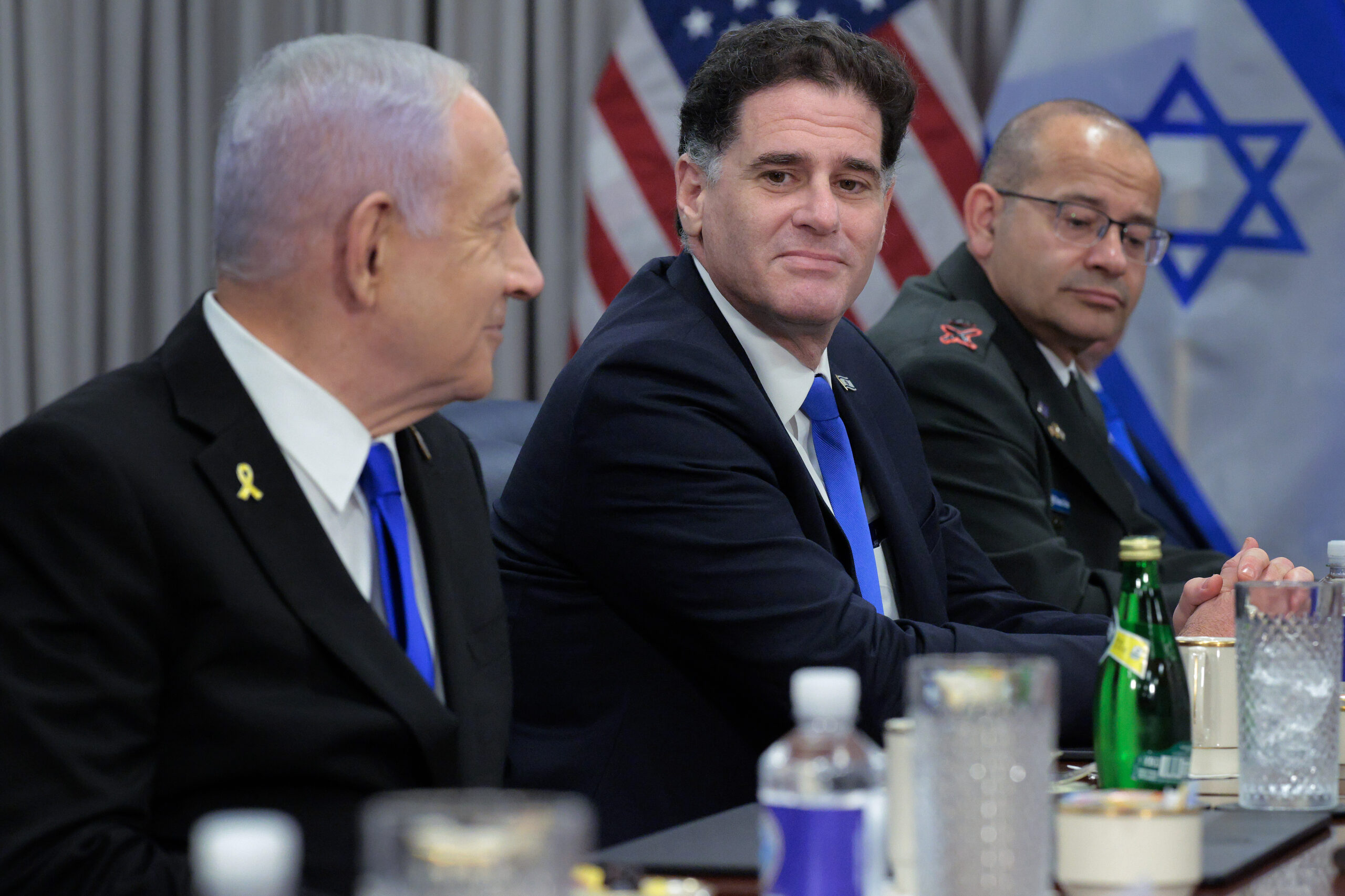
In a wide-ranging interview, Israeli Minister of Strategic Affairs Ron Dermer connected Israel’s strikes against Iran’s nuclear facilities with Israeli Prime Minister Benjamin Netanyahu’s opposition to the U.S.’ 2015 nuclear deal with Tehran, saying that President Donald Trump wouldn’t have pulled out of the deal during his first administration without that precedent, Jewish Insider’s Danielle Cohen-Kanik reports. “I believe that what Iran’s strategy was [before Oct. 7] is to surround Israel with this ring of fire,” including Hamas in Gaza, Hezbollah in Lebanon and militias in Syria and Iraq. “And this is another reason why I was so opposed to the nuclear deal that was done in 2015,” Dermer said in the first installment of his interview on Dan Senor’s “Call Me Back” podcast, which dropped on Monday.
Tracing it back: “And by the way, the attack [on Iran’s nuclear facilities] that happens now does not happen if Prime Minister Netanyahu doesn’t show up and confront that deal then. People don’t make the connection. I do, because I’ve lived it every day since then,” Dermer continued. “I don’t see Trump withdrawing if Netanyahu doesn’t take a stand, because no one’s going to be more Catholic than the pope, and no one’s going to be more pro-Israel than the prime minister of Israel.”
BUDEGET BLOCKS
House Appropriations Committee aims to leverage U.N. funding for UNRWA accountability

The House Appropriations Committee’s draft 2026 National Security, Department of State and Related Programs Appropriations bill, released on Monday, aims to leverage U.S. funding for the United Nations to secure accountability for United Nations Relief and Works Agency employees’ involvement in the Oct. 7, 2023, Hamas attacks on Israel, Jewish Insider’s Marc Rod reports. It also more broadly aims to enact cuts for the U.N. system, cutting all U.S. funding for the U.N.’s regular budget and barring funding for the U.N. Human Rights Council, including its commission of inquiry investigating Israel, the International Court of Justice and the International Criminal Court.
Concrete steps: The bill would ban any funding for the U.N. Secretariat, the arm of the U.N. led by the secretary-general responsible for daily management and operations matters, until several conditions relating to UNRWA accountability are met. The bill would hold the funds until the U.N. provides the State Department with a full and unredacted copy of the U.N.’s internal investigation into UNRWA affiliates’ involvement in the Oct. 7 attacks and until the findings of U.S. investigations into the situation are referred to the Department of Justice for appropriate criminal or civil action.
Exclusive: A bipartisan House bill set to be introduced on Tuesday aims to designate the Muslim Brotherhood as a terrorist organization, a step forward for an effort that gained steam following the terrorist attack in Boulder, Colo., targeting Jews advocating for the release of hostages in Gaza by a man who appeared to have expressed support for the group years earlier, Jewish Insider’s Marc Rod reports.
Worthy Reads
Digital Battleground: The New York Times’ Steven Lee Myers, Natan Odenheimer and Erika Solomon look at how Israel and Iran’s use of AI and deceptive social media posting during last month’s war between the countries has “ushered in” a new era of information warfare. “Over 12 days of attacks, Israel and Iran turned social media into a digital battlefield, using deception and falsehoods to try to sway the outcome even as they traded kinetic missile strikes that killed hundreds and roiled an already turbulent Middle East. … Iran, for example, sent alerts in Hebrew to thousands of Israeli mobile phones warning recipients to avoid bomb shelters because militants planned to infiltrate them and attack those inside, according to researchers and official statements. A network of accounts on X attributed to Israel spread messages in Persian trying to erode confidence in Iran’s government, including ones narrated by an A.I.-generated woman.” [NYTimes]
The MAGA Rebellion: NBC News’ Allan Smith looks at policy disagreements between President Donald Trump and the MAGA wing of the party, including commentator Tucker Carlson, who openly clashed with Trump over the White House’s approach to the Israel-Iran war. “Carlson was center stage among MAGA influencers arguing for the United States to stay out of Iran, a position that has gained popularity on the right as some right-wing influencers have increasingly viewed the U.S.-Israel alliance with skepticism. That stance is also informed by Trump’s having promoted similar anti-war and anti-interventionist views for years, even as he has used military force as president. Ultimately, Carlson said, the most important voice arguing the case to Trump for the U.S. bombing of Iran’s nuclear facilities was Israeli Prime Minister Benjamin Netanyahu. ‘Turns out a head of state of an important ally has a more compelling message than I do,’ he said. ‘That seems reasonable to me. I still disagree, but I don’t think it’s like Trump has changed his views entirely.’” [NBCNews]
No Direction Home: In The Atlantic, Guy Ben-Aharon considers the challenges of his identity as an Israeli pacifist both at home and abroad. “In Israel, I’m hated for opposing a war that many say they don’t support but still fight in, defend, or explain away as necessary. Abroad, I’m no longer welcome among those who say that all Israelis are colonizers. I’m too Israeli to be a victim and too resistant to be a patriot. I’m in exile, even when I’m at home. … My own relatives question whether I belong in Israel, because I criticize the troops in Gaza for the killing and starvation of Palestinians. Abroad, a theater colleague once told me to ‘go back to where you came from’ — that I don’t belong in the land where I was born but in the lands where my ancestors faced pogroms and the Holocaust. Nuance has no currency in a world addicted to absolutes.” [TheAtlantic]
Word on the Street
The Supreme Court ordered that the Trump administration be allowed to proceed with its efforts to enact mass layoffs at the Department of Education as part of its efforts to significantly downsize the department…
The Pentagon reached an agreement with ElonMusk’s xAI to use the company’s chatbot, Grok, as part of xAI’s new “Grok for Government”; the announcement by xAI of the deal, part of $200 million agreement, came days after the Grok chatbot sent a series of antisemitic and sexually explicit replies to X users…
The Hill reports on tensions between Secretary of State Marco Rubio and Ric Grenell, who is serving as a special presidential envoy, as the two attempted to negotiate separate agreements to free Americans being held in Venezuela…
Politico’s “West Wing Playbook” looks at Steve Davis’ departure from the Department of Governmental Efficiency, where he reportedly dispatched Josh Gruenbaum and two other aides to assess department staffers’ loyalty…
Rep. Mike Lawler (R-NY) is reportedly backing away from plans to mount a gubernatorial challenge to New York Gov. Kathy Hochul…
Former New York Gov. Andrew Cuomo announced he would continue his bid to become mayor of New York City, following his 12-point loss last month to Zohran Mamdani; Cuomo pledged to drop out of the race by mid-September if polls indicated that he was not the highest-ranked challenger to the Queens assemblymember, and called on other candidates to do the same…
Inside Higher Ed looks at how universities are increasingly hiring staff to oversee compliance with Title VI of the Civil Rights Act following a crackdown by the Trump administration on dozens of campuses over alleged violations…
Alex Edelman will perform his new show, “What Are You Going to Do,” at the New York Comedy Festival at Carnegie Hall in November; the show is a follow-up to his award-winning “Just For Us” one-man play about attending a white supremacist gathering…
Hungarian low-cost carrier Wizz Air will end its operations at Abu Dhabi’s Zayed International Airport, effective Sept. 1; the airline’s CEO, József Váradi, cited “supply chain constraints, geopolitical instability, and limited market access” as factors that contributed to the decision, which was announced weeks after the Israel-Iran war caused travel disruptions across the region…
The Shin Bet confirmed that the Hamas terrorist who held British Israeli hostage Emily Damari captive was killed last month in an airstrike…
The IDF struck Syrian military vehicles operating in southern Syria, amid clashes between Syrian government forces and local Druze communities…
Attorney Danielle Sassoon, who previously served as U.S. attorney for the Southern District of New York, is joining the Manhattan Institute as a senior fellow; Sassoon resigned from her position weeks after being appointed to avoid carrying out a directive from the Justice Department to drop corruption charges against New York City Mayor Eric Adams…
Israeli-American writer Sol Stern died at 89…
Song of the Day

Edan Golan recently released the music video for her single “You & I.”
Birthdays
Israeli actor, he played Boaz in Season 1 of “Fauda,” Tomer Kapon turns 40…
President and chairman of the board of the Annenberg Foundation, Wallis Annenberg turns 86… Member of the British House of Lords, he is a professor, medical doctor, scientist, television anchor and Labour Party politician, Baron Robert Maurice Lipson Winston turns 85… Israeli composer and conductor, he composed and conducted the winning entry at the 1979 Eurovision Song Contest, Kobi Oshrat turns 81… Professional sports bettor and poker player, he is a four-time winner of World Series of Poker bracelets, Mickey Appleman turns 80… Physician and life fellow of the American Psychiatric Association, Dr. David Harris Lippman… Rosh Yeshiva of Beth Medrash Govoha in Lakewood, N.J., one of the largest yeshivas in the world with more than 10,000 students, Rabbi Dovid Schustal turns 78… Longtime congresswoman from Florida for 30 years until 2019, Ileana Ros-Lehtinen turns 73… EVP at the Aspen Institute responsible for policy programs and its international partners, Elliot Gerson… Israel’s ambassador to the U.S. from 2021 until this past January, Michael (Mike) Herzog turns 73… Retired California-based appellate attorney, Feris M. Greenberger… Executive director of Friends of OU Israel, Miriam Baron (Mimi) Jankovits… Immediate past board chair of The Jewish Federations of North America, Julie Beren Platt… Professor at the UCLA School of Law, Richard Harold Steinberg turns 65… Former political news director at Bloomberg, Jodi Schneider… Member of Congress (D-RI) until 2023, his mother is Sabra née Peskin, David Nicola Cicilline turns 64… Anchorage-based attorney, a member of the Alaska House of Representatives since 2012, Andrew Lewis “Andy” Josephson turns 61… Former U.K. Labour Party MP including three years as foreign secretary, now CEO of NYC-based International Rescue Committee, David Miliband turns 60… Co-founder and chief investment officer of Toronto-based EdgeStone Capital Partners, Gilbert S. Palter… Israeli actress and singer, she is the 1991 and 1998 winner of the Ophir Award for best actress, Dafna Rechter turns 60… Senior advisor at investment bank Greif & Co., he was the CFO of Jewish Family Service of Los Angeles, David S. Felman… Senior business development representative at Atera, Sam Kalmowicz… Senior correspondent at New York magazine, she is a co-author of Notorious RBG: The Life and Times of Ruth Bader Ginsburg, Irin Carmon turns 42… Filmmaker and co-founder of the Square Peg film production company, Ari Aster turns 39… Managing editor of the U.S. deals team at Bloomberg, Liana Balinsky-Baker… Former deputy assistant secretary for travel and tourism at the U.S. Department of Commerce, now CEO of the FIFA World Cup 26 NYNJ host committee, Alexander Lasry turns 38… VP of Israel Action and Addressing Antisemitism Program at Hillel International, Jonathan Steven (“Jon”) Falk… Director of news experimentation at Southern California Public Radio until last year, Ariel Zirulnick… Senior NFL reporter at Yahoo Sports, she is also the author of a biography of a Holocaust survivor, Jori Epstein…
Pentagon spokesperson Sean Parnell told JI: 'Senior Department of Defense officials will no longer be participating at the Aspen Security Forum because their values do not align with the values of the DoD.'
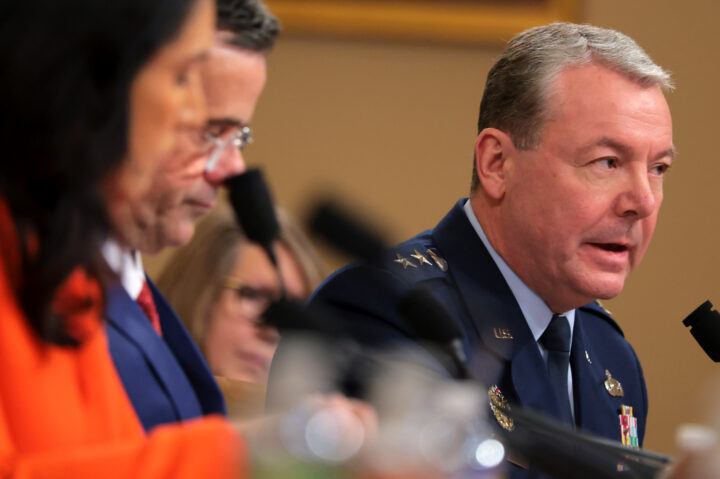
Kayla Bartkowski/Getty Images
Defense Intelligence Agency Director Jeffrey Kruse testifies during an annual worldwide threats assessment hearing at the Longworth House Office Building on March 26, 2025 in Washington, DC.
The 2025 Aspen Security Forum kicks off today and finds itself unexpectedly thrust into the ideological fights gripping the administration.
The Defense Department announced Monday that it would be withdrawing numerous senior military and civilian officials who had been set to speak at the conference.
Pentagon spokesperson Sean Parnell told Jewish Insider: “Senior Department of Defense officials will no longer be participating at the Aspen Security Forum because their values do not align with the values of the DoD. The Department will remain strong in its focus to increase the lethality of our warfighters, revitalize the warrior ethos, and project ‘Peace Through Strength’ on the world stage. It is clear the ASF is not in alignment with these goals.” Spokesperson Kinglsey Wilson offered even more pointed criticism to right-leaning outlet Just the News, saying the conference “promotes the evil of globalism, disdain for our great country, and hatred for the President of the United States.”
It’s tough criticism of a forum that prides itself on bipartisanship and aims to foster cross-partisan dialogue and solution-making, even as those attributes are in short supply in today’s Washington. The forum said in a statement, “we will miss the participation of the Pentagon, but our invitations remain open. … The Aspen Security Forum remains committed to providing a platform for informed, non-partisan debate about the most important security challenges facing the world,” noting that voices across the political spectrum will be speaking this week.
Many had been hoping to hear Defense Intelligence Agency Director Lt. Gen. Jeffrey Kruse, who was originally scheduled for a panel discussing the evolution of warfare, speak about his agency’s leaked report suggesting the strikes on Iran’s nuclear facilities had minimal effects, but Kruse was among the speakers withdrawn by the Pentagon.
Among the administration speakers still scheduled to appear are hostage envoy Adam Boehler, speaking on Thursday, and Tom Barrack, the U.S. ambassador to Turkey and special envoy to Syria. Barrack will be speaking on a Friday panel about the Middle East alongside former CIA Director David Petraeus and former Deputy National Security Advisor Dina Powell McCormick.
Wednesday’s Israel-focused panel will feature former IDF Intelligence Chief Amos Yadlin, former Israeli Ambassador to the U.S. Michael Herzog, former Biden administration official Brett McGurk and author and “Call Me Back” podcast host Dan Senor.
An Iran-focused panel on Thursday will include former U.S. National Security Advisor Stephen Hadley, former CEO of the Bulletin of Atomic Scientists Rachel Bronson and Johns Hopkins professor Vali Nasr.
There’s likely to be plenty of discussion throughout the week about the ways the Trump administration’s strikes on Iran will shape policy in the Middle East — and throughout the world — going forward, and about the ongoing impacts of the war in Gaza.
Former National Security Advisor Jake Sullivan will be speaking on Friday on a panel with former Secretary of State Condoleezza Rice and former Defense Secretary Robert Gates.
Former Defense Secretary Mark Esper and former Homeland Security Secretary Jeh Johnson will also be speaking Friday, on AI and cybersecurity issues, respectively. Former Deputy Treasury Secretary Wally Adeyemo will speak on Thursday about international aid and trade.
Sens. Chris Coons (D-DE), John Cornyn (R-TX) and Mark Warner (D-VA) will lead the conference’s annual “View from the Senate” panel on Friday.
We’ll be keeping an ear out for discussion about the internal debates between hawks and isolationists taking place within the Trump administration over America’s role and engagement in key global arenas — from the Middle East to Ukraine and Asia. We’ll also be tracking proposed efforts to restructure the U.S. intelligence community.
Expect a significant focus throughout the week on the many ways that the Trump administration’s unpredictable foreign policy — from its recommitment to providing Ukraine military aid to the status of tariffs against key countries, along with the recent, sweeping cuts to the State Department and U.S. Agency for International Development — is shaking up global affairs, how the private sector and foreign countries are adapting and how leaders can attempt to maintain bipartisanship on foreign policy.
Please log in if you already have a subscription, or subscribe to access the latest updates.
 Continue with Google
 Continue with Apple