
































































Gulf states need to take the lead, negotiate with Iran over Strait of Hormuz, Murphy says
Sen. Chris Murphy said that the U.S. could no longer guarantee regional security, but that might have a ‘silver lining’ by obligating the Gulf states to negotiate directly with Iran

Jemal Countess/Getty Images for Fair Share America
Sen. Chris Murphy (D-CT) speaks at the U.S. Capitol on April 10, 2025 in Washington, DC.


 Add JewishInsider on Google
ASPEN, Colo. — Sen. Chris Murphy (D-CT) argued on a panel at the Aspen Security Forum on Thursday that the war with Iran had irreparably damaged the U.S.’ reputation and capacity in the Middle East, and that Gulf states would now need to take the lead and negotiate with Iran over the region’s future.
The U.S. has been “effectively eliminated as a security guarantor for our allies” because of what he described as a failed military campaign against Iran, Murphy argued.
“You can make an argument that that could be a long-term silver lining, that the Gulf states will have to sit down and negotiate, at the beginning, the question over the Strait of Hormuz and maybe another set of factors, and in those negotiations, that might be the new reality in the Middle East,” he said.
“Maybe in that conversation with the U.S. not in the lead, but as a partner, there is a solution to the ultimate Iranian control of the strait, but it’s admittedly very hard to answer that question right now,” Murphy continued.
He said that the current state of play suggests that an emboldened, enriched Iran with control of the Strait of Hormuz “seems to be the best-case endgame” and “that is why our allies and friends in the region are questioning whether there is any way the United States can ever secure them.”
Some allies, he acknowledged, want to see the U.S. “finish the job” in Iran, but argued that that’s an unclear and undefined goal that in some cases might involve committing U.S. ground forces.
Asked by moderator Jim Scuitto, a CNN correspondent, how a future Democratic president would approach the situation assuming the current status quo persists through 2028, Murphy said that is “kind of an impossible question,” adding that the U.S. would have to engage with its partners and Iran to try to secure freedom of transit in the Strait of Hormuz. Murphy himself is viewed as a potential presidential candidate.
He said that resolving the current standoff would likely require lifting sanctions and pressuring Israel to permanently end its war against Hezbollah in Lebanon.
Asked about the possibility of expanded U.S. strikes on Iranian oil infrastructure, as suggested earlier in the forum by former National Security Advisor Robert O’Brien, Murphy said that would only lead Iran to escalate further by ordering the Houthis to close the Bab el-Mandeb strait.
Iran, in Murphy’s framing, had “taken our best shot and survived” and realized it can use the Strait of Hormuz to increase its leverage at the negotiating table. He said that the current situation essentially removes any leverage the U.S. had in nuclear talks — having surrendered sanctions relief for the reopening of the Strait of Hormuz and showing that the U.S. military threat is not sufficient to bring down the regime.
As a result, he said that the U.S. would likely not be able to get a better deal than the Obama administration’s 2015 nuclear deal even if talks resumed.
Murphy characterized the war as a catastrophic, generational mistake — “the greatest foreign policy disaster of the last 20 years [and] one of the greatest mistakes any president has made in the world in our country’s history,” which left the U.S. looking “weak and feckless.”
He said that, as a result of the munitions expenditures in the war, the U.S. could not defend Taiwan from China today if it wanted to.
Robert Greenway, who led Middle East policy on the National Security Council during President Donald Trump’s first term, was the primary voice of optimism on the panel, arguing that despite some changing rhetoric, Trump’s objectives have been clear — dating back even to his first administration — and that there is “no question in my mind” that Iran’s capabilities have been significantly degraded.
“Their means and the opportunity to constitute a threat to U.S. vital interests and to global interests, as a matter of fact, are probably the lowest they have ever been since 1979. From the enrichment standpoint, they haven’t been at zero enrichment capacity since 2006,” Greenway said. “So, from an empirical perspective, I would say yes, progress has been made, and I think at this juncture, I would be pleased with that progress. And I don’t think there’s a lot left to be done to eliminate the remaining threat.
He argued that those who are concerned by Iran’s disruptions of the global economy should be supportive of the administration’s military campaign, arguing that Iran would only be more emboldened under a nuclear and missile umbrella.
“This is the most practical way to solve it. Diplomacy up to this point hasn’t prevailed, and it won’t as long as you have a disingenuous partner,” Greenway said. “Now, Iran cannot defend itself from any attack by the United States, or frankly, anyone else.”
Diplomacy, he reiterated, was a “failed approach” and he said military action is the “fastest” and “probably the only realistic way” to achieve the U.S.’ objectives.
He also said that definitively eliminating the threat from Iran would allow the U.S. to reduce its troop presence in the Middle East in the longer term. He said he doesn’t see any need for U.S. ground forces in Iran, arguing that the only potential uses for them would be for search and rescue operations or recovery of Iranian nuclear materials.
But with the nuclear materials currently buried and closely monitored, Greenway said, a ground infiltration to remove them isn’t necessary in the short term, though he said they should be removed from the country in the long term.
Countering Murphy, Greenway also said that many Middle East allies are privately supportive of continued U.S. military operations to finish the job, and are happy to see the threat of Iran reduced, though he acknowledged opinions vary.
Karim Sadjadpour, a senior fellow at the Carnegie Endowment for International Peace, disputed Murphy’s notion that the result of the war would remove the U.S. as a guarantor of regional security. He said that the Gulf countries understand that only the U.S. can protect them in the near term — China and Russia not being viable alternatives — and they still understand and fear Iran as a threat.
But he also acknowledged that, as a consequence of geography, Middle Eastern states will need to seek side deals with Iran to some extent.
Sadjadpour also emphasized that there will never be lasting stability in the Middle East until Iran is led by a government that actually represents the interests of the Iranian people — an aim he said the war did not advance.
“It is militarily weaker than it was four and a half months ago, but … psychologically it feels much stronger. It’s much more confident than it was four and a half months ago before the war,” Sadjadpour said. “I don’t think it’s going to give up its control of the strait anytime soon. I don’t think it’s going to make meaningful compromise anytime soon.”
He compared the current situation in Turkey to post-Soviet Russia — continuing to pursue its own security and destabilize its neighbors, and use energy and trade as a weapon.
He added that leaders in the U.S. often misunderstand Iran, comparing it either to Nazi Germany, an ideologically rigid regime that cannot be bargained with, or to China, ripe for grand bargain and rapprochement. Iran is most similar, he said, to the Soviet Union — not suicidal but not willing to place its economic and national interests above its revolutionary ideology except when faced with “almost existential” economic pressure.
With the Iranians appearing prepared to wait out the Trump administration, Sadjadpour continued, he doesn’t see a clear end to the current war.
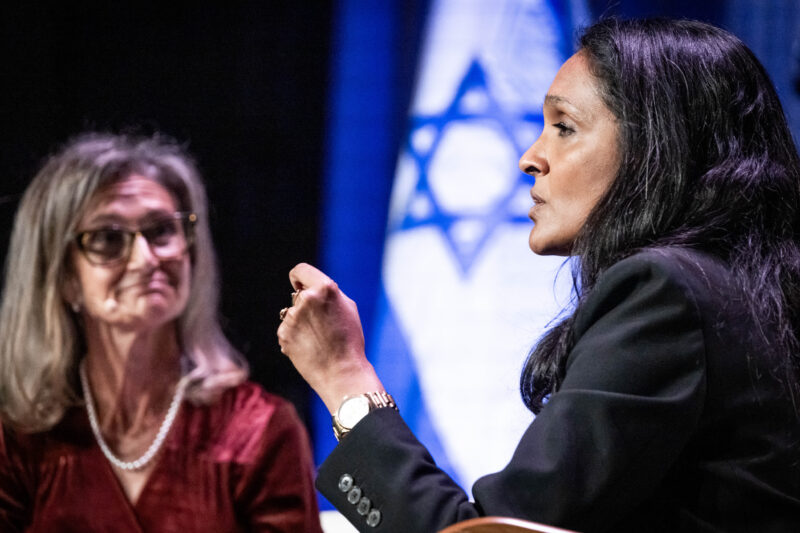
Roxana Saberi, a journalist and author with contacts inside Iran, said that most people in the country remain hopeful but were disappointed by the results of the war and the memorandum of understanding, which she said had demonstrably emboldened Iran to step up human rights abuses at home.
Among the anti-regime population in Iran, which she said constitutes 80% of the Iranian public, there are now three groups: those that opposed the war, those that supported it and want to see further strikes and those that have become numb to the situation and are simply trying to survive.
More Stories

BREAKING POINT
For some Jewish Democrats, Michigan’s debate was the ‘final straw’ for El-Sayed
meeting minutes
Huckabee met secretly with Netanyahu’s top rival, Gadi Eisenkot

GOING GLOBAL
Israeli, Lebanese leaders expressed interest in Michigan Senate race, Sen. Lankford says

PENSION POLITICS
Former NYC comptroller denounces Levine’s decision not to reinvest in Israeli bonds
DRAWING A LINE
British PM rules out partnership with Greens over ‘Zionism is racism’ motion
DIPLOMATIC PUSH
Miliband agrees to host international antisemitism meeting at urging of J7 Task Force
Please log in if you already have a subscription, or subscribe to access the latest updates.
 Continue with Google
 Continue with Apple