


























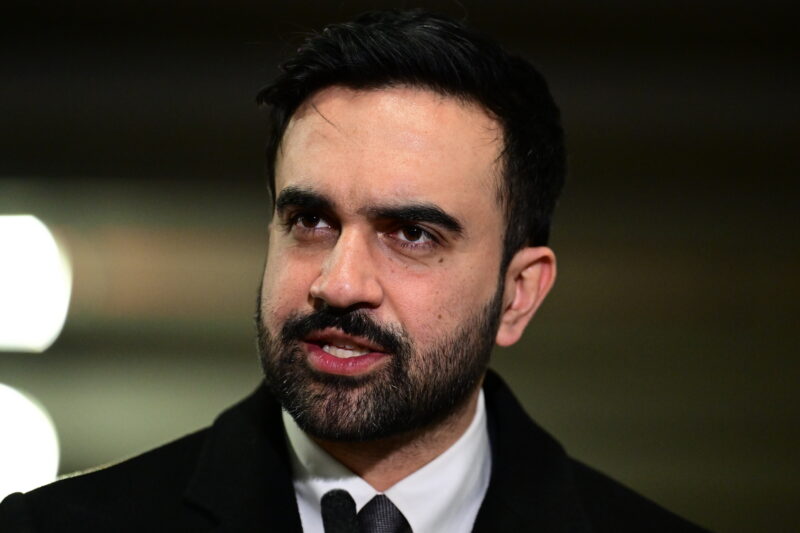











Analysts who spoke to JI last week said the deal could portend a more aggressive posture against Israel by Ankara and its ally in Damascus

Bonnie Cash/Getty Images
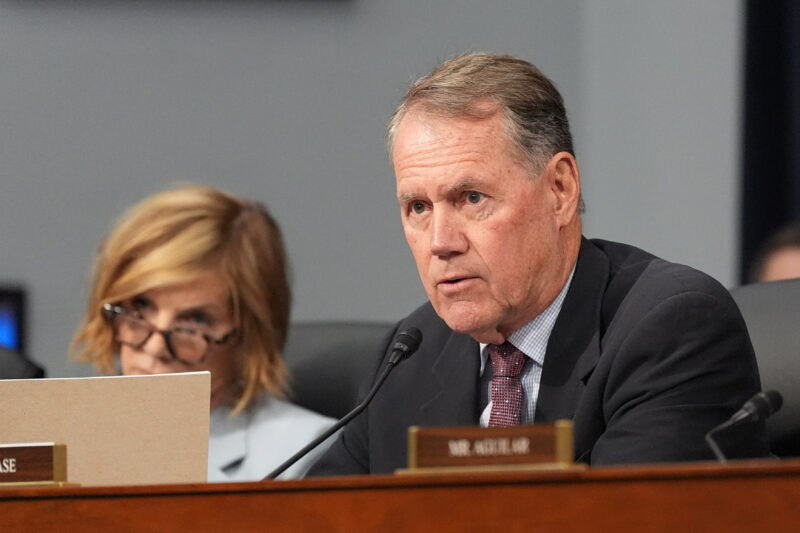
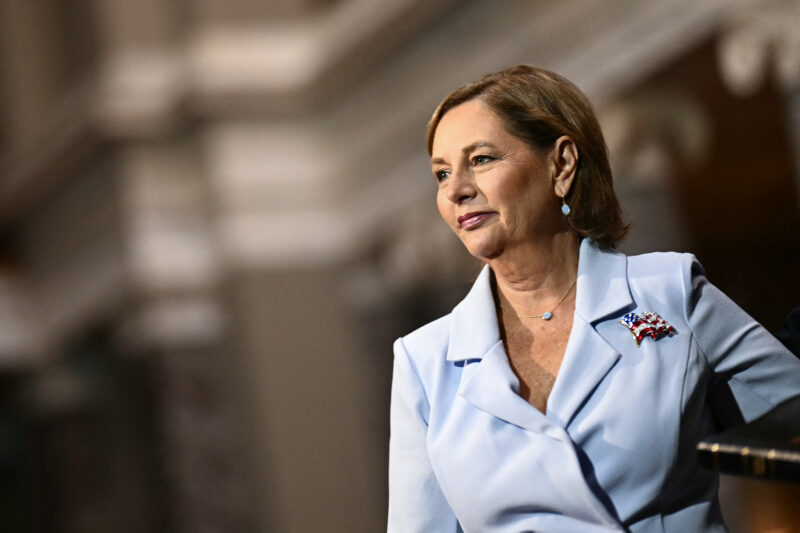
Rep. Joe Wilson (R-SC) looks on during a hearing to examine war crimes from Syria to Ukraine at the U.S. Capitol on July 10, 2024 in Washington, DC.


 Add JewishInsider on Google
Rep. Joe Wilson (R-SC) on Sunday praised the new mutual defense pact between Saudi Arabia, Turkey and Pakistan as an accomplishment by President Donald Trump.
“The mutual defense pact of Saudi Arabia, Türkiye, and Pakistan is another achievement of [Trump] promoting stability, peace, and prosperity in the Middle East,” Wilson, a vocal supporter of Israel who has also been strongly supportive of Turkey, said in a post on X. “With our prosperous Gulf allies, a liberated Syria, and Lebanese-Israeli negotiations, it is clear the murderous regime in Iran is isolated and the people of Iran can regain a new government worthy of Iran’s rich history.”
Wilson has been among the most prominent supporters on Capitol Hill of the new Syrian government, which is tied closely to Turkey’s own government.
The pact has been seen by many in pro-Israel circles as a sign that some of the U.S.’ Gulf allies are attempting to hedge against the U.S. and Israel, creating an alternative to the Abraham Accords and empowering those hostile to Israel.
There also has been no public reporting about Trump or the U.S. having been involved with the deal.
Multiple U.S. analysts told Jewish Insider last week that the agreement should be cause for concern for both the U.S. and Israel, and could portend a more aggressive posture against Israel by Ankara and its ally in Damascus.
Jewish groups have advocated for the Association of Jewish Psychologists to be recognized, as the organization has been under fire over its handling of antisemitism
Graeme Sloan/Sipa via AP Images
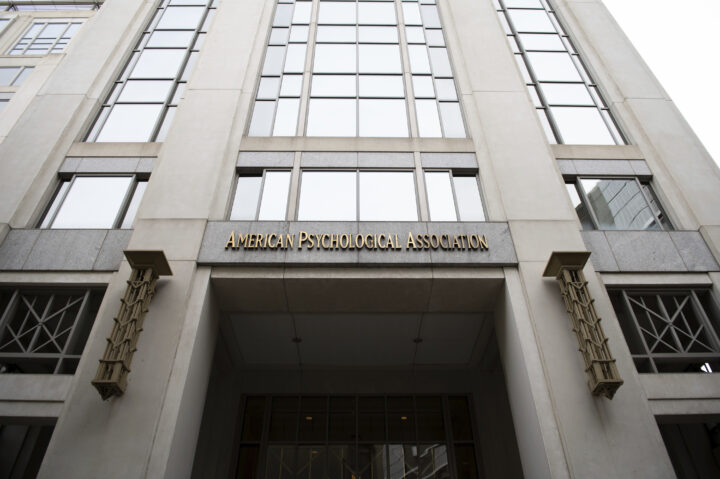
A general view of the American Psychological Association headquarters in Washington, D.C. on April 23, 2020.
The American Psychological Association delayed its vote on Friday to recognize the Association of Jewish Psychologists within its organization, marking the second time this year the organization has postponed the decision to recognize Jewish representation in the organization.
The APA has six official ethnic associations, representing Arab Americans, Black psychologists and Asian-Americans, among other minority groups. Proponents of the proposed Jewish group within the APA argue that Jewish psychologists deserve to be included as well, especially given the rise of antisemitism within the organization.
On Friday, the Anti-Defamation League and the American Jewish Medical Association condemned APA’s decision to postpone the vote again.
“This delay serves no apparent purpose. By denying Jewish psychologists the same representation afforded to other ethnic minority groups, APA is applying a double standard to Jewish identity and acting in direct contravention of APA’s own rules,” the ADL said in a statement.
“The American Jewish Medical Association is alarmed and disappointed by the decision of the APA Council to postpone voting to recognize the AJP as an EPA,” the group, which represents more than 3,000 Jewish medical professionals including psychologists, said in a statement.
The APA has struggled to confront antisemitism in its ranks following the Oct. 7, 2023 terrorist attacks in Israel and ensuing Israel-Hamas war.
The group’s conference last summer featured a panel that described Oct. 7 as attacks on “military targets.” More than 3,500 people signed on an open letter last year that demanded the organization act against what they described as “the serious and systemic problem of antisemitism/anti-Jewish hate” within the APA.
In February 2026, the APA Council of Representatives first voted to defer action on recognizing the Association of Jewish Psychologists within their organization, pushing back the decision to an August vote, despite support from a coalition of Jewish American organizations.
At the time, the APA stated that deferring the vote was meant to give council members time for thorough discussion and deliberation on how best to ensure all voices are heard. The Coalition of National Racial and Ethnic Psychological Associations has opposed the recognition of the Association of Jewish Psychologists as an EPA within the APA, claiming that conflating religion, race and ethnicity “obscures the role of racism,” that “the majority of Jewish Americans in the United States identify as white” and that “Jewish psychologists are not underrepresented within APA.”
A spokesperson for the APA told Jewish Insider that in June, the group’s board of directors endorsed the proposal by the Association of Jewish Psychologists to establish a formal affiliation with the APA Council of Representatives. The path to recognition as an officially recognized ethnic association has historically been a multi-year process for groups that make that request, according to the APA spokesperson.
“Jewish psychologists are a critical and valuable part of our council and our community,” said Wendi Williams, president of APA. “APA is committed to our Jewish members and to confronting antisemitism. We are already working to implement the concrete reforms the APA Board of Directors approved in June — including strengthening oversight, accountability, and member safety. These actions — and our continued commitment to eradicating antisemitism — are now and remain high priorities for the association. We will work diligently in the coming months to continue to advance this process and promote full inclusion of our Jewish members.”
“Professional organizations are strongest when they apply their own rules consistently and fairly,” said Shira Goodman, the ADL’s vice president of public affairs.
“Throughout this process, AJP’s application became entangled in political debates that had nothing to do with the APA’s criteria for Ethnic Psychological Association status. The Council’s responsibility was to evaluate eligibility under its bylaws — not to referee political disagreements or impose ideological litmus tests on a Jewish professional organization.”
Qatar applauded the gathering for its effort to ‘preserve [Jerusalem’s] Islamic and Christian identity’
Government of Qatar
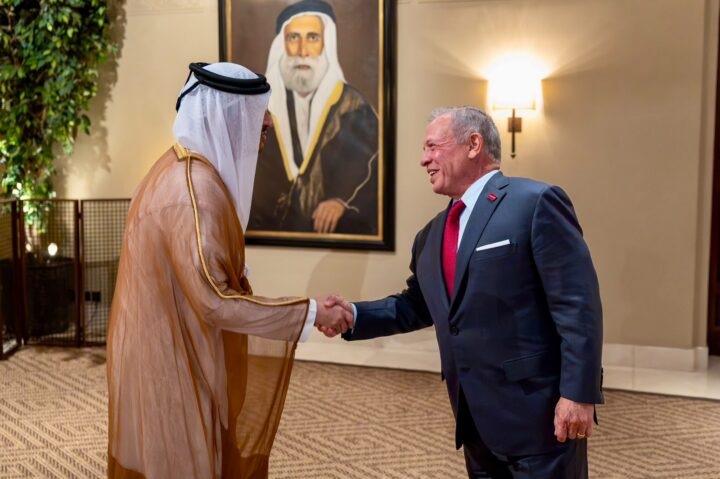
Qatari Prime Minister Sheikh Mohammed bin Abdulrahman Al Thani greets Jordanian King Abdullah at foreign ministers summit.
A coalition of foreign ministers from Arab and Muslim countries met in Jordan on Wednesday to launch a coordinated campaign against Israeli policies in Jerusalem — a gathering marked both by the notable absence of key regional players and rhetoric that dismissed Jewish ties to the city.
The meeting brought together diplomats from Jordan, Egypt, Saudi Arabia, Qatar, Algeria, Iraq, Tunisia, Somalia and Morocco, alongside representatives from the Arab League, Indonesia, Pakistan, Turkey and Malaysia. Missing from the Amman summit were several close U.S. allies including the United Arab Emirates, Bahrain and Kuwait.
In a joint statement, the group denounced what it called an “unprecedented Israeli escalation in occupied Jerusalem and its Islamic and Christian holy sites,” accusing Israel of trying to alter “the Arab Islamic and Christian identity of occupied Jerusalem and its legal and demographic status” — omitting any mention of Jewish historical or religious ties to the city.
The ministers also claimed that Israel “has no sovereignty” over east Jerusalem.
The statement accused Israel of discriminatory practices against Christians, including “restrictions on access to the Church of the Holy Sepulchre and the observance of religious rites therein; interference in the affairs of churches and restrictions imposed on their institutions and properties; and attacks targeting clergy, worshippers and religious symbols.”
The ministers also warned that “Israeli attacks against Islamic holy sites in occupied Jerusalem constitute a blatant provocation to the sentiments of around two billion Muslims worldwide, and push towards a religious conflict with repercussions that will extend beyond the region and threaten regional and international peace and security.”
To operationalize their response, the ministers announced a coordinated international campaign — including a dedicated media platform — to document alleged Israeli violations against holy sites with a plan to present them to international organizations.
Qatar’s Foreign Ministry lauded the meeting, where it said the countries discussed “the Israeli escalation in occupied Jerusalem, and the joint efforts to preserve its Islamic and Christian identity.”
Israel’s Foreign Ministry forcefully denounced the joint statement, noting its exclusion of Jewish ties to the city.
“The declaration endorsed by the Foreign Ministers of the Arab Ministerial Committee, convened by Jordan, is built on false accusations, historical distortions, and a complete disregard for the facts,” the ministry said.
“It is particularly cynical to accuse Israel of violating freedom of worship while declaring that the entire Temple Mount is a place of worship exclusively for Muslims, ignoring the Jewish people’s historic connection to Jerusalem and its holiest sites,” the statement continued. “Under Israeli sovereignty, Jerusalem, the eternal capital of the State of Israel, has never been more open and accessible to worshippers of all faiths. Israel remains committed to preserving freedom of worship, maintaining the status quo on the Temple Mount, and taking all necessary measures to ensure public order and the safety of all visitors.”
The FDD fellow, who said he was taught to hate Israel growing up in Iraq and Lebanon, spoke at a New York launch event for his book on why Arabs should reconsider their views on Israel

Lilya Espinosa, Soapbox Photography
Philanthropist Antoun Sehnaoui, Morgan Ortagus, former deputy U.S. special envoy to the Middle East and Hussain Abdul-Hussain at the launch of The Arab Case for Israel in Manhattan.
At a launch event for his book, The Arab Case for Israel, on Tuesday, writer and researcher Hussain Abdul-Hussain argued that the path to peace in the Middle East begins with Arabs reexamining long-held assumptions about Israel, drawing on his own transformation from believing anti-Israel propaganda to an advocate for the Jewish state.
Speaking days after Israel and Lebanon signed a U.S.-brokered framework agreement, Abdul-Hussain said the Lebanese people can follow in his footsteps, as the country remains divided between a faction that promotes the Iranian narrative that Israel “only understands the language of war and force,” and those seeking to reclaim the country’s sovereignty.
“The Lebanese have had their share of sacrifices for big powers. This started back in the 1960s. The Lebanese will stand up for sovereignty and independence. They’ve been thrown under the bus time and time again and this makes them always wary and they try not to stick their neck out… this is what’s keeping them back,” Abdul-Hussain said.
The invitation-only event for the book, published in February, was hosted by Antoun Sehnaoui, businessman and philanthropist, and Morgan Ortagus, former deputy U.S. special envoy to the Middle East, at the Mark Hotel on Manhattan’s Upper East Side.
Abdul-Hussain, a Shia Muslim raised in Iraq and Lebanon where he said he was taught to hate Israel and the West, is now a Washington-based research fellow at the Foundation for Defense of Democracies. The Arab Case for Israel chronicles his unusual journey away from holding anti-Israel views, detailing his argument for why all Arabs should do the same.
“My story is the story of an average person who was told something and when he dug up the story it turned out to be something else,” Abdul-Hussain told some 50 attendees — a mix of Jews, Christians and Muslims — at the event. “I was taught, like every other kid was taught, that Israel must disappear. And I believed it.”
“Over the course of my life, events pushed me to try to learn about Israel.” The biggest turning point, he recalled, was in 2000 while he was working as a reporter in Lebanon. “We covered the Israeli military pulling out of the south and that day I drove my car to the border, which at the time was just a flimsy wire so I could see Israelis,” said Abdul-Hussain. “I became really curious. At the time, I could get on the FM radio of the Israeli channels. If you were in Lebanon at the time, your sources on Israel were [staunch Israel critics] Edward Said, [Noam] Chomsky and [Norman] Finkelstein.”
After learning Hebrew, Abdul-Hussain said he “discovered everything they taught us about Jews — that they were scheming to kill every Arab Lebanese kid — was not true.
“It was a long journey and I decided this journey must be told for other Lebanese, Syrians and Moroccans to understand what they are being fed is not true. I make the case that even if you think Israel has caused you injustice, moving on is much better for your future and the future of your children and grandchildren,” he said.
As Hezbollah continues to oppose the framework agreement aimed at restoring sovereignty and establishing lasting peace, Abdul-Hussain called on Americans to support the efforts of Lebanese President Joseph Aoun to resist the terror group.
“One of the main criticisms against President Aoun and his government is that he’s talking the talk and not walking the walk,” said Abdul-Hussain. “I understand that. But the guy is going all the way against Hezbollah. He’s being vilified and taking a lot of heat. The last thing he needs is for someone like me to try to push him down. Even if he’s not walking the walk, talking the talk is good enough.”
He also called on the U.S. to implement a long-term policy of protecting religious minorities in the Middle East “to make sure that non-Muslim minorities do not vanish.”
“The pattern of minority shrinking is happening all over the place, except for one place, and that’s Israel,” he said. He pointed to Lebanon where lists of registered voters show that Christians are 35% of the population, whereas 20 years ago they made up about half of the population.
“The trends are not lying. This is bad for everyone. It’s bad for diversity,” Abdul-Hussain continued.
“We in the U.S. should send the message to minorities that we are with you, that we will not let [adversaries] come after you and that Israel is something to be proud of.”
The principal apologized to Arab, Lebanese, Muslim and Palestinian students who felt ‘unseen’ following an antisemitism program that used materials from the Blue Square Alliance Against Hate

Photo by Jeffrey Basinger/Newsday RM via Getty Images
School classroom.
A Massachusetts middle school principal apologized to Arab, Lebanese, Muslim and Palestinian students who he claimed “felt unseen” during a lesson on antisemitism.
The Lexington Observer, a local outlet, reported Thursday that Diamond Middle School Principal Johnny Cole was referring to a lesson on antisemitism and his apology was not about a lesson on the Holocaust, as originally interpreted by some Jewish leaders and parents.
Instead, Cole was referencing a lesson on modern antisemitism taught by a third-party Jewish group called TribeTalk. According to the outlet, a dozen families objected to the group using materials from the Blue Square Alliance Against Hate — an advocacy group founded by New England Patriots owner Robert Kraft, who is a supporter of Israel — prompting Cole’s letter. In a message sent to seventh graders via a school portal, a screenshot of which was obtained by Jewish Insider, Cole said the lesson was aimed at teaching the students to recognize hate and to speak out against it, something he called “an important goal.” Cole then apologized after he said some students’ families had expressed that the lesson left them feeling “unseen.”
“Some of you felt like your own history, your identity, or your community was left out or erased. Some of you left that session feeling less safe, not more. We have heard this from families, and we believe you,” Cole wrote.
“We are sorry. Not because the topic was too hard; hard conversations are part of growing up and part of what we do here at Diamond. We are sorry because every one of you deserves to walk into this school and feel that who you are matters — Arab students; Jewish students; Lebanese students; Muslim students; Palestinian students — every student. And in this case, we missed the mark and did not achieve what we hoped to do,” he added.
Cole said that the school was working with teachers and families to “build something better” that “includes all of our communities and all of our histories.”
Local Jewish organizations — some of which also initially thought the letter was referring to a Holocaust lesson — condemned the letter and sought dialogue with school leadership to address the community’s concerns. “We now understand that the letter itself — which, as written, was deeply disturbing and offensive to many members of our Jewish community — was in fact poorly worded and not reflective of the facts and context,” the JCRC said in a statement.
Scott Gladstone, associate director of the American Jewish Committee New England region, told JI he sent an email to Cole on Wednesday morning, offering to talk, and had not received a response as of Wednesday afternoon.
Samantha Joseph, Anti-Defamation League New England regional director told JI, “We’re aware of reports of a concerning response to a Holocaust education program in Lexington, and we’re in contact with community members about the situation.” The Lexington Public School District, which serves roughly 7,000 students across its nine schools, did not respond to requests for comment from JI.
A similar incident occurred earlier this month, according to Teagan Murtagh, an 8th grader at Diamond Middle School, who wrote in a letter to the editor in the Lexington Observer that he was stopped in the hallway by Cole and told not to wear a black sweatshirt printed with a four-line poem: “Save the bees. Plant more trees. Clean the seas. Punch Nazis.” Cole reportedly said some students had complained and felt “threatened” by the sweatshirt.
Last year, Jewish leaders in Massachusetts praised a new report and set of recommendations by The Massachusetts Special Commission on Combating Antisemitism that called for K-12 schools to implement the International Holocaust Remembrance Alliance’s working definition of antisemitism.
This story was updated on June 29 to reflect the lesson’s contents on antisemitism, per The Lexington Observer‘s report.
The report noted a sharp rise of antisemitism in the state’s K-12 schools since the Oct. 7, 2023, Hamas attacks on Israel and acknowledges that there has been significant harm to the mental health of Jewish and Israeli students and families caused by antisemitic incidents. It also noted inconsistencies in how districts respond to concerns around antisemitism, with some responding inadequately and others failing to respond at all.
Both lawmakers are vocal supporters of Israel and engage on Middle East policy
PMO
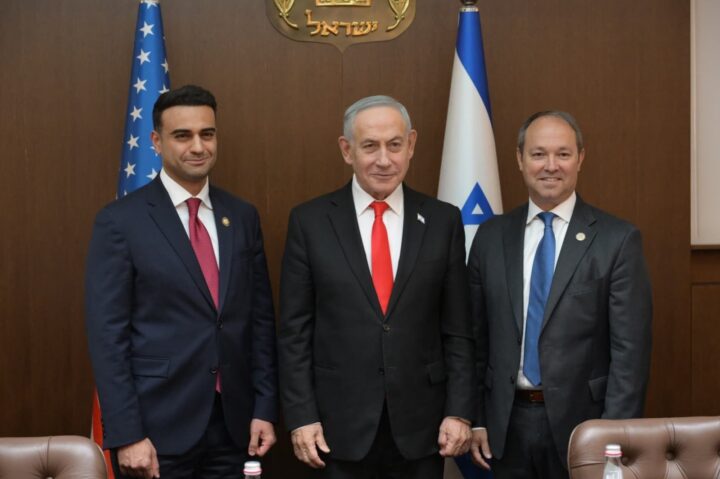
Israeli prime Minister Benjamin Netanyahu meets with Reps. Marlin Stutzman (R-IN) and Abe Hamadeh (R-AZ) in Jerusalem on May 27, 2026.
Reps. Marlin Stutzman (R-IN) and Abe Hamadeh (R-AZ), two strong supporters of Israel, made another trip to the country this week, during which they met separately with Israeli Prime Minister Benjamin Netanyahu, President Isaac Herzog and Foreign Minister Gideon Sa’ar.
The lawmakers visited with Netanyahu at his office in Jerusalem, the PMO confirmed.
Sa’ar said the group held “an in-depth discussion on regional issues, including Lebanon and Syria” where he “stressed the need to safeguard Syria’s minorities” and “described the aim of Israel’s activities in southern Lebanon: protecting our citizens from Hezbollah attacks within Lebanese territory and dismantling the terror kingdom it built there.”
Herzog’s office said he “thanked the congressman for their great friendship” and “commended President Donald Trump’s leadership in confronting Iran’s empire of evil.”
Hamadeh, the first Arab American elected to Congress from Arizona, took part in an AIPAC-organized trip of Republican members of Congress in August 2025, during which he thanked Netanyahu for his support for the Druze in southern Syria. Hamadeh is the son of Syrian immigrants and his mother is Druze.
Stutzman also visited Israel in 2025, meeting with Netanyahu after meeting with Syrian President Ahmed al-Sharaa. During the trip Stutzman said the Syrian leader appeared open to peace with Israel.
Both have been active on issues relating to post-Assad Syria including the protection of minority groups.
The appointment of Deek, the country's first Christian ambassador, comes following several controversies in Israel relating to Christians
Courtesy
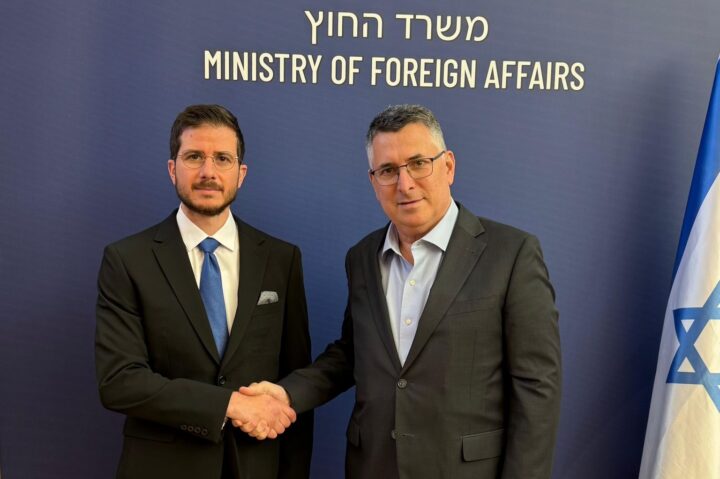
Former Israeli Ambassador to Azerbaijan George Deek (left) and Israeli Foreign Minister Gideon Sa'ar
Israel’s first Christian ambassador, George Deek, has a new job after his return to Israel from his most recent posting as Israeli ambassador to Azerbaijan: special envoy to the Christian world.
Israeli Foreign Minister Gideon Sa’ar named Deek to the role on Thursday, with the ministry saying that the move was “intended to deepen Israel’s ties with Christian communities around the world.”
Deek, who joined the Foreign Ministry in 2008 and has been posted to Norway and Nigeria, received the Foreign Ministry Director General’s Award for Excellence in 2021. He is part of the Arab Orthodox Christian community in Jaffa, and his father, Youssef Deek, was chairman of the community for many years.
Deek came to international prominence as Israel’s chargé d’affaires in Oslo after giving a speech about his family’s background and his decision to represent Israel around the world. In the speech, video of which has gone viral, he spoke about his grandparents’ departure from Jaffa during Israel’s War of Independence and choice to return and build their lives in the fledgling Jewish state.
Sa’ar said that “the State of Israel attaches great importance to its relations with the Christian world and with its Christian friends around the world. I am confident that George, a respected and experienced diplomat, will greatly contribute to the friendship and strengthening of the ties between the State of Israel and the Christian world.”
Deek’s appointment was announced soon after several controversies in Israel relating to Christians. Most recently, an IDF soldier who broke a statue of Jesus in a southern Lebanese Christian town was removed from combat duty and given 30 days in prison.
On Palm Sunday, with the war in Iran still raging, police officers barred Cardinal Pierbatista Pizzaballa from accessing the Church of the Holy Sepulcher because it did not have proper protection from missiles. After Prime Minister Benjamin Netanyahu intervened, Pizzaballa was given more access to the church.
About 120 of the rockets and missiles crossed from Lebanon into Israel during the Wednesday night barrage, with those not intercepted mostly striking Israel’s north
FADEL itani/AFP via Getty Images
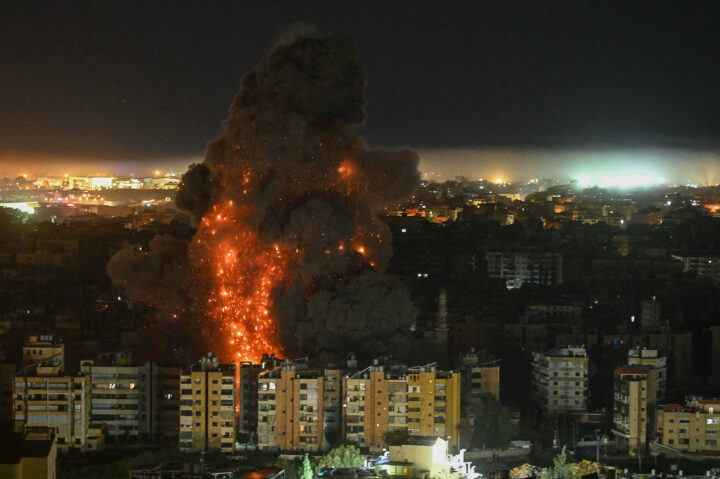
A fireball rises from the site of an Israeli airstrike that targeted an area in Beirut's southern suburbs overnight March 10 to 11, 2026.
Israel continued extensive strikes on Lebanon on Thursday morning, after Hezbollah shot about 200 projectiles at northern Israel the night before.
About 120 of the rockets and missiles crossed from Lebanon into Israel during the Wednesday night barrage, with those not intercepted mostly striking Israel’s north.
The Magen David Adom emergency service treated two individuals with mild injuries following the missile fire from Lebanon.
A home, with the exception of its safe room, was destroyed, and two others were damaged in Moshav Haniel in Emek Hefer, a region of Israel 70 miles from the Lebanon border.
Soon after, Iran launched missiles at Israel, a move officials said likely indicated that the two Wednesday night barrages were coordinated between Tehran and Beirut.
A senior Israeli official briefed the media on Thursday morning that a significant expansion of operations in Lebanon would soon take place, but did not say whether that would include a broad ground invasion.
Shortly after Wednesday night’s barrage began, the IDF announced “a large-scale wave of strikes on Hezbollah infrastructure in the Dahieh area of Beirut” while “interception efforts [were] ongoing.”
As part of that wave, the IDF struck 10 Hezbollah sites within 30 minutes, including an intelligence base and headquarters of the elite Radwan unit. On Thursday morning, the IDF reported launching 200 munitions from air and sea at 70 Hezbollah targets in Beirut.
“The Hezbollah terrorist organization has embedded its terrorist infrastructure in the heart of Beirut under the cover of the civilian population,” the IDF Spokesperson’s Office said.
IDF Spokesperson in Arabic Avichay Adraee posted evacuation warnings on social media throughout the night and morning. Over half a million residents of Lebanon have evacuated since Hezbollah joined the war on Iran’s side last week.
In addition, troops of the IDF’s Mountain Brigade operated in Lebanon near the border with Israel to locate and destroy rocket launchers and weapons storage facilities.
The IDF reported “a wide-scale wave of strikes in Iran” on Thursday. In addition, according to Israeli and other Middle Eastern media, Israeli drones have been striking checkpoints manned by Iranian paramilitary militia Basij. The checkpoints had been set up on central arteries throughout Iran to try to suppress an uprising and limit movement.
The IDF intercepted Iranian missiles headed for Jerusalem on Thursday.
In addition to the two mild injuries from Lebanese missiles, Magen David Adom treated 45 people who were injured on their way to shelters or suffered from anxiety on Wednesday.
Since the start of Operation Lion’s Roar, MDA reported 759 physical casualties, of which 169 were caused by missile fire, including 12 fatalities.
Iran struck an oil tanker off the coast of the United Arab Emirates on Thursday, the sixth such ship targeted in the Gulf over two days, after attacking two vessels in Iraqi waters overnight, killing one. Iranian drones struck an oil facility in Bahrain, an airport in Kuwait, an Italian military base in Iraqi Kurdistan and a tower in Dubai on Thursday morning. The Saudi Defense Ministry said it intercepted a UAV targeting an oil field.
Also Thursday, Israeli Education Minister Yoav Kisch said that schools in northern Israel and the coastal strip, including Tel Aviv, are not expected to reopen in the coming days, while in other areas, school may reopen gradually, starting Monday.
'We were able to take out dozens of launchers,’ IDF spokesperson says

Jack GUEZ/AFP via Getty Images
Rocket trails from Israel's Iron Dome missile defense system are seen over Tel Aviv on February 28, 2026.
A notable decrease in the number and frequency of Iranian missile strikes at Israel is the result of a focused strategy of hunting and aiming at launchers, Lt.-Col. Nadav Shoshani, the IDF’s spokesperson for international media, said on Tuesday.
“The missile and launcher hunt is happening in real time,” Shoshani told reporters. “We have been able to narrow [Iran’s] capability to fire missiles toward us. … We are putting our focus on continuing to do so in the coming days.”
“We were able to take out dozens of launchers,” since the operation began on Saturday, Shoshani said.
Shoshani said that Iran currently has “a lack of capability to fire in large amounts” and that there is a diminished rate of fire.
“I’m sure all of you in Israel can feel it,” he added. “We have significantly limited their ability to fire toward our civilians and other civilians in the region.”
At the same time, Shoshani said part of the reduction in missile launchers may be attributed to Iran trying to ensure it can keep the war going over the coming weeks.
The IDF is also prepared for the war to continue for weeks, but “it is early to give estimates,” Shoshani said, adding that “we are in a more positive scenario than [what] we looked at in the beginning of the war.”
Israel has also destroyed hundreds of Iranian missiles, but “launchers, that’s the real thing that’s important,” the spokesperson said.
Shoshani did not have readily available information on how many missiles Iran has shot, because the Islamic Republic attacked several countries in the region and not just Israel.
Asked if he expects Israeli boots on the ground in Iran, following President Donald Trump’s remarks about deploying U.S. ground troops “if necessary,” Shoshani said he does not see such a scenario as realistic for Israel.
Most of the targets the IDF struck were found after Operation Rising Lion began on Saturday, including radar and detection arrays, surface-to-air missile launchers, surface-to-surface missile launchers and related infrastructure, command and control centers, strategic military bases in Tehran, and facilities belonging to the regime’s repression and enforcement mechanisms.
Among those targets was the Iranian regime leadership’s compound in Tehran, which includes the presidential office, national security council and a training facility for military officers.
Israel’s “aerial superiority now allows the IDF to continuously strike the Iranian regime’s terror infrastructure — including its command-and-control centers and other high-value assets — not merely through isolated sorties, but through sustained operations, fundamentally shifting the operational reality in Operation Roaring Lion and enabling the IDF and the Israeli Air Force to operate freely in Iranian airspace,” the military spokesperson’s office said.
About 30 female aircrew members, including pilots and navigators, have taken part in the strikes on Iran in recent days.
Combat Navigator Maj. S, whose name was kept anonymous by the IDF Spokesperson’s Unit, said that she and her crew “prepared for this operation for a long time — hours of training and briefings.”
Maj.-Gen. Shlomi Binder, the IDF’s intelligence chief, said on Monday, “In 40 seconds, we eliminated more than 40 of the most important people in Iran … and we are not finished. … We intend to add to the list every day.”
“We are sending a very clear message to our enemies — there is no place where we will not find them,” Binder added. “Anyone who chooses to engage in such actions against the state of Israel, against the residents of the state of Israel, against our future here, we will find them, and we will eliminate them.”
As Israeli strikes in Lebanon continue as far north as Beirut, Israeli Defense Minister Israel Katz said the IDF will move to “take control of additional strategic positions in Lebanon in order to prevent attacks on Israeli border communities.”
The IDF holds five positions in southern Lebanon, as permitted by the U.S.-negotiated late-2024 ceasefire, and Katz said he “authorized the IDF to advance and secure additional strategic areas in Lebanon, and from there to defend the border communities.”
Shoshani said that while Israel’s main goal is to “remove the existential threat” emanating from Iran, it is doing “we are acting defensively on the northern front in order to focus our effort on Iran.”
He also noted that “Hezbollah’s main lifeline is Iran,” and said that in the last year, Iran sent over $1 billion to its proxies, with Hezbollah getting the majority of the money.
Israel does not plan to evacuate civilians from towns on the Lebanon border as it did in October 2023, though they have been dealing with frequent drone and rocket attacks in recent days, Shoshani said.
The IDF struck over 70 weapons storage facilities, launch sites and missile launchers in Lebanon on Monday, the military said.
One target was Hezbollah’s intelligence headquarters. The IDF killed Hussein Makled, Hezbollah’s chief intelligence official, a role he took on after Israel eliminated his predecessor in November 2024.
The IDF also said it eliminated the commander of Palestinian Islamic Jihad in Lebanon, Abu Hamza Rami, who was “responsible for advancing and carrying out hundreds of terrorist attacks against IDF troops and Israeli civilians.”
Another target was the Al-Qard Al-Hassan Association, which Hezbollah has said provides social services to the people of Lebanon. Al-Qard Al-Hassan has been sanctioned by the U.S. and others since 2007, and as such, deals exclusively in cash, which the IDF sought to destroy.
According to the IDF, “the terrorist organization uses these services to create economic dependency on the association and to exploit public funds for the purchase of weapons and the payment of salaries to its operatives.”
Also on Monday, the IDF Home Front Command extended restrictions until Saturday night, including closing schools and nonessential workplaces, and prohibiting large gatherings.
Two major missile barrages hit Israel on Tuesday, with two injured in the first one in Israel’s north, and no casualties in the second. Overnight Monday, Magen David Adom released its final casualty count for an Iranian missile strike on Beersheba, where 21 were injured. Since Operation Roaring Lion was launched on Saturday, there have been at least 371 casualties, including 12 fatalities and two severely injured.
Iran continued its strikes around the Gulf on Monday, with a drone causing minor damage to a U.S. Embassy building in Riyadh. Among the sites damaged by Iranian projectiles were three Amazon facilities in the United Arab Emirates and Bahrain.
Trump briefed leaders of two main Kurdish factions in Iraq on what may come next in the war, a step that Israeli Prime Minister Benjamin Netanyahu had encouraged him to take, Axios reported. Kurdish groups throughout the Middle East have had close security and intelligence ties with Israel for decades. The Kurdistan Freedom Party has also accused Iran of targeting them with missiles and drones.
In an interview with JI, Amb. Reuven Azar says joint manufacturing ‘means that, during times of need, we can supply things to each other, unlike what happened [with other countries] during the war’

PRAKASH SINGH/AFP via Getty Images
Indian Prime Minister Narendra Modi (R) and Israeli Prime Minister Benjamin Netanyahu pose for photographers after Netanyahu arrived at the Air Force Station in New Delhi on January 14, 2018.
Indian Prime Minister Narendra Modi is set to arrive in Israel on Wednesday to address the Knesset and head an innovation event in Jerusalem, as part of what Israeli Ambassador to India Reuven Azar told Jewish Insider is an “upgrade” in relations between the countries “to a new, strategic level.”
The visit of the head of the world’s most populous nation, whose relations with Israel have grown stronger since Modi became prime minister in 2014, has important implications for the Jewish state’s security, geopolitics and trade, Azar said.
Modi last visited Israel eight years ago. At the time, a photo of the Indian leader and Israeli Prime Minister Benjamin Netanyahu wading barefoot in the Mediterranean Sea during a visit to a desalination plant went viral.
His trip this week, during which he will address Israel’s Knesset, comes amid rising tensions across the Middle East — and as Israelis prepare for a potential attack from Iran.
India has been the Israeli defense industry’s largest customer in recent years, with arms sales totaling $20.5 billion during 2020-2024. The countries have reportedly closed deals worth $8.6 billion since the beginning of 2026.
During his visit, Modi plans to sign an “updated security agreement to allow the private sector to work on more sensitive products when it comes to joining production,” Azar, who has been Israel’s envoy to India since September 2024, said. “The updated protocols will allow us to work on more sensitive technology. It will create a lot of action.”
Netanyahu and leading Israeli defense figures have spoken about moving toward greater self-sufficiency in arms manufacturing. Delhi has long had a “Make in India” campaign to increase local production, requiring Israeli arms companies to open production lines in India in order to sell to the country, and the agreement means that joint production “will get a significant upgrade, because we are expanding both the scope and range of technologies we can apply,” Azar said.
“Both Israel and India want to be more independent and self-reliant when it comes to production and less reliant on foreign supply. Producing things together means that, during times of need, we can supply things to each other, unlike what happened during the war [in Gaza] … in which we had interruptions in supply from different countries,” Azar said.
Economically, Israel and India are working on a free-trade agreement, and hope to expand their cooperation on emerging technologies, as well as large infrastructure projects. Azar said that he worked to bring Indian companies to bid on tenders relating to the ongoing Tel Aviv Metro subway project, and that 15 have already applied.
The U.S. has long expressed concern about security risks related to Chinese companies working on major infrastructure projects in Israel. Companies from India, which views China as an adversary, have been considered as a potential competitive alternative.
Though Azar, a former deputy national security advisor for foreign policy, served as head of the Israel-U.S.-China Internal Task Force Israel’s Foreign Ministry at the beginning of the decade, he declined to comment on that aspect, preferring to focus on Israel-India bilateral relations.
With regard to the India–Middle East–Europe Economic Corridor (IMEC), a trade route meant to pass through Israel, among other countries in the region, and compete with China’s Belt and Road Initiative, Azar said that “we need to wait for the right geopolitical moment to make it happen. … It needs to happen, but evidently, it won’t now.”
“Currently, there is some movement of merchandise, but to see it become massive, we need some change in Saudi Arabia,” Azar said.
Saudi Arabia and the U.A.E., both points on the IMEC route, are facing increased tensions between them. Riyadh has pointed some of its ire at Jerusalem, and has been growing closer to India’s historic foe, Pakistan.
Azar was enthusiastic about an Israeli Cabinet decision approved on Sunday in which Israel plans to allocate over $48 million to cooperation with India in a variety of spheres. Half of the funds come from individual government ministries seeking the cooperation, and the other half was specially allocated by the Finance Ministry.
“The most important is upgrading research and development with funds from the Israel Innovation Authority, and academic cooperation. Israeli universities are all over India now, getting into agreements to exchange students and transfer technology and innovation offices. They feel very welcome in India,” he said.
Asked if that means India has become an alternative to much of the West, where Israeli academics have faced hostility in recent years, Azar said that India and Israel “don’t have challenges in this realm and continue working together to discover the joint resilience so needed in times of war.”
At the same time, he added, “it’s important for any country to diversify. We feel we have so much in common with India, which is a rising force in the world. It’s natural, and it’s not only Israel. Last week, 20 heads of state and 50 foreign ministers went to an AI summit in India. … Everybody is chasing India now.”
Though India-Israel relations were worse before Modi’s rise, Azar said they have the potential for longevity.
“We are now building the pillars of relations that are going to last,” he said. “We are trying to get bipartisan support. There is a lot of support for Israel, not just in [Modi’s Bharatiya Janata Party]. The general public feels it, and we have a high appreciation of that. There are some parties, like the communists, that are more critical, but I think this relationship is going to last.”
During an appearance on the ‘On The Record’ podcast, Sen. Lindsey Graham urges Gulf nations to prioritize regional stability and make tough choices on Iran
Sean Gallup/Getty Images
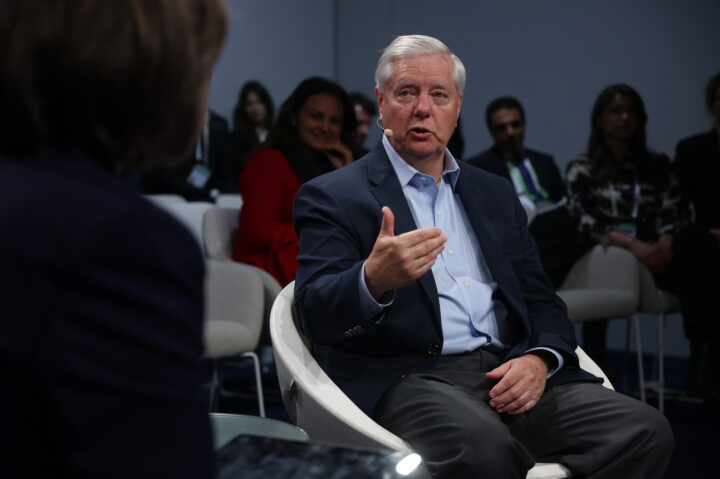
Sen. Lindsey Graham (R-SC) speaks at the 62nd Munich Security Conference on February 13, 2026 in Munich, Germany.
Sen. Lindsey Graham (R-SC) on Thursday rejected the suggestion from some in the Arab world that the deaths of civilians in Gaza does not align with Christian values. Graham made the comments during an appearance on an episode of the “On The Record” podcast with Hadley Gamble, while discussing how Israel’s war in Gaza had impacted regional stability in the Mideast and delayed normalization efforts with the Saudis.
“I just don’t buy that at all, because what did we do in World War II? Did we think for one minute about starving the Germans? Did we bomb every city into smitherreens?” Asked if that meant he was comparing Israel’s response to Hamas’ Oct. 7, 2023, attacks on the Jewish state to how the U.S. responded in World War II, Graham responded affirmatively.
“This is an absolute, existential threat to the Jewish people. What happened on October the 7th was 1,200 people were slaughtered, raped and murdered, and filmed by radical Islamists who would kill every Jew if they could.”
Gamble then pressed Graham on Israel “flattening Gaza,” which the South Carolina senator said he took no issue with.
“Just flatten it. We flattened Berlin. We flattened Tokyo,” Graham said. “Were we wrong to drop an atomic bomb to end the Japanese reign of terror? Were we? In my view, if I were Israel, I would have probably done it the same way. Without military victory, there is no hope of breaking radicalism. We flattened Germany. We flattened Japan.”
“It’s a TV war. We didn’t have TV in World War II. The behavior of the United States was to pursue total destruction of the enemy. That was our behavior. Take Tokyo and Berlin,” he added. “Those people who are trying to say this is just another conflict, it’s not another conflict. It’s existential to the Jewish state.”
Graham, who is in the Middle East for meetings with Israeli, Emirati and Saudi officials, also criticized Saudi Arabia for “attacking the United Arab Emirates pretty viciously for being in the Abraham Accords” and questioned assertions that the kingdom’s ongoing dispute with the Emiratis was solely based on differences in Sudan and Yemen.
“Saudi Arabia is now moving backward. They’re attacking the United Arab Emirates pretty viciously for being in the Abraham Accords,” Graham said. “There is no good reason for this. You can have disputes about Sudan and Yemen, but they’re basically declaring war.”
Asked if he believed the dispute “is all about Israel,” Graham replied: “I don’t know what this is about. I know the consequences. [Mohammed bin Zayed], the president of the United Arab Emirates, I’m going to meet him, you could not ask for a better partner. You could not ask for a better partner than the United Arab Emirates. They’ve stuck with the Abraham Accords through Gaza.”
In a post on X after his meeting on Thursday with Saudi Crown Prince Mohammed bin Salman, Graham praised the kingdom while acknowledging his concerns about achieving normalization with Israel.
“The Crown Prince is dealing with the aftereffects of October 7 like all leaders in the region, particularly with the tremendous loss of life in Gaza,” Graham wrote. “Having said that, his vision for the region is for conservative Islam to coexist — with tremendous economic opportunity — for the people of Saudi Arabia, the Middle East, and the entire world. He is the first Arab leader in modern history that’s expressed a vision not only for the faith, but for economic empowerment that is simply stunning when absorbed, and will set the tone for the region for generations to come.”
Graham criticized Gulf state opposition to regime change in Iran over fears about potential fallout as politically weak.
“That is a short-sighted view of the problems you face over here,” he said. “You’ve got domestic problems, so do I. I’ve got domestic problems. It’s probably better for me to be at home than it is here, so I don’t have a lot of tolerance anymore for people having to make uncomfortable decisions, because I have to make them all the time.”
Pressed on Saudi concerns about oil prices and regional instability, Graham said all of the Gulf states needed to “suck it up.”
“I’m telling everybody over here to suck it up. You’ve got to suck it up to bring about real change. Real change doesn’t come without sacrifice. Now, this region is going to change one way or the other,” Graham said. “There are two scenarios. … The inflection point is weeks away, not months away. That’s why I’m here. That’s why I haven’t slept, because it’s either going to go really good or really bad.”
Later Thursday, Graham warned in a post on X that the U.K. should not deny the U.S. the ability to use British military bases to attack Iran.
“If it turns out to be true that Britain is denying the United States the ability to use British bases against Iran if there is a necessity for an attack – it would be beyond surprising,” Graham tweeted. “I’ve been a military lawyer most of my adult life. What they’re saying about the status of Diego Garcia, the joint US-UK military base, is a huge question.”
“To my friends in Britain, sitting this one out puts you on the wrong side of history and is yet another example of how much our alliances throughout Europe have degraded,” the tweet concluded.
Na’eh, who died on Monday, was ‘the Abraham Accords ambassador, ushering in a new era of regional diplomacy,’ Fleur Hassan-Nahoum said

Emre Senoglu/Anadolu Agency/Getty Images
Then-Israeli Ambassador to Ankara Eitan Naeh gives a speech during his first reception in Ankara, Turkey on December 5, 2016.
Veteran Israeli diplomat Eitan Na’eh, who had a long career in key posts representing Israel in the Arab world, died of a heart attack on Monday. He was 62.
Na’eh’s most recent role was as the Israeli Foreign Ministry’s representative to the U.S.-led Civil-Military Coordination Center (CMCC) in southern Israel, established in October to coordinate humanitarian relief efforts and the stabilization of Gaza.
Na’eh played a key role in growing and preserving Israel’s relations with Abraham Accords signatories. He was Israel’s first envoy to the United Arab Emirates in 2021, setting up Jerusalem’s diplomatic representation in Abu Dhabi. His last posting abroad was in Bahrain, where he served as Israel’s first ambassador to the country from December 2021 until August 2025.
In 2022, Na’eh told Jewish Insider: “I sit here in Manama and look outside to a beautiful view of the Gulf, and I am still pinching myself. I feel lucky to work in these countries.” The ambassador said at the time that he was optimistic about expanding the Abraham Accords and the potential in Israel-Bahrain ties.
A Foreign Ministry official characterized Na’eh to JI as “contributing the first steps in establishing relations in the framework of the Abraham Accords. … He built the content of the Abraham Accords at a critical time in which you don’t want to drop the ball.”
The official said Na’eh was skilled at bringing concrete results from diplomatic relations and had a talent for making connections. At the CMCC, “everyone knew him after five minutes,” the official recalled.
A Bahraini diplomat remembered Na’eh as someone who “represented his nation with grace and wisdom, but also fostered genuine goodwill and friendship wherever he went.”
Fleur Hassan-Nahoum, co-founder of the UAE-Israel Business Council and former deputy mayor of Jerusalem, called Na’eh “the Abraham Accords ambassador, ushering in a new era of regional diplomacy in the most professional way.”
Israeli Foreign Minister Gideon Sa’ar said that Na’eh was “a gifted diplomat who stood out in his ability to make connections wherever he served. Above all, in all of his missions and many positions he filled, Eitan was known for his big heart and endless caring.”
Na’eh was also Israel’s ambassador to Turkey from 2016 to 2018, the first after the diplomatic crisis between Jerusalem and Ankara following the 2010 Gaza flotilla incident. However, his term ended abruptly when Turkey expelled him in response to Palestinians killed by the IDF during protests and riots on the Gaza border.
He was previously Israeli ambassador to Azerbaijan and the head of the foreign policy department of Israel’s National Security Council, giving him a broad view of Israel’s international relations that the Foreign Ministry official said was very valuable.
Na’eh was also interim ambassador in London in 2013-2015, and Israel’s political consul at the Israeli consulate in Chicago in 1997-1999.
Hassan-Nahoum recalled Na’eh’s warmth and sense of humor, and said that he and his wife, Cheryl, had a marriage “to emulate in every way.”
Ahdeya Ahmed, former president of the Bahrain Journalists Association, called Na’eh “a friend who was like a brother.”
“I could talk about his professionalism as a diplomat, but what I really want to share is Eitan the friend — Eitan the warm soul who lit up every room, who always had a laugh, and who dreamed of a kinder world,” Ahmed said. “I’ll always remember his smile, his jokes, the way he made life’s burdens lighter for all of us, and all the celebrations we shared.”
Na’eh is survived by his wife, two children, Maya and Itai, and a granddaughter.
Jerusalem’s recognition of Somaliland — strategically positioned across the Gulf of Aden from Houthi-controlled parts of Yemen — has left some regional governments on the defensive as Jerusalem moves first
Amos Ben-Gershom (GPO)
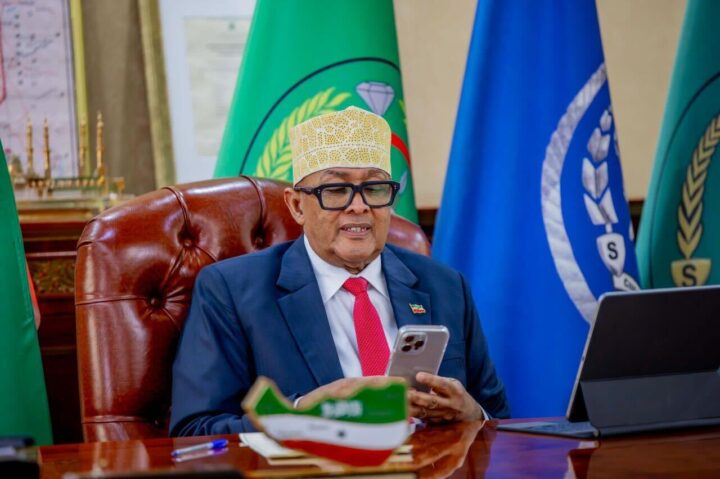
Somaliland President Abdirahman Mohamed Abdullah speaks to Israel Prime Minister Benjamin Netanyahu, Dec. 26, 2025
Israel’s recognition of Somaliland has stirred unease across parts of the Arab and Muslim world, challenging regional power dynamics as Jerusalem moves first in a strategically sensitive corner of the Horn of Africa.
Israel became the first country to recognize Somaliland on Friday, 34 years after the democratic, pro-Western state declared its independence from Somalia. The move puts Israel at odds with a number of Arab and Muslim nations including Qatar, a major power broker in Somalia and a key mediator in regional conflicts, at a time when Washington is seeking to expand the Abraham Accords and manage competing Arab interests in the Horn of Africa.
Israeli Prime Minister Benjamin Netanyahu and Foreign Minister Gideon Sa’ar signed a document establishing full diplomatic relations between the countries which affirms that they have “shared values, strategic interests and the spirit of mutual respect that binds our peoples,” and that “this relationship will contribute to advancing peace, stability, and prosperity in the Horn of Africa, the Middle East and beyond.”
The Prime Minister’s Office described the recognition as being “in the spirit of the Abraham Accords, signed at the initiative of President [Donald] Trump,” and Netanyahu told Somaliland President Abdirahman Mohamed Abdullahi that he would “communicate to President Trump your willingness and desire to join the Abraham Accords.”
However, Trump has largely dismissed the idea that the U.S. would follow suit at this juncture, saying it is “under study.”
“Does anyone know what Somaliland is, really?” Trump told The New York Post.
Somalia is a member of the Arab League, joining in 1974 as the first non-Arab nation due to strong cultural, religious and historical ties. Somalia also holds a crucial geopolitical location for global trade.
Somalia has served as a proxy battleground for broader regional power struggles, with influential Middle Eastern states supporting different factions and projects.
Qatar has sought to establish itself as a dominant influence and key mediator in Somalia, supporting the central government and pouring resources into the country for over a decade.
“Want another reason to back Somaliland? Qatar — the Muslim Brotherhood’s biggest bankroller — backs the other side,” Foundation for Defense of Democracies CEO Mark Dubowitz said.
On Saturday, the Qatari government released a statement rejecting “the announcement of mutual recognition between the Israeli occupation authorities and the Somaliland region,” and “any attempts aimed at establishing or imposing parallel entities that would undermine the unity of Somalia.” Doha also said in the statement that it would be “more appropriate” for the Jewish state to “recognize the State of Palestine.”
Qatar also released a statement with 21 Arab and Muslim countries — including Jordan, Egypt, Iran, Pakistan and “the State of Palestine” — “stressing their unequivocal rejection of Israel’s recognition of the Somaliland region.”
Recognizing Somaliland is also a way of positioning Israel against Qatar, as Foundation for Defense of Democracies CEO Mark Dubowitz pointed out: “Want another reason to back Somaliland? Qatar — the Muslim Brotherhood’s biggest bankroller — backs the other side.”
An official Somaliland X account posted that “Doha has no business meddling in Somaliland’s affairs while bankrolling Muslim Brotherhood proxies to prop up Mogadishu’s failed regime. … Foreign powers parroting Mogadishu’s line can shove their hypocrisy. Our future is ours—not dictated by Qatar’s Islamist agenda.”
Egypt and Turkey, both close allies of Somalia, have also condemned Israel’s recognition of Somaliland. Saudi Arabia, a country that holds a more moderate posture toward the Jewish state but has expressed reticence to establish relations with it, is reportedly less likely to normalize ties with Israel due to the recognition of Somaliland, according to Israel’s Channel 12.
The UAE, in contrast, has nurtured a close relationship with Somaliland, a factor that may have encouraged Jerusalem in its move to recognize the African state, though Abu Dhabi has not yet recognized Somaliland, Asher Lubotzky, a researcher at the Israel-Africa Relations Institute, wrote.
Sa’ar said in a statement that relations between the two countries grew over the course of the last year, and that they will exchange ambassadors and open embassies. Israel and Somaliland also plan to cooperate in the fields of agriculture, health and technology, the Prime Minister’s Office stated.
Israeli and Somaliland officials have reportedly held secret meetings over the course of the past several months. The president of Somaliland has met with Netanyahu and Sa’ar, as well as Israeli Defense Minister Israel Katz, and Netanyahu invited him for another visit.
“Somaliland could serve as a forward base for a range of missions,” Asher Lubotzky, a researcher at the Israel-Africa Relations Institute, wrote in a paper published last month, “intelligence collection and monitoring of the Houthis and their military buildup; logistical support for Yemen’s internationally recognized government in its war against the Houthis; and direct operations, from offensive actions to intercepting Houthi attacks at sea or by UAVs.”
In a paper published by Tel Aviv University’s Institute for National Security Studies a month before Israel recognized Somaliland, Lubotzky wrote that the African state’s “security importance for Israel has become even more pronounced over the past two years.”
Somaliland is strategically located for Israel, across the Gulf of Aden from parts of Yemen controlled by the Houthis, who have frequently attacked Israel over the past two years.
“Somaliland could serve as a forward base for a range of missions,” Lubotzky wrote, “intelligence collection and monitoring of the Houthis and their military buildup; logistical support for Yemen’s internationally recognized government in its war against the Houthis; and direct operations, from offensive actions to intercepting Houthi attacks at sea or by UAVs.”
The growing number of countries recognizing a Palestinian state also may have curbed Israel’s former reluctance to recognize secessionist states out of a concern that it could set a precedent for supporting Palestinian statehood, Lubotzky noted.
Earlier this year, reports indicated that Somaliland could be open to accepting Palestinian refugees from Gaza, as President Donald Trump expressed support for relocation from the enclave to enable reconstruction efforts. Recent reports suggest this idea has resurfaced and may factor into any emerging arrangement between Israel and Somaliland.
The European Union released a statement that it “reaffirms the importance of respecting the unity, the sovereignty and the territorial integrity of the Federal Republic of Somalia … This is key for the peace and stability of the entire Horn of Africa region.”
The African Union has declined to formally recognize Somaliland in the past, citing concerns that doing so could set a precedent for secession across the continent and trigger wider instability.
Tzvika Mor, head of the hawkish Tikvah Forum, a minority group of hostages’ families, calls to prioritize defeating Hamas, says putting hostages first is ‘indescribable stupidity’
Chip Somodevilla/Getty Images
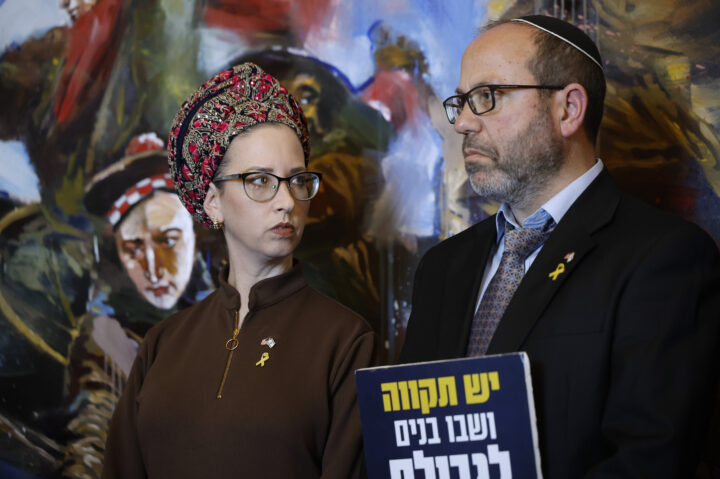
The parents of Eitan Mor, a security guard kidnapped on October 7 at the Supernova rave, wait to meet with Speaker of the House Mike Johnson (R-LA) and other fellow family members of kidnapped victims at the U.S. Capitol on February 06, 2024 in Washington,
The day after Israel’s Security Cabinet voted to seize control of Gaza City, the Hostages Families Forum organized a major protest in Tel Aviv against the decision, warning it would put their loved ones’ lives in danger.
But Tzvika Mor, father of hostage Eitan Mor, has been speaking out against the Cabinet decision for a different reason — he thinks the IDF should be pushing even more aggressively to take over the rest of Gaza.
Nearly two years since his son was kidnapped while working as a security guard at the Nova festival on Oct. 7, 2023, Mor, 48, has not wavered from his position that defeating Hamas must be Israel’s top priority in the war in Gaza, above the hostages.
Mor, who lives in Kiryat Arba, a settlement abutting Hebron in the West Bank, normally works as an ADHD coach. But since the Oct. 7 attacks, he has divided his time between advocating for the country’s victory over Hamas and serving as an IDF reservist in the Paratroopers’ Brigade. In the long term Mor wishes to see the entirety of Gaza become part of Israel, telling Jewish Insider in an interview on Sunday, “It is the land of the Tribe of Judah; it is ours.”
As chairman of the Tikvah Forum, a more hawkish minority group of hostage families than the larger and better-known Hostages Families Forum, Mor and several other hostages’ relatives oppose partial deals and the release of large numbers of terrorists, arguing that only sustained military pressure will bring all of the hostages home. Mor spoke out against the Israeli Security Cabinet’s recent decision in his interview with JI.
“The question isn’t what they’re going to do, but what is the goal. If the goal is to lead Hamas to negotiate, it will fail, just like in Gideon’s Chariots, which took five months and didn’t bring back the hostages and didn’t destroy Hamas,” Mor said, referring to the IDF operation that began earlier this year. “The goal cannot be to bring [Hamas] to talks; it must be to destroy them.”
Hamas, he said, is not motivated to return the hostages, because they have the food, fuel and water that they need to survive, but if they feared for their survival, the situation would be different.
Mor compared the situation to the story in Genesis in which Abraham’s nephew Lot is kidnapped by four kings, and Abraham took an army with him to fight the kings.
Abraham “didn’t talk to them. He didn’t pay them. He fought a war until they surrendered. That is the way,” Mor said.
Mor said fighting to pressure Hamas to return to the table reflects an order of priorities that is both wrong and ineffective.
“The war cannot be about the hostages, and I say that as the father of a hostage. How many soldiers should be killed for the hostages?” he asked. “You don’t go to war to bring back hostages. You go to war for sovereignty, for deterrence. Then, when you win, you get your captives back.”
Prioritizing the hostages “not only harms national security, but it also hurts the hostages, because Hamas learns that they’re the most important to us and raises the price all the time. It’s indescribable stupidity,” he lamented.
Mor warned that if Israel “concedes in Gaza, Hamas will never give up all of the hostages … And what would the message be to the Arabs in Judea and Samaria” – he asked, using the biblical name for the West Bank – “that kidnapping Israelis is the best thing to do?”
In the past, Mor said, “it was clear that there was no negotiating with terrorists. We would try to save our hostages and take risks, but we could not give in to terrorism.”
Mor cited research by the Yachin Research Center, which he said showed that four times more Israelis were killed in terrorist attacks between the signing of the Oslo Accords in 1993 and 2023 than in 1949-1992.
“That means that since Israel gave in to terrorism, more Israelis were murdered. It’s clear … That needs to stop,” he stated.
Asked about the concerns that other hostage families have expressed about expanded military action in Gaza putting their loved ones at risk, Mor responded with a question: “Is our war in Gaza necessary? If there weren’t hostages, would we still need to go to war?”
“The answer is yes, because [Hamas] cannot remain our neighbors after we saw what they can do, or they would do it again. They are religious people; they live for this. They don’t live for a nice house and a car and social status. Not for coffee shops and pilates. They live to kill Jews. They’re like zombies. You have to destroy them. The war would be necessary even if there were no hostages,” he said.
As such, Mor said, Israel must take the necessary steps to win the war in Gaza: “It cannot be that we will endanger 10 million Israelis because of the hostages. We need to solve that problem such that we are not harming national security.”
“We have fears, too,” he added, “but in war, some are hurt. Soldiers are injured in the war too.”
Mor and another one of his sons have been in combat units in the current war. Thirteen soldiers in Mor’s brigade have been killed.
Early in the war, after Israeli Prime Minister Benjamin Netanyahu met with members of the Tikvah Forum, Hebrew news coverage accused the forum members of being Likud plants or, at least, being easier for Netanyahu to talk to than the Hostages Families Forum, whose early leadership included political campaigners involved in protests seeking to bring down his government.
Mor, however, has been and continues to be critical of Netanyahu, who he said he hasn’t spoken to in six months, and of Likud ministers who he has spoken to more recently, including Intelligence Minister Gila Gamliel and Agriculture Minister and former Shin Bet director Avi Dichter.
“I tell them these things, but almost all of the ministers in Likud align with the prime minister and say we have to agree to partial [hostage] deals,” Mor lamented.
Mor says that he has faced pressure for raising a different voice from the more prominent hostage relatives, and that “people defame and curse me.” In December 2023, the father of another hostage accused him on live television of giving up on his son, leading Mor to start crying.
“The Israeli media doesn’t help. They lead the campaign” against him, he said. “But I feel that I am a messenger of the people of Israel. It is clear to me that the people of Israel want to win … They are connected to their roots, to the Land of Israel and to Judaism. They don’t want to be sold dreams and delusions that ‘it will all be OK, we can give in to terror and then deal with it later.’ We can’t deal with it. If we surrender, we will pay a higher price.”
Mor has not seen pictures or videos of his son Eitan, 25, since Oct. 7, 2023, but he said that the most recent sign of life he received was from Israeli intelligence services in February this year.
“We don’t know anything except that he’s alive,” Mor said.
In May, Eitan’s mother, Efrat Mor, said she learned from another hostage released in the first deal in November 2023 that Eitan is using his “incredible social skills … both for himself and for the other hostages” to lift everyone’s spirits.
Eitan is the eldest of eight children.
“He is very strong, physically and mentally. He was very Zionist. He was a fighter and commander in the Golani Brigade” of the IDF, his father said. “He’s not soft; he doesn’t whine. He is strong; he’s a leader. We are sure that if he is with other hostages, he is helping them and strengthening them.”
When Hamas terrorists attacked the Nova rave, Eitan contacted an uncle because his parents do not use phones on Shabbat. He said that he and his friends were hiding, and sent videos of terrorists on pickup trucks. He also sent his location so that his uncle could pass it on to the IDF. The last time he was in contact with his uncle was at 10:04 a.m. His parents did not know that he was at the party, and they did not find out about the Oct. 7 attacks or that their son had been taken hostage until the evening.
Later, Nova survivors said that Eitan left his hiding place and saved their lives, which his father said “tells you the most about him.”
“He could have gone home at 6:29, but he stayed to save people,” Mor said. “He hid people and ran with them until he was kidnapped at 12:30, not by Hamas but by Gazan civilians.”
In recent months, public sentiment in Israel has shifted noticeably. With most of Hamas’ senior military leadership eliminated, growing numbers of Israelis have begun to question the feasibility of Netanyahu’s goal of 'total victory' over Hamas
Amir Levy/Getty Images
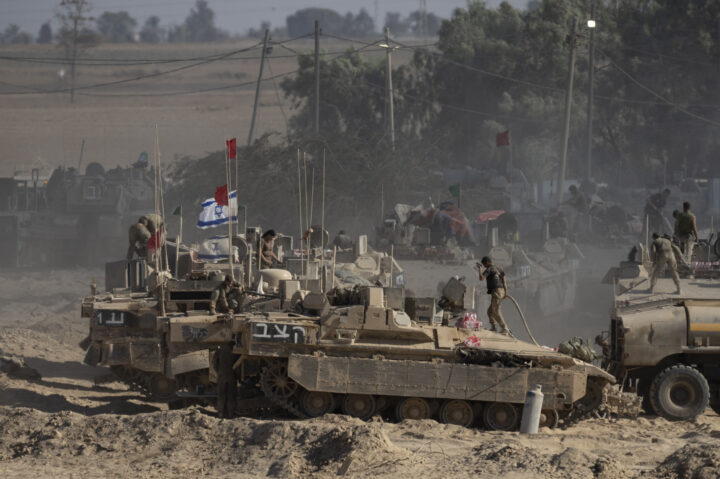
Israeli soldiers organize military equipment while standing on armored personnel carriers near the border with the Gaza Strip on August 6, 2025 in Southern Israel, Israel.
Israeli Prime Minister Benjamin Netanyahu’s announcement on Thursday that Israel plans to take control of additional parts of the Gaza Strip before handing it over to an unspecified Arab governing authority is being met with hesitation from even some of Israel’s most stalwart defenders. The Security Cabinet voted early this morning to take control of Gaza City, stopping short of the full occupation previously discussed.
Throughout much of Israel’s war against Hamas in Gaza, the Israeli public broadly supported the military effort, even as progressive lawmakers such as Sens. Bernie Sanders (I-VT) and Elizabeth Warren (D-MA) painted the war as “Netanyahu’s war,” and the Israeli prime minister as the bogeyman-in-chief.
But in recent months, public sentiment in Israel has shifted noticeably. With most of Hamas’ senior military leadership eliminated, growing numbers of Israelis have begun to question the feasibility of Netanyahu’s goal of “total victory” over Hamas, given the terror group’s hold on the Gazan population and a lack of clarity on what’s left to accomplish militarily. Instead, polling shows that a large majority of Israelis prefer prioritizing a diplomatic resolution that secures the release of the remaining hostages, rather than expanding the military occupation of Gaza in hopes of complete surrender.
Netanyahu’s plan this week to occupy more of Gaza has begun to sap Israel’s political capital even among some of its closest allies on Capitol Hill, not to mention the isolation the Jewish state is facing from less-friendly European capitals. Even within the American Jewish community, as the war drags on into its 23rd month and with mounting IDF fatalities and no living hostages having been released since May, splits have emerged over the wisdom of Netanyahu’s double-down strategy.
Indeed, while the official Israeli position on its war against Hamas in Gaza has hardened, the approach in the Diaspora, both from Jewish groups and leaders and elected officials, has also shifted — in the opposite direction.
Meanwhile, the families of hostages, whose desperation has been deepened by recent videos and images of emaciated captives, have escalated their efforts, taking to the sea in a flotilla that sailed toward Gaza on Thursday in an effort to raise awareness about the plight of their loved ones.
Netanyahu, still mired in legal issues, finds himself in a bind of his own making amid mounting global pressure to end the war and let aid flow freely into Gaza — which contrasts sharply with right-wing members of his coalition who loudly call for the opposite, even as top IDF brass opposes a full Gaza takeover. Speaking from the Temple Mount/Al Aqsa Mosque in Jerusalem earlier this week, National Security Minister Itamar Ben-Gvir called on Israel to “conquer all of Gaza, declare sovereignty over the entire Strip, eliminate every Hamas member, and encourage voluntary emigration.”
On Capitol Hill, Israel’s traditional allies in the Democratic caucus — including some who have given Netanyahu leeway to press forward in Gaza in the past, even when it meant butting heads with the Biden administration — are beginning to shift.
Rep. Ritchie Torres (D-NY) told Jewish Insider’s Marc Rod that Israel is ultimately responsible for making its own decisions, but said he’d advise the Israeli government to seek an end to the war once the remaining 50 hostages are freed.
“The war fatigue and post-traumatic stress in Israeli civil society and in the Israeli military — as well as the humanitarian crisis in Gaza — have become unbearable,” Torres said. “Israel has degraded Hamas. And so once Israel has secured the release of the hostages, it should declare victory, end the war and focus on expanding the Abraham Accords to include relations with the likes of Saudi Arabia and Indonesia.” More reactions from Torres and other Democratic lawmakers here.
Rep. Dan Goldman (D-NY) said in a statement on Thursday that “Netanyahu’s personal and political interests are guiding Israel’s actions” and slammed the prime minister’s “ineffective military operation in Gaza,” which, he added, “has only led to more unnecessary deaths.”
Earlier this week, Rep. Valerie Foushee (D-NC) – who in 2022 was one of the first major recipients of support from AIPAC’s super PAC— announced she was signing onto legislation to ban offensive arms sales to Israel.
The New York Times’ Bret Stephens warned this week, “If Netanyahu makes the colossal mistake of trying to reoccupy Gaza for the long term, then no thoughtful person can be pro-Israel without also being against him.”
The new shift in tone — exacerbated by mounting concerns about humanitarian aid in Gaza and bolstered by Netanyahu’s recent efforts to prolong the war in Gaza — extends beyond Washington and the media elite to some of the leading Jewish communal organizations, figures and philanthropists, dozens of whom signed onto a letter to Netanyahu this week, condemning his government’s policies and rhetoric for causing “lasting damage” to Israel and Diaspora Jewry and calling for an end to the Israel-Hamas war. Read more in eJewishPhilanthropy here.
Mainstream groups and officials, such as the American Jewish Committee and U.K. Chief Rabbi Ephraim Mirvis, have in recent days expressed deep concern about the humanitarian crisis in Gaza and the prosecution of the war.
Israel finds itself, 22 months after Hamas’ attacks, at war at home and abroad. Hamas’ attack didn’t resolve the issues that had caused divisions in Israeli society in the months leading up to Oct. 7, 2023. The national cohesion following the horrific attacks has dissipated, and now segments of Israeli society are again at odds with each other, as Israel finds itself needing to win back invaluable political capital even as its leadership is taking it for granted.
The union’s board of directors said the proposal ‘would not further NEA’s commitment to academic freedom’
Kristoffer Tripplaar/Sipa via AP Images
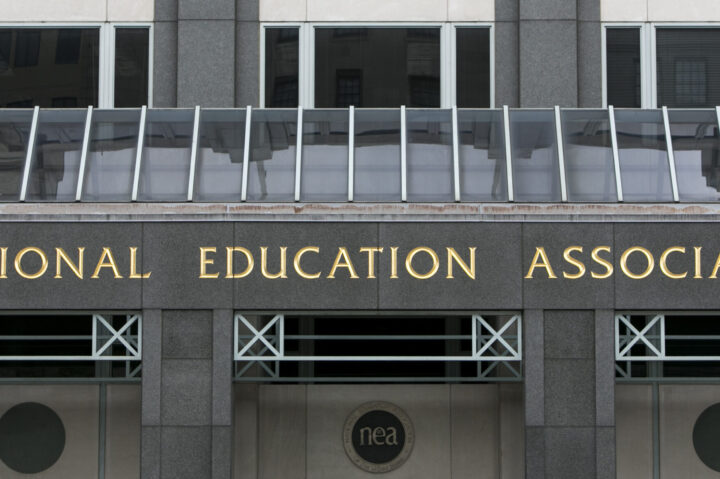
A logo sign outside of the headquarters of the National Education Association (NEA) labor union in Washington, D.C. on July 11, 2015.
The National Education Association, the largest teachers’ union in the country, announced on Friday that it would not cut ties with the Anti-Defamation League, declining to implement a contentious resolution approved by its governing body earlier this month that sought to target the Jewish civil rights organization.
“After consideration, it was determined that this proposal would not further NEA’s commitment to academic freedom, our membership or our goals,” the union’s board of directors said in a statement.
The decision came nearly two weeks after the measure was adopted by the NEA’s representative assembly, its annual leadership gathering that drew more than 6,000 union delegates.
“There is no doubt that antisemitism is on the rise. Without equivocation, NEA stands strongly against antisemitism. We always have and we always will,” the NEA’s board wrote. “In this time of division, fighting antisemitism, anti-Arab racism, and other forms of discrimination will take more resources, not fewer. We are ready.”
ADL CEO Jonathan Greenblatt cheered the union’s decision to distance itself from the “misguided” measure.
“We are committed to working with the NEA and all teachers’ unions to join the Jewish community in making clear these hateful campaigns cannot succeed. They must redouble efforts to ensure that Jewish educators are not isolated and subjected to antisemitism in their unions and that students are not subjected to it in the classroom,” Greenblatt said in a statement.
The measure faced fierce backlash from the Jewish world. A letter authored by the ADL expressing opposition to the proposal — which would have discouraged educators from using teaching materials from the ADL — garnered the support of roughly 400 Jewish organizations across the country, including the leadership of the Reform, Conservative and Orthodox movements.
Other outside Jewish groups, including the Conference of Presidents of Major American Jewish Organizations, the American Jewish Committee and Jewish Federations of North America, released a statement welcoming the NEA’s rejection of the anti-ADL resolution.
The texts from Claire Shipman, published in a letter by the House Education Committee, call a Jewish board member a ‘mole’ and ‘extremely unhelpful’

Alex Wong/Getty Images
Acting Columbia University President Claire Shipman testifies before the House Committee on Education & the Workforce at Rayburn House Office Building on April 17, 2024 in Washington, DC.
Text messages obtained by the House Committee on Education and Workforce published in a letter on Tuesday revealed that Claire Shipman, acting president of Columbia University, suggested that a Jewish trustee should be removed over her pro-Israel advocacy and called for an “Arab on our board,” amid antisemitic unrest that roiled the university’s campus last year.
“We need to get somebody from the middle east [sic] or who is Arab on our board,” Shipman, then the co-chair of Columbia’s Board of Trustees, wrote in a message to the board’s vice chair on Jan. 17, 2024. “Quickly I think. Somehow.”
Shipman said in a follow-up message days later that Shoshana Shendelman, a Jewish board member who frequently condemned campus antisemitism, had been “extraordinarily unhelpful” and said, “I just don’t think she should be on the board.”
In another communication on April 22, 2024, according to the texts obtained by the committee, Wanda Greene, vice chair of the board of trustees, asked Shipman — referring to Shendelman — “do you believe that she is a mole? A fox in the henhouse?” Shipman agreed, stating, “I do.” Greene added, “I am tired of her.” Shipman agreed, “so, so tired.”
The messages were referenced in the letter, first obtained by Free Beacon, sent to Columbia on Tuesday by the committee’s chairman, Tim Walberg (R-MI), and Rep. Elise Stefanik (R-NY) as part of the committee’s ongoing investigation into whether the school is violating Title VI of the Civil Rights Act of 1964 by allowing harassment of Jewish students.
The lawmakers wrote in the letter, which was addressed to Shipman, “These exchanges raise the question of why you appeared to be in favor of removing one of the board’s most outspoken Jewish advocates at a time when Columbia students were facing a shocking level of fear and hostility.”
Columbia responded to the letter, in a statement to Free Beacon, claiming that the text messages were taken out of context.
“These communications were provided to the Committee in the fall of 2024 and reflect communications from more than a year ago,” the university said. “They are now being published out of context and reflect a particularly difficult moment in time for the University when leaders across Columbia were intensely focused on addressing significant challenges.”
Shipman, a former ABC News reporter, stepped into the role in March after interim President Katrina Armstrong’s abrupt resignation. At the time, Stefanik called the choice of Shipman “untenable.” On campus, the news of Shipman’s hiring was met with cautious optimism from pro-Israel student leaders.
Last April, Shipman testified at a congressional hearing regarding antisemitism at Columbia alongside then-Columbia President Minouche Shafik, who resigned from her post in August, and board co-chair David Greenwald. Shipman told members of the House Committee at the time that she knew Columbia had “significant and important work to do to address antisemitism and to ensure that our Jewish community is safe and welcome.”
In its reports on the Iranian ballistic missile strike on a home in Tamra, northern Israel, CNN described the city as Palestinian

JOHN WESSELS/AFP via Getty Images
The mother of one of the victims of an Iranian missile attack which destroyed a three-storey building in the northern Arab-Israeli city of Tamra, is comforted during a funeral in the northern Arab-Israeli city of Tamra, on June 17, 2025.
After an Iranian ballistic missile struck a home in the northern Israeli city of Tamra, killing a woman, her two daughters and her sister-in-law, news outlets faced an additional challenge beyond the sober responsibility of covering a tragic loss: choosing what language to use to describe these women and their ethnic identity.
Tamra is an Arab town, with a history dating back hundreds of years. When Israeli President Isaac Herzog visited on Wednesday, he talked about the “shared society of Jews and Arabs” in Israel that “believe in our common life together,” and described the victims as “Muslim women.” Most news reports — in major international outlets including the Associated Press, Reuters, The New York Times and The Wall Street Journal — referred to Tamra as either an “Arab-Israeli city” or an “Arab town in Israel.”
CNN, however, chose a different word for Tamra, a city that is firmly inside Israel’s original 1948 borders: Palestinian.
“Iranian strikes expose bomb shelter shortage for Palestinian towns inside Israel,” read one headline from this week. The accompanying article described Tamra’s residents as “Palestinian citizens of Israel.” Another story called Tamra a “Palestinian-Israeli town.”
The descriptor is sure to confuse some readers. If advocates for a two-state solution talk about separate Israeli and Palestinian states, how can there be a Palestinian town within Israel?
The use of the word is not a statement about the town being under Palestinian sovereignty or the jurisdiction of a Palestinian governing authority. The word is used to describe the national identity of the people who live there, similar to describing Americans of Chinese ancestry as Chinese Americans — only much more complicated, because of the recent politics of the war in Gaza and nearly eight decades of the ongoing Israeli-Palestinian conflict.
Anwar Mhajne, a political science professor at Stonehill College in Massachusetts, who grew up in the Arab city of Umm al-Fahm in Israel, told Jewish Insider that using the term “Palestinian” to describe her identity and the place where she grew up can serve as an educational opportunity for people from outside the region who don’t know the history of her community, which dates back several hundred years.
“If I’m talking to outsiders who don’t understand the history of the region, I would say, ‘It’s a historically Palestinian town inside of Israel,’” Mhajne said. “Then I have to tell them the whole story of how that happened. The reason why I do this is because I have people ask me, ‘Wait, you’re not Jewish, so how are you in Israel?’”
CNN’s use of the word “Palestinian” to describe the Arab-Israeli residents of Tamra reflects a broader linguistic shift that has been happening over the years among Israel’s Arab citizens, who account for about 20% of Israel’s population. A spokesperson for CNN did not respond to a question about whether the language reflected a change to the network’s style guide, but the recent language appears to be a shift for the news network, which even earlier this year used the term “Arab Israelis” in its reporting.
“There’s a growing trend going on in the past, I want to say 10, maybe 20, years, of people who are saying, ‘We are going to reclaim our identity as Palestinians, and we’re not going to be ashamed to call ourselves Palestinians,’” said Yasmeen Abu Fraiha, a fellow at the Harvard Kennedy School who is completing a fellowship at Harvard Medical School. She counts herself among that trend: She didn’t use the term “Palestinian citizen of Israel” to describe herself until her late 20s, after she studied at Hebrew University in Jerusalem.
Abu Fraiha grew up in a Jewish city in Israel and she trained at Israeli institutions. She was working at Soroka Hospital in Beersheba — the hospital that was hit by an Iranian missile on Thursday — during the Oct. 7, 2023, Hamas attacks, when she helped treat hundreds of people injured that day. She likes the term “Palestinian citizen of Israel” because it encompasses two parts of her identity that are both important, although she is not a stickler about the language; she previously served as health policy director at the Task Force for Health Promotion and Equity in the Arab Society at the Israeli Ministry of Health, an official government entity.
“First, yes, I’m Israeli. I was born and raised there. Hebrew is my first language. I love the Israeli culture,” Abu Fraiha explained. “I’m fully Israeli. And then at the same time, my history, my narrative, my national connection, is to the Palestinian people.”
Mhajne, too, identifies with the Israeli part of her identity. It’s the passport she holds. She is the product of an Israeli education, and earned her bachelor’s degree at Ben-Gurion University of the Negev. But that is not the full story of who she is.
“I do hold both close, dearly, and I think they’re very important to hold onto. Historically, culturally, in a lot of ways, we are Palestinian, and we share that story. It’s our ancestors’ stories. These towns and us, we’ve been there for a long time, even before Israel was a state.”
Among Israel’s Jewish population, the language has not caught on widely, although it has growing cachet among Israeli Jews on the political left. Israel’s government formally uses the term “Arab-Israeli” to describe this part of the population, and that is the language generally used in English, too.
Shayna Weiss, senior associate director of the Schusterman Center for Israel Studies at Brandeis, said the rhetorical matter can be “quite confusing” for her undergraduate students, so she usually discusses it at the beginning of each course she teaches about Israeli society.
“I generally use the term ‘Israeli Palestinian’ ‘Palestinian citizens of Israel,’ but there are also instances where some people have said they see themselves as Israeli Arab, like certain pop stars, that sort of thing. And if I know that’s what they think about themselves, that’s the term I try and use,” Weiss told JI.
The death of the women and girls in Tamra has brought to the surface a rhetorical debate that has been bubbling up for years. Ultimately, Mhajne argued, what matters is not the words used to describe them — but that they were human beings.
“It bugs me, honestly, sometimes when people fight over ‘Arab’ and ‘Palestinian,’” she said. “They’re someone’s wife and daughters.”
‘We think [we] will have some, or a lot of announcements, very, very shortly, which we hope will yield great progress by next year,’ the Middle East envoy said

CHIP SOMODEVILLA/GETTY IMAGES
White House special envoy Steve Witkoff briefly speaks to reporters as he walks back into the West Wing following a television interview on the North Lawn of the White House on March 19, 2025 in Washington, D.C.
Speaking at an event celebrating Israeli Independence Day on Monday, Middle East envoy Steve Witkoff suggested that he expects additional countries will join the Abraham Accords in the coming year.
“We think [we] will have some, or a lot of announcements, very, very shortly, which we hope will yield great progress by next year,” Witkoff said of the prospects for additional normalization between Israel and Arab states, at an event organized by the Israeli embassy in Washington.
Witkoff only gave a glancing mention of Iran, with which he is the lead U.S. negotiator, in his brief remarks, pledging that Tehran would never obtain a nuclear weapon, but not elaborating on the talks beyond that.
The U.S. envoy emphasized the need for Israeli unity, saying, “I urge the Israeli people to choose unity over division, vision over disagreement and hope over despair. When you do, Israel’s future will shine brighter than ever.”
Witkoff also said that one of the most joyous moments of his life was visiting with recently freed hostages from Gaza and singing Am Yisrael Chai with them and their families. He pledged to work “tirelessly this year” toward “peace, prosperity and for Israel, unity.”
The event for Yom Ha’Atzmaut also featured remarks from Secretary of Energy Doug Burgum.
‘It was made very clear to us it was not enough to just negotiate over their nuclear ambitions, that in their weakened state, you could not separate Iran's malignancy when it comes to all of their activity,’ she said

Anna Moneymaker/Getty Images
Rep. Debbie Wasserman Schultz (D-FL) speaks during a press conference on new legislation to support Holocaust education nationwide at the U.S. Capitol Building on January 27, 2023, in Washington, D.C.
Arab and Israeli leaders are insisting that any U.S. deal with Iran also include provisions to address Iran’s other malign activities in the region, including support for terrorist proxies, Rep. Debbie Wasserman Schultz (D-FL) told Jewish Insider following a trip earlier this month to meet with Israeli and Arab leaders in the Middle East.
Wasserman Schultz traveled with Sen. Joni Ernst (R-IA) to the Middle East for the third time since Oct. 7, 2023, visiting Israel, the United Arab Emirates, Bahrain and Jordan.
“There was a very clear urgency that the leaders we spoke to had to make sure that we … don’t let Iran up from their very weakened state. They’ve been badly pummeled and had significant defeats,” Wasserman Schultz told JI last week. “The consensus across the region, no matter where we went, was that we needed to make sure that continued and that we prevented them from achieving their nuclear weapons goals and that we particularly prevented them from continuing their support for terrorist activity.”
She said that notion was raised by multiple leaders without prompting from the U.S. lawmakers.
She said that “across the board” the leaders shared her view that any deal with Iran must “include defanging them — and that was a term that was used repeatedly, defanging them — and stopping them from continuing to terrorize” the region.
“It was made very clear to us it was not enough to just negotiate over their nuclear ambitions, that in their weakened state, you could not separate Iran’s malignancy when it comes to all of their activity — particularly if they got any relief from sanctions,” she said.
Middle East envoy Steve Witkoff, the lead negotiator for the U.S. in talks with Iran, suggested in a recent Fox News interview that the U.S. would consider allowing Iran to retain its enrichment capacity as part of a deal — a statement he later walked back — while Wasserman Schultz and Ernst were in the region. The outline Witkoff provided on Fox appeared to many to be equivalent to the original 2015 Joint Comprehensive Plan of Action which Trump withdrew from in his first term.
Wasserman Schultz called it “incredibly hypocritical” for officials from the new Trump administration, such as Witkoff, to endorse terms of a deal similar to the JCPOA. Wasserman Schultz ultimately voted for the JCPOA in 2015 and calls it “the most difficult vote I’ve cast in all the years I’ve been in Congress.”
She called on Witkoff and the American negotiators to seek a deal stronger than the original JCPOA, making her the latest pro-Israel Democrat to raise concerns about the potential terms of a new deal with Iran.
She said she’s “frustrated and concerned … and even angry” that the administration seems to be going “from pillar to post. Their discussions seem like they’re happening on quicksand and I have seen nothing that looks different than the agreement that [Trump] pulled out of.”
With Iran significantly weaker and more vulnerable than it was in 2015, Wasserman Schultz said the U.S. must seize the opportunity to push for a more comprehensive deal to prevent Iranian terrorist activity and stop Iran from obtaining a nuclear weapon.
If the U.S. does return to a deal similar to the JCPOA, Wasserman Schultz said that the ultimate result of Trump’s withdrawal from the original deal would have been allowing Iran to get “perilously close to a nuclear weapon” and removing the option to strengthen the original agreement through further negotiations.
Wasserman Schultz said that she told Israeli Prime Minister Benjamin Netanyahu, who aggressively opposed the 2015 deal, that she expected he would offer “the same howling pushback that occurred back during the Obama years when those negotiations were taking place” if Trump moves toward a deal similar to the JCPOA.
Wasserman Schultz and Ernst also discussed the ongoing war with Hamas in their meeting with Netanyahu. Compared to previous meetings, Wasserman Schultz said she believed that the prime minister and Israeli Minister of Strategic Affairs Ron Dermer outlined more comprehensive and specific strategies to achieve the release of the remaining hostages being held in Gaza.
“I probably have met with him five or six times over the course of the last year and a half there in Israel and in the U.S.,” Wasserman Schultz explained. “I was glad to see that they had varying approaches in terms of their negotiations and strategy with the ceasefire and hostage deals that they’re discussing. I was glad to see that and hear for the first time Dermer — and Netanyahu too — talk about the various options that they had, as opposed to it being a more minimalist conversation.”
Wasserman Schultz said she and Ernst had also spoken to Arab leaders about their proposals for post-war Gaza and achieving Saudi-Israeli normalization. She said the Arab leaders had been “very clear-eyed” about the difficulties of finding credible Palestinian leadership able to help move toward an eventual Palestinian state, but said they believed it was possible.
“I came away feeling like there could be some progress made. But it was clear that as a result of the war in Gaza, the signs of progress that we had hoped for when we were in Saudi Arabia on the night of Oct. 6 [2023] [were] further away at the moment than [they were] then,” Wasserman Schultz said.
But she added that the countries which have normalized relations with Israel are not retreating from those agreements and remain committed to them, highlighting as one example of the progress made that she was able to attend a Seder on the first night of Passover in Abu Dhabi.
Legislation would require the State Department to annually report anti-normalization efforts in Arab states.

Mark C. Olsen
U.S. Sen. Cory Booker addresses family, friends, elected officials, and New Jersey National Guard leadership during the farewell ceremony for more than 180 New Jersey Army National Guard Soldiers from Alpha and Charlie Companies, 2nd Battalion, 113th Infantry Regiment, at the Prudential Center, Newark, N.J., Feb. 4, 2019.
In a bipartisan effort to ease decades of tensions between Israel and Arab states, Sens. Cory Booker (D-NJ) and Rob Portman (R-OH) introduced legislation on Thursday that would require the State Department to provide an accounting of countries that punish individuals for engaging with Israel.
The bill, “Strengthening Reporting of Actions Taken Against the Normalization of Relations with Israel Act of 2020” would require the State Department to include a status report on anti-normalization laws in countries covered by the department’s Bureau of Near Eastern Affairs in its annual Report on Human Rights Practices. The requirement would run from 2021 to 2026.
(Read the full text of the bill, S.4482 – “Strengthening Reporting of Actions Taken Against the Normalization of Relations with Israel Act of 2020”.)
The legislation includes a provision stating that the Arab League “has maintained an official boycott of Israeli companies and Israeli-made goods since the founding of Israel in 1948.”
A number of Arab countries have laws punishing citizens for interacting with Israeli citizens and businesses. The Arab League first issued a formal boycott of Jewish businesses in 1945, three years prior to the formation of Israel. Afterwards, the League modified the ban to include secondary businesses affiliated or trading with Israel.
In a statement to Jewish Insider, Portman said, “I am proud to join Senator Booker on this bipartisan legislation which supports our ally Israel and the longstanding US policy that encourages Arab League states to normalize their relations with Israel.”
“Anti-normalization laws in the region continue to be a barrier toward communities, people, NGOs and business coming together. In my visits to the region, I’ve seen the deep and abiding friendships that exist, and they are essential to building a long term peace,” Portman continued. “This bill will discourage those Arab League states that continue to enforce anti-normalization laws and support efforts like those proposed by the Arab Council that encourage and defend community engagement amongst Arabs and Israelis.”
“Since my time in the Senate, I have consistently supported Arab-Israeli engagement,” Booker said in a statement. “The need for people-to-people engagement between these communities is not only a critical tool for diplomacy but also important for peace and economic prosperity in the region. Our bill will strengthen America’s commitment to pursuing peace by supporting and encouraging dialogue between Arab and Israeli citizens.”
The bill cites a number of organizations and groups working in support of normalizing relations.
The Arab Council for Regional Integration, one group praised in the bill, applauded Sens. Booker and Portman for sponsoring the legislation. “We are gratified that at a time of turmoil around the world, two prominent U.S. Senators have decided to stand with advocates of people-to-people engagement between Arabs and Israelis,” Arab Council co-founder Mostafa El-Dessouki told JI. “Civil society has always been the ‘missing piece’ in efforts to forge a just and lasting peace in our region. This bill will empower the many bridge-builders among us to move forward toward a ‘peace between peoples.’”
On Sunday, the leadership for the Conference of Presidents of Major American Jewish Organization released a statement praising Portman and Booker. “This bipartisan measure takes action against [anti-normalization] policies and promotes the process of further regional normalization with Israel, which is critical to achieving a genuine and lasting peace between the Jewish state and its Arab neighbors.”
Film producer Robert Lantos says rising antisemitism motivates him to bring Holocaust tales — like “The Song of Names” starring Clive Owen — to wide audiences

Sabrina Lantos/Sony Pictures Classics
Producer Robert Lantos (right) and director Francois Girard work on the set of "The Song of Names."
“The Song of Names,” due in theaters December 25, is a poignant, haunting and memorable film. It is also the first feature movie ever allowed to film on the grounds of Treblinka.
The film, starring Tim Roth and Clive Owen, darts back and forth between 1938, 1951 and 1985, following the lives of two young boys brought together just before the onset of the Holocaust. Dovidl Rapoport, a Jewish violin prodigy from Warsaw, is taken in as a lodger in London by the family of young Martin Simmonds.
The two young boys quickly become fast friends as they survive the London blitz together, though Dovidl never learns the fate of his parents and sisters left behind in Poland. On the day he is slated to make his musical debut at a London concert hall, Dovidl disappears without a trace. Decades later, Martin is still searching for him, hunting down clues to find the man he loved as a brother.
The film was directed by Francois Girard, set to a haunting and pivotal original score from Oscar-winner Howard Shore and produced by Robert Lantos, the Hungarian-born son of Holocaust survivors who has called Canada home for more than 50 years.
Lantos spoke with Jewish Insider recently about his work on the film, the troubling rise in global antisemitism and the lessons movies can teach about hatred and prejudice.
“This is a story that — in the climate in which we live today — absolutely has to be told,” Lantos said. “It’s a way to remember, it’s a way to honor the two key words in my entire vocabulary, which are ‘never again.’”
The screenplay for “The Song of Names” was written by Jeffrey Caine and adapted from a novel by Norman Lebrecht of the same name. When Lantos first read the book, he knew immediately that he wanted to bring it to the silver screen. The storyline, he said, is a way of telling a Holocaust tale “in an original manner and an emotionally compelling manner.” The musical-themed plot, he noted, is a conduit for “bringing the horrors of the Holocaust back to a contemporary audience without forcing people to come face to face with living skeletons and images of horror.”

Martin (Tim Roth) in a scene set at Treblinka.
The cast and crew spent just one day filming at the site of the Treblinka extermination camp, where close to a million people were murdered in its just over one year of operation. Today, nothing remains of the original camp, and the site is marked with a haunting memorial to the dead.
“We asked for a permit and the authorities read the script and surprisingly they said yes,” Lantos recalled. That single day of work was the most difficult and disturbing day on set, he said.
“It was like being in a state of altered reality,” he told JI. “We only shot there for one day. And frankly, I can’t imagine spending more than one day there. The weight of the place is unbearable.”
Caine’s original screenplay contained dialogue for the scenes set in Treblinka. But once the filmmakers arrived on location, they changed the plan entirely.
“Once we were there, we all felt that the dialogue had to go, because there’s nothing to say there,” Lantos said. “There’s nothing that can be said that wouldn’t be trivial in the context of what we were seeing with our eyes.”
While the original novel told a story of two young Jewish boys living through World War II, the film chose to make Martin and his family not Jewish.
“The character of Martin provides an access point” to a wider audience, Lantos said. “I thought it’d be important to bring to it the point of view of someone who wasn’t steeped from birth in Jewish rituals and tradition.”

Dovidl (Jonah Hauer-King) enters a synagogue in London in the 1950s.
Dovidl’s connection to religion is a key plot point throughout the film. In one emotional scene, he reflects on the ideas of Judaism as a faith and as an ethnicity — a debate that still resonates strongly today.
“Ethnicity isn’t soluble in water, Motl,” Dovidl tells Martin, using his affectionate nickname. “It’s a skin you’re born in and wear until the day you die. Now religion — that’s a coat. When it gets too hot — you can take it off.”
Lantos said they consulted with rabbis from Reform to Orthodox to “try and get every detail that had to do with religion and the period this film was set in” as authentic as possible.
Work on “The Song of Names” began several years ago, but Lantos has felt its importance and significance only grow as a rash of antisemitic incidents creeps across North America.
The scene that was filmed in Treblinka, Lantos said, “is the reason that I felt that the film had to be made. Because in the world in which we now live in, where Jew hatred has found brand new ammunition, and it is firing on all cylinders, and it’s sweeping across Europe and on our campuses in North America, anything that we can do, to not forget… the consequences of that hate and human suffering — anything that I can do to remember, has to be done,” he continued. “If we don’t remember the past, we’re guaranteed to repeat them, to repeat all of its tragedies.”

Dovidl (Clive Owen) performs a solo violin concert.
Lantos has enjoyed a long and storied career as a filmmaker in Canada. His works include the critically acclaimed 2004 film “Being Julia,” starring Annette Benning; 2007’s “Eastern Promises” with Viggo Mortensen and Naomi Watts; and 2010’s “Barney’s Version,” starring Paul Giamatti.
But many of Lantos’s films, particularly his recent ones, have dealt with the experiences of Jews during the Holocaust. Those include 1999’s “Sunshine,” starring Ralph Fiennes and Rachel Weisz; 2003’s “The Statement” with Michael Caine; and 2015’s “Remember,” featuring Christopher Plummer.
Lantos said his parents, both Hungarian Holocaust survivors, opted to hide their Jewish identity when he was a child, hoping that “the solution to sparing their son of the horrors and persecutions that they had lived through was to forget all about being Jewish.”
The award-winning producer said that for decades he made films that had nothing to do with the Holocaust or with his Jewish identity — which finally changed with 1999’s “Sunshine,” which follows five generations of a Hungarian Jewish family and in many ways mirrors his own life story.
“Up until that point, I didn’t feel that compelling need” to tell stories of Jewish persecution, Lantos said. And since then, as he watches a resurgence of antisemitism across the world, “I can’t think of anything that is more important to deal with than that in my life. I happen to be a filmmaker. That gives me a way of dealing with it that could possibly make a difference.”
Please log in if you already have a subscription, or subscribe to access the latest updates.
 Continue with Google
 Continue with Apple