







































The bill would also ban trade with all Israeli settlements, mirroring the approach taken by European and other allies
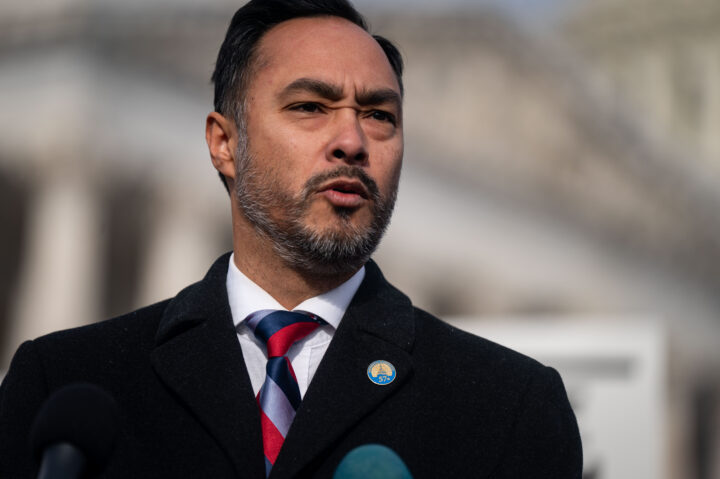
Kent Nishimura/Getty Images
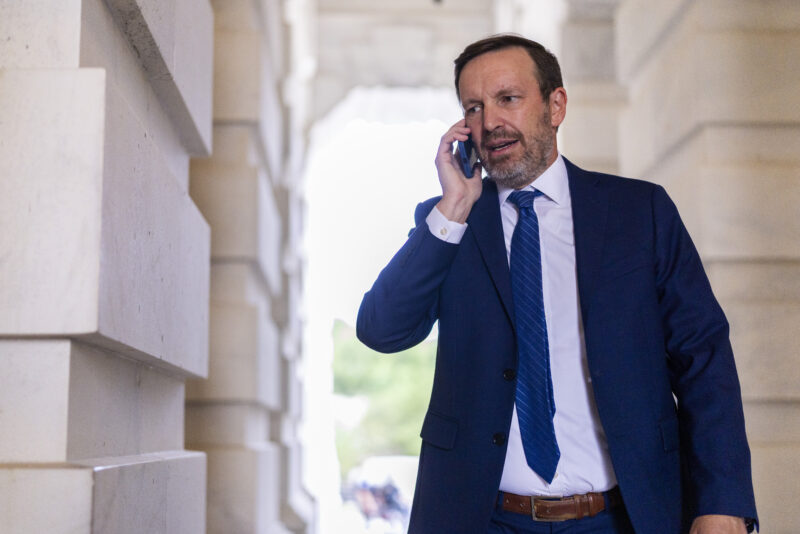
Rep. Joaquin Castro (D-TX) speaks during a news conference outside of the U.S. Capitol on January 18, 2024 in Washington, DC.


 Add JewishInsider on Google
A group of more than 40 House Democrats introduced the Stop the Settlements Act on Wednesday, which would place sanctions on anyone involved in further settlement expansion in the West Bank or Gaza and ban imports from Israeli settlements.
The bill is another signal of a significant appetite among congressional Democrats to take a hard line toward Israeli settlements and Israeli policy in the West Bank, which would likely be a focus of Democrats’ Israel policy if they retake the majority in either chamber in November.
The new legislation, backed by J Street, New Jewish Narrative, some former Biden administration officials and IMEU Policy Project, is significantly broader than a sanctions bill targeting settler violence and officials involved in enabling it that House Minority Leader Hakeem Jeffries (D-NY) said could come up for a vote under a Democratic majority.
The bill is being led by Reps. Joaquin Castro (D-TX), Madeleine Dean (D-PA), Don Beyer (D-VA), Greg Casar (D-TX), Sara Jacobs (D-CA) and Veronica Escobar (D-TX), joined by a number of progressive colleagues, including House Appropriations Committee ranking member Rep. Rosa DeLauro (D-CT) and presidential hopeful Rep. Ro Khanna (D-CA).
The legislation would impose mandatory sanctions on anyone “responsible for or complicit in” or determined to have “directly or indirectly engaged or attempted to engage in” any expansion of settlements in the West Bank after Sept. 30, including investing or assisting the transfer of Israeli civilians into such settlements. The sanctions also target Israeli government officials connected to such activity.
The bill would ban any imports of goods produced “wholly or in part in any Israeli settlements or outposts in the West Bank or Gaza” into the United States, though it would exempt items personally carried in baggage by individuals for personal use or gifts. The lack of such an exemption in import bans applied by some European countries has led to searches of passengers’ baggage when flying into the Netherlands from Tel Aviv.
In a release, Castro’s office said the import ban “would mirror and complement efforts” by U.S. allies.
The bill also provides for discretionary sanctions on anyone involved in “Israeli settlements or outposts that the president determines undermines the viability of a future Palestinian state,” or anyone who has provided financing or other support or assistance to people and individuals subject to mandatory sanctions.
In targeting any new settlement construction, the bill takes a broader aim than a recent Senate bill that takes a similar approach but specifically targets construction in the so-called E1 area.
The president could waive the sanctions for a maximum of two years, before being forced to implement them. The legislation would expire 10 years after its enactment.
“The record expansion of Israeli settlements in the West Bank continues to be one of the greatest impediments to peace. Democrats must face this with urgency — act now or watch the prospect of Palestinian self-determination slip away forever. Congress should and can be using every tool we have available, including sanctions,” Castro said in a statement. “The Stop the Settlements Act gives any person or company looking to take Palestinian land in the West Bank or Gaza a choice: pursue settlements or do business with the United States.”
Hady Amr, who served as the special representative for Palestinian affairs during the Biden administration, said, “A half-century of the U.S. asking nicely has failed to stop ISRAELI settlement expansion,” and said the bill would “finally impose consequences” and is “long overdue.”
Ilan Goldenberg, J Street’s chief policy officer, said in a statement that stopping settlement expansion requires a new sanctions approach, starting with “organizations and entities supporting the tremendous boom in farming outposts over the past few years” and officials such as Finance Minister Bezalel Smotrich and National Security Minister Itamar Ben-Gvir.
“Then give other companies and financial institutions a deadline to wind down activities that support settlement construction. What you would likely get relatively quickly is a de facto settlement freeze on Israeli construction in the West Bank,” Goldenberg predicted, suggesting that Israeli banks would quickly pull out from any settlement projects.
He said that with a crackdown on construction, financial hardship and business withdrawals, some settlers will leave. He called the approach “distinctly different than the [Boycott, Divestment and Sanctions] movement” because it only targets settlements.
“This is bigger than [Israeli Prime Minister Benjamin] Netanyahu. Settlement growth has continued under Israeli governments across the political spectrum,” Goldenberg added.
Sen. Josh Hawley: ‘The European states have been anti-Israel forever, and I just think this is the latest iteration of that’

Amir Levy/Getty Images
A view over the Jewish settlement of Kedumim in the West Bank on Sept. 8, 2026 in Kedumim, West Bank.
Republican lawmakers are speaking up against recent moves by European countries to impose new sanctions and trade restrictions on Israeli settlements in the West Bank, east Jerusalem and the Golan Heights.
The latest restrictions took effect in the Netherlands on Sept. 22, when the country began barring goods obtained or produced wholly or partly in Israeli settlements from entering the country, including products carried by private travelers. Violations can carry a maximum sentence of six years in prison. Israel has since revoked the diplomatic status of Dutch diplomats serving in Ramallah.
On Sept. 9, the United Kingdom announced that it would ban imports produced in Israeli settlements in the West Bank and impose sanctions on companies and individuals involved in settlement construction, financing and related services, while also prohibiting the advertising of settlement properties and goods. France, Canada and other European countries have also committed to — or have already implemented — restrictions involving goods from Israeli settlements, the West Bank, East Jerusalem and the Golan Heights.
Sen. Rick Scott (R-FL) told Jewish Insider he was “disappointed” by the European measures and argued that Israel should be receiving greater support from those governments.
“First off, I’m disappointed. We ought to be supporting the only democracy in the Middle East, somebody that is part of making sure Europe is safe because Iran doesn’t have a nuclear weapon,” Scott said. “I think they ought to be thanking Israel rather than targeting them.”
Asked whether the Trump administration should respond to the European measures, Scott said he believes the White House is already working to address them.
“I think they are, they’re working hard,” he said.
Sen. Josh Hawley (R-MO) likewise criticized the sanctions, arguing that they represent another effort by European governments to pressure Israel over its settlement policy.
“That sounds anti-Israel to me. I don’t support it. I think that’s a bad deal,” Hawley said. “The European states have been anti-Israel forever, and I just think this is the latest iteration of that. It sounds a lot like the BDS movement just sort of laundered now into a different form. So no, I don’t like that at all.”
Hawley also said he expects the Trump administration to retaliate in some form against the European measures, pointing to the president’s previous statements on the issue.
“Well, I assume they will. The president has been very vocal about this, so I hope we’ll continue [to be],” Hawley said.
Rep. Claudia Tenney (R-NY) focused specifically on reports that Dutch customs officials had inspected the luggage of passengers arriving from Israel, calling the reported searches “intrusive” and “unconscionable.”
“The new Dutch BDS law forces Americans and American companies to undergo intrusive searches and prove that they do not possess any goods from Jerusalem or Judea and Samaria,” Tenney wrote on social media. “This is absolutely unconscionable and @USTreasury should IMMEDIATELY add the Netherlands to the list of countries requiring cooperation with a boycott under Section 999 of the Internal Revenue Code.”
Reports provided indicate that passengers were not searched writ large and that some goods were confiscated during routine customs searches.
Scott acknowledged the possibility that Democrats could pursue similar policies in the U.S. if they regain control of Congress. JI has previously reported that should Democrats retake one or both chambers, they could bring up legislation targeting Israeli settlement activity and settler violence.
“Democrats don’t support Israel. They don’t. They don’t fight antisemitism. If you care about stopping hatred in this country, you’re clearly not going to vote for a Democrat,” Scott said.
Several Democratic lawmakers said they were not yet familiar with the European measures and declined to comment.
Sen. Chris Coons (D-DE), the sponsor of legislation targeting companies and Israeli officials involved in settlement construction in the E1 area of the West Bank, drew a distinction between the European restrictions and his bill.
“Look, I think there’s a lot of concern here about settlement expansion and how to send a strong signal to discourage significant settlement expansion, particularly the E1 block,” Coons said. “I recognize that is distinct from some position blocking exports from settlements. I do think after our elections and the Israeli elections, there’s going to be some serious conversations about our long-term relationship and how to ensure that the West Bank continues to be a place in which there may be a viable future for a Palestinian territory.”
Sen. Chris Coons (D-DE) and Rep. Greg Meeks (D-NY), who are both expected to hold powerful committee leadership roles if Democrats win both chambers, have recently made legislative moves that signal a harsher stance on Israel
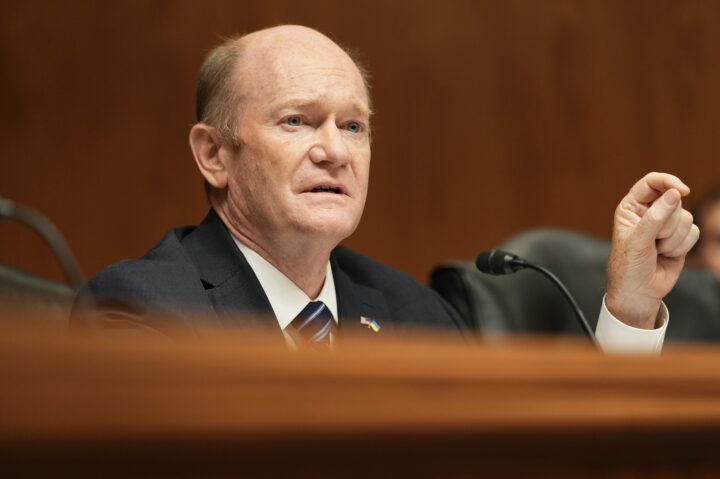
Eric Lee/Getty Images
Sen. Chris Coons (D-DE) speaks at the Senate Appropriations Committee on Capitol Hill on July 14, 2026 in Washington, DC.
If Democrats take control of Congress next year — or even if they win back a majority in only the House of Representatives — expect a legislative agenda that’s a lot tougher on Israel than it has been in a long time.
With growing support among House Democrats for legislation restricting U.S. aid and arms sales to Israel, bills such as the Block the Bombs Act, the Ceasefire Compliance Act or measures similar to this summer’s vote on cutting aid to Israel could come to the House floor, and continued fights over the U.S.-Israel relationship in funding bills and other legislation seem likely.
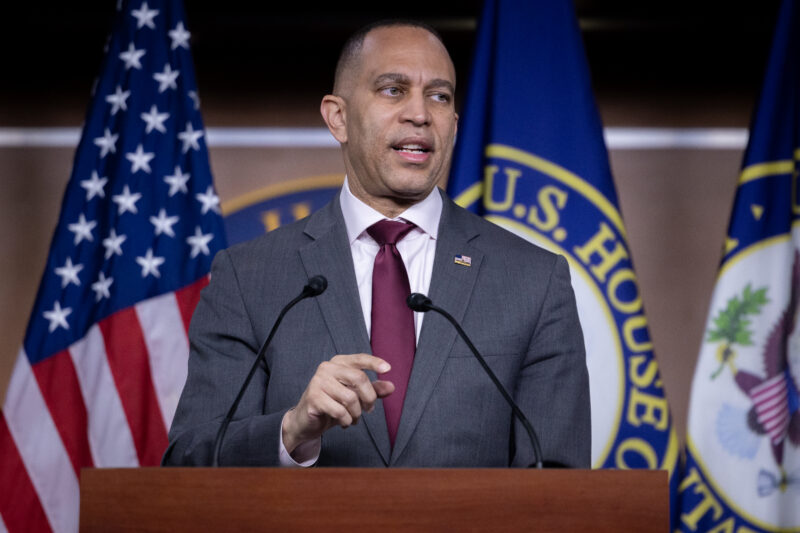
But the top target for senior Democrats at the moment is targeting settlement activity and settler violence in the West Bank. Asked by Jewish Insider at a press conference on Wednesday what Israel-related legislation Democrats might bring forward for a vote, House Minority Leader Hakeem Jeffries (D-NY) — who has generally been a reliable supporter of the U.S.-Israel relationship — pointed to a bill imposing sanctions related to West Bank violence.
“That now has broad support across the House Democratic Caucus family [and] is certainly a legislative step that should be considered in order to push back aggressively against the out of control settler violence in the West Bank,” Jeffries told Jewish Insider. “That cannot continue.”
Responding to JI's @marcrod97, Hakeem Jeffries suggested the West Bank Violence Prevention Act — which seeks to curb settler violence by imposing sanctions on perpetrators and potentially Israeli officials — could be up for a vote next year should Democrats take back the House. pic.twitter.com/2S8upRRz37
— Jewish Insider (@jewishinsider) September 23, 2026
The West Bank Violence Prevention Act would reimplement the West Bank sanctions regime established by the Biden administration and repealed by the Trump administration, which sought to penalize Israeli settlers who commit acts of violence. But the legislation also clearly targets members of the Israeli government connected to or who have permitted settler violence, as well as others who have provided support for such activities, a step the Biden administration never took.
The bill has 173 total co-sponsors — more than any other Israel-related Democratic bill introduced this Congress. Its supporters include all top House Democratic leaders, as well as the leaders of several key committees and even several moderate pro-Israel lawmakers.
There’s similar movement on West Bank issues on the Senate side. Sen. Chris Coons (D-DE), generally a strong ally of Israel who is in line to chair the Senate Foreign Relations Committee if Democrats take the upper chamber, introduced a bill on Wednesday with nearly 20 colleagues to sanction companies, financial institutions and Israeli officials involved in settlement construction in the controversial E1 area of the West Bank, which critics say would sever the West Bank from east Jerusalem.
And a separate Senate measure demanding a report on violence in the West Bank and the killings of U.S. citizens by Israeli settlers and security forces — which could trigger the cut-off of U.S. aid to Israel — picked up more than 20 co-sponsors, including Sen. Richard Blumenthal (D-CT), generally a strong supporter of the Jewish state.
Also among those expected to hold positions of power Rep. Greg Meeks (D-NY), who is in line to chair the House Foreign Affairs Committee, recently announced a hold on a $2.8 billion sale of bombs to Israel, financed by U.S. foreign military funding.
From their anticipated committee leadership posts, Coons and Meeks would hold significant sway over the direction of Democratic policy on Israel and have particular power to guide hearings on and investigations into the U.S.-Israel relationship, the West Bank and more.
At the same time, Coons is one of the few Senate Democrats who have consistently opposed resolutions led by Sen. Bernie Sanders (I-VT) to halt various arms sales to Israel, and Meeks opposed the amendment led by Rep. Thomas Massie (R-KY) to cut off U.S. aid to Israel.
A Democratic-led Congress would also likely bring more of those efforts to restrict or cut off both aid and arms sales to Israel. More than 100 House Democrats, nearly half of the caucus, supported efforts to cut off U.S. aid to Israel earlier this year. In the Senate, 40 Democrats have voted for at least one of Sanders’ resolutions to halt specific arms sales to Israel, and several Democratic candidates have said they would have voted the same way.
In the House, two bills pushing for stringent conditions on U.S. arms sales to Israel have been gaining steam.
The most prominent — and most punitive — of the bills is the Block the Bombs Act, on which Congressional Progressive Caucus Chair Rep. Greg Casar (D-TX) has said his caucus would push for a floor vote in the next term.
The bill would impose unprecedented restrictions on U.S. arms sales to Israel not applied to any other U.S. ally, preventing the transfer or sale of bombs, bomb-guidance kits and tank and artillery ammunition to Israel unless Congress passes a specific law authorizing each individual sale or transfer.
Congress would be required to delineate what specific purposes for which those weapons could be used, and Israel would be asked to provide written assurances that it would comply with those restrictions. Given the gridlock on Capitol Hill and the months it would take to approve any arms sales to Israel — if they could be moved past objections from anti-Israel members at all — critics say the bill would effectively place an arms embargo on Israel for those systems.
Though the Block the Bombs Act started with just 22 co-sponsors in 2025, it has grown to 82, including a handful of more moderate Democrats, a number that is likely to grow further after the midterms, with numerous expected Democratic freshmen pledging on the campaign trail to support the bill.
Alternative measures have been introduced to condition U.S. arms sales to the Jewish state, including the Ceasefire Compliance Act, led by Rep. Sean Casten (D-IL), with 53 co-sponsors. That bill would cut off any arms transfers or sales to Israel if it conducts any strikes inside Gaza, which could only be restored subject to a specific agreement by Israel that it will not use any U.S.-origin weapons inside Gaza or the West Bank.
The legislation would also impose various other conditions on arms sales to Israel related to compliance with the 20-point peace plan for Gaza, the establishment of Palestinian Authority governance in Gaza and steps to prevent West Bank violence or annexation.
Casten’s bill is backed by J Street, the progressive Israel advocacy group that Democratic leaders have increasingly leaned on as a validator on Israel policy issues, such as during the debate in the caucus over the Massie amendment (which J Street opposed).
Speaking broadly, Jeffries told JI that Democrats’ policy should be “anchored in two different principles”: supporting “Israel’s right to exist as a Jewish and democratic state” alongside a peaceful and prosperous Palestinian state to provide “the Palestinian people … the dignity and self-determination that they long deserved.”
Also worth watching: the next U.S.-Israel memorandum of understanding on military aid is set to be finalized during the next Congress. Expect real fights on the Hill, under Democratic leadership, over whether to continue appropriating funding for military aid to Israel and even over the future of U.S.-Israel cooperative military programs in legislation like the National Defense Authorization Act.
Whether negotiators believe that further aid to Israel would actually be passed by a hostile Congress could also be a factor that shapes the MOU itself.
Democratic control of either chamber is also likely to further fuel fights over the future of the U.S. relationship with the United Nations Relief and Works Agency, which were a repeated battle in the divided Congress in 2024.
This term, 79 House Democrats introduced legislation to restore funding to the scandal-plagued agency, including Rep. Rosa DeLauro (D-CT), who is likely to chair the House Appropriations Committee in the upcoming term if the Democrats win back the House.
The Israeli prime minister called the focus on settler violence an ‘obsession’ and declared that Israel ‘prevented genocide’
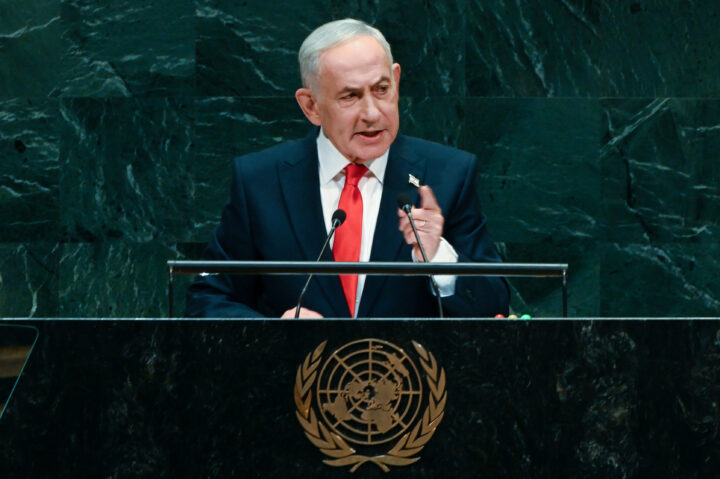
Alexi J. Rosenfeld/Getty Images
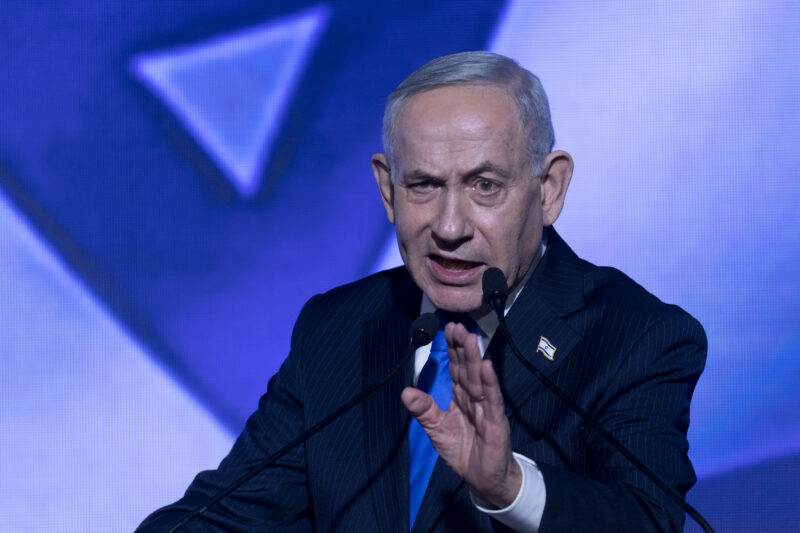
Israeli Prime Minister Benjamin Netanyahu speaks during the 81st session of the United Nations General Assembly at U.N. Headquarters on September 24, 2026 in New York City.
Israeli Prime Minister Benjamin Netanyahu pushed back against criticism of Israel over Gaza and the West Bank in his address to the United Nations General Assembly on Thursday, taking aim at New York City Mayor Zohran Mamdani, French President Emmanuel Macron, Qatar and Turkey.
After most of the hall conducted a walkout at the outset of his speech, Netanyahu condemned violence by Israeli settlers while dismissing the international focus on settler violence as an “obsession.” He said roughly 150 young Israelis were responsible for throwing stones, destroying olive trees and setting fires in the West Bank and said Israel had deployed the Shin Bet against them.
“I can’t stand that. I won’t stand for vigilantism,” Netanyahu said, before arguing that the attention paid to such attacks was disproportionate to Palestinian terrorism. “We can’t stand settler violence. You don’t know what you’re talking about.”
In his UNGA address, Netanyahu alleged that "several foreign countries have spent untold billions to spread lies" about Israel, calling out Qatar for "massively funding American universities and toxic media outlets like Al Jazeera … [to] brainwash young minds to hate Israel." pic.twitter.com/3yhyYfgy9z
— Jewish Insider (@jewishinsider) September 24, 2026
Netanyahu directly addressed Macron, pointing to the killing of Netanel Shukrun, a French citizen and father of six who was shot in a West Bank terror attack on Sunday, and the serious wounding of IDF reservist Neria Leiter, son of Israeli Ambassador to the U.S. Yechiel Leiter, in a car-ramming attack on Wednesday.
Macron had said in his UNGA address that Hamas had “never operated” in the West Bank, while criticizing Israeli policy there. A French diplomatic official later clarified that Macron meant Hamas does not govern the West Bank.
The prime minister also rejected accusations that Israel committed genocide in Gaza, directly addressing Mamdani, who has repeatedly called Netanyahu a war criminal.
“Israel didn’t commit genocide. Israel prevented genocide,” Netanyahu said. He also raised that Mamdani’s wife, Rama Duwaji, had liked multiple Instagram posts celebrating Hamas’ Oct. 7, 2023, attacks. “You try to silence me. Well, you can’t silence me. You can’t silence the truth,” the prime minister said.
In response, Mamdani accused Netanyahu in a statement of using his U.N. address “to repeat baseless lies meant to sanitize his genocide of Palestinians.”
Netanyahu went on to accuse foreign countries of spending “untold billions” to spread anti-Israel messages through traditional and social media, singling out Qatar for “massively funding American universities and toxic media outlets” in what he alleged was an effort to “brainwash young minds to hate Israel, hate America, hate the West.”
He called Turkey the latest “superspreader of antisemitic lies” and Turkish President Recep Tayyip Erdoğan a “tyrant,” accusing Ankara of supporting Hamas and seeking greater influence in Syria.
Netanyahu also responded to Syrian President Ahmad al-Sharaa, who said in his UNGA address on Wednesday that the Golan Heights “will remain Syrian territory.”
“Mr. al-Sharaa, you should know the Jews have been on the Golan Heights since the days of Moses,” Netanyahu said. “You can read it in the Bible.”
With no Trump meeting, a scrapped Musk visit and renewed U.S.-Iran talks, the trip Netanyahu envisioned a month before elections had already unraveled before Neria Leiter was wounded
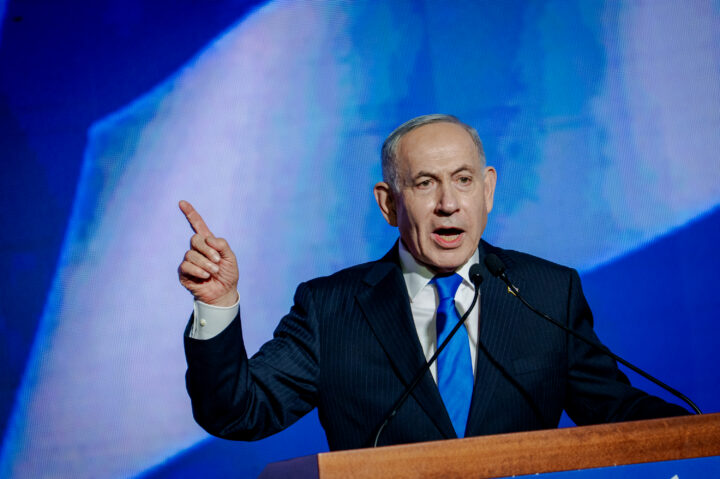
(Erik Marmor/Getty Images)
Israeli Prime Minister and Likud party leader Benjamin Netanyahu speaks at the lectern to supporters during a party campaign rally at Expo Tel Aviv on September 17, 2026 in Tel Aviv, Israel.
For a few hours, Israel’s deeply polarized political arena, just a month before the elections, found rare unity. It came following the news that Neria Leiter, son of Israel’s ambassador to the U.S., Yechiel Leiter, was critically injured in a car-ramming terror attack in the West Bank. Neria chose to continue his reserve duty, including serving in Lebanon, even after his brother Moshe fell in battle in northern Gaza in November 2023.
Ambassador Leiter was on his way to a CNN interview ahead of Israeli Prime Minister Benjamin Netanyahu’s address to the U.N. General Assembly, set to take place this afternoon, when he received the news about his son, and quickly departed for Israel. That speech will likely now take a turn following the attack.
But even beforehand, Netanyahu’s trip to New York was set to be entirely different from anything seen before. The prime minister’s brief video message about his speech on Tuesday referenced only one individual: New York City Mayor Zohran Mamdani. Not Iran, not Hamas, nor Turkish President Recep Tayyip Erdogan. Of all the adversaries facing Israel, Netanyahu singled out just one.
Sources close to the prime minister claim Mamdani is the reason for Netanyahu’s unprecedented brief visit: a quick stop of just a few hours in New York, and nothing more. The concern, his aides claim, stems from potential protests or political posturing by Mamdani, despite him admitting he has no authority to arrest Netanyahu, a key campaign pledge of the mayor’s. However, a former official involved in coordinating prime ministerial trips offered a different explanation: As long as Netanyahu remains in New York for only a few hours, the absence of a meeting with President Donald Trump becomes far less conspicuous.
This is not how the prime minister envisioned his annual U.N. trip, especially a month before an election. He hoped to schedule a meeting with Trump, which would have been their ninth since January 2025 — but it did not materialize. He wanted to visit Texas, meet Elon Musk, and talk about AI, but that too fell through. And Netanyahu, who recently predicted that the Iranian regime would soon be toppled, certainly did not expect that a day before his arrival, U.S.-Iran negotiations would resume, with White House Special Envoy Steve Witkoff and Jared Kushner meeting with Iranian Foreign Minister Araghchi.
“In his address to the General Assembly, Prime Minister Netanyahu intends to speak about both the challenges and the opportunities facing the region. The prime minister will call for continued pressure on Iran, the primary exporter of terrorism in the Middle East,” Israel’s ambassador to the U.N., Danny Danon, told Jewish Insider.
When asked whether the prime minister’s speech is aimed at a domestic Israeli audience or an international one, Danon offered a diplomatic response: “The U.N. General Assembly provides an opportunity for the State of Israel to make its voice heard before hundreds of leaders from around the world, particularly at such a sensitive time.”
Netanyahu promised some surprises in his upcoming speech, which, Danon said, may be connected to Israel’s relationship with the Arab world.
“Netanyahu will also address the diplomatic opportunities emerging in the Middle East, as we mark six years since the Abraham Accords and following the signing of the agreement with Morocco last week,” Danon noted, referring to the deal whereby the two countries upgraded their diplomatic ties..
According to the Prime Minister’s Office, while there will be no meeting with U.S. administration officials during his short stay, the prime minister will meet with the presidents of Argentina, Bolivia, Paraguay, Panama and Ethiopia, as well as the vice president of Colombia and the prime ministers of Greece, Slovenia and Papua New Guinea. “Many world leaders requested to meet with the prime minister during the visit, but due to a tight schedule and the need to return before the onset of Sukkot, the prime minister was only able to accommodate some of them,” the Israeli PMO said.
Danon described the overall atmosphere during the UNGA as almost festive, with delegations gathering from around the globe, yet overshadowed by deep friction between the Israeli delegation and Secretary-General Antonio Guterres, who has historically been exceedingly critical of the Jewish state. Unfortunately, that atmosphere has become even more complicated following the latest terror attack in the West Bank that looms over the entire Israeli delegation to the U.N.
Ambassador Yechiel Leiter said his son ‘needs a miracle’; Neria Leiter’s older brother was killed fighting in Gaza in 2023
Oliver Contreras / AFP via Getty Images
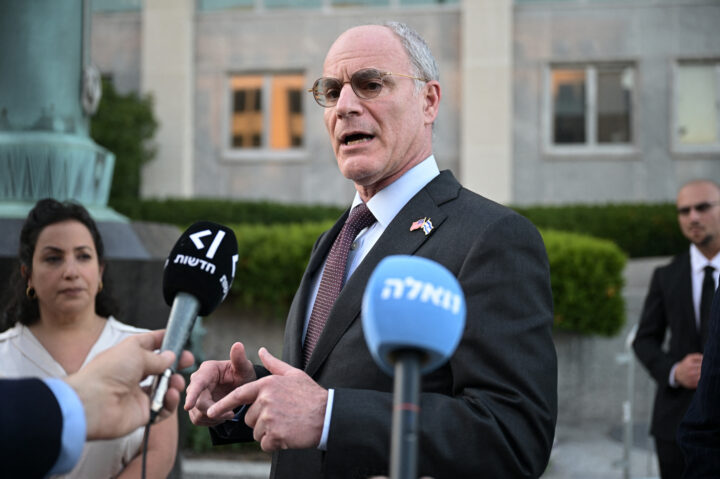
Israel's Ambassador to the U.S. Yechiel Leiter speaks to reporters after a meeting between Israeli and Lebanese delegations hosted by the United States at the State Department in Washington, DC, on June 3, 2026.
Neria Leiter, the son of Israeli Ambassador to the U.S. Yechiel Leiter, was seriously wounded in a car-ramming terror attack at a West Bank checkpoint on Wednesday, the ambassador confirmed.
Leiter, an IDF reservist in his 30s, was stationed at the Maccabim checkpoint on Route 443 when an assailant accelerated toward a police cruiser and ran over Leiter, according to Israeli police. IDF troops at the scene opened fire and killed the driver.
The assailant was identified as a 29-year-old Palestinian from the nearby West Bank village of Beit Ur al-Tahta.
Leiter was evacuated to Shaare Zedek Medical Center in Jerusalem in serious condition. He was unconscious when emergency responders treated him at the scene, according to Magen David Adom.
The ambassador said following the attack that doctors were “fighting for the life” of his son, who he said “needs a miracle.”
“Neria continued to serve in the reserves after losing his older brother, Moshe Yedidya Leiter, of blessed memory, and has served hundreds of days in the reserves on various fronts since October 7,” the ambassador said.
Neria’s older brother, Maj. (res.) Moshe Yedidya Leiter, 39, was killed alongside three other Israeli reservists in northern Gaza on Nov. 10, 2023. The four soldiers were killed by a blast from a booby-trapped tunnel shaft in the Beit Hanoun area.
A father of six, Moshe was a company commander in the IDF reserves and served as a paramedic. He was studying medicine and was due to begin a hospital training placement.
The wide-reaching sanctions would target financial institutions and government officials and entities involved in supporting or facilitating E1 settlement construction
Eric Lee/Getty Images
Sen. Chris Coons (D-DE) speaks at the Senate Appropriations Committee on Capitol Hill on July 14, 2026 in Washington, DC.
Nineteen Senate Democrats, led by Sen. Chris Coons (D-DE), introduced a bill on Wednesday that would impose sanctions on companies, individuals and others involved in the construction and development of Israeli settlements in the E1 area of the West Bank, which the lawmakers argue would be a severe blow to the viability of a Palestinian state.
The far-reaching sanctions would also target financial institutions and government officials and entities involved in supporting or facilitating E1 settlement construction.
Coons’ leadership on the legislation is especially notable because he has historically been seen as one of Israel’s strongest allies on Capitol Hill and he’s in line to be the top Democrat on the Senate Foreign Relations Committee in the next Congress — potentially chairing the influential panel if Democrats take the majority, where he’d have significant latitude to work to advance the bill and other similar measures.
The bill would place mandatory sanctions on anyone “responsible for or complicit in, or [found] to have directly or indirectly engaged in or attempted to engage in” the construction of settlements or related structures in the E1 area; investing in or constructing infrastructure designed to serve the settlements including roads and utilities; or organizing or financing the transfer of Israeli settlers into such settlements.
The sanctions would also apply to those who “knowingly facilitated financial transactions related” to such settlement activity — targeting Israeli or international banks involved in the settlement construction — as well as government entities and leaders involved in E1 settlement construction.
The bill also allows for discretionary sanctions on individuals or entities providing support to those who are sanctioned, and on entities owned or controlled by those sanctioned.
The sanctions authorities would terminate after seven years unless renewed.
Alongside Coons, the bill is being co-led by Sens. Elizabeth Warren (D-MA), Ron Wyden (D-OR) and Ruben Gallego (D-AZ), and is cosponsored by Sens. Michael Bennet (D-CO), Tammy Duckworth (D-IL), Martin Heinrich (D-NM), Tim Kaine (D-VA), Mark Kelly (D-AZ), Andy Kim (D-NJ), Jeff Merkley (D-OR), Chris Murphy (D-CT), Patty Murray (D-WA), Jack Reed (D-RI), Brian Schatz (D-HI), Adam Schiff (D-CA), Elissa Slotkin (D-MI), Chris Van Hollen (D-MD) and Peter Welch (D-VT).
“For decades, American presidents from both parties have warned successive Israeli governments that construction in E1 threatened the viability of a Palestinian state and was unacceptable to the United States,” Coons said in a statement. “As Palestinian civilians face a campaign of devastation and fear from violent extremist settlers, the United States must send a strong message that this behavior is unacceptable and that it remains committed to freedom, security, prosperity, and self-determination for all Israelis and Palestinians.”
Warren described the E1 project as “a move towards de facto annexation of the West Bank, and those who choose to facilitate settlement construction should understand that they risk losing access to the U.S. financial system.”
Wyden said that the expansion of West Bank settlements “crosses a clear red line and makes Palestinian statehood and lasting peace even more difficult” and said the U.S. must “must stand up against [Israeli Prime Minister Benjamin] Netanyahu’s campaign of violence and aggression against Palestinian civilians.”
Gallego said that, by severing east Jerusalem from the West Bank, E1 construction would “threaten a viable Palestinian state” and is a “step in the wrong direction.”
“This legislation sends a clear message to Prime Minister Netanyahu: the United States stands firmly behind a two-state solution as the only path to real peace and security for all,” he said.
The bill follows the announcement of sanctions by the U.K. and other U.S. allies targeting Israeli settlements broadly, including both the West Bank and the Golan Heights.
J Street praised the bill, saying, “The era in which right-wing Israeli governments could ignore US demands to halt settlement expansion and expect American politicians to fall in line is over.”
Phil Gordon, who served as national security advisor to former Vice President Kamala Harris, also expressed support, saying, “If [President Donald’ Trump actually cared about addressing settlements or settler violence he could support that; if not his ‘mild’ response to UK means little.”
The secretary of state said the U.S. wasn’t going to support the policy, but added that the U.S. doesn’t want destabilizing activity taking place in the West Bank
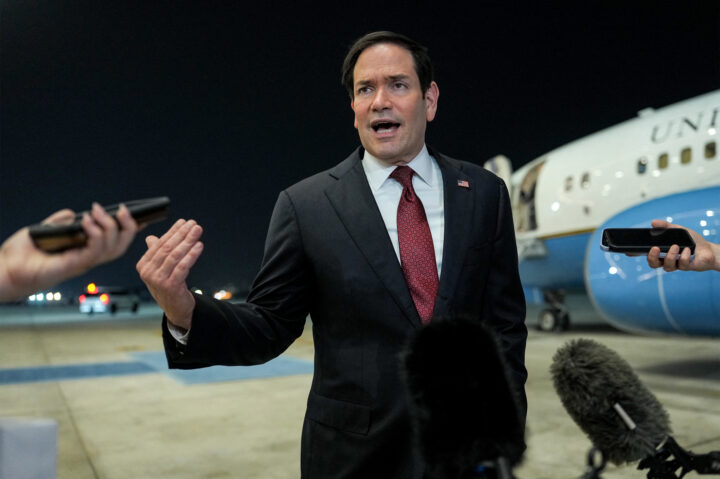
Photo by Eric Lee / POOL / AFP via Getty Images
Secretary of State Marco Rubio speaks to the media upon arrival at al-Bateen Executive Airport in Abu Dhabi on June 23, 2026.
Secretary of State Marco Rubio offered a tepid response on Tuesday to the United Kingdom’s new sanctions regime against Israeli settlements in the West Bank.
“Obviously, we’re not going to do what the U.K. did,” Rubio told reporters during a trip to Colombia when asked about U.K. Foreign Secretary Ed Miliband’s announcement, but said he didn’t have anything to add further.
“Obviously, these are decisions that they make,” he said. “And we — and the president has expressed this in the past — don’t want to see anything destabilizing going on right now in the West Bank with so much going on in the region. We think it has implications as well on our ability to make progress with regards to Gaza and the 20-point plan and Board of Peace that we’re very committed to.”
Rubio’s remarks followed an announcement earlier Tuesday by U.K. Foreign Secretary Ed Miliband, who unveiled a sweeping new sanctions regime targeting West Bank settlements. The British policy includes an import ban on goods produced in settlements alongside targeted sanctions against individuals and businesses involved in constructing, advertising or financing settlement expansion.
Prior to the formal announcement in London, U.S. Ambassador to Israel Mike Huckabee warned that Britain could face retaliatory “repercussions” from Washington over the policy shift.
Asked about Huckabee’s comment, Rubio noted that neither he nor President Donald Trump had issued an official response yet, but acknowledged that the administration was “made aware that [the U.K. was] going to make this decision.”
“We heard their arguments as to why,” Rubio said. “But look, we share the goal of stability. We don’t want to see some uptick in violence or an uptick in conflict or tensions in the West Bank at a very tenuous time in the region. But beyond that, as of this moment, we don’t have any further comment.”
The move was roundly criticized by British Jewish leaders, along with the conservative opposition parties in Parliament
Wiktor Szymanowicz/Future Publishing via Getty Images
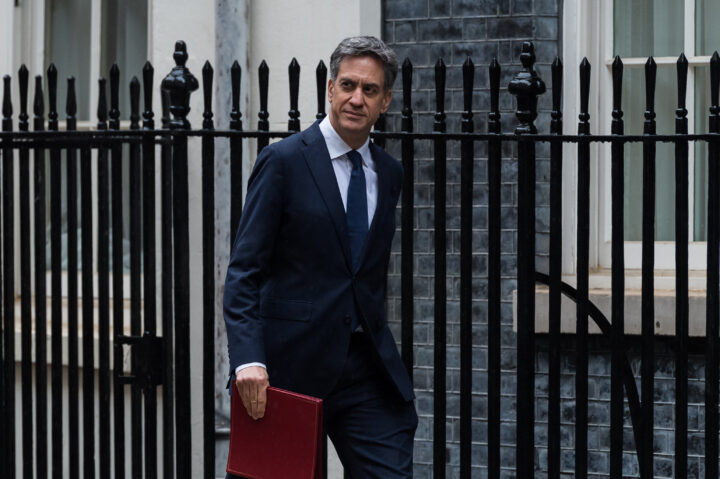
U.K. Foreign Secretary Ed Miliband arrives in Downing Street to attend weekly Cabinet meeting in London, U.K. on Sept. 8, 2026.
U.K. Foreign Secretary Ed Miliband announced a sweeping new sanctions regime targeting Israeli settlements in the West Bank on Tuesday, marking a major escalation in Britain’s diplomatic stance toward Israel.
Addressing the House of Commons, Miliband unveiled an import ban on goods produced in settlements alongside targeted sanctions against individuals and corporate entities involved in constructing, advertising or financing settlement expansion.
The secretary also announced a ban on real estate events in the U.K. promoting the purchase of homes in West Bank settlements. Miliband went further than any previous British official in accusing extremist Israeli settlers of carrying out “ethnic cleansing” of Palestinians in the West Bank and calling them “terrorists” with the tacit backing of the Israeli government.
“My parents came here as Jewish refugees and found sanctuary and a country that stood up for the law, freedom and self-determination,” said Miliband, describing himself as a proud British Jew. Expressing a “deep sense of shame” over the actions and policies of the Israeli government in Gaza, he insisted the policy is intended to target illegal settlements — not Israel or the Jewish community — and is distinct from the Boycott, Divestment and Sanctions movement.
“We absolutely oppose the BDS movement against Israel. This is about the Occupied Territories, settlements in the Occupied Territories,” Miliband said. “[It takes] six to nine months precisely so that we get this regime right so it does not affect, so it does not impinge, on Green Line Israel,” he continued, referring to the Israeli borders established in the aftermath of the 1948 war.
Miliband also announced that the U.K. would be reimposing strict economic sanctions on Iran, as well as sanctions on Al-Qard al-Hassan, a Hezbollah-run financial institution.
The measures, triggered in part by Israel’s plans to expand the contentious E1 settlement zone east of Jerusalem, were coordinated with France and Canada. Denmark, Finland, Iceland and Poland joined the countries in announcing they would enact similar sanctions in a joint statement alongside countries that have already taken similar measures — such as Ireland, Spain, Netherlands, Norway and Belgium.
The countries reaffirmed their commitment to a two-state solution, firmly opposing “actions tantamount to the annexation of Palestinian land and forcible displacement” while reiterating Israel’s legitimate security needs and condemning the Oct. 7, 2023, Hamas terrorist attacks.
Denouncing what he described as a “hostile sanctions package,” Israeli Foreign Minister Gideon Sa’ar announced on Tuesday that Israel would be taking swift retaliatory measures, such as closing the British Consulate in Jerusalem, expelling British representatives from the U.S.-backed International Gaza Support Center, terminating the British Support Team in Ramallah tasked with training members of the Palestinian Authority Security Forces and barring 12 British officials “involved in antisemitic and anti-Israel activity.”
U.S. Ambassador to Israel Mike Huckabee suggested that Britain will face “repercussions” and accused the U.K. of “discrimination against the Israeli government.” The U.S. is expected to release a statement about the sanctions later today.
Despite gaining support within the Labour Party the government’s announcement triggered immediate pushback from the political opposition and British Jewish organizations, who warned the policy could inflame tensions at home.
Speaking to Miliband in the House of Commons, Reform U.K. Deputy Leader Richard Tice condemned the sanctions as a “grave mistake” that risks fueling anti-Jewish hostility. The U.K. has seen a spate of violent attacks against its Jewish communities in recent months.
“We all deplore settler violence, but the simple reality is these sanctions are a grave mistake,” Tice said, questioning whether the policy would “embolden the scourge of antisemitism against British Jews on British streets.” He added that the move risks damaging relations with the U.S., harming U.K. security and inviting retaliatory sanctions from Israel.
Conservative leader Kemi Badenoch similarly criticized the measures, accusing the Labour Party of being driven by domestic political motives rather than Middle East diplomacy.
“Labour’s obsession with Israel is rooted in U.K. politics — it’s got less to do with peace in the Middle East and more to do with trying to keep the peace in the Labour Party,” Badenoch said, warning that British Jews should not have to watch politicians condemn antisemitism while ignoring the ideologies that drive it.
Jewish community groups also raised alarms over the diplomatic fallout. The Board of Deputies of British Jews, the leading representative body of British Jews, cautioned against prioritizing party politics over national interests, warning that eroding ties between London and Jerusalem could undermine economic security, damage national security ties and heighten community friction within the U.K.
“As we have told both governments over recent weeks, the deteriorating relationship between the U.K. and Israel has the potential to negatively impact the two countries’ security and their economies and further inflame community tensions here too,” the statement read.
Meanwhile, the Jewish Labour Movement, while acknowledging that curbing settlement expansion and opposing Israeli Prime Minister Benjamin Netanyahu’s policies were worthy goals, voiced serious misgivings regarding the government’s timing and execution of the policy.
“Action against settlement expansion and settler violence is absolutely necessary, as well as the increased opposition to Netanyahu’s ruinous ideology, but many in our community and our membership will hold questions and voice concerns about the timing and specifics of the policy.”
The resolution could prompt the cutoff of U.S. military aid to Israel
Nathan Posner/Anadolu via Getty Images
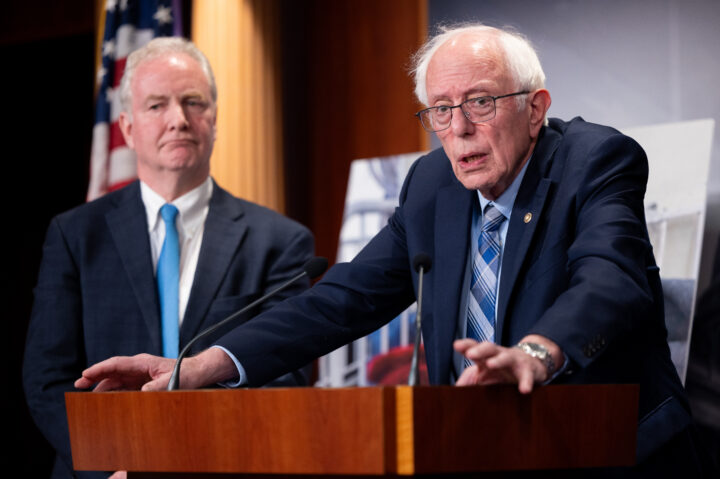
Sen. Bernie Sanders (I-VT) speaks at a press conference, alongside Sens. Chris Van Hollen (D-MD), Peter Welch (D-VT) and Jeff Merkley (D-OR), on upcoming Joint Resolutions of Disapproval aimed at blocking weapon sales to Israel on Nov. 19, 2024.
Sens. Chris Van Hollen (D-MD), Tim Kaine (D-VA), Bernie Sanders (I-VT) and eight Democratic colleagues plan to force a vote in the Senate in the coming weeks to require the State Department to produce a report for Congress on violence by settlers and Israeli forces in the West Bank, including killings and detentions of Americans.
If the resolution were to pass — which is unlikely — and the State Department were to fail to produce the report within 30 days, most U.S. security assistance to Israel would be cut off. After such a report was delivered, any senator would also be able to force a vote on cutting off aid to Israel.
The last time the Senate voted on a similar resolution, demanding an investigation of Israel for potential war crimes, in January 2024, just eleven senators voted for it — so the new resolution is already set to meet and very likely exceed that benchmark.
The resolution accuses both the Israeli and American governments of failing to seek accountability for the killings of U.S. citizens. The legislation also raises concerns about the detention of Palestinian minors, alleged widespread human rights abuses in Israeli prisons, settlement expansion and settler violence in the West Bank. And it highlights attacks on Christians and churches in Israel in the West Bank.
The report required by the bill demands details of any investigations of or evidence gathered by the U.S., Israel, Palestinian Authority or nongovernmental organizations related to killings of nine Americans in the West Bank in recent years, including potential suspects; details about Palestinian minors detained by Israel; the identities of individuals accused of human rights violations in Israeli prisons; and details of U.S. efforts to address these activities.
Van Hollen, in a statement, accused the administration of failing to seek justice or accountability for Americans killed in the West Bank.
“It’s past time we get answers on their deaths — and on the growing violent instability in the West Bank and the injustices facing Palestinian civilians on a daily basis,” Van Hollen said. “This resolution will require the State Department to begin to produce these answers, which are owed to the families of those who have lost loved ones, to the American people, and to all of those who want to ensure recipients of U.S. taxpayer dollars are acting in line with our laws and our values.”
The Maryland senator, who is considering a 2028 presidential bid and is also seen as a potential contender for Senate Democratic leader, has been working to push the party to the left on Israel policy issues.
Kaine said that violence by Israeli settlers “is reaching an unprecedented level.”
“These actions — and the Israeli government’s lack of response to this violence — are unacceptable and threaten the long-term safety and security of the entire region,” Kaine said in a statement. “Friends need to listen to each other, and my colleagues and I have repeatedly urged Israeli leaders to take firmer action to curtail illegal settlements in the West Bank, prosecute violent settlers, and protect Palestinian residents as well as American citizens living in or visiting the West Bank.”
Sanders said in a statement, “Every day, Palestinians in the West Bank experience horrific violence at the hands of Israeli settlers and security forces — and for years, the Israeli government has offered impunity instead of accountability. Enough is enough. The United States cannot keep bankrolling this violence and looking the other way — it’s time to end our complicity, once and for all.”
Sens. Jeff Merkley (D-OR.), Mazie Hirono (D-HI), Martin Heinrich (D-NM), Elizabeth Warren (D-MA), Ed Markey (D-MA), Tina Smith (D-MN), Ben Ray Luján (D-NM) and Peter Welch (D-VT) are cosponsoring the resolution.
The only Democrats who didn’t sign the letter: Sens. John Fetterman and Bernie Sanders, who are on opposite ends of the caucus on Israel issues

Kevin Carter/Getty Images
U.S. Capitol Building on January 18, 2025 in Washington, DC.
Nearly all Senate Democrats wrote to Israeli Prime Minister Benjamin Netanyahu on Wednesday urging him to take action against settler violence in the West Bank and investigate the deaths of nine American citizens killed in the area in recent years.
The letter, led by Sens. Adam Schiff (D-CA), Chuck Schumer (D-NY) and Cory Booker (D-NJ), who have generally been supportive of Israel, was signed by every Senate Democrat except for Sens. Bernie Sanders (I-VT) and John Fetterman (D-PA) — who stand at opposite ends of the caucus on Israel issues.
“We write in shared concern and opposition to the growing levels of violence in the West Bank,” the lawmakers said, arguing that settlement expansion and violence in the West Bank “will harm Israel’s long-term security and the prospects for lasting peace, prosperity, and freedom for Israelis and Palestinians alike.”
They called on Netanyahu to instruct Israeli police and the IDF to stop harassment, threats and violence, to ensure that all responsible for such incidents are held accountable and that full investigations are conducted, to stop authorizing additional settlements and to take steps to dismantle illegal settlements.
“We write particularly on behalf of American citizens who have been killed or threatened in such violence. Many of us have heard first-hand from their families and other constituents who have themselves been threatened without cause by settlers,” the letter states. “[A] more significant response from your government is clearly needed. We ask for your personal and direct engagement and intervention in order to protect our constituents and their families.”
The congressman angered Drop Site co-founder Jeremy Scahill by refusing to condone the attacks; Scahill accused Khanna of promoting a ‘double standard’
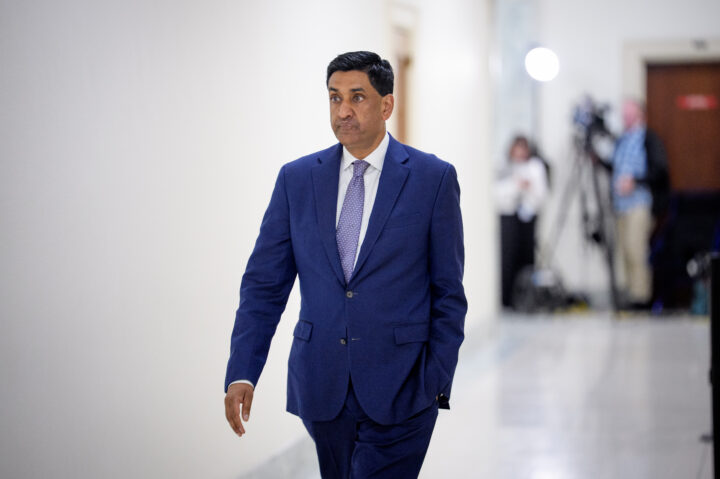
Andrew Harnik/Getty Images
Rep. Ro Khanna (D-CA) on Capitol Hill on May 18, 2026, in Washington, DC.
Rep. Ro Khanna (D-CA), fresh off a trip to the West Bank where he alleges he was unjustly detained by Israeli settlers and Israeli military forces, faced a barrage of criticism in a Drop Site News interview on Tuesday for refusing to endorse Hamas’ Oct. 7, 2023, attack on Israel.
Khanna, in spite of his condemnations of Israel over the incident — which the Israeli government claims he has misrepresented — and demands for consequences for those involved, has faced pressure and condemnation from the far-left flank of the Democratic Party during his media tour following his return to the U.S.
Such pressure reached a fever pitch in Khanna’s Tuesday interview with Drop Site, an outlet that launched in July 2024 with an 8,000-word interview with two senior Hamas leaders. Since then, the outlet has gained a reputation of credulously reporting on Hamas’ claims and repeating the group’s propaganda.
In the lengthy exchange, Drop Site co-founderJeremy Scahill repeatedly questioned Khanna, a 2028 presidential hopeful, on why he would not express support for Hamas attacks on Israeli soldiers. Scahill framed the Oct. 7 attacks as primarily targeting Israeli military bases and soldiers, despite the fact that the group attacked many civilian communities and fired thousands of rockets at civilian centers.
“I think the Oct. 7 attack was a terrorist attack,” Khanna said when pressed if Palestinians have a “right” to kill Israeli soldiers. “I’m not going to say that Hamas had a right to attack Israeli soldiers or kill Israelis. I don’t think that advances peace or advances Palestinian statehood.”
Further angering Scahill, Khanna said he believed Israel had a right to go after Hamas terrorists “who killed the civilians” on Oct. 7, “but not in the way they went about it, which I said is genocide.” Scahill accused him of holding an unfair “double standard.”
“I am baffled as to how you can say that Israel had a right to drop a single bomb on Gaza in response to Oct. 7,” Scahill said. “But Palestinians, according to you, have no right whatsoever to ever kill an Israeli.”
Pressed on whether he supported in any scenario “armed resistance against Israeli occupation soldiers in uniform” — as Scahill characterized it — Khanna did not offer a hard no.
“I think if it’s self-defense, if they feel like there’s an illegal attack on them by a violent settler or by an Israeli soldier and that’s illegal, in a school or on a civilian, then of course they should have justice,” Khanna said. Pressed further, Khanna added, “I will look at it, but I don’t think that the solution in that area is to encourage [violence],” while offering support for peaceful resistance.
Scahill argued that Khanna shouldn’t be afraid of being seen as pro-Hamas.
“You’re afraid of being called pro-Hamas, that’s what this boils down to,” he said, speculating that Khanna would acknowledge the “right to resistance by all means necessary” privately.
Khanna countered saying that the Palestinians he met during his trip to the West Bank were not interested in the sort of armed attacks that Scahill was promoting, and “just want to live their lives in dignity and peace.”
Repeatedly invoking nonviolent civil rights leaders like Mahatma Gandhi and Martin Luther King Jr., Khanna expressed support for nonviolent protest.
The California congressman has also faced pushback for declining to endorse a full arms embargo on Israel in an interview with Hasan Piker, a social media influencer who has expressed support for Hamas and has repeatedly been condemned for antisemitism.
Israeli Ambassador Yechiel Leiter said Khanna had declined a request to coordinate with the embassy for the trip where he was stopped by Israeli settlers in the West Bank
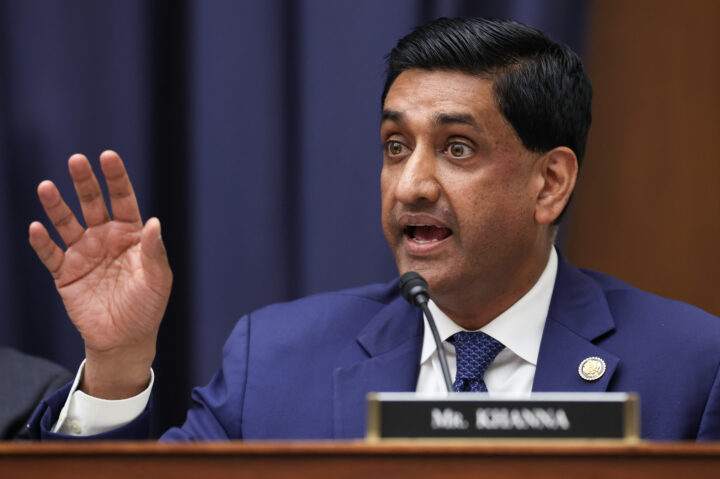
Photo by Win McNamee/Getty Images
Rep. Ro Khanna (D-CA) questions U.S. Secretary of Defense Pete Hegseth as he testifies before the House Armed Services Committee April 29, 2026.
Rep. Ro Khanna (D-CA) on Sunday called on Israeli Prime Minister Benjamin Netanyahu to launch an investigation after the lawmaker said he was harassed by Israeli settlers in the West Bank last week, an incident Netanyahu attributed to a small group of “vigilantes.”
During his first known trip to Israel and the West Bank since October 2024, Khanna said that his delegation’s van had been surrounded, stopped and taunted last Wednesday by Israeli settlers armed with U.S.-made M4 rifles during a tour of the southern West Bank, an incident that a New York Times photographer traveling in a different vehicle said he witnessed.
Khanna claimed IDF vehicles then appeared, and the soldiers spoke amiably with the settlers and continued to block the road themselves after the settlers departed. The IDF denied that the visitors were detained by military personnel.
Cameron Kasky, an aide to Khanna, said the group was held for over an hour and appealed to the U.S. Embassy in Jerusalem for assistance. Kasky previously ran in the Democratic primary in New York’s 12th Congressional District on an explicitly anti-Israel platform.
Khanna told NBC News the incident had made him “more resolved” to consider a presidential run in 2028.
“I have something unique to offer about the injustices of Palestinians,” he told the Times. “I’m going to go to every corner of America, regardless of whether I run or not, and tell their stories and tell the story of what is happening in the West Bank.”
An IDF spokesperson told NBC that troops and police officers were dispatched to the scene in a “closed military zone” after a “report was received regarding Israeli civilians who were unlawfully blocking the vehicle of foreign nationals.” The military said the soldiers reopened the road and let the delegation through.
Israel Police said that officers on the scene did not witness any violence and that the group was stopped in a restricted zone. Israel prohibits its citizens from entering certain areas of the West Bank without an IDF permit, particularly Palestinian Authority-controlled Area A, which are typically marked with warning signs. Foreign civilians are generally not legally barred from these areas, though they may be subject to security advisories or temporary restrictions.
Police added that Khanna’s tour group leader was warned of a possible arrest and that the group was told that civilians were not permitted in the area, before being released. Khanna said that his office had alerted the Israeli Embassy in Washington of his visit — a claim that was denied by the Israeli Ambassador to the U.S. Yechiel Leiter.
Speaking on CBS’ “Face the Nation,” Leiter said that Khanna’s team did not alert Israeli authorities, saying instead that the California lawmaker had ignored a request from officials to allow them to assist in coordinating the trip.
“We reached out to him [Khanna] when we heard he was going to Israel … We suggested he visit with survivors of the Oct. 7 [2023] massacre, that he visit the borders so he understands the issues that we have on our borders and so on,” Leiter said. “He [Khanna] ignored that and he decided to coordinate his trip not with Israel, but with Palestinian activists and with J Street.”
“There was a question about visas, that’s all,” Leiter added of Khanna’s outreach to the embassy. “But when we requested that he coordinate the trip with us, he rejected that by basically staying silent.”
J Street President Jeremy Ben-Ami on Sunday denied that J Street had any involvement in organizing Khanna’s visit.
Speaking on NBC’s “Meet the Press” on Sunday, Khanna called the encounter “unprecedented” and accused the IDF of “lying.”
“They had violent settlers detain American citizens, including an American government official,” Khanna said. “You had these settlers brandishing M4s, kicking the tires of our van, laughing at us, mocking us, videotaping us. We were detained for about 20 minutes, fearful for our lives. Then the IDF comes, four soldiers, they tell our translator that they’re on the side of the settlers.”
Also appearing on NBC on Sunday, Netanyahu insisted that Israel is “a country of laws” and blamed the confrontation on a fringe group of “vigilantes.”
“We’re a country of laws, and people who break the law, we take them to court,” Netanyahu said. “There is a vigilante effort, not by the settler community … There are 150 juvenile delinquents that are not part of that community. They come from other parts of Israel. I don’t want vigilantes of any kind, and we are working to put them under the law.”
Responding to Netanyahu’s remarks, Khanna pushed the Israeli leader to further investigate the matter.
“The prime minister needs to open an investigation on these violent settlers,” Khanna said. “They need to be prosecuted … their outpost needs to be investigated, and he [Netanyahu] needs to have an investigation on these four IDF officers.”
“Security cameras can see that they were involved in the detention of American citizens,” he added. “How dare they mistreat people with an American passport that way?”
The California Democrat, one of the most vocal Israel critics in the House, last traveled to the Jewish state in October 2024

Anna Moneymaker/Getty Images
Rep. Ro Khanna (D-CA) speaks at a rally near the U.S. Capitol on June 29, 2021, in Washington, D.C.
Rep. Ro Khanna (D-CA) traveled to Israel and the West Bank this week while Congress is in recess, according to two individuals with knowledge of the trip.
Khanna has not posted publicly about his trip, which is scheduled to conclude Thursday night. His office did not respond to requests for comment from JI.
The California Democrat has become increasingly critical of Israel since the onset of the Israel-Hamas war following Hamas’ Oct. 7, 2023, terror attacks. In September 2025, he accused Israel of having committed genocide in Gaza.
His last known trip to the country was with a bipartisan delegation in October 2024 that also included stops in Jordan and Saudi Arabia. On that trip, the delegation met with Israeli Prime Minister Benjamin Netanyahu. In a statement about the trip, Khanna noted that the group had also met with Jordanian King Abdullah II earlier in the day.
A spokesperson for the Prime Minister’s Office said that Netanyahu did not meet with Khanna during this trip.
The ‘Ceasefire Compliance Act’ would require continued verification that Israel is not striking in Gaza, without exceptions for operations in response to Hamas’ violations
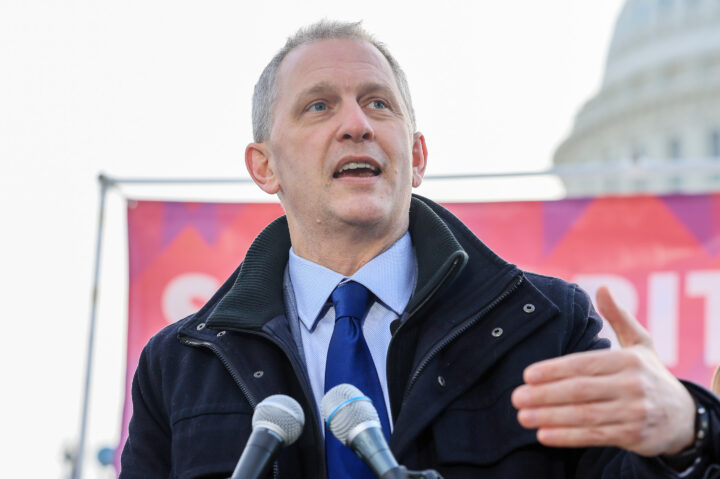
Jemal Countess/Getty Images for Protect Borrowers
Rep. Sean Casten (D-IL) speaks on Capitol Hill on February 09, 2026 in Washington, DC.
Rep. Sean Casten (D-IL) and 25 Democratic co-sponsors introduced a bill on Monday that would implement wide-ranging new conditions and restrictions on U.S. aid to Israel.
The Ceasefire Compliance Act would require the administration to assess and report to Congress every 90 days on whether Israel is complying with the October 2025 ceasefire agreement in Gaza, including halting military operations and bombing campaigns.
The legislation does not appear to contain exceptions for the strikes Israel has taken in retaliation for Hamas’ own violations of the ceasefire deal, nor mention its targeting of individual Hamas leaders.
Under the terms of the legislation, if Israel does not meet the conditions included in the law, the U.S. would be banned from selling or transferring any U.S. military systems to Israel for use in Gaza or the West Bank, any further transfers would be subject to a specific agreement by Israel that the weapons would not be used in Gaza or the West Bank and the administration would be required to reach an agreement with Israel that U.S.-origin systems already in Israel’s possession would also be banned from use in Gaza or the West Bank.
Those restrictions would remain in effect until Israel is in compliance with all conditions. The legislation establishes an end-use monitoring group within the administration to monitor whether U.S.-provided systems are in use in Gaza or the West Bank.
The legislation includes language guaranteeing that U.S. defensive assistance to and intelligence sharing with Israel, as well as provision of missile-defense systems to Israel, are exempt from the conditions. The bill would sunset after five years.
Other conditions would require Israel to work to implement President Donald Trump’s 20-point peace plan; allow humanitarian aid into Gaza; cooperate in the establishment of a temporary Palestinian government and ultimately a Palestinian Authority government in the West Bank; take “material steps” to prevent settler attacks on Palestinians in the West Bank; and ban any forcible displacement of Palestinians from Gaza, annexation of Gaza or “de facto or de jure annexation” of any part of the West Bank.
The Israeli government, and a broad swath of Israeli society, oppose the establishment of a Palestinian Authority government in Gaza given the group’s ongoing payments to the families of terrorists, among a raft of other concerns.
“As one of the United States’ most important allies, Israel must ensure that its policies and the use of U.S. military assistance align with American values, interests, and the law,” Casten said in a statement. “That starts with requiring compliance with the October 10, 2025, ceasefire agreement and the steps laid out in the 20-point plan, curbing settler violence, and rejecting annexation in the West Bank.”
The legislation includes a limited presidential waiver of the conditions for transfers and sales “vital to the national security of the United States.” The president would be required to provide a detailed justification to Congress 15 days before invoking such a waiver explaining why it is necessary and unavoidable.
“This bill redefines the system of US military aid to Israel, transforming it from a blank check to an accountability-based system that advances US strategic interests in the Middle East, aligns with American values, enhances Israel’s security, and protects Palestinian civilians,” a release by Casten’s office about the bill states. “Through thorough oversight and tough enforcement mechanisms, it makes clear that actions undermining shared U.S. and Israeli interests and values will have consequences.”
The bill is co-sponsored by Reps. Madeleine Dean (D-PA), Veronica Escobar (D-TX), Chris Deluzio (D-PA), Becca Balint (D-VT), Jim McGovern (D-MA), Jan Schakowsky (D-IL), Ro Khanna (D-CA), John Garamendi (D-CA), Don Beyer (D-VA), Jill Tokuda (D-HI), Lloyd Doggett (D-TX), Valerie Foushee (D-NC), Mike Thompson (D-CA), Sylvia Garcia (D-TX), Doris Matsui (D-CA), Derek Tran (D-CA), Emily Randall (D-WA), Jared Huffman (D-CA), Mark Takano (D-CA), Troy Carter (D-LA), Chellie Pingree (D-ME), Bonnie Watson Coleman (D-NJ), Marcy Kaptur (D-OH), Betty McCollum (D-MN) and Joaquin Castro (D-TX).
The legislation also includes specific language emphasizing that the administration has no authority to transfer U.S. funds to the Board of Peace — after Trump pledged a $10 billion U.S. commitment last week — or to provide the Board of Peace with authorities that “[supersede] the role or authorities of the United Nations.”
One source familiar with the situation told Jewish Insider that J Street, which is backing the bill alongside New Jewish Narrative and Foreign Policy for America, is making the legislation its top priority. The group is holding a conference in Washington later this month.
“The Ceasefire Compliance Act puts into law the common sense principle that American weapons cannot be used by the Israeli government in Gaza and the West Bank in ways that fundamentally violate American values and directly contravene U.S. interests,” J Street President Jeremy Ben-Ami said in a statement. “US assistance — whether aid or arms — should never come as a blank check. The CCA will ensure the Israeli government is held to agreements it has signed and abides by the ceasefire, allows a Palestinian governing council to take control of Gaza, and cannot annex the West Bank.”
Though the bill is unlikely to pass Congress under Republican control, it could provide a model for Democrats critical of Israel shy of the terms of the Block the Bombs Act and other efforts to impose a full offensive arms embargo on the Jewish state.
The statement was issued ahead of Trump’s meeting with Netanyahu
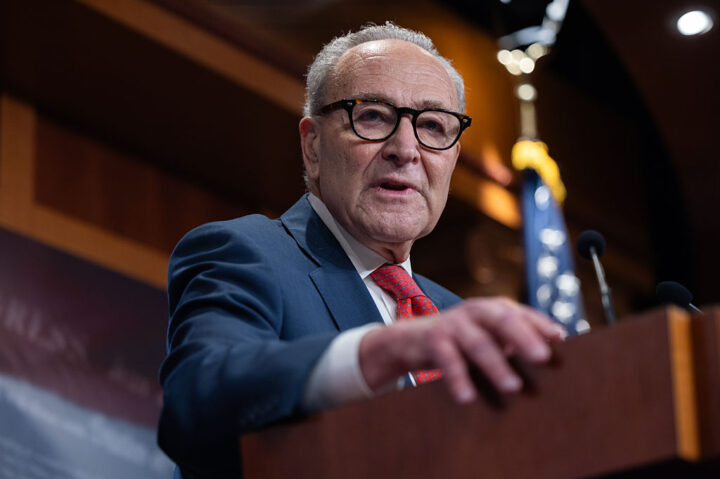
Nathan Posner/Anadolu via Getty Images
Senate Minority Leader Chuck Schumer (D-NY) speaks at a press conference following recent elections as the government shutdown continues in Washington, DC on November 5, 2025.
A group of eight leading Senate Democrats released a statement on Tuesday evening urging President Donald Trump to “clearly reinforce the opposition of the U.S. government to Israeli government actions that set the conditions for irreversible annexation” of the West Bank when he meets with Israeli Prime Minister Benjamin Netanyahu at the White House on Wednesday.
The statement emphasizes Senate Democrats’ opposition to Israel expanding its control over settlements in the West Bank, which Israel’s Security Cabinet approved measures to help facilitate on Sunday ahead of Netanyahu’s visit to Washington this week.
“We are deeply troubled by the Israeli government’s decision to blatantly consolidate administrative control over and set the conditions to expand settlements into the West Bank,” the senators wrote. “The Israeli government’s actions contravene decades of bipartisan United States policy, including that expressed by President Trump, which asserts the United States supports a two-state solution and that it is not in the U.S. national security interest to support annexation of the West Bank.”
“We have long expressed our concern that these reckless moves make the possibility of a two-state solution, where Israelis and Palestinians can live side by side in peace and security, further out of reach,” the statement continued.
The group said they “urge Prime Minister Netanyahu to reverse course. When President Trump meets with Prime Minister Netanyahu this week, we also urge the President to clearly reinforce the opposition of the U.S. government to Israeli government actions that set the conditions for irreversible annexation.”
The statement was signed by Senate Minority Leader Chuck Schumer (D-NY); Sen. Dick Durbin (D-IL), the Senate Democratic whip; and Sens. Jack Reed (D-RI), Jeanne Shaheen (D-NH), Mark Warner (D-VA), Chris Coons (D-DE), Brian Schatz (D-HI) and Patty Murray (D-WA). The senators who joined Schumer and Durbin are, respectively, the ranking members of the Senate Armed Services Committee, Foreign Relations Committee, Intelligence Committee, the Senate Appropriations Subcommittee on Defense, the Senate Appropriations Subcommittee on State and Foreign Operations and the Senate Appropriations Committee.
Trump has held firm on his opposition to Israeli settlement expansion since saying last September that he would “not allow Israel to annex the West Bank.” Trump reiterated this position in an interview with Axios on Tuesday.
He said following a meeting with Netanyahu at his Mar-a-Lago estate in Palm Beach, Fla., in late December that the two were still on separate sides of the issue, but expressed confidence that all parties would reach “a conclusion,” though he declined to offer specifics.
“Well, we have had a discussion, big discussion, for a long time on the West Bank. And I wouldn’t say we agree on the West Bank 100%, but we will come to a conclusion on the West Bank,” Trump said at the time. “It’ll be announced at an appropriate time, but [Netanyahu] will do the right thing. I know that. I know him very well. He will do the right thing.”
In contrast with top candidates in the race, Kasky embraced stances far to the left of the Democratic mainstream

Sarah Morris/Getty Images
Co-founder of the student-led gun violence prevention group "Never Again," Cameron Kasky, speaks March For Our Lives II to protest against gun violence on June 11, 2022 in Los Angeles, California.
Cameron Kasky’s announcement on Wednesday that he was ending his bid for a coveted open House seat in the heart of Manhattan and pivoting to focus on advocating for human rights in the West Bank didn’t come as much of a surprise — given the 25-year-old progressive political activist’s almost exclusive fixation on targeting Israel as a first-time candidate.
Kasky, a Democratic upstart who was among a range of contenders vying to succeed retiring Rep. Jerry Nadler (D-NY) in the 12th Congressional District, had recently returned from a visit to the West Bank, and his experience meeting with Palestinians had left him with “one concern,” he said, motivating his decision to drop out of the primary and seek to promote legislation to counter Israeli settler violence in the territory.
Without providing specifics, Kasky said he looked forward to sharing more details of what he called a “West Bank human rights emergency plan” and said he had “consulted with experts extremely well-versed in the matter” to ensure that “the t’s are crossed and the i’s are dotted.”
Still, while Kasky framed his so far loosely defined next act as a “chance to do what must be done” in the wake of his brief “human rights-centered campaign,” as he described it, his explanation about the sudden withdrawal avoided mentioning that he had been seen as an unserious candidate struggling to gain any traction in the crowded race.
His harsh criticism of Israel generated online attention and helped him to build a relatively sizable and enthusiastic following on social media.
But Kasky’s early exit from the June primary, just two months after launching his bid, illustrates how digital clout is not a reliable indicator of meaningful voter support, particularly as a growing number of influencers has sought unsuccessfully to convert online popularity into a seat in Congress in a range of recent primaries.
It also underscores how Kasky’s anti-Israel views were likely alienating to many voters in one of the most heavily Jewish districts in the country — even as several far-left challengers across New York are taking on pro-Israel incumbents. One Democratic operative familiar with the district, which covers the Upper East and West Sides, called Kasky’s hostile positions on Israel a form of political “kryptonite.”
Former New York Gov. Andrew Cuomo, a pro-Israel moderate, won the district with 50% of the vote in November, beating now-Mayor Zohran Mamdani by five points.
In contrast with top candidates in the race, Kasky embraced stances far to the left of the Democratic mainstream, repeatedly accusing Israel of committing genocide in its war in Gaza, for instance, while pledging to vote against all aid to Israel, “‘defensive’ or otherwise,” as he wrote on his campaign site. He also said he was running to block what he called the “Greater Israel” agenda, accusing Israeli leadership of using “colonial violence” to expand the country’s territory across the Middle East.
Polling commissioned by a rival campaign, some details of which were relayed to Jewish Insider by a Democratic source familiar with the figures, showed Kasky far behind his leading opponents. Two recent polls put Kasky in sixth place, garnering just 5% of the primary vote in one and 8% in the other, according to the source, who shared the unpublicized numbers on condition of anonymity.
The polls showed two state assemblymen, Micah Lasher and Alex Bores, clustered at the top of the field along with Jack Schlossberg, a young Kennedy heir, and George Conway, a former Republican attorney and a prominent critic of President Donald Trump, the source confirmed on Thursday. While no candidate won more than 20% of the vote in either poll, Kasky was seen as operating in a lower tier and unlikely to break out.
His stances on Israel, among other issues, were “a dealbreaker” to a significant share of the electorate, the source noted to JI. “I don’t think that he had the means to become a compelling candidate and build a coalition,” he added.
Owing to his hasty departure from the race, some Democratic strategists and activists suggested that he had not intended to remain a candidate and was using his long-shot bid to build an online audience.
“Kasky saw the writing on the wall,” said another Democratic source who spoke with the candidate. “He did not have a sustainable campaign because it was never a campaign for Congress.”
For Kasky, a Jewish survivor of the 2018 shooting at Marjory Stoneman Douglas High School in Florida who became a gun control activist, “it was a campaign for new social media followers, the hard, hard left and activist clout,” the source told JI on condition of anonymity to offer a candid assessment. “He can absolutely claim victory for getting new followers on Instagram outside of Florida, but he achieved this milestone on the backs of the people he so shockingly vilified: NY-12 Jews.”
“He was never running to win,” added a Jewish Democratic leader familiar with Kasky’s abortive campaign, who was granted anonymity to weigh in freely about the race. “He was running to raise his profile and raise some money so he could continue to be an activist influencer.”
Kasky’s campaign, whose fundraising numbers will be reported later this month, did not return JI’s request for comment on Thursday.
Scott Stringer, a former city comptroller who previously lived in the district and now resides in Lower Manhattan, dismissed Kasky’s campaign as unviable from the beginning. “The bottom line is he wasn’t a factor when he was running, and he’s not a factor now that he’s not running,” Stringer, a Jewish Democrat backing Lasher in the primary, told JI. “I think he would have been better served by applying to his local community board.”
“There’s a whole lot of people on Twitter, unfortunately, who focus on Jewish hate,” he added. “But at the end of the day I think most people tuned out his rhetoric. I know I did.”
Republicans claimed Trump’s comments that he ‘will not allow’ annexation only applied to territory not currently controlled by Israel
Bill Clark/CQ-Roll Call, Inc via Getty Images
Rep. Mike Lawler (R-NY) speaks to reporters as he leaves the House Republican Conference meeting in the U.S. Capitol on December 10, 2025.
Members of the House Foreign Affairs Committee and expert witnesses on Wednesday debated the meaning and significance of President Donald Trump’s edict in September that he “will not allow Israel to annex the West Bank,” which came amid a reported effort earlier this year by the Israeli government to assert sovereignty over all or part of the territory.
The at-times contentious hearing focused on “Understanding Judea and Samaria: historical, strategic and political dynamics in U.S.-Israel Relations,” referring to the biblical term for the West Bank preferred by members of the Israeli government and also used by Republicans on the Foreign Affairs Committee.
Rep. Mike Lawler (R-NY), the chairman of the Foreign Affairs subcommittee on the Middle East, which hosted the hearing, asserted that Trump was only expressing his opposition to the annexation of territory not currently controlled by Israel.
“When the president is talking about annexing, again, I think it’s important to actually look at the map,” Lawler said. “Sixty percent of the West Bank is under Israeli control.”
Lawler’s comments came in response to a remark from ranking member Rep. Brad Sherman (D-CA) highlighting Trump’s position on the issue.
“While some have argued that you don’t need to annex the West Bank because it’s already part of Israel, clearly that’s not what President Trump had in mind,” Sherman argued.
The back-and-forth set off a spat between the two members, with Sherman shouting a demand to be given additional time to respond to Lawler, and Lawler rebuking him in hushed tones as the hearing continued.
Lawler previously organized a private briefing for committee members with U.S. Ambassador to Israel Mike Huckabee on a similar subject.
Rep. Brad Schneider (D-IL) pressed GOP witnesses over their apparent disagreements with Trump on the issue. Like Lawler, they made the case that Trump’s position had been misrepresented.
Eugene Kontorovich, a senior research fellow at the Heritage Foundation, argued that Trump’s position and the situation have not been “accurately characterized.”
“There have been proposals to extend Israeli civil law to those areas where Jewish communities are, in other words, to incorporate under Israeli law, parts of Judea and Samaria,” Kontorovich said. “President Trump’s plan is consistent with his 2020 vision for peace, where Israel would, in fact, expand Israeli civil jurisdiction specifically to those areas, and it seems his comments were simply a reaffirmation of that, that’s how I understand it.”
Schneider responded: “I think his comments were clear: ‘There will not be annexation,’ was I believe exactly what he said,” to which Kontorovich interjected, “of the West Bank.”
The Vision for Peace plan that Kontorovich referenced would also have created a Palestinian state. Plans announced by Israeli Prime Minister Benjamin Netanyahu at the time to annex Israeli settlements immediately upon the release of that plan were rejected and blocked by Trump in 2020.
Multiple Democrats along with Democratic witness Jon Alterman, the Brzezinski chair in global security and geostrategy at the Center for Strategic and International Studies, raised comparisons between the political and governance situation in the West Bank and eastern Ukraine — noting that ethnically Russian Ukrainians had a voice and vote in the Ukrainian government prior to the Russian invasion, and that they are now disenfranchised under Russian occupation.
Alterman said that allowing annexation would also weaken the U.S.’ argument against Russia’s attempted annexation of parts of Ukraine.
Democratic lawmakers and Alterman also warned that full annexation would create a politically untenable position for Palestinians in the West Bank, where they are disenfranchised under Israeli control or expelled — a situation that could prompt further international outrage — or have voting rights and would have sufficient voting share to fundamentally change the nature of Israel. Alterman added that the status quo breeds Palestinian resentment and opposition from the global community.
“If we’re honest with ourselves, we need to recognize that not only are there competing claims here, but there are competing legitimate claims, and that’s if we just consider what’s clear from the historical record. When we bring in faith values and interests which aren’t universal, the issue becomes even more complicated,” Alterman said. He urged lawmakers to seek solutions that preserve space for peace between the Israelis and Palestinians.
Rep. Darrell Issa (R-CA) floated the question of whether the U.S. should, instead of a full separation of Israel and a Palestinian state under a two-state solution and in light of the Palestinian Authority’s dysfunction, be “looking for a solution that is not a conventional state, one that has levels of autonomy, levels of governance, but … the borders would inherently be porous, the question of militarization would be dealt with in some ways as though it is one nation and in other ways clearly with a recognition of the facts on the ground.”
Alterman said that would inevitably involve certain compromises to Israel’s own sovereignty and decision making with “some sort of outside [entity].”
Kontorovich argued that such a proposal would make a “lot of sense,” comparing it to the situation in American Samoa, whose residents are not U.S. citizens and do not have a vote in federal elections. Issa responded that American Samoans do “stand among us and have a say.”
Mort Klein, the president of the Zionist Organization of America, repeatedly emphasized that the PA continues to pay the families of terrorists who conduct attacks against Israel and indoctrinates Palestinian children with anti-Israel and antisemitic ideologies, and that Palestinian Arab opposition more broadly is responsible for the lack of peace in the region. Some Republicans echoed the same point.
Klein said that the PA’s actions “make peace virtually impossible until they have a dramatic reformation and transformation of their actions and their regime,” also noting the escalating security threats in the West Bank.
He focused in his opening remarks on the historical Jewish ties to the region and asserted that Palestinian Arabs have no such claims. “If Israel does not control the Jewish heartland in Judea and Samaria, peace will be impossible. Again, Judea and Samaria are Jewish Israeli land, it’s Jewish land, legally, religiously, biblically, politically and morally,” Klein said.
Sherman argued in his opening statement that modern borders should be based on the modern state of affairs, rather than historical Jewish territories — noting that Tel Aviv had not been Jewish territory for most of the Kingdom of Judea’s history, and that defining international borders based on the “maximum you ever controlled in history” would be a ridiculous exercise.
At the end of the hearing, a group of Code Pink activists confronted Yossi Dagan and Yisrael Ganz, the heads of two Israeli regional settlement councils, surrounding and screaming at them. Capitol Police demanded the activists leave the hearing room.
Ganz said in a statement, “We will do everything to apply sovereignty to Judea and Samaria.” Dagan added, “The hearing is a milestone in the cancellation of the lie of the ‘occupation.'”
The two pro-Israel lawmakers said Trump should reimpose Biden-era sanctions on violent settlers if the Israeli government fails to take action

Kyle Mazza/Anadolu via Getty Images/Mostafa Bassim/Anadolu via Getty Images
Sen. Cory Booker (D-NJ) and Rep. Dan Goldman (D-NY)
Sen. Cory Booker (D-NJ) and Rep. Dan Goldman (D-NY) wrote a letter to President Donald Trump on Wednesday urging him to pressure the Israeli government to intervene to stop attacks on Palestinians by Israeli settlers in the West Bank and to oppose settlement expansion.
The clear-cut criticism of Israel is notable coming from two lawmakers generally seen as strong supporters of the Jewish state. The two urged Trump to reimpose Biden-era sanctions — withdrawn by the Trump administration — on those involved in the settler attacks if the Israeli government does not act.
“The Netanyahu government’s lack of action to address extreme settler violence emboldens Hamas, Palestinian Islamic Jihad, and other terrorist groups, and builds resentment in the West Bank, while putting increased pressure on the fragile ceasefire agreement in Gaza that your Administration secured,” the two lawmakers said. “More must be done to stop settler violence and ensure that those who perpetrate acts of violence against civilians in the West Bank are not allowed to operate with impunity.”
The lawmakers called on Trump to “speak out against settlement expansion, demand accountability for settler violence, and continue to publicly oppose annexation.”
“This vigilante violence is not isolated. It is systemic and aims to impede a viable two-state solution,” the letter continues. “It is consistent with broader systemic efforts to approve illegal expansion of settlements, demolitions of Palestinian homes and structures, and annexation of the West Bank, including Prime Minister Netanyahu’s most recent actions regarding the controversial E1 settlement project.”
Booker and Goldman said that these actions by the Israeli government ultimately threaten Israel’s security, isolate it from the international community and undermine “peace efforts in the region. This includes the Abraham Accords, a critical achievement during your first Administration.”
They said that the administration should “press the Israeli government to take significant action to prevent settler violence, hold perpetrators accountable, seek justice for the victims of violent crimes already committed, and ensure the safety and security of civilians in the West Bank” and should reimpose sanctions on those involved in the attacks if the Israeli government fails to do so.
The lawmakers, who previously wrote a similar letter to the Biden administration, highlighted that they were the only members of Congress in Israel during the Hamas attacks on Oct. 7, 2023, and said they “steadfastly support the special U.S.-Israel relationship and a secure and just future for both Israelis and Palestinians.”
“We continue to believe that a two-state solution is the only viable option that affirms and protects Israel’s right to exist as a democratic, Jewish state and ensures the Palestinian people’s right to human dignity, prosperity, self-determination, and a state of their own,” the letter continues. “Unchecked extremist settler violence and de facto or de jure settlement expansion threatens the very seeds of trust and cooperation needed to make progress toward this goal, which is fundamental to an enduring peace in the region.”
The Israeli PM called the Knesset vote ‘a deliberate political provocation by the opposition to sow discord during’ Vance’s visit
Marc Israel Sellem/Getty Images
U.S. Vice President J.D. Vance (L) and Israeli Prime Minister Benjamin Netanyahu (R) speak to the media at the Prime Minister's Office in West Jerusalem, on October 22, 2025.
Israeli Prime Minister Benjamin Netanyahu distanced himself on Thursday from the Knesset’s approval of two bills to extend Israeli sovereignty to the West Bank, after President Donald Trump, Vice President JD Vance and Secretary of State Marco Rubio spoke out against annexation.
The Knesset approved two settlement annexation bills brought by right-wing members of the opposition in preliminary votes on Wednesday, despite the coalition whipping votes against them.
The bill to annex the entire West Bank, proposed by Avi Maoz, the sole lawmaker from the anti-LGBT Noam party that quit the coalition earlier this year, received 25 votes — most of which were from Netanyahu’s coalition — with 24 voting against it.
The other bill, which would have the Jerusalem suburb of Maaleh Adumim be considered part of sovereign Israel, was proposed by former Defense Minister Avigdor Liberman and his Yisrael Beiteinu party and passed the early vote with 32 in favor — with only one from the coalition — and nine opposed. The bills still have to go through committee meetings and three plenary votes to become law.
Trump voiced opposition to annexation efforts in an interview with Time magazine published Thursday, but conducted before the Knesset vote, and said they could threaten U.S. support for Israel.
Annexation “won’t happen because I gave my word to the Arab countries,” Trump said, “and you can’t do that now. We’ve had great Arab support. … It will not happen. Israel would lose all of its support from the United States if that happened.”
Though the first Trump administration’s 2020 peace plan would have allowed Israel to annex parts of the West Bank, Netanyahu committed later that year to refrain from such a move in exchange for entering the Abraham Accords with the United Arab Emirates.
Vice President JD Vance was asked about the vote on his way onto Air Force Two departing Israel on Thursday, and said that he was “confused” and found the vote “weird.” He said he asked about the vote and was told it was symbolic.
“If it was a political stunt, it was a very stupid political stunt, and I personally take some insult to it,” he said. “The policy of the Trump administration is that the West Bank will not be annexed by Israel; that will continue to be our policy and if people want to take symbolic votes, they can do that, but we certainly weren’t happy about it.”
Rubio, who landed in Israel on Thursday, said the night before that the Knesset vote was “counterproductive,” while acknowledging that Israel is “a democracy, they’re going to have their votes. People are going to take these positions.”
Netanyahu attempted to repair the damage of the votes on Thursday morning, with a statement from his office calling them “a deliberate political provocation by the opposition to sow discord during Vice President JD Vance’s visit to Israel. The two bills were sponsored by opposition members of the Knesset.”
According to the statement, “the Likud party and the religious parties (the principal coalition members) did not vote for these bills, except for one disgruntled Likud member who was recently fired from the chairmanship of a Knesset committee. Without Likud support these bills are unlikely to go anywhere.”
Maoz’s bill got support from six coalition lawmakers from Finance Minister Bezalel Smotrich’s Religious Zionist Party and seven from National Security Minister Itamar Ben-Gvir’s Otzma Yehudit party. One Religious Zionist Party MK voted for Liberman’s legislation.
The one Likud lawmaker who supported Maoz’s bill was Yuli Edelstein, who was removed from the prestigious post of chairman of the Knesset Foreign Affairs and Defense Committee earlier this year due to his refusal to usher in legislation that would continue the broad exemption from IDF service for Haredim. Edelstein argued in a post on X: “If my only sin was standing with the Land of Israel and voting for applying sovereignty in Judea and Samaria” — the Biblical name for the West Bank — “then I am proud of it.”
Israeli Ambassador to the U.S. Yechiel Leiter assisted in Netanyahu’s damage control efforts, calling Sen. Lindsey Graham (R-SC) to clarify the situation.
Leiter assured Graham “that this vote was not intended to be a slight to the U.S. and the position of the Prime Minister is that the U.S. is Israel’s most important and valuable ally and partner, and there will be no major changes without consulting and cooperating with the U.S.,” the South Carolina senator wrote on X.
“As with all legislative bodies and democracies, there are things you can control and things you cannot,” Graham added. “[Leiter] vigorously stressed no offense was meant and reinforced that no major decisions will be made by Israel without cooperation and coordination with the U.S.”
Separately, coalition chairman Ophir Katz, the Likud lawmaker responsible for whipping votes, said on Thursday that Netanyahu “clearly instructed me last night that the coalition must not vote for the bills on the matter of sovereignty. There was coalition discipline on the matter. Since there were MKs who acted against the prime minister’s instructions, the bills passed. Following that, the prime minister instructed me not to advance these bills until further notice.”
Katz punished Edelstein by removing him from the Foreign Affairs and Defense Committee entirely, but consequences for the coalition members from other parties have yet to be announced.
Edelstein said that “every such removal is a medal of honor for me. Anyone who thinks this deters me is making a big mistake.”
In 2010, during a visit by then-Vice President Joe Biden to Israel, Israel’s Interior Ministry announced, without first consulting Netanyahu, that it had approved 1,600 housing units in a northern Jerusalem neighborhood that the Obama administration and most of the international community considered to be a settlement. The incident sparked a diplomatic row between the countries.
Every member of the caucus except Sen. John Fetterman said they want to ‘preserve the viability of a two-state solution’
Brandon Bell/Getty Images
Rep. Adam Schiff (D-CA) speaks with reporters after closing remarks during the fifth hearing on the January 6th investigation in the Cannon House Office Building on June 23, 2022, in Washington, D.C.
Every Senate Democrat with the exception of Sen. John Fetterman (D-PA) wrote to President Donald Trump on Tuesday urging him to “reinforce” the White House’s pledge to oppose Israeli annexation of the West Bank.
In a letter led by Sen. Adam Schiff (D-CA), the senators offered their “support for your comments opposing any efforts by the Government of Israel to annex territory in the West Bank and to urge your Administration to promote steps to preserve the viability of a two-state solution and the success of the Abraham Accords.”
The missive was sent weeks after Trump vowed publicly to not allow Israel to annex the West Bank, telling reporters in the Oval Office in late September that, “I will not allow Israel to annex the West Bank, nope, I will not allow it. It’s not gonna happen.”
“Since your plan for Gaza does not address the West Bank, it is imperative that your Administration reinforce your comments and emphasize its opposition to annexation. As longstanding supporters of Israel’s security and Palestinian aspirations for statehood, we are unified in our opposition to unilateral measures by either party that undermine the prospect of lasting peace through negotiations to achieve a two-state solution,” the letter stated.
The senators argued that “any steps by Israel to annex territory or expand settlements that prevent the establishment of a Palestinian state” would be harmful to the peace process.
“Such steps have elicited deep concern and opposition from Arab partners and place at risk your past achievements under the Abraham Accords and the possibility of expanding them further,” they wrote. “At the same time, terrorism, including the horrific terrorist attack of Oct. 7, 2023, must be uniformly condemned and will not bring the region closer to peace.”
“It is essential that the United States reject measures that undermine the viability of a negotiated resolution to the Israeli-Palestinian conflict,” the letter continued.
Greenblatt spoke at AJC’s Global Jewish Diplomacy Reception, where former Amb. Shapiro also decried Palestinian statehood recognition as a ‘mistake’

U.S. Mission to the U.N.
Jason Greenblatt, Special Representative for International Negotiations Delivers Remarks at a UN Security Council Briefing on the Middle East
Jason Greenblatt, a key architect of the Abraham Accords, joined President Donald Trump in coming out against the Israeli government’s reported plans to annex portions of the West Bank, saying on Thursday evening that it was the wrong time to do so.
“I think Israel has so many challenges right now, militarily, [with the] hostages. There’s enormous things going on. The world is turned against Israel. I don’t agree with those that are pushing Bibi. I don’t know if it’s Bibi himself, but I hope that Bibi could figure out a way to get out of that political space that he’s in. And I think President Trump is making the right call,” Greenblatt said, using Israeli Prime Minister Benjamin Netanyahu’s nickname.
Greenblatt made his remarks during an onstage interview with Jason Isaacson, the American Jewish Committee’s chief policy and political affairs officer, at the AJC’s annual Global Jewish Diplomacy Reception at Manhattan’s Harmonie Club on the sidelines of the United Nations General Assembly, which is being held this week. Shortly before the reception, Trump told reporters that he was firmly against Israeli annexation of the West Bank.
Greenblatt preceded his opposition to annexation by noting his right-wing bona fides.
“My answer is coming from somebody who’s on the right politically, both in Israel and here. In fact, some of my Palestinian friends would say that sometimes I was Bibi’s mouthpiece,” he said.
“But I agree with President Trump and what he said earlier today … I don’t think this is the time. I don’t think it’s the place. And I was part of the team that wrote the paperwork that would have allowed Israel to … apply Israeli sovereignty,” Greenblatt said, using the term the Israeli government prefers to refer to annexation. “I don’t think this is the time to do it.”
In addition to Greenblatt, speakers at the reception included Daniel Shapiro, former U.S. Ambassador to Israel under President Barack Obama, and Serge Berdugo, president of the council of Jewish communities of Morocco, who received AJC’s Akiba Award during the event. At least ten hostage family members were also present, some of whom offered staunch criticism of the Israeli government’s handling of the war in Gaza.
Responding to the growing number of Western countries recognizing Palestinian statehood, Shapiro called these moves an ineffectual “mistake.”
“It’s a purely rhetorical step that changes nothing and probably does little, if anything, to advance the stated goal of some sort of resolution of the Israeli-Palestinian conflict. And in many ways it may actually set it back in part because of the way it appears to — and certainly many Israelis understand it to, and I’m sorry to say, many Arabs understand it to — reward Hamas,” Shapiro said.
He also described the development, in part, as a response by world leaders to Israel’s refusal to develop a “day after” plan in Gaza.
“What is that vision of the day after? Not only when does it start, but what does it look like afterwards? And is it something that Arab states and European states can buy into and get behind,” Shapiro said. “That could have been a way of satisfying some of the domestic pressures, but it wasn’t really available. And so I think some of the leaders turned to this ill-advised move instead.”
Speaking on behalf of hostage families, Ruby Chen, father of slain American Israeli hostage Itay Chen, whose remains are still being held captive by Hamas in Gaza, thanked the AJC for their advocacy on behalf of the hostage families and criticized the Israeli government for the ongoing hostage crisis.
“I think I’m still in shock that … it wasn’t obvious that it should have been the number one objective of the government of Israel. But it’s unfortunate that there were other objectives, such as the disbanding of Hamas and making sure that Oct. 7 does not happen again, which are all legitimate,” said Chen.
Chen continued, “We call on President Trump to bring all the parties together and put on the table a deal that is acceptable by everybody, and we pray to God that… those of you who are meeting with [Netanyahu]… are able to send a message saying we hope that he shares the same conviction that President Trump has shown, as well as President Biden and the previous administration to bring all these hostages home.”
As the hostage family members gathered for a photograph following Chen’s speech, the father of Israeli hostage Nimrod Cohen, Yehuda Cohen, stepped up to the microphone and delivered a fiery impromptu speech criticizing Netanyahu.
“After two years, Netanyahu is prolonging an unneeded war. If you really want to help us as a Jewish organization, please help us advocating the push on Netanyahu, making Netanyahu, forcing Netanyahu to end the war and get a hostage deal,” he said.
Cohen, who came out in support of the countries recognizing Palestinian statehood — breaking ranks with the Hostages and Missing Families Forum and nearly all of Israel’s political leaders, which described it as a reward for Hamas — defended his position as a form of leverage over the prime minister.
“We are using the Europeans — their declaration of the Palestinian state, their sanctions of Netanyahu’s government … We have no choice. We are at war with Netanyahu. So if you really want to help us, that’s forcing Netanyahu to end the war and get a hostage deal, this is the real help,” said Cohen.
The comments, made after meeting with Turkish President Erdogan, are the first time Trump addressed the issue in his second term
Andrew Harnik/Getty Images
President Donald Trump in the Oval Office at the White House on September 25, 2025 in Washington, DC.
President Donald Trump pledged on Thursday that he will not allow Israel to annex the West Bank, the first time Trump has addressed the matter in his second term.
Asked about reports that he told Arab leaders this week he would not permit Israel to make the move, Trump confirmed to reporters in the Oval Office that he opposes annexation. “I will not allow Israel to annex the West Bank, nope, I will not allow it. It’s not gonna happen,” he said, hours after a meeting with Turkish President Recep Tayyip Erdogan.
Asked if he spoke with Israeli Prime Minister Benjamin Netanyahu about the issue, Trump said, “Yeah, but I’m not going to allow it. Whether I spoke to him or not — I did — but I’m not allowing Israel to annex the West Bank. There’s been enough, it’s time to stop now.”
Netanyahu will address the United Nations General Assembly in New York on Friday, and he and Trump will meet in the Oval Office on Monday, for their fourth White House meeting of the year.
In his own General Assembly address earlier this week, Trump pledged his support for Israel and sharply criticized several European nations who had unilaterally recognized a Palestinian state. He did not mention annexation or include any criticism of Israel in his remarks.
Netanyahu has pledged to respond to those moves next week, with annexation of the West Bank viewed as one possible action he could pursue, under pressure from right-wing elements of his governing coalition.
A letter led by Reps. Brad Schneider and Jamie Raskin says such a move would ‘not only violate international law but undermine decades of bipartisan U.S. policy and threaten the progress of the Abraham Accords’
Annabelle Gordon/Bloomberg via Getty Images/Samuel Corum/Getty Images
Reps. Jamie Raskin (D-MD) and Brad Schneider (D-IL)
Most House Democrats, including all of the current and former top Democratic leaders, signed on to a letter on Thursday to Israeli leaders warning them against unilaterally annexing territory in the West Bank or Gaza.
At a time when Democrats are increasingly divided over the U.S.-Israel relationship and its direction, the letter highlights a strong degree of unanimity within the party against annexation, among both Democrats who largely remain supportive of Israel and those who have become more critical over the war in Gaza. President Donald Trump reportedly told Arab leaders on Tuesday that he would pressure Israel against annexation.
“As long-standing supporters of the U.S.-Israel relationship, Israel’s security, and Israel’s future, we are deeply opposed to proposals for unilateral annexation of territory in the West Bank,” the 178 lawmakers, led by Reps. Brad Schneider (D-IL) and Jamie Raskin (D-MD), said. “Such a move would not only violate international law but undermine decades of bipartisan U.S. policy and threaten the progress of the Abraham Accords, which offer Israel and its neighbors the opportunity to build a more secure, cooperative, and prosperous regional future. Unilateral annexation of the West Bank would plunge the region, already reeling from tens of thousands of deaths in the horrific Gaza war, into further chaos and violence.”
The letter is addressed to Israeli Prime Minister Benjamin Netanyahu, Defense Minister Israel Katz and Foreign Minister Gideon Sa’ar. Included among the signatories are House Minority Leader Hakeem Jeffries (D-NY), Minority Whip Katherine Clark (D-MA) and Democratic Caucus Chair Pete Aguilar (D-CA), as well as former House Speaker Nancy Pelosi (D-CA), former Majority Leader Steny Hoyer (D-MD) and former Democratic Whip Jim Clyburn (D-SC).
The signatories highlighted that leaders from the United Arab Emirates have expressed that West Bank annexation would be a red line for them that would endanger regional normalization and integration with Israel.
“Moves toward annexation would undermine Israel’s progress on normalization, prevent international cooperation to rebuild Gaza after this devastating war, risk instability in Jordan, and even further strain ties with key European partners,” the letter continues.
They added that annexation of territory in Gaza, as discussed by some Israeli ministers, “would not only violate international law but exacerbate humanitarian and diplomatic challenges at a moment when broad international support for Israel is at risk.”
The lawmakers stated that they are “convinced that unilateral steps by either side,” including Israeli annexation of territory in the West Bank or Gaza, would be an impediment to direct negotiations between Israel and the Palestinians toward a two-state solution and make a “just, sustainable peace” harder to attain.
“We respectfully urge your government to refrain from steps toward unilateral annexation and to recommit to a negotiated outcome consistent with U.S. policy and the regional vision embodied in the Abraham Accords,” the letter concludes. “That path best safeguards Israel’s security and democratic ideals, advances regional cooperation against shared threats, and offers Israelis and Palestinians the possibility of living side by side in peace and dignity, freed from perpetual attacks on civilians and the threat of war.”
Schneider, a co-chair of the Congressional Jewish Caucus, has been a leader in the moderate pro-Israel wing of the party, though he has expressed concerns about the humanitarian situation in Gaza and previously warned individually against annexation. The progressive Raskin is a co-sponsor of legislation that would severely restrict many critical arms transfers to Israel.
Signatories to the letter similarly span the spectrum from consistent supporters of Israel to vocal critics.
Other signatories include Senate candidates Reps. Angie Craig (D-MN), Robin Kelly (D-IL), Raja Krishnamoorthi (D-IL) and Chris Pappas (D-NH); No. 4 House Democrat Rep. Ted Lieu (D-CA); Jewish Caucus co-chair Rep. Jerry Nadler (D-NY); and Reps. Greg Meeks (D-NY), Adam Smith (D-WA) and Rosa DeLauro, the ranking members of the Foreign Affairs, Armed Services and Appropriations Committees, respectively.
Some of Israel’s most vocal far-left critics, as well as some of its most ardent centrist defenders, did not sign onto the letter.
Some congressional Republicans, meanwhile, have shown signs of increasing openness to recognizing Israeli sovereignty over the West Bank.
The Pennsylvania senator suggested tariffs, visa sanctions and restricting Norway’s market access should be ‘on the table’

Israel on Campus Coalition/X
Rep. Dave McCormick (R-PA) speaks at the ICC National Leadership Summit in Washington on July 29, 2025.
Sen. Dave McCormick (R-PA) wrote to top trade officials in the Trump administration urging them to take action to respond to the decision by the Norges Bank Investment Fund, Norway’s sovereign wealth fund, to divest from U.S. equipment firm Caterpillar because of the Israeli military’s use of its products in the West Bank and Gaza.
“As the Trump Administration continues to take bold action to rebalance global trade, I urge you to also address the disturbing politicization of sovereign wealth fund investment decisions against American companies,” McCormick said in a letter, sent Thursday, to Commerce Secretary Howard Lutnick and U.S. Trade Representative Jamieson Greer.
He called on the administration to take Norges’ moves against American companies into account in ongoing trade negotiations with Norway, calling the effort a “form of economic warfare directed by a foreign government against the U.S. economy.”
He said that “all options should be on the table to address this issue,” including tariffs, “restrictions on Norges’ access to U.S. financial markets, and visa sanctions” on those involved in moves against American companies.
McCormick served from 2020-2022 as CEO of Bridgewater Associates, which manages portions of Norges’ portfolio. Bridgewater CIO Greg Jensen addressed Norges’ 2024 investment conference.
Sen. Lindsey Graham (R-SC) called publicly for similar retaliatory action last week.
McCormick said he’d confronted Norway’s prime minister about the Caterpillar decision during a visit to the country last month, and said the prime minister had told him the decision “merely followed Norges’ ethical guidelines and was not political.”
“I respectfully disagree. While I recognize the value of Norges’ investments of nearly $1 trillion of U.S. assets, I have significant concerns that these decisions are entirely political and are driven by an agenda that has consistently targeted American companies and is explicitly anti-Israel,” McCormick continued.
McCormick emphasized that Caterpillar is a frequent target of the Boycott, Divestment and Sanctions movement targeting Israel, and noted that Norges has also previously divested from U.S. fossil fuel and defense companies — in some cases including companies that Norway itself purchases weapons systems from.
The Pennsylvania senator called on the administration to “look more broadly at instances of sovereign wealth funds adopting restrictive, unfair trade policies against U.S. companies as a result of political pressure” in other cases as well.
McCormick separately wrote to Norway’s ambassador to the United States, stating that he “remain[s] extremely concerned” by Norges’ moves against American companies, adding that he “brought this issue up directly with Prime Minister [Jonas Gahr] Støre and was unsatisfied with his response.”
The Commerce Department did not respond to a request for comment on whether it plans to address Norges’ divestment from Caterpillar.
Richard Goldberg, a senior advisor at the Foundation for Defense of Democracies and former Trump administration official, said that Norges’ decisions have a significant impact on global investment trends.
“Norges is such a large player … It moves capital markets with its decisions,” Goldberg explained. “It causes other sovereign wealth funds, pension funds to follow. It causes institutional investors to follow. It really does set trends in investment and an inversion of capital can have impacts.”
He said that Norges’ investment decisions in relation to Israel are a major political issue in Norway’s upcoming elections, and some of the left-wing parties who could become part of the next governing coalition are demanding divestment from a “laundry list” of other American companies over their relations to Israel.
Goldberg also argued that the “danger of weaponized sovereign wealth funds” both in terms of BDS efforts and other anti-American moves is an ongoing and growing issue, and that the administration should insist that sovereign wealth funds be covered in U.S. trade deals with foreign countries.
“This is a long standing attack on U.S. interests, attack on American energy companies, an attack on American defense companies and now an attack on any company that does business with the State of Israel — all of this to the detriment of our national economic security, all of it politicized by the Norwegians by a state-run, state-controlled entity” Goldberg said.
If the U.S. fails to respond, he continued, “we’re literally allowing supposed democratic allies for whom we provide a blanket of freedom the ability to conduct economic warfare against America and American interests.”
The new regional dynamics have shifted how Israel sees its role in a volatile arena

Nikos Oikonomou/Anadolu via Getty Images
Lana Nusseibeh, Assistant Minister for Political Affairs in the Ministry of Foreign Affairs of UAE, and Ambassador and Permanent Representative of the UAE to the UN, New York (C) attends the hearings on the advisory proceedings of the International Court of Justice (ICJ) on the legal consequences of Israel's practices in the Palestinian territories in The Hague, Netherlands on February 21, 2024.
Flashback to 2020: As Israel mulls annexation of the West Bank, a prominent Emirati official communicates to an Israeli outlet that such a move could have disastrous consequences for Israel’s positioning in the region.
“Annexation,” UAE Ambassador to the U.S. Yousef Al Otaiba wrote in a Yediot Ahronoth op-ed in June 2020, “will certainly and immediately upend Israeli aspirations for improved security, economic and cultural ties with the Arab world and with UAE.”
Al Otaiba’s op-ed was part of the groundwork laid for the Abraham Accords, announced less than two months later and signed in September 2020. With the normalization agreement in place, Israel’s annexation plans were shelved as it deepened its relations with the UAE and Bahrain, the original signatories to the landmark deal.
Five years later, senior Emirati diplomat Lana Nusseibeh, who previously served as Abu Dhabi’s envoy to the United Nations, is issuing a similar warning.
“Annexation would be a red line for my government, and that means there can be no lasting peace. It would foreclose the idea of regional integration and be the death knell of the two-state solution,” Nusseibeh told The Times of Israel earlier this week.
The five years between Al Otaiba’s op-ed and Nusseibeh’s comments have seen seismic shifts in the region: the Israel-Hamas war and the degradation of Iran’s nuclear capabilities and its regional proxy network, particularly with the collapse of the Assad regime in Syria. Israel has shown itself to be the dominant military player in the region, even as it finds itself on the receiving end of widespread criticism across the Middle East and beyond over its war against Hamas in Gaza.
But they have also seen the rise of the Israeli far right as a more significant player in the country’s politics. The ascensions of Finance Minister Bezalel Smotrich and National Security Minister Itamar Ben-Gvir have paved the way for a renewed Israeli effort to annex broad swaths of the West Bank, five years after plans to do so were derailed by peace efforts.
Smotrich, speaking at a press conference on Wednesday, announced plans to annex 82% of the West Bank and approvals of settlement expansion that are explicitly meant to thwart the creation of a Palestinian state. The issue is the focus of high-level talks in Jerusalem that are a response to a renewed global push — led by France and Saudi Arabia — for Palestinian statehood recognition.
While Nusseibeh’s warning could be intended to hold Israel back from making significant territorial claims, it’s unclear if her words will have the same impact. The new regional dynamics have shifted how Israel sees its role in a volatile arena, and Israel’s isolation on the global stage has deepened the us-against-the-world sentiment felt across Israeli society.
Israel’s annexation plans could also impact potential normalization with Saudi Arabia, with which Jerusalem was close to forging ties before Hamas’ Oct. 7, 2023, attacks. Discussions of a massive Saudi-U.S.-Israel “megadeal” that would normalize ties between Jerusalem and Riyadh have been tabled for months and appear unlikely to restart. Saudi Arabia has not weighed in on Smotrich’s most recent plans, but has expressed that normalization will not be considered while the war in Gaza rages on.
What could happen is something approaching a compromise, in which Israel makes some territorial claims — whether that’s in the Jordan Valley or in the E1 corridor — that fall short of Smotrich’s plan to annex the vast majority of the territory.
The UAE’s carrot-and-stick approach was effective in 2020. But in a new political landscape, it’s unclear if it will be as successful a second time.
Attendees indicated that the briefing did not provide specific answers on any U.S. policy toward a potential Israeli move to annex all or part of the territory
Andrew Harnik/Getty Images
U.S. Ambassador to Israel Mike Huckabee delivers remarks as President Donald Trump hosts Israeli Prime Minister Benjamin Netanyahu for a dinner in the Blue Room of the White House on July 7, 2025, in Washington, DC.
U.S. Ambassador to Israel Mike Huckabee privately briefed lawmakers on the House Foreign Affairs Committee on Wednesday morning on the security and political situation in the West Bank and the war in Gaza.
The briefing was organized by Rep. Mike Lawler (R-NY), who chairs the subcommittee on the Middle East and North Africa, in response to efforts by France and other U.S. allies to recognize a Palestinian state. Despite a focus on the West Bank, attendees indicated that the briefing did not provide specific answers on any U.S. policy toward a potential Israeli move to annex all or part of the territory.
Lawler told Jewish Insider the briefing had included a “thorough discussion with the ambassador about Judea and Samaria and the challenges and the opportunities,” using the biblical term for the West Bank preferred by the Israeli government and utilized by the Foreign Affairs Committee.
“Given the insistence on the part of the French and other Europeans to recognize a Palestinian state, I thought it was important for my colleagues to have a greater understanding of what we’re actually talking about with respect to Judea and Samaria, or the West Bank, and how it is actually governed post-Oslo,” Lawler continued, referring to the peace accords brokered in the 1990s.
He noted that a majority of the West Bank is categorized as Area C, controlled by Israel, and said many people do not understand that.
Asked whether the group had discussed a potential declaration of Israeli sovereignty in that area, Lawler responded, “No, we had a broad discussion on the entirety of the situation there.”
Rep. Brad Sherman (D-CA) said he does not “think there’s any support in the United States for unilateral action by Israel to annex any territory.” Some congressional Republicans have indicated support for such a policy.
“[Huckabee] is against the unilateral recognition of a Palestinian state, and I urged [him] to be equally vocal against unilateral actions by settlers or even the Israeli government designed to prevent a Palestinian state. If you’re against this unilateral, you’re against that unilateral,” Sherman told JI.
He added that Huckabee’s “dedication to the hostages is palpable. You can feel it. You can see it.”
Asked whether the group had discussed potential Israeli annexation of the West Bank, Rep. Brad Schneider (D-IL) declined to address specific details of the closed-door briefing but said, “there was broad discussion on a lot of different issues, but we didn’t go in-depth into anything specifically.”
Israeli Finance Minister Bezalel Smotrich said Wednesday that members of the Israeli government are formulating plans for annexation of the West Bank, potentially including all but six large Palestinian cities in the West Bank, with the goal of claiming “maximum territory and minimum population.” Israel is set to hold high-level discussions on the subject this week.
An envoy for the United Arab Emirates told The Times of Israel this week that “annexation would be a red line” for the UAE and would “foreclose the idea of regional integration and be the death knell of the two-state solution.”
The UAE joined the Abraham Accords in 2020 in part to halt then-pending plans for annexation of the West Bank.
Rep. Adam Smith, ranking member of the House Armed Services Committee, said he recognizes restricting offensive weapons to Israel could ‘embolden Hamas’ but it is ‘time to try something else’
Tom Williams/CQ-Roll Call, Inc via Getty Images
Rep. Adam Smith, (D-WA), is seen in the Capitol Visitor Center after an all members briefing on the attack on Israel on Oct.11, 2023.
Rep. Adam Smith (D-WA), ranking member of the House Armed Services Committee, said in a statement on Tuesday that he “believe[s] it is time for the United States government to stop the sale of some offensive weapons systems to Israel as leverage to pressure Israel” into implementing a ceasefire, increasing humanitarian aid in Gaza and stopping the expansion of West Bank settlements.
Smith, a member of the moderate New Democrat Coalition who has played a leading role in Democratic foreign policy, was careful to emphasize that he supports Israel and “recognize[s] both the threats they face and the reality that the actions of Hamas and their supporters have driven this conflict.”
He also affirmed that, “Yes, the hostages must be returned. It is outrageous that Hamas took the hostages and has continued to hold them.”
“But,” Smith said, “six months of war since the end of the last ceasefire has done nothing to bring the hostages home” and it is “impossible to see how further military action in Gaza could degrade Hamas … further than what has already occurred.”
The Washington state Democrat, who has served his Seattle-area district since 1997, said he changed his position on blocking weapons sales to Israel because the “situation in the Middle East has changed dramatically in recent months.” He acknowledged that the weakening of Hezbollah, Hamas and Iran and the fall of the Assad regime in Syria “might not have happened if the U.S. had reduced its support to Israel prior.”
“But these developments also mean that Israel faces little if any risk to its security if the U.S. blocks the sale of some weapons now,” Smith continued.
He recognized that attempts to pressure Israel into ending the war could “simply embolden Hamas to keep fighting. I believe this has happened throughout the war as various international groups have consistently failed to hold Hamas accountable.”
“I am not naive that this approach is somehow guaranteed to work, but simply continuing the war has clearly failed to completely eliminate Hamas or gain the return of the hostages. It is time to try something else,” Smith said.
He said the world should not “blindly trust” how Hamas conveys the humanitarian situation in Gaza, but the “scale” of the crisis “cannot be denied.
“I also believe that if Israel does not end the war in Gaza, they run the risk of being ostracized globally in a way that is a far greater threat to the long-term security of Israel than anything their adversaries are now capable of doing,” Smith said.
Smith also spoke out against the far-left elements of his party, saying he “remain[s] concerned that so many people advocating for the U.S. to stop supporting Israel believe that Israel does not have the right to exist as a country.
“Opposing the actions of the Israeli government in Gaza to stop the war and end the suffering of the Palestinian people is very different from opposing the Israeli government out of a desire to wipe it off the map,” Smith said.
Lawler: The KOTEL Act would remove ‘outdated restrictions so we can continue to ensure the bond between the U.S. and Israel remains ironclad’

David Dee Delgado/Getty Images
Rep. Mike Lawler (R-NY) speaks during a press conference outside of Columbia University on April 22, 2024 in New York City.
Rep. Mike Lawler (R-NY) introduced legislation on Friday to repeal a decades-old provision in U.S. law relating to the construction of new diplomatic facilities in Israel and the West Bank.
The provision, enacted in 1986 as part of a package designed to improve security for U.S. diplomats and combat terrorism, banned funding from that bill from being used for “site acquisition, development, or construction of any facility in Israel, Jerusalem, or the West Bank except for facilities to serve as a chancery or residence within five miles of the Israeli Knesset building and within the boundaries of Israel as they existed before June 1, 1967.”
The language was intended to force the relocation of the U.S. Embassy in Israel from Tel Aviv to Jerusalem, according to a report at the time. The Reagan administration opposed the move, resisting efforts to recognize Jerusalem as Israel’s capital ahead of a negotiated agreement between Israelis and Palestinians about Jerusalem’s final status.
Congress later passed the Jerusalem Embassy Act in 1995, mandating the relocation of the embassy and recognition of Jerusalem as Israel’s capital, though it was waived by successive presidents until President Donald Trump made the move in 2017. Republicans repeatedly accused President Joe Biden of seeking to undo that move or reopen the U.S. consulate in East Jerusalem that primarily served Palestinians.
Lawler’s bill, the Keeping Official Territories Eligible for Land-use (KOTEL) Act, named for the Jewish holy site, would repeal the language from the 1986 bill.
“Israel is one of America’s closest allies, and this 40-year-old inactive prohibition serves no purpose. The KOTEL Act removes these outdated restrictions so we can continue to ensure the bond between the U.S. and Israel remains ironclad,” Lawler said in a statement.
It’s not clear how much impact Lawler’s initiative would have on current efforts to acquire or build new diplomatic facilities — the funding to which the 1986 provision applies has expired. But it could head off future attempts to challenge such construction.
Lawler plans to introduce the bill for consideration as part of the House Foreign Affairs Committee’s upcoming, wide-ranging State Department reauthorization effort.
The $2 trillion fund is divesting from 11 Israeli companies while holding onto relationships with prominent American executives who have stood firmly behind Israel since Oct. 7
Carina Johansen/Bloomberg via Getty Images
Nicolai Tangen, chief executive officer of Norges Bank Investment Management, during the presentation of the sovereign wealth fund's half-year earnings at the Arendalsuka conference in Arendal, Norway, on Tuesday, Aug. 12, 2025.
Norway’s sovereign wealth fund said on Monday that it was divesting from 11 Israeli companies and had terminated its contracts with external fund managers in Israel over concerns regarding the humanitarian crisis in Gaza and the West Bank.
“These measures were taken in response to extraordinary circumstances,” Nicolai Tangen, CEO of Norges Bank Investment Management, which manages the Norwegian Sovereign Wealth Fund, said in a statement. “The situation in Gaza is a serious humanitarian crisis. We are invested in companies that operate in a country at war, and conditions in the West Bank and Gaza have recently worsened. In response, we will further strengthen our due diligence.”
The decision follows a review initiated last week by Norway’s finance minister amid media reports that the fund had in recent years increased its holdings in an Israeli jet engine company that provides services to the Israeli military.
The new announcement comes amid heightened tensions between Israel and Norway in the wake of Hamas’ Oct. 7, 2023, attacks and the ensuing war in Gaza. In what was largely interpreted as a symbolic rebuke of Israel last year, for instance, Norway said it would recognize a Palestinian state. In response, Israel revoked the accreditation of eight Norwegian diplomats in Tel Aviv who had served in Norway’s representative office in the Palestinian Authority.
Yonatan Freeman, an expert on international relations at the Hebrew University of Jerusalem, said that there is “clear public pressure on the Norwegian government,” whose ruling Labour Party is up for reelection next month, “to respond to the Israeli war in Gaza,” and the wealth fund’s latest move “seems to be, in part, a symbolic gesture to that end.”
“Symbolic, because Israeli companies have long contributed to the fund’s performance and to Norway’s economy more broadly — through tech innovation, cybersecurity and medical devices,” Freeman told Jewish Insider on Monday. “Israel also imports Norwegian goods, such as salmon, which make up a significant portion of its fish market.”
Last year, the fund also said that it had divested from Israeli telecommunications firm Bezeq after a state ethics watchdog had raised objections to the company’s servicing of Israeli settlements in the West Bank.
In an interview with a Norwegian broadcaster last week, Tangen said the fund has a mandate to invest in Israel but ultimately defers to the ethics council that oversees the bank’s holdings, according to The Wall Street Journal. “Being invested in Israel is a political question, it is not a decision we make in the oil fund,” Tangen said. “We must have a very clear division of roles here, and we carry out the mandate that we have.”
The bank, the world’s largest sovereign wealth fund, held investments in 61 Israeli companies at the end of June, according to its announcement on Monday.
“A truly consequential move would have been a full divestment from Israeli firms and a severing of trade ties, which undeniably could hurt Israel’s financial capacity to wage war,” Freeman told JI. “But Norway knows that would come at a steep cost — economically and diplomatically.”
Tangen has worked to build relationships with American business leaders he has hosted on his podcast in recent years, including Michael Dell of Dell Technologies, Jonathan Gray of Blackstone, Paul Singer of Elliott Management and Ruth Porat of Alphabet — many of whom have prominently engaged in philanthropic efforts to support Israel following the Oct. 7 attacks.
The bank has also hosted several other pro-Israel U.S. business executives at its annual investment conference in Oslo, including Marc Rowan of Apollo Global Management and David Solomon of Goldman Sachs.
Representatives for Dell, Gray and other executives who have been courted by Tangen did not respond to requests for comment on Monday.
Even as the fund did not announce a wholesale divestment from Israeli holdings, its decision drew scrutiny from the Anti-Defamation League, whose CEO, Jonathan Greenblatt, characterized the divestment strategy as perpetuating double standards in a statement to JI on Tuesday.
“Hamas is celebrating this divestment in the tunnels of Gaza,” Greenblatt said. “Demonizing the Middle East’s only democracy while practically giving a free pass to authoritarian regimes isn’t ethical investing — it’s capitulating to forces that seek to isolate Israel.”
Israeli companies face the “highest exclusion rate” — 32% — in the fund’s equity portfolio, which includes 63 countries and 8,659 holdings, according to a new analysis by JLens, a Jewish investor network affiliated with the ADL. Ari Hoffnung, managing director of JLens, called the disparity “outrageous,” arguing in a statement to JI that “Norway’s ‘ethical guidelines’ aren’t about ethics — they’re about singling out the Jewish state.”
Some experts speculated that the fund’s decision could draw backlash from the Trump administration and Congress as well.
Emmanuel Noval, a lecturer on international relations at Tel Aviv University, said the decision “might backfire” and could “face legal issues in the U.S.,” as congressional lawmakers have ramped up efforts targeting anti-Israel boycott and divestment campaigns.
Rich Goldberg, a senior advisor at the Foundation for Defense of Democracies who recently wrapped up a stint as a senior counselor to the White House’s new National Energy Dominance Council, criticized the wealth fund’s investing practices, which he said deserved broader scrutiny amid ongoing trade talks with the United States.
“It’s important to recognize that Norges isn’t just attacking Israel, it’s been attacking America for years through its ESG investment and divestment strategy,” Goldberg told JI on Monday, referring to environmental, social and governance reporting. “Israel is typically the canary in the coal mine.”
“I’d urge our trade negotiators to take a hard look at all of Norges’ anti-American practices and make demands for fundamental change a condition of any trade deal with Norway,” he added.
The White House did not respond to a request for comment on Monday.
Plus, Qatar picks up another Beltway lobbyist

Anna Moneymaker/Getty Images
Sen. Lindsey Graham (R-SC) in the Senate Judiciary Committee on January 30, 2025 in Washington, D.C.
Good Wednesday morning.
In today’s Daily Kickoff, we talk to Sen. Lindsey Graham about recent incidents on and near Christian sites in Gaza and the West Bank, and interview Anti-Defamation League CEO Jonathan Greenblatt about the National Education Association’s recent rejection of a proposal to cut ties with his organization. We report from a conference this week in New York City hosted by Reut USA and The Rabbi Sacks Legacy focused on the future of Jewish education, and cover the House Foreign Affairs Committee’s vote to advance legislation that aims to expedite arms sales to Abraham Accords signatories. Also in today’s Daily Kickoff: Gal Gadot, Rom Braslavski, Eyal Shani and Shahar Segal.
What We’re Watching
- President Donald Trump is slated to give an address today on AI at a Washington summit co-hosted by the Hill & Valley Forum and the “All In” podcast.
- Secretary of State Marco Rubio is meeting with Jordanian Foreign Minister Ayman Safadi this afternoon in Washington.
- White House Middle East envoy Steve Witkoff heads to Rome today ahead of a meeting on Thursday with Israeli and Qatari negotiators to discuss ceasefire and hostage-release efforts.
- The House Appropriations Committee is holding a full committee markup this morning for the FY 2026 National Security, State and Related Programs bill.
- Also this morning, the House Foreign Affairs Committee is holding a hearing with Under Secretary of State for Political Affairs Allison Hooker.
- In the afternoon, HFAC’s Middle East and North Africa subcommittee is holding a hearing with the State Department’s acting coordinator for counterterrorism, Greg LoGerfo.
- On the other side of the Capitol, the Senate Foreign Relations Committee is holding a hearing on diplomatic strategies for the Middle East. Former Iran envoy Brian Hook, former U.S. Ambassador to Israel Dan Shapiro and RAND senior analyst Shelly Culbertson are slated to testify.
- Later today on the Hill, Reps. Josh Gottheimer (D-NJ) and Don Bacon (R-NE), joined by Anti-Defamation League CEO Jonathan Greenblatt, will announce bipartisan legislation to combat antisemitism and disinformation on social media platforms.
- Elsewhere on the Hill, footwear enthusiast Rep. Jared Moskowitz (D-FL) is celebrating the third annual “Sneaker Day.”
- Also this afternoon, the Foundation for Defense of Democracies is hosting a conversation on U.S. counterterrorism efforts between FDD Executive Director Jonathan Schanzer and Seb Gorka, the Trump administration’s deputy assistant to the president and senior director for counterterrorism.
- Israeli Foreign Minister Gideon Sa’ar is in Ukraine today for meetings with senior Ukrainian officials.
What You Should Know
A QUICK WORD WITH JI’S JOSH KRAUSHAAR
One of the biggest challenges in our modern media ecosystem is breaking out of the echo chambers that so many are locked into.
Ezra Klein’s New York Times column this week, headlined “Why American Jews No Longer Understand Each Other,” is a worthwhile example of how even the best-intentioned columnists can struggle to understand the world outside their own social and informational bubble.
The column portrays a vocal minority of anti-Zionist sentiment within the Jewish community as much larger than it actually is. The characterization of a roughly even divide within the Jewish community between Zionists and anti-Israel Jews is at odds with numerous reputable polls tracking Jewish public opinion.
Public polling serves as a useful reality check to much of the framing in the column, and underscores the breadth of Jewish support towards Israel. An April 2025 Pew Research Center survey found 72% of Jewish Americans held a favorable view towards Israel. A fall 2024 poll of Jewish voters commissioned by the conservative Manhattan Institute found 86% of Jews considering themselves “a supporter of Israel.” A spring 2024 survey of Jewish voters commissioned by the Democrat-affiliated Jewish Electoral Institute (JEI) found 81% of Jewish respondents were emotionally attached to Israel.
This doesn’t paint the portrait of a community that is meaningfully divided over Israel — even amid the wave of negative, if not hostile, coverage towards the Jewish state in recent months.
Klein’s column quotes four Jewish voices — from anti-Israel polemicist Peter Beinart to the publisher of the anti-Zionist Jewish Currents publication to the rabbi of a deeply progressive Park Slope synagogue to self-proclaimed “progressive Zionist” Brad Lander — while just one (former Biden antisemitism envoy Deborah Lipstadt) reflects the mainstream Jewish majority.
foreign agent walking
William Bennett, a former U.S. secretary of education under former President Ronald Reagan, registered in early July as an agent for Qatar, to advocate for the country on education-related issues, Jewish Insider’s Marc Rod reports.
Defending Qatar: Bennett, according to a Foreign Agents Registration Act filing first highlighted by analyst Eitan Fischberger, will receive a total of $210,000 over seven months to serve as a “senior education advisor” to the Qatari Embassy to “make efforts to publicize the fact that Qatari higher education efforts to do not support radical Islamicist movements or positions, and his engaging in publicized efforts — potentially including communications to U.S. political office holders — would help dispel contrary notions.”
WORDS OF WARNING
Sen. Lindsey Graham (R-SC) said that future military actions by Israel must be “conducted in a way to maintain support here at home” amid backlash to the Jewish state’s most recent operations in Syria and the strike that killed three at a Catholic church in Gaza. Speaking to Jewish Insider’s Emily Jacobs from the Capitol on Tuesday, Graham warned that Christians in the West Bank must not face the same fate as other Middle Eastern Christian communities, including in Syria, where as many as 1,000 Christians were killed between the fall of former Syrian leader Bashar al-Assad in November and March of this year under the new Syrian government.
Protecting the community: “Support for Christians throughout the region is eroded, and we need to make sure that doesn’t happen in the West Bank,” Graham told JI when asked how Israel had handled the backlash against its recent military actions in Gaza, last week’s fatal strike on the Holy Family Catholic Church, the only Catholic church in Gaza, and reports of an arson attack in the area of the fifth-century Church of St. George in the West Bank town of Taybeh — which an Israeli police probe found to be unfounded, stating that the fire had been “in an adjacent open area, with no buildings, no crops, and no infrastructure of the site damaged.”
union dues

Days after the National Education Association walked back a decision by its members to cut ties with the Anti-Defamation League, ADL CEO Jonathan Greenblatt praised the move but cautioned that the union still has a “long way to go” toward making clear that it respects the Jewish community, he said in an interview on Monday. “I am glad that they recognize what’s wrong about calling out the most consequential organization fighting antisemitism at a time of rising antisemitism,” Greenblatt told Jewish Insider’s Gabby Deutch. “Yet at the same time, there are elements of even the statement that lead me to believe that we’re still in this fight. We’ve got a long way to go to make sure that the ADL and our community is respected for who we are.”
Caveats: While the board of directors of the NEA — the largest teachers union in the country — condemned antisemitism in the statement released last week, the board also stated that the organization’s rejection of the anti-ADL measure was “in no way an endorsement of the ADL’s full body of work.” Further, the NEA called on the ADL “to support the free speech and association rights of all students and educators.”
DOUBLING DOWN

Anti-Israel activist Mahmoud Khalil, who was a prominent leader of the Columbia University protest movement, repeatedly declined to condemn Hamas in a CNN interview on Tuesday, Jewish Insider’s Haley Cohen reports.
No straight answer: “It’s disingenuous to ask about condemning Hamas while Palestinians are the ones being starved now by Israel,” Khalil told CNN’s Wolf Blitzer and Pamela Brown when asked whether he condemns the U.S.-designated terrorist organization. Khalil also accused the Trump administration of “weaponizing antisemitism” to “silence my speech” and denied that he engaged in any antisemitic activity.
250 years later

Making Jewish education more accessible is the key to many of the challenges facing American Jews today, several Jewish leaders said on Monday at a conference on the future of American Jewry, held at the UJA-Federation of New York headquarters in Manhattan, Jewish Insider’s Haley Cohen reports for eJewishPhilanthropy.
Community questions: Drawing inspiration from the teachings of the late Rabbi Lord Jonathan Sacks, some 100 rabbis, lay leaders, entrepreneurs and CEOs of Jewish organizations debated how to expand Jewish education — as well as a number of other issues facing American Jewry — at the daylong conference organized by Reut USA and The Rabbi Sacks Legacy. “A greater threat even than the antisemites is our own well-being internally, our own loss of identity, our own distance from our history, values and knowledge from our texts,” Elan Carr, CEO of the Israeli-American Council and former U.S. special envoy for monitoring and combating antisemitism in the first Trump administration, told attendees.
Read the full story here and sign up for eJewishPhilanthropy’s Your Daily Phil newsletter here.
MONEY MATTERS

Republicans on the House Appropriations Committee’s National Security, Department of State and Related Programs subcommittee are backing a significant increase in funding for the State Department’s special envoy to monitor and combat antisemitism, Jewish Insider’s Marc Rod reports.
New provisions: The explanatory report accompanying the subcommittee’s 2026 funding bill, which it advanced last week, proposes $2.5 million for the office, up from the $1.75 million provided in 2024 and 2025. The report also includes provisions requesting new oversight mechanisms for U.S. funding abroad to combat the Boycott, Divestment and Sanctions movement that targets Israel and prevent U.S. funding of political groups. It additionally raises concerns about Turkey’s relationship with Hamas. And it offers funding for cultural heritage projects in Israel, like the City of David.
Worthy Reads
Isn’t It Rich: On her podcast “Honestly,” The Free Press’ Bari Weiss interviews journalist and author Evan Osnos about the evolution of technology and industry and his new book, The Haves and Have-Yachts, which looks at American wealth in today’s society. “Not only is it going to mean that our jobs are suddenly in much shorter supply, that kids coming out of school, as we’re already seeing today, are finding themselves in a much harder position to find that first job and get that first rung on the job ladder, but also our whole sense of purpose as an individual. I mean, the first time that you pick up your phone and realize that it is able to do your job better than you are, to reach judgments, to parse complicated, conflicting pieces of information, that’s going to be also a crisis of meaning and purpose in our society.” [Honestly]
The Case Against Genocide: The New York Times’ Bret Stephens counters a recent NYT op-ed accusing Israel of committing genocide. “In short, the first question the anti-Israel genocide chorus needs to answer is: Why isn’t the death count higher? The answer, of course, is that Israel is manifestly not committing genocide, a legally specific and morally freighted term that is defined by the United Nations convention on genocide as the ‘intent to destroy, in whole or in part, a national, ethnical, racial or religious group, as such.’ … But bungled humanitarian schemes or trigger-happy soldiers or strikes that hit the wrong target or politicians reaching for vengeful sound bites do not come close to adding up to genocide. They are war in its usual tragic dimensions.” [NYTimes]
The Fruits of Brokering: The Guardian’s Nesrine Malik looks at Qatar’s efforts to become a “global middleman” that facilitates conversations aimed at resolving local and regional conflicts, as part of its broader ambitions to become a major global player. “‘This is a job that not many people do,’ minister of state Al-Khulaifi told me. ‘Sometimes we feel like we are doctors, trying to develop the right solution for the most complicated cases, trying to offer them the medicine they need.’ The rewards Qatar seeks from this work are not immediate, tangible ones. They’re not looking for investment opportunities, access to raw materials or a say in what happens after a deal is agreed. ‘They don’t ask anything from the participants,’ said one source who had recently been involved in a Qatari-brokered mediation process. The source’s counterpart on the other side echoed his comments: ‘All they wanted was to be recognised as a player.’ The fruits of the brokering – building status and trust, which in turn deepen international influence and relationships – are the prize.” [TheGuardian]
The “Z” Word: In The Wall Street Journal, Rabbi Avi Shafran considers how the term “Zionist” is used by both Israel’s supporters and opponents. “How Israel wages that war is rightly open to criticism, but it is subject, too, to reasoned defense. When someone angrily shouts ‘Zionist!’ at those who offer the latter, that person is using the word to portray defenders of Israel as monstrous murderers. It is meant to defame as evil the belief that Hamas and other terrorist entities need to be destroyed. … Civilians suffer and die in the prosecution of justifiable, even necessary, wars. That tragedy is intensified when you are fighting an enemy who hides behind human shields. Eradicating the engines of terror in Gaza requires attacking the places from which they operate: hospitals, schools and mosques. But whatever one thinks of Israel’s actions, this twisted definition of “Zionist” as evildoer fails the basic purpose of a word: It reveals nothing about its purported subjects, and everything about their accusers.” [WSJ]
Word on the Street
U.S. Ambassador to Turkey Tom Barrack, who is also serving as the White House’s Syria envoy, is convening U.S., Israeli and Syrian officials on Thursday to discuss security measures in Syria following last week’s sectarian violence; ahead of the meeting, Barrack said he advised Syrian President Ahmed al-Sharaa to reconsider some of Damascus’ policies regarding military structure and the integration of minority communities…
U.S. Ambassador to Israel Mike Huckabee met on Tuesday in Ramallah with Palestinian Authority Vice President Hussein al-Sheikh; the meeting underscores the change in approach to the Trump administration by the PA, which had previously refused to meet with Ambassador David Friedman when he served as ambassador during the first Trump term…
Sens. Jacky Rosen (D-NV) and James Lankford (R-OK) led more than a dozen Senate lawmakers on a letter to X owner Elon Musk, raising concerns over his xAI’s inability to take “reasonable measures” to keep its Grok chatbot from engaging in hate speech…
The House Financial Services Committee voted Tuesday to advance a bill that would place a series of conditions on the lifting of U.S. human rights sanctions on Syria, after a debate over whether the U.S. should instead pursue complete sanctions relief for the new Syrian government, Jewish Insider’s Marc Rod reports…
The House Foreign Affairs Committee voted on Tuesday to advance legislation that aims to expedite arms sales to U.S. partners that are members of the Abraham Accords, as well as bills to review the U.S.-South Africa relationship and to combat the proliferation of Western-made parts in Iranian drones, Jewish Insider’s Marc Rod reports…
Columbia University suspended or expelled more than 70 students who participated in disruptive anti-Israel protests at the school’s Butler Library and at the campus’ encampment last year…
The New York Times reports on the controversy surrounding the funding behind the revitalization of Germany’s Hamburg State Opera; the funding for the project comes from German billionaire Klaus-Michael Kühne, whose family’s company collaborated with the Nazis during World War II to transport items looted from European Jews…
The Qatar Olympic Committee confirmed it is engaging in conversation with the International Olympic Committee as part of a bid to host the 2036 Olympic and Paralympic Games…
The planned launch of Gila and Nancy, a new restaurant in Berlin from Eyal Shani and Shahar Segal, was postponed by several weeks following anti-Israel protests outside the restaurant…
Palestinian Islamic Jihad said it lost contact with the captors of Israeli hostage Rom Braslavski, who is believed to be held alone; PIJ in April released a video of Braslavski, who was kidnapped from the Nova music festival on Oct. 7, 2023…
Avera Mengistu, who was held in Gaza for over a decade before his release earlier this year, was released from Tel Aviv’s Ichilov hospital after five months; the Ethiopian-Israeli man, who suffers from mental illness, will be moved into a special residential facility…
The New York Times reports on a string of near-daily fires and explosions across Iran in recent weeks that regime authorities increasingly believe are part of a coordinated sabotage campaign…
Saudi Arabia’s investment ministry said it will convene a Saudi-Syrian investment forum in Damascus to help spur economic development in the country…
The Wall Street Journal does a deep dive into the origins of the recent sectarian violence in Syria…
Pic of the Day

Actor Gal Gadot (second from left) met on Tuesday with former Israeli hostages (from left) Moran Stela Yanai, Doron Steinbrecher, Naama Levy and Liri Albag. Not pictured is Ilana Gritzewsky, who also joined the group.
Birthdays

Starting right fielder for Team Israel at the 2017 World Baseball Classic, Zach Borenstein turns 35…
Banker who distributed $60 million to his 400 employees when he sold City National Bank of Florida in 2008, Leonard L. Abess turns 77… Former U.S. ambassador to the Netherlands, she was the chair of the Harry and Jeanette Weinberg Foundation until 2023, Fay Hartog-Levin turns 77… Retired after serving for 32 years on the U.S. Court of Appeals for the 9th Circuit, Judge Alex Kozinski turns 75… Businessman and real estate investor who made his fortune in the trade and manufacture of fertilizer in the former Soviet Union, Alexander Rovt turns 73… Senior rabbi of the Great Neck Synagogue for over 30 years, he served as president of the Rabbinical Council of America, Rabbi Dale Polakoff turns 68… President of the Marcus Foundation founded by the late Bernie Marcus of Home Depot, Jay Kaiman… Proprietor of Oy Vey Jewish Bakery and Delicatessen in Terre Haute, Ind., Chavah Stair… Freelance journalist, she is the widow of Daniel Pearl and wrote a book about his kidnapping and murder in Pakistan in 2002, Mariane Pearl turns 58… Director, producer and actor in movies and television, Shawn Adam Levy turns 57… Executive director and chief creative officer at the Milken Center for Advancing the American Dream, Rachel Eva Goslins turns 56… U.S. senator (D-GA), Raphael Warnock turns 56… Dov M. Katz… Freelance television writer and author of two books, Joel Stein… Psychologist in private practice in both Manhattan and Great Neck, Long Island, Lynn Glasman, Ph.D…. Activist and fashion designer, Monica Lewinsky… Israeli film actress best known for her performances as a Jedi Master in the “Star Wars” prequel trilogy, Orli Shoshan turns 51… Music producer and songwriter, Jonathan Reuven “J.R.” Rotem turns 50… Professor at Georgetown University Law Center, Itai Grinberg… Singer, he represented Israel in the 2001 Eurovision Song Contest, Tal Sondak turns 49… Radio disc jockey, television show host and professional wrestling personality, Peter Elliot Rosenberg turns 46… Mayor of Minneapolis since 2018, Jacob Lawrence Frey turns 44… Sports studio host and play-by-play announcer for Westwood One, Sirius XM and ESPN, Jason M. Horowitz… Comedian and actor, Rick Glassman turns 41… Reporter for The Washington Post, Perry Stein… Joseph Stern…
In an interview with JI, Sen. Lindsey Graham said Israel is ‘the most tolerant place in the region’ but must be careful to ‘maintain support’ in the U.S.

Amir Levy/Getty Images
Senator Lindsey Graham (R-SC) speaks at a press conference on US-Israel relations on February 17, 2025 at the Kempinski Hotel in Tel Aviv, Israel.
Sen. Lindsey Graham (R-SC) said that future military actions by Israel must be “conducted in a way to maintain support here at home” amid GOP backlash to the Jewish state’s most recent operations in Syria and the strike that killed three at a Catholic church in Gaza.
Speaking to Jewish Insider from the Capitol on Tuesday, Graham warned that Christians in the West Bank must not face the same fate as other Middle Eastern Christian communities, including in Syria, where as many as 1,000 Christians were killed between the fall of former Syrian leader Bashar al-Assad in November and March of this year under the new Syrian government.
“Support for Christians throughout the region is eroded, and we need to make sure that doesn’t happen in the West Bank,” Graham told JI when asked how Israel had handled the backlash against its recent military actions in Gaza, last week’s fatal strike on the Holy Family Catholic Church, the only Catholic church in Gaza, and reports of an arson attack in the area of the fifth-century Church of St. George in the West Bank town of Taybeh — which an Israeli police probe found to be unfounded, stating that the fire had been “in an adjacent open area, with no buildings, no crops, and no infrastructure of the site damaged.”
“I think it’s very important for us to stand up for Americans wherever they’re at, minority faiths, particularly the Christian faith. As to Israel, it is the most tolerant place in the region for minorities. They’re in a war for their lives, but we’ve got to make sure that the war is conducted in a way to maintain support here at home,” he continued.
His comments reflect recent unease within the Trump administration over Israel’s latest military actions. U.S. Ambassador to Israel Mike Huckabee visited the Church of St. George on Saturday, where he decried the attack as an “act of terror” and demanded “harsh consequences” for the perpetrators, while White House Press Secretary Karoline Leavitt said on Monday that President Donald Trump was “caught off guard” by the moves.
The strike on the church in Gaza killed three and injured 10, including a priest. Following a conversation between Trump and Israeli Prime Minister Benjamin Netanyahu, the latter publicly apologized and vowed to investigate what his office described in a statement as “stray ammunition” hitting the house of worship.
The South Carolina senator added that the Taybeh fire and the killing of 20-year-old Palestinian American Saifullah Musallet in the West Bank earlier this month, which the IDF is investigating as possibly being perpetrated by Israeli settlers, should be prosecuted to the fullest extent of the law.
“The attempted arson, whatever you want to call it, I don’t know who did it but I’m glad the church was saved. The Israeli police said that no damage was done. Just keep looking. The 20-year-old Palestinian American, keep investigating,” Graham said, going on to praise Netanyahu’s decision to call Pope Leo XIV after the church attack in Gaza.
Graham emphasized his continued support for Israel, which he argued should be differentiated as a state and a people from individual or small groups of Israelis committing acts of violence in the West Bank.
“There may be some rogue settlers, but they are not Israel. I think Israel, through its very founding, has demonstrated religious tolerance better than any country in the region, and, quite frankly, Israel is about as good as any place in the world. Do you have some aggressive settlers? Maybe so, I don’t know, but I’m not going to judge an entire country by some people,” Graham said.
“The issue is not whether Israel has abandoned Christians. It’s whether or not the damage that’s been done to the Christian community, will those responsible be held accountable?” he asked.
Graham said he hoped to be helpful to both sides as daylight between the White House and Netanyahu over Israel’s actions in Syria entered public view, explaining that he was amenable to the points of view of the Trump administration and the Israelis.
“As to Israel, their security concerns in Syria are legitimate. They’re very important to me, but I also want to help the president with his efforts to integrate the country. So there’s some tension, and I hope we can clear it up,” he said.
He explained that finding out which parties were responsible for the recent attacks on Druze minorities in the war-torn country was a critical next step, and would help establish whether the U.S. needs to reimpose sanctions on Syria.
“It has been the policy of the Trump administration to lift sanctions and give [Syrian leader Abu Mohammed al] Jolani a chance. This fight between the Druze and the Bedouins, what role did the Syrian army play? I don’t know. Israel has been making the argument that the Syrian regular army forces were part of the massacre, that’s very important to me. If that proves to be the case, we’ll reimpose sanctions. If it proves not to be the case, then I want to know that also,” Graham said.
“What role did the Syrian army regime forces play in all this and how much control do they have of this coalition that they formed? That, to me, is the most important question. Is Syria under the command and control of the government? If it’s not, what factions are outside their control? And let’s try to fix it,” he continued.
Sen. Kamala Harris tells Trump that such a move calls into question Israel's 'commitment to shared values of democracy and self-determination'

Perry Bindelglass
A group of Democratic House members are collecting signatures for a letter cautioning Israeli leaders against unilaterally annexing portions of the West Bank. Israeli Prime Minister Benjamin Netanyahu has said that the government could begin annexing territory as early as July 1, though efforts to finalize a plan have stalled in recent days.
The letter, authored by Reps. Jan Schakowsky (D-IL), Brad Schneider (D-IL), Ted Deutch (D-FL) and David Price (D-NC), and shared with Jewish Insider, warns Netanyahu and Defense Minister Benny Gantz that annexation is likely to jeopardize Israel’s warming ties with Gulf states, put Jordan’s security at risk and complicate Israel’s relationships in European countries and around the world. “We do not see how any of these acute risks serve the long-term interest of a strong, secure Israel,” the Democratic lawmakers write.
The letter was distributed to members of the Demcoratic caucus on Monday. JTA first reported the content of the letter.
Earlier this month, House Speaker Nancy Pelosi (D-CA) warned that unilateral Israeli annexation “puts the future [of peace] at risk and undermines our national security interest and decades of bipartisan policy.”
A similar letter from Democratic Senators garnered 19 signatures. The text of the letter, which was updated several times before being sent, cautioned the new Israeli government that “unilateral annexation puts both Israel’s security and democracy at risk” and “would have a clear impact on Israel’s future and our vital bilateral and bipartisan relationship.” Sens. Dianne Feinstein (D-CA), Bob Casey (D-PA) and Tina Smith (D-MN) sent individual communiques to Netanyahu and Gantz, similarly opposing the move. Sens. Michael Bennet (D-CO), Maggie Hassan (D-NH) and Amy Klobuchar (D-MN) addressed the matter in individual letters to Pompeo.
Sen. Kamala Harris (D-CA) sent a letter echoing those sentiments to President Donald Trump on Tuesday. “In recent months, your Administration appears to have given a green light to unilateral annexation, despite the risks to peace and Israel’s security and democracy,” the California senator wrote. Harris suggested that annexation “not only risks Israel’s security, but would also call into question this Israeli Government’s commitment to shared values of democracy and self-determination.”
In the House letter, the lawmakers implore the Israeli government, “as committed partners in supporting and protecting the special U.S.-Israel relationship,” to “reconsider” annexation plans before the target date. “We have consistently endorsed the pursuit of a negotiated peace agreement between Israel and the Palestinians resulting in two states for two peoples and a brighter future for the Israeli people and the Palestinian people. In that vein, we write today to express our deep concern that the push for unilateral annexation of territory in the West Bank after July 1st will make these goals harder to achieve,” the letter reads.
Rep. Yvette Clarke (D-NY) told JI in a recent interview that she would be open to signing such a letter. “While I do not generally believe that strict red lines aid the overriding effort towards a two-state solution, I do believe that there are some issues that have become so politically polarized that they risk politicizing the overall U.S.-Israeli relationship to the detriment of both nations,” Clarke explained.
Below is the full letter:
To:
Prime Minister Netanyahu
Alternate Prime Minister and Defense Minister Gantz
Foreign Minister Ashkenazi
We write as American lawmakers who are long-time supporters, based on our shared democratic values and strategic interests, of Israel and the U.S.-Israel relationship. We firmly believe in, and advocate for, a strong and secure Jewish and democratic State of Israel, a state able to build upon current peace treaties and expand cooperation with regional players and the international community. We have consistently endorsed the pursuit of a negotiated peace agreement between Israel and the Palestinians resulting in two states for two peoples and a brighter future for the Israeli people and the Palestinian people. In that vein, we write today to express our deep concern that the push for unilateral annexation of territory in the West Bank after July 1st will make these goals harder to achieve.
Longstanding, bipartisan U.S. foreign policy supports direct negotiations to achieve a viable two-state solution that addresses the aspirations of both Israelis and Palestinians, and their desire for long-term security and a just, sustainable peace. This position was twice reconfirmed by the U.S. House of Representatives last year. Our fear is that unilateral actions, taken by either side, will push the parties further from negotiations and the possibility of a final, negotiated agreement.
We remain steadfast in our belief that pursuing two states for two peoples is essential to ensuring a secure, Jewish, democratic Israel able to live side-by-side, in peace and mutual recognition, with an independent, viable, de-militarized Palestinian state.
Unilateral annexation would likely jeopardize Israel’s significant progress on normalization with Arab states at a time when closer cooperation can contribute to countering shared threats. Unilateral annexation risks insecurity in Jordan, with serious ancillary risks to Israel. Finally, unilateral annexation could create serious problems for Israel with its European friends and other partners around the world. We do not see how any of these acute risks serve the long-term interest of a strong, secure Israel.
As committed partners in supporting and protecting the special U.S.-Israel relationship, we express our deep concern with the stated intention to move ahead with any unilateral annexation of West Bank territory, and we urge your government to reconsider plans to do so.
Former U.S. Ambassador to the U.N. Nikki Haley also weighs in

Bill Clark/CQ Roll/AP Images
Republican Sen. Jim Risch (left) and Democratic Sen. Bob Menendez both condemned the U.N.'s report.
The Office of the United Nations High Commissioner for Human Rights (OHCHR) released a list of 112 companies on Wednesday that do business in Israeli West Bank settlements, sparking swift negative reactions from the Israeli government, many members of Congress and most mainstream American Jewish organizations.
Michelle Bachelet, the U.N. High Commissioner for Human Rights, said she was “conscious this issue has been, and will continue to be, highly contentious,” but that the list had been compiled “after an extensive and meticulous review process.” The report did not call for sanctions or boycotts of the specific companies listed, but is seen by many as a pressure campaign against the businesses.
The list included Airbnb, Booking.com, Motorola, TripAdvisor, General Mills and Expedia — though 94 of the entities were Israeli businesses.
In response, Israel cut ties with Bachelet for releasing the list without advance warning and without any coordination with Israeli officials. Prime Minister Benjamin Netanyahu called the U.N. Human Rights Council “a biased body that is devoid of influence” that works only to “disparage Israel.”
In a statement, House Majority Leader Steny Hoyer (D-MD) said that efforts to boycott or single out the Jewish state “mirror the kind of gross discrimination directed at Jewish people during some of history’s darkest moments.”
Rep. Eliot Engel (D-NY), the chairman of the House Foreign Affairs Committee, said the list is “wrongheaded and will embolden those who seek to use boycotts as a tool to pressure Israel.”
Reps. Michael McCaul (R-TX), Joe Wilson (R-SC) and Lee Zeldin (R-NY), members of the House Foreign Affairs Committee, released a joint statement calling the blacklist “yet another anti-Israel stunt that will not further peace in the region.”
Former U.S. Ambassador to the U.N. Nikki Haley tweeted that the body “hit a new low,” calling the timing of the publication “conniving and manipulative at best.”
Sen. Jim Risch (R-ID), chairman of the Senate Foreign Relations Committee, published a statement calling the report “incredibly biased,” and that it only offered further proof the OHCHR “is overly politicized and focusing a disproportionate amount of time and resources on Israel.”
Sen. Bob Menendez (D-NJ), the ranking Democrat on the Senate Foreign Relations Committee, accused the U.N. body of being “driven by politically motivated actors who seek to isolate Israel and undermine its right to exist.”
House Republican Whip Steve Scalise said the list “gives Israel’s enemies targets for violence and economic punishment.” Rep. Ted Deutch (D-FL) called the move “shameful,” and said it “will do nothing to further peace.” Rep. Brad Schneider (D-IL) said the list was “the most recent in a long series of discriminatory and shameful actions by the United Nations.”
Sen. Martha McSally (R-AZ) tweeted that the list is the list “discriminatory” and “absolutely appalling,” and Sen. John Boozman (R-AR) said the U.N. Human Rights Council “caved to anti-Israel voices.”
Condemnation also came from AIPAC, the Conference of Presidents and the American Jewish Committee.
None of the four members of “The Squad” — Reps. Ilhan Omar (D-MN), Rashida Tlaib (D-MI), Alexandria Ocasio-Cortez (D-NY) and Ayanna Pressley (D-MA) commented on the U.N. publication as of Wednesday evening.
Please log in if you already have a subscription, or subscribe to access the latest updates.
 Continue with Google
 Continue with Apple