




























Speaking at the FII Priority summit, the special envoy also said the current ceasefire proposal with Iran would address the regime’s nuclear enrichment and existing stockpiles
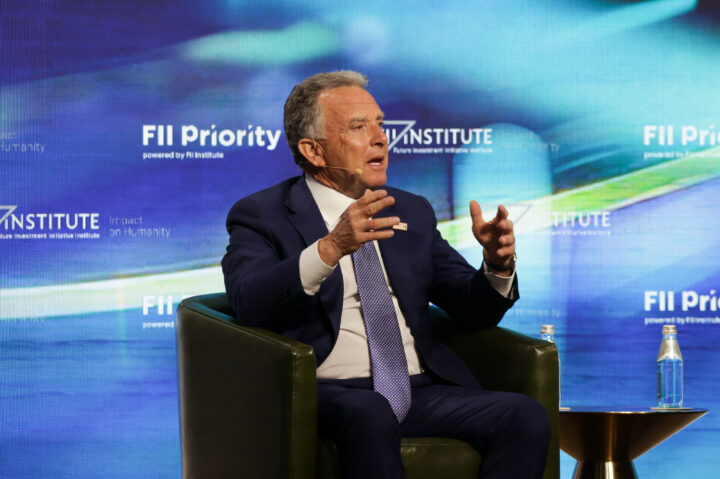
Zak Bennett/Bloomberg via Getty Images
White House Special Envoy Steve Witkoff during the Future Investment Initiative (FII) Priority Summit conference in Miami, Florida, on March 27, 2026.


 Add JewishInsider on Google
White House Special Envoy Steve Witkoff compared the release of Israeli hostages kidnapped by Hamas to the release of Palestinians from Israeli prisons, stating that both experiences “feels like we’re changing lives.”
“People ask me: ‘Why do I like doing it?’ And I say because it feels worthy, it feels like we’re changing lives,” Witkoff said on Friday at the FII Priority summit in Miami. “I remember when we met those families of the Israeli hostages and they were ecstatic because they didn’t think their children were coming home.”
“But I was also in Gaza,” Witkoff continued. “I met Gazan families whose children were released from Israeli prisons in exchange, and they were just as grateful as the Israeli parents.”
“People ask me: ‘Why do I like doing it?’ And I say because it feels worthy, it feels like we’re changing lives,” Witkoff said on Friday at the FII Priority summit in Miami. “I remember when we met those families of the Israeli hostages and they were ecstatic because they didn’t… pic.twitter.com/CBpwY4bQHi
— Jewish Insider (@J_Insider) March 29, 2026
Israel released around 2,000 Palestinian security prisoners in exchange for 20 living and several deceased hostages under the U.S.-backed ceasefire and hostage-release deal with Hamas. At least 250 of the released prisoners were serving life sentences for carrying out deadly terror attacks.
During the summit, Witkoff also discussed the current conflict in Iran, as President Donald Trump continues to herald the success of ongoing diplomatic negotiations with the regime. Iran initially denied that negotiations were taking place but then formally rejected the U.S.’ 15-point ceasefire proposal, sending a five-point counteroffer that would recognize Tehran’s authority over the Strait of Hormuz.
“There are some people who have denied that we are negotiating,” Witkoff said. “We may have a different definition of negotiating than they do, or there may be people within their system today who just don’t have the ability to admit it, but we’re talking to them.”
“We have a 15-point deal on the table that the Iranians have had for a bit of time,” Witkoff added. “We expect an answer from them, and it would solve it all. It would solve the enrichment question, which is, we can’t have enrichment there today.”
Witkoff said the deal on the table would also solve Iran’s “enriched material stockpile, which they have to give up.”
“There are red lines for us, but we’re not looking to see the dissolution of the Iranian people,” Witkoff said. “They are very good people. We want them to thrive and survive and the country to join the league of nations and to be prosperous and do a lot of business. We just don’t want the destabilizing forces that they’ve generated out there.”
Witkoff said a deal could generate “collateral benefits,” such as diplomatic normalization between Saudi Arabia and Israel, a goal that has thus far been elusive for the administration. He also noted that there will be “meetings this week,” and that “ships are passing” in the Strait of Hormuz, where Iran has effectively blocked one of the world’s most critical oil passageways.
“I think the president wants a peace deal, but he also believes in — and I believe in it too — peace through strength. Without pressure, you never get anybody to the table,” Witkoff said. “We’re employing a lot of strength, we have a big fleet there, and yet we’re prepared to solve it with a diplomatic solution.”
Thousands had already assembled by dawn at Tel Aviv’s Hostages Square — where some had slept overnight — for the release of the last remaining hostages known to be alive

(Photo by Alexi J. Rosenfeld/Getty Images)
People gather to watch the hostage release live stream at Hostages Square on October 13, 2025 in Tel Aviv, Israel.
It was the day that Israelis have waited for after more than two years — or two years exactly by the Hebrew calendar. Thousands had already assembled by dawn at Tel Aviv’s Hostages Square — where some had slept overnight — for the release of the last remaining hostages known to be alive. Shortly after 8 a.m., the first seven hostages — Omri Miran, Matan Angrest, Ziv Berman, Gali Berman, Guy Gilboa-Dalal, Alon Ohel and Eitan Mor — were released to Red Cross custody.
“Habayta,” meaning “home,” the unofficial anthem of the hostage families, played over a montage of photos of the 47 men and one woman who have spent the last 738 days in captivity — a scene that has repeated itself in the square every Saturday night for two years.
Israeli networks split coverage between the live festivities across the country, in-studio reporting and interviews with hostage families and former hostages. Former hostage Emily Damari called into Israel’s Channel 12 upon the release of her neighbors and friends, twins Zvi and Gali Berman, and said the Shehecheyanu prayer giving thanks — a prayer also recited by the thousands thronging in and around Hostages Square. The crowd erupted in joy at the sight of the two brothers being reunited.
By just before midday, the 20 living hostages — also including Avinatan Or, Bar Kupershtein, Ariel and David Cunio, Eitan Horn, Elkana Bohbot, Evyatar David, Maksym Harkin, Matan Zangauker, Nimrod Cohen, Rom Braslavski, Segev Kalfon and Yosef-Chaim Ohana — were on Israeli soil.
The first images of the men trickled out over the course of the morning: Miran, flanked by his wife and father, wearing a shirt with artwork by his two young daughters; the Berman twins in Maccabi Tel Aviv jerseys; Ohel, pale but smiling and standing on his own, with sunglasses to protect his damaged eyes.
In contrast to previous hostage release, as dictated by the agreement, there were no propaganda ceremonies staged by Hamas as they handed over the captive Israelis. Instead, Hamas made video calls to the hostages’ relatives, who spoke to their loved ones as they stood beside their masked and uniformed captors.
Amid the hostage releases, President Donald Trump descended from Air Force One to the tarmac at Ben Gurion Airport on Monday morning, where he was greeted by Prime Minister Benjamin Netanyahu and President Isaac Herzog. White House Special Envoy Steve Witkoff, Jared Kushner and Ivanka Trump — who spoke at Saturday night’s hostage rally in Tel Aviv. Read our coverage of their speeches at the rally here.
Signing the Knesset’s guestbook after his arrival, Trump wrote, “This is my great honor — a great and beautiful day, a new beginning.”
With the release of the last living hostages, and later today the remains of four of the 28 deceased hostages, Israel will begin the process of releasing close to 2,000 Palestinian prisoners in accordance with the first phase of the deal. After that, attention will turn to negotiations surrounding the deal’s second phase.
After addressing the Knesset, Trump will travel to Sharm el-Sheikh, Egypt, for a signing ceremony that will also include Palestinian Authority Mahmoud Abbas. Trump’s speech was delayed due to a call with Egyptian President Abdel Fattah el-Sisi, who extended an invitation to Netanyahu to join the ceremony. Netanyahu’s office released a statement saying that the prime minister thanked Trump for the invitation, but won’t be able to participate due to the close timing with the beginning of the Simchat Torah holiday this evening.
It was a day of celebration after two years of pain, longing, fear, anxiety. It was the first time in two years that Israelis were able to wholeheartedly greet each other with ‘Chag Sameach‘ — a greeting that took on a double meaning on the eve of Simchat Torah, which begins this evening.
But the day will take a heavier turn this afternoon when the remains of just four of the deceased hostages are expected to be returned to Israel, bringing a combination of pain and closure to their loved ones who will finally be able to give them a proper burial. Meanwhile, the 24 other hostage families — who were shocked to learn this afternoon of the low number of bodies that will be released — will be left waiting for the remains of their loved ones to be located and returned home. The Hostages Families Forum called the development a “blatant breach of the agreement by Hamas,” and called on the Israeli government and the mediators to “take immediate action to rectify this grave injustice.”
Mentions of President Donald Trump drew raucous applause, while the crowd booed Witkoff’s mentions of Prime Minister Benjamin Netanyahu
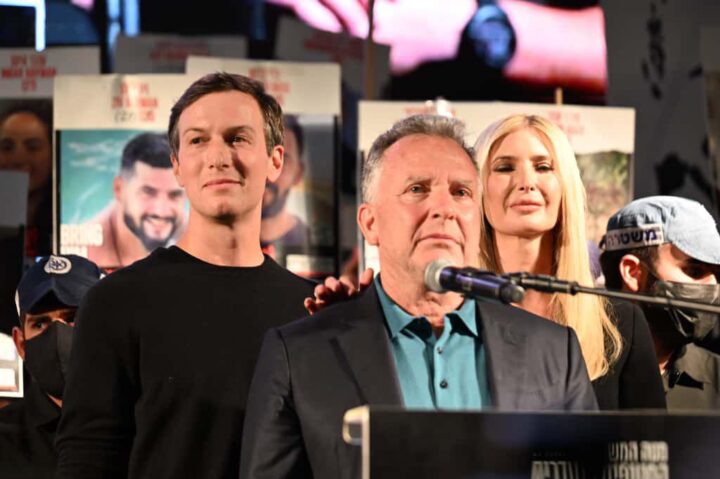
Paulina Patimer
Jared Kushner, Steve Witkoff and Ivanka Trump speak in Hostages Square in Tel Aviv, Israel, on Oct. 11, 2025.
Days before the remaining living hostages are expected to be released from more than two years of captivity in Gaza, White House Special Envoy Steve Witkoff, Jared Kushner and Ivanka Trump addressed a receptive crowd of hundreds of thousands on Saturday night in Tel Aviv’s Hostages Square.
Witkoff and Kushner had been in Sharm el-Sheikh, Egypt, earlier in the week for high-level talks that secured an agreement, which went into effect on Friday, to end the two-year war between Israel and Hamas. They arrived in Israel on Thursday ahead of President Donald Trump’s planned visit to the country on Monday, the day that most living hostages are expected to be released.
“To the hostages themselves,” Witkoff said, “our brothers and sisters, you are coming home.” The White House special envoy praised Trump, who, Witkoff said, “once again proved that bold leadership and moral clarity can reshape history and change the world.”
“We all owe a debt of deep gratitude to President Trump,” the White House special envoy continued, to cheers and chants thanking Trump, Witkoff and Kushner. Numerous mentions of Trump’s name throughout the evening drew cheers and applause from the crowd.
Witkoff paused his speech and appeared flustered after his mentions of Israeli Prime Minister Benjamin Netanyahu drew widespread jeers from the crowd. “I was in the trenches with the prime minister,” Witkoff said as he tried to mollify the crowd. “Believe me, he was a very important part here.” Netanyahu and Israeli Strategic Affairs Minister Ron Dermer, Witkoff added, “have both sacrificed so much for this country and devoted their lives to the service of Israel.”
Witkoff noted the “tireless dedication of leaders who would not rest until the world saw what could be achieved,” naming the president, Kushner and Arab leaders including Qatari Prime Minister Sheikh Mohammed bin Abdulrahman Al Thani, Qatari Emir Tamim bin Hamad Al Thani, Turkish President Recep Tayyip Erdoğan and Egyptian President Abdel Fattah el-Sissi.
Calling Oct. 7, 2023, a “shattering day,” Kushner said the attacks “shocked me to my core in a way I’ll never be the same. Since then, my heart has not been complete.”
Kushner, who has in recent months been increasingly involved in the White House’s efforts to reach a comprehensive deal to end the Israel-Hamas war, described the “tremendous burden that I felt to see these hostages come home, to see their families get the closure they deserve and to end this nightmare — and also to see the suffering end for the people in Gaza, who, for most of them, were experiencing this through no fault of their own, other than being born into a situation that was horrific.”
In brief remarks, Ivanka Trump said that “the return of each hostage is not only a moment of homecoming and relief, it’s a triumph of faith, of courage and of our shared humanity.”
Addressing the hostage families, Trump said, “The president wanted me to share, as he has with so many of you personally, that he sees you, he hears you, he stands with you — always. Always.”
A video that played as Kushner, Witkoff and Trump exited the stage praised the U.S. president as “Israel’s great friend.”
Ruby Chen, the father of slain Israeli American hostage Itay Chen, who spoke following Trump, said that Israel Police estimated that 400,000 people were in attendance at Saturday’s rally, a weekly solidarity event since the Oct. 7 attacks.
The Democratic congressman, in a letter rejecting an offer for a staffer to travel to Qatar, said that the kingdom needs to do more to pressure Hamas
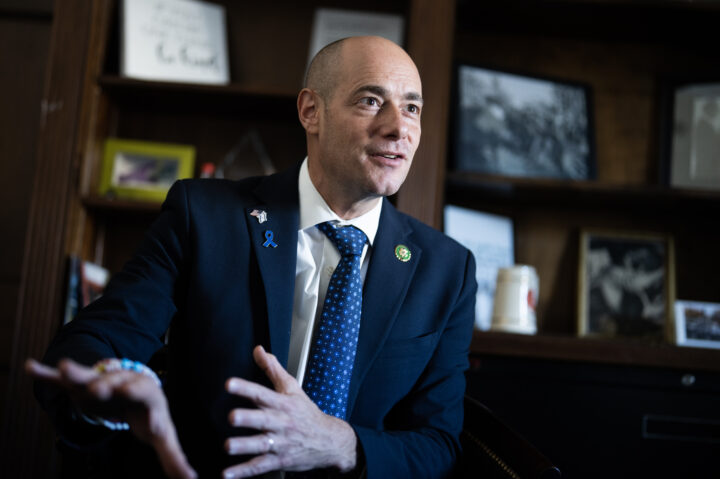
Tom Williams/CQ-Roll Call, Inc via Getty Images
Rep. Greg Landsman (D-OH) is interviewed by CQ-Roll Call, Inc via Getty Images in his Longworth Building office on Friday, November 3, 2023.
Rep. Greg Landsman (D-OH) called on Qatar last week to step up more forcefully to pressure Hamas and bring about a hostage-release and ceasefire deal in Gaza, including taking into custody the Hamas leaders who have long enjoyed safe haven in Doha.
Landsman, in a lengthy X thread about the conflict in Gaza, took aim at various parties, including Qatar, which he called a “huge barrier” to peace given its continued support for Hamas. He revealed that he had rejected an invitation from the Qatari government for one of his staff members to travel to the country.
“It’s time to call the question on everybody, including the Qataris. There are legitimate questions about whether or not they should be doing more, they could be doing more,” Landsman said in an interview with Jewish Insider. “[Hamas] just refuses to engage anymore.”
In light of that situation, Landsman argued that every potential lever to change Hamas’ calculus must be explored and pursued.
He said that Qatar, as “the entity that has the most influence” over Hamas at this point, “has to feel way more pressure from the international community to do everything in their power” to get to a deal. The status quo of Hamas leaders living lavish lives in Qatar “should absolutely be questioned,” Landsman said.
He said he’s heard from Israeli officials and others involved in the hostage talks that the Qataris are “not seen as a trusted partner in this effort to end the war.”
In a letter to the Qatari ambassador rejecting the invitation for his staffer to travel to the kingdom, Landsman offered bracing criticism of Qatar’s role in hostage talks.
“Qatar’s gross mishandling of the hostage crisis in Gaza and failure to sufficiently pressure Hamas into ending the war prevents me from allowing staff to visit your country,” Landsman said. “That you continue to tolerate this obstructionist behavior from your terrorist beneficiary is incomprehensible.”
Calling the Hamas political leaders in Qatar who are representing the terrorist group in hostage talks “useless,” Landsman called on Qatar to detain the Hamas leaders until the hostages are released and other reforms are implemented in Gaza.
He called on Doha to end “future financial support for Hamas and Gaza” until the hostages are released and other reforms are implemented and to take steps to address antisemitic and pro-Hamas content on Al-Jazeera, the Qatari state-run media outlet.
He said he would be glad to send his staff on a trip to Qatar and to work with the country after it had taken the steps he outlined.
Landsman told JI that his conversations with Israeli leaders, on issues such as the need for additional humanitarian aid, produce change — albeit sometimes not as fast as or as comprehensively as he would hope.
With Qatar, he said, “I have had so many conversations and nothing changes.” He indicated that his engagements with Qatar earlier in the war had been more productive, noting that he’d arranged to bring a delegation of hostage families to meet with the Qatari ambassador shortly after the Oct. 7, 2023, Hamas-led attacks during which their family members were kidnapped.
Beyond squeezing Hamas’ leadership in Qatar, Landsman said he wants to see the country step up as not just a meditator and facilitator of dialogue, but as a more active partner in pursuing a two-state solution and regional peace.
He said that Qatar’s lobbying efforts in the United States, its outreach to lawmakers and their staff, its funding of U.S. colleges and universities and other efforts to assert its influence domestically show that the country “care[s] deeply about what we think.”
“That is why I sent the letter and why I’m pushing and doing it publicly,” Landsman said. “I’m sitting here as one member of Congress trying to do everything in my power to end this crisis. … They want the West to like them. They want us to see them as a partner, as an ally.”
In spite of his current criticisms, Landsman did not at this point embrace the idea of moving the U.S. airbase in Qatar elsewhere in the region, arguing that the U.S. should not give up on its relationship with Doha.
“What I am saying is there are expectations of partners, and our partnership will be so much stronger if [Qatar’s] relationship with this terrorist entity ends,” he explained. “That relationship has potential, but it should go in the direction that makes the most sense for our national security and peace and stability in the region, and that means resolving their Hamas issue.”
Landsman also called for shifts in Israel’s strategy in Gaza, saying that the humanitarian crisis is real and that he has spoken directly to Prime Minister Benjamin Netanyahu about the need to increase humanitarian aid.
He said Israel should be doing more to create humanitarian safe zones for civilians and to separate Hamas from the rest of the population of Gaza. And he argued that by sending in an “avalanche” of aid, Israel would diminish the impact of Hamas’ diversion of aid shipments.
He said Israel should also pull back on its large-scale campaign in Gaza and focus on targeted operations to find and liberate the hostages.
Asked about the impact of fellow Democratic lawmakers and the international community blaming Israel for the continuation of the war, Landsman said that there is a place for pressure on Israel to adjust its strategy, “but don’t abandon our ally. This is one of the most important allies we have.”
He also emphasized that Hamas has shown no interest in or willingness to agree to a new hostage deal and that international attacks on Israel will embolden it further.
“If they continue to see people just hammering away at Israel — which they believe is critical for them to achieve their goal, which of course is to destroy the State of Israel — they will continue to [fight],” Landsman said.
Landsman characterized the recent Arab League statement condemning the Oct. 7 attack and calling for Hamas to release the hostages as an important public step in pressuring Hamas.
He said the statement’s public rejection of Hamas mirrors what he has heard privately from Arab leaders for months. “I think this is going to put more pressure on Qatar to figure out a much better path forward with their unique issues with Hamas,” Landsman said.
Qatar’s be-everywhere, invest-in-everything strategy has allowed Doha to gain footholds across the global economy and in diplomatic circles

Jacquelyn Martin/AP
Qatari Prime Minister and Minister of Foreign Affairs Sheikh Mohammed bin Abdulrahman bin Jassim Al-Thani, attends a news conference about the Israel-Hamas war, and pressure to reduce civilian casualties, Friday, Dec. 8, 2023, in Washington.
Ceasefire and hostage-release talks have been ongoing in Doha, Qatar, for the last week. But one of the most consequential meetings in the negotiations could be happening tonight in Washington, when President Donald Trump hosts Qatari Prime Minister Mohammed bin Abdulrahman Al Thani for dinner at the White House.
This continues a new tradition for Trump of hosting prominent Gulf royals who aren’t the heads of state of their respective countries for dinner at the White House. In March, Trump hosted a dinner in the White House’s State Dining Room for Sheikh Tahnoon bin Zayed Al Nahyan, the United Arab Emirates’ national security advisor and chairman of several sovereign wealth funds.
Qatari officials have been in the U.S. all week. Qatari Emir Sheikh Tamim bin Hamad Al Thani was rumored to have met with Trump on the sidelines of the FIFA finals in New Jersey on Sunday, after being spotted in New York over the weekend.
White House Middle East envoy Steve Witkoff, whose trip to Doha last week was postponed over stalled talks, told reporters over the weekend that he planned to meet with Qatari negotiators on the sidelines of the match. And Trump shared a suite with senior Qatari sports officials at the match, including Nasser bin Ghanim Al-Khelaifi, the president of the Paris Saint-Germain team who played in New Jersey on Sunday and chairman of beIN Sports, previously known as Al Jazeera Sport. (In a weekend interview at the FIFA match, Trump even noted Qatar’s “big presence.”)
Qatar also loomed large in Washington this week, where legislators on the House Education and the Workforce Committee pressed university leaders from Georgetown, CUNY and the University of California, Berkeley about their foreign funding sources during a hearing about antisemitism in higher education. Former Rep. Jim Moran (D-VA), one of Qatar’s top lobbyists in Washington, was seen sitting right behind Georgetown University interim President Robert Groves as Groves testified on Tuesday. The school has received over $1 billion from Qatar, and has a campus in Doha.
Qatar’s be-everywhere, invest-in-everything strategy has allowed Doha to gain footholds across the global economy and in diplomatic circles. And since the start of the war, it has sought to highlight its role as a facilitator of ceasefire talks between Israel and Hamas, the latter of which Doha supports financially and diplomatically.
With Iran weakened following last month’s war, Qatar remains the Hamas sponsor with the most leverage on the terror group. Despite pledges last year to expel senior Hamas officials to Turkey, many of those officials remain in Qatar.
Earlier this week, Trump threatened steep tariffs on Russia if Moscow doesn’t reach a peace agreement with Ukraine before the end of August. But the Qatari royal family, with endless wealth and more favored global standing, does not face the same fiscal and geopolitical challenges and limitations as Russian President Vladimir Putin. It’s unclear what leverage Trump could use to push Qatar to exert pressure on Hamas as he seeks a resolution to the war.
Doha has the power to push Hamas to accept a ceasefire. Whether tonight’s dinner will exact a change in Qatar’s approach to Hamas remains to be seen. The sit-down between Trump and the Qatari prime minister could change the tide in the 21-month war, or it could serve as yet another missed opportunity in a war full of stalemates and diplomatic posturing — with fresh casualties mounting on both sides and 50 hostages still languishing in captivity.
Israel getting ‘80-90%’ of what it wants from a temporary ceasefire, but Hamas not willing to take steps towards ending the war, official says
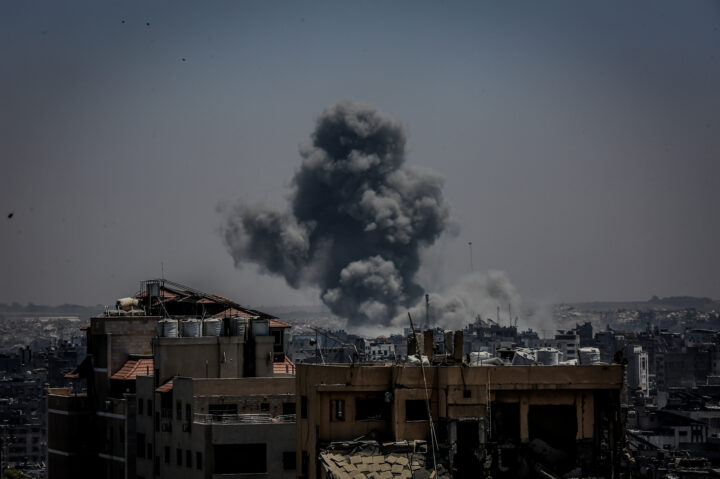
Saeed M. M. T. Jaras/Anadolu via Getty Images
Smoke rises after an Israeli strike in the eastern part of Gaza Strip on July 3, 2025.
A breakthrough in negotiations between Israel and Hamas for a temporary ceasefire and hostage-release deal is likely to take longer than expected, a senior Israeli official in Prime Minister Benjamin Netanyahu’s delegation to Washington told reporters on Monday, after Netanyahu’s dinner with President Donald Trump.
“We hoped that [a deal] would take a few days, but it may take more time,” the official said.
The negotiations in Doha, Qatar, are “fully coordinated” with the Trump administration, and Netanyahu and Trump may meet again “if necessary” while the prime minister is in Washington this week, the official said. Netanyahu is expected to return to Israel on Thursday afternoon, but in the past, he has extended his visits.
Israel and Hamas have been in negotiations mediated by the U.S. and Qatar for a 60-day ceasefire, in which Hamas would gradually free half of the 50 remaining hostages, approximately 20 of whom are thought to be alive, in exchange for the release of hundreds of Palestinian prisoners. In addition, Israel would withdraw from parts of the Gaza Strip, while keeping troops in the area’s perimeter and along key corridors.
Hamas responded to the temporary ceasefire proposal over the weekend, asking for many changes, the senior Israeli official said, to the extent that “Hamas’ answer was essentially no.”
Hamas previously rejected a similar proposal when Middle East envoy Steve Witkoff presented it earlier this year, but now, the official said, “the gaps are small enough for there to be talks.”
A second official on the delegation said the current proposal presents Israel with “80-90% of what it wanted to get.”
In addition to a continued presence on the Philadelphi Corridor, along the Gaza-Egypt border, where Israel has insisted on maintaining control since it reached the area in May 2024, the senior official said that Israel is demanding to keep troops along the Morag Corridor, slightly north of Philadelphi, which separates the southern Gazan cities of Rafah and Khan Younis.
A deal to end the Gaza war is not on the table because “Hamas is not responsive to the conditions that would allow a comprehensive agreement,” such as demilitarization for Gaza and exile for remaining Hamas leaders, the senior official explained. Without those conditions, “Hamas could do [the Oct. 7, 2023 attacks] again.”
“The conversation in the [news] studios that we can finish the war now is delusional. [Hamas] would see that as a major victory that could allow Iran to recover and Hezbollah to recover. I believe that with military and diplomatic pressure, we can bring back all of the hostages. Our pressure is neutralizing Hamas’ ability to control [Gaza],” the official said.
Israel’s vision for Gaza after the war is that “there is no more Hamas; Hamas is dismantled. Another force takes over the territory, the leaders are exiled and Hamas lays down its weapons … I need Gaza demilitarized, and I mean it.”
The senior official did not rule out the possibility that forces affiliated with the Palestinian Authority could be part of the other force, noting that there may be Fatah members in the existing militias that are pushing back against Hamas in Gaza.
“There needs to be another system that administers life [in Gaza]. I’m not certain that it won’t be [Israel], maybe it will be for some time and then we’ll pass it to someone else,” the senior Israeli official said.
The senior Israeli official addressed a plan, previously proposed by Trump, in which the population of Gaza is relocated outside of the Strip, saying that after the meeting between the president and Netanyahu, the official is convinced that the president was serious.
“The plan is alive,” he said. “What is needed is operational coordination, not just in the goal but how to achieve it, and that is what we discussed. The will is there.”
When it comes to Iran, the senior Israeli official said that Jerusalem and Washington are now working “to preserve our achievements against Iran, to prevent uranium enrichment and ballistic missile [production].”
According to the official, there has never been a time in which the governments of Israel and the U.S. have been more coordinated, and that the sides trust each other.
Israel “didn’t ask for and didn’t receive a green light from Trump to attack Iran. There is a different relationship now,” the official said. “We agree on things … You also don’t need to get approval. He understands that we have existential needs.”
A second Israeli official said Netanyahu and Trump’s administrations “had diplomatic coordination before the attack, military coordination during the attack, and now diplomatic coordination again.”
Please log in if you already have a subscription, or subscribe to access the latest updates.
 Continue with Google
 Continue with Apple