






























 Add JewishInsider on Google
Good Tuesday afternoon,
This P.M. briefing is reserved for our premium subscribers like you — offering a forward-focused read on what we’re tracking now and what’s coming next.
I’m Danielle Cohen-Kanik, U.S. editor at Jewish Insider. I’ll be curating the Daily Overtime for you, along with assists from my colleagues. We hope you enjoy the inaugural edition and would love to hear your thoughts and feedback. Please don’t hesitate to drop us a line by replying to this email.
📡On Our Radar
Notable developments and interesting tidbits we’re tracking
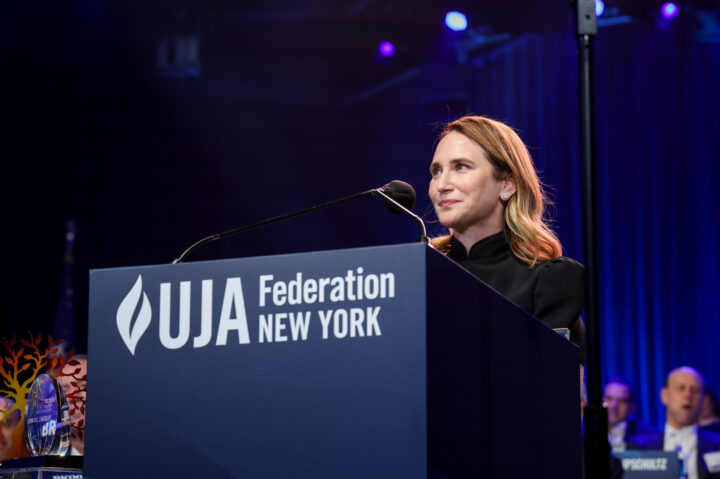
Today, we remember Wesley LePatner, a Jewish philanthropist and Blackstone executive killed in Monday’s shooting at the firm’s Manhattan headquarters. LePatner, 43, served on the boards of the pluralistic Abraham Joshua Heschel School and the UJA-Federation of New York. The federation called LePatner “extraordinary in every way” in a statement, saying she “lived with courage and conviction, instilling in her two children a deep love for Judaism and the Jewish people.” Hindy Poupko, deputy chief planning officer at UJA, said in remarks at the Israel on Campus Coalition’s National Leadership Summit in Washington today that there was a second Jewish victim of the shooting, Julia Hyman. Hyman, a Cornell graduate, worked for Rudin Management in the Midtown skyscraper…
Concerns among Democrats about the humanitarian situation in Gaza and Israel’s role in it are intensifying. On Capitol Hill, the majority of Senate Democrats, led by a group including Senate Minority Leader Chuck Schumer (D-NY) and Sen. Jacky Rosen (D-NV), sent a letter to Secretary of State Marco Rubio and Middle East envoy Steve Witkoff calling the humanitarian crisis in Gaza “unsustainable” and saying that the Israeli- and American-backed Gaza Humanitarian Foundation has “failed” to properly deliver aid…
One Democrat standing up for Israel is Rep. Ritchie Torres (D-NY), who said at the ICC summit today, “We have to remind the world that, despite the amnesia, Hamas was the central cause of the war in Gaza. … Hamas is morally responsible, principally responsible for the war in Gaza.” Read more on Torres’ speech in JI’s Daily Kickoff tomorrow…
Sen. Bernie Sanders (I-VT), who did not sign the Senate Democrats’ letter, jumped into the fray by introducing another resolution to block an arms transfer to Israel — his third since November 2024. In a novel twist, this resolution would block the sale of $1 million worth of assault rifles to Israel’s police force overseen by far-right Minister of National Security Itamar Ben-Gvir, potentially opening the door for more Democrats to vote in favor, given Ben-Gvir’s less-than-favorable reputation within the party…
British Prime Minister Keir Starmer, applying pressure of his own, announced today that the U.K. will recognize a Palestinian state at the U.N. General Assembly in September — matching France’s timeline, announced last week — unless Israel takes “substantive steps to end the appalling situation” in Gaza, reaches a ceasefire with Hamas and commits to reviving the possibility of a two-state solution and not annexing the West Bank. President Donald Trump, who met with Starmer in Scotland yesterday, told reporters that the British PM didn’t discuss the move with him and that he has no view on it, but that the U.S. is “not in that camp”…
On the home front, UCLA settled a lawsuit with Jewish students who alleged that the university permitted antisemitic conduct during the campus’ anti-Israel encampments in spring 2024. According to the agreement announced today, the university cannot allow or facilitate the exclusion of Jewish students, faculty or staff from UCLA programs or campus areas. Notably, the agreement specifies that Jews cannot be excluded “based on religious beliefs concerning the Jewish state of Israel.” Also getting a windfall in the settlement: UCLA agreed to pay over $2.3 million combined to UCLA Hillel and Chabad, the Anti-Defamation League, the Academic Engagement Network and other Jewish organizations combating antisemitism on campus…
⏩ Tomorrow’s Agenda, Today
An early look at tomorrow’s storylines and schedule to keep you a step ahead
Keep an eye on Jewish Insider later this week where we’ll feature an interview with Jeanine Pirro, interim U.S. attorney for D.C., who spoke with JI about the ongoing prosecution of the assailant responsible for the deadly May shooting at the Capital Jewish Museum. We’ll also cover Rep. Mike Collins’ (R-GA) record on antisemitism as he jumps in the race to challenge Sen. Jon Ossoff (D-GA), and report on Harvard’s overtures to the Jewish community while it gears up for a settlement with the federal government.
We’re staying tuned for how President Donald Trump may react as some of the U.S.’ closest allies gear up to recognize a Palestinian state, a policy the U.S. has rejected as unhelpful to peace efforts for decades. Though he said today he has “no view” on the matter, as the U.N. General Assembly nears, will Trump take a tougher line on his European partners?
Stories You May Have Missed
WAIT-AND-SEE APPROACH
New York Jewish leaders reluctant to fight against Mamdani
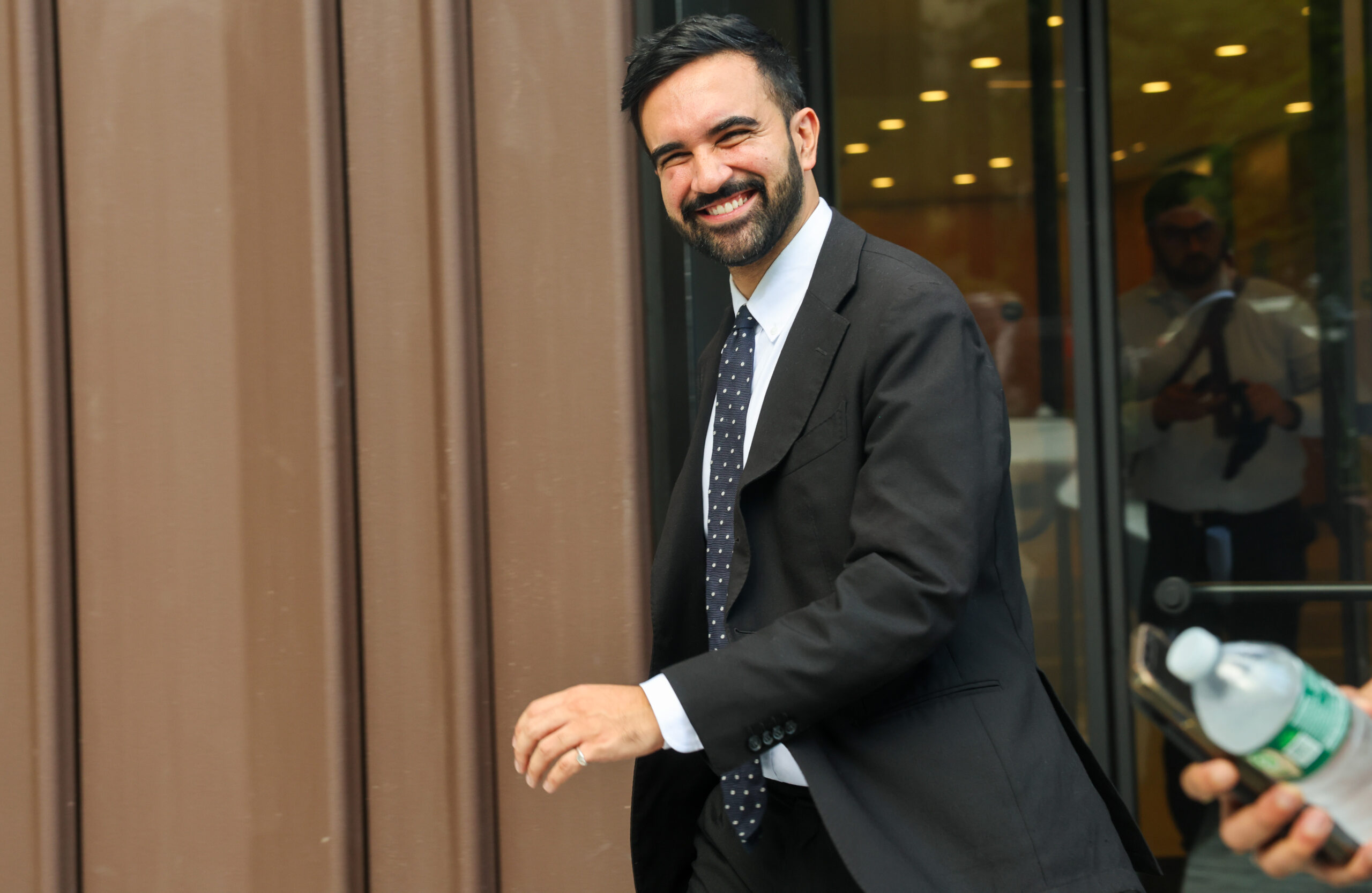
One Jewish political leader: ‘No one thinks it’s going to be good for the Jewish community to be hostile and to be in constant war with the next mayor’
PODCAST POLITICS
Former Obama staffers turned podcasters reemerge to lead anti-Israel chorus

Ben Rhodes and Tommy Vietor shaped the story of the Iran nuclear deal. Now they’re trying to turn Democrats away from Israel
The senators said that aid should be surged to NGOs and multilateral organizations

Kevin Carter/Getty Images
U.S. Capitol Building on January 18, 2025 in Washington, DC.
A group of 40 Senate Democrats, nearly all of the caucus, wrote to administration officials on Tuesday raising concerns about the humanitarian situation in Gaza and calling for a significant expansion of aid, describing the Gaza Humanitarian Foundation as a failure.
The letter to Secretary of State Marco Rubio and Middle East envoy Steve Witkoff, led by Sens. Adam Schiff (D-CA), Brian Schatz (D-HI), Chuck Schumer (D-NY) and Jacky Rosen (D-NV), highlights the extent of the concern even among Democratic leaders and pro-Israel stalwarts.
“The acute humanitarian crisis in Gaza is … unsustainable and worsens by the day,” the lawmakers said. “Hunger and malnutrition are widespread, and, alarmingly, deaths due to starvation, especially among children, are increasing.”
The senators said that the Israeli- and American-backed GHF aid distribution system had “failed to address the deepening humanitarian crisis and contributed to an unacceptable and mounting civilian death toll around the organization’s sites.”
They argued that aid must be significantly expanded, including through “experienced multilateral bodies and NGOs that can get life-saving aid directly to those in need and prevent diversion.” Israel has argued that other aid distribution mechanisms, particularly those affiliated with the United Nations, have failed to effectively distribute aid and prevent Hamas diversion.
The letter further states that efforts to finalize a ceasefire in Gaza “are as critical and urgent as ever and we urge the resumption of good-faith talks as quickly as possible.” The administration walked away from talks with Hamas last week, saying that Hamas was not negotiating in good faith.
“There still remains a viable pathway to end this war, bring home Israeli hostages, and achieve a diplomatic resolution of the Israeli-Palestinian conflict,” the senators asserted.
They emphasized that the living hostages in Gaza “have suffered too long, as have their families” and that “it is imperative that those still living be brought home as soon as possible, before more perish as the war drags on.” They also noted the need to return the bodies of deceased hostages.
The Democrats also voiced “our strong opposition to the permanent forced displacement of the Palestinian people” from Gaza, as has been floated by some Israeli and American leaders, calling such an outcome “antithetical to international humanitarian law,” to the security of Israelis and Palestinians, to lasting peace and to the expansion of the Abraham Accords.
They urged the administration to clearly reject such a plan.
“Beyond a negotiated ceasefire, a permanent end to this war will also require an end to Hamas rule in Gaza and ensuring that Hamas can no longer pose a serious military threat to Israel,” the letter continues. “We reaffirm our strong support for continued U.S.-led diplomacy with Israel, Palestinian leaders, and other partners in the Middle East in pursuit of the long-term goal of a negotiated two-state solution with Israelis and Palestinians living side by side in lasting peace, security, dignity, and mutual recognition.”
The only Senate Democrats who did not sign the letter were Sen. John Fetterman (D-PA) — who has generally abstained from letters by other Democrats critical of Israel — as well as Sens. Andy Kim (D-NJ), Ed Markey (D-MA), Jeff Merkley (D-OR), Tina Smith (D-MN) and Elizabeth Warren (D-MA). Sen. Bernie Sanders (I-VT) also did not sign.
It follows a letter earlier this week from 21 progressive Senate Democrats that more strongly condemned the GHF, describing it as a “private group supported by U.S. security contractors and connected to deadly violence against starving people seeking food in Gaza” that “blur[s] the lines between delivery of aid and security operations.”
That letter called on the administration to “immediately cease all U.S. funding for GHF and resume support for the existing UN-led aid coordination mechanisms with enhanced oversight to ensure that humanitarian aid reaches civilians in need.”
The progressive lawmakers said that the GHF system is insufficient to replace the United Nations aid network and that it is facilitating efforts to displace Palestinians and depopulate Gaza, as well as highlighted incidents in which aid recipients were allegedly attacked at distribution sites.
The lawmakers said the administration had dodged legal and vetting requirements in its provision of aid to the GHF. They also argued that the American military contractors employed to guard the GHF sites are at risk from both Hamas and anti-Hamas militia forces in Gaza.
Strikes come as Damascus, Jerusalem held U.S.-backed negotiations, but Israeli Druze doubt Syrian President al-Sharaa is ‘capable or wants’ to stop violence against minorities
Ilia Yefimovich/picture alliance via Getty Images
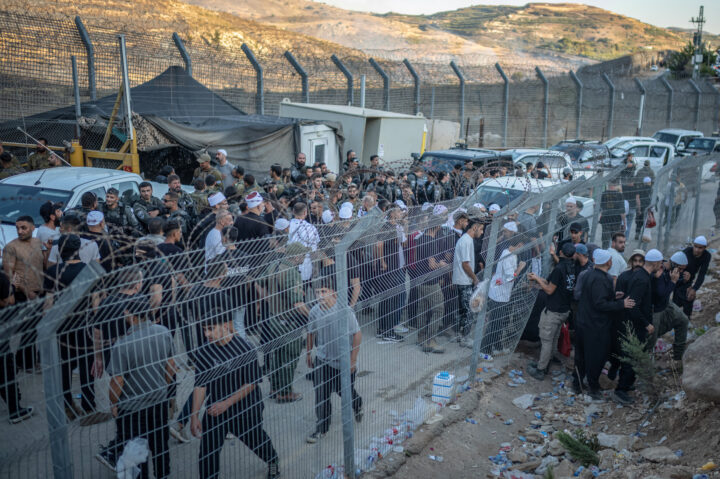
Israeli Druze cross the border near Majdal Shams in a show of support for the Druze community in Hader on the Syrian side on July 16, 2025.
Israel struck the Syrian Defense Ministry’s headquarters in Damascus on Wednesday in response to violence against the country’s Druze minority, a week after Israeli Prime Minister Benjamin Netanyahu spoke in the White House of the “opportunity for stability, security and eventually peace” with Syria.
The strikes came after clashes between Druze and Bedouin groups that began on Sunday, leaving as many as 250 dead over four days in Sweida, some 25 miles from the border with Israel and in the area of Syria that Israel seeks to have demilitarized.
Syrian government forces entered the fray on Tuesday, saying they aimed to stop the fighting and bring about a ceasefire, which they said they had reached on Wednesday. Syrian President Ahmed al-Sharaa, formerly the head of the Syrian branch of Al Qaida, seeks to disarm Druze and other militias and have them integrate under the new government.
Israeli Druze called for Israel to intervene from the outset of the violence on Sunday, saying that their Syrian counterparts were being massacred, raped and tortured by forces aligned with al-Sharaa. In Israel, videos and images circulated of Druze religious figures’ mustaches being forcibly shaved off by men in military fatigues.
Secretary of State Marco Rubio said on Wednesday afternoon that Washington has “engaged all the parties involved in the clashes in Syria. We have agreed on specific steps that will bring this troubling and horrifying situation to an end tonight. This will require all parties to deliver on the commitments they have made and this is what we fully expect them to do.”
An Israeli official said that the U.S. had been in talks to stop the violence in Syria since Monday.
Reda Mansour, a Middle Eastern Studies professor at Reichman University, former Israeli ambassador to Brazil and a member of Israel’s Druze community, told Jewish Insider that “there is not really one Syrian army; it’s different armed groups that do what they think. It will take time until everyone is convinced to hold their fire.”
Mansour expressed hope that the Israeli strikes convinced al-Sharaa to “stop the rampage.”
The former ambassador compared the violence against the Druze in Syria to the Oct. 7, 2023 Hamas attack on Israel and said that the Druze in Syria had not faced such violence since the 1925 rebellion against the French Mandate.
“In the rebellion against the French, it was mostly between soldiers,” Mansour said. “This ISIS and Al Qaida-style attack is a massacre, rape, burning of holy sites, torture of the elderly and religious leaders.”
Mansour also said the community has not had electricity in three days and is running out of food and medical supplies, after attacks on the city’s hospital and its medical staff.
Syrian Druze “are in distress and they are asking [Israel] for help all of the time,” Mansour said, and argued that “al-Sharaa wants to get rid of the Druze.”
“If he wanted to stop the attack, it wouldn’t have happened,” Mansour said. “His people said they are coming to Sweida to defend the Druze from the Bedouin, and then they conquered Druze villages. The people murdering and torturing the elderly are wearing his military’s uniforms.”
On Tuesday, dozens of Israeli Druze men began crossing into Syria, breaching a border fence near the town of Majdal Shams in the Golan Heights.
Netanyahu called on the Israeli Druze to remain in Israel: “You could be murdered, you could be taken hostage, and you are impeding the efforts of the IDF,” he said.
Yet, on Wednesday, the number of Israeli Druze in Syria rose to at least 1,000. The IDF also used tear gas and other crowd control methods to stop Syrian Druze from crossing into Israel.
IDF Chief of Staff Lt.-Gen. Eyal Zamir said that Israel is “acting with determination to prevent hostile elements from establishing a presence beyond the border, to protect the citizens of the State of Israel, and to prevent the harming of Druze civilians … We will not allow southern Syria to become a terror stronghold.”
Zamir called on Druze Israelis to “uphold the law and preserve your lives. We are committed to you and your security and are doing everything possible to support you. I have ordered a further reinforcement of intelligence and strike capabilities in order to increase the pace of strikes and halt the assaults against the Druze in Syria as needed.”
Israeli Foreign Minister Gideon Sa’ar, who has held a hard line on al-Sharaa since the fall of the Assad regime last year, called on the new Syrian government “to come to its senses and to restore order,” lest it lose control of the country and risk the economic engagement it has sought with the West.
Sa’ar called on the international community to speak out against the violence against minorities in Syria, asking rhetorically, “What else needs to happen? What are they still waiting for?”
“We are seeing a recurring phenomenon of persecution of minorities to the point of murder and pogroms in Syria,” Sa’ar said in a briefing to reporters on Wednesday. “Sometimes it is the regime’s forces. Sometimes it is Jihadist militias that are the basis of the regime. And usually, it is both.”
Sa’ar pointed to violence against the Syrian Alawite community, the burning and bombing of churches in recent weeks and repeated waves of violence against Druze in Syria.
The foreign minister said that Israel will act to keep regime forces out of southern Syria and protect its border, and to protect the Druze minority.
Sa’ar also took aim at Western leaders looking to engage with al-Sharaa. “This is not a democratically elected regime,” he said. “Because sometimes, when I am in political meetings [with foreign counterparts], people talk to me about the ‘transition.’ This is not an elected regime at all. This is a regime that … took control by force.”
Sa’ar later spoke to his counterparts in the EU, Germany and Greece, pointing out that the EU set the protection of minority rights as a condition for lifting sanctions on Syria. Sa’ar said there is a “consistent pattern of exploiting these riots [against minorities] for the regime’s interests.” He also called the Syrian government’s claim that there would be an independent investigation of the events a “farce,” noting that al-Sharaa made a similar statement about the massacre of Alawites in March, and no results have materialized.
However, IDF Lt.-Col. (res.) Sarit Zehavi, founder and president of the Alma Research and Education Center focusing on the security of Israel’s northern border, argued to JI that “Israel really had no choice.”
“It had to send a sharp and clear message of defense to the Druze in Syria because it committed to defending them, because the Druze in Israel are real partners,” she said.
In addition, Zehavi said that “whoever doesn’t protect minorities in Syria, especially those on the border [with Israel], will end up being attacked by the same jihadis.”
That being said, Zehavi doubted that the strike on the Syrian Defense Ministry would be effective and said that Israel should focus on targets that are relevant specifically to stopping the attacks on Syrian Druze.
Michael Doran, director of the Center for Peace and Security in the Middle East at the Hudson Institute, questioned whether Israel was certain al-Sharaa was behind the violence in Sweida. Doran wrote that he is not convinced that al-Sharaa “traveled to Baku and met with Israelis there, [and] then chose to provoke a conflict with [Israel] over the Druze,” referring to a meeting between Syrian and Israeli officials over the weekend.
“A policy that holds al-Sharaa responsible for forces he doesn’t control won’t strengthen him—it will weaken him,” Doran wrote on X. “In practice, it becomes a tacit, perhaps unwitting, vote for a disintegrated Syria. But a disintegrated Syria serves Iran more than it serves Israel. And it won’t help with Turkey either.”
Last week, Netanyahu praised President Donald Trump in the White House for having “opened up a channel” with the Syrian regime for negotiations. Talks were underway, with Israeli representatives reportedly meeting with al-Sharaa in the UAE and Azerbaijan last week, for a non-aggression pact between the countries, though not for normalization.
An Israeli official speaking about the future of Israel-Syria talks on condition of anonymity said on Wednesday that Israeli “policy is not based on illusions, but on reality. We want security first.”
Recently, Israel was willing to engage more with the regime in Syria because “things stabilized a bit,” the official said, “but we are not deluding ourselves. They are talking nicely … but there is a difference between what they say and what they do. As their neighbors, we cannot ignore what they do. We send messages [to Western countries] that reflect these things.”
Mansour, who is an expert on modern Syrian history, was skeptical that negotiations between Israel and Syria can be fruitful, saying, “There is not much hope for a political culture that will create stability … There is an inability of the Sunnis, the majority, to understand and accept that there are many minorities, over 30% of the population.”
The former ambassador said that regime-affiliated forces have been harassing minorities on a daily basis. “They enter Christian areas and call on loudspeakers to convert to Islam,” he said. “They check couples to see if they’re married and if not they harass them. There is daily pressure on the Druze, Christians, Alawites and Kurds, and it cannot continue. When they are threatened, they will react.”
Al-Sharaa, Mansour said, “does not look like he’s capable or wants to change it. He wears a suit and tie, but he was in Al Qaida from age 16 … He hinted he’s willing to let Israel keep the Golan Heights and that he wants peace, but on the ground the signs are not encouraging. He speaks nicely, but on the ground he wants to get rid of the Druze — and if he succeeds, he’ll attack the Kurds next.”
“The problem,” Mansour lamented, “is that the Americans believed his show.”
Zehavi said that Israel is likely to return to talks but will be better informed about where the al-Sharaa regime is headed after recent events.
“The first question is whether [al-Sharaa] controls his forces so they won’t massacre minorities, whether he really controls Syria,” she said.
This week also clarified Israel’s red lines for al-Sharaa, she said: “It’s clear why it is important for southern Syria to be demilitarized. You cannot mix Druze and jihadi militias.”
Secretary of State Marco Rubio attributed the move to ‘her illegitimate and shameful efforts to prompt [ICC] action against U.S. and Israeli officials, companies, and executives’

Brian Lawless/PA Images via Getty Images
Francesca Albanese, United Nations special rapporteur on the Occupied Palestinian Territories, during a press conference at Buswells Hotel in Dublin on March 20, 2025.
Secretary of State Marco Rubio announced on Wednesday that the U.S. would sanction Francesca Albanese, the widely criticized United Nations special rapporteur for Israel and the Palestinian Territories.
“Today I am imposing sanctions on UN Human Rights Council Special Rapporteur Francesca Albanese for her illegitimate and shameful efforts to prompt [International Criminal Court] action against U.S. and Israeli officials, companies, and executives,” Rubio said in a statement. “Albanese’s campaign of political and economic warfare against the United States and Israel will no longer be tolerated. We will always stand by our partners in their right to self-defense.”
She is being sanctioned under the Trump administration’s executive order targeting the International Criminal Court.
Members of Congress from both parties, as well as officials in both the Trump and Biden administrations, have condemned Albanese for her bias against Israel, downplaying and justifying the Oct. 7, 2023, Hamas attacks, comparing Israel to Nazi Germany, denying Israel’s right to defend itself and utilizing antisemitic rhetoric, among other issues, calling repeatedly calling for her to be dismissed. The French and German governments have also condemned the U.N. official.
A group of House members issued another call for her dismissal as recently as last month.
“The United States will continue to take whatever actions we deem necessary to respond to lawfare and protect our sovereignty and that of our allies,” Rubio continued.
The sanctions would bar Albanese from entering the U.S., where she has conducted speaking tours, and freeze any assets she, or any of her family members, have in the U.S.
“As chair of the DOJ Task Force to Combat Antisemitism, I applaud Secretary Rubio’s decision to impose sanctions on UN Human Rights Council Special Rapporteur Francesca Albanese,” Leo Terrell, a senior counsel at the Justice Department, told Jewish Insider. “In May, I wrote a public letter calling for her removal due to her long and troubling record of antisemitic rhetoric. This long-overdue step sends a clear message: such hatred will not be tolerated.“
Israel’s ambassador to the United Nations, Danny Danon, praised Rubio for the decision.
“Her relentless and biased campaign against Israel and the United States has long crossed the line from human rights advocacy into political warfare,” Danon said. “Albanese has consistently debased the credibility of the UN by promoting false, dangerous narratives that are detached from reality.”
Rep. Brad Sherman (D-CA), who has led multiple communiques from Congress calling for Albanese to be fired and recently said she has “blood on her hands,” told JI, “Today’s sanctions are … an important step in response to Ms. Albanese’s regular antisemitism.”
“However,” Sherman continued, “until [the] UN removes Ms. Albanese from her post, it is clear that the UN continues to endorse antisemitism within its ranks.”
Rep. Mike Lawler (R-NY), the chair of the House Foreign Affairs Committee’s Middle East subcommittee, said, “Francesca Albanese’s absurd campaign against the U.S. and Israel ends today. We will not tolerate antisemitic witch hunts by the UN and its affiliates.”
Rep. Randy Fine (R-FL) said, “Albanese is a full-throated supporter of Muslim terror.”
Terrell wrote to Albanese earlier this year condemning her for a series of letters she wrote to organizations and businesses that support and invest in Israel, suggesting they may be criminally liable for genocide and war crimes.
Albanese has also allegedly faced private criticism from U.N. Secretary-General Antonio Guterres.
Hillel Neuer, the executive director of UN Watch, which has scrutinized Albanese’s activity and history, called Rubio’s decision “bold and courageous.”
“No U.N. official has ever been sanctioned before in history,” Neuer told JI. “Then again, no U.N. official has ever been condemned for Holocaust distortion and antisemitism by France, Germany, Canada, and both Democratic and Republican US administrations. … She will never again spread her poison on American campuses or enter the country. Justice is served. Good triumphs over evil.”
Jewish Insider congressional correspondent Emily Jacobs contributed reporting.
Netanyahu, Trump project unity in D.C., but diverging views on Iran, Gaza hint at future fault lines
Differences between the two leaders’ comments on potential further strikes on Iran indicated a possible point of friction in the future

Andrew Harnik/Getty Images
President Donald Trump, seated next to Secretary of Defense Pete Hegseth, hosts Israeli Prime Minister Benjamin Netanyahu for a dinner in the Blue Room of the White House on July 7, 2025, in Washington, DC.
Israeli Prime Minister Benjamin Netanyahu’s third visit to Washington since the start of the Trump presidency kicked off Monday with closed-door meetings with President Donald Trump, Secretary of State Marco Rubio and Middle East envoy Steve Witkoff.
Trump and Netanyahu were on warm terms during remarks to the press ahead of their dinner. Netanyahu offered effusive praise for Trump for the U.S. strikes on Iran’s nuclear facilities and said he nominated Trump for a Nobel Peace Prize, as well as following Trump’s lead in expressing openness to the new Syrian government.
Trump, for his part, deferred to Netanyahu on a question about a two-state solution, “We’ll work out a peace with our Palestinian neighbors, those who don’t want to destroy us,” Netanyahu said, while adding that in any future peace agreement, “the sovereign power of security, always remains in our hands.”
White House Press Secretary Karoline Leavitt told reporters earlier in the day that Trump’s “utmost priority … is to end the war in Gaza and return all of the hostages” and that Trump and Netanyahu would discuss “peace in Gaza and ending that conflict.”
But that agenda item saw little discussion in Trump and Netanyahu’s public remarks. Asked about talks with Hamas, Trump instead spoke about Iran.
At the same time, the differences between the two leaders’ comments on potential further strikes on Iran indicated a possible point of friction in the future.
Asked about further strikes, Trump said he “can’t imagine wanting to do that” and maintained that Iran’s nuclear program had been “knocked out completely.” Trump added, “I think they want to make peace and I’m all for it,” while also suggesting that there is no need for negotiations or a deal, saying “What’s the purpose of talking?” He said that the U.S. is “ready, willing and able” if further strikes are necessary, “but I don’t think we’re going to have to be.”
Netanyahu seemed somewhat less certain that Iran’s nuclear and ballistic missile programs had been permanently stopped, even as he called the strikes a “historic victory.” “When you remove a tumor, that doesn’t mean that it can’t come back,” the Israeli prime minister said. “You have to constantly monitor the situation to make sure that there’s no attempt to bring it back.”
The two leaders downplayed another potential test of U.S.-Israel relations, the potential election of Democratic nominee Zohran Mamdani, who has pledged to arrest Netanyahu — following the International Criminal Court’s warrant against him — as mayor of New York City. Netanyahu dismissed the notion as “folly.”
Trump interjected that he’d “get him out of there” and suggested that he could use federal funding to force Mamdani to “behave.” Both men also said that Mamdani’s election is not guaranteed.
Trump also said that he would send more weapons, particularly defensive weapons, to Ukraine, shipments reportedly halted as a result of a push by top Pentagon official Elbridge Colby. Hours later, the Pentagon confirmed it would send additional defensive weapons to Ukraine.
It’s another sign that Trump’s instincts on foreign policy don’t always line up with those of vocal isolationist members of his team. Colby also reportedly resisted moving U.S. systems and personnel, including missile defense platforms, from Asia to the Middle East.
Today, Netanyahu heads to Capitol Hill, where he’s set to sit down with House Speaker Mike Johnson (R-LA) and a group with Senate leaders including Majority Leader John Thune (R-SD), Minority Leader Chuck Schumer (D-NY) and Senate Foreign Relations Committee Chairman Jim Risch (R-ID).
Most House members will likely not be in town to meet with the Israeli leader this week, with the House out of session. The Israeli prime minister will return to the Capitol on Wednesday for one-on-one meetings with several close allies in the Senate.
A new report by Israel Hayom says the two leaders also agreed that the U.S. would recognize Israeli sovereignty in parts of the West Bank and Israel would voice support for a two-state solution

SAUL LOEB/AFP via Getty Images
President Donald Trump with Israeli Prime Minister Benjamin Netanyahu during the signing of the Abraham Accords.
President Donald Trump and Israeli Prime Minister Benjamin Netanyahu agreed to terms to end the war in Gaza and advance other shared interests in a telephone call held shortly after the U.S. struck nuclear sites in Iran earlier this week, according to a new report by Israel Hayom.
A source familiar with the conversation told the right-leaning Israeli daily that Trump and Netanyahu were joined on the call by Secretary of State Marco Rubio and Israeli Minister of Strategic Affairs Ron Dermer, where the four determined that Israel would end the war in Gaza within two weeks.
This process would include the exiling of what remains of Hamas’ leadership from Gaza, voluntary emigration for Gazans who elect to leave the territory — though which countries would host them was not specified in the report — and the release of the 50 hostages remaining in Gaza, less than half of whom are thought to be alive.
Under the terms of the agreement, the UAE and Egypt, along with two other Arab countries, would jointly govern the Gaza Strip after Hamas’ removal.
In addition, the Abraham Accords would be expanded to include Syria and Saudi Arabia, as well as additional Arab and Muslim states.
The plan would also see U.S. recognition of “limited” Israeli sovereignty in the West Bank, while Israel would express support for a future two-state solution premised on reforms within the Palestinian Authority.
Shortly after the publication of the Israel Hayom report, Netanyahu released a statement saying, “We fought valiantly against Iran — and achieved a great victory. This victory opens up an opportunity for a dramatic expansion of the peace agreements. We are working hard on this.”
“Along with the release of our hostages and the defeat of Hamas, there is a window of opportunity here that must not be missed,” Netanyahu added. “Not even a single day must be wasted.”
The following morning, however, Netanyahu’s office released a new statement saying, “The conversation described in the ‘Israel Today’ report did not happen. The diplomatic proposal described in the article was not presented to Israel and Israel obviously did not agree to it.”
The feasibility of this plan remains in question. The Israeli government has been firm in its opposition to a two-state solution and public opposition to a Palestinian state grew after the Oct. 7, 2023, Hamas terror attacks. In April, as French President Emmanuel Macron moved to recognize a Palestinian state, Netanyahu “expressed fierce opposition” to the move in a phone call with Macron and conveyed to him that “a Palestinian state established a few minutes away from Israeli cities would become an Iranian stronghold of terrorism; that the vast majority of the Israeli public opposes that categorically — and that this has been the PM’s consistent and longstanding policy,” according to a readout from the Prime Minister’s Office.
Even the potential acceptance of a future Palestinian state could put Netanyahu’s governing coalition at risk, with not only the parties led by Finance Minister Bezalel Smotrich, National Security Minister Itamar Ben-Gvir and Foreign Minister Gideon Sa’ar adamantly opposing one, but most Likud lawmakers, as well.
U.S. lawmakers told Jewish Insider last week after a trip to the region that the normalization process between Saudi Arabia and Israel had been dealt setbacks by and since Oct. 7 and that the Saudis were demanding concrete progress toward a two-state solution before moving forward with normalization.
Egypt and Saudi Arabia in March condemned moves by the Israeli government to encourage migration from Gaza. The Arab League, meeting earlier that month, also adopted a plan for Gaza’s reconstruction put forward by Egypt where a committee of Gazan professionals would manage the Strip for a period of time until the Palestinian Authority would take over its governance.
JI’s Tamara Zieve contributed to this report.
In Kushner’s confirmation testimony, he spoke about his parents having lost most of their family in the Holocaust

Ivanka Trump/Instagram
Charles Kushner is sworn in as U.S. ambassador to France on June 18, 2025.
President Donald Trump and Secretary of State Marco Rubio on Wednesday swore in Charles Kushner as the U.S. ambassador to France.
Kushner, a real estate executive, longtime Jewish philanthropist and father of Trump’s son-in-law Jared, was confirmed in May on a mostly party-line vote, with Sen. Cory Booker (D-NJ) the only Democrat to support the confirmation.
In Kushner’s testimony to the Senate Foreign Relations Committee, he told senators about his parents having immigrated to the U.S. from Belarus, where most of their family died in the Holocaust.
“My parents loved and appreciated our great country, the land of opportunity, just as I do,” Kushner said.
In 2020, Trump pardoned Kushner, after the latter served two years in a federal prison for tax evasion and for retaliating against a federal witness. In November, Trump described Kushner as “a tremendous business leader, philanthropist and dealmaker.”
During Kushner’s Oval Office swearing-in, he was joined by his children and grandchildren, including Jared Kushner and Ivanka Trump — a rare White House appearance for the couple, who opted not to take on any official roles in Trump’s second term. Jared Kushner was a top Middle East advisor to Trump in his first term, and his swearing-in came as Trump is considering whether the U.S. should attack Iran’s nuclear program.
A bipartisan group of House members described the State Department’s response to Americans stuck in Israel as inadequate thus far

GETTY IMAGES
Rep. Josh Gottheimer, D-N.J., leaves the U.S. Capitol after the House passed the One Big Beautiful Bill Act on Thursday, May 22, 2025.
A bipartisan group of 45 House members wrote to President Donald Trump and Secretary of State Marco Rubio on Tuesday urging officials to act promptly to facilitate evacuations of American citizens from Israel, or at least provide them with additional information on efforts to allow for such evacuations.
They argued that communication from the administration to this point has been inadequate, leaving Americans without clear information or a path to leave Israel. They asked the administration to provide information to them by Wednesday that they can convey to their constituents.
“Americans in Israel are depending on our government for guidance and a pathway to safety,” the letter, obtained by Jewish Insider, reads. “All available options including evacuations by land routes and sea must be explored. At a minimum, American citizens in Israel deserve updates on the efforts underway to ensure their safe departure.”
The lawmakers criticized the State Department for failing to provide any additional information beyond directing them to enroll in the State Department’s travel registration and information program.
“We trust that you will honor our responsibility to protect the American people, no matter where they are in the world,” the lawmakers wrote.
The letter was led by Reps. Josh Gottheimer (D-NJ) and Wesley Bell (D-MO). The majority of the signatories were Democrats but two Republicans — Reps. Don Bacon (R-NE) and Nicole Malliotakis (R-NY) — also signed on.
The U.S. embassy’s offices in both Jerusalem and Tel Aviv are set to be closed through at least Friday, the State Department announced.
The letter is particularly notable, given that a number of prominent Democrats joined Republicans in holding a hard line against Iran’s nuclear program

Jemal Countess/Getty Images for Protect Our Care
A view of the U.S. Capitol on March 12, 2024 in Washington, DC.
A new bipartisan letter sent Friday by 16 House lawmakers to Secretary of State Marco Rubio and Middle East envoy Steve Witkoff argues that any nuclear deal with Iran must permanently dismantle its capacity to enrich uranium — a notable message particularly from pro-Israel Democrats to the administration.
The letter highlights that an insistence on full dismantlement of Iran’s enrichment capabilities is not only a Republican position, and that President Donald Trump will not be able to count on unified Democratic support for a deal that falls short of that benchmark. Previously, 177 House Republicans said they also demand a deal that does not allow enrichment and some pro-Israel Democrats have expressed the view individually.
“We wholeheartedly agree that Iran must not retain any capacity to enrich uranium or continue advancing its nuclear weapons infrastructure,” the letter, which frames the appeal as an endorsement of Rubio and Witkoff’s public positions on the subject, states. “There is widespread bipartisan support for this requirement and we appreciate your commitment to this essential cornerstone of any agreement.”
The letter highlights the Iran Nuclear Agreement Review Act, which mandates that any agreement with Iran be submitted for congressional review, and emphasizes, “for any agreement to endure, it must have strong bipartisan support. We urge you to engage with Congress as negotiations proceed to ensure that any final agreement commands broad support.”
The lawmakers called on the officials to work with the U.S.’ European allies to “promptly invoke the snapback mechanism” to reimpose United Nations sanctions on Iran if talks fail to yield an agreement that fully dismantles Iran’s nuclear program.
They note that, given the Oct. 18 expiration of the snapback provision, “the process must begin by late Summer at the latest if no deal is reached. Iran’s repeated violations must be met with clear consequences.”
“The Iranian regime must understand that the United States is unwavering in its demand that Iran’s uranium enrichment capability be totally dismantled,” the letter reiterates. “We appreciate your leadership on this pressing matter vital to America’s national security interests and stand ready to work in a bipartisan manner to prevent Iran from obtaining a nuclear weapon.”
The letter, led by Reps. Laura Gillen (D-NY) and Claudia Tenney (R-NY), was co-signed by Reps. Dan Goldman (D-NY), Wesley Bell (D-MO), Joe Wilson (R-SC), Josh Gottheimer (D-NJ), Brad Schneider (D-IL), Don Bacon (R-NE), Eugene Vindman (D-VA), Lois Frankel (D-FL), Debbie Wasserman Schultz (D-FL), Jared Moskowitz (D-FL), Grace Meng (D-NY), Frank Pallone (D-NJ), Ted Lieu (D-CA) and Chris Pappas (D-NH).
Pappas is also mounting a run for the U.S. Senate.
Israeli Embassy staffers killed outside Jewish Museum

Embassy of Israel to the USA
Yarón Lischinsky and Sarah Milgrim
Good Thursday morning.
In today’s Daily Kickoff, we detail the latest on last night’s deadly attack outside the Capital Jewish Museum in D.C. and report on the response from Jewish communities and Israeli officials. We highlight Rabbi Ammiel Hirsch’s podcast interview with former New York Gov. Andrew Cuomo in the lead-up to New York’s mayoral primary, report on remarks by Secretary of State Marco Rubio on the urgency of humanitarian aid for Gaza as well as his predictions for the expansion of the Abraham Accords, and cover Israeli Prime Minister Benjamin Netanyahu’s press conference last night. Also in today’s Daily Kickoff: Sen. Ted Cruz, Bruce Pearl and Richard Priem.
What We’re Watching
- The UJA-Federation of New York and JCRC-NY will be hosting a town hall this evening with the leading Democratic New York City mayoral candidates. Jewish Insider Editor-in-Chief Josh Kraushaar and New York Jewish Week managing editor Lisa Keys will be co-moderating the forum.
- The Brandeis Center will host a briefing on Capitol Hill featuring current college students and recent graduates sharing their personal experiences with antisemitism on campus. Kenneth Marcus, chairman and CEO of the Brandeis Center, Alyza Lewin, president of the Brandeis Center, and Rep. Mike Lawler (R-NY) will also deliver remarks.
- The House Foreign Affairs Committee’s Africa subcommittee will hold a hearing on the ongoing civil war in Sudan.
- The Qatar Economic Forum wraps up today in Doha.
What You Should Know
A QUICK WORD WITH ji’s TAMARA ZIEVE
It was an evening dedicated to humanitarian service — young Jewish professionals gathering under the theme “Turning Pain Into Purpose,” discussing interfaith collaboration and working to counter the rising tide of “us versus them” narratives. The event spotlighted efforts to respond to humanitarian crises in the Middle East and North Africa — including in Gaza.
But what was supposed to be a night rooted in shared humanity was rocked by deadly violence. Outside the Capital Jewish Museum, where the American Jewish Committee was hosting the event, an assailant opened fire on a group of four people, killing a young couple, both Israeli Embassy employees.
Eyewitness Paige Siegel, who was a guest at the event, told Jewish Insider’s Marc Rod that she heard two sets of multiple shots ring out, and then an individual, who police have since identified as suspected shooter Elias Rodriguez, 30, of Chicago, entered the building appearing disoriented and panicked, seconds after the shooting ended. She said security allowed the man in, as well as two other women separately. (Police say the suspect had discarded his weapon.)
Siegel said she spoke to the man, asking him if he had been shot. He appeared panicked and was mumbling and repeatedly told bystanders to call the police. Siegel said that she felt the man was suspicious.
JoJo Drake Kalin, a member of AJC’s DC Young Professional Board and an organizer of the event, told JI’s Danielle Cohen the man appeared disheveled and out of breath when he entered the building. Kalin assumed he had been a bystander to the shooting who needed assistance and she handed him a glass of water. Siegel said that the man was sitting in the building in a state of distress for approximately 10 to 15 minutes, and she and a friend engaged him in conversation, informing him that he was in the Jewish museum.
Siegel then said that the man started screaming, “I did it, I did it. Free Palestine. I did it for Gaza,” and opened a backpack, withdrawing a red keffiyeh.
“The deep irony I felt after the guy pulled out the keffiyeh was, ‘if only you knew,’” Drake Kalin reflected. “It was Jewish professionals gathering not for a political agenda but for our collective humanity,” Kalin added. “Which I won’t let this event take from me.”
The two victims of last night’s attack, Yarón Lischinsky and Sarah Milgrim, were due to be engaged soon — Israeli Ambassador Michael Leiter said that the man had purchased a ring earlier this week and was planning to propose next week in Jerusalem.
Milgrim’s last job before joining the embassy’s public diplomacy department was at Tech2Peace, where she researched peace-building theory and, according to her LinkedIn profile, designed and implemented a 12-person study on the role of friendships in the Israeli-Palestinian peacebuilding process.
Lischinsky emigrated from Germany to Israel at age 16, where he studied government, diplomacy and strategy and served in the IDF, according to his LinkedIn profile. The last post shared on X by Lischinsky, an employee of the embassy’s political department, called out a United Nations official for “blood libel,” for spreading a false claim that 14,000 babies in Gaza would die within 48 hours without aid.
Reactions to the killings have been swift. President Donald Trump said of the shooting, “These horrible D.C. killings, based obviously on antisemitism, must end, NOW! Hatred and Radicalism have no place in the USA.”
Leiter said Trump vowed to him that the administration would do everything it can to fight antisemitism and demonization and delegitimization of Israel. “We’ll stand together tall and firm and confront this moral depravity without fear,” Leiter said.
Attorney General Pam Bondi spoke with Israeli Prime Minister Netanyahu, updated him on the details of the incident and asked to convey her condolences to the families of the couple, according to a statement from Netanyahu’s office.
“We are witness to the terrible cost of the antisemitism and wild incitement against the State of Israel,” Netanyhau said. “Blood libels against Israel have a cost in blood and must be fought to the utmost. My heart grieves for the families of the young beloveds, whose lives were cut short in a moment by an abhorrent antisemitic murderer. I have directed that security be increased at Israeli missions around the world and for the state’s representatives.”
In a press conference in Jerusalem this morning, Israeli Foreign Minister Gideon Sa’ar said the attack was “the direct result of toxic antisemitic incitement against Israel and Jews around the world that has been going on since the Oct. 7 massacre.” He pointed a finger at incitement by “leaders and officials of many countries and international organizations, especially from Europe.”
Sa’ar noted that “there is not one week without terror attacks or attempted terror attacks around the world — usually more than one.”
The Foreign Ministry in Jerusalem and Israeli missions around the world will lower their flags to half-mast today to honor the memory of Milgrim and Lischinsky.
security concerns
After deadly shooting, Jewish communities go on high alert

Jewish communities are going on high alert following the deadly shooting outside the Capital Jewish Museum in Washington on Wednesday night, eJewishPhilanthropy’s Judah Ari Gross reports. Richard Priem, CEO of the Community Security Service, which trains security teams at synagogues and other institutions, told eJP this morning that his organization and other security groups would be stepping up their “posture” in the wake of the shooting in case additional attacks had been planned or others are “inspired” to act by this one.
Increased measures: “We’re definitely going to be present, we’re definitely going to do something that increases our posture because anytime there’s an attack, certain people get activated and think, ’Now’s the time,’” Priem said. “But we don’t know yet if there might be a direct, correlated threat.” Such security measures may include additional guards posted outside buildings, tighter involvement of local law enforcement and increased coordination between different Jewish security groups, such as national ones like the Anti-Defamation League and Secure Communities Network, as well as local ones like New York’s Community Security Initiative or various neighborhood watchdog groups.
Read the full story here and sign up for eJewishPhilanthropy’s Your Daily Phil newsletter here.
Security funding: The Capital Jewish Museum is one of the recipients of a $500,000 security grant for local nonprofits recently announced by the D.C. government.
new york, new york
Cuomo predicts Jewish vote could decide mayoral race

Former New York Gov. Andrew Cuomo, the leading Democratic candidate in New York City’s upcoming mayoral primary, predicted that Jewish voters could ultimately swing the outcome of the June election in a new podcast interview released today, Jewish Insider’s Matthew Kassel reports.
‘Use your vote’: “You have 600,000 registered Jewish Democrats. The whole turnout in the primary is 800,000,” he said in a conversation with Ammiel Hirsch, senior rabbi of Stephen Wise Free Synagogue in New York. “They could decide the election. Use your voice, use your vote, get aggressive. Passivity does not work.”
shifting sentiment
Rubio: Israel’s Gaza aid blockade hurt Israel’s security, standing

Secretary of State Marco Rubio, in a shift, said in a House Appropriations Committee hearing on Wednesday that Israel’s 11-week blockade of aid into Gaza was damaging Israel’s national security and international standing and that U.S. pressure had contributed to Israel’s decision to release the hold. He also said that current levels of aid entering Gaza are not sufficient. The remarks are strikingly similar to comments made since the beginning of the war in Gaza by Democrats, particularly progressives, who have criticized Israel’s policy toward aid to Gaza, and stand in contrast with Rubio’s and other Republicans’ previous comments arguing against allowing aid to flow back into Gaza, Jewish Insider’s Marc Rod reports.
What he said: “In the interim period, the one thing we’ve made abundantly clear is that the humanitarian situation — and I think this was acknowledged by the prime minister in his statement — the humanitarian situation, the direction that it was headed was undermining Israel’s standing and national security,” Rubio said.
More from Rubio: In his second consecutive day of hearings on Capitol Hill, Rubio said that he expects that additional Arab countries will join the Abraham Accords by the end of the year, if not earlier. “We do have an Abraham Accords office that is actively working to identify a number of countries who have lined up and already I think we may have good news, certainly before the end of this year, of a number of more countries that are willing to join that alliance,” Rubio said a House Foreign Affairs Committee hearing on Wednesday.
WAR ROOM
Netanyahu lays out newest phase of Gaza war, view on Iran negotiations in press conference

Striking a defiant tone on Wednesday amid intensifying international pressure to end the war in Gaza, Israeli Prime Minister Benjamin Netanyahu laid down his conditions for the end of hostilities, Jewish Insider’s Tamara Zieve and Lahav Harkov report. “The world is telling us to end the war,” Netanyahu said, in the first press conference he has held in Israel since December. “I am prepared to end the war according to clear conditions: Hamas lays down its weapons, steps down from power, returns all the hostages, Gaza is demilitarized and we implement the Trump plan” to relocate residents of Gaza.
Talk of tension: Addressing reports of strained ties between the U.S. and Israel, Netanyahu said that he spoke to President Donald Trump about 10 days ago and Trump told him, “Bibi, I want you to know I have a total commitment to you and to the State of Israel.” Referring to Trump’s recent Middle East tour, which excluded Israel, Netanyahu said, “I have no opposition to the U.S. deepening its ties to the Arab world … I think this can help broaden the Abraham Accords that I’m very interested in.”
On Iran: “Iran remains a serious threat to Israel. We are in full coordination with the U.S. — we talk to them all the time. We hope that it’s possible to reach an agreement that will prevent a nuclear weapon from Iran and will prevent Iran from having the ability to enrich uranium. If it is reached, of course, we will welcome it,” he said, before adding, “In any case, Israel reserves the right to defend itself against a regime that threatens to destroy us.” Netanyahu previously called for total dismantlement of Iran’s nuclear infrastructure, which would go farther than stopping Iran from enriching uranium. An official in Netanyahu’s office denied that his remark reflects a change in policy.
TEHRAN TALK
Some Senate Republicans skeptical of excluding terrorism, missiles from Iran talks

Sen. Ted Cruz (R-TX) argued on Wednesday that sanctions on Iran’s nuclear program can’t be separated from other sanctions on the regime as part of a nuclear deal, contrasting the approach apparently being taken by the Trump administration to that of the Obama administration. Secretary of State Marco Rubio has said in congressional testimony this week that talks with Tehran have revolved solely around Iran’s nuclear program and have not addressed its sponsorship of terrorism or its ballistic missile program, but said that sanctions related to terrorism and missiles would remain in place if those issues are not addressed in a potential deal. “The Obama administration invented the category of ‘nuclear sanctions’ as an excuse to give the Ayatollah whatever he wanted for a nuclear deal,” Sen. Ted Cruz (R-TX) said to Jewish Insider, JI’s Emily Jacobs and Marc Rod report.
Tillis’ take: Sen. Thom Tillis (R-NC) expressed confidence that the Trump administration understood that any deal must be multifaceted, though he noted that congressional Republicans haven’t been briefed on the talks. “I have to believe at the end of the day, they realize that it’s not just about enrichment, but it’s all the other enabling capabilities, because the reality is the world’s a dangerous place and if they had that underlying capability, maybe then they’ll build their own bomb,” Tillis told JI.
Read the full story here with additional comments from Sens. Rick Scott (R-FL), James Lankford (R-OK), Lindsey Graham (R-SC), Mike Rounds (R-SD), Pete Ricketts (R-NE) and John Kennedy (R-LA).
ON THE HILL
House lawmakers call on Appropriations Committee to address antisemitism in health care

A bipartisan group of House lawmakers is urging colleagues to take steps to address antisemitism in the health care field in the 2026 appropriations process for the Department of Health and Human Services and related agencies. In a letter sent Wednesday, the lawmakers called on the leaders of the Subcommittee on Labor, Health and Human Services, Education and Related Agencies to demand reports from HHS on the rise of antisemitism in health care, Jewish Insider’s Marc Rod reports.
What they said: “Failure to confront this pernicious ideology harms not only Jewish medical professionals, students, and patients but threatens to destroy the very foundations of our healthcare system,” the letter reads. “Dangerous rhetoric from individuals in positions of influence raises fears among Jewish and Israeli students, families, and patients about whether they will receive equitable and compassionate care. Antisemitic hate and bigotry put Jewish patients at risk and undermine the ethical foundations of medicine, where commitment to the patient should be paramount.”
Signed on: The letter was signed by Reps. Buddy Carter (R-GA), Dan Goldman (D-NY), Mike Lawler (R-NY), Greg Landsman (D-OH), Troy Balderson (R-OH), Brad Sherman (D-CA), Brian Fitzpatrick (R-PA), Tim Kennedy (D-NY), Haley Stevens (D-MI), Tom Suozzi (D-NY), Don Bacon (R-NE), Shelia Cherfilus-McCormick (D-FL), Sarah Elfreth (D-MD), Mike Carey (R-OH), Laura Friedman (D-CA) and Jared Moskowitz (D-FL).
Education confrontation: House Democrats urged Education Secretary Linda McMahon not to make cuts to the Education Department’s Office of Civil Rights as employees work through the backlog of cases, which includes scores of civil rights complaints from Jewish students alleging discrimination at their universities since the Oct.7, 2023, attacks on Israel, Jewish Insider’s Emily Jacobs reports.
Worthy Reads
Terror Comes to Washington: Commentary Editor John Podhoretz reflects on the nature of last night’s deadly attack outside the Capital Jewish Museum in Washington. “This is a different kind of event from the attacks on synagogues in Pennsylvania and California in 2018, which were the work of white supremacists. It happened at a secular Jewish site, and targeted an event sponsored by the American Jewish Committee for young diplomats. And it was self-evidently an act of anti-Semitic terror in the nation’s capital — which raises similarities to the 2015 attack on the Hyper Casher supermarket in France’s capital, Paris. The only analogue here I can think of was the invasion of the headquarters of the B’nai Brith in D.C. in 1977 by Hanafi Muslims, during which 104 staffers at the Jewish organization — including my wife’s cousin, William Korey, an expert on Soviet Jewry — were held hostage for three days and repeatedly threatened with execution and torture. Two other buildings in DC were invaded as well, and a security guard at one of them was shot in the head and killed.” [Commentary]
Private Sector Diplomacy: The Atlantic’s Andrew Exum writes approvingly about Trump’s transactional approach to Middle East foreign policy in The Atlantic. “Trump unabashedly uses the American private sector as an instrument of national power. In fact, he does this better than any previous president has in my lifetime…Trump may well understand that with the Democratic Party likely divided on Israel for the next generation, his Jewish and evangelical-Christian supporters have nowhere else to go. This puts him in a position of power relative to the Israeli prime minister — one that must surely make Netanyahu and other Israeli leaders very uncomfortable. Making them still more uncomfortable will be the fact that everyone who mattered seemed to be in those meetings in the Gulf. Everyone, that is, except them” [TheAtlantic]
Red Lines on Iran: The Wall Street Journal’s editorial board endorses Trump’s Iran diplomacy. “Iran’s rulers are unhappy with the direction of nuclear talks, which is a sign President Trump is pushing in the right places. No one is ever pleased to make far-reaching concessions, but those are what the U.S. and the world need to get a deal worth making… Iran long insisted it would never negotiate with Mr. Trump. It spent the Biden years talking about killing him. But after Mr. Trump resumed sanctions enforcement and built up a military threat that Iran had to take seriously, Iran came to the table. Its other options are worse. Tehran may decide it can’t abandon enrichment or allow its centrifuges to be dismantled. And it may call the U.S. and Israeli bluff on the use of force, but that could be a mistake its leaders come to regret” [WSJ]
Word on the Street
President Donald Trump is reportedly set to appoint Thomas Barrack, the current U.S. ambassador to Turkey, as a special envoy for Syria…
The Department of Defense formally accepted a luxury Boeing 747 jumbo jet from Qatar for President Donald Trump’s use as Air Force One, Pentagon spokesman Sean Parnell said in a statement on Wednesday, Jewish Insider’s Danielle Cohen reports.
The State Department announced that anyone involved in the sale or transfer to or from Iran of 10 materials found to be used in Iran’s nuclear, military and ballistic missile programs will now be subject to mandatory sanctions…
Iranian President Masoud Pezeshkian said at a conference in Tehran on Wednesday about nuclear negotiations with the U.S. that Iran “not give up this right to use peaceful nuclear technology in any way. No matter what they say, do, how they threaten us or impose sanctions, it makes no difference.” Omani Foreign Minister Badr Albusaidi said that the fifth round of nuclear talks will be held in Rome on Friday…
Xiyue Wang, who was wrongly imprisoned in Iran for more than three years until Trump arranged for his release during his first administration, was named as a senior advisor for Iran at the State Department…
In a tense meeting at the Oval Office yesterday, South African President Cyril Ramaphosa refuted unsubstantiated claims made by Trump about genocide against white South Africans…
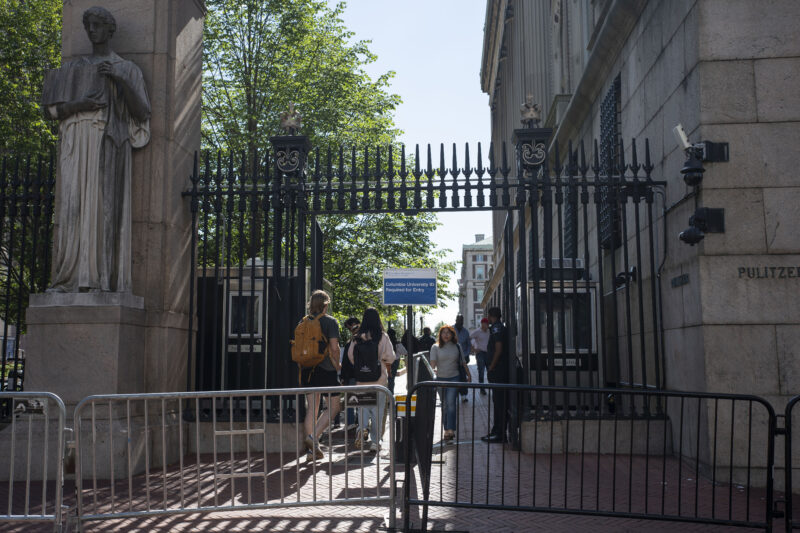
Speaking at one of the university’s commencement ceremonies on Wednesday, Columbia University’s acting president, Claire Shipman, said, “I know many in our community today are mourning the absence of our graduate, Mahmoud Khalil,” referring to the anti-Israel protest leader who is currently facing deportation proceedings, and said, “We firmly believe that our international students have the same rights to freedom of speech as everyone else, and they should not be targeted by the government for exercising that right.”
Some 100 pro-Palestinian protesters outside the campus attempted to disrupt the ceremony…
Charl Kleinhaus, an Afrikaner who was granted refugee status in the United States and said Jews are “untrustworthy and a dangerous group” on social media, confirmed that he is being resettled by HIAS and its affiliate, the Jewish Family Services of Western New York. Kleinhaus said his posts were “completely misinterpreted” and he “probably should have worded it better”…
The Vaad of Lakewood, N.J., endorsed Rep. Josh Gottheimer (D-NJ) for the Democratic nomination in the New Jersey gubernatorial election, specifically calling on unaffiliated voters to cast their ballots for him in the June 10 primary…
New York state Democratic lawmakers moved to block a bill in the state Assembly to include the International Holocaust Remembrance Alliance working definition of antisemitism in state education law…
The Wall Street Journal spotlights shifting sentiment in the Israeli public toward the war in Gaza…
Sheikh Tahnoon bin Zayed Al Nahyan, the United Arab Emirates’ national security advisor, met with Stephen Schwarzman, chairman and CEO of Blackstone, to discuss investment trends…
Arc magazine chronicled the role of the Lubavitcher Rebbe in supporting President Jimmy Carter’s creation of the Department of Education…
Amy Schumer, Israeli actor Yadin Gellman and Israeli director Eliran Peled are co-producing a romantic comedy called “Now More Than Ever” about the divides between Israeli and American Jewry post-Oct. 7…
Eliana Goldin, a recent Columbia University graduate and pro-Israel activist, shared her experience being fired from the Columbia Daily Spectator student newspaper…
Philanthropist and Indianapolis Colts owner Jim Irsay, whose father was Jewish, died at 65…
Pic of the Day

Auburn University men’s basketball coach Bruce Pearl addressed a Jewish American History Month breakfast on Capitol Hill yesterday. Guests included more than 25 House members and senators, antisemitism envoy nominee Yehuda Kaploun and former deputy envoy Aaron Keyak. The event was hosted by the Combat Antisemitism Movement, Jewish Federations of North America, Weitzman National Museum of American Jewish History, AEPi and Operation Benjamin.
Birthdays

Author, activist, actress and producer, she served until 2023 as a special envoy against antisemitism at Israel’s Foreign Ministry, Noa Tishby…
Senior fellow emeritus at the Hudson Institute, Irwin M. Stelzer turns 93… Retired U.S. district court judge from Massachusetts, now a senior lecturer at Harvard Law School, Nancy Gertner turns 79… Award-winning staff writer at The New Yorker since 1989, Connie Bruck turns 79… Former Skadden partner and then vice-chair at Citibank, J. Michael Schell turns 78… Cognitive scientist and CEO emeritus of Haskins Laboratories in New Haven, Philip E. Rubin turns 76… Director emeritus of policy and government affairs at AIPAC, Ambassador Bradley Gordon turns 76… Gloria Woodlock… Charles Scott… Former member of Knesset from the Zionist Union party, he was previously a major general in the IDF, Eyal Ben-Reuven turns 71… Immediate past chair of the Conference of Presidents of Major American Jewish Organizations, Dianne F. Lob… Former member of Congress (D-AZ-1), now a business and transactional attorney in Phoenix, Sam Coppersmith turns 70… Senior consultant as to philanthropy and impact at private equity firm Cresset Capital, Sanford Ronald “Sandy” Cardin… U.S. Sen. (R-AK) Lisa Murkowski turns 68… General partner of Google Ventures where he co-leads the life science investment team, David Schenkein turns 68… Former head coach of the NBA’s Cleveland Cavaliers, he was the winning coach of the EuroLeague Championship in 2014 with Maccabi Tel Aviv, David Blatt turns 66… Actor, he appeared in all five seasons of the HBO program “The Wire” as defense attorney Maurice Levy, Michael Kostroff turns 64… British writer, philanthropist and documentary filmmaker, Dame Hannah Mary Rothschild turns 63… Partner at Sidley & Austin, he clerked for Supreme Court Chief Justice William Rehnquist in the 1996 term, David H. Hoffman turns 58… Former relief pitcher for seven MLB teams, Alan Brian “Al” Levine turns 57… Harvard Law School professor since 2007, he clerked for Supreme Court Justice David Souter in the 1998 term, Noah Feldman turns 55… Israeli cookbook author and TV cookery show host, Shaily Lipa turns 51… Israel’s minister of communications in the prior government, Yoaz Hendel turns 50… Executive director of American Compass, Oren Cass… Co-founder of Facebook in 2004, Dustin Aaron Moskovitz turns 41… Retired slot receiver and kick returner for the NFL’s New England Patriots, member of three Super Bowl-winning teams, Julian Edelman turns 39… Co-founder and former CEO of Tinder, Sean Rad turns 39… Film, television and theater actress, Molly Ephraim turns 39… Washington bureau chief for the Los Angeles Times, Michael Wilner turns 36… J.D. candidate at Harvard Law School in the class of 2026, he is a summer associate at Weil Gotshal, Alex Friedman turns 25… Law clerk for a federal judge in the Eastern District of New York until earlier this year, Peter Walker Kaplan… Emma Kaplan… Aryeh Jacobson… Rebecca Weiss… Benjamin Weiss…
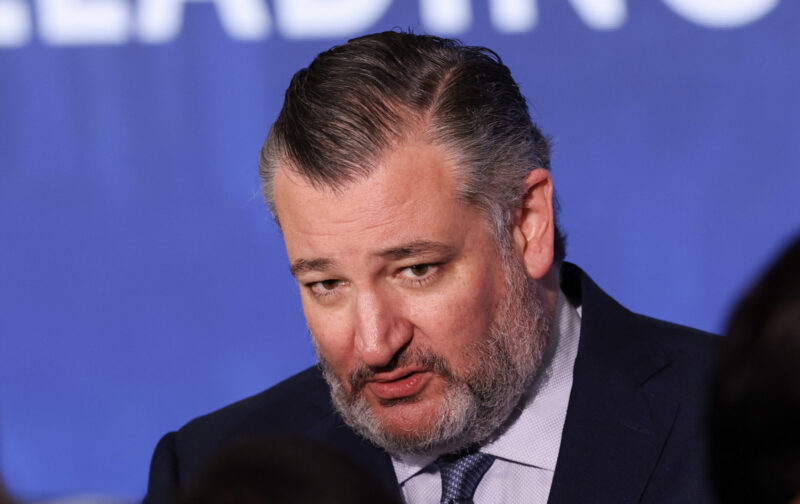
"The Obama administration invented the category of 'nuclear sanctions’ as an excuse to give the Ayatollah whatever he wanted for a nuclear deal," Sen. Ted Cruz said

Tom Williams/CQ-Roll Call, Inc via Getty Images
Sen. Ted Cruz (R-TX) is seen outside a Senate Judiciary Committee markup on Thursday, November 14, 2024.
Sen. Ted Cruz (R-TX) argued on Wednesday that sanctions on Iran’s nuclear program can’t be separated from other sanctions on the regime as part of a nuclear deal, comparing the approach apparently being taken by the Trump administration to that of the Obama administration.
Secretary of State Marco Rubio has said in congressional testimony this week that talks with Tehran have revolved solely around Iran’s nuclear program and have not addressed its sponsorship of terrorism or its ballistic missile program, but said that sanctions related to terrorism and missiles would remain in place if those issues are not addressed in a potential deal.
“The Obama administration invented the category of ‘nuclear sanctions’ as an excuse to give the Ayatollah whatever he wanted for a nuclear deal,” Sen. Ted Cruz (R-TX) said to Jewish Insider.
“It has nothing to do with how Congress passed or past presidents implemented sanctions against the Iranian regime, which was to use our most powerful sanctions against the full range of Iran’s aggression. President Trump rightly refused to certify and then withdrew from the deal because he said that lifting these ‘nuclear sanctions’ gave Iran too much for too little benefit,” he continued.
Congressional Republicans argued in the past, when the original nuclear deal included a similar formula, that the distinctions between nuclear and non-nuclear sanctions were largely specious. Those same lawmakers have maintained that any new funding the regime received would ultimately fuel proxy terrorism and regional destabilization, regardless of the targets of those sanctions.
Sen. Thom Tillis (R-NC) expressed confidence that the Trump administration understood that any deal must be multi-faceted, though he noted that Congressional Republicans haven’t been briefed on the talks.
“I have to believe at the end of the day, they realize that it’s not just about enrichment, but it’s all the other enabling capabilities, because the reality is the world’s a dangerous place and if they had that underlying capability, maybe then they’ll build their own bomb,” Tillis told JI.
“We got to support Israel. Iran uses proxies to attack America and Israel, they chant ‘Death to America.’ So what they’ve got to do is they’ve got to stop enriching uranium, that’s number one. And number two, we’ve got to make sure they have no money to give their proxies,” Sen. Rick Scott (R-FL) said when asked his position on a deal.
Sen. James Lankford (R-OK) told JI he hadn’t kept up with Rubio’s testimony, but said that addressing Iran’s proxy terrorism is crucial.
“Iran’s the largest state sponsor of terrorism. Israel is fighting proxies all the way around them. The entire region’s destabilized. Egypt is struggling economically because of the Houthis and what they’re doing,” Lankford said. “The proxies are the problem in the area and you can’t disconnect Iran and the regime and what they’re doing in the entire region to destabilize the region.”
Another Senate Republican, speaking on condition of anonymity to speak candidly, said he has faith in Rubio, but that an arrangement as outlined by Rubio would require “an awful lot of trust built into it, and I don’t trust Iran.”
“Money is obviously fungible. And the whole point of proxies is you can do whatever you want without doing whatever you want [directly],” the senator said. “There’s just an awful lot of trust built into.”
The senator said, “There’s probably a time where I’d be willing to give them a little bit of room, but they’re an awfully long ways down the road, so I don’t know. I just hope they keep a very, very tight grip on a very, very short leash.”
Sen. Lindsey Graham (R-SC) told JI that, “I like the American position, the administration’s position of no enrichment, complete dismantlement … and [would] have to include their missile program.”
“Anything short of that would be inadequate,” he added.
Sen. Mike Rounds (R-SD) similarly argued that a deal around Iran’s nuclear weapons would likely include addressing Iran’s pursuit of intercontinental ballistic missiles. He added that Iran should not receive any sanctions relief without addressing its nuclear buildup.
Other senators seem to be focusing their attention more on ensuring that dismantling Iran’s enrichment remains a red line for the United States.
“At the end of the day, we’ve got to see what the final package is,” Sen. Pete Ricketts (R-NE), who recently led nearly all Senate Republicans on a letter insisting on full dismantlement, said. “The biggest issue is going to be the enrichment part. If we can crack the enrichment nut, that’s a big deal.”
Sen. John Kennedy (R-LA) similarly said, “The president’s been very clear. I think the Republican side of the aisle in the Senate has been very clear. No enrichment, zero, zilch, nada, no centrifuges. The Iranian leadership doesn’t need it. They can import uranium for civil nuclear energy, so they can either take it or leave it. We can do it the easy way, the hard way.”
The secretary of state said Israel had acknowledged publicly that U.S. pressure had contributed to Israel’s decision to begin allowing aid back into the territory

John McDonnell/Getty Images
Secretary of State Marco Rubio testifies before the House Committee on Appropriations | Subcommittee on National Security, Department of State, and Related Programs at the Rayburn House Office Building on May 21, 2025 in Washington, DC.
Secretary of State Marco Rubio, in a shift, said in a House Appropriations Committee hearing on Wednesday that Israel’s 11-week blockade of aid into Gaza was damaging Israel’s national security and international standing and that U.S. pressure had contributed to Israel’s decision to release the hold. He also said that current levels of aid entering Gaza are not sufficient.
The remarks are strikingly similar to comments made since the beginning of the war in Gaza by Democrats, particularly progressives, who have criticized Israel’s policy toward aid to Gaza, and stand in contrast with Rubio’s and other Republicans’ previous comments arguing against allowing aid to flow back into Gaza.
“In the interim period, the one thing we’ve made abundantly clear is that the humanitarian situation — and I think this was acknowledged by the prime minister in his statement — the humanitarian situation, the direction that it was headed was undermining Israel’s standing and national security,” Rubio said.
He added that the Israelis had “acknowledged in their own statement that … the intervention of the United States and others is the reason why they’ve started to allow aid, albeit … not at the levels that are necessary.”
Israeli Prime Minister Benjamin Netanyahu acknowledged in a press conference on Wednesday, his first to Israeli media in five months, that friends of Israel, including U.S. senators, have said they support Israel in its war against Hamas but they have concerns regarding the humanitarian situation in Gaza.
Rubio said that U.S. officials, including Middle East envoy Steve Witkoff, are actively working to ensure that additional aid is provided “because, as we said, we were concerned about the conditions and the directions that they were headed.”
Throughout the post-Oct. 7 period, Rubio had argued repeatedly as a member of the Senate that any additional aid provided to Gaza “would go directly to Hamas and would be controlled by them,” concerns he again acknowledged in the hearing on Wednesday and other appearances on the Hill this week.
He said repeatedly that he spoke last weekend with Cindy McCain, who leads the World Food Program, about the WFP’s aid distribution mechanisms in Gaza. Israeli and U.S. officials have been working to implement alternative aid delivery processes rather than rely on U.N. agencies.
Rubio reiterated that the administration fully supports Israel’s right to defend itself against Hamas and that there is no future for the people of Gaza as long as Hamas is in power. He said he has “some level of optimism that we may have a breakthrough” in efforts to end the war and free the hostages “pretty quickly.”
But, Rubio continued, “I have felt that way now at least four separate times in the last couple of months, and for one reason or another, at the last minute, it didn’t happen, and so I don’t want to be disappointed on it again.”
The secretary of state also assured lawmakers that all Trump administration officials are unified in their opposition to Iran maintaining domestic nuclear enrichment capabilities
BRENDAN SMIALOWSKI/AFP via Getty Images
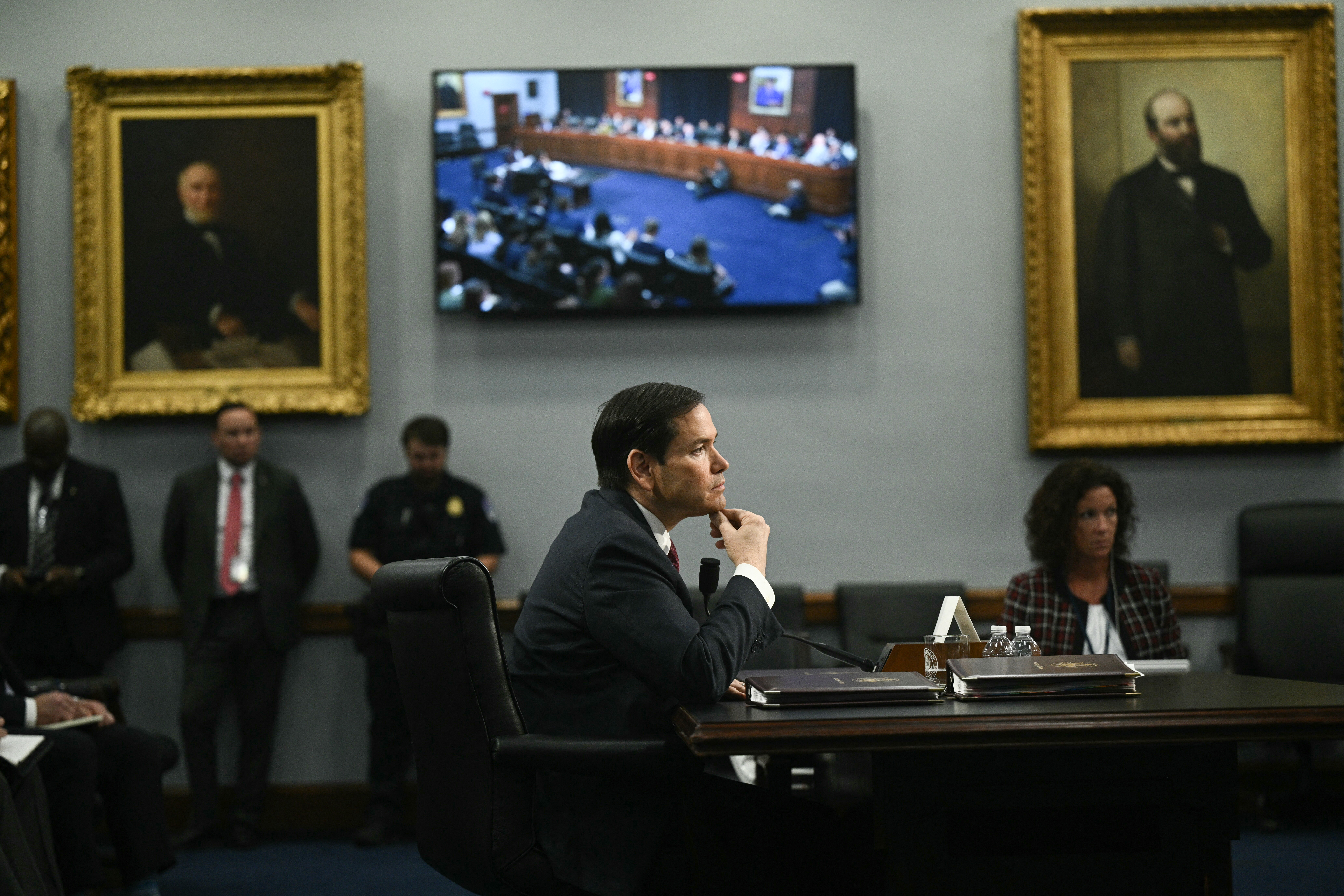
Secretary of State Marco Rubio testifies before a House Subcommittee on National Security, Department of State, and Related Programs hearing on the budget for the Department of State, on Capitol Hill in Washington, DC on May 21, 2025.
In his second consecutive day of hearings on Capitol Hill, Secretary of State Marco Rubio said that he expects that additional Arab countries will join the Abraham Accords by the end of the year, if not earlier.
“We do have an Abraham Accords office that is actively working to identify a number of countries who have lined up and already I think we may have good news, certainly before the end of this year, of a number of more countries that are willing to join that alliance,” Rubio said a House Foreign Affairs Committee hearing on Wednesday.
The comments are consistent with other recent remarks by President Donald Trump and Middle East envoy Steve Witkoff.
Rubio added that the administration is currently working on selecting an ambassador for the Abraham Accords, as required under law, to submit for congressional confirmation.
He said that there is “still a willingness” in Saudi Arabia to normalize relations with Israel, but “certain conditions are impediments,” including the Oct. 7, 2023, Hamas attacks on Israel and the ensuing war.
Rubio’s testimony largely reinforced and added on his comments the day before, on issues including Iran and Syria.
He again insisted that all elements of the Trump administration, including Vice President JD Vance and Witkoff, are unified behind the position that Iran cannot be allowed to maintain its capacity to enrich uranium.
And he affirmed that U.S. law requires that any deal with Iran be submitted to Congress for review and approval, noting that he had been in Congress when that law was passed.
At an afternoon hearing with the House Appropriations Committee, Rubio again said that sanctions relating to Iranian proxy terrorism or other malign activities will not be impacted by a nuclear deal that does not address those subjects. Republicans in the past have questioned the distinction between nuclear and non-nuclear sanctions, particularly as part of the original 2015 nuclear deal, which took a similar approach. And they’ve argued that any sanctions relief would allow Iran to expand its support for regional terrorism.
Rubio said the administration is continuing to ramp up sanctions on Iran, and said that European parties to the deal are “on the verge” of implementing snapback sanctions on Iran. He said that the administration would support legislation to implement additional sanctions on Iran’s oil sector.
He denied knowledge of a Tuesday leak by administration officials that Israel was making plans to strike Iran’s nuclear program, adding, “I also don’t think it’s a mystery, though … that Israel has made clear that they retain the option of action to limit Iran from ever gaining a nuclear capability.”
Expanding on comments he made the day before, Rubio said that he favors moving the mission of U.S. security coordinator for Israel and the Palestinian territories under the authority of the U.S. ambassador to Israel so that it can be a better-integrated part of the U.S.’ Israel policy. But he vowed that the core function of the office will continue.
Rubio denied reports of talks between the United States and Saudi Arabia about potential nuclear cooperation outside of a “gold standard” deal, which would include banning domestic enrichment.
The secretary of state reiterated comments about the critical necessity of providing sanctions relief to Syria to help contribute to stability, but he said that continued sanctions relief “does have to be conditioned on them continuing to live by the commitments” that the Syrian government has made verbally, including to combat extremism, prevent Syria from becoming a launchpad for attacks on Israel and form a government that represents, includes and protects ethnic and religious diversity.
He indicated that the U.S. is not actively working to shut down the United Nations Relief and Works Agency, but pledged that the United States will not be providing any further aid to or through that organization and will use its power and funding to look for alternatives.
He said it will be up to other countries whether they continue working with UNRWA, though he noted that the U.S. has been the agency’s largest donor.
Rubio said that he would be supportive, in concept, of legislation to expand current U.S. anti-boycott laws to include compulsory boycotts imposed by international organizations. That legislation was pulled from a House floor vote after right-wing lawmakers falsely claimed it would ban U.S. citizens from boycotting Israel.
Pushing back on calls for the U.S. to withhold weapons sales to the United Arab Emirates over its support for one of the parties involved in the Sudanese Civil War that the U.S. has found is committing genocide, Rubio said that the U.S. is not fully in alignment with the UAE but argued that it’s critical for the U.S. to continue engaging with and maintain a strong relationship with the UAE for its broader foreign policy goals in the Middle East.
He said that maintaining such a relationship and expanding the U.S.’ diplomatic and economic relationship with Abraham Accords countries is also important to ensuring that the Accords continue to be successful.
Rubio said that the State Department had approved restarting aid programs for Jordan that remained frozen — though he noted most were initially exempted from the administration’s blanket freeze. He acknowledged that the frozen programs had been “a source of frustration for [Jordan], and frankly for me.” He continued, “Ultimately, we’re going to get all those programs online, if they’re not online already.”
In a heated back-and-forth with Rep. Pramila Jayapal (D-WA), who was brandishing a pocket Constitution, Rubio again defended the administration’s policy of revoking student visas from individuals accused of involvement in anti-Israel activity on college campuses, saying that they are coming to the United States to “tear this country [apart]” and “stir up problems on our campuses.”
Addressing the case of Rümeysa Öztürk, a Tufts University graduate student that supporters have said was detained solely for writing an op-ed in a student newspaper criticizing Israel, Rubio claimed the situation is not as has been represented. “Those are her lawyers’ claims and your claims, those are not the facts,” Rubio said.
Asked by Jayapal about a comment — “Jews are untrustworthy and a dangerous group” — made by an Afrikaner refugee recently admitted to the United States from South Africa, Rubio said that he would “look forward to revoking the visas of any lunatics you can identify.”
But when presented with the fact that the individual in question was admitted as a refugee, not on a visa, Rubio said that refugee admissions are “a totally different process,” adding “student visas are a privilege.”
Plus, Rubio, Cruz talk Trump Iran policy

REBECCA DROKE/AFP via Getty Images
Pittsburgh Mayor Ed Gainey speaks ahead of Vice President Kamala Harris at a campaign rally outside Pittsburgh, Pennsylvania on November 4, 2024.
Good Wednesday morning.
In today’s Daily Kickoff, we break down a new Anti-Defamation League report on antisemitism at independent K-12 schools, and report on Corey O’Connor’s victory yesterday in Pittsburgh’s mayoral primary. We report on the increasing pressure on Israel over its conduct in Gaza, cover Secretary of State Marco Rubio’s first appearance on Capitol Hill since being confirmed, and highlight remarks made by Sens. Ted Cruz and John Fetterman to NORPAC members. Also in today’s Daily Kickoff: Lishay Lavi Miran, Sen. Andy Kim, and Reps. Debbie Wasserman Schultz and Dan Goldman.
What We’re Watching
- South African President Cyril Ramaphosa and President Donald Trump will meet at the White House today, with new trade agreements on the agenda amid strained ties between the two countries.
- The Combat Antisemitism Movement and the Jewish Federations of North America will host the Annual Jewish American Heritage Month Congressional Breakfast on Capitol Hill today, with a keynote address from Bruce Pearl, head coach of the Auburn men’s basketball team.
- The House Appropriations Committee will hold separate budget hearings with testimony from Education Secretary Linda McMahon and Secretary of State Marco Rubio.
- The House Foreign Affairs Committee will also hold a hearing with Rubio on “Fiscal Year 2026 State Department Posture: Protecting American Interests.”
- The Senate Committee on Health, Education, Labor and Pensions will hold a hearing on “The State of Higher Education” with witnesses including Dr. Andrew Gillen, a research fellow at the Cato Institute; Dr. Michael Lindsay, president of Taylor University; Dr. Mark Brown, president of Tuskegee University; Mike Pierce, executive director of the Student Borrower Protection Center; and Dr. Russell Lowery-Hart, chancellor of the Austin Community College District.
- The Qatar Economic Forum continues today in Doha, with speakers including Donald Trump Jr.; Steve Mnuchin, former U.S. treasury secretary; Mark Attanasio, principal owner of the Milwaukee Brewers; John Micklethwait, editor-in-chief of Bloomberg; and Hassan Al-Thawadi, former secretary general at Supreme Committee for Delivery and Legacy for the 2022 FIFA World Cup.
What You Should Know
A QUICK WORD WITH JI’S hALEY COHEN
A new Anti-Defamation League report puts a spotlight on episodes of antisemitism in K-12 non-Jewish independent schools, a trend that doesn’t get as much attention as the higher-profile incidents on college campuses but is affecting Jewish students in critical ways.
The study found antisemitic incidents in independent schools down 26% in 2024, compared to 2023, but still up significantly since the Oct. 7 Hamas attacks. There were only 494 documented incidents of antisemitism in independent schools in 2022; that number has nearly doubled to 860 in 2024.
A quarter of surveyed parents said their children experienced/witnessed antisemitic symbols (such as swastikas) in school.
The research was conducted through four focus groups and a survey of 369 parents of Jewish children in independent K-12 schools across 21 states. The ADL told Jewish Insider‘s Haley Cohen it selected independent schools to evaluate since they operate outside of the oversight of public education and therefore have greater autonomy in shaping their curricula, policies and disciplinary procedures.
In addition to expressing concern over antisemitic symbols, nearly one-third of parents reported anti-Jewish and anti-Israel curricula featuring more prominently in their children’s classrooms since the Oct. 7, 2023, terrorist attacks. They’re also deeply dissatisfied with administrators’ responses to antisemitism: Of the parents surveyed who were aware of antisemitism in their child’s school, 34% said the school’s response was either “somewhat” or “very” inadequate.
One bit of encouraging news: A sizable majority of students at these schools (64%) said they felt “very comfortable” showing their Jewish identity at schools, with only 8% feeling somewhat or very uncomfortable with doing so. But there were isolated episodes of student discomfort, including one parent saying their son avoided wearing a Star of David necklace.
Another notable trend: Many independent school parents voiced concern that diversity, equity and inclusion frameworks do not include Jewish identity and antisemitism. They view the exclusion as a fundamental flaw of the programming rather than an oversight and described a pattern in which Jewish identity was omitted altogether from DEI conversations or misrepresented to perpetuate bias.
And parents are voting with their feet: There’s been an increase in Jewish day school enrollment in recent years.
But for those Jewish students who remain in independent schools, the ADL said it’s launching a new initiative to hold schools accountable and support families. “These independent schools are failing to support Jewish families,” Jonathan Greenblatt, the group’s CEO, said. “By tolerating — or in some cases, propagating — antisemitism in their classrooms, too many independent schools in cities across the country are sending a message that Jewish students are not welcome. It’s wrong. It’s hateful. And it must stop.”
GAINEY’S GOODBYE
O’Connor ousts Gainey in heated Pittsburgh mayoral primary

Corey O’Connor prevailed in his bid to oust Mayor Ed Gainey of Pittsburgh in the Democratic primary on Tuesday, dealing a major blow to the activist left in a city where progressives had until recently been ascendant. O’Connor, the Allegheny County controller and a centrist challenger, defeated Gainey, the first-term incumbent aligned with the far left, by a significant six-point margin, 53-47%, on Tuesday evening with most of the vote counted, Jewish Insider’s Matthew Kassel reports.
Victory post: “We built this campaign with and for the people of this city, neighborhood by neighborhood,” O’Connor said in a social media post on Tuesday night. “I’m proud to be your Democratic nominee for Mayor. I’m ready to get to work, and I’m grateful to have you with me as we take the next steps forward, together.”
WAITING FOR OMRI
An Israeli mom’s NYC mission to free husband from Hamas captivity

Every morning, Lishay Lavi Miran’s toddler daughters ask her the same two questions: Why is daddy still in Gaza and when is daddy coming home? In a desperate attempt to provide answers, Miran spent the past week in New York City — her first time in the U.S. — advocating for the release of her husband, Omri Miran, who was kidnapped from their home in Kibbutz Nahal Oz during the Oct. 7, 2023, terrorist attacks and has remained in Hamas captivity for nearly 600 days. In an interview with Jewish Insider’s Haley Cohen during her visit to the states, which concluded on Tuesday, Miran said that her message to the American Jewish community is that its advocacy efforts have provided a “warming sense of hope.”
Now and then: The family received the first sign of life from Omri in April when Hamas terrorists published a video in which he is seen walking through a tunnel in Gaza. The video was released right around his 48th birthday. “It was difficult to see him in those conditions,” Miran told JI during her visit to the states, which concluded on Tuesday. The “exhausted” man in the video was a contrast to the guy known for having “the biggest smile in the world and spark in his eyes,” as Miran describes her husband.
foreign policy in focus
Rubio: Iranian proxy terrorism hasn’t been part of negotiations with Iran

Secretary of State Marco Rubio said in his first appearance on Capitol Hill since being confirmed as secretary of state that Iran’s support for regional terrorist proxies has not been part of the ongoing talks between the Iranian government and Middle East envoy Steve Witkoff, which Rubio said have been focused wholly on Iran’s nuclear program and enrichment capabilities. At the same time, Rubio insisted that any sanctions related to terrorist activity and weapons proliferation would remain in place if such issues are not part of the nuclear deal, Jewish Insider’s Marc Rod reports.
What this means: Rubio’s comments indicate the deal might still be subject to what some critics in the United States and the region described as a key flaw of the original nuclear deal — that it failed to address other malign activity by the regime. One U.S. lawmaker who traveled to the Middle East recently said that U.S. partners in Israel and the Arab world had argued that any deal must include non-nuclear provocations. Rubio added that sanctions will remain in place until a deal is reached, and that European partners are working separately on re-implementing snapback sanctions, potentially by October of this year, when such sanctions expire. He also said that Iran cannot have any level of nuclear enrichment under a nuclear deal, as it would inevitably provide a pathway for Iran to enrich to weapons-grade levels.
Read the full story here with Rubio’s additional remarks on Iran, Gaza and Syria.
TED TALK
Ted Cruz expresses concern about influence of some Trump officials on Iran policy

Sen. Ted Cruz (R-TX) said on Tuesday that he is concerned about the views of some of the officials in the White House shaping President Donald Trump’s Iran policy, marking the most critical comments yet from the hawkish senator about Trump’s approach to Iran. He urged members of NORPAC, a pro-Israel advocacy organization, to raise the issue in their meetings with anyone in the Trump administration, Jewish Insider’s Gabby Deutch reports.
What he said: “We need clarity with the Trump administration, and as NORPAC talks to the administration, I would say, I worry there are voices in the administration that are not eager to hold up the president’s red line of dismantlement,” Cruz said at NORPAC’s annual Washington lobbying mission, referring to mixed messaging from some U.S. officials on the acceptable contours of a potential new nuclear agreement with Iran.
Also during NORPAC’s mission: Sen. John Fetterman (D-PA), who is facing attacks from the media and fellow lawmakers in the Democratic Party, hit back at members of his own party. Speaking to members of NORPAC, Fetterman offered some of his sharpest criticism yet of the Democratic Party’s approach to Israel after the Oct. 7 Hamas attacks. “Israel and your community deserves much better from my party,” Fetterman said, earning loud applause.
RELATIONSHIP RUPTURE
Foreign Minister David Lammy announces suspension of U.K.-Israel free trade agreement

U.K. Foreign Secretary David Lammy announced that Britain has suspended negotiations with Israel on a new free trade agreement and will be “reviewing cooperation,” a day after the U.K., France and Canada threatened to take “concrete actions” and impose sanctions on Israel over its policies on humanitarian aid in Gaza and settlement activity in the West Bank, Jewish Insider’s Danielle Cohen and Lahav Harkov report.
Upping the pressure: Lammy, speaking to British lawmakers in the House of Commons on Tuesday, said the “Netanyahu government’s actions have made this necessary,” describing the lack of humanitarian aid entering Gaza as “intolerable” and “abominable.” He said that Tzipi Hotovely, the Israeli ambassador to the U.K., has been summoned to the U.K. Foreign Office, where Middle East Minister Hamish Falconer will tell her that “the 11-week block on aid to Gaza has been cruel and indefensible” and that “dismissing concerns of friends and partners … must stop.” Lammy also announced that the British government will impose sanctions on three individuals and four entities with ties to settlements in the West Bank, which the U.K., France and Canada called “illegal” in their joint statement.
Meanwhile in Brussels: The EU’s foreign policy chief, Kaja Kallas, said that Brussels will review whether Israel is violating the human rights clause of the EU-Israel Association Agreement, which governs the high-level political and economic ties between the sides. Dutch Foreign Minister Caspar Veldkamp proposed the review with the backing of 17 of 27 EU members; however, a policy change would require unanimity within the bloc.
And from the Vatican: Pope Leo XIV appealed this morning “to allow the entry of dignified humanitarian aid and to put an end to the hostilities, whose heartbreaking price is paid by the children, elderly, and the sick.
kim’s call
Sen. Andy Kim urges Homeland Security Secretary Noem to protect Nonprofit Security Grant Program funding

Sen. Andy Kim (D-NJ) pressed Homeland Security Secretary Kristi Noem for clarification of her department’s plans regarding the Nonprofit Security Grant Program as the Trump administration considers cuts to the Federal Emergency Management Agency, Jewish Insider’s Emily Jacobs reports. Kim and Noem engaged on the issue while the latter was testifying before the Senate Homeland Security and Governmental Affairs Committee on Tuesday. Kim, the top Democrat on the HSGAC subcommittee that oversees FEMA, urged Noem to ensure NSGP funding is not reduced or eliminated outright as part of President Donald Trump’s push to abolish FEMA, citing the program’s success rate with New Jersey synagogues amid rising antisemitism.
Making the case: “I think that there’s very strong bipartisanship here in Congress, especially the Senate, to protect the Nonprofit Security Grant Program. It is literally the best tool that people in New Jersey are telling me is needed to be able to counter antisemitism. I can’t tell you the number of synagogues and temples that are lined up to try to get this type of funding. In fact, you know, given the rise of antisemitism that we have in our country right now, we should be surging resources, not cutting,” Kim said.
Worthy Reads
A Tale of Two New York City’s: New York magazine’s E. Alex Jung writes about the stark contrast between Andrew Cuomo and Zohran Mamdani in the New York City mayoral primary. “Their respective campaigns are striking foils: Cuomo, who at 67 would become the oldest incoming mayor of New York City ever, has stayed out of the public eye while racking up endorsements from major labor unions. When he does appear, he’s working the Black church circuit. He knows that the path to the Democratic nomination has historically gone through Black and Latino voters, mostly in Southeast Queens and Central Brooklyn. In one simulation, Cuomo is winning those communities by 91 percent and 72 percent by the final round, respectively. To the ire of white liberals, he has a broad multi-racial coalition. While Mamdani is seemingly everywhere in the city, running from protests to rallies to galas, his base is largely white college-educated Brooklynites, with much of his early efforts going toward activating South Asian and Muslim voters, who have traditionally been ignored. ‘Zohran is Cuomo’s wet-dream opponent,’ says one anti-Cuomo Democratic strategist. ‘Supported by online kids, on the record for “defund,” on the record about Palestine, and little support in Black or Latino communities.’” [NYMag]
Sam (A)I Am: In a New Yorker review of two new books on Sam Altman and the future of AI, Benjamin Wallace-Wells considers the OpenAI founder’s Midwestern Jewish roots. “Within the world of tech founders, Altman might have seemed a pretty trustworthy candidate. He emerged from his twenties not just very influential and very rich (which isn’t unusual in Silicon Valley) but with his moral reputation basically intact (which is). Reared in a St. Louis suburb in a Reform Jewish household, the eldest of four children of a real-estate developer and a dermatologist, he had been identified early on as a kind of polymathic whiz kid at John Burroughs, a local prep school. “His personality kind of reminded me of Malcolm Gladwell,” the school’s head, Andy Abbott, tells [Keach] Hagey [author of The Optimist: Sam Altman, Open AI, and the Race to Invent the Future]. ‘He can talk about anything and it’s really interesting’ — computers, politics, Faulkner, human rights.” [NewYorker]
Under African Skies: The Foundation for Defense of Democracies senior director Elaine Dezenski and senior research analyst Max Meizlish offer a warning about South Africa’s anti-American activity in the run-up to South African President Cyril Ramaphosa’s meeting with Trump today. “South Africa isn’t an innocent, neutral party. It is playing both sides — courting the West while deepening its ties to China, Russia and Iran. Its leaders speak the language of nonalignment, but their actions tell a different story: They’ve welcomed Hamas and Hezbollah officials, hosted sanctioned Russian warships and worked with entities tied to Iran’s Islamic Revolutionary Guard Corps … South Africa’s conduct is not just inconsistent with American values — it’s increasingly incompatible with US national security. Under Ramaphosa, the ANC has intensified its lawfare campaign against Israel at the International Court of Justice, ramped up efforts to diplomatically isolate Taiwan, and embraced Beijing’s narrative on global governance by joining the China-led BRICS group. The ANC’s historical alignment with authoritarian powers is no secret — but today, it’s backed by real material support. That should concern every serious policymaker in Washington.” [NYPost]
The Illiberal Left, and Right: The Liberal Patriot’s executive editor, John Halpin, considers the future of American liberalism. “Instead of pragmatic, universal solutions to the problems of working- and middle-class Americans, Democrats after Obama went off on extreme ideological tangents and illiberal fads from structural racism and transgender ideology to decriminalization and open borders to the socialist ‘Green New Deal’ and other radical climate policies. Notably, all of these illiberal ‘ideas’ produced significant public backlash from a wide array of American voters and are now in the process of being dismantled or disregarded. On the Republican side, the traditional party of Reagan has basically discarded all its past social and economic liberal commitments in favor of Trump’s peculiar blend of command-and-control tariff and trade policies, unrestrained executive authority, withdrawal from global allies and international security arrangements, and the use of governmental legal and bureaucratic authority to attack and prosecute perceived enemies. ‘Postliberal’ ideas that explicitly reject individualism as the foundation of American life are now dominant in a party that feels the need ‘to be really ruthless when it comes to the exercise of power,’ according to Vice President JD Vance.” [LiberalPatriot]
Word on the Street
President Donald Trump is reportedly frustrated by the continuing war in Gaza and has instructed his aides to tell Israeli Prime Minister Benjamin Netanyahu to “wrap it up,” White House officials told Axios…
Netanyahu’s office announced yesterday that the senior members of the ceasefire and hostage-release negotiating team had been recalled from Doha, Qatar, while the working echelon would continue the talks. The PMO statement stressed that Israel had agreed to the U.S. proposal but that Hamas “is continuing to cling to its refusal”…
In an interview published today in The National, Jake Sullivan, the Biden administration’s national security advisor, says of Trump’s relationship with Netanyahu, “It’s not that the balance of power has changed, just the weight and emphasis on who can deliver” …
CNN, citing intelligence from “multiple US officials,” reported that Israel has been making preparations to strike Iranian nuclear facilities, though they stressed it remains unclear if Israeli leaders have made a final decision to do so. In reaction to the story, former Washington Institute for Near East Policy fellow Nadav Pollak wrote on X: “The only surprising part in [the story] is that US officials leaked the fact they monitor Israeli communications.”…
Iranian Supreme Leader Ali Khamenei said on Tuesday that, “I do not think nuclear talks with the U.S. will be successful” and warned, “They should not try to talk nonsense. It is a big mistake to say that we will not allow Iran to enrich. No one is waiting for permission from this or that.”…
Trump announced Tuesday that the United States will move forward on construction of a Golden Dome missile defense system. Trump began calling for a U.S. missile defense shield similar to Israel’s Iron Dome after watching Israel deflect missiles and drones amid Iran’s attacks in 2024…
Democrat Sam Sutton won a special election for a New York state Senate seat, which the GOP had hoped to flip after Trump received 77% of the vote in the district in November. The district encompasses several heavily Orthodox Jewish neighborhoods, and Sutton is a leader of its Sephardic community…
The New York Times confirmed reporting that Trump, through the Pentagon, White House military office and Middle East envoy Steve Witkoff, had initially approached the Qataris about purchasing the luxury Boeing 747 jet for use as Air Force One, rather than it being offered as a gift…
Newly released emails reveal that Joe Kent, chief of staff to Director of National Intelligence Tulsi Gabbard, pressured analysts to revise an intelligence assessment to align with Trump’s claim that Venezuela’s government controls a criminal gang…
Elon Musk told attendees at the Qatar Economic Forum that he doesn’t plan to spend money on elections in the future. “I think I’ve done enough,” he said…
Secretary of State Marco Rubio and Sen. Chris Van Hollen (D-MD) clashed in a heated exchange during a Senate hearing Tuesday. “I regret voting for you for secretary of state,” Van Hollen said. “Your regret for voting for me confirms I’m doing a good job,” Rubio responded…
Sen. Peter Welch (D-VT) sought unanimous consent to call up a resolution pushing the administration to work to resume U.S. aid to Gaza, which is sponsored by nearly all Senate Democrats. Sen. Jim Risch (R-ID) blocked the effort…
The United Arab Emirates said yesterday that it will send urgent humanitarian aid to Gaza, after UAE Foreign Minister Sheikh Abdullah bin Zayed and his Israeli Foreign Minister Gideon Sa’ar spoke on the phone…
The U.S. and Turkey released a joint statement on the U.S.-Turkey Syria Working Group’s most recent meeting held in Washington, which included discussions on “shared priorities in Syria, including sanctions relief according to President Trump’s directive and combatting terrorism in all its forms and manifestations”…
Sens. Elizabeth Warren (D-MA), Ron Wyden (D-OR) and Bernie Sanders (I-VT) sent a letter to Paramount Global Chair Shari Redstone expressing their concern that CBS News may be engaging in “improper conduct” and violating anti-bribery law in its effort to settle a lawsuit with Trump that will potentially block Paramount’s intended merger with Skydance…
Trump called Rep. Thomas Massie (R-KY) a “grandstander” who “should be voted out of office” over Massie’s opposition to his budget bill. Massie, a longtime opponent of aid to Israel and legislation to combat antisemitism, is mulling a statewide run for Senate or governor in Kentucky…
Speaking at a congressional hearing of the Tom Lantos Human Rights Commission on Tuesday, AJC CEO Ted Deutch urged the U.S. to remain engaged in international bodies including the U.N., UNESCO and OSCE and called for Congress to confirm Rabbi Yehuda Kaploun to the role of special envoy to monitor and combat antisemitism and provide $3 million in funding for the office…
New York Times reporter Joseph Bernstein chronicled the life of his father, a “Nazi hunter” with the U.S. Department of Justice in the ‘80s, who was killed in the Pan Am 103 bombing in 1988, and his struggle to find meaning in the resulting decades-long investigation that ultimately led to the currently delayed trial of a Libyan man accused of planting the bomb on behalf of dictator Muammar Gaddafi…
Israeli Strategic Affairs Minister Ron Dermer eulogized his mother, Yaffa Dermer, who died last Sunday at the age of 89. Ron said, “We don’t choose our parents. They are chosen for us. So I thank Hashem for blessing me to have been raised by such an extraordinary mother and teacher. … Over the years, I have had the privilege to serve in prominent positions and hold prestigious titles. But the greatest honor of my life has been to be Yaffa’s son.”…
Eva Wyner, previously deputy director of Jewish affairs for New York Gov. Kathy Hochul, is now serving as the governor’s director of Jewish affairs…
Arthur Maserjian, previously chief of staff at the Combat Antisemitism Movement, is now the senior director of the Combined Jewish Philanthropies’ Center for Combating Antisemitism…
Eric B. Stillman was hired to serve as the next president and CEO of the Florida Holocaust Museum, which will reopen on Sept. 9 following an extensive renovation; Stillman succeeds Mike Igel, who has led the organization as its interim CEO for the past year…
Pic of the Day

Reps. Debbie Wasserman Schultz (D-FL) and Dan Goldman (D-NY) addressed an Anti-Defamation League reception celebrating Jewish American Heritage Month yesterday in Washington.
Birthdays

Northern California-based comedian, he celebrated his bar mitzvah at 52 years old in Israel, Josh Kornbluth turns 66…
Former U.S. senator from Minnesota, he was previously a comedian, actor and writer, Al Franken turns 74… VP of the Swiss Federation of Jewish Communities, Ralph Lewin turns 72… Guitarist and composer, Marc Ribot turns 71… EVP of American Friends of Bar-Ilan University, Ron Solomon… Chief rabbi of Mitzpe Jericho and dean of Hara’ayon Hayehudi yeshiva in Jerusalem, Rabbi Yehuda Kroizer turns 70… CEO of the Boston-based hedge fund Baupost Group, Seth Klarman turns 68… Legal analyst at CNN, Jeffrey Toobin turns 65… Founder and former co-owner of City & State NY, Thomas Allon turns 63… Director of antisemitism education and associate director of the Israel Action Program, both at Hillel International, Tina Malka… Actress, artist and playwright, Lisa Edelstein turns 59… Former head of Dewey Square’s sports business practice, now a freelance writer, Frederic J. Frommer… Author and journalist, she was a reporter with The New York Times for eight years, Amy Waldman turns 56… U.S. cyclist at the 2000 Summer Olympics in Sydney, Australia, she is now the executive director of the New England Mountain Bike Association, Nicole Freedman turns 53… President and CEO of the Michigan-based William Davidson Foundation, Darin McKeever… University chaplain for NYU, Rabbi Yehuda Sarna turns 47… Founder of Agora Global Advisory, Brandon Pollak… EVP and chief legal officer at Sinclair Broadcast Group, David Gibber… Professor of computer science at the University of Texas at Austin, Scott Joel Aaronson turns 44… President of Mo Digital, Mosheh Oinounou… International fashion model for Versace, Sharon Ganish turns 42… Partner at CreoStrat, Steve Miller… Windsurfer who represented Israel in the Olympics (Beijing 2008 and Rio 2016), she is now a SW delivery lead at SolarEdge, Maayan Davidovich turns 37… Player on the USC team that won the 2016 NCAA National Soccer Championship, she is now an associate in the LA office of Foley & Lardner, Savannah Levin turns 30… Comedian, actress and writer, known for starring in the HBO Max series “Hacks,” Hannah Marie Einbinder turns 30… Deputy director at the Yael Foundation, Naomi Kovitz…
BIRTHWEEK: (was Monday): Alex Shapero…
The secretary of state said that terrorism and weapons sanctions would remain in place if Iran’s other malign activity is not addressed under a nuclear deal

Anna Moneymaker/Getty Images
Secretary of State Marco Rubio speaks during a Senate Foreign Relations Committee hearing in the Dirksen Senate Office Building on May 20, 2025 in Washington, DC. Rubio testified on President Trump's FY2026 budget request for the State Department.
Secretary of State Marco Rubio said in his first appearance on Capitol Hill since being confirmed as secretary of state that Iran’s support for regional terrorist proxies has not been part of the ongoing talks between the Iranian government and Middle East envoy Steve Witkoff, which Rubio said have been focused wholly on Iran’s nuclear program and enrichment capabilities.
At the same time, Rubio insisted that any sanctions related to terrorist activity and weapons proliferation would remain in place if such issues are not part of the nuclear deal.
Rubio’s comments indicate the deal might still be subject to what some critics in the United States and the region described as a key flaw of the original nuclear deal — that it failed to address other malign activity by the regime. One U.S. lawmaker who traveled to the Middle East recently said that U.S. partners in Israel and the Arab world had argued that any deal must include non-nuclear provocations.
Rubio added that sanctions will remain in place until a deal is reached, and that European partners are working separately on re-implementing snapback sanctions, potentially by October of this year, when such sanctions expire.
He also said that Iran cannot have any level of nuclear enrichment under a nuclear deal, as it would inevitably provide a pathway for Iran to enrich to weapons-grade levels.
“About 90% of the work of enrichment is getting to that 3.67% level [necessary for civilian nuclear power]. After that, the rest of it is just a matter of time,” Rubio said. “They [Iran] claim that enrichment is a matter of national pride. It is our view that they want enrichment as a deterrent. They believe that it makes them a threshold nuclear power, and as a result, [become] untouchable.”
Rubio said that reaching a nuclear deal will not be easy, but that it is the administration’s preference. He reiterated that Iran can be permitted to have nuclear energy for civilian use, but only if it imports nuclear material from elsewhere. He said at a second hearing later in the day that a so-called 123 Agreement for civilian nuclear cooperation with the United States or an equivalent deal would be possible if Iran dismantles its enrichment capacity.
Addressing the war in Gaza, Rubio said that the U.S. is ultimately hoping to end hostilities, adding that ending the war will require Hamas freeing the hostages and ensuring that Hamas and similar terrorist groups do not maintain power in Gaza. He placed blame on Hamas for failing to agree to a ceasefire.
Rubio said that regional partners are willing to step up to help support the reconstruction of Gaza, but said that the territory’s future governance will be the key question going forward. He said that a stable governing authority capable of providing peace and security will be necessary to keep Hamas out of power.
Rubio also denied any plans for forcible or permanent relocation of Palestinians in Gaza, but said that the administration had been engaged in discussions with other regional partners about allowing Gazans who want to temporarily relocate to do so. He said he was not aware of any such conversations with Libya, as a recent NBC News report suggested.
“You don’t want people trapped [in Gaza]. They may want to come back, they may want to live there in the future, but right now, they can’t,” Rubio said. “And if there’s some nation willing to accept them in the interim period, yes, we’ve asked countries preliminarily whether they would be open to accepting people, not as a permanent situation, but as a bridge towards reconstruction.”
He said that the U.S. was “pleased to see that aid is starting to flow” into Gaza, after Israel had blocked it for 11 weeks.
He rebutted accusations that Israel is seeking to destroy Gaza, saying that Israel has told the U.S. and the world that “they need to root out the remaining elements of Hamas — who, by the way, have been an impediment to multiple ceasefires.”
Later in the day, Rubio reiterated that the U.S. sees resuming humanitarian aid as a priority and has encouraged Israel to allow aid into Gaza — a divergence from some Israeli officials and congressional Republicans who have opposed allowing aid into Gaza. He appeared to acknowledge that the humanitarian situation in Gaza is dire.
“Many of you have noticed there’s been a growing number of anti-Hamas protests and demonstrations as well. So there are people there that understand that this is a root cause of it,” Rubio said. “That said, you have this, you have this acute, immediate challenge of food and aid not reaching people, and you have existing distribution systems that could get them there.”
He said that Israel can defeat Hamas and prevent diversion of aid while still permitting “sufficient quantities” of aid to move into the territory. He said that organizations like the World Food Program have the capacity to immediately begin distributing aid, reflecting the reticence of Israeli and U.S. officials to rely on the U.N. for distribution.
The secretary of state continued to embrace the administration’s policy of revoking student visas and residency permits from individuals alleged to be involved in anti-Israel activity on college campuses, adding that such revocations will continue.
“We’re going to do more. There are more coming. We’re going to continue to revoke the visas of people who are here as guests and are disrupting our higher education facilities,” Rubio said. “I want to do more, I hope we can find more.”
Rubio said later in the day that thousands of student visas have been revoked, but many for reasons unrelated to anti-Israel activity.
He denied reports that the administration is planning to eliminate the position of U.S. security coordinator for Israel and the Palestinian territories, saying that there had instead been discussions about bringing the mission under the authority of the U.S. embassy in Jerusalem.
Rubio also pushed back on accusations from Sen. Jacky Rosen (D-NV) that the administration was “abandoning” a push for normalization of relations between Israel and Saudi Arabia, saying instead that “the Saudis are the ones that have expressed their inability to move forward on it, so long as the conflict is happening in Gaza. But we would love to see normalization.”
The secretary of state spoke at length about the situation in Syria and the administration’s decision to remove sanctions on the country. He acknowledged that, even with U.S. engagement, the situation in Syria could still collapse, but argued that collapse would have been a certainty if the U.S. had not chosen to engage and lift sanctions.
“It is our assessment that, frankly, the transitional authority, given the challenges they’re facing, are maybe weeks, not many months, away from potential collapse and a full scale civil war of epic proportions, basically the country splitting up,” Rubio said.
Despite President Donald Trump’s announcement that the U.S. would remove “all” sanctions from Syria, Rubio said in the second hearing that the sanctions would be removed “incrementally.” He said that Syria’s designation as a state sponsor of terrorism should be removed if Syria meets the conditions for such a move.
Rubio said that resolving internal divisions, restoring a unified Syrian national identity and creating a situation in which millions of displaced persons can return will be critical challenges going forward.
Rubio described the fall of the Assad regime and the possibility of a stable and peaceful Syria as an “opportunity for Israel,” despite the Israeli government’s deep concerns about the new Syrian government and its leader’s past jihadi loyalties.
“They’re not viewing themselves as a launch pad for revolution. They’re not viewing themselves as a launch pad for attacks against Israel,” Rubio said. “So we think this is an extraordinary thing, if, in fact, you have in Syria a stable government that encompasses all the elements of their society and has no interest whatsoever in fighting wars with Israel over borders or anything else. I think that’s an extraordinary achievement for Israel’s security.”
He said that the U.S. has been working to mediate conflicts between Turkey and Israel inside Syria, but added that Syrian government decisions in the medium term about whether to allow Turkey or Russia to maintain bases inside Syria will be a key issue going forward.
He said Iran is still working to foment violence inside Syria, which he characterized as one of the most critical threats to the new government’s stability.
Rubio said Trump had moved more quickly than anticipated in meeting with Syrian President Ahmed al-Sharaa, but said that removing sanctions will allow regional partners to surge aid in, helping to build a more stable government and unify armed forces in the country.
But Rubio also said that action from Congress will be needed to repeal other sanctions legislation like the Caesar Act that can only be temporarily waived by the president, pending performance from the Syrian government.
He described the situation in Syria as the “first test” of what he characterized as a new approach to U.S. foreign aid and engagement driven more by local personnel and bureaus than Foggy Bottom.
Rubio said that the U.S. Embassy in Syria remains closed due to concerns about potential attacks from other armed groups in the country, explaining that the U.S. does not see the new government led by former jihadist fighters as a security threat.
He said that ISIS, with which al-Sharaa was previously affiliated, “hates the transitional authority, and they hate al-Sharaa, and they hate everybody in his government and I think pose a grave risk to them.”
He said that the Syrian government is willing to take over counter-ISIS operations but currently lacks the capacity to do so.
He added that stability in Syria would help bring stability in Lebanon, and if those two countries become stabilized, it “opens up incredible opportunities around the region for all kinds of peace and security and the end of conflicts and wars.”
Rubio denied any knowledge related to a potential gift of a Boeing 747 jet from Qatar to Trump or the U.S. government.
Asked about the situation, the secretary of state declined to speak publicly about conversations with the United Arab Emirates regarding its backing of one of the warring parties in Sudan that the U.S. has found is committing genocide, but said that it doesn’t “serve the interests” of international parties to back belligerents in the conflict “because instability there is going to create a breeding nest for radicalism.”
In an interview with The Free Press, Rubio said Iran could be allowed to import enriched material but that maintaining its own enrichment program would be ‘problematic’
JACQUELYN MARTIN/POOL/AFP via Getty Images
Secretary of State Marco Rubio addresses media at NATO's headquarters in Brussels on April 4, 2025.
Secretary of State Marco Rubio suggested he was open to Iran maintaining a civil nuclear program and did not explicitly rule out allowing the Islamic Republic to enrich uranium itself, even as he expressed concern about such activity in an interview with The Free Press’ Bari Weiss on Wednesday.
“If Iran wants a civil nuclear program, they can have one just like many other countries in the world have one, meaning they can import enriched material,” Rubio told Weiss on the Free Press’ “Honestly” podcast. “But if they insist on enriching uranium themselves, then they will be the only country in the world that ‘doesn’t have a weapons program’ but is enriching,” he added. “I think that’s problematic.”
Rubio’s comments came as the Trump administration faces scrutiny over its mixed messaging amid ongoing nuclear negotiations with Iran.
Most notably, Steve Witkoff, President Donald Trump’s Middle East envoy, suggested last week that the U.S. was willing to allow Iran to maintain some level of nuclear enrichment, as it did in the original 2015 nuclear deal. But he soon walked back his remarks and said the administration is instead demanding Iran eliminate its enrichment program entirely.
The lack of clarity has raised concerns among foreign policy hawks who opposed the deal brokered by the Obama administration that had allowed Iran to continue its uranium enrichment up to 3.67% — which critics viewed as a pathway to a nuclear weapon. Trump pulled out of the original deal during his first term.
Rubio, who opposed the first nuclear deal with Iran, did little to elucidate how renewed talks would help deliver a different agreement, even as he hinted at some subtle distinctions in his interview with The Free Press.
“Without using the word dismantlement, and perhaps more subtly, the secretary pointed out that Iranian domestic enrichment remains the problem,” Behnam Ben Taleblu, a senior fellow at the Foundation for Defense of Democracies who specializes in Iran, told Jewish Insider. “We will have to wait and see if this problem is reflected both in the marching orders special envoy Witkoff has received as well as what are the contours of any technical framework offered by U.S. negotiators in Oman.”
Rubio also “reupped that the military option was on the table, but there is no clear timeline as to when such an option might enter the U.S.’ equation,” Ben Taleblu said.
“Suffice it to say that I do believe the United States has options, but we don’t want to ever get to that,” Rubio said of a possible military strike against Iran during the interview. “We really don’t.”
Rubio more broadly argued in favor of giving “peace every chance to succeed,” adding, “I don’t want to see a war. The president certainly doesn’t want to see one either.”
But he set low expectations for ultimately achieving a deal.
“We’re a long ways away from any sort of agreement with Iran,” Rubio said. “We recognize it’s difficult and hard. Oftentimes, unfortunately, peace is. But we’re committed to achieving a peaceful outcome that’s acceptable to everyone. It may not be possible — we don’t know.”
The Foreign Relations Committee leaders called on the admin to ‘remove barriers to expanded engagement with the Syrian interim government’

Al Drago-Pool/Getty Images
Ranking member of the Senate Foreign Relations Committee U.S. Sen. Jim Risch (R-ID) speaks during a Senate Foreign Relations Committee hearing on April 26, 2022 in Washington, DC.
Sens. Jim Risch (R-ID) and Jeanne Shaheen (D-NH), the chair and ranking member of the Senate Foreign Relations Committee, this week urged the Trump administration in a letter to consider expanded sanctions relief for Syria.
Their letter, addressed to Secretary of State Marco Rubio and Treasury Secretary Scott Bessent, marked a notable new push from two of Congress’ most senior foreign policy leaders for targeted and conditional sanctions relief for the new Syrian government, an effort that has seen broad bipartisan support in Washington, but which is opposed by the Israeli government.
Risch and Shaheen urged the administration to “remove barriers to expanded engagement with the Syrian interim government,” with an aim of balancing “opportunity and risk” and providing opportunities for U.S. partners to engage in Syria even if the U.S. takes a more cautious approach.
“We recommend a thorough review of existing U.S. regulations on Syria, to include the extension and expansion of existing general licenses and limited or short-term sanctions relief in the near term,” the lawmakers said.
They urged the Cabinet officials to offer sanctions relief for a wide range of critical fields including agriculture, energy and energy infrastructure, finance, telecommunications and education.
The two said the U.S. should expand general license provisions to allow “more time and geographic flexibility to those on the ground” and consider “short-term sanctions relief” to increase liquidity and prevent instability, goals they believed are “essential to achieving the conditions to advance U.S. interests.”
Risch and Shaheen said that the U.S. should also work to push the new government to intensify efforts to crack down on terrorism, prevent Iranian and Russian entrenchment, destroy remaining chemical weapons, eliminate narcotics and find missing U.S. citizens.
The senators argued that the administration should reward “irreversible” progress on these issues with “fulsome sanctions relief,” and pursue “deeper economic and diplomatic isolation” if such progress does not materialize.
They warned that some recent reports out of Syria “raise serious concerns” about backsliding on some of these issues.
Risch and Shaheen further noted the “growing competition between Israel and Türkiye over Syria’s trajectory that may threaten American interests,” urging the administration “to move quickly to mediate between our allies.”
With its parent office being eliminated, the special envoy to monitor and combat antisemitism will be moved to State’s new foreign and humanitarian affairs office

AP Photo/Luis M. Alvarez
State Department in Washington
A new organizational chart released by the State Department on Tuesday shows major changes to the department’s structure, including the elimination of the office where the special envoy to monitor and combat antisemitism’s team is located. Despite this, internal department communications affirmed that the office of the special envoy is still a department priority and will continue to exist.
Secretary of State Marco Rubio announced the major shake-up of the department’s organizational structure as seeking to counter what he described as left-wing orthodoxy in the department and “drain[ing] the bloated, bureaucratic swamp.”
The changes include the elimination of the office of the under secretary for civilian security, democracy and human rights, where the office of the antisemitism envoy was previously placed.
A fact sheet sent to State Department employees that was obtained by Jewish Insider makes clear that the antisemitism envoy’s office will now fall under the State Department’s new foreign and humanitarian affairs office, along with the office of international religious freedom. Many other offices were not afforded the same clarity in Rubio’s fact sheet. Layoffs are expected across the department, but senior officials declined to share with employees who might lose their job.
“President [Donald] Trump and Secretary Rubio are focused on realigning U.S. foreign policy to reflect America’s core national interests and deliver better results for Americans,” the fact sheet stated.
Trump nominated businessman Rabbi Yehuda Kaploun to serve as antisemitism envoy, an ambassador-level position that requires Senate confirmation. The office is still staffed by several civil servants even in the absence of a confirmed envoy.
Mahdawi voiced empathy for Hamas’ Oct. 7 terror attacks on ‘60 Minutes’ and honored his cousin, a commander in the Al-Aqsa Martyrs' Brigade

Adam Gray/Getty Images
Pro-Palestinian activists rally for Mohsen Mahdawi and protest against deportations outside of ICE Headquarters on April 15, 2025 in New York City.
The arrest on Monday of a Palestinian student at Columbia University who helped organize campus anti-Israel demonstrations was the latest front in the Trump administration’s closely scrutinized crackdown on foreign activists who have expressed sympathy for Hamas and other Palestinian terrorist groups.
Mohsen Mahdawi, a 34-year-old green card holder born and raised in the West Bank, was arrested and detained by federal immigration officers on Monday after he appeared at a U.S. citizenship interview in Vermont, where he resides.
Tricia McLaughlin, a Department of Homeland Security spokesperson, said in an email to Jewish Insider on Tuesday that Mahdawi “was a ringleader in the Columbia protests,” sharing a New York Post article citing anonymous State Department sources claiming that he had used “threatening rhetoric and intimidation” against Jewish students.
“Due to privacy and other considerations, and visa confidentiality, we generally will not comment on Department actions with respect to specific cases,” a State Department spokesperson told JI on Tuesday.
Mahdawi’s lawyers filed a habeas corpus petition on Monday calling his detention unlawful. “This case concerns the government’s retaliatory and targeted detention and attempted removal of Mr. Mahdawi for his constitutionally protected speech,” the petition said.
Representatives for Columbia declined to comment on Mahdawi’s arrest, citing federal student privacy law.
Like Mahmoud Khalil, a Palestinian green card holder and recent Columbia University graduate arrested by federal immigration agents last month, Mahdawi has not yet been charged with a crime. Instead, he appears to have been detained on a provision of the Immigration and Nationality Act cited by Secretary of State Marco Rubio to justify expelling foreigners who are seen as a threat to U.S. foreign policy and national security, which the petition also challenges.
Last week, a federal judge in Louisiana ordered that Khalil can be deported, determining such arguments are sufficient grounds for his removal, in a decision that is expected to face further challenges.
A federal judge in Vermont ruled on Monday that Mahdawi must be held in the state and cannot be removed from the country for now.
Mahdawi’s legal team did not respond to a request for comment on Tuesday.
Mahdawi had been a key organizer of anti-Israel protests at Columbia that roiled the campus after Hamas’ Oct. 7, 2023, attacks. He helped to found Columbia University Apartheid Divest and was a member of the university’s Students for Justice in Palestine chapter, which has expressed pro-Hamas rhetoric, among other student anti-Israel groups.
For his part, Mahdawi, who moved to the U.S. from a refugee camp in the West Bank in 2014, called Hamas a “product of the Israeli occupation” shortly after the attacks and reportedly helped to write a statement released by Columbia student groups on Oct. 14, 2023, claiming that the “Palestinian struggle for freedom is rooted in international law, under which occupied peoples have the right to resist the occupation of their land.”
He also appeared at a rally a month after the attack alongside Nerdeen Kiswani of Within Our Lifetime, a radical group that advocates for armed resistance against Israel.
In an interview on “60 Minutes” in December 2023, Mahdawi voiced sympathy for Hamas’ terror attacks.
“I did not say that I justify what Hamas has done. I said I can empathize,” he said. “To empathize is to understand the root cause and to not look at any event or situation in a vacuum. This is for me that path moving forward.”
On his Instagram page in August, meanwhile, Mahdawi posted photos commemorating what he called the “martyrdom” of his “cousin,” Maysara Masharqa, a field commander in the Al-Aqsa Martyrs Brigade, the armed wing of Fatah, describing him as a “fierce resistance fighter,” according to The Washington Free Beacon.
“Here is Mesra who offers his soul as a sacrifice for the homeland and for the blood of the martyrs as a gift for the victory of Gaza and in defense of the dignity of his homeland and his people against the vicious Israeli occupation in the West Bank,” Mahdawi wrote.
While the petition filed by his legal team notes that he stepped back from such activism in March 2024, Mahdawi’s public statements drew intense scrutiny from several antisemitism watchdog groups that are pushing the Trump administration to target campus protest leaders.
Mahdawi, who was an undergraduate at Columbia University, was planning to pursue a master’s degree in the fall, according to the petition.
His arrest drew criticism on Monday from Sens. Bernie Sanders (I-VT), Peter Welch (D-VT) and Rep. Becca Balint (D-VT), who said in a statement that “he must be afforded due process under the law and immediately released from detention.”
The incoming Trump administration’s nominee to be secretary of state is expected to enjoy an easy glide-path to confirmation with overwhelming bipartisan support

Kevin Dietsch/Getty Images
President-elect Donald Trump’s nominee for Secretary of State, Sen. Marco Rubio (R-FL) testifies during his Senate Foreign Relations confirmation hearing at Dirksen Senate Office Building on January 15, 2025 in Washington, DC.
Sen. Marco Rubio (R-FL), the incoming Trump administration’s nominee to be secretary of state, said at his Senate confirmation hearing on Wednesday that President-elect Donald Trump’s administration is open to a new nuclear deal with Iran, under strict conditions.
Over the course of his testimony, Rubio also framed the announcement of a cease-fire between Israel and Gaza and recent losses for Iran and its proxies in the region as creating an opportunity for major steps forward on regional normalization and Israeli-Palestinian peace, condemned the International Criminal Court’s targeting of Israel and spoke forcefully about the need to combat antisemitism globally.
Overall, Rubio’s hearing — businesslike and cordial, focused on details of every region of the globe — marked a striking difference from the heated partisan slug-fests at confirmation hearings for other top Trump nominees this week. Rubio is expected to enjoy an easy glide-path to confirmation with overwhelming bipartisan support.
“My view is that we should be open to any arrangement that allows us to have safety and stability in the region, but one in which we’re clear-eyed,” Rubio said on the subject of Iran’s nuclear program. “Any concessions that we make to the Iranian regime, we should anticipate that they will use, as they have used in the past, to build their weapons systems and to try to restart their sponsorship of Hezbollah and other related entities around the region.”
He described the Iranian regime as at its “weakest point in recent memory, maybe ever,” with its air defenses degraded, its regional partners and proxies undermined and its economy in dire straits.
Secretary of State Nominee @marcorubio appeared at his confirmation hearing today, and discussed Israel, the ICC and Iran, among other issues. The following thread includes some of the highlights:
— Jewish Insider (@J_Insider) January 15, 2025
"How can any nation state on the planet co-exist side-by-side with a group of… pic.twitter.com/8x2Jl5oRab
Rubio said that this could push the Iranian regime in one of two directions: toward negotiations to buy time to rebuild, or toward rapid nuclearization as a method of regime protection.
He said that recent outreach from the regime to European nations, in the context of the expiration of snapback sanctions under the 2015 nuclear deal later this year, indicates that Iran may be leaning toward pursuing negotiations.
He said the U.S. cannot allow “under any circumstances” Iran to become a nuclear weapons state, to continue to sponsor terrorism or have the ability to attack its neighbors and the United States. He also noted that U.S. policy would be shaped by Iran’s yearslong efforts to assassinate Trump and other U.S. officials.
Rubio was careful to repeatedly draw a clear distinction between the Iranian regime of “radical Shia clerics” and the people of Iran, arguing that the gap between the regime and Iranian citizens is perhaps the widest of any country on Earth.
“In no way [are] the clerics who run that country representative of the people of that country and of its history and of the contributions it has made to humanity,” Rubio said.
He also noted that in Iran and other key U.S. adversaries, a “market” has developed for kidnapping and holding American citizens hostage, emphasizing the need for greater awareness about those risks.
Rubio described the cease-fire and hostage-release agreement between Israel and Hamas — announced in the middle of his hearing — as “a foundation to build upon” toward broader regional change, including Israeli-Palestinian peace and regional normalization. He said that the deal, in combination with the cratering of Hezbollah in Lebanon and the fall of the Assad regime, had altered the landscape of the Middle East, potentially opening pathways to renewed normalization and an Israeli-Palestinian peace process.
"I don't know of any nation on earth in which there is a bigger difference between the people and those who govern them than what exists in Iran. And that's a fact that needs to be made repeatedly." pic.twitter.com/cVAx1iUFCU
— Jewish Insider (@J_Insider) January 15, 2025
“There are opportunities now in the Middle East that did not exist 90 days ago,” Rubio said. “There are now factors at play in the Middle East that I think we can build upon and may open the door to extraordinary and historic opportunities, not just to provide for Israel’s security but ultimately begin to confront some of these other factors. But these things are going to be hard work and they’re going to require us to take advantage of those opportunities if they exist.”
Rubio said that the six-week first phase of the deal will be a critical period to build international cooperation to bring stability and new governance into Gaza. He said that both President Joe Biden and Trump deserved credit for working in tandem in the negotiations.
But he also noted that the deal did not ensure the release of all of the hostages, and emphasized that any cease-fire would be short-lived if hostages remain in Hamas captivity.
“Without the hostage situation resolved, this situation will not be resolved. It is the lynchpin,” Rubio said. “Hamas has been severely degraded, but these people, who include a number of American citizens, need to be home as soon as possible, and that will remain a priority in any engagement that we’re involved in.”
Rubio said that potential normalization between Saudi Arabia and Israel would be “one of the most historic developments in the history of the region,” adding that the Saudis and other partners in the Middle East should be part of the post-war stabilization efforts in Gaza and that a normalization agreement would help bring “a level of stability and peace” to the entire region.
He said that a key part of expanding and strengthening the Abraham Accords is ensuring that there are benefits to the countries joining the pact, such as, for Saudi Arabia, high tech investment, economic diversification and security against the mutual Iranian threat. He said the U.S. could help provide security assurances as well.
"Any concessions we make to the Iranian regime we should anticipate that they will use as they have used in the past to rebuild their weapons systems and to try to restart their sponsorship of Hezbollah and other related entities around the region." pic.twitter.com/CjH9BNsJVA
— Jewish Insider (@J_Insider) January 15, 2025
“We’re still going to have some issues with UAE and with Saudi Arabia, but we also have to be pragmatic enough to understand what an enormous achievement it would be if, in fact, you not just get a cease-fire but that leads to the opportunity of a Saudi-Israeli partnership and joint recognition,” Rubio said.
One such issue with the United Arab Emirates that Rubio said the U.S. should raise is Abu Dhabi’s support for a militant group in Sudan that Rubio and the Biden administration have said is commiting genocide. At the same time, he described the UAE as a critical partner to build stability in the Middle East.
On the subject of Israeli-Palestinian peace and a two-state solution, Rubio argued that the “conditions for that have not been in place for some time” — noting that the Palestinian Authority had rejected a Trump administration peace proposal in 2020.
He argued that if Israel had not responded forcefully to the Oct. 7 attack, the country may have faced existential threats from enemies on its various borders.
But Rubio said that there has been a potential “dynamic shift in the region” that has “an historic opportunity, if appropriately structured and pursued, that changes the dynamics of what might be possible.” He emphasized that for Israel, its existential safety is the non-negotiable starting point. If Israeli security can be guaranteed, Rubio said, there may be more opportunities for a peace process.
He said the key question for the Palestinians moving forward will be the future of governance in Gaza. “[Israel] can’t turn it over to people who seek [it’s] destruction … You cannot coexist with armed elements at your border who seek your destruction and evisceration as a state.”
Pressed by Sen. Ted Cruz (R-TX) — who accused the administration of secretly prohibiting Jews in the West Bank from accessing U.S. grants — Rubio committed to ending any waivers to sanctions in Gaza and the West Bank, ending what Cruz described as “discriminatory policies, including the Biden administration’s secret boycott policies” in the territory and ending the Biden administration’s sanctions regime against Israeli settlers accused of inciting violence in the West Bank.
One of the alleged boycotts, through the Development Finance Corporation, does not appear to have been revealed publicly before the hearing.
Senator @tedcruz pressed Senator @marcorubio during his secretary of state confirmation hearing on reversing discriminatory sanctions against Israeli Jews living in Judea and Samaria.
— Jewish Insider (@J_Insider) January 15, 2025
Rubio responded: "I'm confident in saying that President Trump's administration will continue… pic.twitter.com/i4p9mNkwny
He did not address a question from Sen. Chris Van Hollen (D-MD) about whether the Trump administration would oppose potential Israeli annexation of the West Bank.
Addressing the ICC prosecutions targeting Israeli leaders, Rubio said that the court had “done tremendous damage to its global credibility” with the effort, calling the case “completely flawed” and “completely offensive” in drawing equivalency between Israel and Hamas.
“Hamas carried out an atrocious operation. They sent a bunch of savages into Israel with the express and explicit purpose of targeting civilians,” Rubio said. “They deliberately targeted civilians. The ones they didn’t murder, the families they didn’t eviscerate, the people whose skulls they didn’t crack open, they kidnapped, and to this day continue to hold people, innocents that they took.”
He said that Israel cannot be expected to “coexist side-by-side with a group of savages like Hamas. They have to defend their national security and their national interest. And they didn’t target civilians.”
Rubio said that innocent people had been caught up in the war, “but there is a difference between those who in the conduct of armed action deliberately target civilians and those who do as much as they can to avoid civilians being caught up against an enemy that doesn’t wear a uniform, against an enemy that hides in tunnels, against an enemy that hides behind women and children.”
Further, Rubio said the case appeared to be a “test run” for a future case targeting U.S. leaders and military personnel.
Echoing rhetoric from other top Trump nominees, Rubio said that any individuals in the U.S. on visas who express support for Hamas or other terrorist groups should lose their visas and be forced out of the country.
Rubio committed to Sen. Jacky Rosen (D-NV) that the Trump administration would quickly nominate a qualified individual to serve as U.S. special envoy to monitor and combat antisemitism, saying that the nominee “needs to be someone that enjoys broad support across different sectors.”
He also said that the administration would promptly name a deputy envoy to run the office until an envoy is confirmed. Rubio said the antisemitism envoy role is particularly urgent in light of a recent Anti-Defamation League report that showed 60% of people hold some antisemitic views.
“Antisemitism is a unique danger. The suffering that it inflicted on the world historically, but within the last century, is unimaginable and can never be allowed to be repeated, and it’s something that we should make sure we’re constantly speaking out against, and identifying for what it is,” Rubio said. “I think the U.S.’s role in speaking out in that regard is indispensable, and we need to be forceful about it.”
Asked by multiple senators about the incoming administration’s approach to multilateral organizations such as the United Nations, Rubio said that the guiding philosophy for the administration’s engagement with such organizations will be whether engagement with them makes the U.S. safer and more prosperous. He said that no international organizations would be allowed to hold a veto over U.S. security interests.
Any funding to such organizations will require strict examination, Rubio added, suggesting that the administration may pull back funding from some of them.
He further described the U.N. Security Council as having become “almost irrelevant” and “weaponized” against the United States because of the power of Russia and China, which he called two of the top drivers of global conflict.
Rubio also said that international organizations had become “havens” for antisemitism, undermining their credibility.
Rubio characterized the new regime in Syria, led by leaders of an Al-Qaeda offshoot, as “not ideal” but nonetheless “worth exploring.”
“I do think it’s important to respond to this opportunity in Syria,” Rubio said. “It is in the national interest of the United States, if possible, to have a Syria that’s no longer a playground for ISIS, that respects religious minorities … that protects the Kurds and at the same time is not a vehicle through which Iran can spread its terrorism.”
Rubio said that an improved situation in Syria could positively impact Lebanon, Israel, Gaza and the Middle East as a whole. He said Iran and Russia would return to fill the gap in Syria if the U.S. does not “explore these opportunities.”
He described Turkish President Recep Tayyip Erdoğan as an “impediment” to that path forward, and said the Trump administration would communicate immediately to Erdoğan not to move against the Kurds in Syria. He said the U.S. should maintain its support for the Kurdish Syrian Democratic Forces — something Trump sought to pull back in his first administration.
U.S. Senator Marco Rubio, a member of the Senate Committee on Foreign Relations, today introduced legislation to implement comprehensive and long-overdue reforms at the United Nations (UN) to ensure greater transparency and accountability. Rubio issued the following statement with the introduction of the legislation:
“The U.S. should not continue funding the lion’s share of the UN’s budget without, at a minimum, several key reforms to ensure greater accountability and transparency. Nearly 70 years ago, the United Nations was founded to maintain the peace after the end of World War II. While at some times throughout its history the UN has played an effective role in global affairs, today it is plagued by ineffective leadership, excessive bureaucracy, ethical abuses, misspending and transparency problems.
“With the many global challenges we face in the 21st century – including rogue regimes, failed states, terrorism, and blatant violations of human rights – the UN has to get with the times and change. By bringing greater accountability and budget transparency, the U.S. will be able to ensure that American taxpayer dollars going to the UN are actually advancing our national interest.”
Among the reforms the United Nations Transparency, Accountability, and Reform Act of 2013 would implement:
- Withholds a proportional amount of U.S. contributions to the UN system that would have been expended on activities related to the Goldstone Report, which accused Israel of deliberately attacking Palestinian civilians during Operation Cast Lead. It also withholds U.S. contributions to any UN activities related to the Durban Process that has veered from its original intent of fighting racism to become a forum for anti-Semitism. The bill would also deny U.S. funding to any UN entity that recognizes NGOs that condone anti-Semitism.
- Conditions U.S. funding to the UN agency which aids Palestinian refugees (UNRWA) on a State Department report that UNRWA has adopted and is implementing several counterterrorism reforms, including the adoption of updated counterrorism list to vet their personnel.
- Withholds U.S. contributions to any UN entity that grants full membership to the Palestinian Authority in the absence of a negotiated peace settlement with Israel.
Please log in if you already have a subscription, or subscribe to access the latest updates.
 Continue with Google
 Continue with Apple