






























Plus, Mamdani's video editor heaped praise on Sinwar
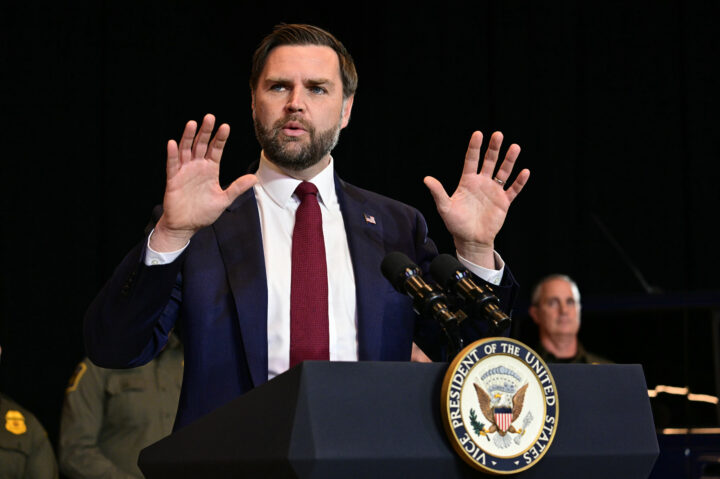
Jim Watson - Pool/Getty Images
U.S. Vice President JD Vance gives remarks following a roundtable discussion with local leaders and community members amid a surge of federal immigration authorities in the area, at Royalston Square on January 22, 2026 in Minneapolis, Minnesota.


 Add JewishInsider on Google
👋 Good Wednesday morning!
In today’s Daily Kickoff, we report on Vice President JD Vance telling an anti-Israel protester to blame former President Joe Biden for the situation in Gaza, which Vance called an “absolute catastrophe,” and have the scoop on social media posts from a staffer in New York City Mayor Zohran Mamdani’s office that praised slain Hamas head Yahya Sinwar. We do a deep dive into the Democratic National Committee’s Middle East working group following a failed effort to push through anti-Israel and anti-AIPAC resolutions at the DNC’s latest meeting, and report on a Yale Youth Poll that found younger voters hold decidedly more antisemitic beliefs than older generations. Also in today’s Daily Kickoff: Stephen Schwarzman, Joshua Feltman and Zach and Max Bruch.
Today’s Daily Kickoff was curated by JI Executive Editor Melissa Weiss and Israel Editor Tamara Zieve, with assists from Danielle Cohen-Kanik and Marc Rod. Have a tip? Email us here.
What We’re Watching
- Talks between the U.S. and Iran could resume in the coming days, President Donald Trump said yesterday. The president’s comments come as the Pentagon prepares to deploy some 10,000 additional troops to the region by the end of the month amid the U.S.’ maritime blockade of the Strait of Hormuz.
- The Senate is slated to vote this afternoon on a war powers resolution, as well as on legislation banning arms sales to Israel put forward by Sen. Bernie Sanders (I-VT).
- Elsewhere in Washington, U.S. Ambassador to the U.N. Mike Waltz and Jeff Bartos, the U.S. ambassador to the U.N. for management and reform, are slated to testify today before the Senate Foreign Relations Committee on U.S. priorities at the United Nations.
- Anti-Defamation League CEO Jonathan Greenblatt and Rabbi Ammiel Hirsch will hold a town hall tonight at Stephen Wise Free Synagogue to discuss antisemitism in New York City.
- In Massachusetts, Gov. Maura Healey will join representatives from Israel’s Sheba Medical Center to launch the new ARC Health Tech Accelerator in Downtown Boston.
What You Should Know
A QUICK WORD WITH JI’S MELISSA WEISS
A popular “domino effect” meme circulates online every few months, linking slain Hamas leader Yahya Sinwar’s decision to launch the Oct. 7, 2023, attacks — the smallest domino — to a series of major geopolitical shifts across the Middle East. While both simplified and exaggerated, the meme underscores the dramatic reshaping of Middle Eastern power dynamics.
The next domino may be the decades-long fraught relationship between Israel and Lebanon, as Iran’s ironclad grip over the region loosens and its most powerful proxy, Hezbollah, finds itself increasingly weakened and marginalized in Lebanon, where it has for decades played a key role in the country’s politics and military.
Those current geopolitical conditions — Iran at its weakest point in decades, successive levels of Hezbollah leadership removed from power through Israeli military actions, the degradation of Hamas and a new government in Syria that has separated itself from Tehran — laid the groundwork for yesterday’s State Department summit, convened by Secretary of State Marco Rubio, between Israel and Lebanon.
The State Department meeting between the ambassadors from Lebanon and Israel took place as the U.S. navigates stalled talks and a tenuous ceasefire with Iran — which was initially on unstable ground as Iran demanded that Israel cease its targeting of Hezbollah as part of the ceasefire.
A senior Israeli official told Jewish Insider on Wednesday that Iran’s effort to link the two conflicts was “a strategic trap with long-term ramifications.”
“There was real pressure to link the Lebanon front to the Iran ceasefire,” the official said. If President Donald Trump had acquiesced to the Iranian demand to link the two conflicts, the official continued, “We would not be on the path to peace that we’re on now. Keeping the arenas separate ultimately means that the fate of Lebanon is no longer dictated by Iran.”
DIRECTING FIRE
Vance to anti-Israel activist: ‘If you want to complain about what happened in Gaza, why don’t you complain about Joe Biden?’

Heckled over Gaza at a Turning Point USA event on Tuesday evening, Vice President JD Vance claimed that “the humanitarian situation in Gaza was an absolute catastrophe” when President Donald Trump returned to office last January and criticized the Biden administration’s handling of the conflict, though he did not defend Israel against the attack, Jewish Insider’s Emily Jacobs reports.
What he said: An attendee at the event at the University of Georgia repeatedly shouted that the Trump administration was supporting “genocide” in Gaza by backing Israel’s war against Hamas. “You know who’s the person who got a peace agreement in Gaza? Donald J. Trump,” Vance told the heckler. “So if you want to complain about what happened in Gaza, why don’t you complain about Joe Biden and the last administration? We’re the administration that solved that problem.”
SCOOP
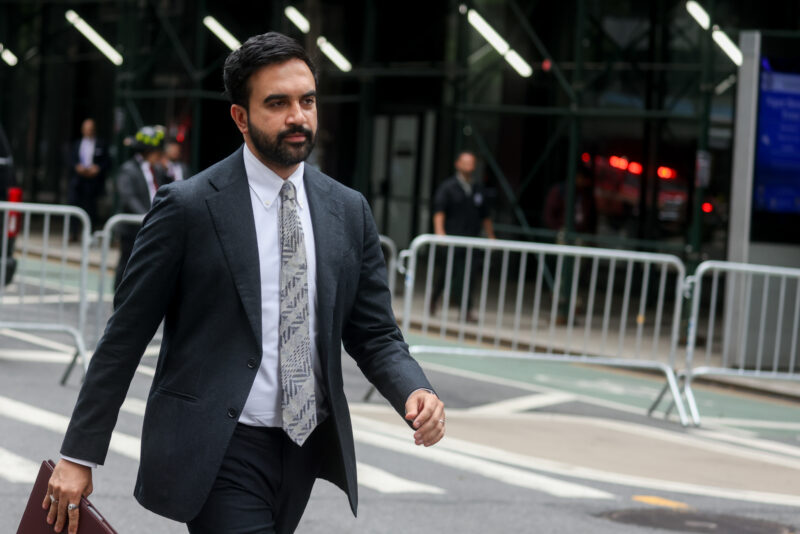
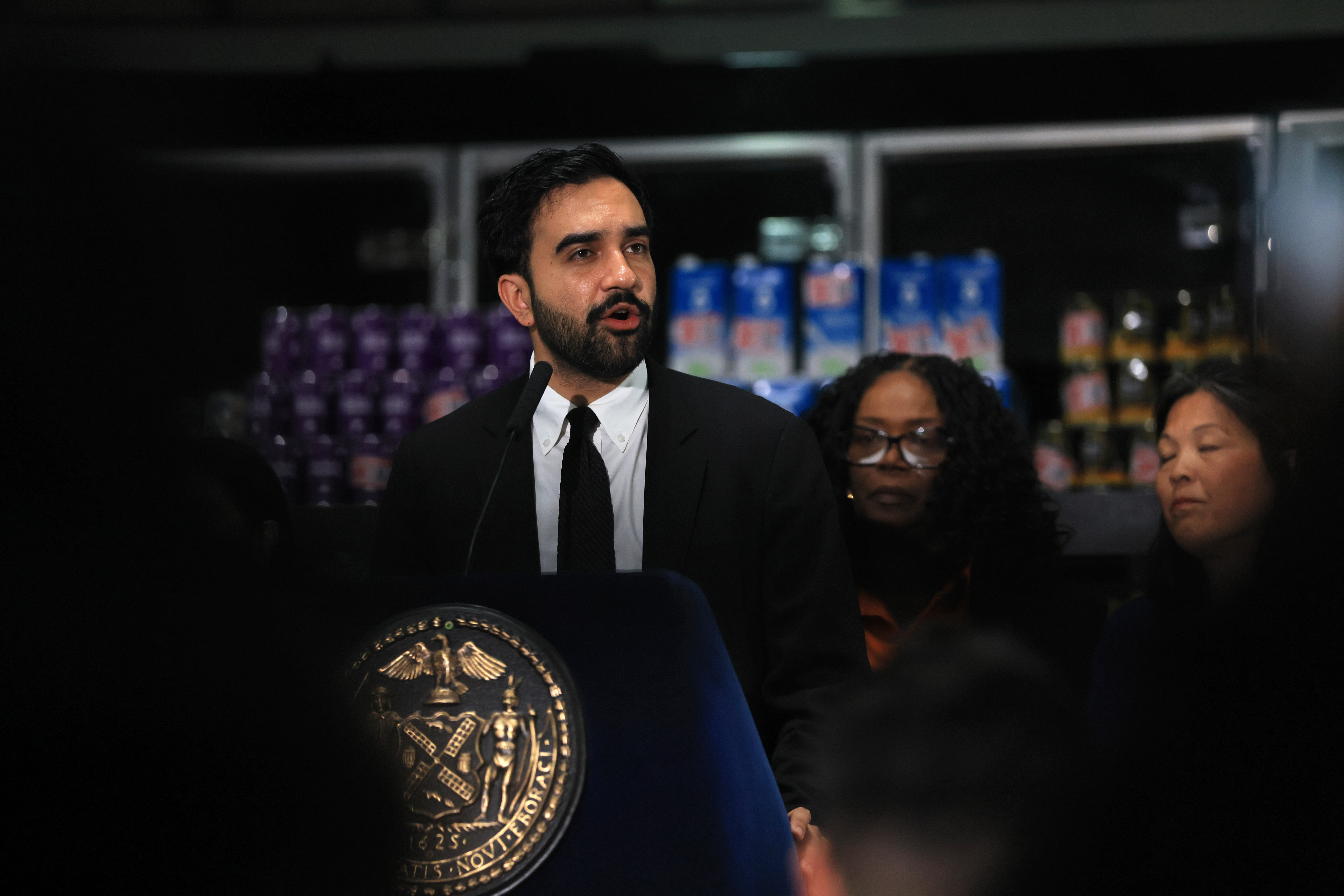
Zohran Mamdani’s video chief lauded Hamas chief Yahya Sinwar

The architect of New York City Mayor Zohran Mamdani’s viral video campaign paid homage to the mastermind of the Oct. 7, 2023, Hamas terror attacks in a series of tweets uncovered by Jewish Insider’s Will Bredderman — posts in which the operative asserted that late Hamas military leader Yahya Sinwar “gave his entire life until the end fighting for his people’s liberation.”
Career development: Records show Donald Borenstein got paid more than $90,000 last year by the Mamdani campaign for his services as director of video — a role in which, according to his LinkedIn, he served as “primary cinematographer” for the social media imagery that propelled the democratic socialist lawmaker into Gracie Mansion. Borenstein’s Instagram indicates he has since assumed the title of “creative director” at City Hall, and he has been credited for official videos promoting the mayor and his agenda. Borenstein was also featured in a recent comedy sketch starring Mamdani and his top staffers that was shared on the official NYC Mayor’s Office YouTube channel.
DEM DIVIDES
Inside the DNC working group at the center of Democrats’ Israel fight
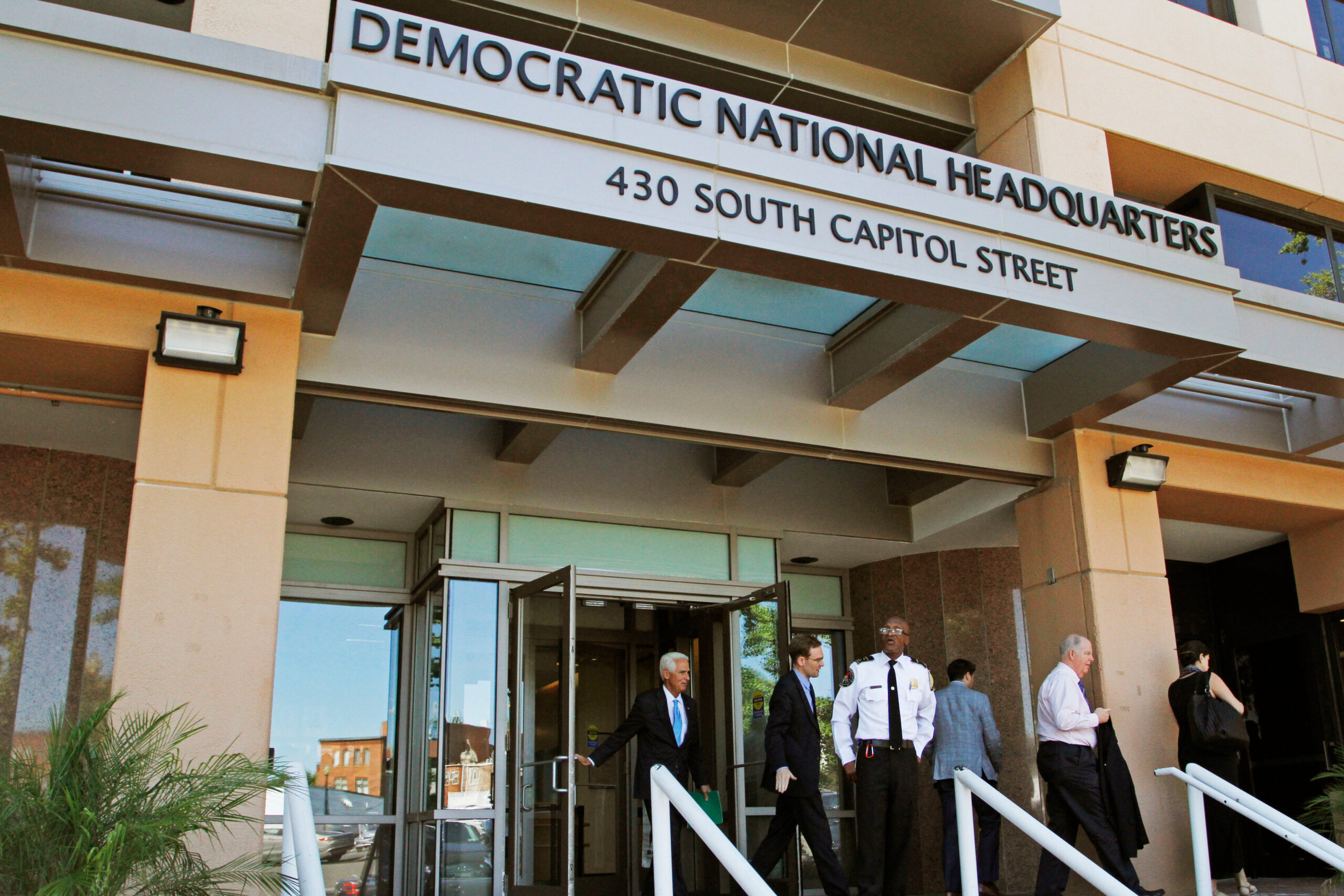
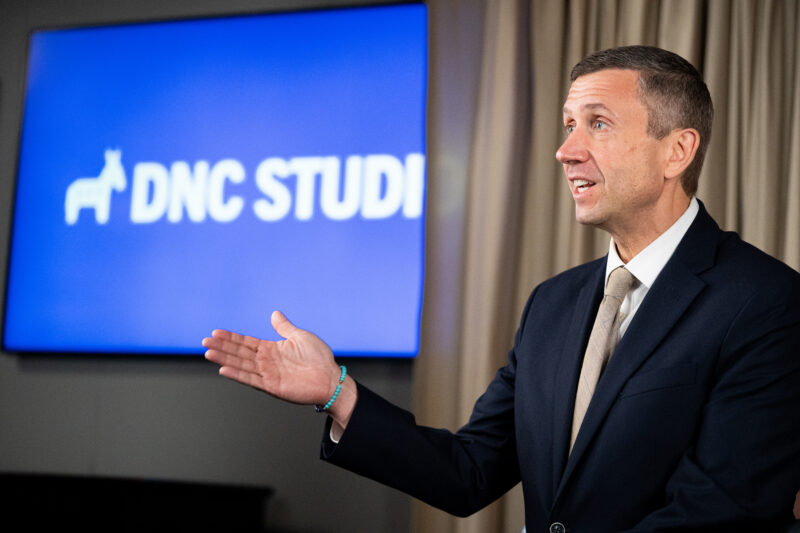
At last week’s Democratic National Committee meeting in New Orleans, two resolutions concerning Israel were tabled, and punted to a working group tasked with building consensus among Democrats on Middle East-related issues. At a time when Democrats appear deeply divided about how to address the U.S.-Israel relationship and Middle East policy more broadly, that’s a tall order. Never mind that the members of the working group include both strongly pro-Israel and staunchly anti-Israel voices, all tasked with working to further a message that will resonate with as many party members as possible, Jewish Insider’s Gabby Deutch reports.
Working group worries: The question facing the group’s members is whether they will actually be able to agree on anything — or if the group is simply a way to push the issue off until 2028, when the party platform is again up for debate. It would not be the first bureaucratic Band-Aid applied to paper over an increasingly fraught political debate. “We are working within the framework of the Democratic platform as it is now, so anything which attempts to radically rewrite where the party has been is not something that I personally feel is appropriate,” said Andrew Lachman, a member of the working group who was previously the president of California Jewish Democrats.
MODERATION MESS
Instagram fails to remove nearly all reported extremist content after Meta moderation rollback, ADL study finds

A new report reveals that Instagram failed to remove 93% of reported extremist and hateful content, tying the trend directly to Meta’s efforts to roll back content moderation last year. The changes lifted some speech restrictions, allowing incendiary content to remain on the platform, fueling what the Anti-Defamation League report calls a surge of antisemitism, Jewish Insider’s Haley Cohen reports.
Fuentes fallout: The ADL report, released on Wednesday, identified 105 accounts affiliated with white supremacist Nick Fuentes’ “groyper” network, with more than 1.4 million combined followers. Those accounts frequently posted antisemitic conspiracy theories, Holocaust denial and pro-Hitler content. The report highlights that in May 2025, shortly after the rollback, Fuentes noted that his content continues to spread on Instagram despite him personally having been banned since 2021, writing on Telegram that Instagram “relaxed its content moderation” and had “stopped taking my clips down.”
KIDS ARE NOT ALRIGHT
New Yale Youth Poll finds younger voters hold decidedly more antisemitic beliefs

Younger voters are significantly more likely to hold antisemitic beliefs and critical views of Israel compared to older generations, according to a new survey. The Yale Youth Poll, an undergraduate-led research group based at Yale University, polled over 3,400 American voters, more than half of whom were under 35, between March 9-23, Jewish Insider’s Haley Cohen reports.
Generation gap: Respondents were presented with paraphrased statements on Israel from several prominent figures across the political spectrum. Among all voters, 35% agreed with the statement “America should end the slavish surrender to Israel, its wars, and its demands for foreign aid,” which is paraphrased from comments neo-Nazi podcaster Nick Fuentes made in a video. But among the youngest respondents, agreement rose to 55% of voters ages 18-22 and to 52% among those 23-29.
Campus climate: A new study on campus discrimination highlights that at least a third of Jewish, Muslim, Black and Asian students have encountered hate and hostility at their universities.
WAR WEARY
Several top Senate Republicans, including John Thune, express hope Iran war winds down
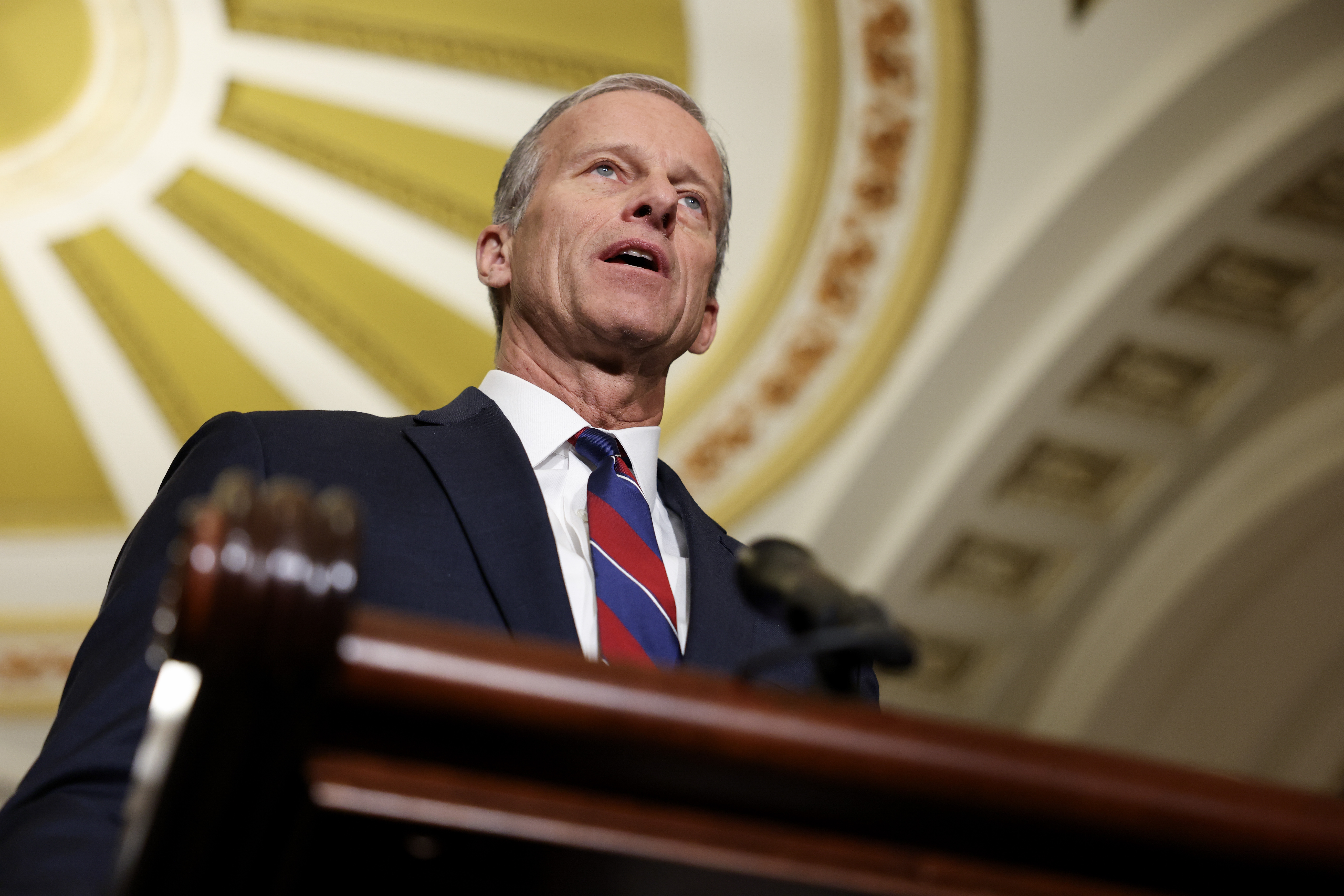
Senate Majority Leader John Thune (R-SD) said Tuesday that he’s hopeful that the war in Iran is close to winding down, in advance of a deadline that could require congressional action for the war to continue, Jewish Insider’s Marc Rod reports. Under the War Powers Act, unilateral military action undertaken by the president without congressional authority is limited to 60 days — with a 30-day extension for draw-down purposes.
What he said: Pressed on whether Republicans would be open to voting to continue the war if it extends beyond 90 days, Thune suggested that wouldn’t be necessary. “At this point, most of us, I believe, feel pretty good about what the American military has achieved there in terms of its objectives,” Thune said. “It’s a hypothetical down the road. … I think the administration has a clear objective, a clear plan, and if they can execute on it, hopefully that question won’t be a necessary one that we’ll have to answer.”
Meeks’ move: Rep. Greg Meeks (D-NY) said he’s aiming to call up a war powers resolution this week to force an end to the war in Iran, but that he’s still working to lock down the support of a few wavering Democratic and Republican lawmakers whose support will be necessary to pass the legislation.
Worthy Reads
Same as the Old Boss: The Wall Street Journal’s Margherita Stancati, Benoit Faucon and Henna Moussavi look at the maximalist, hard-line positions of the new upper echelon of Iranian leadership, overseen by Iranian Supreme Leader Mojtaba Khamenei. “[The supreme leader] relies on a network of trusted allies that analysts call the Habib Circle. Its members include many veterans of the war with Iraq who served in the Revolutionary Guard’s Habib Battalion, renowned for attracting radicals and named after a seventh-century figure in Shia Islam revered for sacrificing his life in battle. Its recruits included Khamenei himself, who was a teenager when he enlisted toward the end of the war. … The new leadership has proved resilient and adaptable, emerging from the first five weeks of the war with its command and control intact. Their hard-line approach is evident in their appointments.” [WSJ]
Best Chance for Beirut: The Washington Post’s Carine Hajjar posits that the Lebanese government is in a position to take decisive action against both Iran and its Hezbollah proxy. “With the leadership of Hezbollah’s Iranian sponsors in disarray, Lebanon may never get a better chance to reclaim its sovereignty. … Even if the Lebanese are frustrated with Israel striking their country, ‘there’s a reason why these Israeli rockets are falling on us,’ Makram Rabah, an assistant history professor at the American University of Beirut, told me. The Israelis have been clear with the Lebanese: They won’t accept an armed Hezbollah, and if Beirut won’t act, they will.” [WashPost]
The Piker Problem: In his Substack “Identity Crisis,” Shalom Hartman Institute President Yehuda Kurtzer weighs in on the recent decision by The New York Times’ Ezra Klein to platform far-left streamer Hasan Piker. “Liberals must not decide that they need the ugliest forms of illiberalism in order to try to restore our fragile and collapsing liberal order. This was true when it involved defending a US senator hoping to impose martial law on American cities, and it is true now when it involves the demagogue-ing of our public square and the soft-pedaling of antisemitism. On both sides, violence is the tool of authoritarianism, and the enemy of the liberal project. Piker’s very project involves the delegitimating of the very liberal order by whose rules Klein is playing.” [IdentityCrisis]
Word on the Street
France and the U.K. are drafting a postwar plan that would free up shipping through the Strait of Hormuz and would include mine-clearing technology and military escorts through the waterway; the plan, which European officials will meet to discuss later this week, would require the approval of Iran and likely exclude the U.S….
Blackstone’s Stephen Schwarzman met this week in New York with Qatari Finance Minister Ali bin Ahmed Al Kuwari…
The Financial Times reports that Iran clandestinely acquired China’s TEE-01B spy satellite, which it used to target U.S. bases during the recent war…
Rep. Jamie Raskin (D-MD) and 50 House Democrats introduced a bill to create a commission to assess President Donald Trump’s potential removal from office under the 25th Amendment, a move prompted in part by the Iran war. Efforts to remove Trump under the provision are almost certainly doomed to fail…
Sen. Jerry Moran (R-KS) urged the administration not to renew oil sanctions waivers on Russia and Iran; “Iran continues to reap significant revenue due to its current waiver, providing financial relief to an adversary we are actively fighting. Any additional waivers for Russia or Iran would be against our national interests,” Moran said…
Citing an “unprecedented and escalating threat environment facing religious communities and institutions” across the country, a coalition of Jewish groups, joined by organizations representing a range of other faiths, is urging Senate and House leaders to significantly expand funding for the Nonprofit Security Grant Program to “up to $1 billion,” Jewish Insider’s Marc Rod reports…
The Wall Street Journal looks at recent clashes between President Donald Trump and Pope Leo XIV, suggesting that the pontiff “has been building broad support within the global church for his course, which combines advocacy for peace and dialogue with a stronger emphasis on traditional Catholic doctrines”…
The Michigan arm of the powerful SEIU labor union announced on Tuesday that it had rescinded its endorsement of Amir Makled, an attorney running for the University of Michigan board of regents, in light of Makled’s deleted social media posts praising the terrorist group Hezbollah, JI’s Gabby Deutch reports…
Law firm Kirkland & Ellis has reportedly offered a three-year, $80 million package to Joshua Feltman, the chair of Wachtell Lipton’s corporate restructuring and finance department…
Portland Trail Blazers guard Deni Avdija hit the game-winning three-point shot to lead Portland over the Phoenix Suns in the NBA’s play-in game and into the NBA playoffs; the Israeli NBA star scored 41 points, and tallied 12 assists and 7 rebounds…
The Harvard Crimson reports that Harvard has yet to release a report on antisemitism that was mandated by its January 2025 settlement with the Louis D. Brandeis Center for Human Rights Under Law…
The University of Pennsylvania requested a stay of a judge’s order requiring the school to turn over names of Jewish employees of the school to the Trump administration’s Equal Employment Opportunity Commission…
The New York Times spotlights the growing interest from private equity firms in local bagel shops that can be developed and scaled…
MyPrize co-founders and brothers Zach and Max Bruch made a $360,000 donation to establish an endowment for Olami Manhattan to support the group’s efforts to bring young Jewish adults to visit Auschwitz and Birkenau, eJewishPhilanthropy’s Jay Deitcher reports…
Axel Springer received approval from U.K. Culture Secretary Lisa Nandy to purchase The Telegraph, clearing a major hurdle in the German company’s £575m effort to acquire the British publication…
Days after U.K. authorities revoked Kanye West’s permission to enter the country for a now-canceled music festival over his past antisemitic remarks, French authorities are weighing a similar ban on the artist, who is set to perform in Marseille in June…
Dublin Mayor Ray McAdam apologized to the city’s Jewish community for a series of administrative and procedural errors around a failed effort to rename the city’s Herzog Park, which was named after former Israeli President Chaim Herzog, the father of President Isaac Herzog, who was born in Belfast and raised in Dublin…
Italian Prime Minister Giorgia Meloni announced that the country would suspend the automatic renewal of its defense cooperation agreement with Israel, prompting President Donald Trump to rail against Meloni, who has thus far been an ally of his, telling an Italian outlet he’s “shocked by her. I thought she was brave, but I was wrong. … It’s her who’s unacceptable, because she doesn’t care if Iran has a nuclear weapon and would blow up Italy in two minutes if it had the chance”…
Italian entrepreneur Adriano Goldschmied, who developed dozens of brands of denim jeans, died at 82…
Pic of the Day
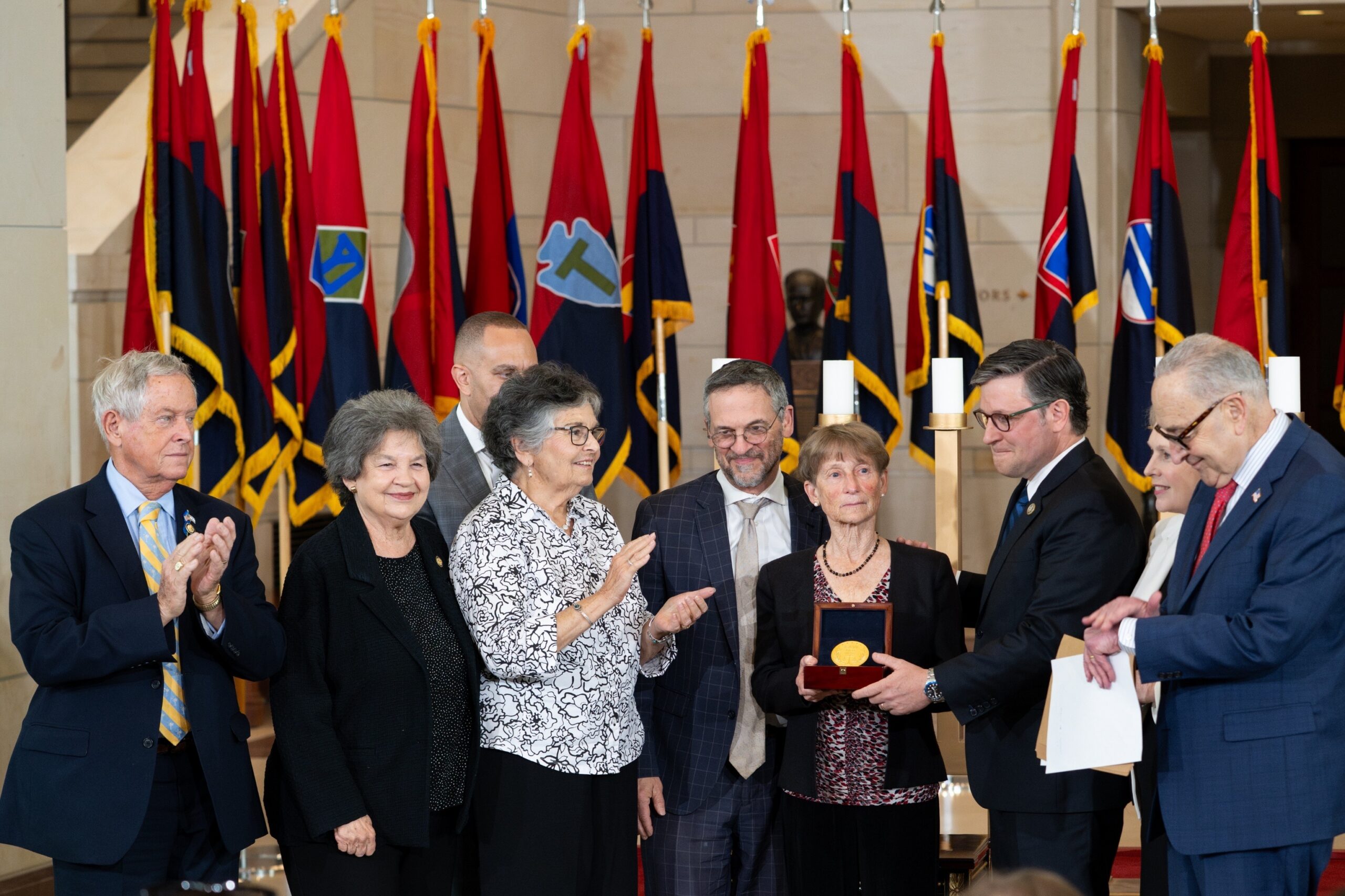
Congressional leaders, newly appointed U.S. Holocaust Memorial Museum Board Chair Jeff Miller, Commerce Secretary Howard Lutnick and others spoke alongside Holocaust survivors on Capitol Hill on Tuesday at the U.S.’ annual commemoration of Yom HaShoah, JI’s Marc Rod reports.
Birthdays

Retired U.S. astronaut and a veteran of five space shuttle missions, Marsha Sue Ivins turns 75…
Psychiatrist, entrepreneur, movie producer and philanthropist, Dr. Henry George Jarecki turns 93… Former 15-term member of the U.S. House of Representatives from California, Howard Lawrence Berman turns 85… Duke University professor, physician, biochemist and Nobel Prize laureate in 2012, Robert Lefkowitz turns 83… Retired U.S. Army chaplain who attained the rank of lieutenant colonel, Rabbi Alan Sherman… Professor of German and comparative literature at New York University, Avital Ronell turns 74… Israeli Breslov rabbi and founder of Chut Shel Chessed Institutions, Shalom Arush turns 74… Former city controller of Philadelphia for 12 years, following 16 years as a member of the Pennsylvania House of Representatives, Alan Butkovitz turns 74… CEO of DMB Strategic, David Brand… Founder and director of the graduate school in the decorative arts at Bard College in Dutchess County, N.Y., Susan Weber turns 71… Deputy counsel at the NYS Department of Taxation and Finance, Deborah R. Liebman… Former executive director at American Press Institute, he is the author of 10 books, including three novels, Tom Rosenstiel turns 70… Born in NYC, now living in Jerusalem, he is the rebbe of the Boyan Hasidic dynasty (a position he assumed in 1984 when he was 25), Rabbi Nachum Dov Brayer turns 67… Former deputy secretary of the Treasury during the Obama administration following four years as a member of the Federal Reserve Board of Governors, Sarah Bloom Raskin turns 65… Winner of 12 Olympic medals at five different Olympic Games, Dara Grace Torres turns 59… Managing partner, CEO and chief investment officer of Hudson Bay Capital Management, Sander R. Gerber… CEO of the New Israel Fund since 2009 on sabbatical this year, prior to that he was the executive director of the Jewish Community Federation of San Francisco, Daniel Sokatch turns 58… Cheryl Myra Cohn… Senior fellow at the Carnegie Endowment for International Peace and founder of the Truman National Security Project, Rachel Kleinfeld, Ph.D…. Head coach of the UC Santa Barbara Gauchos basketball program, Joe Pasternack turns 49… Senior political correspondent at The Hill, Amie Parnes turns 49… CEO of the American Fintech Council, Y. Phillip Goldfeder turns 45… Actor, comedian, writer, producer and director, Seth Rogen turns 44… CEO of the Jewish Community Relations Council of New York, Mark Treyger turns 44… Co-founder and co-CEO of theSkimm, Carly Zakin… Research manager at the Foundation for Defense of Democracies, David May… Director of grants and operations at the Foundation for Middle East Peace, Kristin McCarthy… Founder and CEO of Neue Urban, Zach Ehrlich… Social entrepreneur, environmental activist and human rights activist, Erin Schrode… Israeli singer, songwriter, rapper and record producer, Jasmin Moallem turns 31… Moshe Lehrer…
Plus, positive readouts from Israel-Lebanon talks in D.C.
Stefano Costantino/SOPA Images/LightRocket via Getty Images
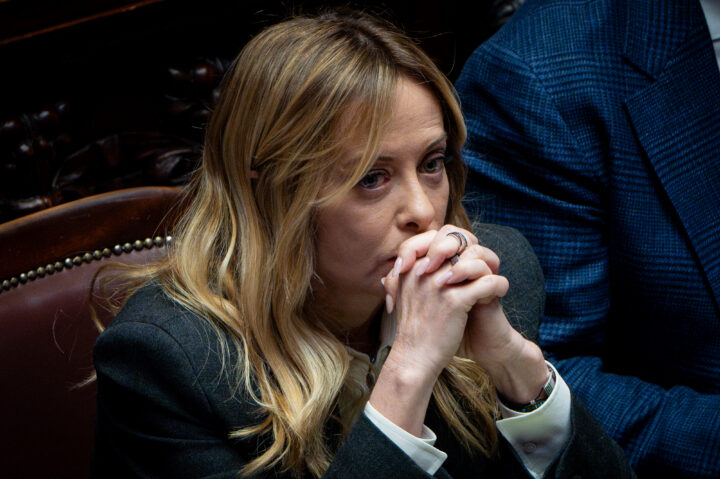
Italian Prime Minister Giorgia Meloni addresses the Italian Chamber of Deputies in Rome.
This P.M. edition is reserved for our premium subscribers — offering a forward-focused read on what we’re tracking now and what’s coming next. Please don’t hesitate to share your thoughts and feedback by replying to this email.
📡On Our Radar
Notable developments and interesting tidbits we’re tracking
U.S.-Iran talks could restart in the next two days, President Donald Trump told the New York Post. “[S]omething could be happening over the next two days, and we’re more inclined to go [back to Islamabad, Pakistan]” rather than a different mediating country, he said in an interview today.
Trump also indicated he wasn’t happy with reports that his own negotiating team had offered Iran a 20-year pause on its ability to enrich uranium. “I’ve been saying they can’t have nuclear weapons, so I don’t like the 20 years,” he said…
CENTCOM announced that no ships made it past the U.S. blockade of the Strait of Hormuz in its first 24 hours, and six merchant ships “complied with direction from U.S. forces to turn around”…
Saudi Arabia is reportedly pressuring the U.S. to end the blockade, fearing retaliation and disruption to other trade routes. Iran has threatened to mobilize the Houthis in Yemen to close off the Bab al-Mandeb Strait, which Riyadh utilizes to move its oil exports out of the Red Sea…
European countries are drafting a plan to restore freedom of navigation in the Strait of Hormuz after the war ends, possibly without the participation of the U.S. As part of this effort, French President Emmanuel Macron announced that France and the U.K. will co-host a conference on Friday of “non-belligerent countries ready to contribute” to the “multilateral and purely defensive mission”…
The Treasury Department said it will not renew a waiver set to expire later this week that temporarily lifted sanctions on Iranian oil — the waiver had drawn condemnation from some lawmakers who had worked to institute those sanctions…
Secretary of State Marco Rubio emphasized at the outset of negotiations between Israel and Lebanon in Washington this morning that the talks are a “process” that will “take time,” and that the objective of today’s meeting was to “outline a framework upon which a permanent and lasting peace can be developed” and bring a “permanent end to Hezbollah’s influence” in the region.
The State Department said after the meeting, the highest-level talks between Jerusalem and Beirut in over 30 years, that the sides “agreed to launch direct negotiations at a mutually agreed time and venue,” though it did not indicate when or where further talks may take place. Israeli Ambassador to the U.S. Yechiel Leiter told reporters that the parties “discovered today that we’re on the same side of the equation. That’s the most positive thing we could have come away with”…
Italy is suspending its defense agreement with Israel, Italian Prime Minister Giorgia Meloni said today, declining to renew the agreement “in consideration of the current situation.” Italy had grown critical of Israel’s war in Gaza and has been noncooperative in the war with Iran, reportedly not allowing U.S. aircraft to land at its bases.
Trump railed against Meloni, who has thus far been an ally of his, in an interview with an Italian outlet today, saying he’s “shocked by her. I thought she was brave, but I was wrong,” and claiming she’s “no longer the same person” after she called the president’s attack on Pope Leo XIV yesterday “unacceptable.” “It’s her who’s unacceptable, because she doesn’t care if Iran has a nuclear weapon and would blow up Italy in two minutes if it had the chance,” Trump said…
Hamas has rejected the U.S.-led Board of Peace’s disarmament proposal, according to the BBC. The parties seem to once again be at an impasse, as Hamas tells mediators it will not continue onto the second phase of the ceasefire until it feels Israel has complied completely with the first phase, while Israel says it will not move forward until there is progress on disarming Hamas…
The New York Times details a tense event held by Rep. Mike Lawler (R-NY) in his Hudson Valley-based swing district where the lawmaker was pressed by constituents demanding answers and accountability on the Iran war; it’s seen as a harbinger of the growing discontent some Republicans will have to contend with around the largely unpopular war in the lead-up to the midterms…
The Union for Reform Judaism released a statement yesterday voicing concern about “efforts to single out AIPAC as a particularly malign influence in campaign finance. … [T]he harsh language being used by some to denigrate and vilify AIPAC borders on — and in some cases crosses over into — antisemitism.”
“Until such time as [C]ongress reforms the nation’s broken campaign finance system overall — an effort we would enthusiastically welcome — to single out AIPAC’s activity will continue to raise questions of antisemitic motivation,” the organization wrote, in a sign of how the demonization of pro-Israel donors and groups is raising alarms across the Jewish political and religious spectrum…
California state Sen. Scott Wiener, a progressive Jewish legislator running to fill Rep. Nancy Pelosi’s (D-CA) seat, was accused at a campaign event earlier this week of taking $50,000 from AIPAC by a constituent citing the far-left group TrackAIPAC. “I just want to be clear, I’m not accepting any support from AIPAC,” Wiener responded. “There are people who are gonna list out all my Jewish donors and say that. I’m not taking any support from AIPAC and I support the Block the Bombs Act”…
The Michigan arm of the powerful SEIU labor union announced today that it had rescinded its endorsement of Amir Makled, a candidate for the University of Michigan board of regents, in light of Makled’s deleted social media posts praising the terrorist group Hezbollah, Jewish Insider’s Gabby Deutch reports.
Makled is a Dearborn attorney who represented an anti-Israel protester who was arrested during the 2024 anti-Israel encampments at UM’s flagship Ann Arbor campus. A Detroit News report found that Makled had deleted posts praising Hezbollah’s leaders and retweets of antisemitic messages from the far-right influencer Candace Owens, as he now seeks to unseat Jewish regent Jordan Acker…
The relationship between New York City Mayor Zohran Mamdani and City Council Speaker Julie Menin appears to be growing increasingly acrimonious as Menin publicly distances herself from some of the mayor’s policies, Politico reports, including apparently helping to plan a protest outside Mamdani’s speech marking his first 100 days in office…
France is exploring legal options to bar rapper Kanye West from entering the country to perform at a concert in Marseille in June, after he was similarly banned and prevented from performing in the U.K. earlier this month. “I refuse to let Marseille be a showcase for those who promote hatred and unapologetic Nazism,” the city’s mayor, Benoit Payan, wrote on social media…
⏩ Tomorrow’s Agenda, Today
An early look at tomorrow’s storylines and schedule to keep you a step ahead
Keep an eye out in Jewish Insider for a look into the work of the Democratic National Committee’s Middle East working group, established last summer, including how it’s approaching intraparty divides over Israel policy.
Two of Sen. Bernie Sanders’ (I-VT) three joint resolutions of disapproval seeking to halt $658.8 million in sales of munitions to Israel are expected to receive a vote in the Senate tomorrow. Sanders and other progressive Democrats have forced votes on similar efforts to block arms sales to Israel on three previous occasions since the war in Gaza began, with a majority of the Democratic caucus — 27 lawmakers — voting to block at least one arms sale in July of last year, a significant jump in support from similar efforts in November 2024 and April 2025.
Sen. Tim Kaine (D-VA) told reporters Democrats will likely force a vote tomorrow on another Iran war powers resolution, the third such vote after the previous two failed largely along party lines.
The Senate Foreign Relations Committee will hold a hearing on reforming the U.N. with U.S. Ambassador to the U.N. Mike Waltz and U.S. Representative for U.N. Management and Reform Jeff Bartos.
The Stephen Wise Free Synagogue in Manhattan will host an antisemitism town hall with Senior Rabbi Ammiel Hirsch and Anti-Defamation League CEO Jonathan Greenblatt.
Israel’s Sheba Medical Center will unveil ARC Landing Boston, its first health care accelerator based in the U.S., at an event featuring Democratic Massachusetts Gov. Maura Healey.
Stories You May Have Missed
MINNESOTA MATTERS
Angie Craig calls on Minnesota Democrats to investigate antisemitism ahead of state party convention
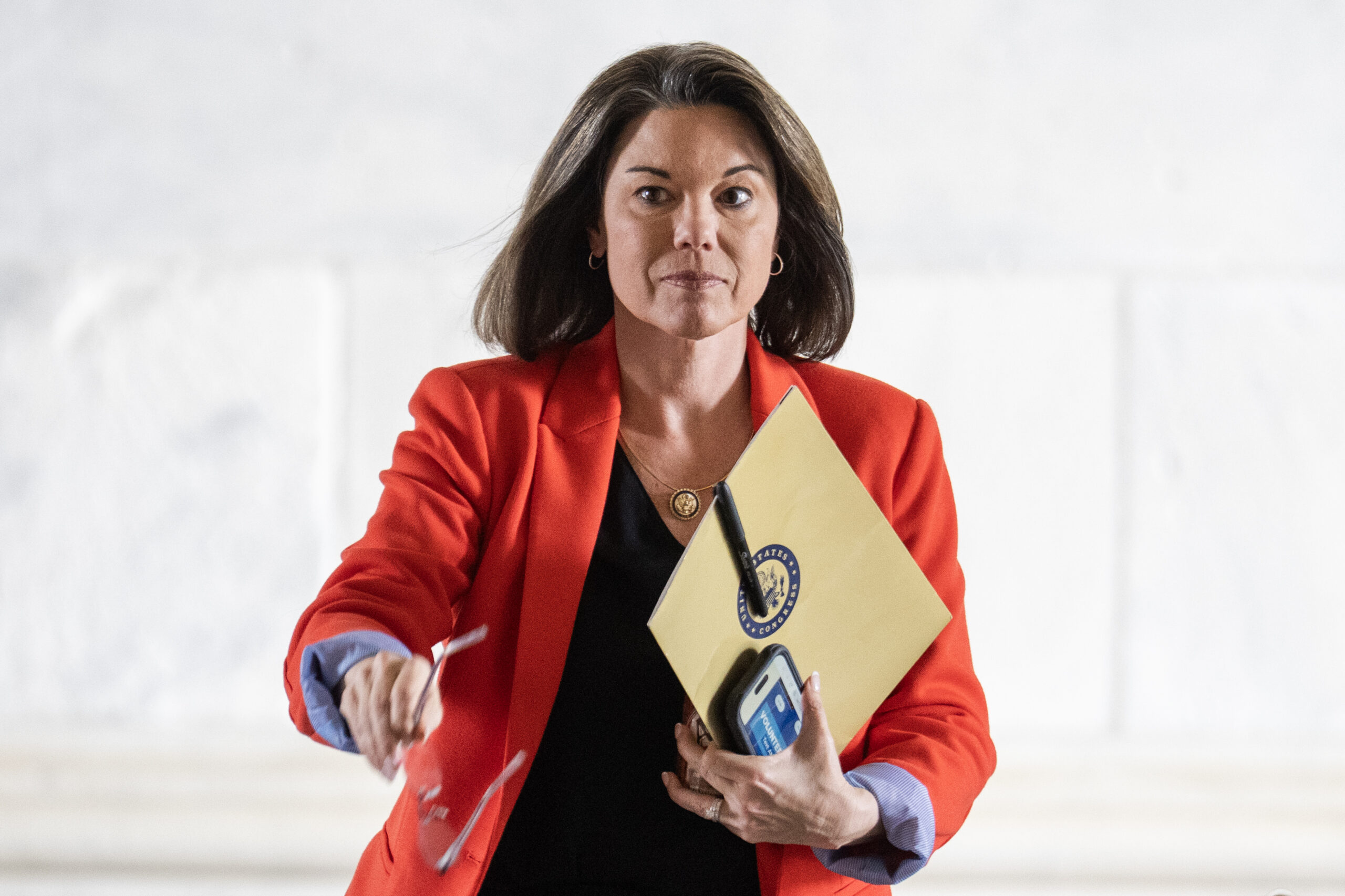
Delegates are expected to take up divisive anti-Israel resolutions at the convention being held next month
HUNGARY FOR MORE
Analysts expect continued pro-Israel slant from new Hungarian government under Magyar

Economic ties and broader European alliances are likely to preserve the bilateral relationship, even as the expected prime minister-elect moves to rejoin the ICC and potentially pivot back towards the EU
The secretary of state emphasized that all ‘the complexities are not going to be resolved in the next six hours’ but that he was hopeful talks could create a ‘framework’ to progress from
Andrew Harnik/Getty Images
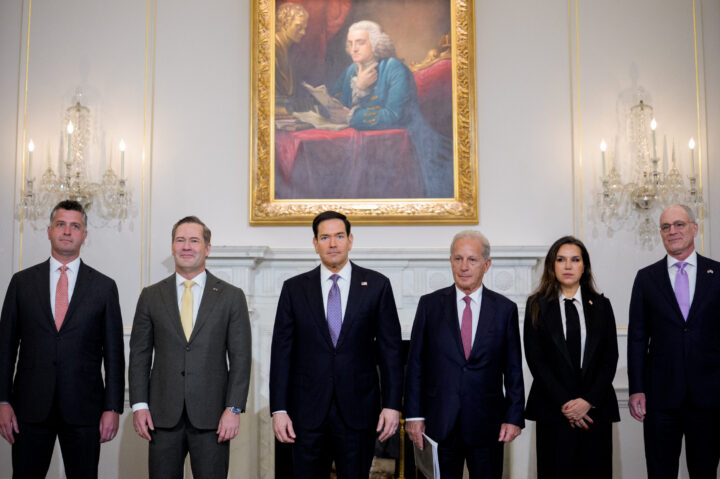
(L-R) Counselor of U.S. State Department Michael Needham, U.S. Ambassador to the United Nations Michael Waltz, U.S. Secretary of State Marco Rubio, U.S. Ambassador to Lebanon Michel Issa, Lebanese Ambassador to the U.S. Nada Hamadeh Moawad and Israeli Ambassador to the U.S. Yechiel Leiter pose for photos before beginning working-level peace talks at the U.S. State Department on April 14, 2026 in Washington, DC.
Sitting at a roundtable of Israeli, Lebanese and American officials, Secretary of State Marco Rubio emphasized at the outset of negotiations between Jerusalem and Beirut that the talks are a “process” that will “take time,” stating that the objective of Tuesday’s meeting, the highest-level direct talks between the countries in over 30 years, is to “outline a framework upon which a permanent and lasting peace can be developed” and bring a “permanent end to Hezbollah’s influence” in the region.
“This is a process, not an event. This is more than just one day,” Rubio said. “All of the complexities are not going to be resolved in the next six hours … This will take time, but we believe it’s worth this endeavor and it’s a historic gathering that we hope to build on.”
“We understand we’re working against decades of history that have led us to this unique moment and opportunity here,” Rubio added. “We have to remember, the Lebanese people are victims of Hezbollah. The Lebanese people are victims of Iranian aggression, and this needs to stop.”
Rubio said the parties want to provide the people of Lebanon “the kind of future they deserve, and so that the people of Israel can live without fear of being struck by rocket attacks from a terrorist proxy of Iran.”
Taking part in the high-level talks between Israel and Lebanon on Tuesday in Washington were Israeli Ambassador to the U.S. Yechiel Leiter, Lebanese Ambassador to the U.S. Nada Hamadeh, U.S. Ambassador to Lebanon Michel Issa and State Department Counselor Michael Needham.
In a statement released by the State Department following the meeting, Washington indicated that any agreement “must be reached between the two governments, brokered by the United States, and not through any separate track.” The U.S. also expressed “support for further talks,” however it is not yet clear when the next round of discussions are expected to take place.
“All sides agreed to launch direct negotiations at a mutually agreed time and venue,” the statement read. It also indicated that Israel “expressed its commitment to working with the Government of Lebanon to achieve … security for the people of both countries” as well as a “commitment to engage in direct negotiations to resolve all outstanding issues and achieve a durable peace that will strengthen security, stability and prosperity in the region.”
In his opening statement ahead of the talks, Leiter commended Lebanese President Joseph Aoun and his government “for not allowing itself to be held hostage to the threats of Hezbollah’s leader,” adding that the group belongs “to the past.”
“I believe that we can, in good faith, accomplish the following interrelated goals: the complete dismantlement of Hezbollah, the freeing of Lebanon from Iran’s terror proxy and the achievement of a real, lasting and mutually celebrated peace for the benefit of our people,” Leiter said. “We also have the courage to pursue peace through strength, and to work tirelessly for tranquility and prosperity for all. Today, we pursue those values for ourselves and especially for our Lebanese neighbors of all ethnic denominations.”
After negotiations wrapped, Leiter struck a positive tone and said he was “honored” to sit at the negotiating table with Lebanese officials.
“We discovered today that we’re on the same side of the equation,” Leiter told reporters. “That’s the most positive thing we could have come away with. We are both united in liberating Lebanon from an occupation power dominated by Iran called Hezbollah.”
Similarly, Hamadeh also called the preliminary meeting “positive” and indicated that another round of talks is likely to take place. She stated that “the date and location of the next meeting will be announced at a later time.”
Tuesday’s negotiations were expected to focus on how Israel and Lebanon can work together to disarm Hezbollah and make peace between the countries. Israeli Prime Minister Benjamin Netanyahu announced the talks last week, saying he had shifted his position once the scope of the negotiations were expanded beyond just a ceasefire to also include disarming Hezbollah and working toward peaceful relations. Lebanese Foreign Minister Youssef Raggi indicated that the direct talks are meant to show that the “Lebanese state alone holds the authority to negotiate on behalf of Lebanon,” rather than Hezbollah.
The two nations currently share no formal diplomatic relations.
Hezbollah, however, has signaled it will not abide by any agreements and called on the Lebanese government to cancel the talks. Wafiq Safa, a high-ranking member of the group’s political council, stated prior to the meeting that the terrorist organization is “not interested or concerned with” the negotiations, saying the group is “not bound by what they [Israel, Lebanon and the U.S.] agree to.”
The negotiations took place against the backdrop of a massive Israeli strike in Beirut last week targeting Hezbollah. The recent round of hostilities was triggered on March 2 when Hezbollah launched rockets at northern Israel days after Israel and the U.S. launched strikes on Iran.
The talks have also received significant support from European and Western nations, with foreign ministers from 17 countries, including the U.K. and France, calling on the two countries to “seize the opportunity presented by the U.S.-Iran ceasefire,” per a joint statement.
Even if a deal is reached, major hurdles lie ahead as it remains unclear whether Lebanon possesses sufficient influence to hold Hezbollah to any potential agreements. While the group is a major political party with seats in the Lebanese parliament, its militia operates largely independently of the government, receiving funding and direction from Iran. Although a growing number of Lebanese officials and civilians view Hezbollah as an intrusive arm of Iranian interference, the group remains a powerful, independent force within the country.
The negotiations will mark the highest-level direct talks between the countries in over 30 years

Jalaa MAREY/AFP via Getty Images
Smoke rises following Israeli strikes in southern Lebanon near the border as seen from the Upper Galilee, in northern Israel on April 10, 2026
Secretary of State Marco Rubio will convene the ambassadors from Israel and Lebanon in Washington on Tuesday for the highest-level direct talks between the countries in over 30 years.
Israeli Ambassador to the U.S. Yechiel Leiter and Lebanese Ambassador to the U.S. Nada Hamadeh will represent their countries, with U.S. Ambassador to Lebanon Michel Issa and State Department Counselor Michael Needham also taking part in the meeting.
The negotiations are meant to focus on how Israel and Lebanon can work together to disarm Hezbollah and make peace between the countries.
A State Department official said the talks are “a direct result of Hezbollah’s reckless actions,” and “will scope the ongoing dialog about how to ensure the long-term security of Israel’s northern border and to support the Government of Lebanon’s determination to reclaim full sovereignty over its territory and political life.”
“Israel is at war with Hezbollah, not Lebanon, so there is no reason the two neighbors should not be talking,” the State Department official said.
Lebanese Prime Minister Nawaf Salam canceled a planned visit to the U.S. this week to monitor the situation from Beirut and “safeguard the security of the Lebanese people and preserve national unit,” he wrote on X.
Israeli Prime Minister Benjamin Netanyahu announced the talks last week, marking a shift in his position from earlier in the Lebanon campaign that began after Hezbollah joined Iran in attacking Israel in late February. Netanyahu said over the weekend that he had agreed to the talks because they would not only be about a ceasefire, but about disarming Hezbollah and working toward peace with Lebanon. President Donald Trump said at the time that he asked Israel to “low-key a bit” the strikes in Lebanon.
Lebanese Foreign Minister Youssef Raggi posted on X that the direct talks “in practice reinforced the separation between the Lebanese file and the Iranian track. … The Lebanese state alone holds the authority to negotiate on behalf of Lebanon.”
The talks are set to take place as Hezbollah continues to launch rockets and drone attacks at northern Israel on a daily basis and the IDF continues to target Hezbollah in southern Lebanon. The IDF said it struck about 150 Hezbollah targets on Monday, and it continues its ground operations in the Iran-backed terrorist organization’s stronghold of Bint Jbeil.
The IDF cleared for publication on Tuesday the name of Sgt.-Maj. Ayal Uriel Bianco, who was killed in battle in Lebanon.
Netanyahu visited IDF troops in Lebanon over the weekend, and praised them on Monday for “pushing the enemy away from the border” and creating “a solid, deeper security zone that both prevents the danger of invasion and distances the anti-tank missile threat.”
Plus, Hasan Piker calls Hamas 'orphan children'

Jacquelyn Martin - Pool/Getty Images
Vice President JD Vance arrives for talks with Iranian officials on April 11, 2026 in Islamabad, Pakistan.
This P.M. edition is reserved for our premium subscribers — offering a forward-focused read on what we’re tracking now and what’s coming next. Please don’t hesitate to share your thoughts and feedback by replying to this email.
📡On Our Radar
Notable developments and interesting tidbits we’re tracking
The U.S. blockade of the Strait of Hormuz began this morning, with more than 15 American warships involved in the operation intended to pressure Iran into concessions after this weekend’s failed negotiations.
President Donald Trump said hours later that the U.S. was “called this morning by the right people, the appropriate people, and they want to work a deal.” Mediators including Pakistan, Egypt and Turkey are also reportedly attempting to revive talks between the parties…
One reported sticking point in the negotiations is a U.S. request that Iran agree not to enrich uranium for 20 years. The 2015 Iran nuclear deal was highly criticized for its sunset clauses, which lifted limits on activity including uranium enrichment after 15 years.
Israeli Prime Minister Benjamin Netanyahu invoked a similar timeframe at a Cabinet meeting today, saying he spoke with Vice President JD Vance yesterday who told him that the U.S. aims to ensure “there is no more enrichment in the coming years, and that could be in decades, no enrichment within Iran.”
Sen. Lindsey Graham (R-SC) took issue with the timeline: “If this reporting is accurate, the idea that we would agree to a moratorium on enrichment rather than a ban on enrichment would be a mistake in my view. Would we agree to a moratorium for al Qaeda to enrich? No,” he wrote on X. “No enrichment means no enrichment”.…
Six additional Senate Democrats plan to file new war powers resolutions this week to halt the war in Iran, a move that would allow Democrats to continue forcing votes on the war for the foreseeable future, Jewish Insider’s Marc Rod reports.
Previously, a different group of six Democrats introduced similar resolutions, and Democrats have called up two of them thus far, with plans to call up a third this week. The latest group of lawmakers spans from staunch progressives and critics of Israel to generally more pro-Israel members, including Sens. Jeff Merkley (D-OR), Kirsten Gillibrand (D-NY), Chris Van Hollen (D-MD), Mark Kelly (D-AZ), Raphael Warnock (D-GA) and Andy Kim (D-NJ)…
Citing an “increasingly sour national environment for Republicans,” the Cook Political Report shifted its ratings for four key Senate races in Democrats’ favor: The North Carolina and Georgia races now lean Democratic, the Ohio race is a toss-up and the Nebraska race is likely Republican, rather than solidly. Democrats would need to flip four seats to take back the chamber…
In another heated Senate race where Democrats hope to pick up a seat, former Rep. Mary Peltola (D-AK) raised nearly $9 million in the first quarter of 2026, four times the amount her opponent, Sen. Dan Sullivan (R-AK), pulled in. The GOP super PAC Senate Leadership Fund has pledged to spend $15 million in the race, as polls show Peltola with a slight lead…
In an appearance on the “Pod Save America” podcast released yesterday, antisemitic streamer Hasan Piker said he “stands by” his statement made in January that “Hamas is a thousand times better than a fascist settler-colonial apartheid state,” referring to Israel.
“I would vote for Hamas over Israel every single time,” he said on the podcast, claiming Hamas is “entirely comprised … of orphan children that have had their parents killed by an apartheid state that has been dominating the lives of Palestinians for 80 years at this point. … Hamas’ tactics, which I oppose at times, or its like internal governance issues are secondary to this conversation”…
Sen. Rick Scott (R-FL) called for the federal government to “immediately” pull funding from Yale University over Yale Political Union’s decision to host Piker, who previously suggested that the senator should be killed. Piker is scheduled to speak on campus tomorrow for a debate titled “Resolved: End the American Empire.”
For Scott, Piker’s incendiary language is personal: the streamer was briefly suspended from Twitch last year after urging his followers to “kill Rick Scott.” “An elite private university that hosts an antisemite who says a Senator should be killed, capitalists should be killed, and the U.S. deserved 9/11, shouldn’t get ONE CENT from taxpayers,” Scott wrote on X on Friday…
J Street is seeking to “set the record straight” after the group backed the growing calls among far-left lawmakers to end U.S. support for Israel’s missile-defense systems, including Iron Dome, despite its own criteria for its endorsees stating otherwise.
In a new FAQ, the group called Iron Dome “a critically important defense system” which it “supports and consistently lobbies for.” After the end of the Memorandum of Understanding between the U.S. and Israel, which runs through Fiscal Year 2028, however, “financial subsidies to Israel should be rapidly and responsibly phased out. … Israel should pay for these systems”…
More Jews were killed in antisemitic incidents outside of Israel in 2025 than any year in the past three decades, according to a report from Tel Aviv University. Twenty Jews were killed last year in attacks in countries including Australia, the U.S. and the U.K., while the previous record was set in 1994 with the AMIA bombing, which killed 85 people in Buenos Aires, Argentina…
⏩ Tomorrow’s Agenda, Today
An early look at tomorrow’s storylines and schedule to keep you a step ahead
Keep an eye out in Jewish Insider for a look at a new poll assessing the partisan divide emerging among American Jews over pro-Israel political engagement.
The U.S. Holocaust Memorial Museum will host a Yom HaShoah remembrance event at the Capitol, with a keynote address delivered by Commerce Secretary Howard Lutnick. Other speakers include several Holocaust survivors as well as House Speaker Mike Johnson (R-LA), House Minority Leader Hakeem Jeffries (D-NY), Sen. Kirsten Gillibrand (D-NY) and Reps. Joe Wilson (R-SC) and Lois Frankel (D-FL).
Amid the International Monetary Fund and World Bank Group’s spring meetings being held in Washington this week, Jacob Helberg, under secretary of state for economic affairs, will speak at an event with the Atlantic Council about U.S. economic leadership in the Middle East, including utilization of the India-Middle East-Europe Corridor, which has been floated as an alternative trade route to the volatile Strait of Hormuz.
Stories You May Have Missed
THE VIEW FROM ISRAEL
Israelis uncertain if Iran war made them safer after ceasefire brings combat to an inconclusive halt

After the ceasefire went into effect, there was a pervading feeling in Israel that the war with Iran was not complete, and the return to routine life may be short-lived
COMFORT FOOD
From trauma to table: An Israeli duo uses food therapy and song to foster connection

A traveling program called ‘Soul and Roll’ by singer Hananel Edri and Foodish CEO Merav Oren tells the Jewish story through an immersive culinary and musical experience
Plus, Joe Kent amplifies Iranian propaganda
Tom Williams/CQ-Roll Call, Inc via Getty Images
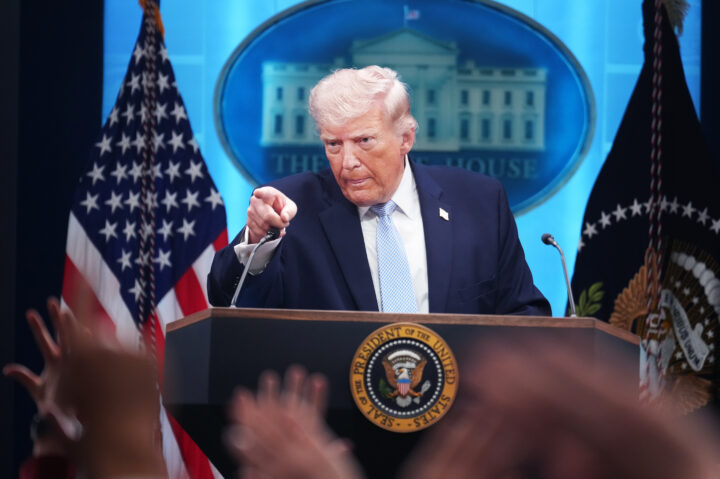
President Donald Trump conducts a news conference in the White House briefing room about the war in Iran on Monday, April 6, 2026.
This P.M. edition is reserved for our premium subscribers — offering a forward-focused read on what we’re tracking now and what’s coming next. Please don’t hesitate to share your thoughts and feedback by replying to this email.
📡On Our Radar
Notable developments and interesting tidbits we’re tracking
Amid reports that Iran has rejected the U.S.’ ceasefire framework, President Donald Trump told reporters Tehran has made its own “significant” proposal, though it is “not good enough.”
Asked if he may push the deadline again for Iran to reopen the Strait of Hormuz or face increased U.S. military action — as he has already done three times — Trump said, “Highly unlikely. They’ve had plenty of time.”
Trump also claimed the U.S. had “sent guns, lot of guns” into Iran. “They were supposed to go to the people so they could fight back against these thugs. You know what happened? The people that they sent them to kept them, because they said, ‘What a beautiful gun. I think I’ll keep it,’” he said…
At a press conference this afternoon, Defense Secretary Pete Hegseth said today would mark “the largest volume of strikes since Day 1” of the Iran war, with more to come tomorrow.
Trump doubled down on his threats, warning that all of Iran “can be taken out in one night, and that night might be tomorrow night.” If Tehran does not acquiesce by his 8 p.m. ET deadline tomorrow, Trump said, “they’re going to have no bridges. They’re going to have no power plants. Stone ages.”
The president also floated the possibility of charging U.S. tolls to ships transiting the Strait of Hormuz once it is reopened and potentially seizing Iran’s oil. Trump and defense officials further detailed the harrowing rescue of a fighter jet pilot, who reportedly treated his own wounds while scaling mountainous terrain to evade capture after being downed over Iran…
Israeli Prime Minister Benjamin Netanyahu said he spoke yesterday with Trump, who thanked him for Israel’s assistance in rescuing the pilot…
Joe Kent, the former director of the National Counterterrorism Center who resigned over his opposition to the Iran war, shared a post on social media on Saturday spreading false claims from Iranian state-linked media and Drop Site News that the U.S. was attempting to kill the servicemember whose fighter jet was shot down over Iran prior to him being rescued, Jewish Insider’s Matthew Shea reports.
The initial statement from Drop Site, a far-left news outlet sympathetic to Hamas and totalitarian regimes, cited a report by Tasnim News, which is linked to the Islamic Revolutionary Guard Corps, claiming that the U.S. had “lost hope” of recovering the airman and was instead “attempting to kill him”…
Rep. Pat Fallon (R-TX), who previously served in the Air Force, predicted that the U.S. will deploy ground troops into Iran: “I just don’t see any other way,” he said on Fox News. “I personally think it’s going to be boots — at least special ops, American special operators — on the ground, with allies in the region and air cover,” he said…
The U.S.-led Board of Peace is pressing Hamas to finalize a Gaza demilitarization agreement by the end of the week, The New York Times reports, which would require the terror group to give up its weapons and maps of its tunnel network in the enclave. Negotiators from both sides are expected to meet in Cairo, Egypt, tomorrow…
Democratic Michigan state Sen. Mallory McMorrow announced she raised more than $3 million in the first quarter of 2026 in her bid for U.S. Senate. “There was not a dime of corporate PAC donations, not a dime of AIPAC donations,” she said in a video. The pro-Israel group was the only organization she named.
While McMorrow’s opponents have not yet publicized their latest fundraising figures, her haul surpassed those of last quarter, when Rep. Haley Stevens (D-MI) led the pack with $2.1 million raised in the final quarter of 2025…
The Senate Leadership Fund, the Senate GOP’s top super PAC, revealed its $350 million plan to retain control of the upper chamber, focusing on defending incumbents in Ohio, North Carolina, Maine, Iowa and Alaska and seeking to flip seats in Michigan, Georgia and New Hampshire.
The funds will largely be used for ad campaigns, with the most money being spent to defend Sen. Jon Husted (R-OH), who must win his first Senate election for the remainder of his term against the likely Democratic nominee, former Sen. Sherrod Brown (D-OH)…
Ukrainian President Volodymyr Zelensky received a grand welcome upon touching down in Damascus yesterday for his first meeting with Syrian President Ahmad al-Sharaa. The two leaders “explored avenues for strengthening economic cooperation and the exchange of expertise,” al-Sharaa said…
Sovereign wealth funds from Saudi Arabia, Qatar and the UAE have signed equity commitments to the tune of $24 billion to back Paramount’s acquisition of Warner Bros. Discovery, The Wall Street Journal reports…
⏩ Tomorrow’s Agenda, Today
An early look at tomorrow’s storylines and schedule to keep you a step ahead
Keep an eye out in Jewish Insider for a preview of tomorrow’s special election runoff in Georgia’s 14th Congressional District, where Republican military veteran and Israel supporter Clay Fuller is expected to win the ruby-red seat of former Rep. Marjorie Taylor Greene (R-GA).
Defense Secretary Pete Hegseth and Gen. Dan Caine, chairman of the Joint Chiefs of Staff, will hold another press briefing on the Iran war tomorrow morning.
Michigan Senate candidate Abdul El-Sayed will host rallies tomorrow at Michigan State University and the University of Michigan with guests including Rep. Summer Lee (D-PA) and antisemitic streamer Hasan Piker, a move which has drawn condemnation from some Democrats and sparked a broader debate about the mainstreaming of Piker within the party.
The Democratic National Committee will begin its five-day meeting in New Orleans tomorrow, where its resolutions committee will consider several resolutions condemning AIPAC and Israel, including calls for conditions on or a suspension of U.S. military aid to the Jewish state.
NATO Secretary-General Mark Rutte will meet with Trump and administration officials in Washington on Wednesday, as the president continues to slam the organization for its refusal to engage in the Iran war.
In observance of Passover, we’ll be back in your inbox with the Daily Overtime on Monday, April 13. Chag Pesach Sameach!
Stories You May Have Missed
ALTERED LIVES
They survived the Temple Israel attack. They can’t escape what followed

The foiled attack at the Michigan synagogue is being called a miracle — but those who were inside now face the lasting impact of trauma and a search for safety
O CANADA
As antisemitic attacks mount, Canadian Jews ask whether they still belong
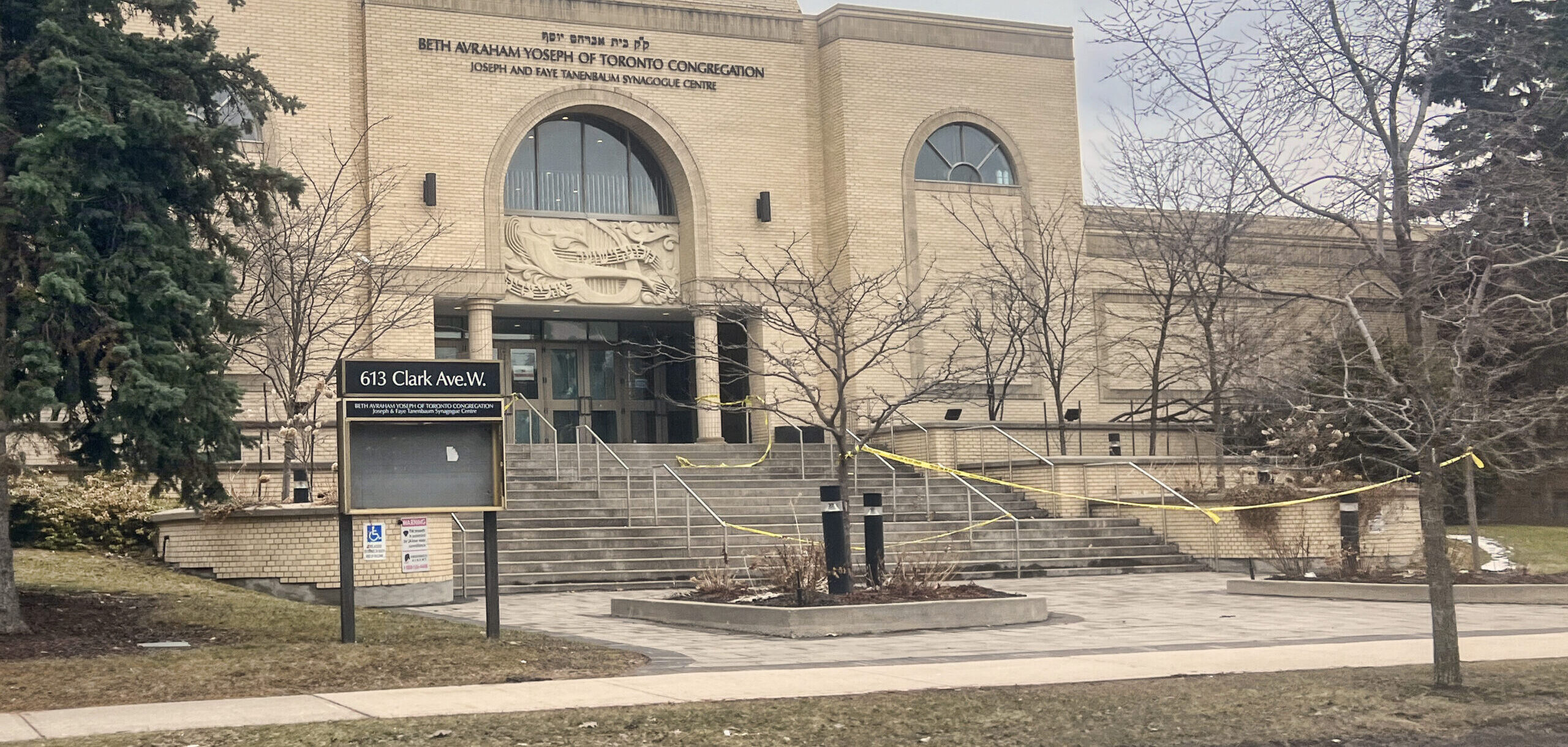
After a series of targeted attacks in Toronto and beyond, Jewish leaders are raising the alarms on Canada’s failure to properly protect its Jews amid ‘systemic’ antisemitism
Plus, judge rules against UPenn in antisemitism investigation

Haidar Mohammed Ali/Anadolu via Getty Images
Mourners carry the coffin of Kata'ib Hezbollah member on March 2, 2026 amid Kata'ib Hezbollah flags.
This P.M. edition is reserved for our premium subscribers — offering a forward-focused read on what we’re tracking now and what’s coming next. Please don’t hesitate to share your thoughts and feedback by replying to this email.
📡On Our Radar
Notable developments and interesting tidbits we’re tracking
President Donald Trump lashed out at European countries this morning for their posture during the war in Iran: He wrote on Truth Social that France is prohibiting planes with military supplies destined for Israel from flying over its territory, calling Paris “VERY UNHELPFUL … The U.S.A. will REMEMBER!”
Trump also named the U.K. among the countries “which refused to get involved in the decapitation of Iran” and are now struggling to acquire fuel due to the effective closure of the Strait of Hormuz. “[G]o to the Strait, and just TAKE IT. You’ll have to start learning how to fight for yourself, the U.S.A. won’t be there to help you anymore, just like you weren’t there for us,” the president warned…
Trump told the New York Post about reports that he’s willing to end the war without reopening the Strait of Hormuz: “I don’t think about it, to be honest. My sole function was to make sure that they don’t have a nuclear weapon. They’re not going to have a nuclear weapon. When we leave the strait will automatically open.”
He similarly said to CBS News about removing Iran’s enriched uranium, “I don’t even think about it. I just know that, you know, that’s so deeply buried it’s gonna be very hard for anybody. … It’s pretty safe. But, you know, we’ll make a determination”…
During a press briefing this morning, Defense Secretary Pete Hegseth revealed that he took a secret trip to the Middle East in recent days to meet with U.S. servicemembers, including Air Force intelligence analysts, Army troops and pilots.
CENTCOM also confirmed that Adm. Brad Cooper visited Israel earlier this week where he met with Defense Minister Israel Katz and Lt. Gen. Eyal Zamir, the IDF’s chief of staff…
Israel is ending all arms purchases from France and “replacing it with domestic Israeli procurement or purchases from allied countries,” the Israeli Ministry of Defense said today, adding that there will be “no new professional engagement with the French military” in the latest rift in the deteriorating relationship between Jerusalem and Paris…
A week after Lebanon declared Iran’s ambassador to Beirut persona non grata and expelled him from the country, the ambassador has still refused to leave the embassy compound, and Iran has stated that the embassy remains open…
China and Pakistan, which has been the intermediary for indirect negotiations between the U.S. and Iran, put forward a ceasefire proposal that would see the immediate cessation of hostilities, the safeguarding of nonmilitary targets and the restoration of transit through global shipping lanes…
American journalist Shelly Kittleson was kidnapped in Baghdad, Iraq, today, according to the Iraqi interior ministry, reportedly by Kataib Hezbollah, the same group that held researcher Elizabeth Tsurkov for over 900 days. Kittleson is a freelance journalist primarily based in Europe who has written for outlets including Al-Monitor and Foreign Policy.
Dylan Johnson, assistant secretary of state for global public affairs, said in a statement that the State Department “is aware of the reported kidnapping” and had “previously fulfilled our duty to warn this individual of threats against them.” Johnson said an “individual with ties” to Kataib Hezbollah “has been taken into custody” in connection with the kidnapping and that the department will coordinate with the FBI to secure Kittleson’s release…
New York City Mayor Zohran Mamdani attended a dinner for Eid last week where he spoke with antisemitic streamer Hasan Piker, a conversation that Piker called “very productive” on a recent Twitch stream.
“No, he did not disavow me,” Piker said in response to a listener’s question. “‘Did you tell him to tune out the bad faith haters?’ I did,” Piker continued. Mamdani appeared on Piker’s Twitch for an interview during the mayoral campaign but has not met with him publicly since…
“Nope,” Rep. Josh Gottheimer (D-NJ) said in response to a video of Sen. Bernie Sanders (I-VT) claiming that, “in many respects,” Piker “is doing a very good job.” “Hasan Piker is a proud antisemite … His voice should have no place in our political discourse and all elected officials should condemn his rhetoric,” Gottheimer wrote…
Michigan Attorney General Dana Nessel, a Jewish Democrat, shared an image of a sign which read, “A Jewish data center has no home here,” displayed outside a town hall she held yesterday urging caution around the approval of data centers. “If you think antisemitism isn’t a problem in Michigan, think again,” Nessel wrote…
A new poll commissioned by former Maine state Sen. Troy Jackson, now a Democratic candidate for governor, found oyster farmer Graham Platner — whom Jackson is backing — nearly 40 points ahead of Gov. Janet Mills in the state’s Senate race (66-28%) among likely Democratic primary voters. The survey was conducted after Mills had started running ads against Platner based on his past controversial statements, a sign that her line of attack may not be persuading voters…
And another poll commissioned by the Senate Majority PAC, a Democratic group, found Texas Attorney General Ken Paxton leading in the heated Republican primary runoff for Senate against incumbent Sen. John Cornyn (R-TX), 47-42%…
A federal judge ruled that the University of Pennsylvania must comply with a subpoena from the Trump administration that seeks information about Jewish university affiliates, which the university had said resembled nefarious efforts by governments over history to gather lists of Jews…
⏩ Tomorrow’s Agenda, Today
An early look at tomorrow’s storylines and schedule to keep you a step ahead
Keep an eye out in Jewish Insider for a report from West Bloomfield, Mich., where JI’s Gabby Deutch sat down with community members still reeling from the attack on Temple Israel earlier this month.
Democrat Analilia Mejia and Republican Joe Hathaway will participate in a debate tomorrow evening ahead of the April 16 special election in New Jersey’s 11th Congressional District, after Mejia eked out a surprise victory in last month’s primary. While this race will decide who serves out the rest of Gov. Mikie Sherrill’s House term, the progressive Mejia is also running essentially unopposed by other Democrats for the full term.
In observance of Passover, we’ll be back in your inbox with the Daily Overtime on Monday, April 6. Chag Pesach Sameach!
Stories You May Have Missed
COMMUNITY TIGHTROPE
In Michigan Senate primary, McMorrow balances Jewish fears and Arab outreach after attack
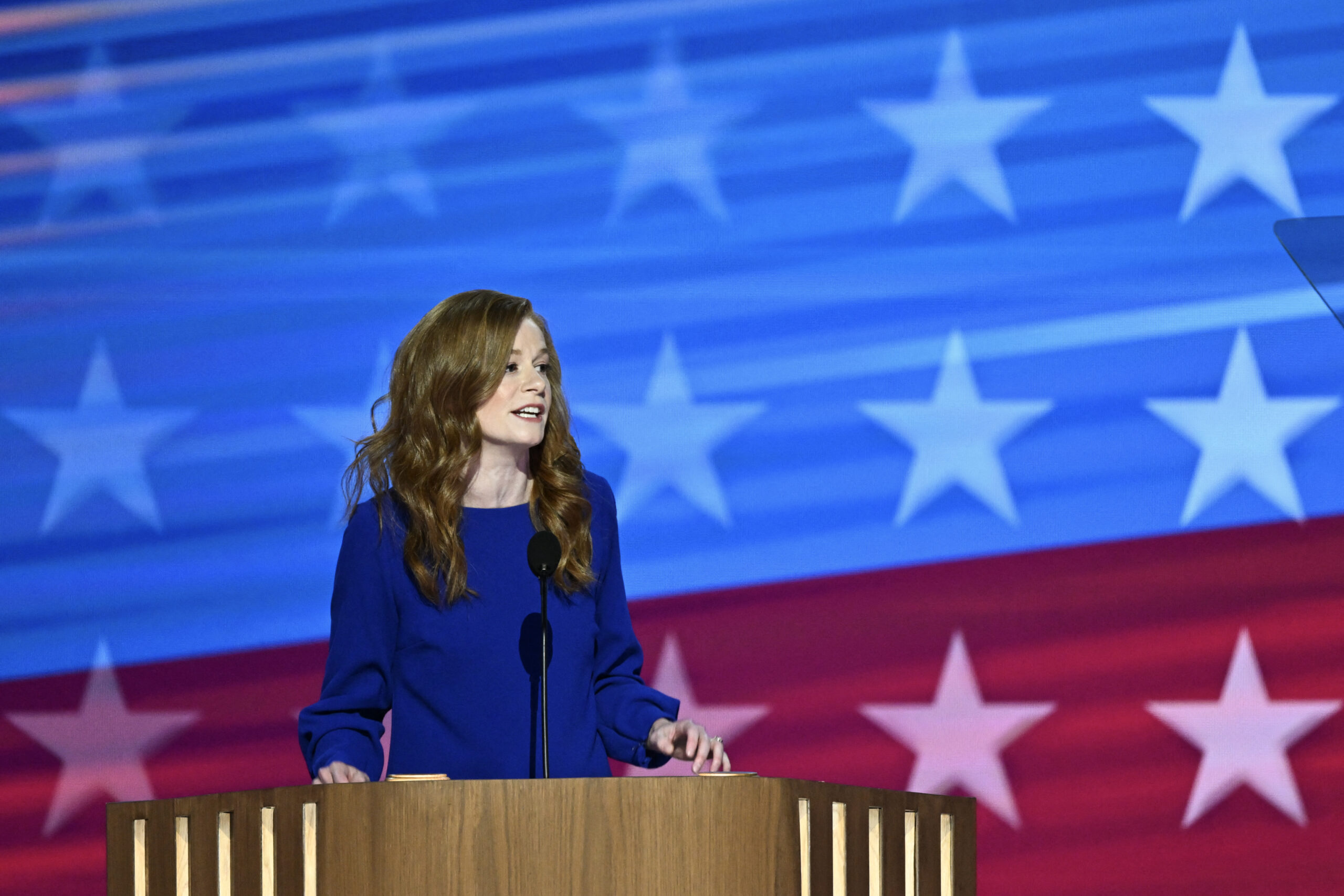
In an interview with JI, the state senator described herself as someone who supports the U.S.-Israel relationship, but not unconditionally
DECISION TIME
Trump at a crossroads on Iran: Will he or won’t he send in troops?

As the president touts progress in talks with Tehran while escalating military pressure, analysts say the administration is keeping its options open — but will need to make a move soon
Plus, one AI rabbi down but more pop up

Emily Elconin/Getty Images
Caution tape near the front entrance of Temple Israel a day after an active shooter incident on March 13, 2026 in West Bloomfield, Michigan.
This P.M. edition is reserved for our premium subscribers — offering a forward-focused read on what we’re tracking now and what’s coming next. Please don’t hesitate to share your thoughts and feedback by replying to this email.
📡On Our Radar
Notable developments and interesting tidbits we’re tracking
President Donald Trump doubled down on threats to escalate the war in Iran while simultaneously heralding the success of ongoing negotiations: He claimed on Truth Social this morning that the U.S. is in “serious discussions” with a “new” and “more reasonable” Iranian regime and that “great progress has been made.”
“But,” he added, “if for any reason a deal is not shortly reached, which it probably will be, and if the Hormuz Strait is not immediately ‘Open for Business,’ we will conclude our lovely ‘stay’ in Iran by blowing up and completely obliterating all of their Electric Generating Plants, Oil Wells and Kharg Island (and possibly all desalinization plants!)”…
Trump confirmed to the New York Post that the U.S. is engaging with Iranian parliament speaker Mohammad Bagher Ghalibaf and assessing whether he’s a reliable partner: “We’re gonna find out. I’ll let you know that in about a week.” He also said the U.S. believes new Supreme Leader Mojtaba Khamenei is “probably” alive “but in extraordinarily bad shape” after he was injured in an airstrike…
Treasury Secretary Scott Bessent claimed in a Fox News interview that the U.S. is “going to retake control of the straits and there will be freedom of navigation, whether it is through U.S. escorts or a multinational escort”…
A series of surveys released today reveal how Jews and Israelis are perceiving the war in Iran: A poll conducted by the Mellman Group found 55% of American Jews oppose the war while 32% are in favor. Another poll of American Jews, solicited by J Street, found 60% of respondents opposed and 40% in support.
In Israel, meanwhile, a poll released by the Israel Democracy Institute found that the war is losing some support among Israelis, Jewish Insider’s Lahav Harkov reports. In the first week of the war, 93% of Jewish Israelis supported continuing it, while in the latest poll — conducted nearly a month into the war — 78% support it. Nearly three times as many Israeli Jews (12%) now oppose the war as did at the beginning of March (4%)…
The FBI announced findings that the attack on Temple Israel in suburban Detroit earlier this month was “a Hezbollah-inspired act of terrorism purposely targeting the Jewish community and the largest Jewish temple in Michigan.” The brother of the assailant was a Hezbollah commander who had been killed in Lebanon by the IDF the week before the attack…
Michigan Democratic Senate candidate Abdul El-Sayed told campaign staff that he did not want to take any public position on the killing of former Iranian Supreme Leader Ayatollah Ali Khamenei at the beginning of the war because “there are a lot of people in Dearborn who are sad,” according to meeting audio obtained by The Washington Free Beacon.
If asked by reporters, El-Sayed said his strategy would be to “go straight to pedophilia, frankly. I’ll just be like, ‘Pedophile president decides that he doesn’t like the front page news, so he decides to take us into another war’”…
Allies of New York City Mayor Zohran Mamdani told Politico that the mayor’s dismissal of criticisms of his wife, Rama Duwaji, for her past extreme rhetoric and social media posts — calling her “a private person” — doesn’t comport with Duwaji’s very public profile.
“‘She is the first lady of New York City. She has a police detail and a government staff,’ said one of the elected officials, who believes Duwaji should explain herself publicly. ‘She would need to do an interview, better explain herself, and have her do some visits and meetings with key constituencies, like Jewish museums’”…
An AI-generated Instagram account, which featured a fake Orthodox rabbi spreading antisemitic conspiracies to its more than 1.4 million followers, was taken offline over the weekend following major backlash from Jewish groups and one Democratic lawmaker — yet several similar, hate-peddling accounts have emerged with little to no public action from Meta, JI’s Haley Cohen reports.
Several new Rabbi Goldman accounts started posting similar videos within the past two weeks — two of which already have followings of 18,500 and 10,000. Both remain active on Instagram and their bios state, “only Backup account for @rabbigoldman” and “old account got banned”…
The Knesset passed a controversial law today allowing courts to impose the death penalty on convicted terrorists found guilty of murder, JI’s Lahav Harkov reports.
The law, championed by National Security Minister Itamar Ben-Gvir, applies in military courts to non-Israeli residents of the West Bank — meaning, in the vast majority of cases, Palestinians. In civilian courts, the law permits applying the death penalty to those who “intentionally cause the death of a person with the aim of denying the existence of the State of Israel” — language which would also likely exclude Jewish assailants. Critics say it will likely be struck down by the High Court…
The Times of Israel breaks down the legislative maneuver used in Knesset by the coalition that caused opposition members to accidentally vote in favor of allocating 800 million shekels (~$250 million USD) to Haredi schools as they passed the state budget this morning…
In an interview on Israel’s Channel 12, Ukrainian President Volodymyr Zelensky said he has barely spoken to Israeli Prime Minister Benjamin Netanyahu since their last meeting at the United Nations General Assembly in September 2023…
⏩ Tomorrow’s Agenda, Today
An early look at tomorrow’s storylines and schedule to keep you a step ahead
Keep an eye out in Jewish Insider for a look at the resolution coming under consideration by the Democratic National Committee that explicitly criticizes AIPAC’s political spending.
The House and Senate left for recess until mid-April, after failing to come to an agreement to fund the Department of Homeland Security, which has now reached its longest-ever shutdown. Calls have already begun from at least one Republican senator to bring Congress back into session sooner, but prospects for an early return are currently unclear.
Sen. Cory Booker (D-NJ) will speak at Temple Emanu-El in New York City tomorrow about his new book, Stand, on the one-year anniversary of his delivery of the longest-ever speech on the Senate floor.
Stories You May Have Missed
SEAT SHAKE-UP
Sheila Cherfilus-McCormick’s scandal could send another Israel critic to Congress
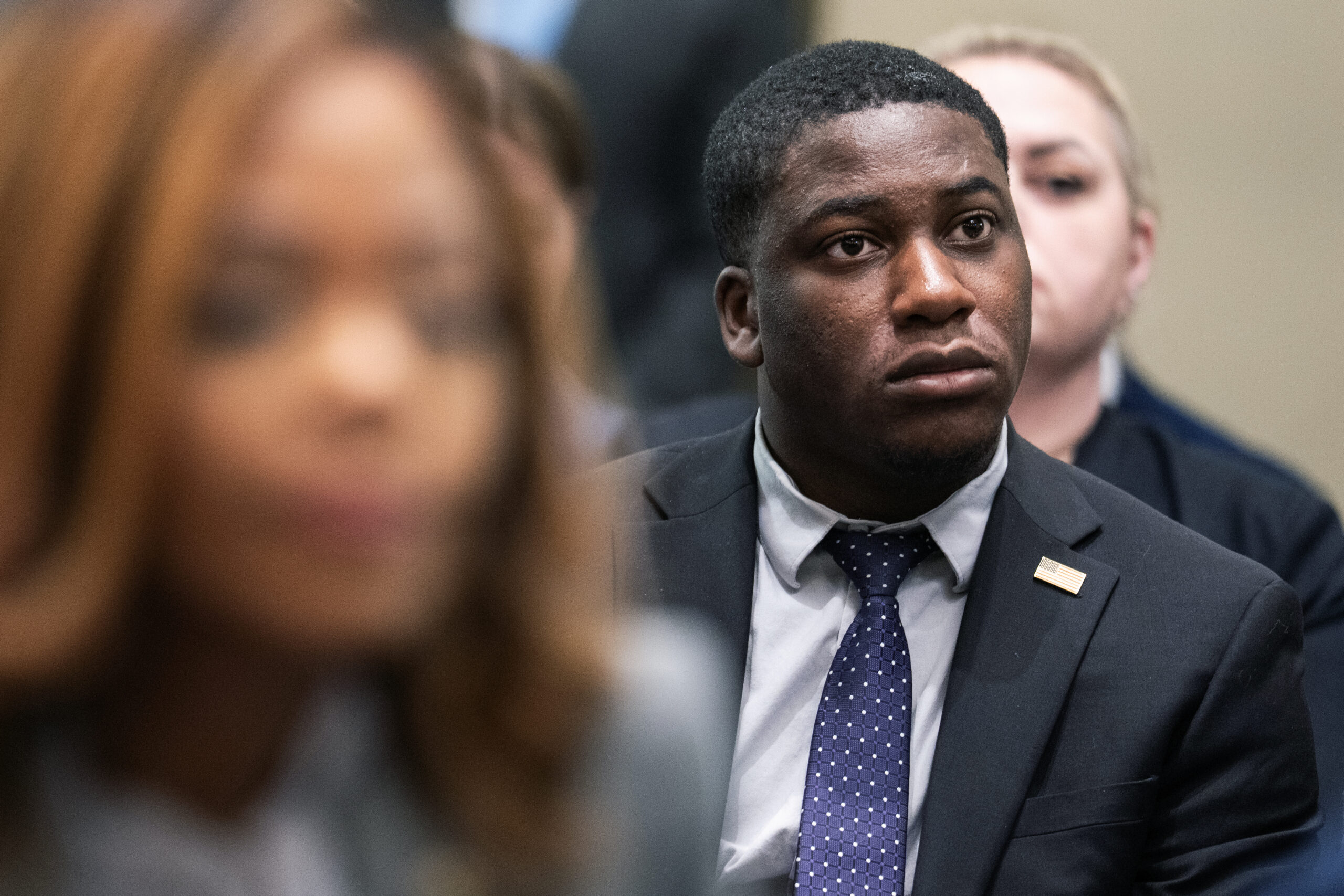
The lawmaker, who may soon be expelled from the chamber, is already in a heated primary race with Elijah Manley, a young far-left candidate endorsed by TrackAIPAC
PHONE A FRIEND
Family of China-allied tech mogul embedded in Zohran Mamdani’s movement
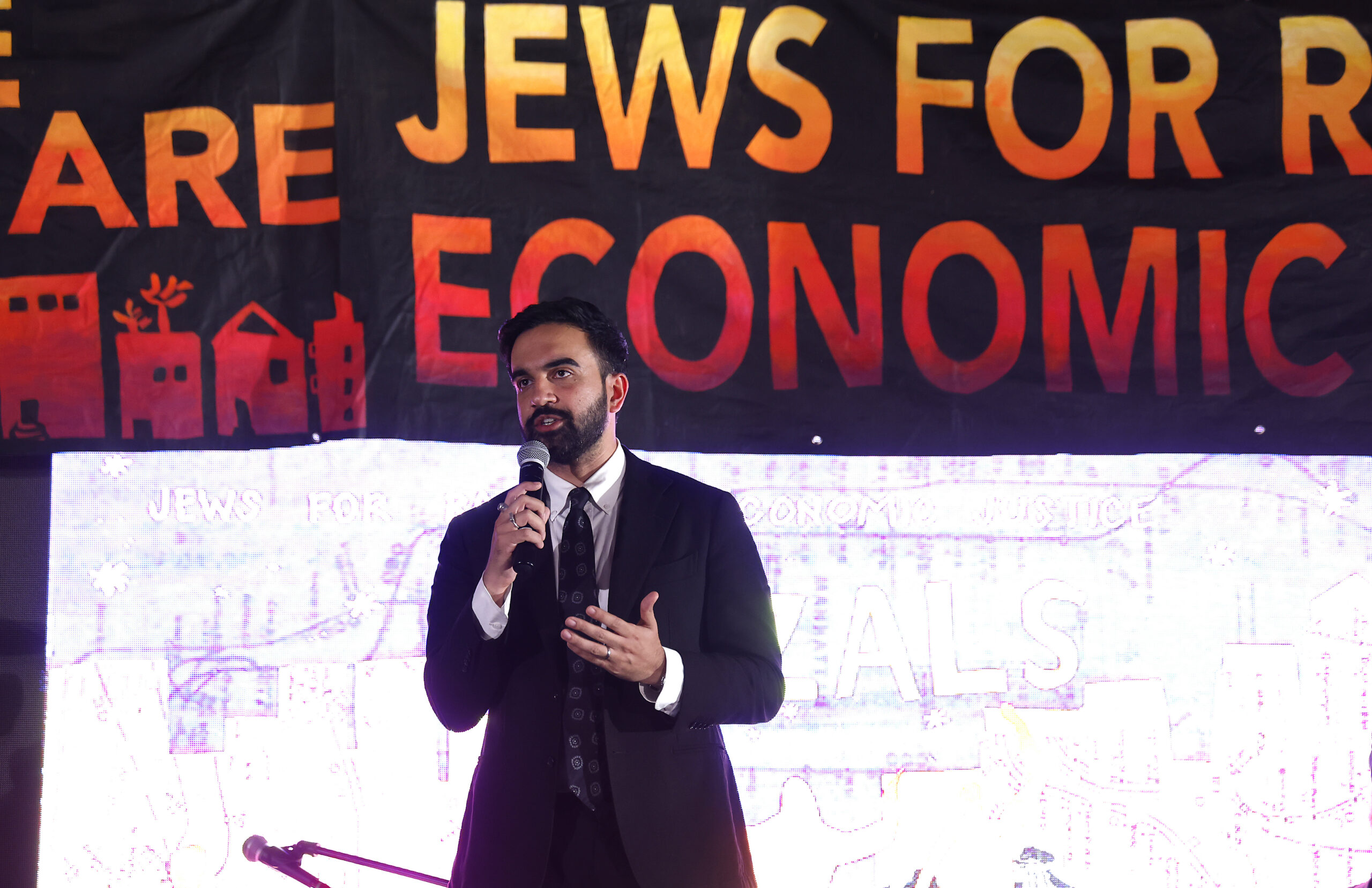
The sister, niece and brother-in-law of Maoist magnate Neville ‘Roy’ Singham have gained influence in New York’s ascendant socialist movement
Plus, fake AI rabbis peddle antisemitism
Will Oliver/EPA/Bloomberg via Getty Images
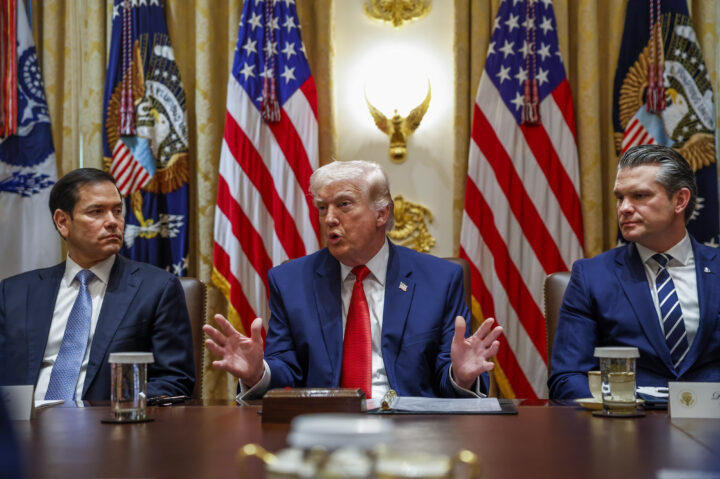
Secretary of State Marco Rubio, President Donald Trump and Defense Secretary Pete Hegseth during a Cabinet meeting at the White House in Washington, DC, US, on Thursday, March 26, 2026.
This P.M. edition is reserved for our premium subscribers — offering a forward-focused read on what we’re tracking now and what’s coming next. Please don’t hesitate to share your thoughts and feedback by replying to this email.
📡On Our Radar
Notable developments and interesting tidbits we’re tracking
President Donald Trump announced this afternoon that he’s extending his original five-day delay on strikes on Iran’s energy sector, which was set to expire tomorrow, by another 10 days. “As per Iranian Government request … I am pausing the period of Energy Plant destruction by 10 Days to Monday, April 6, 2026, at 8 P.M., Eastern Time,” he wrote on Truth Social, adding that negotiations continue and are “going very well”…
At a Cabinet meeting earlier today, Trump revealed that the “present” Iran had provided the U.S. earlier this week was allowing eight Pakistani-flagged oil tankers to pass safely through the Strait of Hormuz, which he said proved the U.S. was speaking with the “right people” in Iran with the authority to make such decisions.
Special Envoy Steve Witkoff, meanwhile, confirmed reports that the U.S. had presented Iran with a “15-point action list” as a starting offer in peace talks between the two countries, and that Pakistan is acting as mediator…
Speaking at the FII Priority summit in Miami, Jared Kushner said that, during his negotiations with Iran prior to the war, “We basically saw that there was no seriousness, and that they were trying to play different games to just get beyond President Trump in order to preserve their capabilities and pathway to get to a nuclear weapon in a way that would have been very, very hard to be stopped in the future”…
CENTCOM applauded an Israeli strike that killed Alireza Tangsiri, the commander of the IRGC Navy, and warned all IRGC Navy members to “immediately abandon their post and return home.” Tangsiri had been named a Specially Designated Global Terrorist by the U.S. in 2019 and was leading Iran’s efforts to shutter the Strait of Hormuz…
Even as U.S.-Iran negotiations continue, the U.S. is considering diverting weapons for Ukraine to the Middle East, The Washington Post reports, including air-defense interceptor missiles.
Ukraine has proved a stalwart ally to the Gulf as it comes under attack from Iran — around 200 Ukrainian military personnel have been deployed around the Middle East to help defend against Iranian drones and President Volodymyr Zelensky arrived in Saudi Arabia today for a surprise visit…
Resources are also being redirected to Gaza — the Trump administration has reportedly pulled $1.25 billion from international peacekeeping and disaster assistance programs for the Board of Peace’s operations, for which Trump had pledged $10 billion in U.S. funding…
An AI-generated Instagram account portraying an Orthodox-looking rabbi is pushing antisemitic conspiracy theories to its more than 1.4 million followers, and it’s not the only one, according to a study published Wednesday by Combat Antisemitism Movement.
Jewish Insider’s Haley Cohen reports: Researchers identified 12 AI-generated “rabbis” with a combined following of 2.1 million Instagram users, all of which promote classic antisemitic stereotypes. The “Rabbi Goldman” account features many of these, including one video in which the “rabbi,” wearing a tuxedo and seemingly seated in a luxury airplane, claims that Jews utilize empty private jets to evade taxes…
A new Emerson College poll of the Maine Senate race found oyster farmer Graham Platner with a nearly 30 point lead over Gov. Janet Mills (55-28%) in the Democratic primary. Both Platner and Mills lead Sen. Susan Collins (R-ME) in the general election matchup, 48-41% and 46-43%, respectively…
California Gov. Gavin Newsom again reaffirmed his support for Israel in an interview with The Bulwark, likening his love for the country but strong disapproval of its current government with how he feels about the U.S…
Democrat Analilia Mejia and Republican Joe Hathaway will participate on April 1 in what is likely to be the only debate of the New Jersey 11th Congressional District’s special election, after the far-left Mejia won the Democratic nomination in a hotly contested primary last month. The New Jersey Globe, which is hosting the debate, acknowledged it had chosen to do so on the first night of Passover, in a district with a sizable Jewish population…
The College Republicans chapter at the University of Florida is suing the school, after a photo of one of its members doing what appeared to be a Nazi salute led to the chapter’s ban from campus.
The chapter argues that the ban violated its First Amendment rights as the member “expressed a viewpoint off-campus that was alleged by some to be anti-Semitic,” and claims it was deactivated in part because it recently hosted James Fishback, a candidate for Florida governor who has expressed antisemitic and anti-Israel views…
⏩ Tomorrow’s Agenda, Today
An early look at tomorrow’s storylines and schedule to keep you a step ahead
Keep an eye out in Jewish Insider for comments from Michigan state Sen. Mallory McMorrow on Israel and antisemitism as she seeks the Democratic nomination for U.S. Senate against Rep. Haley Stevens (D-MI) and Abdul El-Sayed.
President Donald Trump will provide closing remarks at the FII Priority summit in Miami tomorrow afternoon.
Texas Attorney General Ken Paxton will headline CPAC’s Ronald Reagan Dinner. His primary opponent, Sen. John Cornyn (R-TX), will not be making an appearance, despite the confab taking place in his home state and calls from its leadership for him to attend.
Secretary of State Marco Rubio is traveling to France to attend a meeting of G7 foreign ministers where he is expected to press allies on the Iran war — he told reporters as he departed today, echoing a line from Trump, that the countries involved “get far more of their fuel from” the Strait of Hormuz “than we do.”
Stories You May Have Missed
TROUBLE IN THE NEIGHBORHOOD
Gulf states slam Arab League countries for tepid response to Iranian aggression

Frustrated UAE leaders are questioning the ‘impotence’ of countries like Egypt — and warn that silence on Iranian aggression will push the Gulf closer to U.S., Israel
MICHIGAN MOMENT
Elissa Slotkin, Haley Stevens criticize El-Sayed over rallies with Hasan Piker
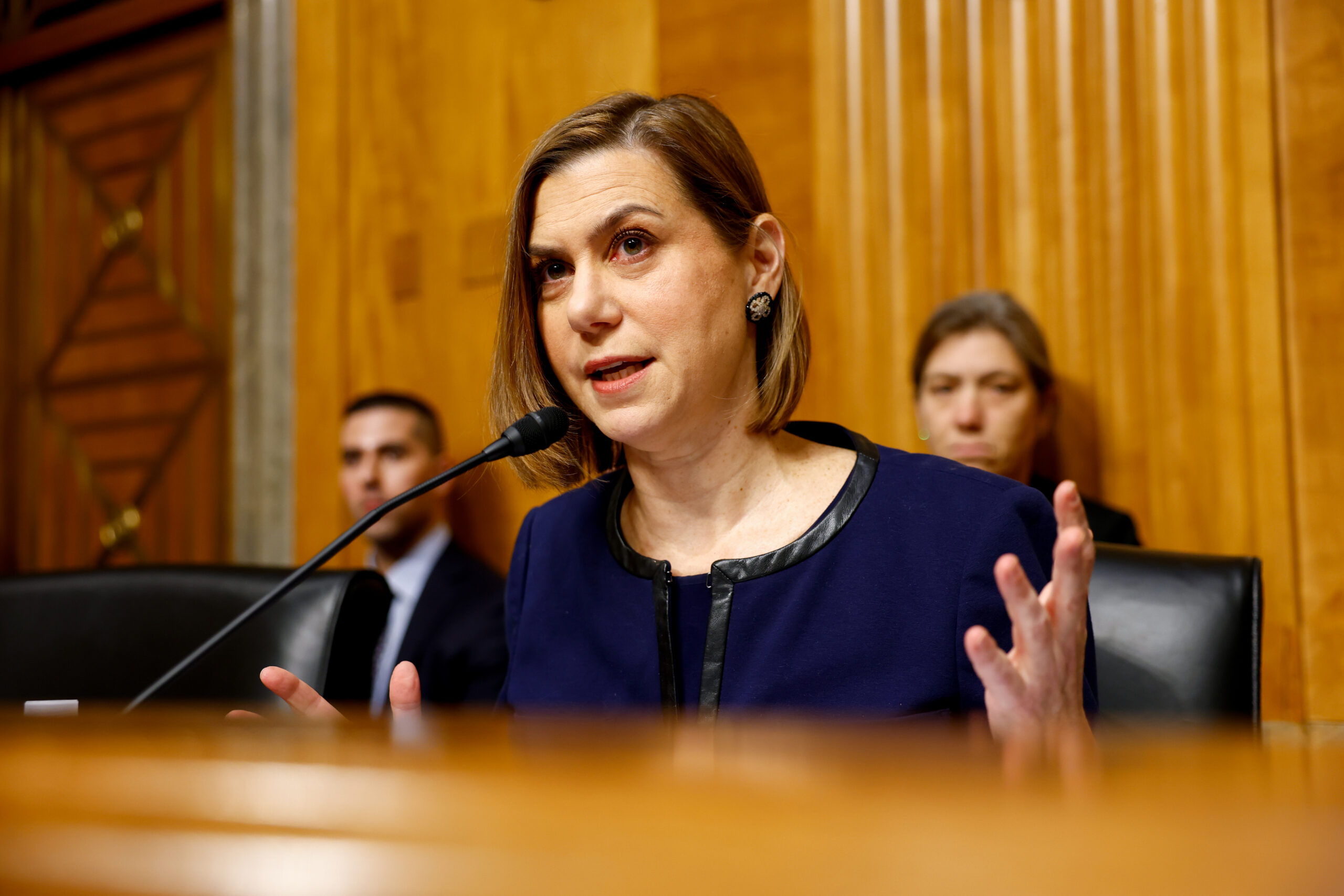
Stevens said that by associating with Piker, El-Sayed is ‘choosing to campaign with someone who has a history of antisemitic rhetoric’
‘At post’s discretion, advocacy efforts should be coordinated with Israeli diplomatic counterparts,’ a leaked diplomatic cable stated, according to ABC
Oliver Contreras / AFP via Getty Images
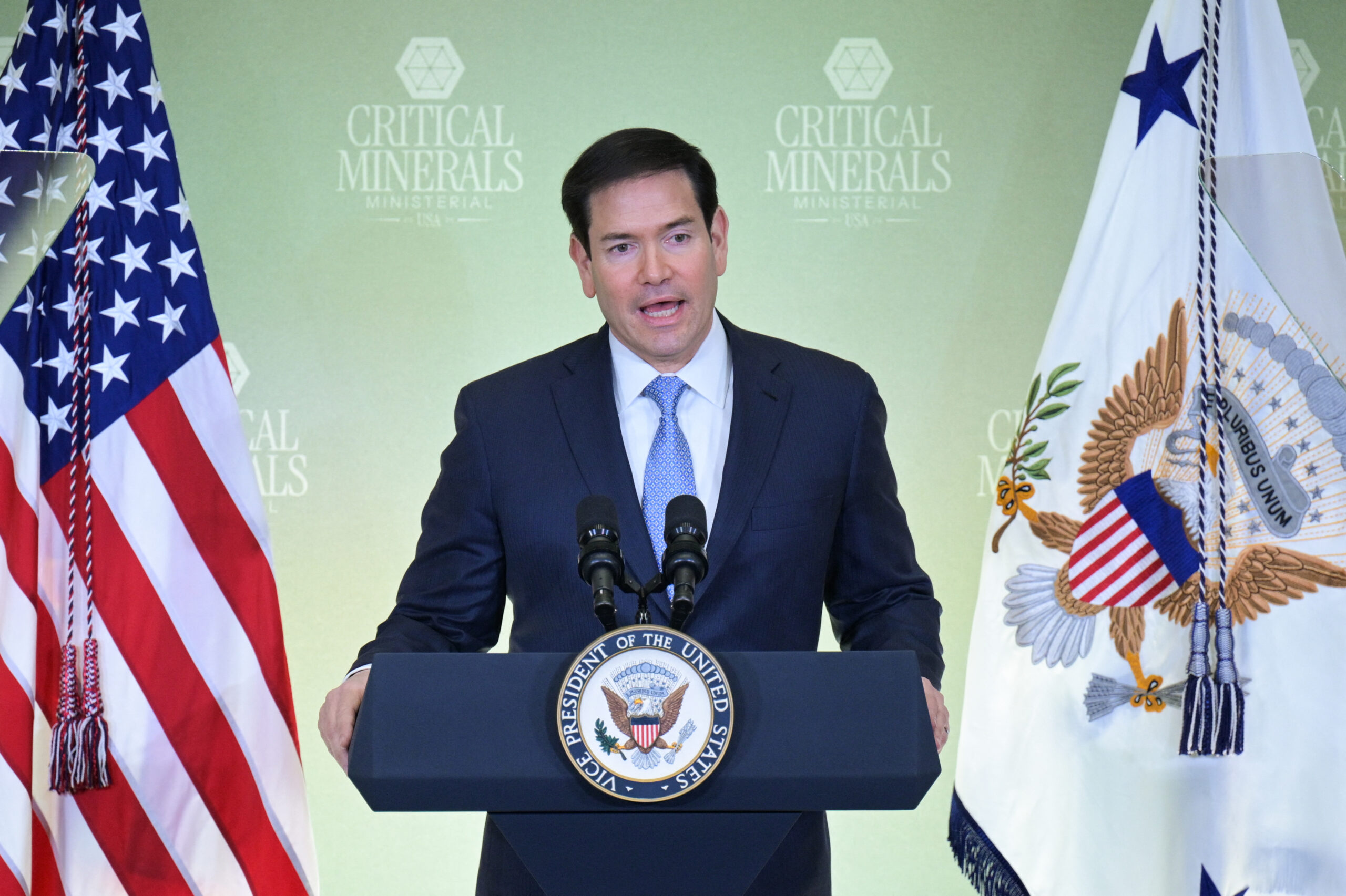
Secretary of State Marco Rubio speaks during the inaugural Critical Minerals Ministerial meeting at the Sate Department in Washington, DC, on February 4, 2026.
Secretary of State Marco Rubio in a recent cable encouraged American diplomats to work with local Israeli embassies on messaging efforts to encourage foreign governments to collaborate with the U.S. in its war against Iran, ABC News reported on Monday.
“At post’s discretion, advocacy efforts should be coordinated with Israeli diplomatic counterparts,” a leaked diplomatic cable stated, according to ABC.
In the cable titled “Elevated Concern of [Islamic Revolutionary Guard Corps] Activity,” Rubio noted that there is an “elevated risk of attack” from Iran, and told diplomats to encourage the governments where they were posted to “move expeditiously to diminish the capabilities of Iran and Iran-aligned terrorist groups from attacking our respective nations and citizens.”
“We assess that the Iranian regime is more sensitive to collective action than unilateral action, and that joint pressure is more likely to compel behavior change by the regime than unilateral actions alone,” the cable reportedly stated. “We must act while international attention is focused now to end the Iranian campaign of terror in the Middle East and globally. Do not allow this critical movement to pass.”
The report comes as President Donald Trump pushes for other countries to join U.S. efforts to prevent Iran from closing the Strait of Hormuz, the point through which oil can be transported out of the Gulf to the open sea.
Rubio also directed diplomats in countries that have not declared the IRGC and Hezbollah to be terrorist organizations to relay the message that they should do so “swiftly,” because “such a designation will intensify the pressure on the Iranian regime and limit its ability to sponsor terror activities across the globe that jeopardizes the safety and security of your populations.”
The cable reportedly noted that the IRGC plans and carries out terrorist attacks on foreign soil and directs espionage and influence operations, which are “intentional acts designed to intimidate populations and inflict harm on your civilians.”
The move marks the latest crackdown from the White House against Muslim Brotherhood affiliates
Andrea Domeniconi/SOPA Images/LightRocket via Getty Images
Man hold a banner reading "The Muslim Brotherhood is a terrorist organization" during a Sudanese rally in Trafalgar Square on Dec. 20, 2025.
On Monday, the Trump administration moved to designate the Sudanese Muslim Brotherhood (SMB) as a Specially Designated Global Terrorist (SDGT) entity and announced plans to impose a Foreign Terrorist Organization (FTO) designation on March 16.
“The Sudanese Muslim Brotherhood uses unrestrained violence against civilians to undermine efforts to resolve the conflict in Sudan and advance its violent Islamist ideology,” Secretary of State Marco Rubio said in a press release. “The United States will use all available tools to deprive the Iranian regime and Muslim Brotherhood chapters of the resources to engage in or support terrorism.”
The SMB is composed of the Sudanese Islamic Movement and its armed wing, the al-Baraa Bin Malik Brigade (BBMB). The Muslim Brotherhood has maintained a significant presence in Sudan since the 1940s and has played a role in the country’s ongoing civil war between the Sudanese Armed Forces (SAF) — backed by Iran, Russia, Egypt and Turkey — and the Rapid Support Forces, which have reportedly received support from the United Arab Emirates.
Experts have previously told Jewish Insider that the SAF is heavily influenced by the SMB, working alongside several Islamist militias and receiving attack drones from Iran’s Islamic Revolutionary Guard Corps (IRGC), which has been designated as a terrorist organization by both the U.S. and the European Union. The SMB has contributed roughly 20,000 fighters to the conflict, with many receiving “training and other support” from the IRGC, according to the State Department.
An alleged Muslim Brotherhood leader in the Sudanese Armed Forces was also caught on video last week asserting that the group is ready to defend Iran amid the ongoing conflict between Tehran and the U.S. and Israel. The leader suggested that the group would send battalions to fight alongside Iran, according to Sky News Arabia.
“As the world’s leading state sponsor of terrorism, the Iranian regime has financed and directed malign activities globally through its IRGC,” Rubio said in the statement, adding that the SMB has also “conducted mass executions of civilians.”
The designation marks the Trump administration’s latest crackdown on Muslim Brotherhood affiliates and represents a notable policy step into the Sudan conflict. In January, the administration designated three Muslim Brotherhood branches in Egypt, Lebanon and Jordan as SDGT entities, with the State Department citing their provision of “material support to Hamas.”
Plus, Gottheimer pans Newsom
Brian Stukes/Getty Images
State Sen. Sharif Street attends a rally outside the Philadelphia Criminal Justice Center on April 16, 2018 in Philadelphia, Pennsylvania.
👋 Good Monday morning!
In today’s Daily Kickoff, we report on the latest in the war with Iran, including a missile attack this morning in which at least one person in Israel were killed, and cover a move by Senate Democrats to introduce five additional war powers resolutions after a similar effort last week failed to get enough support. We profile Pennsylvania state Sen. Sharif Street as the pro-Israel Democrat, who is Black and Muslim, mounts a bid for Congress, and report on concerns from members of the House Education & Workforce Committee that Evanston, Ill., Mayor Daniel Biss, who is running for Congress, “severely downplayed antisemitism” at Northwestern University while in a briefing with committee members. Also in today’s Daily Kickoff: Qatari Prime Minister Sheikh Mohammed bin Abdulrahman al Thani, Gov. Josh Shapiro and Alon Penzel.
Today’s Daily Kickoff was curated by JI Executive Editor Melissa Weiss and Israel Editor Tamara Zieve, with assists from Danielle Cohen-Kanik and Marc Rod. Have a tip? Email us here.
What We’re Watching
- Secretary of State Marco Rubio is set to deliver remarks at 9 a.m. ET at a flag-raising ceremony at the State Department commemorating hostages and wrongful detainees.
- House Republicans are holding their annual policy retreat in Doral, Fla., with President Donald Trump slated to address the gathering at 5 p.m. ET. Also slated to speak at the retreat are Ben Shapiro and CNN’s Scott Jennings.
- EU Council President Antonio Costa and EU Commission President Ursula von der Leyen are holding a call today with Middle East leaders to discuss the ongoing war in the region.
- Team Israel faces off against the Dominican Republic in the World Baseball Classic at noon ET today in Miami. The Israeli team, which lost 11-3 on Saturday against Venezuela, came back to beat Nicaragua 5-0 on Sunday.
What You Should Know
A QUICK WORD WITH JI’S MELISSA WEISS
Recent days have offered a tale of two New York public officials’ wives and a revealing look at inconsistent standards from some mainstream media outlets on how they scrutinize the families of elected officials depending on the political viewpoints expressed.
The first was a New York Times story focused on the pro-Israel social media posts of Rep. Dan Goldman’s (D-NY) wife. Under the headline “Congressman Faces Questions About Wife’s Social Media Stances on Israel,” the Times wrote of the instances — believed to be 10 in all — that Corinne Goldman, who served as treasurer on her husband’s campaign, liked posts related to the Israel-Hamas war in the weeks after the Oct. 7, 2023, Hamas terror attacks, including one comparing “Jews for Palestine” to “Chickens for KFC.”
Days later, Jewish Insider uncovered the social media activity of Rama Duwaji, the Syrian-American wife of New York City Mayor Zohran Mamdani, in the days after the attacks. That activity included liking posts that unambiguously celebrated Hamas’ Oct. 7, 2023, attacks — as they were underway — and included still images from the attacks, in which more than 1,200 were killed and 251 taken hostage.
In his first public statement addressing JI’s reporting, Mamdani said his wife — who less than a month ago was the subject of a cover profile and photo shoot for The Cut — was a “private person.”
It was a response that was unsatisfactory to some. Deborah Lipstadt, the Biden administration’s special envoy to monitor and combat antisemitism, responded to Mamdani’s statement by rhetorically asking, “But Jessica Tisch has to apologize when her brother says something?” — referring to the NYPD commissioner’s recent apology over her brother’s assertion that Mamdani was an “enemy of the Jewish people.”
The Times, which covered Mamdani’s response, changed its headline on the story at least twice after publication, from “Mamdani Says His Wife’s Views on Gaza Are No One’s Business,” to “Mamdani Defends Wife Amid Criticism of her Support for Palestinian Cause,” before eventually landing on “After Social Media Scrutiny, Mamdani Says His Wife Is a ‘Private Person.’”
In response to the second headline, Tel Aviv-based research analyst Daniel Paul Rubenstein wrote on X that he “did not expect to see the New York Times refer to the October 7 Massacre as an expression of the ‘Palestinian Cause’ – but here we are.”
DEATH TOLL RISES
Iranian missile kills two in central Israel as war continues

One person was killed in an Iranian missile attack that struck a construction site in the city of Yehud in central Israel, volunteer emergency service Magen David Adom reported on Monday. MDA pronounced the victim, a man who appeared to be about 40 years old, dead at the scene. Another man, believed to be around the same age, was evacuated to the nearest hospital in serious and unstable condition. Both were foreign workers, Jewish Insider’s Lahav Harkov reports.
Northern front: In Lebanon, two IDF soldiers were killed over the weekend by a missile fired by Hezbollah. The soldiers were retrieving a vehicle from a position in southern Lebanon at the time they were killed, the IDF Spokesperson’s Office said. One soldier, combat engineer Maher Hatar, 38, was the first Druze soldier killed in the war. The second soldier’s identity has not been cleared for publication.
On the bench: President Donald Trump and Israeli Prime Minister Benjamin Netanyahu pushed back on Saturday against reports that they were working with Kurdish leaders to launch a ground invasion of Iran, Jewish Insider’s Lahav Harkov reports.
WORD ON THE STREET
Pro-Israel Muslim Democrat walks political tightrope in Philly primary
Sharif Street is walking a unique political path. The Pennsylvania state senator running for a House seat in the heart of deep-blue Philadelphia is Black and Muslim, and has staked out positions largely supportive of Israel, Jewish Insider’s Marc Rod reports.
What he said: Street traveled to Israel with the American Jewish Committee in 2017 “to gain some understanding” of the complexities facing Israelis and Palestinians. He has indicated that he would not support conditions on U.S. aid to Israel, saying that the two allies need an “open dialogue,” yet he refers to Israeli Prime Minister Benjamin Netanyahu as a war criminal. Street’s nuances on Israel — he backs a strong U.S.-Israel relationship, while also urging a compassionate approach to the Palestinians — offer a sharp contrast with his most prominent rival in the Democratic primary, a strident antagonist of Israel. Street also argues that media portrayals have flattened the American Muslim community and failed to accurately portray their diverse views on the Middle East and relationships with the Jewish community.
RENEWED SCRUTNIY
Texas GOP candidate Brandon Herrera discussed owning a copy of Mein Kampf on podcast

Brandon Herrera, the presumptive Republican nominee in Texas’ 23rd Congressional District, spoke on a podcast in 2024 — after his first run for the House — about owning a copy of Mein Kampf, Nazi leader Adolf Hitler’s manifesto, earning him a fresh rebuke from the Republican Jewish Coalition, Jewish Insider’s Marc Rod reports.
Podcast playback: During a 2024 appearance on the “Unsubscribe” podcast, another guest joked that he had been deeply involved in communism until he had read another book, producing a copy of Mein Kampf. Herrera, who appeared to immediately recognize the book when others on the podcast did not, promptly turned to his phone to produce a picture of his own copy of the Nazi manifesto. “That’s my copy at my house next to a bunch of the German stick grenades,” Herrera said. “I got the 1939 edition printed in English just because I thought it was wild that you couldn’t buy it on Amazon but you could buy The Communist Manifesto and Das Kapital,” he added, making a confused face.
ON DECK
Senate Dems introduce series of new war powers resolutions on Iran
Senate Democrats introduced a series of five new war powers resolutions seeking to block military action in Iran on Thursday, a day after the Senate voted along mostly partisan lines to block an effort to immediately halt the operation, Jewish Insider’s Marc Rod reports.
The latest: Having a series of war powers resolutions already introduced could allow Democrats to continue teeing up a series of votes on the war, or allow them to have several resolutions in reserve to vote on as the situation in Iran evolves. War powers resolutions are subject to a 10-day waiting period between their introduction and when senators can force votes on them.
ON DEFENSE
House Education Committee, in briefing, says Daniel Biss ‘severely downplayed antisemitism’
In a briefing for the House Education & Workforce Committee on his response to the anti-Israel protest encampment at Northwestern University in 2024, Evanston, Ill., Mayor Daniel Biss “severely downplayed” the situation on that campus and antisemitism across the country, the committee said, Jewish Insider’s Marc Rod reports.
Readout: “In his briefing with the Committee today, Mr. Biss severely downplayed antisemitism at Northwestern after October 7th. He told the Committee that the great majority of his Jewish friends in the Northwestern community had no concerns about it,” a committee spokesperson told JI. “He further stated that Northwestern should not have received an F on the Anti-Defamation League’s college report card. He even accused the Committee of alarmism that is not warranted by the facts when it comes to antisemitism at the university after the October 7th attacks.” Biss, meanwhile, has dismissed the committee’s questioning of him as a smear campaign. “From the start, this ‘briefing’ was a flimsy attempt to weaponize the very real threat of antisemitism to attack me and support my opponent. It failed,” Biss said in a statement.
sending signals
Independent Senate candidate Dan Osborn touted endorsement from anti-Israel group
Dan Osborn, a Democratic-aligned independent candidate running for Senate in Nebraska, received and touted an endorsement from a lobbying group that aims to alter U.S. policy toward Israel, in part by electing candidates critical of the U.S.-Israel relationship, Jewish Insider’s Marc Rod reports.
What happened: A New Policy PAC was founded by Josh Paul, a former State Department official who left government in protest of U.S. support for Israel after Oct. 7, 2023, and since joined the anti-Israel group DAWN and become a vocal critic of Israel. A New Policy’s advocacy arm has accused Israel of genocide, urges cutting off and conditioning U.S. aid to Israel; and opposes the Antisemitism Awareness Act and the International Holocaust Remembrance Alliance’s working definition of antisemitism.
Worthy Reads
Risky Business: The Financial Times’ Jacob Judah, Bob Haslett and Alan Smith spotlight Iran’s dwindling number of “indispensable” ballistic-missile launchers and the crews who man them. “When an Iranian ballistic missile launcher breaks cover to dash towards a firing site, its tiny cabin suddenly becomes one of the world’s most perilous places. … Iranian ballistic missile crews are among the most ideologically committed within the Islamic Revolutionary Guard Corps. They operate from mountain hide-outs known in Iran as ‘missile cities’ whose cavernous networks of tunnels wind deep underground.” [FT]
Nobel or Not: In The Wall Street Journal, Joshua Muravchik argues that President Donald Trump’s foreign policy legacy could be solidified by his actions against U.S. adversaries, regardless of whether he is awarded the Nobel Peace Prize. “Reagan never won the Nobel, but in contrast to Mr. Obama and Carter, he greatly advanced world peace and Americans’ safety by bringing low the Soviet Union’s ‘evil empire.’ Mr. Trump could achieve an analogous triumph if he succeeds in undoing the regime in Iran and perhaps the one in Cuba, too. … The downfall of Iran’s regime would blow a gaping hole in this anti-American coalition. It would weaken radical Islam everywhere. Socialism, an idea that had bounced around for nearly a century, became a serious force only when Vladimir Lenin turned Russia into the world’s first socialist state.” [WSJ]
Beijing’s Bad Bet: In The Washington Post, the Hudson Institute’s Miles Yu posits that Beijing’s strategy of investing in Iran for more than a decade as it seeks to gain a foothold in the region has “collapsed” amid the U.S. and Israeli war against Tehran. “[Iran’s] capacity to destabilize the region on China’s behalf has been curtailed. Belt and Road projects tied to Iranian ports, rail corridors and energy infrastructure now face heightened instability and security risk. The vision of a secure overland energy corridor insulated from U.S. naval power has been reduced to uncertainty. China had bet on a confident, defiant and nuclear-ambitious Iran. Instead, it is left with a battered partner whose utility has sharply diminished.” [WashPost]
Word on the Street
In his first comments to the media since the start of the war with Iran, Qatari Prime Minister Sheikh Mohammed bin Abdulrahman al Thani said that Tehran’s decision to strike Arab countries was a “dangerous miscalculation” and that he felt “a big sense of betrayal” by the move…
In a leaked Telegram message, former Iranian Foreign Minister Mohammed Javad Zarif said that Israel and the United Arab Emirates are “one and the same” and that Tehran’s strategy should be to “focus on destroying the bridge between Saudi Arabia and Bahrain in order to create real deterrence against mischief in the island”…
Russia is reportedly providing intelligence to Iran to target U.S. troops in the Middle East…
Azerbaijan said it foiled an Islamic Revolutionary Guard Corps plot to sabotage a number of sites in the country, including the Israeli Embassy in Baku, a synagogue, the leader of a group known as the “Mountain Jews” and the country’s Baku-Tbilisi-Ceyhan oil pipeline…
Two ships owned by an Iranian company under U.S., European and British sanctions departed the Chinese port in Zhuhai known for its storage of chemicals used to make rocket fuel…
The New York Times looks at the concerns of Western officials and nuclear experts over the location and fate of 18-20 canisters of enriched uranium that are believed to still be intact and in Iran…
A Pakistani man was convicted in a U.S. federal court of plotting with Iran to assassinate U.S. officials, including President Donald Trump…
The U.S. began evacuation flights of U.S. citizens from Israel on Friday, Jewish Insider’s Haley Cohen reports…
Sens. Brian Schatz (D-HI), Patty Murray (D-WA), Jeanne Shaheen (D-NH), Jack Reed (D-RI), Mark Warner (D-VA) and Chris Coons (D-DE) released a statement calling on the Department of Defense to “fully and impartially” investigate a strike on an Iranian school on the first day of the war in which more than 100 people, including students, were killed…
The move comes as satellite images and footage increasingly indicate that the U.S. struck the school, which was located near an Islamic Revolutionary Guard Corps installation, despite Trump’s claim that Iran was responsible for the strike…
Rep. Greg Meeks (D-NY), the ranking member of the House Foreign Affairs Committee, again criticized the administration for bypassing normal congressional review processes to approve a $650 million sale of 20,000 bombs to Israel…
Rep. Maxine Waters (D-CA) and 17 Democratic co-sponsors, mostly progressives, introduced legislation requiring stronger oversight of and regular reporting to Congress and the public on the food supply for Palestinians in Gaza…
A group of House Democrats —Reps. Jared Moskowitz (D-FL), Debbie Wasserman Schultz (D-FL), Pramila Jayapal (D-WA), Val Hoyle (D-OR), Mike Thompson (D-CA), Norma Torres (D-CA), Ilhan Omar (D-MN), Sara Jacobs (D-CA), Chrissy Houlahan (D-PA) and Sam Liccardo (D-CA) — called on House Speaker Mike Johnson (R-LA) to cancel the House’s recess this week as long as the war in Iran is ongoing…
Rep. Josh Gottheimer (D-NJ) called out California Gov. Gavin Newsom, a leading 2028 presidential contender, for recent comments characterizing Israel as an apartheid state and questioning future military aid, Jewish Insider’s Marc Rod reports; “Is it really worth throwing Jews under the bus to advance your political ambitions?” Gottheimer said on X this weekend…
Pennsylvania Gov. Josh Shapiro wrote a letter to Attorney General Pam Bondi urging her office to investigate the death of a 19-year-old Palestinian American man who was killed last month in a confrontation with Israeli settlers in the West Bank…
A federal judge nullified a number of actions taken by the U.S. Agency for Global Media, which oversees Voice of America, ruling that Kari Lake was unlawfully serving as the agency’s head when the decisions, which included mass layoffs, were made…
Federal officials will lead the investigation into an incident at a weekend demonstration outside Gracie Mansion in which a homemade explosive device was flung into a crowd of protesters, allegedly by at least once person who told officials they were an ISIS sympathizer…
Two Toronto-area synagogues were damaged by gunfire late Friday and early Saturday following an earlier shooting at another area synagogue last week, Jewish Insider’s Haley Cohen reports…
Police in Liège, Belgium, are investigating an explosion that occurred at a local synagogue this morning, in what a local official called a “violent act of antisemitism”…
The U.K.’s Luton Airport apologized and will institute antisemitism awareness training after an incident in which Israeli author Alon Penzel, who was traveling back to Israel, encountered a member of airport security who made disparaging comments to him…
Authorities in the U.K. are investigating a report of antisemitism during a soccer match in which supporters of the Thorpe St Andrew School allegedly jeered the players from JFS, the U.K.’s largest Jewish school…
Pic of the Day

Team Israel bested the Nicaraguan national team 5-0 on Sunday in its first-ever shutout game at the 2026 World Baseball Classic in Miami. Former Red Sox infielder Kevin Youkilis (center) is serving at the team’s bench manager.
Birthdays
Rhodes scholar, Harvard Law graduate, author and political journalist, Michael Kinsley turns 75…
President at Adelson Family Foundation since 2007 and a board member of Prizmah, Michael Bohnen turns 79… Sag Harbor, L.I.,-based painter, sculptor and printmaker, Eric Fischl turns 78… Host of Public Radio International’s “Science Friday,” Ira Flatow turns 77… Member of the Knesset from 1989-2021, he has served in many cabinet roles and as chairman of Israel Aerospace Industries, Amir Peretz turns 74… President and CEO of NYC’s flagship public TV station WNET, Neal Shapiro turns 68… Professor emeritus of economics at NYU, nicknamed “Dr. Doom,” Nouriel Roubini turns 68… Susan Liebman… NYC-based attorney, Gordon Platt… Private equity and venture capital investor, Howie Fialkov… Founder and head of the Chabad house at Harvard University, Rabbi Hirschy Zarchi… Former Canadian minister of mental health and addictions, Ya’ara Saks turns 53… VP and head of global communications and public affairs for Meta / Facebook, David I. Ginsberg… Senior fellow at Harvard University’s Mossavar-Rahmani Center for Business and Government, Matthew Vogel… Former CEO of the Trevor Project, now CEO of the Malnutrition Advocacy Fund, Amit Paley… Co-founder and CEO at ImpactTechNation, he is also a co-founder of the political party Wake-Up Jerusalem (Hitorerut B’Yerushalayim), Hanan Rubin… Israeli-born singer, now one-half of the world music duo Shlomit & RebbeSoul, Shlomit Levi turns 43… News editor in the U.S. bureau of Jewish News Syndicate, Menachem Wecker… Partner in the Los Angeles law firm of Bocarsly Emden, Rachel Rosner… Political strategist for the Democratic Party, she is a co-host of “The Five” on the Fox News Channel, Jessica Tarlov turns 42… Senior advisor to North Carolina Gov. Josh Stein, Alissa “Sadie” Weiner… CEO at New Orleans-based QED Hospitality, Emery Whalen… Pitcher for Team Israel at the 2017 World Baseball Classic, he now plays in the Mexican League, Jared Lakind turns 34… Founding partner of Mothership Strategies, Jacob “Jake” Austin Lipsett… Manager of education and outreach at inSIGHT Through Education, Marla Topiol… First-round pick in the 2020 NHL Entry Draft, now playing for the NHL’s Nashville Predators, Ozzy Wiesblatt turns 24… Stephen Lent…
Plus, Kristi Noem gets the boot
Tom Williams/CQ-Roll Call, Inc via Getty Images
Reps. Thomas Massie, (R-KY), left, and Ro Khanna, (D-CA), conduct a news conference outside a Department of Justice office in NoMa on Monday, February 9, 2026.
Good Thursday afternoon,
This P.M. edition is reserved for our premium subscribers — offering a forward-focused read on what we’re tracking now and what’s coming next.
It’s me again — Danielle Cohen-Kanik, U.S. editor at Jewish Insider and curator, along with assists from my colleagues, of the Daily Overtime. Please don’t hesitate to share your thoughts and feedback by replying to this email.
📡On Our Radar
Notable developments and interesting tidbits we’re tracking
President Donald Trump announced he’s replacing Kristi Noem as homeland security secretary with Sen. Markwayne Mullin (R-OK), after Noem had rankled the president and some Republican members of Congress with her oversight of widespread turmoil at the agency, among other issues. Mullin still needs to be confirmed by the Senate to assume the post.
Mullin, if confirmed, would take the helm of DHS amid its continued partial shutdown, and as it has repeatedly come under fire for its handling of issues related to antisemitism from lawmakers and Jewish community groups. Noem, meanwhile, will become special envoy to a new security initiative for the Western Hemisphere being launched by Trump this weekend…
House Speaker Mike Johnson (R-LA) and other GOP leadership called on Rep. Tony Gonzales (R-TX) to drop out of his reelection race, after the lawmaker admitted yesterday to having an affair with a staffer who later committed suicide. Gonzales is headed to a May runoff with his primary opponent, social media influencer Brandon Herrera; if Gonzales does step aside, Herrera, who has a history of antisemitic posts about the Holocaust, is all but guaranteed the GOP nomination in a solidly Republican district…
Trump said he “[has] to be involved in the appointment” of the next Iranian leader, in an interview with Axios, “like with Delcy [Rodriguez] in Venezuela.” He called Mojtaba Khamenei, son of the late Supreme Leader Ayatollah Ali Khamenei who has emerged as his father’s likely successor, “unacceptable.” The president’s comments seem to widen the administration’s stated war aims, which have thus far focused on eliminating Iran’s naval, air and nuclear assets.
Trump also insisted in the interview that Israeli President Isaac Herzog issue a pardon for Prime Minister Benjamin Netanyahu “today,” as he wants Netanyahu “to focus on the war and not on the f**king court case. I want the only pressure on Bibi to be the fighting against Iran”…
Some Democratic lawmakers — including Sens. Jack Reed (D-RI), Gary Peters (D-MI), Tim Kaine (D-VA) and Elissa Slotkin (D-MI) — told Politico they won’t “rule out” voting in favor of an emergency supplemental funding request to shore up the military should one come from the administration amid the campaign against Iran, despite widespread Democratic condemnation of the White House’s failure to consult Congress beforehand…
A vote on a war powers resolution to stop the military campaign in Iran failed in the House this afternoon 219-212, with two Republicans — Reps. Thomas Massie (R-KY) and Warren Davison (R-OH) — crossing the aisle in support and four Democrats — Reps. Greg Landsman (D-OH), Henry Cuellar (D-TX), Jared Golden (D-ME) and Juan Vargas (D-CA) — breaking with their party to oppose it.
Reps. Josh Gottheimer (D-NJ) and Jared Moskowitz (D-FL) both changed their positions and voted in favor of the resolution, weeks after Moskowitz told Jewish Insider — before the campaign began — that its sponsors “should just rename [the resolution] the Ayatollah Protection Act because that’s what it does.” Asked by JI about the shift in his stance today, Moskowitz answered, “I didn’t flip at all. Circumstances have changed since my first statement”…
Antisemitic podcaster Tucker Carlson’s latest extreme rhetoric took aim at the Chabad Lubavitch movement, with sweeping conspiratorial language accusing the Hasidic sect of seeking to start a “religious war” amid the U.S. and Israeli strikes on Iran, JI’s Gabby Deutch reports.
Carlson argued in an episode of his show that dropped last night that Jews see the war against Iran as an opportunity to feud with Islam and to target Christians. Carlson’s remarks prompted outrage among Chabad’s backers, who pointed out that Chabad emissaries have for decades played a crucial role in connecting American Jews to their faith and to each other…
In a conversation with ABC News, Trump said this afternoon that Tucker “has lost his way. I knew that a long time ago, and he’s not MAGA. MAGA is saving our country. … Tucker is really not smart enough to understand that”…
In a discussion with the New York Post, Trump railed against European countries which have continued to oppose the campaign against Iran, calling Spain “a loser” and the U.K. “very disappointing.” Canadian Prime Minister Mark Carney, meanwhile, said today that the Iran war is a “failure” of the international order, but would not “categorically rule out” Canada’s participation…
Iran’s indiscriminate attacks are bringing allies together worldwide: Ukrainian President Volodymyr Zelensky said he’s deploying specialists to assist the U.S. after Washington requested “specific support in protection” against Iranian Shahed drones, which Ukraine has been battling for several years as Russia has regularly deployed them, and the European Union and Gulf Cooperation Council held a joint meeting to discuss Iran’s “unjustifiable, unprovoked, and unlawful attacks”…
The New York Times profiles Lt.-Gen. Eyal Zamir, the IDF’s chief of staff, as he helps lead Israel’s efforts in the campaign against Iran…
⏩ Tomorrow’s Agenda, Today
An early look at tomorrow’s storylines and schedule to keep you a step ahead
Keep an eye out in Jewish Insider for a look at Jack Cocchiarella, the progressive Gen Z podcaster who has made a name for himself hosting high-profile Democratic candidates — including California Gov. Gavin Newsom in New Hampshire tonight — and who has recently taken a turn towards bashing Israel.
Team Israel will play its first games of the 2026 World Baseball Classic on Saturday against Venezuela and on Sunday against Nicaragua.
Also Sunday, AJ Edelman, the Israeli Olympic bobsled team pilot, will speak in conversation with Neil Goldman at Chabad of West Village in New York.
Birthright Israel’s Excelerate26 summit is also taking place in New York this weekend, with keynote speeches on Sunday from Robert Kraft, owner of the New England Patriots; Anne Neuberger, former deputy national security advisor during the Biden administration; and Sheryl Sandberg, former COO of Meta.
We’ll be back in your inbox with the Daily Overtime on Monday. Shabbat Shalom!
Stories You May Have Missed
MILITARY UPDATE
Day 6: Repatriation flights briefly delayed in the air as Iran shoots missiles at Israel

Tehran also attacked Azerbaijan for the first time, launching drones that injured two at Nakhchivan International Airport
ABOUT-FACE
Ruben Gallego transforms from pro-Israel moderate to face of antiwar opposition

The Arizona senator’s outspoken commentary has repeatedly placed blame for the military operation on Israel, leading one Jewish Democrat to pull her support
Plus, Qatar rebuffs Iranian diplomacy

Kayla Bartkowski/Getty Images
Sen. John Cornyn (R-TX) speaks with press in the Hart Senate Office Building on April 07, 2025 in Washington, DC.
Good Wednesday afternoon,
This P.M. edition is reserved for our premium subscribers — offering a forward-focused read on what we’re tracking now and what’s coming next.
It’s me again — Danielle Cohen-Kanik, U.S. editor at Jewish Insider and curator, along with assists from my colleagues, of the Daily Overtime. Please don’t hesitate to share your thoughts and feedback by replying to this email.
📡On Our Radar
Notable developments and interesting tidbits we’re tracking
On the fifth day of the joint U.S.-Israeli military campaign against Iran, Secretary of Defense Pete Hegseth announced the accomplishment of several key objectives, Jewish Insider’s Matthew Shea reports, including that “the leader of the unit” responsible for the assassination attempt on President Donald Trump in November 2024 “has been hunted down and killed.”
Hegseth also revealed that an American submarine sank an Iranian warship by torpedo, the first time such a thing has been accomplished since World War II. Responding to concerns over whether the U.S. will be able to maintain enough munitions throughout the conflict, Hegseth dismissed “stories and speculation,” instead asserting: “Iran cannot outlast us”…
Iranian Foreign Minister Abbas Araghchi called Qatar’s foreign minister, Sheikh Mohammed bin Abdulrahman Al Thani, to insist that Iranian drones and missiles attacking Qatar are really directed at U.S. assets and “not intended to target the Gulf state.”
Al Thani “categorically rejected” that claim, according to Qatar’s foreign ministry, “citing the civilian and residential areas inside the country struck by the attacks.” He told Araghchi that Iran’s actions do not “indicate any genuine desire for de-escalation or resolution” and are trying to drag Qatar into a war “that is not theirs”…
Israeli Prime Minister Benjamin Netanyahu called the White House Monday to ask about intelligence that indicated the U.S. might be communicating with Iran, Axios reports, which administration officials told him was false. A New York Times report found that Iran’s Ministry of Intelligence had indirectly sent a message to the CIA attempting to start negotiations to end hostilities…
NATO air defense systems shot down an Iranian missile that was flying through Iraq and Syria on its way toward Turkey, the Turkish defense ministry said this morning. It’s the first attack by Iran on a NATO country’s territory. The U.K. and France, also NATO countries, are sending additional planes and warships to the region after Iran targeted a British base in Cyprus…
White House Press Secretary Karoline Leavitt, asked about reports of the U.S. arming Kurdish militias to assist in regime change in Iran, told reporters that Trump has spoken to Kurdish leaders in recent days about the U.S. military base in northern Iraq, but “any report suggesting that the president has agreed to any such plan” about arming the Kurds “is completely false and should not be written”…
Leavitt also said that the U.S. is now coordinating with Spain on the military operation in Iran, after Trump threatened yesterday to cut off all trade with Madrid over its refusal to let the U.S. use military bases on its soil and its lack of defense spending. Spain categorically denied that it is cooperating with the U.S. or has changed its position at all…
Secretary of State Marco Rubio held phone calls with Turkish Foreign Minister Hakan Fidan, Cypriot Foreign Minister Constantinos Kombos and Italian Foreign Minister Antonio Tajani about the campaign against Iran. Turkey and Cyprus have both faced attacks by Iranian projectiles, while Italy summoned its Iranian ambassador to protest the attack on Cyprus…
Trump indicated he’s close to offering his endorsement to Sen. John Cornyn (R-TX), who beat expectations by finishing ahead of right-wing Texas Attorney General Ken Paxton in yesterday’s primary. While both Republicans are headed to a May runoff, a Trump endorsement would make Cornyn the clear favorite to win the Republican nomination — and alleviate a lot of GOP anxiety over the possibility that a scandal-plagued Paxton could lose to state Rep. James Talarico, the newly minted Democratic nominee…
In North Carolina, Rep. Valerie Foushee (D-NC) holds a narrow lead over her far-left opponent, Durham County Commissioner Nida Allam, who has indicated she will seek a recount. Foushee said in a statement that she would “welcome the opportunity” for a recount and is “confident that the Democratic voters of North Carolina will have nominated me to serve a third term”…
Hegseth will headline a fundraiser next week for Rep. Zach Nunn (R-IA), after four servicemembers who were previously stationed in his district were killed by an Iranian drone in Kuwait on Sunday. Nunn, who has been a staunch ally of Israel in the House, is facing a competitive reelection race as Democrats target his seat in their attempt to take back the chamber…
⏩ Tomorrow’s Agenda, Today
An early look at tomorrow’s storylines and schedule to keep you a step ahead
Keep an eye out in Jewish Insider for a breakdown of the Senate’s consideration of the Iranian war powers resolution, led by Sens. Tim Kaine (D-VA) and Rand Paul (R-KY), which is currently on track to fail on a procedural vote.
The House Foreign Affairs Committee will hold a hearing on “advancing national security through diplomacy” with Sarah Rogers, the under secretary of state for public diplomacy.
The Muslim World League will host an interfaith iftar gathering on Capitol Hill.
Stories You May Have Missed
IN THE CROSSHAIRS
Day 5: Israel vows to eliminate Khamenei’s successor
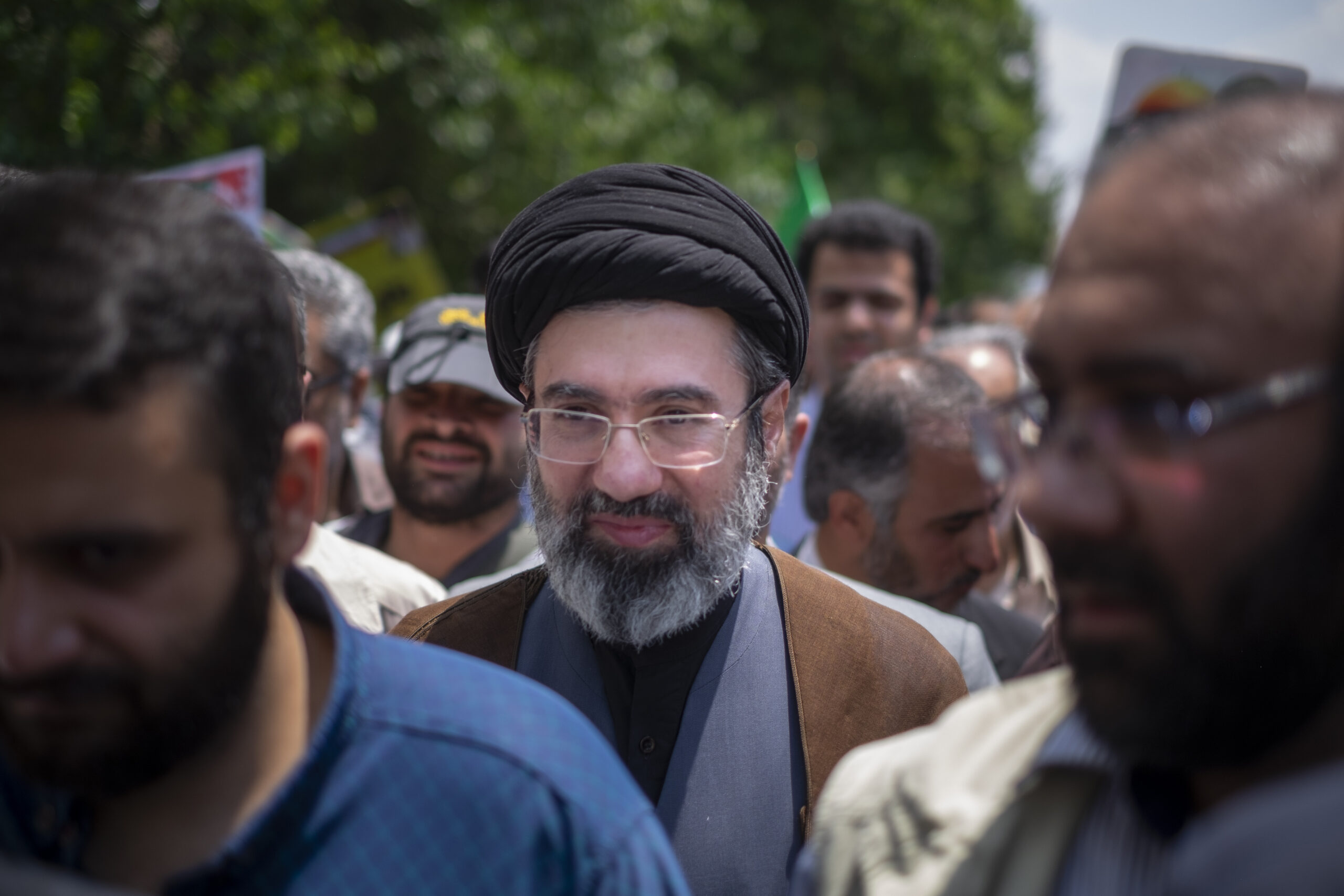
Also Wednesday, an Israeli F-35I fighter jet shot down an Iranian YAK-130 fighter jet over Tehran, marking the first time an F-35 jet shot down a manned fighter aircraft, IDF says
PUSHING BACK
After classified briefing, senators reject claims Israel forced U.S. into Iran war
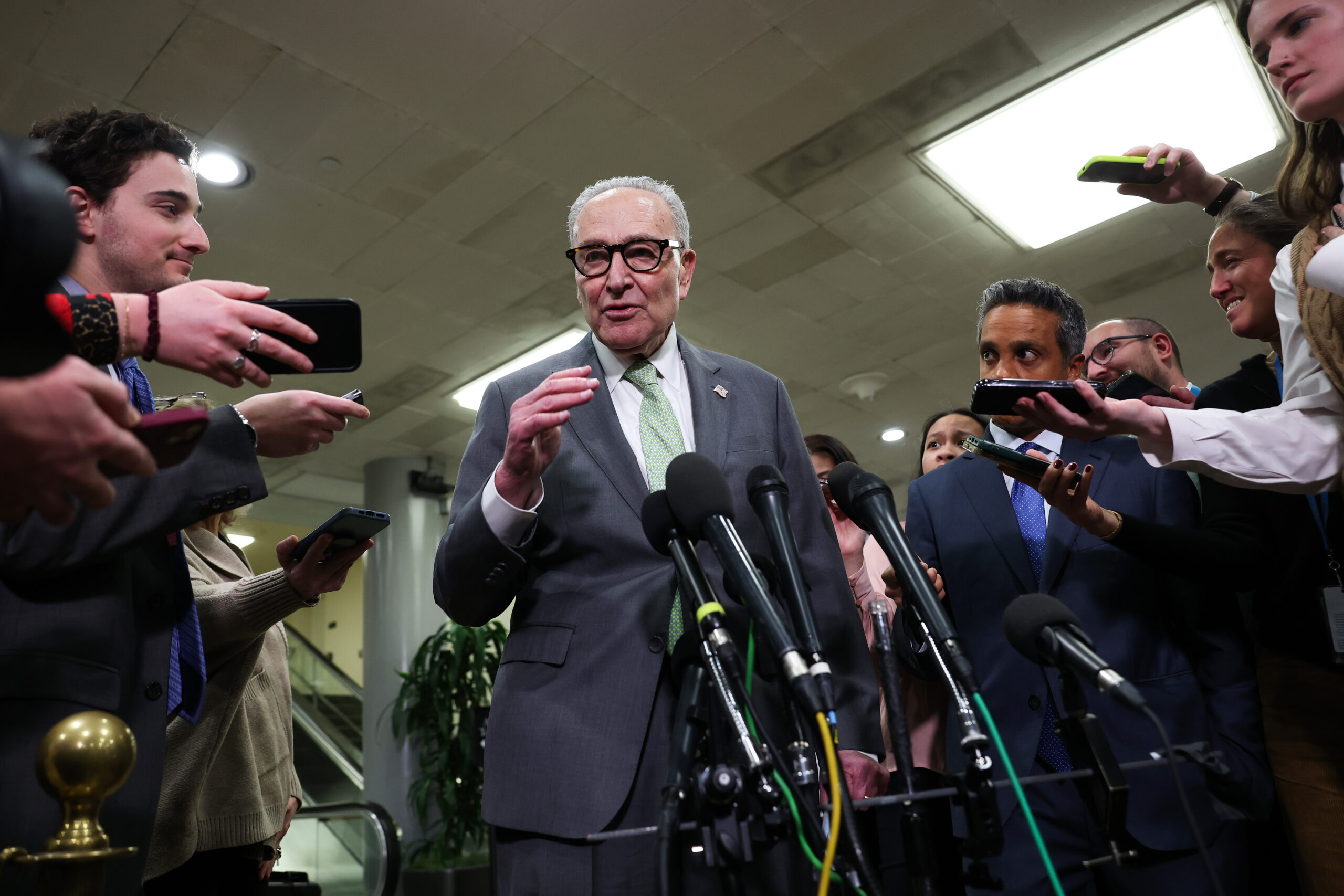
Republicans and some Democrats insisted Trump made the decision, while other Democrats said that the timing of the onset of hostilities was impacted by Israel’s plans
‘If anything, I might have forced Israel's hand,’ Trump said after Rubio’s previous comments were interpreted as placing blame on Israel
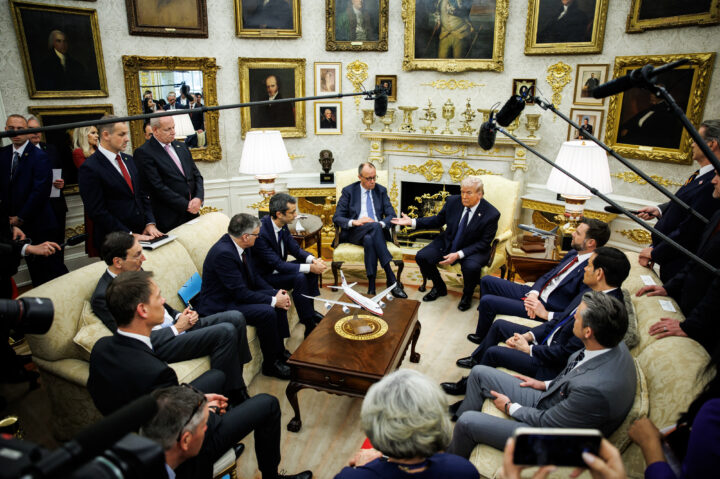
Samuel Corum/Sipa/Bloomberg via Getty Images
Friedrich Merz, Germany's chancellor, center left, and US President Donald Trump during a meeting in the Oval Office of the White House in Washington, DC, US, on Tuesday, March 3, 2026.
A chorus of senior Trump administration officials, including White House Press Secretary Karoline Leavitt, Secretary of State Marco Rubio and Defense Secretary Pete Hegseth sought to offer a decisive rebuttal on Tuesday to what they deemed to be a false narrative, which had spread like wildfire a day before.
They were all responding to the political tumult and online furor that erupted after Rubio briefed congressional leaders about the U.S. military operation in Iran on Monday afternoon.
A narrative quickly formed — based in large part on a viral post on X from the White House clipping an excerpt of Rubio’s comments — that Trump decided to strike Iran because Israel was already planning an attack, which would then prompt Iranian retaliation, thus putting American troops at risk.
“The president made the very wise decision — we knew that there was going to be an Israeli action, we knew that that would precipitate an attack against American forces, and we knew that if we didn’t preemptively go after them before they launched those attacks, we would suffer higher casualties,” Rubio told reporters.
The White House shared that sound bite in a post on X that was viewed more than 13 million times in less than a day. Rubio’s Monday messaging about Israel was echoed by House Speaker Mike Johnson (R-LA) after he and other congressional leaders received Rubio’s briefing.
The question that was then posed dozens of times by reporters to policymakers: Had Israel forced America’s hand and dragged the U.S. into war?
Never mind that Rubio also said in those same remarks the U.S. was not “forced” to strike because of an impending Israeli action. “No matter what, ultimately, this operation needed to happen,” Rubio said. The White House shared that sound bite on X Tuesday morning, drawing 500,000 views, a fraction of the visibility of the earlier post. “No, Marco Rubio Didn’t Claim That Israel Dragged Trump into War with Iran,” was the headline Leavitt posted on X. But the damage had already been done.
Fox News host Sean Hannity asked Israeli Prime Minister Benjamin Netanyahu the same question in a Monday night interview. “You don’t have to drag him into anything,” Netanyahu said of Trump. “He does what he thinks is right for America.”
Another reporter then posed the question to Trump directly on Tuesday during an Oval Office meeting between the president and German Chancellor Friedrich Merz.
“No,” Trump said decisively. “I might have forced their hand.” Hegseth then chimed in on X boosting Trump’s message: “This is 100% correct.”
Rubio similarly refuted a reporter who said the U.S. needed to get involved because Israel was going to strike Iran.
“Your statement is false,” he said Tuesday during another visit to Capitol Hill for all-member briefings in the House and Senate. “Somebody asked me the question yesterday, did we go in because of Israel … I told you this had to happen anyway. The president made a decision, and the decision he made was that Iran was not going to be allowed to hide behind its ballistic missile program, that Iran was not going to be allowed to hide behind its ability to conduct these attacks. That decision had been made.”
The question, he said, was “a question of timing, of why this had to happen as a joint operation. Not the question of the intent.”
Some questions remain unanswered. Trump told reporters alongside Merz that Iran was going to attack first, but it was not clear whom he expected Iran to attack, the Israelis or the Americans. A White House spokesperson did not respond to requests for comment.
“We were having negotiations with these lunatics, and it was my opinion that they were going to attack first,” Trump said. “Based on the way the negotiation was going, I think they were going to attack first, and I didn’t want that to happen. So if anything, I might have forced Israel’s hand, but Israel was ready, and we were ready, and we’ve had a very, very powerful impact.”
Even as the White House refuted the narrative that Israel had pulled the U.S. into war and put American servicemembers at risk, Democratic lawmakers and right-wing podcasters turned it into an online rallying cry.
“So Netanyahu now decides when we go to war? So much for America First,” Sen. Ruben Gallego (D-AZ) said in a post on X on Monday. Ben Rhodes, the deputy national security advisor to President Barack Obama, argued Trump could not bring himself to say no to Netanyahu: “Donald Trump is so weak that he couldn’t tell Bibi Netanyahu no, so now we are at war,” he said in response to the Rubio clip.
Sen. Mark Warner (D-VA), who was in Monday’s briefing by Rubio, afterward described the strikes as “dictated by Israel’s goals and timelines” and said he opposed them.
On the right, Matt Walsh of The Daily Wire sharply criticized Rubio. “So he’s flat out telling us that we’re in a war with Iran because Israel forced our hand. This is basically the worst possible thing he could have said,” Walsh wrote.
The conservative pundit Megyn Kelly said that the American servicemembers who have so far died in the campaign did not give their lives for the United States. “No one should have to die for a foreign country. I don’t think those four service members died for the United States. I think they died for Iran or for Israel,” she said on Monday.
Now progressive Jewish groups are attacking the White House, saying that pinning the war on Israel feeds into antisemitic conspiracy theories.
“Shifting blame for American military decisions to Netanyahu is an abdication of responsibility and comes with the dangerous side effect of fueling antisemitic sentiment in the United States,” J Street President Jeremy Ben-Ami said Tuesday.
The Jewish Democratic Council of America called Rubio’s language “unprecedented, dangerous and deeply irresponsible.”
“As Jewish Americans, we’re deeply concerned about the consequences of the White House effectively blaming Israel for its decision to launch a war against Iran, which has now spread to the entire Middle East,” JDCA said in a Tuesday statement.
The Republican Jewish Coalition, meanwhile, spent Tuesday reposting messages from the White House, the Senate Republican Caucus and the Pentagon that Israel had not, in fact, dragged the U.S. into war.
Rubio attempted to offer a final rebuttal of the narrative about Israel driving the war when he was back on Capitol Hill on Tuesday. He acknowledged how his comments the day before had spread — although he did not mention that the White House played a role in amplifying them.
“If you’re going to play the statements, you need to play the whole statement, and not clip it to reach a narrative,” said Rubio.
Plus, Alex Soros boosts antisemitic conspiracy theorist
Samuel Corum/Sipa/Bloomberg via Getty Images
Friedrich Merz, Germany's chancellor, center left, and US President Donald Trump during a meeting in the Oval Office of the White House in Washington, DC, US, on Tuesday, March 3, 2026.
Good Tuesday afternoon,
This P.M. edition is reserved for our premium subscribers — offering a forward-focused read on what we’re tracking now and what’s coming next.
It’s me again — Danielle Cohen-Kanik, U.S. editor at Jewish Insider and curator, along with assists from my colleagues, of the Daily Overtime. Please don’t hesitate to share your thoughts and feedback by replying to this email.
📡On Our Radar
Notable developments and interesting tidbits we’re tracking
The Trump administration emphatically denied reports, based on partial comments made by Secretary of State Marco Rubio yesterday, that Israel forced the U.S. to launch the operation against Iran.
“If anything, I might’ve forced Israel’s hand,” President Donald Trump told reporters while meeting with German Chancellor Friedrich Merz in the Oval Office today. “You see, we were having negotiations with these lunatics, and it was my opinion that they [Iran] were going to attack first.”
Defense Secretary Pete Hegseth boosted the president’s comments, saying, “This is 100% correct,” while Rubio insisted his original remarks were misrepresented…
Trump continues to share optimistic assessments of the war’s progress: he told Politico that Iran is running out of missile launchers while claiming the U.S. has “a virtually unlimited supply” of weapons, saying, “wars can be fought ‘forever,’ and very successfully, using just these supplies”…
The Israeli Air Force struck a building where senior clerics had gathered to elect Iran’s next supreme leader, Israeli Ambassador to the U.S. Yechiel Leiter told CNN, “and there’s a very good chance that the electors won’t be readily available for any further meetings”…
Trump is open to backing militias in Iran who will work to mount regime change, U.S. officials told The Wall Street Journal, after he held phone calls with Kurdish leaders who maintain armed groups along the Iran-Iraq border.
Trump has wavered in recent comments on his vision for the future of Iran, saying today that “somebody from within” might be the best option to lead, rather than individuals like exiled former crown prince, Reza Pahlavi. At the same time, Trump told reporters, “Most of the people we had in mind are dead. And now we have another group, they may be dead also. Pretty soon we’re not gonna know anybody”…
Trump ordered the U.S. Development Finance Corporation to provide political risk insurance for all maritime trade traveling through the Gulf, as oil traffic has essentially halted and energy prices have soared. The U.S. Navy will also, if necessary, begin physically escorting tankers through the Strait of Hormuz, Trump said…
Ukrainian President Volodymyr Zelensky offered his country’s assistance to the UAE, as the Gulf country has been targeted by over 1,000 Iranian drones and missiles since the operation began Saturday. Ukraine has become particularly skilled in combating Iranian Shahed drones, something the UAE has little experience with, as Russia has regularly used them in its attacks on Ukraine…
The U.S. Embassy in Saudi Arabia was struck with two Iranian drones, with no casualties reported; the embassy was closed, along with U.S. embassies in Kuwait and Beirut. The State Department ordered the mandatory departure of all non-emergency personnel in several countries and has begun “actively securing military aircraft and charter flights for American citizens who wish to leave” the region…
The International Atomic Energy Agency confirmed that Iran’s underground Natanz nuclear enrichment plant was struck in the course of hostilities in recent days. Trump has claimed the site was rendered inoperable during the U.S.’ June 2025 strikes…
Alex Soros, one of the progressive movement’s most influential donors, boosted a social media post today about U.S. casualties in the war with Iran from Max Blumenthal, a prominent anti-Israel conspiracy theorist, Jewish Insider‘s Matthew Kassel reports.
Soros also praised Spain for its refusal to allow the U.S. to use joint bases on its soil, calling Madrid the “leader of the free world” and reprimanding other European countries for not doing the same…
After issuing a statement solely attacking the U.S. and Israel over the campaign against Iran — which provoked backlash from members of the Iranian dissident and diaspora communities — New York City Mayor Zohran Mamdani acknowledged the “systematic repression” of the Iranian people by the regime, while declining to criticize the late Supreme Leader Ayatollah Ali Khamenei, JI’s Will Bredderman reports.
Even as he acknowledged Tehran’s bloody suppression of protesters, Mamdani did not directly answer a reporter’s question at a press conference today about whether the Middle Eastern nation was better off without the radical cleric who ruled for nearly 37 years…
Amazon Web Services operations are “significantly impaired” after three of its data centers in the Middle East were struck by Iranian drones — two directly hit in the UAE and one sustaining damage in Bahrain. The strikes “caused structural damage, disrupted power delivery to our infrastructure, and in some cases required fire suppression activities that resulted in additional water damage,” AWS said…
⏩ Tomorrow’s Agenda, Today
An early look at tomorrow’s storylines and schedule to keep you a step ahead
Keep an eye out in Jewish Insider for a look at the results of today’s high-stakes primary elections in North Carolina and Texas and their implications for pro-Israel voters.
The Heritage Foundation will hold an event to launch its 2026 “Index of U.S. Military Strength” with remarks from Sen. Jim Banks (R-IN) and Reps. August Pfluger (R-TX), Pat Harrigan (R-TX) and Matt Van Epps (R-TN).
The U.S. Commission on International Religious Freedom will release its annual report tomorrow on Capitol Hill.
Stories You May Have Missed
SQUARING OFF
Mamdani allies, deep-pocketed donors mobilize millions for anti-AIPAC effort
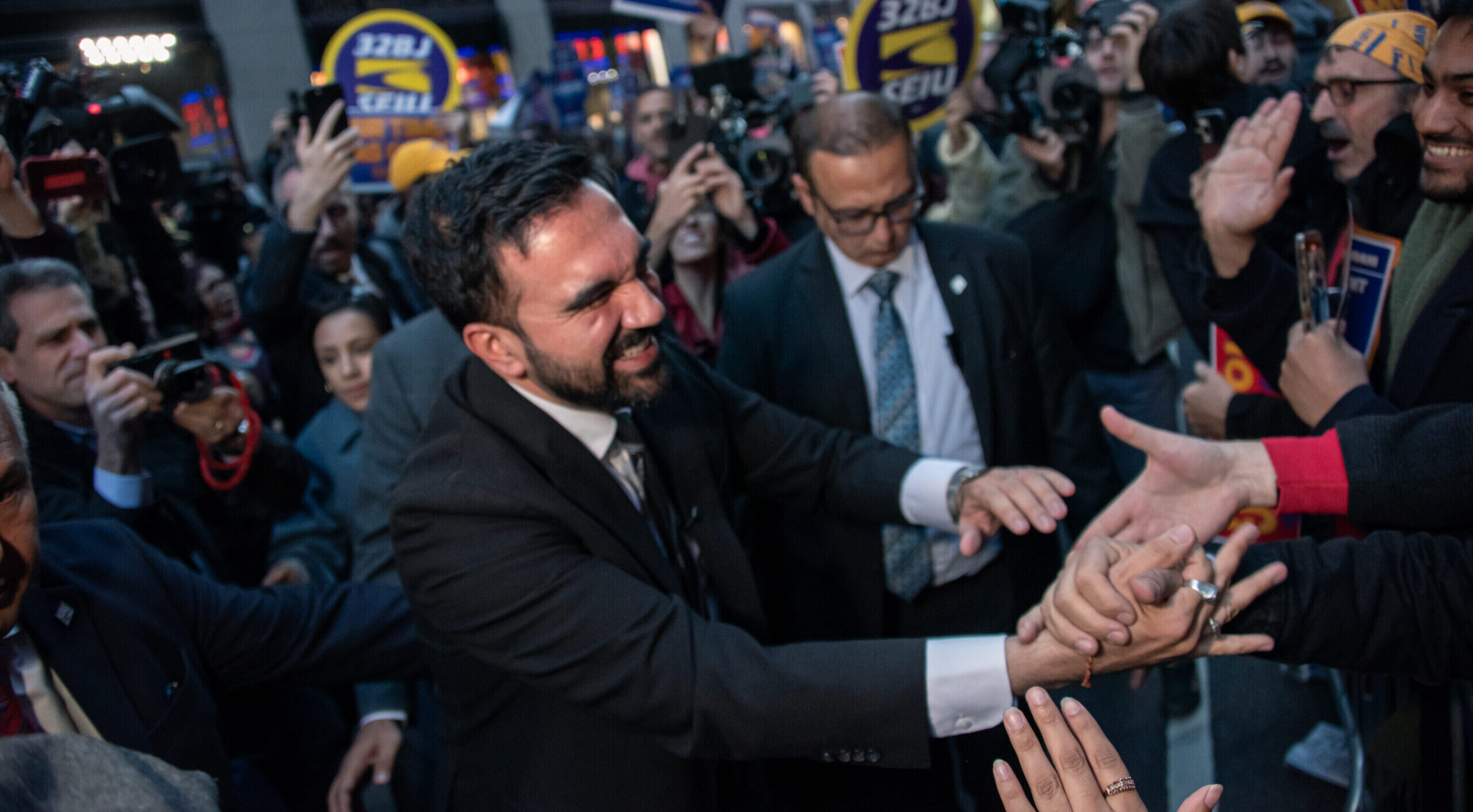
A trio of Mamdani backers united with tech and real estate investors to boost anti-Israel candidates
PARTY PERSPECTIVE
Democrats argue eliminating top Iranian leaders increases dangers to Iranians, Israel, U.S.

Speaking at J Street’s national summit, Sen. Tim Kaine also said ‘virtually all’ Democratic senators now seek the group’s endorsement
Plus, Mamdani allies bankroll a $10M anti-AIPAC effort
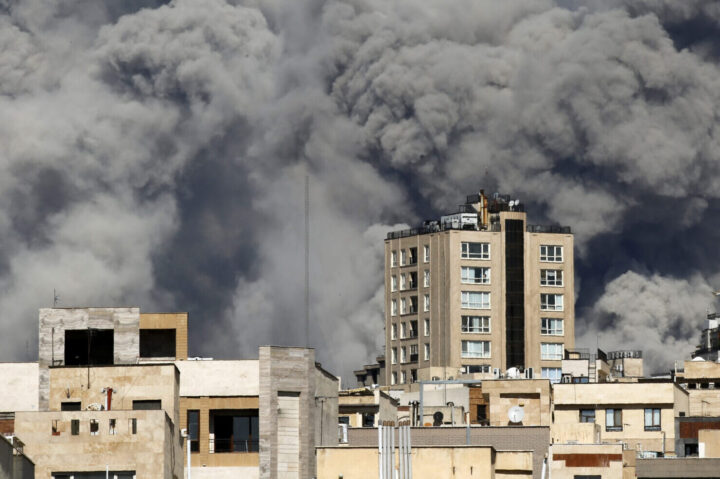
Fatemeh Bahrami/Anadolu via Getty Images
Smoke rises from the area after it was targeted in attacks as a series of explosions are heard in Tehran, Iran on March 01, 2026.
👋 Good Tuesday morning, and happy Purim 🎭
In today’s Daily Kickoff, we report on the latest developments in the Middle East as the conflict with Iran enters its fourth day, and preview the primaries taking place today in Texas and North Carolina. We report on the split on Capitol Hill over the Trump administration’s military moves against Iran, and spotlight the backers of the newly created American Priorities PAC, which has ties to allies of New York City Mayor Zohran Mamdani and is opposing pro-Israel candidates. Also in today’s Daily Kickoff: the Yeshiva University men’s basketball team, Zach Yadegari and Kate Schmier.
Today’s Daily Kickoff was curated by JI Executive Editor Melissa Weiss and Israel Editor Tamara Zieve, with an assist from Danielle Cohen-Kanik. Have a tip? Email us here.
What We’re Watching
- We are monitoring developments across the Middle East as the U.S. and Israel continue to strike Iranian targets, Iran launches attacks against population centers in Israel and Israel strikes Hezbollah targets in Lebanon. Multiple sirens have sounded across central Israel, including Tel Aviv and Jerusalem, throughout the morning as the IDF intercepted the barrages being fired from Iran.
- German Chancellor Friedrich Merz is in Washington today. He’ll meet with President Donald Trump at 11 a.m.
- On Capitol Hill, Secretary of State Marco Rubio, Defense Secretary Pete Hegseth, CIA Director John Ratcliffe, and Gen. Dan Caine, chairman of the Joint Chiefs of Staff, are expected to brief members of the Senate and House on the war in Iran.
- Elsewhere on the Hill, Elbridge Colby, the Pentagon’s under secretary of defense for policy, is testifying before the Senate Armed Services Committee on the Trump administration’s national defense strategy.
- The Capitol Jewish Forum is hosting its annual Purim celebration on the Hill this afternoon, with more than a dozen Jewish legislators, including Senate Minority Leader Chuck Schumer (D-NY), slated to attend.
- The first primaries of the 2026 election cycle are also taking place today. In North Carolina, Rep. Valerie Foushee (D-NC) is facing far-left anti-Israel activist Nida Allam. Read more below.
- In the Texas Senate primary, Rep. Jasmine Crockett (D-TX) faces state Sen. James Talarico; On the Republican side, Sen. John Cornyn (R-TX) faces primary challenges from Rep. Wesley Hunt (R-TX) and scandal-plagued right-wing Texas Attorney General Ken Paxton. Read more here and here.
- In the state’s 23rd Congressional District, Rep. Tony Gonzales (R-TX), also plagued by scandal amid allegations he had an affair with a staffer who later died by suicide, faces his second primary challenge from right-wing social media influencer Brandon Herrera. Read more here.
- Rep. Al Green (D-TX), who has become a consistent detractor of Israel in the House, faces newly elected Rep. Christian Menefee (D-TX), who has built solid relationships with the Houston-area Jewish community. Read more here.
- Rep. Dan Crenshaw (R-TX), a Republican hawk, faces a serious challenge from state Rep. Steve Toth, who is running to his right. Both candidates have been supportive of Israel.
- And Rep. Julie Johnson (D-TX) faces a difficult renomination fight against former Rep. Colin Allred (D-TX), who vacated the seat to run unsuccessfully for the Senate in 2024.
- It’s also primary day in Arkansas and Mississippi — but there are no major congressional primaries of note in either state.
What You Should Know
A QUICK WORD WITH JI’S MARC ROD
In the closing message of her campaign ahead of the North Carolina Democratic primary today, Durham County Commissioner Nida Allam, a far-left antagonist of Israel, is leaning into criticism of the war against Iran.
“President Trump just used our taxpayer dollars to bomb a school in Iran, killing over 100 elementary school children and starting another endless war abroad. This is reprehensible, and I strongly condemn it, as should every elected official,” Allam said in a direct-to-camera video ad posted on social media on Monday — despite no evidence that the U.S. or Israel were responsible for the strike.
Allam, who is Muslim, vowed that she would never accept support from defense contractors or pro-Israel groups, and said she “opposed these ‘forever wars’ my entire career, and I hope to earn your vote to be your proudly uncompromised pro-peace leader in Washington.”
By contrast, Rep. Valerie Foushee (D-NC), aiming to fend off a primary challenge from Allam, offered a condemnation of the “brutal and repressive” Iranian regime in a statement on Monday, while arguing that its “abuses do not give the president the authority to launch military strikes without Congressional approval.” She said Congress must vote to bring the war to an end.
In an initial statement on X over the weekend, Foushee issued an unequivocal condemnation of the operation, calling it “an unconstitutional escalation that risks dragging the United States into another catastrophic and endless war in the Middle East” that “ignores the will of the American people and recklessly puts our servicemembers in harm’s way” — without making mention of the Iranian regime.
Political observers said the Iran conflict could give late momentum to Allam. Given the leftward lean of the 4th Congressional District and Allam’s positioning to the left of Foushee — particularly on Middle East policy — it could very well make a difference,” Chris Cooper, a political scientist at Western Carolina University, told JI’s Matthew Kassel on Monday. “Thousands of votes have already been cast, but for late deciders, this is exactly the kind of issue that could help tilt a voter to one side or the other. It’s hard to get more salient than war.”
In 2022, Foushee won the seat in the 4th Congressional District against Allam with significant backing from the AIPAC-linked United Democracy Project super PAC, but Foushee has taken a more critical posture towards Israel over the last year. This year, significant outside spending has flowed into the race on both sides.
STATE OF PLAY
Day 4: Decrease in Iranian missile strikes on Israel result of targeting launchers, IDF says

A notable decrease in the number and frequency of Iranian missile strikes at Israel is the result of a focused strategy of hunting and taking out its launchers, Lt.-Col. Nadav Shoshani, the IDF’s spokesperson for international media, said on Tuesday, Jewish Insider’s Lahav Harkov reports. “The missile and launcher hunt is happening in real time,” Shoshani told reporters. “We have been able to narrow [Iran’s] capability to fire missiles toward us. … We are putting our focus on continuing to do so in the coming days.”
Military update: “We were able to take out dozens of launchers,” since the operation began on Saturday, Shoshani said, adding that Iran currently has “a lack of capability to fire in large amounts” and that there is a diminished rate of fire. At the same time, he noted that part of the reduction in missile launchers may be attributed to Iran trying to ensure it can keep the war going over the coming weeks.
SUSTAINED CAMPAIGN
Trump, defense officials keep Iran operation open-ended
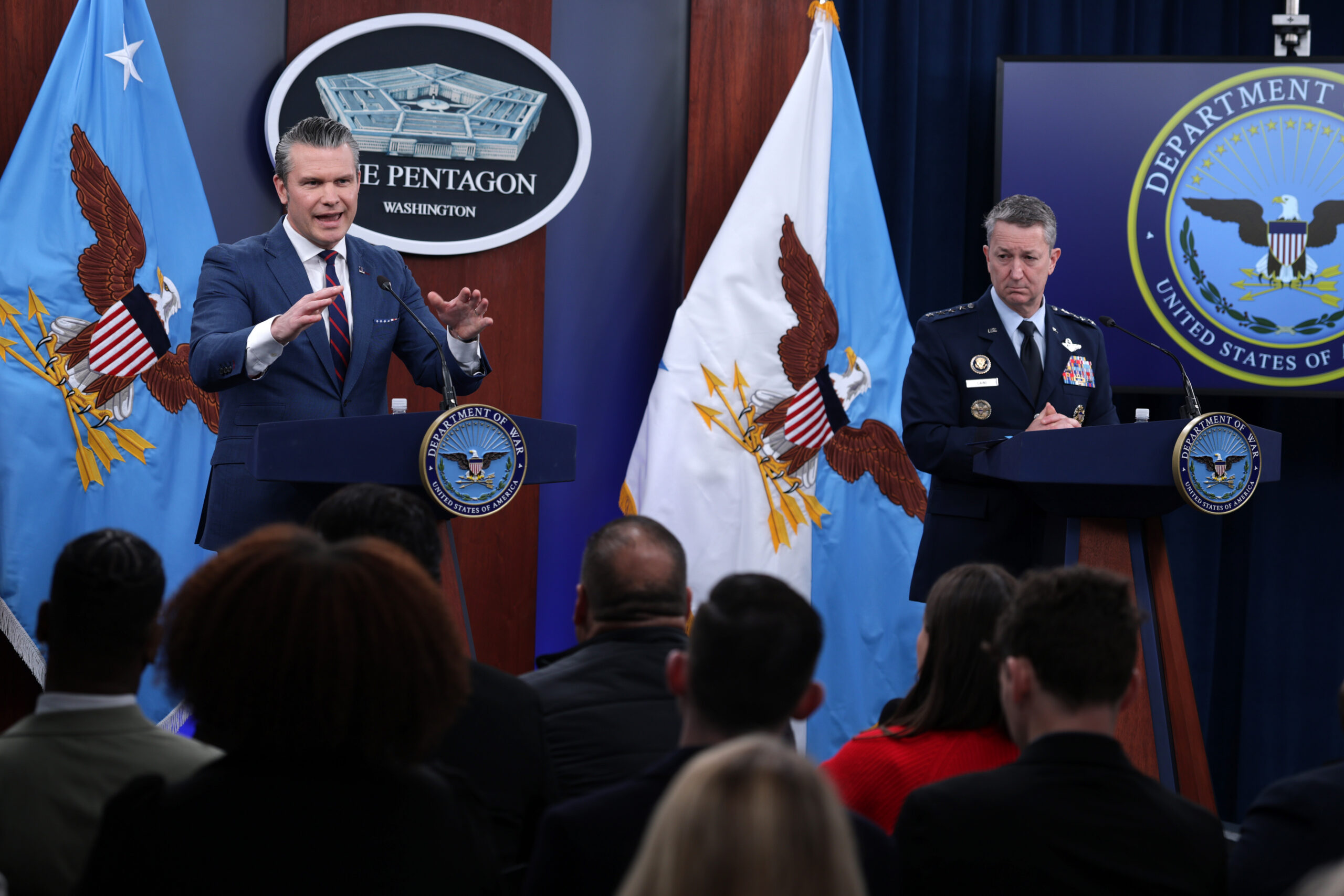
President Donald Trump and senior U.S. defense officials laid out an open-ended timeline for the ongoing operation against Iran on Monday, announcing more U.S. forces are headed to the region to carry out the American and Israeli campaign aimed at dismantling Tehran’s long-range strike capabilities and nuclear ambitions, Jewish Insider’s Matthew Shea and Emily Jacobs report.
Trump talk: Speaking to reporters at the White House on Monday morning, Trump said that U.S. forces were “already substantially ahead of our time projections” with their mission in Iran, but added that the American military was prepared to continue the operation beyond his initial four-to-five week timeline. “Whatever the time is, it’s OK. Whatever it takes,” Trump said at a Medal of Honor ceremony. “Right from the beginning, we projected four to five weeks, but we have capability to go far longer than that. We’ll do it.”
Caine’s comments: Adm. Brad Cooper, head of CENTCOM, “will receive additional forces even today,” said Gen. Dan Caine, chairman of the Joint Chiefs of Staff, during a separate press briefing alongside Defense Secretary Pete Hegseth. “This rapid buildup of forces demonstrated the joint forces ability to adapt and project power at the time and place of our nation’s choosing.” Caine also made clear the weekend barrage was only the beginning.
Team effort: In his first interview since the U.S. and Israel launched their joint military campaign against Iran, Israeli Prime Minister Benjamin Netanyahu defended the timing of the operation’s launch and rebuffed the notion that he decisively pushed Trump to take action, JI’s Matthew Shea reports.
DUELING NARRATIVES
Congressional leaders split over whether U.S. faced imminent threat from Iran
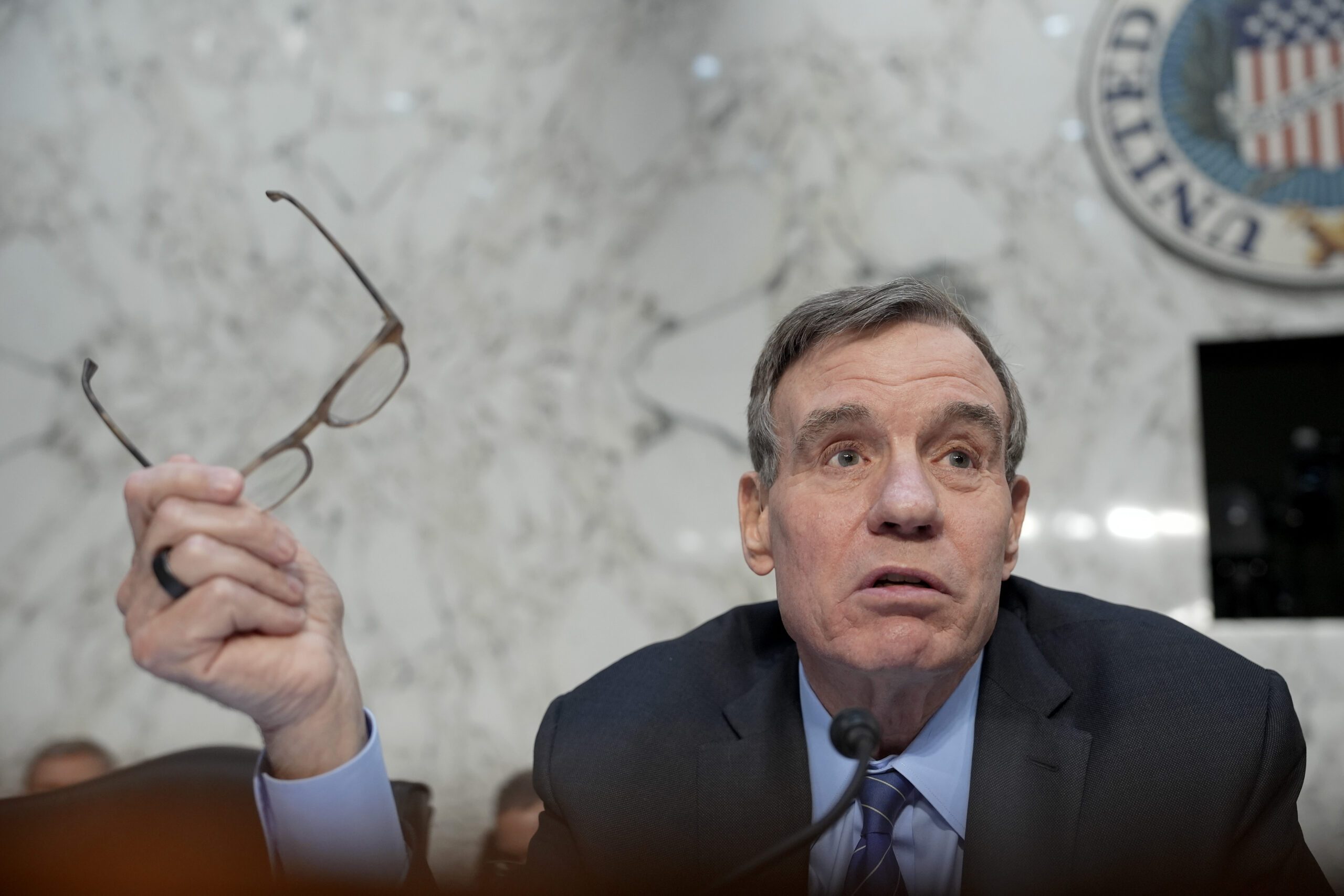
House Speaker Mike Johnson (R-LA) and Senate Intelligence Committee Vice Chairman Sen. Mark Warner (D-VA) emerged from a classified briefing with Cabinet officials on Monday split over whether the U.S. faced an imminent threat from Iran that necessitated and permitted the president to take military action under U.S. statute and the Constitution, Jewish Insider’s Marc Rod reports.
Johnson’s takeaway: “The most critical point is that this was a defensive measure, a defensive operation,” Johnson said. “Israel was determined to act in their own defense here, with or without American support. Why? Because Israel faced what they deemed to be an existential threat. Iran was building missiles at a radical, rapid clip, to the point where our allies in the region do not keep up.”
Warner’s worry: Warner said that the war is “a war of choice that has been acknowledged by others [that] was dictated by Israel’s goals and timelines. Israel is a great ally of America. I stand firmly with Israel, but I believe at the end of the day, when we are talking about putting American soldiers in harm’s way, when we have American casualties and expectations of more, there needs to be the proof of an imminent threat to American interests. I still don’t think that standard has been met.”
SQUARING OFF
Mamdani allies, deep-pocketed donors mobilize millions for anti-AIPAC effort
Three figures linked to New York City Mayor Zohran Mamdani — two Silicon Valley entrepreneurs and a Brooklyn political operative — have joined forces with a bevy of wealthy business leaders to pump millions into a new political action committee dedicated to battling AIPAC, Jewish Insider’s Will Bredderman reports.
Follow the money: American Priorities PAC has raised $2,050,000 to date and spent a quarter of it so far boosting Democrat Nida Allam, a vocal detractor of Israel, in her bid to oust Rep. Valerie Foushee (D-NC) in North Carolina’s 4th Congressional District. Filings with the Federal Election Commission show another $67,000 has gone toward promoting the candidacy of the Rev. Frederick Haynes III, the pastor of Rep. Jasmine Crockett (D-TX), who is running for her House seat as she seeks the Senate. It’s all part of a plan to spend a minimum of $10 million countering candidates who have received past support from AIPAC, as NBC News previously reported. A spokesperson for the PAC refused to answer questions about its fundraising and decision-making practices, though they denied Mamdani was in any way involved.
Bonus: Politico talks to government watchdogs about Mamdani’s continued use of the messaging app Signal for official business, despite the platform’s encryption protocols and self-deleting capabilities being incompatible with freedom of information laws.
DEMS DEMAND
Democratic lawmakers rally support for war powers resolutions at J Street conference

Democratic members of Congress addressing J Street’s national convention in Washington on Monday used the occasion to rally support for long-shot resolutions coming before the House and Senate this week that will attempt to end U.S. military strikes against Iran, Jewish Insider’s Gabby Deutch reports.
On the record: “The president’s refusal to pursue consent from Congress, as required by the Constitution, is perhaps his most grievous assault on democracy, and we should not let it stand,” Sen. Chris Murphy (D-CT) said to the 1,500 activists gathered at J Street’s morning plenary. Rep. Sean Casten (D-IL) told the crowd that he expects to see “very robust, possibly unanimous support” from congressional Democrats on the measures, which would put an immediate end to U.S. operations against Iran.
Read the full story here with additional comments from Rep. Madeleine Dean (D-PA) and Sen. Brian Schatz (D-HI).
More from Murphy: Addressing the conference, Murphy leaned on Jewish history to tailor his case to fight President Donald Trump specifically to American Jews. “The answer to thousands of years of the Jewish people’s faith being decided by emperors and queens and czars is not and cannot simply be the State of Israel. No, the rest of the answer is simple. It’s democracy,” he said.
Also spotted at the conference: Former New York City Comptroller Brad Lander, who is mounting a primary challenge against Rep. Dan Goldman (D-NY), and leaning into sharp criticism of Israel as part of his campaign.
Worthy Reads
Theory of Regime Change: In The Washington Post, Rob Satloff, the executive director of The Washington Institute for Near East Policy, considers the history of failed regime-change efforts in the Middle East as President Donald Trump calls for Iranians to rise up against their government. “On one end of the spectrum, will he, like [Franklin] Roosevelt, find an Iranian Delcy Rodríguez, leaving the structure of the regime intact under a new, more pliant leader? Or will he, like the first Bush, content himself with inflicting massive damage to Iran’s offensive military capability and choose an expedient path to end the war? Or, on the other end of the spectrum, will he, like the second Bush, get stuck in the muck of Iranian nation-building, triggering problems that we can’t even imagine today?” [WashPost]
The Warrior Prime Minister: The Atlantic’s Yair Rosenberg posits that Israeli Prime Minister Benjamin Netanyahu’s long-standing reluctance to pursue military options against adversaries ended with the Oct. 7, 2023, Hamas terror attacks, as Israel began to more aggressively pursue its enemies. “Before this seismic shift, Netanyahu’s longevity as prime minister was built on a foundation of conflict avoidance. That posture appealed to a risk-averse electorate. Under his premiership, Israeli voters who were comfortable with the status quo could rest easy knowing that their leader would be unlikely to upset it. … With each successful escalation, Netanyahu’s willingness to use force to settle Israel’s scores increased.” [TheAtlantic]
Remembering 1979: The Wall Street Journal’s Matthew Hennessey suggests that support for U.S. military action in Iran is generational, noting that young Americans have little memory of Iran’s years of targeting American interests. “But I was born in the 1970s. I remember the shocking barbarism of the fatwa against Mr. Rushdie. I remember the Iranian-backed Hezbollah terrorism of the 1980s, the 1994 suicide attack on the Jewish community center in Buenos Aires, the 1996 Khobar Towers bombing. … The livestreamers will say this war is about oil. The Substackers will say it started with Mosaddegh. To them, this is an academic debate, something they heard about on a podcast once. Any American over 50 knows who started it.” [WSJ]
Drive for Democracy: In The New York Times, the Hoover Institution’s Abbas Milani considers Iran’s leadership quagmire, arguing that former Iranian Supreme Leader Ayatollah Ruhollah Khomeini’s 1979 takeover of the country was done under a “bait-and-switch” that rallied Iranians around the cause of democracy while establishing a radical theocratic regime. “The right question today is: What are the ideas for democratic governance, for fixing the economy, for keeping centrifugal forces at bay and for maintaining sovereignty and good relations with the world around which Iranians (inside the country and out) can unite, and how can they do so in a way that will deliver Iran out of political paralysis and economic morass?” [NYTimes]
Word on the Street
President Donald Trump slammed commentators Tucker Carlson and Megyn Kelly, who have criticized the administration’s military strikes targeting Iran; Trump told journalist Rachael Bade that Carlson “can say whatever he wants; it has no impact on me” and that “MAGA is Trump — MAGA’s not the other two,” referring to Carlson and Kelly…
The Financial Times does a deep dive into the yearslong effort by Israel to track the movements of Iranian Supreme Leader Ayatollah Ali Khamenei, who was killed on Saturday, and other senior members of the Iranian regime; among the tactics used by Israel was the hacking of traffic cameras around Tehran, which allowed Israeli intelligence officials access to regime movements around the capital…
The Supreme Court blocked an effort to redraw Rep. Nicole Malliotakis’ (R-NY) 11th Congressional District — the sole Republican-leaning district in New York City — that encompasses Staten Island and parts of Brooklyn; the move preserves the existing districts in the city, including NY-10, where Rep. Dan Goldman (D-NY) is facing a primary challenge from former New York City Comptroller Brad Lander…
Federal prosecutors are filing an additional charge of damaging religious property against the man accused of ramming a car into the headquarters of Chabad-Lubavitch in Brooklyn in January…
The FBI is investigating recent antisemitic emails that were sent to members of Stanford University’s Jewish community, including more than half a dozen Jewish student leaders…
The Yeshiva University Maccabees are again heading to the Division III NCAA Men’s Basketball Tournament after the team’s 79-72 win over the Farmingdale State Rams over the weekend secured their position as Skyline Conference champions…
MyFitnessPal acquired calorie-counting app Cal Al, including 19-year-old CEO and co-founder Zach Yadegari and the startup’s six additional employees…
The Wall Street Journal spotlights Blue Owl Capital co-founders Doug Ostrover and Marc Lipschultz as the firm faces financial challenges tied to upheaval in the broader credit market…
Meta’s Mark Zuckerberg and his wife, Priscilla Chan, bought an under-construction mansion in South Florida’s Indian Creek for $170 million, setting a new record in Miami-Dade County…
A new report from the Jewish Representative Council of Ireland found that Irish Jews self-reported 146 incidents involving antisemitism between July 2025 and January 2026…
Kate Schmier is joining the Jewish Book Council as director of publishing relations…
London retailer and fashion designer Bernard Lewis, the founder of Little Island, died at 100…
Pic of the Day
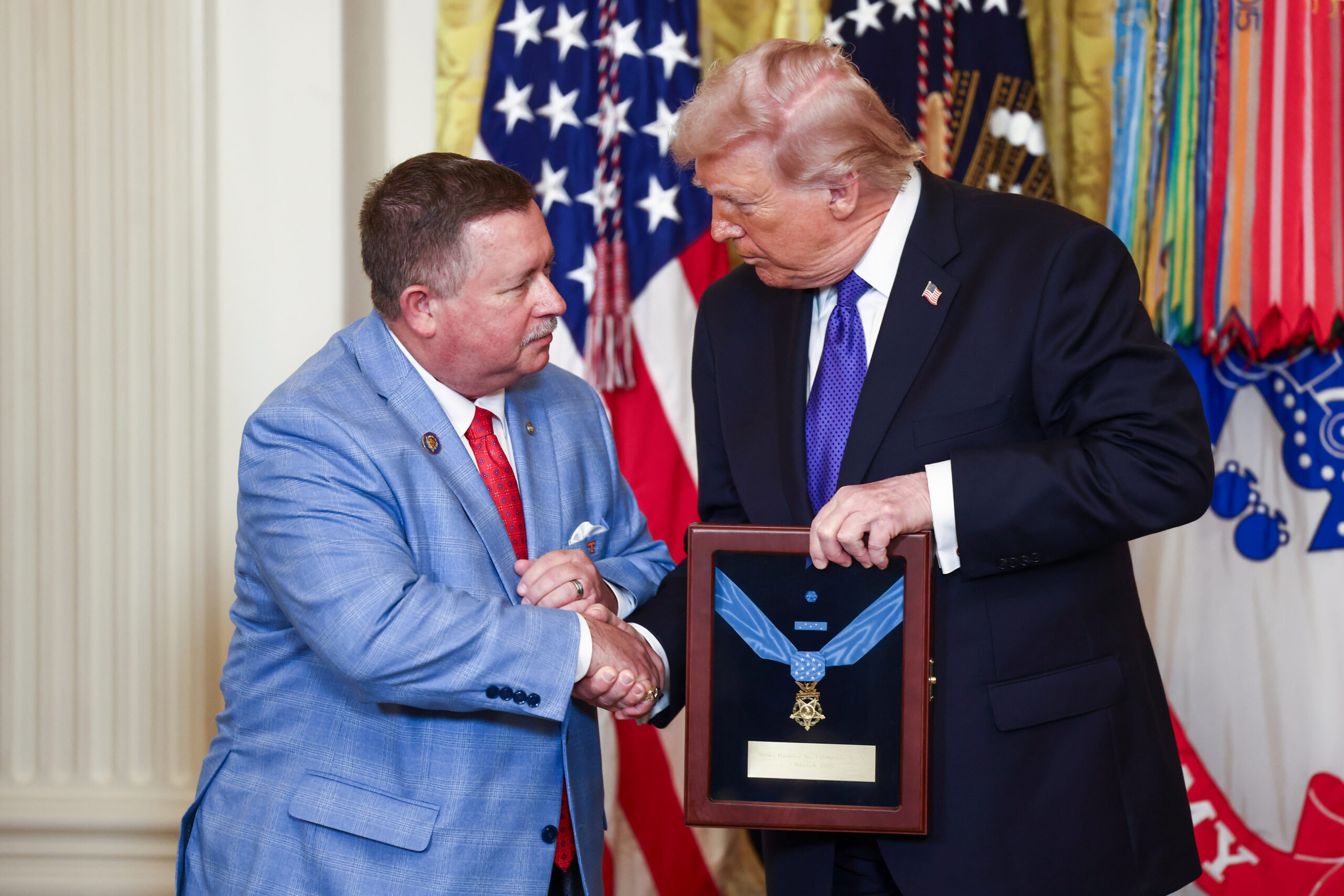
President Donald Trump posthumously awarded the Medal of Honor on Monday to Army Master Sgt. Roderick “Roddie” W. Edmonds, a World War II soldier whose defiance of a Nazi order saved more than 200 Jewish American prisoners of war, Jewish Insider’s Matthew Shea reports. Edmonds’ son, Chris Edmonds, accepted the award on his father’s behalf.
Birthdays

Vocalist for indie-pop band Lucius, Jess Wolfe turns 40…
Australian residential property developer, colloquially known as “High-Rise Harry,” Harry Triguboff turns 93… Former justice of the Supreme Court of Israel, Dalia Dorner turns 92… Author of 32 books and the editor emeritus of Dissent magazine, Michael Laban Walzer turns 91… Researcher in Yiddish language at Sweden’s Lund University’s Centre for Languages and Literature, Henrik Lewis-Guttermann turns 77… Best-selling and Pulitzer Prize-winning biographer of financiers and politicians, Ron Chernow turns 77… President of CBS News until 2021, now president of See It Now Studios, Susan Zirinsky turns 74… Retired chief investment officer of Neuberger Berman, he served as president of AIPAC, Michael Kassen… Fashion designer and businessman, he is the founder and former CEO of an eponymous company, Steve Madden turns 68… NPR personality and the host and producer of the radio and television show “This American Life,” Ira Jeffrey Glass turns 67… Former director of policy for New York state under Gov. Andrew Cuomo, David Yassky turns 62… Israeli economist and diplomat, he served as Israel’s first ambassador to the UAE, Amir Hayek turns 62… MLB pitcher until 2001, his 557 appearances rank second in career games pitched by a Jewish pitcher, Scott David Radinsky turns 58… Co-founder and co-president of Clarity Capital, David Steinhardt turns 57… EVP and general counsel at Eli Lilly and Company, Anat Hakim… Founder of Bunk1, a provider of parent-engagement software for summer camps, he is a co-owner of the Miami Marlins, Ari Jack Ackerman… President and founder of Heppin Biosciences, Brett S. Abrahams, Ph.D. turns 53… Screenwriter and columnist in the Israeli newspaper Globes, Efrat Abramov turns 46… British rabbi who has run for mayor of London and of Manchester, Shneur Zalman Odze turns 45… Acting U.S. attorney for the Southern District of New York for the first 24 days of the Trump 47 administration, Danielle R. Sassoon turns 40… Senior communications manager for Uber, she was the press secretary for former New York City Mayor Bill de Blasio, Freddi Goldstein… Manager of public policy for hate speech at TikTok, Erica H. Mindel… Member of AJR, an indie pop multi-instrumentalist trio, together with his two brothers, Ryan Metzger turns 32…
Plus, Tehran takes aim at global energy
Fatemeh Bahrami/Anadolu via Getty Images
Smoke rises from the area after it was targeted in attacks as a series of explosions are heard in Tehran, Iran on March 01, 2026.
Good Monday afternoon,
This P.M. edition is reserved for our premium subscribers — offering a forward-focused read on what we’re tracking now and what’s coming next.
It’s me again — Danielle Cohen-Kanik, U.S. editor at Jewish Insider and curator, along with assists from my colleagues, of the Daily Overtime. Please don’t hesitate to share your thoughts and feedback by replying to this email.
📡On Our Radar
Notable developments and interesting tidbits we’re tracking
President Donald Trump and senior U.S. defense officials laid out an open-ended timeline for the ongoing bombing campaign against Iran in several press briefings and interviews today, Jewish Insider’s Matthew Shea and Emily Jacobs report.
Trump and Defense Secretary Pete Hegseth both declined to rule out a U.S. ground invasion of Iran, while Joint Chiefs Chairman Gen. Dan Caine announced more American troops are en route to the region. “Every president says, ‘There will be no boots on the ground.’ I don’t say it. I say ‘probably don’t need them,’ [or] ‘if they were necessary,’” Trump told the New York Post.
The president repeatedly said the operation is “ahead of schedule,” but added that the U.S. military is prepared to continue the campaign beyond his initial four-to-five-week timeline. Trump also told CNN that the “big wave” of strikes on Iran “hasn’t even happened. The big one is coming soon”…
On the American public’s perception of the strikes, Trump said, “I think that the polling is very good, but I don’t care about polling. I have to do the right thing. This should have been done a long time ago.” A new CNN poll found that 41% of Americans support the strikes against Iran, while 59% disapprove…
After Hezbollah jumped into the conflict by launching strikes on Israel overnight, prompting Israeli fire on Hezbollah targets in Lebanon in return, Lebanese Prime Minister Nawaf Salam banned the terror group’s “military activities,” restricting it “to the political sphere.”
Salam said the group’s actions are now “illegal” and called on the Lebanese Armed Forces to “prevent any attacks originating from Lebanese territory,” a long-awaited show of resolve from Beirut. The LAF has struggled to disarm Hezbollah forces since the signing of a ceasefire agreement with Israel in November 2024…
On a ground invasion of Lebanon, IDF spokesperson Brig. Gen. Effie Defrin said, similarly to the U.S. position on Iran, “all options are on the table”…
U.S. casualties in the course of the operation increased today to six servicemembers…
Qatar’s Ministry of Defense condemned attacks by Iran on a power plant and an oil facility in the country, further indicating Tehran is setting its sights on civilian and energy infrastructure. The targeted energy plant, Ras Laffan, is responsible for around a fifth of all global natural gas production — Qatar halted production after the strike which, along with decreased passage through the vital Strait of Hormuz, sent oil prices soaring…
Iran continues to sustain heavy losses: The U.S. said it has sunk all 11 of Iran’s warships in the Gulf of Oman while Qatar shot down two Iranian SU-24 tactical bombers, which were developed by Russia; the UAE also intercepted around 150 Iranian drones and 15 missiles today in addition to hundreds over the weekend…
U.K. Prime Minister Keir Starmer reiterated in an address to parliament today that Britain will not be joining the strikes on Iran but will allow the U.S. to use its bases for “defensive actions,” noting that Iran has already struck a military base in Bahrain that houses around 300 British troops. “France and Germany are also prepared to enable U.S. action to destroy Iran’s capability to fire missiles and drones from the source,” Starmer added.
Trump said he was “very disappointed” with Starmer in an interview with The Telegraph, saying the prime minister “took far too long” in deciding to allow U.S. forces to utilize its bases…
NATO Secretary-General Mark Rutte praised the campaign, calling it “really important … because it is taking out, degrading the capacity of Iran to get its hands on nuclear capability, the ballistic missile capability.” But, he said, “there are absolutely no plans whatsoever for NATO to get dragged into this”…
GOP lawmakers are pushing Democrats to agree to a funding deal for the still-shuttered Department of Homeland Security, as hostilities with Iran raise concerns about domestic terror threats…
The war is also making its way into some of the most heated primary races unfolding across the country: In North Carolina’s 4th Congressional District, anti-Israel activist Nida Allam, who is challenging Rep. Valerie Foushee (D-NC), put out a new campaign ad just before tomorrow’s primary slamming “Trump and Netanyahu’s reckless war.”
Allam accused the administration of using “our taxpayer dollars to bomb a school in Iran, killing over 100 elementary school children,” even though there has been no proof that the U.S. was responsible for the strike…
Some pro-Israel Democratic candidates in Illinois also took harsh stances against the Iran operation: state Sen. Laura Fine, running in Illinois’ 9th Congressional District, called for Trump’s impeachment, while Cook County Commissioner Donna Miller, running in the 2nd District, and Chicago Treasurer Melissa Conyears-Ervin, running in the 7th District, called the strikes “reckless” and “immoral,” respectively…
⏩ Tomorrow’s Agenda, Today
An early look at tomorrow’s storylines and schedule to keep you a step ahead
Keep an eye out in Jewish Insider for a rundown of the high-profile primaries on the ballot tomorrow in North Carolina and Texas.
German Chancellor Friedrich Merz will meet with President Donald Trump at the White House for a conversation that was set to focus on negotiations between Russia and Ukraine but will likely be overshadowed by the ongoing operation against Iran. Germany joined the U.K. and France over the weekend in offering a supportive but cautious stance on the hostilities.
It will be a busy day on the Hill, where administration officials including Secretary of State Marco Rubio, Defense Secretary Pete Hegseth, CIA Director John Ratcliffe and Joint Chiefs Chairman Gen. Dan Caine will hold all-member briefings on Iran for the House and Senate. Rubio is briefing the Gang of Eight again this afternoon, and national security committees in both chambers were briefed over the weekend.
Elbridge Colby, the under secretary of defense for policy, will brief the Senate Armed Services Committee on the Pentagon’s National Defense Strategy; Colby has previously drawn bipartisan ire from the committee over a lack of consultation by his team and alleged rogue decision-making on a range of issues by his office.
The Senate Judiciary Committee will hold a hearing on oversight of the Department of Homeland Security with testimony from Homeland Security Secretary Kristi Noem.
The Capitol Jewish Forum will host its annual Capitol Hill Purim celebration, attended by a number of Jewish lawmakers.
Stories You May Have Missed
WEIGHING IN
As Iran war continues, Senate and House set for long-shot votes to cut it short

The resolutions are unlikely to pass; if they do, they will need two-thirds support to override an inevitable presidential veto
CLOSING RANKS
Arab states unite as Iran strikes every member of Gulf Cooperation Council

UAE and Saudi leaders spoke by phone; the GCC affirmed its ‘right to respond’
Plus, Mamdani makes surprise WH visit

Umman Foreign Ministry/Handout/Anadolu via Getty Images
Special Envoy Steve Witkoff (C) advisor Jared Kushner (L) meet with Omani Foreign Minister Badr bin Hamad Al Busaidi (R), who is mediating between the parties in the third round of Iran-U.S. negotiations held in Geneva, Switzerland, on February 26, 2026.
Good Thursday afternoon!
This P.M. edition is reserved for our premium subscribers — offering a forward-focused read on what we’re tracking now and what’s coming next.
It’s me again — Danielle Cohen-Kanik, U.S. editor at Jewish Insider and curator, along with assists from my colleagues, of the Daily Overtime. Please don’t hesitate to share your thoughts and feedback by replying to this email.
📡On Our Radar
Notable developments and interesting tidbits we’re tracking
U.S.-Iran negotiations wrapped up for the day in Geneva without a decisive result: Omani Foreign Minister Badr Albusaidi said the sides had made “significant progress” while Iranian Foreign Minister Abbas Araghchi told state media they negotiated “very seriously,” but no agreement was reached.
Araghchi said technical experts will meet on Monday in Vienna at the International Atomic Energy Agency and fourth round negotiations will take place later next week, after consultations in both capitals…
Secretary of State Marco Rubio told reporters yesterday that Iran “poses a very grave threat to the United States” and is trying to reconstitute its nuclear program. “After their nuclear program was obliterated, they were told not to try to restart it, and here they are. You can see them always trying to rebuild elements of it. They’re not enriching right now, but they’re trying to get to the point where they ultimately can.”
Beyond the nuclear issue, Rubio said, Iran also has “conventional weapons that are solely designed to attack America and attack Americans. … These things have to be addressed.” While the current talks are focused solely on Tehran’s nuclear program, “it’s also important to remember that Iran refuses to talk about ballistic missiles to us or to anyone, and that’s a big problem”…
House Democratic leaders said in a joint statement today that they plan to force a vote “as soon as Congress reconvenes next week” on a resolution blocking military action against Iran without congressional authorization, Jewish Insider’s Marc Rod reports. Three Democrats have already indicated they will oppose the resolution, with other defections likely to follow…
U.S. forces raided a ship last month and seized cargo heading from China to Iran, officials told The Wall Street Journal, part of a broader effort to head off Iran’s covert arms purchases after the 12-day war last June. The cargo was reportedly intended for Iranian companies that procure weapons for the regime’s missile program…
The Journal interviews fighter pilots involved in the U.S. bombing campaign against the Houthis last spring, as military assets are once again amassing in the Middle East for a potential operation against Iran…
Maine Senate candidate Graham Platner amplified a social media post today from a far-right conspiracy theorist well-known for viciously antisemitic commentary — before quickly deleting the statement, JI’s Matthew Kassel reports. In a comment on X, Platner approvingly boosted a remark opposing war with Iran from Stew Peters, who has said Judaism is “satanic” and a “death cult,” promoted blood libels and called for a “final solution” to mass-deport American Jews…
The issue is particularly sensitive for Platner, who earlier in his campaign faced scrutiny over a Nazi tattoo on his chest, which he has since had covered. He was pressed today on a YouTube call-in show about his knowledge of the tattoo’s symbolism because of his self-identification as a WWII history enthusiast.
“I was well aware that they [Nazis] used a similar-looking thing,” Platner said. “You have to admit it’s not a ‘similar-looking thing,’ it’s the same thing. … Anyone who’s remotely a WWII buff knows what that is,” the caller replied. Platner answered, “I’m not going to apologize for something that I didn’t know about or do”…
New York City Mayor Zohran Mamdani made an unannounced visit to the White House to meet with President Donald Trump today. Among other issues, the two discussed housing and immigration activities…
The family of Francesca Albanese, the U.N. special rapporteur for Israel and the Palestinian territories, sued Trump and other administration officials yesterday in district court, alleging that the sanctions imposed on Albanese by the U.S. violate her First, Fourth and Fifth Amendment rights…
Israeli President Isaac Herzog and Foreign Minister Gideon Sa’ar attended an iftar meal to break the Ramadan fast hosted by UAE Ambassador to Israel Mohamed Al Khaja in Tel Aviv, where Herzog said that the “members of the Abraham Accords should be treated in an upgraded manner as they pursue the noble cause of peace.”
“And this I say especially,” Herzog continued, “when there are nations who are spreading hate, spreading blasphemy against nations who seek peace — against the Emiratis, against the Israelis,” ostensibly referring to Saudi Arabia…
As Indian Prime Minister Narendra Modi wrapped up his trip to Israel today, the two countries signed 16 memorandums of understanding to expand cooperation in fields including agriculture and AI. Modi also met with the cast of “Fauda”…
⏩ Tomorrow’s Agenda, Today
An early look at tomorrow’s storylines and schedule to keep you a step ahead
Keep an eye out in Jewish Insider for a profile of Sam Bregman, the Jewish cowboy-hat wearing former district attorney running for governor of New Mexico.
ADL’s Desert Region will hold its annual conference at Arizona State University, with speakers including ADL CEO Jonathan Greenblatt, Arizona Gov. Katie Hobbs, Phoenix Mayor Kate Gallego and state Rep. Alma Hernandez.
J Street’s annual conference will kick off Saturday in Washington. Speakers will include former Israeli Prime Minister Ehud Olmert, Sens. Chris Van Hollen (D-MD), Brian Schatz (D-HI), Adam Schiff (D-CA), Tim Kaine (D-VA) and Chris Murphy (D-CT) and Reps. Nancy Pelosi (D-CA), Sara Jacobs (D-CA), Sean Casten (D-IL) and Madeleine Dean (D-PA). J Street’s PAC will hold an event with Roy Cooper, the former governor of North Carolina now running for Senate, and phone banking sessions for Evanston, Ill., Mayor Daniel Biss, running for the House.
We’ll be back in your inbox with the Daily Overtime on Monday. Shabbat Shalom!
Stories You May Have Missed
EDUCATION CONSTERNATION
Jewish groups file suit against California for widespread failure to address antisemitism in K-12 schools
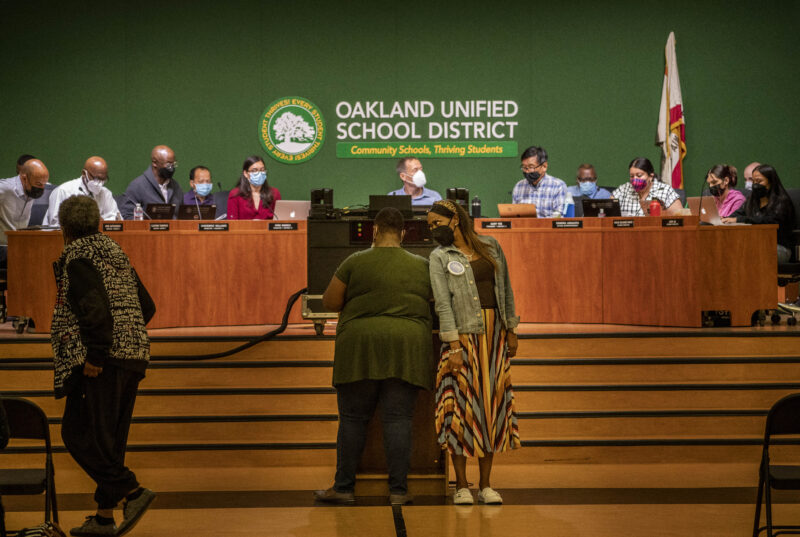
The suit highlights several complaints from Jewish parents and children statewide, in school districts including Berkeley, Los Angeles, Santa Clara, San Francisco, Campbell Union, Fremont, Etiwanda and Oakland
PRAIRIE STATE DEBATE
Abughazaleh says she doesn’t support Iron Dome, dodges on Israel’s right to exist

The far-left influencer, running competitively in a Chicago-area district with a sizable Jewish constituency, debated primary rivals Laura Fine and Daniel Biss on Wednesday
Plus, Trump says Iran won't rule out nuclear weapons
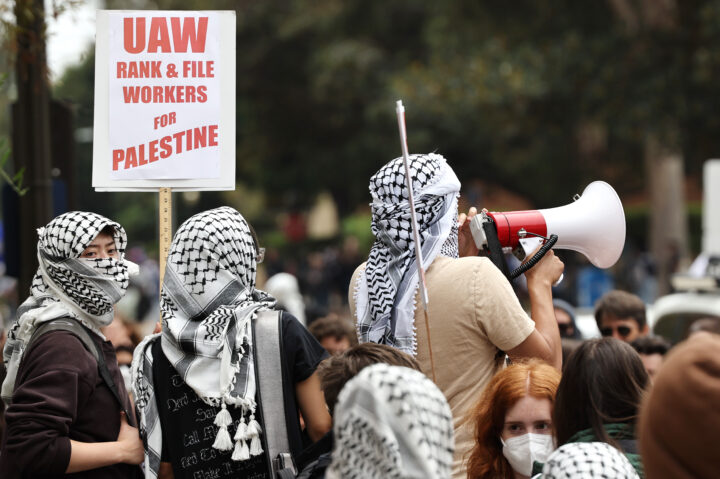
Mario Tama/Getty Images
Protestors gather after police cleared a new encampment on the UCLA campus on May 23, 2024 in Los Angeles, California.
Good Tuesday afternoon!
This P.M. edition is reserved for our premium subscribers — offering a forward-focused read on what we’re tracking now and what’s coming next.
It’s me again — Danielle Cohen-Kanik, U.S. editor at Jewish Insider and curator, along with assists from my colleagues, of the Daily Overtime. Please don’t hesitate to share your thoughts and feedback by replying to this email.
📡On Our Radar
Notable developments and interesting tidbits we’re tracking
Previewing his State of the Union address tonight, where it remains to be seen if he will make any announcements on Iran, President Donald Trump told reporters, “Iran wants to make a deal more than I do, but they just won’t say the sacred phrase: ‘We won’t build nuclear weapons,’” signaling that the two sides are still at an impasse ahead of the third round of negotiations scheduled for Thursday…
Secretary of State Marco Rubio briefed the congressional Gang of Eight, the bipartisan set of leaders advised on classified matters by the executive branch, this afternoon to provide an update on Iran, with CIA Director John Ratcliffe reportedly joining the discussion. The White House did not brief the group before striking Iran last June, drawing ire from Democrats…
Ahead of the meeting, Senate Minority Leader Chuck Schumer (D-NY) told C-SPAN about potential Iran strikes, “Closed-door briefings are fine, but the administration has to make its case to the American people on something as important as this”…
Around a dozen U.S. F-22 stealth fighter jets departed from the U.K. today to be deployed at an Israeli Air Force base in the south of the country, as over 150 aircraft are being moved to the region. Military experts told The Washington Post that the “assets being assembled are indicative of a multiday campaign without a ground invasion”…
The Coast Guard is investigating a swastika drawn at its primary recruit training center in New Jersey, where Coast Guard commandant Adm. Kevin Lunday quickly flew to address recruits and staff about the incident. Lunday recently came under fire from Congress, and had his confirmation delayed, over a change in Coast Guard policy that downgraded the swastika from a prohibited hate symbol to “potentially divisive,” which was eventually walked back.
Regarding the recent incident, Lunday said in a statement to The Washington Post, “Anyone who adheres to or advances hate or extremist ideology — get out. Leave. You don’t belong in the United States Coast Guard and we reject you”…
Rep. Brad Sherman (D-CA) is pushing for legislation to require an affirmative congressional vote prior to the U.S. reaching any nuclear deal with Saudi Arabia, Jewish Insider’s Marc Rod reports, following a notification from the administration to Congress indicating that it is moving toward a deal that could allow Riyadh to enrich uranium for civilian purposes.
The notification procedures, which do not include specific terms of a potential deal, suggest that Saudi Arabia will not be required to agree to more intrusive International Atomic Energy Agency inspections or “gold standard” safeguards — which would require Saudi Arabia to agree not to enrich or reprocess nuclear material — used for the U.S. nuclear cooperation agreement with the United Arab Emirates…
The Justice Department sued the University of California today under Title VII of the Civil Rights Act, which prohibits employment discrimination, alleging that the UCLA campus created a “hostile work environment against Jewish and Israeli faculty and staff.”
During campus anti-Israel protests in 2024, the DOJ said, “the University allowed antisemitic harassment to continue unabated for days” and “has ignored, and continues to ignore, gross and repeated violations” of time, place and manner restrictions on student protest. The department further claimed Jewish and Israeli faculty at the school have been physically threatened, ostracized, harassed, forced to take leave and assaulted…
The New York Times details efforts by New York’s business community and Democratic establishment to organize and promote the moderate wing of the party in response to New York City Mayor Zohran Mamdani’s rise to power. Some of the individuals involved, including former Gov. Andrew Cuomo allies Phil Singer and Steven Cohen, are considering forming PACs, watchdog groups, lobbying campaigns and more…
New York’s Working Families Party endorsed Brooklyn Borough President Antonio Reynoso to replace retiring Rep. Nydia Velázquez (D-NY) yesterday over Mamdani’s objections. The mayor has been backing Assemblymember Claire Valdez, who, like Mamdani, is a member of the Democratic Socialists of America and a vocal critic of Israel, and he had lobbied the WFP to endorse her or to stay out of the race. WFP’s director, Jasmine Gripper, told the Times, “At the end of the day, Zohran is an individual who gets to weigh in as an individual”…
A new poll from the University of New Hampshire found oyster farmer Graham Platner with a commanding lead among likely Senate Democratic primary voters, outdistancing Gov. Janet Mills by 34 points, with the primary less than four months away. In a general election matchup with incumbent Sen. Susan Collins (R-ME), Platner leads Collins by 11 points, while Mills and Collins are neck-and-neck…
Khalid Turaani, executive director of the Ohio branch of the Council on American-Islamic Relations (CAIR), testified at the Ohio Senate Judiciary Committee last week against a bill to codify the International Holocaust Remembrance Alliance’s working definition of antisemitism, where he claimed that Israel operates the world’s largest human skin bank and harvests the skin from deceased Palestinians. “And if I call them Nazis,” Turaani continued, “your law is going to punish me.”
The Anti-Defamation League’s Ohio River Valley office condemned Turaani’s speech, saying that the “antisemitic organ harvesting myth plays on the blood libel trope, which has spurred the torture, murder, and expulsion of Jews for centuries”…
The U.S. Embassy in Israel announced that, as part of the government’s “efforts to reach all Americans,” the embassy will be providing consular services for one day only at several locations across Israel and the West Bank, including Ramallah and the Jewish settlement of Efrat…
⏩ Tomorrow’s Agenda, Today
An early look at tomorrow’s storylines and schedule to keep you a step ahead
Keep an eye out in Jewish Insider for the highlights from President Donald Trump’s State of the Union address, taking place at 9 p.m. ET tonight, as all eyes are on possible U.S. military action against Iran.
Indian Prime Minister Narendra Modi arrives in Israel tomorrow, where he will be greeted by Prime Minister Benjamin Netanyahu before addressing the Knesset. In the evening, the two leaders will have dinner at Jerusalem’s King David Hotel. Read JI’s interview on Modi’s visit with Israeli Ambassador to India Reuven Azar.
The New York City Council will hold its first hearing on Council Speaker Julie Menin’s bill aiming to create “buffer zones” around houses of worship to protect from disruptive protests. The bill’s language was updated last night to remove the original 100-foot figure, which had reportedly emerged as a point of concern for the NYPD.
Congressional candidates from Illinois’ 9th District, where pro-Israel spending is boosting state Sen. Laura Fine and attacking Evanston Mayor Daniel Biss, will hold a debate on local news.
Stories You May Have Missed
SHIFTING STANCE
Sue Altman pivoting on Israel as she runs in safely Democratic N.J. district

The progressive activist ran as a pro-Israel candidate in a neighboring swing district, but is now walking back her support as she runs to succeed Rep. Bonnie Watson Coleman
PRAIRIE STATE OF PLAY
Raja Krishnamoorthi emerging as the strongest ally of Jewish voters in Illinois Senate race
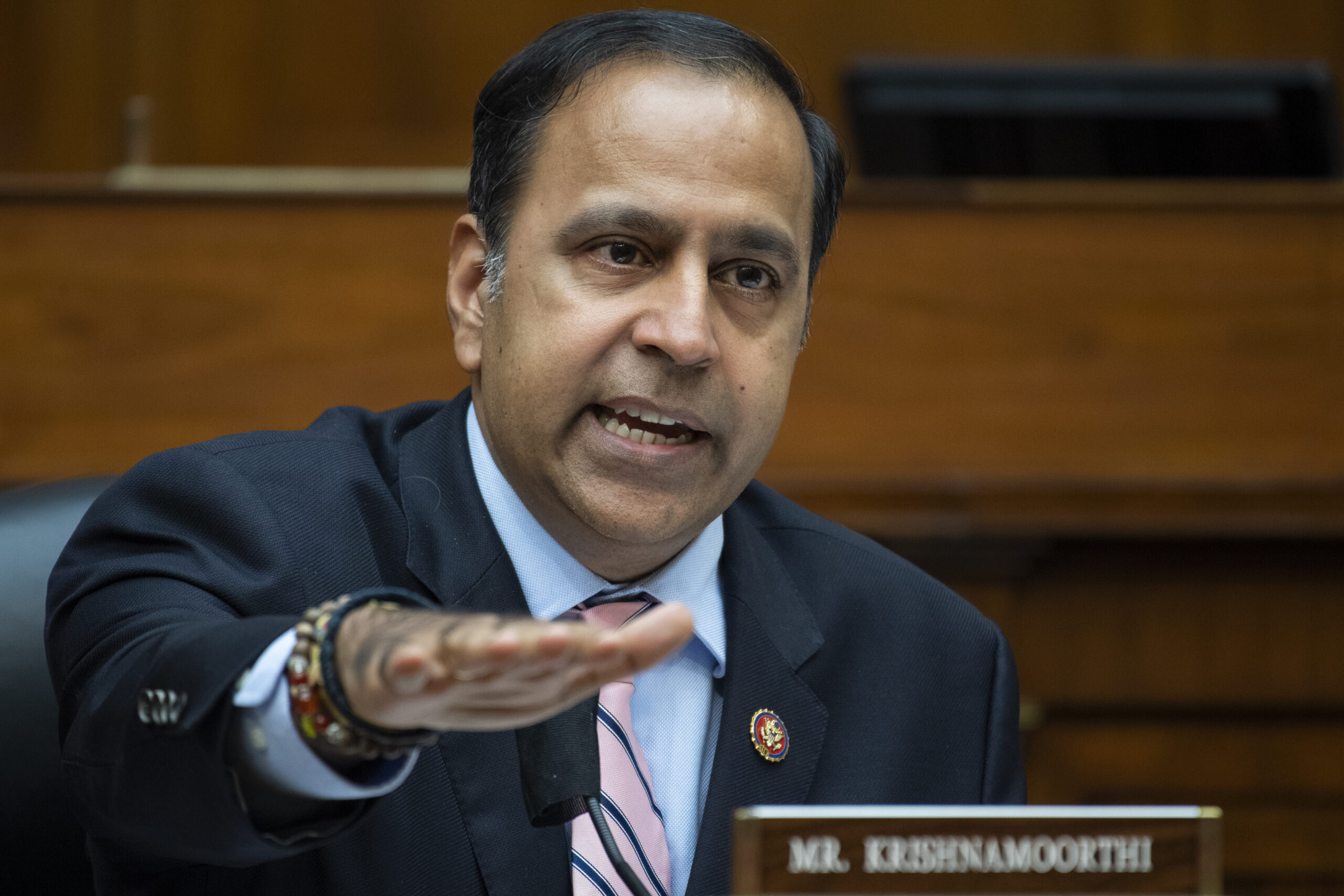
Lt. Gov. Juliana Stratton seems to be running to the congressman’s left on Israel, even as Rep. Robin Kelly is the most outspoken critic of Israel in the race
Plus, major Dem donor calls out 'Jew hate' in party
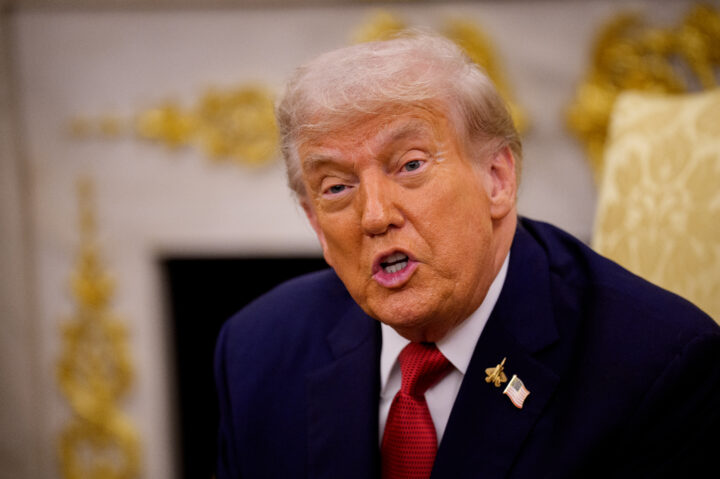
Andrew Harnik/Getty Images
President Donald Trump in the Oval Office at the White House on September 25, 2025 in Washington, DC.
Good Monday afternoon!
This P.M. edition is reserved for our premium subscribers — offering a forward-focused read on what we’re tracking now and what’s coming next.
It’s me again — Danielle Cohen-Kanik, U.S. editor at Jewish Insider and curator, along with assists from my colleagues, of the Daily Overtime. Please don’t hesitate to share your thoughts and feedback by replying to this email.
📡On Our Radar
Notable developments and interesting tidbits we’re tracking
As rumors abound about the possibility and timing of U.S. strikes on Iran, the State Department ordered the evacuation of non-essential personnel and their families from the U.S. Embassy in Beirut. “Based on our latest review, we determined it prudent to reduce our footprint,” a State official told Fox News…
Nearby, amid the buildup of U.S. military assets in the region, American refueling and cargo planes were spotted at Ben Gurion Airport…
President Donald Trump denied reports that Pentagon officials, namely Joint Chiefs of Staff Chairman Gen. Dan Caine, are raising concerns about striking Iran, writing on Truth Social this afternoon, “General Caine, like all of us, would like not to see War but, if a decision is made on going against Iran at a Military level, it is his opinion that it will be something easily won.”
“He has not spoken of not doing Iran, or even the fake limited strikes that I have been reading about, he only knows one thing, how to WIN and, if he is told to do so, he will be leading the pack,” Trump said of Caine, while alluding to the potential breadth of military action against Iran…
Secretary of State Marco Rubio pushed back his visit to Israel, originally scheduled for this weekend, to March 2, The Jerusalem Post reports, days after the next round of U.S.-Iran negotiations in Geneva on Thursday…
Sen. Chris Coons (D-DE), a leader on foreign policy among Democrats in Congress, told Jewish Insider’s Emily Jacobs that he heard “pretty stark early warning signs of some challenges where core allies do not share our priorities” on a potential Iran strike during his recent trip t0 Europe, which included stops at the Munich Security Conference, along with meetings in Ukraine and Moldova with top European diplomats.
Coons laid out what he hopes to see from the president: “A) Consult Congress. B) Make a case to the American people about why this is in our national security interest. C) Clarify what on earth he’s planning with this Board of Peace … And D) If he’s going to work with close allies to ramp up pressure to try and achieve something at the negotiating table, he should work with close allies”…
Anthony Driver Jr., a union organizer and candidate in Illinois’ 7th Congressional District, doubled down on his recent repudiation of AIPAC, despite previously having little public record on Israel policy issues. Following a press conference last week where Driver, who is running against AIPAC-backed Chicago Treasurer Melissa Conyears-Ervin, denounced the pro-Israel group, he returned donations from major Democratic Party donor Michael Sacks over the finance executive’s ties to AIPAC.
Sacks, who was a major backer of former President Barack Obama and former Chicago Mayor Rahm Emanuel, said in his reply, “It is truly sad there is so much anti Israel sentiment and outright Jew hate that Anthony found himself in this position. I can only hope that the electorate rejects hate in all forms”…
As more details emerge about Rep. Tony Gonzales’ (R-TX) alleged affair with a staffer who later committed suicide, a poll commissioned by the campaign of Brandon Herrera, Gonzales’ opponent, shows the congressman trailing Herrera by a whopping 24 points among likely GOP primary voters. The story, which entered the news cycle right as early voting kicked off, could catapult Herrera, a social media influencer with a history of antisemitism, to the Republican nomination and on to Congress…
Investigators at the cryptocurrency giant Binance found last year that about $1.7 billion had been sent from two accounts to Iranian entities with links to terror groups, The New York Times reports, even after Binance pleaded guilty to violating anti-money laundering laws in 2023 and vowed to prevent sanctioned actors from accessing its platform. Trump pardoned Binance founder Changpeng Zhao, who was jailed for his role in the saga, in October 2025…
The Atlanta Jewish Film Festival backtracked in its defense of a juror selected for a judging panel who had posted antisemitic and anti-Israel content online, whom it had stood behind even after the Israeli Consulate in Atlanta announced it was withdrawing its funding and support of the event over the pick.
The festival changed its tune yesterday, saying it is “first and foremost, a Jewish institution” and has “a responsibility, particularly at this fraught time, to stand firmly against antisemitism and to affirm the Jewish people’s right to self-determination.” It said it would review its “organizational processes and policies, including those related to antisemitism, BDS, and cultural boycotts”…
The French Foreign Ministry has moved to block U.S. Ambassador to France Charles Kushner’s access to government officials after he declined to appear for a summons by Foreign Minister Jean-Noël Barrot today, which was issued after the U.S. Embassy reposted comments by Trump about a far-right French activist who was killed in a clash with far-left protesters. It was Kushner’s second summons, after his first last year when he accused the French government of not adequately combating antisemitism…
⏩ Tomorrow’s Agenda, Today
An early look at tomorrow’s storylines and schedule to keep you a step ahead
Keep an eye out in Jewish Insider for a look at Sue Altman’s shifting views on Israel as the formerly pro-Israel congressional candidate is now running in New Jersey’s more heavily Democratic 12th Congressional District.
We’ll be watching for mention of President Donald Trump’s thinking on Iran as he delivers the annual State of the Union address tomorrow night. Virginia Gov. Abigail Spanberger will deliver the Democratic response.
The House Foreign Affairs Committee will hold a hearing on “advancing national security through commercial diplomacy” with Jacob Helberg, under secretary of state for economic affairs, who recently told JI that he hopes the Pax Silica initiative, which he leads, “will pave the way for peace and economic integration” in the Middle East.
Australia’s royal commission on antisemitism, formed after the Hanukkah terror attack at Sydney’s Bondi Beach, will hold its first public hearing, though no testimony or evidence will be heard.
Stories You May Have Missed
OVERTON WINDOW
Jewish Democrats alarmed about whether their party will remain welcoming
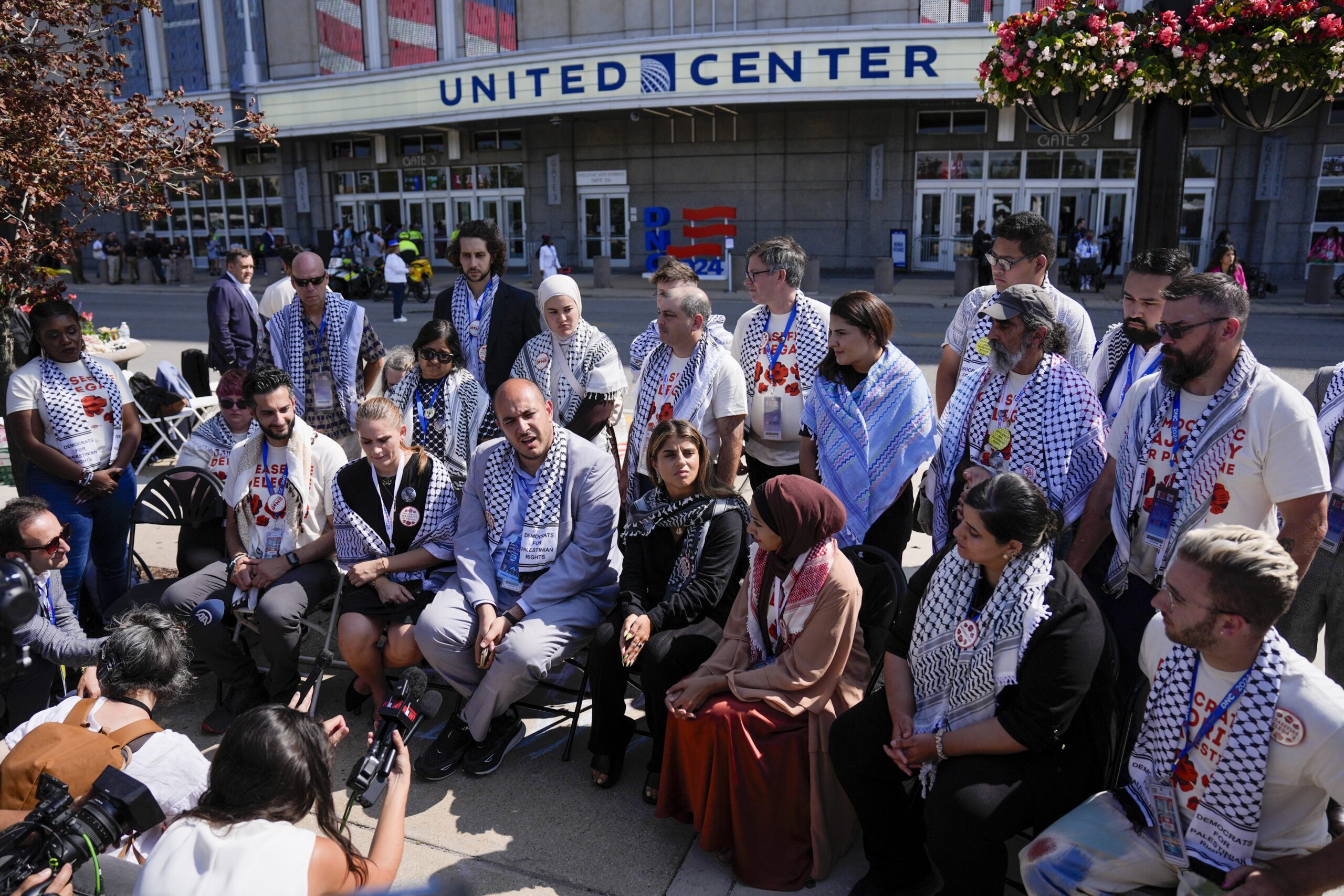
Former Democratic Rep. Kathy Manning: ‘There is no doubt that we are living through very difficult times for American Jews’
BIG TENT SHABBAT
State Dept. Shabbat dinner draws UAE, Saudi ambassadors and senior Trump officials
The dinner was hosted by Rabbi Yehuda Kaploun, the U.S. antisemitism special envoy
The annual confab, which kicks off today, will focus more on Europe’s shifting relations with the U.S.

THOMAS KIENZLE / AFP via Getty Images
People with umbrellas walk past a pedestrian bridge with the logo of the Munich Security Conference leading to the venue of the 62nd Munich Security Conference (MSC) the hotel "Bayrischer Hof" in Munich, southern Germany on February 12, 2026.
A who’s who of the world’s major political leaders, past and present, are descending on Munich for the annual Munich Security Conference. After last year’s forum, in which Vice President JD Vance, who was leading the U.S. delegation, took an abrasive tone against Europe in his keynote address that rankled some attendees, Secretary of State Marco Rubio will lead this year’s delegation.
Unlike last year, when the Israel-Hamas war featured prominently on the agenda, this year’s MSC schedule has relatively little time dedicated to talking about the conflict, with just two sessions expected to touch on Gaza. And while last year’s attendee list included a number of Israelis, including President Isaac Herzog and Defense Minister Israel Katz, there are no current Israeli officials slated to speak. (Former Foreign Minister Tzipi Livni will join one of the panels on Gaza reconstruction.)
Also absent this year is a Qatari presence. Qatari Prime Minister and Foreign Minister Mohammed bin Abdulrahman Al-Thani, who spoke last year about de-escalating tensions in the Middle East, is not on this year’s schedule, nor are any other Qatari officials.
Sens. Lindsey Graham (R-SC) — back this year after skipping the 2025 MSC to travel to the U.S.-Mexico border — and Sheldon Whitehouse (D-RI) will lead a bipartisan congressional delegation that includes Sens. Lisa Murkowski (R-AK), Mark Warner (D-VA), Chris Coons (D-DE), Richard Blumenthal (D-CT), Steve Daines (R-MT), Jacky Rosen (D-NV), Peter Welch (D-VT), Andy Kim (D-NJ) and Elissa Slotkin (D-MI).
Rep. Alexandria Ocasio-Cortez (D-NY) is slated to speak on two panels today, one on the “rise of populism,” and another on the “future of U.S. foreign policy,” the latter in conversation with Michigan Gov. Gretchen Whitmer and Matthew Whitaker, the U.S.’ representative to NATO. Matt Duss, a former foreign policy advisor to Sen. Bernie Sanders (I-VT) who has been critical of the U.S.-Israel relationship and is now advising the New York Democrat, said that she will use her perch in Munich to give the “working-class perspective” on the intersection of domestic politics and foreign policy.
AOC isn’t the only millennial member of Congress to be addressing the MSC this year. Rep. Yassamin Ansari (D-AZ), the first Iranian American Democrat elected to Congress, will be speaking on Sunday on a panel titled “Under Reconstruction: A World Order for the Next Generation.”
The conference kicks off this afternoon with a sit-down with German Chancellor Friedrich Merz, followed by a panel discussion on “The International Order Between Reform and Destruction,” which will feature U.S. Ambassador to the U.N. Michael Waltz, the EU’s Kaja Kallas, Saudi Foreign Minister Prince Faisal bin Farhan Al Saud and Colombian Defense Minister Pedro Arnulfo Sánchez Suárez.
A town hall session focused on Gaza rebuilding efforts will take place later this afternoon. Speakers include Nickolay Mladenov, the Bulgarian diplomat serving as the head of the Gaza Board of Peace, Sen. Chris Murphy (D-CT), Livni and Palestinian Authority Foreign Affairs Minister Varsen Aghabekian. Concurrent to that panel is a session focused on maritime security, with Yemeni President Rashad al-Alimi, whose country has been used by the Iran-backed Houthis as a launching pad for attacks on ships transiting through the Gulf, set to speak.
Later in the day, CNN’s Christiane Amanpour will moderate back-to-back sessions on the future of Iran: the first with exiled Iranian Crown Prince Reza Pahlavi and British-Iranian actress and activist Nazanin Boniadi; and the second with Graham, the Carnegie Endowment for International Peace’s Karim Sadjadpour, European Parliament President Roberta Metsola and Manal Radwan, a senior advisor in Saudi Arabia’s Foreign Ministry.
Rubio will kick off Saturday’s sessions with a mainstage conversation with MSC Chairman Wolfgang Ischinger, followed by Chinese Foreign Minister Wang Yi. Also on Saturday morning, former U.K. Prime Minister Tony Blair and the International Committee for the Red Cross’ Mirjana Spoljaric Egger will speak on a panel about peace deals.
Later in the day, Elbridge Colby, the Defense Department’s under secretary of war for policy will speak in conversation with Foreign Policy’s Ravi Agrawal before joining a larger panel focused on security in the Indo-Pacific.
The Middle East will take center stage again on Saturday evening, during a session titled “Building on Momentum in the Middle East: From Promise to Progress?” that will feature another appearance by Saudi Foreign Minister Prince Faisal bin Farhan Al Saud, joined by Norwegian Foreign Minister Espen Barth Eide and Sigrid Kaag, who now sits on the executive board of the Board of Peace.
Prince Faisal will also speak alongside U.K. Foreign Minister Yvette Cooper and White House senior advisor Massad Boulos in a session Saturday focused on ending the war in Sudan.
Plus, Trump sets monthlong timeline for Iran deal
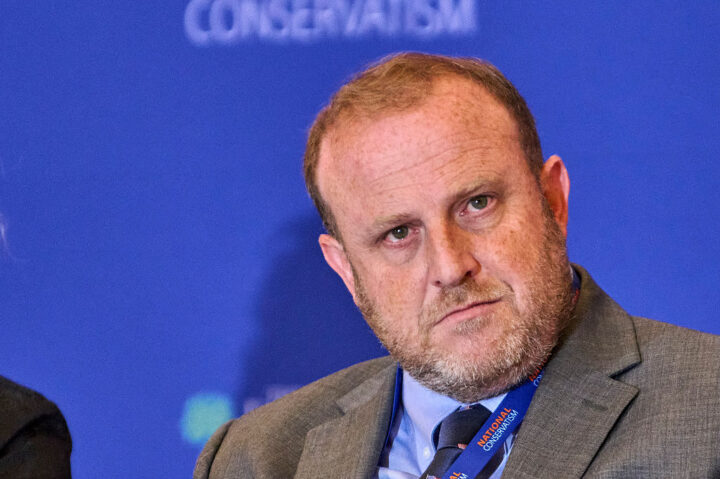
DOMINIC GWINN/Middle East Images/AFP via Getty Images
Jeremy Carl speaks at the National Conservatism Conference in Washington D.C., Sept. 3, 2025.
Good Thursday afternoon!
This P.M. edition is reserved for our premium subscribers — offering a forward-focused read on what we’re tracking now and what’s coming next.
It’s me again — Danielle Cohen-Kanik, U.S. editor at Jewish Insider and curator, along with assists from my colleagues, of the Daily Overtime. Please don’t hesitate to share your thoughts and feedback by replying to this email.
📡On Our Radar
Notable developments and interesting tidbits we’re tracking
Israeli Prime Minister Benjamin Netanyahu again voiced skepticism about the U.S.’ ability to reach an agreement with Iran as he departed Joint Base Andrews today, reports Jewish Insider’s Lahav Harkov, who is traveling with the prime minister’s delegation.
A day after his White House meeting with President Donald Trump, Netanyahu told reporters, “The president thinks the Iranians understand who they’re dealing with. He thinks the conditions he is setting, combined with their understanding that they made a mistake last time not reaching a deal, could bring them to agree to conditions that will allow a good deal to be reached.”
The prime minister’s view was more reserved: “I do not hide my general skepticism about the possibility of any deal with Iran.” Netanyahu said he told Trump that if a deal is indeed reached, “it must include the components that are important to us, the State of Israel, and, I think, the entire international community: not just the nuclear matter, but also ballistic missiles and Iranian proxies in the region.”
The Prime Minister’s Office also said Netanyahu will not be returning to Washington next week as scheduled, in order to speak at an AIPAC conference, and will instead appear virtually…
At a press conference this afternoon, Trump said the timeline for a potential deal with Iran is “over the next month … should happen quickly.” Asked why Netanyahu wants him to stop negotiating, Trump said, “He didn’t say that, we didn’t discuss that. I’ll talk to [Iran] as long as I like.” Trump additionally said Israeli President Isaac Herzog “should be ashamed of himself” and called him “disgraceful” for not issuing a pardon to Netanyahu…
The Trump administration smuggled around 6,000 Starlink terminals, used to establish internet connection, to activists in Iran during the regime’s violent suppression of nationwide protests, which included internet blackouts, U.S. officials told The Wall Street Journal…
New York City Mayor Zohran Mamdani and his team refused to condemn antisemitic and pro-Hamas social media posts from the co-founder of the group ‘Hot Girls for Zohran’ when pressed by JI’s Will Bredderman and other reporters today.
Speaking from City Hall, Mamdani would only stress that Gilani’s organization operated independently of his official election effort: “This was an individual leading an outside group and was never paid for by our campaign,” said Mamdani. “If New Yorkers want to know my views then they can hear it directly from me.
But when JI pressed the mayor directly whether he condemned the content of Gilani’s posts, he refused to respond and left the room, similar to how he fled questions on the matter from Politico on Wednesday…
Rep. Elise Stefanik (R-NY) urged the Trump administration today to investigate reports that a clique of radical staffers at the New York City Department of Health and Mental Hygiene had launched an anti-Israel “working group” inside the agency, JI’s Will Bredderman reports.
In a letter addressed to Health and Human Services Secretary Robert F. Kennedy Jr., Stefanik decried reports that employees had met during work hours at the city bureaucracy’s Queens headquarters. She raised the possibility that the department’s federal funding might have gone toward a prohibited political purpose — or that the gathering may have violated civil rights protections by creating a discriminatory environment for Jewish New Yorkers…
The nomination of Jeremy Carl, tapped to be the assistant secretary of state for international organizations, appears bound to fail after Sen. John Curtis (R-UT) announced his opposition to Carl’s confirmation following his contentious hearing in the Senate Foreign Relations Committee this morning, JI’s Marc Rod reports.
Curtis and a series of Democrats questioned Carl over past antisemitic, anti-Israel and otherwise inflammatory comments that the nominee had made online and in a series of podcast appearances, including his assertion that the U.S. spends too much time and energy on Israel “often to the detriment of our own national interest” and that “the Jews love to see themselves as oppressed”…
CENTCOM announced today it had completed a “deliberate and conditions-based” withdrawal of U.S. forces from al-Tanf Garrison in Syria, handing control of the site on the country’s border with Iraq and Jordan to forces aligned with the Syrian government. The U.S. has had a presence at the base since 2016 as part of its fight against ISIS; over 7,000 ISIS detainees are also being transitioned out of Syria into Iraq, while the U.S. troops were relocated to Jordan…
Germany joined the growing calls today for U.N. Special Rapporteur Francesca Albanese to resign, after France did the same yesterday, over her recent speech at the Al Jazeera Forum where she called Israel humanity’s “common enemy.” German Foreign Minister Johann Wadephul wrote on X, “I respect the system of independent rapporteurs of the UN. However, Ms. Albanese has already repeatedly failed in the past. I condemn her recent statements about Israel. She is untenable in her position”…
Israeli authorities arrested several people, and indicted one army reservist and one civilian, for allegedly using classified information to place bets on the popular prediction market Polymarket around the timing of Israel’s war with Iran last June, the Shin Bet announced today. The bets all correctly predicted the timeline of the strikes, raking in more than $150,000, Israeli media reported…
⏩ Tomorrow’s Agenda, Today
An early look at tomorrow’s storylines and schedule to keep you a step ahead
Keep an eye out in Jewish Insider for reporting on the race to succeed Rep. Bonnie Watson Coleman (D-NJ) in New Jersey’s 12th Congressional District, where the congresswoman is coming out forcefully against the lone Jewish candidate in the race — for being too supportive of Netanyahu.
The Munich Security Conference kicks off tomorrow, with Secretary of State Marco Rubio leading the U.S. delegation and speaking from the main stage on Saturday. Dozens of members of Congress were also expected to attend — official travel was canceled due to the impending shutdown of the Department of Homeland Security tomorrow, but members still may attend on their own. One member making a foray into foreign policy is Rep. Alexandria Ocasio-Cortez (D-NY), who will be speaking on two panels at the high-level summit. Other Democrats in attendance will be California Gov. Gavin Newsom, Michigan Gov. Gretchen Whitmer and Boston Mayor Michelle Wu.
In observance of President’s Day, we’ll be back in your inbox with the Daily Overtime on Tuesday. Shabbat Shalom!
Stories You May Have Missed
DOUBLING DOWN
Two Trump religious liberty appointees joined forces in anti-Israel push for antisemitism hearing
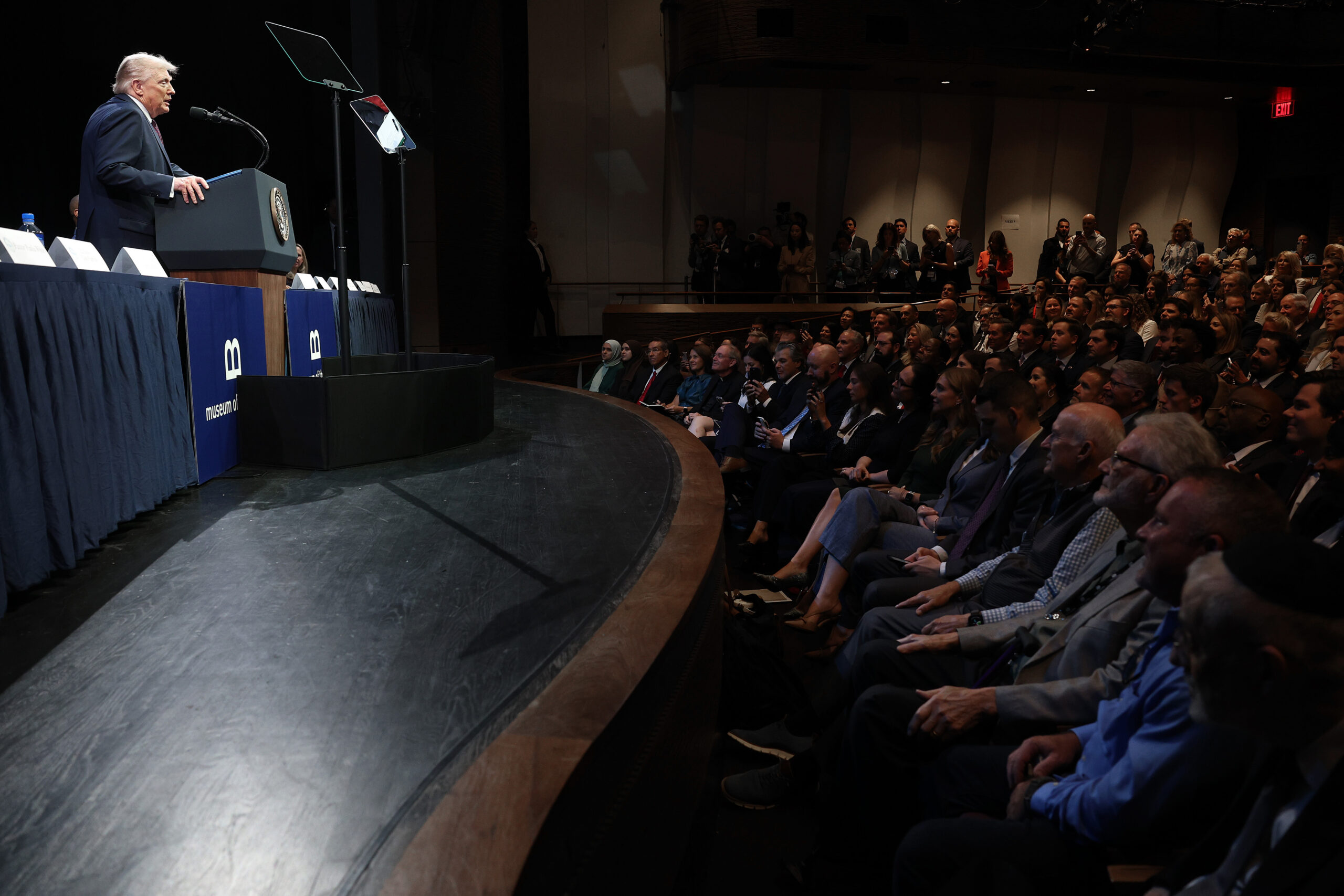
Activist Sameerah Munshi was appointed by the White House to the commission’s advisory board; the two women have jointly posted antisemitic content online
DOHA DEALINGS
GOP senator Ted Budd calls on Qatar to extradite Hamas leader to the U.S.

Budd says Qatar should hand over Khaled Mashaal because he has the ‘blood of Americans on his hands’
Plus, Massie challenger gets strong GOP backing

Julie Menin, speaker of the New York City Council and Zohran Mamdani, mayor of New York, arrive for an announcement in the Brooklyn borough of New York, US, on Monday, Jan. 12, 2026 (Photographer: John Lamparski/Bloomberg via Getty Images)
Good Thursday afternoon!
This P.M. edition is reserved for our premium subscribers — offering a forward-focused read on what we’re tracking now and what’s coming next.
It’s me again — Danielle Cohen-Kanik, U.S. editor at Jewish Insider and curator, along with assists from my colleagues, of the Daily Overtime. Please don’t hesitate to share your thoughts and feedback by replying to this email.
📡On Our Radar
Notable developments and interesting tidbits we’re tracking
Sen. Bill Cassidy (R-LA), the chairman of the Senate Health, Education, Labor and Pensions Committee, wrote to New York Mayor Zohran Mamdani today voicing “serious concerns” about Mamdani’s “rescission of executive orders related to antisemitism and boycotts of Israel.”
Cassidy said the New York City Department of Education’s $2.2 billion in federal funding could be rescinded “contingent on compliance with federal civil rights laws and applicable executive orders designed to protect students”…
New York City councilmembers on both sides of the aisle denounced a new working group established by employees of the city’s Department of Health on “global oppression,” Jewish Insider’s Will Bredderman reports, which a presenter at its first meeting on Tuesday acknowledged was “really developed in response to the ongoing genocide in Palestine.”
City Council Speaker Julie Menin called for a probe into the working group at DOH, which operates under Mamdani’s administration, telling the New York Post, “Our health care officials should be fighting infectious diseases and addressing skyrocketing health care costs instead of spending public time debating geopolitics”…
Moshe Davis, the former executive director of the Mayor’s Office to Combat Antisemitism in New York City, told The Free Press upon being ousted from the role by Mamdani, “I don’t think the priority of the administration has been to combat antisemitism.”
Davis, who was a political appointee of former Mayor Eric Adams, said a Mamdani staffer told him they were “looking to go in a different direction” in replacing him with Phylisa Wisdom, a progressive Jewish activist. “Look, I’m a loud, proud Jewish person with a kippah on my head, a proud Zionist. This administration maybe felt that was too much for them,” Davis said. He noted that his requests to meet with the mayor and the memos he produced on rising antisemitism in the city had gone ignored…
Mamdani officially endorsed New York Gov. Kathy Hochul in an anticipated move, boosting her reelection prospects while also dealing a blow to her lieutenant governor, Antonio Delgado, who is running to oust Hochul from her left…
Rep. Andy Barr (R-KY) and businessman Nate Morris, two of the leading Republican candidates for Kentucky’s Senate seat, today endorsed Ed Gallrein, the GOP challenger to Rep. Thomas Massie (R-KY), one of the leading Republican critics of Israel in Congress, JI’s Marc Rod reports.
“Ed will never side with AOC or the radical-left against President Trump. He is exactly the kind of conservative warrior we need in Congress, and I’m proud to endorse him,” Barr said in a statement, referencing Massie’s pattern of breaking with various elements of Trump’s agenda, which has included voting against support for Israel.
The endorsements came amid an ongoing series of attacks by Trump on Massie, which included calling Massie a “moron” in remarks at the National Prayer Breakfast this morning, as well as attacks on Truth Social this week targeting Massie’s wife…
Daniel Flesch, a senior policy analyst at the Heritage Foundation who led the drafting of the organization’s Project Esther report on combating left-wing antisemitism, has parted ways with the conservative think tank, according to Heritage’s website.
Flesch had raised the alarm on right-wing antisemitism after Heritage President Kevin Roberts released a video defending Tucker Carlson for hosting neo-Nazi Nick Fuentes on his podcast, telling the Young Jewish Conservatives in December that, “Now, in some ways, the call is coming from inside the house.” Flesch had also been Heritage’s point person for the National Task Force to Combat Antisemitism, a coalition of conservative groups that disaffiliated from the think tank after the incident…
White House Press Secretary Karoline Leavitt confirmed today that Special Envoy Steve Witkoff and Jared Kushner will be traveling to Oman for negotiations with Iran tomorrow, saying at a press conference this afternoon that the president is “standing by for an update from them.”
“The president has obviously been quite clear in his demands of the Iranian regime — zero nuclear capability is something he’s been very explicit about and he wants to see if a deal can be struck. And while these negotiations are taking place, I would remind the Iranian regime that the president has many options at his disposal aside from diplomacy as the commander-in-chief of the most powerful military in the history of the world,” Leavitt added…
Israeli Prime Minister Benjamin Netanyahu told lawmakers at a closed-door meeting of the Knesset Foreign Affairs and Defense Committee that U.S.-Israel coordination is “as high and as close as possible” ahead of the nuclear talks tomorrow, Israeli media reports, but that he still doesn’t know if President Donald Trump will choose to take military action…
Middle East countries that were originally meant to participate in the talks, including Saudi Arabia, Qatar, Egypt, Oman, the UAE and Pakistan, drafted a potential agreement for the U.S. and Iran, including a nonaggression pact, diplomats told The Times of Israel…
Iran’s Islamic Revolutionary Guard Corps seized two foreign oil tankers in the Persian Gulf today, Iranian state media reported, days after attempting to stop and board a U.S.-flagged oil tanker. Reports did not provide the country of origin of the tankers seized today…
Sen. Lindsey Graham (R-SC) expressed frustration with the Lebanese government’s stance toward Hezbollah amid struggling disarmament efforts, describing on X a meeting he’d had with Gen. Rodolphe Haykal, the commander of the Lebanese Armed Forces. “I asked him point blank if he believes Hezbollah is a terrorist organization. He said, ‘No, not in the context of Lebanon.’ With that, I ended the meeting.”
“They have been designated as a foreign terrorist organization by both Republican and Democrat administrations since 1997 — for good reason. As long as this attitude exists from the Lebanese Armed Forces, I don’t think we have a reliable partner in them,” Graham continued. The U.S. has provided over $3 billion to shore up the LAF in the last 20 years, including $230 million approved by the Trump administration as recently as October…
⏩ Tomorrow’s Agenda, Today
An early look at tomorrow’s storylines and schedule to keep you a step ahead
Keep an eye out in Jewish Insider for whether AIPAC’s active role in the New Jersey 11th Congressional District Democratic primary — opposing former Rep. Tom Malinowski (D-NJ) — paid off. Polls in the district close at 8 p.m.
We’ll be watching for readouts from the meeting between White House Special Envoy Steve Witkoff, advisor Jared Kushner and Iranian Foreign Minister Abbas Araghchi in Oman at 10 a.m. local time tomorrow, including whether issues beyond Tehran’s nuclear program are discussed.
We’ll be back in your inbox with the Daily Overtime on Monday. Shabbat Shalom!
Stories You May Have Missed
AI AMBITION
Alphabet’s AI bet shows early returns under Israeli-American CFO Anat Ashkenazi
The Israeli-American CFO first fueled Eli Lilly’s success, and is now turning her attention to the tech sector
SURVEY SAYS
Israelis split on whether to join a U.S. strike on Iran – poll

Right-wing Israelis support a strike even if Iran does not attack, while other political camps prefer to wait and see if Iran strikes Israel first, IDI poll finds
The lack of clarity is reason for concern in Jerusalem, where the line on any potential American agreement with Iran has long been zero enrichment, extensive limitations on ballistic missiles and regional proxy activity
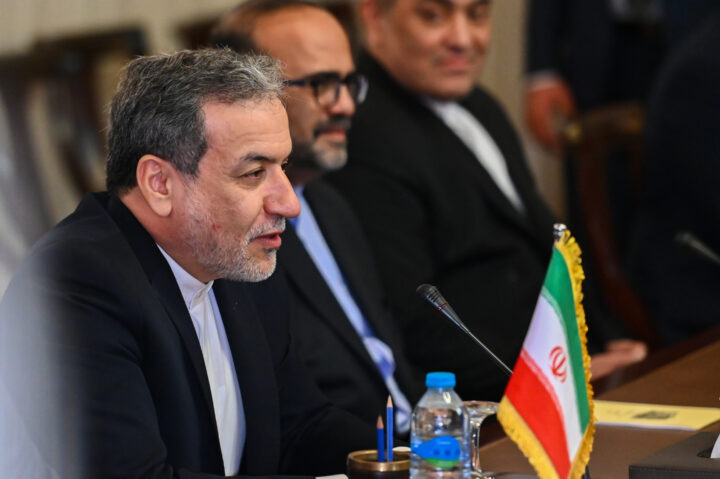
Sayed Hassan/Getty Images
Iran's Foreign Minister Abbas Araghchi meets with his Egyptian counterpart on October 17, 2024 in Cairo, Egypt.
For a brief moment on Wednesday, it looked like Iran talks were off. Tehran wanted to move their location from Turkey to Oman and narrow the scope of the negotiations to its nuclear program. The Trump administration saw this as a bad sign, and anonymous American officials began leaking to the media that Iran wasn’t taking the negotiations seriously.
Secretary of State Marco Rubio acknowledged that the negotiations were uncertain in remarks to the press at the Critical Minerals Ministerial, a conference of 43 foreign and other ministers: “As far as the talks are concerned, I think the Iranians had agreed to a certain format. For whatever reason, it changed … We’ll see if we can get back to the right place. The U.S. is prepared to meet them,” he said.
Meanwhile, President Donald Trump relayed a warning to Iranian Supreme Leader Ali Khamenei in a prerecorded interview with NBC News: “I would say he should be very worried.”
It didn’t take long – just over two hours, to be precise – between the news of the apparent collapse of talks between the U.S. and Iran and Iranian Foreign Minister Abbas Araghchi’s announcement on X that they were back on: “Nuclear talks with the United States are scheduled to be held in Muscat on about 10 am Friday.” Anonymous American sources then confirmed to various media that negotiations were set to take place, after leaders of Arab and Muslim countries urged the Trump administration to give them a chance, despite Iran’s prevarications.
Still, Araghchi’s statement alludes to one of the major reasons that the talks were, briefly, called off: Are they only “nuclear talks” or are they about a range of malign behavior by the Islamic Republic?
The Iranian answer to that question is clear, but the Trump administration sent mixed messages.
The Trump interview with NBC provided few clues. The president expressed support for the protesters against the Iranian regime, saying “we’ve had their back.”
Yet, in a bit of revisionist history, he portrayed his recent threats to Iran as being solely about the nuclear file: “They were thinking of starting a new [nuclear] site in a different part of the country. We found out about it and said, ‘you do that, we’re going to do very bad things to you,'” Trump said. He didn’t mention ballistic missiles in the interview.
Rubio, however, specified that “as far as the topics [of negotiations] and what the agenda needs to be, I think that in order for talks to actually lead to something meaningful, they will have to include certain things, and that includes the range of their ballistic missiles, that includes the sponsorship of terrorist organizations across the region, that includes the nuclear program and that includes the treatment of their own people.”
“Beyond that,” Rubio said, “the president retains a number of options as to how to respond to [the violent crackdown on protesters] and future events.”
Vice President JD Vance told Megyn Kelly that stopping Iran from getting a nuclear weapon was the main concern: “In a perfect world, would I love it if a bunch of freedom-loving Iranians… had a government that was much more friendly to the United States of America? Would that be a good thing? Absolutely.”
“But fundamentally,” he added, “the president has been focused … on this question of ensuring that they don’t get a nuclear weapon. .. I feel 100% confident that even if the Iranians were rushing toward a nuclear weapon, they couldn’t get one during the Trump administration. But we’re not thinking about the next three years; we’re thinking about the next 30 years.”
Vance argued that “global nuclear proliferation” is “the biggest threat to the world,” and as such, Trump is seeking to stop Iran from obtaining nuclear weapons so that other countries in the region do not seek to attain them, as well, and is willing to work with unfriendly countries like Russia and China to achieve that because it is “the most important thing you can do for peace and stability.”
The lack of clarity is reason for concern in Jerusalem, where the line on any potential American agreement with Iran, going back to the Obama-era negotiations, has long been zero enrichment and extensive limitations on ballistic missiles and regional proxy activity.
Israel regarded U.S.-Iran negotiations with deep skepticism even before the latest bumps on the road to Oman, with Israeli Prime Minister Benjamin Netanyahu telling White House Special Envoy Steve Witkoff during his visit to Israel on Tuesday that “Iran proved time after time that its promises cannot be trusted.” Talks that do not include missiles and proxies will likely be viewed with alarm.
Plus, Israel continues to cast doubt over Iran talks
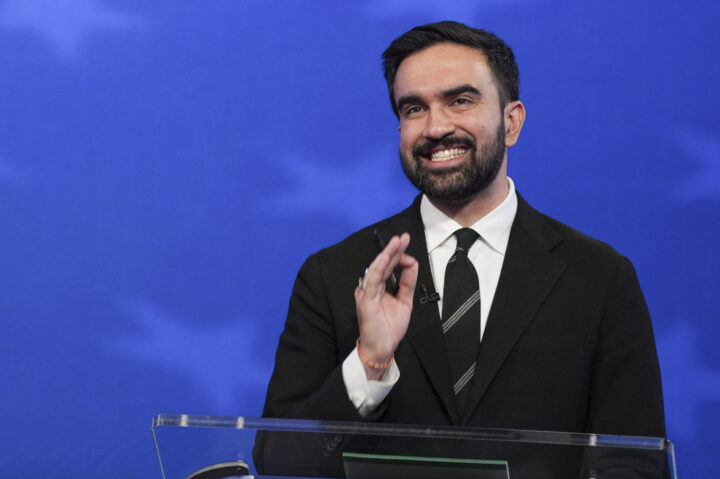
Angelina Katsanis-Pool/Getty Images
Democratic mayoral nominee Zohran Mamdani speaks during a mayoral debate at Rockefeller Center on October 16, 2025 in New York City.
Good Wednesday afternoon!
This P.M. edition is reserved for our premium subscribers — offering a forward-focused read on what we’re tracking now and what’s coming next.
It’s me again — Danielle Cohen-Kanik, U.S. editor at Jewish Insider and curator, along with assists from my colleagues, of the Daily Overtime. Please don’t hesitate to share your thoughts and feedback by replying to this email.
📡On Our Radar
Notable developments and interesting tidbits we’re tracking
U.S. officials reportedly backtracked on their rejection of Iranian demands to change the format and venue of nuclear negotiations, set for Friday, after several Middle East leaders intervened to keep the U.S. from walking away, according to Axios. “They asked us to keep the meeting and listen to what the Iranians have to say. We have told the Arabs that we will do the meeting if they insist. But we are very skeptical,” one U.S. official told the outlet.
Iranian Foreign Minister Abbas Araghchi confirmed on X that “nuclear talks … are scheduled to be held in Muscat” at 10 a.m. on Friday, indicating the U.S. agreed to move the venue from Turkey to Oman…
But Secretary of State Marco Rubio reiterated today that the Trump administration is seeking a comprehensive deal with Iran to address more than just its pursuit of nuclear weapons — including its ballistic missiles program, support for terror proxies and internal repression as well. Iran has traditionally been resistant to discussing anything beyond its nuclear program.
Asked if Iranian Supreme Leader Ayatollah Ali Khamenei should be worried right now, President Donald Trump told NBC News today, “I would say he should be very worried, yeah, he should be.” Trump said he was interested in negotiations again as he understood Iranian officials were considering restarting their nuclear program, “and if they do, we’re going to send” B-2 bombers “right back to do their job again,” referencing the U.S.’ June strikes…
Israeli officials have voiced skepticism over the prudence of negotiating with Iran at all, Jewish Insider’s Lahav Harkov reports. After Israeli Prime Minister Benjamin Netanyahu told White House Special Envoy Steve Witkoff yesterday that Iran’s “promises cannot be trusted,” Energy Minister Eli Cohen told Israeli radio, “Our message to the U.S. is that negotiations with Iran are a waste of time”…
Sam Brownback, the former U.S. ambassador at large for international religious freedom and a former GOP senator from Kansas, warned at a House Foreign Affairs Committee hearing today that, unless Syrian minority groups are allowed to maintain their own security forces, they face a likely genocide by government-aligned forces, JI’s Marc Rod reports.
“The new administration in Syria is purging religious minorities, threatening and killing them,” Brownback said. “These groups must be allowed to maintain their own security forces, or I guarantee you today, a genocide will happen in Syria like happened in Iraq to the Yazidis and Christians.”
The Trump administration has remained largely supportive of the al-Sharaa government, and critics have accused the White House of essentially abandoning the U.S.’ longtime Kurdish allies to the Syrian government onslaught…
First Lady Melania Trump welcomed freed Israeli hostages Aviva and Keith Siegel to the White House today, JI’s Gabby Deutch reports, one year after Aviva met the first lady for the first time and pleaded for help in securing her husband’s release.
“Aviva is a warrior. She’s a warrior. She was fighting very hard for Keith, and I know he suffered a lot,” Trump said at the meeting. “I’m happy to see you healthy at home with your children, with your grandchildren, with your family, and I know you’re giving back your time, your energy, to other people”…
New York City Mayor Zohran Mamdani tapped Phylisa Wisdom, the executive director of the progressive group New York Jewish Agenda, to lead the Mayor’s Office to Combat Antisemitism, the Forward reports.
Wisdom told JI last month that tackling the “scourge of antisemitism” in the city will require a comprehensive strategy,” noting that the office she will now lead “can play a key role, coordinating between long-standing offices and agencies tasked with combating hate, and input from the diversity of New York’s Jewish community.”
The appointment of the left-wing activist indicates Mamdani’s administration isn’t looking to placate the mainstream Jewish community. Wisdom, while well-known in the New York Jewish community, has traditionally opposed the International Holocaust Remembrance Alliance’s working definition of antisemitism and at times vocally opposed Israel’s war in Gaza after the Oct. 7 attacks…
Meanwhile, New York Gov. Kathy Hochul selected former New York City Council Speaker Adrienne Adams as her running mate in her reelection race this year — a pick that provoked both applause and consternation among leaders of the state’s Jewish community, JI’s Will Bredderman reports.
Adams was the first council speaker not to lead a delegation to Israel — although she denied that she was boycotting the country, she raised concerns in 2024 when her office drafted an ultimately abandoned resolution urging a ceasefire between Israel and Hamas that one Jewish community leader described to JI as “one-sided” and “inflammatory”…
A pair of well-financed groups, whose origin is currently unknown, is set to begin running ads boosting moderate pro-Israel candidates in a series of open House seats in Chicago, each of whom is facing off against vocal anti-Israel opponents, JI’s Marc Rod reports.
The ads — being run by newly formed super PACs Elect Chicago Women and Affordable Chicago Now — boost state Sen. Laura Fine, running in the 9th Congressional District, former Rep. Melissa Bean (D-IL), running in the 8th District and Cook County Commissioner Donna Miller, running in the 2nd District.
The ad buys for the two groups add up to millions of dollars across the three races. Given that the groups were just launched, FEC filing policies will not require them to disclose their donors until close to Election Day. But the ads, which do not focus on Israel policy, are widely rumored to be connected to United Democracy Project, the AIPAC-affiliated super PAC…
PEN America, an organization promoting free expression for artists and journalists, said today it would retract its Jan. 29 statement expressing concern about the abrupt cancellation of Israeli comedian Guy Hochman’s shows in New York and Los Angeles. The organization, which alleged Hochman “has been accused by advocacy organizations of incitement to genocide in Gaza,” said it would “remain committed to open and respectful dialogue about the divisions that arise in the course of defending free expression”…
The Washington Post announced mass layoffs of one-third of its staff today, including closing its sports section, reducing its local coverage and letting go all of its Middle East correspondents. The outlet has faced repeated criticism for major factual errors and alleged institutional and reporter bias related to its coverage of Israel and the war in Gaza…
⏩ Tomorrow’s Agenda, Today
An early look at tomorrow’s storylines and schedule to keep you a step ahead
Keep an eye out in Jewish Insider for a profile of Alphabet’s Israeli-American chief financial officer, Anat Ashkenazi, who got her start at Israel’s Bank Hapoalim more than two decades ago.
It’s primary day in New Jersey’s 11th Congressional District, as candidates vie for the Democratic nomination to fill Gov. Mikie Sherrill’s House seat. The race has attracted attention for the more than $2 million the AIPAC-linked super PAC United Democracy Project has spent targeting former Rep. Tom Malinowski (D-NJ), who is attempting to beat out others including Lt. Gov. Tahesha Way, far-left activist Analilia Mejia and Essex County Commissioner Brendan Gill.
The Hudson Institute will host Rabbi Yehuda Kaploun, the special envoy to monitor and combat antisemitism, for a conversation on the Trump administration’s strategy in confronting the rise of antisemitism.
Stories You May Have Missed
UNDER SCRUTINY
Jewish leaders raise alarm over Fairfax County GOP chair candidate’s antisemitism

‘Just because someone is a hateful antisemitic looney-tune doesn’t mean they can’t win office,’ one Jewish community activist said of Shelly Arnoldi
SCHOOL OF THOUGHT
New Seattle school superintendent claims tikkun olam as central leadership value

Ben Shuldiner, who is Jewish, is bringing his progressive politics to a school district facing a spike in antisemitism
With negotiations taking place this week, the secretary of state said any agreement would have to address Iran’s missile program, support for proxy terror groups and internal repression, in addition to the nuclear issue
Oliver Contreras / AFP via Getty Images
Secretary of State Marco Rubio speaks during the inaugural Critical Minerals Ministerial meeting at the Sate Department in Washington, DC, on February 4, 2026.
Secretary of State Marco Rubio outlined on Wednesday what the Trump administration views as the minimum requirements for successful nuclear negotiations with Iran, insisting that any deal with Tehran be comprehensive and address its ballistic missile capabilities, support for regional terrorism and repression of its people, in addition to the nuclear issue.
“In order for talks to actually lead to something meaningful, they will have to include certain things,” Rubio said during his remarks at an event on critical minerals supply chains, which Israeli Foreign Minister Gideon Sa’ar attended. “That includes the range of their ballistic missiles, that includes their sponsorship of terrorist organizations across the region, that includes the nuclear program and that includes the treatment of their own people.”
U.S. and Iranian officials are expected to meet Friday for talks aimed at negotiating a new nuclear agreement, with Iranian Foreign Minister Abbas Araghchi and White House Special Envoy Steve Witkoff leading the delegations. While Iran has insisted the discussions be limited strictly to its nuclear program, the United States has pushed to include Tehran’s ballistic missile capabilities and support for regional proxy groups.
Iran has also demanded that the meeting location be moved from Turkey to Oman and that talks take place in a strictly bilateral format, excluding Arab mediators. Rubio acknowledged the shift on Wednesday, saying Washington remains prepared to engage despite the uncertainty.
“The Iranians had agreed to a certain format and for whatever reasons changed in their system,” Rubio said. “We’ll see if we can get back to the right place, but the United States is prepared to meet with them.”
The diplomatic maneuvering has unfolded against a backdrop of heightened military tensions between the two parties in recent days. On Tuesday, a U.S. F-35 fighter jet shot down an Iranian drone aggressively approaching the USS Abraham Lincoln aircraft carrier in the Arabian Sea.
Later that day, Iran’s Islamic Revolutionary Guard Corps (IRGC) deployed two fast-attack boats and a drone towards a U.S.-flagged commercial tanker, the Stena Imperative, in the Strait of Hormuz. U.S. officials said the IRGC appeared to be attempting to potentially seize the vessel before a U.S. missile destroyer intervened and escorted the tanker out of the area.
Israel has voiced skepticism over the prospects of renewed talks. During White House envoy Steve Witkoff’s visit to Israel on Tuesday, Prime Minister Benjamin Netanyahu told him that “Iran proved time after time that its promises cannot be trusted,” according to a statement from the Prime Minister’s Office.
Experts have also questioned whether negotiations with Tehran could lead to a meaningful outcome. Andrea Stricker, a research fellow at the Foundation for Defense of Democracies, previously told Jewish Insider that the Trump administration’s demands that Iran abandon its nuclear program, cap its missile program, halt support for regional proxies and terrorism and stop executing its people are “nonstarters for the regime.”
Should negotiations falter, experts have warned that U.S. military action against Iran remains a possibility. Rubio said that President Donald Trump retains “a number of options” for responding to “future events.”
Rubio also touched on what he described as fundamental differences between the despotic Iranian regime and the Iranian people, underscoring that Washington’s strategy is focused on confronting the regime rather than civilians.
“I remind everybody what I’ve been saying through my entire career in public service: the Iranian people and the Iranian regime are very unalike,” Rubio said. “This is a culture with deep history. I know of no other country where there’s a bigger difference between the people that lead the country and the people who live there.”
He added that the regime’s priorities remain a central obstacle to improving living conditions for Iranians.
“One of the reasons why the Iranian regime cannot provide the people of Iran the quality of life that they deserve is because they’re spending all their money,” Rubio said. “They’re spending all their resources, of what is a rich country, sponsoring terrorism, sponsoring all these proxy groups around the world, exporting, as they call it, a revolution.”
Plus, Fine lands key endorsement, polling bump in key IL-9 primary

Tajh Payne/US Navy via Getty Images
U.S. Navy's Gerald R. Ford Carrier Strike Group on Nov. 13, 2025.
Good Tuesday afternoon!
This P.M. edition is reserved for our premium subscribers — offering a forward-focused read on what we’re tracking now and what’s coming next.
It’s me again — Danielle Cohen-Kanik, U.S. editor at Jewish Insider and curator, along with assists from my colleagues, of the Daily Overtime. Please don’t hesitate to share your thoughts and feedback by replying to this email.
📡On Our Radar
Notable developments and interesting tidbits we’re tracking
Despite negotiations between the U.S. and Iran set for Friday, Tehran is still behaving belligerently — the U.S. military shot down an Iranian drone today as it was flying toward the USS Abraham Lincoln aircraft carrier in the Arabian Sea, and Iranian gunboats attempted to stop and board a U.S. oil tanker in the Strait of Hormuz.
Iranian officials are also pushing to alter the talks dramatically, including changing the venue from Turkey to Oman, disinviting the foreign ministers of several Middle Eastern countries who were set to participate and limiting discussions only to the nuclear issue and not Tehran’s other malign activities, Axios reports.
Amid these developments, White House Press Secretary Karoline Leavitt said the talks “are still scheduled as of right now, but of course the president has always a range of options on the table and that includes the use of military force. The Iranians know that better than anyone”…
President Donald Trump does have plenty of firepower at his disposal should talks with Iran not pan out — The Washington Post lays out which military assets are in the region, as the U.S. recently deployed “dozens of aircraft to bases operating near Iran and assembled about 12 warships in or near the Middle East”…
White House Special Envoy Steve Witkoff, before heading to the talks, wherever they may be held, met with Israeli Prime Minister Benjamin Netanyahu in Jerusalem today. The prime minister “clarified his position that Iran has proven time and again that its promises cannot be relied upon,” according to a readout, signaling lingering skepticism in Israel that the U.S. will extract any meaningful concessions from Tehran…
Netanyahu also made clear Israel’s expectations for postwar Gaza as the U.S. presses ahead with Phase 2 of the ceasefire deal: that Hamas disarm and the enclave be demilitarized, that Israel be allowed to fulfill its “war objectives prior to the reconstruction of the Strip” and that the Palestinian Authority “not be part of the administration of the Gaza Strip in any way.” The latter demand comes after the technocratic committee set up by the U.S. to oversee reconstruction changed its logo to replicate a PA symbol…
The House of Representatives passed a spending bill to end the partial government shutdown, which Trump signed this afternoon. While the package includes several provisions providing funding to Israel and for joint U.S.-Israel cooperative programs, it only funds the Department of Homeland Security through next week, setting up another battle as the parties spar over funding for Immigration and Customs Enforcement…
State Sen. Laura Fine secured the endorsement of the Chicago Tribune editorial board in the competitive race for Illinois’ 9th Congressional District, over her competitors Daniel Biss, the mayor of Evanston, and social media influencer Kat Abughazaleh.
While Fine’s opponents have been outspoken about their criticisms of Israel on the campaign trail, the editorial board noted Fine said she “had left the progressive caucus in Springfield after she was made to feel uncomfortable for her belief in Israel’s right to defend itself or even to exist,” which it called a “principled position for a principled Democrat.”
Fine’s fundraising figures for the final quarter of 2025 showed she pulled in a whopping $1.2 million, and a new internal poll for Fine’s campaign shows her tied with Biss in first place, holding the momentum in the crowded primary…
New Jersey’s 7th Congressional District’s Democratic primary gained another prominent candidate today: Sue Altman, the state director for Sen. Andy Kim (D-NJ) and the 2024 Democratic nominee for the neighboring 12th District, jumped into the race to succeed retiring Rep. Bonnie Watson Coleman (D-NJ).
Altman has been a member of the progressive left as the former state director for the New Jersey Working Families Party, but took pro-Israel stances during her prior congressional run. Attempting to gain traction in the 7th, though, where the progressive Watson Coleman has said her endorsement will hinge on a candidate’s stance on Israel, Altman said she is now “reevaluating” her position…
Michael Blake, the former New York state assemblyman now mounting a primary challenge to Rep. Ritchie Torres (D-NY), was endorsed today by the longtime mayor of Newark, N.J., Ras Baraka, further solidifying Blake’s departure from his pro-Israel past.
Baraka’s support for violent rhetoric by the controversial Nation of Islam leader Louis Farrakhan and his condemnation of Israel’s war in Gaza are among several positions that have alarmed Jewish leaders in the state; Baraka’s support boosts Blake as he attempts to establish himself as the candidate hostile to Israel in his race, even as he once engaged extensively with AIPAC…
The two Human Rights Watch employees who comprised the organization’s “Israel and Palestine” team both resigned after HRW leadership postponed the publication of their report calling Israel’s refusal to recognize Palestinians’ “right of return” a “crime against humanity,” Jewish Currents reports.
Among other concerns, the organization’s chief advocacy officer had voiced hesitation that the findings were overbroad and “will be misread by many, our detractors first and foremost, as a call to demographically extinguish the Jewishness of the Israeli state”…
⏩ Tomorrow’s Agenda, Today
An early look at tomorrow’s storylines and schedule to keep you a step ahead
Keep an eye out in Jewish Insider for a profile of Seattle Public Schools’ new Jewish superintendent, as the district grapples with rising antisemitism in the aftermath of the Oct. 7 attacks.
First Lady Melania Trump will host former hostages Keith and Aviva Siegel for a private discussion at the White House.
Israeli Foreign Minister Gideon Sa’ar is also in Washington today and tomorrow to attend Secretary of State Marco Rubio’s inaugural Critical Minerals Ministerial, with over 50 countries participating to “strengthen and diversify critical minerals supply chains.”
The House Foreign Affairs Committee will hold a hearing on “defending religious freedom around the world.” Among those testifying is Sam Brownback, the former ambassador-at-large for international religious freedom; the ambassador role is currently empty after former Rep. Mark Walker (R-NC), who was tapped by Trump last April for the position, failed to be confirmed (he now holds a similar advisory role at the State Department, which did not require Senate confirmation).
Also taking place on the Hill, the Muslim World League will host a gathering highlighting “faith, leadership, and global coexistence.” Among those speaking are Ambassador Yehuda Kaploun, the special envoy to monitor and combat antisemitism; Sheikh Mohammed Al-Issa, a prominent Saudi scholar and former justice minister; Imam Talib Shareef, the president of The Nation’s Mosque; and members of Congress.
In the evening, the University of Nebraska–Lincoln’s student government will vote on a Boycott, Divestment and Sanctions resolution.
Stories You May Have Missed
TEHRAN TALK
Will he or won’t he? Analysts don’t rule out Iran strike despite diplomatic flurry

U.S.-Iran negotiations scheduled are ‘likely a diplomatic box-checking exercise and smokescreen,’ FDD’s Andrea Stricker said, while JINSA’s Jonathan Ruhe said U.S. military action is ‘unlikely for the moment’
DEM DIVIDE
Mamdani, socialist allies face first electoral test in battle for NYC House seat
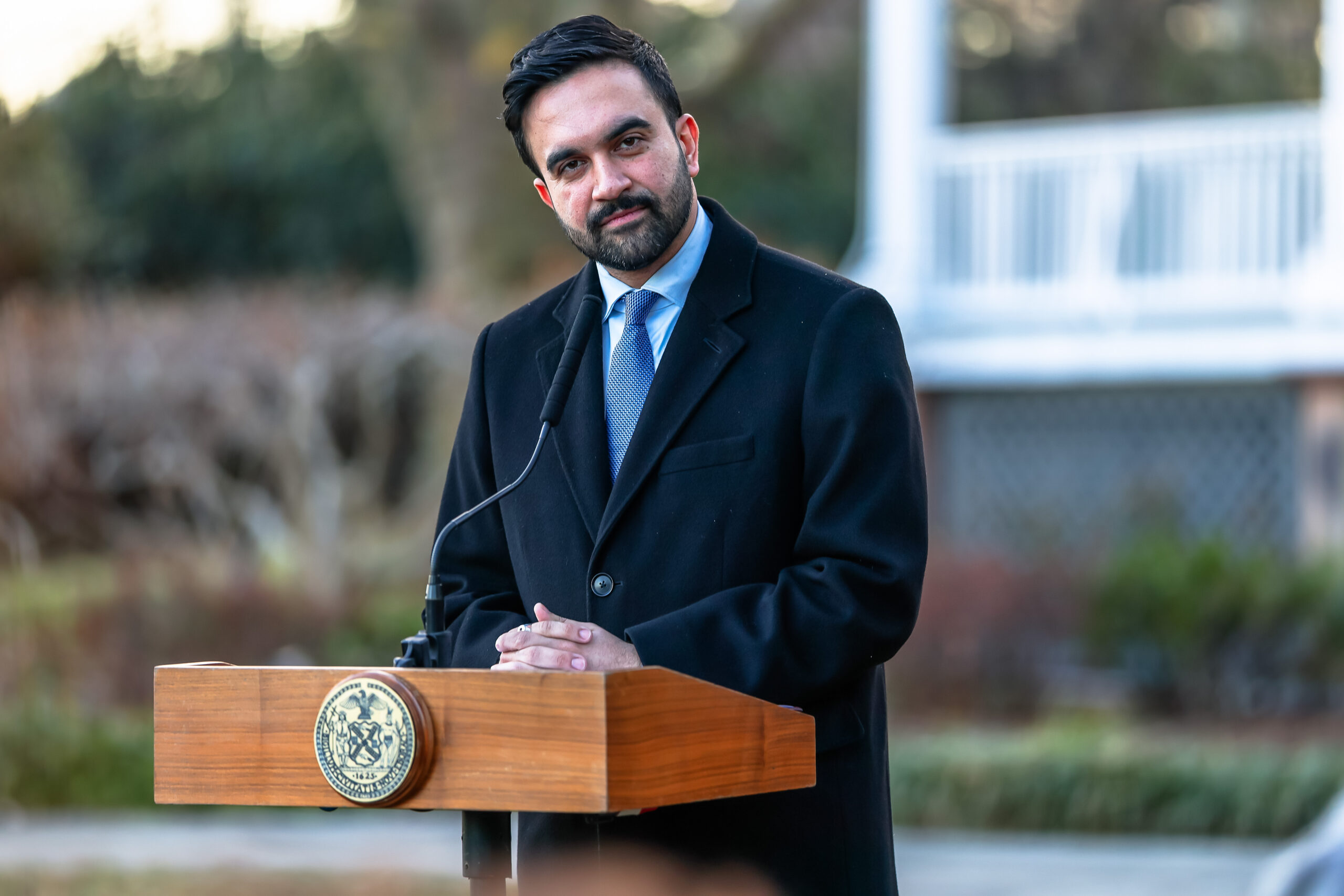
The fight to succeed Rep. Nydia Velazquez pits Mamdani and the DSA faithful against the congresswoman and her protege
Plus, White House press corps welcomes Hamas-friendly outlet
YAR/Middle East Images/AFP via Getty Images
Pedestrians walk past a mural bearing anti-American symbols on the outer wall of the former U.S. Embassy, now called the "U.S. Den of Espionage Museum," in Tehran, Iran, on October 26, 2025.
Good Monday afternoon!
This P.M. edition is reserved for our premium subscribers — offering a forward-focused read on what we’re tracking now and what’s coming next.
It’s me again — Danielle Cohen-Kanik, U.S. editor at Jewish Insider and curator, along with assists from my colleagues, of the Daily Overtime. Please don’t hesitate to share your thoughts and feedback by replying to this email.
📡On Our Radar
Notable developments and interesting tidbits we’re tracking
After weeks of rising tensions, the U.S. and Iran are back on the diplomatic track: White House Special Envoy Steve Witkoff is expected to meet with Iranian Foreign Minister Abbas Araghchi in Istanbul, Turkey, on Friday, Axios reports, possibly alongside Jared Kushner and the foreign ministers of several countries including Turkey, Qatar, Egypt, Oman, the UAE, Saudi Arabia and Pakistan.
What exactly will be up for discussion in the first meeting between the U.S. and Iran since the 12-day war last June is unclear — Iranian officials have said only nuclear activity is on the table, while the U.S. has traditionally maintained support for a comprehensive deal covering nuclear, missile and terror activity…
Before the dialogue in Turkey, Witkoff is slated to stop in Israel tomorrow to consult with Prime Minister Benjamin Netanyahu and Lt. Gen. Eyal Zamir, the IDF chief of staff, and hold meetings in the UAE and Qatar…
The parties are still covering all their bases: The U.S. and Israeli navies conducted a joint “routine maritime exercise” in the Red Sea today, after CENTCOM warned Iran’s Islamic Revolutionary Guard Corps on Friday to “avoid escalatory behavior at sea”…
Back in Washington, the White House tapped Drop Site News, a publication founded in 2024 to offer reporting explicitly hostile to Israel over the war in Gaza and the U.S. response to it, for the press corps’ new media seat on Sunday, Jewish Insider’s Gabby Deutch reports.
Drop Site has credulously interviewed several Hamas leaders, vigorously denied claims that Hamas terrorists raped anyone during the Oct. 7 attacks in Israel and supported the Iranian regime during the anti-government protests last month. Its inclusion among the outlets in Sunday’s press rotation (when no press briefing was held, so its reporter did not get the opportunity to ask a question) was a marked contrast to the mostly right-wing outlets that are usually selected…
And on the campaign trail, Sen. Tina Smith (D-MN) came out today in support of Minnesota Lt. Gov. Peggy Flanagan in the closely fought Democratic primary to replace her, joining fellow progressives Sens. Bernie Sanders (I-VT) and Elizabeth Warren (D-MA) in supporting Flanagan over the more moderate Rep. Angie Craig (D-MN). The endorsement comes days after fundraising reports for the final quarter of 2025 showed Craig raised double what Flanagan brought in ($2 million and $1 million, respectively)…
In New York City, Comptroller Mark Levine endorsed Rep. Dan Goldman (D-NY) in his primary against former Comptroller Brad Lander. Lander, challenging Goldman from the left on issues including his support for Israel, is endorsed by Mayor Zohran Mamdani, further highlighting divisions between Levine and the mayor as the two have sparred over issues including city investment in Israel bonds…
Jacobin profiles Diana Moreno, the democratic socialist running to fill Mamdani’s Queens seat in the state Assembly on a platform highlighting her progressive credentials as an organizer and immigrant.
“Moreno, wearing a keffiyeh, is featured in Mamdani’s launch video, pushing a stroller carrying her newborn son, saying ‘I want to raise my kid in New York.’ ‘I got pregnant one month after the genocide in Gaza started. My relationship to motherhood cannot be divorced from witnessing the world dehumanize children in Palestine,’” she said…
In New York’s 7th Congressional District, Councilmember Julie Won filed paperwork today to join the competitive race to replace retiring Rep. Nydia Velázquez (D-NY). All three candidates for the highly progressive district — which include Assemblymember Claire Valdez, who has the backing of Mamdani and the DSA, and Brooklyn Borough President Antonio Reynoso, who has been endorsed by Velázquez — have made comments critical of Israel.
On the one-year anniversary of the Oct. 7 attacks, Won expressed hope for a ceasefire and return of the hostages, mourning the 1,200 people “brutally killed” by Hamas in Israel and the “over 40,000 brutally killed in Palestine,” a figure Israel disputed at the time.
When a campaign last summer opposing a neighborhood development plan in her district invoked antisemitic rhetoric, Won denounced the move while maintaining her support for the “free Palestine” movement, saying in a statement, “It’s extremely alarming to me that someone would go so low to co-opt a movement of free Palestine for their own purpose — to incite anger and potentially violence … It’s shameful to compare Long Island City to Gaza — where people are literally losing their lives, land and starving to death — to this rezoning and blaming it on a local Jewish landlord who isn’t even part of the rezoning”…
Former Rep. Colin Allred (D-TX), who switched his candidacy from running for the open Texas Senate seat to its 33rd Congressional District, endorsed Rep. Jasmine Crockett (D-TX) for the Senate over his former primary rival, state Sen. James Talarico. Allred alleged that Talarico had called him a “mediocre Black man” and took aim at Talarico’s platform as a devout Christian: “You are not saving religion for the Democratic Party or the left,” Allred said…
⏩ Tomorrow’s Agenda, Today
An early look at tomorrow’s storylines and schedule to keep you a step ahead
Keep an eye out in Jewish Insider for the view from Washington on the continued possibility of U.S. strikes on Iran, even as diplomatic efforts unfold.
We’ll be watching for indications out of White House Special Envoy Steve Witkoff’s meetings in Israel on where the parties stand on engaging with Tehran.
It will be a busy day on the Hill, amid ongoing efforts to end the partial government shutdown: The House Foreign Affairs Committee will hold a hearing on U.S. policy towards Lebanon and “obstacles to dismantling Hezbollah’s grip on power” with testimony from several Washington Institute experts; the Senate Judiciary Committee will hold a hearing on the Nazis’ use of Swiss banks; the Helsinki Commission will hold a hearing on Russia’s influence in post-Assad Syria; and the Senate Foreign Relations Committee will hold a hearing on terrorism in North Africa.
The Jewish Community Relations Council of Greater Washington will host its Maryland advocacy day with Gov. Wes Moore as keynote speaker.
The World Governments Summit will kick off in Dubai, United Arab Emirates, with speakers including former Secretary of State Mike Pompeo, Lebanese Prime Minister Nawaf Salam, Spanish President Pedro Sánchez, Israeli philanthropist and Mobileye CEO Amnon Shashua and several other world leaders.
Stories You May Have Missed
DIPLOMATIC SPAT
South Africa banishes Israeli diplomat days before vote in Congress on trade benefits
Pretoria angered after Israel offers parched region water management aid; Jerusalem declares South African diplomat serving Palestinians persona non grata
RHOADES’ RUN
Swing district Democratic congressional candidate in Omaha blasts rivals over their criticism of Israel
Crystal Rhoades, the clerk of the District Court in Douglas County, is running on an unapologetically pro-Israel platform
Plus, car ramming suspect charged with multiple hate crimes
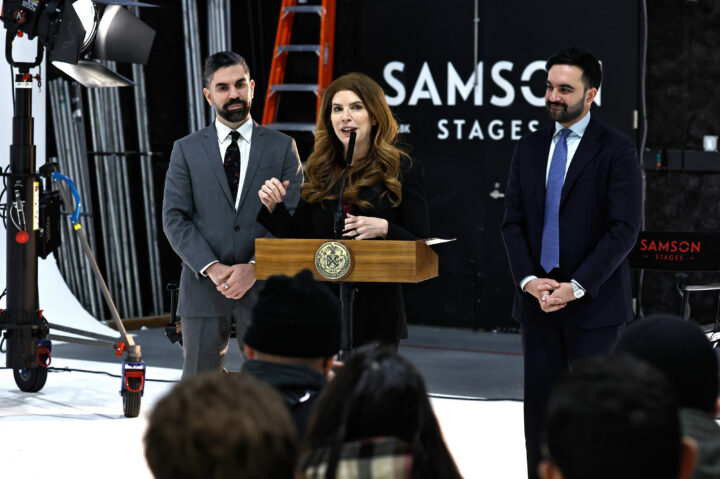
John Lamparski/Bloomberg via Getty Images
Julie Menin, speaker of the New York City Council, and Mayor Zohran Mamdani on Jan. 12, 2026.
Good Thursday afternoon!
This P.M. edition is reserved for our premium subscribers — offering a forward-focused read on what we’re tracking now and what’s coming next.
It’s me again — Danielle Cohen-Kanik, U.S. editor at Jewish Insider and curator, along with assists from my colleagues, of the Daily Overtime. Please don’t hesitate to share your thoughts and feedback by replying to this email.
📡On Our Radar
Notable developments and interesting tidbits we’re tracking
After a car repeatedly drove into Chabad Lubavitch world headquarters in Brooklyn last night, New York City Council Speaker Julie Menin announced today she is creating a council task force to combat antisemitism, even as Mayor Zohran Mamdani has said he plans to retain the mayor’s Office to Combat Antisemitism (and told local news today he’s “in the final stages” of hiring someone to lead it). The council task force’s co-chair is Councilwoman Inna Vernikov, an outspoken critic of Mamdani…
The suspect arrested in the car ramming has been charged with attempted assault, reckless endangerment, criminal mischief and aggravated harassment, all enhanced as hate crimes, the NYPD announced this afternoon…
And in the wake of several protests that have disrupted New York Jewish communities in recent months, Menin also introduced a bill that would ban protests within 100 feet of a house of worship — more stringent than Gov. Kathy Hochul’s proposal of a 25-foot ban.
“The First Amendment right to peacefully protest is sacrosanct. What’s not sacrosanct is inciting violence, intimidation and harassment,” Menin told The New York Times, though some experts cast doubt on the constitutionality of the measure…
Rep. Tim Walberg (R-MI), the chair of the House Committee on Education & Workforce, sent a letter to Evanston, Ill., Mayor Daniel Biss — who is running for Congress to replace retiring Rep. Jan Schakowsky (D-IL) — requesting a briefing on Biss’ role in the 2024 anti-Israel encampment at Northwestern University.
Walberg alleged that Biss had failed “to protect Jewish students” at Northwestern “by refusing to give the university the police support it desperately needed to clear its violent and antisemitic encampment,” which resulted in a failure to arrest protesters who had harassed Jewish students. Biss has also drawn condemnation for allegedly walking back his pro-Israel positions once he was denied the support of AIPAC in his congressional campaign…
Rep. Haley Stevens (D-MI) raised $2.1 million for her Senate campaign in the final quarter of 2025, she announced today, bringing her total raised to $6.8 million. But a new Emerson College poll of the race to replace Sen. Gary Peters (D-MI) shows that haul may not be making an impact among primary voters just yet — Stevens polled at 17% to state Sen. Mallory McMorrow’s 22%, with 38% still undecided.
In a general election matchup against presumptive GOP nominee former Rep. Mike Rogers (R-MI), both McMorrow and Stevens poll ahead of Rogers, 46-43% and 47-42% respectively, with 15% undecided. In all cases, physician Abdul El-Sayed, a progressive Democrat who has made his hostility to Israel a central component of his campaign, polls behind his opponents…
The Democratic primary in New York’s 17th Congressional District got a little less crowded today: Former FBI agent John Sullivan, who served as the top bureau intelligence official in Israel from 2017-2020, dropped out of the race to challenge Rep. Mike Lawler (R-NY).
“While my congressional campaign is coming to an end, my dedication to our community is not,” Sullivan wrote, telling supporters to “stay tuned.” He did not endorse any of the remaining Democratic candidates, which include front-runner Beth Davidson, a Rockland County legislator, and national security veteran Cait Conley…
The U.S. Navy dispatched an additional warship, the USS Delbert D. Black, to the Middle East in the past two days amid heightened tensions with Iran, Reuters reports, bringing the total number of destroyers in the region to six, in addition to an aircraft carrier…
The European Union voted unanimously to designate Iran’s Islamic Revolutionary Guard Corps as a terrorist organization today, Jewish Insider’s Matthew Shea reports, in a move anticipated after several countries including Italy and France rescinded their long-held objections to the move.
“Repression cannot go unanswered,” Kaja Kallas, the EU’s high representative for foreign affairs and security policy, wrote on X following the decision. “Any regime that kills thousands of its own people is working toward its own demise”…
Sens. Lindsey Graham (R-SC) and Richard Blumenthal (D-CT) introduced the “Save the Kurds Act” in response to the Syrian government’s campaign against the Kurdish-led and U.S.-backed Syrian Democratic Forces. The legislation would impose sanctions on “Syrian government officials and financial institutions, and any foreign individual who engages in any transaction, including military or financial support, with the Syrian government,” according to a press release.
The bill would also redesignate as a terror organization Hayat Tahrir al-Sham (HTS), the al-Qaida offshoot that Syrian President Ahmad al-Sharaa led before ousting dictator Bashar al-Assad. The Trump administration removed HTS’ terror designation and U.S. sanctions on Syria after al-Sharaa assumed the presidency…
A draft resolution from the Board of Peace dictating the powers of the bodies overseeing postwar Gaza seems to relegate the Gaza Executive Board — whose inclusion of Turkey and Qatar had concerned Israel — to an advisory role for another committee largely made up of White House advisors, The Times of Israel reports. The resolution, which also increases the Trump administration’s role in managing that body, still must be signed by the president…
A man was tried in federal court today for attempting to assassinate former President Joe Biden over anti-Israel animus, traveling to Georgia with a firearm in June 2024 to sneak into a presidential debate hosted by CNN so he could reach Biden, according to the Justice Department.
The man’s manifesto was addressed to “all the Palestinian journalists … and in remembrance of the ones who lost their lives along the way” and said, “It’s time we overthrow these bastards and threaten to pull a f**king D-Day on Tel Aviv,” concluding with “Free Palestine”…
A bipartisan delegation of lawmakers organized by the AIPAC-affiliated American Israel Education Foundation met with Israeli Prime Minister Benjamin Netanyahu in Jerusalem today, including Reps. Ryan Zinke (R-MT), Jen Kiggans (R-VA), Jake Ellzey (R-TX), Mike Bost (R-IL) and Don Davis (D-NC)…
⏩ Tomorrow’s Agenda, Today
An early look at tomorrow’s storylines and schedule to keep you a step ahead
Keep an eye out in Jewish Insider for a look at the legacy of constitutional lawyer and Jewish activist Nat Lewin, who turns 90 this weekend.
Several Jewish and pro-Israel organizations were invited to a meeting with Saudi Defense Minister Khalid bin Salman, who is in Washington meeting with Trump administration officials, tomorrow afternoon, JI’s Danielle Cohen-Kanik has learned, amid a sharp rise in antisemitic and anti-Israel rhetoric from the kingdom. It’s not clear which organizations will be attending, though the Foundation for Defense of Democracies confirmed it will sit down with KBS separately in the morning.
We’ll be back in your inbox with the Daily Overtime on Monday. Shabbat Shalom!
Stories You May Have Missed
PASTOR’S POLEMIC
Contender to succeed Jasmine Crockett blasted Israeli ‘apartheid’ in sermon on Oct. 8
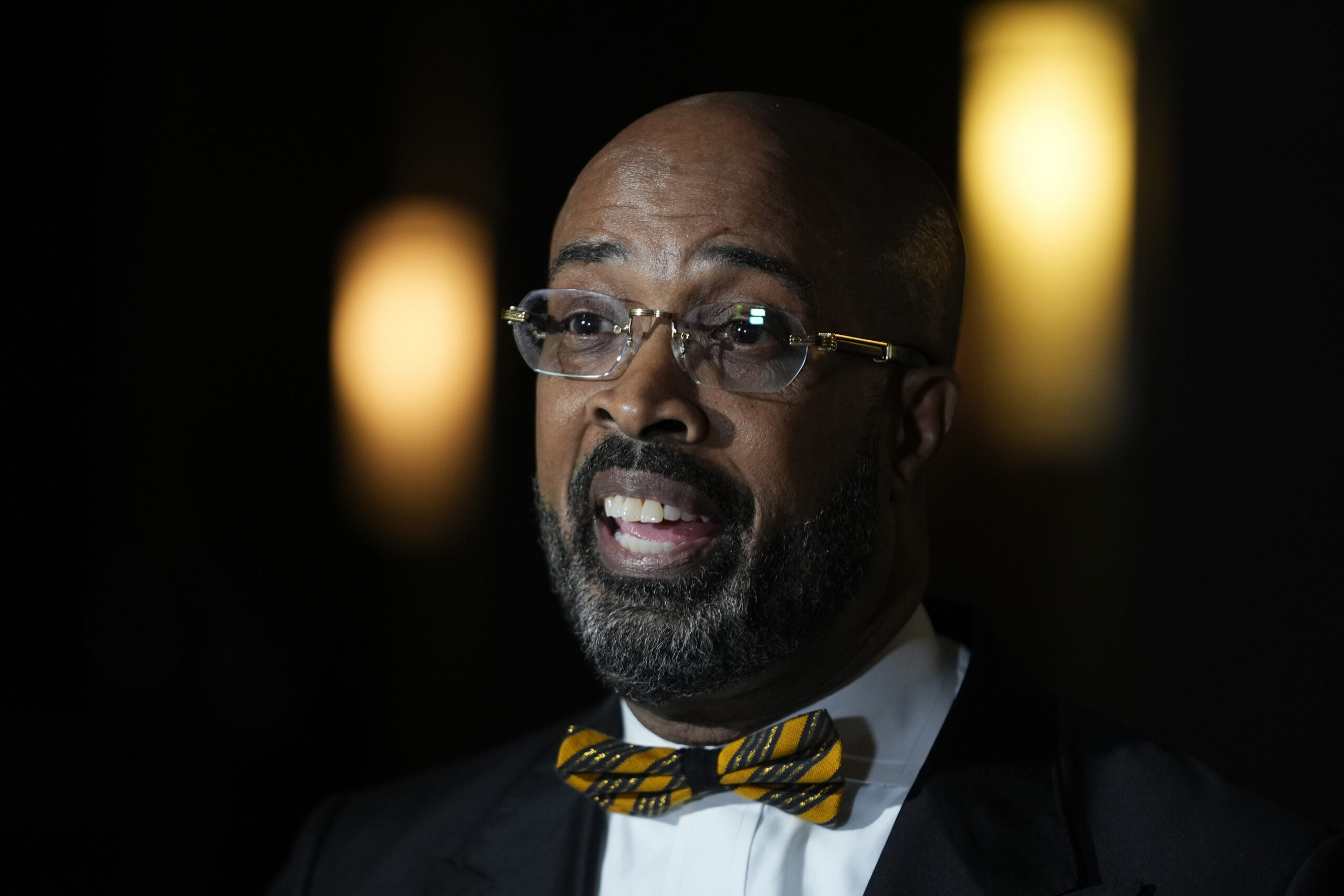
Singer told JI that his alignment with Rev. Frederick D. Haynes III delivered an anti-Israel polemic from the pulpit on Oct. 8, 2023, the day after Hamas’ attack on Israel
COMEBACK BID
Elaine Luria wants to reclaim her post as a pro-Israel leader in Congress
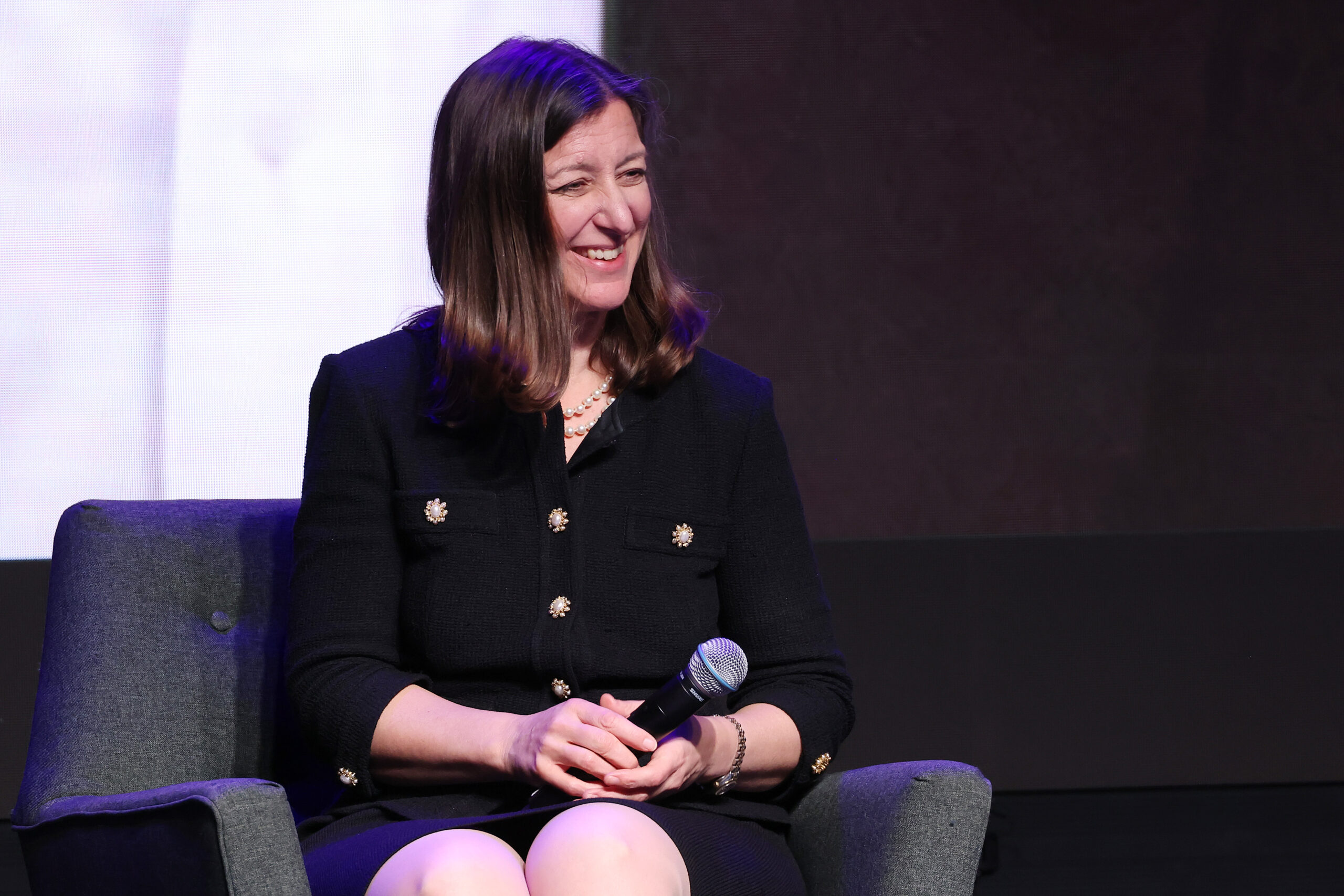
The former congresswoman told JI, ‘Anything that needs to be done to stop Iran from acquiring a nuclear weapon needs to be done’
‘Today, many of the NGOs and technology providers that maintain these tools are facing closure due to funding cuts,’ the letter warns
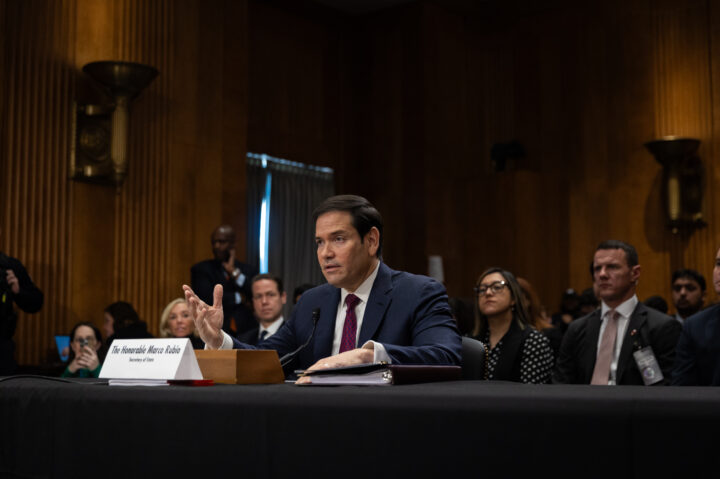
Nathan Posner/Anadolu via Getty Images
Secretary of State Marco Rubio testifies during a Senate Foreign Relations Committee hearing on Venezuela, in Washington, DC, United States on January 28, 2026.
A bipartisan group of senators wrote to Secretary of State Marco Rubio on Wednesday urging him to “surge resources to quickly enable critical internet freedom support” to protesters in Iran, pointing to funding cuts that have stretched resources for such programs.
“Today, many of the NGOs and technology providers that maintain these tools are facing closure due to funding cuts and more importantly, fewer Iranian citizens can share their videos and messages with the world and each other,” the letter warns. “Without the continuous operation of internet freedom programming carried out by the State Department and Open Technology Fund, millions of Iranians will lose their last secure window and voice to the outside world.”
The lawmakers, Sens. James Lankford (R-OK), Jacky Rosen (D-NV), Lindsey Graham (R-SC) and Cory Booker (D-NJ), warned that if U.S. programs fully lapse, regime-controlled programs and state media will step into the gap, “giving the regime near-total control over the digital space and putting users at far greater risk.”
“As we watch brave Iranians take to the streets, it is clear that supporting the Iranian people’s access to information is not a partisan issue but a matter of national security, as well as meeting legislative requirements for a strategy for promoting internet freedom in Iran,” the lawmakers said, pointing to existing legislation mandating the State Department to expand internet access in Iran. “The United States must pair its maximum pressure on the regime with maximum support for the Iranian people.”
The letter comes at a time when Congress has offered few of its own strategies to respond to the wave of protests around Iran — which, according to Rubio, have now largely been put down by the regime.
Such efforts to promote free internet access to the Iranian people, amid efforts by the regime to impose an internet blackout, have emerged as a key area of bipartisan agreement.
Much of the U.S.’ global communications programming, including funding for promoting internet access, was slashed last year amid cutbacks to various foreign aid programs. Some prominent Republicans have criticized the administration, saying that government-sponsored news programming and communications assistance have failed to meet the moment in Iran.
The letter emphasizes the “long-standing and bipartisan commitment” to supporting internet freedom programs, which are “more important than ever as the people of Iran protest against the regime in record numbers.” The legislators noted that prior administrations have, for two decades, supported various anti-censorship and internet freedom tools in Iran, and that Congress passed legislation in 2024 supporting such programs.
“Without U.S. leadership, an entire generation of Iranians would have remained in the dark — and the most powerful source of pressure against the Islamic Republic, the Iranian people themselves, would have been neutralized,” the letter reads.
It notes that the existing U.S. programs allowing a small number of Iranians to remain online had “proved decisive” during the Israel-Iran war last summer to demonstrate the division between the Iranian people and the regime, and said that expanded internet access now “would put a spotlight on the increasingly securitized atmosphere that is cracking down on dissent.”
Plus, Biden officials don't hold back on criticism of Bibi

Mass Communication Specialist 3rd Class Amber Smalley/U.S. Navy via Getty Images
Flight deck of the Nimitz-class aircraft carrier USS Abraham Lincoln (CVN 72) May 10, 2019 in the Red Sea.
Good Wednesday afternoon!
This P.M. edition is reserved for our premium subscribers — offering a forward-focused read on what we’re tracking now and what’s coming next.
It’s me again — Danielle Cohen-Kanik, U.S. editor at Jewish Insider and curator, along with assists from my colleagues, of the Daily Overtime. Please don’t hesitate to share your thoughts and feedback by replying to this email.
📡On Our Radar
Notable developments and interesting tidbits we’re tracking
President Donald Trump indicated he’s losing patience with Iran: He posted a stark warning on Truth Social this morning that a “massive Armada is heading to Iran” and “it is ready, willing, and able to rapidly fulfill its mission, with speed and violence, if necessary.”
Trump encouraged Tehran to come back to the negotiating table where he demanded it have “no nuclear weapons” — a position that differs from Israel’s, which has said Iran must not be allowed to enrich uranium at all — but made no mention of the protesters Trump had pledged to protect…
Despite Trump’s threat, Secretary of State Marco Rubio told lawmakers at a Senate Foreign Relations Committee hearing today that the “armada” of military assets being moved to the Middle East is primarily defensive, Jewish Insider’s Marc Rod reports.
Rubio noted that 30,000-40,000 U.S. troops in the region are “within the reach of an array of thousands of Iranian” drones and missiles. “We have to have enough force and power in the region, just on a baseline, to defend against that possibility,” he explained.
In addition, “the president always reserves the preemptive defensive option — in essence, if we have indications that, in fact, they’re going to attack our troops in the region,” Rubio continued, as well as security agreements to defend allies such as Israel “that require us to have a force posture in the region.”
Rubio admitted the U.S. has little clarity on who would govern Iran if the regime collapses: “I don’t think anyone can give you a simple answer as to what happens next in Iran if the supreme leader and the regime were to fall, other than the hope that there would be some ability to have somebody within their systems you could work towards a similar transition” as the U.S. has supported in Venezuela…
Rubio was also questioned by senators about the Board of Peace: He clarified that “the primary and sole focus of that board right now is to administer Phase 2 and Phase 3 of the plan in Gaza,” despite broad language in the body’s charter, and acknowledged that some European allies have declined to join over their concern that the board is competing with the U.N. “This is not a replacement for the U.N. But the U.N. has served very little purpose in the case of Gaza,” Rubio said…
As their own response to Iran’s violent suppression of protests, several European countries changed their position to support the EU designating the Islamic Revolutionary Guard Corps as a terror organization, a move they have historically opposed over fears of irreparably severing ties with Tehran.
Ahead of a Thursday meeting of EU foreign ministers in Brussels — where the bloc was already expected to approve additional sanctions on Iran — Italy, Germany and earlier today France announced they would support the designation, teeing up its approval, which must be unanimous, at tomorrow’s meeting…
The State Department found that the Palestinian Authority paid more than $200 million to terrorists and their families in 2025, the Washington Free Beacon reports, despite the PA claiming it had ended its “pay-to-slay” program last February.
The PA merely “transferred responsibility” for the payments to a new body “under the guise of social welfare,” a report provided to Congress laid out, with evidence from post offices, social media and Telegram “indicating clearly that the compensation in support of terrorism has continued”…
Biden administration officials jumped to the defense of the former president’s Israel policy after Israeli Prime Minister Benjamin Netanyahu alleged in a press conference yesterday that some IDF soldiers had been killed in Gaza due to a U.S. arms embargo that caused Israel to run out of ammunition during the Biden presidency.
Brett McGurk, Biden’s senior Middle East advisor, told Axios that Netanyahu’s comments were “categorically false” and that Biden’s “commitment to Israel’s security to include U.S. military assistance was unwavering”; diplomat Amos Hochstein slammed Netanyahu as “ungrateful to a president that literally saved Israel at its most vulnerable moment”; and former State Department antisemitism envoy Deborah Lipstadt said that to ignore Biden’s support for Israel “is to ignore history”…
Syrian President Ahmad al-Sharaa visited Moscow today where he and Russian President Vladimir Putin discussed Russia’s continued military presence in the country, Syrian state media reported. Despite its historic backing of longtime Syrian leader Bashar al-Assad, Moscow did not oppose al-Sharaa’s ouster of the dictator, though Russia has sheltered Assad and his family since they fled Damascus.
Russia has begun pulling out from its position in northeast Syria in an area still controlled by the Kurdish-led Syrian Democratic Forces, as Damascus mounts a campaign to oust them, though Moscow reportedly hopes to keep its naval and air bases on the Syrian coast…
⏩ Tomorrow’s Agenda, Today
An early look at tomorrow’s storylines and schedule to keep you a step ahead
Keep an eye out in Jewish Insider for an interview with former Rep. Elaine Luria (D-VA), as she seeks to reclaim her former seat and shore up support for Israel among her Democratic colleagues.
Pennsylvania Gov. Josh Shapiro will speak at Washington’s Sixth & I synagogue in conversation with Sen. Raphael Warnock (D-GA) about the governor’s new memoir, Where We Keep the Light.
The Hudson Institute will host a conversation with Jacob Helberg, the under secretary of state for economic affairs, as he returns from a trip around the Middle East where he brought Qatar and the United Arab Emirates into the Pax Silica initiative and signed a joint AI strategic framework in Israel.
Stories You May Have Missed
FLORIDA FIGHT
Boca Raton Mayor Scott Singer, a Republican, hopes shift to right will push him to victory against Moskowitz
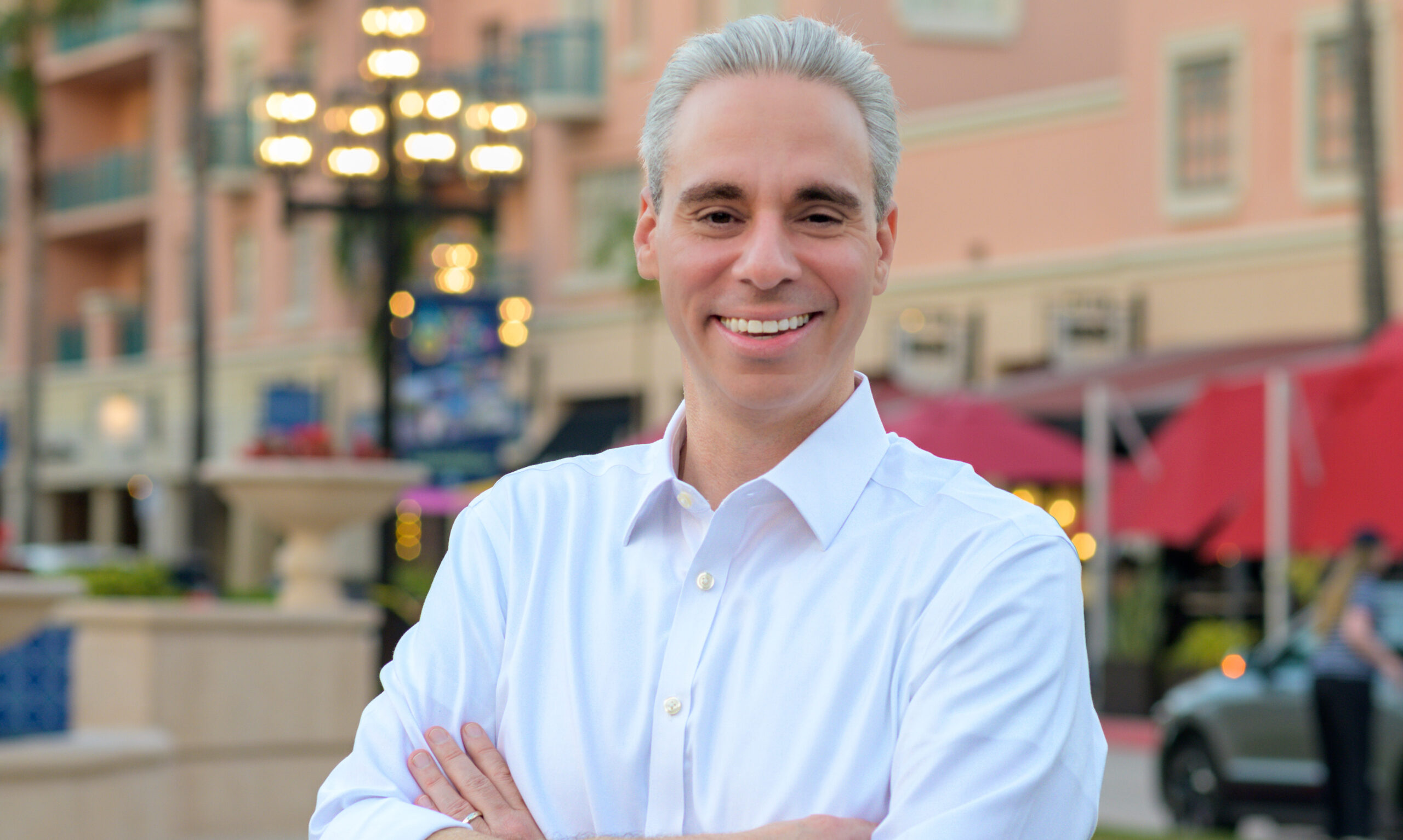
Singer told JI that his alignment with the GOP has been shaped by his Jewish faith
FOLLOW THE MONEY
Anti-Israel group organizing protests outside NYC synagogues gets cash windfall

The group behind the pro-Hamas chants in Queens has a nationwide network and links to pro-terror organizations and individuals
The secretary of state also said that it is unclear who would take over Iran if the supreme leader were removed from power
Nathan Posner/Anadolu via Getty Images
Secretary of State Marco Rubio testifies during a Senate Foreign Relations Committee hearing on Venezuela, in Washington, DC, United States on January 28, 2026.
Secretary of State Marco Rubio said at a hearing before the Senate Foreign Relations Committee on Wednesday that the Iranian regime is historically weak due to serious economic troubles, but also said that Tehran’s violent crackdown on protesters has appeared to have successfully quelled the demonstrations that have swept the country in recent weeks.
Rubio also said that it’s uncertain who would take over the country if the Iranian regime were to fall. He framed the buildup of U.S. forces in the region — a U.S. carrier strike group arrived in the area this week — as a largely defensive measure to protect U.S. troops and allies from an Iranian attack.
“That regime is probably weaker than it has ever been, and the core problem they face, unlike the protests you saw in the past on some other topics, is that they don’t have a way to address the core complaints of the protests, which is that their economy is in collapse,” Rubio told senators.
“The reason why their economy is in collapse is because they spend all their money and all their resources building weapons and sponsoring terrorist groups around the world instead of reinvesting it back into their society, and as a result have taken on massive global sanctions which have isolated their economy and their country.”
He said the Iranian demonstrators want those sanctions removed and the regime to begin addressing their interests, “and this regime is unwilling to do it.”
Asked who would take over in the event that the Iranian supreme leader, Ayatollah Ali Khamenei, was removed from power, Rubio said that it was uncertain but suggested that the U.S. would expect to work with someone from within the Iranian government, rather than an outside actor, mirroring the approach it has taken in Venezuela.
“I don’t think anyone can give you a simple answer as to what happens next in Iran if the supreme leader and the regime were to fall, other than the hope that there would be some ability to have somebody in their systems that you could work toward a similar transition” as in Venezuela, Rubio said.
“I would imagine it would be even far more complex than [Venezuela] because you’re talking about a regime that’s been in place for a very long time, so that’s going to require a lot of careful thinking, if that eventuality ever presents itself,” he continued.
Addressing the U.S. military buildup in the region, he noted that the 30-40,000 U.S. troops in the region are within range of Iran’s arsenal of thousands of drones and short-range ballistic missiles. He said that the U.S. needs a “baseline” of “force and power” in the region to defend against that threat, if Iran “at some point, as a result of something” decided to attack U.S. forces.
“The president always reserves the preemptive defensive option — in essence, if we have indications that, in fact, they’re going to attack our troops in the region,” he continued, in addition to security agreements to defend allies such as Israel “that require us to have a force posture in the region.”
“I think it’s wise and prudent to have a force posture in the region that could respond and, potentially — not necessarily what’s going to happen — preemptively prevent the attack” against U.S. forces or allies, Rubio added.
The secretary of state said, however, that the violent crackdown by regime officials on the protests, which he said has killed thousands of people, has been “effective and … it’s horrifying.”
Though he said the protests have now “ebbed,” he said he was confident that “they will spark up again in the future because this regime, unless they are willing to change, or leave, have no way of addressing the legitimate and consistent complaints of the people of Iran who deserve better.”
Asked by Sen. Brian Schatz (D-HI) about the makeup of the Trump administration’s newly created Board of Peace — specifically why some close U.S. allies are not part of the group while U.S. adversaries are — and whether the body is intended to be a competitor to the United Nations, Rubio answered, “This is not a replacement for the U.N., but the U.N. has served very little purpose in the case of Gaza other than the food assistance, and so we think it’s critical to have something that’s in charge of that.”
Rubio noted that the Board of Peace was chartered through a U.N. resolution and said that the “primary and sole focus of that board right now is to administer Phase 2 and Phase 3 of the plan in Gaza.” He said that various countries have been invited to the board but some U.S. allies in Europe have declined to join or are waiting on parliamentary approval to do so.
Asked by Sen. Jacky Rosen (D-NV) whether the administration would be seeking congressional ratification or legislation to establish and join the Board of Peace, Rubio responded by again highlighting the U.N. Security Council’s support for and recognition of the board.
Rubio’s testimony came at a hearing focused primarily on the U.S. military operation in Venezuela in which former President Nicolás Maduro was arrested and U.S. policy toward Venezuela going forward.
He said that one of the Trump administration’s primary goals in conducting the operation was denying Iran, along with Russia and China, a foothold in the Western Hemisphere. He asserted that the success of the operation could help provide a deterrent to adversaries such as Iran, “because the U.S. is the only country in the world that could have done this operation.”
He also said that he does not anticipate further military action in Venezuela, but that the U.S. would act in case of a threat — offering as an example if Iran were to establish a drone factory in the country.
He further noted that Venezuela had been providing false passports to Iranian and Hezbollah operatives, which he described as deeply concerning.
During a heated back-and-forth with Sen. Tim Kaine (D-VA), Kaine referenced comments by acting Venezuelan President Delcy Rodriguez — who currently has Washington’s support — that the U.S. attack on Venezuela had “Zionist undertones.”
“What the hell did Delcy Rodriguez mean when she said this attack had Zionist undertones?” Kaine said. Rubio responded that he had “an idea what she meant” but Kaine pivoted and Rubio was not able to answer further.
Plus, Emory faculty revolt in defense of Iran official's daughter

MONEY SHARMA/AFP via Getty Images
Saudi Arabia's Crown Prince and Prime Minister Mohammed bin Salman (C) inspects a guard of honor during a ceremonial reception at the President House a day after the G20 summit in New Delhi on September 11, 2023.
Good Tuesday afternoon!
This P.M. edition is reserved for our premium subscribers — offering a forward-focused read on what we’re tracking now and what’s coming next.
It’s me again — Danielle Cohen-Kanik, U.S. editor at Jewish Insider and curator, along with assists from my colleagues, of the Daily Overtime. Please don’t hesitate to share your thoughts and feedback by replying to this email.
📡On Our Radar
Notable developments and interesting tidbits we’re tracking
Saudi Arabia’s shift away from its traditional alliances and towards Islamism is evoking more backlash: Asked about Riyadh’s growing rapprochement with Qatar and Turkey, Israeli Prime Minister Benjamin Netanyahu said at a press conference this afternoon that he’s following the developments and that Israel “expect[s] from anybody who wants normalization or peace with us that they not participate in efforts steered by forces or ideologies that want the opposite of peace”…
Netanyahu’s comments came shortly after Saudi Crown Prince Mohammed bin Salman held a phone call with Iranian President Masoud Pezeshkian, where MBS conveyed that “the Kingdom considers any threat or tension against Iran unacceptable”…
That’s not stopping the U.S. from hinting at the continued possibility of strikes on Iran: U.S. Central Command announced it will be conducting a “multi-day readiness exercise” in order to “demonstrate the ability to deploy, disperse, and sustain combat airpower” across its area of responsibility, which includes Iran…
And Sen. Lindsey Graham (R-SC) slammed Riyadh for other nefarious actions in the region, Jewish Insider’s Emily Jacobs reports, including its “attack” on the UAE and silence regarding the Syrian government’s campaign against the Kurds, demanding the kingdom use its influence to “keep the region from falling further into chaos.”
“Please understand that I am smart enough to know that Saudi Arabia has influence on the Syrian government, and I expect them to use it,” Graham said, adding that he is “trying to work with the administration and regional partners to prevent a bloodbath in Syria against our Kurdish allies”…
(President Donald Trump, meanwhile, had a markedly different take on Syria: He told reporters today that he had a “great conversation” with the “highly respected president of Syria” and that “all of the things having to do with Syria and that area are working out very, very well, so we’re very happy about it”…)
The U.S. Embassy in Riyadh also held its first-ever International Holocaust Remembrance Day event, writing that “Today’s modest but meaningful commemoration reflects a universal duty: protecting our shared humanity across cultures, faiths, and nations”…
With Graham eyeing Damascus and Riyadh, Sen. Ted Cruz (R-TX) took aim elsewhere, calling for the U.S. to arm protesters in Iran “NOW.” “For the Iranian people to overthrow the Ayatollah — a tyrant who routinely chants ‘death to America’ — would make America much, much safer,” he said…
Authorities in Azerbaijan arrested three people allegedly preparing an attack on the Israeli Embassy in Baku today; the men were affiliated with ISIS-K, the Afghani branch of the terror group…
The Board of Peace is attempting to formalize its processes and responsibilities, according to a draft resolution from the board obtained by The New York Times, which bestows expansive powers to its chairman — Trump — including naming the commander of the International Stabilization Force, which still has yet to be established.
The document also names White House Chief of Staff Susie Wiles and attorney Martin Edelman as members of the board, the first time they have been identified as such…
After a doctor who is the daughter of a senior Iranian government official departed from Emory University’s medical school, the professor who serves as head of Emory’s faculty leadership council criticized the school for letting her go, JI’s Haley Cohen has learned.
Noelle McAfee, a professor in Emory’s philosophy department, sent a scathing email to the university expressing concern that the school’s dismissal of Fatemeh Ardeshir-Larijani, the daughter of the secretary of Iran’s Supreme Council for National Security, was a politically motivated firing.
“It’s extremely disappointing to see that our leadership here at Emory are consistently caving to political pressure and never taking the side of faculty,” McAfee wrote, quoting an anonymous faculty member, expressing concern that Ardeshir-Larijani, whose father is responsible for the Islamic Republic’s national security, didn’t receive due process…
In the Garden State, Mussab Ali, the former Jersey City Board of Education president and champion of anti-Israel college encampments, officially launched his primary challenge to Rep. Rob Menendez (D-NJ) today, hitting Menendez on day one for supporting Israel and being endorsed by AIPAC.
“Democrats need to step up and become the party where we abandon corporate PACs, we won’t take money from groups like AIPAC, and we need to be accountable to everyday people,” Ali told the New Jersey Globe. He also enters the race with the endorsement of former Rep. Jamaal Bowman (D-NY), who was unseated in part due to his sharp criticisms of Israel…
Marking International Holocaust Remembrance Day, Chicago’s City Council voted unanimously to adopt the International Holocaust Remembrance Alliance’s working definition of antisemitism into its municipal code…
⏩ Tomorrow’s Agenda, Today
An early look at tomorrow’s storylines and schedule to keep you a step ahead
Keep an eye out in Jewish Insider for an interview with Republican Boca Raton Mayor Scott Singer, who’s hoping for a conservative shift among Jewish voters in South Florida to help him unseat Rep. Jared Moskowitz (D-FL).
“October 7: In Their Own Words,” a play drawn directly from testimonies of survivors of the Oct. 7, 2023, Hamas terror attacks, will premiere at the Kennedy Center. Read JI’s interview with the show’s playwrights here.
Secretary of State Marco Rubio will be on the Hill, testifying at a Senate Foreign Relations Committee hearing on U.S. policy towards Venezuela in the aftermath of the ouster of former President Nicolás Maduro.
Stories You May Have Missed
PROBLEMATIC POST
Top Michigan Democratic fundraiser shared Veterans Day post honoring Nazi officer grandfather

Kelly Neumann is serving as the fundraising co-chair for gubernatorial candidate Jocelyn Benson and Senate candidate Mallory McMorrow and has fundraised for several other Michigan Democrats
SABRA SLAM
Deni Avdija to make triumphant DC return as star NBA player

The Portland Trail Blazers forward has emerged as one of Israel’s all-time top athletes
The letter was signed by 45 House Republicans and 14 House Democrats

John McDonnell/Getty Images
Secretary of State Marco Rubio testifies before the House Committee on Appropriations | Subcommittee on National Security, Department of State, and Related Programs at the Rayburn House Office Building on May 21, 2025 in Washington, DC.
A bipartisan group of 59 House lawmakers sent a letter to Secretary of State Marco Rubio on Thursday urging the State Department to continue condemning Iran’s crackdown on protesters across the country.
The letter, led by Rep. Randy Weber (R-TX), encourages the Trump administration to remain vocally supportive of the protesters amid “the Iranian regime’s ongoing violent suppression of protests across Iran.” The lawmakers urged Rubio to continue speaking out and ensure “whole-of-government support” from the U.S. is presented publicly to Iranians.
“The Iranian people have made clear their demand for a secular, democratic, non-nuclear republic grounded in political pluralism and respect for human dignity,” the letter reads. “Protesters have also explicitly rejected all forms of authoritarian rule, whether Iran’s former monarchy dictatorship or its current theocratic system, and seek the right to determine their own future. Recent international reactions against the regime’s brutalities underscore the urgent global concern over continued violence against civilians and abuses of power in Iran.”
“We urge the Department of State to continue publicly condemning the Iranian regime’s violent repression of protesters, including attacks on hospitals and medical facilities,” it continues. “At this critical juncture, whole-of-government support is essential to reaffirm the United States’ commitment to universal human rights and solidarity with the Iranian people.”
The lawmakers also noted their “deep concern” about the ongoing crackdown against protesters.
“Credible reports indicate the use of lethal force, mass arrests, and intimidation against civilians exercising their fundamental rights,” they wrote. “We are particularly alarmed by reports that Iranian authorities have targeted civilian sites, including hospitals and medical facilities, denying injured protesters access to urgent medical care. Such actions constitute violations of international humanitarian and human rights law.”
Weber’s letter was cosigned by Reps. Don Bacon (R-NE), Andy Barr (R-KY), Austin Scott (R-GA), Nancy Mace (R-SC), Brian Babin (R-TX), James Walkinshaw (D-VA), Beth Van Duyne (R-TX), William Timmons (R-SC), Tom Tiffany (R-WI), Glenn Thompson (R-PA), Tom Suozzi (D-NY), Marlin Stutzman (R-IN), Pete Stauber (R-MN), Chris Smith (R-NJ), Maria Salazar (R-FL), John Rutherford (R-FL), Raul Ruiz (D-CA), Zach Nunn (R-IA), Donald Norcross (D-NJ), Jared Moskowitz (D-FL), John Moolenaar (R-MI), Mariannette Miller-Meeks (R-IA), Carol Miller (R-WV), Tom McClintock (R-CA), Nicole Malliotakis (R-NY), Zoe Lofgren (D-CA), Laurel Lee (R-FL), Mike Lawler (R-NY), Nick Langworthy (R-NY), Nick LaLota (R-NY), Tom Kean (R-NJ), Jeff Hurd (R-CO), Val Hoyle (D-OR), Andy Harris (R-MD), Brett Guthrie (R-KY), Michael Guest (R-MS), Josh Gottheimer (D-NJ), Carlos Gimenez (R-FL), Laura Friedman (D-CA), Scott Franklin (R-FL), Brian Fitzpatrick (R-PA), Scott Fitzgerald (R-WI), Randy Fine (R-FL), Randy Feenstra (R-IA), Jake Ellzey (R-TX), Danny Davis (D-IL), Jeff Crank (R-CO), Joe Courtney (D-CT), Herbert Conaway (D-NJ), Mike Carey (R-OH), Brendan Boyle (D-PA), Mike Bost (R-IL), Sanford Bishop (D-GA), Gus Bilirakis (R-FL), Aaron Bean (R-FL), Troy Balderson (R-OH), Mark Amodei (R-NV) and Rick Allen (R-GA).
“The Iranian people have made it unmistakably clear that they reject this regime and the system of repression it has imposed on them,” Weber said in a statement on the letter. “From mass arrests to targeting hospitals, the regime has shown it will use any means to silence political dissent. The United States must continue to condemn these abuses and stand with the Iranian people as they demand the right to determine their own future.”
Plus, all the president's advice on Iran

Andrew Lichtenstein/Corbis via Getty Images
Demonstrators hold a rally and march to the national ICE headquarters to protest the arrest of Mahmoud Khalil, April 5, 2025 in Washington, D.C.
Good Thursday afternoon!
This P.M. edition is reserved for our premium subscribers — offering a forward-focused read on what we’re tracking now and what’s coming next.
It’s me again — Danielle Cohen-Kanik, U.S. editor at Jewish Insider and curator, along with assists from my colleagues, of the Daily Overtime. Please don’t hesitate to share your thoughts and feedback by replying to this email.
📡On Our Radar
Notable developments and interesting tidbits we’re tracking
U.S. officials advised President Donald Trump that a large-scale military campaign against Iran is unlikely to topple the regime and could spark a wider regional conflict, The Wall Street Journal reports, a message that coincided with the president dialing back his warnings to Tehran over its violent suppression of protests.
Israeli Prime Minister Benjamin Netanyahu also reportedly weighed in yesterday, asking Trump to postpone any strikes, and Qatar, Saudi Arabia, Oman and Egypt have communicated similar messages.
U.S. officials told the Journal these developments have led Trump to hold off on strikes for now, though he directed military assets to be readied in case of action. The USS Abraham Lincoln Carrier strike group is reportedly being moved from the Indo-Pacific to the Middle East.
In a similar vein, IDF Chief of Staff Lt. Gen. Eyal Zamir visited an Arrow missile defense battery site in Israel today and directed a drill simulating a missile attack, saying in a statement, “It is important that every citizen of Israel knows that the IDF is constantly prepared to defend the country”…
In the absence of military action, the U.S. is punishing Iran economically, issuing sanctions today against what it called “the architects” of the crackdown. The Treasury Department will “use every tool to target those behind the regime’s tyrannical oppression of human rights,” Treasury Secretary Scott Bessent said in a statement.
Among the sanctioned Iranian officials are Ali Larijani, the secretary of the Supreme Council for National Security, who was “one of the first Iranian leaders to call for violence in response to the legitimate demands of the Iranian people,” according to the Treasury Department, and several commanders of the Islamic Revolutionary Guard Corps and Iran’s Law Enforcement Forces…
Turning to Gaza, American officials expressed their optimism about Phase 2 of the peace plan shortly after its launch yesterday, telling reporters, “For the first time in Gaza in almost a long time, there’s no Palestinian Authority and there’s no Hamas governing it.”
“We’ve talked to a number of Hamas people, and we’re hearing throughout the Arab world that people don’t want to be at war anymore. They want peace,” one of the officials said, claiming Hamas leaders “are indicating that there’s a real possibility” they will lay down their arms…
A new Emerson College poll released today shows the Republican primary for Texas Senate in a dead heat, with Sen. John Cornyn (R-TX) and his opponent, Attorney General Ken Paxton, polling at 26% and 27%, respectively. With Trump refraining from offering his endorsement to either candidate, it’s likely the race will head to a runoff.
On the Democratic side, state Sen. James Talarico is leading the primary over Rep. Jasmine Crockett (D-TX), 47-38%. Talarico has recently caused concern in the Texas Jewish community over his increasingly critical rhetoric on Israel, leading some to tell Jewish Insider that, without concerted outreach from his team, they’re likely to back Crockett…
A competitive Democratic primary is also underway in New Jersey’s 12th Congressional District, where surgeon Adam Hamawy entered the race today to succeed retiring Rep. Bonnie Watson Coleman (D-NJ) with a profile that may help him break through the field.
Hamawy, of Egyptian descent, served as a trauma combat surgeon during the Iraq War, where he operated on Sen. Tammy Duckworth (D-IL), who credits him with saving her life. In May 2024, he joined a delegation of American doctors to assist in health-care efforts in Gaza, where he was temporarily stuck during an Israeli border closure (he returned for a second mission in January 2025).
Though Hamawy has not run for office before, he has spoken extensively about his experience treating “mass casualties” in the enclave and condemning Israel and the U.S.’ role in the “indiscriminate killing and destruction there.” Watson Coleman, also an outspoken critic of Israel, brought him as her guest to Trump’s 2025 State of the Union address…
Asked about his views on Israel, Antonio Delgado, New York’s lieutenant governor who is challenging Gov. Kathy Hochul from her left, said in an interview released Tuesday that the U.S. should not “fund, provide weapons or diplomatic cover to any military operation that causes catastrophic civilian deaths or mass starvation … Otherwise, we are complicit.”
Delgado pledged not to take money from AIPAC, though the pro-Israel group does not contribute to gubernatorial races, and Delgado took a 2019 trip to Israel as a member of Congress with the AIPAC-affiliated American Israel Education Foundation.
Delgado further described Netanyahu as “deeply problematic” and a “war criminal,” but when asked if Israel is committing a genocide in Gaza, he largely demurred. “I can see how people would want to argue it both ways and I’m sensitive to this, candidly, based on my own relationships,” he said. Delgado’s wife is Jewish and they are raising their children Jewish. “It’s hard to argue against scholars. … [But] wherever you fall on that question, we can’t fund it. … We can’t be complicit in it, anymore”…
A federal appeals court ruled today that former Columbia University graduate student Mahmoud Khalil, a leader of the school’s anti-Israel protest movement, could be rearrested, JI’s Haley Cohen reports. Khalil was released in June from the Immigration and Customs Enforcement detention center in Louisiana, where he had been held for three months.
In a 2-1 ruling, a three-judge panel decided that the federal district court in New Jersey that issued Khalil’s release did not have jurisdiction over the matter and that it should have been handled in immigration court, which is part of the executive branch overseen by the Justice Department, meaning Khalil is now liable to be rearrested.
New York City Mayor Zohran Mamdani denounced the ruling, saying in a statement, “as the crackdown on pro-Palestinian free speech continues, Mahmoud is being threatened with rearrest. Mahmoud is free — and must remain free”…
⏩ Tomorrow’s Agenda, Today
An early look at tomorrow’s storylines and schedule to keep you a step ahead
Keep an eye out in Jewish Insider for a profile of Amy Acton, the Jewish public health expert hoping to become the first Democrat to win an Ohio governor’s race in 20 years.
The U.S. and Israel will sign a strategic framework on AI cooperation at the City of David tomorrow, led by Jacob Helberg, the U.S. under secretary of state for economic affairs, and Brig.-Gen. (res.) Erez Eskel, head of Israel’s National AI Directorate. Israeli Foreign Minister Gideon Sa’ar and U.S. Ambassador to Israel Mike Huckabee are also expected to be in attendance.
Also heading to Israel is Sen. Lindsey Graham (R-SC), who announced a last-minute trip this afternoon to meet with Netanyahu “at this crucial time in the history of the Middle East.”
Iran International will hold its second briefing of the week in Washington with former CIA Director Gen. David Petraeus. Read JI’s coverage of Wednesday’s event here.
Honduran President-elect Nasry Asfura will travel to Israel over the weekend, where he is expected to meet with Netanyahu, Sa’ar and President Isaac Herzog, as well as visit Yad Vashem and the Western Wall. Asfura, who will take office later this month, met with Secretary of State Marco Rubio in Washington earlier this week and was hosted by AIPAC leadership.
In observance of Martin Luther King Jr. Day, we’ll be back in your inbox with the Daily Overtime on Tuesday. Shabbat Shalom!
Stories You May Have Missed
SEEING PURPLE
Marine vet Ryan Crosswell aims to flip GOP-held Pennsylvania congressional seat
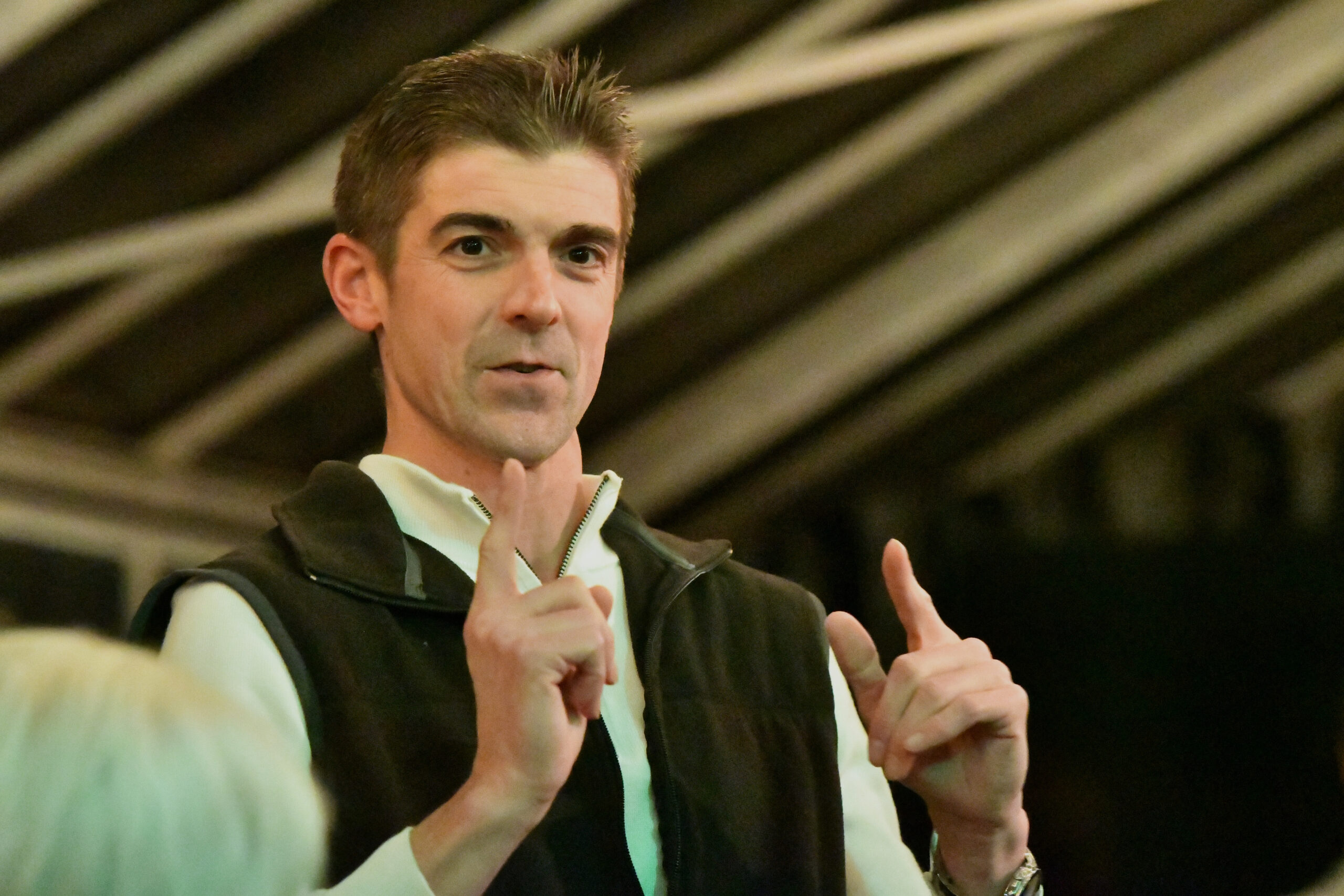
Crosswell, a former Republican who also served as a federal prosecutor, is touting his pro-Israel bona fides as he fights for the Democratic nomination against Rep. Ryan Mackenzie
BOOKSHELF
Ex-hostage’s wife writes book to help children deal with loss post-Oct. 7

The book, ‘Mojo’s Return: A Story of Resilience and Hope,’ was published in November
Plus, Trump favors strikes on Iran over diplomacy

Russell Yip/San Francisco Chronicle via Getty Images
California State Senator Scott Wiener addresses the SF Chronicle Editorial Board on Thursday, Jan. 18, 2018 in San Francisco, Calif.
Good Monday afternoon!
This P.M. edition is reserved for our premium subscribers — offering a forward-focused read on what we’re tracking now and what’s coming next.
It’s me again — Danielle Cohen-Kanik, U.S. editor at Jewish Insider and curator, along with assists from my colleagues, of the Daily Overtime. Please don’t hesitate to share your thoughts and feedback by replying to this email.
📡On Our Radar
Notable developments and interesting tidbits we’re tracking
The suspect in the arson attack that destroyed Mississippi’s largest synagogue early Saturday morning confessed to targeting the building because of its “Jewish ties,” Jewish Insider’s Haley Cohen reports.
In an affidavit filed in U.S. District Court in Mississippi more than 48 hours after the attack, the FBI said the suspect, Stephen Spencer Pittman, 19, admitted to starting the blaze at Beth Israel Congregation in Jackson, Miss., due to “the building’s Jewish ties” and referred to the institution as the “synagogue of Satan” in an interview with the Jackson Fire Department. Pittman was charged with “maliciously damaging or destroying a building by means of fire or an explosive”…
President Donald Trump said Iranian officials made contact with the U.S. over the weekend and proposed restarting nuclear negotiations, telling reporters, “A meeting is being set up, but we may have to act because of what’s happening before the meeting,” referring to the U.S. potentially taking military action in Iran over its violent crackdown on protesters around the country.
Iranian Foreign Minister Abbas Araghchi also spoke with White House special envoy Steve Witkoff in recent days about the protests, Axios reports; White House Press Secretary Karoline Leavitt told reporters today that an Iranian government official who spoke to Witkoff “express[ed] a far different tone than what you’re seeing publicly.”
Trump is currently leaning toward authorizing military strikes rather than engaging in diplomacy, The Wall Street Journal reports, and he is scheduled to hold a briefing tomorrow with advisors, including Secretary of State Marco Rubio, Secretary of Defense Pete Hegseth and Joint Chiefs of Staff Chairman Gen. Dan Caine, to make a determination…
California Jewish communal organizations released a joint statement today condemning state Sen. Scott Wiener’s remarks on Israel, after the Jewish House candidate said in a video statement yesterday that he is changing his position and will now call Israel’s actions in Gaza a genocide.
“We recognize that Senator Wiener has been a strong supporter of the Jewish community throughout the Israel-Hamas war and his many years of public service, and that he has directly experienced antisemitic attacks simply for being Jewish. Unfortunately, Senator Wiener’s newly stated position is both incorrect and lacks moral clarity. … We call on the Senator and our elected, civic, and education leaders to recognize and reflect on the consequences of their words in this fraught and polarizing environment,” the statement read…
In a major recruiting win for Senate Democrats, former Rep. Mary Peltola (D-AK) announced her run against Sen. Dan Sullivan (R-AK) today, JI’s Marc Rod reports, giving Democrats an outside chance of picking up the red-state Senate seat.
Peltola maintained a strongly pro-Israel voting record during her one term in the House, breaking on numerous occasions with a majority of her party to vote for measures supporting the Jewish state post-Oct. 7, including supporting a stand-alone Israel aid package opposed by many Democrats. Sullivan, for his part, has been a hawkish pro-Israel voice in the Senate, and has pushed for a more aggressive stance toward Iran…
Democratic Maryland state Del. Adrian Boafo is launching a bid to succeed his former mentor, Rep. Steny Hoyer (D-MD), as the former House majority leader retires. Boafo, who served as campaign manager for Hoyer, is expected to be the party favorite in the primary, Politico reports. Former Capitol Police officer Harry Dunn, who rose to prominence after the Jan. 6, 2021, Capitol riot, is also considering joining the race…
In another race to watch, Rep. Nellie Pou (D-NJ) in New Jersey’s 9th Congressional District gained another opponent in Tiffany Burress, a Republican political newcomer and wife of former NFL wide receiver Plaxico Burress. On the first day of her campaign, Burress has already secured the backing of several GOP county chairs, as the party looks to flip the seat away from Pou after Trump unexpectedly carried the district in 2024…
Former Obama administration officials and Crooked Media hosts Jon Favreau, Jon Lovett and Ben Rhodes are hosting a fundraiser in Hollywood, Calif., on Thursday for Abdul El-Sayed, a far-left, anti-Israel candidate running for Senate in Michigan, JI’s Marc Rod reports.
El-Sayed, a physician and former director of the Wayne County Department of Health, has made his criticisms of Israel a centerpiece of his campaign, blasting other candidates in the race as being insufficiently hostile to the Jewish state. Favreau, Lovett and Rhodes, on their “Pod Save America” and “Pod Save the World” podcasts, have also emerged as a vocal force against Israel and AIPAC in the Democratic Party, and have boosted prominent anti-Israel candidates in other hot-button primaries…
The future of the Israeli Lounge at the Trump-Kennedy Center is reportedly in peril, eJewishPhilanthropy‘s Judah Ari Gross reports, “unless a major donor from the Jewish community steps up and makes a large donation,” far-right commentator Laura Loomer said over the weekend. The center’s president, Richard Grenell, is seeking to renovate the space; Loomer has suggested Qatar may look to provide the funds for the room’s overhaul…
The New York Times reports on the brewing fight between states over the order of 2028 Democratic presidential primary elections…
Dina Powell McCormick, a banking executive, former deputy national security advisor to Trump and wife of Sen. Dave McCormick (R-PA), was named president and vice chair of Meta, reporting to CEO Mark Zuckerberg, Axios reports. Zuckerberg said in a statement that Powell McCormick will focus on “partnering with governments and sovereigns to build, deploy, invest in, and finance Meta’s AI and infrastructure”…
⏩ Tomorrow’s Agenda, Today
An early look at tomorrow’s storylines and schedule to keep you a step ahead
Keep an eye out in Jewish Insider for more details on the motives and background of the suspected arsonist who set fire to the Beth Israel Congregation in Jackson, Miss., over the weekend.
President Donald Trump will receive a major briefing on avenues for responding to Iran’s violent suppression of protests, including cyber, economic and military options.
New York Gov. Kathy Hochul will deliver her State of the State address in Albany, where she plans to announce her proposal to create a 25-foot buffer zone around houses of worship and health-care facilities. (The legislation, while welcomed by major Jewish groups, would not have prevented the pro-Hamas protest that disrupted a Queens community last week, which took place approximately 300 feet away from the targeted synagogue.) New York City Mayor Zohran Mamdani is expected to be in attendance.
Stories You May Have Missed
VENEZUELAN VIEWS
After years in exile, Venezuelan Jews celebrate the fall of Maduro

Some Venezuelan Jews see similarities in the response of far-left activists to Trump’s capture of Maduro and their criticism of Israel’s actions in Gaza
ON ALERT
Hezbollah’s continued presence in south Lebanon alarms Israel, despite disarmament claims

The Lebanese Armed Forces said it took operational control south of the Litani River, but has fallen well short of fully disarming the terrorist group
Plus, New Jersey IHRA bill scuttled

Kamran / Middle East Images / AFP via Getty Images
Iranians gather while blocking a street during a protest in Kermanshah, Iran on January 8, 2026.
Good Thursday afternoon!
This P.M. edition is reserved for our premium subscribers — offering a forward-focused read on what we’re tracking now and what’s coming next.
It’s me again — Danielle Cohen-Kanik, U.S. editor at Jewish Insider and curator, along with assists from my colleagues, of the Daily Overtime. Please don’t hesitate to share your thoughts and feedback by replying to this email.
📡On Our Radar
Notable developments and interesting tidbits we’re tracking
Protests are escalating across Iran, with videos showing masses of demonstrators taking to the streets and security forces at times overwhelmed. Human rights groups estimate dozens of protesters have already been killed and reports indicate the country is experiencing an internet blackout. Storeowners are reportedly shuttering their businesses in an economic boycott, further deepening the economic crisis that spurred the unrest.
President Donald Trump reiterated his warning today that the Iranian regime will “have to pay hell” if “they start killing people, which they tend to do,” speculating that the deaths so far have been caused by stampedes and not law enforcement. Vice President JD Vance said at a press briefing that the Iranian regime “has a lot of problems” and that “the smartest thing for them to have done … is for them to actually have a real negotiation with the United States”…
Australian Prime Minister Anthony Albanese announced today that he is establishing a royal commission into antisemitism in the country, after the deadly terror attack on a Hanukkah celebration in Sydney last month. The commission, considered a powerful tool in Australian governance, will investigate the scope and causes of antisemitism and make recommendations for law enforcement, in a report due on the year anniversary of the Dec. 14 attack…
Spanish Prime Minister Pedro Sanchez said Spain would send “peacekeeping troops” to the Gaza Strip “when the opportunity presents itself.” Speaking to a gathering of ambassadors in Madrid today, he said, “Of course, we have not forgotten Palestine and the Gaza Strip … Spain must actively participate in rebuilding hope in Palestine.” Many countries remain wary of contributing troops to stabilize Gaza over concerns of being required to engage with Hamas…
Israeli Prime Minister Benjamin Netanyahu met today with Nickolay Mladenov, former U.N. envoy to the Middle East and soon-to-be representative of the U.S.-led Board of Peace in Gaza…
New York City Mayor Zohran Mamdani has been silent thus far today about a protest taking place tonight organized by the radical anti-Israel group responsible for a similar protest outside the Park East Synagogue in November, Jewish Insider’s Haley Cohen reports.
The group posted the address of the real estate event they intend to protest, which is taking place at a synagogue in Queens’ heavily Jewish neighborhood of Kew Gardens Hills. The synagogue canceled prayer services and two nearby schools, Yeshiva of Central Queens and PS 165, announced early closures. Democratic state Assemblymember Sam Berger, who represents the area, told JI that local principals, staff and parents are “very concerned.” The surrounding area has been “completely upended,” he said…
The New Jersey Legislature will not give further consideration to a bill seeking to codify the International Holocaust Remembrance Alliance’s working definition of antisemitism into state law during this legislative session, the bill’s lead sponsor announced, after several years of the Jewish community’s urging for the measure to be adopted…
Rob Sand, the state auditor and Democratic candidate for governor of Iowa, announced he raised over $9.5 million in 2025, more than double the record for off-year fundraising for a gubernatorial election in the state. Sand told Jewish Insider in 2019, when he first took office as auditor, that he conducted what was “definitely the first audit” to ensure agencies were in compliance with a state anti-BDS law. “When you say [you are] willing to be supportive of your ally [Israel], you need to put your money where your mouth is,” he said at the time…
Far-left New York state Assemblywoman Claire Valdez joined the race to succeed retiring Rep. Nydia Velázquez (D-NY) today in the progressive 7th Congressional District covering parts of Brooklyn and Queens. The Democratic Socialists of America and Mamdani are expected to endorse Valdez, a move that could prove consequential in the district that The New York Times said will “pit left against lefter.”
Valdez, who has already brought on several of Mamdani’s advisors, was a vocal critic of Israel’s war in Gaza and pro-Israel political groups; her opponent, Antonio Reynoso, takes similar stances but is viewed as a more “traditional progressive” and is expected to secure Velázquez’s support, the Times reports…
Rep. Steny Hoyer (D-MD) officially announced his retirement today after serving 23 terms, one of the longest-serving House members in U.S. history. Speaking on the House floor, the former majority leader and pro-Israel champion warned he was “deeply concerned that this House is not living up to the founders’ goals” and that the country “is heading not toward greatness, but toward smallness, pettiness, divisiveness, loneliness and disdainfulness”…
In his first State of the State address since 2020 — and final before his term ends next year — California Gov. Gavin Newsom heralded his state as a “beacon” and a “policy blueprint for others to follow.” He denounced Trump and laid out a policy agenda including clean energy, increased wages and lowered housing costs, in a speech seen as laying the groundwork for his potential 2028 presidential run…
The Qatar Investment Authority and Emirati-based MGX, linked to a UAE sovereign wealth fund, participated in the latest fundraising round for Elon Musk’s xAI, which raised over $15 billion total. Gulf investors including QIA and the Saudi and Omani sovereign funds have taken part in previous fundraising rounds for the company that owns the Grok AI chatbot on X…
⏩ Tomorrow’s Agenda, Today
An early look at tomorrow’s storylines and schedule to keep you a step ahead
Keep an eye out in Jewish Insider for a look at how legislation in New Jersey to adopt the International Holocaust Remembrance Alliance’s working definition of antisemitism was scuttled — and who was behind the bill’s demise.
The third season of the hit TV show “Tehran” will premiere in the U.S. on Apple TV tomorrow, after a delay of several years. The popular international thriller, which follows a Mossad agent operating undercover in Iran, was indefinitely postponed at the outset of the Israel-Hamas war in Gaza. The season ran in Israel in December 2024, and Apple has announced the fourth season is already in production.
On Saturday, Anti-Defamation League CEO Jonathan Greenblatt will sit in conversation with Rabbi David Wolpe about the “golden age of American Jewry” at Sinai Temple in Los Angeles.
We’ll be back in your inbox with the Daily Overtime on Monday. Shabbat Shalom!
Stories You May Have Missed
SAUDI SPOTLIGHT
U.S. lawmakers weigh in on fears of Saudi Arabia accommodating Islamists

The lawmakers downplayed reports of a serious Gulf rift, with Rep. Brad Sherman calling the increasing disputes between neighbors ‘tactical, not ideological’
MENIN’S MOMENT
New York Jewish leaders hope Menin will serve as check against Mamdani
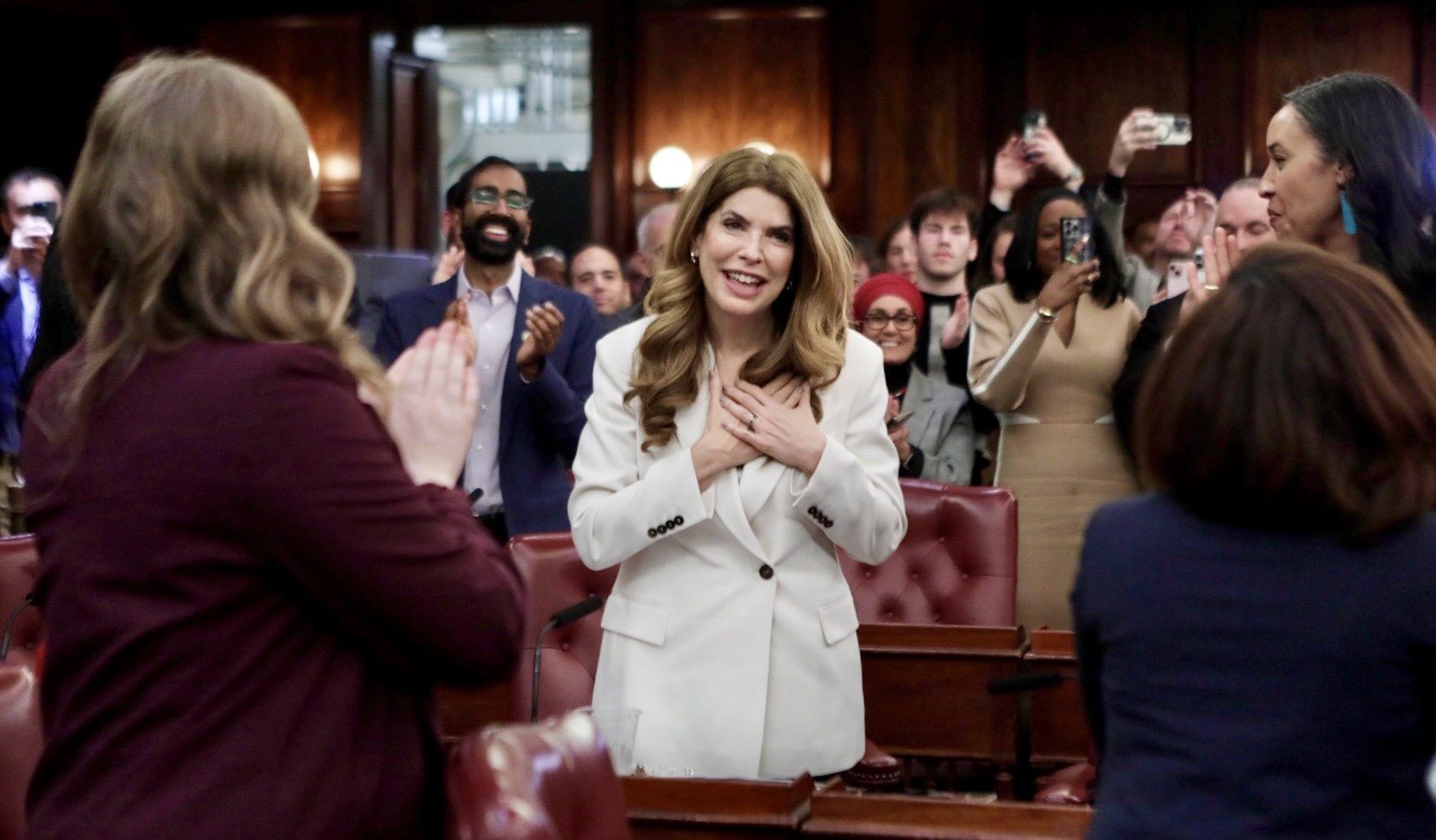
Julie Menin was elected the first Jewish speaker of the New York City Council on Wednesday
Plus, Likud lawmaker calls out 'poison' on American right
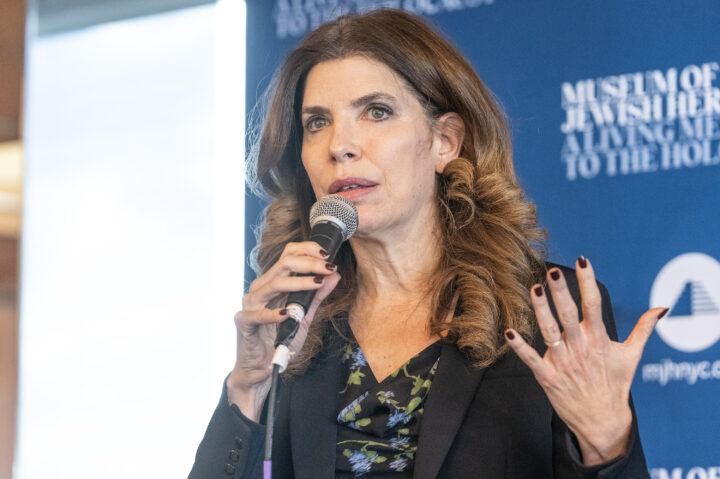
Lev Radin/Pacific Press/LightRocket via Getty Images
Council member Julie Menin speaks during rally of 240 Holocaust survivors for 240 hostages kidnapped by Hamas during terrorist attack on Israel on October 7, 2023.
Good Wednesday afternoon!
This P.M. edition is reserved for our premium subscribers — offering a forward-focused read on what we’re tracking now and what’s coming next.
It’s me again — Danielle Cohen-Kanik, U.S. editor at Jewish Insider and curator, along with assists from my colleagues, of the Daily Overtime. Please don’t hesitate to share your thoughts and feedback by replying to this email.
📡On Our Radar
Notable developments and interesting tidbits we’re tracking
Qatar is the top country donating foreign funds to American universities, and Cornell University is its leading recipient, Jewish Insider’s Haley Cohen reports.
According to a new dashboard from the Department of Education, Qatar holds the No. 1 spot for funds provided to U.S. universities at a whopping $6.6 billion — $2.3 billion of which has gone to Cornell, making up the vast majority of the school’s $3 billion in foreign funding. Qatar has provided significantly more funds than the next leading countries, bolstering criticisms of the Gulf state’s influence over American higher education…
Secretary of State Marco Rubio met with Saudi Foreign Minister Prince Faisal bin Farhan Al-Saud this afternoon “to advance ongoing bilateral cooperation” following President Donald Trump’s meeting with Saudi Crown Prince Mohammed bin Salman in November. Rubio and Al-Saud discussed issues including Gaza, Yemen, Sudan and Syria, according to a State Department readout.
The Saudi foreign minister also met with lawmakers on the Hill, including Reps. Brian Mast (R-FL) and Gregory Meeks (D-NY), the chair and ranking member of the House Foreign Affairs Committee…
Trump is expected to kick off the second phase of the Gaza peace plan next week, Axios reports, including announcing the formation of the Gaza Board of Peace. Among the countries expected to participate are the U.K., Germany, France, Italy, Saudi Arabia, Qatar, Egypt and Turkey, with former U.N. envoy to the Middle East Nikolay Mladenov at the helm…
In a Truth Social post this afternoon, Trump called for the U.S. defense budget to be raised to $1.5 trillion in 2027, an increase of approximately 50% from his 2026 request…
Likud lawmaker Dan Illouz, in a speech to the Knesset on Monday, warned the American right about the dangers of rising antisemitism within its ranks, JI’s Lahav Harkov reports.
“I stand here in Jerusalem to sound an alarm,” Illouz said. “We are used to enemies from the outside … but today, I look at the West — our greatest ally — and I see a new enemy rising from within.” Illouz, who was born and raised in Montreal, took the unusual step of speaking from the lectern in English.
The right-wing lawmaker called for American conservatives to reject what he called the “poison” of Tucker Carlson and Candace Owens, mentioning the podcasters by name. “They claim to fight the ‘woke left.’ They are no different than the woke left,” Illouz argued. “The woke left tears down statues of Thomas Jefferson, the woke right tears down statues of Winston Churchill … It is the same hatred of the West dressed up in a different costume”…
New York City Councilmember Julie Menin was unanimously voted speaker of the council today, as expected, after she announced in November that she had garnered enough support to secure the position.
Shortly after being elected, Menin, the first Jewish council speaker in the city with the largest Jewish population in the world, said she will look to codify legislation to protect the Jewish community, including establishing safe perimeters for protests around synagogues…
A new poll by the Honan Strategy Group found Jewish and non-Jewish New York voters split in their views about New York City Mayor Zohran Mamdani, the Forward reports. Fifty-five percent of non-Jewish respondents said Jews who say they feel threatened by Mamdani’s views on Israel are overreacting, while 53% of Jewish respondents said they are justified to feel that way. Fifty-one percent of Jews said Mamdani’s election is a troubling sign that antisemitism is being normalized, while 61% of non-Jews see it as evidence of healthy debate and diversity…
The New York Times lays out an ongoing lawsuit in New York over redistricting that could see the 11th Congressional District redrawn, which could impact the boundaries of Rep. Dan Goldman’s (D-NY) neighboring district and further complicate his reelection prospects…
In New Jersey, congressional candidates are raking in donations for what’s shaping up to be one of the state’s most expensive primary cycles ever. In the special election in the state’s 11th Congressional District to replace Gov.-elect Mikie Sherrill, former Rep. Tom Malinowski (D-NJ) announced he’s raised more than $1 million in the two months since he launched his bid.
Three Democratic candidates vying for Malinowski’s old seat in the neighboring 7th District, now held by Rep. Tom Kean Jr. (R-NJ), have also raised over $1 million each, including former Navy pilot Rebecca Bennett. The large fundraising hauls are unusual for an off year, though Democrats see the 7th as a promising opportunity to flip a House seat, given that the swing district narrowly voted for Sherrill, a Democrat, in November…
Pennsylvania state Sen. Doug Mastriano, a far-right Republican, announced today he will not pursue a rematch against Gov. Josh Shapiro, to whom he lost decisively in the 2022 gubernatorial race, amid speculation that he would once again seek the office…
Warner Bros. rejected a hostile takeover bid from Paramount, in the latest development in the battle to acquire the media giant. The company’s board voted to maintain its existing deal with Netflix for $72 billion, calling Paramount’s amended $77.9 billion offer with a personal guarantee from Larry Ellison “inadequate”…
⏩ Tomorrow’s Agenda, Today
An early look at tomorrow’s storylines and schedule to keep you a step ahead
Keep an eye out in Jewish Insider for a look at the dynamics that may play out between New York City Mayor Zohran Mamdani and the newly inaugurated City Council Speaker Julie Menin as she plays a critical role in potentially providing a check against the mayor’s policy agenda.
Temple Emanu-El’s Streicker Center in New York City will host a screening of the documentary “The Road Between Us” about Gen. Noam Tibon’s historic rescue of his family amid the Oct. 7, 2023, Hamas terror attacks, as well as a discussion with Tibon and director Barry Avrich. Read JI’s interview with Tibon and Avrich.
Stories You May Have Missed
REASONS AND RAMIFICATIONS
Why Israel recognized Somaliland — and what the rest of the world might do next

After Israel announced it would recognize the secessionist region, the big question remains whether the United States will follow suit
SAME AS THE OLD BOSS
New Venezuelan president signals similar anti-American foreign policy as Maduro
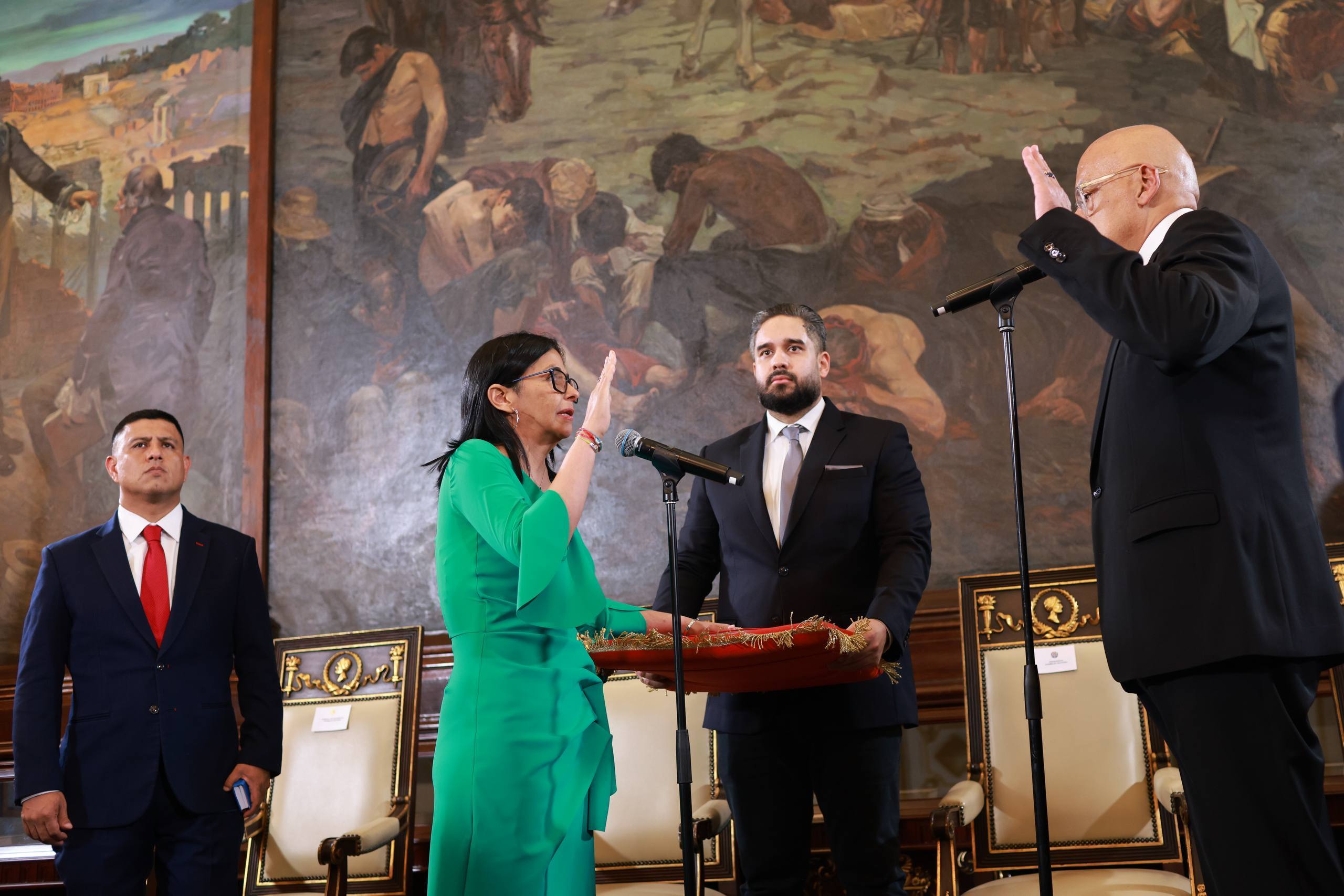
At a swearing-in ceremony on Monday, interim President Delcy Rodríguez appeared to embrace the ambassadors of Iran, China and Russia
Plus, New York candidates get in the midterm mood

Morteza Nikoubazl/NurPhoto via Getty Images
An anti-U.S. and Israeli billboard depicting symbolic images of coffins of U.S. and Israeli soldiers, alongside a statement from the Speaker of Iran's Parliament, Ali Larijani, that reads, ''Watch out your soldiers,'' hangs from a state building in downtown Tehran, Iran, on January 6, 2026.
Good Tuesday afternoon!
This P.M. edition is reserved for our premium subscribers — offering a forward-focused read on what we’re tracking now and what’s coming next.
It’s me again — Danielle Cohen-Kanik, U.S. editor at Jewish Insider and curator, along with assists from my colleagues, of the Daily Overtime. Please don’t hesitate to share your thoughts and feedback by replying to this email.
📡On Our Radar
Notable developments and interesting tidbits we’re tracking
Bolstering concerns that Iran could attempt to strike Israel to rally domestic support amid nationwide protests, Iran’s Defense Council warned today that Tehran could act against its “long-standing enemies” over their “hostile behavior.”
The body, formed after the June war with Israel, said in a statement that “Iran’s security, independence and territorial integrity are an uncrossable red line, and any aggression or continuation of hostile behavior will be met with a proportionate and decisive response.”
“The long-standing enemies of this land” are “repeating and intensifying threatening language and interventionist statements in clear conflict with the accepted principles of international law, which is aimed at dismembering our beloved Iran and harming the country’s identity,” the statement continued, as President Donald Trump has threatened to intervene if Iran cracks down on the protesters…
Wrapping up a U.S.-mediated dialogue in Paris, Israel and Syria made progress towards improving relations as they agreed to accelerate the pace of negotiations going forward, considered a U.S. proposal to establish a demilitarized joint economic zone and agreed to set up a communication mechanism to facilitate coordination on military deescalation, intelligence sharing and diplomacy…
Domestically, midterm election year is in full swing: Rep. Dan Goldman (D-NY) officially launched his reelection bid today in New York’s 10th Congressional District, highlighting the date as the fifth anniversary of the Jan. 6, 2021, Capitol riot and his role as the House’s lead counsel during Trump’s first impeachment.
Goldman came out of the gate against his opponent, former New York City Comptroller Brad Lander, with a slew of endorsements, including New York Gov. Kathy Hochul, House Minority Leader Hakeem Jeffries (D-NY), House Minority Whip Katherine Clark (D-MA) and House Democratic Caucus Chair Pete Aguilar (D-CA).
Goldman told The New York Times that he understood his continued support for Israel “ran the risk of engendering a primary” in his progressive district but that he made his decisions based on “what I genuinely thought was best for the state of Israel, the people of Israel, Palestinian civilians and the future state of Palestine”…
Nearby in New York’s 12th Congressional District, George Conway, a former Republican lawyer and prominent critic of Trump who launched his run today as a Democrat, raised several concerns about New York City Mayor Zohran Mamdani’s approach to Israel and antisemitism in recent interviews, Jewish Insider’s Matthew Kassel reports.
Conway, who recently relocated to Manhattan in order to run for the seat being vacated by retiring Rep. Jerry Nadler (D-NY), said in an interview with The New York Times that he was “disturbed” by Mamdani’s sharp criticisms of Israel, even as he called the mayor “a great politician” and voiced admiration for his “focus on affordability.”
Conway added in an interview with NBC News that he was “concerned about some of the language” Mamdani has “used in the past about Israel,” as well as the mayor’s recent decision to revoke a pair of executive orders related to Israel and antisemitism on his first day in office. “His focus really has to be on bringing people together,” Conway said of Mamdani, “not sending the wrong message to individual groups of people”…
In the crowded Democratic primary in New York’s 17th Congressional District to take on Rep. Mike Lawler (R-NY), Peter Chatzky, the deputy mayor of Briarcliff Manor, injected $5 million of his own money into his campaign, Politico reports. Chatzky has stood out from the crowd in the competitive swing district in the northern suburbs of New York City with his comparatively critical stance of Israel.
Cait Conley, meanwhile, a national security veteran strongly supportive of Israel who is considered one of the front-runners in the seven-person race to take on Lawler, announced yesterday that she raised more than $560,000 in the last quarter of 2025 and has over $1.2 million in cash on hand…
Former Rep. Mary Peltola (D-AK) is considering mounting a run for Senate to challenge Sen. Dan Sullivan (R-AK), Axios reports. Peltola narrowly lost her seat in 2024 when Trump carried the state in the presidential election; if she does make a bid, she would give Democrats the opportunity to contest a red-state race, giving them an outside shot to win back the upper chamber…
Rep. Doug LaMalfa (R-CA) died today at 65, Republican leadership announced. AIPAC mourned him as “an outspoken pro-Israel leader in Congress.” The congressman’s seat, a largely rural district he represented since 2013, was redrawn last year to be more favorable to Democrats, but a special election to fill his seat will be held under the old map friendlier to Republicans due to the timing of the vacancy…
Speaking at a press conference on the latest crime statistics out of New York City, NYPD Commissioner Jessica Tisch, standing next to Mamdani, said that antisemitic hate crimes in the city declined 3% from 2024 to 2025 but, at 57%, still make up the majority of all hate crimes reported…
In an interview released today on CNN commentator Scott Jennings’ podcast, Vice President JD Vance, asked about the rise of antisemitism in the conservative movement, said, “we need to reject all forms of ethnic hatred, whether it’s antisemitism, anti-Black hatred, anti-white hatred,” JI’s Danielle Cohen-Kanik reports.
“I think that’s one of the great things about the conservative coalition, is that we are, I think, fundamentally rooted in the Christian principles that founded the United States of America and one of those very important principles is that we judge people as individuals,” Vance continued…
⏩ Tomorrow’s Agenda, Today
An early look at tomorrow’s storylines and schedule to keep you a step ahead
Keep an eye out in Jewish Insider for a deep dive into the geopolitical ramifications of Israel’s choice to formally recognize the African nation of Somaliland — and whether the U.S. might follow suit.
The New York City Council will vote to elect its speaker tomorrow, which is widely expected to be Councilmember Julie Menin. Menin, who will be the first Jewish speaker of the council, has already begun to push back on Mayor Zohran Mamdani, expressing her concern to him over his repeal of former Mayor Eric Adams’ executive orders related to Israel and antisemitism.
In Washington, the Atlantic Council will host a discussion on the “future of humanitarian assistance,” including remarks from IsraAID CEO Yotam Polizer.
Stories You May Have Missed
TORAH AND BENCH
The judge overseeing the Maduro trial blazed a trail for Jewish lawyers
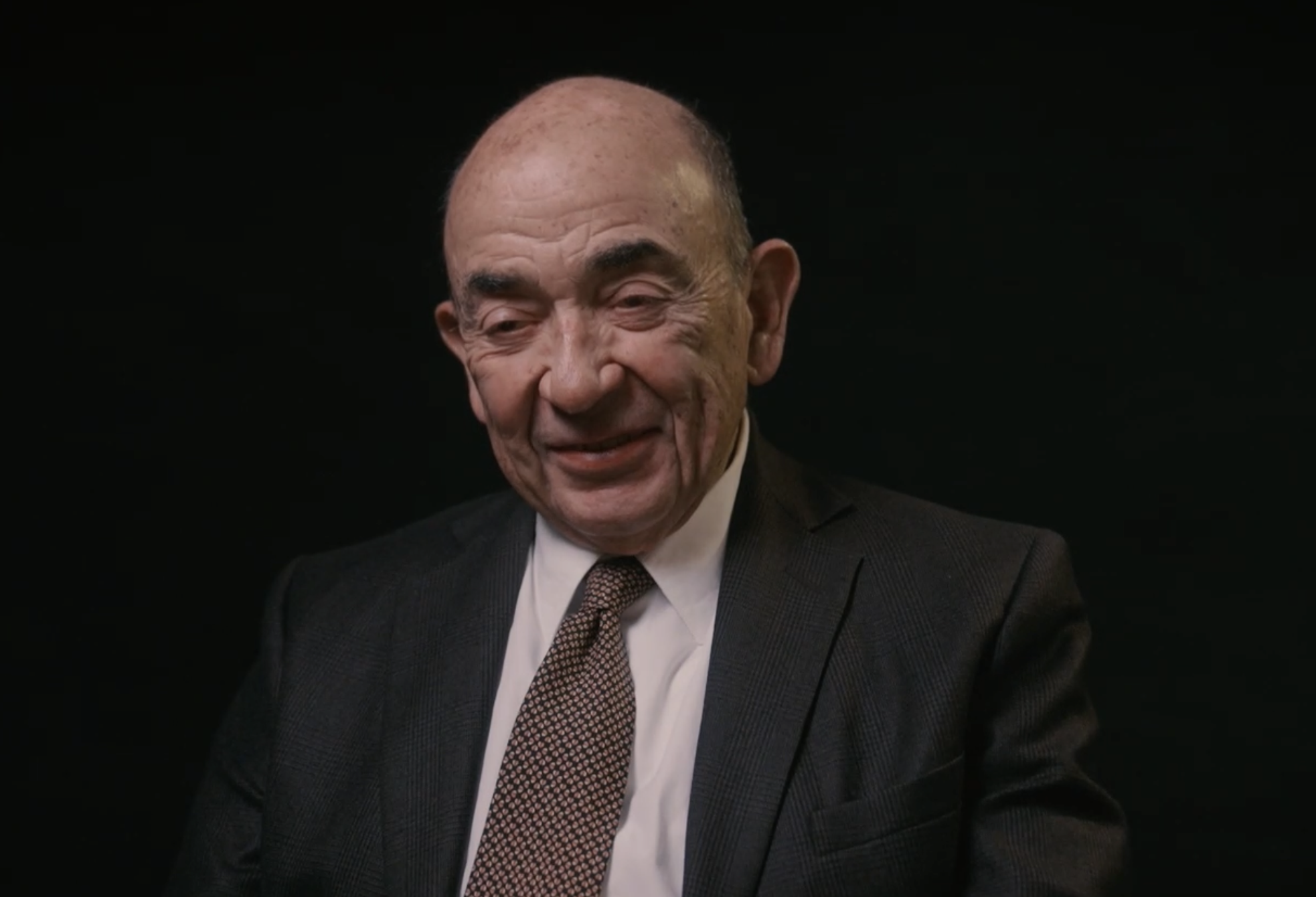
Judge Alvin Hellerstein became a law clerk because firms would not hire an Orthodox lawyer; now, he cites Torah from the bench
DRAWING LINES
Bruce Blakeman outlines his approach to antisemitism if elected NY governor
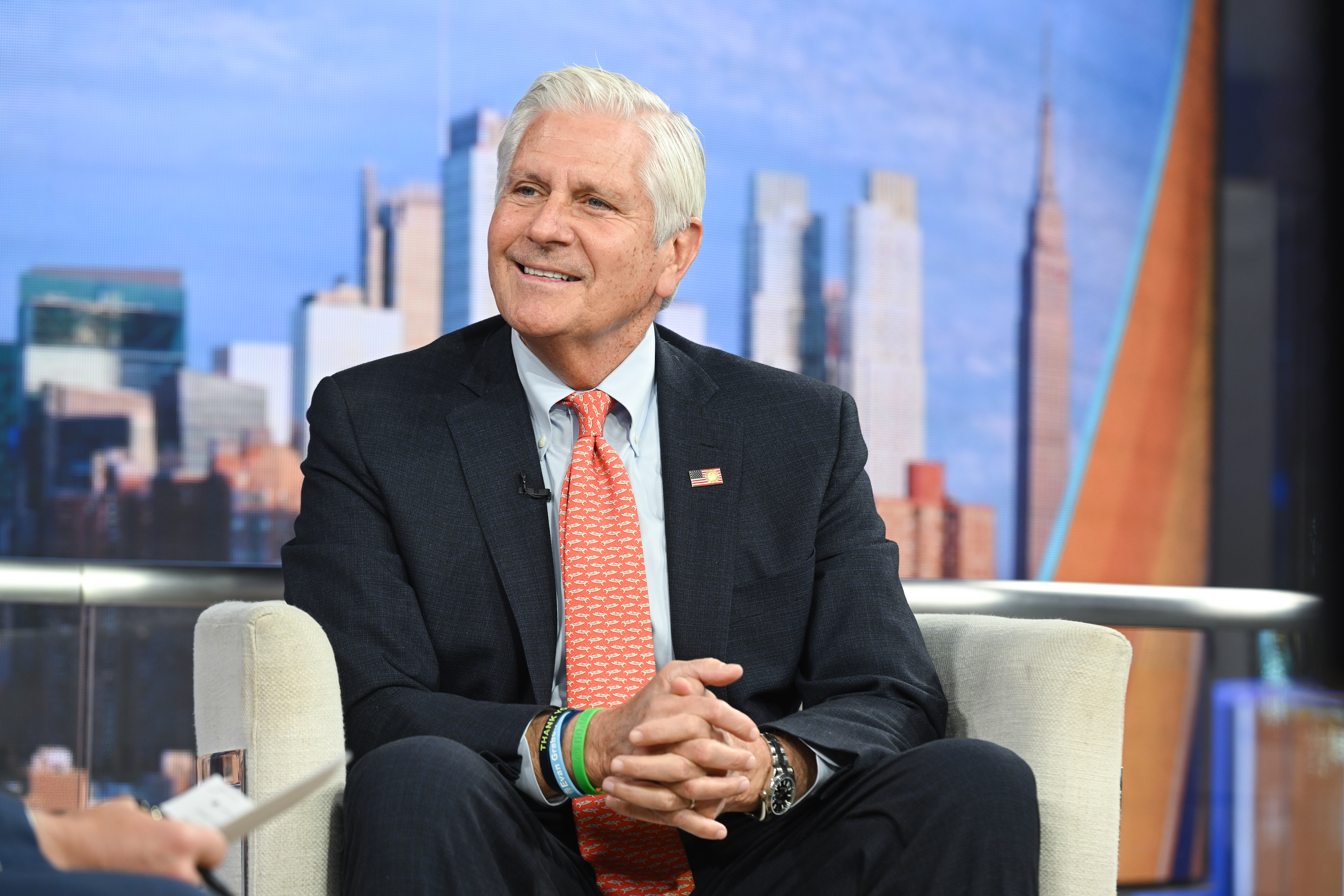
Asked about right-wing antisemitism, Blakeman said that Tucker Carlson ‘is a big blowhard who has an issue with Jewish people’
Plus, the Harvard president's mea culpa
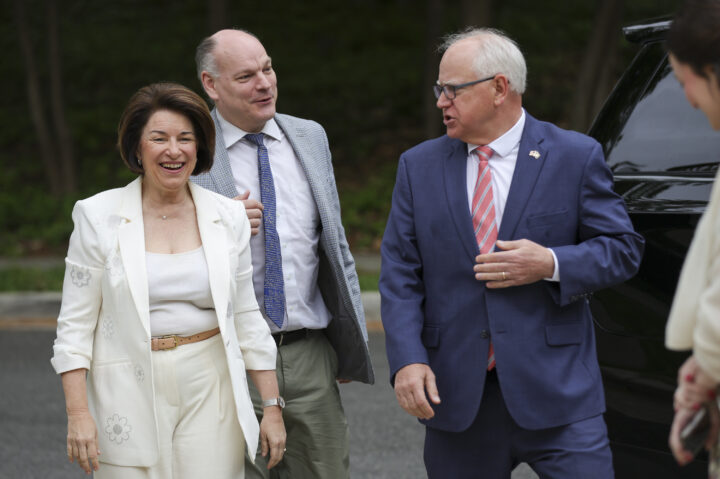
Bryan Dozier/Deadline via Getty Images
Amy Klobuchar, John Bessler and Tim Walz at the Residence of Ireland on April 27, 2024 in Washington, D.C.
Good Monday afternoon!
This P.M. edition is reserved for our premium subscribers — offering a forward-focused read on what we’re tracking now and what’s coming next.
It’s me again — Danielle Cohen-Kanik, U.S. editor at Jewish Insider and curator, along with assists from my colleagues, of the Daily Overtime. Please don’t hesitate to share your thoughts and feedback by replying to this email.
📡On Our Radar
Notable developments and interesting tidbits we’re tracking
Dominating the headlines, deposed Venezuelan President Nicolás Maduro and his wife pleaded not guilty to charges including narco-terrorism during their arraignment in New York City today. “I am still president of my country,” Maduro told the judge, who set their next hearing for March 17.
At the same time, Vice President Delcy Rodríguez, whom the Trump administration has said it will work with, was sworn in as interim president in Caracas, though she insisted that Maduro is still president and that he is being held hostage by the U.S…
Minnesota Gov. Tim Walz announced today that he will no longer seek reelection to a third term after facing weeks of criticism due to revelations of widespread fraud primarily among the state’s Somali diaspora population.
“I came to the conclusion that I can’t give a political campaign my all. Every minute I spend defending my own political interests would be a minute I can’t spend defending the people of Minnesota against the criminals who prey on our generosity and the cynics who prey on our differences,” Walz, who has increasingly played to the progressive wing of the Democratic Party, said in his announcement.
Sen. Amy Klobuchar (D-MN), a moderate with a record of winning over independent voters, is considering running for governor in his stead, after she and Walz met yesterday. On the Republican side, MyPillow CEO Mike Lindell and Speaker of the Statehouse Lisa Demuth are already vying for the office…
New York City Mayor Zohran Mamdani denied that his executive order altering the relationship between the NYPD and his office — which appeared to indicate that NYPD Commissioner Jessica Tisch would no longer report to him but to a deputy mayor — will be meaningful in its impact, telling reporters today that the commissioner “will continue to report directly to me … The executive order is in terms of the question of coordination.”
The direct line between the mayor and NYPD head has been in place at least since the terror attacks of 9/11, after which the commissioner began to hold daily intelligence briefings for the mayor. The National Jewish Advocacy Center called the restructuring “unprecedented” in a letter to Mamdani and said that “The close relationship between the NYPD and the Mayor’s Office has been key to averting disasters for the Jewish community,” including during Hanukkah last month.
The move came as Mamdani revoked an executive order adopting the International Holocaust Remembrance Alliance’s working definition of antisemitism and an anti-Boycott, Divestment and Sanctions order, which also drew backlash from Jewish leaders…
Meanwhile, in one of his final acts in office, Virginia Attorney General Jason Miyares sent a letter today reminding all K-12 superintendents and school boards in the state of their obligation to adopt the IHRA definition of antisemitism into their codes of conduct and discrimination policies, Jewish Insider’s Haley Cohen reports.
“As part of your compliance with Federal and Virginia law, you must implement the IHRA definition and its contemporary examples into your codes of conduct and discrimination policies to assess unprotected activity,” Miyares wrote, referencing a law passed by the state legislature in May 2023 requiring use of the IHRA definition by all state agencies…
Harvard President Alan Garber said that the university was wrong to let professors express strong stances on controversial issues in the classroom, causing students to feel they couldn’t share their views, including faculty espousing anti-Israel views in the wake of the Oct. 7 attacks. “It did happen in classrooms that professors would push this,” he said in a live taping of the Shalom Hartman Institute’s “Identity/Crisis Podcast” last month…
Leslie Grinage, Barnard’s dean and vice president of campus life and student experience, left her position today, the Columbia Spectator reports, after she came under intense criticism for her role in disciplining students who had violated school rules during anti-Israel protests on campus. Dozens of protesters staged a sit-in outside her office last year to demand the reinstatement of two students who were expelled after they disrupted a History of Modern Israel class…
Speaking in the Knesset today, Israeli Prime Minister Benjamin Netanyahu said he and President Donald Trump “will not allow Iran to rebuild its ballistic missile industry, and we certainly won’t let it renew its nuclear program” and that the two leaders agree that Iran must have no enrichment capabilities, all of its enriched uranium must be sent out of the country and there must be close oversight of its nuclear facilities…
Netanyahu also met with Rep. Josh Gottheimer (D-NJ) in Jerusalem today…
The Israel Defense Forces and Moroccan Armed Forces signed a joint work plan for 2026 during the third meeting of their Joint Military Committee in Tel Aviv this week…
A man was arrested for vandalizing the personal residence of Vice President JD Vance in Cincinnati this morning. Nobody was home at the time. “As far as I can tell, a crazy person tried to break in by hammering the windows. I’m grateful to the secret service and the Cincinnati police for responding quickly,” Vance said on X…
⏩ Tomorrow’s Agenda, Today
An early look at tomorrow’s storylines and schedule to keep you a step ahead
Keep an eye out in Jewish Insider for a look at Judge Alvin Hellerstein, the 92-year-old Orthodox Jewish federal judge overseeing the trial of Venezuelan President Nicolás Maduro.
The Academic Engagement Network is convening a three-day “boot camp” in Miami Beach this week for university faculty combating antisemitism and anti-Zionism on campus. Speakers will include Israeli journalist Nadav Eyal, the Atlantic Council’s Ahmed Fouad Alkhatib, antisemitism researcher Miri Bar-Halpern and past president of the American Association of University Presidents Cary Nelson.
Tomorrow, former Israeli Strategic Affairs Minister Ron Dermer and commentator Dan Senor will speak about “Israeli strategy in war and peace” in West Palm Beach, Fla., for the Palm Beach Synagogue’s “Critical Conversation Series.”
Stories You May Have Missed
DOMINO EFFECT
Toppling Maduro may weaken Iran’s hold in Latin America

Caracas served as the hub of Tehran’s operations in the Western Hemisphere
ON THE AGENDA
Security remains Jewish community’s top lobbying priority for 2026
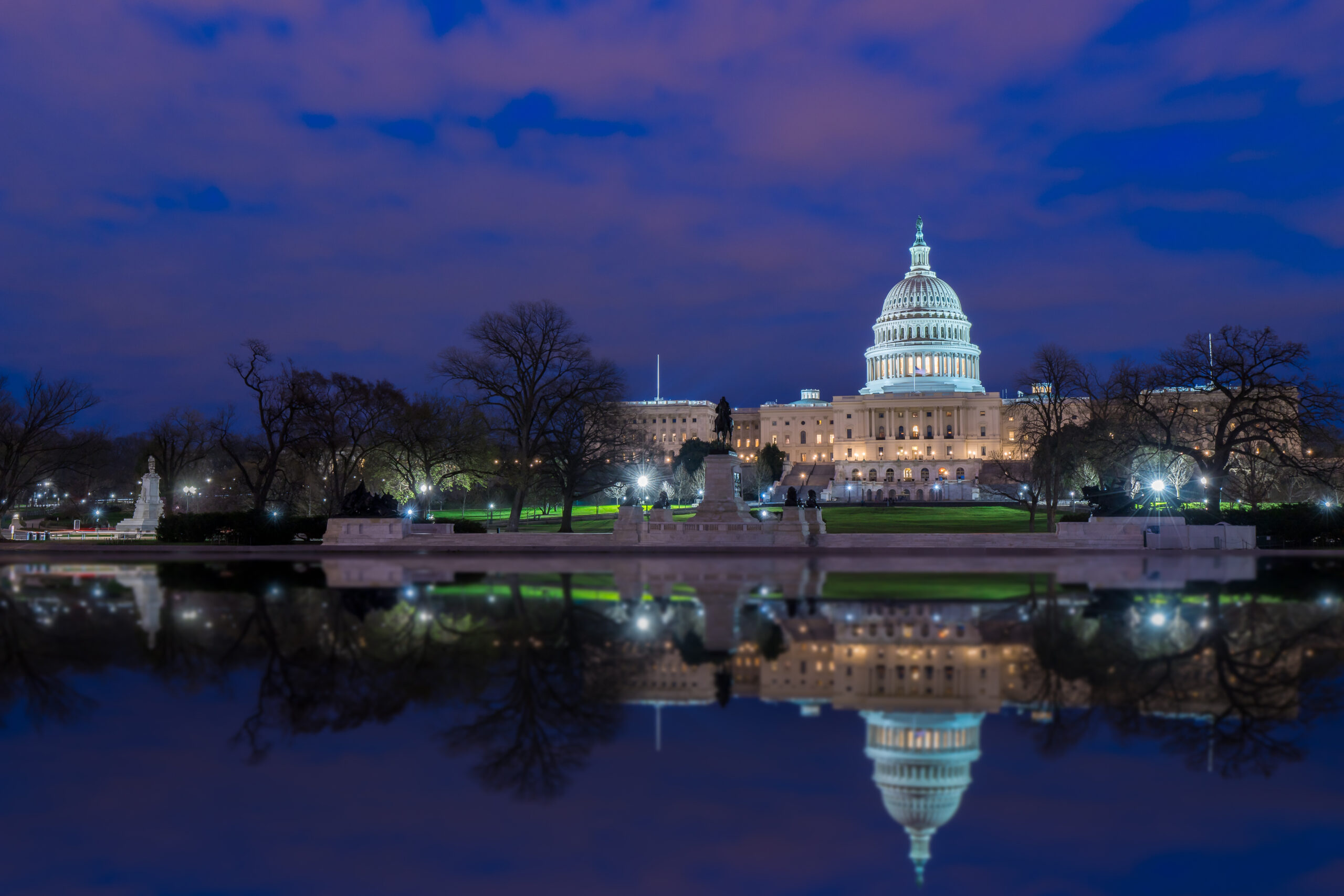
Major Jewish advocacy organizations told JI that they will continue to push for issues including Nonprofit Security Grant Program funding and combating antisemitism online
Plus, Ben Sasse announces terminal diagnosis

Chris Jackson/Getty Images
Members of the public pay their respects at the Heaton Park Hebrew Congregation Synagogue on October 20, 2025 in Manchester, England.
Good Tuesday afternoon!
This P.M. edition is reserved for our premium subscribers — offering a forward-focused read on what we’re tracking now and what’s coming next.
It’s me again — Danielle Cohen-Kanik, U.S. editor at Jewish Insider and curator, along with assists from my colleagues, of the Daily Overtime. Please don’t hesitate to share your thoughts and feedback by replying to this email.
📡On Our Radar
Notable developments and interesting tidbits we’re tracking
Two men in Manchester, England were found guilty of planning a terror attack on the city’s Jewish community, in the same area where two people were killed in a car ramming and stabbing attack at a synagogue on Yom Kippur.
Police warned it would have been the “deadliest terrorist attack in U.K. history”; the would-be assailants were affiliated with ISIS and had obtained guns and ammunition for an extended shooting spree, which they indicated was revenge for Israel’s actions in Gaza. One told an undercover officer, “We start with the Jews and if there any Christians caught in the act, that is a bonus, but we start with the Jews”…
At the same time, British police dropped a criminal investigation into Bob Vylan, the rap duo who led “death to the IDF” chants at the Glastonbury music festival in June, citing “insufficient evidence for there to be a realistic prospect of conviction”…
Sen. Richard Blumenthal (D-CT) wrote to Secretary of Homeland Security Kristi Noem today pushing for additional information about Nonprofit Security Grant Program allocations, Jewish Insider’s Marc Rod reports, as well as criticizing the $330 million funding allocation for the program proposed last week by Republicans on the Senate Appropriations Committee.
“As I travel around Connecticut and hear from community leaders here and around the country, I am struck by the severely heightened anxiety and apprehension about physical threats to places of worship and community centers involving hate-based violence,” Blumenthal said.
The senator requested data on grant applications and acceptances, the reasons why FEMA has provided less funding than requested to some institutions and the resources FEMA provided to unsuccessful applicants for each year from 2023 to 2025…
Israeli Defense Minister Israel Katz walked back comments he made earlier today claiming Israel would reestablish settlements in the Gaza Strip; he said in a statement shortly after that “the government has no intention of establishing settlements” in the enclave and his comments were “made in a security context only.”
A U.S. official told Fox News about Katz’s initial remarks that “the more Israel provokes, the less the Arab countries will want to work with them”…
Israel covertly airdropped weapons and ammunition to a Druze militia in Syria shortly after the fall of dictator Bashar al-Assad, The Washington Post reports, over concerns of then-nascent President Ahmad al-Sharaa’s allegiances. Israel stopped providing weapons to the Druze after Al-Sharaa met with President Donald Trump in the White House earlier this year, though it continues to provide supplies including money, body armor and medical provisions.
“We were helping when it was absolutely necessary and are committed to minorities’ security, but it is not as if we are going to have commandos take positions next to the Druze or get in the business of organizing proxies,” one Israeli official told the Post…
At a meeting of the U.N. Security Council today, Iran accused the U.S. of violating its rights as a member of the Non-Proliferation Treaty by insisting that the country have no domestic uranium enrichment. (The U.N.’s nuclear watchdog agency declared Iran in violation of the NPT in June.)
U.S. deputy Middle East envoy Morgan Ortagus said in response, “We’d like to make it clear to the entire world: the United States remains available for formal talks with Iran, but only if Tehran is prepared for direct and meaningful dialogue. … We have been clear, however, about certain expectations for any arrangement. Foremost, there can be no enrichment inside of Iran, and that remains our principle”…
Estimated private funding of Israeli tech businesses reached $15.6 billion in 2025, according to early numbers from Startup National Central, a nonprofit that tracks and promotes the Israeli innovation ecosystem, up from $12 billion in 2024. “At the same time, deal volume declined to 717 rounds, the lowest in the last decade. This divergence tells a clear story: investors are doing fewer deals, but committing significantly more capital to each one,” the organization wrote….
Ben Sasse, the former Republican senator from Nebraska and previous president of the University of Florida, announced today that he has terminal Stage 4 pancreatic cancer. As UF president during the disruptive campus protests in the wake of Hamas’ Oct. 7 attacks, Sasse was heralded for taking a uniquely firm stance against the protesters; he resigned from UF in July 2024 due to his wife’s failing health…
⏩ Tomorrow’s Agenda, Today
An early look at tomorrow’s storylines and schedule to keep you a step ahead
This is the last Daily Overtime of 2025 — we’ll be back in your inbox on Monday, Jan. 5.
Until then, keep an eye out in Jewish Insider for reporting on Jewish communal organizations’ 2026 legislative agenda, Israeli Prime Minister Benjamin Netanyahu’s meeting with President Donald Trump in Florida next week (read JI’s Lahav Harkov’s preview of the meeting here), Zohran Mamdani’s first days in office after being sworn in as New York City mayor on Jan. 1, and more.
Happy New Year!
Stories You May Have Missed
MILTARY MATTERS
Pentagon plan to reorganize military could undermine U.S.-Israel security, experts warn

Shifting U.S. resources out of the Middle East could impact the U.S.’ ability to counter Iran and send allies towards Russia or China, JINSA’s Blaise Misztal said
DAMASCUS DEALINGS
Trump’s Syria strategy tested amid resurgence of ISIS in Damascus
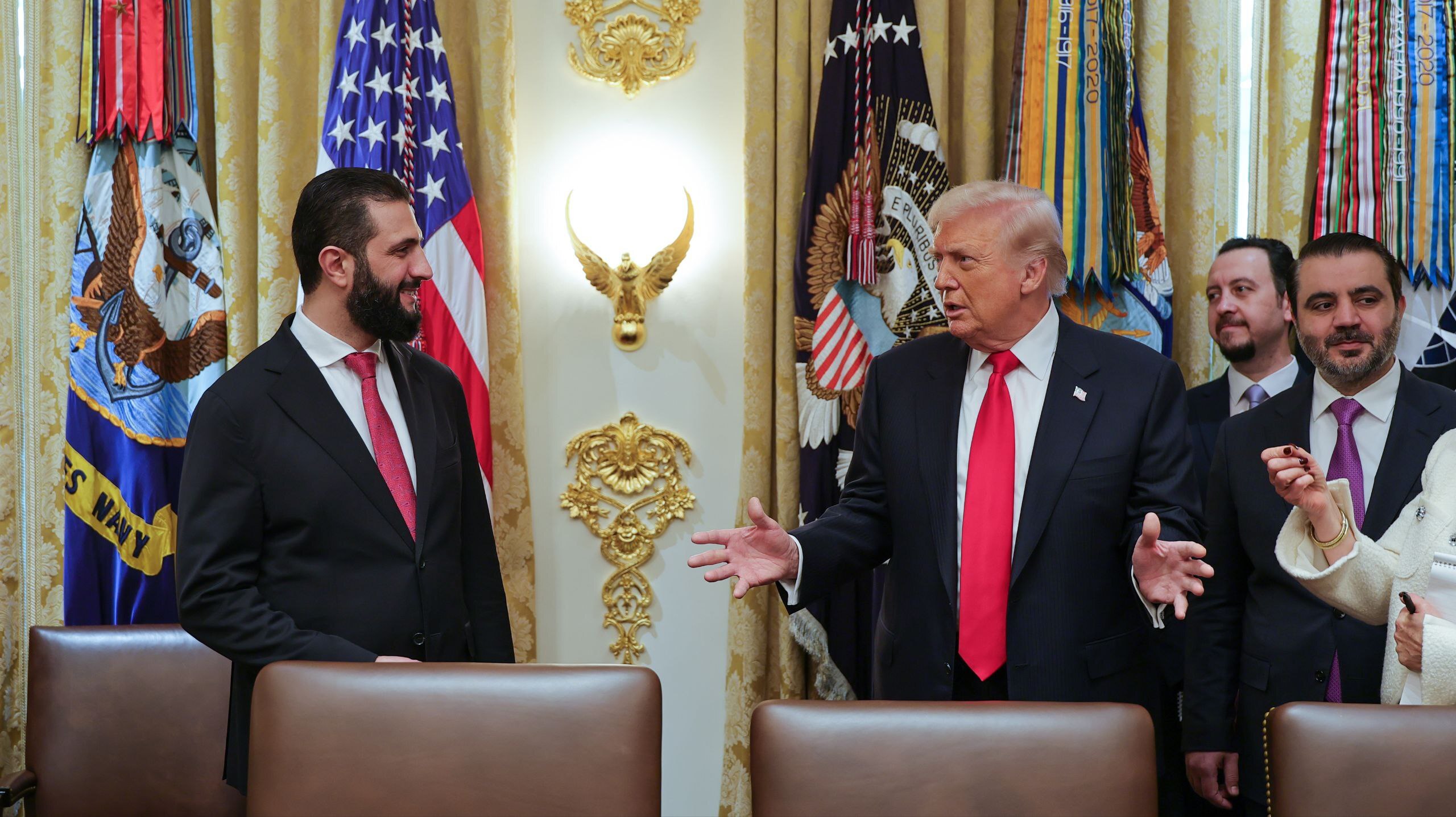
An attack by ISIS forces on U.S. servicemembers earlier this month prompted U.S. airstrikes and an entry ban on Syrian nationals, despite Trump’s embrace of Syria President Ahmad al-Sharaa
Plus, Turning Point attendees hold the pro-Israel line

Gage Skidmore
Good Monday afternoon!
This P.M. edition is reserved for our premium subscribers — offering a forward-focused read on what we’re tracking now and what’s coming next.
It’s me again — Danielle Cohen-Kanik, U.S. editor at Jewish Insider and curator, along with assists from my colleagues, of the Daily Overtime. Please don’t hesitate to share your thoughts and feedback by replying to this email.
📡On Our Radar
Notable developments and interesting tidbits we’re tracking
Over a dozen of the Heritage Foundation’s top legal and economic staff are departing the think tank to join former Vice President Mike Pence’s Advancing American Freedom group, in the latest sign of the continued internal dysfunction racking Heritage since its president, Kevin Roberts, embraced Tucker Carlson after he platformed neo-Nazi Nick Fuentes.
“Why these people are coming our way is that Heritage and some other voices and commentators have embraced big-government populism and have been willing to tolerate antisemitism,” Pence told The Wall Street Journal.
More than 30 of Heritage’s employees have reportedly resigned or been fired in the last several days, and at least three trustees have also dropped their affiliation with the group. Josh Blackman, who announced he’s stepping down as senior editor of The Heritage Guide to the Constitution, told Roberts in his resignation letter that his comments on Carlson “were a huge unforced blunder, and gave aid and comfort to the rising tide of antisemitism on the right”…
A straw poll conducted of attendees at Turning Point USA’s AmericaFest summit found that the anti-Israel views of some of the event’s speakers were not largely shared by the audience — only 13% of respondents said they don’t view Israel as an ally of the United States (one-third thought Israel is a “top ally” while an additional 53% said it’s one ally of many).
Brent Scher, editor-in-chief of the conservative Daily Wire, wrote on X about the poll, “For those who think Tucker and Candace [Owens] are winning … they’ve convinced nobody.” The same poll found 84% of respondents would like to see Vice President JD Vance as the 2028 Republican presidential nominee…
A new report from the Anti-Defamation League finds that more than one-fifth of New York City Mayor-elect Zohran Mamdani’s appointees to his transition team have extreme anti-Israel backgrounds, Jewish Insider’s Matthew Kassel reports.
Among the advisors, Youssef Mubaraz, who was appointed to serve on the committee on small businesses, dismissed a Facebook video about Hamas’ widespread use of sexual violence on Oct. 7 as “propaganda,” according to the report. Mohammed Karim Chowdhury, a member of the worker justice committee, previously shared a post claiming that “Zionists are worse than Haman of ancient times, the Inquisition, and the Nazis.”
Mamdani said about the report at a press conference today that “we must distinguish between antisemitism and criticism of the Israeli government” and that the “ADL’s report oftentimes ignores this distinction”…
George Conway, co-founder of the anti-Trump Lincoln Project group, filed paperwork today to join the crowded Democratic primary in New York’s 12th Congressional District to replace retiring Rep. Jerry Nadler (D-NY). The once decidedly conservative lawyer abandoned his affiliation with the Republican Party over his disagreements with President Donald Trump and became a significant donor of former President Joe Biden, though Conway’s decision to run as a Democrat himself is a step further than he’s gone before.
The New York Times reported last month that Conway told a group of donors he would aim to act as a “wingman” to Reps. Jamie Raskin (D-MD) and Dan Goldman (D-NY), also both lawyers fiercely opposed to Trump, if elected to Congress…
Meanwhile Erik Bottcher, a New York City councilman, dropped out of the NY-12 primary in order to run for a state Senate seat…
Brad Lander, the outgoing New York City comptroller trying to unseat Rep. Dan Goldman (D-NY), received an endorsement today from anti-Israel City Councilmember Shahana Hanif, who has faced backlash from her sizable Jewish constituency for her refusal to explicitly condemn Hamas in the aftermath of the Oct. 7 attacks and blaming Israel’s “unjust occupation of the Palestinian people” for the violence, her inaction on incidents of antisemitism in the district and her endorsement of calls to “globalize the intifada,” among other issues…
U.S. Ambassador to Israel Mike Huckabee echoed warnings Jerusalem is reportedly providing to the Trump administration around Iran’s preparations for another military conflict with Israel while speaking at Tel Aviv University’s Institute for National Security Studies conference today.
“Iran, I don’t know that they ever took [Trump] seriously until the night that the B-2 bombers went to Fordow. I hope they got the message but apparently they didn’t get the full message cause … they appear to be trying to reconstitute and find a new way to dig the hole deeper, secure it more,” Huckabee said…
The Trump administration is recalling senior diplomats from at least 29 countries, State Department officials told the Associated Press, largely from Africa and Asia with several in Europe and the Middle East, as part of its continued effort to “advance the America First agenda”…
Israeli Prime Minister Benjamin Netanyahu hosted the prime minister of Greece and president of Cyprus in Jerusalem today to “strengthen security, promote economic development and deepen the ties between our countries,” he said in a statement…
In the latest development in the bidding war over Warner Bros. Discovery, Paramount amended its offer to acquire the company to include $40.4 billion of equity financing personally guaranteed by Larry Ellison, co-founder of Oracle and father of Paramount’s CEO, David Ellison. Warner Bros. had previously advised shareholders to reject Paramount’s offer due to concerns over its ability to provide the financing…
⏩ Tomorrow’s Agenda, Today
An early look at tomorrow’s storylines and schedule to keep you a step ahead
Keep an eye out in Jewish Insider for a preview of Israeli Prime Minister Benjamin Netanyahu’s meeting with President Donald Trump at his Mar-a-Lago resort at the end of the month.
Stories You May Have Missed
TALARICO TALK
Texas Jewish voters alarmed by James Talarico’s Israel rhetoric

Local leaders said that, without improved outreach from Talarico to address their concerns, they’re likely to vote for Rep. Jasmine Crockett in the Democratic primary
MENORAHS ON THE MALL
Lighting up Washington: Rabbi Levi Shemtov brings Hanukkah to the halls of power

The EVP of American Friends of Lubavitch is a staple around town during the holiday, regardless of the party in power
Plus, Trump contradicts Bibi on Mar-a-Lago meeting
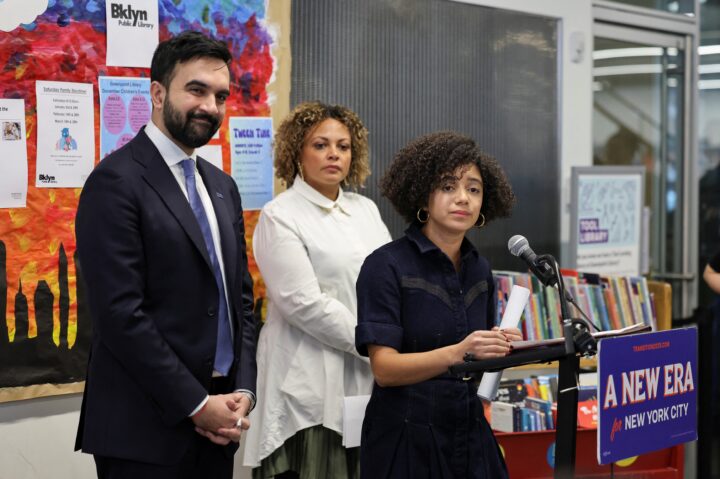
ANGELA WEISS / AFP via Getty Images
Catherine Almonte Da Costa, Director of Appointments, speaks during a press conference with New York City Mayor-elect Zohran Mamdani (L) and Jahmila Edwards (C), Director of Intergovernmental Affairs, on December 17, 2025 in New York.
Good Thursday afternoon!
This P.M. edition is reserved for our premium subscribers — offering a forward-focused read on what we’re tracking now and what’s coming next.
It’s me again — Danielle Cohen-Kanik, U.S. editor at Jewish Insider and curator, along with assists from my colleagues, of the Daily Overtime. Please don’t hesitate to share your thoughts and feedback by replying to this email.
📡On Our Radar
Notable developments and interesting tidbits we’re tracking
New York City Mayor-elect Zohran Mamdani’s newly tapped director of appointments, Catherine Almonte Da Costa, abruptly resigned this afternoon after her history of antisemitic online posts — including complaining about “money hungry Jews” — was unearthed, Jewish Insider’s Haley Cohen reports.
Da Costa, who previously served as executive assistant to former Mayor Bill DeBlasio and was appointed by Mamdani yesterday, posted a series of antisemitic comments in 2011 and 2012, which were obtained by the Judge Street Journal.
Among other X posts — deleted along with her account today — Da Costa wrote in January 2011, “Money hungry Jews smh,” according to screenshots. “Woo! Promoted to the upstairs office today! Working alongside these rich Jewish peeps,” she posted in June 2011.
After outcry from the Anti-Defamation League and others, Mamdani’s team told JI that “Catherine expressed her deep remorse over her past statements and tendered her resignation, and [Mamdani] accepted.” Da Costa said in her own statement that her posts were “not indicative of who I am” and had “become a distraction from the work at hand”…
In another incident of antisemitism proliferating online, Los Angeles Rams wide receiver Puka Nacua garnered widespread backlash — including from New England Patriots owner Robert Kraft’s foundation focused on combating antisemitism — for performing an antisemitic dance on social media on Tuesday, JI’s Haley Cohen reports, leading Nacua to issue an apology this afternoon.
During streamer Adin Ross’ livestream on Tuesday, he taught the wide receiver a touchdown celebration that ended with Nacua looking into the camera and rubbing his hands together — a stereotypical movement indicating greed that Ross’ fans refer to as his “iconic Jewish dance.” Ross then asked Nacua to perform the dance during the Rams’ game against the Seattle Seahawks tonight, to which Nacua agreed.
In his apology, Nacua stated that at the time of the livestream, he had “no idea this act was antisemitic in nature and perpetrated harmful stereotypes against Jewish people”…
In response to the Hanukkah terror attack in Sydney, Australian Prime Minister Anthony Albanese announced today that his government will introduce new legislation to strengthen hate speech laws in the country and allow the government to cancel or reject visas of people deemed likely to spread hate.
The move comes after Australia ignored repeated warnings from local Jewish communities and Israel that rising antisemitism in the country posed a threat to Jewish safety; Albanese conceded the point in his announcement, claiming, “Governments aren’t perfect. I’m not perfect”…
Scott Singer, the Republican mayor of Boca Raton, Fla., announced a run for Congress today for the seat held by Rep. Jared Moskowitz (D-FL). The district, already competitive, is facing a possible redistricting effort by state Republicans which would further endanger the pro-Israel congressman’s hold on it. Singer, who sits on the U.S. advisory board of Combat Antisemitism Movement, has been a strong supporter of Israel as well…
NOTUS asked over 120 House Republicans if they intend to run for reelection amid rumors of a mass wave of retirements in the party. Several, including Reps. Nicole Malliotakis (R-NY) and Mark Amodei (R-NV), gave noncommittal answers…
The State Department issued new sanctions today against dozens of ships and related companies involved in Iran’s “shadow fleet” used to evade existing oil sanctions, as well as against two International Criminal Court judges involved in prosecuting Israeli Prime Minister Benjamin Netanyahu and former Defense Minister Yoav Gallant, citing the judges’ votes against an Israeli appeal to drop arrest warrants for the two earlier this week…
President Donald Trump contradicted an announcement made weeks ago by Netanyahu’s office that the two have set a meeting at the president’s Mar-a-Lago resort in Palm Beach, Fla., for Dec. 29, telling reporters in the Oval Office today, “We haven’t set [a meeting] up formally, but [Netanyahu] would like to see me. … He’ll probably come see me in Florida.”
Asked if Egyptian President Abdel Fattah el-Sissi will join them, as speculated by the signing of a major gas deal between Israel and Egypt yesterday, Trump said, “I’d love to have him. El-Sissi is a friend of mine”…
D.C. City Councilmember Janeese Lewis George, a democratic socialist running for city mayor, committed to standing up for the Jewish community and taking proactive steps to ensure its security on a panel at a Jewish Community Relations Council of Greater Washington breakfast this morning, JI’s Marc Rod reports.
Lewis George’s presence at the event and comments are particularly notable given that she’s a self-identified democratic socialist. (Many DSA-aligned elected officials across the country, including Mamdani, have had combative or nonexistent relationships with mainstream Jewish organizations in their cities and districts.)
“I learned at a very young age how important it was to loudly condemn and loudly stand up for our Jewish neighbors,” Lewis George said. She recalled that she realized through education programs in D.C. schools “how important it was that we support each other in solidarity, in our connected struggles, our connected history”…
⏩ Tomorrow’s Agenda, Today
An early look at tomorrow’s storylines and schedule to keep you a step ahead
Keep an eye out in Jewish Insider for an interview with a longtime Jewish activist mounting a bid for Washington, D.C.’s congressional delegate seat.
White House Special Envoy Steve Witkoff will meet with the Qatari prime minister and Egyptian and Turkish foreign ministers in Miami tomorrow to discuss implementation of the second phase of President Donald Trump’s Gaza peace plan.
Turning Point USA’s AmFest continues over the weekend, including a debate over Israel on Saturday between political commentator Steve Deace and Christian nationalist leader Pastor Doug Wilson.
We’ll be back in your inbox with the Daily Overtime on Monday. Shabbat Shalom!
Stories You May Have Missed
FRIENDLY FIRE
At Heritage HQ, Ben Shapiro calls on think tank to draw red line against Tucker Carlson
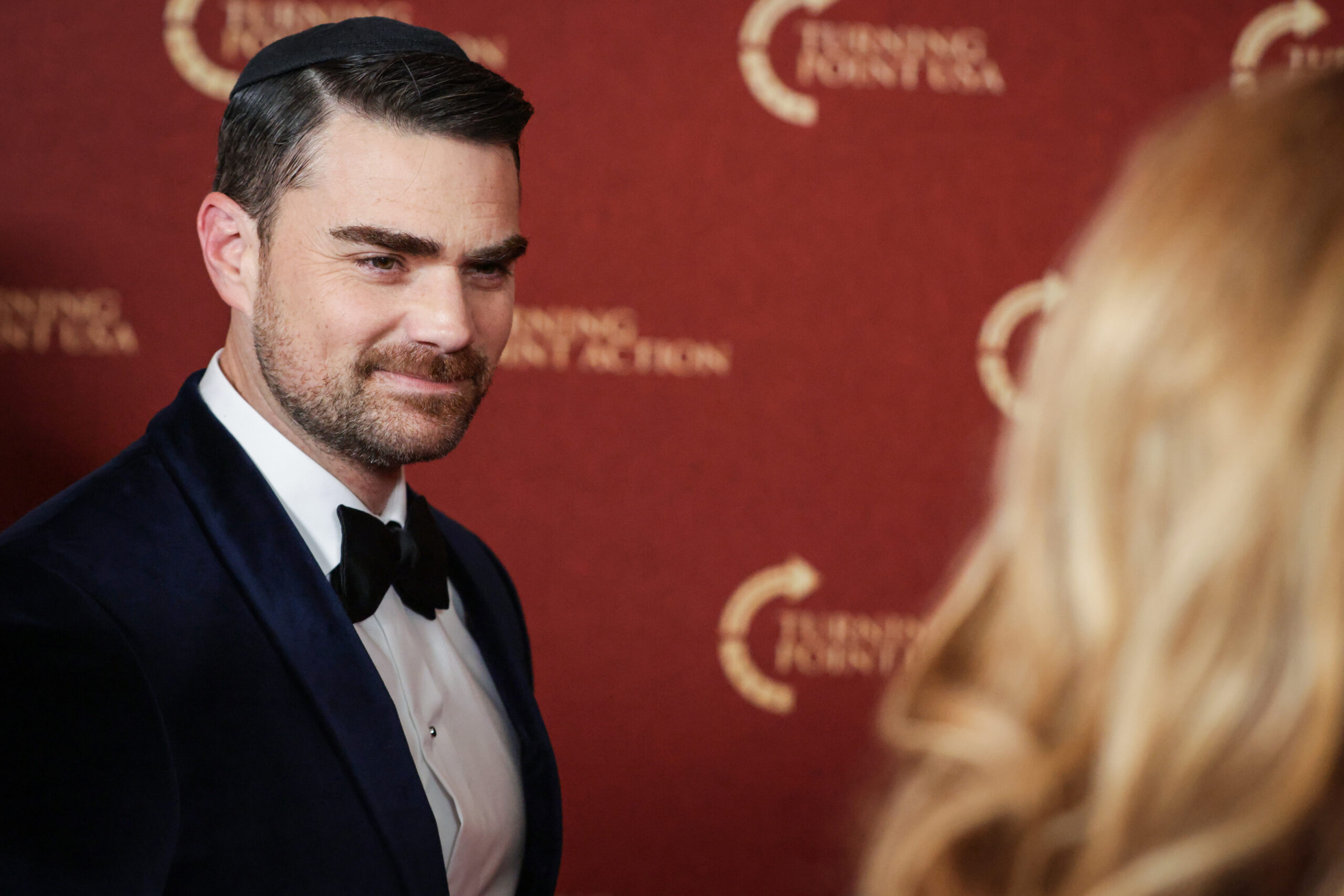
‘If the Heritage Foundation wishes to retain its status as a leading thought institution in the conservative movement, it must act as ideological border control,’ Shapiro warned
CENTER PUSH
Moderate N.Y. Democrat Rory Lancman hoping to reinvigorate party’s centrist wing in the suburbs

The former state assemblyman told JI: ‘I confess to being disappointed that Democrats aren’t making a bright line litmus test out of whether someone supports the existence of the Jewish state’
Plus, Dan Shapiro takes the Rhodes less traveled

Christopher Furlong/Getty Images
Members of the public and congregants seen as Police and other emergency responders attend the Heaton Park Hebrew Congregation Synagogue, where multiple were injured after stabbing and car attack on Yom Kippur, on October 2, 2025 in the Crumpsall suburb of Manchester, England.
Good Wednesday afternoon!
This P.M. edition is reserved for our premium subscribers — offering a forward-focused read on what we’re tracking now and what’s coming next.
It’s me again — Danielle Cohen-Kanik, U.S. editor at Jewish Insider and curator, along with assists from my colleagues, of the Daily Overtime. Please don’t hesitate to share your thoughts and feedback by replying to this email.
📡On Our Radar
Notable developments and interesting tidbits we’re tracking
In the wake of the Hanukkah terror attack in Sydney and the deadly Yom Kippur attack in Manchester, the heads of Britain’s Metropolitan Police and Greater Manchester Police said they will change their policies on arrests in connection with the use of threatening slogans, including “globalize the intifada.”
“The words and chants used, especially in protests, matter and have real world consequences. We have consistently been advised by [the Crown Prosecution Service] that many of the phrases causing fear in Jewish communities don’t meet prosecution thresholds. Now, in the escalating threat context, we will recalibrate to be more assertive,” their joint statement read.
“We know communities are concerned about placards and chants such as ‘globalise the intifada’ and those using it at future protest or in a targeted way should expect the Met and GMP to take action. Violent acts have taken place, the context has changed — words have meaning and consequence. We will act decisively and make arrests,” they pledged. The Israeli Embassy in the U.K. welcomed the move but called it “disappointing” that it only came “after more Jews have been killed”…
Daniel Flesch, a senior policy analyst at the Heritage Foundation, emerged as a critical voice raising the alarm on right-wing antisemitism from within the institution in a speech on Monday night, Jewish Insider’s Gabby Deutch reports, as the think tank continues to grapple with fallout from its president’s embrace of Tucker Carlson after his controversial interview with neo-Nazi Nick Fuentes.
“The last couple of years, really for longer than that, the threat of antisemitism has largely been the domain of the left,” Flesch said at a Hanukkah party hosted by the Young Jewish Conservatives. “Now, in some ways, the call is coming from inside the house.”
Flesch continued, “Right now, the issue we’re facing is a threat to the West. We see it on the left. Now we’re seeing it to the right. And those like Tucker Carlson and others present the greatest threat, I think, on the right. They are anti-conservatives in the conservative movement, seeking to destroy our movements, and in so doing, destroy the future of the United States”…
And on the left, former U.S. Ambassador to Israel Dan Shapiro called out his fellow Democrats in The Atlantic for their own turn against Israel, including his former Obama administration colleague, Ben Rhodes, who has emerged as one of the leading anti-Israel voices in the party.
“The story of the [Oct. 7] attack and its aftermath — so often ignored in commentaries about the past two years — affirms that what the United States was dealing with was not a genocidal nation out to destroy all Palestinians but a deeply imperfect democratic partner beset by enemies, actual genocidal enemies, and terrorists sworn to its physical destruction,” Shapiro wrote.
“But there is a darker danger to the approach that Rhodes and others endorse. … If the test of fealty for the Democratic Party becomes supporting international efforts to pressure Israel to define itself out of existence, or expressing indifference to the campaign of Israel’s enemies to destroy it, we will be in a much uglier place. That is not a policy that would meet any moral test … Those calling for an end to U.S. support for Israel need to be mindful that, perhaps inadvertently, they are abetting this camp”…
Brad Lander, the outgoing New York City comptroller challenging Rep. Dan Goldman (D-NY), told the anti-Israel publication Zeteo News and its host Mehdi Hasan that politicians including former New York Gov. Andrew Cuomo, Mayor Eric Adams and President Donald Trump are “delighted to weaponize antisemitism, to weaponize Jewish fear, against Muslims especially but really against inclusive, multi-racial democracy” in the wake of the Sydney terror attack. He also pledged to support efforts to recognize a Palestinian state if elected to Congress…
The Senate passed the 2026 National Defense Authorization Act this afternoon, sending the bill to the president’s desk. Read JI’s coverage of the bill’s components, including the full repeal of Caesar Act sanctions on Syria and funding joint programs with Israel…
The Senate also finally confirmed Jared Isaacman to head NASA, after he was initially nominated last December but then pulled by the White House during a spat between Trump and Elon Musk, who backed his nomination, and renominated in November…
FBI Deputy Director Dan Bongino, Director Kash Patel’s right-hand, is contemplating leaving the bureau, multiple outlets report. Patel’s choice of Bongino for his deputy raised eyebrows at the time, given Bongino has no prior FBI experience — though he is a former Secret Service agent — and rose to prominence as a right-wing podcaster boosting claims that the 2020 election was “stolen”…
Israel signed its largest ever gas deal today with Egypt to the tune of around $35 billion, Israeli Prime Minister Benjamin Netanyahu announced. The White House had reportedly pushed Israel to finalize the deal to set the groundwork for a trilateral meeting between the three countries…
Secretary of State Marco Rubio met with Qatari Foreign Minister Mohammed bin Abdulrahman Al Thani today to “launch the seventh annual U.S.-Qatar Strategic Dialogue,” working to “deepen cooperation on shared economic and strategic goals in the Middle East and across the world,” according to a readout from Rubio…
⏩ Tomorrow’s Agenda, Today
An early look at tomorrow’s storylines and schedule to keep you a step ahead
Keep an eye out in Jewish Insider for an interview with a moderate New York Democrat hoping to reclaim the party’s pro-Israel bonafides in a state Senate race in the wake of New York City Mayor-elect Zohran Mamdani’s victory, and coverage of a fiery speech by conservative commentator Ben Shapiro at the Heritage Foundation today on antisemitism on the political right.
Turning Point USA’s annual America Fest summit will kick off in Phoenix, Ariz.; Opening night will include speeches from Erika Kirk, now CEO of TPUSA after the killing of her husband; Shapiro; actor and activist Russell Brand; and podcast hosts Matt Walsh and Tucker Carlson. The organization’s attempt to navigate its messaging about the identity of the GOP, including its stance on Israel, in the wake of its founder’s death will be on full display as both pro- and anti-Israel commentators, including Shapiro and Carlson, take the stage.
In Washington, the Jewish Community Relations Council of Greater Washington will hold the last in its series of “Lox and Legislators” breakfasts in D.C. with speakers including outgoing Mayor Muriel Bowser and Attorney General Brian Schwalb.
The Brooklyn Nets vs. Miami Heat NBA game taking place at the Barclays Center in New York will pay tribute to the victims of the Hanukkah terror attack in Sydney, including participation by the nephew of slain Rabbi Eli Schlanger.
Stories You May Have Missed
PRESIDENTIAL ADDRESS
Trump warns that Israel, ‘Jewish lobby’ have lost influence in D.C.
Speaking at the White House’s annual Hanukkah party, the president said Congress is ‘becoming antisemitic’
SANDERS’ STATEMENT
Bernie Sanders pivots from sympathy toward Sydney shooting victims to criticizing Netanyahu
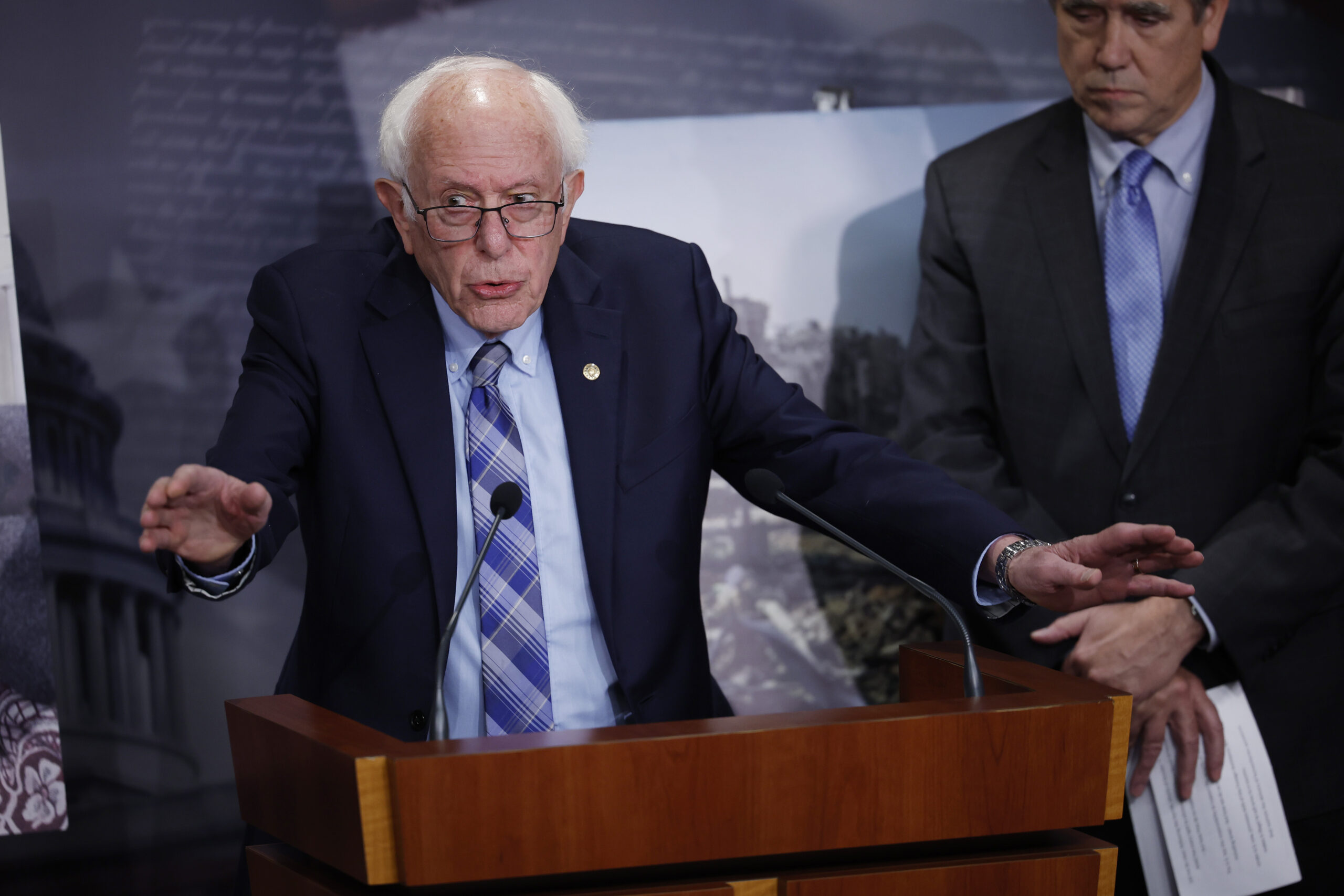
Netanyahu said on Sunday that Jerusalem had previously warned Australia’s PM that Palestinian statehood recognition endangered Jews in the country
Plus, WH adds Syria and Palestinians to travel ban

Smith Collection/Gado/Getty Images
U.S. Coast Guard cutter with crew on deck sailing through foggy harbor waters with Golden Gate Bridge faintly visible in background, San Francisco, California, December 6, 2025.
Good Tuesday afternoon!
This P.M. edition is reserved for our premium subscribers — offering a forward-focused read on what we’re tracking now and what’s coming next.
It’s me again — Danielle Cohen-Kanik, U.S. editor at Jewish Insider and curator, along with assists from my colleagues, of the Daily Overtime. Please don’t hesitate to share your thoughts and feedback by replying to this email.
📡On Our Radar
Notable developments and interesting tidbits we’re tracking
The co-chairs of the House Bipartisan Task Force for Combating Antisemitism are urging Australian Prime Minister Anthony Albanese to act more forcefully to protect Australia’s Jewish community and implement months-old recommendations from the country’s antisemitism envoy, Jewish Insider’s Marc Rod reports.
In a letter sent today, the lawmakers said that there were repeated “warning signs” before the Sunday massacre in Sydney targeting a Hanukkah celebration, including firebombings of synagogues, graffiti, assaults and threats of violence, which “have now led to a tragic reality.”
They noted that Jillian Segal, the Australian special envoy to combat antisemitism, released 49 recommendations to be implemented across a range of institutions in July, and questioned what the Australian government has done to enact that plan and how it will protect the Jewish community going forward…
The Coast Guard quietly implemented its new policy downgrading the status of swastikas from prohibited hate symbols to only “potentially divisive,” after having said it would scrap the change due to widespread backlash, including from members of Congress…
The Trump administration expanded its travel ban today to include individuals from five additional countries, among them being Syria, which the White House has otherwise been welcoming into the international community, as well as individuals with Palestinian Authority-issued travel documents…
The Department of Defense is preparing for a major restructuring, The Washington Post reports, including consolidating U.S. Central Command, European Command and Africa Command under a new organization called the U.S. International Command. “Such moves would complement other efforts by the administration to shift resources from the Middle East and Europe and focus foremost on expanding military operations in the Western Hemisphere,” sources with knowledge on the matter told the Post…
The U.S. and Qatar are drawing up contracts for Doha’s acquisition of F-35 fighter jets, Israeli media reports, raising concerns about the Jewish state’s qualitative military edge among Israeli officials. In response, they are reportedly compiling their own package of requests from the U.S., including more advanced fighter jets and munitions…
A conference hosted by CENTCOM in Doha today with dozens of countries to work on the International Stabilization Force for Gaza did not make meaningful progress, a European official told The Times of Israel, including failing to adequately determine the force’s mandate and its role in disarming Hamas…
A new Siena poll of New York voters released today found 35% of Jewish respondents view New York City Mayor-elect Zohran Mamdani favorably, up from the 18% of respondents who said the same last month. Among all respondents, Democratic Gov. Kathy Hochul led GOP challengers in head-to-head matchups with both Rep. Elise Stefanik (R-NY) and Nassau County Executive Bruce Blakeman; Hochul received around 50% of the vote to Stefanik’s 30% and Blakeman’s 25%…
Harmeet Dhillon, assistant attorney general for civil rights at the Department of Justice, said today that her office would investigate a disturbing video of several Orthodox Jews being harassed and physically assaulted in the New York City subway…
The guest list for a New York Young Republicans gala last Saturday, which was attended by members of Germany’s far-right Alternative for Germany (AfD) party, also included a former producer for former Rep. Matt Gaetz’s (R-FL) show who was fired for posting an animated video depicting Jews as cockroaches counting money; Jared Taylor, the editor of a white supremacist website called American Renaissance; and a streamer who goes by Sneako, known for posting antisemitic content, the Jewish Telegraphic Agency reports. Neo-Nazi Nick Fuentes also claimed he received an invitation, which was rescinded at the last minute…
Administration officials lined up to release statements in defense of White House Chief of Staff Susie Wiles after a Vanity Fair interview released this morning quoted her maligning President Donald Trump and his top Cabinet secretaries, which she said was “disingenuously framed” (though Trump himself said he agreed with her characterization in the interview that he has an “alcoholic’s personality”).
In one of several conversations with author Chris Whipple, Wiles said about Trump’s October appearance at the Knesset, where he lauded Israeli Prime Minister Benjamin Netanyahu and Israel’s war effort, “I’m not sure [Trump] fully realizes that there’s an audience here that doesn’t love it.”
Whipple also asked Secretary of State Marco Rubio if he would challenge Vice President JD Vance in the 2028 Republican presidential primary, to which Rubio said, “If JD Vance runs for president, he’s going to be our nominee, and I’ll be one of the first people to support him”…
Months after the merger of Paramount Skydance brought new leadership to CBS News, including The Free Press’ Bari Weiss as editor-in-chief, in part to address the channel’s perceived bias, Trump wrote on social media today, “For those people that think I am close with the new owners of CBS, please understand that 60 Minutes has treated me far worse since the so-called ‘takeover,’ than they have ever treated me before. If they are friends, I’d hate to see my enemies!” Trump has previously spoken positively of David Ellison, Paramount’s CEO, who has engaged extensively with the White House, including about an ongoing bid to acquire Warner Bros. Discovery…
New York magazine profiles Weiss’ journey from The New York Times to The Free Press to CBS News, where her hiring allowed Ellison to “signal with a single stroke that the new CBS News was pro-Israel, anti-woke, and MAGA-amenable — all attributes Weiss spent years cultivating in L.A. and that could come in handy in Ellison’s dealings with the Trump administration”…
⏩ Tomorrow’s Agenda, Today
An early look at tomorrow’s storylines and schedule to keep you a step ahead
Keep an eye out in Jewish Insider for a preview of the race for Pennsylvania’s 7th Congressional District, where Gov. Josh Shapiro’s endorsement in the Democratic primary may be a sign of how he hopes to build political capital as he prepares for a possible 2028 presidential campaign.
Conservative pro-Israel commentator Ben Shapiro will sit for a discussion tomorrow with embattled Heritage Foundation President Kevin Roberts. Their conversation comes amid heightened debate on the political right about antisemitism and anti-Israel animus, sparked by Roberts’ defense of podcaster Tucker Carlson after he platformed neo-Nazi Nick Fuentes. (Two more Heritage board members resigned today over the scandal.)
The Israeli Embassy in Washington will host its Hanukkah reception and Jewish members of Congress — including Senate Minority Leader Chuck Schumer (D-NY), Sens. Brian Schatz (D-HI), Jacky Rosen (D-NV) and Richard Blumenthal (D-CT) and Reps. Brad Schneider (D-IL), Brad Sherman (D-CA), Craig Goldman (R-TX), Dan Goldman (D-NY), David Kustoff (R-TN), Debbie Wasserman Schultz (D-FL), Greg Landsman (D-OH), Jan Schakowsky (D-IL), Jared Moskowitz (D-FL), Jerry Nadler (D-NY), Josh Gottheimer (D-NJ), Max Miller (R-OH) and Randy Fine (R-FL) — will host the annual Capitol Hill Hanukkah celebration.
In the evening, President Donald Trump will deliver an end-of-year address to the nation.
Stories You May Have Missed
SLOGAN UNDER SCRUTINY
Sydney Hanukkah massacre leads New York Democrats to grapple with ‘globalize the intifada’ rhetoric

Jerry Nadler protege Micah Lasher: ‘The spread of violence against Jews is intertwined with the social acceptability of violent rhetoric directed at Jews’
VANCE’S VIEW
JD Vance links youth antisemitism to immigration, demographics of Gen Z

‘I would say there’s a difference between not liking Israel (or disagreeing with a given Israeli policy) and anti-semitism,’ the vice president added
Sen. John Fetterman (D-PA): ‘Tree of Life to 10/07 to Bondi Beach: antisemitism is a rising and deadly global scourge’

Saeed KHAN / AFP via Getty Images
A Jewish community member reacts as he stands at the site of a terror attack at Bondi Beach in Sydney on December 14, 2025.
U.S. officials and lawmakers across the political spectrum are condemning the terrorist attack at a Chabad Hanukkah celebration Sunday outside Sydney, Australia, tying the murder of 15 attendees to the rise of antisemitism across the world.
Secretary of State Marco Rubio said in a statement that the United States “strongly condemns” the attack and that “antisemitism has no place in this world.”
U.S. Ambassador to the U.N. Mike Waltz said the “horrific and deadly terrorist attack” is a “sickening reminder that antisemitism remains a global threat. Under President Trump’s leadership, the United States will confront this hatred — at the U.N. and around the world — without apology or hesitation.”
FBI Director Kash Patel said he is “in touch with our counterparts in Australia” regarding the attack and is “providing the requested assistance,” while Attorney General Pam Bondi called it “heartbreaking news.”
U.S. Ambassador to Israel Mike Huckabee noted, as did several others, that Australian Prime Minister Anthony Albanese’s original statement on the attack did not specify its antisemitic nature. “The disgraceful statement from Australia PM never mentioned it was jihadist attack on Jews on first day of Hanukkah. Hope he’s ashamed of antisemitic statements past year,” Huckabee wrote on X.
On the Hill, lawmakers from both parties also expressed their shock and sadness. All 25 Jewish members of the House, on both the Republican and Democratic sides, issued a joint statement remembering the “Jewish families in Australia” who were “grotesquely targeted with hate and murderous intent.”
“Sadly, this attack does not come as a surprise to the Jewish community of Sydney who have been raising a clarion call for local and national authorities to take concrete steps against a rising tide of antisemitism,” the members, organized by Rep. Brad Schneider (D-IL), wrote. “Antisemitism is a cancer that eats at the core of society, whether in Australia, the United States, or anywhere it is allowed to take root and grow. We join leaders around the globe in condemning this evil act and in calling for justice, peace, and unwavering support for those affected. We also call on all leaders to do better standing up to antisemitism, bigotry, and hate.”
House Speaker Mike Johnson (R-LA) said the “tragic news” is “another wake-up call.”
“Jewish people must be free to practice their faith openly and without fear. Antisemitism must be confronted and defeated wherever it appears,” he wrote on X.
House Minority Leader Hakeem Jeffries (D-NY) said in a statement he was “horrified by the attack” and that it is “our collective responsibility to aggressively eradicate the poison of antisemitism whenever and wherever it is found.”
“Today, as the Jewish community throughout America gathers with their loved ones to celebrate Hanukkah, the New York Police Department and law enforcement resources across the country must be vigorously deployed to keep everyone safe. It is my sincere hope that the story of Hanukkah and the candles that will shine on windowsills in homes around the world will bring needed light and resolve that the powerful resilience of the Jewish people that has existed for millennia will continue to endure always and forever,” Jeffries wrote.
Senate Minority Leader Chuck Schumer (D-NY) said the attack “is beyond appalling” and “a shocking reminder that antisemitism and hate is not only toxic and far too present and widespread around the world, it is deadly. It must be vigorously condemned, confronted and overcome.”
Sen. Ted Cruz (R-TX) called it “an act of barbaric, antisemitic terrorism.”
“It was the outrageous, but all-too-predictable result of far too many leaders around the world tolerating and even fomenting hatred of Jews, instead of countering the evil of antisemitism with moral clarity and unrelenting condemnation.”
Sen. John Fetterman (D-PA) connected the attack to other antisemitic acts of violence: “Tree of Life to 10/07 to Bondi Beach: antisemitism is a rising and deadly global scourge,” he wrote. “I stand and grieve with Israel and the Jewish global community.”
Rep. Ritchie Torres (D-NY) said, “Terror and violence against Jews are part of a global surge in antisemitism fueled by an ever-escalating campaign of demonization and dehumanization. Yet the Australian Prime Minister’s initial statement expressed sympathy for ‘every affected person,’ conspicuously omitting any mention of Jews or Jew-hatred: a sin of omission that constitutes a fundamental failure of moral clarity at the very moment it is most urgently needed.”
Rep. Elise Stefanik (R-NY) called it “heinous” and said, “We must root out the rot of this most ancient hatred to bring safety and security for all humanity. Never Again is NOW.”
Rep. Ro Khanna (D-CA) called the “targeted terrorist attack … appalling and sickening,” and Rep. Haley Stevens (D-MI) said she was “horrified by the news of yet another disgusting act of antisemitic violence … Antisemitism has no place in our world.”
Sen. Rick Scott (R-FL) wrote, “Allowing antisemitism in Australia created the environment for this despicable act. Globalize the antifada [sic] is not a slogan — it’s a promise. A promise we all have to stop.”
Sens. Jacky Rosen (D-NV), Amy Klobuchar (D-MN), Lindsey Graham (R-SC), Mark Warner (D-VA), Tim Scott (R-FL), John Curtis (R-UT), Dave McCormick (R-PA), Katie Britt (R-AL), Ted Budd (R-NC), Jim Banks (R-IN) and Marsha Blackburn (R-TN) and Reps. Mike Lawler (R-NY), Raja Krishnamoorthi (D-IL), Rudy Yakym (R-IN), House Majority Whip Tom Emmer (R-MN), and Shontel Brown (D-OH) also offered their condemnation of the attack and prayers to the victims, among others.
Deborah Lipstadt, former special envoy to monitor and combat antisemitism under the Biden administration, called out New York Mayor-elect Zohran Mamdani for contributing to rhetoric that she said fueled the attack. “Mr. MayorElect, when you refuse to condemn & only ‘discourage’ use of the term ‘Globalize the Intifada, you help facilitate (not cause) the thinking that leads to Bondi Beach,” she wrote of Mamdani.
In a subsequent post, she asked, “Some asked has Mamdani condemned this? Not yet but he will. Strongly. But the time 2speak is before tragedies. The ‘wink & nod’ to Jew-hatred by facilitating language that leads to murdering Jews is unacceptable — and need we say it — so is murdering Jews.”
Mamdani did issue a statement about the attack, which he called “a vile act of antisemitic terror.”
“Another Jewish community plunged into mourning and loss, a holiday of light so painfully reduced to a day of darkness. This attack is merely the latest, most horrifying iteration in a growing pattern of violence targeted at Jewish people across the world. Too many no longer feel safe to be themselves, to express their faith publicly, to worship in their synagogues without armed security stationed outside. What happened at Bondi is what many Jewish people fear will happen in their communities too,” the mayor-elect wrote.
Jewish organizations also came out in force to share their condemnation and pain.
Ted Deutch, CEO of the American Jewish Community, said he was “Horrified. But not surprised.”
“Bondi Beach is one of the most beautiful places in the world. And Jewish kids celebrating the joyous holiday of Hanukkah with their families is likewise one of the most beautiful images of our people. Both have now been ripped to pieces. … This week, we will be reaching out to leaders from around the world to unite around a shared commitment to eradicate the evil scourge of antisemitism. Take our call. Stand with the Jewish community.”
“But don’t wait to speak out,” he continued. “Do it today. Wherever you live. If you are a leader, then lead. Stand with your Jewish community where you are. Yes, reach out privately to your friends in the community to express your support. But speak out as well for all the world to hear. Everyone who looks up to you needs to hear you condemn the antisemitic slaughter in Australia and the ongoing threats to our community everywhere. We are 16 million people in the world. We cannot do this on our own. Stand with us.”
William Daroff and Betsy Berns Korn, respectively the CEO and chair of the Conference of Presidents of Major American Jewish Organizations, recalled their own recent trip to Australia in a statement, including meeting with a Chabad emissary who was killed in the attack: “Just last week, we joined a delegation of Jewish leaders from the seven largest Diaspora Jewish communities in Australia as they confronted a sharp rise in antisemitism. … This past Shabbat, we attended morning services at Chabad of Bondi Beach. We davened in their beautiful new building and saw a community full of warmth, faith, and energy. After services, we had the honor of sharing Shabbat lunch in the home of Rabbi Yehoram and Shternie Ulman with their family, including Rabbi Eli Schlanger and his wife, Chaya. We are devastated to learn that Rabbi Schlanger, z’l, was among those murdered today.”
“Our hearts are with the families of those killed and injured, and with our brothers and sisters in Sydney as they confront this brutal tragedy. The story of Chanukah speaks to Jewish survival and resilience in the face of persecution. This attack on the Bondi Beach community strikes at the heart of the entire Jewish people. We pray for the swift recovery of the injured and mourn those whose lives were taken in this senseless antisemitic act,” Daroff and Korn wrote.
Karen Paikin Barall, chief policy officer at The Louis D. Brandeis Center for Human Rights Under Law, wrote in a post, “In 2008, as Deputy Special Envoy to Monitor and Combat Antisemitism, I traveled to Australia amid rising antisemitic incidents and a troubling lack of response from law enforcement and government leaders. Australia is home to the largest population of Holocaust survivors outside Israel. The Bondi attack is not isolated. It reflects years of inaction and minimization. Antisemitism doesn’t fade when ignored, it grows more violent.”
The Orthodox Union called the attack “a direct assault on Jewish life.”
“Chanukah is the most public of Jewish holidays. We mark the defeat of ancient antisemitic persecution by lighting our menorahs openly and unapologetically. That is precisely why this attack matters. It was meant to intimidate, silence, and drive Jews out of the public square. It will fail. At a time when antisemitism is being normalized, excused, and even justified in public discourse, this attack is no longer shocking. It is the predictable result of unchecked incitement, extremist rhetoric, and repeated failures by leaders to draw red lines,” the organization wrote.
“Calls to ‘globalize the intifada’ are not slogans. They are threats, and they lead directly to violence. … Silence, moral equivocation, and inaction are no longer acceptable. Jews have the right to celebrate their faith openly and safely, without fear, anywhere in the world.”
Democratic Majority for Israel said the attack “makes painfully clear that antisemitic violence remains a grave and growing threat. Jews must be able to gather, pray, and celebrate their religion openly and safely. From the Tree of Life to Poway, from Boulder to Washington, D.C., and now Bondi Beach, the rise of violent antisemitism demands urgent and sustained action from our leaders and communities.”
“At this moment of darkness, as we prepare to begin Hanukkah, we draw strength from the story of the Maccabees, who faced hatred and persecution with courage and resilience. That spirit endures today.”
The Jewish Council for Public Affairs wrote, “Our hearts are shattered for those murdered and injured, all those impacted, and the entire Australian Jewish community. And we are angry: That Jews around the world are now beginning Hanukkah fearful of showing up and celebrating. That after years of us sounding the alarm about the crisis of antisemitism, our leaders and our society have still failed to truly recognize and effectively address this threat. That too many loud voices seek to politicize and exploit our real, legitimate fears — rather than taking the comprehensive, whole-of-society action necessary to keep us safe.”
The Jewish Federations of North America, Anti-Defamation League, Secure Community Network, Community Security Service and Community Security Initiative issued a joint statement with increased security recommendations for “all Jewish organizations that are hosting events in the coming days to undertake.”
Plus, stars and pols flock to Doha despite baggage
KARIM JAAFAR/AFP via Getty Images
Qatar's Prime Minister and Minister of Foreign Affairs Sheikh Mohammed bin Abdulrahman Al-Thani speaks during a press conference in Doha on April 27, 2025.
👋 Good Wednesday morning!
In today’s Daily Kickoff, we look at Qatar’s multifront effort to attract celebrities, influencers, U.S. politicians and media outlets, even as it continues to back destabilizing groups including Hamas and the Muslim Brotherhood. We have the scoop on a new call from lawmakers in Washington for Lebanon’s leaders to disarm Hezbollah, and report on concerns by the Anti-Defamation League that Sen. Bernie Moreno’s new legislation banning dual citizenship could revive antisemitic narratives. Also in today’s Daily Kickoff: Daniel Lurie, Jacob Helberg and Michael and Susan Dell.
Today’s Daily Kickoff was curated by Jewish Insider Executive Editor Melissa Weiss and Israel Editor Tamara Zieve with assists from Danielle Cohen-Kanik and Marc Rod. Have a tip? Email us here.
What We’re Watching
- The House Foreign Affairs Committee is holding a vote today to advance legislation designating the Muslim Brotherhood as a terrorist organization. More below.
- The Senate Foreign Relations Committee is holding a vote this morning on advancing the nominations of Yehuda Kaploun and Tammy Bruce to be the State Department’s antisemitism envoy and deputy representative to the U.N., respectively.
- Jared Isaacman will face the Senate Commerce Committee today for a second hearing to be the administrator of NASA, eight months after his initial nomination was pulled during a spat between Elon Musk, who backed his nomination, and President Donald Trump.
- Elsewhere in Washington, SKDK is hosting a small gathering with the parents of slain Israeli Americans Omer Neutra and Itay Chen and their supporters.
- In Maryland, the Jewish Community Relations Council of Greater Washington is hosting its annual “Lox and Legislators” event in Rockville this morning. Gov. Wes Moore, Sen. Angela Alsobrooks (D-MD) and Democratic Reps. April McClain Delaney and Glenn Ivey are slated to speak.
- In New York, Israel Policy Forum is honoring Bob Elman and Bob Sugarman this afternoon at the group’s annual gala. The event will also feature a discussion with Ambassador Michael Ratney, Elisa Ewers and Rachel Brandenburg on the future of U.S. leadership in the Middle East.
- White House Deputy Special Envoy to the Middle East Morgan Ortagus is in Israel this week for meetings with senior Israeli officials. Israeli media reported that Israeli Foreign Minister Gideon Sa’ar is expected to present Ortagus with recent findings indicating that Hezbollah is rearming itself in Lebanon in violation of a ceasefire agreement inked between Jerusalem and Beirut last year.
What You Should Know
A QUICK WORD WITH JI’S marc rod
Qatar, whose ties to the Muslim Brotherhood have drawn scrutiny in the aftermath of the Oct. 7, 2023, attacks, is doubling down on a charm offensive focused on a handful of GOP lawmakers and conservative social media influencers, all while hosting two of the most established brands in American news.
A group of House Republicans visited Qatar during the House’s Thanksgiving recess last week, including Reps. Laurel Lee (R-FL), Marlin Stutzman (R-IN), Abe Hamadeh (R-AZ), Ryan Zinke (R-MT) and Lance Gooden (R-TX). The trip occurred just before the House Foreign Affairs Committee is scheduled to vote on legislation that classifies the entire Muslim Brotherhood organization globally as a terrorist group.
A group of conservative social media influencers also visited Qatar over Thanksgiving, posting glowing dispatches lauding the country and its role in hosting a U.S. military base.
Rob Smith, one of the invited guests, posted credulously about Qatar on his Instagram feed after the trip, “I wasn’t aware of a great deal of things about Qatar, only misperceptions and half-truths I’d read about online. When the opportunity was presented to me, with full authority and autonomy to ask the tough questions of the officials I’d be meeting with, I decided to risk any potential criticism and to travel and experience it for myself.”
Meanwhile, numerous prominent celebrities — including comedian Kevin Hart, celebrity chef Gordon Ramsay and tennis star Novak Djokovic — gathered in Doha over the weekend for the 2025 Formula One Qatar Grand Prix.
And this week, the country is hosting the Doha Forum, a conference co-sponsored by CNN. Those attending the conference include several Trump administration officials and ambassadors, politicians and philanthropists, alongside Israel-bashing officials such as former Iranian Foreign Minister Mohammad Javad Zarif, sanctioned U.N. special rapporteur Francesca Albanese and former Iran envoy Rob Malley.
Others on the guest list include: Donald Trump Jr., U.S. Ambassador to Turkey Tom Barrack, U.S. Ambassador to NATO Matthew Whitaker, Trump advisor Alex Bruesewitz, the Heritage Foundation’s Victoria Coates, former Secretary of State Hillary Clinton, Bill Gates, the Quincy Institute’s Trita Parsi, CNN anchor Christiane Amanpour and other officials, leaders and analysts from around the world.
Also this week, The Wall Street Journal is hosting a technology conference in Doha, featuring business leaders and celebrities, hosted by various Journal reporters. As JI’s Matthew Kassel reports (see more below), the summit is raising ethical questions surrounding the paper’s deepening business ties with Qatar — even as the Journal’s conservative editorial page has slammed the Gulf monarchy as a financial and diplomatic sponsor of Hamas.
Each of these events comes at a time when Qatar’s complicated public reputation in the United States is becoming a flashpoint, particularly inside the conservative movement.
QATAR’S PAPER PLAY
Wall Street Journal expands ties with Qatar, launches glitzy conference in Doha

The Wall Street Journal kicked off its Tech Live conference in Qatar on Tuesday, underscoring a deepening partnership between the publication and the controversial Gulf state. The exclusive summit, making its debut in the Middle East, will continue to be held in Doha, the Qatari capital, for the next five years, according to an initial announcement from Dow Jones, which publishes the Journal. The event is sponsored by the state-owned Qatar Airways, among a handful of other companies, Jewish Insider’s Matthew Kassel reports.
Growing embrace: Qatar’s prime minister, Sheikh Mohammed bin Abdulrahman Al-Thani, who spoke at the event on Tuesday in an onstage discussion with Dow Jones’ CEO, Almar Latour, said in a social media post that the conference “represents a key platform to discuss technology’s role in business and advance Qatar’s digital standing.” In addition, Dow Jones recently opened an office in Doha’s Media City as part of an effort to “strengthen its operations throughout the Middle East.”
STATE OF PLAY
Report: Muslim Brotherhood influence ‘increasingly pervasive’ in U.S.

The Muslim Brotherhood’s influence has become increasingly pervasive in the United States, according to a new report by the Institute for the Study of Global Antisemitism and Policy, titled “The Muslim Brotherhood’s Strategic Entryism into the United States: A Systemic Analysis.” President Donald Trump’s recent instruction to Secretary of State Marco Rubio to take steps toward banning Muslim Brotherhood-affiliated organizations came soon after ISGAP briefed policymakers from both parties and national security professionals, including Trump administration officials, in Washington and beyond about the study, Jewish Insider’s Lahav Harkov reports.
Group’s goals: “For decades now, we’ve known that Islamism has been a problem within our liberal secular democracies,” ISGAP’s vice president, Haras Rafiq, told the Misgav Mideast Horizons podcast. (Harkov co-hosts the podcast.) The new ISGAP report cites authenticated Muslim Brotherhood documents describing the group’s strategy – called tamkeen, which loosely translates to “empowerment” – of entrenching itself in the institutions of Western democracies.
SCOOP
Lawmakers to Lebanese leaders: ‘Disarm Hezbollah now’ or risk losing U.S. support

A bipartisan group of House lawmakers wrote to the president and prime minister of Lebanon on Wednesday demanding they urgently move forward to disarm Hezbollah, in accordance with the ceasefire agreement signed by Lebanon and Israel in November 2024. The group accused the Lebanese government of failing to fulfill its promises and obligations to disarm the terrorist group and threatened a withdrawal of U.S. support if it does not change course, Jewish Insider’s Marc Rod reports.
What they wrote: “We write to you with a critical message: disarm Hezbollah now, including by force if necessary,” the letter reads. “Empty promises and partial measures that fall far short of disarming the group are clearly not enough. The lack of real progress has enabled Hezbollah to rearm and rebuild its positions, even in areas south of the Litani River, where it is prohibited from operating under UN Security Council Resolution 1701.” The letter, led by Rep. Josh Gottheimer (D-NJ), was co-signed by Reps. Jefferson Shreve (R-IN), Don Bacon (R-NE), Gus Bilirakis (R-FL), Mark Messmer (R-IN), Tom Suozzi (D-NY), Claudia Tenney (R-NY), Don Davis (D-NC) and Jared Golden (D-ME).
HOLDING FIRE
Harmeet Dhillon declines to criticize Tucker Carlson for hosting antisemites on podcast
Harmeet Dhillon, the assistant attorney general for civil rights at the Justice Department, defended Tucker Carlson’s hosting of neo-Nazi Nick Fuentes at the Israel Hayom summit on Tuesday. Dhillon took part in a conversation at the gathering, which took place in Manhattan, with the outlet’s senior diplomatic correspondent, Ariel Kahana, about the Trump administration’s efforts to combat domestic antisemitism, Jewish Insider’s Emily Jacobs reports.
Tucker talk: Asked about Carlson’s interview with Fuentes and what tools the U.S. had to prevent the spread of the antisemitic ideas from the far right, Dhillon distanced herself from Fuentes while calling Carlson a “friend.” Dhillon said, “What we say in First Amendment world is: The antidote to speech that you don’t like is more speech. It isn’t shutting down speech. So, I don’t agree with a single word that Nick Fuentes says or has to say, and the decision of whether or not to platform that person is one for my friend and former client, Tucker Carlson.”
Also speaking at the summit: Former Secretary of State Hillary Clinton warned of the influence of social media in shaping young people’s perceptions on Israel and the Israeli-Palestinian conflict, Jewish Insider’s Matthew Shea reports.
CITIZENSHIP QUALMS
ADL says Moreno’s dual-citizenship bill risks reviving ‘dual loyalty’ narrative
The Anti-Defamation League said on Tuesday that Sen. Bernie Moreno’s (R-OH) new proposal to ban dual citizenship risks reviving an antisemitic “dual loyalty” charge that has historically been used to target Jewish Americans, Jewish Insider’s Emily Jacobs and Marc Rod report.
ADL’s approach: Dan Granot, the Anti-Defamation League’s senior director of government relations, told JI, “The idea of questioning the loyalty of Americans based on dual citizenship is deeply troubling. Dual citizenship is a lawful and common status that millions of Americans hold, and it does not diminish anyone’s commitment to the United States. Accusations of ‘dual loyalty’ have historically been used against Jews to exclude them from public life and even justify violence, making this trope especially harmful and dangerous.”
Elsewhere: Rep. Ro Khanna (D-CA), a potential 2028 presidential candidate, is sparring with AIPAC on social media over ads the group ran criticizing his support for a House resolution describing the war in Gaza as a genocide, JI’s Marc Rod reports.
PAPAL PRAISE
Pope’s praise of Erdogan as a peacemaker raises eyebrows
Following a visit to Turkey on his inaugural international trip last week, Pope Leo XIV lauded Turkish President Recep Tayyip Erdogan on his peacemaking abilities and said Turkey has “an important role that it could play” in advancing peace in the Middle East and effectuating a two-state solution. The pope’s comments and decision to share pleasantries with the Turkish leader have struck some in the pro-Israel community as out of touch and are part a pattern of recent remarks from the Vatican that have been critical of Israel, most notably in its handling of the war against Hamas in Gaza, Jewish Insider’s Matthew Shea reports.
Reactions: Steven Cook, a senior fellow at the Council on Foreign Relations, called the pontiff’s comments on Turkey “odd,” adding that his intentions were likely to “flatter his hosts but have little connection to reality.” Sinan Ciddi, a senior fellow at the Foundation for Defense of Democracies, agreed, calling the pope’s comments “flawed” and “fantasy.” However, he noted that popes have a “record of being idealists.”
Worthy Reads
The Instagram Mayor: The Wall Street Journal’s Jim Carlton spotlights San Francisco Mayor Daniel Lurie’s embrace of social media as a means to boost the city’s standing after being elected on a platform of revitalizing the Bay Area, which for years had been plagued by economic and safety issues. “The 47-year-old Levi Strauss heir has become ubiquitous on the city’s social-media scene. He posts musings every day from his wanderings around San Francisco, some on somber topics like ongoing drug use but most are upbeat — even a bit hokey. … Social media, he added, is his way of telling San Franciscans — and the world — how the city is progressing. ‘It’s about being unfiltered, speaking directly to the people of San Francisco,’ the mayor said as he walked along the city’s waterfront last month after one of many stops, holding an umbrella against a cold, light rain.” [WSJ]
Having Hurwitz’s Back: In the Jewish Telegraph Agency, Jarrod Bernstein, Shelley Greenspan and Chanan Weissman, all former White House Jewish liaisons, defend former White House speechwriter Sarah Hurwitz amid a deluge of online criticism over a misleadingly edited video clip in which Hurwitz discussed how Holocaust education has impacted conversations about the Israel-Hamas war. “What followed was a torrent of outrage from people who claimed Sarah was arguing that we shouldn’t teach Holocaust education because doing so makes young people think the Israel-Hamas war in Gaza is a genocide. Others claimed she was saying that genocide only matters when it’s perpetrated against Jews. Such sentiments would obviously be obscene, and we were shocked that people would attribute them to Sarah, someone who just published a book in which she expressed profound anguish about the unbearable deaths of civilians in Gaza. … Sarah was also conveying that, contrary to the impression young people get on social media, what happened in Gaza is not analogous to the Holocaust. It was a devastating war that does not fit neatly into a simplistic frame of oppressor versus oppressed. That black and white paradigm disregards the complex challenges that continue to stymie a resolution to this heartbreaking conflict.” [JTA]
Spotlight Shapiro: The Atlantic‘s Tim Alberta profiles Pennsylvania Gov. Josh Shapiro, amid speculation that the moderate Democrat could mount a presidential bid in 2028. “For a man with such an established public profile—years as a congressional aide, decades in various elected offices, a network as extensive as that of any Democrat in office today—Shapiro remains something of a mystery, a man whose real views and motives are widely debated but ill-defined. In conversations with dozens of people who know the governor, a certain irony is inescapable. Shapiro seems to believe that he is uniquely equipped to run for president and repair the Democratic Party’s deficit of trust and authenticity. Any such campaign, however, would expose deficits of his own.” [TheAtlantic]
Word on the Street
The State Department’s Jacob Helberg said that the U.S. is looking to lock in agreements with eight countries, including Israel and the United Arab Emirates, that will strengthen supply chains for computer chips and minerals critical to the production of AI technology; the White House is hosting the first meeting with officials from the countries on Dec. 12…
Israeli Prime Minister Benjamin Netanyahu expressed openness to a U.S.-brokered security deal with Damascus involving southern Syria, with the caveat that Syria respects the buffer zone between the countries…
Republican Matt Van Epps defeated Democratic state Rep. Aftyn Behn by nine points in the special election in Tennessee’s 7th Congressional District…
Rep. Ayanna Pressley (D-MA) ruled out a primary challenge to Sen. Ed Markey (D-MA), announcing on Tuesday that she’ll run for reelection in Massachusetts’ 7th Congressional District…
James Solomon won Jersey City’s runoff election for mayor, besting former Gov. Jim McGreevey…
Reps. Tom Suozzi (D-NY) and Claudia Tenney (R-NY) wrote to Secretary of State Marco Rubio urging him to work to secure the release of Kamran Hekmati, an American-Iranian dual citizen and member of the Persian Jewish community arrested in Iran earlier this year for having visited Israel 13 years ago…
The New York Young Republican Club is slated to honor far-right Alternative for Germany senior official Markus Frohnmaier at its upcoming annual gala…
A new offer from David Ellison’s Paramount Skydance for Warner Bros. Discovery reportedly has backing from the sovereign wealth funds of Saudi Arabia, Qatar and Abu Dhabi; Paramount made the higher, second-round bid for the entire company, while Netflix and Comcast submitted bids for only Warner Bros.’ studios and streaming business…
Philanthropists Michael and Susan Dell are donating $6.25 billion to back the creation of seed investment accounts for children in the U.S. as part of the “Trump accounts” program…
The family of Holocaust survivor Erno Spiegel donated the pen he used to falsify records to save dozens of sets of twins who were subject to medical experiments at Auschwitz…
OneTable laid off 25% of its employees as it undertakes a “planned, strategic shift” in its staffing…
The U.K.’s independent advisor on antisemitism told Parliament’s Home Affairs Committee that U.K. police altered evidence it used to justify banning Maccabi Tel Aviv supporters from attending a recent soccer match against Aston Villa…
U.K. Attorney General Richard Hermer urged Nigel Farage to apologize to former classmates over what they claimed were repeated antisemitic and racist insults from the Reform UK leader during his teenage years…
Israel is finalizing the handover of its Arrow 3 anti-ballistic missile defense system to Germany, marking, at $4.2 billion, Jerusalem’s largest defense export deal…
Israeli officials said that remains transferred from Hamas to Red Cross officials on Tuesday do not match either of the remaining two hostages in Gaza…
The Rafah border crossing between Gaza and Egypt is slated to reopen in the coming days, allowing access out of the enclave to Palestinians who have been approved by Israeli security officials…
Pic of the Day

Lockheed Martin, together with Israel’s Industrial Cooperation Authority, signed an extension this week for the Umbrella Industrial Cooperation Agreement (UICA) through the end of 2029. The ceremony was led by Israeli Minister of Economy Nir Barkat (center left), Lockheed Martin Chief Operating Officer Frank St. John (center right), Lockheed Martin Israel Chief Executive Tal Galor (right), the ministry’s Head of Industry Division Nurit Tsur-Rabino and Head of Industrial Cooperation Authority Division Yazeed Sheick-Yousif.
Birthdays

Professional tennis player with a WTA doubles ranking that reached as high as 21, Sharon Fichman turns 35…
Close associate of the Lubavitcher Rebbe and influential leader within Chabad, Rabbi Chaim Yehuda “Yudel” Krinsky turns 92… Founder of a successful wedding gown business and a lifestyle coach, Sandy Stackler… 1987 Pulitzer Prize-winner for his book on Arabs and Jews in Israel, he was a long-serving foreign correspondent and Washington bureau chief for The New York Times, David K. Shipler turns 83… Member of the New York State Assembly since 1994, Jeffrey Dinowitz turns 71… Former Argentine minister of foreign affairs, Gerardo Werthein turns 70… Miami-based criminal defense attorney whose clients have included O.J. Simpson and Charlie Sheen, Yale Lance Galanter turns 69… Painter and art teacher residing in Maryland, her teaching career started in Petach Tikva, Heidi Praff… Former editorial page editor at USA Today, William “Bill” Sternberg… Former member of the House of Representatives (D-NC) until January, now chair of Democratic Majority for Israel, Kathy Manning turns 69… British publicist, music manager and former tabloid journalist, Rob Goldstone turns 65… President of the Massachusetts Institute of Technology since 2023, Sally A. Kornbluth turns 65… Aerospace and technology executive, entertainment attorney and media mogul, Jon F. Vein turns 62… Former member of the Knesset for the Yisrael Beiteinu party, Eli Avidar turns 61… Member of the U.S. House of Representatives from California, she won Adam Schiff’s House seat in 2025, Democrat Laura Friedman turns 59… First VP at Adat Ari El Congregation in Valley Village, Calif., Malinda Wozniak Marcus… Cellist and associate professor at McGill University, Matt Haimovitz turns 55… SVP of strategic initiatives at NBC News until 2024, now a communications consultant, Alison “Ali” Weisberg Zelenko… Associate professor of Jewish history and chair of Jewish studies at Yeshiva University, Joshua M. Karlip, Ph.D. turns 54… French journalist, author, television and radio personality, Marie Drucker turns 51… Emmy and Grammy Award-winning comedian and actress, she discovered her Eritrean Jewish roots as an adult, Tiffany Haddish turns 46… Financial trader and founder of XTX Markets, Alex Gerko turns 46… CEO of Solar One, he was a member of the New York City Council through 2021, Stephen T. Levin turns 44… Judge of the U.S. Court of Appeals for the 6th Circuit, Rachel Sarah Bloomekatz turns 43… Hasidic singer, his music videos have 120 million views on YouTube, Benzion Hakohen “Benny” Friedman turns 41… Founding partner and head of business strategy at Triadic, Elizabeth “Lizzie” Edelman…
The new ISGAP report cites authenticated Muslim Brotherhood documents describing the group’s strategy of entrenching itself in the institutions of Western democracies

Salah Malkawi/Getty Images
Jordanian police close the entrance of a Muslim Brotherhood headquarter after the announcement of banning the society in the country on April 23, 2025 in Amman, Jordan.
The Muslim Brotherhood’s influence has become increasingly pervasive in the United States, according to a new report by the Institute for the Study of Global Antisemitism and Policy, titled “The Muslim Brotherhood’s Strategic Entryism into the United States: A Systemic Analysis.”
President Donald Trump’s recent instruction to Secretary of State Marco Rubio to take steps toward banning Muslim Brotherhood-affiliated organizations came soon after ISGAP briefed policymakers from both parties and national security professionals, including Trump administration officials, in Washington and beyond about the study.
“For decades now, we’ve known that Islamism has been a problem within our liberal secular democracies,” ISGAP Vice President Haras Rafiq told the Misgav Mideast Horizons podcast. (Jewish Insider’s Lahav Harkov co-hosts the podcast.)
The new ISGAP report cites authenticated Muslim Brotherhood documents describing the group’s strategy – called tamkeen, which loosely translates to “empowerment” – of entrenching itself in the institutions of Western democracies.
“It was a 100-year plan, and they’re 43 years into it,” Rafiq said. “We looked at the who, why, what, where … and then analyzed how well we’re doing against it.”
The Muslim Brotherhood’s basic goals, he said, are “to set up a utopian Islamist state and enforce their vision of Sharia-based law on the whole state, and secondly, to spread that around the world. … [Their] tactic, the opium of the masses, is to wipe Israel off the map.”
In liberal democracies, one of the major elements of the plan is “figuring out a way to persuade Muslims, if you’re living in the West, that the Islam that your parents practice … is actually wrong and it fits into … innovation, false association with a deity, [and] haram, which means not allowed,” Rafiq said. “So first of all, change the Islam that’s practiced from within.”
The way the Muslim Brotherhood relates to non-Muslim societies, Rafiq said, is to “try to persuade others by using a faith-based identity politics which aligns with what they believe — that they are the proper Muslims. And over time, there are four key areas where they focus: One is political infiltration and legislation, the second is controlling the narrative, the media, the third is how they can increase the capacity [of those steps], and looking at Muslims and changing from within.”
Rafiq said that Muslim Brotherhood-sympathetic organizations latched onto the Sept. 11, 2001, attacks to increase their influence.
“It was a time when there was a lot of confusion,” he recounted. “What organizations like CAIR [the Council on American-Islamic Relations] and others were able to do was to latch onto people who wanted to understand who were these Muslims, why did people want to fly planes into the Twin Towers … and they actually were very quick to latch onto the media, the politicians, the people within civil society who were hungry to know more, and become one of the main voices.”
Texas Gov. Greg Abbott, a Republican, recently declared both the Muslim Brotherhood and CAIR to be foreign terrorist organizations banned from the state. Rafiq pointed out, however, that the state has not seized any assets or taken any concrete action against the organization.
The difference between CAIR, which presents itself as an advocacy group for a minority population, and other organizations that aim to do the same, Rafiq said, is that “ultimately, at the end of the day, the people who set up the organization actually are part of the Muslim Brotherhood Islamist worldview, and ultimately are trying to … use entrenchment to change the liberal democracy from within.”
Rafiq also cited ties between CAIR and unindicted co-conspirators in the Holy Land Foundation trial, the largest terrorism finance trial in the U.S., which shut down an organization that was funding Hamas.
“I guess other non-Islamist organizations that represent Muslims and other organizations don’t want those objectives and are not involved in these kinds of criminal activities,” he said.
CAIR has “been able to persuade and fool people that they’re actually representing Islam and Muslims and they’re the correct voices,” he said. Still, Rafiq cited polling that out of 1.9 billion Muslims worldwide, 1.4 billion reject Islamism, which includes the Muslim Brotherhood.
“The good news is still that the majority of Muslims around the world reject Islamism,” Rafiq said, while noting that he did not have specific data about the U.S.
However, Rafiq said that the Muslim Brotherhood has successfully inculcated young Muslims in the West with antisemitism.
“Antisemitism is a key tool that they use in the guise of being anti-Israel or anti-Zionist, etc., to recruit people to their worldview,” he said.
Rafiq called Qatar “the last man standing” in the Sunni Arab world, in that its regime supports the Muslim Brotherhood.
“Muslim Brotherhood Islamist ideology is deeply entrenched within all parts of [Qatar’s] civil society, all the way to the top,” he said. “As a result of this entrenchment … they’ve used tamkeen successfully across the board, from educating children all the way up to civil society organizations and the leadership. One can say the Muslim Brotherhood has a funding arm, which is directly the Emir and the institution, the country, the economy and the corporation that is Qatar.”
ISGAP has estimated that Qatar’s soft power assets worldwide are worth $1 trillion. The Gulf state is the largest state donor to universities in the U.S., and much of those donations are undocumented.
Qatar spreads the Muslim Brotherhood’s messages via Al Jazeera in Arabic and English.
“The English one will be a lot more palatable, but still pushing the Islamist narrative. The Arabic is downright nasty – and they get away with it, because what they’ve done is set up Al Jazeera as a corporation,” Rafiq said. “But they are 100% owned by the Qatari royal family. Therefore, in my view, when they operate in the U.S., they should [register] under the Foreign Agents Registration Act.”
Rafiq said the West can do more to make support for the Muslim Brotherhood more costly for Qatar and discourage its leadership from continuing. One example he gave is an ISGAP report exposing Qatari funding for Texas A&M, including a contract that said all of the research projects are property of the Qatar Foundation – including those with dual-use purposes that could be used to develop weapons. After initially denying the links, the president of the university pulled it out of Education City in Doha.
“That really hurt [Qatar],” Rafiq said. “The reason I know it hurt them was that we are constantly besmirched and lies are told about us and we are targeted by the Qatari government.”
Another win, Rafiq argued, was the Israeli strike on Doha in September.
“That was the key moment in which they realized that even though they have a defense agreement with the U.S., they can’t really hide. But the downside was that rather than actually use that and push on the advantage, what the U.S. government has done is create the situation with the ceasefire in Gaza … and pushed out countries like Saudi Arabia and the U.A.E. … and decided to bring in Qatar and Turkey, and that’s a problem.”
“We need more support from [the Trump administration] in terms of Qatar, and not to be taken in by geopolitics,” he added.
Rafiq compared fighting the Muslim Brotherhood without taking on Qatar to taking aspirin when you have cancer.
“Islamism is a virus or a cancer … which is spreading rapidly, and unless we deal with it, the root cause, and we persuade Qatar to stop funding it … it won’t really make a difference,” Rafiq said.
One of the challenges in combating Islamism, Rafiq said, is that “we don’t make it easy to recognize Islamism in the same way that we recognize fascism and communism … [because] they’ve been able to push this narrative so effectively of Islamophobia.”
“Islam is a set of ideas, a set of values. In a liberal democracy, no set of ideas should be beyond critique, satire or even parody, even if they are ideas that I believe – and I’m a Muslim,” he said. “The people who are intolerant have persuaded us that these concepts are intolerant; therefore, we fall in line.”
Legislation that would ban the group has received bipartisan support in both the House and Senate
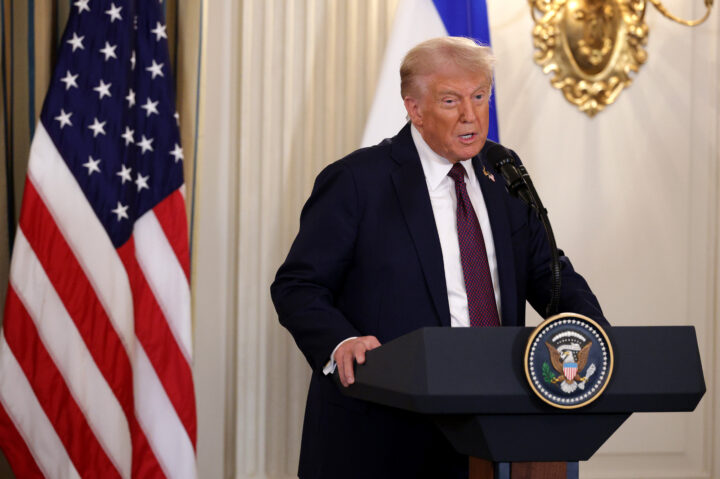
Alex Wong/Getty Images
U.S. President Donald Trump delivers remarks at the White House on September 29, 2025 in Washington, DC.
President Donald Trump announced on Sunday that he plans to designate the Muslim Brotherhood as a Foreign Terrorist Organization following months of bipartisan calls for his administration to target the group.
Trump announced the move in an interview with journalist John Solomon of the conservative outlet Just the News on Sunday morning, saying that an executive order is being prepared for his signature.
“It will be done in the strongest and most powerful terms,” Trump said. “Final documents are being drawn.”
The White House did not respond to Jewish Insider’s request for comment on the announcement or details of the order being drafted for the president.
Trump considered designating the Brotherhood as a Foreign Terrorist Organization (FTO) during his first administration, though that effort never materialized. Sebastian Gorka, who serves as Trump’s deputy assistant for national security affairs and senior director for counterterrorism at the National Security Council, has been publicly and privately urging the president to do so since returning to office, as have a chorus of GOP lawmakers, along with a handful of Democrats in Congress.
Gorka posted on X on Sunday that the “time has come” to designate the group, which he called “the progenitor of all modern Jihadist terror groups, from al Qaeda to HAMAS.”
A Senate bill that would designate the Muslim Brotherhood as a terrorist group, led by Sen. Ted Cruz (R-TX), has 11 co-sponsors, including Sen. Tom Cotton (R-AR), Sen. Rick Scott (R-FL), Sen. Dave McCormick (R-PA) and Sen. John Fetterman (D-PA). The House version of the bill has 19 co-sponsors, including four House Democrats.
Trump’s announcement comes less than a week after Texas Gov. Greg Abbott, a Republican, issued a declaration designating the Muslim Brotherhood and Council on American-Islamic Relations as foreign terrorist groups and transnational criminal organizations, a move prohibiting both groups from buying land in Texas and allowing the AG’s office to sue to shut them down.
Secretary of State Marco Rubio said in August that the FTO designation was “in the works” for the Brotherhood.
“Obviously, there are different branches of the Muslim Brotherhood, so you’d have to designate each one of them,” Rubio told right-wing talk show host Sid Rosenberg on his radio program at the time, adding that the State Department needed to go through a lengthy “process which I didn’t fully appreciate until I came into this job.”
News of Trump’s comments was met with praise in the U.S. and in Israel, even as the details are still fuzzy over what he will be signing.
Israeli Prime Minister Benjamin Netanyahu said on Sunday that he wanted to “commend President Trump on his decision to outlaw and designate the Muslim Brotherhood organization as a terrorist organization.”
“This is an organization that endangers stability throughout the Middle East and also beyond the Middle East. Therefore, the State of Israel has already outlawed part of the organization, and we are working to complete this action soon,” Netanyahu said.
The Institute for the Study of Global Antisemitism and Policy (ISGAP) released a statement commending “the fact that the threat posed by the Muslim Brotherhood’s ideology is now being taken seriously at the highest levels of the U.S. government.”
“We welcome President Trump’s statements and the growing recognition that the Muslim Brotherhood, its ideology and network pose a serious challenge to the United States and democratic societies,” Charles Asher Small, ISGAP’s executive director, said to Jewish Insider..
“A formal U.S. designation would represent an important first step to confront the Muslim Brotherhood in the United States,” Small added. “This will require sustained, evidence-based policy, serious scrutiny of its affiliated structures and funding streams, and long-term investment in democratic resilience.”
Dan Schlessinger, the lead attorney for the Boim family in their lawsuit against American Muslims for Palestine regarding the murder of American teenager David Boim in 1996, told JI in a statement: “This is welcome news for many including the Boim family. The next question is what does this mean for U.S.-based, Hamas adjacent groups like American Muslims for Palestine and Students for Justice in Palestine. Our hope is they will be included in this designation as well.”
Schlessinger and his team have accused AMP in court of acting as an “alter ego” of a now-defunct group that shut down after it was found to have provided support to Hamas.
Plus, Brad Lander considers congressional bid
Bill Clark/CQ-Roll Call, Inc via Getty Images
Rep. Jake Auchincloss (D-MA) participates in the House Transportation Committee hearing on Thursday, June 27, 2024.
Good Monday afternoon!
This P.M. briefing is reserved for our premium subscribers like you — offering a forward-focused read on what we’re tracking now and what’s coming next.
I’m Danielle Cohen-Kanik, U.S. editor at Jewish Insider and curator, along with assists from my colleagues, of the Daily Overtime briefing. Please don’t hesitate to share your thoughts and feedback by replying to this email.
📡On Our Radar
Notable developments and interesting tidbits we’re tracking
Secretary of State Marco Rubio said today that Israel’s airstrike in Gaza over the weekend, which the IDF said targeted a Palestinian Islamic Jihad member who was planning a terror attack, did not violate the ongoing ceasefire with Hamas.
Rubio, who visited Jerusalem last week, told reporters standing next to President Donald Trump aboard Air Force One, “Israel didn’t surrender its right to self-defense. … We don’t view that as a violation of the ceasefire. They have a right — if there’s an imminent threat to Israel — and all the mediators agree to that”…
On the campaign trail, Rep. Jake Auchincloss (D-MA) became the first elected Democrat to call for Democratic Maine Senate candidate Graham Platner to drop out of the race to replace Sen. Susan Collins (R-ME), saying he finds the candidate’s conduct “personally disqualifying,” Jewish Insider’s Matthew Shea reports.
“This is a man who criticized and mocked police, rural Americans, and then put a Nazi tattoo on his body,” Auchincloss said. He expressed dissatisfaction with Platner’s defenses, in which the progressive candidate has claimed his actions aren’t a “liability.”
“I think it’s a liability, and I think we should have high standards for United States senators and one of them is: you don’t have a Nazi tattoo on your body,” Auchincloss continued…
Kevin Brown, the campaign manager for Platner, is stepping down after starting the job just last week, Axios scooped today. Brown told the outlet, “I started this campaign Tuesday but found out Friday we have a baby on the way. Graham deserves someone who is 100% in on his race and we want to lean into this new experience as a family”…
More than 160,000 New Yorkers submitted their ballot for New York City mayor with the start of early voting over the weekend, five times higher than the first weekend of early voting in 2021, according to Gothamist. Voters over 55 made up the majority of ballots cast, in contrast with the Democratic primary when voters ages 25-34 were first to the polls…
New York City Comptroller Brad Lander, who also ran in the mayoral Democratic primary and has been backing nominee Zohran Mamdani, is advancing plans to challenge Rep. Dan Goldman (D-NY) for his congressional seat, City & State New York reports.
“I’m very focused on helping Zohran win next Tuesday, and I’ll focus on after that, after that,” Lander told the outlet. At a rally for Mamdani over the weekend, Lander said “it’s more important than ever that we have leaders who understand this moment and will be partners to Zohran” in “the halls of Congress,” potentially hinting at his desire to run. Read JI’s reporting last month of the dynamics of a possible Lander-Goldman matchup…
Former Sen. John E. Sununu (R-NH), the former New Hampshire senator and part of an influential Granite State political family, officially launched his bid last week to take over the Senate seat of retiring Sen. Jeanne Shaheen (D-NH).
Sununu’s candidacy ensures a hotly contested GOP primary against former Sen. Scott Brown (R-MA), who served as ambassador to New Zealand during the first Trump administration. Brown, who announced his candidacy in June, served a partial term representing Massachusetts in the Senate from 2010-2012, only holding the seat for two years before being bested by Sen. Elizabeth Warren (D-MA).
Brown and Sununu, both of whom had pro-Israel records when they served in the Senate, will battle it out before taking on Rep. Chris Pappas (D-NH), the expected Democratic nominee with a history of winning in a swing district…
In an interview with The New York Times, Pennsylvania Gov. Josh Shapiro said that he still believes the U.S. could elect a Jewish president in his lifetime, even in the face of frequent antisemitic violence like the Passover arson attack on his residence.
“Being open about my faith has opened me up to be able to have a deeper relationship with the people of Pennsylvania, allowed them to share their stories … We’re doing that in this ultimate swing state,” Shapiro, seen as a 2028 presidential contender, said…
Semafor reports on a new survey of hundreds of thousands of voters, conducted by a new center-left group called Welcome, that finds that 70% of voters think the Democratic Party over-prioritizes cultural issues. The report urges Democrats “to abandon some of the progressive language about race, abortion, and LGBTQ issues that Democrats began using after the 2012 election — and recommends the nomination of more candidates willing to vote with Republicans on conservative immigration and crime bills”…
⏩ Tomorrow’s Agenda, Today
An early look at tomorrow’s storylines and schedule to keep you a step ahead
Keep an eye on Jewish Insider tomorrow morning for reporting on Fairfax County Public Schools’ reaction to glorifications of violence by local Muslim Student Association chapters.
Tomorrow afternoon, the Senate Judiciary Committee’s Subcommittee on the Constitution will hold a hearing on “Politically Violent Attacks: A Threat to Our Constitutional Order.”
Jewish Federations of North America will hold a briefing tomorrow on how the deal that split off ownership of TikTok’s U.S. business may impact the social media platform’s treatment of antisemitic content.
The 39th World Zionist Congress kicks off in Jerusalem tomorrow with the largest U.S. delegation in history, made up of 155 delegates and approximately 100 alternates. U.S. Ambassador to Israel Mike Huckabee will address a luncheon hosted by the American Zionist Movement ahead of the Congress’ opening.
Stories You May Have Missed
PEOPLE OF THE BOOK (CLUB)
As Jewish writers face boycotts and bias, new initiative aims to boost their books

The Jewish Book Council launched a new subscription service, Nu Reads, which provides six Jewish books per year, modeled on the success of PJ Library
QUAD CONTROL
Harmeet Dhillon says DOJ will fight antisemitism through law, not speech codes

In an interview with JI, the senior DOJ official said that while combating antisemitism is a priority, the Justice Department is focused on the Trump administration’s battle with DEI
The Israeli PM called the Knesset vote ‘a deliberate political provocation by the opposition to sow discord during’ Vance’s visit
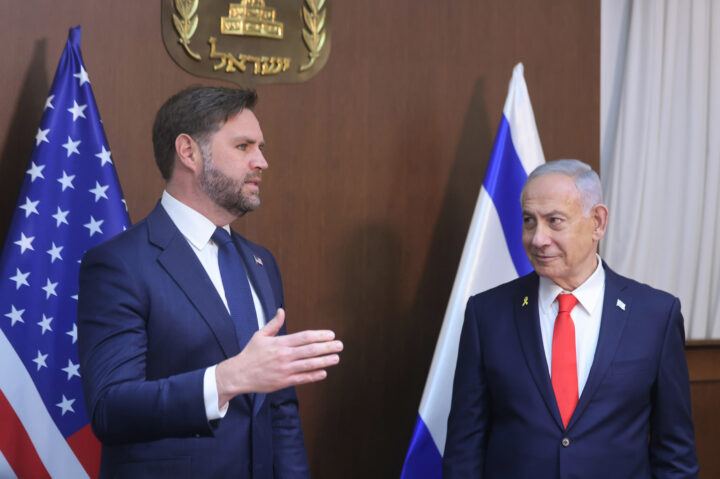
Marc Israel Sellem/Getty Images
U.S. Vice President J.D. Vance (L) and Israeli Prime Minister Benjamin Netanyahu (R) speak to the media at the Prime Minister's Office in West Jerusalem, on October 22, 2025.
Israeli Prime Minister Benjamin Netanyahu distanced himself on Thursday from the Knesset’s approval of two bills to extend Israeli sovereignty to the West Bank, after President Donald Trump, Vice President JD Vance and Secretary of State Marco Rubio spoke out against annexation.
The Knesset approved two settlement annexation bills brought by right-wing members of the opposition in preliminary votes on Wednesday, despite the coalition whipping votes against them.
The bill to annex the entire West Bank, proposed by Avi Maoz, the sole lawmaker from the anti-LGBT Noam party that quit the coalition earlier this year, received 25 votes — most of which were from Netanyahu’s coalition — with 24 voting against it.
The other bill, which would have the Jerusalem suburb of Maaleh Adumim be considered part of sovereign Israel, was proposed by former Defense Minister Avigdor Liberman and his Yisrael Beiteinu party and passed the early vote with 32 in favor — with only one from the coalition — and nine opposed. The bills still have to go through committee meetings and three plenary votes to become law.
Trump voiced opposition to annexation efforts in an interview with Time magazine published Thursday, but conducted before the Knesset vote, and said they could threaten U.S. support for Israel.
Annexation “won’t happen because I gave my word to the Arab countries,” Trump said, “and you can’t do that now. We’ve had great Arab support. … It will not happen. Israel would lose all of its support from the United States if that happened.”
Though the first Trump administration’s 2020 peace plan would have allowed Israel to annex parts of the West Bank, Netanyahu committed later that year to refrain from such a move in exchange for entering the Abraham Accords with the United Arab Emirates.
Vice President JD Vance was asked about the vote on his way onto Air Force Two departing Israel on Thursday, and said that he was “confused” and found the vote “weird.” He said he asked about the vote and was told it was symbolic.
“If it was a political stunt, it was a very stupid political stunt, and I personally take some insult to it,” he said. “The policy of the Trump administration is that the West Bank will not be annexed by Israel; that will continue to be our policy and if people want to take symbolic votes, they can do that, but we certainly weren’t happy about it.”
Rubio, who landed in Israel on Thursday, said the night before that the Knesset vote was “counterproductive,” while acknowledging that Israel is “a democracy, they’re going to have their votes. People are going to take these positions.”
Netanyahu attempted to repair the damage of the votes on Thursday morning, with a statement from his office calling them “a deliberate political provocation by the opposition to sow discord during Vice President JD Vance’s visit to Israel. The two bills were sponsored by opposition members of the Knesset.”
According to the statement, “the Likud party and the religious parties (the principal coalition members) did not vote for these bills, except for one disgruntled Likud member who was recently fired from the chairmanship of a Knesset committee. Without Likud support these bills are unlikely to go anywhere.”
Maoz’s bill got support from six coalition lawmakers from Finance Minister Bezalel Smotrich’s Religious Zionist Party and seven from National Security Minister Itamar Ben-Gvir’s Otzma Yehudit party. One Religious Zionist Party MK voted for Liberman’s legislation.
The one Likud lawmaker who supported Maoz’s bill was Yuli Edelstein, who was removed from the prestigious post of chairman of the Knesset Foreign Affairs and Defense Committee earlier this year due to his refusal to usher in legislation that would continue the broad exemption from IDF service for Haredim. Edelstein argued in a post on X: “If my only sin was standing with the Land of Israel and voting for applying sovereignty in Judea and Samaria” — the Biblical name for the West Bank — “then I am proud of it.”
Israeli Ambassador to the U.S. Yechiel Leiter assisted in Netanyahu’s damage control efforts, calling Sen. Lindsey Graham (R-SC) to clarify the situation.
Leiter assured Graham “that this vote was not intended to be a slight to the U.S. and the position of the Prime Minister is that the U.S. is Israel’s most important and valuable ally and partner, and there will be no major changes without consulting and cooperating with the U.S.,” the South Carolina senator wrote on X.
“As with all legislative bodies and democracies, there are things you can control and things you cannot,” Graham added. “[Leiter] vigorously stressed no offense was meant and reinforced that no major decisions will be made by Israel without cooperation and coordination with the U.S.”
Separately, coalition chairman Ophir Katz, the Likud lawmaker responsible for whipping votes, said on Thursday that Netanyahu “clearly instructed me last night that the coalition must not vote for the bills on the matter of sovereignty. There was coalition discipline on the matter. Since there were MKs who acted against the prime minister’s instructions, the bills passed. Following that, the prime minister instructed me not to advance these bills until further notice.”
Katz punished Edelstein by removing him from the Foreign Affairs and Defense Committee entirely, but consequences for the coalition members from other parties have yet to be announced.
Edelstein said that “every such removal is a medal of honor for me. Anyone who thinks this deters me is making a big mistake.”
In 2010, during a visit by then-Vice President Joe Biden to Israel, Israel’s Interior Ministry announced, without first consulting Netanyahu, that it had approved 1,600 housing units in a northern Jerusalem neighborhood that the Obama administration and most of the international community considered to be a settlement. The incident sparked a diplomatic row between the countries.
‘Bibi-sitting’: Experts say Vance, Rubio trips to Israel part of U.S. efforts to constrain Netanyahu
The secretary of state’s trip follows a flurry of dispatched U.S. officials aiming to reassure Israel on security concerns and maintain a delicate ceasefire

HOCKSTEIN/POOL/AFP via Getty Images
US Secretary of State Marco Rubio waves before departure from Israel's Ben Gurion Airport in Lod on February 17, 2025, bound for Saudi Arabia.
Secretary of State Marco Rubio traveled to Israel on Thursday, becoming the latest senior official dispatched to the country by President Donald Trump as the fragile ceasefire between Israel and Hamas extends into its second week.
Rubio joins several other administration officials and representatives who have made the journey to Israel this past week, on the heels of the signing of the first phase of Trump’s peace proposal, including Vice President JD Vance, White House Special Envoy Steve Witkoff and advisor Jared Kushner.
The swift mobilization of U.S. officials comes as the Trump administration aims to lay the groundwork for the second phase of the deal and works to keep Israeli Prime Minister Benjamin Netanyahu from reigniting fighting in the Gaza Strip and fracturing a delicate peace deal, amid Hamas’ repeated violations of the agreement.
Vance, in his meeting with Netanyahu on Wednesday, emphasized that Israel is not a “vassal state” that needs to be told what to do.
The string of high-level visits is “not about monitoring in the sense of, you know, monitoring a toddler,” Vance told reporters alongside Netanyahu. “It’s about monitoring in the sense that there’s a lot of work.”
Meanwhile, ahead of his own visit to Israel, Rubio warned Israeli leaders that the West Bank annexation vote that passed the Knesset this week — championed by far-right MK Avi Moaz — threatened to derail the Trump-orchestrated ceasefire deal.
Chuck Freilich, an associate professor of political science at Columbia University, told Jewish Insider he sees it as a form of U.S. oversight, or “Bibi-sitting,” something he says is “long-standing tradition” in the U.S.-Israel relationship.
“From the U.S. perspective, you want to go over and reassure Israel its legitimate security concerns are not in jeopardy by continuing to adhere to the ceasefire,” said Jonathan Ruhe, a fellow for American strategy at the Jewish Institute for National Security of America. “I imagine that Rubio will be there to more echo and amplify the messages that have already been laid out, assuming the facts on the ground don’t change between now and then.”
While disagreements between the U.S. and Israel are not unusual, the Biden administration’s efforts to oppose Netanyahu’s preferred policies often led to accusations of insufficient U.S. support for the Jewish state.
During the Biden administration, senior officials, including Secretary of State Tony Blinken, were dispatched to the region to keep Israel from conducting military operations in the southern Gaza city of Rafah. At the time, Biden faced criticism from some in the pro-Israel world for restraining Netanyahu’s government from doing what they saw to be in Israel’s best interest during the war.
Given Trump’s high popularity in Israel in the immediate aftermath of the hostage-release deal, that blowback is not happening this time around. Freilich says the Trump administration’s exertion of restraint on Netanyahu from going after Hamas to uphold the ceasefire is different.
“Unlike with Biden, I don’t think there is a war to be won now that the U.S. is blocking,” said Freilich. “Israel has already done most of what it can do. The real problem is with phase two, how to dismantle and disarm Hamas and remove it as the governing body in Gaza. The administration is working on it intensively, including in all of these visits.”
The continued engagement is also a way for the Trump administration to provide Netanyahu cover from the right-wing coalition of his government, which had been more reluctant to end the fighting and make a hostage deal before the complete elimination of Hamas. The Trump administration may see holding them at bay as another way to keep the ceasefire intact.
David May, a senior research analyst at the Foundation for Defense of Democracies, said Rubio will be a worthy asset alongside Witkoff and Kushner, stating that his presence could help Israel get Hamas to “uphold a ceasefire that would effectively dismantle the terrorist group.”
“Dispatching Secretary of State Marco Rubio is a very positive development,” May told JI. “Rubio possesses immense knowledge of the issues and the actors with his decades of experience operating in U.S. foreign policy.”
This will be Rubio’s fourth visit to Israel since taking office in January. The secretary of state has a plethora of diplomatic experience with the Jewish state and has long expressed steadfast support for Israel’s war against Hamas in Gaza, dating back to his time in the U.S. Senate.
Less than one-quarter of House Democrats signed the letter, even as several European allies recognized a Palestinian state at the U.N.

Chip Somodevilla/Getty Images
Rep. Ro Khanna (D-CA) leaves the U.S. Capitol on March 13, 2024 in Washington.
Forty-seven progressive House Democrats, led by Rep. Ro Khanna (D-CA), signed onto a letter to President Donald Trump and Secretary of State Marco Rubio calling for the U.S. to recognize a Palestinian state on the heels of similar decisions by European allies last week.
“It has long been acknowledged by much of the international community and previous U.S. administrations of both major political parties that a Palestinian state recognized as a full and equal member of the community of nations is necessary to fulfill the legitimate national rights of the Palestinian people and ensure the state of Israel’s survival as the democratic homeland of the Jewish people,” the letter, which was first reported on by Jewish Insider, reads.
The lawmakers argue that because the current Israeli government opposes a two-state solution — a position currently shared by much of Israeli society — and is “actively undermin[ing]” the prospects of an independent Palestinian state, “meaningful action is necessary to join the majority of the world in codifying Palestinian statehood and to unlock the potential for a broader regional peace and security arrangement.”
Trump vowed last week week that he would not allow Israel to annex the West Bank.
The letter also claims that recognizing Palestinian statehood would make reform of the Palestinian Authority “far more achievable and sustainable.”
Signatories to the letter include Reps. Becca Balint (D-VT), Donald Beyer (D-VA), André Carson (D-IN), Greg Casar (D-TX), Joaquin Castro (D-TX), Judy Chu (D-CA), Danny Davis (D-IL), Madeleine Dean (D-PA), Diana DeGette (D-CO), Chris Deluzio (D-PA), Mark DeSaulnier (D-CA), Maxine Dexter (D-OR), Lloyd Doggett (D-TX), Veronica Escobar (D-TX), Dwight Evans (D-PA), Bill Foster (D-MA), Maxwell Frost (D-FL), John Garamendi (D-CA), Chuy García (D-IL), Sylvia Garcia (D-TX), Robert Garcia (D-CA), Al Green (D-TX), Val Hoyle (D-OR), Jared Huffman (D-CA), Jonathan Jackson (D-IL), Sara Jacobs (D-CA), Pramila Jayapal (D-WA), Hank Johnson (D-GA), Marcy Kaptur (D-OH), Zoe Lofgren (D-CA), Stephen Lynch (D-MA), Betty McCollum (D-MN), James McGovern (D-CA), Chellie Pingree (D-ME), Mark Pocan (D-WI), Mike Quigley (D-IL), Emily Randall (D-WA), Mary Gay Scanlon (D-PA), Jan Schakowsky (D-IL), Bennie Thompson (D-MS), Mike Thompson (D-CA), Jill Tokuda (D-HI), Paul Tonko (D-NY), Nydia Velázquez (D-NY), Maxine Waters (D-CA) and Bonnie Watson Coleman (D-NJ).
Dexter and Garcia were both beneficiaries of significant outside spending from AIPAC’s United Democracy Project super PAC in their primary races, running against farther-left anti-Israel opponents.
Balint and Schakowsky are both Jewish. Davis, Evans and Schakowsky are retiring from Congress at the end of their current terms.
Many of the furthest-left lawmakers in the House, including some of the Jewish state’s most outspoken critics, did not sign onto Khanna’s letter, nor did some of the more moderate Democrats backing a concurrent effort to place strict restrictions on U.S. aid to Israel.
The letter is backed by groups including American Muslims for Palestine, DAWN, Emgage Action, Indivisible, J Street, MoveOn, MPower, Muslim Public Affairs Council, New Jewish Narrative and the Quincy Institute.
There is a notable split on this issue within the Democratic caucus: Khanna’s letter follows a letter from 30 moderate pro-Israel Democrats condemning unilateral recognition of a Palestinian state as “performative” and saying that doing so risks “emboldening Hamas, entrenching division, and undermining the very legitimacy and peace such recognition purports to advance.”
The lawmakers also said unilateral recognitions of a Palestinian state are ‘performative’ and ‘risk emboldening Hamas’
Bill Clark/CQ-Roll Call, Inc via Getty Images
Rep. Jake Auchincloss (D-MA) participates in the House Transportation Committee hearing on Thursday, June 27, 2024.
A group of 30 House Democrats urged Secretary of State Marco Rubio to leverage a joint statement from the Arab League this summer — which called for Hamas’ disarmament and removal of power, the release of hostages and a path toward a two-state solution — as a potential diplomatic breakthrough for the region.
The lawmakers also condemned the unilateral recognition of a Palestinian state recently undertaken by several close U.S. allies.
“While there is much we disagree with in the statement, we do believe that this breakthrough presents a rare and urgent opportunity to ensure Israel’s security and create a brighter future for innocent Palestinians free from Hamas through American leadership,” the lawmakers said in a letter to Rubio on Thursday, emphasizing that it is the first time the Arab League has explicitly rejected Hamas.
“The statement made at the conference offers a unique opportunity — one that strengthens both Israel’s long-term security and Palestinians’ aspirations for self-determination under accountable, nonviolent leadership,” the letter continues. “While we once again emphasize that we do not endorse everything in the text, we recognize the unprecedented nature of the declaration and believe it presents a positive shift that opens the door to productive diplomacy and long-term solutions.”
The lawmakers urged Rubio to work with Israel to bring together regional and international partners to broker an agreement that would immediately and unconditionally free the hostages, remove Hamas from power in Gaza and achieve a “responsible deescalation of the conflict” in Gaza that would allow for rebuilding, governmental reform and peace.
They said that such an approach would be “far more constructive than recent unilateral and performative recognitions of a Palestinian state by other nations, which risk emboldening Hamas, entrenching division, and undermining the very legitimacy and peace such recognition purports to advance.”
“With regional partners signaling readiness to help facilitate both security and governance transitions, the United States has a pivotal role to play in turning principle into progress toward a two-state solution,” the letter reads. “This is a chance to protect Israel — our strongest ally — and align American values with regional momentum, and also leave a lasting legacy.”
The letter was led by Reps. Jake Auchincloss (D-MA), Debbie Wasserman Schultz (D-FL), Greg Landsman (D-OH) and Tim Kennedy (D-NY), joined by Reps. Dan Goldman (D-NY), Grace Meng (D-NY), Marilyn Strickland (D-WA), Emilia Sykes (D-OH), Josh Gottheimer (D-NJ), Frank Pallone (D-NJ), Jared Moskowitz (D-FL), Lois Frankel (D-FL), Kim Schrier (D-WA), Tom Suozzi (D-NY), Jimmy Panetta (D-CA), Brad Schneider (D-IL), Angie Craig (D-MN), Kevin Mullin (D-CA), Juan Vargas (D-CA), Ritchie Torres (D-NY), Chris Pappas (D-NH), Eric Swalwell (D-CA), Ted Lieu (D-CA), George Latimer (D-NY), Haley Stevens (D-MI), Darren Soto (D-FL), Greg Stanton (D-AZ), Nikki Budzinski (D-IL), Shri Thanedar (D-MI) and Wesley Bell (D-MO).
Craig, Pappas and Stevens are all running for the Senate in their respective states.
Democratic Majority for Israel supported the letter.
“The U.S. must act quickly to seize on this diplomatic opportunity which presents a unique opening to both ensure Israel’s security and create a future for Israelis and Palestinians free from the terrorist group Hamas,” the group’s CEO, Brian Romick, said in a statement. “While there is much we disagree with in the Arab League statement, its historic nature is unprecedented. By calling for the release of hostages, condemning the October 7 attacks, disavowing Hamas and endorsing a two-state path, Arab countries have signaled a potential willingness to be part of a new, constructive chapter for the Middle East.”
“At the same time, we call on all leaders to reject unilateral performative recognition of a Palestinian state which risks emboldening Hamas rather than advancing peace,” Romick continued.
Even after the Israeli strike, Qatar is trying to keep up its Islamist and American ties
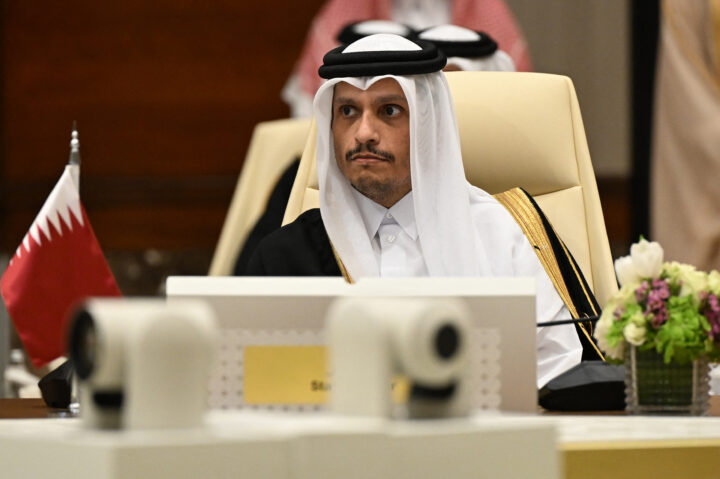
AMER HILABI/AFP via Getty Images
Qatar's Prime Minister and Foreign Minister Sheikh Mohammed bin Abdulrahman bin Jassim Al-Thani attends the 163rd GCC Ministerial Council meeting with Egypt in Mecca on March 6, 2025.
In the aftermath of Israel’s strike aimed at Hamas leaders in Qatar, questions have emerged about how much the U.S. knew, the extent of President Donald Trump’s frustration with Israel’s actions, and what it means for the U.S.-Israel relationship.
But another important question is whether the strike marks a turning point for Qatar — and whether the Gulf nation may now be considering a shift in its own role and behavior.
The fact that the Trump administration has not dwelled on the attack — even sending Secretary of State Marco Rubio to Israel for a warm visit days after the strike — may give Doha pause. While Press Secretary Karoline Leavitt said the strike “did not advance Israel or America’s goals,” in the next breath, she said that “eliminating Hamas, who have profited off the misery of those living in Gaza, is a worthy goal.” That goes against the Qataris’ preferred narrative, that the U.S. wants it to host terrorists because they’re the only conduit to Hamas, the Taliban and others.
With that in mind, Qatar could reconsider the business of harboring terrorists, because it has become too risky. Though the UAE was not in the terror-supporting business and has long opposed the Muslim Brotherhood, it didn’t prevent people like Hamas terrorist Mahmoud al-Mabhouh from visiting the UAE until the Mossad killed him in Dubai in 2010. The Emiratis publicly railed against Israel and the then-quiet relations between the countries were set back, but the UAE cracked down and banned such individuals associated with terror groups from entering their country.
However, Qatar does not seem to be taking recent events as a signal to change. Doha roundly condemned Israel, threatened to stop mediating hostage talks and convened an Arab summit to condemn Israel further. Senior Hamas official Ghazi Hamad appeared on Al Jazeera yesterday, with the chyron stating that he was in Doha, and the wife of senior Hamas official Khalil al-Haya was spotted visiting the grave of her son, killed in the strike, with Qatari security. On Tuesday, the Qatari Defense Minister hosted his Taliban counterpart.
And while Qatar could respond to the strike by turning away from America, it does not seem to have done that, either. Doha publicly denied reports that they were reconsidering its relationship with Washington. After its initial statement, Qatar said it would continue mediating Gaza hostage and ceasefire talks, and shifted to blaming Israeli Prime Minister Benjamin Netanyahu, rather than Israel, broadly. Doha softened its language in Arabic to describe the hostages, moving from “prisoners” to “captives,” according to Ariel Admoni, a Qatar expert at the Jerusalem Institute for Strategy and Security (JISS).
Admoni said that Doha’s “two-faced strategy has survived. … They are trying to keep up their Islamist and American ties. They can do both, and it pays for them.”
While the U.S. did not stop the Israeli strike, “no one is suggesting that Qatar expel Hamas,” Admoni noted. “Qatar is getting the legitimacy to continue hosting Hamas. It doesn’t look like Qatari public gestures to Hamas anger America.”
Rubio publicly praised Doha and asked it to continue playing a role in mediating between Hamas and Israel, and other administration figures have continued calling Qatar a great ally.
For the Doha strike to truly represent a crossroads for Qatar, at which it will have to choose between continuing to harbor terrorists or deepening its economic ties with the West, real pressure must be applied. Barring that, and with the Trump administration seemingly eager to stay in Doha’s good graces, Qatar has little incentive to change.
Asked on the Misgav Institute for National Security and Zionist Strategy’s “Mideast Horizons” podcast this week why the U.S. doesn’t put more pressure on Qatar, Richard Goldberg, the Foundation for Defense of Democracies’ senior advisor and a former Trump administration official, said that “despite bad actions, [Qatar] host[s] a major artery of the U.S. military in Al-Udeid Air Base … You could say, why do we have one of the most important bases right across the Persian Gulf from Iran and within missile range? Maybe we shouldn’t have critical assets right there … But the Pentagon doesn’t think that way. This is just how they do business and it would be too hard to think about something else — and [they say Qatar] are great partners for hosting us.”
Calling Qatar “a gas station with a television station,” Goldberg, who was the Trump administration’s National Energy Dominance Council’s senior counselor, noted that Qatari dominance in the natural gas market is also a factor in which there is “interdependence, but also a competition.” The fact that the U.S. is “a competitor with the Qataris [is] a dynamic that has not been explored enough by the Trump administration. The president wants to make America energy dominant,” he added.
Goldberg also noted that some members of the administration — who he did not name but include Attorney General Pam Bondi, FBI Director Kash Patel and Middle East envoy Steve Witkoff — worked with Qatar before working for the Trump administration: “I don’t even think that they agree with the Qataris hosting Hamas or sponsoring Hamas, and I think they would probably, at some point, indict the Hamas people … but when you’re in the private sector and this isn’t your No. 1 thing,” you’re willing to take their money. South Carolina, home of hawkish Sen. Lindsey Graham (R-SC), is “hugely economically reliant on Qatar. … There’s a reason they picked South Carolina” for investments.
These are all part of Qatar’s “very sophisticated” moves, he said, to build an “influence network … and how they become insulated,” even as they continue to host Hamas.
Plus, Suozzi, Gillen join Never Mamdani camp

MENAHEM KAHANA/AFP via Getty Images
This picture taken from a position at Israel's border with the Gaza Strip shows Israeli military vehicles by the border fence in the besieged Palestinian territory on September 16, 2025.
Good Tuesday morning.
In today’s Daily Kickoff, we report on the ground operation Israel launched in Gaza City this morning and continue to cover Secretary of State Marco Rubio’s visit to Israel. We talk to Jewish social workers who are warning of growing antisemitism in the field and interview journalist and author Yaakov Katz about his new book about the Oct. 7 attacks on Israel. We also interview Rep. Zach Nunn about the U.S.-Israel military relationship. Also in today’s Daily Kickoff: Reps. Tom Suozzi, Laura Gillen and Debbie Wasserman Schultz.
Today’s Daily Kickoff was curated by Jewish Insider Israel Editor Tamara Zieve and U.S. Editor Danielle Cohen-Kanik, with assists from Marc Rod and Gabby Deutch. Have a tip? Email us here.
What We’re Watching
- The Israel Defense Forces launched a major ground operation in Gaza City on Tuesday morning, Israeli Prime Minister Benjamin Netanyahu and the military announced, Jewish Insider’s Lahav Harkov reports.
- Pennsylvania Gov. Josh Shapiro will be delivering a speech this morning on political violence in America at the Eradicate Hate Global Summit in Pittsburgh.
- The Senate Judiciary Committee is holding a hearing this morning on oversight of the FBI with FBI Director Kash Patel.
- Democratic Majority for Israel is hosting a live briefing with Rep. Josh Gottheimer (D-NJ) and former U.S. Ambassador to Israel Dan Shapiro on Gottheimer’s recent trip to Israel, next steps for the Abraham Accords and the latest in the Israel-Hamas war.
- The Center for a New American Security is holding a live fireside chat with Adam Boehler, the U.S. special envoy for hostage response.
- Alan Dershowitz, a former Harvard Law School professor and prominent defense attorney and Israel advocate, is speaking at the JFK Jr. forum at Harvard at the first “Middle East Dialogues” event of the academic year, hosted by professor Tarek Masoud, who invites polarizing speakers to debate the Israeli-Palestinian conflict.
- In the evening, American Friends of Lubavitch (Chabad) will host its Lamplighter Awards at D.C.’s Union Station. This year’s honoree is Palantir CEO Alex Karp, and House Minority Leader Hakeem Jeffries (D-NY) will receive a leadership award.
- Magen David Adom will host its 2025 New York City Gala in Manhattan, where political commentator Meghan McCain will receive its Champion of Israel Award.
What You Should Know
A QUICK WORD WITH jI’S MATTHEW KASSEL
As Zohran Mamdani wins support from a growing number of Democratic leaders in his bid for mayor of New York City, he has notably walked back some of his most polarizing views on several key issues — with one major exception: Israel.
In recent days, the Democratic nominee, who has long been an outspoken critic of Israel and its war in Gaza, has doubled down on his campaign vow to arrest Israeli Prime Minister Benjamin Netanyahu if elected, even as legal experts cautioned such a move could be illegal.
Mamdani, a vocal supporter of the Boycott, Divestment and Sanctions movement, also said that he would seek to divest city holdings in Israel bonds and terminate a program established by Mayor Eric Adams, who is running as an independent, to foster business partnerships between companies in Israel and New York City.
Meanwhile, Mamdani has refused invitations to explicitly condemn calls to “globalize the intifada,” even as he has acknowledged concerns from Jewish voters who see the phrase as provoking antisemitic violence. He has said he will instead discourage use of the slogan, which he himself has not used publicly.
The 33-year-old democratic socialist and Queens assemblyman has otherwise declined to denounce Hasan Piker, a far-left streamer who has said that “America deserved 9/11” and has used antisemitic rhetoric in commenting on Israel. Mamdani sat for a lengthy interview with Piker during the primary.
Mamdani’s unyielding approach to opposing Israel underscores just how central the issue is to his self-conception as an activist and an elected official long involved in such causes. “This is something that I will never stray from for the rest of my life,” he explained in a Zoom discussion in 2020 with a pro-Palestinian advocacy group. “This is kind of, in many ways, the founding battle for justice that I’ve had.”
FIELD FRACTURES
Jewish social workers warn of growing antisemitism in the field: ‘Counter to everything that we learn in social work school’

Like most social workers, Jennifer Kogan went into the field to help people. A therapist who works in Ontario, Canada, and Washington, she markets her private practice as “compassion-focused counseling.” Everyone is welcome here, a banner on her website states. But Kogan’s understanding of her profession has radically shifted in the two years since the Oct. 7 attacks in Israel. Despite its focus on compassion, the field of social work has been engulfed by antisemitism, according to a new report authored by Kogan and Andrea Yudell, a licensed clinical social worker in Washington and Maryland, Jewish Insider’s Gabby Deutch reports.
Called out: “Since Oct. 7, Jewish social workers have experienced unprecedented silencing, gaslighting, exclusion, isolation and public targeting in professional spaces,” states the report, which was published on Monday by the Jewish Social Work Consortium. The report’s authors claim that antisemitic rhetoric — and, in particular, anti-Israel litmus tests foisted on Jewish practitioners — has become endemic in the field. The report describes Jewish social workers being targeted on industry-wide email listservs, doxed and publicly called out during academic courses and lectures.
WTAER UNDER THE BRIDGE
Rubio looking to move past criticism of Israel after Qatar strike
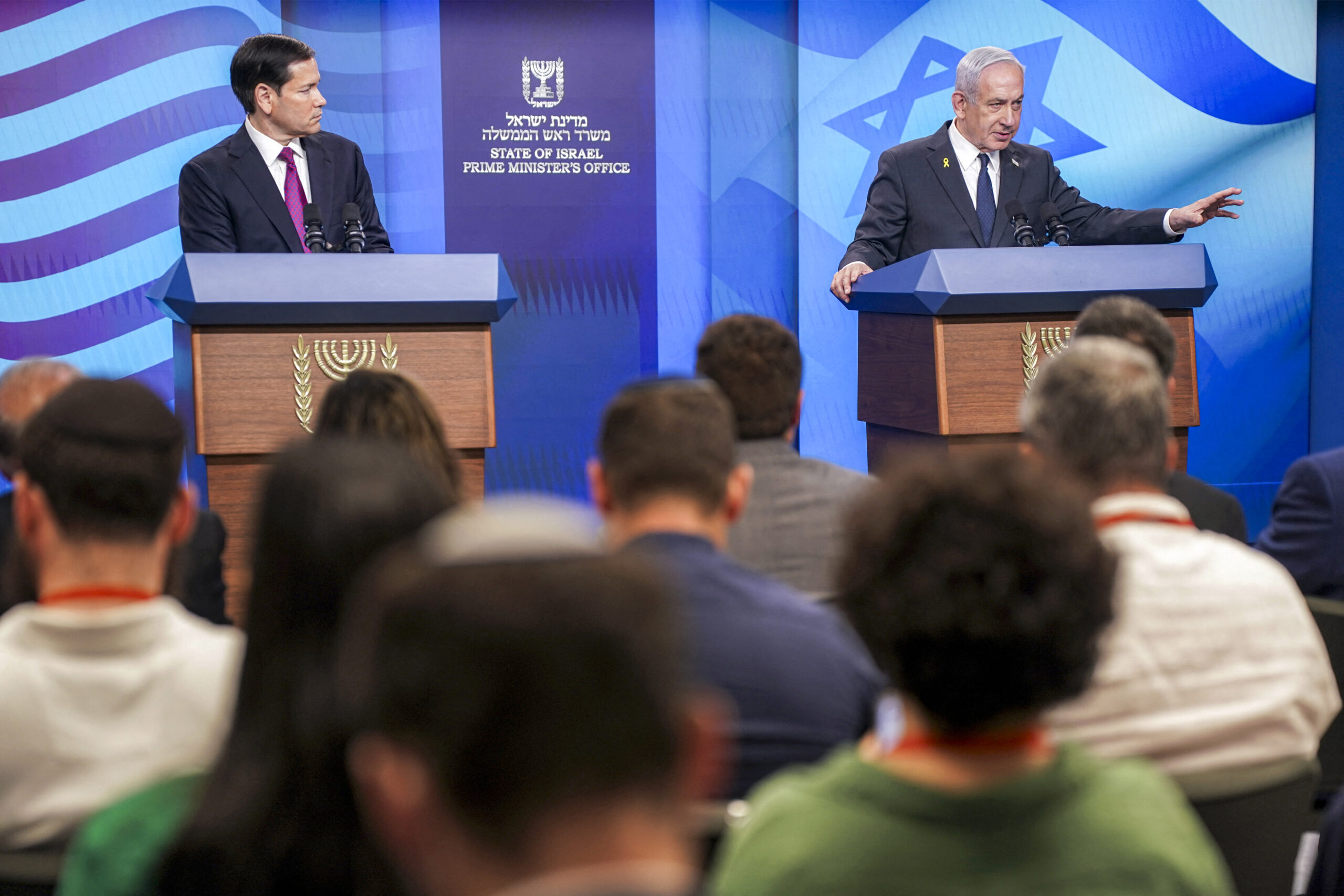
Secretary of State Marco Rubio said the U.S. is focused on moving forward from Israel’s strike on Qatar last week, refraining from doubling down on criticism during a joint press conference with Israeli Prime Minister Benjamin Netanyahu in Jerusalem on Monday, Jewish Insider’s Lahav Harkov reports.
What he said: “We are just focused on what happens next,” Rubio said, when asked about Tuesday’s strike aiming at Hamas’ leadership in Doha, Qatar’s capital. On Saturday, Rubio had echoed comments by President Donald Trump that the U.S. “is not happy” about the strike. “Some fundamentals still remain that have to be addressed, regardless of what has occurred,” Rubio said at the press conference on Monday. “We still have 48 hostages. Hamas is holding not only 48 hostages but all of Gaza hostage … As long as they still exist, are still around, there will be no peace in this region.”
Economic isolation: Netanyahu predicted yesterday that Israel will have to become increasingly self-reliant as countries call for embargoes and sanctions against the Jewish state. Speaking at a Finance Ministry conference in Jerusalem, Netanyahu said, “We will increasingly need to adapt to an economy with autarkic characteristics.”
Diplomatic isolation: The Washington Institute for Near East Policy’s Robert Satloff sounds an alarm on Israel’s growing international isolation, highlighting the U.N. Security Council’s condemnation of Israel’s strike in Qatar and the U.N. General Assembly’s endorsement of a French and Saudi plan for Palestinian statehood.
defense innovation
Rep. Zach Nunn pushes to expand U.S.-Israel cooperation, technology partnerships

For Rep. Zach Nunn (R-IA), the U.S.-Israel military relationship is crucial to pushing the boundaries of defensive technological development, keeping Americans safe, staying ahead of global adversaries and even providing advancements in sectors far-removed from the battlefield, Jewish Insider’s Marc Rod reports.
Notable quotable: “We know that not only is Israel our best military partner for the region, it is the best stabilizing force,” Nunn, who led a pair of successful amendments in last week’s National Defense Authorization Act markup on the House floor aimed at improving U.S.-Israel military cooperation, told JI in a recent interview. “Not only is Israel a force for good in the region, it’s one of our best innovative partners out here, and national defense begins with a tech and human capability that’s able to execute on it. And that really is funded through democracies that allow this type of innovation to take place.”
DRAWING A LINE
Rep. Tom Suozzi says he’s in the ‘Never Mamdani’ camp
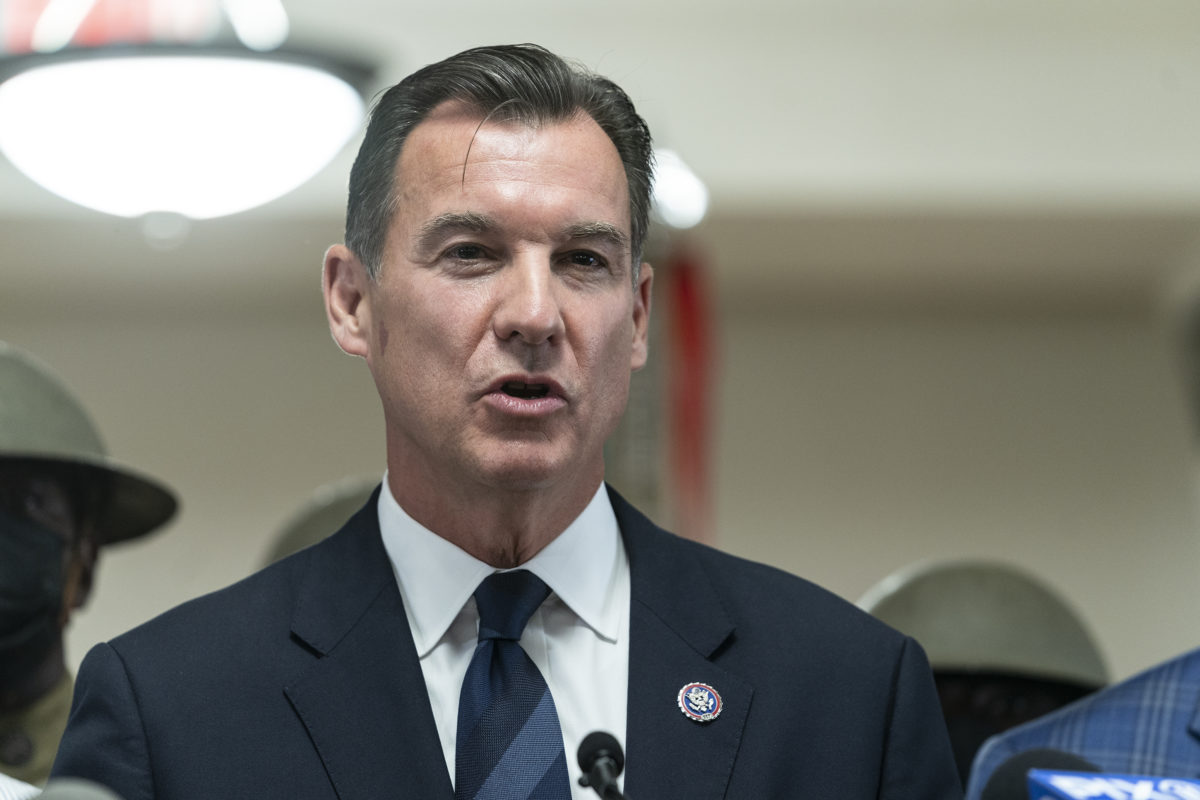
Rep. Tom Suozzi (D-NY) announced on Monday that he would not endorse Zohran Mamdani, the Democratic nominee for mayor of New York City. Suozzi, who represents a Long Island-based swing district on the outskirts of New York City that takes in a slice of Queens, said in an interview with ABC7 that, while he believes Mamdani is “very talented” and “very smart,” he feels the Democratic mayoral candidate’s policies would lead to increased costs for New Yorkers, Jewish Insider’s Emily Jacobs reports.
What he said: “Let me say very clearly: Mamdani is a very talented guy. He’s very smart, he’s very charismatic. … I have nothing against him personally, and I’m sure he’s a good person, but I completely disagree with his ideas. I disagree that we should raise taxes in New York City because people are leaving New York State and New York City as it is,” Suozzi said. “I’m all for making sure wealthy people pay their fair share at the federal level, so that wherever you go in the country you’re still going to have to pay, but not to encourage people to escape New York and go to Florida and go to Texas.”
Standing firm: Rep. Laura Gillen (D-NY) blasted New York Gov. Kathy Hochul for endorsing Democratic New York City mayoral nominee Zohran Mamdani, citing Mamdani’s record on antisemitism. “I completely disagree with the Governor’s endorsement of Mr. Mamdani,” Gillen told Jewish Insider’s Marc Rod. “At a time of skyrocketing antisemitism, his views are far too extreme and would fuel hate and threats against our Jewish community. His antisemitic views deserve to be condemned, not endorsed.”
grant get
NEH announces largest-ever grant for Tikvah Foundation to fight antisemitism
The National Endowment for the Humanities announced Monday that it was awarding its largest-ever grant to the Tikvah Fund, a Jewish and pro-Israel educational nonprofit, for work to fight antisemitism, Jewish Insider’s Marc Rod reports.
Setting a record: The grant totals $10.4 million over three years and will support Tikvah’s Jewish Civilization Project, to “examine Jewish history, culture, and identity in the broader context of Western history” with the goal of fighting antisemitism “through greater understanding of the enduring moral, religious, and intellectual contributions of the Jewish people to the country and the Western world,” according to an NEH release.
book shelf
‘I fear Israel will fall back in love with quiet’: Yaakov Katz warns against complacency after Gaza war
In the two years since the Oct. 7, 2023, attacks on Israel, there have been many books in multiple languages published on the topic — personal accounts, tales of heroism, a hostage memoir — but While Israel Slept: How Hamas Surprised the Most Powerful Military in the Middle East by Yaakov Katz and Amir Bohbot may be the most comprehensive. In the book, Katz, the founder of the MEAD (Middle East-America Dialogue) and former editor-in-chief of The Jerusalem Post, and Bohbot, a veteran Israeli defense reporter, answer the biggest questions about that day, going through the events leading up to the attacks, including the fateful night before. The book also dedicates chapters to stark warnings that an Oct. 7-style attack could happen again if Israel does not make necessary changes. In an interview with Jewish Insider’s Lahav Harkov and Asher Fredman, the executive director of the Misgav Institute for National Security and Zionist Strategy, on the “Misgav Mideast Horizons” podcast last week, Katz said that his “deepest fear is that this could happen again.”
The sound of silence: “Eventually, quiet will set in,” Katz said. “And I fear that Israel will fall back in love with the quiet and will neglect, to some extent, the vigilance that it will require to prevent Hamas from being able to … reconstitute itself.” While Katz said he is skeptical Hamas could again launch attacks at the scale of Oct. 7, “to prevent them from rebuilding and reconstituting … will require a major effort that Israel has never really done.”
Worthy Reads
Charlie Kirk and the Debate on Israel: Semafor Editor-in-Chief Ben Smith writes about what the right-wing debate over Charlie Kirk’s views on Israel say about the future of the MAGA movement. “Future historians will puzzle over why the conflict between Israel and Palestine has been the issue, above all others, to split both US political parties in the 2020s. But one thing the feuding MAGA factions agree on is that there isn’t really another prominent figure like Kirk — a big voice who was focused on smoothing over his movement’s fractures, not hashing them out in public for clout. The only other one, in fact, is Donald Trump, who has proven — in his transactional way — a master of holding together disparate Republican factions. But so far, Trump has firmly chosen Israel’s side in the intraparty dispute. And now it’s not clear who remains to try to smooth over the generational divide, or who would even want to try.” [Semafor]
The Social Media Curse: Jewish Journal Editor-in-Chief David Suissa applauds Gov. Spencer Cox’s statement that “Social media is a cancer on our society right now,” and call for people to “log off, turn off, touch grass,” a message Cox conveyed as he announced the arrest of the suspect in the killing of Charlie Kirk. “We’ll hear plenty of sermons during the upcoming Holy Days, but I can’t help wishing that every rabbi finds a way to squeeze in that message. Why? Because our country has gone off the deep end. The reactions to the murder of Charlie Kirk have brought out our worst. The poor guy can’t die in peace without becoming a lightning rod for our societal dysfunctions. Unlike the old days before social media, today this toxic ugliness is front and center and screeching loud. Indeed the minute Kirk died, armies of social media soldiers put on their uniforms and let fly their predictable bullets. When Cox called social media a ‘cancer on our society,’ he might have added that it’s also an addiction.” [JewishJournal]
The Clock is Tik(Tok)ing: Carrie Filipetti, executive director of the Vandenberg Coalition, calls for the Trump administration to enforce the ban on TikTok in The Washington Post ahead of the Sept. 17 deadline for the company to be acquired by an American company or face a ban, calling it “critical to heading off a military confrontation and, if necessary winning one” against the Chinese Communist Party. “Imagine the following scenario. China decides to attack Taiwan, and, fearing the United States will come to Taiwan’s aid, launches preemptive strikes against American targets overseas. In the United States, Chinese operators launch drone attacks from secret bases located on more than 380,000 acres of farmland China has purchased. As the government considers its options, the 170 million American TikTok users open their feeds to thousands of bots disguised as people, rattling off anti-American propaganda; encouraging young students desperate for meaning to fight their own government; and spreading disinformation at such a rapid rate that it is impossible to discern fact from fiction.” [WashPost]
Word on the Street
Former New York Gov. Andrew Cuomo called Israel’s war in Gaza “horrific” in an interview with The New York Times on Monday and called for an immediate end to its military operations. “There is no doubt that the people of New York and the nation see the continued carnage that is happening and are deeply, deeply disturbed and want it over, and believe it has gone on way too long,” he said…
An independent United Nations inquiry has concluded that Israel has committed genocide in Gaza and that top Israeli officials, including Netanyahu, have incited genocide, in a 72-page report released today. Israel said it “categorically rejects this distorted and false report and calls for the immediate abolition of this Commission of Inquiry.” …
Washington Post columnist Karen Attiah said she was fired from the paper on Monday over her social media posts reacting to the Charlie Kirk assassination. Attiah, a far-left commentator, retweeted social media messages justifying the Oct. 7 Hamas attack on Israel as it was taking place…
The Fallen Servicemembers Religious Heritage Restoration Act, which aims to ensure that Jewish World War I and II veterans receive the proper grave markers reflecting their religion, passed the House. “This bill is an important step to allow for the research necessary to correct these errors and ensure there are resources for that work,” Rep. Debbie Wasserman Schultz (D-FL), who is leading the bill with Rep. Max Miller (R-OH), said. “This will make it possible for these brave Jewish servicemembers’ descendants to know that their loved one’s military service, life and religious heritage are properly honored”…
Micah Lasher, a New York state assemblyman and former aide to Rep. Jerry Nadler (D-NY), launched his campaign for his former mentor’s congressional seat on Monday…
Former Sen. Joe Manchin’s (I-WV) new book, Dead Center, comes out today, detailing his departure from the Democratic Party to become an independent, featuring scathing remarks for his former Democratic colleagues…
The New York Times investigates a series of trade and business dealings over the UAE’s access to AI chips that appear to be connected with cryptocurrency windfalls for the Witkoff and Trump families…
U.S. and Chinese negotiators have reached a framework deal for switching ownership of TikTok, in an effort to avert a threatened shutdown of the app…
HBO Max acquired the rights to a new series, “One Day in October,” the first scripted portrayal of the Oct. 7 attacks, filmed on location in Israel and based on real accounts. The show will premiere Oct. 7, 2025, the two-year anniversary of the attacks…
Israeli Prime Minister Benjamin Netanyahu said in an interview clip that accusations that he’s prolonging the war in Gaza for his own political purposes are “malicious and false.” The interview with Israel’s Channel 13, a rarity for Netanyahu, will air in full today…
Tzachi Braverman, Netanyahu’s chief of staff and close confidant, was approved to serve as Israel’s ambassador to the U.K., replacing Tzipi Hotovely at the end of her five-year term, though he likely won’t be posted to London for several months…
The Heritage Foundation released a report yesterday marking the fifth anniversary of the Abraham Accords, “looking back at all the Accords achieved and looking forward to the fulfillment of their tremendous potential.” …
UJA-Federation of New York announced new grants totaling approximately $7.8 million to expand support for Israel’s recovery and long-term rebuilding efforts, including recovery in Israel’s north and south and support for families including those of reservists, wounded soldiers and hostages, eJewishPhilanthropy’s Judah Ari Gross reports…
Sotheby’s is launching its new flagship at the Breuer Building in Manhattan in November by staging a major auction featuring the late Leonard Lauder’s $400 million art collection —including Gustav Klimt masterpieces —and an estimated $80 million group of artworks from the estate of Jay and Marian Pritzker…
The Monuments Men and Women Foundation stopped the auction of two Nazi-looted oil paintings from the collection of more than 300 works seized from Adolphe Schloss during World War II…
The New York Times announced a new weekly newsletter on religion and spirituality, hosted by the Times’ Lauren Jackson…
Lynn Forester de Rothschild is exploring a sale of a minority stake in the parent company of The Economist magazine, according to Bloomberg, which would mark the publication’s first ownership shakeup in over a decade…
Pic of the Day

Secretary of State Marco Rubio attended the inauguration yesterday of the Pilgrimage Road archaeological site in the City of David, Jerusalem, calling the site “an enduring cultural and historical bond between the United States and Israel” and “a powerful reminder of the Judeo-Christian values that inspired America’s Founding Fathers.”
Birthdays

Israeli windsurfer, he won bronze in Atlanta 1996 and gold in Athens 2004, Israel’s first Olympic gold medalist, Gal Fridman turns 50…
Argentinian physician, author of books on gender relations, Esther Katzen Vilar turns 90… Democratic member of the Florida House of Representatives for multiple terms, in 2015 she became the president of Plaza Health Network, Elaine Bloom turns 88… NYC-based real estate investor and the founder of Cammeby’s International Group, Rubin “Rubie” Schron turns 87… Defense policy advisor to Presidents Reagan, Bush 41 and Bush 43 and member of a number of D.C. based think tanks, Richard Perle turns 84… Montebello, Calif., resident, Jon Olesen… Pompano Beach, Fla., resident, Shari Goldberg… Israeli playwright and screenwriter, Motti Lerner turns 76… Sheriff of Nantucket County, Mass., James A. Perelman turns 75… Founder and CEO of OurCrowd, Jonathan Medved turns 70… Media sales consultant, Fern Wallach… Award winning illusionist, who has sold tens of millions of tickets to his shows worldwide, known professionally as David Copperfield, David Seth Kotkin turns 69… Anthropology professor at Cornell, his work centers on Jewish communities and culture, Jonathan Boyarin turns 69… Director of stakeholder engagement at the National Council of Jewish Women, he is a nephew of former U.S. Sen. Herb Kohl, Dan Kohl turns 60… President and rabbinic head of Yeshivat Chovevei Torah Rabbinical School in Riverdale, N.Y., Rabbi Dov Linzer turns 59… Writer-at-large for The New York Times Magazine, Jason Zengerle… Mayor of Kiryat Motzkin, a city in the Haifa suburbs, Tzvi (Tziki) Avisar turns 47… VP of public affairs and corporate marketing at Meta / Facebook, Josh Ginsberg… President of basketball operations for the NBA’s Cleveland Cavaliers, Koby Altman turns 43… National field director at the Israel on Campus Coalition, Lauren Morgan Suriel… VP of customer success at SimpliFed, Suzy Goldenkranz… Actor, best known for starring in “The Secret Life of the American Teenager,” Daren Maxwell Kagasoff turns 38… NYC-based economics and wealth reporter at The Wall Street Journal, Rachel Louise Ensign… Israeli actress who played the lead role in Apple TV’s spy thriller “Tehran,” Niv Sultan turns 33… Winner of an Olympic bronze medal for Israel in Taekwondo at the 2020 Games in Paris, Avishag Semberg turns 24…
Commissioner of the Federal Acquisition Service, an office within the General Services Administration, Joshua Z. Gruenbaum turned 40 on Monday…
Plus, anti-Israel WaPo columnist fired over Charlie Kirk commentary
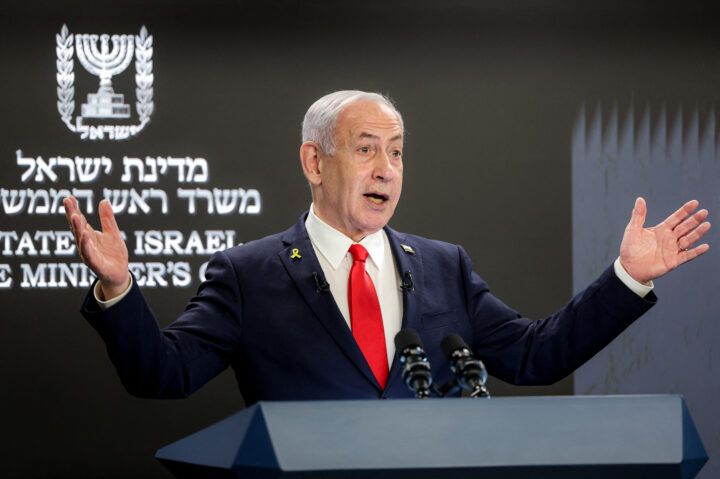
ABIR SULTAN/POOL/AFP via Getty Images
Israel's Prime Minister Benjamin Netanyahu gives a press conference at the Prime minister's office in Jerusalem on August 10, 2025.
Good Monday afternoon.
This P.M. briefing is reserved for our premium subscribers like you — offering a forward-focused read on what we’re tracking now and what’s coming next.
I’m Danielle Cohen-Kanik, U.S. editor at Jewish Insider and curator, along with assists from my colleagues, of the Daily Overtime briefing. Please don’t hesitate to share your thoughts and feedback by replying to this email.
📡On Our Radar
Notable developments and interesting tidbits we’re tracking
Israeli Prime Minister Benjamin Netanyahu predicted that Israel will have to become increasingly self-reliant as countries call for embargoes and sanctions against the Jewish state. Speaking at a Finance Ministry conference in Jerusalem today, Netanyahu said, “We will increasingly need to adapt to an economy with autarkic characteristics.”
“I am a believer in the free market, but we may find ourselves in a situation where our arms industries are blocked. We will need to develop arms industries here — not only research and development, but also the ability to produce what we need,” the Israeli PM said…
Secretary of State Marco Rubio met with Israeli President Isaac Herzog in Jerusalem today, where they gave remarks on the occasion of the fifth anniversary of the Abraham Accords. “Imagine, despite the difficulties the region has confronted over the last few years, how much more difficult it would have been had the Abraham Accords not been in place,” Rubio said…
Elsewhere in the region, after an emergency summit of Arab states convened in Qatar to discuss last week’s Israeli strike in Doha, the leaders of the Gulf Cooperation Council countries today directed the GCC defense ministers to hold an “urgent meeting” to “assess the defense situation of the Council states.”
The countries also issued a communique calling on states to “review diplomatic and economic relations” and “initiate legal proceedings” against Israel…
At the International Atomic Energy Agency’s annual conference happening now in Vienna, Iran is circulating a resolution to censure the U.S. and Israel over their strikes on Iran’s nuclear facilities in June. Iran was unexpectedly elected by other Middle Eastern countries to serve as vice president of the gathering.
Mohammad Eslami, the head of the Atomic Energy Organization of Iran, said in an interview that “if [participating countries] want to obey the law of the jungle and the rule of coercion and force” by blocking the motion, “it’ll end in chaos”…
Stateside, Rep. Tom Suozzi (D-NY) announced he will not be endorsing Democratic nominee Zohran Mamdani for New York City mayor, on the heels of New York Gov. Kathy Hochul’s announcement that she’s supporting the candidate.
Suozzi, who represents a swing district on Long Island, said that, “While I share [Mamdani’s] concern about the issue of affordability, I fundamentally disagree with his proposed solutions. Like the voters I represent, I believe socialism has consistently failed to deliver real, sustainable progress.”
On Hochul, Suozzi said that he did not discuss his decision with her and is “not in a position to give the Governor political advice considering the fact that when I ran against her she beat me soundly”…
In another high-profile New York race, Micah Lasher, a state assemblyman and former aide to Rep. Jerry Nadler (D-NY), officially launched his campaign for his former mentor’s congressional seat today, joining a Democratic primary that’s likely to become crowded in the heavily Jewish Manhattan district. Nadler is expected to offer Lasher his support, a key endorsement in the race…
The New York Times investigates a series of trade and business dealings over the UAE’s access to AI chips that appear to be connected with cryptocurrency windfalls for the Witkoff and Trump families.
When David Feith, then senior director for technology on the National Security Council, attempted to change AI chip policy, which would have inhibited that access, he was fired by President Donald Trump, after a conversation with his influential advisor Laura Loomer…
The fallout from Charlie Kirk’s killing continues: Semafor’s Editor-in-Chief Ben Smith writes about Kirk’s legacy on Israel within the GOP and how both the isolationist and pro-Israel camps of the party are now claiming him as their own.
“A bereft White House official told me that Kirk functioned as something like a Republican chairman and Rush Limbaugh ‘rolled into one.’ Clips of his speeches and debates are everywhere, but movement-building is a subtler thing, and Kirk’s public statements, friends said, often reflected attempts at intraparty diplomacy,” Smith wrote…
Karen Attiah, an opinion columnist at The Washington Post who regularly espoused anti-Israel views, was fired from the paper over her posts on social media about Kirk’s death, including mischaracterizing some of his positions and positing that her “journalistic and moral values” prevented her from “engaging in excessive, false mourning” for Kirk.
Attiah, the Post’s founding Global Opinions editor, retweeted social media messages justifying the Oct. 7 Hamas attacks on Israel as they were taking place and wrote a piece on Oct. 13, less than a week after the attacks, headlined, “We cannot stand by and watch Israel commit atrocities”…
Also in the media, Jewish influencer Hen Mazzig reacts to Jewish actress Hannah Einbinder’s pro-Palestinian commentary at the Emmys last night in The Hollywood Reporter: “Hannah should know there is no such thing as a ‘good Jew’ who can launder antisemitism. The ‘good Jews’ trope — the ones who sign boycott pledges or reassure progressives that this isn’t about hatred — are always used as cover. They are never enough. And at the end of the day, the people demanding ‘good Jews’ don’t actually believe there is anything good about being Jewish”…
After the Vuelta a Espana bike race in Madrid was called off during its finale on Sunday due to anti-Israel protests on the route, Spanish Prime Minister Pedro Sánchez called today for Israel to be banned from sports events due to its military campaign in Gaza, despite the team being protested, Israel-Premier Tech, not being an official Israeli team.
The international union of cyclists voiced its disapproval of Sánchez’s stance, saying in a statement that it “strongly condemns the exploitation of sport for political purposes in general, and especially coming from a government”…
Lynn Forester de Rothschild is exploring a sale of a minority stake in the parent company of The Economist magazine, according to Bloomberg, which would mark the publication’s first ownership shake-up in over a decade…
⏩ Tomorrow’s Agenda, Today
An early look at tomorrow’s storylines and schedule to keep you a step ahead
Keep an eye on Jewish Insider tomorrow morning for an interview with Yaakov Katz, former editor-in-chief of The Jerusalem Post, on his new book about Oct. 7 and an interview with Rep. Zach Nunn (R-IA), a rising national security voice on Capitol Hill.
Pennsylvania Gov. Josh Shapiro will deliver a major address on political violence at the Eradicate Hate Global Summit in Pittsburgh tomorrow, nearly a week after the fatal shooting of Charlie Kirk and several months after the firebombing of Shapiro’s residence over Passover.
Also speaking at the summit will be KIND Snacks founder and former CEO Daniel Lubetzky alongside Lonnie Ali, founder of the Muhammad Ali Center with her eponymous late husband.
The Senate Judiciary Committee will hold a hearing tomorrow morning on oversight of the FBI with FBI Director Kash Patel.
Democratic Majority for Israel will host a live briefing tomorrow with Rep. Josh Gottheimer (D-NJ) and former U.S. Ambassador to Israel Dan Shapiro on Gottheimer’s recent trip to Israel, next steps for the Abraham Accords and the latest in the Israel-Hamas war.
The Center for a New American Security will hold a live fireside chat tomorrow with Adam Boehler, the U.S. special envoy for hostage response.
Alan Dershowitz, a former Harvard Law School professor and prominent defense attorney and Israel advocate, will speak tomorrow at the JFK Jr. forum at Harvard at the first “Middle East Dialogues” event of the academic year, hosted by professor Tarek Masoud, who invites polarizing speakers to debate the Israeli-Palestinian conflict.
In the evening, American Friends of Lubavitch (Chabad) will host its Lamplighter Awards at D.C.’s Union Station. This year’s honoree is Palantir CEO Alex Karp, and House Minority Leader Hakeem Jeffries (D-NY) will receive a leadership award.
Magen David Adom will host its 2025 New York City Gala in Manhattan, where political commentator Meghan McCain will receive its Champion of Israel Award.
Stories You May Have Missed
INTERVIEW TACTICS
Isaac Chotiner, The New Yorker’s interrogator out to trip up Israel supporters

Chotiner recently devoted six consecutive Q&A interviews with guests about Israel, many of them contentious and combative
HAWKEYE STATE RACE
Ashley Hinson emerges as odds-on favorite to succeed Ernst in the Senate
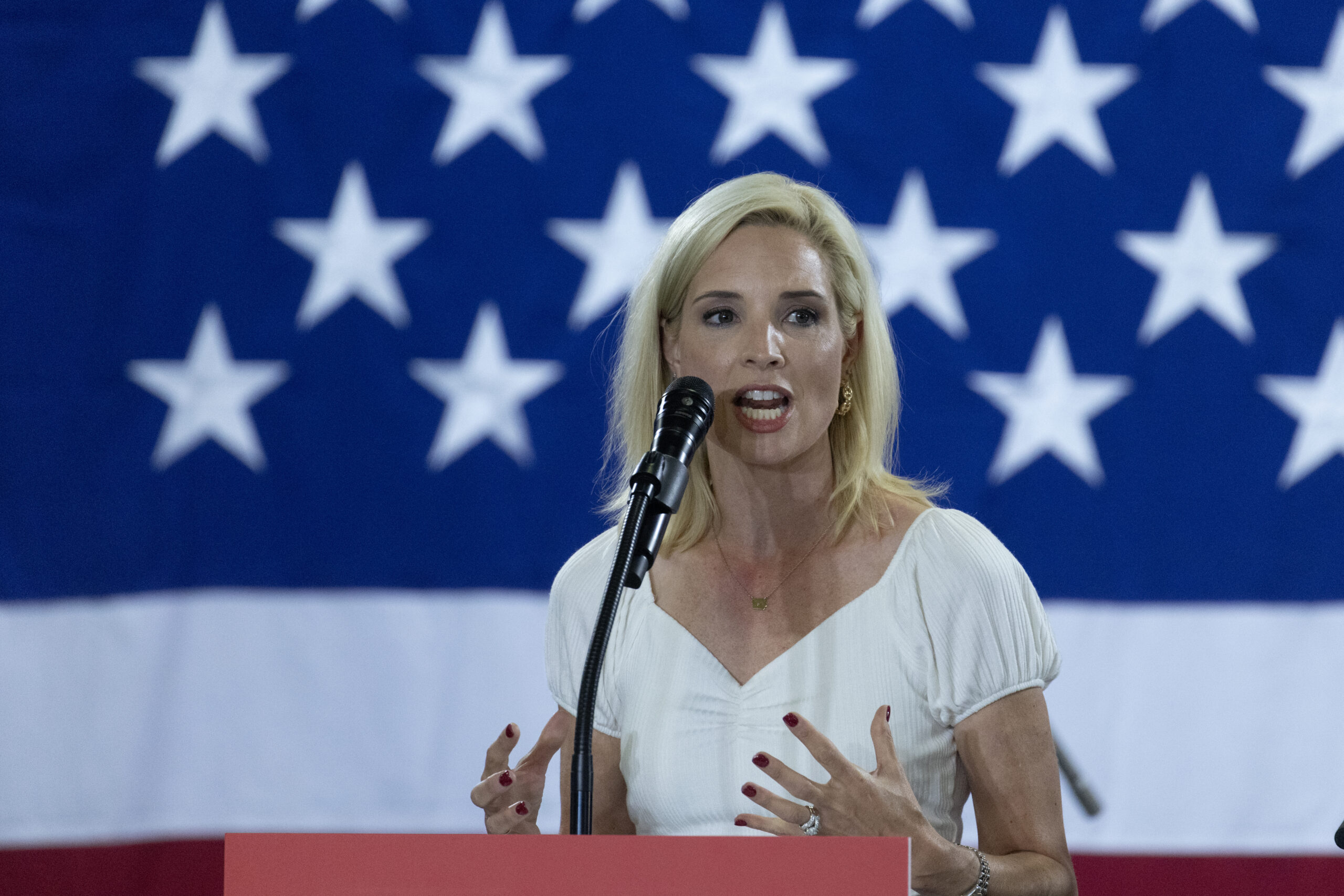
The former TV news anchor boasts a consistently conservative, pro-Israel voting record, and has a history of winning tough races
At a press conference with Israeli PM Netanyahu, Rubio said an agreement with Hamas to end war ‘probably won’t happen’ because ‘savage terrorists don’t often agree to disarm’
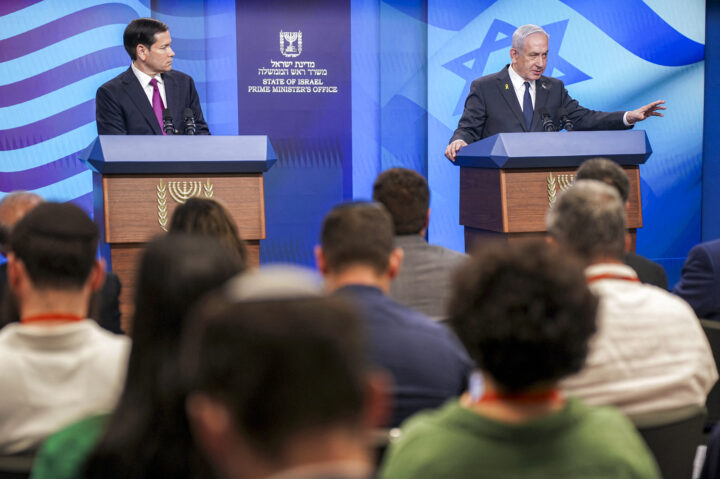
NATHAN HOWARD/POOL/AFP via Getty Images
Secretary of State Marco Rubio and Israeli Prime Minister Benjamin Netanyahu give a joint press conference at the Prime Minister's Office in Jerusalem on September 15, 2025.
Secretary of State Marco Rubio said the U.S. is focused on moving forward from Israel’s strike on Qatar last week, refraining from doubling down on criticism during a joint press conference with Israeli Prime Minister Benjamin Netanyahu in Jerusalem on Monday.
“We are just focused on what happens next,” Rubio said, when asked about Tuesday’s strike aiming at Hamas’ leadership in Doha, Qatar’s capital. On Saturday, Rubio had echoed comments by President Donald Trump that the U.S. “is not happy” about the strike.
“Some fundamentals still remain that have to be addressed, regardless of what has occurred,” Rubio said at the press conference on Monday. “We still have 48 hostages. Hamas is holding not only 48 hostages but all of Gaza hostage … As long as they still exist, are still around, there will be no peace in this region.”
Rubio said the end of the war in Gaza, disarmament of Hamas and freeing the hostages are “pillars of what we hope will happen in the region.”
The secretary of state said that the U.S. not only wants Qatar to continue to play a role in those matters “but also in a better future for the people of Gaza, which cannot happen with Hamas intact. We are going to continue to encourage Qatar to play a constructive role in that regard.” Rubio is scheduled to visit Qatar on Tuesday after concluding his trip in Israel.
As to the chance of a negotiated deal to end the war, Rubio said that “the problem is Hamas is a terrorist group, a barbaric group, committed to destroying the Jewish state, so it probably won’t happen.”
“I don’t think there’s anyone who wouldn’t prefer a negotiated settlement,” he added. “That would be the ideal outcome we can see, one we worked on, but we need to be prepared for the reality that savage terrorists don’t often agree to disarm.”
Netanyahu reiterated that “Israel’s decision to act against Hamas’ terrorist leadership was a wholly independent decision by Israel … It was conducted by us and we assume full responsibility for it, because we believe terrorists should not be given a haven.”
As to those saying Israel violated Qatari sovereignty, Netanyahu said that the U.S. took similar action against the Taliban in Afghanistan and Osama bin Laden in Pakistan.
“You don’t have such sovereignty when you are effectively giving a base to terrorists, a place where they can ply their gruesome trade,” he said.
Netanyahu also took issue with a claim made by a reporter during the press conference that the Doha strike was a failure, because it remains unclear if any of Hamas’ leaders were killed. The prime minister said Israel is waiting for further reports on the matter.
“I’ll tell you the results,” he added. “We sent a message to the terrorists. You can run, you can hide, but we’ll get you. … I don’t accept the premise that the raid failed, because it had one central message. … If the terrorists think they enjoy immunity they’ll do it again and again, and if you deny that immunity, they’ll think twice.”
Netanyahu opened the press conference by paying tribute to the “powerful bond” between Israel and the U.S. and thanking Trump for helping target Iran’s nuclear facilities in June, as well as his efforts to free the hostages remaining in Gaza, 20 of whom are believed to still be alive.
Rubio said that Iran is a threat not only because of its pursuit of nuclear weapons, but because of its development of short and midrange missiles that can reach across the Middle East and into Europe.
“This is an unacceptable risk not just for Israel but for the U.S. and the world, which is why the president has continued with his campaign of maximum pressure on Iran until they change course,” Rubio said. “We are encouraged by our partners in Europe beginning the process of snapping back [sanctions] on Iran, who are clearly out of compliance [with the 2015 nuclear deal]. We 100% support that; that’s what needs to happen.”
The secretary of state criticized countries that recently announced they would recognize a Palestinian state.
“The things these nations are doing in the U.N. are largely because of domestic politics. They’re largely symbolic. The only impact they have is to make Hamas feel emboldened … You know, there’s a negotiation going on and maybe you think you made some progress on getting hostages released and ending the war, and then these things come out and Hamas walks away … They see international support, they believe they’re getting what they want, and they walk away,” Rubio said.
Rubio also spoke about his plan to attend the inauguration of the Pilgrims Road on Monday evening. The site features the path on which Jewish pilgrims walked to the Second Temple in Jerusalem, which Rubio described as “perhaps one of the most important archeological sites on the planet, important to many in the U.S.”
The secretary of state arrived in Israel on Sunday, beginning his visit with prayers at the Western Wall with Netanyahu. He also met with Israeli Foreign Minister Gideon Sa’ar and Strategic Affairs Minister Ron Dermer on Monday.
Plus, Yossi Cohen talks to JI about political ambitions
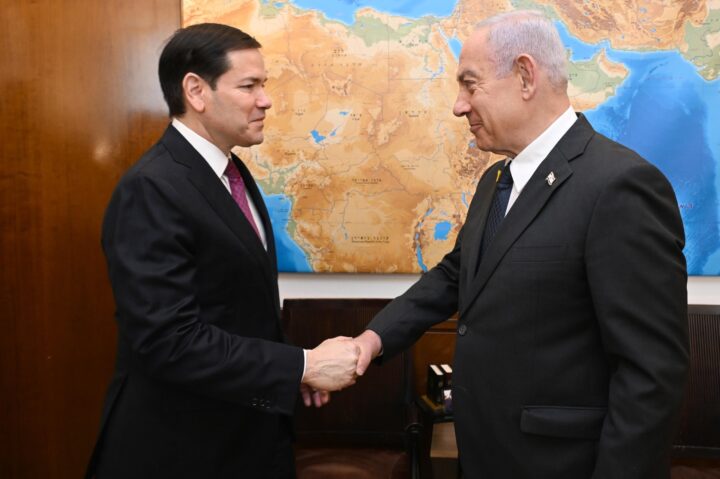
Haim Tzach/GPO
U.S. Secretary of State Marco Rubio meets Israeli Prime Minister Benjamin Netanyahu in Jerusalem, Sept. 15th, 2025
Good Monday morning.
In today’s Daily Kickoff, we cover Secretary of State Marco Rubio’s visit to Israel this week and interview former Mossad chief Yossi Cohen who is releasing a new book tomorrow amid talk that he may enter the political arena. We report on the retirement of Rep. Michael McCaul and highlight antisemitic, white nationalist views expressed by the suspected shooter who critically injured two students at Evergreen High School in Colorado last week. We also report on the anti-Israel views of state Rep. Chris Rabb, who is running in the Democratic primary race for Pennsylvania’s 3rd Congressional District. Also in today’s Daily Kickoff: Gov. Wes Moore, David Rubenstein and Esther Safran Foer.
Today’s Daily Kickoff was curated by Jewish Insider Israel Editor Tamara Zieve and U.S. Editor Danielle Cohen-Kanik, with assists from Marc Rod and Melissa Weiss. Have a tip? Email us here.
What We’re Watching
- Secretary of State Marco Rubio is set to attend the inauguration of the Pilgrim’s Road in the City of David in Jerusalem this evening after meeting earlier today with Israeli Prime Minister Benjamin Netanyahu and Foreign Minister Gideon Sa’ar. More below on Rubio’s visit to Israel.
- Seb Gorka, the White House’s senior director for counterterrorism and a deputy assistant to the president, is also in Israel this week. After landing at Ben Gurion Airport yesterday, he wrote on X, “Utterly sobering to see the pictures of all the innocent hostages still being held by Hamas for more than 700 days lining the walkway to passport control.”
- Also in Israel is a delegation of nearly 250 state lawmakers from around the U.S., organized by Israel’s Ministry of Foreign Affairs.
- A summit of Arab and Muslim leaders is being held in Doha, Qatar, today to denounce Israel’s strike on Hamas officials hosted by the Gulf state. Ahead of the gathering, Iranian Foreign Minister Abbas Araghchi met with his Qatari counterpart in Doha yesterday …
- Stateside, RJC board member Eric Levine is holding a fundraiser for Sen. Lindsey Graham (R-SC). The invite to the event, co-hosted by James Baker, Wayne Berman, Jeff Cohen, Steve Sall, RJC PAC and the NRSC, said the fundraiser will help Senate Republicans maintain their majority and “stand against the tide of communism and antisemitism overtaking the Democratic Party.”
- The Academic Engagement Network is hosting a three-day symposium for college administrators for the launch of its fifth annual Signature Seminar Series. The gathering, taking place in Washington, will focus on how administrations can meaningfully address antisemitism on college campuses.
- The Eradicate Hate Global Summit begins in Pittsburgh today.
- Today is the five-year anniversary of the signing of the Abraham Accords at the White House on Sept. 15, 2020.
What You Should Know
A QUICK WORD WITH JI’S GABBY DEUTCH
Over the weekend, the California State Assembly passed a bill that is intended to address what Jewish community advocates describe as crisis levels of antisemitism in the state’s K-12 schools.
The bill passed despite the objections of the powerful California Teachers Association, the state’s largest teachers’ union, which had stalled the legislation in July, claiming that efforts to combat antisemitism could impinge on teachers’ academic freedom when it came to discussing the Israeli-Palestinian conflict.
It was just one of several examples of influential state and national teachers’ unions presenting a roadblock against efforts to fight antisemitism in public schools, where discrimination against Jewish and Israeli students has skyrocketed over the past two years — even though many of those efforts have broad support from within the Jewish community, and from outside it, too.
In California, the CTA and anti-Israel groups like the Council on American-Islamic Relations were on one side of the issue, facing a diverse coalition of the bill’s backers that included the legislature’s Jewish, Black, Latino and Asian American and Pacific Islander caucuses. In an effort to appease the CTA during negotiations, some parts of the bill were removed, including language that would’ve defined what constituted an antisemitic learning environment.
But the union never changed course.
MOSSAD MEMOIR
Former Mossad chief Yossi Cohen talks covert missions, Oct. 7 failures in new book
Like any former Mossad chief, Yossi Cohen has long been a relatively elusive figure in Israeli public life. So his recent embrace of the spotlight has left Israeli politicos wondering whether he will run for prime minister in the next election. Cohen received attention for commanding ambitious Mossad operations, such as smuggling Iran’s nuclear archive to Israel, and for Israeli Prime Minister Benjamin Netanyahu reportedly naming him as one of his possible heirs, but he rarely gave interviews — until now. Cohen has been on a Hebrew media blitz ahead of Tuesday’s release of his new book, The Sword of Freedom: Israel, Mossad and the Secret War, in Hebrew and English. It reads, in many ways, like the kind of book a politician would publish before a big run, to let potential voters get to know him — albeit with the much more exciting elements of spycraft. Yet, in an interview with Jewish Insider’s Lahav Harkov last week at his office in a Tel Aviv high-rise, where Cohen’s day job is representing the Japanese investment holding company SoftBank in Israel, he dismissed the idea that his book was the first step in a political campaign.
A question of timing: “That was not the reason for me to write the book,” he said. “I started writing the book something like three years ago, much earlier. I decided to [publish the book] now, because I believe that now is the time … Since I started the book we had the judicial reform, the seventh of October, a war against Hezbollah and the Iranian events. Each of those chapters had to be updated.” Still, Cohen added, “I can’t say that one day it will not serve my political goals if I will decide to go into politics.” Thus far, Cohen has kept politics as an “if.” In the past, it was a “no,” he said, but now, he’s thinking about it.
ENDURING FRIENDSHIP
Rubio starts Israel visit with prayer at Western Wall
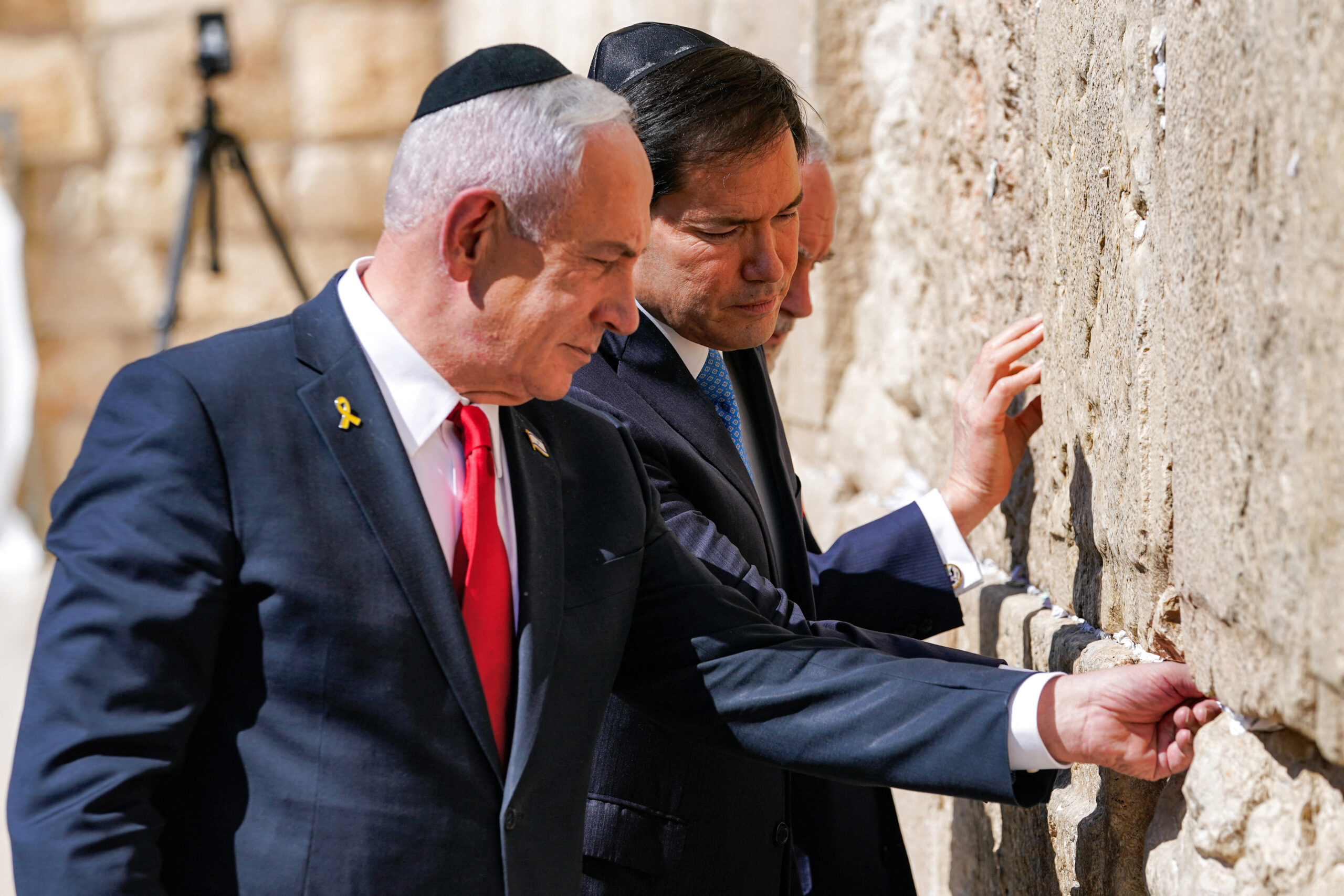
Secretary of State Marco Rubio arrived in Jerusalem on Sunday, at the start of a five-day trip to Israel and the U.K. Rubio began the visit with prayers at the Western Wall, together with Prime Minister Benjamin Netanyahu and U.S. Ambassador to Israel Mike Huckabee, Jewish Insider’s Lahav Harkov reports.
Premier praise: During a tour of the Western Wall Tunnels, Netanyahu called Rubio an “extraordinary friend of the State of Israel.” Netanyahu said, “The Israeli-American alliance is as strong and as durable as the stones of the Western Wall that we just touched. Under President [Donald] Trump and Secretary Rubio and their entire team, this alliance has never been stronger, and we deeply appreciate it.” Rubio’s visit comes days after Israel’s attempted strike on Hamas leaders in Doha, Qatar, which the secretary said he was “not happy” about.
stepping down
Michael McCaul, prominent GOP voice on foreign policy and homeland security, to retire

Rep. Michael McCaul (R-TX), a former chairman of the House Foreign Affairs and Homeland Security Committees, announced Sunday that he will retire from Congress at the end of next year, after 11 terms in office, Jewish Insider’s Marc Rod reports.
Foreign policy focus: McCaul, 63, has been a critical voice for traditional conservative internationalism at a time of rising isolationist sentiment among some factions of the GOP; he’s seen as a key leader who helped drive the passage of supplemental aid to Ukraine, Israel and Taiwan in the House last year. The Texas congressman has been a staunch supporter of Israel and an Iran hawk in the House and has also been a lead Republican voice in support of expanded funding for the Nonprofit Security Grant Program, which helps protect Jewish and other vulnerable nonprofits.
EXTREMISM IN ACTION
Colorado school shooter expressed antisemitic, white nationalist views

Desmond Holly, the suspected shooter who critically injured two students at Evergreen High School in Colorado on Wednesday, shared antisemitic and white nationalist views online, according to the Denver Post and the Anti-Defamation League, Jewish Insider’s Marc Rod reports.
Concerning history: According to the Denver Post, one of Holly’s online accounts used a coded slogan for Holocaust denial and reposted antisemitic videos and other videos showing individuals in Nazi uniforms. The ADL’s Center on Extremism said Friday that Holly’s TikTok accounts were “filled with white supremacist symbolism,” including a reference to the white nationalist “14 words” slogan, and utilized a neo-Nazi symbol in his profile photo. The suspected shooter, like several other recent attackers, was also active in violent online forums and showed a fascination with previous mass killers.
PHILLY FAULTLINES
Philadelphia House race puts spotlight on virulently anti-Israel Democratic candidate
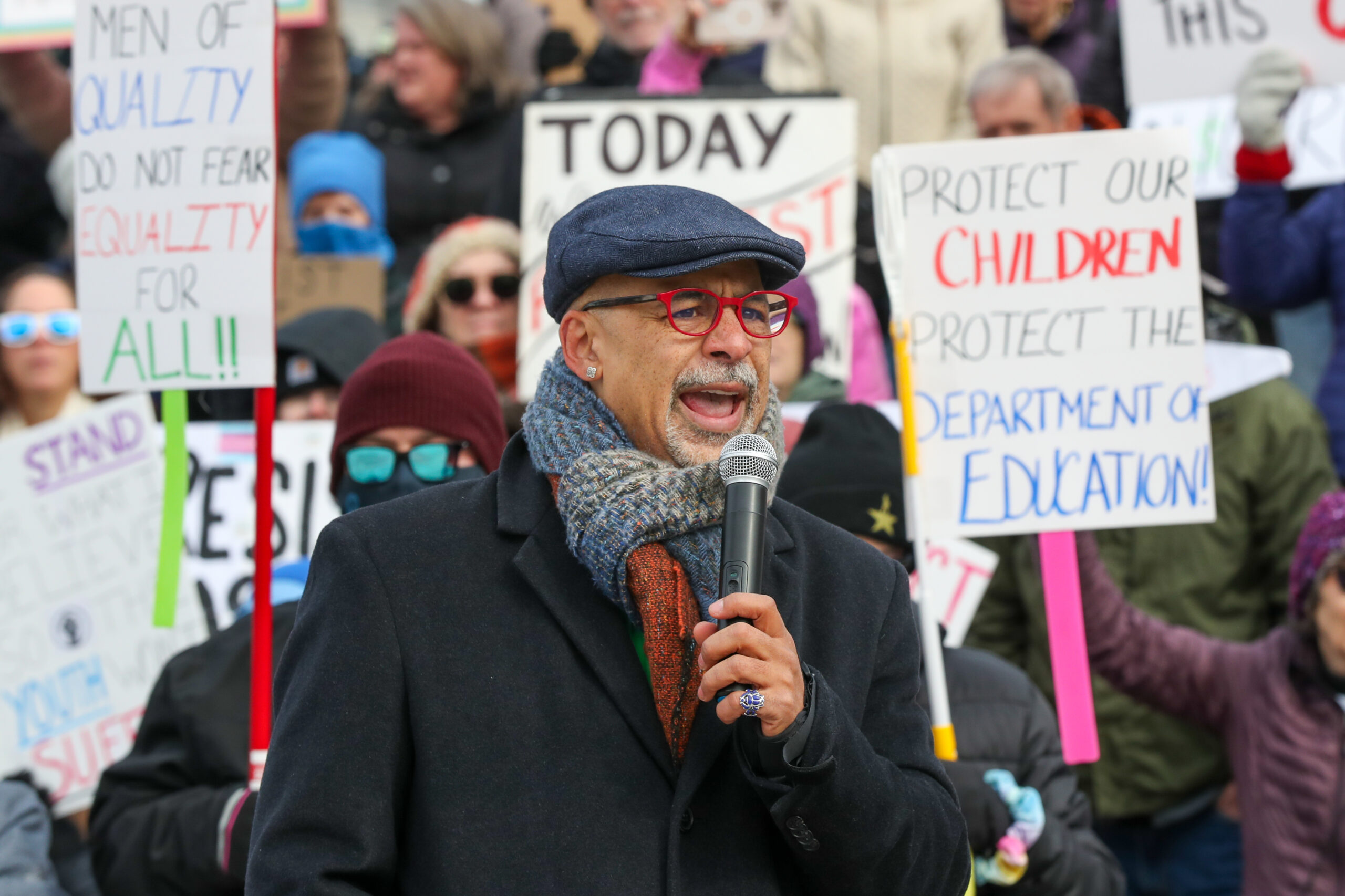
The wide-open primary race for the most Democratic district in the country is highlighting stark divisions in Israel policy among the leading candidates, Jewish Insider’s Marc Rod reports.
Candidate field: The race for Pennsylvania’s 3rd Congressional District — which includes western Philadelphia, Center City and parts of north Philadelphia — is attracting a host of prominent local officials, as well as some outsider candidates, including state Sen. Sharif Street, who recently resigned as state Democratic Party chair, progressive state Rep. Chris Rabb, state Rep. Morgan Cephas and physician Dr. David Oxman. Dr. Ala Stanford, a local surgeon and activist who gained prominence during the COVID-19 pandemic, is also seen as a likely candidate, and former City Councilman Derek Green may also join the race. Rabb has an extensive history, particularly since Oct. 7, of anti-Israel activism, and has accused Israel of genocide.
DUELING ENDORSEMENT
J Street endorses Hakeem Jeffries for the first time
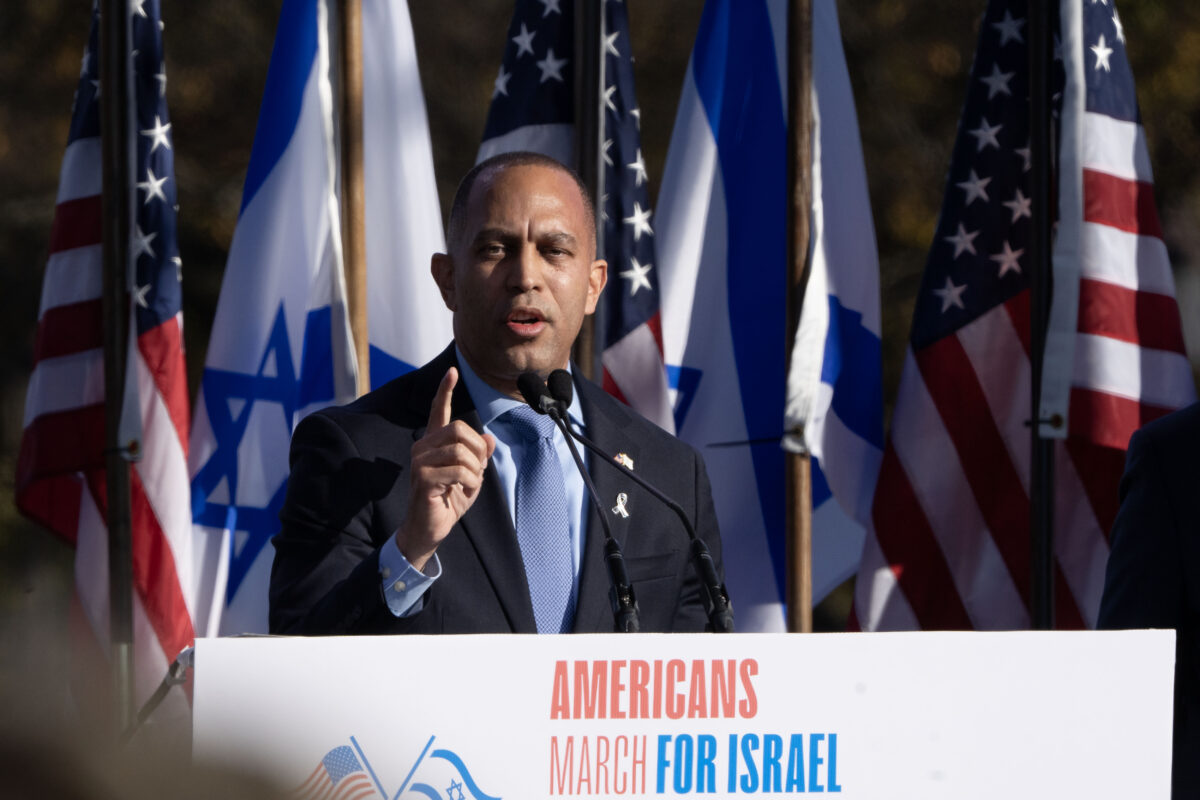
The progressive Israel advocacy group J Street endorsed House Minority Leader Hakeem Jeffries (D-NY) on Friday, marking the first time the top Democratic congressional leader accepted an endorsement from the group. With Jeffries endorsed by J Street, the group has now thrown its support behind the entire House Democratic leadership team: Jeffries, Democratic Whip Katherine Clark (D-MA) and Democratic Caucus Chair Pete Aguilar (D-CA). Jeffries, Clark and Aguilar have all also been endorsed by AIPAC, and they have each traveled to Israel on AIPAC-affiliated trips, Jewish Insider’s Gabby Deutch reports.
Announcement: “J Street is proud to endorse the House Democratic leadership team at such a critical moment in the US-Israel relationship,” J Street President Jeremy Ben-Ami said in a statement Friday. “After 23 months of war, it is important to endorse Democratic leaders who understand the time has come for a just and lasting peace that brings the remaining hostages home and immediately and permanently surges aid to the people of Gaza.”
Worthy Reads
Loaded Language: Andrew Weinstein, a former U.S. public delegate to the United Nations under the Biden administration, writes in Time magazine about why the use of phrases like “globalize the intifada” are so damaging. “Language doesn’t only reflect intention — it carries the weight of past use, of collective trauma, of coded threats. It has an impact. And so, when a community tells you a phrase evokes existential fear, it’s not enough to say, ‘I didn’t mean it that way.’ To do so is more than just a failure of sensitivity — it’s a failure of solidarity. And this is where so many well-meaning people lose their way. They treat empathy as if it were conditional, or zero-sum. They hear Jewish pain and ask first whether it aligns with their politics, parsing slogans instead of listening to those affected by them. This hurts Jews. But even more than that, it fractures coalitions, pushing away people who, too, strive for collective justice — and driving them toward those who cynically (and capriciously) dangle the carrot of protection.” [Time]
Is Mamdani a Team Player? In The Hill, Amanda Berman, founder and executive director of the Zioness Action fund, pushes back against pressure by supporters of New York City mayoral candidate Zohran Mamdani on Democratic leaders to endorse him, highlighting Mamdani’s own recent history during the last presidential campaign. “Mamdani didn’t just fail to support Democratic presidential nominees Vice President Kamala Harris and President Joe Biden in last year’s existentially urgent campaign, he spoke out and organized against them. In March of 2024, Mamdani urged voters to withhold their vote from Biden. ‘As proud Democrats and elected officials and New Yorkers,’ Mamdani declared, ‘we endorse the Leave it Blank campaign.’ Last summer, as the world watched the Democrats make history by nominating the first Black woman on a major party ticket, Mamdani proudly platformed the Uncommitted Movement, which protested her convention. This was not passive disagreement. It was an intentional and successful effort to sabotage the Democratic ticket in a general election — when the risks could not have been more clear, when every vote mattered, when Democrats were working tirelessly to defeat an authoritarian megalomaniac who had already incited a violent insurrection to stop the peaceful transfer of power.” [The Hill]
Word on the Street
New York Gov. Kathy Hochul endorsed New York City Democratic mayoral nominee Zohran Mamdani, becoming one of the few prominent Democrats in the state to do so, saying, “I didn’t leave my conversations with him aligned on every issue” but the two “discussed the need to combat the rise of antisemitism urgently and unequivocally”…
Rep. Elise Stefanik (R-NY), who is mulling a 2026 challenge to Hochul, responded to the endorsement with a statement accusing Hochul of “embrac[ing] this raging Communist who will destroy New York making it less affordable and more dangerous — once again putting criminals and communists first, and New Yorkers LAST”…
In an interview with CNN’s Manu Raju, Sen. John Fetterman (D-PA) said the New York City mayoral race, in which Mamdani is the front-runner, “has really no impact on my life.” Fetterman also said Hamas and Iran are to blame for the humanitarian crisis in Gaza: “It is hell on earth. Why do some people blame Israel for that? I blame Hamas and Iran for that,” he said…
The Washington Post reports that the Mossad declined to implement a ground operation in Doha, Qatar, last week to assassinate senior Hamas officials in the Gulf nation over concerns that such a move would damage ties with Doha as it acts as a mediator between Israel and Hamas. As a result, Israel instead carried out an airstrike that looks like it failed to kill the top targets …
CENTCOM head Bradley Cooper, joined by U.S. special envoy Tom Barrack, met with Syrian President Ahmad al-Sharaa in Damascus…
Antisemitic conspiracy theories proliferated online in the aftermath of the fatal shooting of conservative activist Charlie Kirk, the Anti-Defamation League found, with over 10,000 posts on X that include the phrase “Israel killed Charlie Kirk” posted in the two days after his murder…
Republican officials are considering an effort to persuade former Kentucky Attorney General Daniel Cameron to drop his bid for Senate, as he pursues Sen. Mitch McConnell’s (R-KY) seat upon his retirement, and instead challenge Rep. Thomas Massie (R-KY), Politico reports…
“The Road Between Us: The Ultimate Rescue,” a documentary about Oct. 7, won the People’s Choice Award for best documentary at the Toronto International Film Festival, after originally being canceled due to the festival’s concern that Hamas footage had not been approved for use…
Among several actors who used their platform at the Emmy Awards in Los Angeles last night to criticize Israel, Hannah Einbinder called to “Free Palestine” and Javier Bardem wore a keffiyeh while calling for a “commercial and diplomatic blockade” on Israel…
The Wall Street Journal profiles billionaire Oracle co-founder Larry Ellison, as he backs a bid for Paramount, headed by his son David, to acquire Warner Bros. Discovery and The Free Press…
Nika Soon-Shiong, daughter of the Los Angeles Times owner Patrick Soon-Shiong, has been tapped as the publisher of Drop Site News, a far-left anti-Israel outlet. She told Semafor that she was inspired by the site’s coverage of the war in Gaza…
The Vuelta a Espana bike race in Madrid was called off during its finale on Sunday after anti-Israel protesters occupied the route and overturned barriers…
Police in London arrested and charged a 37-year-old homeless man with smearing feces on synagogues and other Jewish institutions in the city…
Holocaust survivor Fania Fainer, known for the heart-shaped booklet of birthday wishes she was gifted by fellow prisoners at the Auschwitz concentration camp in 1944 — an object she preserved throughout death marches and the war and that went on to become the subject of a film and a book, died at 100…
Pic of the Day

Several hundred people gathered on Sunday evening at the French Embassy in Washington for the Capital Jewish Museum’s second annual gala, in service of a simple theme: “preserving history and building bridges,” Jewish Insider’s Gabby Deutch reports. The gala honored the investor and philanthropist David Rubenstein and Esther Safran Foer, the former longtime CEO of Sixth & I Synagogue and the Capital Jewish Museum’s founding board president. Speaking at the event, Gov. Wes Moore of Maryland decried rising antisemitism in the United States and, in particular, the killing of Israeli Embassy staffers Sarah Milgrim and Yaron Lischinsky outside the museum in May. Read more here.
Birthdays

Film executive, she produced “The Hunger Games” film series, Nina Jacobson turns 60…
Founder and former CEO of Elektra Records, he is a member of the Rock & Roll Hall of Fame, Jac Holzman turns 94… Professor at the Hebrew University and a leading scholar of the Dead Sea Scrolls, Emanuel Tov turns 84… Chief rabbi of Migdal HaEmek, known as the “Disco Rabbi,” Rabbi Yitzchak Dovid Grossman turns 79… Professor emerita of education at Boston University’s Wheelock College, Diane Elizabeth Levin turns 78… NYC-based composer and multi-instrument musician, Ned Rothenberg turns 69… Television comedy writer, he served as a showrunner, writer, and producer for “The Simpsons” and co-created the animated series “The Critic,” Michael L. Reiss turns 66… Business litigator in the Miami office of Gunster, Aron U. Raskas… Managing partner and chief technology officer at Differential Ventures in Philadelphia, he is also the founder of a series of kosher restaurants, David Magerman… NPR’s media correspondent, David Folkenflik turns 56… Actor, best known for his roles on “Sports Night” and “The Good Wife,” Josh Charles turns 54… Comedian, writer and actress, Kira Soltanovich turns 52… VP of leadership at the Anti-Defamation League until earlier this year, Deborah Leipzig… Customer success manager at Screencastify, event organizer and fundraiser, Shayla Rosen… Author and longtime education correspondent at NPR, Anya Kamenetz turns 45… Data scientist, economist and author of the 2017 New York Times bestseller Everybody Lies, Seth Stephens-Davidowitz turns 43… Screenwriter, film producer and director, often in collaboration with his childhood friend Seth Rogen, Evan D. Goldberg turns 43… Model and Israeli beauty pageant winner, Yael Markovich turns 41… Partner in CHW Strategic Advisors and CEO of Harmon Face Values, Jonah Raskas… CFO at Israel on Campus Coalition, Tomer Zvi Elias… Chief strategy officer at PW Communications, Amanda Bresler… Reporter at The New York Times, Eliza Shapiro… Singer and actress, she was the 2009 winner of the Israeli version of “A Star is Born,” Roni Dalumi turns 34… Beauty pageant titleholder, she was crowned Miss Israel 2012, Shani Hazan turns 33…
Israeli PM Benjamin Netanyahu called Rubio an ‘extraordinary friend of the State of Israel’
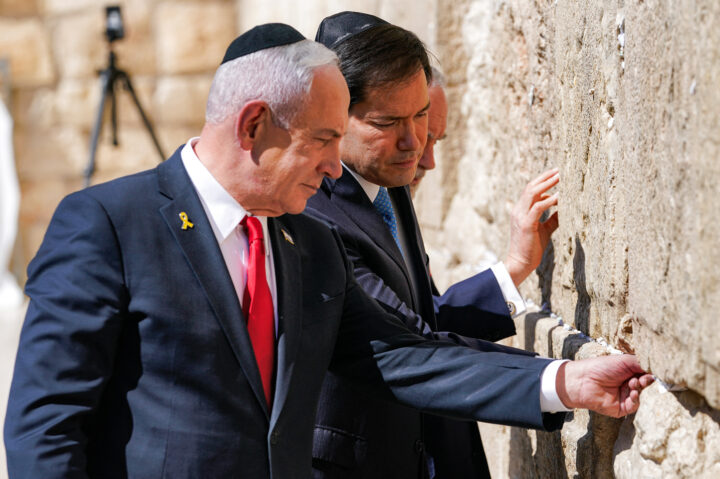
NATHAN HOWARD/POOL/AFP via Getty Images
Israeli Prime Minister Benjamin Netanyahu, U.S. Secretary of State Marco Rubio and U.S. ambassador to Israel Mike Huckabee visit the Western Wall on September 14, 2025.
Secretary of State Marco Rubio arrived in Jerusalem on Sunday, at the start of a five-day trip to Israel and the U.K.
Rubio began the visit with prayers at the Western Wall, together with Prime Minister Benjamin Netanyahu and U.S. Ambassador to Israel Mike Huckabee.
During a tour of the Western Wall Tunnels, Netanyahu called Rubio an “extraordinary friend of the State of Israel.”
“The Israeli-American alliance,” Netanyahu said, “is as strong and as durable as the stones of the Western Wall that we just touched. Under President [Donald] Trump and Secretary Rubio and their entire team, this alliance has never been stronger, and we deeply appreciate it.”
Rubio is expected to attend on Monday the inauguration of an ancient tunnel connecting the City of David archeological park to Jerusalem’s Old City. The tunnel is said to be the road pilgrims took to the ancient Temple in Jerusalem.
Rubio’s visit comes days after Israel’s attempted strike on Hamas leaders in Doha, Qatar last week, which the secretary said he was “not happy” about.
“Now we need to move forward and figure out what comes next,” he told reporters on Saturday.
Before taking off for Israel, Rubio posted on X that the focus of the trip “will be on securing the return of hostages, finding ways to make sure humanitarian aid reaches civilians, and addressing the threat posed by Hamas. Hamas cannot continue to exist if peace in the region is the goal.”
The State Department said that Rubio plans to “convey America’s priorities in the Israel-Hamas conflict and broader issues concerning Middle Eastern security, reaffirming U.S. commitment to Israeli security.”
Rubio and Israeli leaders are expected to discuss Operation Gideon’s Chariots II, as Israel has called its coming invasion of Gaza City, which it has been preparing for by evacuating an estimated 300,000 residents and bombing buildings with terrorist targets inside.
The secretary of state’s visit is taking place amid a push within Netanyahu’s coalition for Israel to annex parts of the West Bank in response to the announcement by a dozen countries, led by France, that they would unilaterally recognize a Palestinian state this month.
The State Department said Rubio’s agenda for the visit includes discussing ways to push back against recognition of a Palestinian state, as well as the International Criminal Court and International Court of Justice cases against Israel.
Rubio is expected to hold further meetings with Netanyahu and Strategic Affairs Minister Ron Dermer and with Foreign Minister Gideon Sa’ar.
The secretary of state is also expected to meet with families of hostages being held in Gaza.
Plus, Paramount Skydance looks to merge with Warner Bros
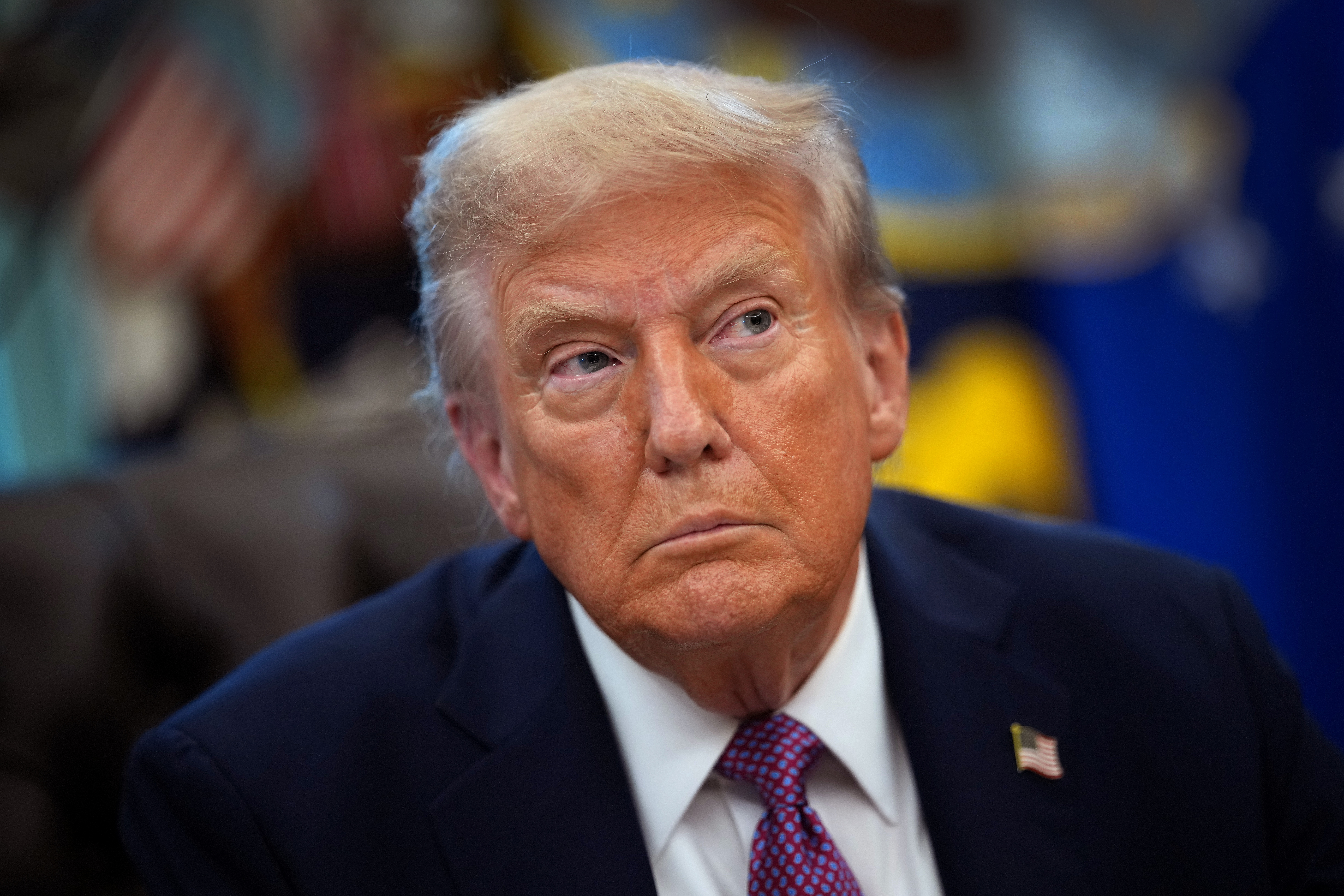
Kevin Dietsch/Getty Images
U.S. President Donald Trump speaks to members of the media as he signs executive orders during a press availability in the Oval Office of the White House on September 05, 2025 in Washington, DC.

