



































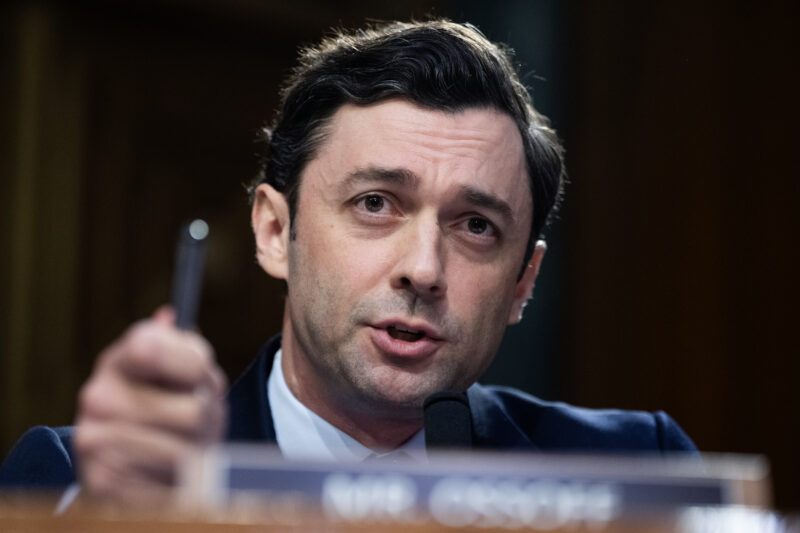





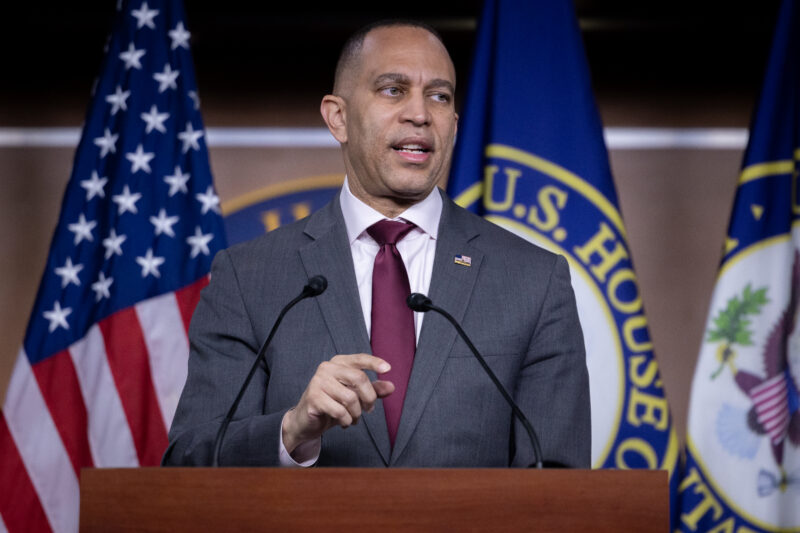






















Sen. Chris Coons (D-DE) and Rep. Greg Meeks (D-NY), who are both expected to hold powerful committee leadership roles if Democrats win both chambers, have recently made legislative moves that signal a harsher stance on Israel
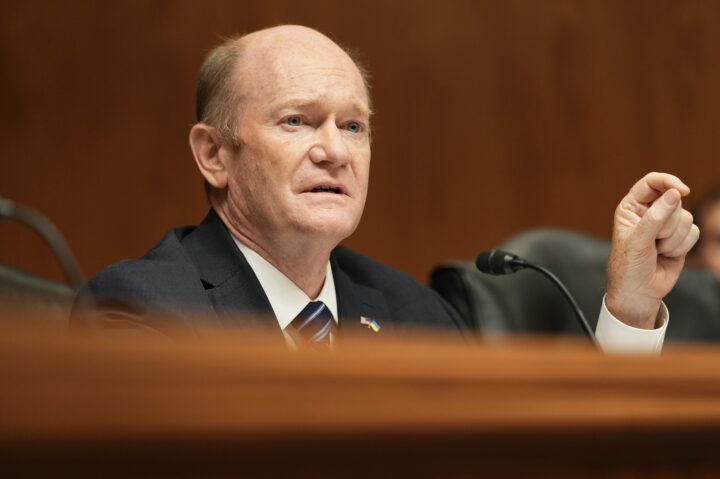
Eric Lee/Getty Images
Sen. Chris Coons (D-DE) speaks at the Senate Appropriations Committee on Capitol Hill on July 14, 2026 in Washington, DC.


 Add JewishInsider on Google
If Democrats take control of Congress next year — or even if they win back a majority in only the House of Representatives — expect a legislative agenda that’s a lot tougher on Israel than it has been in a long time.
With growing support among House Democrats for legislation restricting U.S. aid and arms sales to Israel, bills such as the Block the Bombs Act, the Ceasefire Compliance Act or measures similar to this summer’s vote on cutting aid to Israel could come to the House floor, and continued fights over the U.S.-Israel relationship in funding bills and other legislation seem likely.
But the top target for senior Democrats at the moment is targeting settlement activity and settler violence in the West Bank. Asked by Jewish Insider at a press conference on Wednesday what Israel-related legislation Democrats might bring forward for a vote, House Minority Leader Hakeem Jeffries (D-NY) — who has generally been a reliable supporter of the U.S.-Israel relationship — pointed to a bill imposing sanctions related to West Bank violence.
“That now has broad support across the House Democratic Caucus family [and] is certainly a legislative step that should be considered in order to push back aggressively against the out of control settler violence in the West Bank,” Jeffries told Jewish Insider. “That cannot continue.”
Responding to JI's @marcrod97, Hakeem Jeffries suggested the West Bank Violence Prevention Act — which seeks to curb settler violence by imposing sanctions on perpetrators and potentially Israeli officials — could be up for a vote next year should Democrats take back the House. pic.twitter.com/2S8upRRz37
— Jewish Insider (@jewishinsider) September 23, 2026
The West Bank Violence Prevention Act would reimplement the West Bank sanctions regime established by the Biden administration and repealed by the Trump administration, which sought to penalize Israeli settlers who commit acts of violence. But the legislation also clearly targets members of the Israeli government connected to or who have permitted settler violence, as well as others who have provided support for such activities, a step the Biden administration never took.
The bill has 173 total co-sponsors — more than any other Israel-related Democratic bill introduced this Congress. Its supporters include all top House Democratic leaders, as well as the leaders of several key committees and even several moderate pro-Israel lawmakers.
There’s similar movement on West Bank issues on the Senate side. Sen. Chris Coons (D-DE), generally a strong ally of Israel who is in line to chair the Senate Foreign Relations Committee if Democrats take the upper chamber, introduced a bill on Wednesday with nearly 20 colleagues to sanction companies, financial institutions and Israeli officials involved in settlement construction in the controversial E1 area of the West Bank, which critics say would sever the West Bank from east Jerusalem.
And a separate Senate measure demanding a report on violence in the West Bank and the killings of U.S. citizens by Israeli settlers and security forces — which could trigger the cut-off of U.S. aid to Israel — picked up more than 20 co-sponsors, including Sen. Richard Blumenthal (D-CT), generally a strong supporter of the Jewish state.
Also among those expected to hold positions of power Rep. Greg Meeks (D-NY), who is in line to chair the House Foreign Affairs Committee, recently announced a hold on a $2.8 billion sale of bombs to Israel, financed by U.S. foreign military funding.
From their anticipated committee leadership posts, Coons and Meeks would hold significant sway over the direction of Democratic policy on Israel and have particular power to guide hearings on and investigations into the U.S.-Israel relationship, the West Bank and more.
At the same time, Coons is one of the few Senate Democrats who have consistently opposed resolutions led by Sen. Bernie Sanders (I-VT) to halt various arms sales to Israel, and Meeks opposed the amendment led by Rep. Thomas Massie (R-KY) to cut off U.S. aid to Israel.
A Democratic-led Congress would also likely bring more of those efforts to restrict or cut off both aid and arms sales to Israel. More than 100 House Democrats, nearly half of the caucus, supported efforts to cut off U.S. aid to Israel earlier this year. In the Senate, 40 Democrats have voted for at least one of Sanders’ resolutions to halt specific arms sales to Israel, and several Democratic candidates have said they would have voted the same way.
In the House, two bills pushing for stringent conditions on U.S. arms sales to Israel have been gaining steam.
The most prominent — and most punitive — of the bills is the Block the Bombs Act, on which Congressional Progressive Caucus Chair Rep. Greg Casar (D-TX) has said his caucus would push for a floor vote in the next term.
The bill would impose unprecedented restrictions on U.S. arms sales to Israel not applied to any other U.S. ally, preventing the transfer or sale of bombs, bomb-guidance kits and tank and artillery ammunition to Israel unless Congress passes a specific law authorizing each individual sale or transfer.
Congress would be required to delineate what specific purposes for which those weapons could be used, and Israel would be asked to provide written assurances that it would comply with those restrictions. Given the gridlock on Capitol Hill and the months it would take to approve any arms sales to Israel — if they could be moved past objections from anti-Israel members at all — critics say the bill would effectively place an arms embargo on Israel for those systems.
Though the Block the Bombs Act started with just 22 co-sponsors in 2025, it has grown to 82, including a handful of more moderate Democrats, a number that is likely to grow further after the midterms, with numerous expected Democratic freshmen pledging on the campaign trail to support the bill.
Alternative measures have been introduced to condition U.S. arms sales to the Jewish state, including the Ceasefire Compliance Act, led by Rep. Sean Casten (D-IL), with 53 co-sponsors. That bill would cut off any arms transfers or sales to Israel if it conducts any strikes inside Gaza, which could only be restored subject to a specific agreement by Israel that it will not use any U.S.-origin weapons inside Gaza or the West Bank.
The legislation would also impose various other conditions on arms sales to Israel related to compliance with the 20-point peace plan for Gaza, the establishment of Palestinian Authority governance in Gaza and steps to prevent West Bank violence or annexation.
Casten’s bill is backed by J Street, the progressive Israel advocacy group that Democratic leaders have increasingly leaned on as a validator on Israel policy issues, such as during the debate in the caucus over the Massie amendment (which J Street opposed).
Speaking broadly, Jeffries told JI that Democrats’ policy should be “anchored in two different principles”: supporting “Israel’s right to exist as a Jewish and democratic state” alongside a peaceful and prosperous Palestinian state to provide “the Palestinian people … the dignity and self-determination that they long deserved.”
Also worth watching: the next U.S.-Israel memorandum of understanding on military aid is set to be finalized during the next Congress. Expect real fights on the Hill, under Democratic leadership, over whether to continue appropriating funding for military aid to Israel and even over the future of U.S.-Israel cooperative military programs in legislation like the National Defense Authorization Act.
Whether negotiators believe that further aid to Israel would actually be passed by a hostile Congress could also be a factor that shapes the MOU itself.
Democratic control of either chamber is also likely to further fuel fights over the future of the U.S. relationship with the United Nations Relief and Works Agency, which were a repeated battle in the divided Congress in 2024.
This term, 79 House Democrats introduced legislation to restore funding to the scandal-plagued agency, including Rep. Rosa DeLauro (D-CT), who is likely to chair the House Appropriations Committee in the upcoming term if the Democrats win back the House.
Moulton, who did not directly address Israel policy during the debate, named ending the Iran war as the most important thing that Congress can do in the current moment

Suzanne Kreiter/The Boston Globe via Getty Images
Sen. Ed Markey and Rep. Seth Moulton stand at lecterns ahead of their debate at WWLP-22News on July 8, 2026.
Sen. Ed Markey (D-MA) touted his early support for efforts to block certain U.S. arms sales to Israel during a Senate debate on Thursday with Rep. Seth Moulton (D-MA), who is challenging the Massachusetts senator for his seat.
“Trump had Netanyahu’s back in his unbelievably unconscionable war against Gaza. And that’s why Bernie Sanders and I and Elizabeth Warren, we were [some] of the first 11 who voted against these 1,000-pound bombs going in against Gaza,” Markey said. “The man has no conscience. He has no wisdom whatsoever. He is endangering the United States, our national security, our standing in the world every single day that he’s allowed to sit in that Oval Office.”
Moulton did not directly address Israel policy during the debate.
Both candidates also focused significant time on condemning the war in Iran and expressing their opposition to it, while jabbing at each other over who has been the more effective opponent of the war.
Moulton named ending the Iran war as the most important thing that Congress can do in the current moment, taking credit for bringing a war powers resolution to the House floor.
Throughout the debate, Markey repeatedly attacked Moulton for voting, months before the start of the war, for a 2026 appropriations bill that included funding for the Defense Department. Moulton responded by repeatedly highlighting Markey’s past support for other defense appropriations bills, including during the Iraq war.
Moulton also criticized Markey for voting to confirm Secretary of State Marco Rubio, accusing him of doing so at the behest of Senate Minority Leader Chuck Schumer (D-NY), and highlighted his own national security experience and background.
Both candidates offered defenses of Diversity, Equity and Inclusion programs that have come under attack by the Trump administration, in part through the administration’s investigations into campus antisemitism.
“We absolutely should defend DEI. That’s part of our DNA. And what the Trump administration is doing is not conducting an honest campaign. They are demonizing universities. They are attacking blue states. They are attacking fundamental American values,” Moulton said. “Any decisions about DEI programs should be left to the institutions themselves,” he continued, praising the “amazing institutions,” including institutions of higher education, in the state.
“We’re only going to be a great nation if we tap the talents of every person in our country. That’s what DEI is all about: diversity and equity and inclusion for everyone, and that is what has made our country great,” Markey said.
The two voted for the first time last week in favor of blocking some U.S. arms sales to Israel
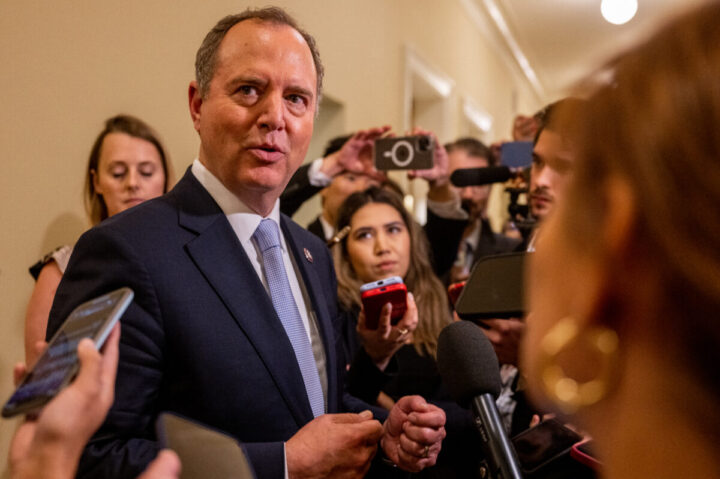
Brandon Bell/Getty Images
Rep. Adam Schiff (D-CA) speaks with reporters after closing remarks during the fifth hearing on the January 6th investigation in the Cannon House Office Building on June 23, 2022, in Washington, D.C.
Sens. Adam Schiff (D-CA) and Mark Kelly (D-AZ), who both voted for the first time last week in favor of blocking some U.S. arms sales to Israel, said that their future positions on such votes would be made on a case-by-case basis, determined by the specific sales in question and the circumstances surrounding the votes.
The two were somewhat surprising votes in favor of Sen. Bernie Sanders’ (I-VT) effort to block U.S. arms sales, having generally maintained pro-Israel records while in Congress.
“I was, and am, strongly opposed to the war in Iran, and I couldn’t justify voting against our own supplemental funding bills, which I plan to, and supporting funding for the same war in a JRD,” Schiff told Jewish Insider, referring to the Joint Resolutions of Disapproval to block specific arms sales to Israel. “I’ll evaluate each circumstance as they come.”
Kelly disputed the notion that his vote had flipped, saying, “I make these decisions based on what is the current situation, and what is the vote on — I don’t make these [decisions] in a vacuum.”
“This isn’t ‘yes’ or ‘no’ in any given moment, I’m always going to be looking out for Israel,” Kelly said. “And I think Israel is weaker, and the Israeli people are at further risk because of the current prime minister of Israel. He’s made a lot of mistakes, and he’s not operating in accordance with our values — but nor is our president. So I’ll look at every one of these [votes] based on what it is and what the current situation is.”
Asked whether his calculus would change if Israeli Prime Minister Benjamin Netanyahu were to lose the next election, he said that the decision is up to the Israeli people, “but I do not think Netanyahu has done Israel as a nation any favors.”
Forty Senate Democrats voted to block sales of bulldozers to Israel, while 36 voted to block the sales of 1,000-pound bombs

Andrew Harnik/Getty Images
(L-R) Senate Democratic leadership, Sens. Brian Schatz (D-HI), Bernie Sanders (I-VT), Elizabeth Warren (D-MA), Amy Klobuchar (D-MN), Senate Majority Leader Chuck Schumer (D-NY), Senate Majority Whip Richard Durbin (D-IL), Tammy Baldwin (D-WI), Cory Booker (D-NJ), Mark Warner (D-VA), Catherine Cortez Masto (D-NV), and Chris Murphy (D-CT), pose for a group photo in the U.S. Capitol on December 3, 2024 in Washington, DC.
Most of the Democrats in the Senate — 40 in total, including some traditionally pro-Israel lawmakers — voted on Wednesday evening for a measure led by Sen. Bernie Sanders (I-VT) that aimed to block sales of bulldozers to Israel, with 36 of them also voting to advance a second Sanders-backed resolution to block sales of thousands of 1,000-pound bombs.
The votes are a striking statement of the extent to which anti-Israel sentiment has become mainstream in the Democratic Party. Just seven members of the Democratic caucus voted against both measures.
Twenty-seven Democrats supported at least one of two similar measures in July 2025, which was a record at that time.
After having opposed previous similar efforts, Sens. Mark Kelly (D-AZ), Ruben Gallego (D-AZ), Adam Schiff (D-CA), Ron Wyden (D-OR), Maria Cantwell (D-WA), Gary Peters (D-MI), Mark Warner (D-VA), Cory Booker (D-NJ), Elissa Slotkin (D-MI), John Hickenlooper (D-CO), Michael Bennet (D-CO), Alex Padilla (D-CA) and Maggie Hassan (D-NH) all flipped and voted in favor of Sanders’ latest resolutions.
Warner and Peters, along with Sens. Jack Reed (D-RI) and Sheldon Whitehouse (D-RI), voted to advance the resolution to block the bulldozer sale but against advancing the one on bombs.
Sens. Angela Alsobrooks (D-MD), Tammy Baldwin (D-WI), Lisa Blunt Rochester (D-DE), Tammy Duckworth (D-IL), Dick Durbin (D-IL), Martin Heinrich (D-NM), Mazie Hirono (D-HI), Tim Kaine (D-VA), Andy Kim (D-NJ), Angus King (I-ME), Amy Klobuchar (D-MN), Ben Ray Lujan (D-NM), Ed Markey (D-MA), Jeff Merkley (D-OR), Chris Murphy (D-CT), Patty Murray (D-WA), Jon Ossoff (D-GA), Brian Schatz (D-HI), Jeanne Shaheen (D-NH), Tina Smith (D-MN), Chris Van Hollen (D-MD), Raphael Warnock (D-GA), Elizabeth Warren (D-MA) and Peter Welch (D-VT), all of whom had supported at least one past effort to block arms sales, voted for both measures on Wednesday.
Every Senate Democrat rumored to have presidential ambitions voted to block both arms sales.
Kelly, a moderate Democrat and potential presidential candidate, insisted in a Senate floor speech that he “cannot and will not abandon Israel,” which is “one of our closest partners. They have a right to defend themselves, and I will always support Israel’s right to exist as a successful and prosperous nation.”
But, he said, “Supporting a partner doesn’t mean that we don’t ask tough questions. It doesn’t mean that we always agree. Our support for our allies must always be about what makes us stronger and safer, and we can look at what’s happening in the region right now and understand that this is not business as usual, and it is not making us safer,” referring to the war in Iran, Israel’s war against Hezbollah in Lebanon and violence in the West Bank.
He said that the weapons sales will not “bring us closer to peace and security,” but that he remains “confident” that Israel has the ability to protect its people and that “we’ll be able to do so in the future with our partnership and I will always support that.”
Schiff, who is Jewish and generally a reliable supporter of Israel, and Padilla released a joint statement saying that they voted for the resolutions “to oppose the U.S. sale of specific weapons and equipment to Israel which might be used in Iran or to facilitate further settlement activity, which we believe undermine Israel’s long-term security and our own.”
“We strongly support Israel’s right to defend itself and the right of the people of Israel to live in peace and prosperity in a Jewish state,” they said. “We oppose actions that further deepen the United States in an unauthorized conflict in Iran — one with no clear strategy, no legal authority, and no defined end.”
They said they also intend to oppose any supplemental funding for the war.
Slotkin said she would “continue to assess U.S.-funded offensive weapons to Israel on a case-by-case basis” but would continue to support missile-defense systems. She said that she had “struggled with these [measures] as much as any vote since I joined Congress.”
“My entire life, I have been — and continue to be — a strong supporter of a Jewish and democratic State of Israel,” she said. “The people of Israel, like all people throughout the region, deserve long-term security and peace. But being pro-Israel today is not about simply supporting the political or military agenda of Prime Minister Netanyahu, just like being pro-American should not be equated with loyalty to President Trump.”
Slotkin said she is also “deeply skeptical” of providing additional funding for the war in Iran.
Warner, the top Democrat on the Senate Intelligence Committee, told Jewish Insider in a statement that he did not want to provide equipment to enable displacements of Palestinians in the West Bank or “escalatory military actions in southern Lebanon,” which he called contrary to both Israel and the United States’ interests.
“The United States can and must hold two truths at once: we can stand firmly with Israel’s security while also speaking out against actions that jeopardize peace and stability in the region,” Warner said. “Israel has an unequivocal right to defend itself, but it does not have the right to unilaterally displace Palestinians in the West Bank and torpedo any chance of ever achieving a two-state solution.”
“The United States should ensure that Israel has the tools it needs to protect its people and deter its adversaries while opposing transfers of equipment that are used to demolish homes, expand settlements, and further entrench a reality that weakens the already fragile prospects for a durable peace,” he continued.
Sanders, who has called for the U.S. to “end US military aid to the extremist Netanyahu government,” had described these votes as a referendum on the war in Iran, as well as Israel’s attacks on Hezbollah in Lebanon and violence by settlers and Israeli military forces in the West Bank.
J Street, the progressive Israel advocacy group that last week called for the U.S. to end financial support for Israel’s missile-defense systems after the current U.S.-Israel memorandum of understanding expires in 2028, supported the Sanders-led resolutions.
Senate Minority Leader Chuck Schumer (D-NY) and Sens. Kirsten Gillibrand (D-NY), Jacky Rosen (D-NV), Catherine Cortez Masto (D-NV), Richard Blumenthal (D-CT), John Fetterman (D-PA) and Chris Coons (D-DE) were the only Democrats to oppose both resolutions.
Gillibrand, who this week introduced a war powers resolution to halt the war in Iran, told JI on Wednesday morning that she sees the resolutions on weapons sales to Israel and the resolutions on the Iran war “very differently.”
“I oppose the war in Iran, but I do not believe we should leave an ally [Israel] who is being attacked without support,” Gillibrand said during a press conference.
AIPAC said in a statement, “We appreciate the senators who opposed these misguided and dangerous resolutions. Letting our democratic ally buy American-made equipment to protect its families from Iran and terrorist groups is clearly in America’s national interest. Congress must continue to stand with Israel as it confronts multiple ongoing threats.”
The votes may draw increased Democratic support amid party criticism of the war with Iran

Kevin Dietsch/Getty Images
Sen. Bernie Sanders (I-VT), joined by fellow senator Sen. Jeff Merkley (D-OR) (R), speaks at a news conference on restricting arms sales to Israel at the U.S. Capitol on November 19, 2024 in Washington, DC.
The Senate is set to hold another round of votes on blocking U.S. arms transfers to Israel, as Sen. Bernie Sanders (I-VT) filed three new joint resolutions of disapproval against $658.8 million in sales of 500- and 1,000-pound bombs to Israel and “defense articles” for 250-pound bombs.
“Given the horrific destruction that Israel’s extremist government has wrought on Gaza, Iran and Lebanon, the last thing in the world that American taxpayers need to do right now is to provide 22,000 new bombs to the Netanyahu government,” Sanders said. “No more weapons to support an illegal war.”
The effort is being co-sponsored by Sens. Chris Van Hollen (D-MD), Jeff Merkley (D-OR) and Peter Welch (D-VT).
Sanders emphasized that the administration had sidestepped normal congressional review procedures using emergency authorities in advancing the arms sales earlier this month.
Sanders and other progressive Democrats have forced votes on similar efforts to block arms sales to Israel on three previous occasions since the war in Gaza began, with a majority of the Democratic caucus — 27 lawmakers — voting to block at least one arms sale in July of last year, a significant jump in support from similar efforts in November 2024 and April 2025.
Israel’s standing among Democrats has worsened since last July, with even some Democrats who supported continued arms sales at that time blaming Israel for dragging the U.S. into the war in Iran. Polls show registered voters now see Israel more negatively than positively.
Some senators have argued the U.S. should have threatened to cut off military support to prevent an Israeli attack on Iran.
Van Hollen, Merkley and Welch, in statements, all framed the bomb sales as proxy votes on the war in Iran, and a vote to block the sales as a step toward ending the war. Senate Democrats have voted nearly unanimously as recently as yesterday to bring an immediate end to the war in Iran.
“With the bombs already provided to Israel by American taxpayers, Israeli forces are unleashing a campaign of total war in Iran with the clear and deliberate intention to eviscerate Iran’s economy and society,” Welch said in a statement. “I support these joint resolutions to make sure that we do not send another 20,000 bombs to Israel that will result in further destruction in Iran and Lebanon. We must end this war, and we must not send these bombs.”
On the other hand, some Democrats who had voted in favor of previous arms sales flipped in the July 2025 vote to express frustration with the ongoing war and humanitarian crisis in Gaza.
With the war in Gaza now in a ceasefire, humanitarian aid restored and efforts toward reconstruction slowly starting, that motivation for blocking arms sales may no longer be salient for some Democrats.
Plus, Qatari editor calls for more hostage-taking

ABIR SULTAN/POOL/AFP via Getty Images
Israel's Prime Minister Benjamin Netanyahu gives a press conference at the Prime minister's office in Jerusalem on August 10, 2025.
Good Wednesday morning.
In today’s Daily Kickoff, we report on yesterday’s votes on Israel-related resolutions at the Democratic National Committee’s summer meeting and subsequent decision to create a task force on the issue, and cover Rep. Adam Smith’s support for leveraging arms sales to Israel. We report on a call from a prominent Qatari journalist tied to the country’s royal family to kidnap IDF soldiers, and report on a push from Jewish groups, led by the Jewish Federations of North America, for the Trump administration to move forward with its nominations for antisemitism envoy and religious freedom ambassador. Also in today’s Daily Kickoff: Avraham Tahari, Jonathan Karp and Shmuel and Anat Harlap.
What We’re Watching
- President Donald Trump will lead a meeting at the White House today focused on winding down the war in Gaza and increasing humanitarian aid to the country. Steve Witkoff, the Trump administration’s Middle East envoy, told Fox News that the administration believes “that we’re going to settle this one way or another, certainly before the end of this year.”
- Israeli Foreign Minister Gideon Sa’ar, who is in the U.S. this week, will meet with Secretary of State Marco Rubio this afternoon in Washington.
- This evening, the Florida Democratic Party Jewish Caucus is hosting a briefing with Rep. Debbie Wasserman Schultz (D-FL).
What You Should Know
A QUICK WORD WITH JI’S JOSH KRAUSHAAR
In the run-up to the U.S. presidential election last year, one common refrain heard in Israeli leadership was to wait out the election in the hope of a friendlier Trump administration taking over.
Increasingly, many pro-Israel voices in the United States are quietly saying the same thing about upcoming Israeli elections, which polls suggest could usher in a more moderate coalition, and diminish the influence of far-right leaders in the current Israeli government.
The possibility of new elections taking place soon, more than any particular shift in military strategy or policy decisions, is looking like the most likely factor that could advance progress in the region.
While Israeli elections are not guaranteed to take place until October 2026, the legislative crisis over Haredi conscription in the IDF is looking like it could collapse Israeli Prime Minister Benjamin Netanyahu’s coalition, and move up the election timetable to as early as next January.
What has prevented elections until now is the fact that all members of the governing coalition are projected to lose seats if elections are held. That most Israelis want new elections is the very reason why they haven’t happened – yet.
Indeed, if elections were held today, Netanyahu would be in serious trouble. A recent poll commissioned by Israel’s Channel 12 found the anti-Netanyahu bloc making up a narrow majority of 61 of the Knesset’s 120 seats, with the current Likud-led coalition sitting at 49 seats, and Arab parties making up the remaining 10 seats.
minneapolis moment

Shortly after members of the Democratic National Committee passed a resolution on Tuesday voicing support for humanitarian aid to Gaza and calling for the release of hostages held by Hamas, Ken Martin, the party chair, announced that he would withdraw the measure, which he had introduced, and instead form a task force to continue discussing the matter, Jewish Insider’s Matthew Kassel reports.
Dem divide: The surprise reversal came even as the DNC, now holding its annual summer meeting in Minneapolis, had voted to reject a dueling and more controversial resolution that had backed an arms embargo as well as a suspension of U.S. military aid to Israel, raising alarms among Jewish and pro-Israel Democrats who rallied behind Martin’s effort, co-sponsored by DNC leadership. “There is a divide in our party on this issue. This is a moment that calls for shared dialogue and calls for shared advocacy,” Martin said after the competing measure had been voted down. He said that he would “appoint a committee or a task force comprised of stakeholders on all sides of this to continue to have the conversation, to work through this, and bring solutions back to our party.”
‘Inside baseball’: Pro-Israel Democrats expressed cautious optimism about the unexpected decision. Despite Martin’s 11th-hour reversal, Halie Soifer, the CEO of the Jewish Democratic Council of America, told JI’s Matthew Kassel she was satisfied with the outcome, noting the DNC also passed a resolution condemning antisemitism that, coupled with its rejection of the arms embargo proposal, “reflects where the party stands” on major issues concerning Israel and the Jewish community. Brian Romick, Democratic Majority For Israel’s president and CEO, said that he viewed the outcome as “a win” for the pro-Israel community, in light of the potential for a more hostile debate. “The bad resolution was rejected and Ken’s compromise resolution also passed the committee,” Romick said. “That all happened publicly” and “reaffirmed where the party stands on Israel,” he said. “Anything else beyond that is just inside baseball.”
the center shifts
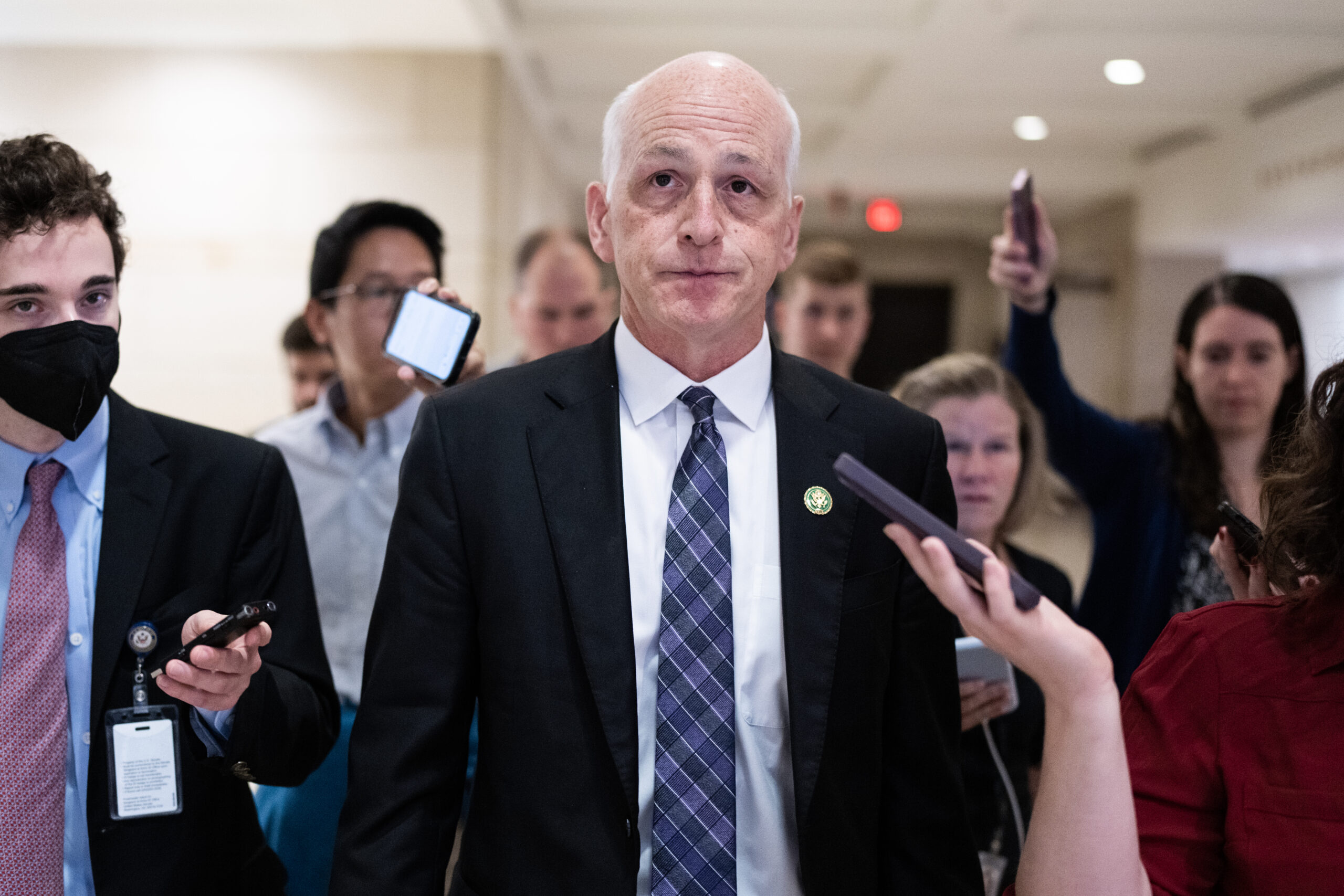
Rep. Adam Smith (D-WA), ranking member of the House Armed Services Committee, said in a statement on Tuesday that he “believe[s] it is time for the United States government to stop the sale of some offensive weapons systems to Israel as leverage to pressure Israel” into implementing a ceasefire, increasing humanitarian aid in Gaza and stopping the expansion of West Bank settlements, Jewish Insider’s Danielle Cohen-Kanik reports. The Washington state Democrat, who has served his Seattle-area district since 1997, said he changed his position on blocking weapons sales to Israel because the “situation in the Middle East has changed dramatically in recent months.”
Nuanced stance: Smith, a member of the moderate New Democrat Coalition who has played a leading role in Democratic foreign policy, was careful to emphasize that he supports Israel and “recognize[s] both the threats they face and the reality that the actions of Hamas and their supporters have driven this conflict.” He also affirmed that “Yes, the hostages must be returned. It is outrageous that Hamas took the hostages and has continued to hold them.” However, Smith said, “six months of war since the end of the last ceasefire has done nothing to bring the hostages home” and it is “impossible to see how further military action in Gaza could degrade Hamas … further than what has already occurred.”
media mania

The editor-in-chief of Qatar’s pro-government newspaper Al Sharq called on Hamas “heroes” to kidnap more IDF soldiers in a since-deleted tweet, Jewish Insider’s Haley Cohen reports. “If success is not achieved this time in capturing Zionist soldiers at the hands of the heroes of #AlQassamBrigades, then the second, third, and fourth attempts will succeed, God willing, by adding new rats to the tally held by the heroes of the Brigades,” Qatari journalist Jabar Al-Harmi wrote in Arabic last week.
Propaganda push: Al Sharq, which is published in Doha by a privately held media company founded and owned by Sheikh Khalid bin Thani Al Thani, a member of the Qatari ruling family, is one of the four leading private daily Arabic newspapers in Qatar, all of which have a pro-government bent. Ghaith Al-Omari, a senior fellow in The Washington Institute for Near East Policy’s Irwin Levy Family Program in the U.S.-Israel Strategic Relationship, told JI that the tweet is “not surprising” and comes amid widespread praise for Hamas in Qatari media. “The Qatari media landscape is rife with statements, selective reporting and editorials that support Hamas,” said Al-Omari, former executive director of the American Task Force on Palestine. “Under the guise of supporting the Palestinian people, many Qatari media outlets have been a key vehicle for amplifying Hamas propaganda.”
beirut or bust

Sen. Lindsey Graham (R-SC) championed a U.S. defense agreement with Lebanon during a bipartisan congressional delegation to Beirut on Tuesday, saying it would be the “biggest change in the history of Lebanon,” Jewish Insider’s Danielle Cohen-Kanik reports. Speaking at a press conference alongside Sen. Jeanne Shaheen (D-NH) and Rep. Joe Wilson (R-SC), Graham asked, “How many nations have a defense agreement with the United States? Very few. … The number of nations that America is willing to go to war for is very few. Why do I mention Lebanon being in that group? You have one thing going for you that is very valuable to me: religious diversity.”
Making the case: “Christianity is under siege in the Mideast. Christians are being slaughtered and run out of all over, all over the region, except here. And so what I am going to tell my colleagues is, ‘Why don’t we invest in defending religious diversity in the Mideast? Why don’t we have a relationship with Lebanon where we would actually defend what you’re doing?’” Graham continued. “I think it’s in America’s interest to defend religious diversity, whether you’re Druze or Alawite or a Christian or whatever. The idea that America may one day have a defense agreement with Lebanon changes Lebanon unlike any single thing I could think of,” Graham said.
granite state race

Maura Sullivan, a Marine veteran who served in Iraq and later worked as a senior Defense Department official, is aiming to leverage that experience to win the New Hampshire congressional seat currently held by Rep. Chris Pappas (D-NH), who is running for the Senate. She’s also leaning on “that firsthand perspective, experience and knowledge” as she stakes out her positions on the conflict in the Middle East, she told Jewish Insider’s Marc Rod in a recent interview.
Military mindset: As a Pentagon official, Sullivan, who noted that she’d be seeking a spot on the House Armed Services Committee if elected, said she spent time in the Middle East on “allied reassurance tours,” visiting allies and meeting with top officials to learn about Israel’s challenges and capabilities and “talking about the incredibly important relationship between the United States and Israel and strongly reaffirming the United States commitment” to Israel. “I’ve been very clear since the devastating, absolutely deplorable Oct. 7 attacks that Hamas perpetrated that Israel has the right to defend itself,” Sullivan continued. “I also want to be clear that the conditions in Gaza are inhumane, they’re deplorable and they must be improved immediately. … Hamas can be destroyed and significant aid can be let in at the same time. It’s a false choice to think that those two objectives cannot occur simultaneously.”
scoop

Several major Jewish organizations are calling on the Senate to “swiftly” confirm President Donald Trump’s nominees for special envoy to monitor and combat antisemitism and international religious freedom ambassador, Jewish Insider’s Gabby Deutch reports. In April, Trump tapped Rabbi Yehuda Kaploun, an Orthodox businessman and Chabad rabbi who served as a campaign surrogate, to serve as the next U.S. special envoy to monitor and combat antisemitism, and has named former Rep. Mark Walker (R-NC) as the U.S. ambassador-at-large for international religious freedom. Both positions require Senate confirmation, and neither has had a confirmation hearing yet.
‘Utmost importance’: The groups, led by the Jewish Federations of North America, wrote in a letter to Senate Majority Leader John Thune (R-SD) and Senate Minority Leader Chuck Schumer (D-NY) that filling the roles is “of utmost importance in fighting growing antisemitism and ensuring freedom of religion or belief worldwide,” according to a draft obtained by JI. “We dare not delay in filling these critical positions that protect human rights around the world,” the letter states. “To that end we strongly urge you to prioritize filling these positions, sending a powerful signal to governments around the world that the United States upholds our constitutionally guaranteed rights to life and liberty, to freedom of religion and belief, and calls on them to do the same.”
Worthy Reads
The Heck With Hasbara: The Wall Street Journal’s Elliot Kaufman interviews Israeli Foreign Minister Gideon Sa’ar about the diplomatic and public relations hits the country has taken as it nears two full years of war against Hamas in Gaza. “Hamas took over and Israel is still paying the price, in diplomacy and in lives. The logic leads me to the conclusion that whether the Gaza war ends now or in some months seems less important for Israel — and even for its foreign relations — than whether Hamas is left with the ability to draw it into another war a few years on. In general, Mr. Sa’ar says, ‘We need to survive first. After that, there comes popularity and how much we are able to convince others around the world.’ Later, he catches himself, and adds, ‘I’m not saying diplomacy shouldn’t be taken into consideration. I’m the last to say that — I’m foreign minister.’” [WSJ]
Southern Comfort: The Atlantic’s Rose Horowitch spotlights the growing popularity of southern universities among prospective Jewish students, as many of the Ivies and small liberal arts colleges in the Northeast face widespread anti-Israel and at times antisemitic activism. “The line between criticism of Israel and anti-Semitism is nearly always contested; the anti-Israel protest movement on some campuses counts many Jewish students among its ranks. Meanwhile, southern colleges are becoming more popular with northeastern students of all backgrounds. No doubt some Jewish students have opted out of the Ivy League simply because they think the South is the place to be. Even so, an atmosphere of fear has clearly taken hold among many Jewish families. Jewish leaders at Columbia, Harvard, and Yale told me that just about every parent of a prospective student asks if their child will be safe on campus. (Here I will resist the temptation to make any quips about Jewish moms.)” [TheAtlantic]
Crimson Coexistence: In The New York Times, Jacob Miller and Tommy Barone, who served as chairs of the Harvard Crimson’s editorial board during the last academic year, reflect on how they worked to maintain civil discourse in the publication’s pages. “The two of us faced a measure of internal criticism, but we consistently underscored the importance of principled, rational disagreement. Meeting by meeting, the board rallied behind this approach. Disagreeing civilly about big stories — the Israeli-Palestinian conflict, but also D.E.I., free speech and admissions policies — became routine, and we published thoughtful editorials that helped earn back disillusioned readers’ respect. Refined by dissent, our editorials, regardless of their ideological tilt, offered stronger reasoning and more engagement with counterarguments. They passed the test our previous editorials on controversial issues had too often failed.” [NYTimes]
Split With Hamas: In Haaretz, Haisam Hassanein considers the outcomes of the Arab League’s call for Hamas to be disarmed and removed from Gaza. “On paper, this new declaration is historic. But it seems most Israelis don’t even know it exists. If Arab leaders are serious, they can’t stop at communiqués read in Cairo or Riyadh. They have to step into Israel’s conversation. That means Hebrew language interviews, Israeli TV, op-eds in this paper and others. Spell it out directly: Arab states are ready to put money into rebuilding Gaza. They are ready to back one Palestinian leadership. They themselves are also ready to move toward normalization. But all of it hinges on Israel doing its part – stopping the drift into endless conflict and opening a real path toward a two-state solution. That’s the message. And Israelis deserve to hear it unfiltered. Right now, they don’t.” [Haaretz]
Word on the Street
Dan Scavino, the longest-serving aide to President Donald Trump, was tapped to head the White House Presidential Personnel Office, replacing Sergio Gor, who was nominated to be U.S. ambassador to India…
U.S. Ambassador to Turkey Tom Barrack received pushback from Lebanese journalists and commentators after warning journalists at a press conference in Beirut to “act civilized” and not be “animalistic”…
Microsoft is weighing disciplinary measures against employees who, protesting the company’s tech sales to Israel, participated in a sit-in in the office of President Brad Smith at the company’s Washington state headquarters that temporarily locked down the building…
Business executives and Jewish leaders in Chicago are preparing to open a college preparatory Jewish high school in the city’s Lakeshore East neighborhood after purchasing the unfinished building, where construction on another school stalled six years ago…
Police in St. Louis County, Mo., charged an area man with defacing a sign outside the city’s Jewish Student Union, which provides programming and community events to Jewish high schoolers in the city…
The Wall Street Journal spotlights the high-profile, high-stakes divorce proceedings of David Geffen, who did not sign a prenuptial agreement with his now-estranged husband, amid allegations of drug use and unequal power dynamics…
Elie Tahari co-founder Avraham Tahari listed his Alpine, N.J., home for $24.75 million, 15 years after buying the property for $4.25 million…
The Woodstock, N.Y., property that was featured on the cover of Bob Dylan’s “Bringing It All Back Home” sold for $4.6 million…
Simon & Schuster CEO Jonathan Karp is stepping down after five years in the role; Karp will remain at the publisher, overseeing its newly created Simon Six imprint…
In The Wall Street Journal, Tevi Troy reflects on the slow pace encouraged by vacation life…
Norges Bank Investment Management, Norway’s sovereign wealth fund, is ending its investments in Caterpillar as well as five Israeli banks, after its ethics council reviewed the companies’ ties to Israeli construction and Palestinian home demolitions in the West Bank…
Israel said that a strike on the Nasser Hospital in Khan Younis earlier this week that killed 20 people had targeted a camera the army alleged had been positioned by Hamas to observe IDF troop movements…
Israeli Prime Minister Benjamin Netanyahu praised the decision by Australia to expel Iran’s ambassador in Canberra, calling it a positive “first step,” days after he had criticized Australian Prime Minister Anthony Albanese for being “weak” and failing to adequately address antisemitism in the country…
French President Emmanuel Macron doubled down in his support for Palestinian statehood, writing in a letter to Netanyahu, which was published in several European newspapers, that a lasting Israeli-Palestinian peace “is essential to the State of Israel’s security”…
German Chancellor Friedrich Merz said Berlin would not join other foreign powers in recognizing a Palestinian state at the United Nations General Assembly next month; Merz, speaking at a press conference with Canadian Prime Minister Mark Carney, said that Germany doesn’t “see the requirements met” for statehood…
The Financial Times looks at how the 12-day war between Israel and Iran has sparked calls inside Iran for political change…
Philanthropists Shmuel and Anat Harlap made a $180 million donation to the Rabin Medical Center in central Israel, the largest-ever single gift to an Israeli hospital, eJewishPhilanthropy’s Judah Ari Gross reports…
Commentator Batya Ungar-Sargon is joining NewsNation, where she will host an eponymous weekend program…
Jewish communal activist and fundraiser Jacqueline Levine, who was active in the Civil Rights Movement as well as the movement to free Soviet Jewry, died at 99…Physicist Rainer Weiss, who won the Nobel Prize in 2017 for his role in developing a mechanism to predict intergalactic events, died at 92…
Pic of the Day
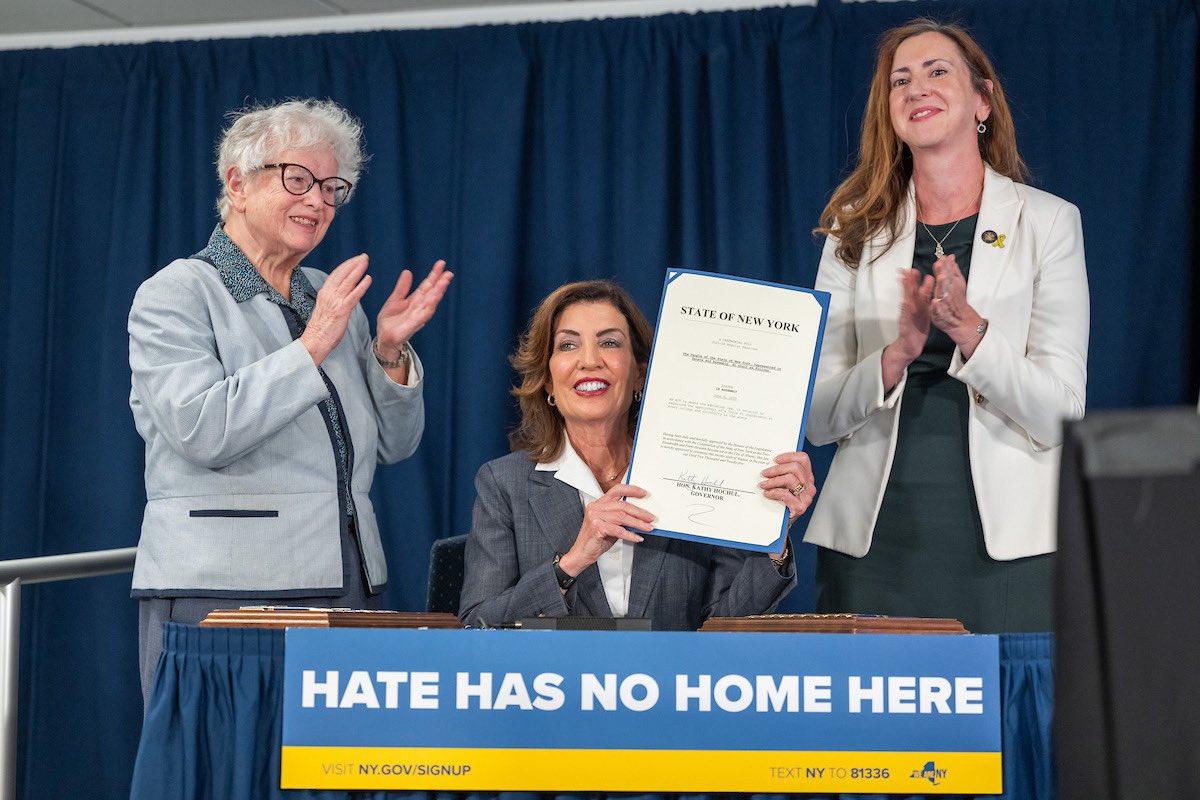
New York Gov. Kathy Hochul (center) signed into law legislation that requires all colleges in the state to designate anti-discrimination coordinators to enforce Title VI of the Civil Rights. Hochul was joined by state Sen. Toby Ann Stavisky (left) and Assemblywoman Nily Rozic (right), who sponsored the legislation in their respective chambers.More on the new law here.
Birthdays

Member of AJR, an indie pop multi-instrumentalist trio, together with his two brothers, Adam Metzger turns 35…
Chatsworth, Calif., resident, Ruth Ann Kerker Hapner… Board chair for North America at the Pardes Institute of Jewish Studies, Mark S. Freedman turns 74… Author, essayist and journalist, Michael Wolff turns 72… President of the Israeli Jewish Congress focused on battling antisemitism, he is a former senator in the Russian Federation, Moshe Shlomo (Vladimir) Sloutsker turns 69… President of Cornell University until June 2024, Martha Elizabeth Pollack turns 67… Governor of New York State since 2021, Kathy Hochul turns 67… Israel’s ambassador to the Czech Republic, Anna Azari turns 66… Vice chairman at IBM and lead independent director on the board of Apollo Global Management, Gary Cohn turns 65… Executive director of J Street Israel, he served as Israel’s consul general to New England from 2006 until 2010, Nadav Tamir… Contributing editor at the National Interest, he is also chairman and CEO of Widehall, Steve Clemons turns 63… Private equity investor and a trustee of the Jewish Federations of North America’s Board, Neil A. Wallack… Israeli-born CEO of Insitro, she was a professor at Stanford for 18 years and a 2004 winner of a MacArthur genius fellowship, Daphne Koller turns 57… Director of National Intelligence throughout the four years of the Biden administration, Avril Haines turns 56… Co-founder of the 2017 Women’s March which she departed citing concerns over antisemitism, Vanessa Wruble turns 51… Managing partner and founder of G2 Investment Partners, Joshua Goldberg… Former director general of the Israeli Ministry of Finance, now CEO of the Strauss Group, Shai Babad turns 49… Mayor of Evanston, Ill., Daniel Kalman Biss turns 48… Senior advisor at the Foundation for Defense of Democracies, Richard Goldberg turns 42… Director of the JCRC at the Jewish Federation & Foundation of Northeast Florida in Jacksonville, Nelson France… Co-founder of theSkimm, Danielle Merriah Weisberg turns 39… Michael Weiss… Director of the Botanical Garden and senior lecturer, both positions at Tel Aviv University, Yuval Sapir… Talia Rubin…
Rep. Raja Krishnamoorthi and Lt. Gov. Juliana Stratton opposed the Sanders-led resolutions, but Rep. Robin Kelly (D-IL) said she would have voted for them
Tom Williams/CQ Roll Call/Bloomberg via Getty Images
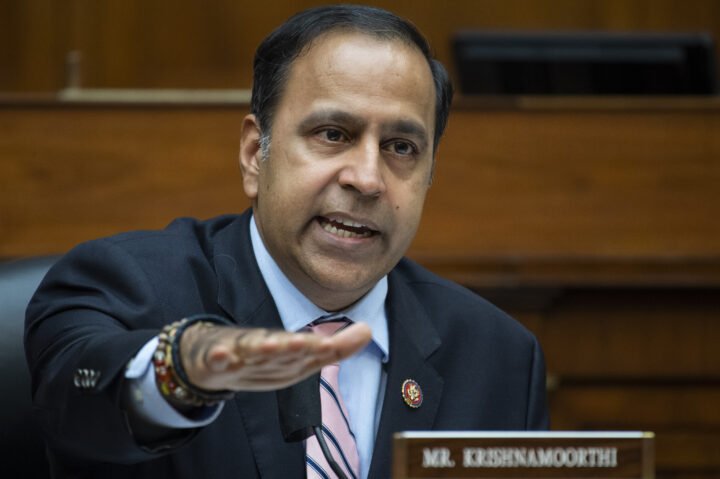
Representative Raja Krishnamoorthi, a Democrat from Illinois
A divide is emerging in the Democratic Senate primary in Illinois over resolutions the Senate voted on earlier this week to block certain arms sales to Israel.
Lt. Gov. Juliana Stratton’s campaign and Rep. Raja Krishnamoorthi told Jewish Insider on Friday that they wouldn’t have supported the resolutions led by Sen. Bernie Sanders (I-VT), even as they condemned the humanitarian crisis in Gaza.
But Rep. Robin Kelly (D-IL) announced earlier in the day that she would have voted for the resolutions if she’d been in the Senate.
The split could help shape the potentially crucial Jewish community vote in the upcoming Senate primary.
“As a mother, it’s heartwrenching to see images of children forced to go without food. Israel and the United States need to take every possible step to end the humanitarian crisis and ensure aid is immediately and widely made available,” Stratton said in a statement to JI. “I continue to pray for a ceasefire that ends the suffering in Gaza, for the return of the hostages still held by Hamas to their families in Israel, and for lasting peace in the region.”
Stratton’s campaign elaborated that the lieutenant governor believes, “[w]e should all be speaking with a clear voice that the Netanyahu administration must be doing more to get food and aid to the citizens of Gaza right away, but Juliana believes that cutting off U.S. military aid to Israel could risk standing in the way of the ultimate goals of a true ceasefire and sustained peace.”
The campaign also said that Stratton believes in Israel’s “right to defend itself as one of the United States’ closest allies and the only democracy in the Middle East.”
The campaign said Stratton “strongly disagrees” with how the Israeli government led by Prime Minister Benjamin Netanyahu has executed the war in Gaza, but she “has been vocal in her support of Israel in the wake of the horrific terrorist attacks by Hamas on October 7th.”
Krishnamoorthi — who, in an interview with JI earlier this year, said he did not support efforts to cut off or condition U.S. aid to Israel — said Friday that the Sanders resolutions would not have solved the humanitarian crisis.
“We need an immediate ceasefire brokered by the U.S. and regional partners and that is swiftly accepted by Hamas, along with the release of the remaining hostages and the emergency provision of humanitarian aid,” Krishnamoorthi said in a statement to JI. “The U.S. must use all of its diplomatic influence to make that happen as quickly as possible. Ultimately, the only path to a lasting peace is a two-state solution. The first step and my focus today is ending the current humanitarian disaster and getting food in as quickly as possible. Wednesday’s resolutions did not right that wrong.”
He said that he has “long been a steadfast supporter of our nation’s alliance with Israel” and that it “had every right to defend itself,” but said that “[w]hat we see going on today in Gaza is a moral catastrophe.”
“As Americans, we can never sit by and allow widespread starvation and disease among a civilian population that includes the elderly, the disabled, women, and children,” Krishnamoorthi continued.
He highlighted that he wrote to Secretary of State Marco Rubio and Special Envoy Steve Witkoff on Friday, urging them to surge aid into the strip and to ensure accountability that it reaches its intended recipients.
He said in the letter that, despite acknowledging the starvation in Gaza, the administration has not done enough to remedy the situation. Krishnamoorthi also urged others in the region, including Hamas, to cooperate in the proper delivery of aid.
Kelly, meanwhile, said in a statement Friday that she would have voted for the resolutions.
“Israelis and Palestinians must work to secure a path forward where both peoples can live in peace, safety and security,” Kelly said in a statement. “I have supported Israel, but in this moment, I cannot in good conscience defend starving young children and prolonging the suffering of innocent families. Now is the time for moral leadership in the U.S. Senate.”
Both Sens. Dick Durbin (D-IL) — who is retiring — and Tammy Duckworth (D-IL) supported the resolutions.
Durbin has supported every similar effort Sanders has made since November to block various arms sales to Israel, but Duckworth had voted against them in the past and, in fact, argued forcefully against them in a letter to constituents.
The votes on Sanders’ proposal to cut Israel aid are also proving to be a dividing line in Michigan’s Senate primary: Rep. Haley Stevens (D-MI) announced Friday that she would have opposed them, while state Sen. Mallory McMorrow said she supported them.
Klobuchar: ‘I have supported Israel’s right to defend itself, I always will. But they aren’t changing’

Drew Angerer/Getty Images
Sen. Amy Klobuchar (D-MN)
Sen. Amy Klobuchar (D-MN) said that she voted, for the first time, for resolutions blocking U.S. arms sales to Israel this week to send a message to the Israeli government of disapproval for the humanitarian situation in Gaza, even as she acknowledged that the vote might not make much of an impact.
“I just think it’s really important for people to speak out when they can, even if it’s on a vote that isn’t probably going to make all the difference right now. And it doesn’t mean I’m going to be hard-stop against aid for Israel in the future,” Klobuchar told Punchbowl News.
“At some point, you’ve got to seek change. And I think this is one way you can do it,” she continued. “I have supported Israel’s right to defend itself, I always will. But they aren’t changing.”
She said that she’d tried to communicate her disapproval of the humanitarian situation in Gaza to Israeli Prime Minister Benjamin Netanyahu during his recent visit to Washington, D.C. but said it “didn’t work very well when I said it.”
Klobuchar said in a Senate floor speech several days before the votes that she attended the meeting with Netanyahu “for one reason: in my capacity as No. 3 in the Democratic leadership, and that was to raise the issue of the humanitarian crisis in Gaza.”
“I say to my colleagues you can support the people of Israel. You can be horrified and condemn, as all of us did, the terrorist attack. But we cannot continue to allow people to starve,” Klobuchar said. “Lives are being lost on a daily basis, kids, innocents, and the government of Israel must change course.”
She said that U.S. policy must focus on returning to a ceasefire, increasing humanitarian aid, freeing the hostages and security a two-state solution.
The Minnesota Democrat, a moderate, has historically been a quiet but reliable supporter of Israel. She’s also the No. 3 Senate Democrat, seen as a potential successor to Minority Leader Chuck Schumer (D-NY).
Of the 11 members of Democratic leadership, seven voted for the resolutions on Wednesday.
Klobuchar is running for the No. 2 Senate Democratic leadership slot, competing against Sen. Brian Schatz (D-HI), a consistent supporter of prior efforts to halt weapons sales, and Sen. Patty Murray (D-WA), who, like Klobuchar, flipped her vote to support the Sanders resolutions after previously opposing them.
Slotkin, in an appearance on an anti-Israel podcast: ‘I was the first Jew elected to the Senate that was not endorsed by any Jewish group — AIPAC, J Street’

Paul Sancya/Pool/Getty Images
Sen. Elissa Slotkin (D-MI) rehearses the Democratic response to President Donald Trump's address to a joint session of Congress.
Sen. Elissa Slotkin (D-MI) indicated in an interview on the “Breaking Points” podcast on Tuesday that she’s open to considering cutting off offensive weapons sales to Israel — comments that came a day before the Senate is set to vote on blocking two arms sales to Israel — as well as distanced herself from “Jewish group[s]” like AIPAC and J Street.
At the same time, while offering criticisms of Israel and its operations in Gaza, Slotkin refused to embrace and pushed back on some of the more heated anti-Israel rhetoric offered by the podcast’s hosts. The podcast, which brings together a progressive and a libertarian host, generally takes an isolationist view toward U.S. foreign policy and is opposed to the close U.S.-Israel relationship.
Asked about cutting off offensive aid, Slokin said, “That certainly, to me, would be a place to look, but I’m not going to cut off a blanket next sale on a defensive weapon that comes through, no.”
One of the hosts, the progressive Krystal Ball, pressed Slotkin over the distinction between offensive and defensive systems, arguing that the U.S. does not provide defensive weapons systems to Russia or Iran — malign global actors and longstanding adversaries.
Slotkin responded by noting her support for the U.S.-Israel relationship in the long term, and argued allies should be treated differently than adversaries even in times of disagreement between the two countries.
“Sometimes we have big breaks with allies, right? Sometimes we have difficult moments with allies. Sometimes it goes the wrong way with allies. But an allied relationship is a long-term relationship,” Slotkin told the duo.
“I think about this from the mirror image way because I do not support the things that Donald Trump is doing, right? But I’m an American. So, do I want other countries to look at America and be like, ‘We can’t stand Donald Trump so we’re going to end the long-standing relationship we have with the American people. We’re going to cut off any support we give them on information sharing or intelligence sharing,’” she continued.
Slotkin also distanced herself from “Jewish group[s],” mentioning that she’d declined to seek endorsements from AIPAC and J Street specifically.
Asked if AIPAC should be forced to register as a foreign lobbying organization, Slotkin said she did not have an answer beyond that she knew “plenty of people who think they should” but would “have to look at the definition.”
Accusations from both political fringes that AIPAC — whose members are American citizens — constitutes a foreign influence operation, have often invoked antisemitic dual loyalty tropes.
After being accused of providing a “cop-out answer,” Slotkin replied by saying that she had stopped accepting money from the group over disagreements about policy and overall strategy in 2021, after having support from AIPAC members when she first ran for Congress in 2018. The group did not officially endorse or fundraise for candidates until the 2022 election cycle.
“You’ve got to get your facts straight. I have not been endorsed by AIPAC. I have not, I’m sorry. I was the first Jew elected to the Senate that was not endorsed by any Jewish group — AIPAC, J Street. In 2018, when I first ran [I was endorsed by] people who were [AIPAC] members, yes, but I’ve not been endorsed since then,” Slotkin said. “And I’ve just got to be honest, like I think that this is where facts really matter. I’ve had very, very difficult conversations with my colleagues in that organization and made a choice back in 2021.”
“2021, so that was the first time I was up for reelection. So I understand that there’s a sort of like, again, cornered position, but to me like I call balls and strikes as someone who served in the Middle East,” she added.
Slotkin was endorsed by one Jewish group, the Jewish Democratic Council of America, which maintains a pro-Israel stance, in 2024.
Slotkin, pressed by Ball on the humanitarian situation in Gaza, said she had signed onto a letter accusing Israel of pursuing a “policy of starvation,” adding that, as an “occupying power,” it has a responsibility to ensure food is supplied to Gaza. But she stopped short of endorsing Ball’s framing of Israel’s actions as a “crime against humanity.”
She also did not embrace Ball’s claims that Israel is pursuing “ethnic cleansing” in Gaza, while criticizing plans from the Israeli government for relocating people within or out of Gaza as illegal.
“I’ve been clear about that,” Slotkin said. “So I would ask for a little bit of an open mind.”
Ball responded by accusing Slotkin of failing to take meaningful action on the issue and criticizing her for voting for aid to Israel, for the Antisemitism Awareness Act, for legislation describing anti-Zionism as antisemitic and for sanctioning the International Criminal Court.
Ball told the Michigan senator that her progressive positions on domestic issues like health care and housing policy were irrelevant to her if she was “still supporting a genocide in Gaza.”
“I’m speaking for myself, but I know there are millions of other people who feel the same, that you have to at least cross this sort of moral threshold,” Ball said.
While Ball framed the conflict in the Middle East as a central issue in the New York City mayoral race, Slotkin, looking to her own senatorial race in 2024, argued that its political significance has been overplayed.
“This issue is motivating people in a very visceral and personal way. But it’s not the only issue that my voters in Michigan care about,” she said. “The online world is extremely, extremely focused on this, but that doesn’t always represent the majority.”
She said it’s the top issue in some areas, but outside of the Detroit area, “it’s not in the top 40.”
Slotkin also said she was proud that she had won a majority of both Jewish voters and the three cities with the largest Muslim populations in Michigan during her Senate campaign, which she attributed to “calling balls and strikes” and leaning on her background in Middle East policy.
The Michigan senator also appeared to argue that the pace of anti-Israel protests has dropped off significantly since the end of the Biden administration
“I just think it’s interesting that there were a ton of protests when Democrats were in charge” against the war in Gaza, adding that it’s “fair to say, just to be honest, that … the number of protests that go on now, versus before,” though she was cut off by the show’s hosts.
She generally declined to weigh in on the results of the New York City mayoral race, saying primarily that she believes the results reflect concerns about the cost of living and the need for a new generation of leadership.
“I can have plenty of disagreements with what I’ve heard Mr. [Zohran] Mamdani propose, and I do,” she said. “I am here because we lived the American dream through capitalism. A lot of free stuff to me is not the answer. … But I can have those disagreements. I would be thrilled to have that conversation with him or anyone else.”
Asked about her condemnation of Rep. Rashida Tlaib (D-MI) for using the phrase “from the river to the sea,” and if she would also condemn Rep. Randy Fine (R-FL) for his comments saying Gazans should “starve away,” Slotkin said she did not know who Fine was but had no reservations denouncing such remarks.
“I have no problem condemning Randy Fine, who I don’t know. I don’t, I’m sorry. I don’t know who that person is. I have no problem condemning someone who talks like that,” she told the hosts.
Slotkin was also asked if she believed that financier and convicted pedophile Jeffrey Epstein “had any connections to U.S. or Israeli intelligence agencies.” Slotkin, a former CIA analyst, said she would be “very surprised” if that was the case.
Bill Clark/CQ-Roll Call, Inc via Getty Images
Rep. Mike Lawler (R-NY) leaves the House Republicans' caucus meeting at the Capitol Hill Club in Washington on Tuesday, May 23, 2023.
The House Foreign Affairs Committee voted on Tuesday to advance legislation that aims to expedite arms sales to U.S. partners that are members of the Abraham Accords, as well as bills to review the U.S.-South Africa relationship and to combat the proliferation of Western-made parts in Iranian drones.
The arms sales bill comes as part of a broader push by House Republicans to speed up military transfers to U.S. allies. It would cut the congressional review period for sales to Abraham Accords partners that work with the U.S. on countering Iran and its proxies from 30 days to 15, in line with the review period for key U.S. defense partners including NATO members.
The bill, led by Rep. Mike Lawler (R-NY), advanced by a 31-19 vote, with Republican Reps. Scott Perry (R-PA), Tim Burchett (R-TN) and Warren Davidson (R-OH) voting against the bill and Democratic Reps. Ted Lieu (D-CA), Sheila Cherfilus-McCormick (D-FL), Greg Stanton (D-AZ), Jared Moskowitz (D-FL), Jim Costa (D-CA), George Latimer (D-NY) and Brad Schneider (D-IL) supporting it.
Rep. Brian Mast (R-FL), the committee chairman, argued that arms sales to the countries in question, which comprise a significant portion of U.S. military sales globally, suffer from “egregious delays,” prompting U.S. partners to consider buying from other countries, despite the U.S.’ interests in supporting its partners and ensuring their systems are compatible with those of the United States.
“There is a clear recognition that it’s simply not enough for our equipment to be the best,” Mast said. “Those procuring U.S.-origin weapons must also have the confidence that our equipment will be delivered on time in a transparent manner. Streamlining the foreign military sales process is critical if the U.S. is to remain the partner of choice, particularly in the Middle East and North Africa.”
Rep. Greg Meeks (D-NY), the ranking member of the committee, and other Democrats argued that the legislation would create “quid pro quo arrangements or enticements” for countries to join the Abraham Accords and would overlook human rights issues and other malign behavior by some Middle East partners, as well as diminish the role of Congress in the arms sales process.
“I don’t believe it is appropriate to equate long-standing allies like the U.K., like France or Canada, all countries with which the United States has detailed comprehensive defensive agreements, to countries who have thus far had inconsistent and checkered records regarding the use of U.S. weapons and conflicts and protections of sensitive defensive technologies,” Meeks said. “We do provide an expedited timeline to our closest allies because of the presumption of approval. I can’t say that we have a presumption of approval, in this case.”
He also described the legislation as an extension of the Trump administration’s business deals with Middle East nations.
By voice votes, the committee approved two amendments by Schneider, one of which would set a 20-year sunset for the bill. The other makes reference to the U.S.’ goal of expanding the Abraham Accords.
The South Africa legislation would require a review of the bilateral relationship between Washington and Pretoria, given South Africa’s deepening ties with authoritarian U.S. adversaries and its genocide case against Israel at the International Court of Justice. It would require the administration to assess whether to impose sanctions on South African officials for corruption or human rights abuses.
The bill advanced by a 34-16 vote, with Democratic Reps. Brad Sherman (D-CA), Bill Keating (D-MA) and Johnny Olszewski (D-MD) joining Lieu, Moskowitz, Costa, Latimer and all Republicans in supporting it. It advanced through the committee by a similar vote in the previous Congress.
Mast argued that, given South Africa’s increasing alignment with authoritarian regimes and its posture since the Oct. 7, 2023, attacks on Israel, the U.S. needs to “reset the expectations” it has in its relationship with South Africa, but “not sever ties.”
“This bill is not anti-South Africa, it is pro-accountability. For too long, we’ve watched a key partner drift closer to authoritarian regimes,” Mast said, adding that South Africa’s “actions raise serious questions about the ANC’s alignment with the democratic values and U.S. interests.”
Other Republicans, including the bill’s sponsor, Rep. Ronny Jackson (R-TX), said that “South Africa has abandoned America and our allies and increasingly aligned itself with our adversaries,” and is working to undermine U.S. interests and partners, particularly Israel.
Meeks argued that the bill would set the U.S. and South Africa, which are longtime partners, on the wrong path, and that the U.S. should prioritize “diplomacy and dialogue” to address concerns, rather than punitive action.
“I do not believe Congress should further enable or double down on President [Donald] Trump’s misguided approach when we disagree with our partners, including on the continent of Africa. We should handle that responsibly by using diplomacy and presenting convincing arguments,” Meeks said. “Unfortunately, this bill fails to do that, so I strongly oppose this legislation and urge all of us to look for future opportunities to steer United States-South Africa relations in a more productive direction.”
Other Democrats said that the bill would undermine U.S. interests on the African continent and globally.
The committee rejected, along party lines, a series of amendments introduced by Democrats focused on issues including refugee resettlement, refuting claims of white genocide and persecution of white farmers in South Africa, the history of aparthied in South Africa and the results of U.S. AIDS prevention funding to South Africa.
Republicans largely dismissed those amendments as unnecessary or attacks on Trump and his administration’s policies.
An amendment specifying that the Russian invasion of Ukraine was “illegal” — language included in last year’s version of the bill — was approved by a 48-2 vote, with only Rep. Keith Self (R-TX) and Davidson voting no.
The Iranian drone bill, which requires the administration to develop a strategy to prevent Iran from obtaining sensitive American and other Western-made technologies for use in Iran’s attack drones, passed the committee unanimously.
Rep. Lawler: ‘I am committed to strengthening our relationships with regional partners and putting our ally Israel in the best position possible to do the same’

Kevin Carter/Getty Images
The U.S. Capitol Building is seen at sunset on May 31, 2025 in Washington, DC.
Rep. Mike Lawler (R-NY) introduced bipartisan legislation on Thursday that would expedite arms sales to U.S. partners that normalize relations with Israel and work with the U.S. in its efforts to counter Iran and its terrorist proxies.
The Abraham Accords Defense Against Terror Act would “narrow the timeline for congressional consideration after arms sales are accepted, while maintaining existing eligibility criteria for arms sales themselves,” according to a press release on the bill. The legislation would provide “the same preferential treatment that our NATO allies receive” to eligible countries.
Reps. Jared Moskowitz (D-FL), Ryan Zinke (R-MT), Don Davis (D-NC), Bryan Steil (R-WI), Don Bacon (R-NE), Michael Baumgartner (R-WA), Buddy Carter (R-GA), Jeff Crank (R-CO), Chuck Edwards (R-NC), Brian Fitzpatrick (R-PA), Brad Finstad (R-MN), Chuck Fleischmann (R-TN), Andrew Garbarino (R-NY), Josh Gottheimer (D-NJ), Abe Hamadeh (R-AZ), Dave Kustoff (R-TN), Anna Paulina Luna (R-FL), Michael McCaul (R-TX), Mark Messmer (R-IN), Zach Nunn (R-IA), John Rose (R-TN), Maria Salazar (R-FL), Pete Stauber (R-MN), Elise Stefanik (R-NY) and Joe Wilson (R-SC) signed on to the bill as co-sponsors.
“This legislation will … [provide] greater benefits to our Abraham Accords and counterterrorism partners. It represents a key step toward implementation of the Abraham Accords and turning shared diplomatic commitments into real-world cooperation. Lastly, it sends a strong message to adversaries: the United States and its allies will not allow Iran’s proxies to destabilize the region unchecked,” Lawler, who chairs the House Foreign Affairs subcommittee on the Middle East and North Africa, said in a statement.
He continued, “I am committed to strengthening our relationships with regional partners and putting our ally Israel in the best position possible to do the same. There is no question that fostering deeper security relationships is key here.”
“The Abraham Accords have been a historic model for peace between Israel and its neighbors, and we should be doing everything we can to expand it and bring more states into the fold,” Moskowitz said.
“This common-sense bill builds on the progress of the Abraham Accords to incentivize others to normalize relations with Israel and cooperate against the threat of Iran and Iranian proxies, safeguarding our ally Israel’s very right to exist in the process,” he added.
Efforts to expedite arms sales to U.S. partners has been a long-term priority for lawmakers and administrations on a bipartisan basis, and the House currently has a dedicated task force on overhauling the military sales process.
“There are too many bureaucratic barriers that prevent us from assisting our closest allies in global security,” Zinke, who chairs that task force, said in a statement. “This bill strengthens the ties forged by the Abraham Accords by ensuring our partners have expedited access to the tools they need to stand against Iran and its terrorist proxies. Israel is one of our closest and most vital allies, and peace through strength is the only way to secure the region and protect American interests.”
The bill ‘is among some of the most concerning anti-Israel legislation we’ve seen in recent years,’ FDD’s Bradley Bowman said

Valerie Plesch via Getty Images
The U.S. flag flies in front of the U.S. Capitol.
A group of 22 left-wing House Democrats introduced legislation pushing for a series of sweeping and unprecedented new restrictions on U.S. aid to Israel, requiring specific authorizations from Congress for each transfer of numerous key weapons and guarantees from Israel about their use.
The legislation would prohibit the administration from transferring or selling a series of arms to Israel including several types of bombs, bomb guidance kits and tank and artillery ammunition without the passage of a distinct law from Congress authorizing the individual transfer.
The bill would require Congress, in those authorizations, to identify “the specific purpose or purposes for which such articles or services may be used for.” And Israel would have to provide “written assurances satisfactory to the President” that the weapons would be used in accordance with those specified purposes, as well as in line with existing U.S. arms sales law — which is already binding on Israel — and international law.
The proposal, which stands no chance of passing in the current Congress, goes beyond the conditions that have previously been proposed for U.S. arms sales to Israel or in place for any other recipients of U.S. aid. It contains no emergency waiver provision for the administration, should Israel face an attack.
Bradley Bowman, senior director of the Foundation for Defense of Democracies’ Center on Military and Political Power and a former Senate staffer, told Jewish Insider that the bill “would be an extraordinary measure targeting Israel alone in a unique manner with the clear purpose of depriving Israel of some of the munitions it needs most” and is “among some of the most concerning anti-Israel legislation we’ve seen in recent years.”
He said that, while Congress has placed conditions on arms transfers to other nations in the past, the requirement of specific congressional approval for each transfer is “particularly aggressive.” He described the bill as “part of a campaign on the far left in this country focused on depriving the world’s only majority Jewish state of the means of self defense.”
“If it were to become law, it essentially is an arms embargo against Israel for these munitions,” Bowman said, making it “incredibly time consuming” to provide those weapons and slow the transfers down by months, and giving anti-Israel members opportunities to further derail the process through procedural means.
The bill is led by Rep. Delia Ramirez (D-IL) and co-sponsored by Reps. Sara Jacobs (D-CA), Pramila Jayapal (D-WA), Mark Pocan (D-WI), Becca Balint (D-VT), Andre Carson (D-IN), Greg Casar (D-TX), Lloyd Doggett (D-TX), Veronica Escobar (D-TX), Maxwell Frost (D-FL), Chuy Garcia (D-IL), Jonathan Jackson (D-IL), Hank Johnson (D-GA), Summer Lee (D-PA), Alexandria Ocasio-Cortez (D-NY), Ilhan Omar (D-MN), Ayanna Pressley (D-MA), Jan Schakowsky (D-IL), Lateefah Simon (D-CA), Rashida Tlaib (D-MI), Nydia Velazquez (D-NY) and Bonnie Watson Coleman (D-NJ).
A Ramirez spokesperson told JI that Ramirez introduced the legislation prior to the news of the murder of two Israeli Embassy staffers in Washington last week. “Out of an abundance of respect and care for the communities and loved ones impacted by the murders of Yaron Lischinsky and Sarah Milgrim, Ramirez and the cosponsoring legislators decided to hold any plan to discuss it publicly, honoring the intention of the legislation to uphold our shared humanity and interconnectedness. We will be sharing more information on the legislation once members return to DC,” the spokesperson said.
Bowman noted that the group in support of this bill is nowhere near a majority in either chamber, but “could be increasingly problematic” as their numbers grow and members gain leadership roles in key committees.
He said the weapons in question are critical for Israel’s operations against Hamas and Hezbollah, as well as for preventing imminent launches of rockets toward Israeli cities. And, he noted, some of the weapons included, like the bomb guidance kits, are designed to improve targeting and decrease civilian casualties, making the effort counterproductive.
Reps. George Latimer (D-NY), Johnny Olszewski (D-MD), Julie Johnson (D-TX) and Sarah McBride (D-DE) are also joining the committee

Kevin Dietsch/Getty Images
Rep. Pramila Jayapal (D-WA) questions a witness in the House Judiciary Committee on April 28, 2022, in Washington, D.C.
Rep. Pramila Jayapal (D-WA), the former chair of the House Progressive Caucus who has been a leading supporter of efforts to block weapons sales to Israel, is set to join the influential House Foreign Affairs Committee, House Democratic leadership announced on Tuesday.
Jayapal will join Reps. George Latimer (D-NY), Johnny Olszewski (D-MD), Julie Johnson (D-TX) and Sarah McBride (D-DE) as the new Democratic members of the key House committee.
Since Oct. 7, 2023, Jayapal has repeatedly voted against legislation to support Israel, counter Iran and combat antisemitism, including supplemental U.S. aid for Israel’s war effort, and has called on the U.S. to withhold aid, accusing Israel of violating arms sales law and serious human rights violations.
Weeks after the Hamas attack, Jayapal voted present on a widely bipartisan resolution expressing support for Israel and condemning Hamas, even though she initially sponsored it. She was among the earliest lawmakers to call for a cease-fire, sponsoring a resolution to that effect on Oct. 18, 2023.
She also faced accusations that she had equivocated about or downplayed Hamas’ use of sexual assault as a weapon of war in public comments.
Prior to Oct. 7, Jayapal described Israel as a “racist state,” comments she walked back under criticism from Democratic leadership, and suggested that the Progressive Caucus might ban members from taking funding from the pro-Israel advocacy group Democratic Majority for Israel. She also voted against a resolution supporting the Abraham Accords and the U.S.-Israel relationship and pushed for the State Department to consider controversial alternative definitions of antisemitism.
She suggested as early as 2020 that the U.S. should consider conditioning aid to Israel if it pursued annexation of the West Bank.
She has also led efforts to restore funding for the United Nations Relief and Works Agency and opposed U.S. strikes against the Houthis as unconstitutional.
Outside of Middle East policy, in 2022, Jayapal led Progressive Caucus members on a letter calling for direct talks between Russia and Ukraine for a peace deal that was quickly disavowed by some of its key signatories.
Jayapal did not immediately provide comment.
Latimer, also joining the committee, was elected on a staunchly pro-Israel platform — ousting anti-Israel Rep. Jamaal Bowman (D-NY) — with the support of the large Jewish community in Westchester, NY. He voted last week in favor of sanctions on the International Criminal Court.
Olszewski also ran on a pro-Israel platform and has ties to the Maryland Jewish community. He voted against the ICC sanctions but signed a letter to the ICC condemning its efforts to arrest Israeli leaders, as did Johnson and McBride.
In her campaign, McBride also expressed strong support for Israel, a stance that earned her the particular ire of some in the progressive community.
Johnson holds the seat of Rep. Collin Allred (D-TX), a former HFAC member.
Elsewhere, Democrats announced that Reps. Jason Crow (D-CO), Gil Cisneros (D-CA), Eric Sorensen (D-IL), Maggie Goodlander (D-NH), Sarah Elfreth (D-MD), George Whitesides (D-CA), Derek Tran (D-CA), Eugene Vindman (D-VA) and Wesley Bell (D-MO) will join the Armed Services Committee.
Crow has repeatedly led letters accusing Israel of violating U.S. arms sales law.
Among the freshmen members, Cisneros and Bell voted for the ICC sanctions, while Cisneros, Elfreth, Tran and Vindman voted against. Whitesides was not present for the vote.
Vindman, a former military war crimes prosecutor and investigator, ran as a supporter of Israel but has also called for caution in Israeli military operations. He was one of the leaders of the letter condemning the ICC arrest warrants. Cisneros, Sorensen, Goodlander and Elfreth all signed it as well.
Goodlander, the wife of Biden national security adviser Jake Sullivan, is a former congressional national security adviser and intelligence officer in the Navy Reserves, who conducted research fellowships in the Middle East. She expressed support for Israel and continued U.S. aid on the campaign trail.
Elfreth received support from the AIPAC-affiliated United Democracy Project super-PAC and said she opposes conditions on U.S. aid, though she appeared to indicate support for such efforts at a candidate forum last year. A spokesperson said after that event that she supports the existing, universally applicable regulations on U.S. aid, not new conditions.
Bell ran on a staunchly pro-Israel platform, with support from St. Louis’ Jewish community, to oust anti-Israel former Rep. Cori Bush (D-MO).
Reps. Greg Casar (D-TX), Summer Lee (D-PA) and John Mannion (D-NY) are set to join the House Committee on Education and the Workforce, the committee that investigated campus antisemitism.
Please log in if you already have a subscription, or subscribe to access the latest updates.
 Continue with Google
 Continue with Apple