

































































House committee advances legislation expediting arms sales to Abraham Accords partners
Bill Clark/CQ-Roll Call, Inc via Getty Images
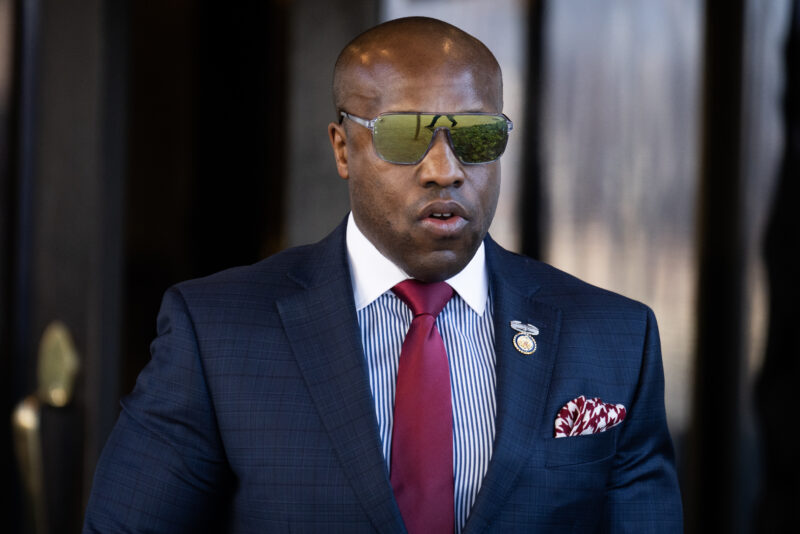
Rep. Mike Lawler (R-NY) leaves the House Republicans' caucus meeting at the Capitol Hill Club in Washington on Tuesday, May 23, 2023.


 Add JewishInsider on Google
The House Foreign Affairs Committee voted on Tuesday to advance legislation that aims to expedite arms sales to U.S. partners that are members of the Abraham Accords, as well as bills to review the U.S.-South Africa relationship and to combat the proliferation of Western-made parts in Iranian drones.
The arms sales bill comes as part of a broader push by House Republicans to speed up military transfers to U.S. allies. It would cut the congressional review period for sales to Abraham Accords partners that work with the U.S. on countering Iran and its proxies from 30 days to 15, in line with the review period for key U.S. defense partners including NATO members.
The bill, led by Rep. Mike Lawler (R-NY), advanced by a 31-19 vote, with Republican Reps. Scott Perry (R-PA), Tim Burchett (R-TN) and Warren Davidson (R-OH) voting against the bill and Democratic Reps. Ted Lieu (D-CA), Sheila Cherfilus-McCormick (D-FL), Greg Stanton (D-AZ), Jared Moskowitz (D-FL), Jim Costa (D-CA), George Latimer (D-NY) and Brad Schneider (D-IL) supporting it.
Rep. Brian Mast (R-FL), the committee chairman, argued that arms sales to the countries in question, which comprise a significant portion of U.S. military sales globally, suffer from “egregious delays,” prompting U.S. partners to consider buying from other countries, despite the U.S.’ interests in supporting its partners and ensuring their systems are compatible with those of the United States.
“There is a clear recognition that it’s simply not enough for our equipment to be the best,” Mast said. “Those procuring U.S.-origin weapons must also have the confidence that our equipment will be delivered on time in a transparent manner. Streamlining the foreign military sales process is critical if the U.S. is to remain the partner of choice, particularly in the Middle East and North Africa.”
Rep. Greg Meeks (D-NY), the ranking member of the committee, and other Democrats argued that the legislation would create “quid pro quo arrangements or enticements” for countries to join the Abraham Accords and would overlook human rights issues and other malign behavior by some Middle East partners, as well as diminish the role of Congress in the arms sales process.
“I don’t believe it is appropriate to equate long-standing allies like the U.K., like France or Canada, all countries with which the United States has detailed comprehensive defensive agreements, to countries who have thus far had inconsistent and checkered records regarding the use of U.S. weapons and conflicts and protections of sensitive defensive technologies,” Meeks said. “We do provide an expedited timeline to our closest allies because of the presumption of approval. I can’t say that we have a presumption of approval, in this case.”
He also described the legislation as an extension of the Trump administration’s business deals with Middle East nations.
By voice votes, the committee approved two amendments by Schneider, one of which would set a 20-year sunset for the bill. The other makes reference to the U.S.’ goal of expanding the Abraham Accords.
The South Africa legislation would require a review of the bilateral relationship between Washington and Pretoria, given South Africa’s deepening ties with authoritarian U.S. adversaries and its genocide case against Israel at the International Court of Justice. It would require the administration to assess whether to impose sanctions on South African officials for corruption or human rights abuses.
The bill advanced by a 34-16 vote, with Democratic Reps. Brad Sherman (D-CA), Bill Keating (D-MA) and Johnny Olszewski (D-MD) joining Lieu, Moskowitz, Costa, Latimer and all Republicans in supporting it. It advanced through the committee by a similar vote in the previous Congress.
Mast argued that, given South Africa’s increasing alignment with authoritarian regimes and its posture since the Oct. 7, 2023, attacks on Israel, the U.S. needs to “reset the expectations” it has in its relationship with South Africa, but “not sever ties.”
“This bill is not anti-South Africa, it is pro-accountability. For too long, we’ve watched a key partner drift closer to authoritarian regimes,” Mast said, adding that South Africa’s “actions raise serious questions about the ANC’s alignment with the democratic values and U.S. interests.”
Other Republicans, including the bill’s sponsor, Rep. Ronny Jackson (R-TX), said that “South Africa has abandoned America and our allies and increasingly aligned itself with our adversaries,” and is working to undermine U.S. interests and partners, particularly Israel.
Meeks argued that the bill would set the U.S. and South Africa, which are longtime partners, on the wrong path, and that the U.S. should prioritize “diplomacy and dialogue” to address concerns, rather than punitive action.
“I do not believe Congress should further enable or double down on President [Donald] Trump’s misguided approach when we disagree with our partners, including on the continent of Africa. We should handle that responsibly by using diplomacy and presenting convincing arguments,” Meeks said. “Unfortunately, this bill fails to do that, so I strongly oppose this legislation and urge all of us to look for future opportunities to steer United States-South Africa relations in a more productive direction.”
Other Democrats said that the bill would undermine U.S. interests on the African continent and globally.
The committee rejected, along party lines, a series of amendments introduced by Democrats focused on issues including refugee resettlement, refuting claims of white genocide and persecution of white farmers in South Africa, the history of aparthied in South Africa and the results of U.S. AIDS prevention funding to South Africa.
Republicans largely dismissed those amendments as unnecessary or attacks on Trump and his administration’s policies.
An amendment specifying that the Russian invasion of Ukraine was “illegal” — language included in last year’s version of the bill — was approved by a 48-2 vote, with only Rep. Keith Self (R-TX) and Davidson voting no.
The Iranian drone bill, which requires the administration to develop a strategy to prevent Iran from obtaining sensitive American and other Western-made technologies for use in Iran’s attack drones, passed the committee unanimously.
More Stories
DIPLOMACY DIARIES
AJC plans ‘diplomatic marathon’ amid U.N. General Assembly in New York

ON ALERT
NYPD braced for ‘multiple protests every day’ around U.N. summit

VEEP APPEAL
Michigan Jewish leaders urge Kamala Harris to appeal to El-Sayed on antisemitism, Israel
ENVOY DEBATE
Congressional Jewish Caucus opposes proposal to combine State Dept. Holocaust, antisemitism offices

DAMASCUS DIARIES
Syrian president blames Israel for diplomatic difficulties, rejects Trump push to send forces into Lebanon

MONEY MATTERS
Treasury moves to terminate tax-exempt status for some universities, private schools
Please log in if you already have a subscription, or subscribe to access the latest updates.
 Continue with Google
 Continue with Apple