





























































Capitol Hill Democrats expected to crack down on Israel in next Congress
Sen. Chris Coons (D-DE) and Rep. Greg Meeks (D-NY), who are both expected to hold powerful committee leadership roles if Democrats win both chambers, have recently made legislative moves that signal a harsher stance on Israel
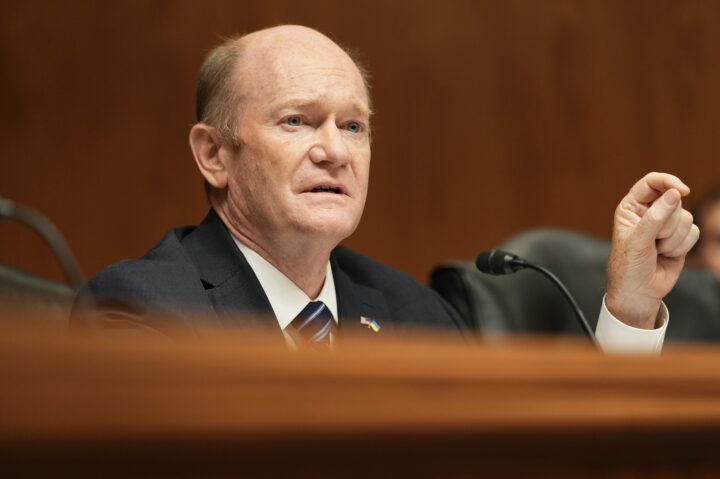
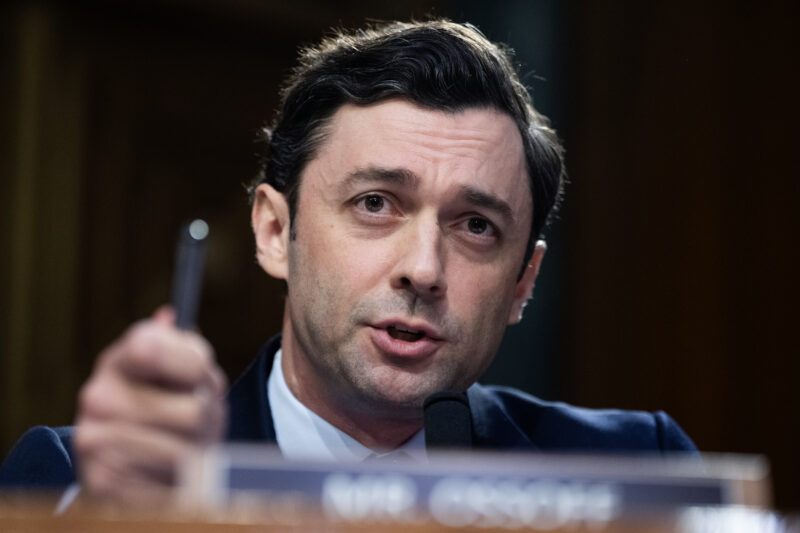
Eric Lee/Getty Images
Sen. Chris Coons (D-DE) speaks at the Senate Appropriations Committee on Capitol Hill on July 14, 2026 in Washington, DC.


 Add JewishInsider on Google
If Democrats take control of Congress next year — or even if they win back a majority in only the House of Representatives — expect a legislative agenda that’s a lot tougher on Israel than it has been in a long time.
With growing support among House Democrats for legislation restricting U.S. aid and arms sales to Israel, bills such as the Block the Bombs Act, the Ceasefire Compliance Act or measures similar to this summer’s vote on cutting aid to Israel could come to the House floor, and continued fights over the U.S.-Israel relationship in funding bills and other legislation seem likely.
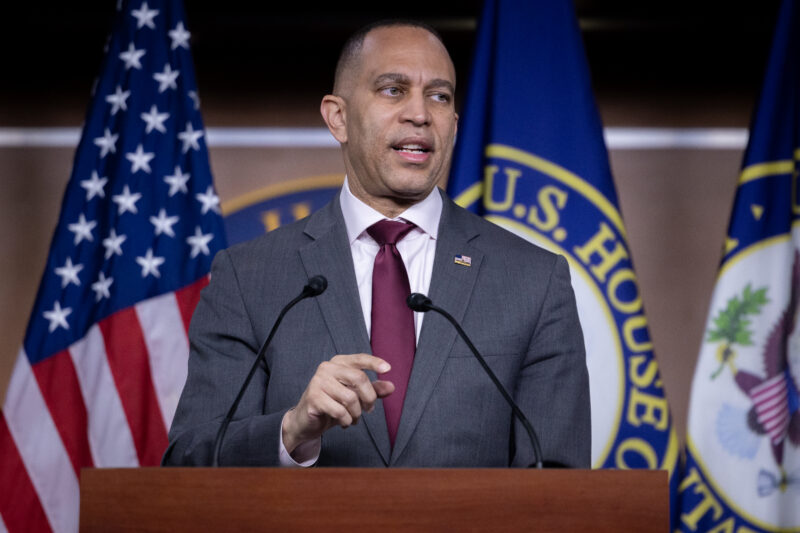
But the top target for senior Democrats at the moment is targeting settlement activity and settler violence in the West Bank. Asked by Jewish Insider at a press conference on Wednesday what Israel-related legislation Democrats might bring forward for a vote, House Minority Leader Hakeem Jeffries (D-NY) — who has generally been a reliable supporter of the U.S.-Israel relationship — pointed to a bill imposing sanctions related to West Bank violence.
“That now has broad support across the House Democratic Caucus family [and] is certainly a legislative step that should be considered in order to push back aggressively against the out of control settler violence in the West Bank,” Jeffries told Jewish Insider. “That cannot continue.”
Responding to JI's @marcrod97, Hakeem Jeffries suggested the West Bank Violence Prevention Act — which seeks to curb settler violence by imposing sanctions on perpetrators and potentially Israeli officials — could be up for a vote next year should Democrats take back the House. pic.twitter.com/2S8upRRz37
— Jewish Insider (@jewishinsider) September 23, 2026
The West Bank Violence Prevention Act would reimplement the West Bank sanctions regime established by the Biden administration and repealed by the Trump administration, which sought to penalize Israeli settlers who commit acts of violence. But the legislation also clearly targets members of the Israeli government connected to or who have permitted settler violence, as well as others who have provided support for such activities, a step the Biden administration never took.
The bill has 173 total co-sponsors — more than any other Israel-related Democratic bill introduced this Congress. Its supporters include all top House Democratic leaders, as well as the leaders of several key committees and even several moderate pro-Israel lawmakers.
There’s similar movement on West Bank issues on the Senate side. Sen. Chris Coons (D-DE), generally a strong ally of Israel who is in line to chair the Senate Foreign Relations Committee if Democrats take the upper chamber, introduced a bill on Wednesday with nearly 20 colleagues to sanction companies, financial institutions and Israeli officials involved in settlement construction in the controversial E1 area of the West Bank, which critics say would sever the West Bank from east Jerusalem.
And a separate Senate measure demanding a report on violence in the West Bank and the killings of U.S. citizens by Israeli settlers and security forces — which could trigger the cut-off of U.S. aid to Israel — picked up more than 20 co-sponsors, including Sen. Richard Blumenthal (D-CT), generally a strong supporter of the Jewish state.
Also among those expected to hold positions of power Rep. Greg Meeks (D-NY), who is in line to chair the House Foreign Affairs Committee, recently announced a hold on a $2.8 billion sale of bombs to Israel, financed by U.S. foreign military funding.
From their anticipated committee leadership posts, Coons and Meeks would hold significant sway over the direction of Democratic policy on Israel and have particular power to guide hearings on and investigations into the U.S.-Israel relationship, the West Bank and more.
At the same time, Coons is one of the few Senate Democrats who have consistently opposed resolutions led by Sen. Bernie Sanders (I-VT) to halt various arms sales to Israel, and Meeks opposed the amendment led by Rep. Thomas Massie (R-KY) to cut off U.S. aid to Israel.
A Democratic-led Congress would also likely bring more of those efforts to restrict or cut off both aid and arms sales to Israel. More than 100 House Democrats, nearly half of the caucus, supported efforts to cut off U.S. aid to Israel earlier this year. In the Senate, 40 Democrats have voted for at least one of Sanders’ resolutions to halt specific arms sales to Israel, and several Democratic candidates have said they would have voted the same way.
In the House, two bills pushing for stringent conditions on U.S. arms sales to Israel have been gaining steam.
The most prominent — and most punitive — of the bills is the Block the Bombs Act, on which Congressional Progressive Caucus Chair Rep. Greg Casar (D-TX) has said his caucus would push for a floor vote in the next term.
The bill would impose unprecedented restrictions on U.S. arms sales to Israel not applied to any other U.S. ally, preventing the transfer or sale of bombs, bomb-guidance kits and tank and artillery ammunition to Israel unless Congress passes a specific law authorizing each individual sale or transfer.
Congress would be required to delineate what specific purposes for which those weapons could be used, and Israel would be asked to provide written assurances that it would comply with those restrictions. Given the gridlock on Capitol Hill and the months it would take to approve any arms sales to Israel — if they could be moved past objections from anti-Israel members at all — critics say the bill would effectively place an arms embargo on Israel for those systems.
Though the Block the Bombs Act started with just 22 co-sponsors in 2025, it has grown to 82, including a handful of more moderate Democrats, a number that is likely to grow further after the midterms, with numerous expected Democratic freshmen pledging on the campaign trail to support the bill.
Alternative measures have been introduced to condition U.S. arms sales to the Jewish state, including the Ceasefire Compliance Act, led by Rep. Sean Casten (D-IL), with 53 co-sponsors. That bill would cut off any arms transfers or sales to Israel if it conducts any strikes inside Gaza, which could only be restored subject to a specific agreement by Israel that it will not use any U.S.-origin weapons inside Gaza or the West Bank.
The legislation would also impose various other conditions on arms sales to Israel related to compliance with the 20-point peace plan for Gaza, the establishment of Palestinian Authority governance in Gaza and steps to prevent West Bank violence or annexation.
Casten’s bill is backed by J Street, the progressive Israel advocacy group that Democratic leaders have increasingly leaned on as a validator on Israel policy issues, such as during the debate in the caucus over the Massie amendment (which J Street opposed).
Speaking broadly, Jeffries told JI that Democrats’ policy should be “anchored in two different principles”: supporting “Israel’s right to exist as a Jewish and democratic state” alongside a peaceful and prosperous Palestinian state to provide “the Palestinian people … the dignity and self-determination that they long deserved.”
Also worth watching: the next U.S.-Israel memorandum of understanding on military aid is set to be finalized during the next Congress. Expect real fights on the Hill, under Democratic leadership, over whether to continue appropriating funding for military aid to Israel and even over the future of U.S.-Israel cooperative military programs in legislation like the National Defense Authorization Act.
Whether negotiators believe that further aid to Israel would actually be passed by a hostile Congress could also be a factor that shapes the MOU itself.
Democratic control of either chamber is also likely to further fuel fights over the future of the U.S. relationship with the United Nations Relief and Works Agency, which were a repeated battle in the divided Congress in 2024.
This term, 79 House Democrats introduced legislation to restore funding to the scandal-plagued agency, including Rep. Rosa DeLauro (D-CT), who is likely to chair the House Appropriations Committee in the upcoming term if the Democrats win back the House.
More Stories

ON DEFENSE
El-Sayed dismisses half-sister’s comments about family’s Muslim Brotherhood ties as ‘hearsay’

PRESIDENTIAL POV
Obama scrutinizes Israel’s founding, says Palestinians want their ‘land back’

analysis
MBS bet Saudi Arabia’s future on economic transformation. The Houthis are testing that wager

Daily Overtime
Dublin hotel dumps antisemitism conference

MAINE EVENT
Maine Senate candidate Troy Jackson says Congress should cut off funding for Iran war
SHARING A STAGE
Top N.J. Dem recruit campaigned alongside New Jersey mayor accused of antisemitism
Please log in if you already have a subscription, or subscribe to access the latest updates.
 Continue with Google
 Continue with Apple