









































The secretary of state also assured lawmakers that all Trump administration officials are unified in their opposition to Iran maintaining domestic nuclear enrichment capabilities
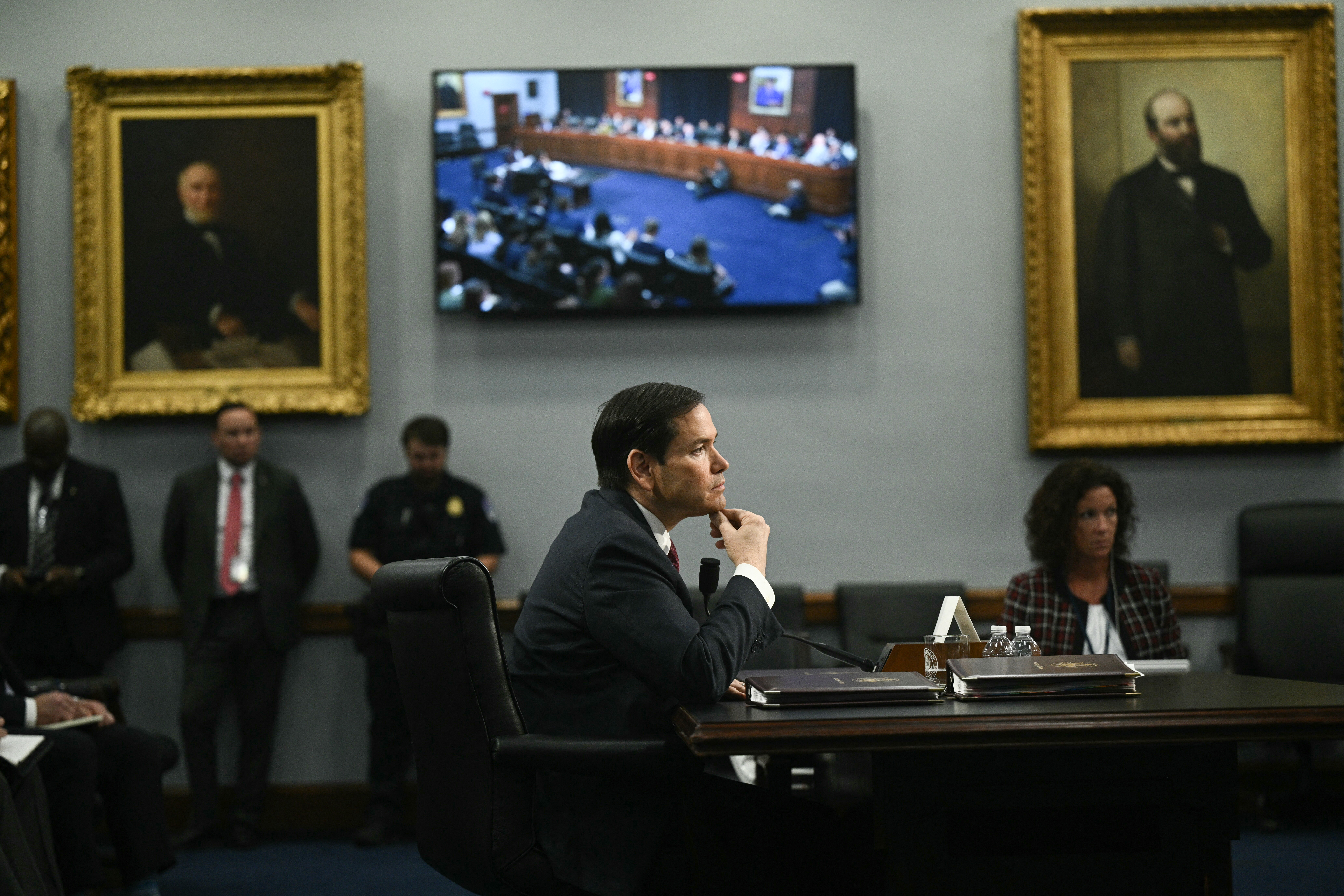
BRENDAN SMIALOWSKI/AFP via Getty Images
Secretary of State Marco Rubio testifies before a House Subcommittee on National Security, Department of State, and Related Programs hearing on the budget for the Department of State, on Capitol Hill in Washington, DC on May 21, 2025.


 Add JewishInsider on Google
In his second consecutive day of hearings on Capitol Hill, Secretary of State Marco Rubio said that he expects that additional Arab countries will join the Abraham Accords by the end of the year, if not earlier.
“We do have an Abraham Accords office that is actively working to identify a number of countries who have lined up and already I think we may have good news, certainly before the end of this year, of a number of more countries that are willing to join that alliance,” Rubio said a House Foreign Affairs Committee hearing on Wednesday.
The comments are consistent with other recent remarks by President Donald Trump and Middle East envoy Steve Witkoff.
Rubio added that the administration is currently working on selecting an ambassador for the Abraham Accords, as required under law, to submit for congressional confirmation.
He said that there is “still a willingness” in Saudi Arabia to normalize relations with Israel, but “certain conditions are impediments,” including the Oct. 7, 2023, Hamas attacks on Israel and the ensuing war.
Rubio’s testimony largely reinforced and added on his comments the day before, on issues including Iran and Syria.
He again insisted that all elements of the Trump administration, including Vice President JD Vance and Witkoff, are unified behind the position that Iran cannot be allowed to maintain its capacity to enrich uranium.
And he affirmed that U.S. law requires that any deal with Iran be submitted to Congress for review and approval, noting that he had been in Congress when that law was passed.
At an afternoon hearing with the House Appropriations Committee, Rubio again said that sanctions relating to Iranian proxy terrorism or other malign activities will not be impacted by a nuclear deal that does not address those subjects. Republicans in the past have questioned the distinction between nuclear and non-nuclear sanctions, particularly as part of the original 2015 nuclear deal, which took a similar approach. And they’ve argued that any sanctions relief would allow Iran to expand its support for regional terrorism.
Rubio said the administration is continuing to ramp up sanctions on Iran, and said that European parties to the deal are “on the verge” of implementing snapback sanctions on Iran. He said that the administration would support legislation to implement additional sanctions on Iran’s oil sector.
He denied knowledge of a Tuesday leak by administration officials that Israel was making plans to strike Iran’s nuclear program, adding, “I also don’t think it’s a mystery, though … that Israel has made clear that they retain the option of action to limit Iran from ever gaining a nuclear capability.”
Expanding on comments he made the day before, Rubio said that he favors moving the mission of U.S. security coordinator for Israel and the Palestinian territories under the authority of the U.S. ambassador to Israel so that it can be a better-integrated part of the U.S.’ Israel policy. But he vowed that the core function of the office will continue.
Rubio denied reports of talks between the United States and Saudi Arabia about potential nuclear cooperation outside of a “gold standard” deal, which would include banning domestic enrichment.
The secretary of state reiterated comments about the critical necessity of providing sanctions relief to Syria to help contribute to stability, but he said that continued sanctions relief “does have to be conditioned on them continuing to live by the commitments” that the Syrian government has made verbally, including to combat extremism, prevent Syria from becoming a launchpad for attacks on Israel and form a government that represents, includes and protects ethnic and religious diversity.
He indicated that the U.S. is not actively working to shut down the United Nations Relief and Works Agency, but pledged that the United States will not be providing any further aid to or through that organization and will use its power and funding to look for alternatives.
He said it will be up to other countries whether they continue working with UNRWA, though he noted that the U.S. has been the agency’s largest donor.
Rubio said that he would be supportive, in concept, of legislation to expand current U.S. anti-boycott laws to include compulsory boycotts imposed by international organizations. That legislation was pulled from a House floor vote after right-wing lawmakers falsely claimed it would ban U.S. citizens from boycotting Israel.
Pushing back on calls for the U.S. to withhold weapons sales to the United Arab Emirates over its support for one of the parties involved in the Sudanese Civil War that the U.S. has found is committing genocide, Rubio said that the U.S. is not fully in alignment with the UAE but argued that it’s critical for the U.S. to continue engaging with and maintain a strong relationship with the UAE for its broader foreign policy goals in the Middle East.
He said that maintaining such a relationship and expanding the U.S.’ diplomatic and economic relationship with Abraham Accords countries is also important to ensuring that the Accords continue to be successful.
Rubio said that the State Department had approved restarting aid programs for Jordan that remained frozen — though he noted most were initially exempted from the administration’s blanket freeze. He acknowledged that the frozen programs had been “a source of frustration for [Jordan], and frankly for me.” He continued, “Ultimately, we’re going to get all those programs online, if they’re not online already.”
In a heated back-and-forth with Rep. Pramila Jayapal (D-WA), who was brandishing a pocket Constitution, Rubio again defended the administration’s policy of revoking student visas from individuals accused of involvement in anti-Israel activity on college campuses, saying that they are coming to the United States to “tear this country [apart]” and “stir up problems on our campuses.”
Addressing the case of Rümeysa Öztürk, a Tufts University graduate student that supporters have said was detained solely for writing an op-ed in a student newspaper criticizing Israel, Rubio claimed the situation is not as has been represented. “Those are her lawyers’ claims and your claims, those are not the facts,” Rubio said.
Asked by Jayapal about a comment — “Jews are untrustworthy and a dangerous group” — made by an Afrikaner refugee recently admitted to the United States from South Africa, Rubio said that he would “look forward to revoking the visas of any lunatics you can identify.”
But when presented with the fact that the individual in question was admitted as a refugee, not on a visa, Rubio said that refugee admissions are “a totally different process,” adding “student visas are a privilege.”
Reps. George Latimer (D-NY), Johnny Olszewski (D-MD), Julie Johnson (D-TX) and Sarah McBride (D-DE) are also joining the committee

Kevin Dietsch/Getty Images
Rep. Pramila Jayapal (D-WA) questions a witness in the House Judiciary Committee on April 28, 2022, in Washington, D.C.
Rep. Pramila Jayapal (D-WA), the former chair of the House Progressive Caucus who has been a leading supporter of efforts to block weapons sales to Israel, is set to join the influential House Foreign Affairs Committee, House Democratic leadership announced on Tuesday.
Jayapal will join Reps. George Latimer (D-NY), Johnny Olszewski (D-MD), Julie Johnson (D-TX) and Sarah McBride (D-DE) as the new Democratic members of the key House committee.
Since Oct. 7, 2023, Jayapal has repeatedly voted against legislation to support Israel, counter Iran and combat antisemitism, including supplemental U.S. aid for Israel’s war effort, and has called on the U.S. to withhold aid, accusing Israel of violating arms sales law and serious human rights violations.
Weeks after the Hamas attack, Jayapal voted present on a widely bipartisan resolution expressing support for Israel and condemning Hamas, even though she initially sponsored it. She was among the earliest lawmakers to call for a cease-fire, sponsoring a resolution to that effect on Oct. 18, 2023.
She also faced accusations that she had equivocated about or downplayed Hamas’ use of sexual assault as a weapon of war in public comments.
Prior to Oct. 7, Jayapal described Israel as a “racist state,” comments she walked back under criticism from Democratic leadership, and suggested that the Progressive Caucus might ban members from taking funding from the pro-Israel advocacy group Democratic Majority for Israel. She also voted against a resolution supporting the Abraham Accords and the U.S.-Israel relationship and pushed for the State Department to consider controversial alternative definitions of antisemitism.
She suggested as early as 2020 that the U.S. should consider conditioning aid to Israel if it pursued annexation of the West Bank.
She has also led efforts to restore funding for the United Nations Relief and Works Agency and opposed U.S. strikes against the Houthis as unconstitutional.
Outside of Middle East policy, in 2022, Jayapal led Progressive Caucus members on a letter calling for direct talks between Russia and Ukraine for a peace deal that was quickly disavowed by some of its key signatories.
Jayapal did not immediately provide comment.
Latimer, also joining the committee, was elected on a staunchly pro-Israel platform — ousting anti-Israel Rep. Jamaal Bowman (D-NY) — with the support of the large Jewish community in Westchester, NY. He voted last week in favor of sanctions on the International Criminal Court.
Olszewski also ran on a pro-Israel platform and has ties to the Maryland Jewish community. He voted against the ICC sanctions but signed a letter to the ICC condemning its efforts to arrest Israeli leaders, as did Johnson and McBride.
In her campaign, McBride also expressed strong support for Israel, a stance that earned her the particular ire of some in the progressive community.
Johnson holds the seat of Rep. Collin Allred (D-TX), a former HFAC member.
Elsewhere, Democrats announced that Reps. Jason Crow (D-CO), Gil Cisneros (D-CA), Eric Sorensen (D-IL), Maggie Goodlander (D-NH), Sarah Elfreth (D-MD), George Whitesides (D-CA), Derek Tran (D-CA), Eugene Vindman (D-VA) and Wesley Bell (D-MO) will join the Armed Services Committee.
Crow has repeatedly led letters accusing Israel of violating U.S. arms sales law.
Among the freshmen members, Cisneros and Bell voted for the ICC sanctions, while Cisneros, Elfreth, Tran and Vindman voted against. Whitesides was not present for the vote.
Vindman, a former military war crimes prosecutor and investigator, ran as a supporter of Israel but has also called for caution in Israeli military operations. He was one of the leaders of the letter condemning the ICC arrest warrants. Cisneros, Sorensen, Goodlander and Elfreth all signed it as well.
Goodlander, the wife of Biden national security adviser Jake Sullivan, is a former congressional national security adviser and intelligence officer in the Navy Reserves, who conducted research fellowships in the Middle East. She expressed support for Israel and continued U.S. aid on the campaign trail.
Elfreth received support from the AIPAC-affiliated United Democracy Project super-PAC and said she opposes conditions on U.S. aid, though she appeared to indicate support for such efforts at a candidate forum last year. A spokesperson said after that event that she supports the existing, universally applicable regulations on U.S. aid, not new conditions.
Bell ran on a staunchly pro-Israel platform, with support from St. Louis’ Jewish community, to oust anti-Israel former Rep. Cori Bush (D-MO).
Reps. Greg Casar (D-TX), Summer Lee (D-PA) and John Mannion (D-NY) are set to join the House Committee on Education and the Workforce, the committee that investigated campus antisemitism.
Dexter had been floated as a potential pro-Israel recruit against Rep. Pramila Jayapal’s sister

Maxine for Oregon campaign website
Maxine Dexter
In Oregon’s 3rd Congressional District, the candidacy of Susheela Jayapal, a Multnomah County commissioner and sister of Congressional Progressive Caucus Chair Rep. Pramila Jayapal (D-WA) — a leading advocate for suspending U.S. arms sales to Israel — quickly raised concerns in the pro-Israel community.
Democratic state Rep. Maxine Dexter, a pulmonologist who had been floated as a potential pro-Israel recruit against Jayapal, has seen an influx of support for her campaign in the run-up to the May 21 primary. Dexter told Jewish Insider earlier this year she wants to see a permanent end to the war in Gaza, but also said she opposes new conditions on U.S. aid to Israel.
On the campaign trail, Jayapal has supported conditions on U.S. aid to Israel and an immediate cease-fire between Israel and Hamas. She has said she opposes anti-Boycott, Divestment and Sanctions measures without directly offering her own views. She said she’d reject donations from anyone who “donates to or is allied with AIPAC.”
Jayapal also voted against a resolution in the Multnomah County board expressing support for Israel days after Oct. 7.
A third candidate, Gresham City Councilor Eddy Morales, did not address questions from JI late last year about his positions on U.S. aid to Israel, and conducted a joint press conference with Jayapal to condemn outside spending backing Dexter in the race.
The Dexter campaign has received more than $4 million in assistance from outside groups, which Jayapal and Morales have claimed are being funded by donors connected to AIPAC.
AIPAC declined to comment. Jayapal and Morales did not respond to requests for comment.
Dexter has herself denounced the outside spending as “a prime example of how broken our campaign finance system is,” while also highlighting the lack of “hard evidence” for her opponents’ claims about the groups’ supporters.
Dexter is endorsed by The Oregonian and Willamette Week, as well as some local unions and current and former elected officials.
Dexter has seen a late surge in fundraising as well, raising nearly three times the amount of money between March and April ($581,000) than she did in the three months prior ($184,000), according to federal filings. She now is the leading overall fundraiser, surpassing Jayapal and Morales.
Some of the recent donations to Dexter have come from donors who have also given to AIPAC.
One of the outside groups spending in the race is a science-focused PAC, 314 Action, which says it’s backing Dexter because of her background as a doctor. Another is a new, California-based group called Voters for Responsive Government, which has so far only opposed Jayapal.
A Dexter campaign adviser accused Jayapal and Morales of hypocrisy, noting that both are benefiting from outside spending as well — albeit in much smaller quantities; the adviser noted that Morales is being backed by a real estate industry group that has backed Republicans.
Shaughnessy Naughton, founder and president of 314 Action, told JI in a statement the group has long supported Dexter, dating back to her state House run, due to her medical and scientific background and work in the state House.
“We also are bumping our heads up against federal preemptions that are absolutely in need of being addressed across those issues,” Dexter told JI in an interview earlier this year, saying she’s running for Congress primarily due to her experiences as a physician, focusing on issues including addiction, homelessness, reproductive rights, the environment, housing and medical costs, mental health and gun control. “I needed to step in. I know that I’m an effective leader, I’m experienced and my physician hat allows me to make policy that continues to be people-focused.”
“The insinuation that we are a front group for any other organization is not only false, but also insulting to our mission and our successful track record of electing over 300 Democratic scientists to office,” he said. “Our mission at 314 is to elect Democratic scientists and our movement is fueled by over 6 million grassroots supporters who are energized by that mission to elect Democratic scientists to public office at every level, from the U.S. Senate to school boards.”
Voters for Responsive Government did not respond to a request for comment.
Thirty of Dexter’s colleagues in the state House and Senate, including the leaders of both chambers, also put out a statement defending her from her opponents’ attacks, arguing, “The idea that she would ever do the bidding of any group or special interest is offensive and wrong.”
Dexter told JI in an interview earlier this year she’s running for Congress primarily due to her experiences as a physician, focusing on issues including addiction, homelessness, reproductive rights, the environment, housing and medical costs, mental health and gun control.
“We also are bumping our heads up against federal preemptions that are absolutely in need of being addressed across those issues,” Dexter said. “I needed to step in. I know that I’m an effective leader, I’m experienced and my physician hat allows me to make policy that continues to be people-focused.”
“What happened on Oct. 7 was horrific. There was a cease-fire on Oct. 6, and Hamas killed 1,200 people brutally, created so much pain in people’s homes within a secure border of their nation. That was horrific,” Dexter said. “And of course, Israel had the right to defend itself, they were obligated to defend itself.”
She said her experience in health care is a key advantage to her among the candidates; she also pointed to her experience as a member of the Oregon state House on issues including housing and homelessness. She voted earlier this year in favor of legislation that re-criminalized possession of small amounts of illegal drugs in Oregon.
“I am truly here because I believe our country is on the wrong track,” she said. “I know I have the integrity, the courage and the compassion to lead well.”
Dexter said she’s been in conversation with leaders in the Jewish community since before she entered the race about the Hamas attack and its ongoing impacts, both in the Middle East and at home, as well as working to educate herself on the conflict.
“What happened on Oct. 7 was horrific. There was a cease-fire on Oct. 6, and Hamas killed 1,200 people brutally, created so much pain in people’s homes within a secure border of their nation. That was horrific,” Dexter said. “And of course, Israel had the right to defend itself, they were obligated to defend itself.”
She also expressed concern, as a physician, about a lack of access to medical care in Gaza and widespread civilian deaths, as well as Hamas’ construction of tunnels underneath Gaza hospitals.
“We need a negotiated cease-fire and long-term peace and two-state solution and end to the violence, and get food and humanitarian aid to people in Gaza, urgently,” Dexter said, calling humanitarian aid shortages, “deeply concerning, morally, just untenable in my mind.”
She added that her priority, as a doctor and a mother, is “protecting and saving human life” and the “families who did not ask their homes to become a battleground.”
But Dexter said it’s difficult to see Hamas as a “viable component” of a negotiated agreement, and that the Palestinian Authority, Arab states and other parties need to be involved in the talks in order to secure a viable and durable peace.
She said she likewise is “really challenged with [Prime Minister Benjamin] Netanyahu’s leadership” because she doesn’t “believe that he wants peace.”
Dexter added that she wants to see both the Israeli and Palestinian sides be committed to peace, but said that it’s up to the Israeli people to decide their leadership.
The state lawmaker has sought to highlight her position on the conflict, running a Facebook ad in late April and early May, reading, “Every day without a ceasefire that returns hostages to their families and rushes humanitarian aid into Gaza is one day too many.”
Jayapal has advertised herself as the only candidate supporting a cease-fire.
“Dexter has been clear about her values and commitment to supporting the US-Israel relationship and fighting antisemitism, both important issues right now,” Pro-Israel America’s executive director, Samantha Garelick, said in a statement to JI.
Dexter said she’s supportive of the Biden administration’s decision to impose new conditions and oversight provisions on arms sales globally — a move primarily prompted by congressional pressure over the war in Gaza — but said she doesn’t believe there should be additional conditions on aid to Israel that don’t apply to all allies.
Dexter spoke to JI well in advance of the administration’s decision to pause some arms transfers to Israel and threaten others if Israel conducts a full-scale invasion of Rafah.
Dexter added that she thinks congressional oversight is important to ensure that all aid recipients comply with U.S. law and international humanitarian law, as mandated by existing U.S. law.
Pro-Israel America is the only Jewish or pro-Israel group that has made an endorsement in the race, supporting Dexter.
“Dexter has been clear about her values and commitment to supporting the US-Israel relationship and fighting antisemitism, both important issues right now,” PIA’s executive director, Samantha Garelick, said in a statement to JI.
J Street and Peace Action are backing Jayapal.
Domestically, Dexter expressed deep concern about “heartbreaking” antisemitism and hate crimes impacting the Jewish community, as well as attacks on the Muslim community. This month, a Jewish student at Portland’s Reed College was struck in the head by a rock thrown into the student’s dorm room — an incident that occurred a day after the student’s mezuzah affixed to the door was removed and destroyed.
“This is not who we are as Americans,” Dexter said. “Actually — it is who we are, but we as leaders must lean into the humanity of the people across our communities and uphold the necessity of treating everyone with respect and understanding, and not allowing hate to be propagated, and not speaking up.”
She particularly highlighted incidents impacting young children and their parents, at children’s swimming lessons and elementary schools. She said she’s heard troubling stories from her own son and other parents and community members about incidents in the district.
“This is absolutely a moment where we as leaders need to step in and acknowledge that this behavior is happening and to stand up against it,” Dexter said. “I just want us to center everyone’s humanity. My Jewish neighbor walking their child to school should not fear in their own community any more than anyone else does.”
Days after Oct. 7, Susheela Jayapal declined to sign onto a statement condemning Hamas and standing with Israel

Susheelaforcongress website
Susheela Jayapal
Pro-Israel activists in Portland, Ore., are bracing for what could be a bitterly divided House race as longtime Rep. Earl Blumenauer (D-OR) prepares to retire at the end of his current term, opening up a rare vacancy in one of the state’s most progressive districts.
The Democratic primary field, which is expected to grow in the coming weeks, has so far drawn two candidates, most prominently Susheela Jayapal, a former Multnomah County commissioner whose younger sister, Rep. Pramila Jayapal (D-WA), leads the Congressional Progressive Caucus and is among the most outspoken critics of Israel in the House.
While the elder Jayapal, 61, had no discernible history of public engagement on Middle East policy until recently, her approach to the war between Israel and Hamas suggests there is little distance between the two siblings on such matters — fueling concerns among local pro-Israel advocates who have yet to coalesce behind a viable candidate.
One major source of contention stems from an emotionally charged county board meeting days after Hamas’ Oct. 7 terror attack, when Jayapal, who stepped down as commissioner last month to launch her campaign, voted to reject a resolution seeking to show unified support for lighting a Portland bridge in blue and white.
“I don’t think I can acknowledge [the] loss of one group when there are Palestinian lives being lost as well,” Jayapal said of the resolution, even as she endorsed illuminating the Morrison Bridge in solidarity with Israel.
Later that day, Jayapal drew heightened scrutiny from Jewish and pro-Israel leaders after she chose not to include her name on a joint statement — signed by two commissioners and the county chair — condemning Hamas and standing with Israel as well as Portland’s Jewish community.
“We were disappointed that she didn’t sign on,” Bob Horenstein, the director of community relations at the Jewish Federation of Greater Portland, told Jewish Insider in a recent interview. “I can only surmise that she didn’t feel like it was balanced.”
Sharon Meieran, the lone Jewish commissioner on Multnomah County’s board, who led the statement, said that Jayapal had initially seemed open to adding her name but ultimately pulled out “at the very last minute,” even after some of the language had been revised at her behest during a strained editing process.
In written comments to JI last week, Meieran alleged that Jayapal had also tried to remove a Holocaust reference from the draft statement, creating further tension behind the scenes. “I was somewhat reassured when Commissioner Jayapal indicated she would consider signing on to the statement,” Meieran said. “But then I heard that she had sought to remove reference to the Holocaust.”
“I refused to remove the reference,” Meieran said, noting that the request had been conveyed by her communications director. “As someone who had numerous family members murdered in the Holocaust, one of the most terrifying aspects of the Hamas attack was the scale and targeting of innocent civilians because they were Jewish. No one affected by the Holocaust could fail to feel the connection.”
Meieran said she could not speculate about Jayapal’s reasons for backing out of the statement but explained that she was “surprised” and “deeply saddened” by her former colleague’s decision. “The situation in the Middle East is complicated beyond measure at every possible level,” she acknowledged. “But issuing a statement seemed like the least our board could do.”
In a statement shared with JI on Sunday, Jayapal said it was “unequivocally false” that she had sought to excise the Holocaust reference. “In fact, I had suggested the language that was ultimately used (‘the deadliest day for Jewish people since the Holocaust’) as an alternative to the original language, which I feel made an equivalency with the Holocaust, which is a singularly horrific event on an incomparable scale,” she countered.
“While working on edits with my colleagues, it became clear that the urgency of the moment superseded the time it would take for us to agree on what words to use to describe our strong condemnation of terror and violence against civilians,” Jayapal continued. “That’s why there were separate statements. My views then and now are largely shaped by my conversations with Jewish community members in Multnomah County.”
Jayapal’s response, which was more broadly worded and released the same day as the joint statement, denounced Hamas while expressing support for the bridge lighting as “a symbol of our absolute condemnation of violence in all its forms, and of our solidarity with the people of Israel in this moment of their grief.”
“My heart breaks for all those across Israel and Palestine who are living in a state of war and continued violence,” Jayapal said in her Oct. 12 statement, which did not mention the Holocaust or explicitly cite the Jewish community, “and for the loss and fear that all their families and friends here in Multnomah County are experiencing. It is unimaginable.”
“What I make of it is that she is running for Congress and is weighing the political implications of what she might say,” said a person familiar with some of the deliberations behind Jayapal’s recent comments on the Hamas attack, who requested anonymity to discuss a sensitive topic. “She was going to try very hard to issue a statement that she hoped would appease both sides.”
Despite her opposition to the board resolution, Jayapal insisted in a separate statement to JI last week that she had been “clear and consistent” about her support for lighting the bridge. “I said so from the dais in the public meeting, I said so in my statement afterwards, and I said so in local news interviews.”
Hannah Love, Jayapal’s campaign spokesperson, clarified in an email to JI that the former commissioner’s “position was that lighting the bridge was within the county chair’s authority, not the board’s.”
As Israel’s war against Hamas shapes the trajectory of several Democratic primaries across the country, Jayapal’s recent maneuvering — and the resulting fallout — underscores the perils some progressive candidates are now facing as they navigate a politically charged issue that is sowing increasingly sharp divisions among party members.
“There are strongly felt perspectives on both sides of the conflict here locally,” said Jake Weigler, a Democratic strategist in Oregon, speculating that Portland’s activist community may push candidates “to stake out a clear position that could then drive national groups to get more involved in the race.”
“What I make of it is that she is running for Congress and is weighing the political implications of what she might say,” said a person familiar with some of the deliberations behind Jayapal’s recent comments on the Hamas attack, who requested anonymity to discuss a sensitive topic. “She was going to try very hard to issue a statement that she hoped would appease both sides.”
The Portland contest is among a few House races in the Pacific Northwest that Democratic strategists and Jewish activists in the region expect to draw spending from leading pro-Israel groups, even as they have yet to disclose their plans.
“There are strongly felt perspectives on both sides of the conflict here locally,” said Jake Weigler, a Democratic strategist in Oregon, speculating that Portland’s activist community may push candidates “to stake out a clear position that could then drive national groups to get more involved in the race.”
But while pro-Israel groups are already setting their sights on House races where far-left incumbents have been among the most strident critics of Israel, it is unclear how such organizations are assessing a growing number of open-seat races fueled by a new burst of impending retirements.
Democratic Majority for Israel is “closely” following the Portland race but is still weighing where it will direct its resources, according to a source familiar with internal deliberations. A spokesperson for AIPAC, meanwhile, said in an email to JI that the group is “in the process of evaluating congressional races” but has “made no decisions at this time.”
With six months to go until the May primary, the race is almost certain to draw more candidates, setting up a potential clash between “an anti-Israel progressive and a pro-Israel progressive,” as one pro-Israel leader in Portland who opposes Jayapal put it in a recent conversation with JI.
One likely candidate who could possibly gain traction within the pro-Israel community is state Rep. Maxine Dexter, who has been characterized as a pragmatic progressive but does not appear to have issued any statements on Middle East policy. In a recent email to JI, Dexter, who is expected to launch a campaign soon, said she has received “strong encouragement” to run and will be announcing her plans this week.
While Dexter did not address questions on her approach to Israel — and local Jewish activists surveyed by JI were unaware of her positions — Meieran said she is “excited about her potential candidacy.”
“I can’t speak to her views on Israel, but I was impressed that she attended an event hosted by Congregation Beth Israel in Portland last night to learn about the Zioness movement,” Meieran told JI on Saturday. “The focus was on intersectional identities and how standing up for social justice and Zionism are not mutually exclusive, but rather are inextricably linked. Showing up and being willing to listen and learn matters, now more than ever, and Maxine walks that walk.”
Eddy Morales, a Gresham City councilman with ties to national Democratic leaders, is also running for the seat held by Blumenauer — who has embraced more critical positions on Israel — for more than 25 years.
In an email to JI last week, Morales, who has visited a kibbutz that was targeted during the Oct. 7 attack, shared his own views on the Israel-Hamas war, which he addressed on social media days before Jayapal released her own statement.
A pro-Israel leader in Portland, who asked to remain anonymous to protect his privacy, said there is growing concern among other like-minded local activists that Jayapal’s Middle East policy positions “will not differ that much from her sister.”
“We must do everything we can to prevent any further atrocities and crimes against civilians, no matter what they look like or where they live,” he said. “Today, as people in Palestine and Israel mourn and seek safety, we must demand that our leaders support immediate steps to help those in danger, like continuing to bring hostages home, preventing and stopping massive civilian deaths and restoring food, water and electricity in Gaza.”
He added that the U.S. “must also demand long-term solutions for people of the whole region, whether they’re Palestinian or Israeli, and support those who simply want to live their lives and raise their families in peace.”
As the race unfolds, the pro-Israel leader in Portland, who asked to remain anonymous to protect his privacy, said there is growing concern among other like-minded local activists that Jayapal’s Middle East policy positions “will not differ that much from her sister,” who faced bipartisan backlash last summer for calling Israel “a racist state,” remarks she later walked back. The progressive leader also drew scrutiny on Sunday for comments that some House colleagues accused of equivocating over Hamas’ use of sexual violence against Israeli women.
For her part, Jayapal’s rhetoric as an aspiring congresswoman has been more carefully worded than that of her sister, who has endorsed her campaign. Still, her comments so far have indicated that they are aligned on hot-button issues including calls for a cease-fire and conditioning aid to Israel.
In a statement shared on social media last week after JI had reached out to her campaign for comment, Jayapal voiced hope that the now-broken truce between Israel and Hamas would be “a step towards a more long-term and mutual cessation of hostilities, or ceasefire.”
During an interview with a local TV station last month, Jayapal, a former corporate lawyer, also suggested that she is in favor of reconsidering the continuation of U.S. funding to Israel, noting that she supports humanitarian and military assistance “where necessary and with appropriate conditions.”
Morales, for his part, did not address requests for comment from JI regarding his positions on such issues. Dexter declined to weigh in on specific policy questions until she makes a decision about whether to run.
The Jewish federation in Portland is planning to organize a forum to hear candidates’ views on Israel and other subjects of interest to Jewish voters in the coming months, according to a spokesperson for the organization.
Elizabeth Mazzara Myers, a Democratic strategist in Portland, said she assumes that the war in Gaza will “play a role” in the race, especially if candidates stake out contrasting views. “I expect many of the candidates in this district are going to be shades of gray in terms of progressive Democrat policy differences,” she told JI last week, “so that actually may be a space where there are differences.”
Separately, seven lawmakers have so far joined a statement on the Congressional Progressive Caucus chair’s remarks about Israel
Kevin Dietsch/Getty Images
Rep. Pramila Jayapal (D-WA) questions a witness in the House Judiciary Committee on April 28, 2022, in Washington, D.C.
The House Democratic leadership team, Reps. Hakeem Jeffries (D-NY), Katherine Clark (D-MA), Pete Aguilar (D-CA) and Ted Lieu (D-CA), in a joint statement issued on Sunday evening rejected comments by Congressional Progressive Caucus Chair Rep. Pramila Jayapal (D-WA) describing Israel as a “racist state.”
Jayapal, speaking at the Netroots Nation conference in Chicago on Saturday, said, “I want you to know that we have been fighting to make it clear that Israel is a racist state, that the Palestinian people deserve self-determination and autonomy, that the dream of a two-state solution is slipping away from us, that it does not even feel possible.” Jayapal’s remarks came in response to chants from pro-Palestinian protesters who interrupted the event.
“Israel is not a racist state,” the Democratic leaders said. “As House Democratic leaders, we strongly support Israel’s right to exist as a homeland for the Jewish people.”
“Certainly, there are individual members of the current Israeli governing coalition with whom we strongly disagree. That is also the case with respect to some on the other side of the aisle who we serve with in the United States Congress,” they continue. “Government officials come and go. The special relationship between the United States and Israel will endure. We are determined to make sure support for Israel in the Congress remains strongly bipartisan.”
They also stated that they “look forward to welcoming Israeli President Isaac Herzog” for his speech before a joint session of Congress this week. At least four Democrats are expected to boycott Herzog’s speech. Lieu is a CPC member, the first to publicly distance himself from Jayapal’s comments.
Jayapal walked back her remarks on Sunday evening, stating, “I do not believe the idea of Israel as a nation is racist. I do, however, believe that [Israeli Prime Minister Benjamin] Netanyahu’s extreme right-wing government has engaged in discriminatory and outright racist policies and that there are extreme racists driving that policy within the leadership of the current government.”
She said that she was attempting to “defuse a tense situation” and was “on a very human level… responding to the deep pain and hopelessness for Palestinians and their diaspora communities when it comes to this debate, and I in no way intended to deny the deep pain and hurt of Israelis and their Jewish diaspora community.”
Separately, seven pro-Israel Democratic lawmakers have signed onto a draft statement saying they are “deeply concerned about” Jayapal’s “unacceptable comments about our historic, democratic ally Israel.”
The statement, which was still circulating for additional signatories as of Sunday evening, has been signed so far by Reps. Josh Gottheimer (D-NJ), Debbie Wasserman Schultz (D-FL), Greg Landsman (D-OH), Brad Schneider (D-IL), Dean Phillips (D-MN), Jared Moskowitz (D-FL) and Kathy Manning (D-NC). A draft was obtained by Jewish Insider.
The International Holocaust Remembrance Alliance’s working definition of antisemitism provides as an example of antisemitism, “denying the Jewish people their right to self-determination, e.g., by claiming that the existence of a State of Israel is a racist endeavor.”
In the joint statement, the lawmakers said they “appreciate [Jayapal’s] retraction.”
They continued, “Regardless of extremist views from groups aligned with either party, efforts to rewrite history and question the Jewish State’s right to exist, or our historic bipartisan relationship, will never succeed in Congress. We remain committed to peace between Israel and the Palestinians to establish two-states that exist side-by-side in peace, prosperity, and mutual security.”
They also state that they “will never allow anti-Zionist voices that embolden antisemitism to hijack the Democratic Party and country” and that “efforts to delegitimize and demonize [Israel] are not only dangerous and antisemitic, but they also undermine America’s national security.”
Anti-Defamation League CEO Jonathan Greenblatt said in a statement that Jayapal’s initial comments were “rashly inaccurate” and “reckless,” adding that ADL “welcome[s] Rep. Jayapal’s clarification.”
“We see again and again how hostile rhetoric can spawn hateful actions, so we would hope that an elected official at her level would choose her words far more carefully,” Greenblatt said. “While we vehemently disagree with many of Rep. Jayapal’s characterizations of Israel and its policies, we share her hope of an ultimate two-state solution to the conflict.”
Greenblatt also offered to travel to Israel with Jayapal “to share with her a diverse, vibrant country where Jews, Muslims, Christians and Bahais; Arabs and Israelis; gay and straight; and essentially people of all ethnicities, faiths and persuasions are living and working side by side.”
Jeremy Ben-Ami, the president of J Street, which has endorsed Jayapal, praised her walk-back statement.
“Thank you @RepJayapal. You are staking out a thoughtful space on a tough issue,” Ben-Ami tweeted. “You’re defending @janschakowsky, expressing your support for the state of Israel and voicing important critiques of its government’s policies. Twitter may not value nuance but the world needs it.”
Banning endorsees from accepting pro-Israel Democratic donations would be ‘repudiating a core element of the Democratic platform and the Biden-Harris agenda’
Kevin Dietsch/Getty Images
Rep. Pramila Jayapal (D-WA) questions a witness in the House Judiciary Committee on April 28, 2022, in Washington, D.C.
Mark Mellman, the president of Democratic Majority for Israel’s political arm, warned leaders of the Congressional Progressive Caucus that it would be engaging in potentially discriminatory behavior if it changes its endorsement rules to exclude members who accept campaign contributions from the pro-Israel group.
The idea was recently floated as a possibility by Rep. Pramila Jayapal (D-WA), the CPC chairwoman.
“Reforming our campaign finance system as a whole is a laudable goal,” Mellman explained to Jewish Insider on Tuesday morning. “But I don’t think the progressive caucus is going to want to allow endorsees to ‘accept’ anti-Israel money, but then turn around and discriminate against pro-Israel Democratic money, especially since they’d be repudiating a core element of the Democratic platform and the Biden-Harris agenda, which is support for a strong U.S.-Israel relationship.”
Mellman was responding directly to comments from Jayapal, who suggested to Punchbowl News on Monday that caucus leaders had been weighing the imposition of such a provision. Her remarks came amid rising tensions between far-left and moderate Democrats over the CPC’s recent endorsement of DMFI-backed Rep. Shontel Brown (D-OH), who is seeking reelection today in the Cleveland-area primary.
Jayapal said the CPC’s executive board had been mulling the possibility of revising its political action committee’s endorsement process “based on,” among other things, “whether somebody accepts this kind of giant PAC money, whether it’s from the crypto billionaires or whether it’s from DMFI.”
DMFI has spent more than $1 million on Brown’s behalf as she faces a primary rematch with Nina Turner, a former Ohio state senator and presidential campaign surrogate for Sen. Bernie Sanders (I-VT). Turner had earned an endorsement from the CPC’s PAC when she unsuccessfully campaigned for the seat in a heated special House election last year.
Brown, who prevailed with support from establishment Democrats and pro-Israel groups, among others, joined the progressive caucus after she assumed office in November. She was endorsed by the CPC PAC last month, though not without some apparent resistance from left-leaning members who had previously supported Turner. Rep. Alexandria Ocasio-Cortez (D-NY), for instance, announced on Monday night that she was again endorsing Turner.
While Jayapal had also personally supported Turner in 2021, she has defended the CPC’s decision to back a fellow incumbent “in good standing for four months.” Still, speaking with Punchbowl, the chairwoman acknowledged “the frustration” among critics of the endorsement and said she is now reviewing the process behind it.
“Should we have a certain period of time,” Jayapal said, “whether it’s six months or a year or something, that you have to be a member of the CPC and [in] good standing?”
How DMFI fits into the equation is somewhat more opaque and may hint at deeper fissures within the party — particularly as Israel has increasingly become a litmus test for progressives who are critical of American support for the Jewish state.
If adopted, the DMFI rule change would likely alienate a large and diverse swath of CPC members who have earned support from the pro-Israel group, including Reps. Jerry Nadler (D-NY), Ritchie Torres (D-NY), Lois Frankel (D-FL), Brendan Boyle (D-PA), Teresa Leger Fernandez (D-NM) and Katie Porter (D-CA), among others.
At least 20 members of the CPC — which includes nearly 100 House Democrats — have earned endorsements from DMFI in recent years.
Asked for comment, a spokesperson for Jayapal deferred to a CPC communications director who suggested reaching out to CPC PAC Executive Director Evan Brown. He did not respond to email inquiries from JI.
DMFI is by no means new to intra-party conflict. The pro-Israel group has often squared off against progressive primary challengers, including Rep. Jamaal Bowman (D-NY), who unseated former Rep. Eliot Engel (D-NY), a longtime pro-Israel stalwart.
Last year in Ohio’s 11th District, DMFI spent more than $2 million in an effort to boost Brown over Turner, who argues that she was misrepresented as anti-Israel by outside groups. In her concession speech last year, she criticized the “evil money” that “manipulated and maligned” the election.
“Obviously this race sent a very powerful message over the summer when Shontel Brown won and Nina Turner lost,” Mellman said in an interview with JI on Monday. “It was very important to us to make sure that message was confirmed in this election.”
DMFI has invested fewer resources this election, but still boasted in a memo that it is the top outside spending group in the race, ahead of Protect Our Future PAC, Mainstream Democrats PAC and United Democracy Project, the super PAC recently created by AIPAC.
“It’s a similar message that we had during the special election, but the difference before was it was all prospective, and now we’ve got some actual facts,” Mellman told JI, praising Brown as a “pro-Israel champion” in the House.
In her second attempt, Turner has engaged in more direct outreach to Jewish voters in Cleveland while appearing to fine-tune her messaging on Israel.
But many community members continue to side with Brown. Pinchas Landis, an Orthodox Jewish rabbi from University Heights, says the congresswoman has remained outspoken in her support for the Jewish state, even amid resistance from what he characterized as “anti-Israel tendencies” within the party.
“We really feel that in the four months she’s been there that she’s really keeping that promise of standing strong,” he told JI. “There’s a lot of pressures right now in the different caucuses.”
Please log in if you already have a subscription, or subscribe to access the latest updates.
 Continue with Google
 Continue with Apple