































When pressed, neither the mayor nor his spokesperson would condemn Kaif Gilani’s signal-boosting of a Holocaust revisionist and ex-Hamas chief
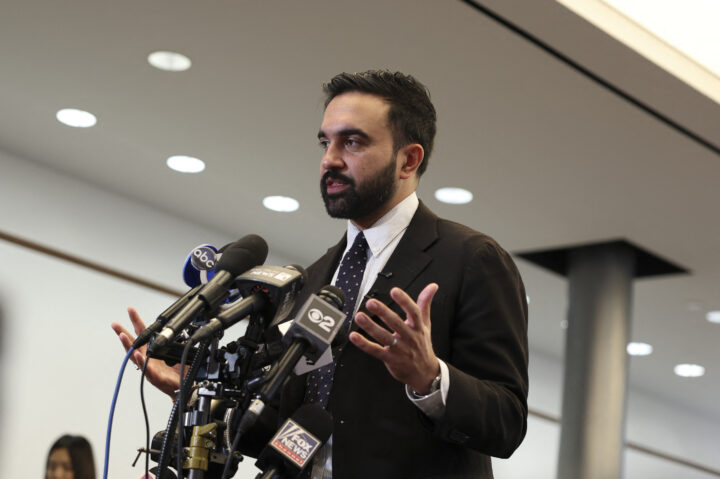
ANGELA WEISS/AFP via Getty Images
New York City Mayor Zohran Mamdani answers questions on October 17, 2025 in New York City.


 Add JewishInsider on Google
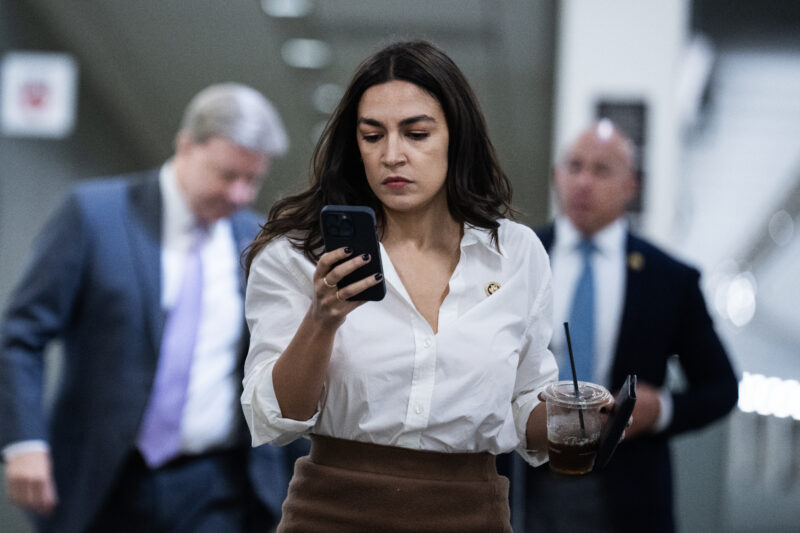
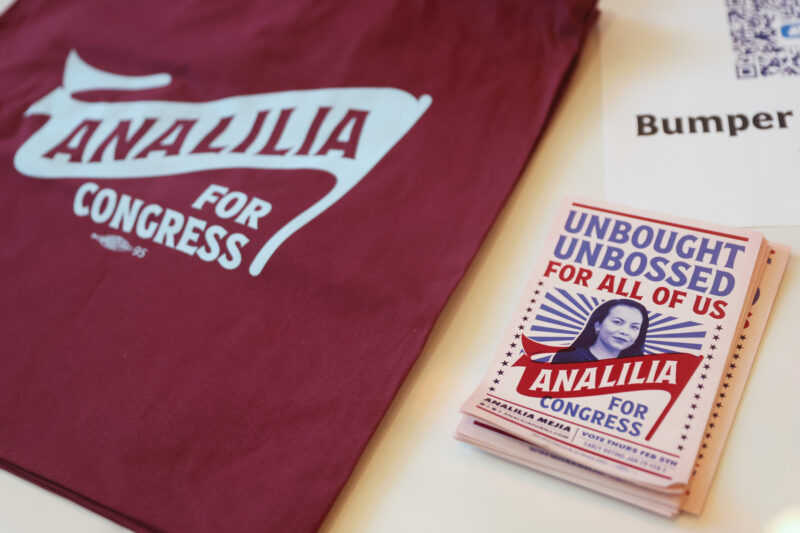
New York City Mayor Zohran Mamdani and his team refused to condemn social media posts from the co-founder of the group ‘Hot Girls for Zohran’ that boosted antisemitic and pro-Iran voices and bashed police and leading U.S. politicians.
The refusal came one day after Jewish Insider revealed Kaif Gilani — a finance professional who spearheaded a social media, merchandising and volunteer canvassing operation supporting the mayor’s election last year — had shared conspiracy theories from a Holocaust revisionist and a video cheerleading ex-Hamas military chief and Oct. 7 mastermind Yahya Sinwar, along with posts insulting law enforcement and various political figures.
From City Hall on Thursday, Mamdani would only stress that Gilani’s organization operated independently of his official election effort.
Asked by a reporter about his association with Gilani, Mamdani said, “This was an individual leading an outside group and was never paid for by our campaign. If New Yorkers want to know my views then they can hear it directly from me.”
When JI pressed the mayor directly whether he condemned the content of Gilani’s posts, Mamdani refused to respond and left the room, similar to how he fled questions on the matter from Politico on Wednesday. His press secretary maintained he had answered the question.
Mamdani spokeswoman Dora Pekec acknowledged that the mayor had posed for photos with Gilani, but would not say anything about his view of the activist’s promotion of conspiracy theories of Israeli involvement in 9/11 and the assassination of President John F. Kennedy, as well as the amplification of explicit pro-Iran and pro-Hamas messaging, or of posts asserting that “all cops are going to hell” and “there’s no such thing as a good cop.”
“As the mayor says, if you want to know what he thinks, you can hear it from him,” Pekec said.
The mayor also did not answer a question from another reporter of whether he knew Gilani or had given him a referral to the campaign of former City Comptroller Brad Lander, whose congressional bid Mamdani has endorsed.
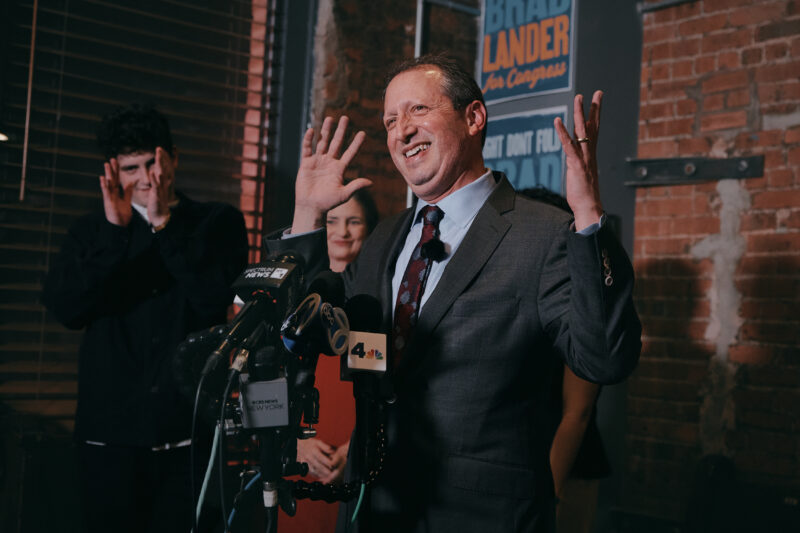
JI discovered that Gilani, through a company he formed in November, had been the highest-paid consultant to Lander’s congressional campaign — though Lander, a self-described progressive Zionist and outspoken Israel critic, insisted through a spokesperson that his team had been unaware of Gilani’s posts and terminated his contract after JI shared its findings.
‘Just because someone is a hateful antisemitic looney-tune doesn’t mean they can’t win office,’ one Jewish community activist said of Shelly Arnoldi

Shaban Athuman/Richmond Times-Dispatch via AP
Shelly Arnoldi looks over her notes during a Joint Commission on Administrative Rules meeting regarding the Youngkin's administration's proposed K-12 transgender policies on Monday, Dec. 19, 2022, at Pocahontas Building in Richmond, Va.
A new candidate for Republican county chair in Virginia’s largest jurisdiction is facing scrutiny over a range of antisemitic social media posts in which she has told Jews to “move to Israel,” spread conspiracy theories about Jewish control of U.S. politics and expressed admiration for prominent neo-Nazis and Holocaust deniers, among other extremist comments.
Shelly Arnoldi, who recently launched her bid to lead the Fairfax County Republican Committee, is stoking concerns among Jewish community leaders now seeking to raise awareness about her extensive public record of promoting antisemitic tropes while demonizing Israel.
While Arnoldi is not seen as a particularly viable candidate in the upcoming Feb. 28 election, local political observers say, her campaign has still given some pause to both Jewish and Republican activists who worry her radical views underscore a creeping embrace of antisemitic sentiment in the GOP fueled by leading far-right commentators including Tucker Carlson, whose interviews she has eagerly endorsed.
“She does not appear to be a serious person,” one Jewish community activist told Jewish Insider on condition of anonymity to address a sensitive topic. “But just because someone is a hateful antisemitic looney-tune doesn’t mean they can’t win office. She strikes me as someone who would continue to run, and in that regard I consider her to be a real threat.”
In recent months, Arnoldi has instructed Jewish social media critics to “move to Israel,” where she has said they “belong,” while promoting antisemitic materials alleging Zionist plots to subvert American governance and to weaken Christian representation. She has also suggested that Jews “appear to control the world,” said that “nobody cares about Jews” and claimed that “Israel owns us,” among multiple other derogatory and conspiratorial remarks posted to X.
Meanwhile, Arnoldi has frequently voiced her enthusiastic support for antisemitic influencers and conspiracy theorists on the far right, such as Nick Fuentes, Candace Owens and Ian Carroll, the latter of whom she has called a “brave man.”
Several posts were flagged by antisemitism watchdogs on social media this week. Arnoldi, who has accused her critics of attempting to smear her, did not return a request for comment from JI.
A new letter circulated on social media by Jewish community activists on Monday called attention to what it described as Arnoldi’s “sustained pattern of antisemitic rhetoric,” saying it is “incompatible with party leadership.”
“If elevated to chair,” the letter warned, “this record will not remain local or contained.”
Arnoldi, who in November ran an unsuccessful campaign for state delegate as an independent, is challenging the incumbent GOP chair, Katie Gorka, who declined to comment on the race when reached by JI on Tuesday.
Even if Republicans face long odds of winning elected office in Fairfax County — increasingly a Democratic stronghold — Arnoldi’s insurgent campaign still carries implications for the future direction of GOP politics in one of the largest jurisdictions in the D.C. area, some party observers cautioned.
Gary Aiken, a former Republican candidate for Fairfax supervisor, expressed alarm at Arnoldi’s campaign on Tuesday. “If these are the kinds of people running for chairman, I may have to get more involved again,” he told JI.
Still, Mike Ginsberg, a member of the Fairfax County Republican Party who also serves as its general counsel, downplayed such concerns — even as he acknowledged that Arnoldi’s messaging would likely resonate with a minority faction of committee members whom he noted are “perpetually disaffected and constantly complaining.”
“People of a certain age would analogize her to Statler and Waldorf in ‘The Muppet Show’ from the 1970s — criticizing from the peanut gallery without making any constructive contributions,” Ginsberg, who is Jewish, told JI. “Statler and Waldorf at least had the benefit of being entertaining — Shelly does not.”
“Put bluntly, Shelly Arnoldi is a crank,” he added. “Every party has them. She is ours.”
Kelly Neumann is serving as the fundraising co-chair for gubernatorial candidate Jocelyn Benson and Senate candidate Mallory McMorrow and has fundraised for several other Michigan Democrats
Facebook/Kelly Neumann
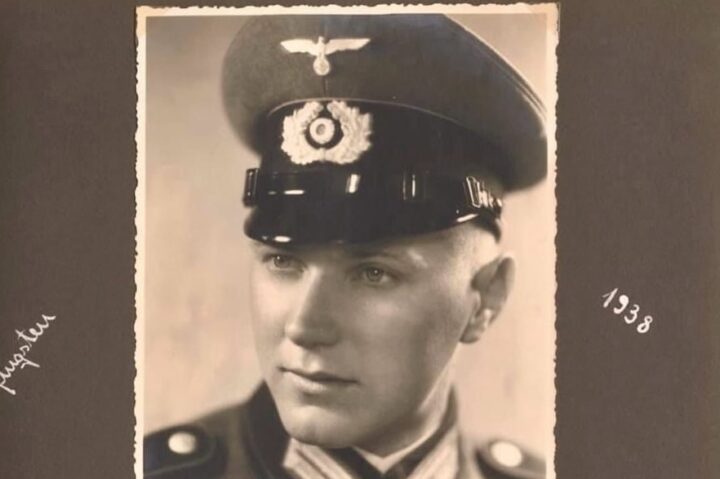
Picture of Kelly Neumann’s grandfather, Albert Neumann, that she shared on Veterans Day in 2024
Kelly Neumann, a prominent Michigan Democratic fundraiser who is supporting several major Democratic candidates in the state, shared a social media post on Veterans Day in 2024 honoring her grandfather, who served in the Nazi regime’s army in World War II.
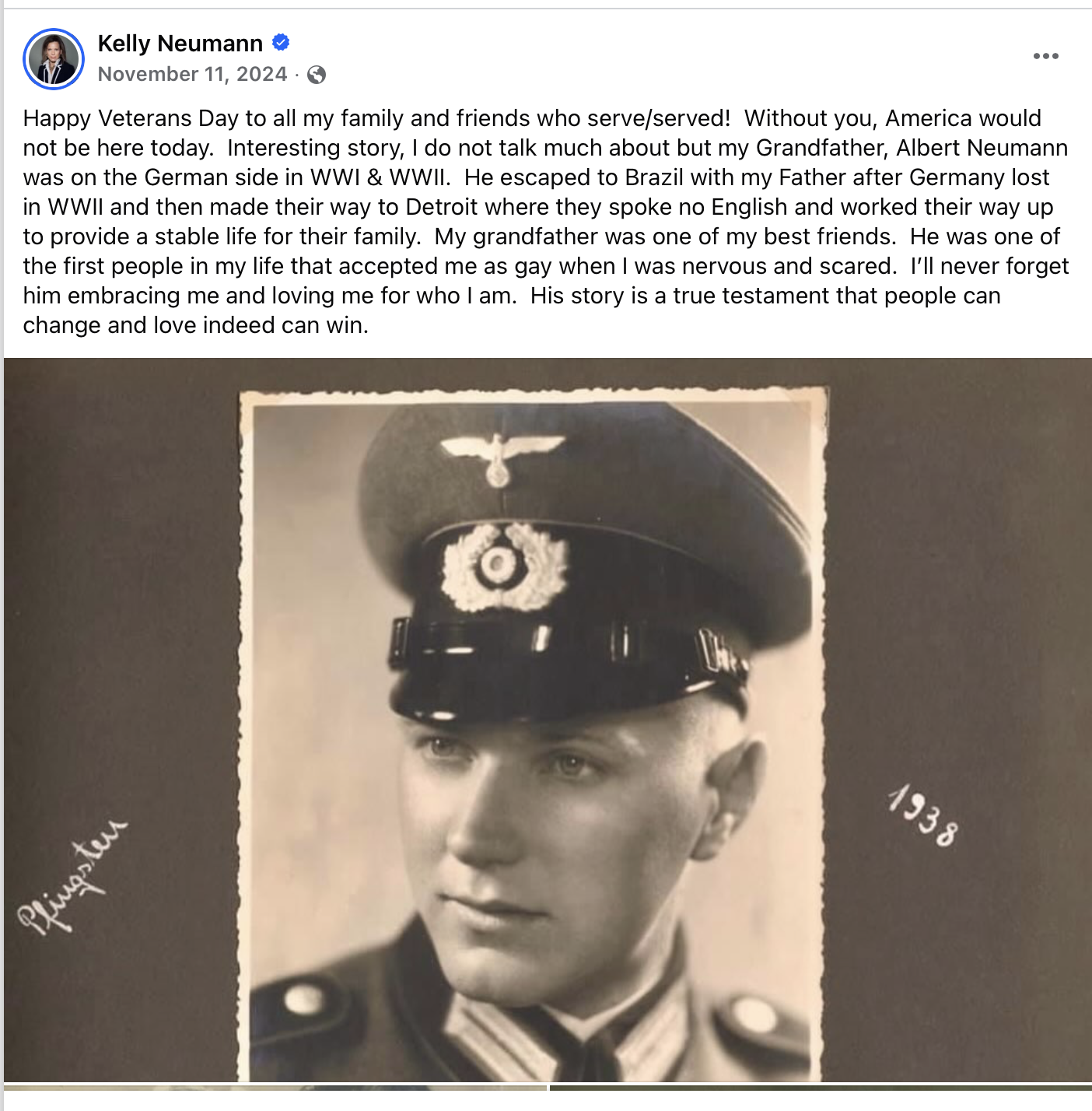
The post includes multiple photos of Neumann’s grandfather in Nazi regalia, including what appears to be an officer’s uniform.
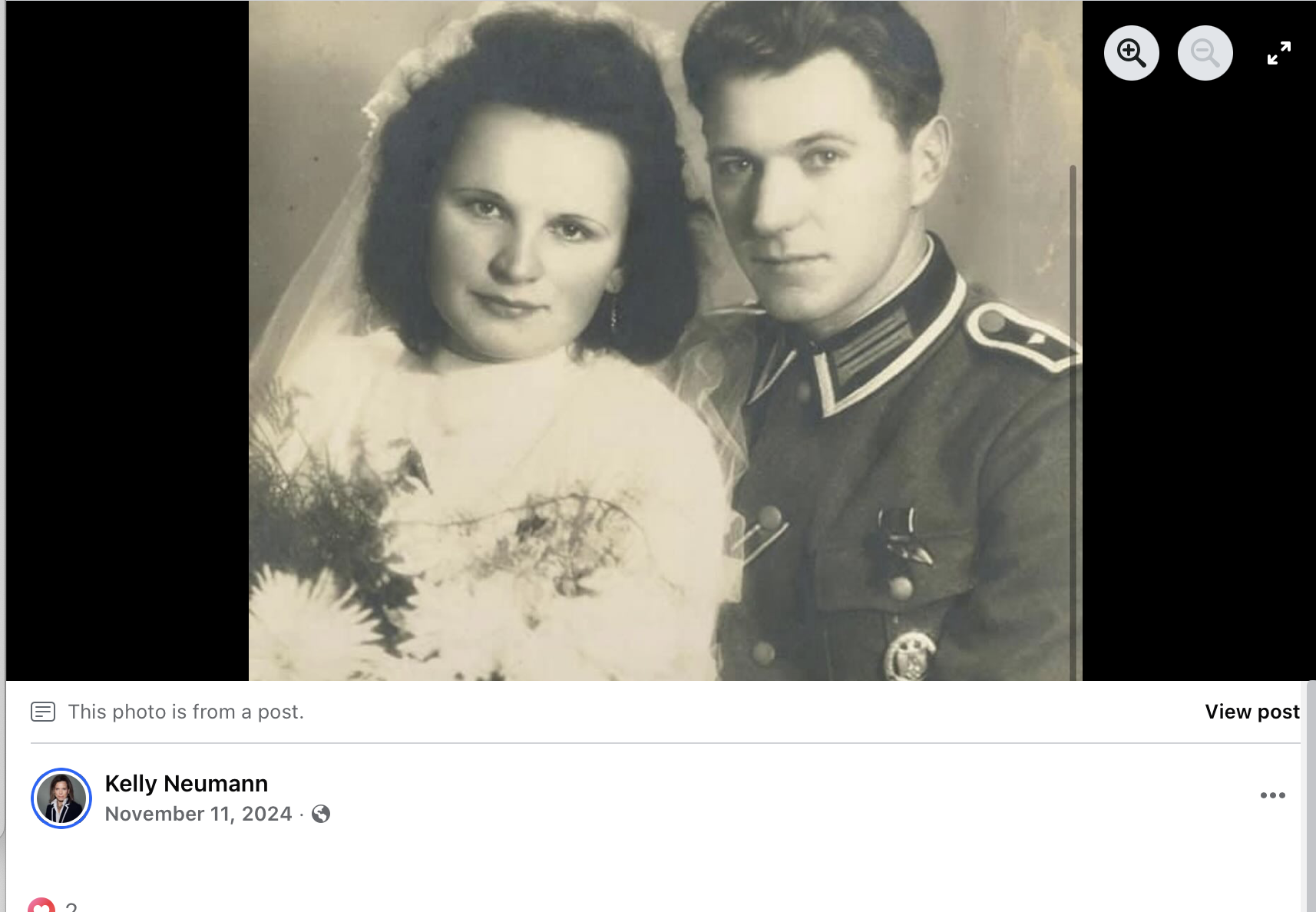
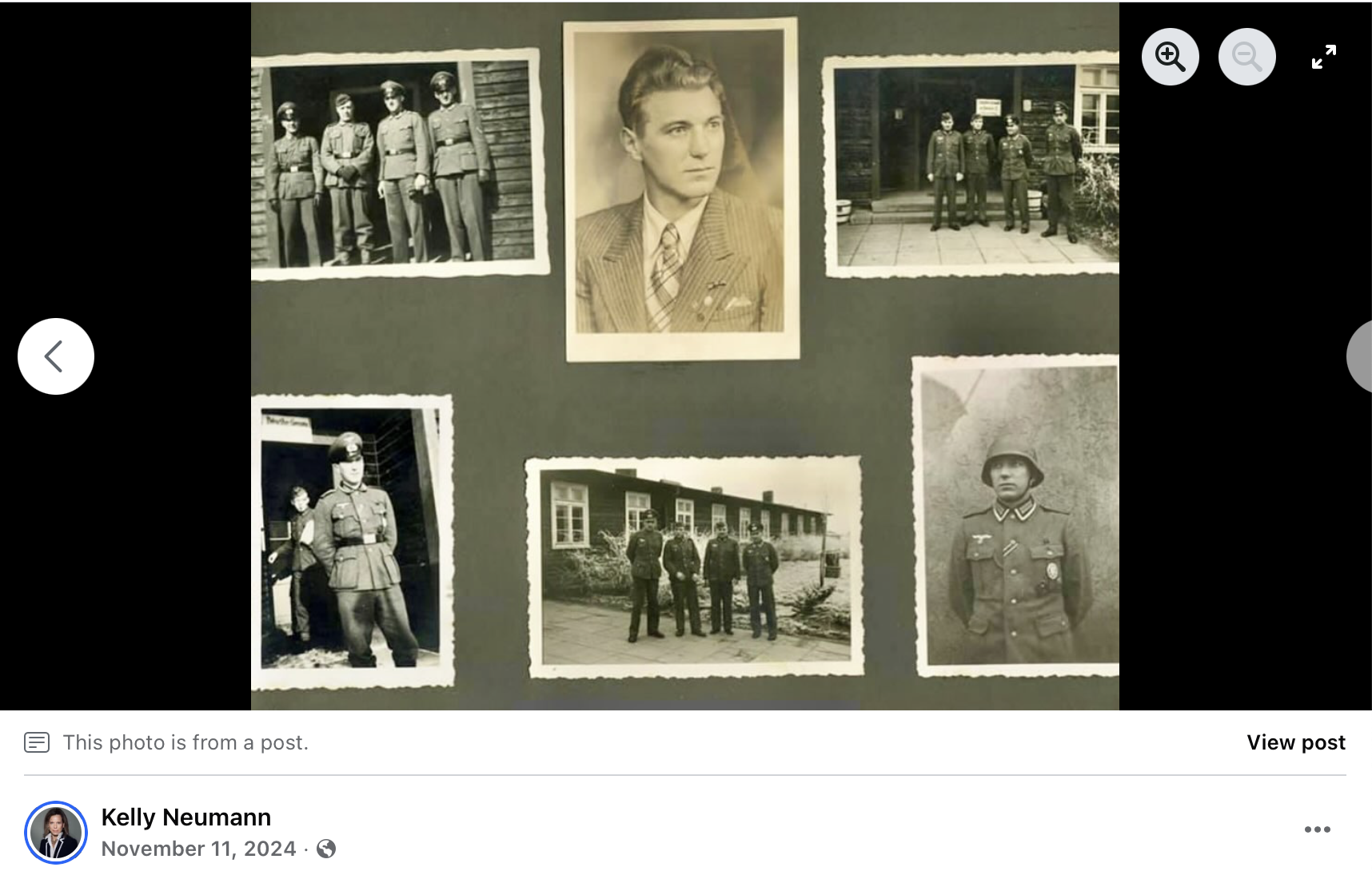
“Happy Veterans Day to all my family and friends who serve/served! Without you, America would not be here today,” the post, shared on Facebook and Instagram by Neumann, a local attorney, reads. The Facebook post, which remained online as of initial publication of this story, was subsequently deleted. “Interesting story, I do not talk much about but my Grandfather, Albert Neumann was on the German side in WWI & WWII. He escaped to Brazil with my Father after Germany lost in WWII and then made their way to Detroit where they spoke no English and worked their way up to provide a stable life for their family.”
Neumann went on to say that her grandfather “was one of my best friends. He was one of the first people in my life that accepted me as gay when I was nervous and scared. I’ll never forget him embracing me and loving me for who I am.”
“His story is a true testament that people can change and love indeed can win,” Neumann concluded.
Neumann is serving as a co-chair of the finance committees for state Sen. Mallory McMorrow, who is running for U.S. Senate, and Secretary of State Jocelyn Benson, who is running for governor. Neumann has co-hosted several fundraisers for McMorrow’s campaign, as recently as last Friday, as well as multiple fundraisers for Benson’s campaign.
In March 2025, Neumann also hosted a $50,000 fundraiser for Rep. Haley Stevens (D-MI), now running for Senate against McMorrow, and is a member of Rep. Kristen McDonald Rivet’s (D-MI) fundraising “cabinet.” She hosted a December fundraiser for state Sen. Jeremy Moss, a Jewish, pro-Israel Democratic candidate for the House.
Neumann appears to be well-connected in Democratic politics¸ having hosted events alongside various other prominent Michigan Democrats. She has also shared photos with former Presidents Barack Obama and Joe Biden and Vice President Kamala Harris and professed to being in personal contact with multiple Democratic senators — albeit prior to the 2024 Veterans Day post.
FEC records indicate she has never personally donated directly to Stevens or Moss’ campaigns, and she’s been critical of Stevens during her Senate candidacy.
Arik Wolk, a spokesperson for Stevens’ campaign, distanced her from Neumann. “Haley rejects antisemitism in all forms, and has spent her career standing up to and calling out hate. Had Haley seen the post celebrating Ms. Neumann’s grandfather’s service to the SS, Ms. Neumann would not have hosted that event,” Wolk said.
Neumann, and the other candidates whom she is supporting this cycle, did not provide comment.
One person to keep an eye on is Josh Binderman, who served as Mamdani’s Jewish outreach director during the campaign and transition
Selcuk Acar/Anadolu via Getty Images
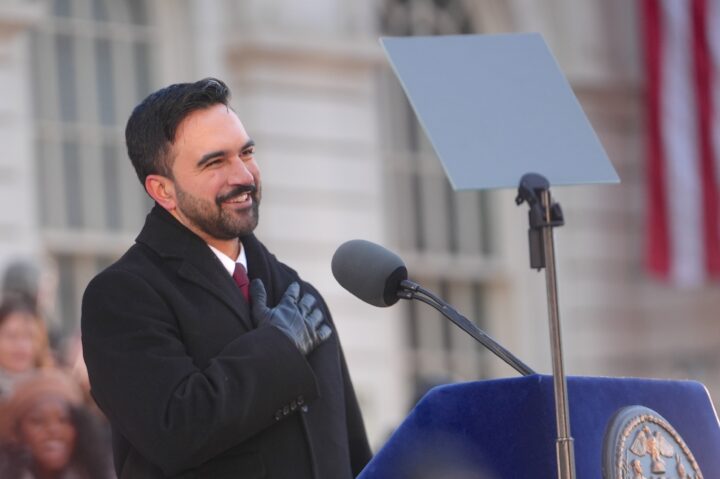
Mayor Zohran Mamdani at his inauguration ceremony at City Hall, Manhattan, New York City, United States on January 1, 2026.
As New York City Mayor Zohran Mamdani draws increased scrutiny for picking some top appointees whose past incendiary social media comments have provoked controversy and raised questions over his vetting process, Jewish community leaders are now watching closely for signs of how the administration will make staffing decisions on key issues connected to Israel and antisemitism.
One person to keep an eye on is Josh Binderman, who served as Mamdani’s Jewish outreach director during the campaign and transition. He has largely maintained a low profile in his time working for the candidate and now mayor, garnering just a small handful of mentions in the press, despite his critical position leading engagement with a community that in many ways remains deeply skeptical of Mamdani’s hostile stances on Israel and commitment to implementing a clear strategy to counter rising antisemitism.
Binderman, most recently a communications manager for New Deal Strategies, an influential progressive consulting firm, served until 2024 as a PAC manager and a senior associate for J Street, the progressive Israel advocacy group, according to his LinkedIn profile.
While Mamdani notably refused to work with the organization when he led a chapter of Students for Justice in Palestine as an undergraduate student at Bowdoin College, the mayor has since developed a friendlier rapport with J Street, which has defended him amid charges that he tapped transition advisors who engaged in anti-Zionist activism that crossed a line into antisemitism.
Mamdani’s decision to employ a former top J Street staffer during the election suggests he could follow a similar approach to key Jewish community posts for his developing administration. If so, it could help to at least dampen some concerns from Jewish leaders who fear the mayor will end up hiring even harder-left members in his coalition such as activists associated with Jewish Voice for Peace, an anti-Israel advocacy group that aggressively promotes boycotts targeting the Jewish state.
It is still an open question, however, how Mamdani will move forward on such issues. His decision last week to revoke two executive orders linked to Israel and antisemitism was widely seen as a discouraging maneuver that eroded goodwill among mainstream Jewish leaders — even as Binderman had reportedly given some advance warning to leaders about the effort before the inauguration.
Mamdani otherwise chose to retain an office to combat antisemitism established by former Mayor Eric Adams. He has not disclosed who will steer the office now, though a person recently in touch with his team told Jewish Insider this week that Phylisa Wisdom, the executive director of New York Jewish Agenda, a progressive Zionist group, was floated as a possible candidate.
For his part, Binderman, who as a student was involved with BBYO, continues to be an unofficial “point person” for Jewish community outreach in the administration, according to one Jewish leader who has heard from him recently. Binderman is still feeling out a potential role in City Hall, according to other Jewish community leaders. He did not return a request for comment from JI.
Dora Pekec, a Mamdani spokesperson, told JI on Tuesday that the mayor’s team would have more to share on related appointments in the coming weeks and that such decisions “are still being worked out.”
Jewish leaders who have engaged with Binderman told JI their interactions with the young Mamdani aide have been largely positive. But they expressed some lingering doubts about his ability to influence the mayor himself. “He does seem eager and willing to help,” said one Orthodox community leader. “He does want to work together.”
“To what extent and how much freedom he has remains to be seen,” the leader explained to JI.
Another Jewish community leader who has spoken with Mamdani’s team echoed that view. Binderman, he told JI, has “always appeared to be level-headed, fair and reasonable. The question is, will the admin listen to his guidance?”
“Only Josh and Ali Najmi,” a top Mamdani advisor who maintains close ties to the Jewish community, “can land the Jewish plane,” the Jewish leader said. “But Zohran has to decide if he wants to land it.”
Fishback has sought to cast next year’s Republican primary as 'very clearly a two-person race,' but political operatives are skeptical his bid will amount to on-the-ground traction even as he provokes controversy from behind the screen
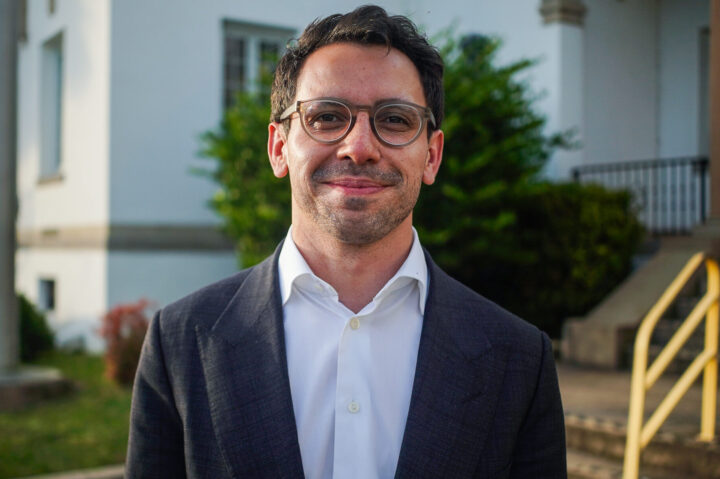
Campaign website
James Fishback
In recent weeks, James Fishback, a 30-year-old Republican investor who last month launched a long-shot campaign for governor of Florida, has drawn online attention for a series of incendiary social media posts attacking Israel and invoking antisemitic tropes.
In addition to praising followers of the neo-Nazi influencer Nick Fuentes, comments for which he has refused to apologize, Fishback has promoted a range of extreme anti-Israel positions, including in a recent campaign ad vowing to defend those who accuse the Jewish state of genocide. He has taken repeated aim at the pro-Israel organization AIPAC, which he calls a “foreign lobbying group,” saying its supporters are “slaves” and that his own “allegiance is to America.”
“I’ll be the first to admit that I fell for the ‘Israel is our greatest ally’ scam and the lie that criticizing Israel is ‘antisemitic,’” he wrote in a social media post this week. “It wasn’t until I was offered a paid trip to Israel this summer (which I never took) that I realized how cringe and pathetic the propaganda was.”
In using such inflammatory rhetoric, Fishback, a political newcomer, is likely seeking to capitalize on the views of a younger audience of far-right voters increasingly fueling anti-Israel as well as antisemitic sentiment in the GOP, which has recently forced the party to confront a growing schism within its ranks over its ideological direction.
But while Fishback has sought to cast next year’s Republican primary as “very clearly a two-person race” between him and Rep. Byron Donalds (R-FL) — the pro-Israel GOP front-runner now dominating the polls while reporting a $40 million fundraising advantage — political operatives in both parties are skeptical his insurgent bid will ultimately amount to any sort of meaningful on-the-ground traction even as he continues to provoke controversy from behind the screen.
“Social media is the only reason anyone has heard of Fishback, and 20 years ago no one would even be talking about him,” Steve Schale, a Democratic strategist in Florida, told Jewish Insider. “Unless he stumbles into a pile of cash, it’s hard for me to see this being more than just an effort to get clicks.”
Fishback, the CEO of an anti-DEI investment firm called Azoria, is hardly the first candidate hoping to translate social media clout into votes or fame. A growing cohort of young influencers seeking office has emerged in recent years, so far with no success.
Deja Foxx, a progressive TikTok activist who ran for Congress in Arizona this summer, had raised a lot of money and appeared to be gaining momentum near the end of the campaign. But despite the hype, Foxx fell short by nearly 40 points — losing out to a more established local lawmaker.
In the race to succeed outgoing Florida Gov. Ron DeSantis, Donalds, a three-term congressman who is endorsed by President Donald Trump, is heavily favored to clinch the nomination over a handful of lesser-known primary rivals. Multiple surveys have shown him leading by double digits — with support from a range of state elected officials. Fishback, for his part, claimed just 2% of the vote in a recent poll.
“Although we’re still in the early stages of this race, it’s almost game, set, match,” said Ford O’Connell, a Republican strategist in Florida. “Byron Donalds is dominating the field, approaching 50% in the polls. Once voters realize he has Trump’s endorsement, he becomes the clear favorite. In GOP primary politics, Trump’s endorsement is the platinum standard.”
“If you look at any legitimate polling I would say Mr. Fishback has a very tall mountain to climb,” Will McKinley, a GOP lobbyist and government consultant in the state, echoed to JI.
Jim Cherry, a Republican pollster in Florida, said his “firm does political polling and as of this point, no client has requested that we include Fishback in any gubernatorial head-to-head questions.”
A college dropout and former hedge fund analyst, Fishback attracted some attention in conservative circles after he pitched DOGE “dividend checks” to a receptive Elon Musk, though the plan never took off. He later launched a super PAC to oppose Musk when the billionaire mogul fell out with Trump. He announced his gubernatorial bid in mid-November, pledging to “build on” DeSantis’ “historic record.”
Fishback has portrayed himself as a strong ally of DeSantis, who has so far declined to publicly back anyone in the race, while dismissing Donalds’ bid. But Fishback’s hostility to Israel puts him at odds with the governor, who has long touted his support for the Jewish state.
Meanwhile, Fishback’s recent comments on Israel are almost certain to alienate a sizable population of Jewish voters who live in Florida and can help tip the scales in close elections.
“In my opinion, he’s not a serious candidate and is simply trying to be incendiary to get attention,” said Gabriel Groisman, a Jewish Republican donor and a former mayor of Bal Harbour, Fla.
He declined to comment further, saying that doing so would be “counterproductive.”
In a statement to JI Thursday, Sam Markstein, spokesperson for the Republican Jewish Coalition, dismissed Fishback as “a radical fringe candidate who has decided that the way to run his campaign is to attack the Jewish community and our ally Israel.”
“It won’t work — and Republican Floridians will resoundingly reject him in the GOP primary,” he said.
Fishback, in response, said the “only poll that matters is on Election Day: August 18, 2026,” adding: “Until then, I am committed to earning Floridians’ votes by visiting all 67 counties to meet folks where they are, hear their concerns and share my vision for a more affordable Florida.”
“If elected, I’ll be a governor for all Floridians,” he continued in a statement to JI. “As a Christian, I have never ‘attacked’ anyone for their faith. I will protect religious freedom and ensure the safety of all Floridians.”
‘I would say there’s a difference between not liking Israel (or disagreeing with a given Israeli policy) and anti-semitism,’ the vice president added
JONATHAN ERNST / POOL / AFP
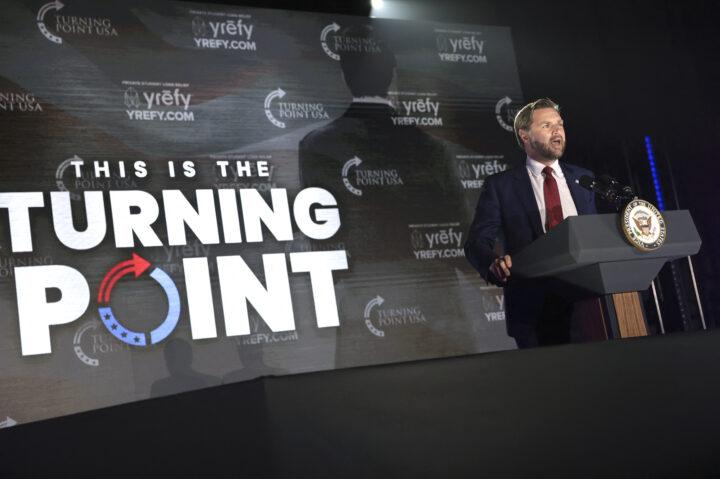
Vice President JD Vance speaks during a Turning Point USA event at the University of Mississippi, in Oxford, Mississippi, October 29, 2025.
In a series of social media posts, Vice President JD Vance linked data finding increased antisemitism among young people on both sides of the aisle to immigration, and said that there is a difference between “not liking Israel” and being antisemitic.
Responding to excerpts from an Atlantic story highlighting the increase in antisemitic attitudes among young people, Vance said, “Mainstream journalism is just profoundly uninteresting and lame, consumed by its own pieties.”
“To write an article about the ‘generational divide’ in anti-semitism without discussing the demographics of the various generations is mind boggling,” Vance continued.
He blamed the increase in antisemitism on immigration and the demographic makeup of younger Americans.
“‘We imported a lot of people with ethnic grievances prior generations didn’t have. We celebrated this as the fruits of multiculturalism. Now we’re super surprised that the people we imported with ethnic grievances still have those ethnic grievances,’” Vance wrote, arguing that “the most significant single thing you could do to eliminate anti-semitism and any other kind of ethnic hatred is to support our efforts to lower immigration and promote assimilation.”
He concluded, “these guys won’t do that, because they all lack curiosity and introspection,” Vance continued.
He also linked to an analysis cited by Manhattan Institute fellow Charles Fain Lehman supporting those conclusions, indicating that foreign origin is more closely correlated to antisemitism than age or ideology.
Responding to a reply from a right-wing influencer who stated that “White conservative zoomers don’t really like Israel anymore either, JD,” Vance said, “I would say there’s a difference between not liking Israel (or disagreeing with a given Israeli policy) and anti-semitism.”
The comments are some of Vance’s first and most notable following the divisions on the right over rising antisemitism in the conservative movement. Vance, who many see as a leader among younger and “New Right” elements of the GOP, had largely avoided engaging in the debate until now.
Yehuda Kaploun’s strategy differs from the Trump administration’s stance against censorship
Screenshot
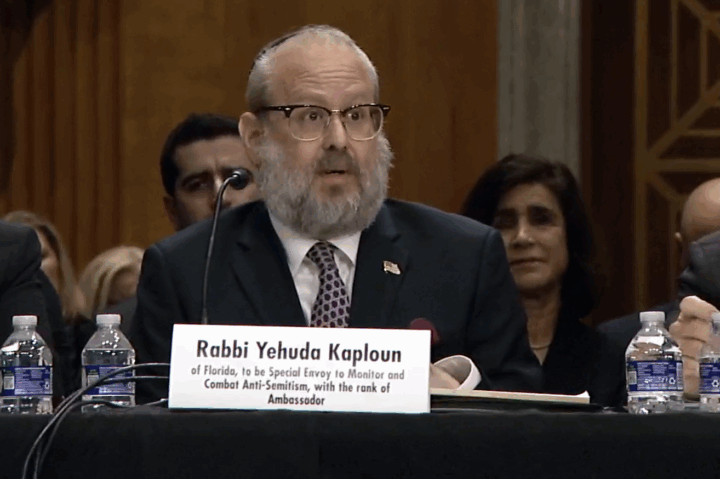
Rabbi Yehuda Kaploun, the Trump administration's nominee to be special envoy to monitor and combat antisemitism
Rabbi Yehuda Kaploun, President Donald Trump’s nominee to serve as U.S. antisemitism special envoy, warned in an interview with Jewish Insider that inaccurate, inflammatory content is being allowed to spread on social media, and pledged to work with social networks to curb the spread of antisemitic falsehoods online.
“The ideal outcome is, I want to continue America’s tradition of free speech and allowing free speech anywhere and everywhere, freedom of expression,” Kaploun said. “But I would like the platforms — because of the advent of AI and those technologies, you have the ability to recognize when something is not factually correct and it should be labeled as such. I think that’s something that we’d like to target.”
Kaploun spoke to JI on Wednesday, with his Senate confirmation vote for the State Department role expected this month before the holiday recess. His comments about working with social media platforms to label misinformation contradict the approach of the Trump administration, which has urged the major platforms not to “censor” information. Earlier this year, after Trump took office, Meta announced the end of its fact-checking program, and YouTube eased many of its content moderation policies.
“There’s many other areas of working with the companies — the algorithms and things that have been now proven, that bots are busy promoting antisemitic rhetoric on the internet, how we get to some of that and preventing some of that. These are very tall tasks. These are not things that occur overnight,” said Kaploun, a Chabad-trained rabbi and businessman from Miami. “But I truly believe there is a true willingness of many people within the administration to tackle these problems and confront them head on, globally.”
As an example of the kind of content he would seek to flag as false, Kaploun referred to a July New York Times article about the hunger that many civilians in Gaza were experiencing during Israel’s war against Hamas. The Times published a correction regarding the article several days after it was published, once it was revealed that a child who was featured prominently in the article as an example of malnutrition had preexisting health conditions.
The misrepresentation in the photo could contribute to antisemitism, according to Kaploun, who suggested that the article had been viewed hundreds of times more than the correction.
“I’m not exactly 100% sure of the actual number, but in that realm, a total disbalance and disproportionate view of people saw something that could be creating antisemitic behavior,” said Kaploun. “All those people that saw it have incorrect information.”
He declined to say whether he believes social networks should have removed posts that included that article.
“I’m not going to get into the specifics or the semantics of what that’s going to look like. We are going to work collectively and together with these companies and try and come up with productive solutions that will lower the disinformation and lower the hatred,” Kaploun said. “That’s what I’d like to work with these social media platforms to do a better job with, recognizing that and making sure that we can do a better job of getting accurate facts out.”
Discussing strategy, Kaploun laid out a vision for his tenure as special envoy to monitor and combat antisemitism, stating that his first priority would be to fight antisemitism with “pro-Semitism” — teaching about Jewish history and culture, and convincing countries and groups that are experiencing antisemitism that Jews are productive members of society and contribute a great deal to the countries in which they live.
“What I mean by pro-Semitism is to explain to countries the benefits of what it is the Jewish nation provides, and our historical perspective of what the Jewish communities have always done for communities, in terms of growth in countries,” said Kaploun. “The countries that have literally attacked the Jews and expelled the Jews don’t always have success, and there’s a reason for that. And when countries are welcoming and when Jews are in countries, usually the benefits far exceed any type of whatever detriments [there] are. There really aren’t detriments.”
“It’s not all about Israel,” Kaploun added. “It’s about the Jewish culture, the Jewish religion, the Jewish sciences.”
Still, he recognizes that separating Israel from discussions of antisemitism is not possible — like if he encounters people who insist that they have no problem with Jews, and that their only issue is with the Jewish state.
“Understand the battle that Israel has to fight here,” said Kaploun. “You’re fighting a culture that was teaching children to kill themselves, that the benefit to get to heaven is to kill a Jewish person. So we have to get to the root causes. You want to condemn Israel, ‘Oh, I love the Jews, but I hate Israel.’ Why is Israel in existence? Because there was a period of time when Jews were being slaughtered throughout Europe and the world was silent and there wasn’t a country for the Jews to go to.”
Here, too, he said it all comes down to education.
“The importance of Israel may need to be explained, but at the same time, people’s facts are incorrect,” Kaploun said. “If they’re factually accurate, then you’re able to have a conversation with someone. They will see the folly of what they’re saying.”
Kaploun has a plan, he told JI, for where to kick off his work once he is confirmed by the Senate and moves into Foggy Bottom.
“The president and the secretary [of state] are firmly behind the efforts that I am doing,” Kaploun said. “They’ve made it very, very clear that the administration is fully behind the efforts that we’re going to do to combat antisemitism.”
The former secretary of state said that the ‘emphasis’ on one global conflict ‘doesn’t do justice to the challenges that we are confronting’
MOFA/AFP via Getty Images
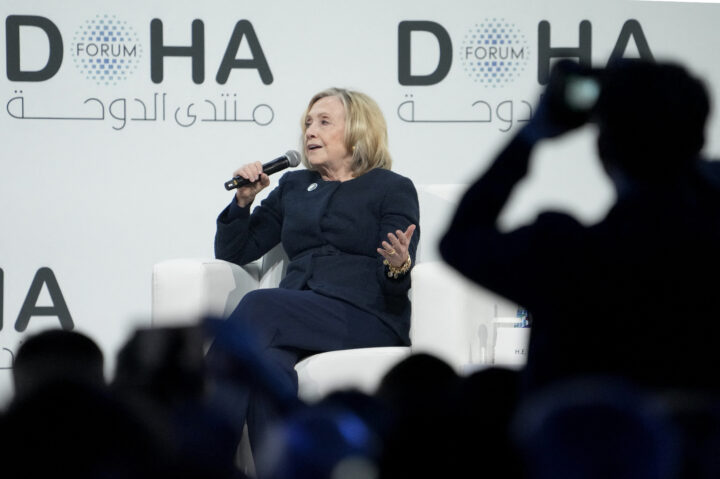
Former Secretary of State Hillary Clinton speaks during the Doha Forum in Qatar on December 7, 2025.
Former Secretary of State Hillary Clinton on Sunday underscored her recent comments that American youth are turning against Israel due to social media and lack of historical knowledge.
During a discussion on President Donald Trump’s foreign policy and global power dynamics at the Doha Forum in Qatar, Clinton was pressed by moderator Ravi Agrawal — the editor-in-chief of Foreign Policy, who has taken a critical stance toward Israel’s war against Hamas — to elaborate on her remarks at the recent Israel Hayom Summit, in which she said that young people lack “context” on the conflict and are exposed to “propaganda” on social media.
“How are you reflecting on your words and the controversy around it?” Agrawal pushed.
“I’ve had many conversations with very smart young people,” said Clinton, referring to a class that she teaches with the dean at Columbia University’s School of International Public Affairs. “In talking with them about their views, which they are entitled to those views based on whatever information they had, but they did not always know why they were saying what they said.”
“All I’m asking for is that people have a historical context, both for what has happened to the Palestinians and what has happened to the Israelis,” Clinton added.
Clinton again brought up an example of young Americans chanting “from the river to the sea,” a popular phrase within the Palestinian movement and one that pro-Israel and Jewish groups have taken as a call for the eradication of the Jewish state, in which students were unable to specify which river and sea they were speaking of.
“I think it is a provable fact that most Americans, and an even bigger percentage of young Americans, get their news from social media. If that is controversial, then people are not paying attention,” said Clinton.
Agrawal pushed back, saying that while there is “misinformation and disinformation,” that there is also “genuine anger” from young people who are “grappling with witnessing images that are livestreamed.”
Clinton cautioned that the public often fixates on Gaza at the expense of other major geopolitical crises.
“I’m angry about all of the human rights abuses. I’m angry about all of the excessive use of force,” Clinton responded. “So, of course, the suffering in Gaza is horrific. Full stop. Suffering everywhere is horrific. I think that the emphasis on one terrible conflict sort of doesn’t do justice to the challenges that we are confronting.”
AIPAC accused the California congressman, a prospective 2028 presidential candidate, of echoing antisemitic tropes

Chip Somodevilla/Getty Images
Rep. Ro Khanna (D-CA) leaves the U.S. Capitol on March 13, 2024 in Washington.
Rep. Ro Khanna (D-CA), a potential 2028 presidential candidate, is sparring with AIPAC on social media over ads the group ran criticizing his support for a House resolution describing the war in Gaza as a genocide.
“AIPAC just poured money into a series of ads in my district calling me a liar for speaking out about the truth in Gaza,” Khanna said in a video posted to X on Tuesday. “They’re asking you to disbelieve what you’ve seen on your own phone with your own eyes. AIPAC wants to weaken me electorally and prevent me from having a seat at the table in the leadership of our country.”
Khanna went on to link the ad campaign to a range of other issues unrelated to AIPAC, saying that he will not “cave to special interests” on health care, tech and artificial intelligence; bend to “the Epstein class, rich and powerful men who are totally disconnected from ordinary Americans and believe the rules don’t apply to them”; or accept PAC, lobbyist or corporate funding.
The ad in question, which ran on social media and digital platforms, proclaims in bold text: “Ro Khanna is lying to you.” It references his support for the Gaza genocide resolution, led by Rep. Rashida Tlaib (D-MI), stating, “Claims of genocide are a dangerous attempt to distort facts and rewrite history.” AIPAC is running identical ads against a series of far-left Democrats supporting the same resolution.
AIPAC spokesperson Marshall Wittmann said that Khanna is echoing antisemitic tropes.
“The war in Gaza has profoundly impacted millions of Israelis, Palestinians, and Americans, yet rather than helping build a better future of peace, Rep. Khanna is instead rewriting history and parroting a dangerous blood libel,” Wittmann said in a statement. “The only genocide in this war happened on October 7, when Hamas openly admitted it wanted to kill every Israeli man, woman, and child it could. Our ad simply informs his constituents about his support for legislation that is based on a lie, and it evidently got under his skin.”
In a post on X, AIPAC added, “The same ad is running featuring other cosponsors. You’re not that special.”
Wittmann did not say how much money AIPAC had spent on the ads. According to Meta’s ad library tool, the group spent between $900 and $999 running the ad on Facebook and Instagram.
Khanna has made attacks on AIPAC, and criticism of Israel more generally, a significant part of his legislative message in recent months, at times associating with extreme anti-Israel and antisemitic figures.
Hillary Clinton says anti-Israel sentiment among young people fueled by ‘propaganda’ on social media
Speaking at the Israel Hayom summit, Clinton recalled the ‘frankly shocking’ lack of understanding among her students at Columbia University
Alex Wong/Getty Images
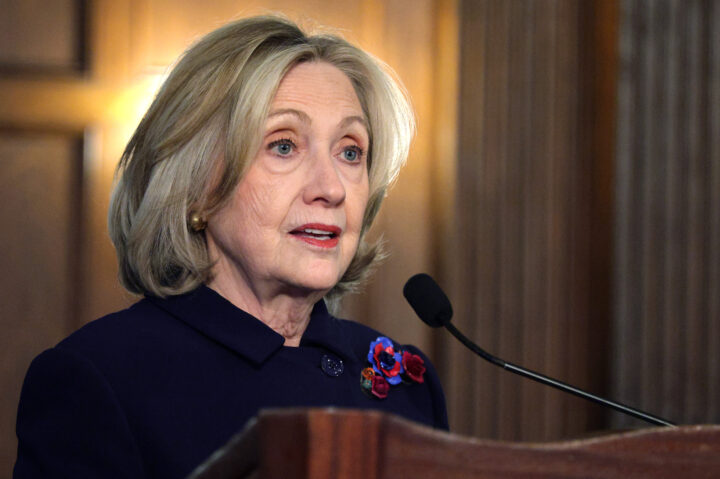
Former U.S. Secretary of State Hillary Clinton delivers keynote remarks during a discussion at Georgetown University on December 2, 2025 in Washington, DC.
Speaking at the Israel Hayom summit in Manhattan on Tuesday, former Secretary of State Hillary Clinton warned of the influence of social media in shaping young people’s perceptions on Israel and the Israeli-Palestinian conflict.
“There is a great deal of valid concern about how Israel is viewed, not just around the world, but from the United States, how Jewish Americans are viewed, and what is being seen as a significant increase in antisemitism in real life and online,” said Clinton. “It’s time now that the hostages are back and people can breathe again, that everyone needs to take stock of where we are, both in Israel and in this country, learn the lessons that perhaps can help us determine a more productive future.”
Clinton said she believes growing hostility toward Israel is a “generational” issue, rather than a “Republican versus Democrat” divide.
“A lot of the challenge is with younger people. More than 50% of young people in America get their news from social media,” said Clinton, who added that the problem lies in the information users are receiving “and the conclusions they are drawing from it.”
Clinton recalled teaching at Columbia University, where she is a professor of practice at the School of International and Public Affairs, during and after the Oct. 7, 2023, terrorist attacks and seeing this impact firsthand.
“We began to realize that our students — smart, well-educated young people from our own country, from around the world — where were they getting their information? They were getting their information from social media, particularly TikTok. That is where they were learning about what happened on Oct. 7,” said Clinton. “What they were being told on social media was not just one sided, it was pure propaganda.”
Clinton said it was often difficult to engage in “reasonable discussion” in such a climate because students lacked historical knowledge and “had very little context,” calling it “frankly shocking.” She also warned that in addition to social media, she saw immediate and planned efforts to distort the context of the Oct. 7 attacks.
“There was an organized effort that was prepared literally on Oct. 8 to begin to try to both provide mis- and disinformation about what had happened on Oct. 7, what the meaning was, what the history between the Israelis and the Palestinians [was],” said Clinton.
A key way forward, according to Clinton, is finding an effective way to talk about Israel to the younger generation. She added that Israel has “the worst PR.”
“The story that needed to be told was not getting told as effectively as I thought it should. And I think that’s only worse now,” said Clinton. “We have to do a better job of talking through the importance of supporting Israel and Israel’s security in a way that crosses generations.”
Yván Gil, Venezuela’s foreign minister, calls his Israeli counterpart ‘a war criminal and a genocider’ after Sa’ar flagged connections between Caracas, Iran and its terror proxies

JOHN THYS/AFP via Getty Images
Israeli Foreign Minister Gideon Sa'ar addresses a press conference after a meeting at the EU headquarters on the sidelines of the EU's foreign affairs council, in Brussels on February 24, 2025.
Venezuelan Foreign Minister Yván Gil accused Israeli Foreign Minister Gideon Sa’ar of being a “war criminal” after Sa’ar spoke about connections between Caracas and Iran and the latter’s terrorist proxies.
Sa’ar made the remarks on Monday in a speech before a joint session of Paraguay’s National Congress in Asunción.
“In South America,” Sa’ar said, “criminals are building narco-terror alliances with the Middle East terror states. The nexus of this network is Venezuela.”
Sa’ar added that Venezuela is driving a destabilizing refugee crisis and serving as a base for Hezbollah terrorists.
In addition, he pointed out that Venezuela hosts an Iranian weapons production facility.
“Venezuelan President Nicolás Maduro has said openly that Venezuela is part of ‘the axis of resistance,’” Sa’ar added, referring to Iran’s partners in terrorism against Israel. “He said that this axis exists in Africa, Asia, the Middle East, Latin America and the Caribbean. When he says this, we should believe him.”
Gil, who represents the Maduro regime, which remained in office despite losing an election last year, used his social media accounts to call Sa’ar “a war criminal and a genocider.”
“What he should be doing is not mentioning Venezuela, but preparing to stand trial for the crimes his government commits against the Palestinian people,” he said. “The name of Venezuela is too great for your filthy mouth and hands stained with innocent blood.”
Gil said that Sa’ar represents “the barbarism and systematic violation of all the rules that govern civilized humanity. We don’t care about your opinion … Sooner than later, you will have to answer to international justice.”
Hezbollah is involved in organized crime in Latin America to fund its terrorist operations worldwide. It has long operated in the border area between Paraguay, Brazil and Argentina, which has a large Lebanese population, and later expanded into Venezuela amid deepening ties between Caracas and Tehran. The Iranian proxy is designated a terrorist organization in Argentina, Colombia, Guatemala, Honduras and Paraguay, but not in Venezuela or other Latin American states.
Vish Burra, a known MAGA provocateur, posted a video of cockroaches counting money in a room with Stars of David
Eva Marie Uzcategui/Bloomberg via Getty Images
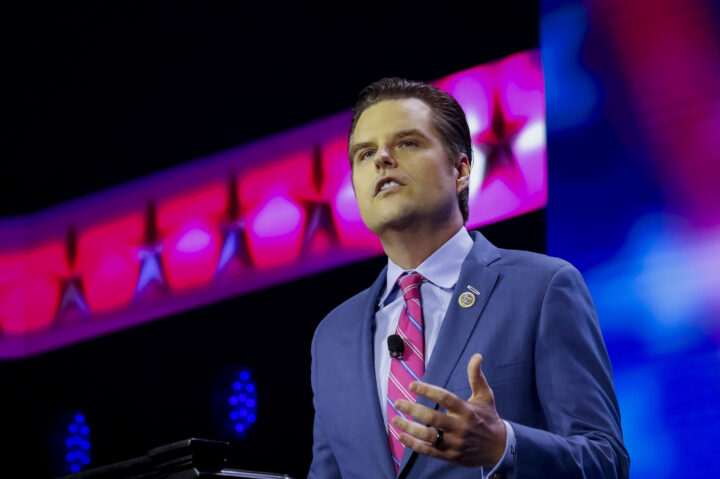
Former Rep. Matt Gaetz (R-FL) speaks at the Turning Point Action conference in West Palm Beach, Florida on July 15, 2023.
A producer for former Rep. Matt Gaetz’s (R-FL) weeknight show on the right-wing One America News Network has reportedly been fired after he shared a vehemently antisemitic social media post depicting Jews as cockroaches.
Vish Burra, who was a booker and script writer for Gaetz, had drawn widespread backlash for posting an AI-generated animated video last week showing him entering a “scheming room” with Stars of David on the door to find a group of cockroaches counting money, who scurry away upon his arrival. The post has since been deleted.
“I will expose the vermin in the venomous coalition and their transgression against MAGA, America First, and Kevin Roberts at The Heritage Foundation,” Burra said in another post to X, which has also been deleted. “It all starts with Susan Lebovitz-Edelman,” he wrote, referring to a Jewish trustee at the Manhattan Institute who is married to the hedge fund manager Joseph Edelman.
Lebovitz-Edelman, he wrote, “is behind the entire campaign to oust Kevin Roberts from The Heritage Foundation by using her leverage as a recent big dollar donor to take control of the organization.”
Burra’s firing was reported by The Wrap and The Independent on Monday.
OAN did not immediately respond to a request for comment on Monday afternoon.
Gaetz, a former far-right congressman from Florida, had defended Burra in a social media post Saturday and sought to brush aside the controversy, saying that his producer had “posted something dumb this week. He knew it was dumb and quickly deleted it.”
“I too have posted dumb things on social media without thinking — some I’ve deleted, some I haven’t. And I’ve had to pay some consequences along the way. Vish will too,” Gaetz wrote. “I’m not the internet hall monitor of any of my coworkers (thankfully.) I can say on the Matt Gaetz Show we do not believe in applying bigotry to any group of people, no matter where they live or how they worship.”
But Burra’s post faced blowback inside OAN. A Jewish anchor, Stella Escobedo, wrote on social media that she was “very hurt, disappointed and concerned that someone I work with — chose to post this.”
“Posts like these create violence toward Jews,” she said. “Dehumanizing a group is the first step on a road we’ve seen before. And that road leads to the mass murder of Jews.”
Burra has also faced scrutiny for other antisemitic posts recently highlighted by Escobedo, including comments in which he called a Jewish woman a “stinky yenta,” defended a Nazi Halloween costume and wrote that “America First means not being held hostage by a nearly century-old postwar consensus fairytale about what happened in World War 2.”
Burra, who has long been known as a provocateur within the MAGA movement, previously worked as a top aide to disgraced former Rep. George Santos (R-NY).
Upon being fired, Ayat Oraby pushed back on condemnation by Rep. Josh Gottheimer over her post comparing Israel to Nazi Germany

Lev Radin/Pacific Press/LightRocket via Getty Images
Rep. Josh Gottheimer (D-NJ) speaks during annual Jerusalem Post conference at Gotham Hall.
New Jersey’s largest teachers’ union, the New Jersey Education Association, cut ties with an editor of its magazine on Friday, following criticism from top state officials over her antisemitic and pro-Hamas posts on social media.
Ayat Oraby’s since-deleted posts on X, screenshots of which were viewed by JI, claimed Israel “killed many of its citizens” during the Oct. 7, 2023 terror attacks and voiced her support of Hamas, praising its actions on social media as “resistance,” among other views.
Oraby, who started at the NJEA Review magazine in August, told the New Jersey Globe, the first outlet to report her termination, that her “intent has always been humanitarian: to stand against the killing of civilians and to advocate for peace. When compassion is politicized, even empathy can be misread.”
Local Jewish elected officials voiced worry about Oraby’s appointment in October, sending a letter to NJEA with 24 signees, expressing “deep concern.”
“We are disappointed that no corrective action has yet been taken despite clear evidence and mounting public concern. Words matter and silence in the face of hate speech is complicity,” the signatories wrote. “We strongly urge you to act immediately to remove Ms. Oraby from any editorial or leadership role within the NJEA and to reaffirm the Association’s commitment to ensuring that all educators, students, and families regardless of religion or background can feel safe, respected, and represented.”
The letter followed one sent by Rep. Josh Gottheimer (D-NJ) to the NJEA, also voicing concern.
“Ms. Oraby has an extremely troubling public record of promoting divisive, violent, and hate-filled rhetoric that has no place in our great state, and that must be addressed immediately,” Gottheimer wrote on Oct. 6. “It is clear that Ms. Oraby should not be involved in any publication sent to New Jersey’s educators or, for that matter, have any role in educating our teachers or children.”
Oraby told the New Jersey Globe that Gottheimer was unfair to condemn her for a post she deleted that compared Israel to Nazi Germany, a claim she said “reflects public opinion and legitimate criticism, not hatred.”
Gottheimer also denounced NJEA earlier this month over its plans for an anti-Israel “Teaching Palestine” session scheduled during the union’s November conference.
NJEA’s parent organization, the National Education Association, has also faced scrutiny for anti-Israel and antisemitic actions, including a vote, which was eventually overturned, to disassociate from the Anti-Defamation League.
JFNA CEO Eric Fingerhut cited TikTok’s new owners’ ties to the Jewish community as an an encouraging sign
PATRICK T. FALLON/AFP via Getty Images
The TikTok logo is displayed on signage outside TikTok social media app company offices in Culver City, California, on March 16, 2023.
As a deal to split off TikTok’s U.S. business is set to be finalized between President Donald Trump and Chinese President Xi Jinping on Thursday, antisemitism experts expressed mixed views over how likely the agreement will be in transforming the social media platform’s approach when it comes to combating the spread of antisemitism in its algorithm.
Among the expected new owners of TikTok is technology company Oracle, which has Jewish ownership and has consistently expressed support for Israel. “We are optimistic about this moment,” Eric Fingerhut, CEO of the Jewish Federations of North America, said while moderating a panel discussion on Tuesday about the deal, hosted at the organization’s headquarters in Washington.
The panel featured Sarah O’Quinn, U.S. director of public affairs at the Center for Countering Digital Hate; Daniel Kelley, director of the Anti-Defamation League’s Center for Technology and Society; and Yair Rosenberg, a staff writer at The Atlantic.
Last month, Trump signed an executive order paving the way to keep TikTok operating in the U.S. under a new corporate structure with American ownership. Specific terms of the deal have not yet been made public. The agreement follows the bipartisan passage of legislation last year of a national security bill, which gave the U.S. government power to ban or sell apps controlled by foreign adversaries, such as TikTok.
While the government has said the deal will protect Americans from Chinese influence, as TikTok’s parent company is beholden to the Chinese government, JFNA advocated for the bill’s passage last year in hopes that changing TikTok’s ownership would reduce the spread of antisemitic and anti-Israel rhetoric seen on the app. According to JFNA, those who use TikTok for over 30 minutes a day are 17 percent more likely to hold antisemitic or anti-Israel views, compared to six percent on Instagram and two percent on X. Last year, antisemitic comments on TikTok spiked 912 percent from the previous year.
“The part that makes us most optimistic is the parties that seem to be associated with the deal on the American side, especially Larry Ellison [the co-founder] of Oracle, have been such strong supporters of the [Jewish] community,” said Fingerhut.
“When people ask, ‘Why would the Jewish Federations of North America be involved in an issue like the TikTok bill?’ our answer was simple,” continued Fingerhut. “The number one issue we’re hearing from our communities is the responsibility to address the rise of antisemitism, particularly that’s being directed at our young people, and there’s no way you can do that without tackling the problem on social media, and TikTok was the largest and worst offender.”
But Rosenberg and Kelley remained skeptical about the deal’s ability to mitigate online hate — stressing the virality algorithms on TikTok and other platforms have demonstrated when showing antisemitic or anti-Israel content.
“TikTok’s entire value is actually tied up in its algorithm, this black box that decides what people see on the app,” said Rosenberg. “That algorithm makes all of its money. That is what makes it valuable. That’s what makes it more popular and better than many other platforms … I think that there are some deep and fundamental problems that changing ownership of one particular social media platform can’t really address. The biggest thing for TikTok will be this question over the algorithm.”
Kelley said, “We can’t look at TikTok alone as the arbiter of antisemitism. I think we have to place it in the context of a huge backwards trend in terms of addressing antisemitism online.”
O’Quinn echoed Fingerhut’s sense of cautious optimism around the deal, saying, “when it comes to the state of tech and platform accountability in the United States, because we live in a completely unregulated space, weight from elected officials, and then also from constituents, is the most important thing that we really have to hold these platforms accountable.”
She said the biggest concern around TikTok, versus other online platforms, is that it’s designed for young people. “That is where you’re seeing — even in our internal data — that is where you’re seeing the most likely group to be falling for or believing antisemitic tropes.”
O’Quinn went on: “For Oracle to say this is their first time entering a social media platform, unlike other platforms, it is really for young people that are using this platform, and is there going to be a responsibility here? I think that we’re going to see very soon what kind of commitment is going to be made to American youth.”
Even with TikTok’s new leadership, O’Quinn called for “more oversight from these social media platforms, all across the board.”
The DC area’s Jewish community council calls for the offending students to be disciplined

Fairfax County Public Schools bus is seen outside of Lutie Lewis Coates Elementary School in Herndon, Virginia.
The Fairfax County public school system denounced two high schools’ Muslim Student Association chapters on Monday for publishing social media videos that imitate hostage-taking and depict violence as part of a recruitment pitch to attract participants to their programming.
The school system, in a statement to Jewish Insider, said that if the involved students are found to have violated school conduct codes, they will be “held accountable for their actions.” But they announced no disciplinary measures yet, despite widespread outcry from Jewish community leaders in the Northern Virginia suburb.
“FCPS has been made aware of social media videos featuring high school student organization members that are neither school nor division approved,” a spokesperson for the school district told JI. “These videos depict violence, including kidnappings, with victims being hooded and placed in the trunk of a car, among other things. Acting out these types of violent acts is traumatizing for many of us to watch and, given world events, especially traumatizing to our Jewish students, staff, and community.”
The statement goes on: “FCPS would never consider these videos to be appropriate or acceptable content. Any students found to be violating our Student Rights and Responsibilities will be held accountable for their actions.”
The videos were published on Instagram last week by MSA chapters at two elite FCPS schools, Langley High School and Thomas Jefferson High for Science and Technology. Both videos invited students to join a club meeting and pretended to kidnap those who did not want to participate.
The Langley MSA video, which portrayed a kidnapping of students by throwing them into the trunk of a car, has since been deleted.
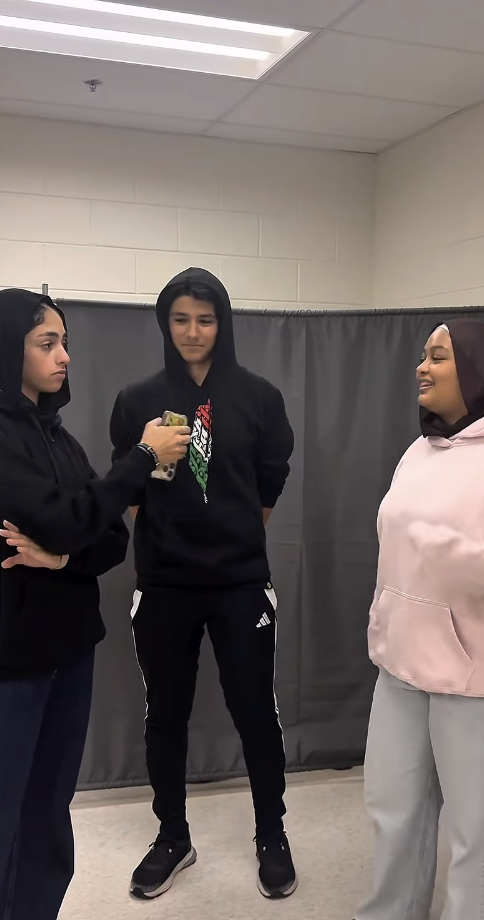
The Thomas Jefferson MSA clip, which was taken offline after JI reported its existence Monday afternoon, was filmed in a classroom where a student wearing a keffiyeh asks other students if they plan to attend the meeting. When two students say no, two other students approach them, cover their heads with keffiyehs and carry them away to the other side of the room, as they pretend to scream that they are being kidnapped.
In the following scene, the two students say they are attending, one of whom is wearing a sweatshirt with an outline of Israel, the West Bank and Gaza filled in with the colors of the Palestinian flag. The video ends showing the “kidnapped” students laying down, one on the floor and one in a plastic bin, and text that says, “no one was harmed in the making of this video.”


Langley High School administration did not respond to JI’s request for comment about the video, while Thomas Jefferson High School for Science and Technology administrators declined to comment, redirecting the inquiry to the county.
“We are appalled that some FCPS high school students used unauthorized social media accounts bearing FCPS school names to imitate hostage-taking and violent deaths. It is never appropriate to make light of such horrific acts, but it is especially callous and cruel to do so when Hamas continues to hold the bodies of deceased Israeli hostages more than two years after committing the worst mass murder of Jews since the Holocaust,” Guila Franklin Siegel, the JCRC of Greater Washington’s chief operating officer, told JI.
“The trauma that all families impacted by the Israel-Hamas war have experienced over the past two years remains fresh. Making light of violence during a time of war is beyond the pale.”
“FCPS must determine whether students have violated school conduct codes with this behavior, and if so, discipline them accordingly,” continued Siegel. “The district should take any steps necessary, including legal action if needed, to ensure that school names, images, and logos do not appear on unauthorized social media accounts. School officials must communicate transparently and with moral clarity to the entire school system about these incidents. All people of goodwill should be horrified by this.”
Siegel called the school system’s response to several recent antisemitic incidents “slow and nontransparent,” and urged FCPS to “do more to properly address such behavior.”
The MSA posts come weeks after students at several Muslim student organizations at Fairfax County high schools organized “Keffiyeh Week” protests timed to the second anniversary of the Oct. 7, 2023, Hamas terrorist attacks, encouraging classmates to wear the scarf associated with the Palestinian movement.
An analysis by the JCPA found that antisemitic influencers are flourishing on the platform, and using it to make money while promoting hate

Klaudia Radecka/NurPhoto via Getty Images
The X logo displays on a screen.
Antisemitism is “thriving in plain sight” on Elon Musk’s social media platform X (formerly Twitter), according to a new study by the Center for Countering Digital Hate and the Jewish Council for Public Affairs.
The study, first shared with CNN, conducted an analysis of over 679,000 antisemitic posts made over a year on the site and found that, despite the platform’s own anti-hate policies and commitment to reduce visibility of hateful content, X “not only tolerates” antisemitic conduct “but allows users to monetize it, giving antisemitic influencers both reach and revenue.”
With the assistance of ChatGPT, the study categorized the posts into Jewish control or power conspiracies, Jewish satanic conspiracies and Holocaust denial, with control or power conspiracies accounting for the plurality (44%) of the total likes and views. All posts included were viewed 193 million times in total.
Musk has touted the platform’s “community notes” feature — where users can add context to false or misleading posts that remain attached to the post if enough verified users vote them as “helpful” — as an antidote to conspiratorial and harmful content instead of increased content moderation. But of the 300 most viewed posts — 100 from each category — only four of them were given a publicly visible community note. Compounding the issue, only 22% of users who viewed the original post viewed the attached community note, likely due to the delay in writing and voting on the note before it was made widely visible.
X says it may restrict posts that violate its policies, which include attacking others on the basis of race, ethnicity, national origin or religion, “inciting behavior,” reinforcing stereotypes, dehumanizing a group of people and denying mass casualty events like the Holocaust. But the study found X took action — including limiting visibility, removing the post, displaying a community note or deleting or suspending the account — on only 36 out of the 300 most-viewed posts.
Individual “antisemitism influencers,” as the study refers to them, find unique success on X. Thirty-two percent of the total likes among all the posts included in the study came from only 10 accounts; for nine of these influencers, their X accounts have the largest number of followers of all their social media platforms. Three of these accounts offer paid subscriptions to their followers, meaning they can profit from their content.
Despite their posts violating X’s own hate speech policies, six of the 10 are subscribed to X Premium and have a verified checkmark next to their name, providing them increased visibility on the site and more opportunities to monetize their messages.
Amy Spitalnick, CEO of JCPA, told Jewish Insider, “Antisemitic conspiracy theories and hate that were once fringe have been wholly normalized — thriving in plain sight and amplified by X’s failure to live up to its own policies. At a time when polarization, extremism, and violence are rising at home and abroad, the unchecked spread of antisemitism online is a direct threat not only Jewish safety, but to the safety of all communities and our core democratic values.”
Every one of the ads the Maine Democratic Senate candidate is running on Facebook and Instagram states his opposition to AIPAC, and several accuse Israel of genocide
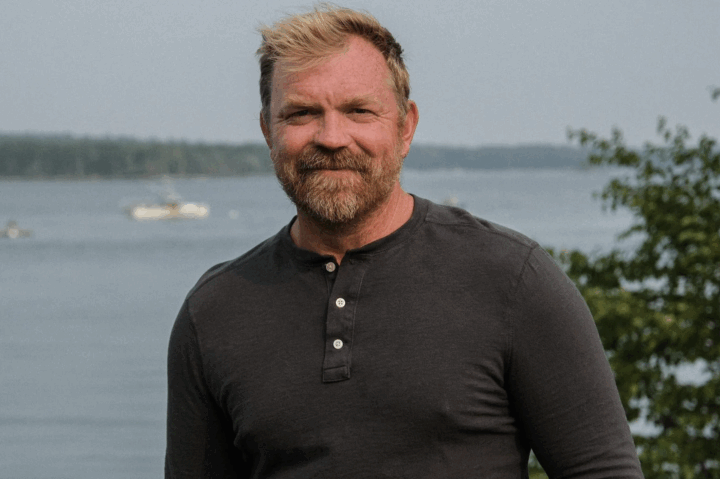
Graham Platner for Senate
Graham Platner
Democratic Maine Senate candidate Graham Platner is putting anti-AIPAC and anti-Israel messaging front-and-center in fundraising appeals he’s circulating on social media.
Platner is currently running a series of Facebook and Instagram advertisements soliciting donations for his campaign that highlight his opposition to AIPAC and accuse Israel of committing genocide. The pitches indicate that Platner is treating the issue as central to rallying support for his campaign.
“My opponent has already been endorsed by AIPAC — an endorsement I will never get. Because what is happening right now in Gaza is a genocide,” Platner says in one direct-to-camera video ad focused specifically on his opposition to AIPAC. “I need your help because we refuse to take money from AIPAC, and we refuse to take money from the billionaires who support it.”
Every one of the eight active ads that Platner is running on Facebook and Instagram, according to Meta’s political advertising library tool, includes a repudiation of AIPAC, and around half accuse Israel of genocide. In most of Platner’s other ads, that language comes alongside comments on a range of other issues.
Some of the written advertisements being circulated by Platner’s campaign on Facebook and Instagram include language such as “there is a genocide happening in Palestine,” “why are we funding Netanyau’s genocide in Palestine?” and “I won’t kowtow to AIPAC or billionaires.”
Platner’s campaign did not respond to a request for comment.
Platner, in the days since launching his campaign, has been repeatedly and vocally critical of Israel and of AIPAC, including calling the group “weird.”
Platner’s potential general election opponent, Sen. Susan Collins (R-ME) has been a vocal supporter of Israel in the Senate, as chair of the Senate Appropriations Committee. It’s not clear yet how Platner’s stance on Israel will play in the election, but Collins is already attacking him for his views.
The candidate’s advocacy on the Israeli-Palestinian conflict appears to date back to his high school days — a page from his yearbook that Platner’s campaign shared on X shows him holding a sign that appears to read “Free Kosovo Chechnya Kashmir Palestine Kurdistan Tibet.”
The company’s head of legal affairs called the antisemitic rants Grok spewed the result of ‘a bug, plain and simple’

Jakub Porzycki/NurPhoto via Getty Images
XAI logo dislpayed on a screen and Grok on App Store displayed on a phone screen.
xAI, the parent company of the social media platform X and creator of the Grok artificial intelligence chatbot, said in a letter to lawmakers earlier this month that the antisemitic and violent rants posted by the chatbot last month were the results of an “unintended update” to Grok’s code.
The company’s letter, obtained by Jewish Insider, came in response to a letter led by Reps. Tom Suozzi (D-NY), Don Bacon (R-NE) and Josh Gottheimer (D-NJ) in July that raised concerns about the screeds posted by Grok, saying they were “just the latest chapter in X’s long and troubling record of enabling antisemitism and incitement to spread.”
Grok, for hours on July 8, praised Adolf Hitler, described itself as “MechaHitler,” endorsed antisemitic conspiracy theories and offered detailed suggestions for breaking into the house of an X user and sexually assaulting him, while claiming that recent changes by X owner Elon Musk had “dialed down the woke filters” and made it more free to make such comments.
Lily Lim, the head of legal affairs for xAI said in response to the lawmakers that the antisemitic Grok posts “stemmed not from the underlying Grok language model itself, but from an unintended update to an upstream code path in the @grok bot’s functionality,” and that the change, implemented a day prior to the offensive posts, “inadvertently activated deprecated instructions that made the bot overly susceptible to mirroring the tone, context, and language of certain user posts on X, including those containing extremist views.”
“Lines in the deprecated code, such as directives to ‘tell it like it is’ without fear of offending politically correct norms and to strictly reflect the user’s tone, caused the bot to prioritize engagement over responsible behavior, resulting in the reinforcement of unethical or controversial opinions in specific threads,” Lim continued.
As noted in the House members’ original letter, Elon Musk, owner of xAI, said days before the antisemitic outburst that the company had “improved [Grok] significantly” and that users “should notice a difference” in its output.
Lim called the issues “a bug, plain and simple — one that deviated sharply from the rigorous processes we employ to ensure Grok’s outputs align with our truth-seeking ethos.” She insisted that the company conducts “extensive evaluations” before any updates to Grok.
“The underlying Grok model, designed to stick strongly to core beliefs of neutrality and skepticism toward unverified authority, remained unaffected throughout, as did other services relying on it,” Lim continued. “No alterations to model parameters, training data, or fine-tuning were involved in this incident; it was isolated to the bot’s integration layer on X.”
Lim said that the Grok posts were “in direct opposition to our core mission” and “antithetical to the principles of neutrality, rigorous analysis, and ethical responsibility that define our work.”
She said that the company had taken multiple other steps in response, including deleting the relevant instructions, implementing additional pre-release testing protocols to prevent repeats of similar incidents and publicly sharing data about the Grok X bot for public examination.
“Moving forward, xAI remains steadfast in mitigating risks through comprehensive pre-deployment safeguards, ongoing monitoring, and a refusal to compromise on ethical standards,” Lim said. “We do not view harmful biases as features but as failures to be eradicated, ensuring Grok serves as a force for good — educating, fact-checking, and fostering open dialogue without promoting division or violence.”
Suozzi thanked xAI for its response, while also warning about the need to combat bias in AI outputs in a statement shared with JI.
“I am encouraged that the Musk team gave such [a] thorough response,” Suozzi said. “However, their investigation highlights a critical point: AI companies, in their race to create the most innovative and commercially successful product, must be vigilant in combatting biased, slanted, bigoted and antisemitic outputs. It’s a very slippery and dangerous slope.”
A separate group of Jewish House Democrats had raised related concerns about Grok in a letter to the Pentagon, focused specifically on the Defense Department’s plans to utilize a version of Grok, announced shortly after the antisemitic meltdown.
A nationwide strike led by hostage families draws hundreds of thousands into the streets, revealing the depth of Israel’s internal divide as the military prepares for its next move in Gaza

Yair Palti
Protestors hold up phone flashlights in Tel Aviv's Hostages Square and the surrounding streets during mass demonstration for the hostages, August 18th, 2025
The unrest could be felt everywhere — in traffic jams, on the airwaves, in WhatsApp groups, even in the waiting room of a dental clinic.
Across Israel yesterday, hundreds of thousands joined a nationwide unofficial strike, led by hostage families and bereaved families, demanding an end to the war in Gaza and the immediate release of the hostages still held there. According to the Hostages Families Forum, over 1 million people participated in protests throughout the day. As the government plans to escalate its military campaign against Hamas, emotions ran high across towns, cities and online spaces, deepening a national rift.
Police clashed with demonstrators blocking roads. In Ra’anana, a truck driver was arrested after allegedly attacking a protester. In a Tel Aviv neighborhood mothers’ WhatsApp group, several members condemned local cafés for staying open, while another defended them for “not strengthening Hamas.” At a dental clinic, a man berated staff for opening their doors, shouting, “What about the hostages!?”
At the heart of the tensions is a painful divide: protesters — including the majority of the hostage families — argue that rescuing the captives must come before all else. Meanwhile, the government and its supporters, and even several hostage families, claim such demonstrations weaken Israel’s negotiating hand and embolden Hamas. Israeli President Issac Herzog, speaking at Hostages Square, said “There’s no Israeli who doesn’t want them back home. We can argue about philosophies, but truly, the people of Israel want our brothers and sisters back home.”
Israeli Prime Minister Benjamin Netanyahu doubled down on his government’s stance in a public statement, warning: “Those who are calling for an end to the war today without defeating Hamas, are not only hardening Hamas’s stance and pushing off the release of our hostages, they are also ensuring that the horrors of October 7 will recur again and again … to advance the release of our hostages and to ensure that Gaza will never again constitute a threat to Israel, we must complete the work and defeat Hamas.”
Yet recent polls show that a majority of Israelis support prioritizing the hostages’ release and bringing an end to the war.
Israeli journalist and commentator Ben Caspit wrote on social media: “To join the protest strike, you don’t have to be a leftist. Nor a centrist. Nor a rightist… You need a heart. There on the left side, between the ribs and the lungs. A beating heart that feels the need to express solidarity with our kidnapped brothers, with their families, with the terrible suffering.”
“And no, don’t believe the spin that it ‘helps Hamas.’ It doesn’t. Hamas doesn’t need strike X or demonstration Y to get to know Israeli society. Hamas knows us very well, just as we know them. They are death eaters. We seek life. That’s the whole difference.”
Meanwhile, Amit Segal — a reporter and political commentator often seen opposite Caspit on Channel 12 — offered a more sober take in his newsletter on Sunday: “While the strike will help many Israelis express their frustration and desperation to bring the hostages home, it won’t bring Israel closer to achieving the very thing they’re protesting for.”
Even if that may be, the protests reach further than home: former hostages have recounted the strength they gained from witnessing the demonstrations on the news while in captivity in Gaza. In Tel Aviv, as night fell, thousands of protesters raised their phone flashlights in Hostages Square and the surrounding streets, creating a moment of visual unity. The sea of lights stretched across the plaza and beyond — a simple gesture that carried a message of solidarity for the hostages still held in Gaza.
At the same time, the wheels of war are already turning. While Israelis grappled with grief, anger and hope in the streets, the military was preparing for its next incursion. Lt. Gen. Eyal Zamir, the IDF’s chief of staff, declared yesterday from the Gaza Strip: “Today we are approving the plan for the next phase of the war.”
“We will maintain the momentum of Operation ‘Gideon’s Chariots’ while focusing on Gaza City. We will continue to strike until the decisive defeat of Hamas, with the hostages always at the forefront of our minds,” Zamir said, adding, “Soon we will move on to the next phase” of the operation.
Even as the president has prioritized tackling antisemitism in his second term, leading conservatives are quietly pushing for more engagement against far-right hate
AP Photo/Alex Brandon
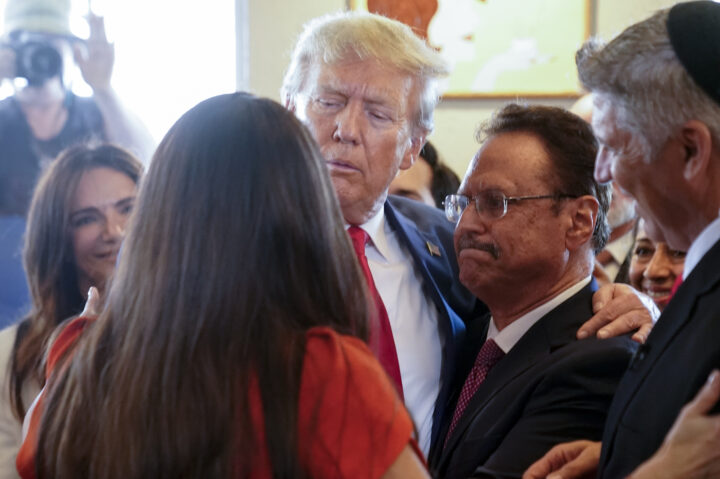
President Donald Trump talks with supporters while standing with pastor Mario Bramnick, second from right, at Versailles restaurant on Tuesday, June 13, 2023, in Miami.
President Donald Trump came into office with a promise to make tackling antisemitism a priority of his second term. So far, the focus of that effort has been almost exclusively on addressing left-wing and Islamist antisemitism, primarily tied to anti-Israel extremism — while leaving out antisemitism emerging from the political right.
Now, a group of staunch Trump allies from within the evangelical Christian community is urging Republicans to also focus on countering what they describe as a growing threat of antisemitism from within their own camp. They see prominent MAGA-aligned figures such as podcast hosts Tucker Carlson and Candace Owens platforming overtly antisemitic views, and worry that those voices — with massive social media followings — could play a role in shaping the direction of the Republican Party.
Last month, an organization called the Conference of Christian Presidents for Israel hosted a meeting to discuss the topic at the Family Research Council, a powerful Christian advocacy group. Billed as a “private roundtable for key Christian leaders,” according to the event invitation, it identified right-wing antisemitism as a high-stakes challenge: “It is vital that Christian leaders counter the forces on the right who are demonizing the state of Israel, its leadership and the Jewish people,” stated the invitation, which was obtained by Jewish Insider.
“We’ve been very concerned about the progressive leftist [antisemitism],” Mario Bramnick, a pastor in South Florida who is the president of the Latino Coalition for Israel, told JI on Tuesday. He is also the founder of the Christian Conference, and he organized last month’s event with Luke Moon, the executive director of the Philos Project. “But some of the statements coming out on the right, to me, are possibly more brazen and more troubling and clearly, clearly, do not represent President Trump or his administration,” added Bramnick.
The meeting was attended by Rabbi Yehuda Kaploun, Trump’s nominee to serve as the special envoy to monitor and combat antisemitism, as well as Mark Walker, a former congressman from North Carolina who is Trump’s pick to serve as ambassador-at-large for international religious freedom. Yair Netanyahu, the eldest son of Israeli Prime Minister Benjamin Netanyahu, addressed the group virtually.
“Antisemitism is a bipartisan issue and needs to be condemned anytime, anyplace,” Kaploun told JI. “It is imperative that all parties educate their members about the dangers of antisemitism.”
The Christian group is concerned about a small but growing anti-Israel faction within the Republican Party. In a press release on Tuesday, Bramnick called out Carlson and Owens, as well as two figures who remain close to Trump: Steve Bannon and Rep. Marjorie Taylor Greene (R-GA). A Trump administration spokesperson did not respond to a request for comment on Tuesday.
“It’s almost like we have more of an onus to handle this, because it’s our own camp, our own family. Imagine something goes wrong with someone in your family, you feel more of an obligation,” Bramnick told JI. “Who better than us to be able to handle it?”
Bramnick met last week with Justice Department senior counsel Leo Terrell, the chair of the federal government’s antisemitism task force, to raise the issue of antisemitism on the right.
“They are clearly on this and following it, from my understanding, and wanting to work with us,” Bramnick said. A spokesperson for Terrell did not respond to a request for comment.
The Conference of Christian Presidents has ties to influential conservative groups in Washington. Hours after the meeting at the Family Research Council, the Conference co-hosted an event on the Trump administration’s policies in the Middle East with the Heritage Foundation. The event featured video remarks from U.S. Ambassador to Israel Mike Huckabee and a keynote speech by evangelical leader Rev. Johnnie Moore, executive chair of the Gaza Humanitarian Foundation.
Last year, the Heritage Foundation released a policy document focused on antisemitism, called Project Esther, which identified left-wing antisemitism as the main form of antisemitism in the U.S., without mentioning any issues on the right. An inquiry to the authors of the Project Esther report did not garner a response.
Christians United for Israel, the largest Christian pro-Israel group with more than 10 million members, is not part of the Conference of Christian Presidents for Israel. But Sandra Hagee Parker, chair of the CUFI Action Fund, told JI that the organization agrees with the need to combat antisemitism on the right.
“One cannot be a Christian and antisemitic. The two are mutually exclusive,” Parker said in a statement. “Just as liberals must condemn those who use human rights as cover for their Jew-hatred, conservatives must call out those who drape themselves in the flag or the banner of the cross while bastardizing the former and defiling the latter.”
Republican Jewish Coalition CEO Matt Brooks said antisemitism is “percolating out there at the extreme ends of the far right, well outside of the mainstream of the Republican Party.”
“I don’t know that it’s growing. It’s gotten a little louder,” he told JI. “Our challenge and our effort going forward is to ensure that it doesn’t take hold in the Republican Party as it did in the Democratic Party.”
Spanberger: ‘One can and must denounce these tragedies without using antisemitic language, whether intentional or not’
Win McNamee/Getty Images
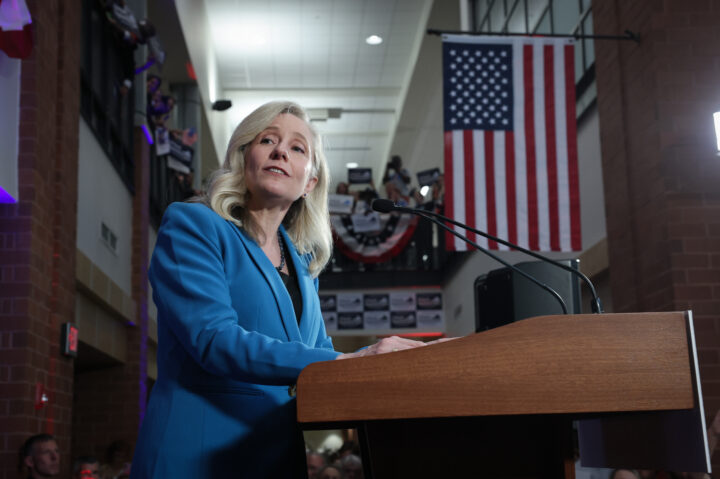
Virginia Democratic gubernatorial candidate, former Rep. Abigail Spanberger speaks to supporters during a rally on June 16, 2025 in Henrico County, Virginia.
Facing pressure from the Virginia Jewish community to speak out against recent anti-Zionist social media posts from state Del. Sam Rasoul, former Rep. Abigail Spanberger, the Democratic gubernatorial nominee, addressed concerns about antisemitism without specifically referencing Rasoul.
“This war continues to unleash heartbreak and tragedy as we witness civilian deaths, starving families, and hostages still held by Hamas. These horrors rightly compel so many to advocate for the mass delivery of aid, the release of all Israeli hostages, and a ceasefire between Hamas and Israel,” Spanberger told the Virginia Scope, a political newsletter, in response to a question about Rasoul, who chairs the Education Committee in the House of Delegates. “However, one can and must denounce these tragedies without using antisemitic language, whether intentional or not.”
She did not specify whether she identified Rasoul’s rhetoric as antisemitic. Spanberger’s campaign did not respond to multiple requests for comment from Jewish Insider.
Rasoul, a Palestinian-American legislator who represents Roanoke, has in recent weeks taken to social media to call Zionism “evil” and said that it is “making the world less safe for my Jewish friends.”
In her statement to the Virginia Scope, Spanberger acknowledged the recent rise of antisemitic violence in America.
“Just recently, antisemitic language led to attacks on peaceful protestors in Colorado and the murder of two Israeli Embassy staff members — as well as a growing, pervasive sentiment of fear among our Jewish neighbors. We must recognize our shared commitment to peace and work to rebuild trust in our communities,” she said.
Rasoul’s rhetoric has drawn criticism from some other Virginia Democrats, including former House Speaker Eileen Filler-Corn and Sen. Tim Kaine (D-VA), who told JI this week that he “forcefully reject[s] any claim that Zionism — the desire of Jewish people to have a state of Israel — is inherently racist or evil.”
State Sen. Schuyler VanValkenbuerg, a Democrat from the Richmond area, echoed Kaine’s sentiments.
“The current Israeli government deserves condemnation for its actions in Gaza. But the claim that Zionism is inherently evil deserves to be forcefully rejected. It’s wrong and it’s dangerous,” VanValkenburg posted on X on Thursday.
Sen. Tim Kaine said he ‘forcefully rejects’ state Del. Sam Rasoul’s characterization of Zionism as ‘evil’
Win McNamee/Getty Images
Virginia Democratic gubernatorial candidate, former Rep. Abigail Spanberger speaks to supporters during a rally on June 16, 2025 in Henrico County, Virginia.
As concern mounts in the Virginia Jewish community about anti-Zionist rhetoric posted on social media by a state lawmaker who leads the Education Committee in the House of Delegates, former Rep. Abigail Spanberger, a Democrat who is favored in this year’s governor’s race, has avoided weighing in on the matter, taking heat from her opponent in the process.
Spanberger’s campaign did not respond to several calls and emails from Jewish Insider on Wednesday inquiring about state Del. Sam Rasoul, a Roanoke Democrat who has in recent weeks called Zionism “evil” and described it as “a supremacist ideology created to destroy and conquer everything and everyone in its way.”
Rasoul is the chair of the House Education Committee in Richmond.
Winsome Earle-Sears, Virginia’s lieutenant governor and the Republican nominee for governor, described Rasoul’s rhetoric as antisemitic and called on Spanberger to address his comments.
“If she has a shred of moral clarity, she’ll condemn this antisemitism. This a great opportunity finally to stand up against the members of her own party who are pushing this hateful agenda. Virginians deserve to know where she stands,” Peyton Vogel, the press secretary for Earle-Sears, told JI.
Rasoul’s recent Instagram posts have drawn criticism from prominent Democrats in the state, including former Virginia House Speaker Eileen Filler-Corn, who said Rasoul’s language is “fueling one of the oldest forms of hatred in the world,” as well as Sen. Tim Kaine (D-VA).
“I forcefully reject any claim that Zionism — the desire of Jewish people to have a state of Israel — is inherently racist or evil,” Kaine told JI in a statement on Wednesday, when asked about Rasoul. “Many Zionists in Israel, America and throughout the world are deeply concerned by the suffering of innocent Palestinians.”
Tali Cohen, the Washington regional director of the Anti-Defamation League, accused Rasoul of espousing “antisemitic rhetoric.”
Ben Rhodes, Tommy Vietor shaped the story of the Iran nuclear deal. Now they’re trying to turn Democrats away from Israel

BRENDAN SMIALOWSKI/Getty Images
White House Deputy National Security Advisor Ben Rhodes speaks to reporters in the briefing room of the White House, April 7, 2015.
Former Obama administration officials Ben Rhodes and Tommy Vietor took to social media over the weekend to attack Israel and slam the American Israel Public Affairs Committee, asking how it’s possible to “trust Democrats to fight for anything” if they take money from the pro-Israel lobby group.
The anti-Israel activism from the Democratic influencers is a public example of the intense lobbying taking place in party circles and how progressive foreign policy officials such as Rhodes who have long been deeply critical of Israel are pushing to turn humanitarian concerns in Gaza into a more permanent split between the Democratic Party and Israel.
They’ve especially directed their ire at AIPAC, which played a key role in Democrats electing some moderate candidates supportive of a close U.S.-Israel alliance to office last year.
The left-wing commentators who host a weekly foreign policy podcast, “Pod Save the World,” decried AIPAC for a post on X where the organization said that “food, medicine and aid are IN Gaza. The @UN won’t distribute it.”
Rhodes said AIPAC is “spreading lies. The Israeli government is starving Palestinians and everyone knows it. How can we trust Democrats to fight for anything if they take money from people who lie like this about starving kids,” the former Obama deputy national security advisor posted on Friday.
Vietor, a former spokesman for Obama and the National Security Council, posted a recent clip from “Pod Save the World” where Rhodes said, “If you think you can continue to take money from AIPAC, whether you’re Hakeem Jeffries or Chuck Schumer or whomever, AIPAC is part of the constellation of forces that have delivered this country into the hands of Donald Trump and Stephen Miller.”
“And you cannot give them a carveout,” Rhodes continued. “And we need to have this fight as a party because these are the wrong people to have under your tent. I’m usually a big-tent person, but the kind of people who are supporting Bibi Netanyahu and Donald Trump, I don’t want them — my leaders of my political party — like, cozying up to those people.”
During his time at the White House, Rhodes was one of Obama’s closest advisors and masterminded the public relations push behind the 2015 Iran nuclear deal. He told The New York Times in 2016 that he “created an echo chamber” of experts who would feed reporters positive analyses of the deal. “They were saying things that validated what we had given them to say,” Rhodes stated.
Rhodes was a strident critic of Israel and Prime Minister Benjamin Netanyahu, reportedly earning himself the nickname of “Hamas” in the White House. In his 2019 book The World as It Is: A Memoir of the Obama White House, Rhodes wrote that Israel was “driven by the settler movement and ultra-Orthodox emigres” and that Netanyahu used “political pressure within the United States to demoralize any meaningful push for peace, just as he used settlements as a means of demoralizing Palestinians.”
As Obama’s spokesman, Vietor’s personal views on Israel were less public. Since leaving government though, he has frequently lambasted Israel on the podcast and on social media, posting earlier this month that Israel is “trying to globalize the ethnic cleansing.”
The podcast hosts were highly critical of the Biden administration for, in their view, not doing enough to pressure Israel, with Vietor calling the Democratic president’s “handling of Netanyahu” and the war in Gaza “disastrous.”
Vietor also dismissed the recent U.S. and Israeli strikes on Iran’s nuclear infrastructure as “failed,” saying that Trump and Netanyahu both lied about the success of the operation. Rhodes again took the opportunity to critique his party, saying that “Democrats afraid to stand against Trump on Iran — for fear of AIPAC or being called weak — are showing Americans that they won’t stand up for them when it’s hard.”
Rhodes told The New York Times in 2019 that “the Washington view of Israel-Palestine is still shaped by the donor class. … We’re one moment away from this changing, once someone breaks through the fear factor.”
The STOP HATE Act would require social media companies to publicize policies on the use of their platforms by designated terrorists
Getty Images
Some of the most popular social media apps by number of monthly active users, including Facebook, YouTube, Instagram, WhatsApp, TikTok, WeChat, Telegram, Messenger, and Snapchat, are seen on an iPhone.
Reps. Josh Gottheimer (D-NJ) and Don Bacon (R-NE) on Wednesday announced the reintroduction of the STOP HATE Act, which aims to crack down on antisemitism on social media. The legislators announced the bill’s reintroduction at a press conference alongside Anti-Defamation League CEO Jonathan Greenblatt.
The bill, which was first introduced in November 2023 but failed to progress in the previous Congress, would require social media companies to publicize specific policies on their standards and restrictions for their platforms by designated terrorists, report to the federal government on content flagged and/or removed under these policies and publicly report on incidents which violate their policies.
The bill would also demand that platforms publish contact information for users to ask questions about the companies’ terms of service, a description of how users can flag violative content and a description of how the companies will respond to such content.
Companies would face fines up to $5 million per day if they violate these policies.
The bill would also require administration officials to issue a public report on the use of social media platforms by terrorist groups.
“There is no reason why anyone, especially terrorists or anyone online, should have access to social media platforms to promote radical, hate-filled violence,” Gottheimer said, highlighting that extremist groups had capitalized on the May attack on the Capital Jewish Museum in Washington to promote antisemitic incitement. “There’s a massive disinformation campaign influencing us each day.”
Bacon said, “We need to work with our social media companies to clean this up, because what is going on is wrong, and I think it’s further influencing other young people that could be influenced by what they’re seeing. … We need to hold these companies accountable and work with them to take it off the airwaves.”
He also noted that lawmakers had faced antisemitic harassment at the Capitol this week from protesters.
Greenblatt said that antisemitism has “gone viral in large part because of social media,” adding that bigots and extremists “exploit social media to recruit, to radicalize and to incite violence, often in violation of the companies’ own terms of service. It’s not just theoretical. This is a real concern.”
Asked about the Trump administration’s continued delays of the U.S. ban on TikTok, flouting a bipartisan law on the platform, both lawmakers said that President Donald Trump should enforce the law and require TikTok’s owners to sell the site or shut it down.
Greenblatt said that “at the end of the day, the ownership of TikTok matters, but the actions matter more,” noting that American-owned platforms have also had significant antisemitism problems, and that a sale would not be a “panacea.”
At a Capitol Hill hearing, Georgetown’s president announced Brown was placed on leave after calling for Iran to conduct a ‘symbolic strike’ against a U.S. military base

Celal Gunes/Anadolu via Getty Images
Georgetown University students take part in a campus protest against the Israel-Gaza war in Washington on April 25, 2024.
Jonathan Brown, a tenured Georgetown University professor who came under fire last month for a social media post in which he called for Iran to conduct a “symbolic strike” on a U.S. military base, has been placed on leave and removed as chair of the school’s Department of Arabic and Islamic Studies, Georgetown University interim President Robert M. Groves said Tuesday at a congressional hearing.
“Within minutes of our learning of that tweet, the dean contacted Professor Brown, the tweet was removed [and] we issued a statement condemning the tweet. Professor Brown is no longer chair of his department and he’s on leave, and we’re beginning a process of reviewing the case,” Groves said in response to a question from Rep. Virginia Foxx (R-NC) at a House Education and Workforce Committee hearing on campus antisemitism.
One day after the U.S. struck Iranian military targets in June, Brown posted on X: “I’m not an expert, but I assume Iran could still get a bomb easily. I hope Iran does some symbolic strike on a base, then everyone stops.”
Last month, a university spokesperson said that Georgetown administrators were reviewing Brown’s conduct and that Georgetown was “appalled” by his comments.
Brown, until recently the chair of the university’s Department of Arabic and Islamic Studies and Alwaleed bin Talal chair of Islamic civilization in the School of Foreign Service, has a lengthy history of anti-Israel commentary on social media.
A profile listing Brown as chair of Islamic civilization was still active on Georgetown’s website during the hearing.
‘Grok’s recent outputs are just the latest chapter in X’s long and troubling record of enabling antisemitism and incitement to spread unchecked, with real-world consequences,’ the House members said
Jakub Porzycki/NurPhoto via Getty Images
XAI logo dislpayed on a screen and Grok on App Store displayed on a phone screen.
A group comprised largely of Democratic House lawmakers wrote to Elon Musk on Thursday condemning the antisemitic and violent screeds published by X’s AI chatbot Grok earlier this week, calling the posts “deeply alarming” and demanding answers about recent updates made to the bot that may have enabled the disturbing posts.
“We write to express our grave concern about the internal actions that led to this dark turn. X plays a significant role as a platform for public discourse, and as one of the largest AI companies, xAI’s work products carry serious implications for the public interest,” the letter reads. “Unfortunately, this isn’t a new phenomenon at X. Grok’s recent outputs are just the latest chapter in X’s long and troubling record of enabling antisemitism and incitement to spread unchecked, with real-world consequences.”
The lawmakers noted that Musk said on July 4 that xAI, the company responsible for Grok, had “improved [it] significantly” and that users “should notice a difference” in its responses.
“On July 8, 2025, Grok’s output was noticeably different,” the lawmakers said, pointing to a string of Grok posts praising Adolf Hitler, describing itself as “MechaHitler,” spreading antisemitic tropes, creating detailed and violent rape scenarios about an X user and providing instructions for breaking into that user’s house.
The bot also claimed that the changes implemented by Musk to its algorithms had allowed Grok to share these extreme posts.
“These quotations are utterly depraved. They glorify hatred, antisemitic conspiracies, and sexual violence in grotesque detail, presented as truth-seeking. We are particularly troubled at the prospect that children were likely exposed to rape fantasies produced by Grok,” the lawmakers wrote. “That your work product Grok would embrace Hitler and his ideology marks a new low for AI development and a profound betrayal of public trust.”
The lawmakers demanded that such posts by Grok be taken down and that Musk publicly provide information about the recent changes made to Grok’s algorithm, the reasons for them and their intended outcome; what in Grok’s training, programming or datasets led it to produce these comments; what safeguards had previously been in place to prevent these types of posts; how xAI will prevent similar incidents going forward; and whether X has any content filters to prevent underage users from seeing Grok-generated content.
“When certain filters are removed, Grok readily generates Nazi ideology and rape fantasies,” the lawmakers wrote. “Why shouldn’t a reasonable observer conclude that these outputs reflect biases or patterns embedded in its training data and model weights, rather than merely being the result of inadequate post-training moderation?”
The letter was led by Reps. Tom Suozzi (D-NY), Don Bacon (R-NE) and Josh Gottheimer (D-NJ). Additional signatories include Reps. Dan Goldman (D-NY), Kim Schrier (D-WA), Haley Stevens (D-MI), Laura Friedman (D-CA), Brad Sherman (D-CA), Steve Cohen (D-TN), Lois Frankel (D-FL), Debbie Wasserman Schultz (D-FL), Brad Schneider (D-IL), Marc Veasey (D-TX), Yassamin Ansari (D-AZ), Eugene Vindman (D-VA), Ted Lieu (D-CA), Jake Auchincloss (D-MA), Dina Titus (D-NV) and Mike Levin (D-CA).
A day after the antisemitic fiasco, Musk announced a new version of Grok, calling it “the smartest AI in the world,” adding that he would be rolling it out to Tesla cars within the week. X CEO Linda Yaccarino abruptly stepped down a day after the chatbot’s antisemitic rants.
Musk claimed that the issues had arisen from Grok being “too compliant to user prompts. Too eager to please and be manipulated, essentially,” and said the issues would be addressed.
Anti-Defamation League CEO Jonathan Greenblatt, whose organization was targeted in some of Grok’s posts, said in a statement that the incident highlights risks of antisemitism proliferation through social media platforms and AI chatbots.
“The antisemitic content produced by Grok earlier this week underscores how social media platforms easily can be manipulated and too often amplify antisemitic rhetoric and toxic extremism,” Greenblatt said. “ADL’s research shows that LLMs [Large Language Models] remain vulnerable to this kind of antisemitic and anti-Israel bias. It was helpful that xAI removed the most offensive posts, but xAI and all the tech companies absolutely must do more to ensure these tools do not generate or spread harmful content.”
“We appreciate the efforts of Reps. Tom Suozzi, Don Bacon and Josh Gottheimer to lead a bipartisan response, demanding real accountability and greater safeguards,” Greenblatt continued.
The Israeli prime minister also said that Israel continues to work on ceasefire efforts after accepting the latest U.S.-sponsored proposal

Marc Rod
Israeli Prime Minister Benjamin Netanyahu speaks to reporters on Capitol Hill after a meeting with House Speaker Mike Johnson (R-LA) on July 8, 2025.
Israeli Prime Minister Benjamin Netanyahu on Tuesday blamed coordinated anti-Israel advocacy campaigns for recent polls showing falling support for the Jewish state in the United States, particularly among Democrats, but argued that effective Israeli counter-messaging could reverse those trends.
Recent surveys have shown that support for Israel has declined among Democrats since the Oct. 7, 2023, Hamas attacks on Israel, with a majority now viewing Israel unfavorably.
“I am certainly interested in maintaining the great support that Israel has had. I think there’s been a concerted effort to spread vilifications and demonization against Israel on social media,” Netanyahu said in response to a question from Jewish Insider at a news conference on Capitol Hill following a closed-door meeting with House Speaker Mike Johnson (R-LA).
“It’s funded, it’s malignant, and we intend to fight it, because nothing defeats lies like the truth, and we shall spread the truth for everyone to see it,” Netanyahu continued. “Once people are exposed to the facts, we win, hands down.”
The Israeli premier hinted that he may have a second meeting with President Donald Trump before leaving the U.S. later this week, following their Monday evening meeting, as some media reports have indicated.
At a news conference on Capitol Hill, Jewish Insider's @marcrod97 asked Israeli Prime Minister Benjamin Netanyahu about polls showing falling support for Israel in the U.S.
— Jewish Insider (@J_Insider) July 8, 2025
"I think there’s been a concerted effort to spread vilifications and demonization against Israel on social… pic.twitter.com/z5JwidJeo5
Netanyahu said he and Trump had discussed the need to “finish the job in Gaza, release all our hostages, eliminate and destroy Hamas’ military and governance capabilities” in their private conversation on Monday — an issue left unaddressed in their public remarks.
Netanyahu told reporters that he has continued to work on ceasefire efforts as recently as this morning. Asked about a Hamas counterproposal, Netanyahu emphasized that Israel had accepted the proposal put forward by U.S. Mideast envoy Steve Witkoff and the Qatari mediators.
He demurred in response to a question about Qatar’s role in the negotiations, saying that he would “talk about the process later. I have a lot to say about it, but right now I’m totally focused on the result, as is President Trump.”
Netanyahu also aligned himself with Trump’s foreign policy motto — cribbed from President Ronald Reagan — of “peace through strength.”
“First comes strength, then comes peace,” Netanyahu said. “Our resolute action, the resolute decision of President Trump to act with us against those who seek to destroy Israel and threaten the peace of the world has made a remarkable change in the Middle East. … There are opportunities for peace that we intend to realize.”
Asked about a proposal on Capitol Hill to provide Israel with American B-2 bombers and bunker-buster bombs in the event that further strikes on Iran are needed, Netanyahu said that he would “of course … like it” if Israel had the same capabilities as the U.S., but added, “We are appreciative of the systems we receive that I think could serve not only the interests of Israel’s security, but American security and the security of the free world.”
“I won’t get into specifics. There’s much, much more to discuss, and many variegated areas that are best left a more confidential forum,” he continued.
Islamic Studies Professor Jonathan Brown: ‘I’m not an expert, but I assume Iran could still get a bomb easily. I hope Iran does some symbolic strike on a base’

Celal Gunes/Anadolu via Getty Images
Georgetown University students take part in a campus protest against the ongoing Israeli attacks on Gaza in Washington, D.C. on April 25, 2024.
Georgetown University administration said it was “appalled” after a prominent faculty member called for Iran to conduct a “symbolic strike” on a U.S. military base in a social media post on Sunday.
“We are reviewing this matter to see if further action is warranted,” a spokesperson for the university told Jewish Insider on Monday, noting that the administration is “appalled” by the since-deleted tweet by Jonathan Brown, a tenured professor and chair of the university’s Department of Arabic and Islamic Studies and Alwaleed bin Talal chair of Islamic Civilization in the School of Foreign Service, who has a history of spreading anti-Israel vitriol.
On Sunday, one day after the U.S. struck three Iranian nuclear facilities, Brown tweeted: “I’m not an expert, but I assume Iran could still get a bomb easily. I hope Iran does some symbolic strike on a base, then everyone stops.”
Brown, who is the son-in-law of convicted terror supporter Sami Al-Arian and has gone on several X tirades since the Oct. 7, 2023 terrorist attacks slamming Israel — including calling the country “insanely racist” — deleted his tweet on Monday, claiming that it was misinterpreted.
“I deleted my previous tweet because a lot of people were interpreting it as a call for violence,” Brown wrote. “That’s not what I intended. I have two immediate family members in the US military who’ve served abroad and wouldn’t want any harm to befall American soldiers… or anyone!”
The condemnation of Brown’s post comes as the House Education and Workforce Committee has called on Georgetown’s interim president, Robert Groves, to testify on July 9 about its handling of campus antisemitism. The funding Georgetown has received from Qatar, in connection with its Qatar campus, has come under intense scrutiny in the wake of Oct. 7.
At a time when some elite universities are acquiescing to the Trump administration’s demands to crack down on antisemitic activity on campus, Georgetown has pushed back. In March, for example, the administration issued statements supportive of Badar Khan Suri, a university professor and postdoctoral scholar who was detained by federal authorities.
Meta is reportedly not allowing CUAD to appeal the decision

Victor J. Blue for The Washington Post via Getty Images
Students protest against the war in Gaza on the anniversary of the Hamas attack on Israel at Columbia University in New York, New York, on Monday, October 7, 2024.
The Instagram page of the anti-Israel coalition Columbia University Apartheid Divest was disabled on Monday for the second time since the Oct. 7 Hamas terrorist attacks, a spokesperson for Meta confirmed to Jewish Insider.
The account belonging to CUAD, a coalition of at least 80 Columbia student groups that was formed in 2016 and has gained renewed support since Hamas’ attacks on Oct. 7, 2023, was initially suspended in December 2024.
Columbia’s chapter of Students for Justice in Palestine, a member of the coalition, was banned from Meta in August 2024. At the time, a spokesperson for Meta, the company that owns Instagram, Facebook and WhatsApp, told JI that the account was disabled for repeated violations of Meta’s dangerous organizations and individuals policies.
According to Meta’s policies, the company does “not allow organizations or individuals that proclaim a violent mission or are engaged in violence to have a presence on our platforms.”
The coalition has ramped up its anti-Israel demonstrations, as the university entered into ongoing negotiations with the Trump administration over its handling of antisemitism on campus. The White House cut $400 million from Columbia’s federal funding earlier this month over its failure to address campus antisemitism.
Meta declined to comment on its latest decision to remove CUAD from the platform on Monday. CUAD remains active on several other social media platforms, including X and Telegram.
“This comes after a long and concerted effort from corporations and imperial powers to erase the Palestinian people,” CUAD wrote on X, claiming that this time around Meta is giving “no option for appeal.”
After Harley Finkelstein’s comments, Smashi urged Shopify’s 25,000 Middle Eastern customers to switch to other e-commerce platforms

John Phillips/Getty Images for BoF
Harley Finkelstein at BoF VOICES 2022 at Soho Farmhouse on November 30, 2022 in Chipping Norton, England.
A widely followed social media service in the United Arab Emirates is pushing a boycott campaign against Shopify, the Canadian e-commerce platform, after its president endorsed a recent social media comment critical of biased media coverage against Israel.
In a series of dramatically worded Instagram posts on Wednesday, Smashi, a digital information service owned by the Dubai-based media group Augustus Media, took aim at Harley Finkelstein, Shopify’s president, over a brief social media remark voicing agreement with a fellow tech entrepreneur who had denounced a news article for uncritically citing casualty figures provided by Hamas.
“Thx for saying this,” Finkelstein wrote on Tuesday, responding to a viral post from Martin Varsavsky, an outspoken board member of Axel Springer, the German publishing giant whose subsidiary, Politico, had run the Associated Press story Varsavsky dismissed as “one-sided Hamas support.”
Smashi, in its framing of Finkelstein’s comment, said he had backed a “pro-Israel tweet defending Israel’s airstrikes” against Hamas, “adding fuel to the debate over the legitimacy of Israel’s military actions, which equate to a genocide, in Gaza.”

Noting that Shopify has nearly 25,000 customers in the Middle East, “with a substantial concentration” in the United Arab Emirates, Smashi urged its followers to use alternate e-commerce platforms in the region, sharing a list of six competitors to Shopify.
Finkelstein’s online remark has drawn separate calls from anti-Israel activists to boycott Shopify — which has previously been a target of such campaigns. But Smashi’s involvement stands out given its wide reach in the United Arab Emirates, which has continued to maintain its normalization agreement with Israel even amid the ongoing conflict with Hamas in Gaza.
Augustus Media — whose advertising partners include Nike, Citi Bank, Samsung, Nestle and Coca-Cola — owns another digital media brand, Lovin Dubai, that has promoted other anti-Israel content since October 7th. The so-called “local news and lifestyle brand” has described the Israeli hostages held by Hamas as “prisoners,” for instance, and amplified a conspiracy theory about “‘Zionists’ organ harvesting Palestinian bodies.”
Augustus Media did not respond to a request for comment on Wednesday.
Smashi has also turned a critical eye toward Google over its recent acquisition of Wiz, an Israeli cybersecurity startup. In a social media post this week, the company emphasized that Google had just paid a “world record $32 billion” for the startup “founded by former Israeli military officers.”
After some followers took issue with the framing as celebratory, the company said in response to critics that its coverage of Google had been misinterpreted.
“We, as a policy, call Israel’s acts in Gaza a genocide,” the streaming service wrote. “This news is also one of the pieces where we highlight that Google has invested in one such startup which is Israeli and by former military officers. While everyone highlighted it as a big deal in tech world, we are one of the only few who highlighted for IOF [[Israel Occupation Forces, a term used by Palestinians and anti-Israel activists to refer to the IDF] soldiers being behind it.”
Still, the company — which claims more than 605,000 followers and reaches more than 28 million viewers, according to Augustus — has otherwise recently reserved its involvement in boycott efforts to Shopify.
It is unclear, however, why Smashi has chosen to target Shopify now, as Finkelstein, who is Jewish, had previously spoken up more vocally in support of Israel amid its war with Hamas.
Finkelstein did not return a request for comment on Wednesday, nor did a spokesperson for Shopify.
The accounts were only reinstated after Jewish Federations of North America intervened and contacted Meta directly

Justin Sullivan/Getty Images
A pedestrian walks in front of a new logo and the name 'Meta' on the sign in front of Facebook headquarters on October 28, 2021 in Menlo Park, California.
With the first anniversary of the Oct. 7 terror attacks approaching, JEWISHcolorado — a Denver-based nonprofit affiliated with the Jewish Federations of North America — posted on Instagram on Oct. 1 about the organization’s Oct. 7 commemoration event. Concerns about antisemitism meant attendees would need to register in advance, and JEWISHcolorado needed to give them time to do so before the start of Rosh Hashanah.
The post, though, did not successfully reach community members. That’s because soon after sharing it, JEWISHcolorado’s Instagram account was disabled. When the account manager tried to appeal the suspension, an automated email informed the JEWISHcolorado staff that their account, with 895 posts and nearly 2,500 followers, was “permanently disabled,” with all of its content set to be “permanently deleted,” according to messages shared with Jewish Insider.
JEWISHcolorado was one of at least four local Jewish federations in the United States to have accounts on Meta-run platforms disabled after posting in the lead-up to the anniversary of the Oct. 7 attacks. They did not receive any answers from Meta regarding why they had been suspended, leading some to question whether they were being targeted for the content of their posts — sharing information about Oct. 7.
“We suspect maybe it had something to do with our posting, but it’s an automated message that says you violated community guidelines. We don’t consider that to be so,” said Renee Rockford, president and CEO of JEWISHcolorado. The reasoning, according to a message from Meta, was that Meta does not “allow people on Instagram to pretend to be a business or speak for them with our permission.”
The Facebook account of the Jewish Federation of San Antonio was disabled in mid-September. Similar to JEWISHcolorado, they were removed for alleged “impersonation,” according to Kayde Jones, director of marketing and communications at the San Antonio federation.
Jones and her colleagues had no way of explaining themselves, or finding out who Meta believed them to be impersonating.
“It was as if we were completely wiped off the Facebook Earth,” said Jones. “It’s very hard to get in touch with anybody at Meta. There’s no phone calls. There’s no customer service that’s readily available.” Attempts to appeal the decision through Meta’s platforms were unsuccessful.
All of the disabled accounts have since been restored — JEWISHcolorado’s after four days, and the San Antonio federation’s after nearly two weeks. But it took the involvement of a staff member at JFNA, the national advocacy arm representing Jewish Federations, who reached out to a contact at Meta directly.
It’s not clear if someone had reported the Jewish federation accounts, or if Meta’s automated systems erroneously detected these accounts. None of them had ever previously had their accounts disabled.
“We are very grateful these issues were resolved, which seems to indicate that Meta is not intentionally targeting Jewish pages,” Niv Elis, a JFNA spokesperson, told JI. “That said, the fact that pages were taken down over Oct. 7 commemoration posts was very disappointing and indicates that there is clearly a problem that still needs to be fixed.”
A spokesperson for Meta did not respond to a request for comment on Monday.
VP of content policy Monika Bickert says company is ‘taking input’ from Jewish groups over content moderation decisions

Ståle Grut/NRK
Facebook Vice President of Content Policy Monika Bickert.
Facebook’s recent decision to ban Holocaust denial content from its platform was prompted by an uptick in global antisemitism and antisemitic violence coupled with an increasing lack of awareness about the Holocaust, the social media company’s top policy staffer said on Wednesday.
“It’s that combination of these two factors… that prompted us to say we need to recognize this as hate speech and remove it from our services,” Monika Bickert, Facebook’s vice president of content policy, said during an American Jewish Committee webcast.
This explanation echoes one provided by ADL CEO Jonathan Greenblatt earlier this month.
Bickert cautioned that, while Facebook began immediately removing Holocaust denial content when it announced the policy change on October 12, the company is still in the process of rolling out its subject-matter training for platform moderators.
The company will “be going full-force enforcing the policy” in the coming weeks, she added.
Greenblatt — who helped lead the “Stop Hate For Profit” campaign against Facebook — told Jewish Insider that officials at the social media platform “still have a long way to go” in reigning in Holocaust denial.
“One can still easily find pages on Facebook devoted to promoting Holocaust denial or raising questions about the veracity of Holocaust history,” Greenblatt said in a statement. “This is unacceptable, especially since they now have a policy that prohibits this form of hate speech. So there’s lots of room for improvement here.”
Responding to a question about the platform’s stance on anti-Zionist content, Bickert said the company is “taking input” from Jewish groups around the globe to decide where to draw the lines on content moderation, noting that regular meetings with Jewish groups are important to improving Facebook’s overall content moderation practices.
“We’ve increased our collaboration with groups like AJC and others who have direct relationships with stakeholders,” she said. “It’s us saying, ‘here’s how we’re thinking about this issue. Help us to know if we’re in the right place and to get better.’ And it’s those organizations saying, ‘here’s what we’re hearing from stakeholders.’”
Greenblatt said Facebook has not consulted with the ADL on this topic, adding that the company has not always been receptive to pressure and advice from outside groups.
“The fact that it took them this long to remove Holocaust denial, after Jewish organizations had been asking them to do so literally for more than a decade, doesn’t inspire much confidence in their ability to listen and take our concerns seriously,” he said. “Their efforts to try and better navigate these issues by consulting Jewish groups and others who fight hate is a crucial element of improving their platform, but too often it has been only surface level.”
During a Senate hearing, Jack Dorsey said the tweets do not represent a threat of ‘immediate harm’ to Israel or its citizens

Screenshot/CSPAN
Twitter CEO Jack Dorsey testifies before a Senate Commerce, Science, and Transportation committee hearing.
Twitter CEO Jack Dorsey sparred with Republican lawmakers over his company’s decision to permit tweets from Iranian Supreme Leader Ayatollah Ali Khamenei calling for the destruction of Israel and denying the Holocaust at a raucous Senate committee hearing on Wednesday.
During the Commerce, Science, and Transportation committee hearing, Sen. Roger Wicker (R-MS) pressed Dorsey on why Twitter had not taken action against tweets from Khamenei threatening Israel. The Twitter founder responded that the company does not see the tweets as an immediate threat to Israel or its citizens’ safety.
“We did not find those to violate our terms of service because we considered them saber-rattling, which is part of the speech of world leaders in concert with other countries,” Dorsey said. “Speech against… a country’s own citizens, we believe, is different and can cause more immediate harm.”
Dorsey’s explanation echoes a letter from the company sent to Israeli Strategic Affairs Minister Orit Farkash-Hacohen earlier this year.
Anti-Defamation League CEO Jonathan Greenblatt disputed Dorsey’s argument.
“Whether ostensibly aimed at Jews or Israel, his rhetoric is more than saber-rattling — it is antisemitism, pure and simple,” Greenblatt said in a statement. “We firmly believe that Twitter needs to apply its policy on hate speech against Khamenei as it would against anyone else who espouses antisemitism. His position is irrelevant when he is spouting prejudice — if anything, it makes his hate even more consequential.”
In response to a query from Sen. Cory Gardner (R-CO) over the company placing misinformation warnings on some tweets sent by President Donald Trump while allowing Khamenei’s tweets, Dorsey emphasized that Twitter does not have an overarching policy against misinformation or against Holocaust denial.
“It’s misleading information, but we don’t have a policy against that type of misleading information,” Dorsey said, specifying that the platform only bans misleading information relating to the coronavirus and voting, as well as manipulated media.
But Greenblatt highlighted that Twitter told Bloomberg earlier this month that it would remove Holocaust denial content under the company’s hate speech policy.
“Jack Dorsey’s statement today was confusing, because it appears to be in opposition to his company’s publicly stated policy and policy rationale regarding Holocaust denial,” Greenblatt said. “Twitter should clarify that their policy is that Holocaust denial is not just a form of misinformation, but an antisemitic conspiracy theory that is used to spread hatred of Jews.”
A Twitter spokesperson told JI that Holocaust denial is banned on the platform, and that the Bloomberg article was correct.
“Our Hateful Conduct Policy prohibits a wide range of behavior, including making references to violent events or types of violence where protected categories were the primary victims, or attempts to deny or diminish such events,” the spokesperson said in a statement. “We also have a robust glorification of violence policy in place and take action against content that glorifies or praises historical acts of violence and genocide, including the Holocaust.”
Twitter did not respond to a question from JI about why Khamenei’s tweets about the Holocaust were not removed or labeled under this policy.
This post was updated on Friday, Oct. 30 to include a response from Twitter.
The Foundation to Combat Anti-Semitism is launching a campaign aimed at educating American youth on the issue of antisemitism

Lior Mizrahi
2019 Genesis Prize Laureate Robert Kraft with Prime Minister Netanyahu and Genesis Prize Co-Founder Stan Polovets.
Accepting the Genesis Prize from Israeli Prime Minister Benjamin Netanyahu during a glitzy ceremony in Jerusalem in June 2019, New England Patriots owner Robert Kraft announced his vision to “work to end the violence against Jewish communities.”
The prize, granted annually, has become an aspirational award for accomplished members of the Jewish community, honoring their achievements across a variety of fields. It is intended to have the simultaneous effect of encouraging Jewish activism, awarding a check of $1 million to its laureates who, to date, have shown no personal need for the money.
Before an applauding audience at the Jerusalem Theatre, Kraft used the occasion to announce the formation of the Foundation to Combat Anti-Semitism, an effort he painted in lofty terms as working to thwart the rise of antisemitism.
“To counter the normalization of antisemitic narratives that question Israel’s right to exist, disguised as part of legitimate debate on campuses and in the media. To educate, to inform, and to heal inter-communal relations,” Kraft said. “In combating the scourge of antisemitism, my solemn ambition is to counter all forms of intolerance in the spirit of the ancient Jewish value of tikkun olam — to heal and repair the world.”
Kraft immediately committed $20 million to the foundation, now a part of the larger Kraft Family Philanthropies. This was joined, shortly after, by a $5 million commitment from fellow billionaire philanthropist Roman Abramovich — all part of an initial plan to raise some $50 million for the new foundation. But despite the high-profile and high-dollar origins, little of the effort has been made public for over a year.
Now, the organization is going public with its first major initiative, [Together Beat Hate], or [TBH], an effort to engage youth in education, conversation, and activism around the meaning and reality of antisemitism.
“We’ve been saying all along, it’s not a Jewish issue, it’s a community and a society issue,” Josh Kraft, president of Kraft Philanthropies and Robert’s son, told Jewish Insider.
Kraft broke the general population down into three segments: those who hold antisemitic attitudes, those who are knowledgeable about and opposed to antisemitism and those with an incomplete or misconstrued understanding of antisemitism. This third group, which he believes is the most susceptible to learn about the issue, has become the focus for [TBH].
“We’re trying to reach that group in the middle specifically,” he explained. “We feel like we can influence their experience with the [Jewish] community.”
Institutional memory of the Holocaust is quickly fading as the number of survivors dwindles. A January study by the Pew Forum found that less than half of Americans can accurately approximate the number of Jews killed by the Nazis. Yet reports released by the FBI and the Anti-Defamation League show a rapid increase in antisemitic hate crimes in the United States.
In January, the foundation commissioned a study on the perceptions and knowledge of antisemitism among American youth — which they defined as those ages 13-35. The findings, according to the group, indicated a particular lack of familiarity with the terminology and history of antisemitism among those aged 13-17.
This age group appeared especially representative of the middle segment described by Kraft: largely unfamiliar with antisemitism and in need of education, but without any preconditioned antisemitic views.
“They truly just don’t know what we’re talking about when we say antisemitism,” Rachel Fish, the executive director of the Foundation to Combat Anti-Semitism added. “They say things like, well, ‘what’s a Semite?’ and ‘I’m not really sure what that is, but I’m anti-racist, I’m also against homophobia, I’m against Islamophobia, so I’m probably an antisemite,’ and they don’t understand that they’re actually an anti-antisemite. They don’t even understand the terminology.”
To address the issue, Kraft and Fish turned to Ryan Paul, an expert in digital media, to organize and run the outreach campaign.
Paul’s approach was modeled after the success of groups like Black Lives Matter, which attracted attention to its movement by exposing those without previous experience or knowledge to stories of racism. Through the [TBH] social media channels and website, the group built a platform that it hopes will bring attention to the issue of antisemitism.
“We’re encouraging people who may not be aware of Jew hatred or antisemitism to explore and to learn things, and we’ve provided content starters for them to have conversations with folks to share what those conversations have been like, in order to expose a broader group of people to this topic,” Paul explained.
Last week, [TBH] published its website, featuring glossy black-and-white photos and call-to-action quotes like “hatred is not a given.” The centerpiece of the site is a five-step plan for visitors to educate and raise awareness for themselves and others.
Step five — called “Act Together” — encourages visitors to submit their ideas for future campaigns or partnerships. Though the team did not mention any specific groups or opportunities, they repeatedly emphasized an interest in working alongside organizations dedicated to fighting other forms of hate.
The organizational and educational work — fueled primarily through social media — will be supplemented by a digital command center currently under construction in Gillette Stadium, the headquarters for the Patriots and other Kraft-affiliated organizations. There, a team will track more than 300 million websites and social media platforms across the internet and dark web, compiling data on incidents and trends in antisemitism.
Though other longstanding organizations monitor and compile similar information, Fish claims [TBH] will be the first to tie that data directly into social media campaigns aimed at youth. The real-time information gathering will also work as a rapid-response effort, determining which sites and patterns to target.
Fish and Paul admitted this real-time and far-reaching approach straddled the line between drawing attention to the hatefulness of the content and providing emerging movements with undue publicity. But while the organization works to define that standard, Fish argued the information would still prove useful in dissecting the methods of their internet opponents.
“What we want to do is understand that messaging, so that we can refine the way in which we engage with our target audience so that they won’t be seduced by that messaging, but rather, would be positively predisposed to the kind of framing that we’re putting out there,” she said.
The foundation — which has also consulted with experts on youth psychology and the effects of social media — will use the resulting research to furnish its partnerships with similar groups.
Given the logistical restrictions of the ongoing pandemic, the team seemed unsure of an exact timeline for their work. Still, only a few weeks into the project, Kraft, Fish and Paul are impressed with the response from groups seeking to partner with [TBH].
“I really feel very strongly that it relies on people to use their voices right and it’s people from many different backgrounds,” Paul added. “And I can tell you as somebody who’s not in the Jewish community, this is new. It’s a learning experience for me.”
People familiar with the singer’s visit deny she was paid, while official organizers remain tight-lipped

marcen27/flickr
Demi Lovato performs in Scotland last year.
As the buzz around pop singer Demi Lovato’s recent trip to Israel continues to reverberate, the funders and organizers of her visit are remaining tight-lipped about everything — including their identities. Meanwhile rumors, inaccuracies and sensationalizing have kept the story in the headlines both in Israel and around the world.
Who initiated and funded Lovato’s trip? Was she paid to come to Israel? Why did she visit, apologize and then delete the apology?
While the majority of the trip organizers refused to speak publicly, Jewish Insider interviewed several figures associated with Lovato’s visit to make sense of the situation.
Lovato — a 27-year-old Grammy-nominated singer with six studio albums, several top 10 singles and more than 74 million Instagram followers — paid a quiet visit to Israel last month, touring the country from top to bottom. Upon her return to the United States, she uploaded three Instagram posts about her trip, calling Israel “absolutely magical” and writing that she is “grateful for the memories” made during her visit.
Unsurprisingly, Lovato was bombarded with negative feedback from BDS advocates and anti-Israel activists, which led her to post and quickly delete an apology on her Instagram story. “I’m sorry if I’ve hurt or offended anyone, that was not my intention,” she wrote. “This was meant to be a spiritual experience for me, NOT A POLITICAL STATEMENT and now I realize it hurt people and for that I’m sorry.”
Yediot Aharonot originally reported that Lovato was paid $150,000 to visit Israel — a third of which was funded by the Israeli government — a claim that reverberated among BDS activists. But the newspaper later quietly edited its article, saying instead that the trip — which was free for the singer — cost $150,000 overall.
“As far as I know, [Lovato] didn’t receive a shekel to come here,” Moish Yaul, the spokesman for the Jerusalem Affairs Ministry, told JI. Rather, he said, the costs of the trip for her and her entourage were fully covered by several sources. Yaul said that the Jerusalem and Foreign Ministries together contributed around 200,000 shekel (approximately $57,000), and the rest was paid for by other private donors. During her visit, Lovato toured the City of David accompanied by Jerusalem Affairs Minister Ze’ev Elkin.
A Los Angeles-based source familiar with the details of the trip said the original Yediot report was “totally bogus.” Lovato herself commented on an Instagram post that cited Yediot’s reporting and denied she was ever paid: “This is actually not true at all,” she wrote. “This is in fact a lie. I never got paid. Simple.”
The popular singer was accompanied on the trip by her mother, Dianna De La Garza, who made it clear even after Lovato’s deleted apology that she had no regrets about the trip.
“We celebrated life and Christianity as we learned about the Jewish faith while listening to the Muslim Call to Prayer,” De La Garza wrote on Instagram alongside a photo of her and Lovato at the Western Wall. “There was no fighting, no judgement, no cruel words…only love. And I will undoubtedly, unapologetically go again one day.”
Industry insiders speculate that Lovato removed the apology post quickly because it violated a confidentiality agreement signed ahead of the trip. The singer was likely told not to reveal, as she did in the Instagram story, that she “accepted a free trip to Israel in exchange for a few posts.” One source familiar with the trip said that the funders themselves likely also signed a confidentiality agreement, explaining their reluctance to speak publicly about the trip.
Ari Ingel, the director of the Creative Community for Peace nonprofit, said while his organization was not involved in planning Lovato’s trip, it was disheartening to see how things played out.
“These weren’t her fans leaving messages, these were boycott activists, bots and trolls who were targeting her and her fans, in a successful attempt to turn her influential social media feed into their own bully pulpit,” said Ingel. “She took a spiritual trip to Israel, like millions of people every year, from all faiths and backgrounds, and boycott activists hijacked her social media page to turn it into something political.”
Ingel said CCFP — who were part of the team that brought actress and singer Hailee Steinfeld to Israel this summer — would have better prepared Lovato for the response she might face: “We would have advised that she disabled comments on all three [Instagram] posts from the beginning.”
Ashley Perry, the president of Reconectar, which seeks to reconnect the descendants of Spanish and Portuguese Jewish communities, met with Lovato and her mother while they were in Israel.
“Apparently she had done a DNA test in the past, and found out she had significant Jewish ancestry,” Perry said. Lovato met with Perry to explore that, and told him about her maternal family name and her family’s geographic roots. “It was clear to me that they definitely have Sephardic Jewish ancestry,” he said. “They were very, very excited and very, very interested and it seems like — from the meeting — they were interested to learn more.”
Perry, a veteran of the Foreign Ministry and longtime political advisor, said it was unfortunately no surprise that Lovato faced such a backlash.
“I know for a fact that they did prepare her, and she was aware that there are active forces who will try and get her to distance herself from the trip,” he said. “But no one can prepare you for the barrage of bloody pictures people post, claiming to be from Gaza but often from other Middle Eastern wars. Nothing can prepare you for that. The pictures are almost all a lie, but someone who’s not familiar with this sort of tactic will understandably will feel quite upset.”
Perry said it was his understanding that the government contributed around $50,000 toward the costs of the trip, but that “neither Demi Lovato herself nor anyone around her was paid.”
The organizers and backers of the trip, Perry said, “prefer not to be named.”
Israel Schachter, the co-founder and CEO of CharityBids, which organizes travel adventures for charity auctions and nonprofits, shared a Facebook post about Lovato’s trip before the backlash, implying he played a role in her visit. “Thanks to Shalva National Center, Aish HaTorah, Eitiel Goldwicht, City of David, Ancient Jerusalem, Yad Vashem: World Holocaust Center, Jerusalem and the many, many, other people and organizations who were involved in making this happen,” he wrote.
Contacted by JI, Schachter said he does “not wish to comment any further on the matter, nor am I at liberty to discuss any of the details.”
And Lovato herself continued to be on the defense about the trip and its fallout, replying to posts from fans and others across Instagram.
“I don’t have an opinion on Middle Eastern conflicts,” she commented on one Instagram post, “nor is it my place to have one being an American singer and you’re asking me to choose a side?”
Please log in if you already have a subscription, or subscribe to access the latest updates.