





































The leading House Democrat said U.S. policy in the Middle East ‘has to change’ and is ‘unsustainable’ but would be ‘broadly inclusive’ in its new iteration
Anna Moneymaker/Getty Images
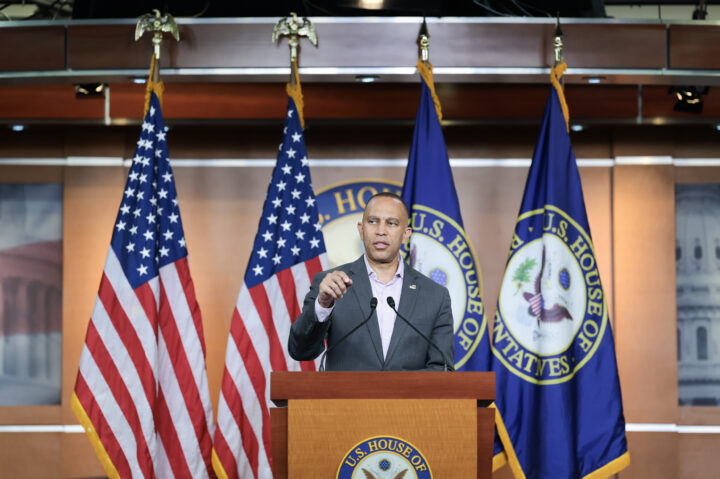
House Minority Leader Hakeem Jeffries (D-NY) speaks during a news conference at the U.S. Capitol Building on July 13, 2026 in Washington, DC.


 Add JewishInsider on Google
House Minority Leader Hakeem Jeffries (D-NY) said on Thursday that should Democrats regain control of the House in the upcoming midterm elections, the party will adopt a “broadly inclusive” but fundamentally new approach to policy on Israel.
Jeffries’ comments follow a historic, highly divisive floor vote on Wednesday where nearly half of House Democrats broke with him to support an amendment cutting off $3.3 billion in U.S. foreign military aid to Israel. The amendment to the 2027 State Department appropriations bill, introduced by Rep. Thomas Massie (R-KY), ultimately failed, but laid bare a continuing erosion of support for Israel within the Democratic caucus.
“The situation relative to the United States’ relationship with Israel, the Palestinian people and policy in the Middle East has to change because the current status quo is unsustainable,” Jeffries said at a press conference. “Our approach will be one that is broadly inclusive … [and will include] dialogue across the entire spectrum of the House Democratic Caucus and then be able to land on the highest common denominator, but being guided by the effort to actually create a just and lasting peace between Israel and the Palestinian people.”
House Minority Leader Hakeem Jeffries said that should Democrats retake the House, the party will adopt a “broadly inclusive” but fundamentally new approach to policy on Israel.
— Jewish Insider (@jewishinsider) July 16, 2026
"The situation relative to the United States' relationship with Israel, the Palestinian people and… pic.twitter.com/AELh50as7i
Jeffries outlined that the future Democratic approach will be “anchored in several different principles,” including a renewed commitment to a two-state solution.
“[It will include] Israel’s right to exist as a Jewish and democratic state and homeland for the Jewish people, and at the same time, pressing the urgent need to establish an independent Palestinian state that allows the Palestinian people to live with dignity, respect, and self-determination — and that needs to be dealt with urgently.”
Jeffries also noted that the Democratic Party under his leadership will support all necessary measures to allow for the “prosperity” of the Palestinian people and the alleviation of “suffering,” including calling for a surge of humanitarian assistance into Gaza.
“It means not just the reconstruction of Gaza, but the modernization of Gaza and investing, along with our partners in the Gulf states and moderate Arab nations, in a path toward prosperity for the Palestinian people,” Jeffries said. “Hamas needs to be disarmed and completely removed from power, and we need to deal with the out-of-control settler violence that the Netanyahu administration has allowed to take place in the West Bank, and perpetrators of that violence should be sanctioned and criminally prosecuted.”
Still, Jeffries noted that Israel remains a valuable ally.
“[The Democratic policy approach also includes] recognizing that Israel is an ally of the United States of America in the fight against terrorism, whether that’s Iranian-backed proxies, Hezbollah, Hamas or the Houthis,” Jeffries said.
House Minority Leader Hakeem Jeffries and Reps. Alexandria Ocasio-Cortez and Greg Casar were noncommittal when pressed by JI

Bill Clark/CQ-Roll Call, Inc via Getty Images
Democratic Caucus Chair Hakeem Jeffries, D-N.Y., right, and Rep. Pete Aguilar, D-Calif., hold their press conference following the House Democrats caucus meetings in the Capitol on Wednesday, July 27, 2022.
Several House Democrats, including in leadership and top progressives, remain divided or notably noncommittal over whether Israel’s right to exist in safety and security should continue to be a policy position of the Democratic Party moving forward.
The official 2024 Democratic Party Platform, released by the DNC for former President Joe Biden and former Vice President Kamala Harris, stated that party leaders “believe a strong, secure, and democratic Israel is vital to the interests of the United States” and that the party’s “commitment to Israel’s security, its qualitative military edge, its right to defend itself … is ironclad.”
However, the Democratic Party has continued to face internal division over how to exercise that support, or to what extent that support should continue to exist at all.
When asked on Tuesday whether support for Israel’s right to exist in safety and security should continue to be an official policy position of the Democrat Party moving forward, House Minority Leader Rep. Hakeem Jeffries (D-NY) was noncommittal and avoided the question.
He instead told Jewish Insider that Democrats are “continuing to focus on driving down the high cost of living, fixing our broken healthcare system and cleaning up corruption in an environment where the Trump cartel is the most corrupt administration in American history.”
Rep. Alexandria Ocasio-Cortez (D-NY) also did not provide a concrete answer, instead telling JI she is “less concerned with slogans” and more interested in “what it would mean in terms of policy.”
“I think what is being litigated, and what has been litigated, is that it’s a vague statement,” Ocasio-Cortez said on whether the Democratic Party should affirm Israel’s right to exist as an official platform position. “I’m less concerned with slogans and more about the United States’ commitment in honoring its own laws and defending and protecting human rights and preventing war, catastrophe and needless death across the board.”
Ocasio-Cortez said that the main “ideal” behind the party’s approach to Israel is that “Palestinians are safe, that Israelis are safe” and that conflict in the region is “de-escalated.”
“I think that when we start litigating phrases that are not attached to the material commitments, then we create a lot of conflict where there doesn’t need to be,” she added.
Rep. Greg Casar (D-TX), who chairs the House Progressive Caucus, said that the party’s position is clear on supporting the safety of Israeli civilians, but argued that there is a difference in providing funds to an Israeli government that some Democrats disagree with.
“Democrats have been very clear — every Democrat I’ve spoken to has been very clear that security, peace and safety for Israeli civilians is a priority and is our position,” Casar said. “It’s just that I don’t think that giving $3.3 billion in weaponry to the Netanyahu regime actually helps with that cause.”
Casar said he believes “deeply in the safety and security of everyday folks in Israel.”
“What I think is at issue here is the human rights violations that have occurred because of decisions by the Israeli government and the Israeli military, and the fact that I think America’s national security interests, as well as, in my view the security interests of everyday people in Israel … are being harmed by Netanyahu’s decisions.”
Meanwhile, other House Democrats expressed strong backing for continued support of Israel. Rep. Pete Aguilar (D-CA), the No. 3 Democrat, who chairs the House Democratic Caucus, said support for Israel’s existence and security should “absolutely” remain part of the Democratic Party platform moving forward.
“I think that supporting a free Jewish state is important for Democrats and it’s important for our country,” Aguilar said. “Israel is a lone democracy in the region.”
“That doesn’t mean that we agree with everything that Israel is doing, and we shouldn’t sign onto a policy statement that says that, and we wouldn’t,” Aguilar continued. “But do they have a right to exist and defend themselves? Yes, but the manner in which they conduct [themselves] that matters a great deal to Democrats.”
Rep. Jamie Raskin (D-MD), similarly said: “Absolutely, of course it should be.” He criticized “right-wing politics and right-wing government” for having “undermined” Israel. “We’ve got to stand up for the democratic forces in Israel and against all of that reactionary politics.”
Rep. Jim McGovern (D-MA) stated that while “everybody [in congress] … all have their own individual opinion” on the subject, he believes that “Israel has a right to exist” and that “[Israel’s] security should be ensured.” Still, the Massachusetts congressman issued sharp criticism of the Jewish state’s handling of the war in Gaza and said the Democratic party platform should “stand loud for human rights.”
“I also believe that what Netanyahu is doing against Palestinians are war crimes and they need to stop,” McGovern said. “So I think we need to, in our party platform, make it clear that we stand loud for human rights, that we are committed to the human rights of every single individual on this planet.”
A Pew Research Center poll published in April of this year found that 8 in 10 Democrats and Democratic-leaning independents responded as having an unfavorable view of Israel. Among Democrats 76% of those 50 years or older hold unfavorable views of Israel, while 84% of Democrats 18-to-49 years old held negative views.
Earlier this year, the DNC referred a resolution on Israel – which would have labeled the Jewish state’s actions in Gaza as a genocide and called for conditioning U.S. military aid to Israel – to a working group on the Middle East.
Gov. Jared Polis of Colorado is the only Dem governor so far to opt into the program; other Dem governors actively considering it
CHET STRANGE/AFP via Getty Images
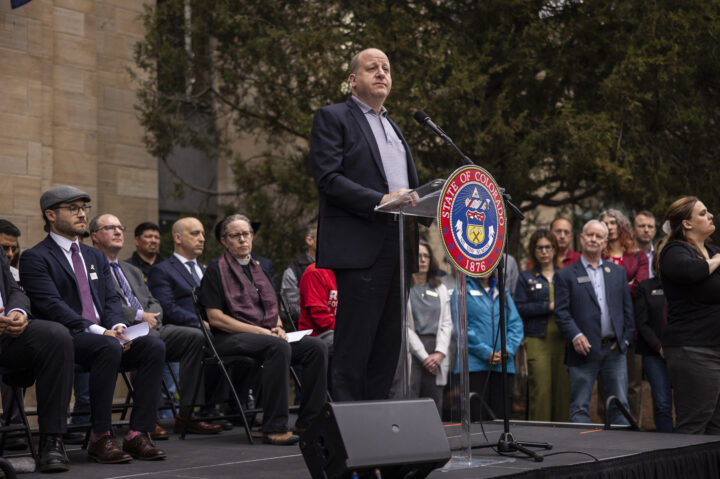
Colorado Governor Jared Polis speaks during a community gathering at the site of an attack against a group people holding a vigil for kidnapped Israeli citizens in Gaza oin Boulder, Colorado on June 4, 2025.
At the start of a pivotal campaign cycle, Democratic governors will face a politically high-stakes decision this year on a new education policy that President Donald Trump signed into law last year.
One provision of Republicans’ sweeping spending package adopted in 2025 — dubbed the “One Big Beautiful Bill” by Trump — was a measure that provides a dollar-for-dollar federal tax credit for people who donate to approved scholarship organizations that can support a range of education expenses, including private school tuition and tutoring.
Individual states must opt in for taxpayers to be eligible for the credit of up to $1,700 annually.
So far, the policy has been a no-brainer for Republican governors, who already support school choice programs, to allow parents to receive a federal tax credit to support private schools, including religious schools. Twenty-three states have formally opted in as of last month, and at least two other Republican-led states (Florida and Utah) said they plan to do so.
Democratic governors, skeptical of school choice programs and wary of powerful teachers’ unions, face a trickier choice. They have to opt in by the end of the year for taxpayers to be eligible for the credit. The National Education Association urged lawmakers to vote against the bill last year, and has said that “voucher-inspired schemes” like the federal tax credit program “erode public education, the foundation of our democracy.” (An NEA spokesperson declined to comment on Wednesday.)
Orthodox Jewish groups have long supported school choice efforts, including vouchers, while most non-Orthodox groups — including umbrella organizations such as the Jewish federations — sat out those matters in the past or opposed them. Now, Orthodox leaders are being joined by the Jewish Federations of North America as the umbrella group urges Democratic governors to support the bill. The Union for Reform Judaism, which opposed an earlier version of the tax credit that was farther-reaching, ultimately did not come out against the measure.
“We think this should be a priority for the entire Jewish community, to support students, especially in Jewish day schools,” said Rabbi A.D. Motzen, national director of government affairs at Agudath Israel, a major Orthodox organization. “I think it’s very helpful, because in many of those blue states, the more governors see that this is a politically wise idea, and that there is widespread support among different faiths, whether it’s Catholic clergy or Jewish leaders and business leaders, then it will make it easier for them to to opt in.”
Marc Baker, CEO of Combined Jewish Philanthropies, Boston’s Jewish federation, said the tax credit “aligns with CJP’s vision to make day school more affordable and accessible for families in Greater Boston,” and that he plans to discuss it with Massachusetts Gov. Maura Healey, a Democrat.
Part of the pitch that Gil Preuss, CEO of the Jewish Federation of Greater Washington, is making to Democratic leaders in Maryland, Virginia and Washington, is to differentiate the tax credit from more controversial voucher programs.
“I know, particularly for Democratic governors, they place significant value in public education, and we as a Jewish community strongly support public education,” said Preuss. “We don’t believe it’s taking away money from public education, but it is a way for individual households to direct some of their federal taxes.”
Colorado Gov. Jared Polis is so far the Democrat who has expressed the most enthusiasm about the tax-credit scholarship program.
“It supports donors to give more money to our schools,” Polis said in November. “I mean, I would be crazy not to” opt in. A spokesperson for Polis confirmed in December that he plans to add the state to the program.
North Carolina Gov. Josh Stein, a Democrat, has also said he intends to opt in his state once more information is released from the federal government. “School choice is good for students and parents,” Stein said last year. “I intend to opt North Carolina in so we can invest in the public school students most in need of after school programs, tutoring, and other resources.”
A handful of blue-state governors — in Wisconsin, Oregon, New Mexico and Hawaii — have stated they will opt out of the program.
Most Democratic governors, including in states with the largest Jewish communities, are taking a wait-and-see approach, saying they need to see formal regulations from the IRS and the Treasury Department outlining what the funds can be used for and how they can be collected. Activists in the Jewish community working on this issue say they are still in conversation with Democratic governors even though the timeline for implementation is not totally clear.
“The governors that we speak to on a regular basis about this are very clear that they want to see the regulations first, which we don’t hold against them. We think that’s fair. You don’t want to play a game until you see the rules of the game,” said Sydney Altfield, CEO of Teach Coalition, a project of the Orthodox Union that advocates for federal funding for nonpublic schools. “We think that in the long run, it will be a positive outcome, but we understand that there’s no movement yet.”
Rosie Lapowsky, a spokesperson for Pennsylvania Gov. Josh Shapiro, said his administration “is awaiting federal guidance to address key questions about how this program would work, including which students will be eligible, how this federal initiative will interact with existing programs, and more. We look forward to reviewing that guidance.”
A spokesperson for Maryland Gov. Wes Moore said he has not yet taken a position. Alana Davidson, director of communications at the Massachusetts Executive Office of Education, told JI that Gov. Healey “is awaiting official guidance from the U.S. Department of Education and Treasury at this time.”
Jen Goodman, a spokesperson for Gov. Kathy Hochul of New York, took a swipe at the Trump administration while saying Hochul has not yet made up her mind.
“While this proposal doesn’t take effect until 2027, it’s surprising that the federal government continues to fail to share any policy details with states,” Goodman told JI. “Gov. Hochul is supportive of anything that would help students and schools, but given this administration’s record of including poison pills in policies, the state needs to thoroughly review the proposal before making commitments.”
Spokespeople for Illinois Gov. JB Pritzker, California Gov. Gavin Newsom, New Jersey Gov. Mikie Sherrill, Washington, D.C., Mayor Muriel Bowser and Virginia Gov. Abigail Spanberger did not respond to requests for comment.
Spanberger is in a different position from other Democrats, because her predecessor — Republican Gov. Glenn Youngkin — already opted Virginia in last month before he left office, so she would have to formally revoke that permission.
Preuss said his goal at the moment is not necessarily to get area governors in the Washington area to a yes anytime soon, with IRS regulations not likely to come out for a few more months. He just wants to convince them to leave the door open.
“It’s very early on,” Preuss said. “We mostly want to make sure that governors do not come out against it.”
‘My impression was the committee felt the support there was not ready yet,’ Rounds told JI

Nathan Posner/Anadolu via Getty Images
Elbridge Colby, nominee to be Under Secretary of Defense for Policy, is seen ahead of his confirmation hearing at the Senate Committee on Armed Services in Washington, DC on March 4, 2025.
Sen. Mike Rounds (R-SD) told Jewish Insider on Wednesday that there was a “broad consensus” among members of the Senate Armed Services committee that two nominees tapped to serve under Under Secretary of Defense for Policy Elbridge Colby did not yet have sufficient support to move ahead at a committee meeting on Wednesday.
Confirmation hearings for the two nominees — Alex Velez-Green and Austin Dahmer, who were initially expected to receive votes in committee on Wednesday — turned into an airing of the grievances by a series of Republican and Democratic senators with Colby and his office.
The senators accused the Defense Department’s policy team of failing to properly communicate or consult with Congress on key decisions and issues, and of executing their own policy at odds with and without authorization from the White House on various issues. Colby is viewed as one of the leading isolationist voices in the Trump administration.
Rounds told JI that there was a “broad consensus” on the committee that more time was needed to consider the two nominations.
“I don’t think it was one or two people holding it up, or anything like that. … My impression was the committee felt the support there was not ready yet, but … we didn’t want to hold up anybody else,” Rounds said.
Republicans have only a one-vote majority on the committee, so they cannot afford to lose any GOP votes if all Democrats plan to vote against a given nominee.
Senate Armed Services Committee Republican leadership did not respond to a request for comment. Sen. Jack Reed (D-RI), the Democratic ranking member, deferred to Republicans when asked Wednesday about the postponed votes.
The Washington Post reported that the symbol would instead be classified as ‘potentially divisive’

Photo by Alex Brandon / POOL / AFP
US Homeland Security Secretary Kristi Noem participates in a tour at the US Coast Guard Station Charleston, on November 7, 2025, in Charleston, South Carolina.
A Washington Post report that the U.S. Coast Guard will no longer classify the swastika as a hate symbol under a new policy set to be implemented next month is garnering condemnation from Jewish groups and Democratic officials.
According to the report, the new policy will classify the Nazi emblem as “potentially divisive.” It is also set to apply to nooses.
Acting Coast Guard Commandant Adm. Kevin Lunday denied the reports, saying “The claims that the U.S. Coast Guard will no longer classify swastikas, nooses or other extremist imagery as prohibited symbols are categorically false. These symbols have been and remain prohibited in the Coast Guard per policy. Any display, use or promotion of such symbols, as always, will be thoroughly investigated and severely punished.”
Coast Guard spokesperson Jennifer Plozai, however, told the Washington Post that the Coast Guard would be “reviewing the language” of the new policy.
Rep. Lauren Underwood (D-IL), the ranking member of the House Appropriations subcommittee responsible for funding the Department of Homeland Security, said she’d met with Lunday on Thursday evening and he had committed to changing the policy and publishing an updated version on Thursday evening.
She said that Lunday had “assured us that there is a[n] across-the-board prohibition on hate symbols, including swastikas and nooses.” She said the policy would also make clear that there will be “zero tolerance” for “any display” of such symbols in the Coast Guard.
“The swastika and the noose aren’t ‘potentially divisive.’ They are explicit symbols of antisemitism and hate. Treating them as anything less than hate symbols is a dangerous mistake,” Anti-Defamation League CEO Jonathan Greenblatt said.
“Nazi swastikas are not ‘divisive.’ They are antisemitic,” the American Jewish Committee said in a statement. “They represent a regime responsible for the murder of six million Jews and insult the hundreds of thousands of Americans who gave their lives to defeat the Nazis 80 years ago.”
The AJC called on Secretary of Homeland Security Kristi Noem, under whose jurisdiction the Coast Guard falls, to “reverse these deeply troubling guidelines immediately.”
Amy Spitalnick, the CEO of the Jewish Council for Public Affairs said, through the amended policy, “the Coast Guard is doing nothing less than normalizing violent extremism.”
Halie Soifer, the CEO of the Jewish Democratic Council of America, told Jewish Insider the policy marks as “dark and unprecedented moment in our country’s history,” in conjunction with President Donald Trump’s recent comments accusing Democrats of “SEDITIOUS BEHAVIOR, punishable by DEATH!”
“This signaling to right-wing extremists and antisemites — combined with the President’s explicit threat of political violence — is depraved, unconscionable, shocking, and incredibly dangerous, including for Jews,” Soifer continued.
Sen. Richard Blumenthal (D-CT) said that, “Granting hate symbols like swastikas & nooses even an ounce of respectability is absolutely an anathema.”
“Sec. [Kristi] Noem should be ashamed & Americans outraged. This edict besmirches the Coast Guard’s honor & should be immediately reversed,” he continued.
Sen. Alex Padilla (D-CA) called the policy change “indefensible.”
Reps. Dan Goldman (D-NY), Brian Fitzpatrick (R-PA), Haley Stevens (D-MI), Mark Veasey (D-TX), Ted Lieu (D-CA) and Grace Meng (D-NY), co-chairs of the House Antisemitism Task Force, issued a statement condemning the decision.
“By eliminating the terminology of ‘hate incident’ symbols at a time of rising antisemitism and increasing hate, the Coast Guard risks emboldening those who seek to intimidate or target Jewish Americans, Black Americans, and other minority communities,” the lawmakers said. “This change sends a chilling signal to American Jews at a moment when antisemitic incidents have already hit record highs in the United States. This policy change must be reversed immediately.”
Rep. Don Bacon (R-NE), also a co-chair of the task force, said, “This would be an egregious move on the part of the Administration if true.”
“The Department of Homeland Security is outright refuting and another outlet has confirmed it reporting that officials say they are still covered under the new language and will not be tolerated,” Bacon said. “We need some clarity on this issue and the Coast Guard should make it 100% clear. It would help if the Coast Guard had a Commander, as the position has been vacant for many months.”
Rep. Laura Gillen (D-NY) wrote to Lunday, the Coast Guard commandant, expressing “deep concern” and “strong opposition” to the policy, and said that the policy change should be reversed immediately and requested an explanation of the policy change, who was involved and how the Coast Guard will “reaffirm its zero-tolerance posture toward racism and antisemitism.”
Illinois Gov. J.B. Pritzker, who is Jewish and a potential 2028 presidential candidate, said that he “helped build a Holocaust museum so future generations would understand the horror of the swastika — not watch our own government rebrand it, the noose, and the Confederate flag as merely ‘potentially divisive.’ These are symbols of mass murder and racial terror. The Trump Administration must reverse this immediately. You do not sanitize evil. You confront it.”
Rep. Bennie Thompson (D-MS), the ranking member of the House Homeland Security Committee, said that the policy “is vile and horrific.”
“Swastikas and nooses aren’t ‘potentially divisive’; they are longstanding and well known representations of genocide and lynchings,” he said. “The Trump Administration is looking to take us back all the way to the era of the Nazi Party and the Jim Crow South.”
He dismissed the Coast Guard’s denials, saying that the “administration is trying to claim they don’t mean what the policy says,” and should withdraw and disavow the policy.
Rep. Jim McGovern (D-MA), the ranking member of the House Rules Committee, posted on X, “Welcome to Donald Trump’s America—where it’s fine to be a Nazi or in the KKK.”
Doug Emhoff, the former second gentleman and a leader of the Biden administration’s efforts to combat antisemitism, said on X, the change is “Completely wrong and unacceptable. Leaders cannot remain silent on this if they are serious about combatting antisemitism and hate.”
Senators on both sides of the aisle again accused Colby and his office of failing to communicate with them at a nomination hearing for Colby deputy Alex Velez-Green
Al Drago/Bloomberg via Getty Images
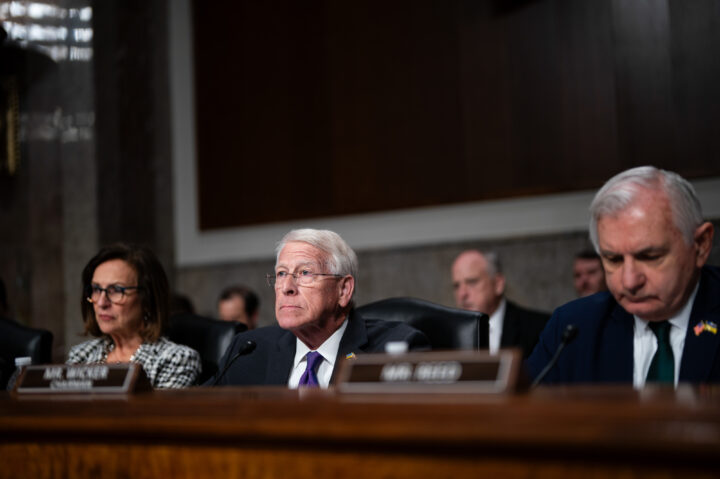
Sen. Roger Wicker (R-MS), chairman of the Senate Armed Services Committee, and Sen. Jack Reed (D-RI), ranking member of the Senate Armed Services Committee, during a confirmation hearing in Washington, DC, US, on Tuesday, April 1, 2025.
Members of the Senate Armed Services Committee from both parties voiced concerns with Elbridge Colby, under secretary of defense for policy, and his office at the Pentagon, at a committee hearing — for the second time this week.
While Thursday’s proceedings, a confirmation hearing for Alex Velez-Green, nominated to be Colby’s top deputy and who has been a senior advisor to him in an interim capacity, were generally less heated than a Tuesday hearing with nominee Austin Dahmer, lawmakers reiterated concerns with a lack of consultation by Colby’s team and alleged rogue decision-making on a range of issues by the office.
“Many of this committee have serious concerns about the Pentagon’s policy office and how it is serving the president of the United States and the Congress,” Sen. Roger Wicker (R-MS), the chairman of the committee, said in his opening statement. “In many of these conversations, we hear that the Pentagon policy office seems to be doing what it pleases without coordinating, even inside the U.S. executive branch.”
Wicker, pushing back on a defense offered earlier this week by Dahmer — who dismissed many concerns as fallacious and based on inaccurate media reporting — said that the issues raised by committee members were based on their own conversations with other administration officials and United States allies.
“Either all of these other administration officials and senior foreign officials are deliberately misleading us or we have a problem coming from this office,” he continued.
He said that the policy office can begin to rectify those issues by meeting “its statutory requirement to consult with this committee … rather than simply informing us of a decision after the fact.”
“We need a process that works for the president and the [Congress]. Unfortunately, we do not have such a process at this moment,” Wicker said, adding that progress will require a “change in a mindset” from the policy office.
Sen. Rick Scott (R-FL) added that, “the perception is that there’s some disagreement between what has been put out [by the policy office] and what the president wants. And I think it’s pretty important that you guys figure out how to stop that.”
Velez-Green generally took a conciliatory posture, pledging to communicate and consult with lawmakers whenever possible and appropriate. He also insisted that the policy office and the entire Department of Defense have been diligent in ensuring they are fully aligned with the president’s policy.
But Velez-Green also insisted that the policy office had not directed a pause in U.S. arms transfers to Ukraine, which was later publicly overridden by President Donald Trump, who said he had not been aware of or instructed any such moves. Multiple Senate Republicans pointed to a news release from the Pentagon that specifically stated that such a pause had been implemented.
Velez-Green also denied media reports that Colby had opposed the deployment of additional U.S. forces to the Middle East during the war between Israel and Iran.
Lawmakers again raised concerns that they and U.S. allies in Romania had been notified only days ahead of time that the U.S. would be withdrawing troops from Romania, and that lawmakers were only provided a notification after the decision had been made rather than consulted ahead of time.
“Congress was not consulted about this. I think I can say with certainty about that,” Wicker said.
Sen. Eric Schmitt (R-MO) was the only lawmaker to offer an unequivocal defense of Colby and his office, accusing those criticizing Colby over both policy decisions and communication issues of attempting to block his policy preferences.
“I think much of the criticism, which is cloaked in terms of transparency and communication, really is just an effort to undermine a shift in our foreign policy orientation, which I support, which is to realism, as opposed to some of the failed points of view that have dominated permanent Washington over the last 30 years,” Schmitt said, adding that criticisms of Colby and his team reflect “resistance from those invested in maintaining the foreign policy status quo that has repeatedly failed the American people.”
Sens. Mark Kelly, Elissa Slotkin and Jack Reed broke with their party on the vote
Nathan Posner/Anadolu via Getty Images
Elbridge Colby, nominee to be Under Secretary of Defense for Policy, is seen ahead of his confirmation hearing at the Senate Committee on Armed Services in Washington, DC on March 4, 2025.
The Senate voted to advance the nomination of Elbridge Colby to be undersecretary of defense for policy on Monday, teeing up a final confirmation vote for later this week, with three Democrats crossing party lines to vote in favor of advancing to a final vote on his confirmation.
Colby’s nomination advanced in a 53-39 vote on Monday evening, with no Republicans voting against him. It was unclear going into Monday’s vote what the final whip count would be, the result of Colby’s nomination being advanced in a secret vote during a classified session of the Senate Armed Services Committee last week.
A final vote on Colby’s confirmation is scheduled for Tuesday morning.
Sen. Jack Reed (D-RI), the top Democrat on Armed Services, Sen. Mark Kelly (D-AZ) and Sen. Elissa Slotkin (D-MI) voted for the procedural motion to advance Colby’s nomination to a final vote on Monday. All three serve on Armed Services, and Slotkin worked with Colby in the past. Slotkin, who has worked for the Defense Department and the Central Intelligence Agency, told Jewish Insider in February that she was familiar with Colby’s record because he “used to be my assistant.”
Sens. Ruben Gallego (D-AZ), Cory Booker (D-NJ), John Fetterman (D-PA), Kirsten Gillibrand (D-NY), Jon Ossoff (D-GA), Bernie Sanders (I-VT) and Tim Sheehy (R-MT) did not attend Monday’s vote.
The Democratic backers of Colby come as something of a surprise given the tough questioning the nominee faced from Democrats at his confirmation hearing on his skepticism of U.S. support for Ukraine and other issues.
Colby has faced pushback from some Republican lawmakers over his past support for accommodating a nuclear Iran. He walked back some of those positions, including that the U.S. could contain a nuclear armed Iran and that it should not attack Iran to stop it from obtaining a nuclear weapon, during his confirmation hearing last month.
Several Republicans could vote against Colby on the final vote on Tuesday, but none of the potential critics previewed their plans to JI on Monday.
Colby said at the hearing that a nuclear Iran would be an “existential danger” to the United States and that he would provide the administration with military options to prevent such an outcome. He also said his past comments had been intended to push back on what he viewed as an overly hawkish public consensus at the time.
Those comments, along with a private lobbying effort by Colby and his allies to assuage concerns and distance himself from other controversial Pentagon hires, had a positive impact on skeptical senators who had been hesitant about voting to confirm him.
“Speaking for me, he did answer things the way he needed to answer them, adequate at least to my satisfaction,” one GOP senator told JI last month. “He has said the things he needed to say to the satisfaction of people who like me and maybe others — I can’t speak for any of them … and he was pretty convincing.”
Jewish Insider’s senior congressional correspondent Marc Rod contributed to this report.
The housing expert and all-around policy wonk is hoping his 'campaign of ideas' will set him apart in a crowded field

Courtesy
Shaun Donovan
On paper, Shaun Donovan seems to stand out as an eminently qualified candidate for New York City mayor. The 55-year-old housing and urban development expert with two master’s degrees is a policy wonk who held top jobs in the Obama White House and Bloomberg mayoral administration, and in conversation, he projects an air of academic forbearance reminiscent of his former bosses.
In his 200-page campaign policy book, released last month, Donovan lays out his painstakingly detailed and rather creatively rendered plan for New York City as it emerges from the ravages of the pandemic, calling for equity bonds of $1,000 for every child and envisioning a plan to engineer a series of “15-minute neighborhoods” in which “a great public school, fresh food, rapid transportation, a beautiful park and a chance to get ahead” are all within walking distance.
On Tuesday, Donovan announced a new initiative, “70 Plans in 70 Days,” in which he will lay out one new policy proposal every day until the Democratic primary on June 22 — a meticulous approach he is hoping will set his candidacy apart from the crowded field as a “campaign of ideas.”
“The plan for New York City is the best expression of that, and I really do have the boldest, most comprehensive ideas about the future of this city,” Donovan boasted in a recent interview with Jewish Insider. “But I also have the deepest experience in government to be able to ensure that those ideas can make a real difference in people’s lives.”
Donovan’s proposals have, appropriately enough, earned plaudits from serious policy experts in New York.
“I’ve been impressed with Shaun Donovan’s focus on getting New Yorkers back to work,” said Eli Dvorkin, editorial and policy director for the Center for an Urban Future. “He has identified a number of strong models that New York City can build on — from apprenticeship programs to nonprofit tech training — and made it clear that he would invest heavily in skills-building infrastructure. That’s what the city will need to rebound from the current crisis and build a more equitable economy in the future.”
But it remains to be seen if Donovan has the wherewithal to pull off an upset. Several analysts who spoke with JI described the mayoral hopeful as a “talented” individual, while also observing that, despite his policy chops, voters don’t seem to be rallying behind him.

Shaun Donovan, secretary of the Department of Housing and Urban Development, testifies at a Senate Homeland Security and Governmental Affairs subcommittee hearing on Nov. 6, 2013. (J. Scott Applewhite/AP)
“Shaun Donovan is a tremendously talented public servant,” said David Greenfield, the CEO of the Met Council and a former city council member. “The challenge that he faces is that he’s always sort of been in the background and therefore doesn’t have the same political profile as some of the more active and better-known political candidates, many of whom have either held office or run for higher-profile office before.”
Polling suggests as much. Donovan seems to be lagging significantly behind the apparent frontrunners in the race, including Andrew Yang, the charismatic former presidential candidate; Eric Adams, the brash Brooklyn borough president; and Scott Stringer, the seasoned city comptroller.
But Donovan remains uncowed, citing another set of statistics that he claims supports his case. “I wouldn’t trade my place in this race with anyone,” he said. “I think it’s reflected in polling that New Yorkers want change and they want experience at this moment, and I really believe I’m the only candidate that represents both of those in the sense that nearly every other candidate is, in some way, part of the status quo.”
Donovan, of course, isn’t exactly a fresh face in New York City government, though it has been some time since he was on the scene enacting what experts characterized as meaningful change.
From 2004 to 2009, he served as former Mayor Michael Bloomberg’s housing commissioner, creating the city’s first inclusionary housing program offering “density bonuses to developers who agree to set aside units as affordable,” according to Ingrid Ellen, a professor at New York University who specializes in housing.
“He left a legacy of improving the lives of so many people who don’t have the means to get habitable housing,” said Rabbi David Niederman, president and executive director of the United Jewish Organizations of Williamsburg, who worked with Donovan on issues of affordable housing back in the aughts.
“I worked extremely closely with mayors across the country and saw, again and again, that particularly at a time when our national politics could be divisive and dysfunctional, mayors really touch people’s lives.”
Following his tenure in city government, Donovan accepted an appointment from former President Barack Obama to helm the Department of Housing and Urban Development, during which time he helped lead a revitalization task force in the wake of Hurricane Sandy, among other things.
“I worked extremely closely with mayors across the country and saw, again and again, that particularly at a time when our national politics could be divisive and dysfunctional, mayors really touch people’s lives,” said Donovan, who went on to lead the Office of Management and Budget under Obama. “They are close to the ground. They are the leaders that can make the most difference in the day-to-day lives of New Yorkers and people in their communities.”
In conversation with JI, Donovan, who was raised on the Upper East Side, emphasized his family’s own personal connection to New York as an explanation for why he is now mounting a mayoral bid.
His father, Michael Donovan, an advertising executive, had Jewish, Catholic and Protestant grandparents, and was “beaten up as a child because of that,” Donovan said. Michael, who was born in Panama and grew up in Costa Rica, “had a deep connection to his Irish roots, but also a sense of being an outsider,” Donovan added. “He came to the U.S. to go to school like so many immigrants, and then came to New York to find opportunity, and found it.”
“I would say my entire family owes everything to New York in a fundamental way,” Donovan elaborated. “But at the same time, I also grew up in New York in the 1970s and ’80s. I saw homelessness exploding on the streets. I saw the South Bronx and so many other communities around the city struggling, even burning to the ground, and that really lit a fire in me to go to work on behalf of this city that I love.”

Shaun Donovan
“My platform is really about repairing and rebuilding the city but also about reimagining it as a city that works for everyone,” said Donovan, who advocates for investments in bus rapid transit as well as keeping libraries open 24 hours a day, seven days a week, so New Yorkers will have increased access to broadband.
But getting elected and implementing such policies is in many ways a more challenging task than earning an appointment to public office, particularly in New York, where many prominent figures have tried and failed to do so, including Joe Lhota, Richard Ravitch and Daniel Patrick Moynihan.
“This is a longstanding challenge,” said Mitchell Moss, a professor of urban policy and planning who directs the Rudin Center for Transportation Policy and Management at New York University. “It’s not unusual that people who succeed in appointed life can’t make it in New York City politics.”
Donovan seems intent on proving that he will be an exception to the rule. In the first TV ad of the race, released in February, he painted himself as a veteran of the Obama administration with ties to the current president, Joe Biden — though such appeals appear largely to have gone unnoticed as other candidates gain traction.
“I would say my entire family owes everything to New York in a fundamental way.”
“Donovan’s going to have to do something creative over the next couple of months to be able to catch people’s attention and be, if not their number one choice, their second or third,” said Jake Dilemani, a managing director in Mercury’s New York office.
Donovan is now mounting an aggressive TV ad blitz as he seeks to earn name recognition in the new ranked-choice voting system, buoyed by $2 million in independent expenditures from his father. “I am following the law,” Donovan said of his father’s super PAC contributions in an interview with WNYC host Brian Lehrer on Tuesday. “There are dozens of these groups supporting many different candidates who are running, and I don’t coordinate with any of them.”
In the end, Donovan, who has staked out a position, for better or worse, as one of the brainiest candidates in the race, wants to focus on the ideas. “I think, especially in this moment of crisis, New Yorkers are really hungry for a mayor who has the boldest ideas about how we rebuild our health and our economy, how we make this a more equitable city.”
“Shaun Donovan is very smart, very capable and very knowledgeable about New York City,” Moss acknowledged. But in the highly competitive mayoral race, he said, “It’s not enough to be smart.”
Incumbent Democratic Rep. Dan Lipinski faces two progressive challengers in a solidly blue district

J. Scott Applewhite/AP Photo
Rep. Dan Lipinski, D-Ill., is met by reporters as he leaves the Democratic Caucus leadership elections at the Capitol in Washington, Wednesday, Nov. 28, 2018.
A close Illinois primary race — marked by an unusual focus on policy towards Israel among Democrats and a Holocaust-denying Nazi on the Republican side — may end up being determined by something else altogether: a virus that has yet to be contained.
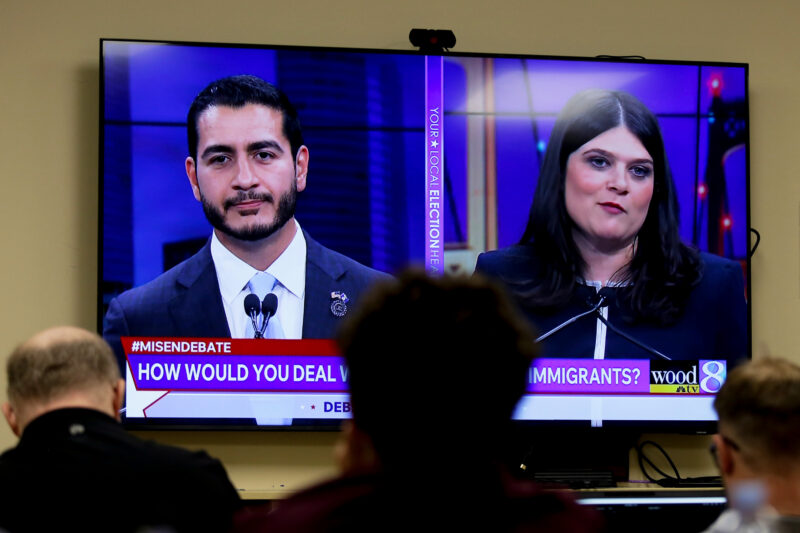
The race for Illinois’s 3rd congressional district drew attention when Israel became a voting issue in a primary otherwise focused on health care, abortion rights and domestic social issues. Challengers to incumbent Rep. Dan Lipinski (D-IL) — including Marie Newman, who lost to Lipinski by a small margin in 2018, and Rush Darwish, who hopes to be the first Palestinian-American from Illinois in Congress — went after the eight-term congressman for his support of the Jewish state.
However, the issues are being overshadowed by the growing threat of COVID-19. “The story that’s shaking up Illinois politics and U.S. politics is the coronavirus scare,” said Sean Tenner, a Chicago-based Democratic political consultant. “Nobody is quite sure how it will impact results on Election Day, but a few things are clear. Turnout is absolutely going to be lower than it would be if we were not in the middle of a pandemic.”
Tenner pointed out that it’s “no secret that Congressman Lipinski tends to do better with senior voters,” which could hurt his chances today. “Many senior voters are very concerned about the risk of exposure and there will be seniors who will not come out who certainly otherwise would vote for the congressman,” he said.
On the flipside, he said, younger voters — who are more likely to vote for Lipinski’s challengers — tend to support Sen. Bernie Sanders (I-VT), and will likely be less enthusiastic to go to the polls now that the risk of catching the virus is coupled with the decline of the Vermont senator’s chances in the presidential race.
When Israelis voted for a third time earlier this month, special arrangements were made for those deemed at risk, with some workers donning full hazmat gear. No provisions on that scale appear to be in place for Tuesday’s primary in Illinois.
“We completely had to tear up the tried-and-true playbook of ‘get out the vote,’ and between Saturday and Sunday instead of knocking on 25,000 doors we made 100,000 phone calls,” Ben Hardin, a spokesman for Newman, told JI. He said it was a tough decision to make, but it was an important measure to protect voters and staff.

Marie Newman
In an email to JI, Rush Darwish said that the campaign “changed dramatically in the last couple of days due to the spread of COVID-19.” He said “vote efforts have become primarily remote and we have had to cancel our election night party.” Team members now “only bump elbows instead of shaking hands,” he said.
John Mark Hansen, a professor of political science at the University of Chicago, pointed out that early voting and absentee ballots have been available for a while, and those concerned by the virus could have utilized those options. He said while the pandemic may have some impact, the decisive factor likely comes from within the party itself, as it throws its support behind incumbents over challengers.
“The conditions are a little more difficult for [Newman] this time around, in part because the national party, the DCCC, has basically gone all-in for its incumbents and so they have kind of frozen her out,” Hansen said. “She still has plenty of support, particularly from abortion rights groups. But my instinct is that her best shot was in 2018, and she didn’t get it done then, and it will be harder this time around.”
Darwish’s candidacy also poses a challenge for Newman. “Given that she came so close last time around, I think Newman was the main alternative and it’s another negative for her having him in the race,” Hansen said. “[Darwish] is not taking votes away from Lipinski.”
The battle is shaping up as a traditional Democrat facing a challenge to the old guard from modern progressives. Newman and Darwish contend that Lipinski, who assumed office in 2005 after replacing his father, is out of touch with the district, citing his voting record that is often out of step with the mainstream Democrat party, including his opposition to abortion.
Lipinski, who brands himself as “the commonsense Democrat,” dismisses the allegations, pointing to voting trends in the area.
But the pandemic has hammered home in a very tangible way the main issue at the heart of the election here: healthcare.
Hardin, Newman’s spokesman, chastised Lipinski for his handling of the crisis. “It is reprehensible that two days ago, both Democrats and Republicans came together in the House to pass the coronavirus relief bill, and Dan Lipinski was here in the district at a campaign potluck dinner — and didn’t feel the need to go back to DC to work with his colleagues to provide a relief for families here,” Hardin said.
He drew a stark contrast to how he said Newman would deal with the situation. “She is an advocate for a system of healthcare that will cover everybody, that will refocus the way that we approach healthcare to patient care and not to profits,” Hardin said. “That’s a pretty winning message, particularly now [when] people are worried about being able to afford, or have access to, a vaccine or even testing.”

Rush Darwish
Lipinski’s camp repeatedly denied requests for an interview. However, things seem to be looking up for him as the general election heats up.
“Events nationally over the past couple of weeks have shown that the Democratic Party is in no mood to take a gamble,” Hansen explained. ”Part of that is ‘let’s go with the tried-and-true Joe Biden’ and part of that is ‘we’re not going to be very finicky about what peoples’ positions are, were going to support incumbents so that we maintain control of the House and try to get a bunch of Senate candidates nominated who will be competitive.’” In the debate between “ideological purity and anticipated electability, electability is winning out in a big way right now,” Hansen added.
Tenner pointed out that many of the issues people have been discussing ahead of the election — including “abortion and Israeli-Palestinian issues” — have been eclipsed by concerns over the coronavirus.
The winner of Tuesday’s Democratic primary is expected to win the general election in November in this deeply blue district. In the past, the make-up of the district has left it largely ignored by the Republican Party.
It’s these mechanics that enabled Arthur Jones, a Holocaust denier and former leader of the American Nazi movement, to run unopposed as the Republican candidate in 2018 and win some 56,000 votes. Many of those votes, analysts say, came from Republicans who voted for the party’s nominee automatically without knowledge of Jones’ beliefs.
Republicans were embarrassed by Jones’ 2018 primary victory and vowed to prevent it happening again. This year Mike Fricilone, the Republican minority leader of the Will County Board, is running against Jones, and has been endorsed by the party’s leadership. “The Republican Party has taken quite an active stand against [Jones], sending out advertisements making sure that people know that he is a Nazi,” Tenner said. “There is a sensible candidate running for the nomination now.”
Please log in if you already have a subscription, or subscribe to access the latest updates.
 Continue with Google
 Continue with Apple