






















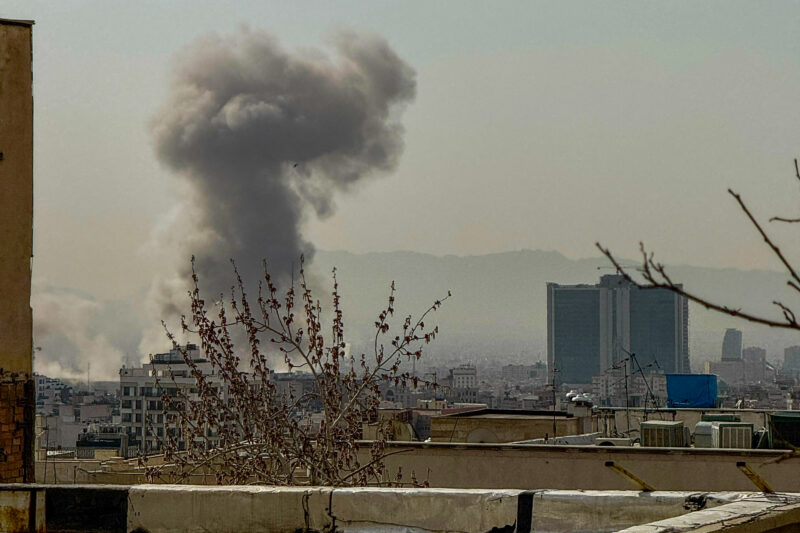
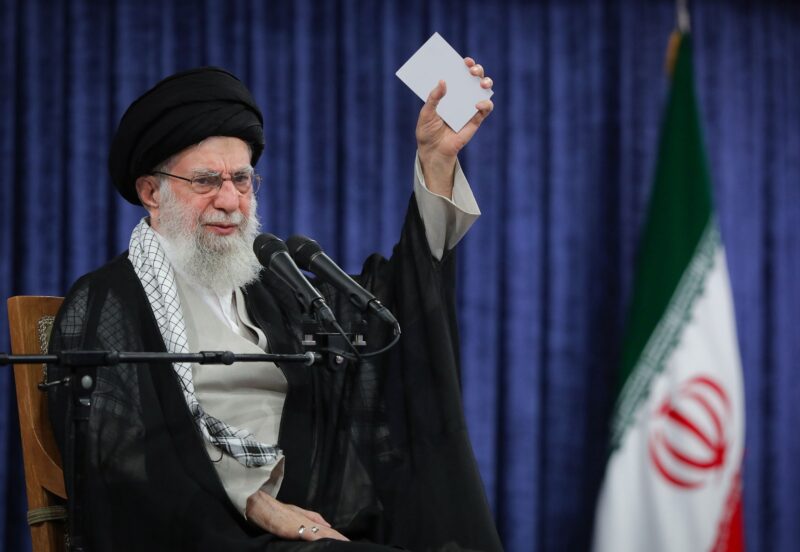














But with Iran maintaining various capabilities and continuing its attacks, other leading GOP senators say it would be premature to end the war now
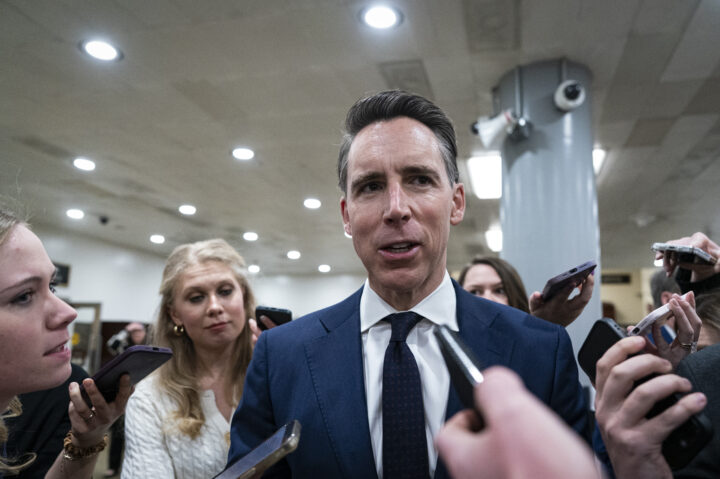
Al Drago/Getty Images
Sen. Josh Hawley (R-MO) speaks to reporters prior to the Senate Republicans weekly policy luncheon, in the US Capitol on March 25, 2025 in Washington, DC.


 Add JewishInsider on Google
Both of Missouri’s Republican senators, Josh Hawley and Eric Schmitt, argued that the administration seems to have largely achieved its key objectives for the war in Iran — a posture that distinguishes him from most GOP colleagues and highlights subtle but emerging divisions among Republicans on the proper scope and duration of the war.
Pointing to comments by President Donald Trump saying that the war was substantially complete and that the U.S. had achieved its objectives, Hawley said on Fox News earlier this week, “I agree with what the president said last night. You look at all the success that we’ve had in the last 10 days. I mean, this thing is a victory. I think we should be hailing our military. We ought to be saying we’ve achieved our objectives here. … If this isn’t success, I don’t know what would be. … Now it’s time to declare victory.”
He also posited that Iran has nothing remaining with which to reconstitute its nuclear program — though the regime maintains a stockpile of enriched nuclear material which many experts argue cannot be fully secured without some form of on-the-ground presence.
Continuing a trend of making contradictory comments on the war’s timeline, Trump had said the same day that the U.S. could and would go much further in Iran, and that the U.S.’ aims could expand significantly.
Asked by Jewish Insider on Thursday about the metrics by which he was judging the success of the war, Hawley — who is one of the more prominent senators from the populist wing of the GOP — said he was referring to Trump’s own comments on the subject.
“I assume our overriding national security objective when it comes to Iran is to prevent them from getting nukes. And between our bombing last June and in the last … 12 days, I don’t know how they’re going to reconstitute their nuclear program anytime in, maybe, our lifetimes,” Hawley said.
“Our military has done an amazing job. I think it’s been an overwhelming display of force,” Hawley continued. “I know my Democrat colleagues, a bunch of them are saying, ‘This has accomplished nothing, nothing’s happened.’ It seems to me a lot has happened. And I think we should say that’s a good thing.”
Pressed on whether the war can be ended while Iran continues to fire missiles and drones at countries throughout the Middle East and is dropping mines in the Strait of Hormuz, Hawley said he would defer to Trump’s judgement on when to end the war.
“My point is just that I think the military has achieved a tremendous amount. It has ended [Iran’s] nuclear program for all intents and purposes. It has destroyed their navy. It has eliminated most of their ballistic missiles — those are good things,” he continued. “I’d be glad to take that [win].”
“Seems pretty good to me,” Hawley added.
Schmitt, who is also aligned with the populist wing of the party, likewise emphasized the progress the U.S. has made and pushed for a quick conclusion to the war.
“I know they’re way ahead of schedule. I’d look for a swift end to it,” Schmitt told JI. “I’m not interested in forever war in the Middle East, I don’t think the president is either. And I think that, again, they’ve laid out clear objectives and [are] making a lot of progress.”
Other Republicans are taking a distinctly different approach. Sen. Kevin Cramer (R-ND) told reporters on Thursday that “victory isn’t determined by declaration, it’s determined by the outcome.” He argued that the U.S. can’t and shouldn’t end the war prematurely.
“If you pull 90% of the weeds of our garden and you leave 10%, you’re going to have a weedy garden,” Cramer continued. “The last 10% are the hardest, in many cases.”
The North Dakota senator, who sits on the Senate Armed Services Committee, expressed surprise that the U.S. had not been better prepared to secure the Strait of Hormuz, calling it a potential “miscalculation” and saying that the attacks on ships in the critical waterway “could have been avoided.”
Sen. Lindsey Graham (R-SC), one of the most vocal supporters of the Iran war on Capitol Hill, said that he thinks there are “weeks more of this coming.”
“I don’t see this conflict ending today. I think the mission is to make sure they cannot regenerate, that they’re going to be beyond capable of building missiles to hit us, and they’ll never go back to the nuclear business,” Graham continued.
Also on Thursday, in a rare Senate floor speech, Sen. Mitch McConnell (R-KY), emphasized that the war against Iran cannot be decoupled from the global axis, including Russia and China, with which Iran is aligned.
Russia, McConnell emphasized, has reportedly been providing Iran with targeting intelligence. He criticized Special Envoy Steve Witkoff, who said earlier this week that he takes Russia at its word that it has not been doing that.
“I’ve warned successive presidents to take the Russian-Iranian axis, actually, more seriously,” McConnell said. He emphasized the supportive role that Ukraine has taken in helping to protect the U.S.’ allies in the Gulf, and criticized administration officials for not moving more quickly in pre-war discussions to acquire Ukrainian anti-drone technology.
He also urged lawmakers who oppose the war to nonetheless support an expected request for supplemental military funding as “an overdue opportunity to invest in urgent and strategic defense priorities.”
President Donald Trump called on Iranians to ‘take over your government’ when ‘we are finished’

Mandel NGAN / AFP via Getty Images
President Donald Trump steps off Air Force One at Palm Beach International Airport in West Palm Beach, Florida, on February 27, 2026.
The U.S. and Israel launched a joint military operation targeting Iran on Saturday morning, the culmination of months of tensions and, more recently, negotiations aimed at reaching a diplomatic resolution to concerns over Iran’s nuclear program.
In an address on Saturday shortly after the first strikes were reported, President Donald Trump announced that “the United States military is undertaking a massive and ongoing operation to prevent this very wicked, radical dictatorship from threatening America and our core national security interests.”
Trump said that the goal of the operation “is to defend the American people by eliminating imminent threats from the Iranian regime, a vicious group of very hard, terrible people.”
“For 47 years, the Iranian regime has chanted ‘Death to America’ and waged an unending campaign of bloodshed and mass murder targeting the United States, our troops and the innocent people in many, many countries,” Trump said, noting that “it was Iran’s proxy Hamas that launched the monstrous October 7 attacks on Israel, slaughtering more than 1,000 innocent people, including 46 Americans, while taking 12 of our citizens hostage.”
The strikes came a day after Omani Foreign Minister Bdar Al Busaidi traveled to Washington to meet with Vice President JD Vance after mediating a round of talks in Geneva between senior Iranian officials and a U.S. delegation led by White House Special Envoy Steve Witkoff and Jared Kushner.
The military confrontation came eight months after Israel’s 12-day war with Iran, which the U.S. joined, which significantly degraded Iran’s aerial defenses and nuclear program.
The White House had faced questions in recent weeks about the scale of a potential operation in Iran as it amassed the largest U.S. military presence in the Middle East in more than two decades.
In his most direct remarks targeting Iranian Supreme Leader Ayatollah Ali Khamenei, Trump addressed “the great proud people of Iran,” saying, “The hour of your freedom is at hand. Stay sheltered. Don’t leave your home. It’s very dangerous outside. Bombs will be dropping everywhere. When we are finished, take over your government.”
Trump slammed the efforts by Iran and its proxies to disrupt commercial waterways and target U.S. interests and positions across the region. “It’s been mass terror, and we’re not going to put up with it any longer. From Lebanon to Yemen and Syria to Iraq, the regime is armed, trained and funded terrorist militias that have soaked the earth with blood and guts,” Trump said.
Two hours after the start of the strikes, Iran launched its first barrages of ballistic missiles at Israeli population centers. No injuries were reported.
Israeli Prime Minister Benjamin Netanyahu said in a statement, “My brothers and sisters, citizens of Israel, a short while ago, Israel and the United States embarked on an operation to remove the existential threat posed by the terrorist regime in Iran. I thank our great friend, President Donald Trump, for his historic leadership.”
“For 47 years, the Ayatollah regime has called for ‘Death to Israel’ and ‘Death to America.’ It has spilled our blood, murdered many Americans, and massacred its own people. This murderous terrorist regime must not be allowed to arm itself with nuclear weapons that would enable it to threaten all of humanity,” Netanyahu continued.
“Our joint action will create the conditions for the brave Iranian people to take their destiny into their own hands” Netanyahu said. “The time has come for all segments of the people in Iran – the Persians, the Kurds, the Azeris, the Balochis, and the Ahwazis – to rid themselves of the yoke of tyranny and bring about a free and peace-seeking Iran.”
“The coming days of Operation Roaring Lion will demand patience and fortitude from all of us. We shall stand together, fight together, and ensure the eternity of Israel together,” he concluded.
Jewish Insider’s Israel Editor Tamara Zieve contributed reporting.
The lack of clarity is reason for concern in Jerusalem, where the line on any potential American agreement with Iran has long been zero enrichment, extensive limitations on ballistic missiles and regional proxy activity
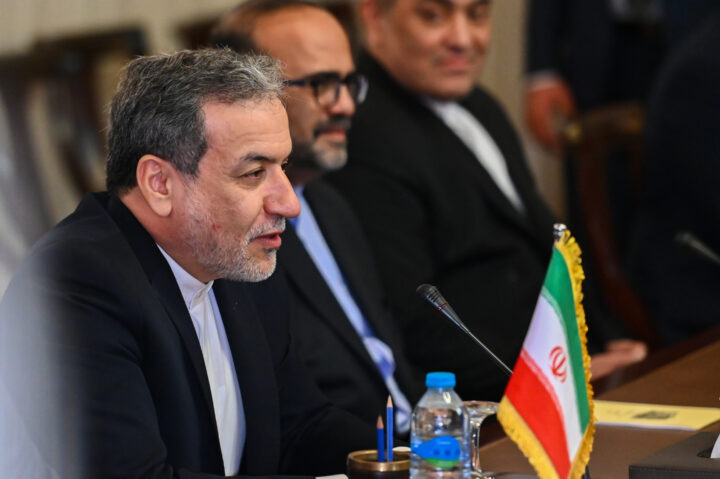
Sayed Hassan/Getty Images
Iran's Foreign Minister Abbas Araghchi meets with his Egyptian counterpart on October 17, 2024 in Cairo, Egypt.
For a brief moment on Wednesday, it looked like Iran talks were off. Tehran wanted to move their location from Turkey to Oman and narrow the scope of the negotiations to its nuclear program. The Trump administration saw this as a bad sign, and anonymous American officials began leaking to the media that Iran wasn’t taking the negotiations seriously.
Secretary of State Marco Rubio acknowledged that the negotiations were uncertain in remarks to the press at the Critical Minerals Ministerial, a conference of 43 foreign and other ministers: “As far as the talks are concerned, I think the Iranians had agreed to a certain format. For whatever reason, it changed … We’ll see if we can get back to the right place. The U.S. is prepared to meet them,” he said.
Meanwhile, President Donald Trump relayed a warning to Iranian Supreme Leader Ali Khamenei in a prerecorded interview with NBC News: “I would say he should be very worried.”
It didn’t take long – just over two hours, to be precise – between the news of the apparent collapse of talks between the U.S. and Iran and Iranian Foreign Minister Abbas Araghchi’s announcement on X that they were back on: “Nuclear talks with the United States are scheduled to be held in Muscat on about 10 am Friday.” Anonymous American sources then confirmed to various media that negotiations were set to take place, after leaders of Arab and Muslim countries urged the Trump administration to give them a chance, despite Iran’s prevarications.
Still, Araghchi’s statement alludes to one of the major reasons that the talks were, briefly, called off: Are they only “nuclear talks” or are they about a range of malign behavior by the Islamic Republic?
The Iranian answer to that question is clear, but the Trump administration sent mixed messages.
The Trump interview with NBC provided few clues. The president expressed support for the protesters against the Iranian regime, saying “we’ve had their back.”
Yet, in a bit of revisionist history, he portrayed his recent threats to Iran as being solely about the nuclear file: “They were thinking of starting a new [nuclear] site in a different part of the country. We found out about it and said, ‘you do that, we’re going to do very bad things to you,'” Trump said. He didn’t mention ballistic missiles in the interview.
Rubio, however, specified that “as far as the topics [of negotiations] and what the agenda needs to be, I think that in order for talks to actually lead to something meaningful, they will have to include certain things, and that includes the range of their ballistic missiles, that includes the sponsorship of terrorist organizations across the region, that includes the nuclear program and that includes the treatment of their own people.”
“Beyond that,” Rubio said, “the president retains a number of options as to how to respond to [the violent crackdown on protesters] and future events.”
Vice President JD Vance told Megyn Kelly that stopping Iran from getting a nuclear weapon was the main concern: “In a perfect world, would I love it if a bunch of freedom-loving Iranians… had a government that was much more friendly to the United States of America? Would that be a good thing? Absolutely.”
“But fundamentally,” he added, “the president has been focused … on this question of ensuring that they don’t get a nuclear weapon. .. I feel 100% confident that even if the Iranians were rushing toward a nuclear weapon, they couldn’t get one during the Trump administration. But we’re not thinking about the next three years; we’re thinking about the next 30 years.”
Vance argued that “global nuclear proliferation” is “the biggest threat to the world,” and as such, Trump is seeking to stop Iran from obtaining nuclear weapons so that other countries in the region do not seek to attain them, as well, and is willing to work with unfriendly countries like Russia and China to achieve that because it is “the most important thing you can do for peace and stability.”
The lack of clarity is reason for concern in Jerusalem, where the line on any potential American agreement with Iran, going back to the Obama-era negotiations, has long been zero enrichment and extensive limitations on ballistic missiles and regional proxy activity.
Israel regarded U.S.-Iran negotiations with deep skepticism even before the latest bumps on the road to Oman, with Israeli Prime Minister Benjamin Netanyahu telling White House Special Envoy Steve Witkoff during his visit to Israel on Tuesday that “Iran proved time after time that its promises cannot be trusted.” Talks that do not include missiles and proxies will likely be viewed with alarm.
Ahead of reported talks between the U.S. and Iran, Sen. Mike Rounds said the regime ‘would love to deceive us … I just don’t think we’re going to have much success’

Iranian Leader Press Office / Handout/Anadolu via Getty Images
Iranian Supreme Leader Ayatollah Ali Khamenei makes remarks in Tehran, Iran, on May 20, 2025.
Several Republican senators expressed skepticism that the Iranian regime would negotiate in good faith with the United States on its nuclear program or on its crackdown on pro-democracy protesters, as the administration pursues a diplomatic approach with Tehran following threats of military action.
Some, including Sen. Lindsey Graham (R-SC) — and the Saudi defense minister, behind closed doors — have warned that, if the U.S. fails to act after President Donald Trump promised Iranian protesters that “help is on its way,” it would be a blow to the U.S.’ credibility in the Middle East and would strengthen the Iranian regime.
Sen. Rick Scott (R-FL) expressed skepticism that the Iranians would engage sincerely or willingly give up their nuclear program in talks with the U.S., reported to be taking place in Turkey on Friday.
“Wouldn’t that be great? It’d be great if they did. It’d be great if they got rid of their nuclear weapons,” Scott told JI. “Do I actually believe they’re going to negotiate in good faith? I don’t.”
Scott added that he was in favor of Trump taking action to support the protesters after promising to do so. “I think if you tell somebody you’re going to help them, you’ve got to help them,” the Florida senator said.
Sen. Mike Rounds (R-SD) said he believes Trump “wants to avoid a war.”
“I hope he’s successful,” Rounds added, but said that he is not optimistic that a viable deal is achievable. “I, personally, am really discouraged. I don’t think Iran really wants to negotiate a deal that would stop them from doing their terrorist activities, supporting terrorism around the area, and I don’t think they really want to give up their nuclear ambitions — although they would love to deceive us,” Rounds said.
“I wish [Trump] the best. I think he’s right in trying to do [make a deal]. I think that’s what we should be trying to do, but I don’t, I just don’t think we’re going to have much success,” he added.
Sen. Markwayne Mullin (R-OK) said, “You can’t trust anything the ayatollah says at all.”
“I don’t know what the details are, so it’s hard for me to say what I’d like to see in [an agreement],” Mullin continued. “We all know that a nuclear Iran can never happen, so that’s got to be part of it. What else happens there? I don’t know, but I still go back to the fact that you can’t trust anything that the ayatollah or this current regime says.”
Mullin disagreed that not striking Iran would be seen as a shift in U.S. policy, describing the administration’s current approach as an extension of the president’s “peace through strength” policy.
“People respect that the president will always strike, or ratchet that up, when the time is right. He always wants diplomacy first, but he’s willing to use the strength part if he has to get to that point,” Mullin said. “And I think that’s what the president has positioned himself to do, but he has multiple options … so hopefully we’ll have a positive outcome without anyone getting hurt.”
Sen. John Kennedy (R-LA) said that he’d want to see Iran surrender its enriched uranium, give up any future potential to obtain a nuclear weapon, stop funding terrorist groups and “start being a responsible member of a stable world order.”
He disputed the notion that a failure by the U.S. to launch strikes now would hurt the country’s credibility, arguing that any military strikes would be based on U.S. intelligence, which he does not have.
“It’s a lot more complicated. I mean, these folks are entitled to their opinion … obviously I hope the negotiations are successful,” Kennedy said. “Whether the president decides to go further is going to depend an awful lot on national and military intelligence, which I don’t have access to. We have the best spies in the world, and I don’t know what they’re telling the president, but it matters. So I can’t advise him if I don’t have the information from the intelligence community.”
Sen. Richard Blumenthal (D-CT) said that any deal with the Iranians would need to include “a complete renunciation of nuclear arms and ballistic missiles that can reach Israel or our European allies.” He also said the regime’s crackdown on protesters would need to be “renounced.”
“They’re a country that continues to maintain ‘death to America, death to Israel.’ It is what it is,” Blumenthal said. “On a military front, there has to be a complete renunciation of nuclear weapons and long-range ballistic missiles, and I think the brutal and inhumane tactics toward its own people have to be renounced.”
“I think we should do something, but it may not be a military strike,” he added. “There are a range of actions that we could take, [such as] to expand economic efforts and [implement] a stronger enforcement of sanctions. So between those, there are options.”
Sen. Tim Kaine (D-VA), who recently introduced a war powers resolution to block military action against Iran without congressional authorization, explained to JI that the resolution was a response to Trump’s comments about a potential attack and the current deployment of U.S. military assets to the Middle East.
Kaine said that the resolution would be eligible for consideration on the Senate floor next week, and that whether he calls it up will depend on how events develop and whether it will have the votes to pass.
“What really prompts me is when I think I can get the votes,” Kaine said. “Usually that means something beyond saber-rattling and it’s some kind of step, like in the international waters or Venezuela, we’re actually killing people — that clearly demonstrates we need to do this.”
Kaine also emphasized that the administration’s explanation for potential military action against Iran has shifted — citing both the protests and nuclear issue — and said he was concerned by a report last week that the administration may be considering some ground deployment of special forces into Iran.
“I’ve just got an awful lot of military families in Virginia who don’t want their kids to be in another war in the Middle East,” Kaine said.
Trump is adamant that Iran will not get a nuclear weapon, has yet to set a timeline for talks, but if Iran attacks, ‘all bets are off,’ ambassador says
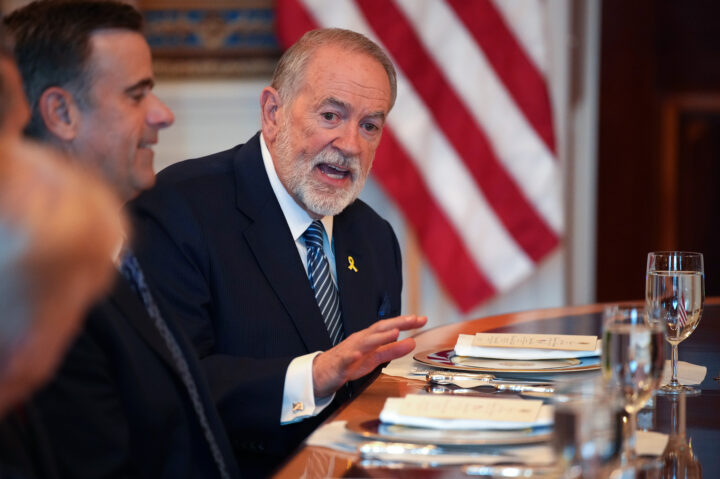
Andrew Harnik/Getty Images
U.S. Ambassador to Israel Mike Huckabee delivers remarks as President Donald Trump hosts Israeli Prime Minister Benjamin Netanyahu for a dinner in the Blue Room of the White House on July 7, 2025, in Washington, DC.
The U.S. would prefer a negotiated agreement with Iran to dismantle its nuclear program, U.S. Ambassador to Israel Mike Huckabee said in an interview that aired on Israel’s Channel 12 on Saturday night.
“I think everybody would love to see, at least in the U.S., would love to see some type of peaceful settlement in which Iran comes to it and decides that there’s no future for them to have a nuclear device, and there’s no future for them to continue to threaten both Israel and the United States,” Huckabee said.
President Donald Trump is “adamant,” Huckabee said, that “Iran is not going to get a nuclear weapon, not going to enrich uranium, so they’re going to have to get that out of their heads.”
Trump has yet to decide if he will strike Iran or not, the ambassador added.
“President Trump is always hopeful for the best outcome – let’s never forget The Art of the Deal – and if he can get that, that’s ideal,” Huckabee said. “But if he can’t, he’s not afraid to do what he proved last summer when he instigated Midnight Hammer,” the operation in which the U.S. struck Iranian nuclear sites.
As to the timing for a decision, Huckabee said he was baffled by the decision taken by some airlines to cancel flights as though a strike was imminent. The ambassador posited that Trump is likely to announce a timeline: “Remember last year, he said ‘you have 60 days,’ [and] on day 61 [the American strike on Iran] happened.”
At the same time, Huckabee said, “there are things that could precipitate a more urgent sense of reaction. If Iran were to strike, I think all bets are off.”
Huckabee also said that he “cannot imagine” that a strike on Iran would not be coordinated with Israel.
“The alignment between the United States and Israel is so incredible, more than most Israelis or Americans would ever assess,” he said. “We share intelligence that saves the lives of Americans and Israelis. We share military hardware, we share technology, and you have an excellent relationship between the president and the prime minister.”
Asked if Netanyahu had a significant role in the president calling off a strike on Iran on Jan. 14, Huckabee said “there is a genuine relationship, and there is a partnership that is unlike we have with any other country.”
In Gaza, Huckabee admitted that “there are some question marks” remaining as to how Hamas will be disarmed and who will do it, though Trump has insisted that “if they don’t give up their weapons, it’s going to be very bad.”
“You have every Arab country in the world signing the agreement saying this is going to happen,” Huckabee said. “I don’t trust Hamas to do anything, but I trust the rest of the world to say to Hamas, ‘you signed it, you’re on the line for it, if you don’t fulfil it, the whole world is going to rise up and take you down.’”
As to whether Israel will be the one to disarm Hamas, Huckabee said: “I don’t think the President is going to limit any action solely to Israel. Israel has enough blood in this. Everybody else at Sharm El Sheikh signed in ink; Israel signed in blood.”
Huckabee said that the U.S. is still hopeful that more countries will join the Abraham Accords, and that last week he met with U.S. Ambassador to Lebanon Michel Issa to discuss “how do we, as Americans, help our host countries move toward better understanding the escalating tensions and hopefully moving toward the president’s agenda of joining the Abraham Accords. It would be historic. We’d love to see this happen, and I’m optimistic that we will see that.”
The ambassador was noncommittal as to whether Trump would visit Israel in May to receive the Israel Prize in person, but he said it’s “a huge honor” for the president to be the first non-Israeli to be granted the award.
‘If Iran restarts their nuclear ambitions, I fully support bombing them until they get the message,’ the Pennsylvania senator told JI
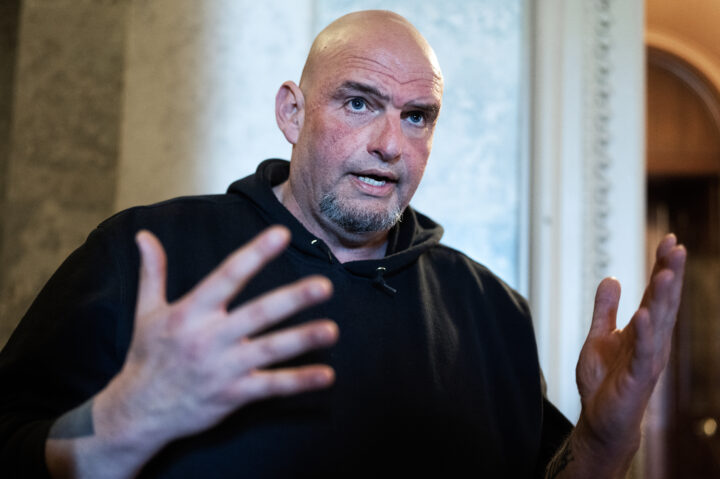
Tom Williams/CQ-Roll Call, Inc via Getty Images
Sen. John Fetterman, (D-PA) talks with reporters after the Senate luncheons in the U.S. Capitol on Tuesday, March 11, 2025.
Sen. John Fetterman (D-PA) said on Thursday that he would support the U.S. striking Iran’s nuclear facilities again to prevent Tehran from rebuilding its nuclear program — if the regime is found to be making strides toward restoring sites damaged by U.S. and Israeli strikes last year.
The Pennsylvania senator told Jewish Insider that he believes the U.S. and Israel should keep targeting Iranian nuclear facilities until Iran’s leaders “get the message” that the Islamic Republic will never be allowed to acquire a nuclear weapon.
“If Iran restarts their nuclear ambitions, I fully support bombing them until they get the message,” Fetterman told JI.
Fetterman was supportive of President Donald Trump’s decision to strike Iran’s nuclear facilities amid the 12-day war with Israel last year and has emerged as one of the staunchest Iran hawks in the Democratic Party. He criticized members of his party last June who spoke out against Israel’s strikes on Iran and Trump’s subsequent decision to join the strikes.
“It was just astonishing to see colleagues criticizing these things. It’s like, do you think you can negotiate with that regime? Do you think you want to run that scenario and allow them to acquire 1,000 pounds of weapons grade uranium?” Fetterman told JI at the time. “I can’t understand, I can’t even begin to understand that.”
For his part, the president said late last month while meeting with Israeli Prime Minister Benjamin Netanyahu that he was open to another round of strikes against Iran.
Asked by reporters if he will support another Israeli attack on Iran if it continues its ballistic missile and nuclear programs, Trump said, “If they continue with the missiles? Yes. If the nuclear? Fast, OK? One will be yes, absolutely; the other was, we’ll do it immediately.”
“Iran may be behaving badly,” he added. “It hasn’t been confirmed, but if it’s confirmed, look, they know the consequences.”
Fetterman is the first Democrat in Congress to publicly endorse additional strikes on Iran’s nuclear program, a move several of his Republican colleagues have also gotten behind.
Sen. Lindsey Graham (R-SC) said in Israel last month that Washington had a duty to act on “credible evidence” that Iran is looking for avenues to rebuild its nuclear program. The South Carolina senator argued it was imperative that the U.S. and Israel “hit them before they can” do so.
“We obliterated the Iranian nuclear facilities. We did not obliterate Iran’s desire to have a nuclear weapon,” Graham said. “The regime hasn’t changed at all. They still want to kill all the Jews, consider America the great Satan, and purify Islam.”
“Are they regenerating their nuclear capability? Are they building more ballistic missiles that could hurt Europe and Israel?” he added. “I don’t know, but there’s evidence that, yes, they are.”
Republican senators agreed President Donald Trump would make good on his threat to strike Iran again if it attempts to rebuild its nuclear capabilities

Satellite image (c) 2025 Maxar Technologies.
ISFAHAN NUCLEAR TECHNOLOGY CENTER, IRAN -- JUNE 22, 2025: 04 Maxar satellite image reveals multiple buildings damaged or destroyed at the Isfahan nuclear technology center after the airstrikes. Charring and roof collapses are visible across the compound.
Lawmakers said on Monday that an additional round of U.S. strikes on Iran remains on the table if the regime makes strides in rebuilding its nuclear program or other malign activities, echoing recent warnings from President Donald Trump.
Trump also threatened last week that the U.S. would intervene to protect Iranian protesters if the regime cracked down on nationwide demonstrations, as U.S. officials are watching closely while Tehran reportedly accelerates efforts to restore its ballistic missile capabilities — developments that could spark renewed conflict with Israel and potentially the United States.
Republican senators expressed confidence that the president would strike Iranian nuclear facilities a second time if the U.S. determined that Tehran was working to restore its nuclear program.
“I think there’s a chance” Trump will strike Iran’s nuclear sites again, Sen. Rick Scott (R-FL) told Jewish Insider. “If they go forward again and start building up nuclear facilities, yeah, I think Trump’s going to bomb the hell out of them.”
Sen. Pete Ricketts (R-NE) told JI, “President Trump is demonstrating that we have the most outstanding military in the world. And if he believes we have to hit Iran again, I believe he will do that.”
Sen. John Kennedy (R-LA) agreed but dismissed the suggestion that Trump’s willingness to order the operation that deposed Venezuelan President Nicolas Maduro last week signified that the president was looking to resume strikes against Iran.
“I don’t think one’s related to the other,” Kennedy told JI. “I also think that if Iran starts back in terms of developing a nuclear weapon, or substantially tries to increase the number of missiles that they have, I think the president should hit them and I believe he will.”
Asked about Trump’s threat to intervene to prevent crackdowns on Iranian protesters, and rumors of a potential second round of Israeli strikes on the Islamic Republic, Sen. Richard Blumenthal (D-CT) emphasized the threat of Iran’s missile and nuclear programs.
“We should be considering what action may be appropriate if Iran progresses with its missile building and nuclear programs, which are obviously a pressing and dire threat to us and Israel,” Blumenthal said.
Sen. Tim Kaine (D-VA), a leading voice in the Senate for constraining presidential war powers, who is pushing to block further action in Venezuela, told JI that the U.S. should not be sending in its military in response to the protests, particularly without congressional debate and approval.
“This president should not willy-nilly use the press, use the military as his palace guard to go here, there and everywhere,” Kaine said. “Not Nigeria, not Iran, not Venezuela, not international waters, not Cuba, not Mexico, not Panama, not Greenland. It should be a debate with Congress.”
He added that a constituent, whose son is an Army Ranger, urged Kaine during the holidays to work to prevent unilateral military deployments by the administration. “And I am representing one of the most pro-military states in the country, and that’s what my state thinks,” Kaine explained.
Meeting in Florida, Trump and Netanyahu projected unity but highlighted disagreements on Turkey, Syria and the West Bank
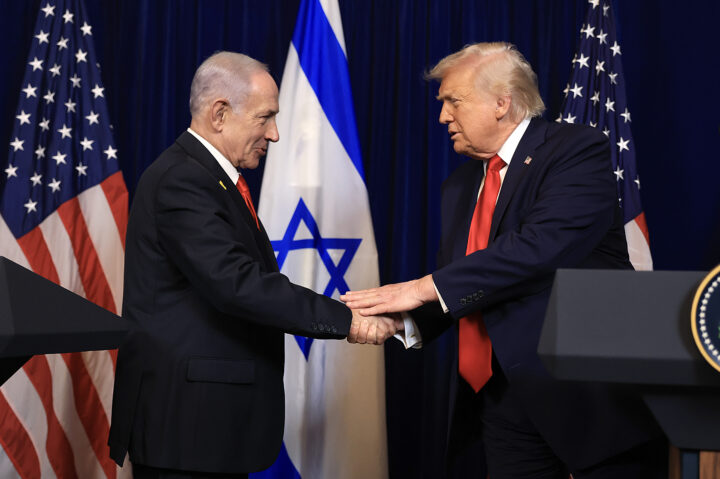
Joe Raedle/Getty Images
President Donald Trump shakes hands with Israeli Prime Minister Benjamin Netanyahu during a press conference at his Mar-a-Lago club on December 29, 2025 in Palm Beach, Florida.
President Donald Trump vowed on Monday that he would support the U.S. or Israel launching another round of strikes against Iran if Tehran is attempting to rebuild its ballistic missile program or nuclear facilities.
Trump made the comments while speaking to reporters from his Mar-a-Lago estate in Palm Beach, Fla., alongside Israeli Prime Minister Benjamin Netanyahu for the latter’s fifth visit to the United States this year.
Asked if he will support another Israeli attack on Iran if they continue their ballistic missile and nuclear programs, Trump said, “If they continue with the missiles? Yes. If the nuclear? Fast, okay? One will be yes, absolutely; the other was, we’ll do it immediately.”
He added later, “If they are [rearming], we’re going to have no choice but very quickly to eradicate that build up. … We don’t want to waste the fuel on a B-2 [bomber]. It’s a 37-hour trip, both ways, I don’t want to waste a lot of fuel,” suggesting the U.S. would again utilize its bomber jets that conducted the June strikes on Iran’s nuclear facilities.
The president repeatedly urged Tehran to return to the negotiating table with the U.S. while cautioning that the regime would face consequences for declining his offer to address the nuclear issue diplomatically. “They could have made a deal the last time before we went through the big attack on them, and they decided not to make the deal. They wish they made that deal. So I think, again, they should make a deal,” he said.
About reports that Iran is rearming, Trump said, “Iran may be behaving badly. It hasn’t been confirmed, but if it’s confirmed, look, they know the consequences.”
“This is just what we hear, but usually where there’s smoke, there’s fire,” he continued. “I’m hearing that their [efforts are] not nuclear yet, but maybe nuclear, too. The sites were obliterated, but they’re looking at other sites [than the ones the U.S. bombed in June]. That’s what I’ve heard. They’re looking. It’ll take a long time. They’re not going to go back to where they were, but they have other places they can go. And if they’re doing that, they’re making a big mistake.”
Trump repeatedly praised Turkish President Recep Tayyip Erdogan in his remarks with Netanyahu, pledging to thaw tensions between the Turkish and Israeli leaders and repeated that he was “very seriously” considering approving Turkey’s longstanding requests to purchase F-35 fighter jets from the United States. “We’re thinking about it very seriously,” Trump said about the move, which Israeli Ambassador to the U.S. Yechiel Leiter said last month that Israel opposes.
“I know President Erdogan very well, and as you all know, he’s a very good friend of mine … and I do respect him and Bibi respects him, and they’re not going to have a problem,” Trump said.
Speaking to reporters alongside Netanyahu ahead of their meeting, Trump also voiced his support for Turkey joining the proposed U.S.-led International Stabilization Force to be deployed in Gaza.
“I have a great relationship with President Erdogan, and we’ll be talking about it. And if it’s good, I think that’s good. And a lot will be having to do with Bibi, we’re going to be talking about that,” Trump said. “But Turkey has been great, and he [Erdogan] has been excellent, as far as I’m concerned. I don’t know about you [Netanyahu], but to me he’s been very good.”
Netanyahu did not comment on the suggestion at the time or during the press conference later on, though Israel, as well as several U.S. lawmakers, has said it opposes Ankara’s involvement in the proposed peacekeeping force due largely to Turkey’s ties to Hamas, despite the supportive posture from the Trump administration.
The president later used the topic of Syria to again praise Erdogan, arguing the Turkish leader deserved “a lot of credit” for ousting the Assad regime.
“Don’t forget, it was President Erdogan that helped very much get rid of a very bad ruler of Syria. That was President Erdogan, and he never wanted the credit for it, but he really gets a lot of credit. Bibi agrees with that. … I know it,” Trump told reporters.
The president went on to say that the U.S. and Israel “have an understanding regarding Syria” and that he was working to improve relations between the Jewish state and its neighbor, praising Syrian President Ahmad al-Sharaa along the way.
“We do have an understanding regarding Syria. Now with Syria, your new president. I respect him. He’s a very strong guy. That’s what you need in Syria. You can’t put a choir boy, you can’t put somebody that’s a perfect person — everything’s nice, no problems in life,” Trump said.
“I’m sure that Israel and him will get along,” he continued. “I will try and make it so that they do get along. I think they will.”
For its part, Israel has been wary of al-Sharaa and the new Syrian government, with the IDF maintaining control of the 155-square-mile buffer zone between the two countries since the fall of Syrian dictator Bashar Assad last year, against Damascus’ wishes. Israel and Syria have also continued to disagree on the contours of a potential security agreement, which the Trump administration has continuously sought, with Netanyahu maintaining that any agreement must require Syria to accept the demilitarization of territory stretching from southern Damascus to the Israeli border.
Trump was also asked about the Lebanese government’s failure thus far to disarm Hezbollah, amid reports that the terror group is rearming. The president demurred when pressed on his support of Israel striking Hezbollah targets in Lebanon again as a result, instead only acknowledging his disapproval with the terrorist organization.
“Well, we’re going to see about that. We’ll see about it,” Trump said. “The Lebanese government is at a little bit of a disadvantage, if you think of it, with Hezbollah, but Hezbollah has been behaving badly. So we’ll see what happens.”
Asked about attacks by Israeli settlers against Palestinians, Trump acknowledged that he and Netanyahu discussed the West Bank during the meeting and that they’re not in complete alignment on the issue. Still, Trump expressed confidence that all parties would reach “a conclusion” to prevent the matter from undermining the implementation of his broader peace plan, though he declined to offer specifics.
“Well, we have had a discussion, big discussion, for a long time on the West Bank. And I wouldn’t say we agree on the West Bank 100%, but we will come to a conclusion on the West Bank. … It’ll be announced at an appropriate time, but [Netanyahu] will do the right thing. I know that. I know him very well. He will do the right thing,” he said.
Trump also expressed gratitude during his remarks for being named the recipient of the Israel Prize, the Jewish state’s highest cultural honor awarded by the country’s education minister. Netanyahu said Trump will be the first non-Israeli to receive the award, which the president said “really is a great honor.”
Netanyahu invited Trump to visit Israel on Yom Ha’atzmaut, the Jewish state’s independence day, in April, which will be an election year, to receive the award in person.
Joined by Trump at his the meeting with Netanyahu were White House Chief of Staff Susie Wiles; Stephen Miller, deputy chief of staff for policy at the White House; Secretary of State Marco Rubio; Defense Secretary Pete Hegseth; Gen. Dan Caine, the chairman of the Joint Chiefs of Staff; Steve Witkoff, the White House’s Mideast envoy; and Jared Kushner, Trump’s advisor on Middle East efforts.
Netanyahu also met individually with Secretary of State Marco Rubio and Defense Secretary Pete Hegseth while at the president’s property.
Reports indicate the move could come as soon as Thursday, after talks in Geneva ended with little progress on rolling back the Iranian nuclear program

Kay Nietfeld/picture alliance via Getty Images
French President Emmanuel Macron (l-r), German Chancellor Friedrich Merz (CDU) and Keir Starmer, Prime Minister of Great Britain, meet in The Hague at the delegation hotel on the sidelines of the NATO summit for trilateral talks in the E3 format.
France, Germany and the U.K. are poised to reinstate snapback sanctions on Iran in the next several days, after talks held in Geneva this week aimed at scaling back Iran’s nuclear program reportedly concluded with little progress.
The three countries — known as the E3 — sent a letter to the U.N. Security Council earlier this month outlining “ongoing concerns regarding the lack of assurances as to the exclusively peaceful nature of Iran’s nuclear program” and Tehran’s ongoing violations of the 2015 Joint Comprehensive Plan of Action, to which the E3 countries are still parties despite the U.S. withdrawal in 2018.
The countries threatened to reinstate snapback sanctions by the end of August 2025 if “no satisfactory resolution” to the issue was reached before then.
The mechanism to trigger snapback sanctions at the UNSC expires in October, at which point any attempt to adopt new UNSC sanctions could face vetoes from Russia and China. However, the E3 and U.S. are looking to start the process before Russia assumes the UNSC presidency in October, giving it the power to delay the imposition of snapback sanctions — a process that takes 30 days to complete — until its expiration date.
The foreign ministers of the E3 and Iran met in Geneva earlier this week to discuss a diplomatic solution that would see Iran roll back its nuclear program without additional sanctions, which reportedly ended with little progress made.
A senior European diplomat told Axios on Wednesday that it would take a “diplomatic miracle” to prevent the reinstatement of snapback sanctions, with the European nations poised to trigger the mechanism as soon as Thursday.
Secretary of State Marco Rubio held a call with the E3 foreign ministers on Wednesday, during which all of the officials “reiterated their commitment to ensuring that Iran never develops or obtains a nuclear weapon,” State Department Principal Deputy Spokesperson Tommy Pigott said.
U.S. lawmakers have repeatedly pressed for the E3 to trigger the snapback mechanism.
The former CIA director warned that the Islamic Revolutionary Guard Corps may attempt to consolidate power in Iran

Maxym Marusenko/NurPhoto via Getty Images
Former CIA Director and retired US General David H. Petraeus speaks at a special event of the Kyiv Security Forum, Kyiv, Ukraine, September 05, 2023.
ASPEN, Colo. — Retired Gen. David Petraeus, the former director of the CIA and head of U.S. Central Command, said Friday at the Aspen Security Forum that, in the post Oct. 7, 2023 environment, Israel will no longer tolerate threats to its security throughout the region, including a resumption of Iran’s nuclear program.
Petraeus said, “We have to step back a little bit and recognize that Israel’s strategic calculation is very, very different from before Oct. 7, and that’s a big deal for the region,” explaining that Israel will no longer allow threats to metastasize anywhere in the Middle East.
He added that Iran must understand that it is vulnerable and that no Israeli leader will allow it to resume its push for a nuclear weapon.
“[The Iranians] have to recognize that if they make another move, they’re going to get hammered once again,” Petraeus said. “And I don’t think that an Israeli prime minister, even if it’s not Bibi Netanyahu, will allow the Iranians to proceed down the path to a nuclear device.”
He predicted that Russia would not be helpful to Iran in replacing its Russian-manufactured air-defense systems that Israel destroyed, since it doesn’t have sufficient systems to protect itself from Ukraine’s counter-strikes at this point.
Petraeus argued that Iran’s future direction and leadership will depend on what sort of leader or leadership structure succeeds Ayatollah Ali Khamenei — whether the country remains ruled by a hardline religious cleric or whether a new body, potentially one dominated by the Islamic Revolutionary Guard Corps, emerges.
“You can actually entertain at least a notion that, since they control 30 to 40% of the economy, that the Revolutionary Guard Corps says, ‘Hey, why are we doing all this stuff? We could be living high on the hog and stop getting bombed and our headquarters getting taken out, us individually targeted, if we just cut loose Hezbollah, and all these others. Who cares about this nuclear stuff? What has this brought us now?’” Petraeus said.
Journalist Kim Ghattas, speaking alongside Petraeus, said that “this 40 year arc of the Islamic Revolution is coming to an end,” citing knowledge from an unnamed Western diplomat previously based in Iran, “but exactly how it ends we just don’t know yet.”
She argued that the “inconclusive” nature of the Israel-Iran war “has actually complicated matters internally and in the region” and may allow the Iranian regime to recalibrate and consolidate power. She suggested that the IRGC could take charge and transform the country into more of a military dictatorship, sidelining the mullahs.
“I think that in the medium term, we’re looking at a more oppressive, more militaristic Iranian regime,” Ghattas said.
And she predicted that Iran would push ahead with its nuclear program as its only option for deterrence.
Ghattas also said that the fact that Iran had managed to survive the Israeli attacks had complicated efforts to sideline Hezbollah in Lebanon, sending a message to the group that it should hold out; she said that Hezbollah is unlikely to disarm without instruction from Iran, and that it would require political concessions in order to do so.
“We had a really golden opportunity at the beginning of the year, when everything was in flux, Hezbollah was very much on the back foot. [Syrian dictator Bashar al-]Assad was gone. Gaza had a ceasefire in January,” Ghattas said. “This was the moment to strike with a grand political vision, diplomatic vision, for the region. Now, everybody’s recalibrating. Iran is trying to see how it can get a foothold stronger again, into Lebanon, even into Syria.”
Petraeus said that he supports Israel’s objectives it has laid out in Gaza — destroying Hamas, removing it from governance and freeing the hostages — “but I’ve said publicly from the very beginning and written about it as well, that I just don’t think they’re going about it the right way.”
He said Israel should be pursuing a “comprehensive civil-military counterinsurgency campaign — clear, hold, build and transition,” including establishing security and governance measures in Gaza as the campaign proceeds and allowing Gazan Palestinians return to their homes.
“And that requires a fourth objective, which has never been stated, and that is to provide a better future for the Palestinian people in Gaza without Hamas in their lives,” he continued.
He said that, though Hamas has been degraded, it still has the largest armed force in Gaza and would reemerge as the dominant force in a vacuum, despite Israel’s arming of some Palestinian clans in Gaza.
“I’m really worried about what is the future of Gaza, for which there’s been no real vision provided for what life of the Palestinian people will look like,” Petraues said.
The retired general indicated that he’s optimistic about Syrian President Ahmad al-Sharaa, explaining, “We believe that he understands the need for a government that has representation from all of these different elements and not only assures majority rule, but also ensures minority rights.”
Ghattas warned that the ongoing Israeli military campaign in Syria risks spawning a revitalized terrorist threat in Lebanon and a renewed threat from Syria.
She said she supports the Trump administration’s policy in opening a door to the new Syrian government, but said that the U.S. has “gone a little bit too far in embracing al-Sharaa.”
“Great about lifting the sanctions, but you still need to breathe down his neck, because international support does not translate into national legitimacy, yet, and he’s not done enough in terms of national legitimacy,” Ghattas said.
The panelists also discussed Saudi Crown Prince Mohamed Bin Salman’s rise to power and vision for the region.
Petraeus said that bin Salman had overhauled a slow and indecisive government to consolidate power.
“There’s never been a consolidation of power like we see there, and there’s never been someone with the kind of vision that he has put forward as well,” Petraeus said. “You can ask if some of that is beyond realistic. … But he knows that.”
He said that bin Salman’s initiative has established Saudi Arabia as one of the key centers of power in the region, alongside the United Arab Emirates and Qatar, supplanting traditional power-players like Egypt.
Ghattas said that bin Salman had evolved over time and “transformed, for the better, the lives of millions of young Saudis.”
“I think the opportunities are great, but I think Saudi Arabia, which wanted to establish relations with Israel before Oct. 7, is finding itself with a conundrum that it cannot solve on its own without pressure from the United States on Israel,” Ghattas said, “which is [that] it is not going to reach out to Israel anymore unless they get a promise of a Palestinian state. The bar for that has risen tremendously.”
Speaking at the Aspen Security Forum, the analysts also discussed the possibility of Iran attempting to reconstitute its nuclear weapons program covertly and the prospect of regime change in Iran

Aspen Security Forum
Former National Security Advisor Stephen Hadley, Rachel Bronson, David Sanger and Vali Nasr speak on a panel about Iran at the Aspen Security Forum on July 17, 2025.
ASPEN, Colo. — Speaking on a panel at the Aspen Security Forum, a group of Iran analysts discussed the potential paths forward in nuclear talks with Iran after the American and Israeli strikes on Iran’s nuclear facilities, the possibility that Iran will attempt to reconstitute its nuclear program covertly and the prospect of regime change in Iran.
Former National Security Advisor Stephen Hadley laid out three paths forward after the strikes: a continued campaign of Israeli air strikes to “mow the lawn,” while Iran works to try to re-establish its own deterrence; a negotiated agreement with Iran including intrusive inspections that would make it difficult for Iran to construct a covert nuclear program, with provisions addressing Iran’s ballistic missiles and proxies; and the possibility, with an agreement, that Iran decides to give up its pursuit of nuclear weapons, having spent billions of dollars on the program, alienated the region and still failed to deter a U.S. or Israeli attack.
“There is a question whether the Iranians will decide that the cost of pursuing a nuclear program was just too high,” Hadley said. “It was supposed to safeguard them from getting attacked by the Israelis in the United States, and it resulted in them getting attacked. … That’s a long way down the road. It’s probably a low-likelihood probability, but it would certainly remake the Middle East.”
He presented a potential pathway for Iran, working with Gulf states, to pursue the model that they have laid out, focusing on economic development.
Rachel Bronson, a senior advisor at the Bulletin of the Atomic Scientists, said that it’s widely believed Iran has seen a nuclear weapon as a guarantor of regime survival, in the model of North Korea. But she said there’s a chance that Iran wants to go down a different path.
“That begs the question whether the Iranians want to live like North Koreans and want to live in a sanctioned regime and in such isolation, which the Iranians demonstrated that they don’t want to live that way,” Bronson said.
David Sanger, the chief Washington correspondent for The New York Times, argued that, while the Fordow nuclear facility has likely been rendered inoperable due to U.S. strikes, other sites, such as Natanz and Isfahan, can likely be repaired or rebuilt.
“I don’t think anybody can say whether or not this is really gone for good. My guess is you’re going to need a political agreement with getting inspectors back in to make sure that it stays out of circulation,” he said.
Sanger added that it would be a “long time” before Iran is in a position where it will be willing to negotiate. He said he’s concerned about the lack of inspections in the interim, “because I think if we get into another confrontation with them, they will leave the [Nuclear Non-Proliferation Treaty]. And if that happens, I think we could see a second cycle of [military action].”
From the U.S. side, Sanger said that Washington publicly presenting a proposal could build pressure on Iran to strike a deal. Without diplomacy, Sanger continued, future military confrontation is likely. He said there are also major questions around enrichment that Israel and Iran will have to answer.
“The question for the Israelis is, would they give an assurance that says, ‘We won’t strike you if you don’t try to reconstitute your program and don’t have a covert nuclear weapons program?’” Sanger said. ”For the Iranians on the enrichment point, there’s a question of whether, diplomatically, you could finesse it by saying, ‘You of course have the sovereign right to enrich, but you also, in the exercise of that sovereignty, can elect to give it up for other purposes.’”
And he said that Israel should also consider whether it’s willing to allow limited enrichment under comprehensive and intrusive IAEA inspections, arguing that Iran’s pathway to a potential covert weapons program would come via other avenues.
Bronson highlighted that the U.S.’ European partners, and even Russian President Vladimir Putin, are now in lockstep with the Trump administration in insisting that Iran must give up its enrichment capacity.
She also said it’s likely unrealistic that Iran would be able to restart a covert nuclear program without the world’s knowledge, particularly if it attempts to retrieve its stockpiles of highly enriched uranium, activity that would be noticed by various intelligence services.
“The covert is always out there, but it’s a long way to go for them to get back in that game,” she said.
Johns Hopkins University professor Vali Nasr predicted that the Iranian government’s priority would be finding a way to prevent future strikes by the United States and Israel, rebuilding its deterrence and defense.
He also argued that the public, aggressive diplomacy from the Trump administration, including demands on Truth Social for full dismantlement of Iran’s nuclear program, make such a deal politically unpalatable for the Iranian regime. He accused the Trump administration of failing to seriously negotiate before its strikes.
“You’re basically asking for surrender. It’s not a compromise anymore,” Nasr said. “So then the question becomes, what is the acceptable cost for surrender? Would the supreme leader think that Iran is back to the wall sufficiently for him to … go and sign a surrender treaty?”
Nasr suggested that the U.S. would have to offer Iran incentives to bring in to the table and that Tehran would make significant demands for such a deal, including a guaranteed end to Israeli strikes on Iran and safeguards against the U.S. pulling out of the deal in the future.
The panel members downplayed the notion that regime change is an imminent prospect in Iran.
Hadley said the most likely source of such a change would be from a faction inside the regime, like the Islamic Revolutionary Guard Corps, that decides it wants to reduce the role of the mullahs and their revolutionary ideology.
“If folks come out in the streets it may be because one of those factions has called them to the streets to give them an excuse for making some kind of change with the regime,” Hadley said. “But that’s going to take a long, I think, considerable time, to play out.”
Sanger said that “betting on regime change is a risky business.” He said that the Obama administration had been gambling on the idea that Supreme Leader Ayatollah Ali Khamenei would be dead before the JCPOA sunset.
“It’s pretty clear from talking to the Israelis who were in Washington last week, that is their bet now: They are just pushing for time, and they think a regime change will happen,” Sanger continued. “But I’m not sure where they get that confidence.”
Nasr predicted that there will be no major changes inside Iran as long as Khamenei is still alive. And he argued that the U.S. would need to lay out an attractive alternative and future for Iran in order to motivate a faction like the IRGC to take action.
“How do you force this shift in Iran? How do you cause the debate at the top that people seriously consider that this is a dead end and there’s some other path on the table?” Nasr said. “Iranian leaders, hardline moderates cannot react to what is theoretically possible but is not actually solidly in front of them as an option.”
At the same time, Nasr said that the failure of Iran’s proxy network had been a significant blow to segments of Iran’s government, leaving them in a weakened position in the regime.
Rogers, a former House Intel Cmte chair: ‘I was for all of this when it wasn’t very cool to be for all of this’
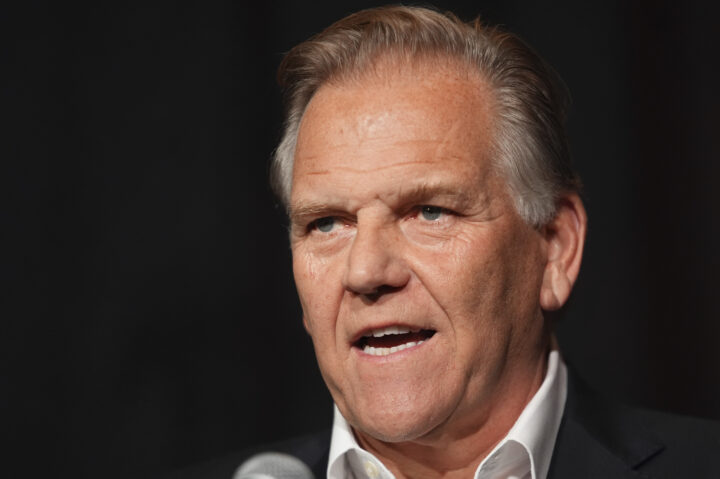
AP Photo/Paul Sancya, File
Republican Michigan Senate candidate Mike Rogers speaks during an election night watch party, Nov. 5, 2024, at Suburban Showplace Collection in Novi, Mich.
Former Rep. Mike Rogers (R-MI), making his second bid for Michigan’s Senate seat, is leaning into his support for the Trump administration’s decision to strike Iran’s nuclear program on the campaign trail.
Rogers emphasized, in an interview with Jewish Insider last week, that he has long been suspicious and concerned about Iran’s nuclear program and other malign activities dating back to his time as the chairman of the House Intelligence Committee in the early 2010s, when he had access to highly classified information.
“I couldn’t have supported [the operation] more,” Rogers, who served in the House from 2001 to 2015, said. “I was for all of this when it wasn’t very cool to be for all of this.”
The former lawmaker said he believes that Iran was much closer to a nuclear weapon than many believe, noting that its development of advanced supercomputers would likely have allowed it to reliably simulate a nuclear weapons test, an undetectable alternative to actually testing a nuclear bomb.
“I believe, on the day that Trump went in, that they had all three components” of a nuclear weapon: highly enriched uranium, a weapon and a delivery system using a ballistic missile, Rogers said. “They just didn’t have them assembled.”
He said that the “urgency of which Israel undertook their mission” suggests to him that Iran was working to bring those three elements of a nuclear weapon together.
Rogers added that the U.S. and Israel need to take seriously Iran’s threat to wipe out Israel if it obtains a nuclear weapon.
Rogers said that the destruction of much of Iran’s enrichment capacity — particularly the strikes on Fordow — and many of its missile launchers, as well as its anti-aircraft capabilities, put Iran on its back foot if it attempts to reconstitute its program. He predicted it would take Iran years to regain access to Fordow, if it attempts to do so.
“What I have said publicly is, I believe we should leave the option on the table for another round of attacks targeted at their nuclear capability,” Rogers continued. “I don’t care if it’s in uranium enrichment stockpiles, delivery equipment … there’s always the possibility you might find another centrifuge effort somewhere.”
He said that making clear that the U.S. is prepared to act again will help force Iran back to the negotiating table and rebut Iranian deception and stalling tactics in negotiations.
The U.S. strikes could create heated political dynamics in Michigan in the upcoming election cycle, as the war in Gaza did in the 2024 election, in the Jewish, Muslim and Arab communities.
When speaking to Arab and Muslim voters, Rogers said he emphasizes the ways that the Iranian regime has hurt the Muslim world, saying it has killed many more Muslims and Americans than it has Jews and that its support for groups like Hamas and Hezbollah has destabilized the region and undermined opportunity and prosperity.
“My argument is this may be the first step. I think this is the most consequential time in American, Israeli and Middle East politics in my lifetime, because I think the president set the tone for real peace,” Rogers said.
Rogers added: “I am against military adventurism, I think it’s a terrible idea for the country. What you saw here, and this is how I explain it to them — this is very surgical. … If you’re going to tout peace through strength, you have to show the strength path. Iran was undeterred up to this point.”
He described potential future talks with Iran as on a fundamentally different footing than they have been in the past: now, he argued, the debate is not over details like International Atomic Energy Agency inspection schedules, but a more comprehensive and permanent solution and peace.
Rogers added that he keeps his message on Middle East policy consistent regardless of whether he’s addressing Jewish or Muslim audiences.
“You can’t say one thing to one group and another thing to another. It never works,” Rogers said. “But if they know where you’re at and they can articulate why you’re there and why support of Israel is so important, both to me personally, but I think to the country … and Republicans, we talk about it too, that’s this debate, should we or shouldn’t we.”
Rogers is looking like the early favorite to emerge as the GOP nominee for the seat of retiring Sen. Gary Peters (D-MI). He is backed by Senate Republican leaders, as well as Trump campaign co-manager Chris LaCivita. But Rep. Bill Huizenga (R-MI) is considering challenging Rogers in the primary.
Rogers described himself as “one of the first folks” to raise alarms about the Joint Plan of Action, the precursor to the Obama administration’s nuclear deal, during his time in the House.
“I thought we were engaging and empowering Iran in a way that seemed to me that the Obama administration just didn’t understand, or didn’t want to understand, who Iran is, what their intentions are, and when they say they want to wipe Israel from the face of the earth, they actually mean it,” Rogers said.
He also said that he was among the first to sound the alarm about the Houthis, in 2013 or 2014.
“I said that if we don’t do something about the Houthis … we’re going to have a problem, and it’s going to be a problem for Israel, our greatest ally in the region, and our security as well,” Rogers said. He visited Yemen at the time and said he watched in real time as the group grew its capabilities and deepened its ties to Iran, at the same time that the situation in Yemen deteriorated.
“We couldn’t get people interested in [it] enough to understand what the threat was,” Rogers said. Going forward, “I would make sure that the Houthis understand what U.S. intention and Israeli intention is, if they continue to shoot at our sailors in our commercial enterprise in the region.”
“Those attacks on Fordow, that was the U.S. showing strength,” Rogers continued, invoking the motto of “peace through strength.” “Now let’s get to the peace part, but you also may have to reduplicate that in a few places to get people’s attention.”
Prior to his service in Congress, Rogers was an FBI agent, during which time he said he was involved in tracking down Iraqi agents inside the United States, during the first Gulf War. He said that there are some parallels between those “sleeper cells” and Iran’s more recent efforts to infiltrate and carry out operations in the United States.
“Here’s what I worry about — the difference between the Iraqi operations and what I know that Iran had the capabilities then as well,” Rogers said. “The Iranians will be, I think, more loyal to their mission than the Iraqis. … By the time [the Iraqis] lived here for 10 years, they thought, ‘This America thing is pretty good. I don’t know if I want to screw this up.’ I think the Iranian threat is much worse than the Iraqi threat at that time because they’re more passionate about it.”
He emphasized that Iran’s operations globally, including in the U.S., have been “pretty aggressive,” and serious in their planning and intentions and have disregarded potential civilian casualties.
“You need to reassign some agent manpower here to make sure you’re dealing with it” and get ahead of the Iranians before they can execute their plans, Rogers said. “Sometimes just including letting them know, ‘We know who you are, we know where you live, we know what you’re doing.’ That stuff can be a pretty good deterrence sometimes.”
Iran’s foreign minister told American media that the country can quickly restart its program, despite ‘heavy and severe’ damage
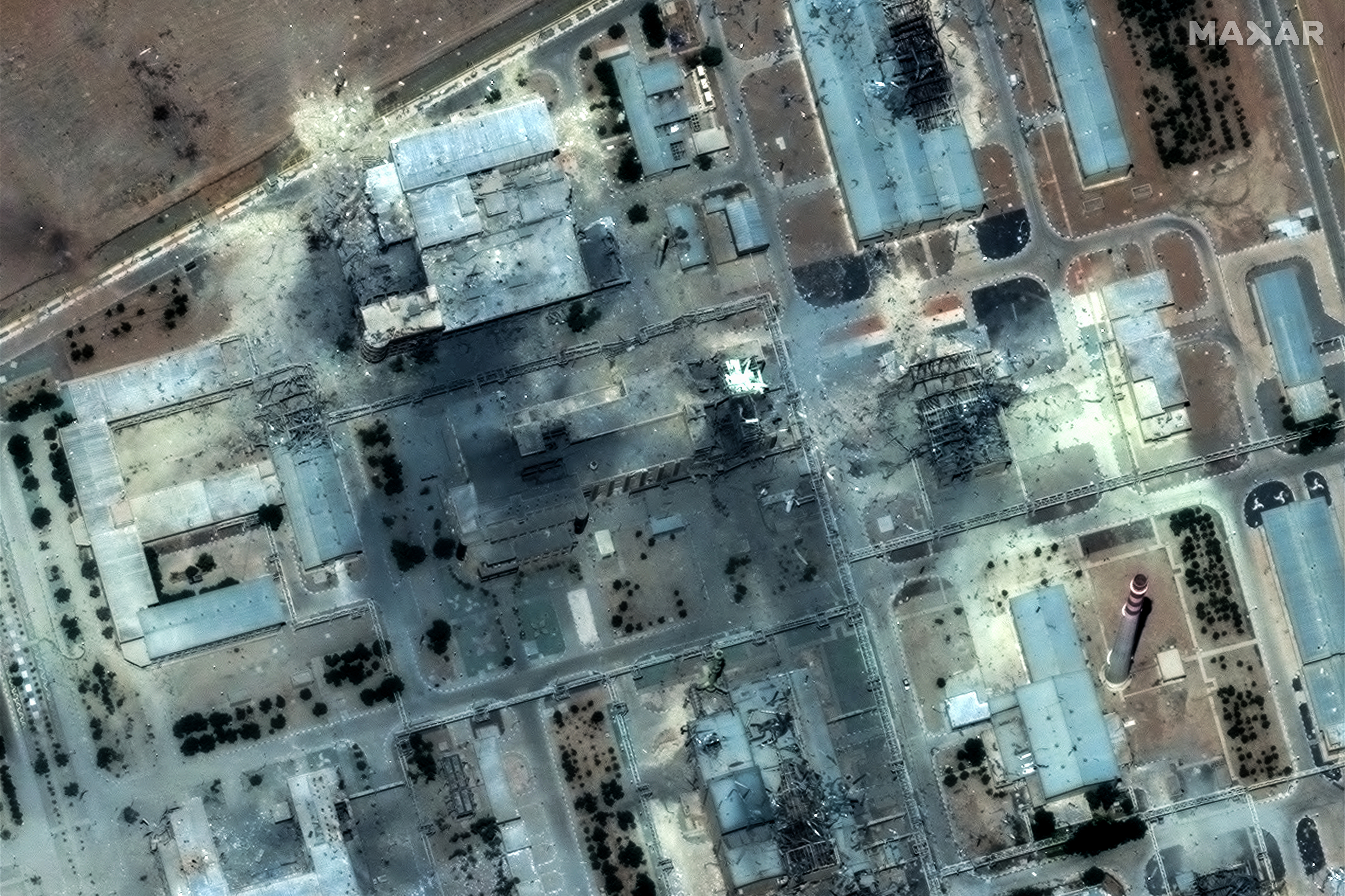
Satellite image/Maxar Technologies
Maxar satellite image reveals multiple buildings damaged or destroyed at the Isfahan nuclear technology center after the airstrikes.
The Pentagon’s chief spokesman said on Wednesday that the U.S. strikes against the Iranian nuclear program had set the program back by two years. His estimate appears to be the most specific information the Trump administration has shared on the extent of the damage caused by the strikes.
U.S. allies “share our sentiments about the degradation of Iran’s nuclear program and the fact we have degraded their program by one or two years … I think we’re thinking closer to two years,” Sean Parnell said at a press conference.
The administration has consistently claimed the strikes completely destroyed the nuclear program. During the briefing, Parnell said that he believed the combination of U.S. and Israeli strikes would be successful in deterring Tehran from continuing its nuclear program in the future.
“We believe that sending bombers from Missouri, 37 hours on a mission, not a single shot fired on them, took a very strong psychological toll on the Iranian leadership,” Parnell said. “So, when you take the constellation of different things into consideration, we believe Iran’s nuclear capability has been severely degraded, perhaps even their ambition to build a bomb.”
Parnell’s remarks came hours after Iranian Foreign Minister Abbas Araghchi told CBS News that the country’s nuclear facilities were “heavily and severely damaged.” Araghchi maintained that Iran’s enrichment equipment and knowledge base were not impacted, despite Israel assassinating several of the country’s senior nuclear scientists.
Araghchi also said that Iran’s nuclear agency was still conducting damage assessments at the Fordow, Natanz and Isfahan nuclear sites. This was confirmed by geospatial imagery analysis from the Institute for Science and International Security, which showed crews working to gain access to the underground sections of the facilities.
The military victories under Netanyahu's leadership are seemingly not staunching the Israeli right’s continued collapse in the polls as the war grinds on in its 635th day
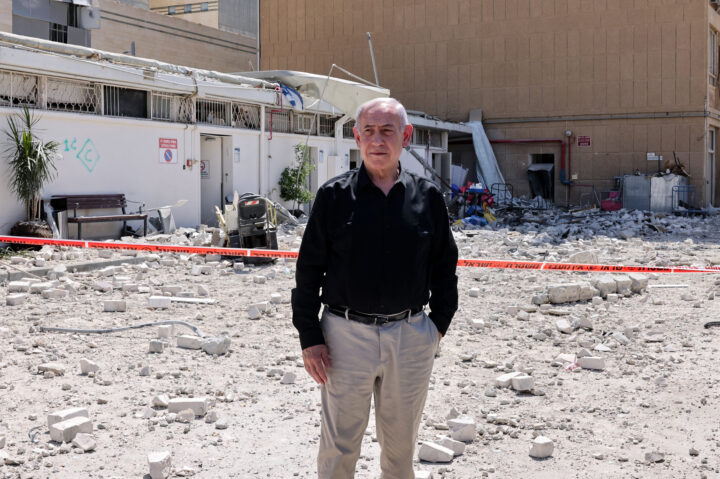
MARC ISRAEL SELLEM/POOL/AFP via Getty Images
Israeli Prime Minister Benjamin Netanyahu stands amid debris outside the Soroka Hospital in the southern city of Beersheba, after it was hit by a missile fired from Iran on June 19, 2025.
It might be hard to remember now, with all that has happened in recent weeks, but the Knesset seemed very close to calling an early election a day and a half before Israel commenced its airstrikes on Iran’s nuclear and ballistic missile programs last month.
Israeli Prime Minister Benjamin Netanyahu received a post-Iran victory bump, and is once again leading in the polls – but not by much. A poll published on Tuesday showed his Likud party leading a potential party led by former Prime Minister Naftali Bennett by only two seats, and tied with Bennett for leading candidate for prime minister. Another pollster showed a similar margin during the Iran operation, but had the two parties tied after the ceasefire. Parties in the current coalition made up less than half of the Knesset in every poll. In a poll from the Israel Democracy Institute published on Wednesday, only 46% of Jewish Israelis said they trust Netanyahu.
A common accusation heard by Netanyahu’s political opponents at home and abroad is that he is prolonging the war in Gaza to stay in office, because ending the war before his far-right coalition partners deem Hamas fully defeated would likely see the collapse of his government. But the victories under his leadership are seemingly not staunching the Israeli right’s continued collapse in the polls as the war grinds on in its 635th day.
Though Israelis are impressed by their intelligence agencies’ feats and pilots’ daring and skill that significantly degraded Hezbollah and then Iran, they clearly remember who was in charge during the Hamas massacres on Oct. 7, 2023. Fifty hostages remain in Gaza; 13 soldiers have been killed there in the past three weeks. Inside Israel, thousands have been displaced due to Iranian strikes — joining the thousands more who were left without homes after the Oct. 7 attacks.
An Israeli comedian’s video last week asking why there isn’t a victory parade after “winning” in Iran went viral; she answered that Israel is in a Babushka doll of a war within a war within a war. “We need to end something,” she said.
Netanyahu may consider the political advantages of “ending something” as he heads to Washington next week while President Donald Trump is pushing for a broad deal that would encompass a Gaza ceasefire and the release of hostages, the administration of Gaza by moderate Sunni states, normalization between Israel and Syria and perhaps other countries, plus working to ensure Iran doesn’t rebuild its nuclear program.
Hamas tends to spoil the best-laid plans of American negotiators, but Trump has been hinting that things are moving in a positive direction in the past few days.
If Netanyahu returns to Israel with a Gaza ceasefire and the hostages returned, an expanded Abraham Accords and a way to keep Israel’s achievement in Iran intact, then he may get a more significant electoral bump. In that scenario, one option for him could be to ride that wave and call a snap election, rather than wait until the official October 2026 date for the vote.
Or, Netanyahu could see this as his legacy-clinching move, a sign that his work is done. In 2021, the prime minister said that he wants his legacy to be that he was the “protector of Israel, because I devoted much of my adult life to preventing Iran from having a nuclear weapon.”
That doesn’t seem likely in light of Netanyahu’s behavior over the years. After he lost the 1999 election, Netanyahu returned to publicly commenting on politics as a “concerned citizen” the following year and by 2002 was foreign minister. When he lost the election in 2021, he remained as opposition leader and successfully peeled off members of the Bennett coalition, contributing to its demise.
But Trump’s recent Truth Social posts tying together a deal and Netanyahu’s corruption trial are instructive here. Trump seemed to be lamenting that the trials are time-consuming when Netanyahu’s focus should be elsewhere. But there are constant rumors of a plea deal or a pardon of some sort, which could also pave the way for a dignified exit from the political stage, saying he fulfilled the promise of most of his political life, to stop Iran from going nuclear.
The briefing, led by Trump’s top national security officials, did not change Democratic minds about the success of the operation

Satellite image (c) 2025 Maxar Technologies.
FORDOW UNDERGROUND COMPLEX, IRAN -- JUNE 22, 2025: 02 Maxar Satellite Imagery collected this morning shows extensive damage at the Fordow underground complex. Several large craters are visible across the ridge, and a wide area is covered in grey-blue ash, consistent with airstrike aftermath.
Senators remained divided about the success of the American military strikes on Iran’s nuclear program following a classified briefing on the subject from Cabinet officials on Thursday. Several Republicans hailed the strike as a success, while some Democrats said it had barely set Iran’s nuclear program back and many others on both sides said that it’s too soon to accurately judge the attack’s success.
The briefing led by Secretary of State Marco Rubio, Secretary of Defense Pete Hegseth and CIA Director John Ratcliffe also does not appear to have dissuaded Democrats from pursuing plans to call up a war powers resolution to block further military action against Iran.
Sen. Tom Cotton (R-AR), the chair of the Senate Intelligence Committee, told reporters that “we’ve caused catastrophic damage to Iran’s nuclear program.” He said Iran might try to rebuild the program at some point, but that the U.S. and Israel had struck critical targets in all parts of the nuclear weapons manufacturing process.
“You have seen several experts in the last couple of days, who I think it’s fair to say are not Donald Trump partisans, use words like ‘effectively destroyed,’ ‘catastrophic damage,’ ‘set back for years,’” Cotton said. “I think it’s safe to say that we have struck a major blow, alongside our friends in Israel, against Iran’s nuclear program that is going to … protect the world from the risk of an Iranian nuclear program for years.”
Cotton declined to comment on whether Iran’s stockpile of highly enriched uranium was destroyed or had been relocated, adding “it was not part of the mission to destroy all their enriched uranium, or seize it, or anything else.”
Sen. Lindsey Graham (R-SC) said that the program had been set back “years, not months,” adding, “I think it’s absurd that any member of the Senate would say … that this wasn’t necessary.”
“Nobody is going to work in these three sites any time soon. They’re not going to get into them any time soon. Their operational capability was obliterated,” Graham said. He also said he doesn’t know where Iran’s stockpile of highly enriched uranium is, but likewise argued that it was “not part of the target set.”
The South Carolina senator additionally said, “I don’t want people to think that the problem is over, because it’s not. They’re going to keep trying this until they change their stated goal” of eliminating Israel.
Sen. Kevin Cramer (R-ND) said he was “very confident it’s been set way back, a year at the minimum.”
Sen. Eric Schmitt (R-MO) said that the strikes had “accomplished the purpose of destroying the nuclear ambitions,” adding that assessments would be ongoing “but [are] very positive.”
Sen. Steve Daines (R-MT) declined to say whether he was confident that Iran’s nuclear program had been destroyed or disabled, but told Jewish Insider that the briefing had “set the record straight” from a leaked low-confidence Defense Intelligence Agency report indicating the strikes had limited effect and only set Iran’s nuclear program back by a few months. He said that report was not accurate based on the information he received.
Sen. John Fetterman (D-PA) told JI the briefing had “affirmed” his support for the strikes.
“You can’t possibly know with certainty” if the program was destroyed, Fetterman said. “We have to get beyond the partisanship. … We will know more and more as there’s more time. But at this point, it was the right thing. … What’s out so far confirms that significant damage was done.”
Sen. Josh Hawley (R-MO) said he did not learn anything new in the briefing that would impact his support for Trump’s decision to strike Iran’s nuclear facilities.
“I didn’t hear anything in there that I haven’t read in the press. I think the operation was obviously a great success, and the president’s achievement in getting a ceasefire in place, I think, is really significant. And now it’s a question of making that stick and pursuing our objectives going forward,” Hawley told JI while leaving the briefing.
Others were more pessimistic about the strike.
“Right now, it seems to me that leaked DIA report is right, that we only set this program back a handful of months, and that is not obliteration,” Sen. Chris Murphy (D-CT), one of the most vocal critics of the strike, said.
Senate Minority Leader Chuck Schumer (D-NY), reading off of a card of prewritten, typed remarks, said that he “did not receive an adequate answer” to the question of whether Iran’s nuclear stockpile had been destroyed.
“What was clear is that there was no coherent strategy, no end game, no plan, no specific, no detailed plan on how Iran does not attain a nuclear weapon,” Schumer said. “Anyone in that meeting, anyone — if they’re being honest with themselves, their constituents, their colleagues — would know that we need to enforce the War Powers Act and force them to articulate an answer to some specific questions and a coherent strategy.”
Many senators said that the full impact of the strikes will take longer to understand, as more intelligence is gathered.
Sen. Mike Rounds (R-SD) said that the briefing confirmed that the mission had gone off as administration officials had planned: “The guys hit the targets as planned. The munitions worked exactly as planned, and the results were as expected.”
Rounds added that it is impossible to say exactly how long the nuclear program was delayed “until we actually get the real analysis of proof of what happened.”
Sen. Jeanne Shaheen (D-NH), the ranking member of the Senate Foreign Relations Committee, said that “the reporting will continue to come out around” whether the program was set back by months or years, but added, “as Gen. [Dan] Caine and [former national security official] Brett McGurk, if you heard his analysis, followed up and confirmed that the first two phases of the operation seemed very successful.”
Asked if Trump had been honest in describing the program as eliminated, Shaheen said, “you’d have to ask the president.”
Shaheen said that the briefing was a “good follow-up” to a news conference by Caine, the chairman of the Joint Chiefs of Staff, earlier in the day, where Caine discussed the strike on Fordow and the bunker busting bomb used.
Sen. Mark Warner (D-VA), the vice chair of the Intelligence Committee, said it’s “going to take some time to get a final assessment of how much damage [was done],” adding that he’s concerned that President Donald Trump “jump[ed] to a conclusion too early” that the program was “obliterated.”
“I hope that is the final assessment. But if not, does that end up providing a false sense of comfort to the American people?” Warner said. He added that some of Iran’s enriched uranium “was never going to be taken out by a bunker-buster bomb, so some of that obviously remains in Iran.”
Warner said there are still questions about how quickly Iran could rush to a nuclear device using the material it still retains, particularly if it did not plan to mount the bomb on a missile.
Sen. John Cornyn (R-TX) also said that the briefers had told the senators it was “too early to know” whether the program was destroyed.
Asked by JI if he learned anything during the briefing that changed his assessment of Trump’s strike being the wrong decision, Sen. Chris Coons (D-DE) replied: “I came away feeling like I learned some valuable information, yes.”
“The whole time I’ve been a senator, I’ve been gravely concerned about Iran’s nuclear enrichment program and the threat it poses to Israel, Tehran, to the region. Your question is: do I feel safer [after the briefing]? We do not have a complete assessment yet of the impact of the strikes of last week, and when we do, I think that’ll answer a lot of currently unanswered questions,” Coons told reporters.
Sen. Raphael Warnock (D-GA) said that “the situation is evolving and what we know about it — the nature of the thing is what we’ll know about it is evolving,” adding that he plans to vote for the war powers resolution.
Multiple senators said that the administration appears to be focused on resuming diplomacy as its next step.
“The administration’s trying [to] engage, on a diplomatic level, and that would be the next step, is trying to have some kind of discussion with the Iranians about giving up their ability to enrich uranium,” Sen. Mark Kelly (D-AZ) said.
Graham expressed deep skepticism about the possibility of negotiations with Iran, though he said that now is probably the most ripe time for negotiations given Iran’s weakness.
“I talked to Rubio, I talked to the administration,” Graham said. “Try diplomacy, but if you don’t get a commitment up front that Iran, from this day forward, abandons its stated desire to wipe out Israel, if they’re not willing to recognize the Jewish state, you’re wasting your time.”
Warner, on the other hand, argued that diplomacy is the only path to ensure Iran cannot enrich uranium for military purposes, as inspectors will need to be sent into the country to verify that.
Sen. Maria Cantwell (D-WA) said that “there’s a lot to [discuss]” about the war powers resolution and the potential timing for a vote on it — originally expected Thursday or Friday. “There’s just a lot to think about in that, and I’d have to hear from our colleagues about why, or when, to call that [up].”
Senators largely described the briefing as cordial and said the briefers had answered the questions posed to them.
Asked whether he was concerned that Hegseth and Rubio had provided political talking points or failed to address the substance of the issue, Kelly said that the two “did a good job. They answered our questions.”
But Murphy said he was “deeply worried about the politicization of intelligence.”
IDF Chief of Staff Eyal Zamir says damage to Iran's nuclear program is ‘systemic,’ ‘severe, broad and deep,’ and ‘pushed back by years’

DigitalGlobe via Getty Images
This is a satellite image of the Fordow facility in Iran.
Israel is feeling victorious after its 12-day war with Iran, culminating in the U.S. strikes on underground nuclear sites that significantly degraded and rolled back Tehran’s nuclear program. While the country is mourning 29 civilian deaths — in addition to seven soldiers killed in Gaza this week — and thousands have lost their homes in missile strikes, nearly two-thirds of Israelis, according to a new poll, think their country won the war.
But there have been some cautionary signals about the state of Iran’s nuclear program since the fighting ended, most notably a leaked Defense Intelligence Agency report from the U.S. that suggested — with reportedly low confidence — that the bombings only set back Iran’s nuclear program by a few months. President Donald Trump, at the NATO summit in the Netherlands on Wednesday, called the DIA intelligence report “fake news” and cited a more favorable Israeli intelligence report as being more reliable. CIA Director John Ratcliffe said Thursday that “a body of credible intelligence indicates Iran’s Nuclear Program has been severely damaged by the recent, targeted strikes. This includes new intelligence from a historically reliable and accurate source/method that several key Iranian nuclear facilities were destroyed and would have to be rebuilt over the course of years.”
Further dampening the mood was Trump angrily and publicly pressuring Israel not to aggressively respond to a ceasefire violation that came within hours of a volley of missiles that killed several Israelis right before the ceasefire went into effect.
But as Israeli officials and national security experts have taken the time to assess the geopolitical landscape, the overall picture is one of significant military success.
Lt.-Gen. Eyal Zamir, the IDF chief of staff said that “based on the assessments of senior officers in IDF Intelligence, the damage to [Iran’s] nuclear program is … systemic … severe, broad and deep, and pushed back by years.”
Similarly, in a statement shared by both Israel’s government and the White House, the Israeli Atomic Energy Commission said that “the devastating U.S. strike on Fordow destroyed the site’s critical infrastructure and rendered the enrichment facility inoperable. We assess that the American strikes on Iran’s nuclear facilities, combined with Israeli strikes … have set back Iran’s ability to develop nuclear weapons by many years.”
The Trump administration and Israeli officials have an interest in presenting the mission in Iran as successful, which may lead some to trust the intelligence leaks over their statements. However, their assessment of the DIA report as “flat-out wrong,” as the White House put it, is backed up by several experts surveyed by Jewish Insider – though most cautioned that it’s unlikely anyone knows the full extent of the damage yet.
David Albright, president and founder of the Institute for Science and International Security, published an extensive report on the damage, stating that “Israel’s and U.S. attacks have effectively destroyed Iran’s centrifuge enrichment program. It will be a long time before Iran comes anywhere near the capability it had before the attack,” though there are “non-destroyed parts … [that] can be used in the future to produce weapon-grade uranium.”
Albright cited evidence relating to the sites bombed by the U.S. indicating that “the elimination of, or severe damage to, the majority of the centrifuges at the Natanz site, significant damage to the Fordow underground site, destruction and damage to several facilities at the Isfahan Nuclear Complex, including one used in the conversion of enriched uranium to uranium metal and another that converts natural uranium into uranium hexafluoride.”
Mark Dubowitz, CEO of the Foundation for Defense of Democracies, told JI that the DIA report was assessed as a “low-confidence” analysis and is based only on satellite imagery. “That’s part of the puzzle, but it’s not enough to go on. It gives some sense of what happened above ground, but not a sense of what happened below ground, and that’s the real question,” said Dubowitz.
Even using the satellite imagery, Danny Citrinowicz, an Iran expert at the Institute for National Security Studies at Tel Aviv University, told JI that “based on the pictures, it looks a lot worse than the DIA said.” Like the DIA, Citrinowicz was skeptical of Trump’s claims of “obliteration” of the nuclear facilities at Fordow, but he said it appears significantly damaged. “It’s a matter of time. We need to wait patiently,” he said, adding that even the Iranians do not appear to know the extent of the damage yet.
To have a better sense of the damage, “we would need the International Atomic Energy Agency to go there, or an Israeli intelligence assessment on the ground or signal intelligence,” Dubowitz said.
Gerald Steinberg, founder and president of NGO Monitor and a nuclear arms control expert, argued to JI that “estimates of the time it might take Iran to repair enough of the very fragile components are even more speculative” than current damage assessments.
Still, some of the results are already clear. Steinberg explained that “the banks of rapidly spinning centrifuges used to convert natural uranium into enriched material used to create weapons are highly sensitive to shockwaves caused by earthquakes and nearby high-energy bombs.”
Dubowitz pointed out that centrifuges are so sensitive that about 1,000 were destroyed by an Israeli cyberattack, making them spin too fast. “It’s hard to believe many centrifuges survived a massive crack in a mountain.”
IDF Brig.-Gen. (res.) Yossi Kuperwasser, head of the Jerusalem Institute for Strategy and Security and the former head of the research division of the Israel Defense Forces’ Intelligence Directorate, noted to JI that while Iran may be able to rebuild parts of its nuclear program from whatever remains of it, the Isfahan conversion facility was purchased from China, and Iran does not know how to build one itself. He posited that China would be unlikely to construct a new one for the Islamic Republic after the IAEA said it had a nuclear weapons program in violation of the Nonproliferation Treaty.
Steinberg said that, in light of the lack of solid information a few days after the U.S. strikes on Iran, he views articles about the DIA assessment citing “anonymous officials who may or may not have read the actual report” in outlets that are highly critical of Trump and Israeli Prime Minister Benjamin Netanyahu “as more political spin than strategic analyses.”
Dubowitz similarly said that “one can speculate that it was clearly done to damage the president … The leak suggested a political motivation. Welcome to Washington, D.C.!”
As to possible spin from the other direction, cheering on the strikes, Citrinowicz accused the Israeli Atomic Energy Commission of putting out a statement “to support Trump. They’re trying to stabilize the narrative that [the nuclear facilities are] obliterated.”
Dubowitz, however, said that the IAEC is “very careful, professional and serious. There is no way they are putting out a report intended to spin anything or help the prime minister sell something that is not true.”
Looking to the future, Israel “needs to remain vigilant,” Kuperwasser said. Israel “needs to eliminate any new kind of air defense Iran will try to build, in order to maintain freedom of action in the air [above Iran].”
“Israel needs quality intelligence about the details of what Iran is planning and how it may try to advance to break out and build nuclear weapons. We need to advocate that the Americans enter an agreement so that [Iran] cannot enrich uranium or have highly enriched uranium stockpiles, with close ‘anywhere, anytime’ supervision by American inspectors. Israel should make clear what needs to be done to ensure Iran cannot have a nuclear weapon in the future,” Kuperwasser added.
In addition to the lack of clarity about what remains of Iran’s nuclear program, Kuperwasser said there is an “intelligence gap” about the location of Iran’s remaining missile launchers. “We shot many down, up to the very last minute, but we must admit that there are many we did not shoot.”
Still, Kuperwasser said, “There’s nothing to do now. The nuclear sites are done. If we knew where more launchers were located, we would have shot them.”
Former National Security Advisor Robert O’Brien said that the U.S. cannot allow Iran to rebuild its ballistic missile program. “If they get further along than they were, they could attack Europe or the United States … I think it’s part and parcel of the Iranian nuclear program,” he explained, because ballistic missiles would be used to launch the nuclear weapon.
Speaking on the Misgav Institute for National Security and Zionist Strategy’s new “Mideast Horizons” podcast, O’Brien painted a broader picture of the 12-day Israel-Iran war than the specifics of what remains of Iran’s nuclear facilities. (The writer is a senior fellow at the Misgav Institute and co-hosts its podcast.)
“This radical Shia regime in Iran has been a cloud and a pall over the region for 40 years, and the nuclear issue was very dangerous, because if Iran had developed a nuclear weapon, they said that Israel is a one-bomb state … They could [have] eliminate[d] Israel,” he said.
“But it was also a threat to the Gulf monarchies,” O’Brien added. “If Iran had gotten a nuclear weapon, there’s no doubt in my mind that Saudi Arabia would have immediately gone nuclear … and the UAE would have probably developed nuclear weapons very, very quickly. There’s no way the Turks … would have stayed conventional. And you got Egypt … So we would have had a nuclear arms race in the most dangerous part of the world.”
Kuperwasser argued that one significant achievement that has emerged from the war is “breaking down barriers” in demonstrating that the U.S. and Israel are willing and able to successfully attack if the threat from the Islamic Republic becomes acute.
Israel “attacked and had aerial superiority in Iran for nearly two weeks and could have continued for as long as [it] wanted, had international legitimacy and not just American support, but involvement,” he said. “The change in mindset is more important than the physical damage. Iran can build a new Fordow in three or four years; they were already working on more underground facilities, but what is the point if they know that the U.S. has an unlimited number of bombs that they can drop anywhere and are willing to use them?”
Kuperwasser added a caveat: “As long as we have President Trump. After that, I don’t know. But we are at the beginning of his term, and that is an important asset [for Israel].”
O’Brien said that Iran is unlikely to maintain a comprehensive ceasefire, even if it isn’t shooting directly at Israel.
“The Iranians are always in the Axis of Resistance, with Hamas, Hezbollah, Kataib Hezbollah [in Iraq],” he said. “They’re always very reticent to live up to their word and to agree to a ceasefire because they think they can get an advantage in pressing their violence against Israel and against the United States.”
Still, O’Brien was hopeful that the ceasefire “will stay and a lot of the death and destruction that we’ve seen in Tel Aviv, but also in Tehran, will end.”
CNN reported that an early intelligence assessment by the Pentagon found that the core components of Iran’s nuclear program were still intact

PIROSCHKA VAN DE WOUW/POOL/AFP via Getty Images
President Donald Trump talks to the media during a meeting with NATO Secretary General at the NATO summit of heads of state and government in The Hague on June 25, 2025.
President Donald Trump and other administration officials denied a report that U.S. strikes on Iranian nuclear facilities had only set Iran’s nuclear program back by several months, continuing to insist the nuclear sites were “completely destroyed” and “obliterated.”
CNN reported on Tuesday night that an early intelligence assessment by the Pentagon found that the core components of Iran’s nuclear program were still intact and the regime could continue seeking a nuclear bomb, according to seven people briefed on the matter.
Speaking from the NATO Summit in the Netherlands on Wednesday, Trump told reporters, “That was a perfect operation. … And also, and nobody’s talking about this, we shot 30 Tomahawks from submarines … and every one of those Tomahawks hit within a foot of where they were supposed to hit. Took out a lot of buildings that Israel wasn’t able to get. … This was a devastating attack and it knocked them for a loop. And, you know, if it didn’t, they wouldn’t have settled. … If that thing wasn’t devastated, they never would have settled.”
“I don’t want to use an example of Hiroshima. I don’t want to use an example of Nagasaki, but that was essentially the same thing that ended that war,” he said later. “This ended that with the war. If we didn’t take that out, they’d be fighting right now.”
“It was obliteration,” he said of the U.S. strikes in Iran. “And you’ll see that, and it’s going to come out. Israel is doing a report on it, I understand. … You know, they have guys that go in there after the hit, and they said it was total obliteration.”
“I don’t think they’ll ever do it again,” Trump continued, referring to Iran’s enrichment of uranium. “They just went through hell. I think they’ve had it. The last thing they want to do is enrich.”
The president also posted on Truth Social earlier, saying, “FAKE NEWS CNN, TOGETHER WITH THE FAILING NEW YORK TIMES, HAVE TEAMED UP IN AN ATTEMPT TO DEMEAN ONE OF THE MOST SUCCESSFUL MILITARY STRIKES IN HISTORY. THE NUCLEAR SITES IN IRAN ARE COMPLETELY DESTROYED! BOTH THE TIMES AND CNN ARE GETTING SLAMMED BY THE PUBLIC!”
Middle East envoy Steve Witkoff, speaking to Fox News shortly after the CNN report was released, called the leak “treasonous” and said, “There is no doubt that it [Iran’s nuclear program] was obliterated. So the reporting out there that in some ways suggests that we didn’t achieve the objective is just completely preposterous.” He said it was “not even conceivable” that Iran could still achieve a nuclear weapon within months.
Secretary of State Marco Rubio similarly denied the report but offered a more measured assessment of Iranian nuclear capabilities, telling Politico on the sidelines of the NATO Summit on Wednesday that, “The bottom line is, they are much further away from a nuclear weapon today than they were before the president took this bold action. That’s the most important thing to understand — significant, very significant, substantial damage was done to a variety of different components, and we’re just learning more about it.”
White House Spokesperson Karoline Leavitt said, “This alleged ‘assessment’ is flat-out wrong and was classified as ‘top secret’ but was still leaked to CNN by an anonymous, low-level loser in the intelligence community. … Everyone knows what happens when you drop fourteen 30,000 pound bombs perfectly on their targets: total obliteration.”
A CNN spokesperson said in a statement to Jewish Insider, “CNN stands by our thorough reporting on an early intelligence assessment of the recent strikes on Iran’s nuclear facilities, which has since been confirmed by other news organizations. The White House has acknowledged the existence of the assessment, and their statement is included in our story.”
David Albright, president and founder of the Institute for Science and International Security and an expert on the Iranian nuclear program, called the report “hard to believe” and “misleading.” Among other analyses, he said Iran has “likely lost close to 20,000 centrifuges at Natanz and Fordow, creating a major bottleneck in any reconstitution effort. Moreover, there has been considerable damage to Iran’s ability to build the nuclear weapon itself.”
Experts agree that Iran’s nuclear program was significantly derailed, but uncertainty remains about the status of the country’s enriched uranium
DigitalGlobe via Getty Images
This is a satellite image of the Fordow facility in Iran.
According to President Donald Trump, Iran’s nuclear program is finito.
“Obliteration is an accurate term!” Trump wrote in a Truth Social post on Sunday. “Monumental damage was done to all nuclear sites in Iran.” He said on Monday that the three sites hit by U.S. strikes on Sunday morning “were totally destroyed, and everyone knows it.” White House Press Secretary Karoline Leavitt told reporters on Monday that the U.S. “took out” Iran’s nuclear program over the weekend.
Nuclear experts aren’t as confident. What, exactly, remains of Iran’s nuclear program — which, just weeks ago, Israeli officials said was on the precipice of being able to produce a nuclear weapon — remains an open question. (A White House spokesperson did not respond to a request for comment.)
Experts agree that the combination of Israel’s strikes that began a week and a half ago, aided by the U.S. military’s intervention on Sunday, has done significant damage to Iran’s nuclear capabilities. But uncertainty lingers about the status of the enriched uranium that had been housed at Fordow, the major Iranian nuclear facility hidden under a mountain that the U.S. struck with bunker-buster bombs this weekend.
Reports suggest Tehran may have removed the nuclear materials from Fordow and hidden them elsewhere in Iran.
“I think that we can assume that damage was done, but it’s going to take a long time, and we may never know entirely the extent of the damage,” said Tressa Guenov, a senior fellow at the Atlantic Council who dealt with international security affairs at the Pentagon in the Biden administration. Iran’s claim that it moved the uranium “could be real, or it could be a strategy to keep things ambiguous,” she added.
David Albright, a former United Nations weapons inspector, told The Free Press that “any highly enriched uranium at Fordow was likely gone before the attack.”
Even with the possibility that the enriched uranium was moved from Fordow, experts agreed that Iran’s nuclear program has been left reeling by the Israeli and American military actions.
“Israelis believe that they dealt together with the U.S. … a really serious blow to the Iranian nuclear program, took it back by, some say, two years,” Michael Herzog, who until January was Israel’s ambassador to the U.S., said on Monday. But, he cautioned, it’s “premature to make that assessment.” Elliott Abrams, a longtime Republican foreign policy advisor who served as Trump’s special representative for Iran in Trump’s first term, said Iran is “now years away” from being able to make a nuclear weapon.
And the extent of the damage goes beyond just the nuclear program.
“Iran is losing its nuclear weapons option, and we have applied military force to ensure that,” said Dennis Ross, a former State Department official who worked in both Republican and Democratic administrations. “You have a military that has been decapitated. You have a Revolutionary Guard that has been decapitated. You have people in both those leaderships that have been basically together for the last 30 years. They’re not so easy to replace. You have a leadership that doesn’t know who it can trust. You have a leadership that is completely in hiding.”
Even if Iran’s nuclear weapons program was set back several years, that is not the same thing as obliterating its ability to create a nuclear weapon, as Trump claimed. Vice President JD Vance repeated that statement several times in a Monday night interview on Fox News, where he discussed the newly announced ceasefire deal between Israel and Iran and asserted that Iran’s nuclear program was “obliterated.”
But fully dismantling Iran’s nuclear weapons program might not even be a realistic goal.
“We know that no military operation on its own will completely eliminate the Iranian nuclear program,” Dana Stroul, a fellow at the Washington Institute for Near East Policy who oversaw Middle East policy at the Pentagon in the Biden administration, said earlier Monday.
During the war, Israeli officials hinted that they want to see regime change in Iran. Yet by announcing the ceasefire on Monday night, the Trump administration underscored that the goal of its military operation was to set back Iran’s nuclear program, and not target Iran’s leadership.
“Absent a revolution in Iran that brings in a friendlier regime, where you could verify the moth-balling of [nuclear] sites and this dismantlement of the program, I don’t think you could ever say for certain that the program is over,” Steven Cook, a senior fellow at the Council on Foreign Relations, told Jewish Insider on Monday.
Trump said in a Truth Social post on Monday evening that, once the fighting ceases, “the War will be considered, ENDED,” and that both sides “will remain PEACEFUL and RESPECTFUL.” He did not share whether either side had to abide by any particular demands, or whether the agreement would mark a return to the negotiating table.
Carlson also argued Al Udeid ‘exists to protect Israel’
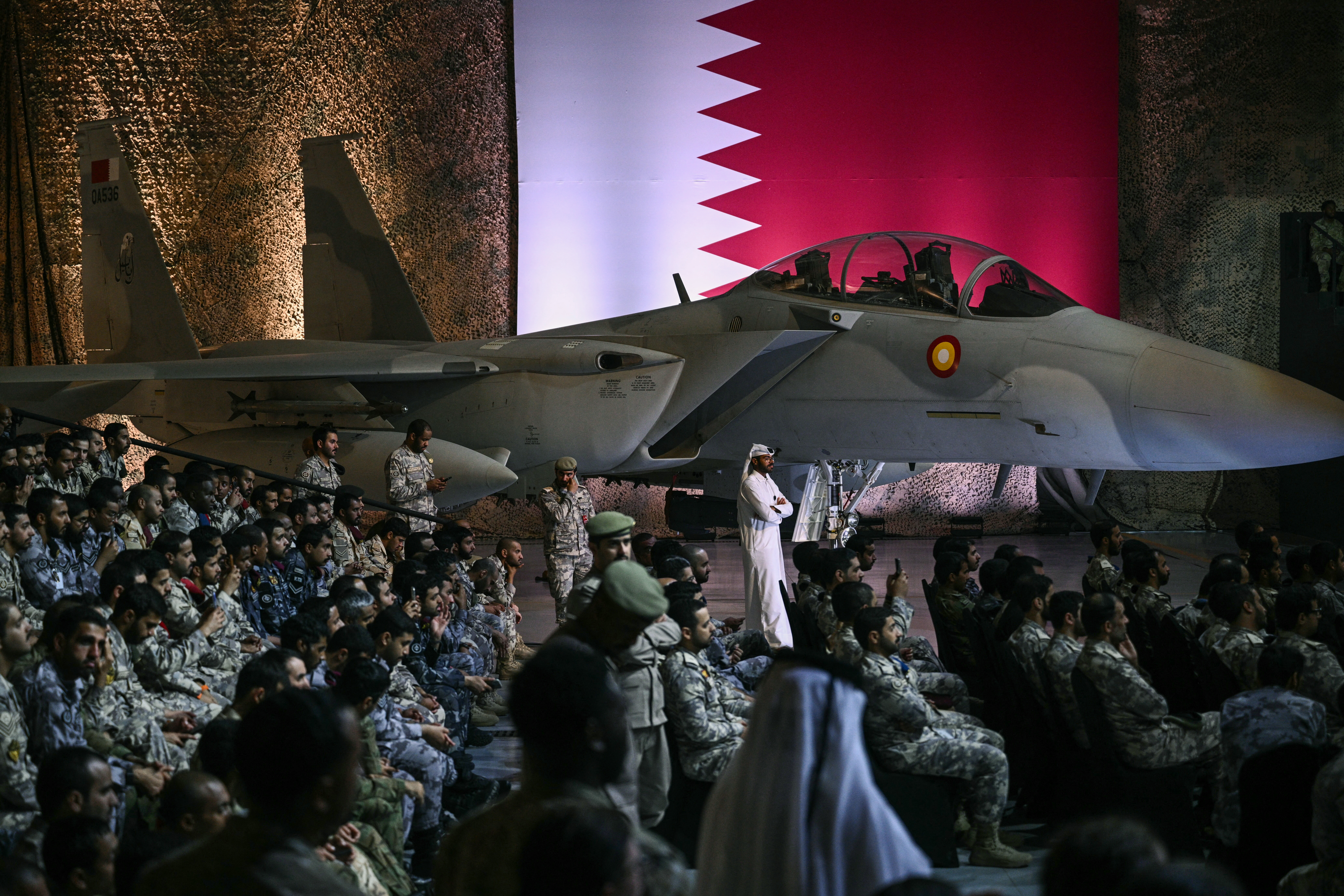
Photo by BRENDAN SMIALOWSKI/AFP via Getty Images
US and Qatari troops and staff await US President Donald Trump at the Al-Udeid air base southwest of Doha on May 15, 2025.
As Iran targeted Al Udeid Air Base in Qatar in retaliation for the U.S. airstrikes against the Iranian nuclear program, Tucker Carlson claimed on his podcast that the air base exists to protect Israel.
“That base exists to protect Israel, by the way. I know we’re constantly, Bari Weiss is constantly attacking Qatar,” the conservative commentator said, referring to the founder and editor of The Free Press. “Qatar has done more to protect Israel. But anyway, hosting this base that they don’t need at all, it’s the richest country in the world. They’re doing it to be nice.”
According to a joint statement issued by the U.S. and Qatar in 2020, Al Udeid base supports joint operations aimed at maritime security and other regional security concerns.
As U.S. Central Command’s forward headquarters, Al Udeid has also played a critical role in nearly every U.S. operation within the Middle East and North Africa since 2009. These operations include the 2021 Afghanistan pullout, combat missions countering the Islamic State, and air missions within Iraq.
President Donald Trump recently visited the base during his tour through the Middle East and spoke to American personnel stationed there. During the speech he mentioned several new arms sales to Qatar and praised the base. “Qatar will also be investing $10 billion to support this massive base in the coming years,” Trump said. “There is no place like it, they say.”
Following Trump's suggestion that he was supportive of regime change in Iran, Press Secretary Karoline Leavitt said he was 'just raising a question'

Anna Moneymaker/Getty Images
White House press secretary Karoline Leavitt speaks to reporters outside of the West Wing of the White House on June 02, 2025 in Washington, DC.
Despite President Donald Trump posting on Truth Social on Sunday suggesting that he sought regime change in Iran, White House Press Secretary Karoline Leavitt downplayed his remarks when speaking to reporters on Monday morning.
“The president was just raising a question that I think many around the world are asking,” Leavitt said. “If the Iranian regime refuses to give up their nuclear program or engage in talks, we just took out their nuclear program on Saturday night, as you all know. But if they refuse to engage in diplomacy moving forward, why shouldn’t the Iranian people rise up against this brutal terrorist regime? That’s the question the President raised last night.”
Trump posted earlier, “It’s not politically correct to use the term, ‘Regime Change,’ but if the current Iranian Regime is unable to MAKE IRAN GREAT AGAIN, why wouldn’t there be a Regime change?”
His comments were at odds with other senior administration officials who have insisted that the U.S. strikes were solely intended to disable the Iranian nuclear program and that Trump still remained focused on securing a diplomatic solution.
“We do not want regime change,” Vice President JD Vance said on NBC News’ “Meet the Press” on Sunday. “We do not want to protract this or build this out anymore than it’s already been built out. We want to end their nuclear program and then we want to talk to the Iranians about a long-term settlement here.”
Leavitt insisted to reporters that the U.S. was successful in completely destroying the Iranian nuclear program, despite signs that the fortified nuclear site of Fordow was severely damaged, but not completely destroyed. In the days prior to the strike, satellite imagery also showed trucks stationed at Fordow, leading some analysts to speculate that Iran evacuated some of its uranium stockpile.
In the aftermath of Trump’s decision to order strikes against Iran’s nuclear sites over the weekend, the views of the institutional Jewish community and many rank-and-file Democrats couldn’t have been more divergent
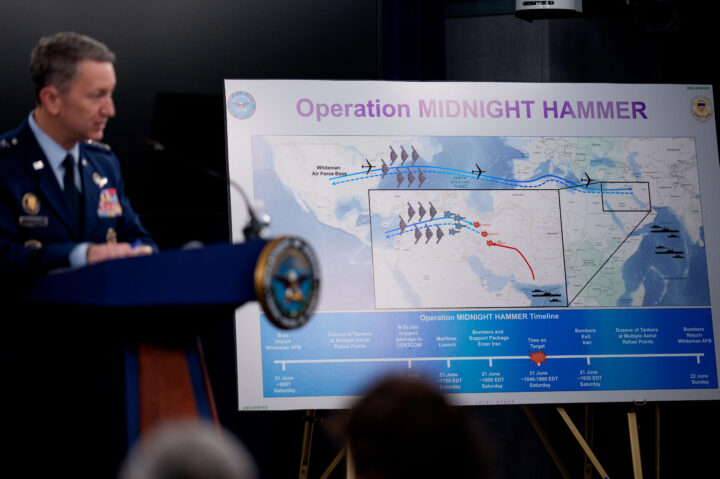
Andrew Harnik/Getty Images
Chairman of the Joint Chiefs of Staff Air Force Gen. Dan Caine discusses the mission details of a strike on Iran during a news conference at the Pentagon on June 22, 2025 in Arlington, Virginia.
In my years of covering politics, it’s pretty rare for mainstream Jewish organizations to be wildly out of step with the predominant views of the Democratic Party. But in the aftermath of President Donald Trump’s decision to order bunker-busting strikes against Iran’s nuclear sites over the weekend, the views of the institutional Jewish community and many rank-and-file Democrats couldn’t have been more divergent.
Consider: The American Jewish Committee’s CEO Ted Deutch, a former Democratic congressman, praised Trump’s decision and called it “an historic moment for the United States, Israel and the world.” Anti-Defamation League CEO Jonathan Greenblatt thanked Trump for “holding true to the commitment that the United States will not stand by and watch the world’s leading state sponsor of terrorism and antisemitism develop nuclear weapons.”
Even the more-partisan Democratic pro-Israel group DMFI, which normally can be counted on to criticize the president, rejected its own party’s predominant view that further congressional approval should have been received before the strikes. “Iran was unwilling to give up its nuclear program through diplomatic negotiations across three different administrations, so the United States was left with no choice but to take decisive military action,” DMFI CEO Brian Romick said.
By contrast, it was tough to find many Democratic lawmakers — even among the many who are typical allies of Israel — to offer praise of the strikes severely degrading Iran’s nuclear program.
Senate Minority Leader Chuck Schumer (D-NY), who earlier this month recorded a video taunting Trump for “folding” against Iran, criticized the president for carrying out the strikes without congressional authority. Sen. Jacky Rosen (D-NV), one of the strongest pro-Israel stalwarts in the Democratic Party, likewise withheld support for striking Iran’s nuclear facilities while also reiterating her view that Iran should never be able to obtain a nuclear weapon. Like Schumer, she called on more congressional involvement.
Rep. Haley Stevens (D-MI), another strong pro-Israel ally running as the moderate Democrat in a Michigan Senate primary, sounded wary about the U.S. decision to take out Iran’s nuclear facilities. “The last thing our country needs is to be involved in another foreign war,” she said, echoing rhetoric from more progressive voices in the party.
To be sure, there have been a handful of Democrats sounding like the pro-Israel lawmakers that once dominated the party. Just look at the comments from Rep. Josh Gottheimer (D-NJ), Ritchie Torres (D-NY), Sen. John Fetterman (D-PA), Rep. Jared Moskowitz (D-FL), Rep. Greg Landsman (D-OH), Rep. Debbie Wasserman Schultz (D-FL), Rep. Tom Suozzi (D-NY) and former House Majority Leader Steny Hoyer (D-MD), all of whom described the all-too-urgent threat that a nuclear Iran posed to Israel and the world.
As one pro-Israel Democrat put it to JI: There were notably more Democrats putting out statements cheering anti-Israel activist Mahmoud Khalil being released from immigration detention than those expressing solidarity with Israel in its time of great need.
The debate over dealing with Iran’s nuclear ambitions has been a fraught one within the Democratic Party, ever since former President Barack Obama cut a nuclear deal with Iran in 2015 that many pro-Israel leaders found too accommodating towards the Islamic Republic. There were very messy internal divisions in the party back then as well.
But with public support for Israel among Democratic voters waning, according to recent polling, it looks like it’s getting harder for even sympathetic Democrats to vocally support the position, as Landsman did, that preventing Iran from getting a nuclear weapon is a step towards peace. It’s possible to quibble with the administration’s lack of legislative outreach while also acknowledging the positive end result.
On national security, this is becoming a moment of truth for the Democratic Party at large, which is trying to moderate its record to win back power in Washington, but still is beholden to its activist base. The fact that Zohran Mamdani, a radical anti-Israel candidate defending the slogan “globalize the intifada” is running as competitively as he is in tomorrow’s New York City Democratic mayoral primary, is a sign of where the party could be headed without more mainstream leaders speaking out.
‘Israel's not going to live this way anymore. They're not going to be subject to missile attacks every day and every night, living in bunkers,’ the South Carolina senator said

Photo by Kevin Dietsch/Getty Images
U.S. Sen. Lindsey Graham (R-SC) speaks during a news conference at the U.S. Capitol on July 30, 2021 in Washington, DC.
Sen. Lindsey Graham (R-SC) on Sunday dismissed claims that President Donald Trump’s decision to help Israel take out Iran’s nuclear program would lead to a wider war requiring U.S. troops.
Graham made the comments after being asked about the military implications of the strikes during an appearance on NBC’s “Meet the Press.” The South Carolina senator told anchor Kristen Welker that while he does not see U.S. servicemembers being sent to Iran, he believed Israel would target the regime itself.
“I don’t think I’ll see boots on the ground in our future, but I do see Israel not stopping. Israel’s not going to live this way anymore. They’re not going to be subject to missile attacks every day and every night, living in bunkers. They’re going to go after the heart of this regime. They’re going to take it down, one of two ways, make it change or replace it,” Graham said.
Asked to respond to critics who have argued that engaging militarily against Iran would lead to another conflict similar to the war in Iraq, Graham praised Trump’s decision to authorize the Iranian operation.
“It was necessary. It was bold. It was brilliant. Hats off to the president. In May of 2022, Iran had 95 pounds of highly enriched uranium to make a handful of bombs. By May of 2025, they had 900 pounds. Sixty percent enriched uranium has no commercial purpose. They have one peaceful reactor, actually, in Iran. They haven’t used one gram of their enrichment program to run that reactor. They get their fuel from Russia for civilian purposes. They had 900 pounds of highly enriched uranium to make more than a dozen bombs,” Graham said.
“This was the right call at the right time. It stopped their program from advancing even further. Iran with a nuclear weapon is an existential threat to the Sstate of Israel. The country is in the hands of religious Nazis. They want to kill all the Jews. And they’re coming after us. And they were set back. And to Steve Bannon and all those people, Iran is different. Nuclear weapons in the hands of the Ayatollah is a nightmare for the world,” he added.
Graham revealed that Israeli Prime Minister Benjamin Netanyahu said in a phone call with him earlier Sunday morning that the Iranian attack on Soroka Hospital in Beersheba last week marked a turning point in the conflict.
“If I were Israel, I would have done it a long time ago. They’ve been held back, in many ways. What would be the right response, if America had a ballistic missile fired into our country and killed our citizens? We would wipe the offender off the map,” Graham said.
“After the hospital attack – and they were so lucky not to lose a lot of people – Israel made a decision. This regime is going to change in one of two ways: they’re going to change their behavior, which I doubt, the regime itself, or the people are going to replace the regime. They have less capability today than they did yesterday, but they’re still religious Nazis,” he added.
The vice president said the U.S. made the decision to strike Iran after assessing it was only using negotiations as a stalling tactic

Screenshot/NBC News
Vice President JD Vance speaks on NBC News' "Meet the Press" on June 22, 2025.
Vice President JD Vance emphasized that the United States is “not at war with Iran” but instead “at war with Iran’s nuclear program,” in an interview with NBC News’ “Meet the Press” Sunday.
Vance also denied that the U.S. is seeking regime change in Iran but is instead seeking peace with a non-nuclear Iran. He said it’s up to Israel whether it wants to take its own action to kill Iran’s supreme leader, Ayatollah Ali Khamenei.
“Our expectation is we’re going to learn a lot about what the Iranians want to do, how they want to proceed over the next 24 hours,” the vice president said. “The president has said he wants, now, to engage in a diplomatic process. But if the Iranians are not going to play ball here, they didn’t leave as many options as it pertains to last night, and they won’t leave as many options in the future.”
He said that if Iran continues its nuclear program, continues to fund international terrorism and attacks U.S. forces, “it will be met with overwhelming force,” but it has the opportunity to rejoin the international community if it changes course.
“What would make sense is for them to come to the negotiating table, to actually give up their nuclear weapons program over the long term,” he reiterated. “And, again, if they’re willing to do that, they’re going to find a willing partner in the United States of America.”
He said the U.S. only took action after it became clear Iran was “stonewalling” in talks and was not serious about negotiations, instead using them as a tactic to build out their nuclear program. “Diplomacy never was given a real chance by the Iranians,” Vance said.
He said that Iran had “stopped negotiating in good faith” and that was “the real catalyst” for the U.S. strikes. Vance said the administration came to the conclusion that talks were stagnant in mid-May.
Vance added that the U.S. had a “limited window” in which to strike Fordow, and that such an operation may not have been feasible in six months.
Asked about the possibility of Iran closing the Strait of Hormuz, a key waterway for the international oil trade, Vance said that such a decision would be “suicidal” for Iran. The Iranian parliament voted Sunday to close the waterway, but that decision will have to be approved by others in the regime.
“Their entire economy runs through the Strait of Hormuz. If they want to destroy their own economy and cause disruptions in the world, I think that would be their decision,” Vance said. “But why would they do that? I don’t think it makes any sense.”
Vance, who has been aligned with the “restrainer” foreign policy camp within the GOP wary of American military interventions, defended Trump’s actions from those critical that the strikes could lead the U.S. to get enmeshed in a protracted conflict in the Middle East once again.
”The difference is that back then, we had dumb presidents, and now we have a president who actually knows how to accomplish America’s national security objectives. So this is not going to be some long, drawn-out thing,” Vance said.
He said the U.S. has “no interest in boots on the ground.”
Vance emphasized on ABC News’ “This Week” that allowing Iran to achieve a nuclear weapon would not have generated peace in the Middle East.
“We can achieve peace much more fully than if we sort of sit on our hands and hope that somehow, if the Iranians get a nuclear weapon, they’re going to be more peaceful,” the vice president said. “That is a stupid approach, and the president rejected it.”
Vance asserted on “Meet the Press” that the raid had “substantially delayed” the regime’s ability to build nuclear weapons by “many, many years.”
“I’m not going to get into sensitive intelligence about what we’ve seen on the ground there in Iran, but we’ve seen a lot, and I feel very confident that we’ve substantially delayed their development of a nuclear weapon, and that was the goal of this attack,” Vance said. The vice president’s comments match an initial assessment provided by Pentagon leaders Sunday morning.
Vance added on “This Week” that the U.S. will have to “work in the coming weeks to ensure” that Iran’s stockpiles of highly enriched uranium are addressed.
“One of the things that we’re going to have conversations with the Iranians about. But what we know is they no longer have the capacity to turn that stockpile of highly enriched uranium to weapons grade uranium, and that was really the goal here,” Vance said, emphasizing that Iran’s enrichment capacity was the primary U.S. target.
“We’re now going to have a serious conversation about how to get rid of Iran’s nuclear weapons program permanently, meaning they have to choose not to have a nuclear weapons program, and they have to give this thing up,” Vance continued.
With congressional Democrats, and a small group of Republicans, denouncing the strikes as lacking the proper congressional authorization, Vance argued on “Meet the Press” that the president has the authority to “act to prevent proliferation of weapons of mass destruction.”
“The idea that this was outside of presidential authority, I think any real serious legal person would tell you that’s not true,” Vance said.
Asked about previous U.S. intelligence assessments that Iran was not actively building a nuclear weapon, Vance said, “There’s of course an open question about whether they were weeks away, whether they were months away. But they were way too close to a nuclear weapon for the comfort of the president of the United States, which is why he took this action.”
He said that the final decision had been made based on American, not Israeli, intelligence, and that U.S. intelligence concluded Iran was not interested in serious negotiations.
Iran unlikely to escalate attacks against the U.S. after strike on nuclear sites, but the war with Israel will continue, experts say

Morteza Nikoubazl/NurPhoto via Getty Images
Iranian worshippers burn the flags of the U.S. and Israel during an anti-Israeli rally to condemn Israeli attacks on Iran, after Tehran's Friday prayers in Tehran, Iran, on June 20, 2025.
Iran is unlikely to initiate attacks against the U.S. after the American strike on Islamic Republic nuclear sites, but it will continue to launch missiles at Israel, experts told Jewish Insider on Sunday.
Hours after the U.S. bombed nuclear facilities in Fordow, Natanz and Isfahan in Iran, Raz Zimmt, director of the Iran program at the Institute for National Security Studies at Tel Aviv University, told JI that he doesn’t “identify a great desire — to say the least — of the Iranians to escalate with the U.S. … If they have a sharp reaction, it could drag in the Americans, who said that the matter is finished for them after they strike Iran. The U.S. has capabilities that could threaten the survival of the regime.”
Zimmt said it was likely that the Iranians would have a “symbolic reaction,” possibly targeting a U.S. military base in the region but with advance warning, similar to their response to the killing of Quds Force commander Qassem Soleimani in 2020.
“We shouldn’t underestimate Iran’s capabilities — their missiles are a big concern — but those who think we’re on the verge of World War III and that all the American bases will burn need to understand that the central goal of the Iranian regime is to survive, so I don’t think they’ll do that in the foreseeable future,” Zimmt added.
However, he said, hours after Iran shot 25 missiles at Israel on Sunday morning, causing damage in central Israel and Haifa, “Israel is another story. I think [Iran will] continue what they’re doing in Israel.”
Oded Ailam, a former senior official in Israel’s defense establishment and a researcher at the Jerusalem Center for Security and Foreign Affairs, told JI that Iran may choose not to escalate with the U.S. and instead “take out their anger on Israel with an increase in ballistic missiles,” but he said an Iranian attack on U.S. military targets in the region was still possible.
“The Iranians probably have not decided yet. It can go either way,” he said.
Iranian Foreign Minister Abbas Araghchi posted on X that “we were in negotiations with the U.S. when Israel decided to blow up that diplomacy. This week, we held talks with the E3/EU when the U.S. decided to blow up that diplomacy. What conclusion would you draw?”
Ailam said that while, in the short term, Iran was unlikely to return to the negotiating table “as a matter of national pride, it would look like a total defeat,” they would probably reenter talks farther down the line.
“I don’t know when it will happen, but I think the Iranians will very cautiously try to reach out to the Americans to negotiate and say they want to try to salvage some uranium enrichment for civilian needs,” he said.
Zimmt, however, said it was “clear that they won’t go back to negotiations.”
“The more significant thing in the weeks and days ahead is what they do in the nuclear arena,” he said. “Do they announce that they’re quitting the [Non-Proliferation Treaty]? In the end, I think their decision is connected to the question to which we don’t have an answer: what capabilities they still have.”
The lesson that Iran likely learned from the past week and a half, Zimmt posited, is that “being on the verge of having a nuclear weapon is not enough. They need to have a nuclear weapon. I’m not sure they can do it, though.”
“If, theoretically, they can use a few hundred centrifuges that remain and a few hundred kilos of uranium and try to break out [to weapons-grade enrichment] in a hidden place, they may consider it. I doubt they’ll do it now, when Israeli planes are flying over their heads, but I assume they would wait some time and reconsider their nuclear strategy,” Zimmt explained.
Initial satellite photos published by the Associated Press showed damage to the entrances of the nuclear facility in Fordow, which is under a mountain, as well as damage to the mountain itself. David Albright, president and founder of the Institute for Science and International Security, wrote on X that the photos appear to show that the bombs were dropped on a ventilation shaft into Fordow’s underground halls.
Ailam said that “the damage is very extensive.” According to his analysis, the attacks “neutralized” Iran’s ability to use its 400-kg stockpile of uranium enriched to 60% purity and turn it into weapons-grade (90% enriched) uranium.
“They don’t have the capability because they don’t have the centrifuges anymore,” he said. “It’s not terminal; if we want to ensure the nuclear weapons program is totally destroyed, we need to strike the 400 kg or reach an agreement in which it is removed from Iran, but this has significantly damaged the Iranians’ ability to rapidly reach military-grade enrichment.”
U.S. intelligence agencies said that the stockpile, held at the Isfahan facility, was harmed, but Israel has not yet released a similar assessment, Ailam said.
However, Zimmt said that it is harder to know the extent of the damage to the nuclear program without more extensive satellite photos of the nuclear sites.
“The Iranians are trying to present a picture that it was not significantly damaged, but there really is not much to rely on yet other than IDF reports,” he said.
IDF Spokesperson Effie Defrin said on Sunday that the Israeli army “has more targets. We are prepared for the campaign to continue and must prepare for any developments.”
Ailam said that Israel “did not entirely meet [its] goals. It was mostly Israel, but with the help of the U.S., we partially removed the immediate threat from the nuclear program and the massive ballistic system and [Iran’s] ability to manufacture 300 ballistic missiles a day. That was an existential threat to Israel.”
“But we are not at the point where we can say we removed all the threats and finished the whole bank of targets. It’s a huge country,” he added.
Zimmt said that the U.S. strike on Fordow was “the cherry on top” of Israel’s war against Iran, and that it’s time to wind down.
“Of course we can continue. We can always try to further degrade the nuclear program, but … as long as the goal was, foremost, to severely damage the nuclear program, the goal was — if not already achieved — it’s very close … I think the time has come to think of how to end this, even if it’s unilateral. If they attack, we can react, but we need to aim to finish in the coming days,” Zimmt said.
As for talk about regime change, Zimmt said it would be “impossible” through airstrikes.
Ailam said that every major attack on Iran creates “cracks in the regime’s wall and stability, and reveals this regime to be an empty vessel.” However, he said that there are not powerful enough forces within Iran that have risen up against the regime yet. “When it will happen is hard to say, but the more [the regime] suffers blows, the closer it gets.”
The last 24 hours have seen a sharp pivot from Trump to a more hard-line approach to Tehran

Tasos Katopodis/Getty Images
U.S. President Donald Trump stops and talks to the media before he boards Marine One on the South Lawn at the White House on June 15, 2025 in Washington, DC.
While the last two months have been an exercise in diplomacy for Trump administration officials, who have crisscrossed the Middle East and Europe in an attempt to negotiate with Iran over its nuclear program, the last 24 hours have seen a sharp pivot from President Donald Trump to a more hard-line approach to Tehran.
“UNCONDITIONAL SURRENDER,” the president posted on his Truth Social site on Tuesday afternoon, understood to be a message to Iran after more than five days of Israeli attacks meant to degrade Tehran’s military and nuclear infrastructure. Iranian reprisals have paralyzed Israel, but resulted in damage that has fallen far short of Supreme Leader Ayatollah Ali Khamenei’s threats. Khamenei responded on Wednesday that “the Iranian nation will not surrender.”
The president’s post, made following his early departure from the G7 summit in Alberta, Canada, but before his Situation Room sit-down with senior advisors, signaled Trump’s new approach to the regional conflict.
Trump’s latest comments underscore his shift away from the isolationist elements of the GOP that have dominated his administration since a purge of more traditional foreign policy-minded Republicans, including former National Security Advisor Mike Waltz. As The New York Times’ Ross Douthat wrote on Tuesday, Trump’s isolationist supporters “imagined that personnel was policy, that the realists and would-be restrainers in Trump’s orbit would have a decisive influence. That was clearly a mistake, and the lesson here is that Trump decides and no one else.”
As the president’s position further crystalized — also Tuesday, he called Iranian Supreme Leader Ayatollah Ali Khamenei an “easy target,” but said the U.S. would not assassinate him, “at least not for now” — his post-G7 rhetoric trickled down to his inner circle.
Trump “may decide he needs to take further action to end Iranian enrichment,” Vice President JD Vance posted on X yesterday. “That decision ultimately belongs to the president. And of course, people are right to be worried about foreign entanglement after the last 25 years of idiotic foreign policy. But I believe the president has earned some trust on this issue. … Whatever he does, that is his focus.”
It’s a notable shift from Vance, too, who has been one of the most prominent opponents of preemptive military action in the Middle East. (Vance opposed U.S. strikes on Houthi targets in Yemen earlier this year.)
Journalist Eli Lake noted on Tuesday that Trump’s “inner circle deliberating on Iran policy is very small and has been fairly tight-lipped,” adding that those advising him on Iran include Vance, Chief of Staff Susie Wiles, Secretary of State Marco Rubio, Middle East envoy Steve Witkoff, Secretary of Defense Pete Hegseth and CIA Director John Ratcliffe. Director of National Intelligence Tulsi Gabbard, Lake said, is “occasionally” part of the group, but was absent from recent Camp David conversations about Israel and Iran.
On Capitol Hill, while Republicans appear publicly split on the level of involvement that the U.S. should have in the conflict — from working with Israel to destroy the Fordow nuclear facility to forcing Iran’s hand in diplomatic talks — JI’s conversations with legislators indicate a different approach behind the scenes. One senior Republican senator who requested anonymity to discuss internal conference dynamics estimated that nearly the entire GOP conference is privately united on the issue of the U.S. supporting Israel in bombing the Fordow facility if Israel needs such support. Read more from JI’s Emily Jacobs and Marc Rod here.
“I think the president has struck the right position,” Sen. Josh Hawley (R-MO) told JI earlier this week, “which is supportive of Israel’s right of self-defense, which is what this really is, and supporting them publicly while they defend themselves. I think that’s the right position to stick on.” Read more of Hawley’s comments here.
Trump has “handled this situation very deftly,” Hawley added. “I think his message has been pretty clear, which is that Iran is not going to get a nuke. So they can either surrender their nuclear program peaceably, and he’s willing to [have] the United States facilitate that, or the Israelis are going to blow their program to smithereens. Right now they’re choosing the smithereens route.”
Hawley himself has previously advocated for a more restrained approach to U.S. foreign engagement and aligns with the national conservative movement
Al Drago/Getty Images
Sen. Josh Hawley (R-MO) speaks to reporters prior to the Senate Republicans weekly policy luncheon, in the US Capitol on March 25, 2025 in Washington, DC.
Sen. Josh Hawley (R-MO) says he doesn’t share the concerns of some in the isolationist wing of the Republican Party that U.S. engagement in Israel’s military operation to destroy Iran’s nuclear program would lead to a global war or another prolonged conflict in the Middle East, citing his confidence in President Donald Trump’s ability to avoid either outcome.
The Missouri senator told Jewish Insider, following a conversation with Trump on Tuesday morning, that he trusted the president to navigate the situation without dragging the U.S. into a broader war, an issue that has caused growing consternation among commentator Tucker Carlson and other neo-isolationists in the GOP. Hawley has previously advocated for a more restrained approach to U.S. foreign engagement and aligns with the national conservative movement.
“I just don’t think that. I think Donald Trump is the least likely person to let that happen,” Hawley said when asked what he’d say to those who argue Trump’s actions will embroil the U.S. in a war. “I think he’s pretty careful, and I think he’s got a pretty good sense of our security interests, obviously our allies. So I feel pretty good with him in charge.”
Hawley made similar comments in a separate conversation with JI on Monday, saying at the time, “I think the president has a pretty clear assessment of what is good, what is in America’s interests. He’s been really clear on this, America’s interest and the world’s interest is to not have Iran have a nuclear weapon.”
“There’s all kinds of paths to that, and that’s what the president is saying about negotiating. Iran ought to come and do this peacefully and give up their nuclear program. You can get there that way, but at the end of the day, we’re going to get to the point where they don’t have a nuclear weapon and they don’t have a nuclear program,” Hawley explained.
“If they keep going down this path, good luck,” he added.
Hawley also praised Trump’s approach to addressing the conflict and the threat posed by a nuclear Iran while cautioning against engaging in conjecture about what the Israelis were asking of the Trump administration.
“I think the president has struck the right position, which is supportive of Israel’s right of self-defense, which is what this really is, and supporting them publicly while they defend themselves. I think that’s the right position to stick on. I know what the speculation is in the press about what Israel may want to do or not do next, but let’s see what they actually ask us for,” he told JI on Monday.
Following his Tuesday conversation with Trump, Hawley reiterated his support for the president’s response since Israel first struck Iran last week. “He’s handled this situation very deftly. I think his message has been pretty clear, which is that Iran is not going to get a nuke. So they can either surrender their nuclear program peaceably, and he’s willing to [have] the United States facilitate that, or the Israelis are going to blow their program to smithereens. Right now they’re choosing the smithereens route. Doesn’t seem very wise to me,” he said.
Speaking to reporters later Tuesday, Hawley said he wouldn’t support Sen. Tim Kaine’s (D-VA) war powers resolution blocking the U.S. from taking military action in support of Israel’s operation against the Iranian regime, citing his opposition to the legislation broadly.
“I tend to think the War Powers Act is unconstitutional, and I don’t think the president needs preclearance to do one-off military strikes. That doesn’t mean that they’re necessarily a good idea, but I don’t think he needs preclearance from Congress. I don’t know quite how that would function,” Hawley said.
Danny Citrinowicz of INSS at Tel Aviv University told JI, ‘Either the Americans help Israel, or we need to pull a rabbit out of our hats’
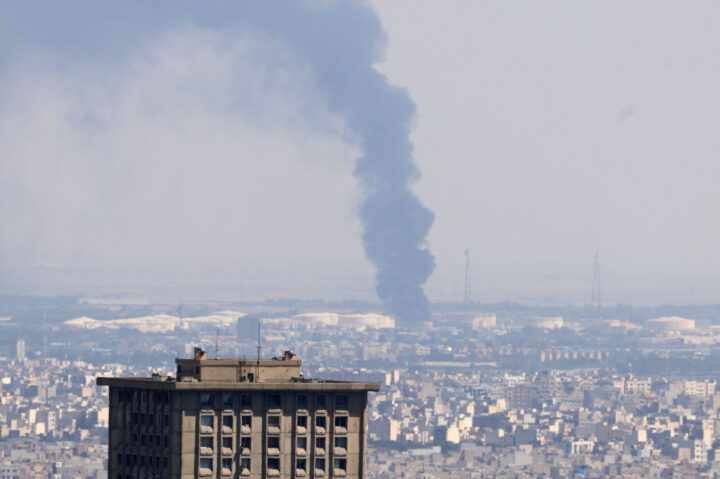
ATTA KENARE/AFP via Getty Images
Smoke billows in the distance from an oil refinery following an Israeli strike on the Iranian capital Tehran on June 17, 2025.
A decision by President Donald Trump whether or not to join Israel’s strikes against Iran could make the difference between the full destruction of the Islamic Republic’s nuclear program and a more drawn-out war with a less conclusive end, Danny Citrinowicz, a senior researcher in the Iran and the Shi’ite Axis Program at the Institute for National Security Studies at Tel Aviv University, told Jewish Insider on Tuesday.
Citrinowicz, the former head of the Iran branch in the Research and Analysis Division (RAD) in Israeli defense intelligence, spoke with JI from Australia, where he is one of more than 100,000 Israelis stranded abroad as the country’s airspace remains closed.
He argued that Israel’s strikes on Iran have gone beyond the war aims authorized by its Security Cabinet — to weaken Iran’s nuclear and ballistic missile programs — and indicate a push toward destroying Iran’s nuclear weapons program and forcing regime change. However, he warned, Israel would be unlikely to achieve either without help from the U.S.
The interview has been edited for length and clarity.
Jewish Insider: How would you describe where things stand on Day Five of the war between Israel and Iran?
Danny Citrinowicz: Trump is the variable. He is signaling that the Americans are in one minute, and then the White House says they don’t want to get involved the next. It’s clear that [Israel is] not only aiming at weakening the nuclear and missile programs. I think [Israeli Prime Minister Benjamin] Netanyahu’s plans, as he said on Iran International yesterday [that Israel will help “free” Iran], are much wider … There is a genuine attempt by Netanyahu to convince Trump to bring down the regime and change the entire Middle East.
JI: What progress has Israel made toward reaching its stated war aims?
DC: We maximized our achievements when it comes to the nuclear program. We struck the [nuclear] scientists. [The nuclear enrichment site] Natanz is an extraordinary achievement; it collapsed.
We had significant achievements against the missile program. It’s not clear if there have been fewer missile launches [from Iran] because of our strikes or because they are trying to be economical with their missiles. It’s significant that we took out a third of their missile launchers.
The strike on the [Iranian state] TV station is very strange because it is not connected to either war aim.
My view is that Netanyahu wants to keep going and for there to be a historic event, but he needs the Americans. The Americans are the variable. If they enter, things will be totally different. If not, Israel will continue doing what it has been doing.
JI: How is the Iranian regime responding to the latest developments?
DC: The Iranians have a very difficult dilemma. Decision-making is difficult because they lost so many senior officers. The assassination [of Iran’s Chief of War Gen. Staff Ali Shadmani] last night was very serious for them.
For Iran’s leaders, giving up on the nuclear program is giving up on the revolution. But if they continue fighting, they may also lose the revolution. They have a different view of the situation than we do, which ensures that they will continue fighting for the foreseeable future.
That’s why the important variable is whether Trump will decide to attack [the underground nuclear facility] in Fordow. If he says no, then the war will continue as it has been, with varying momentum as the Iranians try to challenge Israel.
I don’t see this ending soon if the Americans don’t enter [the war]. If they don’t, we will be in this for several weeks, at least…
There is an obstacle for Israel in Fordow [that it does not have the requisite bombs or bomber planes to destroy the facility under a mountain]. We could be planning something, but for now, I’m not optimistic.
JI: If the U.S. does not attack Fordow, what targets remain for Israel to attain its stated war goals?
DC: I don’t think we can achieve more than we already did … We are destroying missiles and launchers. We killed senior officials. There isn’t something left to achieve [in] the war aims that stands out. It’s just deepening the achievement.
My concern is that we’re going beyond that.
JI: Do you mean regime change as well?
DC: I think we’re aiming for it, but Israelis cannot do it alone. With the Americans, maybe. Replacing a regime through military means is hard, and you don’t always end up with something better. There’s a better chance with the Americans. I’ll be very surprised if it happens with Israel alone.
JI: Do you think Israel could send ground troops to demolish Fordow?
DC: Some have written about it, because they understand that attacking it from the air will be very hard. Either the Americans will help from the air, or something will happen that we don’t know about.
JI: What if Fordow isn’t destroyed?
DC: If this ends with Fordow intact, it’s a loss, because they can still enrich to 90%. We knew this from the beginning, and it’s still true. Either the Americans help Israel, or we need to pull a rabbit out of our hats.
It’s not clear to me that we went into this campaign with Trump and Netanyahu fooling everyone, or if things are as they appear. If nothing is being hidden, then Israel struck Iran’s nuclear program knowing it cannot destroy it … They took a bet.
This is either part of a grand plan, or it’s an unfolding event.
JI: Are negotiations for Iran to stop uranium enrichment still an option?
DC: The Iranians really want to stop the war with talks, but they will have to give up on a part of the revolution. They will come out very weak … If Iran accepts, it will not be the same Iran. If they don’t, the war will continue.
Still, [U.S. Middle East envoy Steve] Witkoff planned to talk to [Iranian Foreign Minister Abbas] Araghchi, so it’s possible. It depends on Iran. If Iran says “we give up, take Fordow, we no longer intend to develop a nuclear weapon,” Trump can say he’s a peacetime president and “no more bloodshed.” But I don’t see it happening.
JI: If Israel has to continue going at it alone, how long do you think this can continue?
DC: I think it’s a contest of patience between Israel and Iran … I think that we can hold on for a few weeks. Israel’s goal in these weeks is to bring the U.S. into the campaign, and Iran’s goal is for the U.S. not to enter.
It’s not a simple situation for Israelis, economically, militarily or societally … Israelis are also worn out. It takes hours to fly to Natanz — it’s not like Gaza, it costs a lot of money. The airport is closed. People aren’t going to work. And of course there’s the loss of life.
JI: And how is the Iranian regime faring in the contest of patience?
DC: For them, it depends on one thing. The reach of their military is measured only in their ability to launch missiles at Israel. They have relied on this for their entire existence. That’s the whole story.
There is concern in the regime about pressures from Iranian society, but I don’t see a serious challenge to the regime right now. There have not been any demonstrations. That could change.
JI: How do you view the fact that Iran’s proxies like Hezbollah haven’t joined in the fight and the Houthis haven’t escalated?
DC: One of the reasons that Israel went to war now is because it knew that Hezbollah would not join or its capabilities would be very limited. It was not just because of the nuclear and missile programs. It was the collapse of the axis that created a strategic opportunity Netanyahu didn’t want to give up.
JI: The timing was not, as Trump and Netanyahu have said, because Iran was very close to getting a bomb? Israeli officials have said Iran began the weaponization process.
DC: U.S. intelligence says otherwise. I don’t know why Trump is saying it…
There were significant developments [in the nuclear program], but there was an unprecedented strategic opportunity.
Though Trump said he did not leave in order to pursue a ceasefire between Israel and Iran, the U.S. is reportedly still seeking a meeting with the Iranians to reach a nuclear deal

Chip Somodevilla/Getty Images
President Donald Trump waves as he boards Air Force One after leaving the G7 Leaders' Summit early on June 16, 2025 in Calgary, Alberta.
President Donald Trump denied on Tuesday that he was attempting to facilitate “peace talks” with Iran as he returned to Washington to monitor the ongoing war between Israel and Iran.
Upon landing in the U.S. early Tuesday morning after prematurely leaving a meeting of G7 leaders in Canada — a move that White House Press Secretary Karoline Leavitt attributed to “what’s going on in the Middle East,” — Trump posted on Truth Social that he had “not reached out to Iran for ‘Peace Talks’ in any way, shape, or form. This is just more HIGHLY FABRICATED, FAKE NEWS! If they want to talk, they know how to reach me. They should have taken the deal that was on the table – Would have saved a lot of lives!!!”
On Sunday, however, Trump had written on Truth Social that “Iran and Israel should make a deal, and will make a deal” and “we will have PEACE, soon, between Israel and Iran! Many calls and meetings now taking place.”
While still aboard Air Force One, the president told reporters that he wanted “a real end” to Iran’s nuclear program and he would be monitoring developments between Israel and Iran from the White House Situation Room.
He suggested that Israel was unlikely to slow its strikes on Iranian targets in the coming days, saying that, “You’re going to find out over the next two days. You’re going to find out. Nobody’s slowed up so far.”
But the president stopped short of addressing whether the U.S. would join Israel’s strikes, saying he hopes the Iranian nuclear weapons program “is wiped out long before that.”
French President Emmanuel Macron suggested to reporters on Monday that Trump had departed the G7 earlier to negotiate a ceasefire between Israel and Iran, saying that “the U.S. assured they will find a ceasefire and, since they can pressure Israel, things may change.”
Trump slammed Macron and denied his claims, posting on Truth Social, “Publicity seeking President Emmanuel Macron, of France, mistakenly said that I left the G7 Summit, in Canada, to go back to D.C. to work on a ‘cease fire’ between Israel and Iran. Wrong! He has no idea why I am now on my way to Washington, but it certainly has nothing to do with a Cease Fire.” Trump said he had departed for something “much bigger than that.”
While at the G7, Trump took an aggravated tone with Iran’s failure to come to an agreement, writing on Truth Social that “Iran should have signed the ‘deal’ I told them to sign. What a shame, and waste of human life. Simply stated, IRAN CAN NOT HAVE A NUCLEAR WEAPON. I said it over and over again! Everyone should immediately evacuate Tehran!”
Israel had issued a warning earlier that day to residents of Tehran to evacuate ahead of impending strikes on military infrastructure in the capital city. Israeli media reported that the U.S. had joined Israel in attacking Iran, which was denied by White House spokesperson Alex Pfeiffer. “American forces are maintaining their defensive posture, and that has not changed. We will defend American interests,” he said. Trump later told reporters that his call to evacuate was because he wants “people to be safe.”
On Monday night, Axios reported that Middle East envoy Steve Witkoff is seeking a meeting with Iranian Foreign Minister Abbas Araghchi to reach a nuclear deal and end the military action between Israel and Iran. Trump reportedly said at the G7 that the U.S. and Iran “are talking on the phone, but it is better to talk in person.”
A senior U.S. official told Axios that Trump sees Israel’s assumed reliance on the U.S.’ bunker-buster bombs to effectively target Iran’s nuclear facilities as a point of leverage to force Iran into a deal, lest the U.S. supply Israel the assistance it is seeking.
Meanwhile, the Iranian Foreign Ministry said in a statement that the country’s parliament is preparing a bill to potentially pull Iran out of the nuclear Non-Proliferation Treaty. The U.N.’s nuclear agency had recently ruled that Iran was violating its obligations under the treaty — which allows a country to utilize civilian nuclear power in exchange for a guarantee it will not pursue nuclear weaponization — for the first time in almost 20 years.
'If Iran rejects diplomacy, the only logical answer is to help Israel finish the job. If we don't do that, it will be another example of Afghanistan where we blink,' the South Carolina Republican told JI

Amir Levy/Getty Images
Senator Lindsey Graham (R-SC) speaks at a press conference on US-Israel relations on February 17, 2025 at the Kempinski Hotel in Tel Aviv, Israel.
Sen. Lindsey Graham (R-SC) said on Friday that he’s urging U.S. support for Israel’s campaign to destroy Iran’s nuclear program as a means of “substantially undoing the damage caused by the disastrous Afghanistan withdrawal” during the Biden administration.
The South Carolina senator told Jewish Insider that he views Israel’s military operation in Iran as an opportunity to improve the reputation of the U.S. in the region by helping the Jewish state eliminate the threat of a nuclear Tehran if diplomatic efforts to address the issue fail.
Graham argued that the standing of the U.S. in the Mideast was significantly degraded by the 2021 withdrawal from Afghanistan, which was ordered under President Donald Trump during his first administration and implemented under then-President Joe Biden.
“If Iran rejects diplomacy, the only logical answer is to help Israel finish the job. If we don’t do that, it will be another example of Afghanistan where we blink. We can’t afford that anymore. If we do help Israel, who has been amazingly successful thus far, then I think it reverses the damage that Afghanistan caused for America. We’ve got a chance not only to take a bad guy off the table in terms of their nuclear ambitions, but reset the position of America in the world. I would take that opportunity if I were President Trump,” Graham said.
“The benefit to us as a nation is that Iran is a threat not only to Israel but to us. It would have the benefit of substantially undoing the damage caused by the disastrous Afghanistan withdrawal. We would be seen as a stronger, more reliable ally and it would help us to get good outcomes in other conflicts throughout the world,” he continued.
Graham expressed appreciation for Trump’s efforts to try “to get Iran back to the negotiating table to end their nuclear program through diplomacy” while cautioning that he believes “it’s important for the United States to go all in with Israel in finishing the job regarding Iran’s nuclear program” if “that effort fails.”
“We have capability Israel doesn’t just in terms of air assets, and I think it is in our national security interest to provide Israel what they need and to assist them in finishing the job. That doesn’t require boots on the ground, but it will require military assets,” the GOP senator said.
“If you believe in America as a force for good and you believe that we should deal with threats before they get out of hand, then the answer is to go all in. What would be provocative and irresponsible is to allow this program to continue. We’re trying to use diplomacy to end it, but that only works if we have a willing partner. I cannot stress how important it is to deny Iran a nuclear capability. If they get a weapon, they will use it. And if they get a weapon, the Arabs will want one of their own and you’ll have a new arms race in the Mideast,” he added of the risks of a nuclear-armed Iran.
Asked about left- and right-wing critics of Israel’s actions who have accused the Jewish state of hurting the diplomatic efforts, Graham compared them to “the heirs of Neville Chamberlain.”
“That’s what they said about Hitler, that being provocative would make Hitler more lethal. They were wrong then, they’re wrong now,” he said.
‘I have long said that Israel has a right to defend itself and that Iran cannot have a nuclear weapon.’ Schumer added

Senate Majority Leader Chuck Schumer speaks during 'March For Israel' at the National Mall on November 14, 2023 in Washington, DC. (Photo credit: Noam Galai/Getty Images)
Senate Minority Leader Chuck Schumer (D-NY) stood strongly behind Israel in his first public comments on its strikes on Iran and its nuclear program on Friday afternoon — a response that was notably more forceful in its support for Israel than those of many prominent members of the Senate Democratic Caucus.
“The United States’ commitment to Israel’s security and defense must be ironclad as they prepare for Iran’s response,” Schumer said in a statement first shared with Jewish Insider. “The Iranian regime’s stated policy has long been to destroy Israel and Jewish communities around the world. I have long said that Israel has a right to defend itself and that Iran cannot have a nuclear weapon. Ensuring they never obtain one must remain a top national security priority.”
Schumer, who has recently been critical of President Donald Trump’s negotiations with Iran, said “the preferred path to preventing a nuclear-armed Iran and for supporting security and stability in the region has always been a strong, unrelenting diplomatic effort backed by meaningful leverage, and every effort must be made to move toward the path of a diplomatic solution.”
Schumer noted that Iran was just censured by the International Atomic Energy Agency “for systematically deceiving the world about its nuclear program,” that it is “the world’s leading state sponsor of terrorism” and it “has sought to expand its influence in the Middle East, exporting terror and violence across the region.”
He said he is “praying for the safety of American citizens and servicemembers in the region and for enduring stability and security in the region.”
Ron Dermer and David Barnea will meet Steve Witkoff on Friday ahead of the sixth round of talks with Iran in Oman on Sunday 'in an additional attempt to clarify Israel's stance.'

ATTA KENARE/AFP via Getty Images
A picture taken on November 10, 2019, shows an Iranian flag in Iran's Bushehr nuclear power plant, during an official ceremony to kick-start works on a second reactor at the facility.
Since the Israeli strike on Iran’s air defenses in October, Jerusalem has sought a green light, or something close to it, from Washington to strike the Islamic Republic’s nuclear sites. President Donald Trump, however, repeatedly told Israel to hold off as he pursued a diplomatic agreement with Tehran to stop its enrichment program.
Now, after the Iranian nuclear program has continued apace and Trump has voiced frustration over Tehran’s intransigence, it seems that Jerusalem’s patience for diplomacy is running out.
Israeli Strategic Affairs Minister Ron Dermer and Mossad chief David Barnea will be meeting Trump’s top negotiator Steve Witkoff on Friday ahead of the sixth round of talks with Iran in Oman on Sunday “in an additional attempt to clarify Israel’s stance,” an official in Jerusalem said, amid persistent reports and strong indications that Israel is prepared to strike Iran.
After a call with Israeli Prime Minister Netanyahu last week, Trump said that if Tehran does not agree to give up uranium enrichment, the situation will get “very, very dire.” On Wednesday, Secretary of Defense Pete Hegseth said that “there have been plenty of indications” that Iran is moving towards weaponization of its nuclear program, and Gen. Michael “Erik” Kurilla, the chief of CENTCOM, said that he presented Trump and Hegseth with numerous options to attack Iran if nuclear talks break down.
Hours later, the State Department began to move some personnel out of Iraq and the military suggested that servicemembers’ families depart the Middle East, while the U.K. warned about a potential “escalation of military activity” in the region. Such evacuations are often the first step to reduce risk ahead of a large-scale military operation.
Trump told reporters that the evacuations are happening because the Middle East “could be a dangerous place, and we’ll see what happens.” More on this from Jewish Insider’s Marc Rod here.
Kurilla postponed his testimony before the Senate planned for Thursday. Staff at U.S. embassies and consulates throughout the Middle East were told to take safety precautions, and those stationed in Israel were told not to leave the Tel Aviv metropolitan area, Jerusalem or Beersheva.
Multiple news outlets published reports citing anonymous American officials that Israel is ready to strike Iran without help from the U.S. One possible reason for the timing — moving forward even as Washington and Tehran are set to enter a sixth round of talks on Sunday — is that Iran has reportedly begun to rebuild the air defenses that Israel destroyed last year. Iranian Armed Forces Chief of Staff Mohammad Bagheri reportedly said last month: “We are witnessing a remarkable improvement in the capability and readiness of the country’s air defense.”
Ynet’s well-sourced military analyst Yoav Zitun reported early Wednesday that Israel’s threat to attack Iran’s nuclear program is serious, and the most likely scenario is that Israel would strike Iran on its own but coordinate with the U.S. to receive air defense support. That scenario appears consistent with both Trump’s stated reticence to launch an attack, and the events that took place later that day.
In light of the negotiations set to continue on Sunday, some American analysts told JI that Washington could be acting as though it’s preparing for a possible attack to pressure Iran into concessions.
If the latest moves successfully pressure Iran, Shira Efron, Israel Policy Forum’s director of policy research, told JI that she hoped it would be “an opportunity to get to a bigger, better deal.”
However, in Israel, it looks like the moves towards a strike on Iran are serious.
The fact that Netanyahu is expected to go on a two-day vacation in northern Israel this weekend and his son is getting married next week have been counterintuitively pointed to as indications that a strike is imminent — after all, the Hezbollah pager operation happened when the prime minister was in New York, and the strike on Syria’s nuclear facilities in 2007 took place when then-Prime Minister Ehud Olmert was set to go on vacation in Europe.
“Yesterday, I thought there was no way something is going to happen,” Efron said, but now, “I think we’re at the money time. It’s more serious than we had thought.”
“Israel clearly no longer thinks an agreement can work, so it all depends on whether Trump told Israel it can do something before” negotiations between Iran and the U.S. break down, Efron said.
Dana Stroul: ‘If you’re trying to minimize risk before significant military operations, this is what you do’

ANDREW CABALLERO-REYNOLDS/POOL/AFP via Getty Images
State Department Sikorsky HH-60L Black Hawk helicopters as they fly over Baghdad towards the U.S. embassy headquarters on December 13, 2024.
The U.S.’ moves to evacuate some State Department personnel and military families from the Middle East are seen by experts as a potential sign of a U.S. or Israeli strike against Iran’s nuclear program — or, at least, a signal to Iran that the U.S. is prepared for such action, ahead of a planned round of nuclear talks with Tehran.
The moves come as President Donald Trump’s self-imposed deadline for the talks is approaching this week, and Trump has expressed public frustration with the lack of progress being made. There have been conflicting reports about whether the talks expected this weekend are still slated to occur.
The State Department is drawing down personnel in Iraq, the department said, and the Pentagon is allowing for voluntary departures of military families from locations in the Middle East. The United Kingdom, separately, issued a maritime trade warning about a potential “escalation of military activity” in the Middle East.
Dana Stroul, the research director at the Washington Institute for Near East Policy and former deputy assistant secretary of defense for the Middle East, noted that the Trump administration had conducted mandatory drawdowns of State Department personnel in Iraq at the end of the first Trump administration. The Pentagon evacuations, she noted, are thus far optional.
“This was part of the Iran policy approach [during Trump’s first administration] to increase pressure on the Iraqi government to get attack[s] against U.S. forces to stop,” Stroul told Jewish Insider. “So some of the people making these decisions inside the Trump administration have prior experience with reducing our presence in the region as part of a pressure play against Iran.”
But, she added, a “reduction in military families in the Gulf is the first step military planners would want to take if they were trying to reduce risk to U.S. personnel before large-scale, significant military operations.”
“If you’re trying to minimize risk before significant military operations, this is what you do. But right now they’re voluntary, not ordered,” Stroul continued.
Stroul argued that, in combination with the recent call between Trump and Israeli Prime Minister Benjamin Netanyahu and Trump’s public comments that he’s been frustrated by Iran’s posture in negotiations, “Tehran should take notice.”
Daniel Shapiro, Stroul’s successor in the deputy assistant secretary role, said that the administration “is clearly into some major preparations for possible military action vs Iran (by US and/or Israel).”
“A useful signal ahead of round 6 of nuke talks,” Shapiro continued. “Need to be prepared to back it up.”
Jason Brodsky, the policy director for United Against Nuclear Iran, framed the move as a likely sign of action, noting that congressional testimony by Gen. Erik Kurilla, who leads U.S. Central Command, set for Thursday morning, had been postponed.
“Something is cooking,” Brodsky said.
John Hannah, a senior fellow at the Jewish Institute for National Security of America and former national security advisor to Vice President Dick Cheney, told JI he believes that the moves are primarily an “unambiguous signal to the Iranians in advance of the next round of talks that U.S. patience is not unlimited and that time may be running out for them.”
He said the steps will take time to carry out but “they all have the indicia of the classic playbook that the United States would start rolling out in advance of anticipated hostilities. And of course it’s all being undertaken without much stealth and secrecy, but rather in a manner that ensures the Iranians and the rest of the world will know about it.”
He added that it “doesn’t necessarily have to be just one or the other,” and the moves should leave Iran guessing.
“The fact that the immediate purpose of these moves might primarily be a signaling mechanism to influence Iran’s posture in the negotiations doesn’t ipso facto mean it’s all just a bluff — although, if we’re honest, bluffing and then retreating is clearly often an integral part of President Trump’s negotiating MO and the ‘art of the deal,’” Hannah said. “That said, it could also be a deadly serious first step to put Iran on notice that it’s got one last chance to take the deal on offer or face the wrath of a U.S. military strike.”
“Trump is perfectly capable of going either way and the Iranians shouldn’t sleep too comfortably trying to figure out which one of those possibilities they’re facing,” he continued. “If they guess wrong, the outcome for them is potentially catastrophic.”
Mark Dubowitz, the CEO of the Foundation for Defense of Democracies, framed the moves more as a negotiating tactic.
“Ahead of round 6, the U.S. is signaling: failure at the table means real consequences,” Dubowitz said on X. “Starting to move non-essential personnel and families —reversible but not trivial. Message to Khamenei: you can end this peacefully, or face serious preparedness if you don’t.”
Kurilla said in response to a question from lawmakers on Tuesday about retaliation from a potential Israeli strike on Iran that the U.S. is continually assessing threats to military personnel in the Middle East and taking steps to address potential vulnerabilities.
Gen. Erik Kurilla, the top U.S. commander in the Middle East, said he’d presented a ‘wide range of options’ for strikes on Iran’s nuclear program if talks fail to achieve dismantlement

Department of Defense/EJ Hersom via AP
U.S. Army Gen. Michael E. Kurilla, commander of U.S. Central Command, testifies before the House Armed Services Committee, March 21, 2024, on Capitol Hill in Washington.
Gen. Michael “Erik” Kurilla, the top U.S. military commander in the Middle East, said on Tuesday that he had provided “a wide range of options” to Secretary of Defense Pete Hegseth and President Donald Trump for carrying out U.S. military strikes on Iran’s nuclear program if negotiations with Tehran fail to achieve the dismantlement of its nuclear program.
Kurilla affirmed, under questioning from the House Armed Services Committee, that the military is prepared for a strong show of force against Iran if it refuses to give up its nuclear program. He said that Iran is continuing to increase its stockpiles of uranium enriched to 60% purity, for which he said there are no legitimate civilian uses.
Kurilla added that Iran is in a “weaker strategic position” than it was pre-Oct. 7, but still maintains “a lot of operational capabilities, in terms of their long-range weapons.”
He also emphasized that China, in purchasing the majority of Iran’s exported oil, is “effectively supporting and financing Iran’s malign behavior.” He said that the administration’s moves to sanction “teapot refineries” in China were a major step.
Kurilla said that a stand-alone Israeli strike on Iran’s nuclear program would increase the risk of attacks on U.S. forces in the region, but added that “every day, we’re making assessments of our posture and our risk to force, and we made adjustments based on those. We’re fielding new systems and new equipment and making adjustments every single day.”
Pressed by Rep. Pat Ryan (D-NY) about Michael DiMino, the deputy assistant secretary of defense for the Middle East, who had previously downplayed U.S. interests in the region and opposed action against Iran and its proxies, Katherine Thompson, the acting assistant secretary of defense for international security affairs, largely demurred, saying that she was not involved in DiMino’s hiring and could not speak to his positions.
She said that her superior, Elbridge Colby, the undersecretary of defense for policy who himself made comments opposing strikes on Iran, which he walked back during his confirmation process, is in line with the administration’s policy.
“We support the president’s objective to not only, first and foremost, defend the State of Israel but second, of course, deny Iran the ability to obtain a nuclear weapon. That is something that we are 100% committed to,” Thompson said. “I will also note that we support the president’s objectives and stand ready to provide military options should his strategy of pursuing peace with Iran through a negotiated solution [fail].”
Ryan said that he was concerned that “dissonance” and “lack of clarity” in the administration’s public statements on its willingness to allow Iran to enrich uranium as part of an agreement was signaling “division and weakness to our adversaries.”
Asked about the U.S. ceasefire with the Houthis, Kurilla and Thompson said that the U.S. bombing campaign had achieved the goal Trump had set out of restoring freedom of navigation for U.S. ships through the Red Sea. Kurilla pointed to a recent transit of U.S. and allied naval vessels through the Red Sea as evidence.
While the ceasefire made no provisions to halt Houthi attacks on Israel, which have continued, Kurilla insisted that the U.S. is continuing to defend Israel through the operation of an American THAAD missile defense system in Israel and other efforts to intercept Houthi missiles and drones fired at the Jewish state.
He acknowledged that normal commercial traffic through the region has not yet resumed, but said that it would be a “lagging indicator” that would increase over time as insurance rates for commercial ships transiting the region drop.
Thompson said that the U.S. is not fully withdrawing from the Houthi issue, noting that the group is still designated as a Foreign Terrorist Organization by the U.S., and said the administration continues to pursue a “whole of government approach” to the Iran-backed group.
She said the U.S. is working to have Gulf partners take a greater role in countering the Houthis and “develop a regional solution that empowers our Gulf partners … to tackle the long-term elements of the problem set.”
Kurilla said that permanently ending the Houthi threat will require stopping covert shipments of weapons and weapon components from Iran to Yemen.
“They would die on the vine without Iranian support,” Kurilla said, adding that Islamic Revolutionary Guard Corps personnel remain on the ground in Yemen assisting with assembling and operating those weapons.
Pressed at one point by Rep. Derek Van Orden (R-WI) on why the U.S. is not sinking ships bringing weapons to the Houthis, Kurilla responded that the key challenge has been identifying the ships and the weapons among the many ships transiting the vast area of the Red Sea. But he said that when such ships are identified, the U.S. can and has intercepted and captured them.
Thompson said that European allies have taken positive steps toward collaborating on this mission and Kurilla said that the United Nations’ inspection mechanism for Yemen had also recently taken steps to increase inspections of containers, though he said that it should require the full unloading of all containers to verify their contents.
He also noted that the Houthis have been spreading across the region their knowledge and expertise gained from upgrading Iranian drones to attack Israel. He said the group and its personnel have a presence in Iraq and are sharing technical expertise with Iranian personnel as well as members of Iranian proxy groups in Iraq and Lebanese Hezbollah.
He said that the Houthis also maintain cells in Syria and Lebanon and have conducted diplomatic outreach to Russia and China.
But, Kurilla continued, Iran’s vision of a “Shia crescent” through the Middle East has collapsed with the fall of the Syrian government — ”probably the single biggest event that has happened in the Middle East” — and the degrading of Hezbollah and other Iranian proxies.
He praised Israel’s success against Iran’s proxies, at one point describing its “disintegration” of Hezbollah as “brilliant” and saying that it should be studied by every military in the world.
He said that Iran is attempting to make inroads into Iraq, but that the Iraqi government has largely rejected them.
“I would offer there has rarely been a time with greater opportunity to protect [our] national interests [in the Middle East], but only if we have the courage to step through that window,” said Kurilla, who will soon be retiring after 37 years in military service.
According to public reporting, Kurilla has largely been seen as a hawkish voice in the Trump and Biden administrations and a close ally of Israel.
Kurilla said the U.S. is “transitioning from security guarantor to security integrator” in the Middle East, which requires the U.S. to maintain a “sufficient and a sustainable posture” in the region, as well as to improve foreign military sales to partners in the region.
Asked at multiple points about Qatar’s reliability as a U.S. ally, Kurilla defended Doha as a reliable and eager partner. He said that the U.S. is working to bring Qatar into the military supply chain to repair and manufacture shared weapons systems, noting that it had been enlisted to repair a component of a Patriot missile defense system the previous week.
“We have a phenomenal relationship with them, military-to-military,” Kurilla said. “They have been incredibly supportive of everything we do. Generally, the answer is, ‘Yes, what is the question,’ when I talk to them.”
Kurilla said that U.S. partners are also critical to anti-terrorist missions in places such as Syria and Iraq, and allow the U.S. to keep its operating force in the Middle East relatively small, even as those troops in the Middle East have repeatedly been on the front lines in the past year.
In Syria, he said that the U.S. is working with Kurdish partners, the Syrian Democratic Forces, to integrate them into the new Syrian government, and said that Turkey is playing a positive role in those efforts.
But he also warned that the current Syrian government is being run by a small group of individuals and that he is deeply concerned about its stability, saying President Ahmed al-Sharaa may also bring foreign terrorist fighters, who helped bring his government to power, into the fold.
He said that U.S. troops remain in-country for counterterrorism missions, including one carried out against ISIS forces the morning of the hearing. But he said the U.S. is currently undertaking a process to review and consolidate its forces inside Syria into a smaller number of bases.
Kurilla further said that a key obstacle for U.S. relationships and goals in the region has been delays in U.S. foreign military sales to allies, frustrating those partners and imperiling efforts to integrate U.S. and allied systems across the region. He cited obstacles in the Defense Department, Congress and the defense production industry.
For the U.S.’ own purposes, he also noted that U.S.-produced air-defense systems are significantly more expensive than systems such as the Arrow, which is co-produced with Israel.
He added that the U.S. had learned much, particularly in improving technical and software capacities for air defense systems, from its ongoing operations in the Middle East.
Multiple Democrats pressed Kurilla on what role the U.S. military could play in delivering aid to civilians in Gaza. Kurilla said that the U.S. government is currently not involved in aid delivery, but highlighted the efforts of the Gaza Humanitarian Foundation as a positive step.
“Hamas hates that because Hamas no longer has control over that distribution,” Kurilla said.
He said the military would be prepared to assist if asked to do so.
The top Republican lawmaker said that, if a deal cannot be reached, ‘Israel is going to do something about that’

Kevin Dietsch/Getty Images
Sen. James Risch (R-ID) walks to the Senate chambers on February 16, 2023, in Washington, D.C.
Sen. Jim Risch (R-ID), the top Republican on the Senate Foreign Relations Committee, said on Wednesday in remarks at the Hudson Institute that he’s skeptical that Iran would agree to a deal to dismantle its nuclear program.
Risch said that he is “not particularly optimistic” that a deal with Iran that stops it from enriching uranium can be reached, while adding that if Iran does not agree to a deal, “Israel is going to do something about that.”
“I’ve sat across the table from [Israeli Prime Minister Benjamin] Netanyahu, I don’t know how many times, and he has looked me in the eye and said, ‘Iran will not have a nuclear weapon,’” the top Senate Republican said. “And you know what? I believe him, and I think that’s a case for the United States to be in the exact same position.”
He called Iran a “failing country right now,” and said that the U.S. should be continuing to ratchet up sanctions on Iran and those purchasing Iranian oil. If Iran were eliminated as a threat, he continued, that would also effectively eliminate the other major bad actors in the region, Hamas, Hezbollah and the Houthis, as Iran’s proxies.
“They’re all Iran. They’re all proxies of Iran. If Iran was gone, the three Hs would be gone,” Risch said. “So we’re down to one bad actor, really, in the region.”
Addressing the push for a ceasefire between Israel and Hamas, Risch said that Israel needs to destroy Hamas completely, and that any deal that allows it to continue existing will only set up another war down the road. And he said that Arab states are privately hoping that Israel is successful in incapacitating Hamas and its Muslim Brotherhood affiliates.
Risch described Syria and Lebanon as “keystones in a peaceful and prosperous Middle East,” both of which, he said, are poised for change and progress.
He expressed support for the administration’s decision to waive sanctions on Syria but warned that “we need to proceed with caution,” given Syrian President Ahmad al-Sharaa’s jihadist past.
“There are conditions that I believe must be met” by Syria and the administration should consider reimposing sanctions if they are not, he continued, including full cooperation against ISIS, eliminating Syria’s chemical weapons stores, expelling Russian and Iranian influence from the country, dismantling the Assad regime’s drug empire and accounting for missing and detained Americans.
Risch said he was initially nervous about al-Sharaa when he took control of Syria, but said, in his defense, that al-Sharaa’s terrorist activity was “a long time ago,” that al-Sharaa had cut ties with terrorist groups “knowing full well what they were and what they stood for” and that the sorts of atrocities and violence that Western leaders have worried about occurring in post-Assad Syria largely have not.
He said he believes that al-Sharaa was not involved in the “one incident” — seemingly referring to a massacre targeting the Alawite religious minority — that has taken place since he took power.
“I think the guy needs to be given a chance, particularly when he is saying what he’s saying, doing what he’s doing,” Risch said. At the same time, the committee chair also acknowledged that Israel does not share his view of al-Sharaa.
Risch downplayed the recent U.S. military pullback from Syria, emphasizing that the U.S. remains committed to the fight against ISIS and is concentrating its remaining resources in the region where ISIS has the strongest presence.
Risch said he’s “skeptical of Turkey” as a “result of my dealings with [Turkish President Recep Tayyip] Erdogan directly.” He warned that the Turkish antagonism toward the Kurds “could be a really, really serious problem” in Syria, which has “enough problems as it is,” and said he is “very cautious” about Turkey maintaining influence inside Syria.
He framed the new Lebanese government as that country’s “best opportunity” but emphasized that it has a long way to go to implement reforms, solve financial issues, eliminate corruption and root out Hezbollah. He said both the Lebanese president and Parliament speaker have “shown great potential over the years.”
“Any hesitancy to meet the threats posed by Hezbollah would be deeply troubling and force the United States to reevaluate providing much needed support for the [Lebanese] military,” Risch continued.
Pushing back on some in the Republican Party who have argued that the U.S. must pull back from the Middle East and other foreign engagements to focus resources on the Indo-Pacific and the home front, Risch said that he’s concerned about the U.S. national debt, but emphasized that fiscal responsibility does not require abandoning U.S. allies.
“We have relationships around the world that are just as important to us for our national security as [are] our military operations. We need friends,” Risch said. “There are a lot of people around the world that share our values and share our view of what life should be for human beings, and we need to maintain that.”
He added that the U.S. should “prize” its global reputation, and warned that abandoning allies like Ukraine would show weakness to China and other adversaries, and ultimately kick off a global nuclear arms race.
"The Obama administration invented the category of 'nuclear sanctions’ as an excuse to give the Ayatollah whatever he wanted for a nuclear deal," Sen. Ted Cruz said

Tom Williams/CQ-Roll Call, Inc via Getty Images
Sen. Ted Cruz (R-TX) is seen outside a Senate Judiciary Committee markup on Thursday, November 14, 2024.
Sen. Ted Cruz (R-TX) argued on Wednesday that sanctions on Iran’s nuclear program can’t be separated from other sanctions on the regime as part of a nuclear deal, comparing the approach apparently being taken by the Trump administration to that of the Obama administration.
Secretary of State Marco Rubio has said in congressional testimony this week that talks with Tehran have revolved solely around Iran’s nuclear program and have not addressed its sponsorship of terrorism or its ballistic missile program, but said that sanctions related to terrorism and missiles would remain in place if those issues are not addressed in a potential deal.
“The Obama administration invented the category of ‘nuclear sanctions’ as an excuse to give the Ayatollah whatever he wanted for a nuclear deal,” Sen. Ted Cruz (R-TX) said to Jewish Insider.
“It has nothing to do with how Congress passed or past presidents implemented sanctions against the Iranian regime, which was to use our most powerful sanctions against the full range of Iran’s aggression. President Trump rightly refused to certify and then withdrew from the deal because he said that lifting these ‘nuclear sanctions’ gave Iran too much for too little benefit,” he continued.
Congressional Republicans argued in the past, when the original nuclear deal included a similar formula, that the distinctions between nuclear and non-nuclear sanctions were largely specious. Those same lawmakers have maintained that any new funding the regime received would ultimately fuel proxy terrorism and regional destabilization, regardless of the targets of those sanctions.
Sen. Thom Tillis (R-NC) expressed confidence that the Trump administration understood that any deal must be multi-faceted, though he noted that Congressional Republicans haven’t been briefed on the talks.
“I have to believe at the end of the day, they realize that it’s not just about enrichment, but it’s all the other enabling capabilities, because the reality is the world’s a dangerous place and if they had that underlying capability, maybe then they’ll build their own bomb,” Tillis told JI.
“We got to support Israel. Iran uses proxies to attack America and Israel, they chant ‘Death to America.’ So what they’ve got to do is they’ve got to stop enriching uranium, that’s number one. And number two, we’ve got to make sure they have no money to give their proxies,” Sen. Rick Scott (R-FL) said when asked his position on a deal.
Sen. James Lankford (R-OK) told JI he hadn’t kept up with Rubio’s testimony, but said that addressing Iran’s proxy terrorism is crucial.
“Iran’s the largest state sponsor of terrorism. Israel is fighting proxies all the way around them. The entire region’s destabilized. Egypt is struggling economically because of the Houthis and what they’re doing,” Lankford said. “The proxies are the problem in the area and you can’t disconnect Iran and the regime and what they’re doing in the entire region to destabilize the region.”
Another Senate Republican, speaking on condition of anonymity to speak candidly, said he has faith in Rubio, but that an arrangement as outlined by Rubio would require “an awful lot of trust built into it, and I don’t trust Iran.”
“Money is obviously fungible. And the whole point of proxies is you can do whatever you want without doing whatever you want [directly],” the senator said. “There’s just an awful lot of trust built into.”
The senator said, “There’s probably a time where I’d be willing to give them a little bit of room, but they’re an awfully long ways down the road, so I don’t know. I just hope they keep a very, very tight grip on a very, very short leash.”
Sen. Lindsey Graham (R-SC) told JI that, “I like the American position, the administration’s position of no enrichment, complete dismantlement … and [would] have to include their missile program.”
“Anything short of that would be inadequate,” he added.
Sen. Mike Rounds (R-SD) similarly argued that a deal around Iran’s nuclear weapons would likely include addressing Iran’s pursuit of intercontinental ballistic missiles. He added that Iran should not receive any sanctions relief without addressing its nuclear buildup.
Other senators seem to be focusing their attention more on ensuring that dismantling Iran’s enrichment remains a red line for the United States.
“At the end of the day, we’ve got to see what the final package is,” Sen. Pete Ricketts (R-NE), who recently led nearly all Senate Republicans on a letter insisting on full dismantlement, said. “The biggest issue is going to be the enrichment part. If we can crack the enrichment nut, that’s a big deal.”
Sen. John Kennedy (R-LA) similarly said, “The president’s been very clear. I think the Republican side of the aisle in the Senate has been very clear. No enrichment, zero, zilch, nada, no centrifuges. The Iranian leadership doesn’t need it. They can import uranium for civil nuclear energy, so they can either take it or leave it. We can do it the easy way, the hard way.”

Anna Moneymaker/Getty Images
President Donald Trump delivers remarks during a swearing-in ceremony for Special Envoy to the Middle East Steve Witkoff in the Oval Office at the White House on May 06, 2025 in Washington, where he provided an update on the Houthi conflict in the Middle East.
Good Thursday morning.
In today’s Daily Kickoff, we look at the Trump administration’s waffling position on Iran’s nuclear program, and report on Columbia University’s handling of an anti-Israel protest in the school’s library during finals week. We also talk to experts about Israel’s military approach to Syria, and report on yesterday’s meeting between senior Justice Department officials and Orthodox Jewish leaders in Washington. Also in today’s Daily Kickoff: Massachusetts Gov. Maura Healey, Jay Sanderson and Arizona state Rep. Alma Hernandez.
What We’re Watching
- House Speaker Mike Johnson (R-LA), Sens. Ted Cruz (R-TX) and James Lankford (R-OK) and Reps. Mike Lawler (R-NY) and Brian Mast (R-FL) are slated to speak at an event this morning on Capitol Hill hosted by United Against Nuclear Iran, which will display an Iranian Shahed-136 drone in the Cannon Office Building.
- Sens. Lindsey Graham (R-SC) and Tom Cotton (R-AR) are hosting a press conference at 10:30 this morning on their resolution “affirming the acceptable outcomes of the United States’ negotiations with Iran regarding its nuclear program.”
- The Senate Appropriations Committee is holding hearings at 9 a.m. and 10 a.m. with FBI Director Kash Patel and Homeland Security Secretary Kristi Noem, respectively.
- Former President Joe Biden will give his first televised interview since leaving office when he appears on “The View” this morning alongside former First Lady Jill Biden.
- America Abroad Media is holding its annual awards dinner tonight in Washington. Axel Springer CEO Mathias Döpfner and Iran International are among the honorees at this year’s dinner.
- The Library of Congress is hosting an event to mark Jewish-American Heritage Month with the New York Andalus Ensemble, which will perform a medley of songs in Hebrew, Arabic, Spanish and Ladino.
What You Should Know
A QUICK WORD WITH JI’S GABBY DEUTCH
There’s an ongoing parlor game in Washington: Trying to figure out President Donald Trump’s Iran policy. More specifically, trying to decipher his endgame for ongoing nuclear negotiations with Iran, which are set to enter their fourth round in Oman this weekend.
Does Trump support allowing Iran to enrich uranium at a low level, as Middle East envoy Steve Witkoff said last month, before he walked that position back? Will he seek a “total dismantlement” of Iran’s nuclear program, as he told “Meet the Press” last weekend? Or will he allow Iran to have a “civil nuclear program,” as Vice President JD Vance said on Wednesday, by importing enriched material from abroad (as Secretary of State Marco Rubio has stated)?
Trump offered the latest clue to Iran watchers on Wednesday afternoon. Or, more accurately, he pretty much shut down the entire game — because trying to guess what the Trump administration wants is a fool’s errand if Trump himself has not made up his mind.
“We haven’t made that decision yet,” Trump said in the West Wing on Wednesday when asked by a reporter whether it is Washington’s position that Iran can maintain an enrichment program as long as it doesn’t enrich uranium to weapons-grade levels. “We will, but we haven’t made that decision yet.”
What’s particularly striking is that Trump’s comment came hours after he seemed to suggest something different to radio host Hugh Hewitt, saying the only options are to “blow them up nicely or blow them up viciously,” apparently referring to Iran’s nuclear program.
The 2015 Iran nuclear deal, negotiated by the Obama administration, allowed Iran to continue enriching uranium at a low level, rather than forcing the Islamic Republic to give up its nuclear program entirely. This was one of the key reasons foreign policy hawks opposed the deal so strongly — including Trump, who pulled out of the Joint Comprehensive Plan of Action in 2018. But the regional landscape has changed since then. Iran is weaker, but it is also bolder.
“Even if you agreed with the JCPOA, you have to note that Iran is different today, and it’s different because it’s now a country that will directly attack Israel, and it’s now a country that will directly try to kill American presidents,” said William Wechsler, director of the Rafik Hariri Center and Middle East Programs at the Atlantic Council.
Dan Shapiro, the former U.S. ambassador to Israel who worked on Iran policy at the Pentagon in the Biden administration, said Trump administration officials shouldn’t negotiate in public. “Pick a line — preferably full dismantlement, with the military option available if they refuse — stick with it, and try to hammer out a deal in private negotiations. When it comes to public commentary, less is more,” Shapiro told Jewish Insider.
Meanwhile, Republicans in the House and Senate have been gathering signatures for letters calling for full dismantlement of Iran’s nuclear program, JI’s Marc Rod scooped on Wednesday.
What’s clear is that there is not yet a consensus even among Republicans in Washington about the best way to handle the question of enrichment in a nuclear deal with Iran. And amid all the hubbub about enrichment, chatter about other major issues, such as Iran’s support for terror proxies across the Middle East, has died down entirely.
PROTESTS PERSIST
Over 75 anti-Israel protesters arrested after storming Columbia library during finals

More than 100 masked anti-Israel demonstrators stormed Columbia University’s main library on Wednesday afternoon — disrupting students studying for finals by banging on drums and chanting “Free Palestine.” As public safety officers attempted to clear out the protesters, several of the officers were forcefully pushed to the ground near the building’s front entrance. “The sense of entitlement and sheer ignorance of these students remains astonishing, and it is an embarrassment that they were even admitted to this university in the first place,” Eden Yadegar, a senior studying Middle East studies and modern Jewish studies — who was in the library as the chaos began — told Jewish Insider’s Haley Cohen.
Arrests in the library: By Wednesday evening, New York Police Department officers arrested around 75 of the protesters after Acting President Claire Shipman authorized the NYPD to enter the library. Two individuals were led off campus by Columbia University Emergency Medical Service on stretchers, one of whom had their face covered by a keffiyeh and the other had their face covered by a sheet, Columbia’s student newspaper, The Spectator, reported. New York City Mayor Eric Adams praised the NYPD’s swift response and called on parents of students protesting to “call your children and make clear that breaking the law is wrong and they should exit the building immediately.”
Congressional questioning: Haverford College President Wendy Raymond took the brunt of congressional questioning and criticism at a House Education and Workforce Committee hearing on Wednesday on campus antisemitism, repeatedly dodging questions from committee members, Jewish Insider’s Marc Rod reports.
DAMASCUS DEALINGS
Israeli presence in Syria ‘a direct lesson of Oct. 7’

Syrian President Ahmed al-Sharaa made a surprising admission during a visit to Paris on Wednesday: that Damascus and Jerusalem have been engaged in indirect negotiations in recent days. Al-Sharaa, the former leader of an Al-Qaida offshoot in Syria whose nom de guerre was Mohammed Al-Jolani, was welcomed by friendly crowds to the Eiffel Tower on Wednesday evening, a potent symbol of his growing acceptance in the international community. French President Emmanuel Macron said that he is looking to have the EU lift sanctions on Syria and would advocate for the Trump administration to do the same. Israel, however, continues to be deeply suspicious of al-Sharaa. The IDF maintains a presence over the border and miles into Syria, which Israeli Defense Minister Israel Katz has said will continue “indefinitely,” Jewish Insider’s Lahav Harkov reports.
Military action: Last week, Israel struck an area on the outskirts of Damascus, to protect the Druze community, whose militias had been clashing with Syrian government-affiliated forces. “Israel is in Syria as a direct lesson from Oct. 7 [2023],” Sarit Zehavi, the founder and president of the Alma Research and Education Center, specializing in Israel’s northern border, told JI this week. “On Oct. 7, Israel understood that we can no longer let radical elements build military capabilities on the other side of our border … If we’re not there, we’ll have radical Sunni bases on our border. We can’t let the monster grow. We have to cut it down while it’s small. That’s the basic idea,” she added.
double talk
Vance: Iran can have ‘civil nuclear power’ but no weapon

Vice President JD Vance said at a conference in Washington on Wednesday that Iran can have a “civil nuclear program” but not a “nuclear weapons program,” offering yet another confusing signal about the Trump administration’s position on Iran’s nuclear capabilities as negotiations with the Islamic Republic are set to enter their fourth round this weekend. Several Trump administration officials have in recent weeks offered competing messages about the goal of the ongoing nuclear negotiations with Iran. Vance’s comments come days after President Donald Trump said the outcome of the negotiations must be “total dismantlement” of Iran’s nuclear program, Jewish Insider’s Gabby Deutch reports.
What Vance said: Vance’s remarks, at the Munich Security Conference’s D.C. confab, suggested that the White House believes Iran does not need to entirely give up its nuclear program. “Our proposition is very simple. We don’t care if people want nuclear power. We’re fine with that,” said Vance. “But you can’t have the kind of enrichment program that allows you to get to a nuclear weapon, and that’s where we draw the line,” the vice president added. Vance said the negotiations will end with “Iran eliminating their nuclear program,” before he seemed to stop himself and clarify that he meant only their “nuclear weapons program.” He continued, “This is going to end somewhere, and it will end either in Iran eliminating their nuclear program — their nuclear weapons program. They can have civil nuclear power, OK? We don’t mind that.”
Senator’s soapbox: Speaking at an Orthodox Union luncheon on Capitol Hill, Sen. Josh Hawley (R-MO) said that Iran must be fully stripped of any nuclear capacity. He also vowed to work to revive the Antisemitism Awareness Act, which faces an uncertain path ahead in the Senate after a chaotic committee hearing last week, Jewish Insider’s Marc Rod reports.
SCOOP
Senate, House Republicans circulate letters calling for full dismantlement of Iran’s nuclear program

Prominent Senate and House Republicans are collecting signatures on nearly identical draft letters to President Donald Trump insisting that any nuclear deal with Iran must include the full dismantlement of the regime’s nuclear program and that the verification protocols from the original 2015 nuclear deal are no longer a viable option, Jewish Insider’s Marc Rod has learned. The letters indicate a concerted effort among congressional Republicans to emphasize to the Trump administration that they expect that any deal with Iran will mandate full dismantlement of Iran’s nuclear program, in the wake of inconsistent comments from top administration officials on that issue.
Simultaneous efforts: The draft Senate letter is led by Sens. Pete Ricketts (R-NE) and Ted Cruz (R-TX). Ricketts and Cruz both sit on the Senate Foreign Relations Committee and have taken a hard line toward Iran. Sen. Tom Cotton (R-AR), the chair of the Senate Intelligence Committee who has emerged as a prominent voice for full dismantlement of Iran’s nuclear program, is also supportive, JI has learned. Rep. August Pfluger (R-TX) is circulating a similar letter for signatures in the House, a copy of which was also reviewed by JI. He chairs the influential conservative Republican Study Committee, the largest GOP caucus in the House, which counts nearly three-quarters of House Republicans among its membership. A military veteran, Pfluger is also a prominent hawkish voice in the House GOP on national security matters.
MILKEN MOMENTS
Former hostage Noa Argamani: ‘I’m thinking about the hostages all the time’

Former hostage Noa Argamani and author Noa Tishby spoke about anti-Israel activism and antisemitism on Wednesday at the Milken Institute Global Conference in Beverly Hills, Calif., with Argamani saying that an anti-Israel performance at the Coachella music festival “broke her heart” and Tishby arguing that antisemitism “is nothing short of a cultural conflict,” Jewish Insider’s Danielle Cohen reports.
Coachella controversy: Argamani, who was kidnapped by Hamas terrorists from the Nova music festival on Oct. 7, 2023, said that she had intended to attend Coachella last month, where the Irish band Kneecap led the crowd in chants of “Free, Free Palestine” and displayed messages on the stage that read, “Israel is committing genocide against the Palestinian people,” “It is being enabled by the US government who arm and fund Israel despite their war crimes” and “Fuck Israel. Free Palestine.” Argamani said of the event, “It’s really hard and breaking my heart to see that this is still happening. I’m like all of the people that come for Coachella, and we are the same people. It could happen to each one of us, and if people will not share sympathy [for] each other, for all these people just going to festivals of love, peace and community, that’s what we need to do. We didn’t choose to be kidnapped, we didn’t choose to be born in Israel. We just want to go to a festival to dance and have fun.”
Money matters: Financial experts and regulators touted the strength of the Israeli economy, tech sector and stock exchange after a year and a half of war during a panel at the Milken conference, saying that “resilience” is a “very core characteristic of the Israeli market.”
justice agenda
DOJ officials tell Orthodox leaders they have launched probes into antisemitic discrimination

Senior Justice Department officials revealed on Wednesday that they have “several open investigations involving Orthodox Jewish communities across the country.” During a meeting between Trump administration officials and Orthodox Jewish leaders at the Justice Department, Michael Gates, the deputy assistant attorney general for civil rights, told attendees that the DOJ is looking into several matters impacting the Orthodox community, including how some municipalities’ use of zoning laws had affected individual religious communities’ ability to operate normally, Jewish Insider’s Emily Jacobs reports.
Open investigations: “We currently have several open investigations involving Orthodox Jewish communities across the country. These investigations include municipalities that have restricted building or operation of houses of worship or other religious land uses, and we are investigating cities that have made changes to zoning laws that negatively impact religious communities. In another matter, we are investigating antisemitic discrimination in public accommodations, including whether a restaurant, believe it or not, has engaged in a pattern practice of religious discrimination for refusing service to Jewish patrons,” Gates said.
Worthy Reads
Let’s Make a (Bad) Deal: In The Wall Street Journal, Israeli journalist and political commentator Amit Segal raises concerns about President Donald Trump’s approach to malign actors in the Middle East. “What’s happening is that Iran is drawing great encouragement from Mr. Trump’s conduct. The shaken regime — whose proxies have been hammered by Israel and whose air defense systems have been destroyed by advanced weaponry it can’t even identify — may be about to receive a deal similar to the one Barack Obama pursued. That would be more favorable to Tehran, since in the decade since Mr. Obama’s deal, the Iranian nuclear program has only surged ahead. If this were President Biden, the Israeli right, led by Mr. Netanyahu, would be accusing the American leader of throwing Israel under the bus. The prime minister would fly to Washington to address Congress and rally senators to petition against the president. But who is Mr. Netanyahu going to persuade now — Alexandria Ocasio-Cortez?” [WSJ]
The Gaza Bind: The New York Times’ David French considers Israel’s strategic options as it pursues the defeat of Hamas and the release of the remaining hostages in Gaza. “Israel is facing a terrible choice. If it wants to remove Hamas from power, it almost certainly has to pursue an occupation that would divide the nation and further enrage the international community. If it wants to secure the release of the hostages, it will almost certainly have to agree to a cease-fire that leaves Hamas in place and sets the stage for future conflicts. It remains to be seen whether Israel’s new approach is anything more than bluster. Perhaps Israel’s threats are little more than negotiation tactics. Perhaps Israel will ultimately prioritize releasing the remaining hostages over ending Hamas’s despotic rule. But one thing is crystal clear. There are no shortcuts in war.” [NYTimes]
Word on the Street
President Donald Trump withdrew the nomination of Dr. Janette Nesheiwat, the sister-in-law of former National Security Advisor Mike Waltz, to be surgeon general; Nesheiwat had faced criticism from far-right provocateur Laura Loomer over her support for vaccines and allegedly misrepresenting her education background…
FBI Director Kash Patel was pressed on Wednesday about the exclusion of Ed Martin’s ties to an alleged Nazi sympathizer in his FBI background check after Martin was nominated to be U.S. attorney for Washington, D.C., Jewish Insider’s Emily Jacobs reports…
The U.S. signed off on a plan for Qatar to fund the salaries of Syrian civil servants; Doha’s financial support will not extend to the Damascus’ defense and interior ministeries…
A group of 96 House Democrats has signed onto a letter to Israeli Ambassador to the U.S. Yechiel Leiter blasting as both a moral and strategic failure Israel’s blockage of humanitarian aid moving into Gaza in recent months, Jewish Insider’s Marc Rod reports…
Bloomberg looks at how the ceasefire between the U.S. and the Houthis will impact Trump’s visit to the Middle East next week, allowing senior officials and the U.S. delegation, which also includes Defense Secretary Pete Hegseth, to prioritize economic cooperation in their meetings…
A new Anti-Defamation League report indicates that Jewish members of Congress have experienced a five-fold increase in antisemitic harassment on Facebook this year since Meta loosened its content moderation guidelines and dialed back enforcement…
Massachusetts Gov. Maura Healey announced the launch of a strategic partnership with Israel’s Sheba Medical Center to build a new health-care accelerator in the state…
The San Marcos, Texas, City Council voted down a resolution calling for an arms embargo on Israel, weeks after Gov. Greg Abbott threatened to withhold state grants if the resolution passed, citing the state’s anti-boycott laws…
A federal appeals court ruled that the Tufts student being held at a detention facility in Louisiana must be moved to Vermont…
Prosecutors in New York charged a self-described “Jew hater” who on three separate occasions physically assaulted Jewish people, including a Columbia University student, with federal hate crimes; a search of Tarek Bazrouk’s Manhattan home uncovered hundreds of thousands of dollars, brass knuckles, an airsoft gun and real bullets, while a probe of his phone uncovered writings sympathetic to Hamas and Hezbollah…
Temple University issued an interim suspension to a second student involved in an antisemitic incident that took place over the weekend at a Philadelphia bar owned by Barstool Sports’ Dave Portnoy…
Arizona Gov. Katie Hobbs signed into law legislation banning the erection of encampments on public universities in the state; the bill, which had bipartisan support, was first introduced by state Rep. Alma Hernandez…
In an appearance on conservative commentator Tucker Carlson’s talk show earlier this month, Ben & Jerry’s co-founder Ben Cohen addressed a question from Carlson about his faith, saying, “I was born a Jew. I love Jesus Christ. I think the words that he said are wonderful, are amazing. And, you know, I’m kind of distressed that a lot of organized Christian religions are not really, I don’t know, abiding by the words of Jesus Christ”…
Israeli Prime Minister Benjamin Netanyahu confirmed that 21 hostages in Gaza are believed to be alive, while the statuses of three others remain uncertain, confirming past comments from his wife and Israeli Foreign Minister Gideon Saar, as well as a recent comment from President Donald Trump…
Israel’s National Security Council warned Israelis attending the Eurovision Song Contest in Basel, Switzerland, next week against wearing Israeli or Jewish symbols in public, talking about their military service or posting their location on social media…
U.K. officials said that five Iranian nationals arrested earlier this week in London had been plotting an attack on Israel’s embassy in the country…
A Houthi spokesperson confirmed that the Iran-backed terror group’s ceasefire agreement with the Trump administration does not include Israel, the same day that a missile launched at the Jewish state by the group fell short in Saudi Arabia…
Jay Sanderson was named interim president of the American Jewish University, succeeding Jeffrey Herbst…
Former American Jewish Committee Board of Governors Chair Bobby Lapin was named the organization’s next president, succeeding Michael Tichnor…
Pic of the Day

A group of Zanzibari children slated to travel to Israel earlier this week to receive life-saving treatment through the Save a Child’s Heart nonprofit was stranded in Addis Ababa, Ethiopia, for 24 hours after their flight to Israel was canceled following a Houthi ballistic missile attack on Ben Gurion Airport on Sunday morning.
The group connected with Israeli Foreign Minister Gideon Saar, who was in Ethiopia for meetings with Ethiopian Prime Minister Abiy Ahmed and Foreign Minister Gedion Timotheos, and joined Saar on his flight back to Israel, eJewishPhilanthropy’s Judith Sudilovsky reports.
Birthdays

Retired USDOJ official, for many years he was the director of the Office of Special Investigations focused on deporting Nazi war criminals, Eli M. Rosenbaum turns 70…
Retired senior British judge, Baron Leonard Hubert “Lennie” Hoffmann turns 91… Former chairman of the board of the American Jewish Joint Distribution Committee, Stanley A. Rabin turns 87… International chair of the Raoul Wallenberg Centre for Human Rights, he is a past president of the Canadian Jewish Congress, Irwin Cotler turns 85… MIT biologist and 2002 Nobel Prize laureate in medicine, H. Robert Horvitz turns 78… Former MLB pitcher who played for the Angels, Rangers and White Sox, Lloyd Allen turns 75… Rabbi in Dusseldorf, Germany, until moving to Israel in 2021, Rabbi Raphael Evers turns 71… CFO for The Manischewitz Company for 13 years until 2024, Thomas E. Keogh… Past president of Congregation B’nai Torah in Sandy Springs, Ga., Janice Perils Telling… Third-generation furniture retailer in Springfield, Ill., Barry Saidman… President of Clayton, Mo.-based JurisTemps, Andrew J. Koshner, J.D., Ph.D…. CEO and founder of NSG/SWAT, a high-profile boutique branding agency launched in 2011, Richard Kirshenbaum turns 64… Novelist, author of If I Could Tell You and movie critic for The Jerusalem Post since 2001, Hannah Brown… Co-founder and director of the Mizrahi Family Charitable Fund and a Maryland climate commissioner, Jennifer Laszlo Mizrahi turns 61… Israeli journalist, anchorwoman and attorney, she is best known as host of the investigative program “Uvda” (“Fact”) on Israeli television, Ilana Dayan-Orbach turns 61… Longtime litigator and political fundraiser in Florida, now serving as a mediator and arbitrator, Benjamin W. Newman… Canadian social activist and documentary filmmaker, Naomi Klein turns 55… Israel’s ambassador to the United Nations from 2015 to 2020 and again since last August, Ambassador Danny Danon turns 54… Stand-up comedian, writer, actress and author, Jodi Miller turns 54… Novelist and memoirist, Joanna Rakoff turns 53… Senior advisor at West End Strategy Team, Ari Geller turns 52… Director of strategic initiatives at J Street, Josh Lockman turns 43… Ice hockey player, now the assistant coach of the New Hampshire Wildcats women’s ice hockey program, Samantha Faber turns 38… Canadian beach volleyball player, he competed in the 2016 and 2024 Summer Olympics, Sam Schachter turns 35… Keren Hajioff… Founder and CEO at Axion Ray, Daniel First… Former White House senior policy advisor, now a senior fellow at the Harvard Kennedy School, Amiel Fields-Meyer…
The Senate majority leader said ‘when we do sit down we have to make sure there are a lot of issues on the table'

Lev Radin/Sipa via AP
U. S. Senator and Senate Majority Leader Charles Schumer marks re-opening of Junior's Cheesecake restaurant on Times Square in New York on May 6, 2021.
Senate Majority Leader Chuck Schumer (D-NY) called on the Biden administration on Thursday to address a range of issues in addition to Iran’s nuclear program in its negotiations with Tehran during a virtual event with the Jewish Community Relations Council of New York.
Schumer emphasized that he opposed both the 2015 nuclear deal when it was signed as well as the Trump administration’s withdrawal from it three years later, which he said “isolated the U.S., instead of Iran.”
“Today Iran has a greater ability — they’re closer to producing a nuclear weapon — than they were the day Trump pulled out of the agreement or the day Obama signed the agreement,” Schumer said.
The longtime New York senator indicated that he would like to see a broader deal with Iran addressing a range of issues including terrorism, ballistic missiles, human rights and hostage-taking, rather than focusing on the nuclear issue alone.
“I understand why the current administration is in negotiations and I don’t have any problem with them sitting down and talking, but I also believe… we have to follow through on all of these issues,” Schumer said. “It’s not that we shouldn’t sit down, because if we don’t sit down, Iran could just go forward and produce a nuclear weapon… but when we do sit down we have to make sure there are a lot of issues on the table.”
The Senate majority leader also said he plans to push for $360 million in funding for the Nonprofit Security Grant Program (NSGP) for fiscal year 2022. In 2020, the House approved $360 million in funding, while the Senate only approved $90 million; the chambers compromised at $180 million.
“I wanted $360 [million]. I was only minority leader in December. I got it doubled to $180 [million], now we’re going to try to get the full $360 [million] a year, which is very much needed and has broad support, so I’m very optimistic,” Schumer said.
Last week, a group of House members — roughly one-third of the legislative body — expressed support for $360 million in NSGP funding for 2022, which is also the target amount for a number of Jewish community organizations lobbying on the issue.
In recent weeks, however, several senators who had been vocal supporters of the NSGP program declined to provide to JI a specific target level for 2022 NSGP funding.
Earlier on Thursday, Schumer paid a shiva call to the family of Pinchas Menachem Knoblowitz, who died in the stampede at a Lag B’Omer gathering at Israel’s Mount Meron last weekend that killed 45 people. Schumer told the family he has “a deep faith in Hashem.”
“I have a Jewish heart — a neshamah,” Schumer said. “I have a deep faith in God. If I didn’t I wouldn’t be in this job.”
Also Thursday, the New York senator stopped by Junior’s in Times Square, digging into a slice of the restaurant’s famous cheesecake, to celebrate the location’s reopening.
“If there’s an iconic place on the planet that tells the toil of COVID, it’s Times Square,” Schumer said. “All of Times Square is coming back. And we’re here to say now that in Times Square there is light, there is liveliness, and there is cheesecake.”
Victoria Nuland appeared at the Senate for a confirmation hearing to become under secretary of state for political affairs

Tom Williams/CQ Roll Call via AP
Amb. Victoria Nuland, former Assistant Secretary of State for European and Eurasian Affairs, testifies during a Senate (Select) Intelligence Committee hearing in Hart Building
Victoria Nuland, the Biden administration’s nominee to be under secretary of state for political affairs, avoided committing to a specific strategy to address Iran’s nuclear program while highlighting the administration’s determination to bring Tehran into compliance with the 2015 nuclear agreement during a Senate Foreign Relations Committee confirmation hearing on Thursday.
Nuland previously served under President Barack Obama as assistant secretary of state for European and Eurasian affairs and as U.S. ambassador to NATO under President George W. Bush, as well as a foreign policy advisor to Vice President Dick Cheney. In 2014, she led the U.S. response to the Ukraine crisis.
In an exchange with Sen. Chris Murphy (D-CT), Nuland declined to definitively endorse the position on the Joint Comprehensive Plan of Action (JCPOA) that Murphy and more than two dozen other Senate Democrats expressed in a letter to Secretary of State Tony Blinken earlier this week. The letter called for a swift reentry into the 2015 Iran nuclear deal, a contrast with a recent bipartisan letter from 43 senators which called on the U.S. to negotiate a more comprehensive deal addressing nuclear and non-nuclear issues.
“I think we’ve got to pursue all of these problems in tandem. Whether that is a question of a comprehensive agreement, I think there are many players and many different pieces of this,” Nuland said. “Walk and chew gum would be my answer.”
Nuland also made clear that the nuclear issue is the administration’s priority.
“What is most urgent today is that Iran is breaking out — again — of its nuclear box. It is enriching at 20%, it is using these advanced centrifuges. We’ve got to get them back in the box on the nuclear front. But at the same time we can and should be countering their malign regional influence,” she said. “Its breakout time is shortened, so [the] first job [is to] get them back in the box. And then together define what ‘longer and stronger’ means.”
Intelligence officials have predicted that last weekend’s blackout on the Natanz nuclear facility may have extended Iran’s breakout time by nine months. In the wake of the incident, which Iran has claimed was an Israeli attack, the regime announced it would begin enriching uranium to 60%.
Critics of the Biden administration’s approach argue that it is not viable because Iran may not agree to follow-on negotiations. According to Mark Dubowitz, CEO of the Foundation for Defense of Democracies, the administration’s talking points also fail to articulate whether Iran’s other malign activities will be part of the negotiations to lengthen or strengthen the Iran deal or whether they will be negotiated separately.
“I think Nuland is keeping the administration’s options open… even though so far they’ve already committed to return to the JCPOA as their priority,” he said.
Danielle Pletka, a senior fellow at the conservative American Enterprise Institute, agreed that Nuland’s answers were vague and accused the Biden administration of being “desperate to make a deal with Tehran.”
During the hearing, Nuland pledged to engage with Congress consistently during negotiations with Iran, and particularly on any final deal.
“Whatever agreements we reach with Iran need to be supported in a bipartisan fashion, not only on this committee but across the Congress and across America. That will ensure that they are binding across administrations and for the long term. So we have to do our job and consult at every phase and hear your ideas and incorporate them,” Nuland said. “I would pledge to be here as often as we need to be to ensure that we all support what’s happening.”
Even among critics of the 2015 nuclear deal and the Biden administration’s approach, Nuland is highly regarded. Dubowitz called her a “tough negotiator” and “very clear-eyed and sober-minded” about the threat from authoritarian regimes. Pletka called her “a pro, not an ideologue” and “a smart woman and a shrewd diplomat.” But, Dubowitz said, Nuland is unlikely to be a major player on Iran policy, given her background in Russia issues and the proliferation of Iran experts already within the administration.
“I assume Nuland is going to have some role in this,” he said, “but I don’t think she’s going to be a major influence on Iran policy or a major shaper of the direction of Iran policy.” Pletka echoed Dubowitz’s sentiments, saying that Nuland is unlikely to have a major influence on the U.S.’s overall direction on Iran.
Please log in if you already have a subscription, or subscribe to access the latest updates.
 Continue with Google
 Continue with Apple