



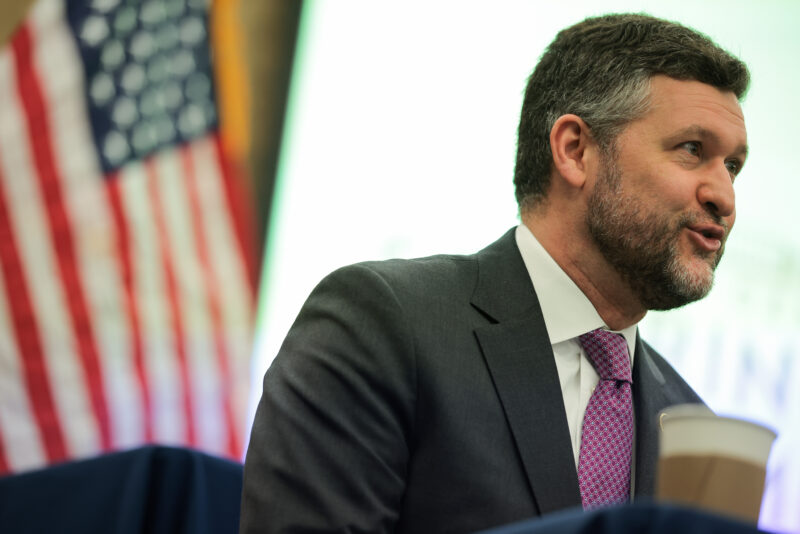






























The Pennsylvania senator told JI his ‘views aren't controversial, or they shouldn't be. What should be controversial is the trash that's coming out from many Democrats and out of J Street’
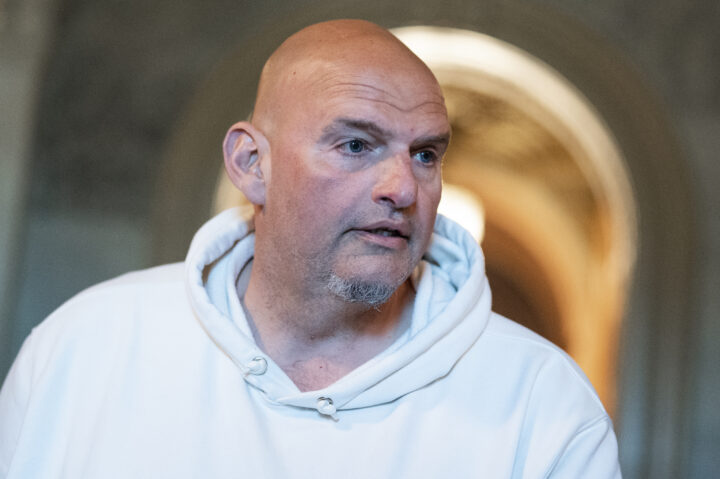
Tom Williams/CQ-Roll Call, Inc via Getty Images
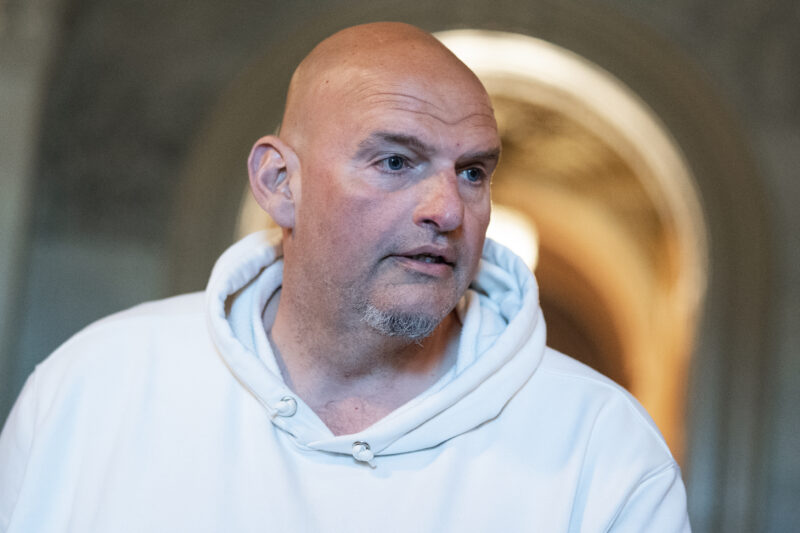
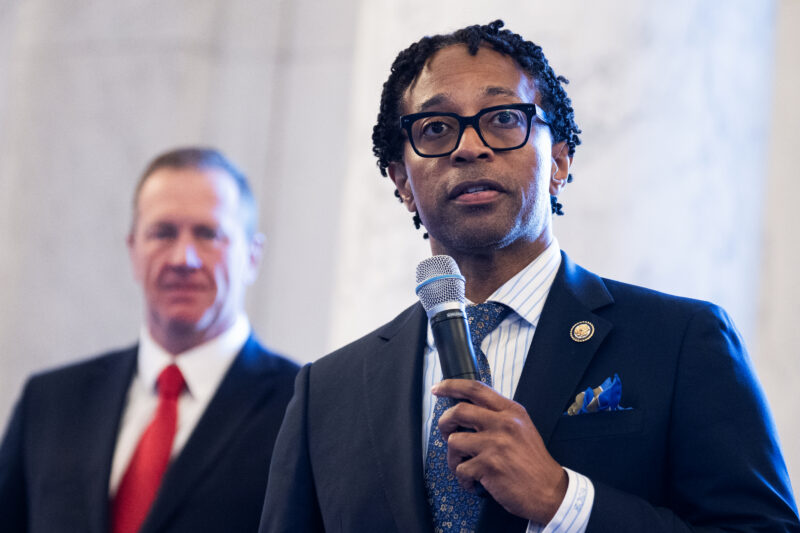
Sen. John Fetterman (D-PA) is seen after the Senate luncheons in the U.S. Capitol on Tuesday, April 14, 2026.


 Add JewishInsider on Google
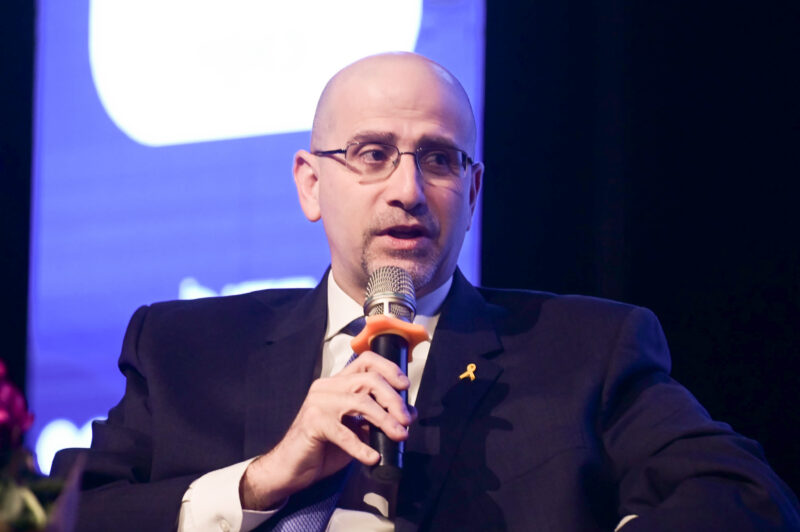
Sen. John Fetterman (D-PA) said on Monday that the votes by more than 100 House Democrats last week in favor of an effort to end all U.S. aid to Israel indicates the party is “flirting with” making opposition to Israel the official party stance, something he said would lead him to leave the caucus.
Fetterman, who has dismissed discussions about him leaving the party in recent years despite his increasing isolation from Democratic colleagues on Capitol Hill, said in a series of media appearances last week that he would leave the Democratic Party if it called for opposing offensive or defensive aid to Israel or ending the U.S.-Israel relationship in its official platform.
“It’s very clear, if the Democratic Party becomes the official anti-Israel party, then that forces me to rethink my membership in that party,” Fetterman told Jewish Insider in an interview on Monday. “Candidates run on the platform, on whatever the platform is, any one member of it effectively agrees with it. If they put that in the platform that we will never vote for aid for Israel, or we describe Israel as a genocidal or apartheid state, then yes, you have to rethink it.”
The Pennsylvania senator said that the move by nearly half of the House Democratic caucus to vote for Rep. Thomas Massie (R-KY)’s measure indicates the party is “flirting with” the idea of shifting its platform.
“It’s absurd. The Democratic Party are increasingly voting not to support the only Democratic state in the entire region,” Fetterman told JI. “I’m saying, effectively, you are flirting with it. You are increasingly making it more official. Inculcate it into our platform, then that’s a fundamental betrayal of the Democratic Party’s core morality.”
“I’ve been warning — I have been. Maybe two years ago I said I’ll be the last man standing if it’s what’s necessary,” he continued. “In July of ‘24, [Israeli Prime Minister Benjamin] Netanyahu had a joint address [to Congress]. I was the only Democrat that would engage him, shake his hand, get a photo with him, support the decision when every other Democrat was pushing for a ceasefire [in Gaza]. I mean, the Democratic Party was entirely wrong with that approach, and imagine what the security situation would be if Israel was pushed into a ceasefire.”
Fetterman referenced an Axios article published earlier Monday that credited the letter House Minority Leader Hakeem Jeffries (D-NY) sent to all House Democrats urging them to oppose the amendment with keeping 30 to 40 additional lawmakers from voting for the measure.
“It could have been 150 Democrats to vote against that,” Fetterman said. “I mean, that’s the direction the party’s going. … My views aren’t controversial, or they shouldn’t be. What should be controversial is the trash that’s coming out from many Democrats and out of J Street.”
The Pennsylvania senator took pointed aim at J Street, referring to the progressive Israel advocacy organization as “the embodiment of the suicidal empathy against the Jewish state of Israel” and criticizing the group for associating with Hasan Piker, the far-left streamer who has a record of antisemitic remarks.
“Nothing embodies suicidal empathy like J Street,” Fetterman said. “I wouldn’t describe them as cancer, but it’s vile the views that they are adopting, and they are becoming the useful idiots for the Hamas and Iranian propaganda machine. Are they gonna invite Hasan Piker to be on their board?”
“J Street is the group that said and gave political cover for Democrats so they don’t have to vote for Iron Dome [funding]. That’s a fact,” he continued. “They were trying to provide political cover for Democrats to say, ‘Well, J Street said it, so that seems pretty reasonable.’”
Fetterman had previously brushed off reports that efforts to recruit him to the GOP would be successful, writing in a Washington Post op-ed in May that he would “be a terrible Republican who still votes overwhelmingly with Democrats.”
Questions about Fetterman’s future political plans began circulating again earlier this month, however, when he and Sen. Dave McCormick (R-PA) launched Common Ground PA, a joint fundraising committee combining two of each senator’s PACs and allowing them to fundraise together.
Fetterman warned last week that he could become a deciding swing vote in the next Congress if the Democratic Party wins control of the Senate in November, which Democrats need to flip four seats to accomplish.
“If we flip those four seats, then I would be 51,” Fetterman said Wednesday at The Hill Nation Summit. “Watch what I do.”
The Pennsylvania senator heavily criticized the normalization of anti-Israel platforms and the validation of extreme views among Democratic voters
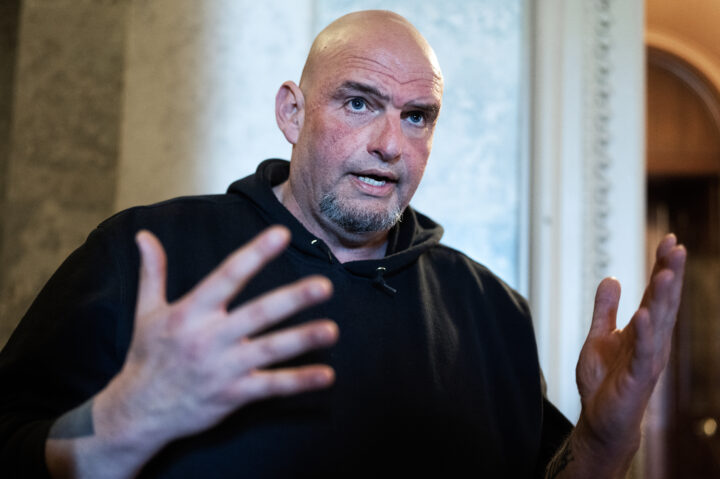
Tom Williams/CQ-Roll Call, Inc via Getty Images
Sen. John Fetterman (D-PA) talks with reporters after the Senate luncheons in the U.S. Capitol on Tuesday, March 11, 2025.
Sen. John Fetterman (D-PA), a stalwart ally of Israel and the Jewish community who has become increasingly isolated within a Democratic Party facing internal friction over its Middle East policy, warned on Wednesday that the outlook for Jewish voters within his party has become “bleak.”
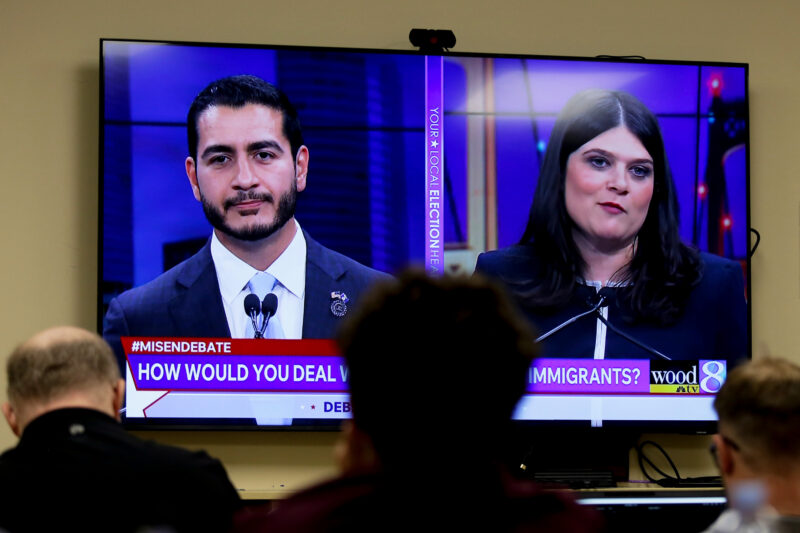
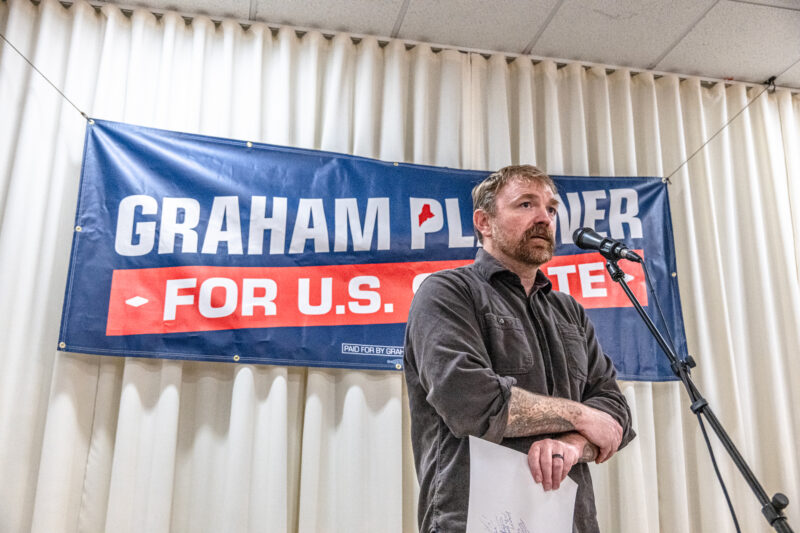
“I’m not a member of the Jewish community, but if I was one, it would be bleak as a Jewish voter in the Democratic Party,” Fetterman said, speaking at a conference hosted by the Culture for Peace Institute, a nonprofit organization focused on advancing “sustainable peace” by bringing together political leaders and researchers, in Washington. “If [Democratic voters are] willing to support these kinds of candidates across the map — look in Michigan [Abdul El-Sayed], look at the one in Maine [Graham Platner], look at New York City [Mayor Zohran Mamdani], look across the map — these are defined by how much anti-Israel rhetoric you can cram into your platform.”
Fetterman expressed concern that the trajectory of the party will continue to “deteriorate,” noting that he “refuses to be part” of what he claims to have predicted would occur within the Democratic ranks. He added that he is “constantly disappointed but not surprised by the way things have drifted within the party.”
“I expect that it’s going to continue to deteriorate,” Fetterman said. “A lot of these extreme views were validated during the midterms. It’s stunning, astonishing to me, the kind of people with these views who [Democratic voters] will now choose to be their representatives. It’s heartbreaking to me, but unsurprising, and that’s what history would have predicted will happen.”
The Pennsylvania senator pointed specifically to Platner’s victory in the Maine Democratic Senate primary on Tuesday, calling it a “capstone” example of deterioration within the party, taking concern with the amount of people “defending” the scandal-plagued candidate.
“I think the capstone of that recently was where you have the kind of garbage candidate like Platner — like full-on Nazi ink on his body — and now you have people defending it,” Fetterman said. “I read an interview with a Maine voter where [a woman said] she would not vote or support someone if they have an Israeli flag tattoo, but it’s OK that [Platner has a Nazi tattoo] on his body. That’s how insidious it’s become within the party, and the calculus where it’s OK to have these views.”
Fetterman stated that the problem is most acute among the “young generation,” arguing that the environment on college campuses and behavior of certain Democratic candidates have contributed to the alarming shift.
“The young generation’s been lost, and that’s 100% on social media,” Fetterman said. “If the Democratic Party is convinced that Hamas or Hezbollah or Iran were the wronged party, that’s absurdity.”
“If you are angry, blame Iran — don’t blame America, or don’t blame Israel for demanding that they turn over their nuclear dust,” he continued. “Don’t keep hostages, don’t attack Israel, don’t fire thousands of rockets into northern Israel. This response was entirely appropriate.”
On the war in Iran, Fetterman discussed his decision to be the sole Senate Democrat to vote against multiple war powers resolutions, clarifying that it was a “pro-no-nuclear-weapons-for-Iran” vote rather than a pro-war stance. Despite his isolation in the caucus on that specific measure, Fetterman insisted he stood on the “right side” of history.
“Can’t we just agree that every single Democrat in the caucus would agree that we can never let Iran build a nuclear bomb?” Fetterman said. “When someone [the Trump administration] actually tries to make sure that doesn’t happen, why can’t you support that?”
Fetterman recalled that Democrats once stood firmly and unanimously against Iran acquiring a nuclear weapon. However, he argued that a policy position that used to be mainstream for Democrats has now “become a controversial one.”
Fetterman further asserted that support for Israeli military objectives has also become “controversial” within the Democratic Party. Nonetheless, he emphasized that he will continue to back Jerusalem’s operational goals regardless of the shifting political tides.
“This might be controversial for Democrats now, but I’ll say it again. I think it’s magnificent the way Israel continues to this day to eliminate people in Hamas and everyone that is tied to [the Oct. 7, 2023, terrorist attacks],” Fetterman said. “Everyone should be held accountable and pick off the new leaders before the new business cards even come in.”
Ultimately, he warned that an Iranian nuclear breakout would carry severe consequences for the Middle East and economic fallout globally.
“I can’t imagine the circumstances in the Middle East if that happened,” Fetterman said. “If you think gas is too expensive today, let Iran become a nuclear power because they could do anything and charge any kind of toll once they’re nuclear. They would be truly untouchable, and this is why as a Democrat I’m willing to embrace perhaps the most toxic thing a Democrat can do right now.”
The Pennsylvania Democrat, the most hawkish member of his party on Iran, told JI that failing to eliminate Tehran's nuclear threat would undermine the president's legacy

Andrew Harnik/Getty Images
Sen. John Fetterman (D-PA) speaks at a rally for Democratic vice presidential nominee Minnesota Gov. Tim Walz at York Exposition Center UPMC Arena on October 2, 2024 in York, Pennsylvania.
Sen. John Fetterman (D-PA) said on Tuesday that he is growing increasingly concerned that President Donald Trump may agree to a deal with Iran that does not ensure the retrieval of Tehran’s stockpile of enriched uranium or that the regime will never acquire a nuclear weapon.
Fetterman, who has become the most hawkish Democrat in Congress on Iran and the sole member of his party to vote against every Iran war powers resolution in recent months, spoke with Jewish Insider in Washington about the possible outcomes of the ongoing peace talks. The Pennsylvania senator acknowledged that he and Trump had taken political heat from their respective parties over their stances on the conflict, but argued that solving the Iranian nuclear issue would be legacy-defining for the president.
“Nuclear dust, that’s the reason why we’re here. This is why I was reasoned and OK with setting myself politically on fire to be the only Democrat for the last 90 days voting against these war powers acts,” Fetterman told JI. “Presidents always talk about their legacy. At this point, if you cave just for political convenience, what kind of legacy is that?”
“I appreciate every now and then when Trump will say, ‘Well, it [the war in Iran] is only going to be about that nuclear dust,’ but Israel is never allowed to fully pulverize their enemies,” he continued. “They’re fighting a nation where they like martyrdom and that’s what they celebrate. It’s so dumb.”
The Pennsylvania senator addressed the negative U.S. public perception of the war, arguing that the president was acting in a “Churchillian” manner by taking on the Iranian regime, and expressing concern that reversing course in Iran could indicate the Trump administration’s lack of commitment to Taiwan, in the event of a Chinese invasion.
“I hope after that silly visit to China that they [the Trump administration] aren’t now like, ‘Well, we’re going to turn our back to Taiwan,’” he added, referencing the president’s summit in Beijing last month with Chinese President Xi Jinping. “These are all fights for civilization and democracy. I don’t care if it’s in Gaza or Iran, Taiwan against Chinese communism or Russia and Ukraine, it’s the same fight, and that’s why it’s our special responsibility, it’s America’s, to stand with these allies.”
Fetterman pointed to the pressure Democrats faced during the 2024 election to take a firmer stance in opposition to Israel’s war in Gaza due to the high death toll of Palestinians. He argued that those of his Democratic colleagues who had worked to restrain Israel since Hamas’ Oct. 7, 2023, attacks on the Jewish state had damaged their credibility.
“How can you trust these people?” he asked of those Democrats. “Two years ago they were all demanding and pushing for a ceasefire. Can you believe where we would be now if we had a ceasefire? Can you imagine if Israel had to grovel to get their people back? Can you imagine if Iran could be a nuclear power by now?”
“If [there was] a ceasefire in July [2024] based on the pressures from the election in ‘24, [former Hamas chief Yahya] Sinwar would be alive. Hezbollah would be intact. They could launch thousands of rockets at will — and think of the capabilities that Iran could be at now,” he added. “Where’s the outrage? They pretended to be so worried about it. It was politically convenient to try to push Israel into a position that would put Iran on the path to nuclear power, and [leave] their proxies fully intact.”
Despite the three Republican defections, the measure still failed to pass

Kevin Carter/Getty Images
U.S. Capitol Building on January 18, 2025 in Washington, DC.
Sen. Lisa Murkowski (R-AK) became the latest of a small number of Senate Republicans to break ranks and vote with the majority of Democrats in favor of an effort to force an end to the war in Iran on Wednesday.
She joined Sen. Susan Collins (R-ME), who voted for the second time for such an effort, and Sen. Rand Paul (R-KY), who has consistently voted with Democrats on the issue. Nevertheless, the effort still fell short of a majority of the Senate, or of the 60 vote threshold needed for passage, with a final vote of 49 in favor to 50 against.
Sen. John Fetterman (D-PA) remained the only Democrat to vote against the war powers effort.
Murkowski has been working with other Senate Republicans on an Authorization for Use of Military Force to set limits on the U.S. operations against Iran, but it remains unclear when she plans to introduce it or what its scope will be.
Murkowski and Collins’ votes suggest they’re unconvinced by the administration’s assertions that the military operations that began in late February have now concluded. The War Powers Act sets a 60-day deadline for military action without congressional approval.
“You’ve got a timeline that has taken us beyond the 60 days,” Murkowski told reporters. “I thought that perhaps we would get … more clarity from the administration in terms of where we are, and I haven’t received it. So I felt that it was now time to advance a discharge so that we can discuss our responsibilities as Congress under the War Powers Act.”
Collins said following the prior vote, two weeks ago, that she had voted for the resolution in order to enforce the War Powers Act.
Sen. Josh Hawley (R-MO), who previously said his position might change after the 60-day mark and has been urging the administration not to restart military operations, again voted against the war powers effort.
“I think the administration’s in compliance, the president’s [in] compliance with the war powers statute given his certification to Congress … saying that he had terminated hostilities under Operation Epic Fury,” Hawley told Jewish Insider, echoing comments he made earlier this week. “I welcome the termination of hostilities … I’m glad [Trump] has resisted some of my colleagues’ calls to return to large-scale bombing and is pursuing an end to the conflict. I think that’s good.”
Senate Majority Leader John Thune (R-SD) had urged Republicans not to break ranks on the issue while President Donald Trump is in China on a state visit this week.
“Right now, the president’s overseas,” Thune said. “He’s negotiating with the Chinese on a whole range of issues, some of which bear on national security, and I think it would be best if everybody hung together and supported the president.”
Sen. John Curtis (R-UT), who had previously expressed opposition to any military operations beyond the 60-day deadline, also voted against the resolution. He suggested to reporters that the efforts from Democrats were not “serious.”
“I’ve yet to see a serious war powers vote. Let’s admit it, all this is a poke at the president,” Curtis said.
Curtis told reporters later in the day that the situation and the path forward is not simple, and that many questions including whether the U.S. is in a ceasefire, whether hostilities have actually stopped and whether the U.S. is drawing down from operations in Iran need to be answered to shape his approach to the issue.
He said that there is not “any question in my mind” that the 60-day period has expired. He reiterated that he would not fund the war beyond 60 days without congressional authorization.
Asked by JI whether he would introduce his own war powers resolution or AUMF as an alternative to those pushed by Democrats, Curtis indicated he does not plan to do so. “Ever since 1973,” when the War Powers Act was first passed, “Congress has struggled with what the answer is.”
He said he wants to ensure the administration maintains freedom to act in an emergency scenario. He said that drawing the proper boundaries is “not easy, and there’s a reason nothing’s been done on it. It’s not a matter of will, it’s a matter of where do you draw that line? I do think it’s time to have that conversation and count me in, in a group that would try to define that.”
Asked about the potential for renewed military action, he said he would have to evaluate it and the requirements for notifying Congress based on events as they occur.
Sen. Thom Tillis (R-NC) told reporters he wants to work with the administration on an AUMF, dismissing comments by Secretary of Defense Pete Hegseth yesterday indicating that the administration feels it does not need and does not plan to seek an AUMF if it returns to combat.
The House is set to vote on a war powers resolution on Thursday, which stands a greater chance of passage. However, Rep. Warren Davidson (R-OH), who voted for the first war powers resolution that came before the House earlier this year, said he plans to vote “present” tomorrow, as he did on the second House vote.
Jewish Insider Washington reporter Matthew Shea contributed reporting.
‘The guy that’s going to win the primary in Maine has a Nazi tattoo on his chest and now that’s no problem for a lot of voters. … That’s crazy,’ Fetterman told CNN
Tom Williams/CQ-Roll Call, Inc via Getty Images
Sen. John Fetterman (D-PA) is seen after the Senate luncheons in the U.S. Capitol on Tuesday, April 14, 2026.
Sen. John Fetterman (D-PA) said on Friday that the Democratic Party “absolutely” has an issue with rising antisemitism, calling out the party’s embrace of candidates including Graham Platner in Maine and Abdul El-Sayed in Michigan while criticizing the recent progressive push to cut off defensive aid to Israel.
The Pennsylvania senator made the comments after being asked on CNN’s “The Arena with Kasie Hunt” if he believed the Democratic Party has a problem with antisemitism. Fetterman argued that the growing support for both candidates in their respective primaries was indicative of a tolerance for antisemitism within the party.
He pointed to Platner surviving the controversy surrounding his Nazi tattoo and Jewish Insider’s reporting in recent days that the first-time candidate repeatedly praised Hamas’ tactics in a 2014 Reddit forum that shared video of the terrorist group killing several Israeli soldiers.
“I mean, the guy that’s going to win the primary in Maine has a Nazi tattoo on his chest and now that’s no problem for a lot of voters,” Fetterman said. “I don’t know why. That’s crazy. And now, I mean, we know he knows, he knew what that was. I mean, if you’re back over 12, 13 years, cheering about the death of Israeli soldiers, I mean, you clearly have a serious issue, and the left has a serious issue with antisemitism.”
“It was just released that he was praising and celebrating a video online where Hamas was beating and torturing Israeli soldiers to death,” Fetterman said, referring to Platner.
Fetterman also made note of El-Sayed’s lead in one recent primary poll despite his decision to campaign alongside antisemitic streamer Hasan Piker.
“The guy in Michigan, he’s leading now in that race, as my party becomes more and more hostile to Israel,” Fetterman said. “They’re just palling around someone like Hasan Piker, you know the guy that, absolutely, I mean, he absolutely is proud to cheer for Hamas, loves Hamas.”
“The Democrats are proud to stand with him and campaign with him,” he added. “Go ahead, try to win Pennsylvania and campaign around Hasan Piker, or saying, ‘Yeah, America deserved 9/11’ or ‘Hamas is 1,000% better than Israel’ or ‘I don’t care about the rapes and for all this other things.’ We have a serious problem with my party.”
Fetterman, one of most vocal pro-Israel Democrats in the Senate, told Hunt that Israel is “becoming more and more toxic for a Democrat to support,” pointing out that “80% of Democrats view Israel in a negative way.” He specifically condemned the uptick in progressive and far-left voices coming out against continued defensive aid to Israel.
“You have people like [Rep. Alexandria Ocasio-Cortez] voting against Iron Dome, the technology that prevents tens and tens of [thousands] of Israeli deaths from the rockets that those cowards fire at civilians,” he said.
Fetterman went on to criticize members of his party for opposing the war in Iran, saying that there were other Democrats who felt the same as him in supporting the effort but were not speaking out because doing so would be “politically toxic.”
“Every single Democrat has already been on record saying, ‘We can‘t ever allow Iran to acquire a nuclear bomb,’” Fetterman said, specifically naming former Vice President Kamala Harris and former Secretary of State Hillary Clinton and “everyone that’s run for president” who said “we can’t ever allow that to happen.”
“Then, [President Donald] Trump happened to do something about that to prevent that. That’s why I support that,” he continued. “I’m not the only Democrat who supports this, but I’m the only Democrat that’s willing to stand up and say it’s the right thing because I know how politically toxic it is as a Democrat to support this.”
Fetterman surmised that he is the “only Democrat … perhaps left in the entire Congress” who will say publicly that recent U.S. military action in Iran “was necessary” because doing so “contradicts every single thing that every Democrat has said” about how “we can’t ever allow Iran to acquire a nuclear bomb.”
Fetterman went on to criticize the Democratic lawmakers who voted for the recent war powers resolutions in the House and Senate, arguing that their opposition to the war has been “celebrated” by Iranian leadership and calling their response to the conflict “absurd.”
“Iran has celebrated this,” Fetterman said of the broad Democratic opposition. “A lot of people in my party and a lot of people in the media has turned Iran into the underdog. They’re like Rudy” — making a reference to the 1993 sports movie — “and putting them up on their shoulders and cheering for Iran at this point.”
Asked to respond to Sen. Elissa Slotkin’s (D-MI) statement that “being pro-Israel today is not about simply supporting the political or military agenda of Prime Minister [Benjamin] Netanyahu, just like being pro-American should not be equated with loyalty to President Trump,” Fetterman argued that her comments on her votes for Sen. Bernie Sanders’ (I-VT) measures on Thursday blocking military sales to Israel were similarly “absurd.”
“She’s a Democratic senator. Why aren’t you criticizing Iran? Why aren’t you criticizing Hamas or Hezbollah or these other kinds of forces? If you have to pick a side here, criticize that. So that’s where we are as a Democratic Party, and you’re going to vote against the kinds of critical aid that Israel requires and needs in order to beat back and destroy an organization like Hezbollah. Like I said, if you have to pick a side in a war, and clearly we have a side, I’m proud to stand on the side of Israel and America.”
Pressed on if he was still committed to being a Democrat given that his comments marked his harshest criticism yet of his party, Fetterman responded affirmatively.
“Well, of course. Yeah, I am absolutely committed to [remaining a] Democrat, absolutely,” Fetterman said. “I vote 91, 92 percent the Democratic line, but I am the only Democrat now that’s proud to consistently stand with Israel, and I’m going to do that, and that’s been very damaging with my standing as a Democrat.”
“If it’s what’s necessary, I’ll be the last Democrat standing with Israel through this,” he later added.
Fetterman also predicted that the war in Iran would not go on much longer, noting that “things kind of continue to wind down,” and said it’s “important to support” the U.S. securing an outcome in which Iranian leadership “surrenders.”
“I think these are very positive developments,” he said of Israel and the U.S. targeting Iran and their leading proxies.
“I think it seems like it’s going to wind down,” Fetterman said. “And we’re heading to a strong end at this point.”
The Pennsylvania senator told JI about the U.S. military operation’s successes: ‘Why can’t a single Democrat agree that this is a good thing for the world and the region?’

Lev Radin/Pacific Press/LightRocket via Getty Images
Senator John Fetterman speaks during the grand opening of The Altneu synagogue.
Sen. John Fetterman (D-PA) is criticizing his fellow Democrats over their opposition to President Donald Trump’s decision to launch the U.S. war in Iran, arguing that his party should celebrate efforts to bring down the Iranian regime and its military and nuclear capabilities as a “positive development.”
Fetterman, the most vocal pro-Israel Democrat in the Senate, has been one of the leading advocates for striking Iran directly since Hamas’ Oct. 7, 2023, attacks on Israel. He backed Trump’s decision to strike Iran’s nuclear facilities amid the 12-day war with Israel last year, criticizing Democrats at the time for speaking out against the operation, and has since emerged as one of the staunchest Iran hawks in the Democratic Party.
The Pennsylvania senator said, since leading Democrats have long argued that Iran should never have the ability to get a nuclear weapon, criticism from the party of the joint U.S.-Israel efforts to degrade their military capabilities is hypocritical.
“First, let’s get to history. Every single Democratic presidential candidate or Democratic president all agreed, we can never allow Iran to acquire a nuclear bomb. Everyone has run the gamut: sanctions, treaties, proxies, other kinds of negotiations. It never worked,” Fetterman told Jewish Insider in an interview on Tuesday. “But you know what it actually produced? Nine hundred pounds of just pure, weapons-grade uranium.”
“When the country that wants death to America and wants to destroy Israel could have been months away from developing a nuclear weapon, and every single Democratic candidate for president all agreed we can never allow them [to do so], why can’t we just acknowledge what’s happened?” he asked. “It’s a profound development. I don’t get it. I know what the [Democratic] base demands right now: condemn and criticize.”
He said that Democrats should be able and willing to praise the operation for degrading Iran’s regime and its capabilities.
“Why can’t a Democrat call this a positive development given everything that Iran is responsible for and what their ambitions are?” Fetterman said. “This is effectively us destroying the Nazi regime and Hitler before they could’ve even begun. So, to your readers, whether in Israel or here, I ask: Why is that a problem?”
Fetterman also said that the media and fellow Democrats are ignoring what he characterized as the apparent successes and effectiveness of the U.S.-Israel strikes.
“Iran’s capabilities have been effectively ended. Right now, the missile strikes are down by 90 percent. Their Navy is gone. They can’t even project any force at this point,” Fetterman said. “Why do The New York Times and other left-wing media keep making it seem that the region is on fire when this is the breaking free of Iran? Why can’t a single Democrat agree that this is a good thing for the world and the region?”
Fetterman also blasted recent comments from former Vice President Kamala Harris and California Gov. Gavin Newsom, potential 2028 Democratic presidential contenders, criticizing Trump’s decision to launch the U.S. war in Iran and questioning the future of the U.S.-Israel relationship. The Pennsylvania senator said he was not surprised by the mainstreaming of opposition to Israel within the Democratic Party, predicting that the shift away from supporting Israel would continue.
“I expect at the end that our party is going to continue to back away from the moral clarity of Israel. If you are describing Israel as an apartheid state, or you have people in leadership [doing so], that’s profoundly disappointing but unsurprising,” Fetterman said.
The resolutions are unlikely to pass; if they do, they will need two-thirds support to override an inevitable presidential veto

Kevin Carter/Getty Images
The U.S. Capitol Building is seen at sunset on May 31, 2025 in Washington, DC.
As the U.S.-Israel air war against Iran continues, the Senate and House are set to vote this week on war powers resolutions that would aim to cut the U.S. operations short.
The resolutions, led by Sens. Tim Kaine (D-VA) and Rand Paul (R-KY) and Reps. Ro Khanna (D-CA) and Thomas Massie (R-KY), respectively, were originally introduced before the war began, in an effort to block military action and signal dissatisfaction with the then-looming war.
Now, the resolutions, if passed, would force the administration to end the nascent war, withdraw forces and cease operations against the Iranian regime.
It’s almost certain that the resolution will not pass the Senate; the House vote may be closer but it is also not likely to pass. And even if the resolutions were to pass, they would not have the two-thirds support necessary to overcome an inevitable presidential veto.
But the resolution will be an opportunity for Democrats — and a small number of Republicans — to go on record demonstrating their opposition to the war and dissatisfaction with the administration’s approach.
Democrats, even lawmakers like Sen. Jacky Rosen (D-NV) who are relatively hawkish on Iran and have offered some positive feedback about the ongoing operations, are expected to mostly vote for the war powers resolution.
They have cited concerns about the administration’s failure to brief Congress at large about its plans before launching the war, its decision not to seek congressional authorization for the operations and what they say is the administration’s failure to make the case for war to the American public.
Lawmakers are reportedly set to receive classified briefings on the war on Tuesday from Cabinet and other senior administration officials.
A small number of Democrats will likely vote against the resolutions, such as Sen. John Fetterman (D-PA), an outspoken supporter of the war against Iran, and Rep. Greg Landsman (D-OH), who backed limited operations against Iran and said yesterday he would oppose the resolution.
Two other Democrats, Reps. Josh Gottheimer (D-NJ) and Jared Moskowitz (D-FL), had said before the war started that they would oppose the war powers resolutions, but haven’t specified their plans now that active combat operations are underway.
The key difference between the text of the Senate and House resolutions is language in the Senate version specifically permitting the U.S. to continue intelligence sharing with and providing military aid for Israel and other allies. The House bill does not contain any such language, a potential issue for some supporters of Israel.
Most Republicans, with the exception of some isolationist-leaning lawmakers like Paul, Massie and Rep. Warren Davidson (R-OH), have been offering full-throated support for the Trump administration’s actions and are likely to vote against the war powers resolutions.
Kaine said he expects the Senate vote will happen on Tuesday or Wednesday. The House isn’t set to reconvene until Wednesday, with a vote likely set for Wednesday or Thursday.
Most Democrats are pushing for a war powers resolution next week, amid ongoing military operations

Win McNamee/Getty Images
The American flag flies in front of the U.S. Capitol on February 28, 2026 in Washington, DC. U.S.
A number of Republican lawmakers rallied behind President Donald Trump’s military strikes against Iran on Saturday, while leading Democrats expressed quick and strident opposition to the administration’s decision to attack Iran.
Democrats are also demanding Congress reconvene promptly next week to vote on war powers resolutions to block further military operations in Iran without congressional approval. The resolutions were already expected to come up for votes in the coming week.
A few Democratic lawmakers sounded more open-minded about the attack against Tehran. Sen. John Fetterman (D-PA), one of the few foreign policy hawks in his party, said the president “was absolutely” correct to attack Iran in an appearance on Fox News. “God bless the United States, our great military, and Israel,” Fetterman said.
Rep. Greg Landsman (D-OH), who told Jewish Insider earlier this week that limited strikes on Iran could be necessary and productive, echoed that stance on Saturday. He said that he would oppose the war powers resolution.
“I hope these targeted strikes on the Iranian regime’s military assets end the regime’s mayhem and bloodshed and makes way for this lasting peace in the region,” Landsman said. “Thank you to our brave service members who are leading this effort, and I pray their work will finally free the people of Iran and those in the region from more violence or war. May peace emerge from all of this.”
Rep. Josh Gottheimer (D-NJ), who had been planning to oppose the war powers resolution, praised the attack while highlighting the administration’s obligations under the War Powers Act, which limits the duration for which the president can unilaterally commit forces to armed conflict without congressional approval.
“Today, the United States, with our key democratic ally Israel, took decisive action to defend our national security, fight terror, protect our allies and stand with the Iranian people who have been massacred in the streets for demanding freedom from the murderous Iranian regime,” Gottheimer said. “I applaud the extraordinary bravery and professionalism of our servicemembers and pray for their safety as Iran and its terrorist proxies retaliate against American bases and our partners in the region.”
“Confronting the Iranian threat is essential to America’s national security and to global stability. The world is safer because of the courage and skill of our service members. I am praying for their safety and the safety of all of our allies who have been targeted by Iranian retaliation,” he continued.
Sen. Jacky Rosen (D-NV) offered more muted support for the operation, praising U.S. servicemembers while saying she “stand[s] with the Iranian people in their hope for a better future and will continue to work in a bipartisan way in Congress to provide them the support they need.” She called for an immediate and detailed briefing on the administration’s plans, and highlighted Iran’s long record of malign activity and attacks on its own citizens.
But Rosen also warned against a protracted conflict and criticized the lack of congressional authorization.
Rep. Tom Suozzi (D-NY), among the most moderate Democrats in the House and a potential swing vote on the war powers resolution, said Trump needs to seek congressional authorization for the operation, while offering support for the administration’s goals.
“I agree with the President’s objectives that Iran can never be allowed to obtain nuclear capabilities. The President must now clearly define the national security objective and articulate his plan to avoid another costly, prolonged war in the Middle East,” Suozzi said. “Iran remains the leading state sponsor of terrorism in the region and must never be allowed to obtain a nuclear weapon. Preventing that outcome is vital to our national security, the safety of our allies, and the stability of the Middle East.”
Most of the leading voices in the Democratic Party, however, are rallying against the Iran attack.
Sen. Tim Kaine (D-VA), who is leading a war powers resolution in the Senate that he planned to call up for a vote next week, said in a statement, “Every single Senator needs to go on the record about this dangerous, unnecessary, and idiotic action,” calling the strikes a “colossal mistake,” accusing the president of having “learned nothing from decades of U.S. meddling in Iran and forever wars in the Middle East” and of being “mentally incapacitated.”
Rep. Ro Khanna (D-CA), who is leading similar legislation in the House, said that “the American people are tired of regime change wars that cost us billions of dollars and risk our lives. We don’t want to be at war with a country of 90 million people in the Middle East.”
Rep. Thomas Massie (R-KY), one of the few GOP isolationists in Congress and Khanna’s cosponsor on that resolution, also said he opposes the operation.
“This is not ‘America First,’” Massie said. “When Congress reconvenes, I will work with @RepRoKhanna to force a Congressional vote on war with Iran. The Constitution requires a vote, and your Representative needs to be on record as opposing or supporting this war.”
Rep. Warren Davidson (R-OH), another isolationist-minded Republican who indicated this week that he was leaning toward voting for the war powers resolution, sent similar signals on Saturday.
“We need a government small enough to fit within the Constitution. We need a government effective enough to solve problems and serve its own people. Or, we need a new Constitution,” Davidson said.
The House is not scheduled to reconvene until Wednesday.
Rep. Jim Himes (D-CT), the top Democrat on the House Intelligence Committee, who was one of the handful of congressional leaders briefed on the administration’s plans earlier this week, said that “everything I have heard from the administration before and after these strikes on Iran confirms this is a war of choice with no strategic endgame.”
He said he expressed his concerns to Secretary of State Marco Rubio during the briefing this week.
Republicans are largely lining up behind the administration, with the exception of Massie.
Sen. Lindsey Graham (R-SC), who had urged Trump to take action, praised the administration, saying Trump had “met the moment.”
“My mind is racing with the thought that the murderous ayatollah’s regime in Iran will soon be no more. The biggest change in the Middle East in a thousand years is upon us,” Graham said. “The likelihood of normalization between Saudi Arabia and Israel getting back on track is exceedingly high – a subject I brought up last week to the key players in the region who concurred if the ayatollah goes down, historic peace advances.”
Graham met with leaders in Israel, Saudi Arabia and the United Arab Emirates this month and said on Fox News on Saturday morning that he plans to return soon. Following retaliatory strikes by Iran on U.S. military facilities in several Arab states, Saudi Arabia issued a statement condemning Iran and offering its support for measures the Arab states may take in response.
“This operation has been well-planned,” Graham continued. “It will be violent, extensive and I believe, at the end of the day, successful. Again the demise of the ayatollah’s regime with American blood on its hands is necessary and more than justified.”
He later urged Arab and other allies to “get behind President Trump and go all in to ensure the ayatollah’s Iran, which has become the largest state sponsor of terrorism in the world is no more.”
Sen. Tom Cotton (R-AR), the chairman of the Senate Intelligence Committee, who was also briefed, said, “The butcher’s bill has finally come due for the ayatollahs. May God bless and protect our troops on this vital mission of vengeance, and justice, and safety,” highlighting the regime’s long record of attacks against Americans.
House Speaker Mike Johnson (R-LA) said Iran is “facing the severe consequences of its evil actions,” and said Trump had “made every effort” at diplomacy. “For decades, Iran has defiantly maintained its nuclear program while arming and funding Hamas, Hezbollah, and other internationally recognized terrorist organizations. Iran and its proxies have menaced America and American lives, undermined our core national interests, systematically destabilized the Middle East, and threatened the security of the entire West.”
“The Gang of 8 was briefed in detail earlier this week that military action may become necessary to protect American troops and American citizens in Iran. I received updates from Secretary Rubio thereafter, and I will remain in close contact with the President and the Department of War as this operation proceeds,” Johnson continued.
Other rank-and-file Democrats, including some moderates, drew parallels with the Bush administration’s war against Iraq in their criticism.
Sen. Mark Warner (D-VA), the top Democrat on the Senate Intelligence Committee, said that the strikes raise “serious legal and constitutional concerns.”
“The American people have seen this playbook before — claims of urgency, misrepresented intelligence, and military action that pulls the United States into regime change and prolonged, costly nation-building,” Warner continued. “We owe it to our service members, and to every American family, to ensure that we are not repeating the mistakes of the past. The president owes the country clear answers: What is the objective? What is the strategy to prevent escalation? And how does this make Americans safer?”
Sen. Ruben Gallego (D-AZ), an Iraq war veteran representing a GOP-leaning state, expressed concern for U.S. forces, who Trump acknowledged could be lost in the ensuing war.
“I lost friends in Iraq to an illegal war. Young working-class kids should not pay the ultimate price for regime change and a war that hasn’t been explained or justified to the American people,” Gallego said. “We can support the democracy movement and the Iranian people without sending our troops to die.”
Rep. Brad Schneider (D-IL), a co-chair of the House Jewish caucus and a key pro-Israel leader, criticized the administration’s move and said he would support the war powers resolution. “The President of the United States is not allowed to take our nation to war without authorization from Congress.”
“This is a moment of peril and opportunity,” Schneider said. “Congress must step up to meet the moment, fulfill its constitutional duties, and ensure American action — with our allies in the region and around the world — leads to a more stable and peaceful Middle East, not another generational entanglement ending in failure.”
Former Rep. Elaine Luria (D-VA), among the House’s most vocal Democratic Iran hawks while she was in office and who is now running to reclaim her former seat, also said Congress should “immediately return to Washington” to vote on Kaine’s war powers resolution.
Rep. Jake Auchincloss (D-MA) said that Trump has “no credibility on either the strategy or law guiding foreign policy” — pointing to the president’s delayed promise to Iranian protesters earlier this year that help would be coming — and said he plans to support the war powers resolution.
“I am ready to work across the aisle to craft congressionally directed strategy on Iran, especially for securing American air supremacy in the region and supporting the Iranian people’s right to self determination,” Auchincloss said. “But first congressional Republicans must call the question on this fundamental issue of war powers by voting against a reckless commander-in-chief and for the Constitution.”
‘If Iran restarts their nuclear ambitions, I fully support bombing them until they get the message,’ the Pennsylvania senator told JI
Tom Williams/CQ-Roll Call, Inc via Getty Images
Sen. John Fetterman (D-PA) talks with reporters after the Senate luncheons in the U.S. Capitol on Tuesday, March 11, 2025.
Sen. John Fetterman (D-PA) said on Thursday that he would support the U.S. striking Iran’s nuclear facilities again to prevent Tehran from rebuilding its nuclear program — if the regime is found to be making strides toward restoring sites damaged by U.S. and Israeli strikes last year.
The Pennsylvania senator told Jewish Insider that he believes the U.S. and Israel should keep targeting Iranian nuclear facilities until Iran’s leaders “get the message” that the Islamic Republic will never be allowed to acquire a nuclear weapon.
“If Iran restarts their nuclear ambitions, I fully support bombing them until they get the message,” Fetterman told JI.
Fetterman was supportive of President Donald Trump’s decision to strike Iran’s nuclear facilities amid the 12-day war with Israel last year and has emerged as one of the staunchest Iran hawks in the Democratic Party. He criticized members of his party last June who spoke out against Israel’s strikes on Iran and Trump’s subsequent decision to join the strikes.
“It was just astonishing to see colleagues criticizing these things. It’s like, do you think you can negotiate with that regime? Do you think you want to run that scenario and allow them to acquire 1,000 pounds of weapons grade uranium?” Fetterman told JI at the time. “I can’t understand, I can’t even begin to understand that.”
For his part, the president said late last month while meeting with Israeli Prime Minister Benjamin Netanyahu that he was open to another round of strikes against Iran.
Asked by reporters if he will support another Israeli attack on Iran if it continues its ballistic missile and nuclear programs, Trump said, “If they continue with the missiles? Yes. If the nuclear? Fast, OK? One will be yes, absolutely; the other was, we’ll do it immediately.”
“Iran may be behaving badly,” he added. “It hasn’t been confirmed, but if it’s confirmed, look, they know the consequences.”
Fetterman is the first Democrat in Congress to publicly endorse additional strikes on Iran’s nuclear program, a move several of his Republican colleagues have also gotten behind.
Sen. Lindsey Graham (R-SC) said in Israel last month that Washington had a duty to act on “credible evidence” that Iran is looking for avenues to rebuild its nuclear program. The South Carolina senator argued it was imperative that the U.S. and Israel “hit them before they can” do so.
“We obliterated the Iranian nuclear facilities. We did not obliterate Iran’s desire to have a nuclear weapon,” Graham said. “The regime hasn’t changed at all. They still want to kill all the Jews, consider America the great Satan, and purify Islam.”
“Are they regenerating their nuclear capability? Are they building more ballistic missiles that could hurt Europe and Israel?” he added. “I don’t know, but there’s evidence that, yes, they are.”
The Pennsylvania Democrat joins a handful of Republicans in supporting U.S. recognition of Somaliland, but other lawmakers warn it may not be fully aligned with U.S. interests
Lev Radin/Pacific Press/LightRocket via Getty Images
Senator John Fetterman speaks during the grand opening of The Altneu synagogue.
Some Republicans and at least one Democrat on Capitol Hill are voicing their support for the U.S. to follow Israel’s lead in recognizing Somaliland — but many lawmakers, even some who have supported expanded U.S.-Somaliland ties in the past, say such a step would be premature, if not misguided, at this point.
Sen. John Fetterman (D-PA), one of the most vocal pro-Israel Democrats in Congress, said in a statement to Jewish Insider that he’s in favor of U.S. recognition of Somaliland, making him the first member of his party to do so publicly.
“As an unapologetic friend of Israel, I fully support their decision on Somaliland. I support the U.S. doing the same,” Fetterman told JI.
“Recognizing Somaliland isn’t charity — it’s strategy. It aligns with America’s security interests and the ‘America First’ doctrine by strengthening an ally that shares our values in a region vital to global trade and counterterrorism,” Sen. Ted Cruz (R-TX) said in a statement on Monday.
Cruz has been a longtime champion for Somaliland recognition, urging the administration to take such a step last August in a letter to President Donald Trump.
Rep. Chris Smith (R-NJ), the chairman of the House Foreign Affairs Committee subcommittee on Africa, praised Israel in a statement on Tuesday for recognizing Somaliland and urged others, including the U.S., to do the same.
“Somaliland is a functioning democracy, as demonstrated by the peaceful transfer of power more than a year ago following elections — a rare, positive example in the Horn of Africa, and, indeed, in much of Africa,” Smith said. “Somaliland’s strategic location and deep-water port at Berbera also underscore its national security significance to the United States. And Somaliland’s close ties with Taiwan offset Communist China’s malign influence in the region … Above all, official recognition signals to the Somaliland people that their commitment to democracy — and to free and fair elections — is not in vain, and their nation is getting the acknowledgment it deserves.”
Reps. Scott Perry (R-PA), Andy Ogles (R-TN), Pat Harrigan (R-NC) and Tom Tiffany (R-WI) introduced a bill last June to recognize Somaliland’s independence. Reps. Tim Burchett (R-TN) and John Rose (R-TN) have since joined as cosponsors.
Still, lawmakers on both sides of the aisle said that U.S. recognition would be either premature or a mistake entirely.
Sen. James Lankford (R-OK) told JI that he didn’t support the idea “yet,” citing issues the U.S. has had with recognizing still-developing nations. “I’m still deciding on that. I was just in the region not long ago on that. I don’t share their [the Israelis’] recognition of it yet, but it is one I’m actually looking at,” Lankford told JI.
Lankford also pointed to issues that experts have raised around the need for continued positive relations with Somalia, which opposes Somaliland independence, as it pertains to regional stability and counterterrorism efforts.
“We’ve done a lot to try to stabilize Somalia over the years, which has just been a hot mess for a very long time. We need their country to be a stable country. Al-Shabaab has been a major threat of terrorism in the entire region. The work they [Somalia] have done has destabilized Kenya, a close ally of ours,” Lankford said. “There’s a lot that we’re trying to be able to work with the countries in the region on what they’re going to do. You don’t want to see Somalia collapse. You want to see Somalia succeed. We want successful democracies there, and I think Somaliland has struggled with that.”
Sen. Richard Blumenthal (D-CT) said that the U.S. should examine the issue but that it has other considerations to take into account that Israel may not.
“We should take a close look at it, but I don’t know that we should be the second in the world to do it,” Blumenthal said. “I think that Israel’s reasons for recognition, while deserving of respect, probably are different from what ours should be.”
Sen. Mike Rounds (R-SD), a lead sponsor of legislation in 2022 that sought to expand U.S. ties with Somaliland — but explicitly stopped short of recognizing Somaliland’s independence or establishing a relationship with Somaliland as an independent entity — said that U.S. recognition would be premature.
“There are some diplomatic issues that have to play out there yet. I’m not sure how that’s going to look when it’s all done,” Rounds said. “I’m aware of what [Israel has] done, but I’m not exactly sure what the next steps will be, so I really can’t give you a whole lot of information right now, that I can share publicly anyway.”
Parts of that legislation were adopted as part of the 2023 National Defense Authorization Act, directing a report and feasibility study on existing and potential greater collaboration with Somaliland.
Sen. Chris Van Hollen (D-MD), another lead sponsor of the bill with Rounds, said the U.S. should not recognize Somaliland’s independence.
“I think the United States should be engaged with people throughout Somalia, including Somaliland,” Van Hollen said. “It continues to be part of Somalia. And I don’t think that the United States should be essentially getting in the middle of that.”
Sen. Jim Risch (R-ID), the chair of the Senate Foreign Relations Committee, also sponsored the 2022 bill on expanded ties. Risch did not respond to a request for comment.
Multiple other senators indicated to JI that they hadn’t followed the issue closely enough to weigh in.
Other prominent lawmakers on the Hill have also called for steps to deepen the U.S.-Somaliland relationship without endorsing full recognition of its independence.
Smith and Rep. John Moolenaar (R-MI), the chair of the House Select Committee on China, urged the administration in September to distinguish Somaliland from Somalia in its travel advisory report, a step toward expanding relations with Somaliland and incentivizing U.S. investors to enter its market.
That letter also noted that Somaliland is working with U.S. partners including Israel and Taiwan.
Moolenaar in January 2025 urged the State Department to open a representative office in the Somaliland capital, Hargeisa. He did not respond to a request for comment.
Dating back to 2022, bipartisan members of the House Foreign Affairs Committee, including the committee’s former chairman, Rep. Michael McCaul (R-TX), have called for expanded ties with Somaliland.
Beyond Capitol Hill, analysts and former military personnel say the question of U.S. recognition hinges on a complex tradeoff: potential military and geopolitical gains weighed against the risk of destabilizing existing alliances and inflaming regional tensions.
Vice Adm. Kevin Donegan (Ret.), who served as commander of the U.S. Fifth Fleet and the 32-nation Combined Maritime Forces in the Middle East, told JI that an expanded American presence in Somaliland could carry military benefits – from greater access to the Red Sea to deeper cooperation on counterterrorism – in what he described as a “critical choke point” in the world.
“Having options is always good for the military,” Donegan said, pointing to concerns about ISIS and broader counterterrorism efforts in the region. “When you look at the region in general, we are worried about ISIS and doing counterterrorism operations when necessary, or at least collecting information and maybe empowering other nations to help in this anti-terrorism fight.”
He added that “it’s always better to have more places that you have access to and more governments that are going to work with you against counterterrorism.”
Another factor potentially shaping U.S. thinking is growing Chinese influence in Africa, according to Donegan. “We all know that Chinese influence exists in Africa,” he said, adding that expanded engagement in Somaliland could provide Washington with “options” to push back against Beijing’s footprint on the continent.
Edmund Fitton-Brown, a former British diplomat and senior fellow at the Foundation for Defense of Democracies, who supports a U.S. move to recognize Somaliland, said that the east African nation’s capital city and Berbera port “could be very useful.”
“The U.S. would have a great deal of freedom of action in a landmass and coastline with potential strategic significance, close to Yemen, the Gulf of Aden, the Red Sea, and not far from Iran,” said Fitton-Brown. “In my opinion, the U.S. should recognize [Somaliland].”
Donegan, however, stopped short of endorsing formal recognition, instead suggesting that it may not be necessary to “unlock” military and geopolitical benefits in the region.
“Ensuring that what’s in the best interests of the United States for helping to create stability in the region is the number one predominant thing that we should look at, as opposed to adding another issue that’s relatively charged to the plate,” he said. “Some of these things, including access to the port in Berbera and access to helping their forces, potentially can be worked out without declaring Somaliland independent.”
Donegan also warned that recognition risked adding to regional instability. He pointed to the complex regional dynamics involving Saudi Arabia and the United Arab Emirates, two U.S. partners whose growing policy differences include whether to support Somaliland. The UAE has quietly supported Somaliland’s de facto independence, while Saudi Arabia has strongly backed Somalia’s territorial integrity.
“The harder problem is, does [recognition] make [the U.S.] aligned or misaligned with regional allies?” he said. “As a country, the United States is very much supportive of the Emiratis and very much supportive of the work they’re doing, and very much supportive of the Saudis and the work they’re doing, and we wouldn’t want to pick sides between those, and that’s where it starts to get complex.”
Steven Cook, a senior fellow at the Council on Foreign Relations, told JI that geopolitical concerns among Middle East partners are a possible reason that the Trump administration has thus far refrained from formal recognition.
“It is unclear to me exactly why President Trump is opposed to recognition of Somaliland, but I surmise it has to do with Turkey, Qatar, Egypt and Saudi Arabia — four countries that are important to U.S. foreign policy,” said Cook. “The Qataris and Turkey are invested heavily in Somalia and as a result, are likely concerned about an Israeli partner next door and an Israeli presence in the Red Sea.”
Cook added that Egypt is likely “worried that the Israelis will forcibly relocate Gazans [in Somaliland],” despite calling such a move “unlikely.”
As U.S. officials weigh whether to follow in Israel’s lead, Fitton-Brown said there is “talk of other states,” such as Ethiopia, Kenya, Morocco, the UAE and India, moving towards recognition of Somaliland, which could “put the issue more firmly on the U.S. radar screen.”
Every member of the caucus except Sen. John Fetterman said they want to ‘preserve the viability of a two-state solution’
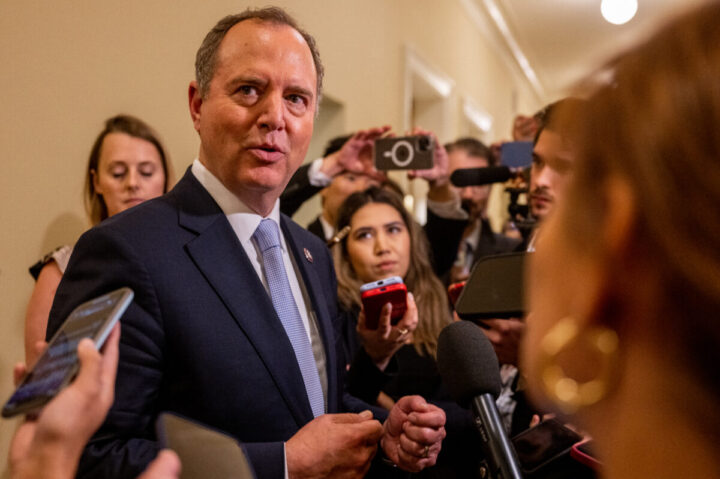
Brandon Bell/Getty Images
Rep. Adam Schiff (D-CA) speaks with reporters after closing remarks during the fifth hearing on the January 6th investigation in the Cannon House Office Building on June 23, 2022, in Washington, D.C.
Every Senate Democrat with the exception of Sen. John Fetterman (D-PA) wrote to President Donald Trump on Tuesday urging him to “reinforce” the White House’s pledge to oppose Israeli annexation of the West Bank.
In a letter led by Sen. Adam Schiff (D-CA), the senators offered their “support for your comments opposing any efforts by the Government of Israel to annex territory in the West Bank and to urge your Administration to promote steps to preserve the viability of a two-state solution and the success of the Abraham Accords.”
The missive was sent weeks after Trump vowed publicly to not allow Israel to annex the West Bank, telling reporters in the Oval Office in late September that, “I will not allow Israel to annex the West Bank, nope, I will not allow it. It’s not gonna happen.”
“Since your plan for Gaza does not address the West Bank, it is imperative that your Administration reinforce your comments and emphasize its opposition to annexation. As longstanding supporters of Israel’s security and Palestinian aspirations for statehood, we are unified in our opposition to unilateral measures by either party that undermine the prospect of lasting peace through negotiations to achieve a two-state solution,” the letter stated.
The senators argued that “any steps by Israel to annex territory or expand settlements that prevent the establishment of a Palestinian state” would be harmful to the peace process.
“Such steps have elicited deep concern and opposition from Arab partners and place at risk your past achievements under the Abraham Accords and the possibility of expanding them further,” they wrote. “At the same time, terrorism, including the horrific terrorist attack of Oct. 7, 2023, must be uniformly condemned and will not bring the region closer to peace.”
“It is essential that the United States reject measures that undermine the viability of a negotiated resolution to the Israeli-Palestinian conflict,” the letter continued.
The bipartisan duo urged university leaders to ‘commit to ensuring Jewish institutions on your campus are equipped to protect the students they serve’
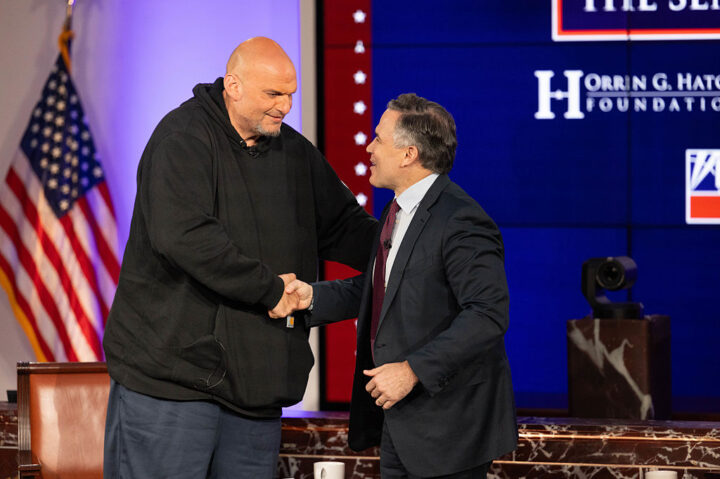
Scott Eisen/Getty Images
U.S. Senators John Fetterman (D-PA) and David McCormick (R-PA) shake hands after the sixth installment of The Senate Project moderated by FOX NEWS anchor Shannon Bream at the Edward M. Kennedy Institute for the United States Senate on June 2, 2025 in Boston, Massachusetts.
With the 2025-26 school year kicking off, Sens. Dave McCormick (R-PA) and John Fetterman (D-PA) wrote to the presidents of five Pennsylvania universities urging them to work with their Jewish communities to ensure Jewish students’ safety and ability to participate in campus life.
McCormick and Fetterman wrote the letters to the presidents of Lehigh University, Pennsylvania State University, the University of Pennsylvania, the University of Pittsburgh and Temple University, and suggested in part that the schools should cover additional security expenses incurred by campus Jewish organizations.
“We write to you to urge you, as a leader of a Pennsylvania university with a large Jewish student population, to commit to ensuring Jewish institutions on your campus are equipped to protect the students they serve, including by allocating the resources to do so,” the lawmakers wrote. “It is incumbent on all of us — especially our nation’s universities — to ensure vibrant Jewish life is not compromised or driven into the shadows.”
They urged the college presidents to “work with your campus’s Jewish institutions and ensure all students, regardless of their race, ethnicity, or shared ancestry, are safe and able to fully participate in campus life.”
The senators noted that antisemitic harassment and violence has plagued Jewish communities and institutions on campuses in the state, that “many Jewish institutions have been forced to cover the costs of additional security” and that students have been forced to hide their Judaism.
McCormick and Fetterman told the schools that “no students should feel like they must risk their safety” to practice their religion and that institutions such as Hillel and Chabad should not be forced to divert funding from programs toward security expenses.
They praised some Pennsylvania schools for taking steps to enforce their campus policies, break up encampments and suspend student groups involved in antisemitic activity.
‘It was just astonishing to see colleagues criticizing these things,’ Fetterman told JI
Lev Radin/Pacific Press/LightRocket via Getty Images
Senator John Fetterman speaks during the grand opening of The Altneu synagogue.
Sen. John Fetterman (D-PA) criticized his Democratic colleagues in Congress who have spoken out against Israel’s attack on Iran, calling it “astonishing” to see members of his party treat Israel’s actions as escalatory.
Fetterman spoke to Jewish Insider on Friday for an interview in the wake of Israel launching its military operation to take out Iran’s nuclear facilities and prevent the regime from acquiring a nuclear weapon.
The Pennsylvania senator said he could not fathom how some Democrats on Capitol Hill could accuse the Jewish state of launching the strikes to upend the Trump administration’s nuclear negotiations with Tehran.
Fetterman didn’t mention any of his Democratic colleagues by name, but many have been critical of the Iranian strikes. Sen. Chris Murphy (D-CT), for instance, went on MSNBC’s “Morning Joe” Friday morning and said that Israel’s strike on Iran was “pretty transparent that this was an effort to submarine, to undermine our diplomacy.”
“It was just astonishing to see colleagues criticizing these things. It’s like, do you think you can negotiate with that regime? Do you think you want to run that scenario and allow them to acquire 1,000 pounds of weapons grade uranium? I can’t understand, I can’t even begin to understand that,” Fetterman told JI.
“I can’t imagine why they would say that. Remember, Iran tries to acquire nuclear weapons. Iran has created and spent billions of dollars to build those destructive proxies like Hamas or Hezbollah or the Houthis. Why can’t we talk about that? Why can’t we talk about the absolute imperative to keep Iran accountable for what they’ve done? That’s exactly part of what Israel did last night, as well,” he continued.
The Pennsylvania Democrat praised the opening salvos of the operation as “absolutely spectacular,” citing the “precision in targeting people.”
”They eliminated the generals and those scientists in their beds at their building, and they didn’t take out the whole building. It was just their specific apartments. I mean, that is truly remarkable. … It’s like Beepers 2.0, the kind of things they’ve done. Like I said, I am constantly blown away by the sophistication and their lethality,” Fetterman said, referring to the Israeli pager operation that took out senior Hezbollah leaders.
“I think I might have been the only one openly calling for that [striking the nuclear facilities now]. I’m never going to negotiate with that regime. You can never trust them, and the only thing they’re going to respond to, that they respect, are exactly the kind of things that [Israel] did last night. … Any potential path for an enduring peace in the Middle East, these are the kind of steps that do that,” he added.
Fetterman disputed the narrative that the U.S. supporting Israel in targeting Iran’s nuclear facilities could increase the prospect of a regional war. “If Iran is going to take their big, big swing, they would have done that by now. Just imagine how exposed they are, even how [exposed] they were earlier this year after what Israel had done taking out Hezbollah,” he told JI.
“Hezbollah ain’t talking tough anymore. They’re not talking about any kinds of actions, they’re just whimpering, and that’s my point. Iran can’t fight for s**t. … They just shot their big shot, a couple junkie rockets, and it’s like, that’s what you’ve got?” Fetterman asked.
Blumenthal: ‘Our bipartisan effort seeks to strengthen measures to bring long overdue justice to families whose cherished art was brazenly stolen by the Nazis’

J. Scott Applewhite/AP Photo
Sen. John Cornyn, R-Texas, center, is flanked by Senate Judiciary Committee Chairman Dick Durbin, D-Ill., left, and Sen. Richard Blumenthal, D-Conn., at the Capitol in Washington, Thursday, Nov. 14, 2024.
Sens. John Cornyn (R-TX) and Richard Blumenthal (D-CT) introduced bipartisan legislation last week aimed at eliminating loopholes used by museums and other stakeholders to continue possessing Nazi-looted artwork that Jewish families have been trying to recover.
Introduced on Thursday, the Holocaust Expropriated Art Recovery (HEAR) Act would expand on Cornyn’s 2016 legislation of the same name, which was passed at the time by unanimous consent, by ending the Dec. 31, 2026, sunset date on the original bill and strengthen the existing procedural protections to ensure that victims’ claims are not dismissed due to non-merit-based factors such as time constraints.
“The artwork wrongfully ripped from Jewish hands during the Holocaust bears witness to a chapter in history when evil persisted and the worst of humanity was on full display. I’m proud to introduce this legislation to support the Jewish people and Holocaust survivors by helping them recover art confiscated by the Nazis that they are rightfully owed and give them the justice and restitution they deserve,” Cornyn said in a statement.
“The theft of art by the Nazi regime was more than a pilfering of property — it was an act of inhumanity. Our bipartisan effort seeks to strengthen measures to bring long overdue justice to families whose cherished art was brazenly stolen by the Nazis,” Blumenthal said.
Many families of Holocaust victims in the U.S. who have located artwork from deceased relatives and sued to recover those items face the deadline at the end of next year before the statute of limitations sets in. Thousands of stolen works of art remain unreturned to their rightful owners from the Nazi plunder, and there are scores of ongoing cases to resolve disputes over ownership of those items.
“Unfortunately, many museums, governments, and institutions have contradicted Congress’ intent and obstructed justice by stonewalling legitimate claims, obscuring provenance, and employing aggressive legal tactics designed to exhaust and outlast Survivors and their families. Rather than embracing transparency and reconciliation, too many have chosen to entrench and litigate, effectively preserving possession of stolen works rather than returning them to their rightful owners,” a press release for the bill states.
Sens. Thom Tillis (R-NC), Cory Booker (D-NJ), Marsha Blackburn (R-TN), John Fetterman (D-PA), Eric Schmitt (R-MO) and Katie Britt (R-AL) co-sponsored the bill, which was endorsed by a number of Jewish organizations including Agudath Israel of America, the American Jewish Committee, Anti-Defamation League, Jewish Federations of North America, StandWithUs and World Jewish Congress, among others.
“This legislation helps to right a historic wrong committed during one of the darkest chapters in history. By eliminating unnecessary legal obstacles, the HEAR Act establishes a clear path to restitution for Holocaust survivors and their families, ensuring that art and cultural property stolen by the Nazis can finally be returned to their rightful owners,” Tillis said.
Fetterman said in a statement, “Eighty years after the Holocaust, we have a moral responsibility to do right by the victims of these atrocities and their families. I’m grateful to join my colleagues from both sides of the aisle in introducing the HEAR Act to help return artwork stolen by the Nazis to its rightful owners.”
Sen. John Fetterman asked members of the left, ‘Why can’t you just call it [antisemitism] what it is?’
Tom Williams/CQ-Roll Call, Inc via Getty Images
Sen. John Fetterman (D-PA) talks with reporters after the Senate luncheons in the U.S. Capitol on Tuesday, March 11, 2025.
Pro-Israel leaders in the United States on Thursday connected the murder of two Israeli Embassy employees outside the Capital Jewish Museum in Washington to the anti-Israel advocacy seen on the political extremes throughout the country since the Oct. 7, 2023, attacks, characterizing it as a culmination of such rhetoric and, in some cases, the failure of some politicians to denounce it.
The suspected shooter, Elias Rodriguez, shouted “free, free Palestine” and “I did it for Gaza” following the shooting, according to an eyewitness and video from the arrest. He reportedly published a manifesto railing against Israel.
Sen. John Fetterman (D-PA) said that the attack should be a signal to the left that it needs to rethink its rhetoric on Israel and Zionism. He compared the anti-Israel movement in the United States to a “cult” that has been stoked online and is using inherently violent slogans while its members “try to hide behind this idea that it’s free speech to intimidate and terrorize members of the Jewish community.”
He said that too many on the left have failed to call out antisemitism in the anti-Israel movement.
“Why can’t you just call it what it is, and then address and assert the pressure on the aggressor,” which is Hamas,” Fetterman said. “I can’t even imagine having to live with that ever-present antisemitism and what? Why can’t people just acknowledge and call that what it is?”
Fetterman predicted that the same elements of the left that have supported Luigi Mangione, the alleged assassin of UnitedHealthcare CEO Brian Thompson, will also rally behind Rodriguez.
“What part of my party does this come from where it’s like, we try to defend or try to justify assassinating an executive in broad daylight or … somebody [who] guns down” two people at a Jewish event, Fetterman asked incredulously.
Israeli Ambassador Yechiel Leiter connected the shooting to the anti-Israel protests seen on college campuses and elsewhere in the country.
“The point of the matter is that on campuses around this country, where ideas — these are the temples of ideas — where smart ideas, intelligent ideas, moral ideas, truthful ideas, are supposed to be taught, we have useful idiots running around in support of the destruction of Israel,” Leiter said at a press conference.
“This is done in the name of a political agenda to eradicate the State of Israel,” Leiter added. “The State of Israel is now fighting a war on seven fronts. This is the eighth front, a war to demonize, delegitimize, to eradicate the right of the State of Israel to exist.”
He also connected rising global antisemitism to countries like France that have spoken out against Israel and are moving to recognize a Palestinian state.
A coalition of 42 Jewish organizations, in a statement, described the murders as “the direct consequence of rising antisemitic incitement in places such as college campuses, city council meetings, and social media that has normalized hate and emboldened those who wish to do harm.”
William Daroff, the CEO of the Conference of Presidents of Major American Jewish Organizations, said on X, “There is a direct line between demonizing Israel, tolerating antisemitic hate speech in the public square, and violent action.”
“We are now witnessing the deadly consequences of months of relentless antisemitic incitement — amplified by international organizations and political leaders across the globe — since the horrors of October 7,” Daroff said. “This is not a debate over policy; it is the mainstreaming of hatred, and its consequences are measured in blood.”
Rep. Josh Gottheimer (D-NJ) said on X the attack was “the deadly consequence of normalizing Jew-hatred.”
“Since October 7, antisemitic attacks have surged — fueled by violent chants to ‘globalize the intifada’ and slurs like ‘dirty Zionist,’” Gottheimer said.
Rep. Ritchie Torres (D-NY), highlighting a tweet from a local anti-Israel group that praised the attack, said that, “Violence is not a bug but a feature of virulent Anti-Zionism.”
Arizona state Rep. Alma Hernandez called out a series of progressive lawmakers, saying, “spare us the fake outrage.”
“Two Israeli diplomats were murdered in cold blood—and you dare act concerned? Y’all have spent years fueling the hate and antisemitism that’s now exploding across America. Don’t pretend to care,” Hernandez continued, in an X post. “You are constantly surrounded by keffiyehs and “Free Palestine” and have pushed rhetoric that’s radicalized Americans into thinking murdering Jews and harassing them in the streets will somehow “liberate” Palestine and end the so-called genocide. No thanks.”
“We don’t want prayers from politicians who support individuals and organizations that promote this hate and who are being actively supported by said individuals and organizations while they run for office,” Hernandez added.
“You can’t support chants of ‘Globalize the Intifada’ and then be ‘appalled’ when people act it out,” Georgia state Rep. Esther Panitch said on X in response to a statement on the attack from Rep. Ilhan Omar (D-MN) that did not acknowledge that the victims worked for the Israeli embassy and condemned “violence” broadly. Panitch also criticized other progressive Democrats who issued statements on the attack.
Panitch added, “Fascinating that those who campaigned against the Jewish community’s right to define their own experience of antisemitism are the ones who call ‘Globalizing the Intifada’ peaceful protests. The same ones who can’t say the word antisemitism in their posts.”
Jordan Acker, the University of Michigan regent who has been repeatedly targeted with antisemitic harassment and vandalism, drew a direct line between those incidents and demonstrations on the University of Michigan’s campus, and the Wednesday night murders.
“This isn’t protest. It’s a threat. This is what antisemitism looks like — and it’s escalating,” Acker said. “This is part of a terrifying trend: Jews in America being hunted, harassed, and attacked for being visibly Jewish — for existing in public. When we call it antisemitism, we’re told we’re overreacting. That our fear is political. That our pain is inconvenient. We’ve been gaslit for 18 months. Enough.”
He also called out progressives directly, saying “antisemitism isn’t any less dangerous when it comes wrapped in ‘progressive’ language.”
In response to the attack, some of the most prominent far-left critics of Israel on Capitol Hill have offered what many in the Jewish community have seen as half-hearted and inadequate responses.
“My heart breaks for the loved ones of the victims of last night’s attack in D.C. Nobody deserves such terrible violence. Everyone in our communities deserves to live in safety and in peace,” Rep. Rashida Tlaib (D-MI) said, linking to an article highlighting that the victims, Sarah Milgrim and Yaron Lischinsky, were Israeli Embassy workers, but not noting their backgrounds or the circumstances of the shooting in her own post.
Omar noted that the shooting took place at the Capital Jewish Museum but did not acknowledge the victims’ backgrounds and condemned violence broadly.
“I am appalled by the deadly shooting at the Capital Jewish Museum last night. Holding the victims, their families, and loved ones in my thoughts and prayers,” Omar said. “Violence should have no place in our country.”
Plus, Rubio, Cruz talk Trump Iran policy

REBECCA DROKE/AFP via Getty Images
Pittsburgh Mayor Ed Gainey speaks ahead of Vice President Kamala Harris at a campaign rally outside Pittsburgh, Pennsylvania on November 4, 2024.
Good Wednesday morning.
In today’s Daily Kickoff, we break down a new Anti-Defamation League report on antisemitism at independent K-12 schools, and report on Corey O’Connor’s victory yesterday in Pittsburgh’s mayoral primary. We report on the increasing pressure on Israel over its conduct in Gaza, cover Secretary of State Marco Rubio’s first appearance on Capitol Hill since being confirmed, and highlight remarks made by Sens. Ted Cruz and John Fetterman to NORPAC members. Also in today’s Daily Kickoff: Lishay Lavi Miran, Sen. Andy Kim, and Reps. Debbie Wasserman Schultz and Dan Goldman.
What We’re Watching
- South African President Cyril Ramaphosa and President Donald Trump will meet at the White House today, with new trade agreements on the agenda amid strained ties between the two countries.
- The Combat Antisemitism Movement and the Jewish Federations of North America will host the Annual Jewish American Heritage Month Congressional Breakfast on Capitol Hill today, with a keynote address from Bruce Pearl, head coach of the Auburn men’s basketball team.
- The House Appropriations Committee will hold separate budget hearings with testimony from Education Secretary Linda McMahon and Secretary of State Marco Rubio.
- The House Foreign Affairs Committee will also hold a hearing with Rubio on “Fiscal Year 2026 State Department Posture: Protecting American Interests.”
- The Senate Committee on Health, Education, Labor and Pensions will hold a hearing on “The State of Higher Education” with witnesses including Dr. Andrew Gillen, a research fellow at the Cato Institute; Dr. Michael Lindsay, president of Taylor University; Dr. Mark Brown, president of Tuskegee University; Mike Pierce, executive director of the Student Borrower Protection Center; and Dr. Russell Lowery-Hart, chancellor of the Austin Community College District.
- The Qatar Economic Forum continues today in Doha, with speakers including Donald Trump Jr.; Steve Mnuchin, former U.S. treasury secretary; Mark Attanasio, principal owner of the Milwaukee Brewers; John Micklethwait, editor-in-chief of Bloomberg; and Hassan Al-Thawadi, former secretary general at Supreme Committee for Delivery and Legacy for the 2022 FIFA World Cup.
What You Should Know
A QUICK WORD WITH JI’S hALEY COHEN
A new Anti-Defamation League report puts a spotlight on episodes of antisemitism in K-12 non-Jewish independent schools, a trend that doesn’t get as much attention as the higher-profile incidents on college campuses but is affecting Jewish students in critical ways.
The study found antisemitic incidents in independent schools down 26% in 2024, compared to 2023, but still up significantly since the Oct. 7 Hamas attacks. There were only 494 documented incidents of antisemitism in independent schools in 2022; that number has nearly doubled to 860 in 2024.
A quarter of surveyed parents said their children experienced/witnessed antisemitic symbols (such as swastikas) in school.
The research was conducted through four focus groups and a survey of 369 parents of Jewish children in independent K-12 schools across 21 states. The ADL told Jewish Insider‘s Haley Cohen it selected independent schools to evaluate since they operate outside of the oversight of public education and therefore have greater autonomy in shaping their curricula, policies and disciplinary procedures.
In addition to expressing concern over antisemitic symbols, nearly one-third of parents reported anti-Jewish and anti-Israel curricula featuring more prominently in their children’s classrooms since the Oct. 7, 2023, terrorist attacks. They’re also deeply dissatisfied with administrators’ responses to antisemitism: Of the parents surveyed who were aware of antisemitism in their child’s school, 34% said the school’s response was either “somewhat” or “very” inadequate.
One bit of encouraging news: A sizable majority of students at these schools (64%) said they felt “very comfortable” showing their Jewish identity at schools, with only 8% feeling somewhat or very uncomfortable with doing so. But there were isolated episodes of student discomfort, including one parent saying their son avoided wearing a Star of David necklace.
Another notable trend: Many independent school parents voiced concern that diversity, equity and inclusion frameworks do not include Jewish identity and antisemitism. They view the exclusion as a fundamental flaw of the programming rather than an oversight and described a pattern in which Jewish identity was omitted altogether from DEI conversations or misrepresented to perpetuate bias.
And parents are voting with their feet: There’s been an increase in Jewish day school enrollment in recent years.
But for those Jewish students who remain in independent schools, the ADL said it’s launching a new initiative to hold schools accountable and support families. “These independent schools are failing to support Jewish families,” Jonathan Greenblatt, the group’s CEO, said. “By tolerating — or in some cases, propagating — antisemitism in their classrooms, too many independent schools in cities across the country are sending a message that Jewish students are not welcome. It’s wrong. It’s hateful. And it must stop.”
GAINEY’S GOODBYE
O’Connor ousts Gainey in heated Pittsburgh mayoral primary

Corey O’Connor prevailed in his bid to oust Mayor Ed Gainey of Pittsburgh in the Democratic primary on Tuesday, dealing a major blow to the activist left in a city where progressives had until recently been ascendant. O’Connor, the Allegheny County controller and a centrist challenger, defeated Gainey, the first-term incumbent aligned with the far left, by a significant six-point margin, 53-47%, on Tuesday evening with most of the vote counted, Jewish Insider’s Matthew Kassel reports.
Victory post: “We built this campaign with and for the people of this city, neighborhood by neighborhood,” O’Connor said in a social media post on Tuesday night. “I’m proud to be your Democratic nominee for Mayor. I’m ready to get to work, and I’m grateful to have you with me as we take the next steps forward, together.”
WAITING FOR OMRI
An Israeli mom’s NYC mission to free husband from Hamas captivity

Every morning, Lishay Lavi Miran’s toddler daughters ask her the same two questions: Why is daddy still in Gaza and when is daddy coming home? In a desperate attempt to provide answers, Miran spent the past week in New York City — her first time in the U.S. — advocating for the release of her husband, Omri Miran, who was kidnapped from their home in Kibbutz Nahal Oz during the Oct. 7, 2023, terrorist attacks and has remained in Hamas captivity for nearly 600 days. In an interview with Jewish Insider’s Haley Cohen during her visit to the states, which concluded on Tuesday, Miran said that her message to the American Jewish community is that its advocacy efforts have provided a “warming sense of hope.”
Now and then: The family received the first sign of life from Omri in April when Hamas terrorists published a video in which he is seen walking through a tunnel in Gaza. The video was released right around his 48th birthday. “It was difficult to see him in those conditions,” Miran told JI during her visit to the states, which concluded on Tuesday. The “exhausted” man in the video was a contrast to the guy known for having “the biggest smile in the world and spark in his eyes,” as Miran describes her husband.
foreign policy in focus
Rubio: Iranian proxy terrorism hasn’t been part of negotiations with Iran

Secretary of State Marco Rubio said in his first appearance on Capitol Hill since being confirmed as secretary of state that Iran’s support for regional terrorist proxies has not been part of the ongoing talks between the Iranian government and Middle East envoy Steve Witkoff, which Rubio said have been focused wholly on Iran’s nuclear program and enrichment capabilities. At the same time, Rubio insisted that any sanctions related to terrorist activity and weapons proliferation would remain in place if such issues are not part of the nuclear deal, Jewish Insider’s Marc Rod reports.
What this means: Rubio’s comments indicate the deal might still be subject to what some critics in the United States and the region described as a key flaw of the original nuclear deal — that it failed to address other malign activity by the regime. One U.S. lawmaker who traveled to the Middle East recently said that U.S. partners in Israel and the Arab world had argued that any deal must include non-nuclear provocations. Rubio added that sanctions will remain in place until a deal is reached, and that European partners are working separately on re-implementing snapback sanctions, potentially by October of this year, when such sanctions expire. He also said that Iran cannot have any level of nuclear enrichment under a nuclear deal, as it would inevitably provide a pathway for Iran to enrich to weapons-grade levels.
Read the full story here with Rubio’s additional remarks on Iran, Gaza and Syria.
TED TALK
Ted Cruz expresses concern about influence of some Trump officials on Iran policy

Sen. Ted Cruz (R-TX) said on Tuesday that he is concerned about the views of some of the officials in the White House shaping President Donald Trump’s Iran policy, marking the most critical comments yet from the hawkish senator about Trump’s approach to Iran. He urged members of NORPAC, a pro-Israel advocacy organization, to raise the issue in their meetings with anyone in the Trump administration, Jewish Insider’s Gabby Deutch reports.
What he said: “We need clarity with the Trump administration, and as NORPAC talks to the administration, I would say, I worry there are voices in the administration that are not eager to hold up the president’s red line of dismantlement,” Cruz said at NORPAC’s annual Washington lobbying mission, referring to mixed messaging from some U.S. officials on the acceptable contours of a potential new nuclear agreement with Iran.
Also during NORPAC’s mission: Sen. John Fetterman (D-PA), who is facing attacks from the media and fellow lawmakers in the Democratic Party, hit back at members of his own party. Speaking to members of NORPAC, Fetterman offered some of his sharpest criticism yet of the Democratic Party’s approach to Israel after the Oct. 7 Hamas attacks. “Israel and your community deserves much better from my party,” Fetterman said, earning loud applause.
RELATIONSHIP RUPTURE
Foreign Minister David Lammy announces suspension of U.K.-Israel free trade agreement

U.K. Foreign Secretary David Lammy announced that Britain has suspended negotiations with Israel on a new free trade agreement and will be “reviewing cooperation,” a day after the U.K., France and Canada threatened to take “concrete actions” and impose sanctions on Israel over its policies on humanitarian aid in Gaza and settlement activity in the West Bank, Jewish Insider’s Danielle Cohen and Lahav Harkov report.
Upping the pressure: Lammy, speaking to British lawmakers in the House of Commons on Tuesday, said the “Netanyahu government’s actions have made this necessary,” describing the lack of humanitarian aid entering Gaza as “intolerable” and “abominable.” He said that Tzipi Hotovely, the Israeli ambassador to the U.K., has been summoned to the U.K. Foreign Office, where Middle East Minister Hamish Falconer will tell her that “the 11-week block on aid to Gaza has been cruel and indefensible” and that “dismissing concerns of friends and partners … must stop.” Lammy also announced that the British government will impose sanctions on three individuals and four entities with ties to settlements in the West Bank, which the U.K., France and Canada called “illegal” in their joint statement.
Meanwhile in Brussels: The EU’s foreign policy chief, Kaja Kallas, said that Brussels will review whether Israel is violating the human rights clause of the EU-Israel Association Agreement, which governs the high-level political and economic ties between the sides. Dutch Foreign Minister Caspar Veldkamp proposed the review with the backing of 17 of 27 EU members; however, a policy change would require unanimity within the bloc.
And from the Vatican: Pope Leo XIV appealed this morning “to allow the entry of dignified humanitarian aid and to put an end to the hostilities, whose heartbreaking price is paid by the children, elderly, and the sick.
kim’s call
Sen. Andy Kim urges Homeland Security Secretary Noem to protect Nonprofit Security Grant Program funding

Sen. Andy Kim (D-NJ) pressed Homeland Security Secretary Kristi Noem for clarification of her department’s plans regarding the Nonprofit Security Grant Program as the Trump administration considers cuts to the Federal Emergency Management Agency, Jewish Insider’s Emily Jacobs reports. Kim and Noem engaged on the issue while the latter was testifying before the Senate Homeland Security and Governmental Affairs Committee on Tuesday. Kim, the top Democrat on the HSGAC subcommittee that oversees FEMA, urged Noem to ensure NSGP funding is not reduced or eliminated outright as part of President Donald Trump’s push to abolish FEMA, citing the program’s success rate with New Jersey synagogues amid rising antisemitism.
Making the case: “I think that there’s very strong bipartisanship here in Congress, especially the Senate, to protect the Nonprofit Security Grant Program. It is literally the best tool that people in New Jersey are telling me is needed to be able to counter antisemitism. I can’t tell you the number of synagogues and temples that are lined up to try to get this type of funding. In fact, you know, given the rise of antisemitism that we have in our country right now, we should be surging resources, not cutting,” Kim said.
Worthy Reads
A Tale of Two New York City’s: New York magazine’s E. Alex Jung writes about the stark contrast between Andrew Cuomo and Zohran Mamdani in the New York City mayoral primary. “Their respective campaigns are striking foils: Cuomo, who at 67 would become the oldest incoming mayor of New York City ever, has stayed out of the public eye while racking up endorsements from major labor unions. When he does appear, he’s working the Black church circuit. He knows that the path to the Democratic nomination has historically gone through Black and Latino voters, mostly in Southeast Queens and Central Brooklyn. In one simulation, Cuomo is winning those communities by 91 percent and 72 percent by the final round, respectively. To the ire of white liberals, he has a broad multi-racial coalition. While Mamdani is seemingly everywhere in the city, running from protests to rallies to galas, his base is largely white college-educated Brooklynites, with much of his early efforts going toward activating South Asian and Muslim voters, who have traditionally been ignored. ‘Zohran is Cuomo’s wet-dream opponent,’ says one anti-Cuomo Democratic strategist. ‘Supported by online kids, on the record for “defund,” on the record about Palestine, and little support in Black or Latino communities.’” [NYMag]
Sam (A)I Am: In a New Yorker review of two new books on Sam Altman and the future of AI, Benjamin Wallace-Wells considers the OpenAI founder’s Midwestern Jewish roots. “Within the world of tech founders, Altman might have seemed a pretty trustworthy candidate. He emerged from his twenties not just very influential and very rich (which isn’t unusual in Silicon Valley) but with his moral reputation basically intact (which is). Reared in a St. Louis suburb in a Reform Jewish household, the eldest of four children of a real-estate developer and a dermatologist, he had been identified early on as a kind of polymathic whiz kid at John Burroughs, a local prep school. “His personality kind of reminded me of Malcolm Gladwell,” the school’s head, Andy Abbott, tells [Keach] Hagey [author of The Optimist: Sam Altman, Open AI, and the Race to Invent the Future]. ‘He can talk about anything and it’s really interesting’ — computers, politics, Faulkner, human rights.” [NewYorker]
Under African Skies: The Foundation for Defense of Democracies senior director Elaine Dezenski and senior research analyst Max Meizlish offer a warning about South Africa’s anti-American activity in the run-up to South African President Cyril Ramaphosa’s meeting with Trump today. “South Africa isn’t an innocent, neutral party. It is playing both sides — courting the West while deepening its ties to China, Russia and Iran. Its leaders speak the language of nonalignment, but their actions tell a different story: They’ve welcomed Hamas and Hezbollah officials, hosted sanctioned Russian warships and worked with entities tied to Iran’s Islamic Revolutionary Guard Corps … South Africa’s conduct is not just inconsistent with American values — it’s increasingly incompatible with US national security. Under Ramaphosa, the ANC has intensified its lawfare campaign against Israel at the International Court of Justice, ramped up efforts to diplomatically isolate Taiwan, and embraced Beijing’s narrative on global governance by joining the China-led BRICS group. The ANC’s historical alignment with authoritarian powers is no secret — but today, it’s backed by real material support. That should concern every serious policymaker in Washington.” [NYPost]
The Illiberal Left, and Right: The Liberal Patriot’s executive editor, John Halpin, considers the future of American liberalism. “Instead of pragmatic, universal solutions to the problems of working- and middle-class Americans, Democrats after Obama went off on extreme ideological tangents and illiberal fads from structural racism and transgender ideology to decriminalization and open borders to the socialist ‘Green New Deal’ and other radical climate policies. Notably, all of these illiberal ‘ideas’ produced significant public backlash from a wide array of American voters and are now in the process of being dismantled or disregarded. On the Republican side, the traditional party of Reagan has basically discarded all its past social and economic liberal commitments in favor of Trump’s peculiar blend of command-and-control tariff and trade policies, unrestrained executive authority, withdrawal from global allies and international security arrangements, and the use of governmental legal and bureaucratic authority to attack and prosecute perceived enemies. ‘Postliberal’ ideas that explicitly reject individualism as the foundation of American life are now dominant in a party that feels the need ‘to be really ruthless when it comes to the exercise of power,’ according to Vice President JD Vance.” [LiberalPatriot]
Word on the Street
President Donald Trump is reportedly frustrated by the continuing war in Gaza and has instructed his aides to tell Israeli Prime Minister Benjamin Netanyahu to “wrap it up,” White House officials told Axios…
Netanyahu’s office announced yesterday that the senior members of the ceasefire and hostage-release negotiating team had been recalled from Doha, Qatar, while the working echelon would continue the talks. The PMO statement stressed that Israel had agreed to the U.S. proposal but that Hamas “is continuing to cling to its refusal”…
In an interview published today in The National, Jake Sullivan, the Biden administration’s national security advisor, says of Trump’s relationship with Netanyahu, “It’s not that the balance of power has changed, just the weight and emphasis on who can deliver” …
CNN, citing intelligence from “multiple US officials,” reported that Israel has been making preparations to strike Iranian nuclear facilities, though they stressed it remains unclear if Israeli leaders have made a final decision to do so. In reaction to the story, former Washington Institute for Near East Policy fellow Nadav Pollak wrote on X: “The only surprising part in [the story] is that US officials leaked the fact they monitor Israeli communications.”…
Iranian Supreme Leader Ali Khamenei said on Tuesday that, “I do not think nuclear talks with the U.S. will be successful” and warned, “They should not try to talk nonsense. It is a big mistake to say that we will not allow Iran to enrich. No one is waiting for permission from this or that.”…
Trump announced Tuesday that the United States will move forward on construction of a Golden Dome missile defense system. Trump began calling for a U.S. missile defense shield similar to Israel’s Iron Dome after watching Israel deflect missiles and drones amid Iran’s attacks in 2024…
Democrat Sam Sutton won a special election for a New York state Senate seat, which the GOP had hoped to flip after Trump received 77% of the vote in the district in November. The district encompasses several heavily Orthodox Jewish neighborhoods, and Sutton is a leader of its Sephardic community…
The New York Times confirmed reporting that Trump, through the Pentagon, White House military office and Middle East envoy Steve Witkoff, had initially approached the Qataris about purchasing the luxury Boeing 747 jet for use as Air Force One, rather than it being offered as a gift…
Newly released emails reveal that Joe Kent, chief of staff to Director of National Intelligence Tulsi Gabbard, pressured analysts to revise an intelligence assessment to align with Trump’s claim that Venezuela’s government controls a criminal gang…
Elon Musk told attendees at the Qatar Economic Forum that he doesn’t plan to spend money on elections in the future. “I think I’ve done enough,” he said…
Secretary of State Marco Rubio and Sen. Chris Van Hollen (D-MD) clashed in a heated exchange during a Senate hearing Tuesday. “I regret voting for you for secretary of state,” Van Hollen said. “Your regret for voting for me confirms I’m doing a good job,” Rubio responded…
Sen. Peter Welch (D-VT) sought unanimous consent to call up a resolution pushing the administration to work to resume U.S. aid to Gaza, which is sponsored by nearly all Senate Democrats. Sen. Jim Risch (R-ID) blocked the effort…
The United Arab Emirates said yesterday that it will send urgent humanitarian aid to Gaza, after UAE Foreign Minister Sheikh Abdullah bin Zayed and his Israeli Foreign Minister Gideon Sa’ar spoke on the phone…
The U.S. and Turkey released a joint statement on the U.S.-Turkey Syria Working Group’s most recent meeting held in Washington, which included discussions on “shared priorities in Syria, including sanctions relief according to President Trump’s directive and combatting terrorism in all its forms and manifestations”…
Sens. Elizabeth Warren (D-MA), Ron Wyden (D-OR) and Bernie Sanders (I-VT) sent a letter to Paramount Global Chair Shari Redstone expressing their concern that CBS News may be engaging in “improper conduct” and violating anti-bribery law in its effort to settle a lawsuit with Trump that will potentially block Paramount’s intended merger with Skydance…
Trump called Rep. Thomas Massie (R-KY) a “grandstander” who “should be voted out of office” over Massie’s opposition to his budget bill. Massie, a longtime opponent of aid to Israel and legislation to combat antisemitism, is mulling a statewide run for Senate or governor in Kentucky…
Speaking at a congressional hearing of the Tom Lantos Human Rights Commission on Tuesday, AJC CEO Ted Deutch urged the U.S. to remain engaged in international bodies including the U.N., UNESCO and OSCE and called for Congress to confirm Rabbi Yehuda Kaploun to the role of special envoy to monitor and combat antisemitism and provide $3 million in funding for the office…
New York Times reporter Joseph Bernstein chronicled the life of his father, a “Nazi hunter” with the U.S. Department of Justice in the ‘80s, who was killed in the Pan Am 103 bombing in 1988, and his struggle to find meaning in the resulting decades-long investigation that ultimately led to the currently delayed trial of a Libyan man accused of planting the bomb on behalf of dictator Muammar Gaddafi…
Israeli Strategic Affairs Minister Ron Dermer eulogized his mother, Yaffa Dermer, who died last Sunday at the age of 89. Ron said, “We don’t choose our parents. They are chosen for us. So I thank Hashem for blessing me to have been raised by such an extraordinary mother and teacher. … Over the years, I have had the privilege to serve in prominent positions and hold prestigious titles. But the greatest honor of my life has been to be Yaffa’s son.”…
Eva Wyner, previously deputy director of Jewish affairs for New York Gov. Kathy Hochul, is now serving as the governor’s director of Jewish affairs…
Arthur Maserjian, previously chief of staff at the Combat Antisemitism Movement, is now the senior director of the Combined Jewish Philanthropies’ Center for Combating Antisemitism…
Eric B. Stillman was hired to serve as the next president and CEO of the Florida Holocaust Museum, which will reopen on Sept. 9 following an extensive renovation; Stillman succeeds Mike Igel, who has led the organization as its interim CEO for the past year…
Pic of the Day

Reps. Debbie Wasserman Schultz (D-FL) and Dan Goldman (D-NY) addressed an Anti-Defamation League reception celebrating Jewish American Heritage Month yesterday in Washington.
Birthdays

Northern California-based comedian, he celebrated his bar mitzvah at 52 years old in Israel, Josh Kornbluth turns 66…
Former U.S. senator from Minnesota, he was previously a comedian, actor and writer, Al Franken turns 74… VP of the Swiss Federation of Jewish Communities, Ralph Lewin turns 72… Guitarist and composer, Marc Ribot turns 71… EVP of American Friends of Bar-Ilan University, Ron Solomon… Chief rabbi of Mitzpe Jericho and dean of Hara’ayon Hayehudi yeshiva in Jerusalem, Rabbi Yehuda Kroizer turns 70… CEO of the Boston-based hedge fund Baupost Group, Seth Klarman turns 68… Legal analyst at CNN, Jeffrey Toobin turns 65… Founder and former co-owner of City & State NY, Thomas Allon turns 63… Director of antisemitism education and associate director of the Israel Action Program, both at Hillel International, Tina Malka… Actress, artist and playwright, Lisa Edelstein turns 59… Former head of Dewey Square’s sports business practice, now a freelance writer, Frederic J. Frommer… Author and journalist, she was a reporter with The New York Times for eight years, Amy Waldman turns 56… U.S. cyclist at the 2000 Summer Olympics in Sydney, Australia, she is now the executive director of the New England Mountain Bike Association, Nicole Freedman turns 53… President and CEO of the Michigan-based William Davidson Foundation, Darin McKeever… University chaplain for NYU, Rabbi Yehuda Sarna turns 47… Founder of Agora Global Advisory, Brandon Pollak… EVP and chief legal officer at Sinclair Broadcast Group, David Gibber… Professor of computer science at the University of Texas at Austin, Scott Joel Aaronson turns 44… President of Mo Digital, Mosheh Oinounou… International fashion model for Versace, Sharon Ganish turns 42… Partner at CreoStrat, Steve Miller… Windsurfer who represented Israel in the Olympics (Beijing 2008 and Rio 2016), she is now a SW delivery lead at SolarEdge, Maayan Davidovich turns 37… Player on the USC team that won the 2016 NCAA National Soccer Championship, she is now an associate in the LA office of Foley & Lardner, Savannah Levin turns 30… Comedian, actress and writer, known for starring in the HBO Max series “Hacks,” Hannah Marie Einbinder turns 30… Deputy director at the Yael Foundation, Naomi Kovitz…
BIRTHWEEK: (was Monday): Alex Shapero…
The Pennsylvania Democratic senator’s criticism of his party drew loud applause from pro-Israel activists

Gabby Deutch
Sen. John Fetterman (D-PA) speaks at a NORPAC advocacy event in Washington on May 20, 2025.
As Sen. John Fetterman (D-PA) faces attacks from the media and fellow lawmakers in the Democratic Party, he hit back at members of his own party on Tuesday in remarks to a group of bipartisan activists in Washington.
Speaking to members of NORPAC, a pro-Israel advocacy organization, Fetterman offered some of his sharpest criticism yet of the Democratic Party’s approach to Israel after the Oct. 7 Hamas attacks.
“Israel and your community deserves much better from my party,” Fetterman said, earning loud applause.
He described how American universities have produced a “monoculture that produced, actually, rampant antisemitism,” and called to address it — but suggested Democrats are not interested in doing so.
“We have to address that. But in my party, you will pay a price,” said Fetterman. “That’s OK. I think that’s what defines character … that you’re going to support things even if it moves against your own political interest.”
Several recent reports have suggested that Fetterman is struggling with mental health challenges, which Fetterman has denied.
Plus, Trump's Gulf tour underscores Israel’s diplomatic disadvantage

White House Press Secretary Karoline Leavitt/X
Saudi Crown Prince Mohammed bin Salman, President Donald Trump and Syrian President Ahmed al-Sharaa meet in Riyadh, May 14th, 2025
Good Wednesday morning.
In today’s Daily Kickoff, we report on President Donald Trump’s meeting earlier today with Syrian President Ahmed al-Sharaa, and analyze the findings of a new poll from the Jewish Voter Resource Center. We also talk to Sen. Katie Britt about recent attacks on Sen. John Fetterman, and spotlight the Zachor Legal Institute’s call for the IRS to investigate a key fiscal sponsor of anti-Israel agitators. Also in today’s Daily Kickoff: Dan Senor, former Vice President Mike Pence and Rabbi Noam Marans.
What We’re Watching
- President Donald Trump continues his Middle East trip today as he flies to Qatar this afternoon. Earlier today, Trump met with Gulf Cooperation Council leaders in Riyadh, Saudi Arabia, including a side meeting with Syrian President Ahmed al-Sharaa. Read more about the meeting between Trump and al-Sharaa here.
- The House Homeland Security Committee is holding a hearing this morning with Homeland Security Secretary Kristi Noem.
- The Department of Justice is holding its 32nd Annual Federal Interagency Holocaust Remembrance Program this morning.
- The Israeli American Council is holding a Yom Ha’atzmaut celebration tonight at the Library of Congress.
What You Should Know
A QUICK WORD WITH JOSH KRaushaar
A new poll commissioned by a Democratic Jewish group suggests that concerns over antisemitism have receded a bit since post-Oct. 7 record levels, with younger voters notably less concerned than their parents and older generations. The survey, conducted by GBAO, also finds the depth of attachment for Israel, while still at high levels, has also dipped somewhat as time has passed since Hamas’ attacks, Jewish Insider Editor-in-Chief Josh Kraushaar writes.
The big toplines from the Jewish Voter Resource Center survey, which polled 800 Jewish voters between April 22 and May 1: Only one-quarter of Jewish voters view President Donald Trump favorably. Among respondents, Democrats hold a commanding 70-22% lead on next year’s generic congressional ballot. Israeli Prime Minister Benjamin Netanyahu’s standing among American Jewish voters is also low, with only 34% viewing him favorably, while 61% see him unfavorably.
Over two-thirds (69%) of Jewish voters profess an attachment to Israel, which is down from 82% a month after Oct. 7 but at a similar level to the years preceding the attack. Nearly two-thirds of Jewish respondents (62%) said they’re very concerned about antisemitism — a historically high number, but a marked dropoff from the 79% who expressed the same sentiment in November 2023. Notably, only 33% of younger Jewish voters ages 18-34 said they’re concerned about antisemitism.
Asked whether right-wing or left-wing antisemitism was a bigger threat, respondents were more divided. Nearly half (47%) said right-wing individuals and groups were more responsible, while 34% viewed left-wing groups as a bigger problem. And Democrats fared relatively poorly on which party is better equipped to handle antisemitism, holding just a seven-point edge (34-27%) over Republicans despite a much greater overall partisan advantage.
The most significant takeaway from the survey is the gaping divide within the Jewish community when it comes to Jewish observance — secular and less observant Jews hold diametrically opposing views on many issues compared to their more observant coreligionists.
For instance, 75% of Orthodox Jewish respondents said they approved of Trump’s job performance, compared to only 18% of Reform Jewish voters. While 69% of Orthodox Jews and 60% of Conservative Jews have a “very strong” attachment to Israel, that number falls to 35% among Reform Jews (and 22% among those unaffiliated).
On domestic policy issues, the gap is similar. Most Orthodox voters (78%) favor eliminating DEI initiatives that receive federal funding, while only 21% of Reform respondents say the same. The poll also found two-thirds of Orthodox Jews backing the president’s original punitive tariffs against China, while just 14% of Reform voters agreed.
The results underscore that one of the biggest challenges in both Israel and the United States’ Jewish community is internal divisions that make it harder to present a united front externally. Those divisions are slowly, but notably, percolating even on issues that once united the Jewish world post-Oct. 7.
ON THE SIDELINES
Trump’s Gulf tour underscores Israel’s diplomatic disadvantage

If there was any doubt about President Donald Trump’s increasing reliance on checkbook diplomacy, and his disapproval of America’s past approach to the Middle East, he left little room for dispute in a keynote address on Tuesday in Saudi Arabia that sharply critiqued “interventionalists” and “neo-cons” while calling for an end to regional wars. The message in Trump’s speech, and the optics of a visit to the Middle East that doesn’t include a stop in Israel, were met with concern by pro-Israel Republicans and hawkish foreign policy experts, who worry that his turbo-charged dealmaking with the oil-rich Gulf nations — cemented this week with trade deals in the hundreds of billions of dollars — puts Israel at a diplomatic disadvantage, Jewish Insider’s Gabby Deutch reports.
Dollar signs: “His approach is obviously completely transactional. If he has a view about the U.S. national interest, that view revolves around financial and commercial interests, and that obviously diminishes the value of the alliance with Israel, which is not primarily financial and commercial,” said Elliott Abrams, a former longtime Republican official who served as Iran envoy in Trump’s first term. “It’s based on values. It’s based on military cooperation. It is based also on high-tech cooperation, but Trump seems to be less interested in that and more interested in the dollar signs.”
Presidential address: “The gleaming marvels of Riyadh and Abu Dhabi were not created by the so-called nation-builders, neo-cons, or liberal nonprofits like those who spent trillions failing to develop [Kabul], Baghdad, so many other cities,” Trump said in a speech on Tuesday at a U.S.-Saudi Arabia investment forum event in Riyadh. “In the end, the so-called nation-builders wrecked far more nations than they built and the interventionalists were intervening in complex societies that they did not even understand themselves. Trump also condemned American presidents who “have been afflicted with the focus that it’s our job to look into the souls of foreign leaders and use U.S. policy to dispense justice for their sins.”
AIRING CONCERNS
More Republicans voice concern about Qatari jet, as Dems pursue blocking efforts

A handful of congressional Republicans voiced fresh concerns on Tuesday about President Donald Trump’s plans to accept a gift of a Qatari luxury jet worth $400 million to join the Air Force One fleet, Jewish Insider’s Marc Rod and Emily Jacobs report. Democrats, meanwhile, stepped up their efforts to block the gift.
Growing worries: Senate Majority Leader John Thune (R-SD), expanding on comments he’d made the previous day, said that there “will be plenty of scrutiny” for the transfer if it occurs. “There are lots of issues around that that I think will attract very serious questions if and when it happens.” But he also downplayed the gift as purely “hypothetical” at this point. Sen. Ted Cruz (R-TX) came out more strongly against the gift, saying, “I’m not a fan of Qatar, I think they have a really disturbing pattern of funding theocratic lunatics who want to murder us, funding Hamas and Hezbollah and that’s a real problem. I also think that the plane poses significant espionage and surveillance problems, so we’ll see how this issue plays out, but I certainly have concerns.”
Bonus: Bloomberg looks at the potential security risks associated with Qatar’s proposed gift of a luxury jet to the Trump administration, citing expert concerns over “opportunities for surveilling, tracking or compromising communications.”
FAIR-WEATHER FRIENDS
Sen. Katie Britt slams Democrats for not defending Fetterman

Sen. Katie Britt (R-AL) is criticizing Senate Democrats for declining to challenge media reports about Sen. John Fetterman’s (D-PA) mental health, attributing their reticence to the Democratic senator’s independent approach to Israel and immigration, and his support for several of President Donald Trump’s Cabinet nominees, Jewish Insider’s Emily Jacobs reports.
Independent streak: Britt, who has grown to be one of Fetterman’s closest personal friends in the Senate since both were elected in 2022, raised concerns about the implications of Senate Democrats remaining silent as one of their own is targeted over his highly publicized mental health struggles during National Mental Health Awareness Month. “John has been a voice for Israel. He has been a voice for the Jewish people. He has been willing to take a look at nominees and approach things in a common-sense way. He understands the need for a secure border and interior enforcement. He was out front on the Laken Riley Act. I would say that part of [Democrats’] silence has to do with his independence,” Britt told JI.
STATE OF THE JEWS
Dan Senor: Jewish day schools, summer camps key to thriving U.S. Jewry

Jewish day schools and summer camps as well as gap years in Israel are some of the strongest contributors of a solid Jewish identity — ones that provide the tools that are needed at this precarious moment to “rebuild American Jewish life” — podcast host and author Dan Senor said on Tuesday night as he delivered the 45th annual State of World Jewry address at the 92NY in Manhattan, Jewish Insider’s Haley Cohen reports for eJewishPhilanthropy.
Jewish giving: “But here’s the uncomfortable truth,” Senor said, pointing to a statistic that of the 33 Jewish individuals on the Forbes 400 list with publicly reported charitable giving, no more than 11% of their giving went to Jewish causes. “I am not suggesting Jewish generosity to the broader civic square come to an end,” Senor said. “But I am arguing that it is time for a recalibration in favor of our community’s needs. We need to invest so that we can look back on this moment decades from now and say: American Jewish life was not the same after that. It was better.”
Read the full story here and sign up for eJewishPhilanthropy’s Your Daily Phil newsletter here.
scoop
Syrian diaspora group’s Capitol Hill conference abruptly canceled amid anti-Israel, Assad regime concerns

A Syrian diaspora conference in a House office building meeting room was abruptly canceled on Monday after a lawmaker raised concerns about the group and its leadership, sources familiar with the situation told Jewish Insider’s Marc Rod.
What happened: A member of Congress reserved the room on the group’s behalf, but that member withdrew their sponsorship on Monday after the event had begun, a source said. Per House policy, the group would have been required to leave the room once it lost that sponsorship. The group in question denied that the event had been canceled or disrupted. In the days before the conference, Rep. Joe Wilson (R-SC) wrote to the chair and ranking member of the Committee on House Administration urging them to intervene to cancel the event, citing concerns about alleged ties to the Assad regime and comments the group’s counsel had shared in support of the Houthis and about Israel.
Bonus: Sen. Lindsey Graham (R-SC), a close ally of President Donald Trump, called for a cautious and deliberate approach to removing sanctions on Syria and emphasized that Congress has a significant oversight role to play, hours after Trump announced in a speech in Riyadh that he plans to lift “all” U.S. sanctions on Syria, Jewish Insider’s Marc Rod reports. Reactions from others on Capitol Hill to the news have been decidedly mixed across both parties.
money matters
Antisemitism watchdog calls for IRS to investigate fiscal sponsor of anti-Israel agitators

The Zachor Legal Institute, a legal think tank in Montana focused on combating antisemitism and boycott campaigns against Israel, is calling on the IRS to review the tax-exempt status of a nonprofit group involved in fundraising for pro-Palestinian activism, claiming its fiscal sponsorship of a radical anti-Zionist organization accused of advocating for political violence may be in violation of federal law, Jewish Insider’s Matthew Kassel reports.
The argument: In a complaint filed Wednesday morning, Marc Greendorfer, the president and co-founder of the Zachor Legal Institute, formally urged the IRS to begin an investigation of the WESPAC Foundation, a nonprofit organization based in White Plains, N.Y., over its ties to Within Our Lifetime, an extreme activist group at the forefront of anti-Israel demonstrations across New York City in the wake of Hamas’ Oct. 7, 2023, attacks. “Through its fiscal sponsorship of Within Our Lifetime, a violent, radical and anti-Israel organization, WESPAC may have violated both the public policy doctrine and the illegality doctrine that the IRS uses to analyze and discern whether a 501(c)(3) charitable organization can maintain their tax-exempt status,” Greendorfer wrote in a letter to Michael Faulkender, the acting commissioner of the IRS, arguing that a “thorough investigation” of the matter “is warranted.”
Worthy Reads
Doha’s Dollars: The Free Press’ Jay Solomon and Frannie Block do a deep dive into Qatar’s efforts to establish footholds across American society. “Qatar has spent almost $100 billion to establish its legitimacy in Congress, American colleges and universities, U.S. newsrooms, think tanks, and corporations. Over the past two decades, it has poured those billions into purchases of American-made weapons and business investments ranging from U.S. real estate to energy plants. It built — and still pays for — the Al Udeid Air Base, even as the American wars in Iraq and Afghanistan have ended. Doha finances research and campuses at prestigious American universities. And its lobbyists have the connections needed to open all the right doors in Washington. Since 2017, it has spent $225 million on lobbying and public-relations efforts in the nation’s capital. … The influence built by Qatar in the U.S. has no modern parallel, The Free Press found, whether compared with large American companies seeking to influence antitrust policy, energy firms trying to win new drilling rights, or other foreign governments aiming to shape U.S. policy—or shield themselves from it. For comparison, Qatar spent three times more in the U.S. than Israel did on lobbyists, public-relations advisers, and other foreign agents in 2021 — and nearly two-thirds as much as China did, according to the government’s latest reports.” [FreePress]
Dealmaker or Wrecker?: The Washington Post’s David Ignatius looks at President Donald Trump’s unconventional approach to foreign policy as he balances multiple conflicts and a trade war with China while in the middle of his first trip abroad. “‘America has no ‘permanent enemies,’ Trump said in his discussion of Iran. That simple statement will reverberate across the region, especially in Israel, which views Iran as a deadly adversary. Israeli anxieties might be eased by Trump’s warning that if Iran didn’t agree to a nuclear deal and make peace, it would face ‘massive maximum pressure.’ Trump’s comments in Saudi Arabia cap a remarkable few weeks in which he has bent policies, including his own, to accommodate what he evidently concluded were limits imposed by global reality. … My takeaway: Trump remains a disrupter and a dealmaker — with big ambitions for ending global conflicts and boosting America’s economy. He can also be a wrecker, as in many of his domestic policies that have savaged universities, law firms, medical research, government agencies and anyone on Trump’s retribution list. But abroad, he appears to have recognized the constraints imposed by the financial markets, the resistance of China and other big trading partners, the danger of wasting money on inconclusive wars, and the inescapable fact of global economic interdependence.” [WashPost]
Full-Court Press: In an essay adapted from a speech he gave at the Notre Dame Kellogg Institute for International Studies, New York Times Publisher A.G. Sulzberger reflects on the role a free press plays in society. “And the press is far from the only American institution that finds itself under pressure. We’re seeing direct efforts to go after government agencies, universities, cultural institutions, research organizations, advocacy groups and law firms. We’re even seeing challenges to the authority of Congress and the courts to serve as a check on executive power. Like all of those institutions, the free press is imperfect. And like all of those institutions, the free press is a load-bearing pillar in a free society. … Let me pause to say plainly that as a champion of independent journalism, I believe our job is to cover political debates, not to join them. We’re not the resistance. We are nobody’s opposition. We’re also nobody’s cheerleader. Our loyalty is to the truth and to a public that deserves to know it.” [NYTimes]
Word on the Street
Iranian officials said that Iranian Foreign Minister Abbas Araghchi proposed a joint nuclear-enrichment venture in its negotiations with the U.S.; a representative for Middle East envoy Steve Witkoff denied the report…
Israeli Prime Minister Benjamin Netanyahu and Witkoff held a meeting on Wednesday in Jerusalem, the second time in three days the two have met…
Speaking at an event hosted by the Buckley Institute, former Vice President Mike Pence expressed “concerns” about the Trump administration’s revocation of Harvard’s tax-exempt status, stating, “What’s good for the goose is good for the gander. If we establish the precedent of taking away tax-exempt status from certain institutions that reflect discriminatory practices or antipathy toward right-wing views, we might find ourselves in an America where subsequent administrations think the same”…
The Trump administration announced it is cutting an additional $450 million in federal grants to Harvard, citing the school’s “pervasive race discrimination and anti-Semitic harassment”…
Former Transportation Secretary Pete Buttigieg said he would “assess” a 2028 presidential run, after declining to mount bids for Senate and governor in Michigan, where he resides…
A legal watchdog group sent a warning letter to Microsoft on Monday alleging that it is violating Title VII of the Civil Rights Act of 1964 by refusing to recognize a Jewish Employee Resource Group, Jewish Insider’s Haley Cohen has learned…
Brownstein Hyatt Farber Schreck hosted a 30th anniversary reception in its new office in Washington; speaking to the dozens of Capitol Hill legislators in attendance — including Senate Minority Leader Chuck Schumer (D-NY), , Chair John Barrasso (R-WY), NRSC Chair Tim Scott (R-SC), Sens. Michael Bennet (D-CO), Mitch McConnell (R-KY), Richard Blumenthal (D-CT), Ted Budd (R-NC), Susan Collins (R-ME), Chris Coons (D-DE), Steve Daines (R-MT), Tammy Duckworth (D-IL), Deb Fischer (R-NE), Kirsten Gillibrand (D-NY), Maggie Hassan (D-NH), John Hickenlooper (D-CO), Ron Johnson (R-WI), Tim Kaine (D-VA), Amy Klobuchar (D-MN), James Lankford (R-OK), Cynthia Lummis (R-WY), Ben Ray Luján (D-NM), Ed Markey (D-MA), David McCormick (R-PA), Jeff Merkley (D-OR), Jerry Moran (R-KS), Alex Padilla (D-CA), Gary Peters (D-MI), Jack Reed (D-RI), Jim Risch (R-ID), Mike Rounds (R-SD), Tina Smith (D-MN), Dan Sullivan (R-AK), Thom Tillis (R-NC) and Sheldon Whitehouse (D-RI); House Minority Leader Hakeem Jeffries (D-NY), Reps. Nancy Pelosi (D-CA), Rosa DeLauro (D-CT), Steny Hoyer (D-MD), Jeff Hurd (R-TX), Lisa McClain (R-MI), Chris Pappas (D-NH), Greg Stanton (D-AZ), Ritchie Torres (D-NY), Rob Wittman (R-VA) and Ann Wagner (R-MO) as well as Hill staff, administration officials, clients and friends of the firm — founder and Chairman Norm Brownstein reflected on the firm’s start “in a small office above the Capital Grille”…
New York City Mayor Eric Adams announced the creation of the city’s Office to Combat Antisemitism, staffed by Executive Director Moshe Davis…
A community garden in the Ridgewood neighborhood of Queens, N.Y., is facing eviction after requiring prospective members to sign a “statement of values” that included opposing Zionism…
In a letter to Rabbi Noam Marans, the American Jewish Committee’s director of interreligious affairs, Pope Leo XIV pledged “to continue and strengthen the Church’s dialogue and cooperation with the Jewish people.” Prominent Jewish Italian journalist Maurizio Molinari commented to Jewish Insider’s Lahav Harkov that the letter shows the new pope’s “deep understanding of the damage caused by his predecessor. … He understands that the very base of the dialogue with the Jews was put at risk” by his predecessor, Pope Francis….
U.K. broadcaster Gary Lineker is again facing criticism after sharing a social media post comparing Israel to a rat…
Workers in Argentina discovered a trove of Nazi-era documents in the basement of the country’s Supreme Court, where the propaganda materials had been kept for eight decades after being seized by the government during a customs search in 1941…
The IDF targeted Hamas leader Mohammad Sinwar in a strike on the European Hospital in southern Gaza yesterday, Jewish Insider’s Danielle Cohen reports…
Israel intercepted Houthi ballistic missile attacks on Tuesday evening and Wednesday morning; the missiles set off sirens in central Israel, including Tel Aviv and Jerusalem…
Natan Sachs, formerly the director of Brookings’ Center for Middle East Policy, is joining the Middle East Institute…
Pic of the Day

Israeli President Isaac Herzog (right) presented German President Frank-Walter Steinmeier with the Israeli Presidential Medal of Honor at a ceremony on Tuesday at the President’s Residence in Jerusalem.
Birthdays

Actress who has appeared in 13 movies, she is the daughter of Steven Spielberg, Sasha Rebecca Spielberg turns 35…
Born in Casablanca and raised in Paris, Midtown NYC hair stylist and owner of La Boîte a Coupe salon, Elie Laurent Delouya turns 77… Physician and social activist, she was the Green Party’s nominee for POTUS in 2012, 2016 and 2024, Jill Stein turns 75… Professor emerita of computer science at Technion, Orna Grumberg turns 73… Dean of UC Berkeley Law School, he is one of the most frequently cited American legal scholars on constitutional law and federal civil procedure, Erwin Chemerinsky turns 72… Los Angeles city attorney from 2013 until 2022, Mike Feuer turns 67… Author of seven international bestsellers on topics such as strategy, power and seduction, Robert Greene turns 66… Head of School at the Gideon Hausner Jewish Day School in Palo Alto, Calif., Daniel L. Lehmann turns 63… Former member of Knesset for the Meretz party and a major general (reserves) in the IDF, he now leads the Democrats party, Yair Golan turns 63… Former ESPN SportsCenter anchor and football sideline reporter, Suzanne Lisa “Suzy” Kolber turns 61… Retired U.S. Air Force lt. colonel, now serving as director of the U.S. Office of Global Shield, Robert Levinson turns 60… CEO of the Jewish Federation of Greater New Haven, she is a former seven-term Connecticut state senator, Gayle Slossberg turns 60… Education program lead of Bloomberg Philanthropies, Howard Wolfson… Record producer, multi-instrumentalist and songwriter, he has won nine Grammy Awards, Greg Kurstin turns 56… Managing partner of Alexandria, Va.-based MVAR Media and a leading strategist in Democratic politics, Jon Vogel… Political director for the Northeast region at AIPAC, Jason Koppel… Emmy Award-winning executive producer at NBC’s “Meet the Press,” David Philip Gelles… Director of media relations and a spokesman at Chabad Lubavitch, Rabbi Mordechai “Motti” Seligson… Chairman, CEO and co-founder of Meta / Facebook, Mark Zuckerberg turns 41… Bloomberg News and Bloomberg Businessweek reporter, Josh Eidelson… Senior managing director of government relations at The Blackstone Group, Alex I. Katz… Associate at O’Melveny & Myers, he is a former track star and then football player at Harvard, Andrew Ezekoye… Former pitcher for Yale and then Team Israel, he is now a senior associate on the Surveyor Capital team at Citadel, Eric Brodkowitz turns 29… Center for the NHL’s New Jersey Devils, he was the first pick in the 2019 NHL Entry Draft and is the son of hockey star Ellen Weinberg-Hughes, Jack Hughes turns 24…
The Pennsylvania Democrat first traveled to Israel in June 2024
Tom Williams/CQ-Roll Call, Inc via Getty Images
Sen. John Fetterman (D-PA) talks with reporters after the Senate luncheons in the U.S. Capitol on Tuesday, March 11, 2025.
Sen. John Fetterman (D-PA) will travel to Israel on Sunday for his second visit to the Jewish state, the Pennsylvania Democrat told Jewish Insider on Friday.
Fetterman told JI of his plans in the Capitol early Friday evening while waiting to finish votes on funding legislation to prevent a government shutdown. The trip will mark Fetterman’s third international trip since being elected to the Senate in 2022. He did not elaborate on his schedule while in Israel.
The Senate will be out of session all of next week.
Fetterman visited the Jewish state for the first time last June, during which he had meetings with Israeli Prime Minister Benjamin Netanyahu, President Isaac Herzog, Opposition Leader Yair Lapid, former Defense Minister Benny Gantz, Labor Party leader Yair Golan and Defense Minister Israel Katz, who was then serving as the country’s foreign minister. He also met with then-U.S. Ambassador to Israel Jack Lew and families of hostages.
Fetterman opted against visiting the sites of Hamas’ on Oct. 7, 2023, massacres during his first trip, saying at the time that he did not want to make anyone relive their trauma. He instead visited with students and faculty at Hebrew University and took a tour of Yad Vashem, the nation’s Holocaust memorial and museum.
Fetterman has also only been on one other congressional delegation out of the United States. His first trip after being elected was a brief visit to Turks and Caicos last May as part of a bipartisan delegation that facilitated the release of five detained Americans.
Fetterman, who suffered a stroke during his Senate campaign, has spent most of his first term thus far between Washington and Pennsylvania.

Anthony Behar/Sipa USA via AP Images
Senator John Fetterman (D-PA) seen removing his colored hood from Harvard University as a sign of protest against their policies concerning the ongoing Israel-Palestinian war during the commencement ceremony for 2024 Yeshiva University graduating class, at the USTA Billie Jean King National Tennis Center's Louse Armstrong Stadium, Flushing Meadow-Corona Park, Queens, NY, May 29, 2024.
Good Thursday morning.
In today’s Daily Kickoff we report on Israel’s move to seize the Philadelphi Corridor, investigate the increasingly hostile environment Jewish therapists are facing after Oct. 7, and cover Sen. John Fetterman’s renunciation of Harvard at the Yeshiva University commencement yesterday. Also in today’s Daily Kickoff: Sen. Gary Peters, Virginia State Sen. John McGuire and new Yale President Maurie McInnis.
The Israeli army has taken full control of the Philadelphi Corridor, the strategic pathway that runs along Gaza’s southern border with Egypt, it announced yesterday evening.
In a press conference, IDF Spokesman Rear Adm. Daniel Hagari said the route had served as an “oxygen pipeline” for Hamas to smuggle weapons into the Strip. He also said that the Iranian-backed terror group had exploited the corridor’s proximity to Egypt to store its weapons, including rocket launch sites. IDF troops operating in the area in recent weeks discovered dozens of Hamas’ launch sites used as recently as last week to fire projectiles into Israel and at least 20 tunnels, as well as tunnel shafts, located a few feet from the Egyptian border, Hagari explained.
IDF Chief of Staff Herzi Halevi carried out an operational assessment along the corridor on Wednesday, telling troops that the military operation in Rafah, which sits adjacent to the border, was essential to “dismantle the Rafah Brigade.”
Among the tunnel shafts discovered in the area of Rafah in recent days, the army said, was a mile-long tunnel not far from the border crossing into Egypt. The tunnel, which was destroyed by combat and engineering units, contained dozens of anti-tank missiles and a large quantity of weapons.
Kobi Michael, a senior researcher at the Institute for National Security Studies (INSS) and the Misgav Institute for National Security and Zionist Strategy, told Jewish Insider’s Ruth Marks Eglash that controlling the corridor weakened Hamas militarily and economically, both above and below ground.
“The infrastructure that exists beneath the corridor of active smuggling tunnels is used by Hamas for smuggling weapons, munitions, money, people and explosives into Gaza,” Michael said. “By disconnecting them from these tunnels, by dismantling them and destroying them, Hamas will have difficulty restocking.”
The Rafah border crossing also sits along the corridor and was used by Hamas as a source of income, Michael explained. “Hamas received a lot of money from controlling the Rafah crossing, they took customs and taxes and they also used the crossing as another smuggling platform,” he said.
“Disconnecting Hamas from the tunnels and the crossing weakens them dramatically militarily and economically, and also vis-à-vis the population,” he continued. “Hamas leaders are sitting in their tunnels and understand they are close to losing their sovereignty over the Gaza Strip and that might make them more willing to make concessions to reach a deal over releasing the hostages.”
White House national security spokesman John Kirby said during a briefing with reporters on Wednesday that the IDF had briefed the administration on its plans for Rafah, including “moving along that corridor and out of the city proper to put pressure on Hamas in the city. He said that Israel’s control of the 8.6-mile buffer zone along the border was consistent with the “limited” ground operation President Joe Biden’s team had already been briefed on.
“I can’t confirm whether they seized the corridor or not, but I can tell you that their movements along the corridor did not come as a surprise to us and was in keeping with what we understood their plan to be — to go after Hamas in a targeted, limited way, not a concentrated way,” Kirby told reporters.
U.S. Deputy Ambassador to the U.N. Robert Woodtold reporters yesterday that a new U.N. resolution proposed by Algeria to stop Israel’s operation in Rafah “is not going to be helpful.” The draft resolution calls for the opening of all border crossings and demands an immediate cease-fire and the release of all the hostages. Wood said that “another resolution is not necessarily going to change anything on the ground.”
While the movesteers clear of U.S. red lines, it could exacerbate tensions between Israel and Egypt, which is performing a delicate act as a mediator in the war, and has charged that increasing Israeli troops in the border area would be a breach of the peace treaty between the two countries.
An understanding must be reached between Israel and Egypt to prevent Hamas from regaining control of the area in the future and a sophisticated barrier, similar to that which exists between Israel and Gaza preventing the digging of more tunnels, must be erected, Michael said.
bad therapy
‘Opposite of inclusive’: A look inside the increasingly hostile environment for Jewish therapists

When someone posted in a private Facebook group for Chicago therapists in March, asking whether anyone would be willing to work with a Zionist client, several Jewish therapists quickly responded, saying they would be happy to be connected to this person. What happened next sparked fear and outrage among Jewish therapists in Chicago and across the country, and illuminated the atmosphere of intimidation and harassment faced by many Jews in the mental health world who won’t disavow Zionism. Those who replied soon found themselves added to a list of supposedly Zionist therapists that was shared in another local group as a resource, so that other professionals could avoid working with them. The only trait shared by the 26 therapists on the list is that they are Jewish, Jewish Insider’s Gabby Deutch reports.
No compassion: The anti-Zionist blacklist is the most extreme example of an anti-Israel wave that has swept the mental health field since the Oct. 7 Hamas terror attacks and the resulting war in Gaza, which has seen the deaths of tens of thousands of Palestinian civilians. More than a dozen Jewish therapists from across the country who spoke to JI described a profession ostensibly rooted in compassion, understanding and sensitivity that has too often dropped those values when it comes to Jewish and Israeli providers and clients.
Crisis mode: “We all worried that it could get this bad, but I don’t think any of us were actually expecting it to happen,” said Halina Brooke, a licensed professional counselor in Phoenix. Four years ago, she created an organization called the Jewish Therapist Collective to build community among Jewish professionals and raise the alarm about an undercurrent of antisemitism in the field. “Once Oct. 7 hit, we’ve all been in crisis mode since literally that morning, and the stories that have come in from colleagues and about their clients have been horrifying.”
Read JI’s full investigation into antisemitism in the mental health profession here.
Bonus: The Illinois body that licenses therapists has filed a formal complaint against Heba Ibrahim Joudeh, the author of the Zionist blacklist, alleging that the creation of the list violates state anti-discrimination laws as well as professional codes of ethics and standards of practice, according to a copy of the complaint obtained by JI. The Illinois Department of Financial and Professional Regulation “prays” that Ibrahim Joudeh has her counseling license “revoked, suspended or otherwise disciplined.” A preliminary hearing on the case is scheduled for June 17.
unholy alliance
Sen. Peters slams terror-linked conference Rep. Tlaib addressed: ‘There is no place for violent rhetoric or advocacy of violence’

Sen. Gary Peters (D-MI) distanced himself from Rep. Rashida Tlaib’s (D-MI) appearance at the People’s Conference for Palestine, where pro-terror messages were celebrated and an activist with ties to a group designated by the U.S. as a foreign terrorist organization was welcomed. Peters’ office told Jewish Insider’s Emily Jacobs in a statement on Wednesday that Michigan’s soon-to-be senior senator “understands how personal the issues around the war between Israel and Hamas are for Michiganders and believes that individuals have the right to gather and advocate for their personal beliefs. However, he believes that there is no place for violent rhetoric or advocacy of violence in these discussions.”
Additional concerns: “As Chairman of the Homeland Security and Governmental Affairs Committee, Senator Peters is also concerned that foreign adversaries, like the Chinese and Russian governments, have and will continue to try to exploit divisions within U.S. domestic politics to sow chaos, something our nation’s intelligence officials have warned about. He urges Michiganders to be attentive to such potential interventions by foreign actors and organizations,” the statement concluded.
Avoiding comment: JI reached out to every Democratic member of Michigan’s congressional delegation, including Sen. Debbie Stabenow (D-MI) and Rep. Elissa Slotkin (D-MI), for comment on Tlaib’s appearance at the conference. Only Peters and Rep. Haley Stevens (D-MI) responded, and the latter used her statement to praise President Joe Biden’s record on Israel and Jewish issues.
Conference content: The conference was organized by The People’s Forum, a far-left advocacy group funded largely by Neville Roy Singham, a businessman with ties to the Chinese Communist Party and a long history of donating to Marxist and socialist causes. Wisam Rafeedie, an activist with ties to the Popular Front for the Liberation of Palestine, which is designated in the U.S. as a terrorist organization, was a guest at the event. Sana’ Daqqah, the widow of Walid Daqqah, the PFLP terrorist who was lionized in the Palestinian community for dying in an Israeli prison, was the keynote speaker. Attendees took part in chants of “From the river to the sea, Palestine will be free,”, and “We want justice, you say how? End the siege on Gaza now,” in between speeches and discussions on “Confronting Zionism in Higher Education” and “Zionism and U.S. Imperialism.”
Read the full story here.
feting fetterman
Fetterman renounces Harvard in Yeshiva University commencement address

Sen. John Fetterman (D-PA) renounced his association with Harvard University over its “inability to stand up for the Jewish community” during his Yeshiva University commencement address on Wednesday, removing the crimson hood representing his alma mater while onstage. Fetterman made the gesture early in his address, which culminated in him receiving the Presidential Medallion, the private Orthodox university’s highest honor, for his advocacy on behalf of Israel and the Jewish people. He joked that he didn’t deserve to be in the same company as previous recipients of the award, describing himself as “just a senator with a big mouth that happens to be committed to standing with Israel,”Jewish Insider’s Emily Jacobs reports.
Symbolic gesture: The Pennsylvania senator, who has emerged since Oct. 7 as one of Israel’s strongest allies in his party, said he had been “reflecting” on his “last graduation, and that was literally a quarter century ago. I was graduating from Harvard University. Today, I have been profoundly disappointed with Harvard’s inability to stand up for the Jewish community after Oct. 7. Personally, I do not fundamentally believe that it is right for me to wear this today,” Fetterman said while pointing to his hood, which he then removed from around his neck. The move sparked audible gasps and subsequent cheers from the crowd.
Staunch support: Fetterman, who graduated from the Harvard Kennedy School in 1999 with a master’s degree in public policy, vowed to remain a staunch supporter of Israel and fight for the release of the hostages, pointing to a memento given to him by a hostage family member. “Of course, we cannot ignore the somber context of today. In fact, on my wrist I’m wearing the wristband from the Nova music festival. It was given to me by a family member of someone that was taken hostage. If you look at it, it reads Oct. 7, 2023. It’s a constant reminder of the horrors of that day,” Fetterman said. “The Jewish community everywhere deserves our support and I promise you will always have mine. And I will not stop speaking out until every last hostage is brought back home.”
Read the full story here.
old dominion race
Rep. Bob Good faces primary threat from Trump-backed challenger John McGuire

Rep. Bob Good (R-VA), the House Freedom Caucus chair who has frequently voted against U.S. funding for Israel since Oct. 7 and backed a series of candidates opposing foreign aid across the country, is fighting for his political life in Virginia’s June 18 primary election, Jewish Insider’s Marc Rod reports. Good was already facing a tough primary campaign against state Sen. John McGuire, but his odds of winning the nomination tumbled further after former President Donald Trump endorsed McGuire on Tuesday.
In the race: McGuire, a former Navy SEAL, told JI that Good’s backing of DeSantis was a major factor in his candidacy. He said he picked up widespread anti-Good sentiment in his state Senate district during his 2023 campaign. McGuire framed Good as a “divisive” drain on Republicans’ unity and effectiveness in Virginia and nationally, both through his support for unseating McCarthy and his involvement in primaries nationwide. Allies of McCarthy and other outside groups have spent over $4 million on TV ads tagging Good a “backstabber” and “MAGA traitor.”
Speaker troubles: McGuire highlighted that the weekslong speakership vacancy coincided with the Oct. 7 attack on Israel and the beginning of the war in Gaza. “In our time of need for our greatest ally, we couldn’t help [them] because we didn’t have a speaker,” McGuire said. “That right there is enough for me to run against him.”
Pro-Israel backing: McGuire called Good “not reliable with regard to Israel.” Good has said he voted against Israel aid over concerns about federal spending and the national debt, as well as provisions in the legislation that provided humanitarian aid for Palestinians. Good has maintained that he’s supportive of Israel. The Republican Jewish Coalition endorsed McGuire and hosted him at a recent leadership meeting in Washington, D.C. The state senator said he would have voted for supplemental Israel aid.
campus beat
New Yale President Maurie McInnis received high marks for handling of protests at Stony Brook

As Maurie McInnis prepares to take the helm at Yale University, Jewish leaders on Long Island and at Stony Brook University, where the art historian has been president since 2020, praised her for avidly defending free speech while also protecting Jewish students amid the anti-Israel campus protests that have roiled the New York school. At Yale, after a spring semester gripped by protests and encampments, the executive director of the school’s Slifka Center for Jewish Life, Uriel Cohen, expressed hope that when McInnis takes over the New Haven campus in July, replacing outgoing President Peter Salovey, the “campus climate [will return] to one in which mutual responsibility and respect are once again hallmarks of the Yale community,” he told eJewish Philanthropy’s Haley Cohen, reporting for Jewish Insider.
Encampment approach: During her tenure at Stony Brook, a SUNY public university in Suffolk County, McInnis “handled the encampments very well,” Mindy Perlmutter, executive director of the Jewish Community Relations Council Long Island, told JI. When encampments sprung up in the spring — and included antisemitic activity such as inhibiting the ability of Hillel to host its annual Jewish American Heritage Month celebration — McInnis said that anti-Israel demonstrations that comply with school policy will be permitted to continue. Ultimately, she shut down the encampments on May 2 after 22 Stony Brook students, two faculty members and five others were arrested for violating various laws.
Balancing act: Stony Brook Hillel’s executive director, Jessica Lemons, said that McInnis, who earned master’s and doctoral degrees from Yale in the 1990s and will be the university’s 24th president — and first woman in the post — “will leave behind big shoes.” Lemons added, “Since October, our campus has seen dozens of protests, anti-Israel events and tables, incidents of doxxing, harassment and intimidation of Jewish students, and much of what other campuses around the country are seeing. It has never been our expectation that our university president would be able to eradicate antisemitism, but rather that she and her administration would do their best to support students on campus, abide by rules set forth by both the first amendment and Title VI, and create an excellent institution of higher learning. By our measure, I believe President McInnis has done that.”
Read the full story here.
Elsewhere: More than 300 people, including 60 faculty members and several major donors have signed a letter calling on the University of California, Berkeley to cancel the deal outgoing Chancellor Carol Christ made with anti-Israel protesters.
community concerns
VA-10 candidates voice varying views on Gaza war, U.S. support in Jewish community events

Speaking at a pair of forums with Jewish community groups on Wednesday, candidates running in Virginia’s 10th Congressional District expressed a range of views on the U.S.-Israel relationship and domestic antisemitism, Jewish Insider’s Marc Rod reports.
Disagreements between allies: Del. Dan Helmer, speaking at an online forum hosted by the Jewish Democratic Council of America, said, “I believe in most cases that the Biden administration has done well by supporting the U.S.-Israel relationship. Where I have disagreements, it’s where we have allowed disagreements between allies to potentially become openings for enemies.” He said he “believe[s] strongly in continued aid, and that the best way to ensure the release of hostages is “to continue maximum pressure on Hamas to ensure that they understand that until they let the hostages go, Israel will continue its fight.”
Supporting Biden: Former House of Delegates Speaker Eileen Filler-Corn said she’s been “really pleased with how President Biden has been so incredibly supportive of Israel, its right to self-determination, its right to defend itself in light of the atrocities” committed by Hamas. Filler-Corn laid out several goals going forward: continuing to support Israel, ensuring humanitarian aid, ending the war with a return of the hostages and beginning to consider who will control Gaza after Hamas is defeated.
Defeating Hamas: State Sen. Suhas Subramanyam reiterated views that he’s laid out in other recent events, supporting an “enduring defeat of Hamas,” humanitarian assistance and a two-state solution, emphasizing “Hamas can’t be one of the states.” He said he supports humanitarian assistance for Gaza as well as, broadly, funding for Israel, without offering specifics. Subramanyam added that he was particularly affected by the attack on Kibbutz Kfar Aza, which he visited in 2022, and with whose residents he had stayed in contact.
Worthy Reads
Jewish Pride at Columbia: Natan Sharansky writes in Tablet about the importance of the letter from 500 Columbia University Jewish students expressing pride in Israel and their Jewish faith: “The next year will likely be as tough for Jews on campus as this one. Of course, in democratic America there are many tools that can be used to fight antisemitism: going to court, encouraging hearings in Congress, using the press to unmask the dangerous actors who finance the new antisemitic waves, and so forth. But in order to defend your rights, you have to first define and claim them. Until America’s Jewish students publicly claim their right to their Jewish and Zionist identity, they will continue to fight at a disadvantage.” [Tablet]
Illiberal State of Mind: Rabbi Ammiel Hirsch of the Stephen Wise Free Synagogue argues in an address at the Re-CHARGING Reform Judaism conference on Wednesday that the West is jettisoning liberal values. “The West is increasingly hostile to Jewish identity. It is not only Israel. Judaism, itself, is under withering ideological assault, and hence the Jewish state is the focus and the target of this hostility. It was inevitable that the rise and spread of identity politics would place the Jew on the wrong side of virtue. Some of us have been warning for years that the abandonment of Western liberal values is always bad for Jews. When we forsake Martin Luther King’s understanding of liberalism, to judge people not by the color of their skin but by the content of their character; when we elevate feelings over facts, bias over evidence, group entitlement over individual merit, cancelation over debate: When we dismiss liberal values as rooted in white privilege, oppression, colonialism and racism, we have betrayed liberalism, and undermined the very foundations that made the West dominant and Western Jews secure. The passions unleashed by an illiberal state of mind threaten both the West and Western Jews. History teaches that once Jew-hatred becomes normative it portends social decay” [SWFS]
Around the Web
A Letter from the Ayatollah: Iranian Supreme Leader Ayatollah Ali Khamenei wrote an open letter to American college students, which he also tweeted out, in which he praised them for having “formed a branch of the Resistance Front” and advised them to study the Quran.
Notable Quotable: House Speaker Mike Johnson (R-LA) responded to the Khamenei Twitter storm, saying: “When you’ve won the Ayatollah, you’ve lost America.”
Malley Update: Republican lawmakers uncovered evidence that Robert Malley, the Biden administration’s former Iran envoy, “downloaded sensitive and classified documents and may have shared them with individuals outside the US government to advance his diplomatic efforts,” according to Semafor.
City of Brotherly Love: At a Philadelphia campaign stop designed to win support from Black voters, President Joe Biden attacked former President Donald Trump for invoking “neo-Nazi, Third Reich terms.”
Calming Nerves: Democratic Majority For Israel (DMFI) is trying to reassure Democrats who are concerned that their continued support for Israel will be damaging at the polls, Axios reports.
Role for Musk?: Former President Donald Trump and Elon Musk have considered an advisory role for the X owner should Trump take back the White House in November, according to a Wall Street Journal report.
No-Show: The U.S. will boycott the U.N.’s ceremony on Thursday to commemorate the death of Iranian President Ebrahim Raisi, according to Reuters.
ICC Fallout: Israeli Prime Minister Benjamin Netanyahu told former Trump State Department spokesperson Morgan Ortagus on her radio show that he’s “surprised and disappointed” that the Biden administration said it would reject the congressional effort to rebuke the International Criminal Court.
Backing Starmer: U.S. Ambassador to the U.K. Jane Hartley lauded the U.K Labour party leader, and likely the next prime minister, Keir Starmer, for his approach to the Gaza war and his consistency with the Biden administration’s position.
Next on the Hot Seat: The presidents of Yale University and the University of Michigan were given notice by the House Committee on Education and the Workforce for upcoming probes into the handling of antisemitism at their universities.
Documents Ask: The House Oversight Committee requested documents from National Students for Justice in Palestine relating to its funding, communications about responses to the Oct. 7 attack, provision of support to terrorism and all documents and communications created or sent between Oct. 6 and Oct. 8.
Road Rage: A driver tried to run over students and a rabbi outside a Jewish school in Brooklyn yesterday as he allegedly yelled “I’m gonna kill all the Jews.”
Bad Look: The deputy political director for Rep. Elissa Slotkin (D-MI), a Senate candidate, attended a 2017 convention celebrating Louis Farrakhan and the Nation of Islam.
Big Bucks Against Bowman: A national group arguing Rep. Jamaal Bowman (D-NY) is too radical to represent mainstream Black voters has joined the crush of critics spending big to keep the progressive from a third term, Politico‘s Playbook has learned. The National Black Empowerment Action Fund, founded by AIPAC veteran Darius Jones, plans to sink an initial half-million dollars into a NY-16 offensive that includes directly interacting with Black voters and mobilizing local officials. More spending is anticipated.
Calling Out Haley: Rep. Jamaal Bowman (D-NY) called former U.N. Ambassador Nikki Haley “disgusting” for writing “finish them” on an Israeli artillery shell to be shot at Hezbollah targets.
Weighing Words: Responding to comments from Rep. Alexandria Ocasio-Cortez (D-NY), Rep. Brad Schneider (D-IL) told Jewish Insider it’s “ignorant and abhorrent” to suggest that the Abraham Accords “either caused or justified Hamas’s barbaric attack on October 7.” He added, “my colleagues should all recognize this simple truth and measure their words and statements accordingly.”
Intercepted: The IDF said it intercepted a cruise missile “that approached Israel from the east,” this morning, reportedly from Iraq.
Car Ramming: Two Israeli soldiers were killed in a car-ramming attack perpetrated last night near the city of Nablus in the West Bank.
Lula’s Move: Brazilian President Luiz Inacio Lula da Silva withdrew his ambassador to Israel following months of hostility between the two countries over the Israel-Hamas war.
Meta Move: Meta removed from Facebook and Instagram hundreds of fake accounts linked to an Israeli tech firm that is suspected of having used AI-generated comments for pro-Israel messaging.
New PM: Former chief of the Netherlands’ intelligence and security service, Dick Schoof, has been named as the country’s next prime minister.
Pic of the Day

New York City Mayor Eric Adams and Shoshan Haran, who was kidnapped to Gaza along with her daughter, son-in-law and their two children, and was released after 50 days, pose during a reception celebrating Jewish Heritage Month yesterday at Gracie Mansion in New York. Haran’s son, Tal Shoham, is still in captivity in Gaza.
Birthdays

Literary critic, essayist and novelist, Daphne Miriam Merkin turns 70…
Santa Monica, Calif.-based historian of Sephardic and Crypto-Jewish studies, Dolores Sloan turns 94… Real estate developer and former chair of UJA-Federation of NY, Larry A. Silverstein turns 93… Partner in the NYC law firm of Mintz & Gold, Ira Lee “Ike” Sorkin turns 81… Board member of the Collier County chapter of the Florida ACLU and the Naples Florida Council on World Affairs, Maureen McCully “Mo” Winograd… Cape Town native, she is the owner and chef at Los Angeles-based Catering by Brenda, Brenda Walt turns 73… Former professional tennis player, he competed in 9 Wimbledons and 13 US Opens, now the varsity tennis coach at Gilman School in Baltimore, Steve “Lightning” Krulevitz turns 73… Former chief rabbi of France, Gilles Uriel Bernheim turns 72… Medical director of the American Jewish Joint Distribution Committee’s Ethiopia spine and heart project, Dr. Richard Michael Hodes turns 71… Encino, Calif.-based business attorney, Andrew W. Hyman… Israeli physicist and philosopher, Avshalom Cyrus Elitzur turns 67… Former member of Congress for 16 years, since leaving Congress he has opened a bookstore and written two novels, Steve Israel turns 66… Former science editor for BBC News and author of six books, David Shukman turns 66… Founder of Krav Maga Global with 1,500 instructors in 60 countries, Eyal Yanilov turns 65… Editorial writer at The New York Times, Michelle Cottle… Film, stage and television actress, she sang the national anthem at Super Bowl XLIX in 2015, Idina Menzel turns 53… Writer, filmmaker, playwright and DJ, known by his pen name Ithamar Ben-Canaan, Itamar Handelman Smith turns 48… Member of Knesset who served as Israel’s minister of agriculture in the prior government, Oded Forer turns 47… Director of engagement and program at NYC’s Congregation Rodeph Sholom, Scott Hertz… Deputy assistant to President Biden until 2023, now chief of staff for Senator Brian Schatz, Reema Dodin… Tel Avivian Alina T. Katz… Israeli author, her debut novel has been published in more than 20 languages around the world, Shani Boianjiu turns 37… Rapper, singer, songwriter and record producer, known professionally as Hebro, Raphael Ohr Chaim Fulcher turns 37… Counsel at Gilead Sciences, Ashley Bender Spirn… Deputy chief of staff for U.S. Sen. Jon Ossoff (D-GA), Miryam Esther Lipper… Senior writer for CNN, Eric Levenson… Challah baker, social entrepreneur, professor and manager of Howard Properties, Jason Friend…
‘I’m just a senator with a big mouth that happens to be committed to standing with Israel,’ Fetterman said
Anthony Behar/Sipa USA via AP Images
Senator John Fetterman (D-PA) seen removing his colored hood from Harvard University as a sign of protest against their policies concerning the ongoing Israel-Palestinian war during the commencement ceremony for 2024 Yeshiva University graduating class, at the USTA Billie Jean King National Tennis Center's Louse Armstrong Stadium, Flushing Meadow-Corona Park, Queens, NY, May 29, 2024.
Sen. John Fetterman (D-PA) renounced his association with Harvard University over its “inability to stand up for the Jewish community” during his Yeshiva University commencement address on Wednesday, removing the crimson hood representing his alma mater while on stage.
Fetterman made the gesture early in his address, which culminated in him receiving the Presidential Medallion, the private Orthodox university’s highest honor, for his advocacy on behalf of Israel and the Jewish people. He joked that he didn’t deserve to be in the same company as previous recipients of the award, describing himself as “just a senator with a big mouth that happens to be committed to standing with Israel.”
The Pennsylvania senator, who has emerged since Oct. 7 as one of Israel’s strongest allies in his party, said he had been “reflecting” on his “last graduation, and that was literally a quarter century ago. I was graduating from Harvard University.”
“Today, I have been profoundly disappointed with Harvard’s inability to stand up for the Jewish community after Oct. 7. Personally, I do not fundamentally believe that it is right for me to wear this today,” Fetterman said while pointing to his hood, which he then removed from around his neck.
The move sparked audible gasps and subsequent cheers from the crowd.
Fetterman, who graduated from the Harvard Kennedy School in 1999 with a master’s in public policy, vowed to remain a staunch supporter of Israel and fight for the release of the hostages, pointing to a memento given to him by a family member.
“Of course, we cannot ignore the somber context of today. In fact, on my wrist I’m wearing the wristband from the Nova music festival. It was given to me by a family member of someone that was taken hostage. If you look at it, it reads Oct. 7, 2023. It’s a constant reminder of the horrors of that day,” Fetterman said. “The Jewish community everywhere deserves our support and I promise you will always have mine. And I will not stop speaking out until every last hostage is brought back home.”
The Democratic senator has bucked his party’s shift away from Israel in recent months, refusing to waver in his support for continued offensive military aid despite the objections of some far left colleagues. He has also led on legislation combating antisemitism on college campuses alongside Sen. Bill Cassidy (R-LA).
He told the graduating class that one of his “most proud moments as a United States senator was voting for billions in aid for Israel with no conditions to allow Israel to push back at that singular evil force.”
Fetterman also urged students to take some time to celebrate their accomplishments and embrace the joy they felt on this day despite the tragedy that has unfolded in Israel and Gaza on and since Oct. 7.
“Joy can coexist with tragedy,” Fetterman said. “And today, never forget that today is a day of celebration for all of you and all of these families here.”
Please log in if you already have a subscription, or subscribe to access the latest updates.
 Continue with Google
 Continue with Apple