



























The senator credited al-Sharaa with diminishing Iran’s influence in Syria and urged Israel to recognize how the move could benefit the region

Photo by Kevin Dietsch/Getty Images
Sen. Lindsey Graham (R-SC) speaks during a news conference at the U.S. Capitol on July 30, 2021 in Washington, DC.


 Add JewishInsider on Google
In a change of tone, Sen. Lindsey Graham (R-SC) said on Wednesday that Syrian President Ahmad al-Sharaa deserves a chance to rebuild the war-torn country, arguing that his efforts to curb Iran’s influence in Syria should prompt Israel to reassess its approach to the new government.
Graham, who has long been skeptical of Syria’s new government, released a statement at the conclusion of his visit to Ankara, Turkey, this week for the NATO summit, where he took part in several bipartisan meetings between U.S. lawmakers and world leaders including al-Sharaa.
The South Carolina senator said he left his meeting with the Syrian president feeling encouraged, saying the Syrian leader has earned U.S. backing as he seeks to rebuild the war ravaged country.
Graham’s latest statement came hours after President Donald Trump notified Congress that he’s moving to remove Syria from the State Sponsor of Terrorism list, which the president had been publicly considering.
“I believe it is in America’s national security interest to work with him and give him a chance to see if he can put together a lasting, functioning government in Syria,” Graham said of al-Sharaa. “A fractured Syria, on the other hand, plays into the hands of our enemies. I think President al-Sharaa presents the best chance for a functioning, united Syria over time.”
“I very much understand Israel’s concerns, but President al-Sharaa has been a true thorn in the side of Iran. He has dramatically reduced Iran’s influence in Syria, which is a giant step forward for the Syrian people and a blow to Iran,” he continued. “It is time to recognize what he’s done regarding Iran and give him the capability to improve the lives of the Syrian people, realizing that the status quo is unacceptable for all.”
The comments mark a notable shift for the South Carolina senator, who has been among the most vocal skeptics of the new Syrian government since it took power in March 2025. Graham had tried to convince the Trump administration to place binding conditions on the repeal of Caesar Act sanctions on Syria last year, which the White House and Syrian diaspora groups successfully pushed congressional Republicans to lift unconditionally.
Graham vowed to “do everything in my power to revive the Caesar Act sanctions, making them even more bone crushing” in response to the Syrian government’s military offensive in January against territory held by the Kurdish-led Syrian Democratic Forces. He introduced legislation that month imposing sanctions on any government or group involved in targeting Kurdish forces in Syria.
An attack by ISIS forces on U.S. servicemembers earlier this month prompted U.S. airstrikes and an entry ban on Syrian nationals, despite Trump’s embrace of Syria President Ahmad al-Sharaa
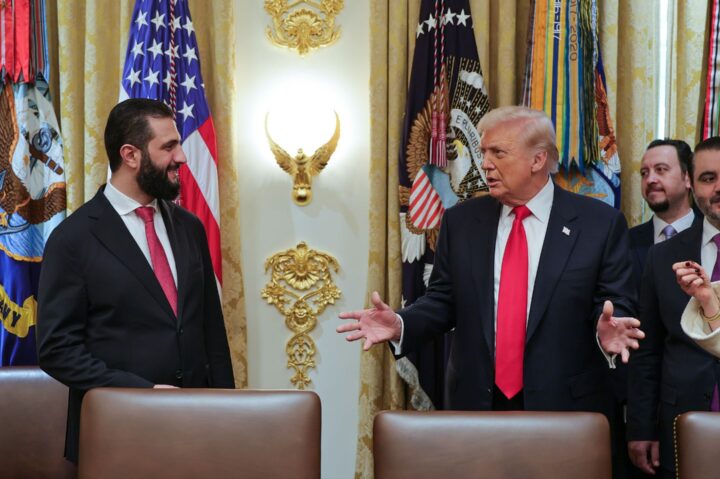
Syrian Presidency/Anadolu via Getty Images
President Donald Trump meets with Syrian President Ahmad al-Sharaa at the White House on Nov. 10, 2025.
Following the fall of the Assad regime in Syria, President Donald Trump has taken an unusually open approach toward Damascus, seeking to usher in a new era of stability and regional integration. But that strategy is beginning to face significant tests from jihadist elements embedded within Syrian President Ahmad al-Sharaa’s own military ranks.
In his second term, Trump has made unprecedented moves to normalize relations with Damascus and promote a new political order in Syria following the fall of the Assad regime last year. During a Middle East visit in May, Trump became the first American president in 25 years to meet with a Syrian leader and announced the lifting of U.S. sanctions on Syria that had been in place for more than a decade. On Nov. 10, Trump hosted al-Sharaa at the White House in a historic visit, during which Syria formally joined the U.S.-led anti-ISIS coalition. The administration has also sought to broker a security agreement between Syria and Israel.
Despite those efforts, experts warn that Trump’s push for stabilization is increasingly being challenged by the incorporation of jihadist-aligned figures into Syria’s emerging military and security apparatus.
“What my colleagues and I have been warning this entire year is that al-Sharaa was putting his jihadist allies into the new Syrian military without apparent measures to prevent bad things from happening,” said David Adesnik, vice president of research at the Foundation for Defense of Democracies, who added that those with jihadist beliefs were integrated in “large groups.”
Those concerns were underscored earlier this month, when two U.S. soldiers and one civilian contractor were killed in Syria in an attack claimed by the Islamic State (ISIS) — the first U.S. casualties in the country since Assad’s fall in December 2024. Reports indicated the assailant was a lone gunman who had previously served in Syria’s Internal Security service and had extremist leanings.
“The ISIS attack that killed U.S. service members and a civilian should be a wakeup call that the terrorist group is still a threat, and will seize opportunities to reconstitute,” said Dana Stroul, director of research at The Washington Institute for Near East Policy. “So far, the Trump team has tested al-Sharaa’s forces by asking them to go after ISIS threats and the record is fairly positive. But the ‘Defeat ISIS mission’ is not complete.”
While ISIS remains active in parts of Syria — particularly in the country’s northeast, where U.S. forces have long maintained a presence — some experts told Jewish Insider that jihadist figures aligned with al-Sharaa in the new Syrian military are the more immediate challenge to stabilization efforts.
John Hannah, a senior fellow at the Jewish Institute for National Security of America, said al-Sharaa’s decision to formally align with the U.S.-led anti-ISIS coalition has not only provoked ISIS, but also energized jihadist elements within Syria’s ranks.
“ISIS has been relatively quiet since the collapse of the Assad regime. That’s clearly changed over the past couple of months,” Hannah said. “That decision to sign on with a posse led by the Americans against fellow Muslims served as a major provocation — not just to ISIS, but to the broader jihadist community, including fighters now inside Syria’s new formal security structures.”
“There have been deep feuds among jihadis, and al-Sharaa was on one side in a feud against the Islamic State,” said David Adesnik, vice president of research at the Foundation for Defense of Democracies. “Al-Sharaa is also invested very heavily in a better relationship with the United States. The last thing he needs is a guy in his own ranks killing Americans and potentially throwing all of this off.”
In a Truth Social post, Trump vowed “very serious retaliation” to the attack, writing that the Syrian president “is extremely angry and disturbed by this attack.” The U.S. conducted strikes on multiple ISIS targets in Syria last Friday.
Adesnik said Trump’s comments likely accurately “represent al-Sharaa’s views,” noting that ISIS has long been a rival to al-Sharaa within the jihadist ecosystem.
“There have been deep feuds among jihadis, and al-Sharaa was on one side in a feud against the Islamic State,” Adesnik said. “Al-Sharaa is also invested very heavily in a better relationship with the United States. The last thing he needs is a guy in his own ranks killing Americans and potentially throwing all of this off.”
Days after the attack, Trump signed an executive order barring Syrian nationals from entering the United States. The order “adds full restrictions and entry limitations” on Syria “based on recent analysis.”
Stroul said that while this is “not a significant change in U.S. policy toward Syria,” it will be “received poorly by Syrians.”
“On a positive note, the EO clearly acknowledged the work of the one-year-old government in Damascus to address its security challenges, in coordination with the U.S.,” said Stroul. “This suggests that once the U.S. has confidence in the security procedures of Damascus, it could reverse this decision.”
But signs of ideological extremism within Syria’s new military have continued to surface. Shortly before the attack, video surfaced of what appeared to be a group of Syrian army soldiers chanting a jihadist declaration of war against Israel during a military parade in Damascus.
“It should have been obvious quite a while back that there were large groups within the Syrian military that had precisely this belief,” Adesnik said. “It goes back to the fact that [Syria’s new leadership] has integrated a large number of al-Sharaa’s jihadi forces, or aligned jihadi forces, into the military. Being deeply anti-Israel to the point of supporting Hamas is sort of par for the course if you’re a jihadist.”
Adesnik added that such views are consistent with al-Sharaa’s past rhetoric on Israel. Pro-Israel critics of al-Sharaa have pointed to the Syrian leader’s past ties to Al-Qaida, a U.S.-designated Foreign Terrorist Organization and group he joined following the 2003 U.S. invasion of Iraq. While operating for the group as a foot soldier, al-Sharaa was captured by U.S. military forces and imprisoned. He later founded one of the terror group’s Syrian branches.
U.S. officials have played down concerns about Syrian intentions toward Israel. Tom Barrack, the U.S. ambassador to Turkey and special envoy to Syria, told reporters last week that Damascus is not interested in aggression against the Jewish state. But Israeli officials have taken a more pessimistic view, with Israeli Diaspora Affairs Minister Amichai Chikli writing on X that war with Syria is “inevitable.”
“The SDF have been America’s most reliable and effective partner in fighting ISIS for more than a decade,” John Hannah, a senior fellow at the Jewish Institute for National Security of America, said. “The logic of incorporating those SDF units wholesale into al-Sharaa’s army and then unleashing them with U.S. backing on the ungoverned spaces of Syria’s central desert where ISIS has found real sanctuary is compelling.”
The White House has aimed to broker a security agreement between Damascus and Jerusalem, in which the Jewish state would relinquish territory it holds within Syria. However, Israel has differed on this approach due to security concerns and a deep distrust of the leadership in Damascus. The two sides reportedly remain far apart on any potential agreement.
The U.S. currently maintains roughly 1,000 troops in Syria, supported by U.S. air power, and continues to work with the Kurdish-led Syrian Democratic Forces (SDF), a longtime American partner that has played a central role in combating ISIS. Hannah argued that integrating the SDF into Syria’s new security structures could help counteract jihadist and ISIS influence in the country.
“The SDF have been America’s most reliable and effective partner in fighting ISIS for more than a decade,” Hannah said. “The logic of incorporating those SDF units wholesale into al-Sharaa’s army and then unleashing them with U.S. backing on the ungoverned spaces of Syria’s central desert where ISIS has found real sanctuary is compelling.”
Adesnik echoed that view, calling SDF integration “definitely a good idea,” while cautioning that progress is likely to be slow.
“There was an interim agreement in March, but the odds of that happening in the next few weeks are very low,” Adesnik said. “As long as it doesn’t go completely off the rails, they’ll probably kick the can down the road.”
Despite the challenges to stabilization, Stroul said that U.S. policy toward Syria will likely “remain consistent,” and that she expects the Trump administration to continue embracing the new government in Damascus and al-Sharaa’s leadership.
“President Trump is about to sign into law the bipartisan NDAA which lifts the sweeping Caesar sanctions against Syria — this was requested by the Trump team and the al-Sharaa government to Congress,” said Stroul. “This is a critical step in sanctions relief that will allow foreign investment to flow into Syria without fear of U.S. punitive action, and is a major signal of support for the post-Assad Syria.”
Rabbi Yosef Hamra is the brother of the last chief rabbi of Syria
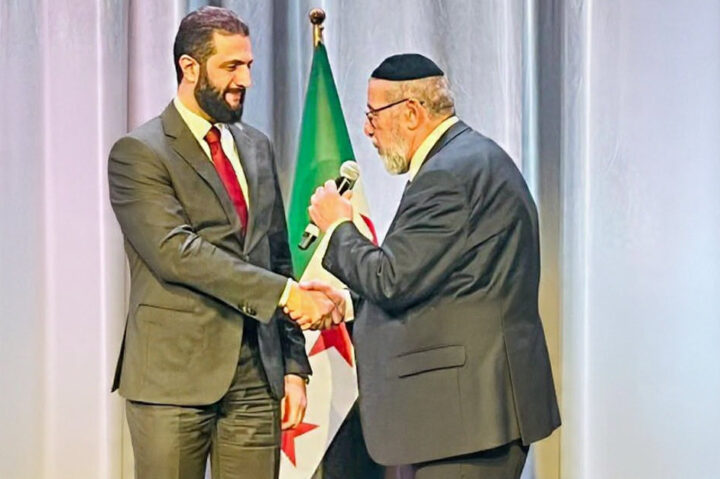
X/Jewish Heritage in Syria Foundation
Rabbi Yosef Hamra, the brother of the last chief rabbi of Syria, shakes hands with Syrian President Ahmad al-Sharaa during a meeting between al-Sharaa and a variety of Syrian diaspora activists on Sunday, Nov. 9th, 2025.
Rabbi Yosef Hamra, the brother of the last chief rabbi of Syria, who now lives in Brooklyn, was invited to offer a blessing to Syrian President Ahmad al-Sharaa during a meeting between al-Sharaa and a variety of Syrian diaspora activists in Washington on Sunday.
The moment produced a striking visual — a handshake between a kippah-wearing rabbi and the new president of Syria, a former Islamist terrorist affiliated with Al-Qaida and ISIS.
“Syrian Jews coming up and sitting down with the president — this is really history,” Henry Hamra, who leads the Jewish Heritage in Syria Foundation with his father, told Jewish Insider. “A lot of people from over here, from our community, were very, very emotional about it. It’s a beautiful thing, and my father was so touched and it was a great moment.”
Hamra said that al-Sharaa had thanked his father for the blessing and said that he would “love to see you again in Syria. And I think it’s happening very soon.”
He said that al-Sharaa had also, during the meeting, expressed a commitment to religious inclusion and pluralism.
“The Jewish community in Syria is exactly the same thing as every community,” Hamra said. “That’s what the president said — there’s no difference between the Syrian Jewish and the Syrian Christian and the Syrian Muslim. We’re all in this together … that’s what he was emphasizing also. And he spoke about all the religions — that everything is the same, the Kurds, the Alawites, everybody is the same.”
Forces aligned with al-Sharaa’s government have carried out massacres targeting the Alawite, Druze and other minority communities.
“We should get ourselves together and try to rebuild again [in] Syria,” Hamra said.
He said the members of Jewish Heritage in Syria also had the opportunity to discuss with both Syrian leaders and U.S. Syria envoy Tom Barrack the work they are doing to support sanctions relief and restore Jewish antiquities and religious sites in Syria. The Jewish group was invited to the meeting by the Syrian Foreign Ministry.
Hamra said that he had invited Barrack to tour Jewish sites in Syria, and Barrack expressed an interest, sharing his personal phone number with Hamra.
“I think the government [is] very, very open for us to start the process of building up, and that’s a great thing,” Hamra said.
Mouaz Moustafa, a Syrian-American activist who leads the Syrian Emergency Task Force, which has been working with JHS in advocating for the repeal of sanctions on Syria under the Caesar Act, said it was “inspirational” and moving to see the meeting between al-Sharaa and Rabbi Hamra.
Henry Hamra, who fled Syria in 1992 at age 15, also recently ran for the Syrian parliament on a platform focused on advocating for sanctions relief, though he was not successful.
Hamra reiterated to JI his desire to see the repeal of the Caesar Act sanctions.
“My goal is to help the Syrian people who suffered a lot, and I think they should have another chance to live in freedom again,” he said. Moustafa, Hamra and Hamra’s father have argued that any restoration work on Syria’s ancient synagogues will be impossible until all sanctions are lifted.
Opponents of the sanctions relief effort say that keeping the sanctions in place is necessary to maintain U.S. leverage and ensure accountability on American priorities like protecting minority groups from further attacks.
The presence of Saudi and Turkish officials at the White House during the meeting underscores how Syria has become a battleground for regional influence
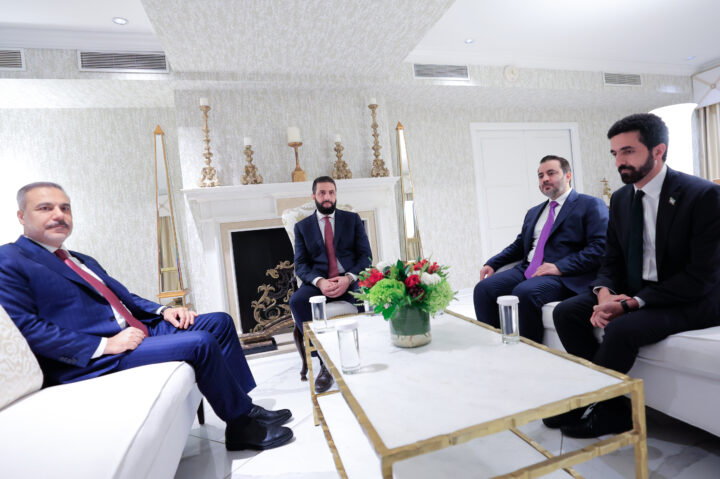
Turkish Ministry of Foreign Affairs/Anadolu via Getty Images
Turkish Foreign Minister Hakan Fidan (L) meets President of Syria Ahmed al-Sharaa in Washington, United States on November 10, 2025.
At the White House on Monday, as President Donald Trump met with Syrian President Ahmad al-Sharaa, two other high-level figures were in attendance — Saudi Defense Minister Prince Khalid bin Salman and Turkish Foreign Minister Hakan Fidan, underscoring how Syria has become a new battleground for regional influence.
Following the fall of longtime dictator Bashar al-Assad’s regime last December, the war-ravaged nation has become a political vacuum, transformed into a critical security frontier for many regional players — most notably Turkey and Saudi Arabia.
“Saudi Arabia and Turkey are among the most powerful Middle Eastern countries. The power vacuum caused by the Syrian civil war turned Syria into a stage for these competing powers,” said David May, a research analyst at the Foundation for Defense of Democracies. “Both countries supported elements working to topple former Syrian strongman Bashar al-Assad.”
Despite both countries supporting the overthrow of the Assad regime, the nations share different visions for the future government in Damascus. Saudi Arabia and other moderate Arab countries are seeking to guide Syria towards pragmatic governance and away from the influence of radical Islam — a stark contrast to the propping up of the Muslim Brotherhood by Turkey, according to May.
“Saudi Arabia and Turkey have radically different foreign policy objectives and trajectories, especially as it relates to political Islam and the Muslim Brotherhood,” said May. “Historically, Turkey and Saudi Arabia each have a claim to the leadership of Islam and the Middle East …. [Saudi Crown Prince] Mohammed bin Salman has tried to modernize the kingdom and has downplayed the fundamentalism that used to be central to the state. Turkey, meanwhile, used to be a modernizing force in the region, but President [Recep Tayyip] Erdogan has elevated the role political Islam and Muslim Brotherhood ideology play in the orientation of the state.”
Saudi Arabia emerged quickly as a key backer of al-Sharaa’s regime due to the Syrian leader’s apparent moderation from his fundamentalist background.
“When al-Sharaa took Damascus, Saudi Arabia rushed to lobby Washington to press the reset button on al-Sharaa and legitimize his rule in Syria,” Hussain Abdul-Hussain, a research fellow at the Foundation for Defense of Democracies, told Jewish Insider.
Abdul-Hussain has argued that Turkey is not looking to help rebuild a sovereign Syrian state but rather is seeking a “puppet-state” in Damascus, also noting that Ankara supports factions influenced by the Muslim Brotherhood and an alternative Sunni leadership model, which is opposed by Saudi Arabia.
Pro-Israel lawmakers in Congress also expressed wariness towards Turkey’s expanding role in the region. “President Erdogan has a long record of hostility toward Israel, Greece, and Cyprus and his government maintains ties to Hamas terrorists, making Turkey an unreliable partner in ensuring peace. That’s why I remain deeply skeptical of Turkey’s intentions and potential role in Syria’s stabilization,” Rep. Josh Gottheimer (D-NJ) told Jewish Insider.
Other analysts argued that Turkey is seeking a more productive role. Soner Cagaptay, a senior fellow at The Washington Institute for Near East Policy, said that Turkey is actually “the most important stakeholder” in Syria, adding that the Trump administration views Ankara as a critical part of ensuring Syria’s stabilization.
“Trump wants to see Syria not fall into another cycle of civil war, and he believes that Turkey is a key actor to Syria’s stabilization,” said Cagaptay. “I think Turkey has the institutions to bring to the table to help with capacity building and Syria’s restoration of serious institutions.”
Cagaptay says a stabilized Syria is in Turkey’s best interest, and that al-Sharaa will rely on help from Ankara.
“100 years after the collapse of the Ottoman Empire, Syria has been Turkey’s most problematic neighbor. Turkey now wants to flip that into an ally,” said Cagaptay. “[Hay’at Tahrir al-Sham] and al-Sharaa need Turkey, and they will play along. They will lead Turkey to legitimacy and recognition.”
After meeting with Trump, al-Sharaa held a meeting with Fidan, along with Syria’s foreign minister and U.N. envoy. Fidan also met at the White House with Vice President JD Vance, Secretary of State Marco Rubio and Special Envoy Steve Witkoff.
“This visit here by al-Sharaa, in which he was accompanied by Turkish Foreign Minister Fidan, kind of underlines Turkey’s significantly elevated role in Syria and a very important shift,” said Cagaptay. “Syria was Turkey’s most problematic neighbor and now has become a strong ally and a country that Turkey is deeply invested in and cares for.”
However, Israel views an elevated Turkish role in Syria with “some anxiety,” according to Cagaptay, unlike with Riyadh.
“Israel and Saudi Arabia are not competing in Syria. Turkey is competing with the two. This suggests that Israel and Saudi Arabia can be allies in Syria, and both — together or independently — will be Turkey’s rival,” said Abdul-Hussain. “Al-Sharaa will have to navigate this dynamic to survive, beat domestic rivals, and emerge as Syria’s sole and strong ruler.”
Plus, Israel's concerns over the Gaza stabilization force
Syrian Presidency/Anadolu via Getty Images
President Donald Trump meets with Syrian President Ahmad al-Sharaa at the White House on Nov. 10, 2025.
Good Tuesday morning!
In today’s Daily Kickoff, we report on President Donald Trump’s meeting with Syrian President Ahmad al-Sharaa yesterday and talk to senators about a dinner meeting they had with the Syrian leader. We also talk to Israeli experts about the prospect of a United Nations-led stabilization force in Gaza and report from a bridge-building event attended by Black and Jewish college students at George Washington University. Also in today’s Daily Kickoff: Ronald Lauder, Bianna Golodryga and Yonit Levi.
Today’s Daily Kickoff was curated by Jewish Insider Israel Editor Tamara Zieve and U.S. Editor Danielle Cohen-Kanik, with an assist from Marc Rod. Have a tip? Email us here.
What We’re Watching
- Temple Emanu-El in New York City is hosting an event this evening for the launch of Don’t Feed the Lion, a novel for middle schoolers on the theme of antisemitism by journalists Bianna Golodryga and Yonit Levi. The authors will be joined by chess champion Garry Kasparov and comedian Elon Gold for a conversation moderated by Rafaela Siewert. Read JI’s interview with Golodryga and Levi below.
What You Should Know
A QUICK WORD WITH JI’S Josh Kraushaar
With a week since the off-year gubernatorial elections in New Jersey and Virginia, a clear dynamic is emerging: President Donald Trump’s gains with nontraditional GOP voters — especially working-class Black and Hispanic voters and Gen Zers — are not translating into support for the Republican Party this year.
If Republicans are unable to recreate the Trump 2024 coalition without Trump on the ballot, they will face serious political disadvantages for the midterms and beyond.
The double-digit margins of victory of incoming Democratic governors Mikie Sherrill in New Jersey and Abigail Spanberger in Virginia speak volumes about the current political environment. Their sweeping wins underscore that, while Democrats may be divided as a result of ideological infighting, the antipathy towards Trump and the GOP is the glue that holds the party together.
The historic tendency of voters taking out their dissatisfaction on the party in power is alive and well, and is much more of a factor than the favorability ratings of the political parties.
The most revealing outcome from the gubernatorial elections is the fact that the majority-making elements of Trump’s coalition swung decisively back to the Democrats, according to the AP/Fox News voter analysis. In New Jersey, young men between 18-29 backed Sherrill by 14 points (57-43%) after narrowly supporting Trump in last year’s presidential election. In Virginia, Spanberger won 58% of young men, a huge margin for a demographic that had assumed to be trending away from the Democratic Party.
The Democratic Party’s comeback with Hispanic voters is equally as significant. Because of continuing inflation and backlash to the Trump administration’s aggressive deportation of illegal immigrants and ICE tactics, Hispanic voters once again voted like reliable elements of the Democratic coalition. In New Jersey, over two-thirds (68%) of Hispanic voters backed Sherrill — 12 points more than Kamala Harris’ support with Hispanics in the state in 2024. In Virginia, Spanberger’s 67% support with Hispanics was eight points ahead of Harris’ vote share with the key constituency.
Meanwhile, Black voters overwhelmingly sided with the Democratic nominees this year, after a notable minority of them backed Trump in last year’s presidential election. Spanberger won 93% of the Black vote, seven points more than Harris, even though she was running against a Black opponent in Republican Lt. Gov. Winsome Earle-Sears. Sherrill won 94% of the Black vote in New Jersey, a whopping 15 points more than Harris carried in 2024.
WINDS OF CHANGE
Trump signals Syria will join U.S.-led anti-ISIS coalition
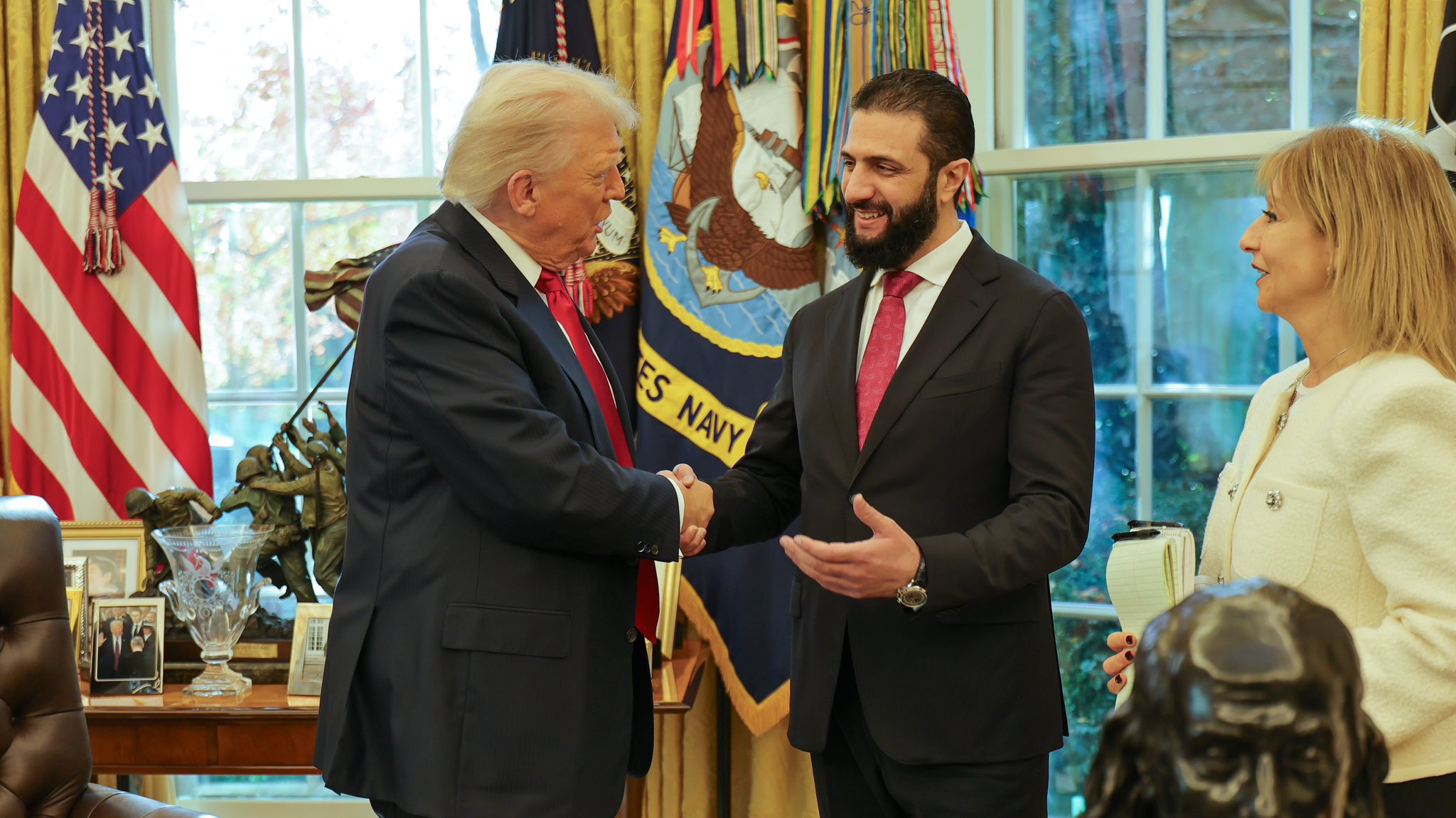
President Donald Trump indicated that he expects Syria to join the U.S.-led coalition against the Islamic State during his meeting with Syrian President Ahmad al-Sharaa on Monday at the White House, Jewish Insider’s Matthew Shea reports. “Yes, you can expect an announcement on Syria,” Trump said to reporters in the Oval Office. “We want to see Syria become a country that’s very successful. And I think this leader can do it. I really do.”
Background: By joining the agreement, Syria would follow 89 countries that have committed to the pact’s goal of “eliminating the threat posed by ISIS.” The group was established in 2014 as part of a response to territorial gains made by the Islamic State after the collapse of Iraqi security forces in Mosul. Following the fall of Syria’s longtime dictator Bashar al-Assad last December, al-Sharaa has sought to establish control over the war-ravaged nation and assert the authority of his new transitional government. However, the emergence of ISIS cells that have regrouped across Syria over the past few years pose a threat to al-Sharaa’s rule.
Assassination attempts: Syria’s security services have foiled two separate ISIS plots to assassinate al-Sharaa, Reuters reports.
ON THE HILL
Senators optimistic after meeting with Syrian president
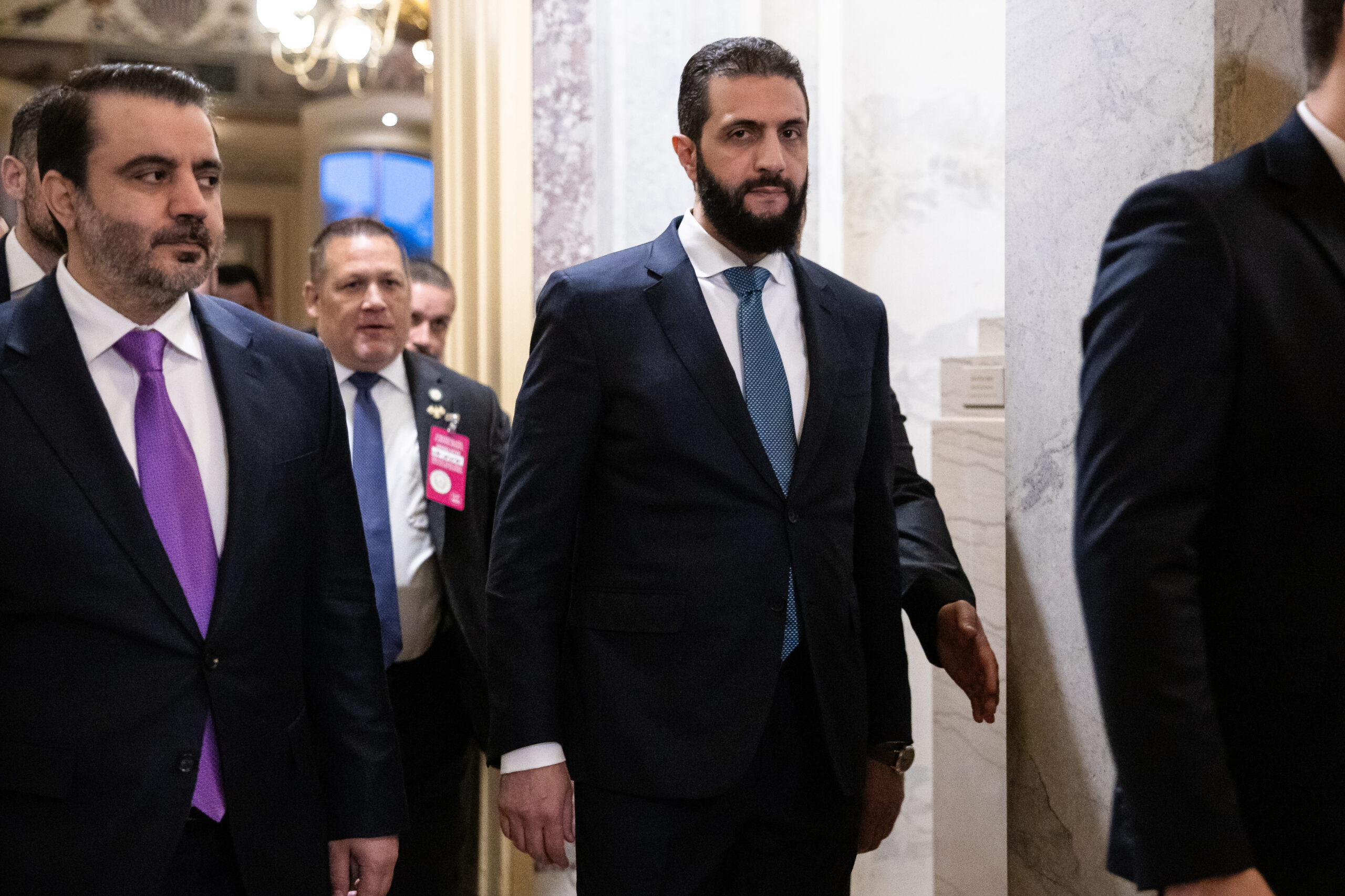
Senators offered a positive readout from a dinner meeting with Syrian President Ahmad al-Sharaa on Sunday evening prior to al-Sharaa’s Monday summit at the White House with President Donald Trump, Jewish Insider’s Marc Rod and Emily Jacobs report.
What they’re saying: Attendees described the meeting as “open,” “moving” and “constructive,” and said they discussed progress toward sanctions relief as well as counterterrorism efforts. Sen. Markwayne Mullin (R-OK) told JI that al-Sharaa was “very charismatic” and “had a very open conversation” about his “checkered past” with senators. “I found it to be straightforward. I thought his answers were what we needed to hear, but I think he honestly believed it too,” Mullin said of the dinner.
The exception: Rep. Brian Mast (R-FL), seen by advocates as a primary holdout on sanctions relief efforts, offered a more tepid statement on the meeting, absent any direct praise for al-Sharaa or his efforts, or any commitment to supporting sanctions relief for the Syrian regime. “We had a long and serious conversation about how to build a future for the people of Syria free of war, ISIS, and extremism,” Mast said.
Read the full story here with additional comments from Sens. Elissa Slotkin (D-MI), Chris Coons (D-DE), Richard Blumenthal (D-CT) and Joni Ernst (R-IA).
Sanctions suspended: Following a meeting with Secretary of State Marco Rubio, Syrian Foreign Minister Assad al-Shaibani posted on X, “We have received a signed decision from my friend, the U.S. secretary of state, stipulating the lifting of all legal measures previously imposed on the Syrian Mission and the Embassy of the Syrian Republic by the United States of America.” The sanctions lift will be reviewed again in six months.
PEACEKEEPING PROSPECTS
Concerns in Israel as U.S. seeks United Nations mandate for international force in Gaza

Israeli diplomats and experts have expressed concern as the U.S. seeks a two-year United Nations Security Council mandate for an international stabilization force in Gaza. The force is part of President Donald Trump’s 20-point plan to end the war in Gaza, which Israeli Prime Minister Benjamin Netanyahu agreed to in September. However, the broad plan did not provide details on most of its points and did not mention a U.N. mandate, Jewish Insider’s Lahav Harkov reports.
Mixed bag: Historically, Israel has had mixed experiences with such U.N. forces, ranging from the U.N. Disengagement Observer Force along the 1973 ceasefire line between Israel and Syria — which countries abandoned amid the Syrian Civil War and was then replaced by fewer troops — to the U.N. Interim Force in Lebanon, which, for decades “obscure[d] the vast scale of Hezbollah’s extensive weapons build up … in violation of the relevant UNSC resolutions,” Sarit Zehavi, an expert in Israel’s northern border security, recently wrote. The Multinational Force in the Sinai Peninsula, established to ensure the implementation of the Israel-Egypt peace treaty, has been in place since 1981 with little controversy. The force does not have a U.N. mandate, because the Soviet Union vetoed it, and comprises troops from 14 countries, including 465 American servicemen and women known as “Task Force Sinai.”
Implementation questions: Private documents, presented in Israel last month to officials from the U.S. Departments of State and Defense and viewed by Politico, reportedly raise concerns about whether an international stabilization force can really be deployed.
BETTER TOGETHER
Black and Jewish college students explore shared adversity and allyship at DC-area ‘Unity Dinner’

The official reason that more than 100 college students from across Washington gathered in a ballroom at George Washington University last week was for a formal dinner billed as an opportunity to build bridges between the Black and Jewish communities. But what really got the students — undergrads from GWU, American, George Mason, Georgetown, Howard and the University of the District of Columbia — talking at this event, which was meant to highlight commonalities and spark deep connections between students from different backgrounds, was a breezy icebreaker: Is a hot dog a sandwich? That was one of several lighthearted prompts for the students to discuss as they settled into dinner and got to know each other at tables of 10, Jewish Insider’s Gabby Deutch reports.
Digging in: Later, after they had introduced themselves and playfully debated topics like who would play them in a movie and their least favorite internet trends, the students turned to more personal questions about identity, community and belonging. It was an exercise carefully calibrated to build connection free from rancor, where the students could speak about themselves and their identities as racial and religious minorities without fear of judgment. “Every single time, I am amazed at the discussion and how vulnerable people will be,” said Arielle Levy, vice president of diversity, equity and inclusion at Hillel International. Levy shepherded the students through the increasingly more serious questions during last week’s dinner program. “I just really hope it leads to action, because that’s really what we’re hoping for.”
BOOK SHELF
Bianna Golodryga and Yonit Levi confront rising antisemitism with a story for the next generation

Long before the Oct. 7, 2023, Hamas terror attacks, parents — especially Jewish parents — wondered and at times struggled with how to speak to their children about antisemitism. In the midst of the antisemitism that exploded in the wake of the attack on southern Israel and continued to rise through the ensuing war between Israel and Hamas, journalists Bianna Golodryga and Yonit Levi found themselves navigating that challenge — and found no help to guide them. As a result, Golodryga said in an interview with Jewish Insider’s Melissa Weiss, “Yonit and I decided to try to write the book we couldn’t find.” The result was their debut book, Don’t Feed the Lion, released today.
Inspired by experience: “The fact that our kids are talking about it, [it’s] something I’m dealing and grappling with in New York City in 2023 at the time,” Golodryga, a CNN news anchor, told JI. “I never thought that we’d be having to address [it] so directly. But there were no resources on this issue. I asked my kid’s school about it, [saying], ‘What are you doing to address antisemitism?’ And in a longly worded statement, it was clear that there were no resources. They weren’t really doing anything.” In Israel, Levi, an anchor on Israel’s Channel 12, was asked about antisemitism by her preteen son. “And I was sort of floored by it,” she told JI. “I didn’t even know how to begin answering because I wasn’t planning to answer that question, explaining and answering a lot of other questions that Oct. 7 brought to the table.”
FIGHTING ANTISEMITISM
At annual gala, WJC’s Ronald Lauder says education and public relations are only solutions to antisemitism
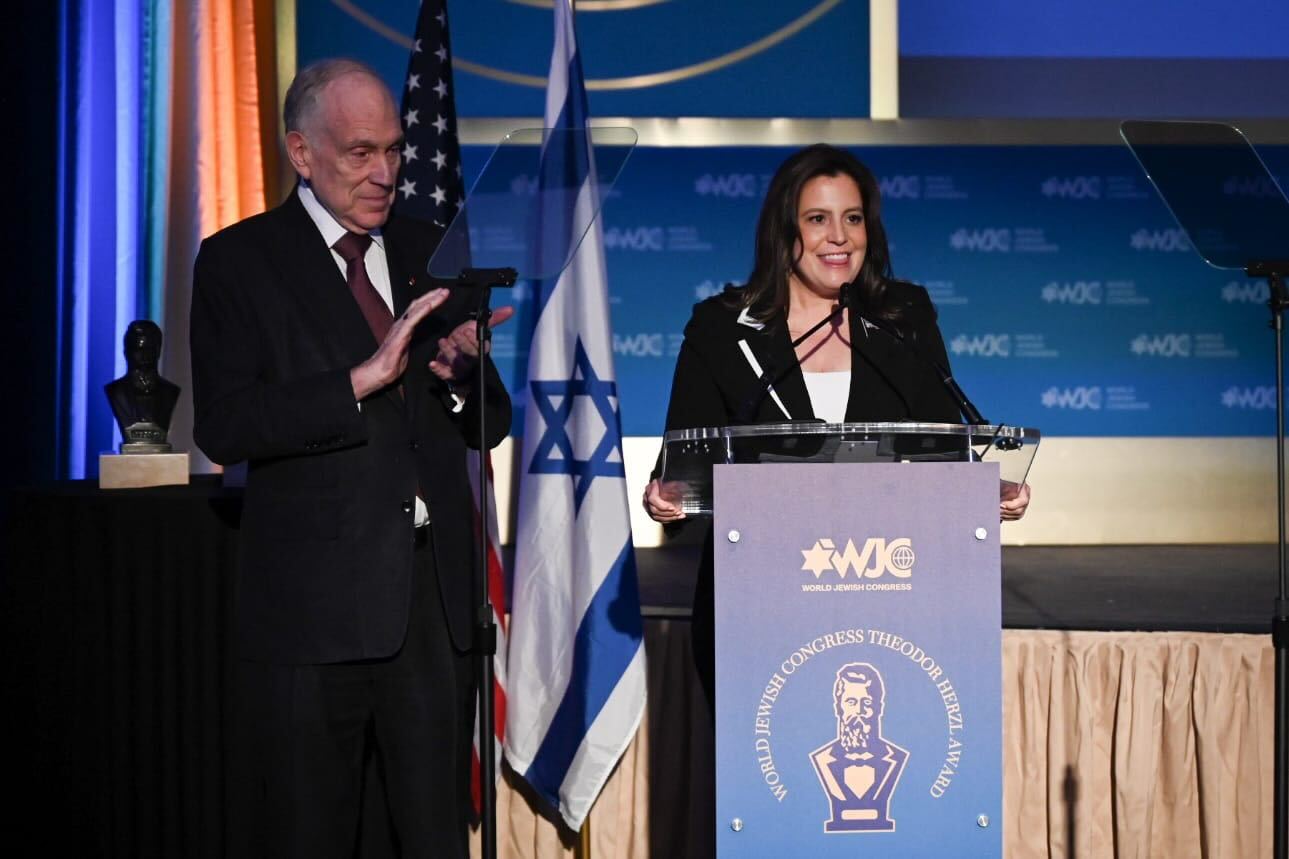
In the wake of a global rise in antisemitism not seen in generations, World Jewish Congress President Ronald Lauder told some 250 attendees at the organization’s annual gala dinner on Monday that the “only” solutions are “creating more Jewish schools” and “taking the high ground in public relations,” Jewish Insider’s Haley Cohen reports. The event, held at the Museum of Modern Art in Manhattan, honored Rep. Elise Stefanik (R-NY) and Sen. John Fetterman (D-PA) with WJC’s Theodor Herzl Award for the lawmakers’ pro-Israel advocacy and opposition to antisemitism.
Stepping it up: “The entire education system — K-12 to college — must be retaught. Laws must be passed that will focus on no racism, no antisemitism and no anti-Western civilization being taught,” said Lauder. “It’s [also] time we fight back with stronger PR to tell the truth about [antisemitism and Israel]. If Israel doesn’t want to do this, we in the Diaspora will help. I don’t blame Jewish organizations for not being prepared” for the Oct. 7 terror attacks in Israel and their aftermath, continued Lauder. “[But] all of these groups don’t know how to [combat antisemitism]. Frankly, they’re wasting a lot of money. Education and public relations are the only [answers].”
Worthy Reads
The Next Peace Process: Robert Satloff, executive director at the Washington Institute for Near East Policy, along with senior fellow Hanin Ghaddar and international fellow Ehud Yaari, lay out the prospects for peace between Israel and Lebanon in The Washington Post. “One way to avert a catastrophic return to war would be for Lebanon and Israel to begin their own peace process. Movement on normalization would not substitute for disarmament. But if diplomacy were pursued as an alternative to Israeli military action against Hezbollah, the very fact of the talks would undermine Hezbollah’s effort to claw back its political influence. And practical progress could show the Lebanese people the potential benefits of peacemaking. … The Trump administration should do more to get things going. … The administration should remind Lebanon that choosing to neither disarm Hezbollah nor pursue diplomacy with Israel will come with costs. Those could entail losing U.S. aid to the Lebanese Armed Forces, losing U.S. backing of international support for Lebanon’s economy and losing U.S. willingness to restrain Israel from disarming Hezbollah ‘the hard way.’” [WaPo]
Dreher’s Dread: Conservative author Rod Dreher frets over the “new radicalism” emerging among Gen Zers on the political right in America on his Substack, “Rod Dreher’s Diary.” “The main points I want to leave you with, based on what I saw and heard in Washington, are these: The Groyper thing is real. It is not a fringe movement, in that it really has infiltrated young conservative Washington networks to a significant degree. Irrational hatred of Jews (and other races, but especially Jews) is a central core of it. This is evil. If postliberal conservatism requires making peace with antisemitism and race hatred, count me out. It cannot be negotiated with, because it doesn’t have traditional demands. It wants to burn the whole system down. It really does. At the same time, the gatekeepers of the Right aren’t going to be able to make it go away, because they have less power than ever. Dealing with this is going to require great skill and subtlety, and courage.” [Substack]
Wrong on the Right: The Wall Street Journal’s Gerard Baker warns against Vice President JD Vance’s “breezy dismissal” of efforts to root out extremists from the right as infighting that should be avoided. “That would be a mistake. It is hard to imagine people like Mr. Fuentes and Candace Owens as figures of historic significance: The idea seems ridiculous. But what gives them their current salience — besides cozy sit-downs with the nation’s top media celebrity — is their claim, a plausible one, to be speaking for others. The rise of populism has been characterized by a liberalization of thought and speech that had previously been suppressed by the prevailing authorities of orthodoxy. Much of this was necessary and welcome. The cultural limitations on what ordinary people were supposed to think about issues like immigration and ‘gender identity’ were thrown off when populist leaders came along who dared to say things that many people had felt. But with this liberation of legitimate and reasonable ideas inevitably came a wider unleashing of much uglier sentiments on the right.” [WSJ]
Keep Hope Alive: Marking five years since the death of Rabbi Lord Jonathan Sacks, Tanya White, a senior lecturer at the Matan Institute for Torah Learning and a lecturer at the Rabbi Sacks Institute at Bar-Ilan University, contemplates Sacks’ lessons on hope in an essay for 18Forty. “Reflecting on his vast and far-reaching oeuvre, one could not hope to capture its scope in a single essay. Yet one idea has continued to echo through my mind over these past two years: his oft-quoted distinction between optimism and hope. Optimism and hope are not the same. Optimism is the belief that the world is changing for the better; hope is the belief that, together, we can make the world better. ‘Judaism,’ wrote Rabbi Sacks, ‘is the voice of hope in the conversation of humankind.’ These short yet powerful lines capture the essence of a uniquely Jewish theology that underpins Rabbi Sacks’ vast and far-reaching thought: a theology that places human freedom and responsibility side by side. That fosters an active virtue of courage to confront the world that is and work towards a world that ought to be. A theology that reinterprets the biblical concept of covenant for the challenges of modern liberal democracies.” [18Forty]
Word on the Street
In a Fox News interview with Syrian President Ahmad al-Sharaa, asked about his country’s relations with Israel and the possibility of entering the Abraham Accords, al-Sharaa said, “Syria has borders with Israel, and Israel has occupied the Golan Heights since 1967. We are not going to enter negotiations directly right now.” He added that the U.S. might be able to “help reach this kind of negotiation”…
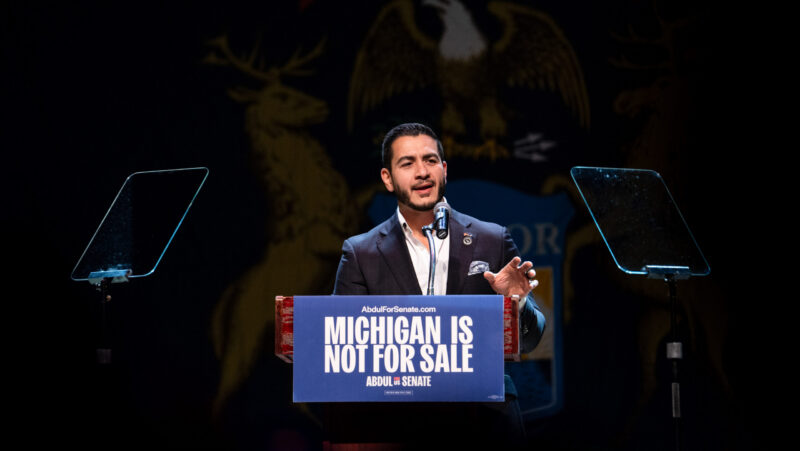
Abdul El-Sayed, an anti-Israel Democrat running in the Michigan Senate primary to replace retiring Sen. Gary Peters (D-MI), has deleted his entire history on X, including “defund the police” posts…
Sen. Bernie Sanders (I-VT) endorsed left-wing Minnesota Lt. Gov. Peggy Flanagan over her more moderate opponent, Rep. Angie Craig (D-MN), in the Democratic Minnesota Senate primary…
Progressive voters and Democratic Party activists are blaming Senate Minority Leader Chuck Schumer (D-NY) for the votes of eight Democratic senators who backed GOP legislation to put an end to the government shutdown…
The Wall Street Journal reports on Yale’s attempt to stay out of the line of fire in President Donald Trump’s crusade against higher education, including President Maurie McInnis’ increased government lobbying expenditures and a student forum where classmates encouraged each other to refrain from disruptive anti-Israel protests…
Palantir CEO Alex Karp defended his support of Israel in an interview with WIRED, saying, “Israel is a country with a GDP smaller than Switzerland, and it’s under massive attack. Some critiques are legitimate, but others are aggressive in attacking Israel. My reaction is, well, then I’m just going to defend them”…
Lt. Hadar Goldin, whose remains were returned to Israel on Sunday after he was killed and his body kidnapped to Gaza more than 11 years ago, was laid to rest at the Kfar Sava military cemetery this morning…
In his first interview since his release after two years in Hamas captivity in Gaza, Matan Zangauker, who was taken hostage on Oct. 7, 2023, told Channel 12 that every night one of his captors would play mind games with him giving him false reports of the combat between Israel and Hamas, telling him, for instance, “We took out 20 of your tanks today and we killed soldiers”…
Danielle Sassoon, the former interim U.S. attorney for the Southern District of New York who resigned her post rather than drop a case against New York City Mayor Eric Adams at the request of the Trump administration, has joined the conservative boutique law firm of Clement & Murphy…
The New York Times reports on Iran’s acute water crisis, which Iranian President Masoud Pezeshkian warned could soon necessitate the evacuation of Tehran…
The New York Times considers the status of Iran’s nuclear program, as snapback sanctions have been enacted, negotiations are frozen and Tehran appears to be building a new enrichment site at Pickaxe Mountain…
British comedian and actor John Cleese has cancelled shows that had been scheduled to take place in Israel in late November and early December, with the Israeli production company handling his shows saying the “Monty Python” star had “succumbed to threats from BDS organizations”…
Pic of the Day
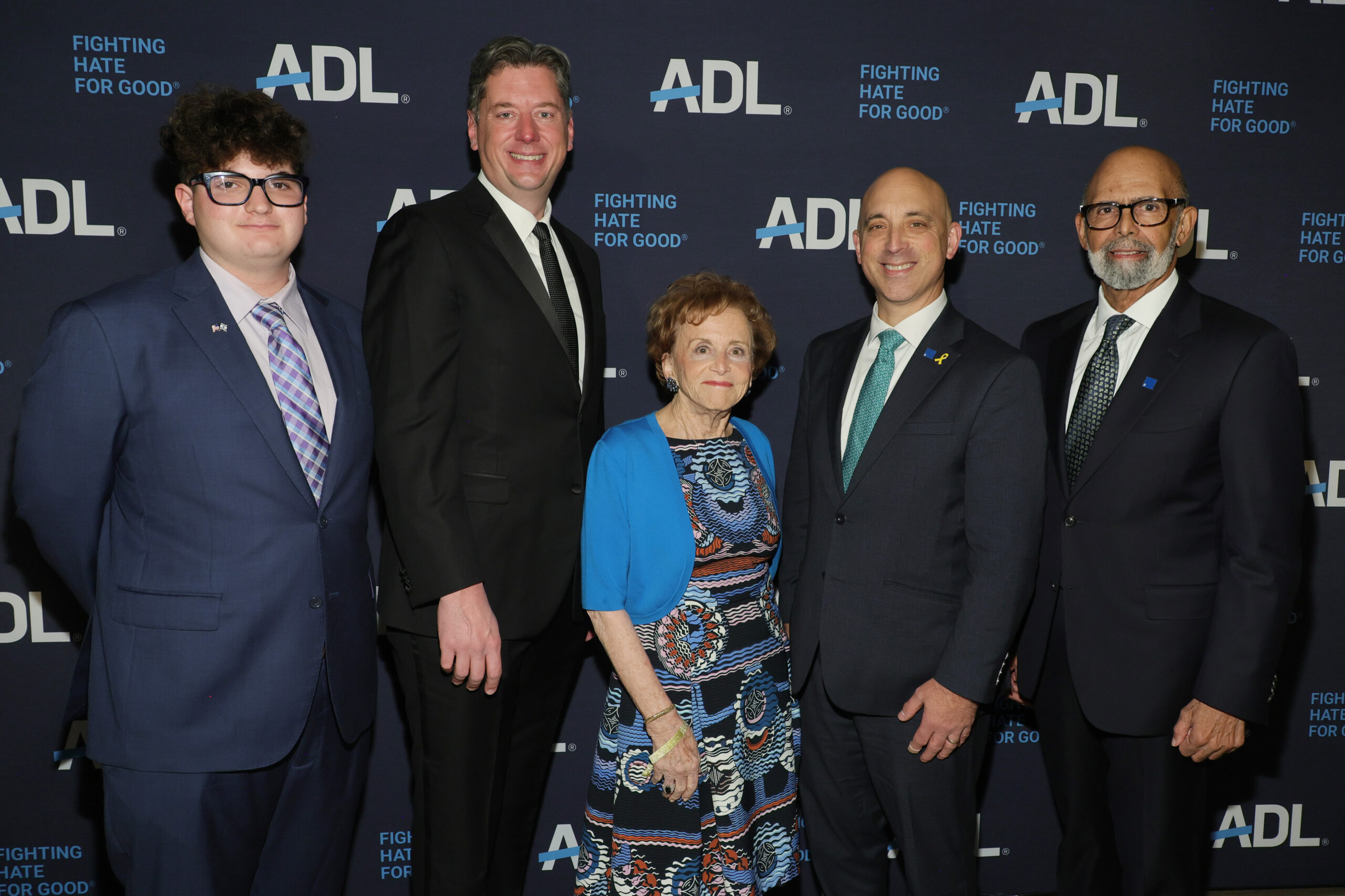
The Anti-Defamation League held its 31st Annual In Concert Against Hate in Washington last night. Hosted by actor and director Jason Alexander, the evening honored four individuals for their courage in fighting antisemitism and hate: Holocaust survivor and health policy leader Marion Ein Lewin; Dr. Michael L. Lomax, president and CEO of the United Negro College Fund; Wesley Seidner, a high school senior combating antisemitism in his Virginia community; and Oklahoma City Mayor David Holt.
Pictured, ADL CEO Jonathan Greenblatt with the honorees. From left: Seidner, Holt, Lewin, Greenblatt and Lomax.
Birthdays
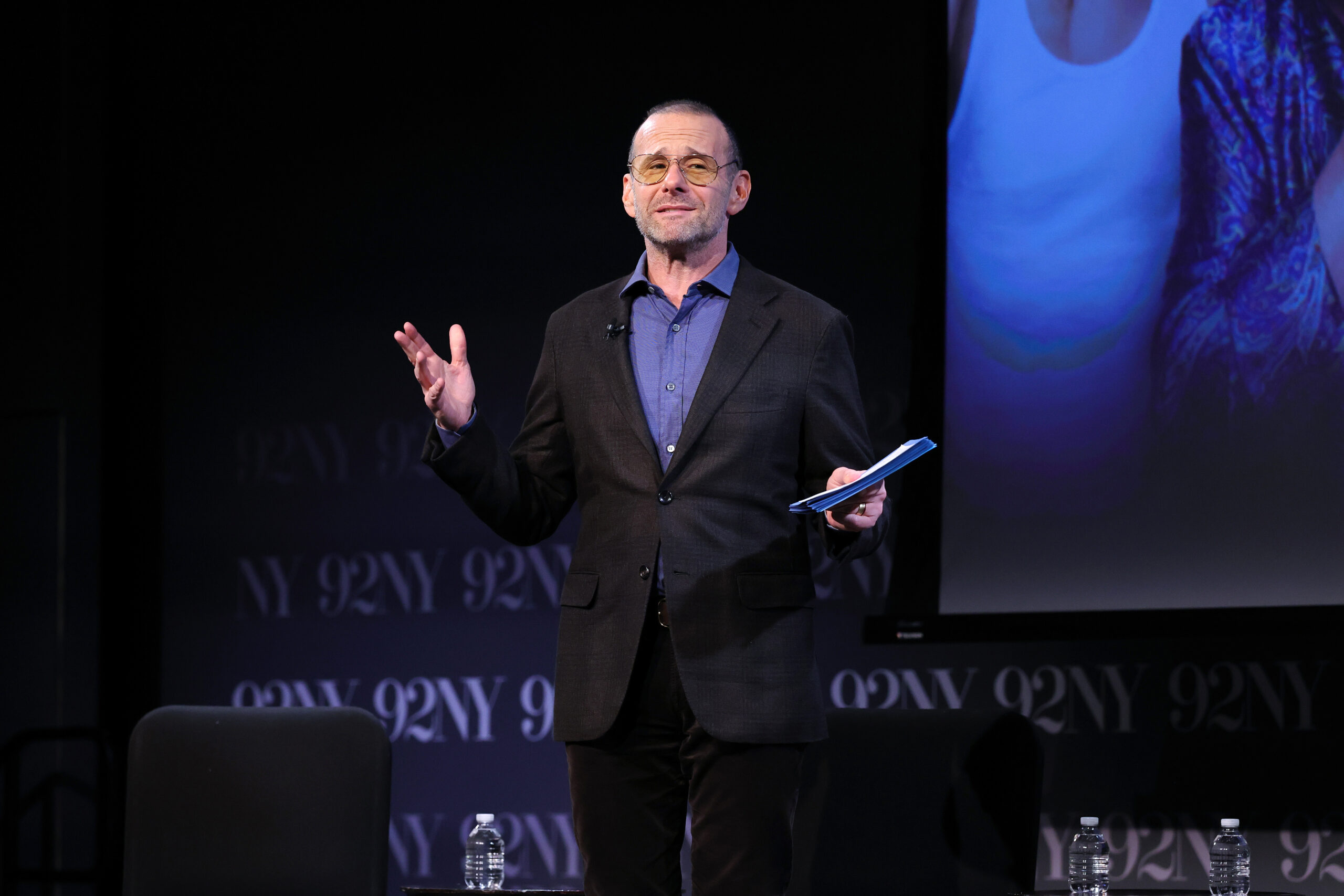
Emmy Award and People’s Choice Award-winning television producer, Jason Nidorf “Max” Mutchnick turns 60…
Retired psychiatric nurse now living in Surprise, Ariz., Shula Kantor turns 98… Retired television and radio sports broadcaster, Warner Wolf turns 88… Former Democratic U.S. senator from California for 24 years, Barbara Levy Boxer turns 85… Author, best known for her 1993 autobiographical memoir Girl, Interrupted, Susanna Kaysen turns 77… Television personality (former host of “Double Dare”), known professionally as Marc Summers, Marc Berkowitz turns 74… Founder of Sierra Nevada Brewing Company, Ken Grossman turns 71… Founder and president of D.C.-based Plurus Strategies, David Leiter… President at American Built-in Closets in South Florida, Perry Birman… Aish HaTorah teacher in Los Angeles, author and co-founder of a gourmet kosher cooking website, Emuna Braverman… Talk show host and founder of Talkline Communications, Zev Brenner turns 67… Philanthropist and founder of Portage Partners, Michael Leffell… Professor of philosophy at the University of Wisconsin-Madison, Steven M. Nadler turns 67… Former U.S. ambassador to the Czech Republic, he served as a counsel for the Democrats during the first Trump impeachment, Amb. Norman Eisen turns 65… Russian-born entrepreneur, venture capitalist and physicist, Yuri Milner turns 64… Founder and executive director of Los Angeles-based IKAR, Melissa Balaban… Former Israeli Police commissioner, Kobi Shabtai turns 61… Former member of the Knesset for the Likud party, Orly Levy-Abekasis turns 52… Tel Aviv-born actor and screenwriter, he is best known for his roles in “The Young and the Restless” and “NCIS,” Eyal Podell turns 50… Former Pentagon policy official, now vice president of the American Jewish Committee’s Center for a New Middle East, Anne Rosenzweig Dreazen turns 43… Defender for the Houston Dynamo in Major League Soccer, Daniel Steres turns 35… Formerly the finance director at the campaign for Rep. Matt Cartwright (D-PA), now a deployment strategist at GovWell, Shelly Tsirulik… Survivor of the mass shooting at Marjory Stoneman Douglas High School, he has become an advocate against gun violence and recently launched his congressional campaign for the seat of retiring Rep. Jerry Nadler (D-NY), Cameron Kasky turns 25…
A bipartisan group of lawmakers that attended the Sunday dinner called the discussion ‘open,’ ‘moving’ and ‘constructive’
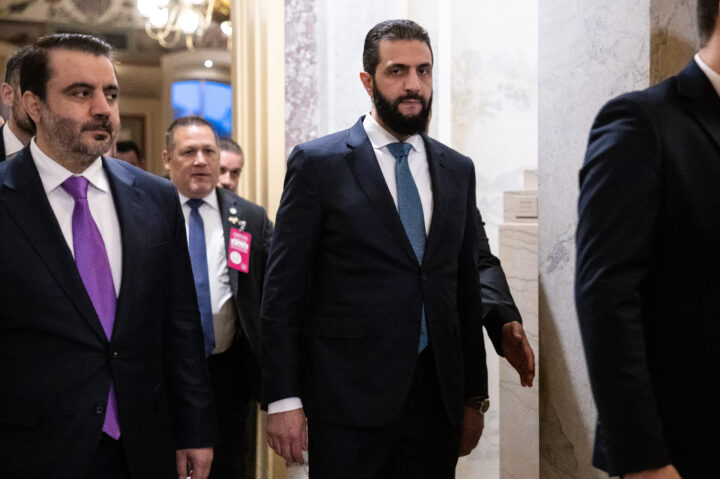
Francis Chung/POLITICO via AP Images
Syrian President Ahmed al-Sharaa departs a meeting in the Senate Foreign Relations Committee hearing room at the U.S. Capitol, Nov. 10, 2025.
Senators offered a positive readout from a dinner meeting with Syrian President Ahmad al-Sharaa on Sunday evening prior to al-Sharaa’s Monday summit at the White House with President Donald Trump.
Sen. Markwayne Mullin (R-OK) told Jewish Insider that al-Sharaa was “very charismatic” and “had a very open conversation” about his “checkered past” with senators. “I found it to be straightforward. I thought his answers were what we needed to hear, but I think he honestly believed it too,” Mullin said of the dinner.
“I was with him in Damascus in August. I led the first delegation there with [Rep.] Jason Smith (R-MO), [Rep.] Jimmy Panetta (D-CA) and [Sen.] Joni Ernst (R-IA). This was kind of more of the same, just building on that,” Mullin told JI. “When we talked in August, there were some issues that he brought up with sanctions towards the Assad regime that we need to work on. I’ve already been working on that, so we wanted to give him an update on it.”
The Oklahoma Republican said progress was being made on lifting the sanctions, something he attributed to the fact that the U.S. wants the al-Sharaa regime to “be successful.”
“He may not fit the mold of what you’d want as a leader in Syria. Actually, if you look at it, he’s probably what needs to be in Syria right now, because they’ve been at war for so long,” Mullin said. “As I told him, it’s trust — but verify. And so far, he’s making all the right moves. He’s trying to actually formalize relationships with Israel, that’s huge for that region. So, as he continues to move down this path, we want to continue to help him be successful.”
Sen. Elissa Slotkin (D-MI) told JI that, as a longtime Middle East and counterterrorism official, “it was quite a change to be sitting across the table from someone a decade ago I may have looked at in a very different light. But he was very impressive.”
She said that Michigan has a large Syrian-American community that supports efforts to lift sanctions and reopen Syria to the world, “so it was actually in some parts, even quite moving.” Slotkin said she also supports lifting sanctions to “do what I can to give them a shot,” and added that she wants to visit Syria.
“There were a number of people at the dinner, Democrats and Republicans, who have former service in the global war on terror,” Slotkin continued. “There was something really almost emotional about sitting across the table from someone who years ago would have been an adversary who now seems like he’s trying to really make Syria work. It was quite moving.”
Sen. Chris Coons (D-DE) echoed his colleagues’ comments about wanting to see al-Sharaa be successful in ushering Syria into a peaceful era.
“We need Syria to succeed. We want Syria to succeed. Peace between Syria and Israel is absolutely essential. Respect and support for the Syrian Democratic Forces is essential,” Coons told JI, referring to the Kurdish-led group that has been a key U.S. ally inside Syria.
The Delaware senator said that the Sunday evening discussion “was broadly a constructive conversation. For some of the members who were present, it was their first time meeting him. For most of us, it was our second or third conversation with him.”
“Having a pathway towards repealing the state sponsor of terrorism designation and repealing or downgrading the Caesar sanctions were key asks of his, and I believe the NDAA has a Risch-Shaheen provision that repeals the Caesar sanctions,” Coons added.
Sen. Richard Blumenthal (D-CT) called the meeting “encouraging and positive.”
“I think that the relationship with Israel is still challenging,” Blumenthal told JI. “I asked him very specifically about it, but on the whole, I think it’s a new chapter for the region that could be extremely promising.”
Ernst, who also attended the dinner, described it in a statement as “frank and constructive,” praising Trump for engaging with al-Sharaa.
“Today’s visit is an important step toward building trust, fostering dialogue, and uniting Syria’s diverse ethnic and religious communities,” Ernst said. “Under President Trump’s leadership, there is a real opportunity to advance peace in the Middle East and make the vision of a more stable and prosperous world a reality.”
Other lawmakers who attended the dinner were Reps. Brian Mast (R-FL), Marlin Stutzman (R-TN), Joe Wilson (R-SC) and Abe Hamadeh (R-AZ). Mast, according to Politico, was not planning to attend the meeting but happened to be at the same hotel where the meeting was occurring and was asked to join.
He offered a more tepid readout than many of the other attendees.
Mast did not issue any support for sanctions relief for Syria; the congressman is seen as a key holdout for the move
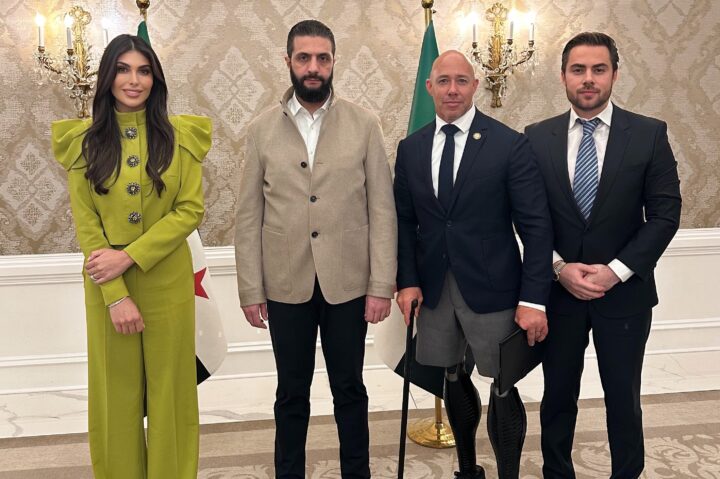
Jasmine Naamou and Tarek Naemo with Syrian President Ahmad al-Sharaa and Rep. Brian Mast (R-FL) (courtesy)
Rep. Brian Mast (R-FL) met on Sunday with Syrian President Ahmed al-Sharaa, who is in Washington for a meeting with President Donald Trump. Mast said he confronted al-Sharaa over his terrorist past.
“We had a long and serious conversation about how to build a future for the people of Syria free of war, ISIS, and extremism,” Mast said in a statement.
Mast is an Army veteran who lost both legs while serving as an explosive ordinance disposal technician in Afghanistan in 2010. Al-Sharaa is a former commander in ISIS and Al-Qaida and later in a Syrian splinter group.
“He and I are two former soldiers and two former enemies. I asked him directly ‘Why we are no longer enemies?’” Mast continued. “His response was that he wishes to ‘liberate from the past and have a noble pursuit for his people and his country and to be a great ally to the United States of America.’”
Mast, a Trump ally, concluded, “Today, he will meet with President Trump and officially join the Global Coalition to Defeat ISIS.”
Notably, Mast’s statement is absent any direct praise for al-Sharaa or his efforts, or any commitment to supporting sanctions relief for the Syrian regime, which Trump has encouraged Congress to enact.
Some Syrian diaspora activists have targeted Mast, who chairs the House Foreign Affairs Committee, in recent days, describing him as the largest obstacle to the repeal of human rights sanctions on Syria under the Caesar Act.
Meanwhile, Mast is facing criticism from some conservatives for sitting down with al-Sharaa.
Far-right influencer Laura Loomer, who has a long history of anti-Muslim activism and is an ally of Trump as well, said she was “really stunned” by the two meeting.
“Imagine getting your legs blown off by Muslim terrorists and then posing for a photo with an Islamic terrorist,” Loomer said on X. “How many of @RepBrianMast’s fellow brothers and sisters in uniform were killed by Islamic terrorists like Julani?”
Loomer has also criticized the Trump administration for welcoming al-Sharaa to the White House.
Jasmine Naamou and Tarek Naemo, a Florida couple advocating closer U.S.–Syria ties, have courted lawmakers including Sen. Jeanne Shaheen, Rep. Joe Wilson and even House Speaker Mike Johnson as they promote Damascus in D.C.
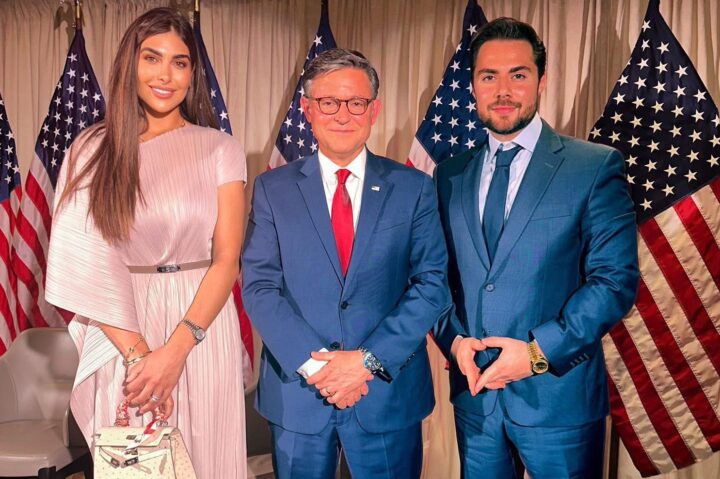
X/Syrian American Alliance for Peace & Prosperity
asmine Naamou and Tarek Naemo meet with House Speaker Mike Johnson (R-LA), June, 10, 2025
The fall of Bashar al-Assad’s brutal regime in Syria last December happened slowly, and then all at once — leaving a region reeling from whiplash and a country digging itself out from the rubble, now under the leadership of a former militia head who cut his teeth as an Al-Qaida terrorist.
This week, that leader, Syrian President Ahmad al-Sharaa, is coming to Washington, the first time a Syrian president has ever been invited to the White House.
Alongside al-Sharaa’s rise in Damascus has been a flurry of activity in Washington, as lawmakers tried to make sense of a country that one day was considered a rogue nation locked in protracted civil war and the next was viewed as a free state on the path to stability.
Two people in particular have become fixtures on Capitol Hill, pushing the message that Washington should lift sanctions on Damascus and build stronger ties with Syria: Jasmine Naamou and Tarek Naemo, a married couple who live in Daytona Beach, Fla., with a knack for social media self-promotion and a willingness to strike up a conversation with anyone.
On the eve of al-Sharaa’s meeting with President Donald Trump, the couple arranged a meeting with the Syrian leader and Rep. Brian Mast (R-FL), chair of the House Foreign Affairs Committee.
Naamou and Naemo first came to Capitol Hill this year as activists with the Syrian American Alliance for Peace and Prosperity, a nonprofit that emerged early this year to advocate for closer ties between the U.S. and Syria, though Naamou said she doesn’t work directly with them anymore. The organization arranged meetings for Syria’s foreign minister in New York this year, and in April it brought two members of Congress — Reps. Cory Mills (R-FL) and Marlin Stutzman (R-IN) — to Syria for the first visit by U.S. officials in years. Naamou and Naemo were on the trip with them.

Mills and Stutzman’s visit preceded a more senior delegation, with Sen. Jeanne Shaheen (D-NH), the top Democrat on the Senate Foreign Relations Committee, and Rep. Joe Wilson (R-SC), who has held several senior foreign policy roles, visiting the country together.
All of those lawmakers have met with either Naamou or Naemo this year, documented with slick photos shared on the couple’s Instagram accounts. Naamou has 319,000 followers, and a pinned photo with House Speaker Mike Johnson (R-LA); Naemo has 2.2 million followers and flaunts photos with the Saudi investment minister and Turkey’s ambassador to Syria — plus an image of him holding a rifle and sitting on a golf cart with Wilson. He refers to Wilson as “my dearest friend.”

Naamou spoke to Jewish Insider on Friday ahead of al-Sharaa’s visit to preview what she hopes the Syrian leader will discuss with Trump, with normalization with Israel high on the list.
“We want regional stability. Israel’s a neighbor. They’re a friend of America. We want them to be friends of Syria. We want to normalize relations,” said Naamou, who was driving to the airport, bound for Washington to be there for al-Sharaa’s visit. She also expressed hope for a U.S. security presence in Syria: “I believe they’re moving in the right direction of getting that security agreement in place. From what I’ve heard, they are in discussions of having a U.S. air base in Damascus to help with those security discussions between Syria and Israel. So I really do see the steps moving in the right direction.”
Ahead of his visit, the United Nations lifted sanctions on al-Sharaa, a move that followed a similar executive order by Trump in June. “President Trump is committed to supporting a Syria that is stable, unified and at peace with itself and its neighbors,” the White House said at the time.
Naamou and her husband both work in real estate in central Florida, though they also have ties to a Saudi sovereign wealth fund, according to Intelligence Online, a publication focused on diplomacy. Naamou said investment is a focus of their advocacy to American officials.
“They’re also going to have discussions on reintegrating investments in Syria because President Trump, when he went over to Saudi Arabia on his Middle East trip, he had announced the whole cessation of sanctions,” said Naamou.

Florida oceanside city become such fixtures on Capitol Hill? Naamou, who is 30, dates her own advocacy to her college days at the University of Florida, where she studied international relations and political science because of what was happening in Syria. She said the political relationships started back home in Florida, too.
“I live in Volusia County, and it’s a relatively small county, and everyone kind of knows each other,” she said. “You just go to events, and you meet people, and things happen, and you discuss things, and then you find things in common.”
They’ve also met with Reps. Byron Donalds (R-FL), who is running for governor of Florida; Anna Paulina Luna (R-FL); Maxine Waters (D-CA) and Abe Hamadeh (R-AZ), who is the child of Syrian immigrants.
“I see huge bipartisan support now,” Naamou said. “We like to term Syria as a swing state. Syria is multi-layered. Syria is one of the only countries in the Middle East that is so complex. You have all three Abrahamic religions present in Syria. You have all different types of ethnicities present. And so Syria is very key in the region, because it can be swung either way.”
“Either way,” in this case, means West or East — bringing Syria into the U.S.-led Western world, or into the Russia-Iran-China orbit.
“They want the U.S., and they want to acclimate here with our values,” said Naamou, who was born in Michigan to a Syrian father. She described the rapid changes in Syria as a “snowball effect.”
“I’ve never seen, when a regime has fallen, such a fast paced amount of change happen in such a short period of time,” said Naamou. She wants to see it continue: all sanctions lifted, American investment, closer ties.
“I’m hoping that we see a larger acceptance of Syria in general,” she said. “I’m hoping that we’re able to somehow, in any way, reshape the narrative into a positive light.”
The meeting with al-Sharaa could help push a U.S.-brokered Syria-Israel security agreement across the finish line
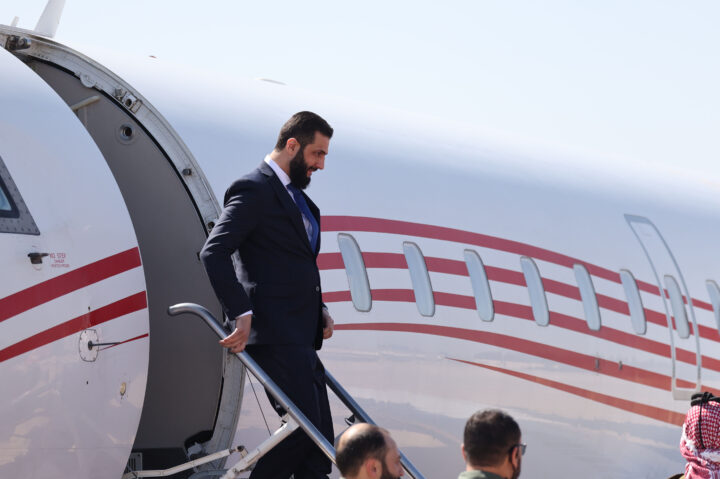
Salah Malkawi/Getty Images
Syrian President Ahmad al-Sharaa arrives at Marka airport on Feb. 26, 2025 in Amman, Jordan.
When Syrian President Ahmad al-Sharaa visits the White House on Monday, he will be the first Syrian head of state to do so, a long-anticipated meeting that could advance U.S. efforts to broker a potential security agreement between Syria and Israel.
The U.S. has worked on mediating a security deal between the two nations this year following the fall of the Iran-aligned Assad regime and Israel’s decisive military action against Hezbollah in Lebanon, something that Israeli Prime Minister Benjamin Netanyahu said made the talks “possible.”
After the fall of Assad, the IDF entered a U.N. buffer zone inside Syria in order to protect its own borders as the country’s military and government were in flux. Reports indicate that Damascus is seeking an end to the Israeli presence there, while Israel is calling for the demilitarization of southwest Syria and for al-Sharaa’s government to take more responsibility for the security of the Druze minority in the region.
“Israel’s main concerns center on the deployment of Syrian forces in the south and the protection of the Druze minority, while Syria remains wary of leaving large parts of southern territory outside its control,” said Ahmad Sharawi, a research analyst at the Foundation for Defense of Democracies.
Trump administration officials have said in recent months that the security deal is “99% done,” though it has yet to be finalized.
Experts told Jewish Insider the visit could allow the parties to work out the details of the agreement and push the long-awaited security deal to completion — a development that would further cement Damascus’ strategic realignment with Washington and Israel and foster reduced dependence on Iran.
“Regrettably, a much-discussed Syria-Israel security agreement is evidently not ready to be announced, but it is hoped that the visit will help push the agreement over the finish line,” said Robert Satloff, executive director of The Washington Institute for Near East Policy, who called the visit a “landmark event.”
“Al-Sharaa’s visit to the White House is significant because it marks the first time Washington has treated Damascus not as an adversary, but as a potential partner,” said Sharawi. “There is a real possibility that this meeting could move both sides closer to signing such an agreement.”
To bolster a potential agreement, the U.S. is also preparing to deploy forces to an airbase near Damascus, according to Reuters. The move would mark the first direct American military presence in the Syrian capital, even as President Donald Trump has advocated for reduced or nonexistent military involvement in the region.
Shawari says a potential U.S. military presence at an airbase near Damascus would represent a “turning point” in the talks.
“For Israel, a limited U.S. presence would provide Israel with a guarantor to keep the Syrians in check; for Damascus, it would signal goodwill toward Washington and a willingness to align with U.S. strategic interests in promoting regional stability,” said Shawari.
Trump has worked on normalizing U.S. relations with the new Syrian government during his second term. During his Middle East visit in May, Trump became the first American president in 25 years to meet with a Syrian leader and announced an end to U.S. sanctions on Syria for the first time in more than a decade.
The U.S. requested that the United Nations lift sanctions on al-Sharaa ahead of the visit — a move the Security Council approved on Thursday. The decision allows the U.S. to legally remove al-Sharaa from the Specially Designated Global Terrorist list and follows the State Department’s July 2025 decision to delist his faction, Hay’at Tahrir al-Sham (HTS), as a Foreign Terrorist Organization. The Trump administration has also expressed support for repealing the congressionally mandated Caesar Act sanctions on Syria, a move the Senate is considering.
“I’m glad that the @UN Security Council lifted its sanctions on Syria,” wrote Sen. Jim Risch (R-ID), the Senate Foreign Relations Committee Chairman, on X on Friday. “This will benefit the Syrian economy and its people. Along with @potus, my colleagues and I are working to repeal Caesar sanctions so Syria can become a safe and prosperous partner for the U.S. in the Middle East.”
The Oval Office meeting also comes on the heels of an announcement Thursday that Kazakhstan will be joining the Abraham Accords, a move that Trump administration officials said they hoped would help build momentum for the Accords ahead of the meeting and a later visit by the Saudi Crown Prince Mohammed bin Salman on Nov. 18.
“President Trump has advocated for Syria’s inclusion in the Abraham Accords since lifting sanctions in May,” said Sharawi. “But, al-Sharaa himself has described that step as unrealistic for now, while signaling that he’s open to a security agreement modeled on the 1974 disengagement accord.”
The 1974 Separation of Forces Agreement — a resolution that was passed by the U.N — established a zone of separation between Israel and Syria and called for the disengagement of forces following the 1973 Yom Kippur War.
In a webinar hosted by The Washington Institute for Near East Policy on Friday, former Israeli Ambassador to the U.S. Michael Herzog — who said an “active U.S. role” is essential for the deal — questioned the effectiveness of using the previous agreement as a template.
“There is still the framework of the 1974 disengagement agreement between Israel and Syria following the 1973 war, but that is outdated,” said Herzog. “We need a new framework and new structure.”
Sharawi noted a new framework for cooperation between Syria and Israel could be based on “shared security threats” such as Iran and Hezbollah — a point Herzog also emphasized.
“Both Israel and al-Sharaa would take action [under a security agreement] to prevent Hezbollah from reasserting itself in Syria or Iranians smuggling weapons and munitions to Hezbollah in Lebanon through Syria,” said Herzog. “So this is a very big deal, but there are also risks.”
“The biggest opportunity is the fact that both al-Sharaa and Israel regard Iran and the Iranian axis as an enemy,” Herzog added. “Syria was a vital link in the Iranian axis and this is no longer the case — an indirect outcome of Israel turning the tables on Hezbollah and later on Iran.”
Satloff said there are steps al-Sharaa could take — whether as part of the emerging agreement or through independent gestures — to further strengthen regional security and demonstrate Damascus’ commitment to peace.
“One area where President al-Sharaa could make a singular contribution to broader Middle East peace is to publicly clarify an issue that has provided Lebanon’s Hezbollah with fodder for its ‘resistance’ against Israel — that is, for Syria to state that the disputed Shebaa Farms and divided town of Ghajar were Syrian territory when taken by Israel, not Lebanese,” said Satloff, referring to a disputed area along the Lebanon-Syria-Israel border that has been under Israeli control since 1967 but is claimed by Lebanon with Syrian backing. “This would pull the rug from under Hezbollah and undermine much of its rationale for continuing the fight against Israel.”
Ernst called Qatar ‘a partner nation who has been working so heavily on securing peace and stability in the Middle East’ in reference to Israel’s strike in Doha
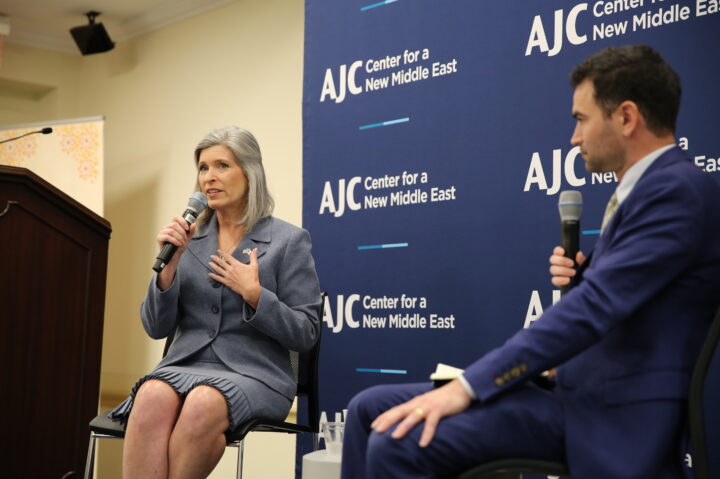
AJC/Martin H. Simon
Sen. Joni Ernst (R-IA) speaks at AJC's Abraham Accords 5th Anniversary Commemoration on Capitol Hill in Washington on Sept. 10, 2025.
Sen. Joni Ernst (R-IA) said that she came away with optimism for the future of Syria from a meeting with Syrian President Ahmad al-Sharaa last month, while adding that she remains skeptical and emphasizing the need to “trust but verify.”
“This is an opportunity right now. Whereas before, we have been on opposing forces, now is the time when we can come together for the prosperity of the region and stability in Syria,” Ernst said at an American Jewish Committee event on Wednesday in Washington. “Yes, I’m skeptical, but I am optimistic.”
Ernst, a vocal supporter of Israel, joined a statement shortly after that meeting condemning Israel for carrying out strikes against Syrian government targets.
Ernst said that she’d had a striking exchange with al-Sharaa over their shared time in combat in Iraq — Ernst as a U.S. service member and al-Sharaa as a member of Al-Qaida.
“I told him I, as well, served in Iraq. He was kind of taken aback by that, but then we laughed,” Ernst said.
She said that she will give the new Syrian government the “benefit of the doubt, as long as they are earning that benefit.” But, she continued, “The minute things start going south, we no longer support and we made that very clear to the president while we were on that visit.”
She said that the best way to ensure that Syria turns toward the West and to prevent encroachment by Iran, Russia, China and Turkey is to maintain a presence and influence with Syria’s leadership.
Ernst — who has been among the most strident critics of Qatar in the Senate and argued on multiple occasions that it is not doing enough to pressure Hamas to free the hostages — offered a cautious response to the Israeli strike on Hamas leaders in Doha.
“We understand that Israel is in a place where they have said Hamas will be destroyed, end of story. We support them on that effort,” Ernst said. “The problem is when you are striking a partner nation who has been working so heavily on securing peace and stability in the Middle East, and that country on this particular strike happened to be Qatar, so the president was disappointed in that. I did not feel that it furthered our relationship” with Qatar.
She emphasized that, though Qatar is hosting Hamas leadership, it also hosts the largest U.S. Air Force base in the Middle East.
Addressing isolationist voices on both political sides, the retiring Ernst emphasized that relationships globally matter, and that the U.S. must maintain them.
“If you don’t have a seat at the table, you are not able to shape and influence the outcome,” Ernst said. “So it is very important that the United States remain engaged around the globe. Now I would also say presence is power.”
Israel used Syrian airspace for its strikes on Iran last month, and the two countries are discussing a non-aggression pact that would lead to a return to pre-2025 borders

Rami Alsayed/NurPhoto via Getty Images
The President of the Syrian Arab Republic, Ahmad Al-Sharaa, delivers a speech at the People's Palace during the swearing-in ceremony of the new government, in Damascus, Syria, on March 29, 2025.
The goodwill gestures toward Israel from Syrian President Ahmed al-Sharaa began modestly.
In a surprise move that came only months after he and his Hayat Tahrir al-Sham group toppled the brutal regime of Bashar al-Assad, the Syrian president — “a jihadi in a suit,” as Israeli Foreign Minister Gideon Sa’ar called him over past ties to Al-Qaida — gave Israel Syria’s archive of documents relating to captured Israeli spy Eli Cohen, who was captured and executed in Syria in 1965, and the remains of soldier Zvi Feldman, who was killed in battle in 1982.
Then, al-Sharaa pressured the terrorist groups Palestinian Islamic Jihad and the Popular Front for the Liberation of Palestine to disarm, leading some of the groups’ leaders to flee the country.
And when Israel sent its bombers streaking toward Iran’s nuclear sites last month, Syria did not intervene with or publicly oppose Israel’s use of its airspace.
Taken together, these steps and others are leading to a warming of relations between Israel and its northern neighbor, a reality that seemed almost unthinkable just a few months ago. While officials and analysts are stopping short of calling the rapprochement peace talks, there is a new optimism — albeit cautious — following the strikes.
While at the White House on Monday, Israeli Prime Minister Benjamin Netanyahu spoke positively about an “opportunity for stability, security and eventually peace” with Syria. He said that prospect stems from “the fact that [President Trump] has opened up a channel … and the change of security situation brought about by the collapse of the Assad regime.”
Last week, Sa’ar said in a press conference that Israel “would like to have all our neighbors … in the camp of normalization and peace in the region. That includes Syria, as much as it includes Saudi Arabia … It is too early to prejudge what will happen in the future. We have certain security needs and interests, which we must take into account.”
A senior official in Netanyahu’s delegation to Washington emphasized this week that talk of peace between Israel and Syria is premature, saying that “agreements with Lebanon and Syria are not a matter of the short term, but they’re possible.”
“There are a lot of challenges,” the official said. “It would be irresponsible to talk about Syria entering the Abraham Accords or normalization at this time. We aren’t there.”
Still, the official said that opportunities opened up after the successful Israeli and American strikes on Iran, among them an agreement with Syria.
One way the 12-day Israeli operation against Iran’s nuclear and ballistic missile programs may have contributed to Israel’s cautious optimism about reaching understandings with Syria is that its airspace played an important role in Israel’s strikes and defense during that time — and Damascus did not get in the way.
Carmit Valensi, head of the Syria program at the Institute for National Security Studies at Tel Aviv University, told Jewish Insider that “there was intensive Israeli activity in Syria’s airspace on the way to attack Iran, and Israel shot down [Iranian] drones and missiles over Syrian territory.”
While al-Sharaa’s view of Iran as a “strategic threat to the entire region” is not unique among leaders in the Middle East, Valensi pointed out, “unlike other Arab countries that condemned Israel [for the strikes on Iran], al-Sharaa was totally quiet.”
Israel and Syria “have a shared goal to weaken Iran and its influence,” Valensi said. “I think that gave another push for the interests to bring relations closer.”
Ronni Shaked, a research fellow at the Harry S. Truman Institute for the Advancement of Peace at Hebrew University, views Syria’s willingness to allow Israel use of its airspace to strike Iran as the most significant of a number of “goodwill gestures” from Damascus to Jerusalem that may be contributing to Israel’s shifting approach to Syria.
Letting Israel use Syrian airspace during its war with Iran “gave Israel unusual freedom of action to easily reach the Iraqi border and then Iran, which took a great weight off of Israel,” Shaked said.
“He [Syrian President Ahmed al-Sharaa] is showing signs that he knows he has to change to get help from the West and so the world will recognize him as the legitimate leader,” said IDF Maj.-Gen. (res.) Ya’acov Amidror, a former Israeli national security advisor. “It’s also clear that Arab leaders are not willing to live next to a Taliban state.”
Other gestures in the months since al-Sharaa’s rise included giving Israel Syria’s archive of documents relating to Israeli spy Eli Cohen, who was captured and executed in Syria in 1965, and the remains of soldier Zvi Feldman, who was killed in battle in 1982.
In addition, Shaked noted that al-Sharaa pressured the terror groups Palestinian Islamic Jihad and the Popular Front for the Liberation of Palestine to disarm, leading some of the groups’ leaders to flee the country.
IDF Maj.-Gen. (res.) Ya’acov Amidror, a former Israeli national security advisor, told JI that the main reason for the shift was that “time passed, that’s all.”
“In the beginning, he was a mystery. No one knew who [al-Sharaa] was, only that he came from Al-Qaida, and we only saw Al-Qaida-type people around him,” Amidror said.
Since assuming leadership of Syria in December, however, Israel has seen that al-Sharaa “is trying to build something else in Syria,” Amidror said. “He is showing signs that he knows he has to change to get help from the West and so the world will recognize him as the legitimate leader. It’s also clear that Arab leaders are not willing to live next to a Taliban state.”
“Taking all of that together, Israel is willing to talk,” he added.
Trump’s May meeting with al-Sharaa in Saudi Arabia also motivated Jerusalem and Damascus to enter talks.
Shaked said that Syria “jumped on [the opportunity] … and said, ‘If Trump is willing to recognize us, then we can get rid of the sanctions and receive grants’” to help rebuild the country.
The meeting between Trump and al-Shaara “was the breakthrough that set the path we are on,” he added.
Valensi concurred, saying that “the direct motivation for Israel to change its approach is the Americans’ embrace of al-Sharaa.”
After Assad’s fall in December, Israel struck Syria’s air defenses, missile stockpiles and other military capabilities, and moved into the buffer zone between the countries. Valensi said that the “hawkish approach to al-Sharaa came from … the trauma of Oct. 7 [2023 terror attacks]. Israel is much more determined to stop threats that may develop on its border. And paradoxically, Israel had a feeling of increased self-confidence, strength and power after its significant military achievements against the axis of resistance and Hezbollah, including the beeper operation and killing [Hezbollah leader Hassan] Nasrallah.”
Even before the May meeting in Riyadh, Valensi said, Israel had begun to soften its approach, with indirect talks between the countries, fewer military strikes and talks about deconfliction with Turkey, mediated by Azerbaijan.
“I think Israel started to understand that there were risks to its approach, and was starting to create a hostile dynamic to Israel” within Syria, Valensi said.
Amidror stopped short of describing the current situation as a shift in Israel’s approach: “There isn’t a change yet. We aren’t giving anything up, but we are in talks … We’re not withdrawing [from the Syrian Golan] so fast.”
That could change in the future, however, Amidror added, saying that if al-Sharaa “really distances himself from where he came from and goes to a less extreme and more normal place, there is no reason for Israel to ignore it.”
Syrian media describes the talks as a “non-aggression pact,” Valensi said. Damascus has said it is looking to return to the 1974 ceasefire agreement that went into effect after the Yom Kippur War, which would entail Israel withdrawing from the Syrian side of the Golan Heights to where it was before the fall of former President Bashar al-Assad last year, and for there to be a buffer zone with U.N. forces between the countries.
Valensi was skeptical that Israel would be willing to withdraw from the peak of Mount Hermon, a point in Syria which the IDF deployed troops to shortly after the fall of Assad, after so many senior Israeli security figures have called it a strategic achievement.
“Peace with Syria removes the entire threat from the eastern front, which is Israel’s longest front and a strategic one. We have peace with Jordan, and if we had peace with Syria, it would be the greatest gift to Israel,” said Ronni Shaked, a research fellow at the Harry S. Truman Institute for the Advancement of Peace at Hebrew University.
“Israel may want a more gradual formula, a withdrawal in stages. I don’t know if al-Sharaa will accept that, and [withdrawal] is his basic condition,” she said.
Shaked argued that “Israel has no need for the Syrian Golan. I don’t know what we’re doing there. It’s nonsense, it’s a symbol. If we want peace, we need to stop conquering territory.”
“Peace with Syria removes the entire threat from the eastern front, which is Israel’s longest front and a strategic one. We have peace with Jordan, and if we had peace with Syria, it would be the greatest gift to Israel,” he said.
While talks are not focused on a comprehensive peace treaty yet, Shaked said anything is possible: “It was a great surprise when [former Egyptian President Anwar] Sadat came to Israel. We pinched ourselves and asked when we’re dreaming. New realities are created by brave leaders. If Netanyahu will be brave enough, he can give a little attention to this issue and make advances towards peace.”
Valensi, however, argued that “the conversation about expanding the Abraham Accords or normalization is not relevant now.” She noted that al-Sharaa has said that public opinion in Syria would not support normalization with Israel, and it would be too drastic of a shift. “Al-Sharaa is a new leader with very limited legitimacy. It’s a fragile situation … It’s unclear that al-Sharaa would want to take on that political risk,” she said.
Johnnie Moore, an evangelical leader and director of the Gaza Humanitarian Foundation who met with al-Sharaa last month, told the “Misgav Mideast Horizons” podcast last week that he “absolutely believe[s] that there will be peace between Syria and Israel. No question. It’s just a matter of time.”
As to an unconfirmed report that Netanyahu and al-Sharaa will meet in September before the U.N. General Assembly, Valensi said that “so many things can change in two months … Reality is so dynamic so I would not go that far. But if things continue on this trajectory, then it is possible.”
Still, al-Sharaa would have to do a lot of work on Syrian public opinion before being photographed with Netanyahu, she added.
Johnnie Moore, an evangelical leader and director of the Gaza Humanitarian Foundation who met with al-Sharaa last month, told the “Misgav Mideast Horizons” podcast last week that he “absolutely believe[s] that there will be peace between Syria and Israel. No question. It’s just a matter of time.” (The writer is a co-host of the podcast.)
Al-Sharaa, Moore said, is part of a new generation of Middle Eastern leaders who are “future-oriented” and focused on solving problems, in contrast with “older leaders who think only about the past.”
To get there, however, Moore said “there are practical things that have to be done, and there are things that will make the Syrians uncomfortable and things that will make Israel uncomfortable. And yet, I think it will be done.”
“I’m not sure it’s going to be done as quickly as everybody wants it, but I am certain it’s not going to take as long as people think it might,” he added.
Plus, Trump's Gulf tour underscores Israel’s diplomatic disadvantage

White House Press Secretary Karoline Leavitt/X
Saudi Crown Prince Mohammed bin Salman, President Donald Trump and Syrian President Ahmed al-Sharaa meet in Riyadh, May 14th, 2025
Good Wednesday morning.
In today’s Daily Kickoff, we report on President Donald Trump’s meeting earlier today with Syrian President Ahmed al-Sharaa, and analyze the findings of a new poll from the Jewish Voter Resource Center. We also talk to Sen. Katie Britt about recent attacks on Sen. John Fetterman, and spotlight the Zachor Legal Institute’s call for the IRS to investigate a key fiscal sponsor of anti-Israel agitators. Also in today’s Daily Kickoff: Dan Senor, former Vice President Mike Pence and Rabbi Noam Marans.
What We’re Watching
- President Donald Trump continues his Middle East trip today as he flies to Qatar this afternoon. Earlier today, Trump met with Gulf Cooperation Council leaders in Riyadh, Saudi Arabia, including a side meeting with Syrian President Ahmed al-Sharaa. Read more about the meeting between Trump and al-Sharaa here.
- The House Homeland Security Committee is holding a hearing this morning with Homeland Security Secretary Kristi Noem.
- The Department of Justice is holding its 32nd Annual Federal Interagency Holocaust Remembrance Program this morning.
- The Israeli American Council is holding a Yom Ha’atzmaut celebration tonight at the Library of Congress.
What You Should Know
A QUICK WORD WITH JOSH KRaushaar
A new poll commissioned by a Democratic Jewish group suggests that concerns over antisemitism have receded a bit since post-Oct. 7 record levels, with younger voters notably less concerned than their parents and older generations. The survey, conducted by GBAO, also finds the depth of attachment for Israel, while still at high levels, has also dipped somewhat as time has passed since Hamas’ attacks, Jewish Insider Editor-in-Chief Josh Kraushaar writes.
The big toplines from the Jewish Voter Resource Center survey, which polled 800 Jewish voters between April 22 and May 1: Only one-quarter of Jewish voters view President Donald Trump favorably. Among respondents, Democrats hold a commanding 70-22% lead on next year’s generic congressional ballot. Israeli Prime Minister Benjamin Netanyahu’s standing among American Jewish voters is also low, with only 34% viewing him favorably, while 61% see him unfavorably.
Over two-thirds (69%) of Jewish voters profess an attachment to Israel, which is down from 82% a month after Oct. 7 but at a similar level to the years preceding the attack. Nearly two-thirds of Jewish respondents (62%) said they’re very concerned about antisemitism — a historically high number, but a marked dropoff from the 79% who expressed the same sentiment in November 2023. Notably, only 33% of younger Jewish voters ages 18-34 said they’re concerned about antisemitism.
Asked whether right-wing or left-wing antisemitism was a bigger threat, respondents were more divided. Nearly half (47%) said right-wing individuals and groups were more responsible, while 34% viewed left-wing groups as a bigger problem. And Democrats fared relatively poorly on which party is better equipped to handle antisemitism, holding just a seven-point edge (34-27%) over Republicans despite a much greater overall partisan advantage.
The most significant takeaway from the survey is the gaping divide within the Jewish community when it comes to Jewish observance — secular and less observant Jews hold diametrically opposing views on many issues compared to their more observant coreligionists.
For instance, 75% of Orthodox Jewish respondents said they approved of Trump’s job performance, compared to only 18% of Reform Jewish voters. While 69% of Orthodox Jews and 60% of Conservative Jews have a “very strong” attachment to Israel, that number falls to 35% among Reform Jews (and 22% among those unaffiliated).
On domestic policy issues, the gap is similar. Most Orthodox voters (78%) favor eliminating DEI initiatives that receive federal funding, while only 21% of Reform respondents say the same. The poll also found two-thirds of Orthodox Jews backing the president’s original punitive tariffs against China, while just 14% of Reform voters agreed.
The results underscore that one of the biggest challenges in both Israel and the United States’ Jewish community is internal divisions that make it harder to present a united front externally. Those divisions are slowly, but notably, percolating even on issues that once united the Jewish world post-Oct. 7.
ON THE SIDELINES
Trump’s Gulf tour underscores Israel’s diplomatic disadvantage

If there was any doubt about President Donald Trump’s increasing reliance on checkbook diplomacy, and his disapproval of America’s past approach to the Middle East, he left little room for dispute in a keynote address on Tuesday in Saudi Arabia that sharply critiqued “interventionalists” and “neo-cons” while calling for an end to regional wars. The message in Trump’s speech, and the optics of a visit to the Middle East that doesn’t include a stop in Israel, were met with concern by pro-Israel Republicans and hawkish foreign policy experts, who worry that his turbo-charged dealmaking with the oil-rich Gulf nations — cemented this week with trade deals in the hundreds of billions of dollars — puts Israel at a diplomatic disadvantage, Jewish Insider’s Gabby Deutch reports.
Dollar signs: “His approach is obviously completely transactional. If he has a view about the U.S. national interest, that view revolves around financial and commercial interests, and that obviously diminishes the value of the alliance with Israel, which is not primarily financial and commercial,” said Elliott Abrams, a former longtime Republican official who served as Iran envoy in Trump’s first term. “It’s based on values. It’s based on military cooperation. It is based also on high-tech cooperation, but Trump seems to be less interested in that and more interested in the dollar signs.”
Presidential address: “The gleaming marvels of Riyadh and Abu Dhabi were not created by the so-called nation-builders, neo-cons, or liberal nonprofits like those who spent trillions failing to develop [Kabul], Baghdad, so many other cities,” Trump said in a speech on Tuesday at a U.S.-Saudi Arabia investment forum event in Riyadh. “In the end, the so-called nation-builders wrecked far more nations than they built and the interventionalists were intervening in complex societies that they did not even understand themselves. Trump also condemned American presidents who “have been afflicted with the focus that it’s our job to look into the souls of foreign leaders and use U.S. policy to dispense justice for their sins.”
AIRING CONCERNS
More Republicans voice concern about Qatari jet, as Dems pursue blocking efforts

A handful of congressional Republicans voiced fresh concerns on Tuesday about President Donald Trump’s plans to accept a gift of a Qatari luxury jet worth $400 million to join the Air Force One fleet, Jewish Insider’s Marc Rod and Emily Jacobs report. Democrats, meanwhile, stepped up their efforts to block the gift.
Growing worries: Senate Majority Leader John Thune (R-SD), expanding on comments he’d made the previous day, said that there “will be plenty of scrutiny” for the transfer if it occurs. “There are lots of issues around that that I think will attract very serious questions if and when it happens.” But he also downplayed the gift as purely “hypothetical” at this point. Sen. Ted Cruz (R-TX) came out more strongly against the gift, saying, “I’m not a fan of Qatar, I think they have a really disturbing pattern of funding theocratic lunatics who want to murder us, funding Hamas and Hezbollah and that’s a real problem. I also think that the plane poses significant espionage and surveillance problems, so we’ll see how this issue plays out, but I certainly have concerns.”
Bonus: Bloomberg looks at the potential security risks associated with Qatar’s proposed gift of a luxury jet to the Trump administration, citing expert concerns over “opportunities for surveilling, tracking or compromising communications.”
FAIR-WEATHER FRIENDS
Sen. Katie Britt slams Democrats for not defending Fetterman

Sen. Katie Britt (R-AL) is criticizing Senate Democrats for declining to challenge media reports about Sen. John Fetterman’s (D-PA) mental health, attributing their reticence to the Democratic senator’s independent approach to Israel and immigration, and his support for several of President Donald Trump’s Cabinet nominees, Jewish Insider’s Emily Jacobs reports.
Independent streak: Britt, who has grown to be one of Fetterman’s closest personal friends in the Senate since both were elected in 2022, raised concerns about the implications of Senate Democrats remaining silent as one of their own is targeted over his highly publicized mental health struggles during National Mental Health Awareness Month. “John has been a voice for Israel. He has been a voice for the Jewish people. He has been willing to take a look at nominees and approach things in a common-sense way. He understands the need for a secure border and interior enforcement. He was out front on the Laken Riley Act. I would say that part of [Democrats’] silence has to do with his independence,” Britt told JI.
STATE OF THE JEWS
Dan Senor: Jewish day schools, summer camps key to thriving U.S. Jewry

Jewish day schools and summer camps as well as gap years in Israel are some of the strongest contributors of a solid Jewish identity — ones that provide the tools that are needed at this precarious moment to “rebuild American Jewish life” — podcast host and author Dan Senor said on Tuesday night as he delivered the 45th annual State of World Jewry address at the 92NY in Manhattan, Jewish Insider’s Haley Cohen reports for eJewishPhilanthropy.
Jewish giving: “But here’s the uncomfortable truth,” Senor said, pointing to a statistic that of the 33 Jewish individuals on the Forbes 400 list with publicly reported charitable giving, no more than 11% of their giving went to Jewish causes. “I am not suggesting Jewish generosity to the broader civic square come to an end,” Senor said. “But I am arguing that it is time for a recalibration in favor of our community’s needs. We need to invest so that we can look back on this moment decades from now and say: American Jewish life was not the same after that. It was better.”
Read the full story here and sign up for eJewishPhilanthropy’s Your Daily Phil newsletter here.
scoop
Syrian diaspora group’s Capitol Hill conference abruptly canceled amid anti-Israel, Assad regime concerns

A Syrian diaspora conference in a House office building meeting room was abruptly canceled on Monday after a lawmaker raised concerns about the group and its leadership, sources familiar with the situation told Jewish Insider’s Marc Rod.
What happened: A member of Congress reserved the room on the group’s behalf, but that member withdrew their sponsorship on Monday after the event had begun, a source said. Per House policy, the group would have been required to leave the room once it lost that sponsorship. The group in question denied that the event had been canceled or disrupted. In the days before the conference, Rep. Joe Wilson (R-SC) wrote to the chair and ranking member of the Committee on House Administration urging them to intervene to cancel the event, citing concerns about alleged ties to the Assad regime and comments the group’s counsel had shared in support of the Houthis and about Israel.
Bonus: Sen. Lindsey Graham (R-SC), a close ally of President Donald Trump, called for a cautious and deliberate approach to removing sanctions on Syria and emphasized that Congress has a significant oversight role to play, hours after Trump announced in a speech in Riyadh that he plans to lift “all” U.S. sanctions on Syria, Jewish Insider’s Marc Rod reports. Reactions from others on Capitol Hill to the news have been decidedly mixed across both parties.
money matters
Antisemitism watchdog calls for IRS to investigate fiscal sponsor of anti-Israel agitators

The Zachor Legal Institute, a legal think tank in Montana focused on combating antisemitism and boycott campaigns against Israel, is calling on the IRS to review the tax-exempt status of a nonprofit group involved in fundraising for pro-Palestinian activism, claiming its fiscal sponsorship of a radical anti-Zionist organization accused of advocating for political violence may be in violation of federal law, Jewish Insider’s Matthew Kassel reports.
The argument: In a complaint filed Wednesday morning, Marc Greendorfer, the president and co-founder of the Zachor Legal Institute, formally urged the IRS to begin an investigation of the WESPAC Foundation, a nonprofit organization based in White Plains, N.Y., over its ties to Within Our Lifetime, an extreme activist group at the forefront of anti-Israel demonstrations across New York City in the wake of Hamas’ Oct. 7, 2023, attacks. “Through its fiscal sponsorship of Within Our Lifetime, a violent, radical and anti-Israel organization, WESPAC may have violated both the public policy doctrine and the illegality doctrine that the IRS uses to analyze and discern whether a 501(c)(3) charitable organization can maintain their tax-exempt status,” Greendorfer wrote in a letter to Michael Faulkender, the acting commissioner of the IRS, arguing that a “thorough investigation” of the matter “is warranted.”
Worthy Reads
Doha’s Dollars: The Free Press’ Jay Solomon and Frannie Block do a deep dive into Qatar’s efforts to establish footholds across American society. “Qatar has spent almost $100 billion to establish its legitimacy in Congress, American colleges and universities, U.S. newsrooms, think tanks, and corporations. Over the past two decades, it has poured those billions into purchases of American-made weapons and business investments ranging from U.S. real estate to energy plants. It built — and still pays for — the Al Udeid Air Base, even as the American wars in Iraq and Afghanistan have ended. Doha finances research and campuses at prestigious American universities. And its lobbyists have the connections needed to open all the right doors in Washington. Since 2017, it has spent $225 million on lobbying and public-relations efforts in the nation’s capital. … The influence built by Qatar in the U.S. has no modern parallel, The Free Press found, whether compared with large American companies seeking to influence antitrust policy, energy firms trying to win new drilling rights, or other foreign governments aiming to shape U.S. policy—or shield themselves from it. For comparison, Qatar spent three times more in the U.S. than Israel did on lobbyists, public-relations advisers, and other foreign agents in 2021 — and nearly two-thirds as much as China did, according to the government’s latest reports.” [FreePress]
Dealmaker or Wrecker?: The Washington Post’s David Ignatius looks at President Donald Trump’s unconventional approach to foreign policy as he balances multiple conflicts and a trade war with China while in the middle of his first trip abroad. “‘America has no ‘permanent enemies,’ Trump said in his discussion of Iran. That simple statement will reverberate across the region, especially in Israel, which views Iran as a deadly adversary. Israeli anxieties might be eased by Trump’s warning that if Iran didn’t agree to a nuclear deal and make peace, it would face ‘massive maximum pressure.’ Trump’s comments in Saudi Arabia cap a remarkable few weeks in which he has bent policies, including his own, to accommodate what he evidently concluded were limits imposed by global reality. … My takeaway: Trump remains a disrupter and a dealmaker — with big ambitions for ending global conflicts and boosting America’s economy. He can also be a wrecker, as in many of his domestic policies that have savaged universities, law firms, medical research, government agencies and anyone on Trump’s retribution list. But abroad, he appears to have recognized the constraints imposed by the financial markets, the resistance of China and other big trading partners, the danger of wasting money on inconclusive wars, and the inescapable fact of global economic interdependence.” [WashPost]
Full-Court Press: In an essay adapted from a speech he gave at the Notre Dame Kellogg Institute for International Studies, New York Times Publisher A.G. Sulzberger reflects on the role a free press plays in society. “And the press is far from the only American institution that finds itself under pressure. We’re seeing direct efforts to go after government agencies, universities, cultural institutions, research organizations, advocacy groups and law firms. We’re even seeing challenges to the authority of Congress and the courts to serve as a check on executive power. Like all of those institutions, the free press is imperfect. And like all of those institutions, the free press is a load-bearing pillar in a free society. … Let me pause to say plainly that as a champion of independent journalism, I believe our job is to cover political debates, not to join them. We’re not the resistance. We are nobody’s opposition. We’re also nobody’s cheerleader. Our loyalty is to the truth and to a public that deserves to know it.” [NYTimes]
Word on the Street
Iranian officials said that Iranian Foreign Minister Abbas Araghchi proposed a joint nuclear-enrichment venture in its negotiations with the U.S.; a representative for Middle East envoy Steve Witkoff denied the report…
Israeli Prime Minister Benjamin Netanyahu and Witkoff held a meeting on Wednesday in Jerusalem, the second time in three days the two have met…
Speaking at an event hosted by the Buckley Institute, former Vice President Mike Pence expressed “concerns” about the Trump administration’s revocation of Harvard’s tax-exempt status, stating, “What’s good for the goose is good for the gander. If we establish the precedent of taking away tax-exempt status from certain institutions that reflect discriminatory practices or antipathy toward right-wing views, we might find ourselves in an America where subsequent administrations think the same”…
The Trump administration announced it is cutting an additional $450 million in federal grants to Harvard, citing the school’s “pervasive race discrimination and anti-Semitic harassment”…
Former Transportation Secretary Pete Buttigieg said he would “assess” a 2028 presidential run, after declining to mount bids for Senate and governor in Michigan, where he resides…
A legal watchdog group sent a warning letter to Microsoft on Monday alleging that it is violating Title VII of the Civil Rights Act of 1964 by refusing to recognize a Jewish Employee Resource Group, Jewish Insider’s Haley Cohen has learned…
Brownstein Hyatt Farber Schreck hosted a 30th anniversary reception in its new office in Washington; speaking to the dozens of Capitol Hill legislators in attendance — including Senate Minority Leader Chuck Schumer (D-NY), , Chair John Barrasso (R-WY), NRSC Chair Tim Scott (R-SC), Sens. Michael Bennet (D-CO), Mitch McConnell (R-KY), Richard Blumenthal (D-CT), Ted Budd (R-NC), Susan Collins (R-ME), Chris Coons (D-DE), Steve Daines (R-MT), Tammy Duckworth (D-IL), Deb Fischer (R-NE), Kirsten Gillibrand (D-NY), Maggie Hassan (D-NH), John Hickenlooper (D-CO), Ron Johnson (R-WI), Tim Kaine (D-VA), Amy Klobuchar (D-MN), James Lankford (R-OK), Cynthia Lummis (R-WY), Ben Ray Luján (D-NM), Ed Markey (D-MA), David McCormick (R-PA), Jeff Merkley (D-OR), Jerry Moran (R-KS), Alex Padilla (D-CA), Gary Peters (D-MI), Jack Reed (D-RI), Jim Risch (R-ID), Mike Rounds (R-SD), Tina Smith (D-MN), Dan Sullivan (R-AK), Thom Tillis (R-NC) and Sheldon Whitehouse (D-RI); House Minority Leader Hakeem Jeffries (D-NY), Reps. Nancy Pelosi (D-CA), Rosa DeLauro (D-CT), Steny Hoyer (D-MD), Jeff Hurd (R-TX), Lisa McClain (R-MI), Chris Pappas (D-NH), Greg Stanton (D-AZ), Ritchie Torres (D-NY), Rob Wittman (R-VA) and Ann Wagner (R-MO) as well as Hill staff, administration officials, clients and friends of the firm — founder and Chairman Norm Brownstein reflected on the firm’s start “in a small office above the Capital Grille”…
New York City Mayor Eric Adams announced the creation of the city’s Office to Combat Antisemitism, staffed by Executive Director Moshe Davis…
A community garden in the Ridgewood neighborhood of Queens, N.Y., is facing eviction after requiring prospective members to sign a “statement of values” that included opposing Zionism…
In a letter to Rabbi Noam Marans, the American Jewish Committee’s director of interreligious affairs, Pope Leo XIV pledged “to continue and strengthen the Church’s dialogue and cooperation with the Jewish people.” Prominent Jewish Italian journalist Maurizio Molinari commented to Jewish Insider’s Lahav Harkov that the letter shows the new pope’s “deep understanding of the damage caused by his predecessor. … He understands that the very base of the dialogue with the Jews was put at risk” by his predecessor, Pope Francis….
U.K. broadcaster Gary Lineker is again facing criticism after sharing a social media post comparing Israel to a rat…
Workers in Argentina discovered a trove of Nazi-era documents in the basement of the country’s Supreme Court, where the propaganda materials had been kept for eight decades after being seized by the government during a customs search in 1941…
The IDF targeted Hamas leader Mohammad Sinwar in a strike on the European Hospital in southern Gaza yesterday, Jewish Insider’s Danielle Cohen reports…
Israel intercepted Houthi ballistic missile attacks on Tuesday evening and Wednesday morning; the missiles set off sirens in central Israel, including Tel Aviv and Jerusalem…
Natan Sachs, formerly the director of Brookings’ Center for Middle East Policy, is joining the Middle East Institute…
Pic of the Day

Israeli President Isaac Herzog (right) presented German President Frank-Walter Steinmeier with the Israeli Presidential Medal of Honor at a ceremony on Tuesday at the President’s Residence in Jerusalem.
Birthdays

Actress who has appeared in 13 movies, she is the daughter of Steven Spielberg, Sasha Rebecca Spielberg turns 35…
Born in Casablanca and raised in Paris, Midtown NYC hair stylist and owner of La Boîte a Coupe salon, Elie Laurent Delouya turns 77… Physician and social activist, she was the Green Party’s nominee for POTUS in 2012, 2016 and 2024, Jill Stein turns 75… Professor emerita of computer science at Technion, Orna Grumberg turns 73… Dean of UC Berkeley Law School, he is one of the most frequently cited American legal scholars on constitutional law and federal civil procedure, Erwin Chemerinsky turns 72… Los Angeles city attorney from 2013 until 2022, Mike Feuer turns 67… Author of seven international bestsellers on topics such as strategy, power and seduction, Robert Greene turns 66… Head of School at the Gideon Hausner Jewish Day School in Palo Alto, Calif., Daniel L. Lehmann turns 63… Former member of Knesset for the Meretz party and a major general (reserves) in the IDF, he now leads the Democrats party, Yair Golan turns 63… Former ESPN SportsCenter anchor and football sideline reporter, Suzanne Lisa “Suzy” Kolber turns 61… Retired U.S. Air Force lt. colonel, now serving as director of the U.S. Office of Global Shield, Robert Levinson turns 60… CEO of the Jewish Federation of Greater New Haven, she is a former seven-term Connecticut state senator, Gayle Slossberg turns 60… Education program lead of Bloomberg Philanthropies, Howard Wolfson… Record producer, multi-instrumentalist and songwriter, he has won nine Grammy Awards, Greg Kurstin turns 56… Managing partner of Alexandria, Va.-based MVAR Media and a leading strategist in Democratic politics, Jon Vogel… Political director for the Northeast region at AIPAC, Jason Koppel… Emmy Award-winning executive producer at NBC’s “Meet the Press,” David Philip Gelles… Director of media relations and a spokesman at Chabad Lubavitch, Rabbi Mordechai “Motti” Seligson… Chairman, CEO and co-founder of Meta / Facebook, Mark Zuckerberg turns 41… Bloomberg News and Bloomberg Businessweek reporter, Josh Eidelson… Senior managing director of government relations at The Blackstone Group, Alex I. Katz… Associate at O’Melveny & Myers, he is a former track star and then football player at Harvard, Andrew Ezekoye… Former pitcher for Yale and then Team Israel, he is now a senior associate on the Surveyor Capital team at Citadel, Eric Brodkowitz turns 29… Center for the NHL’s New Jersey Devils, he was the first pick in the 2019 NHL Entry Draft and is the son of hockey star Ellen Weinberg-Hughes, Jack Hughes turns 24…

Anna Moneymaker/Getty Images
Rep. Debbie Wasserman Schultz (D-FL) speaks during a press conference on new legislation to support Holocaust education nationwide at the U.S. Capitol Building on January 27, 2023, in Washington, D.C.
Good Monday morning.
In today’s Daily Kickoff, we talk to Rep. Marlin Stutzman about his recent meeting with Syrian President Ahmad al-Sharaa in Damascus and Rep. Debbie Wasserman Schultz about her conversations with Israeli and Arab leaders during her recent trip to the Middle East. We report from a gathering in Denver of moderate Democratic elected officials from around the country, and interview former JFNA executive Elana Broitman about her newly released comic book about a menopausal superhero. Also in today’s Daily Kickoff: Nathan Fielder, Menachem Rosensaft and Hussein al-Sheikh.
What We’re Watching
- The American Jewish Committee’s Global Forum continues today. John Spencer, Ellie Cohanim and Bill Kristol will all speak on the main stage.
- Canadians head to the polls today in a federal election pitting Prime Minister Mark Carney and his Liberal Party against Conservative leader Pierre Poilievre.
- The Hostage and Missing Families Forum is hosting an event tonight at the Marlene Meyerson JCC Manhattan featuring former Israeli hostage Noa Argamani as well as the relatives of slain hostages Omer Neutra, Itay Chen and Shiri Bibas.
What You Should Know
A QUICK WORD WITH JI’S JOSH KRAUSHAAR
As official Washington spent this weekend at the parties surrounding the White House Correspondents Dinner, an intimate group of moderate Democratic elected officials, policy wonks and strategists met in Denver to present ideas for rehabilitating their party from the center, Jewish Insider Editor-in-Chief Josh Kraushaar reports in a dispatch from the event.
Will Marshall, president of the Progressive Policy Institute (PPI), gathered together a lineup of prominent Colorado centrists — Democratic Gov. Jared Polis and Sens. John Hickenlooper (D-CO) and Michael Bennet (D-CO), among them — along with some former red-state Democratic officials, including former Sen. Doug Jones (D-AL) and former Rep. Tim Ryan (D-OH) to brainstorm ideas for a new moderate movement.
Of note: Rep. Joe Neguse (D-CO), a rising star in the party who is rumored to be mulling a Senate bid as Bennet runs for governor, was in attendance and gave a paean to former President Bill Clinton’s brand of politics, directly quoting from a seminal speech from the then-candidate breaking with the left and calling for a more-mainstream direction for the party.
Neguse quoted from Clinton’s 1991 Democratic Leadership Council speech: “Our burden is to give the people a new choice rooted in old values, a new choice that is simple, that offers opportunity, demands responsibility, gives citizens more of a say, provides them responsive government.”
Neguse, Colorado’s first Black member of Congress, first ran for office as a progressive but has grown more pragmatic over time — and sounded like the type of future national leader the party is looking for. If Bennet wins the governorship in 2026, Neguse would be a strong contender to be appointed to his Senate seat.
Not at the moderate Democratic event: Colorado Attorney General Phil Weiser, who is running for governor and will be clashing with Bennet in the primary. In an interview with JI at an outreach event for Black voters, Weiser said he plans to position himself as a “populist problem solver” — while playing up his strong voice against President Donald Trump’s policies.
Weiser touted the fact that he’s already filed 13 lawsuits against the Trump administration, saying he’s on the front lines of fighting the “lawlessness of the White House.” In the campaign, he plans to contrast his active record litigating Trump’s immigration and tariff policies in the state with Bennet’s time as a lawmaker in Washington.
But Weiser also sounded like he would be tacking to the senator’s left in the primary.
Weiser’s speech on Saturday centered on how he would fight to protect DEI programs in the state. Asked about what he thought about the Democratic Socialists of America movement — which has a foothold within the party in Denver — he noted their “deep empathy for how working class people are struggling.” He also noted that he endorsed against a DSA-backed legislator who went on an anti-Israel, antisemitic rant in the state House.
Weiser, who speaks openly about his Jewish faith, also slammed the Trump administration for its overreach in cracking down against antisemitism, saying he was “horrified” about Trump’s actions. “Using antisemitism as a cudgel against marginalized individuals or to take away freedom is so horrifying to me,” he told JI.
Bennet, for his part, underscored how Colorado is one of the biggest Democratic success stories because it has nominated candidates who focus on returning results over red-meat slogans. On a PPI panel, he talked passionately about how the country’s health care and education systems are broken — and the Democratic Party has done little to fix it.
“Where is our agenda to reform the education system for the American people? Joe Biden said not a word about it, and these people deserve better than Donald Trump, who is destroying both what’s left of our health care system and what’s left of our education!”
He added: “Trump is not the cause of all our problems. He is the symptom of the lack of economic mobility that we have, the sense that people no matter how hard they work, can’t get ahead.”
peace prospects
Syria’s al-Sharaa discussed prospects for normalization with Israel with GOP lawmaker

New Syrian President Ahmad al-Sharaa last week discussed his conditions for normalizing relations with Israel with Rep. Marlin Stutzman (R-IN), who was one of the first American lawmakers to visit the country since the overthrow of the Assad regime, Jewish Insider’s Marc Rod reports.
Conditions: During a meeting at the presidential palace in Damascus, al-Sharaa told Stutzman that his concerns in Syria’s relationship with Israel are keeping Syria as a unified country and not allowing regions to be divided off, Israel’s military encroachment into Syria around the Golan Heights and the Israeli bombing campaign targeting Syrian military assets. Al-Sharaa said any agreement with Israel would have to address those points, but Stutzman told JI last week that al-Sharaa said that, “outside of those couple of items — and I’m sure there’s going to be other issues that he would bring to the table, but he was open to those conversations about normalizing relations with Israel.” Stutzman said he felt al-Sharaa was being honest and upfront about those conditions. He said they did not specifically address the issue of whether al-Sharaa’s government is seeking to reclaim the Golan Heights.
TAKING ON TEHRAN
Wasserman Schultz: Arab, Israeli leaders say Iran deal must cover proxy activity
Arab and Israeli leaders are insisting that any U.S. deal with Iran also include provisions to address Iran’s other malign activities in the region, including support for terrorist proxies, Rep. Debbie Wasserman Schultz (D-FL) told Jewish Insider’s Marc Rod following a trip earlier this month to meet with Israeli and Arab leaders in the Middle East. Wasserman Schultz traveled with Sen. Joni Ernst (R-IA) to the Middle East for the third time since Oct. 7, 2023, visiting Israel, the United Arab Emirates, Bahrain and Jordan.
Common goals: “There was a very clear urgency that the leaders we spoke to had to make sure that we … don’t let Iran up from their very weakened state. They’ve been badly pummeled and had significant defeats,” Wasserman Schultz told JI last week. “The consensus across the region, no matter where we went, was that we needed to make sure that continued and that we prevented them from achieving their nuclear weapons goals and that we particularly prevented them from continuing their support for terrorist activity.”
trump talks
In Time interview, Trump says he would meet with Iranian supreme leader

President Donald Trump said he’d be open to meeting directly with Iran’s president or Supreme Leader Ayatollah Ali Khamenei, but also suggested that the U.S. could attack Iran to keep it from acquiring a nuclear weapon, in an interview with Time magazine, released on Friday. When asked if he would consider such a meeting, the president responded, “Sure,” Jewish Insider’s Danielle Cohen reports.
War stance: Pressed if he is worried Israeli Prime Minister Benjamin Netanyahu could “drag you into a war” with Iran, Trump responded, “No. By the way, he may go into a war. But we’re not getting dragged in.” The president clarified that he did not mean the U.S. wouldn’t join a war if Israel initiates one: “You asked if he’d drag me in, like I’d go in unwillingly. No, I may go in very willingly if we can’t get a deal. If we don’t make a deal, I’ll be leading the pack.”
BOOKSHELF
Turning the page: how a former Jewish nonprofit exec found her superpower in storytelling

It’s an unlikely origin story for a comic-book superhero: standing at the front of a boardroom in a snazzy blazer, delivering an important presentation until it’s derailed by … a hot flash. That’s when she begins to discover her superpower. Meet Mina, the star of “Holy Menopause: Adventures of a Middle-Aged Superheroine,” a new comic book published by Bunny Gonopolskaya, the pen name of Elana Broitman, a former Jewish communal executive and government affairs consultant who is most familiar to Jewish communal leaders not as an artist or a writer, but as the former senior vice president of public affairs at Jewish Federations of North America until September 2023. Broitman talked to Jewish Insider’s Gabby Deutch about her new book.
Sexism shift: Broitman, 58, has held senior roles in the private sector, on Capitol Hill and at nonprofits. She never felt like sexism held her back in her career until she hit menopause — and sexism combined with more subtle ageism to make a potent, toxic combination. “I felt gaslighted and ignored,” Broitman told JI in an interview last week. “My way of working through emotions was always to just do some art. I started with a painting of an elderly Wonder Woman, because my whole concept was, Hey, we’re pretty badass, right? We’ve made it here. We have all this wisdom. We can do lots of things, and we’re not about to get dismissed.”
Worthy Reads
Power Chats: Semafor’s Ben Smith spotlights the growing use of “power group chats,” in which dozens, or sometimes hundreds, of power brokers and public figures engage in debate and conversation through the group messaging features of Signal and WhatsApp. “But their influence flows through X, Substack, and podcasts, and constitutes a kind of dark matter of American politics and media. The group chats aren’t always primarily a political space, but they are the single most important place in which a stunning realignment toward Donald Trump was shaped and negotiated, and an alliance between Silicon Valley and the new right formed. … The chats are occasionally marked by the sort of thing that would have gotten you scolded on Twitter in 2020, and which would pass unremarked-on on X in 2025. They have rarely been discussed in public, though you can catch the occasional mention in, for instance, a podcast debate between [Mark] Cuban and the Republican entrepreneur Vivek Ramaswamy, which started in a chat. But they are made visible through a group consensus on social media. Their effects have ranged from the mainstreaming of the monarchist pundit Curtis Yarvin to a particularly focused and developed dislike of the former Washington Post writer Taylor Lorenz.” [Semafor]
Has Ben-Gvir Really Changed?: The Atlantic’s Graeme Wood reflects on his interaction with Israeli National Security Minister Itamar Ben-Gvir at an event in New Haven, Conn., in which Ben-Gvir was pressed about his previous support for Jewish extremist Baruch Goldstein, whose portrait was displayed for decades in Ben-Gvir’s home. “[Ben-Gvir] framed his transformation as moral, and said he was not who he was when he was 17. Getting married and having six kids mellows a man out, he said. His whole answer took no more than a couple of minutes. I told Ben-Gvir that I found his contrition perfunctory and unconvincing, and I challenged him, if he was sincere, to prove it. I asked him to tell us all what it was like to idolize a murderer — and then to tell us what he would say to his younger self, or someone still in the thrall of a terrorist, to persuade him to give up violence and mellow out sooner rather than later. He couldn’t even bring himself to pretend. He just asserted that he had changed. ‘I’m sure you did things when you were 17 that you are not proud of,’ he said. (He removed the portrait when he was 44.) And he said again that time and family make a difference — but he added not a word about the inherent value of human life, or the disgrace brought upon religion and country by someone who massacres civilians, especially in a moment of total vulnerability.” [TheAtlantic]
Corbyn-ism Coming to America: In the Jewish Chronicle, Shany Mor raises concerns about the “Corbynization” of left-wing American circles. “As with so many more benign trends, Britain is just ten or so years ahead of the US. And the long march of geostrategic antisemitism’s institutional capture in the US is only about a decade behind Britain’s. Each major milestone – the capture of academia, the arts world, the various NGOs, a few major newspapers and journals of the smart set – was reached on these shores well before crossing the pond. And just as in Britain, so in the United States there is no realistic path to building a majority coalition around antisemitism either in its geostrategic or conventional forms. … American liberals, American Jews, and especially liberal American Jews would be well advised to be extra vigilant about this British import, which no tariff will protect them from. The British experience of the 2010s has a few useful lessons and warnings for what awaits the Americans in the 2020s.” [JewishChronicle]
Word on the Street
American and Iranian negotiators concluded a third round of nuclear talks in Oman over the weekend, amid disagreements over Iran’s domestic uranium enrichment; the parties will meet in Europe in the coming weeks…
The Trump administration restored thousands of foreign student visas — largely for students who had committed minor or dismissed infractions — that had been previously revoked…
Donald Trump Jr., alongside investment banker Omeed Malik and Alex Witkoff, the son of Middle East envoy Steve Witkoff, is opening a members club in Washington; Malik’s 1789 Capital had previously invested in Tucker Carlson’s new media company…
The chair of the United Arab Emirate’s Executive Affairs Authority met in Washington last week with senior Trump administration officials, including Treasury Secretary Scott Bessent and Commerce Secretary Howard Lutnick, National Security Advisor Mike Waltz and Middle East envoy Steve Witkoff…
Reps. Debbie Wasserman Schultz (D-FL), Mariannette Miller-Meeks (R-IA), Troy Carter (D-LA) and Brian Fitzpatrick (R-PA) introduced a resolution commemorating Jewish American Heritage Month…
Reps. David Kustoff (R-TN) and Wasserman Schultz introduced legislation to enable Holocaust survivors to recoup pre-Holocaust insurance policies, the latest in a long series of congressional attempts to move the issue forward…
The Los Angeles Times spotlights a lawsuit between Irish hotelier Patrick McKillen and members of the Qatari royal family over the alleged lack of payment for work done on the Maybourne Beverly Hills…
Israeli Foreign Minister Gideon Sa’ar spoke on Friday to Pennsylvania Gov. Josh Shapiro about the recent arson attack at the governor’s mansion in Harrisburg…
In The Wall Street Journal, Eugene Kontorovich calls on the Trump administration to again withdraw from UNESCO over what he alleges is antisemitism within the body, years after the Biden administration reversed a decision by the first Trump administration to pull out…
The NYPD is investigating clashes that took place last week outside of Chabad-Lubavitch headquarters in Crown Heights, Brooklyn, between demonstrators and counterprotesters during a surprise visit by Israeli National Security Minister Itamar Ben-Gvir…
“60 Minutes” correspondent Scott Pelley addressed the recent departure of the show’s executive producer in the final minutes of Sunday’s episode; Pelley cited disagreements with CBS parent company Paramount+ over the show’s coverage of “the Israel-Gaza war and the Trump administration”…
In the latest episode of HBO’s “The Rehearsal,” comic Nathan Fielder compared Paramount+ to Nazi Germany after discovering that a 2015 episode of his “Nathan for You” comedy series that dealt with antisemitism was removed from the streaming service…
NPR spotlights the “shlissel challah,” a key-shaped loaf that is traditionally made the Shabbat after Passover…
Israel slammed the Spanish government’s cancellation of a €6.6 million deal that would have seen Madrid purchase 15 million bullets from Israel’s IMI Systems…
Israel sent its envoy to the Vatican, Yaron Sideman, to attend the funeral of Pope Francis, opting against sending an official Israeli delegation, days after Israel’s Foreign Ministry deleted a post memorializing the pontiff, who died last week…
Israeli Prime Minister Benjamin Netanyahu accused Shin Bet head Ronen Bar of lying to an Israeli court that Netanyahu had demanded personal loyalty from him…
Senior Biden administration official Amos Hochstein said that Israel “missed” an opportunity to reach a normalization agreement with Saudi Arabia last year…
Hussein al-Sheikh was appointed vice president of the Palestine Liberation Organization amid an ongoing debate over who will succeed 91-year-old Palestinian Authority President Mahmoud Abbas…
Israel struck a Hezbollah facility in southern Beirut that contained precision missiles on Sunday evening…
At least 40 people were killed in an explosion at the port of Bandar Abbas in Iran following the outbreak of a small fire in a section of the port with large shipping containers…
Iran’s Infrastructure Communications Company said it repelled a large cyber attack the day after the port explosion…
Amateur golfer Jay Sigel, whose plans to go pro were deferred for several decades by a college injury, died at 81…
Pic of the Day

Attorney and professor Menachem Rosensaft, who was born in a displaced persons camp at Bergen-Belsen, spoke at a memorial ceremony on Sunday at the concentration camp marking the 80th anniversary of its liberation.
Birthdays

Comedy writer, television producer and showrunner, Daniel Joshua Goor turns 50…
Former Israeli ambassador to the U.S., he also served four terms in the Knesset, Zalman Shoval turns 95… White House chief of staff for Presidents Reagan and Bush 41, secretary of the Treasury and secretary of state, James Baker turns 95… Retired judge of the Maryland Court of Appeals (now known as the Supreme Court of Maryland), Judge Irma Steinberg Raker turns 87… Retired four-star United States Marine Corps general, Robert Magnus turns 78… Retired SVP and COO of IPRO and former president of the Bronx/Riverdale YM-YWHA and the Riverdale Jewish Center, Harry M. Feder… Cantor who has served in Galveston, Texas, Houston and Buffalo, N.Y., Sharon Eve Colbert… Criminal defense attorney, Abbe David Lowell turns 73… Director of congregational engagement at Temple Beth Sholom of Miami Beach, Fla., Mark Baranek… Associate Justice of the Supreme Court of the United States, Elena Kagan turns 65… American-born Israeli writer and translator, David Hazony turns 56… Director of criminal justice innovation, development and engagement at USDOJ during the Biden administration, Karen C. Friedman… Retired soccer player, she played for the U.S. Women’s National Soccer Team from 1997 to 2000, Sara Whalen Hess turns 49… Founder of GlobeTrotScott Strategies, Scott Mayerowitz… Actress and film critic, she is the writer and star of the CBC comedy series “Workin’ Moms,” Catherine Reitman turns 44… Model, actress and TV host, known for her role in the soap opera “Fashion House,” Donna Feldman turns 43… CEO and founder of The Branch, Ravi Gupta… Freelance journalist, formerly at ESPN and Sports Illustrated, Jason Schwartz… Senior editor at Politico Magazine, Benjamin Isaac Weyl… President of Saratoga Strategies, a D.C.-based strategic communications and crisis management firm, Joshua Schwerin… Head coach of the women’s soccer team at Yeshiva University, Ryan Alexander Hezekiah Adeleye turns 38… Israeli artist and photographer, Neta Cones… Marketing director at College Golf Experience, Jeffrey Hensiek… Associate in the finance department of Fried, Frank, Harris, Shriver & Jacobson, Robert S. Murstein… Senior reporter for Cybersecurity Dive, Eric J. Geller… Founder and CEO of Diamond Travel Services and CEO of A Better Way ABA, Ahron Fragin… Midfielder for Major League Soccer’s New York Red Bulls, Daniel Ethan Edelman turns 22…
Rep. Marlin Stutzman visited Syria last week as one of the first members of Congress to visit the country following the fall of the Assad regime
Rami Alsayed/NurPhoto via Getty Images
The President of the Syrian Arab Republic, Ahmad Al-Sharaa, delivers a speech at the People's Palace during the swearing-in ceremony of the new government, in Damascus, Syria, on March 29, 2025.
New Syrian President Ahmad al-Sharaa discussed last week his conditions for normalizing relations with Israel with Rep. Marlin Stutzman (R-IN), who was one of the first American lawmakers to visit the country since the overthrow of the Assad regime.
Al-Sharaa’s apparent openness to normalization is a striking step given his history as a fighter and leader in Al-Qaida and ISIS, and the campaign of Israeli military strikes against Syria, motivated by concerns about al-Sharaa and other new Syrian leaders’ jihadist pasts, among other issues.
During a meeting at the presidential palace in Damascus, al-Sharaa told Stutzman that his concerns regarding Syria’s relationship with Israel are keeping Syria as a unified country and not allowing regions to be divided off, Israel’s military encroachment into Syria around the Golan Heights and the Israeli bombing campaign targeting Syrian military assets.
Al-Sharaa said any agreement with Israel would have to address those points, but Stutzman told Jewish Insider last week that “outside of those couple of items — and I’m sure there’s going to be other issues that he would bring to the table, but [al-Sharaa] was open to those conversations about normalizing relations with Israel.” Stutzman said he felt al-Sharaa was being honest and upfront about those conditions.
He said they did not specifically address the issue of whether al-Sharaa’s government is seeking to reclaim the Golan Heights, which Israel captured in the Six-Day War in 1967. Israel has floated the prospect of attempting to create and protect an autonomous zone for the Druze minority in southern Syria and strongly opposes any sanctions relief for the regime, as has been floated by lawmakers in the U.S.
The congressman noted that al-Sharaa used the word “Israel” on various occasions, rather than using euphemisms like “Zionist [entity]” preferred by Israel’s antagonists in the region, which Stutzman suggested was a positive sign.
The Indiana congressman said he believed al-Sharaa, who some in the United States and Israel — including members of the Trump administration — think still harbors jihadist aims, is sincere in his interest in reforming Syria and moving beyond Islamist extremism.
“He sees the prosperity of the West, it seems to me like he may want to be a part of that, and I think that’s something we should be open to,” Stutzman explained. “His past is dubious. We can’t ignore it. But at the same time, it seems like he’s stretching a hand to the West to have a dialogue.”
Stutzman called for a “trust-but-verify approach” to the new regime. He said that he and al-Sharaa had discussed the issue of lifting U.S. sanctions, which Stutzman said would ultimately be a decision best left to President Donald Trump and Secretary of State Marco Rubio.
“He wanted to keep Syria unified. That was a really top priority for him,” Stutzman said. “And respecting all human rights, religious rights, he seemed agreeable to that. Actions speak louder than words, and that’s what we have to watch, but I truly believe that we should be engaging in a conversation with him.”
“He’s already pushing Hezbollah and the Iranians out of the region, and he has a good relationship with Turkey for the most part, and is reaching out to the countries in the Middle East,” Stutzman added, saying that welcoming members of Congress into the country for an unrestricted visit was another positive sign.
Stutzman said he believes al-Sharaa is currently committed to keeping Iran, Russia and China out of Syria, but said that if al-Sharaa cannot find friends in the West, he will likely turn to American adversaries.
He said that al-Sharaa is highly interested in building economic relationships with Gulf states and making Syria peaceful and prosperous.
“He was very thoughtful and measured, but you could tell a couple of times he got excited, he was getting excited when I asked him about his vision for Syria economically, and he started talking about trade and commerce and tourism and the relationship with Qatar and Saudi Arabia and UAE, and the fact that they could be an energy resource to the West as well as trade routes,” Stutzman said.
Al-Sharaa pitched to Stutzman plans to build rail lines and trucking routes through Syria to the Gulf and the West to cut down shipping times, as well as a gas line to Europe that could help undermine Russia’s energy dominance.
The Indiana lawmaker noted that he was particularly struck by the fact that a Christian woman, Hind Kabawat, is a member of al-Sharaa’s Cabinet. She met with Stutzman and Rep. Cory Mills (R-FL), who also traveled to Syria, and took them to meet with other Christian leaders.
He said that he was also impressed by al-Sharaa’s opening of the presidential palace to the Syrian people.
Stutzman added that, in general, he saw a sense of optimism among the Syrian people, which “shows you how bad it was before.” He added, “their spirit is not broken,” drawing stark contrasts between his visit to Syria and the dejected people he saw on a visit to Russia in 1995 after the fall of the Soviet Union.
“There seemed to be a sense of hope and optimism,” he said. “The opportunities there are endless if President al-Sharaa takes advantage of it.”
He said that Christian leaders in Syria with whom he met were aware of but did not seem especially worried by al-Sharaa’s jihadist background. The Christian leaders noted that al-Sharaa’s father was an academic, that some of them had known al-Sharaa in their school days and that al-Sharaa, while a member of terrorist groups, had been fighting against the Assad regime.
The surprise trip came about through long relationships between Stutzman and members of the Syrian American community, including the leaders of the Syrian American advocacy group that organized the trip, who live in Indiana.
“I’ve learned a lot from them, and they asked me to be supportive of lifting sanctions,” Stutzman said. “I said, ‘It’s hard to just say that without knowing more and seeing what’s on the ground.’ And so the opportunity came to go over, and that’s why I went.”
Please log in if you already have a subscription, or subscribe to access the latest updates.
 Continue with Google
 Continue with Apple