









Trump, al-Sharaa meeting highlights growing Saudi-Turkish competition for influence over Damascus
The presence of Saudi and Turkish officials at the White House during the meeting underscores how Syria has become a battleground for regional influence
Turkish Ministry of Foreign Affairs/Anadolu via Getty Images
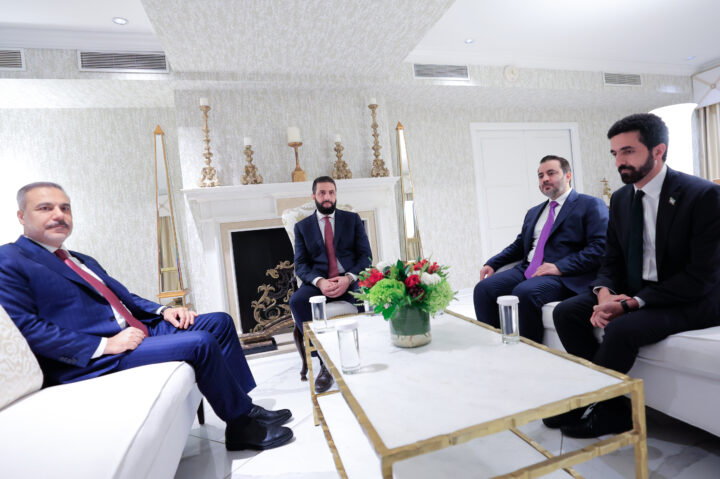
Turkish Foreign Minister Hakan Fidan (L) meets President of Syria Ahmed al-Sharaa in Washington, United States on November 10, 2025.


 Add JewishInsider on Google
At the White House on Monday, as President Donald Trump met with Syrian President Ahmad al-Sharaa, two other high-level figures were in attendance — Saudi Defense Minister Prince Khalid bin Salman and Turkish Foreign Minister Hakan Fidan, underscoring how Syria has become a new battleground for regional influence.
Following the fall of longtime dictator Bashar al-Assad’s regime last December, the war-ravaged nation has become a political vacuum, transformed into a critical security frontier for many regional players — most notably Turkey and Saudi Arabia.
“Saudi Arabia and Turkey are among the most powerful Middle Eastern countries. The power vacuum caused by the Syrian civil war turned Syria into a stage for these competing powers,” said David May, a research analyst at the Foundation for Defense of Democracies. “Both countries supported elements working to topple former Syrian strongman Bashar al-Assad.”
Despite both countries supporting the overthrow of the Assad regime, the nations share different visions for the future government in Damascus. Saudi Arabia and other moderate Arab countries are seeking to guide Syria towards pragmatic governance and away from the influence of radical Islam — a stark contrast to the propping up of the Muslim Brotherhood by Turkey, according to May.
“Saudi Arabia and Turkey have radically different foreign policy objectives and trajectories, especially as it relates to political Islam and the Muslim Brotherhood,” said May. “Historically, Turkey and Saudi Arabia each have a claim to the leadership of Islam and the Middle East …. [Saudi Crown Prince] Mohammed bin Salman has tried to modernize the kingdom and has downplayed the fundamentalism that used to be central to the state. Turkey, meanwhile, used to be a modernizing force in the region, but President [Recep Tayyip] Erdogan has elevated the role political Islam and Muslim Brotherhood ideology play in the orientation of the state.”
Saudi Arabia emerged quickly as a key backer of al-Sharaa’s regime due to the Syrian leader’s apparent moderation from his fundamentalist background.
“When al-Sharaa took Damascus, Saudi Arabia rushed to lobby Washington to press the reset button on al-Sharaa and legitimize his rule in Syria,” Hussain Abdul-Hussain, a research fellow at the Foundation for Defense of Democracies, told Jewish Insider.
Abdul-Hussain has argued that Turkey is not looking to help rebuild a sovereign Syrian state but rather is seeking a “puppet-state” in Damascus, also noting that Ankara supports factions influenced by the Muslim Brotherhood and an alternative Sunni leadership model, which is opposed by Saudi Arabia.
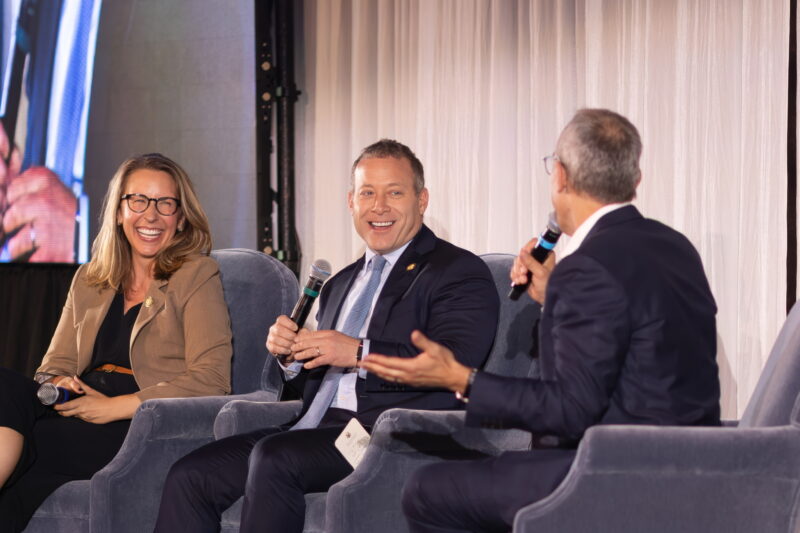
Pro-Israel lawmakers in Congress also expressed wariness towards Turkey’s expanding role in the region. “President Erdogan has a long record of hostility toward Israel, Greece, and Cyprus and his government maintains ties to Hamas terrorists, making Turkey an unreliable partner in ensuring peace. That’s why I remain deeply skeptical of Turkey’s intentions and potential role in Syria’s stabilization,” Rep. Josh Gottheimer (D-NJ) told Jewish Insider.
Other analysts argued that Turkey is seeking a more productive role. Soner Cagaptay, a senior fellow at The Washington Institute for Near East Policy, said that Turkey is actually “the most important stakeholder” in Syria, adding that the Trump administration views Ankara as a critical part of ensuring Syria’s stabilization.
“Trump wants to see Syria not fall into another cycle of civil war, and he believes that Turkey is a key actor to Syria’s stabilization,” said Cagaptay. “I think Turkey has the institutions to bring to the table to help with capacity building and Syria’s restoration of serious institutions.”
Cagaptay says a stabilized Syria is in Turkey’s best interest, and that al-Sharaa will rely on help from Ankara.
“100 years after the collapse of the Ottoman Empire, Syria has been Turkey’s most problematic neighbor. Turkey now wants to flip that into an ally,” said Cagaptay. “[Hay’at Tahrir al-Sham] and al-Sharaa need Turkey, and they will play along. They will lead Turkey to legitimacy and recognition.”
After meeting with Trump, al-Sharaa held a meeting with Fidan, along with Syria’s foreign minister and U.N. envoy. Fidan also met at the White House with Vice President JD Vance, Secretary of State Marco Rubio and Special Envoy Steve Witkoff.
“This visit here by al-Sharaa, in which he was accompanied by Turkish Foreign Minister Fidan, kind of underlines Turkey’s significantly elevated role in Syria and a very important shift,” said Cagaptay. “Syria was Turkey’s most problematic neighbor and now has become a strong ally and a country that Turkey is deeply invested in and cares for.”
However, Israel views an elevated Turkish role in Syria with “some anxiety,” according to Cagaptay, unlike with Riyadh.
“Israel and Saudi Arabia are not competing in Syria. Turkey is competing with the two. This suggests that Israel and Saudi Arabia can be allies in Syria, and both — together or independently — will be Turkey’s rival,” said Abdul-Hussain. “Al-Sharaa will have to navigate this dynamic to survive, beat domestic rivals, and emerge as Syria’s sole and strong ruler.”
More Stories
CAMPAIGN CALCULUS
El-Sayed focuses on attacking Israel in closing stretch of the campaign
VATICAN VISIT
Pope Leo affirms commitment to fighting antisemitism in meeting with AJC leaders
PANEL PUSHBACK
Jewish groups raise alarm over anti-Israel sessions at American Studies Association conference
WAR WORRIES
Could another war with Iran be the October surprise of the Israeli election?
AID ARGUMENTS
Michael Oren, Jonathan Schanzer split over when Israel should move past U.S. aid
SCOOP
Chabad holding 250 menorah lightings in all 50 states to commemorate Chanukah, America’s 250th birthday
Please log in if you already have a subscription, or subscribe to access the latest updates.
 Continue with Google
 Continue with Apple