






































































The union’s board of directors said the proposal ‘would not further NEA’s commitment to academic freedom’
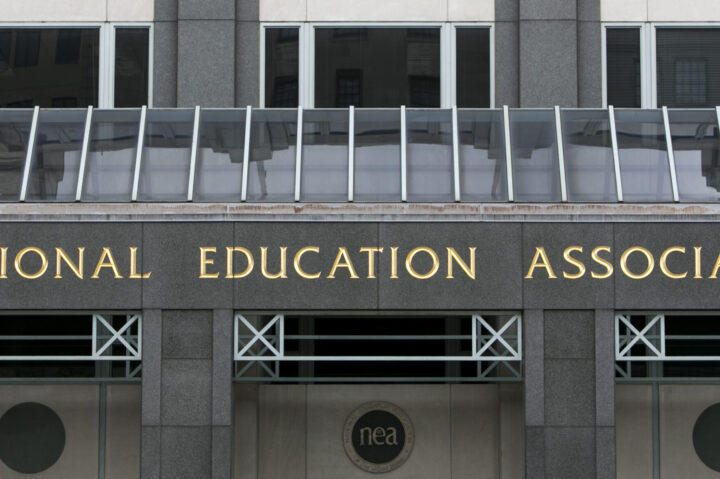
Kristoffer Tripplaar/Sipa via AP Images
A logo sign outside of the headquarters of the National Education Association (NEA) labor union in Washington, D.C. on July 11, 2015.


 Add JewishInsider on Google
The National Education Association, the largest teachers’ union in the country, announced on Friday that it would not cut ties with the Anti-Defamation League, declining to implement a contentious resolution approved by its governing body earlier this month that sought to target the Jewish civil rights organization.
“After consideration, it was determined that this proposal would not further NEA’s commitment to academic freedom, our membership or our goals,” the union’s board of directors said in a statement.
The decision came nearly two weeks after the measure was adopted by the NEA’s representative assembly, its annual leadership gathering that drew more than 6,000 union delegates.
“There is no doubt that antisemitism is on the rise. Without equivocation, NEA stands strongly against antisemitism. We always have and we always will,” the NEA’s board wrote. “In this time of division, fighting antisemitism, anti-Arab racism, and other forms of discrimination will take more resources, not fewer. We are ready.”
ADL CEO Jonathan Greenblatt cheered the union’s decision to distance itself from the “misguided” measure.
“We are committed to working with the NEA and all teachers’ unions to join the Jewish community in making clear these hateful campaigns cannot succeed. They must redouble efforts to ensure that Jewish educators are not isolated and subjected to antisemitism in their unions and that students are not subjected to it in the classroom,” Greenblatt said in a statement.
The measure faced fierce backlash from the Jewish world. A letter authored by the ADL expressing opposition to the proposal — which would have discouraged educators from using teaching materials from the ADL — garnered the support of roughly 400 Jewish organizations across the country, including the leadership of the Reform, Conservative and Orthodox movements.
Other outside Jewish groups, including the Conference of Presidents of Major American Jewish Organizations, the American Jewish Committee and Jewish Federations of North America, released a statement welcoming the NEA’s rejection of the anti-ADL resolution.
Plus, antisemitism inside the American Psychological Association

AP Photo/Mark Schiefelbein
Pentagon spokesman Sean Parnell speaks during a press briefing at the Pentagon, Wednesday, July 2, 2025, in Washington.
Good Tuesday morning.
In today’s Daily Kickoff, we preview the Aspen Security Forum, which begins today, and report on concerns from Jewish members of the American Psychological Association over the group’s approach to antisemitism and Israel. We report on the backlash facing Rep. Jerry Nadler over his support for New York City Democratic mayoral candidate Zohran Mamdani, and do a deep dive into Georgetown administrators’ handling of antisemitism issues on campus and the school’s financial support from Qatar ahead of today’s congressional hearing on the topics. Also in today’s Daily Kickoff: Sen. Dave McCormick, Alex Edelman and Ron Dermer.
What We’re Watching
- The Aspen Security Forum kicks off tonight. More below.
- President Donald Trump is in Pittsburgh this afternoon for Sen. Dave McCormick’s (R-PA) inaugural Pennsylvania Energy and Innovation Summit. More below.
- In Washington, the House Education and Workforce Committee is holding a hearing this morning on campus antisemitism — with a specific focus on the drivers of antisemitism in higher education. Representatives from Georgetown University, the University of California, Berkeley and the City University of New York are slated to testify. More below.
- Elsewhere on the Hill, the Senate Foreign Relations Committee will hold its confirmation hearing this morning for former National Security Advisor Mike Waltz to be U.S. ambassador to the U.N. Waltz’s hearing comes two months after he was removed over a series of clashes with the Trump administration on policy as well as his role in “Signalgate.”
- Tonight, the Argentine Embassy in Washington is hosting an event commemorating the upcoming anniversary of the 1994 bombing of the AMIA Jewish community center in Buenos Aires. Rep. Brian Mast (R-FL), AMIA President Osvaldo Armoza and State Department officials are slated to speak.
- Today is the special election in Arizona’s 7th Congressional District, where Adelita Grijalva is the front-runner to succeed her father, Rep. Raúl Grijalva (D-AZ), who died earlier this year. Grijalva is facing off against former state Rep. Daniel Hernandez and Deja Foxx.
- In Israel, we’re keeping an eye on Prime Minister Benjamin Netanyahu’s coalition, following United Torah Judaism’s decision last night to both quit the government and leave the ruling coalition over the Haredi draft law. Netanyahu will have until tomorrow evening to convince the party to reverse course before the 48-hour long resignation process takes effect.
- In Tianjin, China, Iranian Foreign Minister Abbas Araghchi is holding talks with his counterparts from Moscow and Beijing on the sidelines of the Shanghai Cooperation Organisation summit.
What You Should Know
A QUICK WORD WITH JI’S Marc rod
The 2025 Aspen Security Forum kicks off today and finds itself unexpectedly thrust into the ideological fights gripping the administration.
The Defense Department announced Monday that it would be withdrawing numerous senior military and civilian officials who had been set to speak at the conference.
Pentagon spokesperson Sean Parnell told Jewish Insider: “Senior Department of Defense officials will no longer be participating at the Aspen Security Forum because their values do not align with the values of the DoD. The Department will remain strong in its focus to increase the lethality of our warfighters, revitalize the warrior ethos, and project ‘Peace Through Strength’ on the world stage. It is clear the ASF is not in alignment with these goals.” Spokesperson Kinglsey Wilson offered even more pointed criticism to right-leaning outlet Just the News, saying the conference “promotes the evil of globalism, disdain for our great country, and hatred for the President of the United States.”
It’s tough criticism of a forum that prides itself on bipartisanship and aims to foster cross-partisan dialogue and solution-making, even as those attributes are in short supply in today’s Washington. The forum said in a statement, “we will miss the participation of the Pentagon, but our invitations remain open. … The Aspen Security Forum remains committed to providing a platform for informed, non-partisan debate about the most important security challenges facing the world,” noting that voices across the political spectrum will be speaking this week.
Many had been hoping to hear Defense Intelligence Agency Director Lt. Gen. Jeffrey Kruse, who was originally scheduled for a panel discussing the evolution of warfare, speak about his agency’s leaked report suggesting the strikes on Iran’s nuclear facilities had minimal effects, but Kruse was among the speakers withdrawn by the Pentagon.
Among the administration speakers still scheduled to appear are hostage envoy Adam Boehler, speaking on Thursday, and Tom Barrack, the U.S. ambassador to Turkey and special envoy to Syria. Barrack will be speaking on a Friday panel about the Middle East alongside former CIA Director David Petraeus and former Deputy National Security Advisor Dina Powell McCormick.
Read the rest of ‘What You Should Know’ here, and please get in touch if you’ll be attending the Aspen Security Forum. JI’s senior congressional correspondent Marc Rod will be reporting from the gathering all week.
COGNITIVE DISSONANCE
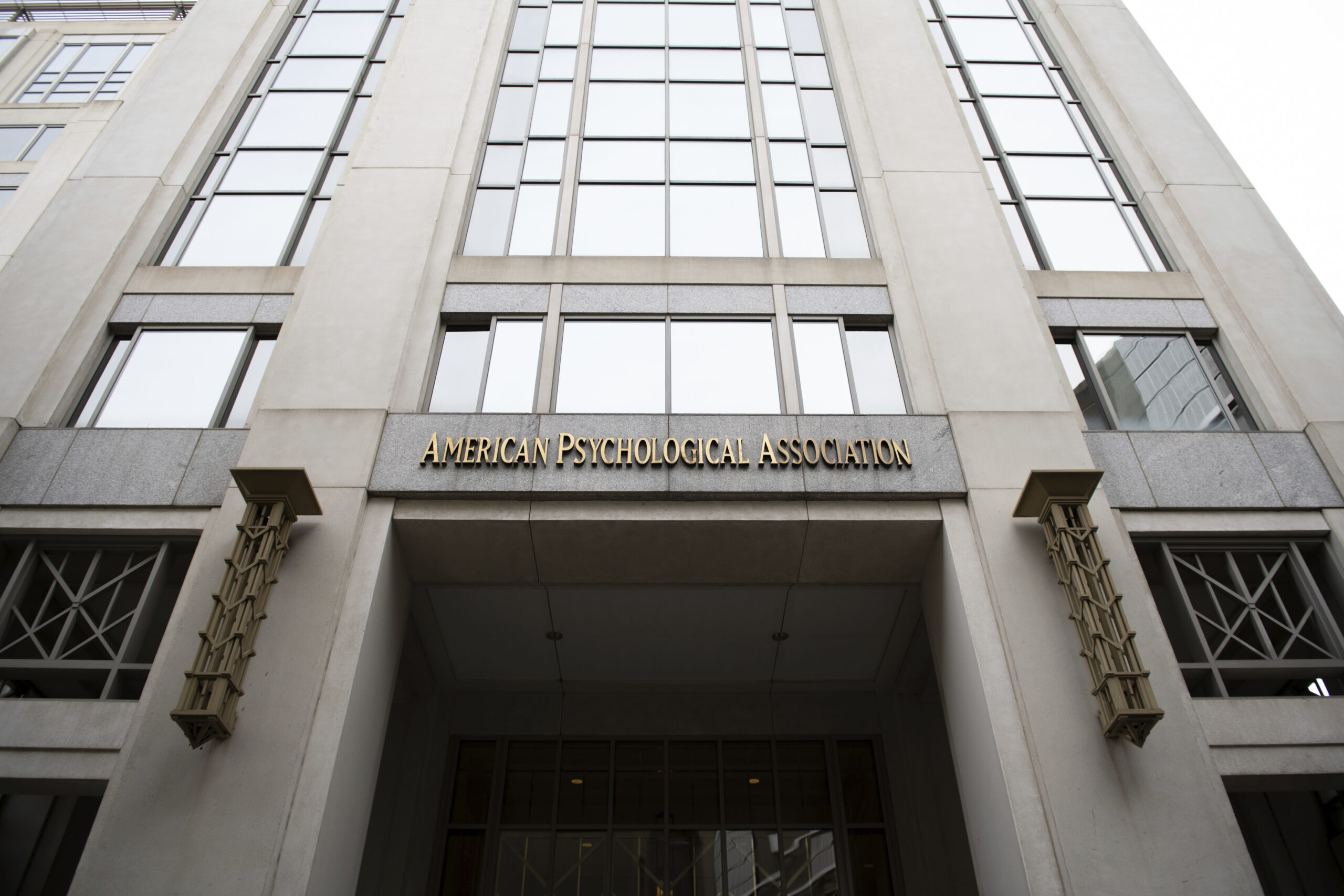
Concerns about antisemitism in the field of psychology have followed the American Psychological Association since soon after the Oct. 7, 2023, Hamas terror attacks. With 172,000 members, it is the largest body dedicated to the study of psychology in the world. The issue has become a flashpoint again in the run-up to the APA’s flagship annual conference, which will be held next month in Denver and is set to feature several lectures — including some offering continuing education credit — that offer sharply anti-Israel narratives, Jewish Insider’s Gabby Deutch reports in a new investigation.
Exclusive psychology: Several leading Jewish psychologists told JI that the APA has repeatedly failed to respond to the concerns of its Jewish members, despite a stated commitment to promoting an “accessible, equitable and inclusive psychology that promotes human rights, fairness and dignity for all,” according to the organization’s diversity mission. They say the APA has avoided taking a stand against double standards and litmus tests applied to Jewish psychologists who are vilified for their support for Israel. Instead, the organization has been almost paralyzed in the aftermath of Oct. 7, seemingly afraid to take sides between the Jewish psychologists seeking support and an increasingly vocal contingent of anti-Israel voices in the field, some of whom have described Zionism as a pathology to root out.
JI is committed to covering antisemitism. Catch up by reading our investigations on what Jewish professionals face in the mental health field and in pediatric medicine. Got a tip? Email us.
NADLER’S NOD
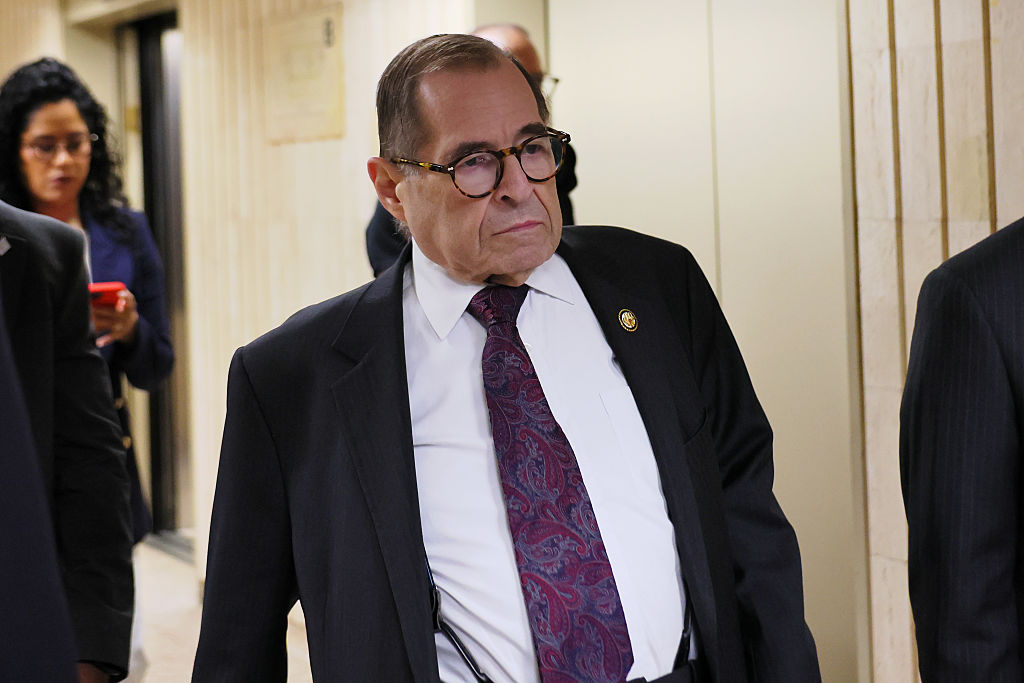
Rep. Jerry Nadler (D-NY) is facing backlash from some Jewish community leaders over his efforts to boost Zohran Mamdani, the Democratic nominee for mayor of New York City whose fierce criticism of Israel and refusal to condemn calls to “globalize the intifada” have stoked accusations of antisemitism, Jewish Insider’s Matthew Kassel reports.
Details: Nadler, the dean of New York City’s congressional delegation and co-chair of the House Jewish Caucus, endorsed Mamdani shortly after his stunning upset over former New York Gov. Andrew Cuomo in last month’s primary, and he has been working behind the scenes to build support for the nominee within the Jewish community, sources told JI. The 78-year-old congressman organized a meeting on Monday between Mamdani and local Jewish elected officials, some of whom chose not to join because of Mamdani’s hostility toward Israel, according to one person familiar with the matter.
Dem divisions: The pro-Israel Democratic party group Democratic Majority for Israel issued a scathing statement on Monday criticizing the party’s progressive wing amid Mamdani’s refusal to condemn the “globalize the intifada” slogan and the North Carolina state party’s recent passage of several anti-Israel resolutions, including one endorsing an arms embargo against the Jewish state, Jewish Insider’s Emily Jacobs reports.
On the calendar: House Minority Leader Hakeem Jeffries (D-NY) is slated to meet with Mamdani this week to discuss an array of issues, including Mamdani’s defense of the “globalize the intifada” slogan.
EXCLUSIVE
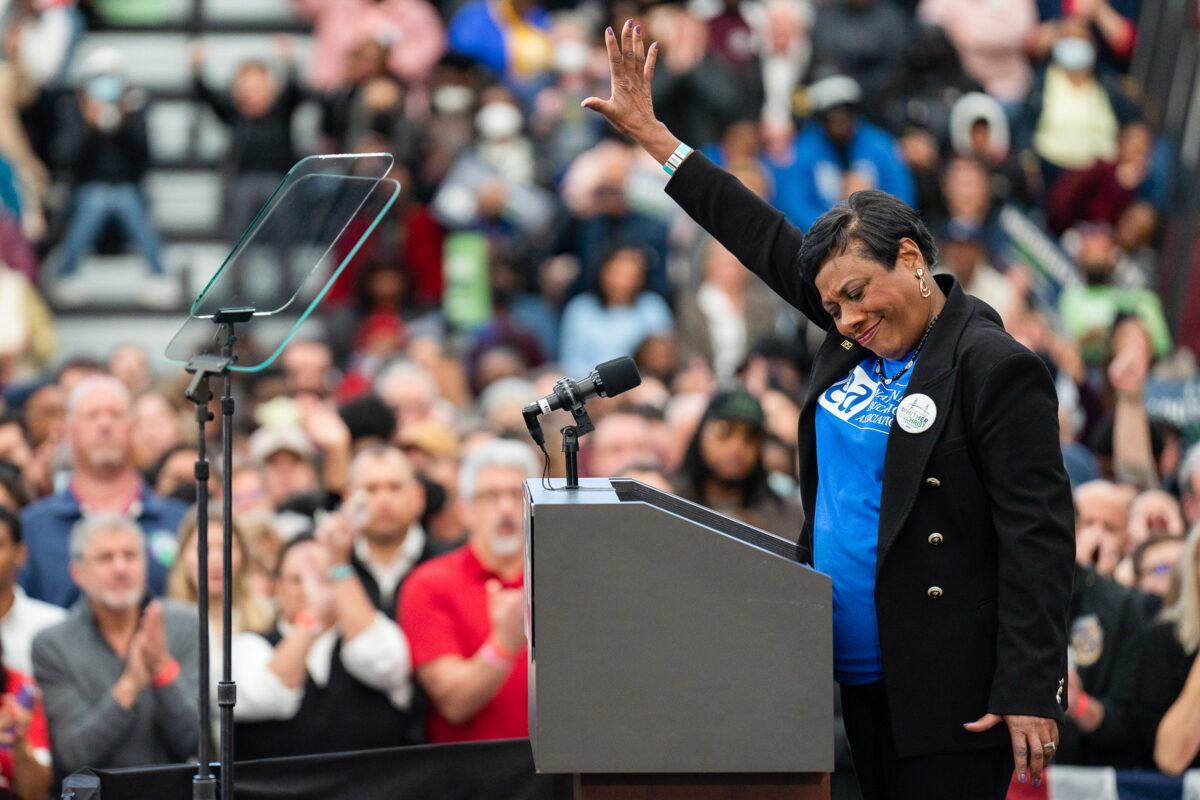
Around 400 Jewish organizations and synagogues signed onto an Anti-Defamation League backed letter Monday expressing concern over the “growing level of antisemitic activity” within teachers’ unions, which recently escalated with the National Education Association’s adoption of a measure targeting the leading Jewish civil rights organization, Jewish Insider’s Haley Cohen has learned. Signatories include the American Jewish Committee, Jewish Federations of North America, Conference of Presidents of Major American Jewish Organizations, National Council of Jewish Women, Orthodox Union, Rabbinical Assembly and Union for Reform Judaism.
What they said: The letter, addressed to Rebecca Pringle, president of the NEA — the largest teachers’ union in the U.S. — comes on the heels of a measure passed last week by the association that bars the union from using any teaching materials from the ADL. “The ADL has been a national leader in anti-hate education in K-12 schools for decades and is widely recognized as one of the country’s foremost experts on antisemitism,” the letter states, raising concern that, “although the measure does not explicitly say so, we understand that much of the underlying concern prompting this resolution is directed at ADL’s Holocaust education materials.”
Hoyas in the hot seat: As Georgetown University’s interim president, Robert Groves, is set to be questioned about campus antisemitism on Tuesday morning by the House Education and Workforce Committee, the university is contending with several thorny issues centered around the Jesuit school’s Prince Alwaleed Bin Talal Center for Muslim-Christian Understanding, one of the country’s leading centers for Islamic and Middle Eastern studies, JI’s Haley Cohen reports.
KEYSTONE CONFAB

A who’s who of U.S. and Gulf officials and some of the world’s leading tech and energy investors are en route to Pittsburgh ahead of Sen. Dave McCormick’s (R-PA) first-ever innovation summit on Tuesday, where he and President Donald Trump will announce $70 billion in investments aimed at turning Pennsylvania into a hub for artificial intelligence and new energy technologies, Jewish Insider’s Emily Jacobs reports from Pittsburgh.
On the guest list: More than 60 CEOs and scores of top energy and AI investors are slated to be at the freshman senator’s inaugural Pennsylvania Energy and Innovation Summit at Carnegie Mellon University, home to one of the world’s most advanced AI programs. Among the CEOs expected to appear are BlackRock’s Larry Fink, Palantir’s Alex Karp, Bridgewater’s Nir Bar Dea, Anthropic’s Dario Amodei, Amazon Web Services’ Matt Garman, Bechtel’s Brendan Bechtel, Chevron’s Mike Wirth, GIC’s Lim Chow Kiat, Brookfield’s Bruce Flatt, CPP Investments’ John Graham, EQT’s Toby Rice and ExxonMobil’s Darren Woods. (McCormick’s wife, Dina Powell McCormick, is on the ExxonMobil board of directors.) Others on the guest list include Ruth Porat, Alphabet’s president and chief investment officer; Raj Agrawal, global head of real assets at KKR; and Khaldoon Khalifa Al Mubarak, managing director and group CEO of Mubadala Investment Company.
PODCAST PLAYBACK
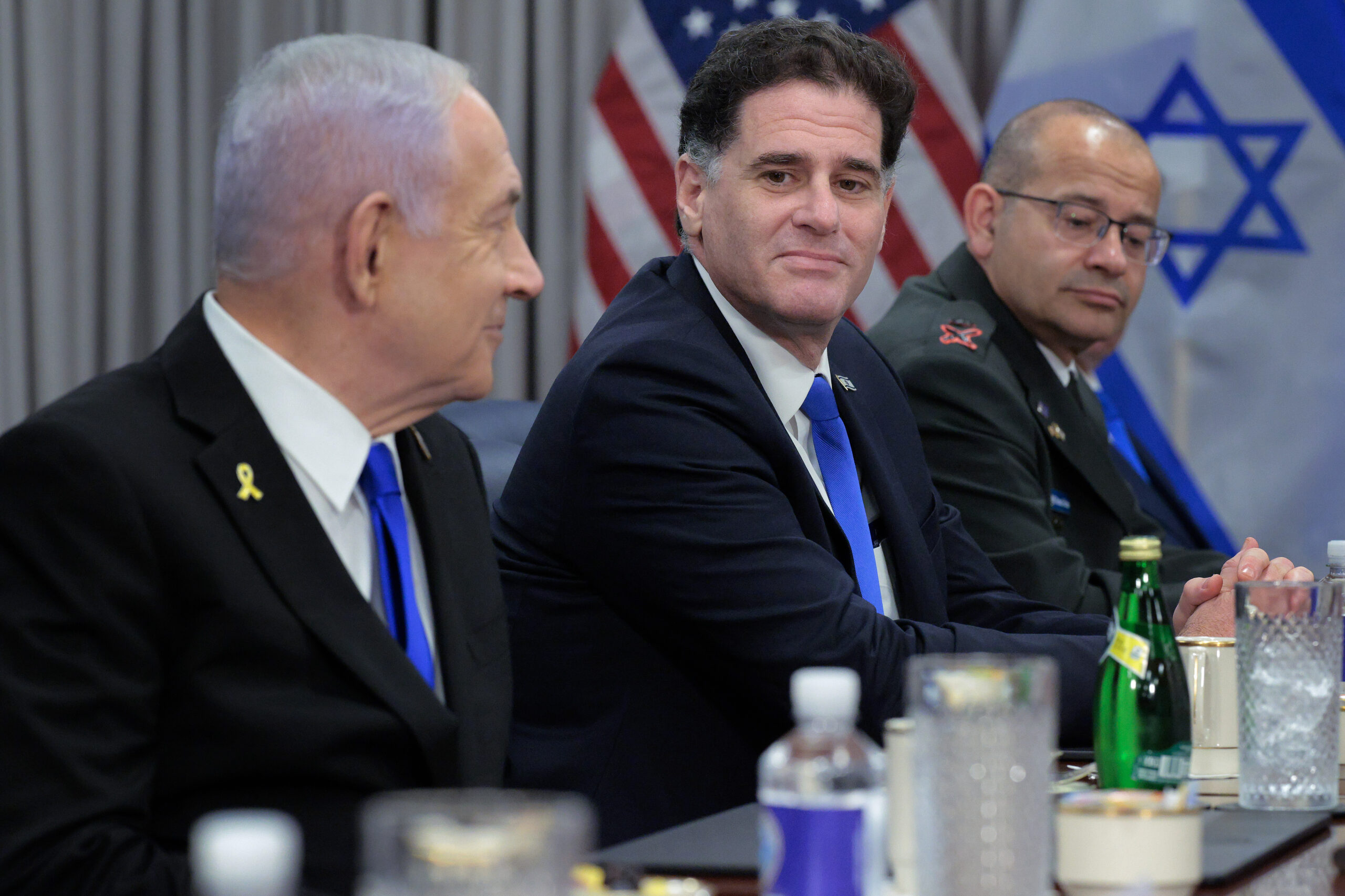
In a wide-ranging interview, Israeli Minister of Strategic Affairs Ron Dermer connected Israel’s strikes against Iran’s nuclear facilities with Israeli Prime Minister Benjamin Netanyahu’s opposition to the U.S.’ 2015 nuclear deal with Tehran, saying that President Donald Trump wouldn’t have pulled out of the deal during his first administration without that precedent, Jewish Insider’s Danielle Cohen-Kanik reports. “I believe that what Iran’s strategy was [before Oct. 7] is to surround Israel with this ring of fire,” including Hamas in Gaza, Hezbollah in Lebanon and militias in Syria and Iraq. “And this is another reason why I was so opposed to the nuclear deal that was done in 2015,” Dermer said in the first installment of his interview on Dan Senor’s “Call Me Back” podcast, which dropped on Monday.
Tracing it back: “And by the way, the attack [on Iran’s nuclear facilities] that happens now does not happen if Prime Minister Netanyahu doesn’t show up and confront that deal then. People don’t make the connection. I do, because I’ve lived it every day since then,” Dermer continued. “I don’t see Trump withdrawing if Netanyahu doesn’t take a stand, because no one’s going to be more Catholic than the pope, and no one’s going to be more pro-Israel than the prime minister of Israel.”
BUDEGET BLOCKS

The House Appropriations Committee’s draft 2026 National Security, Department of State and Related Programs Appropriations bill, released on Monday, aims to leverage U.S. funding for the United Nations to secure accountability for United Nations Relief and Works Agency employees’ involvement in the Oct. 7, 2023, Hamas attacks on Israel, Jewish Insider’s Marc Rod reports. It also more broadly aims to enact cuts for the U.N. system, cutting all U.S. funding for the U.N.’s regular budget and barring funding for the U.N. Human Rights Council, including its commission of inquiry investigating Israel, the International Court of Justice and the International Criminal Court.
Concrete steps: The bill would ban any funding for the U.N. Secretariat, the arm of the U.N. led by the secretary-general responsible for daily management and operations matters, until several conditions relating to UNRWA accountability are met. The bill would hold the funds until the U.N. provides the State Department with a full and unredacted copy of the U.N.’s internal investigation into UNRWA affiliates’ involvement in the Oct. 7 attacks and until the findings of U.S. investigations into the situation are referred to the Department of Justice for appropriate criminal or civil action.
Exclusive: A bipartisan House bill set to be introduced on Tuesday aims to designate the Muslim Brotherhood as a terrorist organization, a step forward for an effort that gained steam following the terrorist attack in Boulder, Colo., targeting Jews advocating for the release of hostages in Gaza by a man who appeared to have expressed support for the group years earlier, Jewish Insider’s Marc Rod reports.
Worthy Reads
Digital Battleground: The New York Times’ Steven Lee Myers, Natan Odenheimer and Erika Solomon look at how Israel and Iran’s use of AI and deceptive social media posting during last month’s war between the countries has “ushered in” a new era of information warfare. “Over 12 days of attacks, Israel and Iran turned social media into a digital battlefield, using deception and falsehoods to try to sway the outcome even as they traded kinetic missile strikes that killed hundreds and roiled an already turbulent Middle East. … Iran, for example, sent alerts in Hebrew to thousands of Israeli mobile phones warning recipients to avoid bomb shelters because militants planned to infiltrate them and attack those inside, according to researchers and official statements. A network of accounts on X attributed to Israel spread messages in Persian trying to erode confidence in Iran’s government, including ones narrated by an A.I.-generated woman.” [NYTimes]
The MAGA Rebellion: NBC News’ Allan Smith looks at policy disagreements between President Donald Trump and the MAGA wing of the party, including commentator Tucker Carlson, who openly clashed with Trump over the White House’s approach to the Israel-Iran war. “Carlson was center stage among MAGA influencers arguing for the United States to stay out of Iran, a position that has gained popularity on the right as some right-wing influencers have increasingly viewed the U.S.-Israel alliance with skepticism. That stance is also informed by Trump’s having promoted similar anti-war and anti-interventionist views for years, even as he has used military force as president. Ultimately, Carlson said, the most important voice arguing the case to Trump for the U.S. bombing of Iran’s nuclear facilities was Israeli Prime Minister Benjamin Netanyahu. ‘Turns out a head of state of an important ally has a more compelling message than I do,’ he said. ‘That seems reasonable to me. I still disagree, but I don’t think it’s like Trump has changed his views entirely.’” [NBCNews]
No Direction Home: In The Atlantic, Guy Ben-Aharon considers the challenges of his identity as an Israeli pacifist both at home and abroad. “In Israel, I’m hated for opposing a war that many say they don’t support but still fight in, defend, or explain away as necessary. Abroad, I’m no longer welcome among those who say that all Israelis are colonizers. I’m too Israeli to be a victim and too resistant to be a patriot. I’m in exile, even when I’m at home. … My own relatives question whether I belong in Israel, because I criticize the troops in Gaza for the killing and starvation of Palestinians. Abroad, a theater colleague once told me to ‘go back to where you came from’ — that I don’t belong in the land where I was born but in the lands where my ancestors faced pogroms and the Holocaust. Nuance has no currency in a world addicted to absolutes.” [TheAtlantic]
Word on the Street
The Supreme Court ordered that the Trump administration be allowed to proceed with its efforts to enact mass layoffs at the Department of Education as part of its efforts to significantly downsize the department…
The Pentagon reached an agreement with ElonMusk’s xAI to use the company’s chatbot, Grok, as part of xAI’s new “Grok for Government”; the announcement by xAI of the deal, part of $200 million agreement, came days after the Grok chatbot sent a series of antisemitic and sexually explicit replies to X users…
The Hill reports on tensions between Secretary of State Marco Rubio and Ric Grenell, who is serving as a special presidential envoy, as the two attempted to negotiate separate agreements to free Americans being held in Venezuela…
Politico’s “West Wing Playbook” looks at Steve Davis’ departure from the Department of Governmental Efficiency, where he reportedly dispatched Josh Gruenbaum and two other aides to assess department staffers’ loyalty…
Rep. Mike Lawler (R-NY) is reportedly backing away from plans to mount a gubernatorial challenge to New York Gov. Kathy Hochul…
Former New York Gov. Andrew Cuomo announced he would continue his bid to become mayor of New York City, following his 12-point loss last month to Zohran Mamdani; Cuomo pledged to drop out of the race by mid-September if polls indicated that he was not the highest-ranked challenger to the Queens assemblymember, and called on other candidates to do the same…
Inside Higher Ed looks at how universities are increasingly hiring staff to oversee compliance with Title VI of the Civil Rights Act following a crackdown by the Trump administration on dozens of campuses over alleged violations…
Alex Edelman will perform his new show, “What Are You Going to Do,” at the New York Comedy Festival at Carnegie Hall in November; the show is a follow-up to his award-winning “Just For Us” one-man play about attending a white supremacist gathering…
Hungarian low-cost carrier Wizz Air will end its operations at Abu Dhabi’s Zayed International Airport, effective Sept. 1; the airline’s CEO, József Váradi, cited “supply chain constraints, geopolitical instability, and limited market access” as factors that contributed to the decision, which was announced weeks after the Israel-Iran war caused travel disruptions across the region…
The Shin Bet confirmed that the Hamas terrorist who held British Israeli hostage Emily Damari captive was killed last month in an airstrike…
The IDF struck Syrian military vehicles operating in southern Syria, amid clashes between Syrian government forces and local Druze communities…
Attorney Danielle Sassoon, who previously served as U.S. attorney for the Southern District of New York, is joining the Manhattan Institute as a senior fellow; Sassoon resigned from her position weeks after being appointed to avoid carrying out a directive from the Justice Department to drop corruption charges against New York City Mayor Eric Adams…
Israeli-American writer Sol Stern died at 89…
Song of the Day

Edan Golan recently released the music video for her single “You & I.”
Birthdays
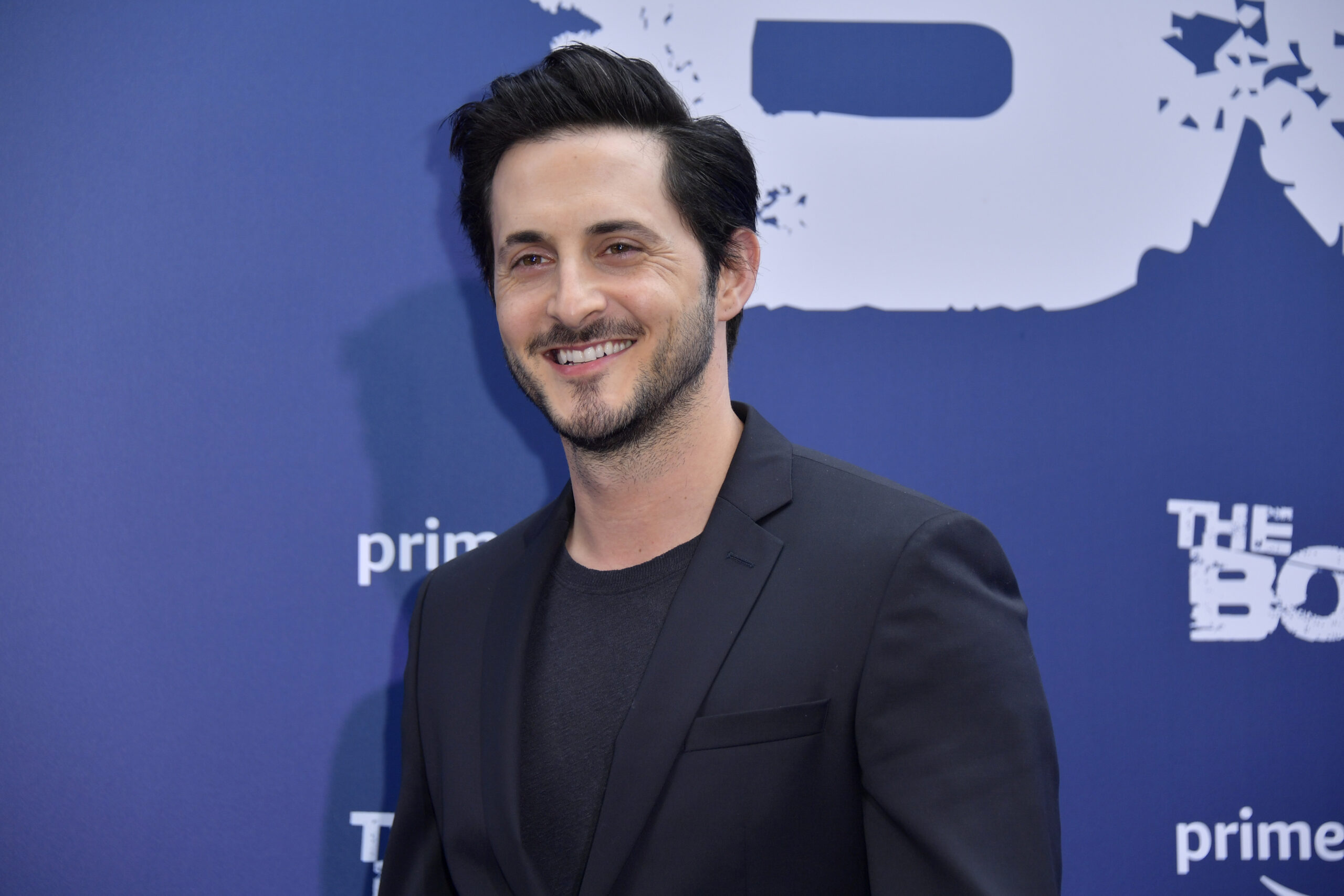
Israeli actor, he played Boaz in Season 1 of “Fauda,” Tomer Kapon turns 40…
President and chairman of the board of the Annenberg Foundation, Wallis Annenberg turns 86… Member of the British House of Lords, he is a professor, medical doctor, scientist, television anchor and Labour Party politician, Baron Robert Maurice Lipson Winston turns 85… Israeli composer and conductor, he composed and conducted the winning entry at the 1979 Eurovision Song Contest, Kobi Oshrat turns 81… Professional sports bettor and poker player, he is a four-time winner of World Series of Poker bracelets, Mickey Appleman turns 80… Physician and life fellow of the American Psychiatric Association, Dr. David Harris Lippman… Rosh Yeshiva of Beth Medrash Govoha in Lakewood, N.J., one of the largest yeshivas in the world with more than 10,000 students, Rabbi Dovid Schustal turns 78… Longtime congresswoman from Florida for 30 years until 2019, Ileana Ros-Lehtinen turns 73… EVP at the Aspen Institute responsible for policy programs and its international partners, Elliot Gerson… Israel’s ambassador to the U.S. from 2021 until this past January, Michael (Mike) Herzog turns 73… Retired California-based appellate attorney, Feris M. Greenberger… Executive director of Friends of OU Israel, Miriam Baron (Mimi) Jankovits… Immediate past board chair of The Jewish Federations of North America, Julie Beren Platt… Professor at the UCLA School of Law, Richard Harold Steinberg turns 65… Former political news director at Bloomberg, Jodi Schneider… Member of Congress (D-RI) until 2023, his mother is Sabra née Peskin, David Nicola Cicilline turns 64… Anchorage-based attorney, a member of the Alaska House of Representatives since 2012, Andrew Lewis “Andy” Josephson turns 61… Former U.K. Labour Party MP including three years as foreign secretary, now CEO of NYC-based International Rescue Committee, David Miliband turns 60… Co-founder and chief investment officer of Toronto-based EdgeStone Capital Partners, Gilbert S. Palter… Israeli actress and singer, she is the 1991 and 1998 winner of the Ophir Award for best actress, Dafna Rechter turns 60… Senior advisor at investment bank Greif & Co., he was the CFO of Jewish Family Service of Los Angeles, David S. Felman… Senior business development representative at Atera, Sam Kalmowicz… Senior correspondent at New York magazine, she is a co-author of Notorious RBG: The Life and Times of Ruth Bader Ginsburg, Irin Carmon turns 42… Filmmaker and co-founder of the Square Peg film production company, Ari Aster turns 39… Managing editor of the U.S. deals team at Bloomberg, Liana Balinsky-Baker… Former deputy assistant secretary for travel and tourism at the U.S. Department of Commerce, now CEO of the FIFA World Cup 26 NYNJ host committee, Alexander Lasry turns 38… VP of Israel Action and Addressing Antisemitism Program at Hillel International, Jonathan Steven (“Jon”) Falk… Director of news experimentation at Southern California Public Radio until last year, Ariel Zirulnick… Senior NFL reporter at Yahoo Sports, she is also the author of a biography of a Holocaust survivor, Jori Epstein…
The group’s annual conference, being held in August, features a panel that describes the Oct. 7 Hamas terrorism as attacks on ‘military targets’
Graeme Sloan/Sipa via AP Images
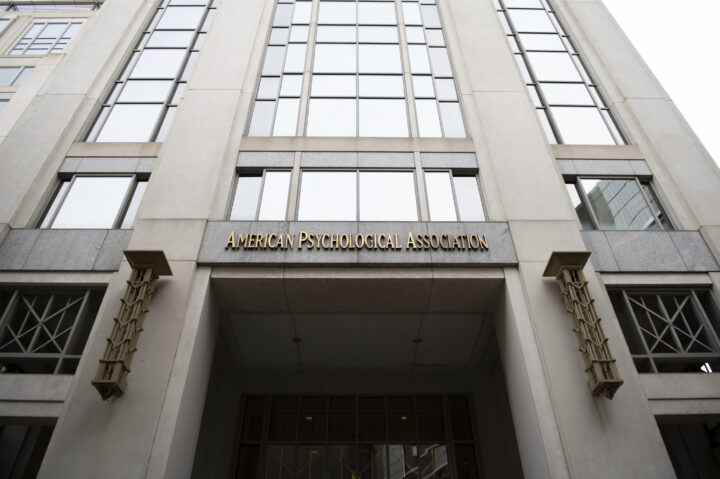
A general view of the American Psychological Association headquarters in Washington, D.C. on April 23, 2020.
In late February, Dr. Julie Ancis drafted an open letter with a group called Psychologists Against Antisemitism, condemning antisemitism within the American Psychological Association. More than 3,500 people signed on to demand the organization act against what they described as “the serious and systemic problem of antisemitism/anti-Jewish hate” within the APA. With 172,000 members, it is the largest body dedicated to the study of psychology in the world.
For months, the organization appeared to do nothing. Ancis did not even get an acknowledgement that the letter had been received. But then in May, after she and another Jewish colleague raised their concerns in a meeting with Rep. Ritchie Torres (D-NY), Ancis received an invitation from senior APA officials to discuss antisemitism.
The meeting was ostensibly meant as an olive branch from the organization where she had once been a prominent member: In 2010, a division of the APA named Ancis, a distinguished professor at New Jersey Institute of Technology and one of the pioneers of the psychology field’s approach to diversity, equity and inclusion, its Woman of the Year.
Yet when Ancis looked at the list of stakeholders invited to the Zoom meeting, she was astonished to see the names of several APA groups that she considered the biggest perpetrators of antisemitism within the APA. Later, she learned that the list of invited “stakeholders” included Dr. Lara Sheehi, the president of an APA division focused on the study of psychoanalysis, who was called out in the open letter for describing Zionists as “genocidal f**ks.” (Sheehi, who left a teaching position at The George Washington University in 2024 after being accused of antisemitic conduct by some of her students, recently appeared on a podcast to defend the tactics of the man accused of shooting and killing two Israeli Embassy staffers outside the Capital Jewish Museum in Washington in May. She did not respond to a request for comment.)
“The stakeholders should include people who have expertise, not the ones who are promoting antisemitism, where we’re tokenized. It’s an absolute lose-lose situation, and hostile,” Ancis said last week. She decided not to attend. “I’m not going to sit in that farce of a meeting.”
That the APA would host a meeting about addressing antisemitism where the “stakeholders” included both Jews who have scrupulously documented harassment and bias within the organization’s ranks for months, as well as some of the people they identified as the perpetrators of that harassment, is, according to Jewish psychologists, evidence of how this historic organization has lost its way and ceded its moral voice.
“Could you imagine APA having a listening session for LGBTQ+ individuals, which includes people who are known to be homophobic?” asked Dr. David Rosmarin, director of the Spirituality and Mental Health Program at McLean Hospital in Massachusetts and a Harvard Medical School professor. “They want everyone to be included, and all that kind of stuff. What that means is that there’s no room for Jews, because they’re including people who are engaged in antisemitic, anti-Zionist rhetoric, publicly, in the discussions.”
“They’re between a rock and a hard place. They’re trying to appease different constituents, and I feel like they’re appeasing the ones who are loudest and bigger, and that’s not the Jewish professionals,” Dr. Julie Ancis told JI.
Several leading Jewish psychologists told Jewish Insider in interviews last week that the APA has repeatedly failed to respond to the concerns of its Jewish members, despite a stated commitment to promoting an “accessible, equitable and inclusive psychology that promotes human rights, fairness and dignity for all,” according to the organization’s diversity mission. They say the APA has avoided taking a stand against double standards and litmus tests applied to Jewish psychologists who are vilified for their support for Israel.
Instead, the organization has been almost paralyzed in the aftermath of the Oct. 7, 2023, Hamas terror attacks and ensuing war, seemingly afraid to take sides between the Jewish psychologists seeking support and an increasingly vocal contingent of anti-Israel voices in the field, some of whom have described Zionism as a pathology to root out.
“They’re between a rock and a hard place. They’re trying to appease different constituents, and I feel like they’re appeasing the ones who are loudest and bigger, and that’s not the Jewish professionals,” Ancis told JI.
The APA is the key body shaping the education of psychologists in the United States. It accredits masters- and doctorate-level academic programs at hundreds of universities across the country. So while the battle over antisemitism in this organization may seem like an internecine ivory tower fight, the way it is handled is poised to have major implications for the future of psychology — a field that touches the millions of Americans who see a therapist, and whose research shapes the way we understand each other and ourselves.
*****
Concerns about antisemitism in psychology have followed the APA since soon after Oct. 7, when the Association of Jewish Psychologists chided the organization for issuing only a tepid statement about the Hamas attacks. “We … are deeply disappointed and terribly saddened that our professional association could not more forcefully and unequivocally condemn the horrific acts of barbarism against the Jewish people of the State of Israel,” they wrote at the time.
The issue has become a flashpoint again this year in the run-up to the APA’s flagship annual conference, which will be held next month in Denver.
Among the events at next month’s gathering, which is expected to draw several thousand people, is a “critical conversation” called “truth-telling as resistance” focused on understanding the 2024 encampments amid “a global and national effort to distort realities about Palestine and the encampments.”
At a symposium about “resisting anti-Palestinian racism,” psychologists can earn continuing education credit for attending a talk that will discuss “advocacy and actions to resist anti-Palestinian racism” that are “erroneously framed as antisemitism.” Another symposium, focused on mental health during wartime in Gaza and Lebanon, features a talk by a presenter who describes the Oct. 7 terror attacks that killed more than 1,200 people as attacks on “military targets” in Israel.
“What concerns me most are the psychologists who are maybe not Jewish or maybe not aware of these concerns in the Jewish community, who attend these talks with what I consider to be antisemitic rhetoric, and accept and internalize the ideas and rhetoric as true,” said Dr. Caroline Kaufman, a post-doctoral fellow at McLean Hospital. She will be speaking at a symposium about antisemitism, which also offers continuing education credit. “When they treat Jewish clients, or they have Jewish colleagues, or they conduct research, those ideas continue into those endeavors. That is extremely concerning to me.”
Rosmarin, a colleague of Kaufman’s at McLean, put a baseball hat over his yarmulke at last year’s APA convention in Seattle because it didn’t feel like a “safe space,” he said. He worries the organization does not understand the scope of the problem. “This is like a cancer that’s spread throughout the organization,” said Rosmarin, who is also the president of the APA Society for the Psychology of Religion and Spirituality.
*****
The term “gaslighting” — a form of emotional abuse in which one person falsely and repeatedly tells another person that their experience of reality is untrue — has become so popular in recent years that it was named Merriam-Webster’s word of the year in 2022. A growing body of psychological research is devoted to studying the concept, which the APA defines as “manipulat[ing] another person into doubting their perceptions, experiences or understanding of events.”
Given psychology’s deepening understanding of gaslighting, it was particularly ironic that following the APA’s antisemitism meeting, which occurred last Thursday, an email discussion broke out in which several psychologists attempted to invalidate and refute the concerns their Jewish colleagues raised about antisemitism. (The email thread was viewed by JI.)
One psychologist referred to the substance of the Zoom call as “propaganda” and said he would denounce only “actual antisemitism.” Dr. Karen Suyemoto, who chaired the APA’s task force that developed guidelines for addressing race and ethnicity in psychology, agreed.
She called it “imperative” that “actual antisemitism” be addressed, because “the continuing confounding creates barriers to allies and accomplices who do not have [a] nuanced understanding.” (Suyemoto, a University of Massachusetts professor, declined to comment to JI. She was the guest editor of a recent special issue of the APA’s flagship journal that focused on “practicing decolonial and liberation psychologies,” which the Anti-Defamation League, Academic Engagement Network and Psychologists Against Antisemitism criticized in a Tuesday letter as “ethically compromised and biased.”)
To Jewish psychologists, the skepticism from professionals who claim to listen to marginalized communities did not add up.
“We take identity very seriously. We realize that it intersects with both risk and protective factors,” said Kaufman. “That’s a given in our field, and APA seems willing to recognize that for several identities or groups. But it’s seemingly unwilling to address such concerns for the Jewish community. I can’t understand why.”
In 2007, the APA adopted a resolution on antisemitic and anti-Jewish prejudice that detailed modern manifestations of antisemitism alongside a commitment to being a leader in fighting it. (The resolution had the foresight to note that 21st-century antisemitism “may be more difficult for its perpetrators to identify and challenge, as their beliefs about themselves may be that they are not biased against Jews.”)
But since Oct. 7, a vocal group of APA members has been encouraging the organization to revisit this resolution because of its assertion that antisemitism can arise in the context of criticism of Israel. An activist group called Psychologists for Justice in Palestine drafted a petition last year calling on the APA to “refute” that part of the resolution — and instead admit that it is actually “discriminatory” to refer to anti-Zionism as a form of antisemitism.
“With the removal of the claim that criticism of Israel can become antisemitic, it would open psychologists to even more experiences of antisemitism and even more antisemitic aggression, by which Jewish and Israeli psychologists can be excluded, denigrated and denied for reasons that are presumably having to do with Israel, but, from my perspective, are really just antisemitism,” warned Dr. Caroline Kaufman, a post-doctoral fellow at McLean Hospital.
The petition was endorsed by several APA affiliates, including the Asian American Psychological Association; the American Arab, Middle Eastern and North African Psychological Association (AMENA-Psy); and the Society for the Psychology of Women. AMENA-Psy — one of six official APA ethnic associations — declared just four days after the Oct. 7 attacks that the group stands “in full solidarity with our Palestinian siblings in their decolonial struggle for justice.”
The APA ceded to the groups’ demands and agreed to reopen the debate about the 2007 resolution. The APA’s board of directors even created a task force to update the resolution. But the effort was shelved in March, as internal criticism of the organization’s handling of antisemitism began to mount.
“With the removal of the claim that criticism of Israel can become antisemitic, it would open psychologists to even more experiences of antisemitism and even more antisemitic aggression, by which Jewish and Israeli psychologists can be excluded, denigrated and denied for reasons that are presumably having to do with Israel, but, from my perspective, are really just antisemitism,” warned Kaufman.
*****
The solutions that Jewish psychologists seek require a long-term commitment from the APA that they aren’t confident they will receive, although the organization’s leaders stated on last week’s call that they do want to do more to combat antisemitism.
The concerned Jewish members want stronger monitoring on APA-affiliated email servers, which have been used by some APA members to promote boycotts against Israel and, occasionally, to defend Hamas. (An APA spokesperson told JI that “enhanced oversight is now in place to ensure respectful discourse and timely response to violations.”) They are also seeking more stringent oversight of the panels at the summer conference.
“They still struggle to really make a determination as to whether or not anti-Zionism is antisemitism, and so I surmise that people could say some things that would be very hurtful to large swaths of the professional community, and it would be considered acceptable within the new and refined listserv guidelines,” Fordham psychology professor Dr. Dean McKay told JI after last week’s antisemitism Zoom. “That’s one of those places where I don’t think they really know what to do.”
The APA frequently invokes bureaucratic red tape in response to these concerns by asserting that the 54 divisions that fall under the APA umbrella — on topics including developmental psychology, clinical psychology and pediatric psychology — operate autonomously, allowing the APA to claim immunity from the most egregious issues.
“APA’s 54 divisions operate autonomously with their own governance structures,” Kim Mills, the APA’s senior director for strategic external communications and public affairs, told JI in a statement. “Each of them program convention sessions that their leaders believe best represent the concerns of their division and will foster academic discourse on a variety of psychology topics.”
Mills asserted that the APA “unequivocally condemns antisemitism in all its forms and acknowledges the climate of fear such prejudice creates,” and said the organization is “committed to fostering an environment where members of all identities can contribute fully, safely and without discrimination.”
Jewish psychologists are waiting to see if that commitment passes the stress test, but they are not confident. Because while they see general proclamations about the ills of antisemitism as helpful, the true measure of whether the APA is serious about taking on the problem is whether the organization is willing to call out the most extreme members in its ranks, some of whom hold high-profile leadership positions. Doing so would require the APA to wade into the fraught conversation about whether the tactics of anti-Zionist activists can cross a line into antisemitism. It is clear the APA wants to avoid doing that.
“They still struggle to really make a determination as to whether or not anti-Zionism is antisemitism, and so I surmise that people could say some things that would be very hurtful to large swaths of the professional community, and it would be considered acceptable within the new and refined listserv guidelines,” Fordham psychology professor Dr. Dean McKay told JI after last week’s antisemitism Zoom. “That’s one of those places where I don’t think they really know what to do.”
The APA’s diversity webpage features a large section dedicated to explaining antisemitism. However, it does not mention Israel, Hamas or the post-Oct. 7 spike in antisemitism. Nor did Mills refer to Israel or Zionism in a lengthy statement she sent JI last week outlining the organization’s pledge to fight antisemitism. In fact, she ignored a question about Jewish psychologists who feel they have been targeted for being Zionists.
*****
The Jewish psychologists raising concerns about antisemitism in their field know that doing so entails a risk. They worry about the silencing effect on younger Jewish psychologists who are still finding their footing in the field, which is already in a precarious situation amid federal funding cuts to scientific and medical research.
“I’m protected. I’m already mid-career,” said Rosmarin, the Harvard Medical school professor. “I’m animated about this because I care about the next generation.”
Ancis, who spearheaded the open letter to the APA, quit the organization three years ago. She is far enough along in her career to not worry about facing backlash for supporting Israel and speaking out against antisemitism. But she worries about younger people in the field.
“A person coming up trying to get tenure in an APA-accredited program and identifying as a Zionist, I think it’d be extremely difficult,” Ancis said.
Kaufman only completed her Ph.D. four years ago, and she is at the beginning of what she hopes is a career in academia. She has the right credentials: a postdoctoral position at Harvard, an internship at Yale, a speaking slot at a symposium at next month’s APA conference. But she worries that won’t be enough to shield her.
“I have very deep and sincere concerns that my involvement in these issues related to antisemitism will negatively impact the opportunities available to me and my career,” Kaufman told JI. “I hold that truth or that fear in one hand. The other truth in my other hand is that I have a responsibility as a Jewish psychologist to raise my voice and become involved in this issue. There’s truly no other path for me, even if, and I think there will be, serious consequences.”
The groups signed a letter to NEA President Rebecca Pringle calling out the hostile climate for Jews at the nation’s largest teachers’ union

Dominick Sokotoff/SOPA Images/LightRocket via Getty Images
National Education Association President Rebecca Pringle speaks during the Get Out the Vote Rally in Detroit ahead of the 2022 midterm elections.
Around 400 Jewish organizations and synagogues signed onto an Anti-Defamation League backed letter Monday expressing concern over the “growing level of antisemitic activity” within teachers’ unions, which recently escalated with the National Education Association’s adoption of a measure targeting the leading Jewish civil rights organization, Jewish Insider has learned.
Signatories include the American Jewish Committee, Jewish Federations of North America, Conference of Presidents of Major American Jewish Organizations, National Council of Jewish Women, Orthodox Union, Rabbinical Assembly and Union for Reform Judaism.
The letter, addressed to Rebecca Pringle, president of the NEA — the largest teachers’ union in the U.S. — comes on the heels of a measure passed last week by the association that bars the union from using any teaching materials from the ADL.
The letter urges Pringle to reject the measure, referred to as New Business Item 39, as well as to issue a condemnation of and plan of action to address antisemitism and anti-Israel rhetoric in the NEA.
“The ADL has been a national leader in anti-hate education in K-12 schools for decades and is widely recognized as one of the country’s foremost experts on antisemitism,” the letter states, raising concern that, “although NBI 39 does not explicitly say so, we understand that much of the underlying concern prompting this resolution is directed at ADL’s Holocaust education materials.”
“That reality makes this proposal especially disturbing,” the letter continues. “This is precisely the kind of education that is vital not only to combat antisemitism, but also to fighting hatred and intolerance of all kinds. The effort to exclude ADL’s voice from educational spaces at a time of skyrocketing antisemitism — including in K-12 classrooms — speaks volumes about the climate within NEA that allowed this measure to pass, and the lack of understanding, if not outright hostility, behind it.”
The letter also references several Jewish teachers who spoke out against the resolution at the Representative Assembly, claiming that they were “harassed and shouted down during the proceedings.”
“It is our belief that the goal of those who introduced NBI 39 is to marginalize mainstream Jewish voices within this country’s public school systems and to limit the ability of educators to address the growing threat of antisemitism with their students,” the letter states.
The ADL has criticized the vote, calling it “profoundly disturbing that a group of NEA activists would brazenly attempt to further isolate their Jewish colleagues and push a radical, antisemitic agenda on students.”
“Excluding ADL’s gold-standard educational resources is not just an attack on our organization – it’s a dangerous attack on the entire Jewish community,” Jonathan Greenblatt, the group’s CEO, said in a statement. “We urge the NEA Executive Committee to reverse this biased, fringe effort, and reaffirm its commitment to supporting all Jewish students and educators.”
Even outside of the recent measure, antisemitism and anti-Israel activism in teachers’ unions has been increasing since the Oct. 7, 2023, Hamas terror attacks in Israel. At their conventions last year, both the NEA and the American Federation of Teachers, the second largest teachers’ union in the U.S. — which together represent 4.7 million members — made anti-Israel resolutions a notable part of both gatherings. In July 2024, the NEA signed a joint letter calling on President Joe Biden to halt all military aid to Israel amid its war against Hamas.
Also in July of last year, at the AFT convention, members voted on a total of seven resolutions regarding Israel, including one against the “weaponization of antisemitism” to defend Israel. One of the seven proposed resolutions critical of Israel at the AFT convention passed.
'You should write about what you know, and if there’s anything we know, it’s Jewish summer camp,' producer Shai Korman told JI

K180 Studios
Sarah Podemski stars as Camp Daveed's director Mara.
As summer heats up, Jewish adults looking for an escape from the fraught state of world Jewry may find themselves reflecting on a seemingly simpler time — getting competitive over color war or gaga ball and singing Debbie Friedman songs around a campfire at Jewish sleepaway camp.
That sense of nostalgia for one’s Jewish summer camp years is doled out liberally in “The Floaters,” a new film that centers on the fictional Camp Daveed and a group of outsider teens called the floaters.
“The Floaters” tells the story of Nomi (Jackie Tohn), who is freshly ousted from her rock band and reluctantly takes a job from her best friend Mara (Sarah Podemski), who is now camp director at their childhood Jewish summer camp. Nomi is charged with producing the camp play with the group of “Breakfast Club”-inspired campers.
The comedy was filmed at Camp Tel Yehudah in Barryville, N.Y. — where the film’s three sibling producers grew up, and where their parents met. “You should write about what you know, and if there’s anything we know, it’s Jewish summer camp,” Shai Korman, who produced the film alongside his sisters, Lily and Becky, told Jewish Insider. The movie was directed by Rachel Israel and written by Brent Hoff, Andra Gordon and Amelia Brain.
Korman told JI that “The Floaters” — which began production about a month before the Oct. 7, 2023, terrorist attacks in Israel — was not created to counter rising antisemitism. Rather, Korman said, “our goal was expanding and deepening the definition of how Jews are represented on screen.”
“We try to push the movie beyond lox and bagels,” he said, noting that the sibling trio specifically aimed to “put on screen Jewish women that exemplified the Jewish women that raised us, that were leaders and mentors.” Camp Daveed is run by women, from camp director Mara to the camp’s rabbi, Rabbi Rachel.
Several iconic films, such as “Wet Hot American Summer” and “Meatballs,” were also inspired by Jewish camps. But in “The Floaters,” “we talk about the rules of kashrut,” Korman said. “You see Orthodox and secular kids all together, reflecting the world we grew up in.”
Korman said an important aspect of that representation was casting all of the Jewish roles with Jewish actors — which includes Persian, Latino and Asian Jews.
“Making these kind of stories does help combat negative stereotypes about Jews,” Korman told JI. “But we came from it more from the joyful affirmative we want to expand.”
Like most summer camps itself, the movie is apolitical. Still, it doesn’t shy away from briefly talking about the Israeli-Palestinian conflict and other debates within the Jewish community. In one scene, campers make maps of Israel out of ice cream. “That’s the kind of thing that used to happen at camp when we were there,” Korman reflected. A counselor responds that one of the maps holds the solution to the Israeli-Palestinian conflict.
In another scene, Rabbi Rachel pushes for discussions about “the hard stuff,” including Israel and “all the ways the Torah has excluded or offended you.” The idea is rejected by the camp director, who says she would get angry calls from parents if those seminars took place.
“If people go away from this movie thinking it’s some kind of political statement, they might want to take a moment of reflection, because what we’re doing is showing an authentic experience,” Korman said. “The movie is not about Israel, but Israel is part of the fabric of the story and the environment because that’s what Jewish summer camp is like.”
“The Floaters” premiered in June for a mostly non-Jewish audience at the Bentonville Film Festival in Arkansas. While the film has specific details that “only camp kids would know,” Korman said — for example, the chaos that ensues after dairy spoons are switched with meat ones in the camp’s kosher kitchen — “for people who aren’t Jewish,” he continued, “it will make them excited to either learn more or feel like they’re in on it. We believe the more specific you get, the more universal you can be.”
Currently only available for private screenings, the film’s West Coast premiere is slated for Aug. 3 at the closing night of the San Francisco Jewish Film Festival.
Columbia’s Hillel director said that the university is on track for a large incoming class of Jewish freshmen next year
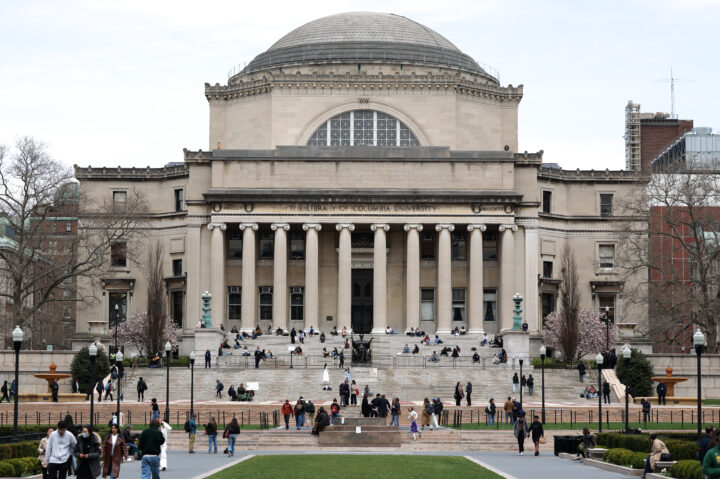
CHARLY TRIBALLEAU/AFP via Getty Images
Students are seen on the campus of Columbia University on April 14, 2025, in New York City.
Earlier this year at a symposium in New York City, Jewish scholars gathered to analyze the recent surge of antisemitism on college campuses and debate whether Jewish students still belong at the country’s elite bastions of higher education.
“I certainly don’t think that we should abandon great citadels of learning or be chased out of them, although to be there takes fortitude that I don’t think should be asked of every student,” Rabbi David Wolpe, a former visiting scholar at Harvard University Divinity School, said during the event’s opening address. “So I’m going to give a selective answer: it depends who.”
Over the next two months, college freshmen will embark on new chapters at universities around the country. Many Jewish students have found appeal in other top schools, such as Vanderbilt in Nashville, Tenn., and Washington University in St. Louis, where administrators were quick to enforce university rules amid rising antisemitism in the aftermath of the Oct. 7, 2023, terrorist attacks, and therefore avoided much of the chaos that played out on other campuses.
But some Jewish students are still seeking admission to the country’s most prestigious schools.
Who are these students making the choice to display the fortitude that Wolpe referenced by attending Columbia and Harvard —- two Ivy League campuses that have been beset by nearly two years of controversy over anti-Israel encampments and classroom disruptions, physical assaults of Jewish students and battles with the federal government, including potential loss of accreditation — over an alleged failure to address antisemitism?
Leah Kreisler, a recent graduate of Winston Churchill High School in Potomac, Md., decided in ninth grade that she wanted to attend Columbia. Kreisler plans to enroll in Columbia’s dual-degree program with the Jewish Theological Seminary and will begin next year, following a gap year in Israel.
Recent events have only reinforced Kreisler’s dream of attending the storied institution. “Columbia has always had a politically charged environment and I honestly think that fits a part of who I am,” she told Jewish Insider. “I like having those kinds of discussions and engaging with people I disagree with. That spirit drew me to the school.”
She’s also hopeful that by the time she arrives at Columbia for the 2026-27 school year, “things will get figured out.” The university is in talks with the federal government to restore the institution’s federal funding, which was slashed in March due to the antisemitic demonstrations that have roiled the campus since Oct. 7.
Still, Kreisler admitted she’s “a little bit scared” to face antisemitism, which she hasn’t directly encountered in her tight-knit D.C. suburb with a sizable Jewish community. “There will probably be people in the streets doing antisemitic things,” she said, noting that she often gets “weird looks from Jewish members of the community” when she shares her plans to attend Columbia.
Laura Hosid runs a private business in Potomac guiding high school students through the college admissions process. She works with many students like Kreisler who are “often willing to overlook [antisemitism] at schools like Harvard and Columbia, if they can get in,” Hosid, who is Jewish, told JI.
“At slightly less selective schools, though, it’s more of a factor,” she said. “Students are willing to look away if there’s too much anti-Israel stuff.”
“Jewish life at Columbia is Dickens-esque: the best of times and the worst of times,” said a Jewish Columbia alum who requested to remain anonymous. “There are real challenges, but at the same time, you can go to Columbia Hillel, the Kraft Center for Jewish Life, and access the most interesting people in the world. Bob Kraft shows up for events,” he said, referencing the billionaire owner of the New England Patriots for whom the center is named.
“I’m certainly not discouraging students if they are interested in schools like Columbia and Harvard,” Hosid continued. “I’m just making sure that they are well aware of what’s going on there and how it compares to what the climate is like at other schools.”
A Jewish Columbia alum who requested to remain anonymous told JI that he still sees his alma mater as “an amazing New York City school with an incredible alumni network.” So he was supportive when his daughter, an incoming Columbia freshman, committed to the university.
“Jewish life at Columbia is Dickens-esque: the best of times and the worst of times,” he said. “There are real challenges, but at the same time, you can go to Columbia Hillel, the Kraft Center for Jewish Life, and access the most interesting people in the world. Bob Kraft shows up for events,” he said, referencing the billionaire owner of the New England Patriots for whom the center is named.
In 1967, Columbia’s student body was 40% Jewish, according to a Jewish Telegraphic Agency report at the time. But even as Jewish enrollment at Columbia has declined since then, it still has one of the highest percentages of Jewish undergraduates in the Ivy League, at an estimated 22%. “The numbers for this year’s incoming class are quite strong,” Brian Cohen, executive director of Columbia Hillel, told JI.
Cohen said that the center’s “top priority is to make sure that every Jewish student feels seen and supported and part of a vibrant Jewish community from the moment they arrive at Columbia University.”
“Everything we hear anecdotally is that the number of applications of Jewishly involved students to Harvard were stable — if not increased — from last year to this year,” said Rabbi Jason Rubenstein, the director of Harvard Hillel.
That’s been Hillel’s goal for years — even before antisemitism reached record highs on campus. But Cohen noted that for the past two academic years, “everything is ramped up.”
“We want to make sure that when we meet students and families face-to-face they already have some idea of who we are and the relationship isn’t starting from square one,” he said, outlining two priorities. “One is that students understand that they are entering into this thriving, diverse Jewish community on campus. [The second is] that, should any problems arise during their time at Columbia, they have trusted resources to go to that are easily accessible and can help support them in navigating the various university processes.”
Rabbi Jason Rubenstein, the director of Harvard Hillel, is similarly spending the summer preparing for a new class of Jewish students. He’s hearing less concern around antisemitism from incoming students and their parents compared to last year. “I think that’s a combination of all of us adjusting our baselines and knowing what we’re getting into, and that last year was calmer on campus than the year before.”
Like Columbia, Harvard has had billions of dollars in federal grants and contracts frozen by the Trump administration. The university filed suit against the government in April, claiming that the cuts violate the First Amendment. A 300-page antisemitism report released by the university in April described “severe problems” that Harvard’s Jewish students have faced in the classroom, on social media and through campus protests.
“Everything we hear anecdotally is that the number of applications of Jewishly involved students to Harvard were stable — if not increased — from last year to this year,” Rubenstein said. Ramaz, a Modern Orthodox Jewish day school in Manhattan, for instance, admitted five students to Harvard the past admissions cycle, with four planning to attend. “That’s the highest in living memory,” Rubenstein said.
One of the Ramaz graduates starting at Harvard this fall is Stella Hiltzik, who grew up hearing “incredible stories” from her mother’s time on the Boston campus. “But it wasn’t until I visited Harvard last year that I decided that was the place I wanted to be,” Hiltzik, whose major is undecided, told JI. She was drawn to Harvard “even despite all of the crazy things happening on campus” after seeing “how supportive, warm and comforting Jewish life on campus is — especially the Chabad. It feels like a sense of home,” Hiltzik said.
“Despite everything going on, when I say I’m going to Harvard, most people are proud of me and supportive,” Hiltzik continued. “But there are some people who ask me, ‘What are you thinking?’ For me, it’s honestly a cool conversation to have, because I get to tell them how I’m excited to be a Jewish voice on campus during these hard times.”
“Despite everything that has happened at Columbia,” Leah Kreisler, a recent graduate of Winston Churchill High School in Potomac, Md., said, “I don’t think that the solution to antisemitism is to remove ourselves from these institutions. That’s been my mentality throughout the college [application] process.”
“Jewish students are not being dissuaded,” Rubenstein said. “Which is a great thing because some people are chanting ‘Zionists are not welcome here’ and the one thing they most want is Jewish students to not come here.”
Students like Hiltzik and Kreisler offer a quiet rebuke to the billionaire alums of the Ivies who have begun to withhold their considerable donations. One Israeli venture capitalist went as far as to try to lure Jewish students attending Ivy League schools to transfer to universities in Israel.
“Despite everything that has happened at Columbia,” Kreisler said, “I don’t think that the solution to antisemitism is to remove ourselves from these institutions. That’s been my mentality throughout the college [application] process.”
“People shouldn’t be afraid to go to any of these schools,” echoed Hiltzik. “At the end of the day, you’re going to get a good education and you’re going to show everyone how cool it is to be a proud Jew. I feel, in a sense, that this is my version of fighting for my people.”
Two Dallas therapists filed suit against their former employer for discrimination and retaliation, alleging they were terminated for speaking out against a policy barring discussion of religious opinions

BSIP/UIG Via Getty Images
Models
One November afternoon last year, Jackie Junger and Jacqueline Katz, both therapists at a private practice in Dallas, sat down with their colleagues for their weekly team meeting. This one-hour gathering was a lifeline for the therapists, where they could discuss challenges their clients were facing and receive advice from their fellow practitioners.
When a non-Jewish therapist asked for help better understanding a Jewish client who was “experiencing trauma with everything going on,” Junger and Katz — both Jewish — were eager to offer insight about the surge in antisemitism in the United States, in the hopes of helping their colleague better serve her client. But before Junger, 29, and Katz, 61, could speak, their supervisor, Dr. Dina Hijazi, shut down the conversation.
“I don’t think that’s a good idea, because you’ll get a one-sided response,” Hijazi told the therapists, according to legal filings.
The next day, Hijazi emailed the team and asked them to avoid discussing the “Palestine Israel topic” because she has “great pain” around the issue. But no one had mentioned the events in the Middle East at that meeting. Junger and Katz each responded to Hijazi’s note: Why, they wondered, would it be considered “one-sided” for Jewish therapists to speak about their understanding of antisemitism and Jewish trauma?
Over the next five days, Junger and Katz would see their lives upended after they chose to raise concerns about antisemitism and double standards against Jewish practitioners and clients.
That’s the key allegation at the heart of a federal lawsuit that Junger and Katz filed last month against D2 Counseling and its co-owners, Hijazi and Rev. Daniel Gowan. The two Jewish therapists claim they were discriminated against for objecting to their supervisors’ handling of antisemitism — and that, ultimately, they faced unlawful retaliation when they were fired days later. On the Monday before Thanksgiving, both received identical voicemails letting them know they had been terminated, saying they were no longer a “good fit” for D2. (An attorney representing Hijazi and Gowan declined to respond to detailed questions, citing the ongoing legal proceedings. The account in this article is based on an interview with Katz and Junger, allegations in their lawsuit and information shared by their lawyer.)
The incident was jarring for both Katz and Junger, they told Jewish Insider this week. But the biggest travesty, they said, is not that they lost their jobs: It’s that Jewish clients at their old practice should no longer expect to receive the highest level of care — because of their religion.
“This Jewish client — I don’t know who it is, obviously, I just know that it’s a Jewish client who is genuinely seeking support for something that they’re having trouble with in their life. It’s real trauma. I think most Jews can appreciate that it’s really traumatic, what’s happening,” Junger told JI. “And they’re not allowed to get competent health care. They have no clue.”
*****
This case is only a single incident experienced by just two of the nation’s more than 100,000 licensed therapists. But it comes amid what Jewish mental health professionals in the United States have described as an increasingly hostile professional environment, where denunciations of Israel are expected and outright antisemitism is no longer a taboo, particularly after the Oct. 7, 2023, terror attacks in Israel.
Earlier this year, the state of Illinois formally reprimanded a social worker who had created a blacklist publicly naming “Zionist” therapists. (The clinicians included on the list said it was just a pretext for targeting Jews.)
In May, Rep. Ritchie Torres (D-NY) warned of a “persistent and pernicious pattern of antisemitism” at the American Psychological Association, the preeminent professional organization for psychologists in the U.S.
Empathy is supposed to be the central tenet of the mental health field, but compassion and understanding are not always extended to Jewish therapists — or worse, their clients.
“Our role is really to facilitate the discussion, to honor their feelings, and to create a safe space — to create a space that [clients] can communicate what they’re experiencing internally, without any sort of feeling that, ‘I’m going to be shut down or marginalized or not taken seriously,’” Katz explained.
It was clear to Junger and Katz soon after the Oct. 7 attacks that team conversations about what was happening in the Middle East would be different from other issues they’d been discussing for years.
“We talk about current events a lot because these things affect our clients,” said Katz. The D2 team had talked about the war in Ukraine soon after it started; abortion access following the Supreme Court’s overturning of Roe v. Wade in 2022; and gun control after a mass shooting at a Texas mall in 2023.
A therapist helping a client work through issues with their sexuality might seek advice from a gay co-worker. Past meetings also included discussions of Mormonism and Islam, according to the complaint filed by Katz and Junger. Hijazi led a conversation about how to help clients who were having an emotional reaction to President Donald Trump’s reelection shortly after it occurred, according to the lawsuit.
“It’s very common to seek peer consultation, supervision from someone who has expertise, whether it’s lived experience or clinical experience,” Junger told JI. “If someone, let’s say, had cancer, and I had a client who’s going through cancer, I might reach out and say, ‘Hey, what would be helpful for me to know?’”
Three days after the Oct. 7 attacks, when the D2 team gathered as they do each Tuesday, Hijazi and Gowan did not address the recent terror attacks.
“We were all very shocked that we weren’t going to address the elephant in the room, as it were, and it quickly fell apart because one of my coworkers brought it up. ‘Aren’t we going to talk about what happened? We’re all very upset and suffering here,’” said Katz. “And it was shut down.”
Lesson learned, according to Katz and Junger: Don’t bring up Israel or Gaza again. It wasn’t an overt order, but the palpable discomfort from Hijazi and Gowan kept a lid on future conversations.
Still, Hijazi’s strong reaction to the conversation about antisemitism a year later, in November 2024, surprised Junger and Katz. No one had mentioned Israel or Gaza. But Hijazi followed up with an email requesting that the “Palestine Israel topic” not be discussed.
“I have great pain around this as I know some of you do as well,” Hijazi wrote in the email, which was shared with JI. “In order for me to work and be present with my clients I have asked that this be kept out of the noon meeting.” (What Hijazi did not share is that her family is Palestinian — a fact her daughter discussed in an online blog post viewed by JI, but one Hijazi didn’t mention to colleagues.)
Katz and Junger did not see how a question about the trauma of a Jewish patient in Texas could be extrapolated to extend to the Israeli-Palestinian conflict, nor did they understand why Hijazi chose to shut down future discussions of Jewish trauma. Separately, they each responded with lengthy emails, screenshots of which were included in the lawsuit.
“I believe every single one of us has Jewish clients, and the more we understand, the better we can service our clients,” Junger wrote in her email.
Katz took issue with Hijazi letting her own emotions guide the discussion, a therapist no-no.
“As a managing partner in this practice I think it was essential for you to be able to manage the inquiry without adopting the victim role and personalizing it to your pain,” Katz wrote in another email. “I understand that you were protecting yourself by leaving the room, however the impact was that some of us felt shut down and unheard.”
The matter only escalated from there, playing out like most modern office dramas: over email, leaving a lengthy digital record.
Hijazi banned the expression of “political or religious opinions” in the group meetings, under the rationale of “safety in the workplace.” “Emotional safety for the group,” she wrote, “will always come before personal agendas.”
But Katz and Junger were still unsure what was political about their earlier meeting and decided to press the point about their concern for Jewish clients. “I think your failure to see that this was not a political conversation is a huge blind spot for you,” wrote Katz. Gowan responded by telling her she was “way over the line,” a sentiment Hijazi echoed.
Over that weekend, on Sunday night, Junger chimed in, too. “I would love some clarification, as I am feeling lots of confusion,” she wrote. “Would wanting more clarity on a Black client experiencing racism violate that policy as well? How about talking about a client who is part of the LGBTQ community and experiencing trauma and discrimination? Are we allowed to talk about their lived experience? Or does this rule only apply to Jewish clients?”
That was Junger’s final message to her bosses about the matter. Katz chimed in after, saying she had the same questions.
A day later, they were both fired.
“It was just outrageous behavior on their part, I think, and so punishing, really. You open your mouth here, and this is what happens to you,” said Katz. “If we weren’t Jewish, [the other therapist] wouldn’t have asked us for supervision. If we weren’t Jewish, we wouldn’t have spoken up. If we weren’t Jewish, we wouldn’t have been let go.”
Their contract required D2 to give them 30 days to finish seeing clients. But they were forced to move to a different office, and asked to pay tens of thousands of dollars stemming from a part of the contract with buyout options and a non-compete clause. (They have refused to pay.)
“I knew antisemitism was on the rise, but to have it so blatant in my face in this way was really shocking. It was honestly a little scary,” said Junger.
*****
Winning an employment discrimination suit is not an easy task. But the lawyers at the Lawfare Project and Winston & Strawn representing Katz and Junger are confident that they have a strong case.
“It’s very rare to see a case like this, a discrimination retaliation case like this, where the employer’s actions are so brazen,” said Jaclyn Clark, the Lawfare Project attorney who brought the case. “I strongly suspect that the employer in this instance just thought that they could get away with it … So from my standpoint, beyond just shining a light on the issue of antisemitism in the mental health field, the politicization of Jewish trauma and all of those things, is also to put these smaller employers on warning.”
Orly Lobel, an employment law expert at the University of San Diego who looked over the complaint, described it as “a strong case, since it is all documented with email exchanges and there is no pretextual reason for the termination,” she told JI.
Junger and Katz’s attorneys allege that they faced discrimination as members of a racial minority, leaning on a 1987 Supreme Court ruling as precedent. L. Camille Hébert, a professor at The Ohio State University’s law school, said the race-based argument could be a tougher bar to clear than if the therapists made an argument about religious discrimination. But she noted that the facts laid out in the complaint paint a picture of discrimination.
“If the facts are as alleged, that all subjects were allowed to be addressed in the meetings other than antisemitism, then there might be a cognizable claim of discrimination based on religion. The defense of ‘workplace safety’ seems not to be a particularly strong one,” Hébert said after reviewing the complaint.
*****
Jewish therapists aren’t the only ones worried about antisemitism in the field. People seeking mental health care are, too, and Junger and Katz say they are right to be concerned.
After she was fired by D2, Junger created a list of Jewish therapists in the Dallas area to share with the people in the Jewish community who come to her asking for a referral. Since Oct. 7, she has seen more people seeking out a therapist who understands Jewish issues — and she understands why.
“Maybe a while ago I would have been like, ‘No, it’s a therapist job to [listen]. They’re not political. It’s OK,’” said Junger. “Now I’m like, ‘I get that.’ It makes sense to want to have safety and know that you have a real safe space to be able to process things that are directly impacting us.”
Wednesday night marked the first time since 2006 that two Jewish players were picked in the same draft

Sarah Stier/Getty Images/Harry Langer/DeFodi Images via Getty Images
Danny Wolf/Ben Saraf
Brooklyn, if it’s possible, got even more Jewish on Wednesday night, when two members of the tribe were picked back to back by the Brooklyn Nets in the first round of the NBA draft.
The Nets tapped 6-foot-6 Israeli point guard Ben Saraf and Israeli-American 7-footer Danny Wolf, who starred at the University of Michigan, with the No. 26 and 27 picks, marking the first time since 2006 that two Jewish players were selected in the same NBA draft.
“Picking two Jewish players back to back is at worst a pretty kismet coincidence. They know what they’re doing,” James Hirsh, host of the Jewish sports podcast “Menschwarmers,” told Jewish Insider, referring to the Nets’ front office. “This is a pretty cool thing to happen.”
Hirsh said that the picks reflect a “growth of professional Jewish athletes in New York,” pointing to Max Fried, who signed with the New York Yankees as a starting pitcher last December. “It makes sense to have talent that your fan base is going to automatically support.”
Saraf, 19, is the son of two former Israeli professional basketball players and was born in Israel. He chose to wear the No. 77, according to media reports, because it is the Jewish numerical value of the word “mazal,” Hebrew for luck. He is currently playing in Germany.
Wolf, 21, led the Wolverines to a No. 5 seed in last year’s NCAA men’s basketball tournament after transferring from Yale University. He has been outspoken about the antisemitism he’s faced on the court, especially in the aftermath of the Oct. 7, 2023, terrorist attacks while playing at Yale. “There were more than 80 fans who came to the game disguised,” he told the Detroit Free Press in March about a game against Dartmouth. “And then minutes into the game they broke out chanting and holding Palestinian flags. And it was a small gym, so everyone’s focus turned to that.”
“I would hear it growing up, that noise about me being Jewish, and [so] you don’t expect much from me as a basketball player,” Wolf continued. “When I was younger, I kind of looked at [being Jewish] as an opportunity to prove myself.”
“The most beautiful thing about Judaism is the way it connects me with my family,” said Wolf, who attended a Solomon Schechter Jewish day school in the Chicago suburbs until fifth grade and obtained Israeli citizenship in 2023 to represent Israel at the FIBA U20 European Championship in Greece. “It transcends other things and brings us together.”
“You can’t teach height,” Hirsh quipped, noting that Wolf is the “tallest Jewish player the U.S. has ever seen.”
“That’s pretty unique for Jewish basketball players,” he said. “There’s a lot of excitement to see whether his game can transfer to the NBA level or not.”
The newest Nets players follow in the footsteps of Omri Casspi and Jordan Farmar, who became the first pair of Israeli teammates on an NBA roster when they played for the Sacramento Kings in 2017. Lior Eliyahu and Yotam Halperin were the last two Jewish players to be picked in the same NBA draft in 2006. Another Israeli player, 24-year-old forward Deni Avdija, plays with the Portland Trail Blazers after three years with the Washington Wizards.
The new Jewish players mark a fresh chapter for the team, whose minority owner Oliver Weisberg is an Anti-Defamation League board member. The Nets were embroiled in an antisemitism scandal in 2022 after point guard Kyrie Irving posted a link to a film that denied the Holocaust and blamed Jewish people for slavery. Irving, who refused to apologize for days, was suspended by the NBA. The Nets traded him in 2023.
One Democratic strategist predicted that if Mamdani wins, some Jewish residents will move out of the state

Yuki Iwamura-Pool/Getty Images
Democratic mayoral candidate Zohran Mamdani
As the closely watched Democratic primary for mayor of New York City wraps up today, many Jewish and pro-Israel activists are now confronting a mounting sense of alarm that Zohran Mamdani, a far-left assemblyman from Queens, could win the nomination, propelling a fierce critic of Israel to the general election — and, potentially, Gracie Mansion.
In a city home to the largest Jewish community outside of Israel, Mamdani’s rise has fueled anxiety among Jewish leaders — particularly as his hostile positions toward Israel have hardly dented his standing in a competitive race that has narrowed to a two-person matchup.
Even if Mamdani does not win, Jewish Democrats uncomfortable with his strident criticism of Israel and alleged insensitivity to rising antisemitism fear that his surging campaign could end up alienating Jewish voters who have long called the party home.
“The Jewish community is going to face a real shock if Mamdani gets the nomination,” Mitchell Moss, an urban policy professor at New York University who is backing Cuomo, said in an interview with Jewish Insider on Monday. “A lot of people have come to realize that anti-Israel sentiment has metastasized into antisemitism.”
The Tik Tok-savvy Mamdani, a 33-year-old democratic socialist, has largely polled in second place behind his chief rival, former New York Gov. Andrew Cuomo, though a poll released by Emerson College on Monday showed Mamdani narrowly prevailing.
Cuomo’s campaign, for its part, has dismissed the survey as an outlier and cited other polls showing him with a more robust lead in the crowded race to unseat Mayor Eric Adams, who is seeking reelection as an independent. Fix the City, a pro-Cuomo super PAC that has slammed Mamdani’s approach to Israel in several attack ads, also released a new poll Monday that found Cuomo with a comfortable, 24-point lead over Mamdani in the final round of voting.
While support for Israel had once been viewed as a prerequisite for any winning campaign in New York City, Mamdani’s bid has tested that proposition. He has suggested he is uninterested in visiting Israel if elected, breaking with long-standing precedent, and has declined to acknowledge Israel’s right to exist as a Jewish state.
The two-term state lawmaker, who has endorsed boycotts targeting Israel, has said he would divest from Israel as mayor and promised to arrest Israeli Prime Minister Benjamin Netanyahu for alleged war crimes if he were to enter the city. Perhaps most controversially, Mamdani has drawn scrutiny for defending calls to “globalize the intifada” — a slogan that critics interpret as stoking violence against Jews.
Despite backlash, Mamdani doubled down on that defense during a radio interview on Monday, saying the phrase “has a variety of meanings to a variety of people.”
Many Jewish and pro-Israel activists in New York City have found his response alarming. “No matter what the outcome tomorrow, the fact that Zohran has been able to capture the attention of so many people who are really blind to his antisemitic tendencies really says something about the state of our electorate right now,” Sara Forman, who leads a pro-Israel super PAC that has urged voters to rank Cuomo first and to exclude Mamdani entirely, told JI.
Mamdani’s “foreign policy stances are isolating Jews and freezing us out from our political home base in the Democratic Party,” Forman said in an interview on Monday. “If the Democratic Party doesn’t wake up and start speaking to its core constituencies of Blacks, Jews and Latinos, we’re going to find our party rebuilt in someone else’s image.”
Hank Sheinkopf, a veteran Democratic strategist, predicted a Mamdani victory could end up pushing “more Jews nationally into the Republican column” and said Orthodox Jews might choose to relocate to South Florida and New Jersey. “Whether he wins or loses,” Sheinkopf said, the contours of the race have sent a concerning message that he characterized as “Jews don’t matter.”
Mamdani has rejected accusations of antisemitism, saying his opponents have weaponized such charges to score “political points.” He has said he is sensitive to rising antisemitism across New York City and has vowed to increase funding to counter hate crimes by 800%.
Early voting tallies have suggested that Mamdani has galvanized his base of younger supporters who are enlivened by his calls to “freeze the rent” and to deliver free buses as he has emphasized a message of affordability.
Cuomo, meanwhile, is depending on strong turnout from Black, Latino and Orthodox Jewish voters who have long been part of his core coalition. The former governor has locked up major endorsements from a range of key Orthodox leaders in Williamsburg and Borough Park, a Hasidic enclave in Brooklyn where he spent time on Sunday rallying a community that could deliver thousands of votes in a close election.
One Satmar leader in Williamsburg told JI that he is expecting solid turnout from New York City’s largest Hasidic voting bloc, predicting up to 8,000 votes for Cuomo, who has worked to mend relationships with Orthodox leaders that soured over his crackdown on religious gatherings during the COVID-19 pandemic.
The Cuomo campaign believes polls are missing the Orthodox vote, which could make the difference in a close election, according to an advisor who said that turnout from the community has been encouraging. “But what else are they missing is the question,” the advisor told JI on Monday, speaking anonymously to address the race.
Still, some Orthodox leaders remain on edge as Mamdani has continued to defy the odds over the course of the campaign. “He has really excited his base,” said one Orthodox leader in Brooklyn. “I am very fearful that he could actually make it, especially on ranked choice.”
Cuomo, who has won endorsements from Rep. Jim Clyburn (D-SC) and former President Bill Clinton in recent days, has also struggled to overcome his own vulnerabilities in the race, including accusations of sexual misconduct that forced his resignation from office in 2021. He denies the allegations and said he regrets stepping down.
In the final days of the election, the former governor — who has called antisemitism “the most important issue” and touted his staunch support for Israel — has insisted that his decades of government experience make him better suited to handle threats from Iran after the U.S. bombing of its nuclear sites over the weekend.
“Who do you want in charge in that situation?” he said of possible Iranian retaliation for the attacks. “Who’s handled situations like Hurricane Sandy and COVID and terrorist threats? This is not a job for on-the-job training.”
As for the bombing itself, Cuomo backed the effort to eliminate Iran’s nuclear capabilities, but he took issue with President Donald Trump’s decision to do so unilaterally without first consulting Congress — underscoring another key difference with Mamdani on Middle East policy.
Mamdani criticized the attack on Iran as “the result of a political establishment that would rather spend trillions of dollars on weapons than lift millions out of poverty, launch endless wars while silencing calls for peace, and fearmonger about outsiders while billionaires hollow out our democracy from within.”
The other candidates in the crowded primary, including Brad Lander, the city comptroller, and Adrienne Adams, the City Council speaker, have struggled to gain traction, polling has indicated.
Regardless of the primary result, which is unlikely to be confirmed for several days because of the ranked-choice system, both Mamdani and Cuomo could run in the general election on separate ballot lines, a possibility neither candidate has ruled out.
“This is a prelude to November,” said Moss, the urban policy professor, envisioning a high-stakes general election. “If Mamdani wins in New York,” he warned, “you can say goodbye to the Democratic Party for a long time.”
More than a dozen vendors set up tents around a grassy lawn overlooking lower Manhattan

Courtesy
The Great Nosh picnic
The biggest Jewish food event of the summer began like so many other great Jewish moments: with a story. In this case, that was the story of Noah’s Ark. Or at least that’s what it felt like on Sunday, as an unexpected rainstorm pelted New York City just moments before thousands of foodies were supposed to arrive at Governor’s Island for an afternoon of eating.
But like in that ancient biblical tale, the rain stopped and the sun poked through, paving the way for humanity to survive — or, at least, to nosh. And to nosh really well.
The Great Nosh Picnic was the most significant undertaking yet for Naama Shefi and the Jewish Food Society, the nonprofit she founded in 2017 to promote Jewish cuisine. Since then, Shefi has become something of a tastemaker when it comes to identifying the next generation of Jewish culinary talent and nurturing the traditions from which they emerged. (Part of JFS’ mission has been to preserve Jewish culinary history, including with an archive of recipes from Jewish immigrants from around the world.)
Her mission with the Great Nosh Picnic was even bigger. She wanted to create a large-scale celebration of Jewish food and Jewish culture that would rival other major citywide cultural events like the Pride Parade, St. Patrick’s Day and Cinco de Mayo.
“I live in New York City, a city whose culture and Jewish culture are so deeply connected,” Shefi told Jewish Insider. “I live on East Broadway Street on the Lower East Side, and you feel this connection on the street. But still, we don’t have any whole city celebration to emphasize that and to include everyone, and that was really the motivation.”
“We’re trying to create a movement,” Shefi continued, “and this is honestly just the beginning.”
Her plan is off to a good start. The event sold out all 2,500 tickets the first 48 hours after tickets went on sale last month. A buzzy Instagram post from New York magazine helped, and before the event started, 5,000 people were on a waitlist for tickets.
More than a dozen vendors set up tents around a grassy lawn overlooking lower Manhattan. Each attendee received a branded Great Nosh Picnic tote bag, which included a picnic blanket (waterproof, conveniently), sharing plates and a deck of cards. People were spread out lazily on a sea of checkered blankets, enjoying specially crafted dishes from some of New York’s hottest chefs. Toddlers ran around under an overcast sky, which for much of the afternoon shielded people from the worst of the punishing heat wave promised by forecasters.

The picnic idea was loosely inspired by Shefi’s upbringing on a kibbutz in Israel. The seasonal dishes, paired with fresh fruit, cheese and bread available for purchase in a “provisions” tent, were meant to provide a “much more fresh, stylistic, beautiful and lush” representation of Jewish cuisine than she is used to seeing reflected in the American Jewish community.
“I grew up on a kibbutz celebrating Shavuot and having this celebration in the form of a picnic, a community gathering on the grass every year,” said Shefi, referring to the Jewish holiday that falls in late spring and marks the giving of the Torah at Mount Sinai. “It’s so poetic and beautiful, the connection to the land and farming and seasonality.”
The food was roughly kosher-style: no pork or shellfish, although some chefs mixed meat and milk. One stand, a collaboration between Israeli chef Eyal Shani and American food writer Jake Cohen, featured a certified kosher dish, a deconstructed sabich, or fried eggplant, sandwich. Each tent served a dish devised by a pairing of chefs, matches that Shefi helped set up, yenta-style.
There was a marbled rye roti reuben (corned beef, grueyere, bamboo kraut, mango slaw) created by Katz’s Deli and Thai Diner. (The staff working that booth wore matching shirts: “Because it’s iconic and we love to do iconic sh**.”) Across the way, a mash-up between Gertrude’s, a newish Brooklyn hotspot, and Dhamaka, from the Michelin-starred Indian chef Chintan Pandya, featured lamb pastrami on a chapati, with green chutney and dill sour cream. Elbow Bread and the Korean restaurant Sunn’s — which are on the same block on the Lower East Side — offered banchan bialys, available with smoky eggplant, kimchi or garlic cucumber.
Schnitzel was repurposed as “schnitz and chips” by the Brooklyn cafe K’far with Dame, a British seafood restaurant, and served with tahini and schug. La Boite, an Israeli-owned spice company, partnered with the mobile pizza oven Slow Fires for a corn and labneh pizza, cooked with saffron and topped with La Boite’s spice blends.

It was a languorous afternoon, where appropriate dining times and orders did not matter; a chicken appetizer could be followed by an ice cream main course and a bagel dessert.
But there were plenty of real desserts, too. A lemon poppyseed “bagel” (read: cookie) ice cream sandwich from Russ & Daughters and Morgensterns. Another sandwich, with mini black and white cookies straddling a piece of cheesecake, from the baker Caroline Schiff and the restaurant Juniors. A malted cinnamon babka from Breads Bakery and East Village bakery Hani’s.
Elsewhere, the modern Judaica artist Susan Alexandra, known for her whimsical designs, oversaw a beading station where patrons young and old made friendship bracelets, choosing from brightly colored beads that featured Hebrew letters and Jewish stars. At the “Grandmas Tent,” older chefs led cooking demonstrations with younger family members, with generous samples passed around afterward.
Not everyone at the picnic was Jewish. Some may simply have wanted a taste of cuisine made by award-winning chefs without having to manipulate Resy or OpenTable for a reservation.
“We are inviting the entire city to join the Great Nosh,” Shefi said. “The excitement went way, way beyond the Jewish world.”
Still, the grounds had the feel of a catwalk where New York’s Jews could strut their stuff, whether that meant a “Shalom Y’all” t-shirt or curly hair puffing up in the humidity or a giant chai necklace coupled with the now-ubiquitous hostage dog tag. One bulky man in a sleeveless sweatshirt rocked a huge Magen David tattoo on his upper arm. A couple strolled around in matching hats, his reading “Brooklyn Reb” and hers reading “Brooklyn Rebbetzin.” When DJ Mark Ronson played a set to close out the afternoon, one woman held a raw cauliflower in the air as she danced.
Governor’s Island became a place where, for a few hours, Jews could be themselves, unselfconsciously, with no politics and no religious ritual beyond being together. (Well, there was a rabbi asking men to wrap tefillin. But would it be a Jewish event if there weren’t?)
Everyone heading to the picnic, reachable only by ferry, floated past the Statue of Liberty — the same beacon that greeted the iconic Jewish immigrant chefs and business owners of the Lower East Side who laid the groundwork for Sunday’s modern feast a century or more ago when they first arrived in America, seeking a better life. The anti-Jewish hatred the unofficial founders of American Jewish cuisine sought to escape is now firmly ensconced in this country and on the streets of New York.
But once inside the festival, any hint of that antisemitism, and the challenges that American Jews have lived with since the Oct. 7 terror attacks, vanished.
“While we can struggle with the state of affairs, we can and also need to find joy, find ways to connect with what it means to be Jewish, and that’s very personal and different for different people,” said Niki Russ Federman, the fourth-generation co-owner of Russ & Daughters. “But I do think that food is one of the great unifiers of the Jewish community. … We need something like this more than ever.”
The Jewish Republican had previously expressed concerns about his personal safety in the wake of the Oct. 7 Hamas attacks on Israel

Anna Moneymaker/Getty Images
Rep. Max Miller (R-OH) leaves for a break during a House Republican Steering Committee meeting at the U.S. Capitol Building.
Rep. Max Miller (R-OH), one of four Jewish Republicans in the House, said on Thursday that his car was run off the road by a pro-Palestinian activist who threatened his and his family’s lives, earlier in the day.
“If you have an issue with a legislator, your city councilman, your mayor, anyone like that, the appropriate thing to do is to reach out to them for a phone call to set up a meeting at one of our district offices,” Miller said in an angry video posted on Thursday afternoon on X. “What is not OK is to assault anyone, whether you’re a member of Congress or anybody else within our district while you are driving to work.”
Miller said in the video that on his way to work in his district on Thursday morning, an “unhinged, deranged man” leaned on his car horn and ran Miller off the road “when he couldn’t get my attention, to show me a Palestinian flag, not to mention ‘death to Israel, death to me’ — that he wanted to kill me — and my family.”
He explained in the X post that the man threw a Palestinian flag out of his car before driving off and threatened his life and his family’s lives. Miller did not specify what the individual said.
Miller said that he had reported the incident to local and U.S. Capitol Police, and that the individual had been identified and would face consequences. Local and Capitol Police did not respond to requests for comment and no announcements of any arrests have been made so far.
“We will not hide, and I will continue to fight against antisemitism, Islamophobia and all other forms of hate,” Miller said. “You have an issue? Take it to our office. You want to run me off the road? That’s a different story.”
The incident comes just days after a man shot two Minnesota state lawmakers and their spouses at their homes, killing Minnesota House Speaker Melissa Hortman and her husband Mark, impersonating a law enforcement officer; the man carried with him what authorities have characterized as a target list containing the names of lawmakers, including numerous House Democrats, from Minnesota and other nearby states.
It also comes amid a string of violent antisemitic attacks by anti-Israel extremists that have targeted Pennsylvania Gov. Josh Shapiro, an American Jewish Committee event at the Capital Jewish Museum in Washington and a hostage awareness event in Boulder, Colo.
Multiple Jewish House members, including Miller, have expressed concerns for their personal safety since the Oct. 7, 2023, attacks, and the Minnesota shootings have sparked broader concerns about lawmaker safety this week.
House leaders condemned the incident.
“What happened to Max this morning is yet another outrageous example of unhinged rhetoric inspiring unstable people to threaten and attack elected officials who are serving their communities,” House Speaker Mike Johnson (R-LA) said. “We must turn down the temperature in this country.”
“We condemn in the strongest possible terms the attack on Congressman Max Miller and his family and are thankful they are safe,” Democratic leaders Reps. Hakeem Jeffries (D-NY), Katherine Clark (D-MA) and Pete Aguilar (D-CA) in a joint statement. “The rise in political violence in this country is unacceptable. This is a moment of crisis that requires Congress to act decisively in order to ensure the safety of every single Member who serves in the People’s House.”
In its reports on the Iranian ballistic missile strike on a home in Tamra, northern Israel, CNN described the city as Palestinian

JOHN WESSELS/AFP via Getty Images
The mother of one of the victims of an Iranian missile attack which destroyed a three-storey building in the northern Arab-Israeli city of Tamra, is comforted during a funeral in the northern Arab-Israeli city of Tamra, on June 17, 2025.
After an Iranian ballistic missile struck a home in the northern Israeli city of Tamra, killing a woman, her two daughters and her sister-in-law, news outlets faced an additional challenge beyond the sober responsibility of covering a tragic loss: choosing what language to use to describe these women and their ethnic identity.
Tamra is an Arab town, with a history dating back hundreds of years. When Israeli President Isaac Herzog visited on Wednesday, he talked about the “shared society of Jews and Arabs” in Israel that “believe in our common life together,” and described the victims as “Muslim women.” Most news reports — in major international outlets including the Associated Press, Reuters, The New York Times and The Wall Street Journal — referred to Tamra as either an “Arab-Israeli city” or an “Arab town in Israel.”
CNN, however, chose a different word for Tamra, a city that is firmly inside Israel’s original 1948 borders: Palestinian.
“Iranian strikes expose bomb shelter shortage for Palestinian towns inside Israel,” read one headline from this week. The accompanying article described Tamra’s residents as “Palestinian citizens of Israel.” Another story called Tamra a “Palestinian-Israeli town.”
The descriptor is sure to confuse some readers. If advocates for a two-state solution talk about separate Israeli and Palestinian states, how can there be a Palestinian town within Israel?
The use of the word is not a statement about the town being under Palestinian sovereignty or the jurisdiction of a Palestinian governing authority. The word is used to describe the national identity of the people who live there, similar to describing Americans of Chinese ancestry as Chinese Americans — only much more complicated, because of the recent politics of the war in Gaza and nearly eight decades of the ongoing Israeli-Palestinian conflict.
Anwar Mhajne, a political science professor at Stonehill College in Massachusetts, who grew up in the Arab city of Umm al-Fahm in Israel, told Jewish Insider that using the term “Palestinian” to describe her identity and the place where she grew up can serve as an educational opportunity for people from outside the region who don’t know the history of her community, which dates back several hundred years.
“If I’m talking to outsiders who don’t understand the history of the region, I would say, ‘It’s a historically Palestinian town inside of Israel,’” Mhajne said. “Then I have to tell them the whole story of how that happened. The reason why I do this is because I have people ask me, ‘Wait, you’re not Jewish, so how are you in Israel?’”
CNN’s use of the word “Palestinian” to describe the Arab-Israeli residents of Tamra reflects a broader linguistic shift that has been happening over the years among Israel’s Arab citizens, who account for about 20% of Israel’s population. A spokesperson for CNN did not respond to a question about whether the language reflected a change to the network’s style guide, but the recent language appears to be a shift for the news network, which even earlier this year used the term “Arab Israelis” in its reporting.
“There’s a growing trend going on in the past, I want to say 10, maybe 20, years, of people who are saying, ‘We are going to reclaim our identity as Palestinians, and we’re not going to be ashamed to call ourselves Palestinians,’” said Yasmeen Abu Fraiha, a fellow at the Harvard Kennedy School who is completing a fellowship at Harvard Medical School. She counts herself among that trend: She didn’t use the term “Palestinian citizen of Israel” to describe herself until her late 20s, after she studied at Hebrew University in Jerusalem.
Abu Fraiha grew up in a Jewish city in Israel and she trained at Israeli institutions. She was working at Soroka Hospital in Beersheba — the hospital that was hit by an Iranian missile on Thursday — during the Oct. 7, 2023, Hamas attacks, when she helped treat hundreds of people injured that day. She likes the term “Palestinian citizen of Israel” because it encompasses two parts of her identity that are both important, although she is not a stickler about the language; she previously served as health policy director at the Task Force for Health Promotion and Equity in the Arab Society at the Israeli Ministry of Health, an official government entity.
“First, yes, I’m Israeli. I was born and raised there. Hebrew is my first language. I love the Israeli culture,” Abu Fraiha explained. “I’m fully Israeli. And then at the same time, my history, my narrative, my national connection, is to the Palestinian people.”
Mhajne, too, identifies with the Israeli part of her identity. It’s the passport she holds. She is the product of an Israeli education, and earned her bachelor’s degree at Ben-Gurion University of the Negev. But that is not the full story of who she is.
“I do hold both close, dearly, and I think they’re very important to hold onto. Historically, culturally, in a lot of ways, we are Palestinian, and we share that story. It’s our ancestors’ stories. These towns and us, we’ve been there for a long time, even before Israel was a state.”
Among Israel’s Jewish population, the language has not caught on widely, although it has growing cachet among Israeli Jews on the political left. Israel’s government formally uses the term “Arab-Israeli” to describe this part of the population, and that is the language generally used in English, too.
Shayna Weiss, senior associate director of the Schusterman Center for Israel Studies at Brandeis, said the rhetorical matter can be “quite confusing” for her undergraduate students, so she usually discusses it at the beginning of each course she teaches about Israeli society.
“I generally use the term ‘Israeli Palestinian’ ‘Palestinian citizens of Israel,’ but there are also instances where some people have said they see themselves as Israeli Arab, like certain pop stars, that sort of thing. And if I know that’s what they think about themselves, that’s the term I try and use,” Weiss told JI.
The death of the women and girls in Tamra has brought to the surface a rhetorical debate that has been bubbling up for years. Ultimately, Mhajne argued, what matters is not the words used to describe them — but that they were human beings.
“It bugs me, honestly, sometimes when people fight over ‘Arab’ and ‘Palestinian,’” she said. “They’re someone’s wife and daughters.”
Ye, who most recently was a staffer for Rep. Dan Goldman, is backed by a pro-Israel super PAC as well as a group with ties to the real estate industry

Michael M. Santiago/Getty Images
Council Member Alexa Aviles speaks during a press conference outside of City Hall on April 10, 2025 in New York City.
In recent years, Jewish and pro-Israel activists in New York City have been successful in defending favored incumbents while boosting candidates in open-seat local races. But they have struggled to go on the offensive against far-left Israel critics on the City Council aligned with the Democratic Socialists of America, which has gained prominence in some districts.
Now, however, some Jewish community activists and pro-Israel strategists are expressing optimism that a competitive City Council election in southern Brooklyn could be their best pick-up opportunity in next week’s citywide primaries, delivering a possible upset that has so far proved elusive at the local level.
In one of the city’s most hotly contested local races, Alexa Avilés, a two-term councilmember backed by the DSA, is facing a formidable challenge from Ling Ye, a moderate former congressional staffer making her first bid for elective office with a focus largely on public safety.
The race is playing out in a redrawn district that now includes more moderate constituents in Dyker Heights who are likely less receptive to reelecting a socialist, strategists say, fueling hopes among allies of Ye eager to pick off an incumbent whose hostility to Israel while in office has rankled Jewish leaders.
Ye, who immigrated to the United States from China in her early teens, is also depending on the sizable population of Chinese American voters who live in the ethnically diverse district — which covers such progressive pockets as Red Hook, winds down through a heavily Latino section of Sunset Park and terminates around Bensonhurst and Dyker Heights in southwestern Brooklyn.
“She is hyper focused on the issues impacting the community she grew up in and served through her many roles in government,” Haley Scott, a spokesperson for Ye, told JI. “She’s fighting to make south Brooklyn safer and more affordable, and to make sure every community in this district is being heard and represented in City Hall.”
One political consultant supportive of Ye said that he had seen recent polling showing Avilés with an eight-point lead over her opponent, but cautioned the district is difficult to accurately survey because the electorate is so diverse and voters speak several different languages.
“There are a bunch of voting pockets, between the Asian population and working-class moderate white voters, that could break toward Ye,” the consultant, who spoke on condition of anonymity to address the race, told Jewish Insider this week.
Haley Scott, a spokesperson for Ye, also projected confidence ahead of Tuesday’s primary, saying the first-time candidate “is running a campaign to win” and built “overwhelming grassroots support and an aggressive turnout operation to make sure everyone who can vote exercises that right.”
“She is hyper focused on the issues impacting the community she grew up in and served through her many roles in government,” Scott told JI. “She’s fighting to make south Brooklyn safer and more affordable, and to make sure every community in this district is being heard and represented in City Hall.”
Ye, who most recently was a staffer for Rep. Dan Goldman (D-NY), is backed by a pro-Israel super PAC as well as a group with ties to the real estate industry that has invested in attack ads targeting Avilés over past calls to defund the police, among other issues.
Like some other candidates who have previously endorsed such efforts — which have more recently become a political liability — Avilés has softened her rhetoric on public safety issues as she faces scrutiny over her positions while seeking reelection to a third term in the changed district.
As recently as last August, for instance, Avilés had explicitly advocated for “defunding the NYPD” in a platform section on her campaign site, according to archived screenshots on the Wayback Machine. But her current platform features no such language, and even acknowledges that a “police presence” coupled with public services like “better street lighting” have helped constituents “feel safe” in their communities.
Rather than calling for a wholesale divestment from law enforcement, Avilés’ platform now pushes for increased police accountability while arguing that officers are unfit to respond to mental health calls, among other things.
Her campaign did not return a request for comment from JI on Thursday.
The Puerto Rican-born councilwoman, who chairs the Committee on Immigration, has otherwise been emphasizing constituent services, citing her efforts to protect residents from federal agents conducting what she has called “unlawful” raids and arrests as President Donald Trump’s immigration crackdown targets New York City.
For her part, Ye has countered that Avilés’ tenure has been more defined by what she characterizes as performative gestures such as voting against the city budget, while suggesting that her vociferous support for defunding the police has damaged relations with law enforcement at the expense of the community’s immediate needs. Ye has called for “strengthening relationships between local police precincts and the neighborhoods they serve” amid local concerns over violent crime, among other policies that she casts as practical solutions better aligned with the district.
Ye, who has drawn donations from Jewish and pro-Israel donors, is supportive of Israel but has stressed that the City Council is not an appropriate venue for litigating foreign policy and has sought to focus on local issues throughout the race, according to her campaign. The district is home to just a small number of Jewish voters, according to experts, even as it includes some parts of Borough Park, a Hasidic enclave.
“New York’s AIPAC is spending big against me,” Avilés said during her speech on Saturday before a packed audience at Terminal 5, referring to Solidarity PAC, a local pro-Israel advocacy group supporting Ye that has no formal ties to the Washington-based federal lobbying organization. “Because I’ve stood up over and over to demand a ceasefire in Gaza,” she added defiantly to cheers from the crowd. “We want to end the genocide and we want a free Palestine!”
Still, Israel’s ongoing wars have fueled tension in the district. Pro-Palestinian activists have heckled Ye on the campaign trail, according to video seen by JI, accusing her of supporting “genocide” and taking “blood money” from Israel, a false claim that echoes antisemitic tropes about Jewish control of American politics. Ye has also faced xenophobic rhetoric amid the race, as one of her public campaign posters was defaced with graffiti labeling her a “Zionist” as well an affiliate of the “CCP,” or the Chinese Communist Party, a photo recently shared with JI shows.
Even as Avilés has somewhat tempered her rhetoric on law enforcement, she has continued to speak out stridently in opposition to Israel, most recently at a campaign rally in Manhattan for Zohran Mamdani, a far-left state assemblyman from Queens polling in second place in the Democratic mayoral primary on Tuesday.
“New York’s AIPAC is spending big against me,” Avilés said during her speech on Saturday before a packed audience at Terminal 5, referring to Solidarity PAC, a local pro-Israel advocacy group supporting Ye that has no formal ties to the Washington-based federal lobbying organization. “Because I’ve stood up over and over to demand a ceasefire in Gaza,” she added defiantly to cheers from the crowd. “We want to end the genocide and we want a free Palestine!”
In keeping with the DSA, which drew widespread backlash for promoting a Manhattan rally at which attendees were seen celebrating Hamas shortly after the Oct. 7, 2023, attacks, Avilés backs the Boycott, Divestment and Sanctions moment targeting Israel and has faced scrutiny for being among a handful of City Council members who abstained from voting in favor of a City Council resolution to establish an annual “End Jewish Hatred Day.”
Sara Forman, who leads Solidarity PAC, criticized Avilés in a statement to JI as “a DSA ideologue” who during her time in office has “sidelined” key issues such as affordable housing “in favor of empty promises, an obsession with foreign policy and political posturing.”
Solidarity PAC, Forman said, “proudly supports Ling Ye, who has called Brooklyn’s 38th District home since immigrating to the United States at 14, as someone who understands the real and pressing needs of the community.”
As she seeks to fend off her primary challenger, Aviles’ allies have raised some concerns about the race, even as she has won a range of high-profile endorsements from such progressive leaders as Rep. Alexandria Ocasio-Cortez (D-NY) and the Working Families Party. In a recent Zoom discussion about the “Israel lobby,” Yuh-Line Niou, a former far-left state assemblywoman who lost a tight congressional contest in 2022, warned that Avilés is running in “a very tough race” and urged viewers to support her campaign.
“There are people who are Asian voters who will literally see an Asian name on the ballot and be willing to vote for them,” suggested Niou, who is Taiwanese American.
Despite some unease among supporters of Avilés, the race has largely flown under the radar and has been overshadowed by a separate City Council race in Brooklyn where Shahana Hanif, the DSA-aligned incumbent, has drawn backlash from Jewish voters over her strident criticism of Israel.
“It’s going to be the closest of the DSA races,” said one Jewish leader, speaking anonymously to discuss the primary. “But Alexa still wins,” he predicted, while speculating that Mamdani’s “coattails” in the district “will help.”
In her primary, Hanif is defending her seat against Maya Kornberg, a pro-Israel Jewish Democrat also backed by Solidarity PAC who, like Ye, has accused her opponent of failing to provide solid constituent services while advocating for policies like defunding the police that have not helped the district.
But while the race has drawn national attention as well as spending from outside groups backing both candidates, some strategists and Jewish leaders who are eager to see Kornberg win expressed skepticism she will ultimately unseat Hanif — owing largely to the ideological makeup of the district that includes deeply progressive Park Slope.
Some Jewish community activists are also cautious about Ye’s race further south. “It’s going to be the closest of the DSA races,” said one Jewish leader, speaking anonymously to discuss the primary. “But Alexa still wins,” he predicted, while speculating that Mamdani’s “coattails” in the district “will help.”
Still, others following the race are holding out hope that Avilés’ new district lines will favor a moderate Democrat like Ye, who has argued the community “doesn’t need another professional protester” in City Hall.
“There’s a really good chance for a pick-up here,” said another Jewish community activist who has tracked the race.
Rabbi Arie Zeev Raskin, chief rabbi of Cyprus, said the Israelis stranded on the island amid Israel’s war with Iran are making ‘lemonade out of lemons’

Courtesy Chabad of Cyprus
Israelis stranded in Cyprus amid Israel's war with Iran gather at Chabad.
An American couple who were en route to Israel to celebrate their wedding but had their flight diverted. Two Israeli single mothers on holiday looking for a quick refresh, now stranded. A group of injured Israel Defense Forces soldiers on a healing retreat.
These are some of the nearly 2,500 Jewish people that Rabbi Arie Zeev Raskin, the chief rabbi of Cyprus, and his wife, Shaindel, unexpectedly found themselves hosting for Shabbat last Friday after at least 32 flights from the United States and Europe were diverted to the island in the Mediterranean amid Israel’s preemptive military campaign against Iran, which was launched early Friday morning.
“Everybody in the community gave a hand with cooking and preparing,” Raskin, who has run the local Chabad center in the port city of Larnaca since 2003, told Jewish Insider.
Shabbat at Chabad “was amazing, a crazy experience,” said Tzvi Berg, a Jerusalem resident who was flying home from a wedding in New York on Thursday night when — just moments away from landing in Tel Aviv — his flight was rerouted to Larnaca.
“When the pilot made the announcement, everyone went online and saw Israel was attacking Iran and instead of being upset, everybody was clapping,” Berg said.
But as Shabbat ended — with Israeli airspace still shuttered as Iranian missiles continued to strike in Tel Aviv and elsewhere — “the challenge began again,” Raskin said. Hotels on the island are overwhelmed. Tourists have exhausted their vacation funds. People with chronic illness can’t access medications.
And they are knocking on Chabad’s door looking for food and accommodations, as many Jews do in moments of crisis around the world.
“We have a few challenges at the moment,” Raskin said.
“People have started to lose patience. Parents want to get back to their kids,” said Berg, who on Tuesday traveled some 30 miles to the island’s other Chabad, located in the resort town of Ayia Napa, where he barbecued for the injured IDF soldiers.
The couple whose wedding is scheduled for Thursday remains hopeful they can still get to Israel via boat.
One of the single mothers who came to Cyprus on vacation has two children with special needs in southern Israel facing constant missile fire. “There’s a lot of tears and crying that she can’t get back to her kids,” Raskin said.
Still, Raskin said that most of those stranded are making “lemonade out of lemons” during their time on the picturesque island — which is a popular tourist destination for Israelis due to its proximity.
“The majority of the people here trust in God, so you see happy faces,” Raskin said. “They’re saying, ‘OK, we’re here on holiday, we have a place to stay and food, we’re happy.’”
Cypriot police said on Sunday that security measures would be increased for Israeli tourists following concerns that Iran or its proxies could attempt to target them abroad.
Israel’s Transportation Ministry announced on Monday it would launch Operation Safe Return to bring close to 150,000 Israelis stuck abroad back home. According to the Israeli airline El Al, 60,000 Israelis registered for rescue flights to return them to Israel within the first 90 minutes of the registration site going live on Monday.
Israeli carriers El Al, Arkia and Israir announced on Tuesday that they received permission from the Israeli government to organize repatriation flights to bring back Israelis stranded abroad. The first two flights from Larnaca, Cyprus, landed at Ben Gurion Airport on Wednesday morning.
“People are doing crazy stuff to get back,” Berg said, adding that while he looks forward to reuniting with his wife and children, who have been hunkered down in Jerusalem, the people in Cyprus “have been very hospitable and accommodating. They love Israelis.”
“I was here [on holiday] in the summer once, but this is a different experience,” said Berg.
Some Israelis, including Aliyah and Integration Minister Ofir Sofer, who was stuck in Azerbaijan, which borders Iran, were able to return home over the weekend by flying to Greece and then to Cyprus, from which they took a boat to Israel. Others, including civilians, have charted private flights from Larnaca to Israel through Sharm el-Sheikh, Egypt.
But Raskin advises displaced Israelis who are safe in Europe to “stay where you are if you have good accommodations.”
“Don’t rush to Cyprus because it won’t get you to Israel any faster.”
Faced with widespread antisemitism in the gay rights movement, 'We're not going to let them take Pride away from us,' says one Jewish activist

Kent Nishimura/Getty Images
People march along the National Mall towards the U.S. Capitol as part of the WorldPride International Rally and March on Washington for Freedom at the Lincoln Memorial on June 08, 2025 in Washington, DC.
In early June, Rabbi Eleanor Steinman wrote to members of Temple Beth Shalom, the Reform congregation she leads in Austin, Texas, sharing the synagogue’s plans to celebrate Pride Month with several events in June.
Steinman also revealed that, for the first time in more than two decades, her congregation would not be marching in the Austin Pride parade, which event organizers say draws 200,000 people each August, because of concerns about antisemitism.
“The Austin Pride organization took an antisemitic stance in the midst of the Pride Parade and Festival last year,” wrote Steinman, who is gay.
Ahead of last year’s Pride parade, slides were leaked from a presentation in which Austin Pride organizers said hate speech against Jews wasn’t welcome, including “symbols, images or flags used by terrorist and hate groups.” An accompanying image showed people holding a “Globalize the Intifada” sign, a Hamas flag and a “From the river to the sea, Palestine will be free” banner. It was part of an education campaign for queer activists as anti-Israel sentiment exploded in the queer community after the Oct. 7, 2023, Hamas attacks and the ensuing war in Gaza, as it did in many other progressive spaces.
But the effort to educate about antisemitism backfired. Anti-Israel activists pressured Austin Pride to disavow that message. Austin Pride not only backtracked on barring those slogans; it issued a statement pledging to support the Boycott, Divestment and Sanctions movement and stating that the organization does not work with the Anti-Defamation League. In the months that followed, Jewish leaders and LGBTQ activists pushed Austin Pride’s leadership to consider changing this stance, but they did not.
“Despite attempts to meet with Austin Pride since then, a coalition of Jewish leaders were unable to create an environment where we felt we would be both safe and respected as Jewish LGBTQ+ and allies,” Steinman wrote in the email.
It was a remarkable statement, tinged with bitter irony: The synagogue first started marching in Pride so that LGBTQ congregants would feel that they could bring their full selves to the Jewish community. Now some of those same congregants feel that they need to suppress their Jewishness in order to fully belong in the queer community.
“It’s putting people back in the closet,” Steinman told Jewish Insider in a recent interview. “It makes me so angry and so sad that Jewish queer people are having to choose between those two identities, almost in a hierarchy — Which one am I more? — and decide how they want to live their truth.” (Micah Andress, president of Austin Pride, said in a statement that he was “saddened that members of the Jewish community may have been misled about our intentions,” and said “misinformation” was circulating. “Everyone is welcome at Austin Pride. Hate speech, of any kind, is not,” said Andress.)
Temple Beth Shalom was joined by two other synagogues, the local ADL branch and the leadership of Shalom Austin — the umbrella organization encompassing Austin’s Jewish federation, JCC and Jewish Family Service — in pulling out of Austin Pride and announcing a suite of Jewish Pride events instead, including a “Jewish queer joy and resilience” happy hour and two different Pride Shabbat services.
“There aren’t really very many queer spaces in this city that allow queer Jews to exist without being interrogated about Israel, Zionism, the war, things like that,” said Emily Bourgeois, director of public affairs at Shalom Austin. “We decided that this was a good moment for us and our community, knowing just how isolated the LGBT Jewish community specifically is, to really uplift and celebrate queer Jews.”
Austin is not the only place where Jewish members of the LGBTQ community are opting out of large Pride events because of fears of antisemitism and worries that they will face exclusion and ostracization. Similar monthlong Jewish Pride festivities are also taking place in San Diego and Raleigh, N.C., where organizers of the citywide Pride festivals have taken stances that Jewish leaders say put LGBTQ Jews at risk. In New York and San Francisco, grassroots “Shalom Dykes” parties are being planned as alternatives to the cities’ Dyke Marches, where anti-Zionist sentiment is de rigueur.
“We’re not going to let them take Pride away from us. We’re going to create a really inclusive Jewish Pride,” said Rabbi Denise Eger, interim executive director at A Wider Bridge, which builds ties between LGBTQ communities in the U.S. and Israel.
Even amid rising antisemitism, Jews in many places have and will participate in large Pride celebrations. At WorldPride in Washington early this month, a large Jewish contingent marched together.
“We encouraged people to show up to the parade, especially wearing Jewish pride and not being afraid of showing the world that we are LGBTQ Jews,” said Josh Maxey, executive director of Bet Mishpachah, an LGBTQ synagogue in Washington. “We have every right to be in the Pride march, just as anyone else.”
But in other communities where Pride organizers have aligned their organizations with anti-Israel movements or failed to offer support to concerned Jewish community members, the counterprogramming is a way for queer Jews and allies to express support for the LGBTQ community without having to hide their Jewish identity.
“We’re not going to let them take Pride away from us. We’re going to create a really inclusive Jewish Pride,” said Rabbi Denise Eger, interim executive director at A Wider Bridge, which builds ties between LGBTQ communities in the U.S. and Israel. (Eger is married to Steinman, the Austin rabbi.)
Even if the events are meant to be joyful, they will be enjoyed with a hint of discomfort. After years of fighting for inclusion, many LGBTQ Jews worry that excluding Jews is becoming accepted in queer spaces, particularly if those Jews are believed to be Zionists.
Seth Krosner, a trauma surgeon in San Diego, has seen enormous progress in Jewish spaces when it comes to LGBTQ inclusion. That makes it even harder for him to watch anti-Jewish sentiment become more common in LGBTQ spaces.
“I’m in my early 60s, and it wasn’t always that you could easily have a husband and be a surgeon, or have a husband — well, if you’re a man — and be president of a Conservative synagogue,” Krosner told JI. He lives near the city’s Pride Parade route, and for years he has hosted his rabbi overnight on Shabbat to enable the rabbi to walk to the parade.
San Diego Pride has stood by its decision to feature R&B singer Kehlani as its headliner, despite facing pushback from the Jewish community over the singer’s lengthy history of violent rhetoric targeting Israel and Zionists. Five synagogues, along with the San Diego JCC and the San Diego Jewish Federation, formally pulled out of San Diego Pride as a result. They will be collaborating on a weekend-long Jewish Pride event the same weekend in July. San Diego Mayor Todd Gloria also pulled out of the event over Kehlani’s role in it.
“I’m still happy to be a gay man with a wonderful husband. I’m proud to be a Jew, and I insist on being both. I’m not going to be forced to choose. But I can’t go to the parade in all good faith,” Krosner said. A spokesperson for San Diego Pride said the event is “an inclusive space that centers on and celebrates diverse queer identities, voices and joy [and] remains committed to ensuring a welcoming and, above all, safe Pride experience for the entire community.”
“While we respect those from our local Jewish community who have made the decision not to participate in San Diego Pride’s programming this year, we hope everyone will gather during Pride as a sign of solidarity for our queer community,” the spokesperson said.
“We have been aware for some time of antisemitism within the LGBTQ community,” Rabbi Lucy Dinner, Temple Beth Or’s senior rabbi, told JI. “This promotion of antisemitism by the OUT! Raleigh event leaders is a profound escalation of that expression, so much so that a local police officer advises that our safety may be at risk if Jews participate.”
Jewish communities are already on high alert, following the killing of two Israeli Embassy staffers outside a Jewish museum in Washington last month and the firebombing of a Boulder, Colo., protest for the Israeli hostages in Gaza soon after. A statement by the San Diego Jewish organizations referenced those incidents. “Kehlani’s hateful messages, including calls to ‘eradicate Zionism’ and for an ‘Intifada Revolution’ are not only dehumanizing, but history has shown that when they are normalized and platformed, they can lead to real-world violence against Jews,” they wrote.
Sometimes, community leaders must take into account security needs and make difficult calls about when it’s better to be safe than sorry.
Temple Beth Or, a Reform congregation in Raleigh, announced in an email to community members last week that the synagogue would not be formally participating in the OUT! Raleigh pride festival after a conversation with a police officer about security concerns. That decision followed the recent uptick in antisemitic violence, but it also came after OUT! Raleigh released a sharply anti-Zionist statement last year adopting BDS and pledging to “unequivocally stand with the Palestinian people” and demand an “end to Israeli occupation of native Palestinian land and the unjust apartheid system.” (JI did not receive a response to an inquiry sent to OUT! Raleigh.)
“We have been aware for some time of antisemitism within the LGBTQ community,” Rabbi Lucy Dinner, Temple Beth Or’s senior rabbi, told JI. “This promotion of antisemitism by the OUT! Raleigh event leaders is a profound escalation of that expression, so much so that a local police officer advises that our safety may be at risk if Jews participate.” (A Raleigh Police Department spokesperson disputed that the detective in question told the synagogue to pull out of the Pride event. “I want to affirm that RPD fully supports the right of all individuals to come to Raleigh and peacefully exercise their First Amendment rights,” Chief Public Information Officer Lt. David Davis told JI.)
In 2025, the exclusion of Jews is rarely so cut-and-dry as someone saying “Jews not welcome here,” particularly on the political left. But the New York City Dyke March, an event focused on queer women that draws between 15,000 and 30,000 people to Manhattan every June, came close: It said this year that Zionists aren’t welcome, even as polls show that an overwhelming majority of American Jews feel a connection to Israel.
“We oppose the nationalist political ideology of Zionism,” Dyke March organizers affirmed in a statement of values adopted this year, over objections from some Jewish activists. One of the activists, Jodi Kreines, was voted off the planning committee as a result. She was not removed for being a Zionist — Kreines never told her fellow committee members if she is or is not a Zionist — but rather for simply voicing that Zionists should be allowed at the Dyke March.
“Recent public statements attributed to you, expressing support for Zionist inclusion and collaboration, are in direct conflict with our mission and have caused deep concern in our community,” a group of committee members wrote in an email to Kreines that was viewed by JI. “We’d like to ask you to step down from the committee.” When she did not respond to their email, they voted to remove her.
“What crazy bizarro world is this, where calling for inclusion is a reason to be ousted from an organizing group, from a progressive space?” Kreines told JI on Monday.
This year, many queer Jewish women and nonbinary people will attend a “Shalom Dykes” party instead of the New York Dyke March. Nate Shalev, who organized the first “Shalom Dykes” event in 2024, is excited that it is happening again. But Shalev, who uses they/them pronouns, struggles with feeling they don’t belong in larger activist communities at a time when they want to protest against anti-LGBTQ policies being promoted by conservative politicians.
“If we set that precedent this year, that we’re siloing Jews to their own spaces, that’s going to continue, and are we ever going to be able to return?” Sarah Haley, a labor organizer in San Francisco asked. “I do think this type of hatred has gone very mainstream. I don’t think it’s fringe anymore. I think it’s pretty popular to be anti-Zionist, to say ‘Zionist scum’ and things like that. To not recognize this as a slur, I think, has become mainstream. If that’s where we are this year, next year, where will we be in five years? Will it be just no Jews allowed, period?”
“I want to be out there protesting and building coalitions around the values and issues that I care about, and I don’t feel like I’m able to do that,” Shalev said. “I don’t know how much we align anymore. Knowing that folks would possibly want to push me out if we had a conversation about it, and my Israeli wife wouldn’t be able to attend these.”
Sarah Haley, a labor organizer in San Francisco, faced harassment and name-calling from other San Francisco Dyke March volunteers when she argued in a planning meeting that Zionists should be allowed to attend the event.
“In some ways, it feels like we’re backsliding into a time period when Jews were only able to exist in their own spaces, only in their own businesses and their own groups,” Haley told JI. She does not plan to attend the march this year, but worries about what that means for queer Jews in the future.
“If we set that precedent this year, that we’re siloing Jews to their own spaces, that’s going to continue, and are we ever going to be able to return?” Haley asked. “I do think this type of hatred has gone very mainstream. I don’t think it’s fringe anymore. I think it’s pretty popular to be anti-Zionist, to say ‘Zionist scum’ and things like that. To not recognize this as a slur, I think, has become mainstream. If that’s where we are this year, next year, where will we be in five years? Will it be just no Jews allowed, period?”
For the many queer Jews who do choose to participate in larger Pride gatherings this summer, doing so is often a celebration of their identity — mixed, increasingly, with a quiet apprehension about antisemitism. Idit Klein, president and CEO of Keshet, an organization that fights for LGBTQ inclusion in the Jewish community, marched in WorldPride in Washington this month.
“It really was a day of queer Jewish joy, with these flashes of vulnerability, and looking around, and anxiety about what might happen, and then profound relief and gratitude,” Klein told JI. “I’m really kind of amazed by this: There wasn’t a flicker of negativity.”
As the WorldPride parade marched down 14th Street the first weekend in June, several announcers situated throughout the parade route shouted out the name of each contingent that marched past.
“Happy Pride, queer Jews of Washington, D.C.!” the announcers said.
Except one of them didn’t see the group’s banner, and chimed in with a different name, deduced from the sight of an Israeli flag.
“Happy Pride, LGBTQ people from Israel!” the announcer stated.
The Jewish marchers paused and held their breath, hoping the reaction from spectators wouldn’t be too harsh.
“All of us froze for a moment and wondered, what is going to happen now?” Klein recalled. Would this be one of those bad stories?
Then everyone cheered, just like they did for all the other floats and groups. And they kept on marching.
“To have an experience of a parade, and all the more so in Washington, D.C., given the murders that just happened there, that really just felt embracing and celebratory — that felt quite extraordinary,” said Klein.
Owner Manny Yekutiel: ‘There is no justification for attacking me other than the fact that I am Jewish’

Screenshot/JCRC Bay Area on X
Manny's, a Jewish-owned community center, is vandalized during anti-ICE riots in San Francisco on June 9, 2025.
Protests against Immigration and Customs Enforcement deportations that have engulfed San Francisco’s streets this week took an antisemitic turn on Monday night when a local Jewish-owned civic engagement hub and community space had its windows smashed and walls defaced with slurs including “Die Zio,” “The Only Good Settler is a Dead One,” “Death 2 Israel is a Promise” and “Intifada.”
“There is no justification for attacking me other than the fact that I am Jewish,” Manny Yekutiel, owner of the Mission District event space Manny’s, which is in disrepair following the vandalism and break-in, told Jewish Insider. “My business is not a pro-Israel business. I am not Israeli. This is not a space that represents Israel in any way.”
The space was also the target of antisemitic graffiti in October around the one year anniversary of the Oct. 7, 2023 terrorist attacks. The most recent attack is currently being investigated as a hate crime.
In the Bay Area, over 150 people were arrested on Sunday and Monday following protests against President Donald Trump’s travel ban, latest immigration policies and ICE raids. Similar protests spread across the country — including in Los Angeles where 4,000 National Guard members and 700 U.S. Marines were deployed on Monday.
Yekutiel believes the protests against ICE are “necessary” because ongoing deportations are “stoking hatred” and “we need to stand with immigrants.” While Yekutiel says he will continue identifying with left-wing causes, he also said the attack on his business makes the protests concerning for Jews.
The attack on Manny’s “undermines the very values such movements claim to uphold” such as “justice and welcome the stranger,” the Jewish Community Relations Council Bay Area said in a statement.
Monday’s vandalism in San Francisco comes as the Jewish community faces an “elevated threat” following a surge of violent antisemitic attacks across the country in recent weeks, the FBI and Department of Homeland Security warned last week. Last month, two Israeli Embassy employees were killed in a shooting in Washington. Days later in Boulder, Colo., 15 people advocating for the release of hostages in Gaza were injured in a firebombing by an Egyptian national who overstayed his visa in the U.S.
Trump announced his travel ban — which bars nationals of 12 countries from entering the U.S. — last week following the Boulder attack.
“The recent terror attack in Boulder, Colorado has underscored the extreme dangers posed to our country by the entry of foreign nationals who are not properly vetted, as well as those who come here as temporary visitors and overstay their visas,” Trump said. “We don’t want them.”
NYC mayoral candidate Zohran Mamdani said a trip to Israel is not necessary to support Jews but said in 2020 he would ‘coordinate a trip with other legislators to Palestine’
Yuki Iwamura-Pool/Getty Images
Democratic mayoral candidate Zohran Mamdani
In his campaign for New York City mayor, Zohran Mamdani, a far-left Queens state assemblyman polling in second place behind former New York Gov. Andrew Cuomo, has indicated he would not visit Israel if he is elected, saying he does not believe that such a trip is necessary “to stand up for Jewish New Yorkers.”
“I believe that to stand up for Jewish New Yorkers means that you actually meet Jewish New Yorkers wherever they may be, be it at their synagogues and temples or their homes or on the subway platform or at a park, wherever it may be,” Mamdani, a fierce critic of Israel, reiterated in comments at a mayoral forum hosted by several progressive Jewish groups on Sunday night.
By contrast, in a 2020 Zoom discussion with the Adalah Justice Project, a pro-Palestinian advocacy group, Mamdani said he was planning to organize a trip to the Palestinian territories, suggesting that he would make an exception for an issue he has upheld as one of his top causes during his tenure in Albany.
“Once COVID is over, I am planning on finding a way to coordinate a trip with other legislators to Palestine,” Mamdani said at the time. “We’ll figure that one out. I’ll probably get to the border and get turned away, but at the very least I’m going to organize it and go myself.”
It is unclear if Mamdani organized such a trip. His campaign did not immediately respond to a request for comment on Monday.
The comments, however, broadly underscore how Mamdani’s past remarks on the Israel-Palestinian conflict have become a source of growing tension as he confronts basic questions on the issue during his mayoral campaign.
Several of Mamdani’s Democratic opponents in the June 24 primary have said they would visit Israel if elected — in keeping with a long-standing tradition for New York City mayors who represent the largest Jewish community outside of Israel. Cuomo, who is leading the primary, has vowed it would be his first trip abroad, as have other candidates.
Mamdani, for his part, has suggested he would not visit any foreign country as mayor, saying he would instead “stay in New York City,” as he confirmed at the first mayoral debate last week. “My plans are to address New Yorkers across the five boroughs and focus on that,” he said.
During the mayoral forum on Sunday evening, he also raised doubts about whether he would be able to enter Israel at all, citing Israeli legislation barring non-citizen backers of the Boycott, Divestment and Sanctions movement from visiting the Jewish state.
Despite his long-standing support for BDS, Mamdani, who has faced scrutiny for declining to acknowledge Israel’s right to exist as a Jewish state, did not provide a direct answer about whether he would continue to endorse the movement as mayor when asked at the forum, saying only that he would seek to “bring New York City back into” compliance with international law.
“I think ultimately, the focus of our mayor should be on the issues of New York City at hand,” he insisted, even as he had argued in the Zoom conversation five years ago that BDS is a salient “local” issue and said that mayoral candidates should be pressured to join the movement to boycott Israel.
Elsewhere in that discussion, Mamdani voiced hostility to resolutions in the state Legislature to “disavow BDS” or “stand in solidarity with Israel,” which he dismissed as promoting Israeli interests.
“They use all of these hasbara propaganda talking points in the resolutions,” Mamdani said, using the Hebrew word for Israeli public diplomacy. “That is one place to fight is to stop such resolutions from being passed, to pass different kinds of resolutions.”
Mamdani has faced scrutiny for not signing on to several resolutions commemorating the Holocaust and honoring Israel during his tenure in office. He has defended his decision as consistent with what he now describes as a general policy against joining any such measures.
“In January, I told my Assembly staff not to co-sponsor any resolutions that were emailed to our office,” Mamdani said in a video last month. “It had nothing to do with the content of the resolution. But I understand this has caused pain and confusion for many.”
He said he had “voted every year for the Holocaust Remembrance Day Resolution, including this year, to honor the more than 6 million Jewish people murdered by the Nazis.”
From secular to sacred, the trendy Chabad location draws young professionals, business executives and politicos together in community

Courtesy
Chana Gurevitch and Rabbi Berel Gurevitch, former U.S. Ambassador to Israel Tom Nides and television producer and congregation member Neil Goldman at Chabad West Village.
It’s Friday evening in Manhattan’s fashionable West Village. A couple dozen of New York’s elite — business executives, a television producer, a fashion designer, a journalist and a few politicos — pack a charming brownstone, a spot that’s been frequented by a range of influential people, from former U.S. Ambassador to Israel Tom Nides to reality TV personality Andy Cohen. Wine flows around a long candlelit table. A three-course meal and deep discussion follow late into the night.
This isn’t dinner in one of the neighborhood’s Michelin-starred restaurants — although some weeks the waitlist here can be just as long. It’s Shabbat at Chabad West Village.
There are more than 3,000 Chabad Houses around the world aimed at Jewish outreach, inspired by the teachings of the Lubavitcher Rebbe Menachem Mendel Schneerson. New York City alone is home to some 40 Chabad centers. Each Chabad caters to the characteristics of the community it serves.
But in the West Village — one of Manhattan’s most unlikely neighborhoods for the spread of Torah — synagogue-goers, a diverse group of mostly secular Jews, say something unique is happening at this Chabad in particular. The growing, vibrant community is a stark contrast with the shul just across the street, the Charles Street Synagogue that sits defunct.
“When we moved here, we did not know one person,” Rabbi Berel Gurevitch, who launched Chabad West Village six years ago with his wife, Chana, told Jewish Insider. “Now our list consists of around 5,000 Jewish people,” said Gurevitch, who is in his early 30s but declines to disclose his exact age so as not to inhibit older members from connecting.
The Gurevitches decamped from the comfort of Crown Heights, Brooklyn, where they both grew up, for the West Village, a neighborhood known for its trendy arts and nightlife scene. The synagogue initially ran out of a small apartment on Grove Street — with New Yorker staff writer Calvin Trillin, who still attends frequently — as its landlord.
Now in a townhouse on Charles Street, where such real estate can run into the tens of millions of dollars, the center, which is also the personal home of the Gurevitches and their three children, has become synonymous with several innovative programs: letting attendees be “Rabbi for a Day”; a “TGIF” program where participants learn how to host Friday night dinners with their friends; explanatory “Shabbat Matinée” services for people who would otherwise be at brunch and are giving prayer a chance; and a speaker series called “Hineni: Here I Am,” which has featured Trillin, Nides, social psychologist Jonathan Haidt and comedian Alex Edelman.
“[Rabbi Gurevitch’s] energy and drive was infectious instantaneously,” Marc Calcano, the West Village Chabad’s security director, told JI. “You can easily tell how everyone in the congregation lives based on this energy. It’s not just the synagogue where you go to worship, but it’s where you meet great people and there’s incredible conversation. After services no one ever wants to leave. This place is incredibly special. The lingering continues for hours.”
Unlike some Chabad centers, which cater specifically to young professionals, families or senior citizens, the West Village Chabad has drawn a diverse crowd that spans different age groups and income levels. The community has recently celebrated several simchas and full-circle moments, where children and their parents pray together.
“It started for my kids. [The rabbi] brought in a real beehive to teach about [honey for] Rosh Hashanah and I just thought ‘what an amazing thing to encounter in the middle of the West Village,’” said Steeven Mallet, 42, who stumbled upon the Chabad four years ago while walking his dog and has sent his children to its preschool since. “Then we started going for Shabbos and events.”
“My wife is Conservative, I’m Orthodox and there’s just a crowd of everyone,” said Mallet, who was born and raised in France and works in finance. “It’s a very tolerant community.”
Marc Calcano, the West Village Chabad’s security director, was hired in the aftermath of the Oct. 7, 2023, terrorist attacks on Israel — as antisemitism skyrocketed around the U.S. and Jewish institutions remained on high alert. “[Rabbi Gurevitch’s] energy and drive was infectious instantaneously,” Calcano, a former NYPD officer, reflected. “You can easily tell how everyone in the congregation lives based on this energy. It’s not just the synagogue where you go to worship, but it’s where you meet great people and there’s incredible conversation. After services no one ever wants to leave. This place is incredibly special. The lingering continues for hours,” he told JI.
In January, Calcano celebrated the bar mitzvah of his son, Carter, at the synagogue. Calcano — who is not Jewish but whose children have a Jewish mother — never expected that Carter, who has Down syndrome, would be able to lead a bar mitzvah service. But with the help of Gurevitch, he did it. “Every minute that I spend thinking about it is an emotional minute for me,” Calcano said.
In April, a Grammy-nominated musician and a Trump White House staffer, who got married in 2022 after meeting at Chabad West Village, celebrated their second child’s bris at the synagogue.
Among the qualities that set the synagogue apart is its fast-growing demographic of singles and young professionals — at a time when polls from recent years show that synagogue attendance is declining for the majority of American Jewish young adults — especially those unmarried and without children. According to Gurevitch, every young professional event he’s held since Oct. 7 has sold out. Last month, the center hosted its first wine tasting Shabbat dinner geared towards those in their 20s and 30s.
“I was extremely lonely when I first moved to New York,” Scarlett Tucker, a 30-year-old CPA who lives in the neighborhood, told JI. Tucker, who met her best friend after first attending a Shabbat dinner at the center in 2022, describes her Jewish upbringing in California as “eating lobster at the Passover Seder.”
“I feel very close to Chana [Gurevitch] and I don’t have any family here so it’s been a warm place,” Tucker said. “For a long time, I didn’t really understand being Jewish.”
“I have not gotten more religious at all, I’ve just gotten more comfortable with it,” she continued. “The one thing that has changed for me, most significantly, is that it’s now very important to me that I marry someone Jewish.”
“They have created, and allowed me to help build with them, a vibrant Jewish base for me and so many others in downtown New York City, where Jews from all walks of life can find an entry point into our tradition,” Neil Goldman, segment producer at the Late Show with Stephen Colbert, told JI. “They have established a beautiful Jewish community where none existed, have brought so many Jews in touch with their Jewish heritage for the first time, and are fulfilling the Lubavitcher Rebbe’s call to make our world a brighter, more spiritual place.”
Ezra Feig, the 33-year-old founder of Nice Jewish Runners, a running club started in the aftermath of Oct. 7, told JI that his attendance at Chabad West Village for the past three years has felt “unique” due to “how they have managed to attract so many amazing people which has created a feeling where everyone is welcome and feels included.”
Feig reflected that as he was going through El Al security on the way to Israel for Passover, he was asked what community he belonged to. When he said “Chabad West Village,” the security agent responded, “Oh I’ve heard what a great community that is. I’m going to come check it out.”
Neil Goldman, segment producer at the Late Show with Stephen Colbert, told JI that he was drawn to Chabad West Village five years ago by the Gurevitches’ “soulfulness, their elegance, and of course their food.”
“They have created, and allowed me to help build with them, a vibrant Jewish base for me and so many others in downtown New York City, where Jews from all walks of life can find an entry point into our tradition,” said Goldman, who is 39. “They have established a beautiful Jewish community where none existed, have brought so many Jews in touch with their Jewish heritage for the first time, and are fulfilling the Lubavitcher Rebbe’s call to make our world a brighter, more spiritual place.”
Jonathan Harounoff, Israel’s international spokesperson to the United Nations, described a similar setting where “regulars are highly impressive and the food is incredible.”
“What makes the place even more appealing, though, is its total lack of pretension,” Harounoff, 29, told JI.
While congregants echo that the people — and food — are what make the synagogue special, the 5,000- square-foot, multistory West Village townhome is distinctive in itself — and holds a metaphor, according to Gurevitch.
Etched into the walls of the sanctuary is a line from the Book of Genesis, “Behold, God was in this place and I didn’t know it.”
“Our dreams are big,” Gurevitch said. “On a fundamental level, I would like to see a thriving Jewish community here. Until every Jewish person in this area has that connection and access, our job isn’t finished and we’re far from there. We’ve only scratched the surface.”
“I like people to have their own interpretations of it,” Gurevitch told JI. “But I think the most obvious one is that this Chabad, like an expression of life itself, is a place where you can find God in the most unexpected way. You’re walking down the street in the West Village and suddenly you walk inside and there’s 140 people praying. Wake up and realize that God is in here, you don’t have to travel the world or climb mountains or turn your life upside down to find God. I think this Chabad physically and spiritually represents that.”
Amid hosting events and meals for a variety of movers and shakers, Chana stressed the importance of “striking a balance.”
“We hold on to that homey, warm, intimate feeling even though there are thousands of members and very well-attended events,” she said.
The Gurevitches’ vision for Jewish life in the West Village is only just beginning. “Our dreams are big,” the rabbi said. “On a fundamental level, I would like to see a thriving Jewish community here. Until every Jewish person in this area has that connection and access, our job isn’t finished and we’re far from there. We’ve only scratched the surface.”
“Five, 10 years from now,” he continued, “I would love to walk down the street on Shabbat and see kippahs, people walking with their tallits, moms pushing strollers, Jewish people living publicly and proudly and us being able to provide the support base and epicenter for all of them.”
Fine also called for deporting all undocumented immigrants and taking aggressive actions against college campuses with antisemitism problems

Joe Raedle/Getty Images
Rep. Randy Fine (R-FL)
Rep. Randy Fine (R-FL), the newest Jewish Republican member of Congress, argued on Monday, following an antisemitic attack on a group marching in support of the hostages in Gaza in Boulder, Colo., that the federal government should take aggressive action against groups such as the Council on American-Islamic Relations whose executive director said he was “happy to see” the Oct. 7 terror attack.
Fine added that the federal government also should be deporting all undocumented immigrants and take a strong hand toward college campuses in order to fight rising antisemitism..
“I’m angry that we’ve allowed this to get there, I’m angry that we’ve allowed Muslim terror to operate unfettered in this country,” Fine said in an interview with Jewish Insider on Monday. “Make no mistake, the Palestinian cause is fundamentally a broken, evil philosophy … It’s time to realize there is evil in this world and we have to fight it.”
He said that institutions tied to that ideology, including CAIR, the Muslim Brotherhood and Students for Justice in Palestine, should not be allowed to operate in the United States, and should be designated as terrorist organizations, “because that’s what they are.”
He noted that the executive director of CAIR had celebrated the Oct. 7 attack, and remains in his position. Nihad Awad had in November 2023 said he “was happy to see people breaking the siege and throwing down the shackles of their own land and walk free into their land that they were not allowed to walk in.”
Fine also said that the U.S. must deport “every illegal immigrant,” as well as closely examine individuals entering the country “from these places that hate us.” The Boulder attacker, Mohamed Sabry Soliman, was an Egyptian immigrant who overstayed a tourist visa and was subsequently granted a work permit, which expired in March, according to Fox News.
Fine said that, while security funding is important, it’s impossible to provide individual security to every Jewish American, making it critical to go on the offensive.
“What we need to do is hunt bad guys,” Fine said. “And we can start by throwing out every illegal immigrant. And we can start by taking a hard look at people who are here on visas from Egypt.”
He said the U.S. must also move to stop countries such as Qatar and China “who are not our friends,” from “buying our universities and buying off our media outlets,” and take action to protect Jewish students.
He noted that he has introduced legislation that would explicitly make antisemitism and other forms of religious discrimination illegal on college campuses. Currently, based on guidance in executive orders, antisemitism is banned as a form of discrimination based on shared ancestry. Fine argued that his legislation would “create real legal courses of action” for Jewish students to protect themselves.
Though Elias Gonzalez — who killed two Israeli Embassy staffers outside of the Capital Jewish Museum last month — was not a student or an undocumented immigrant, Fine argued that campuses and immigrants are epicenters of antisemitic incitement and that addressing those would address larger trends.
“When these people hear that the nation’s best universities are saying that Israel is engaged in a genocide or 14,000 babies are going to die, they are radicalizing people through false information with the stamp of approval of universities,” Fine said. “So this guy [Gonzalez] was involved with organizations that are tied back to universities.”
“Also, he may not be an illegal immigrant, he may not be on a visa from another country, but I guarantee he was hanging around people who were and they’re going to rub off,” Fine continued.
Fine said he expects that antisemitic rhetoric and attacks will only get worse after Sunday’s attack in Boulder. He said he hadn’t slept the night after the attack because he was afraid of what might come next.
“What the Muslim terrorists will do is they’ll do what they did before — they double down, they get more aggressive with the rhetoric afterwards,” Fine said. “That’s part of the strategy. Punch and then punch harder … Muslim terrorists have declared open season on Jews. And I think that is a frightening thing. And I think the people who need to be hunted are the Muslim terrorists.”
Pressed on the fact that Rodriguez was not Muslim, Fine responded, “there are white supremacists who aren’t white … it is terrorism that is rooted in the Muslim faith.”
“They call it Christian nationalism, I don’t think every Christian is a bad person, I think very few of them are,” Fine continued.
Fine argued that surveys show a substantial portion of American Muslims are sympathetic to Hamas, that leading Muslim organizations like CAIR have supported Hamas and antisemitism, that there are few in Gaza who have stood up against Hamas and that many of those who participated in the Oct. 7 attack were not Hamas fighters.
“We are told, ‘No, no, no, it’s this tiny, tiny fringe.’ It is not a tiny fringe,” Fine said. “I don’t know whether it’s 30 or 40 or 70 or 90%, I don’t know. But I know it’s not 1% that are bad, and it’s time for us to stop pretending that it is.”
As the Oval Office dominates foreign policy, pro-Israel advocates rethink their Congress-focused playbook

GETTY IMAGES
A general view of the U.S. Capitol Building from the National Mall, in Washington, D.C., on Thursday, May 29, 2025.
For decades, Jewish and pro-Israel groups invested significant resources in building bipartisan relationships with key members of Congress to steer legislation, while helping secure foreign aid and blocking unfavorable initiatives concerning the Middle East.
But that long-standing playbook has appeared less effective and relevant in recent years as Congress has increasingly ceded its authority on foreign policy to the executive branch, a trend that has accelerated with President Donald Trump’s return to office. The dynamic is frustrating pro-Israel advocates who had long prioritized Congress as a vehicle of influence, prompting many to reassess the most effective ways to advocate for preferred policies.
That Congress had no formal role in Trump’s recent decisions to unilaterally reach a ceasefire with the Houthis in Yemen and to lift sanctions on Syria, for example, has stoked speculation that legislators could also be sidelined from ratifying a potential nuclear deal with Iran.
There are any number of reasons why Congress has taken a back seat in shaping foreign affairs, experts say, including Trump’s efforts to consolidate power in the executive branch, most recently by gutting the National Security Council. And Trump’s own power in reshaping the ideological direction of his party, preferring diplomacy over military engagement, has made more-hawkish voices within the party more reluctant to speak out against administration policy.
“Congress is increasingly irrelevant except on nominations and taxes,” Elliott Abrams, a senior fellow at the Council on Foreign Relations who served as a special envoy for Iran in the first Trump administration, told Jewish Insider. “It has abandoned its once-central role on tariffs, and plays little role in other foreign affairs issues. That’s a long-term trend and we saw it in previous administrations, but it is worsened by the deadlocks on Capitol Hill, the need to get 60 votes to do almost anything, and by Trump’s centralization of power in the White House.”
Previously, “when there was real power in the departments, congressional oversight meant a lot more,” Abrams added. “If you’re a foreign ambassador in Washington, there’s no one to talk to at the NSC, lots of vacancies at State, and while there are plenty of people to meet with on the Hill, what are they going to do for you? You need to see Trump” Abrams said, or Steve Witkoff, the special envoy to the Middle East leading the negotiations with Iran.
The executive branch, to be sure, has long held significant control over foreign policy but it has expanded considerably in the decades following the 9/11 attacks. Since then, a law passed by Congress to authorize the invasion in Iraq in 2003 has been used — and, critics allege, abused — by successive administrations to initiate military action abroad without first seeking approval from lawmakers who are constitutionally empowered to decide when the country goes to war and oversee defense spending.
Still, Congress has also long shown “disinterest” in exercising its power over foreign policy, said Brian Katulis, a senior fellow at the Middle East Institute. “This was a preexisting condition,” he explained to JI. “By and large, Congress abdicated its oversight role before Trump even came to office,” especially as national security matters have been overshadowed by competing domestic issues such as inflation and immigration, which “resonate more saliently” with voters.
“Trump’s dominance over the Republican Party accounts for much of the acquiescence on the part of his Congress,” observed Stephen Schlesinger, a historian who specializes in international affairs. “But let us not forget that recent Democratic presidents have practically had a free hand, too, in pursuing their own global policies — with little reaction or opposition from their party members.”
Among other examples, Schlesinger cited former President Barack Obama’s nuclear deal with Iran — brokered without consent from Congress — as well as former President Joe Biden’s “total support” for Ukraine in its war against Russia.
Republican deference to Trump, however, has set a new standard for such acquiescence, Schlesinger argued, particularly on talks with Iran. “Given the past obsessive Republican fury against a deal with Iran during Democratic administrations, still none in Trump’s party have objected to a nuclear deal with Tehran under Trump, or, for that matter, his solo decision to lift sanctions on Syria, a country led by a former radical Islamic leader,” Schlesinger noted.
“Certainly the reality of governance in Washington today is that Congress may not be totally irrelevant, but they’re an appendage to the whims and desires of the Trump presidency,” said Norman Ornstein, a senior scholar at the American Enterprise Institute. “There is little if any pushback or oversight of what Trump” and his advisors “involved in foreign policy and diplomacy are doing — and that’s a change.”
The new dynamic has forced pro-Israel groups to adapt to a new political landscape in which their traditional advocacy has been weakened by Congress’ diminished clout and lack of interest in asserting meaningful supervision over Trump’s recent Middle East policy decisions.
“There are very few remedies for this kind of a standoff where the executive branch has arrogated to itself so much power that Congress is essentially marginalized,” said Danielle Pletka, a senior fellow at the American Enterprise Institute who previously worked on the Hill. “When you look at the question of Israel, you have to see it in the context of much broader trends.”
Marshall Wittmann, a spokesperson for AIPAC, argued that both “the administration and Congress play a critical role in strengthening and expanding the U.S.-Israel relationship, and AIPAC works with key leaders in power, on both sides of the aisle and both sides of Pennsylvania Avenue, to build support for the mutually beneficial alliance between America and Israel.”
The absence of congressional influence has come as disagreements have emerged between the Trump administration and the Netanyahu government over ending the war in Gaza and nuclear diplomacy with Iran. Trump’s recent trip to the Middle East — where he met with a range of Arab leaders but did not stop in Israel — was one of the latest indications of deprioritization of America’s closest ally in the region.
Tensions have also surfaced amid ongoing negotiations with Iran. Pro-Israel advocates have voiced concerns that Trump’s negotiating team is nearing an agreement that could simply reinstate the deal brokered by the Obama administration a decade ago — which detractors had criticized as a pathway to a nuclear weapon since it allowed Iran to continue enriching uranium.
The Trump administration has indicated it will not permit Iran to retain domestic nuclear enrichment — even as some officials have sent mixed signals on the matter, contributing to a sense of confusion over the ultimate terms of an agreement. Trump pulled out of the original deal — which was widely opposed by Republicans — during his first administration.
For pro-Israel groups, the risks of clashing with Trump on key issues likely outweigh the benefits, observers contend. “Any organization has to very carefully weigh its equities before publicly taking on the administration,” Daniel Silverberg, a former top foreign policy advisor to Rep. Steny Hoyer (D-MD), told JI.
The pro-Israel lobbying group AIPAC has recognized that it is now operating in a unique landscape, according to Manny Houle, a Democratic pro-Israel strategist who previously served as the group’s progressive outreach director in the Midwest. Before Trump was elected, Howard Kohr, AIPAC’s former president, frequently said the group “was all about Congress,” Houle recalled in a recent interview with JI. “Then, Trump was in office and he said we’re going to be dealing with the White House.”
Marshall Wittmann, a spokesperson for AIPAC, argued that both “the administration and Congress play a critical role in strengthening and expanding the U.S.-Israel relationship, and AIPAC works with key leaders in power, on both sides of the aisle and both sides of Pennsylvania Avenue, to build support for the mutually beneficial alliance between America and Israel.”
“President Trump has a strong pro-Israel and anti-Iran record, but his administration evinced early on a lack of expertise and consistency in its policy toward Iran’s nuclear program,” said Michael Makovsky, president and CEO of the Jewish Institute for National Security of America. “But recently that position has evolved and strengthened due in no small part to feedback it has gotten.”
“We applaud the administration’s strong statements and actions in support of our ally, commend Congress for passing pro-Israel legislation such as the annual appropriation for lifesaving security assistance to Israel, and appreciate President Trump and congressional leaders both making clear last week that Iran must completely dismantle its nuclear program,” Wittmann said in a statement to JI last week.
Even as Congress has failed to take formal action over points of disagreement with Trump’s recent Middle East directives, some pro-Israel activists suggested their outreach to lawmakers on the Iran talks in particular has yielded substantive results in recent weeks.
“President Trump has a strong pro-Israel and anti-Iran record, but his administration evinced early on a lack of expertise and consistency in its policy toward Iran’s nuclear program,” said Michael Makovsky, president and CEO of the Jewish Institute for National Security of America. “But recently that position has evolved and strengthened due in no small part to feedback it has gotten.”
In public and private settings, JINSA and other pro-Israel groups, as well as Israeli officials and congressional Republicans, “have made the case that Trump needs to stick to his initial policy of dismantlement of Iran’s enrichment facilities,” Makovsky said.
“This has contributed to Trump officials pivoting in the past couple weeks to a tougher ‘no enrichment’ stand,” Makovsky told JI last week.
Eric Levine, a top GOP fundraiser and a board member of the Republican Jewish Coalition who recently launched a federal lobbying practice, said “the most important voice Congress will have is if the president makes a deal with Iran. I think that it’s really important that the Senate remains steadfast and safeguards its powers and insists, if there is a deal, it should be counted as a treaty. If he thinks it’s an amazing deal, he should have no trouble passing it.”
Still, it remains to be seen if the toughest voices against Iran in the Senate who have expressed reservations with enrichment limits and other perceived weaknesses of a potential deal will push back against Trump if he lands on an agreement that does not meet their standards. While some Republican lawmakers have spoken out in recent weeks to set expectations for a deal, including Sens. Ted Cruz (R-TX), Tom Cotton (R-AR) and Lindsey Graham (R-SC), observers say they are skeptical that Congress will ultimately seek to flex its authority if an agreement comes forward.
“The ultimate test will be if there’s a vote on Iran,” said former Rep. Steve Israel (D-NY), a pro-Israel Democrat who opposed Obama’s deal in 2015. “As Congress has grown more performative, it has become less deliberative on foreign policy,” he added. “The speaker’s gavel has become a rubber stamp. The result is an abdication by Congress of its delineated responsibilities.”
Eric Levine, a top GOP fundraiser and a board member of the Republican Jewish Coalition who recently launched a federal lobbying practice, said “the most important voice Congress will have is if the president makes a deal with Iran.”
“I think that it’s really important that the Senate remains steadfast and safeguards its powers and insists, if there is a deal, it should be counted as a treaty,” said Levine. “If he thinks it’s an amazing deal, he should have no trouble passing it,” Levine said of Trump’s efforts to reach what he has suggested is an imminent accord.
It is unclear if the White House will seek approval from Congress for a deal, even as lawmakers have recently stressed that an agreement would have no guarantee of surviving in future administrations if not ratified by the legislative branch.
Secretary of State Marco Rubio affirmed during hearings on Capitol Hill last week that U.S. law requires that any deal with Iran be submitted to Congress for review and approval, noting that he had been in Congress when that law, the Iran Nuclear Agreement Review Act, was passed. A White House spokesperson declined to confirm if Trump plans to present a potential deal to Congress when reached by JI on Wednesday, deferring to the president and Witkoff’s remarks from the Oval Office — which did not address the matter.
With Congress increasingly on the sidelines, some pro-Israel groups have turned to alternative forms of advocacy to buttress their lobbying efforts in recent years.
“Advocacy tactics are always changing,” James Thurber, a distinguished professor of government at American University and a leading expert on federal lobbying, told JI. “It is like war where opponents must be flexible, try new tools, assess and adjust. It is essential to be persistently focused on the best strategy, theme and message and to not rely on outdated lobbying tactics.”
“Our world has changed,” said Ann Lewis, a veteran Democratic advisor and a former co-chair of Democratic Majority for Israel, whose formidable political arm has actively engaged in congressional primaries featuring sharp divisions over Israel. “Any definition of advocacy that begins post-election is less effective than it deserves to be.”
Indeed, AIPAC’s foray into campaign politics four years ago, marking a major tactical shift for the organization, was a sign of the changing power dynamics in Washington. The group has since helped to elect a range of congressional allies, while working to unseat some of the fiercest critics of Israel in the House and blocking potential antagonists from getting elected.
“Advocacy tactics are always changing,” James Thurber, a distinguished professor of government at American University and a leading expert on federal lobbying, told JI. “It is like war where opponents must be flexible, try new tools, assess and adjust. It is essential to be persistently focused on the best strategy, theme and message and to not rely on outdated lobbying tactics.”
But as most foreign policy decisions now emanate from the White House, some pro-Israel activists say they remain frustrated by the lack of will from Congress to assert its authority, even as they vow their efforts will continue.
“It is tragic that Congress has so blatantly shirked its responsibility to act as a check and balance on the executive branch,” a senior political operative involved in pro-Israel advocacy recently lamented. “But under no circumstances does that mean we stop fighting for the future of the U.S.-Israel relationship.”
Healey visited the Boston-area Jewish restaurant and learning institute to ‘be present in a space that expresses the best of Jewish life’

Gov. Maura Healy on X
Gov. Maura Healey visits Lehrhaus in Somerville, MA on May 23, 2025.
On Thursday morning, as Jews around the world woke to news of an antisemitic attack that left two young people dead in Washington, the team at Lehrhaus, a kosher restaurant near Boston, prepared for another day of service. That night, dozens of people — young and old, Orthodox and secular, Jewish and non-Jewish — stopped by this Jewish tavern and house of learning to gather with community and, of course, to eat delicious food.
Among the guests at the popular Somerville, Mass., restaurant on Thursday night was Gov. Maura Healey, a first-time visitor to a place that has become an institution for Boston’s Jewish community since it opened in 2023. She spent nearly an hour there talking to diners and meeting Lehrhaus’ staff.
“I wanted them to know that I share their heartbreak and outrage over the murders of Sarah Milgrim and Yaron Lischinsky, and that antisemitism has absolutely no place in Massachusetts,” Healey, a Democrat, told Jewish Insider in a statement. “Lehrhaus is a testament to the strength and spirit of the Jewish community in Massachusetts, especially during the most difficult times.”
At a Thursday morning meeting among senior leaders of Boston Jewish organizations, Rabbi Charlie Schwartz, the director of Lehrhaus, suggested that Healey should stop by in the coming days. Jeremy Burton, CEO of the Boston Jewish Community Relations Council, brought the idea to Healey — and within hours, she agreed to visit.
“Maybe not 10 or 15 minutes after Charlie and I spoke, the governor called me sometime before 10 a.m., and we had the kind of chat that we often have at times like this, where she’s expressing her concern, asking about the community, asking about what people are feeling and needing,” Burton said. “One of the things that we talked about was this issue of spaces of Jewish gathering, and this larger question of how to convey that Jews belong and Jews are valued, and Jewish spaces are valued, and it’s safe to gather.”
By the time Healey stopped by, the restaurant was nearly full, with people sampling Jewish cuisine and Jewish-inspired cocktails from around the world. In the library, a class was going on — so packed that Healey had to wave rather than walking in to address the attendees.
“I told her about Lehrhaus, about what we’re doing. I mentioned that we have the best fish and chips in Boston, according to Eater, and she definitely should come back and try them,” said Schwartz.
With Healey’s visit, she came to “just hang out and speak to people, and just be present in a space that expresses the best of Jewish life, even in moments of real tragedy and pain,” Schwartz added.
Like other Jewish institutions, Lehrhaus is well aware of security concerns, and regularly examines its security measures amid antisemitic threats. But it is not the kind of place where guests will find armed guards or metal detectors.
“We understand that as a public-facing tavern and house of learning, where one of our main functionalities is being a bar and restaurant, there’s a different type of security posture that we have to have,” said Schwartz. “The type of security that we have is going to be very different than a museum or a synagogue or an embassy, but will still be present.”
Lehrhaus is planning to open a second location in Washington, but they have not yet announced a timeline for the project.
After voting with Bernie Sanders to block aid to Israel, Ossoff is reaching out to Georgia’s Jewish community — with some success

Julia Beverly/Getty Images
Sen. Jon Ossoff (D-GA) appears onstage at a campaign rally for Democratic presidential candidate, U.S. Vice President Kamala Harris at the Georgia State Convocation Center on July 30, 2024 in Atlanta, Georgia.
Jewish leaders in Georgia say that Sen. Jon Ossoff’s (D-GA) reversal in early April on efforts to block U.S. aid to Israel marks an important step toward repairing relations with the Jewish community, but several said that he’ll need to do more and show he’ll remain on that track going forward to regain their trust.
Ossoff’s votes last November in favor of resolutions led by Sen. Bernie Sanders (I-VT) attempting to block arms sales to Israel shocked and frustrated Jewish Democrats in Georgia, who could help tip what might be a razor-thin margin of victory in Ossoff’s 2026 reelection campaign. The November votes prompted condemnation from a coalition of 50 Jewish organizations in Georgia and led a group of Democratic donors to offer to support Republican Gov. Brian Kemp if he runs for the seat.
Norman Radow, a major Democratic donor in Georgia, told Jewish Insider that Ossoff’s April votes against anti-Israel resolutions again brought by Sanders, are “helpful. I think we want that to continue.” But he noted that Ossoff had not apologized for his previous votes and comments. He said he appreciated Ossoff’s latest votes and comments, but said he wanted to see them become part of a consistent pattern, rather than a momentary shift.
“My fear is that that’s the real Jon, and that our political pressure and his running for reelection has temporarily moved him towards our position,” Radow continued. “I’m hoping that he recognizes the importance of the U.S.-Israel relationship, and that he will not only support us, but he’ll become a champion for the U.S.-Israel relationship and the Jewish community. That’s my hope.”
David Lubin, a former Democratic state Senate candidate, said that Ossoff’s latest votes were “exactly what we wanted to see happen.” He noted that Ossoff had also recently attended a play at a local Jewish day school, describing his attendance as an additional sign that Ossoff understands the frustration within the Jewish community and realizes that he has work to do.
“The healing process — I think it will take more for a lot of people,” Lubin continued. “I think it’s hard for people to explain why he voted that way, which makes it difficult for Democrats when you’re talking to people that are on the fence on who to vote for … The healing part is going to be tough, I think, for people that put Israel as one of their top priorities.”
Aaron Goldman, another Democratic Georgia donor, said that Ossoff had heard and responded to the widespread outcry from the Jewish community following the November votes and deserved thanks for his pivot. Goldman added that he wanted to see it followed by similar votes and actions, and called on Ossoff to remain communicative with and available to the Jewish community ahead of consequential votes on Israel, as well as to be more vocal in support of the U.S.-Israel relationship.
“Our door is open. We are here to work with him collaboratively, to support the U.S.-Israel relationship, which has historically been a strong Democratic value,” Goldman said.
Dov Wilker, the regional director of the American Jewish Committee in Atlanta, which was a lead signatory to the organizational letter, told JI, “We’re pleased with the direction of the senator’s votes and hope that his continued engagement with the Jewish community on behalf of the hostages, in support of Israel will continue.”
Cheryl Dorchinsky, the founder of Atlanta Israel Coalition, a grassroots pro-Israel nonprofit that signed the letter from local pro-Israel groups, told JI that she was “thrilled [Ossoff] changed his stance” which was “truly a sign that he was listening.” Dorchinsky declined to say whether she had supported Ossoff previously and said she does not associate with either political party.
“I think he has more to do,” Dorchinsky continued. “Now it’s about seeing how he votes and how he acts from that point moving forward. I applaud him for changing his stance … [but] it’s like if you kick someone, the pain doesn’t just go away. You wait, you heal, and you hope for the best.”
Dov Wilker, the regional director of the American Jewish Committee in Atlanta, which was a lead signatory to the organizational letter, told JI, “We’re pleased with the direction of the senator’s votes and hope that his continued engagement with the Jewish community on behalf of the hostages, in support of Israel will continue.”
Others in the community believe that Ossoff has addressed their concerns.
Lori Kagan Schwarz, a former board co-chair and current trustee of the Jewish Federation of Greater Atlanta, said she was “hugely disappointed and upset” by Ossoff’s votes in November. But she said his public advocacy against the similar resolutions in April had helped address her concerns, along with direct engagement with his staff. She said she believes that Ossoff was “surprised” by the level of outcry from Democratic Jews following the November votes.
Kagan Schwarz said that many Jewish Georgians she knows “were so upset by his vote in November, and even before he voted against the most recent resolution, they were encouraged by his outreach, by his words and actions.”
She added that supporters of Israel should and will continue to advocate to Ossoff, as they do with all elected leaders. “I’m not concerned at all, but I’m vigilant in terms of my advocacy and my deep concern for Israel.”
Both Goldman and Radow emphasized that it was not only Ossoff’s votes but also his floor speech in favor of the Sanders resolutions, in which Ossoff said Israel’s conduct of the war in Gaza had been “gratuitously brutal” and that it had shown “reckless disregard for the innocent,” that they and others had found particularly objectionable.
“Last November, Senator Ossoff was wrong to vote with Bernie Sanders to jeopardize Israel’s security as it fights a seven-front war against Iran and Iran-backed terrorists,” AIPAC spokesperson Marshall Wittmann said. “His recent vote was a notable step to rectify his previous mistake.”
Ossoff said following the April votes that he felt the new resolutions “would have been damaging” and that all focus should be on restoring a ceasefire and freeing the remaining hostages.
AIPAC was one of the lead signatories on the Jewish organizational letter. AIPAC spokesperson Marshall Wittmann told JI that the April vote had been a step to correct Ossoff’s past moves.
“Last November, Senator Ossoff was wrong to vote with Bernie Sanders to jeopardize Israel’s security as it fights a seven-front war against Iran and Iran-backed terrorists,” Wittmann said. “His recent vote was a notable step to rectify his previous mistake.”
There are some members of the Jewish community who supported Ossoff’s initial votes.
“Many of us in the Jewish community feel like it’s reasonable to want to see an end to the killing of innocent people and of course a return of the hostages,” Jodi Greenwald, a Jewish Ossoff supporter, told JI. “Jon Ossoff has supported Israel in so many ways and so many votes, and I think he’s just going with a reasonable approach to minimize the damage of loss of innocent life. I personally was not upset by that. I certainly did not interpret it as an abandonment of his support for Israel.”
Greenwald told JI that she felt the letter from 50 Jewish organizations criticizing Ossoff misrepresented the level of support for those views among the members of those institutions.
Lubin, the former state Senate candidate, said that for some in the community, frustrations with Ossoff were not limited to the Sanders votes, but rather reflected a broader sense that he was not standing with members of the Jewish community, even at a time of rampant antisemitism. Lubin said he’s concerned that Ossoff’s November votes were reflective of a larger and deeper pattern than just a few votes. Other previous Ossoff supporters echoed that view.
Kagan Schwarz disagreed that there has been a broader pattern of concern with Ossoff. “It never occurred to me that he was not hugely a proponent against antisemitism.”
She added that supporters of Israel “have to be a little accepting of people expressing concern about Israel’s leadership, especially right now.” She argued that such criticisms don’t mean that someone is not a supporter of Israel. “I love Israel and want to do everything I can to protect and preserve her. But it doesn’t mean that I love Israel’s government.
Radow said that Ossoff, after the November votes, avoided his and other longtime, major Jewish supporters’ outreach for months, until a February New York Times article highlighted Jewish donors interested in supporting a Kemp campaign.
Ossoff subsequently sat down with a group of around 50 Jewish leaders from Georgia, including Radow, at an AIPAC conference in Washington in February, where the Jewish leaders confronted him about his past votes and urged him to commit to supporting a series of three priority legislative initiatives.
Radow said that Ossoff, at the meeting, was not willing to commit to any of the three, including voting against further Sanders resolutions; however, Ossoff did so days after the meeting. He said Ossoff had tried to avoid discussing his past remarks and votes and told the leaders that they would have to agree to disagree, but the Jewish leaders pushed back.
“Jon is not out of the woodshed but he did come and meet with 50 of us. He spent an hour. He did meet with me privately for 45 minutes. He has voted for us on three important pieces of legislation since then,” Norman Radow, a major Democratic donor in Georgia, said. “I hope that that relationship can continue to build and we can reestablish trust.”
“What surprised me was, he’s coming to that audience, he was not prepared then to say he’d participate [in] or support any of the three,” Radow said. “It took him days, and all these issues were out there. He’d been contacted in advance. All this legislation was on his desk, and he hadn’t prepared for it.”
Radow also met privately with Ossoff following the AIPAC sit-down, where he said they had an “honest” and “forthright” discussion and “made progress.”
“Jon is not out of the woodshed but he did come and meet with 50 of us. He spent an hour. He did meet with me privately for 45 minutes. He has voted for us on three important pieces of legislation since then,” Radow said. “I hope that that relationship can continue to build and we can reestablish trust.”
Ossoff’s deputy chief of staff met separately with at least two groups of Jewish Democratic female leaders in Georgia, including Kagan Schwarz, in late March. The meetings were organized in collaboration with members of the Jewish Democratic Women’s Salon.
Kagan Schwarz said that Ossoff’s staffer told the group that Ossoff had heard the feedback from the Jewish community and wanted to keep an open conversation with community members. She said that the Ossoff staffer was open to discussing all of their concerns and explaining Ossoff’s November votes and why his positions had shifted since then.
She added that Ossoff’s staffer also highlighted other actions he’d taken in support of Jewish community priorities, like numerous meetings with hostage families and working with law enforcement to ensure adequate security for the Jewish community following Oct. 7 — reassuring actions Kagan Schwarz said Ossoff’s office should have better publicized.
Lubin said that, to rebuild bridges with those hurt by his past actions, Ossoff will need to continue to be present in the Jewish community, reach out to Jewish leaders and “make it clear that he is supporting Israel” and that he fully grasps the significance of the fight that Israel is facing. “It seems like there’s some disconnect with him, in regards to that,” Lubin said.
Going forward, Dorchinsky called on Ossoff to be more active in fighting antisemitism.
“Stand up for us. We are part of this community,” Dorchinsky said. “It’s not just impacting us, it impacts everyone … Our representatives are responsible for protecting their communities, regardless of religion.”
Radow, who signed the letter to Kemp encouraging him to run against Ossoff, said that he hasn’t yet made a decision on who he’ll support in 2026.
“It would be imprudent of me to say I would support Jon, not support Jon, until, A, I see how Jon continues to act in the next 18 months and, two, who the Republicans put up,” Radow said. “If it’s Marjorie Taylor Greene, I think the decision is clear.”
Goldman, who also signed onto the letter expressing support for Kemp, said that letter “reflected the frustration and the disappointment” in the community.
But Goldman noted that Kemp appears unlikely to run and that Ossoff “has shown his willingness to listen and deliberate and make a vote more reflective of not only his Jewish constituencies, but Georgia voters as a whole, and where they are on Israel … A continuation in that trend, as we’ve discussed, would be very comforting to Jewish Democrats in general.”
Lubin said he can’t yet speak firmly to how he will vote in 2026, given the many unknowns between now and the election, though he’s currently inclined to vote for Ossoff.
“There is concern to see that if we get closer, and other things do come up and he wavers too much, I think a lot of people will be looking at who to vote for,” Lubin said. “I can’t tell you where I’m going to vote in a couple of years from now.”
Lubin added that Ossoff’s April votes and outreach to the Jewish community will help some Democrats who were previously on the fence feel better about voting for him. He agreed that if Rep. Marjorie Taylor Greene (R-GA) becomes the Republican nominee, many otherwise undecided Democratic Jews will likely line up behind Ossoff.
“I think that folks who are abandoning support for a Georgia senator based on just one vote about one element of support to Israel and willing to throw everything else good that he does and supports and is for away in our representation in the Senate — I think that’s not in the interests of our lives as Georgians,” Jodi Greenwald, a Jewish Ossoff supporter, said. “He’s been a friend to the people of Georgia regardless of their faith.”
If the GOP nominee is someone like Rep. Buddy Carter (D-GA), a supporter of the Jewish community, or Insurance Commissioner John King, viewed as a moderate, that could raise a trickier dilemma for voters than an Ossoff-Greene race, one individual familiar with the situation noted. Jewish Democratic voters may also be faced with questions of how and whether to vote tactically in the primaries — to vote in next year’s Democratic gubernatorial primary or the GOP Senate primary.
Kagan Schwarz, an Ossoff supporter, said that Israel is one of her top issues, but she wants to see the candidates she supports be strong “on all my key issues, not just one,” and described Ossoff as the clear choice. She said she was “very disappointed” by the letter from Jewish donors to Kemp and would not have signed it — though she said she does not “begrudge” the signatories and said it “might have been a wake-up call” for Ossoff.
“I think that folks who are abandoning support for a Georgia senator based on just one vote about one element of support to Israel and willing to throw everything else good that he does and supports and is for away in our representation in the Senate — I think that’s not in the interests of our lives as Georgians,” Greenwald said. “He’s been a friend to the people of Georgia regardless of their faith.”
Growing up immersed in conversations about the weekly Torah portion over Shabbat lunch and spending his summers at Camp Ramah in the Poconos shaped the Pennsylvania budget secretary’s approach to public service

Pennsylvania’s Budget Secretary Uri Monson
Only in a family where nearly everyone is a rabbi does becoming a Cabinet secretary in one of the largest states in the nation make you a black sheep.
That’s the joke that Uri Monson, Pennsylvania’s budget secretary, likes to make when describing his career as a public servant in the context of his family — a brother, father, grandfather and great-grandfather who were rabbis; a stepmother who was a lifelong Jewish nonprofit professional; and a mother who was a renowned Jewish academic and university administrator.
But coming out of that kind of lineage (his great-grandfather was the first person to certify Coca-Cola as kosher!), choosing a career in public service was Monson’s act of “pseudo-rebellion,” he said in an interview with Jewish Insider earlier this month. He didn’t stray that far from his Jewish values, though — during his first internship, at city hall in Philadelphia, he helped draft the mayor’s speech for Israeli Independence Day.
“I grew up a mile from Independence Hall. I’ve always been an American government junkie, and fascinated by and love[d] government and its ability to really help,” said Monson, 56. “I felt, even at 18, that I could make it better, that it had to be able to be done better, and that started me on that path to public service.”
Even if Monson didn’t follow his family members into the Jewish professional world, growing up immersed in deep conversations about the weekly Torah portion over Shabbat lunch and spending his summers at Camp Ramah in the Poconos shaped his approach to public service just as much as his wonky fascination with fiscal policy and his master’s degree in public administration.
“What we’ve seen all along is that that Jewish perspective has shaped his commitment to what government can do and the way that society should work,” said Rabbi Chaim Galfand, the head rabbi at Perelman Jewish Day School in Philadelphia and a close friend of Monson’s.
Monson attended the joint program at List College at the Jewish Theological Seminary, where he earned a bachelor’s degree from Columbia University and another, in midrash, from JTS. The intellectual curiosity and creativity that comes from his expertise in interpreting the Torah — Monson calls himself a “midrash parsha junkie” — colors the way he approaches everything from budgetary policy to his weekly Settlers of Catan board games with Galfand each Shabbat.
The biblical stories about Joseph are his favorite; Joseph’s “rise in the political world,” from slave to advisor to the Egyptian pharaoh, is particularly resonant for Monson. But he doesn’t think there is only one way to engage with these stories, and that’s a lesson that guides his approach to public policy, too.
“When you make that jump to learning that the Talmud is not a book of law, but that it’s a book of how to think about law, it’s a major change. It’s a major jump in thought,” Monson said. “To realize that you had people disagreeing over really complex issues of Jewish law — that’s how they lived their lives, and what they actually record [in the Talmud] is the discussion and the back-and-forth and the debate. They were able to do it while living civilly together.”
Monson started his career in Washington as a policy advisor at the Department of Education during the Clinton administration. He has friends from that era who have lost their jobs as the Trump administration slashes the federal workforce. Monson does not reflexively believe all public employees have a right to keep their jobs; his former boss, President Bill Clinton, also stressed efficiency and shrunk the federal workforce by hundreds of thousands of people. But he does think those workers should be respected.
“There are few of us who have a mantra, and I share this with the governor, that [we] cannot stand the phrase, ‘That’s the way we’ve always done it.’ There are always opportunities for change,” he said, referring to Gov. Josh Shapiro. “The biggest difference for me between what I was a part of and what the current administration is doing is that that change was all about employee empowerment.” Shapiro has made a play for laid-off federal workers, encouraging them to apply to fill vacancies in Pennsylvania.
Monson’s time in Washington got him started on his path to Harrisburg — both because it was his first full-time gig in the government, and also because it was in this era that he reconnected with Shapiro, who was working on Capitol Hill at the time.
“Like most expatriate Eagles fans, we would find each other to watch games, that kind of thing,” said Monson. But their relationship goes back decades: Shapiro and Monson’s younger brother, Ami, were in the same grade at Akiba Hebrew Academy, a pluralistic Jewish day school in the Philadelphia suburbs. (CNN anchor Jake Tapper was another classmate.) Shapiro’s parents and Monson’s were active in the Soviet Jewry movement of the 1970s and 1980s.
“Uri and I both lean on our family and our faith as motivation to serve the good people of Pennsylvania,” Shapiro told JI in a statement last week. “We are both driven by the same Jewish principle of tikkun olam, and from the passage from the Talmud that teaches us that no one is required to complete the task, but neither are we free to refrain from it.”
Shapiro’s first video ad in his 2022 gubernatorial campaign showed him, his wife and their children celebrating Shabbat. Monson, who observes Shabbat and does not work or travel from sundown Friday until Saturday night, receives weekly “Shabbat shalom” emails from Shapiro.
“When he offered me the job, I said, ‘I’m not going to be in Harrisburg on Fridays in the winter’” — when Shabbat begins in the late afternoon — “and he said he understood,” Monson recalled. Over the years, his colleagues have gotten used to Monson’s Shabbat observance, sending emails on Saturdays with the subject line “read me first” to try to capture his attention after Shabbat ends.
“Once in a while they’re like, ‘Maybe I want to be Jewish too,’ because they need a break,” Monson said, laughing.

Monson returned to Philadelphia in the late 1990s for the first in a series of increasingly powerful jobs dealing with municipal and school district budgets. In 2012, when Shapiro was chair of the Montgomery County Board of Commissioners, he tapped Monson to serve as chief financial officer of the commonwealth’s third most populous county. Monson then spent seven years as chief financial officer of the School District of Philadelphia, which has a budget of $4.6 billion, helping shepherd the district through the tumult of the COVID-19 pandemic. He joined Shapiro in Harrisburg in early 2023.
“Uri had a very calming presence of being able to lead with certainty in very uncertain times,” said Larisa Shambaugh, the former chief talent officer in the Philadelphia school district, where she worked closely with Monson. She saw him take a forward-looking approach to budgeting, thinking not just about cost but about how to advance the interests of the school district.
“What was truly a joy about working with Uri is that he wasn’t a CFO that was focused only on finances and only on the bottom line,” Shambaugh explained. “When we would be thinking about proposing a new initiative or a new policy or a new staffing structure, the first question wasn’t, How much would this cost and can we afford it? It was, Why is this best for students?”
Shambaugh also benefitted from another skill Monson brought with him to his next job: his baking skills. He baked lemon squares for a meeting with new school board members. When he found out Shambaugh loved challah, he baked her one. In his new job, he’s baked cranberry walnut muffins twice — once to relax before a budget hearing and once to get rid of flour before Passover — and brought hamantaschen to the capital during Purim. (“We’ve all been on the receiving end of his largesse,” said Galfand.)
Monson has spent the spring testifying at Statehouse hearings about Shapiro’s $51.5 billion budget proposal. This is the forum where he allows his Torah discussion skills to shine: keeping his cool under sometimes hostile questions from Republicans, and disarming them by actually being willing to engage. (When he sat down at this year’s budget hearings, he wore a custom kippah showing the commonwealth of Pennsylvania, made by an artist his wife found on Etsy.)
“I will never claim to have a monopoly on good ideas, and I think that’s something I certainly learned from around the table and from growing up among the rabbis,” said Monson. “I want to learn from everybody, because you can learn from everybody, and be open to the discussion.”
Jewish leaders on campus agree that the university should implement some of the White House’s demands on its own

CRAIG F. WALKER/THE BOSTON GLOBE VIA GETTY IMAGES
President of Harvard University, Alan Garber, addresses the crowd during the 373rd Commencement at Harvard University.
Jewish faculty, alumni and students at Harvard — including some who have been outspoken against Harvard’s handling of antisemitism over the past year and a half — are watching with concern as the White House targets the Ivy League institution and the university prepares to battle with the Trump administration.
The Trump administration announced on Monday that it would be canceling $2.2 billion in federal funds to Harvard University after President Alan Garber said he would not cede to its demands. Many Jewish Harvard affiliates are wary of Trump’s aggressive intrusion into academia, while also calling for Harvard to take stronger action to address antisemitism.
An April 11 letter from the Trump administration called for reforms to Harvard’s governance structure, its hiring of faculty, its admissions policies and its approach to antisemitism, with stringent federal reporting requirements, with all demands expected to be implemented by August. Attorneys for Harvard responded that Trump’s demands “go beyond the lawful authority of this or any administration.”
“The second Trump letter had demands that could charitably be called ridiculous, and the Trump administration must have known that Garber would have no choice but to reject them,” Jesse Fried, a Harvard Law School professor who has spoken publicly about increasing antisemitism and anti-Zionism at Harvard after the Oct. 7, 2023, Hamas attacks, told Jewish Insider. “They say that Trump is the great divider, but I’ve never seen anybody unify the Harvard faculty as successfully as he has.”
Rabbi David Wolpe, who was a visiting faculty member at Harvard Divinity School from 2023-2024, said he has no problem “with the general goals that are laid out” in Trump’s letter. But, Wolpe added, “I think this is a letter that will have a lot of unintended consequences, and it seems to me an overreach.”
“I think there are people in the Trump administration — one or two of whom I’ve spoken to — who I know that this is a genuine cause of the heart for them, I have no doubt about that,” Wolpe said. “But I think there are a lot of other agendas swirling around that are not directly concerned with antisemitism.”
Jewish leaders on Harvard’s campus called on the university to implement some of the federal government’s suggestions to crackdown on antisemitism, even if the university rejects making a formal deal with Trump.
“Considering that there is wide support in the Harvard community and beyond for many of these policies and changes, they should have been put into place long ago,” Rabbi Hirschy Zarchi, who leads Harvard Chabad, told JI. “It’s our hope that in wanting to demonstrate its independence, Harvard will not delay implementing further necessary changes, because an authority is trying to impose it on them.”
Former Harvard President Lawrence Summers, who is still a professor at the university, praised Garber for “resisting extralegal and unreasonable demands from the federal government.” But just because Trump’s approach is the wrong one, Summers argued in a post on X, that doesn’t mean Harvard should ignore the issues raised in his letter.
“The wrongness of federal demands must not obscure the need for major reform to combat antisemitism, to promote genuine truth seeking, to venerate excellence and to ensure ideological diversity,” wrote Summers, who has been critical of Harvard’s handling of antisemitism after Oct. 7.
One Harvard senior who has sharply criticized Harvard’s response to campus antisemitism, Jacob Miller, argued that Trump’s “crusade against Harvard” seeks to “hobble” the university, “the same way he has sought to incapacitate other perceived political enemies, including a number of law firms.”
Alex Bernat, a senior who is co-president of the Harvard Chabad Undergraduate Board, said that if Harvard is set on resisting the government’s demands, “then it is imperative Harvard release the steps they will take to further fix antisemitism here.”
Bernat praised some of the recent changes Harvard made in an attempt to combat antisemitism ahead of the government’s reforms, such as last month’s firing of two controversial heads of the university’s Center for Middle Eastern Studies.
“But [that is] not enough by any means and I’d like to see a concrete plan, whether developed internally at Harvard or agreed upon with the government,” he continued. “Additionally, I think Harvard ought to be careful about failing to take a given appropriate action merely because it was recommended from outside the university.”
One nonprofit representing Harvard alumni calling for the school to make changes focused on promoting academic excellence, the 1636 Forum, has been highly critical of Harvard’s handling of campus protests after Oct. 7. 1636 Forum co-founder Allison Wu, a Harvard Business School alumna, said Garber should use this opportunity to clarify what reforms he will take.
“Harvard could benefit from publicly articulating a concrete roadmap for internal reforms and showing it can make swift, meaningful progress on that plan — even in the face of internal resistance or inertia,” Wu told JI.
Rabbi Jason Rubenstein, executive director of Harvard Hillel, declined to weigh in on the issue.
The funding freeze is already affecting major research projects at Harvard. Jeff Fredberg, a professor emeritus at the Harvard School of Public Health, has been meeting weekly with Jewish public health students, researchers and faculty over the past year, and the feeling among them now “is one of fear and depression.”
“They’ve dedicated their whole life to this, and now I’m hearing from them, ‘What am I going to do? There are not going to be positions, or my lab is going to get closed, or has been closed,’” said Fredberg, who started meeting with the group amid increasing antisemitism within the public health field. He worries the federal actions will backfire for budding Jewish scientists. “These Jewish students are afraid there’s going to be a backlash, because the sciences are going to take the body blows on this, and ‘It’s going to be because of the Jews.’”
Harvard’s attorneys made clear the university will fight Trump, although the school has not yet announced plans to file litigation against the federal government. The Trump administration’s antisemitism task force stated on Monday that it will not let up on its demands.
“Harvard’s statement today reinforces the troubling entitlement mindset that is endemic in our nation’s most prestigious universities and colleges — that federal investment does not come with the responsibility to uphold civil rights laws,” the task force wrote in a press release announcing the funding pause. “It is time for elite universities to take the problem seriously and commit to meaningful change if they wish to continue receiving taxpayer support.”
Trump added to Harvard’s worries on Tuesday by threatening to revoke the university’s tax-exempt status for “pushing political, ideological, and terrorist inspired/supporting ‘Sickness.’”
The meeting came as a result of several antisemitic incidents CUNY students have faced just weeks into the new academic year

Haley Cohen
Mayor Eric Adams and Rep. Ritchie Torres (D-NY) met with CUNY Jewish students at City Hall to discuss antisemitism on campus, Sept. 23, 2024
Jewish student leaders from the City University of New York shared firsthand accounts of campus antisemitism with Rep. Ritchie Torres (D-NY) and New York City Mayor Eric Adams at a roundtable inside City Hall on Monday.
The meeting came as a result of several antisemitic incidents CUNY students have faced just weeks into the new academic year. Many of the students in attendance said that antisemitism is more intense on campus than it was last year. They shared that they were met with loud protests outside of a recent event intending to welcome new Jewish students to campus.
On Sep. 3, some CUNY Jewish students were followed to a kosher restaurant in midtown Manhattan, where pro-Palestinian student demonstrators blockaded the entrance and shouted threats at Jewish customers.
Also this month, CUNY’s Baruch College tried to cancel an annual campus Rosh Hashanah celebration over safety concerns. Baruch’s president, Szu-yung David Wu, initially told students that he could not “guarantee their security.” The decision was later reversed on the condition that Hillel’s name would not be on the Sept. 26 event due to fears of anti-Israel protests.
“We’ve been fighting for almost a year now with all of the antisemitism going on both on campus and in the city,” Maya Gavriel, a third-year student studying accounting at Baruch, told Jewish Insider at the event. “Being able to speak with leaders who can actually make change, and they’re listening to what’s happening, feels like I’m finally getting an opportunity to be proud about being Jewish. I’m under the impression that [Adams and Torres] care about wanting to give us the resources to make a change, but it will only come with time and a lot of pressure.”
Gavriel noted that she’s particularly appreciative of Torres for meeting with Baruch Jewish students immediately after the Rosh Hashanah event cancellation. “He set up the meeting with Mayor Adams and the NYPD,” she said. “He listened and gave us resources and that’s how I know things are happening. That’s why we keep showing up to tell our stories and we’re not stopping this fight.”
Students expressed that the NYPD did not move fast enough last year to break up demonstrations.
Adams told the group of about a dozen students that “we need action from you guys to ask them to go onto campus.”
“Our lawyers made it clear you don’t have the authority to go on those college campuses without the permission of the individuals of the schools, the presidents and the faculties,” the mayor said after listening to students’ concerns and experiences.
“Whatever the law allows me to do, I am going to do it to ensure New Yorkers are safe,” Adams said.
“Free expression is vital to a free society,” said Torres. “But there is a difference between free expression and harassment [and] intimidation. What we’re seeing in our colleges and universities is the creation of a hostile environment in violation of Title VI [of the Civil Rights Act of 1964].”
Several Jewish members of Adams’ team also addressed students’ concerns at the roundtable, including Menashe Shapiro, deputy chief of staff and senior advisor to the mayor; Richie Taylor, deputy chief of the NYPD and Fabien Levy, deputy mayor for communications.
The Democrats also condemned J.D. Vance for declining to rebuke Carlson, while Republicans are privately fretting the Trump campaign’s handling of the controversy

Chip Somodevilla/Getty Images
(L-R) Tucker Carlson, Rep. Byron Donalds (R-FL), former President Donald Trump, and Sen. JD Vance (R-OH) appear on the first day of the Republican National Convention at the Fiserv Forum on July 15, 2024 in Milwaukee, Wisconsin.
Every Jewish Democrat in the House signed onto a joint statement issued Monday night condemning Tucker Carlson for amplifying the views of a Holocaust denier and blasting Sen. J.D. Vance (R-OH), the Republican vice presidential nominee, for failing to denounce the interview.
The letter comes amid growing GOP alarm at the indulgence of antisemitism within their own ranks and concern about the political implications of the Trump campaign’s continued embrace of Carlson.
Joint statements from every Jewish Democrat — ranging from some of the most conservative Democrats in the House to committed progressives — are rare. This one was organized by Rep. Seth Magaziner (D-RI).
The Democrats condemned Vance by name, for having “refused to condemn Carlson for promoting” Darryl Cooper, a self-proclaimed historian, “when given the opportunity to do so. Acceptance of hateful ideologies by people in power puts Jews and other targeted minorities across the world at great risk.”
“The normalization of Nazism is unacceptable and dangerous, and must be forcefully condemned,” they continued. “Americans deserve to know that their leaders will rebuke the cancers of antisemitism and Nazism whenever and wherever they appear.”
The lawmakers said that Cooper’s “revisionist and morally repugnant retelling of history” presented in the Carlson interview “is an insult to the six million Jews who were methodically murdered at the hands of the Nazi regime and is especially dangerous now as antisemitism is on the rise globally.”
They also criticized Carlson for praising Cooper: “Not only did Carlson provide a platform for Cooper’s ignorance and hate to millions of viewers, he also promoted Cooper by calling him ‘the most important popular historian in the United States.”
And they blasted billionaire Trump backer and X owner Elon Musk for his now-deleted post calling the interview “very interesting.”
A source familiar with the situation said the Democratic lawmakers thought it was important to call out Carlson and Cooper, as well as bring attention to Vance and Musk’s connections to the controversy.
Several high-ranking Republicans also privately expressed deep concern about the Trump campaign’s failure to distance itself from Carlson and the interview.
“They ignore this at their own peril,” one senior lawmaker told Jewish Insider of the campaign’s dismissive posture toward the situation.
“The political implications of Trump and Vance handling this Tucker thing incorrectly are huge,” another member of Congress and a supporter of the campaign, told JI. “Every respected operative in this business could recognize how problematic this could become. This election will be won on the margins by swing voters in the suburbs. It’s nonsense to think something this outrageous couldn’t swing the race by alienating just enough people.”
“This is not the behavior of a winning team,” a third GOP lawmaker said of the situation. They added that they hoped the campaign would reverse course but had little optimism that a shift would happen.
In a statement provided to JI by a Vance spokesman last week, the Ohio senator declined to distance himself from Carlson but spoke out against Cooper.
“Senator Vance doesn’t believe in guilt-by-association cancel culture but he obviously does not share the views of the guest interviewed by Tucker Carlson. There are no stronger supporters of our allies in Israel or the Jewish community in America than Senator Vance and President Trump,” a Vance spokesman said at the time.
Later at a campaign stop in Arizona, Vance told a gaggle of reporters: “Agree or disagree with anything Tucker Carlson or his guests say, we believe in free speech. We believe if you don’t like an idea and – obviously the Holocaust was a terrible tragedy and it’s something that we have to make sure doesn’t get repeated anywhere in the world — the best way to ensure that doesn’t happen is to debate and push back against bad ideas. It’s not to suppress and censor them.”
Vance is scheduled to be interviewed by Carlson during the talk show host’s nationwide tour on Sept. 21 in Hershey, Pa. Sources close to the campaign have told JI that there are no plans to cancel Vance’s appearance.
Many of the Republicans who spoke to JI for this story expressed discomfort about criticizing Carlson publicly for fear of retribution or harassment.
Meanwhile, Sen. Tom Cotton (R-AR) dismissed antisemitic elements of the right wing as a small fringe after he was asked about the subject during an interview at the MEAD Summit in Washington. Cotton said he does not “see it much from Arkansans,” who he said largely support Israel and “see the difference between right and wrong.”
“We should not truck with or tolerate that kind of Holocaust denialism or antisemitism, no matter what quarter it comes from, and whether it’s based on that kind of historical denialism, or what you see in certain quarters in America today, especially on our campuses,” Cotton said.
As chief of staff for freshman Rep. Michelle Steel, Arie Dana makes history on Capitol Hill

Hilary Eldridge/Jewish Insider
Arie Dana
When Arie Dana walked up to a Capitol Hill coffee shop on a recent spring morning, I called him over to my table. “How’d you know it was me?” he asked. “Because I look like the Jewish guy?”
In a fitted blue suit, a navy sweater and light brown oxfords, Dana looked the part of a young, ambitious congressional staffer. He wore round tortoiseshell glasses; his combed-back graying hair appeared perfectly in place.
What gave Dana away as “the Jewish guy” — even more than the yarmulke on the back of his head — was his beard. In some places it extended more than a foot, the dark brown hair interspersed with gray. Dana has an identical twin brother, but “I’m the only bearded one of the family,” he told me, smiling. During our conversation, a young man with unkempt curly hair walked by and shouted “Nice beard, dude!” Dana thanked him.
Nine days after his December 2020 wedding to a woman he met at the University of Southern California Chabad house on Rosh Hashanah, Dana moved to Washington D.C. to serve as the chief of staff for newly elected freshman Rep. Michelle Steel (R-CA), for whom he has worked since graduating college more than a decade ago.
***
Dana’s journey to this moment began during his freshman year at USC. “I was a College Republican, and one of my fellow College Republican friends was Michelle [Steel]’s daughter,” Dana said.
After graduating, he took an internship with a California state assemblyman, until he received a call from his College Republicans friend. “Michelle’s daughter said to me, ‘Hey, I think my mom is looking for a communications director, are you interested in applying?’” Dana had previously volunteered on her 2006 campaign for the State Board of Equalization, the only elected tax commission in the country. He took the job.
Last November, Steel, then a member of the Orange County Board of Supervisors, beat incumbent first-term Democrat Harley Rouda (D-CA) to become one of the first three Korean-born members of Congress. (Young Kim (R-CA) also represents parts of Orange County, while Marilyn Strickland (D-WA) represents the area around Tacoma, Wash.)
“I was actually in Crown Heights” — the Brooklyn neighborhood home to the global headquarters of the Chabad-Lubavitch movement — “doing some pre-wedding shopping with my fiancée, and I got an email: ‘Arie, book your flight to D.C. for orientation,’” he recounted. He got on a plane to Washington, and “by the end of the orientation, she asked me to be her chief of staff,” Dana recalled.
“Arie has been a dedicated member of my team for more than 10 years in three different elected positions,” Steel told JI. “Arie is the one who introduced me to Orange County’s Jewish community, and I’m grateful for his leadership, which is needed here in Washington.”

Dana is far from the first Orthodox Jew to work on the Hill. There was Peter Deutsch, a former member of Congress who now lives in Israel, and of course Sen. Joe Lieberman (I-CT), who went on to serve as Al Gore’s running mate on the 2000 Democratic ticket. Before Jack Lew served as Treasury secretary under Barack Obama, he was a staffer for House Speaker Tip O’Neill.
But according to Rabbi Levi Shemtov, executive vice president of American Friends of Lubavitch (Chabad) and Washington’s most prominent Chabad rabbi, “there has never before been a chief of staff to a member — which is the most senior position you get — who was Hasidic in appearance and in observance.” Put more bluntly: “You’ve had many people who were shomer Shabbas, but they were not as outwardly recognizable as observant as Arie Dana,” Shemtov explained. “This speaks volumes about what it is possible to achieve in America without compromising religious principles.”
***
When Dana was a freshman at USC, he met Rabbi Dov Wagner, the school’s Chabad rabbi. “We always do, on Sukkot, a sukkah in the middle of campus, and offer students the opportunity to make a blessing over the lulav and etrog,” Wagner told JI. “He stopped by the sukkah at that time and made a little connection.” Dana would not reconnect with Wagner in a serious way until after he graduated.
Raised by Mexican parents in the Brentwood neighborhood of Los Angeles, Dana did not grow up Orthodox. “In Mexico, some of the different Jewish denominations that you see in [the U.S.] don’t really exist,” he explained. “There’s less religious and there’s more religious, but it’s a very traditional environment.”
Dana had his bar mitzvah at a Reform congregation. “We were the first people, I think, who put on tefillin, ever, in this temple for our bar mitzvah, and it was something that I kept up doing,” Dana said. In college, “I was looking for ways to be more religiously involved. But I also had my parents at home, and we had Shabbat dinner every Friday night,” which did not leave much time for him to get involved with Jewish groups on campus.
Both Dana and his twin brother started at USC as architecture majors, though Arie later changed his major to religion. (His brother and his sister-in-law, who is also an architect, are now working on an expansion for the USC Chabad house.)
Dana’s family was not politically active when he was growing up. He was a teenager on Sept. 11, 2001, “which was a very transformative thing to happen your freshman year of high school,” Dana noted. He started reading up on the Middle East, terrorism and foreign affairs, before expanding into other topics.
“I started reading a lot of libertarian thinkers and philosophers and got into the idea of the free market [as] a great way to help individuals from all backgrounds earn their own success,” Dana explained. “Freedom — in that sense of letting people on their own choose how they want to create their own communities without external force — made me really interested in the political world.”
Apparently, it’s a value espoused by Steel as well: Years later, when she was elected to Congress, she joined the “Freedom Force,” a group of Republican members formed to counter Alexandria Ocasio-Cortez’s progressive “Squad.”
But first, at the State Board of Equalization, Dana received an education in big government. There’s “this big state agency,” Dana explained, that, in his view, could get in the way of “allow[ing] people to have the most freedom possible to live their lives the way they want to.”
At the same time, he was also receiving a new religious education. “I had this great idea that I was going to be an Orthodox Sephardic Jew,” Dana said. But there was no Sephardic community near where he was living, so he began learning again with Rabbi Wagner from USC. They had reconnected when Dana came to Chabad alumni events with a woman he was dating at the time.
“He had this incredible journey of really engaging in his Judaism very seriously and making it an important part of his life,” said Wagner, the USC rabbi. Dana and Wagner would study the teachings of the Lubavitcher Rebbe, Menachem Mendel Schneerson, together. “Learning those things drew me into starting to study chassidus more. And then over time, I was just like, ‘Oh, I think I think this is where I’m supposed to be,” he noted.
He began to observe Shabbat and keep kosher, which is when people close to him noticed his new observance. “With friends, it was a little bit harder than it was at work,” Dana recounted. “The standard thing is to go out to dinner, or [hang out on] Friday nights, and you can’t do any of those things anymore.”
At work, “it started out with me just turning off my phone on Friday evenings. I didn’t really say so much about it,” he recalled. “Then [Steel] asked me, ‘Hey, why do you wait and not answer your phone until Saturday night?’” [I responded] ‘Oh, because I’m starting to keep the Sabbath.’”
Last winter, Dana and Steel “already had a general understanding of many years,” he said. So when Orange County officials had to have an emergency press conference about the coronavirus, Steel knew not to call Dana. “It ended up being a Saturday morning press conference in Orange County, where they ended up announcing that there was going to be a state of emergency,” Dana explained. “I found out about it Saturday night. I was like, okay, it’s gonna be a busy week,” he said.
It ended up being not just a busy week but a busy year, as the virus spread and Steel’s campaign for Congress heated up. “It was a lot of work in those days. I was leaving barely enough time to get home, and I would just rush home and change quickly and go to synagogue — or not go to synagogue; I stayed at home because everything closed, which in a way makes it easier,” he said.
“Arie has been a dedicated member of my team for more than 10 years in three different elected positions,” Steel told JI. “Arie is the one who introduced me to Orange County’s Jewish community, and I’m grateful for his leadership, which is needed here in Washington.”
One silver lining of the pandemic was the Rosh Hashanah dinner where Dana met his soon-to-be wife. “Even during COVID,” said Wagner, “the right people come together.” Dana had been spending a lot of time with Wagner, with most other Jewish organizations not holding events. On Rosh Hashanah, his future wife Chana “just showed up at our door, looking for a place” to celebrate the holiday, Wagner recalled. “Of the very few guests there, two of them met and, thankfully, hit it off.”
They got married in December, and nine days later moved across the country to the first place Dana had ever lived outside of Los Angeles. About a week later, rioters stormed the Capitol.
Dana and his team were in Steel’s office, trying to get the congresswoman out of the Capitol complex — she had tested positive for the coronavirus that morning and did not want to infect her staffers. “We had doctor’s orders, of course, to get her out of the Capitol as fast as we could so that she could go isolate,” Dana said. But when he called the sergeant-at-arms’ office to ask for the best way out, the response was: “There is no safe way out at this time.” So Dana and the other staffers stayed in one wing of the office while Steel isolated in her personal office, keeping the door closed for the next 10 hours that they were trapped together. Her case ended up being mild, and no one else in the office got sick.
Insurrection aside, Dana has also missed the celebrations and events that typically mark the beginning of a new congressional session. He had to a hire an entirely new team, looking for people who “have experience on what the Hill is like” and understand things like ”what the schedule for a day is like, what do the votes mean, the procedural rules.” Back in Orange County, “there aren’t 2 a.m. votes on Friday night,” Dana explained. “Official business was a lot more regimented and scheduled.” Amid all the new things to learn, he at least knew that his boss understood why he could not be present during those rare Friday night votes.
The new job brings new policy areas for Dana to learn about, but “we’re trying to be focused on local issues anway,” he said. “The foreign policy side is probably the biggest single change,” he added, but “with the congresswoman being very involved in the Asian-American community,” she already had some experience in foreign affairs. Since coming to Washington, Steel has joined with other Asian American members of Congress to call out violence against the Asian American Pacific Islander community, including after the mass shooting at a series of Asian-owned massage parlors in Atlanta this week. “What happened in Atlanta last night was senseless and tragic, and unfortunately only adds to a long list of recent violent crimes against our Asian American and Pacific Islander community,” Steel said in a statement, before testifying yesterday at a congressional hearing on anti-Asian American discrimination.
According to Dana, Steel also sees collaboration with Israel as a priority. “Water issues are something that’s a huge deal in California, and we have hi-tech and biomedical innovation,” said Dana. “She’s talked a lot about trying to find priorities of places to work together with Israel and the United States to advance that type of innovative spirit and find solutions to those types of issues.”
Dana is excited to explore Washington’s Jewish community more as the weather improves and the pandemic subsides. “I’m really eager to see what the Jewish community is like,” Dana said. Capitol Hill is not known for having a large Orthodox community, but “we’ve had a very warm welcome from the community that there is.” On a typical Saturday, Dana normally walks across town to Chabad in Dupont Circle.
The lack of kosher restaurants in the District is also an adjustment, with the presence of just a single kosher meat restaurant, CharBar. But in some ways, that reminds Dana of home: “Orange County also had only one kosher restaurant.”

(AP Photo/Eyal Warshavsky)
Kirk Douglas walks with his wife Anne in the Old City of Jerusalem during a 2000 visit.
Hollywood legend Kirk Douglas died yesterday at age 103. The Jewish actor enjoyed a long, varied and storied career, including many iconic Jewish roles.
Bio: Douglas was born Issur Danielovitch in New York in 1916, the son of Russian Jewish immigrants. He grew up with little religious influence in his life, but began to embrace Judaism when he was in his 70s, after a near-fatal helicopter crash in 1991. He began studying the religion, and at 83 he held a second bar mitzvah in Los Angeles, telling the attendees “Today, I am a man.”
On-screen Semite: In 1966, Douglas portrayed Colonel Mickey Marcus in the big-budget film “Cast A Giant Shadow,” which was shot in Israel. Douglas played a fictionalized version of the real-life American army colonel who joined Israeli forces as a general during the 1948 War of Independence, and was killed by friendly fire. He also starred in the 1976 made-for-TV movie “Victory at Entebbe,” filmed less than six months after the Israeli raid on the hijacked plane in Uganda took place.
Book shelf: Douglas starred in dozens of critically-acclaimed films, and later enjoyed a second career as a writer, penning 11 books, including 1997’s Climbing the Mountain about his “quest for spirituality and Jewish identity,” the children’s Holocaust-themed novella The Broken Mirror and 1999’s Young Heroes of the Bible.
Friend of Zion: The actor visited Israel many times over the years, shooting several films there including 1953’s “The Juggler,” a tale of a Holocaust survivor arriving in Israel soon after the war — which was the first Hollywood feature to film in the nascent state of Israel. In 1982 he flew in to visit soldiers and civilians wounded in the Lebanon war. In the 90s, he contributed $2 million toward building a theater at Aish HaTorah, overlooking the Western Wall in Jerusalem’s Old City.
Tributes: Israeli Prime Minister Benjamin Netanyahu said he “mourns the loss” of the “legendary actor, a proud Jew and a great friend of the Jewish state.” Director Steven Spielberg said he was “honored” to have worked with Douglas and witnessed “his wisdom and courage,” while actor Ed Asner tweeted: “May your memory forever be a blessing.”

YouTube
Former New York City mayor and 2020 presidential candidate Michael Bloomberg is expected to announce his national Jewish leadership team at an event in the battleground state of Florida next week, according to an invitation obtained by Jewish Insider.
The “United for Mike” campaign event will take place at the Aventura Turnberry Jewish Center & Tauber Academy in South Florida on Sunday afternoon. According to the invite, Jewish community leaders will have “an opportunity to hear directly from” Bloomberg “about his priorities and plans for our future.”
In recent weeks, the Bloomberg campaign quietly expanded its Jewish outreach team, adding several staffers who worked in Bloomberg’s mayoral administration. Journalist and author Abigail Pogrebin joined the campaign as director of Jewish outreach in November.
Jewish voters represent 3 to 6 percent of the electorate in Florida, one of the toss-up states that could determine the outcome of the presidential race. According to a 2016 exit poll, 68 percent of Jews in the state voted for Hillary Clinton.
Florida, which is holding its Democratic primary on March 17, uses proportional representation to determine its 219 Democratic National Convention delegates.
Former Miami Mayor Manny Diaz joined the team this week as a policy advisor and surrogate, and the campaign has for weeks been flooding Florida’s airwaves with Bloomberg ads. Earlier this month, Bloomberg states director Dan Kanninen explained the campaign’s focus on the state to Politico, “Florida is a critical March state and key battleground state for beating Donald Trump this fall.”
Blogger and entrepreneur Melinda Strauss is about to host the 7th year of the Jewish Food Media Conference — and already planning a women’s mindfulness event for next month
Thousands of kosher industry professionals will pack the the Meadowlands Exposition Center in Secaucus, New Jersey, next week to check out the latest trends in the Jewish food world. And a day earlier, more than 100 bloggers, brands and burgeoning foodies will convene for the 7th annual Jewish Food Media Conference.
The conference is the brainchild of Melinda Strauss, a food blogger, health coach and mom of two who lives in Long Island. She held the first such gathering in Manhattan in 2012, for around 50 kosher food bloggers. Next week she’s expecting more than 120 Jewish food media moguls from up and down the East Coast — as well as California, London and Israel — to show up in Passaic, New Jersey for this year’s event.
Strauss told Jewish Insider that she started the conference — and knew it would keep going year after year — because “our community needs it. We thrive on seeing each other and building each other up.”
“It really is about knowing that you will leave that room with new friends,” she said. “Every year, people tell me that they have created new friendships because they get to finally see their friends in person… people that they talk to on social media all the time.”
This year’s lineup includes cookbook author Adeena Sussman; chef, recipe developer and meal prep instructor Dini Klein; food photographer Sina Mizrahi and Fleishigs Magazine publishers Shlomo and Shifra Klein.
“The learning is really, really important because anytime someone’s growing a business, there’s always something new to learn,” said Strauss of the lectures and speeches planned for next week. But, she added, there’s also “a really important networking opportunity” at the conference, especially with its sponsors.

Attendees photograph a workshop at a past Jewish Food Media Conference.
Each year, the conference is timed to fall just before the Kosherfest trade show, to allow those traveling from out of town to attend both. Now in its 31st year, the Kosherfest exhibit hall will be packed with manufacturers, distributors, suppliers and kosher certifiers. New buzzworthy products this year include organic oat milk, vegan bagels, a coconut-based margarine replacement, and Hebrew letter stamps for cake and cookie decoration.
And while the major kosher brands have a prominent presence each year — including Manischewitz, Kedem (rebranded as Kayco) and Meal Mart — Menachem Lubinsky, co-founder of the trade show, says it continues to be a dynamic experience. This year, Lubinsky said, there will be 90 new exhibitors, which will make up almost 40% of the show floor.
Strauss has been attending Kosherfest for years, and sees many changes over the years, in part due to the growth of social media. “It is so much easier to connect than it used to be,” she said. “There are people who aren’t interested or don’t feel like they need [Kosherfest] because they can just as easily connect with whoever they want to through Instagram.” But she still thinks there is a lot of value in “that face-to-face [meeting] and the connections you can make.”
The Jewish Food Media Conference was originally named the Kosher Food Blogger’s Conference when it launched back in 2012. But several years ago, Strauss rebranded the gathering to make it more inclusive.
“I got a lot of questions from people in the first few years: ‘Is it okay if I come if I don’t keep kosher? Is it okay if I come and I don’t have a website? If I’m not a blogger?’” Strauss recalled. Today, she said, “it’s so much bigger than bloggers,” attracting online influencers, writers of all stripes, brand owners and Jewish media professionals. Plus, she added, “there is no reason for it to ever be about ‘Do you keep kosher?’”
Strauss said this year will not focus specifically on social media, but she acknowledges the outsized role platforms like Instagram have played in Jewish food media — and in her own journey. Each morning, she greets her 24,000 Instagram followers via video while walking her dog — sharing a few thoughts and a little inspiration to start the day.
“It’s changed everything for me,” Strauss said of the social media platform. “It’s really taken me from food blogging into motivational speaking and really — it’s changed the direction of my mindset.”

Strauss started her food blog, Kitchen Tested, soon after the birth of her second child, back in 2011. She quickly fell in love with the medium, and attracted attention for recipes like zucchini ravioli, pomegranate brisket tacos and rainbow hamantaschen.
While the kosher food blogging world can seem saturated, Strauss said there is always space for more. “The world can’t get enough new recipes,” she said. “The world can’t get enough incredible photographers. There’s just so much room.”
And while she touts the warm and interconnected nature of the kosher foodie community, Strauss acknowledges that there have been occasional feuds, squabbles and accusations within the niche group, particularly when it comes to taking credit for new ideas.
“It’s not always pretty,” she said. “I’ve been a part of it. I’ve witnessed it.” Over the years, she said, she’s learned to handle it better, and brush things off rather than magnifying the drama. “If somebody else is copying you, then they’re going to copy you. If you really have a problem with it, then the best thing to do is to approach them privately. Because when things get public, nobody wins.”
Strauss, a Seattle native, is energetic, bubbly and laser-focused, despite being involved in a whole host of ongoing projects. The busy blogger is spending the weekend before the Jewish Food Media Conference at a health coach convention in Arizona, and she’s already planning a brand new conference for next month titled Kavana, touted as an event for Jewish women’s personal growth.
“I just wanted it to happen so badly,” Strauss says of the close timing between the two conferences. “I didn’t want to announce it and then wait six months for it to happen. I’d rather it be imperfect and happen than wait for it to be perfect, because perfect never comes.”
She said the one-day event, billed as helping women “become inspired, find community, live with purpose, and learn to dream,” is for females across all religious levels and all lifestyles. “For so many women out there, it’s about your sister, it’s about your mom, it’s about your kids, it’s about your husband — it’s like everybody else is taken care of but you,” she said. “I think we just deserve so much more for ourselves. And this conference is really all about that. It’s about giving yourself time for yourself, and figuring out how to make that happen.”
The financier and convicted sex offender donated to yeshivas, Hillels, Jewish foundations and even the Friends of the IDF.
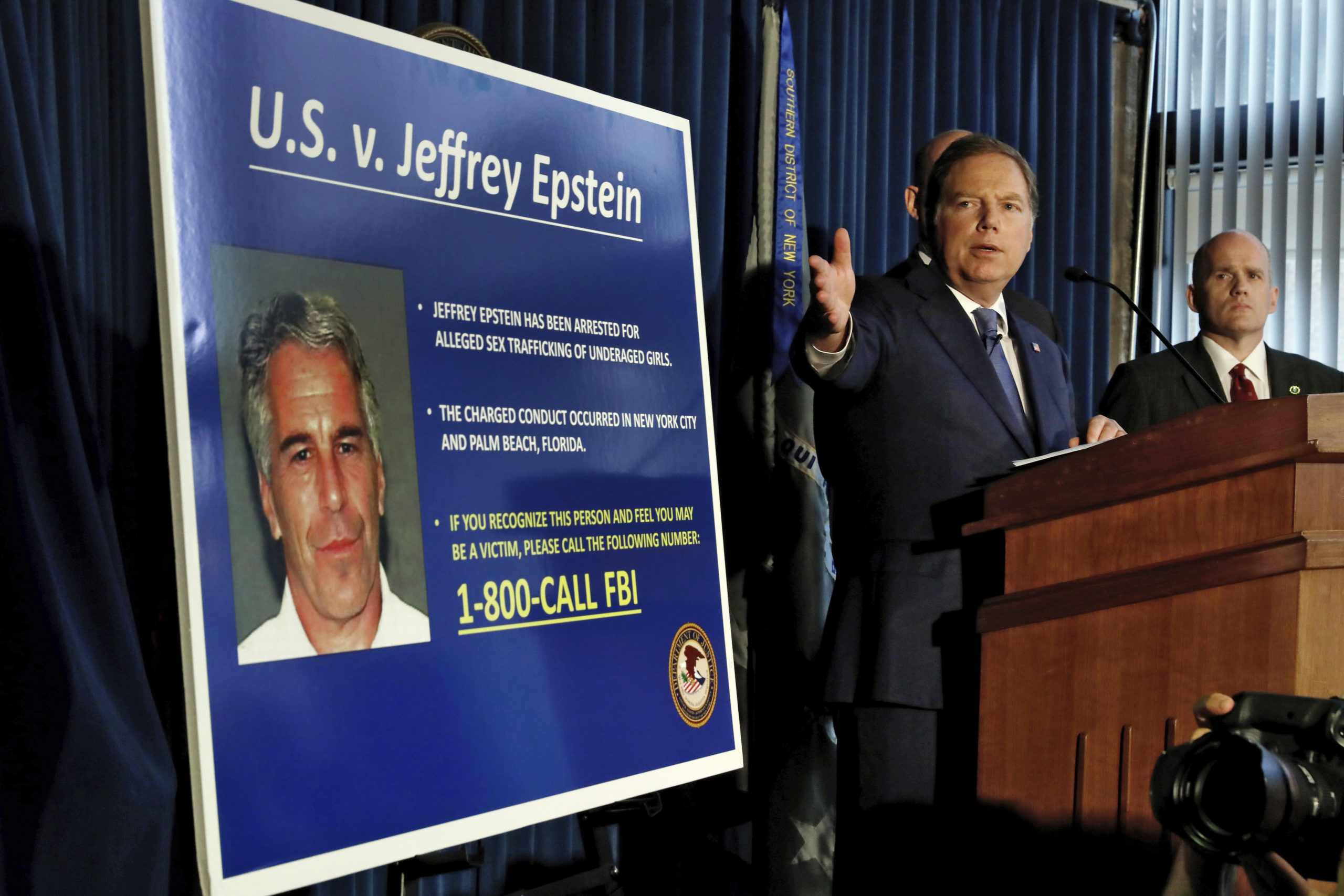
(AP Photo/Richard Drew)
U.S. Attorney for the Southern District of New York Geoffrey Berman speaks during a news conference on July 8, 2019, about the arrest of Jeffrey Epstein.
Extensive tax filings compiled by The Miami Herald and released this week show a pattern of giving by accused sex trafficker and convicted sex offender Jeffrey Epstein over a period of 20 years. The hundreds of donations, dating from 1998 to 2017, detail charitable giving from three of Epstein’s foundations to more than a dozen Jewish nonprofits and educational institutions.
From $250 to a kollel study program and charity in Jerusalem to $500,000 to an Orthodox Jewish school in Manhattan, Epstein’s three non-profits — Epstein Interest, The C.O.U.Q. Foundation and Gratitude American Ltd. — gave heavily to Jewish organizations of all stripes. It is likely that Epstein made other charitable contributions over the years that have yet to be discovered in the public IRS documents currently available.
Epstein was first accused of sexual misconduct in 2005, indicted in 2006 and pled guilty in a secret plea deal in 2008 and served 13 months in prison. He was released in 2009 and forced to register as a sex offender in both Florida and New York. Earlier this month he was arrested on federal charges for sex trafficking of minors.
Epstein’s most recent donation to a Jewish organization was listed as $50,000 on December 31, 2017, to the UJA-Federation in New York. The single largest donation from any of the foundations, to any recipient, was $500,000 to the Ramaz School in February 2008.
Jewish Insider has compiled a list of Epstein’s publicly documented donations to Jewish institutions, and, when relevant, asked them to comment on the context of the charitable gift. They are presented here in reverse chronological order.
UJA-Federation of New York
Epstein’s foundation, Gratitude America Ltd., gave a $50,000 donation to the UJA-Federation of New York in December 2017. The UJA-Fed did not respond to a request for comment from JI on the context of the donation. The Forward reported earlier this month that the Federation did not answer its multiple calls and emails on the same topic.
In May 2002, Epstein’s nonprofit Epstein Interests donated $100,000 to the UJA-Fed.
The UJA-Fed is one of the largest Jewish non-profits in the world, with a turnover of more than $200 million a year, distributed to dozens of charitable organizations in the U.S., Israel and around the world.
YIVO Institute for Jewish Research
Epstein’s foundation, C.O.U.Q. Foundation, contributed $50,000 in February 2012 to the YIVO Institute for Jewish Research. YIVO did not respond to a request for comment from JI about the nature of the donation. The Institute, based in New York City, is a library, archive and research center of Jewish history and culture.
Chibas Yerushalayim Reb Meyer
In February 2009, the C.O.U.Q. Foundation donated $250 to Chibas Yerushalayim Reb Meyer. It is the smallest individual donation listed from any of Epstein’s charities in the 20-year period documented. “Kolel Chibas Jerusalem Rabbi Meyer Baal Haness” describes itself as “one of the oldest and holiest charities in the world,” and says it distributed more than $7 million annually “to thousands of needy in [the] Holy Land.”
National Council of Jewish Women
The National Council of Jewish Women was one of the most frequent organizations that received funds from Epstein’s foundations. The first donation, through Epstein’s C.O.U.Q. Foundation, was a $5,000 gift made on October 20, 2005, the very same day that Florida police arrived with a search warrant at his home. The second donation of $5,000 was made on October 5, 2006. The third donation, also for $5,000, was made on February 29, 2008, several months before Epstein plead guilty and entered prison. The NCJW did not respond to a request for comment on the donations.
“Aspen Jewish Congregation”
A line on the 2008 tax return for Epstein’s C.O.U.Q. Foundation says it donated $50,000 to the Aspen Jewish Congregation on February 29, 2008. The synagogue by that name, a Reform congregation, denied it was the recipient of such a donation. Searches of other tax returns around the same time indicate that the donation may have been directed to the UJA of Aspen Valley. A representative of Jewish Colorado, which is now the umbrella organization of the Aspen UJA, told JI that its records do not go back to 2008, since it only took over the UJA’s finances in 2015.
Les Wexner, Epstein’s closest association for many years and the Jewish billionaire owner of L Brands, has a residence in Aspen.
Ramaz School
On February 29, 2008, the C.O.U.Q. Foundation donated $500,000 to the Ramaz School, the single largest donation for any of Epstein’s three charities for more than 20 years. Ramaz is a well-respected Orthodox Jewish day school in Manhattan. In an email sent out this week, the school admitted to receiving the gift.
“At the time, the source of the foundation’s funding was not made known to the School,” Ramaz chairman Philip Wilner and head of school Jonathan Cannon wrote in the email, according to JTA. “However, we very recently learned that the foundation was associated with Jeffrey Epstein, whose unconscionable behavior is widely known.” Ramaz said most of the donation was spent to establish an educational program, and that the revelation would cause it to more carefully review its acceptance of gifts.
Ziv Tzedakah Fund
The C.O.U.Q. Foundation listed a donation of $100,000 in August 2006 to the “Zvi Tzedakah Fund,” which was most likely a typo for the Ziv Tzedakah Fund, a now-defunct charitable organization founded by Danny Siegel that operated from 1981 to 2008. Siegel told Jewish Insider that he was unaware of any donation of that nature linked to Epstein.
“In all those years there were only two 6-figure donations,” Siegel wrote, stating that one was in Canada and one “was donated by a woman, though I did not see the actual check.” Siegel promised to look into the organization’s records further for more clarity.
Hillel Foundation and Harvard Hillel
In July 2005, Epstein’s C.O.U.Q. Foundation donated $50,000 to the Hillel Foundation, the umbrella group for the organization dedicated to Jewish life on campus.
In May 2003, Epstein — who never attended Harvard or attained a college degree — donated $50,000 to the Harvard Hillel through his foundation, Epstein Interests. According to a 2003 article in the Harvard Crimson, “Epstein and Wexner… teamed up in the early 1990s to fund the construction of Harvard-Radcliffe Hillel’s new building.”
Jewish National Fund
In June 2005, Epstein’s C.O.U.Q. Foundation donated $15,000 to the Jewish National Fund, the quasi-governmental agency best known for planting trees around Israel, and which is the second-largest landowner in Israel.
Friends of Israel Defense Forces
On March 3, 2005, Epstein’s C.O.U.Q. Foundation donated $25,000 to the Friends of the Israel Defense Forces. The Friends of the IDF organization held a fundraising gala in Manhattan on March 15, 2005.
Seeds of Peace
The Epstein Interests nonprofit donated $10,000 to Seeds of Peace, a nonprofit founded to bring together Israeli and Palestinian teens at a summer camp in Maine.
American Jewish Committee
In May 2003, Epstein Interests donated $25,000 to the American Jewish Committee, a Jewish advocacy group.
Columbus Jewish Foundation
In May 2003, the C.O.U.Q. Foundation donated $100,000 to the Columbus Jewish Foundation. Wexner has lived in the Columbus, Ohio area for most of his life.
Yeshiva of Spring Valley
On two separate occasions, the Epstein Interests nonprofit made donations to the Yeshiva of Spring Valley. On both May 31, 2002 and August 3, 2000, the foundation donated $20,000 to the yeshiva. The school is an Orthodox, separate-sex yeshiva day school in the Monsey, New York area.
Gift of Life
Epstein Interests donated $25,000 to the Gift of Life bone marrow foundation in 2002, a Jewish-founded organization based in Florida.
92nd Street Y
In November 2000, Epstein Interests donated $25,000 to the 92nd Street Y Jewish community center.
Jewish Family Children Service
Tax filings for Epstein Interests list two donations to an organization named as Jewish Family Children Services. Both donations, in April 1999 and June 1998, were for $15,000.
American Friends of Hebrew University
In October 1998, Epstein Interests donated $25,000 to the American Friends of Hebrew University.
Center for Holocaust Studies
Tax filings for Epstein Interests indicated a $900 donation in October 1998 to an organization listed as Center for Holocaust Studies.
Congregation Kehilath Jeshurun
In July 1998, Epstein Interests donated $10,000 to Congregation Kehilath Jeshurun, an Orthodox synagogue in Manhattan.
Please log in if you already have a subscription, or subscribe to access the latest updates.
 Continue with Google

 Continue with Apple