
































Jewish conservatives voiced their concerns about the fundraiser on social media as the invitation surfaced online Thursday
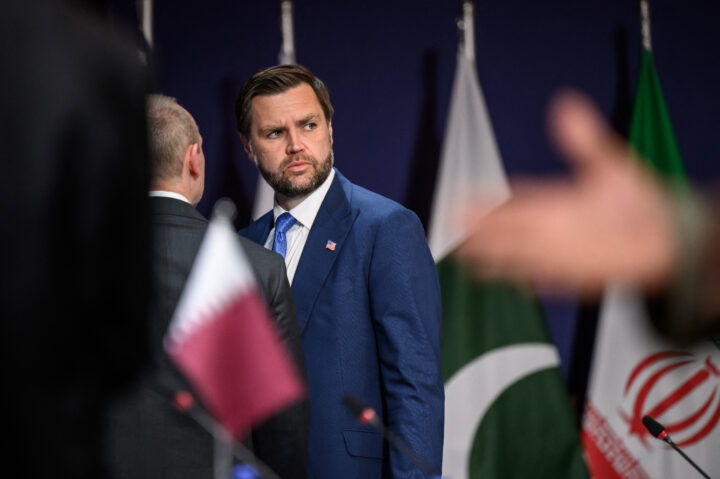
Fabrice Coffrini / POOL / AFP via Getty Images
Vice President JD Vance looks on prior to a quadrilateral meeting between the United States, Iran, Pakistan and Qatar at the Burgenstock luxury hotel complex overlooking Lake Lucerne, Switzerland, on June 21, 2026, as part of high-level talks aimed at advancing a deal to end the Middle East conflict.


 Add JewishInsider on Google
A fundraiser hosted by Vice President JD Vance in the Hamptons on Wednesday is raising red flags among some Jewish Republicans who continue to harbor concerns over his likely intention to run for president in 2028.
The event, first reported by Axios, was notably held in the home of Omeed Malik, the Iranian American investor who was an important early backer of Tucker Carlson’s media company. The fundraiser highlights Vance’s ongoing ties to Carlson’s network — even as the far-right commentator has faced backlash for his regular promotion of antisemitic conspiracy theories about Jews and Israel.
Carlson also recently pledged to help start a third political party after breaking with President Donald Trump over the war with Iran, which Vance himself has reportedly privately opposed.
As Vance mulls a presidential bid, the fundraiser — where he reportedly raised $5 million — shows how he is building a coalition of younger donors from the populist right who are poised to meaningfully shape the upcoming campaign to define a post-Trump era.
In addition to Malik, the fundraiser also reportedly included Donald Trump Jr., a close ally of Vance as well as Carlson. Malik is a business partner of Trump Jr. in their investment firm 1789 Capital, which raised significant funding from Middle East and other foreign investors and has done business with the Qatar Investment Authority. In January, Malik appeared with Trump Jr. and Carlson at the Doha Forum in Qatar, following the May 2025 Qatar Economic Forum where Trump Jr. and Malik spoke on a joint panel session titled “Investing in America.”
The event underscores the anxieties among some traditional Republicans who are skeptical of Vance’s indulgence of antisemitic forces on the far right and commitment to a strong relationship with Israel that has long been a key GOP value but is now waning among the party’s younger voters.
Jewish conservatives voiced their concerns about the fundraiser on social media as the invitation surfaced online Thursday.
A senior Republican official defended Vance’s appearance at the fundraiser, saying it was a function of the vice president’s role as finance chairman of the Republican National Committee.
“As RNC Finance Chairman, it’s the vice president’s job to raise money for the Republican Party, and that’s exactly what he did at this event,” the official told Jewish Insider. “The vice president has raised tens of millions of dollars not for himself, but for the RNC’s efforts to hold the House and Senate. All of the hosts for the event were strong supporters of President Trump’s 2024 campaign and we’re happy that they’re continuing that support for Republicans in the midterms.”
Vance has in recent months stepped up his criticism of Israel — alleging Israeli influence campaigns have been “manipulating” U.S. opinion of the Iran war, for instance, while publicly rebuking Israeli officials over disagreements regarding negotiations with Tehran.
Many Jewish Republican donors remain wary of Vance as speculation mounts over who will run for president in 2028 and whether he would be the front-runner.
While the vice president has made some overtures to Jewish Republicans, the Wednesday night fundraiser indicates he is embracing a potential route that could increasingly alienate the pro-Israel community.
Miller is being accused of abuse by his ex-wife Emily Moreno, daughter of Sen. Bernie Moreno, who on Sunday said Miller is unfit for office

Anna Moneymaker/Getty Images
Rep. Max Miller (R-OH) leaves for a break during a House Republican Steering Committee meeting at the U.S. Capitol Building.
Sen. Bernie Moreno (R-OH) publicly accused Rep. Max Miller (R-OH), his former son-in-law, of domestic abuse on Sunday and said Miller is unfit for office. Moreno’s comments came in response to a video address by Miller denying wrongdoing amid growing scrutiny of the allegations of domestic violence and abuse by his ex-wife Emily Moreno, the senator’s daughter.
Recent polling and reports indicate that the unfolding scandal could lead Miller, one of the few Jewish Republicans in the House to lose his House seat. The New York Times reported last week that Miller’s polling is slipping in the wake of the recent allegations about his past conduct, with a Democratic internal poll showing him just one point ahead of his Democratic challenger, progressive Brian Poindexter, despite the district favoring Republicans.
Another poll conducted by a Republican firm last week reported by NOTUS found Poindexter leading Miller by five points, with Miller’s favorability 15 points underwater.
The allegations against Miller include repeated physical abuse of both Emily Moreno and their daughter.
Democratic aides told the Times they intend to target the district, which the Cook Political Report rates as “likely Republican.” The handicapper already increased Democratic chances of winning the seat as the abuse allegations gained increasing attention.
White House officials are concerned that Miller’s continued candidacy endangers Republicans’ chances of holding the House, according to the Times. Miller, in a statement, vigorously denied to the newspaper that he was in any danger of losing his seat.
Miller released a video on Sunday denying the abuse allegations against him, also posting what he claimed was exculpatory evidence. He has argued that his ex-wife suffers from mental health issues, is fabricating her claims and is a danger to him and their child, repeating allegations he has made in other public interviews. Miller said in the video address he intends to stay in the race and continue campaigning.
He has emphasized that he has never been charged with or convicted of wrongdoing and has been permitted to maintain joint custody of their 2-year-old daughter.
A spokesperson for Emily Moreno called the statement “shameful” and “a bizarre and lie-filled rant about his ex-wife to desperately try to save his political career.”
After previously withholding comment, Moreno said in a lengthy statement that the past two years since his daughter’s divorce from Miller have been “hell” and that his priority has been keeping the matter private to protect his family but that Miller’s “increasingly erratic and dangerous behavior has made that impossible.”
He called Miller a “danger” to his daughter and granddaughter and said that he fails to meet any “basic standards of character” to serve in office and “should not continue to be free” until he receives psychological help.
Miller dismissed Moreno’s claims and accused him of trying to “hide from your own media circus” and of only speaking out for political reasons, as well as questioning why he had not spoken out earlier.
Some of Miller’s colleagues in Ohio’s congressional delegation were muted in their reactions to Moreno’s accusations against him, with no members of the House Republican Conference calling for Miller’s resignation.
Rep. Mike Turner (R-OH), the former chairman of the House Intelligence Committee and a fellow Ohio Republican, declined to answer several questions on the accusations against Miller on Sunday, telling CBS’ “Face the Nation” that the matter should be handled “in a courtroom” as opposed to the court of public opinion.
“This is a matter of litigation. This is best handled in a courtroom and not in a TV studio,” Turner told the network. “This is an issue that is currently part of a divorce and part of litigation that’s in a courtroom, and the court should be handling this, which is clearly ongoing, and that’s where this needs to be.”
Miller, while in office, has been a close ally of Ohio’s Jewish community and active on various issues of interest to the Jewish community including supporting Israel and combating antisemitism. He has also faced harassment, threats and violence for being a Jewish member of Congress.
He serves on the House Foreign Affairs Committee.
Miller also helped lead the charge to oust former Rep. George Santos (R-NY) from the House, during which time Santos alluded to allegations of domestic violence against Miller. That reference was to a separate, earlier allegation: in 2021, Stephanie Grisham, a former White House press secretary who dated Miller before his marriage to Emily Moreno, publicly accused him of physically abusing her during their relationship. Miller denied those allegations as well.
Miller’s challenger Poindexter is an ironworker, union organizer and Brook Park, Ohio city, councilmember whose record on Israel and other issues of interest to the Jewish community is largely undefined.
“No one credibly accused of holding a gun to his wife’s head and breaking their two-year-old daughter’s collarbone belongs in the halls of power,” Poindexter said on X on Sunday.
He has been endorsed by the Congressional Progressive Caucus PAC and Our Revolution, the progressive campaign group founded by alumni of Sen. Bernie Sanders’ (I-VT) presidential campaign.
Plus, Hill hums along to F-35s for Saudi
Chip Somodevilla/Getty Images
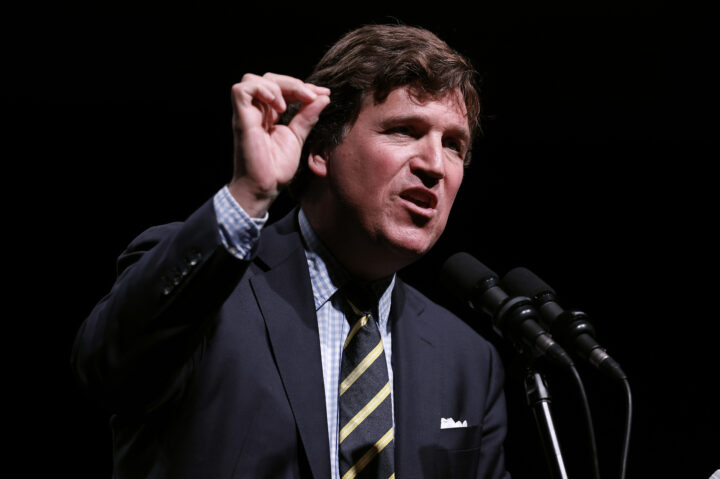
Tucker Carlson speaks at his Live Tour at the Desert Diamond Arena on October 31, 2024 in Phoenix, Arizona.
Good Tuesday morning.
In today’s Daily Kickoff, we preview Saudi Crown Prince Mohammed bin Salman’s meeting with President Donald Trump today at the White House, and look at how Jewish Republicans are reckoning with resurgent antisemitism on the right. We report on the U.N. Security Council’s support for Trump’s plan for postwar Gaza, and cover Israel’s push for the International Criminal Court to drop its arrest warrants for Israeli leaders over claims the court’s chief prosecutor pursued the case to distract from sexual harassment allegations. Also in today’s Daily Kickoff: Gov. JB Pritzker, Robert George and Troye Sivan.
Today’s Daily Kickoff was curated by Jewish Insider Executive Editor Melissa Weiss and Israel Editor Tamara Zieve with assists from Marc Rod and Danielle Cohen-Kanik. Have a tip? Email us here.
What We’re Watching
- All eyes are on Washington today for Saudi Crown Prince Mohammed bin Salman’s visit to the nation’s capital and meeting with President Donald Trump, followed by a formal dinner in honor of the crown prince’s visit. More below.
- The National Task Force to Combat Antisemitism is holding a daylong conference on “Exposing and Countering Extremism and Antisemitism on the Political Right.”
- Elsewhere in Washington, the Aspen Cyber Summit is taking place at the Kennedy Center.
- The Jewish Federations of North America’s General Assembly wraps up today. Speakers at this morning’s closing plenary, which features a musical performance by The Tamari Project, include Sen. Ted Cruz (R-TX) and “Call Me Back” host Dan Senor. JI’s Lahav Harkov will be moderating a session this morning on the future of the Middle East.
- The One Israel Fund is holding its annual gala tonight in New York. Rep. Elise Stefanik (R-NY) is keynoting this year’s event.
- In Turtle Bay today, U.S. Ambassador to the U.N. Mike Waltz will be joined by rapper Nicki Minaj as the two deliver remarks on the persecution of Christians in Nigeria.
- Outgoing New York City Mayor Eric Adams concludes his trip to Israel today. Following a trip to Kibbutz Nir Oz in Israel’s south, Adams will depart Israel for Uzbekistan.
What You Should Know
A QUICK WORD WITH JI’S Matthew Shea
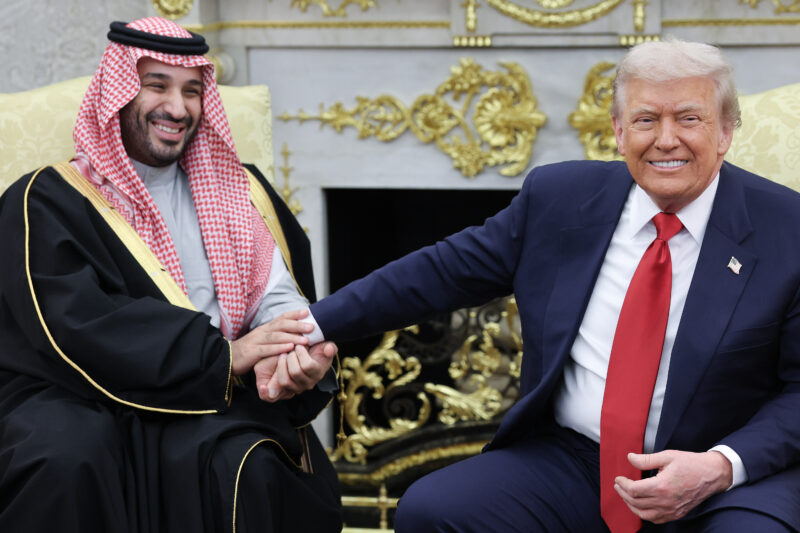
President Donald Trump is hosting Saudi Crown Prince Mohammed bin Salman today at the White House, marking the first time MBS has visited Washington since 2018.
Trump plans to roll out the red carpet for the visit, which includes a welcome ceremony, bilateral meeting in the Oval Office and a black-tie dinner in the evening. Tiger Woods and Elon Musk are expected to be in attendance at the dinner, among other high-profile attendees. “We’re more than meeting,” Trump said late Friday. “We’re honoring Saudi Arabia, the crown prince.”
The visit is not an official state visit, as MBS is not Saudi Arabia’s head of state; however, the crown prince holds almost all responsibility in ruling the kingdom.
The bilateral meeting will feature high-stakes discussions on several key issues, including the sale of F-35 fighter jets, Saudi-Israel normalization and a possible U.S.-Saudi defense pact. Experts told Jewish Insider such an agreement is likely to be modeled after the assurances Trump gave Qatar in September, in the wake of an Israeli strike on Hamas in the Gulf state, when he issued an executive order stating that the U.S. will regard “any armed attack” on Qatar “as a threat to the peace and security of the United States.”
Trump announced on Monday he would approve the sale of the F-35s to Riyadh, helping the Saudis secure a long-coveted deal and making them the first country in the Middle East other than Israel to obtain the advanced fighter jets. “They want to buy. They are a great ally. We will be doing that. We will be selling them F-35s,” Trump told reporters in the Oval Office.
Concerns remain within the foreign policy community over the impact that the sale of F-35s will have on the military balance in the region and Israel’s qualitative military edge, which the U.S. is bound by law to uphold. Experts also cautioned the risks of transferring sensitive technology to Riyadh after Saudi naval forces conducted a joint military exercise with China last month. Israel has requested that such a sale be conditioned on the kingdom joining the Abraham Accords, however Trump made no mention of such a provision.
THE RIGHTS NEW DIVIDE
‘Confused young groypers’: Jewish Republicans reckon with resurgent antisemitism on the right
During a talk at a Turning Point USA event at the University of Mississippi last month, Vice President JD Vance listened carefully as a student took the microphone and asked him a question grounded in antisemitic tropes. Vance took the question at face value, declining to push back. The exchange came soon after right-wing podcaster Tucker Carlson hosted neo-Nazi provocateur Nick Fuentes for a decidedly friendly interview, a shocking but not altogether surprising cultural moment that catapulted an intra-party rift into the open: a shift among a small but growing contingent of young conservatives away from Israel and, increasingly, into a conspiratorial worldview that holds the Jewish state — and Jews — responsible for the world’s ills. The question facing party leaders is just how deeply this perspective has rooted itself among the right and how to deal with it: whether to fight it, accept it or stay quiet and hope it disappears, Jewish Insider’s Gabby Deutch reports.
Looking ahead: Vance’s response at the Turning Point event sparked concern among Jewish conservatives about how a potential future GOP presidential nominee plans to deal with a growing segment of the political right that is not just critical of Israel but of Jews — and why he has been willing to make excuses for the bigotry of some of his supporters. Earlier this month, at the RJC conference in Las Vegas, Republican fundraiser Eric Levine told JI that he has concerns about Vance, though he added that those concerns are balanced out by the fact that President Donald Trump remains “the most pro-Israel president in the history of the country.”
F-35 FACTOR
House Republicans largely supportive of F-35 deal with Saudi Arabia

House Republicans sounded largely supportive of President Donald Trump’s announcement on Monday that he plans to sign a deal to sell advanced F-35 fighter jets to Saudi Arabia, despite an apparent lack of progress toward normalization of relations between Saudi Arabia and Israel, Jewish Insider’s Marc Rod reports. Democrats, meanwhile, were generally more skeptical of the deal.
What they’re saying: “I’m very supportive of the president in every effort to reach out to Saudi Arabia,” Rep. Joe Wilson (R-SC), a senior member of the House Foreign Affairs Committee, told JI. “Saudi Arabia has been so significant in addressing the regime change in Syria and so over and over again, Saudi Arabia is proving [itself].” Rep. Brad Schneider (D-IL), a co-chair of the Abraham Accords caucus, suggested that normalization should precede the sale of F-35s. Saudi Arabia joining the Abraham Accords “would certainly require a reassessment of the assumptions underpinning our strategic outlook for the region and revisions to our policy doctrines, including provision of the F-35 platform to Saudi Arabia, while also preserving Israel’s qualitative military edge,” he said.
Read the full story here with additional comments from Reps. Mike Lawler (R-NY), Ann Wagner (R-MO), Jared Moskowitz (D-FL), Brad Sherman (D-CA) and Adam Smith (D-WA).
Forceful feedback: The Lebanese Armed Forces is facing pushback from Sens. Joni Ernst (R-IA) and Lindsey Graham (R-SC) over a statement it posted to social media on Sunday blaming Israel for flare-ups with Hezbollah in southern Lebanon, Jewish Insider’s Emily Jacobs reports. The Trump administration reportedly canceled an upcoming trip to the U.S. by Lebanese Armed Forces commander Gen. Rodolphe Haykal as part of Washington’s concern over the LAF’s moves.
PATH TO PEACE
U.N. Security Council backs Trump’s Gaza plan
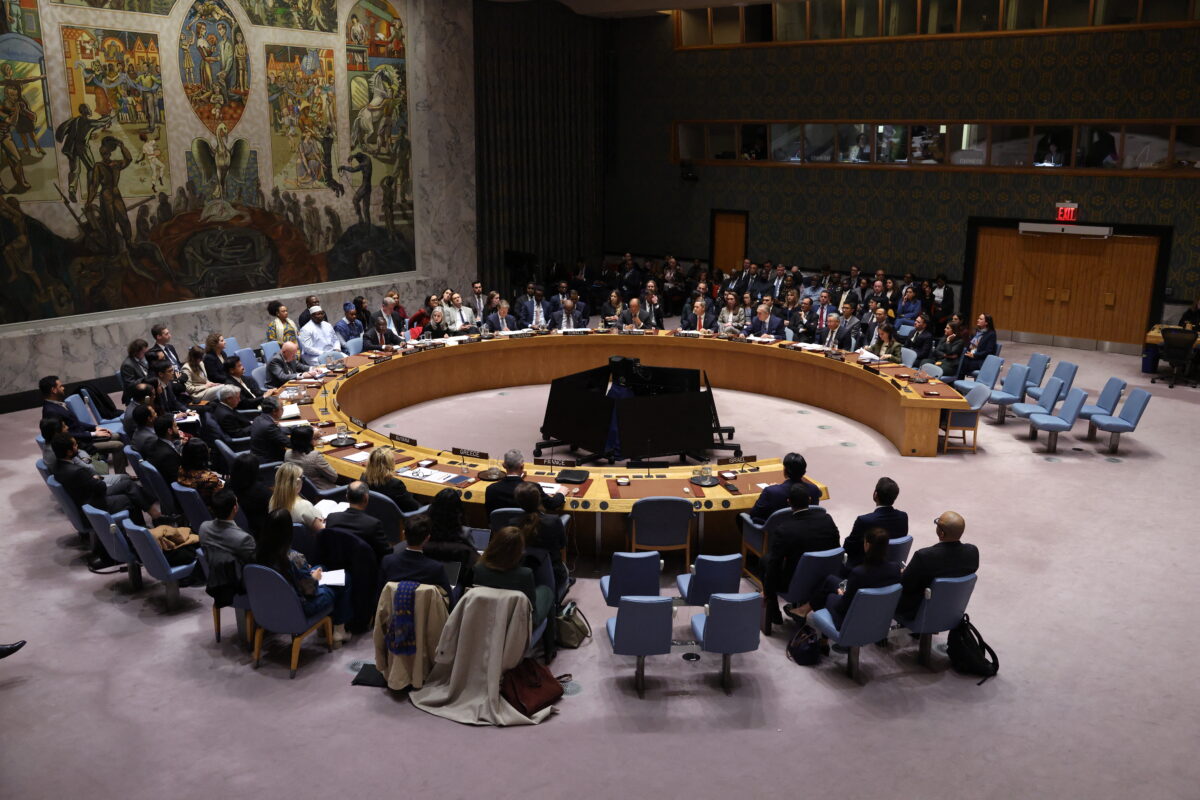
The U.N. Security Council adopted a U.S.-led resolution on Monday backing President Donald Trump’s peace plan for Gaza, including the creation of an international security force, in a move that could boost efforts to advance into the next phase of the Israel-Hamas ceasefire, Jewish Insider’s Matthew Shea reports. In the first phase of Trump’s 20-point peace plan, originally presented in September, the Israel Defense Forces have partially withdrawn to a “yellow line” dividing Gaza, while Hamas has returned all of the living hostages and all but three of the deceased hostages’ bodies. However, the plan has faced significant roadblocks, and questions remain about the feasibility of implementing the following phases, including effectively disarming Hamas and determining who will govern Gaza.
What it means: Monday’s vote follows coordinated diplomacy between Washington and Arab partners aimed at reviving momentum behind the U.S. plan, including hosting a summit in Sharm El Sheikh, Egypt, last month and issuing a joint statement of support last week. With the adoption of the resolution, the U.N. showed a rare consensus on Gaza — 13 countries voted in favor and none against, with Russia and China abstaining. Experts told JI that moving to the second phase of the plan now becomes more plausible — even if challenges remain.
RESIGNATION RIPPLE
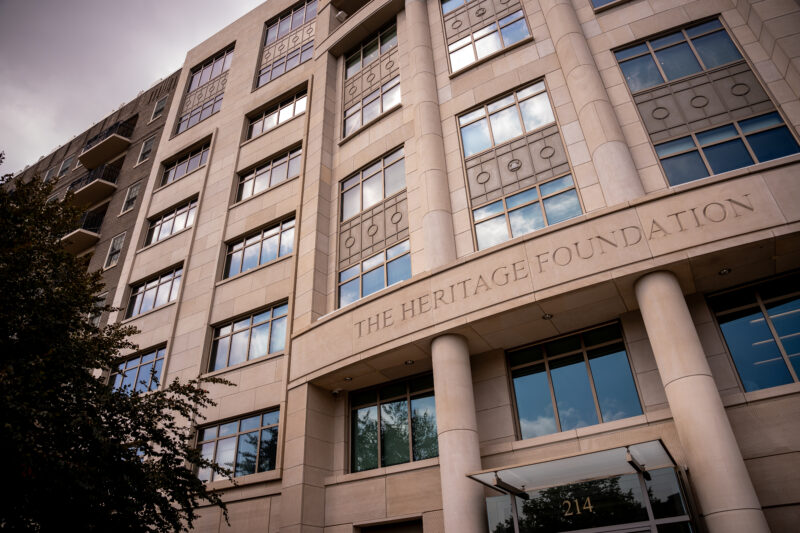
Heritage board member resigns amid continued fallout over Tucker Carlson controversy
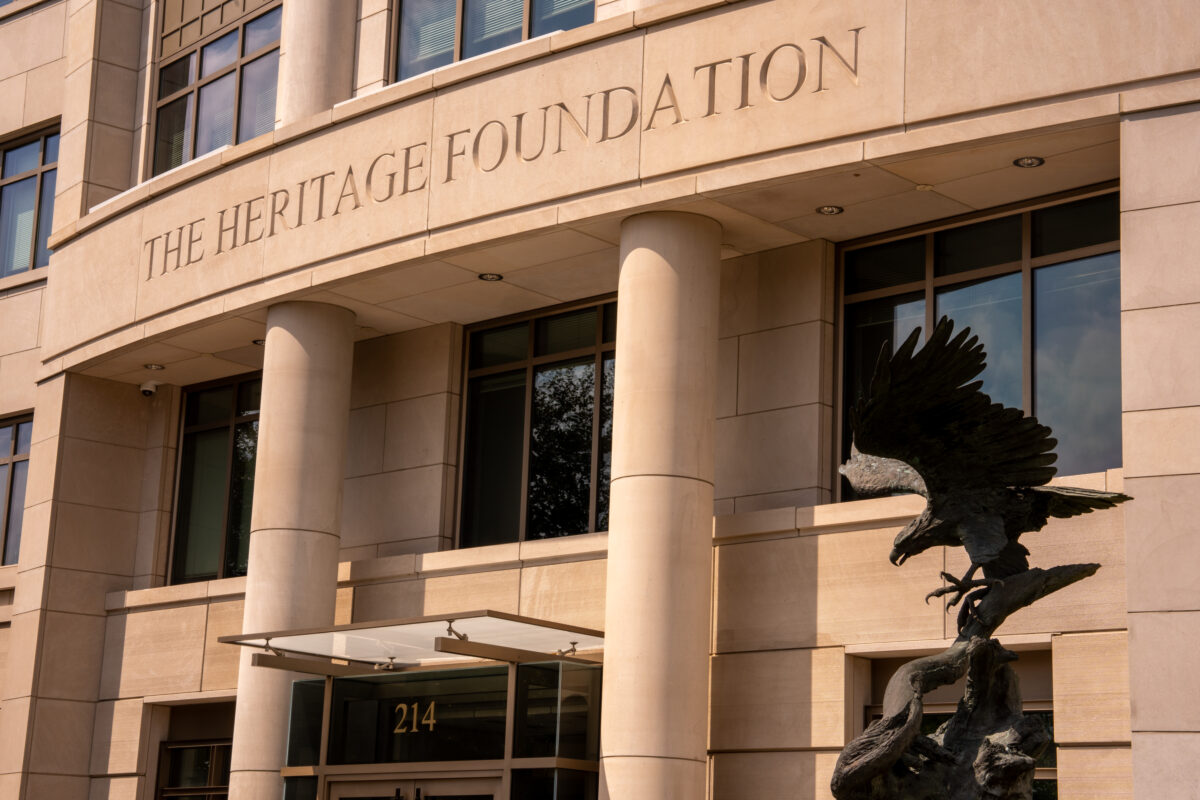
Robert George, a prominent board member of the Heritage Foundation, said on Monday that he was resigning from the conservative think tank, in the latest sign of continued fallout over its president’s controversial defense of Tucker Carlson after his friendly interview last month with a neo-Nazi influencer, Jewish Insider’s Matthew Kassel reports.
What he said: “I could not remain without a full retraction of the video released by Kevin Roberts, speaking for and in the name of Heritage, on October 30th,” George said in a Facebook post Monday morning, referring to the group’s president. “Although Kevin publicly apologized for some of what he said in the video, he could not offer a full retraction of its content. So, we reached an impasse.” His decision to step down indicates that Roberts is likely secure, for now, in his role atop Heritage, as its board remains split about his future, according to a former Heritage staffer familiar with internal discussions.
PARTING WAYS
Matt Gaetz producer fired for sharing virulently antisemitic video
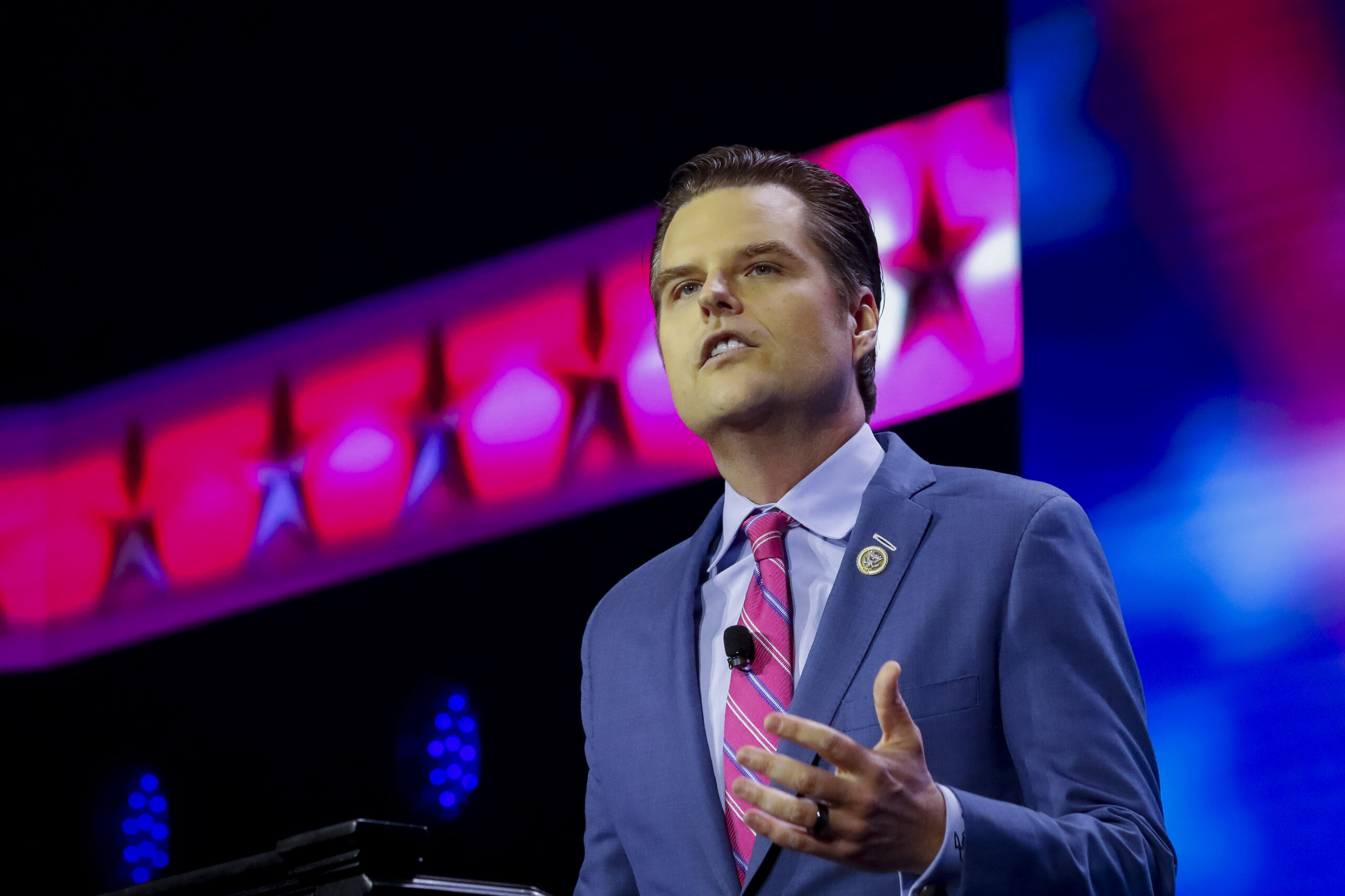
A producer for former Rep. Matt Gaetz’s (R-FL) weeknight show on the right-wing One America News Network has reportedly been fired after he shared a vehemently antisemitic social media post depicting Jews as cockroaches, Jewish Insider’s Matthew Kassel reports. Vish Burra, who was a booker and script writer for Gaetz, had drawn widespread backlash for posting an AI-generated animated video last week showing him entering a “scheming room” with Stars of David on the door to find a group of cockroaches counting money, who scurry away upon his arrival. The post has since been deleted.
Additional hate speech: “I will expose the vermin in the venomous coalition and their transgression against MAGA, America First, and Kevin Roberts at The Heritage Foundation,” Burra said in another post to X, which has also been deleted. “It all starts with Susan Lebovitz-Edelman,” he wrote, referring to a Jewish trustee at the Manhattan Institute who is married to the hedge fund manager Joseph Edelman. Lebovitz-Edelman, he wrote, “is behind the entire campaign to oust Kevin Roberts from The Heritage Foundation by using her leverage as a recent big dollar donor to take control of the organization.” Burra’s firing was reported by The Wrap and The Independent on Monday.
TRIBUNAL TURMOIL
Israel petitions ICC to remove chief prosecutor from case, citing conflict of interest

Israel petitioned the International Criminal Court on Monday to remove chief prosecutor Karim Khan from its case, saying he pursued charges against Israeli leaders to distract from sexual harassment accusations lodged against him. Israel also asked the court to cancel its arrest warrants against Israeli Prime Minister Benjamin Netanyahu and former Defense Minister Yoav Gallant over Khan’s allegations that they perpetrated war crimes and crimes against humanity in Gaza including “starvation of civilians as a method of warfare” and “intentionally directing attacks against a civilian population,” Jewish Insider’s Lahav Harkov reports.
Background: The petition came after two women submitted complaints against Khan for workplace sexual misconduct. One is an ICC employee, who alleged the misconduct occurred as recently as 2024 and that Khan attempted to dissuade her from making claims against him. In a leaked recording of a phone call between Khan and the ICC employee, she lamented that she had been accused of being a “Mossad plant” over the complaint. Khan was recorded telling the woman that someone had leaked the complaint to the media to “get rid of the warrants for Palestine,” among other open cases. According to The Guardian, private investigators hired by Qatar had attempted and failed to find a link between the accuser and Israel.
Worthy Reads
A Magazine’s Missteps: In Commentary, Jamie Kirchick does a deep dive into the antisemitism within The American Conservative — underscored by the language of its opposition to the U.S. strikes on Iranian nuclear facilities earlier this year that put it at odds with both the White House and the conservative movement. “The more one reads the American Conservative and listens to its contributors, the more one realizes how deeply ingrained the idea of Jewish perfidy is in the magazine’s Weltanschauung. … There is no greater rebuke to isolationism than Auschwitz. Isolationists know this, which is why they spend so much time relitigating World War II. It’s also why so many isolationists harbor antipathy toward Jews, the Holocaust’s chief victims and the stewards of its memory. The Jews are a living reminder of what happens when evil is not confronted, and their survival is deeply offensive to those who prefer not to confront the evil in our world.” [Commentary]
BBC Bias: The Wall Street Journal’s Gerard Baker raises concerns over the impact of the BBC’s biases on public opinion and policy. “There were — and are — many talented, honest people there. But in the past 10 years, it has, like other institutions worldwide, been captured by the cultural revolution that has swept the world of graduate-level work, seized by an activist class not content to report the news but insisting instead on telling people what to think. Their orthodoxy is familiar: on race, gender, sexuality, immigration and national sovereignty, climate alarmism, Western civilization and international affairs. I believe that the BBC’s coverage of Gaza is the most important factor in the recent rise of antisemitism in Britain. The daily repetition of Hamas propaganda about supposed Israeli atrocities has played in Britain (and around the world) for two years.” [WSJ]
Word on the Street
Illinois Gov. JB Pritzker contributed $25.5 million to his campaign fund over the last two weeks as he makes a bid for a third term and as speculation mounts that he may enter the 2028 presidential race…
New York City Councilmember Chi Ossé filed paperwork to challenge House Minority Leader Hakeem Jeffries (D-NY) in New York’s 8th Congressional District; Ossé, an ally of New York City Mayor-elect Zohran Mamdani, is challenging Jeffries from the House leader’s left…
Former Harvard President Larry Summers will step away from his upcoming public commitments following the release of extensive email correspondence with Jeffrey Epstein that lasted until the day before Epstein’s arrest; Summers will continue teaching five classes this semester, and will stay on as director of the Mossavar-Rahmani Center for Business and Government at the Harvard Kennedy School…
Federal prosecutors in New York are seeking an 18-year prison sentence for a neo-Nazi leader who pleaded guilty to soliciting hate crimes for his role in a plot to give poisoned candy to Jewish children…
Canadian officials said that worker error was the reason an Israeli-born woman applying for a passport was told that she could not list Israel as her country of birth; an employee had reportedly told the woman that the denial was due to “the political conflict”…
A collection of Gustav Klimt works owned by art collector and philanthropist Leonard Lauder, who died earlier this year, is expected to garner more than $400 million when they are auctioned by Sotheby’s today…
A German auction house canceled the planned sale of more than 600 items that belonged to Holocaust victims after coming under criticism by a Berlin-based organization for survivors…
The Washington Post spotlights the efforts of a Brazilian magazine publisher to uncover rumored underground tunnels in his hometown that had been constructed by Nazi officials who had fled to South America after World War II…
Israeli Prime Minister Benjamin Netanyahu condemned recent settler violence in the West Bank following the release of video that showed dozens of settlers setting fire to vehicles and homes in the Palestinian village of Jab’a…
The New York Times reports on the shadowy effort that brought hundreds of Palestinians from Gaza to South Africa in the last month…
Parts of western Iran flooded after heavy rainfall, following months in which the Islamic Republic faced severe drought issues…
Singer Troye Sivan listed his home in Los Angeles’ Hollywood Hills, which he bought in 2017, for $2.545 million…
Rabbi Shlomo Porter, the executive director of the Etz Chaim Center for Jewish Learning, died at 78…
The New York Times spotlights psychoanalyst Sabina Spielrein, who was believed to have been killed by a Nazi death squad in Russia in 1942, in its “Overlooked” series…
Pic of the Day
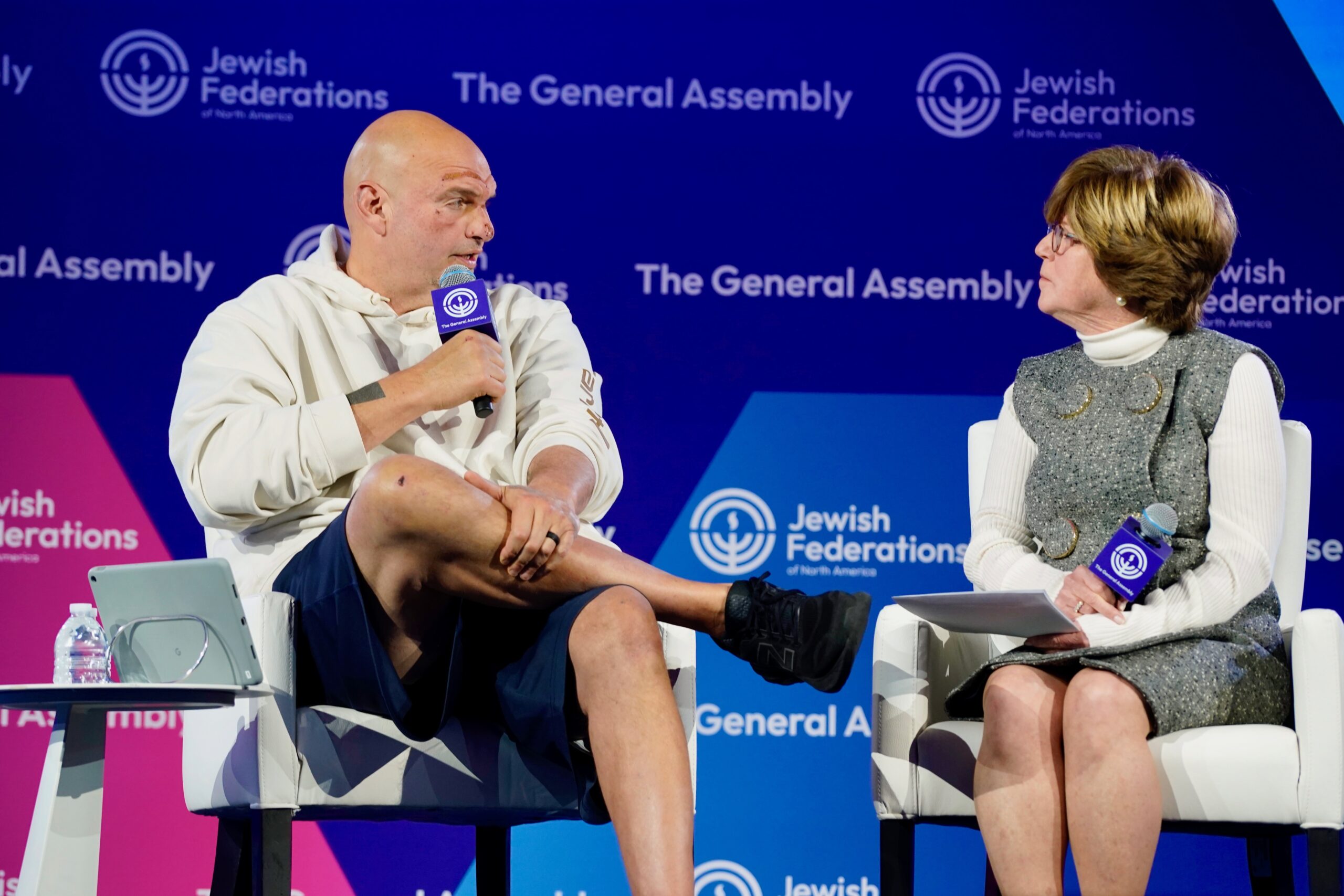
Sen. John Fetterman (D-PA) spoke in conversation with Julie Platt, the immediate past board chair for the Jewish Federations of North America, at a Monday plenary session at the JFNA’s General Assembly in Washington.
Birthdays
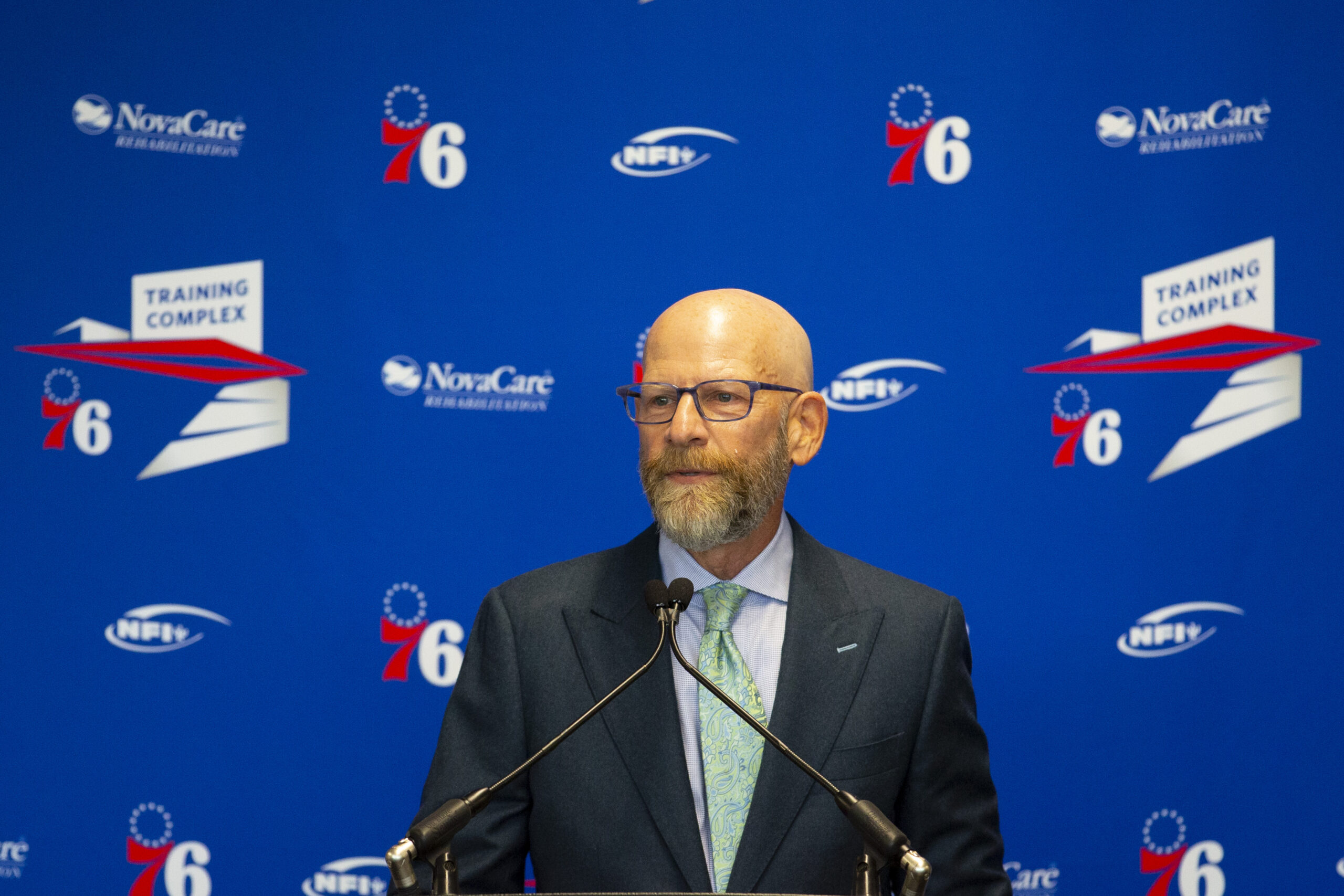
Longtime former play-by-play sportscaster for the NBA’s Philadelphia 76ers, Marc Zumoff turns 70…
Theoretical physicist, at age 27 he became a professor and then later president of the Weizmann Institute, he is the founder of the Davidson Institute of Science Education at Weizmann, Haim Harari turns 85… Former president of East Bay Federation, Steve Goldman… Former national director of major gifts for the American Committee for the Shaare Zedek Medical Center in Jerusalem, Paul Jeser… Lecturer at Boston University School of Law, he was formerly SVP and general counsel of Fidelity Management & Research Company, Eric D. Roiter turns 77… Atlanta resident, Lynda Wolfe… Israeli cantor and actor, known for his Broadway performance as Jean Valjean in “Les Misérables,” David “Dudu” Fisher turns 74… Professor emerita at Harvard Business School, Shoshana Zuboff turns 74… Professor of epidemiology and neurology at Columbia University, Walter Ian Lipkin turns 73… Former U.S. ambassador to South Africa, she is a luxury handbag designer, Lana J. Marks turns 72… Singer-songwriter, he is also the author of a popular Passover Haggadah, Barry Louis Polisar turns 71… Mayor of Dallas from 2002 until 2007, Laura Miller turns 67… SVP and general counsel of HSP Group and ARF Financial, Robert Bruce Lapidus… Moroccan-born, member of the Knesset since 2003 for the Shas party, he currently serves as the minister of welfare and social affairs, Yaakov Margi turns 65… NYC-based writer, activist and performer, Shira Dicker… Pulitzer Prize-winning Washington-based correspondent for The New York Times covering health policy, Sheryl Gay Stolberg turns 64… Retired Baltimore attorney who devotes her time to philanthropic and pro-Israel activities, Laurie Luskin… Rabbi of Burbank Temple Emanu El and former national coordinator of Rabbis Without Borders, Tsafreer “Tsafi” Lev turns 54… Chabad rabbi in Kyiv and executive chairman of the Federation of Jewish Communities of Ukraine, Raphael Rutman turns 53… President and CEO of the Jewish Federation of Broward County, Audra P. Berg… Member of the Knesset for the Yesh Atid party, Michal Shir Segman turns 46… Freshman U.S. senator (R-MT), Tim Sheehy turns 40… Real estate agent at Coldwell Banker and a consultant for Bridals by Lori, Talia Fadis… Israeli singer-songwriter and music producer, Elisha Banai turns 37…
President Donald Trump, called by his Jewish supporters ‘the most pro-Israel president in history,’ won’t lead the party forever. So what will come next?
Joe Raedle/Getty Images
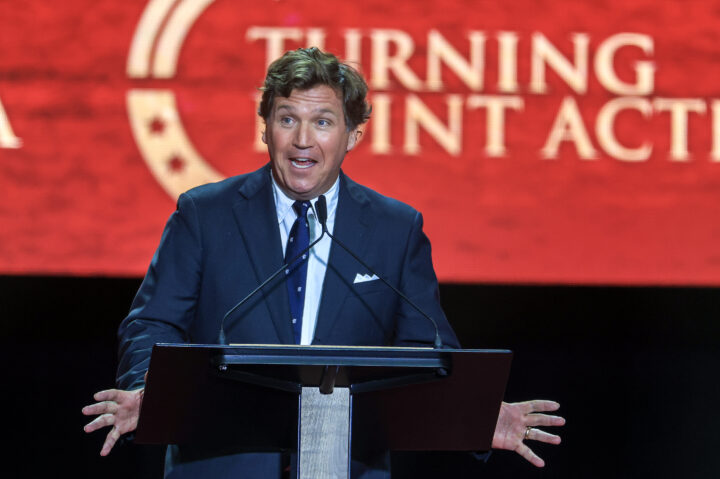
Tucker Carlson speaks during the memorial service for political activist Charlie Kirk at State Farm Stadium on September 21, 2025 in Glendale, Arizona.
During a talk at a Turning Point USA event at the University of Mississippi last month, Vice President JD Vance listened carefully as a student took the microphone and asked him a question grounded in antisemitic tropes. Vance took the question at face value, declining to push back.
“I’m a Christian man, and I’m just confused why there’s this notion that we might have owed Israel something, or that they’re our greatest ally,” the questioner began. “I’m just confused why this idea has come around, considering the fact that not only does their religion not agree with ours, but also openly supports the prosecution [sic] of ours.”
The exchange came soon after right-wing podcaster Tucker Carlson hosted neo-Nazi provocateur Nick Fuentes for a decidedly friendly interview, a shocking but not altogether surprising cultural moment that catapulted an intra-party rift into the open: a shift among a small but growing contingent of young conservatives away from Israel and, increasingly, into a conspiratorial worldview that holds the Jewish state — and Jews — responsible for the world’s ills.
The question facing party leaders is just how deeply this perspective has rooted itself among the right and how to deal with it: whether to fight it, accept it or stay quiet and hope it disappears.
Vance’s response at the Turning Point event sparked concern among Jewish conservatives about how a potential future GOP presidential nominee plans to deal with a growing segment of the political right that is not just critical of Israel but of Jews — and why he has been willing to make excuses for the bigotry of some of his supporters. Last month, Vance called criticism of scores of racist and antisemitic messages in Young Republicans group chat “pearl clutching.” And earlier this month, after many conservatives spoke out against Carlson’s interview with Fuentes, Vance decried what he deemed “infighting” calling it “stupid.”
Until Sunday, President Donald Trump had avoided the maelstrom of the last several weeks, which saw the venerable Heritage Foundation devolve into chaos after its president, Kevin Roberts, defended Carlson following the Fuentes interview. But Trump entered the fray for the first time on Sunday when he was asked by a reporter what role Carlson should play in the conservative movement after hosting “antisemite Nick Fuentes” — and responded with praise for Carlson.
“I found him to be good. I mean, he said good things about me over the years. I think he’s good,” Trump said. “You can’t tell him who to interview. I mean, if he wants to interview Nick Fuentes, I don’t know much about him, but if he wants to do it, get the word out. People have to decide.” Trump dined with Fuentes and Kanye West, also an avowed antisemite, at his Mar-a-Lago resort in 2022, though Trump has insisted that he didn’t invite Fuentes, but rather that Fuentes tagged along with West.
Pro-Israel Republicans have generally been willing to dismiss Trump’s connection to Carlson — Trump appeared on Carlson’s podcast during the campaign last year soon after the former Fox News host platformed a well-known Holocaust denier — because of what they describe as Trump’s pro-Israel bona fides.
“It’s a ridiculous conversation to be having, because nobody should doubt where the president stands on this,” Republican Jewish Coalition CEO Matt Brooks told Jewish Insider on Monday. “Donald Trump has zero tolerance when it comes to antisemitism.” Brooks, who is highly critical of Carlson, categorized Trump’s comments as “an omission in his remarks on an airport tarmac.”
Earlier this month, at the RJC conference in Las Vegas, Republican fundraiser Eric Levine told JI that he has concerns about Vance, though he added that those concerns are balanced out by the fact that Trump remains “the most pro-Israel president in the history of the country.”
“I was disappointed in JD Vance’s response, particularly as part of the Trump administration, which is so pro-Israel, so pro-Jewish,” Levine said. “This notion of this outsized influence that Jews have is disturbing, and I would have thought that the vice president could have done a better job, could have been clearer on that point.”
Yet Vance’s rhetoric, coupled with his ties to the more isolationist wing of the Republican Party, has frustrated even some of his Jewish backers, who want to see him do more to disavow the fringe, conspiracist right.
“This [anti-Israel] sensibility has been gaining ground on the right for several years now, and I count myself as one of those who has been warning about it and is worried. But the antisemitic part of it is relatively new,” Peter Berkowitz, who served as a senior State Department official in Trump’s first term, told JI. “It’s high time for those great adepts of social media, President Trump and Vice President Vance, to take to social media and weigh in.”
“I admire and support JD Vance, but his response to that question was disappointing,” said David Brog, a conservative activist who leads the Maccabee Task Force, an organization focused on fighting the Boycott, Divestment and Sanctions movement targeting Israel. “He knows better. He is the vice president of the United States now. He doesn’t need to please the confused young groypers” — a term used by Fuentes’ acolytes to describe themselves. “He needs to step up, lead and teach them the right path forward.”
Andrew Day, an editor at The American Conservative, a magazine identified with more isolationist strains of the right, called Vance “the clear favorite of a growing faction on the right that favors realism and restraint in foreign policy, a faction generally hostile toward Israel,” while noting that his “pro-restraint views have long accommodated sympathy for the Jewish state,” so he won’t entirely alienate pro-Israel Republicans. Vance has written for the magazine, and Carlson sits on its advisory board.
“This [anti-Israel] sensibility has been gaining ground on the right for several years now, and I count myself as one of those who has been warning about it and is worried. But the antisemitic part of it is relatively new,” Peter Berkowitz, who served as a senior State Department official in Trump’s first term, told JI. “It’s high time for those great adepts of social media, President Trump and Vice President Vance, to take to social media and weigh in.”
The White House did not respond to a request for comment, and a spokesperson for Vance declined to comment for this article.
Vance’s sympathy toward a more transgressive younger generation of conservatives is an outgrowth of that contingent’s expansion in the party. How widely that worldview has percolated is not fully known: conservative writer Rod Dreher recently estimated that 30 to 40% of young Republican staffers in Washington “are fans of Nick Fuentes,” while journalist Emily Jashinsky wrote at the conservative website UnHerd that the “number is high, but not nearly as high as 30-40%.”
What is not disputed is that among Gen Z conservatives, old dogmas, like support for Israel, are no longer accepted at face value. In the weeks after TPUSA founder Charlie Kirk’s murder, several well-known figures on the right, particularly in the podcasting sphere where Carlson operates, have attempted to recast Kirk as critical of Israel. In a letter sent to Israeli Prime Minister Benjamin Netanyahu earlier this year, Kirk was clear about the trend lines: “Israel is losing support even in conservative circles. This should be a 5 alarm fire,” he wrote.
But Jewish Republicans see an issue bigger than just a shift away from Israel among some Republicans who are skeptical of American involvement overseas, particularly in the aftermath of the invasion of Iraq two decades ago. They also see an antisemitism problem, in addition to an apathy problem — or, perhaps more accurately, a fear factor — among leaders who are wary of taking on an increasingly radicalized young generation.
“It wouldn’t be accurate to say the right is inherently antisemitic, or that being anti-Israel is endemic on the right,” said Tamara Berens, a conservative writer in Washington who wrote an article in early 2023 outlining the growth of antisemitism on America’s far right. “I think what’s endemic is the platforming and the excusing of antisemitic figures.”
“You’re going to get debates about where America’s long-term interests truly lie and where they don’t, and that’s where I think you get a very hot debate,” said Rusty Reno, editor of First Things, a prominent Christian magazine. “Certainly because of the Gaza war, it became a very heated debate about whether or not the U.S. has an interest in a strong alliance with Israel.”
A June Quinnipiac poll found that 64% of Republicans sympathized more with Israelis than Palestinians — a far higher number than Democrats, but a decrease from November 2023, when 80% of Republicans were more sympathetic to Israel. And that drop in support has come alongside “flirt[ing] with antisemitism,” said Maccabee Task Force’s Brog.
“It’s a new era, certainly when it comes to the conversation about where the guardrails are, if there are any remaining on the broader right,” said Josh Hammer, a conservative activist and lawyer. “There are a lot of young folks on the right who have been infected with varying degrees of this mind virus.”
As the editor of First Things, a prominent Christian magazine, Rusty Reno is aware of the anti-establishment sentiment growing among young conservatives. He attributes much of that to an emerging “consensus that we need to revise and fundamentally rethink our global commitments,” Reno told JI.
“You’re going to get debates about where America’s long-term interests truly lie and where they don’t, and that’s where I think you get a very hot debate,” Reno explained. “Certainly because of the Gaza war, it became a very heated debate about whether or not the U.S. has an interest in a strong alliance with Israel.”
Reno said he believes some of the concern about rising antisemitism has brought about a “hysterical response,” although he acknowledged that it is not “just this internet nonsense.”
“It does exist, and I’ve heard people say things that shocked me in some circles on the right,” Reno said. “It’s difficult for me to interpret in young people the extent to which they say things performatively, to demonstrate to each other their bona fides as not captive to the baby boomer mentality, and how much of it is real, or something I should worry about.”
Even staunch backers of Trump’s agenda now acknowledge that they can no longer ignore the fact that something has begun to shift among some hardcore conservatives.
“I don’t think Republicans should make the same mistake that Democrats made and allow themselves to be eaten by a radical fringe, which inevitably means you start losing elections,” said the Foundation for Defense of Democracies’ Rich Goldberg, who until recently served as a senior advisor at the Department of Interior.
“I do not think that is reflective of the party as a whole, by any stretch of the imagination. I think that it is, with respect to the adults in the room, still fringe,” Sandra Hagee Parker, the chair of Christians United for Israel Action Fund, told JI. “But I think that the issue is that we have to be aware of what’s happening in this young generation and be prepared to respond to that.”
The party now finds itself at a crossroads as Republican leaders consider how to deal with a small but vocal antisemitic fringe.
“I don’t think Republicans should make the same mistake that Democrats made and allow themselves to be eaten by a radical fringe, which inevitably means you start losing elections,” said the Foundation for Defense of Democracies’ Rich Goldberg, who until recently served as a senior advisor at the Department of Interior.
It is certainly not a foregone conclusion that the party will fully cede to that perspective. Sen. Ted Cruz (R-TX) has spoken out sharply against Carlson recently, including in a recent speech calling on his Republican colleagues to criticize the popular podcaster. By going after Carlson, Cruz may be positioning himself for a 2028 presidential run, Axios reported this week.
Trump is in his second term, and the Republican Party — which has been shaped almost exclusively by Trump for the last decade — will eventually have a new figurehead. Whether that is Vance or someone else remains to be seen, with two years before presidential primary season begins. But the fight that is playing out now is not one that Trump will be able to contain forever.
“What these guys are fighting for is not MAGA. It’s fighting for the next thing,” said David Reaboi, who operates a national security communications firm. “They don’t care if he’s MAGA or not. They’re very happy to hand over MAGA at this point.”
The GOP group’s latest board members are: former Congressional Leadership Fund President Dan Conston, former RNC counsel Charlie Spies and attorney David Gemunder
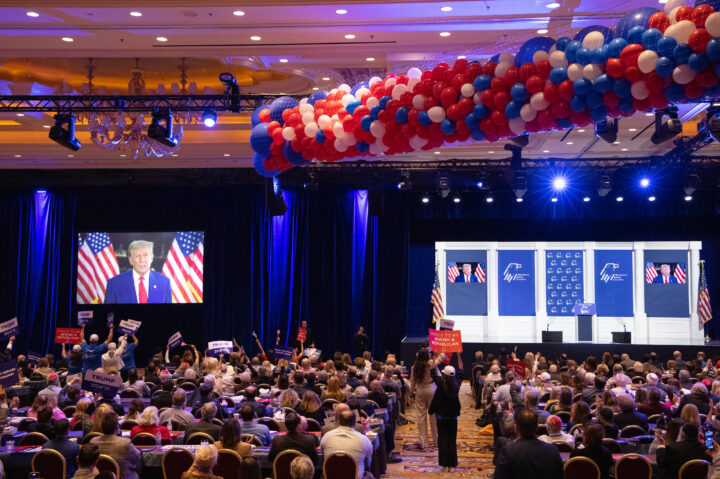
(Ronda Churchill/Bloomberg via Getty Images)
Former US President Donald Trump, left, speaks virtually during the Republican Jewish Coalition (RJC) Annual Leadership Meeting in Las Vegas, Nevada, US, on Thursday, Sept. 5, 2024.
The Republican Jewish Coalition announced on Wednesday that it had elected Dan Conston, the former president of the Congressional Leadership Fund, and Charlie Spies, a veteran elections attorney, and philanthropist David Gemunder to its board of directors.
Conston, a longtime ally of former House Speaker Kevin McCarthy (R-CA), led the House GOP campaign arm for six years before departing last December to launch Watchtower Strategy alongside McCarthy. During his time leading CLF, Conston was among those credited with helping House Republicans secure a majority in 2022 and keep the lower chamber in GOP control in 2024.
“The RJC is a tremendous organization, and the fight for the American Jewish vote is as important as ever. I’m excited to help them as they look to expand their reach in key races and move more voters to the Republican Party,” Conston told Jewish Insider of his election to RJC’s board.
Spies briefly served as chief counsel to the Republican National Committee last year as President Donald Trump was reshaping the organization, but only stayed in the role for about two months. He advised the presidential campaigns of Florida Gov. Ron DeSantis in 2024, former Florida Gov. Jeb Bush in 2016 and former Sen. Mitt Romney (R-UT) in 2008. Spies also launched Right to Rise, the super PAC Bush used in the 2016 cycle, and Restore our Future, the PAC used by Romney in 2008, and has served as an advisor to Rep. John James (R-MI).
In addition to his philanthropic work, Gemunder is a corporate attorney with AEGIS Law in Tampa, Fla., who has served on the boards of Hillel International and Secure Community Network.
“It is a pleasure to welcome our newest board members, each of whom is an accomplished, dedicated American patriot, and a strong defender of the U.S. Jewish community and of Israel,” RJC Chairman Norm Coleman said in a statement. “On behalf of our entire Board, I look forward to working with these new Board members as we grow and enhance our capabilities leading into the 2026 elections.”
Boschwitz spoke to JI about his life story, legacy and thoughts about our current political moment
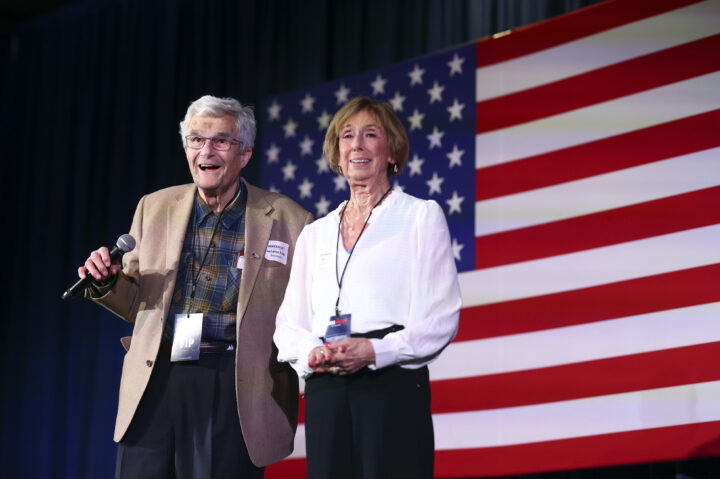
AP Photo/Adam Bettcher
Former Minnesota Sen. Rudy Boschwitz and his wife Ellen introduce Republican presidential candidate former UN Ambassador Nikki Haley at a campaign event, Monday, Feb. 26, 2024, in Bloomington, Minn.
Former Minnesota Sen. Rudy Boschwitz, who turns 95 today, isn’t necessarily a household name — but is one of the more consequential figures in Jewish political history, as the first Holocaust refugee elected to Congress and one of the most prominent Jewish Republicans during a golden period of Jewish representation on Capitol Hill.
Boschwitz now holds the distinction of being the oldest living elected senator, and remains active in political and business life from his home in Plymouth, Minn. He spoke on the phone to Jewish Insider this week about his life story, legacy and thoughts about our current political moment.
Boschwitz was born in Berlin in 1930. On the day that Hitler took power in 1933, Boschwitz’s father came home and told his family they would be leaving Germany forever. He arrived in the United States in 1935 with his family, completed college at the age of 19, started a retail lumber business and quickly made a career in business and, later, politics.
He was elected as a Republican to the Senate in 1978, scoring an upset against the state’s former Gov. Wendell Anderson. He served there for 12 years, eventually losing reelection in 1990 to Democrat Paul Wellstone.
“When I came to the Senate, I was really the first Jewish conservative that many of my colleagues really met. They hadn’t met many Jewish Republicans at all. I think we had a hand in building some of the pro-Israel feelings now,” Boschwitz told JI. (During the 1980s, four other Jewish GOP senators would end up serving alongside him.)
In the Senate, Boschwitz served in GOP leadership, including as chairman of the National Republican Senatorial Committee, where he helped raise money and lead the campaign to elect GOP senators. He held seats on the influential Budget Committee, Foreign Relations Committee and Agriculture Committee, which helped him build support in a big farming state like Minnesota.
“The highlights of my career: I voted for the Reagan defense budgets and for lower taxes that resulted in a strong economy and winning the Cold War without a shot,” Boschwitz said.
After leaving the Senate, Boschwitz was named as President George H.W. Bush’s emissary to Ethiopia, where he led the American delegation to negotiate the release of Ethiopian Jews to allow their migration to Israel in what became known as Operation Solomon. Earlier as a senator, Boschwitz led an Ethiopian Jewish caucus that featured dozens of senators from both parties.
Aside from his legislative work, Boschwitz was also known as something of a matchmaker for young Jewish professionals on Capitol Hill, sponsoring parties for Jewish singles who worked around Washington.
“I was very active in the Jewish community… I wanted young Jewish members of the congressional staff to know that there was a Jewish senator who was interested in them,” Boschwitz told JI.
Despite Minnesota’s relatively small Jewish population, Boschwitz held a Senate seat that, famously, was represented by four different Jewish senators over four decades — with Wellstone, current Republican Jewish Coalition National Chairman Norm Coleman and comedian Al Franken all holding the same Senate seat from 1978 until Franken’s resignation in 2018.
Asked in closing how concerned he was about the rise of antisemitism in this country, Boschwitz simply said: “Yes, there has been a rise in antisemitism. But I think that the U.S. is not a country where the Jews have to be careful or look for another place to go. I’m a fan of magnificent America.”
Plus, partisan redistricting endangers pro-Israel lawmakers
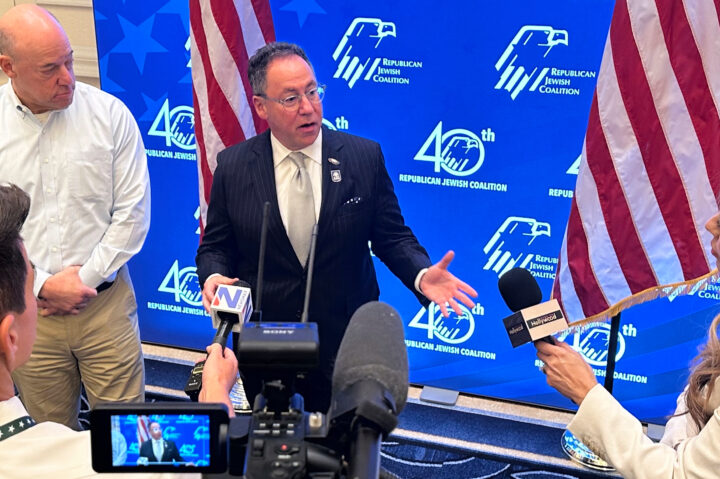
Republican Jewish Coalition CEO Matt Brooks, center, alongside Ari Fleischer, an RJC board member and press secretary to former President George W. Bush, answers questions from members of the news media about confronting antisemitism within the Republican Party, during the coalition's annual conference at the Venetian Resort in Las Vegas, Saturday, Nov. 1, 2025. (AP/Thomas Beaumont)
Good Monday morning!
In today’s Daily Kickoff, we report from the Republican Jewish Coalition’s annual leadership summit in Las Vegas, and look at how mid-decade redistricting efforts in a handful of states could affect pro-Israel legislators. We report on newly obtained audio of Maine Senate candidate Graham Platner expounding on his Israel views, and cover the arrest of Israel’s former military advocate-general, who resigned from her position last week. Also in today’s Daily Kickoff: Michael Eisenberg, Sylvan Adams and Gordon Gee.
Today’s Daily Kickoff was curated by Jewish Insider Executive Editor Melissa Weiss and Israel Editor Tamara Zieve, with assists from Danielle Cohen-Kanik and Marc Rod. Have a tip? Email us here.
What We’re Watching
- The Foundation for Defense of Democracies is hosting a virtual event with former Israeli Defense Minister Benny Gantz on his vision for the future of Israel’s security and relationships around the world.
- The Anti-Defamation League is hosting its annual real estate reception in New York City. This year’s event will honor Feil Organization CFO Eric Lowenstein.
- Elsewhere in New York, Birthright Israel is holding its annual gala tonight. Actor Jonah Platt is slated to emcee the evening’s events, which will honor Lynn Schusterman.
- In Israel, the annual Christian Media Summit kicked off last night in Jerusalem.
What You Should Know
A QUICK WORD WITH JI’S MATTHEW KASSEL
LAS VEGAS — Until last week, the Republican Jewish Coalition’s annual leadership summit was expected to be a triumphant gathering to celebrate President Donald Trump’s accomplishments in the Middle East, chief among them his administration’s recently brokered ceasefire deal between Israel and Hamas, Jewish Insider‘s Matthew Kassel reports.
That all changed after Tucker Carlson hosted the neo-Nazi influencer Nick Fuentes on his podcast for a sympathetic interview, provoking fierce backlash. By the time that Kevin Roberts, the president of the Heritage Foundation, came to Carlson’s defense on Thursday, the RJC recognized its conference would require a thematic update to more forcefully emphasize the urgency of confronting rising antisemitism — and its enablers — within the GOP.
“If there was ever a time for the RJC, this is our time,” Norm Coleman, the organization’s national chairman, said in opening remarks on Friday. “We have been called to this moment to fight the scourge of antisemitism.”
But even as multiple speakers at the three-day summit held at the Venetian Resort — including congressional leaders, conservative activists and media personalities — alluded to antisemitism in their ranks, many talked in broad strokes, didn’t mention Carlson by name or downplayed the issue as confined to the fringes, despite Carlson and Fuentes each commanding a significant number of dedicated followers on the far right.
SPEAKING UP
Lindsey Graham calls Tucker Carlson antisemitism a ‘wake-up call’ for GOP
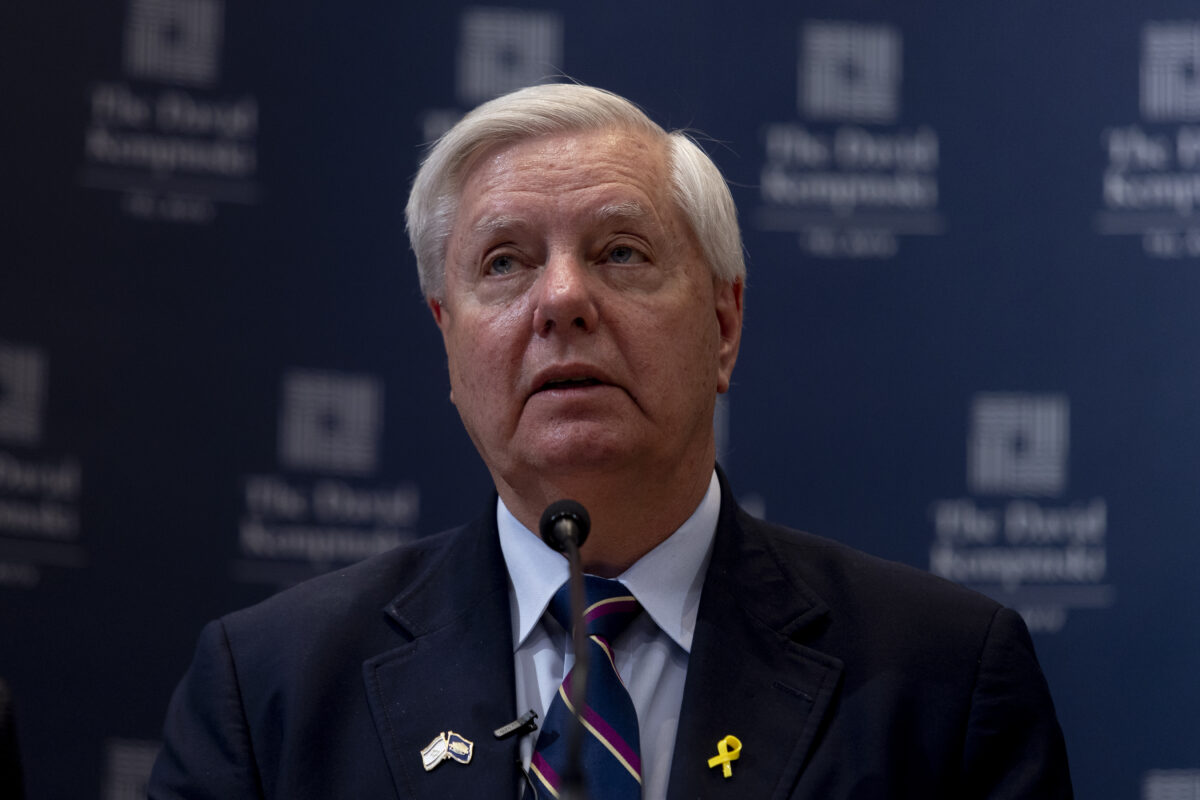
Sen. Lindsey Graham (R-SC) spoke out against Tucker Carlson for giving a friendly platform to Nick Fuentes, the neo-Nazi influencer, on his podcast this week, calling it “a wake-up call” for the Republican Party as it grapples with rising antisemitism within its ranks. “How many times does he have to play footsie with this antisemitic view of the Jewish people and Israel until you figure out that’s what he believes?” Graham said of Carlson in an interview with Jewish Insider’s Matthew Kassel on Friday on the sidelines of the Republican Jewish Coalition’s annual leadership summit at the Venetian Resort.
‘Niche market:’ Graham said that “antisemitism has been with us, and it’ll always be with us, and the goal is to limit it, fight back and contain it. I am confident that if anybody in the Republican world ran for office as a member of Congress, for the Senate or any major elected office and spouted this garbage, it would get creamed,” Graham told JI. “This is a niche market. It won’t sell to a wider audience.”
Drawing a red line: Rep. Randy Fine (R-FL) called Tucker Carlson “the most dangerous antisemite in America” in remarks on Saturday at the conference, in what was an unusually direct rebuke of the far-right commentator who is facing backlash over his recent friendly interview with the neo-Nazi influencer Nick Fuentes, Jewish Insider’s Matthew Kassel reports.
OUT OF BOUNDS
At RJC summit, Ted Cruz slams right-wing embrace of antisemitic figures
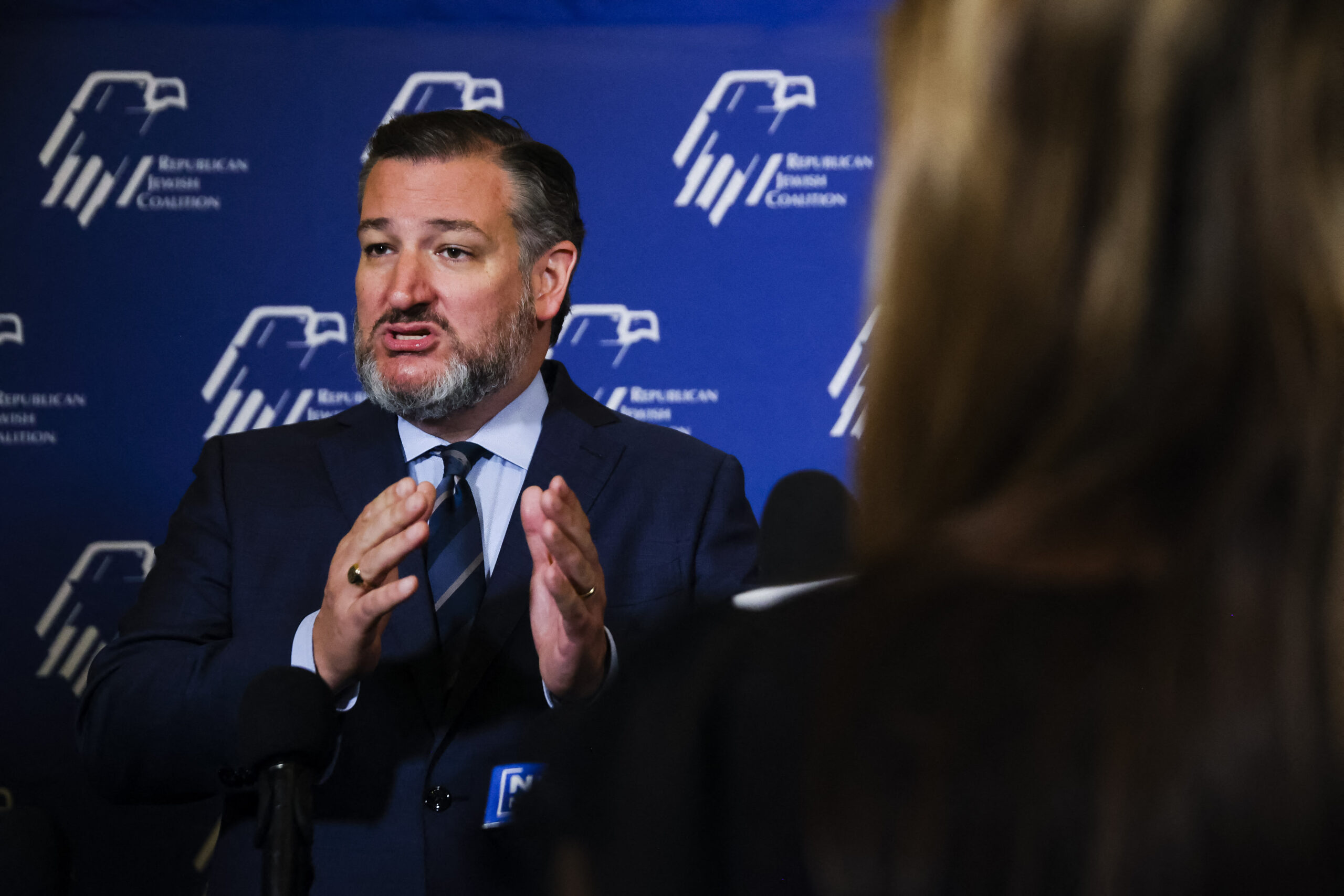
Sen. Ted Cruz (R-TX) criticized Republicans who refuse to disavow prominent antisemites in the conservative movement as “cowards” after the Heritage Foundation and its president, Kevin Roberts, defended Tucker Carlson and his friendly interview with neo-Nazi influencer Nick Fuentes. Cruz warned during a half-hour address at the opening of the Republican Jewish Coalition’s annual summit in Las Vegas on Thursday evening that young Christians were turning away from supporting Israel, something he argued was the result of pro-Israel Christians being maligned by leading voices in the America First movement, Jewish Insider’s Emily Jacobs reports.
Cruz’s comments: The Texas Republican senator did not mention the Heritage Foundation, Roberts, Carlson or Fuentes by name, though he accused anyone who uncritically promotes Adolf Hitler of being “complicit” in spreading virulent antisemitism. Fuentes has praised Hitler on multiple occasions; in his statement, Roberts said he “disagree[s] with” some of Fuentes’ views, “but canceling him is not the answer.” “The last year, we’ve seen three prominent people on the right publicly muse, ‘Gosh, maybe Hitler’s not all that bad.’ No. He is the embodiment of evil, a grotesque bigot. And if you’re confused by that, you’re an imbecile,” Cruz said on Thursday. “Too many people are scared to confront them. I want to ask you, how many elected Republicans do you see standing up and calling this out? How many do you see willing to take on the voices in the anti-Israel right?”
Bonus: Following Roberts’ comments last week, Heritage’s chief of staff, Ryan Neuhaus, was reassigned to serve as a senior advisor, while the think tank’s executive vice president, Derrick Morgan, was moved into the chief of staff role on an interim basis through the end of the year.
PLATNER’S POSITION
Newly surfaced recording of Graham Platner highlights his Israel fixation
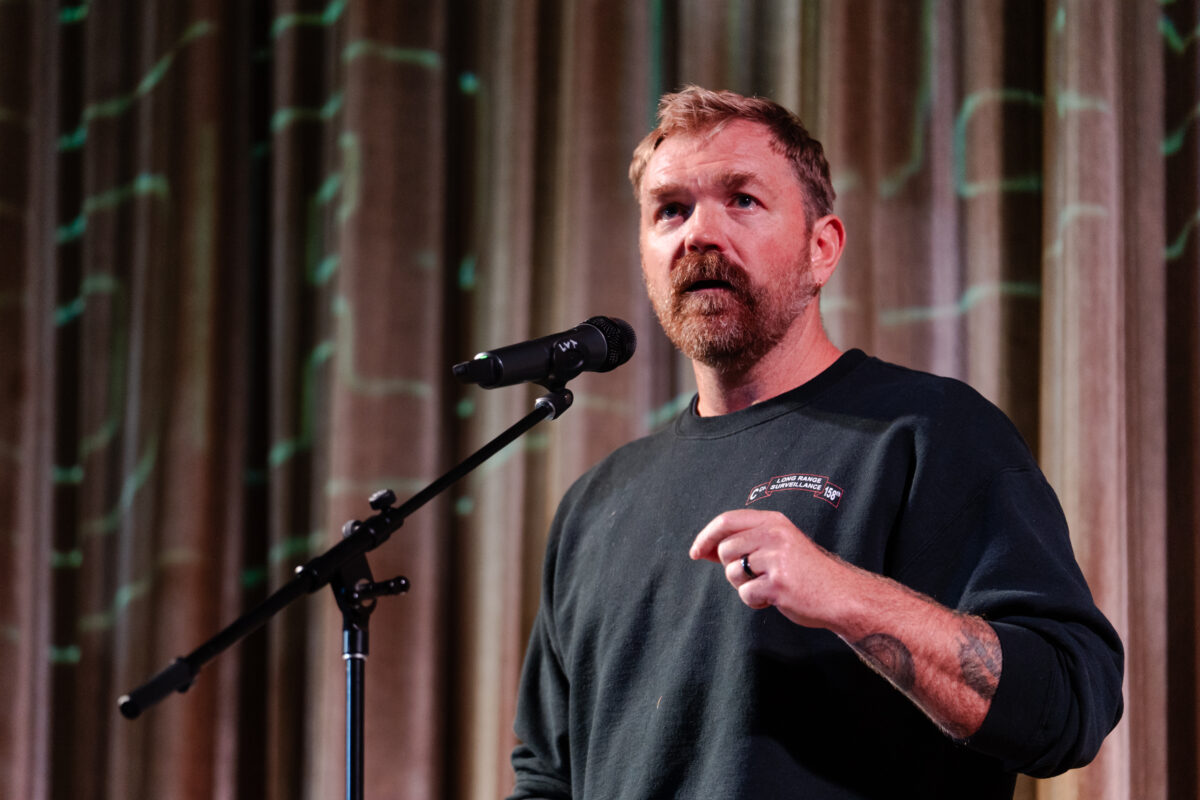
Like many progressives now running for Congress, Graham Platner, a Democratic Senate candidate in Maine, has made opposition to Israel a central part of his messaging. But more so than many candidates, the political newcomer seems particularly invested in engaging on Middle East policy. In a private conversation with attendees of an August fundraiser in Maine, Platner defended his stances on Israel and shared previously undisclosed details about his personal ties to the region, according to audio of the discussion, recently shared with Jewish Insider’s Matthew Kassel.
What he said: While he said he agreed that Hamas is a terrorist organization, Platner claimed that Israeli Prime Minister Benjamin Netanyahu had “publicly stated that” Israel was “funding Hamas to make sure that there was going to be no non-radical leadership within Gaza in order to keep a Palestinian state from happening.” While members of Netanyahu’s coalition have made this argument, the prime minister has never personally made such a claim. New York Times reporting from shortly after the Oct. 7 attacks alleged that the Israeli prime minister had allowed the Qatari government to send money into the Gaza Strip for several years in order to “maintain peace in Gaza.”
Family ties: In the conversation, which took place before controversy ensnared his campaign, Platner noted his stepbrother is Seth Frantzman, an Israeli author, journalist and security analyst who has long worked for for The Jerusalem Post and lives in Jerusalem, saying they are “very close,” according to the audio.
Bonus: Platner’s finance director became the latest campaign departure last week, following the exits last month of Platner’s campaign manager and political director. Ronald Holmes said in a LinkedIn post that he “began to feel that my professional standards as a campaign professional no longer fully aligned with those of the campaign.”
MAPPING MOVES
Partisan redistricting efforts endanger pro-Israel incumbents
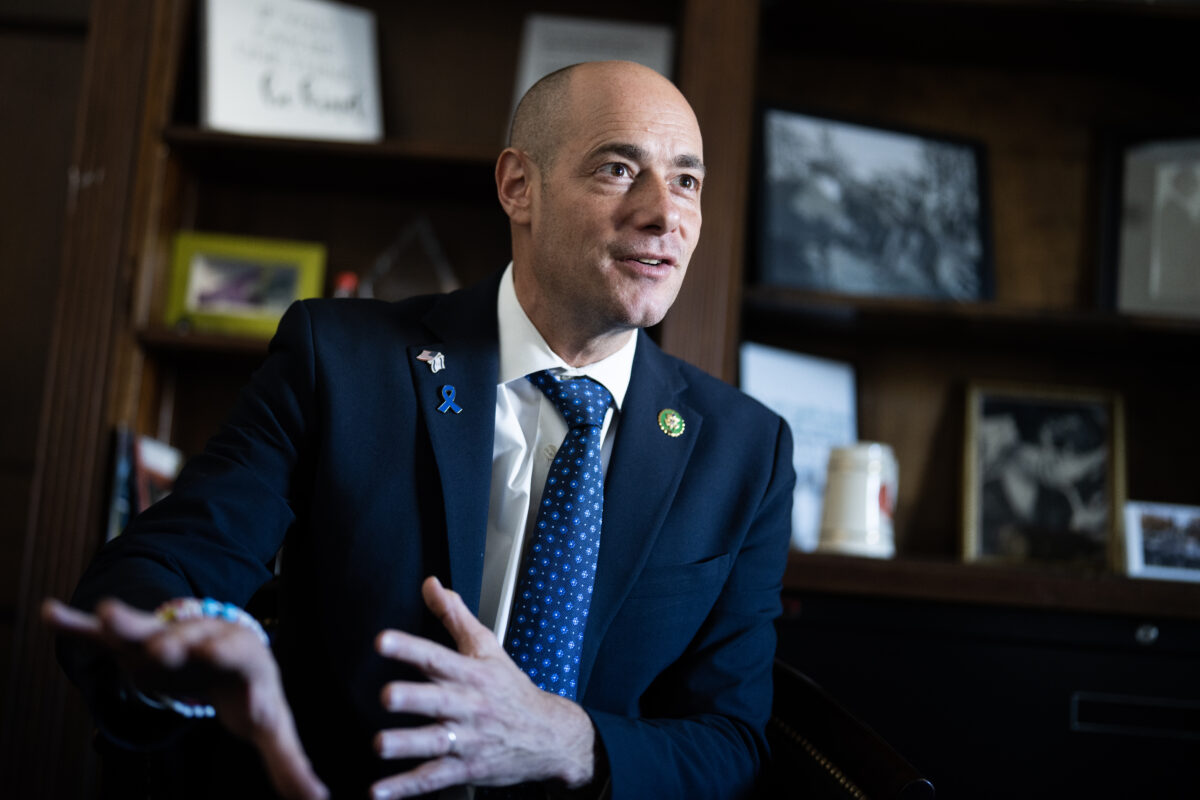
Triggered by President Donald Trump’s efforts to gain a partisan edge in the 2026 midterm elections, a cascade of states is undertaking unusual mid-decade redistricting efforts, in what has become a growing race between Democrats and Republicans to shore up incumbents, knock out lawmakers from the opposing party and create more-winnable seats. On both sides of the aisle, the efforts could endanger a number of vocal pro-Israel incumbents, Jewish Insider’s Marc Rod reports.
Who’s in danger: The districts of Reps. Greg Landsman (D-OH) and Don Davis (D-NC) have been redrawn to be less favorable to the incumbents, and in Florida, Republicans are considering efforts to pack Democratic voters into a smaller number of districts, potentially endangering several pro-Israel incumbents including Reps. Debbie Wasserman Schultz, Jared Moskowitz and Darren Soto. On the Republican side, a series of GOP lawmakers in California with strong records on Israel and antisemitism could be impacted by the redistricting push, including Rep. Ken Calvert — who chairs the Appropriations subcommittee on defense funding — as well as Reps. Darrell Issa, Kevin Kiley, Doug LaMalfa and David Valadao.
LEGAL TROUBLES
Ex-IDF advocate-general arrested over alleged destruction of evidence after being reported missing

Former IDF Advocate-General Yifat Tomer-Yerushalmi was arrested on Sunday evening, reportedly on grounds of obstruction of an investigation, after disappearing and leaving behind a note raising concerns of a potential suicide. The arrest came two days after she resigned her post following a determination by police that she had leaked sensitive materials showing alleged abuse of a Palestinian detainee at Israel’s Sde Teiman prison to the media, Jewish Insider’s Lahav Harkov reports.
Chain of events: Police found Tomer-Yerushalmi’s car at a beach north of Tel Aviv, hours after relatives reported that she was missing. According to Israeli media, she had left a note to her family telling them, “don’t look back.” The ensuing manhunt involved police, the Israeli Navy, drones with geothermal detection and more. Tomer-Yerushalmi was arrested after police found her safe, but without her phone, which had last been tracked near her car and then turned off. The disappearance of the phone raised police officers’ concern that she had possibly staged a suicide attempt to cover up the destruction of evidence caused by the disposal of her phone, Ynet reported. National Security Minister Itamar Ben-Gvir said on Monday that Tomer-Yerushalmi remains on suicide watch in jail.
UNIVERSITY INSIGHTS
Longtime higher ed leader Gordon Gee says fear, not free speech, is ruling America’s campuses

Gordon Gee has served as president of more American universities than almost anyone, as far as he knows. Most recently he led West Virginia University, from which he retired in July; before that, he oversaw Ohio State, Vanderbilt, Brown and the University of Colorado over a span of 45 years. In an interview with Jewish Insider’s Gabby Deutch last week, Gee, 81, looked back on his career and reflected on the state of academia, noting a growing chasm between what he described as two different kinds of universities: those like Vanderbilt, that have held firm to the principles of institutional neutrality, and those like his alma mater, Columbia University, that have struggled to take an impartial stance in response to campus protests and antisemitism — and that are wary of making significant change.
Fear factor: “The biggest challenge facing university presidents is fear,” said Gee. “I think the university presidents, in many ways, are paralyzed, and a lot of it is brought on by themselves, because of the fact that they allowed themselves to become kind of engaged in this ‘go along, get along’ response, and now all of a sudden, when they discover that they’ve got to take a stand, it’s becoming very difficult for many of them.”
Bonus: In The Atlantic, University of Chicago law professor Aziz Huq suggests that the Trump administration’s recent offer to prioritize federal funding for schools that agree to a series of dictates from the government provides universities that don’t agree to the compact with new opportunities, noting that “[w]ithdrawal from the embrace of the federal government, while painful, also is a chance to confront some latent, long-simmering weaknesses of the existing higher-education model.”
Worthy Reads
Roberts’ Rules of Disorder: The Wall Street Journal’s editorial board weighs in on Heritage Foundation CEO Kevin Roberts’ response to recent antisemitic comments by far-right commentators Tucker Carlson and Nick Fuentes. “Amid criticism on Friday, Mr. Roberts scrambled to list Mr. Fuentes’s odiousness, but his initial contribution was to join in the Jew-baiting. His video framed the issue not as antisemitism, but as Christian freedom of conscience in the face of a hostile attempt to impose loyalty to Israel on Americans. … If conservatives — and Republicans — don’t call out this poison in their own ranks before it corrupts more young minds, the right and America are entering dangerous territory.” [WSJ]
Boycotting The Times: The Atlantic’s Jonathan Chait reflects on a push by anti-Israel figures to refuse to submit future op-eds to The New York Times over the paper’s perceived bias toward Israel. “But the extent to which these writers object to the sword depends on who is wielding it. The letter’s demands come from a coalition of nine groups, three of which have declined to condemn Hamas for the October 7 attack, while six — the U.S. Palestinian Community Network, the Palestinian Feminist Collective, the Palestine Solidarity Working Group, the Palestinian Youth Movement, Pal-Awda, and National Students for Justice in Palestine — rationalized or directly endorsed the massacre.” [TheAtlantic]
Fear of Mamdani: In the Jewish News Syndicate, William Daroff and Betsy Berns Korn, respectively the CEO and chair of the Conference of Presidents of Major American Jewish Organizations, raise concerns about New York City mayoral front-runner Zohran Mamdami over what they describe as his demonstrated “hostility toward the concerns of the Jewish community and contempt for the broader public interest” ahead of tomorrow’s election. “What begins as a debate about policy too often becomes a campaign of hostility toward Jews. In this context, any candidate who fails to condemn terrorists who burned families alive, abducted civilians, and committed rape and other war crimes, as Hamas and other Palestinian terrorists did in southern Israel on Oct. 7, 2023, forfeits the moral right to seek public office.” [JNS]
PA Still Key: In the National Interest, David Makovsky and Shira Efron posit that the Palestinian Authority Security Forces could serve as an “imperfect but plausible” option on the ground in postwar Gaza. “Despite their shortcomings, these forces have over three decades of experience in security coordination with the IDF in the West Bank. … The PA today is like a car without wheels: it cannot drive Gaza out of the post-October 7 morass. But wheels can be added — reforms that build credibility, training that professionalizes the PA’s security forces, and service delivery that tangibly improves daily life for suffering Gazans. With each milestone, the PA gains a larger role, international donors gain confidence, Israel gains a more stable frontier, Gazans gain a path out of limbo, and Palestinians everywhere regain agency that could help establish a political horizon.” [NationalInterest]
Word on the Street
In a wide-ranging CBS “60 Minutes” interview that aired Sunday night, President Donald Trump described the ceasefire between Israel and Hamas as being “very solid”; Trump also said that the U.S. would be “involved” in Israeli Prime Minister Benjamin Netanyahu’s corruption trial, two weeks after the president, speaking at the Knesset, called on Israeli President Isaac Herzog to pardon Netanyahu…
Netanyahu said on Sunday that Israel would “act as necessary” if Lebanon does not move to fully disarm Hezbollah, amid concerns that the Iran-backed terror group is rearming in defiance of the ceasefire inked last year…
Amos Hochstein, who served as a senior official in the Biden administration overseeing the Lebanon portfolio, cautioned that Israel’s muscular approach to Hezbollah in Lebanon could be “counterproductive” and that Beirut is “in a really tough spot” as it works to shore up international support…
Israeli Energy Minister Eli Cohen said his U.S. counterpart, Energy Secretary Chris Wright, canceled a planned trip to Israel following Jerusalem’s decision to hit pause on a $35 billion gas agreement with Egypt that would be the biggest gas deal in Israel’s history…
Video from a May 2024 city council meeting in Hamtramck, Mich., that was recently viewed by local media showed Mayor Amer Ghalib, the Trump administration’s nominee to be U.S. ambassador to Kuwait, voicing support for the council’s passage of a boycott, divestment and sanctions resolution targeting Israel; Ghalib told members of the Senate Foreign Relations Committee that he had not supported the resolution…
The Diocese of Harrisburg, Pa., condemned and apologized for a Halloween float representing a local Catholic school that included a replica of the front gates of Auschwitz with the words “Arbeit Macht Frei”…
The Wall Street Journal spotlights Palantir’s new “Meritocracy Fellowship” in which 22 high school graduates spend four months at the company in lieu of pursuing a traditional college track…
A spokesperson for Zohran Mamdani said that the New York City Democratic mayoral candidate, if elected, would reassess the partnership between the Roosevelt Island campus of Cornell University and Israel’s Technion…
Former U.K. Labour party leader Jeremy Corbyn, who was ousted from the party’s leadership over a series of antisemitism incidents, phone-banked for Mamdani over the weekend…
A London bus driver was suspended after refusing to return a dropped bank card to a visibly Jewish man and hurling antisemitic insults at the passenger for an hour until police arrived…
A French court sentenced four Bulgarian men to prison terms ranging between two and four years over the vandalism last year of Paris’ Holocaust memorial…
The bodies of three Israelis were repatriated to Israel and identified overnight as dual American Israeli citizen Capt. Omer Neutra, Col. Asaf Hamami and Staff Sgt. Oz Daniel; the exchange came a day after Israeli forensics determined that three bodies given to Israel by Hamas on Friday evening did not belong to any of the remaining hostages…
Israel announced a series of tax benefits aimed at luring Israeli high-tech workers abroad back to the country amid an exodus that followed the Oct. 7, 2023, attacks and ensuing war…
Canadian Israeli philanthropist Sylvan Adams committed $100 million to help rebuild the Soroka Medical Center in Beersheva, Israel, which sustained significant damage during the 12-day war between Israel and Iran in June, eJewishPhilanthropy’s Judah Ari Gross reports…
Omani Foreign Minister Badr Albusaidi told attendees at the IISS Manama Dialogue in Bahrain over the weekend that Gulf countries should reverse course on their isolation of Iran and deepen diplomatic, economic and security cooperation with Tehran…
Iranian President Masoud Pezeshkian said that Iran would rebuild its nuclear facilities with “greater strength,” while denying that the country is seeking nuclear weapons…
The New York Times published a belated obituary for World War II partisan fighter and poet Hannah Senesh as part of the paper’s “Overlooked No More” series; Senesh was executed at age 23 after being captured by the Nazis in 1944…
Dutch-Jewish resistance member Selma van de Perre, who forged and delivered documents and helped Jewish families seeking shelter, died at 103…
Pic of the Day

Israeli Prime Minister Benjamin Netanyahu met in Jerusalem over the weekend with Aryeh Lightstone, who is serving as a senior advisor to White House Special Envoy Steve Witkoff; White House senior advisor Josh Gruenbaum and venture capitalist Michael Eisenberg, who is working with the U.S. team overseeing ceasefire efforts.
Birthdays
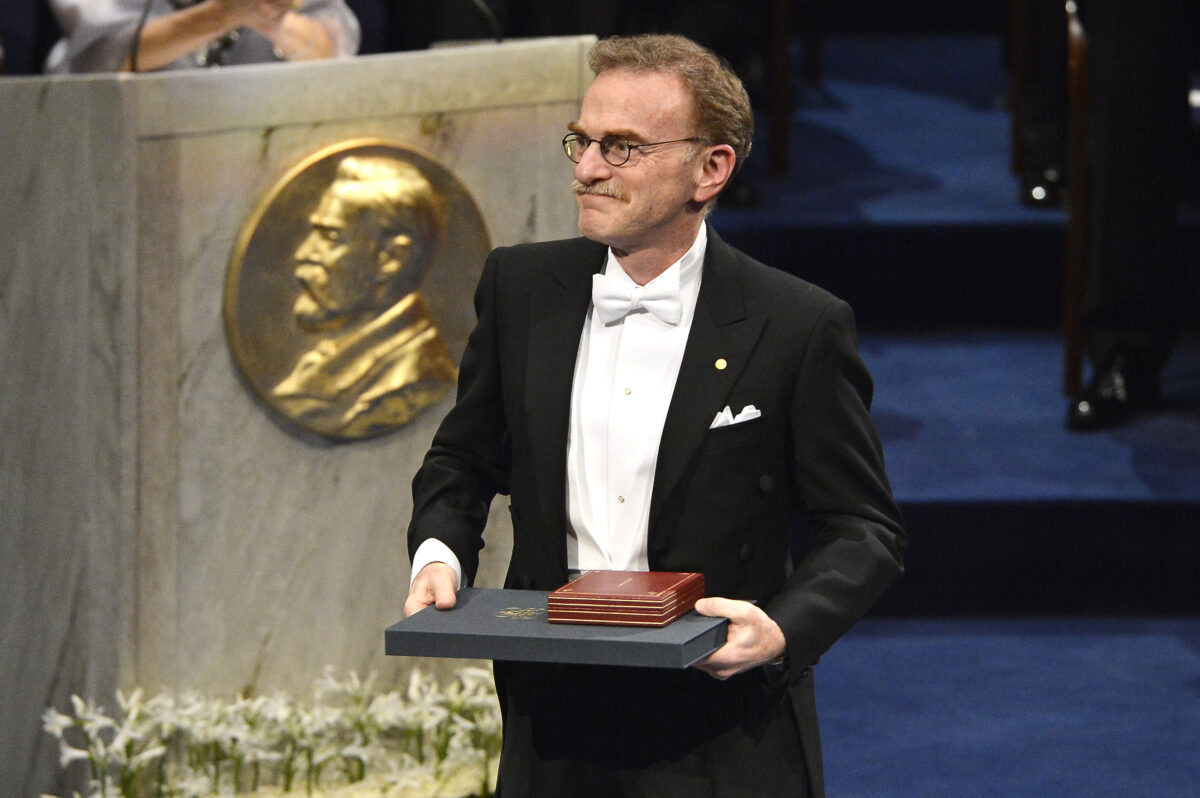
Winner of the 2013 Nobel Prize in medicine, professor at Yale University, James Rothman turns 75…
Chancellor emeritus of The Jewish Theological Seminary where he also served as a professor of Jewish history, Ismar Schorsch, Ph.D. turns 90… Senior U.S. District Court judge in California, he is the younger brother of retired SCOTUS Justice Stephen Breyer, Judge Charles Breyer turns 84… U.S. senator (D-HI), Mazie K. Hirono turns 78… Resident of Great Barrington, Mass., and a part-time researcher at UC Berkeley, Barbara Zheutlin… Rabbi emeritus at Temple Anshe Sholom in Olympia Fields, Ill., Paul Caplan turns 73… Actress, comedian, writer and television producer, best known for the long-running and award-winning television sitcom “Roseanne,” Roseanne Barr turns 73… Comedian, talk show host, political and sports commentator, Dennis Miller turns 72… Manuscript editor and lecturer, author of books on the stigma of childlessness and on the Balfour Declaration, Elliot Jager turns 71… Award-winning Israeli photographer whose works have appeared in galleries in many countries, Naomi Leshem turns 62… Regional director of development for The Washington Institute for Near East Policy, Jeanne Epstein… Podcaster and clinical professor of marketing at the New York University Stern School of Business, Scott Galloway turns 61… Co-founder and former CEO of Blizzard Entertainment, now CEO of Dreamhaven, Michael Morhaime turns 58… Entrepreneur-in-residence at Loeb Enterprises, he was previously co-chair of the board of the Yeshiva University Museum, Edward Stelzer… VP for federal affairs at CVS Health, she was the White House director of legislative affairs in the last year of the Obama administration, Amy Rosenbaum turns 54… Director of development for States United Democracy Center, Amie Kershner… Partner at political consulting firm GDA Wins, Gabby Adler… Agent at Creative Artists Agency, Rachel Elizabeth Adler… Actress who won three Daytime Emmy Awards for her role on “ABC’s General Hospital,” Julie Berman turns 42… Director of corporate responsibility, communications and engagement at Southern Company Gas, Robin Levy Gray… Senior managing director at Guggenheim Securities, Rowan Morris… General manager of NJ/NY Gotham FC, a women’s soccer team based in Harrison, N.J., Yael Averbuch West turns 39… Former captain in the U.S. Marine Corps, he is a co-founder of D.C.-based Compass Coffee, Michael Haft turns 39… New York state senator, Michelle Hinchey turns 38… Deputy coordinator for global China affairs at the U.S. Department of State, Julian Baird Gewirtz turns 36… Recent MBA graduate at The Wharton School, Ben Kirshner turns 33… Marketing manager at American Express, Caroline Michelman turns 33… Founder and CEO of Noyse Publicity Management, Noy Assraf turns 30… Actress and model, Diana Silvers turns 28… Stu Rosenberg…
Even as multiple speakers at the three-day summit alluded to antisemitism in their ranks, many talked in broad strokes

(AP Photo/Thomas Beaumont)
Attendees watch a recorded video address by President Donald Trump during the Republican Jewish Coalition's annual summit at the Venetian Resort in Las Vegas, Saturday, Nov. 1, 2025.
LAS VEGAS — Until last week, the Republican Jewish Coalition’s annual leadership summit was expected to be a triumphant gathering to celebrate President Donald Trump’s accomplishments in the Middle East, chief among them his administration’s recently brokered ceasefire deal between Israel and Hamas.
That all changed after Tucker Carlson hosted the neo-Nazi influencer Nick Fuentes on his podcast for a sympathetic interview, provoking fierce backlash. By the time that Kevin Roberts, the president of the Heritage Foundation, came to Carlson’s defense on Thursday, the RJC recognized its conference would require a thematic update to more forcefully emphasize the urgency of confronting rising antisemitism — and its enablers — within the GOP.
“If there was ever a time for the RJC, this is our time,” Norm Coleman, the organization’s national chairman, said in opening remarks on Friday. “We have been called to this moment to fight the scourge of antisemitism.”
But even as multiple speakers at the three-day summit held at the Venetian Resort — including congressional leaders, conservative activists and media personalities — alluded to antisemitism in their ranks, many talked in broad strokes, didn’t mention Carlson by name or downplayed the issue as confined to the fringes, despite Carlson and Fuentes each commanding a significant number of dedicated followers on the far right.
The speakers also argued that anti-Jewish hatred had become an endemic problem for Democrats — especially in the wake of Hamas’ Oct. 7, 2023, terror attacks. And in a preview of GOP messaging ahead of the midterms next year, many took aim at Zohran Mamdani, the far-left Democratic nominee for New York City mayor and fierce critic of Israel favored to win the election on Tuesday.
Rep. Byron Donalds (R-FL), who is now running for governor of Florida, relied on euphemism to refer to right-wing antisemitism, declaring that the GOP would “not stand idly by” as “some in other parts of politics try to demonize Jewish Americans” and “try to weaken or destroy the relationship between the United States of America and the nation of Israel.”
“I will always call out and confront antisemitism wherever it is and whoever spreads it,” Rep. Lisa McClain (R-MI), the House Republican conference chair, said on Saturday, but shared no examples of such prejudice in her own party.
Some, including Sens. Ted Cruz (R-TX), Dave McCormick (R-PA) and Lindsey Graham (R-SC), more forcefully addressed growing antisemitism on their side of the aisle.
In an interview with Jewish Insider shortly before he took the stage on Friday, Graham described Carlson’s interview with Fuentes as a “wake-up call” for the Republican Party. “How many times does he have to play footsie with this antisemitic view of the Jewish people and Israel until you figure out that’s what he believes?” Graham said of the former Fox News host.
But in his speech later, the South Carolina senator adopted a more sanguine attitude, speaking more like a stand-up comedian as he sought to lighten the mood. “I just want to make it really clear: I’m in the ‘Hitler sucks’ wing of the Republican Party,” he said to applause. “What is this Hitler shit?”
“I feel good about the Republican Party,” he added, saying the GOP “has figured it out when it comes to Israel.”
Cruz also criticized Republicans who refuse to disavow right-wing antisemites in the conservative coalition, though he ultimately didn’t mention any of the offending individuals by name in his RJC speech.
McCormick, in his fireside chat with conservative author Douglas Murray, directly confronted the lack of right-wing voices challenging virulent antisemitism. “This very week, you had an avowed antisemite, Fuentes, given a platform. This is a guy that says Hitler is cool, says Jews should be terminated…and those views went unchallenged,” McCormick said.
In his own speech at the summit, McCormick said: “Let’s face it, antisemitism is running wild on the progressive left and the leaders of the Democratic Party are not confronting it with their new star Mamdani,” McCormick said. “But I’m also sad to say we see that ugliness on the right too, and we must confront it. Jews can’t be slandered, antisemites can’t be given platforms.”
Their comments sidestepped a more deeply rooted challenge for mainstream Republicans following recent controversies in which young party leaders were caught sharing pro-Nazi messages in leaked group chats, and Paul Ingrassia, the controversial Trump ally, withdrew his nomination to lead the Office of Special Counsel after text messages were unearthed where he allegedly made antisemitic and racist remarks.
Vice President JD Vance also faced criticism from Jewish Republicans last week over his recent appearance at a conservative campus event, where he chose not to confront some students who asked questions that invoked antisemitic tropes. While some attendees at the RJC summit told JI that they had been troubled by Vance’s performance, it was not a topic of discussion on the main stage.
Taking the floor on Saturday, however, Rep. Randy Fine (R-FL), a freshman congressman from Florida who is one of four Jewish Republicans in the House, criticized those who focus only on left-wing antisemitism or just broadly talk about anti-Jewish prejudice on the right.
“It’s easy to talk about antisemitism on the left,” Fine said in his remarks. “I want to talk about the dark force rising on our side. Multiple speakers have talked about the rise of antisemitism on the right. But it is not enough to speak in platitudes or generalities about the fight. We must call evil by its name.”
He called Carlson “the most dangerous antisemite in America” and said he did not belong in Trump’s movement — a message that was amplified by a line of student attendees who stood before him holding up posters declaring “Tucker is not MAGA.”
Fine also said that he was canceling a scheduled event with the Heritage Foundation, adding that the group had “no future” in his office. “I will be calling on all of my colleagues on the Republican side to do the same,” he confirmed.
Matt Brooks, the RJC’s CEO, told JI last week that his group would be reassessing its relationship with Heritage, noting that he was “disgusted” by Roberts’ decision to stand with Carlson. The RJC has not yet further clarified how it plans to move forward with regard to Heritage.
As the summit neared its conclusion on Saturday, one RJC member, Jon Tucker of Chicago, voiced optimism that Trump, set to deliver a prerecorded message later that evening, would choose to speak out against what he termed the “ultra-right wing, isolationist” and “anti-Christian Zionist” voices in the Republican Party.
“I would hope the president comes out and has something to say about it, just like Ronald Reagan did back in the ’80s when he, famously, kicked the right wing out of the Republican Party,” he told JI, expressing concern that — in the absence of direct condemnation from the top — “we could lose” the GOP to “radicals.”
When he finally appeared on screen, Trump made no mention of antisemitism’s ascendance within the GOP, instead touting his administration’s efforts to target universities for their alleged failure to address antisemitism while listing his achievements in the Middle East, including the ceasefire deal.
He also credited the RJC with helping him to perform particularly well among Jewish voters in 2024, even as he reiterated his complaint that he should have received more support in light of his pro-Israel policies.
“I can’t imagine we didn’t do better than that after all I’ve done for the Jewish vote, I must be honest with you,” Trump said. “But that’s OK.”
This story was updated on Monday to reflect Sen. Dave McCormick’s comments regarding Nick Fuentes.
The GOP congressman said he planned to cancel a scheduled event with the Heritage Foundation next week
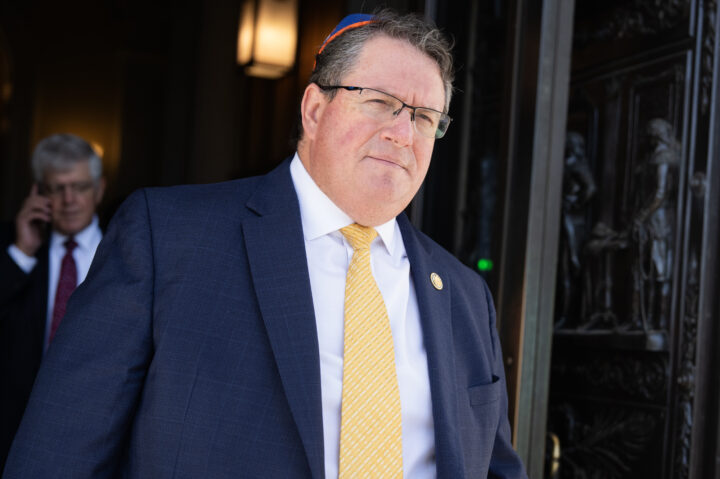
Tom Williams/CQ-Roll Call, Inc via Getty Images
Rep. Randy Fine (R-FL) leaves the U.S. Capitol after the last votes of the week on Thursday, September 4, 2025.
LAS VEGAS — Rep. Randy Fine (R-FL) called Tucker Carlson “the most dangerous antisemite in America” in remarks on Saturday at the Republican Jewish Coalition’s annual leadership conference, in what was an unusually direct rebuke of the far-right commentator who is facing backlash over his recent friendly interview with the neo-Nazi influencer Nick Fuentes.
“He has chosen to take on the mantle of leader of a modern day Hitler Youth,” Fine, a freshman congressman from Florida who is one of four Jewish Republicans in the House, said of Carlson. “To broadcast and feature those who celebrate the Nazis, those who call for the extermination of Israel, to defend Hamas, to even criticize President Trump for stopping Iran’s nuclear ambitions.”
Fine’s remarks came as the RJC now reckons with rising antisemitism within the Republican Party in the wake of the Fuentes interview last week, where Carlson, in a podcast conversation that ran for more than two hours, failed to challenge his guest’s praise for Adolf Hitler and Holocaust denial, among other antisemitic views.
Kevin Roberts, the president of the Heritage Foundation, a leading conservative think tank, has also drawn criticism for standing by Carlson in the days after the interview, even as he has condemned Fuentes.
But while many speakers at the RJC summit have alluded to anti-Jewish prejudice on the right, few have explicitly mentioned Carlson or the Heritage Foundation in their own remarks, instead focusing largely on left-wing antisemitism.
“I can stand up here all day and take shots at the left,” Fine said in a ballroom at the Venetian Resort, standing in front of a long line of younger attendees who lined up before him with red posters declaring “Tucker is not MAGA,” a line he used in his speech.
“But I’m here for the kids down here, because it’s easy to talk about antisemitism on the left,” Fine continued. “I want to talk about the dark force rising on our side. Multiple speakers have talked about the rise of antisemitism on the right. But it is not enough to speak in platitudes or generalities about the fight. We must call evil by its name.”
The congressman said that Carlson’s “fall from grace has been one of the most extraordinary implosions in political history, and the rapidity of it has created real challenges for us all, because our friends don’t have our shared experience.”
“I can deal with this with my colleagues in the House,” he said. “See, they remember the Tucker of five years ago. They don’t live with antisemitism every day. They don’t think about it the way that we do, and it’s jarring for them to try to understand: How did this person become who he is today? But the challenge is, he’s inspired a movement of hate in our midst, and I’m not done calling people out.”
In his speech, Fine also said that he “was supposed to do an event with” the Heritage Foundation next week but had since changed his mind. “They don’t know what I’m about to tell you,” he told the crowd. “Right now we’re canceling it.”
“They have no future in my office, and I will be calling on all of my colleagues on the Republican side to do the same,” he said. “If those who support Tucker Carlson want to see a venomous coalition,” he said, referring to language from Roberts’ recent defense of Carlson, “all they need to do is go look in the mirror.”
In addition to Carlson and the Heritage Foundation, Fine turned his sights on two of his GOP colleagues, Reps. Marjorie Taylor Greene (R-GA) and Thomas Massie (R-KY), both outspoken critics of Israel who have faced accusations of using antisemitic rhetoric.
“Some days, I marvel at their stupidity, other days, at their evil,” he said. “It makes my stomach crawl that I have to sit in the same room with them.”
“Now we have to choose: Will we ignore these embarrassments to our party?” he asked in his concluding remarks. “When we pretend they don’t matter or that they don’t exist, we make the same mistakes that Democrats made so many years ago.”
“Today in this room and at this time, we speak with one loud and convincing truth,” Fine said to cheers from the audience. “We will not let our party fall to this darkness.”
The senator’s comments at the Republican Jewish Coalition gathering came after the Heritage Foundation defended Tucker Carlson and refused to disavow neo-Nazi Nick Fuentes
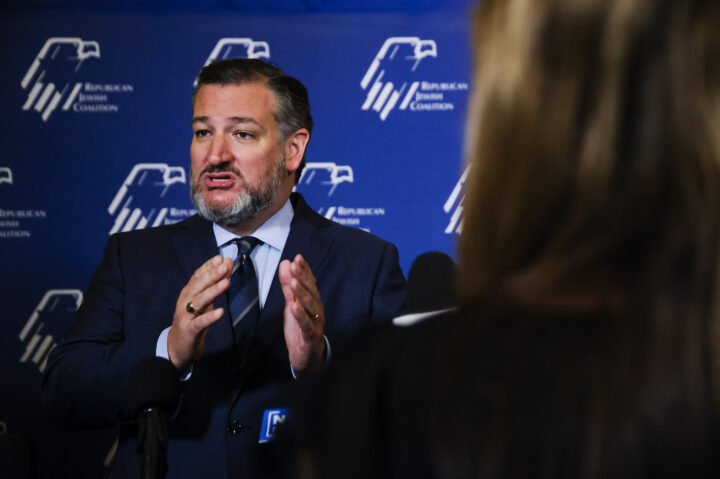
WADE VANDERVORT/AFP via Getty Images
Sen. Ted Cruz (R-TX) speaks during the Republican Jewish Coalition Annual Leadership Meeting in Las Vegas, Nevada, on November 19, 2022.
Sen. Ted Cruz (R-TX) criticized Republicans who refuse to disavow prominent antisemites in the conservative movement as “cowards” after the Heritage Foundation and its president, Kevin Roberts, defended Tucker Carlson and his friendly interview with neo-Nazi influencer Nick Fuentes.
Cruz warned during a half hour address at the opening of the Republican Jewish Coalition’s annual summit in Las Vegas on Thursday evening that young Christians were turning away from supporting Israel, something he argued was the result of pro-Israel Christians being maligned by leading voices in the America First movement.
The Texas Republican senator did not mention the Heritage Foundation, Roberts, Carlson or Fuentes by name, though he accused anyone who uncritically promotes Adolf Hitler of being “complicit” in spreading virulent antisemitism.
Fuentes has praised Hitler on multiple occasions; in his statement, Roberts said he “disagree[s] with” some of Fuentes’ views, “but canceling him is not the answer.”
“The last year, we’ve seen three prominent people on the right publicly muse, ‘Gosh, maybe Hitler’s not all that bad.’ No. He is the embodiment of evil, a grotesque bigot. And if you’re confused by that, you’re an imbecile,” Cruz said on Thursday. “Too many people are scared to confront them. I want to ask you, how many elected Republicans do you see standing up and calling this out? How many do you see willing to take on the voices in the anti-Israel right?”
“More than a few of my Republican officeholders are terrified of upsetting people with really big megaphones,” he explained.
Cruz warned that antisemitic ideas are spreading among young Americans through social media and argued that rising support for isolationism and the pro-Israel community’s failure to adequately explain the benefits of the U.S.-Israel relationship accounted for the broad ideological shifts on the issue — but he noted that there “is also a theological argument” being made on the Christian right against Jews.
“We are seeing young Christians and young evangelicals turning against Israel, and they are being pitched lies,” Cruz said. “One particular lie is something called replacement theology, and replacement theology is a twisted view that the Jews are no longer God’s chosen people, that the promises in the Old Testament no longer apply and that Christians have replaced Jews. Now in my Bible, I believe every word of it is true, and I believe every promise that God made to the people of Israel remains a promise that is made to the chosen people.”
After noting that he was “proud to be a Christian Zionist,” Cruz noted Carlson’s recent comments expressing his disdain for people who identify as such while appearing to note his protected status in the Trump administration. Carlson attacked Cruz and other pro-Israel conservatives, including U.S. Ambassador to Israel Mike Huckabee, by name in his podcast conversation with Fuentes, where Carlson claimed that those who identify as Christian Zionists have been infected by a “brain virus.”
“There are some people who are embraced at the highest level of government who said there is no one they hate more than Christian Zionists,” Cruz said. “Well, I’ll tell you what, there’s no one I hate more than communists and jihadists who want to murder us. Now is the time for choosing. Now is the time for courage.”
“If you sit there and nod adoringly while someone tells you that Winston Churchill was the villain of World War II, if you sit there and nod while someone says, ‘Well, there’s a very good argument that America should have intervened on behalf of Nazi Germany in World War II.’ If you sit there with someone who says Adolf Hitler was very, very cool and that their mission is to combat and defeat global Jewry, and you say nothing, then you are a coward, and you are complicit in that evil,” he added.
Omri Ceren, Cruz’s legislative director and longtime advisor, criticized Heritage directly in a post on X on Friday morning, writing that: “I mean, if Republican Jews don’t have a place at @Heritage that’s a choice its current leadership is institutionally empowered to make, but it sits uncomfortably with the organization’s history.”
Cruz’s comments were met with praise from Deborah Lipstadt, the State Department’s special antisemitism envoy during the Biden administration, who posted a message on X commending the Texas Republican.
Hanging over the three-day conference is the specter of rising antisemitism on the party’s far right, an issue that Sam Markstein, the group’s national political director, said the RJC does not intend to avoid
(Ronda Churchill/Bloomberg via Getty Images)
Former US President Donald Trump, left, speaks virtually during the Republican Jewish Coalition (RJC) Annual Leadership Meeting in Las Vegas, Nevada, US, on Thursday, Sept. 5, 2024.
The Republican Jewish Coalition’s annual leadership summit kicks off tonight at the Venetian Resort in Las Vegas with much to celebrate.
President Donald Trump’s recently brokered ceasefire and hostage-release agreement is certain to be among the administration’s accomplishments touted by a range of high-profile speakers including Cabinet officials, congressional leaders, pundits and media figures.
The RJC, which was established in 1985, is also celebrating its 40th anniversary this year, and the proceedings will feature “content about where we came from and where we are today,” said Sam Markstein, the group’s national political director.
“It’s come a long way from its humble beginnings,” Markstein told Jewish Insider in an interview on Thursday.
Hanging over the three-day conference, however, is the specter of rising antisemitism on the party’s far right, an issue that Markstein said the RJC does not intend to avoid.
It’s a particularly timely, and urgent, subject as the RJC prepares to convene days after Tucker Carlson hosted the neo-Nazi influencer Nick Fuentes on his podcast for a friendly interview. Carlson has faced backlash for not only inviting Fuentes onto his show but for failing to challenge any of his viciously antisemitic views — including admiration for Adolf Hitler and Holocaust denial.
During the interview, Carlson himself also expressed his disdain for Christian Zionists including Mike Huckabee, the U.S. ambassador to Israel, whom he accused of being “seized by this brain virus.”
Huckabee, for his part, is slated to give remarks, via livestream, during the RJC’s confab. Other outspoken critics of Carlson’s antisemitic turn, including Sen. Ted Cruz (R-TX) and Fox News host Mark Levin, will also be in attendance.
The summit will also feature House Speaker Mike Johnson (R-LA), Sens. Dave McCormick (R-PA) and Lindsey Graham (R-SC), Arkansas Gov. Sarah Huckabee Sanders and Kristi Noem, the homeland security secretary, among others. The four Jewish Republicans serving in the House are joining as well: Reps. Craig Goldman (R-TX), Randy Fine (R-FL), Max Miller (R-OH) and David Kustoff (R-TN).
It remains to be seen if Trump will speak at the summit as he has in recent years, either virtually or in person. The president has not commented on Carlson’s interview with Fuentes, with whom Trump himself had dinner in 2022 at his home in Palm Beach, Fla. Carlson has been a top ally of Trump, even as they have clashed over the administration’s military actions in the Middle East.
According to Markstein, there will be several speakers at the summit who will talk about what he called “the challenges facing the Republican Party,” citing “certain media personalities.”
He added that the tenor of the conference with regard to such issues will thematically echo a speech delivered earlier this year by Matt Brooks, the RJC’s CEO, who warned against the “woke right” and said the GOP “must combat the rise of neo-isolationism” that is now fueling anti-Israel sentiment within the party.
“It certainly will take on a little added resonance considering who Mr. Carlson platformed this week,” Markstein told JI.
The RJC will also now find itself on the opposing side of the Heritage Foundation, the right-wing think tank behind Project 2025 whose president, Kevin Roberts, forcefully defended Carlson on Thursday.
“Conservatives should feel no obligation to reflexively support any foreign government, no matter how loud the pressure becomes from the globalist class or from their mouthpieces in Washington,” Roberts said in a video posted to social media, adding that Heritage would not be “policing the consciences of Christians.”
Brooks told Jewish Insider that the RJC has worked with Heritage in various ways over the years, particularly its foreign policy team, “but obviously there’s going to be a reassessment of our relationship with Heritage in light of this.”
“They’re becoming more like Tucker Carlson and less like Ronald Reagan. Tucker Carlson represents the Barack Obama-Bernie Sanders wing of the Republican Party,” Brooks said of Heritage. “I believe that there’s still a vibrant Trump-Reagan wing of the Republican Party, and Heritage continues to position itself away from that — I think to their detriment.”
Roberts’ comments came a day after Vice President JD Vance, speaking at a Turning Point USA event on Wednesday at the University of Mississippi, faced scrutiny for using conspiratorial rhetoric while he discussed Israel with a group of conservative college students.
Vance also avoided directly calling out antisemitic questions from some audience members, including one who suggested that Trump had been pressured into holding pro-Israel stances because he received political donations from Miriam Adelson, the GOP megadonor whose late husband built the Venetian Resort and is a frequent guest at the RJC’s summit.
Markstein, for his part, said broadly that the RJC would stand firm against such thinking. “If folks believe that Israel is not an ally to the United States,” he warned, “they’re going to have to go through the RJC first.”
‘I am appalled, offended and disgusted that [Kevin Roberts] and Heritage would stand with Tucker Carlson and Nick Fuentes,’ Republican Jewish Coalition CEO Matt Brooks told JI
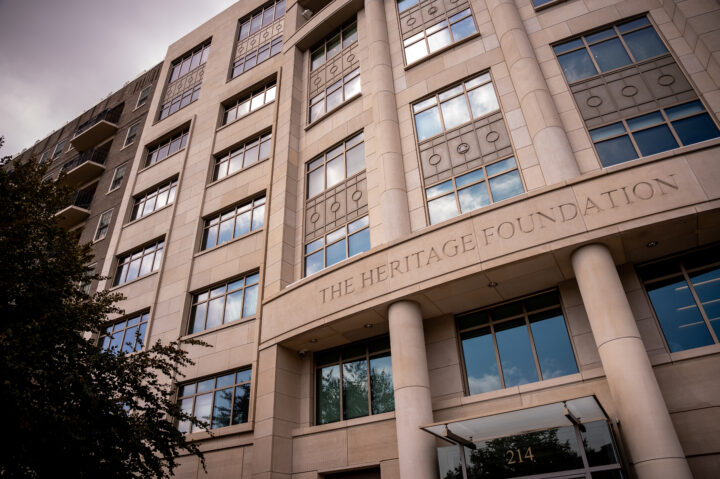
Andrew Harnik/Getty Images
An exterior view of The Heritage Foundation building on July 30, 2024 in Washington, DC.
Conservatives, including the CEO of the Republican Jewish Coalition, condemned the Heritage Foundation and its president, Kevin Roberts, for Roberts’ defense of his “close friend” Tucker Carlson amid criticism of Carlson’s friendly interview with neo-Nazi influencer Nick Fuentes and his general antisemitic and anti-Israel turn.
Roberts also declined to fully disavow Fuentes, saying that “canceling him is not the answer.”
“Watching the statements from Kevin Roberts today, as somebody who has been involved and supportive of the Heritage Foundation since I came to Washington in 1987, I am appalled, offended and disgusted that he and Heritage would stand with Tucker Carlson and Nick Fuentes as somehow being acceptable spokespeople within the conservative movement,” Matt Brooks, the RJC CEO, told Jewish Insider.
Brooks said that Heritage’s defense of Carlson and Fuentes “is a total abrogation of their mission and what it means to be a conservative today.”
He said that RJC has worked with Heritage in various ways over the years, particularly its foreign policy team, “but obviously there’s going to be a reassessment of our relationship with Heritage in light of this.”
Brooks said that “we’ve seen Heritage moving further in this direction,” but that he believes that it is still “well outside of the mainstream of where the conservative movement in the Republican Party is.”
“They’re becoming more like Tucker Carlson and less like Ronald Reagan. Tucker Carlson represents the Barack Obama-Bernie Sanders wing of the Republican Party,” Brooks said. “I believe that there’s still a vibrant Trump-Reagan wing of the Republican Party, and Heritage continues to position itself away from that — I think to their detriment.”
Richard Goldberg, a former Trump administration official, told JI that his “heart goes out” to Heritage staff who have “worked for years tirelessly in defense of both the United States and Israel, and in the defense of both Christians and Jews, and … certainly deserve better than this.”
Their work, he continued, “is fundamentally disconnected from the video that Kevin put out,” which is “really vile” and “filled with canards and straw men in order to try to bait opponents into some sort of imagined conflict that does not exist — I think to create such conflict.”
Goldberg said that unless Roberts plans to conduct mass firings at Heritage of those working on national security and foreign policy issues and the group’s Project Esther antisemitism program to bring the organization in line with the isolationist Quincy Institute, “there is a great deal of disconnect between what he is saying and doing and what his organization is saying and doing.”
The enemies of both America and Israel, “would like nothing more than to see this kind of messaging succeed. This is very much in line with a Marxist-Islamist ideology that really only benefits China, Russia, terrorists and their sponsors,” Goldberg argued.
“I hope we don’t allow this strain to try to break what is core to American values and core to American interests, and that’s Christians and Jews sticking together, and America and Israel sticking together,” Goldberg said.
Joel Griffith, a co-chair of Young Jewish Conservatives and a former research fellow at Heritage, called for Heritage members and donors to speak out against Roberts. Griffth is currently a senior fellow at Advancing American Freedom, the think tank founded by former Vice President Mike Pence.
“As a former Heritage fellow who’s both patriotically American and proudly Jewish, I’m deeply disheartened by Kevin Roberts continued support for Tucker Carlson even as he ridicules allied Christians who believe in the right of the Jewish people to self-determination in their homeland, slanders Israel as genocidal, supports removal of citizenship for young Americans who serve in the IDF, and platforms a Holocaust denier,” Griffith told JI. “I’m hopeful that Heritage members and donors will make their voices heard. Kevin Roberts does not speak for me as a Heritage alum, nor does he represent the views of many allies of Israel who remain on staff at Heritage.”
In his video, Roberts cited comments by Vice President JD Vance at a Turning Point USA event on Wednesday that no other country should come “before the interest of American citizens.” Vance’s comments had come in response to an openly antisemitic question accusing Jews of persecuting Christians, a notion Vance did not directly dispute.
“I wish that Vice President Vance had answered the question differently,” Brooks told JI. “He should know — and if he doesn’t, I am sure there are a number of people who will make the information available to him — that the Israelis have not limited access to any of the Christian holy sites or persecuted Christians in Israel. In fact, things couldn’t be further from the truth.”
“It has been Israelis, since the founding of the State of Israel and even before, that have protected the Christian heritage sites, and have always talked about having Israel as the home to the three major religions and having freedom of access and freedom of religion throughout the country,” Brooks continued.
Goldberg said that Vance’s recent visit to Israel and his trips to Christian holy sites in Jerusalem were “outstanding” and “important for Christians … around the world.”
He urged Vance “not to be afraid to be very direct in shutting down Jew hate and antisemitic tropes when the appear when he is out on the stump or campaigning” — noting that TPUSA founder Charlie Kirk had a record of responding forcefully to antisemitism at his own public events. “I think it would honor Charlie to emulate that style as well.”
Noah Pollak, who is serving in the Trump administration as a senior advisor to the Department of Education, said on X, “I’m genuinely curious what Roberts and people promoting this line of innuendo think they are responding to. Did someone ask you not to be loyal to your faith and country? Who? Can you post a screenshot or something?”
Far-right influencer Laura Loomer, a close ally of President Donald Trump, claimed Roberts’ statement was part of a coordinated “psyop” to “kneecap Trump” before the 2026 midterms.
Rabbi Yaakov Menken, the executive vice president of the Coalition for Jewish Values — one of the few Jewish groups that had partnered with Heritage on combating antisemitism — said that “Heritage has chosen to vocally stand with an antisemite, call his Jewish critics a ‘[venomous] coalition,’ and slander organizations like CJV as if we were slandering Carlson rather than standing up for his victims. The consequences will be far-reaching indeed.”
Strategist and commentator David Reaboi said that it should be “obvious” to anyone who has watched Carlson’s show that his commentary on Israel and other issues goes beyond criticism to “grotesque lies and bad faith distortions” and likewise questioned what “globalists” are “preventing discussion about Israel, or (as you claim) attempting to bully others into supporting it.”
“Are we allowed to take Carlson’s ‘criticisms’ of Israel and its supporters seriously — I mean, as issues of fact to be debated or debunked?” Reaboi continued. “If so, I haven’t seen any evidence for it. All his lies and slander just go into the category of ‘his truth,’ like the leftists with whom he agrees on every foreign policy question.”
Jason Brodsky, the policy director of United Against Nuclear Iran, praised the work that Heritage has done on Iran, Israel and antisemitism, but said that “this video is disappointing and lacks moral clarity” given that Carlson is “obsessed with Jews and traffics in antisemitism.”
To mark the second anniversary of the Oct. 7 attacks in Israel, the Jewish Insider team asked leading thinkers and practitioners to reflect on how that day has changed the world. Here, we look at how Oct. 7 changed American Politics
Worawat/Adobe Stock
The United States Capitol with reflection at night Washington DC USA
The ad, airing on broadcast TV in the Washington area, says the U.S. strikes on Iran ‘made the world safer … Only President Trump had the courage to stop them’

Ethan Miller/Getty Images
President Donald Trump is introduced at the Republican Jewish Coalition's Annual Leadership Summit at The Venetian Resort Las Vegas on October 28, 2023 in Las Vegas, Nevada.
The Republican Jewish Coalition is launching a new television ad buy in the Washington area timed to coincide with Israeli Prime Minister Benjamin Netanyahu’s visit this week praising President Donald Trump’s decision to support Israel in striking Iran’s nuclear program.
The 30-second spot, titled “Peacemaker,” will air on Fox News, Fox Business Network and Newsmax through the end of this week, after the conclusion of Netanyahu’s U.S. visit.
“President Trump’s strike on Iran’s nuclear weapons facilities made the world safer. For decades, Iran has waged war on America, even plotting to assassinate President Trump. Their goal: death to America, destruction of Israel, terror. Only President Trump had the courage to stop them,” the narrator says in the ad.
RJC’s national political director, Sam Markstein, told Jewish Insider, “Certainly, eliminating or obliterating Iran’s nuclear weapons program should go down as one of the great peacemaking actions ever taken by any president.”
“If you believe in Western civilization, if you believe in America, if you believe in support for Israel, all the things that generations of our people have cared about, there’s no question that this action taken by Donald Trump will be heralded by generations to come. It really is hard to quantify how important and legacy defining this will be — not just for the president himself, but for our country and for Israel,” Markstein said.
Markstein said the organization created the ad “specifically to align with the prime minister’s trip to Washington,” which is Netanyahu’s third visit since Trump began his second term. The frequency in visits, Markstein argued, serves as evidence of “how the cooperation is so intertwined and how the relationship [between the U.S. and Israel] has been strengthened so quickly at this decisive time in history.”
‘I think I can play that role. I'm willing to do it. Certainly happy to share the spotlight with the other three [Jewish Republicans] if they wish to do it, but, but this is deeply personal to me,’ Fine told JI

Kayla Bartkowski/Getty Images
Rep. Randy Fine (R-FL) holds a seal of the House that he bought 30 years ago after he is sworn in by U.S. Speaker of the House Rep. Mike Johnson (R-LA) at the U.S. Capitol on April 02, 2025 in Washington, DC.
Rep. Randy Fine (R-FL) believes that he was sent to Congress, at least in part, to take a leading role in fighting for the Jewish community against antisemitism.
Fine, during a lengthy interview with Jewish Insider in his congressional office earlier this month, said he sees himself as having a mostly unique ability among House members to help tackle the rise of antisemitism nationwide, as one of only four Jewish Republicans in the lower chamber.
“I think I can play that role. I’m willing to do it. Certainly happy to share the spotlight with the other three [Jewish Republicans] if they wish to do it, but, but this is deeply personal to me,” the Republican firebrand said. “This affects my children and so I understand it better than others.”
He has recently taken to wearing a kippah on the Hill at the request of one of his sons, as a symbol for those in the Jewish community for those who do not feel safe doing the same.
“I believe that God puts us where he wants us to be,” Fine said, describing his quick rise from the Florida House to the state Senate — where he served for only a few months — and then to an unexpected vacancy in Congress. “This must be why. This is what He wants me to do. … I think this is one of the reasons that I am here, to solve this problem, much like we did in Florida.”
He said that he is in Congress to fight for his district, but that he believes can also be a fighter for the entire Jewish community and “everyone who believes in the idea of Judeo-Christian values.”
Fine sees the war in Gaza and the global rise of antisemitism as a civilizational battle against extremist groups — both Hamas and anti-Israel forces in the United States — that want to see a global Islamic caliphate and are “spiritual cousins” of the Nazi regime. His often-hardline rhetoric on these issues has frequently sparked controversy.
He argued that it “remains to be seen” if the House Republican caucus and leadership are serious about the issue, saying that there has been a “great willingness to pass strongly worded letters, but I didn’t come here to do strongly worded letters.”
Asked about Trump administration officials with a history of antisemitic rhetoric such as Pentagon press secretary Kingsley Wilson and Office of Special Counsel nominee Paul Ingrassia, Fine demurred, saying he wasn’t familiar with the officials or their backgrounds and would want to examine them further before speaking about them.
At another point in the interview, Fine said that President Donald Trump and members of his team know that he’s not “afraid to call [antisemitism and anti-Israel attitudes] out on our side.”
“I’ve been very critical publicly of Thomas Massie, who I think is an embarrassment to the Republican Party,” Fine volunteered, referring to the libertarian-minded House member from Kentucky. “The guy makes me sick that I have to be in the same room with him at times.”
Massie did not respond to a request for comment.
He also said that, while he hasn’t had a chance to meet many of the Jewish Democrats in Congress yet, he’s willing to “work with anyone who wants to solve this problem, but I think that it helps to have someone in the majority to take the lead.”
He named Rep. Jared Moskowitz (D-FL), a former colleague in the Statehouse and his neighbor in the House offices, as a likely Democratic partner on future efforts. He said he’d also spoken on occasion with Rep. Dan Goldman (D-NY), whose office is across the hall from Fine’s. Goldman also co-chairs the House antisemitism task force.
”The fight against antisemitism is a moral one that must cross party lines and transcend political divisions,” Goldman told JI. “I am eager to work with Congressman Fine and anyone else committed to the fight against bigotry and hate towards the Jewish community and anyone else.”
Fine argued that Florida, his home state, has developed a successful strategy for dealing with antisemitism and antisemitic violence, a trend for which he believes he holds significant responsibility, pointing to multiple pieces of legislation he passed while in the Statehouse.
Antisemitic incidents in Florida dropped 24% in 2024, but were still up 277% from 2020, according to Anti-Defamation League statistics.
“This can all be done. We largely solved this problem in Florida,” Fine said in a prior interview with JI. “If you are willing to fight, if you do not let Muslim terrorists scare you, you can win. … We do not have these same problems in Florida and it is because I fought for this for eight and a half years. This is fixable, but not if we continue to be afraid to face evil and not be afraid to call it evil.”
“All the antisemites discover free speech when it comes to the Jews. You can’t call a black student the N word and go, ‘Free speech,’” Fine said. “We said, ‘You’ve got to treat antisemitism the same way. You don’t get to discriminate in how you deal with discrimination.’ We’ve identified certain behaviors, not speech, but certain behaviors that antisemites used to target Jews. We made them illegal, and we put in huge penalties for doing them. They stopped.”
He offered as one example legislation allowing people to run over demonstrators blocking roads — ”blocking roads is a form of terrorism,” Fine said — which he said had stopped that issue in Florida.
As another example, he said that antisemitism is treated “the exact same way as racism” on college campuses in Florida. He argued that free speech has been used as a cover for antisemitic activity that would be unequivocally condemned if it targeted another minority group.
“All the antisemites discover free speech when it comes to the Jews. You can’t call a black student the N word and go, ‘Free speech,’” Fine said. “We said, ‘You’ve got to treat antisemitism the same way. You don’t get to discriminate in how you deal with discrimination.’ We’ve identified certain behaviors, not speech, but certain behaviors that antisemites used to target Jews. We made them illegal, and we put in huge penalties for doing them. They stopped.”
He added that rhetoric like “globalize the intifada” constitutes a call for violence and should be an imprisonable offense.
Fine also noted that he passed legislation to provide dedicated security funding for Jewish day schools in Florida, the first state to do so.
The newly-elected congressman told JI, in the sit-down in his congressional office, that he’s entering Congress in a different position than he did in the Florida House in 2016, when antisemitism was not an issue he expected to work on.
That changed six months into his term, when a spate of bomb threats targeted Jewish day schools in Florida. He said the Orthodox Union approached him at that time to ask him to lead the security legislation for Jewish day schools. He said he was initially reluctant to do so, given that his district contained no Jewish day schools, but was told that “you’re the only one who can.”
“It was incredibly hard to get the funding,” Fine said. “I learned from that, ‘If I don’t do this, no one else will.’ And the difference in coming to Congress is I knew walking in the door that this would be part of what I came here to do.”
His work in Florida earned him the nickname “the Hebrew Hammer,” from a friend in the Florida legislature, Sen. Joe Gruters. That nickname now adorns a plaque gifted to him by the Orthodox Union’s Teach Coalition that hangs on his congressional office’s wall — next to shofar — as well as a mezuzah on his office door.
Fine said he was initially reluctant to accept the nickname, but it caught on anyway.
Looking toward the Middle East, the Florida congressman has attracted controversy for his calls for an aggressive bombing campaign in Gaza to force Hamas into an unconditional surrender. (Contrary to some reports, Fine has denied that he wants to see the territory nuked.)
He has also argued that “Palestinians in Gaza are on a level of evil that we saw in Japan and we saw in Germany back in World War II.”
Fine’s comments about Palestinians and Muslims — he argues that support for peace and coexistence is more “radical” and unusual in the Muslim community than extremist ideologies — have elicited repeated accusations of Islamophobia.
Asked about the administration’s push for a negotiated cease-fire with Hamas, Fine described Trump as a dealmaker who believes that any deal is possible “and I hope that he’s right.” He said he believes Trump is also focused on returning the hostages.
Fine said some interim deals with Hamas may be possible along the way, but he does not anticipate that Hamas will agree to a final and full surrender “unless the pain is sufficiently great to do that.”
Beyond the war, he said that there must be a “deprogramming” effort in Gaza, similar to that undertaken in post-World War II Germany, to counter the antisemitic hate and violence inculcated in the Palestinian population. It’s a process that he said may take a long time.
“One of the biggest problems we have in the world is there is evil in this world and people refuse to acknowledge it,” Fine said, pointing to audio that circulated following the Oct. 7, 2023, Hamas-led terrorist attacks on Israel of a Palestinian mother and her son crying with joy as the son exclaimed that he had murdered Jews in the attack. “These are not like us. This is not someone that you can sit down and break bread with and just talk it out. This is someone who must be defeated,” Fine said.
Though Fine argues that extremist antisemitic sentiments are mainstream among Muslims, he said that there are countries like the United Arab Emirates that are safe for Jews, and he’d like to see a similar change among Palestinians.
He said he doesn’t have the answers at this point on which country our countries can organize and lead the deprogramming effort — in an “ideal world, it might be a UAE or a Saudi Arabia,” but they may not “want the headache.”
“It might be Israel. There are 2 million Muslims who live in Israel,” Fine said. “I don’t think Israel wants the job, but that may be the only solution. I don’t know, but what you can’t do is you can’t have terrorists run the show. That much I know.”
“What I think we need to be doing is taking out Iran’s nuclear capabilities and hope that in the process of that, the Iranian people, who are a great people, will rise up and make Persia great again,” Fine said on CNN.
Asked about the future of the West Bank — which Fine refers to as Judea and Samaria — Fine said that he would prefer that Israelis and Palestinians be able to live in peace, but he is not sure that is a possibility, suggesting that the Palestinians “may have to go to the Palestinian country and live there,” referring to Jordan, which has a large Palestinian population.
“Right now, they live in the Jewish country, so I think the best outcome is they say, ‘Hey, we want to be happy, collaborative, constructive members of Israeli society,’” Fine said. “That’s what I hope happens. I don’t think there’s any reason why everyone shouldn’t be able to get along … But I think you have something broken in that society.”
Fine, who spoke to JI prior to the start of Israel’s military campaign in Iran, has repeatedly praised Israel’s strikes, backing President Donald Trump’s approach to the conflict.
“What I think we need to be doing is taking out Iran’s nuclear capabilities and hope that in the process of that, the Iranian people, who are a great people, will rise up and make Persia great again,” Fine said on CNN.
“The overwhelming majority of Republicans stand with Israel and support what I’m supporting, which is supplying Israel with the material they need to beat this genocidal Iranian regime,” Fine added.
He has criticized individuals like Tucker Carlson who have called for the U.S. to abandon Israel, characterizing opposition to the operation as fueled by “Qatar-funded troll farms.”
“The bombings will continue until morale improves,” Fine has also said, repeatedly invoking one of his catch-phrases: “bombs away.”
Prior to the strikes, Fine said he was skeptical of Iran’s willingness to abandon its pursuit of a nuclear weapon through talks, but said he was going to trust Trump to try to reach a deal, describing a deal as preferable to a war. He emphasized that Iran cannot, under any circumstances, be allowed to have a nuclear weapon.
And he said he would not support a deal with Iran that does not address its support for terrorism — which Secretary of State Marco Rubio has said was not part of the talks — arguing that funding from sanctions relief is fungible and Iran can divert it toward malign activities.
But he also said that he did not want to “judge until I see the end product,” saying he has “a lot of confidence in the president. He has been Israel’s greatest champion, American Jews’ greatest champion. And I don’t think he’s going to sell us out.”
He noted as well that he is close to Trump and members of the administration and that Trump knew he would be coming to Congress as a Jewish member and a champion for Israel.
The freshman congressman expressed deep criticisms of Qatar, saying he was “convinced” that opposition to him in his congressional special election race, totaling around $10 million in support of his opponent’s campaign, was “largely funded by Qatar.” He suggested that out-of-state volunteers for his opponent he met on the campaign trail had been paid to come to the district.
Democrats, energized by opposition to Trump, mobilized for the race, bringing it closer than most anticipated it would be.
Asked how his views of Qatar color his opinion of the Gulf state’s offer of a Boeing 747 to the administration for use as Air Force One and Trump’s dealmaking with the Qatari government, Fine said, “I think the president, to try to resolve issues, believes sometimes in offering big carrots. He’s a big guy, big carrot, big stick. I think he’s trying to embrace them into our way of thinking. Maybe it will work.”
He said that giving the jet to the United States, purported to be worth around $400 million, will, at minimum, deprive the country of $400 million it could otherwise provide to Hamas, “but I do have real reservations about Qatar. I think there’s a lot of bad that comes out of there, and it’s a concern that I have.”
He said that the kingdom must stop its donations of millions of dollars to U.S. universities and the U.S. should dig into the Muslim Brotherhood and Qatar’s relationship with it. He suggested that Qatar’s army of lobbyists in Washington might attempt to block impending efforts to designate that organization as a Foreign Terrorist Organization.
“I don’t back down from a fight … I’m not here focused on what’s next or [an] election. I’m here to do the right thing,” Fine said. “I don’t engage in political calculations to do what I do. I think Qatar is a problem, and I think we’re gonna have to deal with it.”
The Jewish Republican had previously expressed concerns about his personal safety in the wake of the Oct. 7 Hamas attacks on Israel
Anna Moneymaker/Getty Images
Rep. Max Miller (R-OH) leaves for a break during a House Republican Steering Committee meeting at the U.S. Capitol Building.
Rep. Max Miller (R-OH), one of four Jewish Republicans in the House, said on Thursday that his car was run off the road by a pro-Palestinian activist who threatened his and his family’s lives, earlier in the day.
“If you have an issue with a legislator, your city councilman, your mayor, anyone like that, the appropriate thing to do is to reach out to them for a phone call to set up a meeting at one of our district offices,” Miller said in an angry video posted on Thursday afternoon on X. “What is not OK is to assault anyone, whether you’re a member of Congress or anybody else within our district while you are driving to work.”
Miller said in the video that on his way to work in his district on Thursday morning, an “unhinged, deranged man” leaned on his car horn and ran Miller off the road “when he couldn’t get my attention, to show me a Palestinian flag, not to mention ‘death to Israel, death to me’ — that he wanted to kill me — and my family.”
He explained in the X post that the man threw a Palestinian flag out of his car before driving off and threatened his life and his family’s lives. Miller did not specify what the individual said.
Miller said that he had reported the incident to local and U.S. Capitol Police, and that the individual had been identified and would face consequences. Local and Capitol Police did not respond to requests for comment and no announcements of any arrests have been made so far.
“We will not hide, and I will continue to fight against antisemitism, Islamophobia and all other forms of hate,” Miller said. “You have an issue? Take it to our office. You want to run me off the road? That’s a different story.”
The incident comes just days after a man shot two Minnesota state lawmakers and their spouses at their homes, killing Minnesota House Speaker Melissa Hortman and her husband Mark, impersonating a law enforcement officer; the man carried with him what authorities have characterized as a target list containing the names of lawmakers, including numerous House Democrats, from Minnesota and other nearby states.
It also comes amid a string of violent antisemitic attacks by anti-Israel extremists that have targeted Pennsylvania Gov. Josh Shapiro, an American Jewish Committee event at the Capital Jewish Museum in Washington and a hostage awareness event in Boulder, Colo.
Multiple Jewish House members, including Miller, have expressed concerns for their personal safety since the Oct. 7, 2023, attacks, and the Minnesota shootings have sparked broader concerns about lawmaker safety this week.
House leaders condemned the incident.
“What happened to Max this morning is yet another outrageous example of unhinged rhetoric inspiring unstable people to threaten and attack elected officials who are serving their communities,” House Speaker Mike Johnson (R-LA) said. “We must turn down the temperature in this country.”
“We condemn in the strongest possible terms the attack on Congressman Max Miller and his family and are thankful they are safe,” Democratic leaders Reps. Hakeem Jeffries (D-NY), Katherine Clark (D-MA) and Pete Aguilar (D-CA) in a joint statement. “The rise in political violence in this country is unacceptable. This is a moment of crisis that requires Congress to act decisively in order to ensure the safety of every single Member who serves in the People’s House.”
Fine also called for deporting all undocumented immigrants and taking aggressive actions against college campuses with antisemitism problems

Joe Raedle/Getty Images
Rep. Randy Fine (R-FL)
Rep. Randy Fine (R-FL), the newest Jewish Republican member of Congress, argued on Monday, following an antisemitic attack on a group marching in support of the hostages in Gaza in Boulder, Colo., that the federal government should take aggressive action against groups such as the Council on American-Islamic Relations whose executive director said he was “happy to see” the Oct. 7 terror attack.
Fine added that the federal government also should be deporting all undocumented immigrants and take a strong hand toward college campuses in order to fight rising antisemitism..
“I’m angry that we’ve allowed this to get there, I’m angry that we’ve allowed Muslim terror to operate unfettered in this country,” Fine said in an interview with Jewish Insider on Monday. “Make no mistake, the Palestinian cause is fundamentally a broken, evil philosophy … It’s time to realize there is evil in this world and we have to fight it.”
He said that institutions tied to that ideology, including CAIR, the Muslim Brotherhood and Students for Justice in Palestine, should not be allowed to operate in the United States, and should be designated as terrorist organizations, “because that’s what they are.”
He noted that the executive director of CAIR had celebrated the Oct. 7 attack, and remains in his position. Nihad Awad had in November 2023 said he “was happy to see people breaking the siege and throwing down the shackles of their own land and walk free into their land that they were not allowed to walk in.”
Fine also said that the U.S. must deport “every illegal immigrant,” as well as closely examine individuals entering the country “from these places that hate us.” The Boulder attacker, Mohamed Sabry Soliman, was an Egyptian immigrant who overstayed a tourist visa and was subsequently granted a work permit, which expired in March, according to Fox News.
Fine said that, while security funding is important, it’s impossible to provide individual security to every Jewish American, making it critical to go on the offensive.
“What we need to do is hunt bad guys,” Fine said. “And we can start by throwing out every illegal immigrant. And we can start by taking a hard look at people who are here on visas from Egypt.”
He said the U.S. must also move to stop countries such as Qatar and China “who are not our friends,” from “buying our universities and buying off our media outlets,” and take action to protect Jewish students.
He noted that he has introduced legislation that would explicitly make antisemitism and other forms of religious discrimination illegal on college campuses. Currently, based on guidance in executive orders, antisemitism is banned as a form of discrimination based on shared ancestry. Fine argued that his legislation would “create real legal courses of action” for Jewish students to protect themselves.
Though Elias Gonzalez — who killed two Israeli Embassy staffers outside of the Capital Jewish Museum last month — was not a student or an undocumented immigrant, Fine argued that campuses and immigrants are epicenters of antisemitic incitement and that addressing those would address larger trends.
“When these people hear that the nation’s best universities are saying that Israel is engaged in a genocide or 14,000 babies are going to die, they are radicalizing people through false information with the stamp of approval of universities,” Fine said. “So this guy [Gonzalez] was involved with organizations that are tied back to universities.”
“Also, he may not be an illegal immigrant, he may not be on a visa from another country, but I guarantee he was hanging around people who were and they’re going to rub off,” Fine continued.
Fine said he expects that antisemitic rhetoric and attacks will only get worse after Sunday’s attack in Boulder. He said he hadn’t slept the night after the attack because he was afraid of what might come next.
“What the Muslim terrorists will do is they’ll do what they did before — they double down, they get more aggressive with the rhetoric afterwards,” Fine said. “That’s part of the strategy. Punch and then punch harder … Muslim terrorists have declared open season on Jews. And I think that is a frightening thing. And I think the people who need to be hunted are the Muslim terrorists.”
Pressed on the fact that Rodriguez was not Muslim, Fine responded, “there are white supremacists who aren’t white … it is terrorism that is rooted in the Muslim faith.”
“They call it Christian nationalism, I don’t think every Christian is a bad person, I think very few of them are,” Fine continued.
Fine argued that surveys show a substantial portion of American Muslims are sympathetic to Hamas, that leading Muslim organizations like CAIR have supported Hamas and antisemitism, that there are few in Gaza who have stood up against Hamas and that many of those who participated in the Oct. 7 attack were not Hamas fighters.
“We are told, ‘No, no, no, it’s this tiny, tiny fringe.’ It is not a tiny fringe,” Fine said. “I don’t know whether it’s 30 or 40 or 70 or 90%, I don’t know. But I know it’s not 1% that are bad, and it’s time for us to stop pretending that it is.”
Please log in if you already have a subscription, or subscribe to access the latest updates.
 Continue with Google
 Continue with Apple