






































































Fetterman, McCormick say Democrats have worse antisemitism problem than GOP
‘We don’t have many people in the Republican Party who are running for office with Nazi tattoos on their chests,’ McCormick said, referring to Democratic Senate candidate Graham Platner

AJC
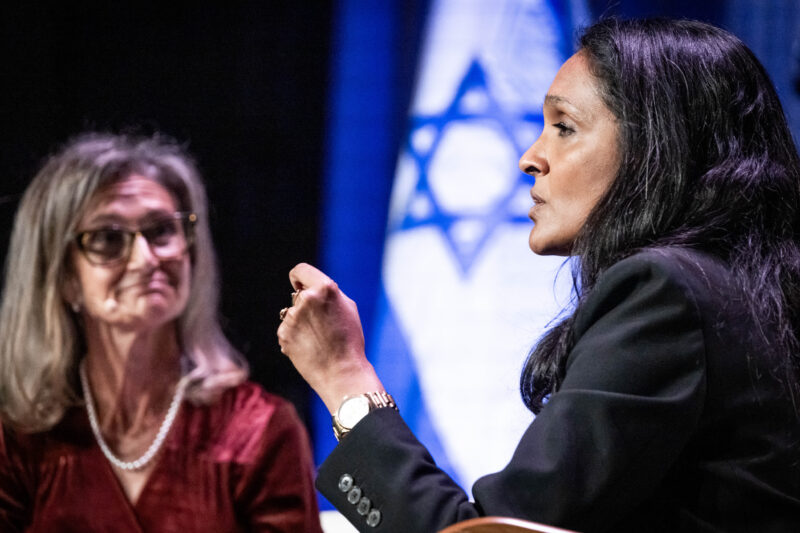
Sens. Dave McCormick (R-PA) and John Fetterman (D-PA) speak with American Jewish Committee CEO Ted Deutch at AJC's Global Forum in Washington on June 2, 2026.


 Add JewishInsider on Google
Sens. John Fetterman (D-PA) and Dave McCormick (R-PA) said on Tuesday that they believe antisemitism is worse on the left than on the right, arguing that the electoral success of far-left candidates with antisemitic records in Democratic primaries distinguished the left from the right, as similarly controversial candidates have struggled in GOP primary contests.
The Pennsylvania senators spoke to Jewish Insider on the sidelines of the American Jewish Committee’s Global Forum, where they headlined the closing plenary alongside AJC CEO Ted Deutch with a discussion on promoting bipartisanship amid expanding domestic political divisions.
While both men acknowledged on stage and to JI that antisemitism exists within the conservative movement, they rejected the notion that it had taken hold of the GOP, arguing that the rise of Graham Platner’s Senate campaign in Maine and Pennsylvania state Rep. Chris Rabb’s nomination for a Philadelphia-area House seat showed that the Democratic Party had already normalized antisemitism within their party.
Last month, Republican voters in Kentucky’s 4th District ousted Rep. Thomas Massie (R-KY), one of the few anti-Israel Republicans in Congress, largely because President Donald Trump endorsed his primary opponent, Ed Gallrein. The outcome was cheered by the Republican Jewish Coalition as an example of party leaders showing no tolerance for antisemitism within the party.
“Look at the people that are winning the primaries in our party right now and look at their views on Israel. We’re old enough to remember that if somebody had a Nazi tattoo, they’re a Nazi sympathizer, but now it’s like, that’s OK. People will defend that, or they’ll just kind of explain that away,” Fetterman said of Platner and Rabb. “In our state, too, Rabb. He won, and he ran on being very, very anti-Israel. So that’s the one thing that’s not just acceptable, it’s actually a virtue.”
“Candidates and Democrats will campaign and proudly stand with Hasan Piker. This is an individual [who said] that Hamas is 1,000% better than Israel and all other kinds of things, [including that] America deserved 9/11. They will campaign with this guy, it’s like their new mascot,” he continued.
Fetterman told JI there is nothing “more damaging a Democrat can believe in” than the right of Israel to fight its enemies, and that, “For me, it’s probably the biggest concern, these people who are winning in the Democratic Party.”
Fetterman said that there is “no daylight” between the two senators on Israel or opposing antisemitism, while McCormick said they have been “joined at the hip.” Both argued Israel and the Jewish community face greater challenges from the left than the right.
“My party has a more significant problem with Israel and standing up for it, although there are fringe elements in his party as well,” Fetterman said. “I’ve isolated myself more in my party, but if you witness who is winning a lot of these primaries, even Chris Rabb in our state and the tattoo guy [Graham Platner], these are intensely anti-Israel people that are part of the primary crowd.”
McCormick echoed that, pointing out Platner’s standing in primary and general election polls and saying, “It’s certainly, I think, more pervasive on the left right now, but we have to fight back on both sides.”
“But I don’t think we can have equality there,” the Pennsylvania Republican continued. “We don’t have many people in the Republican Party who are running for office with Nazi tattoos on their chests, with mainstream Democrats going to Maine to campaign for Graham Platner, so I do think that this problem has really gained traction and become a very significant part of the Democratic Party.”
“[Neo-Nazi] Nick Fuentes is a good example. When he’s speaking out, I’m saying, ‘No, no, that’s not part of my party, that’s not part of my values, that’s not someone I want to have to Thanksgiving dinner, and we shouldn’t platform those voices as well,’” he explained. “But I would differentiate between social media, where there’s certainly a lot of that, and what’s happening on the ground.”
McCormick, who chairs the Senate Foreign Relations Subcommittee on Near East, South Asia, Central Asia, and Counterterrorism, argued that the Jewish people faced two attacks in recent years, the first being Hamas’ Oct. 7, 2023, terrorist attacks on Israel and the second being a “second surprise attack” in the form of surging global antisemitism.
“What came after — on the campuses of University of Pennsylvania, on the streets of Philadelphia, in Pittsburgh, where a young campaign worker on my campaign was attacked — was this rise of antisemitism and hatred and hateful rhetoric,” the GOP senator said on stage. “That also strengthened my conviction that we need to stand up.”
Asked by JI about what concerns him regarding right-wing antisemitism, McCormick pointed to the platforming of voices like Fuentes by prominent podcasters in the conservative movement, though he did not mention any podcast hosts by name.
“I believe in free speech, but anyone who promotes pro-Hitler, pro-Nazi, antisemitic conspiracy theories should not be platformed,” he said.
McCormick told JI that he’s “skeptical that diplomacy can work” with Iran, and said that if the efforts are unsuccessful, Trump or a future president will need to take military action against Iran again.
Fetterman warned that Iran would only become more powerful with a nuclear weapon and have more leeway to impede transit in the Strait of Hormuz and drive up global energy prices.
“I am outraged at the lack of condemnation of our allies or everyone collectively demanding Iran has to relinquish its nuclear materials. I mean, every democracy, every one of our allies, we should be demanding that,” he continued.
In spite of recent Saudi hostility toward Israel and the United Arab Emirates, McCormick said he remains “optimistic that Saudi Arabia and other countries will eventually join the Abraham Accords, especially after seeing the threat of the Iranian regime.”
“If you look at the UAE and Bahrain, which have openly embraced the Abraham Accords and deepened their relationships with Israel in a short period of time, the demonstrated value of those partnerships have been born out through their collaboration during Operation Epic Fury. Only time will tell if they’ll come to the table, but I’m optimistic,” he said.
More Stories

Daily Kickoff
Three years, familiar fears on 10/7 anniversary
Daily Overtime
Slotkin sees no ‘Jewish vote’ in Michigan

REGIONAL SHIFT
Amb. Kaploun: More Latin American countries plan to adopt IHRA definition of antisemitism

education consternation
Department of Education accuses colleges and universities of hiding foreign funding ties

Gaza Grift?
Department of Justice operation targets Hamas network of fake charities
KINGS COUNTY KERFUFFLE
Treasurer for anti-AIPAC PAC behind effort to unseat Brooklyn Republicans
Please log in if you already have a subscription, or subscribe to access the latest updates.
 Continue with Google
 Continue with Apple