



























Analysts say Iran and the U.S. remain too far apart on compensation demands and Washington's military posture in the region for a deal
AFPTV / AFP via Getty Images
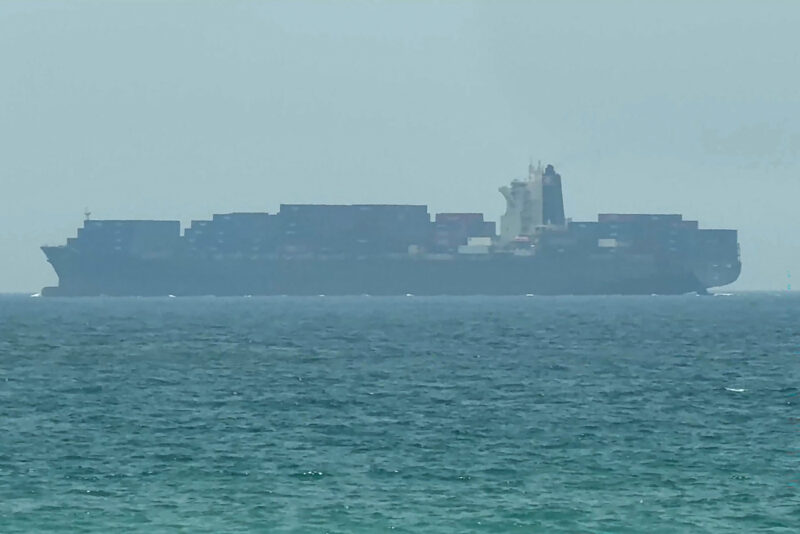
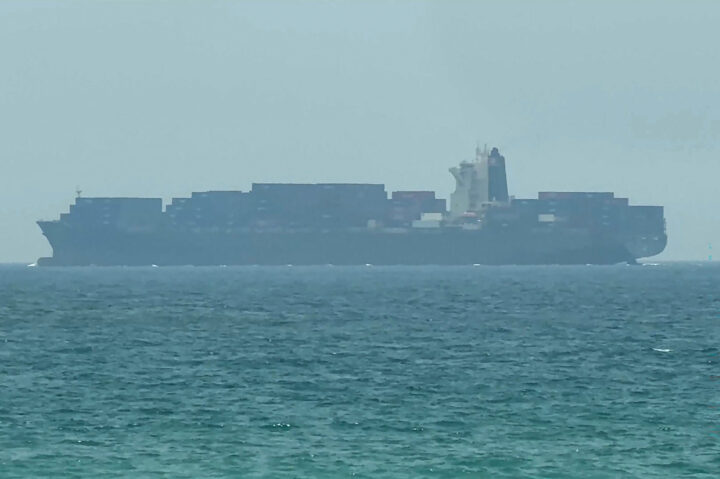
A cargo ship anchoring near the Strait of Hormuz off the eastern coast of the United Arab Emirates on July 12, 2026.


 Add JewishInsider on Google
Talks to reopen the Strait of Hormuz appear unlikely to produce an agreement, analysts told Jewish Insider this week, with little sign that Washington and Tehran can bridge their competing demands over the waterway. The Trump administration is more likely to pursue continued economic pressure than return to military confrontation, the experts suggested — but that strategy may not be enough to force Tehran to back down.
Reports indicate that an agreement between Iran and Oman on managing traffic through the strait is imminent, but a final deal has failed to materialize despite days of negotiations. Mohsen Rezaei, secretary of Iran’s Supreme National Security Council, insisted on Tuesday that any agreement reached between the two countries is separate from Tehran’s broader closure of the waterway, which will only be lifted once the U.S. accedes to Tehran’s demands, including full compensation for its war costs.
Trump has also applied conditions of his own, stating the U.S. would also seek compensation from Iran for the current conflict as well as previous ones. Experts maintained to JI that a broader agreement between Washington and Tehran over the strait appears increasingly unlikely, with both sides seeking to preserve the leverage they have gained.
“Iran is unlikely to give up control of the strait anytime soon, having spent years threatening to choke the waterway and finally proving it can with relatively few cheap missiles and drones,” Ari Cicurel, associate director of foreign policy at the Jewish Institute for National Security of America, told JI. “The mere threat of attacks remains Iran’s best leverage after a war that gutted its economy, which is why its demands for reopening [the strait] center on Washington lifting the blockade and pulling back forces, the two things that give the United States its own leverage, leaving the two sides’ positions increasingly incompatible.”
Steven Cook, a senior fellow at the Council on Foreign Relations, said his “sense is that we are going to have a long and drawn-out contest of wills over the strait.”
“The president has toggled between threatening force, using force and negotiating. He seems to like the idea of economic pressure, but of course there is no way of knowing that the resulting economic pain will dislodge the regime,” he continued.
Michael Koplow, chief policy officer at the Israel Policy Forum, similarly noted the Trump administration is more likely to continue pursuing economic pressure than return to military hostilities, citing American munitions shortages, the war’s unpopularity with the public and Congress and the approaching midterm elections.
“Given the extreme unlikelihood of any successful negotiation between the U.S. and Iran, the two plausible scenarios are either a continuation of the status quo, or Trump using an Iran-Oman agreement on Hormuz to declare victory and extricate himself from the situation altogether,” Koplow said. “Trump’s preferred option is economic pressure … The economy has priced in the Hormuz closure, so if the U.S. keeps up economic pressure without returning to war, Trump can at least count on no drastic changes on inflation or public opinion, even if neither improves before the election.”
Elliott Abrams, who served as Iran envoy in the first Trump administration, said Washington has caused “great economic damage” to Iran by maintaining its blockade on oil exports, something he called “the right policy now.” He noted that Iran’s inflation rate “is just under 90 percent and it loses hundreds of millions of dollars a day in oil revenue.”
Cicurel cautioned, however, that economic pressure may not be enough to force Tehran to surrender its leverage over the strait, pointing to the Iranian regime’s history of passing along economic hardships to the country’s citizens while continuing to direct resources toward its military. He suggested Washington could instead seek to weaken Iran’s control over the strait by establishing “protected windows of time” for commercial vessels to transit and offering financial backing to shipping companies and insurers.
“The Iranian regime has long shown it can absorb immense economic pressure at the expense of the Iranian people while funneling resources into the military programs that have now handed it this leverage,” Cicurel said. “Neither economic pressure nor the limited tit-for-tat strikes over the past few weeks have changed Tehran’s calculus on leverage it waited years to gain.”
Additionally, Abrams indicated that the decision may not be entirely up to Trump should Tehran grow impatient under increased economic pressure.
“The problem for Trump is that Iran may decide not to allow him to sit and wait. It is a vicious and brutal tyranny, but the rulers know that they risk another uprising as the economy worsens. That may lead them to attack Gulf Arab states, Israel and U.S. bases again,” Abrams said. “At some point Trump will have to hit back. The decision to return to war is really in the Ayatollah’s hands right now.”
Cook also noted that the economic pressure strategy “has costs for Americans too.”
“So far, prices at the pump have generally been manageable, but that cannot go on forever,” Cook said. “Americans have also been helped by the fact that experts undercounted how much oil is in storage around the globe. That’s a good problem to have, but it doesn’t change the fact that less oil (and other products like fertilizers and aluminum) is flowing through the strait. At some point, the laws of economics are going to catch up with us.”
The president thanked Turkey, Qatar and Egypt for mediating the deal that will see the IDF withdraw from Gaza and the International Stabilization Force take over
Omar AL-QATTAA / AFP via Getty Images
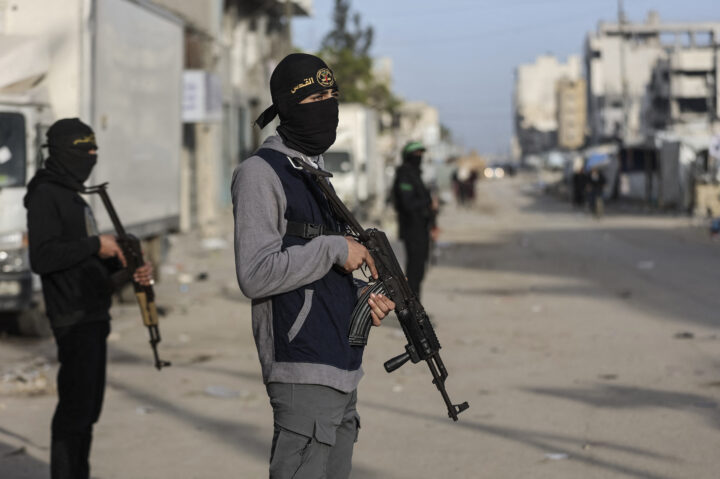
Members of Palestinian Hamas' Ezzedine Al-Qassam Brigades and Islamic Jihad's Quds Brigades are deployed at intersections in Gaza City on March 20, 2026.
President Donald Trump announced on Thursday that the Board of Peace had reached a “historic” agreement for the “complete disarmament” of Hamas and all other armed groups in Gaza, calling it a “monumental step toward lasting PEACE and SECURITY.”
Trump said in a post on Truth Social that the agreement would be “carried out carefully in structured phases,” and that the IDF would withdraw when Hamas’ disarmament is “completed.”
The president said that moving forward, “the International Stabilization Force will work with a new Palestinian police force to take responsibility for Gaza being safe for its residents and neighbors.” He emphasized that the transition represents a critical step toward establishing a government that works for Palestinians while not posing a threat to Israeli security.
“The threat that emerged from Gaza on October 7 will NOT be allowed to rebuild!” Trump wrote. “Under this agreement, Gaza will finally be in the hands of a new Palestinian government that serves its PEOPLE.”
Trump said the ultimate goal is for the Palestinian government, ostensibly a reference to the technocratic government established under the Board of Peace, to “work closely” with the board and oversee a Gaza “no longer used as a base for terror attacks.”
He also thanked Turkey, Qatar and Egypt for their role as mediators whose “important efforts” made “this historic breakthrough possible.”
Following the announcement, a senior U.S. official said in a call with reporters on Thursday evening that the document is “an agreement by Hamas to follow through on the decommissioning” of its weapons as well as its terror tunnels. The official noted that Iran tried to “convince [Hamas] not to do this deal,” but in the end, “the final communication came through the mediators that Hamas has agreed.”
“There were a lot of concerns that [Hamas] had about what would happen to them — would Israel honor its commitments if they did that? — it’s been a very delicate negotiation and discussion with them over the past months that have led us to this breakthrough where we have an understanding of what needs to be done,” the U.S. official said. “We’ll hopefully work over the next weeks to start putting it in motion.”
Text of the deal released on Friday by the Board of Peace indicates the process will be carried out over three years, and requires that Israel immediately end all military operations in the Gaza Strip, to eventually withdraw completely from the enclave.
Hamas must relinquish its heavy weapons, military production sites, depots of weapons and terror tunnels in a process linked to the IDF’s phased withdrawal, and personal weapons will be “subject to the regulations of relevant Palestinian laws.” At the end of the process, “only [the new technocratic government] shall hold, store or control weapons in Gaza,” the agreement reads.
Ghazi Hamad, a senior Hamas figure, told Al Jazeera, “We will not take any action regarding disarmament prior to Israel’s withdrawal from the Strip.”
Meanwhile, Reuters cited an Israeli official as having said, prior to Trump’s announcement, “Israel demands the complete disarmament of Hamas, including the removal of weapons from Gaza and the complete demilitarization of the Strip as a precondition for any process.”
A Board of Peace official told reporters that the plan includes U.N. Security Council Resolution 2803, in which the U.N. endorsed Trump’s Gaza peace plan, stating that “for the first time, effectively, Hamas and the Palestinian factions have agreed to accept this entire framework and have agreed on a way to implement it.”
They noted that the framework includes “everything from demilitarization and de-radicalization to the transfer of civilian authority in Gaza to the transfer of security authority in Gaza as well to the national committees,” along with “a full monopoly on weapons.”
The Board of Peace official said that the board will implement a “verification committee” in order to ensure the plan’s objectives are being met. They noted that weapons will be transferred to the technocratic government.
Officials added that the ISF has secured commitments for over 5,000 troops from various nations. The force will help train Palestinian police, oversee the decommissioning of weapons and act as a buffer between Israeli and Palestinian forces during the IDF withdrawal. Meanwhile, a newly trained Palestinian police force will handle internal security, taking over from Hamas.
Asked whether the board would seek the involvement of the Palestinian Authority, the official said that “for the time being, we’re trying to just do something new.”
“They [the PA] have to show that they can run the West Bank and do reforms,” the official said. “If the PA shows that they do a good job … then obviously the discussion could be open.”
The official said that despite “a lot of criticism, particularly in Israel,” about the involvement of Turkey and Qatar in the Board of Peace, they noted that the two Arab nations, along with Egypt, have been “essential partners … in getting to this stage.”
The Board of Peace official said that the negotiations were “very complicated,” given that the two sides “do not trust each other.”
“From Day One, we heard the same thing both from Hamas and Israel, that they absolutely do not trust each other,” the official said. “So we built this entire proposal that we took to them on the basis of zero trust … everything that is in it is conditional, and it needs to be verified. No side is being asked to do something without that being confirmed and by reciprocity from the other side.”
“The first step is getting a framework, getting the de-escalation, getting the humanitarian issues resolved, having a plan forward … and so we’re going to do it as quickly as we can,” the official added. “But it can get slower, and hopefully both sides will cooperate in an appropriate way. And if they don’t, we’ll deal with it accordingly, like we have the last months.”
A senior U.S. official told reporters, “We’re not asking Israel to do anything that isn’t in the 20-point plan that they agreed to initially, and so we’re very confident they will adhere to it. If they don’t, President Trump would be very, very disappointed.”
White House Press Secretary Karoline Leavitt said the deal, which was already signed, is ‘still being finalized’
Win McNamee/Getty Images
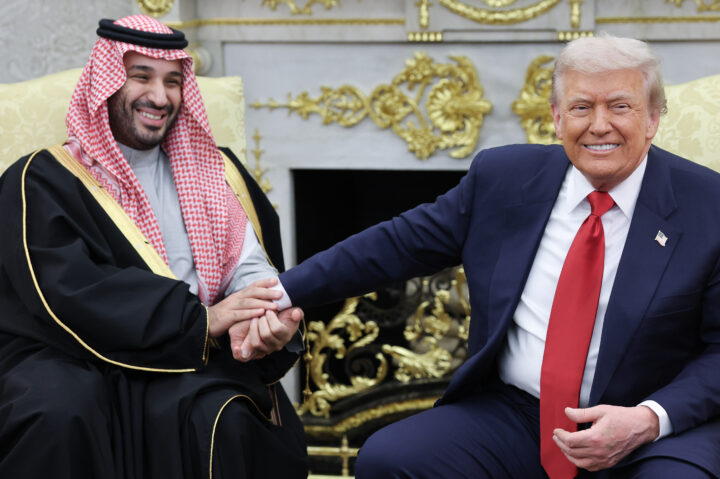
President Donald Trump (R) meets with Crown Prince and Prime Minister Mohammed bin Salman of Saudi Arabia during a bilateral meeting in the Oval Office of the White House on November 18, 2025.
The new civilian nuclear cooperation agreement already signed between the U.S. and Saudi Arabia is now contingent on Riyadh joining the Abraham Accords, President Donald Trump announced on Thursday morning.
The president’s Truth Social post — in which he said the deal is “totally subject” to Saudi Arabia normalizing relations with Israel, a provision not previously disclosed by the administration — was quickly affirmed by the White House.
“Yes, this deal with Saudi Arabia, the energy deal, is contingent on this condition as far as the president is concerned,” White House Press Secretary Karoline Leavitt said during a press briefing on Thursday. “So we’ll continue to talk with our Saudi counterparts to get the deal finalized, and hopefully see them joining the Abraham Accords very soon.”
It appeared that Trump thought to add the provision only after the signing ceremony, which took place on Wednesday afternoon between Energy Secretary Chris Wright and Saudi Energy Minister Prince Abdulaziz bin Salman.
Asked if Trump had spoken to Saudi Crown Prince Mohammed bin Salman about it, Leavitt said, “As you know, the president just put out this statement a few hours ago. I don’t believe he’s had a call with MBS in the hours since.”
The new addition may have thrown a wrench in the agreement: Leavitt said the deal is “still being worked out,” despite already having been signed by the parties, and “will eventually, hopefully, be finalized with the condition that the president spoke about this morning.”
Leavitt also said she did not believe the provision was requested by Israeli Prime Minister Benjamin Netanyahu.
Under the preliminary agreement, Israel will withdraw from two ‘pilot zones’ while maintaining its security zone in southern Lebanon
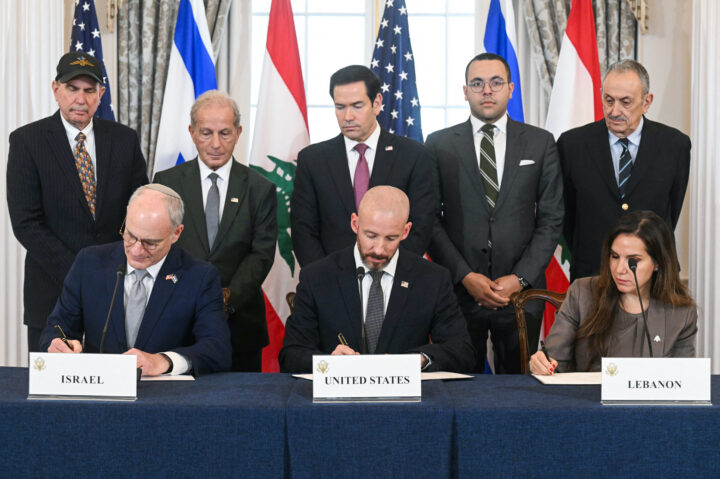
Photo by SAUL LOEB / AFP via Getty Images
Secretary of State Marco Rubio looks on as Israeli Ambassador to the U.S. Yechiel Leiter, State Department Chief of Staff Daniel Holler, and Lebanese Ambassador to the U.S. Nada Hamadeh sign a framework agreement at the U.S. Department of State in Washington, DC, on June 26, 2026.
Secretary of State Marco Rubio and the ambassadors of Israel and Lebanon signed a framework agreement in Washington on Friday aimed at scaling back Israel’s military presence in Lebanon, where the IDF has established a presence for the last three months as part of its campaign against Hezbollah.
Israeli Ambassador to the U.S. Yechiel Leiter and Lebanese Ambassador to the U.S. Nada Hamadeh Moawad announced the deal at a press conference with Rubio, following four days of negotiations in Washington during the fifth round of direct talks between Jerusalem and Beirut.
Under the deal, Israel will withdraw from two “pilot zones,” one north of the Litani river and one in southern Lebanon, and transfer administration of the areas to the Lebanese Armed Forces.
The preliminary deal between Israel, Lebanon and the U.S. is aimed at enabling a broader agreement in the future, a senior Israeli official told CNN.
Israeli Prime Minister Benjamin Netanyahu hailed the framework agreement as a “major blow to Iran,” emphasizing in a video statement that Israeli forces will maintain their presence in Israel’s security zone in southern Lebanon until Hezbollah is disarmed.
“Iran is trying to force us into a withdrawal from southern Lebanon by force. In effect, Israel, Lebanon and the United States are telling them: this is none of your business,” Netanyahu said.
Today is “the beginning of the beginning,” Rubio said at the signing ceremony. “There’s a lot of work ahead. We don’t, in any way, underestimate the difficulty of the task ahead. But we understand the importance of it, how vital it is. And we are honored to play a part in bringing this together.”
Moawad said at the signing that the agreement would be the “first step on the road to restoring Lebanese sovereignty and territorial integrity.”
The announcement comes after months of negotiations and on the heels of the Trump administration signing a memorandum of understanding with Iran and launching a deconfliction mechanism to end the fighting in Lebanon without Israel’s participation.
Some GOP legislators swiftly moved to tie Vance to the MOU — hours after it was announced
Roy Rochlin/Getty Images
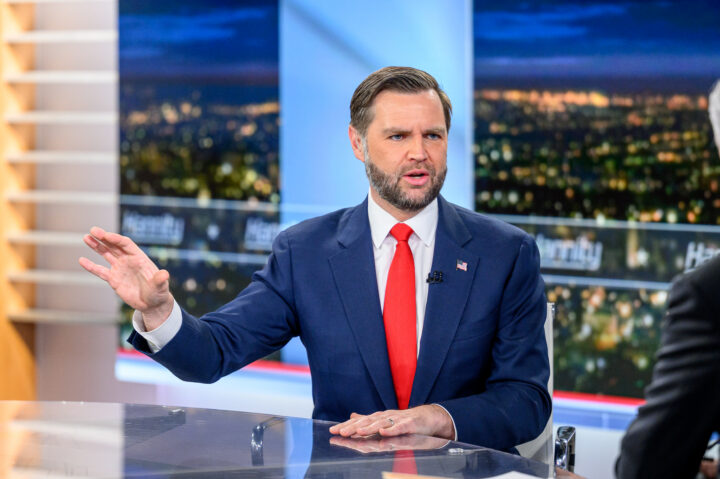
Vice President JD Vance
Vice President JD Vance is increasingly becoming the face of Washington’s negotiations with Iran — setting him up to claim victory if the agreement is successful, or to take the fall if talks with the historically intransigent adversary collapse.
President Donald Trump said as much yesterday in France: “If it works out, I’m going to take the credit. If it doesn’t work out, I’m blaming JD,” Trump quipped on the sidelines of the G7 summit, hours before signing the agreement alongside French President Emmanuel Macron in Versailles.
Trump is far from the only Republican in Washington to tie Vance to the deal. Some GOP legislators swiftly moved to tie Vance to the MOU — hours after it was announced. Sen. Lindsey Graham (R-SC), who has long advocated for military pressure against Iran, was one of the first, saying Sunday that it was “imperative that the architect of the deal, Vice President Vance and his negotiating partners, be part of the process in presenting the final deal to Congress.”
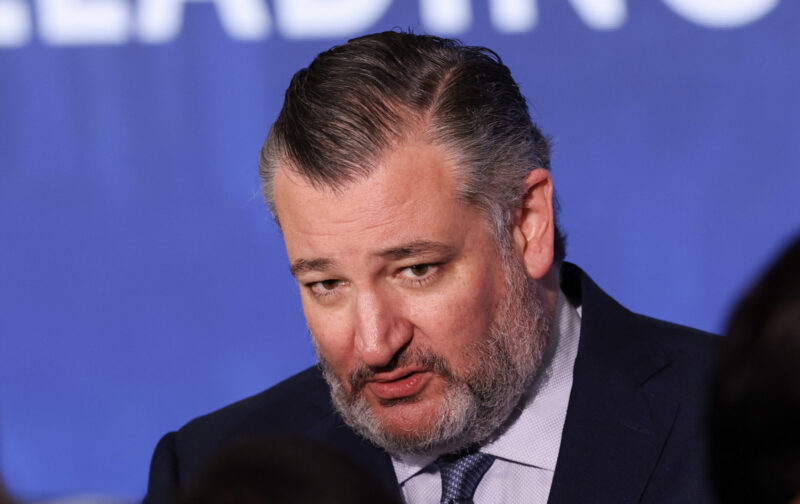
But the pressure on Vance quickly has spread through the party. On Wednesday, Sen. Josh Hawley (R-MO), a longtime backer of the president who is largely aligned with the GOP’s isolationist wing (where Vance has also found his political home), told reporters, “I wish the VP all the best of luck.” Sen. Ted Cruz (R-TX), without mentioning Vance by name, said that in moving forward with the MOU, “the president, unfortunately, is receiving bad advice once again.”
The criticism of Vance over the agreement with Iran extends beyond the capital. Conservative commentator Ben Shapiro said on Fox News on Wednesday that the MOU “appears to be, just from the text, a disaster that does not achieve any of the actual signal goals that were set by the administration at the beginning.” Directly addressing Vance’s role, Shapiro said, “The vice president of the United States, the chief negotiator on this particular project, has not well served the president.” Read more here on Shapiro’s comments.
Vance’s high-profile presence around the Iran negotiations draws attention to other senior members of the Trump administration — including Secretary of State Marco Rubio and Defense Secretary Pete Hegseth — who have been notably absent from the White House’s public efforts to talk up the MOU.
Axios reported earlier this week that Rubio and Hegseth — who during the course of the war with Iran had often been front and center explaining the administration’s policies and actions — had opposed the MOU, while Vance, White House Special Envoy Steve Witkoff and Jared Kushner backed the agreement.
Rubio, who has long taken a more hawkish approach to foreign policy — not just on Iran, but also on China, Russia, Cuba and other U.S. adversaries — was on hand this week at the G7. Rubio has been in France this week with Trump and was at his side when the president signed the agreement, but has largely avoided publicly commenting on the deal and its contours.
Iran has long boasted of its ability to drag out negotiations, betting (usually correctly) that it can take the economic hits and outlast the West. It may well be that Vance, who worked in venture capital and had not yet entered politics during the Obama administration’s yearslong talks that led to the 2015 Joint Comprehensive Plan of Action, is less familiar with Iran’s intransigence and ability to slow-walk diplomacy.
After the midterms — now less than five months away — attention will shift to 2028. By then, if the administration’s timeline holds, a deal with Iran will either have been struck or will have collapsed. For Vance, who along with Rubio is expected to make a White House bid in two years’ time, the failure to bring about a resolution with Iran could become a major liability in the 2028 GOP primary.
The president warned that the U.S. would resume military operations if Iran fails to ‘behave,’ and denied that the deal would automatically release billions in frozen Iranian assets
Daniel Torok/The White House via Getty Images
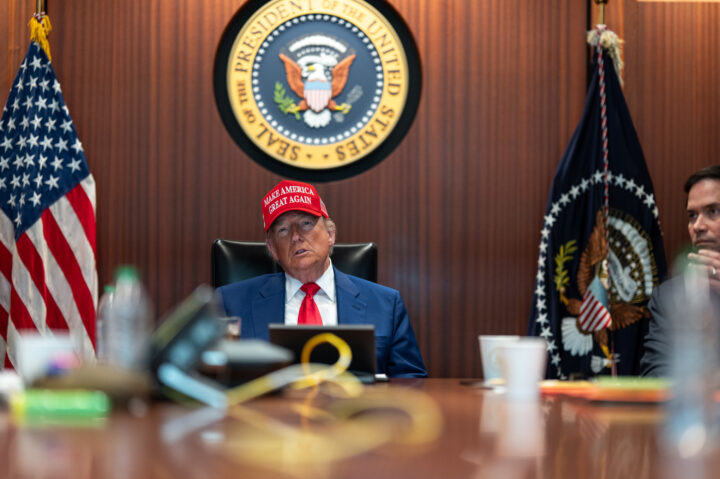
President Donald Trump and Secretary of State Marco Rubio (R) sit in the Situation Room as they monitor the mission that took out three Iranian nuclear enrichment sites, at the White House on June 21, 2025 in Washington, DC.
President Donald Trump said on Wednesday that the agreement reached between the U.S. and Iran earlier this week to end the conflict has not been finalized, warning that the U.S. would “go right back to dropping bombs” if he is dissatisfied with the final deal or if Iran fails to “behave.”
“No, it’s not final. It’s a memorandum of understanding, and if I don’t like it, we’ll go back to shooting at them, dropping bombs on their head,” Trump said during a bilateral meeting with Egyptian President Abdel Fattah el-Sissi on the sidelines of the G7 summit in Évian-les-Bains, France. “If I don’t like it, if they don’t behave, we’ll go right back to dropping bombs right smack in the middle of their head, because they have misbehaved for 47 years.”
Reports indicate that the memorandum of understanding announced this week could release $24 billion in Iranian frozen assets and provide $300 billion in reconstruction relief. Senior administration officials have stated that while the U.S. is open to these terms, they have denied reports that the funds would automatically be released, instead arguing that it would remain strictly conditioned on Iran fulfilling its obligations within the agreement.
WATCH: Trump warns he’ll go back to military operations if the Iran deal falls apart.
— Jewish Insider (@jewishinsider) June 17, 2026
“If I don’t like it, if they don’t behave, we’ll go right back to dropping bombs right smack in the middle of their head.”
Read the full story from @MatthewShea__: https://t.co/JXdeZk63DY pic.twitter.com/QRQCU3UQZe
When asked whether the money would be released, Trump stated: “That’s false.”
“That’s a false story that got picked up incorrectly,” he said.
The president also said that while the U.S. would not invest in Iran, Washington will not stop other countries from doing so.
“People can decide to do that, but that’s up to them. I would say they won’t be doing it for a while until they find out [whether Iran has changed] the behavior. It’s a behavior thing,” Trump said. “Do you want me to say that nobody’s ever allowed to invest in a country? We are not investing in it [Iran], we do not have a fund.”
Trump also touted U.S. military accomplishments, saying that Iran’s navy, military and air force have been “wiped out.” He argued that operations to guide and protect ships through the Strait of Hormuz have been successful and are keeping oil prices down.
“They have no anti-aircraft, they have no radar,” Trump said. “The reason oil stayed low is because we were taking ships out every night…We averaged 15 to 25 ships a night. Nobody knew that our navy did a great job, nobody knew that was happening. That’s why oil didn’t go to $300 million a barrel, it went to $125, $115, now it’s at $72-$73.”
The president also renewed his sharp criticism of the Joint Comprehensive Plan of Action, the nuclear deal signed with Iran in 2015 under former President Barack Obama. Trump argued that the fundamental flaw of that agreement was the transfer of cash to “bribe” the Iranian government.
“Nobody could have made this deal. The JCPOA done by Obama… he gave them $1.7 billion in green cash from banks into a Boeing 757 and flew it into Iran,” Trump said. “They [the Iranians] stood at the plane, I have pictures of it, like, ‘Oh my, look at this money he’s giving us.’ He [Obama] tried to bribe his way out. I didn’t do that… and you know what the Iranians did, they laughed at Obama and they said he’s a stupid son of a b****.”
The president said he would send the agreement to Congress and suggested it could lead more Arab countries to join the Abraham Accords
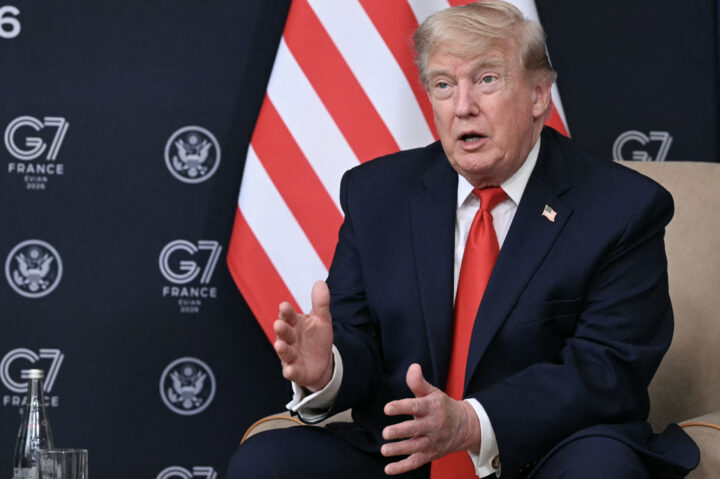
Photo by Mandel NGAN / AFP via Getty Images
U.S. President Donald Trump delivers remarks as he attends a bilateral meeting with UAE's President during the G7 summit, in Evian, eastern France, on June 16, 2026.
As the U.S. and Iran prepare to formally sign an agreement ending the recent fighting between the two countries, President Donald Trump on Tuesday said he was hopeful that a full deal would come soon because, he asserted, U.S.-Iranian ties had improved.
“Iran wants to get it done. They have to get back to business, and the relationship is now normalized,” Trump said during a meeting with United Arab Emirates President Sheikh Mohamed bin Zayed Al Nahyan on the sidelines of the G7 Summit in France.
Trump said he expects a final deal to be negotiated in the 60-day period that is reportedly outlined in the memorandum of understanding that both countries signed, even as he added that the timing may change.
“I think it’s going to go pretty quickly. It could go faster. It could take longer, too,” he said.
Without offering specifics, Trump pledged to release the text of the MOU after the formal signing ceremony on Friday in Switzerland, which will be attended by Vice President JD Vance.
“I’d like to get a formal setting first before we do that, but I have no problem with that. It’s a great document. Here’s what it says: Iran will never have a nuclear weapon,” Trump said. “It won’t have one to buy, to develop. They will not have a nuclear weapon, and I would say that’s about 99.9% of what I wanted, because we couldn’t let that happen.”
He drew a comparison between the U.S.-Iran MOU his administration negotiated and the 2015 Joint Comprehensive Plan of Action.
“It’s a very important document, and unlike Obama, who could have destroyed the Middle East with the horrible JCPOA — it is the worst agreement that was a road to a nuclear weapon,” said Trump. “Mine is a wall against a nuclear weapon.” Trump withdrew from the JCPOA in 2018 and relied heavily on a new “maximum pressure” sanctions policy. In the years that followed, Iran began to stockpile enriched uranium.
Responding to a question about how to keep the Strait of Hormuz open, Trump said, “Have a United States with a strong president. Thats the only way you could do it, I guess … We have all the agreements we want. The agreements for bad people don’t mean anything.”
Trump speculated that the deal with Iran would lead additional Arab nations to join the Abraham Accords.
“I think they’re all going to come into the Abraham Accords. The only conflict was a place called Iran,” Trump said. “I understand that. It’s a little bit tough when people were afraid of Iran, but I think they’re going to all start coming in.” Trump has been saying for weeks that he wants Arab states to join the Abraham Accords after the Iran war ends, but several — Saudi Arabia in particular — have said that they will not do so until Israel commits to make progress toward the creation of a Palestinian state.
Asked whether an agreement should be approved by Congress, Trump said he is open to doing so.
“I never thought about sending, never even thought about it, but I will. I will send it to Congress. I like the idea,” he said.
Jewish organizations across the political spectrum question whether the deal will curb Iran’s nuclear program or its support for regional proxies
Tom Williams/CQ-Roll Call, Inc via Getty Images
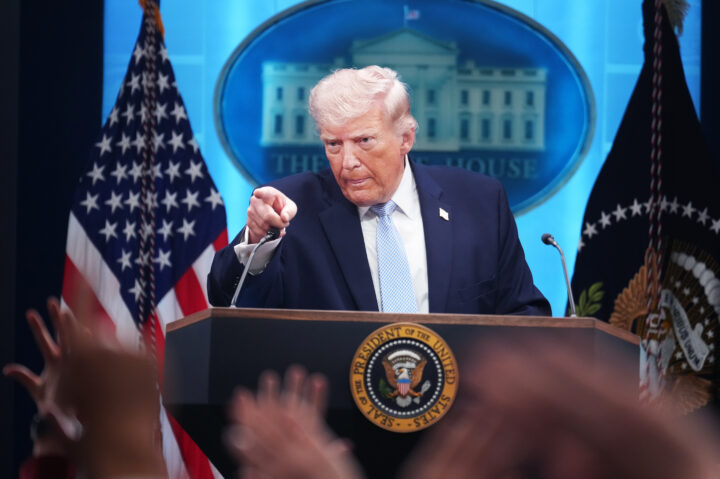
President Donald Trump conducts a news conference in the White House briefing room about the war in Iran on Monday, April 6, 2026.
As details begin to emerge about the Trump administration’s agreement with Iran to end the war and lift the U.S. blockade of the Strait of Hormuz, some mainstream Jewish organizations are treating the deal as a preliminary step — focusing on the 60-day negotiating period ahead, while others are expressing skepticism about the contours of the agreement.
AIPAC, in a statement that came late Monday afternoon after many other organizations had already spoken out, framed the current MOU as a preliminary step, focusing more on the upcoming negotiations, while emphasizing the need for more details about how the current deal affects Israel.
“The announced MOU kicks off a new 60-day window for talks. We look forward to learning the full details of the framework for these negotiations, including whether the deal preserves the sovereign right of our democratic ally Israel to respond to the security threats it confronts,” AIPAC said in a statement.
The group also emphasized that “Congress will play a critical role in working with the administration throughout these negotiations and in reviewing the ultimate agreement.”
It said any deal should require the removal of all enriched uranium from Iran, the dismantling of its enrichment capacity and should address Iran’s missile and drone programs and end its support for terrorist proxies.
The American Jewish Committee also did not take a definitive position on the current agreement, saying on X that the organization “await[s] developments about the reported 60-day ceasefire agreement” but emphasized the need to continue to focus on Iran’s long-running threats.
The AJC said that any ultimate deal with Iran at the conclusion of the upcoming 60-day negotiating period should ensure Iran cannot obtain a nuclear weapon, rebuild its ballistic missile program, continue to support terror proxies, threaten U.S. allies and partners or hold the Strait of Hormuz hostage.
“AJC also strongly supports the legitimate aspirations of the Iranian people for greater freedom, opportunity and dignity, and hopes that those aspirations are eventually realized,” the statement continued. “As the contours of this and future agreements become more clear, we will continue to engage with our partners in the U.S., the Middle East, and around the world to make this vision a reality.”
Other groups offered a more directly negative reaction to the emerging details of the MOU.
The Zionist Organization of America, which has been strongly supportive of Trump administration policies and President Donald Trump himself, praised the president for carrying out military operations against Iran but said that “the pending deal with Iran is concerning.”
“The deal appears to be an ‘agreement to negotiate’ — which enables the Iranian regime to obtain massive oil revenue and time to build up its military and terror arsenals, while leaving the genocidal Iranian regime and its nuclear and missile stockpiles in place, and positioning the Iranian regime to continue and strengthen its 47-year war to destroy the U.S., Israel, and the West,” ZOA National President Mort Klein said. “[T]he little that we know is deeply problematic.”
Klein said it “makes no sense” for the U.S. to let up on its blockade of Iran unless Iran fully gives up its nuclear program and missile stockpile. He also expressed concerns that the deal will allow Hezbollah to regroup and rearm, and that Trump demanded that Israel stand down against Hezbollah.
“Pressuring Israel to not respond to threats of annihilation and attacks on her people is not, as the president called it, a ‘Great Deal [that] will bring Peace and Security to the whole Region,’” Klein said.
“Disturbingly, the interim Iran deal does not appear to be even close to the U.S.-Israel war goals of eliminating the existential dangers of Iran’s nuclear program and ballistic missiles, ending the Iranian regime’s support for its terror proxies, and helping the Iranian people overturn the brutal, genocidal Iranian regime,” he continued.
Democratic groups are also skeptical.
Democratic Majority for Israel CEO Brian Romick criticized the administration’s “incoherent and erratic strategy” and said that “there are concerning details about what is and isn’t in this deal.” Romick called on the administration to lean on “experienced negotiators and technical experts” in the next phases of talks, “rather than relying on friends, family, and donors.”
He said that any deal must permanently end Iran’s nuclear program, constrain its ballistic missiles, address Iran’s support for terrorism and ensure that the Islamic Revolutionary Guard Corps and Iran’s terrorist proxies do not receive additional support as a result of sanctions relief or the unfreezing of assets, and that it must be thoroughly vetted by Congress.
“Despite this tentative deal, the reality is Israel still faces constant threats from Iranian-backed terrorist groups like Hamas and Hezbollah. President Trump must not limit or interfere with our ally’s ability to defend itself from very real threats along its border,” Romick continued.
The Jewish Democratic Council of America’s CEO Halie Soifer took an even more strident tone.
“Donald Trump’s deal with Iran isn’t a deal at all. At best, it’s a statement of intention — a ‘concept of a plan’ — lacking details. At worst, it’s an admission of defeat by the United States,” Soifer said, describing it as a weaker deal than the 2015 Joint Comprehensive Plan of Action.
She argued that the “reckless war” gave Iran a “chokehold” on the U.S. and global economy that it will continue to exercise in the future, gave Iran a stronger hand in nuclear negotiations, solidified the current regime, harmed the Iranian people and gained the U.S. nothing.
“Today, Iran is unquestionably further from regime change — and this Iranian regime is stronger — than before the war,” Soifer said. “Trump repeatedly berated the Obama administration for offering sanctions relief and unfreezing Iranian assets as part of the JCPOA. The amount of financial benefit Iran received from the JCPOA will be dwarfed by the amount of money going to Iran following Trump’s defeat.”
Soifer also criticized Trump for sidelining and ignoring Israel throughout the talks.
J Street has thus far been an outlier in expressing support for the deal.
The group’s president, Jeremy Ben-Ami, said J Street “welcomes” the announcement, while also criticizing the war effort as a whole.
“The lesson is the same one many experts and former security officials have warned about for years: There is no sustainable military solution to the challenge posed by Iran’s nuclear diplomacy,” Ben-Ami said. “Durable constraints on Iran’s nuclear activities can only be achieved through pragmatic and sustained diplomacy.”
Ben-Ami argued that the deal would be largely similar to the JCPOA, adding, “We urge lawmakers to support this agreement to end the fighting and push to ensure future diplomatic efforts address the security threats presented by Iran.”
The Republican Jewish Coalition has not issued a full statement of its own on the deal, but has indicated support thus far, sharing on its X account two Truth Social posts from Trump about the Strait of Hormuz being reopened and the lifting of the U.S. blockade. RJC did not immediately respond to a request for comment.
In Israel, the deal is being met with dismay across the board
Samuel Corum/Getty Images
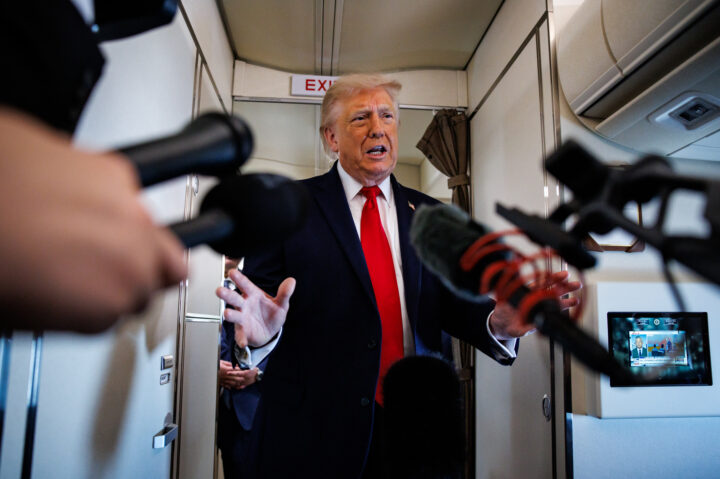
President Donald Trump speaks with reporters while aboard Air Force One on June 5, 2026 en route to Chippewa Falls, Wisconsin.
A year and a day after Israeli fighter jets first opened fire above Iran, setting off a year of intermittent fighting and numerous failed negotiations, President Donald Trump announced on Sunday that an agreement with Iran to end the war had been reached. A signing ceremony set for later this week in Switzerland — which is expected to be attended by Vice President JD Vance — will kick off a 60-negotiation period to address Iran’s nuclear program and U.S. sanctions on the Islamic Republic.
For Americans, the deal closes a chapter that saw high gas and food prices as well as schisms in the GOP as the party’s wings fought over how the war should be fought and ended. Among Democrats, legislators and activists from the party’s progressive wing — from Rep. Ro Khanna (D-CA) to the National Iranian American Council’s Trita Parsi (who additionally gloated, “Netanyahu failed!”) — praised the deal.
But Israel was not part of the negotiations, nor did it have final say in what was in the agreement inked between Washington and Tehran. As the Is were dotted and Ts were crossed on the agreement, tensions between Trump and Israeli Prime Minister Benjamin Netanyahu — already on display following Israel’s threatened escalation last week in Beirut, followed by an actual escalation on Sunday when Israel struck Beirut’s Dahiyeh neighborhood — deepened. In a call on Sunday after Israel conducted the strike — later claiming to have killed a senior Hezbollah commander — Trump told Axios he had conveyed to Netanyahu that he “was so pissed off.” Netanyahu, Trump said, “has no f***ing judgement. I let him know that.”
In Israel, the deal is being met with dismay across the board, as neither of the war goals laid out by Netanyahu last June — removing Iran’s “existential threats” to Israel and ending Tehran’s support for its terror proxies across the region — have been met, even after a year of fighting.
With elections in the country fast approaching, Netanyahu, who has long billed himself as “Mr. Security,” is already finding himself on the receiving end of criticism from across the political spectrum. Former Israeli Defense Minister Avigdor Liberman blasted the deal as “catastrophe from Israel’s perspective,” while prominent right-wing Israeli journalist Amit Segal posted an ominous quote from former U.S. Secretary of State Henry Kissinger: “It may be dangerous to be America’s enemy, but to be America’s friend is fatal.”
The question now is what, exactly, is in the agreement. Iran’s state-linked Mehr agency reported that under the terms of the agreement, the U.S. will release $12 billion in frozen assets to Iran before talks begin.
Fox News reported that the $12 billion figure, as well as other reports of the deal’s stipulations, are incorrect, and that officials within the Trump administration are growing frustrated over rumors about the contours of the agreement.
Calls for the deal’s text to be made public have come from even Trump’s staunchest supporters. Commentator Mark Levin said he has “asked for days, why can’t we, the people, see the damn MOU?” Levin added that he had “never seen anything like this. If it is a great outcome for peace, then release it.”
Sen. Lindsey Graham (R-SC) said on X on Sunday that he was “somewhat concerned” that Iran’s account of the U.S.-Iran ceasefire deal diverges sharply from what the U.S. negotiators are claiming, and demanded Vice President JD Vance personally present the deal to Congress.
The vice president, who two months ago traveled to Pakistan for high-level negotiations with Iranian officials, has increasingly become the public face of the Iran talks. In an interview last week that aired yesterday on “CBS Sunday Morning,” Vance said he believed “that we are in a position to get a deal that is good for the United States economically and that really does deal with the Iranian nuclear program” in the long term.
For Vance, the success or failure of the deal, and of the negotiations to follow, could become one of the defining political issues of his rumored 2028 presidential bid — one in which he will likely find himself up against Secretary of State Marco Rubio in what could be a bruising primary.
With the deal’s signing later this week, the military phase of the war — begun just over a year ago — will conclude. But what comes next is the political phase, which will determine Iran’s nuclear future, Israeli security policy and the direction of U.S. foreign policy in the region for decades to come.
Signing ceremony set for Friday in Switzerland; Israeli security officials express concern

Christopher Furlong/Getty Images
President Donald Trump holds up an executive order after signing it during an indoor inauguration parade at Capital One Arena on January 20, 2025 in Washington, DC.
The United States and Iran have secured a ceasefire agreement, President Donald Trump announced on Sunday. The deal is slated to immediately freeze regional military actions, and will lift the U.S. naval blockade and restore commercial shipping through the critical Strait of Hormuz after a formal signing ceremony set for Friday in Switzerland.
“The Deal with the Islamic Republic of Iran is now complete,” Trump posted on Truth Social on Sunday. “I hereby fully authorize the toll free opening of the Strait of Hormuz, and, simultaneously herewith, authorize the immediate removal of the United States Naval blockade.” He later clarified the Strait would open after the deal was officially signed on Friday.
Iran’s deputy foreign minister, Kazem Gharibabadi, also told Iranian media that the agreement had been finalized and stressed that Iran’s “commitments will take effect starting Friday.”
The agreement establishes a 60-day ceasefire extension, during which Washington and Tehran are expected to enter technical negotiations on the scope of Iran’s nuclear enrichment program and the dismantling of its highly enriched uranium stockpiles. The cessation of hostilities extends across the entire region, including in Lebanon, according to Pakistani Prime Minister Shehbaz Sharif, who helped mediate the agreement.
“Following intensive talks, we are pleased to announce that the Peace Deal between the United States of America and Islamic Republic of Iran has been REACHED,” Sharif posted on X. He noted that international mediators will facilitate a “series of meetings” and “technical talks” ahead of the signing ceremony.
Sharif’s statement thanked Qatar, Saudi Arabia and Turkey for their roles in the negotiations, but made no mention of Israel, which had fought alongside the U.S. in the conflict with Iran.
The diplomatic breakthrough followed a tense escalation earlier on Sunday that threatened to derail the negotiations. Israeli forces struck Hezbollah targets in Beirut in response to a Hezbollah drone strike on northern Israel, prompting Tehran to warn it would abandon talks and strike against Israel.
Vice President JD Vance said the U.S. was able to deter an Iranian attack on Israel prior to the deal being reached. “After the Israelis struck Beirut, we saw a lot of evidence the Iranians were going to launch a large number of missiles at…them,” Vance said on Fox News. “[Iran] assured us they were not going to respond to the Israelis. They were going to sign the agreement, and get to peace.”
Writing on Truth Social, Trump criticized the Israeli response as an unnecessary escalation against a “meaningless” initial drone strike, and demanded an immediate halt to all military activity in Lebanon. “There should be no more attacks by Israel anywhere in Lebanon, but there should also be no more attacks by any other party, including Hezbollah, against Israel,” he wrote.
Gharibabadi said the Iranian threats against Israel “helped facilitate progress in the negotiations.” Iranian state media reported that Iran called off the attack on Israel because of “last-minute concessions” offered by Trump, including “preserving Lebanon’s territorial integrity” and Israel’s withdrawal from the Lebanese border. The U.S. did not confirm the reported concessions on Lebanon.
Israeli Prime Minister Benjamin Netanyahu has said that the IDF would not follow such a request and that Israel does not consider itself bound to the Lebanon ceasefire under the agreement. It is unclear whether the Trump administration will pressure Jerusalem to comply.
Israeli security officials have reportedly expressed concern with the deal, warning that it could harm Israeli security interests and leave Iran stronger.
Iranian state media and Iran’s foreign ministry have said that Trump’s claims that Iranian leadership had approved the deal are ‘speculative’
Brendan SMIALOWSKI / AFP via Getty Images
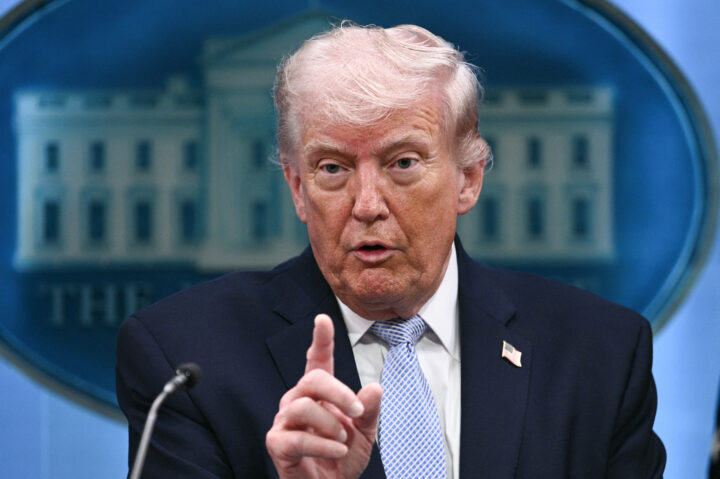
US President Donald Trump speaks about the conflict in Iran in the James S. Brady Press Briefing Room of the White House on April 6, 2026, in Washington, DC.
President Donald Trump said on Thursday that negotiations with Iran had reached a breakthrough and that he expected there to be a signing, possibly in Europe, in the coming days. With the diplomatic developments, Trump said he would cancel planned strikes against Iran, and call off an operation to take control of Kharg Island.
“Based on the fact that discussions with the Islamic Republic of Iran have been brought to the highest level of Iranian leadership and approved, I have, as President of the United States of America, cancelled the scheduled strikes and bombings against Iran this evening,” Trump posted on Truth Social.
In the Oval Office, the president said the deal was “in pretty final shape” and predicted that it would “get done over the next few days.” He also claimed that the agreement would ultimately deliver on his assurance that Iran would be prevented from having nuclear weapons and open up the Strait of Hormuz.
“The signing of the agreement will be in Europe, perhaps during the weekend,” Trump told reporters in the Oval Office on Thursday afternoon. “I won’t be able to be there, but Vice President [JD] Vance and the [White House special] envoy [Steve] Witkoff will.”
Trump also said that Iran’s supreme leader had approved the deal. However, Iranian state media and a spokesperson for Iran’s foreign ministry have reportedly asserted that Trump’s claims that Iranian leadership had provided approval are “speculative” and that “nothing has been finalized.”
The president spoke with the Emir of Qatar following the announcement and also with Israeli Prime Minister Benjamin Netanyahu. Reports indicated that Netanyahu was initially surprised by the statement. However, after the conversation between the two leaders, the Prime Minister’s Office said that Netanyahu “expressed his appreciation” for the framework and the inclusion of key objectives related to Iran’s nuclear program and support for terrorism.
The U.S. and Iran have reportedly closed vital gaps on three main issues that have prolonged diplomatic efforts, including the protocol for releasing Iranian frozen assets, reopening the Strait of Hormuz, and negotiations over Iran’s nuclear program.
The announcement came after two days of tit-for-tat strikes between the U.S. and Iran. Earlier on Thursday, Trump warned that the U.S. would hit Iran “VERY HARD TONIGHT” and threatened to seize Kharg Island, which handles roughly 90% of Iran’s oil exports.
Jewish and pro-Israel groups seem at pains to clarify how they are now assessing an issue that has long been key to their advocacy — particularly as the conversation around funding and the possibility for a new MOU has rapidly evolved in recent months
Joe Raedle/Getty Images
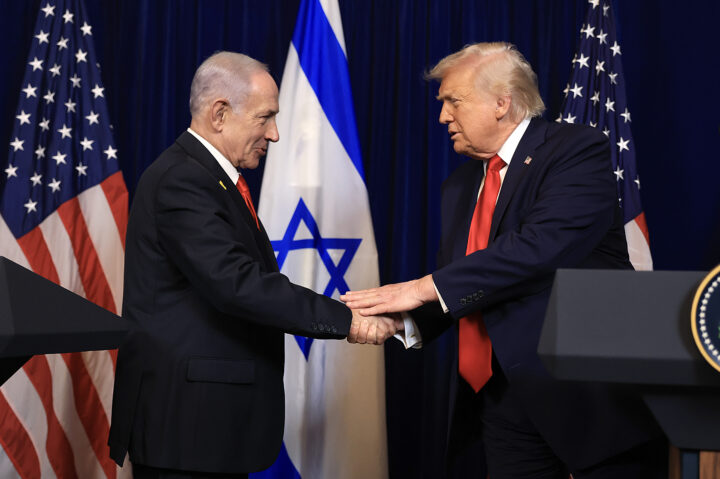
President Donald Trump shakes hands with Israeli Prime Minister Benjamin Netanyahu during a press conference at his Mar-a-Lago club on December 29, 2025 in Palm Beach, Florida.
Late last month, AIPAC circulated what seemed at first glance like a relatively anodyne memo stressing its support for the current 10-year memorandum of understanding between the United States and Israel, which guarantees $3.8 billion in annual military aid and missile-defense funding to Israel through 2028.
“Congress must fulfill America’s commitment by providing full security assistance and missile defense funding to Israel for the remainder of the MOU,” the group wrote in its missive published on April 28.
The memo was notable, however, for what it left out: calling to negotiate a follow-up MOU — the future of which has been a topic of ongoing speculation among analysts and lawmakers beginning to think about the contours of a potential new agreement in a changing political landscape.
That AIPAC had only urged the implementation of the final two years of the current deal was in many ways a tacit acknowledgement of shifting attitudes against U.S. military aid even among supporters of Israel.
The omission, intentional or not, was otherwise reflective of uncertainty around an agreement that has drawn scrutiny not only among Israel critics on the far left and right but also moderate defenders of Israel in both parties who are openly questioning the necessity of U.S. military assistance to a longstanding Middle East ally.
Meanwhile, Israeli Prime Minister Benjamin Netanyahu has called for winding down U.S. financial aid over the next decade, saying that the Jewish state has “come of age” and matured economically to continue on its own. In an interview with CBS’ “60 Minutes” earlier this month, he confirmed that he wanted to immediately begin the process of weaning Israel off of U.S. aid, noting the future of the U.S.-Israel alliance should be focused on joint projects equally funded by Israel and the United States.
“Each U.S.-Israel MOU to date — negotiated by Presidents Clinton, Bush and Obama — has laid the framework for the decade ahead, strengthening an alliance that advances American interests, supports a strong and capable ally in an unstable region, and drives a remarkable ecosystem of joint development and cooperation between two reliable allies,” Deryn Sousa, a spokesperson for AIPAC, told Jewish Insider in a recent statement.
Some pro-Israel Republican lawmakers — including Sens. Lindsey Graham (R-SC), John Thune (R-SD), the Senate majority leader, and Roger Wicker (R-MS) — have welcomed the idea, even as the GOP has long touted its staunch support for such funding. Rahm Emanuel, the former Chicago mayor and Democratic presidential prospect who holds close personal ties to Israel, has advocated for immediately ending military aid to Israel, arguing it is not worth expending the “political capital” to promote spending that is facing mounting opposition in Congress and among voters.
But Jewish and pro-Israel groups seem at pains to clarify how they are now assessing an issue that has long been key to their advocacy — particularly as the conversation around such funding and the possibility for a new MOU, which remains an open question, has rapidly evolved in recent months.
“Each U.S.-Israel MOU to date — negotiated by Presidents Clinton, Bush and Obama — has laid the framework for the decade ahead, strengthening an alliance that advances American interests, supports a strong and capable ally in an unstable region, and drives a remarkable ecosystem of joint development and cooperation between two reliable allies,” Deryn Sousa, a spokesperson for AIPAC, told Jewish Insider in a recent statement.
She added, “We appreciate the Trump administration working closely with the Israeli government toward a new agreement that will strengthen and define the mutually beneficial partnership in the years ahead.”
“We’re figuring it out ourselves,” said Michael Makovsky, the president and CEO of the Jewish Institute for National Security of America, adding that he believed Israel “made a mistake” in choosing to forgo U.S. financial aid. He suggested that the U.S. sign “one more” MOU with Israel to cover the next 10 years and help Israel replenish its munitions stocks amid the war against Iran, which he believes is key to advancing American interests in the region. “It zeroes down at the very end,” he explained to JI.
In lieu of an agreement, Makovsky floated “non-monetary” alternatives, for instance, a U.S.-Israel mutual defense treaty — though he questioned whether such a pact could gain enough support in the Senate, where most Democrats recently voted in favor of resolutions to block arms sales to Israel.
Former U.S. and Israeli officials have also recently called for building closer technological ties between the two countries, in anticipation of an era in which financial aid is not a defining feature of the alliance.
“The model in which Israel is assisted by the United States and receives aid has a very small chance of continuing under any future administration,” former IDF intelligence chief Amos Yadlin said this month while promoting a new strategic technology alliance with Tom Nides, a former U.S. ambassador to Israel. “And perhaps even under the Trump administration, so we need to find a new basis for the relationship that is a transition from aid to partnership.”
Even as analysts had indicated last year that the U.S. should begin considering what the next MOU entails, it is unclear if the process is now seriously underway, as Netanyahu’s remarks have complicated the effort. One Hill staffer to a pro-Israel House member told JI he had no knowledge of discussions at the moment.
President Donald Trump was initially surprised when Netanyahu first proposed winding down U.S. funding late last year and did not immediately lend support to the move, JI has previously reported.
A White House spokesperson declined to comment on the prospects for a future MOU, the framework for which first went into effect in 1998 during the Clinton administration. The current agreement was finalized in 2016 near the end of the Obama administration — which touted the deal as “the largest single pledge of military assistance in U.S. history” at the time.
Tal Naim, a spokesperson for the Israeli Embassy in Washington, referred JI to Netanyahu’s comments to “60 Minutes” this month.
Looking ahead, Brian Romick, the president of Democratic Majority for Israel, said “there can and should be a discussion about how the U.S.-Israeli security relationship should change with the times, how our partnership must evolve as Israel’s own capabilities grow and its security needs change, and how we can align on a long-term vision for the region.”
“While a new MOU should reflect that Israel’s economy has grown, it should also recognize that Israel’s defense requirements have too, and Israel may struggle to fill the gap in its defense budget that the loss of FMF would create,” Justin Leopold-Cohen, a senior research analyst at the Foundation for Defense of Democracies’ Center on Military and Political Power who specializes in U.S.-Israel security cooperation, said.
But, he added, “that debate must bring a serious analysis grounded in prioritizing America’s interests and Israel’s security. It cannot shift with political changes or in the middle of a war, especially when American troops are actively deployed in the region. Ultimately this will be a negotiated agreement between two democratically elected governments.”
A spokesperson for the American Jewish Committee likewise used broad strokes to discuss a future MOU, saying it is “far more than a financial commitment.”
The agreement “is a cornerstone of a broader strategic relationship that advances both U.S. and Israeli national security interests, strengthens deterrence against shared adversaries, and reinforces America’s commitment to the security of its closest ally in the Middle East,” the spokesperson told JI. “At a time of growing regional volatility and evolving security threats, maintaining strong and sustained U.S.-Israel security cooperation remains critically important.”
Justin Leopold-Cohen, a senior research analyst at the Foundation for Defense of Democracies’ Center on Military and Political Power who specializes in U.S.-Israel security cooperation, said that “there will likely be a new, heavily modified MOU following the current agreement’s expiration.”
Netanyahu, he told JI, “already revealed his desire to phase out American military aid, granted primarily as Foreign Military Financing,” which typically must be used to purchase U.S. defense products and services.
“While a new MOU should reflect that Israel’s economy has grown, it should also recognize that Israel’s defense requirements have too, and Israel may struggle to fill the gap in its defense budget that the loss of FMF would create,” Leopold-Cohen said.
Dan Shapiro, a U.S. ambassador to Israel in the Obama administration who served as a top defense official in the Biden administration, speculated that “the next MOU — if there is an MOU — will look very different from the current one.”
“It will likely phase out FMF, which both Prime Minister Netanyahu and Americans from the left and right are calling for,” Shapiro added. “It will likely emphasize joint research and development, sharing technological advances, and expanded co-production to answer President Trump’s question of what’s in it for the United States. To garner bipartisan support, it should include a consultative mechanism to ensure U.S. weapons are only used in ways consistent with American laws and values and that minimize civilian casualties.”
Daniel Silverberg, a former top foreign policy advisor to Rep. Steny Hoyer (D-MD), characterized the MOU as “mutually beneficial,” saying that “it does not need to be exclusively assistance-based.”
“There are many ways to expand cooperation that involve more than giving aid,” he said. “The MOU is a key framework to do so, and it’s crucial to spell that out for a skeptical U.S. audience.”
But, he emphasized to JI, “We can’t want the MOU more than the Israelis want it.”
Details of the arrangement remain unclear, but reports indicate the U.S. would end military action, lift its blockade and release $25 billion in frozen Iranian funds
Tasos Katopodis/Getty Images
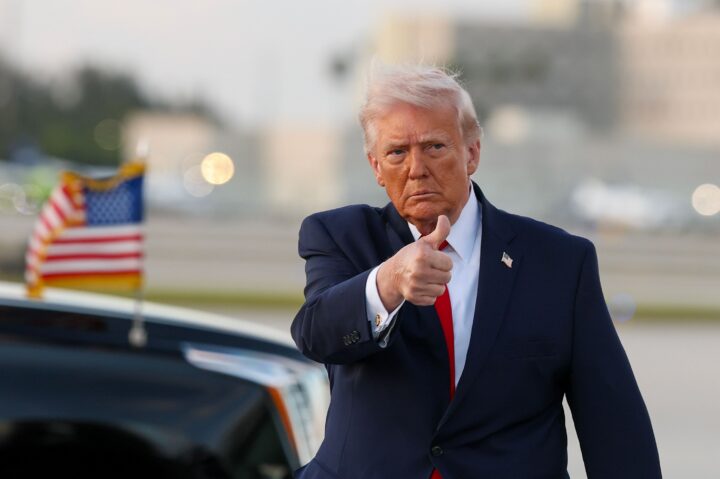
U.S. President Donald Trump waves to the media after walking off of Air Force One at Miami International Airport on April 11, 2026 in Miami, Florida.
The U.S. is nearing a deal with Iran to end the war, President Donald Trump announced on Saturday, though the precise parameters of the agreement remained unclear.
After holding a call with officials from the United Arab Emirates, Saudi Arabia, Qatar, Turkey, Pakistan, Jordan, Bahrain and Egypt, as well as a separate discussion with Israeli Prime Minister Benjamin Netanyahu, Trump said on Truth Social on Saturday afternoon that an agreement has “been largely negotiated” with “final aspects and details … currently being discussed.”
“In addition to many other elements of the Agreement, the Strait of Hormuz will be opened,” the president said.
While Trump did not offer any further details, Iranian officials had told The New York Times that a memorandum of understanding under discussion with the U.S. would end fighting on all fronts, including between Israel and Lebanon; lift the U.S. blockade of Iranian ports and allow for free movement of commercial traffic without any tolls; leave nuclear issues to be negotiated within 30 to 60 days; and see the release of $25 billion in frozen Iranian funds.
U.S. officials told the Times that, under the current agreement, Tehran has committed to giving up its stockpile of already enriched uranium, an issue that Trump has frequently stated is a U.S. priority, but the specifics as to how that transfer will occur are set to be worked out in subsequent negotiations.
A senior Iranian official denied to Reuters on Sunday that Iran’s nuclear program was a part of the initial agreement, and said that Tehran had not agreed to hand over its enriched uranium. “The nuclear issue will be addressed in negotiations for a final agreement and are therefore not part of the current deal,” the official told Reuters.
A U.S. official told Axios’ Barak Ravid that the agreement involves a 60-day ceasefire extension during which the Strait of Hormuz would be reopened and Iran would be able to sell oil freely. The draft MOU, according to Axios, includes commitments from Iran that it will never pursue nuclear weapons and to negotiate a suspension of its uranium enrichment program and the removal of its stockpile of highly enriched uranium. The draft also includes an end to the war between Israel and Hezbollah in Lebanon.
Netanyahu said in a statement on Sunday regarding his conversation with Trump the day prior that the two leaders “agreed that any final agreement with Iran must eliminate the nuclear danger,” including dismantling Tehran’s nuclear program and removing enriched uranium from the country. Trump also “reaffirmed Israel’s right to defend itself against threats on every front, including Lebanon,” Netanyahu said.
Some hawkish Senate Republicans expressed outrage on Saturday over the reported terms of the deal, calling it a defeat for the United States filled with major concessions to the Iranian regime.
Departing from Washington, the Israeli PM said he stressed to Trump that if any deal is reached, it must go beyond the nuclear issue
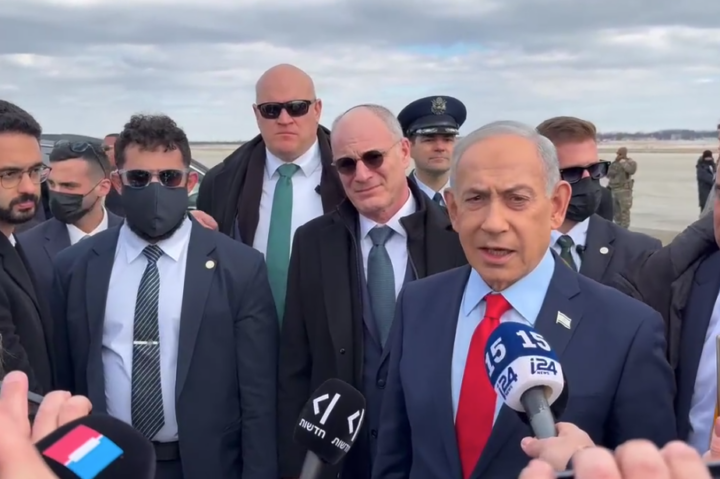
Lahav Harkov
Israeli Prime Minister Benjamin Netanyahu departs Joint Base Andrews on Feb. 12, 2026.
Israeli Prime Minister Benjamin Netanyahu again voiced skepticism about the U.S.’ ability to reach an agreement with Iran as he departed Joint Base Andrews on Thursday, a day after his White House meeting with President Donald Trump.
Netanyahu said that his nearly three-hour meeting with Trump “mostly focused on the negotiations with Iran.”
“The president thinks the Iranians understand who they’re dealing with,” Netanyahu said. “He thinks the conditions he is setting, combined with their understanding that they made a mistake last time not reaching a deal, could bring them to agree to conditions that will allow a good deal to be reached.”
The prime minister’s view was more reserved: “I do not hide my general skepticism about the possibility of any deal with Iran.”
Netanyahu said he told Trump that if a deal is indeed reached, “it must include the components that are important to us, the State of Israel, and, I think, the entire international community: not just the nuclear matter, but also ballistic missiles and Iranian proxies in the region.”
After Wednesday’s White House meeting, the Prime Minister’s Office stated that the leaders discussed Iran and Gaza, and that Netanyahu “emphasized the security needs of the State of Israel in the context of the negotiations, and the two leaders agreed on continued coordination and the close contact between them.”
Trump posted on Truth Social that he “insisted that negotiations with Iran continue to see whether or not a Deal can be consummated. If it can, I let the Prime Minister know that will be a preference. If it cannot, we will just have to see what the outcome will be.”
The president warned that last time Tehran did not make a deal, the U.S. launched Operation Midnight Hammer, striking Iran’s nuclear sites.
The Prime Minister’s Office said Netanyahu will not be returning to Washington next week as he had been scheduled to, in order to speak at an AIPAC conference, and will instead appear virtually.
As he departed Washington a day after his meeting with Trump, Netanyahu voiced skepticism about the U.S.’ ability to reach an agreement with Iran.
— Jewish Insider (@J_Insider) February 12, 2026
“The president thinks the Iranians understand who they’re dealing with,” Netanyahu said from Joint Base Andrews. “He thinks the… pic.twitter.com/A1AsiDYZCe
Trump is adamant that Iran will not get a nuclear weapon, has yet to set a timeline for talks, but if Iran attacks, ‘all bets are off,’ ambassador says
Andrew Harnik/Getty Images
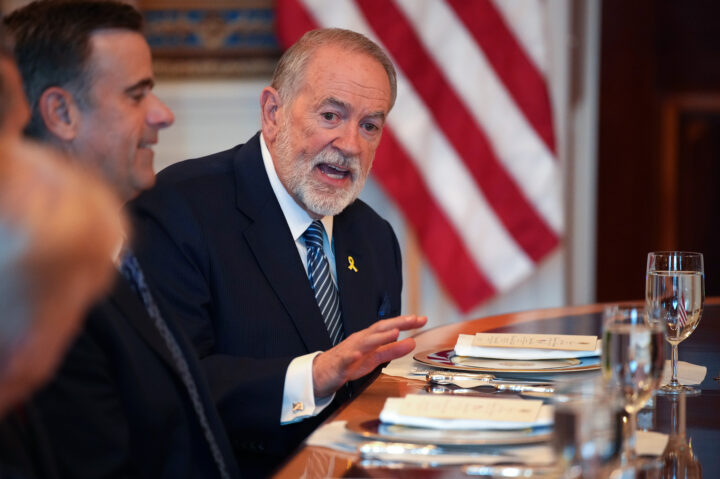
U.S. Ambassador to Israel Mike Huckabee delivers remarks as President Donald Trump hosts Israeli Prime Minister Benjamin Netanyahu for a dinner in the Blue Room of the White House on July 7, 2025, in Washington, DC.
The U.S. would prefer a negotiated agreement with Iran to dismantle its nuclear program, U.S. Ambassador to Israel Mike Huckabee said in an interview that aired on Israel’s Channel 12 on Saturday night.
“I think everybody would love to see, at least in the U.S., would love to see some type of peaceful settlement in which Iran comes to it and decides that there’s no future for them to have a nuclear device, and there’s no future for them to continue to threaten both Israel and the United States,” Huckabee said.
President Donald Trump is “adamant,” Huckabee said, that “Iran is not going to get a nuclear weapon, not going to enrich uranium, so they’re going to have to get that out of their heads.”
Trump has yet to decide if he will strike Iran or not, the ambassador added.
“President Trump is always hopeful for the best outcome – let’s never forget The Art of the Deal – and if he can get that, that’s ideal,” Huckabee said. “But if he can’t, he’s not afraid to do what he proved last summer when he instigated Midnight Hammer,” the operation in which the U.S. struck Iranian nuclear sites.
As to the timing for a decision, Huckabee said he was baffled by the decision taken by some airlines to cancel flights as though a strike was imminent. The ambassador posited that Trump is likely to announce a timeline: “Remember last year, he said ‘you have 60 days,’ [and] on day 61 [the American strike on Iran] happened.”
At the same time, Huckabee said, “there are things that could precipitate a more urgent sense of reaction. If Iran were to strike, I think all bets are off.”
Huckabee also said that he “cannot imagine” that a strike on Iran would not be coordinated with Israel.
“The alignment between the United States and Israel is so incredible, more than most Israelis or Americans would ever assess,” he said. “We share intelligence that saves the lives of Americans and Israelis. We share military hardware, we share technology, and you have an excellent relationship between the president and the prime minister.”
Asked if Netanyahu had a significant role in the president calling off a strike on Iran on Jan. 14, Huckabee said “there is a genuine relationship, and there is a partnership that is unlike we have with any other country.”
In Gaza, Huckabee admitted that “there are some question marks” remaining as to how Hamas will be disarmed and who will do it, though Trump has insisted that “if they don’t give up their weapons, it’s going to be very bad.”
“You have every Arab country in the world signing the agreement saying this is going to happen,” Huckabee said. “I don’t trust Hamas to do anything, but I trust the rest of the world to say to Hamas, ‘you signed it, you’re on the line for it, if you don’t fulfil it, the whole world is going to rise up and take you down.’”
As to whether Israel will be the one to disarm Hamas, Huckabee said: “I don’t think the President is going to limit any action solely to Israel. Israel has enough blood in this. Everybody else at Sharm El Sheikh signed in ink; Israel signed in blood.”
Huckabee said that the U.S. is still hopeful that more countries will join the Abraham Accords, and that last week he met with U.S. Ambassador to Lebanon Michel Issa to discuss “how do we, as Americans, help our host countries move toward better understanding the escalating tensions and hopefully moving toward the president’s agenda of joining the Abraham Accords. It would be historic. We’d love to see this happen, and I’m optimistic that we will see that.”
The ambassador was noncommittal as to whether Trump would visit Israel in May to receive the Israel Prize in person, but he said it’s “a huge honor” for the president to be the first non-Israeli to be granted the award.
The Ivy League school will pay $60 million and agree to comply with civil rights laws against antisemitism

Matt Burkhartt/Getty Images
A man walks through the Cornell University campus on November 3, 2023 in Ithaca, New York.
Cornell University agreed to conduct “annual surveys to evaluate the campus climate for students, including the climate for students with shared Jewish ancestry” as part of an agreement it reached with the Trump administration on Friday.
The settlement will restore more than $250 million in federal funding that was cut from the Ivy League school earlier this year, over allegations that it failed to address campus antisemitism. The annual surveys will “ask students whether they feel welcome at Cornell; whether they feel safe reporting antisemitism at Cornell; and whether they believe the changes Cornell has made since October 2023 have benefited the Cornell community.”
The federal government concluded that Cornell is not in violation of Title VI of the Civil Rights Act of 1964 and has closed the relevant investigations.
“I am pleased that our good faith discussions with the White House, Department of Justice, and Department of Education have concluded with an agreement that acknowledges the government’s commitment to enforce existing anti-discrimination law, while protecting our academic freedom and institutional independence,” Cornell President Michael Kotlikoff told Jewish Insider on Friday. “These discussions have now yielded a result that will enable us to return to our teaching and research in restored partnership with federal agencies.”
Under the terms of the settlement, in which Cornell agreed to pay $60 million — half to the government and the other $30 million toward research that will support U.S. farmers — the university must also ensure it is in compliance with government civil rights laws and provide admissions data to the government to ensure race is not considered a factor in admissions.
The settlement includes a provision stating that the university and government both “affirm the importance of and their support for academic freedom.” It also said that no part of the settlement could be “construed as giving the United States authority to dictate the content of academic speech or curricula.”
Menachem Rosensaft, an adjunct professor of law at Cornell Law School who teaches about antisemitism in the courts, called the settlement a “significant victory for Cornell.”
“It is proof that the Cornell administration under President Kotlikoff has in fact been doing — and is doing — everything in its power, and everything that is appropriate within the restraints posed by academic freedom, to protect its Jewish students, faculty and staff against any type of antisemitic discrimination, just as it is protecting all members of the Cornell community from Title VI or Title IX based discrimination,” Rosensaft told JI.
“Of course there remains work to be done to fight against antisemitic manifestations at Cornell, just as there is at virtually every university and college in this country. But the settlement is proof that Kotlikoff and his administration are fully invested and engaged in this fight.”
The six-page agreement comes weeks after a similar one was signed by the University of Virginia; however, the Charlottesville campus’ settlement did not explicitly address Jewish students. Columbia University, Brown University and the University of Pennsylvania also cut deals with the government earlier this year. The Trump administration is still reportedly in talks to reach agreements with Harvard University and the University of California.
The move from Cornell comes as its graduate student union is considering a BDS resolution that accuses Jewish students of “weaponizing antisemitism” and blames labor disputes on “Zionist interests” — where, unlike many other unions, dues are mandatory.
In the immediate aftermath of the Oct. 7, 2023 attacks in Israel, Cornell made headlines for several high-profile incidents. Those included a student’s online threats to shoot Jewish students at the kosher dining hall — and, following a leave of absence, the return to campus earlier this year of Russell Rickford, an associate professor of history who called Oct. 7 “exhilarating” and “energizing.”
Cornell’s former president, Martha Pollack, issued a set of recommendations aimed at countering antisemitism in May 2024. Pollack resigned in July 2024, citing “enormous, unexpected challenges” on campus amid the Israel-Hamas war.
Please log in if you already have a subscription, or subscribe to access the latest updates.
 Continue with Google
 Continue with Apple