

















































These two unexpected nomination fights are serving as a microcosm of both parties’ ideological directions

Joe Raedle/Getty Images
Democratic U.S. Senate candidate Graham Platner and Troy Jackson stand together during a “Fighting Oligarchy” tour stop at the Collins Center for the Arts on the University of Maine campus on May 24, 2026 in Orono, Maine.


 Add JewishInsider on Google
July was scheduled to offer a break from primary politics, but two seismic developments this month — the collapse of scandal-plagued Graham Platner’s campaign in Maine and the sudden death of Sen. Lindsey Graham (R-SC) — are forcing both parties to deal with messy internal conflicts as they choose replacements in these key races.
The outcome of the July 25 Maine Democratic convention choosing an alternative candidate to run against Sen. Susan Collins (R-ME) and the Aug. 11 special election primary to choose a GOP nominee for Graham’s seat are offering clarity on the ideological directions of the two parties as the November midterm elections approach.
Already, we’re seeing that Democrats want to nominate a candidate as ideologically similar to Platner as possible, with most of the convention delegates chosen this weekend gravitating towards former state Senate President Troy Jackson, an anti-Israel progressive who unsuccessfully ran for governor this year as a champion of Sen. Bernie Sanders (I-VT).
As Maine counties completed the process of choosing delegates for the nominating convention, Jackson’s campaign expressed confidence that he rallied enough backers to secure a victory. Most of his leading rivals dropped out of the race on Sunday, indicating that the state party is clearly intent on pushing forward a candidate that shares Platner’s anti-establishment, left-wing worldview but without the personal baggage he brought to the table.
Jackson was the candidate whom Platner preferred to replace him on the general election ballot. Indeed, the Platner camp’s reported demands that the party choose someone who shares his values — even as his own campaign was sinking — caused such a backlash that the Maine Democratic Party’s executive director put out a video rebuking Platner for trying to influence the selection of his own successor.
If Jackson is the nominee, he’ll have to answer why he continued to support Platner even as the candidate’s other scandals piled up around him. Jackson finished in third place in June’s Democratic gubernatorial primary, only winning 21% of the vote in the five-candidate field.
In a sign of where the Democratic Party is headed, most of the leading candidates to challenge Collins sought to underscore their anti-Israel bona fides in the race, even the more-moderate Democrat Nirav Shah, who called Israel’s war against Hamas a “genocide” in a candidate questionnaire.
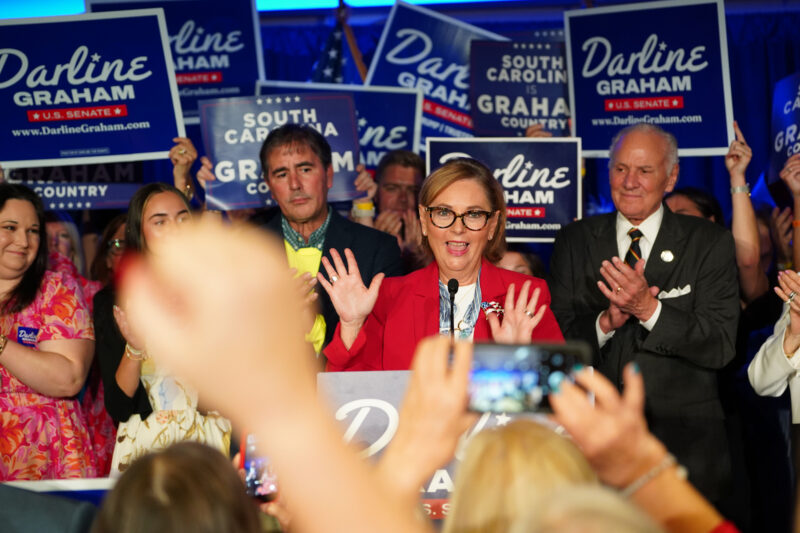
Meanwhile in South Carolina, there are growing indications that appointed Sen. Darline Graham (R-SC), who was tapped to fill the remainder of her late brother’s term, is seriously considering running for the seat herself, and has the president’s endorsement to do so.
That would greatly scramble the internal politics for next month’s primary, which was seen as a wide-open contest between several politically established South Carolina lawmakers. An endorsement of Graham from President Donald Trump would immediately make her the front-runner — given his near-perfect track record in congressional primary endorsements — even as she’d still likely face credible primary opposition.
It’s impossible to guarantee how Graham will end up voting in the Senate, but it’s safe to assume she’ll continue her brother’s hawkish record, maintaining strong support for Israel and Ukraine. Some of the other candidates for the seat — namely Reps. Nancy Mace (R-SC) and Ralph Norman (R-SC) — have been less enthusiastic supporters of military spending, and more reticent in aiding Ukraine in its war against Russian aggression.
These two unexpected nomination fights are serving as a microcosm of both parties’ ideological directions. Democrats are accommodating their populist left flank, even at the risk of damaging the party’s midterm prospects. Republicans, meanwhile, continue to march to the beat of Trump’s drum, and are fine maintaining the party’s conservative status quo even with rumblings from the isolationist right.
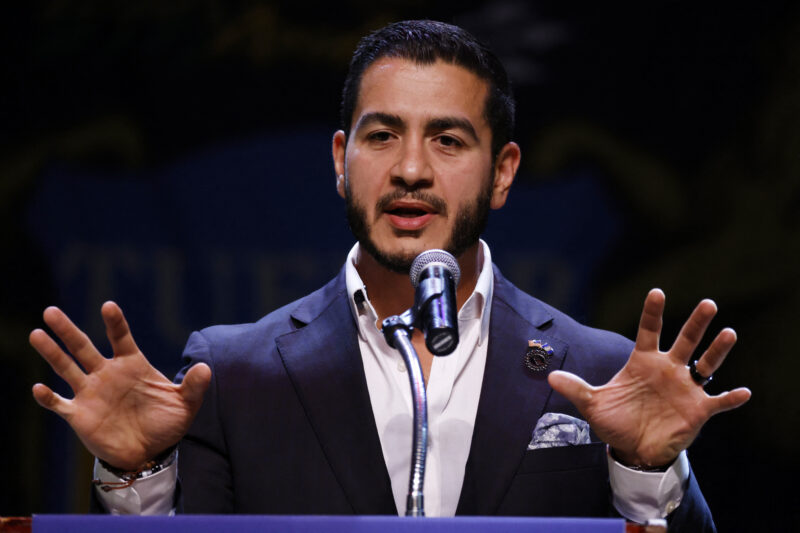
After socialist candidates scored several surprise victories, party leaders are fighting with renewed vigor to rally behind Rep. Haley Stevens (D-MI) in the primary against her left-wing challenger, Abdul El-Sayed
Kristen Norman/AP
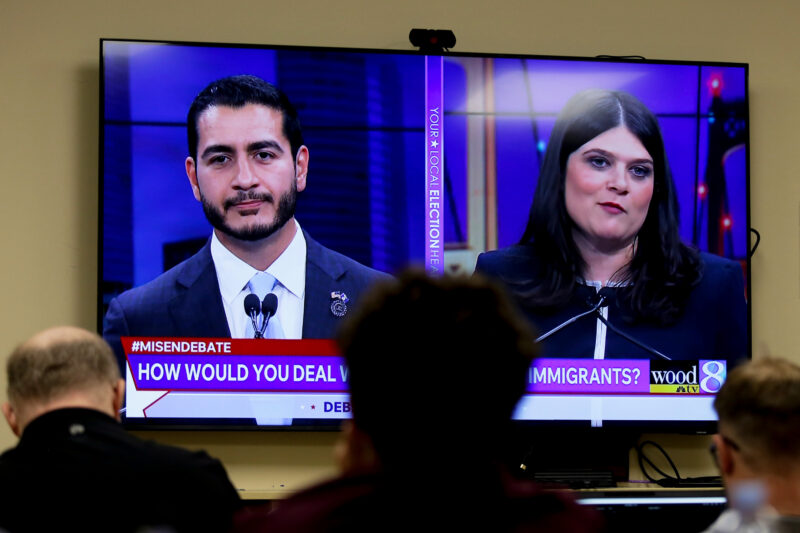
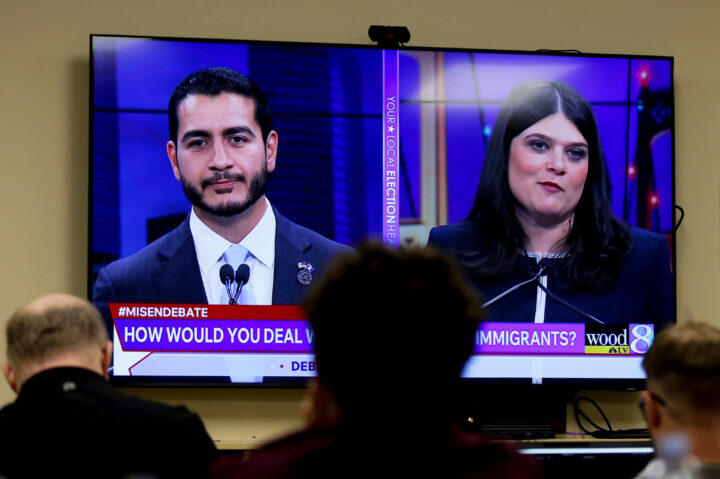
Michigan U.S. Senate candidates, Abdul El-Sayed, left, and Rep. Haley Stevens, D-Mich., are displayed on a television during a debate inside the spin room at WoodTV studios on Tuesday, July 7, 2026, in Grand Rapids, Mich.
As Maine Democrats pick up the pieces of Graham Platner’s failed Senate campaign and quickly try to find a replacement for the scandal-tarred candidate on the ballot, moderate Democrats in Michigan, where a primary is fast approaching, are in a race against time to prevent another far-left Senate candidate from capturing a valuable nomination.
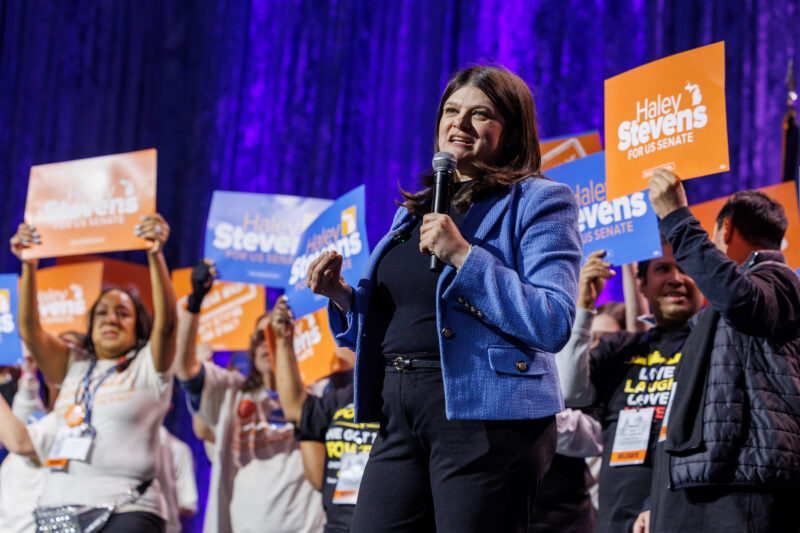
The final three weeks of the Michigan primary will be 2026’s most consequential test yet for the power the party establishment still holds, particularly in a pivotal swing state. After socialist candidates scored a number of surprise victories in heavily blue districts in New York City, Philadelphia and Denver, party leaders are fighting with renewed vigor to rally behind Rep. Haley Stevens (D-MI) in the primary against her left-wing challenger, Abdul El-Sayed.
Retiring Sen. Gary Peters (D-MI) endorsed Stevens on Monday, a pivot from his announcement in May that he planned to stay out of the race, joining Senate Minority Leader Chuck Schumer (D-NY), who had already backed the congresswoman. The party’s left flank — including Sens. Bernie Sanders (I-VT) and Chris Van Hollen (D-MD) — is backing El-Sayed.
“The change of heart is we just know that we have to hold Michigan,” Peters said on “Morning Joe” on Tuesday of his decision to endorse, with Stevens sitting beside him. “She’s an outstanding candidate and I certainly hope that folks get behind her around the country and understand that she’s the right person to be the next senator from the state of Michigan.”
There are fresh signs that the late push for Stevens from Democratic leaders — along with millions in ad spending from pro-Stevens outside groups — has given the congresswoman momentum in the closing stretch of the race. A new poll commissioned by the Detroit News found Stevens pulling ahead of El-Sayed by seven points, 48-41%, after she trailed in most public polls this year.
The United Democracy Project, AIPAC’s affiliated super PAC, is spending big to attack him, dropping nearly $15 million in the race so far. A new 30-second ad attacks El-Sayed as sexist, referencing criticisms he’s made against former First Lady Michelle Obama and Gov. Gretchen Whitmer. A mailer sent to Michigan voters criticized El-Sayed’s response to the attack on Temple Israel in West Bloomfield in March. El-Sayed condemned the attack but said that “hurt people hurt people,” referring to the assailant having lost his brother — a Hezbollah commander — in an Israeli airstrike in Lebanon.
“We are going to continue educating Michigan voters on El-Sayed’s track record of making disparaging and sexist comments about women,” Patrick Dorton, a UDP spokesperson, told JI on Tuesday.
Platner’s collapse in Maine has, for some Democrats, raised questions about the electability of far-left candidates in must-win Senate battlegrounds for the Democratic Party.
The centrist Democratic think tank Third Way published a memo on Tuesday underscoring that Democrats could lose other winnable races if they continue taking the advice of ideologically driven left-wing consultants who advised Platner. (Fight Agency, the political ad firm that was used by Platner and New York City Mayor Zohran Mamdani, is also consulting for El-Sayed’s campaign.)
El-Sayed has continued to play to his base, doubling down on radical rhetoric in interviews at a time when Democrats are concerned about holding onto the swing seat in November. He called Israel a “rogue state” in a recent CNN interview and said that Democrats who support Israel only do so because of money. As his rhetoric has become more extreme, and the race tightens between the two candidates, Jewish Democratic groups are planning to amp up their campaigning for Stevens ahead of the Aug. 4 primary.
“It is now a direct, high-stakes two-way race between Haley Stevens and Abdul El-Sayed,” the Michigan Democratic Jewish Caucus wrote in a recent email to members. The Jewish Caucus is hosting a canvassing event on behalf of Stevens in Farmington, a heavily Jewish suburb of Detroit, this weekend.
“With early and absentee voting already underway, to ensure Haley wins on Aug. 4, we need to leverage our deep community roots, personal relationships, and trusted voices,” Jewish Caucus Chair Decky Alexander told Jewish Insider on Tuesday.
The Jewish Democratic Council of America, a national organization, is hosting a virtual phone bank for Stevens this week. The group had previously issued a joint endorsement of Stevens and state Sen. Mallory McMorrow, who withdrew from the race earlier this month, but is now planning a five-figure digital ad buy in support of Stevens’ campaign.
“JDCA is focused on mobilizing Jewish voters across Michigan in support of Haley Stevens,” JDCA CEO Halie Soifer told JI on Tuesday. “Haley has always stood with the Jewish community, and we’re proud to support her in this critically important election. We also believe she has the best chance of beating Mike Rogers in November, and we’re committed to keeping Michigan blue.”
The Stevens campaign expects a close race but views McMorrow’s decision to drop out as a boon for Stevens. McMorrow did not endorse either candidate. A source working with the Stevens campaign, who was not authorized to speak on behalf of the congresswoman, said the campaign is particularly focused on winning over Black voters, as well as older and non-college-educated voters, many of whom remain undecided. (The Detroit News poll showed Stevens with a substantial advantage with Black voters, leading El-Sayed 67-21%.)
The Michigan Jewish community, which is centered in Stevens’ congressional district, is also a part of the campaign’s get out the vote plan.
“I think that Haley wants all Michiganders to vote, but obviously has a very special connection with the Jewish community, especially in her district in Oakland County,” said the campaign source.
El-Sayed routinely tars Stevens for receiving the backing of AIPAC. She has not said much during the primary about her ties to the group, instead highlighting her support for a two-state solution to the Israeli-Palestinian conflict, which she described as “the difference between my opponent and myself on this issue” in a debate last week. El-Sayed has said he struggles with the question of whether Israel should exist as a Jewish state.
This week, El-Sayed announced a major fundraising haul from the second quarter of the year: $4.5 million, up from $2.3 million he raised in the first quarter. A spokesperson for Stevens declined to share her latest fundraising totals, which legally must be reported by Wednesday. She took in $1.9 million in the first three months of the year.
Jordan Wood, a former Katie Porter staffer, says he supports the U.S.-Israel relationship but opposes 'a blank check' for the Israeli government
Campaign website
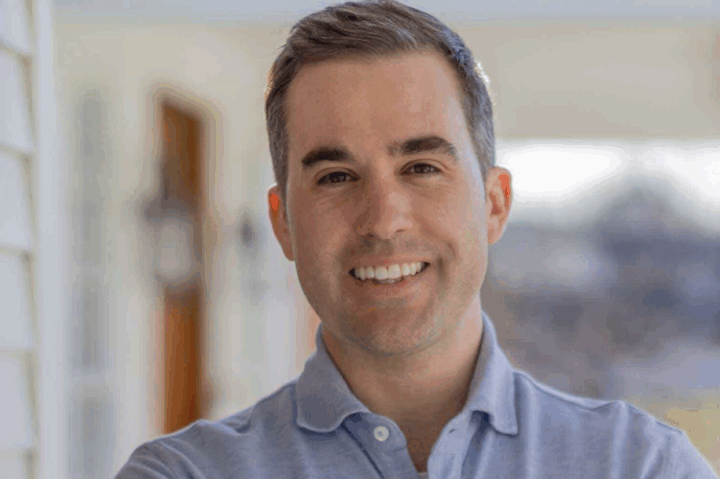
Jordan Wood
As Maine Democrats jump at the chance to replace Graham Platner on the ballot against Sen. Susan Collins (R-ME), one of the issues where candidates are staking their claim early is U.S. foreign policy — and Israel and Gaza in particular.
Jordan Wood, a former chief of staff to Rep. Katie Porter (D-CA), shared his views on the U.S.-Israel relationship with Jewish Insider on Thursday. He entered the race after placing third in last month’s congressional primary to replace retiring Rep. Jared Golden (D-ME).
He told JI that he considers Israel “our strongest ally in the Middle East” but that its government must be reined in.
“The United States should absolutely have a cooperative relationship with Israel, and I want that relationship to work. But a real partnership is not a blank check,” said Wood. “It comes with honesty and accountability. The United States has enormous leverage with the Israeli government, and we’ve been refusing to use it.” He pledged to “push America to actually use that leverage to stop the genocide in Gaza.”
Wood spent a decade in Washington as a political staffer, with stints as a vice president at End Citizens United and executive director at a pro-democracy nonprofit.
Shortly after announcing his campaign, he said in his first official statement that he would not accept support from AIPAC. In a post on X hours later, he said that the U.S. “can’t continue to fund Israel’s genocide in Gaza,” and that he would support the Block the Bombs Act.
Still, he told JI, he believes that “Israel is our strongest ally in the Middle East.”
“But there’s a difference between the Israeli people and the Netanyahu government, and nothing about self-defense justifies waging a war without limits,” said Wood. “Starving children and flattened hospitals don’t make Israel safer, and they don’t make America safer.” He referred to the family members of the Israelis taken hostage after Oct. 7, many of whom protested in Tel Aviv for two years, and said “they deserve leaders, in Israel and in America, with the courage to deliver the peace they’ve been asking for.”
Wood said Hamas should have no role in governing Gaza and called for the group to disarm. “The Oct. 7 terrorist attack was a horrific crime that shocked the world’s conscience,” said Wood.
Despite his pledge to eschew any support from AIPAC, he said that AIPAC supporters are still welcome in the party, even as he said AIPAC’s “agenda is not aligned with our values.”
“Jewish Democrats, and Democrats who care deeply about Israel’s security, are part of this party and always will be,” said Wood. “What’s not welcome is AIPAC’s agenda, which demands unconditional support for the Netanyahu government’s genocide in Gaza no matter the cost in innocent lives.”
Candidates vying for the Democratic nomination in Maine are largely pledging to oppose arms sales to Israel and reject AIPAC — but several have yet to say where they stand
Joe Raedle/Getty Images
Democratic U.S. Senate candidate Graham Platner and Troy Jackson stand together during a “Fighting Oligarchy” tour stop at the Collins Center for the Arts on the University of Maine campus on May 24, 2026 in Orono, Maine.
The mad dash to replace Graham Platner as the Democratic Senate nominee in Maine is coming together so quickly and haphazardly that one potential replacement, Nirav Shah, is taking stickers from his failed gubernatorial campaign and cutting off the “for governor” line below his name before handing them to supporters.
Much is still in flux about the process to replace Platner, who dropped out of the race on Wednesday two days after being accused of rape by a former romantic partner. His potential successors aren’t jockeying for the public’s approval — they’re angling for the support of the Maine Democratic Party, which voted on Wednesday, before Platner even announced his resignation, to hold a statewide nominating convention to tap his replacement. The MDP said it would share more in the days to come about the process, which according to state law would have to be completed by July 27.
Many of the candidates now seeking to succeed Platner on the general election ballot are commending the populist movement he built and looking to capitalize on it. Less than 24 hours into the contest, some had already made clear they will adopt a platform much like Platner’s when it comes to Israel — seeking to end U.S. weapons sales to the country and shunning donations from AIPAC — while others are remaining mum on that topic.
Shah, who served as the director of the Maine Centers for Disease Control and Prevention during the COVID-19 pandemic, said this week that he would support a full arms embargo against Israel, that he believes Israel’s actions in Gaza amount to genocide and that he would refuse AIPAC support. He finished second in the gubernatorial primary last month.
One contender who seems poised to rack up support from the party’s left flank is Troy Jackson, the former president of the Maine Senate. He placed third in last month’s gubernatorial primary, and earned the endorsement of Sen. Bernie Sanders (I-VT) and the Maine chapter of Democratic Socialists of America in that race. Jackson was one of Platner’s biggest boosters and appeared with him at several campaign rallies.
Our Revolution, the Sanders-aligned advocacy organization, has already endorsed Jackson’s Senate campaign, along with Rep. Ro Khanna (D-CA) and far-left, antisemitic streamer Hasan Piker.
In a post on X on Thursday, Jackson accused Israel of committing genocide in Gaza, saying that “anybody with eyes” would agree, and pledged to “never vote in favor of U.S. taxpayer-funded military aid to Israel.” His team did not respond to a request for comment.
Jordan Wood, a former chief of staff to Rep. Katie Porter (D-CA) who placed third in last month’s congressional primary to replace retiring Rep. Jared Golden (D-ME), said in a Thursday statement announcing his Senate run that he would not accept money from “corporate PACs and AIPAC.” He said in a post on X that the U.S. “can’t continue to fund Israel’s genocide in Gaza,” and that he would support the Block the Bombs Act.
In a statement to Jewish Insider on Thursday, Wood added some nuance to his views: “Israel is our strongest ally in the Middle East,” Wood said via a spokesperson. “But there’s a difference between the Israeli people and the Netanyahu government, and nothing about self-defense justifies waging a war without limits. Starving children and flattened hospitals don’t make Israel safer, and they don’t make America safer.” He also stated that “Hamas must disarm, and it can never be allowed to govern Gaza again.”
Wood reiterated that he will not accept support from AIPAC but said AIPAC supporters are still welcome in the Democratic Party.
“Jewish Democrats, and Democrats who care deeply about Israel’s security, are part of this party and always will be,” he said. “What’s not welcome is AIPAC’s agenda, which demands unconditional support for the Netanyahu government’s genocide in Gaza no matter the cost in innocent lives.”
Paige Loud, a 29-year-old social worker who placed fourth in the same congressional primary as Wood, ran an anti-Israel campaign and claimed that Democrats lost the presidency in 2024 “because of our lackluster stance on the genocide that’s happening in Gaza right now.” Her campaign website says she is committed “to human rights, sovereignty, and self-determination everywhere — from Palestine to Iran, Ukraine, Venezuela, and Greenland.”
Shenna Bellows, Maine’s secretary of state and a former state senator, entered the race on Thursday afternoon. She espoused a similarly populist message to Platner, pledging to take on billionaires and corporations, but stayed away from mentioning the Middle East or AIPAC in her opening salvo. A spokesperson for Bellows, who also ran for governor in last month’s primary and placed fourth, did not respond to a request for comment.
Bellows served as executive director of the Holocaust and Human Rights Center of Maine from 2018 to 2020, an experience that she still refers to regularly. In a campaign video from International Holocaust Remembrance Day, she said one way to remember the Holocaust is as a story of “resistance, of communities coming together to say no to antisemitism, xenophobia, racism, homophobia,” and said that Americans must speak out “against any othering and dehumanization of our friends and neighbors.”
One unorthodox candidate is Dan Kleban, the founder of Maine Beer Company, a brewery in Freeport. He was briefly a candidate in the Senate primary last year, but dropped out early and endorsed Maine Gov. Janet Mills, the establishment favorite who dropped out of the race in April. He reentered the race on Wednesday and said in a Substack post that he’s “had enough meddling from Washington establishment insiders and New York City consultants trying to dictate who represents us,” ostensibly a dig at Platner’s own political consultants.
Asked on CNN this week if he considered Israel guilty of genocide, Kleban called the situation in Gaza an “absolute tragedy” and said he would support placing conditions on U.S. arms sales to Israel, but did not use the term genocide. Kleban told Politico in October that he would not have supported Sanders’ resolution to block arms sales to Israel.
“I believe Israel has a right to defend itself. I don’t think that we solve the horrific humanitarian crisis in Gaza by disarming Israel and exposing them to harm,” Kleban said at the time.
While Platner and Mills were the main candidates running for Senate, a third, David Costello — a former senior official in Maryland’sMaine’s Department of the Environment who got 8% of the vote in last month’s primary — is now running again. He said during the campaign that Israel, after the Oct. 7 attacks, “not only had a right but an obligation to attempt to crush Hamas.” But, he argued, they did not do so surgically, and said Israel’s conduct has been “indefensible.” He said he would oppose offensive weapons sales to Israel.
One possible wild card is state Rep. Valli Geiger, who has said she is considering entering the race. Geiger, who in the past defended Platner’s treatment of women, stuck by him until the end. “I will not throw Graham under the bus, but neither will I slander or accuse Ms. [Jenny] Racicot [Platner’s accuser] of anything more than telling the truth as she experienced it. I acknowledge the pain on all sides and offer compassion on all sides,” Geiger wrote on Facebook.
She has said little publicly about Gaza, but shared Facebook posts criticizing Israel, including one in April that listed Prime Minister Benjamin Netanyahu as someone who, like President Donald Trump and Russian President Vladimir Putin, harbors “delusions of grandeur.”
The Maine Democrat, who won his primary in June, had been dogged by controversy for months before a rape allegation finally cost him his political allies
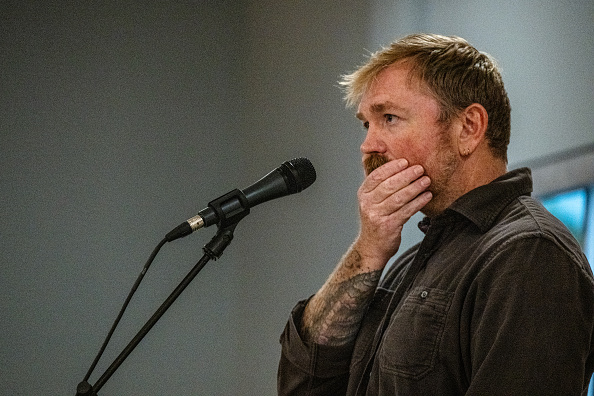
Photo by Laura Brett/Getty Images
Democratic U.S. Senate candidate Graham Platner speaks to voters at a town hall on June 7, 2026 in Portland, Maine.
Maine Senate candidate Graham Platner, the scandal-plagued progressive insurgent, announced on Wednesday evening that he plans to drop out of the race amid intense pressure, two days after a former romantic partner accused him of rape.
Even as he announced his withdrawal, Platner remained defiant, claiming that the allegations against him were a conspiracy aimed at forcing him out of the race.
The sexual assault allegation by Jenny Racicot, who shared the details of the incident with Politico, followed months of controversies — including allegations of domestic abuse — that Platner withstood with the backing of top Democrats, including Sens. Elizabeth Warren (D-MA) and Bernie Sanders (I-VT) and, after the primary, Senate Minority Leader Chuck Schumer (D-NY). He lost the support of his political allies after the report was published on Monday.
Even before that, Platner had been dogged by controversy for months. Last October, Platner acknowledged that he had a tattoo of a Nazi symbol known as a Totenkopf for nearly two decades.
He denied knowing what the symbol meant, but a past acquaintance told Jewish Insider that Platner was aware of its Nazi association. Another former romantic partner, Lyndsey Fifield, who accused Platner of domestic violence, shared text messages with the New York Times showing she had informed friends of the Nazi symbol months before it became public knowledge and said he and his Marine colleagues had chosen the symbol deliberately.
In Reddit posts, Platner regularly used slurs, criticized sexual assault victims and praised Hamas’ tactics during the terror group’s 2014 war against Israel.
In his announcement, Platner continued to deny the sexual assault allegation, claiming that “large forces,” the “corporate media” and the “political establishment” are conspiring against him — specifically timed in order to force him off the ballot before the drop-out deadline next week.
“We live in a political system that is not built for normal people,” Platner asserted. “It is a system that is built structurally to make sure that movements like ours cannot flourish, that if they begin to succeed, they can be crushed. … We did it the way that we were told we are supposed to make change, and we won, and now they are not going to let us have it, not if it’s me.”
He said he’s leaving the race because “those in power … are using these allegations as an excuse” to block his ability to fundraise, access voter data and otherwise campaign.
Platner insisted he was not attempting to influence the process to replace him on the ballot — a claim disputed by the Maine Democratic Party and numerous news reports. He said that the process “needs to be open, transparent and democratic” and not shaped by “party apparatchiks” or party leadership in Washington.
He also said he “intend[s] to file my paperwork to withdraw,” indicating he had not yet actually done so.
In his statement, Platner also referenced his repeated claim that Israel committed genocide in Gaza, a charge that had become central to his campaign.
“All we were asking for was healthcare, was to end the genocide, to use our taxpayer dollars at home to uplift our communities, instead of waging war overseas,” Platner said.
Shortly before Platner’s announcement, the Maine Democratic Party’s state committee members met and voted to hold a nominating convention to choose a new nominee should Platner withdraw from the ballot. Party leaders said they’d disclose further details about the process “soon.”
Media reports indicate that county committees would be charged with selecting 500 to 600 total delegates for the convention.
In a text message to supporters on Wednesday, Platner’s campaign manager claimed that the Maine Democratic Party has been coordinating behind closed doors with the Democratic Senatorial Campaign Committee to cut Platner’s camp and supporters out of the nominating process.
Platner entered the Senate race to challenge Sen. Susan Collins (R-ME), a five-term incumbent, last August. From the beginning of the race, he touted his bona fides as a veteran who served in Iraq and Afghanistan and positioned himself as an anti-war candidate. He has blamed his past conduct on PTSD and his resulting alcohol dependence.
From the beginning, Platner positioned himself as a working-class outsider taking on the establishment — including both Collins and the Democratic establishment, which was backing Janet Mills, Maine’s governor, in the Democratic primary. His viral first campaign video was produced by Morris Katz, a political consultant who had also made political ads for New York City Mayor Zohran Mamdani.
Criticism of Israel was central to Platner’s campaign. He regularly attacked AIPAC and described Collins as “bought and paid for by [Israeli Prime Minister] Benjamin Netanyahu.” Liberal Jewish groups, including the Jewish Democratic Council of America and J Street, had opted not to endorse Platner, even after Mills dropped out of the race in April. Platner handily won the Democratic primary in June. Mills did not endorse him.
Democrats saw the race as a possible pickup opportunity in a midterm election year when many voters in the purple state are disillusioned by President Donald Trump.
Numerous Maine Democrats have already announced plans or filed paperwork to take Platner’s place on the ballot, including former Maine Centers for Disease Control Director Nirav Shah, former state Senate President Troy Jackson, former House candidate Jordan Wood, former Senate candidate David Costello, Secretary of State Shenna Bellows, former House candidate Paige Loud, state Rep. Valli Geiger and brewery owner Dan Kleban.
Geiger claimed on Wednesday that she was Platner’s preferred replacement, but a campaign spokesperson denied that, though the spokesperson said he had encouraged her to run if he dropped out.
The New York City mayor, whose advisor Morris Katz also worked for Graham Platner, called on the Maine Senate contender to forfeit
Michael M. Santiago/Getty Images
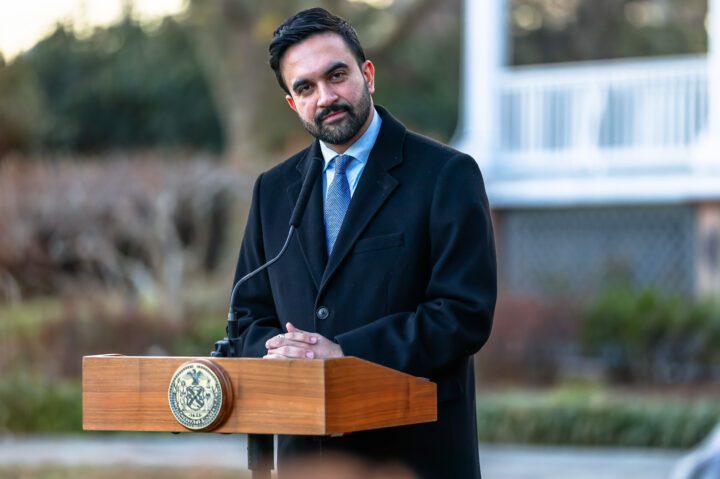
Mayor Zohran Mamdani speaks at a press conference during moving day at Gracie Mansion on January 12, 2026 in New York City.
New York City Mayor Zohran Mamdani on Tuesday joined the swelling chorus of Democratic voices demanding the party’s nominee for Senate in Maine, Graham Platner, abandon his campaign in the aftermath of a rape allegation revealed in a Politico report on Monday — a campaign the mayor’s own top political advisor helped start and steer.
Mamdani’s remarks came shortly after an unrelated event at City Hall, a day after a former romantic partner of Platner’s accused him of drunkenly entering her home and sexually assaulting her in 2021. The mayor’s nearest political aide, Morris Katz, was one of the architects of Platner’s Senate run and one of his fiercest public defenders amid prior allegations of personal misconduct and the discovery that the candidate had a tattoo of a Nazi symbol.
But Mamdani made no remarks on Katz’s role in Platner’s rise, and declined to comment on the long-term consequences for the insurgent left-wing movement the two have championed.
“I believe that it’s time for him to drop out of the race,” the mayor said of Platner. “I think the focus of today should be on the campaign coming to a close. And I think there will be many more days to have conversations for what it means beyond that.”
The 27-year-old Katz reportedly talked up congressional candidate Darializa Avila Chevalier to Mamdani, leading the mayor to endorse her in the final days of her ultimately successful challenge to Rep. Adriano Espaillat (D-NY).
It soon emerged that Avila Chevalier had bragged online about wiping her hands on the American flag, praised Soviet despots, pushed Russian government talking points and spread a conspiracy theory about COVID-19 — creating uncomfortable questions for Democratic leaders after she won the primary in the deep-blue district.
Katz also advised Democratic candidates Clare Valdez, Micah Lasher and Brad Lander in their successful primary bids elsewhere in New York City.
The unfolding situation in Maine comes amid a broader trend in American politics in which immoral or questionable behavior by one’s peers has at times been ignored or obfuscated to serve a perceived 'greater good'
(CJ Gunther/Getty Images)
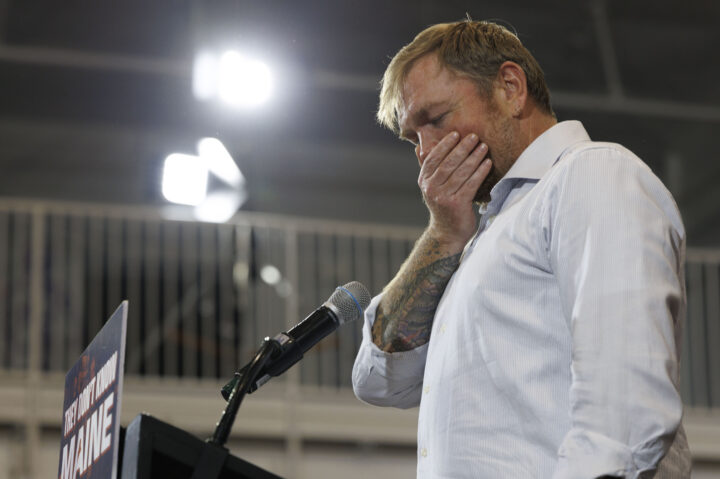
Democratic U.S. Senate candidate Graham Platner speaks at his Primary Election event on June 9, 2026 in Blue Hill, Maine.
When an ex-girlfriend of Graham Platner told Politico in a story published on Monday that the Maine Democratic Senate candidate had raped her in 2021 after entering her home while heavily intoxicated, she said she did so because the response to a recent New York Times report on Platner’s past dubious behavior had focused on discrediting Lyndsey Fifield, one of the women who featured prominently in the story, over her ties to the GOP.
Jenny Racicot, a Democrat, hadn’t wanted to go public with the rape accusation (which she had shared off-record with the Times), in part because she and Platner were largely politically aligned. “One of the reasons I didn’t come forward sooner was, the huge moral conflict that I had between supporting his politics, but not supporting him as a person,” Racicot told Politico. “My part of the story [in the NYT] was just a read-over,” Racicot said. “And the story was Lyndsey, and the accusations of her being politically motivated.”
The unfolding situation in Maine comes amid a broader trend in American politics in which immoral or questionable behavior by one’s peers has at times been ignored or obfuscated to serve a perceived “greater good” of electing a political ally despite their failing moral standards.
In recent years, both major parties have increasingly tolerated conduct that would have once been considered disqualifying — even as the #MeToo movement briefly changed the nature of the discourse. Similar arguments have surfaced across political controversies over the last decade (including against President Donald Trump), with supporters of embattled candidates and officials insisting that policy positions outweigh personal conduct and dismissing allegations as politically motivated.
In a short span of time, the 2017 rallying cry of “Believe women” gave way to “Believe women whose politics align with ours” — a mindset that extended to the widespread denial of Hamas’ sexual violence during the Oct. 7, 2023, terror attacks and against the Israeli hostages kept in captivity in Gaza.
But yesterday’s Politico report, which prompted calls from Platner’s most prominent backers — including Rep. Ro Khanna (D-CA) and Sens. Elizabeth Warren (D-MA) and Ruben Gallego (D-AZ) — for him to end his bid, may mark the point at which previous defenses of the Maine Democrat become politically untenable.
Since shortly after the launch of his campaign, Platner — a virtual unknown before last summer — has faced numerous controversies, from his tattoo of an SS totenkopf to Reddit comments praising Hamas tactics to the revelation that he exchanged inappropriate messages with numerous women despite being married. The Wall Street Journal reported last month that Platner’s vetting process — normally a weeks-long process — took place in a matter of days, expedited by Platner’s top strategist and done at a fraction of the cost of a standard background check, which likely would have flagged at least some of these issues.
Yet none of those allegations proved politically fatal — and Platner ended up winning the Democratic primary with 72% of the vote. Platner’s defenders echoed the rhetoric of many of Trump’s early backers: that the party establishment had targeted him, that the media had unfairly covered the incidents and that a candidate’s positions, rather than their personal lives, should be on the ballot.
Unlike Trump, who was weeks away from his 2016 presidential victory when the infamous “Access Hollywood” tape leaked, Platner had only recently clinched his party’s nomination after Gov. Janet Mills ended her bid. He can still be replaced on the ballot, provided he exits the race by next Monday, though any new candidate will face a much more difficult battle against Sen. Susan Collins (R-ME) in what had been the Democrats’ best hope for a pickup and control of the Senate.
Now, the question is whether American politics still has a meaningful threshold beyond which partisan leanings give way to concerns about character and ethics — or whether that threshold has simply become much higher than it once was.
Senate leaders threatened to withhold funding from the race if Platner remains the nominee, while several of his progressive backers rescinded their endorsements
Laura Brett/Getty Images
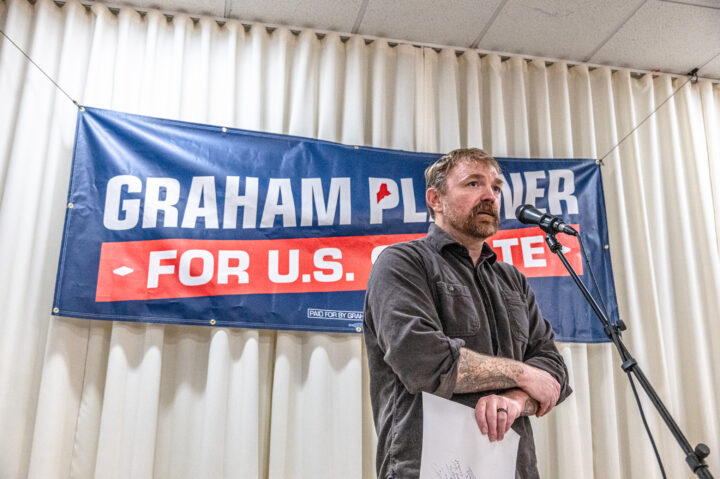
Democratic U.S. Senate candidate Graham Platner speaks to voters at a town hall at the Elks Lodge 188 on June 7, 2026 in Portland, Maine.
Democratic leaders coalesced around calls for Maine Senate candidate Graham Platner to withdraw from the race on Monday following a Politico report in which an ex-girlfriend of Platner’s accused the Democrat of sexual assault, an account the outlet backed up with her correspondence and other interviews.
Platner denied the allegation outright but said in a video statement that he’s “mindful of the political reality it will inflict” and would be “taking the time to reflect on the best path forward.” If Platner voluntarily drops out by July 13, the Maine Democratic Party would have until July 27 to pick a replacement to appear on the ballot.
Senate Minority Leader Chuck Schumer (D-NY) and Sen. Kirsten Gillibrand (D-NY), the chair of the Democratic Senatorial Campaign Committee, said in a joint statement that Platner should withdraw, and that the DSCC would not invest financially in the Maine Senate race if Platner remained the nominee.
“The allegations reported today are incredibly disturbing — violence, abuse and sexual assault are absolutely unacceptable,” Schumer and Gillibrand said. “Graham Platner needs to immediately withdraw as the Democratic nominee for Senate and allow Maine Democrats the opportunity to choose a new candidate who can defeat Susan Collins.”
Schumer and Gillibrand had offered tepid support for Platner in the wake of previous scandals he has weathered on the campaign trail.
Senate Majority PAC, the Senate Democratic super PAC, said in a statement that Platner should withdraw and that the PAC would be “redirecting resources away from the Maine Senate race.” The group said the race would be winnable “if Platner is not on the ballot.”
The Maine Democratic Party’s leadership also called on Platner to end his candidacy.
“Over the past several weeks, multiple women have made serious, credible allegations against Graham Platner. Today’s statements take those allegations even further,” party leaders said in a statement. “Maine Democratic Party leadership is calling on Graham Platner to withdraw as the Democratic nominee for U.S. Senate.”
The party leaders said it’s “essential that we refocus this campaign” on defeating Sen. Susan Collins (R-ME) and the Trump administration.
Maine Statehouse Speaker Ryan Fecteau, a Democrat, also called on Platner to drop out, saying it’s clear that he cannot win the seat.
Several prominent progressives who had previously defended and supported Platner, even through his previous scandals and controversies — including his now-covered Nazi tattoo and domestic abuse allegations — also said that the latest sexual assault allegations were a breaking point.
Sen. Elizbeth Warren (D-MA) said that there can be “no tolerance for sexual assault” and that “the best path forward is for Graham Platner to step aside.”
“I’ve been very clear that sexual assault or violence against women is a red line. These allegations are very serious and credible. Graham Platner should drop out from the race. I am withdrawing my endorsement,” Rep. Ro Khanna (D-CA) said on Monday evening.
Sen. Ruben Gallego (D-AZ) called the allegations “troubling and deeply serious” and likewise rescinded his endorsement.
Sen. Ed Markey (D-MA) said, “The allegations reported against Graham Platner are deeply disturbing and must be taken seriously. I cannot support his candidacy.”
Sen. Martin Heinrich (D-NM) similarly rescinded his endorsement and called for Platner to step aside.
Some of Platner’s prominent media boosters also said that they wanted to see him pull out of the race or otherwise criticized him.
“Platner needs to drop out ASAP — these are awful, credible allegations,” said Jon Favreau, co-host of “Pod Save America.” “It’s now abundantly clear that he just hasn’t been honest about his past and can’t be trusted as a candidate for office.”
Sens. Bernie Sanders (I-VT), one of Platner’s most prominent progressive backers, has not yet addressed the latest allegations.
The End Citizens United PAC also pulled its support for Platner, as did the Sanders-linked Our Revolution, though the group warned “the Democratic establishment: this is not your opening.” TrackAIPAC also pulled its endorsement of Platner.
Rep. Haley Stevens (D-MI), who is running for U.S. Senate in Michigan, also condemned Platner, who campaigned alongside her primary rival, Abdul El-Sayed.
“The allegations against Graham Platner are extremely troubling and completely unacceptable,” Stevens said. “There should be no room for this conduct in the U.S. Senate or any public office. Graham Platner must step aside.”
Numerous other Democratic Senate candidates followed her. El-Sayed, in a statement, did not unequivocally call for Platner to withdraw.
Speculation has already turned to who might replace Platner on the ballot, with many pointing to logger and former state Senate President Troy Jackson, a former gubernatorial candidate who finished third in the 2026 primary, as an alternative choice with a similar background and politics to Platner.
Jackson also campaigned alongside and supported Platner, something that could hinder his electoral prospects.
Jackson was endorsed by the Maine Democratic Socialists of America in his gubernatorial bid.
Former acting Centers for Disease Control Director Nirav Shah, who finished second in the primary, has also been floated as a potential replacement and has reportedly expressed interest.
Maine Gov. Janet Mills, the favored candidate of the Democratic establishment who suspended her campaign for the seat before the primary, could also see a second wind.
A recent poll also tested “Grey’s Anatomy” star and Maine resident Patrick Dempsey’s popularity in the state, as well as Secretary of State Shenna Bellows, who also ran in the gubernatorial primary; state Sen. Joe Baldacci; former House candidate Jordan Wood; Rep. Chellie Pingree (D-ME); former state Rep. Sara Gideon, who lost to Collins in 2020; former Rep. John Baldacci (D-ME); Attorney General Aaron Frey; and former Rep. Mike Michaud (D-ME).
State Sen. Baldacci said that the party “can’t handpick a replacement candidate without some process involving all Democrats” in the state.
Retiring Rep. Jared Golden (D-ME), who had been eyed by Democrats as a potential recruit for the seat, said last month that he was not interested in replacing Platner on the ballot.
The Maine senator said she learned to reject anti-Jewish hate at a young age, inspired by her World War II veteran father and her mother who quit a sorority for excluding Jewish students

Mark Makela/Getty Images
Sen. Susan Collins (R-ME) addresses the press on Nov. 6, 2022.
Sen. Susan Collins (R-ME) reiterated her criticism of Maine Democratic Senate candidate Graham Platner and accused him and his supporters of antisemitism at an Orthodox Union event on Tuesday.
Speaking at the OU luncheon, Collins called out Platner for his Nazi tattoo, pointing to accounts by former romantic partners that he had described it as a Nazi symbol despite later denying that he knew what it was. She said that even though he covered up the tattoo on the campaign trail, “the stain remains.”
Collins also referenced comments from a Platner supporter who said she did not find the Nazi tattoo disqualifying but would find an Israeli tattoo to be a deal-breaker, which Collins said she found “even more distressing.”
She also repeated comments she made a day earlier on Fox News asserting that her support for Israel remains in spite of shifting political winds.
“Our support for Israel remains as strong as ever,” Collins said, to a standing ovation. “We must all stand with Israel. In my case, I learned that lesson at an early age.”
She said that her father, a World War II veteran, taught her from childhood the need to stand against evil. Collins said that her mother also taught her to reject antisemitism, noting that her mother quit her sorority in college after it rejected a fellow student because she was Jewish.
“The friendship that I share with the people of Israel is that which our true nation shares, a friendship that is anchored by common principles, a love of liberty and the courage to defend [them],” Collins said.
The GOP senator, who chairs the Senate Appropriations Committee, also said that a major priority for her this year is to make the U.S.’ defunding of UNRWA permanent. She said that it “should not have been a close call” to cut off U.S. funding to the agency after its employees were revealed to be involved in the Oct. 7, 2023 attacks on Israel, but that she had to “fight” to add and extend that provision in recent funding bills.
Collins said that the rise in antisemitism since Oct. 7 has “revealed … the oldest hatred is not only still alive, but sicker than ever. Tragically, the prognos is has only worsened since then.”
She praised David Greene, the president of Colby College, in her home state, which she said had not seen the anti-Israel demonstrations and encampments that plagued other colleges. Greene told her that “the key is, you do not negotiate, you do not allow this to occur,” she recalled.
She said Greene had also told her that the protests at other schools were directed by radical professors, graduate assistants and outside agitators, rather than grassroots activities.
Collins said a member of her own congressional staff was assaulted at an encampment at the University of Pittsburgh for carrying an American and an Israeli flag, and that no action was taken against his attacker — something she described as a pattern under the prior presidential administration.
“I think it shows how much we need to do to make sure that our students are [equipped] with the truth,” Collins said.
Sens. Elissa Slotkin (D-MI), Andy Kim (D-NJ), Jacky Rosen (D-NV) and Kevin Cramer (R-ND) also spoke at the OU event.
Collins said her Senate opponent makes AIPAC sound like ‘some sort of evil foreign influence, and that is absolutely wrong’
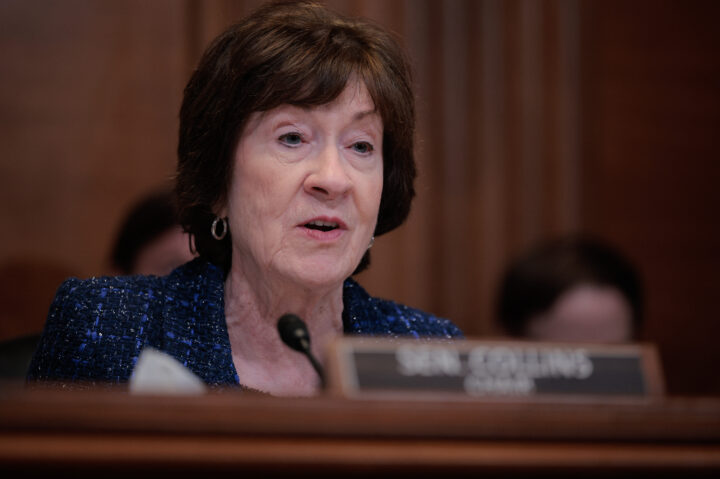
(Photo by Chip Somodevilla/Getty Images)
Sen. Susan Collins (R-ME) in the Dirksen Senate Office Building on Capitol Hill on December 9, 2025 in Washington, DC.
Sen. Susan Collins (R-ME) accused Maine Democratic Senate nominee Graham Platner of antisemitism and defended her support for Israel in a Fox News interview on Monday.
“I remain a very strong supporter of Israel, the one democracy in the Middle East, our true ally in the Middle East,” Collins said when asked about increasing hostility to Israel and AIPAC among the American public. She attributed such trends to “rising antisemitism in our country that Graham Platner certainly is part of, and has been since his high school days. That’s been a consistent theme throughout his entire life.”
WATCH: Sen. Susan Collins accused Maine Democratic Senate nominee Graham Platner of antisemitism and defended her support for Israel in a Fox News interview on Monday.
— Jewish Insider (@jewishinsider) June 22, 2026
“I remain a very strong supporter of Israel, the one democracy in the Middle East, our true ally in the Middle… pic.twitter.com/iShufv15PM
Collins pointed to Platner’s accusations of genocide against Israel and his comments praising Hamas’ tactics in a raid that killed multiple Israeli soldiers, as first reported by Jewish Insider in April, calling his activity “appalling.”
“AIPAC is made up of Americans who care deeply about our relationship with Israel,” Collins continued. “Platner makes it sound like this is some sort of evil foreign influence, and that is absolutely wrong.”
The progressive Israel advocacy group said it did not ‘have anything to share at this time’ about Maine’s scandal-plagued Democratic Senate nominee
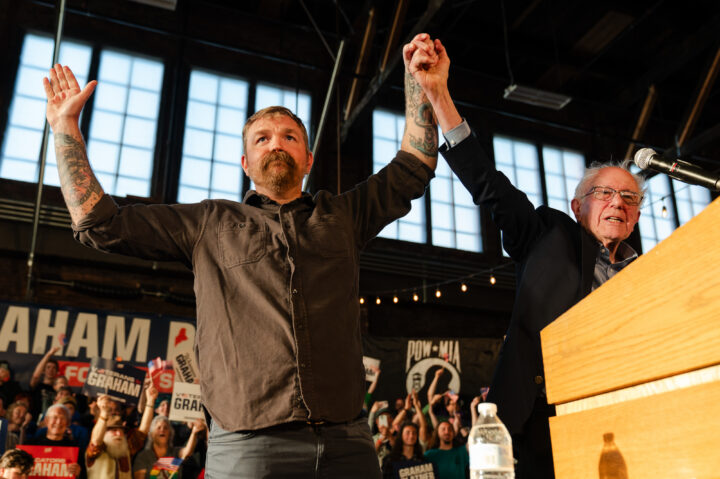
Sophie Park/Bloomberg via Getty Images
Graham Platner, Democratic Senate candidate for Maine, left, and Sen. Bernie Sanders (I-VT) during a Fighting Oligarchy event in Portland, Maine, on May 25, 2026.
J Street, the progressive Israel advocacy group, is for now withholding an endorsement of Graham Platner, the scandal-plagued Democratic Senate nominee in Maine, underscoring the extent to which even some left-wing Jewish activists appear skeptical of his insurgent campaign.
A spokesperson for J Street told Jewish Insider on Wednesday that the group did not “have anything to share at this time” about a Platner endorsement but would provide more information “if that changes.”
The spokesperson declined to confirm if J Street, which this cycle has backed a handful of Democratic Senate candidates vying for open seats or challenging Republican incumbents, had considered whether it will make an endorsement. The group had told JI in early May that it did “not currently have a position in the race.”
In a statement to JI on Thursday, the spokesperson said that it “is incorrect to frame J Street as actively withholding an endorsement from Graham Platner.”
The group “evaluates candidates and makes endorsement decisions on a rolling basis,” and its “endorsement process is ongoing,” the spokesperson said. “The timing of endorsement decisions does not reflect judgment about any individual candidate.”
J Street’s response came after Platner had clinched the nomination on Tuesday to challenge Sen. Susan Collins (R-ME), in a high-profile race Democrats see as crucial to reclaiming control of the upper chamber.
Platner won the Democratic primary decisively even as he has faced a mounting series of controversies over alleged “toxic” relationships with past girlfriends, sexual messages he sent to women while married and deleted Reddit comments expressing a range of incendiary views.
He also weathered a scandal relating to a Nazi tattoo on his chest for nearly two decades that he covered up last October. Platner has insisted that he did not recognize its imagery, despite claims to the contrary from a former girlfriend who first spoke with JI last year, shortly after he had announced his campaign.
The tattoo, along with Platner’s hostile criticism of Israel and insistent demonization of AIPAC, have stoked ongoing concerns among Jewish Democrats. Halie Soifer, CEO of the Jewish Democratic Council of America, has said the group is not ready to endorse Platner.
“We won’t support a Democrat who doesn’t represent the views and values of the vast majority of American Jews,” Soifer said in a statement in late April echoing a sense of discomfort with Platner’s candidacy felt by mainstream Jewish leaders.
JDCA had endorsed Maine Gov. Janet Mills, who suspended her campaign amid lackluster fundraising but remained on the ballot Tuesday, pulling in 19% of the vote. Platner won 72%.
Following Tuesday’s win, some prominent Senate Democrats have also declined to endorse Platner as he prepares for a bruising and expensive campaign.
J Street, which has moved to the left in recent years as it has sought to capitalize on growing Democratic frustration with Israel, is in many ways aligned with Platner on Middle East policy, including accusations that Israel committed genocide in its war in Gaza and calls to block U.S. military aid to the Jewish state that are now gaining momentum in Congress.
Still, the group has shown its intolerance for some extreme views that could be seen as antisemitic. In 2024, for instance, J Street revoked its endorsement of former Rep. Jamaal Bowman (D-NY), who was at the time fighting for reelection in a bitterly contested primary he would later lose, saying his inflammatory rhetoric on Israel had crossed a line.
Even as the group officially stays on the sidelines in Maine’s marquee Senate race, J Street’s state leader, Steven Koltai, who helped organize a Passover Seder with Platner, told the Jewish Telegraphic Agency he is “still very much” supporting the oyster farmer and former Marine in spite of recent revelations about his past.
In the statement to JI on Thursday, J Street’s spokesperson said the group “remains steadfast in our commitment to ensuring a pro-Israel, pro-peace majority in the Senate and House come January.”
Klain claimed ‘the tattoo was a skull and crossbones to remember his fallen comrades from his service in Afghanistan’ — an explanation the campaign itself has not previously offered

Kevin Dietsch/Getty Images
Ron Klain, the White House chief of staff under President Joe Biden, leaves an interview in the Rayburn House Office Building on July 24, 2025 in Washington, DC.
Ron Klain, the former chief of staff to President Joe Biden, defended Maine Democratic Senate nominee Graham Platner’s tattoo of a Nazi symbol in a comment responding to the Republican Jewish Coalition on Instagram.
The RJC, after Platner’s victory in Tuesday’s primary election, called on Senate Minority Leader Chuck Schumer (D-NY) to rescind his support for Platner. Klain, in a comment on the RJC’s Instagram post, declared, “This is just a partisan attack. The tattoo was a skull and crossbones to remember his fallen comrades from his service in Afghanistan.” Platner was deployed to Iraq, not Afghanistan, when he got the tattoo.
Platner has denied that he knew what the symbol was until late last year, when the campaign was contacted by media about it, but has not claimed, as Klain did, that it was intended to memorialize fallen comrades.
Klain, now the chief legal officer at Airbnb, has reportedly been quietly backing and advising Platner’s campaign, as well as several other prominent progressives, including New York City Mayor Zohran Mamdani, potential presidential candidate Rep. Ro Khanna (D-CA), California gubernatorial candidate Xavier Becerra, New York congressional candidate Jack Schlossberg and Sen. Ed Markey (D-MA).
But he had previously declined to comment to Politico last week on his political activities, and had otherwise not discussed his involvement with Platner.
Platner’s former romantic partner, Lyndsey Fifield, who has accused him of domestic abuse, has said that he described the tattoo to her as “my Totenkopf” and would joke about it being a Nazi symbol. She said that Platner told her that he and his Marine colleagues chose the symbol because they saw a parallel between themselves and the Nazi SS as a “death unit.”
Fifield shared text messages with The New York Times showing that she had informed friends that Platner had a tattoo of a Nazi symbol in August 2025, months before it became public knowledge.
The RJC said on X that “Klain’s pathetic rationalization of a clear Nazi symbol is a total disgrace,” and that, as a former U.S. Holocaust Memorial Museum board member, “Klain absolutely knows better.”
“Every Jewish family in America knows what the insignia of the Nazi SS — the unit that ran the death camps — looks like and Klain knows exactly what it is too,” the group said.
Following his victory in Maine’s primaries on Tuesday, some Senate Democrats who appeared wary of Platner after the domestic abuse allegations once again appear to be rallying around him.
“I think Graham showed a great deal of support in the primary, and I think … that’s going to build momentum and will assure that we win Maine,” Sen. Kirsten Gillibrand (D-NY), who chairs the Democratic Senatorial Campaign Committee, told CNN.
Plus, Lasher lashes out on Israel ‘obsession’

(CJ Gunther/Getty Images)
Democratic U.S. Senate candidate Graham Platner and his wife Amy Gertner wave to supporters as they arrive to Platner's Primary Election event on June 9, 2026 in Blue Hill, Maine.
Good Wednesday morning.
In today’s Daily Kickoff, we break down the results of yesterday’s Democratic Senate primary in Maine, and look at how senior House Democrats are suggesting they’re unaware of New Jersey congressional candidate Adam Hamawy’s controversial past. We have the exclusive on the introduction of the Jewish American Security Act by Reps. Dan Goldman and Mike Lawler, and report on a new survey from the Israel Democracy Institute that found that Israeli confidence in President Donald Trump’s commitment to Israel’s security hit a new low. Also in today’s Daily Kickoff: Rabbi A.D. Motzen, Gwyneth Paltrow and Somaliland President Abdirahman Irro.
Today’s Daily Kickoff was curated by JI Executive Editor Melissa Weiss and Israel Editor Tamara Zieve, with assists from Danielle Cohen-Kanik and Marc Rod. Have a tip? Email us here.
What We’re Watching
- We’re continuing to watch the situation in the Middle East after Iran fired at U.S. installations in Jordan, Kuwait and Bahrain overnight, following what the U.S. described as “self-defense strikes” targeting Iranian radar and air-defense sites in response to Iran’s downing of a U.S. Apache helicopter with two crew members on board (both were rescued).
- Shortly after the U.S. strikes, President Donald Trump shared a clip from an episode of “The West Wing” in which the fictional President Jed Bartlet debates “the virtue of a proportional response.”
- Somaliland President Abdirahman Mohamed Abdullahi is in the United Arab Emirates today, where he’s slated to meet with senior officials in the Gulf state. He will travel to Israel over the weekend to formally inaugurate Hargeisa’s embassy in Jerusalem.
- Back in Washington, the Senate Energy and Natural Resources Committee is scheduled to mark up the HEAL Act this morning.
- The annual Congressional Baseball Game is taking place this evening at Nationals Park, rain or shine.
- The Israel Allies Foundation is holding a belated Jerusalem Day reception this evening on Capitol Hill.
- In New York, the Conference of Presidents of Major American Jewish Organizations is holding its annual convening on antisemitism today.
- Elsewhere in New York, the Auschwitz Jewish Center Foundation is holding its annual gala tonight, where the group will honor New York City Council Speaker Julie Menin and former Israeli hostage Elkana Bohbot.
- The Democrats running in the NY-07 congressional race — Brooklyn Borough President Antonio Reynoso, City Councilmember Julie Won and New York state Assemblymember Claire Valdez — will square off tonight in a debate hosted by PIX 11.
What You Should Know
A QUICK WORD WITH JI’S JOSH KRAUSHAAR
Maine Democrats rallied behind scandal-plagued oyster farmer and military veteran Graham Platner as their Senate nominee against Sen. Susan Collins (R-ME) in Tuesday’s primary, turning to a left-wing outsider running against the political and institutional establishment as its standard-bearer for the general election.
Platner — whose controversies, including his now-covered Nazi tattoo and abuse allegations, have unnerved many Democrats — will be a political test over whether his brand of progressive populism can win over swing voters in a state critical to the Democrats’ hopes of winning back the Senate.
“In trying so hard to understand me, [the media] failed to understand that this is not about me at all. This is a movement about us, about the far too many, working far too hard and struggling far too much,” Platner said in his victory speech.
Attacking “forever wars,” Platner railed against the Trump administration’s war in Iran, and slammed Collins for “closing hospitals while using our tax dollars to destroy them halfway around the world.” (The line was an apparent attack against Israel’s targeting of Hamas terror infrastructure that was often lodged in medical facilities during the war in Gaza.)
Platner won about 72% of the primary vote despite Gov. Janet Mills remaining on the ballot, a solid enough showing amid all the controversies that should mute any calls for him to drop out of the race. In a statement on Platner’s victory, Senate Minority Leader Chuck Schumer (D-NY) and Democratic Senatorial Campaign Committee Chair Kirsten Gillibrand (D-NY) reiterated their support for the nominee: “In November, Maine voters will elect Graham Platner, and we will win a Senate majority.”
Mills, for her part, did not mention Platner at all in her statement about the election results.
SIDESTEPPING QUESTIONS
Senior House Democrats profess ignorance of Hamawy’s controversial past
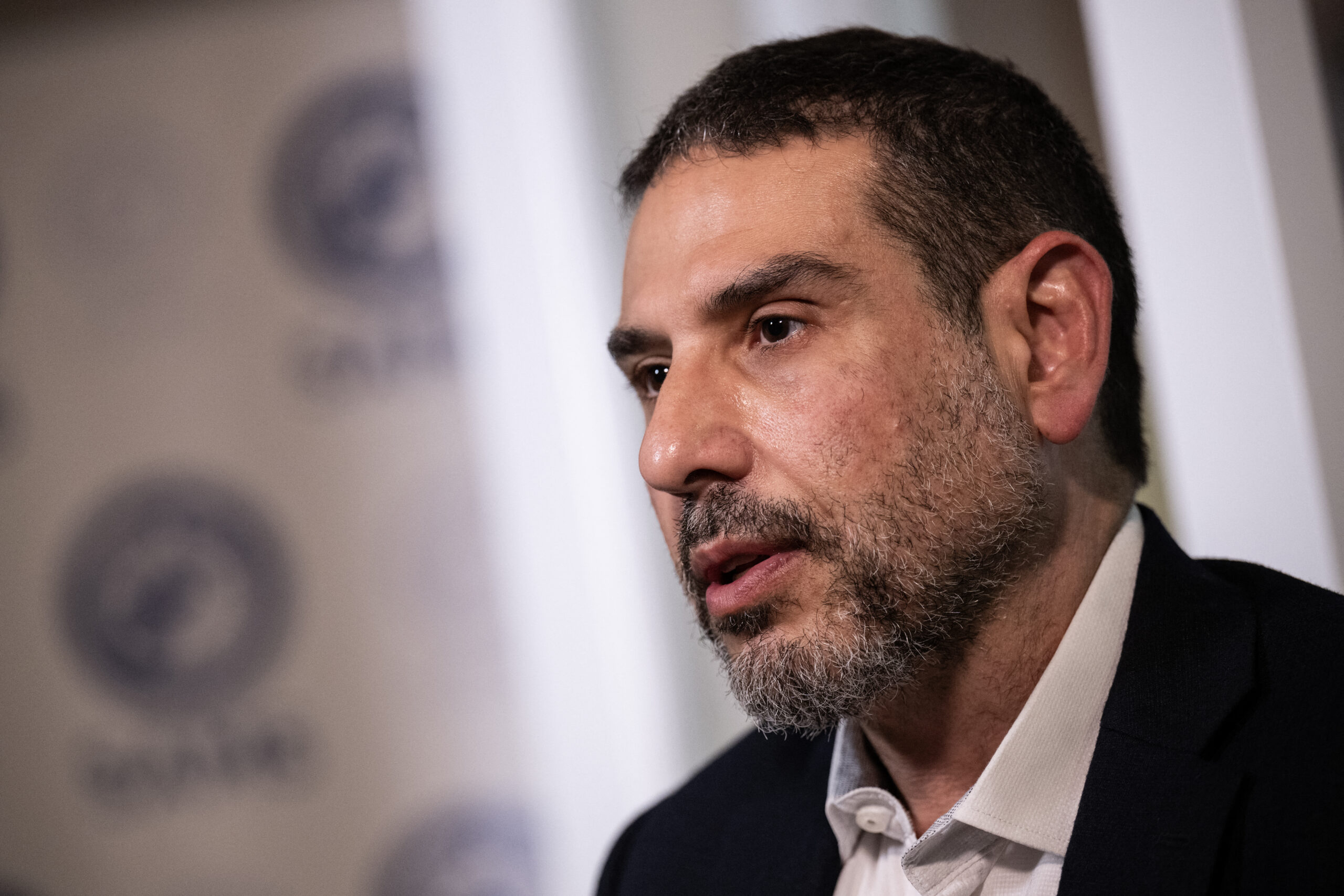
Top House Democrats are mostly avoiding questions about Adam Hamawy, the controversial Democratic nominee in New Jersey’s 12th Congressional District claiming they are unfamiliar with his background, including his association with Omar Abdel-Rahman, the terrorist mastermind known as the Blind Sheikh and his service with a nonprofit in Bosnia shuttered as an al-Qaida front group, Jewish Insider’s Marc Rod reports.
Responses: House Minority Leader Hakeem Jeffries (D-NY) sidestepped multiple questions about Hamawy in an interview on Fox News’ “The Sunday Briefing” this weekend. Reps. Greg Meeks (D-NY) and Jim Himes (D-CT), who are both in line to lead key national security committees if Democrats retake the House, told JI they did not have enough familiarity with Hamawy and his history to comment. But Rep. Greg Landsman (D-OH) joined other moderate Jewish Democrats in raising concerns, lamenting that he wants leaders, “who don’t have Nazi tattoos or close ties with convicted terrorists. It’s really not too much to ask.”
EXCLUSIVE
Goldman, Lawler lead bipartisan group of lawmakers on House version of comprehensive antisemitism bill
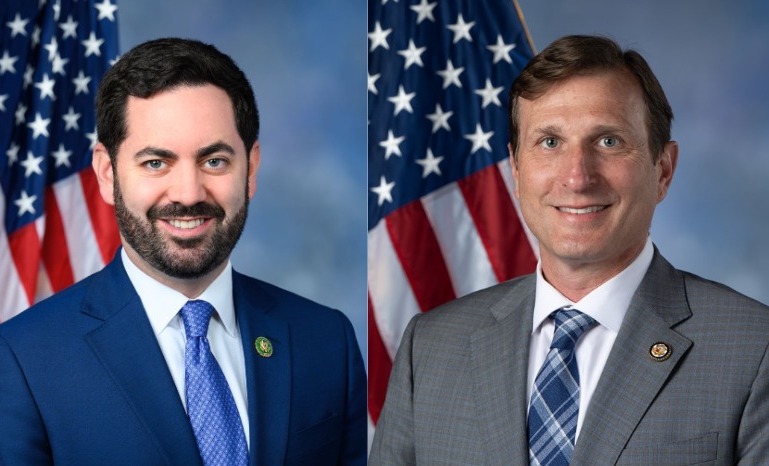
Reps. Dan Goldman (D-NY) and Mike Lawler (R-NY) are leading 28 colleagues in introducing a House version of the Jewish American Security Act, the package of antisemitism-related legislation introduced by Sens. Jacky Rosen (D-NV) and James Lankford (R-OK) last month in the Senate, Jewish Insider’s Marc Rod reports.
Notable quotable: “Words of condemnation are no longer enough,” Goldman said in a statement. “Since the October 7th attacks, there has been a systematic failure in Congress and in our communities to counter the threat posed by surging antisemitism across this country.” Goldman, a co-chair of the House antisemitism task force, said the bill would change that pattern: “Whether on campus, at synagogues, or online — the Jewish American Security Act will provide the tools necessary to help secure our at-risk communities to practice their faith without fear. American Jews cannot be asked to bear this burden alone. As Americans, we must stand shoulder to shoulder with those under siege by hate.”
Funding increase: The House Appropriations Committee approved a $40 million increase in its funding proposal for the Nonprofit Security Grant Program for 2027, boosting its recommendation to $355 million, in a Tuesday night session that stretched into Wednesday morning, JI’s Marc Rod reports.
SCOOP
Stefanik, Gillen introduce bill to reform campus antisemitism adjudication procedures
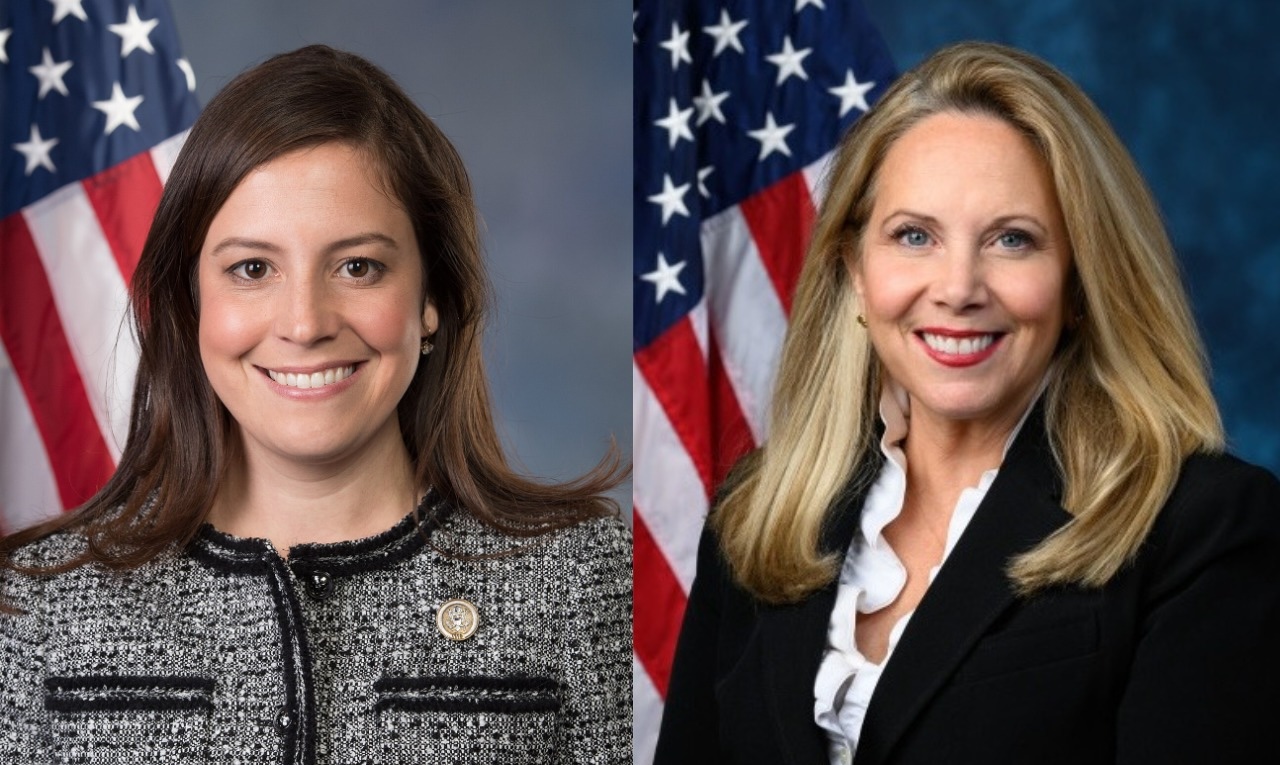
Reps. Elise Stefanik (R-NY) and Laura Gillen (D-NY) this week introduced the Student Protection and University Accountability Act, which aims to compel schools to institute clear policies for addressing antisemitism and other forms of discrimination under Title VI of the Civil Rights Act, or lose their federal funding if they fail to do so, Jewish Insider’s Marc Rod reports.
What it does: The bill requires schools to designate a specified Title VI coordinator and to develop clear procedures, including providing timely notifications to complainants, for investigating student complaints and publicize those procedures, as well as to publicly display guidance from the Department of Justice on Title VI complaints. Schools would be required to certify annually to the Department of Education that they are complying with these provisions, and would be ineligible for federal funding if they fail to comply for two years in a row.
CRISIS OF CONFIDENCE
Israeli confidence in Trump’s commitment to Israel’s security falls to new low

The share of Israelis who believe the country’s security is a primary consideration for President Donald Trump has plummeted to a new low, according to a new poll, revealing a sharp shift in public attitudes as the U.S. and Israel diverge on their strategies and ultimate goals of the war with Iran, Jewish Insider’s Matthew Shea reports.
Survey says: The survey, conducted by the Viterbi Family Center for Public Opinion and Policy Research at the Israel Democracy Institute from May 31 to June 5, found that 44% of Israelis believe Israel’s security is a central consideration for the Trump administration, a decline from the 60% recorded in March at the beginning of the Iran war. The drop was even more pronounced among Jewish Israelis, where confidence fell 23 points over the same period, from 64% to 41%.
MONEY IN MICHIGAN
UDP jumps into Mich. Senate race with $2 million ad buy supporting Stevens
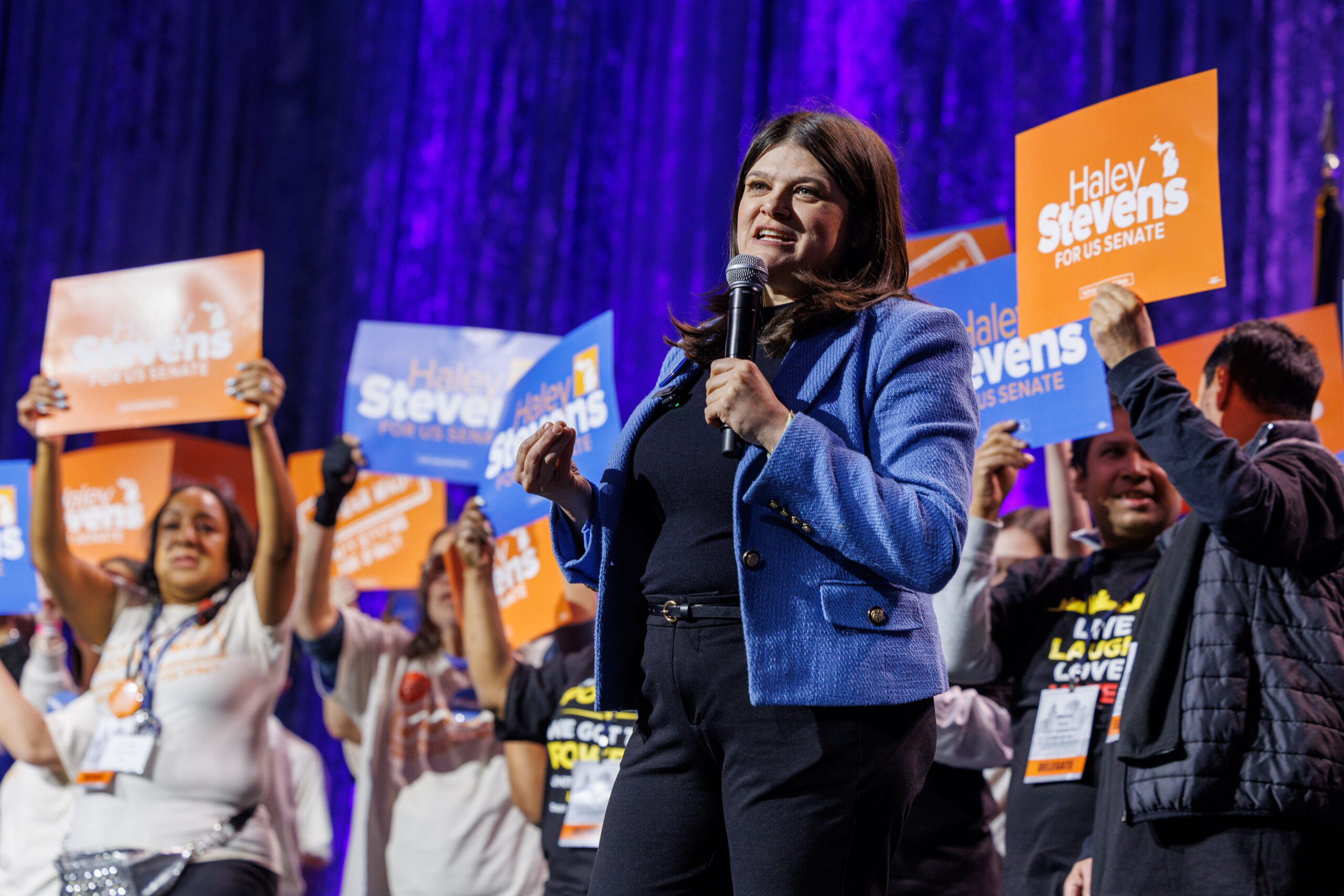
Nearl
LASHING OUT
Micah Lasher says he’s ‘exhausted’ by political ‘obsession’ with Israel

Micah Lasher, a Democratic New York state assemblymember running to fill the seat of retiring Rep. Jerry Nadler (D-NY) in Manhattan, raised concerns on Monday that “the political dialogue” in his primary “is obsessed with Israel,” a key topic of discussion in the heavily Jewish 12th Congressional District, Jewish Insider’s Matthew Kassel reports. Lasher made the remarks while participating in a candidate forum at B’nai Jeshurun, a synagogue on the Upper West Side.
Fed up: During the forum on Monday night, the moderator, New York Times opinion columnist Michelle Goldberg, asked Lasher where he stood regarding continued U.S. aid to Israel — a question that has been repeatedly posed to him and his opponents throughout the race. Lasher has said he backs funding to boost Israel’s Iron Dome missile-defense system and opposes efforts to condition U.S. aid to Israel that single out the Jewish state. Rather than answering Goldberg’s question directly, Lasher sounded increasingly frustrated as he described feeling “exhausted by the obsession on a plot of land the size of New Jersey.”
Worthy Reads
Mae Alsalama: The Associated Press’ Melanie Lidman spotlights Avichay Adraee, who is retiring next week as the IDF’s first Arabic-language spokesperson, having pioneered the position more than two decades ago. “The military’s claim to have found Hamas infrastructure under a luxury hotel in Gaza made little impact, but Adraee said his satirical video of a Hamas leader leaving a Trip Advisor review for the tunnels was widely shared. He has sent birthday messages to singers and holiday greetings to Arab influencers, even exchanging public messages with Lebanese journalists who work for Hezbollah-linked outlets. ‘We want people to be exposed to the really important and serious messages, the information we’re trying to convince them of, but if you want them to remember you, you have to be more creative,’ he said.” [AP]
The Platner Paradigm: The New York Times’ Bret Stephens suggests that Maine Senate candidate Graham Platner’s candidacy could end the “inconsistent standards selectively applied” to fit certain political biases. “If Platner can pass muster among Democratic primary voters, then the differences between him and Donald Trump are mainly of degree, not of kind. You may still agree with Platner’s politics, and if you’re in Maine, you may still think he’s a better choice than Collins. What you can no longer do, at least not with any intellectual integrity, is to use moral litmus tests to try to disqualify political figures from the opposing party. To be fine with Platner, knowing what you know now, should also require burying #MeToo in the graveyard of discarded progressive shibboleths.” [NYTimes]
Bibi’s Blind Spot: The Wall Street Journal’s William Galston observes the steep drop in support for Israel among broad swaths of Americans. “More than a decade ago, Mr. Netanyahu abandoned his country’s longstanding policy of cultivating bipartisan American support and made a hard right turn toward the Republicans. Today, Republicans over 50 are the only demographic group to give him and his country majority support, even as controversy about American policy in the Middle East rises among younger Republicans, along with anti-Jewish attitudes on the MAGA right and the radical left. Here as elsewhere, Israel’s veteran prime minister has been tactically clever but strategically foolish, leading his country into a political cul de sac.” [WSJ]
Police the Platforms: In the Washington Times, Sander Gerber and Shawn Chenoweth call for the implementation of federal reforms to address malign behavior on social media platforms. “Algorithms do not distinguish between civic contributions and coordinated manipulation by U.S. adversaries. They optimize for attention. The result is a feedback loop that brings fringe narratives into the mainstream and, ultimately, sows national division. The risks are not just to our national security. They are also commercial. The issue is not what people are allowed to say; it is whether users and advertisers know who is speaking and how much of the apparent public reaction is real.” [WashingtonTimes]
Word on the Street
President Donald Trump met with former Israeli hostage Rom Braslavski in the Oval Office on Tuesday; Braslavski, who was released from Hamas captivity in Gaza last October, had been unable to join a group of hostages who met with the president late last year, soon after the release of the remaining living hostages…
Senior officials in the Office of the Director of National Intelligence reportedly told employees to expect widespread staff cuts in the coming months as part of Trump’s directive to interim DNI Bill Pulte to further shrink the office, which initially saw layoffs following outgoing DNI Tulsi Gabbard’s confirmation last year…
Sen. Bernie Sanders (I-VT) poured cold water on suggestions that he mount another presidential bid; Sanders, who will be 87 on Election Day 2028, said at a National Press Club event that he “suspect[s] that’s not going to happen”…
The Trump administration‘s plans for a $1.5 trillion defense budget seem increasingly shaky as top Senate Republicans on the Appropriations Committee said Tuesday that they do not believe a third reconciliation bill — expected to fund a portion of the defense budget, among other matters — can pass this year, even as House Republicans say they plan to charge ahead…
Speaking at an Agudath Israel of America event on Tuesday, Assistant Attorney General Harmeet Dhillon said that the Department of Justice will soon file charges in another hate crime case targeting the Jewish community, adding that the DOJ is also looking into cases relating to antisemitic discrimination by local planning departments and commissions in the Northeast…
Progressive activist Randy Villegas, who is running to unseat Rep. David Valadao (R-CA) in California, claimed victory on Tuesday in the jungle primary over Jasmeet Bains, a moderate Democrat who had been favored by pro-Israel leaders as well as the party’s national leadership, JI’s Matthew Kassel reports…
Some Democratic lawmakers are threatening to withhold their dues to the DCCC over its boosting of Bains, which included a $135,000 ad buy…
Politico reports that Sherif Soliman, who was tapped by New York City Mayor Zohran Mamdani earlier this year to head the city’s Office of Management and Budget, may have violated ethics laws when he briefed a group of Democratic Socialists of America members on the city’s finances…
Harvard University will expand its kosher food offerings following a $100 million gift from the Zimmer Family Foundation that will go in part to bringing kosher dining options to the school’s Eliot House; Stuart Zimmer, who made the donation with his wife, Jennifer, said they hoped “to ensure that every Jewish student feels genuinely welcomed and at home on campus”…
Jewish groups in the Tampa, Fla., area are joining calls for local officials to cancel two upcoming Kanye West shows in the city, amid a wave of cancellations of the rapper’s concerts in Europe tied to his past antisemitic rhetoric…
A Pennsylvania man was sentenced to 2 1/2 years in federal prison for sending an antisemitic message to a Jewish public official in the state telling the official to “[g]o back to Israel or better yet, exterminate yourself and save us the trouble. … We will not stop until your kind is nonexistent”…
In response to the viral image of former New York City Mayor Michael Bloomberg coming face-to-face with Jose Alvarado when the Knicks guard crashed into spectators during Monday night’s NBA Finals game, Bloomberg posted on X, “Great to meet NYC’s homegrown star, @AlvaradoJose15. But next time, Jose, just call me. Let’s go Knicks!”…
Actor Gwyneth Paltrow is the celebrity face of a new advertising campaign promoting Aviv Melisron’s 51 PARK development in Herzliya, Israel…
Berlin’s Babka & Krantz Jewish bakery shuttered its flagship shop, six months after the eatery, which was opened by Polish and Israeli immigrants, closed its second location; the owners cited, in part, “constant verbal abuse” faced by employees in the aftermath of the Oct. 7, 2023, Hamas terror attacks…
New York-based real estate owners Michael and David Shabsels declared Chapter 11 bankruptcy in New Jersey last Thursday, both personally and under their umbrella group, Simad Holdings, a move that could affect thousands of Jewish campers just as the summer season is getting underway, eJewishPhilanthropy’s Jay Deitcher reports…
U.K. officials charged a fifth individual — a teenager — in connection with a March arson attack targeting Hatzola ambulances in the heavily Jewish London suburb of Golders Green…
French Foreign Minister Jean-Noël Barrot confirmed that France had banned Israeli Finance Minister Bezalel Smotrich from entering the country, saying that the far-right Israeli official “actively promotes the annexation of the West Bank … [as well as] the creation of new settlements in the West Bank, [and] the recolonization of Gaza”…
The Associated Press does a deep dive into the tensions surrounding the unknown whereabouts of a Palestinian man with Ukrainian citizenship who had escaped Hezbollah custody in Beirut after having been accused by Lebanese officials of plotting attacks in the country; the disappearance of Khaled al-Aydi comes as Hezbollah cracks down on Israeli efforts to infiltrate the terror group…
Iran’s national football federation said that U.S. officials had revoked the ticket allocation for the team’s soccer fans planning to attend the Islamic Republic’s three U.S. matches…Oscar-winning costume designer Albert Wolsky, who as a teenager fled Nazi Europe and went on to accumulate scores of film credits, including “Sophie’s Choice” and “Grease,” died at 95…
Pic of the Day

Agudath Israel of America celebrated the retirement of Rabbi Abba Cohen (fourth from left), the longtime director of the group’s Washington office, and the opening of the group’s new D.C. headquarters near the Capitol. In addition, the organization announced at Tuesday’s event that Rabbi A.D. Motzen will be taking Cohen’s place as the new head of the Washington office.
Birthdays

Actor and the older sister of comedian Sarah Silverman, Laura Silverman turns 60…Author of award-winning books about her experiences before, during and after the Holocaust, Aranka Davidowitz Siegal turns 96… Emmy Award-winning TV journalist who has worked for CBS, ABC, NBC, CNN and PBS, he is the author of 14 books, Jeff Greenfield turns 83… Musician, producer, composer and conductor for film and television, Randy Edelman turns 79… Physical therapist at the University of Pennsylvania Health System, Andrea Sachs… Cathy Farbstein Miller… Senior director of communications for CoGenerate, Stefanie Weiss… Former attorney general and then governor of New York, Eliot Spitzer turns 67… Director of strategic accounts at Pharmacy Management Solutions, Avi H. Goldfeder… Blogger and columnist for the Chicago Sun-Times, Neil Steinberg turns 66… Film, television and stage actor, Gina Gershon turns 64… President and CEO of the Jewish Institute for National Security of America (JINSA), Michael Makovsky… Israeli film and TV Actor, Avital Abergel turns 49… Veteran of nine NFL seasons as an offensive tackle, he is now the athletic director of Mira Costa High School in Manhattan Beach, Calif., Mike Rosenthal turns 49… VP of strategic partnerships at the Birthright Israel Foundation and director of community education at NYC’s Congregation Kehilath Jeshurun, Rabbi Daniel Kraus… Professor at the Johns Hopkins University’s School of Advanced International Studies in Washington, Yascha Mounk turns 44… Economic commentator on Israel’s Channel 13, Matan Hodorov turns 41… Publisher of The New York Sun, he is also honorary chairman of The Algemeiner, Dovid Efune… Actor, producer, writer and director, Joseph Paul “Joey” Zimmerman turns 40… CEO of the Jewish Community Relations Council Bay Area, Tyler Gregory… Singer, composer and entertainer in the contemporary Jewish religious music industry, Simcha Leiner turns 37… CEO of NYC-based Encounter Programs, designed to transform communal engagement with the Israeli-Palestinian conflict, Yona Shem-Tov… Belgian singer and songwriter, known as “Blanche,” Ellie Noa Blanche Delvaux turns 27…
In his victory speech, Platner railed against the political establishment and criticized U.S. wars in the Middle East
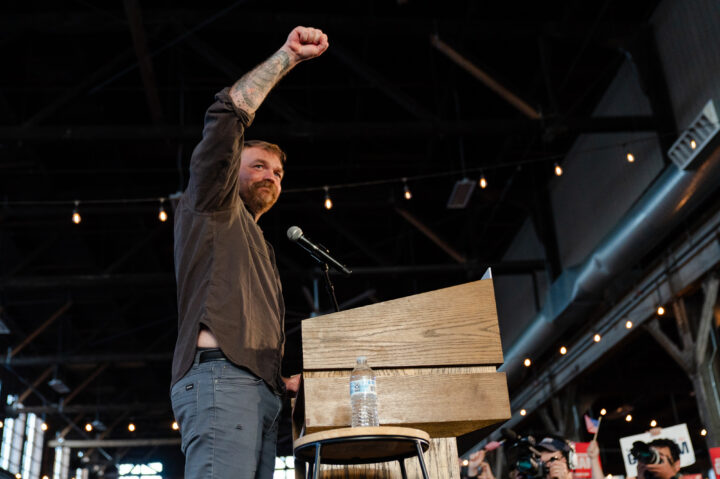
Sophie Park/Bloomberg via Getty Images
Graham Platner, Democratic Senate candidate for Maine, arrives to speak during a Fighting Oligarchy event in Portland, Maine, on May 25, 2026.
Maine Democrats rallied behind scandal-plagued oyster farmer and military veteran Graham Platner as their Senate nominee against Sen. Susan Collins (R-ME) in Tuesday’s primary, turning to a left-wing outsider running against the political and institutional establishment as its standard-bearer for the general election.
Platner — whose controversies, including his now-covered Nazi tattoo and abuse allegations, have unnerved many Democrats — will be a political test over whether his brand of progressive populism can win over swing voters in a state critical to the Democrats’ hopes of winning back the Senate.
“In trying so hard to understand me, [the media] failed to understand that this is not about me at all. This is a movement about us, about the far too many, working far too hard and struggling far too much,” Platner said in his victory speech.
Attacking “forever wars,” Platner railed against the Trump administration’s war in Iran, and slammed Collins for “closing hospitals while using our tax dollars to destroy them halfway around the world.” (The line was an apparent attack against Israel’s targeting of Hamas terror infrastructure that was often lodged in medical facilities during the war in Gaza.)
Platner won about 72% of the primary vote despite Gov. Janet Mills remaining on the ballot, a solid enough showing amid all the controversies that should mute any calls for him to drop out of the race. In a statement on Platner’s victory, Senate Minority Leader Chuck Schumer (D-NY) and Democratic Senatorial Campaign Committee Chair Kirsten Gillibrand (D-NY) reiterated their support for the nominee: “In November, Maine voters will elect Graham Platner, and we will win a Senate majority.”
Mills, for her part, did not mention Platner at all in her statement about the election results.
The most recent polls in the race, conducted as Platner’s scandals hit the news, suggest a highly competitive matchup between Collins and Platner. Maine is the only state Trump lost in the 2024 presidential election that is represented by a Republican in the Senate, but Platner’s personal baggage is complicating the party’s path to victory.
Collins, meanwhile, is one of the most politically resilient senators, winning reelection even when the political environment for her party has been less than favorable.
Platner was surrounded by mostly older women as he delivered his victory speech, a critical constituency for him to win in the general election in the state with the oldest median population, especially given the allegations of abuse towards several ex-girlfriends.
In other primary news on Tuesday, Sen. Lindsey Graham (R-SC) coasted to renomination, though he only won 58% of the GOP vote against weak competition.
In his victory speech, Graham railed against Rep. Thomas Massie (R-KY) and former Rep. Marjorie Taylor Greene (R-GA), two isolationist, anti-Israel GOP lawmakers who left or were ousted from Congress. “What did we prove tonight? That South Carolina is Trump country, not Massie country. We proved tonight that nobody gives a damn what Marjorie Taylor Greene thinks about who to vote for in South Carolina,” Graham said.
In South Carolina’s governor’s race, Lt. Gov. Pamela Evette, who was endorsed by President Donald Trump, will face state Attorney General Alan Wilson in a runoff for the nomination. Reps. Ralph Norman (R-SC) and Nancy Mace (R-SC) lagged well behind in the primary, with Mace’s fifth-place finish serving as a disappointing conclusion to her congressional career.
Most aren’t calling for him to leave the race, or throwing their support behind Gov. Janet Mills, who still remains on the primary ballot even after suspending her campaign

Sophie Park/Getty Images
Senate candidate from Maine Graham Platner speaks at a town hall at the Leavitt Theater on October 22, 2025 in Ogunquit, Maine.
Senate Democrats sounded wary of Maine Senate candidate Graham Platner after the latest revelations that he had engaged in sexual conversations with numerous women while married, but most aren’t calling for him to leave the race, or throwing their support behind Gov. Janet Mills, who still remains on the primary ballot even after suspending her campaign.
Senate Minority Leader Chuck Schumer (D-NY), who recruited Mills to run for the seat to challenge Sen. Susan Collins (R-ME) but got behind Platner after Mills dropped out, met with Platner in Washington on Tuesday and repeatedly offered a terse response when asked about Platner at a press conference, offering neither effusive support for nor criticism of the presumptive Democratic nominee.
“I met with Graham Platner today. We’re going to beat Susan Collins and take back the Senate,” Schumer said.
Asked whether he was standing behind Platner or whether Mills should restart her campaign, Schumer again said, “We’re going to beat Susan Collins and take back the Senate.” He repeated the same answer two additional times in response to subsequent questions.
Asked whether he’s still endorsing Platner, Schumer offered nearly the same line once again, while noting that he had “endorsed” Platner.
Other Senate Democrats are keeping Platner at arm’s length.
“He has to answer those questions, directly and forthrightly. They’re fair questions and that’s going to be on him to answer that and it’s going to be up to the voters of Maine to decide,” Sen. Peter Welch (D-VT) said on Monday.
Welch said that Platner’s electability is “going to depend on how he handles it.”
Welch joined several other Senate Democrats who met with Platner at the Democratic Senatorial Campaign Committee offices on Tuesday afternoon. The meeting ran for more than an hour and a half, but Platner avoided reporters while entering and exiting the building, dashing from a side exit to an awaiting car on his way out, pursued by a throng of press.
“I oppose inappropriate sexual behavior no matter who does it, but it’s up to the voters of Maine to decide,” Sen. Jeanne Shaneen (D-NH) said.
Asked if she thinks Platner can still win, Sen. Elissa Slotkin (D-MI) told JI, “I’ll work with whoever wins.”
Sens. Andy Kim (D-NJ) and Richard Blumenthal (D-CT) both said they’d been focused on other matters — the ongoing demonstrations outside an Immigration and Customs Enforcement facility in New Jersey and a trip to Ukraine, respectively — and hadn’t been keeping up with the latest on Platner.
Sen. Angus King (I-ME) declined to comment, saying he never gets involved in campaigns involving any sitting colleagues, regardless of party.
Sen. John Fetterman (D-PA), who said months ago he planned to stay out of the race but has been directly attacked by Platner several times, offered the harshest criticism of the candidate, and suggested he would be eager for a direct confrontation with him.
“I’d be happy to [meet him.] I’d love to. He’s a tough guy. When I was growing up, if someone had a Nazi tattoo, you could pretty much assume he’s a Nazi sympathizer,” Fetterman said, and referred to several of the scandals plaguing Platner’s campaign. “If you describe an American soldier, a Purple Heart recipient, as a dumb motherf***** that doesn’t deserve to live — who describes the U.S. Army as absolutely trash? Who joins a disgusting platform like Kik and puts a [topless] picture — what are you looking for? He’s expressed frustration [with] how I dress, and this a****** is on Kik and sexting to a dozen women and dressing like this.”
He told JI that his Democratic colleagues could be endangering the party’s chances of taking the seat by sticking by Platner, but said it’s ultimately their decision and that of Maine voters.
“The last time a lot of [Democrats] defended someone who was sexting and saying inappropriate things to women, that was Swalwell,” Fetterman said, referring to former Rep. Eric Swalwell (D-CA) who resigned amid a flurry of sexual harassment and assault allegations. “If they want to carry water for that, they’re entitled to that. I don’t live in Maine, I’m not a voter. Whoever Maine decides for that.”
Platner’s strongest supporters are standing firmly behind him.
Sen. Ruben Gallego (D-AZ) told JI that he is still confident that Platner can win the seat.
Sen. Bernie Sanders (I-VT), asked about the latest scandals, offered a similar response multiple times during the day on Tuesday, deflecting by discussing Republican megadonors’ spending plans in the state.
“There are some concerns that some of the wealthiest people in this country [backing] Republican super PACs are planning to spend $100 million in the state of Maine,” Sanders said. “Why do you think that Republicans super PACs controlled by billionaires want to spend a troubling amount of money to defeat Graham Platner?”
A group of people — at least one of them a spokesperson for the National Republican Senatorial Committee — gathered outside of the DSCC headquarters during Platner’s meeting chanting through a bullhorn and holding signs referencing Platner’s various scandals and, without evidence, accusing him of pedophilia.
A handful of them, including the NRSC staffer, were shirtless wearing towels wrapped around their waists, mimicking Platner’s profile photo on the messaging app Kik, where he communicated with other women.
Following the meeting with Democratic senators, Platner canceled a planned appearance with the campaign group VoteVets and left Washington, D.C. early because reporters had visited his in-laws’ home and his family’s restaurant, according to NOTUS.
‘I find that tattoo and his commentary about it to be personally disqualifying,’ Auchincloss told CNN
Bill Clark/CQ-Roll Call, Inc via Getty Images
Rep. Jake Auchincloss (D-MA) participates in the House Transportation Committee hearing on Thursday, June 27, 2024.
Rep. Jake Auchincloss (D-MA) said on Monday that Maine Democrat Graham Platner’s tattoo of a Nazi Totenkopf was “disqualifying,” weeks after Gov. Janet Mills’ departed from the Democratic primary race, leaving Platner as the party’s presumptive nominee challenging Sen. Susan Collins (R-ME).
“I find that tattoo and his commentary about it to be personally disqualifying,” Auchincloss told CNN. “I hope Maine voters agree with me. I think it would be a mistake for the Democratic Party to think that Graham Platner’s brand of the Democratic Party is what wins us durable majorities throughout this country.”
Jewish Insider reported last year that Platner had on at least one occasion identified the tattoo on his chest as a Nazi SS symbol, known as a “Totenkopf,” to a former acquaintance and had been fully aware of the tattoo and its meaning well before entering the race to replace Sen. Susan Collins (R-ME), even bragging about having it.
Platner has since covered up the tattoo and dismissed wrongdoing, claiming he had no idea the tattoo symbol was a Nazi insignia when he got it with fellow Marines while in Croatia in 2007.
Far-left Democrat Saikat Chakrabarti, a cofounder of Justice Democrats who is mounting a bid for the seat being vacated by Rep. Nancy Pelosi (D-CA), rebuked Auchincloss, writing on X, “Auchincloss is essentially endorsing Susan Collins in Maine. Absolutely no excuse for a Democrat in the House to back a Republican for Senate in a crucial swing seat. Auchincloss should be primaried. His primary election is September 1 in a safe, D+11 seat.”
Last year, Auchincloss became the first elected Democrat to call on Platner to drop out of the Senate race in Maine after news of his tattoo emerged.
Sen. Elizabeth Warren (D-MA) has campaigned with Platner, dismissing criticism of him and describing him as “my kind of man.” Sen. Chris Van Hollen (D-MD) has also defended Platner, saying “people should have second chances.”
There hasn’t been much incentive for party groups to set red lines against radicals looking to disrupt the party in lower-profile races

Spencer Platt/Getty Images
Members of the Democratic Socialists of America May 01, 2019 in New York City.
As the Democratic Party lurches left in the run-up to the midterms — and amid the rise of high-profile, far-left Senate candidates such as Graham Platner in Maine and Abdul El-Sayed in Michigan — candidates affiliated with the Democratic Socialists of America (DSA) have gradually been making inroads and positioning themselves to win nominations in several key House races.
This has happened without much protest or opposition from Democratic Party leadership. And given that the urban districts where the DSA-endorsed candidates have the most support are so heavily Democratic, there hasn’t been much incentive for party groups to set red lines against radicals looking to disrupt the party in these lower-profile races.
One of the most insidious aspects of the advocacy of many DSA chapters is the demand that its endorsees cut ties with any Jewish group that recognizes the State of Israel. Some chapters celebrated or justified Hamas’ Oct. 7 terror attacks against Israel.
“They are trying to do in America what [the Boycott, Divestment and Sanctions movement] seems to do internationally, which is to make being Jewish unacceptable in polite society,” Ron Halber, the CEO of the Jewish Community Relations Council of Greater Washington, recently said on a webinar of D.C-area Jewish leaders.
But despite the group’s radical views, DSA-endorsed candidates have a real shot at prevailing in several upcoming Democratic primaries in major cities.
Pennsylvania state Rep. Chris Rabb, one of several Democrats looking to succeed retiring Rep. Dwight Evans (D-PA) in his Philadelphia district, has the notoriety of recirculating an Instagram post blaming the Bondi Beach terrorist attack that killed 14 Jewish Australians on “Zionists,” insinuating the terror attack was a false flag. (His campaign later blamed a former staffer for reposting the item.)
Rabb, who has been endorsed by many of the leading anti-Israel progressives in Congress, also recently campaigned with antisemitic streamer Hasan Piker. His far-left views and virulent criticism of Israel has alarmed Gov. Josh Shapiro, according to Axios, and the popular Pennsylvania governor has worked behind the scenes to oppose his campaign.
Democratic sources familiar with the primary, however, suggest that any behind-the-scenes efforts aren’t having much effect in derailing the DSA candidate’s campaign. Rabb’s two leading opponents — surgeon Ala Stanford and state Sen. Sharif Street — are both mainstream Democrats and may potentially split the more-moderate vote. The primary is on Tuesday.
Next month, a similar clash between the Democratic mainstream and socialist wing of the party is taking place in New York City, where state Assemblymember Claire Valdez, who is backed by Mayor Zohran Mamdani and New York’s DSA chapter, is squaring off against Brooklyn Borough President Antonio Reynoso, the progressive establishment’s favorite.
The race, in one of the most left-wing districts in the city, which covers part of Brooklyn and Queens, will mark a major test of Mamdani’s political capital — and whether the DSA brand is more compelling to progressives than the endorsement of Reynoso by retiring liberal stalwart Rep. Nydia Velazquez (D-NY).
Reynoso, in an interview with The New York Editorial Board, proclaimed himself the underdog in the race despite boasting endorsements from organized labor, the outgoing congresswoman, state Attorney General Letitia James and the left-wing Working Families Party line. “Zohran Mamdani is a celebrity-status, inspiring figure at the levels of AOC and Bernie Sanders. He is a movement and is deeply important,” Reynoso said.
Meanwhile, in Denver, another DSA hotbed, Rep. Diane DeGette (D-CO) faces a primary threat from DSA-backed challenger Melat Kiros, a 28-year-old attorney. Kiros has made criticism of Israel a centerpiece of her campaign, accusing Israel of genocide, and she supports an arms embargo against the Jewish state. Kiros dominated DeGette at a districtwide party convention filled with activists in March, and the congresswoman has been airing ads touting her progressive record, in anticipation of a competitive June primary.
And in St. Louis, the local DSA chapter is again backing former Rep. Cori Bush (D-MO), who was one of the most extreme anti-Israel lawmakers when serving in Congress, in her attempt at a comeback against Rep. Wesley Bell (D-MO).
(The other major contest featuring a DSA-endorsed contender is next month’s D.C. mayoral primary, where Jewish groups have been alarmed by Janeese Lewis George’s rhetoric around Israel and antisemitism.)
All told, there could be at least four Democratic Socialists of America-endorsed lawmakers in the next Congress, with limited party efforts to marginalize the extremists from within. It underscores how fast the Democratic Party is evolving, and how quickly the guardrails that kept the party centered — and largely free of antisemitism — are falling out of place.
Former U.S. Ambassador to Japan Rahm Emanuel, on the Maine Senate candidate: ‘If he's the Democratic nominee, I'm going to help him if he wants my help, absolutely’
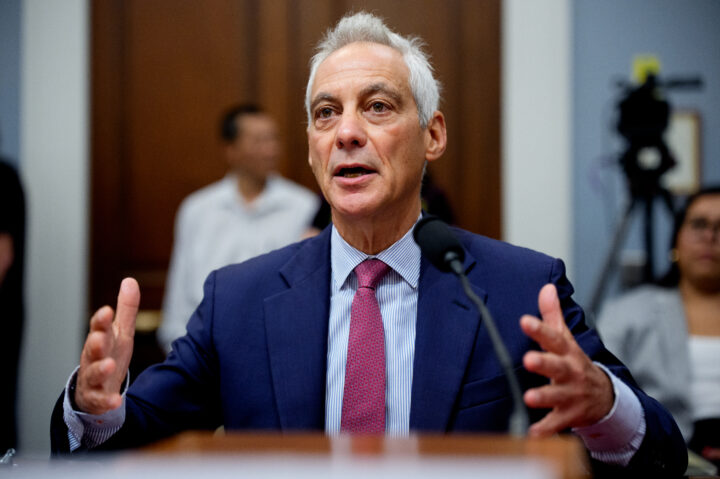
Andrew Harnik/Getty Images
Former U.S. Ambassador to Japan Rahm Emanuel speaks on Capitol Hill on July 23, 2025 in Washington, DC.
Former U.S. Ambassador to Japan Rahm Emanuel, a likely Democratic presidential candidate, on Friday signaled his backing for Maine Democratic Senate candidate Graham Platner, who has drawn scrutiny over his far-left views and decades-old Nazi tattoo that he recently covered up.
“I would hope at this point in the process he understands what a Nazi symbol is,” Emanuel said. “He’s going to have to make his way. And the Democrats — he’ll be the nominee — should support his candidacy,” Emanuel told CNN’s Kasie Hunt.
Asked by Hunt if he was personally backing Platner, Emanuel said, “If he’s the Democratic nominee, I’m going to help him if he wants my help, absolutely.”
“You have to put an end to Donald Trump,” Emanuel added.
Emanuel, who served as mayor of Chicago from 2011-2019, later quipped about a meeting with New York City Mayor Zohran Mamdani, a vocal critic of Israel, after Mamdani’s election as mayor. “I told him when I first met him, I said, ‘I don’t know who’s going to hate this meeting more, my rabbi or AOC,’ but we had an honest meeting … an honest discussion about what to face as mayor,” he said.
Platner is now the expected Democratic nominee against Sen. Susan Collins (R-ME) after the Democratic establishment’s favored candidate, Maine Gov. Janet Mills, dropped out of the race on Thursday. Mills, despite holding a strong political track record, consistently trailed Platner in primary polling since launching her campaign.
Over the weekend, Platner’s campaign also drew support from another unexpected voice: far-right podcaster Tucker Carlson.
In a lengthy interview with The New York Times, Carlson said he “appreciated” Platner’s foreign policy views, and plans to meet with the candidate. “I appreciate how different [his foreign policy views] are from everybody else in his party,” Carlson said.
Democratic leadership, who had backed the Maine governor in the primary, voiced tepid support for Platner moving forward
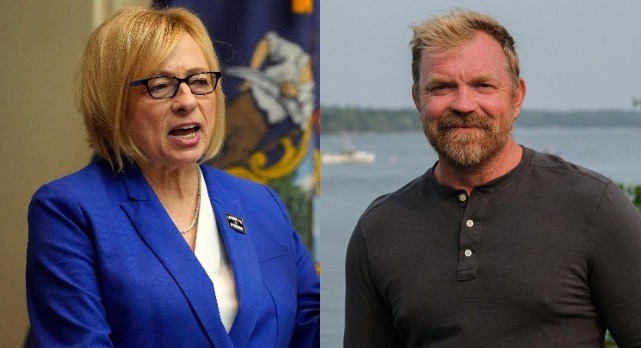
Robert F. Bukaty/AP/Graham Platner campaign
Gov. Janet Mills and Graham Platner
Maine Gov. Janet Mills said on Thursday that she was suspending her primary campaign to challenge Sen. Susan Collins (R-ME), clearing the path for her Democratic primary rival, Graham Platner, to secure the party’s nomination.
“While I have the drive and passion, commitment and experience, and above all else — the fight — to continue on, I very simply do not have the one thing that political campaigns unfortunately require today: the financial resources,” she said in a statement.
Her sudden exit, with just over a month until the June primary, marks a stunning development in the closely watched race that Democratic leadership has regarded as one of its best pick-up opportunities this cycle as the party seeks to reclaim the majority in the upper chamber.
Mills, a moderate two-term governor who had been favored by the Democratic establishment, struggled to gain traction in the race against Platner, a far-left political newcomer who had continued to maintain a commanding polling and fundraising lead, even as he has faced ongoing scrutiny for his extensive record of incendiary statements and personal controversies.
Since he entered the primary last year, Platner, a 41-year-old oyster farmer and former Marine, has weathered criticism over a now-covered Nazi tattoo whose imagery he claims not to have recognized until recently as well as a series of past online comments in which he praised Hamas’ tactics during a violent raid into Israel in 2014, among other posts that have been surfaced amid his campaign.
He has otherwise drawn blowback for boosting extremists — telling a podcast host who has spread antisemitic conspiracy theories, for instance, that he was a “longtime fan” of his show.
In a statement, Senate Minority Leader Chuck Schumer (D-NY) and Sen. Kirsten Gillibrand (D-NY), the Democratic Senatorial Campaign Committee chair, called Mills “a formidable governor who has broken barriers and never hesitates to stand up to bullies to fight for Maine,” adding that they “will work with the presumptive Democratic nominee Graham Platner to defeat” Collins, viewed as among the most vulnerable Senate Republicans up for reelection.
The statement, hardly a ringing endorsement of the now-presumptive nominee in a crucial battleground state, underscored the uncomfortable nature of their relationship with Platner, who has been a vocal critic of the Democratic establishment and its support for Israel.
Platner, casting himself as a populist, had won an early endorsement from Sen. Bernie Sanders (I-VT) that helped him rise to prominence at the beginning of his campaign, and has continued to claim backing from a handful of other national progressive leaders such as Sen. Elizabeth Warren (D-MA) and Rep. Ro Khanna (D-CA).
Nirav Shah, a Democrat running for governor of Maine, also announced he was endorsing Platner on Thursday after Mills had bowed out of the primary.
Mills, whose comments did not mention Platner, has not indicated if she will back her now-former rival.
In a statement, Platner voiced gratitude for Mills’ “service to Maine” and said he looked “forward to working with her between now and November” to defeat Collins.
Republicans, for their part, have seemed particularly eager to go up against Platner, whose vulnerabilities the Senate GOP campaign arm had been aggressively highlighting even before Mills ended her campaign.
“Chuck Schumer and Senate Democrats just coronated a phony who is too extreme for Maine,” Sen. Tim Scott (R-SC), the National Republican Senatorial Committee chair, said in a statement on Thursday. “Susan Collins has always put in the work for her constituents and delivered. Washington Democrats always fall short in Maine and will again, because they just nominated a dishonest radical.”
Collins, in comments to a CNN reporter on Thursday, praised Mills but would not weigh in on Platner as she prepares for what is now expected to be a bitterly contested general election.
Warren lauded Platner’s economic populist message rather than address his extremist rhetoric

Brian Stukes/Getty Images for Vanderbilt Policy Accelerator
Sen. Elizabeth Warren (D-MA) speaks during the Vanderbilt Policy Accelerator (VPA) Luncheon at Eaton DC on April 22, 2026 in Washington, DC.
Sen. Elizabeth Warren (D-MA) dismissed criticism of Maine Senate candidate Graham Platner’s scandals on Wednesday, after calling him “my kind of man” at his rally in Maine on Saturday.
“You care about character,” CNBC host Sara Eisen said to Warren. “This is a guy that had a chest tattoo with a Nazi symbol — OK, he apologized for it. It’s a guy that reportedly wrote that people concerned about rape should take some responsibility for themselves and not get so effed up that they wind up having sex with someone they don’t mean to. He praised military tactics used by Hamas, reportedly, in comments online when they were murdering Israeli soldiers. So I’m just curious why you think he’s ‘your kind of man’?”
Warren responded, “So, as you rightly point out, he has apologized. He’s out meeting with the people of Maine every single day so they can evaluate not who Graham Platner was but who Graham Platner is today.” She went on to say her comment was in reference to her experience reading an interview of Platner’s where he condemned the lack of consequences for bankers during the 2008 financial crisis.
Eisen said, “OK, well, ‘I dig it,’ next to a video of a bunch of terrorists killing five soldiers?” referring to a Jewish Insider report unearthing Platner’s 2014 Reddit comments. “I don’t know, I mean, you guys want to be the party of inclusivity, right?”
“I want to be the party that stands up for hardworking people,” Warren answered. “I want to be the party that is transformative of an economy that right now is hip deep in corruption … and that’s what Graham Platner wants to do and I’m there to stand with him and to help in that fight.”
‘The guy that’s going to win the primary in Maine has a Nazi tattoo on his chest and now that’s no problem for a lot of voters. … That’s crazy,’ Fetterman told CNN
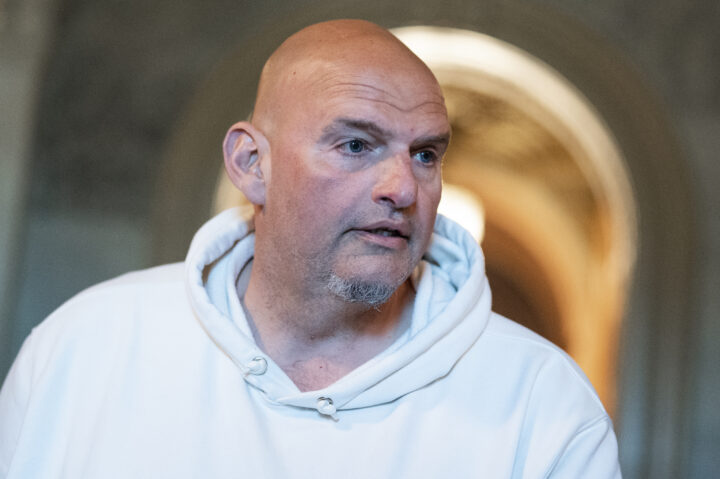
Tom Williams/CQ-Roll Call, Inc via Getty Images
Sen. John Fetterman (D-PA) is seen after the Senate luncheons in the U.S. Capitol on Tuesday, April 14, 2026.
Sen. John Fetterman (D-PA) said on Friday that the Democratic Party “absolutely” has an issue with rising antisemitism, calling out the party’s embrace of candidates including Graham Platner in Maine and Abdul El-Sayed in Michigan while criticizing the recent progressive push to cut off defensive aid to Israel.
The Pennsylvania senator made the comments after being asked on CNN’s “The Arena with Kasie Hunt” if he believed the Democratic Party has a problem with antisemitism. Fetterman argued that the growing support for both candidates in their respective primaries was indicative of a tolerance for antisemitism within the party.
He pointed to Platner surviving the controversy surrounding his Nazi tattoo and Jewish Insider’s reporting in recent days that the first-time candidate repeatedly praised Hamas’ tactics in a 2014 Reddit forum that shared video of the terrorist group killing several Israeli soldiers.
“I mean, the guy that’s going to win the primary in Maine has a Nazi tattoo on his chest and now that’s no problem for a lot of voters,” Fetterman said. “I don’t know why. That’s crazy. And now, I mean, we know he knows, he knew what that was. I mean, if you’re back over 12, 13 years, cheering about the death of Israeli soldiers, I mean, you clearly have a serious issue, and the left has a serious issue with antisemitism.”
“It was just released that he was praising and celebrating a video online where Hamas was beating and torturing Israeli soldiers to death,” Fetterman said, referring to Platner.
Fetterman also made note of El-Sayed’s lead in one recent primary poll despite his decision to campaign alongside antisemitic streamer Hasan Piker.
“The guy in Michigan, he’s leading now in that race, as my party becomes more and more hostile to Israel,” Fetterman said. “They’re just palling around someone like Hasan Piker, you know the guy that, absolutely, I mean, he absolutely is proud to cheer for Hamas, loves Hamas.”
“The Democrats are proud to stand with him and campaign with him,” he added. “Go ahead, try to win Pennsylvania and campaign around Hasan Piker, or saying, ‘Yeah, America deserved 9/11’ or ‘Hamas is 1,000% better than Israel’ or ‘I don’t care about the rapes and for all this other things.’ We have a serious problem with my party.”
Fetterman, one of most vocal pro-Israel Democrats in the Senate, told Hunt that Israel is “becoming more and more toxic for a Democrat to support,” pointing out that “80% of Democrats view Israel in a negative way.” He specifically condemned the uptick in progressive and far-left voices coming out against continued defensive aid to Israel.
“You have people like [Rep. Alexandria Ocasio-Cortez] voting against Iron Dome, the technology that prevents tens and tens of [thousands] of Israeli deaths from the rockets that those cowards fire at civilians,” he said.
Fetterman went on to criticize members of his party for opposing the war in Iran, saying that there were other Democrats who felt the same as him in supporting the effort but were not speaking out because doing so would be “politically toxic.”
“Every single Democrat has already been on record saying, ‘We can‘t ever allow Iran to acquire a nuclear bomb,’” Fetterman said, specifically naming former Vice President Kamala Harris and former Secretary of State Hillary Clinton and “everyone that’s run for president” who said “we can’t ever allow that to happen.”
“Then, [President Donald] Trump happened to do something about that to prevent that. That’s why I support that,” he continued. “I’m not the only Democrat who supports this, but I’m the only Democrat that’s willing to stand up and say it’s the right thing because I know how politically toxic it is as a Democrat to support this.”
Fetterman surmised that he is the “only Democrat … perhaps left in the entire Congress” who will say publicly that recent U.S. military action in Iran “was necessary” because doing so “contradicts every single thing that every Democrat has said” about how “we can’t ever allow Iran to acquire a nuclear bomb.”
Fetterman went on to criticize the Democratic lawmakers who voted for the recent war powers resolutions in the House and Senate, arguing that their opposition to the war has been “celebrated” by Iranian leadership and calling their response to the conflict “absurd.”
“Iran has celebrated this,” Fetterman said of the broad Democratic opposition. “A lot of people in my party and a lot of people in the media has turned Iran into the underdog. They’re like Rudy” — making a reference to the 1993 sports movie — “and putting them up on their shoulders and cheering for Iran at this point.”
Asked to respond to Sen. Elissa Slotkin’s (D-MI) statement that “being pro-Israel today is not about simply supporting the political or military agenda of Prime Minister [Benjamin] Netanyahu, just like being pro-American should not be equated with loyalty to President Trump,” Fetterman argued that her comments on her votes for Sen. Bernie Sanders’ (I-VT) measures on Thursday blocking military sales to Israel were similarly “absurd.”
“She’s a Democratic senator. Why aren’t you criticizing Iran? Why aren’t you criticizing Hamas or Hezbollah or these other kinds of forces? If you have to pick a side here, criticize that. So that’s where we are as a Democratic Party, and you’re going to vote against the kinds of critical aid that Israel requires and needs in order to beat back and destroy an organization like Hezbollah. Like I said, if you have to pick a side in a war, and clearly we have a side, I’m proud to stand on the side of Israel and America.”
Pressed on if he was still committed to being a Democrat given that his comments marked his harshest criticism yet of his party, Fetterman responded affirmatively.
“Well, of course. Yeah, I am absolutely committed to [remaining a] Democrat, absolutely,” Fetterman said. “I vote 91, 92 percent the Democratic line, but I am the only Democrat now that’s proud to consistently stand with Israel, and I’m going to do that, and that’s been very damaging with my standing as a Democrat.”
“If it’s what’s necessary, I’ll be the last Democrat standing with Israel through this,” he later added.
Fetterman also predicted that the war in Iran would not go on much longer, noting that “things kind of continue to wind down,” and said it’s “important to support” the U.S. securing an outcome in which Iranian leadership “surrenders.”
“I think these are very positive developments,” he said of Israel and the U.S. targeting Iran and their leading proxies.
“I think it seems like it’s going to wind down,” Fetterman said. “And we’re heading to a strong end at this point.”
Plus, when Graham Platner praised Hamas

Chip Somodevilla/Getty Images
Sen. Bernie Sanders (I-VT) speaks in the Eisenhower Executive Office Building on April 03, 2024 in Washington.
👋 Good Thursday morning!
In today’s Daily Kickoff, we have the scoop on Maine Senate candidate Graham Platner’s praise for a violent 2014 Hamas attack on an Israeli military base, and report on last night’s failedSenate votes on weapons sales restrictions to Israel, which garnered the support of most Senate Democrats. We cover Meta’s defense of its content moderation policies following an Anti-Defamation League report that found that the platform failed to remove the vast majority of reported extremist and hateful content, and look at how Israel is preparing for a potential future Houthi ground assault. Also in today’s Daily Kickoff: Ken Marcus, Avi Issacharoff and Matt Brooks.
Today’s Daily Kickoff was curated by JI Executive Editor Melissa Weiss and Israel Editor Tamara Zieve, with assists from Danielle Cohen-Kanik and Marc Rod. Have a tip? Email us here.
What We’re Watching
- President Donald Trump suggested yesterday that a call between Israeli and Lebanese leaders could take place today, following a State Department summit on Tuesday between the ambassadors from the two countries. Israeli Science and Technology Minister Gila Gamliel, a member of Israel’s security cabinet, said that Israeli Prime Minister Benjamin Netanyahu and Lebanese President Joseph Aoun were slated to speak, while a Lebanese government official told Reuters earlier today that Beirut was “not aware” of any upcoming contact with Israeli officials.
- Pakistani army chief Asim Munir is in Tehran today for meetings with senior Iranian officials aimed at convening a second round of U.S.-Iran talks in Islamabad. Yesterday, Munir met with Iranian Foreign Minister Abbas Araghchi. The meetings come as Pakistani Prime Minister Shehbaz Sharif conducts a multicountry trip through the weekend, traveling to Saudi Arabia, Qatar and Turkey. In Jeddah yesterday, Sharif met with Saudi Crown Prince Mohammed bin Salman.
- Voters in New Jersey’s 11th Congressional District are heading to the polls today for the election to succeed now-Gov. Mikie Sherrill. Progressive organizer Analilia Mejia, who since the primary has gotten the backing of top Garden State Democrats, is the favorite to win in the blue district against Republican Joe Hathaway.
- The Senate Foreign Relations Committee is holding a confirmation hearing for several positions: NTIA Deputy Administrator Adam Cassady to be ambassador at large for cyberspace and digital policy, attorney Todd Steggerda to be U.S. representative to the U.N. in Geneva and the State Department’s Preston Wells Griffith III to be U.S. representative to the International Atomic Energy Agency.
- The House Appropriations Committee is holding a series of budget hearings over the course of the day. Committee members will hear this afternoon from Karen Evans, the acting administrator of FEMA, which administers the Nonprofit Security Grant Program.
- Harvard University is hosting a landmark public conference on antisemitism and civil rights today, one of the terms of a legal settlement between the school and the Louis D. Brandeis Center for Human Rights Under Law. More below.
- The Shalom Hartman Institute’s Yehuda Kurtzer and The Atlantic’s Jeffrey Goldberg will sit in conversation at an event this evening at the Capital Jewish Museum focused on “Jewish America at 250” ahead of the U.S. Semiquincentennial.
- Semafor’s World Economy summit in Washington continues today. Speakers today include Interior Secretary Doug Burgum, EPA Administrator Lee Zeldin, Sens. James Lankford (R-OK), Mark Warner (D-VA), Steve Daines (R-MT), Todd Young (R-IN) and Susan Collins (R-ME), Steve Bannon, former Biden administration official Amos Hochstein and former Treasury Secretary Robert Rubin.
What You Should Know
A QUICK WORD WITH JI’S JOSH KRAUSHAAR
There’s been a lot of debate lately over whether President Donald Trump is losing some of his grip on the Republican Party, amid growing economic concerns and the ongoing military operations in Iran.
While the media coverage has been amplifying any sign of intraparty discontent — to the point that former Rep. Marjorie Taylor Greene (R-GA) is getting strange new respect from some Democrats and mainstream press — polls continue to show Trump with widespread backing from within his own party, and especially within the MAGA faction of the GOP.
Ultimately, election results are the best reality check. And you couldn’t draw up a better test on the degree of Trump’s impact on the Republican Party than examining the results from four states holding highly consequential primaries next month that will be a benchmark of the president’s power.
Key races in Indiana, Kentucky, Louisiana and Texas will speak volumes about the president’s ability to shape the GOP agenda for the remainder of his second term — and most consequentially, whether he will be able to maintain a unified front with his party on continuing to pursue military action against Iran.
The biggest intraparty showdown, especially when it comes to foreign policy, is the May 19 primary between Rep. Thomas Massie (R-KY) and military veteran Ed Gallrein. Massie, one of the few anti-Israel Republicans in Congress, is being opposed by Trump but also has a solid base of grassroots support in the northern Kentucky district, which has thus far supported his anti-establishment brand of politics. But Gallrein has proven to be a credible challenger, raising millions and giving Massie the biggest political test of his career.
Trump has spent some valuable political capital to boost Gallrein, including appearing at a recent rally in Massie’s district to promote his challenger. He’s been joined by the Republican Jewish Coalition, which has poured $3.5 million into the race, airing five ads underscoring Massie’s record of breaking with Trump. (Further drawing Trump’s ire: Massie also joined with Democrats in championing the release of the Epstein files.)
It’s never easy to beat a sitting incumbent, but Trump also has an imposing record of winning primaries in which he chooses to engage. If Massie pulls out a victory despite breaking so flagrantly with Trump on a number of key issues, it will be a sign of the president’s diminished political clout.
SCOOP
‘I dig it’: Graham Platner praised Hamas tactics in 2014 graphic video of killings of Israeli soldiers

Maine Senate candidate Graham Platner repeatedly praised the tactics used by Hamas terrorists in comments made about a graphic video of a Hamas raid into Israel in 2014, in which terrorists killed at least five Israeli soldiers, Jewish Insider’s Marc Rod reports.
What he said: “Looks like an all around well executed and successful small unit raid to me,” Platner wrote in 2014 on the Reddit forum r/CombatFootage, a discussion board for footage and photographs of past and current armed conflicts. “Pragmatically I have little problem with killing an enemy combatant who you attempt to capture but for whatever reason cannot. From a strictly professional standpoint, this was a damn fine looking and successful raid against a superior opponent, I dig it,” he added, in response to another user.
FEELING THE BERN
Following Bernie Sanders’ lead, 40 Senate Democrats vote against arms sales to Israel
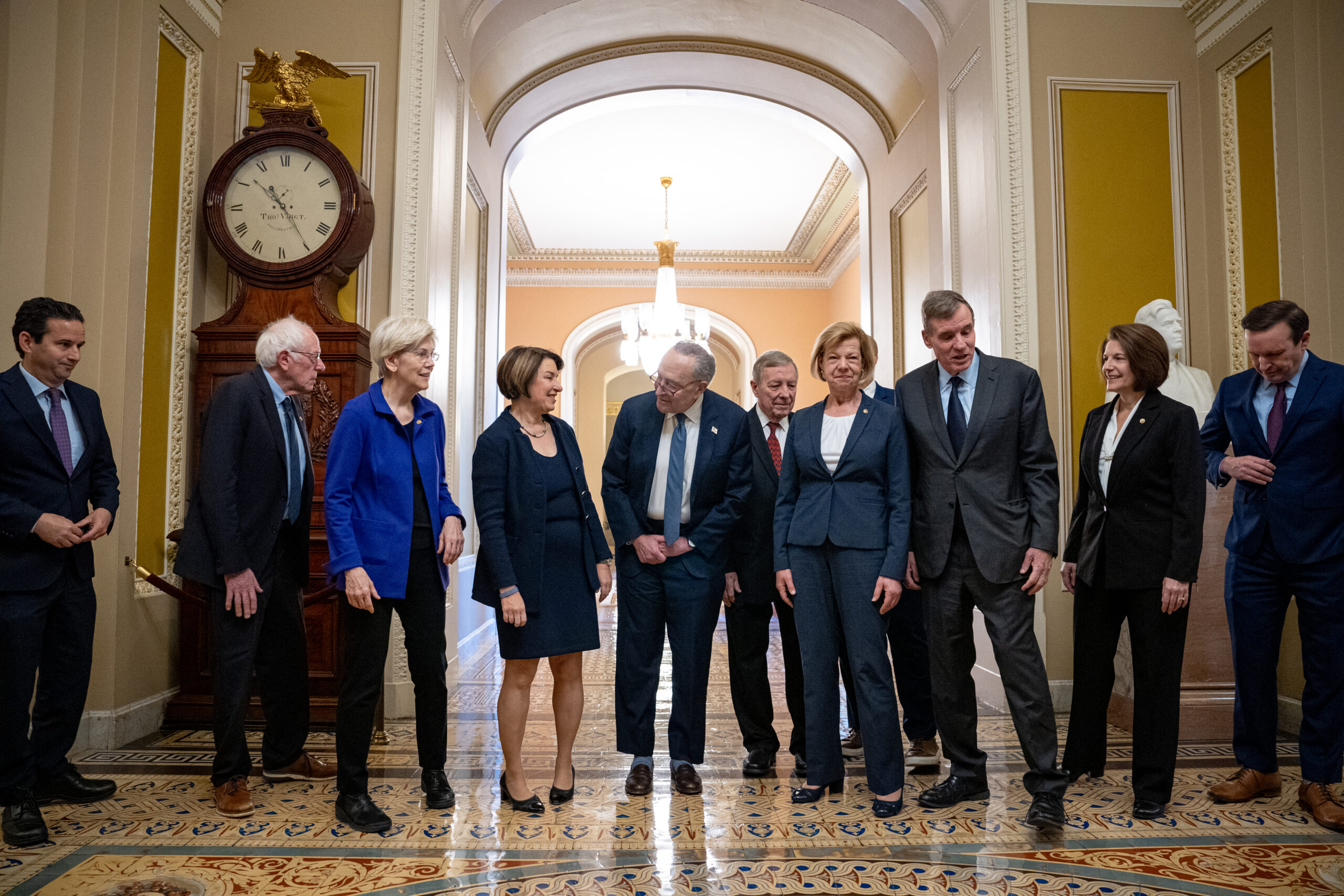
Most of the Democrats in the Senate — 40 in total, including some traditionally pro-Israel lawmakers — voted on Wednesday evening for a measure led by Sen. Bernie Sanders (I-VT) that aimed to block sales of bulldozers to Israel, with 36 of them also voting to advance a second Sanders-backed resolution to block sales of thousands of 1,000-pound bombs, Jewish Insider’s Marc Rod reports.
Newcomers: After having opposed previous similar efforts, Sens. Mark Kelly (D-AZ), Ruben Gallego (D-AZ), Adam Schiff (D-CA), Ron Wyden (D-OR), Maria Cantwell (D-WA), Gary Peters (D-MI), Mark Warner (D-VA), Cory Booker (D-NJ), Elissa Slotkin (D-MI), John Hickenlooper (D-CO), Michael Bennet (D-CO), Alex Padilla (D-CA) and Maggie Hassan (D-NH) all flipped and voted in favor of Sanders’ latest resolutions. Warner and Peters, along with Sens. Jack Reed (D-RI) and Sheldon Whitehouse (D-RI), voted to advance the resolution to block the bulldozer sale but against advancing the one on bombs.
Also on the Hill: An effort by Senate Democrats to force an end to the war in Iran was again blocked by Republicans on Wednesday, the fourth such failed attempt mounted by Senate Democrats since the war began in late February.
META-MORPHISIS
Meta defends content moderation policies, touts usage of AI to track Holocaust denial
Amid accusations that Meta’s moderation policies enable antisemitic content to circulate on its platforms, a Meta leader on Tuesday highlighted efforts to combat online Jew-hatred, including restrictions on Holocaust denial, Jewish Insider’s Haley Cohen reports.
Pushing back: “We remove Holocaust distortion and denial, not because it’s false, which it is, but because it’s antisemitic. It is hate speech against Jewish people, so we’ve drawn a clear line against it,” said Ben Good, director of content policy at Meta, the parent company of Instagram, Facebook and WhatsApp. Good spoke at “Hack the Hate NYC 2026,” an event at the Yeshiva University Museum in Manhattan spotlighting Israeli tech experts and Jewish leaders working to combat digital antisemitism. But even as Meta has made strides in addressing Holocaust denial, the Anti-Defamation League released a new report on Tuesday, just hours before the event, revealing that Instagram failed to remove 93% of reported extremist and hateful content, tying the trend directly to Meta’s efforts to roll back content moderation last year.
CAPITAL CONTEST
D.C. mayoral candidate Kenyan McDuffie courts Jewish voters as DSA-endorsed rival Lewis George faces communal backlash
As voters in Washington, D.C., get ready to elect their first new mayor in more than a decade, the two leading candidates — former colleagues on the Council of the District of Columbia — are proposing drastically different visions for the city’s future: political moderation or democratic socialism. In an interview with Jewish Insider’s Gabby Deutchthis week at his campaign headquarters in Northeast Washington, former Councilmember Kenyan McDuffie drew a direct contrast between his campaign and that of his Democratic Socialists of America-endorsed rival, Janeese Lewis George.
DSA direction: “I didn’t seek, nor would I accept, the endorsement of Democratic Socialists of America, or any organization, for that matter, that requires some sort of divisive pledge to exclude people that are a part of the fabric of the community of the District of Columbia,” McDuffie said. He was referring to a DSA endorsement questionnaire that asked candidates not to engage with “the Israeli government or Zionist lobby groups.” Lewis George, a longtime DSA member, vowed not to attend events that promote Zionism when she filled out the questionnaire, which earned her the DSA endorsement.
CONTINGENCY PLANS
Iran’s ‘Houthi card’: Israel prepares for possibility of ground assault if war resumes

Like a desperate poker player holding an ace in the hole, Iran has a “strategic reserve” if the ceasefire in the war with Israel and the U.S. collapses and fighting resumes: the Houthis, the Tehran-backed Yemeni terrorist group. How Iran plays the Houthi card has been the subject of concern in Israel, with analysts telling Jewish Insider’s Lahav Harkov that everything from a ground invasion from the east — with echoes of Hamas’ Oct. 7, 2023, rampage in southern Israel — to making good on the threat to block the Bab el-Mandeb Strait to further choke off international shipping remains in play.
Seeking revenge: Yoni Ben-Menachem, a senior Middle East analyst at the Jerusalem Center for Security and Foreign Affairs, told JI that the Houthis planned “to take revenge and bring back their honor” since Israel killed much of their leadership in August 2025. “They see that Israel’s air defenses are strong, and it’s hard for them to reach military achievements with missiles and drones. They want to surprise Israel, so they are looking at ways to do it on the ground,” he said.
Cautious optimism: The first round of direct talks between Israel and Lebanon has been received positively by diplomats, pro-Israel lawmakers and experts, who see it as a sign of Hezbollah’s waning influence in Lebanon. But despite the optimism surrounding the discussions, experts caution that disarming the terrorist group remains a daunting obstacle that stands in the way of any meaningful change, JI’s Matthew Shea reports.
CAMPUS CONVERSATION
Brandeis Center convenes inaugural conference on antisemitism at Harvard

A Jewish legal group will convene its inaugural conference on antisemitism and civil rights law at Harvard University on Thursday, an event that was born out of last year’s settlement of a Title VI lawsuit against the school and framed around the upcoming 250th anniversary of the United States, Jewish Insider’s Haley Cohen reports.
On the agenda: “We’re very excited to have a mix of federal, high-level leadership, prominent scholars, Jewish communal leaders, high-powered litigators and experts in the field,” Ken Marcus, founder and chairman of the Louis D. Brandeis Center for Human Rights Under Law, the group hosting the conference, told JI. The daylong event is slated to open with an address from Marcus and benediction from Rabbi Hirschy Zarchi, who leads Harvard Chabad. Held as America prepares to celebrate its 250th anniversary this summer, Marcus said the headline session will focus “on how we define antisemitism as lawyers and professionals, and why a proper definition of antisemitism matters for America at this point in time.”
Cambridge chatter: Federal prosecutors filed a 160-page brief calling on a circuit court to reinstate the Trump administration’s multibillion-dollar freeze on Harvard’s research funding.
Worthy Reads
The Problem with Piker: The Free Press’ Peter Savodnik looks at Democrats’ continued embrace of Hasan Piker, despite the far-left streamer’s extensive history of praising terrorists and antisemitic and anti-American rhetoric. “The truth is they’re afraid of challenging Piker because they don’t want to alienate his next-gen Bernie Bro audience — a fear that is greatly exacerbated by their hand-wringing about not being on ‘the right side of history,’ down with the kids. … There’s a deeper problem here, one that is more cognitive, even spiritual: Too few Democrats can see that Piker is obviously, deeply wrong, that he lacks imagination, that he’s ignorant, that he camouflages his ignorance with just enough lingo to make his highly unoriginal neo-Marxist riffs and rants sound incisive.” [FreePress]
The Future of Warfare: In The Wall Street Journal, former CIA Director David Petraeus posits that despite the U.S.’ military successes in Iran, the war in Ukraine is more instructive as to the future of warfare. “War is increasingly defined by unmanned systems, artificial intelligence and mass precision. The Gulf offers useful insights, but Ukraine is the more demanding laboratory. There, the true challenges of unmanned systems at scale and the rapid emergence of autonomous capabilities are already on display. … The Gulf conflict demonstrates what American forces can achieve from a position of strength. Ukraine has shown what war looks like from a more vulnerable position, when that strength is contested at scale.” [WSJ]
Word on the Street
At Semafor’s World Economy summit in Washington on Wednesday, Chuck Robbins, CEO of the tech giant Cisco, spoke about his decision a decade ago to acquire Leaba Semiconductor, an Israeli company, before it had even developed a product, Jewish Insider’s Gabby Deutch reports…
UAE Minister of State for International Cooperation Reem Al Hashimy, speaking at the confab, called for the Strait of Hormuz to be an international passageway that is not under the control of any one country…
Also speaking at the summit yesterday, “CBS Evening News” anchor Tony Dokoupil, speaking to David Rubenstein, talked about documentarian Ken Burns‘ July 4 tradition of reading the Declaration of Independence out loud with his family, calling it “a Seder for America”…
A second U.S.-sanctioned supertanker entered the Persian Gulf through the Strait of Hormuz, despite the U.S.’ maritime blockade of the waterway…
The Wall Street Journal looks at how growing economic distress in Iran could push Tehran back to negotiations with the U.S. as it seeks much-needed sanctions relief…
Seb Gorka, a deputy assistant to President Donald Trump, is reportedly looking to be named the head of the National Counterterrorism Center, following Joe Kent’s resignation last month…
The Financial Times spotlights Paolo Zampolli, a close personal friend of President Donald Trump and the U.S. special representative for global partnerships, as he conducts multibillion-dollar deals on behalf of the White House…
The Wall Street Journal reports on the hurdles facing Kevin Warsh ahead of his confirmation hearing to be the next chair of the Federal Reserve…
Rep. Ilhan Omar (D-MN), appearing on “Pod Save America,” praised former Rep. Marjorie Taylor Greene (R-GA) — once a vocal Omar foe who called for the congresswoman’s deportation while they were both in the House — and far-right influencer Candace Owens over the pair’s break with Trump, JI’s Marc Rod reports…
New York Gov. Kathy Hochul issued a challenge Wednesday to those seeking to challenge her plan to penalize protesters who get too close to religious institutions — “Bring it on.” Announcing new state programs to provide support and security for organizations deemed “vulnerable to hate crimes,” the governor, a Democrat, took questions regarding her proposal to bar demonstrations of more than two people from occurring within 25 feet of a house of worship, JI’s Will Bredderman reports…
Rama Duwaji, the wife of New York City Mayor Zohran Mamdani, apologized for using racist language in social media posts as a teenager, but fell short of addressing more recent comments in which she suggested that Tel Aviv “shouldn’t exist in the first place,” and celebrated “freedom fighters of Palestine”…
A new report from Yale University’s Committee on Trust in Higher Education found that universities themselves cultivated significant public distrust of higher education, citing soaring tuition costs, unclear admissions processes and the uneven applications of standards and rules…
Kent Syverud, who earlier this year had been tapped as the next chancellor of the University of Michigan, announced that he has been diagnosed with brain cancer and will not assume the position in Ann Arbor; the school’s Board of Regents said it will begin a new search process in the coming days…
Duke University suspended its Students for Justice in Palestine chapter on Tuesday, one month after students began submitting complaints about an antisemitic Instagram post from the group, which depicted the U.S. and Israel as pigs frothing at the mouth, JI’s Haley Cohen reports…
Hebrew Union College President Andrew Rehfeld told eJewishPhilanthropy’s Jay Deitcher that the school was “deeply disappointed” by a decision by the Ohio Attorney General’s office to file a lawsuit to block the institution’s plans to shutter its Cincinnati rabbinical programs…
Apple TV released the trailer for the upcoming Israeli thriller series “Unconditional,” which stars Liraz Chamami and Talia Lynne Ronn as a mother-daughter pair stranded in Russia and at the mercy of Moscow crime rings following Ronn’s character’s arrest on drug-smuggling charges…
“Fauda” co-creator Avi Issacharoff shared a sneak peek of the show’s upcoming fifth season, which takes place in the aftermath of the Oct. 7, 2023, Hamas terror attacks…
Police in the U.K. arrested two people following an attempted arson attack at a synagogue in North London…
U.K. Conservative leader Kemi Badenoch called for the deportation of foreigners who engage in antisemitism…
Immanuel College, one of London’s only private Jewish secondary schools, is set to close at the end of this year, citing financial challenges…
Kanye West postponed an upcoming show in Marseille, France, after government officials, as well as the mayor of Marseille, suggested the rapper would not be welcome in the country; the decision comes days after U.K. authorities revoked West’s visa ahead of a summer festival he was set to headline in the country…
Ukrainian President Volodymyr Zelensky signed into law legislation levying criminal penalties — including fines and prison sentences — against individuals convicted of antisemitic offenses…
Israeli Prime Minister Benjamin Netanyahu and Hungary Prime Minister-elect Peter Magyar spoke by phone on Wednesday, with a readout from the Prime Minister’s Office saying that the incoming Hungarian leader invited Netanyahu to the country for the 70-year commemoration of the Hungarian Uprising…
LIV Golf CEO Scott O’Neil denied reports that Saudi Arabia’s Public Investment Fund was planning to pull its financial support for the league, weeks before its first scheduled U.S. tournament of the season, slated to take place next month at Trump National Golf Club in Virginia…
Front Office Sports reports that a multiyear deal between Michael Rubin‘s Fanatics and Saudi Arabia’s General Entertainment Authority is on the verge of collapse…
Republican Jewish Coalition CEO Matt Brooks is joining Brownstein Hyatt Farber Schreck as a senior strategic advisor; Brooks will continue in his position at the RJC, in addition to his role leading the Jewish Policy Center…
Israel Malachi was named the new director general of Israel’s Finance Ministry after serving for nearly four years as the ministry’s deputy director general…
Amy Marks is joining JCC Association of North America as the organization’s chief advancement officer…
Former “All Things Considered” host Ari Shapiro is joining CNN as a contributor, where he’ll co-host a new podcast focused on digital trends with his former NPR colleague Audie Cornish…
Author and TV producer Barbara Gordon, whose memoir about her addiction to Valium and mental health challenges became a bestseller, died at 90…
Pic of the Day

Massachusetts Gov. Maura Healey (center right), cut the ribbon at the official launch on Wednesday of ARC Landing Boston, a joint initiative between Healey’s administration and Israel’s Sheba Medical Center. Joining Healey for the ribbon-cutting were New England Patriots owner Robert Kraft, Sheba Director General Yitshak Kreiss and ARC Innovation Founder and Director Eyal Zimlichman.
Birthdays

Emmy- and Tony Award-winning actress and movie producer, Ellen Barkin turns 72…
CEO and president of American Express in the 1990s, he now serves on many corporate and charitable boards, Harvey Golub turns 87… Chasidic singer, known by his stage name Mordechai Ben David or MBD, Mordechai Werdyger turns 75… Olympic track-and-field athlete, and survivor of the 1972 Munich Olympics massacre, Esther Roth-Shachamorov turns 74… Cofounder of Jordan Company LP, a New York private equity firm, David Wayne Zalaznick turns 72… Physician and venture capitalist focused on biotechnology and life-sciences industries, Lindsay Rosenwald turns 71… Professor of politics and international affairs at Princeton University, Aaron Louis Friedberg, Ph.D. turns 70… Filmmaker, he directed the 2011 documentary “Paul Williams Still Alive” and the 1997 slapstick comedy “Vegas Vacation” starring Chevy Chase, Stephen Kessler turns 66… Former dean of Harvard’s Kennedy School and former director of the Congressional Budget Office, Douglas Elmendorf turns 64… Former secretary of state of the United States under the Biden administration, Antony John “Tony” Blinken turns 64… Emmy Award-winning television producer and writer, he co-created and produced “Will & Grace” and “Boston Common,” David Sanford Kohan turns 62… Long Island native, he is a Los Angeles pharmacist, Jeffrey D. Marcus… U.S. ambassador to Egypt during the Trump 45 administration, Jonathan Raphael Cohen turns 62… Former mayor of Hoboken, N.J., Dawn Zimmer turns 58… Israel’s former ambassador to the U.S. and minister of strategic affairs, Ron Dermer turns 55… Canada’s minister of the environment, climate change and nature, Julie Dabrusin turns 55… Celebrity plastic surgeon, he is active on social media as “Dr. Miami” and has been on reality TV about his practice, Michael Salzhauer, M.D. turns 54… Board member of Jewish Community High School of the Bay in San Francisco, Ellen K. Finestone… Founder and president of Glass Ceiling Strategies, she is also a managing director for communications at Climate Power, Alex Glass… Founder of Jewish Fashion Council and journalist at Fabologie, Adi Heyman… Former pitcher in the Washington Nationals organization, he played for Team Israel in the 2023 World Baseball Classic, Richard Sidney Bleier turns 39… Attorney who has served as a law clerk to three Maryland judges, now a VP at JPMorgan Chase, Geoffrey S. Middleberg… Lead product manager at Anthropic, Uriel Kejsefman… Singer, pianist and composer, he is best known as half of the folk-rock duo the Portnoy Brothers, Mendy Portnoy turns 34… Climate and energy transition investor, he was a White House staffer in 2017, Matthew Saunders… Senior client strategy and success manager at Grow Progress, Adam Gotbaum… First baseman and free agent, he played for Team Israel in the 2023 World Baseball Classic, Matthew Jared “Mash” Mervis turns 28… Josh Goldstein… Sarah Wolfson…
Platner, in Reddit post on Hamas terrorist attack: ‘From a strictly professional standpoint, this was a damn fine looking and successful raid against a superior opponent’
Sophie Park/Getty Images
Senate candidate from Maine Graham Platner speaks at a town hall at the Leavitt Theater on October 22, 2025 in Ogunquit, Maine.
Maine Senate candidate Graham Platner repeatedly praised the tactics used by Hamas terrorists in comments made about a graphic video of a Hamas raid into Israel in 2014, in which terrorists killed at least five Israeli soldiers.
In archived posts from his now-deleted Reddit profile under the username “P-Hustle,” Platner commented on a video post titled “Helmet Footage from Hamas cross-border raid,” which showed the attack on multiple Israeli soldiers.
The original video, also now deleted but still archived, was posted by a YouTube channel called Sabah on July 29, 2014, with the description, “Secret footage shows the storming of a settlement by the Qassam Brigades and the killing of 10 soldiers.” The description and comments in the Reddit thread appear to match a raid by Hamas’ Al-Qassam Brigades on a military base near Kibbutz Nahal Oz the day prior.
According to a text description of the video and the raid shared online, the video includes footage of the shootings of several Israeli soldiers, at least one of whom is screaming as the terrorists attempt to kidnap him.
“Looks like an all around well executed and successful small unit raid to me,” Platner wrote in 2014 on the Reddit forum r/CombatFootage, a discussion board for footage and photographs of past and current armed conflicts.

Responding to another user who criticized the “execution” of the Israeli soldiers and emphasized that the attack would lead to heavy reprisals in Gaza, Platner said he was not interested in discussing the geopolitical or strategic implications, but suggested Hamas’ tactics and actions were reasonable.
“As for your aversion to ‘execution’, a small unit raid tends to be used to inflict casualties and take prisoners in a short period of time,” Platner wrote. “Pragmatically I have little problem with killing an enemy combatant who you attempt to capture but for whatever reason cannot. From a strictly professional standpoint, this was a damn fine looking and successful raid against a superior opponent, I dig it.”
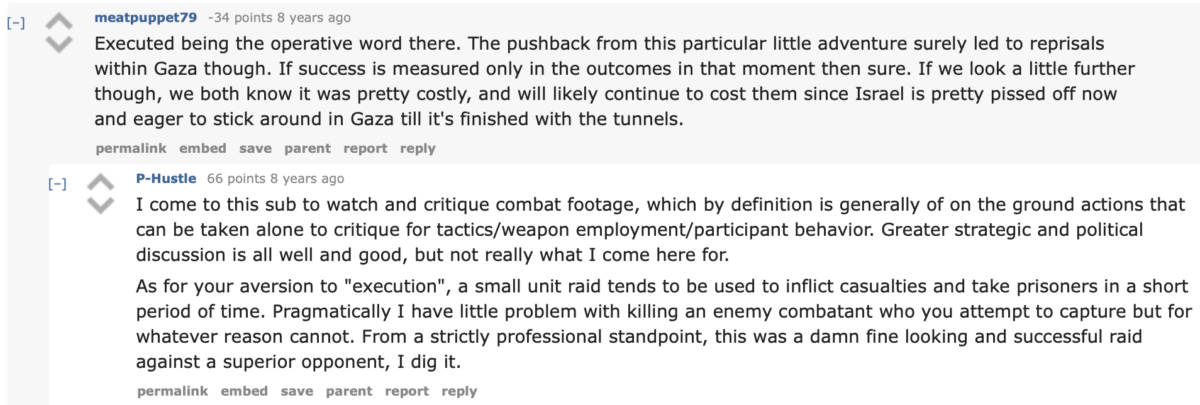
He acknowledged, in response to another user, that the terrorists’ actions were brutal and that the terrorists should have shot one of the soldiers instead of beating him to death.

Responding to another user who disputed Platner’s characterization of the Hamas attack as a “raid” and said that the attack was “not resistance its just drawing blood to score imaginative points in the war,” Platner suggested the Hamas terrorists were preferable to those who attacked U.S. forces in Iraq.
“It was Iraq, and those guys were in civilian clothing with silenced weapons. This videos shows a unit of men in full uniform assaulting uniformed military personnel of an enemy their organization is currently engaged in military operations with. There is no comparing the two,” Platner wrote. “Generally you try to catch the enemy off guard, and kill them with the least resistance. This looks like a pretty audacious plan that worked, and I’ll certainly give credit where credit is due, no matter who they are fighting for.”

Platner’s campaign did not return a request for comment.
Platner has come under fire by Gov. Janet Mills, who is his main competitor in the Democratic primary, and by Republicans for other past Reddit posts under the “P-Hustle” username which have disparaged a wide range of groups and included various offensive comments.
He also has faced scrutiny for his criticism of Israel and a tattoo on his chest of an apparent Nazi symbol.
The Maine Senate candidate quickly deleted his post, in which he approved of a message by neo-Nazi radio host Stew Peters
Sophie Park/Getty Images
U.S. senatorial candidate from Maine Graham Platner speaks at a town hall at the Leavitt Theater on October 22, 2025 in Ogunquit, Maine.
Graham Platner, a far-left Senate candidate in Maine, amplified a social media post on Thursday from a far-right conspiracy theorist well-known for viciously antisemitic commentary — before quickly deleting the statement.
In a comment to X late Thursday morning, Platner approvingly boosted a remark from Stew Peters, an extremist radio host who has frequently promoted antisemitic tropes and engaged in Holocaust denial, calling a war with Iran “the only thing Republicans and Democrats have both given a standing ovation for.”
“As always, there’s one thing that brings Republican and Democratic politicians together: sending other people’s children to die in stupid wars in the Middle East,” Platner, a 41-year-old Marine veteran turned oyster farmer who has sharply criticized U.S. military engagement abroad, wrote in his own post.
He deleted the post an hour or so after it had been flagged by online observers who noted that he was elevating a problematic figure with a long record of hostile rhetoric toward Jews.
The Anti-Defamation League has described Peters as a “prolific antisemite” who blames “‘the Jews’ for everything he believes is wrong with society,” while the Southern Poverty Law Center has said his radio show has “become a central hub for antisemitic and conspiratorial content.”
He has said Judaism is “satanic” and a “death cult,” promoted blood libels, called for a “final solution” to mass-deport American Jews and questioned the existence of gas chambers that exterminated Jews during the Holocaust, among other conspiratorial assertions.
In a statement to Jewish Insider, a spokesperson for Platner said the post had been published due to an oversight. “We were reposting a C-Span clip of Trump speaking about the potential war with Iran and didn’t realize that the video had been posted by a despicable account,” the spokesperson said. “When we learned who the poster was we immediately deleted the post.”
The social media blunder is a particularly sensitive issue for Platner, who earlier in his campaign faced scrutiny over a Nazi tattoo on his chest, which he had covered up last October. He has insisted he was not aware the tattoo closely mirrored a Totenkopf, a skull-and-crossbones icon used by an infamous Nazi SS unit, even as a former acquaintance told JI that he had years ago specifically identified it as such. He has denied such claims.
“I am not a secret Nazi,” Platner said in a podcast interview last year, while calling himself “a lifelong opponent” of “Nazism and antisemitism and racism in general.”
Despite such baggage, polling has shown Platner holds a commanding lead in the Maine Democratic primary race, where he is facing Gov. Janet Mills to challenge Sen. Susan Collins (R-ME), who is one of the most vulnerable Republican incumbents up for reelection in the midterms.
A notable takeaway was just how different the preferences of Boomers and Gen Zers were — even among those affiliated with the same party
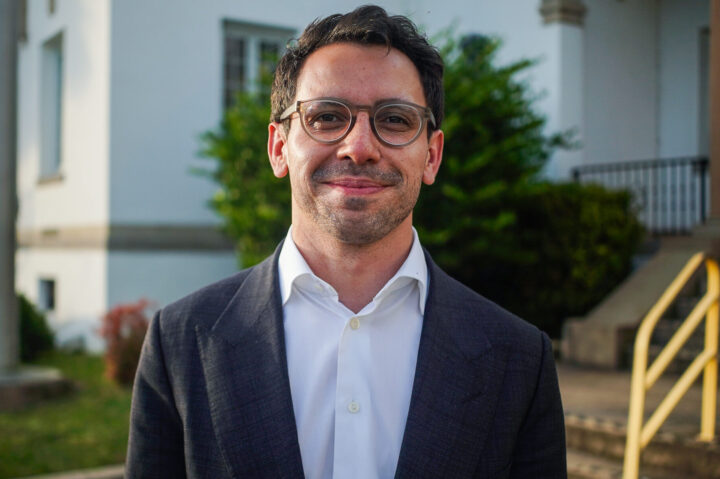
Campaign website
James Fishback
A pair of new polls — one in a Democratic Senate primary in Maine and one in a Republican gubernatorial primary in Florida — should sound alarm bells about the political and ideological trajectory of Gen Z voters, and the younger generation’s creeping tolerance of antisemitism that transcends party ID.
While the top lines from the polls generated the most headlines, the more notable takeaway was just how different the preferences of Boomers and Gen Zers were — even among those affiliated with the same party. The younger voters gravitated toward the candidates with checkered (at best) records on antisemitism.
James Fishback, a 31-year-old Republican investor who made a name for himself with incendiary social media posts attacking Israel and invoking antisemitic tropes, is barely winning a following among most Florida Republicans as he runs for governor. But among younger Republican voters, he appears to be building a growing base of support.
Graham Platner, an anti-establishment oyster farmer who for years had a skull-and-bones Totenkopf tattoo on his chest, a symbol adopted by a Nazi SS unit, is barely facing any backlash from Maine voters in his outsider Senate campaign. (He had the tattoo covered up during the campaign, amid widespread controversy.) Indeed, he may soon become the favorite to win the Senate seat in Maine, fueled by near-universal support among younger Democratic voters.
The polling underscores the dramatic generational disconnect.
In the University of North Florida poll, Fishback only received 6% support among Florida Republican voters, badly trailing front-runner Rep. Byron Donalds (R-FL), who is 47, by 25 points. But among voters 18-34 years old, the little-known Fishback is dominating Donalds, 31-8%. (It’s worth noting the subsample of young voters is small, but the polling is consistent with anecdotal reporting that Fishback has built a base of support among younger right-wing voters.)
Meanwhile in Maine, a Senate poll conducted by the University of New Hampshire found Platner, 41, not only holding a commanding primary lead over the state’s 78-year-old sitting governor, Janet Mills, (64-26%), but comfortably leading Sen. Susan Collins (R-ME) in a potential general election matchup. His support is fueled by Gen Z Democrats, who back him over Mills overwhelmingly, by a 73-point margin (84-11%). Those 65 and older preferred Mills, who is 78, by a four-point margin, 49-45%.
At the very least, these polls underscore that experience and credentials — no less the policy knowledge and credibility typically required of governors and senators — are barely valued by younger voters.
At worst, it’s an indicator that radicalism is actually a selling point for young voters, who are getting most of their information from social media sites whose algorithms promote polarization and extremism, and very little from reliable, trusted sources.
As we’ve noted before, it shouldn’t be a surprise that given the incentive structure on social media, antisemitism is thriving. If you build even artificial demand for extremism, the supply of hateful influencers — and eventually like-minded political candidates — will follow.
Jordan Wood, now running to succeed Rep. Jared Golden, said he won’t take money from AIPAC in his newly launched House campaign
Campaign website
Jordan Wood
Jordan Wood, a Maine Democrat who dropped his Senate bid on Wednesday to run for the seat held by retiring Rep. Jared Golden (D-ME), said in a recent podcast interview that he would reject contributions from AIPAC, the pro-Israel advocacy group, joining a growing crop of Democratic candidates who have made similar pledges.
In the conversation with Kaivan Shroff, a Democratic activist, released last week, Wood pointed to what he called “a tremendous amount of distrust right now among Democratic primary voters that the money that AIPAC has put into our political system has affected our priorities when it comes to foreign aid to Israel.”
Graham Platner, a leading far-left candidate in the Democratic Senate primary facing Maine Gov. Janet Mills, has been a particularly hostile critic of AIPAC, which he has made a central focus of his anti-Israel messaging.
In a statement to Jewish Insider, Wood clarified that he does not “take money from AIPAC for the same reason I don’t take money from corporate PACs or lobbyists — because it guarantees voters trust that my policy positions and votes in Congress are not influenced by any campaign contributions.”
A spokesperson for AIPAC, Marshall Wittmann, dismissed that logic. “It’s outrageous to discriminate against pro-Israel Americans,” he said in a sharply worded statement to JI. “Ostracizing and making false accusations about fellow citizens’ democratic engagement to strengthen the U.S.-Israel partnership is contrary to American values and interests.”
“Our six million members will not be deterred by anti-Israel extremists, and their voices will be heard in the 2026 elections,” Wittmann said.
During the podcast interview, Wood stated that, even as he pulls away from AIPAC, “I do also still support aid to Israel,” albeit alongside “conditions on the continuation” of U.S. assistance, including “restrictions on offensive military weapons” to the Jewish state.
Wood, a former congressional staffer who was trailing his rivals in what has increasingly solidified into a two-person Senate race, declared on Wednesday that he was jumping into the open primary to succeed Golden, a moderate Democrat who has represented a GOP-leaning district for three consecutive terms.
The congressman said last week he would not seek reelection, writing he had “grown tired of the increasing incivility and plain nastiness” of American politics and that he and his family had faced “frequent threats” that ultimately contributed to his decision.
Golden, a retired Marine, has been a dependably pro-Israel voice in the House and was endorsed by AIPAC before he announced he was stepping down.
“With Jared not running, it leaves open one of the most competitive House races in the entire country, and so I’m stepping up to take that on,” Wood said on Wednesday.
Matt Dunlap, the Maine state auditor, was already challenging Golden from the left before Wood, who embraced progressive stances as a Senate candidate, said he would enter the race.
The primary field is expected to grow in the coming weeks as other potential candidates are floated, including Troy Jackson, the former president of the Maine Senate currently running for governor, and Kirk Francis, chief of the Penobscot Nation.
The Democratic Congressional Campaign Committee, looking for more-moderate candidates in the field, is still recruiting even with Wood and Dunlap in the race, according to a source familiar with the matter.
Former Maine Gov. Paul LePage is the frontrunner for the Republican nomination in the swing district, which backed President Donald Trump by a double-digit margin in 2024.
In a recent conversation at a fundraising event, the Maine Senate candidate claimed the Israeli government funded Hamas and also revealed he is related to Israeli author and analyst Seth Frantzman
Sophie Park/Getty Images
U.S. senatorial candidate from Maine Graham Platner speaks at a town hall at the Leavitt Theater on October 22, 2025 in Ogunquit, Maine.
Like many progressives now running for Congress, Graham Platner, a Democratic Senate candidate in Maine, has made opposition to Israel a central part of his messaging.
He frequently accuses Israel of genocide in Gaza, advocates for blocking U.S. aid to Israel and is an outspoken critic of AIPAC. During a campaign event last month, Platner, a 41-year-old former Marine who runs an oyster farm, also said he believes that Israel is a terrorist state.
But more so than many candidates, the political newcomer seems particularly invested in engaging on Middle East policy, even if his views have drawn scrutiny, according to audio of a recent private discussion in which he debated about Israel with some attendees at a fundraising event in Maine for nearly 20 minutes.
Speaking at the August fundraiser, Platner defended his stances on Israel and shared previously undisclosed details about his personal ties to the region, according to the audio, recently shared with Jewish Insider.
Despite his hostile criticism of Israel, Platner said he believed that the country “has the same right to exist that every nation has to exist,” though he did not confirm whether he recognizes Israel’s right to exist as a Jewish state.
While he said he agreed that Hamas is a terrorist organization, Platner claimed that Netanyahu had “publicly stated that” Israel was “funding Hamas to make sure that there was going to be no non-radical leadership within Gaza in order to keep a Palestinian state from happening.”
While members of Netanyahu’s coalition have made this argument — Finance Minister Bezalel Smotrich referred to the terrorist organization as “an asset” as it serves as an obstacle to Palestinian statehood — the prime minister has never personally made such a claim. New York Times reporting from shortly after the Oct. 7 attacks alleged that the Israeli prime minister had allowed the Qatari government to send money into the Gaza Strip for several years in order to “maintain peace in Gaza.” Netanyahu called allegations that he was empowering Hamas “ridiculous.”
“It is difficult for me to lay the onus of everything only at the feet of the Palestinians,” he explained, “and not include the Netanyahu government.”
Platner also quibbled with an attendee who said that 1,200 Israeli civilians had been killed during the attacks, noting that a percentage of those who had died on Oct. 7 were soldiers in the Israeli military.
“It wasn’t 1,200 civilians. It was 600 military members,” Platner countered, using a number that far exceeded the approximately 300 soldiers who were killed in the attacks.
“Who were taken sleeping, unarmed, out of their beds, I’ve met families,” the attendee responded, likely referring to the tatzpitaniot, unarmed female observer soldiers, and others, who were famously killed and kidnapped in their pajamas.
“When you are wearing a uniform and carrying a gun in the service of a cause, it is difficult for me to feel that you can be called a civilian,” said Platner, who fought in Iraq and Afghanistan. “There is a one-way street on this,” he continued, “that I find to be disingenuous.”
The private comments suggest that Platner is not merely paying lip service to such issues on the trail, as he runs in a competitive primary against Maine Gov. Janet Mills for the Democratic nomination to unseat Sen. Susan Collins (R-ME).
Platner’s campaign did not respond to a request for comment.
Platner’s views on Israel and Gaza have received limited attention in recent weeks as his campaign has weathered controversy over his past incendiary Reddit posts and faced questions over when he first became aware that a skull tattoo on his chest he had for nearly 20 years resembled a Nazi symbol known as a Totenkopf.
Platner, who covered the tattoo this month, has insisted he did not know what the skull signified until recently, though reporting from JI and CNN has contradicted that claim.
He has also argued that members of his family are Jewish and never objected to the skull tattoo when he took his shirt off around them. “Eighteen years,” he told The Atlantic recently. “It’s never come up.”
In the conversation about Israel at the fundraiser, which took place before controversy ensnared his campaign, Platner noted his stepbrother is Seth Frantzman, an Israeli author, journalist and security analyst who has long worked for The Jerusalem Post and lives in Jerusalem, saying they are “very close,” according to the audio.
Frantzman, who has previously written admiringly about Platner without mention of their familial ties, did not respond to an email seeking comment.
Platner also said that he had “multiple friends in B’Tselem,” the left-wing Israeli human rights group that has described Israel as an apartheid regime and accused Israel of committing genocide in Gaza — as he argued that Israel is not fully a democracy.
He cited his friends from B’Tselem “who have showed me videos, who have introduced me to former soldiers, who have introduced me to Palestinians, who have laid out a very clear and, frankly, well-sourced case that Palestinians living within the borders of the occupied territories do not live in a democracy, that they do not have equal rights, that they do not have equal access to areas.”
He said that, “as an American taxpayer,” he was uncomfortable with sending continued U.S. aid to support Israel’s military.
But even as he has been deployed to the Middle East, Platner confirmed that he had never visited Israel.
The Massachusetts congressman is the first Democratic lawmaker to call on the scandal-plagued candidate to drop out

Courtesy
Rep. Jake Auchincloss (D-MA)
Rep. Jake Auchincloss (D-MA) became the first elected Democrat to call on scandal-plagued Democrat Graham Platner to drop out of the race for Senate in Maine amid controversy over a tattoo on his chest with Nazi origins and other controversies.
Jewish Insider earlier reported that Platner had on at least one occasion identified the tattoo on his chest as a Nazi SS symbol, known as a “Totenkopf,” to a former acquaintance and had been fully aware of the tattoo and its meaning well before jumping into the race to replace Sen. Susan Collins (R-ME), even bragging about having it.
Auchincloss urged Platner to abandon his Senate bid on Sunday, telling Politico that he finds the progressive candidate’s conduct “personally disqualifying.”
Platner has dismissed wrongdoing and claimed he had no idea the tattoo symbol was a Nazi insignia when he got it with fellow Marines while in Croatia in 2007.
“I am not a secret Nazi. Actually if you read through my Reddit comments, I think you can pretty much figure out where I stand on Nazism and antisemitism,” Platner said on the “Pod Save America” podcast last week.
Auchincloss expressed dissatisfaction with Platner’s defenses, in which the progressive candidate has said his actions aren’t a “liability.”
“I think it’s a liability, and I think we should have high standards for United States senators and one of them is: you don’t have a Nazi tattoo on your body,” Auchincloss told WCVB Channel 5 Boston on Sunday.
“I hope that Maine voters would agree with me,” Auchincloss said to Politico. “Democrats would be united in condemning a Republican candidate who has this episode, and we should be consistent.”
Platner is running against Gov. Janet Mills in the Democratic primary. The winner will face Collins in what is expected to be a hotly-contested race.
Some progressive members of Congress, led by Sen. Bernie Sanders (I-VT), have defended Platner amid his numerous scandals.
“He sounds like a human being to me,” Sen. Chris Murphy (D-CT) said of Platner’s tattoo in a CNN interview on Sunday. “A human being who made mistakes, recognizes them, and is very open about it.”
The Democratic candidate has remained defiant amid CNN’s reporting confirming he was aware of the Nazi roots of a recently revealed chest tattoo

Daryn Slover/Portland Press Herald via AP
Senate candidate Graham Platner acknowledges the large crowd that attended Platner's town hall, Sept. 25, 2025, at Bunker Brewing in Portland, Maine.
Graham Platner, the scandal-plagued Democrat running for Senate in Maine, continued to insist he only recently became aware that a black skull tattoo on his chest resembles a Nazi SS symbol, even amid mounting evidence suggesting he was aware of what the image represented long before he announced his campaign this summer.
A new investigation published on Friday by CNN confirmed Jewish Insider’s earlier reporting that Platner had on at least one occasion identified the tattoo as a Nazi SS symbol, known as a Totenkopf, to a former acquaintance more than a decade ago.
The former acquaintance spoke with CNN, which also interviewed a second person who said that the acquaintance had mentioned Platner’s tattoo years ago. In addition, CNN reviewed a more recent text exchange from several months ago in which the acquaintance discussed the tattoo, before Platner himself revealed he had the tattoo in an interview last week, in an effort to preempt what he described as opposition research seeking to damage his insurgent Senate campaign.
Both JI and CNN also cited deleted Reddit posts in which Platner, a 41-year-old Marine veteran and an oyster farmer, defended the use of Nazi tattoos, including SS lighting bolts, among servicemembers. In one thread, a user had mentioned the Totenkopf, further indicating that Platner had been aware of its symbolism before he entered the race in August to unseat Sen. Susan Collins (R-ME).
While Platner has apologized for some recently unearthed Reddit posts in which he had described himself as a “communist,” called all cops “bastards” and downplayed sexual assault in the U.S. military, he has otherwise dismissed JI’s reporting about the tattoo, which he said he had gotten with a group of “very inebriated” Marines while they were on shore leave in Croatia in 2007.
Platner said the group had no idea it was a Nazi insignia and chose it simply because “skulls and crossbones are a pretty standard military thing,” as he put it in an interview with the “Pod Save America” podcast.
He has also dismissed claims by a former political director — who recently resigned from his campaign over objections to his past posts — who said last week that Platner had an “antisemitic tattoo on his chest” that he acknowledged “could be problematic” at the beginning of his campaign.
Platner said on Wednesday he had covered up the tattoo with a dog-themed Celtic knot, displayed in a video he posted to social media soon after JI published its story.
“The amount of money and time it takes to dig through somebody’s entire past who has not lived a very public life is extensive, and yet they are willing to expend those resources,” Platner told a crowd of supporters during an event in Ogunquit, Maine, last week. “They are not trying to organize people. They are trying to destroy my life,” he said, alluding to his perceived political enemies.
Progressives also continued to rally behind Platner, who is facing Gov. Janet Mills and other candidates in the Democratic primary next year — a prelude to what party leadership views as a key race to regain a majority in the Senate.
Sen. Bernie Sanders (I-VT), who is backing Platner and campaigned with him in Maine last month, was among top progressives who stood by the embattled Democrat hoping to withstand the ongoing scrutiny over his tattoo and now-deleted Reddit comments.
And not one Democratic senator has yet to say that Platner’s tattoo or his other controversies disqualify him from running, according to a recent NBC News report.
“He sounds like a human being to me,” Sen. Chris Murphy (D-CT) said of Platner’s tattoo in a CNN interview on Sunday. “A human being who made mistakes, recognizes them, and is very open about it.”
Some polling has shown that Mills, a two-term governor who landed an endorsement from Senate Minority Leader Chuck Schumer (D-NY), is trailing Platner by double digits — even among respondents surveyed amid the controversy over his past Reddit remarks.
A more recent survey released Saturday, however, showed Platner behind Mills by five points with 36%. But while his deficit broadly increased after voters were informed of his Nazi-linked tattoo, according to the poll conducted by SoCal Strategies, younger voters ages 18-29 still favored the former Marine.
Another recent poll, screenshots of which were shared with JI on Friday, included questions that had inaccurately described Platner’s tattoo as an “anti-Israel tattoo” and asking if such a tattoo “is disqualifying for a candidate seeking public office.”
It was unclear who had commissioned the poll. A spokesperson for Platner said he was not behind it. And the National Republican Senatorial Committee, which also released a poll late last week that showed Platner ahead of Mills, did not respond to a request for comment from JI on Friday.
Meanwhile, Jordan Wood, a former congressional aide also running in the Democratic primary, wrote last week that Platner’s “Reddit comments and Nazi SS Totenkopf tattoo are disqualifying.”
And another Democratic candidate in the primary, Daira Smith-Rodriguez, announced on Friday that she was ending her bid and endorsing Mills, citing her concerns over Platner’s past Reddit comments “as a survivor of military sexual assault.”
A former acquaintance of the Maine Senate candidate said he called the tattoo ‘my Totenkopf,’ referring to a symbol adopted by a Nazi SS unit
Daryn Slover/Portland Press Herald via AP
Senate candidate Graham Platner acknowledges the large crowd that attended Platner's town hall, Sept. 25, 2025, at Bunker Brewing in Portland, Maine.
Graham Platner, a far-left Democratic candidate running for Senate in Maine who has captured the enthusiasm of the party’s grassroots base, sought to preempt rumors circulating in recent weeks that a black skull-and-cross bones tattoo on his chest is a Nazi symbol.
Speaking with Tommy Vietor on the “Pod Save America” political podcast, released on Monday night, Platner, 41, confirmed the existence of the tattoo, seen in video he shared displaying his bare chest, but suggested that his opponents in the race have been spreading claims that the symbol is affiliated with Nazism, which he forcefully denied.
“I am not a secret Nazi. Actually, if you read through my Reddit comments, I think you can pretty much figure out where I stand on Nazism and antisemitism and racism in general,” said Platner, a Marine veteran and oyster farmer in Maine who has faced scrutiny over past online posts. “I would say a lifelong opponent.”
But according to a person who socialized with Platner when he was living in Washington, D.C., more than a decade ago, Platner had specifically acknowledged that the tattoo was a Totenkopf, the “death’s head” symbol adopted by an infamous Nazi SS unit that guarded concentration camps in World War II.
“He said, ‘Oh, this is my Totenkopf,’” the former acquaintance told Jewish Insider recently, speaking on the condition of anonymity to address a sensitive issue. “He said it in a cutesy little way.”
The exchange occurred in 2012 at Tune Inn, a popular dive on Capitol Hill where Platner later worked as a bartender and was a frequent patron while he attended The George Washington University on the G.I. bill, according to the former acquaintance. He would often take his shirt off drinking with friends late at night at the bar, and on at least one occasion had stated he knew what the tattoo represented, the former acquaintance recalled.
Platner gave varying accounts of the image during this time, saying at one point he was aware it was a Totenkopf when he had first gotten the tattoo several years prior and at another time claiming he had not known, according to the former acquaintance.
The mixed accounts indicate that Platner has at least long been aware of the symbols’s connection to Nazism, even as he said in the podcast interview he was not familiar with any such association when he chose to get the tattoo.
Platner, who is running to unseat Sen. Susan Collins (R-ME) said he had gotten the tattoo in Split, Croatia, in 2007, when he and a group of “very inebriated” fellow Marines had time off while on deployment and decided to step into a parlor. “We chose a terrifying-looking skull and crossbones off the wall, because we were Marines, and skulls and crossbones are a pretty standard military thing,” he explained on the podcast.
“We got those tattoos, and then we all moved on with our lives,” he added, emphasizing he had later served in the Army and received a security clearance to work as a contractor for the State Department in Afghanistan. “I can honestly say that if I was trying to hide it,” he continued, “I’ve not been doing a very good job for the past 18 years.”
In a statement shared with JI on Tuesday, Platner said he did not know about the tattoo’s connection to Nazi imagery until recently. “It was not until I started hearing from reporters and DC insiders that I realized this tattoo resembled a Nazi symbol,” he said. “I absolutely would not have gone through life having this on my chest if I knew that — and to insinuate that I did is disgusting. I am already planning to get this removed.”
Platner’s former political director, Genevieve McDonald, who resigned from his campaign last week over her objection to his recently unearthed incendiary Reddit comments, said in a Facebook post on Tuesday that “Graham has an antisemitic tattoo on his chest.”
“He’s not an idiot, he’s a military history buff,” McDonald wrote in the post, which was reviewed by JI. “Maybe he didn’t know it when he got it, but he got it years ago and he should have had it covered up because he knows damn well what it means.”
McDonald said that Platner’s campaign “released it themselves to some podcast bros, along with a video of him shirtless and drunk at a wedding to try to get ahead of it.”
A spokesperson for the Anti-Defamation League said in a statement to JI that Platner’s tattoo “appears to be a Nazi Totenkopf tattoo, and if true, it is troubling that a candidate for high office would have one.”
“We do understand that sometimes people get tattoos without understanding their hateful association,” the ADL spokesperson added. “In those cases, the bearer should be asked whether they repudiate its hateful meaning.”
Platner, a political newcomer who is facing Gov. Janet Mills and other candidates in the Democratic primary, launched his campaign in August and has raised more than $4 million while promoting a left-wing populist message — including staunch criticism of Israel and opposition to “fascists” — that garnered a high-profile endorsement from Sen. Bernie Sanders (I-VT).
The Senate race is widely viewed by Democratic leadership as a major pickup opportunity in the midterm elections, as the party works to regain a majority in the upper chamber.
But Platner’s campaign has lost momentum in recent days amid the revelations that he had made several controversial comments while posting in Reddit forums. In a range of comments published anonymously, Platner, who has acknowledged that he wrote the posts and apologized for some of them, described himself as a “communist,” called all cops “bastards” and dismissed sexual assault in the military, among other remarks facing backlash.
In previously unreported posts reviewed by JI, Platner defended a man with a Nazi SS lightning bolt tattoo who later admitted to impersonating a federal officer at a Black Lives Matter protest in Las Vegas in 2020. “I will be sure to inform the black guys I know with bolts that they’re Nazis now and not USMC Scout/Snipers,” Platner said in a deleted Reddit post, referring to the Marines.
“Bolts were a STA icon since the ’80s at least, if not longer,” he wrote in another, using military jargon. “It was never official, but it sure as shit was tattooed on almost every HOG I knew between 2004-2012.”
Platner has also drawn scrutiny for appearing in a photo this summer with a white supremacist agitator in Maine, Richard Ward, who is running for a Bangor City Council seat.
Ward, a far-right activist who frequently spreads neo-Nazi rhetoric and imagery, wrote on Facebook in late August that he met and shook hands with Platner during an encounter at a Maine fair, posting a photo in which they are both seen standing side by side.
“Shaking hands with Graham Platner today at Blue Hill Fair,” Ward said. “Check out Graham Platner for U.S. Senate. We have a lot in common.”
In the photo, Ward is pictured wearing a T-shirt emblazoned with the number “88,” an apparent reference to a widely recognized neo-Nazi code for “Heil Hitler.” The post, a screenshot of which was obtained by JI, has since been deleted from Ward’s Facebook page.
A spokesperson for Platner’s campaign confirmed the encounter had taken place but said that he had quickly ended the conversation. “Graham promptly told Richard to f*** off and get the f*** away, like he would tell any Nazi,” the spokesperson told JI last month.
Gov. Janet Mills is facing anti-Israel oyster farmer Graham Platner, who called himself a ‘communist’ in 2021
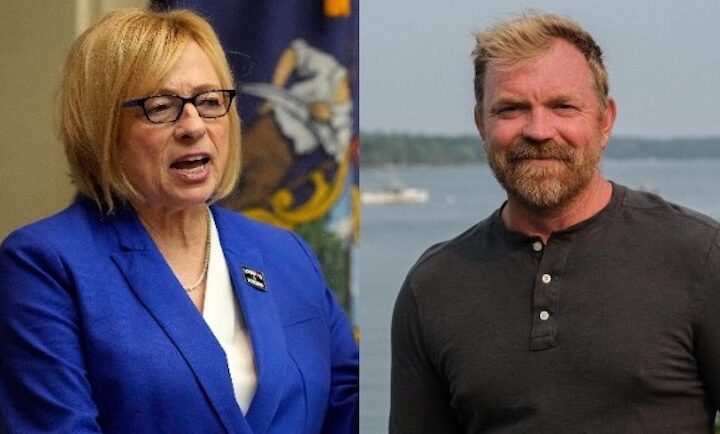
Robert F. Bukaty/AP/Graham Platner campaign
Gov. Janet Mills and Graham Platner
The Democratic Senate primary in Maine is shaping up to be among the most significant proxy battles over Israel in the upcoming midterm elections, pitting the state’s moderate two-term governor against a left-wing populist upstart who has vocally embraced an anti-Israel platform.
Gov. Janet Mills, who announced her campaign to unseat Sen. Susan Collins (R-ME) on Tuesday and is backed by Senate Democratic leadership, is set to face a well-funded challenge from Graham Platner, a veteran and oyster farmer who boasts high-profile support from Sen. Bernie Sanders (I-VT).
In contrast with Mills, who has criticized anti-Israel divestment efforts in her state and warned against a “deeply troubling” rise in antisemitic incidents after Hamas’ Oct. 7, 2023, attacks, Platner has promoted more hostile views on Israel and its alliance with the United States.
Since entering the race in August, Platner has accused Israel of genocide in Gaza and endorsed measures to block U.S. arms sales to Israel. His campaign did not respond to a request for comment regarding the recently brokered ceasefire and hostage-release deal between Israel and Hamas.
Platner has also been an outspoken critic of the pro-Israel advocacy group AIPAC, whose affiliated political arm is supporting Collins, one of the most vulnerable Republicans now seeking reelection — in a state President Donald Trump lost by seven points in 2024.
“We are focused on helping to re-elect Senator Collins, who has long been a leader and champion of strengthening the partnership between the U.S. and Israel,” Marshall Wittmann, a spokesperson for AIPAC, told Jewish Insider on Thursday.
Wittmann did not address whether AIPAC has plans to get involved in the primary. Collins, a five-term senator, has defended her relationship with AIPAC, which has faced growing criticism from Democratic candidates in recent months as intraparty tensions over Israel have intensified.
It remains to be seen if the Maine Senate race will draw outside spending from other pro-Israel groups including Democratic Majority for Israel, which has engaged in a number of recent primaries. The group did not respond to requests for comment from JI.
The primary also includes Jordan Wood, a former congressional aide whose campaign says that he has raised $3 million since April. Dan Kleban, a brewery owner in Maine, dropped out of the race on Tuesday and endorsed Mills, who was aggressively recruited by Senate Minority Leader Chuck Schumer (D-NY).
Mills’ campaign said this week that she had raised $1 million in the 24 hours after she announced her bid. Platner’s team reported a $4 million haul since entering the race over the summer, with prominent contributors ranging from Ron Klain, a former chief of staff to President Joe Biden, to the billionaire donors Donald Sussman and Chris Hughes, according to campaign filings.
While Platner, 41, has drawn scrutiny over his views on Israel — which he has made a central component of his campaign messaging and national fundraising appeals — the political newcomer has more recently weathered controversy surrounding past comments in which he identified as a “communist,” called “all” police “bastards” and said rural Americans are racist and stupid, among other incendiary statements.
Platner has said that such views, unearthed in a CNN investigation published on Thursday, do not reflect his current thinking. Still, the deleted posts underscore how a previously untested candidate is likely to navigate additional vulnerabilities in a race that Democrats view as one of their top priorities as they seek to win back the Senate majority next year.
Following Mills’ launch this week, Larry Sabato’s Crystal Ball, a top elections forecaster, said that it had changed its ranking of the Maine Senate race from “leans Republican” to “toss-up” — a rating also echoed by The Cook Political Report.
Mills — who, at 77, would be the oldest freshman senator in history if elected — has won praise from Sen. Kirsten Gillibrand (D-NY), the chair of the Democratic Senatorial Campaign Committee. The two-term governor also formed a joint fundraising committee with the Senate Democrats’ campaign arm earlier this week, according to a new campaign disclosure.
Mills’ campaign team features veterans of her 2022 bid for governor, a person familiar with the matter told JI on Thursday, including Eric Adelstein of the communications consultancy AL Media and Jefrey Pollock of the polling firm Global Strategy Group — which has conducted a number of surveys on Israel and the Jewish vote.
Chelsea Brossard, a Democratic strategist who recently advised Rep. Josh Gottheimer (D-NJ) in his bid for governor of New Jersey, is also joining Mills’ team as campaign manager, according to the source, who asked to remain anonymous to discuss undisclosed details.
Mills’ campaign did not respond to requests for comment from JI on Thursday. Pollock declined to comment.
Every one of the ads the Maine Democratic Senate candidate is running on Facebook and Instagram states his opposition to AIPAC, and several accuse Israel of genocide
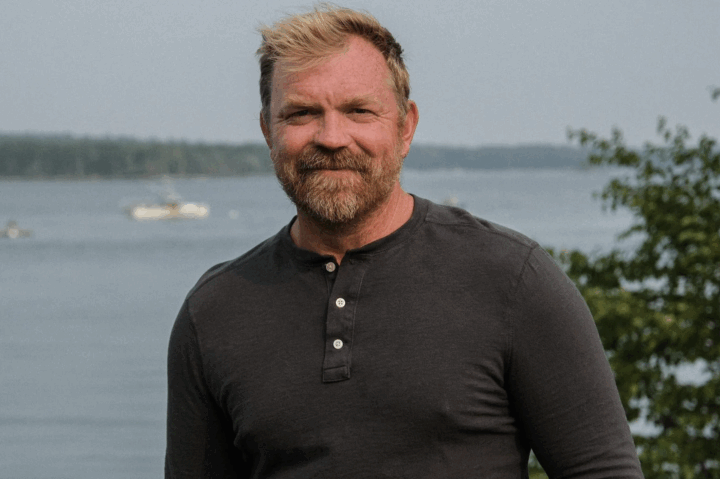
Graham Platner for Senate
Graham Platner
Democratic Maine Senate candidate Graham Platner is putting anti-AIPAC and anti-Israel messaging front-and-center in fundraising appeals he’s circulating on social media.
Platner is currently running a series of Facebook and Instagram advertisements soliciting donations for his campaign that highlight his opposition to AIPAC and accuse Israel of committing genocide. The pitches indicate that Platner is treating the issue as central to rallying support for his campaign.
“My opponent has already been endorsed by AIPAC — an endorsement I will never get. Because what is happening right now in Gaza is a genocide,” Platner says in one direct-to-camera video ad focused specifically on his opposition to AIPAC. “I need your help because we refuse to take money from AIPAC, and we refuse to take money from the billionaires who support it.”
Every one of the eight active ads that Platner is running on Facebook and Instagram, according to Meta’s political advertising library tool, includes a repudiation of AIPAC, and around half accuse Israel of genocide. In most of Platner’s other ads, that language comes alongside comments on a range of other issues.
Some of the written advertisements being circulated by Platner’s campaign on Facebook and Instagram include language such as “there is a genocide happening in Palestine,” “why are we funding Netanyau’s genocide in Palestine?” and “I won’t kowtow to AIPAC or billionaires.”
Platner’s campaign did not respond to a request for comment.
Platner, in the days since launching his campaign, has been repeatedly and vocally critical of Israel and of AIPAC, including calling the group “weird.”
Platner’s potential general election opponent, Sen. Susan Collins (R-ME) has been a vocal supporter of Israel in the Senate, as chair of the Senate Appropriations Committee. It’s not clear yet how Platner’s stance on Israel will play in the election, but Collins is already attacking him for his views.
The candidate’s advocacy on the Israeli-Palestinian conflict appears to date back to his high school days — a page from his yearbook that Platner’s campaign shared on X shows him holding a sign that appears to read “Free Kosovo Chechnya Kashmir Palestine Kurdistan Tibet.”
Vermont’s democratic socialist senator is on a campaign swing as part of his ‘Fighting Oligarchy’ tour

Scott Olson/Getty Images
Sen. Bernie Sanders (I-VT) speaks to guests during the first stop on his "Fighting Oligarchy" tour, Midwest swing, at the RiverCenter on August 22, 2025 in Davenport, Iowa.
Sen. Bernie Sanders (I-VT) is slated to appear with Graham Platner, a Democrat running to unseat Sen. Susan Collins (R-ME), at a rally in Portland, Maine, on Labor Day, as the progressive leader from Vermont steps up his efforts to boost left-wing candidates who have been outspoken in their criticism of Israel and its ongoing war in Gaza.
Platner, a first-time candidate and Marine veteran who launched his campaign last week, has accused Israel of committing genocide in Gaza and backed Sanders’ recent resolutions to block arms sales to Israel. Platner’s rhetoric has faced criticism from Collins, a moderate Republican seeking her sixth term.
Sanders, who announced the rally on Monday, has not officially endorsed Platner, a 40-year-old oyster farmer whose past social media activity indicates he is a longtime admirer of Vermont’s democratic socialist senator.
The Portland event on Sept. 1, the next stop on Sanders’ nationwide “Fighting Oligarchy” tour, follows a rally in Michigan on Saturday at which the senator sought to boost Abdul El-Sayed, a staunch critic of Israel who is vying to replace retiring Sen. Gary Peters (D-MI) in a crowded primary next year.
In remarks over the weekend, Sanders, an early backer of El-Sayed’s campaign for the Democratic nomination, highlighted his efforts to restrict U.S. military aid to Israel and spoke out against the humanitarian crisis in Gaza, claiming that Washington is “way out of touch with where the American people are” on what he called “clearly a moral issue.”
“We are paying for the starvation of children in Gaza,” Sanders said to the crowd gathered at the Miller Auditorium at Western Michigan University in Kalamazoo.
El-Sayed, for his part, echoed those remarks, saying that party leadership “is still pulling its punch on the fact that we are subsidizing a genocide in Gaza.”
“Maybe we should be using our taxpayer dollars, I don’t know, to build schools for our kids, rather than sending blank checks to foreign militaries who drop bombs on other kids,” El-Sayed said in his speech last weekend.
El-Sayed, a former health director in Michigan, is facing progressive state Sen. Mallory McMorrow and Rep. Haley Stevens (D-MI), a leading pro-Israel voice in the House who is favored by party leaders.
It was a surprise to everyone in Portland, Maine — including Mayor Ethan Strimling — when 250 asylum-seekers from Angola and the Congo arrived in the New England city over a single week in June.
The only advance notice Portland received had been a call from a Catholic Charities worker in San Antonio, Texas, who had put the asylees — who had crossed into the U.S. through the border with Mexico — on a bus headed for the coastal city, Strimling said in an interview with Jewish Insider.
Though it created a housing crisis for officials in the municipality that The New York Times described as one of the “oldest and whitest states in the country,” Strimling and others welcomed them.
In April, when President Trump tweeted that he was considering sending immigrants to sanctuary cities, Strimling tweeted in response, “If Trump wants to send more immigrants our way, I say, ‘Welcome Home!’”
Asylees who arrived in June were given temporary shelter at the Expo Center, a city-owned basketball arena. “The city’s response made me so proud that I was a member of this community, let alone the mayor,” Strimling told JI. “I went to the shelter every night and talked to the families, made sure they were safe. “It gave me great joy to be down there every day.”
About half of the unexpected African asylees have settled in Portland, with the rest having been set up with housing in surrounding communities, said the mayor.
His city is “without question the most diverse in the state,” Strimling told JI, and he expects the 2020 census to reveal that 15 to 20 percent of its residents are people of color – a major shift from 20 years ago.
Now, three weeks from Portland’s mayoral election, Strimling hopes voters will elect him to a second term. Despite having three challengers, including one who interned for Strimling’s last campaign, “we are feeling cautiously optimistic” about winning, he told JI.
Strimling, who will turn 52 this week, was born and raised in New York City and was an acting student at Julliard when he decided to take a left — or northern — turn and move to a farm owned by his mother’s best friend, near Maine’s Acadia National Park. He earned his Bachelor’s degree at the University of Maine and a Master’s degree in education at Harvard before going to Washington to work as a legislative aide. He returned to the Pine Tree State to run a congressional campaign.
In the late 1990s, Strimling turned to working with at-risk kids, eventually running Learning Works, a community-based education organization, and joined the board of the NAACP. Later he was invited to join the board of the Maine chapter of the ADL. He stepped off of all boards when he ran for mayor. He lost his first race in 2011, but won his second attempt four years later.
Now he hopes to win a second term and address what he describes as Portland’s most pressing problems, primary among them a local housing crisis. He is pushing for a $10 million bond issue that would raise money for affordable housing, wants to increase the number of affordable housing units developers provide, and to “crack down on Airb&b,” which has taken 400 homes off the rental market since their owners began listing them on the short-term vacation stay site.
“When those migrant families arrived we needed just 100 units of affordable housing to not open up the gymnasium, and we didn’t have it,” said Strimling.
His city has become a tourist destination on the Maine coast, with developers building triple the number of hotel rooms as they did two decades ago. But that doesn’t mean it has been a total economic success for Portland, said Strimling, noting that “tourism industry jobs are low-paying.”
A pop-up organization calling itself Unite Portland has been running Facebook attack ads against Strimling in the past several weeks — not for another candidate, just against Strimling. The individuals behind it are real estate developers, he said, though organizers are not complying with mandatory disclosure reporting rules.Strimling said that his campaign filed an ethics complaint against them last week in an effort to force them to disclose more details.
The son of a non-Jewish mother and a Jewish father, Strimling identifies as Jewish, but it is a cultural rather than religious association, he said. His father, Arthur Strimling, is a theater director and midrashic story-maker based in Brooklyn. Most of his close friends from high school were Jewish, he noted. His girlfriend, who also works as his campaign manager, is not.
In July, an article in the local Portland Press-Herald about donors to his campaign highlighted the contributor with the most overtly “Jewish” name. In addition, there have been some anti-immigrant and anti-Strimling signs posted around Portland, he said.
However, antisemitism has not been an overt issue in his race for a second term, he said.
“I get a lot of ‘go back to NY’ — code for ‘New York values,’ you know what that can mean,” Strimling told JI. “But overtly antisemitic stuff, where they’re really identifying my ethnicity, I haven’t gotten that.”
Please log in if you already have a subscription, or subscribe to access the latest updates.
 Continue with Google
 Continue with Apple