













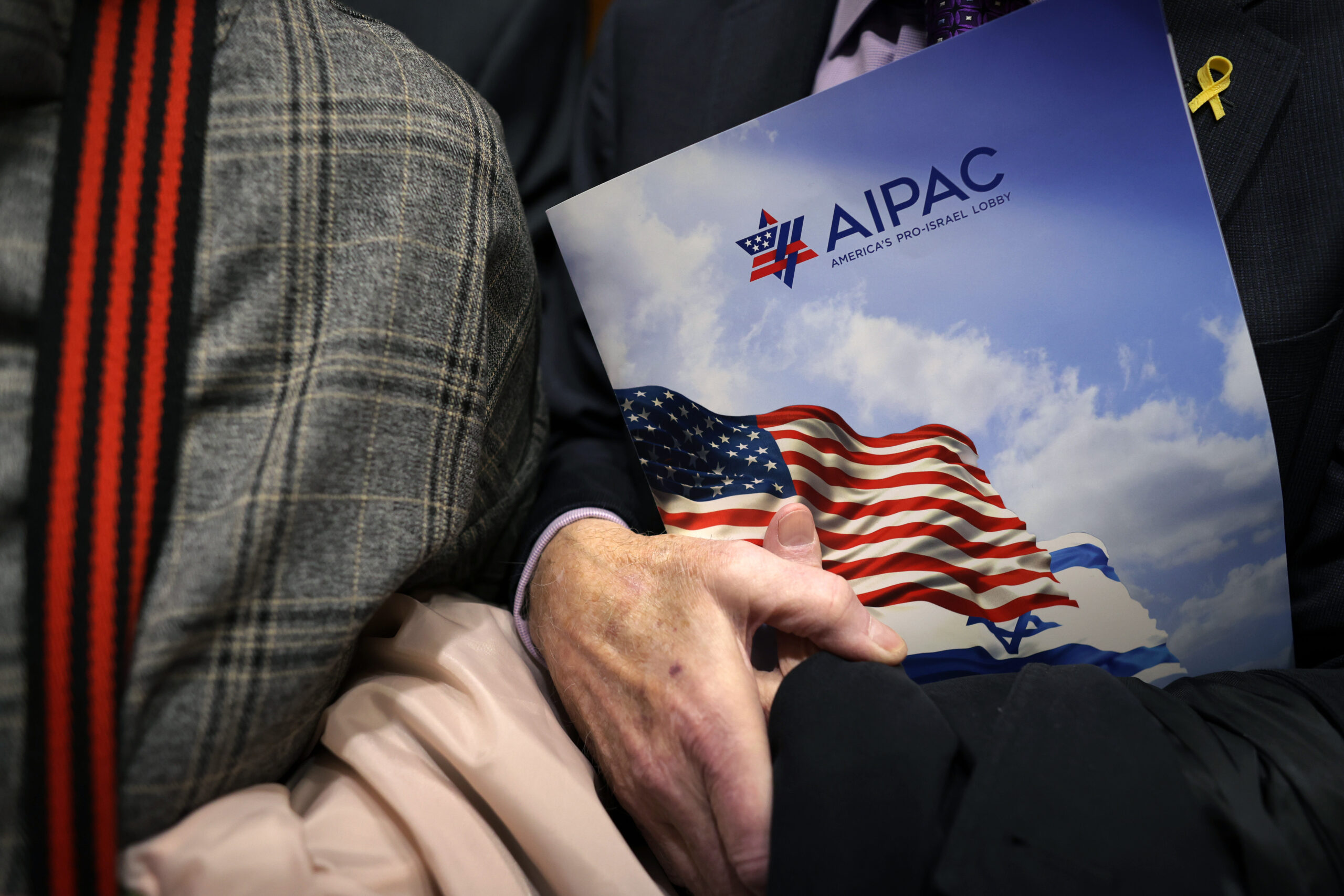



















DeLauro has long publicly affiliated more closely with J Street than AIPAC, but AIPAC has maintained its support for and endorsement of the senior Democrat
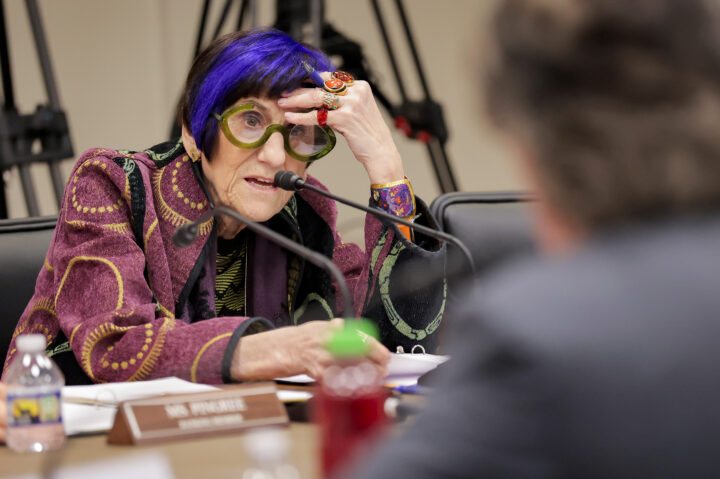
(Heather Diehl/Getty Images)
Rep. Rosa DeLauro (D-CT) questions Interior Secretary Doug Burgum during a House Appropriations Committee hearing at the Rayburn House Office Building on April 20, 2026 in Washington, DC.


 Add JewishInsider on Google
Rep. Rosa DeLauro (D-CT), the ranking Democrat on the House Appropriations Committee, said she’ll no longer accept support from AIPAC, a major break with the pro-Israel group by one of the key power players in the House.
As the top Democrat on the Appropriations Committee, in line to again be the committee chair if Democrats retake the House, DeLauro has significant sway on federal funding matters, including the provision of aid to Israel.
DeLauro has long publicly affiliated more closely with J Street than AIPAC, and has staked out some positions more critical of Israel, including floating conditions on U.S. aid. But AIPAC has maintained its support for and endorsement of the senior Democrat, whose voice can be crucial to advancing its priorities.
“Congresswoman Rosa DeLauro is taking no contributions from AIPAC. She did in prior years when she believed Israel was acting like a strategic partner & was committed to a two-state solution,” DeLauro’s campaign manager Allison Dodge said in a statement posted on X. “It is abundantly clear now that the Netanyahu government has no interest in either.”
Dodge emphasized that DeLauro has “repeatedly called out the humanitarian crisis in Gaza and Israel’s annexation of the West Bank,” as well as pushed for additional aid to Gaza and an amendment in the 2027 Defense Appropriations bill that would “ensure U.S. weapons and equipment are not being used in violation of the ceasefire.”
The memo comes as House Democrats reportedly fret over an effort to strip U.S. military funding for Israel out of the State Department’s annual funding bill

Andrew Harnik/Getty Images
Rep. Thomas Massie (R-KY) speaks to reporters as he arrives for a House Republican caucus meeting at the U.S. Capitol on February 25, 2025 in Washington, DC.
Democrats on the House Appropriations Committee are warning that an effort by Rep. Thomas Massie (R-KY) to cut aid to Israel from the State Department’s annual funding bill could have further-reaching consequences than intended and impact a range of other programs and issues, Jewish Insider has learned.
Those concerns come amid reports of an outpouring of agita among House Democrats about how to approach the amendment — a reflection of how far debate among Democrats over aid to Israel has shifted.
Though Massie has focused his messaging around the amendment on the $3.3 billion in U.S. military funding to Israel laid out in the U.S.-Israel memorandum of understanding, the amendment also includes blanket language stating that “none of the funds made available under this Act shall be obligated or expended for Israel.”
Democrats on the Appropriations Committee are warning that it would be up to the State Department to interpret how to implement the amendment, but that the amendment would likely also require the department to withhold funding for joint U.S.-Israel development programs in underserved countries, the Middle East Partnership for Peace program, the Middle East Regional Cooperation program supporting Israeli-Arab scientific cooperation and longstanding funding for refugee resettlement in Israel — a line item that dates back to efforts to resettle Soviet refugees.
The legislators believe, depending on the State Department’s interpretation, it may also defund U.S. Embassy operations in Israel, U.S. support for the Palestinian Security Forces, educational and cultural exchanges and even U.S. military sales to Israel not funded by the U.S.
Democrats on the committee are also emphasizing that Israel is one of 35 recipients of U.S. military funding, that the funding includes requirements on how it is used and that the orders in question generally take years to fulfill.
Funding for cooperative missile-defense programs with Israel would not be impacted by the amendment, as that funding comes through the defense appropriations process, a separate bill.
The amendment was originally set to come up for consideration this week in the House but — amid a rebellion by some House Republicans over the Senate’s failure to pass the SAVE America Act, President Donald Trump’s top-priority voter ID bill — Republicans were unable to approve a procedural vote to open consideration of the State Department bill.
House Democrats are set to hold a virtual meeting on Sunday to discuss the situation.
AIPAC has been lobbying aggressively against the amendment, with an action alert to members urging them to contact their representatives in Congress to oppose the amendment. In messaging for Democrats, the group emphasized that the memorandum of understanding was finalized by the Obama administration and in the eight appropriations cycles since, “Congress has thus far never failed to ensure Israel has the resources it needs to defend its families.”
“Israel is on the front lines fighting against our shared enemies in the Middle East,” the AIPAC messaging reads. “Robust U.S.-Israel security cooperation is vital to advancing our mutual security interests around the world. Cutting funding for assistance to Israel would embolden our adversaries and undermine a key pillar of longtime U.S. national security policy.”
The message also describes Israel as a “model ally” defending the U.S. and shared values against common enemies and the funding as a “smart and cost-effective investment.”
J Street is also opposing the amendment, focusing on its impacts on MEPPA, MEPI and MERC, which the group says “play an important role in peacebuilding and people-to-people relations, including focusing specifically on Israeli-Palestinian peacebuilding in the case of MEPPA.”
The group did not specifically defend the military funding but said it “supports a rapid and responsible phaseout of the $3.3 billion in U.S. military aid to Israel when the 2016 Memorandum of Understanding expires in FY2028 and believes the United States should honor its existing commitments rather than abruptly terminating assistance.”
At the same time, it offered talking points for members who ultimately support this amendment: “Given the realities on the ground, Members may choose to support this amendment,” adding that members should note that the funding does not impact missile defense and should express support for restoring civil programs.
The anti-Israel group A New Policy is also claiming in messaging to members that the U.S. funding for Israel set to be disbursed this year would be consistent with the MOU because of the additional funding appropriated in the 2024 national security supplemental bill. But the MOU specifically guarantees $3.3 billion to be provided annually each year, without consideration of any additional funding provided in other years.
DMFI is also urging lawmakers to reject the amendment, emphasizing both the military and non-military impacts.
“Israel is facing threats from Iran and its terrorist proxies across the region. Cutting off Israel entirely would not create peace. It would embolden America’s adversaries and make a wider regional war more likely,” the group said on X, emphasizing that U.S. support to Israel ultimately helps defend the U.S. and keep American forces out of harm’s way.
DMFI also said that offensive weapons systems are needed to prevent attacks before they happen, and that “eliminating all U.S. funding for Israel is not serious oversight. It is abandonment without a plan.”
Trump urged Republicans to abandon their obstructionist tactics on the issue, and their weekly schedule released Friday indicated that Republican leadership intends to seek to bring the State Department appropriations bill forward again in the coming week.
Lawmakers are also slated to consider the 2027 National Defense Authorization Act on the floor next week.
That bill will bring with it more fights over the U.S.-Israel relationship, with plans by Massie to offer an amendment to eliminate a relatively routine provision on U.S.-Israel military cooperation that that far right and far left have falsely framed as a merging of the American and Israeli militaries and a surrender of U.S. sovereignty to Israel.
Had the House opened consideration of the State Department bill last week, it was also set to consider an amendment by Massie on cutting U.S. funding for Jordan, including military aid, as well as an amendment by Reps. Chip Roy (R-TX) and Andy Biggs (R-AZ) banning any funding for the U.N. and an amendment by Roy to cut funding for the Middle East Partnership Initiative, which funds educational exchange programs for students from the Middle East, among other programs.
J Street, in its communications with lawmakers, offered more robust support for the military funding for Jordan.
The $355 million proposal is the highest funding level to pass out of committee for the program

Brandon Bell/Getty Images
A law enforcement vehicle sits near the Congregation Beth Israel synagogue on January 16, 2022 in Colleyville, Texas.
The House Appropriations Committee approved a $40 million increase in its funding proposal for the Nonprofit Security Grant Program for 2027, boosting its recommendation to $355 million, in a Tuesday night session that stretched into Wednesday morning.
The funding increase was approved as part of a negotiated bipartisan package of amendments during an Appropriations Committee markup, which passed by a voice vote.
A source familiar with the situation credited Reps. Juan Ciscomani (R-AZ), Celeste Maloy (R-UT), Debbie Wasserman Schultz (D-FL) and Lois Frankel (D-FL) with securing the increase.
“Nonprofit security grants are absolutely critical to combat surging antisemitism and hate crimes,” Wasserman Schultz told Jewish Insider. “I proudly fought for an increase in NSGP funding and I’m grateful it was included, but we must do more on the floor and in conference to make sure everybody in America can worship safely.”
In remarks during the committee markup, Wasserman Schultz thanked colleagues for supporting the request, saying that it is not “anywhere near the funding that is necessary … it is certainly a small step in the right direction,” citing recent attacks on Jewish and other communities.
Frankel said that her synagogue is guarded by several armed men, a “really sort of scary” situation.
“As antisemitism continues to rise and threats against religious communities become more frequent, Congress must do more to help houses of worship protect their congregants. No one should have to fear for their safety while practicing their faith,” Frankel said in a statement. “I’m glad we were able to secure an increase this year, but the job isn’t finished. I’ll keep working with Republicans and Democrats alike to make sure protecting synagogues and other faith-based institutions remains a priority and that our funding keeps pace with the threats they face.”
The $355 million proposal is the highest funding level to pass out of committee for the program, but still falls well below the $1 billion that lawmakers and advocates for the program on Capitol Hill say is necessary to fully meet the needs of the Jewish community and other populations under threat.
The proposal could be further increased — or face further cuts — as the appropriations process continues. The process looks to be especially chaotic this year as Senate lawmakers say they are still far apart in negotiating top-line funding levels.
The Orthodox Union, Jewish Federations of North America and Anti-Defamation League worked behind the scenes in support of the amendment, sources said.
“We appreciate this substantial increase in NSGP funding by the committee and we’re particularly thankful to Reps. Ciscomani, Maloy, Wasserman Schultz and Frankel, as well as Chair Amodei,” Nathan Diament, the executive director of the Orthodox Union Advocacy Center told Jewish Insider. “It’s well known that the security needs of the Jewish community and other faith communities are huge and we will continue to work with allies in Congress to fully meet those needs.”
Rachel Dembo, director of policy and government affairs for the Jewish Federations of North America, said JFNA “was proud to play a leading role in securing this additional bipartisan funding.”
“This increase is a meaningful investment in the safety and security of Jewish communities and other vulnerable nonprofits, though the need for the program continues to exceed available funding,” Dembo continued. “We are grateful to the Committee and bipartisan congressional champions for strengthening this critical investment and recognizing the urgent need for nonprofit security. We look forward to continuing to work with Congress to help close the gap between available funding and demonstrated need.”
Lauren Wolman, the senior director of government relations and strategy at the Anti-Defamation League, said that the funding will be helpful, but remains insufficient.
“ADL welcomes the inclusion of an additional $40 million for NSGP in the House Homeland Security managers amendment. This increase will help more houses of worship, schools, and community centers access the security resources they need,” Wolman said. “But the truth is, the gap between what’s available and what’s needed remains vast. To truly protect vulnerable communities across the country, Congress must go further and fund the program at $1 billion to ensure every at-risk community gets the protection it deserves.”
The two pro-Israel and one anti-Israel lawmakers join the panel which features outspoken voices on both sides of the Israel policy debate
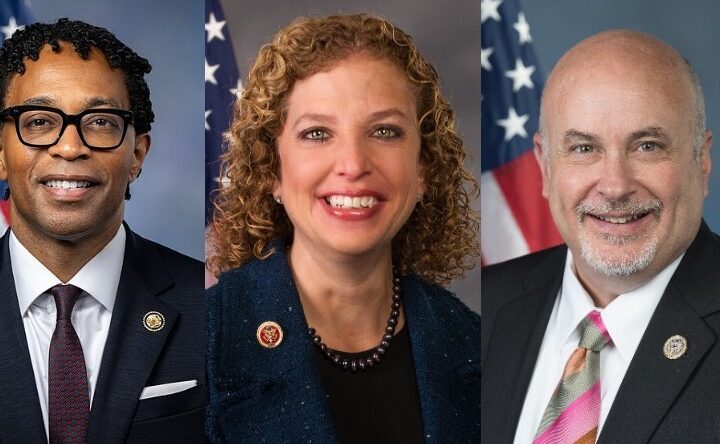
Wikimedia Commons/U.S. Congress/U.S. House Office of Photography
Reps. Wesley Bell (D-MO), Debbie Wasserman Schultz (D-FL) and Mark Pocan (D-WI)
House Democrats are set to name Reps. Wesley Bell (D-MO), Debbie Wasserman Schultz (D-FL) and Mark Pocan (D-WI) to the House Foreign Affairs Committee, Jewish Insider has learned.
Bell and Wasserman Schultz are both strong supporters of Israel, while Pocan is an outspoken critic, joining a panel that features outspoken voices on both sides of the Israel policy debate. None of the three offices responded to requests for comment.
Rep. Max Miller (R-OH), a Jewish Republican and strong supporter of Israel, also recently joined the panel.
Wasserman Schultz is a senior member of the House Appropriations Committee who has long been deeply involved in foreign policy issues, particularly in support of Israel. She is also a co-chair of the House Abraham Accords Caucus.
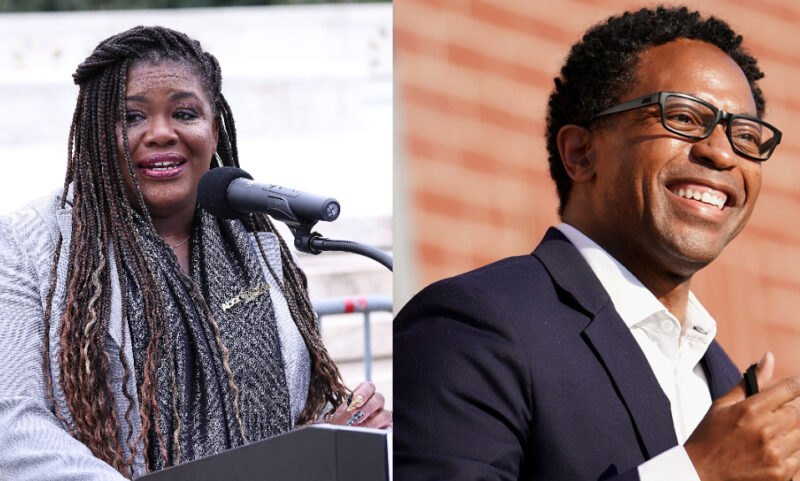
Bell, first elected in 2024, also serves on the House Armed Services Committee. Bell defeated anti-Israel former Rep. Cori Bush (D-MO) with support from the Jewish and pro-Israel communities both in St. Louis and nationally, and faces a primary challenge from her this year.
Pocan has long been among the most vocal critics of Israel in the House. He was a lead sponsor of the Block the Bombs Act when it was first introduced a year ago, and voted against supplemental aid to Israel in 2024. He also frequently sparred with AIPAC on social media, at times invoking antisemitic tropes accusing Israel and its supporters of relishing in the deaths of civilians and children.
Jewish groups called the proposal, which is a slight increase from 2026 funding levels, appreciated but vastly inadequate

Brandon Bell/Getty Images
A police vehicle and crime scene tape.
Republicans on the House Appropriations Committee proposed providing $315 million for the Nonprofit Security Grant Program in 2027, a slight increase from 2026 funding levels but far below the $1 billion that supporters of the program in the House and Jewish and other faith communities have called for.
The 2026 funding bill contains $300 million for the program, a marginal increase from 2025 levels. But the program has been subject to significant procedural delays — funding from the 2025 tranche has still not yet been disbursed, and the timeline for 2026 applications remains uncertain.
In 2024 — the most recent year for which data is publicly available — applicants requested $978 million in federal funding, and less than half of applications were funded with a pool of $454.5 million available.
“Any increase in Nonprofit Security Grant Program funding is welcome, but this proposed appropriation is not enough,” Rep. Gabe Amo (D-RI), who led a letter to appropriators calling for $1 billion in funding, told JI. “I’ll keep pushing to fund the NSGP at $1 billion so Americans can worship, gather, and serve their communities in safety.”
Rep. Josh Gottheimer (D-NJ) said that the “math doesn’t add up” for the committee’s proposal. “When houses of worship are under threat, this is not the time to lowball our safety.”
Jewish groups also called the proposal appreciated, but vastly inadequate.
“This is a modest increase from last year, but we need more to keep our community safe in the face of the explosion in antisemitic threats,” Nathan Diament, the executive director of the Orthodox Union Advocacy Center, said. “We will be working with our allies on the Appropriations Committee to increase this funding level.”
“We appreciate the House proposal to provide $315 million for NSGP, but the reality is that demand continues to far outpace available funding,” Dan Granot, senior director of government relations and community engagement for the Anti-Defamation League, said. “At a time of record antisemitism and heightened security concerns, Congress should fund NSGP at no less than $1 billion, reflecting the urgent needs of vulnerable communities across the country.”
Eric Fingerhut, the CEO of the Jewish Federations of North America, said, “We are grateful for the support of the committee thus far but we will not be able to adequately address these threats until the Nonprofit Security Grant Program, which is unable to cover even half of requests at current levels, reaches $1 billion.”
He said that JFNA will work with DHS and Congress to “fully fund” the program.
In recent appropriations cycles, the House has approved modest funding increases for the program as the funding bills have worked their way through committee and the House floor.
The Appropriations Committee released a separate bill on Thursday proposing a $1.5 million increase to the Holocaust Survivor Assistance Program, to $10 million.
“We commend the House for proposing $10 million for the Holocaust Survivor Assistance Program,” Fingerhut said. “This increased investment will help ensure that survivors, many of whom continue to face significant physical, emotional, and financial challenges, receive the specialized care and support they deserve.”
In a hearing on the 2027 State Department funding bill, Democrats pushed unsuccessfully to condition the use of U.S. funded-weapons by Israel
(Heather Diehl/Getty Images)
Rep. Rosa DeLauro (D-CT) questions Interior Secretary Doug Burgum during a House Appropriations Committee hearing at the Rayburn House Office Building on April 20, 2026 in Washington, DC.
During a meeting on the 2027 funding bill for the Department of State, several Democrats on the House Appropriations Committee pushed, ultimately unsuccessfully, for the committee to adopt new conditions on the $3.3 billion in U.S. military aid allocated for Israel annually in the bill.
Rep. Mike Quigley (D-IL) introduced an amendment which would have prevented the use of U.S. funded-weapons to expand settlements or damage or destroy “homes, schools, farms, orchards or other civilian property” in the West Bank or Gaza, but ultimately withdrew it. Israel has routinely targeted Hamas operatives hiding in a range of civilian locations throughout Gaza.
Though he withdrew the amendment before requesting a vote, several progressive Democrats spoke in favor of it, most notably Rep. Rosa DeLauro (D-CT), who is set to be the chair of the Appropriations Committee should Democrats retake the House in November.
The amendment “would require the United States to live up to our obligations under international law,” DeLauro argued, condemning settlement expansion as “annexation of the West Bank … happening before our very eyes.”
Destructions of Palestinian homes in the West Bank “are part of a strategy to destroy the possibility of a two-state solution,” she continued.
“This amendment would recognize the United States’ obligation under international law, which is at a minimum to cease support for Israel’s illegal settlement policies,” she said. “But there are impacts at home as well. The more the U.S. ignores lawless actions, turns a blind eye to the violations of Palestinian territory and sovereignty, the more that our credibility and influence erodes on the global stage.”
Rep. Lois Frankel (D-FL), the ranking member of the subcommittee responsible for State Department funding, did not offer a definitive stance on the bill, but indicated her opposition, praising Quigley repeatedly for withdrawing it.
“This has obviously become a contentious situation. I myself am a strong supporter of the security of Israel, of the people who live there, and also decency to innocent people who live nearby,” Frankel said. “I respect your offering [the amendment] and willingness to withdraw.”
Rep. Mario Diaz-Balart (R-FL), the subcommittee chair, emphasized Hamas’ use of human shields in Gaza and placement of terror infrastructure under schools, hospitals and United Nations facilities, and noted that U.S. aid to Israel is already subject to global human rights conditions.
“These other conditions, additional conditions, are totally unnecessary. I think they’re totally inappropriate to one of our closest allies that is under serious threat right now,” he continued.
Quigley introduced a second amendment allocating at least $400 million for rebuilding civilian infrastructure in Gaza, which failed by a vote of 32-25.
The explanatory report accompanying the committee’s draft 2027 funding bill for the State Department, also released this week, includes multiple passages that offer veiled and overt criticism of U.S. allies for failing to assist in the U.S. operations against Iran, a gripe shared by President Donald Trump.
One section “strongly encourages longstanding allies and partners to work with the United States to help secure freedom of navigation within critical sea lanes, including the Strait of Hormuz,” and another “condemns the decision by the Government of Spain” to deny the U.S. use of its bases and airspace for operations against Iran.
The full bill includes various new provisions aimed at securing accountability for United Nations Relief and Works Agency staff’s involvement in the Oct. 7, 2023, attacks on Israel, and ties to Hamas. The explanatory report accompanying the bill expands upon such efforts.
It condemns the United Nations for providing “ongoing protection” to former U.N. staff involved in the Oct. 7 attacks, and highlights that the State Department inspector general has sought information from organizations operating in Gaza about their staffing and relationships with Hamas, but such requests have at times been ignored.
It requires that funding to any entity be suspended if the entity fails to comply within 90 days with a request for information from a U.S. inspector general. It emphasizes that the “committee expects” that anyone employed by a U.S.-funded group who is a member of a terrorist organization, or any group that knowingly employed such individuals, “shall be referred expeditiously for the appropriate criminal and administrative remedies.”
And it urges the administration to use U.S. influence and power at the U.N. to push other countries to defund UNRWA, and to identify other aid mechanisms.
It instructs the administration to assess whether international organizations’ anti-Israel bias arises from specific actions by member states or “systemic behavior” within the organizations, and to assess “institutional practices” that might undermine neutrality toward Israel, such as hiring individuals known to be prejudiced against Israel or accepting information provided by Hamas while rejecting information provided by Israel.
It also calls for an assessment of the U.N.’s progress in implementing efforts to combat antisemitism and recommendations on how such efforts can improve.
The report raises concerns about Turkey’s relationship with Hamas, demanding a briefing to Congress on such ties. And it blocks U.S. funding to South Africa until the South African government stops cooperating with U.S. adversaries, additionally condemning the country for its anti-Israel advocacy on the international stage.
The bill proposes a marginal increase in funding for the office of the State Department’s special envoy to monitor and combat antisemitism, from $2.6 million in 2026 up to $2.75 million. It again urges the State Department to increase full-time staffing within the office.
The explanatory report offers support for the State Department’s Global Guidelines for Countering Antisemitism, and urges the department to expand efforts to promote those guidelines globally.
It further expresses concern about rising antisemitism in Latin America, particularly by elected officials, and calls on the State Department to engage with regional leaders to combat it.
The bill allocates $37.5 million for the Nita Lowey Middle East Partnership for Peace Act designed to promote Israeli-Palestinian people-to-people ties, level with 2026; allocates $55 million for the Near East Regional Democracy program, which promotes civil society and democracy in Iran, as well as directing the administration to consult with Congress on expanding internet access in Iran; keeps consistent funding at $3 million for U.S.-Israel development partnerships in third countries; holds funding for Israeli-Arab scientific partnerships level at $7 million; and offers a substantial increase in funding for the Middle East Partnership Initiative from $20 million to $50 million.
It also allocates $4 million in U.S. military aid for Bahrain.
The report condemns the U.N. General Assembly for passing, in a previous year, a resolution upgrading the Palestinians’ status at the U.N.
The report urges the further expansion of the Abraham Accords, calling the “urgent need” for further normalization “more apparent than ever” following Oct. 7. It calls for additional “dedicated resources” to implement U.S.-driven normalization efforts. It instructs the Department of State to “ensure resources are available” to implement and expand on normalization agreements, and to consult with Congress on these efforts.
The report instructs the administration to report to Congress every 90 days on progress in implementing the 20-point peace plan for Gaza — an effort that has been hampered by Hamas’ refusal to disarm — as well as to brief Congress on the Board of Peace.
It asks the administration to provide information to lawmakers on the Boycott, Divestment and Sanctions campaign targeting Israel, including companies, international organizations, countries, sovereign investment funds and other entities promoting or engaging in BDS, and steps that the administration is taking to “discourage or end” such policies.
It further directs the administration to “expand vetting policies and practices” to ensure no U.S. aid is provided to entities that engage in the Boycott, Divestment and Sanctions movement, glorify violence or support efforts to target Israel or the U.S. at the International Criminal Court or the International Court of Justice.
The report further instructs the State Department to report to Congress on the effectiveness of Iran sanctions and current Iranian revenue streams — as well as to allocate an additional $2 million to enforce and implement Iran sanctions; report on efforts to end the Palestinian Authority’s prisoner payments program; report on the status of religious and ethnic minorities in Syria; report on the Iranian and Iranian proxy presence in Latin America; and report on the production and distribution of the narcotic Captagon by Hezbollah and other adversaries.
It also urges the administration to “prioritize partnerships” with educational institutions that support U.S.-Israel engagement, and instructs it to make funds available to support humanitarian needs in Israel stemming from Iranian and Iran-backed attacks and to provide funding to historical preservation projects in Israel such as the City of David.
The bill introduces a new version of the provision put forward by House Republicans last year that would withhold funding for the United Nations secretariat

Anna Moneymaker/Getty Images
Rep. Mario Diaz-Balart (R-FL) speaks at a press conference following their weekly caucus meeting in the U.S. Capitol Building on July 19, 2022, in Washington, D.C.
Republicans on the House Appropriations Committee, in their draft 2027 funding bill for the State Department, are again aiming to leverage U.S. funding to the United Nations and other foreign programs to seek accountability for involvement by U.N. employees and others in the Oct. 7, 2023, attacks on Israel.
They made similar efforts during the 2026 government funding process, but the provisions were ultimately excluded from the final 2026 funding bill.
The bill introduces a new version of the provision put forward by House Republicans last year that would withhold funding for the United Nations secretariat — the U.N. management headed by the secretary-general — until the U.N. agrees to waive privileges and immunities for United Nations Relief and Works Agency employees or employees of other U.N. entities in cases involving gross violations of human rights, acts of terrorism, support for terrorism or other serious criminal conduct.
The move is an effort to respond to findings that UNRWA employees took part in the Oct. 7 attacks on Israel and subsequently were involved in holding hostages and engaging in other terrorist activity in Gaza.
The provision also withholds any funding for any entities that fail to comply within 90 days with U.S. inspector general requests related to projects and programs in Gaza, the Oct. 7 attacks or support for terrorism.
“The bill also includes a provision to help provide justice for victims murdered in the October 7 terrorist attacks, including 50 American citizens, by requiring full accountability for the UNRWA staff involved in this vicious attack,” Rep. Mario Díaz-Balart (R-FL), who chairs the subcommittee with jurisdiction over the bill, said at a Thursday meeting. “In addition, the bill includes a new provision cutting off funds to any international organization that refuses to cooperate with inspector general investigations into whether October 7 terrorists are on its staff.”
Under the 2026 funding bill, 10% of U.S. funding to the U.N. and its agencies is conditioned on the State Department’s certification that the recipients of that funding are taking credible steps to counter anti-Israel bias, informing donors when aid has been diverted or destroyed and implementing policies to vet staff for terrorist affiliations, among a range of unrelated reforms.
In the new bill, House Republicans proposed increasing that to 15% of the funding in question.
More broadly, the bill would leverage U.S. foreign aid by tying aid levels to cooperation with various U.S. priorities, including recipients’ U.N. votes and their efforts to oppose U.S. adversaries, maintaining a provision first implemented in 2026.
It cuts funding for the U.N. by $1.8 billion, including slashing all funding for the U.N.’s regular budget, as well as cutting nearly $1 billion from humanitarian assistance programs generally.
It maintains the now-multiyear provision banning U.S. support for the UNRWA, as well as enhanced vetting and oversight procedures for assistance to the West Bank and Gaza. And it bans U.S. funding for the U.N. Human Rights Council and its Commission of Inquiry investigating Israel, the International Criminal Court and the International Court of Justice.
The bill eliminates a previous provision allowing the administration to waive a ban on U.S. aid to U.N. agencies or bodies led by states that support terrorism.
Overall, the bill cuts an additional $2.69 billion from the State Department budget — 6% of its 2026 funding — while maintaining the annual $3.3 billion military aid for Israel.
The bill adds a new provision prohibiting the admission or resettlement in the U.S. of any foreign national from Gaza.
It maintains bans on any effort to move the U.S. Embassy in Israel out of Jerusalem, or to establish any other U.S. diplomatic facility in Israel’s capital. It also maintains existing prohibitions and restrictions on U.S. aid to the Palestinians, and a ban on the taxation of U.S. aid, a provision crafted in response to Palestinian Authority policies.
It continues the U.S. weapons stockpile in Israel for an additional year, through 2029.
Regarding Iran, the bill would maintain bans on any Iran nuclear agreement that is not submitted to Congress for review, and would bar the revocation of the Islamic Revolutionary Guard Corps’ terrorism designation.
The bill would allow for continued U.S. aid to the Lebanese Armed Forces — which some Republicans argue should be cut off if Beirut’s military continues to fail to comply with its obligation to disarm Hezbollah.
House Republicans are seeking to strip out longstanding human rights conditions on a portion of the proposed $1.3 billion in U.S. military aid to Egypt, an effort that the Senate has previously rejected — though those conditions have habitually been waived by both the Trump and Biden administrations. It instructs the State Department to seek a multi-year Memorandum of Understanding with Egypt on military aid. The bill also includes $125 million in other national security aid to Egypt.
It would provide $845.1 million in budget support and $425 million in military aid to Jordan.
It fully defunds the U.S. Agency for Global Media — which, under previous leadership, faced criticism for a slow response to the protests in Iran — instead providing $540 million for a new “International Communications Activities” program requested by the president.
For the first time, the lawmakers’ request aligns with the $1 billion that some Jewish groups have been advocating for amid a surge in antisemitism

Emily Elconin/Getty Images
Members of Hatzalah of Michigan, a Jewish volunteer emergency medical service survey the area near Temple Israel following reports of an active shooter on March 12, 2026 in West Bloomfield, Michigan.
In a letter to the leaders of the House Appropriations Committee, a bipartisan group of 150 House members asked the committee to provide $1 billion in funding for the Department of Homeland Security’s Nonprofit Security Grant Program in 2027, a massive expansion of the program and an unprecedented increase in their request level.
The request letter, which has been sent annually for the last several years at the start of the House’ appropriations process, comes this year in the immediate aftermath of an attack at Temple Israel in West Bloomfield, Mich., and its early childhood center.
For the first time, the lawmakers’ request aligns with the $1 billion that some Jewish groups have been advocating for for the program, amid a surge in antisemitism in recent years.
“The fact of the matter is, around this country, we’ve all experienced a rise in antisemitism, xenophobia, Islamophobia, hatred of all types,” Rep. Gabe Amo (D-RI), who again co-led the request with Rep. Michael McCaul (R-TX), told Jewish Insider on Thursday. “This is a response that’s proportional to the demand, and right now, we need to act swiftly.”
Last year, a group of 130 lawmakers asked for $500 million, but ultimately were not able to secure a substantial increase in funding; the current DHS funding bill for 2026 contains $300 million for the program, a marginal increase from 2025 levels but below the high-water mark in 2023 of $305 million. The bill has not yet passed, waylaid by ongoing disputes over immigration policy and funding. Immigration issues have made the DHS bill difficult to finalize in recent years, and have strained resources for other DHS programs.
“The threat of violence is unfortunately increasing at places of worship across our country at alarming rates,” the House letter reads. “There has been an increase in hoax bomb and active shooter threats against houses of worship to interrupt services and intimidate the worshippers. There has also been an increase in antisemitic incidents across the country following the October 7th attack in Israel. … Unfortunately, it is easy to see that the need for the NSGP is quickly outpacing the funding.”
The significantly increased request also has more signatories this year than in other recent years, underscoring the degree to which bipartisan support for the program has grown.
“There is strong, robust and meaningful support for this program, because people have seen the realities, and it’s a priority to ensure that all of our communities can worship, celebrate and exist with the safety that they deserve,” Amo told JI on Thursday.
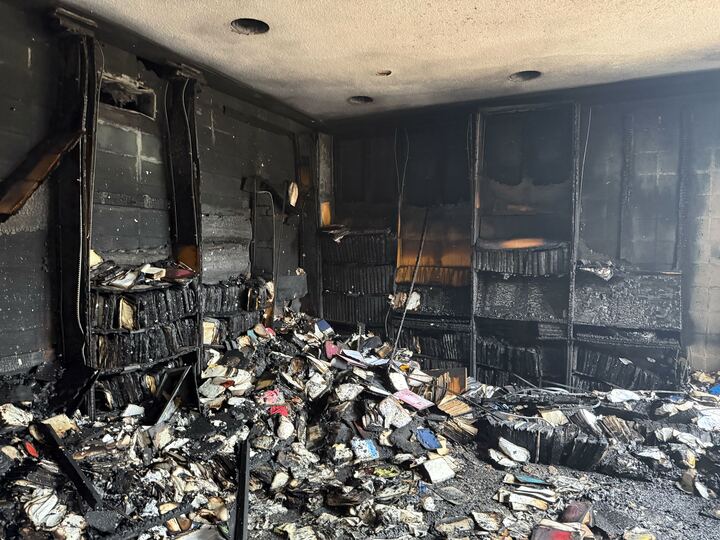
The letter outlines a series of attacks on Jewish institutions, including the Capital Jewish Museum shooting in Washington, the firebombing of a hostage awareness march in Boulder, Colo., an attempted attack on a Florida Jewish nonprofit, the arson attack at Beth Israel Congregation in Jackson, Miss. and the car ramming attack at Chabad-Lubavitch World Headquarters in Brooklyn, as well as attacks on Christian, Mormon and Muslim institutions.
The lawmakers highlighted that need has significantly outpaced the available funding, noting that in 2024 — the most recent year for which data is publicly available — applicants requested $978 million in federal funding, and less than half of applications were funded, even with a pool of $454.5 million available.
The program received $274.5 million in funding in 2025, but that funding has still not been distributed, according to the letter, due to delays at FEMA, and lawmakers have not been provided with customary data about supplemental funding rounds awarded last year.
The $1 billion request, Amo said, is “actually where the demand is.” Though funding allocations haven’t kept pace with demand or with the requests that lawmakers have made, “you can’t get what you don’t ask for. We requested $500 million last year … this year we’re going higher because the need as measured by applications [is there]. We want to get as many as possible.”
He acknowledged that the final allocation may be lower than the $1 billion requested, “but if you look across the board, you want to ask relative to the need, and the need is there.”
Amo said it’s not likely, at this point, that advocates will seek to revise the funding allocation in the stalled 2026 DHS funding bill, despite recent incidents.
He also said that a series of inquiries by lawmakers to the administration about a range of administrative issues and slowdowns for the program in 2025 have gone largely unanswered and unaddressed by administration officials, but vowed to continue to engage with DHS officials to ensure the program remains a priority.
Sen. Markwayne Mullin (R-OK), the Trump administration’s nominee to head the DHS, said at his confirmation hearing on Wednesday that he’d work with lawmakers on both sides of the aisle to try to reduce the bureaucracy around the program and ensure that funding is moving where it is needed quickly.
Lauren Wolman, the Anti-Defamation League’s senior director of government relations and strategy, told JI, “ADL is grateful to Reps. Amo and McCaul for their leadership in spearheading a bipartisan congressional effort calling for a historic $1 billion in funding for the Nonprofit Security Grant Program. At a time of rising antisemitism and continued threats to houses of worship, this program provides critical resources that help communities protect themselves. The need is clear, demand continues to far outpace available funding, and we urge Congress to act to ensure NSGP is funded at a level that reflects the reality on the ground.”
Eric Fingerhut, the CEO of the Jewish Federations of North America, highlighted that the Jewish community spends more than $765 million a year on security efforts and that security costs are the largest expenditure for every Jewish institution.
“We are in the middle of the most serious, violent antisemitic threat environment against the Jewish community in the history of the United States,” Fingerhut said in a statement. “It is the government’s responsibility to protect its citizens in their places of worship, in their places of communal gathering, and the government of the United States must step up to this responsibility now, before we have another tragedy of a kind that we almost had in Detroit last week.”
Nathan Diament, the executive director of the Orthodox Union Advocacy Center, said OU is also “supportive of [Amo’s] leadership and his letter.”
At the same time, the legislation cuts funding for the Department of Education’s Office for Civil Rights by nearly $50 million

David Ake/Getty Images
U.S. Department of Education headquarters building in Washington, DC.
The House Appropriations Committee’s proposed funding bill for the Department of Education includes sweeping new provisions cutting off funding for colleges and universities that fail to address campus antisemitism, but would also cut $49 million in funding for the Department of Education’s Office for Civil Rights in 2026.
New language included in the bill states that no federal funding may be provided to institutions of higher education “unless and until such institution adopts a prohibition on antisemitic conduct that creates a hostile environment in violation of Title VI of the Civil Rights Act of 1964 in all documents relating to student or employee conduct.”
The bill also bans funding to schools that have “failed to take administrative action against any student, staff member, or student group that commits acts of antisemitism while utilizing the facilities, grounds, or resources of such institution.”
The former provision would require schools to specifically implement anti-discrimination policies regarding antisemitism as a precondition of federal funding, while the latter could give the Department of Education additional latitude to cut funding to schools that have allowed antisemitic conduct to go unaddressed or unpunished.
At the same time, the bill would provide $91 million in funding for the Office for Civil Rights, down from $140 million provided in several previous years. The Trump administration, in its budget request to Congress, requested the same cut, as it looks to slash the size of the Department of Education while winding down the department.
The Appropriations Committee’s subcommittee on Labor, Health and Human Services, Education and Related Programs voted along party lines to advance the bill to the full committee on Tuesday evening.
The funding proposal sets up a clash with the Senate, which proposed consistent funding at $140 million for the office in its own appropriations legislation, which the Senate Appropriations Committee passed at the end of July. The Senate bill does not include the new language relating to antisemitism.
A large coalition of Jewish community groups across the ideological spectrum previously urged the “highest possible funding” for the Office for Civil Rights, though others in the Jewish community have argued that the office does not require additional funding, instead needing only to better-prioritize resolving antisemitism cases.
House Democrats have frequently pointed to Republicans’ efforts to cut funding for the office as evidence that Republicans are not serious about confronting campus antisemitism. Key Republicans expressed support for the Trump administration’s proposal to cut funding for the office earlier this year.
“The Office for Civil Rights is on the front lines of the fight against rising antisemitism at universities and K-12 schools. It’s absurd to cut their budget when complaints are at an all-time high,” Rep. Debbie Wasserman Schultz (D-FL) said in a statement to Jewish Insider. “Republicans have no interest in the hard work of enforcing protections for Jewish students on campus.”
Lauren Wolman, the senior director of government relations and strategy for the Anti-Defamation League, expressed support for the new provisions on campus antisemitism while warning about the OCR cuts.
“We appreciate the committee’s focus on the crisis of antisemitism in education and commitment to ensuring there are consequences when antisemitism occurs. The Appropriations Committee underscores this point forcefully and urgently,” Wolman said. “But if Congress simultaneously defunds the very office charged with investigating and enforcing Title VI, those consequences may never be realized. Jewish students need real accountability, backed by resources, enforcement, and monitoring.”
A spokesperson for the Jewish Federations of North America said, “This is the first step in a long process of appropriations, and we look forward to working with Congress to ensure that OCR has the resources necessary to effectively fulfill its mission.”
Rep. Madeleine Dean described the Gaza Humanitarian Foundation as a ‘death trap for starving Palestinians’

DIRK WAEM/BELGA MAG/AFP via Getty Images
The UNRWA logo is seen on the vest of an employee during a visit to the Jabal El Hussein refugee camp of UNRWA, , part of a diplomatic mission to Israel and the Palestinian territories, in Amman, Jordan, Wednesday 15 May 2024.
Democratic members of the House Appropriations Committee criticized Republican-led efforts to dismantle the United Nations Relief and Works Agency in the House’s draft 2026 budget bill for the State Department and other foreign programs.
The exchanges underscore the continued support among some prominent Democrats for restoring the U.S. relationship with the scandal-plagued UNRWA, more than a year after U.S. aid to the group was first halted following allegations that UNRWA staff participated in the Oct. 7, 2023 attacks on Israel. The budget bill includes a continued ban on aid to the agency and calls on the State Department to put together a plan to replace it.
Rep. Rosa DeLauro (D-CT), the top Democrat on the committee, pushed for the restoration of support to UNRWA.
“The bill scapegoats our international partners, U.N. agencies and NGOs that deliver life saving aid to the most vulnerable people around the globe,” DeLauro said. “Organizations like UNRWA will be destroyed, leaving children and families in Gaza and other places around the world to starve and to die.”
DeLauro also pushed back on provisions in the bill that would withhold funding from the U.N. Secretariat until the U.N. and U.S. government take certain steps to pursue accountability for UNRWA members involved in the Oct. 7 attacks.
“I do not believe the language matches the intent,” she argued. “The provision is overly broad. It penalizes important U.N. entities until specific actions are taken by the United States government. This makes no sense.”
She argued that a provision demanding that the U.N. waive immunity for U.N. employees involved in the attack is unnecessary.
“U.N. immunity is already waived in cases where it would impede the course of justice or where someone has committed human rights violations or engaged in or supported acts of terrorism,” DeLauro said. “We all want justice for the horrific attacks on both Americans and our friends in Israel and indeed, the Justice Department has a task force already investigating this issue. We should work together to address this in a manner that achieves true justice.”
Reps. Madeleine Dean (D-PA) and Bonnie Watson Coleman (D-NJ) introduced an amendment that would halt future U.S. aid to the Gaza Humanitarian Foundation until the State Department transmits to Congress all evidence provided by Israel and all U.S. assessments about the diversion of United Nations humanitarian aid by Hamas in Gaza.
It would also require the State Department to report to Congress on deaths at or near GHF distribution sites and plans to minimize such deaths, as well as on fraud and antiterrorism safeguards, before any further aid is provided to the GHF.
Dean accused the GHF of “violating core humanitarian principles” and described the system as a “death trap for starving Palestinians,” urging the U.S. to return to previous U.N. and NGO-run distribution systems.
She said she’s been shown no proof that Hamas had diverted aid provided under previous distribution systems, though she said that it “could be” doing so.
Dean claimed that “not a single refugee was gunned down as they attempted desperately to retrieve aid for their family with UNRWA or [the] World Food [Program] or other U.N. programs” and alleged that “more than 1,000 Gazans have been killed — shot and killed — by the IDF by trying to simply get food” at GHF sites. Israel has denied claims that it is targeting aid recipients at GHF sites, and some reports of such activity have been disproven.
Dean withdrew her amendment without requesting a vote.
Dean and Watson Coleman introduced another amendment to encourage the State Department to continue to support the East Jerusalem Hospital Network, which the committee rejected by a party line 35-26 vote.
Rep. Mario Díaz-Balart (R-FL) argued against the amendment, saying that no provisions of law would otherwise prohibit aid to the hospital network and that the decision should be left to Secretary of State Marco Rubio to assess where and how humanitarian funding would be best spent.
As part of an amendment package, committee Republicans called for an additional $2 million to be provided in the coming year for the implementation, enforcement and renewal of sanctions on Iran.
The amendment package also included language expressing concern about the Muslim Brotherhood, and requesting a report to Congress on how the State Department is countering “the threats posed” by the group, including visa restrictions.
The amendment package was adopted by a 34-27 vote.
Democrats more broadly criticized Republicans for the significant cuts the bill would enact on the State Department and U.S. foreign aid programs formerly run through the U.S. Agency for International Development.
The report requires additional vetting for U.S. funding abroad, targeting the BDS movement and alleged U.S. support for political activity

Kevin Carter/Getty Images
The U.S. Capitol Building is seen at sunset on May 31, 2025 in Washington, DC.
Republicans on the House Appropriations Committee’s National Security, Department of State and Related Programs subcommittee are backing a significant increase in funding for the office of the State Department’s special envoy to monitor and combat antisemitism.
The explanatory report accompanying the subcommittee’s 2026 funding bill, which it advanced last week, proposes $2.5 million for the office, up from the $1.75 million provided in 2024 and 2025. The report also includes language calling for increased full-time staff in the office. The full Appropriations Committee will meet to discuss and vote on the bill on Wednesday.
The bill also expands vetting policies for U.S. funding abroad, requiring that no funding be provided to organizations that engage in the Boycott, Divestment and Sanctions movement targeting Israel, glorify violence or target the U.S. or Israel at the International Criminal Court or International Court of Justice.
Citing unspecified allegations that the U.S. provided assistance to organizations involved in political activity — a potential reference to GOP allegations that the U.S. funded protests against the Israeli government — the report directs the Department of State to expand its vetting procedures “to include an assessment of political neutrality and a review of statements by individuals or organizations that constitute engagement in political advocacy, incitement, or support for terrorism that would cause operational and reputational risks for the United States Government.”
The legislation, as approved by the subcommittee last week, would cut off U.S. funding to various United Nations initiatives, including the U.N.’s general budget.
The report explains that the cuts were motivated in part by the U.N.’s failure to address internal antisemitism and anti-Israel bias. It requests that the State Department report to Congress on the issue, including specific instances of antisemitism and their origins, statements by U.N. agencies or officials that may violate their responsibility to maintain neutrality toward Israel and an assessment of the U.N.’s plan to improve its response to antisemitism.
It also “strongly condemns” the U.N. General Assembly for passing a resolution granting the Palestinian Authority status nearly equivalent to that of a member state, describing the decision as having “undermin[ed] peace and security between the Israeli and Palestinian peoples.”
The report states that lawmakers are concerned about the continued relationship between Hamas and Turkey, which has hosted some of the group’s leaders. It makes no mention of the similar — and deeper — relationship between Hamas and Qatar.
The report calls for accountability for the United Nations Relief and Works Agency, including demanding that the U.N. address atrocities committed by UNRWA members on Oct. 7, 2023, and UNRWA’s alleged provision of support for and partnership with terrorist groups.
It demands that the U.N. provide unredacted files on these issues, which it has allegedly declined to do thus far, and asks the State Department to present a plan for aiding the Middle East without UNRWA and a report on whether U.S. aid to UNRWA was diverted to or paid the salaries of terrorist groups and their members.
The bill would block U.S. funding to South Africa unless it meets several conditions, including ceasing its cooperation with U.S. adversaries.
It would earmark $5 million for programs in Israel designed to support archeological and cultural heritage, like the City of David. It also urges the State Department to support programs and organizations that back the U.S.-Israel relationship and directs the department to make funding available for humanitarian needs in Israel, such as medical responses to Iranian missile attacks.
It would maintain funding, $50 million annually, for the Middle East Partnership for Peace Act and would provide $50 million for the Middle East Partnership Initiative, which aims to support leadership and public-private partnerships in the Middle East; $10 million for the Middle East Regional Cooperation program, which funds scientific collaboration between Israel and Arab States; and $4 million for cooperative development programs between Israel and the United States in third countries.
The report states that freeing the remaining hostages in Gaza “is a critical United States priority and urges regional partners and allies to intensify their efforts toward achieving this objective.”
The legislation creates new oversight requirements for U.S. aid to Syria, requiring the State Department to notify Congress about aid provided to Syria, to consult with Congress before initiating a new aid program or activity and to ensure that no U.S. aid will benefit members or affiliates of the former Assad regime.
The report expresses concern about antisemitic discrimination in Latin America, “particularly instances of elected leaders fueling prejudice against Jewish communities through social media and official government channels or otherwise neglecting their responsibility,” and encourages them to condemn and work to fight antisemitism.
The report also instructs the State Department to work with U.S. allies toward implementing snapback of United Nations sanctions on Iran.
It also asks the State Department to report to Congress on foreign governments and nonstate actors that are targeting the international Jewish community and using antisemitism and antisemitic symbols.
The report requests that the State Department update Congress on the status of negotiations with the PA to end its terror payments program and expresses support for continued efforts to dismantle Hamas in Gaza, stating that the group continues to pose a threat to the U.S., Israel and other partners.
It further mandates that the State Department update Congress on the situation in southern Lebanon, including the actions of Hezbollah, the Lebanese Armed Forces and the U.N. peacekeeping force and their actions to comply with and enforce U.N. Security Council Resolution 1701 and the Israel-Lebanon ceasefire agreement, which mandates the disarmament of Hezbollah.
And it directs the State Department to present a plan for the future of the U.S.-Egypt relationship, including to consider negotiating a memorandum of understanding between the two countries on security assistance, as the U.S. has in place with Israel.
The report additionally instructs the State Department to ensure sufficient resources are provided to support the Abraham Accords and their expansion, and to work to expand membership in the Comprehensive Security Integration and Prosperity Agreement with Bahrain.
The committee’s draft funding bill would ban funding for the U.N. Secretariat until the body provides the State Department with a copy of its investigations into UNRWA employees’ participation in Oct. 7

Rafah Police
Armed men sit atop a U.N. aid truck outside a U.N. logistics facility in the Gaza Strip
The House Appropriations Committee’s draft 2026 National Security, Department of State and Related Programs Appropriations bill, released on Monday, aims to leverage U.S. funding for the United Nations to secure accountability for United Nations Relief and Works Agency employees’ involvement in the Oct. 7, 2023, Hamas attacks on Israel.
It also more broadly aims to enact cuts for the U.N. system, cutting all U.S. funding for the U.N.’s regular budget and barring funding for the U.N. Human Rights Council, including its commission of inquiry investigating Israel, the International Court of Justice and the International Criminal Court.
The bill would ban any funding for the U.N. Secretariat, the arm of the U.N. led by the secretary-general responsible for daily management and operations matters, until several conditions relating to UNRWA accountability are met.
The bill would hold the funds until the U.N. provides the State Department with a full and unredacted copy of the U.N.’s internal investigation into UNRWA affiliates’ involvement in the Oct. 7 attacks and until the findings of U.S. investigations into the situation are referred to the Department of Justice for appropriate criminal or civil action.
It also mandates that the U.N. initiate and expedite proceedings to suspend and blacklist UNRWA individuals involved in the Oct. 7 attacks and that the secretary-general provide written guarantees that he will not invoke U.N. privileges and immunities to protect U.N. affiliates in cases involving gross violations of human rights, terrorism, support for terrorism or other serious crimes including corruption.
The bill maintains the ban on UNRWA funding and stringent oversight provisions for Gaza aid implemented in other recent appropriations bills.
In addition to existing restrictions relating to funding and other support for the Palestinian Authority and the Palestine Liberation Organization, the draft bill adds a new condition preventing the opening of a PLO office in the U.S. if the Palestinians “initiated any further action, whether directly or indirectly, based on an Advisory Opinion of the International Court of Justice that undermines direct negotiations to resolve the Israeli-Palestinian conflict, including matters related to final status and Israel’s longstanding security rights and responsibilities.”
It also adds a new provision barring the establishment of any diplomatic facility in Jerusalem other than the U.S. embassy, aiming to bar the reestablishment of the U.S. consulate in the city that previously worked with Palestinians.
Breaking with longstanding practice, the bill also directs the Department of State to consider the West Bank and Gaza as separate units for budgeting purposes; they have traditionally been treated collectively as one unit.
The legislation maintains the expected $3.3 billion in foreign military funding for Israel and also includes $1.42 billion in aid for Egypt, $1.3 billion of that in military aid, and $1.65 billion in aid for Jordan, $845 million in budget support and $425 million in military aid.
The legislation removes provisions included in 2024 appropriations legislation that prohibited military education and training funding for Saudi Arabia and that barred funding to support a Saudi nuclear program unless Saudi Arabia agreed to strict controls including renouncing uranium enrichment and reprocessing.
Overall, the bill cuts 22% from the current funding level, a cut that Rep. Lois Frankel (D-FL), the ranking member of the State, Foreign Operations, and Related Programs Subcommittee, said “takes us down a dangerous path of recklessness and isolation.”
Rep. Mario Diaz Balart (R-FL), the subcommittee chairman, said, “We are fulfilling our national security commitments in putting America’s interests first while protecting U.S. taxpayer dollars.”
The subcommittee will meet to discuss the bill on Tuesday.
The House’s 2026 Homeland Security Appropriations bill now includes $335 million for the Nonprofit Security Grant Program
Brandon Bell/Getty Images
A law enforcement vehicle sits near the Congregation Beth Israel synagogue on January 16, 2022 in Colleyville, Texas.
The House Appropriations Committee voted on Tuesday to boost its proposal for 2026 Nonprofit Security Grant Program funding by $30 million, up to $335 million, an increase that Jewish groups say is a positive, but insufficient step, amid rising threats to the community.
The change was approved by a voice vote as part of a bipartisan package of amendments.
The committee’s original proposal had set funding for the program at $305 million, the same funding level in place in 2023, which had fulfilled less than half of the grant applications received at the time, before the spike in domestic antisemitism and antisemitic violence in the aftermath of the Oct. 7, 2023, Hamas terror attacks and ensuing war in Gaza.
Supporters of the program on Capitol Hill have, on a bipartisan basis, called for $500 million to be provided for the program in 2026, while many Jewish community groups have said the program should receive $1 billion.
The debate also comes amid rising fears of Iranian-backed or Iran-inspired attacks on Jewish institutions in the U.S. prompted by Israeli and American strikes on Iran.
Eric Fingerhut, the CEO of the Jewish Federations of North America, told Jewish Insider that JFNA is “grateful” for the funding boost, which is “a meaningful step forward, but it’s still not enough.”
“Security isn’t a luxury — it’s a necessity. For many Jewish organizations, the cost of keeping their doors open and our community safe from growing antisemitic threats is the single largest cost,” Fingerhut said.
He noted that JFNA and other Jewish groups are bringing a delegation of more than 400 Jewish leaders to Congress on Wednesday to advocate for greater NSGP funding and other priorities.
Lauren Wolman, director of federal policy and strategy at the Anti-Defamation League, said, “In the wake of surging antisemitic violence and the heightened threat environment following the Iran-Israel conflict, Jewish communities across the country are living in fear.”
“ADL was proud to work with bipartisan members to increase funding for the Nonprofit Security Grant Program in the Homeland Security Appropriations Markup,” Wolman said. “In times of crises, expressions of solidarity are important, but they must be backed by meaningful action. As the appropriations process moves forward, ADL will continue working with members of Congress on both sides of the aisle to increase funding to ensure at-risk communities can worship, learn, and gather without fear.”
“This funding boost over the Subcommittee’s initial proposal is a very welcome and good start,” Nathan Diament, executive director of the Orthodox Union Advocacy Center, said in a statement. “We appreciate the Appropriations Committee’s bipartisan effort to increase funding for the NSGP at such a critical time. With threats against the Jewish community surging, every additional dollar makes a difference in protecting lives.”
But, Diament continued, “the need far exceeds current funding levels, and we will continue to work with allies in Congress toward the $500 million funding target. That level of funding is what our community needs, and it is supported by a strong bipartisan coalition.”
The OU’s Nathan Diament said, ‘Thoughts and prayers are not going to protect us. It’s time for Congress to step up with the resources needed to keep our communities safe’
Brandon Bell/Getty Images
A law enforcement vehicle sits near the Congregation Beth Israel synagogue on January 16, 2022 in Colleyville, Texas.
Jewish groups said on Monday that the House Appropriations Committee’s 2026 appropriations bill, which includes $305 million in funding for the Federal Emergency Management Agency’s Nonprofit Security Grant Program, fails to meet the need for the program.
The House Appropriations subcommittee on Homeland Security voted on Monday evening to advance the bill funding the Department of Homeland Security, which oversees FEMA, with an increase from 2025 of just over $30 million for NSGP funding. The full committee will debate and vote on the bill on Thursday morning.
Nathan Diament, the executive director of the Orthodox Union Advocacy Center, said in a statement the House proposal is “a far cry from what is needed in the face of exploding antisemitism.”
“The pro-Hamas calls to ‘globalize the Intifada’ have arrived in America. Jewish communities are facing a real crisis with a real set of threats, and Congress must respond with real action,” Diament said.
“Every synagogue, school, and community center denied funding is left vulnerable. Thoughts and prayers are not going to protect us. It’s time for Congress to step up with the resources needed to keep our communities safe,” he continued.
The Anti-Defamation League expressed a similar view.
“In the wake of the horrific antisemitic violence we’ve seen in Washington, D.C., and Boulder, our communities are living in fear. We appreciate the proposed increase to $305 million for the Nonprofit Security Grant Program, but it is not enough,” Lauren Wolman, director of federal policy and strategy at the ADL, said in a separate statement. “Not when Jewish schools are forced to hire armed guards. Not when synagogues are receiving bomb threats during services.”
Wolman continued, “This program is a lifeline, and the demand far exceeds what this funding level can provide. ADL is committed to working with bipartisan lawmakers to ensure more at-risk communities have the resources they need to feel safe. Words of support must be matched with action.”
The $305 million figure would restore the program to its 2023 funding levels, though it still falls short of what Jewish advocacy groups and lawmakers have called for. At the time, the $305 million funding level fell short of meeting demand.
OU Advocacy, the public policy arm of the Orthodox Union, is one of many Jewish organizations that has called for at least $500 million in NSGP funding for the next fiscal year.
Both the OU and the ADL signed onto a joint statement with other Jewish community groups following the Capital Jewish Museum shooting last month, urging federal officials to increase NSGP funding to $1 billion.
“OU Advocacy views the NSGP as severely underfunded, despite skyrocketing antisemitism. In 2023, the program received 5,257 applications for $679 million in funding, but only 42% were approved. In 2024, more than 7,500 organizations applied for nearly $1 billion in grants, but less than half, $454.5 million, was distributed,” the organization’s press release stated.
The Trump administration has requested $274.5 million for NSGP for FY 2026, keeping the program funded at FY 2025 levels.
Senate Minority Leader Chuck Schumer (D-NY) held a press conference with other New York Democratic lawmakers, including Sen. Kirsten Gillibrand (D-NY) and Reps. Jerry Nadler (D-NY) and Dan Goldman (D-NY), as well as communal Jewish leaders to push for $500 million for the program. He said that Republicans on the Senate Appropriations Committee, who will release their own draft bill, “seemed open to it.”
Plus, the surprise hotspot in NYC's West Village

LUDOVIC MARIN/AFP via Getty Images
French President Emmanuel Macron (R) shakes hands with Palestinian President Mahmud Abbas during a meeting on the sidelines of the 79th Session of the United Nations General Assembly in New York on September 25, 2024.
Good Monday morning.
In today’s Daily Kickoff, we report on the House Appropriations Committee’s suggested 2026 funding for the Nonprofit Security Grant Program, amid a warning from federal agencies of an “elevated threat” facing the Jewish community. We look at the state of relations between Israel and France as Paris moves toward unilaterally recognizing a Palestinian state, and report on UCSF’s firing of a medical school professor accused of antisemitism. Also in today’s Daily Kickoff: Vice President JD Vance, Sen. John Hickenlooper and Rep. Brad Sherman.
What We’re Watching
- The House of Representatives is set to vote this evening on two resolutions condemning antisemitism and the terrorist attack on a hostage march in Boulder, Colo. One resolution from Republicans, focused on Boulder, highlights immigration issues and denounces the slogan “Free Palestine,” while the other, which is bipartisan, links Sunday’s Colorado attack to a series of other recent violent antisemitic attacks. The first of the two is already attracting criticism from Democrats.
- The House Appropriations Committee’s Homeland Security subcommittee will hold a vote on its 2026 funding bill today. More below.
- New York City Mayor Eric Adams is holding a roundtable for Jewish media this morning.
- The Jewish Federations of North America is leading an LGBTQ+ Pride mission to Israel this week.
What You Should Know
A QUICK WORD WITH MELISSA WEISS
The image of Greta Thunberg eyeing a turkey sandwich as she is taken into Israeli custody has been picked up across pro-Israel social media. And on the other side of the ideological spectrum, supporters of Thunberg, who is vegan, decried the “hostage-taking” of the Swedish climate activist and other participants on the boat that had been headed to Gaza before its interception overnight by Israel’s navy.
But the stunt — after all, the small vessel carrying Thunberg and the other activists could carry only a minimal amount of aid — has briefly taken global attention away from the legitimate efforts to distribute aid in Gaza, amid mounting distribution challenges following the launch of the Gaza Humanitarian Foundation last month.
Distribution through the GHF was briefly paused last week following a series of incidents in and around distribution sites, including the shooting of some Gazans as they neared sites as instructed, and the rush on other facilities by crowds of Gazans. Additionally, the GHF said it was forced to close its distribution sites on Saturday due to threats from Hamas.
ON ALERT
FBI, Jewish security experts warn of uptick in antisemitic threats

The American Jewish community is facing an “elevated threat” following a surge of violent antisemitic attacks across the country in recent weeks, the FBI and Department of Homeland Security warned last week. In a joint statement, the FBI and DHS called for increased vigilance among Jewish communities, noting the possibility of copycat attacks after a shooting in Washington in which two Israeli Embassy employees were killed and an attack in Boulder, Colo., in which 15 people were injured in a firebombing targeting advocates calling for the release of hostages in Gaza, Jewish Insider’s Haley Cohen reports.
Words of warning: “The ongoing Israel-HAMAS conflict may motivate other violent extremists and hate crime perpetrators with similar grievances to conduct violence against Jewish and Israeli communities and their supporters. Foreign terrorist organizations also may try to exploit narratives related to the conflict to inspire attacks in the United States,” the agencies warned. Jewish organizations that track threats to the community are similarly concerned about online rhetoric following the attacks. The Anti-Defamation League highlighted that, one day after the incident in Boulder, videos allegedly recorded by the assailant shortly before the assault began circulated on a Telegram channel called Taufan al-Ummah, which translates to “Flood of the Ummah,” a reference to the Al-Aqsa Flood, Hamas’ name for its October 7 terror attack on Israel. The circulated posts celebrated the actions of the terror suspect, Mohamed Sabry Soliman.
MONEY MATTERS
House Appropriations Committee proposes $305 million for nonprofit security grants

The House Appropriations Committee’s draft 2026 Homeland Security funding bill includes $305 million for the Nonprofit Security Grant Program, a marginal increase that would restore the program to its 2023 funding levels,Jewish Insider’s Marc Rod reports.
Yes, but: Lawmakers and Jewish advocacy groups called that funding level insufficient at the time, well before antisemitism skyrocketed following the Oct. 7, 2023, Hamas attacks on Israel and the recent series of terrorist attacks targeting Jews in the United States. At the time, the funding fell well short of meeting demand, which has increased significantly since then.
PARIS POSITION
Macron’s Palestinian state push comes as report recommends step to appease Muslims

Israel and France have been on a diplomatic collision course in recent weeks, with French President Emmanuel Macron set to lay out steps toward the recognition of a Palestinian state at a French- and Saudi- sponsored conference promoting a two-state solution being held at the United Nations headquarters in New York next week. The move comes as the French government released a report calling on Paris to recognize a Palestinian state and recalibrate its policies towards Israel to “appease” France’s growing Muslim population, Jewish Insider’s Lahav Harkov reports.
Gov’t report: Amid the sparring between Israel and France, the French Interior Ministry released a report titled “Muslim Brothers and Political Islam in France,” calling the Muslim Brotherhood an “imminent threat” to French national security. The Islamist group is funded by foreign powers, has over 100,000 members in France and runs or influences countless mosques, schools and other organizations. The report also describes the Muslim Brotherhood’s dissemination of antisemitic texts and propaganda. Among the report’s recommendations is “the recognition by France of a Palestinian State alongside Israel” to “appease the frustrations” of French Muslims who perceive Paris as “supporting Jewish Israelis against Muslim Palestinians.”
Condemnation: Rep. Brad Sherman (D-CA), in a blistering statement, accused the U.N.’s special rapporteur for the Palestinian territories, Francesca Albanese, of antisemitism and said that her activity has undermined the United Nations and eroded U.S. support for the U.N. and foreign aid in general and will contribute to deaths around the world. The statement came in response to a letter from Albanese to Israel Bonds, accusing it of involvement in crimes against humanity, war crimes and genocide, Jewish Insider’s Marc Rod reports.
PODCAST PLAYBACK
Vance parries anti-Israel attacks from podcaster Theo Von, rejects genocide charge

Vice President JD Vance defended Israel against an accusation of genocide from podcaster Theo Von on Saturday, but said “this whole debate” around the Israel-Hamas war “has caused us to lose our humanity,” Jewish Insider’s Danielle Cohen reports.
What he said: Speaking on the comedian’s podcast, Vance called the images coming out of Gaza “very heartbreaking” and said the administration is trying to “solve two problems here.” The first, he said, is that “you’ve got innocent people, innocent Palestinians and innocent Israeli hostages, by the way, who are like caught up in this terrible violence that’s happening as we speak. OK? And we’re trying to get as much aid and as much support into people as humanly possible.” The second, Vance said, is that “Israel’s attacked by this terrible terrorist organization … So I think what we’re trying to do in the Trump administration with that situation is to get to a peaceful resolution.”
Bipartisan push: A new bipartisan letter sent Friday by 16 House lawmakers to Secretary of State Marco Rubio and Middle East envoy Steve Witkoff argues that any nuclear deal with Iran must permanently dismantle its capacity to enrich uranium, Jewish Insider’s Marc Rod reports. The letter highlights that an insistence on full dismantlement of Iran’s enrichment capabilities is not only a Republican position, and that President Donald Trump will not be able to count on unified Democratic support for a deal that falls short of that benchmark.
DOCTOR DISMISSED
UCSF fires medical school professor accused of antisemitism

A University of California, San Francisco medical school professor whom Jewish colleagues allege has routinely posted antisemitic content on social media during the Gaza war has been fired by the university, more than a year after concerns about her behavior first surfaced, Jewish Insider’s Gabby Deutch reports.
Background: Dr. Rupa Marya worked at UCSF for 23 years, beginning as a resident before becoming a professor of internal medicine and a regular lecturer on social justice topics. With an active social media presence, Marya began posting about Israel’s war against Hamas soon after the Oct. 7, 2023, terror attacks. Her posts included attacks targeting Jewish and Israeli colleagues and students. In a federal lawsuit filed against UCSF this week, Marya alleged that the university violated her constitutional free speech protections by firing her in a retaliatory fashion over posts published on her personal account, which Marya claimed the university willfully misconstrued. She asserted that “neither her views nor her posts are antisemitic.”
URBAN SPIRITUALITY
Shabbat, style and soul at Chabad in the West Village

It’s Friday evening in Manhattan’s fashionable West Village. A couple dozen of New York’s elite — business executives, a television producer, a fashion designer, a journalist and a few politicos — pack a charming brownstone, a spot that’s been frequented by a range of influential people, from former U.S. Ambassador to Israel Tom Nides to reality TV personality Andy Cohen. This isn’t dinner in one of the neighborhood’s Michelin-starred restaurants — although some weeks the waitlist here can be just as long. It’s Shabbat at Chabad West Village. There are more than 3,000 Chabad Houses around the world aimed at Jewish outreach. But in the West Village — one of Manhattan’s most unlikely neighborhoods for the spread of Torah — synagogue-goers, a diverse group of mostly secular Jews, say something unique is happening at this Chabad in particular, Jewish Insider’s Haley Cohen reports.
Building a community: “When we moved here, we did not know one person,” Rabbi Berel Gurevitch, who launched Chabad West Village six years ago with his wife, Chana, told JI. “Now our list consists of around 5,000 Jewish people,” said Gurevitch, who is in his early 30s. The Gurevitches decamped from the comfort of Crown Heights, Brooklyn, where they both grew up, for the West Village. The synagogue initially ran out of a small apartment on Grove Street — with New Yorker staff writer Calvin Trillin, who still attends frequently — as its landlord. Now in a townhouse on Charles Street, where such real estate can run into the tens of millions of dollars, the center, which is also the personal home of the Gurevitches and their three children, has become synonymous with several innovative programs: letting attendees be “Rabbi for a Day”; a “TGIF” program where participants learn how to host Friday night dinners with their friends; explanatory “Shabbat Matinée” services for people who would otherwise be at brunch and are giving prayer a chance; and a speaker series called “Hineni: Here I Am,” which has featured Trillin, Nides, social psychologist Jonathan Haidt and comedian Alex Edelman.
Worthy Reads
The Case for Israel: The Atlantic’s Yair Rosenberg posits that recent antisemitic attacks targeting Jews over their support for Israel underscores the country’s founding purpose as a safe haven for Jews. “Although these assailants all attacked American Jews, they clearly perceived themselves as Zionism’s avengers. In reality, however, they have joined a long line of Zionism’s inadvertent advocates. As in Herzl’s time, the perpetrators of anti-Jewish acts do more than nearly anyone else to turn Jews who were once indifferent or even hostile to Israel’s fate into reluctant appreciators of its necessity. … Simply put, Israel exists as it does today because of the repeated choices made by societies to reject their Jews. Had these societies made different choices, Jews would still live in them, and Israel likely would not exist — certainly not in its present form.” [TheAtlantic]
Foreign Exchange Fee: In The New York Times, Princeton professor David Bell considers the benefits and pitfalls of maintaining current levels of foreign-student enrollment in American universities. “If we think of universities principally as generators of knowledge, expanding international enrollments clearly makes sense. By increasing the pool of applicants, it raises the quality of student bodies, thereby improving the level of intellectual exchange and facilitating better research and more significant discoveries. … A graduate of an elite private school in Greece or India may well have more in common with a graduate of Exeter or Horace Mann than with a working-class American from rural Alabama. Do we need to turn university economics departments into mini-Davoses in which future officials of the International Monetary Fund from different countries reinforce one another’s opinions about global trade?” [NYTimes]
Word on the Street
he State Department informed Congress that it no longer plans to eliminate the Office of the U.S. Security Coordinator, a Jerusalem-based office that works with both Israel and the Palestinian Authority; the office will now be consolidated into the U.S. Embassy in Jerusalem…
Sens. Michael Bennet (D-CO) and John Hickenlooper (D-CO) introduced a resolution condemning the antisemitic terrorist attack in Boulder, Colo., and calling for “continued vigilance and Federal resources to counter rising antisemitism, investigate hate crimes, and support targeted communities”…
Hickenlooper was among the hundreds of marchers who attended Sunday’s hostage walk in Boulder, the first to be held following the attack…
Sens. Roger Marshall (R-KS) and Jerry Moran (R-KS) introduced a resolution honoring Sarah Milgrim, an Israeli Embassy employee and Kansan killed in the Capital Jewish Museum shooting…
A bipartisan resolution calling for the release of the remaining hostages held in Gaza advanced through the Senate Foreign Relations Committee on Thursday…
In audio leaked from a Democratic National Committee officers meeting that took place in mid-May, DNC Chair Ken Martin said he was not sure he wanted to continue in his position, amid a push to oust DNC Vice Chairs David Hogg and Malcolm Kenyatta; the move by Hogg’s super PAC to back primary challengers to incumbents spurred internal concerns over Hogg’s continued leadership role at the DNC…
New York City Mayor Eric Adams signed an executive order adopting the International Holocaust Remembrance Alliance’s working definition of antisemitism…
The Bobov sect, a major Hasidic voting bloc in the Borough Park section of Brooklyn, is endorsing former New York Gov. Andrew Cuomo for mayor of New York City, a representative for the community confirmed to Jewish Insider’s Matthew Kassel on Friday…
The mayor of San Diego and a number of the city’s Jewish organizations pulled out of the upcoming San Diego Pride over the selection of Kehlani, who has faced backlash for recent comments about Israel, as the celebration’s headline act; one of the singer’s recent music videos opens with the text, “long live the intifada”…
A Pride music festival in San Francisco announced that Kehlani, who was slated to headline the event, had departed the lineup…
The New York Times spotlights the firing of a tenured Muhlenberg College professor over anti-Zionist social media posts, amid a broader crackdown on universities alleged to have mishandled campus antisemitism after the Oct. 7, 2023, Hamas terror attack…
Two U.S. Army veterans were found with a cache of stolen weapons and Nazi and white supremacist paraphernalia after they were arrested in connection with the assault of another soldier while attempting to steal additional combat equipment from a Washington state base…
Three Serbian nationals were charged with vandalizing Jewish sites in Paris, including the city’s Holocaust memorial, last weekend…
Iran claimed to have seized an “important treasury” of documents regarding an Israeli nuclear program, but did not provide evidence of the discovery…
Israel recovered the body of Thai hostage Nattapong Pinta in Gaza; Pinta was believed to have been killed in the early months of the war, after he was taken hostage from Kibbutz Nir Oz, where he was working…
The IDF found the body of Hamas leader Mohammed Sinwar, weeks after he was believed to have been killed in an airstrike while hiding in a tunnel under the European Hospital…
The Australian government canceled the visa of Israeli American activist Hillel Fuld, citing the Department of Home Affairs’ concerns over the risk officials suggest Fuld, who had been slated to speak at Magen David Adom fundraising events in Sydney and Melbourne, poses to “the health, safety or good order” of Australians…
Israeli journalist Barak Ravid is departing Walla News and will join Israel’s Channel 12 as the network’s Washington correspondent; Ravid will continue to report for Axios and appear on CNN as an analyst…
The Jewish Telegraph Agency’s Ben Sales is joining The Times of Israel as news editor…
Pic of the Day

United Arab Emirates President Sheikh Mohammed Bin Zayed hosted fellow UAE rulers and faith leaders last Friday on the occasion of Eid Al Adha, the Islamic festival that concludes its four-day celebration today. Among the faith leaders that greeted the UAE president was Rabbi Levi Duchman, the head of Chabad of the United Arab Emirates.
Birthdays

Former executive director of the Jewish Federation of Greater Dallas, Walter Julius Levy turns 103…
Journalist for 30 years at CBS who then became the founding director of Harvard’s Shorenstein Center, then a fellow at GWU, Marvin Kalb turns 95… Retired Israeli diplomat who served as ambassador to Italy and France and world chairman of Keren Hayesod – United Israel Appeal, Aviezer “Avi” Pazner turns 88… Author of 12 books, activist, and founding editor of Ms. Magazine, Letty Cottin Pogrebin turns 86… British businessman, co-founder with his brother Maurice of advertising agency Saatchi & Saatchi, Charles Saatchi turns 82… Diplomat and Shakespeare historian, Kenneth Adelman turns 79… Founder and chairman of Commonwealth Financial Network and chairman of Southworth Development, Joseph Deitch turns 75… Professional mediator and advice columnist, Wendy J. Belzberg… Israel’s former minister of defense and deputy prime minister, Benny Gantz turns 66… Canadian journalist, author, documentary film producer and television personality, Steven Hillel Paikin turns 65… Producer, director, playwright and screenwriter, Aaron Benjamin Sorkin turns 64… Former lead singer of the Israeli pop rock band Mashina, Yuval Banay turns 63… CEO of Jewish Women’s International, Meredith Jacobs… Managing director at Major, Lindsey & Africa, Craig Appelbaum… EVP of Jewish Funders Network, Rabbi Rebecca Sirbu… Screenwriter, director and producer, Hayden Schlossberg turns 47… Founder and CEO of Delve LLC, previously a Bush 43 White House Jewish liaison, Jeff Berkowitz… Co-founder of Swish Beverages, David Oliver Cohen turns 45… Jerusalem born Academy Award-winning actress, producer and director, Natalie Portman turns 44… Online producer, writer and director, Rafi Fine turns 42… Multimedia artist, Anna Marie Tendler turns 40… Composer and lyricist, in 2024 he became the 20th person to complete the EGOT, an acronym for the Emmy, Grammy, Oscar and Tony Awards, Benj Pasek turns 40… Israeli tech entrepreneur, he is the founder and chairman of Israel Tech Challenge, Raphael Ouzan turns 38… Director of the Yale Journalism Initiative, her book, A Flower Traveled In My Blood, is being published next month, Haley Cohen Gilliland… Deputy assistant secretary for strategic communications at the U.S. Department of Homeland Security during the Biden administration, Jeff Solnet… Ice hockey player for the NHL’s Edmonton Oilers and best-selling author of children’s books, Zachary Martin Hyman turns 33… Founder and CEO of The Fine Companies, Daniel Fine… Emilia Levy…
The proposal matches the program’s 2023 funding level, which lawmakers and Jewish advocacy groups called insufficient at the time
Brandon Bell/Getty Images
A law enforcement vehicle sits near the Congregation Beth Israel synagogue on January 16, 2022 in Colleyville, Texas.
The House Appropriations Committee’s draft 2026 Homeland Security funding bill includes $305 million for the Nonprofit Security Grant Program, a marginal increase that would restore the program to its 2023 funding levels.
But lawmakers and Jewish advocacy groups at the time — well before antisemitism skyrocketed following the Oct. 7, 2023, Hamas attacks on Israel, the ensuing war in Gaza and the recent series of antisemitic terrorist attacks in the United States — called that funding level insufficient. At the time, the funding fell well short of meeting demand, which has increased significantly since then.
In 2024 and 2025, the program received $274.5 million, supplemented by $400 million split across the two years from the national security supplemental bill passed in 2024.
In 2023, the program received a total of 5,257 applications, requesting a total of $679 million in funding. Just 42% were approved. Demand increased significantly in 2024 — 7,584 applications were submitted, totaling nearly $1 billion in funding requested. Forty-three percent of applications were approved, with $454.5 million available between annual appropriations and the supplemental.
Bipartisan groups of supporters in the House and Senate have been pushing for $500 million for the program for 2026, while many Jewish groups called for funding to be increased to $1 billion following the shooting of two Israeli Embassy staffers outside a Jewish communal event in Washington in May.
The House’s proposal does, however, deviate from the administration’s request for flat funding — $274.5 million — for the program, indicating some interest from House Republicans in providing additional support for the program.
The House Appropriations Committee’s Homeland Security Subcommittee will meet to debate and vote on the bill Monday evening, and the full committee will debate and vote on it Thursday morning.
Senate Minority Leader Chuck Schumer (D-NY) told Jewish Insider last week that he plans to launch an “all-out push” on Monday for $500 million for the program. He said that Republicans on the Senate Appropriations Committee, who will release their own draft bill, “seemed open to it.”
With both chambers of Congress and the White House controlled by Republicans, Schumer’s voice may have limited impact in the process.
The secretary of state said Israel had acknowledged publicly that U.S. pressure had contributed to Israel’s decision to begin allowing aid back into the territory

John McDonnell/Getty Images
Secretary of State Marco Rubio testifies before the House Committee on Appropriations | Subcommittee on National Security, Department of State, and Related Programs at the Rayburn House Office Building on May 21, 2025 in Washington, DC.
Secretary of State Marco Rubio, in a shift, said in a House Appropriations Committee hearing on Wednesday that Israel’s 11-week blockade of aid into Gaza was damaging Israel’s national security and international standing and that U.S. pressure had contributed to Israel’s decision to release the hold. He also said that current levels of aid entering Gaza are not sufficient.
The remarks are strikingly similar to comments made since the beginning of the war in Gaza by Democrats, particularly progressives, who have criticized Israel’s policy toward aid to Gaza, and stand in contrast with Rubio’s and other Republicans’ previous comments arguing against allowing aid to flow back into Gaza.
“In the interim period, the one thing we’ve made abundantly clear is that the humanitarian situation — and I think this was acknowledged by the prime minister in his statement — the humanitarian situation, the direction that it was headed was undermining Israel’s standing and national security,” Rubio said.
He added that the Israelis had “acknowledged in their own statement that … the intervention of the United States and others is the reason why they’ve started to allow aid, albeit … not at the levels that are necessary.”
Israeli Prime Minister Benjamin Netanyahu acknowledged in a press conference on Wednesday, his first to Israeli media in five months, that friends of Israel, including U.S. senators, have said they support Israel in its war against Hamas but they have concerns regarding the humanitarian situation in Gaza.
Rubio said that U.S. officials, including Middle East envoy Steve Witkoff, are actively working to ensure that additional aid is provided “because, as we said, we were concerned about the conditions and the directions that they were headed.”
Throughout the post-Oct. 7 period, Rubio had argued repeatedly as a member of the Senate that any additional aid provided to Gaza “would go directly to Hamas and would be controlled by them,” concerns he again acknowledged in the hearing on Wednesday and other appearances on the Hill this week.
He said repeatedly that he spoke last weekend with Cindy McCain, who leads the World Food Program, about the WFP’s aid distribution mechanisms in Gaza. Israeli and U.S. officials have been working to implement alternative aid delivery processes rather than rely on U.N. agencies.
Rubio reiterated that the administration fully supports Israel’s right to defend itself against Hamas and that there is no future for the people of Gaza as long as Hamas is in power. He said he has “some level of optimism that we may have a breakthrough” in efforts to end the war and free the hostages “pretty quickly.”
But, Rubio continued, “I have felt that way now at least four separate times in the last couple of months, and for one reason or another, at the last minute, it didn’t happen, and so I don’t want to be disappointed on it again.”
The secretary of state also assured lawmakers that all Trump administration officials are unified in their opposition to Iran maintaining domestic nuclear enrichment capabilities
BRENDAN SMIALOWSKI/AFP via Getty Images
Secretary of State Marco Rubio testifies before a House Subcommittee on National Security, Department of State, and Related Programs hearing on the budget for the Department of State, on Capitol Hill in Washington, DC on May 21, 2025.
In his second consecutive day of hearings on Capitol Hill, Secretary of State Marco Rubio said that he expects that additional Arab countries will join the Abraham Accords by the end of the year, if not earlier.
“We do have an Abraham Accords office that is actively working to identify a number of countries who have lined up and already I think we may have good news, certainly before the end of this year, of a number of more countries that are willing to join that alliance,” Rubio said a House Foreign Affairs Committee hearing on Wednesday.
The comments are consistent with other recent remarks by President Donald Trump and Middle East envoy Steve Witkoff.
Rubio added that the administration is currently working on selecting an ambassador for the Abraham Accords, as required under law, to submit for congressional confirmation.
He said that there is “still a willingness” in Saudi Arabia to normalize relations with Israel, but “certain conditions are impediments,” including the Oct. 7, 2023, Hamas attacks on Israel and the ensuing war.
Rubio’s testimony largely reinforced and added on his comments the day before, on issues including Iran and Syria.
He again insisted that all elements of the Trump administration, including Vice President JD Vance and Witkoff, are unified behind the position that Iran cannot be allowed to maintain its capacity to enrich uranium.
And he affirmed that U.S. law requires that any deal with Iran be submitted to Congress for review and approval, noting that he had been in Congress when that law was passed.
At an afternoon hearing with the House Appropriations Committee, Rubio again said that sanctions relating to Iranian proxy terrorism or other malign activities will not be impacted by a nuclear deal that does not address those subjects. Republicans in the past have questioned the distinction between nuclear and non-nuclear sanctions, particularly as part of the original 2015 nuclear deal, which took a similar approach. And they’ve argued that any sanctions relief would allow Iran to expand its support for regional terrorism.
Rubio said the administration is continuing to ramp up sanctions on Iran, and said that European parties to the deal are “on the verge” of implementing snapback sanctions on Iran. He said that the administration would support legislation to implement additional sanctions on Iran’s oil sector.
He denied knowledge of a Tuesday leak by administration officials that Israel was making plans to strike Iran’s nuclear program, adding, “I also don’t think it’s a mystery, though … that Israel has made clear that they retain the option of action to limit Iran from ever gaining a nuclear capability.”
Expanding on comments he made the day before, Rubio said that he favors moving the mission of U.S. security coordinator for Israel and the Palestinian territories under the authority of the U.S. ambassador to Israel so that it can be a better-integrated part of the U.S.’ Israel policy. But he vowed that the core function of the office will continue.
Rubio denied reports of talks between the United States and Saudi Arabia about potential nuclear cooperation outside of a “gold standard” deal, which would include banning domestic enrichment.
The secretary of state reiterated comments about the critical necessity of providing sanctions relief to Syria to help contribute to stability, but he said that continued sanctions relief “does have to be conditioned on them continuing to live by the commitments” that the Syrian government has made verbally, including to combat extremism, prevent Syria from becoming a launchpad for attacks on Israel and form a government that represents, includes and protects ethnic and religious diversity.
He indicated that the U.S. is not actively working to shut down the United Nations Relief and Works Agency, but pledged that the United States will not be providing any further aid to or through that organization and will use its power and funding to look for alternatives.
He said it will be up to other countries whether they continue working with UNRWA, though he noted that the U.S. has been the agency’s largest donor.
Rubio said that he would be supportive, in concept, of legislation to expand current U.S. anti-boycott laws to include compulsory boycotts imposed by international organizations. That legislation was pulled from a House floor vote after right-wing lawmakers falsely claimed it would ban U.S. citizens from boycotting Israel.
Pushing back on calls for the U.S. to withhold weapons sales to the United Arab Emirates over its support for one of the parties involved in the Sudanese Civil War that the U.S. has found is committing genocide, Rubio said that the U.S. is not fully in alignment with the UAE but argued that it’s critical for the U.S. to continue engaging with and maintain a strong relationship with the UAE for its broader foreign policy goals in the Middle East.
He said that maintaining such a relationship and expanding the U.S.’ diplomatic and economic relationship with Abraham Accords countries is also important to ensuring that the Accords continue to be successful.
Rubio said that the State Department had approved restarting aid programs for Jordan that remained frozen — though he noted most were initially exempted from the administration’s blanket freeze. He acknowledged that the frozen programs had been “a source of frustration for [Jordan], and frankly for me.” He continued, “Ultimately, we’re going to get all those programs online, if they’re not online already.”
In a heated back-and-forth with Rep. Pramila Jayapal (D-WA), who was brandishing a pocket Constitution, Rubio again defended the administration’s policy of revoking student visas from individuals accused of involvement in anti-Israel activity on college campuses, saying that they are coming to the United States to “tear this country [apart]” and “stir up problems on our campuses.”
Addressing the case of Rümeysa Öztürk, a Tufts University graduate student that supporters have said was detained solely for writing an op-ed in a student newspaper criticizing Israel, Rubio claimed the situation is not as has been represented. “Those are her lawyers’ claims and your claims, those are not the facts,” Rubio said.
Asked by Jayapal about a comment — “Jews are untrustworthy and a dangerous group” — made by an Afrikaner refugee recently admitted to the United States from South Africa, Rubio said that he would “look forward to revoking the visas of any lunatics you can identify.”
But when presented with the fact that the individual in question was admitted as a refugee, not on a visa, Rubio said that refugee admissions are “a totally different process,” adding “student visas are a privilege.”
Please log in if you already have a subscription, or subscribe to access the latest updates.
 Continue with Google
 Continue with Apple