











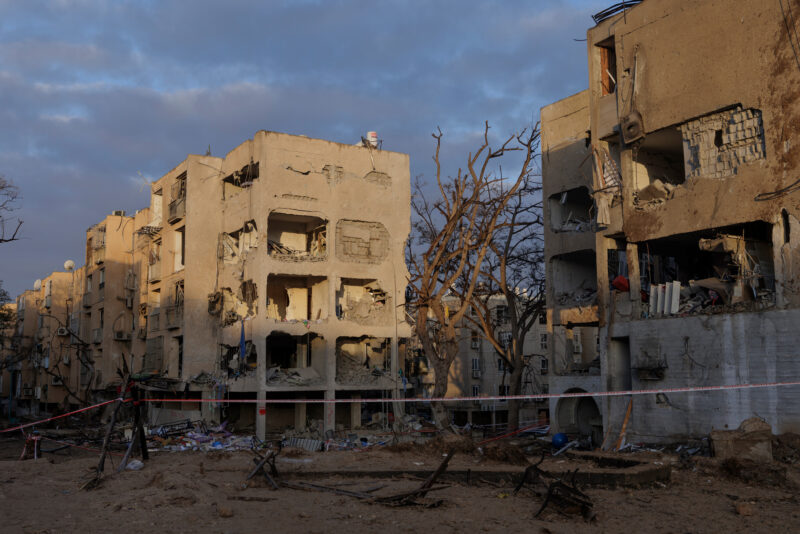



































Izz al-Din al-Haddad was the leader of Hamas’ military wing and an architect of the Oct. 7 attacks, according to Israeli leaders
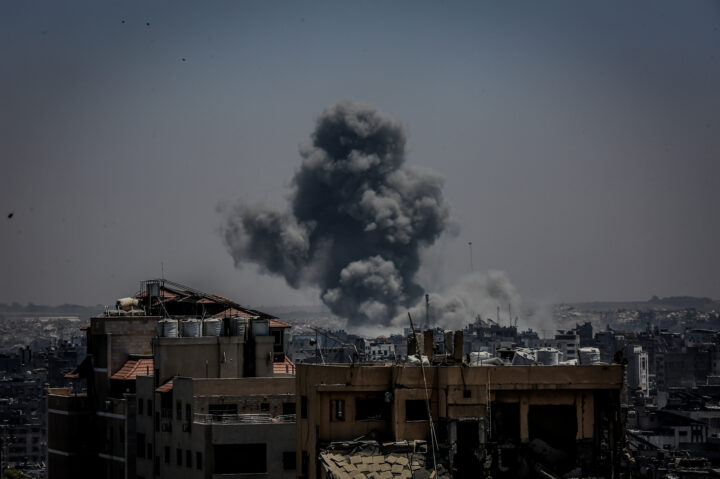
Saeed M. M. T. Jaras/Anadolu via Getty Images
Smoke rises after an Israeli strike in the eastern part of Gaza Strip on July 3, 2025.


 Add JewishInsider on Google
The Israeli military killed Izz al-Din al-Haddad, the most senior remaining Hamas commander in the enclave, in a strike on Friday, according to a joint statement from Prime Minister Benjamin Netanyahu and Defense Minister Israel Katz.
Al-Haddad was the leader of Hamas’ military wing and was “one of the architects of the October 7 massacre,” according to the statement.
The strike, carried out by the Israeli Air Force, had been approved about a week and a half earlier, during which time Israeli forces kept Al-Haddad under constant surveillance, an Israeli official told reporters. The official said the operation was carried out after an “operational opportunity” emerged.
Al-Haddad “held our hostages in brutal captivity, directed terrorist operations against our forces, and refused to implement the agreement led by U.S. President Donald Trump aimed at dismantling Hamas and demilitarizing the Gaza Strip,” Netanyahu and Katz’s statement said. “The IDF and the Shin Bet are effectively implementing the government’s policy of not tolerating threats and preemptively thwarting our enemies.”
The strike comes amid a fragile ceasefire between Israel and Hamas that was first implemented in October 2025, under which Israeli forces withdrew to a “yellow line” encompassing roughly 53% of the Gaza Strip. Hamas has yet to comply with the next phase of Trump’s plan, which calls for the group’s disarmament.
Nickolay Mladenov, the Board of Peace’s lead envoy for Gaza, wrote in a recent letter obtained by The Times of Israel to the technocratic committee governing Gaza that the board would not expect Israel to abide by the terms of the ceasefire if Hamas continues to refuse to disarm.
Speaking at the World Economic Forum, the president said ‘we’re going to know over the next two or three’ days and weeks ‘whether or not they’re going to do it’

Harun Ozalp/Anadolu via Getty Images
President Donald Trump delivers a speech during the World Economic Forum Annual Meeting in Davos, Switzerland, on January 21, 2026.
President Donald Trump issued a stark warning to Hamas on Wednesday, setting a timeline for the terror group’s disarmament and stating that it must deliver on its agreement to demilitarize or face potential military consequences.
“Hamas has agreed to give up their weapons,” Trump said, speaking to a packed room at the World Economic Forum in Davos, Switzerland. “If they don’t do it, they’ll be blown away very quickly.”
The president has made several statements following the initial adoption in October of the Gaza peace plan, insisting that the group disarm or face consequences. During his Davos address, Trump seemed to issue a more concrete timeline for when he expects the administration to determine if Hamas has chosen to comply with the agreement.
“They’ve got to do it, and we’re going to know over the next two or three days, certainly over the next two or three weeks, whether or not they’re going to do it,” said Trump, who noted that disarmament is “not an easy thing” for Hamas, adding that group members are “born with a weapon in their hands.”
The administration is a week into the launch of Phase 2 of Trump’s 20-point Gaza peace plan, which moves from “ceasefire to demilitarization, technocratic governance, and reconstruction,” according to White House Special Envoy Steve Witkoff.
“We have 59 countries that are part of that whole peace deal, and some of those countries aren’t even near the Middle East, and they want to come in and take out Hamas,” said Trump. “They want to come in and they want to do whatever they can.”
Critics have remained skeptical over whether Hamas will comply and relinquish its weapons. The terrorist group has previously insisted that it would refuse to disarm until a Palestinian state is established.
Sen. Lindsey Graham (R-SC), who previously said Hamas is unlikely to disarm without Israeli confrontation, lauded Trump’s statement at Davos in a post on X on Wednesday.
“President Trump rightly put Hamas on a time clock for disarmament,” Graham wrote on X. “This is the right decision at the right time.”
Many New York Democrats, from Gov. Kathy Hochul to Attorney General Letitia James, quickly spoke up. It took Mamdani over a day to do the same.
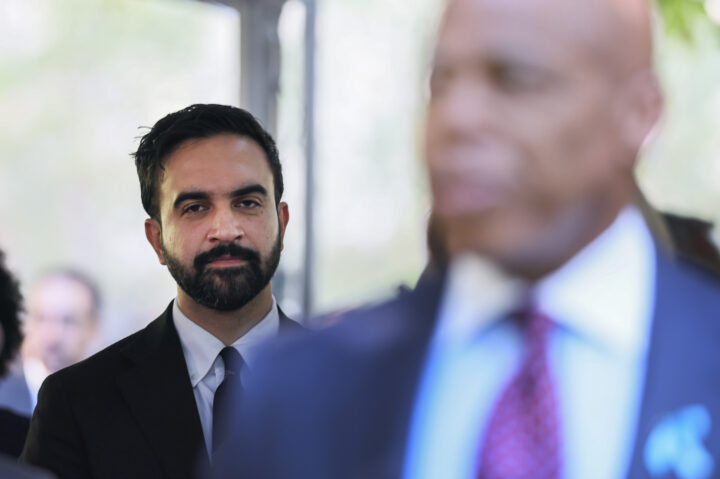
Michael M. Santiago/Getty Images
New York City Mayoral Zohran Mamdani (L) and former Mayor Eric Adams attend the annual 9/11 Commemoration Ceremony on September 11, 2025 in New York City.
New York City Mayor Zohran Mamdani is facing criticism from Democratic leaders over his delayed and muted response to last week’s pro-Hamas protest in Queens that caused nearby schools and a synagogue to close early in anticipation of the demonstration, where dozens of masked protesters chanted “We support Hamas” near the synagogue.
Democratic elected officials across New York — including left-wing politicians hostile to Israel, like Mamdani ally and former City Comptroller Brad Lander — were quick to release statements condemning the support for Hamas that was on display at the demonstration, which was organized by the group Palestinian Assembly for Liberation, [PAL]-Awda, to protest an event held by CapitIL, a Jerusalem-based real estate agency.
The event was held at the Modern Orthodox synagogue Young Israel of Kew Gardens Hills.
A flyer promoting the protest, which took place on a residential street about half a block from the synagogue, called the meeting an “illegal event” promoting “blatant land theft and dispossession.” Keffiyeh-clad demonstrators also chanted “There is only one solution, intifada revolution,” “Globalize the intifada,” and “Death to the IDF” for more than two hours while banging on drums.
“Let’s be crystal clear: this is vile antisemitism,” Lander, who is running to unseat Rep. Dan Goldman (D-NY) as a Mamdani-endorsed challenger in New York’s 10th Congressional District, said on Friday morning. “This should not have to be said: you can oppose land sales in the West Bank, without supporting terrorism & the mass murder of Jews.”
Gov. Kathy Hochul, who endorsed Mamdani in the mayoral election, also weighed in on Friday morning, saying, “Hamas is a terrorist organization that calls for the genocide of Jews. No matter your political beliefs, this type of rhetoric is disgusting, it’s dangerous, and it has no place in New York,”
New York Attorney General Letitia James said Friday midday, “Hamas is a terrorist organization. We do not support terrorists. Period.”
Other New York Democratic leaders who condemned the protest quickly and directly on Thursday and Friday included New York City Comptroller Mark Levine, Senate Minority Leader Chuck Schumer and Sen. Kirsten Gillibrand and Reps. Grace Meng and Ritchie Torres.
But the newly inaugurated mayor remained silent Thursday night and much of the following day regarding the demonstration, which marked his first major test in protecting the city’s Jewish community.
His spokesperson did not respond to multiple inquiries from Jewish Insider on Thursday, including one asking whether the mayor’s team had discouraged demonstrators from protesting and another, immediately after the event, asking if he condemned any of the slogans chanted.
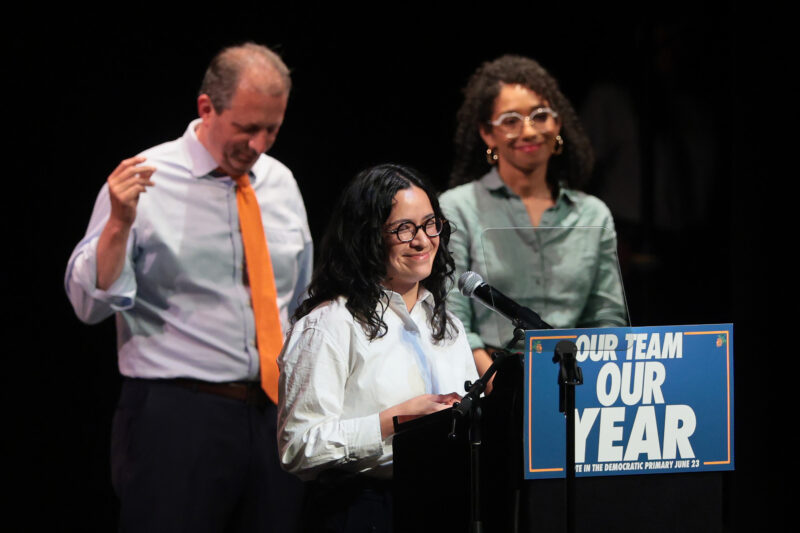
Mamdani broke his silence late in the afternoon on Friday when he was asked about the protesters’ pro-Hamas chant by Politico reporter Jason Beeferman while leaving a campaign event in Brooklyn for Democratic Socialists of America-endorsed candidate Claire Valdez, who is running for a Brooklyn-Queens congressional seat held by Rep. Nydia Velazquez (D-NY)
“That language is wrong,” Mamdani replied while walking to a car after the event. “I think that language has no place in New York City.”
Mamdani later followed up with an additional statement just after Shabbat started in New York: “As I made clear, the rhetoric and displays that we saw and heard in Kew Gardens Hills last night are wrong and have no place in our city,” he said. “My team is in close touch with the NYPD regarding last night’s protest and counterprotest. We will continue to ensure New Yorkers’ safety entering and exiting houses of worship as well as the constitutional right to protest.”
On Saturday, when asked at a press conference why he didn’t “condemn both sides,” Mamdani answered, “I absolutely have an opposition to the sale of land in the West Bank. It’s a violation of international law and that comes from my belief in the importance of following international law.”
“It’s been a distressing few months for Jews everywhere. I appreciated the mayor’s statement,” Democratic strategist Chris Coffey told JI. “Could it have come earlier? Sure. But being mayor in the first week is pure pandemonium and chaos. The important part is that he got it right.”
But Mamdani’s eventual response was met with continued concern from Jewish leaders over its delay and neglect to specifically condemn Hamas. In a sign of the far-left character of his political base, he also received criticism from DSA-aligned allies in his own camp for criticizing the protest.
“It’s a step up from his statement [after the Oct. 7, 2023 terrorist attacks in Israel], which failed to even mention Hamas. Still, it’s concerning that it takes the mayor of the city with the largest population of Jews outside of Israel nearly 24 hours to condemn blatant antisemitism when every other major elected in New York found the time,” Democratic state Assemblymember Sam Berger, who represents the district where the protest took place, told JI on Sunday.
Another Democratic Queens assemblymember, Nily Rozic, told JI, “It shouldn’t take the mayor [nearly] 24 hours to condemn an antisemitic protest layered in antisemitism, let alone one that openly supports terror organizations.”
Rozic expressed dismay over the timing of the statement after Shabbat.
“If the mayor were genuine in his concern over Jewish safety he would have acted with urgency and not waited so long, when most of those impacted wouldn’t see his statement until long after,” she told JI.
“I am a vocal & passionate support[er] of Mamdani’s,” Adam Carlson, founding partner of the polling group Zenith Polls, wrote on X. “But I’ve waited patiently all day for him to forcefully condemn Hamas — watching dozens of other city & state electeds do so — and am still waiting. This is not only hurtful to me, but it’s bad politics & distracts from his agenda.”
New York magazine writer David Freedlander posted screenshots on X of texts sent to him on Friday afternoon from two city political operatives, both “broadly supportive of Mamdani.”
The messages were identical: “Zohran is completely blowing this pro-Hamas protest thing.”
The adoption of the U.S.-led resolution provides an international legal framework for the international stabilization force to deploy in Gaza
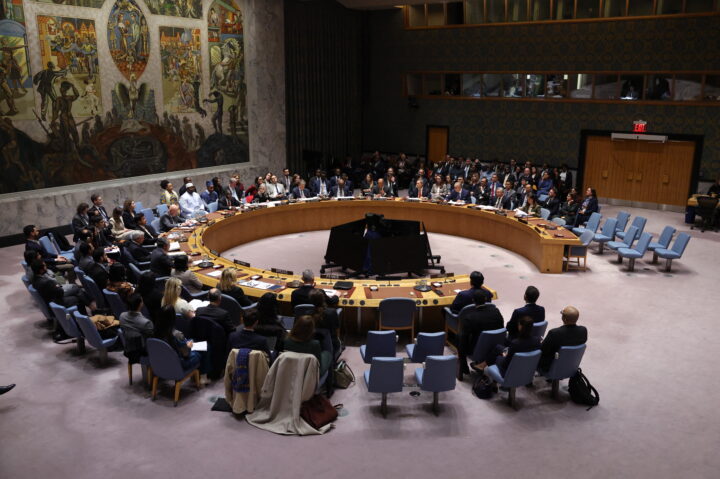
ANGELA WEISS/AFP via Getty Images
Ambassadors and representatives to the United Nations meet at the U.N. Security Council to vote on a U.S. resolution on the Gaza peace plan at the U.N. Headquarters in New York City, Nov. 17, 2025.
The U.N. Security Council adopted a U.S.-led resolution on Monday backing President Donald Trump’s peace plan for Gaza, including the creation of an international security force, in a move that could boost efforts to advance into the next phase of the Israel-Hamas ceasefire.
“Congratulations to the World on the incredible Vote of the United Nations Security Council, just moments ago, acknowledging and endorsing the BOARD OF PEACE,” Trump posted to Truth Social following the vote. “This will go down as one of the biggest approvals in the History of the United Nations.”
In the first phase of Trump’s 20-point peace plan, originally presented in September, the Israel Defense Forces have partially withdrawn to a “yellow line” dividing Gaza, while Hamas has returned all of the living hostages and all but three of the deceased hostages’ bodies.
However, the plan has faced significant roadblocks, and questions remain about the feasibility of implementing the following phases, including effectively disarming Hamas and determining who will govern Gaza.
Monday’s vote follows coordinated diplomacy between Washington and Arab partners aimed at reviving momentum behind the U.S. plan, including hosting a summit in Sharm El Sheikh, Egypt, last month and issuing a joint statement of support last week.
With the adoption of the resolution, the U.N. showed a rare consensus on Gaza — 13 countries voted in favor and none against, with Russia and China abstaining. Experts told Jewish Insider that moving to the second phase of the plan now becomes more plausible — even if challenges remain.
“The vote on the U.S.-drafted resolution is incredibly significant,” said Dana Stroul, a senior fellow at The Washington Institute for Near East Policy, who added that it provides “an international legal framework for the international stabilization force to deploy in Gaza, which is required for certain countries to send forces, like Indonesia.”
Prior to the vote, the White House has had difficulty recruiting countries to provide troops for the security force.
“What is being proposed is an enormous logistical feat, not to mention a high-risk environment where a terrorist organization is still active, the civilian population is in desperate need of humanitarian aid and local security, and Israeli forces remain on the ground,” said Stroul. “Foreign governments are concerned about their forces being attacked by Hamas, or being caught in the middle of Israeli security operations, and want clarity on the command and control, important details like logistical support and lodging, and the specifics of the actual mission.”
A key hurdle will be defining the role of the stabilization force. David May, a senior research analyst at the Foundation for Defense of Democracies, said there has been confusion over whether the ISF would “maintain the peace or enforce it.”
Jonathan Ruhe, a fellow at the Jewish Institute for National Security of America, echoed the importance of determining the role such a force would play in Gaza.
“The ISF likely will have lots of participants if the mission is limited to non-kinetic roles like aid distribution, border security, guarding camps, etc., all of which are important,” said Ruhe. “But Hamas thinks it won the war, and it won’t give up without a real fight. Phase 2 will be difficult for everyone if Israel has to do all this heavy lifting, so the success of Trump’s plans depends heavily on resolving the question of who, other than Israel, will actually enforce the peace?”
With the terror group still active in Gaza, few countries have been willing to risk sending soldiers into a conflict that “doesn’t involve them,” according to May.
“Without foreign forces on the ground, the options are either hoping that Hamas will disarm itself and give up its governance position, or leaving Israel to resume military options to do the disarming,” said Stroul.
At the same time, Hamas has sought to deter the implementation of the next phase — which calls on the group to relinquish its arms and governing authority.
“Hamas blew by the 72 hours for returning all hostages, living and dead, and continues to attack Israeli forces,” said May, referring to commitments the terror group agreed to in the first phase of the ceasefire. “Hamas always tests the limits of agreements with Israel, and it has little incentive to carry out a ceasefire plan that ultimately calls for the terrorist group’s destruction.”
“It should not be a surprise that a terrorist organization will try a variety of means to survive, from inflicting violence against Palestinians outside the yellow line to intimidating them into submission, insisting on distinguishing between different kinds of weaponry it may be willing to relinquish to appear reasonable, or attempting to present itself as a legitimate representative of the Palestinian national dialogue,” said Stroul.
Even as Washington and Arab governments moved the plan forward diplomatically, Israeli Prime Minister Benjamin Netanyahu and right-wing members of his government reiterated their opposition to a Palestinian state over the weekend, a stance that contrasts with the resolution, which contains language on creating “a pathway to Palestinian self-determination and statehood.” This wording was also present in the original plan released by Trump and agreed to by Netanyahu.
“The rhetoric coming out of Netanyahu’s right-wing coalition this weekend is incredibly ill-timed and will fuel those looking to blame Israel for failure to move from Phase 1 to Phase 2 of the plan,” said Stroul. “By appearing to renege on this issue, Netanyahu is setting himself to be on the opposite side of the Palestinian question from Trump, and risking serious daylight between the U.S. and Israel on Gaza at a high-risk moment.”
May said the inclusion of the clause “may have helped make the resolution more palatable to the other Security Council members,” but added that it will likely be out of the question for Israel moving forward.
“Following the popular support among Palestinians for the Oct. 7 atrocities, a Palestinian state on Israel’s borders is a nonstarter for most Israelis,” said May. “It is not worth it for Israel to risk the stabilization of Gaza on the lip service paid to a two-state solution that is dead in the water for most Israelis.”
Leading up to the vote, Russia had presented a counterproposal that diverged from the U.S. draft resolution in advocating that the West Bank and Gaza be joined as a state under the Palestinian Authority.
“This is really Russia seeking any way to assert influence in an attempt to make itself relevant,” said Stroul. “Moscow sees anything that keeps the U.S. tied down in the Middle East in a state of conflict, in tension with its longstanding allies and partners, as beneficial.”
Ruhe said Russia’s counterproposal was an attempt to throw “wrenches in America’s gears.”
“Russia was conspicuously absent from the Egypt peace summit, so this is one way Moscow tries to reassert itself,” said Ruhe. “The U.S. decision to mention a pathway to a Palestinian state probably owes more to our partners’ priorities than to Russian pressure, though Moscow certainly will try to claim this as a win anyway.”
The next part of Trump’s proposal also includes the increased entry of humanitarian aid into Gaza and the rebuilding of critical infrastructure. However, like other key elements of the plan, experts said it remains contingent on Hamas’ presence.
May said the full recovery of Gaza will remain incomplete “until Hamas is disarmed and there are troops on the ground to keep the peace.”
“No one is willing to start reconstructing Gaza if Hamas is still active on the ground,” said Stroul. “This is the fundamental choice for Hamas: it can choose to disarm and stay in Gaza, or receive amnesty and leave. But if it insists on having a say in the future governance of the Strip, then nothing beyond humanitarian aid will flow into Gaza; Palestinians will have no prospects for rebuilding their lives; and the potential for a return to open conflict rises.”
In ‘Don’t Feed the Lion,’ protagonist Theo Kaplan helps middle school readers navigate antisemitism

Long before the Oct. 7, 2023, Hamas terror attacks, parents — especially Jewish parents — wondered and at times struggled with how to speak to their children about antisemitism.
In the midst of the antisemitism that exploded in the wake of the attack on southern Israel and continued to rise through the ensuing war between Israel and Hamas, journalists Bianna Golodryga and Yonit Levi found themselves navigating that challenge — and found no help to guide them.
“The fact that our kids are talking about it, [it’s] something I’m dealing and grappling with in New York City in 2023 at the time,” Golodryga, a CNN news anchor, told Jewish Insider in a recent interview. “I never thought that we’d be having to address [it] so directly. But there were no resources on this issue. I asked my kid’s school about it, [saying], ‘What are you doing to address antisemitism?’ And in a longly worded statement, it was clear that there were no resources. They weren’t really doing anything.”
In Israel, Levi, an anchor on Israel’s Channel 12, was asked about antisemitism by her pre-teen son. “And I was sort of floored by it,” she told JI. “I didn’t even know how to begin answering because I wasn’t planning to answer that question, explaining and answering a lot of other questions that Oct. 7 brought to the table.”
As a result, Golodryga said, “Yonit and I decided to try to write the book we couldn’t find.” The result was their debut book, Don’t Feed the Lion, released on Tuesday.
After the Oct. 7 attacks, Golodryga and Levi spent much of their professional bandwidth reporting on the war. The weekly writing and brainstorming sessions for the book, Golodryga explained, were “cathartic” and provided an opportunity to “step aside and away from all of the breaking news and the heartache of the day.” For Levi, having that support system and the experience of writing the book amid so much turmoil at home was “like a ray of light inside this darkness of the last two years.”
Don’t Feed the Lion is a novel targeted to middle school students, but with lessons, scenarios and parables that anyone who has experienced or witnessed discrimination — in any of its forms — will recognize.
The book’s main plot point revolves around a pair of Jewish siblings in Chicago. The older of the two, Theo Kaplan, a soccer enthusiast and co-captain of his school’s team, is shaken when prominent soccer player Wes Mitchell goes on an antisemitic rant. Days later, the eighth grader’s teammates vandalize his gym locker with a swastika. Theo, who is weeks away from his bar mitzvah, faces inner turmoil as he grapples with the fallout of Mitchell’s comments and the responses to the incident by his friends, teammates and school administrators. (Spoiler alert: the school is more than happy to sweep the incident under the rug.)
Meanwhile, Theo’s younger sister, Annie, sneakily creates an account on a social media platform in an effort to get concert tickets, but ends up falling into a Reddit-esque black hole of antisemitic drivel, which she attempts to fight despite being far outnumbered by anonymous online trolls.
Theo finds himself an ally in Gabe, a new student who moved to Chicago after his mother’s death from COVID-19. Gabe, although an outside observer, becomes the readers’ eyes and ears into the Kaplan family when he is paired with Theo for a family heritage project that sees the two spotlight Theo’s grandparents, Ezra and Talia.
“It’s obviously a fictional book, but there are several real-life experiences that we’ve encountered, that I’ve encountered with some family members, going back several years ago, where antisemitism not only wasn’t really addressed, but when it was facing students and faculty members at schools, it wasn’t treated or given the prioritization that that other forms of hate were given,” Golodryga said.
But whereas many stories and fiction novels about Jewish families settle into tired tropes, Don’t Feed the Lion takes a more realistic approach to the American Jewish experience: Ezra and Talia are a mixed Ashkenazi-Mizrahi couple — a rarity in the world of Jewish literature. The family dynamic is challenging, with estrangement between Theo and Annie’s grandparents and their aunt’s family. And Theo faces the relatable social pressures that many young assimilated Jews encounter as they feel torn between spending Friday nights socializing with friends during a time traditionally set aside for Shabbat meals with family.
Beyond capturing the zeitgeist of the modern American Jewish family, Theo is a relatable protagonist — owing in part to Golodryga and Levi’s own children, who inspired elements of Theo’s personality, backstory and experiences. Golodryga recalled her son’s reaction to the response, in 2022, to antisemitic social media posts made by then-Brooklyn Nets star Kyrie Irving.
“It seemed like everyone was apologizing for him but him, and he was allowed to play,” she explained. Irving was ultimately suspended for eight games, more than a week after the initial social media post, after repeated opportunities in which he had refused to distance himself from the content of the post. NBA heavyweights, including LeBron James and Jaylen Brown, a vice president in the NBA’s players’ union, defended Irving at the time.
Golodryga said her son didn’t know how to approach the situation. “As a New Yorker, he even said, ‘So can I not go to games? Or can that mean that I shouldn’t be a fan, or I can’t watch him anymore? He doesn’t want me to.’ So that’s always sat in the back of my mind.”
Where art perhaps most imitates life is in how administrators in the story respond to the swastika incident — not by addressing it head-on, but by hoping to sweep it under the rug, thereby avoiding the need for disciplinary action that could keep Theo’s soccer team from advancing to the state-level competition.
At the heart of the book, Levi said, is “that the kids really get what’s wrong and what’s right” — even when the adults in the room do not. “At the end of the day, it’s like the grown ups [in the book] and in reality too, sort of obfuscate … and say, ‘Maybe I shouldn’t stand up because it’s not good for my workplace, or it’s too much bureaucracy,’ or all the other things that are said in this book, and the kids at the end of the day, they know, they get what is wrong and what is right.”
Lt. Goldin was killed by Hamas during Operation Protective Edge in 2014; Hamas still holds four more hostage bodies

MENAHEM KAHANA/AFP via Getty Images
Israeli soldiers salute and people hold national flags as a van carrying Lt. Hadar Goldin's remains arrives at the National Center for Forensic Medicine in Tel Aviv on November 9, 2025.
Hamas returned the remains of Lt. Hadar Goldin on Sunday, over 11 years after he was killed in battle in Gaza.
Israel confirmed the body was Goldin’s through DNA testing, four hours after it was returned.
Goldin was 23 when he fought in Operation Protective Edge in Gaza and took part in a mission to destroy a Hamas tunnel in Rafah on Aug. 1, 2014, during a 72-hour ceasefire. Hamas terrorists killed two Israeli soldiers, taking Goldin’s body with them.
Goldin’s parents, Leah and Simcha, publicly advocated for his return, but did not support the release of living terrorists in exchange for their son’s remains. They repeatedly suggested that humanitarian aid to Gaza be reduced or stopped as long as the remains of their son and Oron Shaul, another soldier whose body was taken in 2014, were held in Gaza.
After Goldin’s remains were returned, Leah said her family “took for granted that the State of Israel would not leave soldiers behind. It took us 11 years to bring him home through the IDF and security forces. … We faced many disappointments. We cannot give up on who we are, and we will prevail through our values. …Thank you for walking with us all the way.”
Simcha Goldin credited IDF “soldiers [who] fought to bring warriors back from the battlefield. The IDF brought Hadar back to his homeland — no one else. … What this war has proven is that when we fight for our soldiers, we succeed. Victory means bringing home the hostages and bringing home our soldiers to Israel.”
Goldin’s body is the 24th that Hamas has returned since the ceasefire began on Oct. 13 this year, after which all of the remaining hostages, both living and deceased, were meant to be returned within three days. However, the terrorist group has drawn out the return of the remains, and four more hostages have yet to be handed over to Israel: Meny Godard, Master Sgt. Ran Gvili, Dror Or and Sudthisak Rinthalak, a Thai national.
IDF Chief of Staff Eyal Zamir visited the Goldin family on Saturday night. Hamas and the Red Cross were permitted to search for his body in the areas of Gaza controlled by Israel, Hebrew media reported.
Israeli Prime Minister Benjamin Netanyahu announced earlier Sunday that Hamas was expected to return Goldin’s body.
“Lt. Hadar Goldin fell in a heroic battle in Operation Protective Edge 11 years ago,” Netanyahu said. “His body was taken hostage by Hamas, who refused to return him throughout this entire period. This entire time, Israeli governments made a great effort to return him. Naturally, this has been amid the great agony of his family, which will now be able to give him a Jewish burial.”
Netanyahu added that Israel has “a tradition from the establishment of the state … to bring back our soldiers who fell in battle, and we are doing it. Sometimes it takes a long time … It is a holy value. It expresses our mutual responsibility with the citizens of Israel and first and foremost the soldiers and fighters of Israel.”
Goldin’s return was reportedly tied to the fate of 200 Hamas fighters currently hiding in a tunnel in the Israel-controlled half of Gaza.
According to Israel’s Channel 12, the White House reportedly suggested a plan by which, after Goldin’s remains are returned, the terrorists would lay down their arms and surrender, and Israel would allow them to go into exile or to the Hamas-controlled half of Gaza. The IDF would then destroy the tunnel in which they were hiding.
An Israeli official said last week that Netanyahu “would not allow safe passage for 200 Hamas terrorists.”
Hamas member Majed al-Zeer said ‘the resistance’ is key to changing how the Western world views Israel
Paul Sancya/AP
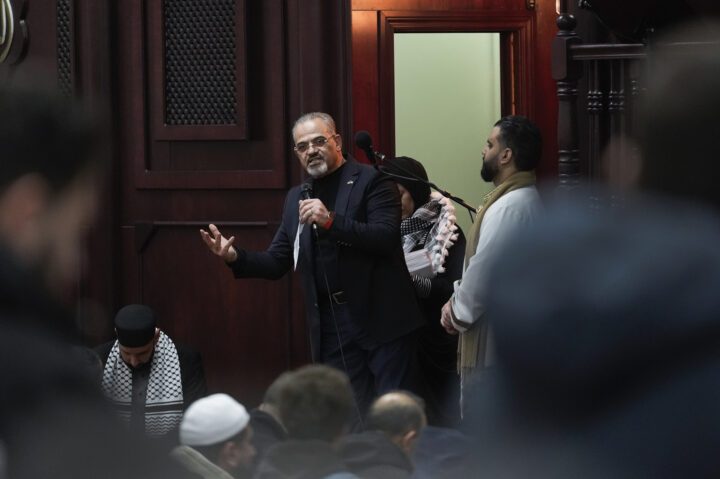
Khalid Turaani, co-chair of the Abandon Biden campaign in Michigan, speaks at the Islamic Center of Detroit in Detroit, Friday, Jan. 26, 2024.
The executive director of the Council on American-Islamic Relations’ Ohio branch moderated an online event last week featuring a Hamas official designated as a terrorist by the Treasury Department, as well as other Hamas and Palestinian Islamic Jihad members.
The Beirut-based think tank Al-Zaytouna Centre for Studies and Consultations hosted an event in Arabic last week titled “Palestinians Abroad and Regional International Strategic Transformations in Light of Operation Al-Aksa Flood,” using Hamas’ name for its Oct. 7, 2023, attacks on southern Israel.
Among the speakers at the web conference was Majed al-Zeer, who was designated by the Treasury Department in October 2024 as “the senior Hamas representative in Germany, who is also one of the senior Hamas members in Europe and has played a central role in the terrorist group’s European fundraising.”
Al-Zeer said that “the resistance” is key to maintaining the momentum of a “strategic shift” in how Europe and the world views the Palestinian issue.
Palestinian Islamic Jihad financier Sami al-Arian, a former University of South Florida computer science professor who was deported from the U.S. in 2015 due to his ties to the terrorist group, said on the same panel as Al-Zeer that “the overall Palestinian situation is much better strategically than it was before the flood [Oct. 7].”
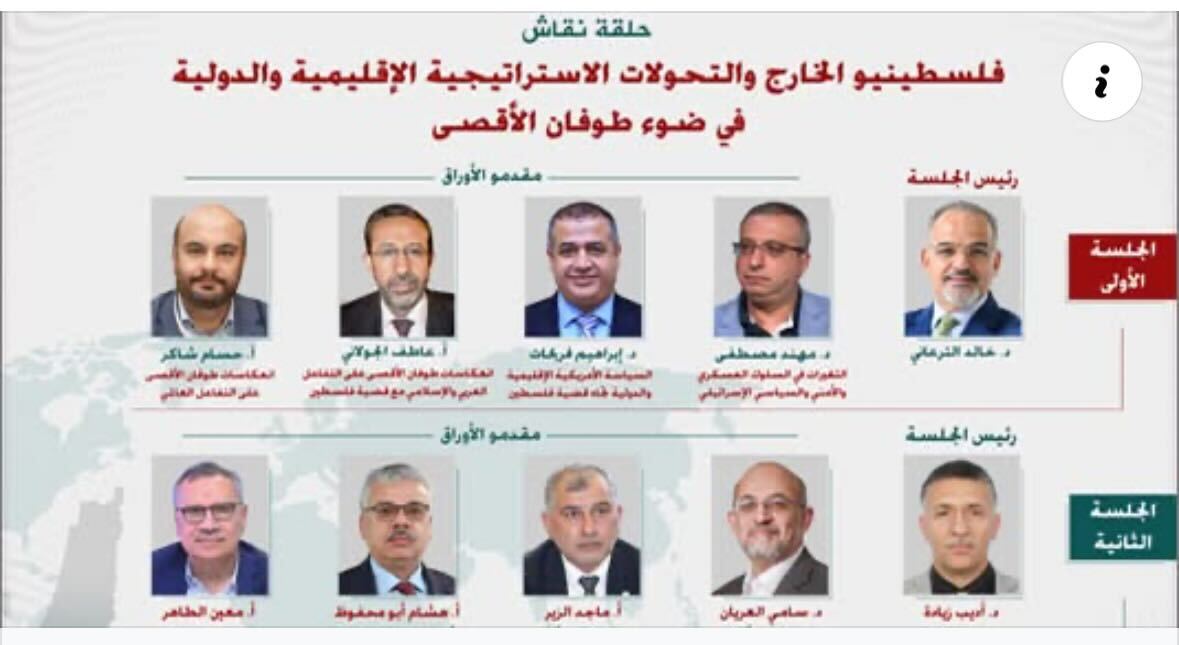
CAIR-Ohio Director Khalid Turaani moderated one panel with commentary provided by Ziad el-Aloul, who is active in several Hamas-affiliated organizations in Europe, including the Popular Conference for Palestinians Abroad, which was designated a terrorist group by Israel in 2021 for its work on behalf of Hamas. More recently, PCPA was found to be involved in facilitating the Global Sumud Flotilla that attempted to sail to Gaza with climate activist Greta Thunberg on board.
Another speaker in the Turaani-led panel expressed hope that the Turkish army would deploy in Gaza and fight the IDF.
The CAIR-Ohio director’s participation in a conference with senior Hamas and Palestinian Islamic Jihad figures came two months after Sen. Tom Cotton (R-AR) called for an IRS investigation into the organization and the revocation of its 501(c)(3) nonprofit status, citing alleged “ties to terrorist organizations like Hamas and the Muslim Brotherhood.”
CAIR did not respond to a request for comment.
Plus, Khanna distances himself from terror sympathizers

Alex Wong/Getty Images
U.S. President Donald Trump delivers remarks at the White House on September 29, 2025 in Washington, DC.
Good Tuesday morning.
In today’s Daily Kickoff, we report on President Donald Trump’s 20-point proposal to end the Israel-Hamas war, and report on a new Department of Justice lawsuit targeting demonstrators who protested outside of a New Jersey synagogue. We have the scoop on the reintroduction of the bipartisan Pray Safe Act, and report on Rep. Ro Khanna’s effort to distance himself from other speakers at the recent ArabCon conference who promoted terrorism from the stage. Also in today’s Daily Kickoff: Jay Schottenstein, Al Tylis and Sarah Adler Hartman.
Today’s Daily Kickoff was curated by Jewish Insider Executive Editor Melissa Weiss and Israel editor Tamara Zieve, with assists from Danielle Cohen-Kanik and Marc Rod. Have a tip? Email us here.
What We’re Watching
- Defense Secretary Pete Hegseth is convening senior military officials stationed around the world today in Virginia to speak about military standards and the “warrior ethos,” amid concerns from the military’s top brass, including Gen. Dan Caine, chairman of the Joint Chiefs of Staff, over the Pentagon’s priorities. President Donald Trump is slated to attend the summit, being held at Quantico.
- A federal shutdown appears increasingly likely to take effect overnight as Congress faces today’s deadline to pass a spending bill, and as talks last night between Trump and senior congressional leadership failed to yield a breakthrough that would keep the government open.
- The Atlantic Council is holding a conversation with Palestinian-American researcher and activist Ahmed Fouad Alkhatib about efforts to stabilize and rebuild Gaza in a postwar scenario.
- This evening, Democratic Majority for Israel will host a virtual briefing with Rep. Greg Landsman (D-OH) on the implications of yesterday’s White House meeting, the status of the Gaza war, political developments in Jerusalem and Landsman’s reflections on his recent trip to Israel.
What You Should Know
A QUICK WORD WITH JI’S LAHAV HARKOV
With Israeli Prime Minister Benjamin Netanyahu accepting President Donald Trump’s 20-point plan to end the war in Gaza at the White House on Monday, the ball is now in Hamas’ court. Read more here from JI’s Gabby Deutch on Trump and Netanyahu’s press conference.
Whether Hamas would agree to release the hostages first, before Israel makes any concessions other than stopping the fighting, remains to be seen. There is also newfound pressure on Qatar, a chief patron of Hamas, to convince the terror group to accept the deal.
The late elder Israeli statesman Abba Eban famously said, “The Arabs never miss an opportunity to miss an opportunity.” In readily accepting Trump’s plan, Netanyahu is counting on Hamas to do just that.
That’s not to say that Netanyahu opposes the plan. His calculus may be that he will be able to execute the parts he supports, while the aspects he finds less favorable are unlikely to materialize anyway — largely, he believes, due to the Palestinians’ own intransigence.
As Netanyahu noted in the press conference, the plan meets all of Israel’s war aims: Bringing back the hostages, dismantling Hamas — most of which Israel already did in the war — and making sure it no longer poses a threat to Israel, through demilitarization and deradicalization. Other elements of the plan that Israel has long said would be part of the “day after” for Gaza are a technocratic government with help from international partners, and the IDF retaining a buffer zone inside Gaza’s perimeter. Netanyahu also reportedly secured 11th-hour edits to the plan regarding the IDF’s withdrawal and Hamas’ disarmament prior to the press conference.
But the details are tricky.
For example, Point 17 of the plan: “In the event Hamas delays or rejects this proposal, the above, including the scaled-up aid operation, will proceed in the terror-free areas handed over from the IDF to the [International Stabilization Force].”
In other words, if Hamas rejects the plan, humanitarian aid “without interference” — likely including dual-use items that could be exploited by terrorist organizations — would still be immediately and significantly scaled up and managed by the United Nations and Red Crescent, among others. Once an international force is put together, the IDF would still be expected to retreat from areas in which it has defeated Hamas. And a transitional, technocratic government overseen by Trump and former British Prime Minister Tony Blair’s “Board of Peace” would be put into place.
HILL REACTIONS
Senators react to Trump’s Gaza plan with cautious optimism
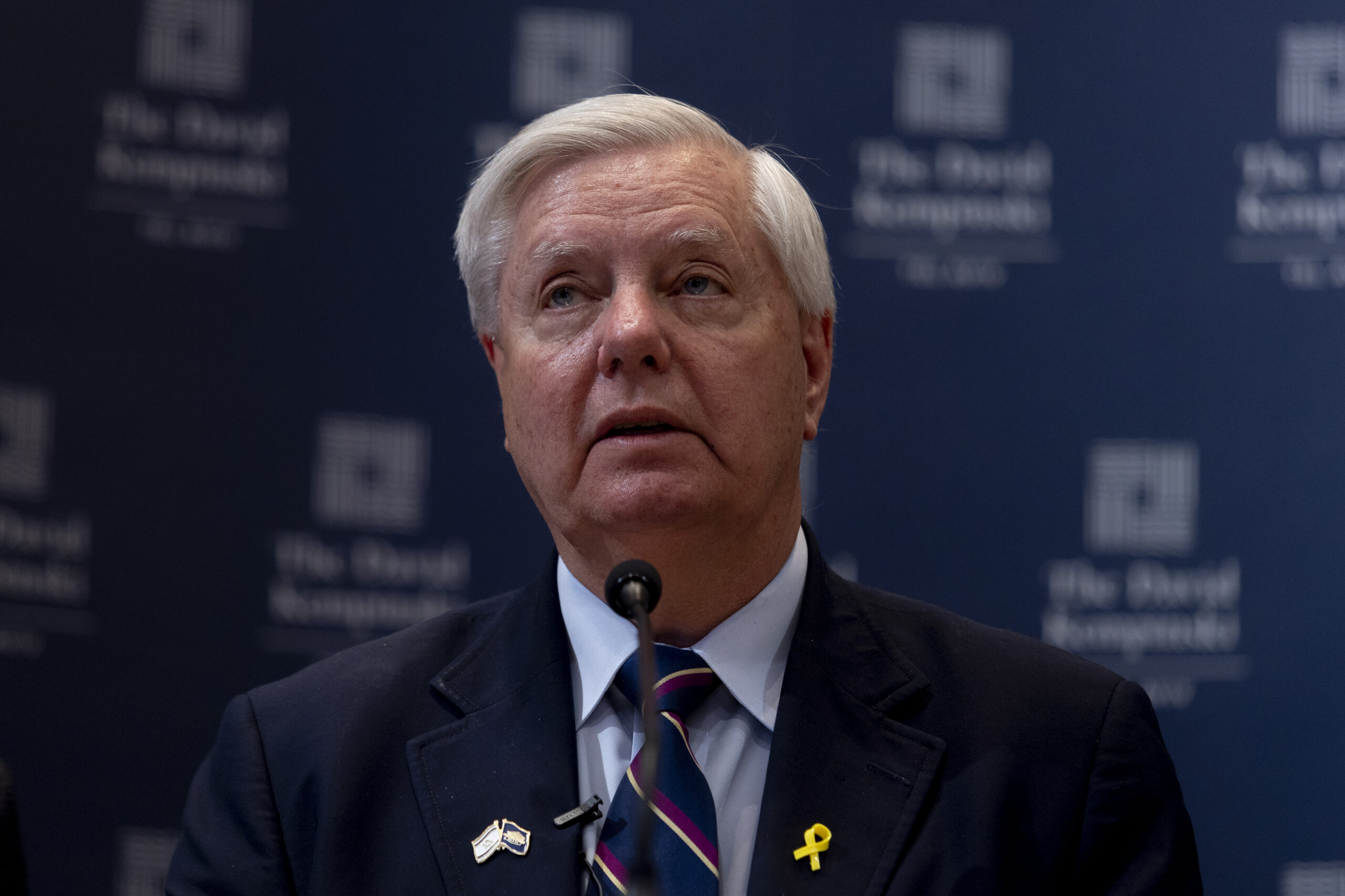
Senators reacted with cautious optimism — and a degree of skepticism — to President Donald Trump’s announcement on Monday of a sweeping deal that would end the war in Gaza, see the release of the remaining hostages and facilitate reconstruction of the Gaza Strip, Jewish Insider’s Marc Rod and Emily Jacobs report.
Close eye: Sen. Lindsey Graham (R-SC) warned that the execution of the deal would require close monitoring of Hamas’ compliance and that long-term peace in the region will likely require eliminating Iran’s other proxies, in addition to Hamas. “I hope Hamas agrees — we’ll get the hostages home. Distrust and verify with these guys,” Graham said. “A lot of loopholes if you don’t watch it, but I hope we can land this deal.”
Read the full story here with additional comments from Sens. John Cornyn (R-TX), Rick Scott (R-FL), Kevin Cramer (R-ND), Ted Budd (R-NC), Jim Risch (R-ID), John Kennedy (R-LA), Chris Coons (D-DE), Richard Blumenthal (D-CT), Peter Welch (D-VT) and Jeanne Shaheen (D-NH).
Communal reaction: Jewish groups are rallying behind Trump’s peace plan, with organizations from AIPAC to J Street voicing initial support for the proposal, eJewishPhilanthropy’s Judah Ari Gross reports.
OLIVE BRANCH
During Trump meeting, Netanyahu apologized to Qatari leader for Doha strike
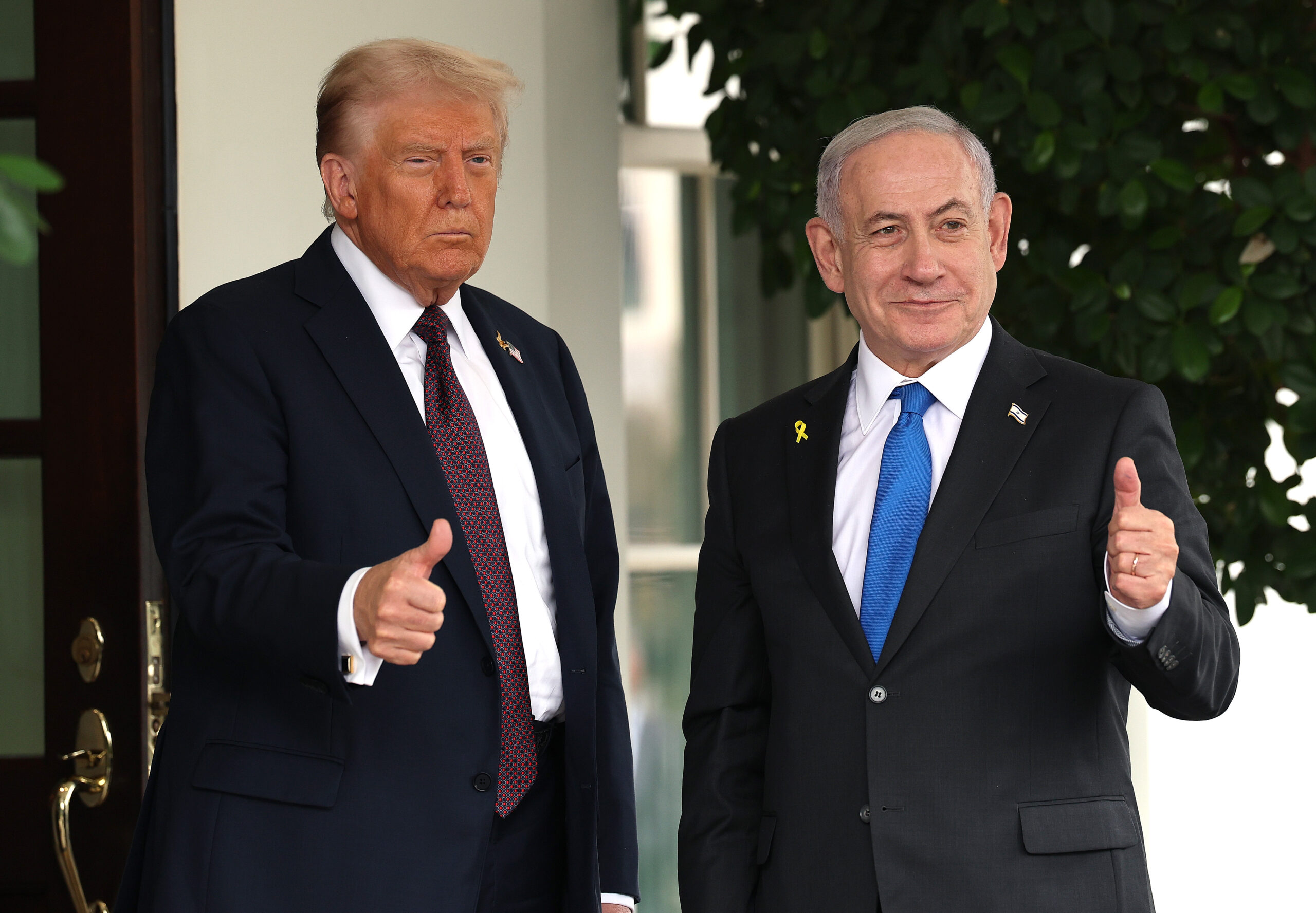
During a meeting between Israeli Prime Minister Benjamin Netanyahu and President Donald Trump at the White House on Monday, Netanyahu apologized to Qatar’s prime minister, Sheikh Mohammed bin Abdulrahman al-Thani, for killing a Qatari serviceman in an attempted strike on Hamas leadership in Doha and promised not to violate Qatari sovereignty again, Jewish Insider’s Marc Rod reports. News of the apology has been met with frustration and scorn from Netanyahu’s political allies and opponents in Israel.
Notable quotable: According to remarks released by the Israeli government, Netanyahu told Al Thani, “I want you to know that Israel regrets that one of your citizens was killed in our strike. I want to assure you that Israel was targeting Hamas, not Qataris. I also want to assure you that Israel has no plan to violate your sovereignty again in the future, and I have made that commitment to the president.” Netanyahu also acknowledged Qatar’s “grievances against Israel” as well as Israel’s own issues with Qatar “from support for the Muslim Brotherhood to how Israel is portrayed on Al Jazeera to support for anti-Israel sentiment on college campuses.”
CONFERENCE CONTROVERSY
Khanna distances himself from pro-terror speakers at anti-Israel conference and defends ‘free speech’

Rep. Ro Khanna (D-CA) distanced himself from some speakers and attendees at the ArabCon conference that he attended in Dearborn, Mich., while defending their First Amendment right to free speech, Jewish Insider’s Marc Rod reports. At the conference, held last week, several panelists laughed at the notion of condemning the Oct. 7, 2023, Hamas attacks, defended Hamas as “Palestinian resistance” and said the group should not be condemned and defended convicted terrorists and terrorist financiers, according to excerpts of the event shared online.
Responding: During his own separate panel at the event, Khanna dismissed the notion that there were any “pro-terror radical[s]” speaking at the event or attending the conference, referencing criticism he faced prior to the event. “I don’t agree with everyone who spoke at the conference, but I do believe in free speech. You can’t just be for free speech when it’s convenient. I’ve unequivocally condemned the Oct. 7 attacks and called for the release of the hostages,” Khanna said in a statement to JI on Monday, when pressed about whether he considered the comments of other speakers and attendees to constitute pro-terror radicalism.
HARBORING HATE
Study: Antisemitism ‘thriving in plain sight’ on X

Antisemitism is “thriving in plain sight” on Elon Musk’s social media platform X (formerly Twitter), according to a new study by the Center for Countering Digital Hate and the Jewish Council for Public Affairs, Jewish Insider’s Danielle Cohen-Kanik reports.
Breakdown: The study, first shared with CNN, conducted an analysis of over 679,000 antisemitic posts made over a year on the site and found that, despite the platform’s own anti-hate policies and commitment to reduce visibility of hateful content, X “not only tolerates” antisemitic conduct “but allows users to monetize it, giving antisemitic influencers both reach and revenue.” With the assistance of ChatGPT, the study categorized the posts into Jewish control or power conspiracies, Jewish satanic conspiracies and Holocaust denial, with control or power conspiracies accounting for the plurality (44%) of the total likes and views. All posts included were viewed 193 million times in total.
DOJ SUIT
Justice Department sues individuals involved in demonstration at N.J. synagogue

The Department of Justice filed a civil suit on Monday against several protesters and anti-Israel groups for their involvement in a demonstration last November at a West Orange, N.J., synagogue, Congregation Ohr Torah, Jewish Insider‘s Marc Rod reports.
The details: The DOJ complaint alleges that the Party for Socialism and Liberation-New Jersey, American Muslims for Palestine-New Jersey and six individuals engaged in physical assaults and antisemitic and threatening chants, as well as defied police orders. The suit was brought under the Freedom of Access to Clinic Entrances (FACE) Act, traditionally used against those who block access to abortion clinics, but which also includes provisions barring the use of force, threats, intimidation or physical obstruction to interfere with the right to worship.
EXCLUSIVE
Senate, House lawmakers to reintroduce Pray Safe Act
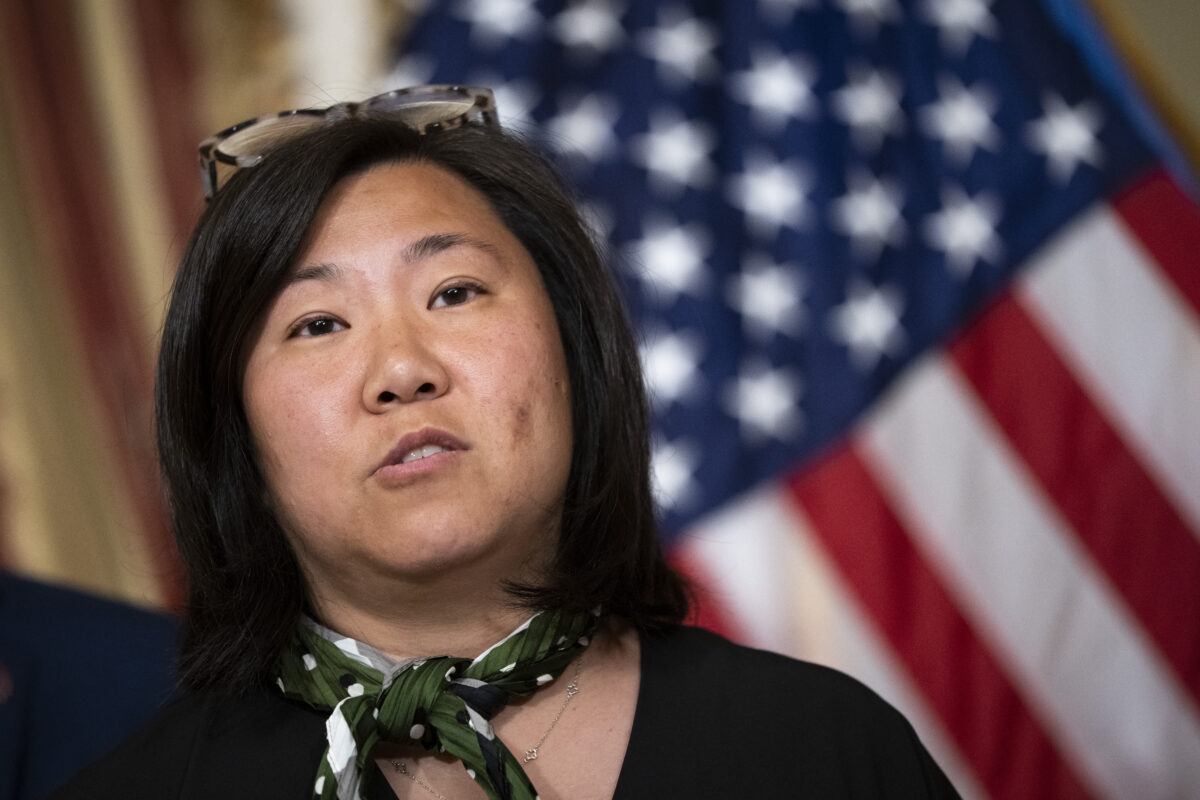
Senate and House lawmakers on Tuesday are expected to reintroduce the Pray Safe Act, a long-gestating bill that would create a federal database and clearinghouse for security best practices, training materials and grant opportunities for religious nonprofits, Jewish Insider’s Marc Rod reports.
The latest: The legislation is being led by Sens. Maggie Hassan (D-NH) and Ron Johnson (R-WI) and Reps. Grace Meng (D-NY) and Maria Elvira Salazar (R-FL) and comes after a series of high-profile attacks at religious institutions, including mass shootings at a Catholic church in Minneapolis and a Mormon church in Michigan.
Worthy Reads
Jean Mutation: The Wall Street Journal’s Suzanne Kapner interviews American Eagle CEO Jay Schottenstein about the company’s marketing success, months after its viral Sydney Sweeney “great jeans” ad campaign. “Schottenstein uses a Yiddish word to describe his long-held goal for American Eagle: ‘to put a pair of jeans on every tuchis in the United States.’ The 71-year-old has an uncanny ability to discern what young shoppers want. … While visiting Israel with his granddaughters in 2017, he noticed they were going wild for flow ring bracelets that looked like slinkies. He tracked down the manufacturer and sold them in American Eagle stores, generating nearly $1 million in sales. Schottenstein has honed his instincts over decades in a retail business founded by his grandfather, Ephraim, a Lithuanian immigrant, who opened a department store in Columbus, Ohio, in 1917.” [WSJ]
Door Opening to Peace?: The Washington Post’s David Ignatius weighs in on President Donald Trump’s 20-point plan to end the Israel-Hamas war. “The ‘New Gaza’ proclaimed by Trump would ease the agony of Palestinian civilians ravaged by the war while marking an end to the suffering Israel has endured since the brutal Hamas terrorist attack of Oct. 7, 2023. Gaza’s buildings are mostly shattered ruins, and the ground is soaked in blood. Palestinian civilians live in hunger and fear, as do Israeli hostages. It’s time for the fighting to end. Trump often overstates the significance of his actions, but not here. His ‘Board of Peace’ to oversee political transition in Gaza is a potential game changer. … The door to something different seemed to open slightly Monday. On this, Trump deserves the credit he craves. We can only hope and pray that he and his new coalition of Arab and Israeli allies will keep pushing.” [WashPost]
Word on the Street
The Pentagon is pushing missile suppliers to increase production rates amid concerns regarding low U.S. stockpile levels and in preparation for a potential future conflict with China…
Michael Friedman, who previously served as special assistant to the president for presidential personnel, was appointed chief of staff to Treasury Secretary Scott Bessent…
House Education Committee Chairman Tim Walberg (R-MI) and Rep. Elise Stefanik (R-NY) wrote to Harvard‘s president requesting information about whether the school is taking promised steps to address antisemitism on campus. The letter accuses the school of obstructing a law enforcement investigation into an antisemitic attack and supporting those involved, failing to follow through on its commitment to implement the International Holocaust Remembrance Alliance’s working definition of antisemitism and slow-walking a decision on whether to end its partnership with Birzeit University…
The Office for Civil Rights in the Department of Health and Human Services sent a letter to Harvard beginning a process that could render the school ineligible for future federal grants…
A new New York Times/Siena poll found that 51% of Americans oppose sending U.S. military aid to Israel; a 36% plurality said they sympathize more with the Palestinians, 35% said they sympathize more with the Israelis and 31% said “both equally” or they didn’t know…
Staff and allies of former New York Gov. Andrew Cuomo told Politico that more money has begun flowing into his mayoral campaign and allied super PACs since Mayor Eric Adams suspended his campaign, giving Cuomo an outside chance to consolidate voters who oppose front-runner Zohran Mamdani with just over a month to go in the race…
A circuit court in Virginia found that American Muslims for Palestine to be in civil contempt of court for failing to comply with a request from the commonwealth’s attorney general, Jason Miyares, regarding the group’s potential violations of Virginia’s charitable solicitation laws…
Apollo announced yesterday the launch of Apollo Sports Capital, to be helmed by Al Tylis with the goal of investing in sports franchises, media and events…
New York Gov. Kathy Hochul announced a competition to design a memorial for Supreme Court Justice Ruth Bader Ginsburg, which will be situated in Brooklyn Bridge Park…
Maurice Shnaider, the uncle of slain Israeli hostage Shiri Bibas, filed a complaint against Iran at the International Criminal Court, accusing the Islamic Republic of complicity in crimes against humanity, war crimes and genocide and demanding the issuance of arrest warrants for Iranian Supreme Leader Ayatollah Ali Khamenei and Islamic Revolutionary Guard Corps head Esmail Qaani…
Former Israeli MK Michal Cotler-Wunsh, resigned as Israel’s special envoy to combat antisemitism, a voluntary position, citing what she said was the government’s failure to take the issue seriously…
The U.S. deported approximately 100 Iranian migrants back to Iran, in a deal made between Washington and Tehran amid a broader illegal immigration crackdown by the Trump administration…
Sarah Adler Hartman was named the next CEO of the Texas Tribune; read JI’s 2021 profile of Hartman here…
Pic of the Day

A delegation from Chabad-Lubavitch met on Monday with President Donald Trump, Jared Kushner, White House Deputy Chief of Staff Stephen Miller, EPA Administrator Lee Zeldin, Staff Secretary Will Scharf, Liaison to the Jewish Community Martin Marks, Commerce Secretary Howard Lutnick, Chief of Staff Susie Wiles and Paula White. The meeting was a belated celebration of Education and Learning Day USA, which honors the Lubavitcher Rebbe, Rabbi Menachem Mendel Schneerson.
Birthdays
Founder and president of the Menomadin Group and president of the Menomadin Foundation, Haim Taib turns 65…
Former prime minister of Israel, Ehud Olmert turns 80… IT developer and business analyst, Sanford Kadish… Past president of The Washington Institute for Near East Policy, she is on the board of The Tikvah Fund, Rochelle A “Shelly” Kassen… Chairman and CEO of AMC Entertainment, he is a co-owner of the Philadelphia 76ers, Adam Maximilian Aron turns 71… Actress and activist, she completed her second term as president of the SAG-AFTRA trade union a few weeks ago, Fran Drescher turns 68… Professor of mathematical logic at Oxford, Ehud Hrushovski turns 66… Journalist for Haaretz, Allison Kaplan Sommer… Professor of healthcare economics at MIT and an architect of Romneycare and Obamacare, Jonathan Gruber turns 60… Leora Lily Ihilevich Usman… Lisa K. Robbins… Israel’s U.N. ambassador until 2024, now global president of Magen David Adom, Gilad Menashe Erdan turns 55… Former SVP of digital product management at The Advertising Council, now a consultant to nonprofits, Anastasia Goodstein… European affairs editor for The Washington Post, David Herszenhorn… CEO of Via Trading Corporation, Jacques Stambouli… President and CEO of Hadar Institute in Manhattan, Rabbi Eliezer “Elie” Kaunfer… Founder and partner at Artemis Strategies, a boutique consultancy, Hildy Kuryk turns 48… Host of NPR’s “All Things Considered,” Ari Michael Shapiro turns 47… Member of the Kentucky House of Representatives since 2023, Daniel Grossberg turns 47… Screenwriter, director, producer and actor, Jonathan Peter Kasdan turns 46… Founder of the Jerusalem-based Interfaith Center for Sustainable Development, Yonatan Neril turns 45… Computer scientist and entrepreneur, he is a co-founder and president of Palantir Technologies, Stephen Cohen turns 43… Chief news editor at Business Insider, Steven Russolillo… Mixed martial artist who competed in the lightweight division in the Ultimate Fighting Championship, Natan Levy turns 34…
The former Defense Department official said, ‘The risk is actually that these kinds of actions do set back the cause of normalization and integration’
Martin H. Simon/AJC
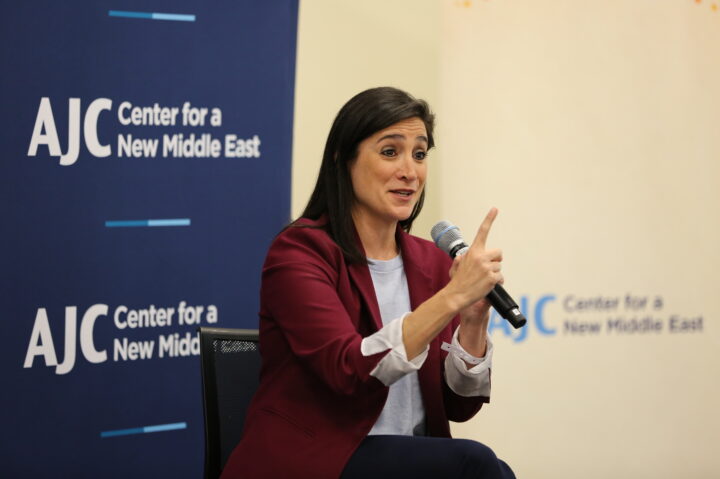
Dana Stroul, the director of research at the Washington Institute for Near East Policy, speaks at AJC's Abraham Accords 5th Anniversary Commemoration on Capitol Hill in Washington on Sept. 10, 2025.
Dana Stroul, the director of research at the Washington Institute for Near East Policy and a former senior Defense Department official in the Biden administration, warned on Wednesday that the Israeli strike on Hamas leaders in Doha is leading Arab states to rally around Qatar, potentially dealing setbacks to regional normalization.
Stroul, speaking at an American Jewish Committee event in Washington to mark the five-year anniversary of the Abraham Accords, said that Arab leaders are offering support for Qatar following the strike, and that both Israeli and Iranian moves to make the Gulf a “new battlefield in the Middle East” are making the U.S.’ regional partners “very nervous.”
“It is really disappointing that not one [Arab] government acknowledged Hamas,” Stroul said. “What’s very clear is that everyone else in the region is aligned that this was a strike on Qatar,” as opposed to a strike on Hamas. “This is about Qatari sovereignty. We’ve seen really a shoring up of Arab leaders’ alignment with and defense of Qatar.”
She said that there had been relatively little criticism in the region for Israel attacking Iran’s nuclear program, undermining Hezbollah or helping bring down the Assad regime in Syria, but “this time Israeli military action didn’t happen on what everyone sort of agrees is an adversary … that was a major non-NATO ally of the United States who is actively participating in diplomatic processes.”
“Now we have the leader of the [United Arab Emirates], who years ago was the leader of the Gulf Rift in isolating Qatar — he just went to Qatar,” she continued, noting as well that Israel was disinvited today from the Dubai Air Show, where it had a significant presence in previous years.
“The risk is actually that these kinds of actions do set back the cause of normalization and integration,” she continued.
She also called Qatar, as the host of the U.S. air base in the region, a critical hub of regional defense integration efforts.
Another crucial question, she added, is how the Hamas military leadership in Gaza holding the remaining living hostages will react to the Doha strike.
“I’m very, very worried about the hostages,” she said.
She said it’s unlikely that the strikes will make Hamas leaders in Gaza more willing to negotiate or release hostages. The dispute between the U.S. and Israel over the strikes, compounded by growing international criticism of Israel, could further harden their resolve to not negotiate or compromise.
Stroul said that the strike’s apparent failure to kill any of the senior echelon of Hamas leaders could make it a “worst-case scenario,” in which Hamas leaders are less incentivized to negotiate and could cause Qatar to withdraw from any further mediation.
She added that it’s unclear how ceasefire negotiations can continue, and that parties may look to Egypt to step up as the new mediator, placing it in a potentially precarious position.
She said it was common knowledge in the region that the Hamas leaders are “dead men walking,” but said it’s an “open question” whether now was the right time to carry out that strike, or its broader implications.
Stroul also said that Qatar had never been formally asked to expel the Hamas leaders — she said that former Secretary of State Tony Blinken had asked the Qataris to do so in late 2024 when ceasefire talks yielded little progress, but the Trump administration’s special envoy Steve Witkoff asked that be walked back so that he could continue talks. Stroul was out of government at the time.
And she said that Qatar’s support of Hamas pre-Oct. 7, frequently cited by the country’s critics, was conducted with Israel’s knowledge and support, and that of the United States.
Plus, Ziv and Gali Berman's second birthday in captivity

(Photo by JACQUELINE PENNEY/AFPTV/AFP via Getty Images)
This frame grab taken from an AFPTV footage shows smoke billowing after explosions in Qatar's capital Doha on September 9, 2025.
Good Wednesday morning.
In today’s Daily Kickoff, we report the latest on the Israeli strike targeting senior Hamas officials in Doha, and look at how Capitol Hill is responding to the operation. We report on Texas state Rep. James Talarico’s criticism of Israel following the launch of his Senate campaign, and talk to friends of Israeli hostages Gal and Ziv Berman, who are marking the twins’ second birthday in Hamas captivity. Also in today’s Daily Kickoff: Elizabeth Tsurkov, Scarlett Johansson and Amb. Mark Wallace.
Today’s Daily Kickoff was curated by Jewish Insider Executive Editor Melissa Weiss and Israel Editor Tamara Zieve, with assists from Marc Rod and Danielle Cohen-Kanik. Have a tip? Email us here.
What We’re Watching
- We’re keeping an eye on the situation in the Middle East and Washington following Israel’s targeting of senior Hamas officials in Doha yesterday. More below.
- The California Senate’s Education Committee is holding a hearing this afternoon on AB 715, legislation meant to address antisemitism in the state’s K-12 schools. One of the legislators supporting the bill told The Jewish News of Northern California that the text had become “narrower” after the bill’s backers “compromised on numerous things with our colleagues who expressed concerns” over the legislation.
- Yeshiva University’s Rabbi Ari Berman will serve as the Senate’s guest chaplain today. C-SPAN’s Howard Mortman, author of When Rabbis Bless Congress, notes that Berman, who delivered the benediction at President Donald Trump’s inauguration earlier this year, will become the third rabbi to have prayed both in Congress and during a presidential inauguration.
- Elsewhere on Capitol Hill today, the House Committee on Education and the Workforce’s subcommittee on early childhood, elementary and secondary education is holding a hearing on antisemitism in K-12 schools. The Foundation for Defense of Democracies’ Brandy Shufutinsky, the Louis D. Brandeis Center for Human Rights Under Law’s Rachel Lerman, Defending Education’s Nicole Neily and T’ruah’s Rabbi Jill Jacobs are slated to testify.
- Brandeis University is unveiling its “New Vision for American Higher Education” this afternoon at the National Press Club. Sen. Ed Markey (D-MA) is slated to speak at the event. Across town, Sen. Ted Cruz (R-TX) is speaking at a Heritage Foundation event focused on the Muslim Brotherhood.
- The American Jewish Committee is holding an event this morning marking the upcoming fifth anniversary of the signing of the Abraham Accords.
- This afternoon, the Jewish Democratic Council of America is hosting “Israel and Gaza: Two Years Later and What Comes Next” with Israel Policy Forum’s Michael Koplow.
- Elsewhere in DC, the National Union for Democracy in Iran and MEAD are continuing their conference in Washington today.
- Some MEAD attendees are heading to Israel for the Jefferies TechTrek conference in Tel Aviv, which kicked off with a welcome reception last night. Former U.S. Ambassador to Israel Tom Nides, Paul Singer, Bill Ackman, Shaun Maguire and Dan Loeb are among those gathered for Jefferies.
- The Climate Solutions Prize Tour kicks off today in the United Arab Emirates, before moving to Israel on Sunday.
- Israeli President Isaac Herzog arrived in London today for a two-day visit.
- In Canada, “The Road Between Us,” about Israeli Maj. Gen. (res.) Noam Tibon’s efforts to rescue his son’s family from their Gaza envelope home on Oct. 7, 2023, will premiere at the Toronto International Film Festival, after it was previously removed from the slate of films over what organizers said was a failure to get Hamas to approve the use of its videos of the attacks.
- In Pennsylvania, representatives from the Jewish Federation of Greater Pittsburgh will deliver a victim impact statement at the sentencing of Talya Lubit, who pleaded guilty in May to charges of conspiracy and defacing and damaging Chabad of Squirrel Hill.
What You Should Know
A QUICK WORD WITH JI’S MELISSA WEISS AND Lahav harkov
Nearly a day after an Israeli airstrike targeted a meeting of high-level Hamas officials in Doha, Qatar, there are more questions than answers, both in Jerusalem and Washington. Israel has not confirmed which officials were killed in the strike, while Hamas has said that five officials from the group, including the son of Hamas’ chief negotiator, Khalil al-Hayya, were killed in addition to a member of the Qatari security forces.
Israeli reports earlier today indicate that the strike did not kill the most senior echelon of the terror group, which for years has been based in Qatar, a U.S. ally.
Amid ongoing uncertainty over the success of the strike, the operation was met with rare condemnation from the White House, first from Press Secretary Karoline Leavitt and then from President Donald Trump himself, who said he “was very unhappy about it, very unhappy about every aspect” — perhaps, in part, because the operation is not believed to have taken out the most senior Hamas officials.
But it was Trump himself who said over the weekend on his Truth Social site that he had “warned Hamas about the consequences of not accepting” the ceasefire and hostage-release deal that had been put forward by the U.S.
At the same time that Trump officials, including the president, were criticizing the operation, U.S. Ambassador to Israel Mike Huckabee was embracing Israeli Prime Minister Benjamin Netanyahu at the U.S. Embassy’s belated Independence Day celebration in Jerusalem, where the prime minister addressed a smaller group of VIPs attending the party.
HILL REACTIONS
Partisan divide emerges over Israeli strike on Hamas leadership in Qatar
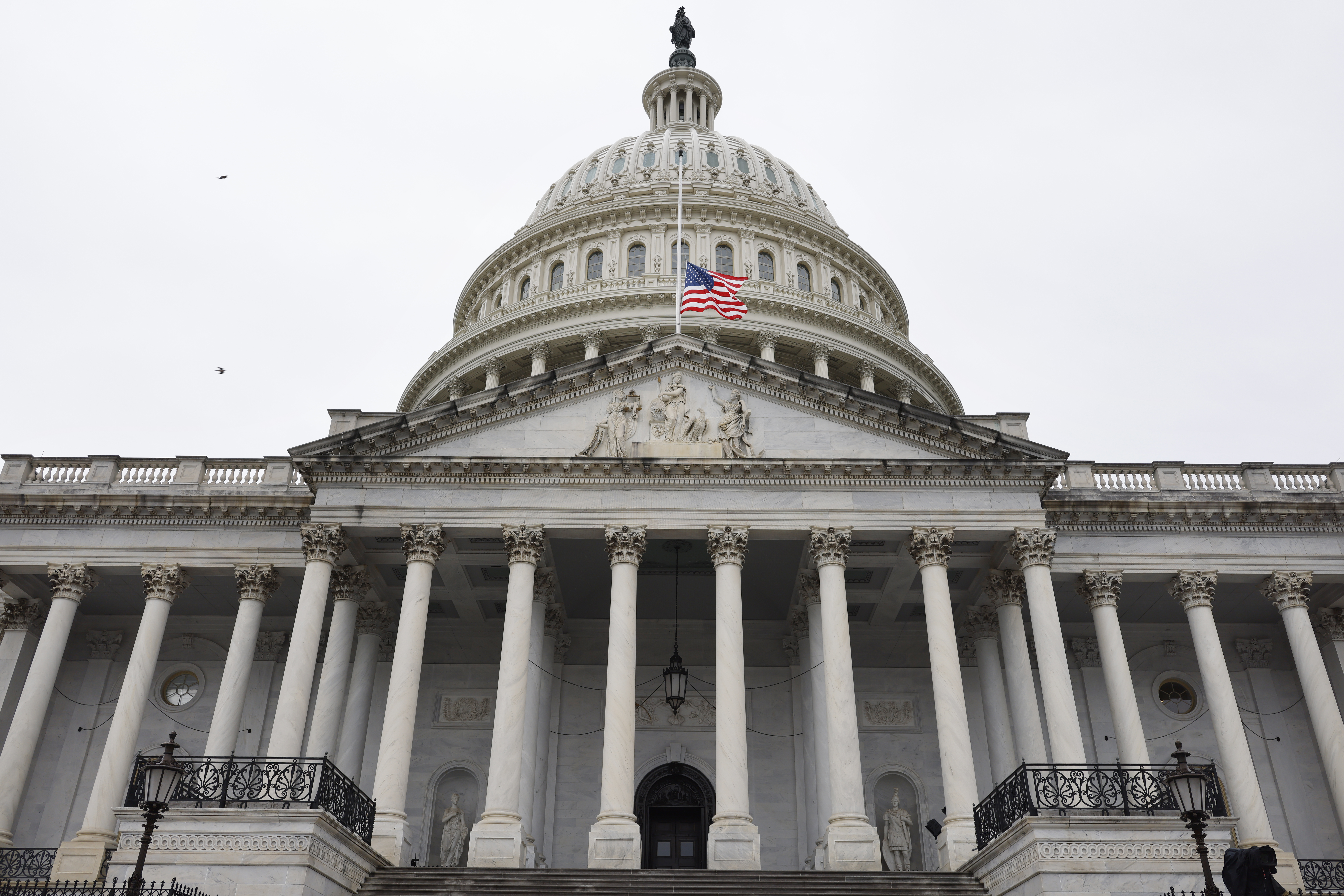
A partisan divide quickly emerged Tuesday over the Israeli strike on Hamas leadership in Qatar, with senior Republican lawmakers expressing support for the attack, while top Democrats criticized it, Jewish Insider’s Marc Rod reports.
What they’re saying: Sen. Roger Wicker (R-MS), the chair of the Senate Armed Services Committee, told JI, “I support it.” He continued, “I think Hamas has got to be destroyed, and there’s no sense in doing half measures.” But Wicker’s Democratic counterpart, Sen. Jack Reed (D-RI), called the strike “extremely disruptive, provocative and dangerous” and a “great strategic mistake.” He praised Qatar as “a strong ally of the United States” and argued that the strike, which targeted Hamas leaders who were part of negotiations with the U.S. and Israel, showed that Israel is not serious about reaching a ceasefire deal.
doha debate
Senate Republicans address differences with White House over Israel’s Doha strike
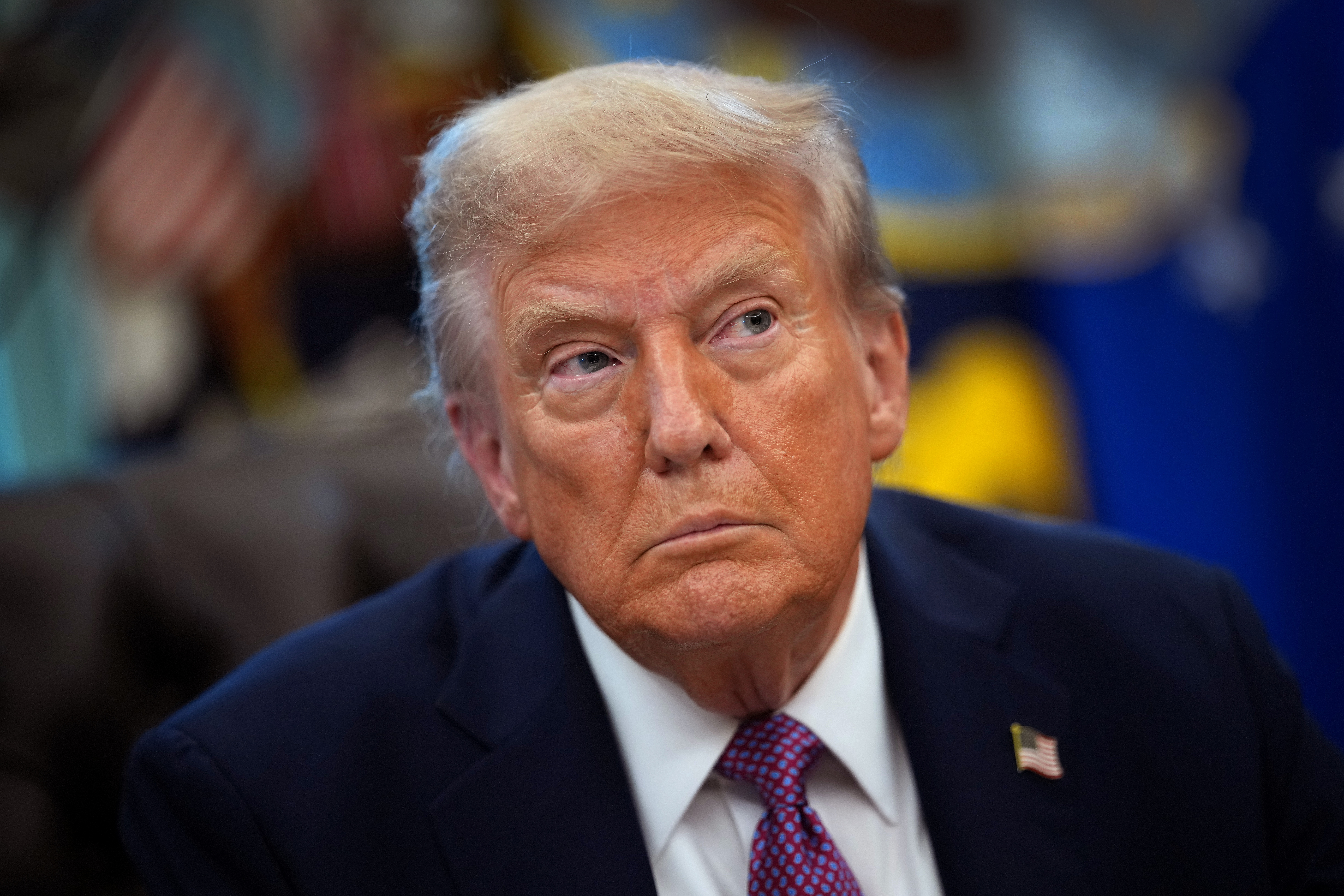
The Israeli strike targeting Hamas leaders in Qatar is dividing the White House, which strongly criticized Israel for attacking Qatari territory, and Senate Republicans, who have been overwhelmingly supportive of the Israeli action, Jewish Insider’s Marc Rod and Emily Jacobs report.
Divisions: Sen. Lindsey Graham (R-SC), asked about the White House statement on the attack, told JI, “I understand we have troops there, but my focus is Israel. Hamas has had every chance. … Lay down your weapons, release the hostages — you live. If you don’t — it keeps going.” Sen. Roger Marshall (R-KS), the most outspoken supporter of Qatar among Senate Republicans, stood alone in offering a full-throated criticism of the Israeli strike.
Breaking rank: Breaking with many of his Senate Democratic colleagues, Sen. Richard Blumenthal (D-CT) sounded a supportive note on the Israeli strike on Hamas leaders in Qatar on Tuesday. “I strongly support Israel’s right to defend itself against Hamas,” Blumenthal told Jewish Insider’s Marc Rod. “I want to know more about the details of this particular strike — I’m learning about it in real time and anything done to destroy Hamas’ leadership or its terrorist capability or military capacity is a step in the right direction.”
HOSTAGE RELEASE
Elizabeth Tsurkov released after months of torture by Iraqi terror group, Trump says

President Donald Trump announced Tuesday that Elizabeth Tsurkov, an Israeli-Russian researcher at Princeton University, was released by an Iranian-backed terrorist group in Iraq to the U.S. Embassy in Baghdad, Jewish Insider’s Marc Rod reports.
What he said: “I am pleased to report that Elizabeth Tsurkov, a Princeton Student, whose sister is an American Citizen, was just released by Kata’ib Hezbollah (MILITANT Hezbollah), and is now safely in the American Embassy in Iraq after being tortured for many months,” Trump said on Truth Social. “I will always fight for JUSTICE, and never give up. HAMAS, RELEASE THE HOSTAGES, NOW!”
Talarico talk
Texas Democratic Senate recruit James Talarico takes critical view of Israel

James Talarico, a Democratic state representative in Texas seen as a rising star in his party, launched a campaign for Senate on Tuesday, joining a crowded primary to claim the seat held by veteran Sen. John Cornyn (R-TX). The 36-year-old former public school teacher, who has studied to become a Presbyterian minister, has drawn national attention for openly embracing his Christian faith to connect with voters. In his launch video, he referred to Jesus, invoking him as “a barefoot rabbi who gave two commandments: love God and love neighbor,” Jewish Insider’s Matthew Kassel reports.
Israel approach: Talarico, who is calling for a generational shake-up in a party he sees as largely out of touch with voter concerns, until this week had no apparent record of public commentary on Middle East policy, a subject that is likely to stir debate in the upcoming election cycle amid Democratic divisions over Israel’s war in Gaza. In interviews published on Tuesday, he indicated that he would adopt a more critical approach to Israel, calling the war a “moral disaster” that his party has failed to address. “One of the primary reasons that the Democratic Party lost young voters in particular last election was our party’s failure to recognize the moral disaster in Gaza, and I hope that we have leaders who recognize that mistake,” he said in comments to Punchbowl News that were echoed in an interview with The Washington Post.
CAMPUS BEAT
Faculty and staff drive antisemitism on college campuses, ADL/AEN survey finds
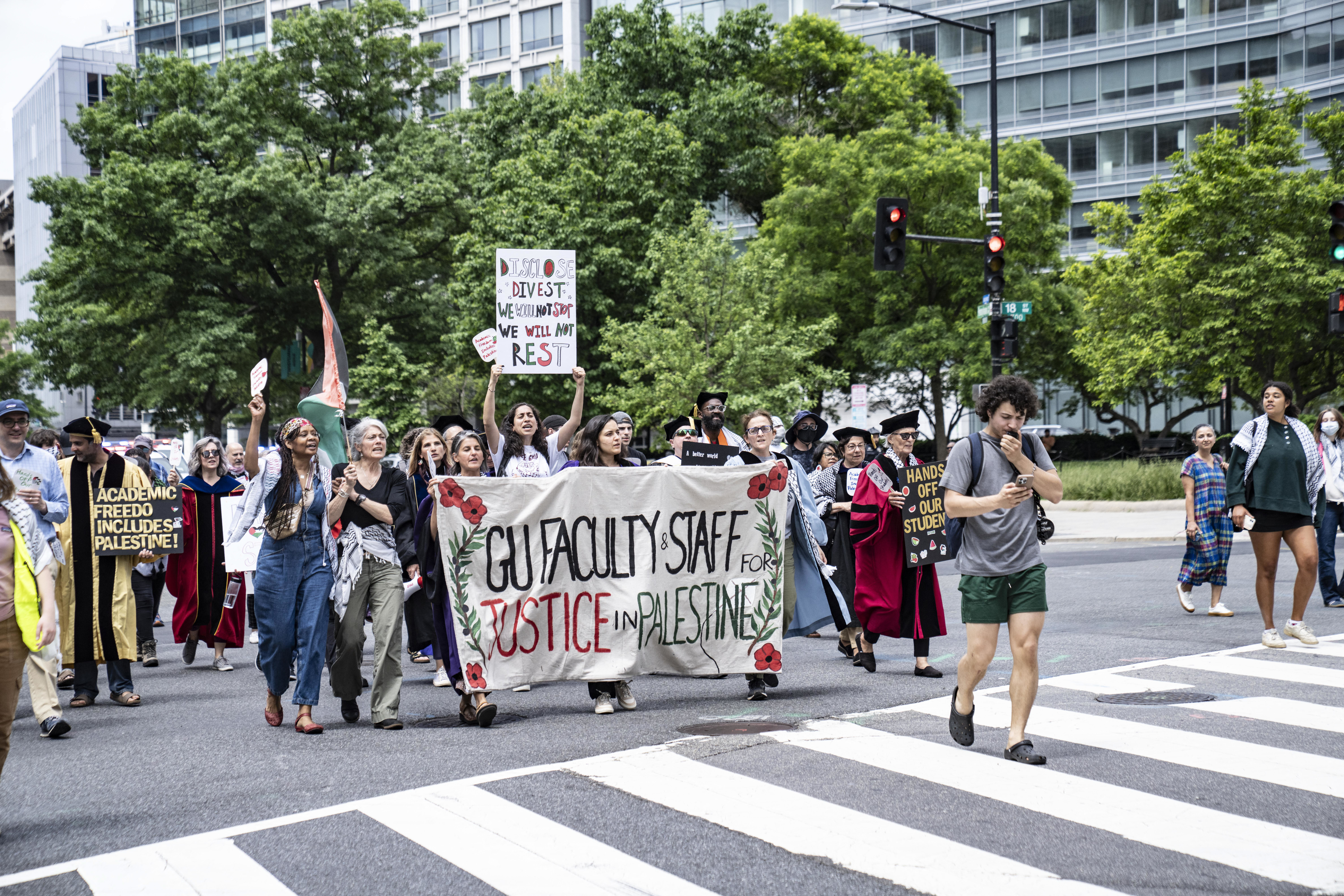
Much of the antisemitism on college campuses is fueled by faculty and staff — both on campus and within professional academic organizations — according to a survey released on Wednesday by the Anti-Defamation League and the Academic Engagement Network. Seventy-three percent of the 209 Jewish faculty members polled from universities around the U.S. reported observing antisemitic activities or statements from faculty, administrators or staff on campuses, including calls to boycott Israel and doxxing campaigns. Forty-four percent said they were aware of an organized Faculty for Justice in Palestine chapter on their campus, Jewish Insider’s Haley Cohen reports.
Testimony: “My chair is pro-Hamas (explicitly so) and has turned our department into an encampment, full of ‘river to the sea’ slogans and propaganda,” an anonymous faculty member shared in the survey. “When I and a few other Jewish faculty objected, the chair organized about 50 people to verbally attack us, including one who told me that we had all the money and power. Consequently, my department is a hostile work environment, and I can no longer attend events or participate in departmental life there.”
SOMBER DAY
‘We won’t normalize it’: Friends of Ziv and Gali Berman mark twins’ 28th birthday in Hamas captivity
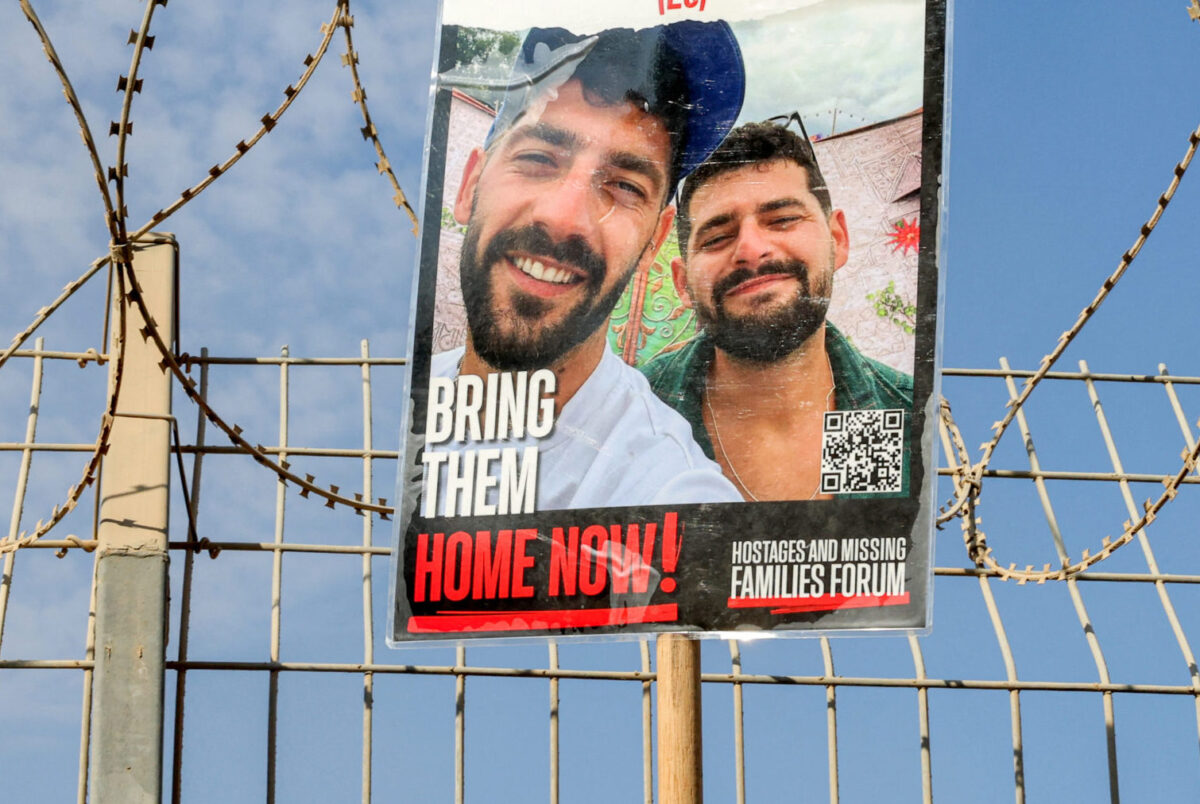
As Israeli twins Ziv and Gali Berman mark their 28th birthday in captivity on Wednesday — their second since being kidnapped to Gaza from Kibbutz Kfar Aza during the Hamas-led terror attacks of Oct. 7, 2023 — their close-knit group of friends is quietly commemorating the day while continuing their public campaign for the brothers’ release. Known to their loved ones as inseparable, Ziv and Gali are not only the best of friends but also deeply connected to — and the center of — their childhood circle in Kfar Aza. Ziv, the more quiet and reserved twin, and also the funny one, and Gali, the loud, extroverted and charming one, complement one another and gravitate toward each other, friends say. But testimonies from released hostages suggest that the two have been separated from each other while in captivity, Jewish Insider’s Tamara Zieve reports.
Friends reflect: Their birthday, said Inbar Rosenfeld, a lifelong friend of the twins, “makes us stop for a moment and remember, and get a sense of the time that they haven’t been here — and this is the second birthday [in captivity.]” Rosenfeld told JI on Tuesday, “It’s crazy, it’s tough — we never thought we would get to this situation.” Ido Felus, another close friend of the twins from Kfar Aza, said that their second birthday in captivity fills him with a mix of pain and perseverance. “I am sure they are coming back, I have no doubt of that,” Felus told JI.
Another birthday in captivity: Another Israeli hostage, Yosef Haim Ohana, is also marking his second birthday, his 25th, in captivity in Gaza today. Ohana was kidnapped from the Nova music festival on Oct. 7 after he chose to stay and help the wounded instead of fleeing. “On your 25th birthday, we gather not to celebrate, but to remember, to pray, and to amplify your voice until you come home. Let us surround Yosef with love, with faith, and demand: bring them all home now,” his father, Avi Ohana, said in a message.
Worthy Reads
Empty Gestures: The New York Times’ Bret Stephens considers the ramifications of the “gesture politics” that politicians and activists engage in around the Israel-Palestinian conflict. “What, then, do these gestures accomplish? The legitimate needs of the Palestinian people are these: an end to this war; an end to being dragged into future wars by Hamas; an end to the chronic misgovernance of the Palestinian Authority; the establishment of a self-governing political order that improves the lives of Palestinians without endangering the lives of Israelis; the eventual creation, under conditions of mutual trust, of a Palestinian state. Immediate recognition of such a state advances none of this. It is the proverbial cart before the horse. France and its fellow travelers aren’t aiming to do much to help actual Palestinians. Mainly, they seek to congratulate themselves. Countries achieve irrelevance when moral onanism takes the place of serious policy as the principal instrument of national policy.” [NYTimes]
Bullish Economy: In The Wall Street Journal, Nimrod Sapir considers why Israel’s economy has “defied expectations and displayed remarkable resilience” over nearly two years of war and growing international isolation. “Demographics further bolster Israel’s prospects: a growing, youthful labor force. Israel has the highest population growth rate among Organization for Economic Cooperation and Development countries, and that growth goes far beyond the Haredi and Arab sectors. Surging global demand for Israeli defense systems likewise strengthens the export base and opens new markets. Israel’s military achievements — particularly in neutralizing Iran’s nuclear ambitions and diminishing threats from its proxies — are reshaping the geopolitical landscape. For the first time in decades, investors can anticipate a gradual easing of geopolitical risks that have long weighed heavily on Israel’s economic potential.” [WSJ]
New Stage of War: The Free Press‘ Jay Solomon spotlights Qatar’s years of engaging in “one of the Middle East’s most dangerous games of double-dealing” by hosting Hamas officials as it benefits from its allyship with Western nations. “Israel’s attack on Qatari soil, and the U.S.’s connivance, marks the crossing of another boundary in the Jewish state’s two-year war with Hamas, sparked by the October 7 attack. … Israel’s attack inside Qatar may open a new chapter of direct conflict between Netanyahu’s government and the Al Thanis, though likely not involving their militaries. Qatar is one of the world’s richest nations per capita and possesses vast resources to challenge the legitimacy of the state of Israel through Doha’s global media operations, including the Al Jazeera television network and support for international bodies like the United Nations and the International Criminal Court.” [FreePress]
Word on the Street
Reps. Mike Lawler (R-NY) and Ritchie Torres (D-NY) wrapped up a bipartisan delegation to Italy, Tunisia and Morocco…
Democrat James Walkinshaw is won the special election in Virginia’s 11th Congressional District, succeeding Rep. Gerry Connolly (D-VA), who died earlier this year and for whom Walkinshaw served as chief of staff until 2019…
Syrian President Ahmad al-Sharaa is slated to travel to the U.S. for the U.N. General Assembly later this month; al-Sharaa, who will speak to the gathering on Sept. 24, is expected to meet with President Donald Trump on the sidelines of the annual confab…
Northwestern University announced the hiring of Henry Bienen to succeed outgoing President Michael Schill; Bienen previously led the school from 1995-2009, during which time he spearheaded the launch of Northwestern’s campus in Qatar…
The FBI is investigating threats made to several Pittsburgh-area Jewish organizations, including the Tree of Life…
Police in Oregon are searching for an individual who spray-painted swastikas on the Oregon Jewish Holocaust Museum earlier this summer…
Actress Scarlett Johansson said she intentionally cast Holocaust survivors in “Eleanor the Great,” her directorial debut, about an elderly American Jewish woman who assumes the childhood storyline of a deceased friend who had survived the Holocaust…
United Against Nuclear Iran CEO Mark Wallace sent a letter to the head of the U.S.-based Marriott International, inquiring about the hotel chain’s hosting of Hamas officials at the Ritz Carlton in Doha, Qatar…
The Wall Street Journal reports that Turkey and Egypt warned Hamas officials abroad in recent weeks to tighten security measures around their meetings…
Spain banned Israeli National Security Minister Itamar Ben-Gvir and Finance Minister Bezalel Smotrich, amid rising tensions between Jerusalem and Madrid over the war in Gaza and a Spanish arms embargo on Israel…
Former National Security Council staffer Oliver North quietly married his former secretary, Fawn Hall, nearly four decades after the Iran-Contra affair both were involved in…
The son of a British couple detained since January in Iran said his parents’ situation is “dire” following their meeting with the British ambassador in Tehran…
The International Atomic Energy Agency reached an agreement with Iran to resume inspections of the country’s nuclear facilities, three months after cooperation ceased amid the 12-day Israel-Iran war…
Zachary Isakowitz, who previously worked at the Semiconductor Industry Association as head of government affairs and at the Treasury, is joining Nvidia as a director of government affairs.
Pic of the Day

U.S. Ambassador to Israel Mike Huckabee (on guitar) and Paul Singer (on keyboard) jammed out to Chuck Berry’s “Johnny B. Goode” at the embassy’s belated Independence Day celebration last night at the Museum of Tolerance Jerusalem.
Birthdays
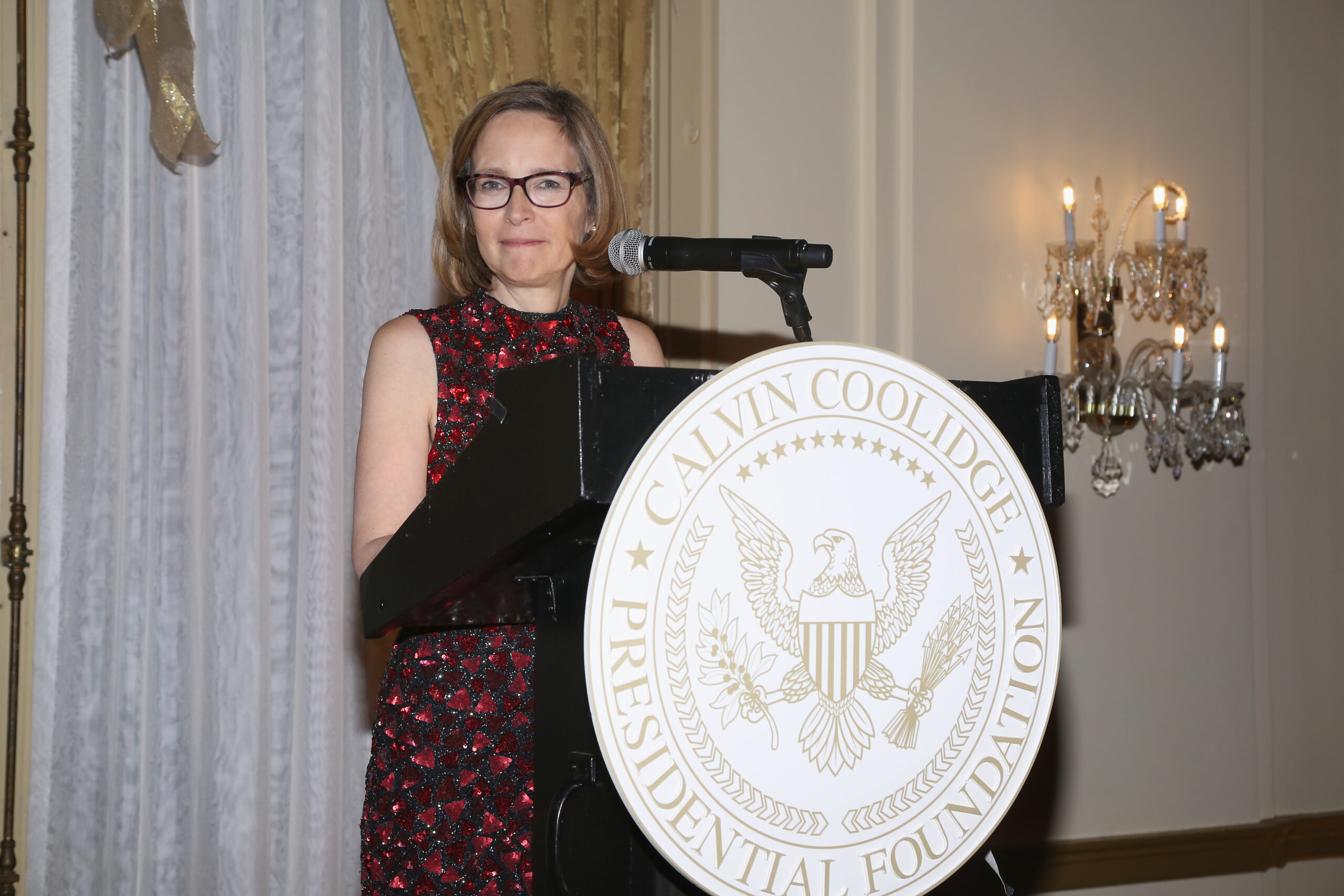
Writer, columnist and author of four New York Times bestsellers, Amity Ruth Shlaes turns 65…
Chairman of Shamrock Holdings, Roy Disney’s private investment company, Stanley Gold turns 83… Retired realtor in Southern California, Dianne Varon… Former EVP and general counsel at Chicago’s futures broker Rosenthal Collins Group, Gerald Fishman… Past president of Congregation Ahavas Israel in Passaic, N.J., Howard Penner… Retired coordinator at Truman Heartland Community Foundation, she had been a Hebrew teacher at Congregation Beth Torah in Overland Park, Kan., Henri Goettel… Houston attorney, and Republican Party activist, Gary M. Polland turns 75… Denver attorney and politician, he served in the Colorado House of Representatives for eight years, Joel Judd turns 73… Executive assistant to the office managing partner of the E&Y office in Tampa, Nancy Carol Finkel… U.S. senator (R-WY), Cynthia Lummis turns 71… Retired VP at Goldman Sachs, now a part-time elementary school teacher, Matthew Fried… Real estate attorney in South Florida, Steven A. Greenspan… Award-winning journalist and author, he wrote a 2024 book on Bernie Madoff, Richard Behar… Former acting administrator of the DEA, now a senior counsel at D.C.’s Crowell & Moring, Charles Philip “Chuck” Rosenberg turns 65… Founder and managing director at Beacon Global Strategies, Andrew Shapiro… NYC trusts and estates attorney, Lawrence Ira Garbuz… Co-founder and partner of One Madison Group, Jonathan Soros turns 55… Television writer and producer whose work includes “The Big Bang Theory,” Eric Kaplan turns 54… Executive director of the Maryland/Mid-Atlantic region of Agudath Israel, Ariel Sadwin… Writer, actress and comedian, she was a writer for “Saturday Night Live,” Sarah Schneider turns 42… Principal at Blue Zone Partners and managing partner at Precision Infrastructure Management, Charles Szold… PR strategist, Josh Nass… Chief foreign correspondent for Fox News, his 2024 book, Black Saturday, covers the events of Oct. 7 and the war that followed, Trey Yingst turns 32… Jennifer Meyer…
As conflicting accounts emerge about the strike’s outcome, Trump voices frustration while Netanyahu says the operation could bring the war in Gaza closer to an end
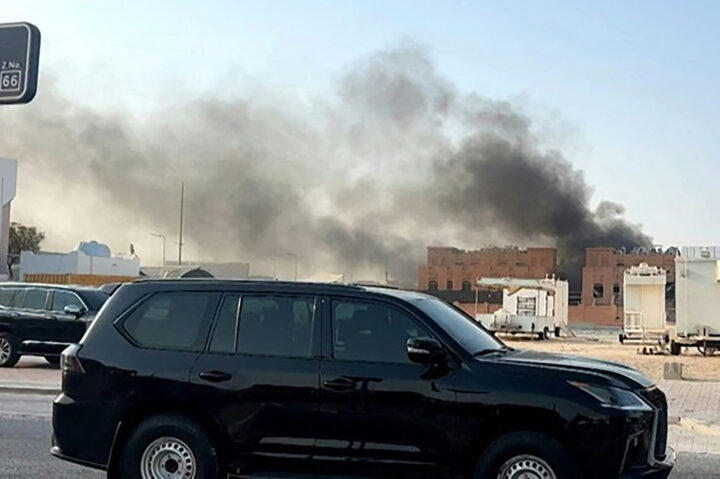
JACQUELINE PENNEY/AFPTV/AFP via Getty Images
This frame grab taken from an AFPTV footage shows smoke billowing after explosions in Qatar's capital Doha on September 9, 2025.
Nearly a day after an Israeli airstrike targeted a meeting of high-level Hamas officials in Doha, Qatar, there are more questions than answers, both in Jerusalem and Washington. Israel has not confirmed which officials were killed in the strike, while Hamas has said that five officials from the group, including the son of Hamas’ chief negotiator, Khalil al-Hayya, were killed in addition to a member of the Qatari security forces.
Israeli reports earlier today indicate that the strike did not kill the most senior echelon of the terror group, which for years has been based in Qatar, a U.S. ally.
Amid ongoing uncertainty over the success of the strike, the operation was met with rare condemnation from the White House, first from Press Secretary Karoline Leavitt and then from President Donald Trump himself, who said he “was very unhappy about it, very unhappy about every aspect” — perhaps, in part, because the operation is not believed to have taken out the most senior Hamas officials.
But it was Trump himself who said over the weekend on his Truth Social site that he had “warned Hamas about the consequences of not accepting” the ceasefire and hostage-release deal that had been put forward by the U.S.
At the same time that Trump officials, including the president, were criticizing the operation, U.S. Ambassador to Israel Mike Huckabee was embracing Israeli Prime Minister Benjamin Netanyahu at the U.S. Embassy’s belated Independence Day celebration in Jerusalem, where the prime minister addressed a smaller group of VIPs attending the party.
“Israel acted wholly independently and we take full responsibility for this action,” Netanyahu said of the Doha strikes. “This action can open to an end of the war in Gaza.”
Israeli officials and defense sources said on Wednesday that they are waiting for better intelligence before commenting on who was killed, but they viewed the operation as a success.
Israeli Defense Minister Israel Katz warned that there could be additional strikes of this kind: “The long hand of Israel will act against its enemies anywhere in the world. There is no place where they can hide. Whoever was a partner in the Oct. 7 massacre will be fully brought to justice.”
Everyone from Israeli Opposition Leader Yair Lapid to Finance Minister Bezalel Smotrich put out statements praising the IDF and Shin Bet and saying the terrorists got what they deserved.
At the same time, the Hostages and Missing Families Forum said the affiliated families felt “deep concern and heavy anxiety” that their loved ones would pay the price. “We know from survivors who have returned that the revenge directed at the hostages is brutal. The chance of bringing them back now faces greater uncertainty than ever before.”
However, Shimon Or, uncle of hostage Avinatan Or, said on Kan radio that “this action brings us closer to bringing Avinatan and the rest of the hostages. …We will not bring back the hostages anymore with military operations and ‘the gates of hell,’ but with control over Gaza.”
Meanwhile, Israeli officials have pushed back on criticism that the strikes would affect ceasefire talks, briefing press in Hebrew and English that the operation will help talks, because there are other channels for negotiations.
Many prominent Senate Democrats have criticized the strike

Jemal Countess/Getty Images for Fair Share America
Sen. Richard Blumenthal speaks at a rally at the Capitol on April 10, 2025 in Washington, DC.
Breaking with many of his Senate Democratic colleagues, Sen. Richard Blumenthal (D-CT) sounded a supportive note on the Israeli strike on Hamas leaders in Qatar on Tuesday.
“I strongly support Israel’s right to defend itself against Hamas,” Blumenthal told Jewish Insider. “I want to know more about the details of this particular strike — I’m learning about it in real time and anything done to destroy Hamas’ leadership or its terrorist capability or military capacity is a step in the right direction.”
Many prominent Senate Democrats have criticized the strike, saying it undermines negotiations for a ceasefire and that it should not have been carried out in Qatari territory. The White House expressed a similar view, breaking with top Senate Republicans who have been supportive of the Israeli attack.
Sen. John Fetterman (D-PA) was the only other Senate Democrat who has publicly been supportive of the Israeli action.
White House Press Secretary Karoline Leavitt: ‘Unilaterally bombing inside Qatar … does not advance Israel or America’s goals’

SAUL LOEB/AFP via Getty Images
White House Press Secretary Karoline Leavitt speaks during a press briefing in the Brady Briefing Room of the White House in Washington, DC, on September 9, 2025.
In a prepared statement on behalf of President Donald Trump, White House Press Secretary Karoline Leavitt on Tuesday criticized the Israeli strike on Hamas leaders in Qatar and expressed regret that it had taken place in Doha, adding that the U.S. had warned Qatar about the strike when the U.S. itself became aware.
She said Trump had also vowed to Qatari leaders that such an attack would not be repeated in Qatari territory.
“This morning, the Trump administration was notified by the United States military … as Israel was attacking Hamas, which very unfortunately was located in a section of Doha, the capital of Qatar,” Leavitt said. “Unilaterally bombing inside Qatar, a sovereign nation and close ally of the United States that is working very hard and bravely taking risks with us to broker peace, does not advance Israel or America’s goals.”
Pressed repeatedly on whether Israel had notified the U.S. about the attack, as some reports indicated, or whether the U.S. military had detected it independently, Leavitt did not specify, repeating only that the U.S. military had notified the White House.
She said that Trump “immediately directed” Middle East envoy Steve Witkoff to notify Qatar about the upcoming attack when the administration learned about it.
“The president views Qatar as a strong ally and friend of the United States and feels very badly about the location of this attack,” Leavitt continued.
She did add, however, that the administration views eliminating Hamas as “a worthy goal.”
Asked whether Trump would impose “consequences” on Israeli Prime Minister Benjamin Netanyahu for the strike or provide a “directive … to Netanyahu in terms of what’s allowed in the future,” Leavitt said that “that’s a decision only the president can make.”
Leavitt said that Trump had spoken to Qatari Emir Tamim bin Hamad Al Thani, Prime Minister Mohammed bin Abdulrahman Al Thani and Netanyahu after the attack.
She said the president “assured [the Qatari leaders] that such a thing will not happen again on their soil” and thanked Qatar for “their support and friendship to our country.”
She said that both Trump and Netanyahu agreed that they want to make peace quickly and said Trump “believes this unfortunate incident could serve as an opportunity for peace,” and that Trump had conveyed his displeasure about the location of the strike to Netanyahu.
“He expects all of our friends and allies in the region — that includes both Qatar and Israel — to seek peace as well, and he wants to see that happen, and he’s working with all of our allies in the region to get that done,” Leavitt said.
Leavitt denied that Trump’s post on social media over the weekend offering a “last warning” to Hamas to accept a ceasefire deal was a reference to the impending Israeli attack.
The White House’s expressed concern about the location of the attack puts the administration at odds with many senior members of Trump’s own party in the Senate, who were quick to express support for the Israeli attack, and aligns more closely with top Senate Democrats who have been more critical of the attack and where it took place.
Asked about the White House’s opposition to the strike, multiple Senate Republicans who had earlier in the day expressed support for the Israeli attack declined to comment.
Meanwhile, Sen. Chris Coons (D-DE) said, “I will actually agree with President Trump that it doesn’t advance our interests in terms of advancing negotiations for the release of hostages or the ceasefire that is urgently needed in Gaza.”
“I have not gotten any briefing on the details of how it was approved, whether or not the Trump administration was aware and supported it, but in the middle of a hostage negotiation that is urgently needed to free the hostages, to end the fighting, to deliver humanitarian relief and to address Hamas — to take a strike in Doha against Hamas leaders, I think puts at risk any peace process,” Coons said. He added that he wants to be briefed on further details.
Top Senate Republicans are supporting the Israeli attack in Doha while senior Democrats are criticizing it

Kevin Carter/Getty Images
U.S. Capitol Building on January 18, 2025 in Washington, DC.
A partisan divide quickly emerged Tuesday over the Israeli strike on Hamas leadership in Qatar, with senior Republican lawmakers expressing support for the attack, while top Democrats criticized it.
Republican lawmakers largely characterized the strike as justified and unsurprising given the Hamas leaders’ responsibility for the Oct. 7, 2023, attacks on Israel, while Democrats argued that the strike compromised the ability to negotiate with Hamas officials for a ceasefire and should not have been carried out in the territory of a U.S. ally.
Sen. Roger Wicker (R-MS), the chair of the Senate Armed Services Committee, told Jewish Insider, “I support it.”
“I think Hamas has got to be destroyed, and there’s no sense in doing half measures,” Wicker continued.
Sen. James Risch (R-ID), the chair of the Senate Foreign Relations Committee, told JI that the strike was “not surprising.”
“Any member of Hamas who had anything to do with the invasion of Israel is in jeopardy, it’s a given,” Risch said. “Is now, always has been.”
He said he does not see the strike as having any broader implications for the U.S. relationship with Qatar.
Sen. Mike Rounds (R-SD) suggested that similar attacks on Hamas leaders may continue.
“Hamas is a terrorist organization. Israel has been focused on taking out that terrorist organization. These are the folks that Israel firmly believes were directly responsible for the Oct. 7 attacks,” Rounds said. “I think we’re going to see Israel continue to go after those individuals that are accountable for that terrorist activity.”
Sen. Pete Ricketts (R-NE) said that “Qatar has been told they probably ought not to harbor terrorist organizations, so Israel is going to defend itself and take out terrorist organizations.”
Sen. Ted Cruz (R-TX) said the strike shows that “Israel is serious about defending itself and taking out the terrorists.”
Sen. Lindsey Graham (R-SC) posted on X, “To those who planned and cheered on the October 7 attack against Israel, the United States’ greatest ally in the region: This is your fate.”
Senate Democrats took a starkly different perspective.
Sen. Jack Reed (D-RI), the ranking member of the Senate Armed Services Committee, called the strike “extremely disruptive, provocative and dangerous” and a “great strategic mistake.”
“Qatar has been a strong ally of the United States, one of our biggest bases in the region is there. … They, in fact, took a rocket attack after Iran tried to hit our troops at Al Udeid. They’ve provided significant financial support to our efforts in the Middle East,” Reed told JI, referring to retaliatory strikes by Iran on the U.S. airbase in Doha after the U.S. attacked its nuclear facilities in June.
He also argued that the strike, which targeted Hamas leaders who were part of negotiations with the U.S. and Israel, showed that Israel is not serious about reaching a ceasefire deal. A Hamas official on Monday publicly rejected the latest ceasefire proposal sponsored by the U.S., along with others.
“The Hamas representatives are there for at least some type of discussion about a ceasefire, and the signal I think that [Israeli Prime Minister Benjamin] Netanyahu [sends] is ‘I don’t want a ceasefire under any terms.’ So those hostages continue to languish,” Reed said.
Sen. Jeanne Shaheen (D-NH), the ranking member of the Senate Foreign Relations Committee, said at a Council on Foreign Relations event on Tuesday that “it’s unfortunate that Israel bombed in Doha, one of our allies.”
“I understand that they were going after one of the Hamas leaders — and we all agree that Hamas should be eliminated — but we have to be thoughtful about escalating things in a way that [isn’t] helpful, especially when we’ve got this opportunity in the region.”
Sen. Mark Kelly (D-AZ) called the Israeli strike “rather aggressive.”
“Hamas is a terrorist organization but Qatar often hosts the political side of the organizations so there is some avenue for communication,” Kelly told JI. “And they’re an ally of ours. It’s an aggressive thing to do, but I haven’t seen the details yet.”
Sen. Tim Kaine (D-VA) offered a somewhat more nuanced view, acknowledging to JI that it’s “been enormously frustrating for the Israelis and the U.S. that Qatar has sheltered Hamas.”
“But every once in a while, they have been an effective intermediary on things like hostages. So exactly what was the decision-making about why this was the right move now, I’m interested to know it,” Kaine said. “Until I get an answer to that, I’m probably not going to opine about it. But I understand the serious frustration with what Qatar has done with Hamas. I just need to know more.”
Several other Democrats including Sens. Elissa Slotkin (D-MI), Ruben Gallego (D-AZ) and Adam Schiff (D-CA) declined to comment, saying they needed more information before discussing the attack, as did Sen. John Barrasso (R-WY), the No. 2 Senate Republican.
Sen. John Fetterman (D-PA) was the only Senate Democrat who full-throatedly supported the strike, posting a gif on X of a smiling, dancing Winnie the Pooh.
The image, Fetterman told JI, “sums it up. Just like the beepers” — a reference to the Israeli attack on Hezbollah officials in Lebanon a year ago. “I love it. Hold them [Hamas] accountable.”
The IDF said it targeted Hamas’ senior leadership amid explosions in Doha

Screenshot/X
Israel strikes Hamas leadership in Doha, Qatar on Sept. 9, 2025.
Israel conducted a strike against senior Hamas leaders, the IDF said on Tuesday, following reports of explosions in Doha, Qatar.
The operation, whose Hebrew name translates to “Judgment Day,” reportedly targeted Khalil al-Hayya, Hamas’ chief negotiator in hostage and ceasefire talks, and longtime senior Hamas official Khalid Mashaal, as well as Hamas officials Zaher Jabarin and Nizar Awadallah, though reports conflict as to the success of the strike.
Israeli Prime Minister Benjamin Netanyahu and Defense Minister Israel Katz said in a joint statement that the Israeli defense establishment unanimously supported the strike.
“The action is totally justified in light of the fact that Hamas leadership initiated and organized the Oct. 7 massacre and did not stop launching murderous actions against Israel and its citizens since then, including taking responsibility for the murder of our civilians in the terrorist attack in Jerusalem yesterday,” they stated.
President Donald Trump was informed of the strike in advance and supported it, Israel’s Channel 12 reported. Netanyahu’s office said that “today’s action against the top terrorist chieftains of Hamas was a wholly independent Israeli operation. Israel initiated it, Israel conducted it, and Israel takes full responsibility.”
“The IDF and [Israel Security Agency (Shin Bet)] conducted a precise strike targeting the senior leadership of the Hamas terrorist organization,” the IDF Spokesperson’s Office stated. “For years, these members of the Hamas leadership have led the terrorist organization’s operations, are directly responsible for the brutal October 7th massacre, and have been orchestrating and managing the war against the State of Israel.”
The IDF said that it used precision munitions and intelligence to reduce harm to civilians.
Hamas leadership is based in the Al-Qatar neighborhood of Doha, where the explosions took place, according to videos posted on social media.
Qatar said it “strongly condemns” the strike in a statement posted to X by Majed Al-Ansari, spokesman for the Qatari Ministry of Foreign Affairs, which described the operation as “a cowardly Israeli attack that targeted residential buildings housing several members of the Political Bureau of Hamas in the Qatari capital, Doha.”
“This criminal assault constitutes a blatant violation of all international laws and norms, and poses a serious threat to the security and safety of Qataris and residents in Qatar,” he added, and said that Qatar “will not tolerate this reckless Israeli behavior and the ongoing disruption of regional security, nor any act that targets its security and sovereignty.”
The strike took place days after the Trump administration sent a Gaza ceasefire and hostage deal proposal via intermediaries, which Israel accepted and a senior Hamas official based in Istanbul rejected.
Earlier Tuesday, Netanyahu left a hearing in his ongoing corruption trial early due to “an exceptional security matter,” Israeli public broadcaster Kan reported.
In 1997, Israel attempted to assassinate Mashaal, the head of Hamas’ political bureau at the time, in Jordan, but gave Amman the antidote for the poison after then-King Hussein threatened to cancel the peace treaty between the countries.
Michael Schill said no Northwestern students have been disciplined for anti-Israel behavior

Valerie Plesch for The Washington Post via Getty Images
Michael Schill, president of Northwestern University, before a House Committee on Education and the Workforce hearing, "Calling for Accountability: Stopping Antisemitic College Chaos" on Capitol Hill on May 23, 2024.
Michael Schill, the Northwestern University president who announced his resignation last week amid widespread controversy over his tenure, appeared unfazed to hear that a Palestinian professor he hired as part of a deal with encampment protestors had once met with the late Hamas leader Yahya Sinwar, an interview with the House Committee on Education and Workforce, released on Thursday, reveals.
In the Aug. 5 interview, which was released as a response to Schill’s resignation announcement on Thursday, House investigators pressed Schill on the hiring of Mkhaimar Abusada as a visiting associate professor of political science.
Abusada, who Schill described as “someone who is regularly quoted as an authority on Palestine governance and politics,” published a piece in Haaretz last year about his 2018 meeting with Sinwar.
“Hypothetically, if somebody, you know, 4 years, 5 years before Oct. 7 has met with someone who — and, I mean, I’m not sure — my guess is — I’ve never been to Gaza, but it’s a pretty small place, and that you are going to meet people and talk to people,” said Schill, who claimed to not be aware of that meeting when he hired Abusada but noted in the interview that the professor’s position had been extended to August 2026. “I don’t know whether a seasoned professor who is doing the politics of Gaza could avoid getting to know some of these people, or whether that would be not doing his job right.”
Schill, who will remain as president in an interim role until his successor is chosen, oversaw a period of antisemitic turmoil on the Chicago-area campus after the Oct. 7, 2023, terrorist attacks and was accused of failing to respond in an adequate manner, leading some lawmakers to call for his resignation.
The 135-page interview transcript provides new, detailed information on Schill’s response to years of campus turbulence, including his controversial handling of a violent anti-Israel encampment in spring 2024 and the university’s close ties to Hamas-allied Qatar.
The interview comes as Northwestern is in talks with the Trump administration to restore $790 million in funding for the university that was pulled by the federal government over an alleged failure to protect Jewish students.
Jewish alumni expressed optimism that Schill’s resignation, and the interview being made public, would lead to Northwestern leaders making necessary reforms.
“Northwestern’s board needs to take control of the situation in a way they have declined to until now [and] clear out all other administrators who have been part of this culture of enabling antisemitism on campus,” Rich Goldberg, a senior advisor at Foundation for Defense of Democracies who holds bachelor’s and master’s degrees from Northwestern, told Jewish Insider.
“Those who are negotiating on behalf of the Trump administration, now seeing this transcript, will need to review any additional information that’s come to light, additional questions that they might have for the university, see if this changes anything that’s been under negotiation to date, and with Schill stepping down, hopefully signaling the board of the university wanting to see real changes made,” Goldberg continued.
Michael Teplitsky, president of the Coalition Against Antisemitism At Northwestern, said that Abusada “should never have been at Northwestern.”
“There must be a massive turnaround and restructuring at the university and they have to make meaningful changes,” said Teplitsky.
When anti-Israel encampments emerged on college campuses across the country in spring 2024, Schill, who is Jewish, became the first university president to strike a deal with demonstrators. The deal included no disciplinary action taken against students and acceded to several demands of the protesters, which drew strong condemnation from many Jewish leaders. Among other concessions, Schill committed to hire two Palestinian professors, which would include Abusada, and offer full scholarships to five students from Gaza.
Schill acknowledged in the interview that — despite telling Congress that “discipline has been meted out to many of those students” who participated in the encampment and other antisemitic incidents on campus — no students had actually faced disciplinary action for anti-Israel activity on campus. Schill said that the university had reason to believe some demonstrators could be armed and claimed that university leadership had no option but to negotiate with the encampment organizers because they were dangerous. The university was afraid to send in the police to remove them, he said.
“We didn’t think our students were armed, but we didn’t know,” Schill told the House committee. “There was a suspicious tent off to the side, and we knew that our students were trying to avoid the people in that tent, and we didn’t know what was inside the tent. And so we were concerned about that.”
The released testimony also puts a spotlight on Northwestern Provost Kathleen Hagerty’s support for the encampment and BDS activism on campus, which Schill argued she may have viewed as a “teachable moment.”
In a series of exposed text messages, Hagerty wrote that “if the students really cared about actual divestment, then they need the patience to do the work to actually make it happen.”
In an April 27 text exchange with a professor, Hagerty wrote that for Northwestern to boycott Sabra, an Israeli hummus company that is sold at the university, it would “probably be pretty easy,” adding that she is “all for making a deal.”
Schill responded to the text messages by highlighting his support for the Jewish state. “I view Israel as our number one strategic partner in the world,” he said.
“I don’t think [Schill] is the only administrator that needs to go,” said Goldberg. “Clearly the provost needs to follow him out the door as someone who is also chiefly responsible for the culture of enabling antisemitism at the university and implementing the encampment appeasement.”
The interview also raised new questions around Northwestern’s relationship with Qatar. Schill said that students on Northwestern’s Qatar campus are exempted from completing the university’s mandatory antisemitism training and acknowledged several examples of professors on the Qatar campus engaging in extreme pro-terrorism and antisemitic activism and speech on social media.
He said that Northwestern’s contract with Qatar prevents it or its affiliates from criticizing the country. “NU, NU-Q, and their respective employees, students, faculty, families, contractors and agents, shall be subject to the applicable laws and regulations of the State of Qatar, and shall respect the cultural, religious and social customs of the State of Qatar,” said Schill. He said that Qatar has given Northwestern $737 million since 2008.
“The initial deal to put a campus out in Qatar was put together, it was in the era after 9/11,” Teplitsky told JI. “I think people had hopes and ambitions to build bridges in the Middle East, in Qatar. It had wonderful intentions. I think now looking back and looking at it specifically through the lens of Northwestern University… looking at it from a perspective of … values that Northwestern lists on its website, that relationship has not been a good one. It’s been one of failure.
Teplitsky continued, “Should Northwestern be registered, as long as they continue to have this campus, with the Department of Justice as a foreign agent? I believe that they should have to register as a foreign agent if they choose to continue to have this campus.”
Jewish Insider Senior Congressional Correspondent Marc Rod contributed reporting.
The World Food Program head is expected to meet with hostage families, as well as senior Israeli and U.S. officials, this week
Tom Williams/CQ Roll Call via AP Images
Cindy McCain is seen outside the Capitol Hill Club on Tuesday, June 10, 2025.
World Food Program head Cindy McCain is in Israel this week on her first trip to the country since the start of the Israel-Hamas war nearly two years ago, three sources in the U.S. and Israel confirmed to Jewish Insider.
McCain’s trip comes amid a scaled-up effort to deliver aid to Gaza, following widespread reports of malnutrition, food shortages and distribution challenges. She will meet on Monday with families of some of the remaining 50 hostages in Gaza, and is expected to travel to the enclave on Tuesday.
On Wednesday, McCain is expected to meet with Israeli and U.S. officials, including Strategic Affairs Minister Ron Dermer and U.S. Ambassador to Israel Mike Huckabee. She may also meet with Sen. Lindsey Graham (R-SC), who is in Lebanon this week and expected to travel on to Israel after leaving Beirut.
In normal times, a candidate would be ashamed to be associated with extremists, and would immediately cut ties with the offending staffers

AP Photo/Abbie Parr
U.S. Senator Amy Klobuchar, left, and Minnesota Gov. Tim Walz, right, arrive at a press conference ahead of the U.S. Gymnastics Olympic Trials Monday, June 24, 2024, in Minneapolis.
If there is one word to describe the political mood in dealing with rising antisemitism, it would be apathy. Even the most jaw-dropping displays of anti-Jewish hatred — from abject Holocaust denial on far-right podcasts to support for Hamas’ atrocities on the extreme left — are increasingly responded to with shrugs from mainstream political leaders.
The most recent example of obvious antisemitism being ignored by a party’s political class came out of Minnesota, where we reported about Minneapolis Democratic mayoral candidate Omar Fateh — running as a democratic socialist against sitting Mayor Jacob Frey — hiring top staff who celebrated Hamas’ Oct. 7 terror attacks.
In normal times, a candidate would be ashamed to be associated with extremists, and would immediately cut ties with the offending staffers. Not long ago, having ties to that type of extremist rhetoric would be disqualifying for the candidate as well.
But these are not normal times. Not only has Fateh, a state senator, ignored the controversy entirely, but the local and national media has been uninterested in following up on Jewish Insider’s reporting about the radical operatives on Fateh’s team.
Even more shocking: Two of Frey’s most prominent backers, Sen. Amy Klobuchar (D-MN) and Minnesota Gov. Tim Walz — have remained silent when asked about their thoughts about the antisemitism stemming from an endorsee’s political rival. It’s a sign that many mainstream Democrats fear that speaking out against antisemitism or anti-Israel extremism could lead to a backlash from other grassroots supporters.
At best, it’s a sign that speaking out against hate carries few political benefits these days.
We saw a similar dynamic in Virginia this month, when former Rep. Abigail Spanberger (D-VA), the Democratic nominee for governor, initially avoided answering questions from our reporters when asked about the rhetoric from an influential Democratic legislator tagging Zionism as “evil.” (After other leading Democrats weighed in, she responded: “One can and must denounce these tragedies without using antisemitic language, whether intentional or not.”)
Unlike in Minneapolis, which is heavily Democratic and deeply progressive, Virginia is a more competitive battleground. But even in battleground states, the makeup of the Democratic Party has changed to the point where speaking out against virulent anti-Israel rhetoric carries the potential for backlash from Arab and left-wing voices within the party coalition.
The apathy towards antisemitism is far from only a left-wing issue. On the right-wing side of the ledger, there are numerous examples of a grassroots infrastructure — from podcasts to social media influencers — that has become openly antisemitic and hostile to Israel.
Tucker Carlson is the most prominent of these voices, but the number of podcasters and so-called influencers who share his worldview is growing. It’s as much a demand-side problem as a supply-side one. It’s now perfectly plausible to build a niche as a far-right purveyor of hate in the new social media ecosystem, and build a lucrative audience from that base.
We’ve also seen, on the Republican side, the reticence to confront antisemitism when it’s happening from within its own ranks. When the Pentagon hired a deputy press secretary with a long history of promoting antisemitic conspiracy theories, barely a peep of protest was heard from within partisan circles. In fact, she’s since been promoted to become the lead press secretary at the Defense Department.
There’s something broken in our political culture where we’ve, broadly speaking, become numb to the crazy. It’s a bipartisan phenomenon. And it’s happening as real-life antisemitic violence is at record levels, highlighted recently by the firebombing against Jews in Boulder, Colo.; the murder of two Israeli Embassy staffers in Washington; and the attack on Gov. Josh Shapiro’s home in Harrisburg, Pa.
The trend only underscores the need for Jewish organizations to speak up in the face of this rising hate, and if necessary, turn up the political pressure on all fronts.
A new report from NGO Monitor describes the ‘workaround’ used by international aid groups to continue flow of aid to Gaza despite Hamas involvement

Ali Jadallah/Anadolu via Getty Images
Members of the Al-Qassam Brigades, the military wing of Hamas as the bodies of hostages' are handed over to the Red Cross teams as part of the Hamas-Israel prisoner-hostage swap agreement in Khan Yunis, Gaza on February 20, 2025.
Amid an international outcry over the humanitarian conditions in Gaza, Israel and the Gaza Humanitarian Foundation have repeatedly pointed to Hamas’ practice of diverting and disrupting the distribution of aid that officials say has entered Gaza unimpeded as one of the culprits behind the crisis.
NGO Monitor, which tracks the funding of anti-Israel organizations, wrote a new report given exclusively to Jewish Insider, which claims to show evidence of Hamas controlling the destination of humanitarian aid given in cash for years before and during the Gaza war, including money coming from U.N. agencies and NGOs funded by European governments.
The report alleges that the groups distributed cash and vouchers to beneficiaries selected by the Hamas-run Gaza Ministry of Social Development (MoSD), which since 2019 has been led by Ghazi Hamad, a member of the Hamas politburo who was designated a terrorist by the U.S. last year and who, weeks after Hamas’ Oct. 7, 2023 attacks, vowed that “there will be a second, a third, a fourth … one-millionth” Oct.7-style attack on Israel.
Hamad made headlines in Israel earlier this week with his assertion that the commitments of 11 countries to recognize a Palestinian state is an “achievement” stemming from Hamas’ attacks on Israel.
In 2023, the EU provided $19.6 million, France donated $9.34 million and Spain $1.75 million “for the payment of social allowances to poor Palestinian families.” The EU stated that since 2008, it “has been a steadfast supporter of the Palestinian Authority’s Ministry of Social Development, collaborating to ensure that basic social allowances are extended to the most vulnerable families residing in the West Bank and Gaza.”
In August 2024, according to the report, the EU and Spain provided 15.5 million Euros of aid for Gaza, saying they were partnering with the PA MoSD to deliver it. The EU also gave UNICEF over 4 million Euros in 2023 for a project in which the MoSD was the “main partner.”
Among the governments funding programs involving the MoSD is the U.K., even though its Foreign Office had been made aware of the matter and expressed concern over possible “severe” reputational damage that could come from its involvement.
Other countries funding programs working with the MoSD, according to the NGO Monitor report, include Germany, Switzerland and Norway.
The EU and others say that they are working with the MoSD in Ramallah, controlled by the Palestinian Authority, as opposed to the Gaza MoSD, controlled by Hamas.
However, the NGO Monitor report argues that the Ramallah MoSD was used to circumvent Western countries’ rules against contact with Hamas, a proscribed terrorist organization, while the beneficiaries were still chosen by the Hamas-controlled MoSD in Gaza.
A 2022 Oxfam International analysis of its cash-assistance programs in Gaza described “workarounds needed for the no-contact policy” with Hamas, by way of “the interface between humanitarian agencies and the MoSD in Ramallah, and the local authorities in Gaza,” otherwise known as Hamas.
The Oxfam analysis notes that there is “collaboration between the de-facto government in Gaza and the official Ramallah government,” and that “in the MoSD in Gaza, most of the staff are from the de-facto government,” meaning Hamas.
The organization called for more work with Arab humanitarian aid groups, “capitalizing on the fact that the latter are not restricted by no-contact policies,” meaning that they work directly with Hamas.
Hamas also takes a cut of the cash that aid organizations transfer into Gaza.
The minutes from a Oct. 8, 2024, meeting of the Gaza Cash Working Group, a U.N.-led coordination mechanism for U.N. agencies and international NGOs, state that the Hamas-controlled government in Gaza charged “withdrawal fees up to 20% … these fees are not limited to multipurpose cash assistance, but apply across the entire market.”
NGO Monitor also highlighted a 2022 Mercy Corps Gaza project as an example of Hamas control of humanitarian funding. A description of the project from the U.N. repeatedly referred to the MoSD’s central role.
“Through unconditional cash assistance, this project will identify and select the most vulnerable HHs [households] … from the Ministry of Social Development (MoSD) unserved waiting lists of Social Safety Net (SSN),” the U.N. description states. At another point, it says that the project will be undertaken with “full coordination and engagement with the MoSD.”
Oxfam responded to inquiries from JI that the organization “operates under a strict and clear no-contact policy with de facto authorities in Gaza. We do not work or communicate with the Ministry of Social Development (MoSD) in Gaza. In line with this, our work in Gaza is coordinated through the MoSD’s PA focal point based in Ramallah.”
“The reference in the 2022 study is not an admission of direct engagement,” the organization continued. “It describes sector-wide challenges … We have robust safeguards in place to prevent any misuse or manipulation of our aid programs and adhere to the highest standards of humanitarian principles and accountability.”
Mercy Corps also told JI it has a strict no-contact policy against engaging with sanctioned entities and that allegations that it worked with the MoSD in Gaza is “false and inaccurate.” Their aid recipient lists came from the MoSD in Ramallah, managed by the PA, the organization stated.
“We do not and have not coordinated with Hamas in Gaza to implement our aid programs, and allegations that we work with Hamas are false,” the group stated. “We are confident in our processes and policies, including a rigorous verification process for program participants, which ensures we help the most vulnerable families, while avoiding those with affiliation or contact with sanctioned groups. We have decades of experience delivering humanitarian assistance in high-risk environments like Gaza.”
The BBC reported on Wednesday that Hamas has continued to pay 30,000 salaries throughout the war in Gaza using “a secret cash-based payment system” even as Israel attempts to block the terrorist group from making payments.
Hamas employees receive encrypted messages inviting them to “meet a friend for tea” at a specific time and place. When they arrive, someone hands them an envelope of cash and then walks away.
Hamas has stockpiled about $700m in cash, according to the BBC, but has only paid $7m in salaries since the war began in Oct. 2023. Employees reportedly only receive about 20% of their wages, and the BBC quoted employees claiming to have non-combat roles who were frustrated with the insufficient payments and the dangers in having to travel to collect the cash amid Israeli airstrikes.
In addition, Hamas has reportedly distributed food packages to its members, angering Gazans who accuse the terrorists of not aiding others, according to the BBC.
Rep. Ritchie Torres said in remarks at the event, ‘We in the United States, both Jews and non-Jews, have a moral obligation to stand with our ally in ensuring that the Nova massacre is never forgotten and never repeated’

Haley Cohen
Mia Schem speaks at inaugural Tribe of Nova Foundation benefit held at Sony Hall, Times Square, May 30th 2025
Following her return to Israel, Mia Schem — who was kidnapped from the Nova music festival in southern Israel on Oct. 7, 2023, and spent 55 days in Hamas captivity — famously had the phrase “We will dance again” tattooed on her arm.
On Thursday night, approximately 800 New Yorkers joined Schem in dancing again at the sold-out inaugural Tribe of Nova Foundation benefit held at Sony Hall, a concert venue in Times Square. The event was held with the goal of raising at least $1 million to aid families of victims and survivors of Nova, where 411 festivalgoers, mostly young people, were killed and 44 were taken hostage.
“In Gaza, I lost my innocence,” Schem told attendees. “I brought back strength and the promise to live life, to help others and to fight with everything I have for the release of all hostages.” The event was held as 58 hostages remain captive in Gaza — about a third of whom are believed to be alive.
The Tribe of Nova Foundation was founded two weeks after the Oct. 7 attacks by five survivors of the massacre. It quickly drew support from high-profile entertainment and business executives including music manager Scooter Braun and tech entrepreneur Joe Teplow, both of whom attended Thursday’s event.
Ofir Amir, co-founder of the Tribe of Nova Foundation who was shot in both legs during the attack, told attendees that he went through a long period of rehabilitation and still carries “a life-long injury.”
“The Tribe of Nova Foundation was born out of an experience that we shared, our mutual values and sensitivity to one another,” he said. “I got my life back, but forever I will carry the memories of the friends I lost and the many beautiful souls we lost that day, our tribe of angels,” said Amir.
Rep. Ritchie Torres (D-NY) delivered remarks at the event, saying, “Israel cannot tolerate Oct. 7 being ignored because the world’s only Jewish state cannot survive it being repeated. We in the United States, both Jews and non-Jews, have a moral obligation to stand with our ally in ensuring that the Nova massacre is never forgotten and never repeated.”
“Resilience and renewal is encoded in the Jewish DNA … there is no doubt in my mind that the Jewish people will emerge better and stronger, more unified and more resilient than ever before, and that Israel will outlive its enemies: the Houthis, Hezbollah, Hamas and the Islamic Republic of Iran,” Torres continued, drawing applause from the crowd.
In North America, the foundation is best known for bringing the pop-up Nova Music Festival exhibition to cities including New York City, Miami and Toronto over the past year. The exhibit — an immersive experience that educates about the Oct. 7 attacks — is slated to arrive in Washington, D.C. this summer.
In Israel, the Tribe of Nova Foundation plans to open a community center to provide services and support by the end of the year, following a $2 million donation from UJA-Federation of New York in February. The UJA New York Nova House, projected to cost nearly $3 million, will provide rehabilitation, sports, cultural activities and workforce development to those directly affected by the attacks, as well as Israel Defense Force soldiers and individuals with special needs, according to the organization.
Attendees spotted on the dance floor included: Jonathan Greenblatt, CEO of the Anti-Defamation League; Eli Beer, founder of United Hatzalah of Israel; Josh Kadden, CEO of the Nova Festival Exhibition; former Israeli hostage Andrey Kozlov, who had been working as a security guard at the Nova festival when he was kidnapped; Martin Hoffstein, co-founder of JAJA Spirits and singer-songwriter Jeryko.
“Examining your own aggression prevents the next victim,” said filmmaker Joseph Cedar.

RAN MENDELSON/HBO
The contentious, dramatic events that marred the summer of 2014 in Israel will be dramatized in the HBO series “Our Boys,” which premieres a week from today on August 12.
On June 12, 2014, three Israeli teenagers — Eyal Yifrach, Gilad Sha’ear and Naftali Fraenkel — were kidnapped by Hamas terrorists. After a nationwide search of more than two weeks that left the country on edge, their bodies were found dumped in a field. Two days later, the burned body of Palestinian teenager Mohammed Abu Khdeir was discovered in a western Jerusalem forest. “Our Boys” follows the Shin Bet’s investigation into Abu Khdeir’s murder, revealing an unexpected story that the show’s creators believe is worth retelling — for both dramatic and political reasons.
While “Our Boys” begins with the kidnapping of the three Israeli teenagers, neither the boys nor their families appear as actual characters in the show. Viewers are instead brought up to speed courtesy of news footage from 2014. In contrast, Abu Khdeir and his family are introduced as well-developed characters with whom the audience can sympathize.
Hagai Levi, one of the show’s Israeli creators, explained the decision to Jewish Insider: “It’s much more interesting to deal with my own soul searching than why ‘the other’ would do something to me,” he said.
Levi, along with co-creators Joseph Cedar (who previously directed “Norman”) and Palestinian filmmaker Tawfik Abu Wael, visited New York City last week to promote the show. Joined by actor Shlomi Elkabetz (who plays Shin Bet operative Simon), the three filmmakers sat down with JI in the reading room of The Whitby Hotel in midtown Manhattan to share what drew them to the project.
“We’re on this wheel,” notes Cedar, who was born in New York but immigrated to Jerusalem at age six, regarding the Israeli-Palestinian conflict. “A cycle of where some kind of violent act creates victimhood, suffering, pain that then creates rage, that turns into a violent act that creates pain, suffering, victimhood and so on.” In Cedar’s view, “aggression is more interesting than victimhood and so dramatically that’s probably the reason.”
Cedar said the decision to focus on Khdeir also had political motivations. “There’s also a political reason for us focusing on the aggression and not the victimhood,” he said. “Holding onto victimhood creates more aggression. Examining your own aggression prevents the next victim. We’re not interested in our own victimhood, not because we don’t sympathize with the pain but, because we have an interest in stopping the cycle.”
For a show about a region with competing narratives, the creators embraced their own differences and didn’t shy away from the challenge of syncing those views into a single series.
Abu Wael, who directed the Palestinian scenes for “Our Boys,” said the series is written from an Israeli point of view, which created a challenge for him. “It is very difficult because from a Palestinian point of view, the first thing they will say is ‘but the occupation didn’t start with the kidnapping of the three boys. The killers of the three boys were living under apartheid.’”
Cedar, who argued that there are both Israeli and Palestinian points of view in the miniseries, conceded that for Abu Wael, even if the three Israeli boys aren’t characters in the show, “the decision to start the cycle with our victimhood is a cop-out on our side.”
It remains to be seen how the average HBO viewer will react to a show diving deep into the murky waters of the Israeli-Palestinian conflict. The Shin Bet’s investigation into Abu Khdeir’s murder leads them to a pair of Mizrahi yeshiva students in the West Jerusalem neighborhood of Har Nof, a group not typically associated with acts of extremism. “For us it was very important to show the hidden currents in society and not the obvious ones,” Levi said.

A scene from the upcoming miniseries “Our Boys.”
Cedar said the identity of Khdeir’s murderers reverberated through Israel in a unique way.
“One of the interesting things that happened when the identity of the killers became known is that all Israelis had a sigh of relief,” Cedar recalls. “They’re not one of us. It’s either an insane man who forces his young nephews to take part in this or they’re in some weird group that has no larger institutionalized base, or no belonging to something that reflects on us. It’s extremely rare and it probably will never happen again because it’s so rare.”
For Cedar, the series demonstrates how that perception is wrong, and in his view, there is no way for Israeli Jews to distance themselves from the murder.
Elkabetz, whose character leads the Shin Bet investigation on the show, said there might not have been an organization behind the murder, but “if individuals decide to do an act, you understand there are bigger influences. It’s in the air and they get permission from it.”
For fans of “Fauda” and “Shtisel,” “Our Boys” incorporates both similar dynamics and even several cast members from the two shows. Shadi Mar’i, who plays Walid on “Fauda,” appears on “Our Boys” as Abu Khdeir’s older brother, while Michael Aloni, who plays Akiva on “Shtisel,” is a Shin Bet investigator.
Abu Wael points out that there are only so many actors in Israel, but says there’s a key difference between “Fauda” and “Our Boys.”
“On Fauda, Palestinians are either terrorists or traitors,” he said. “This show is different because you have a very normal Palestinian family with dreams like everyone else.”
Please log in if you already have a subscription, or subscribe to access the latest updates.
 Continue with Google
 Continue with Apple