











































Left-wing Lt. Gov. Peggy Flanagan’s anti-Israel message is being complicated by her outreach to AIPAC earlier in the campaign

(AP Photo/Ellen Schmidt)
U.S. Rep. Angie Craig, D-Minn., left, and Minnesota Lt. Gov. Peggy Flanagan participate in a forum for U.S. Senate candidates at Farmfest Wednesday, Aug. 5, 2026, in Morgan, Minn.


 Add JewishInsider on Google
The outcome of Michigan’s bruising Democratic Senate primary last week, where Abdul El-Sayed claimed a narrow victory over Rep. Haley Stevens (D-MI) in an upset championed by the anti-Israel left, is looming over the next intraparty showdown being held in Minnesota on Tuesday — the latest in a series of proxy battles between the party’s mainstream and left-wing flanks.
In an echo of Michigan, the bitter Democratic primary for an open Senate seat in battleground Minnesota this week is pitting a moderate House member with a long-standing pro-Israel record, Rep. Angie Craig (D-MN), against an outspoken progressive, Lt. Gov. Peggy Flanagan, whose attack lines have frequently centered on AIPAC, which spent over $30 million in its unsuccessful effort to help Stevens.
The Minnesota primary is, in the closing stretch, likewise revolving around questions of electability for Democrats in the must-win November contest. Craig has pointed to controversies amid Flanagan’s tenure in government as vulnerabilities Republicans are eager to exploit — most notably including the welfare fraud scandal that prompted Democratic Gov. Tim Walz to abandon his reelection campaign for a third term earlier this year.
Flanagan, in addition to her anti-AIPAC messaging, has hammered Craig over what she has described as a “disqualifying” vote approving the Laken Riley Act — legislation requiring the detention of unauthorized migrants charged with certain crimes — the optics of which have been damaging in the wake of President Donald Trump’s protracted immigration crackdown in Minnesota. Craig has expressed regret for her vote.
But unlike Michigan, where El-Sayed claimed the nomination by less than one point after polls had suggested a double-digit blowout, the Minnesota matchup has been seen as neck-and-neck, the outcome of which is hard to predict, experts say. Recent independent surveys have shown a statistical dead heat in the final weeks of the primary, with each candidate garnering around 40% of the vote.
The candidates’ equivocations over AIPAC and individual ties to the group have also emerged as fault lines in recent weeks, complicating the ideological divisions that have shaped other primaries in which Israel and Middle East policy have featured prominently.
In a reflection of the extent to which AIPAC is now viewed as a liability in Democratic primaries, Craig has distanced herself from the group, which has not officially made an endorsement in the race even as its donor network has contributed to her campaign. The congresswoman, who is backed by several pro-Israel lawmakers including Sen. Elissa Slotkin (D-MI) and House Minority Leader Hakeem Jeffries (D-NY), has said she is not accepting contributions from AIPAC’s political arm in her current campaign.
During a recent debate, Flanagan said AIPAC had been Craig’s “biggest funder throughout her entire political career,” while claiming her own “values do not align with” the group. Flanagan has cast AIPAC as part of “a band of super villains” in the race now trying to “buy this election,” language some Jewish leaders say they have found unsettling amid rising antisemitism.
Flanagan, however, acknowledged last month she had met privately with AIPAC after The Minnesota Star Tribune obtained a video recording of remarks to Jewish community members — also reviewed by Jewish Insider — in which she said the outreach was “important” for her “to make sure that we’re building that relationship.”
Flanagan claims that AIPAC turned against her and came to regard her as a “threat” when she confirmed her support last year for Senate resolutions to block arms sales to Israel. She has since endorsed a House amendment to end aid to Israel, which Craig rejected, further illustrating her policy disagreements with the group.
Craig, for her part, has sharply dismissed the lieutenant governor as “completely disingenuous about her soliciting support from AIPAC,” claiming that she “has been very hypocritical” because of her efforts to demonize the group.
While Flanagan has insisted she was not seeking an endorsement in her outreach to AIPAC officials, she did write an Israel position paper that she submitted to the group as part of their discussions, according to two people familiar with the matter.
Manny Houle, a pro-Israel Democratic consultant in Minnesota, confirmed to JI that Flanagan presented a Middle East policy paper to AIPAC and said that he had personally reviewed the document. He said he no longer had a copy, which JI was unable to obtain, but he recalled that she “was open to conditioning aid” to Israel and said she “put a lot of pressure and fault on Israel and occupation,” among other “key factors” he characterized as distinguishing Flanagan from Craig.
Houle, a former director of progressive outreach for AIPAC in the Midwest, said his impression had been that Flanagan wrote the paper and sought the group’s feedback early in her campaign last year because she viewed it as part of a broader process. The lieutenant governor “would have been open to engaging within the network of donors” affiliated with AIPAC, Houle claimed, “but when she realized that wasn’t going to be the case,” she pivoted to a more hostile position.
“Many key advisors to Peggy are anti-AIPAC, so it’s hard for me to think she’d ever honestly in good faith engage with the organization,” Houle explained to JI. “I’ve had conversations with her throughout the race trying to get her to tone down her rhetoric” on Israel issues, he added, “but to no avail.”
A spokesperson for AIPAC did not return a request for comment.
Alexandra Fetisoff, a spokesperson for Flanagan’s campaign, did not directly address the AIPAC paper in a statement responding to a request for comment. “Flanagan disagrees with AIPAC’s deeply unpopular political agenda and the catastrophic actions of” the government led by Israeli Prime Minister Benjamin Netanyahu, Fetisoff told JI on Friday.
“Flanagan believes what has happened in Gaza is genocide, a position in line with the United Nations,” Fetisoff said. “Flanagan has consistently condemned antisemitism, and will continue standing with Jewish Minnesotans against hate.”
Last week, American Priorities, a new super PAC created to counter AIPAC’s influence in Democratic primaries, began spending in the race to help boost Flanagan, spending over $50,000 on an ad calling her a “fighter” who would “stand up to Trump” while touting her support from Sen. Bernie Sanders (I-VT).
Flanagan also claims backing from the state Democratic Party and retiring Sen. Tina Smith (D-MN), whom she is vying to succeed, along with leading progressive critics of Israel such as Sens. Elizabeth Warren (D-MA) and Chris Van Hollen (D-MD).
Doug Rossinow, a professor of history at Metro State University in St. Paul, who has tracked divisions over Israel in the state Democratic Party, said the “AIPAC issue flew under the radar until pretty recently” in the election. “The Flanagan-Craig contest is, compared to Michigan’s Democratic Senate primary race, a classic case of Minnesota understatement and even passive aggression,” he told JI.
“Flanagan lately has made an issue of Craig’s history of support from AIPAC,” he noted, “but Craig, unlike Haley Stevens, doesn’t want to own that or talk about Israel.” Meanwhile, Flanagan has stated “little about her own position on Israel” and the region, he added, “unlike El-Sayed in Michigan,” a fierce critic of Israel who has refused to acknowledge its right to exist as a Jewish state.
One state party activist described the race as “a little bit less black and white than Michigan,” while noting the contrasts between Craig and Flanagan are not as drastic. “I see it as a toss-up,” he said of the primary.
Joe Radinovich, a Democratic consultant based in Minneapolis, added that while the national political mood has favored populist progressives, he believes there is reason to interpret the closer-than-expected finish in Michigan as a relatively promising omen for Craig, who flipped a GOP-held swing district in 2018.
“The dominant narrative has belonged to the further left wing of the party, populist candidates and people decrying AIPAC and Israel,” Radinovich, who said he is supporting Craig but is not involved in the primary, told JI in an interview on Friday. “But if I’m on the Craig campaign and looking at the results of the election in Michigan, I’m feeling some wind in my sails.”
Mara Kunin, Craig’s campaign manager, projected confidence in a statement on Friday. “National and state Republicans are making a serious play for this Senate seat and primary voters understand that we can’t risk putting up a weak candidate in the general election,” she said, adding Craig “is positioned to win this race on Tuesday and seal the deal in November.”
The Democratic nominee is expected to face Michele Tafoya, a former NFL sideline reporter who is heavily favored to win the Republican primary, in November. The GOP’s Senate campaign arm has indicated that it views Minnesota among four pickup opportunities as the party seeks to retain its majority in the chamber.
“It is very saturated, very ugly and very negative,” another state party activist said about the primary, which has otherwise seen a flood of outside spending from opposing groups. “I think that AIPAC will have an impact in the race, but social services fraud could be more important,” he told JI. “Whoever wins, it will sort of say which issue” carries the most weight.
In an interview with CNN, she underscored her pro-Israel bona fides, saying she is a ‘Zionist Democrat in Michigan’
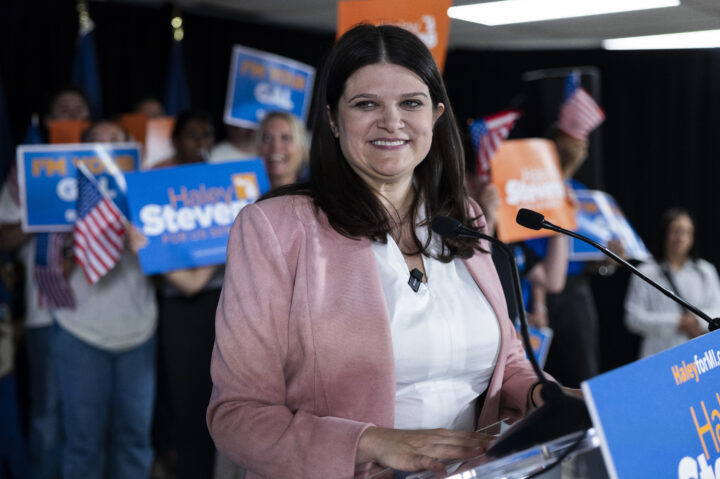
Rep. Haley Stevens (D-MI), candidate for Michigan's open U.S. Senate seat, holds a rally with Sen. Gary Peters (D-MI) on August 2, 2026 in Madison Heights, Michigan (Photo by Finn Gomez/Getty Images)
In her first cable news interview since her Senate primary loss on Wednesday morning, Rep. Haley Stevens (D-MI) told CNN that Jewish voters who are concerned about Democratic Senate nominee Abdul El-Sayed’s hostility towards Israel are “going to have to make a personal and private decision” as to who to support in November.
Stevens also told CNN on Friday that she is a “Zionist Democrat in Michigan.”
Just before he was declared the winner in the Democratic primary for the pivotal Michigan Senate race, El-Sayed doubled down on his criticism of Israel on MS NOW’s “Morning Joe,” calling the Jewish state “bloodthirsty” and saying his critiques go beyond the government of Israeli Prime Minister Benjamin Netanyahu.
El-Sayed, who made his opposition to AIPAC a central part of his campaign message, sought to ease tensions with skeptical Jewish voters after winning the nomination, addressing what he called “an issue that has been focused on in this race.”
“To all of my sisters and brothers of the Jewish faith,” he said in his televised remarks, “I want you to know that my commitment to your safety, my commitment to Jewish safety, is the same commitment that I have to the safety of my own daughters.” He also spoke about his experience going to a seder during the campaign, where in an awkward turn of phrase, said he was able to “break bread” with his Jewish friends.
On Friday, Republican Senate nominee Mike Rogers argued that the “vast majority of people” rejecting El-Sayed — whose bid he framed as a “campaign filled with anger, divisiveness, calls for violence and the views that are out of touch with your values”— have “a home with us.”
Plus, Hawaii's sleeper House race
(Scott Olson/Getty Images)
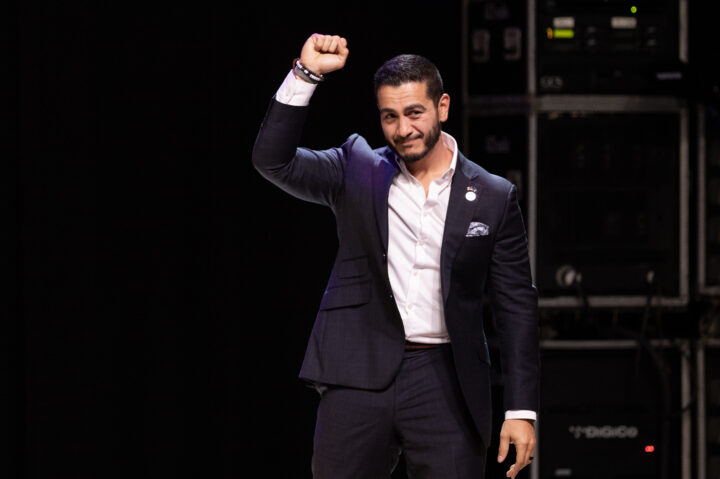
Democratic candidate for U.S. Senate Abdul El-Sayed speaks to supporters at an election-night rally at the Majestic Theatre on August 04, 2026 in Detroit, Michigan.
Good Thursday morning.
In today’s Daily Kickoff, we cover the fallout from Abdul El-Sayed’s narrow victory over Rep. Haley Stevens in Michigan’s Democratic Senate primary, and talk to Jewish Democrats in the state who are considering crossing party lines to vote for GOP nominee Mike Rogers in the November election. We report on the obstacles facing Rep. Ed Case ahead of a challenge from his left in Saturday’s primary in Hawaii’s 1st Congressional District, and cover a Senate Judiciary subcommittee hearing examining Muslim Brotherhood networks and affiliates in the United States. Also in today’s Daily Kickoff: Benny Stanislawski, Tom Kahn and Gianni Infantino.
We also have a new on-demand Live Briefingthat you can access throughout the day via our new app (on Apple and Android) and on our website.
Today’s Daily Kickoff was curated by JI Israel Editor Tamara Zieve and U.S. Editor Danielle Cohen-Kanik. Have a tip? Email us here.
What We’re Watching
- U.S.-led talks between Israel and Lebanon in Rome are slated to conclude today, after yesterday’s discussion was cut short by several hours “due to events on the ground,” the State Department said.
- The decision to pause talks came after the IDF conducted strikes in southern Lebanon over what it said were “blatant violations” of the ongoing ceasefire by Hezbollah, including an incident in which two IDF reservists were killed and four seriously wounded by an explosive device in southern Lebanon.
- Reports continue to indicate Iran and Oman are inching toward a deal to reopen the Strait of Hormuz after earlier agreements on the issue fell apart. An Iranian Foreign Ministry spokesperson said on Wednesday that Tehran and Muscat were close to finalizing an agreement, so long as “certain parties do not obstruct this process” — an apparent reference to the U.S.
- Tennessee is holding its primary elections today. In the state’s 5th District, Rep. Andy Ogles (R-TN), a far-right lawmaker, is facing a serious primary challenge from Charlie Hatcher, a former state commissioner of agriculture.
What You Should Know
A QUICK WORD WITH JI’S MATTHEW KASSEL
Abdul El-Sayed’s narrow victory over Rep. Haley Stevens (D-MI) in Michigan’s bruising Democratic Senate primary on Tuesday is forcing many Jewish leaders in the state to confront an uncomfortable decision as they now look ahead to the general election in November.
Several Jewish Democrats in the battleground state are now indicating that they will break with a party they have long called home and instead vote for the Republican nominee, Mike Rogers, in the November election, citing their continued alarm over El-Sayed’s hostile rhetoric toward Israel as well as remarks they have interpreted as indifferent to rising antisemitism, among other concerns.
“I can’t vote for El-Sayed,” Michael Horowitz, a Jewish community leader and Detroit businessman who supported Stevens, a pro-Israel moderate, told Jewish Insider. “So many things I find despicable about him, not the least of which is his close association with Hasan Piker,” the antisemitic Twitch streamer, who Horowitz said “demeans America, demeans Jews and demeans all but the most radical among us.”
Horowitz confirmed he was now “leaning strongly to Rogers,” a former congressman who narrowly lost in his bid for Senate last cycle. “And I have heard from many in the Jewish community who say they will be supporting Rogers,” he said on Wednesday.
Hannan Lis, a Democratic fundraiser and Jewish leader who splits his time between Michigan and Israel, was among those who had told JI before the primary that he would vote for Rogers in the general election if El-Sayed won the nomination, noting he knows “many” Jewish Democrats who plan to do the same.
His reservations about Republicans preserving their Senate majority by picking up the Michigan seat held by retiring Sen. Gary Peters (D-MI), he clarified, were superseded by his objections to El-Sayed’s stances on Israel and responses to antisemitism. “El-Sayed is no Democrat,” he claimed.
CASE STUDY
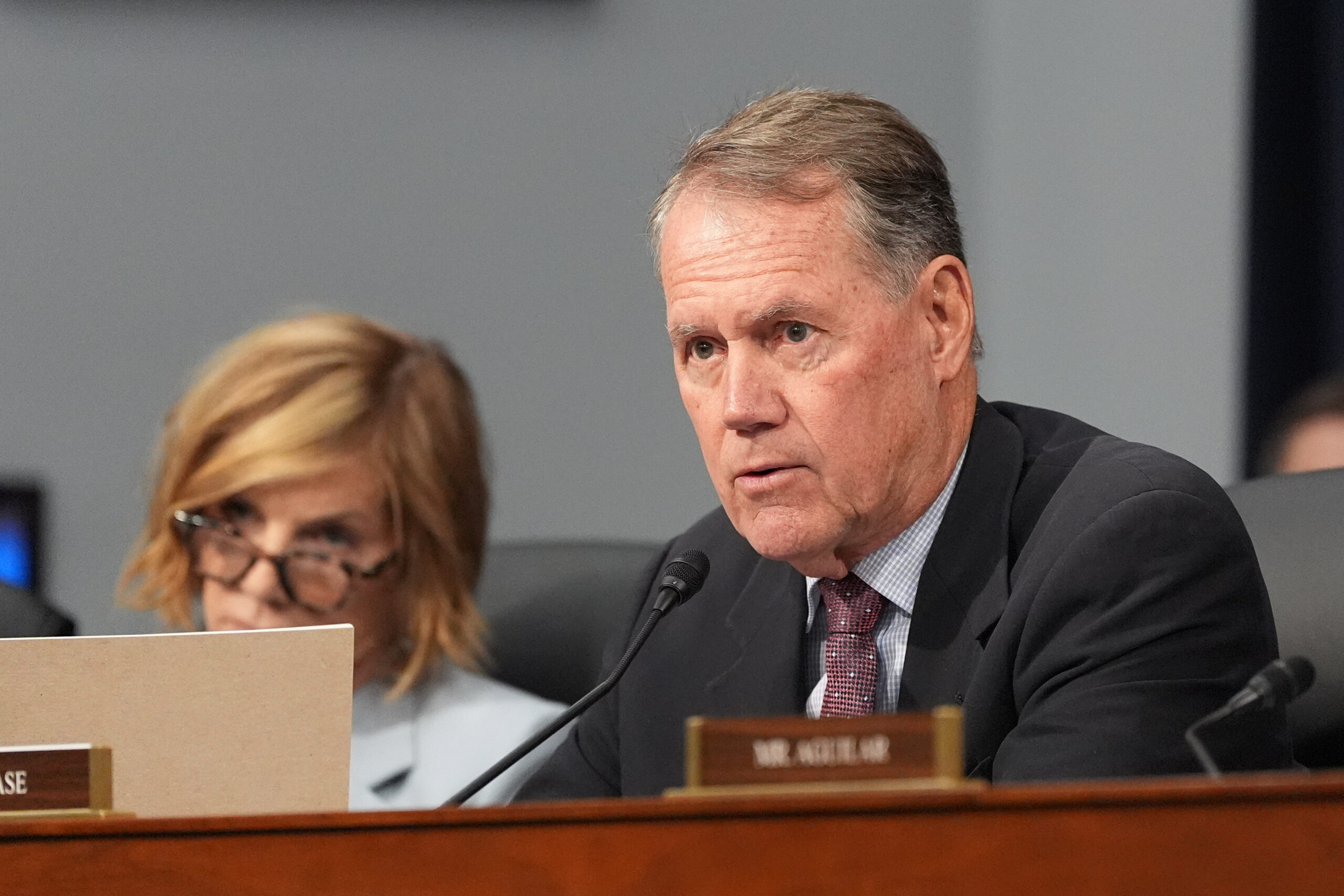
Rep. Ed Case (D-HI), a moderate pro-Israel Democrat in Hawaii who was first elected to the House in 2002, has not drawn a serious primary threat in several years. Now, as he prepares to defend his seat in a primary on Saturday that has largely flown under the radar, some Democrats are warning that the 73-year-old could be at risk of losing to a younger challenger capitalizing on a national political environment that has proven unfavorable to Democratic incumbents amid broader calls for generational change from the party’s activist base, Jewish Insider’s Matthew Kassel reports.
While you were sleeping: “It’s one of those sleeper races where there’s definitely an upset brewing,” said a Democratic operative who worked on the Case campaign until a few months ago, speaking on condition of anonymity to avoid professional reprisals. “Ed is running a poor race,” the former staffer told JI, echoing other observers who described a sluggish approach in which Case has largely foregone campaign events and avoided debates with his opposition.
ON THE HILL
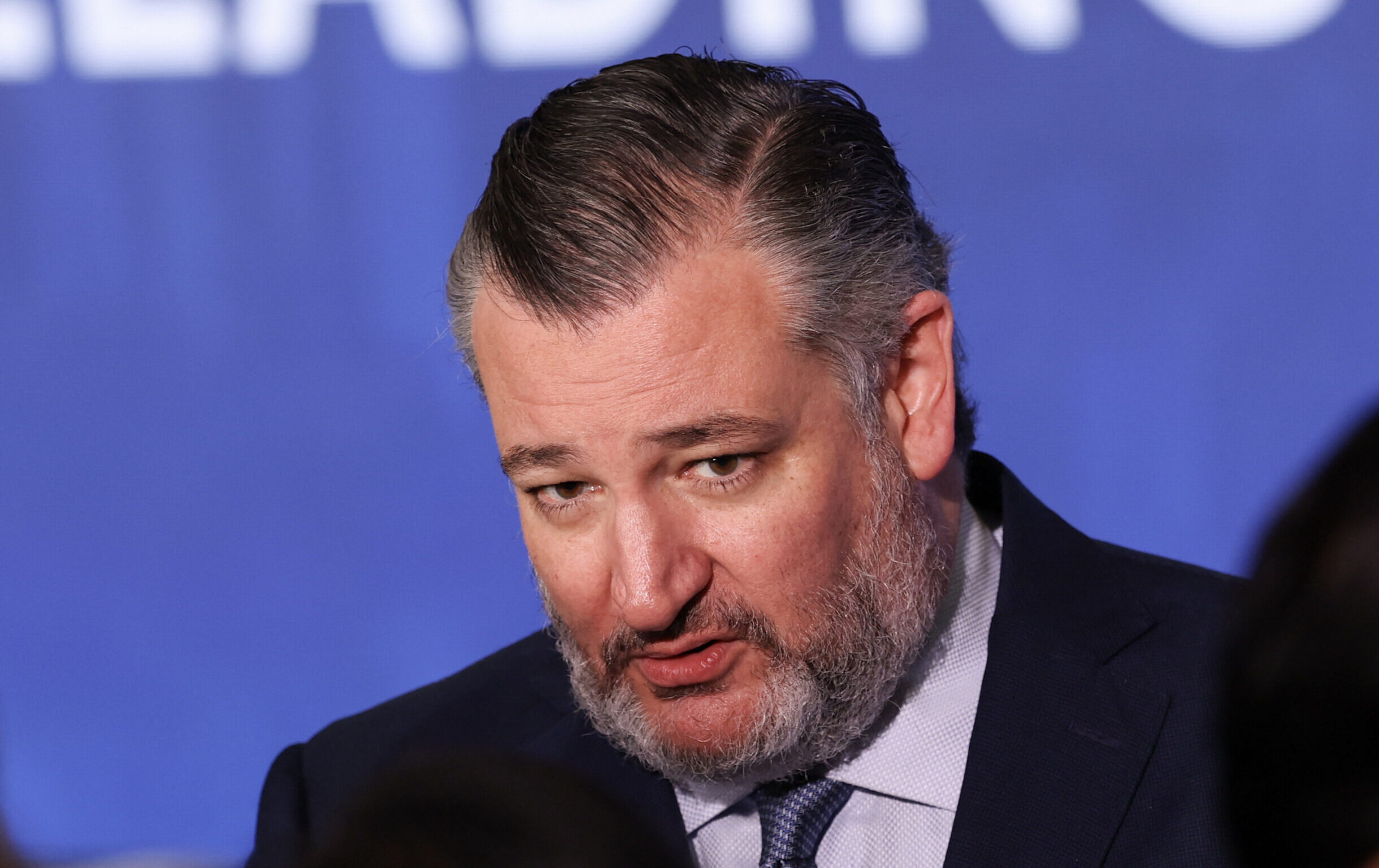
Sen. Ted Cruz (R-TX), speaking at a Senate Judiciary subcommittee hearing on Wednesday that he organized to examine Muslim Brotherhood networks and affiliates in the U.S., suggested that Michigan Senate candidate Abdul El-Sayed was tied to such networks and that his Democratic primary win represented a victory for them. “Behind El-Sayed’s political rise sits a much older and more entrenched institutional network,” Cruz asserted, Jewish Insider’s Marc Rod reports.
Zoom out: Kyle Shideler, a senior analyst for homeland security and counterterrorism at the Center for Security Policy, testified under questioning from Cruz that El-Sayed’s win concerned him given the nominee’s father-in-law’s ties to Muslim Brotherhood-linked groups and El-Sayed’s own relationship with groups connected to the Council on American-Islamic Relations. “It shows the success of the Muslim Brotherhood network over multiple decades. It achieved what they said they were going to achieve, which was to normalize support for Hamas and normalize support for terrorism,” Shideler said.
COMMUNITY CONCERN
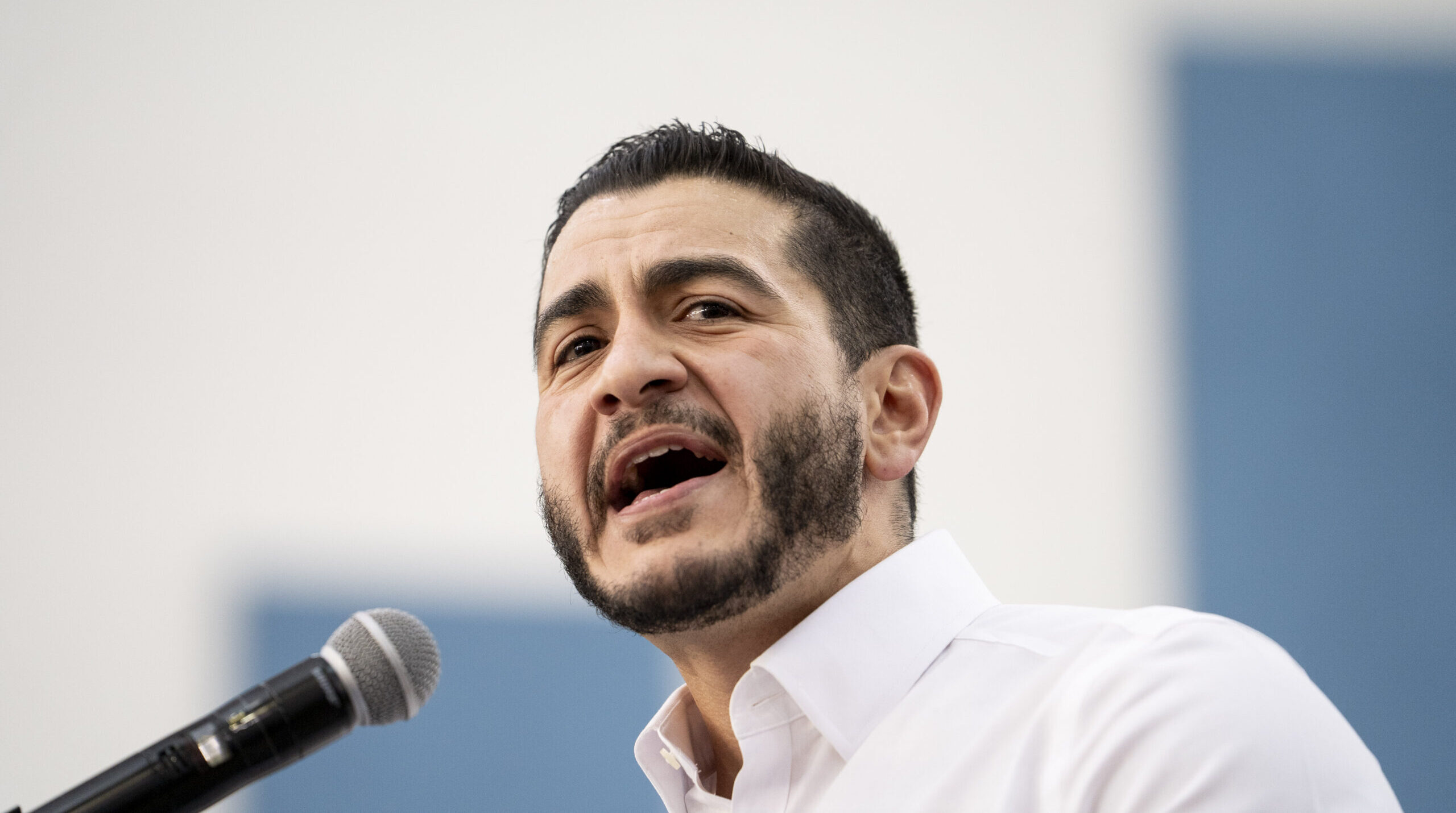
Jewish groups expressed concern on Wednesday about the victory of Abdul El-Sayed in the Democratic primary for U.S. Senate in Michigan, highlighting his extreme rhetoric on Israel and the broader rise of the far left, Jewish Insider’s Marc Rod reports.
Reactions: Jewish Democratic Council of America CEO Halie Soifer said in a statement that the group was “disappointed” by the results of the primary, in which the group had endorsed and campaigned strongly for Rep. Haley Stevens (D-MI). Soifer congratulated but stopped short of endorsing El-Sayed. AIPAC, while declining to preview specific plans, indicated it intends to stay engaged in the Michigan race through November. “Our members remain determined to ensure that voters reject Dr. El-Sayed and his radical anti-Israel agenda in November,” spokesperson Deryn Sousa told JI.
Trump’s take: President Donald Trump, speaking at an event in Las Vegas on Wednesday, said al-Sayed “hates Jews and he hates Israel,” adding, “He’s a man of hate, and now he’s going around saying, ‘Oh I love everybody.’ He doesn’t love everybody. Put him in office, and you’re going to find out what he loves.”
WITHHOLDING SUPPORT
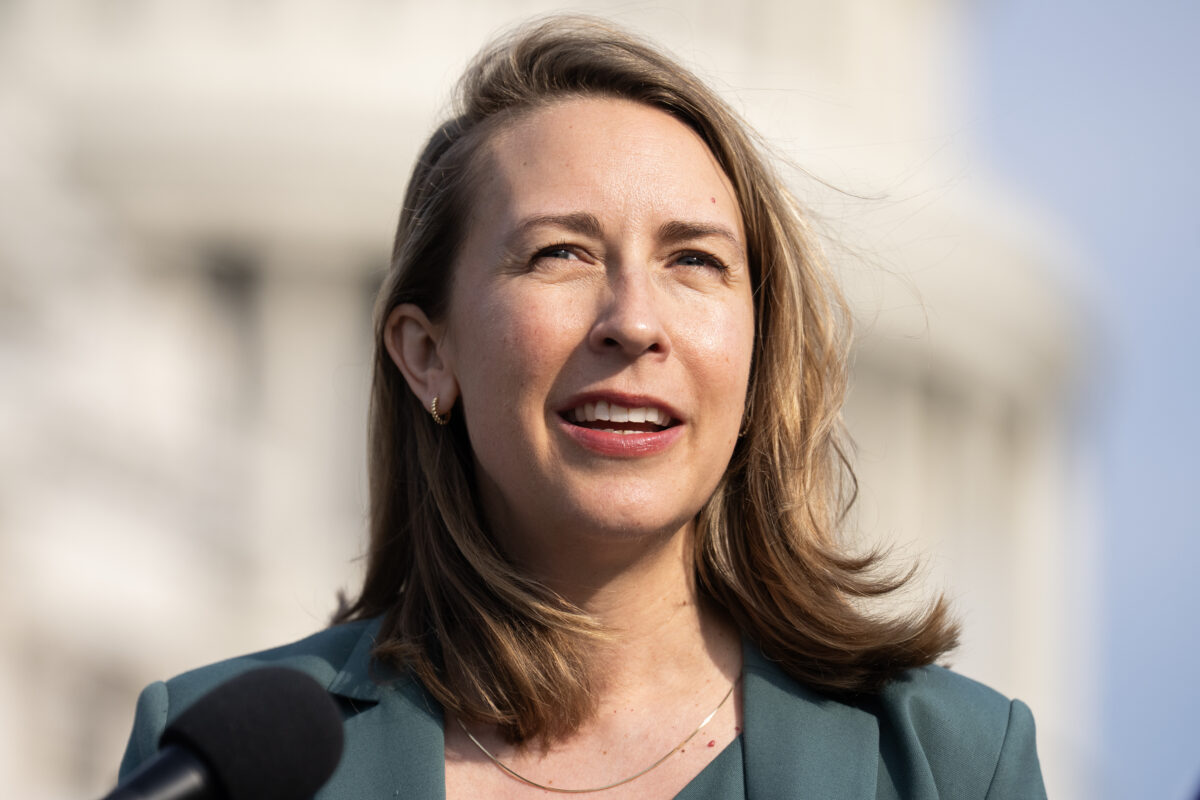
Rep. Hillary Scholten (D-MI), a moderate Michigan lawmaker representing a swing district, broke with most other Democratic members of the state’s congressional delegation in declining to offer an explicit endorsement of Democratic Senate nominee Abdul El-Sayed, after offering strident criticism of him during the primary campaign, Jewish Insider’s Marc Rod and Matthew Shea report.
What she said: “Congratulations to everyone who participated in Michigan’s hard-fought primary elections last night, and thank you to every voter who made your voice heard. In these close elections, we want you to know — you are HEARD,” Scholten said in a statement that did not mention El-Sayed. “Now our focus turns forward. I’ve always said I’ll work with anyone committed to lowering costs, expanding affordable health care, creating more opportunity, and fighting corruption. I mean that.”
Phone a friend: New York City Mayor Zohran Mamdani refused to close the door on a trip to Michigan to campaign for El-Sayed, whom Mamdani praised for what he described as a focus on “the concerns of working-class Americans” — even as he tried to explain away El-Sayed’s poor performance in the areas where working-class voters live, JI’s Will Bredderman reports.
RACE RHETORIC
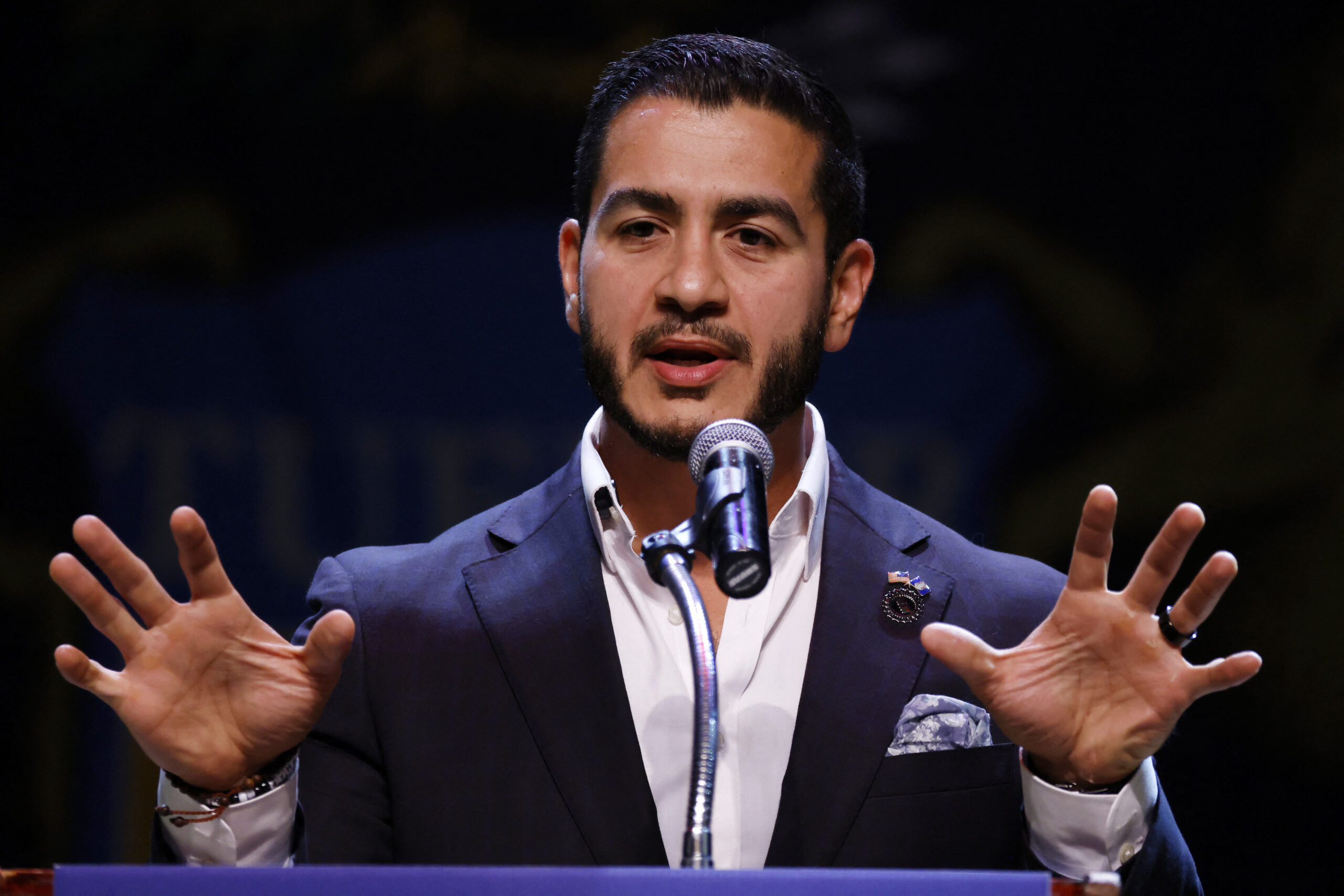
Appearing on MS NOW’s “Morning Joe” on Wednesday, Abdul El-Sayed doubled down on his criticism of Israel, calling the Jewish state “bloodthirsty” and saying his critiques go beyond the government of Israeli Prime Minister Benjamin Netanyahu, Jewish Insider’s Danielle Cohen-Kanik reports.
What he said: “I think we’ve seen the worst of what the Israeli government has done [under Netanyahu] but don’t forget that we’ve been talking about an illegal apartheid regime for a very, very long time, and that supersedes Netanyahu himself,” El-Sayed said. “I understand that Netanyahu is a big reason why they’ve gotten so aggressive and frankly so bloodthirsty under his reign, but I also understand that it’s impossible for us to say we want a two-state solution while we’ve been aiding, arming and abetting the very people who have been trying to foreclose on the possibility of a Palestinian state.”
It’s all over: Democrats quickly coalesced behind El-Sayed after the far-left candidate narrowly clinched victory in Michigan’s Democratic primary on Wednesday morning, while Republicans quickly pounced on his extremist history and ties, JI’s Marc Rod reports.
Worthy Reads
Reassessing Reality: The Atlantic‘s Jonathan Chait contends that, in order to wrest back their party from the far left, moderate Democrats will have to reevaluate some of their core stances, including support for AIPAC and Israel. “Fending off a leftist insurgency will be all but impossible unless Democrats reject AIPAC’s endorsements and stop supporting unconditional aid for an Israel that no longer works toward a two-state solution. Democrats also have to stop passively allowing multiple candidates to split the mainstream vote while the leftist vote consolidates behind a single candidate, as occurred in Michigan’s Seventh District and the Wisconsin governor’s race. But the greatest challenge for mainstream liberals is to find a way to engage in and win the substantive argument with the left.” [TheAtlantic]
Lemons into Lemonade: Tablet‘s Jacob Siegel argues that the U.S.-Israel alliance is loosening, and that the moment presents an opportunity for Israel to reduce its dependence on Washington and diversify its alliances. “A greater degree of separation between the United States and Israel is not only inevitable, it is desirable. Many supporters of Israel seem to be aware only of the significant challenges that this will create for the small country. They overlook the significant opportunities it presents for Israel’s growth. … With the chapter closing on its role as an outsize client state, Israel needs to develop itself as an independent regional power that is a desirable partner by virtue of its ability to innovate technologies and project force.” [Tablet]
Fashion Faux Pas: In The New York Times, John Galliano biographer Dana Thomas cautions against the decision by the Metropolitan Museum of Art to honor the designer, who was convicted of antisemitic abuse after praising Adolf Hitler. “Not all great creators deserve a retrospective, and someone as incendiary as Mr. Galliano certainly shouldn’t be the subject of one during his lifetime, when he stands to profit from the honor personally. With ‘John Galliano: Horizons,’ the Met and Ms. Wintour are selling the idea that they can tell the rest of us how to think about a difficult and divisive figure. Maybe they didn’t notice that idea has gone badly out of fashion.” [NYTimes]
Find more Worthy Reads in our Live Briefing via our new app (on Apple and Android) and website.
Word on the Street
Asked about an Axios report that claimed Israeli Prime Minister Benjamin Netanyahu “confronted” him over their diverging policy views during his visit to Washington last week, Vice President JD Vance said in an interview on Fox News on Wednesday, “He didn’t confront me. We had a nice and frank conversation. … I would describe it as a pleasant but direct conversation”…
The White House denied a Washington Post report that President Donald Trump and Defense Secretary Pete Hegseth clashed last week at Camp David over the war in Iran; the Post reported that the president asked why he had been misled about a shortage of munitions…
A group of far-right figures, including Tucker Carlson, outgoing Rep. Thomas Massie (R-KY), former Rep. Marjorie Taylor Greene (R-GA) and former National Counterterrorism Center head Joe Kent — who gathered over the weekend at Carlson’s Maine home — are considering launching a third-party political organization…
The Israeli Foreign Ministry denounced a joint statement adopted by Arab states — including Qatar, Saudi Arabia, Turkey, Pakistan and Egypt, among others — whose foreign ministers convened in Jordan on Wednesday to discuss Israel’s policies in Jerusalem and said that Israel, which the statement claimed “has no sovereignty” over the city, had “alter[ed] the Arab Islamic and Christian identity of occupied Jerusalem”…
The IDF is investigating a reported arson attack by Israeli settlers in a Palestinian village in the West Bank overnight in which suspects allegedly set fire to homes and attacked residents, including children…
A new Israel Democracy Institute survey found that a majority of Israelis believes the integrity of the October election is in danger…
The Iran-backed Houthis in Yemen said on Wednesday that they struck a Saudi oil tanker in the northern Red Sea, escalating the group’s stated blockade against Riyadh and strikes on Saudi ships that have thus far been focused in the southern Red Sea, near the Bab el-Mandeb strait…
James Stavridis, former supreme allied commander of NATO, argues in Bloomberg that a Saudi-led naval coalition could help protect commercial shipping in the Red Sea from Houthi attacks, though it would likely still require U.S. and European intelligence and logistical support to be effective…
An Azerbaijani official said on Turkish TV that Baku lobbied Israel to stop the Knesset from voting to recognize the Armenian genocide…
FIFA officials gathered in Morocco this week reaffirmed their support for Gianni Infantino, days after the FIFA president faced widespread criticism from within the organization over a plan to privatize elements of the World Cup…
The Atlantic investigates whether al-Qaida, 25 years after the 9/11 attacks, is quietly rebuilding or if its core organization is effectively defunct…
A new poll shows left-wing Brazilian President Luiz Inácio Lula da Silva‘s lead over conservative challenger Flávio Bolsonaro, the son of former President Jair Bolsonaro, narrowing ahead of the country’s October elections…
Benny Stanislawski, previously the communications director for Rep. Ritchie Torres (D-NY), is joining Pennsylvania Democrat Bob Brooks‘ congressional campaign as communications director…
American University’s School of Public Affairs named Tom Kahn as director of its Center for Congressional and Presidential Studies; Kahn, who served as acting director for the past year, was the longest-serving staff director in history for the House Budget Committee…
Find on-demand Live Briefing updates throughout the day via our new app (on Apple and Android) and website.
Pic of the Day
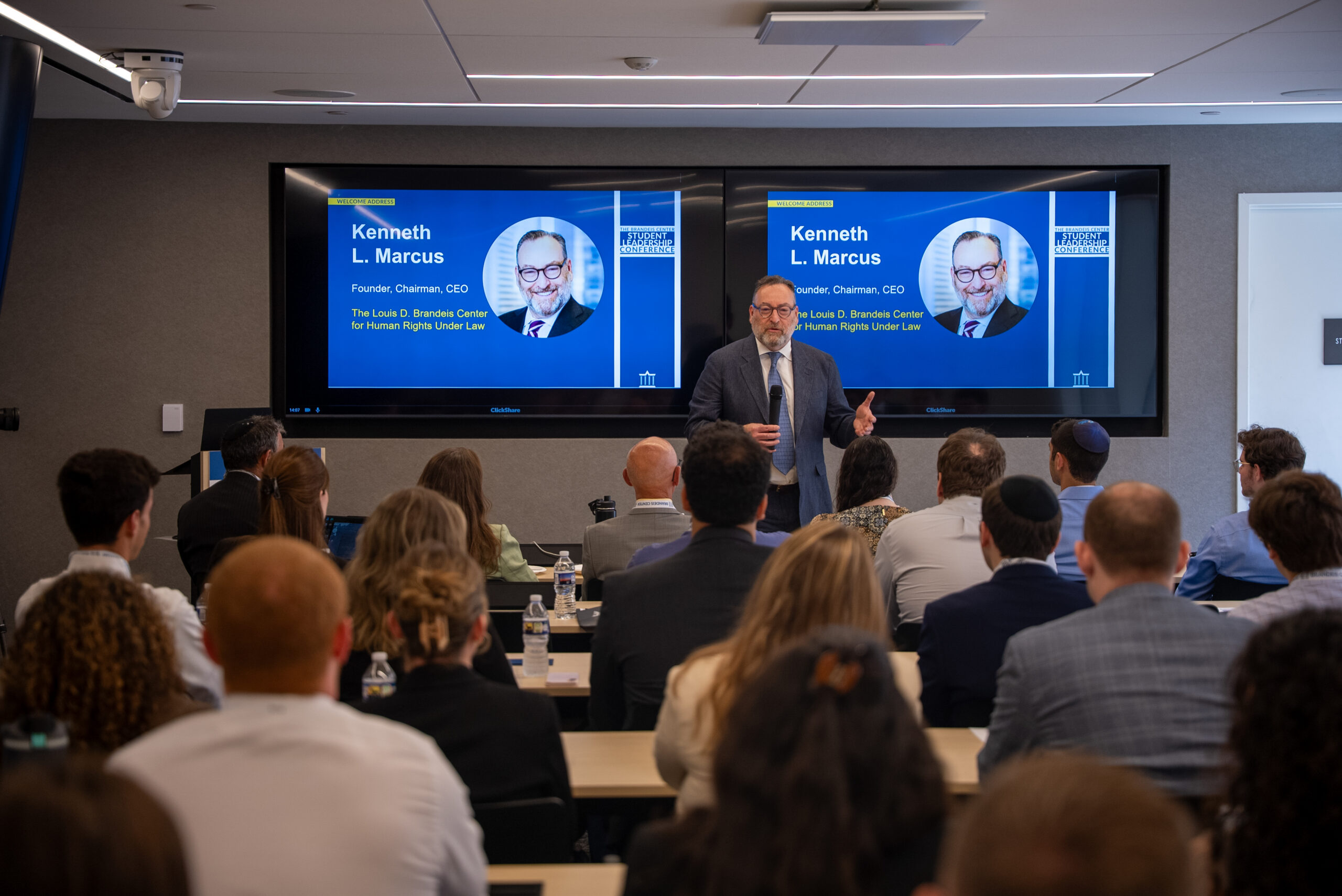
The Louis D. Brandeis Center for Human Rights Under Law hosted 34 law students from leading law schools, including Columbia, Cornell, Duke, Georgetown, NYU and Vanderbilt, for its three-day Law Student Leadership Conference in Washington, D.C., this week. The students received training in civil rights law, Title VI, free speech and advocacy on behalf of Jewish students from a range of experts, including Brandeis Center founder Ken Marcus, pictured here addressing attendees.
Birthdays
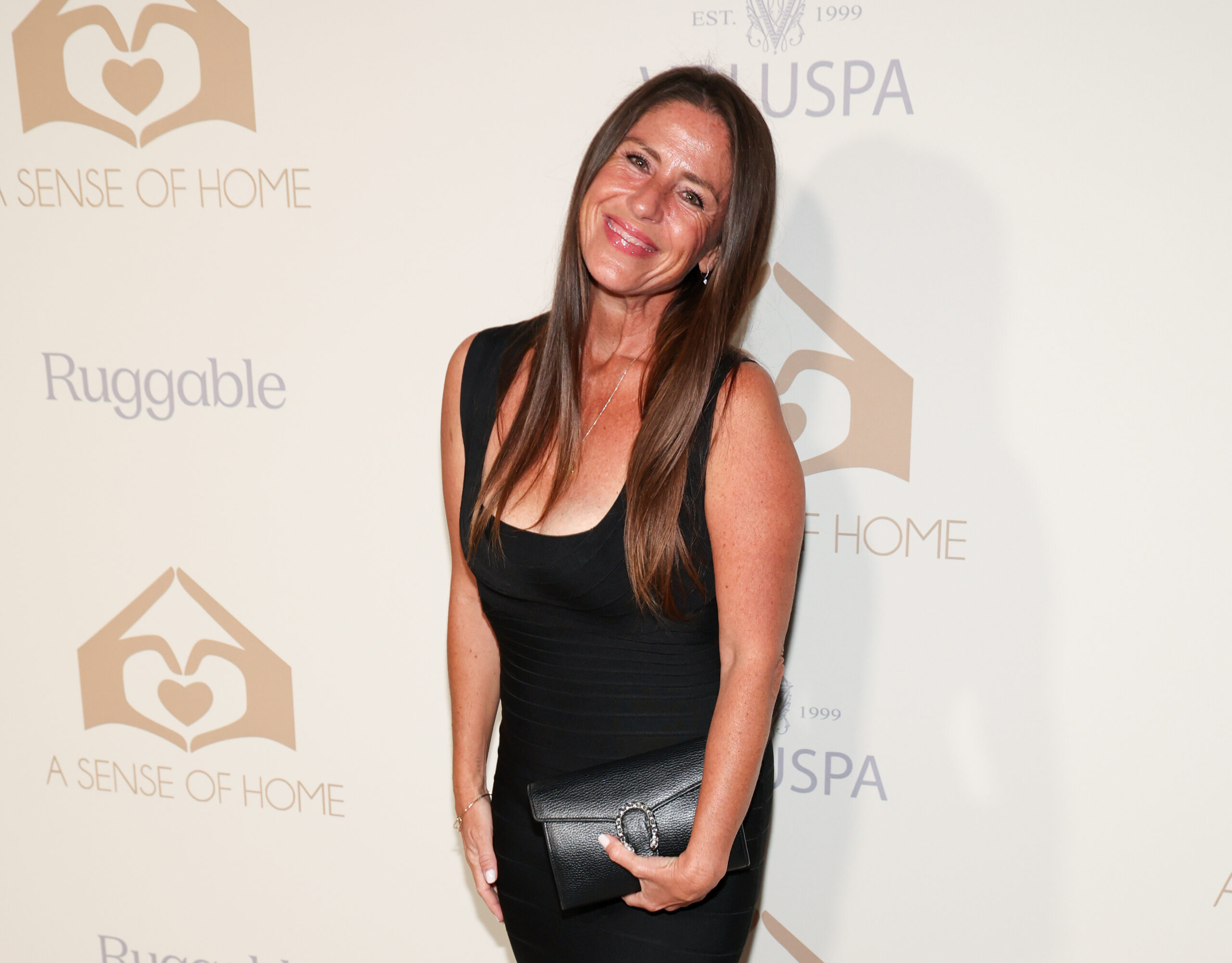
Actor, director, producer and screenwriter, Soleil Moon Frye turns 50…
Retired founding partner of the Jaffe Family Law Group, Daniel J. Jaffe turns 89… Esports executive and casino owner, he is a three-time bracelet winner at the World Series of Poker, Lyle Berman turns 85… Professor emerita and former dean at Bar Ilan University, Malka Elisheva Schaps turns 78… Film director, television director, producer and screenwriter, Brian Michael Levant turns 74… Austrian businessman with many U.S., Israeli and Eastern European investments, Martin Schlaff turns 73… Former state treasurer of Virginia and then state secretary of finance, she is now a gourmet popcorn manufacturer, Jody Moses Wagner turns 71… Professor of public diplomacy at The Fletcher School of Tufts University, she was formerly undersecretary of state for public diplomacy, Tara D. Sonenshine turns 67… Professor of psychiatry and behavioral sciences at The George Washington University Medical Center, Alan J. Lipman, Ph.D. turns 66… Israeli diplomat, he served as Israel’s consul general in NYC between 2000 and 2004, Alon Pinkas turns 65… NASA astronaut who spent 198 days on the International Space Station, he brought 18 bagels from his family’s bagel store in Montreal into space, Gregory Chamitoff turns 64… Chair of White & Case’s white collar practice group, Joel M. Cohen… Executive director of public affairs and policy communications at the American Council on Education, Jonathan Riskind… CEO of Elluminate (formerly known as the Jewish Women’s Foundation of New York), Melanie Roth Gorelick… Vice chair of Jewish California and a board member of JFNA and JCRC Bay Area, Susie Sorkin… Television and radio sports anchor on ESPN and ABC, he was one-half of the “Mike & Mike” team but now hosts his own ESPN morning program, Mike Greenberg turns 59… Chief economist at The Burning Glass Institute, Gad Levanon, Ph.D…. Law professor and associate dean at Michigan State University College of Law, David Blankfein-Tabachnick turns 55… Former boxing commentator and co-host of ESPN’s “This Just In,” Yiddish speaking Max Kellerman turns 53… Co-founder and former CEO of Uber, Travis Kalanick turns 50… Founder and CEO at Climb Together which helps prepare people from low-income backgrounds for entry level jobs, Nitzan Pelman… Screenwriter and television producer, he is best known for creating and executive producing the Fox teen drama “The O.C.,” Joshua Ian Schwartz turns 50… Former comms director for Zohran Mamdani’s New York City mayoral general election campaign, Jeffrey Lerner… Creative director and visual strategist, Rachel Gogel… Member of the New York State Assembly, Simcha Eichenstein turns 43… Winner of two gold medals in swimming at the 2008 Summer Olympics in Beijing, he is now CEO of Gather Campgrounds north of Austin, Garrett Weber-Gale turns 41… Director of strategy and policy at K2 Space Corporation, he is also a non-resident senior fellow at the Atlantic Council, Corey A. Jacobson… Reporter at San Antonio Express-News, Elizabeth Teitz… Special advisor at the Department of Homeland Security and former student at Marjory Stoneman Douglas High School, Hunter Pollack turns 29…
Several Jewish Democrats in the battleground state are now indicating that they will break with a party they have long called home and instead vote for the Republican nominee, Mike Rogers, in the November election
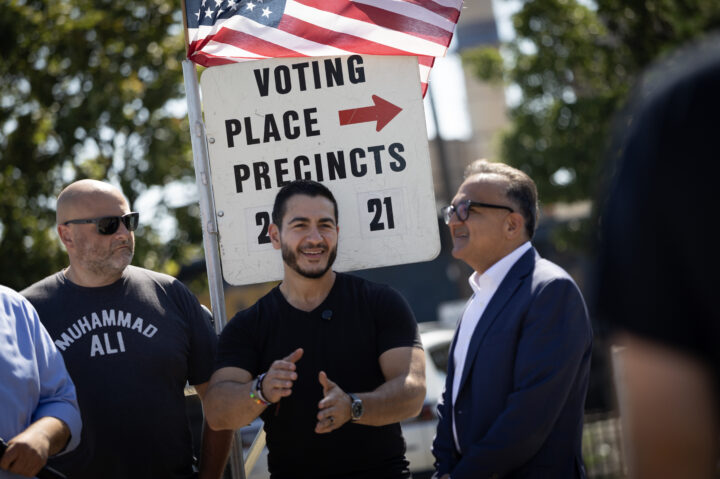
Scott Olson/Getty Images
Democratic candidate for U.S. Senate in Michigan Abdul El-Sayed visits a polling place as residents cast their votes on August 04, 2026 in Dearborn, Michigan.
Abdul El-Sayed’s narrow victory over Rep. Haley Stevens (D-MI) in Michigan’s bruising Democratic Senate primary on Tuesday is forcing many Jewish leaders in the state to confront an uncomfortable decision as they now look ahead to the general election in November.
Several Jewish Democrats in the battleground state are now indicating that they will break with a party they have long called home and instead vote for the Republican nominee, Mike Rogers, in the November election, citing their continued alarm over El-Sayed’s hostile rhetoric toward Israel as well as remarks they have interpreted as indifferent to rising antisemitism, among other concerns.
“I can’t vote for El-Sayed,” Michael Horowitz, a Jewish community leader and Detroit businessman who supported Stevens, a pro-Israel moderate, told Jewish Insider. “So many things I find despicable about him, not the least of which is his close association with Hasan Piker,” the antisemitic Twitch streamer, who Horowitz said “demeans America, demeans Jews and demeans all but the most radical among us.”
Horowitz confirmed he was now “leaning strongly to Rogers,” a former congressman who narrowly lost in his bid for Senate last cycle. “And I have heard from many in the Jewish community who say they will be supporting Rogers,” he said on Wednesday.
Hannan Lis, a Democratic fundraiser and Jewish leader who splits his time between Michigan and Israel, was among those who had told JI before the primary that he would vote for Rogers in the general election if El-Sayed won the nomination, noting he knows “many” Jewish Democrats who plan to do the same.
His reservations about Republicans preserving their Senate majority by picking up the Michigan seat held by retiring Sen. Gary Peters (D-MI), he clarified, were superseded by his objections to El-Sayed’s stances on Israel and responses to antisemitism. “El-Sayed is no Democrat,” he claimed.
Dennis Bernard, a Jewish leader in Michigan who backed both Rogers and Stevens in their respective primaries, said that the “word is out on a few Rogers fundraisers targeting historical Jewish Dems,” efforts that he described as “co-led” with Jewish Democratic donors.
“Candidly,” he added, “the only area that may not jump on Rogers is the highly progressive Ann Arbor community,” which he called “very small.”
Bernard, national chair of government relations at the Jewish Federations of North America, told JI that it would likely take a few more days for such events to materialize as donors now “settle down and organize” in the wake of the primary. “Everyone is jumping in,” he said.
One Democratic fundraiser in Michigan, who spoke on the condition of anonymity to address a sensitive subject, said he was “absolutely certain” that “several large Jewish Dem donors” will be supporting Rogers.
“I would guarantee there will be fundraisers for him hosted by high-profile Jewish Dems,” he told JI.
The fundraiser, who backed Stevens, said that hours after the race had been called on Wednesday he was “already contacted by Rogers surrogates” seeking to make inroads with Jewish Democrats whose support could prove consequential in what is expected to be a close race.
The surrogates’ pitch, as he put it: “Essentially that as Jews, we need to put our communal well-being ahead of the party.”
It remains to be seen whether the depth of Jewish Democrats’ fears of electing El-Sayed will ultimately translate to a meaningful boost for Rogers’ bid amid a national political environment that is less favorable to Republicans.
Still, Rogers and his supporters have said they are eager to court Jewish Democrats alienated by their party as support for Israel has emerged as a litmus test on the far left — particularly in Michigan, where Jewish Democratic leaders have recently voiced fears of antisemitic harassment from anti-Israel activists in the state.
Alyssa Brouillet, a spokesperson for Rogers, told JI on Sunday that his campaign was “beginning to see more and more Jewish Democrats coming to us who feel abandoned by their party.”
“Mike Rogers stands with the Jewish community in Michigan and across the country,” she said, “and he will continue fighting to make life better for working families all across the state.”
In a video ad posted to social media on Wednesday, Rogers highlighted his opponent’s close ties to Piker, featuring past comments in which the streamer said “America deserved 9/11,” among other controversial remarks that have faced scrutiny. “You are who your friends are, and Abdul El-Sayed’s are radical leftists who hate America,” Rogers wrote.
The Republican Jewish Coalition called El-Sayed “a direct threat to Michigan’s Jewish community” in a statement on Wednesday that urged Jewish voters in the state to get behind Rogers in the general election.
“To our friends in Michigan’s Jewish community, including the tens of thousands who have voted Democrat their entire adult lives and now find themselves politically homeless: this is the moment for real change and action,” said Matt Brooks, the RJC’s CEO. “There are more than 100,000 Jewish voters in the Wolverine State. We are not a rounding error, we are the decisive margin. Mike Rogers has earned your vote.”
Even as El-Sayed quickly won backing on Wednesday from national Democratic leaders hoping to unite the party for a must-win election, the Jewish Democratic Council of America stopped short of an endorsement, underscoring the extent to which the divisive primary has left some Jewish leaders rudderless after Stevens’ defeat.
“While we are disappointed in the final result of the Michigan Senate race, the razor-thin margin isn’t the resounding win for the far-left that was predicted,” said Halie Soifer, the JDCA’s CEO. “We are proud of the race run by Rep. Haley Stevens, and we thank her for her consistent and principled leadership standing with Jewish Americans. We congratulate Dr. Abdul El-Sayed on his victory after a difficult and divisive primary.”
Several nonpartisan Jewish groups, including the Anti-Defamation League and the American Jewish Committee, released statements on Wednesday condemning El-Sayed.
Deryn Sousa, a spokesperson for AIPAC, whose super PAC invested over $30 million on an aggressive effort to boost Stevens, said in a statement that the group’s “members remain determined to ensure that voters reject Dr. El-Sayed and his radical anti-Israel agenda in November,” indicating it intends to back Rogers in the general election.
AIPAC’s super PAC, United Democracy Project, did not return a request for comment, but sources told JI the group was all but certain to support Rogers, who was recognized as a pro-Israel hawk while serving in the House from 2001 to 2015.
For his part, El-Sayed, who made his opposition to AIPAC a central feature of his campaign messaging, sought to ease tensions with skeptical Jewish voters on Wednesday, addressing what he called “an issue that has been focused on in this race.”
“To all of my sisters and brothers of the Jewish faith,” he said in his televised remarks, “I want you to know that my commitment to your safety, my commitment to Jewish safety, is the same commitment that I have to the safety of my own daughters.”
But many Jewish leaders in the state suggested that they would be unmoved by such appeals — especially as El-Sayed has continued to use incendiary rhetoric while discussing Israel. In an interview on MS NOW’s “Morning Joe” on Wednesday morning, for instance, he doubled down on his criticism of Israel, calling the Jewish state “bloodthirsty” while saying his critiques go beyond the government led by Israeli Prime Minister Benjamin Netanyahu.
His comments faced criticism from Democratic Majority for Israel, which said “El-Sayed should be working to build a bigger tent and earn the trust of Jewish Michiganders” but was instead invoking “an age-old antisemitic trope that is especially dangerous amid rising violence against Jews.”
Asher Lopatin, a rabbi who serves as director of community relations at the Jewish Federation of Greater Ann Arbor and endorsed Stevens, told JI he has “heard from several people who say that they will campaign for Rogers and support him and tell others to vote for him.”
“I have not spent a lot of time looking into his positions,” Lopatin added, “but I can say clearly that I will not be voting for Abdul El-Sayed and I wish more Democrats would come out and say they will not be voting for him.”
Some Jewish Democrats in the state have confirmed privately that while they cannot bring themselves to vote for Rogers, they will leave their ballots blank or write in another candidate due to their reservations about El-Sayed.
Despite widespread objections to El-Sayed within Michigan’s mainstream Jewish community, others suggested that their loyalty to the Democratic Party outweighed those concerns. “I know Jewish Dems who will vote for Rogers,” Richard Lenter, a Jewish community activist in Detroit, told JI. “I am leaning toward voting for El-Sayed while holding my nose.”
Michigan state Rep. Noah Arbit, a Jewish Democrat who has been outspoken against antisemitism in his party, declined to confirm whether he would vote for El-Sayed, even as he expressed strong concerns about past comments in which the candidate has dismissed Zionists as “illiberal” and refused to recognize Israel’s right to exist as a Jewish state.
“Abdul’s rhetoric has been alarming and dangerous for my community,” Arbit, whose district in suburban Detroit includes a sizable Jewish constituency, said in a message posted to Facebook Wednesday morning. “There is a profound need for him to come to the table and attempt to repair the harm he has caused, to see what semblance of trust and confidence may be built.”
The results paint a picture of a Democratic Party deeply divided, with older voters, Black voters and Jewish voters forming the centrist coalition
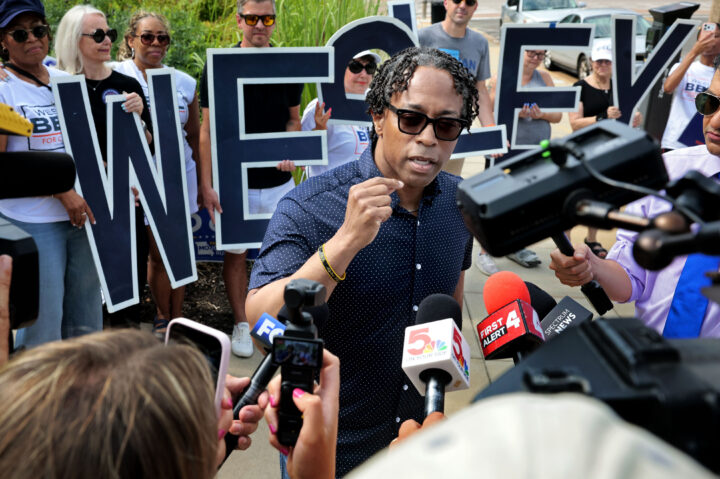
(Christian Gooden/St. Louis Post-Dispatch via Getty Images)
U.S. Rep. Wesley Bell speaks to media outside the Mid-County Branch public library on Tuesday, Aug. 4, 2026, before voting in Missouri's primary elections.
Rumors of the demise of the mainstream, pro-Israel wing of the Democratic Party turned out to be somewhat exaggerated: The Michigan Senate race between Rep. Haley Stevens (D-MI) and Abdul El-Sayed is a lot closer than polls suggested, while Rep. Wesley Bell (D-MO) romped to victory over his anti-Israel opponent, with the help of pro-Israel, Jewish supporters.
Bell’s sweeping 22-point victory in a rematch over former Rep. Cori Bush (D-MO) was an early election night highlight for Jewish and pro-Israel groups, which poured money and organizing efforts into ensuring the virulently anti-Israel Bush didn’t get a chance to return to Congress. AIPAC’s super PAC spent over $3 million on ads attacking Bush as corrupt and extreme, resources which likely played a key role in Bell’s landslide margin.
There were some other silver linings for the moderate side of the Democratic Party on Tuesday night: Michigan state Sen. Jeremy Moss won comfortably to succeed Stevens despite facing attacks over his pro-Israel record from his opponents. And Rep. Adam Smith (D-WA), the moderate ranking member of the House Armed Services Committee who faced harassment and threats over his longstanding pro-Israel record, won a clear majority of the vote against far-left challengers in Washington state’s all-party primary.
But there were plenty of warning signs about the changing ideological direction of the Democratic Party, as we’ve previously seen in deep-blue congressional districts across the country. Despite Stevens’ closer-than-expected showing, she still trails El-Sayed even after winning endorsements from top Democratic officials (including Gov. Gretchen Whitmer) and being the beneficiary of tens of millions in outside spending led by AIPAC’s ad blitz.
Meanwhile, Rep. Shri Thanedar (D-MI), seen as a reliable pro-Israel ally, is trailing against DSA-aligned challenger state Rep. Donavan McKinney, who ran on an anti-Israel platform.
And in the battleground Michigan 7th District, left-wing activist William Lawrence prevailed with a plurality of the vote, largely because of a split between his two moderate challengers. Running in a district President Donald Trump carried in 2024, Lawrence will find his ideological baggage a major vulnerability as he tries to unseat freshman Rep. Tom Barrett (R-MI).
The results paint a picture of a Democratic Party deeply divided, with older voters, Black voters and Jewish voters forming the centrist coalition, which is facing an insurgency from the left made up of younger voters, white progressives and Arab Americans.
What should be most concerning for the Jewish community is that virulently anti-Israel candidates are making inroads in the affluent, college-educated suburbs — areas where such views would have been politically toxic not long ago.
Stevens only narrowly won her home base of suburban Oakland County — the center of the state’s Jewish community — and lost badly in affluent Kent County, spanning the city of Grand Rapids. It underscores the point that the base of the DSA movement is among fairly well-off white voters.
But on the other side, there are plenty of red flags for El-Sayed after his underwhelming primary performance. El-Sayed struggled with Black voters, who make up the core of the party’s voting base. He got romped in the state’s rural counties. And El-Sayed’s overconfidence and the campaign’s grandiose expectations were undercut by the race’s close margin, and he didn’t get to enjoy a celebratory moment in the media spotlight on Election Night.
For AIPAC, which poured over $30 million into the Michigan Senate race, this is merely the first round of a lengthy battle against El-Sayed. If El-Sayed ends up prevailing, expect the pro-Israel advocacy group to remain actively engaged in the race as attention pivots to a general election with former Rep. Mike Rogers (R-MI) as the GOP nominee.
‘We DO NOT endorse Haley Stevens,’ Pux Taphouse said, claiming it has ‘advocated and continue[s] to call for a Free Palestine’
Finn Gomez/Getty Images
Rep. Haley Stevens (D-MI) speaks to the press after casting her ballot at Baldwin Public Library on Aug. 4, 2026 in Birmingham, Michigan.
A Michigan cider brewery where Rep. Haley Stevens (D-MI) hosted a campaign event the night before the state’s Senate primary election issued a statement saying they regretted hosting the event, citing Stevens’ support for Israel.
Pux Taphouse, which is located in Grand Rapids, said in an Instagram post on Monday that they did not know the event was being hosted by the Stevens campaign, only that they had been told it was “a private women’s Dem event.”
The event featured Stevens alongside Rep. Hillary Scholten (D-MI), former Sen. Debbie Stabenow (D-MI) and Jessica Mackler, president of EMILYs List. Some protesters stood outside the event, using bullhorns to accuse Stevens of supporting genocide in Gaza.
“We are heartbroken as we pride ourselves on being not only a queer friendly space but also have advocated and continue to call for a Free Palestine,” the Instagram post from the brewery stated. “We DO NOT endorse Haley Stevens.”
The message calling out Stevens and pledging not to host her for any future events comes amid a broader effort in some liberal cities and businesses to not welcome supporters of Israel. In June, a Brooklyn coffee shop wrote on Instagram that it would refund a recent purchase by Rep. Dan Goldman (D-NY) and ban him from returning because of his views on Israel.
A spokesperson for Stevens did not immediately respond to a request for comment.
With polls showing Stevens trailing, she said El-Sayed wants ‘to blame all of [his] problems on Jewish Americans’
Kristen Norman/AP
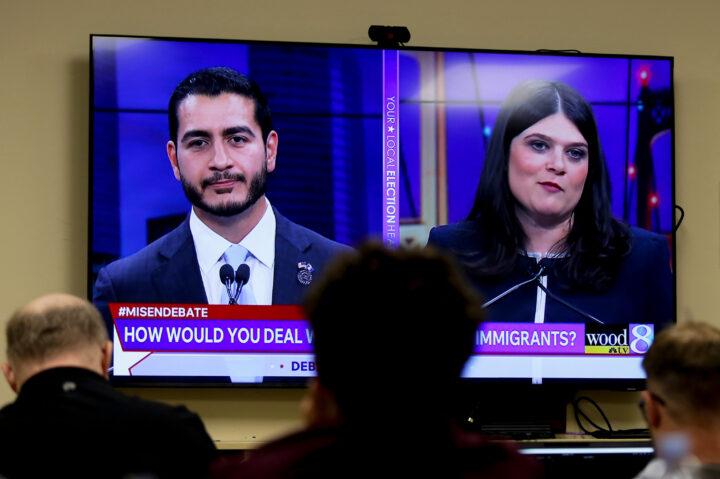
Michigan U.S. Senate candidates, Abdul El-Sayed, left, and Rep. Haley Stevens, D-Mich., are displayed on a television during a debate inside the spin room at WoodTV studios on Tuesday, July 7, 2026, in Grand Rapids, Mich.
In a late-night tweet five days before Michigan’s high-stakes Democratic Senate primary, Rep. Haley Stevens (D-MI) explicitly accused her opponent, Abdul El-Sayed, of trafficking in antisemitism.
Stevens’ post came in response to a video in which El-Sayed attacked AIPAC for supporting her, as he called her “literally the least capable candidate in America.” He has made criticism of AIPAC a central tenet of his campaign.
“Abdul, we were both on the ballot in 2018. I was capable of winning my competitive primary and general election. You lost,” Stevens wrote in the post, which was uploaded at 10:30 p.m. on Thursday, referring to El-Sayed’s run for governor. “You lost by over twenty points to Gretchen Whitmer and you will lose to [GOP nominee] Mike Rogers by talking like this.”
“Everyone in America understands,” Stevens continued, “you want to blame all of your problems on Jewish Americans.”
Stevens has generally avoided mentioning AIPAC on the campaign trail, even as it has spent tens of millions of dollars backing her, as the pro-Israel group has fallen out of favor with rank-and-file Democrats. After a new poll showed her trailing El-Sayed by 15 percentage points, Stevens ratcheted up her rhetoric.
She also pledged in her post to “lower the costs of groceries, ban stock trading for elected officials, stop Trump’s abuses of power and protect Michigan manufacturing” — and said El-Sayed will just turn into “a celebrity whining and writing books to get even richer.”
Leading rabbis across the state are urging their congregants to vote for Stevens — even if they’re not saying so explicitly
Andrew Roth/Sipa USA
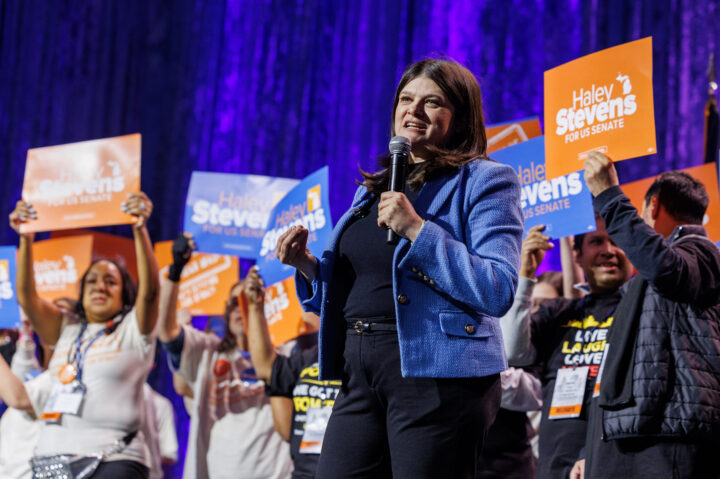
Rep. Haley Stevens (D-MI) speaks at the Michigan Democratic Party Endorsement Convention in Detroit, Mich., on April 19, 2026.
Several large Detroit-area synagogues emailed their congregants earlier this summer to urge them to vote in Michigan’s Aug. 4 primary — what seemed at first to be a somewhat bland call to make their voices heard and exercise their civic duty.
Then, as primary day drew closer, the messages took on a sharper edge from the usual staid, nonpartisan rhetoric that houses of worship might have sent in the past ahead of major elections.
“While we aren’t going to tell you who to vote for and we have never sent a message like this in our congregation’s history, these are no ordinary times,” the leaders of Temple Israel, the Reform synagogue in West Bloomfield that was the site of a violent antisemitic attack in March, wrote in an email last month.
The rabbis did not directly tell congregants whom to support in the Democratic Senate primary between Rep. Haley Stevens (D-MI) and Abdul El-Sayed, a former public health official. Instead, they merely described a politician who sounded a lot like Stevens: “a candidate whose record, actions, and rhetoric demonstrate the strongest commitment to protecting Jewish lives by combating antisemitism, seeking federal security funding for American Jewish communities, and supporting Israel’s security and right to exist as a Jewish state.” (The Conservative Congregation Shaarey Zedek in Southfield used similar language in a letter to its congregants in June.)
El-Sayed, who has made attacking AIPAC a central tenet of his campaign, has refused to say whether he believes in Israel’s right to exist as a Jewish state. El-Sayed condemned the Temple Israel attack — which did not result in any casualties aside from the assailant, a Hezbollah sympathizer who drove a truck into the synagogue preschool before opening fire — but said that “hurt people hurt people,” referring to the attacker’s ties to family members in Lebanon affiliated with Hezbollah who were killed in Israeli strikes.
The email from a nonprofit religious institution was just one of many that are being forwarded between the inboxes of Jewish Michiganders in the final days of the Senate primary, which is open to all registered voters regardless of party affiliation. Rabbis’ unprecedented advocacy in the race reflects the urgency surrounding what many Michigan Jews view as one of the most important elections in their lifetime: between a moderate, pro-Israel lawmaker who has represented the hub of Detroit’s Jewish community for nearly eight years and an insurgent far-left candidate whom they view as dangerously misguided when it comes to matters of Jewish communal concern.
Rabbi Aaron Starr, of Shaarey Zedek, told Jewish Insider on Tuesday that Stevens is “a longtime friend of the Detroit Jewish community.” But he stopped short of publicly naming her as his preferred candidate. Still, he said that the stakes feel different in this election, prompting the stronger-than-usual message to congregants.
“This is not difficult at all because I just feel it is so important,” Rabbi Asher Lopatin, who leads the Orthodox Kehillat Etz Chayim synagogue in Detroit and is director of community relations at the Ann Arbor Jewish federation, told JI. “We really have seen a lot of energy, I would say really just in the last month. People have woken up, I think, to this danger.”
“We’ve spoken in condemnation of and in praise of elected officials’ and candidates’ rhetoric on both sides of the aisle,” he said of the synagogue’s past political commentary. “Yet this election feels like a more existential moment for the Jews of Michigan, of the United States and around the world.”
Other rabbis are being more overt in their support for Stevens. Rabbi Asher Lopatin, who leads the Orthodox Kehillat Etz Chayim synagogue in Detroit and is director of community relations at the Ann Arbor Jewish federation, sent an email this week to his personal contact list urging them to vote for Stevens. He also noted that his position does not formally represent the views of his employers.
“This is not difficult at all because I just feel it is so important,” Lopatin told JI. “We really have seen a lot of energy, I would say really just in the last month. People have woken up, I think, to this danger.”
Three dozen members of Detroit’s Orthodox community, including several rabbis, signed a letter calling on observant Jews to support Stevens, whom they described as an “outspoken supporter of Israel and a devoted ally to the Jewish community.”
Among Orthodox Jews, who are more likely than secular Jews to identify as Republican, there is an educational push to remind voters that in Michigan, they can vote in whichever primary they choose — Democratic or Republican — regardless of their party affiliation.
“In the primary, many of the Democratic challengers to these candidates are hostile to our community. It is imperative to vote for those who support us,” the Orthodox Jewish leaders wrote. “Having a voice in deciding who the Democratic candidate is will be important no matter who you vote for in November in the general election. You do not need to be a registered Democrat to vote in the Democratic primary.”
“We need all the help we can get, the people we can get, to represent the Jewish population,” Gail Mash, an 81-year-old resident of a senior housing facility operated by the Detroit Jewish Federation, told JI. “There are people who are homebound and have nothing to do. This is the best thing they can do: take an active part and feel that they’re doing something for the community.”
The frantic email campaigns and WhatsApp chains are joined by the actual bread-and-butter of campaigning: phone banking and canvassing. Gail Mash, an 81-year-old resident of a senior housing facility operated by the Detroit Jewish Federation, calls herself and her group of politically engaged girlfriends the “Bubbe Brigade.” (Mash described herself as a former “Kennedy girl” who has been a Democrat her whole life.)
The “Bubbe Brigade” makes phone calls each week to members of the Michigan Democratic Jewish Caucus, a grassroots group representing Jewish Democrats within the state party, and reminds them to vote.
“We need all the help we can get, the people we can get, to represent the Jewish population,” Mash told JI in a phone call on Tuesday. “There are people who are homebound and have nothing to do. This is the best thing they can do: take an active part and feel that they’re doing something for the community.”
The Democratic Jewish Caucus campaigned with Stevens in the Detroit suburbs over the weekend at a canvassing event that was also promoted by the Jewish Democratic Council of America, a national group that is supporting efforts to rally Jewish voters for Stevens. JDCA is hosting more than a dozen phone banking events, and it has also made a five-figure digital ad buy in support of Stevens.
“When Jewish Americans needed a champion, Haley Stevens stepped up,” the ad says. It touts Stevens as a leader in fighting antisemitism, “creating jobs” and “delivering for Michiganders.”
Polling has shown El-Sayed with a small lead, though the dynamics of the race have shifted in Stevens’ favor since a third candidate, state Sen. Mallory McMorrow, dropped out earlier this month.
In the final debate of the campaign on Monday, El-Sayed repeatedly went after AIPAC and attacked Stevens for her support of the U.S.-Israel relationship. The rhetoric has left some Jewish Democrats in the state confused — and frustrated — at the way Israel, and its political supporters in the U.S., have become so central to a primary for a pivotal Senate swing seat.
“We have concerns that are sometimes unique from other communities’ concerns,” Ari Weisenfeld, the director of state relations at Agudath Israel, told JI. “If you want your elected officials to take them seriously, whether that’s at the local, state or federal level, you need to get out and vote.”
“The Jewish community is just like, why is there this obsession with this organization that a lot of us do not have an affiliation with?” said Decky Alexander, who chairs the Democratic Jewish Caucus. “It is just mind-blowing that this is such a consumptive issue when we have real threats to our Constitution, our democracy and the economics that are going on.”
Early voting is already underway, but campaigning will continue until polls close on Tuesday. Ari Weisenfeld plans to travel to Detroit from his home in Connecticut to urge Orthodox Jews to vote. As the director of state relations at Agudath Israel, an Orthodox umbrella organization, Weisenfeld is not promoting a particular candidate — all he cares about is that observant Jews get out and vote. He plans to try to visit as many synagogues as he can for morning minyanim between 6 a.m. and 9 a.m, reminding people to vote. If people need a ride to the polls, he’ll provide it.
“We have concerns that are sometimes unique from other communities’ concerns,” Weisenfeld told JI. “If you want your elected officials to take them seriously, whether that’s at the local, state or federal level, you need to get out and vote.”
The poll, commissioned by the state’s largest teachers’ union, shows Haley Stevens and Mike Rogers nearly tied, with El-Sayed trailing Rogers by 7 points
Sarah Rice/Getty Images
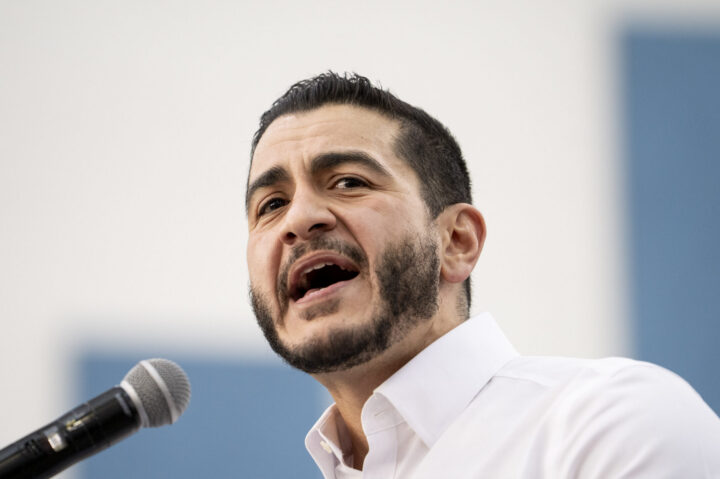
Abdul El-Sayed, candidate for US Senate in Michigan, speaks at Mumford High School on May 3, 2026 in Detroit, Michigan.
One week before Michigan’s closely watched Democratic Senate primary, a new poll shows Rep. Haley Stevens (D-MI) leading former GOP Rep. Mike Rogers by two points if she proceeds to the general election — with her opponent, Abdul El-Sayed, trailing Rogers by seven points.
Among voters who said they definitely plan to vote in the general election, the more moderate Stevens currently leads Rogers 47% to 45%, making the race a toss-up. In an El-Sayed-Rogers matchup, Rogers leads El-Sayed, a far-left former public health official, 48% to 41%.
The poll’s findings provide evidence for one of Stevens’ central campaign messages, which is that she stands the best chance of defeating Rogers in a key swing state and ensuring that Democrats hold onto the Senate seat being vacated by retiring Sen. Gary Peters (D-MI).
Among independent voters, Stevens and Rogers are nearly tied, with Rogers at 40% and Stevens at 39%. Independent voters overwhelmingly prefer Rogers to El-Sayed, with 47% saying they would support Rogers and 19% pledging to back El-Sayed.
The poll was commissioned by the Michigan Education Association — the state’s largest teachers’ union, which has not made an endorsement in the race — and an organization called Business Leaders for Michigan. It was conducted between July 22 and 24. The survey did not ask respondents their preferences in the Aug. 4 primary.
Haley Stevens touted her support for a two-state solution for Israel and the Palestinians, while Abdul El-Sayed lambasted U.S. aid to the Jewish state
(Robin Buckson/Detroit News via AP, Pool)
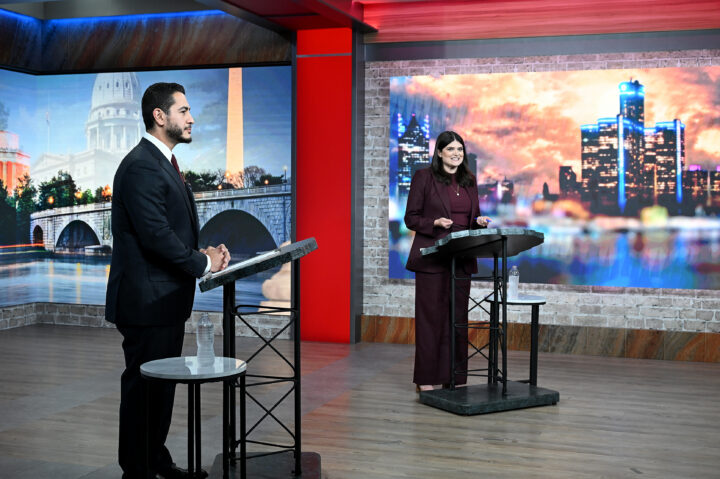
Senate candidates Abdul El-Sayed, left, and Rep. Haley Stevens participate in a televised debate moderated by Roop Raj, Monday, July 27, 2026, in Southfield, Mich.
If Michigan’s Democratic Senate primary has become a test case for the saliency of AIPAC and Israel as a political issue for Democratic voters, then Monday night’s debate between Abdul El-Sayed, a far-left former public health official, and Rep. Haley Stevens (D-MI) served as the ultimate battlefield — and illustrated the gulf between the two candidates on the issue.
Over the course of an hourlong debate, El-Sayed made clear that he believes his opposition to AIPAC and to Israel will help him win next week’s election. Stevens, meanwhile, did not even utter the word “AIPAC.”
Stevens outlined her views on the Middle East, arguing that she and El-Sayed diverge because she supports a two-state solution to the Israeli-Palestinian conflict while he has not acknowledged Israel’s right to exist as a Jewish state. She touted her support for Michigan’s Jewish community and mentioned the work she did to advocate for the hostages after the Oct. 7, 2023, Hamas attacks on Israel.
Debate moderator Roop Raj, an anchor on FOX 2 News, prodded Stevens on her support from AIPAC, pushing her to discuss the group’s spending in the race, but she largely avoided doing so.
“Absolutely not,” Stevens said when asked by Raj whether voters should be concerned that she will do AIPAC’s “bidding” when she wins the seat.
Mostly, she turned the transparency questions on her opponent, attacking El-Sayed for not releasing all of his financial disclosure forms and for benefitting from a super PAC to which his father-in-law has contributed $200,000.
“I don’t think there’s much difference between super PACs going in for Abdul or super PACs going in for me,” Stevens said, when asked about AIPAC spending $46 million in the race. “We have a problem with campaign finance reform in this country.”
El-Sayed did the same, but in reverse: When she called out his lack of personal financial transparency, he went after her for benefiting from outside spending in the race.
The first question of the debate, to El-Sayed, was about how he would work to make Michigan more affordable. His answer: eschewing campaign donations “from the corporations who are jacking up your prices in the first place,” a category in which he placed AIPAC.
“Just last week, our friend here voted to send 3.3 billion of your tax dollars to a foreign government. That is the pro quo that comes with the quid of $30 million spent by AIPAC,” El-Sayed said. “It really comes down to how are you funded.”
Stevens, when asked about affordability, talked about regulating utilities in the state and promising to be a “proven fighter.”
When Stevens described being “robbed by Washington, D.C., and [President] Donald Trump,” and pledged to fight corruption in public office, El-Sayed said he agreed that Michiganders are being robbed — but by AIPAC, not Trump.
“The money that we should have to invest in our schools is being sent to foreign governments to destroy other people’s schools instead of investing in our own, and that is exactly what AIPAC wants you to do, and why they’re spending so much money to get the congresswoman elected,” El-Sayed said.
In Whitmer’s endorsement video, she touted Stevens’ work ethic while avoiding mention of Abdul El-Sayed
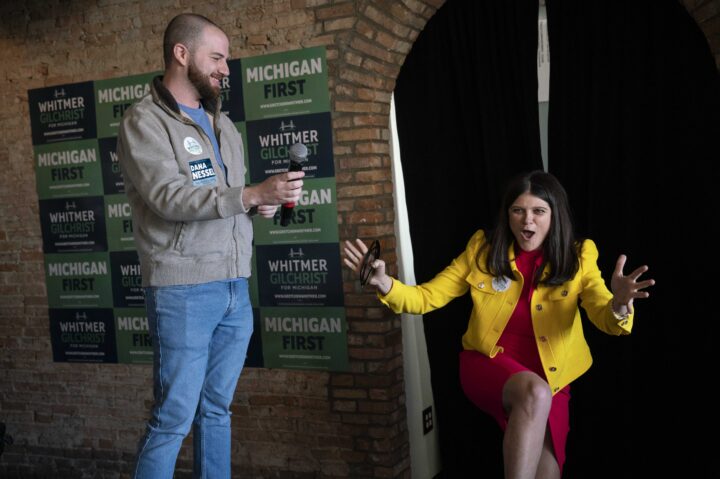
Rep. Haley Stevens is introduced to speak before Michigan Governor Gretchen Whitmer at a rally at the Crofoot Ballroom on November 6, 2022 in Pontiac, Michigan (Photo by Sarah Rice/Getty Images)
With less than two weeks until Michigan’s contentious Democratic Senate primary, Michigan Gov. Gretchen Whitmer endorsed Rep. Haley Stevens (D-MI) on Friday, offering a burst of momentum to the moderate Democrat’s campaign against progressive, anti-Israel firebrand Abdul El-Sayed.
“Haley will do whatever it takes to get things done for people in Michigan, and we need her now more than ever,” Whitmer said in a video announcing the endorsement.
Whitmer had conspicuously avoided making an endorsement in the race, which until weeks ago was a three-way contest between Stevens, El-Sayed and state Sen. Mallory McMorrow. After McMorrow dropped out, the race between Stevens and El-Sayed tightened.
El-Sayed has made opposition to Israel a core tenet of his campaign, targeting Stevens for receiving backing from AIPAC and for supporting the U.S.-Israel relationship.
In the endorsement video, Whitmer did not mention El-Sayed; she talked about Stevens as a candidate who will “get things done.”
“She knows what Michigan families are going through, and that’s how I know she will always put Michigan first,” Whitmer said.
Stevens highlighted Israeli Prime Minister Benjamin Netanyahu’s criticisms of her earlier on Tuesday amid attacks by primary rival Abdul El-Sayed over AIPAC support
Andrew Roth/Sipa USA
Rep. Haley Stevens (D-MI) speaks at the Michigan Democratic Party Endorsement Convention in Detroit, Mich., on April 19, 2026.
Rep. Haley Stevens (D-MI) continued a war of words with Israeli Prime Minister Benjamin Netanyahu as she faced a barrage of attacks from her primary opponent, former public health official Abdul El-Sayed, at a debate on Tuesday in Michigan.
Netanyahu, in a CNN interview earlier on Tuesday, criticized Stevens for saying that his actions and government had made the Jewish community less safe and placed Jews in an “uncomfortable position.”
“It’s made her uncomfortable because she can’t stand up for the truth. She’s trying to, probably, excuse antisemitism,” Netanyahu said in response to a question from CNN host Dana Bash.
Asked about the war in Iran, Stevens criticized both President Donald Trump and Netanyahu.
“We need long-term peace. Donald Trump has failed us. The prime minister of Israel has failed in that regard, and he was just coming after me on this today,” Stevens said. “Look, I am unafraid. Michigan, you are my North Star, and no illegal wars, no unilateral wars at our expense.”
She doubled down on those criticisms later in the debate.
“It is very clear that Mr. Netanyahu has not made us safer, has not brought us closer to peace, and he’s endangered Jews here in America and around the world,” Stevens said. “This is why he was just trashing me today on CNN. I am not afraid of bullies. I am not afraid to stand up, and I continue to stand up for humanitarian aid, for the U.S. to work with the countries in the region and get aid into Gaza.”
She also highlighted her work with the families of Israeli hostages formerly held in Gaza.
Stevens accused El-Sayed of opposing a two-state solution, alluding to his repeated refusal to say directly whether he believes Israel has a right to exist.
“The difference between my opponent and myself on this issue is that I believe in a two-state solution,” Stevens said. “I can say that Israel has a right to peacefully exist alongside the people of Palestine and in Gaza.”
El-Sayed argued that Netanyahu and AIPAC’s support for U.S. politicians are the primary reasons the U.S. entered the war, and emphasized that an AIPAC-linked super PAC has been attacking him and supporting Stevens.
“So long as our politicians continue to be bought off by AIPAC, do not be surprised when we fight wars that are in their best interest to … annex Lebanon or to do genocide in Gaza,” he continued.
He also argued that U.S. support for Israel, which he described as a “rogue state,” has foreclosed the possibility of a two-state solution, calling for an end to U.S. aid to Israel and “blank checks” to other Middle Eastern countries including Egypt and Saudi Arabia.
In response to repeated attacks over her support from AIPAC, Stevens pivoted to discussing other issues including her record in Michigan, GOP support for El-Sayed’s campaign and El-Sayed’s failure to release his tax returns, among other issues.
Responding to multiple questions from viewers and the debate moderator about the leftward shift of the Democratic Party, both candidates largely sidestepped the issue, though El-Sayed suggested he’s supportive of a shift in the party.
“I’ll tell you this: it won’t shift if we continue to elect leaders who take money from the same corporations who have broken with the interests of the American public,” El-Sayed said. “[Senate Minority Leader] Chuck Schumer (D-NY) desperately wants one of us to be the next senator, and it’s not me. So, if you want your politics dictated by AIPAC or Chuck Schumer, then I’m not your guy.”
Stevens, meanwhile, emphasized her record in office as a “workhorse” for the state. “This has always been about Michigan,” she said, when asked whether the race was a battle over the future direction of the Democratic Party.
El-Sayed ultimately offered a similar answer, saying, “I’m not doing this because of some direction of a party. I’m doing this because of the Michiganders that I’ve gotten to see.”
Plus, Sun Valley set lands in Idaho

Photo by Andrew Harnik/Getty Images
President Donald Trump delivers remarks during a meeting with President of Turkey Recep Tayyip Erdogan in the Oval Office at the White House on September 25, 2025 in Washington, D.C.
Good Monday morning.
In today’s Daily Kickoff, we look at how Mallory McMorrow’s departure from the Michigan Democratic Senate primary could impact the race now between Rep. Haley Stevens and Abdul El-Sayed, and report on Gov. Josh Shapiro’s prediction that the Democratic Party will face an ideological “battle” in light of the growing influence of the Democratic Socialists of America. We cover a Democratic effort led by Rep. Dina Titus to block the sale of advanced fighter jets to Turkey, and report on the National Education Association’s protocol changes ahead of the group’s annual convention aimed at avoiding similar allegations of antisemitism that it faced at its conference last year. Also in today’s Daily Kickoff: Eyal Shani, Ruth Cohen Dar and Rep. Yassamin Ansari.
We have also launched a new on-demand Live Briefing that you can access throughout the day via our new app (on Apple and Android) and on our website.
Today’s Daily Kickoff was curated by JI Executive Editor Melissa Weiss and Israel Editor Tamara Zieve, with an assist from Danielle Cohen-Kanik and Marc Rod. Have a tip? Email us here.
What We’re Watching
- World leaders — including President Donald Trump — are traveling to Turkey today ahead of the start of the NATO Ankara Summit tomorrow.
- A number of Israeli officials are reportedly expected to travel to the U.S. in the coming weeks for meetings with their American counterparts amid floundering U.S.-Iran talks. Trump told Axios that Israeli Prime Minister Benjamin Netanyahu had asked for a meeting, which could take place soon after Trump returns from Turkey, while i24News reports that Israeli Foreign Minister Gideon Sa’ar is expected to meet next week in Washington with Secretary of State Marco Rubio.
- Funeral proceedings for former Iranian Supreme Leader Ayatollah Ali Khamenei that began over the weekend continued today with the slain leader’s funeral. Three of Khamenei’s sons have been seen at the ceremonies, though Ayatollah Mojtaba Khamenei, who succeeded his father following an Israeli strike on the first day of the war, has yet to make a public appearance.
- Allen & Co.’s annual Sun Valley retreat is taking place this week in Idaho. Those expected to attend this year include David Ellison, David Zaslav, Barry Diller, Bob Iger, Mark Zuckerberg, Alex Karp, Jeffrey Katzenberg, Bari Weiss, Jared Kushner and Josh Kushner.
- The Christians United For Israel Summit continues today in Washington, with its annual Night to Honor Israel dinner scheduled for tonight.
- In Jerusalem, the National Library of Israel is marking the U.S.’ semiquincentennial with an evening event focused on “Celebrating America at 250.”
- Startup Nation Central founder Wendy Singer will moderate a conversation between Rabbi Abi Dauber Sterne, former Israeli Ambassador to the U.S. Michael Oren and B’nai Jeshurun Senior Rabbi Felicia Sol.
What You Should Know
A QUICK WORD WITH JI’S MARC ROD
Michigan state Sen. Mallory McMorrow dropped out of the Democratic primary for U.S. Senate on Sunday, narrowing the race to a contest between Rep. Haley Stevens (D-MI) and Abdul El-Sayed, a former public health official.
McMorrow suspended her campaign without endorsing either of her rivals, saying only that “whoever wins this primary on August 4th will have my full support.”
Recent polling has shown a relatively close race between the moderate Stevens and far-left El-Sayed, with El-Sayed leading in several surveys. With McMorrow generally claiming around 10% of the vote in polls, her withdrawal could shift dynamics in the race.
At the same time, mail-in ballots in the state have already been dispatched — with McMorrow’s name still on them.
The end of McMorrow’s campaign marks a significant fall for the up-and-coming state senator, who posted strong performances in early polls but has seen flagging support and enthusiasm in recent months. Her voting base will likely end up divided among both candidates, and both are making efforts to attract her supporters.
McMorrow had sought to carve out a middle ground between Stevens and El-Sayed, running as a somewhat progressive anti-establishment candidate but claiming a more pragmatic lane than El-Sayed, who some Democrats worry will not be electable in a general election against former Rep. Mike Rogers (R-MI), the expected GOP nominee. The race offers the biggest test yet of the progressive, anti-Israel movement’s ability to win in a critical swing state.
BAIT AND SWITCH
When Rep. Yassamin Ansari (D-AZ) narrowly prevailed in the Democratic primary for an open House seat in Phoenix in 2024, winning by just 39 votes in a deep-blue district, the Arizona lawmaker could attribute her success, in part, to strong backing from the local Jewish community as well as a surge of outside spending from a prominent pro-Israel group. Now, however, Ansari, 34, is aligning with a range of far-left policy positions that have led several Jewish and pro-Israel leaders to feel they were misled, they told Jewish Insider’s Matthew Kassel.
Flip-flop: Alma Hernandez, a Democratic state representative in Tucson who had been one of Ansari’s top Jewish campaign surrogates in the 2024 primary, said she “was really excited for the idea of having someone like” Ansari in office, noting that she attended the congresswoman’s swearing-in ceremony in Washington to demonstrate her solidarity. “I have not talked to her since,” Hernandez said last week in an interview with JI. “I think a lot of folks in the community feel they were really used in a sense,” she added, alleging that Ansari “was very careful with all her words because she wanted the support and the financial backing” in a closely contested race.
NO FLIGHT PLAN

A group of House Democrats introduced a resolution last week that aims to block the sale of advanced jet engines to Turkey, as the Trump administration pushes ahead with the sale despite legal restrictions on U.S. military sales to the country, Jewish Insider’s Marc Rod reports.
Titus’ take: The resolution is led by Rep. Dina Titus (D-NV), a vocal critic of Ankara, and co-sponsored by Reps. Chris Pappas (D-NH), Brad Schneider (D-IL), Josh Gottheimer (D-NJ), Mike Quigley (D-IL), Jim Costa (D-CA), Jim McGovern (D-MA), George Latimer (D-NY) and Brad Sherman (D-CA). “The regime of Turkish President Erdoğan has made repeated threats of military action against NATO allies and other partner nations throughout the Middle East,” Titus said on X. “I am introducing a Joint Resolution of Disapproval to stop the $700 million sale of F110 jet engines to Turkey which would undermine regional stability and pose a threat to U.S. allies.”
Exclusive: A bipartisan group of House lawmakers wrote to President Donald Trump on Thursday to “express deep concern about any effort to sell F-35s to Turkey.”
FAULT LINES
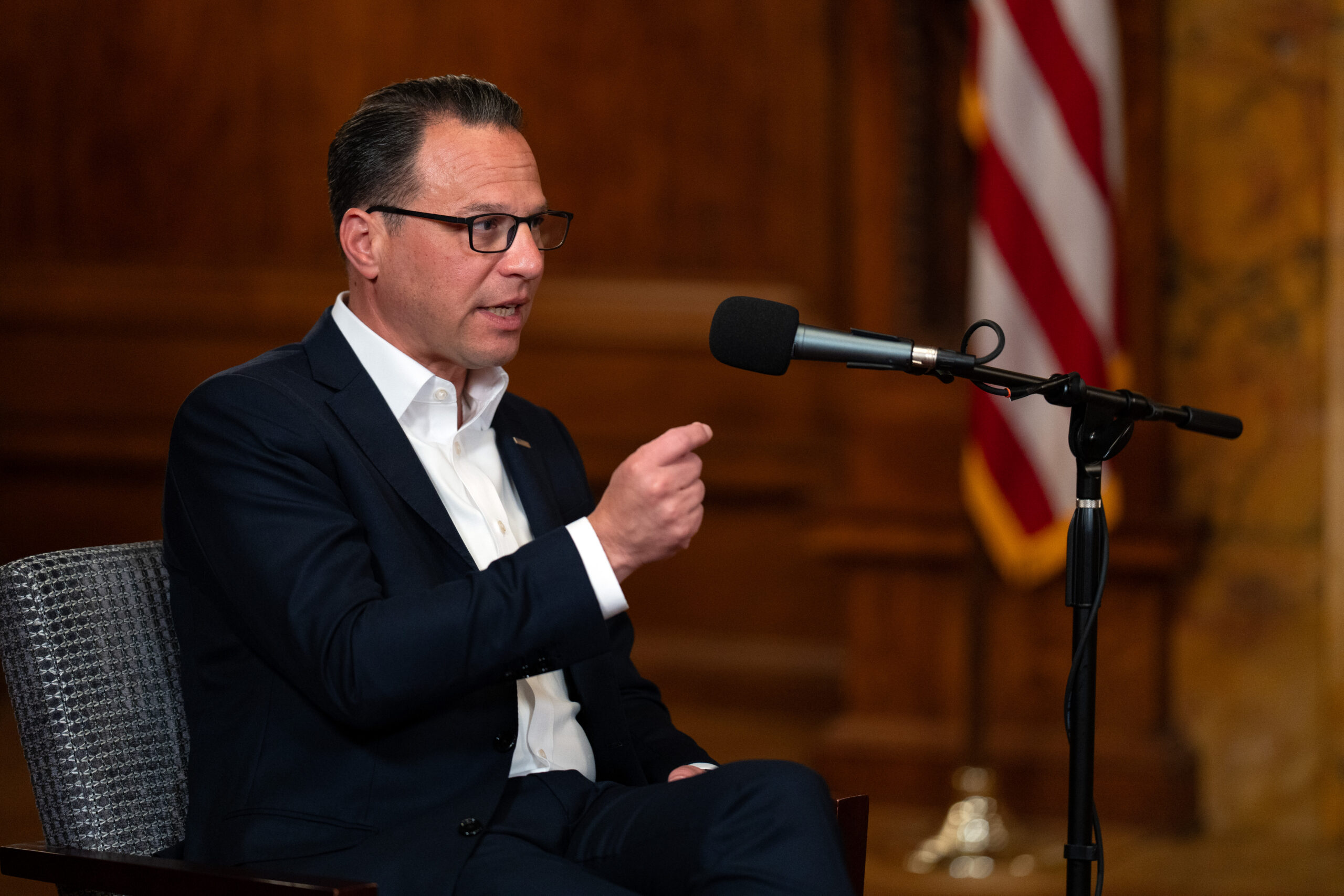
Pennsylvania Gov. Josh Shapiro, a potential 2028 Democratic presidential contender, predicted in a TV interview that aired on Sunday that Democrats will soon face a “battle” over the rising influence of socialists in the party and distanced himself from such far-left candidates, Jewish Insider’s Haley Cohen reports.
What he said: In an interview with CNN’s Dana Bash, Shapiro cited “profound differences” with Darializa Avila Chevalier, a socialist New York City congressional candidate who won her primary last month against incumbent Rep. Adriano Espaillat (D-NY) and was endorsed by New York City Mayor Zohran Mamdani. Avila Chevalier has a history of incendiary online rhetoric, including railing against Democratic leaders and praising communism, and defended attending an anti-Israel rally the day after the Oct. 7 Hamas attacks. “She’s not someone who seemingly I would agree with on many things or that we share similar values. She ran on the Democratic ticket, I guess, as a socialist,” said Shapiro.
Bonus: The Wall Street Journal looks at Avila Chevalier’s swift political rise and primary victory over Espaillat, describing the DSA member as being “at the forefront of a shocking blitz by Democratic socialists that has upended Democratic politics.”
ONLINE ACTION

In a bid to protect Jewish children from rampant antisemitism on the internet, the Jewish Federations of North America is pushing lawmakers to support the KIDS Act, a major bipartisan package of legislation focused on children’s safety online that passed the House late last month by a 267-117 vote, Jewish Insider’s Marc Rod reports.
About the effort: Omer Yarden-Oppenheim, director of government relations at JFNA, told JI that online antisemitism has been a major conversation and challenge for Jewish families, especially since the Oct. 7, 2023, Hamas attacks on Israel. He said the group identified four bills in the House’s online safety push that it felt could play a role in addressing online antisemitism, which were ultimately packaged into the KIDS Act. But the Senate and House remain divided on how best to approach the problem, so roadblocks remain.
TEACHING MOMENT

Following last year’s contentious assembly mired in allegations of antisemitism, the National Education Association — the nation’s largest teachers’ union — adopted new policies for its Denver convention aimed at preventing the same chaos, the NEA confirmed to Jewish Insider’s Haley Cohen.
Details: The new rules for the four-day Representative Assembly, which ends on Tuesday, include stricter conduct enforcement for delegates, electronic voting to prevent shouting on the floor, de-escalation training for staff and regular public reminders of assembly rules, according to the Jewish Council for Public Affairs, which said it worked with the union’s Jewish Affairs Caucus to lobby the NEA for the changes.
ON THE AIR
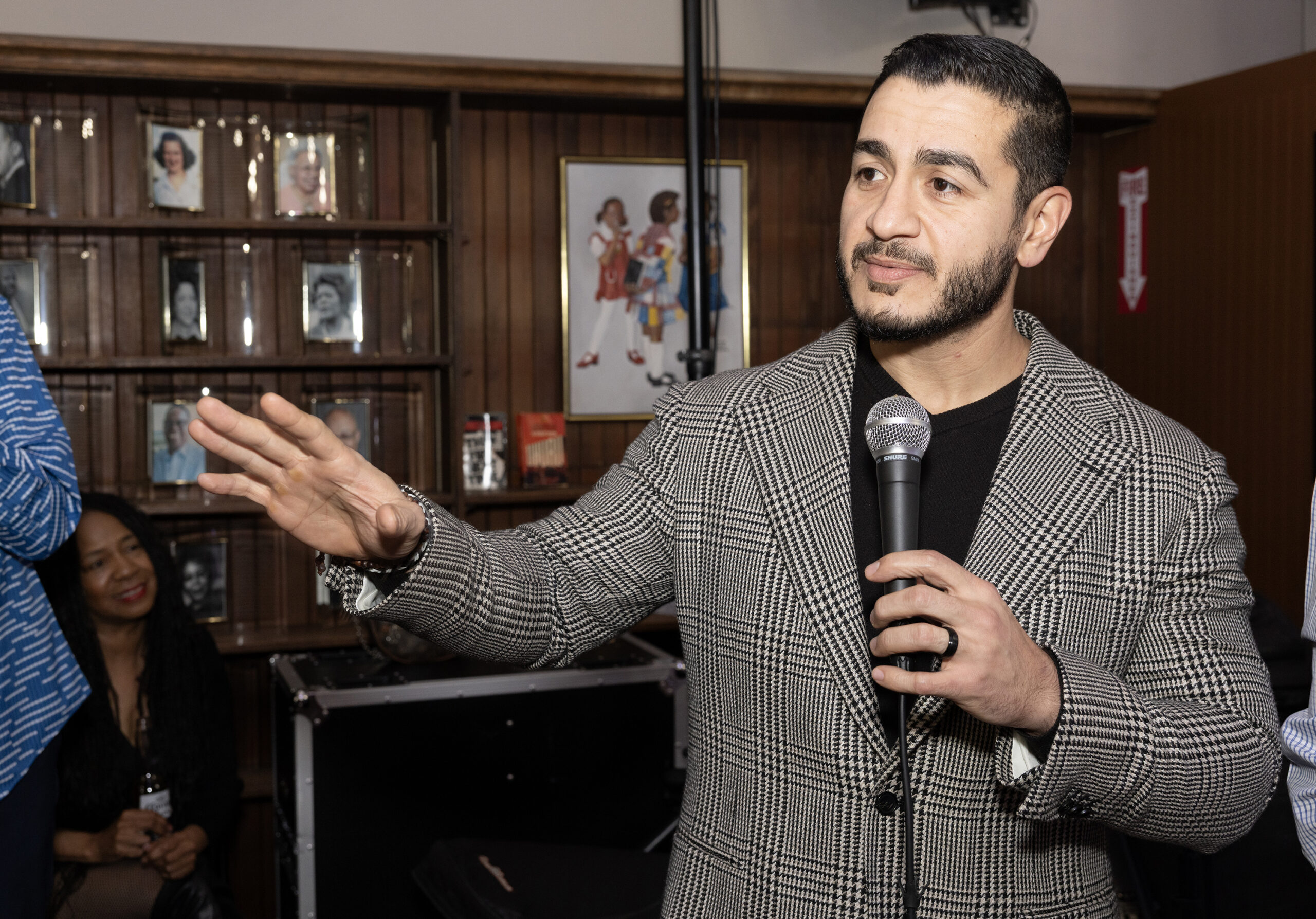
The AIPAC-linked United Democracy Project is launching its first negative ad in the Michigan Senate race, targeting Democratic candidate Abdul El-Sayed, just over a month before the state’s primary elections, Jewish Insider’s Marc Rod reports.
Money moves: According to FEC filings, the group spent more than $2 million in the initial ad buy targeting El-Sayed, a former public health official. The 30-second ad highlights El-Sayed’s “long history of disrespecting women,” including criticisms of former First Lady Michelle Obama and Michigan Gov. Gretchen Whitmer. UDP has spent more than $10 million in the race boosting Rep. Haley Stevens (D-MI).
Called out: Colorado Attorney General Phil Weiser, the Democratic nominee for governor, criticized his party’s socialist congressional nominee, Melat Kiros, for her refusal to describe the deadly firebombing of a Boulder, Colo., hostage awareness march last year as an act of antisemitism. “We cannot look at that murder and say anything else happened than a hate crime, and so if someone isn’t going to acknowledge that I’m concerned about that, because this was tried, this was how we have a conviction” for a hate crime, Weiser told 9News, a Denver station, last week.
Worthy Reads
Battle Plan vs. the DSA: In The Wall Street Journal, Mark Penn and Andrew Stein suggest how Democrats can counter the Democratic Socialists of America’s rising influence in the party. “Political-action committees and advocacy groups that have focused on federal races have to realize that the DSA initially focuses on low-turnout local races and nonprofit boards as easy targets. Once in power, its members degrade law enforcement with policies that encourage street vagrancy, drug abuse and higher taxes, fueling more voter anger, which they exploit at election time. Moderate PACs and other groups need a battle plan for every campaign from district attorney to Congress, city council to state legislature.” [WSJ]
Singled Out in San Francisco: In the San Francisco Standard, Eric Kingsbury reflects on a recent incident in which California state Sen. Scott Wiener, who is Jewish, was filmed being heckled as he was forced by demonstrators to leave a transgender march last month. “Connie Chan, his opponent in the congressional race, holds the same positions on Gaza and Israel that Wiener has publicly endorsed, yet she faced no such harassment and marched in peace. If it’s not his record, why is Wiener singled out? It’s because he’s Jewish. And because of that, nothing he can ever do or say will be enough. He will always be held to a different standard. That is antisemitism.” [SFStandard]
The Erdogan Loophole: In Foreign Policy, Steven Cook, a senior fellow at the Council on Foreign Relations, observes the response by Western leaders to Turkish President Recep Tayyip Erdogan’s jailing of political opponents and gutting of the country’s main opposition party. “This is odd, especially given how much time and attention leading Democrats and Republicans have spent on human rights in China, Saudi Arabia, the United Arab Emirates, Cuba, North Korea, and especially Israel.” [ForeignPolicy]
Word on the Street
The Wall Street Journal reports that NASA administrator Jared Isaacman superseded FAA objections to flying vintage Northrop F-5 Tiger II jets in the America 250 air show in Washington over the weekend; Isaacman, whose company owns three planes that were part of the group, said guidelines for planes participating in the flyover differed from rules regarding civilian aircraft that fall under FAA regulations…
Ahead of the start of the NATO summit in Ankara, Turkey, tomorrow, former U.S. Ambassador to Japan Rahm Emanuel, who is mulling a 2028 presidential bid, called for a “23-state solution” in which all Arab countries, including a newly formed Palestinian state, establish “full diplomatic relations” with Israel…
Seven anti-Israel demonstrators arrested during a 2024 protest that shut down traffic on San Francisco’s Golden Gate Bridge were convicted of misdemeanors tied to the incident; the judge overseeing the case declared a mistrial on felony conspiracy charges when jurors were unable to reach a verdict…
The board of the Committee to Protect Journalists voted 17-1 to uphold its existing definition of a journalist that includes members of media groups affiliated with militant organizations “provided they are not engaging in combat or inciting violence in a manner likely to have imminent effect”…
Eyal Shani will open a Los Angeles outpost of his Malka restaurant this summer at the boutique hotel SIXTY Beverly Hills, a year and a half after opening a Miami branch of the popular Tel Aviv eatery, which also has a location in New York…
U.S. Ambassador to France Charles Kushner’s America 250 celebration in Paris — which concluded on Friday before Shabbat — included a fully kosher spread (including kosher wines) and a performance by Italian tenor Andrea Bocelli…
The New York Times spotlights the challenges facing Jewish museums across Europe amid the explosion of antisemitism that followed the Oct. 7, 2023, Hamas terror attacks and ensuing war in Gaza…
A Meta executive denied to Australia’s royal commission investigating antisemitism that the company’s changes to its content moderation rules led to increased instances of antisemitism on its platforms…
Israel’s central bank is expected to cut interest rates to 3.50% from 3.75%, citing the shekel’s strength and inflation expectations…
An American man studying at a seminary in Israel was charged with spying on behalf of Iran in exchange for $1,400 in cryptocurrency; the yeshiva student allegedly took photos of sites and carried out assigned tasks as instructed by a foreign agent operating on behalf of Tehran…
The Wall Street Journal spotlights Gadi Eisenkot as the former IDF chief of staff, who is making his first bid as a party leader, rises in the polls against Prime Minister Benjamin Netanyahu…
Israeli Transportation Minister Miri Regev gave the first Israeli confirmation that the country deployed an Iron Dome battery to the United Arab Emirates during the recent war with Iran; the deployment was previously reported by Axios and also confirmed by U.S. Ambassador to Israel Mike Huckabee…
The Israeli government voted unanimously to appoint Ruth Cohen Dar — who serves as nonresident ambassador to Slovenia and Malta — to be Jerusalem’s first permanent envoy in Slovenia, following Foreign Minister Gideon Sa’ar’s announcement that Israel will open an embassy in the country…
The Israeli Cabinet rejected a Supreme Court decision striking down the government’s creation of an alternative television regulating body as it works to block the sale of Channel 13 to a group led by Assaf Rappaport, a Netanyahu critic…
Judah Gribetz, a longtime New York political aide who played a key role in restituting $1.25 billion to Holocaust survivors and later served as president of the Jewish Community Relations Council of New York, died at 97…
Geneticist Stanley Gartler, whose work advanced research into the origins and growth of cancerous tumors, died at 102…
Find on-demand Live Briefing updates throughout the day via our new app (on Apple and Android) and website.
Pic of the Day

Former Israeli hostages Sasha Trufanov and Sapir Cohen, who were kidnapped from Kibbutz Nir Oz during Hamas’ Oct. 7, 2023, attacks, were married on Sunday outside of Netanya. The couple walked down the aisle to Idan Raichel’s “Mi’Ma’amakim” — “Out of the Depths.”
Those in attendance included former hostages Arbel Yehud, Ariel Cunio, Shani Goren, Moran Stella Yanai, Rom Braslavsky, Eitan Horn and Daniel Aloni, as well as Israeli President Isaac Herzog, who had previously said he wouldn’t attend any weddings until all of the hostages had been released.
Birthdays

Founder of Tumblr, which he sold to Yahoo in 2013 for $1.1 billion, David Karp turns 40…
Chairman of NYC-based GFP Real Estate, Jeffrey Robert Gural turns 84… 43rd president of the United States from 2001 to 2009, George W. Bush turns 80… Former member of the Knesset for the National Religious Party, Yitzhak Levy turns 79… Lobbyist and former president of AIPAC, Marshall Aaron Brachman… Journalist, pundit and author, known for writing the blog “Kausfiles,” Robert Michael “Mickey” Kaus turns 75… Israeli cryptographer, he is a co-inventor of the RSA algorithm and one of the inventors of differential cryptanalysis, Adi Shamir turns 74… Sole member of the Knesset for the Noam party, Avigdor “Avi” Maoz turns 70… Founder of Kehilas Pnei Menachem, a breakaway in 2019 from the Ger Hasidic dynasty, Rabbi Shaul Alter turns 69… Professor of Bible at JTS and former senior fellow at the Shalom Hartman Institute of North America, Benjamin D. Sommer turns 62… Partner at SKDK, she served as a board member of Jewish Foundation for Group Homes (now known as Makom), Jill Zuckman… CEO of Holocaust Museum LA, Beth Kean… Widow of Beau Biden, she is the board chair of the Beau Biden Foundation, Hallie Olivere Biden turns 53… Stand-up comedian, writer and actor, Mark Moshe Kasher turns 47… British actor, Louisa Clein turns 47… Former chief of staff on the Hill, now CoS at Blue Frontier, Shira Siegel… Israeli freestyle wrestler, she was born on the day her parents made aliyah, Ilana Kratysh turns 36… Postdoctoral research fellow at Emory University, Josh Lipson… Jeannie Gerzon…
Recent polling has shown a relatively close race between the moderate Stevens and far-left El-Sayed, with El-Sayed leading in several surveys
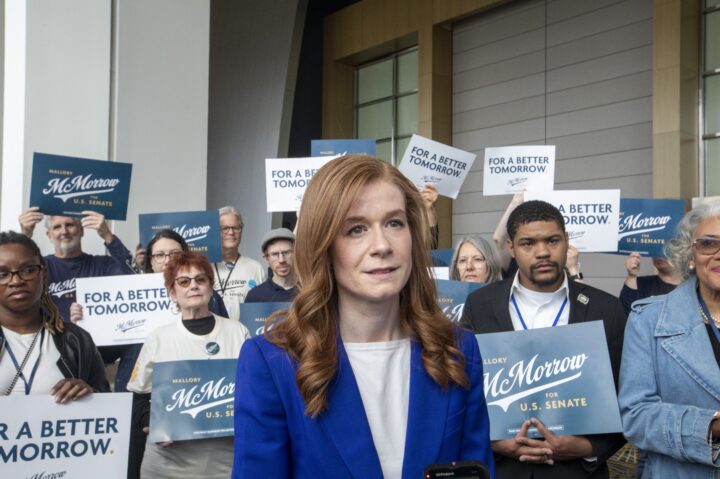
Jim West/UCG/Universal Images Group via Getty Images
Mallory McMorrow, a candidate for U.S. Senate, campaigns at the Michigan Democratic Nominating Convention
Michigan state Sen. Mallory McMorrow dropped out of the Democratic primary for U.S. Senate on Sunday, narrowing the race to a contest between Rep. Haley Stevens (D-MI) and Abdul El-Sayed, a former public health official.
McMorrow suspended her campaign without endorsing either of her rivals, saying only that “whoever wins this primary on August 4th will have my full support.”
Recent polling has shown a relatively close race between the moderate Stevens and far-left El-Sayed, with El-Sayed leading in several surveys. With McMorrow generally claiming around 10% of the vote in polls, her withdrawal could shift dynamics in the race.
At the same time, mail-in ballots in the state have already been dispatched — with McMorrow’s name still on them.
The end of McMorrow’s campaign marks a significant fall for the up-and-coming state senator, who posted strong performances in early polls but has seen flagging support and enthusiasm in recent months.
McMorrow’s voting base will likely end up divided among both candidates, and both are making efforts to attract her supporters.
McMorrow had sought to carve out a middle ground between Stevens and El-Sayed, running as a somewhat progressive anti-establishment candidate but claiming a more pragmatic lane than El-Sayed, who some Democrats worry will not be electable in a general election against former Rep. Mike Rogers (R-MI), the expected GOP nominee.
That positioning extended to the tightrope she tried to walk on Israel policy issues, criticizing Israel and agreeing with those who characterized the war in Gaza as a genocide while also condemning antisemitism in the anti-Israel movement.
Democrats who backed McMorrow for electability reasons, and some female voters, will likely end up in Stevens’ camp. But others, who were attracted by McMorrow’s anti-establishment message and more progressive posture than Stevens, will likely move toward El-Sayed. El-Sayed is also likely to pick up those voters turned off by Stevens’ staunch support for Israel — to the extent such voters hadn’t already abandoned McMorrow.
In her statement on McMorrow’s withdrawal, Stevens said she plans to continue to make her case that she’s “the strongest Democrat to defeat Mike Rogers.” In his statement, El-Sayed emphasized, “we cannot allow the establishment to decide our nominee for us.”
McMorrow’s withdrawal from the race may give space for Michigan’s political establishment to coalesce behind Stevens to block El-Sayed. Shortly after McMorrow dropped out, Attorney General Dana Nessel endorsed Stevens, saying that the “choice is clear.”
Former Sen. Debbie Stabenow (D-MI) previously endorsed Stevens, who has also been privately backed by Senate Minority Leader Chuck Schumer (D-NY).
Also in the wake of McMorrow’s decision, Republicans have continued to work to boost El-Sayed. Sen. Bernie Moreno (R-OH) accused Washington Democrats of “working overtime to stack the deck against” El-Sayed and boost Stevens.
Outside spending will also likely play a significant role in shaping the final month of the campaign. The AIPAC-linked United Democracy Project super PAC has already spent more than $10 million in the race, launching its first negative ads attacking El-Sayed late last week.
And after McMorrow withdrew from the field, the anti-Israel American Priorities super PAC told Politico it is “fully committed” to ensuring El-Sayed is the Democratic nominee “and we will do what it takes to get there” — the biggest test yet of the progressive, anti-Israel movement’s ability to win in a critical swing state.
The AIPAC-affiliated super PAC is touting Stevens’ record fighting for the auto industry, opposing Medicare cuts and working to cap insulin prices in Congress
Andrew Roth/Sipa USA
Rep. Haley Stevens (D-MI) speaks at the Michigan Democratic Party Endorsement Convention in Detroit, Mich., on April 19, 2026.
United Democracy Project, the super PAC affiliated with AIPAC, is spending $2 million on an initial ad buy this week to boost Rep. Haley Stevens (D-MI) in the Democratic primary for Michigan’s open Senate seat, a UDP spokesperson confirmed to Jewish Insider on Tuesday.
The new TV ad, which calls Stevens “a proven fighter for Michigan,” touts her past role as chief of staff to President Barack Obama’s auto task force, support for capping insulin prices and efforts “fighting back against” President Donald Trump’s “Medicare cuts.”
“She’s a fighter for Michigan families on affordability and jobs,” Patrick Dorton, a spokesperson for UDP, said of Stevens, a moderate pro-Israel Democrat. “We are going to show that on these ads,” he said in a statement to JI.
UDP is also spending $300,000 on radio and mail ads, Dorton said of the group’s first investment in the race. He was unable to share how much UDP intends to spend in the primary, which takes place on Aug. 4.
The spending comes as AIPAC is viewed as a lightning rod in Michigan’s closely contested Democratic Senate primary, where one of Stevens’ top rivals, Abdul El-Sayed, a vocal far-left critic of Israel, has accused her of being beholden to donors from the pro-Israel group. Mallory McMorrow, a state senator, has also vowed to reject campaign contributions from AIPAC.
In contrast with other races where UDP has relied on shell PACs that allow it to shield its involvement until after a primary has concluded, the group is spending under its own name in Michigan, which is home to a sizable Jewish community.
Meanwhile, Rep. Haley Stevens avoided a question about receiving support from pro-Israel donors, while Abdul El-Sayed blamed rising antisemitism on white supremacy
Jim West/UCG/Universal Images Group via Getty Images
Mallory McMorrow, a candidate for U.S. Senate, campaigns at the Michigan Democratic Nominating Convention
State Sen. Mallory McMorrow offered a straightforward answer when asked at a debate on Thursday, alongside the other two Democrats vying for an open Senate seat in Michigan, whether there is an antisemitism problem in the Democratic Party.
“There is,” said McMorrow. She told the story of an attendee at last month’s Democratic Party convention in Detroit who yelled an antisemitic slur at her Jewish husband, in front of their young daughter.
“That is terrifying. We need to be able to state very clearly that what the Netanyahu government is doing is wrong, that the violence needs to end, that we need to bring about long-term peace and security for Palestinians and for Israelis, and that turning that into not an anti-Netanyahu, but an anti-American Jewish message is dangerous,” McMorrow said, earning applause from the room.
The other two candidates — Rep. Haley Stevens (D-MI) and former public health official Abdul El-Sayed — did not directly address the question about Democrats.
Stevens condemned “rising political violence and extremism,” including the attack at Temple Israel in West Bloomfield, in her district, which she said was carried out by a “homegrown terrorist.” She described herself as a lawmaker who is “leading on combating antisemitism in a bipartisan way. That does not have to be a partisan thing.”
El-Sayed said he understands discrimination because he has faced it himself. He blamed antisemitism in the U.S. on white supremacy.
“I know that antisemitism and Islamophobia tend to go hand in hand, and the real issue when it comes to either of them is the scourge of white supremacy,” he said, while arguing that respecting American Jews does not require supporting Israel.
The Democratic primary for the open Senate seat in Michigan is one of the most contentious in the country, and antisemitism has become a major issue, alongside U.S. foreign policy and support for Israel. It is perhaps the most high-profile seat where debates about the role of AIPAC might actually have an impact on the outcome.
Stevens, a longtime ally of the pro-Israel group, was the early frontrunner in the race but has faced attacks from her opponents for not criticizing AIPAC.
Presented with an opportunity on Thursday in a primary debate to help voters understand why she continues to receive support from the pro-Israel advocacy group, Stevens chose not to speak about the group at all.
“You take money from AIPAC. Walk us through what that money means and what it buys, and maybe what it doesn’t,” one of the debate’s moderators asked Stevens, as part of a question about how much influence individual donors have over their decisions.
“Michiganders are frustrated because we have not done comprehensive campaign finance reform. Mike Rogers will not vote for comprehensive campaign finance reform like I have in the House of Representatives,” Stevens said, referring to former Rep. Mike Rogers (R-MI), the expected GOP nominee for Senate. “We squarely need to put people at the front of our agenda.”
She also said she is “deeply proud to have grassroots support coming from grocery clerk workers to retired teachers to factory workers and the like,” and named some of the politicians who have endorsed her, including former Rep. Brenda Lawrence (D-MI), former Sen. Debbie Stabenow (D-MI) and former Gov. Jennifer Granholm.
When asked about her views on foreign policy, Stevens attacked President Donald Trump for the “harmful and ridiculous” steps he took to pare back U.S. humanitarian aid abroad, and pledged to focus on peace.
“We need to see the United States work with our allies to achieve lasting peace between Russia and Ukraine, between the people of Israel and Palestine and of course between China and Taiwan,” said Stevens. “But when you remove the tools from our tool kit, you fail this country and you fail us, to allow us to work alongside our allies.”
Both McMorrow and El-Sayed used Thursday’s debate to remind voters that they do not accept donations from AIPAC. (AIPAC has not made an endorsement in the Senate race, but it has encouraged its supporters to donate to Stevens’ campaign.)
“I have not taken a dime of corporate PAC donations. I have not taken a dime of AIPAC donations,” said McMorrow, who is endorsed by the progressive Israel advocacy group J Street.
El-Sayed, who regularly accuses Israel of genocide and has said he struggles with the question of whether Israel has the right to exist as a Jewish state, slammed Stevens for taking AIPAC supporters’ donations.
“Let me tell you what absolutely would not shape my perception [of foreign policy]: it’s AIPAC money,” said El-Sayed.
The move is intended to block Abdul El-Sayed’s path to victory, though a divided mainstream vote could help the anti-Israel candidate
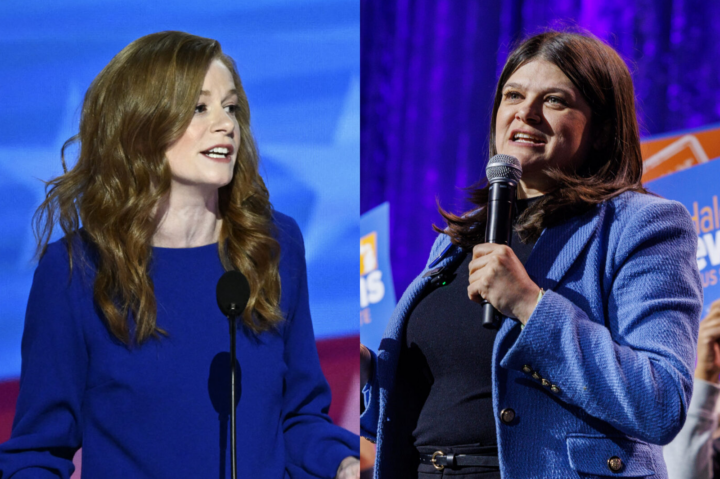
MANDEL NGAN/AFP via Getty Images & Andrew Roth/Sipa USA
Mallory McMorrow and Haley Stevens
The Jewish Democratic Council of America announced a dual endorsement on Wednesday of Rep. Haley Stevens (D-MI) and state Sen. Mallory McMorrow in Michigan’s three-way Senate Democratic primary, saying “there are two candidates who stand with our community on issues of importance to Jewish voters, and there is one who does not.”
“It is because of this stark contrast of the views and values of Haley Stevens and Mallory McMorrow, compared to those of Abdul El-Sayed,” a vocal critic of Israel who has captured the enthusiasm of the far left, “that we are taking the distinct opportunity to endorse two candidates,” Halie Soifer, JDCA’s CEO, said in a statement.
The decision to issue a dual endorsement is rare for JDCA, which has long supported Stevens, a moderate pro-Israel Democrat who is favored by establishment leaders as well as AIPAC. In recent days, Stevens has won a series of major endorsements from Sen. Chris Coons (D-DE), former Sen. Debbie Stabenow (D-MI) and former Michigan Gov. Jennifer Granholm, with under three months until the August 4 primary seen as key to reclaiming the party’s majority in the upper chamber.
McMorrow, who has backed efforts to restrict arms sales to Israel and called its military conduct in Gaza a genocide while also reaching out to Jewish voters in the state, stands to to the left of JDCA on Middle East policy, which backs continued U.S. aid to Israel “with no cuts or conditions,” its website states.
In an interview with Jewish Insider, Soifer said the group had weighed those differences and engaged in “extensive conversations with McMorrow” as it made its endorsement.
“Given the fact that her views on this issue stood in such contrast with those of Abdul El-Sayed,” who has drawn criticism for campaigning with Hasan Piker, a Twitch streamer who regularly espouses antisemitic rhetoric, “we felt that it was important to send a clear message that either Stevens or McMorrow would” be preferable, Soifer explained on Wednesday.
McMorrow and Stevens have criticized El-Sayed for appearing with Piker, whose rhetoric he has refused to denounce. El-Sayed, who has been rising in recent polls — including one earlier this month in which he held a 10-point lead over his two primary opponents — has also side-stepped questions about Israel’s right to exist and said the Israeli government is just as evil as Hamas, among other inflammatory comments that have raised alarms among Jewish voters in the state.
While Soifer acknowledged concerns that Stevens and McMorrow could end up splitting the vote and inadvertently propelling El-Sayed to the nomination, she told JI the dual endorsement was meant to reflect JDCA’s broader assessment of the stakes of the race.
El-Sayed “stands alone among the most anti-Israel candidates who are running this cycle,” Soifer said, calling him an “unacceptable choice” in a state home to a sizable Jewish community.
“We wanted to send a clear message that he is a threat both to Democrats and the chances of holding onto that Senate seat,” she added. “It is our interest to ensure he is defeated.”
Polling has indicated that the general election — where Democrats are now expected to face former Rep. Mike Rogers (R-MI) — will be competitive.
JDCA has endorsed more than 120 candidates this election cycle. The group has so far notably refrained from offering its imprimatur to Graham Platner, the presumptive Senate Democratic nominee in Maine who has faced scrutiny over a Nazi tattoo he recently covered up and other personal controversies linked to his past online statements.
According to Soifer, JDCA plans to spend “at least six figures” in the Michigan Senate race, but she said she was not yet ready to share additional details about its strategy.
Plus, Israel-Ukraine relations face grain of contention

Joe Raedle/Getty Images
Rep. Debbie Wasserman Schultz (D-FL)
This P.M. edition is reserved for our premium subscribers like you — offering a forward-focused read on what we’re tracking now and what’s coming next. Please don’t hesitate to share your thoughts and feedback by replying to this email.
📡On Our Radar
Notable developments and interesting tidbits we’re tracking
The gunman who attacked the White House Correspondents’ Dinner on Saturday night, Cole Tomas Allen, was arraigned in Washington this afternoon. He is being charged with transportation of a firearm between states, discharging a firearm during a crime of violence and attempting to assassinate the president of the United States, which carries a potential life sentence.
Assistant U.S. Attorney Jocelyn Ballantine said Allen, 31, had “a 12-gauge, pump-action shotgun, a .38-caliber semiautomatic pistol and … three knives and other dangerous paraphernalia” during the attack. He will remain in detention with another hearing scheduled for Thursday…
White House Press Secretary Karoline Leavitt confirmed that President Donald Trump met with his national security team this morning where they discussed Iran’s latest proposal to end the war, which reportedly includes reopening the Strait of Hormuz but postponing talks on the country’s nuclear program…
German Chancellor Friedrich Merz said the U.S. is “being humiliated” by Iranian leaders after negotiations between the two countries this weekend were called off.
“The Iranians are obviously very skilled at negotiating, or rather, very skillful at not negotiating, letting the Americans travel to Islamabad and then leave again without any result,” Merz told a group of students. The result is “an entire nation is being humiliated by the Iranian leadership, especially by these so-called Revolutionary Guards,” he added…
Russian President Vladimir Putin praised how “courageously and heroically the people of Iran are fighting for their independence” in a meeting with Iranian Foreign Minister Abbas Araghchi today in St. Petersburg. Araghchi thanked Russia for standing by its side and said the countries will continue their “strategic partnership”…
Hezbollah leader Naim Qassem said today that the terror group will not disarm, despite the Lebanese government’s intent to remove the group from power in the south of the country under the terms of the ongoing ceasefire with Israel. Hezbollah and Israel have continued to exchange fire throughout the ceasefire, including a wave of Israeli airstrikes today in response to Hezbollah’s deadly drone attack that killed an IDF soldier and wounded six yesterday…
New Department of Homeland Security training materials allow green card applicants to be denied for antisemitic and anti-Israel social media posts and activism, as well as anti-American activism, The New York Times reports. The documents, distributed to immigration officers last month, cite “as an example of questionable speech a social media post that declares, ‘Stop Israeli Terror in Palestine’ and shows the Israeli flag crossed out”…
Ukrainian Foreign Affairs Minister Andrii Sybiha summoned Israel’s ambassador to the country to protest the arrival of a ship allegedly carrying grain taken from Russian-occupied Ukraine at Israel’s Haifa Port, Sybiha said on X. Sybiha also denounced Israel’s “lack of appropriate response to Ukraine’s legitimate request” regarding a similar vessel that docked in Haifa last week.
Israeli Foreign Minister Gideon Sa’ar slammed Sybiha for his announcement: “Diplomatic relations, especially between friendly nations, are not conducted on Twitter or in the media,” Sa’ar wrote. He said that “evidence substantiating [Ukraine’s] allegations have yet to be provided” and that “the matter will be examined”…
Several pro-Israel House Democrats in Florida could lose their seats after Gov. Ron DeSantis unveiled a new congressional map that eliminates their districts — state lawmakers are expected to approve the map for use in this year’s midterm elections at a special session of the state Legislature tomorrow.
The new map could give the GOP up to four additional House seats by redrawing Democratic-leaning districts, including those of Reps. Jared Moskowitz (D-FL), Debbie Wasserman Schultz (D-FL) and Darren Soto (D-FL)…
Claims by New Jersey congressional candidate Adam Hamawy that the Gazan hospital where he volunteered as a trauma surgeon in 2024 during Israel’s war with Hamas was a “completely benign civilian hospital with no tunnels underneath it” are false, The Washington Free Beacon reports.
While Hamawy claimed in an interview shortly after he returned that “there were definitely no tunnels underground and no command base there,” Hamas leader Yahya Sinwar was killed a year later “in a tunnel directly under the hospital emergency department, where he was leading a high-level meeting with senior Hamas terrorists,” the Free Beacon writes…
All five of Pennsylvania’s living former governors, both Democrats and Republicans, released a statement today calling on state officials to prioritize the safety and security of Gov. Josh Shapiro, Jewish Insider’s Gabby Deutch reports.
The letter came days after state Treasurer Stacy Garrity — Shapiro’s leading Republican opponent in this year’s gubernatorial race — said the state will not pay for security upgrades made to Shapiro’s privately owned family residence, done after the state-owned governor’s mansion was targeted in an antisemitic arson attack last spring…
The New York Times chronicles Google co-founder Sergey Brin’s turn away from the Democratic Party and increasing political involvement, including against the proposed “billionaire tax” in his home state of California.
“I fled socialism with my family in 1979 and know the devastating, oppressive society it created in the Soviet Union. I don’t want California to end up in the same place,” Brin told the Times. Brin, who is Jewish, has also been disturbed by the Democratic Party’s leftward shift on Israel policy…
Toronto-based Jewish advocate Adam Hummel argues in the “Boundless Insights” Substack that “anti-Zionism” is an obsolete position, given the 78-year-old existence of the State of Israel.
“Israelis don’t owe anyone an argument for their existence. … The debate is over, not because one side won, but because the thing itself came into being. They are a people. They speak a language. They live on a piece of land and have mortgages. That is what peoples do. The Greeks do it. The Poles do it. The Québécois do it. The arguments about whether they should are, at this point, a leisure activity for people who live elsewhere”…
⏩ Tomorrow’s Agenda, Today
An early look at tomorrow’s storylines and schedule to keep you a step ahead
Keep an eye out in Jewish Insider for a profile of Keith Sonderling, the acting secretary of labor, who is Jewish and the grandson of Holocaust survivors, following the resignation of Secretary Lori Chavez-DeRemer.
The Zionist Rabbinic Coalition will present its first “Pillar of Zion” award to Rep. Steny Hoyer (D-MD) at the organization’s fifth annual National Conference in Washington. Other speakers at the three-day conference will include Israeli Ambassador to the U.S. Yechiel Leiter; State Department antisemitism envoy Yehuda Kaploun; Assistant Attorney General for Civil Rights Harmeet Dhillon; and Jonathan Schanzer, executive director of the Foundation for Defense of Democracies.
Stories You May Have Missed
REPORTER’S NOTEBOOK

‘Two thoughts ran through my head. The main one: I’m getting married in six days. I can’t die now. The second: I can’t believe this is happening to me again’
FOLLOW THE MONEY
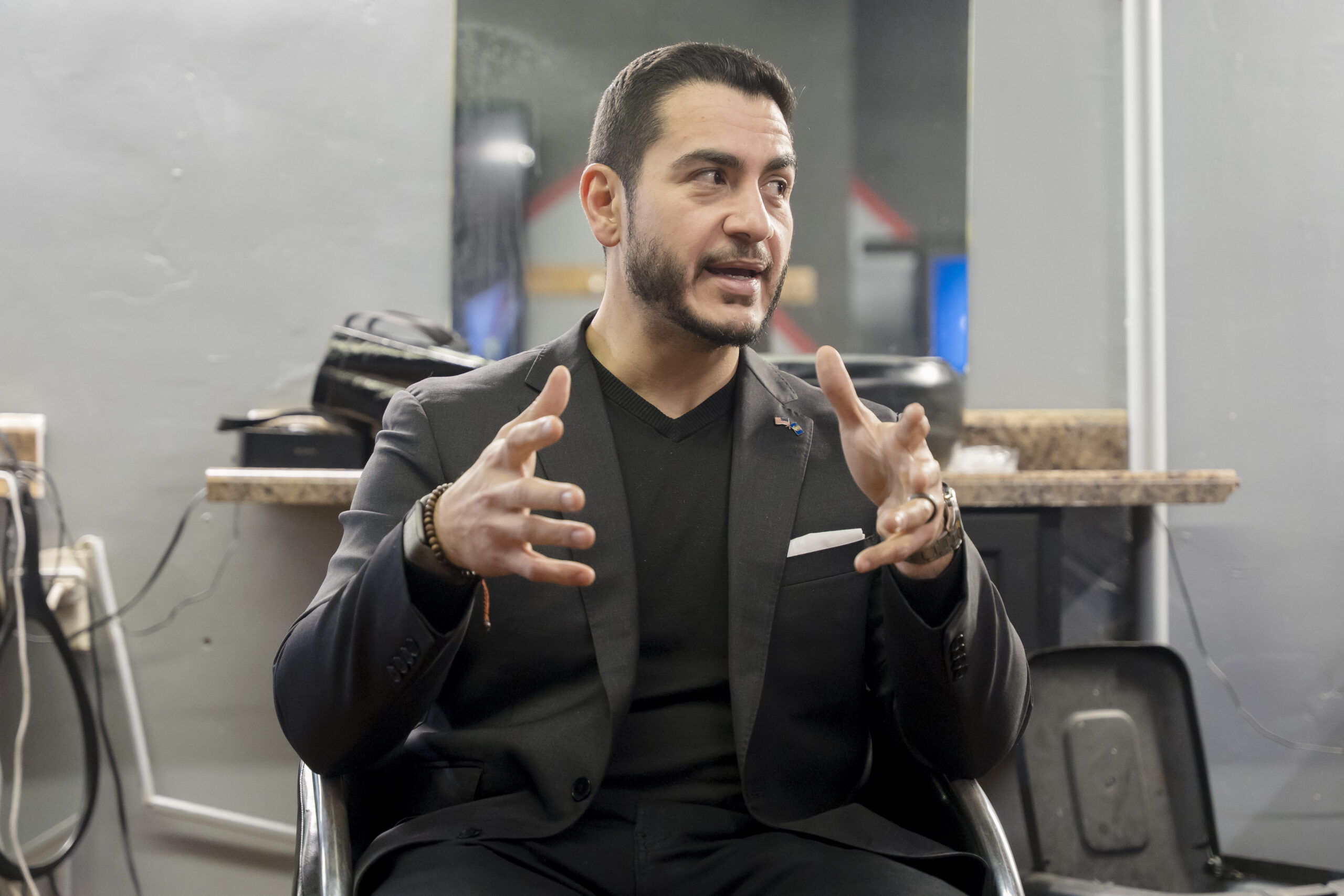
The Michigan Senate contender accepted $7k from the chair of Al-Awda/PRRC — and hired her son
Plus, half of young Americans view Israel as a burden
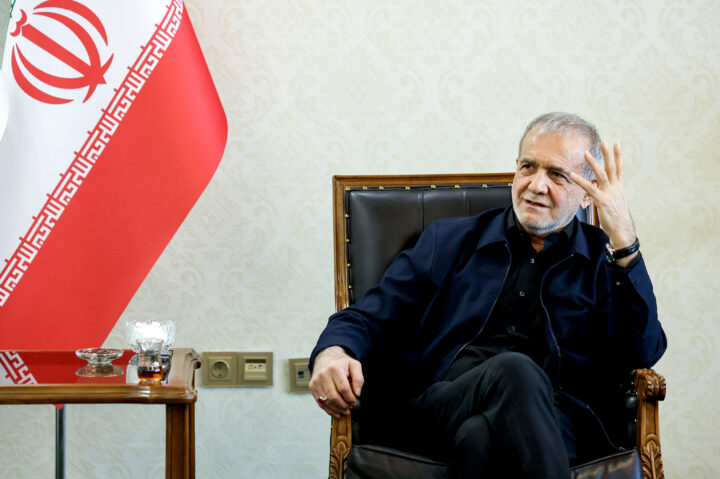
Iranian Presidency/Handout/Anadolu via Getty Images
Iranian President Masoud Pezeshkian delivers a speech on April 19, 2026.
This P.M. edition is reserved for our premium subscribers like you — offering a forward-focused read on what we’re tracking now and what’s coming next. Please don’t hesitate to share your thoughts and feedback by replying to this email.
📡On Our Radar
Notable developments and interesting tidbits we’re tracking
Talks between Israel and Lebanon, which are currently underway, were moved from the State Department to the White House. Vice President JD Vance and Secretary of State Marco Rubio were spotted arriving there together this afternoon, and a White House official told Jewish Insider that President Donald Trump would greet the participants at the opening of the discussion…
U.S. Ambassador to Israel Mike Huckabee, who returned to Washington in order to participate in the talks, also stopped by Capitol Hill where he met with Sen. Ted Cruz (R-TX)…
While the bombing campaign in Iran is on pause, the battle at sea continues: U.S. forces boarded another vessel carrying Iranian oil in the Indian Ocean this morning and Trump said he had ordered the U.S. Navy to “shoot and kill any boat” placing mines in the Strait of Hormuz — just as a third U.S. aircraft carrier arrived in the region…
Trump also said Iran is “having a very hard time figuring out who their leader is,” indicating the regime may still be struggling to present the U.S. with a unified proposal. “The infighting is between the ‘Hardliners,’ who have been losing BADLY on the battlefield, and the ‘Moderates,’ who are not very moderate at all (but gaining respect!),” he claimed.
In response, Iranian parliament Speaker Mohammad Bagher Ghalibaf and President Masoud Pezeshkian, both considered relative moderates, issued nearly identical statements on X pledging “complete obedience to the Supreme Leader”…
Iranian officials tell The New York Times their new supreme leader, Mojtaba Khamenei, is alive but injured, and so far ruling differently than his late father; the younger Khamenei is relying on Islamic Revolutionary Guards Corps commanders to provide him advice to make decisions “as though he is the director of the board.”
Khamenei’s injuries are extensive and he is largely inaccessible in person: “One leg was operated on three times, and he is awaiting a prosthetic. He had surgery on one hand and is slowly regaining function. His face and lips have been burned severely, making it difficult for him to speak, the officials said, adding that, eventually, he will need plastic surgery”…
U.S. officials are expressing concern over the military’s ability to defend Taiwan from China in the near future should the need arise, given that the U.S. has burned through more than 1,000 Tomahawk missiles and more than 1,500 air-defense missiles in the course of the war with Iran so far, supplies that could take up to six years to replace…
Israeli Foreign Minister Gideon Sa’ar named Israel’s first Christian ambassador, George Deek, as the country’s special envoy to the Christian world, JI’s Lahav Harkov reports, after several recent controversies in Israel relating to Christians. Deek is part of the Arab Orthodox Christian community in Jaffa…
Sen. Elissa Slotkin (D-MI) joined other Michigan Democrats in denouncing Amir Makled, a Democratic nominee for regent of the University of Michigan, over Makled’s past comments expressing antisemitic sentiments and support for terrorism.
“I’m going to have a problem with any candidate — Democrat, Republican or independent — who shares antisemitic and hateful posts on social media. Especially when they refuse to disavow those comments or show remorse,” Slotkin said in a statement to JI’s Marc Rod, in response to a question about Makled…
Defense Secretary Pete Hegseth did not give advance notice to senior Republican senators before announcing yesterday that he was firing Navy Secretary John Phelan, causing surprise and confusion on Capitol Hill. “I found out about it the way everybody else did,” Senate Majority Leader John Thune (R-SD) told JI’s Emily Jacobs and Marc Rod of the Pentagon’s announcement on social media of Phelan’s dismissal.
Trump praised Phelan in a post on Truth Social this afternoon and said he’d “certainly like to have him back within the Trump Administration sometime in the future” — Phelan had reportedly bumped heads with Hegseth but had a close relationship with the president…
Nearly half of young American adults view Israel as a burden to the United States, according to a new Harvard Youth Poll of 18- to 29-year-olds. The survey found that 46% of young Americans consider Israel to be mostly a burden to the U.S., compared to just 16% who say Israel is mostly a benefit, JI’s Gabby Deutch reports.
In addition, Ukraine, which has also received U.S. support in its lengthy war with Russia, was also determined to be more of a burden by young Americans — 31% of respondents said Ukraine is mostly a burden, while 21% said it is mostly a benefit…
The Wall Street Journal‘s Matthew Hennessey issued a defense of Elliot Kaufman, a member of the Journal‘s editorial board, after Trump slammed him on Truth Social as an “idiot” and a “moron.”
“What triggered the president’s ire was an op-ed under Mr. Kaufman’s byline headlined ‘The Iranians Take Trump for a Sucker.’ That’s a provocative title, yes, but the piece delivers on the provocation. Mr. Kaufman wasn’t calling Mr. Trump a sucker; he was merely pointing out that the Iranians are acting like they think he is one. The piece offers plenty of recent evidence to support that claim,” Hennessey wrote…
American journalist Shelly Kittleson details in The Atlantic her experience being kidnapped and held hostage by the Iran-backed Kataib Hezbollah terror group in Iraq for nine days earlier this month…
Former Disney CEO Bob Iger, who stepped down last month, is returning to Joshua Kushner’s venture firm, Thrive Capital, in an advisory role…
⏩ Tomorrow’s Agenda, Today
An early look at tomorrow’s storylines and schedule to keep you a step ahead
Keep an eye out in Jewish Insider for an interview with Rep. Tom Suozzi (D-NY) as he introduces a buffer zone bill in Congress, which follows legislation under consideration in New York and elsewhere, aiming to protect attendees at houses of worship.
Washington is abuzz ahead of the White House Correspondents’ Dinner, being held at the Washington Hilton on Saturday night. The event will be headlined by American Israeli mentalist Oz Pearlman and attended by Trump for his first time as president, alongside celebrities (including Trump fan Nicki Minaj), politicians and media figures. Politicos and reporters will schmooze at events beginning this evening through Sunday morning.
We’ll be back in your inbox with the Daily Overtime on Monday. Shabbat Shalom!
Stories You May Have Missed
SHAPIRO SPOTLIGHT
In an interview with JI, Shapiro said he ‘[hasn’t] really thought about’ whether he would appear on Hasan Piker’s stream but that he hasn’t been invited
DEFINITION DEBATE
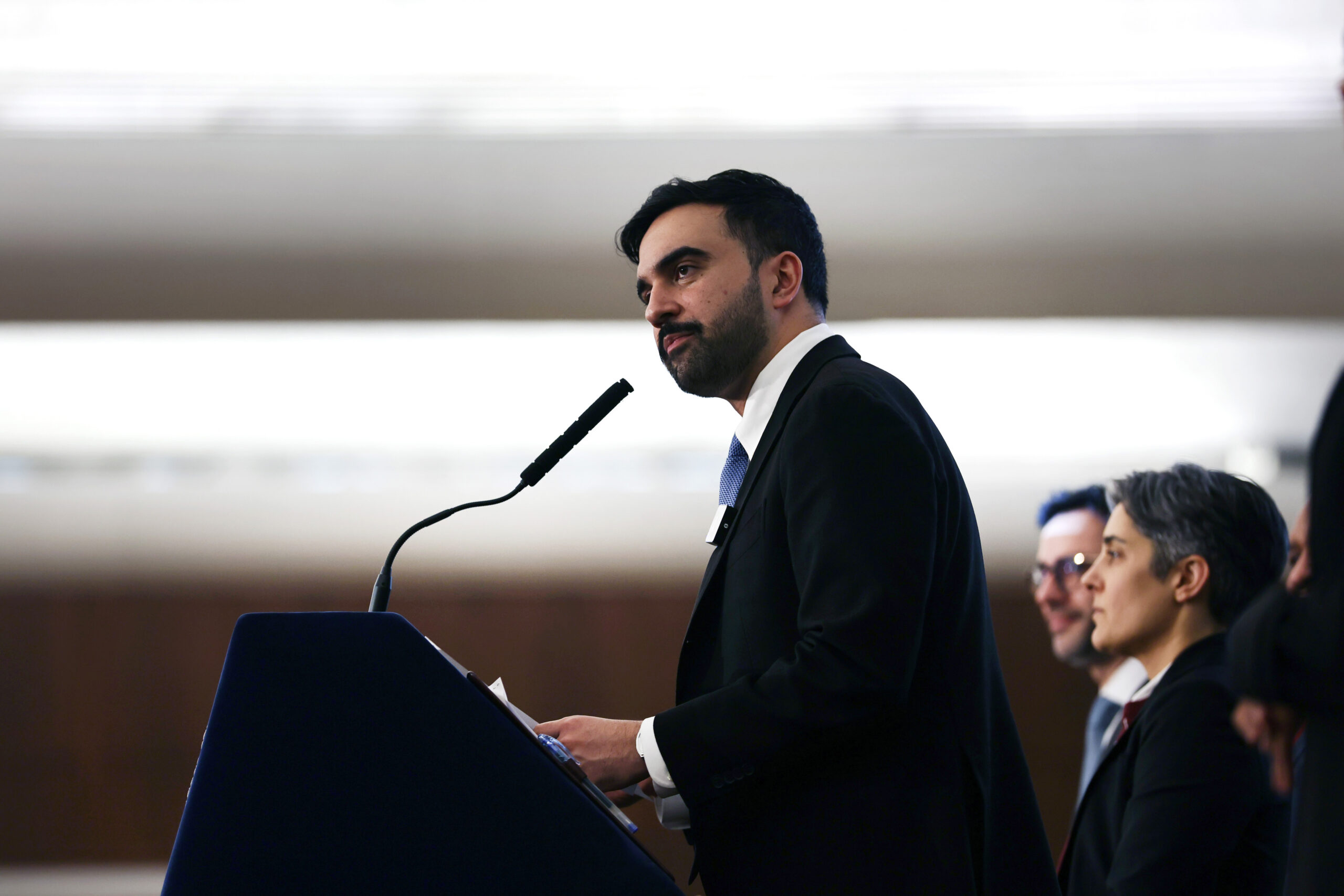
In testimony before the City Council’s antisemitism task force, an NYPD official said Mamdani played no role in a controversial change in reporting data from hate crimes
Plus, Dems concerned over fraying Israel-Europe ties

Gage Skidmore
Elizabeth Warren
This P.M. edition is reserved for our premium subscribers — offering a forward-focused read on what we’re tracking now and what’s coming next. Please don’t hesitate to share your thoughts and feedback by replying to this email.
📡On Our Radar
Notable developments and interesting tidbits we’re tracking
White House Press Secretary Karoline Leavitt maintained this afternoon that President Donald Trump is “generously offering a bit of flexibility” to Iranian leaders and has not given them a “firm deadline” to provide a proposal to the U.S., contrary to reports that said Trump only intended to wait a few days before ending the ceasefire that he extended yesterday.
Leavitt also said the president did not view Iran’s seizure of two ships near the Strait of Hormuz today as a violation of the ceasefire: “These were not U.S. ships. These were not Israeli ships,” she said — a change in tone for Trump, who has taken a hardline against Tehran’s escalatory actions in the key waterway.
Meanwhile, mediating countries are reportedly working to get Tehran and Washington back to the negotiating table, with a meeting possibly on Friday. Iranian President Masoud Pezeshkian said Iran “has welcomed dialogue and agreement and continues to do so,” but that “breach of commitments, blockade and threats are the main obstacles” to continuing talks…
Even as negotiations to end the war are still in flux, Trump thanked Iran for granting his request not to execute eight women who were reportedly due to be killed by the regime tonight, instead releasing four of them and holding the other four in jail for one month…
The Financial Times profiles Pakistani army chief Asim Munir as he emerges as an unexpected key mediator between the U.S. and Iran, utilizing his ties to Tehran’s security establishment — including the Islamic Revolutionary Guard Corps — and personal rapport with Trump to help secure a comprehensive deal…
Former Secretary of State Mike Pompeo is keeping the door open to a possible 2028 presidential run, saying “only the good Lord knows” what comes next as he continues to reestablish himself in the private sector and policy world after serving in the first Trump administration.
In a wide-ranging interview with Jewish Insider’s Emily Jacobs, Pompeo also praised Columbia University, where he now teaches at the School of International and Public Affairs, for “beg[inning] to get back the correct leadership … in a way where more voices can be heard”…
U.S. Ambassador to Turkey Tom Barrack stood by his comments that drew criticism over the weekend in which he repeatedly criticized Israel and praised Turkey, saying he was merely “stating the obvious.”
“When I described the Israel-Hezbollah ceasefire as a ‘time out’ and said that ‘everybody has been equally untrustworthy,’ I was simply stating the obvious reality on the ground. This is realism, not criticism of any side,” Barrack told Fox News Digital. He also reaffirmed his comments that the goal in Lebanon is “not killing Hezbollah,” and that Turkey should be readmitted to the F-35 fighter jet program…
A group of Jewish District of Columbia residents gathered at the city’s municipal building today for a scheduled meeting with Janeese Lewis George, a D.C. councilmember and one of the leading candidates in this year’s mayoral race, but she never showed, two people who were in the meeting told JI’s Gabby Deutch.
A staff member for Lewis George told attendees at the start of the meeting that she was having a busy morning, and they should begin the conversation without her. At the end of the meeting, when Lewis George still had not arrived, the staff member apologized that she could not attend…
New York City Council Speaker Julie Menin warned this morning that if Mayor Zohran Mamdani vetoes the council’s legislation intended to regulate protests at religious and educational sites, the city will face “more divisiveness,” calling the decision a critical test for the mayor, JI’s Haley Cohen reports.
Menin, New York City Comptroller Mark Levine and Manhattan Borough President Brad Hoylman-Sigal, speaking at 92NY on the future of Jewry in New York, beseeched the Jewish community not to flee despite tensions with the mayor. “This is not a time to lose hope. Hopefully the three of us here can embody the future of the commitment to fighting antisemitism, the commitment to supporting the Jewish community,” Menin said…
Rep. Tom Suozzi (D-NY) is set to introduce a federal buffer zone bill, similar to that of the New York City Council, alongside Anti-Defamation League CEO Jonathan Greenblatt on Friday, as Suozzi seeks reelection to his swing-district seat on Long Island…
Democratic lawmakers and strategists are expressing concern over the rising popularity of far-left Michigan Senate candidate Abdul El-Sayed, fearing that if he clinches the Democratic nomination, he would lose in a general election to former Rep. Mike Rogers (R-MI), the GOP front-runner, Semafor reports. Democrats must retain the Michigan Senate seat to have any hope of taking back the chamber in the midterm elections.
Rep. Hillary Scholten (D-MI), who is backing Rep. Haley Stevens (D-MI) in the race, told the outlet that “all three candidates are qualified, but dinged El-Sayed for campaigning with [Hasan] Piker and said ‘we are continuing to see consistent polling that suggests that Haley is the only one that can win in a general election’”…
Maine Senate candidate Graham Platner said he would not support keeping Senate Minority Leader Chuck Schumer (D-NY) as the party’s leader in the chamber, naming as potential replacements Sens. Chris Van Hollen (D-MD), Mark Kelly (D-AZ), Chris Murphy (D-CT) or Brian Schatz (D-HI). He also said he would oppose a ban on semiautomatic assault weapons, a priority policy for much of the Democratic caucus…
Sen. Elizabeth Warren (D-MA) dismissed criticism of Platner after campaigning with him in Maine last weekend: Asked on CNBC about her comment that Platner is “my kind of man” given his past incendiary rhetoric and actions including his Nazi chest tattoo, Warren said, “He has apologized, he’s out meeting with the people of Maine every single day so they can evaluate not who Graham Platner was but who Graham Platner is today.”
Warren sidestepped a question specifically about Platner’s 2014 praise of Hamas tactics during an attack on Israeli soldiers, as reported by JI: “You guys want to be the party of inclusivity, right?” host Sara Eisen asked regarding the report. “I want to be the party that stands up for hardworking people,” Warren answered…
Schumer dodged a question yesterday asking if he is on the wrong side of his party after most Democratic senators voted in favor of blocking arms sales to Israel — a measure he opposed. “Our caucus is united and focused on ending the war in Iran,” he said, and touted Democrats’ war powers resolutions before walking away…
Rep. David Scott (D-GA) died today at 80. Scott, who voted on the House floor last night, had been running for reelection for his 13th term…
⏩ Tomorrow’s Agenda, Today
An early look at tomorrow’s storylines and schedule to keep you a step ahead
Keep an eye out in Jewish Insider for the results of this afternoon’s war powers resolution vote in the Senate, which is expected to be blocked by Republicans as the previous four were.
Israeli Ambassador to the U.S. Yechiel Leiter and Lebanese Ambassador to the U.S. Nada Hamadeh will meet at the State Department tomorrow for the second round of direct talks between the two countries. Lebanon is reportedly seeking a one-month extension to the ongoing ceasefire, which is set to expire on Sunday; Hezbollah, which has said it is not bound by the agreement, has continued to fire rockets and a drone at Israeli troops in southern Lebanon.
Paramount Skydance CEO David Ellison will host an exclusive dinner honoring President Donald Trump and CBS News’ White House correspondents at the recently renamed Donald J. Trump Institute of Peace. Ellison is currently seeking regulatory approval of Paramount’s deal to acquire Warner Bros. Discovery.
The Jewish Democratic Council of America will host a candidate forum for New York’s 17th Congressional District featuring leading candidates Beth Davidson, a Rockland County legislator, and Cait Conley, a national security veteran.
Stories You May Have Missed
DEM DIVIDES
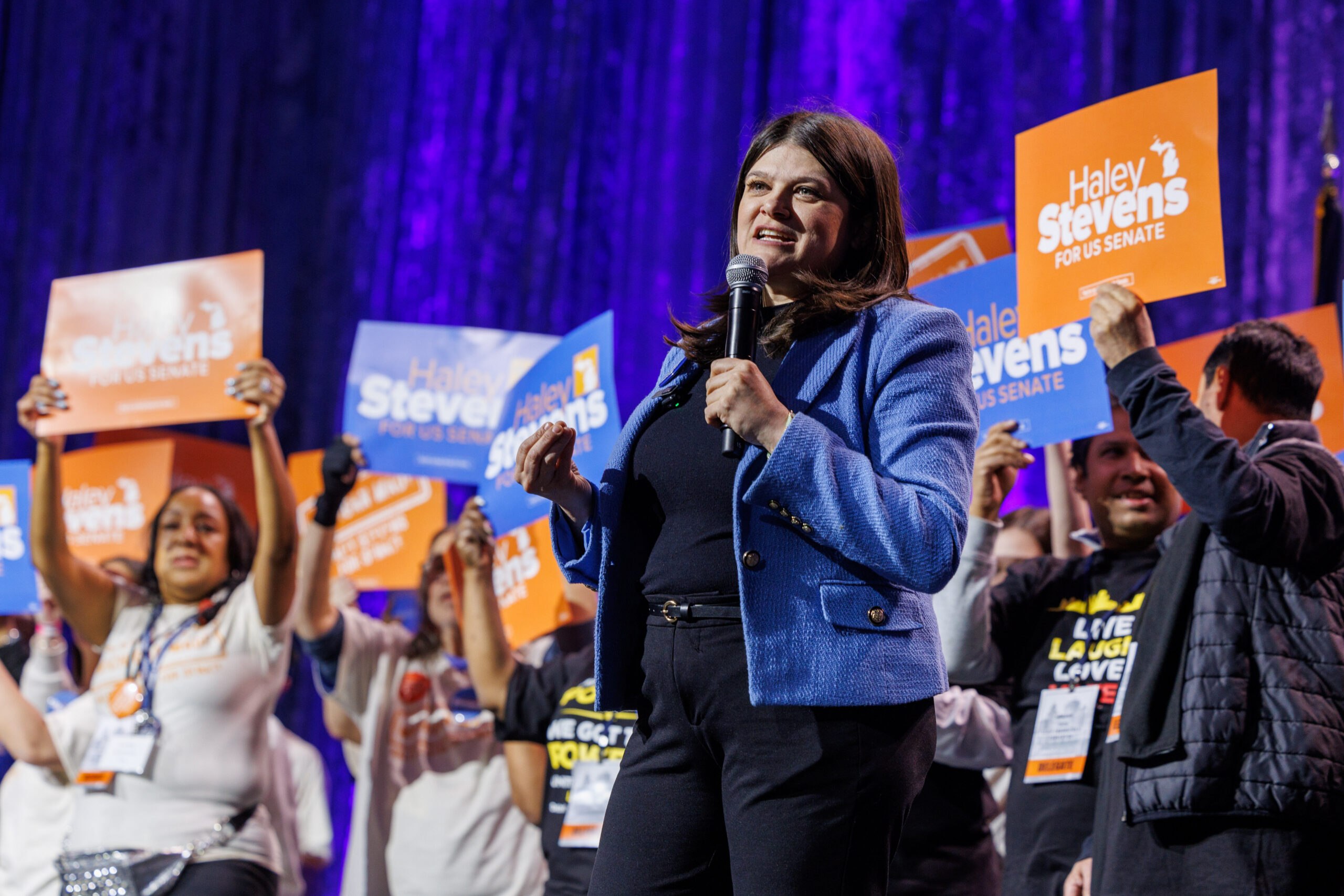
Jewish Democrats described a ‘shell-shocked’ atmosphere at their statewide convention that saw marked hostility to pro-Israel voices
CAMPAIGN CLASH
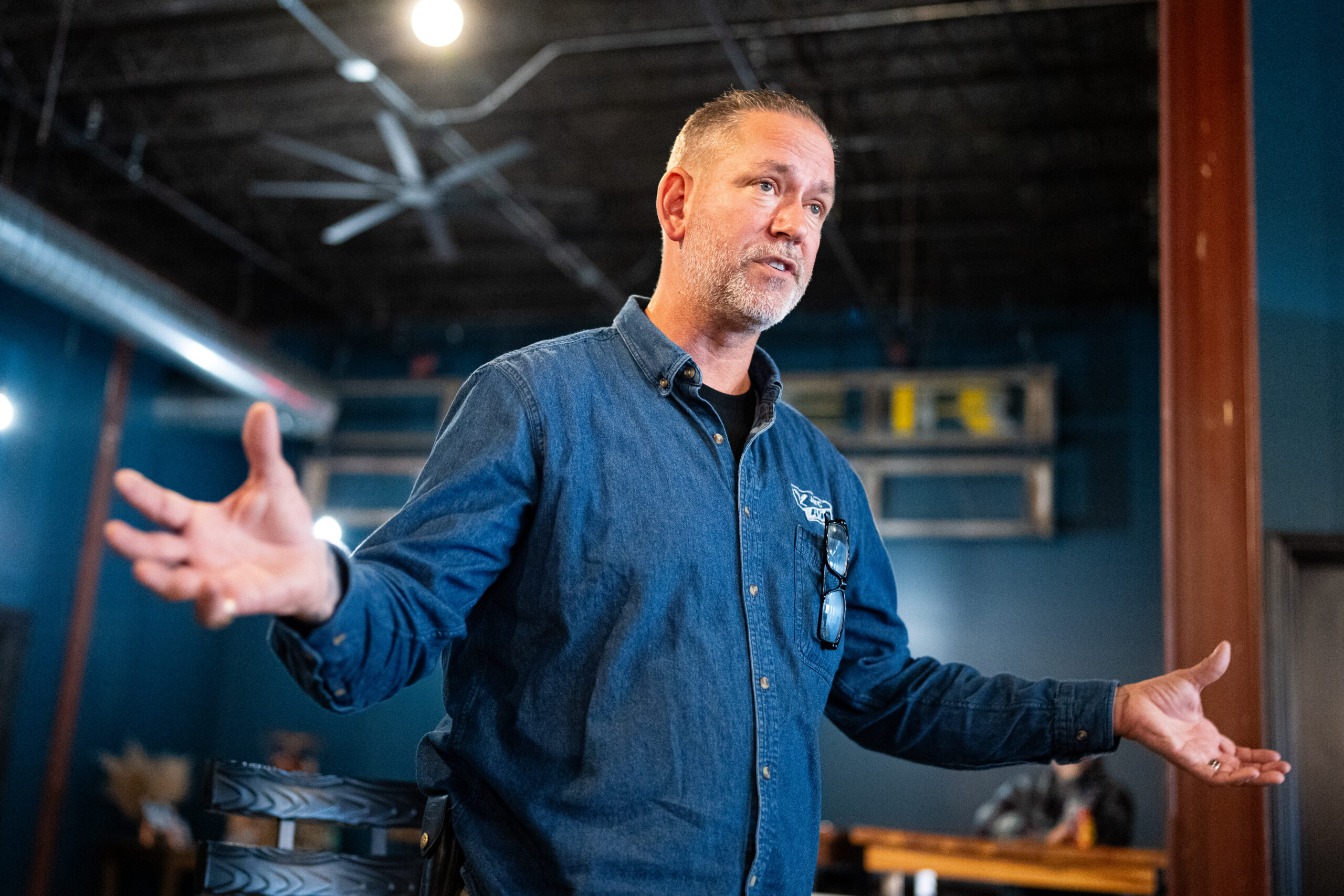
Daniel Moraff also recruited Rep. Summer Lee, a leading anti-Israel Democrat, to pursue her political career
‘We have to win in Michigan all up and down the ticket, and it's not helpful for people to be shouting down candidates who care deeply about the future of this country,’ Peters told JI
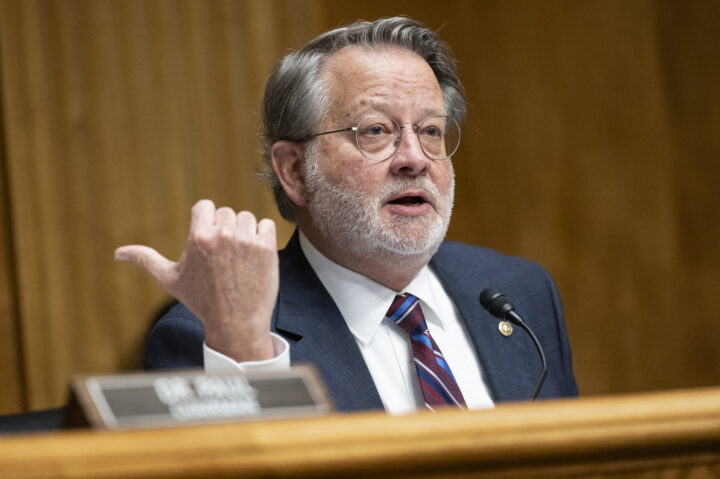
Luke Johnson/Getty Images
Sen. Gary Peters (D-MI) speaks in Dirksen Senate Office Building on April 15, 2026 in Washington, DC.
Sen. Gary Peters (D-MI) criticized divisive behavior by Democratic Party activists at the Michigan Democratic Party convention last weekend, where activists shouted down pro-Israel voices including Rep. Haley Stevens (D-MI) and a speaker supporting University of Michigan regent Jordan Acker. State Sen. Mallory McMorrow also faced some jeers.
“I was really disappointed by some of the behavior, by some folks who were just so negative to Democratic candidates,” Peters told Jewish Insider in a brief interview on Tuesday. “The way we win elections is when we are all united and I would hope that everyone would realize that the most important election for Democrats is going to be in November.”
Peters served for two election cycles as the chair of the Democratic Senatorial Campaign Committee, working to boost Democrats in swing states. He is retiring at the end of this term.
“We have to win in Michigan all up and down the ticket, and it’s not helpful for people to be shouting down candidates who care deeply about the future of this country,” he continued.
He follows Rep. Kristen McDonald Rivet (D-MI) in condemning the behavior of activists at last weekend’s convention.
Stevens said that by associating with Piker, El-Sayed is ‘choosing to campaign with someone who has a history of antisemitic rhetoric’
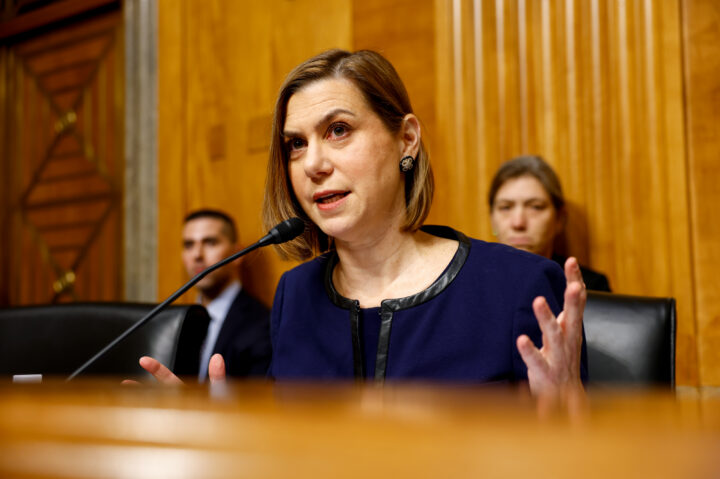
Kent Nishimura/Bloomberg via Getty Images
Senator Elissa Slotkin (D-MI) during a Senate Homeland Security and Governmental Affairs Committee confirmation hearing in Washington, DC, on March 18, 2026.
Michigan Senate candidate Abdul El-Sayed is facing criticism from some prominent Michigan Democrats — including Sen. Elissa Slotkin (D-MI) and Rep. Haley Stevens (D-MI), who is running against him in the Democratic primary — for his decision to host campaign rallies with Hasan Piker, the far-left political streamer with a history of antisemitic remarks.
“That’s the exact opposite of someone I’d be campaigning with,” Stevens told Jewish Insider on Wednesday. “We have to be serious here about who’s going to be the best general election candidate for U.S. Senate in Michigan to beat [Republican] Mike Rogers, and someone who’s campaigning with someone like that is not going to win in Michigan.”
El-Sayed will host two rallies with Piker and Rep. Summer Lee (D-PA) at the University of Michigan and Michigan State University on April 7.
Piker has millions of followers on the streaming platform Twitch. He has said that “Hamas is a thousand times better” than Israel, and has described Orthodox Jews as “inbred.” He has also praised terrorists and said America deserved 9/11.
Stevens said that by associating with Piker, El-Sayed is “choosing to campaign with someone who has a history of antisemitic rhetoric.”
Slotkin told JI that she is not familiar with much of Piker’s language but that what she knows of his rhetoric raises concerns for her.
“Any equating of all Jews or American Jews with Israel and the Israeli government is a problem right off the bat, and then it sounds like, from there, a cascading set of antisemitic tropes and just the kind of rhetoric that is — I want to read for myself, but sounds deeply antisemitic, consistently, and therefore not someone that should be helping anybody out in the Michigan political environment,” said Slotkin.
The announcement of Piker’s upcoming campaign visits to Michigan comes two weeks after an attempted terrorist attack at Temple Israel, a Reform synagogue in West Bloomfield Township, Mich.
A new poll conducted by the campaign of Michigan state Sen. Mallory McMorrow, the third major Democrat running alongside Stevens and Piker, shows McMorrow leading the race with 30%. El-Sayed is behind her at 25%, and Stevens follows at 23%, with 21% undecided. Other polling ahead of the August primary has shown Stevens with a small lead.
Stevens, who is running as the mainstream Democrat in the race, welcomed support this week from the group Democratic Majority for Israel
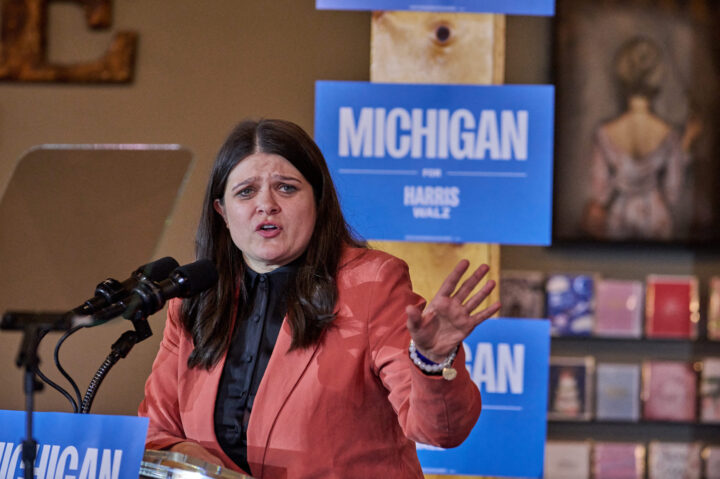
DOMINIC GWINN/Middle East Images/AFP via Getty Images
Michigan Rep. Haley Stevens speaks at a rally featuring First Lady Dr. Jill Biden during a 2024 campaign event supporting Vice President Kamala Harris in Clawson, MI, during the 2024 presidential election, Monday, Oct. 14, 2024.
As two Democratic Michigan Senate candidates compete for the votes of anti-Israel voters with accusations of genocide against the Jewish state, Abdul El-Sayed, is going after state Sen. Mallory McMorrow, as insufficiently and inauthentically critical of Israel.
Rep. Haley Stevens (D-MI), meanwhile, is solidifying her support for Israel, receiving an endorsement this week from Democratic Majority for Israel and calling herself a “proud pro-Israel Democrat [who] believe[s] America is stronger when we stand with our democratic allies, confront antisemitism and extremism, and keep our promises to our friends abroad and our working families here at home.”
With significant Arab and Muslim and Jewish constituencies, Israel policy issues are poised to play a significant role in Michigan’s Democratic primary next year.
El-Sayed entered the race as a vocal critic of Israel, while McMorrow, in recent months, has joined him in describing the war in Gaza as a genocide, as well as saying she would support efforts to cut off offensive weapons shipments to Israel.
El-Sayed, in a recent event at Michigan State University, criticized McMorrow for not taking that position sooner, describing allegations of genocide in Gaza as a matter of clear and incontrovertible fact. Video of the comments was published by the Michigan Advance.
He compared McMorrow’s position to someone taking months to decide that the sky is blue and saying, “let me give you five caveats about why it might not be blue.”
El-Sayed also suggested that McMorrow’s positions changed because she was seeking support from AIPAC, and only took a more critical stance on Israel after the group declined to support her. The far-left publication Drop Site alleged that McMorrow had been seeking an AIPAC endorsement earlier in the year and had authored a pro-Israel position paper.
McMorrow’s campaign has denied that she completed a questionnaire for AIPAC and McMorrow said last month she would not accept the group’s support. AIPAC has previously endorsed Rep. Haley Stevens (D-MI), who has maintained her position on Israel, in House races, but has not weighed in on the Senate race.
“When there’s 20,000 kids who died, that’s a genocide,” El-Sayed said in his remarks at Michigan State. “When people who are from the very country that committed — whose government committed that genocide say it’s a genocide, at some point you kind of just gotta be like, ‘Oh it’s a f***ing genocide.’ … “I don’t pretend that when 20,000 babies are murdered by our tax dollars, that there’s hemming and hawing about saying because it’s the truth.” El-Sayed was referring to numbers from the Hamas-run Ministry of Health indicating that almost 20,000 children and teenagers were killed in the war.
He suggested that McMorrow is trying to “package” herself as a progressive changemaker while the “substance” of her policies is “the same old politics.”
Asked last month whether the war in Gaza is a genocide, McMorrow said that it is.
“We have [Israeli Prime Minister] Benjamin Netanyahu trying to tell us what we’ve been seeing with our own eyes is not true,” McMorrow said. “It is true. And two things can be true at once. … The position of the United States should not be that we support Netanyahu with no check and balances.”
Asked about El-Sayed’s criticisms, McMorrow’s campaign referred Jewish Insider to those remarks.
The pro-Israel Democratic group also backed Chris Pappas and Roy Cooper in their battleground Senate races

Carlos Osorio/AP
Rep. Haley Stevens (D-MI) speaks Tuesday, Aug. 2, 2022, at an election night party in Birmingham, Mich.
Democratic Majority for Israel on Thursday announced its endorsements of Reps. Haley Stevens (D-MI), Angie Craig (D-MN) and Chris Pappas (D-NH) and former Gov. Roy Cooper as they seek the Senate seats in their respective states.
Stevens faces a particularly competitive primary against state Sen. Mallory McMorrow and former Wayne County health director Abdul El-Sayed, both of whom have sided with the far left on Israel issues and publicly rejected pro-Israel backing. El-Sayed has attacked Stevens over her pro-Israel stance.
DMFI’s endorsement marks the first formal involvement by a pro-Israel group in the race. AIPAC’s PAC and super PAC, which have previously provided significant support for Stevens, have not yet issued an endorsement.
Craig, another moderate pro-Israel Democrat, also faces a left-wing opponent critical of Israel in Lt. Gov. Peggy Flanangan. Cooper and Pappas, both moderates who have been supportive of Israel, are seen as the clear frontrunners in their primaries.
“Chris Pappas, Haley Stevens, Angie Craig, and Roy Cooper are battle-tested leaders who know how to win tough races, hold the Trump administration accountable, and deliver real results for working families. They’ve stood firm against extremism, antisemitism, and efforts to undermine America’s alliances,” DMFI PAC Chair Brian Romick said in a statement.
“Each is a champion of the U.S.-Israel relationship and a clear-eyed advocate for Israel’s security and the region’s long-term stability.”
“DMFI PAC is proud to support these exceptional candidates, and we’re firmly committed to helping them win their races,” he added.
Stevens, in a statement thanked DMFI for its support.
“I’m honored to have DMFI PAC’s endorsement in this race. As a proud pro-Israel Democrat, I believe America is stronger when we stand with our democratic allies, confront antisemitism and extremism, and keep our promises to our friends abroad and our working families here at home,” Stevens said in a statement. “In the Senate, I’ll keep fighting to protect our democracy, support Israel’s security, ensure the ceasefire holds in Gaza, and deliver for Michiganders in every corner of our state.”
Mallory McMorrow, Haley Stevens and Mike Rogers condemned the attack; Abdul El-Sayed didn’t respond

JEFF KOWALSKY/AFP via Getty Images
Anti-Israel demonstrators set up a mock trial against the University of Michigan's Board of Regents on the university's campus in Ann Arbor, Michigan, on April 21, 2025.
Two of the leading Democratic hopefuls looking to replace retiring Sen. Gary Peters (D-MI) condemned anti-Israel protesters for harassing University of Michigan Regent Sarah Hubbard over the weekend.
Protesters could be heard in video of the incident, which began circulating on social media on Sunday evening, shouting at Hubbard that she had “blood on [her] hands” along with other insults as she was guided away by a uniformed police officer. “Your money has gone to kill Palestinian children. Your money has killed our families. We are your students, you answer to us,” one protester shouted as they filmed Hubbard.
In response, Hubbard wrote on X that, “I remain steadfast in my commitment to make our campus a safe place for all our students and will not be intimidated by protestors.”
The incident prompted quick statements of condemnation from Rep. Haley Stevens (D-MI) and state Sen. Mallory McMorrow, two of the Democratic Senate candidates looking to replace Peters. Abdul El-Sayed, a Bernie Sanders-endorsed progressive candidate, did not issue a statement and did not respond to Jewish Insider’s request for comment.
“The harassment and antisemitism we’ve seen against University of Michigan regents in recent months is wrong, plain and simple. Regent Hubbard should be able to walk to her car without a police escort. And Regent [Jordan] Acker’s family was terrorized in their own home when vandals threw jars of urine through their windows and spray painted graffiti on their car,” McMorrow told JI in a statement.
“The attacks and intimidation need to stop now,” McMorrow, who launched her campaign earlier this month, added.
A spokesperson for Rep. Haley Stevens (D-MI), who announced her candidacy on Tuesday, told JI in a statement, “Rep. Stevens has been clear that violence and vandalism have no place in our communities and will continue to make sure all Michiganders are safe in their daily lives.”
Former Rep. Mike Rogers (R-MI), who is also running to replace Peters, similarly denounced the harassment in a statement.
“These activists’ criminal actions toward university leaders at their homes cannot be tolerated. I stand with Sarah Hubbard and the Michigan Regents as they continue to stand up to hate and antisemitism in their efforts to make the campus safe for all students,” Rogers told JI.
Jewish Insider’s senior congressional correspondent Marc Rod contributed to this report.
Stevens is hoping to parlay her record in tough races and pro-Israel record in Congress into broad support in a crowded field

Sarah Rice/Getty Images
Rep. Haley Stevens (D-MI) speaks before Michigan Gov. Gretchen Whitmer at a rally at the Crofoot Ballroom on November 6, 2022 in Pontiac, Michigan.
Rep. Haley Stevens (D-MI) announced on Tuesday morning that she’s entering the Democratic primary for Michigan’s open Senate seat, setting up an intraparty showdown in one of the most consequential battleground states in the country.
Stevens is a leading contender for the seat of retiring Sen. Gary Peters (D-MI). She will be facing state Sen. Mallory McMorrow and Abdul El-Sayed, who led the Wayne County Department of Health, Human and Veterans Services. Former Michigan House Speaker Joe Tate, a former NFL player, is also seriously considering a run.
Stevens represents a district in the Detroit suburbs and has made supporting local manufacturing a centerpiece of her time in Congress, as well as her work in the Obama administration in supporting the auto industry recovery.
That work took center stage in Stevens’ campaign announcement video, where she also attacked President Donald Trump, accusing him of endangering Michigan jobs and driving up prices with tariffs and other policies.
“I remember being handed the keys to my first car. I’m Haley Stevens and I bet you do too,” Stevens said in her launch video, which prominently features footage of Michigan factories. “That used Oldsmobile Cutlass Supreme, it meant more to me than just freedom. It meant I had a piece of Michigan. You know, the Michigan that helped build this country. The Michigan that shaped me. It’s not just what I sound like, it’s who I am.”
In a statement, Stevens’ campaign also went after White House advisor Elon Musk, accusing him and Trump of undermining essential services and endangering citizens’ private data.
Stevens is a favorite within the state’s Jewish community for her outspoken support for Israel and condemnation of high-profile antisemitic incidents at a time when many Michigan Democrats have pandered to anti-Israel activists.
She represents a sizable Jewish community in the Detroit suburbs with which she forged a strong relationship in part during her successful primary campaign against then-Rep. Andy Levin (D-MI).
But pro-Israel groups also view McMorrow as a reliable ally, and are more concerned with blocking the candidacy of El-Sayed, a Bernie Sanders-endorsed progressive who supports cutting off aid to Israel.
Because of that dynamic, outside pro-Israel groups may not formally endorse a favorite in the Democratic primary — even as Stevens will likely benefit from widespread support from Jewish voters in the early stage of the campaign.
AIPAC and the affiliated United Democracy Project super PAC have been rumored to be planning to spend in support of Stevens despite not usually intervening in statewide races.
“Although we have not yet made a decision in this race, Rep. Stevens has emerged as a pro-Israel stalwart during her tenure in the House of Representatives,” AIPAC spokesperson Marshall Wittmann told Jewish Insider.
Stevens also boasts an electoral record that demonstrates she can win over swing voters — her district was a battleground when she was first elected in 2018 before redistricting made it more safely Democratic — along with ousting Levin, an anti-Israel Democratic incumbent, in a member-on-member primary.
McMorrow has demonstrated a knack for earning glowing national media attention — at first through a state Senate speech in which she pushed back against accusations against her by a GOP colleague of grooming and sexualizing children and her outspoken support for abortion rights after Roe v. Wade was overturned — even though she’s only been serving as a state senator in Michigan.
In a sign of McMorrow’s attentiveness to the Jewish community, she’s returned policy papers to at least one Democratic pro-Israel group underscoring her support for Israel’s security, according to a source familiar with her outreach. She also has personal ties to the Jewish community — while she’s Catholic, her husband is Jewish and they are raising their children in a mixed-faith home.
One of McMorrow’s top advisors is Lis Smith, who engineered Pete Buttigieg’s out-of-nowhere 2020 presidential campaign and who has been a prominent critic of the party’s left-wing activist class.
Adrian Hemond, a Michigan political strategist, told JI he views Stevens as holding significant institutional advantages in the hotly-contested primary.
Hemond noted that Stevens has been a strong fundraiser in her congressional seat and has proven her ability to win close elections, which Hemond said will be “paramount” to Democratic primary voters. Stevens also boasts a strong relationship with organized labor and Black voters in her district, Hemond added.
He acknowledged that McMorrow is “trying to position herself as somewhat more moderate” but argued that her base and brand remains strongest among progressives — and El-Sayed, with Sanders’ endorsement, is playing in the left-wing lane.
Hemond said that El-Sayed did not prove to be a strong fundraiser in his 2018 gubernatorial race and failed to build support statewide, only winning 30% of the vote in the primary contest. But he’s well-positioned to do well with Arab-American voters in the state, and other single-issue, anti-Israel voters.
On the Republican side, former Rep. Mike Rogers (R-MI) has already declared his second run for the seat after losing by less than 20,000 votes to Sen. Elissa Slotkin (D-MI) in 2024. He won Trump’s endorsement, giving him a critical edge against any potential GOP challengers.
Jordan Acker's law office in Southfield vandalized: 'I believe this was a message to be sent to the Jewish community'

Courtesy Jordan Acker
Vandals scrawled antisemitic and anti-Israel messages early Monday morning at the law office of University of Michigan regent Jordan Acker in Southfield, a heavily Jewish suburb of Detroit.
The exterior of University of Michigan Board of Regents member Jordan Acker’s law office was vandalized overnight on Monday with the phrases “FREE PALESTINE,” “DIVEST NOW,” “FUCK YOU ACKER” and “UM KILLS” scrawled on the walls, walkway and front window. The incident is the second time during the Israel-Hamas war that Acker, who is Jewish, has been targeted by anti-Israel demonstrators.
“It’s a disgusting escalation and pure antisemitism,” Acker, who is a former Obama administration official and has sat on the school’s Board of Regents since 2018, told Jewish Insider. “This has nothing to do with Palestine. I am one of eight [regents] and I was the only person targeted. I believe that’s because I’m Jewish. I believe this was a message to be sent to the Jewish community.”
According to video footage obtained by the Goodman Acker personal injury law firm, which is located in a heavily Orthodox Jewish neighborhood of Southfield — about 30 minutes away from the University of Michigan campus in Ann Arbor — the incident occurred at approximately 2 a.m. when four masked individuals splattered the front walkway, the sign over the door and the building’s walls with red and black spray paint and the antisemitic and anti-Israel messages.
Southfield police told local newspaper Deadline Detroit that the department responded to a 911 call Monday morning and is investigating the matter. “The investigation is in its infancy,” Lt. Mo Bzeih said. “We want to gather the preliminary facts before we put out a statement. We’re canvassing the area.”
“The vandalism that occurred at Regent Jordan Acker’s place of business is shocking and unacceptable,” University of Michigan’s president, Santa Ono, said in a statement. “Singling out this dedicated public servant and defacing his workplace in the middle of the night is an act of antisemitic cowardice that Southfield police have indicated is being investigated as a hate crime. Such harassment and attempts to intimidate have no place in a civil society and certainly no place in our university community.”
Many Michigan lawmakers and candidates for office expressed support for Acker and condemned the incident. Republican Senate candidate and former Rep. Mike Rogers (R-MI) tagged the incident as antisemitic, while his Democratic opponent, Rep. Elissa Slotkin (D-MI) called it “intimidation related to the Middle East conflict.”
“We have yet another instance of the use of intimidation related to the Middle East conflict. If your ‘protest’ tactics include vandalism and violent language, you’re not protesting — you’re breaking the law and discrediting your cause at the same time,” Slotkin said in a statement. “And anyone carrying that out should be held legally accountable.”
Rep. Debbie Dingell (D-MI) said in a statement to JI, “Vandalism and acts of violence and hate against anyone for any reason are completely unacceptable. I condemn these actions in the strongest terms. Hate is being normalized in too many communities, and we must stand up to hate wherever and whenever we see it.”
Rep. Haley Stevens (D-MI) wrote on X, “Jordan Acker and the Goodman Acker law firm have my love and support… so many drive by his place of work every day and it’s painful to see this attack on a place of business. Today and everyday, I denounce Jewish hate with every fiber in my being.”
Sen. Gary Peters (D-MI) told JI in a statement, “I condemn today’s antisemitic attack on University of Michigan Regent Jordan Acker’s Office in Southfield. While everyone has a right to express their views, there is absolutely no place for vandalism or violent rhetoric of any kind of in our state. It’s up to all of us to call out these attacks targeting Michiganders for who they are or their religion.”
Last month, as Acker, his wife and three daughters were asleep, his doorbell app obtained footage of a stranger wearing a red keffiyeh over his face walking up to the family’s front door. He stood there for several moments, placed papers on the door and took photographs before leaving. The incident occurred in the wake of University of Michigan police breaking up an anti-Israel illegal encampment on the Diag, the main quad, that engulfed the campus for nearly a month. One of the papers, a list of demands for the leadership of the University of Michigan, was signed: “In liberation, the UMich Gaza Solidarity Encampment.”
Jewish Insider congressional correspondent Emily Jacobs and senior national correspondent Gabby Deutch contributed reporting.
Bipartisan letter argued that not removing the presidents from their positions would constitute an ‘endorsement’ and ‘act of complicity’ in the presidents’ ‘antisemitic posture’

Kevin Dietsch/Getty Images
Claudine Gay, president of Harvard University and Liz Magill, president of University of Pennsylvania, testify before the House Education and Workforce Committee at the Rayburn House Office Building on December 05, 2023, in Washington, D.C.
Seventy-four House lawmakers wrote to the boards of Harvard, the Massachusetts Institute of Technology and the University of Pennsylvania on Friday demanding that they immediately fire their presidents in response to widely criticized congressional testimony they delivered on antisemitism on their campuses earlier this week.
The presidents of the three schools have come under increasing scrutiny this week amid growing speculation that their jobs could be on the line following their refusal to say earlier this week that calls for Jewish genocide would violate their schools’ codes of conduct.
“Testimony provided by presidents of your institutions showed a complete absence of moral clarity and illuminated the problematic double standards and dehumanization of the Jewish communities that your university presidents enabled,” the letter reads. “Given this moment of crisis, we demand that your boards immediately remove each of these presidents from their positions and that you provide an actionable plan” to ensure the safety of the Jewish community on campus.
“Anything less,” than the steps they requested, the lawmakers continued, “will be seen as your endorsement… and an act of complicity in their antisemitic posture.”
The letter was led by Rep. Elise Stefanik (R-NY), who questioned the presidents on the genocide issue, and Rep. Jared Moskowitz (D-FL). Rep. Josh Gottheimer (D-NJ) is the only other Democrat who signed the letter; the rest are Republicans.
The lawmakers said that the testimony makes it “hard to imagine” any Jewish or Israeli person feeling safe on their campuses when the presidents “could not say that calls for the genocide of Jews would have clear consequences on your campus.”
It adds that subsequent social media statements seeking to clarify or walk back those comments “offered little clarification on your campus’ true commitment to protecting vulnerable students in this moment of crisis,” describing them instead as “desperate attempts to try and save their jobs” and “too little too late.”
Shortly before the Stefanik-Moskowitz letter was released, a group of thirteen House Democrats wrote to the boards of the three schools urging them to re-examine their codes of conduct to make clear that calls for the genocide of Jews are not acceptable.
This second letter, led by Reps. Kathy Manning (D-NC), Jake Auchincloss (D-MA) and Susan Wild (D-PA), includes similar language to the bipartisan letter regarding the presidents’ testimony and how it would make Jewish campus members feel unsafe, but stops short of directly calling for the presidents to be fired.
The lawmakers wrote that they felt “compelled to ask” if the presidents’ responses “align with the values and policies of your respective institutions.”
“The presidents’ unwillingness to answer questions clearly or fully acknowledge appalling and unacceptable behavior — behavior that would not have been tolerated against other groups — illuminated the problematic double standards and dehumanization of the Jewish communities at your universities,” the letter continues. “The lack of moral clarity these presidents displayed is simply unacceptable.”
The lawmakers requested that the schools update their policies to “ensure that they protect students from hate” and describe their plans for protecting Jewish and Israeli community members.
“There is no context in which calls for the genocide of Jews is acceptable rhetoric,” the letter reads. “While Harvard and Penn subsequently issued clarifying statements which were appreciated, their failure to unequivocally condemn calls for the systematic murder of Jews during the public hearing is deeply alarming and stands in stark contrast to the principles we expect leaders of top academic institutions to uphold.”
The letter notes that federal civil rights law prohibits discrimination against Jews on campus, and that criminal law bans hate crimes, violence and incitement to violence.
“Students and faculty who threaten, harass, or incite violence towards Jews must be held accountable for their actions,” the lawmakers wrote. “If calls for genocide of the Jewish people are not in violation of your universities’ policies, then it is time for you to reexamine your policies and codes of conduct.”
Signatories to the Democratic letter include Manning, Wild, Auchincloss, Debbie Wasserman Schultz (D-FL), Lois Frankel (D-FL), Haley Stevens (D-MI), Greg Landsman (D-OH), Grace Meng (D-NY), Brad Schneider (D-IL), Dan Goldman (D-NY), Donald Norcross (D-NJ), Jerry Nadler (D-NY) and Elissa Slotkin (D-MI).
All of the signatories to the Democratic letter are either Jewish or deeply involved with Jewish community issues on the Hill.
Earlier this week, a third letter by six House Republicans from Pennsylvania — Reps. Guy Reschenthaler (R-PA), alongside Congressmen John Joyce, M.D. (R-PA), Mike Kelly (R-PA), Lloyd Smucker (R-PA), Brian Fitzpatrick (R-PA), and Dan Meuser (R-PA) — called for University of Pennsylvania President Liz Magill specifically to be fired.
Rep. Ritchie Torres, their Democratic House colleague, called the lawmakers’ views ‘repulsive’ and ‘reprehensible’

Tom Williams/CQ-Roll Call, Inc via Getty Images
Rep. Rashida Tlaib (D-MI) attends the House Financial Services Committee on Wednesday, March 29, 2023.
Reps. Rashida Tlaib (D-MI) and Cori Bush (D-MO) blamed U.S. military aid to Israel for contributing to the massive Hamas terror attack on Israel yesterday, which has left more than 700 Israelis dead. Tlaib also described Hamas’ actions as “resistance” to Israeli “apartheid.”
The comments come as most U.S. lawmakers have offered strong support to Israel in the conflict, without many of the typical calls for cease-fires and de-escalation by both sides in the hours following the onset of the attack. The exception to this has been members of the far-left Squad and a handful of other lawmakers aligned with them.
“I am determined as ever to fight for a just future where everyone can live in peace, without fear and with true freedom, equal rights, and human dignity,” Tlaib said in a statement on Sunday. “The path to that future must include lifting the blockade, ending the occupation and dismantling the apartheid system that creates the suffocating, dehumanizing conditions that can lead to resistance.”
Tlaib added that “as long as our country provides billions in unconditional funding to support the apartheid government, this heartbreaking cycle of violence will continue.”
Bush, in a similar statement on Saturday, said she was “heartbroken” by the violence and loss of life, “following attacks by Hamas militants on Israeli border towns and Israeli military bombardment of Gaza.”
“As part of achieving a just and lasting peace, we must do our part to stop this violence and trauma by ending U.S. government support for Israeli military occupation and apartheid,” Bush continued.
Rep. Ritchie Torres (D-NY) condemned the comments by his colleagues.
“U.S. aid to Israel is and should be unconditional, and never more so than in this moment of critical need,” Torres told Jewish Insider in a statement. “Shame on anyone who glorifies as ‘resistance’ the largest single-day mass murder of Jews since the Holocaust. It is reprehensible and repulsive.”
Rep. Josh Gottheimer (D-NJ) highlighted the barbarism committed by Hamas terrorists in his own response.
“Two of my colleagues called for America to end assistance to Israel, despite the countless images of Israeli children, women, men, and elderly, including Americans, murdered by radical Iranian-backed Hamas terrorists,” Gottheimer told JI. “It sickens me that while Israelis clean the blood of their family members shot in their homes, they believe Congress should strip U.S. funding to our democratic ally and allow innocent civilians to suffer.”
Rep. Haley Stevens (D-MI), who serves in the Michigan delegation with Tlaib, distanced herself from Tlaib’s comments in a statement to JI.
“We must continue to come together as a Congress and a country to disavow terrorism and support the Jewish state, our democratic ally, Israel,” Stevens said. “Israel has a right to exist and defend herself.”
None of the other Democratic members of Michigan’s House delegation responded to requests for comment.
Israeli Ambassador to the U.S. Michael Herzog responded directly to Tlaib, in an impassioned statement on X, formerly known as Twitter.
“How much more blood needs to be spilled for you to overcome your prejudice and unequivocally condemn Hamas, a U.S.-designated terror organization?” Herzog wrote. “Hundreds of innocent Israeli civilians massacred in cold blood on a holy day. Babies kidnapped from their mother’s arms and taken to Gaza. An 85-year-old woman in a wheelchair and a Holocaust survivor taken hostage. Is that not enough, @RashidaTlaib?”
At the same time, a number of New York Democrats condemned a Democratic Socialists of America rally on Sunday in New York’s Times Square expressing “solidarity with the Palestinian people and their right to resist 75 years of occupation and apartheid.”
Senate Majority Leader Chuck Schumer (D-NY) called the rally “ill-timed” and “cold-hearted.”
“We’ve seen unprecedented viciousness coming from Hamas aimed at innocent families and children,” Schumer said. “Everyone — no matter your views — should condemn this brutal act.”
Rep. Ritchie Torres (D-NY) said, “The NYC-DSA is revealing itself for what it truly is — a deep rot of antisemitism.”
He added, “There is a special place in hell for those who glorify the cold blooded murder of civilians and children… The DSA should be universally condemned for its genocidal celebration of Israel’s destruction.”
Rep. Pat Ryan (D-NY) called the rally “an absolute disgrace” and “blatant antisemitism.”
“These actions are an insult to the memories of the innocent men, women, and children brutally murdered,” Ryan continued.
Through a spokesperson, House Minority Leader Hakeem Jeffries (D-NY) also condemned the rally.
“Leader Hakeem Jeffries strongly and unequivocally condemns the hate-filled rally held by the DSA in [NYC] and any effort to support the barbaric, inhumane and despicable terrorist attack by Hamas on the State of Israel and its citizens,” spokesperson Andy Eichar said.
New York Gov. Kathy Hochul said the rally was “abhorrent and morally repugnant.”
Former Rep. Mondaire Jones (D-NY), who is currently running for a House seat in the New York City suburbs, said that “no one should support terrorist attacks against Israel” and that “today’s rally by the NYC DSA is despicable.” He added that “Hamas alone is responsible for this heinous violence.”
Brad Lander, the left-wing NYC comptroller who has in the past called for conditioning U.S. aid to Israel — and is affiliated with the DSA — disavowed the group’s rally.
“Today’s DSA rally — which effectively celebrated Hamas’ murder & kidnapping of hundreds of Israeli civilians, including children & grandparents — was abominable,” Lander said. “There is no place for glorifying terror, left, center, or right.”
Please log in if you already have a subscription, or subscribe to access the latest updates.
 Continue with Google

 Continue with Apple