






























Qatar applauded the gathering for its effort to ‘preserve [Jerusalem’s] Islamic and Christian identity’
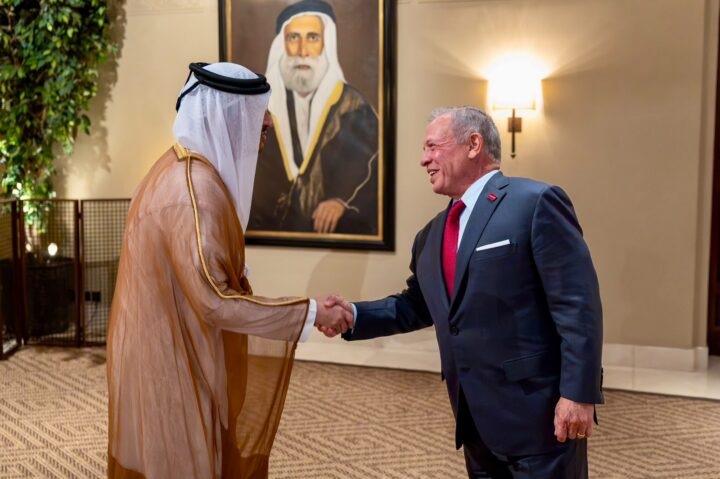
Government of Qatar
Qatari Prime Minister Sheikh Mohammed bin Abdulrahman Al Thani greets Jordanian King Abdullah at foreign ministers summit.


 Add JewishInsider on Google
A coalition of foreign ministers from Arab and Muslim countries met in Jordan on Wednesday to launch a coordinated campaign against Israeli policies in Jerusalem — a gathering marked both by the notable absence of key regional players and rhetoric that dismissed Jewish ties to the city.
The meeting brought together diplomats from Jordan, Egypt, Saudi Arabia, Qatar, Algeria, Iraq, Tunisia, Somalia and Morocco, alongside representatives from the Arab League, Indonesia, Pakistan, Turkey and Malaysia. Missing from the Amman summit were several close U.S. allies including the United Arab Emirates, Bahrain and Kuwait.
In a joint statement, the group denounced what it called an “unprecedented Israeli escalation in occupied Jerusalem and its Islamic and Christian holy sites,” accusing Israel of trying to alter “the Arab Islamic and Christian identity of occupied Jerusalem and its legal and demographic status” — omitting any mention of Jewish historical or religious ties to the city.
The ministers also claimed that Israel “has no sovereignty” over east Jerusalem.
The statement accused Israel of discriminatory practices against Christians, including “restrictions on access to the Church of the Holy Sepulchre and the observance of religious rites therein; interference in the affairs of churches and restrictions imposed on their institutions and properties; and attacks targeting clergy, worshippers and religious symbols.”
The ministers also warned that “Israeli attacks against Islamic holy sites in occupied Jerusalem constitute a blatant provocation to the sentiments of around two billion Muslims worldwide, and push towards a religious conflict with repercussions that will extend beyond the region and threaten regional and international peace and security.”
To operationalize their response, the ministers announced a coordinated international campaign — including a dedicated media platform — to document alleged Israeli violations against holy sites with a plan to present them to international organizations.
Qatar’s Foreign Ministry lauded the meeting, where it said the countries discussed “the Israeli escalation in occupied Jerusalem, and the joint efforts to preserve its Islamic and Christian identity.”
Israel’s Foreign Ministry forcefully denounced the joint statement, noting its exclusion of Jewish ties to the city.
“The declaration endorsed by the Foreign Ministers of the Arab Ministerial Committee, convened by Jordan, is built on false accusations, historical distortions, and a complete disregard for the facts,” the ministry said.
“It is particularly cynical to accuse Israel of violating freedom of worship while declaring that the entire Temple Mount is a place of worship exclusively for Muslims, ignoring the Jewish people’s historic connection to Jerusalem and its holiest sites,” the statement continued. “Under Israeli sovereignty, Jerusalem, the eternal capital of the State of Israel, has never been more open and accessible to worshippers of all faiths. Israel remains committed to preserving freedom of worship, maintaining the status quo on the Temple Mount, and taking all necessary measures to ensure public order and the safety of all visitors.”
Frustrated UAE leaders are questioning the ‘impotence’ of countries like Egypt — and warn that silence on Iranian aggression will push the Gulf closer to U.S., Israel
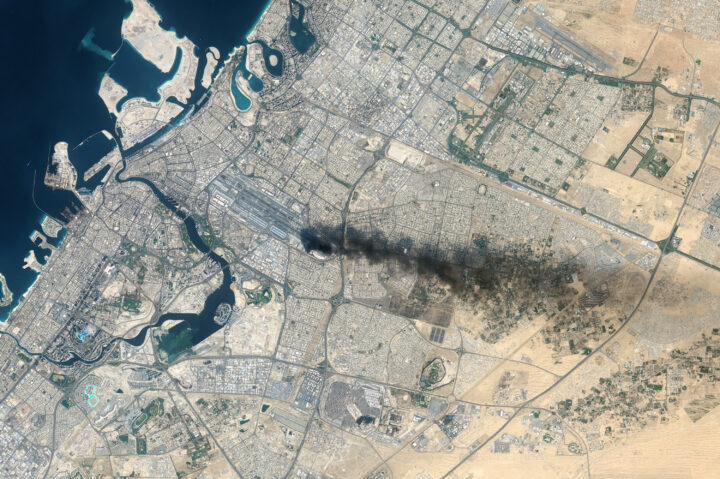
Gallo Images/"USGS/NASA Landsat data processed by Orbital Horizon"
Satellite view of Dubai International Airport after a drone strike ignited a fuel tank fire. on March 16, 2026.
The United Arab Emirates has been publicly expressing its disappointment in Arab League countries like Egypt for not showing or expressing very little support for Gulf states under attack from Iran, a dynamic playing out more quietly in other Gulf states, as well.
In a post on X on Sunday that received significant attention, Anwar Gargash, an advisor to the UAE President Mohamed bin Zayed, said that “Iran’s brutal aggression against the Arab Gulf carries profound geopolitical repercussions … and the result is to bolster our national capabilities and the joint security, as well as to solidify our security partnerships with Washington.”
When French former diplomat Gérard Araud criticized Gargash’s approach, writing on X that “it means deepening your dependence on a country that has led yours into a disastrous conflict without caring about your interests,” Emirati Foreign Minister Abdullah bin Zayed backed up Gargash, responding: “We will never be blackmailed by terrorists.”
In subsequent posts, Gargash not only said that Iran’s attacks are bringing his country closer to the U.S., but criticized other Arab countries for not aligning themselves with the Gulf.
“Where are the joint Arab and Islamic institutions, chief among them the Arab League and the Organization of Islamic Cooperation, while our countries and peoples are subjected to this treacherous Iranian aggression? And where are the ‘major’ Arab and regional countries? … The Arab Gulf states were a support and partner to all in times of prosperity… So where are you today in times of hardship?” Gargash wrote.
As such, he argued, “in absence and impotence, it is unacceptable later to speak of the decline of the Arab and Islamic role or to criticize the American and Western presence.”
On Wednesday, Gargash followed up by distinguishing “those who offered genuine support” from “those who settled for statements without action.”
“The Emirates has proven its ability to confront and endure, and it does not need equipment and troops as much as it needs clarity of positions and knowledge of who can be relied upon in times of hardship,” he added.
Hussain Abdul-Hussain, a research fellow at the Foundation for Defense of Democracies and author of The Arab Case for Israel, told Jewish Insider that the UAE is not the only Gulf state that is expressing resentment towards Arab League states at this time, saying that similar messages have been published in Qatari newspaper editorials and have come out of Kuwait.
Some of the targets of that anger, he said, are Egypt and the Arab League, whose secretary-general, Ahmed Aboul Gheit, is an Egyptian diplomat.
“Gulf governments expected more denunciations of Iran as an aggressor. It took [Egypt] five days to say a word. The Arab League hasn’t met; they usually hold emergency summits and haven’t called for one. The foreign ministers met over Zoom and issued a statement that was a nothingburger,” Abdul-Hussain said.
While Egyptian President Abdel Fattah El-Sisi denounced the Iranian attacks and visited the Gulf, his remarks came across as weak, while Aboul Gheit called the attacks “audacious,” stopping short of a full denunciation, Abdul-Hussain argued.
“Even the adjectives they’re using are soft” in the eyes of Gulf leaders, Abdul-Hussain said.
The media in Egypt and Algeria, Abdul Hussain said, are showing “happiness … that Israel is being pounded. They’re happy with what Iran is doing and no one really seems to care about the Gulf states. The Gulf took 84% of the [Iranian] missiles, as opposed to Israel, which took 16%, and they still can’t straightforwardly say Iran is a problem?”
While Gargash did not specifically mention Israel, Abdul-Hussain interpreted Gargash’s remarks as meaning, “If we in the Gulf can’t rely on you Arabs and Muslims, we will have to find other allies to defend ourselves. That clearly means the U.S. and Israel.”
“The Emiratis feel vindicated, that they were right to move forward and seek their interests with Israel, because look at [other Arab states] now,” he added.
Prominent Emirati media personality Jamal Al Mulla said in a recent episode of his podcast “Arab Cast” that “the Gulf is hurt and will not forget how fellow Arab countries let it down.”
Al Mulla compared the current conflict to the 1991 Gulf War, when only 12 out of 22 Arab League members voted to condemn Iraq for invading Kuwait — “six Gulf countries and the six others were bought off by wealthy Gulf governments.”
“This round, the line is even clearer since aggression is not by an Arab League member against another, but by a non-Arab foreign country against Arab countries, and yet, the Arab League is shameful and so are countries like Iraq, Algeria, Sudan’s Burhan government and western Libya’s government,” he said.
Al-Mulla said that “when any Arab government wants not to take a position on anything, it inserts the Palestinian cause into its statement.”
Arab countries are “always citing Palestine as a distraction,” he added, and recounted that, in 1991, Palestinian leader Yasser Arafat told the Arab League that “the Kuwaiti problem will be solved only after the Palestinian cause.”
“When the shooting stops, I expect a few Gulf countries to rush to normalization with Israel. My money is on Kuwait, perhaps Saudi Arabia too,” Al Mulla said.
Abdul-Hussain agreed with Al-Mulla that Kuwait would return to its past pro-American stance and normalize relations with Israel.
“People in the Gulf were expected to support the Palestinians at all times during the Gaza war, with money, humanitarian aid, politically and diplomatically, and they get nothing in return,” Abdul-Hussain said. “I think they’re really hurt.”
Abdul-Hussain said that Hamas and the Palestinian Authority have not robustly denounced Iran. After initially only condemning the U.S. and Israel, Hamas released a statement two weeks into the war against attacks on the Gulf by Iran — one of its patrons — under pressure from Qatar, another of its patrons. The Palestinian Authority released a statement on the first day of the war expressing solidarity with the Gulf states and calling for de-escalation.
“The thinking in the Gulf is that this time, it’s our turn. We’re the victims. The Palestinians can wait,” Abdul-Hussain said.
Trump made the remarks in a Truth Social post, in which he threatened that the U.S. would bomb the South Pars gas field if Iran does not stop attacking Qatar
Alex Wong/Getty Images
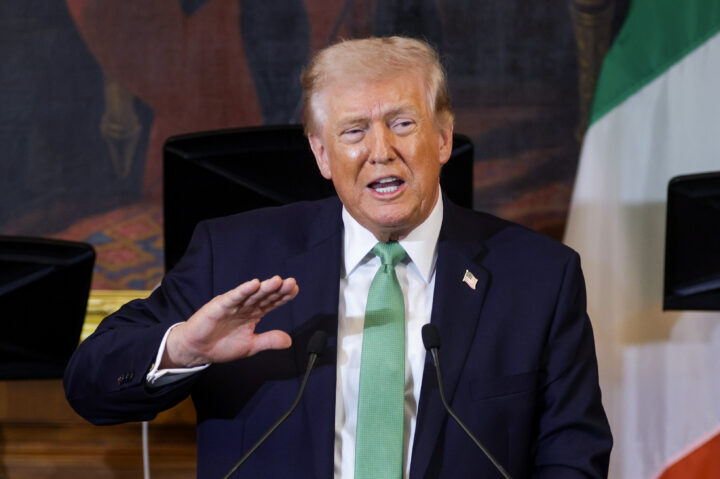
President Donald Trump speaks during the annual Friends of Ireland Luncheon at the U.S. Capitol on March 17, 2026 in Washington, DC.
Current and former Israeli and U.S. officials suggested that an Israeli strike on an Iranian gas field on Wednesday that prompted the Islamic Republic to strike Qatar was coordinated with the White House, despite President Donald Trump’s claim that the U.S. “knew nothing about this particular attack.”
Trump made the remarks in a Truth Social post, in which he threatened that the U.S. would bomb the South Pars gas field, the Iranian portion of the larger field shared with Qatar, if Iran does not stop attacking Qatar.
“The United States knew nothing about this particular attack, and the country of Qatar was in no way, shape or form involved with it, nor did it have any idea that it was going to happen. Unfortunately, Iran did not know this … and unjustifiably and unfairly attacked a portion of Qatar’s [liquid natural gas] facility,” the president wrote.
If “Iran unwisely decides to attack a very innocent, in this case, Qatar,” he added, the U.S., “with or without the help or consent of Israel, will massively blow up the entirety of the South Pars Gas Field at an amount of strength and power that Iran has never seen or witnessed before.”
An Israeli official told Kan News, Israel’s public broadcaster, that the attack on the South Pars gas field was coordinated with the U.S.
Dan Shapiro, the former U.S. ambassador to Israel and Pentagon official in the Biden administration, wrote on X, “Trump can post whatever he likes. But there is zero, I mean zero, chance the IDF would conduct a strike in that location without giving CENTCOM full visibility.”
“Trump knew (and approved),” Shapiro added. “Now he realizes it caused a major escalation with Iran’s (entirely unjustified) attacks on Gulf energy targets.”
Shapiro later clarified that the Israeli strike “could not have been carried [out] without U.S. knowledge and explicit or implicit approval.”
“It was predictable that strikes on Iranian energy facilities (by US or Israel) would lead to Iranian strikes on Gulf energy facilities,” he wrote. “There is a narrow window following the Israeli and Iranian strikes, and Trump’s Truth Social Post (untrue, but possibly useful in this context), to de-escalate away from further strikes on energy industry targets in either direction. That will still leave a very challenging situation to unwind, but [it] would be the best near-term development.”
Gilad Erdan, a former Israeli ambassador to Washington and a former member of Israel’s Security Cabinet, told Jewish Insider that it was highly likely the U.S. knew about the strike, saying that Trump did not criticize Israel in his post, and “in the same breath” as saying the U.S. was unaware, “[Trump] himself threatened to erase the [gas] field.”
Erdan noted that the South Pars gas field is “used for Iran’s domestic energy needs [and] doesn’t harm the international energy market.”
“Israel took upon itself to be at the front [of the situation] in my estimation because the field is also Qatari,” Erdan, who is also a senior fellow at the Misgav Institute for National Security, said. “Someone had to send the deterrent message about the energy field to the Iranians, that if they continue, then all options are open against them and they will be hurt badly.” (The writer is a senior fellow at the Misgav Institute and cohosts its podcast.)
Yaakov Katz, an Israeli military expert and author of While Israel Slept: How Hamas Surprised the Most Powerful Military in the Middle East, told JI that he agreed with Shapiro’s assessment. “There is no way Israel would attack such a strategic facility [without coordination] because they know it would draw the Iranians to attack the Gulf states,” he said.
Katz pointed to Israeli Prime Minister Benjamin Netanyahu’s behavior since the war with Iran began late last month as further indication that Israel was unlikely to make such a move without coordinating with the U.S.: “Why would Netanyahu who behaved so carefully all throughout the war, coordinating with Trump to not upset him so he keeps the war going … do something that would anger Trump and potentially lead him to do something brash and declare the war is over?”
“It was coordinated, and now Trump is saying what he’s saying to distance himself, but it was done to send a message to the Iranians,” Katz added.
Also Thursday, Saudi Arabia released a statement with the foreign ministers from Azerbaijan, Jordan, the UAE, Bahrain, Pakistan, Turkey, Syria, Qatar, Kuwait, Lebanon and Egypt urging Iran to stop its attacks.
“The participants held Iran fully responsible for the losses and called on Iran to immediately and unconditionally cease its aggression and to comply with UN Security Council resolutions. The meeting also emphasized the dangers of supporting militias and destabilizing security, stressing that Iran must seriously reconsider its miscalculations,” the statement read.
If Iran continues, the foreign ministers stated, there will be “serious consequences for Iran and the security of the region, and will exact a heavy price, casting a shadow over its relations with the countries and peoples of the region, who will not stand idly by in the face of threats to their capabilities.”
Following on a November executive order, the Jordanian and Egyptian branches were deemed Specially Designated Global Terrorists and the Lebanese branch a Foreign Terrorist Organization
Salah Malkawi/Getty Images
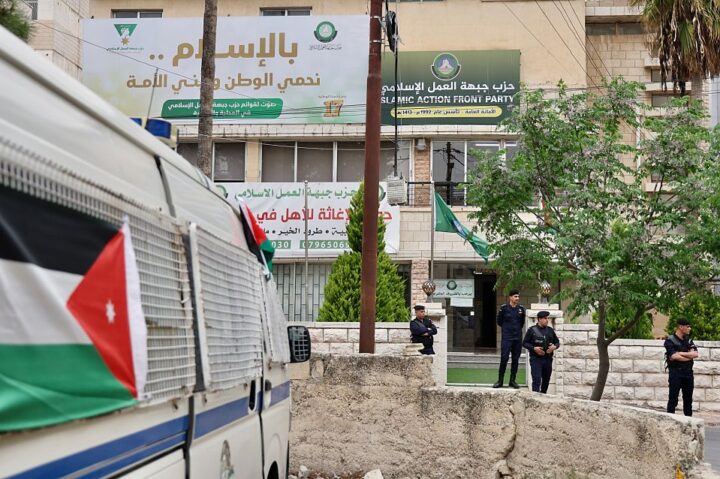
Jordanian police close the entrance of a Muslim Brotherhood headquarter after the announcement of banning the society in the country on April 23, 2025 in Amman, Jordan.
The Trump administration labeled three Muslim Brotherhood branches as terrorist organizations, including chapters in Lebanon, Egypt and Jordan.
The move follows an executive order President Donald Trump signed in November, which tasked Secretary of State Marco Rubio and Treasury Secretary Scott Bessent with identifying whether branches of the Muslim Brotherhood in Jordan, Lebanon and Egypt should be designated as Foreign Terrorist Organizations and which should be deemed Specially Designated Global Terrorists.
Those determinations were released on Tuesday: Jordanian and Egyptian branches were placed under the category of Specially Designated Global Terrorist (SDGT), with the State Department citing their provision of “material support to Hamas.”
Meanwhile, the organization’s branch in Lebanon received the more stringent label of Foreign Terrorist Organization (FTO), a stronger categorization that makes it a criminal offense to provide material support to the group. The organization’s leader in Lebanon, Muhammad Fawzi Taqqosh, was named an SDGT.
“These designations reflect the opening actions of an ongoing, sustained effort to thwart Muslim Brotherhood chapters’ violence and destabilization wherever it occurs,” Rubio said in a statement. “The United States will use all available tools to deprive these Muslim Brotherhood chapters of the resources to engage in or support terrorism.”
Edmund Fitton-Brown, a senior fellow at the Foundation for Defense of Democracies, told Jewish Insider that while the organization poses a threat in all three countries, Lebanon’s determination was “more far reaching.”
“In the case of Lebanon, you can see why it’s been singled out, because the Lebanese chapter was directly involved in violence in the recent conflict between Hezbollah and Israel,” said Fitton-Brown. “In the case of the Jordanian and Egyptian chapters, they’re not necessarily a lesser threat, but the State Department evidently didn’t find enough information to justify a finding that they are a Foreign Terrorist Organization.”
Fitton-Brown added that this is just the “beginning” of the process, noting that the administration has moved “pretty quickly” and there is potentially “more to follow.”
“I understand that there is still interest in the [administration] in other chapters,” said Fitton-Brown. “This could be the first of a number of initiatives. We might see an initiative that looks at other specific chapters. One that’s been mentioned is Yemen, another that’s been mentioned is Libya.”
Dr. Charles Small, executive director of the Institute for the Study of Global Antisemitism & Policy, praised Trump and Rubio’s efforts, stating that the administration has taken an “enormous step to confront the threat the the Muslim Brotherhood poses around the world.”
“The Muslim Brotherhood works from within open and free societies to subvert the values that America and other Western democracies cherish, while advocating for the subjugation of women, the oppression of LGBTQ+ people, and the murder of Jews,” said Small. “We are hopeful that these vital efforts will continue, and ISGAP will keep supporting executive and legislative actions in Washington that aim to dismantle the Brotherhood’s networks and stop its continuing plan to undermine our way of life.”
One of its branches is banned for Hamas ties. The other sits in the Knesset
AHMAD GHARABLI/AFP via Getty Images
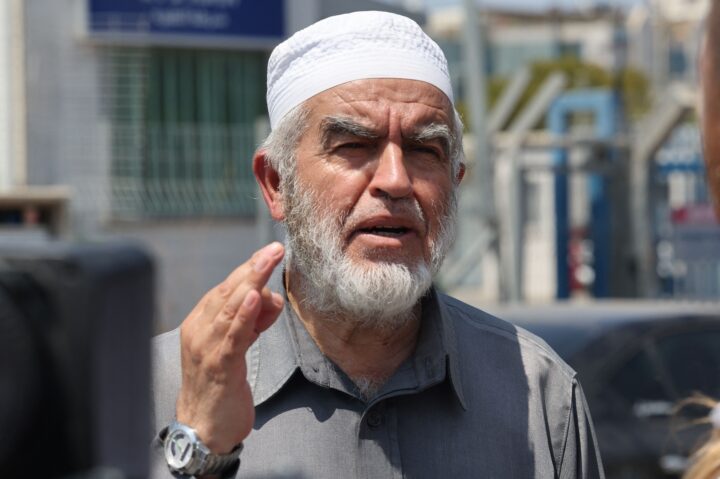
Sheikh Raed Salah, leader of the radical northern branch of the Islamic Movement in Israel, speaks on August 23, 2023, outside a police station during the funeral of the director-general of the Arab city of Tira in Israel, who was gunned down on August 21 evening.
While Congress is working on a bill to designate the Muslim Brotherhood a terrorist organization in the U.S., and the Islamist group is banned from Egypt, Syria, Saudi Arabia, the United Arab Emirates and beyond, the group’s status in Israel is much more complicated.
The matter drew renewed attention this week after Mansour Abbas, the leader of the Ra’am party in the Knesset, an ideological offshoot of the Muslim Brotherhood, declined to call for the eradication of Hamas on Israeli radio.
In an interview with Israeli public broadcaster KAN, Abbas mostly lamented the high rate of crime and gun violence in Israeli-Arab society, but when he mentioned Gaza, the interviewer, Asaf Liberman, asked whether he sees Hamas as part of the enclave’s future.
“Palestinian society needs to pick its leadership and go on a new path towards peace and reconciliation,” Abbas responded.
Liberman twice repeated his question and sharpened it: “Does Hamas need to be destroyed?”
Abbas added that an international force must enter Gaza and after an interim period a security force of the Palestinian Authority would be trained, but after being pressed to make his position on Hamas clear, he said the interview was beginning to feel like an “interrogation,” and pointed out that he had gone on air to talk about domestic issues facing Arab Israelis. “If you want to talk about crime, fine, if not, bye,” he said, before hanging up.
Abbas has previously condemned Hamas’ Oct. 7 attacks, calling them unjustifiable and inhumane, and called for the release of the hostages. The other reporter who conducted the interview, Suleiman Maswadeh, later noted that Abbas and his family had recently received death threats, and hinted that was the reason the Knesset member avoided repeating his previously articulated position — which Maswadeh said does not include a future for Hamas in the governance of Gaza.
In 2021, the Ra’am party became the first Arab party in 50 years to join an Israeli governing coalition, which was celebrated by many in Israel and abroad as a milestone for coexistence, while the Israeli right criticized the 2021-2022 government for what it characterized as working with the Muslim Brotherhood.
Monday’s interview sparked headlines and analysis in right-leaning Israeli media and comments by politicians on the right about the viability of center and left-wing parties once again forming a coalition with Ra’am to oust Prime Minister Benjamin Netanyahu, when Ra’am’s leader would not say that he is for eradicating Hamas.
“The Muslim Brotherhood is a very generic term,” said Michael Milshtein, head of the Palestinian Studies Forum at the Moshe Dayan Center at Tel Aviv University. “It’s not membership in an organization; it’s a denomination. Mansour Abbas is the Muslim Brotherhood. Raed Salah, his rival, is also the Muslim Brotherhood. Hamas is the Muslim Brotherhood. [Turkish President Recep Tayyip] Erdogan is the Muslim Brotherhood.”
The historic and recent connections between Hamas and Ra’am, both of which were founded by adherents of the Muslim Brotherhood, shed light on the nuances of the international Sunni Islamist movement and its status in Israel.
Michael Milshtein, head of the Palestinian Studies Forum at the Moshe Dayan Center at Tel Aviv University, emphasized, in an interview with Jewish Insider on Wednesday, that the Muslim Brotherhood is an ideology aiming to make Muslim societies more religious, and is not one centralized organization spanning the Muslim world.
“The Muslim Brotherhood is a very generic term,” Milshtein said. “It’s not membership in an organization; it’s a denomination. Mansour Abbas is the Muslim Brotherhood. Raed Salah, his rival, is also the Muslim Brotherhood. Hamas is the Muslim Brotherhood. [Turkish President Recep Tayyip] Erdogan is the Muslim Brotherhood.”
Muslim Brotherhood founder Hasan al-Banna’s brother, Abd al-Rahman al-Banna, founded the group’s branch in Mandatory Palestine in 1935; its leaders included Mufti of Jerusalem Hajj Amin al-Husseini, who incited the deadly Hebron riots against Jews in 1929 and collaborated with Hitler, and Izz al-Din al-Qassam, leader of the 1935 Arab Revolt against the British and namesake of Hamas’ short-range Qassam rockets.
Gaza-based Sheikh Ahmad Yasin formed the Muslim Brotherhood-inspired Hamas in the 1980s. Sheikh Abdullah Nimar Darwish founded the Islamic Movement in Israel in 1971, which also espoused Muslim Brotherhood ideology.
In 1979, Darwish founded an underground group in Israel called The Family of Jihad with a goal of establishing an Islamic state. However, after his arrest and conviction for involvement in killing an accused collaborator and membership of a terrorist organization, he renounced violence and decided to promote Islamism within the confines of Israeli law.
Fissures began in the Islamic Movement in Israel after the Oslo Accords, with the northern branch, led by Sheikh Raed Salah, opposing it, while the southern branch supported it. The two parts of the movement officially split when the southern branch ran for the Knesset in 1996 as Ra’am, and Salah advocated boycotting national elections.
The leaders of the northern branch were arrested in 2003 for aiding Hamas and in 2015, the branch was banned, after the police and Shin Bet demonstrated that it had close ties to Hamas and the Muslim Brotherhood, and received funds from groups affiliated with Hamas.
Darwish, however, continued to be the spiritual leader of the Islamic Movement’s southern branch and said he was committed to obeying the laws of Israel. He engaged in interfaith dialogue events, often with former Labor lawmaker Rabbi Michael Melchior, and spoke out against Holocaust denial.
While Islamic Movement Southern Branch leaders have met with Hamas leaders and taken part in mediation efforts between the Palestinian Authority and Hamas, in 2022, then-leader of Hamas Yahya Sinwar declared Mansour Abbas a traitor for joining the governing coalition and saying Israel is a Jewish state. Abbas has said that his decision to join the governing coalition in 2021 came from the values he “absorbed from the legacy of Sheikh Abdullah Nimr Darwish.”
As such, the more radical of the two major offshoots of the Muslim Brotherhood is outlawed in Israel.
Yet, more recently, the Islamic Movement Southern Branch has come under scrutiny for its own possible ties to Hamas.
In the decades since its establishment, the Islamic Movement has faced repeated crackdowns on its charities. The Islamic Relief Committee, founded in 1987 with the stated goal to help the needy in the West Bank and Gaza, was shut down by Israeli authorities in 1995 for aiding Hamas members’ families, the first in a series of such actions.
“Israel’s anti-terrorism law and the whole discipline has been to focus on specific organizations and declaring them as terrorist organizations because of their goals, because of the means that they use, rather than focusing on an idea, which the Muslim Brotherhood really is,” Lt.-Col. (res.) Maurice Hirsch, the former director of the IDF Prosecution for Judea and Samaria, told JI.
In July, the Israeli Justice Ministry unit dealing with nonprofit organizations found grounds to shut down “Aid 48,” a charity affiliated with Ra’am, on suspicion of providing funding to terrorist organizations. “Aid 48” is the Islamic Movement Southern Branch’s main charity. According to an investigation by the ministry, in 2020-2021, the organization transferred NIS 2 million to a charity in Hebron that Israel had declared in 2012 to be part of a terrorist organization; in 2023, “Aid 48” worked with three such Palestinian charities; in 2020, the organization gave NIS 933,000 to a Turkish organization run by Hamas members, which funneled money to the terrorist organization.
Lt.-Col. (res.) Maurice Hirsch, the former director of the IDF Prosecution for Judea and Samaria, currently the director of the Initiative for Palestinian Authority Accountability and Reform in the Jerusalem Center for Public Affairs, explained to JI that Israeli law makes it easier to crack down on smaller subgroups than an umbrella term like the Muslim Brotherhood.
“Israel’s anti-terrorism law and the whole discipline has been to focus on specific organizations and declaring them as terrorist organizations because of their goals, because of the means that they use, rather than focusing on an idea, which the Muslim Brotherhood really is,” he said on the sidelines of a JCFA conference last week.
In order to declare the Muslim Brotherhood a terrorist organization, “you have to break it down into intelligence,” Hirsch said, adding that the authorities would have to determine who they are seeking to arrest and what money and possibly weapons need to be seized.
Hirsch recounted taking part in the Israeli Security Cabinet meeting in 2015 when the government decided to outlaw the Islamic Movement Northern Branch.
“Some of the questions that were asked were, what is the next step? Who do we operate against now? It was a bit clearer than the entire Muslim Brotherhood, but even then there was a question,” he said.
“I would be very careful because, at its core, the Muslim Brotherhood is a movement that aims to change society. They have a lot of social organizations. It’s very different from Islamic Jihad or ISIS, who are not interested in social activism,” said Milshtein, adding that the Muslim Brotherhood ideology is up for interpretation by its adherents.
When it comes to the southern branch, Hirsch, who has worked with the “Choosing Life” organization of relatives of victims of terror whose lawsuit led to the shuttering of “Aid 48,” argued that “there is a clear connection between Ra’am and funding Hamas … That connection was there all along. It’s partly ideological and partly the idea of the Muslim Brotherhood in its different constellations, including in Israel.”
Milshtein acknowledged that there have been cases of leaders of “Aid 48” meeting with Hamas leaders and funding going to Hamas ahead of its invasion of Israel on Oct. 7, 2023, but said that Abbas “took care of” those responsible when he learned of the incidents.
“I would be very careful because, at its core, the Muslim Brotherhood is a movement that aims to change society. They have a lot of social organizations. It’s very different from Islamic Jihad or ISIS, who are not interested in social activism,” he said, adding that the Muslim Brotherhood ideology is up for interpretation by its adherents.
“If you ask Mansour Abbas, there is no problem with being part of the Muslim Brotherhood and part of the government in a state that defines itself as Jewish,” he said. “If you ask Hamas, they want jihad against Israel.”
The president said hostages will be released Monday or Tuesday, confirmed his team working on a weekend trip to Egypt and Israel
Samuel Corum/Sipa/Bloomberg via Getty Images
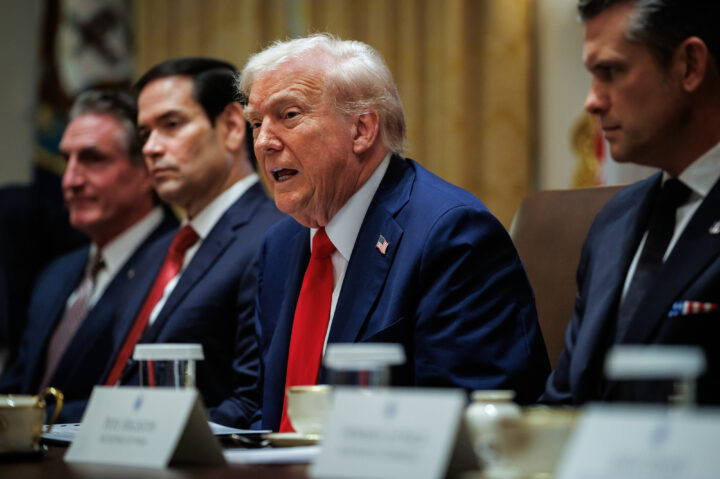
President Donald Trump during a Cabinet meeting at the White House in Washington on Oct. 9, 2025.
President Donald Trump heaped praise on the leaders of Qatar, Egypt, Saudi Arabia, Turkey and Indonesia on Thursday, lauding them and members of his administration as key parties responsible for getting Israel and Hamas to agree to the first phase of his peace plan for the region.
“I want to express my tremendous gratitude to the leaders of Qatar, Egypt and Turkey for helping us reach this incredible day and for being there. They were there with us all the way. And of course, as you know, Saudi Arabia and Jordan and so many,” Trump said during a Cabinet meeting at the White House. “I will tell you, [Turkish] President [Recep Tayyip] Erdoğan was personally involved in dealing with Hamas and some of the others. He’s been great. They’ve all been really amazing. Indonesia has been amazing. Indonesia has been fantastic.”
“The whole world has come together for this, people that didn’t get along, people that didn’t like each other, neighboring countries that, frankly, didn’t like each other,” he continued.
The president confirmed in his remarks on Thursday that his team was working on organizing a Mideast trip for him to commemorate the deal, which would include stops in Egypt and Israel, where he has been invited to address the Knesset.
He said he plans to depart from Washington on Sunday and is considering the timing of the release of the hostages in his plans. “They should be released on Monday or Tuesday. … That’ll be a day of joy. I’m gonna try and make a trip over,” Trump said. “We’re planning on leaving sometime Sunday,” he added later.
Regarding the U.S. officials involved in the deal, Trump credited Vice President JD Vance; White House Chief of Staff Susie Wiles; Secretary of State Marco Rubio; Secretary of Defense Pete Hegseth; Middle East envoy Steve Witkoff; Jared Kushner, the president’s son-in-law and former advisor who spearheaded the Abraham Accords in the first Trump administration; and CIA Director John Ratcliffe with helping bring the agreement across the finish line.
“All Americans should be proud of the role that our country has played in bringing this terrible conflict to an end,” Trump said.
Israeli and Hamas negotiators signed off on the first phase of the deal in Egypt earlier in the day, which would see the release of all the remaining hostages in exchange for the release of Palestinian security prisoners.
In brief remarks to reporters during the meeting, Rubio similarly attributed the administration’s success to its engagement with Arab and Muslim-majority nations.
“What really took a turn about a month ago, less than a couple weeks ago, is when we were at the United Nations, and [Trump] convened an historic meeting, not simply of Arab countries, but Muslim-majority countries from around the world … Indonesia was there, Pakistan was there, and created this coalition behind this plan. Then on that following Monday, you met with the prime minister of Israel here, and that plan was presented. And then, of course, our great negotiating team followed up on it in the interim,” Rubio said.
Asked about the potential for political turmoil in Israeli Prime Minister Benjamin Netanyahu’s governing coalition by far-right parties who said today they would oppose the deal in a Cabinet vote, Trump replied that the issue was not a concern and predicted that such an agreement could help Netanyahu.
“Bibi may go a little bit out of whack. Look, that’s politics. … I think he’s very popular right now. He’s much more popular today than he was five days ago, I can tell you that. Right now, maybe people shouldn’t run against him, five days ago it might not have been a bad idea,” Trump said. “This has been a very good thing. I don’t think he did it [agreed to a deal] for that reason [of political survival]. But I think just looking as an analyst would look at this … I think Bibi should be very popular right now.”
Trump said that, beyond bringing an end to the war in Gaza, the new agreement was “really [about achieving] peace in the Middle East.” He then described the war as a “big retribution” in response to Hamas’ Oct. 7, 2023, attacks on the Jewish state.
“Remember, Oct. 7 was terrible, but also, from the Hamas standpoint, they probably lost 70,000 people. That’s big retribution. That’s big retribution. But at some point that whole thing has to stop, and we’re going to see to it,” he said.
Looking forward, Trump was noncommittal about how future phases of his 20-point peace plan would be implemented or upheld, instead noting that Gaza would be rebuilt, the Abraham Accords would expand to include more countries and the hostages would be returned. He also declined to take a stance on supporting or opposing a two-state solution.
“Gaza is going to be slowly redone. You have tremendous wealth in that part of the world by certain countries, and just a small part of that, what they make will do wonders for Gaza,” the president explained. “I think you’re going to see some tremendous countries stepping up and putting up a lot of money and taking care of things. There’s this tremendous spirit like I haven’t seen.”
“The first thing we’re doing is getting our hostages back. That’s what people wanted more than anything else. They wanted these hostages back that have lived in hell like nobody has ever even dreamt possible. And after that, we’ll see,” he later added when asked about ensuring all sides adhere to the deal. “But they’ve agreed to things, and I think it’s going to move along pretty well.”

Good Thursday morning.
In today’s Daily Kickoff, we report the latest out of Sharm el-Sheikh, Egypt, following the announcement overnight that Israel and Hamas had reached a hostage-release and ceasefire agreement as part of the first phase of a broader deal to end the war in Gaza. We talk to Noam Tibon about the Toronto International Film Festival’s decision to cancel and then reinstate the screening of a documentary about his efforts to rescue his family during the Oct. 7 attacks, and look at how the Pentagon’s new rules regarding grooming standards could impact Orthodox Jewish servicemembers. Also in today’s Daily Kickoff: Rep. Josh Gottheimer, Anne Dreazen and Maine Gov. Janet Mills.
Today’s Daily Kickoff was curated by Jewish Insider Executive Editor Melissa Weiss, with assists from Danielle Cohen-Kanik and Marc Rod. Have a tip? Email us here.
What We’re Watching
- We’re closely tracking the ongoing talks to secure the release of the remaining 48 living and dead hostages and reach an end to the war, following last night’s breakthrough in Sharm el-Sheikh, Egypt. White House Special Envoy Steve Witkoff and former White House senior advisor Jared Kushner are expected to travel to Jerusalem tonight for the continuation of talks. More below.
- We expect to hear more about the agreement over the course of the day, first in a televised White House Cabinet meeting scheduled for 11 a.m. ET, followed hours later by a press conference at 3 p.m. ET with Finnish President Alexander Stubb. Become a premium subscriber and sign up for the Daily Overtime to get our afternoon update on the latest in the talks.
- Negotiations between the Trump administration and Harvard aimed at releasing billions of dollars in frozen grant funding are set to resume today, with Blackstone CEO Stephen Schwarzman, who chaired the Strategic and Policy Forum during the first Trump administration, is playing a central role in the talks.
- In Paris, French President Emmanuel Macron is expected to name a new prime minister by the end of the week, following the resignation earlier this week of Sébastien Lecornu, who held the position for less than a month.
What You Should Know
A QUICK WORD WITH JI’S LAHAV HARKOV
It’s a “morning of historic and momentous news,” as Israeli President Isaac Herzog put it on Thursday, when Israelis woke up to learn that a deal had been reached to free the remaining hostages in the coming days and halt the fighting in Gaza.
The sides are expected to officially sign the deal in Egypt today, and Israel’s Cabinet is set to vote at 11 a.m. ET on the exchange of the 48 hostages, 20 of whom are thought to be alive, for close to 2,000 Palestinian prisoners. The IDF said it began preparing to withdraw from parts of Gaza as part of the deal.
Hamas is expected to release the Israeli hostages first. Only when Israel is satisfied that the terrorist group has freed everyone it can find — including the remains of about 28 Israelis who were killed — will Palestinian prisoners be released. The swap comes with caveats: Hamas says it is unable to locate some of the bodies, and about 250 of the Palestinian prisoners set to be released are serving life sentences for terrorist offenses, though Israel insisted that high-profile detainees — such as Second Intifada mastermind Marwan Barghouti — will not be part of the deal.
The deal is expected to pass easily in the Cabinet, with Israeli Prime Minister Benjamin Netanyahu’s Likud party holding the majority of the seats. National Security Minister Itamar Ben-Gvir, who expressed opposition earlier this week to President Donald Trump’s plan to end the war, was unusually quiet on Thursday morning, while Finance Minister Bezalel Smotrich said he would not vote in favor.
Trump said in an interview with Fox News that all of the hostages “will be coming back on Monday. … As we speak, so much is happening to get the hostages freed.”
communal reactions
‘Fulfillment of our prayers’: Jewish groups hail Gaza ceasefire deal

Jewish organizations and leaders from around the world and across most of the ideological spectrum cheered the acceptance last night of the first phase of a Gaza peace plan, which will see the release of all living hostages in the coming days and the eventual release of slain ones as well, eJewishPhilanthropy’s Judah Ari Gross reports.
Communal response: Jewish Federations of North America said in a statement that it “celebrate[s] the exciting news of the deal between Israel and Hamas to return all the remaining hostages home and end the war. Both AIPAC and J Street issued statements in support of the agreement, as did the American Jewish Committee, Israel Policy Forum, the Israeli-American Coalition, Jewish Council for Public Affairs, National Council of Jewish Women, Anti-Defamation League, the Conservative movement, Yeshiva University, Board of Deputies of British Jews and World Jewish Congress, among many others.
Read the full story here and sign up for eJewishPhilanthropy’s Your Daily Phil newsletter here.
Bonus: Jewish communal leaders and a bipartisan group of political officials gathered somberly on Tuesday at the “Sukkah of Hope” hosted by the Hostages Families Forum at the Kennedy Center to mark two years since the Hamas terror attacks, Jewish Insider’s Gabby Deutch reports from Washington.
book shelf
‘Now, life:’ Former hostage Eli Sharabi shares his post-captivity resilience and optimism
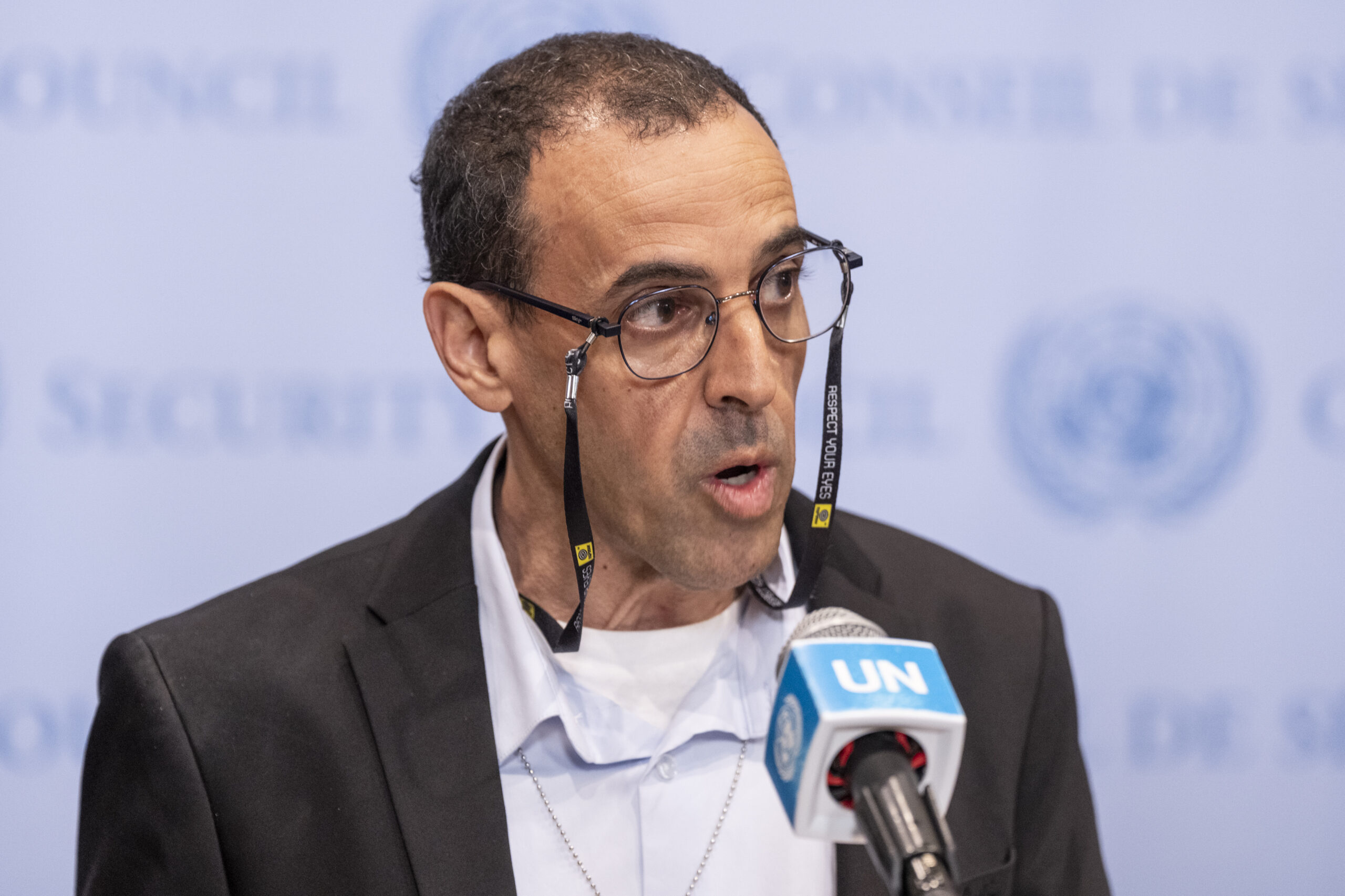
Freed hostage Eli Sharabi’s new memoir, Hostage, ends with him visiting the graves of his wife, Lianne, and his daughters, Noiya and Yahel, for the first time after being released from nearly a year and a half of captivity in Gaza, during which he had hoped they were still alive following the Hamas attack on their home in Kibbutz Be’eri on Oct. 7, 2023. “This here is rock bottom. I’ve seen it. I’ve touched it,” Sharabi writes. “Now, life.” That final sentence of Sharabi’s memoir could sum up his post-captivity self. In a recent interview with Jewish Insider’s Lahav Harkov, Sharabi said he was determined to reassert his agency, take action on hostage advocacy and move forward in his life.
In the belly of the beast: “I recognize that even within Hamas, after spending 24/7 with them for many months and having different conversations with them, I understand who is ideological and who stumbled into it because Hamas controls the financial faucets in Gaza,” Sharabi told JI. “Does that make them innocent? Of course not. The moment they got the order, I was shackled around my legs. If they were told to shoot me, they would have shot me.”
FILM IN FOCUS
‘A story about family’: Noam Tibon, director Barry Avrich reflect on ‘The Road Between Us’ premiere

The most important victory of Israeli Maj. Gen. (res.) Noam Tibon’s life was rescuing his son, daughter-in-law and two granddaughters from their home in Kibbutz Nahal Oz during the Oct. 7, 2023, Hamas terror attacks. But the premiere of a new documentary telling that story almost didn’t happen, after “The Road Between Us: The Ultimate Rescue” was removed from the Toronto International Film Festival’s schedule last month, where it was set to make its debut. The film’s reinstatement after widespread pushback was “a victory for the movie and a victory for the truth of what happened on Oct. 7,” Tibon, the film’s protagonist, told Jewish Insider’s Haley Cohen in an interview alongside documentarian Barry Avrich.
Global effort: “What was extraordinarily amazing to me — because I just didn’t think we had the wind to our back — was that the global pressure and reaction to the withdrawal of this film was so enormous and validating. We received emails from Jewish people as far as Shanghai” who were outraged over the film’s cancellation, Avrich recalled. “It was one of the great moments in my film career, when the Hollywood community and Jewish community globally said, ‘We will not be erased.’ I kept telling Noam, ‘You will not cancel your ticket, you’re coming to Toronto. We will show this film.’” Tibon said he dedicated the film to “all of the people who fought with me on Oct. 7 — the brave soldiers and border patrol and the brave squad of [Kibbutz Nahal Oz]. I hope many people will watch this around the world because it’s a story about family. What would you do in such a situation?”
exclusive
Gottheimer, GOP lawmakers warn Irish BDS effort will damage relationship with United States

Rep. Josh Gottheimer (D-NJ) and a group of Republican House lawmakers warned the Irish government on Monday that pending legislation to criminalize the importation of Israeli goods from the West Bank and east Jerusalem into Ireland risks damaging the country’s economic relationship with the United States, Jewish Insider’s Marc Rod reports. The lawmakers also criticized Dublin’s efforts to support a genocide case against Israel at the International Court of Justice.
Message to Dublin: “This legislation threatens to inflict real harm on American companies operating in Ireland. If enacted, it would put U.S. firms in direct conflict with federal and state-level anti-boycott laws in the U.S., forcing them into an impossible legal position and jeopardizing their ability to do business in Ireland,” reads the letter, addressed to Taoiseach Micheál Martin. “Therefore, were it to pass this bill, Ireland would risk causing significant damage to its own economic credibility and partnerships with American commerce.” The letter states that Dublin’s moves are “fueling rising antisemitic and anti-Zionist sentiment in Ireland and beyond,” and urges the country to cease both efforts in order to “preserve the economic and diplomatic ties between our two nations.”
grooming guidelines
Pentagon’s stricter grooming standards could impact Orthodox Jewish servicemembers
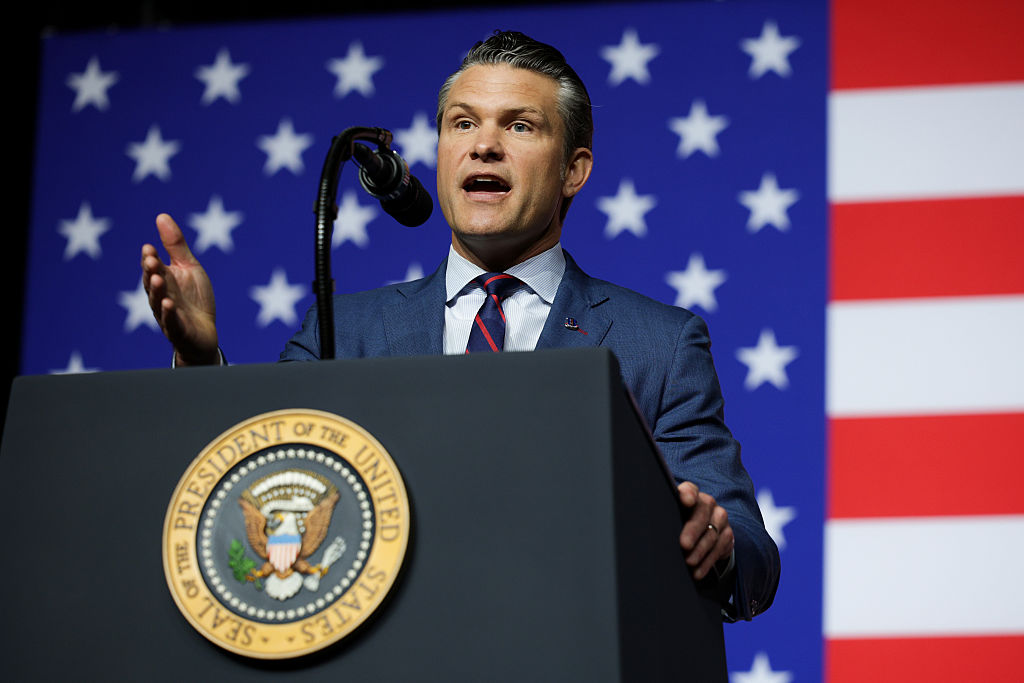
The military grooming rules announced last week and circulated in a memo to military members would end most existing religious exemptions allowing troops to maintain beards. The regulations would present a potential obstacle to Orthodox Jewish servicemen who maintain beards. The policy, which would return the military to pre-2010 standards — when the Pentagon first granted an exemption to a Sikh soldier to maintain a beard in uniform — also prohibits sideburns below the ear openings, potentially impacting servicemen who wear peyot, Jewish Insider’s Marc Rod reports.
Waiver crackdown: Religious facial hair waivers will be “generally not authorized” under the new policy, and will require “individualized reviews” with “documentation demonstrating the sincerity of the religious or sincerely held belief … sufficient to support a good faith determination by the approving authority,” according to the Pentagon memo. “The military obviously has its need for discipline and uniform adherence,” Rabbi Levi Shemtov, the executive vice president of American Friends of Lubavitch (Chabad), told JI. “At the same time, it has been, and we hope it will continue to be, cognizant that certain individuals, for them to serve and accommodation will be necessary, and as in the past, if everything else about that particular person adheres to military standards, then they should get the dispensation they need.”
transitions
AJC names Anne Dreazen to lead its Center for a New Middle East
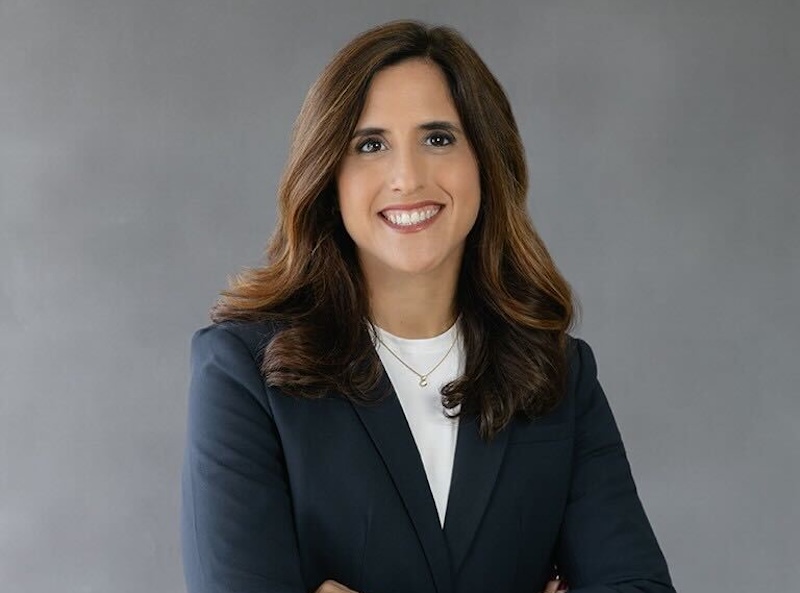
The American Jewish Committee tapped Middle East policy official Anne Dreazen on Thursday as vice president and director of its Center for a New Middle East, Jewish Insider’s Haley Cohen has learned. The center launched in June 2024 to advance the organization’s existing work in Israel and the Gulf, with the goal of hosting conferences and business programs in the U.S., Israel and the Gulf, and working with emerging leaders in Israel and the Arab world.
Background: Dreazen, whose career spanned 15 years at the Department of Defense in a variety of roles — most recently as principal director for Middle East policy — is slated to begin the Washington DC-based position on Oct. 20. She oversaw U.S. defense cooperation with partners including Israel, Egypt, Jordan, Iraq, Saudi Arabia, the UAE and Qatar while serving as the Pentagon’s principal director for Middle East Policy, under both Democratic and Republican administrations. She also served as a national security fellow in the Senate. Prior to that, Dreazen spent seven months on the ground in Iraq’s Anbar Province, facilitating U.S. reconstruction efforts following Operation Iraqi Freedom.
Worthy Reads
Bearing Witness: In Politico, Axel Springer CEO Mathias Döpfner reflects on the rise of antisemitism globally following the Oct. 7, 2023, Hamas attacks and his meeting with Nova music festival cofounder and producer Ofir Amir. “Since this conversation about the events of Oct. 7, I keep asking myself how Ofir Amir can bear what happened after Oct. 7. How he can bear that victims are turned into perpetrators and perpetrators into victims. That more and more often, it is concealed who started this war, what is action and what is reaction. How he can bear it that justified criticism of decisions made by an Israeli government is mixed with deep-rooted hatred of Jews and that, as a result, instead of an obvious global wave of compassion and solidarity, a global wave of cold-heartedness and increasingly aggressive anti-Semitism has emerged. How he can bear what I can hardly bear, even though I am neither a victim nor a relative of victims.” [Politico]
A Family’s Torment: The Financial Times’ Mehul Srivastava interviews Ilay David, whose brother, Evyatar, has appeared in multiple Hamas hostage videos in a continuous state of decline since his capture two years ago. “But in this litany of broadcast suffering, few have suffered more than the family of Evyatar David, a 24-year-old guitar player who loved AC/DC and Queen and was kidnapped from the Nova Music Festival alongside 40 others. … Ilay has watched the video of him waiting many times, his brother breathing fresh air and begging for his freedom. ‘Of course, Hamas terrorists told him to beg for their life,’ he said. ‘But I saw my brother’s eyes. I saw that he really begged for his life — I saw that he wants to cry.’ Ilay says he lies awake wondering why his brother was chosen for this public form of torture — so many other hostages had suffered in private, while others were filmed but their videos never released. ‘Why Evyatar? Why does he have to suffer so much more?’ he said.” [FT]
Problems Across the Pond: Jewish News Editor Richard Ferrer considers the increasing isolation and antisemitism faced by the U.K.’s Jewish community. “Since Hamas’s massacre in Israel, Jews in Britain have been pushed, slowly — and ever so politely — out of public life. Jewish actors have been dropped from shows. Jewish comedians told their Edinburgh Fringe gigs are off under the pretext of ‘staff safety.’ Venues have quietly cancelled Jewish musicians. Holocaust survivor visits to schools have been pulled ‘for security reasons.’ Every time a theatre has cancelled a Jewish performer, every time a company has decided it’s ‘uncomfortable’ working with Jews, the line between silent and savage antisemitism has blurred just a little more. Now that line no longer exists. On Thursday, Britain became a place where a knife-wielding man called Jihad can convince himself that driving a car into Jews outside a synagogue isn’t an atrocity but a statement. Tonight, I’m off to a bat mitzvah party hoping there’s enough security on the door. That’s life for British Jews now. And death.” [JewishNews]
Iran’s Next Move: The Atlantic’s Arash Azizi and Graeme Wood weigh Iran’s military and diplomatic options following its defeat during the 12-day war with Israel in June. “Iran could surrender its nuclear ambitions. Call this the Libya option, after Muammar Qaddafi’s renunciation of his nuclear program in 2003. The limits of the Libyan option’s appeal are evident when one considers Qaddafi’s fate, which was to be deposed, poked in the backside with a piece of steel, and shot in the head. More appealing is the relative calm of North Korea, whose combined nuclear and conventional deterrent shows no sign of weakness. States that go nuclear tend to survive. … Another option would be to go short of nuclear — to go ballistic.” [TheAtlantic]
Word on the Street
The Department of Commerce sanctioned more than two dozen companies in China, Turkey and the United Arab Emirates for acting as conduits for Iran to purchase American technology…
California Gov. Gavin Newsom signed into law legislation taking aim at antisemitism in K-12 schools, which passed last month over the opposition of the state’s largest teachers union…
Rep. Josh Gottheimer (D-NJ) called on the New Jersey Education Association to fire its recently hired magazine editor, citing since-deleted social media posts promoting violent and antisemitic content, including a post that said that the president of Egypt was “filthier than the Jews”…
Maine Gov. Janet Mills, a Democrat, is expected to announce her entry into the state’s 2026 Senate race in the coming days; Mills will face a crowded primary field that includes Israel critic Graham Platner as she seeks to challenge Sen. Susan Collins (R-ME) next year…
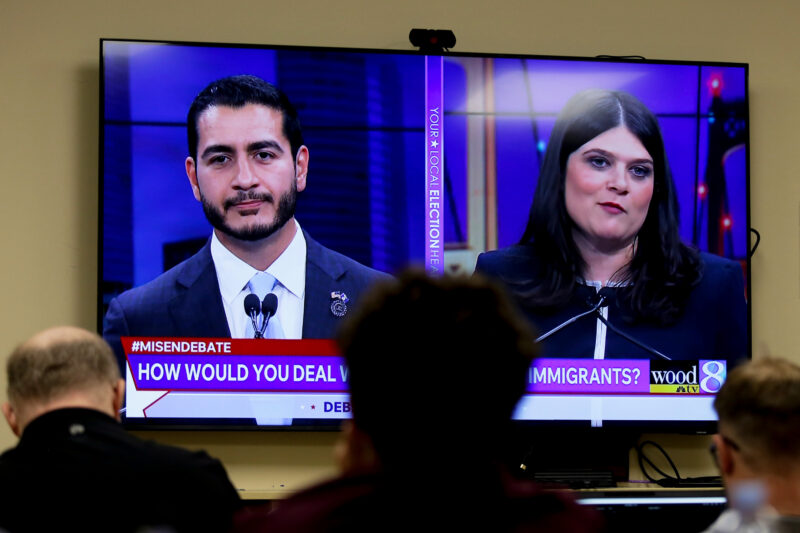
On the second anniversary of the Oct. 7, 2023, Hamas attacks on Israel, Democrat Abdul El-Sayed, who is running for Senate in Michigan, sent a fundraising email to supporters that criticized Israel’s ground invasion of Gaza while ignoring the Hamas attack that precipitated it, Jewish Insider’s Marc Rod reports…
Several key Minnesota political leaders across the ideological spectrum, including Minneapolis Mayor Jacob Frey, Rep. Angie Craig (D-MN) and Sens. Amy Klobuchar (D-MN) and Tina Smith (D-MN), condemned the vandalism of a synagogue in Minneapolis on Wednesday as an act of antisemitism, Jewish Insider’s Marc Rod reports…
The New York Times explores how New York City Democratic mayoral candidate Zohran Mamdani’s views on Israel were shaped by his upbringing and college activism; during his time at Bowdoin College, where he founded the campus’ chapter of Students for Justice in Palestine, Mamdani refused efforts to collaborate with the campus’ J Street U chapter, citing SJP’s “antinormalization” policy against working with groups that support Israel’s right to exist…
Federal prosecutors in Maryland are expected to charge former National Security Advisor John Bolton in the coming days with mishandling classified documents…
A Pennsylvania couple is pursuing legal action against the previous owner of their home, who hid a tiled swastika and German war eagle, installed in the 1970s, under carpet during the property sale…
A U.K. court began proceedings against two men accused of planning a terror attack against the Jewish community in Manchester in late 2023 and early 2024; the trial is taking place days after two people were killed in an unrelated terror attack on a Manchester synagogue on Yom Kippur…
The Wall Street Journal looks at how 10 Downing Street under Prime Minister Keir Starmer and the ruling Labour party has struggled to quell daily anti-Israel protests around the country amid concerns that the rallies are fueling antisemitism in the U.K.…
The family of Bipin Joshi, a Nepali citizen taken hostage by Hamas on Oct. 7, 2023, released a recently discovered video of Joshi filmed shortly after his abduction to Gaza…
Iran released a 19-year-old French-German cyclist who had been detained since June…
Longtime Zabar’s owner Saul Zabar, who oversaw the appetizing shop’s operations for seven decades, died at 97…
Attorney Bruce Cutler, who secured multiple acquittals for his client, mob boss John Gotti, died at 77…
Pic of the Day

Former U.S. Ambassador to Israel David Friedman and Jerusalem Mayor Moshe Lion prayed at the Western Wall during the Priestly Blessing on Thursday in Jerusalem. Also in attendance during the Chol Hamoed prayers were the Sephardic and Ashkenazi chief rabbis of Israel and former hostage Sasha Trufanov.
Birthdays
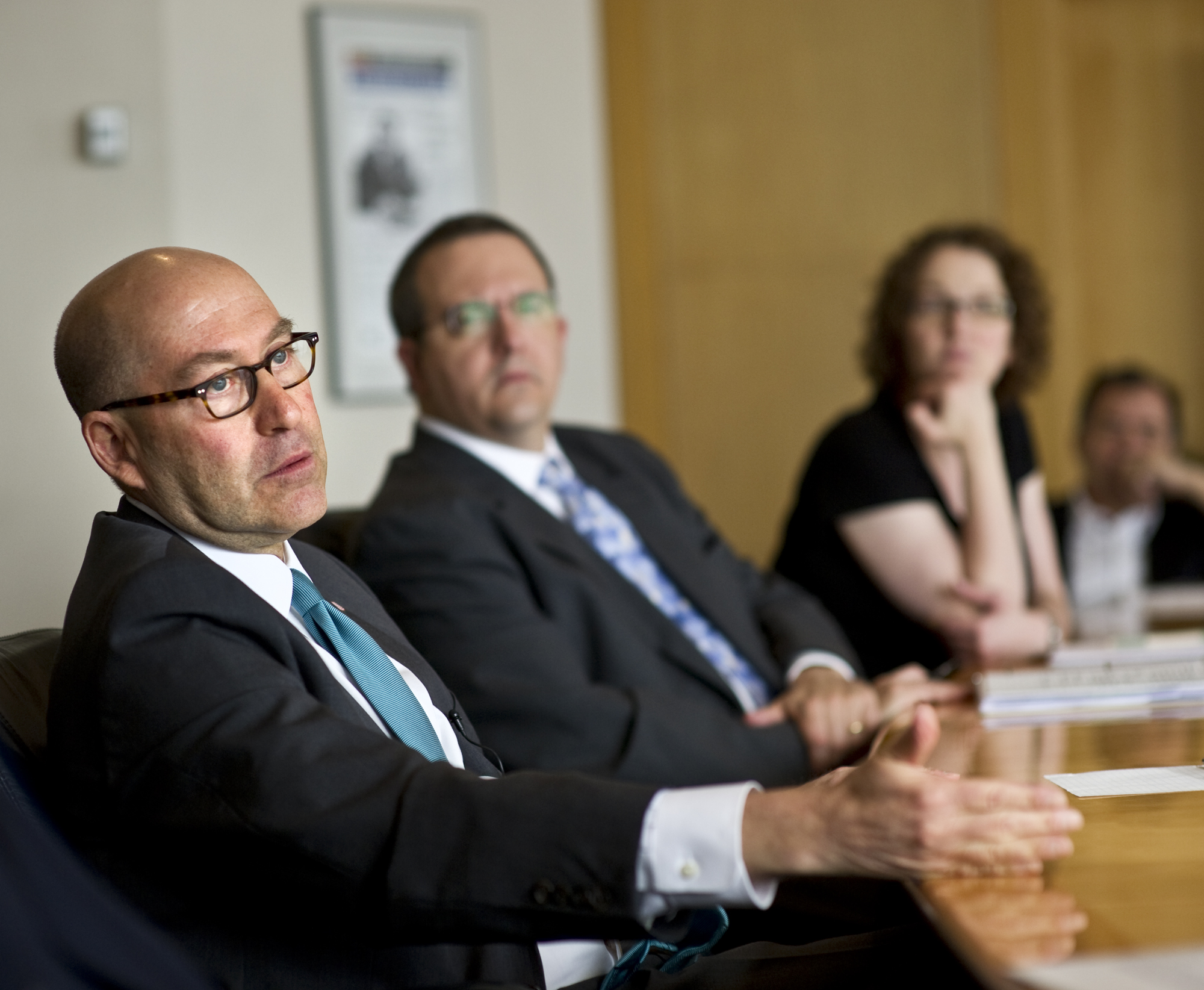
U.S. ambassador to Canada during the Obama administration, then vice chair of BMO until 2024, David Jacobson turns 74…
Founder, executive chairman and now retired CEO of C-SPAN, known for his unique interview style, Brian Lamb turns 84… Retired federal government manager and analyst, Charles “Chuck” Miller… Associate professor of Jewish history at the University of Maryland, Bernard Dov Cooperman turns 79… Burbank, Calif., resident, Richard Marpet… Commissioner of Major League Soccer since 1999, Don Garber turns 68… VNOC engineer at Avaya until a few months ago, David Gerstman… Attorney at Wilkes Artis, Eric S. Kassoff turns 65… Retired director of Jewish learning at the Brandeis School of San Francisco, Debby Arzt-Mor… Managing director and financial advisor at Morgan Stanley Private Wealth Management and chair emeritus of DMFI, Todd Richman… Best-selling author and motivational speaker, Simon Sinek turns 52… Rosh yeshiva at Yeshivas Elimelech following 17 years as rabbi at Ohev Shalom Synagogue in Washington, D.C., Rabbi Shmuel Herzfeld turns 51… Musician and singer, Neshama Carlebach turns 51… Member of the Knesset for Yesh Atid, Karin Elharar Hartstein turns 48… SVP for Jewish education, community and culture at Hillel International, Rabbi Benjamin Berger… Partner at Left Hook Strategy, Justin Barasky… CEO at Denver-based energy firm Nexus Energy Partners, he was the national board chair of Moishe House (now known as Mem Global) until 2022, Ben Lusher… Senior director of state and international affairs at the U.S. Chamber of Commerce Institute for Legal Reform, David Meyerson… Stand-up comedian and two-time Emmy Award-winning television writer, Ian Karmel turns 41… VP of portfolio management for LEO Impact Capital, Lily Goldstein… Counsel in O’Melveny’s NYC office, he was an executive assistant and advance associate in the Obama White House, David Cohen… Physical therapist in Montreal, Chaya Notik… VP at L’Oréal, Jason Kaplan turns 35… Senior manager of policy communications at Snap, Julia Schechter… Israel-based senior associate at JP Morgan Payments, Daniel Rubin… Manager of in-stock management at Amazon in NYC, Kayla Levinson Segal… Security coordinator of Kibbutz Nir Am on Oct. 7, 2023, now an Israeli heroine after her team killed 25 terrorists and the kibbutz suffered no casualties, Inbal Rabin-Lieberman turns 27… Foil fencer, he won a team bronze medal at the 2020 Olympics (Tokyo) and an individual bronze medal at the 2024 Olympics (Paris), Nick Itkin turns 26…
Israeli media reports have said that Hamas could begin freeing hostages as early as Saturday, without the mass propaganda events that marred previous hostage releases
Liri Agami
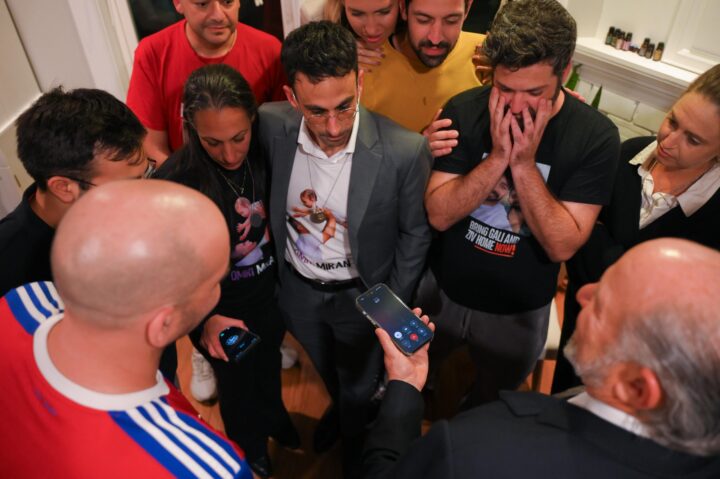
Former hostages and hostage families, meeting with Commerce Secretary Howard Lutnick, speak to President Donald Trump following Trump's announcement that Israel and Hamas had reached an agreement to free the hostages.
It’s a “morning of historic and momentous news,” as Israeli President Isaac Herzog put it on Thursday, when Israelis woke up to learn that a deal had been reached to free the remaining hostages in the coming days and halt the fighting in Gaza.
The sides are expected to officially sign the deal in Egypt today, and Israel’s Cabinet is set to vote at 11 a.m. ET on the exchange of the 48 hostages, 20 of whom are thought to be alive, for close to 2,000 Palestinian prisoners. The IDF said it began preparing to withdraw from parts of Gaza as part of the deal.
Hamas is expected to release the Israeli hostages first. Only when Israel is satisfied that the terrorist group has freed everyone it can find — including the remains of about 28 Israelis who were killed — will Palestinian prisoners be released. The swap comes with caveats: Hamas says it is unable to locate some of the bodies, and about 250 of the Palestinian prisoners set to be released are serving life sentences for terrorist offenses, though Israel insisted that high-profile detainees — such as Second Intifada mastermind Marwan Barghouti — will not be part of the deal.
The deal is expected to pass easily in the Cabinet, with Israeli Prime Minister Benjamin Netanyahu’s Likud party holding the majority of the seats. National Security Minister Itamar Ben-Gvir, who expressed opposition earlier this week to President Donald Trump’s plan to end the war, was unusually quiet on Thursday morning, while Finance Minister Bezalel Smotrich said he would not vote in favor.
Trump said in an interview with Fox News that all of the hostages “will be coming back on Monday. … As we speak, so much is happening to get the hostages freed.”
Israeli media reports have said that Hamas could begin freeing hostages as early as Saturday, without the mass propaganda events that marred previous hostage releases.
Israeli Ambassador to the U.S. Yechiel Leiter made clear that only the first phase of the deal had been agreed on, and the end of the war can only come after it is implemented.
“We hope it leads to a complete cessation of hostilities and a rebuilding of Gaza for the sake of the Gazans and for the sake of Israel, but it’s the first stage, and we’ve got to see the first stage implemented completely,” Leiter told CNN.
Trump is expected to fly to Israel over the weekend to celebrate the release of the hostages and address the Knesset, following an invitation from Netanyahu. The Hostages Families Forum invited Trump to meet with families and give an address in Tel Aviv’s Hostages Square during his trip. U.S. Special Envoy Steve Witkoff and Trump’s former Middle East advisor, Jared Kushner, are expected to arrive in Israel later Thursday.
“We can finally breathe again, embrace those we feared we would never hold, and bring to dignified burial those we have lost. … We simply need the opportunity to look you in the eye and express what words alone cannot fully convey: that you gave us back our families, and with them, our hope,” the hostage families’ group wrote to Trump.
A delegation of released hostages and hostages’ relatives were in Washington, meeting with Secretary of Commerce Howard Lutnick, when the deal was announced. With the president on Lutnick’s speakerphone, members of the group thanked the president for his efforts.
The Tikvah Forum, made up of more hawkish hostage families, said that the news “gives us hope. We are full of hope that … we will merit to embrace our loved ones soon. Thank you to everyone who acted to bring them all back, especially our brave soldiers.”
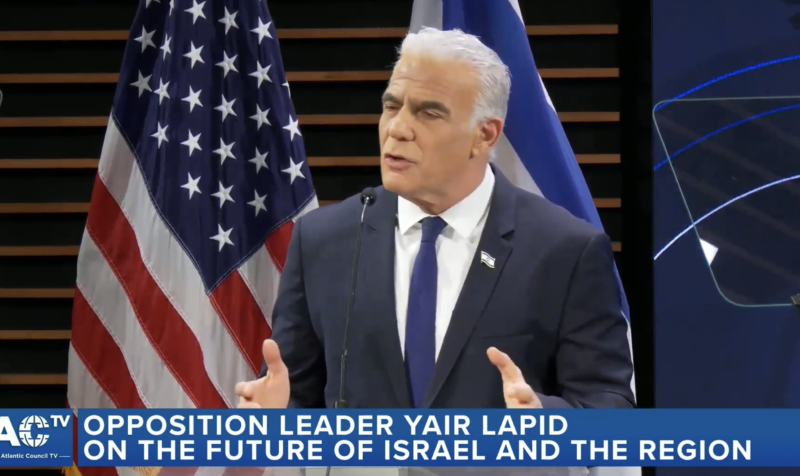
Opposition leader Yair Lapid called for Trump to be awarded the Nobel Peace Prize, echoing a recent call from hostage families who nominated the president for the award.
Earlier in the week, senior figures from several of the countries involved in the talks headed to Egyptian resort town Sharm el-Sheikh to close the deal, including Witkoff, Kushner, Israeli Strategic Affairs Minister Ron Dermer, Qatari Prime Minister Sheikh Mohammed bin Abdulrahman al-Thani and Turkish Intelligence Minister Ibrahim Kalin.
Negotiators hammered out the details of the first phase of Trump’s 20-step deal — the hostage release — along with Israel’s initial lines of withdrawal. According to the plan Trump announced last month, Israel would only withdraw from Gaza City in the first stage, but subsequent Israeli media reports indicate that Jerusalem agreed to a withdrawal from parts of Khan Younis, as well.
The talks in Egypt began after Hamas stated last week that it was willing to exchange the hostages for Palestinian prisoners. The terrorist group rejected other components of the Trump plan, such as laying down its arms and the demilitarization and deradicalization of Gaza, yet Trump said he views Hamas as “ready for a lasting peace.”
Netanyahu said in a subsequent statement that this was a new concession from Hamas in that they agreed to free the hostages “while the IDF remains deep within the [Gaza] Strip.” The Trump plan would also have the IDF remain in a buffer zone along Gaza’s perimeter, including the Philadelphi Corridor between Gaza and Egypt.
Other issues under negotiation include who will be part of the temporary technocratic administration governing Gaza and the “Peace Board” led by Trump, with former British prime minister Tony Blair taking part, as well as, potentially, Apollo Global Management CEO Marc Rowan.
‘It’s bad for Israel and bad for America,’ an Israeli diplomat told JI this week
GETTY IMAGES
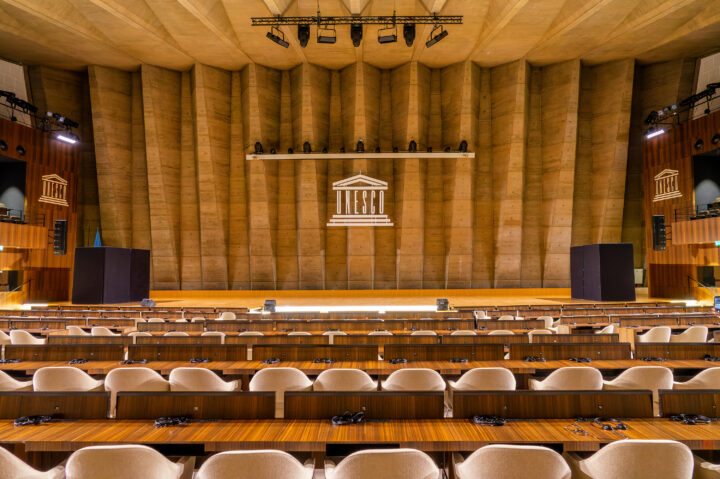
Inside of the grand auditorium of UNESCO headquarters building in Paris, France
Israel is eyeing the upcoming United Nations Educational, Scientific and Cultural Organization executive board meeting with concern, with Egypt and Qatar poised to take influential roles in the body.
Qatar is set to take the body’s chairmanship, and former Egyptian Tourism and Antiquities Minister Khaled el-Enani is considered a leading candidate for the organization’s director-general.
UNESCO is focused on international cooperation in education, culture and science and communication. Its most prominent project is its list of World Heritage Sites that members pledge to safeguard and adhere to global norms for preservation. Its annual budget in recent years has been about $1.5 billion.
The Jewish state has historically faced challenges in UNESCO, which ratified multiple resolutions in the past decade declaring the Temple Mount, Western Wall and the Old City of Jerusalem to be endangered Muslim and Christian sites, while excluding the millenia-old Jewish connection. The “State of Palestine” has been a full member of UNESCO since 2011, and the organization recognizes five Palestinian heritage sites, including the Cave of the Patriarchs in Hebron, a Jewish and Muslim holy site; UNESCO resolutions relating to Hebron have also left out its Jewish history. In 2009-2014, UNESCO approved 46 resolutions widely viewed as critical of Israel.
Yet, in recent years, with former French Culture Minister Audrey Azoulay at the helm of UNESCO — the first Jewish person to hold the position — the organization managed to lower the temperature over contentious issues in the Middle East, and she pushed for the advancement of Holocaust education and the fight against antisemitism. Azoulay will complete her second term in November; the departing chairperson of the UNESCO Executive Board is Vera Lacoeuilhe of Saint Lucia.
The UNESCO Executive Board Meeting will begin on Wednesday in Paris and continue for two weeks, during which the new board chairperson and director general will be selected. The director general must receive a majority vote on Oct. 6, while the executive board chairmanship rotates between geographic blocs and the Middle East bloc agreed to put Qatar in the role.
With two Arab countries expected to assume UNESCO’s leading positions, some observers have expressed concern that Israel may again face disproportionate scrutiny and criticism — a pattern seen in other U.N. bodies where geopolitical tensions often rise to the surface.
The Trump administration left UNESCO earlier this year. The first Trump administration departed the organization in 2017, after which the Biden administration returned. Washington is left with little influence to help Israel or push back against decisions it may view as against its own interests.
“It’s an odd situation where we have announced we are leaving, so it matters far less to us,” former Trump administration official and Foundation for Defense of Democracies Senior Advisor Rich Goldberg told Jewish Insider. “In fact, it reinforces how broken the agency is and why we should be in opposition to it, not in the middle of it.”
The potential new leadership of UNESCO is “bad for Israel and bad for America,” an Israeli diplomat told JI this week.
An Israeli diplomatic source said that it is an “unusual combination to have a director general and chairman of the executive board from Arab countries. It puts Israel at a disadvantage. … Israel is not a member of the executive board and has no influence on who will be chairman.”
Still, Israel tried to advocate for friendlier candidates in the past year, though the diplomatic source called the effort “somewhat pointless, because they have an almost automatic majority. There’s a bloc of Muslim countries, and those who support Qatar.”
Qatari Ambassador to UNESCO Nasser bin Hamad Al Hanzab is a leading candidate to chair UNESCO’s Executive Board for the next two years, according to diplomatic sources.
Qatar is one of the largest donors to UNESCO, contributing millions of dollars in the last decade and hosting a regional office in Doha, whose expenses are covered by the Qatar Fund for Development. The Gulf state’s Sheikha Moza Bint Nasser is a UNESCO Special Envoy for Basic and Higher Education.
Qatar is also one of the top donors to the U.N., broadly, increasing its contributions since 2020, including pledging over $1 billion to humanitarian agencies in 2018 and 2020.
“Qatar has the money and the influence,” the Israeli diplomatic source said. “It’s a game where the result is known in advance. There isn’t a lot that can be done.”
Goldberg said that “the Qataris have learned from the Chinese how to leverage international organizations for global legitimacy and national interests. We now must come to terms with a U.N. where both the [Chinese Communist Party] and the [Qatar-backed] Muslim Brotherhood seek control of U.N. bodies to advance their interests and undermine America’s.”
“They’ve poured billions into cultural and educational influence across the world,” he added. “This is a logical U.N. body for Qatar to co-opt.”
El-Enani is an archeologist by profession and a professor of Egyptology. During his tenure as Egypt’s minister of tourism and antiquities, Cairo put substantial effort and resources into refurbishing its ancient sites, such as Luxor.
A diplomatic source said that Qatar is actively backing el-Enani, who played a role in strengthening the Gulf state’s ties with Egypt, after years of tensions between the countries due to Doha’s sponsorship of the Muslim Brotherhood and Al Jazeera, which supported the overthrow of the Egyptian government in 2011. Qatar is one of the largest sponsors of the Giza Pyramids UNESCO World Heritage Site project led by el-Enani when he was in government. El-Enani has been featured at events hosted by Qatari embassies around the world in recent years.
Journalists across the Middle East have also accused el-Enani and his campaign of corruption. Doha-based journalist Mohammed Al-Qadusi published a recording that he said was a conversation between Egyptian Foreign Minister Badr Abd-Ela’ati with Egyptian Ambassador to the Netherlands Emad Hana in which the latter suggested offering a gift to UNESCO executive board members to improve his chances of winning. Egyptian TV anchor Mohammed Naser said in an on-camera monologue that el-Enani represents a “corrupt regime” and had misused public funds, allowed for the destruction of archeological sites and lacked transparency when spending on large events.
Coptic Christians have spoken out against el-Enani’s candidacy, saying that Egypt violated UNESCO’s rules for World Heritage Sites by declaring a historic monastery property of the state and noted Cairo’s systemic discrimination against the minority population, which makes up 12-15% of Egyptians.
El-Enani is running against Firmin Edouard Matoko, a former senior UNESCO official from Congo, and Gabriela Ilian Ramos Patino of Mexico, a former senior official at UNESCO and the OECD.
The Israeli diplomatic source said that “who the director-general appoints to key roles, such as his deputies and the head of departments will be significant.”
He also said it is unclear where el-Enani will stand on Israel-related matters — the options likely being either sympathetic to the Palestinians or seeking to avoid controversy as UNESCO has done in recent years, by watering down Palestinian resolutions’ texts so that they do not attack or delegitimize Israel.
But if the Palestinians propose resolutions that are hostile to Israel, “the automatic majority brings them success in almost everything. [Israel is] fighting defensively. … We aren’t abandoning this arena to the Palestinians. We make sure to emphasize with historic documents and archeological findings the Israeli connection to Jerusalem and Hebron,” he said.
In addition to advancing education, science and culture, UNESCO protects independent media and press freedom. Despite owning the Al Jazeera media empire, Qatar ranks 79th out of 180 in the World Press Freedom Index, and Egypt ranks 170th and is one of the world’s biggest jailers of journalists.
In the coming months, Israel plans to submit proposals to double its current number of UNESCO World Heritage Sites, 17. The list of 18 new sites includes ancient synagogues in the Upper Galilee and the Carmel Nature Reserve.
Israel also submitted a report to UNESCO earlier this year about damage caused by Iranian missile attacks to Tel Aviv’s White City, a World Heritage Site due to its Bauhaus architecture.
Sen. Ted Cruz is planning to reintroduce an updated version of legislation that he first sponsored nearly a decade ago

Tom Williams/CQ-Roll Call, Inc via Getty Images
Sen. Ted Cruz (R-TX) is seen outside a Senate Judiciary Committee markup on Thursday, November 14, 2024.
Following Sunday’s antisemitic attack in Boulder, Colo., on a group marching to raise awareness about the hostages held in Gaza, a bipartisan push is growing on Capitol Hill to designate the Muslim Brotherhood as a terrorist organization.
Mohamed Sabry Soliman, the assailant, an Egyptian citizen who lived in Kuwait for 17 years prior to arriving in the United States, appears to have expressed support for the group and Mohamed Morsi, the Muslim Brotherhood leader who previously served as Egypt’s president.
Law enforcement officials have not announced any further links between Soliman and the Muslim Brotherhood. Hamas is a Muslim Brotherhood affiliate, and the group is closely tied to Qatar.
Sen. Ted Cruz (R-TX) said on Tuesday that he plans to reintroduce a “modernized version” of the Muslim Brotherhood Terrorist Designation Act he previously led, adding, “the Muslim Brotherhood used the Biden administration to consolidate and deepen their influence, but the Trump administration and Republican Congress can no longer afford to avoid the threat they pose to Americans and American national security.”
The Washington Free Beacon first reported on Cruz’s efforts.
Rep. Jared Moskowitz (D-FL) separately wrote to President Donald Trump on Tuesday urging him to “conduct a comprehensive investigation” into designating the group as a foreign terrorist organization, noting that multiple U.S. allies and partners including Egypt, Saudi Arabia, the United Arab Emirates, Bahrain and Austria have already done so, and France is considering doing the same.
“It must be noted that such ideological influence not only fosters division but also encourages radicalization against the United States, our allies and the foundational principals that define our societies,” Moskowitz wrote. “Taking steps to investigate and designate the Muslim Brotherhood as an FTO would enhance the ability of U.S. law enforcement and intelligence agencies to disrupt financial networks and recruitment activities connected to its affiliates.”
The Muslim Brotherhood Designation Act backed by Cruz was first introduced in 2014 by former Rep. Michele Bachmann (R-MN). Cruz and Rep. Mario Diaz-Balart (R-FL) subsequently picked up the torch, reintroducing the bill in the subsequent four congressional sessions.
At its high-water mark, in 2016, the legislation picked up additional 71 co-sponsors, most of them Republicans, in the House, and seven in the Senate, and was reported out of the House Judiciary Committee by a 17-10 vote. When it was last introduced, the legislation picked up just 14 co-sponsors in the House and two in the Senate.
The bill as of 2021 would have directed the administration, within 60 days of passage, to assess whether the Muslim Brotherhood meets the criteria for designation as a foreign terrorist organization and to provide a “detailed justification” if it determines it does not.
Near the end of his first term, Trump was expected to designate the Muslim Brotherhood as a terrorist group but that move never materialized.
Rep. Randy Fine (R-FL), who on Monday told Jewish Insider that the Council on American-Islamic Relations should also be designated as a terrorist group, told JI on Tuesday that he had reached out to Cruz to offer to lead the Muslim Brotherhood legislation in the House.
“That’s really the nexus of all this,” Fine said, accusing the Muslim Brotherhood of funding CAIR, Students for Justice in Palestine and other anti-Israel groups. “None of what we’ve seen in America is organic … Look, if Saudi Arabia and the UAE don’t want them and Egypt doesn’t want them, maybe you ought to take a hint.”
He described CAIR as the “mouthpiece” of the Muslim Brotherhood in the United States and said that designating the Muslim Brotherhood would inevitably wrap in CAIR and SJP. CAIR’s leader met with members of the Muslim Brotherhood as recently as 2022, and has been linked to other Brotherhood-affiliated groups. CAIR has praised the Muslim Brotherhood as a moderating force with which the U.S. should engage.
SJP and its parent group, American Muslims for Palestine, have also been accused of having grown out of Muslim Brotherhood networks in the U.S.
Rep. Debbie Wasserman Schultz (D-FL) told JI she hasn’t been contacted about the effort to designate the group yet, “but I can think of no reason why I wouldn’t support that.” She added, “I am surprised — how has that not already happened?”
Please log in if you already have a subscription, or subscribe to access the latest updates.
 Continue with Google
 Continue with Apple